
Author: admin
How Does a Fermentation Airlock Work

You've sealed a jar of sweet tea and a SCOBY on the kitchen bench, and now you're waiting for the first sign of life. Then it happens: bloop. That small sound is satisfying, but it isn't the airlock “making” fermentation happen. It's carbon dioxide finding a safe exit while the fermenter stays protected.
So, how does a fermentation airlock work? Think of it as the immune system of the fermenter. It releases pressure from active cultures while helping keep oxygen, airborne microbes, mould spores and insects out. For delicate probiotic cultures, including kombucha SCOBYs, that controlled environment helps you avoid turning a carefully prepared brew into an unpredictable experiment.
The First Bloop and Why It Matters
The first bloop often arrives after a quiet stretch. Your jar looks unchanged, the tea is resting, and nothing seems to be happening. Then pressure from inside moves through the airlock and sends a bubble through the liquid trap. That sound tells you gas is escaping, not that the airlock is measuring the exact health or speed of fermentation.
In a Hunter Valley kitchen, where warm days can make a ferment feel lively, that little device gives the brew a safer outlet. Australian homebrewing guidance describes a fermentation airlock as a one-way pressure release device. It allows carbon dioxide to bubble out through water or sanitiser while helping prevent outside air, oxygen and airborne microbes from re-entering the fermenter. Green Living Australia's fermentation airlock guide explains this closed-system approach in practical terms.
More than a plastic accessory
A fermenting culture produces gas as it works through available sugars. If the vessel has no controlled release path, pressure can build inside. If the vessel is left wide open, the brew has a much easier route for unwanted exposure.
The airlock sits between those extremes. It keeps the main vessel closed, then gives internal gas a narrow, controlled pathway through a liquid or silicone seal. That balance matters for kombucha because the brew contains living cultures whose environment affects flavour, aroma and texture.
The first bloop is reassuring, but the real job is quieter. The airlock protects the fermenter even between bubbles.
A visible airlock also changes how you brew. Instead of repeatedly opening the lid to inspect the liquid, you can observe the setup from outside. The less you disturb the vessel, the easier it is to maintain the conditions you created at the start.
The important distinction is this: an airlock supports fermentation, but it doesn't replace clean equipment, a suitable vessel or sensible temperature management. It's one part of a controlled process, and a small part with a very important protective role.
The Science of the One-Way Water Trap
The classic liquid airlock works through a simple pressure difference. Fermenting yeast and bacteria produce carbon dioxide. As that gas accumulates in the headspace, pressure inside the vessel becomes greater than the pressure outside.
The gas then pushes into the airlock's internal tube. It travels through the liquid chamber and escapes as bubbles. Once the pressure equalises, the liquid settles back into place, ready to resist air moving in the opposite direction.
A simple way to picture the mechanism
Think of the water trap as a doorway with a spring that only opens when pressure comes from inside. Carbon dioxide can push through because the fermenter is producing it. Outside air doesn't have the same pressure advantage, so it can't travel backwards through the liquid and into the jar.
Australian guidance commonly recommends filling the chamber with water or sanitiser, often to about half full or to the marked line. The liquid column forms the barrier. If evaporation lowers the level too far, the seal can weaken, so the airlock needs occasional visual attention. Pantry Culture's explanation of fermentation airlocks also highlights why a bubbling airlock shouldn't be treated as a calibrated fermentation meter.
The airlock must remain above the fermenting liquid. It isn't designed to touch the brine, wort or kombucha itself. Keeping it raised reduces the chance of dirty liquid travelling back into the airlock chamber and helps prevent contamination from entering through the pressure-release path.
Why low oxygen matters
A closed fermenter doesn't mean the contents are isolated from every biological process. It means you're limiting unnecessary contact with the outside environment while the culture develops.
Oxygen exposure can alter the balance you're trying to create. Unwanted airborne organisms can enter through an unprotected opening, and insects can carry contamination into a sweet ferment. The airlock creates a practical boundary, allowing the culture to release gas without leaving the vessel exposed.
That doesn't mean every kombucha process must use an airlock in exactly the same way. Vessel design, fermentation stage and recipe all matter. The useful principle is consistent: give carbon dioxide an exit while making re-entry difficult.
For readers exploring other botanical ingredients, organic hops flowers can be a useful resource when learning how different plants contribute aroma and character to fermentation-inspired drinks. Keep additions appropriate to the recipe and remember that an airlock protects the process, not the ingredients themselves.
The key sequence is straightforward:
- Fermentation produces CO2. Internal pressure begins to rise.
- Pressure enters the airlock. Gas moves through the central passage.
- The liquid barrier releases gas. CO2 bubbles through and escapes.
- The seal discourages reverse flow. Outside air and airborne contaminants remain outside.
That's the whole principle. The design is simple, but the result is a more controlled environment for your ferment.
Choosing the Right Airlock for Your Vessel
Your vessel determines which airlock will feel easiest to live with. A wide-mouth Mason jar needs a different fitting from a bucket or demijohn, and a vigorous ferment may benefit from a design that's easy to inspect and clean.
Australian suppliers describe two broad approaches: traditional liquid-seal airlocks, such as S-shaped models, and waterless silicone valves that self-seal. Nourish Me Organics' pickle pipe listing describes a silicone design that screws onto wide-mouth Mason jars and doesn't need daily burping, while S-shaped airlocks use pre-boiled water or sanitiser as the barrier.
Airlock types compared
| Airlock Type | Best For | Maintenance Level | Key Advantage |
|---|---|---|---|
| S-shaped airlock | Standard buckets, carboys and demijohns | Moderate | Simple liquid barrier and familiar design |
| Three-piece airlock | Ferments where easy disassembly matters | Moderate | Parts separate for cleaning and inspection |
| Silicone waterless airlock | Wide-mouth Mason jars and compact setups | Low | Self-sealing valve without a liquid chamber |
The S-shaped model
The S-shaped airlock is the traditional bubbler. You add liquid to the chamber, fit it into a bung or grommet, and watch for bubbles as gas moves through. It works well with common brewing vessels and makes the pressure-release process visible.
Its main drawback is cleaning the curves. Sediment or foam can collect in places you can't easily see, so you'll want to rinse it thoroughly after use.
The three-piece version
A three-piece airlock has separate components inside the chamber. That makes it easier to take apart, wash and inspect than a single curved tube. It can be a practical choice for brewers who prefer to see every surface before sanitising.
For a larger fermenter, the most important question isn't whether the airlock looks impressive. Check whether the bung, grommet and lid opening match, and whether the vessel gives active fermentation enough room.
The silicone waterless valve
A silicone valve suits a different style of brewing. It uses a self-sealing slit rather than a water chamber, which means there's no liquid level to monitor or refill. This can be handy for a small Mason jar ferment where a low-profile lid is part of the appeal.
The trade-off is that you lose the visible water-trap bubbles. You'll need to judge progress using the ferment itself and your chosen process checks rather than relying on movement in the valve.
For a suitable starting point, explore Pep Tea's kombucha brewing container and compare its vessel design with the airlock style you already use. Match the hardware to the lid, the batch size and the amount of monitoring you're realistically prepared to do.
Setting Up Your Airlock for a Perfect Seal
A good airlock can only work when the rest of the vessel is sealed properly. If the lid leaks around its rim, carbon dioxide may escape through that gap instead of passing through the airlock. The brew can still be fermenting, but the airlock may remain quiet and the vessel may have less protection from outside exposure.
Five checks before fermentation begins
Clean and sanitise the parts. Wash the vessel, lid, bung or grommet, and airlock so residue doesn't interfere with the seal or introduce unwanted organisms.
Confirm the lid opening. Australian brewing documentation commonly specifies a 13–14 mm hole for the grommet or bung used with standard airlock fittings. Pitch & Pour's first beer guide gives this practical fitting detail alongside the recommendation to use a half-filled sanitiser solution.
Fill the chamber correctly. Add water or sanitiser to the marked line, or approximately half full where the airlock design uses that guidance. Don't overfill, because vigorous fermentation can push liquid into places you don't want it.
Insert the airlock upright. Press the bung or grommet firmly into place, then fit the airlock vertically. The upright position helps the liquid remain in the intended channels.
Seal the vessel firmly. Tighten or secure the lid before fermentation becomes active. A loose lid gives gas an easier escape route and can make the airlock appear inactive.
Keep the airlock above the liquid
The airlock should sit above the kombucha, wort or brine, not down in it. That arrangement gives pressure a clear route out and reduces the risk of liquid travelling into the chamber.
Leave enough headspace for foam and movement. A vigorous ferment can send krausen or other foamy material into the airlock, particularly when the ferment is warmer and more active. If foam reaches the chamber, clean and sanitise the airlock before returning it to service.
For a dedicated vessel, Pep Tea's fermenting glass jar is another option to consider when you're choosing a container and planning how the lid, seal and airlock will work together.
Practical rule: A silent airlock with a properly sealed vessel deserves a closer look, not immediate panic. A bubbling airlock with a poorly fitted lid deserves attention too.
Reading the Bubbles and Managing Temperature
A lively stream of bubbles can be reassuring when you are watching a new ferment, but it is not a speedometer. A quiet airlock is not proof that fermentation has stopped either. The airlock is better understood as the fermenter's immune system: it helps keep fresh oxygen and unwanted microbes out while allowing pressure to escape. That protection matters especially for delicate probiotic cultures, such as a kombucha SCOBY, which can be affected by unnecessary oxygen exposure and contamination.
The airlock only displays gas passing through its liquid or valve. If carbon dioxide slips around a loose lid, a damaged seal or another leak, fermentation may continue without visible activity. Judge progress with the evidence suited to the brew, such as gravity readings, recipe timing and sensory checks, rather than bubbles alone. Pantry Culture's airlock guidance also points brewers towards gravity readings when assessing completion.
What bubbles can tell you
Bubbles show that pressure is changing inside a sealed vessel and that gas has found the intended exit. That is useful information, but it answers only one question.
They cannot reliably tell you:
- Fermentation speed. Bubble frequency shifts with pressure, temperature and seal quality.
- Completion. A quiet airlock may indicate a slower ferment, a finished ferment or gas escaping elsewhere.
- Culture health. Bubble activity cannot reveal the brew's flavour balance, acidity or wider microbial activity.
For beer, the Pitch & Pour brewing workflow keeps wort at 18–22°C, lets primary fermentation run for 10–14 days, then checks final gravity, with a suggested finishing target around 1.010–1.014. Those figures apply to that beer process, not to every kombucha recipe. The brew-day checklist emphasises checking gravity instead of repeatedly opening the fermenter.
Temperature changes the rhythm
Temperature changes how actively a culture produces gas. Australian brewing guidance commonly targets 18–20°C for ale fermentations and notes that active fermentation can raise wort temperature by about 2–4°C above ambient. Pitch & Pour's four-week fermentation plan links warmer conditions with increased CO2 production and a greater chance of krausen reaching the airlock when headspace is limited.
The same principle helps with non-beer ferments. Warm conditions can make activity more vigorous, so allow more room above the liquid and check the airlock more often. Cooler conditions can quiet the bubbling without stopping the culture.
If a ferment appears stuck, inspect the seal and temperature, then look for process evidence before changing the recipe. Pep Tea's guide on how to restart a stuck fermentation offers a practical way to work through an inactive ferment without relying on bubbles alone.
Read the ferment, not just the plastic. Use recipe timing, sensory checks and suitable measurements to work out what is happening.
Pressure fermentation uses different equipment. A spunding valve holds controlled pressure, with KegLand guidance recommending 10–12 psi for most fermentations and warning that pressure should never reach or exceed 35 psi. The guidance also says pressure may need checking and adjustment every 15 minutes while the target is being reached. KegLand's pressure fermentation guidance highlights the difference: a basic airlock vents gas, while a spunding valve controls internal pressure.
Maintenance Habits for Long-Term Brewing Success
An airlock is reusable, but it isn't maintenance-free. Liquid can evaporate, foam can enter the chamber and residue can hide in narrow channels. A quick visual check protects the function of the device and helps you catch problems before the next batch.
During active fermentation, look at the liquid level and confirm that the airlock remains upright. If the chamber is drying out or the seal has been disturbed, correct it with the appropriate water or sanitiser solution for that design.
A simple cleaning routine
Australian retailers recommend cleaning reusable airlocks between uses with warm soapy water, followed by thorough rinsing and complete drying before sanitising. Pitch & Pour's brewing checklist provides that cleaning sequence as part of its equipment care guidance.
- Rinse promptly: Remove residue before it dries inside the chamber.
- Wash carefully: Move warm soapy water through every channel and removable part.
- Rinse completely: Don't leave detergent behind.
- Dry fully: Allow the parts to dry before the next sanitisation step.
- Sanitise before use: Reassemble only after the components are ready for the new ferment.
If a sudden temperature change pulls sanitiser or water back towards the vessel, stop and assess the batch rather than ignoring it. Clean the airlock, check the liquid level and review the seal before continuing. The best response depends on what entered the ferment and the stage of your process.
A well-maintained airlock won't make every ferment identical, but it gives your living cultures a cleaner, steadier environment. Once you understand that, the bloop becomes more than a cheerful kitchen sound. It's a small sign that your fermenter has a safe route for pressure and a protective barrier against the outside world.
Pep Tea offers Australian-brewed, sugar-free organic kombucha from the Hunter Valley, NSW, alongside organic Japanese Matcha for everyday tea rituals and café menus. Visit Pep Tea to explore the range, learn more about fermentation, and choose a clean, naturally brewed drink for your next pour.
How to Restart a Stuck Fermentation at Home

You lift the lid expecting movement and find a quiet surface. The airlock has stopped, the kombucha culture is sitting still, or the hydrometer has delivered the same reading for days. That silence doesn't automatically mean the batch is lost, but it does mean you should stop guessing.
The practical approach to how to restart a stuck fermentation begins with diagnosis, not another handful of yeast. Australian wine-industry guidance places particular emphasis on prompt action, controlled temperature, oxygen management and gradual re-inoculation, while kombucha makers need an added safety check because a stalled, low-acid beverage can become a food-safety concern. The methods below connect those principles for home brewers, with clear limits on when rescue is sensible and when discarding is the better decision.
When Your Ferment Goes Quiet
The first reaction is usually hopeful denial. You move the fermenter, check the airlock seal, or wait for the SCOBY to shift. In wine, you take another hydrometer reading. In kombucha, you look for a new pellicle and wonder whether the culture is merely taking a rest.
Sometimes it is. A loose lid or imperfect airlock can hide active fermentation, and a surface culture can work without dramatic movement. The decisive clue is a flat gravity reading, supported by temperature, aroma and pH observations. A quiet airlock alone isn't proof of a stuck ferment.
The cost of waiting
A stalled batch still contains fermentable material. Residual sugar in a warm vessel can support unwanted microbial activity, particularly when the culture has weakened and protective acidity or alcohol hasn't developed as intended. That doesn't mean every quiet batch is spoiled, but it does mean the vessel shouldn't be left unattended while you hope for a recovery.
Australian guidance from the Australian Wine Research Institute advises that problematic ferments shouldn't be left to resolve by themselves. Its rescue approach keeps the ferment under controlled conditions and uses a staged culture acclimatisation process rather than shocking fresh yeast with the entire difficult environment at once.
Practical rule: Diagnose promptly, then make one controlled change at a time. Random warming, aeration and repeated yeast additions make the original problem harder to identify.
For wine, the payoff of quick action is a cleaner restart with less oxidation and less time for spoilage organisms to establish themselves. For kombucha, the payoff is different. You may decide that the batch isn't suitable for rescue, especially if the pH hasn't reached a sufficiently acidic level or the aroma has moved beyond a clean tart profile.
A stuck fermentation is an inflection point, not a verdict. The brewers who rescue the most batches don't rely on bubbling as their only signal. They measure, smell carefully, protect the liquid from unnecessary oxygen and choose an intervention that matches the cause.
Reading the Signs of a Stuck Fermentation
Before adding nutrient or pitching a rescue culture, establish whether fermentation has stopped. Use three checks in order: sensory condition, gravity movement and acidity.
Start with the sensory read
Open the vessel only as much as necessary. A healthy ferment may smell fruity, yeasty, tart or grain-like, depending on the beverage. A sharp vinegar character, solvent-like aroma, persistent sulphur, rotten-egg notes or a harsh chemical smell points towards stress or contamination rather than a simple temperature-related pause.
Look at the surface and sediment. A settled SCOBY with no fresh pellicle development can support the suspicion of inactivity, but it doesn't prove failure. Ropey or stringy texture, visible mould, unusual colours or a surface that looks dry and contaminated should move the batch towards discard rather than experimentation.
Measure movement, not bubbles
Take a hydrometer reading using a sanitised sample, record the temperature, and repeat the reading after enough time has passed to show whether the liquid is moving. A flat line across 48 to 72 hours is the useful warning interval described in fermentation troubleshooting guidance from Precision Fermentation. Bubbling can stop because of a seal problem, but gravity tells you whether sugar conversion is continuing.
A refractometer can help with quick checks, though alcohol affects its reading. Use a hydrometer for the clearest home decision when alcohol is already present.
Check pH before you intervene
The supplied home-brewing ranges commonly used for diagnosis are:
- Kombucha: approximately 2.5 to 3.5
- Wine: approximately 3.0 to 3.8
- Beer: approximately 4.0 to 4.5
Treat these as practical comparison ranges, not universal guarantees. The key Australian food-safety point is that fermented beverages need to reach pH ≤ 4.2 to meet the cited safety requirement discussed by Food Regulation Australia New Zealand. A batch above that level after stalling deserves caution, not an automatic warm restart.
| Ferment Type | Healthy Gravity Drop | Stuck Threshold | Safe pH Window | Warning Signs |
|---|---|---|---|---|
| Kombucha | A downward trend with active acidity development | No meaningful gravity movement over the monitoring period | Approximately 2.5 to 3.5, with pH ≤ 4.2 a key safety requirement | Mould, ropey texture, vinegar, solvent or rotten aromas |
| Wine | A continuing downward hydrometer trend | A flat reading across 48 to 72 hours | Approximately 3.0 to 3.8 | Sulphur, solvent, vinegar, oxidation or unusual surface growth |
| Beer | A continuing gravity decline during active fermentation | A flat reading across 48 to 72 hours | Approximately 4.0 to 4.5 | Harsh acidity, solvent character, contamination or stalled krausen |
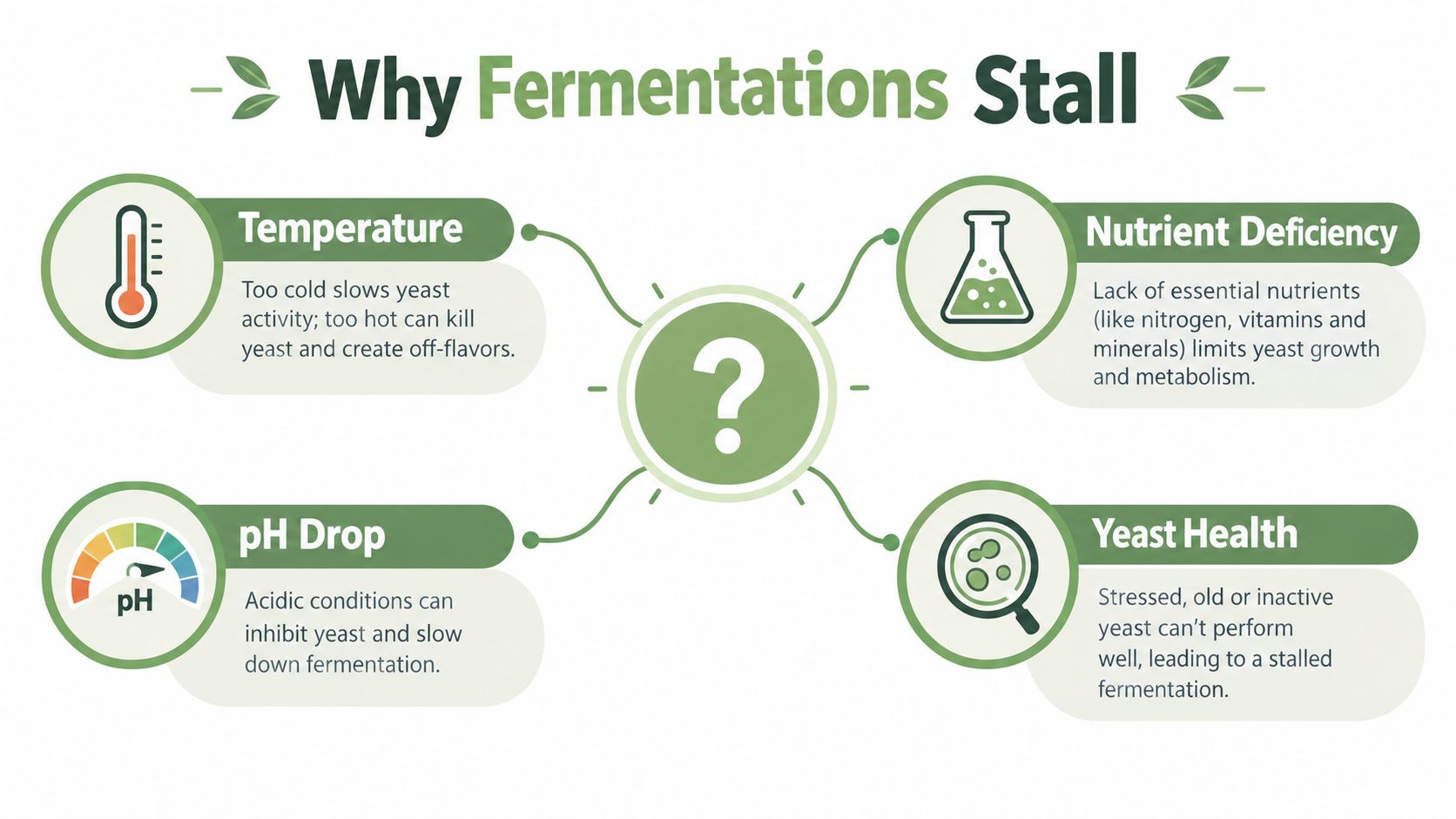
Why Fermentations Stall in the First Place
Every stalled ferment leaves a fingerprint. Temperature problems look different from nutrient exhaustion, and a weak culture behaves differently from bacterial competition. Identify that fingerprint before choosing the fix.
Temperature stress
Yeast work within a tolerance range. A sudden cold spell can make cells dormant, while excessive heat can damage viability or drive harsh flavours. In a cool, clean-smelling ferment with low turbidity and no obvious contamination, gentle warming may be enough to bring the existing population back into suspension.
Australian wine rescue guidance is more specific than the usual “warm it up” advice. It recommends bringing a stuck or sluggish bulk ferment to about 18 to 22°C, keeping it off ullage and protecting it with inert gas to reduce oxidation risk. For problematic ferments, the AWRI wine fermentation resources emphasise rapid management and controlled conditions rather than passive waiting.
Nutrient limitation
Yeast need more than sugar. A nutrient-poor must, wort or tea base can support an energetic start and then fail to sustain the culture. The pattern often includes strong early activity followed by a sharp slowdown, with the aroma remaining relatively clean while gravity stays high.
Nutrient additions aren't a universal cure. Adding more nutrient to a contaminated or excessively acidic batch can feed competing organisms as readily as it supports yeast. Use your measurements and the beverage's stage to decide whether nutrition is the limiting factor.
Yeast health and pitch strength
Old wine yeast, poorly rehydrated dried yeast, an under-pitched culture or a tired kombucha SCOBY may not contain enough healthy cells to finish. Rapid flocculation can also remove yeast from suspension before the available sugar has been consumed.
For kombucha, the culture's age and handling history matter, but don't assume a SCOBY is automatically a rescue culture. If the liquid around it smells wrong or hasn't acidified safely, transferring the culture into a fresh batch can spread the problem.
Oxygen and microbial competition
Alcoholic fermentation needs careful oxygen management. Once fermentation is established, unnecessary splashing can encourage oxidation and expose the liquid to organisms that produce unwanted acidity. Kombucha is a mixed culture, so oxygen management differs from wine, but contamination and pH imbalance can still redirect the process.
Brewers working with living cultures can also benefit from general colonisation troubleshooting principles, particularly around environment, contamination control and culture vitality. The Colorado Cultures colonization tips are written for a different fermentation context, but the diagnostic habit is useful: inspect the conditions before blaming the culture.
For basic kombucha culture preparation and handling, follow the practical steps in this kombucha SCOBY guide. The central lesson is simple. Temperature, nutrition, acidity, oxygen and culture health interact, so a single symptom rarely identifies the cause on its own.
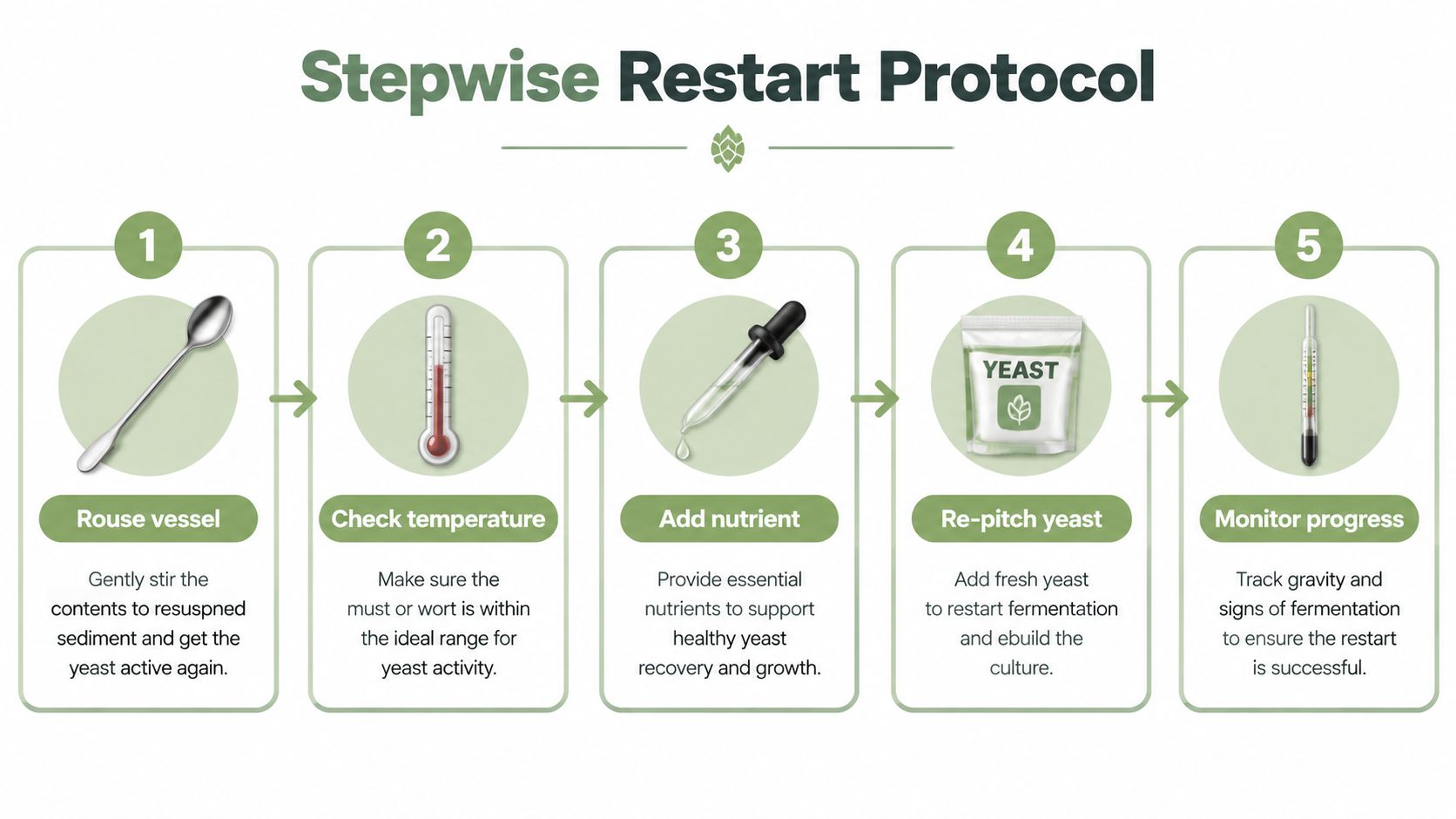
A Stepwise Restart That Respects the Yeast
A rescue culture enters a hostile environment. The stuck liquid may contain alcohol, depleted nutrients, high osmotic pressure or an unfriendly pH. Dumping a small amount of fresh yeast straight into that liquid often fails because the new cells experience the full stress immediately.
Australian AWRI-linked procedures use stepwise acclimatisation. The starter begins in a friendlier medium, then receives portions of the stuck wine only after its sugar has dropped by half. That gradual exposure lets yeast adapt to alcohol stress instead of facing a sudden full-volume repitch.
Prepare before pitching
Rouse gently. Mix the vessel carefully to lift settled yeast without aggressive splashing. In an alcoholic ferment, protect against oxidation rather than treating aeration as a default remedy.
Record baseline conditions. Measure gravity, pH and temperature. Work out how far the batch is from its intended finish, but don't use a gravity figure alone to justify a restart.
Set the temperature. AWRI guidance places rescue conditions around 20 to 22°C, while an Australian restart protocol specifies 20 to 24°C during the restart phase. A separate Lallemand procedure uses a starter mixture at 25 to 30°C, then requires tighter control as the culture is introduced to the wine.
Prepare a healthy starter. Use a selected, alcohol-tolerant rescue yeast. The detailed Lallemand restart procedure specifies hydration in 40 to 43°C water with GoFerm Protect Evolution at 30 g/hL, followed by 50 g/hL Uvaferm 43 Restart. Follow the product label and winery protocol rather than improvising equivalent quantities.
Acclimatise in stages. Add a small portion of stuck wine to the active starter. Wait until the starter's sugar has dropped by half, then add another portion. Repeat until the culture can handle the full batch. The AWRI-linked Australian guidance also specifies 25 g/hL of Nutrient Vit END before each restart batch, with only the final batch allowed to finish to dryness.
Keep the transition gentle
Don't create a sharp temperature shock. The Lallemand procedure advises that the wine temperature shouldn't change by more than 10°C during inoculation and recommends maintaining free SO2 near 7 to 8 ppm before restarting. Those details matter because a vigorous-looking starter can still collapse when it enters a chemically stressful wine.
For small home batches, the important principle is the sequence rather than pretending that a winery protocol can be copied without adjustment. Work with clean equipment, use measured additions, keep the starter active and add the difficult liquid progressively. Avoid adding extra fermentable sugar to force activity unless your recipe and nutrient plan specifically require it.
Monitor the restart
Check the starter and main vessel at regular intervals for:
- Temperature: Is it staying inside the chosen restart range?
- Gravity: Has the reading begun to move?
- Aroma: Is the clean ferment character returning, or is volatile acidity increasing?
- Surface activity: Are you seeing renewed foam, bubbles or culture development appropriate to the beverage?
- pH: Is acidity moving in a safe and expected direction?
- Oxidation: Has unnecessary headspace exposure or splashing changed colour or aroma?
The Carbon 6 Brewing fermentation blog provides useful background on observing fermentation as a process rather than relying on a single visual sign. If the starter never becomes active, stop escalating. Repeatedly pitching into an unsuitable batch doesn't make the environment more hospitable.
The following video provides a visual companion to the restart sequence.
Matching the Fix to the Cause
The best intervention is usually the least disruptive one that addresses the measured cause. A clean ferment that became quiet after a cold change doesn't need the same treatment as an acidic kombucha batch with bacterial competition.
Use the signal to choose the first move
| Likely Cause | Diagnostic Signal | Best Fix |
|---|---|---|
| Cold temperature | Clean aroma, low activity and a temperature below the culture's working range | Warm gradually and rouse gently |
| Nutrient deficiency | Strong early activity, then a stall with a relatively clean aroma and remaining fermentable material | Add a suitable complete nutrient only after checking pH and contamination |
| Oxygen starvation or poor yeast suspension | Yeast has settled, gravity is flat and the ferment looks unusually clear | Gentle rousing, with oxygen exposure kept appropriate to the beverage |
| Unhealthy yeast | Fresh temperature and nutrient conditions produce no renewed activity | Prepare and acclimatise a fresh rescue culture |
| Bacterial dominance or pH imbalance | Vinegar, solvent, harsh acidity, ropey texture or abnormal surface growth | Don't treat as a routine yeast restart. Assess safety and discard when indicated |
Temperature is the easiest fix to overuse. A sluggish ferment at a low temperature can respond well to controlled warming, but warming a high-pH batch with a suspicious aroma may just make bacterial activity more vigorous.
Nutrient addition also requires restraint. Australian restart guidance recommends a dedicated rescue process when the simple starter option isn't appropriate. Its technical thresholds distinguish a ferment with less than 10 g/L residual sugar and alcohol below 12% v/v, where active yeast or fresh yeast lees may be a first option, from a more difficult case requiring racking and a staged rescue culture. See the AWRI technical guidance for that severity-based logic.
Layer interventions in a sensible order
For a clean, cold batch, adjust temperature first and observe. If the reading remains flat, assess nutrition and yeast health before preparing a starter. If you need to repitch, use acclimatisation rather than a cold, full-volume dump.
Kombucha and sour beer require extra caution because mixed microbial communities can be affected by acidity and competing bacteria. Adding sugar may increase activity without improving the balance, while backsweetening only hides residual fermentables and can create renewed pressure in a sealed bottle. Dilution can lower intensity, but it doesn't make a contaminated batch safe.
The order matters. Measure, correct the environment, then introduce a compatible culture gradually. Combining every possible fix at once removes your ability to tell which variable helped and can worsen oxidation, contamination or over-pressurisation.
Safety Thresholds and When to Discard the Batch
“Just warm it up” is not a safety plan. It assumes the only problem is dormant yeast, but a stalled beverage can also have an unsuitable pH, microbial contamination or aromas that indicate chemical spoilage.
For fermented beverages, pH ≤ 4.2 is a key Australian safety requirement cited in the FSANZ fermented beverages outcomes paper. If kombucha remains above that level after several days of stalling, don't treat it as a normal restart candidate. Measure with a calibrated meter, consider the entire fermentation history and discard if the batch doesn't meet a safe, controlled process.
Discard rather than rescue when
- pH remains above 4.2 after the batch has stalled and the beverage has been held under conditions that could support unwanted growth.
- Mould is visible on the kombucha pellicle or liquid surface. Don't scoop it off and keep the remainder.
- Aromas stay strongly solvent-like, nail-polish-like, rotten, putrid or sharply volatile. These aren't signals to wait longer.
- The liquid shows ropey or stringy contamination, unexplained colours or an abnormal surface film.
- A high-gravity wine or mead remains nutrient-rich and suspect. A batch above 1.040 with signs of contamination shouldn't receive a warm repitch just because yeast can still ferment its sugar.
The last point involves trade-off. A clean, high-gravity ferment may be technically recoverable, but an unsafe or contaminated ferment becomes a better environment for spoilage when warmed. Re-inoculating a warm, high-pH, low-acid must can increase volatile acidity rather than restore a clean alcoholic ferment.
Discard rule: If the gravity is high, the pH is unsafe or the aroma is wrong, don't let the possibility of rescue override food safety.
Fermented beverages can also accumulate excess ethanol, which is one reason the Australian guidance treats safety and suitability as separate from a pleasing flavour. Kombucha makers shouldn't assume that “natural” or “live” means risk-free. When the evidence points to contamination, tipping out the batch protects the next one.

A reliable digital pH meter is more useful than judging acidity by taste. Calibrate and clean it according to the manufacturer's directions, and record readings alongside gravity and temperature.
Preventing the Next Stuck Fermentation
Prevention starts before the culture touches the liquid. Choose yeast suited to the expected alcohol level and temperature, prepare nutrients as part of the recipe rather than as an emergency measure, and sanitise every surface that contacts the ferment.
The Australian restart protocols make the value of planning clear. They use controlled temperatures around 20 to 24°C during restart, gradual acclimatisation and staged nutrient additions because yeast performance depends on its environment. Your normal fermentation plan should apply the same thinking before the batch stalls.
Build a repeatable log
Record the following for every batch:
- Culture choice: Note the yeast or SCOBY condition and the environment it will face.
- Starting measurements: Record gravity, pH and temperature before pitching.
- Nutrient schedule: Write down what you add and when, instead of relying on memory.
- Oxygen handling: Decide whether oxygen is appropriate at the beginning, then limit unnecessary exposure later.
- Early progress: During the first 48 hours, log temperature at two intervals, record gravity movement and inspect the cap, foam or pellicle.
The supplied prevention plan also identifies FAN above 100 ppm and dissolved oxygen at 8 to 10 ppm before pitching as useful control targets where the brewer has the equipment and process knowledge to measure them. These are not numbers to guess at with kitchen tools. If you can't measure them reliably, focus on consistent ingredients, sound sanitation and a documented nutrient plan.
Make the routine visible
Keep a one-page checklist inside the fermentation cabinet. Include sanitation, temperature windows, gravity checkpoints, pH checks and the point at which you stop attempting rescue. A written boundary prevents the common mistake of adding another intervention because the previous one didn't produce an immediate visual change.
For living cultures, the general discipline described in revitalising your living culture is transferable. Observe activity, feed with purpose and judge culture strength by performance rather than appearance alone.
For kombucha, use a clean vessel with enough headspace for the process, and keep your culture handling organised. A suitable fermenting glass jar makes it easier to inspect the surface, protect the batch from avoidable contamination and record what happens without repeatedly disturbing the ferment.
The durable lesson is simple: measure early, maintain stable conditions and treat a stall as a diagnostic event. A calm, staged response gives healthy yeast a chance. A questionable aroma, unsafe pH or visible mould deserves the bin, not another experiment.
Pep Tea offers Australian-brewed, sugar-free organic kombucha from the Hunter Valley, NSW, alongside premium organic Japanese Matcha for clean, everyday beverage routines. Visit Pep Tea to explore properly fermented kombucha, organic Matcha and practical products for brewing with confidence.
How to Make Matcha Tea from Powder at Home
You're standing at the kitchen bench with an open tin of matcha, a freshly boiled kettle and a spoon ready to go. The tempting move is to pour boiling water straight onto the powder, stir it quickly and hope for the best. The other is to skip the sieve because the powder looks fine enough. Those two shortcuts usually lead to the same disappointing bowl, harsh bitterness and pebble-sized clumps.
A well-made bowl looks different. It has a vivid jade-green colour, a fine creamy foam and a smooth texture that feels closer to warm milk than chalk. The flavour should be grassy and gently sweet, with a clean finish rather than a sharp aftertaste. Once you know how to make matcha tea from powder, the process takes only a few minutes, and each small detail has a clear purpose.
What a Good Bowl of Matcha Looks Like
Your first sip should be smooth, bright and gently sweet. The powder needs to stay evenly suspended, with no dry flecks on the surface or gritty sediment collecting at the bottom. A fine layer of microfoam shows that the matcha has dispersed well. It does not need the thick foam of a cappuccino.
Colour offers a useful clue, though it cannot judge the whole bowl. Vivid green powder usually creates a more appealing drink, while a fresh grassy aroma suggests careful storage. The flavour should be vegetal and clean, without burnt bitterness or a dusty texture.
The two rules to remember: sift the powder before it touches water, and never use boiling water.
Matcha is finely milled tea leaf, not an infusion that you strain and discard. You drink the suspended powder, so every preparation mistake remains in the bowl. A clump becomes a concentrated mouthful of bitterness, while excessively hot water can flatten sweetness and make the tea harsher.
For an Australian-style baseline, combine 2 g of matcha, roughly 1 teaspoon, with 100–120 g of water at 70–80°C. Whisk until smooth, following the preparation guidance in Tea Tonic's Australian matcha guide. A smaller, more concentrated bowl uses 60–80 ml of water at 70–80°C, as shown in the method from Zen Green Tea.
These proportions give you room to correct the two common failures. Sifting breaks apart compacted powder before water can bind it into lumps. Controlled heat preserves the tea's softer flavours, while whisking from side to side spreads the powder through the water and builds a fine foam. The result should feel creamy and lively, not cloudy, thin or aggressively bitter.
Gathering Your Equipment and Matcha
Put everything beside the bowl before heating the water. Preparation feels much easier when you're not searching for a sieve with hot water cooling on the bench.
- Matcha powder: Choose a finely milled powder with a vibrant green colour and a fresh aroma. Ceremonial or premium drinking-grade matcha is generally more suitable for a plain bowl, while culinary-grade powder works well in recipes and milk-based drinks.
- A wide bowl or cup: A small bowl gives your whisk room to move from side to side. A narrow mug can make the whisk catch against the sides, which leaves powder sitting in the corners.
- A fine mesh sieve: Matcha clumps inside its container, even when the powder looks loose. Passing it through a sieve breaks up those compacted pieces before water binds them together.
- A whisk or alternative: A bamboo chasen is traditional, but a handheld milk frother, lidded shaker or fork can also help, depending on the texture you want.
A warm bowl also makes the drink more comfortable to hold and can help maintain its temperature. Australian brewing guidance from T2 Tea includes warming the matcha bowl before adding water.
If you're building a regular home ritual, Pep Tea's matcha tea accessories can help you organise the basic tools around the way you brew. You don't need a ceremonial setup to start, though. The sieve is the most important overlooked item, and a clean wide bowl is more useful than a specialised cup that leaves no room for whisking.
Check that the matcha, bowl, sieve, spoon and whisk are within arm's reach before the kettle goes on.
The Core Preparation Method
Measure and sift before adding water
Place 1 teaspoon, about 2 g, of matcha into the dry bowl. This is a practical Australian starting point for a single serve, and the amount aligns with Zen Green Tea's Australian preparation method.
Hold the fine sieve over the bowl and press the powder through with the back of a spoon. Don't rush this part. If a compact piece remains in the mesh, gently work it through rather than tipping it into the bowl. Sifting creates a loose, even layer that water can reach more easily.
Add controlled heat
Heat fresh water to 70–80°C, keeping it well below boiling. Australian guidance from Fish River Roasters specifically warns against boiling water because excessive heat can make matcha taste bitter.
If you don't have a thermometer, allow freshly boiled water to stand for a few minutes before pouring. The water should feel hot enough to brew the tea, but it shouldn't be bubbling or aggressively steaming.
For a concentrated bowl, add 60–80 ml of water. Pour slowly, beginning with a small splash to wet the powder evenly, then add the remainder. This first contact creates a smooth slurry rather than allowing dry powder to float apart in a larger volume of water.
Whisk across the surface
Use brisk zigzag strokes, moving in a W or M pattern rather than stirring in circles. Keep the whisk close to the base at first to incorporate the slurry, then lift it slightly towards the surface as foam develops.
Whisk for roughly 15–30 seconds, a range reflected in Australian matcha instructions from Tea Tonic. Stop when the surface has a fine pale-green foam and no dry specks remain.
Sensory checkpoint: A smooth surface and clean texture mean the method has worked. Grit points to incomplete dispersal, while sharp bitterness usually points to excessive heat, old powder or overworking.
Taste the bowl while it's fresh. Matcha's flavour should be distinct, but the finish shouldn't make you want to cover it with a large amount of sweetener. If it does, adjust the water temperature and storage before changing the recipe.
Choosing How to Whisk It
The whisk changes the drink more than many first-timers expect. A tool that disperses powder efficiently can create fine foam, while an unsuitable tool may leave large bubbles or a sandy mouthfeel.
| Tool | Foam quality | Ease of use | Cleaning | Best for |
|---|---|---|---|---|
| Bamboo chasen | Fine, creamy microfoam | Requires technique | Rinse prongs and dry upright | Ceremony-style bowls |
| Electric milk frother | Quick, light foam | Very easy | Rinse immediately | Matcha lattes |
| Small lidded shaker | Thin foam, even suspension | Easy and travel-friendly | Simple rinse | Iced matcha |
| Kitchen fork | Larger bubbles, uneven texture | Available in most kitchens | Very easy | An emergency substitute |
A chasen bamboo whisk gives the most refined texture and makes the classic W or M motion feel natural. Its fine prongs need careful rinsing after use, and leaving them wet in a drawer can distort them.
A handheld electric frother is faster and more forgiving, particularly when you're making a milk-based drink. Keep the head submerged to avoid splashing, and stop as soon as the powder is dispersed. Excessive frothing can make the surface airy without improving the underlying texture.
A shaker jar suits an iced serve or a kitchen without a whisk. Add the powder and water, secure the lid and shake until combined, but expect thinner foam. A fork works when nothing else is clean, though it won't create the same fine suspension.
For a closer look at the traditional motion and care routine, use Pep Tea's guide to whisking matcha. The quick rule is straightforward: chasen for plain bowls, frother for lattes, shaker for iced drinks and fork only in a pinch.
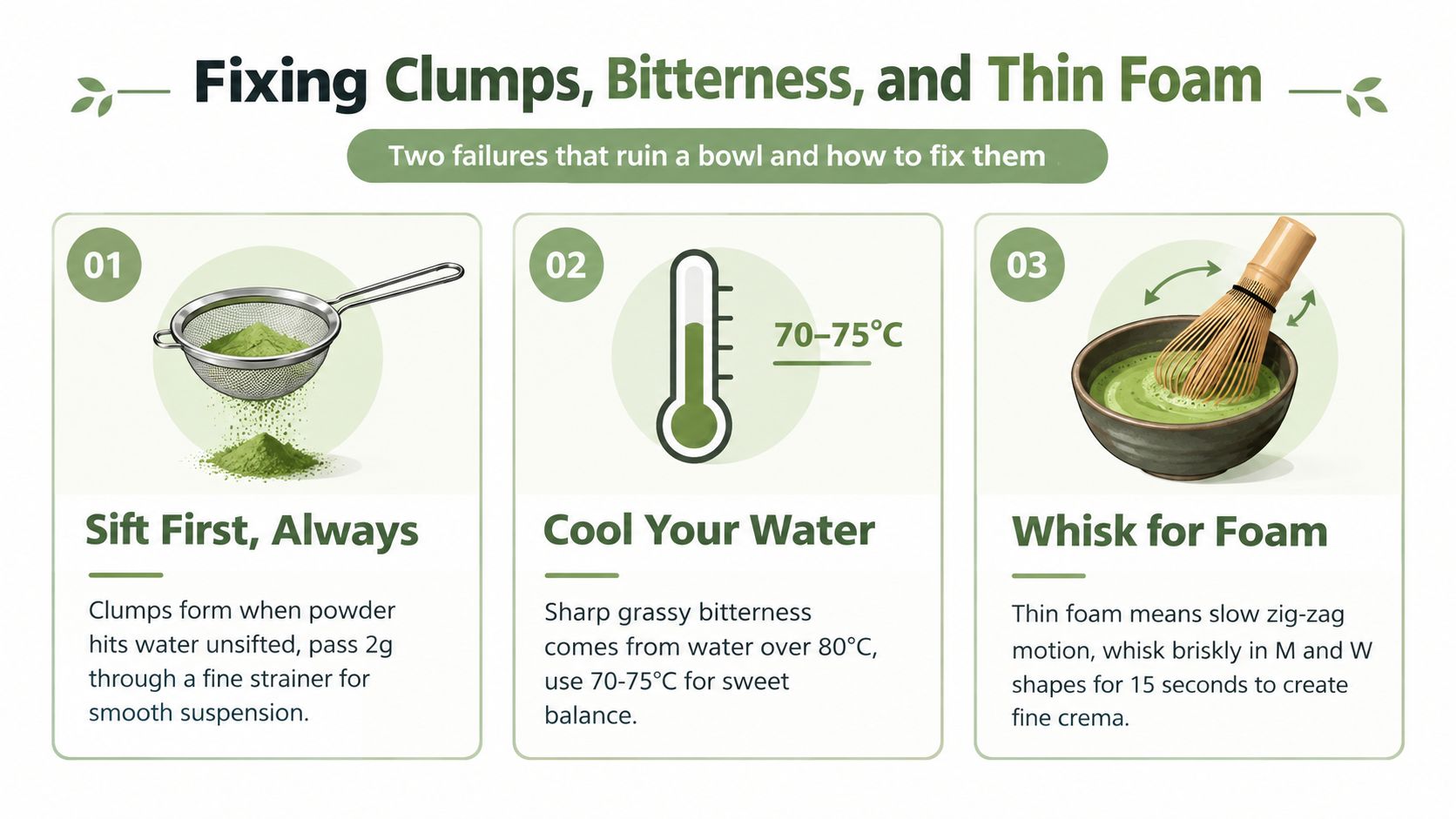
Fixing Clumps, Bitterness, and Thin Foam
A cloudy bowl usually has two separate problems: clumps form when dry powder meets water too quickly, while bitterness often comes from overheated water or stale matcha. Treat each issue at its source, rather than trying to fix the finished bowl with extra sweetener.
When clumps float on top
Sift the full measure through a fine mesh strainer before adding liquid. Then use a small splash of water to make a smooth paste, like wetting flour before mixing a sauce. Once the paste looks even, dilute it with the remaining water and whisk.
A heavy stream can bury dry matcha in compact islands at the bottom or leave floating lumps on the surface. Pour slowly around the bowl, especially if it is small, so the powder receives moisture in stages.
When the flavour turns bitter
For an Australian-style preparation, cool the water to 75–80°C and keep whisking to around 15 seconds. As noted earlier, water that is too hot can draw out a harsher flavour, so temperature is the first adjustment to make.
Open powder also needs protection from air, light, heat and moisture. An airtight container helps preserve its character, but older matcha may still taste flat or sharp. If the bitterness remains after correcting the water, try fresher powder before adding more sweetener.
When the foam looks thin
Whisk across the surface with a quick, shallow zigzag rather than stirring slowly in circles. The motion should agitate the top layer while keeping the whisk near the water, creating smaller bubbles instead of a loose cap of air.
With a frother, use a brief 5-second pulse at the end, then stop. For readers who mix other powders into drinks, Everti's guide to protein powder with water explains the same useful principle: add liquid gradually and control the incorporation. Matcha behaves better when the powder is dispersed step by step, not forced to disappear in one pour.
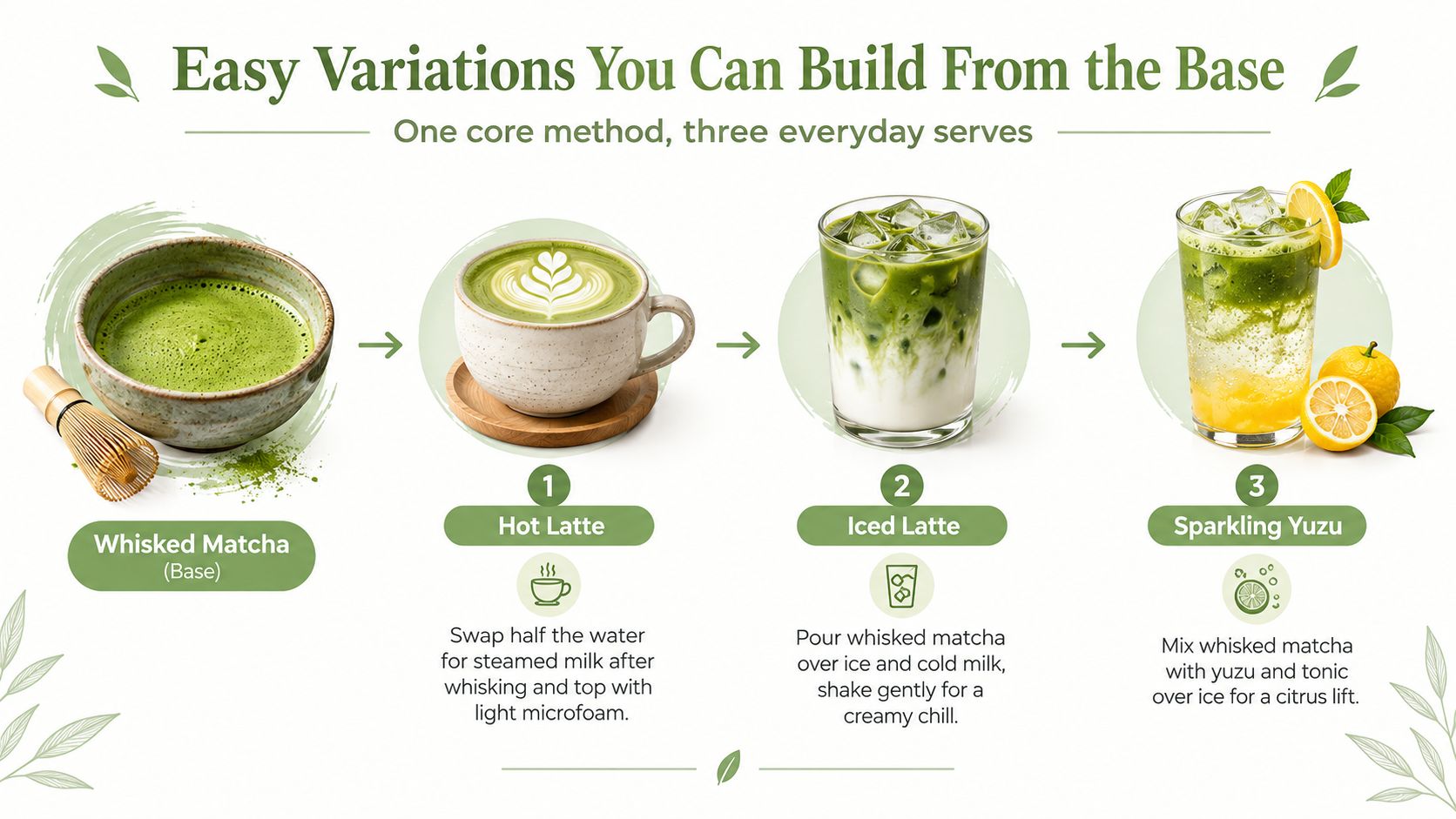
Easy Variations You Can Build From the Base
Once the plain bowl is smooth, you don't need to learn a completely new recipe for every drink. Keep the sift, slurry and whisking habits, then change the finishing liquid or temperature.
A warm matcha latte
Whisk the matcha with the concentrated water base first. Warm or steam milk separately, then replace part of the final water volume with milk and add it gently. A handheld frother can create a light topping without requiring a second complicated technique.
Choose dairy milk or a plant-based option according to taste and texture. Oat milk gives a naturally rounded impression, while a lighter milk keeps the grassy character more visible.
An iced matcha
Dissolve the sifted powder in a small splash of cool water first, forming a smooth paste before adding more liquid. Pour the whisked mixture over ice, then top with cold milk or water and stir or shake gently.
The cold serve makes clumps especially obvious because the powder doesn't have warm liquid to help it disperse. The initial slurry solves that problem without changing the core flavour.
A lightly sweetened serve
Add honey, maple syrup or sugar to the hot water before introducing the powder, so the sweetener dissolves evenly. For a café-style latte, a small amount of condensed milk can be whisked into the milk, although its sweetness will be more pronounced.
Matcha also works in smoothies, baking and chilled desserts. If you use it with another bold ingredient, such as cacao, Yuve's raw cacao powder tips can help you think about balancing strong flavours in blended recipes.
Here's a short visual demonstration of the basic process:
Drink leftover whisked matcha within an hour for the best colour and flavour. It can lose its brightness as it sits, so make only what you expect to enjoy soon.
Sourcing Better Powder and Serving It Well
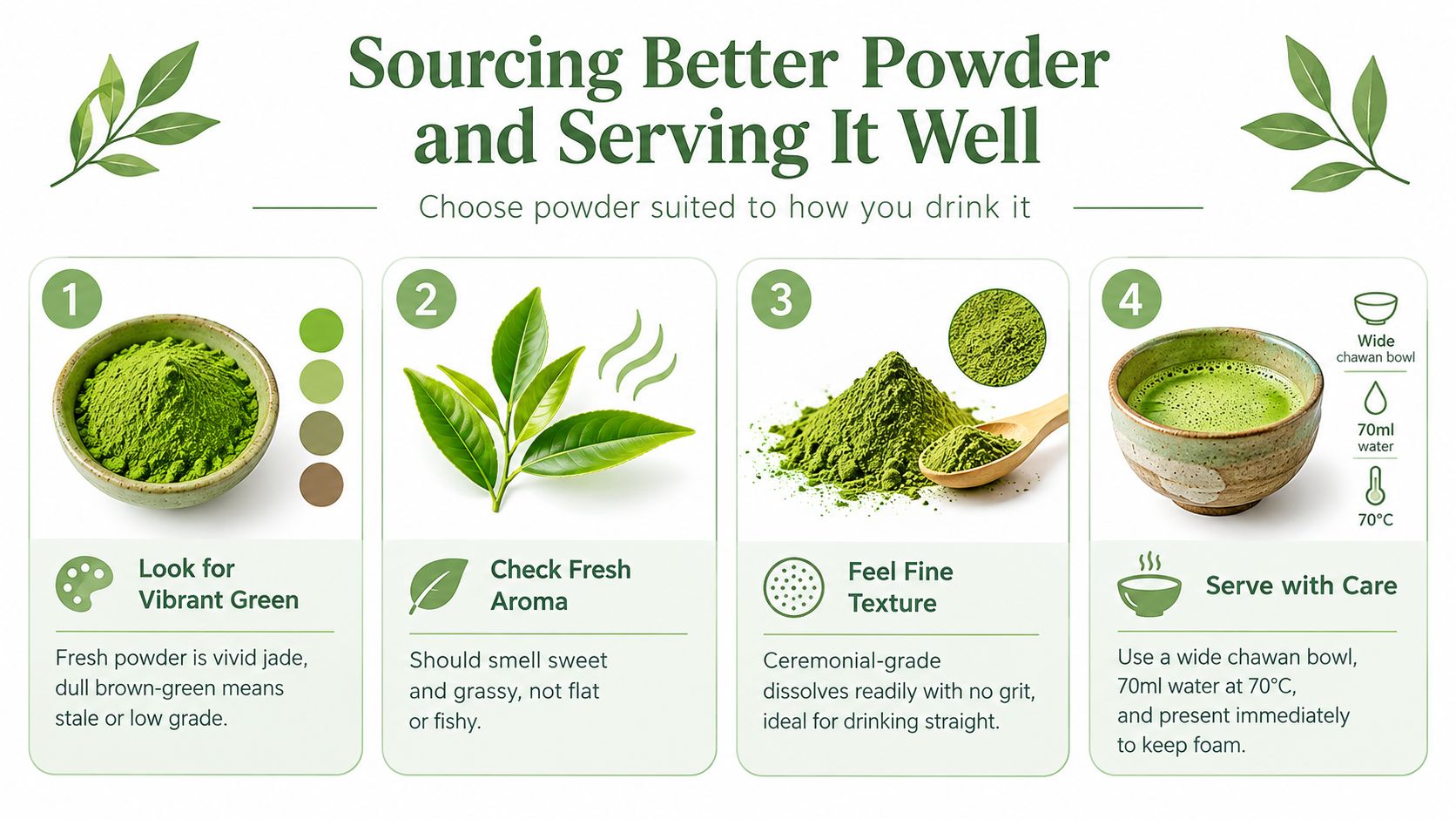
A smooth method can't fully rescue powder that has been stored poorly or chosen for the wrong purpose. Look for a vivid green colour, a fresh grassy or gently sweet aroma and a fine texture that disperses readily.
Ceremonial-grade matcha is suited to drinking plain, where its aroma and finish are easy to notice. Culinary-grade matcha has a stronger presence that can work well in lattes, smoothies and baking, where other ingredients share the bowl.
Protect the powder after opening
Keep matcha in an airtight, opaque container away from light, heat, moisture and strong odours. Refrigeration may help in a warm Australian climate, but allow the sealed container to move towards room temperature before opening so condensation doesn't reach the powder.
Serve the drink immediately after whisking, while the colour is bright and the foam remains evenly distributed. Plain matcha pairs naturally with mild sweets, fruit or light pastries, while a latte can sit comfortably alongside breakfast.
If bitterness continues, use fresher powder, slightly cooler water and a shorter whisk. Frothing milk separately and folding it in gently can create a richer latte without forcing extra air through the matcha itself. Readers wanting more detail on choosing between different powders can consult Pep Tea's guide to distinguishing ordinary and ultimate matcha tea powder.
Pep Tea offers organic Japanese matcha for plain bowls, lattes and recipes, giving Australian home brewers a way to explore different serving styles with powder selected for everyday preparation.
Visit Pep Tea to explore organic Japanese matcha and choose a powder that suits plain tea, lattes or baking. Start with a sieve, controlled water temperature and a few calm whisking strokes, then make your first bowl while the powder is fresh.
Matcha Latte Benefits: What the Science Actually Says

The most popular advice about matcha latte benefits is also the least precise: “It's a healthier coffee.” Sometimes that's a reasonable swap. Sometimes it's a large, sweetened café drink with a wellness halo and only a modest amount of matcha.
The useful question isn't whether matcha is healthy in isolation. It's what's in the beverage you're drinking, including the matcha dose, grade, milk, sweeteners, preparation and serving size. The evidence supports promising benefits from matcha's catechins, caffeine and L-theanine, but human trials are still limited, and a latte isn't automatically equivalent to plain matcha whisked with water.
Why a Matcha Latte Is Not the Same as Matcha Tea
A traditional bowl of matcha and a café latte share the same powdered tea, but they're different drinks. A café latte is usually built around steamed milk, sometimes sweetened, with a relatively small amount of powder. That changes the concentration of the compounds people associate with matcha, as well as the drink's energy and sugar content.
Matcha itself is made by consuming the whole tea leaf rather than steeping leaves and discarding them. Research cited in Australian university material reports that catechins can make up up to 30% of green tea leaf dry weight, while EGCG can account for up to 60% of total catechins (matcha chemistry research). That makes matcha a concentrated source of tea compounds, but the amount in your cup still depends on how much powder you use.
The four questions that matter
When I assess a matcha latte, I look at four things:
- Dose: How many grams of matcha went into the cup?
- Grade: Is it a fresh, vibrant powder intended for drinking, or a more assertive culinary powder intended for blended recipes?
- Preparation: Was the matcha properly sifted and whisked, or stirred into hot milk?
- Add-ins: Is the drink unsweetened, lightly sweetened, or built around syrup and flavoured powder?
An Australian café benchmark places mainstream matcha drinks at roughly 56–81 mg of caffeine per serve (Starbucks Australia Matcha Misu Latte). That's enough to make the drink stimulating, while generally sitting below a standard coffee. It doesn't tell us the exact catechin or L-theanine content, though, because recipes and powder doses vary.
A practical rule: Treat “matcha latte” as a recipe, not a health category. The ingredients and proportions decide whether it's a functional everyday drink or an occasional sweet treat.
The rest of the answer comes down to how those four variables affect the beverage as served. Matcha may support alertness and provide concentrated bioactive compounds, but those advantages can be diluted by a low powder dose or offset by a heavily sweetened recipe.
What Counts as a Quality Matcha Latte
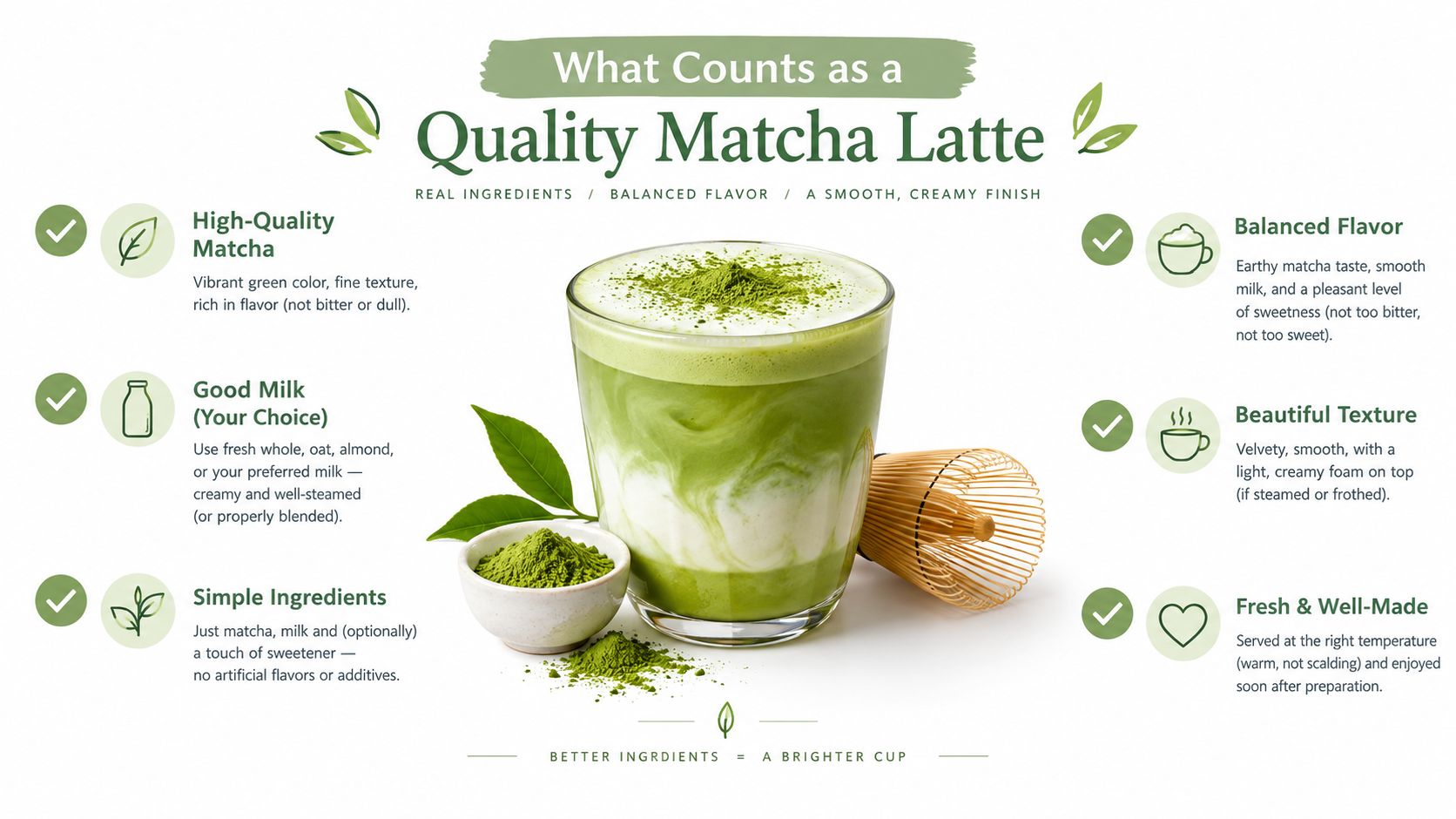
A quality matcha latte starts with a powder that tastes good enough to drink without hiding it under syrup. Ceremonial-grade matcha is generally made from tender, carefully processed leaves and is valued for its smooth texture, bright colour and savoury sweetness. Culinary-grade matcha is more intense and often more astringent, which makes it useful in baking, smoothies and strongly flavoured drinks.
Both are matcha. The label alone doesn't prove a specific health outcome, and “ceremonial” isn't a universal medical or nutritional standard. For a daily latte, choose a powder with clear Japanese sourcing, a vivid green appearance, fine texture and a fresh harvest or packaging date where available.
Prepare the powder before adding milk
Water that's too hot can make matcha taste harsh. For a smoother drink, use water around 70–80 °C, sift the powder, add a small amount of water and whisk until it becomes a lump-free paste. Then add warmed milk.
This method distributes the powder through the drink instead of leaving clumps floating on top. It also gives you more control over bitterness, which is especially helpful when using a higher-quality powder with delicate grassy and umami notes.
A traditional serving can use more matcha than a typical café recipe. Australian-style guidance commonly describes a serving of about 2 g of powder, with around 60–70 mg of caffeine (Australian matcha serving guide). The caffeine figure is a useful practical benchmark, but it will vary with the tea and dose.
A simple quality checklist
Look for:
- Matcha as the main ingredient, rather than a sweetened “matcha-flavoured” blend.
- Bright green colour, not a dull or brownish appearance.
- Fine, smooth powder, which whiskes more evenly.
- Transparent sourcing, ideally identifying where the tea was grown and processed.
- A recipe you can taste, with little or no syrup needed.
The latte format can still be a good way to enjoy matcha. It just needs enough real powder and not so many additions that the tea becomes decoration.
Antioxidant Power and EGCg Concentration
Matcha's antioxidant reputation rests mainly on catechins, a group of tea polyphenols. The best-known member is epigallocatechin gallate, usually written as EGCG or EGCg. These compounds show antioxidant activity in laboratory tests, but chemical activity in a controlled experiment does not establish a specific health benefit for people drinking a matcha latte.
The whole-leaf format changes the comparison with steeped tea. Because the powdered leaf is consumed rather than removed after brewing, matcha can provide more catechins. One Australian source reports that a standard serving may contain about two to three times the catechins of a cup of steeped green tea. An Australian product laboratory report measured total catechins at 65,200 μg/g and EGCG at 56,000 μg/g (Australian matcha catechin analysis). These are measurements from tested products, not a guarantee for every powder sold in Australia.
Growing conditions also affect matcha's chemistry. Shading before harvest changes the balance of compounds in the plant, including chlorophyll and L-theanine. A 2020 analysis measured matcha's fibre, vitamin C, caffeine, chlorophyll, phenolics and antioxidant activity, showing that its composition extends beyond colour and flavour (2020 matcha composition analysis).
What the measurements can and can't tell you
Tests such as ORAC and DPPH measure chemical activity under controlled conditions. They cannot show that a matcha latte will prevent disease, repair cellular damage or create a noticeable change in how you feel. A high catechin reading is evidence about composition, not proof of an outcome.
Human trials provide a more relevant test. An Australian systematic review screened 122,429 records and identified only 8 randomised controlled trials. Those trials reported significant reductions in body weight, body mass index and blood pressure, plus improvements in plasma cholesterol and lipids, with all reported results at p<0.05 (Australian systematic review of green tea catechins). The review concluded that supplementation in the range of 300–1500 mg per day may help reduce anthropometric and cardiovascular biomarkers in people with obesity and people with type 2 diabetes.
That range describes supplementation, not a café recipe. Extracts and concentrated preparations may contain far more catechins than the amount in a served latte. For a plain-language explanation of what EGCg is and why it matters, Pep Tea provides a useful chemistry overview.
The practical comparison is straightforward. Matcha's whole-leaf format can increase catechin exposure, while the actual amount still depends on the powder dose, product and preparation.
| Source | Serving Size | EGCg (mg) | Total Catechins (mg) | Notes |
|---|---|---|---|---|
| Matcha | Varies by powder dose | Product-dependent | Product-dependent | Whole-leaf powder is consumed |
| Steeped green tea | Varies by tea and brewing | Product-dependent | Product-dependent | Leaves are removed after brewing |
| Green tea catechin preparation | Research-dependent | Research-dependent | 300–1500 mg/day supplementation range | This range comes from the Australian systematic review, not a standard latte |
The matcha powder supplies the catechins, so its grade and dose matter when assessing the finished drink. The latte format changes the serving context, which is why ingredient-level antioxidant claims need to be read alongside the actual recipe.
Sustained Energy From Caffeine and L-Theanine
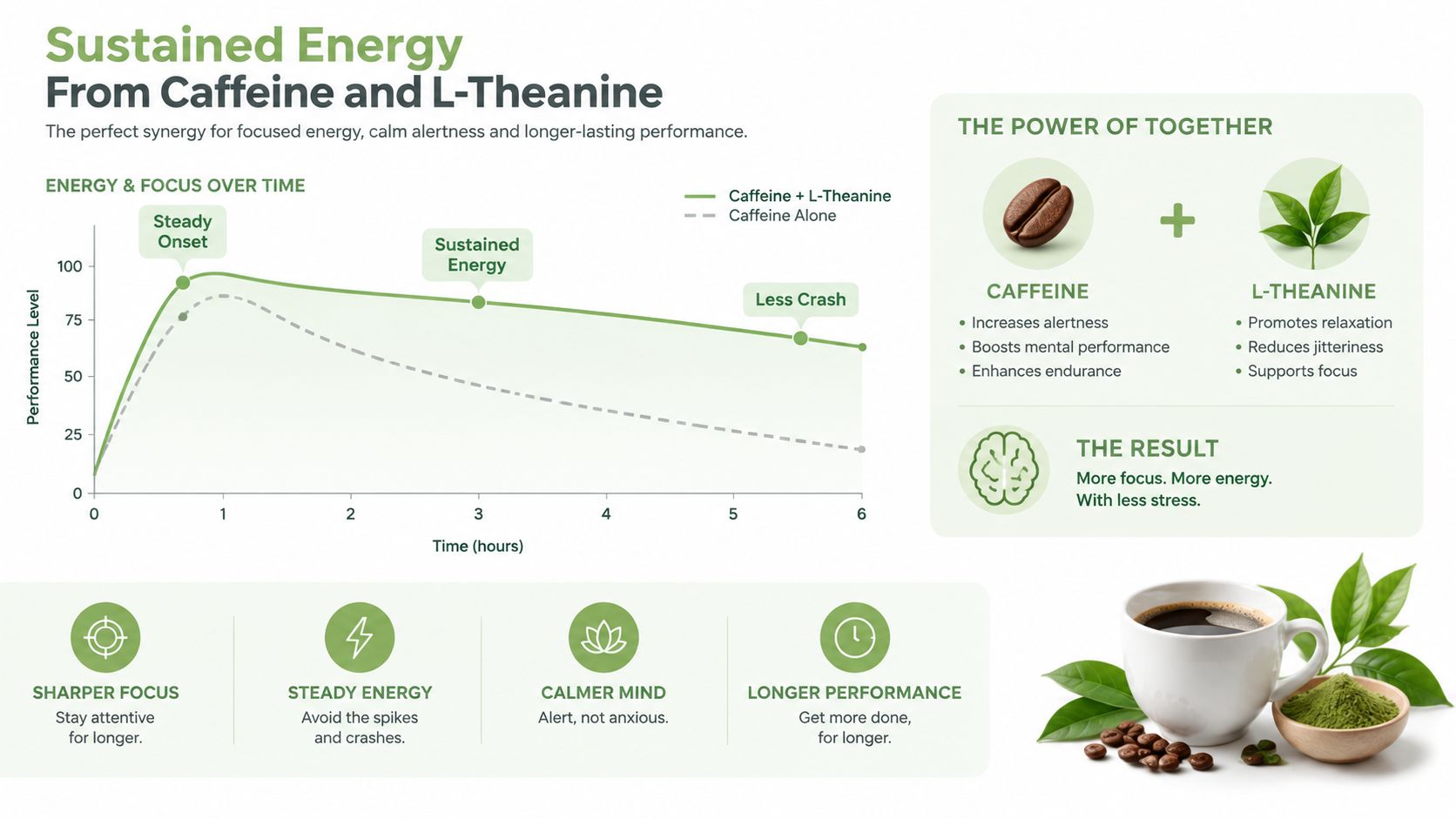
A matcha latte's most credible everyday benefit is its caffeine, not a guaranteed wellness effect. It can provide moderate stimulation with a smoother feel than some coffee drinks, partly because matcha supplies caffeine alongside L-theanine.
Caffeine supports alertness through the brain's adenosine signalling. L-theanine is an amino acid found naturally in tea, and technical reviews link the caffeine and L-theanine combination with smoother cognitive performance than caffeine alone (technical review of matcha composition and effects). The pairing may help explain why some drinkers experience focused attention rather than a pronounced buzz. Individual responses still vary, and the latte format can change the overall experience.
A useful benchmark
One clinical review cited a daily intake of about 2.07 g of matcha providing 72.5 mg of caffeine, 50.3 mg of theanine and 171.0 mg of catechins (technical review of matcha composition and effects). That is a research benchmark, not a fixed amount for every scoop or café recipe.
A mainstream Australian matcha drink can provide roughly 56–81 mg caffeine per serve (Australian café matcha caffeine benchmark). This generally places matcha above a typical brewed green tea and below a standard coffee, although the comparison depends on preparation. More powder or a larger café serve increases the total caffeine.
Milk does not remove caffeine. It can make a large latte taste and feel gentler because the caffeine is spread through more liquid, while the drink may still contain more caffeine than expected.
How to use the lift well
Choose an earlier serving if caffeine affects your sleep. A matcha latte may also suit a focused work period or exercise session, particularly when it replaces a sweeter drink or a stronger caffeine hit.
Food can make the experience feel gentler by slowing digestion, but it does not cancel caffeine. Include coffee, black tea, cola, energy drinks and chocolate when considering your overall intake.
Calm focus still contains caffeine. If you are caffeine-sensitive, L-theanine may change the drink's feel, but it cannot guarantee good sleep after a late serve.
Matcha grade does not set a fixed caffeine level. Dose, leaf material, harvest and preparation all influence the finished cup. Pep Tea explains the relationship between matcha, green tea and L-theanine in its educational resource.
Metabolic and Cognitive Benefits in Human Trials
Matcha's metabolic and cognitive claims need a clear distinction between plausible mechanisms and measured human outcomes. Catechins may affect pathways associated with cardiovascular markers, while caffeine and L-theanine may support alertness. Those possibilities do not show that a sweetened latte causes weight loss, removes anxiety or improves sleep.
An Australian review of green tea catechin trials reported improvements in body measurements, blood pressure, cholesterol and lipids among the small group of randomised studies. Its conclusion about 300–1500 mg per day referred to catechin supplementation in relevant populations, not to every café latte. As noted earlier, the amount of matcha in a served drink can differ substantially from a research dose.
What researchers measured in people
Australian-facing coverage of a 2023 review describes only five experimental studies in which matcha was given to people, generally at doses around 2–4 g per day (Australian-facing summary of matcha research). The findings were mixed. Some studies reported lower stress and anxiety, better memory or cognition, and improved sleep in older adults. Other results showed little sleep effect in younger adults, no mood effect, and no additional weight-loss benefit in people with obesity.
This evidence supports continued interest in matcha, while leaving its clinical role uncertain. A trial serving of plain matcha is not interchangeable with a large latte containing milk and syrup.
| Claim | Evidence | Typical Result |
|---|---|---|
| Better alertness | Caffeine and L-theanine have a plausible combined effect | May support attention and calm wakefulness |
| Cardiovascular markers | Green tea catechin trials reported improvements in several markers | Promising, but not proof that a latte prevents disease |
| Weight loss | Human matcha evidence is limited and mixed | No reliable standalone weight-loss result |
| Anxiety reduction | Some experimental findings point to lower stress or anxiety | Inconsistent and dependent on the person and dose |
| Sleep improvement | Results differ between groups | Not a dependable sleep aid |
The research base is generally small or short, and many preparations do not resemble a milk-based café drink. Milk changes the recipe, while syrup changes its nutritional profile, so ingredient-level claims cannot automatically be transferred to the beverage as served.
Matcha may fit a heart-conscious, balanced lifestyle and may help some people with attention. It isn't proven to replace sleep, movement, medical treatment or a nutritious eating pattern.
How Milk, Sugar and Serving Size Change the Equation
The latte format changes more than taste. Milk adds volume, protein and energy, while sweeteners can turn a low-sugar tea into a dessert-style drink. The result may still be enjoyable, but its overall nutritional profile is no longer represented by the matcha powder alone.
Research and commentary on matcha often focus on the leaf's catechins, caffeine and L-theanine. Café buyers experience the whole recipe. A small unsweetened home latte and a large syrup-based café drink may share a name while delivering very different amounts of matcha, sugar and milk.
Milk isn't the main concern, sugar is
Milk proteins may interact with tea catechins, and the effect on antioxidant absorption remains debated. Human results don't support a simple rule that dairy cancels matcha's benefits, so there's no need to avoid milk automatically.
Sweetener deserves more attention. Honey, vanilla syrup and pre-sweetened powders can shift the drink away from the low-sugar profile people expect from plain matcha. If you're buying a drink, ask whether the café uses pure matcha powder or a flavoured blend, then request no syrup or a reduced amount if that suits your palate.
For people planning drinks around travel, ingredient labels and serving choices are easier to manage with practical resources such as this guide to practical nutrition for travelers.
Choose the format that matches your goal
| Situation | Better choice | Why |
|---|---|---|
| Hot at home | Pure matcha, water and warmed unsweetened milk | You control dose and sweetness |
| Iced at home | Whisk matcha with a little water before adding cold milk | Reduces clumps and keeps the flavour clear |
| Café order | Ask for pure matcha and no syrup | Separates the tea from the dessert-style additions |
| Flavoured baking or smoothies | Culinary-grade matcha | Stronger flavour works with other ingredients |
A “matcha-flavoured” powder may contain little real matcha and can be dominated by sugar or other ingredients. Read the label rather than relying on the green colour.
For a controlled home version, follow Pep Tea's method for making a sugar-free matcha latte. The key idea is simple: keep the matcha real, keep the powder dose sensible and let sweetness be optional.
Serving Contexts, Quality Choices and Smart Use
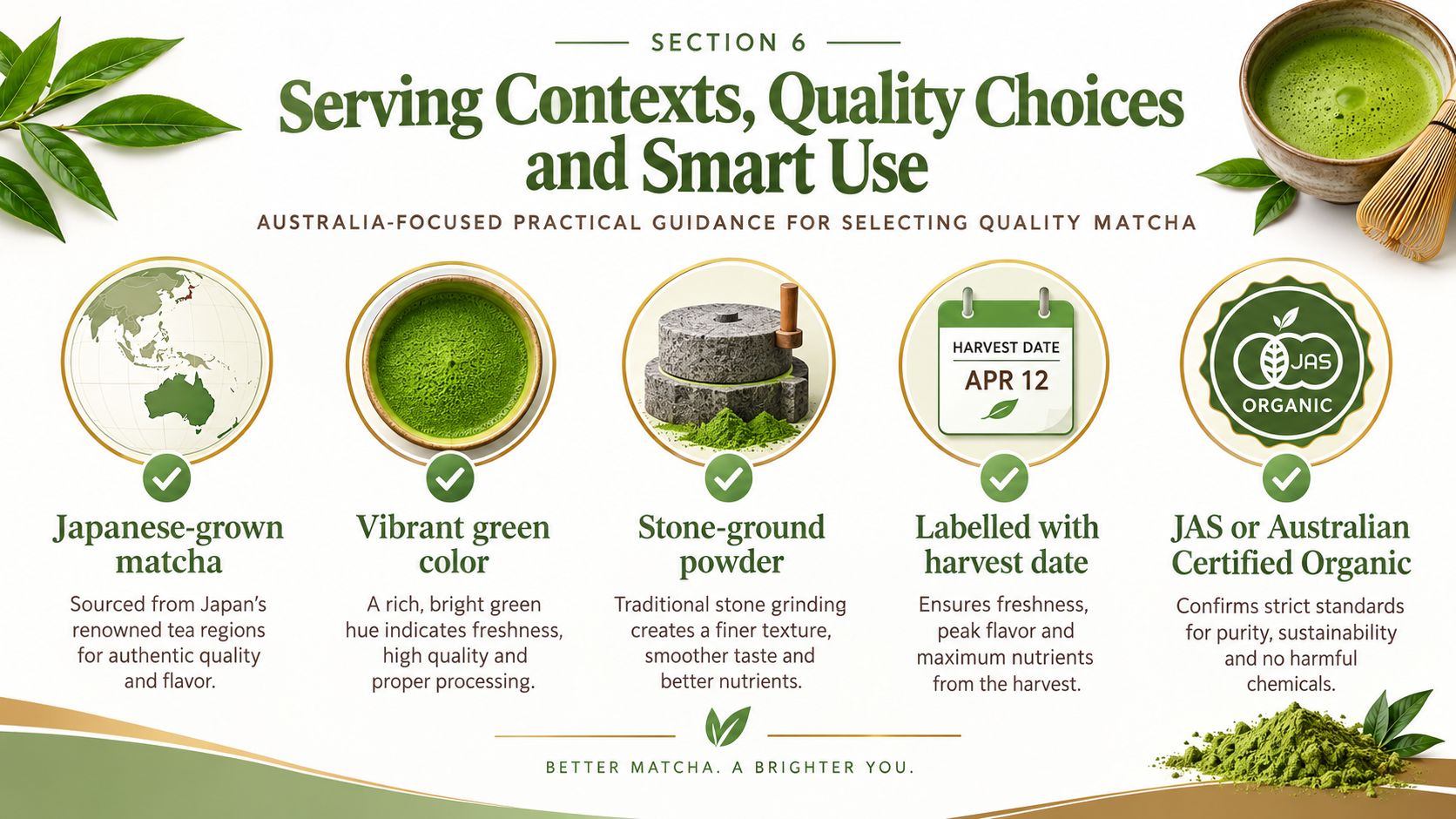
A useful matcha latte starts with buying decisions, not health promises. Choose Japanese-grown matcha from a supplier that identifies the product clearly, look for a vibrant green colour, and favour powder that's stone-ground and fresh. Organic certification, such as JAS or Australian Certified Organic certification, can also help shoppers assess production standards.
For a daily latte, a pleasant drinking-grade powder makes sense because flavour determines whether you'll keep using it. Reserve culinary grade for smoothies, baking and recipes where matcha is combined with fruit, yoghurt or other assertive flavours.
A dependable home method
For a 200–250 mL serve, start with 1–2 g of matcha, whisk it with about 60 mL of water at 80 °C, then add warmed milk. These quantities are a practical recipe framework, not a guarantee of a particular caffeine or catechin content.
Morning is the easiest timing. A pre-workout latte can be a coffee alternative, while sleep-sensitive drinkers may prefer to avoid matcha after 2 pm. Anyone who notices anxiety, palpitations or disrupted sleep should reduce the dose or stop and discuss persistent symptoms with a qualified health professional.
People who are pregnant, take blood thinners or iron supplements, or manage anxiety should be especially cautious with caffeine and tea compounds. Keep to one small serve unless a doctor or pharmacist advises otherwise, and consider the timing of matcha around iron supplements or meals.
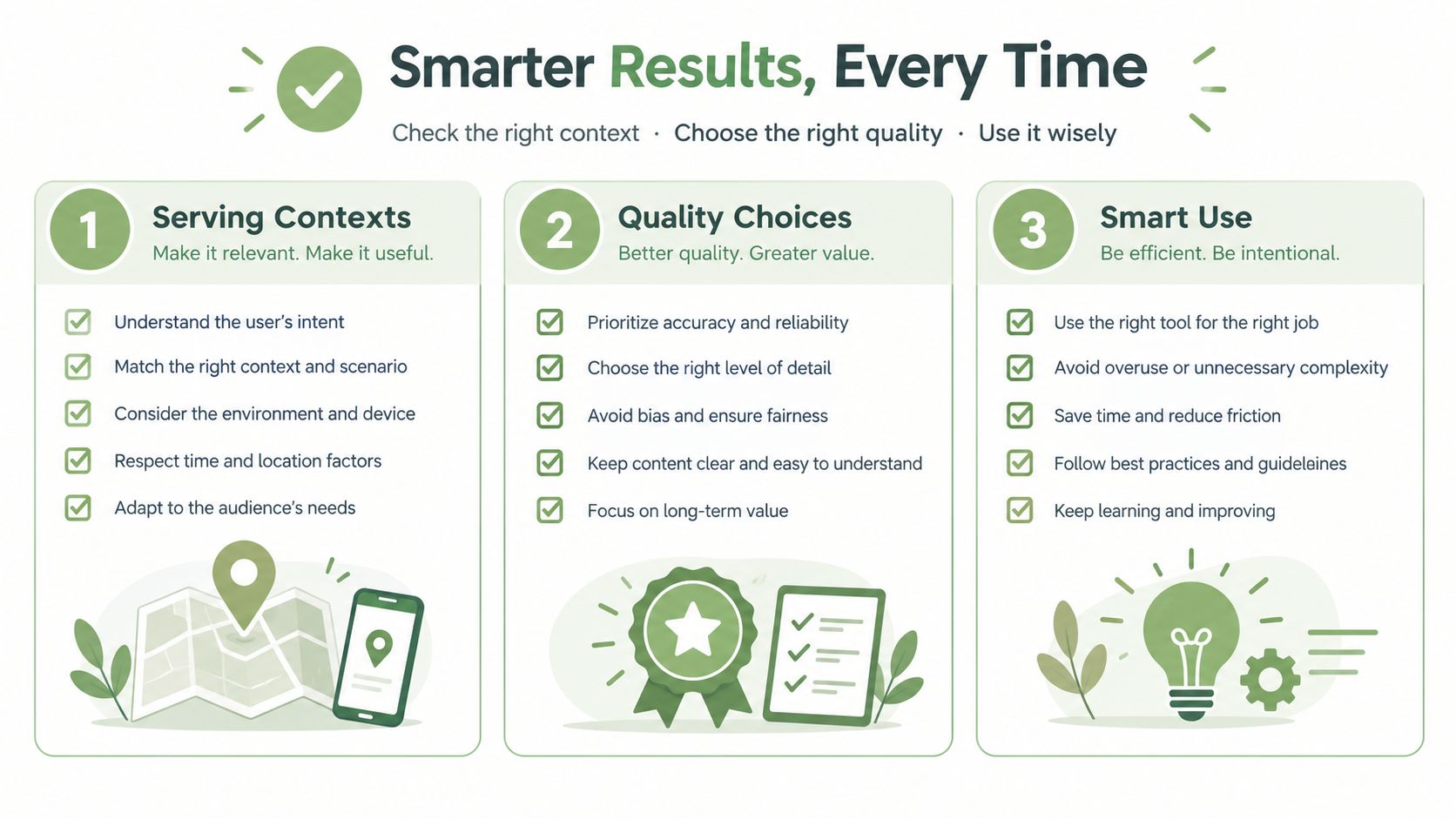
What to ask at a café
Ask:
- Is the drink made with pure matcha?
- How much powder goes into the cup?
- Does the powder already contain sugar?
- Can you make it without syrup?
- Can I choose a smaller size?
At home, keep a fine sieve, a bamboo whisk or handheld frother, a small bowl and a reliable way to judge water temperature. If you're helping a remote team explore café culture, a guide to latte tasting for remote managers offers useful ideas for comparing preparation and flavour, even though the same tasting approach can be adapted to matcha.
Pep Tea offers organic Japanese matcha alongside Australian-brewed, sugar-free organic kombucha made in the Hunter Valley, NSW. If you want to compare clean, low-sugar beverage options, visit Pep Tea to explore the range and choose a matcha suited to your preferred latte style.
Organic Ceremonial Matcha Guide for Health and Brewing
Australia's matcha market generated more than $54 million in 2024, while Japanese green tea exports to Australia reached 195,319 kg between January and August 2025, a 131% year-on-year increase according to SBS News coverage of Australia's matcha boom. That growth has pushed organic ceremonial matcha from a niche tea-shop ingredient into a mainstream wellness product, but popularity also creates confusion. A green powder labelled “ceremonial” isn't automatically authentic, organic, fresh, or nutritionally consistent.
Organic ceremonial matcha is whole, shade-grown green tea leaf, processed into a fine powder and consumed rather than steeped and discarded. Its appeal comes from a combination of Japanese provenance, organic certification, vibrant flavour, naturally occurring caffeine, L-theanine and catechins, plus the calm ritual of whisking a fresh bowl.
For Australian buyers, quality involves more than colour and branding. You'll need to consider origin, certification, harvest and processing information, packaging, taste, and preferably lot-specific laboratory data. This guide breaks down those decisions, then shows you how to brew organic ceremonial matcha, use it in lattes and recipes, and buy it with greater confidence.
Introduction to Organic Ceremonial Matcha
Matcha differs from ordinary green tea because you consume the leaf itself. Loose-leaf tea works like an infusion: hot water extracts selected compounds, while the leaves remain in the strainer. Matcha instead keeps finely milled powder suspended in water, so storage, preparation, and sourcing shape the result.
Organic describes the tea's production system and the certification supporting that claim. It does not promise a particular flavour, caffeine level, or freshness. Ceremonial generally indicates matcha intended for whisking with water and drinking on its own, yet the term has no universal quality standard. A grade name is therefore only one clue, not proof of authenticity.
Australia's import-dependent supply makes provenance details especially useful. Industry market analysis reports that over 90% of consumed matcha volume is imported, with combined green tea powder imports estimated to have risen at a 13–17% CAGR from 2020 to 2025. Premium buyers consequently depend largely on imported certified products, particularly Japanese matcha.
Start with three checks: can the supplier identify the powder's origin, show its organic certification, and provide laboratory testing that supports its quality? These records work like a product passport. Colour and branding may suggest quality, but traceable documents offer stronger evidence when choosing organic ceremonial matcha in Australia.
Understanding What Makes Matcha Ceremonial
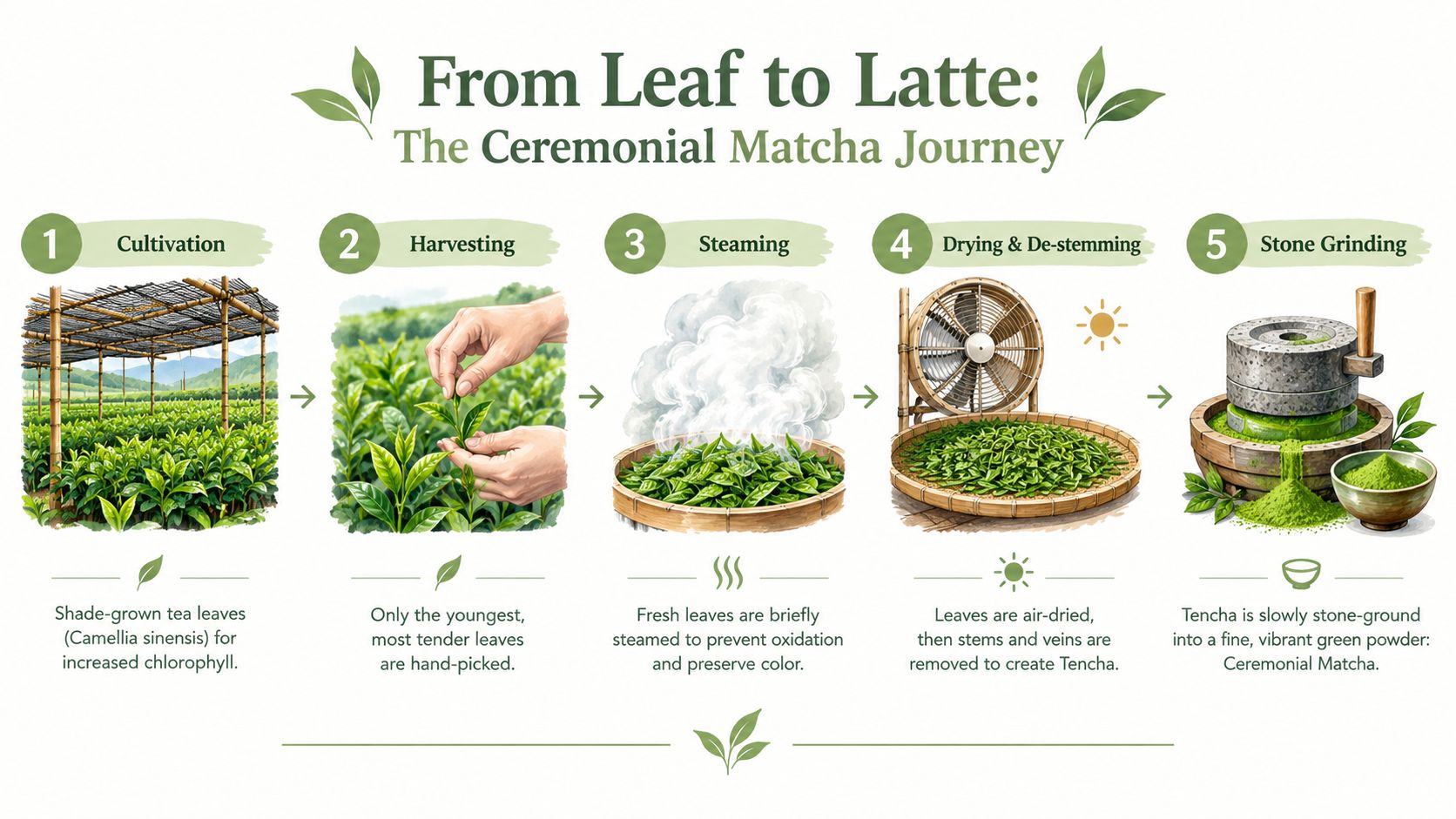
Ceremonial matcha begins as Camellia sinensis, the same tea plant used for green, black and white tea. The difference lies in cultivation and processing. Before harvest, producers shade the plants, often using structures that reduce direct sunlight. This encourages the leaves to retain a deep green colour and develop a softer, umami-led flavour.
From shaded leaf to tencha
The youngest leaves are selected because they're tender and well suited to drinking without milk or sugar. Producers quickly steam the fresh leaves to limit oxidation, then dry them. Stems and veins are removed, leaving tencha, the leaf material that becomes matcha.
Think of tencha as the carefully prepared flour of the tea world. A baker wouldn't describe a coarse bran mixture as the same thing as finely sifted pastry flour. In a similar way, removing tougher leaf parts helps create the smooth texture expected from matcha designed for whisking.
Why stone grinding matters
The dried tencha is slowly ground into an exceptionally fine powder, traditionally using stone mills. The process resembles artisan flour milling, where patience and controlled movement matter more than speed. The result should disperse smoothly when whisked, rather than feel gritty or heavy on the tongue.
This whole-leaf format explains why matcha has a more concentrated taste than a cup of steeped green tea. It also means poor storage can affect the aroma and colour directly, because there's no separate leaf to remove after brewing.
For readers comparing powdered tea formats, this guide to choosing instant matcha can help clarify the difference between convenience powders and matcha intended for a more traditional preparation. PepTea also provides a useful overview of how matcha tea is made, including the transformation from leaf to powder.
Health Benefits and Key Compounds
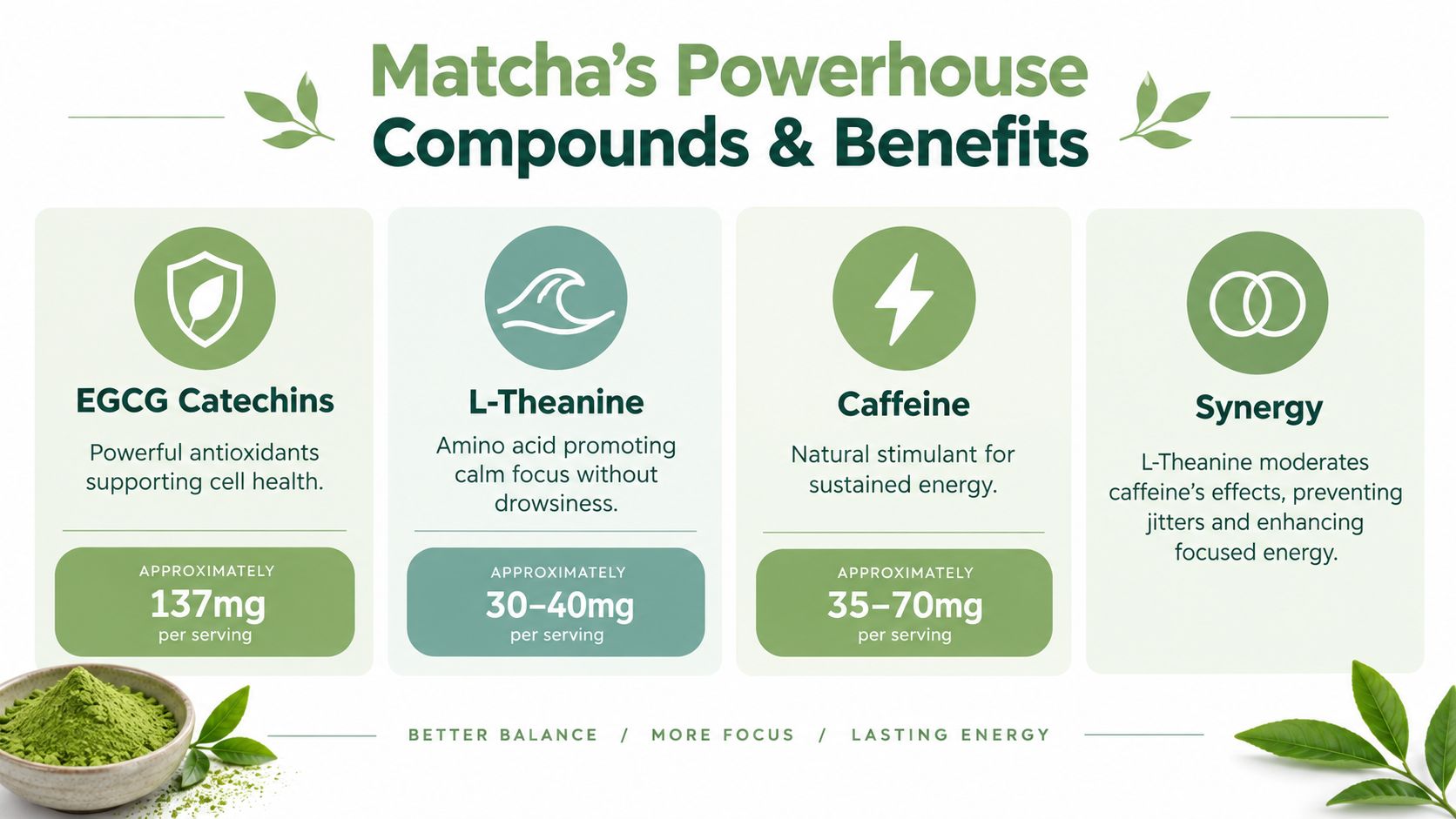
Organic ceremonial matcha contains several naturally occurring compounds that shape both its flavour and its physiological effects. The main trio is catechins, L-theanine and caffeine. It's more accurate to say matcha may support alertness and focused energy than to promise a medical outcome.
Catechins are plant compounds with antioxidant activity. EGCG, or epigallocatechin gallate, is one of the best-known catechins in green tea. A useful everyday analogy is a clean-up crew. Antioxidants help the body manage oxidative processes, but they aren't a cure-all and shouldn't replace a balanced diet or medical advice.
L-theanine is an amino acid associated with tea's characteristic savoury, rounded taste. Caffeine provides stimulation, while L-theanine may help make the experience feel calmer and less abrupt for some people. The combination can feel different from drinking a strongly caffeinated beverage on its own.
Practical rule: Treat matcha as a whole-leaf food and a caffeinated drink, not as a medicine.
A randomized placebo-controlled study used 2.07 g of matcha per day, providing 50.3 mg of theanine, 171.0 mg of catechins and 72.5 mg of caffeine. Participants showed a statistically significant reduction in reaction time and more correct responses on an emotion-perception task, as reported in the published study available through PubMed Central. That result supports interest in the combined matrix, but it doesn't mean every product or serving delivers the same composition.
Preparation can change the sensory experience. Very hot water may draw out more bitterness, while excessive milk or sweetener can hide the fresh, grassy and umami notes that distinguish good matcha. Readers interested in the role of EGCG can explore what EGCG is before deciding how much weight to place on antioxidant language.
Grading Origins and Sourcing in Australia
Australia's ceremonial matcha market depends heavily on imported products, so a packet's origin story matters as much as its colour or label. The terms ceremonial, premium and culinary provide useful starting points, but they describe intended use more than they prove authenticity.
Ceremonial matcha is generally selected for a fine texture, attractive colour and balanced flavour when whisked with water. Premium matcha may suit everyday drinking or lattes. Culinary matcha usually has a stronger flavour designed to remain noticeable alongside milk, fruit, flour or chocolate. These categories work like menu labels, not independent laboratory standards.
Origin adds another layer. Japanese matcha is associated with established shading and processing traditions and with umami-focused drinking styles. Chinese matcha is also sold in various grades, often for culinary applications. A country name alone cannot confirm that a product is organic, fresh or appropriate for ceremonial preparation.
Why Australian provenance matters
IndexBox's Australian market analysis describes Australia as an import-dependent market, with Japan supplying much of the value associated with premium matcha and China contributing substantially to import volume. That pattern makes traceability, stock continuity and accurate labelling practical concerns for Australian buyers.
Supply pressure can also affect availability. Australian hospitality coverage describes a fast-growing category, new supply agreements and pressure on shipments of ceremonial Japanese matcha. Treat vague wording such as “Japanese style” or “inspired by Japan” as a prompt to ask questions. Look for the producing country, region where available, importer and batch details.
Reading organic certification
Certification connects an organic claim with an identifiable standard and certifying body. Australian shoppers may see:
- Australian Certified Organic: A certification scheme used for eligible organic products sold in Australia.
- NASAA Certified Organic: Another recognised Australian organic certification pathway.
- JAS: Japan's Agricultural Standards system, relevant when Japanese organic certification is stated.
Check the logo, certification details, product name and importer together. Japanese origin does not automatically mean certified organic, and organic certification does not establish ceremonial grade. For stronger verification, compare the label with lot-specific laboratory data, such as a certificate of analysis showing the tested batch and relevant contaminant or composition results.
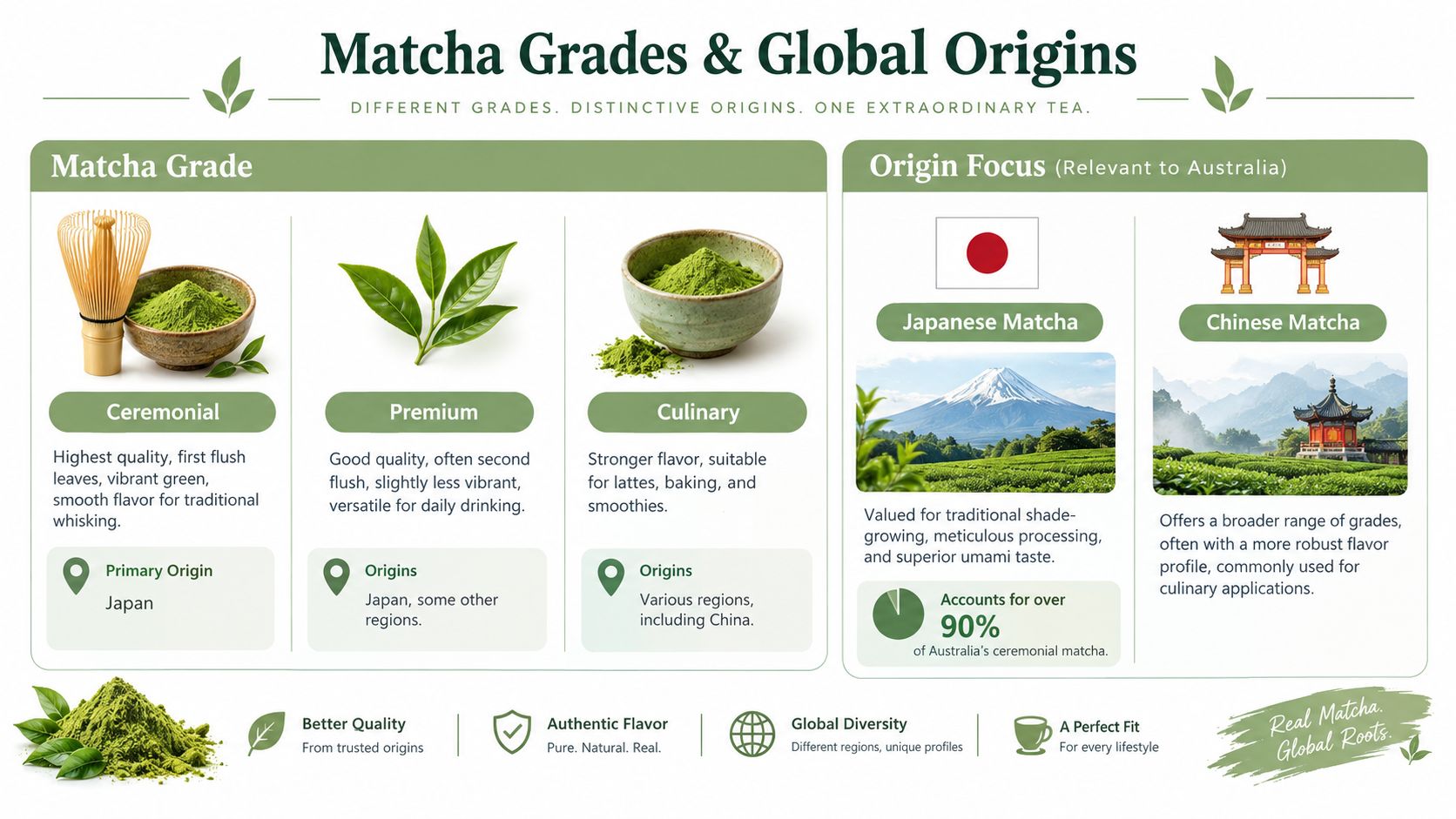
How to Choose High Quality Ceremonial Matcha
Start with transparency, not the colour of the tin. A bright jade-green powder can be a positive sign, but appearance alone can't verify origin, organic status, freshness or potency. The most dependable choice combines sensory checks with documentation.
Use the five-part check
-
Read the origin statement. Look for the producing country and, where available, the region, cultivar, harvest information and importer. A specific statement is more useful than a broad phrase such as “Japanese matcha blend”.
-
Verify organic certification. Check for an identifiable certification mark, not just the word “organic” in large type. If the package is unclear, ask the supplier which body certified the product and whether the certification applies to that particular matcha.
-
Inspect the powder. Fresh ceremonial matcha should look vivid rather than dull, yellowed or grey-green. It should feel fine and silky between the fingers, without obvious coarse particles.
-
Smell before tasting. A fresh, gently sweet and vegetal aroma is more encouraging than a stale, musty or hay-like smell. Once whisked, the flavour should be rounded and umami-led, with bitterness and astringency kept in balance.
-
Ask for a lot-specific COA. A certificate of analysis should identify the tested batch and show relevant results rather than relying on generic marketing copy.
The final point deserves particular attention. Independent ceremonial matcha lab results show substantial variation between samples. One analysis reported EGCG at 69.73 mg/g, EGC at 24.47 mg/g and caffeine at 35.01 mg/g. Another test reported L-theanine at 21.3 mg/g and caffeine at 56 mg/g.
Those figures don't create a universal pass or fail threshold, but they demonstrate why “ceremonial” isn't a reliable proxy for potency. A lot-specific COA can help you understand the likely bitterness, intensity and serving consistency of the product in front of you.
A sealed package protects quality, but it can't replace traceability. You need both.
Choose packaging that limits exposure to light and air, check the best-before information, and note the lot number before opening. If a supplier won't answer basic questions about certification, origin or batch testing, choose a product with clearer documentation instead.
Brewing Basics and Creative Use Cases
The simplest way to taste organic ceremonial matcha is to whisk it with water. Use a clean bowl, a bamboo whisk called a chasen, a small sieve and fresh water. Sifting breaks up compacted powder before it meets the water, so you won't need to fight stubborn lumps.
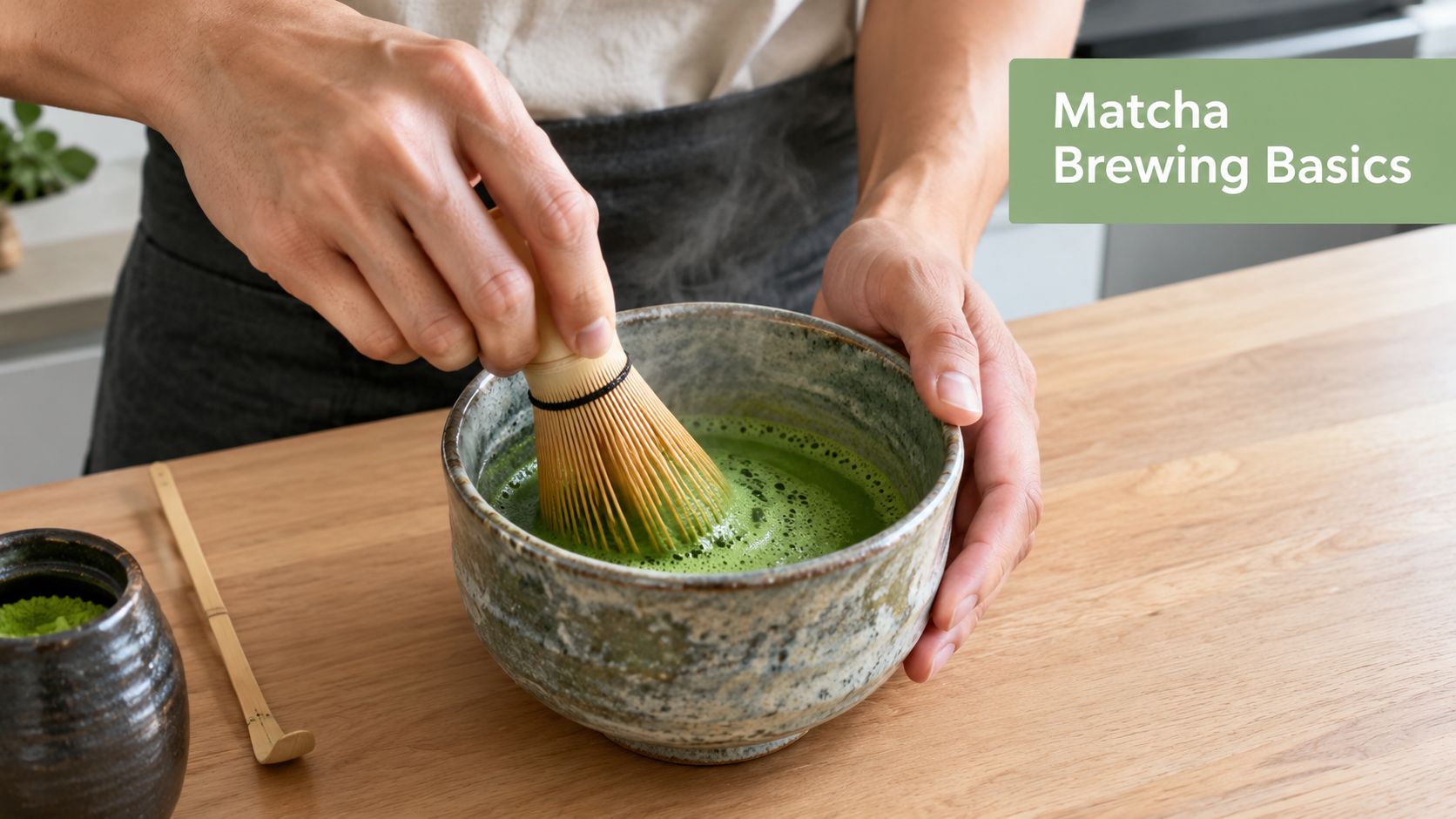
A reliable bowl method
- Warm the bowl, then discard the warming water.
- Sift your chosen amount of matcha into the bowl.
- Add a small amount of warm water and work the powder into a smooth paste.
- Add more water and whisk briskly in a back-and-forth W motion.
- Stop when the surface looks lightly foamy and the powder is evenly suspended.
Avoid boiling water. Excessive heat can make the drink taste harsh, while cooler water tends to preserve delicate sweetness and umami. For a more precise guide, use PepTea's instructions on matcha brewing temperature.
You can also follow the technique visually before adapting it to your own bowl and whisk.
Turning matcha into everyday drinks
A latte starts with a concentrated matcha paste. Whisk the powder with warm water first, then add steamed or chilled dairy milk or plant milk. Oat milk brings sweetness and body, while unsweetened almond milk keeps the tea profile lighter. Add sweetener only after tasting, because sugar can quickly cover the powder's natural character.
For an iced drink, make the concentrate, pour it over ice, then add cold milk or water. A matcha smoothie works well with banana, yoghurt or fruit, but use enough matcha to remain noticeable among the other ingredients. Strong culinary matcha can be practical here because its flavour is designed to stand up to food.
Baking gives you even more flexibility:
- Muffins: Sift matcha with the dry ingredients to distribute the powder evenly.
- Brownies: Stir it into part of the batter for a green tea swirl beside chocolate.
- Ice cream: Blend matcha into the dairy or plant-based base before chilling.
- Smoothies: Combine matcha with fruit, yoghurt and liquid, then taste before adding sweetness.
Cafés can benefit from consistent weighing, water temperature and milk volume. Teams wanting to strengthen their coffee and tea service can also explore TP Training's barista programs for broader beverage preparation skills.
Shopping Guide and Quality Certifications
Buying organic ceremonial matcha in Australia becomes easier when you separate four questions: Is it organic? Is it from the stated origin? Is it fresh? Can the supplier support the quality claim?
Specialist tea retailers, established cafés and direct brand websites can all be useful, provided the product page or packaging gives enough information. Look for a named certification scheme such as NASAA, Australian Certified Organic or JAS, then check that the certification applies to the product rather than only to the business generally.
Use this quick shopping sequence:
- Confirm the label: Check origin, grade description, organic mark, importer details and lot information.
- Examine the pack: Prefer sealed, light-protective packaging that limits air exposure.
- Check freshness: Read the best-before information and avoid products with unclear dating.
- Request evidence: Ask for a lot-specific COA showing relevant compounds such as catechins, caffeine and L-theanine.
- Store it carefully: Keep opened matcha sealed, away from heat, light, moisture and strong kitchen odours.
PepTea offers organic Japanese matcha products, including organic premium and ceremonial-style powders intended for whisking, alongside its Australian-brewed organic kombucha range. That gives shoppers one local supplier option to investigate while comparing certification and product documentation across the category.
A supplier that can't explain its certification, origin or testing may still sell an enjoyable powder, but you won't have enough information to verify the claims. Choose transparency first, then judge the flavour for yourself.
Explore the organic matcha range at Pep Tea to compare Japanese powders for whisking, lattes and recipes. You can also browse its Australian organic kombucha options when you're building a lower-sugar, functional drinks routine.
7 Healthy Caffeine Alternatives for Energy and Calm

Replacing coffee isn't one decision, because people want different things from their daily drink. You might be looking for calm focus, a coffee-like morning ritual, a pre-exercise lift, a sugar-free refreshment, or a caffeine-free option for the evening. The best healthy caffeine alternatives depend on the feeling and routine you want to support.
This guide compares seven practical choices, from organic matcha and kombucha to roasted dandelion blends, brewed cacao and mushroom cacao. “Stimulant intensity” is used as a practical guide, not a medical measurement. Individual tolerance varies, and ingredients, serving size, timing and label instructions all matter. If you're managing pregnancy, medication, a medical condition or strong caffeine sensitivity, check with a qualified health professional.
Australia already has a strong tea culture. Roy Morgan data published through the Australian National University found that 9.8 million Australians aged 14 and over, about half the population, drank tea in an average week during the 12 months to June 2016. The comparison below focuses on caffeine level, flavour, preparation effort, best use and practical cautions. For readers concerned about caffeine and hormonal symptoms, this caffeine and hot flashes guide offers useful additional context.
1. Pep Tea
Pep Tea is the most versatile choice here because it covers two different routines, smooth energy from organic Japanese matcha and refreshing, fermented hydration from Australian-brewed kombucha. That makes it useful for a home morning ritual, an iced afternoon drink, or a café menu that needs premium non-alcoholic options without relying on sugary soft drinks.
Pep Tea's matcha is stone-ground from organically grown Japanese tea. Because you consume the finely ground leaf rather than only an infusion, matcha has a full, grassy flavour and contains naturally occurring L-theanine and catechins, including EGCg. Those compounds don't make matcha risk-free or medically proven to improve every aspect of wellness, but they help explain why many people experience it as a steadier, calmer lift than a sharper coffee hit. Matcha generally sits in the moderate stimulant category, so it isn't the right choice for a caffeine-free evening.
Practical rule: Start with a modest amount, whisk it thoroughly, and assess your response before making matcha a stronger daily drink.
For a simple cup, sift matcha into a bowl, add a small amount of warm water, whisk until smooth, then add more water or your preferred milk. Ceremonial-grade matcha suits drinking on its own, while culinary-grade matcha works well in iced lattes, smoothies, baking and desserts. Pep Tea's educational resources also cover storage, recipes and practical ways to use matcha beyond a traditional bowl.
Kombucha for a different kind of refreshment
Pep Tea's kombucha is raw, living and brewed in the Hunter Valley, NSW, in a purpose-built HACCP-accredited facility. The sugar-free range uses organic green tea, fermentation and live cultures, with flavours including Ginger, Lime & Ginger and Mango. It's naturally sharp, lightly sparkling and ready to drink chilled, or to use as a mixer for a non-alcoholic café serve.
Kombucha can contain live bacteria and yeast, but CHOICE's discussion of kombucha evidence notes that human clinical evidence for broad claimed benefits remains limited. “Probiotic-rich” should therefore describe the presence of live cultures, not promise a guaranteed gut-health outcome. Pep Tea's guide to whether kombucha contains caffeine is useful when choosing a product for your own tolerance, and labels remain the final check.
Pros
- Organic sourcing: Pep Tea focuses on certified-organic matcha and kombucha.
- Two routines in one range: Matcha supports a focused daytime ritual, while kombucha offers a cold fermented refreshment.
- Hospitality support: Cafés and retailers can use the products in lattes, mocktails, recipes and ready-to-serve menus.
- Education: Guides cover matcha storage, fermentation basics, SCOBY care and recipe ideas.
Cons
- Pricing requires an enquiry: Public retail and wholesale pricing isn't consistently displayed.
- Flavour needs a little adjustment: Matcha's vegetal taste and kombucha's acidity may be unfamiliar at first.
- Caffeine varies by product: Check the specific label, especially if you're sensitive.

2. Teeccino
Teeccino is for the person who misses the coffee ritual, not necessarily the caffeine. Its roasted herbal blends combine ingredients such as chicory, carob, barley, dates, figs and ramón seeds to create a dark, nutty drink that can be brewed in a drip machine, French press or refillable pod. It's designed to be caffeine-free and coffee-like, making it a natural fit for a morning mug or an afternoon replacement.
The brand offers a broad range of dark and medium roast flavours in grounds and tea-bag formats. Some blends have organic or gluten-free positioning, but those features vary by product, so the individual packet matters more than the brand name. The stimulant intensity is none from caffeine, although the warm roasted flavour and familiar preparation can still feel energising as a routine.
Why it suits coffee drinkers
Teeccino gives you control over texture and strength. Brew it like plunger coffee for a fuller cup, use a drip method for a cleaner result, or choose tea bags when you want less equipment. A splash of milk can soften the roasted bitterness, while a latte preparation makes the drink feel closer to a café order.
Chicory contains inulin, a type of fibre that some people tolerate well and others find difficult. People managing digestive sensitivities, particularly those avoiding FODMAPs, should check the ingredients and start cautiously. Many blends also contain barley, which means they aren't suitable for people avoiding gluten unless the specific product is clearly labelled otherwise.
For Australians, availability is more practical through third-party retailers than direct local distribution. Before ordering, check shipping, blend ingredients and whether the format suits your equipment. The product can be a useful addition to a broader natural energy drinks Australia guide, particularly for readers who want a coffee-style experience without caffeine.
Best use: A slow morning ritual, office plunger or evening decaf-style drink when you still want roasted flavour.
Potential drawback: It won't taste exactly like espresso, and chicory or gluten-containing ingredients may rule out some blends.

3. Kintra Foods Roasted Dandelion Blend
Kintra Foods' roasted dandelion and chicory blend is one of the easiest choices for Australians who want a caffeine-free coffee ritual with local availability. It comes in filter bags, jars and larger pouches, with a fine grind designed for café-style preparation. You can brew it in a percolator, plunger or coffee machine, depending on the format you buy.
The drink has a toasted, earthy profile rather than the sharp bitterness of coffee. That distinction matters. It may satisfy the habit of grinding, brewing and serving a warm dark drink, but people seeking a true espresso flavour may need time to adjust. The stimulant intensity is caffeine-free, so it works better for evening routines than matcha or brewed cacao.
A practical café option
The fine grind is particularly useful for cafés that want to offer a dandelion latte without buying another complicated system. Steam milk separately, combine it with the brewed blend and adjust the ratio until the roasted flavour sits comfortably beneath the milk. At home, filter bags make the simplest entry point, while the larger formats suit frequent use or hospitality service.
Kintra describes the blend as preservative-free, lactose-free and gluten-free. It contains chicory, however, so the absence of gluten doesn't automatically make it suitable for people avoiding inulin or FODMAP ingredients. Always read the current pack, especially if you're serving customers with allergies or dietary requirements.
Best use: A caffeine-free morning latte, workplace drink or café menu addition.
Intensity: None from caffeine. The sensory effect comes from warmth, aroma and a familiar coffee-style ritual.
Main trade-off: The roasted dandelion and chicory profile is distinct, and it won't reproduce every quality of coffee. Its Australian ownership and production, plus broad supermarket and health-store availability, make it a convenient choice for local shoppers.
4. Bonvit Roasted Dandelion Blend
Bonvit's roasted dandelion and chicory blend takes a similar idea and makes it practical for shoppers who want affordability, easy sourcing and multiple preparation formats. It's available in medium and fine grinds, with pack sizes ranging from smaller household options to larger formats suitable for regular service. The fine grind can be used for espresso-style preparation or a milk-based latte.
The blend is marketed as caffeine-free, gluten-free and lactose-free, and it carries Vegan Australia Certification. Those labels help narrow the search, but they don't remove the need to check the ingredients. Chicory and dandelion create a recognisable roasted flavour and may not suit people who want a dark, smoky coffee substitute with no earthy notes.
Matching the grind to the routine
Choose a filter or medium-style format when you want a straightforward brewed cup. A fine grind makes more sense for a café or home barista who wants to build a latte around the drink. Add steamed dairy or plant milk, then taste before adding sweetener. The natural roasted flavour can work well with cinnamon or cacao, but you don't need sugar to make it function as a daily beverage.
Bonvit is a zero-caffeine option, so it belongs at the gentle end of the stimulant scale. It may replace the sensory cues of coffee, but it won't recreate caffeine's physiological stimulation. That difference is helpful when your priority is reducing caffeine rather than finding an identical energy effect.
Pros
- Easy to find: It's widely stocked online and in Australian stores.
- Flexible formats: Medium and fine grinds support different preparation styles.
- Café friendly: Larger packs and fine grind options suit hospitality menus.
- Dietary labels: Vegan Australia Certification, gluten-free and lactose-free positioning help with initial screening.
Cons
- Distinct flavour: Dandelion and chicory taste more earthy than coffee.
- Stock varies: Retailers may carry only selected grinds or pack sizes.
- Digestive caution: Chicory's inulin content may not suit everyone.

5. Dandy Blend
Dandy Blend is built around one advantage, speed. It's an instant roasted herbal powder that dissolves in hot water, so you don't need a grinder, plunger, coffee machine or steeping time. That makes it particularly suitable for travel, an office drawer, a quick morning latte or a café that needs a fast caffeine-free base.
Its roasted ingredients include dandelion, chicory, beets, rye and barley. The drink is designed to mimic coffee aroma and taste, with several bag sizes, single-serve sachets and an organic line available. The stimulant intensity is caffeine-free, but the preparation can still preserve the psychological comfort of a coffee break.
The convenience trade-off
Add the powder to hot water, stir, then add milk if you want a latte. You can adjust strength without changing brewing equipment, which is useful when different people want different cup sizes. Cold preparation is also possible, although a hot drink usually integrates the powder more smoothly.
The most important caution is gluten. Because the formula contains rye and barley, it isn't suitable for people with coeliac disease or strict gluten-free requirements. It also contains chicory, so anyone sensitive to inulin should check the label and consider a cautious trial. Australian availability can be inconsistent, and international online ordering may involve shipping delays or retailer differences.
Best use: Travel, office routines and rapid café service.
Best for: People who want coffee-like flavour but don't want to brew.
Not ideal for: Anyone who needs a gluten-free formula, dislikes roasted herbal notes or wants a locally stocked product with simple supermarket access.
The instant format also makes it easy to experiment. Try a small amount in a milk-based drink first, then adjust the concentration rather than sweetening heavily to cover unfamiliar flavour.
6. Crio Bru Brewed Cacao
Crio Bru is for people who want a gentle lift and a brewed ritual, but don't want the full intensity of coffee. It uses roasted, ground cacao brewed like coffee in a French press, drip machine or pour-over setup. The result is chocolate-forward, aromatic and lightly roasty, with a flavour closer to unsweetened cacao than a conventional mocha.
The product information lists approximately 10 mg of caffeine per 8-ounce cup, a figure that should be checked against the current product label and cited product details at Crio Bru's website. That is a low level compared with many caffeinated drinks, but it means Crio Bru is not caffeine-free. It also contains theobromine, another naturally occurring cacao compound, which contributes to its distinctive, gentler stimulation.
Brewing and serving ideas
Use it much like coffee grounds. A French press creates a fuller, heavier cup, while pour-over preparation produces a cleaner chocolate profile. You can drink it black, add milk, or use it as a base for a cacao latte. Some single-origin and flavoured roasts make it easier to choose between fruitier, darker or more dessert-like notes.
The preparation effort is moderate because you still need brewing equipment and time. In return, you get a drink that feels more substantial than herbal tea and less coffee-like than a dandelion blend. It may suit a late-morning ritual better than an evening one, particularly for people who respond strongly to even small amounts of caffeine.
Read the label before treating “low caffeine” as “no caffeine.”
Availability in Australia can be limited, and international retailers may be the most practical source. Consider delivery conditions, product freshness and serving guidance before ordering. If you want a chocolate drink with no caffeine at all, choose a clearly labelled caffeine-free cacao or herbal formula instead.
7. Teelixir Mushroom Cacao Latte
Teelixir Mushroom Cacao Latte is designed for an evening wind-down, not a coffee imitation. The Australian blend combines organic cacao and rose with a 10:1 reishi fruiting-body extract. It's caffeine-free, has no added sugar according to the product description, and can be prepared hot, iced or as a café latte base.
The flavour is chocolate-led, with an earthy mushroom note that some people enjoy and others find challenging. That makes it a better fit for drinkers who like cacao, botanical flavours or functional beverage menus than for someone trying to recreate a dark roast. The stimulant intensity is zero from caffeine, so the experience comes from warmth, flavour and the ritual of making something deliberately calming.
A flexible home and hospitality formula
For a hot latte, whisk the powder into a small amount of warm water before adding steamed milk. An iced version works with chilled milk and plenty of ice, while cafés can use the blend as a distinctive non-coffee menu option. Teelixir offers formats ranging from sample sizes to a 1 kg pouch, which supports both home experimentation and hospitality service.
The product has third-party testing information and transparent ingredient details, but “mushroom” should not be treated as a guarantee of a health outcome. Reishi may interact with some medicines, and people who are pregnant, managing a condition or taking regular medication should ask a health professional before using functional mushroom products. Product labels can change, so check the current directions and allergen information.
Pros
- Caffeine-free: Suitable for an evening beverage routine.
- Australian brand: Local production and bulk options suit households and cafés.
- Versatile preparation: Serve it hot, iced or as a latte.
- No added sugar: Helpful for people reducing sweetened drinks, subject to the current label.
Cons
- Earthy flavour: Mushroom notes won't appeal to every palate.
- Not coffee-like: Cacao provides comfort, but not a roasted coffee replica.
- Ingredient considerations: Reishi and other functional ingredients deserve careful label reading.
This kind of drink fits naturally alongside broader natural focus enhancers, although a caffeine-free evening beverage should be chosen for the routine it supports rather than promised effects.

Comparison of 7 Healthy Caffeine Alternatives
| Item | 🔄 Implementation complexity | ⚡ Resources & availability | ⭐📊 Expected outcomes (quality & impact) | 💡 Ideal use cases / tips |
|---|---|---|---|---|
| Pep Tea | Moderate, small‑batch, HACCP kombucha & certified organic matcha production | Good B2B distribution; certified organic sourcing; wholesale pricing via enquiry | High, antioxidant-rich matcha (calm sustained energy) and probiotic, sugar‑free kombucha ⭐📊 | Cafés, hospitality menus, specialty grocers, health‑focused consumers; use as mixer or menu feature |
| Teeccino | Low, roasted herbal blends produced at scale; simple brewing | Wide product range; often available via third‑party retailers (limited direct AU shipping) ⚡ | Effective, convincing caffeine‑free coffee substitute with broad flavor options ⭐📊 | Home brews, drip/French press, variety seekers; choose blends for desired roast profile |
| Kintra Foods Roasted Dandelion Blend | Low, mass production with café grind options | High availability across Australian supermarkets and health stores | Good, caffeine‑free, latte‑ready option; coffee‑like but distinct flavor ⭐📊 | Supermarkets and cafés wanting easy-to-stock caffeine‑free lattes; use fine grind for espresso machines |
| Bonvit Roasted Dandelion Blend | Low, standard retail production, multiple pack sizes | Very good, widely stocked nationwide and affordably priced ⚡ | Reliable, affordable caffeine‑free substitute; flavour differs from dark coffee ⭐📊 | Cost‑conscious cafés and shoppers; bulk packs for high‑volume use |
| Dandy Blend | Low prep complexity, instant powder (no brewing required) | Variable, not always stocked locally; often bought via international e‑commerce | Fast & convenient, instant coffee‑like cup, caffeine‑free; contains gluten grains ⚡📊 | Travel, office or quick café service; use sachets for single‑serve convenience |
| Crio Bru Brewed Cacao | Low, brew like coffee (press/drip); requires cacao sourcing | Limited AU availability; usually via international retailers | Gentle lift, low caffeine, high theobromine; chocolate‑forward, low acidity ⭐📊 | Chocolate lovers or those who want a gentle stimulant; brew like coffee for latte bases |
| Teelixir Mushroom Cacao Latte | Moderate, formulated with concentrated mushroom extracts and testing | Good AU availability; certified organic, bulk sizes and third‑party tested | Calming, caffeine‑free, mushroom + cacao blend for relaxation and flavour ⭐📊 | Evening drinks, cafés offering functional hot‑chocolate/latte options; dose transparently for servings |
Choose Your Caffeine Alternative by Routine
The right choice becomes clearer when you start with the moment you're trying to improve. Matcha is the strongest fit for a focused daytime drink, especially when you want a tea ritual with a smoother feel. Kombucha works when you want cold refreshment, acidity and gentle carbonation rather than a hot mug. Roasted dandelion blends and Teeccino are more useful when the coffee ritual matters most, while brewed cacao sits between caffeine-free comfort and a low-stimulant lift.
For Australian shoppers, local access also changes the decision. Kintra Foods and Bonvit offer practical roasted alternatives that are easier to find in local retail channels. Pep Tea combines Japanese organic matcha with Australian-brewed kombucha from the Hunter Valley, giving cafés and households two different beverage formats from one specialist supplier. Teelixir adds an Australian caffeine-free cacao option for evening menus, while Teeccino, Dandy Blend and Crio Bru may require more careful retailer and shipping checks.
A simple decision guide
Treat the table as a starting point, not a promise about how your body will respond. Caffeine sensitivity varies, and even a low-caffeine product can feel too stimulating for some people. If you're reducing coffee, tapering gradually may feel more comfortable than changing everything overnight, particularly if you regularly experience headaches or fatigue when you miss your usual drink.
Ingredient checks matter just as much. Chicory-based products contain inulin, which may not suit people avoiding FODMAPs or managing digestive sensitivity. Teeccino, Dandy Blend and some similar roasted formulas contain barley or rye, so they aren't suitable for coeliacs or strict gluten-free diets unless the individual product clearly states otherwise. Kombucha can contain live cultures, but limited human clinical evidence means you should avoid turning “probiotic-rich” into a guaranteed gut-health claim. With matcha and kombucha, check the product label for caffeine information and serving guidance.
Choose one alternative that matches your routine, not five products that create another decision every morning.
Try one option for a week and keep the preparation simple. Use matcha at the time you'd normally reach for coffee, pour kombucha over ice when you want a cold afternoon drink, or prepare a roasted blend in the same mug and milk style you already enjoy. If the flavour feels unfamiliar, adjust temperature, dilution and milk before adding sugar. For an evening drink, choose a clearly caffeine-free product and give yourself enough time to notice how it fits your sleep routine.
Australia's beverage market supports more than one definition of a healthy caffeine alternative. Roy Morgan's Australian tea data shows that tea is already well established, while market research from Grand View Research describes strong projected growth for Australian kombucha through 2033, with the figures presented as estimates rather than guarantees. Grand View Research's Australian matcha outlook also describes an import-dependent category with growing matcha consumption and ready-to-drink interest. These trends give cafés, retailers and households more room to choose drinks by experience, sugar level, caffeine exposure and preparation style.
For a focused start, explore Pep Tea's organic matcha and try it as a whisked bowl, iced latte or recipe ingredient. For a cold, sugar-free option, compare the kombucha flavours and use them in a simple mocktail with citrus, herbs and ice. The best swap is the one you'll enjoy preparing often, can source reliably and can adjust safely to your own tolerance.
Pep Tea offers premium organic Japanese matcha for calm, focused routines and raw, sugar-free organic kombucha brewed in the Hunter Valley for refreshing everyday drinks and café menus. Visit Pep Tea to explore the range, find practical recipes and enquire about Australian wholesale supply.
Does Kombucha Need to Be Refrigerated? the Complete Guide

Yes, raw and live kombucha needs refrigeration, ideally at 4°C or colder, to slow ongoing fermentation, stabilise flavour, and limit alcohol build-up. Pasteurised kombucha can generally remain on a shelf until opened, but always follow the product label.
You've bought a bottle, carried it home, and then noticed it sitting on the kitchen bench. Or perhaps you're a café owner deciding whether a new kombucha belongs in the drinks fridge or on a shelf. The answer depends less on the word “kombucha” and more on whether the drink is raw and living or pasteurised and shelf-stable.
That distinction matters because fermentation doesn't necessarily finish when a bottle is sealed. Live yeast and other microbes can remain active, especially when the drink warms up. Australian food-safety guidance therefore treats refrigeration as a practical control for most unpasteurised kombucha, while shelf-stable products follow a different production and labelling pathway.
The Quick Answer on Kombucha Refrigeration
A bottle of raw kombucha left out briefly isn't automatically ruined, but leaving it warm for an extended period can change the drink. The fermentation culture may continue working, producing more carbon dioxide, increasing acidity, altering flavour, and allowing alcohol levels to rise. Chilling the bottle slows those changes and helps preserve the balance created during brewing.
In Australia, CHOICE's kombucha guidance recommends refrigeration because cold temperatures slow further fermentation. CHOICE also advises refrigerating unpasteurised kombucha before and after opening and consuming it within a month. That advice is particularly relevant to raw or live products, where residual yeast and other microbes can remain active at warmer temperatures.
Check the label before deciding
Look for practical wording such as:
- “Keep refrigerated”, which means the product relies on cold storage.
- “Raw”, “live” or “unpasteurised”, which usually indicates ongoing microbial activity.
- “Refrigerate after opening”, which is commonly used for a shelf-stable product.
- A chilled retail location, which is a useful clue but not a substitute for reading the label.
Pasteurised kombucha has been heat-treated to make it more stable at room temperature. It may suit a pantry or café shelf before opening, while raw kombucha belongs in a functioning refrigerator from purchase through service.
For home drinkers, the simplest rule is straightforward: if the bottle is raw or live, keep it cold. For cafés and retailers, the same principle extends to receiving, storage, transport, and display. The cold chain protects more than freshness. It helps manage a fermented product whose chemistry can continue to change after bottling.
Why Live Kombucha Needs Cold Storage
Kombucha contains a living fermentation culture. During brewing, yeast and bacteria transform ingredients in the sweetened tea, creating the drink's acidity, aroma, and natural carbonation. Some of that microbial activity can continue after packaging, particularly if residual fermentable material remains and the bottle is stored warm.
At room temperature, yeast can keep converting available sugars into alcohol and carbon dioxide. Other microbes can continue changing the drink's acidity and flavour. Refrigeration doesn't destroy the culture or stop fermentation permanently. Instead, it slows microbial activity and helps move the product into a more stable state.
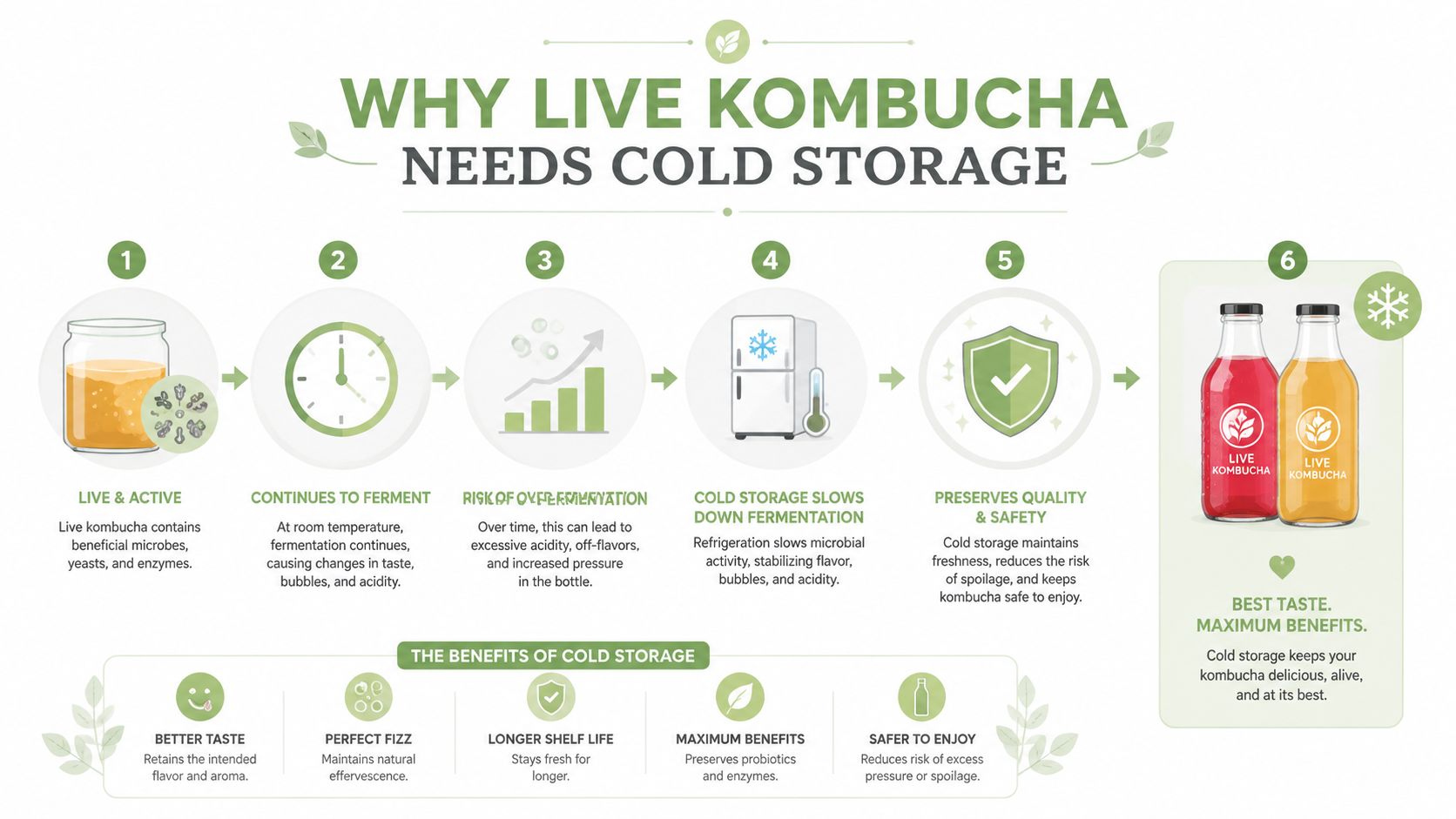
The Australian temperature framework
Western Australian food-safety guidance states that once kombucha reaches a safe acidity, the final product needs refrigeration at 4°C. The same guidance cites the Kombucha Brewers International recommendation for cold storage between 1.1°C and 4.4°C throughout the supply chain to help prevent continued fermentation and increases in alcohol content. These figures appear in the Western Australian fermented-food guideline.
A national fermented-beverages issues paper explains that kombucha is refrigerated at less than 4°C after 1 to 3 days of fermentation, which significantly slows the process. The same paper describes the microbes entering a dormant state rather than being eliminated. Small amounts of alcohol can still accumulate, so cold storage is a control measure, not a promise that all fermentation has stopped. You can read this context in the Australian fermented-beverages issues paper.
Practical rule: Cold storage turns active fermentation into slow fermentation. It doesn't make a live drink inert.
This explains why a finished bottle needs careful handling. Warm storage gives the culture more opportunity to keep working. Chilled storage helps hold the intended flavour, carbonation, and alcohol profile closer to the brewer's finished product.
For a café, that means a display fridge isn't merely a merchandising choice. For a home drinker, it means the refrigerator is part of the product's storage system, just as it is for other chilled fermented foods and beverages.
Raw Versus Pasteurised Kombucha Compared
Raw and pasteurised kombucha can look similar in the bottle, but they behave differently after production. Raw kombucha retains living cultures and needs temperature control. Pasteurisation uses heat to reduce or neutralise microbial activity, creating a product that can be stored on a shelf according to the producer's instructions.
That doesn't make one category universally right for everyone. Raw kombucha suits people who specifically want a living fermented drink and are happy to maintain the cold chain. Pasteurised kombucha may be more convenient for a pantry, mobile event, or café with limited refrigerated space.
| Attribute | Raw / Live Kombucha | Pasteurised Kombucha |
|---|---|---|
| Microbial activity | Living yeast and other microbes remain present and can continue changing the drink | Heat treatment reduces or neutralises the active culture |
| Storage | Usually kept refrigerated before and after opening | May remain on a shelf before opening, if the label permits |
| Flavour | Can continue developing if stored warm | More stable because fermentation activity has been reduced |
| Carbonation | Can build up as fermentation continues | More controlled after stabilisation |
| Best suited to | Drinkers seeking a raw fermented product | People prioritising portability and shelf convenience |
Read the product story, not just the front label
A bottle marked “organic” or “sugar-free” doesn't automatically tell you whether it needs refrigeration. Those terms describe ingredients or formulation, not necessarily the status of the fermentation culture. The storage instruction and processing information matter more.
Raw products also need a producer with disciplined brewing and bottling practices. If you're exploring home fermentation, PepTea's home-brew kombucha guide can help you understand the relationship between culture activity, acidity, flavour, and storage.
For a café, the choice affects operations. A raw product requires reliable chilled receiving, refrigerated display, and staff who understand why bottles shouldn't sit beside a warm coffee machine. A pasteurised product offers simpler logistics, but it no longer delivers the same living-culture proposition.
The most useful question isn't “Which type is healthier?” It's “Which type matches the customer expectation, storage capacity, and product label?” Once that's clear, refrigeration becomes a practical decision rather than a marketing mystery.
How Refrigeration Affects Probiotics and Carbonation
Cold storage can sound counterintuitive when you're buying kombucha for its living culture. Many people worry that refrigeration kills the probiotics. In practice, chilling slows microbial metabolism, helping preserve the drink in the condition the brewer intended. It doesn't turn a raw product into a pasteurised one.
Carbonation follows the same logic. A live culture can continue producing carbon dioxide when the bottle warms, particularly if fermentable material remains. Refrigeration reduces that activity and helps keep the fizz more controlled.
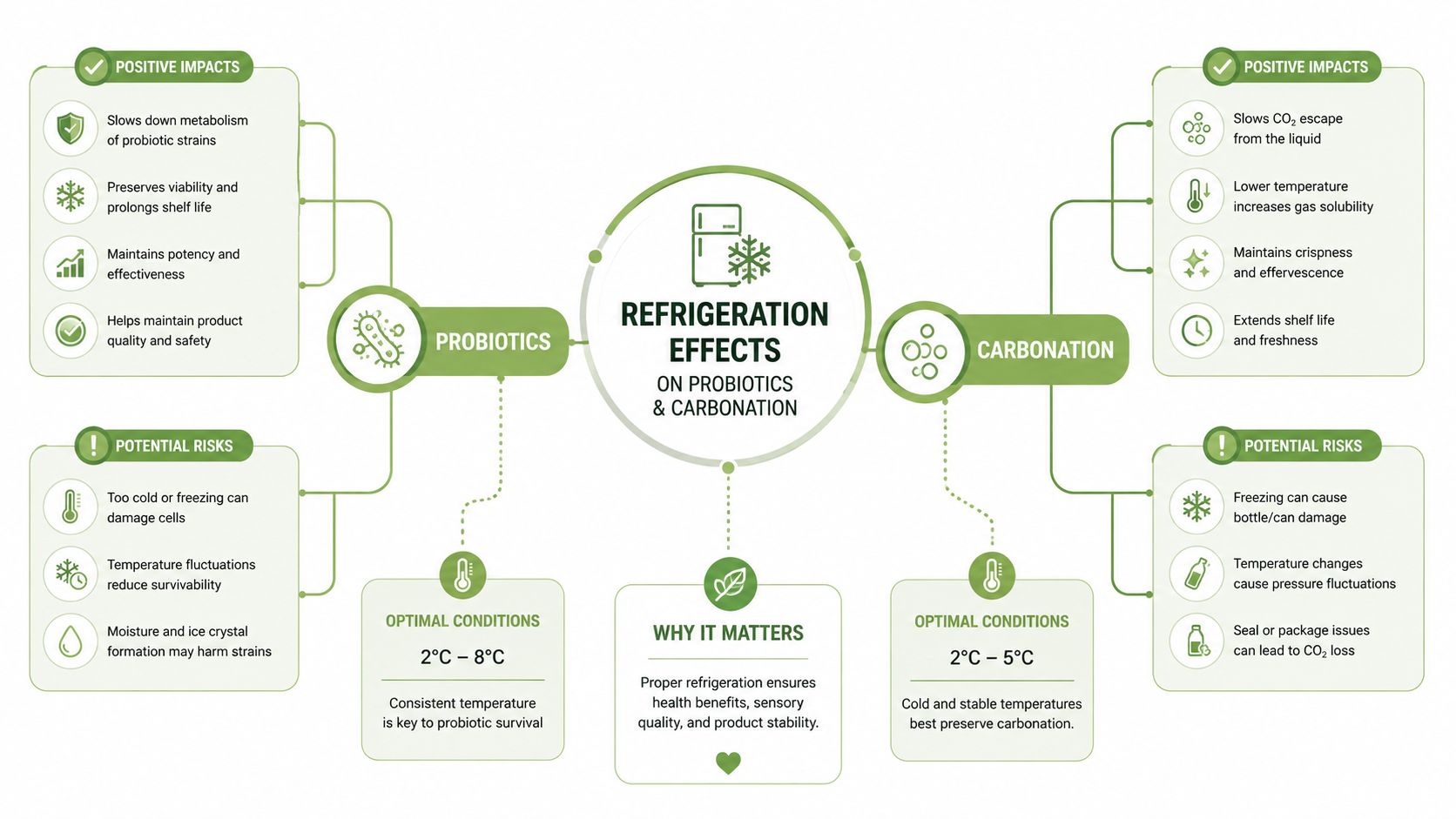
What changes when a bottle warms
A temperature change doesn't instantly transform kombucha, but repeated or prolonged warming gives the culture more opportunity to ferment. You may notice:
- More pressure: Carbon dioxide can accumulate inside a sealed bottle.
- A sharper taste: Continued fermentation may shift the balance towards greater acidity.
- A bigger pour: A warm, highly carbonated bottle may foam or gush when opened.
- A changing alcohol profile: Ongoing fermentation can allow small amounts of alcohol to accumulate.
Open a chilled bottle slowly over a sink if it has travelled, warmed up, or appears unusually pressurised. Don't shake it first. Keep your hands away from the cap as you release the pressure gradually.
Why pH checks matter to producers
Brewers use acidity as one part of fermentation control. A tool such as PepTea's digital pH meter can help a producer monitor the brew's acidity during production, but pH alone doesn't replace safe handling, validated processes, or correct refrigeration.
Refrigeration protects the drinking experience and supports control of the living process. It isn't a substitute for good brewing hygiene.
For consumers, the practical lesson is simple. Keep raw kombucha consistently cold, avoid leaving it in a hot car or sunny window, and expect the drink to behave differently if it has spent substantial time warm.
Storage and Transport Best Practices for Every Setting
A good storage routine starts before the bottle reaches the fridge. At home, place raw kombucha in the refrigerator as soon as you unpack it. Keep bottles upright, avoid the warmest areas of the fridge door, and leave enough space around them for cold air to circulate.
CHOICE's storage advice says unpasteurised kombucha should be refrigerated before and after opening and consumed within a month. Treat that as a useful guide, while giving the product's own best-before date and label instructions priority.
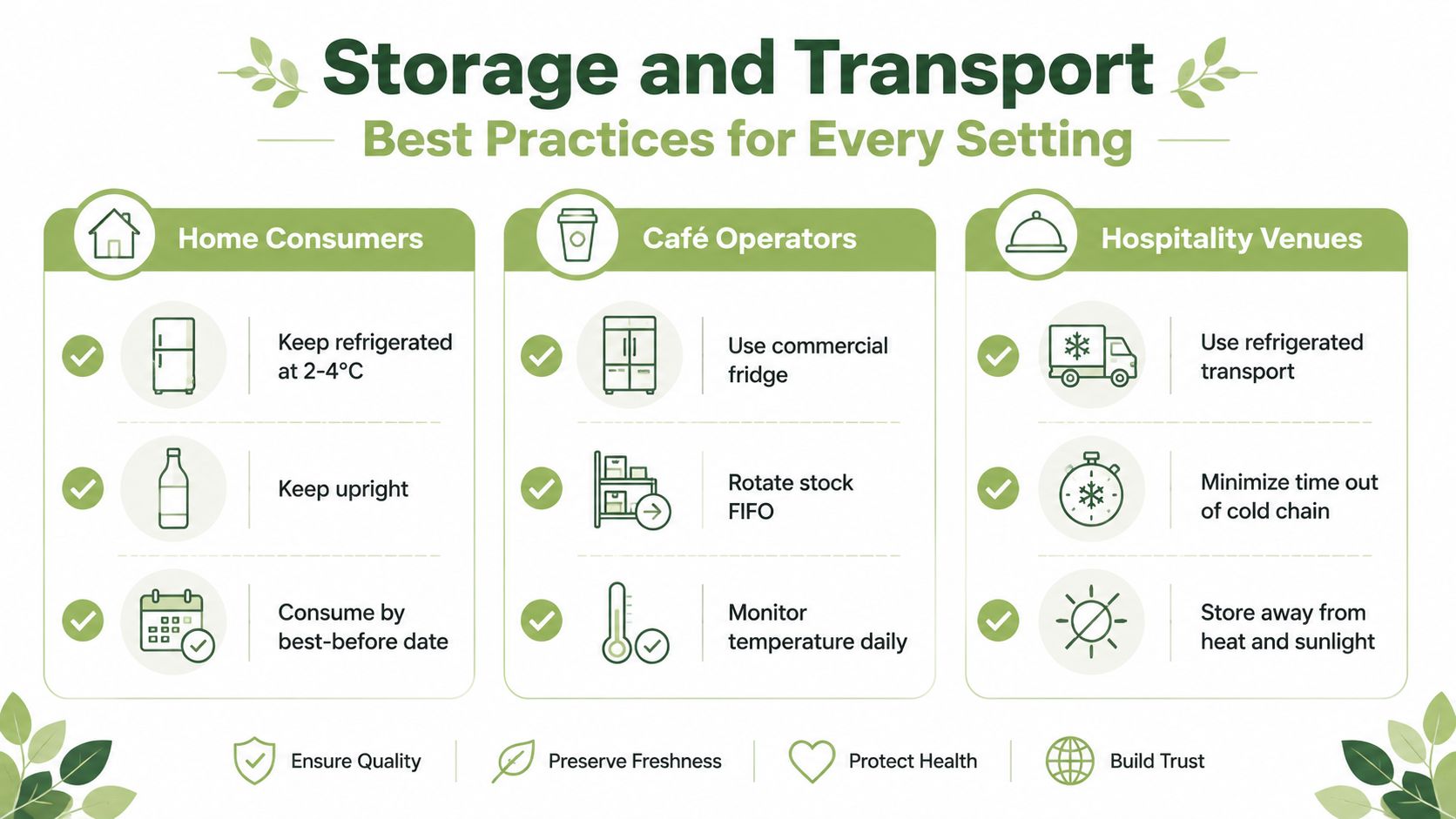
At home
- Keep it upright: This reduces the chance of liquid sitting against the cap and makes opening more manageable.
- Open gently: Twist the cap slowly, particularly if the bottle has been moved or warmed.
- Use clean glasses: Don't drink directly from a shared bottle if you plan to store the remainder.
- Follow the label: Use the producer's opening instructions and best-before guidance.
If a raw bottle has been left on the bench, move it back to the fridge and inspect it before opening. A change in smell, unusual appearance, damaged packaging, or excessive pressure is a reason to avoid drinking it and contact the producer for advice.
In a café or restaurant
Receiving staff should check whether the product is labelled for refrigeration and move raw kombucha into a functioning commercial fridge promptly. Keep stock away from ovens, direct sunlight, hot pass areas, and equipment that releases heat.
Use a simple rotation system so older stock is offered first. Staff should know the difference between a raw bottle and a shelf-stable pasteurised product, because displaying them together can create confusion for customers and inconsistent service.
A daily temperature check gives managers a practical record that the cold storage system is working. If the fridge runs warm, isolate affected stock and follow the supplier's advice rather than guessing.
During transport
Use an insulated esky or refrigerated vehicle for raw kombucha, especially when travelling to a market, event, or outdoor service. Pack the bottles securely, keep the container shaded, and return unused stock to refrigeration as soon as possible.
For cafés ordering from an Australian supplier, ask how the product is packed, transported, and labelled. A clear cold-chain process protects flavour and helps the venue serve the drink as the brewer intended. PepTea's kombucha storage guide is another practical reference for handling bottles at home or in hospitality settings.
Common Kombucha Storage Myths and Mistakes
Myth one, all kombucha is shelf-stable. Some bottles can sit on a shelf because they've been pasteurised or otherwise stabilised. Raw kombucha is different. A chilled display is often a direct signal that the product remains biologically active and depends on cold storage.
Myth two, refrigeration kills the good bacteria. Refrigeration slows microbial activity. That's why it helps preserve a live drink rather than replacing it with a heat-treated one. Warm storage is usually the bigger concern for a raw product because it allows fermentation to continue more quickly.

The alcohol question in Australia
Kombucha's alcohol content can change as fermentation continues. NSW Health notes that drinks over 0.5% ABV require alcohol-content labelling under the Food Standards Code, as outlined in the national fermented-beverages issues paper.
The thresholds applied to kombucha also vary by state in the Kombucha Brewers International code of practice. New South Wales, Victoria and Queensland use 0.5% ABV, while Western Australia, South Australia and Tasmania use 1.15% ABV, according to the Kombucha Brewers International code. That variation makes temperature control important for producers and hospitality businesses selling across state borders.
Myth three, one warm night never matters. A short period outside the fridge doesn't provide enough information to make a universal safety decision. The product's formulation, processing, packaging, temperature exposure, and label all matter. If a raw bottle has been warm for an extended time, contact the producer rather than relying on smell alone.
Finally, don't confuse “sugar-free” with “doesn't need refrigeration”. Storage depends on the entire product and process, not one front-label claim.
Choosing Quality Australian Kombucha and Storing It Right
Good storage starts with choosing a product whose handling requirements are clear. In Australia, FSANZ treats kombucha as a traditional food, so it doesn't require pre-approval as a specific product category. It remains covered by the general Food Act requirement that food is safe and suitable, which places practical importance on responsible production, storage, and handling. CHOICE explains this regulatory context.
Keep these rules close:
- Raw or live kombucha: Refrigerate it before and after opening.
- Temperature control: Follow the label and maintain cold storage around the recommended 4°C-class range.
- Transport: Use an insulated or refrigerated method and limit warm exposure.
- Cafés: Check receiving, display, rotation, and daily fridge practices.
- Shelf-stable products: Follow the producer's unopened and opened storage instructions.
Pep Tea makes Australian-brewed, sugar-free organic kombucha in the Hunter Valley, NSW, alongside its organic Japanese Matcha range. If you're looking for a chilled fermented drink for home or a non-alcoholic café menu, explore the product details and store each bottle according to its label.
Visit Pep Tea to explore sugar-free organic kombucha brewed in Australia and premium organic Matcha for everyday wellness routines. Choose the format that suits your fridge, café menu, or transport needs, then keep live kombucha properly chilled from purchase to pour.
How to Store Matcha Tea and Keep It Fresh

You open the matcha tin for your morning latte and notice the colour has shifted from vivid green to something duller. The aroma that once smelled sweet and grassy now reminds you of hay, even though the powder is still within its printed date. In an Australian kitchen, that change can happen quickly when matcha sits beside a toaster, on a sunny shelf, or in a humid cupboard.
Learning how to store matcha tea isn't about treating a pantry like a laboratory. It's about controlling air, light, heat and moisture, then building a routine that prevents condensation and repeated exposure. Store it properly and your matcha will keep its fresh aroma, smooth flavour and vibrant colour for far longer.
Why Your Matcha Is Going Off Faster Than You Think
The first sign is often subtle. You whisk your usual morning bowl, but the fragrance is flat and the flavour tastes more like cut grass than fresh, sweet greenery. The tin was sealed after yesterday's use, so you assume the problem must be the matcha itself.
Usually, the problem is exposure. Matcha is made by grinding tea leaves into an extremely fine powder, which means oxygen can reach a much larger exposed surface than it can with intact loose leaves. Its delicate colour, aroma and flavour are therefore vulnerable every time you open the container. You can learn more about that transformation in this guide to how matcha tea is made.
Australian conditions make careless storage harder to forgive. A warm summer kitchen, a humid apartment near the coast and a cupboard above the oven all expose matcha to conditions that shorten its best flavour window. Frequent fridge opening creates another issue, because temperature changes can encourage condensation inside the packaging.
Freshness isn't the same as safety
Matcha may remain usable after its best sensory qualities have faded. Australian guidance commonly recommends using opened matcha within 2 to 3 months, because flavour and nutritional benefits peak early and decline with air, light and moisture exposure. Unopened product is often kept for up to 12 months, although some suppliers recommend 6 to 12 months for best quality. (Australian Matcha Society guidance)
That distinction matters. A powder can be technically within its storage window while its aroma has already disappeared, its colour has dulled and its flavour has become bitter or bland. Treat the printed date as a safety and quality reference, not permission to leave an opened tin untouched for months.
Practical rule: If the colour, aroma and flavour have clearly deteriorated, better storage won't restore them. Use fresher matcha next time and protect it from the moment you open it.
The Four Enemies of Fresh Matcha
Audit your current storage setup against four causes of deterioration. Fix the biggest exposure first, then make the rest part of your normal kitchen routine.
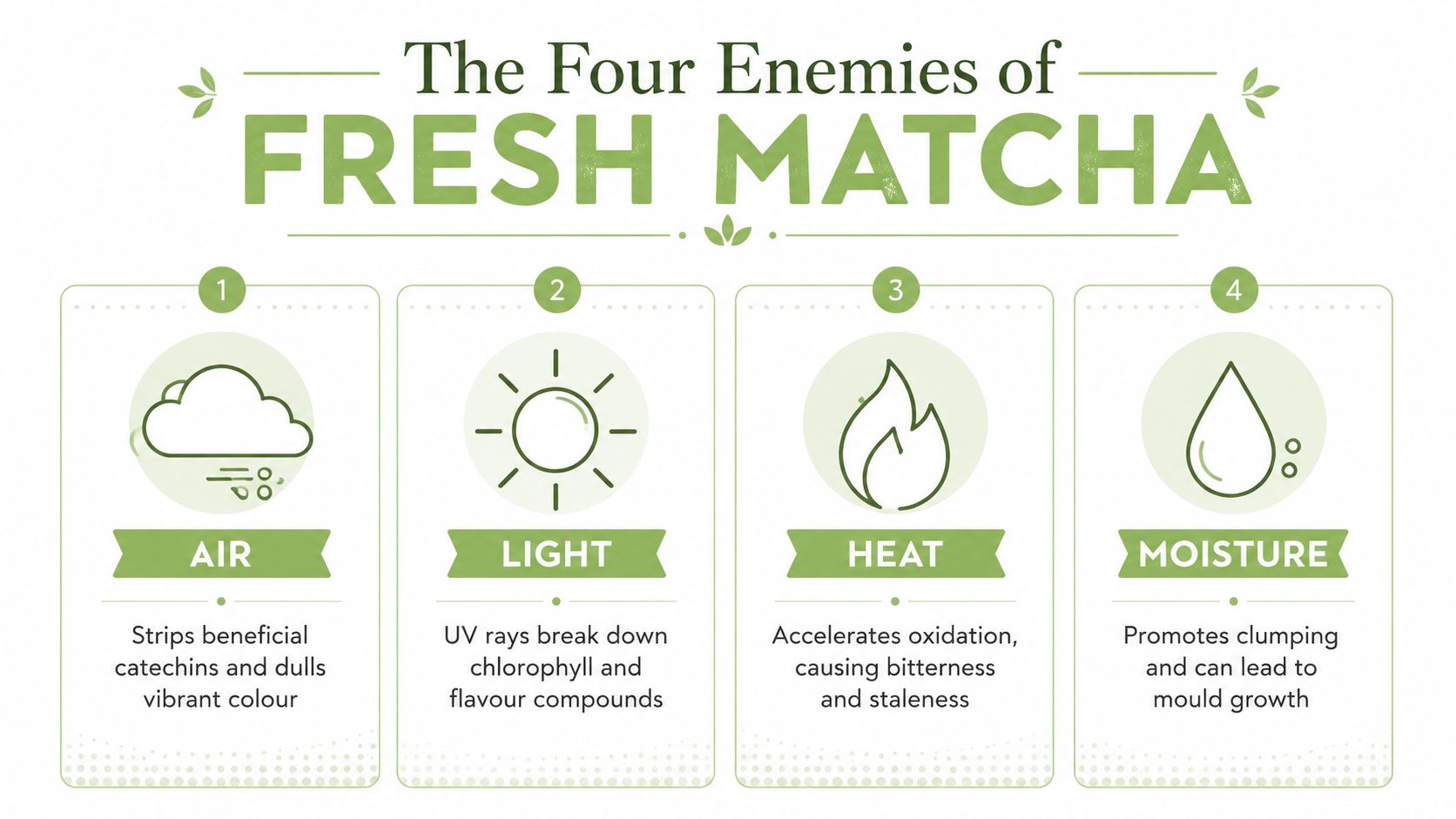
Air
Oxygen gradually dulls matcha's colour, aroma and flavour. A pouch that contains a large pocket of air is already working against you.
Spot it: The powder looks less vibrant around the surface or tastes flat despite being tightly closed.
Counter it: Squeeze excess air from a resealable pouch before closing it, or transfer the powder to the smallest suitable airtight container. Australian storage advice specifically recommends smaller packs and limiting repeated air exposure. (Kenkō Tea storage guidance)
Light
Direct sunlight and bright kitchen lighting can fade the green colour and weaken the fresh vegetal character.
Spot it: Your container sits on an open shelf, windowsill or bench in full daylight.
Counter it: Use an opaque tin or place the sealed container inside a dark cupboard. A clear canister may look attractive, but it's a poor choice for long-term matcha storage.
Heat
Heat accelerates quality loss. Keep matcha away from ovens, kettles, stovetops, dishwashers and other warm appliances. Australian guidance identifies 0°C to 20°C as an ideal storage band and recommends relative humidity at or below 60%. (Kenkō Tea storage guidance)
Spot it: The tin feels warm, or it lives in a cupboard above an appliance.
Counter it: Move it to the coolest dark cupboard available, or use the fridge when your home is consistently hot or humid.
Moisture
Humidity causes clumping and can compromise the powder's quality. Steam from a kettle, a damp teaspoon or condensation from a cold container can introduce enough moisture to change the texture.
Spot it: The matcha forms stubborn lumps or feels damp rather than silky.
Counter it: Use a completely dry spoon, close the container immediately and never open chilled matcha until it has returned to room temperature.
Start with air and heat, then eliminate light and moisture. A perfect container won't compensate for a hot shelf or a wet spoon.
Pantry, Fridge or Freezer Where Should Matcha Live
There isn't one universal storage zone. The right choice depends on your household temperature, humidity and how quickly you use the powder.
| Location | Ideal Temperature | Typical Shelf Life | Best For |
|---|---|---|---|
| Pantry | Around 25°C or cooler | Opened matcha is best used within 2 to 3 months | Daily drinkers with a genuinely cool, dark cupboard |
| Fridge | Cool and stable, within the recommended 0°C to 20°C band | Opened matcha is commonly used within 2 to 3 months for best quality | Hot or humid Australian homes |
| Freezer | Frozen and consistently sealed | Some Australian guidance allows unopened matcha to be kept for longer, but quality depends on avoiding moisture and temperature swings | Large, sealed reserves or café stock |
The pantry is perfectly practical when it stays cool, dry and dark. Store the matcha in its airtight opaque packaging, away from direct light and heat sources. An Australian tea guide recommends around 25°C or cooler, with refrigeration or desiccants reserved for humid conditions. (Tavalon Australia storage advice)
The fridge is the better choice for a hot Australian summer or a humid apartment. Put the sealed container inside a protective airtight food container and keep it away from strong-smelling foods. Don't open it straight from the fridge. Let it reach room temperature first, otherwise warm humid air can condense on the powder.
Freezing is a specialist option, not my default recommendation for a household tin. Use it only when the matcha is sealed thoroughly and you won't keep moving it between frozen and room-temperature storage. A freezer can extend storage for a bulk reserve, but condensation during thawing can undo the benefit.
My recommendation: Daily users should choose a cool dark pantry if it stays stable. If summer heat or humidity makes that unreliable, use the fridge consistently. Occasional users should buy smaller packs rather than relying on long-term freezing.
Choosing the Right Container and Packaging
The best matcha container is airtight, opaque, clean and appropriately sized. Don't choose a clear decorative jar because it looks good on the bench. Light and excess air matter more than presentation.
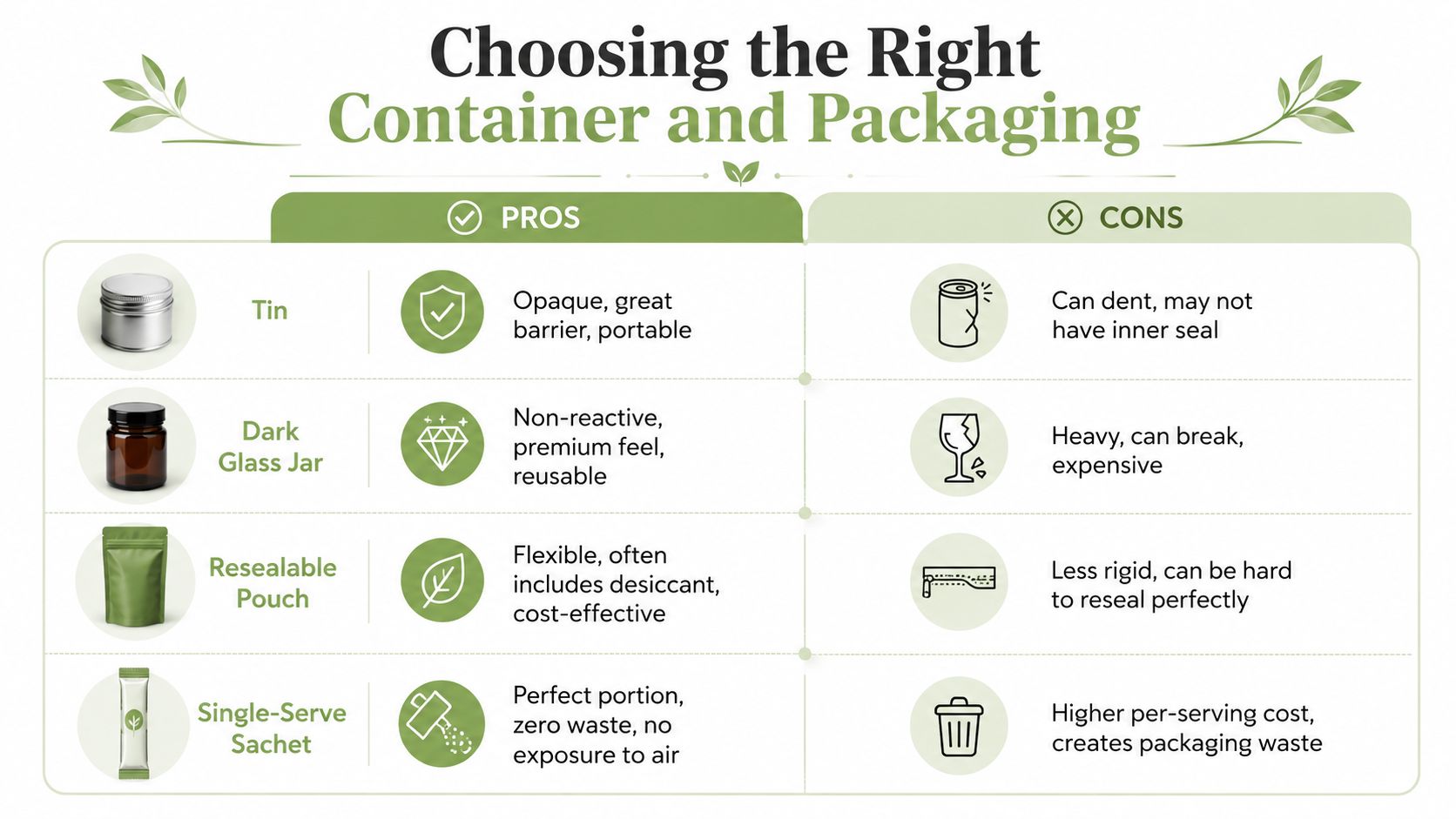
Tins for regular home use
A metal tin is my first choice for a daily drinker. It blocks light, travels well and usually gives you a strong barrier against the kitchen environment. Look for a tight inner seal, because a lid that merely rests on the rim isn't enough.
The weakness is practical. Tins can dent, and some have no reliable inner seal. Keep the original pouch inside the tin if it closes securely, or use a food-safe airtight insert that doesn't leave a large air gap.
Dark glass jars for careful storage
Dark glass is non-reactive, reusable and attractive on a kitchen shelf, provided it blocks light effectively. It's heavier than a tin and can break, so it suits a stationary home setup better than a café service area.
Fill the jar sensibly rather than leaving a large empty space above the powder. Wash it thoroughly, dry it completely and never transfer matcha into a container that retains steam or detergent odour.
Resealable pouches and sachets
Resealable pouches are flexible and efficient, especially when they include a suitable barrier layer or desiccant. Squeeze excess air out before resealing, and don't assume a zip closure remains perfect forever. For a useful packaging example, compare the format of this matcha green tea pouch 40g.
Single-serve sachets offer excellent portion control. Each serving remains protected until use, but the packaging creates more waste and can cost more per serving. They make sense for cafés with inconsistent demand, travel kits and hospitality service where an opened bulk pouch would sit exposed.
For more container-specific guidance, see this practical resource on a matcha storage container. For cafés and retail, vacuum-sealed or nitrogen-flushed pouches can reduce oxygen exposure before opening, but staff still need a disciplined system after the seal breaks.
Pack Sizes, Rotation and Everyday Habits That Matter Most
A better container helps. Smaller packs and disciplined rotation help more. Matcha begins losing quality as soon as the seal is broken, so a quantity that gets used promptly is a smarter purchase than a large bargain pack that remains open through changing weather.
Australian guidance recommends smaller packs, with about 50 g suggested for people who drink matcha daily to reduce repeated air exposure. Some Australian advice also recommends consuming opened matcha within about 2 months. (Kenkō Tea storage guidance)
Use a simple FIFO system
Cafés should mark the opening date on every pouch or tin and use first in, first out rotation. Put the oldest opened stock at the front of the shelf, not behind a newer delivery. Households can use the same approach by writing the opening date on masking tape and keeping one active pack at a time.
Don't bulk-buy simply because a sale makes the larger size appear economical. The saving disappears when the powder sits open, loses its aroma and forces you to compromise on flavour in lattes, baking or ceremonial preparation.
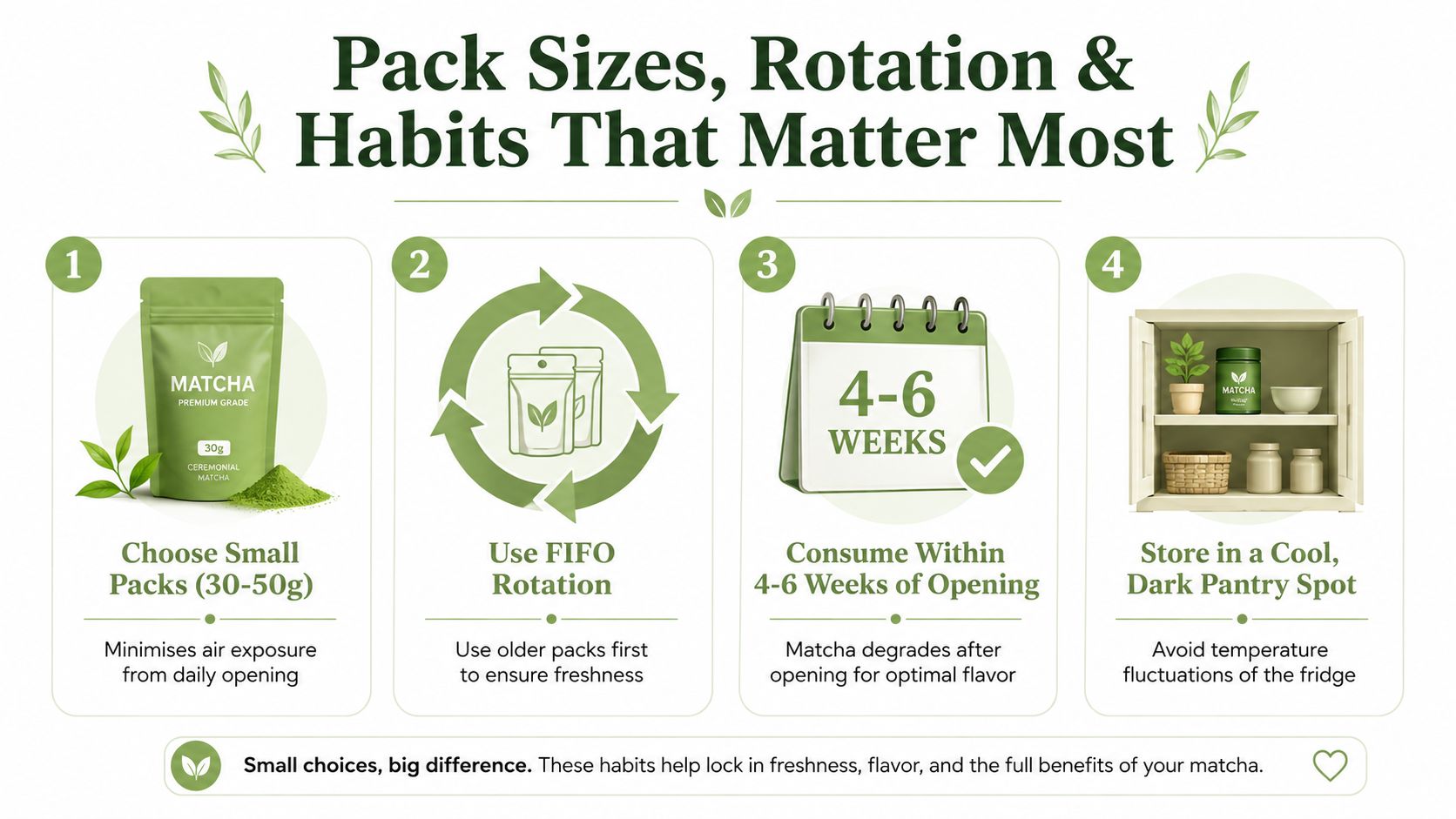
A useful routine is to keep a small working amount in a daily tin while the main pack stays sealed. Refill that tin only when necessary, and return the main pack to its cool storage immediately. This reduces the number of times you expose the full supply to air.
For more detail on quality windows and handling, use this guide to matcha shelf life. The exact container matters less than opening only what you can use promptly.
Troubleshooting Common Matcha Storage Mistakes
Most storage failures leave visible or aromatic clues. Use this checklist before deciding whether your matcha needs replacing.
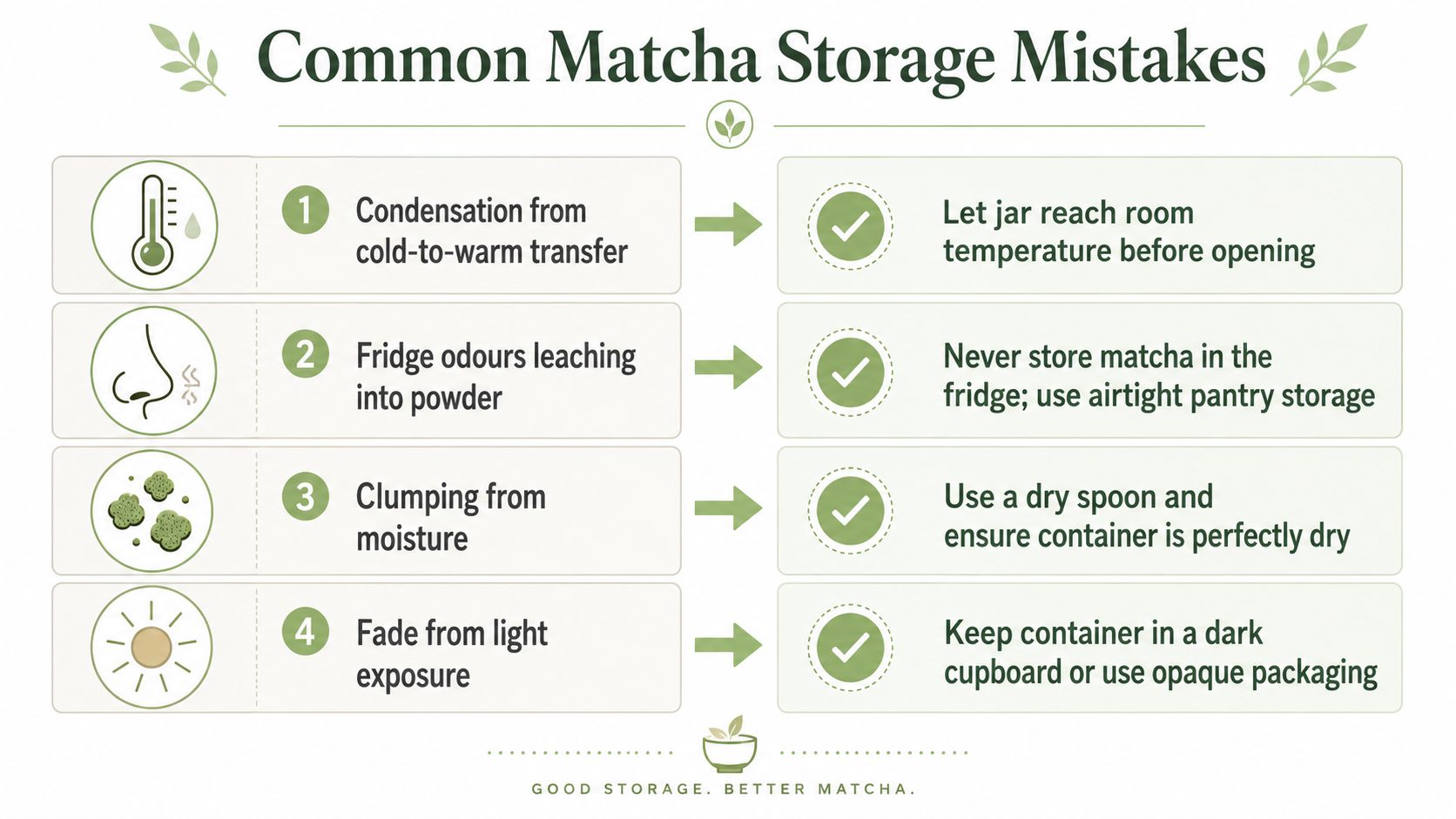
Condensation after refrigeration
If you open a cold tin in warm kitchen air, moisture can form inside. That moisture lands directly on the powder and creates clumps.
Fix: Keep the container sealed while it returns to room temperature. Don't speed up the process by opening the lid on the bench.
Fridge odours in the powder
Matcha can pick up nearby food smells, particularly when packaging isn't fully airtight.
Fix: Store it inside a second airtight food container and keep it away from strongly scented foods. If the aroma has already changed to garlic, onion or another fridge smell, the container has failed at its job.
Clumping from moisture
Small soft lumps may come from a damp spoon or steam near the kettle. Hard, persistent clumps suggest more serious moisture exposure.
Fix: Use a dry spoon every time, ensure the container is completely dry and keep the lid off only while measuring. Never scoop matcha over a steaming mug or saucepan.
Faded colour
Fresh matcha should look lively and green. A dull green, greyish or brown appearance, paired with a flat or stale aroma, indicates oxidation and quality loss.
Fix: Don't try to rescue it with extra powder or sweetener. Replace it, then protect the new pack from light, air, heat and moisture from day one.
A Simple Daily Storage Routine You Can Stick To
Good storage should be easy enough to follow on a busy weekday. This routine takes only a few minutes to organise and removes most of the avoidable exposure from daily use.
Set up the main pack
Choose a small opaque tin for the amount you'll use regularly. On a quiet day, portion enough matcha for several daily preparations into that working tin, then close the main pouch firmly and return it to its chosen storage zone.
If your main supply lives in the fridge, keep it sealed while it warms before opening. Don't keep moving it between the fridge and pantry. Stable conditions are safer than constant temperature changes.
Handle the powder properly
Before scooping, wipe the teaspoon completely dry. A clean, dry bamboo scoop or teaspoon is fine, but a wet utensil can introduce moisture in seconds.
Measure what you need, then close the daily tin immediately. Never leave the lid upside down on the bench, where condensation, steam or crumbs can reach the seal. Put the lid back on as soon as the powder is out.
Keep the storage spot organised
Choose a dark cupboard away from the oven, toaster, kettle and dishwasher. If the kitchen becomes hot or humid during an Australian summer, move the sealed supply to the fridge instead, using the same careful warm-up routine before opening.
Label the opened date and keep older stock in front. That simple habit prevents forgotten tins from hiding behind newer purchases and gives cafés a practical way to manage multiple matcha grades.
Buy packaging that supports the routine
Fresh, well-packaged matcha makes this process much easier. An opaque, airtight pack already protects the powder from the main storage threats, so you only need to add sensible handling, quick resealing and a dry utensil.
Australian storage guidance varies on unopened quality windows, with one guide allowing up to 18 months in a cool, dry place when excess air is removed from resealable pouches and opaque airtight packaging is used. (Mindya Matcha storage guide) That longer unopened window doesn't change the central rule: once opened, prioritise flavour and volatility retention over keeping the powder until it is technically usable.
At home or in a café, choose a pack size you can finish promptly, keep it cool and dark, and make resealing automatic. That's how to store matcha tea without turning every morning cup into a storage experiment.
Choose Pep Tea for premium organic Japanese matcha in formats suited to everyday drinking, cafés and culinary use. Visit Pep Tea to find matcha that arrives properly packaged, then make the simple routine above part of your daily preparation.
Small Batch Kombucha: A Complete Australian Guide

Most advice about small batch kombucha starts with romance: handmade, raw, alive, and somehow automatically healthier. That framing misses the part that decides whether a bottle is safe, consistent, and legally sold. In Australia, fermentation changes acidity, sugar, carbonation and alcohol content, so the brewer's real work happens in the measurements, records and cold storage, not just in the attractive label.
Australia's kombucha story has deep roots. The drink appeared in Australian press as a “mysterious medicine” from Mongolia and eastern Siberia in 1945, while Mojo in South Australia is identified as the country's first commercial producer, with Anthony Crabb beginning sales at the Willunga Farmers' Market in 2009 (Australian Food Timeline). That path from home brewing and farmers' markets to broader retail helps explain why craft-style fermentation still matters, but it doesn't excuse loose process control.
What Small Batch Kombucha Actually Means
“Small batch” doesn't automatically mean better. It describes a way of producing kombucha, not a guarantee about sugar, live cultures, flavour or safety.
A small-batch brewer usually ferments limited volumes in individual vessels, monitors those vessels by hand and accepts that one batch may taste slightly different from the next. The producer may work with a shorter supply chain, buy tea and botanicals in smaller quantities, and bottle closer to the place of brewing. Those choices can create a more distinctive drink, but they also create more variables.
A factory can use filtration, pasteurisation, controlled carbonation and tightly standardised inputs to make every bottle taste familiar. A small producer may preserve more of the living fermentation, which can mean more sediment, changing acidity and a shorter stability window. Neither format deserves a halo by default.
The Australian boundary that matters
The phrase also carries a regulatory consequence. Queensland guidance says fermented foods should reach a pH of 4.6 or lower, ideally within 24 hours, and that final alcohol content must not exceed 0.5% ABV for general food classification (ABC News). Queensland guidance also identifies 1.15% ABV as the maximum for brewed soft drinks under the Food Standards Code, while products at 0.5% ABV or above require alcohol declaration on the label.
That means “small batch” isn't merely a visual style or a farmers' market story. Fermentation can continue after bottling, particularly when residual sugar, yeast and warmth are present. A brewer needs to control the batch before packaging and understand what happens during transport and storage.
Practical rule: Treat every small batch as its own production event. Record its tea, sugar, fermentation conditions, pH, flavour additions, packaging date and storage conditions.
The rest of the buying decision follows from that reality. Taste may be more expressive, but the buyer should also ask whether the producer manages pH, alcohol drift, refrigeration and batch consistency with the same care given to branding.
How Small Batch Kombucha Is Brewed
A useful way to understand small batch kombucha is to follow one brew from sweet tea to finished bottle. The culture commonly called a SCOBY, or symbiotic culture of bacteria and yeast, works with starter liquid to transform sweetened tea into a tart fermented drink.
Start with filtered water, black or green tea, white or raw sugar, a healthy SCOBY and acidic starter liquid from a previous batch. The sugar feeds the culture during fermentation. It isn't poured into the finished drink for the consumer to consume, although fermentation doesn't guarantee that every gram disappears.
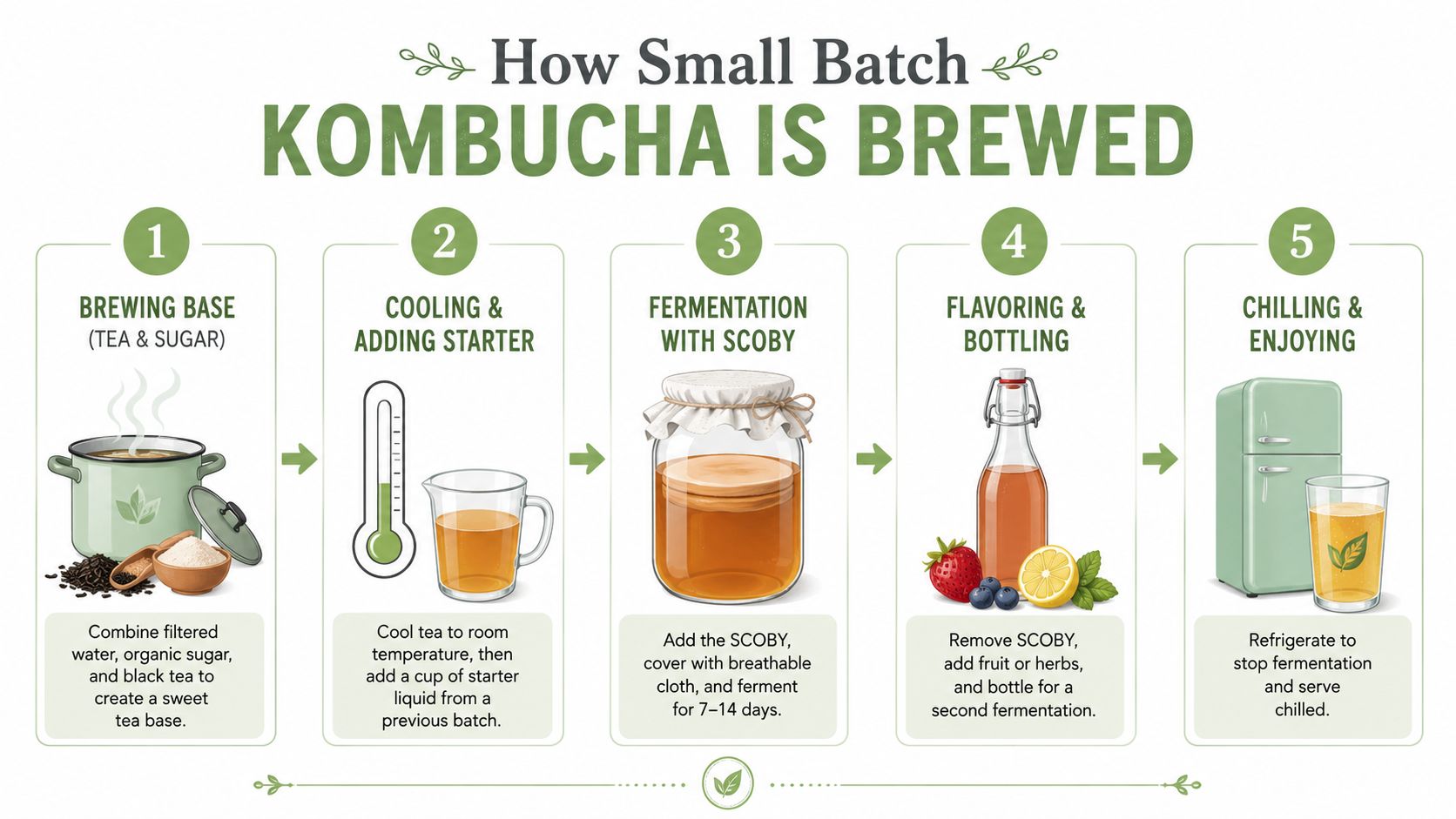
Building the primary ferment
Brew the tea base. Steep the tea in hot water, dissolve the sugar, then allow the liquid to cool fully. Hot sweet tea can damage the culture, so patience at this stage prevents trouble later.
Add starter and SCOBY. Transfer the cooled tea to a clean, food-grade vessel. Add starter liquid, then place the SCOBY into the brew. The starter helps lower the initial pH and gives the new batch a stronger beginning.
Cover and ferment. Use a breathable cloth or cover that keeps insects and debris out while allowing air exchange. A working temperature around 22 to 26°C is commonly used, with primary fermentation often taking 7 to 14 days, but taste and pH should guide the decision rather than a calendar alone.
Taste and measure. The brew becomes sharper as the culture consumes sugar and produces acids. Use a reliable pH meter, clean sampling technique and consistent records. A pleasant flavour isn't a substitute for a safety check.
Basic equipment includes a food-grade vessel, breathable cover, bottles, a pH meter and a hydrometer for tracking fermentation-related changes. Brewers also need a repeatable cleaning and sanitising routine. Commercial or serious home operations can benefit from learning about food industry lab solutions when designing a hygienic workspace, especially where wet areas, sampling and storage need to stay organised.
Why the second ferment changes the drink
After primary fermentation, remove the SCOBY and add fruit, herbs, spices or juice before bottling. This second fermentation lets remaining yeast work on fresh sugars, creating natural carbonation. It can also increase alcohol content, change acidity and produce pressure inside the bottle.
A SCOBY hotel is a separate container of SCOBYs and strong starter liquid, maintained so a brewer has reserve cultures available. It's useful for continuity, but it still needs clean handling and regular observation. For a practical home-brewing starting point, Pep Tea provides a home-brew kombucha guide that can help turn the broad process into a repeatable routine.
The safest habit is to chill bottled kombucha once the desired carbonation develops. Cold storage slows fermentation. It doesn't magically reverse it, so bottles should still be checked, handled carefully and kept within the producer's instructions.
Small Batch Versus Mass Produced Kombucha
Small-batch kombucha often shows more tea character, sharper acidity and visible sediment. Those features reflect how much of the fermented drink remains in the bottle, rather than proving superior health value. Mass-produced kombucha may be filtered, pasteurised or stabilised, which can create a cleaner appearance and a longer, more predictable retail life.
The practical difference is control versus variation. A small producer must manage pH, fermentation time, carbonation and alcohol drift across changing temperatures and cultures. Industrial production can apply tighter process controls, but the label and storage instructions still determine what reaches the customer.
Sugar also cuts through broad marketing claims. Retail kombucha products have been found with sugar levels from less than 0.1 g to 3.8 g per 100 mL, while the Australian Food Standards Code defines low sugar as 2.5 g or less per 100 mL, according to CHOICE. The word “kombucha” tells you very little about sweetness. Read the nutrition panel.
| Attribute | Small Batch | Mass Produced |
|---|---|---|
| Taste | More variation between batches, with tea, acidity and botanicals often prominent | More standardised flavour from controlled processing |
| Residual sugar | Can vary with fermentation time and flavour additions | Usually managed for a consistent labelled profile |
| Live cultures | May retain live cultures when sold raw and refrigerated | May be reduced through pasteurisation or filtration |
| Alcohol control | Requires close monitoring because fermentation can continue | Industrial controls can improve consistency, but the label still matters |
| Batch consistency | Natural variation is more likely | Repeatability is usually the commercial priority |
A live, unpasteurised bottle can keep changing in the fridge. That suits fermentation enthusiasts, but it also requires a reliable cold chain and a realistic best-before period. Warmer storage can speed fermentation, increase pressure and allow ABV to drift, so a producer needs records and repeatable handling rather than a promising label alone.
Shelf-stable kombucha is easier to distribute and store. Its processing may reduce culture activity, so buyers should not assume it behaves like raw kombucha. Small-batch producers can offer distinctive, flavour-forward drinks, while mass-produced brands usually prioritise consistent taste and supply. The better choice depends on fermentation character, storage convenience, sugar control and the serving context.
Safety, pH and Quality Standards in Australia
A small-batch brewer should treat safety as a sequence of checks, not a final paperwork exercise. The first question is whether the fermentation acidifies quickly and consistently enough to discourage harmful bacteria.
Australian food-safety guidance recommends a final pH below 3.0 for kombucha. If the brew hasn't fallen below 3.0 by day 10, it should be discarded, and guidance recommends measuring around day 7 before deciding whether fermentation should continue (Food Safety Australia). A weak starter culture, low temperature or contamination can all contribute to inadequate acidification.
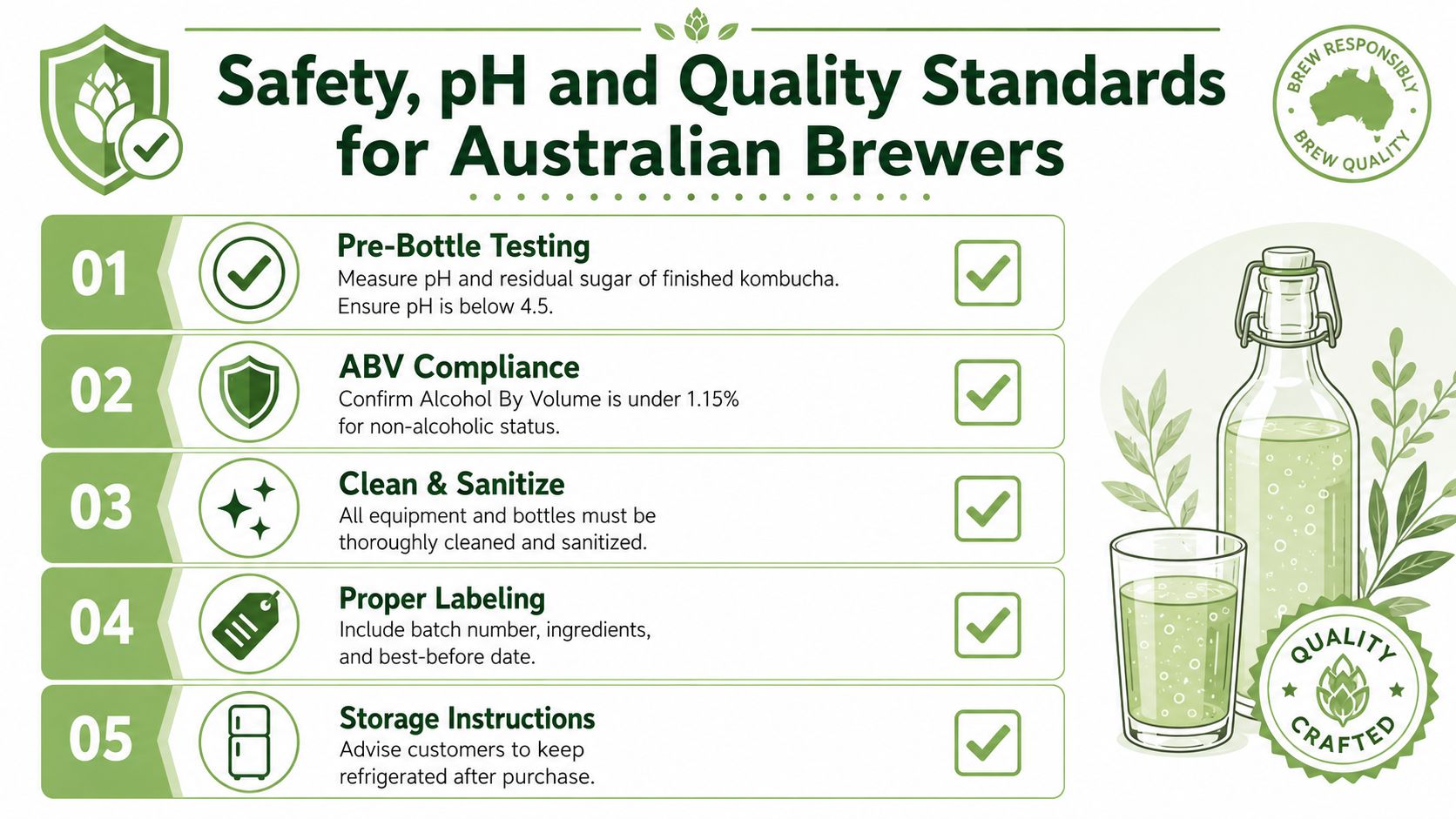
A brewer's control sequence
First, control the vessel. Clean and sanitise the fermentation vessel, utensils, bottles and sampling equipment. Handle the SCOBY with clean hands or suitable food-safe tools, and keep a batch record that identifies the date, tea, sugar, culture and observations.
Second, monitor acidification. Measure pH with a calibrated meter rather than relying only on taste. Queensland guidance uses 4.6 or lower as a fermented-food safety threshold, while kombucha-specific guidance recommends going below 3.0 and discarding a batch that hasn't reached that target by day 10.
Third, manage alcohol. NSW Health states that drinks above 0.5% ABV require alcohol-content labelling, while products above 1.15% ABV are considered alcoholic in NSW (NSW Health). The practical controls are sugar loading, fermentation time, temperature, flavour additions, packaging and refrigeration. A hydrometer can support production records, but producers may need more appropriate alcohol testing when compliance decisions depend on the result.
Finally, validate the finished product. Check pH and residual sugar before bottling, assess carbonation behaviour, and establish a shelf-life method through real-time and accelerated testing. Live, unpasteurised kombucha needs refrigerated distribution because cold slows, but doesn't eliminate, ongoing fermentation.
For label design and broader food-information obligations, producers can consult Australian food labelling requirements and confirm requirements relevant to their product, state and sales channel. A digital pH meter can also make routine acidity checks easier, provided the brewer calibrates, cleans and stores it correctly.
A basic HACCP approach helps identify hazards at each stage. The critical points include culture handling, sanitation, acidification, alcohol formation, bottle pressure, temperature control, allergen or ingredient declarations and recall records. Good process control isn't the enemy of craft. It's what lets a small producer keep making an honest product.
Flavouring, Second Fermentation and Recipe Ideas
Flavouring is where small batch kombucha becomes expressive, but it's also where a stable ferment can become unpredictable. Fruit sugars feed yeast, acidity shifts with juice and botanicals, and a sealed bottle can build pressure quickly.
Use small trials before committing a full batch. Keep the base kombucha, addition, dose, bottling date, refrigeration date and sensory result in a record. Never fill a bottle right to the top, and release pressure carefully when testing an active second ferment.
| Flavour Profile | Ferment Stage | Dose Rate | ABV Impact | Best Use |
|---|---|---|---|---|
| Ginger and lemon | Finish in primary ferment or short bottle conditioning | Fresh grated ginger with a modest amount of lemon juice | Low to moderate, depending on residual sugar and time | A sharp everyday serve |
| Berry and hibiscus | Second fermentation | A small amount of crushed berries and hibiscus infusion | Moderate potential because fruit sugars feed yeast | Colourful café bottle or brunch pairing |
| Cold-brew coffee | Flavour after primary fermentation | Strained cold-brew coffee blended into the finished kombucha | Variable, with coffee adding flavour rather than being the main fermentable | A bitter, grown-up alternative to sweet drinks |
| Cucumber and mint | Short second ferment or direct serve | Thin cucumber slices and a restrained mint infusion | Usually lower when no sugary fruit is added, though the base still matters | A light summer café pour |
Berry and hibiscus are visually dramatic, but they deserve close attention. Natural carbonation can increase as yeast consumes fruit sugar, while fruit acids can push pH lower. Cucumber and mint are gentler additions for a low-sugar serve, although they can lose freshness if held too long.
Coffee kombucha needs clean, well-filtered cold brew. Excess coffee solids can make the bottle muddy and may overpower the tea. Ginger and lemon are forgiving, but lemon juice can make the finished drink noticeably sharper, so taste before adding more.
Bottle warning: Carbonation is not proof of quality. A swollen cap, aggressive foaming or a bottle that hisses violently needs careful handling and should not be served casually.
Chill bottles as soon as the desired fizz develops. The colder environment slows yeast activity, protects the flavour profile and reduces pressure growth. Flavour additions also affect alcohol drift, so a producer who sells the drink commercially must test the finished, flavoured product rather than assuming the plain base tells the whole story.
Serving Small Batch Kombucha in Cafés and Retail
A café should buy small batch kombucha as a perishable fermented product, not as ordinary shelf-stable soft drink. The service plan starts with the format.
Kegs can support a fresh draft experience but require compatible equipment, clean lines and disciplined rotation. Bottles are simpler to display and sell, although they take more refrigerator space and still need clear handling instructions. Live product belongs in chilled storage. Ambient placement suits a pasteurised product only when the producer's label and process support that decision.
A working hospitality checklist
- Confirm the product status: Ask whether the kombucha is raw, live, pasteurised or filtered, and request storage and shelf-life instructions in writing.
- Check wholesale documentation: Review food-safety systems, insurance, organic certification claims and the supplier's recall procedure. If a producer claims Australian Certified Organic status, ask what the certification covers.
- Train the team: Staff should know the flavour profile, sugar information, alcohol declaration and whether sediment is normal. They shouldn't make medical promises about gut health or immunity.
- Plan the serve: A chilled glass that shows carbonation and aroma works well. Offer the drink beside sparkling water, cold-brew coffee and alcohol-free menu choices rather than hiding it in a vague “wellness” category.
- Rotate every delivery: Record the arrival date, best-before date, batch number and fridge location. Don't mix old and new stock without checking dates.
Tap lines need a cleaning schedule that matches the product and manufacturer guidance. Bottles should remain sealed until service, and staff should avoid shaking a warm bottle before opening. The producer's instructions take priority because live fermentation behaves differently across recipes.
For menus, describe the actual drink. “Raw ginger kombucha, brewed tea, chilled” tells a customer more than “detox fizz”. A clear description builds trust and helps people choose between kombucha, soda, coffee or wine without pretending that one drink suits every occasion.
Buying Small Batch Kombucha as a Consumer
Begin with the nutrition panel. Check sugar per 100 mL before being persuaded by phrases such as “naturally sweetened” or “crafted with fruit”. Retail kombucha can range from very little sugar to noticeably sweet, and Australian food labelling treats 2.5 g or less per 100 mL as low sugar. The number gives you a more useful starting point than the front label.
Then check the alcohol information. Drinks above 0.5% ABV require alcohol-content labelling in Australia, and live fermentation can continue during storage. Refrigeration, best-before dates and batch identification therefore matter. If any of these details are unclear, ask the retailer or producer before buying.
What the bottle can reveal
- Ingredients: Look for brewed tea, fruit, herbs or spices. “Natural flavours” may describe a broader formulation, so the ingredient list deserves a close read.
- Processing: Live, unpasteurised kombucha and shelf-stable pasteurised kombucha are different products. The first can continue changing in the bottle, while the second is processed for easier storage.
- Cold chain: Keep a refrigerated bottle cold from shop to home. Sediment can occur in a living drink. Mould, a leaking seal or damaged packaging means the bottle should stay unopened.
- Certification: Australian Certified Organic claims can provide useful information about the supply chain. Check which ingredients and production steps the certification covers.
Packaging also gives clues about how the product is handled. A 250 mL glass bottle, 330 mL can or growler-style refill involves different compromises around freshness, transport and price per litre. Smaller formats suit one serve. Refill formats can reduce packaging, but they require dependable refrigeration and quicker turnover.
Market growth does not make every health claim meaningful. The Australian functional beverage category has grown strongly, but it includes drinks such as coconut water, protein water and alkaline water rather than representing kombucha alone (6Wresearch). Read “probiotic”, “low sugar” and “non-alcoholic” as separate descriptions. They answer different questions about the drink.
Australian kombucha is also projected to grow substantially, with estimates reported by the Australian Beverages Council. That commercial interest makes production details more important, especially pH control, alcohol drift and consistent cold storage. A lively bottle can be appealing, but it still needs clear handling information.
For local purchasing options, see this guide to where to buy organic kombucha in Australia.
Pep Tea offers Australian-brewed sugar-free organic kombucha made with live cultures in the Hunter Valley, NSW, alongside organic Japanese Matcha for tea-based energy. Visit Pep Tea to explore kombucha flavours, matcha products and options for home, cafés and wholesale.
Matcha Bamboo Scoop: What It Is and How to Use It

Most advice treats a matcha bamboo scoop as a charming accessory and stops there. That misses the practical issue. A chashaku is a small portioning tool, and its output changes with the way you fill it, the density of the powder, and the moisture in the surrounding air. If you prepare matcha at home, that affects flavour. If you run a café, it affects recipe consistency, stock usage, and margin.
Australian guidance commonly places a full bamboo scoop at about 1 gram, while other Australian listings describe a serving at approximately 2 grams, so the scoop isn't a fixed-mass measuring instrument. One Australian product guide makes that variation clear, and another matcha scoop guide uses roughly 1 gram per full scoop as a practical rule.
The useful approach is simple. Learn the tool's shape, establish your own fill method, care for the bamboo properly, and keep a digital scale nearby whenever exact dosing matters.
Why a Matcha Bamboo Scoop Matters More Than You Think
A chashaku earns its place through repeatable handling, not decoration. Its slim body and curved tip let you lift matcha from a tin without pressing hard into the powder, which helps you transfer it neatly to a bowl or sifter. Used with the same fill level each time, it gives a familiar portioning rhythm that a teaspoon rarely provides.
That doesn't mean one scoop always equals exactly the same mass. Powder density, humidity, particle size and the difference between a level and heaped fill all affect the result. Australian retail guidance describes a single scoop as about 1 gram, while other local guidance places a serving at approximately 2 grams, so operators should treat the chashaku as a volumetric tool rather than a precision scale. Australian listings describe the scoop's approximate serving role, but they don't remove the need for calibration.
Practical rule: Use the scoop to transfer matcha, then use a scale to learn what your particular scoop and powder deliver.
At home, this distinction helps explain why the same latte can taste gentle one day and bitter or intense the next. In a café, small differences repeated across service can alter the drink's strength and the amount of powder taken from stock. The sensible workflow is to standardise one scoop style, record its result, and train staff to copy it.
By the end of this guide, you'll be able to identify useful chashaku geometry, dose more consistently, compare bamboo with other materials, protect the scoop in Australian conditions, and decide when a scale belongs beside it. The object has ceremony behind it, but its everyday value is practical.
What a Chashaku Actually Is and Where It Comes From
A chashaku, often called a matcha bamboo scoop, is the narrow utensil traditionally used to move powdered tea from its container into a matcha bowl. It belongs to the Japanese tea ceremony toolkit alongside the chawan and chasen. Unlike a teaspoon, it was shaped around the handling of a very fine powder and the controlled movements of tea preparation.
Traditional chashaku are carved from a single piece of bamboo. Australian tea retailers commonly preserve that description, along with a length of around 18.5 centimetres, which reflects the familiar long, slim form used in Japanese tea practice. Australian tea-ceremony listings describe handcrafted bamboo construction and traditional dimensions, connecting the utensils available today with the object's established design language.
From ceremonial object to Australian kitchen tool
In Japan, the chashaku carries cultural meaning as well as practical purpose. Its curve, finish and material invite careful handling, and individual pieces can be appreciated for their craftsmanship. Australian retailers have adapted that tradition for modern homes, tea counters and cafés, where the scoop may be used for a daily latte rather than a formal gathering.
That shift doesn't make the utensil meaningless. It shows how a specialised object can move between contexts while keeping its basic identity. A product page that labels the utensil chashaku rather than generic spoon is preserving that connection to tea ceremony.
For readers exploring the cultural background, PepTea's matcha tea ceremony guide provides a useful companion to the physical tool. The key point is to hold both ideas together. A chashaku is a cultural artefact, but it also has a clear job on a contemporary Australian preparation bench.
The Design Details That Change How It Performs
The chashaku's shape isn't arbitrary. Australian listings describe examples around 18 to 18.7 centimetres long, with one listing giving dimensions of 18.7 cm × 0.3 cm × 0.9 cm and another describing an 18 cm scoop weighing 6 grams. This Australian matcha scoop listing shows how narrow and light the format is intended to be.
The curve does the work
The curved tip lets you lift dry matcha from the surface of a tin without scraping aggressively or compressing the powder. A long, slim stem keeps your fingers away from the container and gives you control when transferring the scoop to a sifter or bowl.
The small cross-section also means less powder remains trapped on the utensil. A smooth finish helps the chashaku move gently around a ceramic bowl, although the scoop itself should be used for transferring powder, not for stirring or whisking.
Australian descriptions also preserve the traditional making process. Some chashaku are heated, bent and carved from bamboo, while vintage examples available locally show that the form has continued as a collectible object as well as a working utensil.
What this means on the bench
A generic bamboo spoon may hold more powder and may have a different bowl depth. A chashaku's narrow profile encourages a controlled amount, but it doesn't promise a fixed gram weight. Its main technical advantage is repeatable volume when your technique remains consistent.
The best test is to compare two tools using the same matcha and fill method. If one spoon encourages you to press, scrape or heap unpredictably, it isn't serving the same purpose as a chashaku. The design supports consistency, but the person using it still controls the dose.
How to Measure Matcha With a Bamboo Scoop
Consistent matcha dosing depends less on the scoop's label than on how you fill it. Start with dry, settled powder and a clean chashaku. Place the curved end into the matcha with a controlled downward movement, rather than forcing it in at an angle. Lift without compressing the powder, then follow the recipe's chosen fill style.
Australian product guidance may describe a heaped bamboo scoop as roughly 1 gram, while another listing gives approximately 2 grams for one serve. A local chashaku listing explains this variation shows why the café needs a defined method, especially when powder density and humidity change.
Three practical fill styles
Level fill: Draw the scoop across the tin's edge, or remove the excess with a finger. It is straightforward to teach and repeat.
Heaped fill: Leave a small mound above the scoop. This produces a stronger drink, but a slightly larger mound can change the dose quickly.
Pinched transfer: Lift the powder with the scoop, then adjust it between your fingers. This informal home method is difficult to standardise in a café and creates a hygiene concern.
For a commercial recipe, weigh the selected method. A kitchen scale shows what your particular matcha, storage tin and filling technique deliver, rather than assuming that level or heaped means a universal mass.
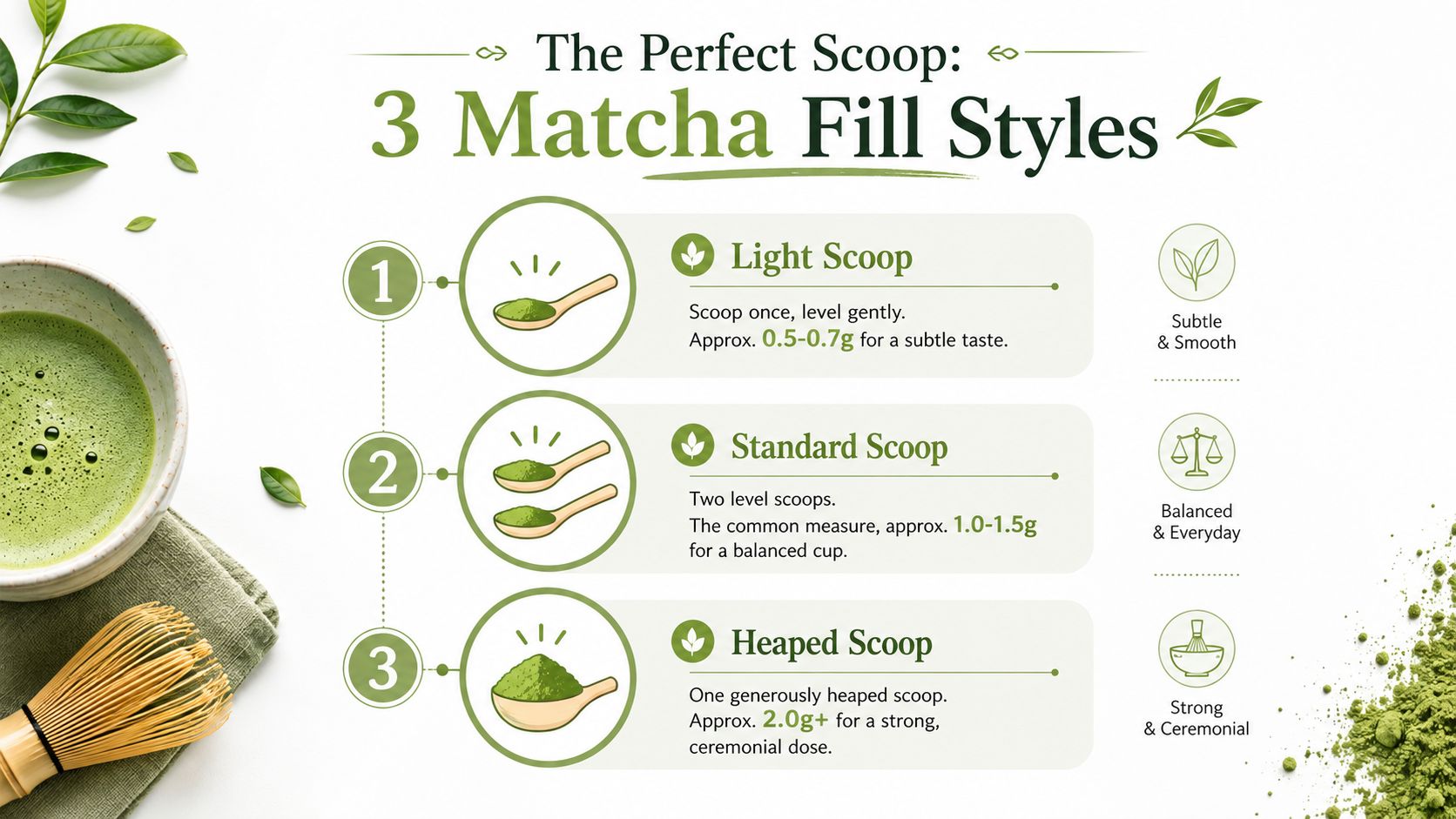
Use three test fills to identify variation. For example, record each level scoop separately after the powder has been stored in the same conditions. If the results spread noticeably between a dry morning and a humid service period, keep the fill motion and recipe dose fixed, then check again after changing matcha grade or storage. That result can guide portion costing as well as flavour consistency. A matcha tea sifter can remove clumps before filling, so compacted powder does not distort the scoop.
Bamboo Versus Steel, Plastic, and Ceramic Spoons
The right scoop depends on where and how you'll use it. Bamboo feels natural in a tea ritual and transfers powder neatly, but moisture can affect its condition and its volumetric output. Stainless steel is easier to sanitise and more resistant to humidity, while plastic is practical for busy service and ceramic suits visible presentation.
| Material | Dosing accuracy | Hygiene | Durability | Cost AU | Ceremony feel |
|---|---|---|---|---|---|
| Bamboo | Consistent by volume when technique is standardised, but mass varies with conditions | Requires dry handling and careful storage | Can split, darken or absorb odour | Varies by product and craftsmanship | Strong |
| Stainless steel | Useful for repeatable portions when sized consistently | Easy to clean and sanitise | Highly durable | Varies by product | Low |
| Plastic | Consistent if the scoop is clearly sized and staff use the same fill method | Often easy to wash, with some materials suitable for dishwashing | Practical, but may stain or retain aroma | Usually accessible | Low |
| Ceramic | Depends on the bowl volume and shape | Washable, but chips need attention | Can chip or break | Varies by design | Moderate to strong |
Choosing for the setting
For a home ritual, bamboo is a natural choice. It connects the movement of measuring with the history of matcha and feels pleasant in the hand. It also suits single-origin tasting, gift presentation and preparation where the utensil remains visible.
For high-volume café work, stainless steel or colour-coded plastic usually makes the operational decision easier. Staff can identify a dedicated utensil quickly, clean it as part of a normal workflow and replace it without treating it as a keepsake. Resources covering spoons for cafés and events can help operators compare general service utensils before choosing a matcha-specific format.
Ceramic works best when presentation matters and the spoon stays on a tasting tray. It echoes the chawan, but breakage and variation between pieces make it less suitable as the sole dosing control in a busy bar.
Caring for a Bamboo Scoop in Australian Conditions
Bamboo and moisture don't make a relaxed partnership. Coastal homes, humid kitchens and steam near an espresso machine can leave a scoop damp long after the powder has disappeared. Air-conditioned offices create the opposite challenge, with dry air and temperature changes that can encourage splitting if the tool is stored carelessly.
After each use, remove loose matcha with a dry, lint-free cloth or a soft brush. Don't soak the chashaku, place it in a dishwasher or coat it with food oil. A damp wooden utensil needs to dry completely, and oil can create an unwanted surface for residue and mould, particularly in warm, humid conditions.
A practical storage routine
- Wipe immediately: Remove powder before it settles into the curve or handle.
- Air-dry fully: Rest the scoop vertically or in a holder so air can reach the curved tip.
- Keep it away from steam: Store it away from kettles, sinks, stovetops and espresso steam wands.
- Use dedicated storage: Cafés should keep staff scoops labelled and separate from utensils used with raw ingredients.
In a commercial kitchen, follow the venue's food-safety procedures and keep preparation tools clean, dry and assigned to their intended ingredient. End-of-shift storage should leave the scoop dry rather than sealed while damp.
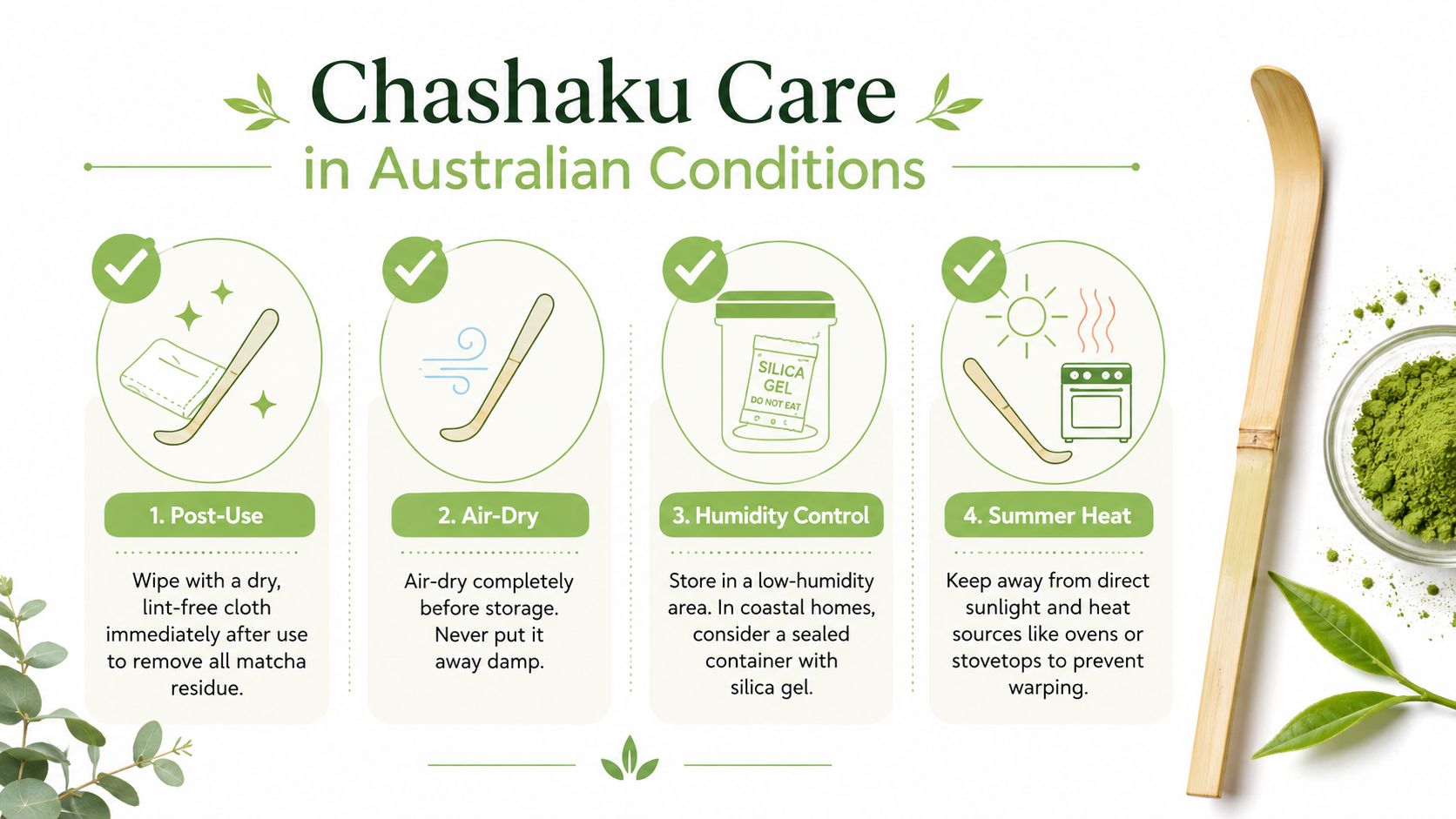
Retire the scoop when you see cracks, splinters, darkening, persistent odour or powder that keeps clinging after drying. Australian product pages show that chashaku are readily available as standard teaware, so replacement is preferable to continuing with a damaged utensil. PepTea's matcha tea accessories collection is one place to compare compatible preparation tools.
When a Scoop Is Not Enough for a Café Workflow
A bamboo scoop can work beautifully at the tea counter, but it shouldn't be the café's only dose-control system. The volume changes when the powder is denser, more humid, more finely settled or filled differently, so two apparently identical scoops can produce different drinks.
That matters as Australian matcha demand and supply pressure increase. Market coverage reported matcha revenue above US$54 million in 2024, projected annual growth of 7.1%, and Japan-to-Australia green tea exports up 131% year on year by August 2025. The same coverage noted cafés in Sydney, Melbourne, Brisbane, Perth and Adelaide charging about A$6 to A$8 for a matcha latte in 2025 amid shortages. SBS News provides that Australian market context.
A better service system
- Calibrate the scoop: Weigh a level fill with a scale that reads to 0.1 gram.
- Test several fills: Record the results rather than relying on a single reading.
- Set the recipe: Choose a target dose in the 1 to 2 gram range when that suits the menu, then document the fill method.
- Train the team: Use one dedicated scoop and one agreed levelling technique.
- Check stock: Compare expected powder use with actual consumption and investigate drift.
Batch-weighing portions into clean, labelled containers can speed service, while the chashaku remains useful for presentation and small adjustments. A scale should stay available for opening a new matcha, checking staff technique and investigating changes in flavour or stock use.
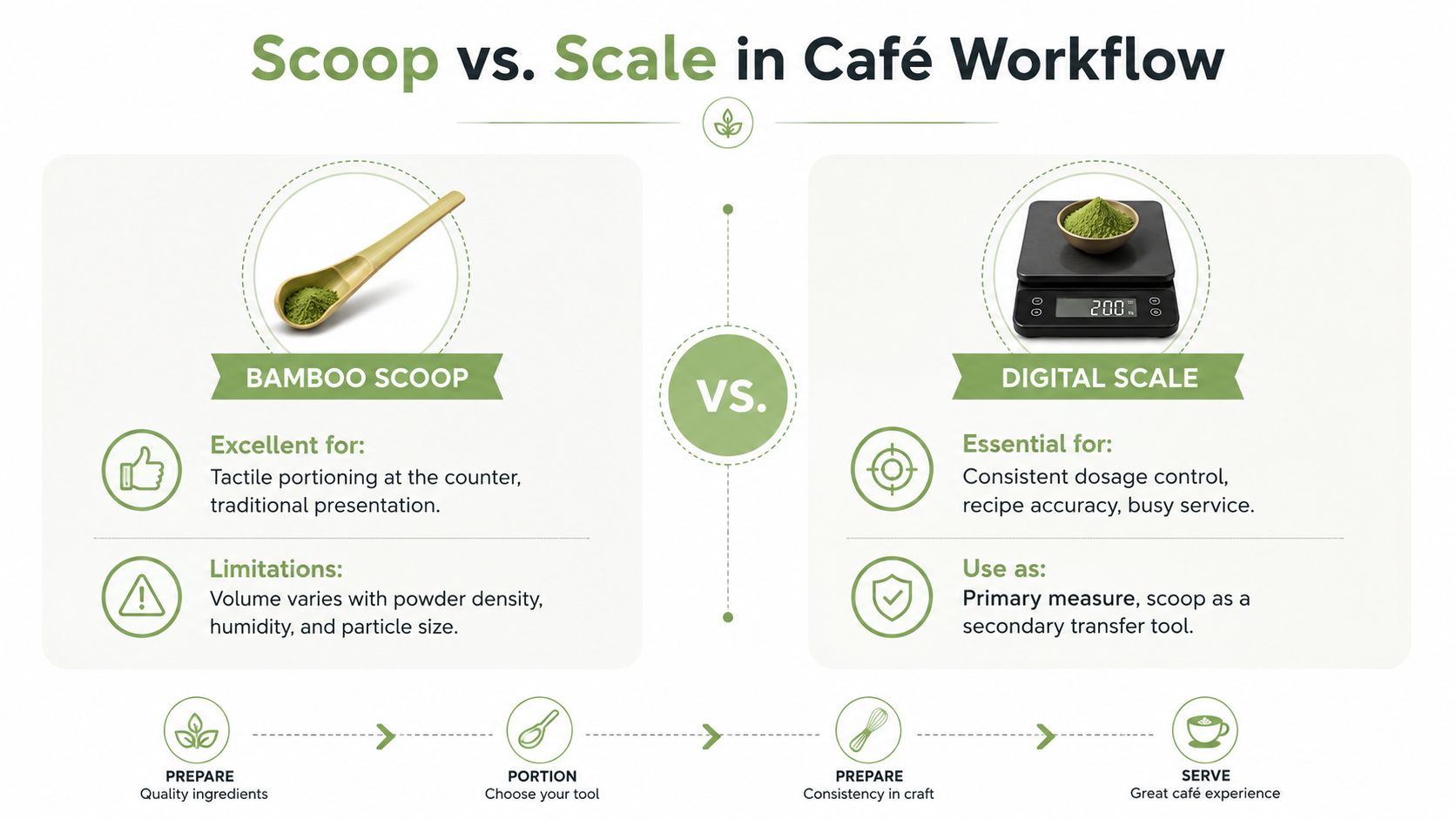
The aim isn't to remove tradition from café service. It's to pair the tactile familiarity of bamboo with a system that protects drink quality, ingredient control and customer expectations.
Bringing It All Together With Your Matcha Ritual
A matcha bamboo scoop works best when you treat it as a measured portioning tool with cultural character. Its traditional bamboo form and curved tip make it especially satisfying for ceremonial preparation, while the same geometry helps transfer powder neatly for everyday lattes, smoothies or baking.
Choose one fill style and repeat it. Use a digital scale when a recipe needs tight control, and don't assume that a heaped scoop will match another person's heaped scoop. Keep the chashaku dry, remove residue after use and replace it when it cracks, splinters, develops a musty smell or shows mould.
For home brewers, bamboo offers connection, handling and a gentle sense of ritual. For cafés, it works best alongside calibration, labelled storage and a backup measuring method. Once the tool is understood this way, it becomes less mysterious and more useful.
Pep Tea offers organic Japanese matcha powders, including Premium 100g Organic Matcha Green Tea and Organic Matcha Japanese Imperial Tea Powder, for home preparation and café use. Visit Pep Tea to explore the matcha range and choose a powder that suits your scoop, recipe and daily tea ritual.