
Tag: home brewing
How to Restart a Stuck Fermentation at Home

You lift the lid expecting movement and find a quiet surface. The airlock has stopped, the kombucha culture is sitting still, or the hydrometer has delivered the same reading for days. That silence doesn't automatically mean the batch is lost, but it does mean you should stop guessing.
The practical approach to how to restart a stuck fermentation begins with diagnosis, not another handful of yeast. Australian wine-industry guidance places particular emphasis on prompt action, controlled temperature, oxygen management and gradual re-inoculation, while kombucha makers need an added safety check because a stalled, low-acid beverage can become a food-safety concern. The methods below connect those principles for home brewers, with clear limits on when rescue is sensible and when discarding is the better decision.
When Your Ferment Goes Quiet
The first reaction is usually hopeful denial. You move the fermenter, check the airlock seal, or wait for the SCOBY to shift. In wine, you take another hydrometer reading. In kombucha, you look for a new pellicle and wonder whether the culture is merely taking a rest.
Sometimes it is. A loose lid or imperfect airlock can hide active fermentation, and a surface culture can work without dramatic movement. The decisive clue is a flat gravity reading, supported by temperature, aroma and pH observations. A quiet airlock alone isn't proof of a stuck ferment.
The cost of waiting
A stalled batch still contains fermentable material. Residual sugar in a warm vessel can support unwanted microbial activity, particularly when the culture has weakened and protective acidity or alcohol hasn't developed as intended. That doesn't mean every quiet batch is spoiled, but it does mean the vessel shouldn't be left unattended while you hope for a recovery.
Australian guidance from the Australian Wine Research Institute advises that problematic ferments shouldn't be left to resolve by themselves. Its rescue approach keeps the ferment under controlled conditions and uses a staged culture acclimatisation process rather than shocking fresh yeast with the entire difficult environment at once.
Practical rule: Diagnose promptly, then make one controlled change at a time. Random warming, aeration and repeated yeast additions make the original problem harder to identify.
For wine, the payoff of quick action is a cleaner restart with less oxidation and less time for spoilage organisms to establish themselves. For kombucha, the payoff is different. You may decide that the batch isn't suitable for rescue, especially if the pH hasn't reached a sufficiently acidic level or the aroma has moved beyond a clean tart profile.
A stuck fermentation is an inflection point, not a verdict. The brewers who rescue the most batches don't rely on bubbling as their only signal. They measure, smell carefully, protect the liquid from unnecessary oxygen and choose an intervention that matches the cause.
Reading the Signs of a Stuck Fermentation
Before adding nutrient or pitching a rescue culture, establish whether fermentation has stopped. Use three checks in order: sensory condition, gravity movement and acidity.
Start with the sensory read
Open the vessel only as much as necessary. A healthy ferment may smell fruity, yeasty, tart or grain-like, depending on the beverage. A sharp vinegar character, solvent-like aroma, persistent sulphur, rotten-egg notes or a harsh chemical smell points towards stress or contamination rather than a simple temperature-related pause.
Look at the surface and sediment. A settled SCOBY with no fresh pellicle development can support the suspicion of inactivity, but it doesn't prove failure. Ropey or stringy texture, visible mould, unusual colours or a surface that looks dry and contaminated should move the batch towards discard rather than experimentation.
Measure movement, not bubbles
Take a hydrometer reading using a sanitised sample, record the temperature, and repeat the reading after enough time has passed to show whether the liquid is moving. A flat line across 48 to 72 hours is the useful warning interval described in fermentation troubleshooting guidance from Precision Fermentation. Bubbling can stop because of a seal problem, but gravity tells you whether sugar conversion is continuing.
A refractometer can help with quick checks, though alcohol affects its reading. Use a hydrometer for the clearest home decision when alcohol is already present.
Check pH before you intervene
The supplied home-brewing ranges commonly used for diagnosis are:
- Kombucha: approximately 2.5 to 3.5
- Wine: approximately 3.0 to 3.8
- Beer: approximately 4.0 to 4.5
Treat these as practical comparison ranges, not universal guarantees. The key Australian food-safety point is that fermented beverages need to reach pH ≤ 4.2 to meet the cited safety requirement discussed by Food Regulation Australia New Zealand. A batch above that level after stalling deserves caution, not an automatic warm restart.
| Ferment Type | Healthy Gravity Drop | Stuck Threshold | Safe pH Window | Warning Signs |
|---|---|---|---|---|
| Kombucha | A downward trend with active acidity development | No meaningful gravity movement over the monitoring period | Approximately 2.5 to 3.5, with pH ≤ 4.2 a key safety requirement | Mould, ropey texture, vinegar, solvent or rotten aromas |
| Wine | A continuing downward hydrometer trend | A flat reading across 48 to 72 hours | Approximately 3.0 to 3.8 | Sulphur, solvent, vinegar, oxidation or unusual surface growth |
| Beer | A continuing gravity decline during active fermentation | A flat reading across 48 to 72 hours | Approximately 4.0 to 4.5 | Harsh acidity, solvent character, contamination or stalled krausen |
Why Fermentations Stall in the First Place
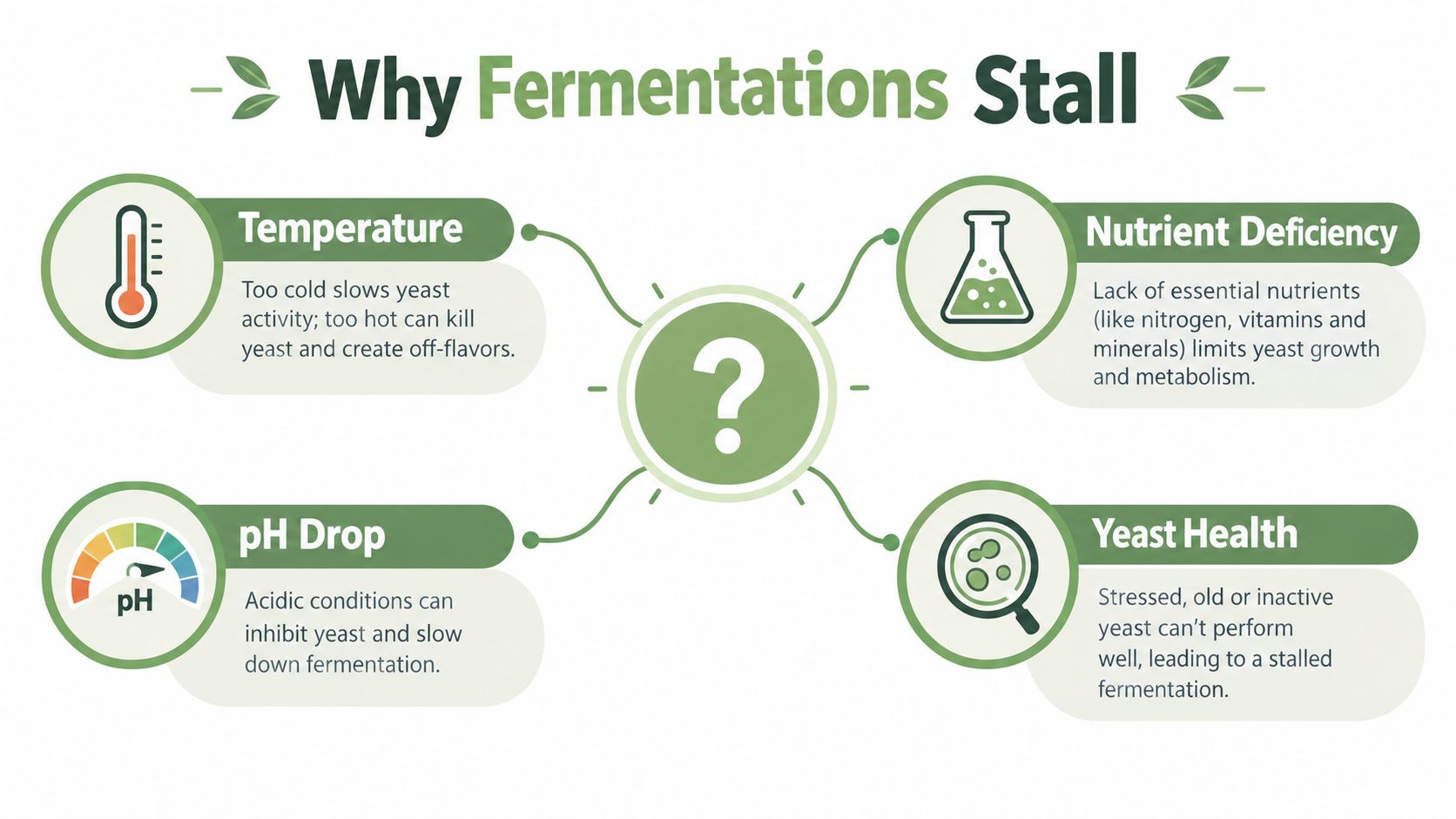
Every stalled ferment leaves a fingerprint. Temperature problems look different from nutrient exhaustion, and a weak culture behaves differently from bacterial competition. Identify that fingerprint before choosing the fix.
Temperature stress
Yeast work within a tolerance range. A sudden cold spell can make cells dormant, while excessive heat can damage viability or drive harsh flavours. In a cool, clean-smelling ferment with low turbidity and no obvious contamination, gentle warming may be enough to bring the existing population back into suspension.
Australian wine rescue guidance is more specific than the usual “warm it up” advice. It recommends bringing a stuck or sluggish bulk ferment to about 18 to 22°C, keeping it off ullage and protecting it with inert gas to reduce oxidation risk. For problematic ferments, the AWRI wine fermentation resources emphasise rapid management and controlled conditions rather than passive waiting.
Nutrient limitation
Yeast need more than sugar. A nutrient-poor must, wort or tea base can support an energetic start and then fail to sustain the culture. The pattern often includes strong early activity followed by a sharp slowdown, with the aroma remaining relatively clean while gravity stays high.
Nutrient additions aren't a universal cure. Adding more nutrient to a contaminated or excessively acidic batch can feed competing organisms as readily as it supports yeast. Use your measurements and the beverage's stage to decide whether nutrition is the limiting factor.
Yeast health and pitch strength
Old wine yeast, poorly rehydrated dried yeast, an under-pitched culture or a tired kombucha SCOBY may not contain enough healthy cells to finish. Rapid flocculation can also remove yeast from suspension before the available sugar has been consumed.
For kombucha, the culture's age and handling history matter, but don't assume a SCOBY is automatically a rescue culture. If the liquid around it smells wrong or hasn't acidified safely, transferring the culture into a fresh batch can spread the problem.
Oxygen and microbial competition
Alcoholic fermentation needs careful oxygen management. Once fermentation is established, unnecessary splashing can encourage oxidation and expose the liquid to organisms that produce unwanted acidity. Kombucha is a mixed culture, so oxygen management differs from wine, but contamination and pH imbalance can still redirect the process.
Brewers working with living cultures can also benefit from general colonisation troubleshooting principles, particularly around environment, contamination control and culture vitality. The Colorado Cultures colonization tips are written for a different fermentation context, but the diagnostic habit is useful: inspect the conditions before blaming the culture.
For basic kombucha culture preparation and handling, follow the practical steps in this kombucha SCOBY guide. The central lesson is simple. Temperature, nutrition, acidity, oxygen and culture health interact, so a single symptom rarely identifies the cause on its own.
A Stepwise Restart That Respects the Yeast
A rescue culture enters a hostile environment. The stuck liquid may contain alcohol, depleted nutrients, high osmotic pressure or an unfriendly pH. Dumping a small amount of fresh yeast straight into that liquid often fails because the new cells experience the full stress immediately.
Australian AWRI-linked procedures use stepwise acclimatisation. The starter begins in a friendlier medium, then receives portions of the stuck wine only after its sugar has dropped by half. That gradual exposure lets yeast adapt to alcohol stress instead of facing a sudden full-volume repitch.
Prepare before pitching
Rouse gently. Mix the vessel carefully to lift settled yeast without aggressive splashing. In an alcoholic ferment, protect against oxidation rather than treating aeration as a default remedy.
Record baseline conditions. Measure gravity, pH and temperature. Work out how far the batch is from its intended finish, but don't use a gravity figure alone to justify a restart.
Set the temperature. AWRI guidance places rescue conditions around 20 to 22°C, while an Australian restart protocol specifies 20 to 24°C during the restart phase. A separate Lallemand procedure uses a starter mixture at 25 to 30°C, then requires tighter control as the culture is introduced to the wine.
Prepare a healthy starter. Use a selected, alcohol-tolerant rescue yeast. The detailed Lallemand restart procedure specifies hydration in 40 to 43°C water with GoFerm Protect Evolution at 30 g/hL, followed by 50 g/hL Uvaferm 43 Restart. Follow the product label and winery protocol rather than improvising equivalent quantities.
Acclimatise in stages. Add a small portion of stuck wine to the active starter. Wait until the starter's sugar has dropped by half, then add another portion. Repeat until the culture can handle the full batch. The AWRI-linked Australian guidance also specifies 25 g/hL of Nutrient Vit END before each restart batch, with only the final batch allowed to finish to dryness.
Keep the transition gentle
Don't create a sharp temperature shock. The Lallemand procedure advises that the wine temperature shouldn't change by more than 10°C during inoculation and recommends maintaining free SO2 near 7 to 8 ppm before restarting. Those details matter because a vigorous-looking starter can still collapse when it enters a chemically stressful wine.
For small home batches, the important principle is the sequence rather than pretending that a winery protocol can be copied without adjustment. Work with clean equipment, use measured additions, keep the starter active and add the difficult liquid progressively. Avoid adding extra fermentable sugar to force activity unless your recipe and nutrient plan specifically require it.
Monitor the restart
Check the starter and main vessel at regular intervals for:
- Temperature: Is it staying inside the chosen restart range?
- Gravity: Has the reading begun to move?
- Aroma: Is the clean ferment character returning, or is volatile acidity increasing?
- Surface activity: Are you seeing renewed foam, bubbles or culture development appropriate to the beverage?
- pH: Is acidity moving in a safe and expected direction?
- Oxidation: Has unnecessary headspace exposure or splashing changed colour or aroma?
The Carbon 6 Brewing fermentation blog provides useful background on observing fermentation as a process rather than relying on a single visual sign. If the starter never becomes active, stop escalating. Repeatedly pitching into an unsuitable batch doesn't make the environment more hospitable.
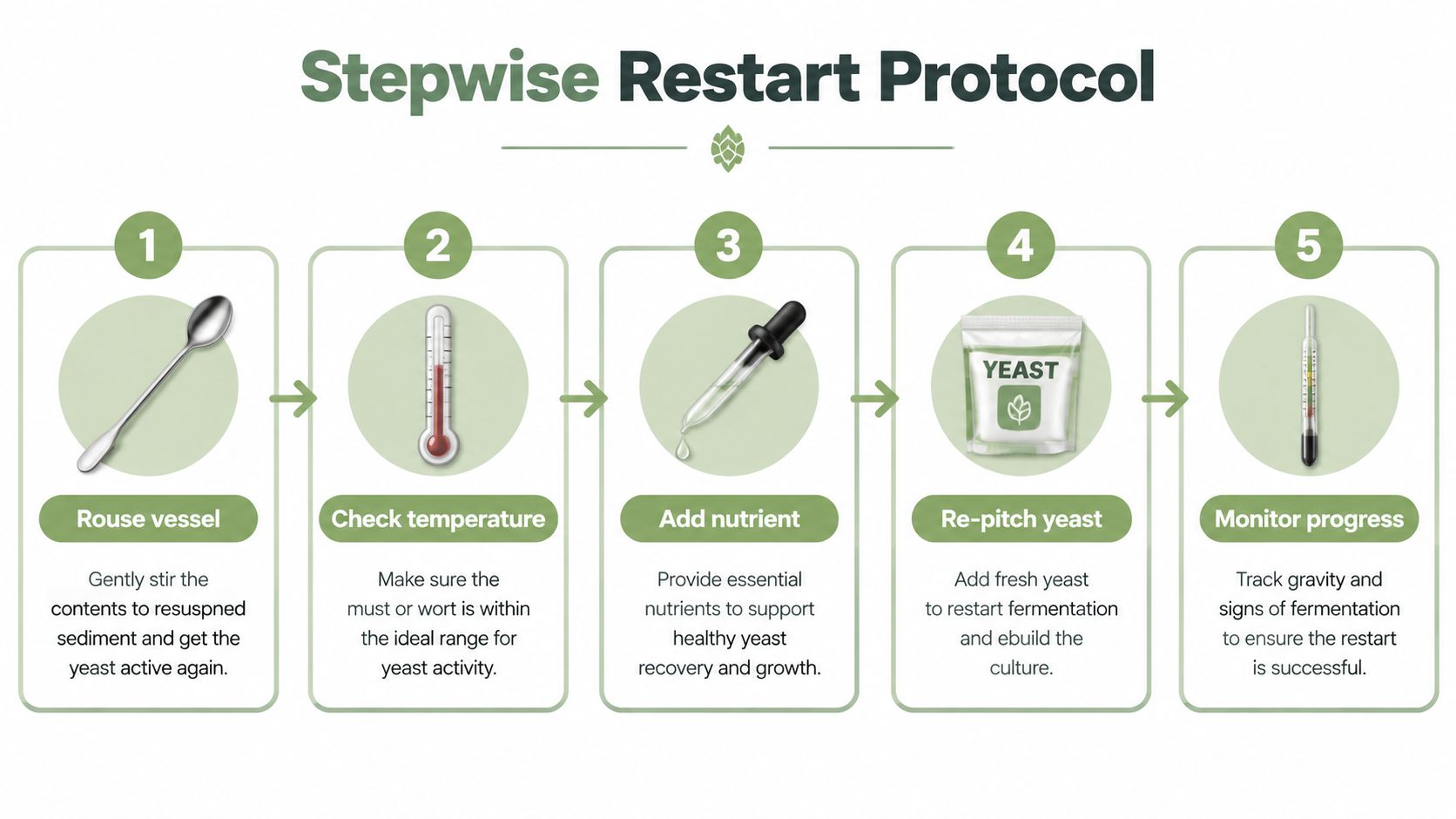
The following video provides a visual companion to the restart sequence.
Matching the Fix to the Cause
The best intervention is usually the least disruptive one that addresses the measured cause. A clean ferment that became quiet after a cold change doesn't need the same treatment as an acidic kombucha batch with bacterial competition.
Use the signal to choose the first move
| Likely Cause | Diagnostic Signal | Best Fix |
|---|---|---|
| Cold temperature | Clean aroma, low activity and a temperature below the culture's working range | Warm gradually and rouse gently |
| Nutrient deficiency | Strong early activity, then a stall with a relatively clean aroma and remaining fermentable material | Add a suitable complete nutrient only after checking pH and contamination |
| Oxygen starvation or poor yeast suspension | Yeast has settled, gravity is flat and the ferment looks unusually clear | Gentle rousing, with oxygen exposure kept appropriate to the beverage |
| Unhealthy yeast | Fresh temperature and nutrient conditions produce no renewed activity | Prepare and acclimatise a fresh rescue culture |
| Bacterial dominance or pH imbalance | Vinegar, solvent, harsh acidity, ropey texture or abnormal surface growth | Don't treat as a routine yeast restart. Assess safety and discard when indicated |
Temperature is the easiest fix to overuse. A sluggish ferment at a low temperature can respond well to controlled warming, but warming a high-pH batch with a suspicious aroma may just make bacterial activity more vigorous.
Nutrient addition also requires restraint. Australian restart guidance recommends a dedicated rescue process when the simple starter option isn't appropriate. Its technical thresholds distinguish a ferment with less than 10 g/L residual sugar and alcohol below 12% v/v, where active yeast or fresh yeast lees may be a first option, from a more difficult case requiring racking and a staged rescue culture. See the AWRI technical guidance for that severity-based logic.
Layer interventions in a sensible order
For a clean, cold batch, adjust temperature first and observe. If the reading remains flat, assess nutrition and yeast health before preparing a starter. If you need to repitch, use acclimatisation rather than a cold, full-volume dump.
Kombucha and sour beer require extra caution because mixed microbial communities can be affected by acidity and competing bacteria. Adding sugar may increase activity without improving the balance, while backsweetening only hides residual fermentables and can create renewed pressure in a sealed bottle. Dilution can lower intensity, but it doesn't make a contaminated batch safe.
The order matters. Measure, correct the environment, then introduce a compatible culture gradually. Combining every possible fix at once removes your ability to tell which variable helped and can worsen oxidation, contamination or over-pressurisation.
Safety Thresholds and When to Discard the Batch
“Just warm it up” is not a safety plan. It assumes the only problem is dormant yeast, but a stalled beverage can also have an unsuitable pH, microbial contamination or aromas that indicate chemical spoilage.
For fermented beverages, pH ≤ 4.2 is a key Australian safety requirement cited in the FSANZ fermented beverages outcomes paper. If kombucha remains above that level after several days of stalling, don't treat it as a normal restart candidate. Measure with a calibrated meter, consider the entire fermentation history and discard if the batch doesn't meet a safe, controlled process.
Discard rather than rescue when
- pH remains above 4.2 after the batch has stalled and the beverage has been held under conditions that could support unwanted growth.
- Mould is visible on the kombucha pellicle or liquid surface. Don't scoop it off and keep the remainder.
- Aromas stay strongly solvent-like, nail-polish-like, rotten, putrid or sharply volatile. These aren't signals to wait longer.
- The liquid shows ropey or stringy contamination, unexplained colours or an abnormal surface film.
- A high-gravity wine or mead remains nutrient-rich and suspect. A batch above 1.040 with signs of contamination shouldn't receive a warm repitch just because yeast can still ferment its sugar.
The last point involves trade-off. A clean, high-gravity ferment may be technically recoverable, but an unsafe or contaminated ferment becomes a better environment for spoilage when warmed. Re-inoculating a warm, high-pH, low-acid must can increase volatile acidity rather than restore a clean alcoholic ferment.
Discard rule: If the gravity is high, the pH is unsafe or the aroma is wrong, don't let the possibility of rescue override food safety.
Fermented beverages can also accumulate excess ethanol, which is one reason the Australian guidance treats safety and suitability as separate from a pleasing flavour. Kombucha makers shouldn't assume that “natural” or “live” means risk-free. When the evidence points to contamination, tipping out the batch protects the next one.
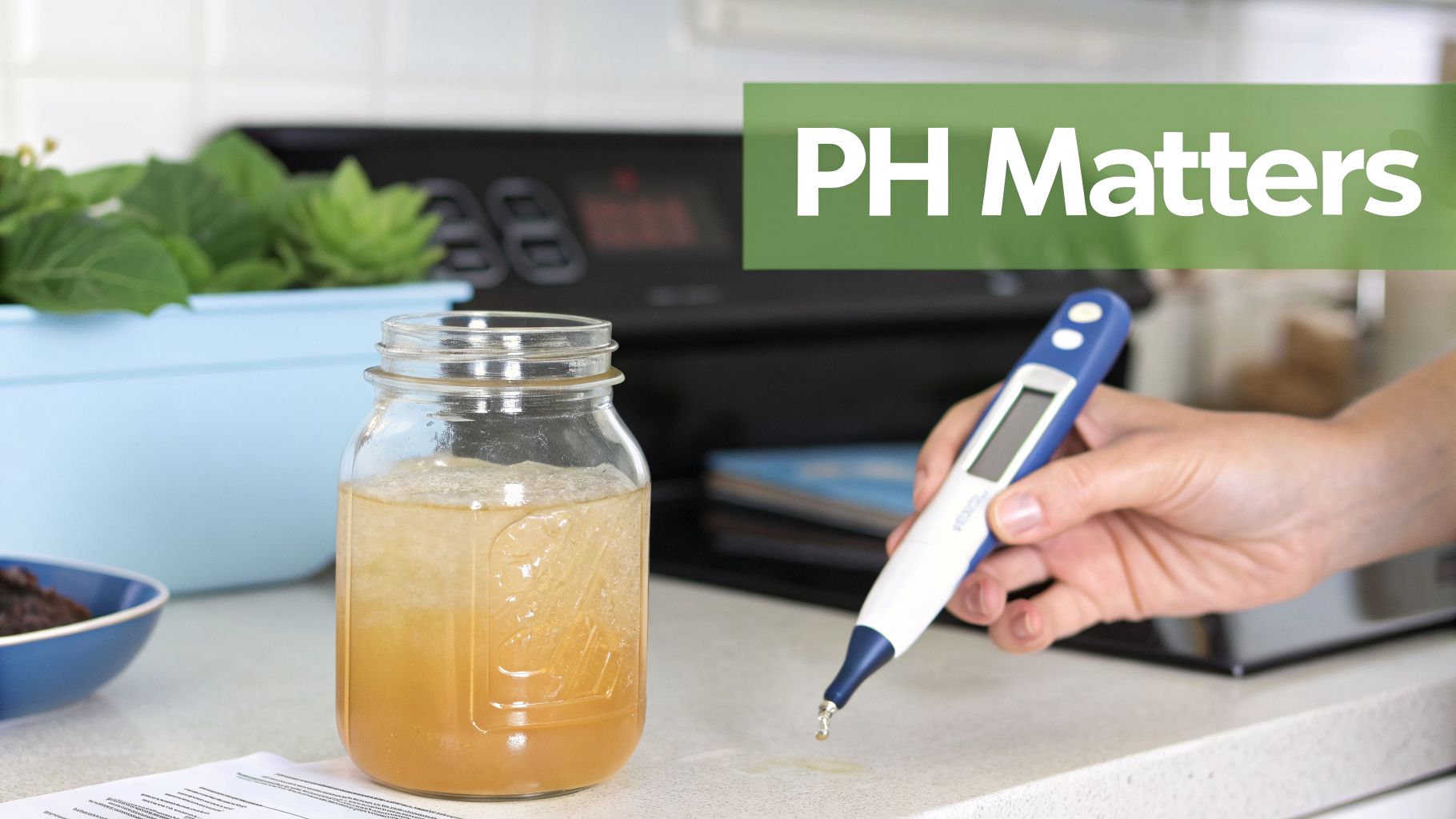
A reliable digital pH meter is more useful than judging acidity by taste. Calibrate and clean it according to the manufacturer's directions, and record readings alongside gravity and temperature.
Preventing the Next Stuck Fermentation
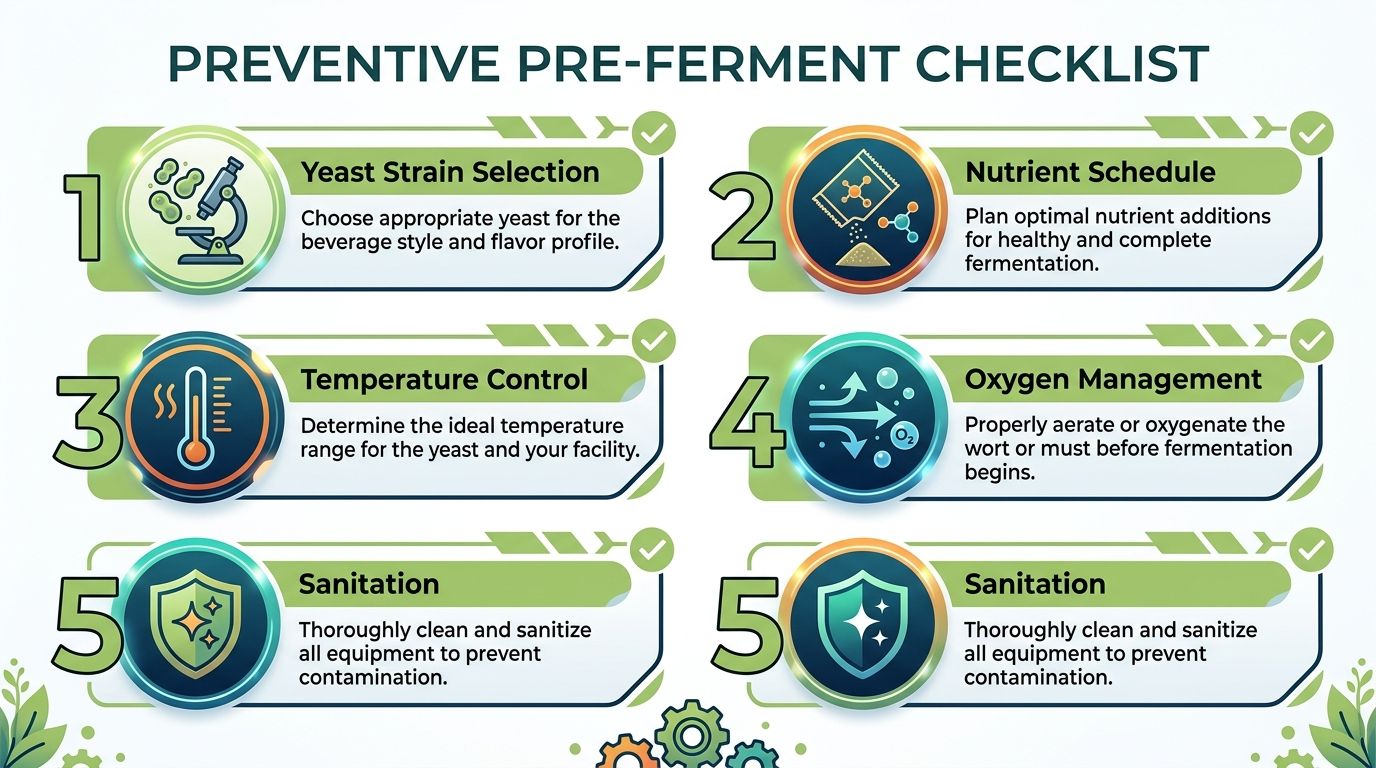
Prevention starts before the culture touches the liquid. Choose yeast suited to the expected alcohol level and temperature, prepare nutrients as part of the recipe rather than as an emergency measure, and sanitise every surface that contacts the ferment.
The Australian restart protocols make the value of planning clear. They use controlled temperatures around 20 to 24°C during restart, gradual acclimatisation and staged nutrient additions because yeast performance depends on its environment. Your normal fermentation plan should apply the same thinking before the batch stalls.
Build a repeatable log
Record the following for every batch:
- Culture choice: Note the yeast or SCOBY condition and the environment it will face.
- Starting measurements: Record gravity, pH and temperature before pitching.
- Nutrient schedule: Write down what you add and when, instead of relying on memory.
- Oxygen handling: Decide whether oxygen is appropriate at the beginning, then limit unnecessary exposure later.
- Early progress: During the first 48 hours, log temperature at two intervals, record gravity movement and inspect the cap, foam or pellicle.
The supplied prevention plan also identifies FAN above 100 ppm and dissolved oxygen at 8 to 10 ppm before pitching as useful control targets where the brewer has the equipment and process knowledge to measure them. These are not numbers to guess at with kitchen tools. If you can't measure them reliably, focus on consistent ingredients, sound sanitation and a documented nutrient plan.
Make the routine visible
Keep a one-page checklist inside the fermentation cabinet. Include sanitation, temperature windows, gravity checkpoints, pH checks and the point at which you stop attempting rescue. A written boundary prevents the common mistake of adding another intervention because the previous one didn't produce an immediate visual change.
For living cultures, the general discipline described in revitalising your living culture is transferable. Observe activity, feed with purpose and judge culture strength by performance rather than appearance alone.
For kombucha, use a clean vessel with enough headspace for the process, and keep your culture handling organised. A suitable fermenting glass jar makes it easier to inspect the surface, protect the batch from avoidable contamination and record what happens without repeatedly disturbing the ferment.
The durable lesson is simple: measure early, maintain stable conditions and treat a stall as a diagnostic event. A calm, staged response gives healthy yeast a chance. A questionable aroma, unsafe pH or visible mould deserves the bin, not another experiment.
Pep Tea offers Australian-brewed, sugar-free organic kombucha from the Hunter Valley, NSW, alongside premium organic Japanese Matcha for clean, everyday beverage routines. Visit Pep Tea to explore properly fermented kombucha, organic Matcha and practical products for brewing with confidence.
Master Your Brew: A Guide to Using a Digital pH Meter for Kombucha

Before we even get to the tools, let's get one thing straight: pH is the single most important number in your entire kombucha brew. This isn't just a technical detail for chemistry nerds. Understanding and controlling your kombucha's pH is the difference between a delicious, safe brew and a disappointing, or even risky, one. For this crucial job, a digital pH meter is the only tool that truly delivers.
Why pH Is Your Secret to Perfect Kombucha
If you've ever had one batch turn out perfectly tangy and the next fall completely flat, the reason is almost always pH. Think of pH as your fermentation's bodyguard and guide. It's a simple measurement of acidity, but it controls everything from flavour and fizz to safety.
Keeping a close eye on your brew’s pH with a digital meter isn't just about collecting data. It’s about turning a hopeful experiment into a reliable, repeatable process.
It’s a safety net. A low pH (high acidity) creates a hostile environment where mould and other nasty bacteria just can't get a foothold. Getting your starting brew to a pH of 4.5 or lower is the single most effective thing you can do to protect it.
It’s how you dial in the flavour. That signature tang you love in kombucha comes from the organic acids that develop during fermentation. By tracking the pH as it drops, you can decide the exact moment to end your first ferment to get that perfect sweet-to-sour ratio.
It keeps your SCOBY happy. Your Symbiotic Culture of Bacteria and Yeast thrives in a specific acidic window. Monitoring the pH means you’re giving your culture the ideal conditions to stay healthy and work its magic, batch after batch.
The Professional’s Tool for Quality and Consistency
This obsession with precision isn't just a home-brewing quirk. Here in Australia’s booming organic beverage market, a digital pH meter is non-negotiable. At PepTea, we rely on meticulous pH control in our HACCP-accredited Hunter Valley brewery to craft the raw, living kombucha our customers love.
We ensure our brew stays within a specific pH range. This fosters a probiotic-rich environment and guarantees every bottle is not only delicious but consistently safe.
For us, a digital pH meter isn't optional—it's the heart of our quality control. It’s our guarantee that every bottle of PepTea kombucha is a living, probiotic-rich drink you can trust.
Ultimately, once you understand the fundamentals of what kombucha is, the importance of pH just clicks. By taking charge of this one number, you gain the confidence to refine your process, experiment with flavours, and brew amazing kombucha every single time.
Choosing the Right Digital pH Meter for Your Brew
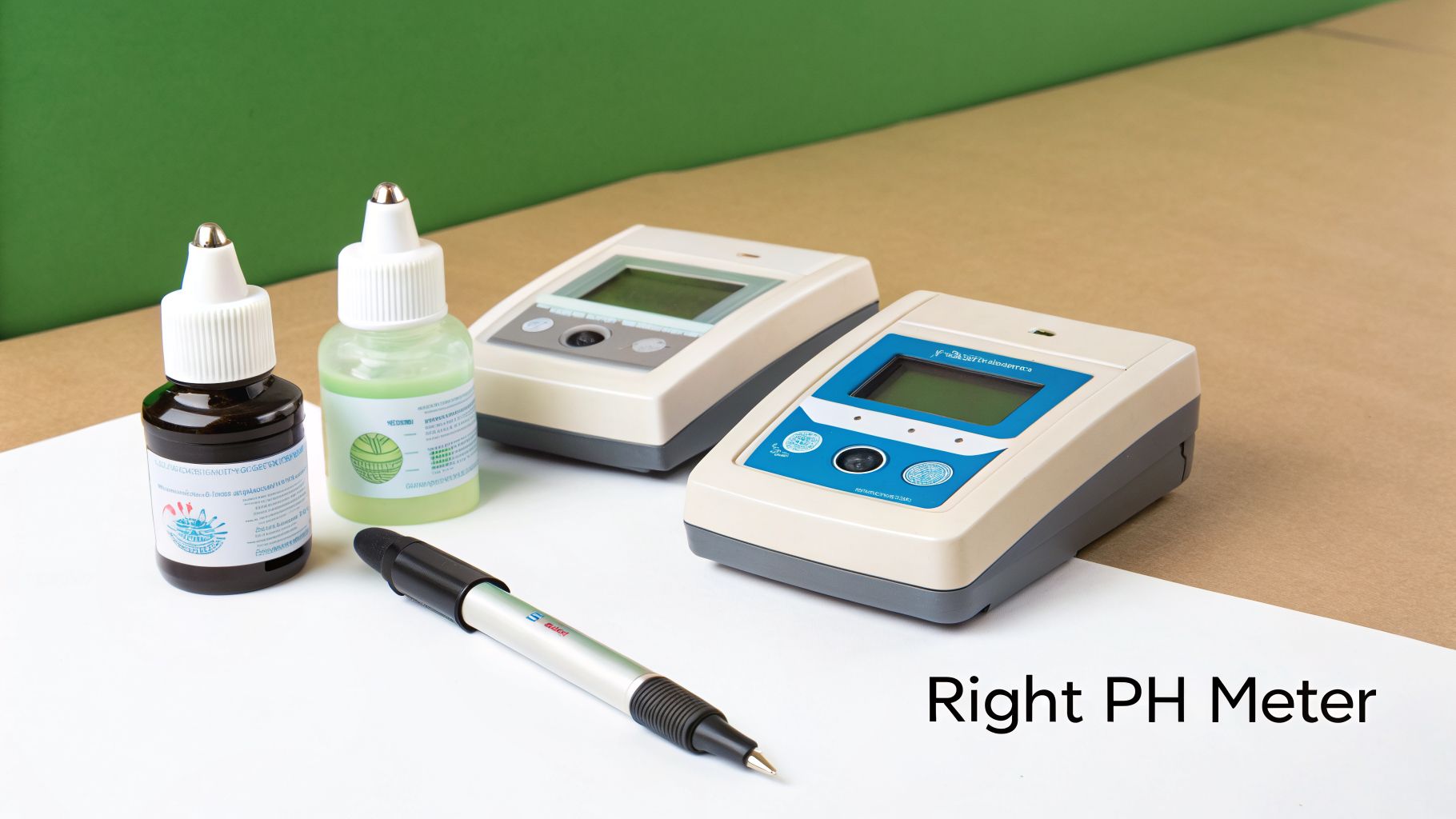
Not all pH meters are created equal, and stepping into the market for the first time can feel a bit overwhelming. Let’s cut through the technical jargon and focus on what you actually need to brew brilliant kombucha. The goal is a reliable tool that gives you accurate readings, not a lab-grade gadget with bells and whistles you’ll never use.
The most common and accessible option for home brewers is the pen-style digital pH meter. They’re affordable, portable, and more than capable of providing the accuracy you need. At the other end of the spectrum are the robust benchtop models, like the ones we use in our commercial brewery, which offer the highest level of precision but are serious overkill for a home setup.
For your kitchen bench, a quality pen meter is the perfect place to start. A compact and easy-to-use option like this Mini pH Water Tester Meter is a great example of what to look for.
Key Features That Actually Matter
When you're comparing models, it's easy to get lost in the specs. To get trustworthy readings for kombucha, you only really need to pay attention to a few key things.
Resolution of 0.1 pH: For brewing, a resolution of 0.1 pH is perfectly fine. You might see meters offering 0.01 resolution, but that’s a level of precision needed for a scientific lab, not your brew. A 0.1 resolution clearly shows you when your kombucha has dropped from a starting pH of 4.5 to a ready-to-bottle 3.0.
Automatic Temperature Compensation (ATC): This one is non-negotiable. The temperature of your liquid directly impacts its pH reading, and ATC automatically corrects for this. It ensures your reading is accurate whether your sample is at a cool 20°C or a warmer 28°C. Without it, you’re just guessing.
A Replaceable Electrode: The electrode—that little glass bulb at the end of the meter—is the most sensitive part of the device. It's also the part that degrades over time. Choosing a meter with a replaceable electrode is a much smarter long-term investment. When it eventually wears out, you can just swap it for a new one instead of buying a whole new meter.
To help you decide, here’s a quick breakdown of what to look for when you're shopping around.
Digital pH Meter Feature Comparison for Brewers
| Feature | What to Look For | Why It Matters for Kombucha |
|---|---|---|
| Resolution | 0.1 pH | Perfectly adequate for tracking fermentation. A resolution of 0.01 is unnecessary and often comes at a higher price. |
| Automatic Temp. Compensation | "ATC" listed as a feature | Guarantees accurate readings as your kombucha's temperature fluctuates, which it will. This is a must-have. |
| Electrode Type | Replaceable glass bulb | The electrode is a consumable part. Being able to replace it saves you from buying a whole new device down the line. |
| Calibration | 1 or 2-point automatic calibration | Makes it simple to keep your meter accurate using pH buffer solutions. Avoids tricky manual adjustments. |
| Display | A clear, backlit LCD screen | You’ll often be taking readings in different lighting conditions. A backlit screen is a small feature that makes a big difference. |
This move towards precision isn't just a niche trend. While global data showed digital pH meters capturing 64.1% of the market in 2021, Australia's own homebrewing scene reflects this shift. Accessible pen-style models are allowing brewers to achieve the same accuracy that was once reserved for professional labs.
Ultimately, choosing a meter with these core features sets you up for consistent, safe, and delicious kombucha from your very first batch.
By prioritising these essential features, you ensure your digital pH meter is a reliable partner, not just another gadget. It sets you up for consistent, safe, and delicious kombucha from your very first batch.
Making Calibration a Simple Brewing Habit
An uncalibrated digital pH meter is just an expensive toy. Think of calibration as teaching your meter what "neutral" and "acidic" actually mean—without it, every number it shows you is built on a faulty foundation. While it might sound technical, getting this right is the single most critical habit for trustworthy readings. It's a non-negotiable step in our Hunter Valley brewery, and it should be in your kitchen, too.
The whole process is much simpler than it sounds. You’re just using standard buffer solutions, which are pre-mixed liquids with a precise, stable pH. For kombucha, most meters use a two-point calibration with a neutral pH 7.0 solution and an acidic pH 4.0 solution. This perfectly brackets the range you'll be working in.
Your Quick Calibration Checklist
Making this a pre-brew ritual only takes a few minutes, but it's the best insurance policy for a safe and delicious batch. It's the only way to be certain you can trust the numbers.
Rinse First, Always: Before you start and between each step, give the meter's electrode (the glass bulb at the end) a good rinse with distilled or deionised water. Never use tap water. The minerals can mess with your readings and slowly damage the sensitive electrode.
Start with pH 7.0: Dip the clean electrode into your pH 7.0 buffer solution. Swirl it gently and just wait for the reading on the screen to stop moving. Now, follow your meter’s instructions to lock this in as your first calibration point.
Rinse Again: Pull the probe out, rinse it thoroughly with distilled water, and gently pat it dry with a clean, soft tissue. This is crucial to avoid contaminating your buffer solutions.
Calibrate with pH 4.0: Now, dip the electrode into your pH 4.0 buffer solution. Again, just wait for the reading to stabilise, then set this as your second point.
And that's it. Your meter is now properly calibrated and ready to give you data you can actually rely on for your brew.
Calibration isn’t just a “nice-to-do” task; it's a non-negotiable part of every single brew day. A quick calibration before you start is the only way to be certain that your digital pH meter is providing accurate data, protecting your kombucha from the very first step.
How Often Should You Calibrate?
For absolute peace of mind and the most consistent results, we strongly recommend calibrating your digital pH meter before every new brewing session.
If you brew weekly, you calibrate weekly. An electrode’s sensitivity can drift over time from temperature changes, how it’s stored, and general use. By making calibration the very first step of your brew day, you eliminate any doubt and make sure every batch starts on the right foot.
How to Correctly Measure Your Kombucha's pH
Alright, you've got your calibrated digital pH meter in hand. Now comes the part that really matters: getting a reliable pH reading from your brew. It’s a straightforward process, but your technique makes all the difference between a guess and a genuinely useful measurement.
The single most important rule? Never dip your meter directly into your main brewing vessel. Always, always take a small, clean sample to test. It’s a simple habit that completely removes the risk of contaminating your entire batch.
Taking an Accurate Sample
First up, grab a clean ladle or measuring cup and draw out a small amount of kombucha—about 50-100ml is more than enough. Pour this into a separate, clean glass or small jar. This little sample is your testing ground.
Now, let that sample sit for a few minutes until it reaches room temperature. pH readings are sensitive to temperature, and letting the liquid stabilise allows your meter’s Automatic Temperature Compensation (ATC) to do its job properly. This step is crucial for an accurate reading.
Once it's at room temp, submerge the clean electrode of your pH meter into the sample. The glass bulb at the tip should be completely covered. Give it a gentle swirl to make sure the liquid is circulating around the probe, then hold it still. Wait for the numbers on the screen to stop fluctuating. That final, stable number is your kombucha's true pH.
Key Moments to Measure Your Brew
Knowing when to measure is just as critical as knowing how. A pH reading at the right time gives you a window into what’s happening inside your fermenter and empowers you to guide the process.
Here are the key checkpoints in any brew cycle:
The Start of Your Batch: Take your very first reading right after adding your starter tea and SCOBY to your fresh sweet tea. You’re looking for a starting pH of 4.5 or lower. This confirms the batch is acidic enough from the get-go to protect against mould and other unwanted microbes.
A Few Days In: Check the pH again a few days into fermentation. You should see the number steadily dropping. This is your proof that the culture is alive, well, and actively converting sugars into those healthy organic acids.
Nearing the End of the First Ferment: This is where your personal taste comes in. As the pH drops, the brew becomes more tart and complex. We recommend starting to taste your kombucha once the pH hits about 3.5. Most brewers find their sweet spot somewhere between pH 2.8 and 3.2.
Before you can trust these readings, you need to be sure your meter is ready. The simple rinse-calibrate-ready process is the foundation of good measurement.
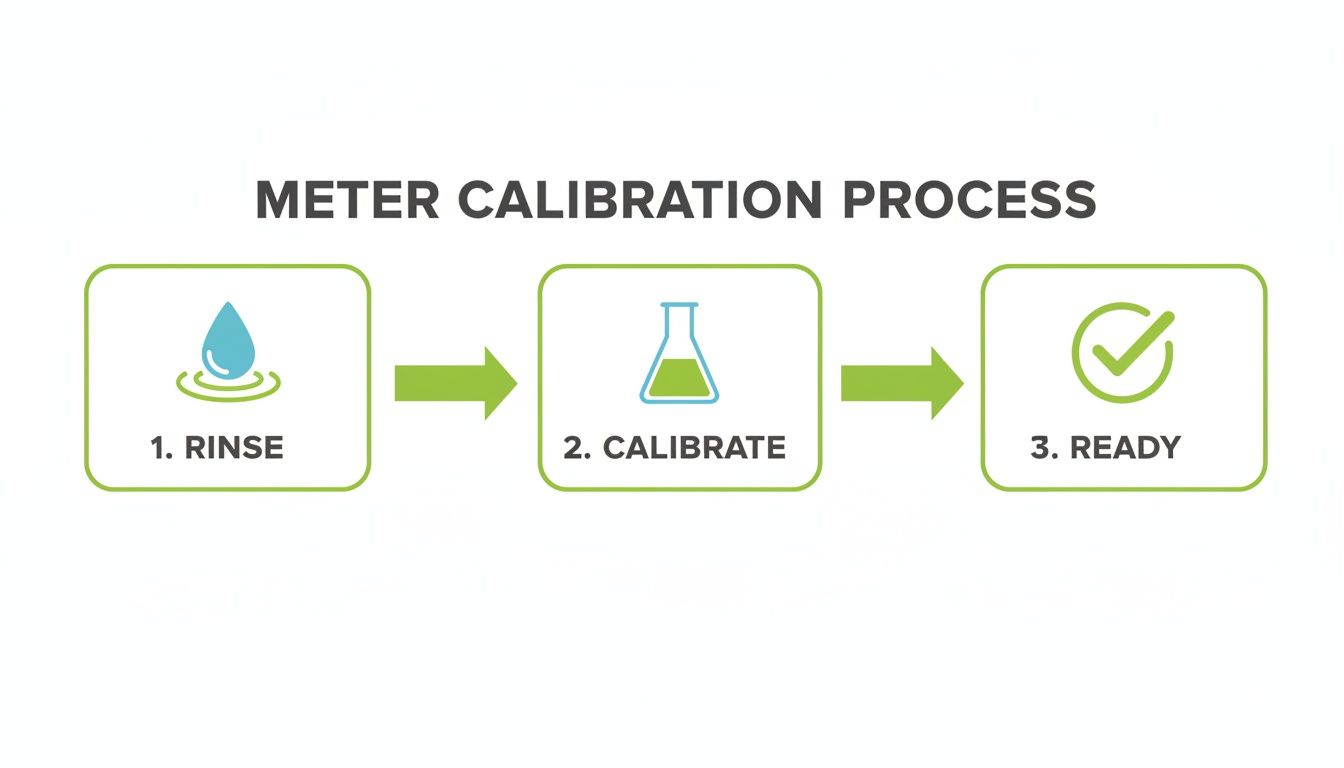
This simple workflow—rinsing the probe, calibrating with buffer solutions, and then taking your reading—is what gives you data you can actually rely on.
Mastering this rhythm of testing at key moments gives you the control to steer your brew towards the exact flavour profile you want. It’s how you move from simply making kombucha to crafting it with intention.
Target pH Ranges for Kombucha Fermentation
To make things even clearer, here’s a quick guide to the ideal pH levels at each stage of your brew. Think of it as a roadmap for your fermentation journey.
| Brewing Stage | Target pH Range | What This Tells You |
|---|---|---|
| Starting the Brew | Below 4.5 | Your brew is acidic enough to be safe from mould and bad bacteria. |
| Mid-Fermentation | 3.5–4.0 | Fermentation is active, and the culture is working as it should. |
| End of First Ferment | 2.8–3.5 | The kombucha is reaching maturity. Time to start tasting for your preferred balance of sweet and tart. |
| Final Product (Bottling) | 2.5–3.2 | Your brew is finished, stable, and ready for bottling or a second fermentation. |
Using this table helps you interpret what your meter is telling you at a glance. It turns a simple number into actionable information, ensuring every batch you make is not only delicious but also consistently safe.
What Your pH Readings Are Telling You
Your digital pH meter is giving you data, but what does that data actually mean? Think of your meter as a translator, telling you the secret story happening inside your brew. Learning to interpret these numbers is what separates a good brewer from a great one, giving you the confidence to solve problems before they even start.
When you understand the story your pH is telling you, you move beyond just following a recipe. You start truly crafting your kombucha, able to diagnose issues and make smart adjustments on the fly.
Your Starting pH Is Too High
You’ve mixed your sweet tea, added your SCOBY and starter liquid, and your meter flashes 4.8. This is probably the most common—and most critical—issue to catch early on. Any starting pH above 4.5 leaves your brew wide open to mould and other unwanted microbes.
The Fix: The solution here is simple: you need to add more acidity. You have two solid options:
- Add More Starter Tea: This is always the best method. Just add another splash of strong, mature starter tea from a previous batch and re-test your pH.
- Add Distilled White Vinegar: If you’re completely out of starter tea, a tablespoon of distilled white vinegar will do the trick and drop the pH into the safe zone. Use this one sparingly, though, as it can subtly change the final flavour of your kombucha.
A high starting pH is a red flag, not a failed brew. Catching it and correcting it right away with your pH meter is the single most important thing you can do to guarantee a safe and successful fermentation.
Fermentation Stalls and the pH Is Not Dropping
It's been three days, and your pH has barely moved from 4.4. This is a classic sign of a stalled or sluggish fermentation. It means your little team of yeast and bacteria isn't working hard enough to produce the acids that naturally lower the pH over time.
This is where a digital pH meter proves its worth. It gives you concrete evidence that something is off, long before you’d notice a lack of fizz or flavour development.
There are a few likely culprits when a brew stalls.
Your Brewing Temperature Is Too Cold: Kombucha cultures love a warm environment, ideally somewhere between 24–29°C. If your house is on the cool side, fermentation will slow to a crawl. The fix is as simple as moving your brewing jar to a warmer spot, away from any draughts.
Your Starter Culture Was Weak: A starter tea that wasn't quite mature enough, or a SCOBY that's been hibernating in the fridge for a while, might not have the oomph to acidify a whole new batch. Always make sure you're using a robust, active starter tea.
Incorrect Ingredient Ratios: Using too little starter tea for the volume of sweet tea is a very common misstep. A good rule of thumb is to use 10-15% starter tea relative to your total batch size. For a standard 4-litre batch, that means using at least 400ml of strong starter liquid.
By paying close attention to what your digital pH meter is telling you, you can pinpoint the exact cause of the problem and, more importantly, learn from it. This knowledge doesn't just save your current batch; it makes every future brew better. It’s all part of the journey to understanding the incredible process behind the many health benefits of kombucha that we all love.
Essential Care for Your Digital pH Meter
Your digital pH meter is a sensitive piece of scientific equipment. A little care goes a long way, and neglecting it is the fastest way to get frustratingly inaccurate readings that can throw off an entire batch of kombucha.
Think of it like any other critical tool in your brewing setup. Just as you look after your SCOBY, your meter needs a bit of attention to keep it performing reliably. A well-maintained meter is a partner you can trust.
Cleaning and Handling Your Probe
The glass bulb at the tip of the probe is where all the magic happens. This electrode is also the most fragile part of the whole device. The absolute golden rule is to never touch the glass bulb with your fingers. The oils on your skin can coat the glass, seriously interfering with its sensitivity and leading to unreliable readings.
Adopting a quick cleaning routine after every single use is non-negotiable. It only takes a few seconds.
- Rinse immediately. As soon as you’re done with your measurement, rinse the probe thoroughly under a gentle stream of distilled or deionised water. This will wash off any residual kombucha or tea.
- Blot, don't wipe. Take a soft, lint-free tissue (like a lens cloth or special lab wipe) and gently blot the probe dry. Wiping it can create a static charge that messes with your next reading, and you risk scratching the delicate glass.
This simple rinse-and-blot process is the single most effective thing you can do to maintain your meter’s accuracy day-to-day.
Storage The Right Way
How you store your meter between brews is just as critical as how you clean it. In fact, improper storage is probably the number one reason pH meters fail before their time.
The most important rule of storage is to never store your electrode in plain water. Storing the probe in distilled, deionised, or even tap water will effectively "kill" it. It leaches the essential reference solution out of the glass bulb, rendering it useless.
Always use a proper pH storage solution, usually supplied by the meter’s manufacturer. This solution is specifically designed to keep the electrode hydrated and in perfect working condition.
Just pour a small amount into the meter’s protective cap, making sure the bulb will be submerged, and click it back into place. This one simple habit will ensure your digital pH meter is ready and reliable for your next brew day.
Your Questions on pH Meters Answered
Getting serious about your brew always brings up new questions. Once you’ve got a digital pH meter in your hands, it’s only natural to wonder if you’re using it right and what the numbers actually mean. As passionate Aussie brewers ourselves, we get these questions all the time. Let’s clear up a few of the most common ones and get you brewing with confidence.
Can I Just Use pH Test Strips for My Kombucha?
While pH strips are definitely better than guessing, they just aren’t accurate enough for brewing kombucha. The natural colour of your tea easily stains the paper, which makes matching it to the colour chart a real shot in the dark. You’re only getting a rough estimate, and that’s not good enough when consistency and safety are on the line.
To be certain your starting pH is safely below 4.5 and to keep mould at bay, you need the precision of a digital meter. It takes all the guesswork out of the equation, which is the only way to replicate your best batches and ensure every single brew is a safe one.
How Often Do I Really Need to Calibrate My Meter?
For readings you can actually trust, you should calibrate your meter before you start a new brewing session. If you brew weekly, you calibrate weekly. It might sound like a lot, but it’s a quick job and the only way to be sure your readings are spot on.
A meter’s electrode drifts over time with temperature changes and normal use. Think of a quick pre-brew calibration as cheap insurance for a successful, safe batch of kombucha. It's non-negotiable.
My Kombucha's pH Is Not Dropping. What Is Wrong?
If your pH reading stays stubbornly high a few days into your brew, the problem almost always comes back to your starter culture. Either the culture itself is a bit weak, or you simply didn't use enough strong starter tea to acidify the fresh sweet tea properly.
The other common culprit is temperature. If your brewing space is too cold, everything slows to a crawl. Your culture does its best work at around 24–29°C. As a firm rule, always use at least 10-15% mature starter tea from your last batch to give the new one a strong, acidic kick-start.
Is It Safe to Put the pH Meter Directly into My Brewing Jar?
It’s much better practice not to. You don’t want to risk contaminating your entire brew. The best approach is to take a small sample from your brewing vessel and pour it into a separate, clean glass.
Let that sample cool to room temperature first, then pop your calibrated meter in. This simple habit guarantees an accurate reading without introducing any unwanted microbes into your main batch.
Ready to take control of your brew? At PepTea, we're passionate about helping Australians discover the benefits of truly authentic, healthy beverages. From our sugar-free kombucha brewed right here in NSW to our premium organic Japanese Matcha, quality is at the heart of everything we do.
Explore our range of organic teas and kombucha supplies at peptea.com.au to learn more.