
Tag: chashaku
Matcha Bamboo Scoop: What It Is and How to Use It

Most advice treats a matcha bamboo scoop as a charming accessory and stops there. That misses the practical issue. A chashaku is a small portioning tool, and its output changes with the way you fill it, the density of the powder, and the moisture in the surrounding air. If you prepare matcha at home, that affects flavour. If you run a café, it affects recipe consistency, stock usage, and margin.
Australian guidance commonly places a full bamboo scoop at about 1 gram, while other Australian listings describe a serving at approximately 2 grams, so the scoop isn't a fixed-mass measuring instrument. One Australian product guide makes that variation clear, and another matcha scoop guide uses roughly 1 gram per full scoop as a practical rule.
The useful approach is simple. Learn the tool's shape, establish your own fill method, care for the bamboo properly, and keep a digital scale nearby whenever exact dosing matters.
Why a Matcha Bamboo Scoop Matters More Than You Think
A chashaku earns its place through repeatable handling, not decoration. Its slim body and curved tip let you lift matcha from a tin without pressing hard into the powder, which helps you transfer it neatly to a bowl or sifter. Used with the same fill level each time, it gives a familiar portioning rhythm that a teaspoon rarely provides.
That doesn't mean one scoop always equals exactly the same mass. Powder density, humidity, particle size and the difference between a level and heaped fill all affect the result. Australian retail guidance describes a single scoop as about 1 gram, while other local guidance places a serving at approximately 2 grams, so operators should treat the chashaku as a volumetric tool rather than a precision scale. Australian listings describe the scoop's approximate serving role, but they don't remove the need for calibration.
Practical rule: Use the scoop to transfer matcha, then use a scale to learn what your particular scoop and powder deliver.
At home, this distinction helps explain why the same latte can taste gentle one day and bitter or intense the next. In a café, small differences repeated across service can alter the drink's strength and the amount of powder taken from stock. The sensible workflow is to standardise one scoop style, record its result, and train staff to copy it.
By the end of this guide, you'll be able to identify useful chashaku geometry, dose more consistently, compare bamboo with other materials, protect the scoop in Australian conditions, and decide when a scale belongs beside it. The object has ceremony behind it, but its everyday value is practical.
What a Chashaku Actually Is and Where It Comes From
A chashaku, often called a matcha bamboo scoop, is the narrow utensil traditionally used to move powdered tea from its container into a matcha bowl. It belongs to the Japanese tea ceremony toolkit alongside the chawan and chasen. Unlike a teaspoon, it was shaped around the handling of a very fine powder and the controlled movements of tea preparation.
Traditional chashaku are carved from a single piece of bamboo. Australian tea retailers commonly preserve that description, along with a length of around 18.5 centimetres, which reflects the familiar long, slim form used in Japanese tea practice. Australian tea-ceremony listings describe handcrafted bamboo construction and traditional dimensions, connecting the utensils available today with the object's established design language.
From ceremonial object to Australian kitchen tool
In Japan, the chashaku carries cultural meaning as well as practical purpose. Its curve, finish and material invite careful handling, and individual pieces can be appreciated for their craftsmanship. Australian retailers have adapted that tradition for modern homes, tea counters and cafés, where the scoop may be used for a daily latte rather than a formal gathering.
That shift doesn't make the utensil meaningless. It shows how a specialised object can move between contexts while keeping its basic identity. A product page that labels the utensil chashaku rather than generic spoon is preserving that connection to tea ceremony.
For readers exploring the cultural background, PepTea's matcha tea ceremony guide provides a useful companion to the physical tool. The key point is to hold both ideas together. A chashaku is a cultural artefact, but it also has a clear job on a contemporary Australian preparation bench.
The Design Details That Change How It Performs
The chashaku's shape isn't arbitrary. Australian listings describe examples around 18 to 18.7 centimetres long, with one listing giving dimensions of 18.7 cm × 0.3 cm × 0.9 cm and another describing an 18 cm scoop weighing 6 grams. This Australian matcha scoop listing shows how narrow and light the format is intended to be.
The curve does the work
The curved tip lets you lift dry matcha from the surface of a tin without scraping aggressively or compressing the powder. A long, slim stem keeps your fingers away from the container and gives you control when transferring the scoop to a sifter or bowl.
The small cross-section also means less powder remains trapped on the utensil. A smooth finish helps the chashaku move gently around a ceramic bowl, although the scoop itself should be used for transferring powder, not for stirring or whisking.
Australian descriptions also preserve the traditional making process. Some chashaku are heated, bent and carved from bamboo, while vintage examples available locally show that the form has continued as a collectible object as well as a working utensil.
What this means on the bench
A generic bamboo spoon may hold more powder and may have a different bowl depth. A chashaku's narrow profile encourages a controlled amount, but it doesn't promise a fixed gram weight. Its main technical advantage is repeatable volume when your technique remains consistent.
The best test is to compare two tools using the same matcha and fill method. If one spoon encourages you to press, scrape or heap unpredictably, it isn't serving the same purpose as a chashaku. The design supports consistency, but the person using it still controls the dose.
How to Measure Matcha With a Bamboo Scoop
Consistent matcha dosing depends less on the scoop's label than on how you fill it. Start with dry, settled powder and a clean chashaku. Place the curved end into the matcha with a controlled downward movement, rather than forcing it in at an angle. Lift without compressing the powder, then follow the recipe's chosen fill style.
Australian product guidance may describe a heaped bamboo scoop as roughly 1 gram, while another listing gives approximately 2 grams for one serve. A local chashaku listing explains this variation shows why the café needs a defined method, especially when powder density and humidity change.
Three practical fill styles
Level fill: Draw the scoop across the tin's edge, or remove the excess with a finger. It is straightforward to teach and repeat.
Heaped fill: Leave a small mound above the scoop. This produces a stronger drink, but a slightly larger mound can change the dose quickly.
Pinched transfer: Lift the powder with the scoop, then adjust it between your fingers. This informal home method is difficult to standardise in a café and creates a hygiene concern.
For a commercial recipe, weigh the selected method. A kitchen scale shows what your particular matcha, storage tin and filling technique deliver, rather than assuming that level or heaped means a universal mass.
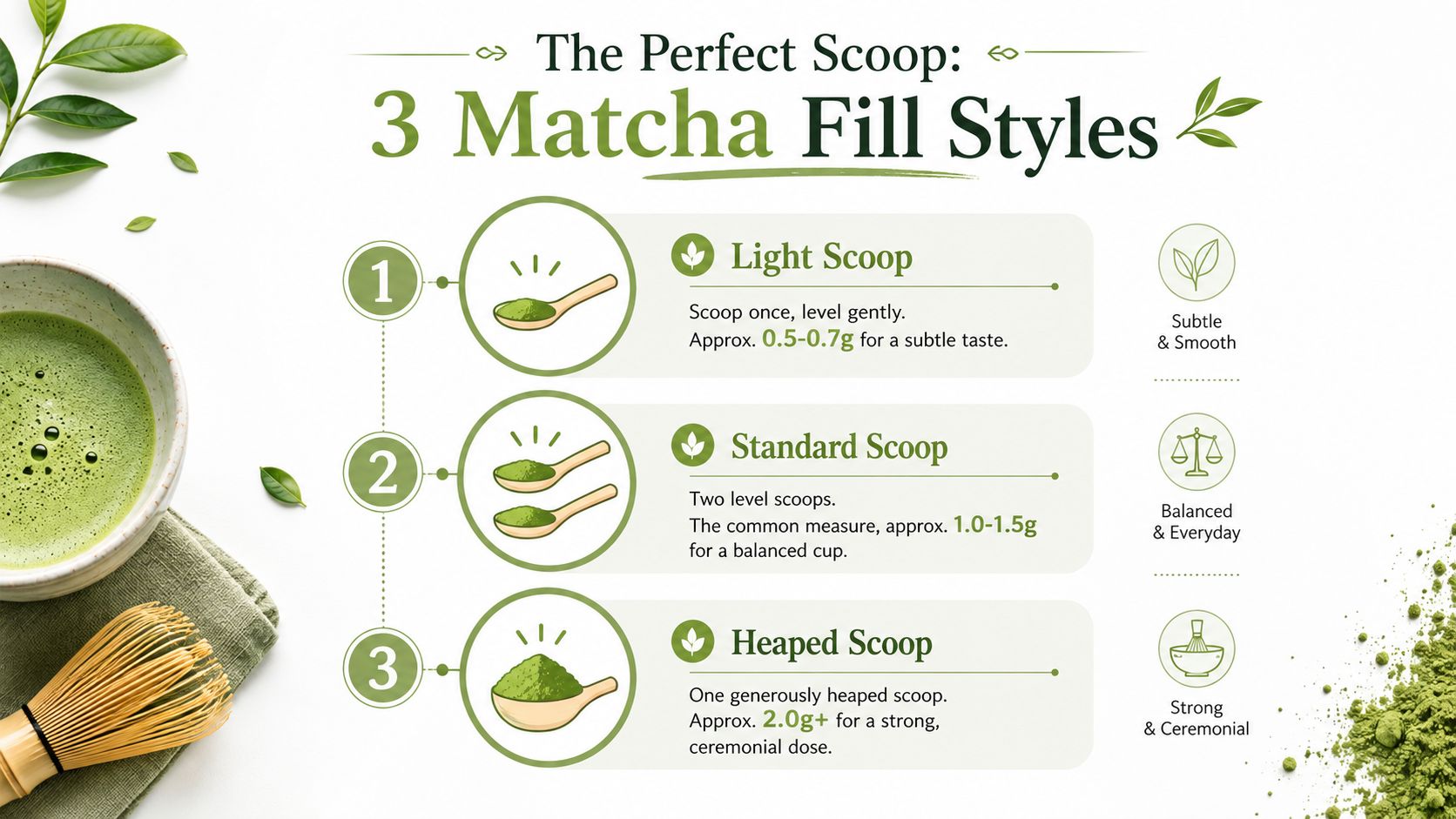
Use three test fills to identify variation. For example, record each level scoop separately after the powder has been stored in the same conditions. If the results spread noticeably between a dry morning and a humid service period, keep the fill motion and recipe dose fixed, then check again after changing matcha grade or storage. That result can guide portion costing as well as flavour consistency. A matcha tea sifter can remove clumps before filling, so compacted powder does not distort the scoop.
Bamboo Versus Steel, Plastic, and Ceramic Spoons
The right scoop depends on where and how you'll use it. Bamboo feels natural in a tea ritual and transfers powder neatly, but moisture can affect its condition and its volumetric output. Stainless steel is easier to sanitise and more resistant to humidity, while plastic is practical for busy service and ceramic suits visible presentation.
| Material | Dosing accuracy | Hygiene | Durability | Cost AU | Ceremony feel |
|---|---|---|---|---|---|
| Bamboo | Consistent by volume when technique is standardised, but mass varies with conditions | Requires dry handling and careful storage | Can split, darken or absorb odour | Varies by product and craftsmanship | Strong |
| Stainless steel | Useful for repeatable portions when sized consistently | Easy to clean and sanitise | Highly durable | Varies by product | Low |
| Plastic | Consistent if the scoop is clearly sized and staff use the same fill method | Often easy to wash, with some materials suitable for dishwashing | Practical, but may stain or retain aroma | Usually accessible | Low |
| Ceramic | Depends on the bowl volume and shape | Washable, but chips need attention | Can chip or break | Varies by design | Moderate to strong |
Choosing for the setting
For a home ritual, bamboo is a natural choice. It connects the movement of measuring with the history of matcha and feels pleasant in the hand. It also suits single-origin tasting, gift presentation and preparation where the utensil remains visible.
For high-volume café work, stainless steel or colour-coded plastic usually makes the operational decision easier. Staff can identify a dedicated utensil quickly, clean it as part of a normal workflow and replace it without treating it as a keepsake. Resources covering spoons for cafés and events can help operators compare general service utensils before choosing a matcha-specific format.
Ceramic works best when presentation matters and the spoon stays on a tasting tray. It echoes the chawan, but breakage and variation between pieces make it less suitable as the sole dosing control in a busy bar.
Caring for a Bamboo Scoop in Australian Conditions
Bamboo and moisture don't make a relaxed partnership. Coastal homes, humid kitchens and steam near an espresso machine can leave a scoop damp long after the powder has disappeared. Air-conditioned offices create the opposite challenge, with dry air and temperature changes that can encourage splitting if the tool is stored carelessly.
After each use, remove loose matcha with a dry, lint-free cloth or a soft brush. Don't soak the chashaku, place it in a dishwasher or coat it with food oil. A damp wooden utensil needs to dry completely, and oil can create an unwanted surface for residue and mould, particularly in warm, humid conditions.
A practical storage routine
- Wipe immediately: Remove powder before it settles into the curve or handle.
- Air-dry fully: Rest the scoop vertically or in a holder so air can reach the curved tip.
- Keep it away from steam: Store it away from kettles, sinks, stovetops and espresso steam wands.
- Use dedicated storage: Cafés should keep staff scoops labelled and separate from utensils used with raw ingredients.
In a commercial kitchen, follow the venue's food-safety procedures and keep preparation tools clean, dry and assigned to their intended ingredient. End-of-shift storage should leave the scoop dry rather than sealed while damp.
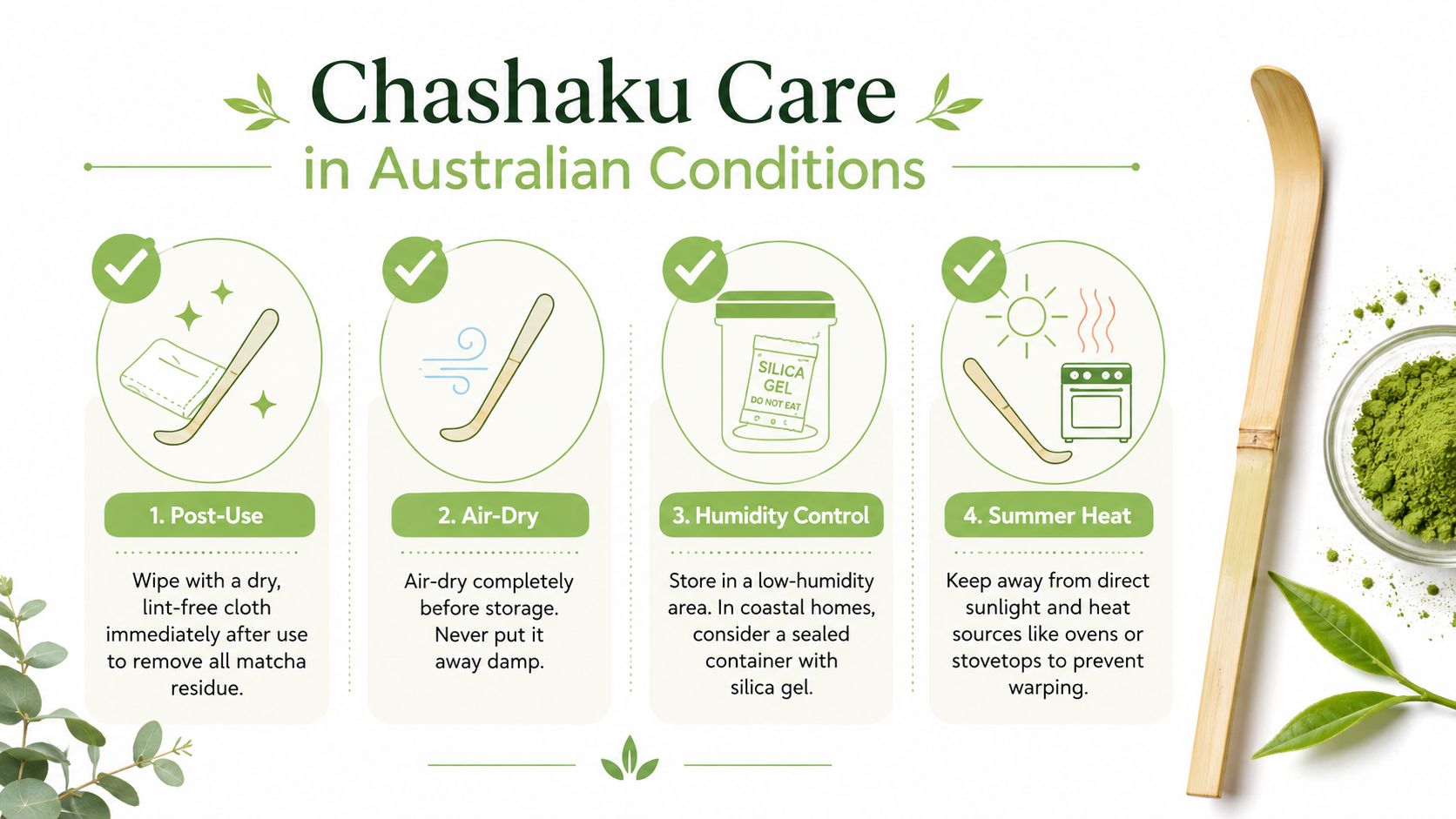
Retire the scoop when you see cracks, splinters, darkening, persistent odour or powder that keeps clinging after drying. Australian product pages show that chashaku are readily available as standard teaware, so replacement is preferable to continuing with a damaged utensil. PepTea's matcha tea accessories collection is one place to compare compatible preparation tools.
When a Scoop Is Not Enough for a Café Workflow
A bamboo scoop can work beautifully at the tea counter, but it shouldn't be the café's only dose-control system. The volume changes when the powder is denser, more humid, more finely settled or filled differently, so two apparently identical scoops can produce different drinks.
That matters as Australian matcha demand and supply pressure increase. Market coverage reported matcha revenue above US$54 million in 2024, projected annual growth of 7.1%, and Japan-to-Australia green tea exports up 131% year on year by August 2025. The same coverage noted cafés in Sydney, Melbourne, Brisbane, Perth and Adelaide charging about A$6 to A$8 for a matcha latte in 2025 amid shortages. SBS News provides that Australian market context.
A better service system
- Calibrate the scoop: Weigh a level fill with a scale that reads to 0.1 gram.
- Test several fills: Record the results rather than relying on a single reading.
- Set the recipe: Choose a target dose in the 1 to 2 gram range when that suits the menu, then document the fill method.
- Train the team: Use one dedicated scoop and one agreed levelling technique.
- Check stock: Compare expected powder use with actual consumption and investigate drift.
Batch-weighing portions into clean, labelled containers can speed service, while the chashaku remains useful for presentation and small adjustments. A scale should stay available for opening a new matcha, checking staff technique and investigating changes in flavour or stock use.
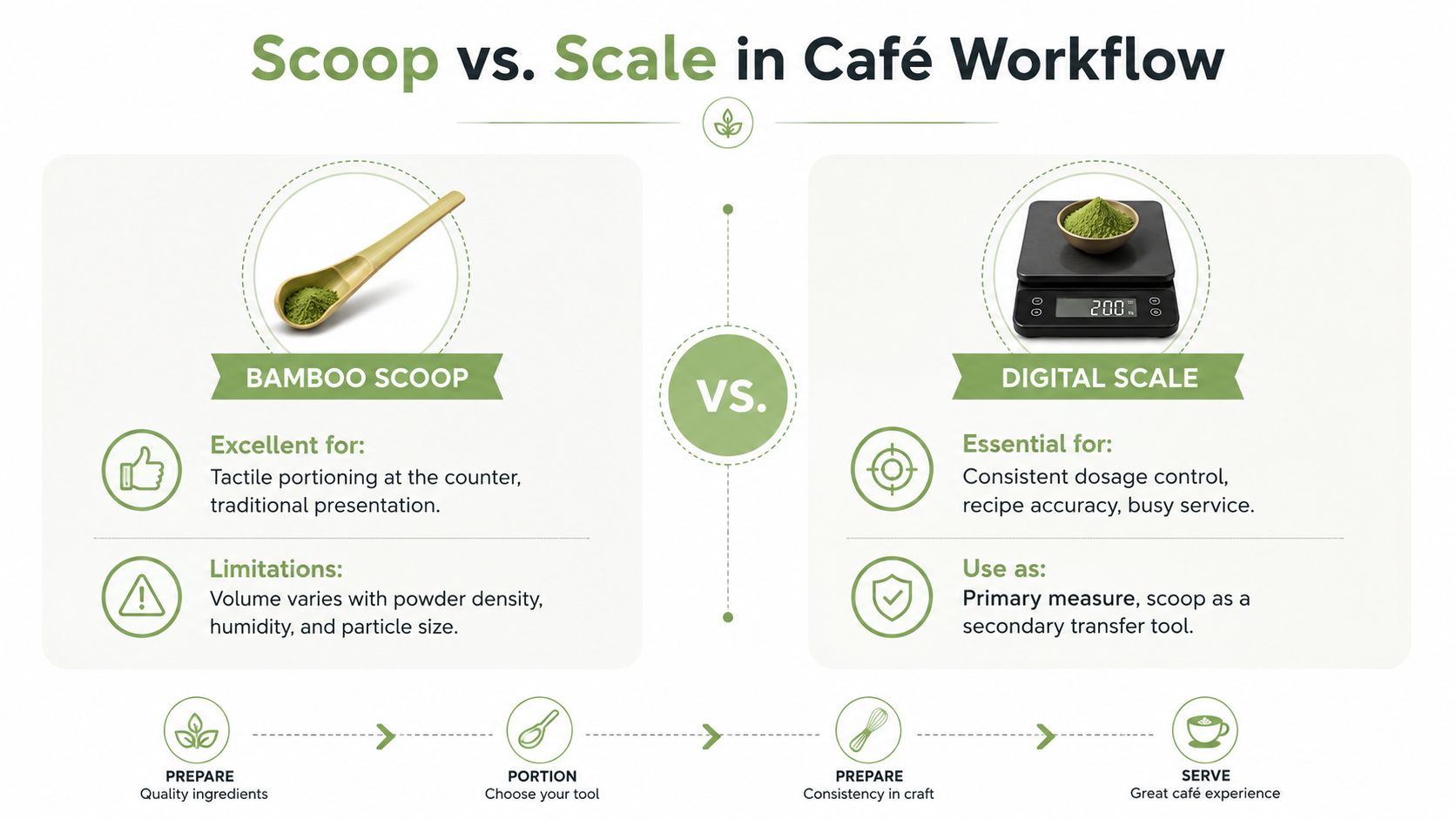
The aim isn't to remove tradition from café service. It's to pair the tactile familiarity of bamboo with a system that protects drink quality, ingredient control and customer expectations.
Bringing It All Together With Your Matcha Ritual
A matcha bamboo scoop works best when you treat it as a measured portioning tool with cultural character. Its traditional bamboo form and curved tip make it especially satisfying for ceremonial preparation, while the same geometry helps transfer powder neatly for everyday lattes, smoothies or baking.
Choose one fill style and repeat it. Use a digital scale when a recipe needs tight control, and don't assume that a heaped scoop will match another person's heaped scoop. Keep the chashaku dry, remove residue after use and replace it when it cracks, splinters, develops a musty smell or shows mould.
For home brewers, bamboo offers connection, handling and a gentle sense of ritual. For cafés, it works best alongside calibration, labelled storage and a backup measuring method. Once the tool is understood this way, it becomes less mysterious and more useful.
Pep Tea offers organic Japanese matcha powders, including Premium 100g Organic Matcha Green Tea and Organic Matcha Japanese Imperial Tea Powder, for home preparation and café use. Visit Pep Tea to explore the matcha range and choose a powder that suits your scoop, recipe and daily tea ritual.