
Tag: Matcha Latte
How to Make Matcha Not Taste Like Grass: Fix It Today

An overly grassy bowl is almost always fixable by lowering the water temperature to 70–80°C and adding a creamy base, rather than just using stronger matcha. Start with about 2 g of powder, whisk it properly, then dilute it with milk or chilled water until the flavour suits you.
You've probably had the experience: the colour looks beautiful, the whisk is ready, and then the first sip tastes like freshly cut lawn with a bitter finish. That doesn't necessarily mean your matcha is bad. More often, boiling water, clumps, too much powder, or the wrong serving style has pushed its natural vegetal character too far.
For many Australians, matcha is a big sensory jump from regular black tea. Australian tea-buying data found that 35% of people aged 14 and over purchased regular tea in an average four-week period, compared with 11% for green tea, in the 12 months to March 2015, based on 15,913 respondents. Roy Morgan's tea data helps explain why a strong powdered green-tea flavour can feel unfamiliar.
The good news is that learning how to make matcha not taste like grass is less about hiding the drink and more about controlling heat, texture, concentration and dilution.
Why Your Matcha Tastes Grassy
You whisk up a bright green bowl, take a sip, and get hit with raw lawn, bitterness, or a strange stale edge. That usually points to a specific problem, not a lost cause. Matcha is more concentrated than brewed green tea because you drink the leaf itself, so heat, texture, and dose all show up clearly in the cup.
Start with temperature, because it changes flavour fast. Freshly boiled water pulls out more bitterness and leaves the finish dry, especially in a small, concentrated mix. A lower range gives you a softer, sweeter result and makes it easier to judge the powder fairly. PepTea's matcha brewing temperature guide lays out why gentler water gives you better control.
Then read the flavour before you change everything at once.
Read the flavour before changing the recipe
Your first sip usually tells you what to fix:
- Freshly cut grass or raw greens: the powder itself may lean strongly vegetal. This often shows up more in culinary matcha.
- Drying, puckering bitterness: the water was likely too hot, or the drink is too concentrated.
- Grainy, uneven flavour: the matcha was not sifted or whisked into a smooth suspension.
- Flat, stale green flavour: storage, age, or air exposure may be dulling the powder.
Each fix does a different job. Sugar can soften bitterness, but it will not solve scorched powder. Milk can round off aggressive notes, but it will not remove clumps. If you want a better cup, diagnose the problem first, then change one variable at a time. Keep the amount of matcha steady while you test water temperature or dilution, otherwise it gets hard to tell what improved the flavour.
Off-notes can also come from the vessel itself. If your bottle or shaker carries residue from previous drinks, effective bottle cleaning tablets remove that variable before you blame the matcha. A clean bottle will not rescue overheated powder, but it does stop old protein, sweetener, or tea residue from muddying the aroma.
That diagnostic mindset matters in Australia, where plenty of tea drinkers still find matcha stronger and greener than what they usually reach for. IndexBox's Australian tea market overview shows the category has a solid local base. Matcha usually lands better when the format matches the drinker, whether that is a latte, an iced drink, a smoothie, or a straight bowl made with more care.
Mastering the Basic Preparation Method
A smooth cup starts with a small, controlled preparation. Use a bowl or wide mug, a fine sifter, a bamboo whisk or electric milk frother, a digital scale if you have one, and water that has cooled below boiling.
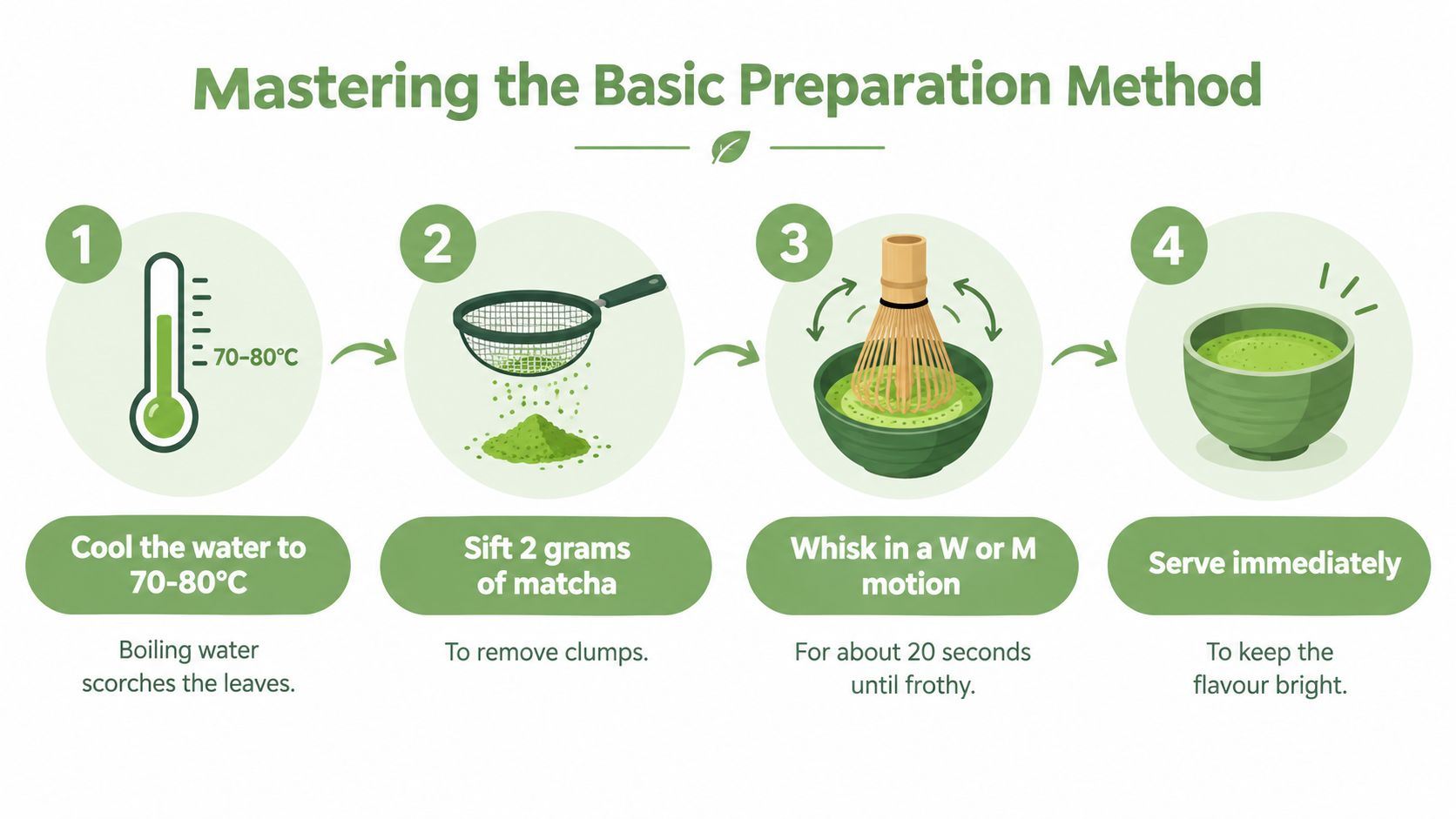
Use less heat and better dispersion
Cool the water. Heat water, then let it cool to 70–80°C. For a particularly grassy powder, begin around 70–75°C. If you don't have a thermometer, leave freshly boiled water to cool for several minutes instead of pouring it directly onto the matcha.
Sift approximately 2 g of matcha. Push the powder through a fine sieve into your bowl. This breaks up compacted particles before they become bitter clumps in the finished drink.
Make a paste first. Add 10–15 mL of the warm water and work it into a smooth slurry. Don't rush this step. A paste gives the powder an even starting point and prevents dry pockets from surviving into the final cup.
Whisk in the remaining water. Add enough water to reach approximately 50–60 mL in total, then whisk rapidly in a W or M motion until the surface looks lightly foamy.
Serve immediately. Matcha begins to settle as it stands. The final sips can taste stronger and more bitter because the powder has collected at the bottom.
This controlled method follows Australian preparation guidance that recommends approximately 2 g of matcha with 50–60 mL of water at 70–80°C. SBS Food's matcha recipe also uses a paste before gradually adding the remaining water, which is a simple way to improve texture.
Troubleshoot with a café-style test
If the drink still tastes sharp, keep the dose and water volume unchanged and compare cooler water. A useful sensory trial is 65°C, 70°C and 75°C, tasted immediately after whisking. Australian brewing guidance recommends cooler water when bitterness develops, and explains that warmer water can increase tannin-driven astringency. You can read the broader comparison in this Australian green-tea brewing guide.
For café service, consistency matters more than guesswork. Weigh the powder, measure the water and check the temperature. If you change all three at once, you won't know what improved the flavour.
You'll find a fuller walkthrough of the drink itself in PepTea's guide to making matcha tea from powder, but the essential principle is simple: cooler water, a smooth slurry and immediate service.
Transforming the Taste with Milk and Sweeteners
If plain matcha still feels too intense, a latte is usually the most reliable next step. Milk changes the drink's texture and spreads the powder through a larger volume, so the concentrated green flavour feels rounder rather than so direct.
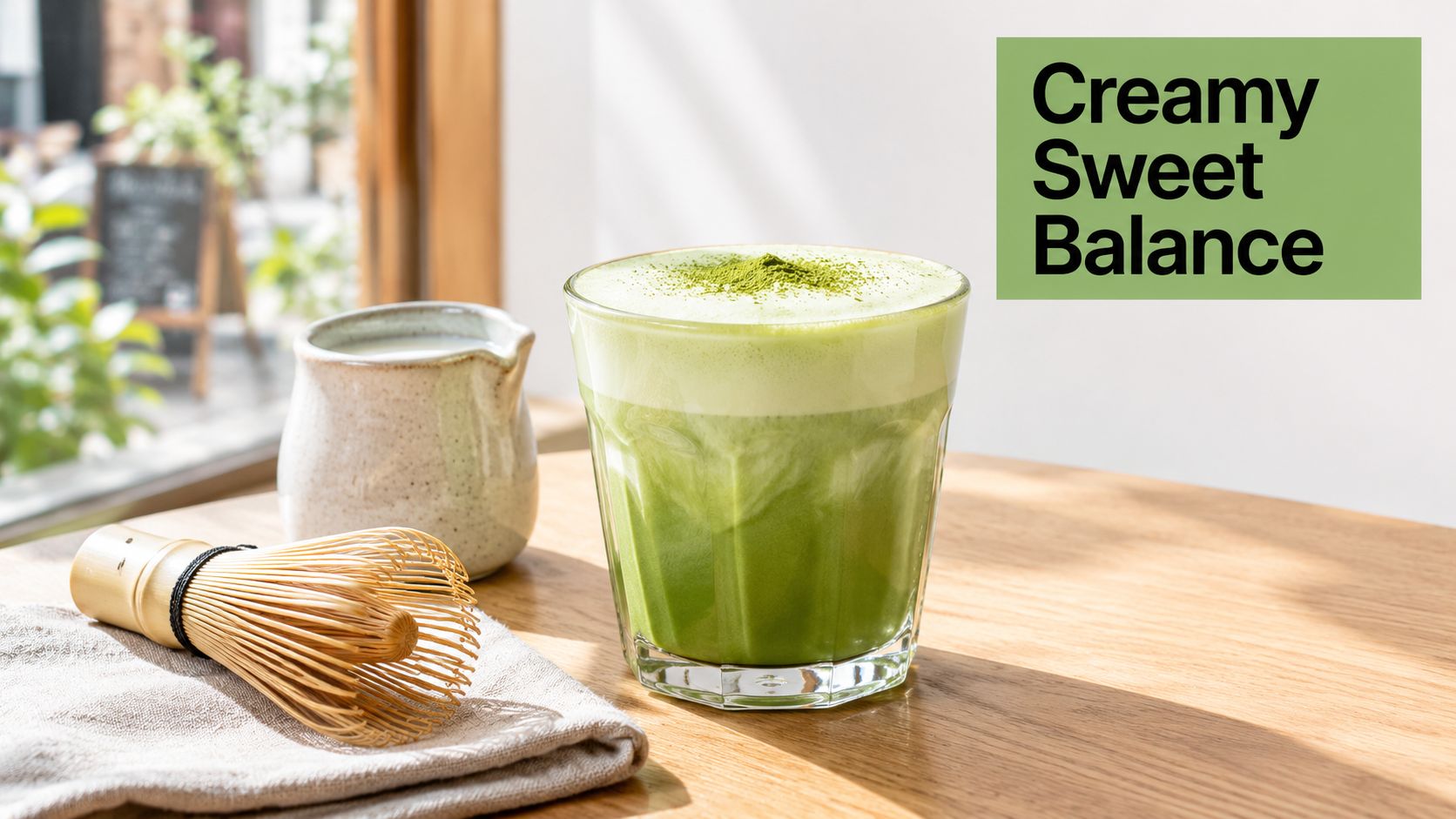
Dairy milk brings creaminess and a familiar café profile. Oat milk adds body and gentle sweetness, while macadamia milk gives a lighter, nutty finish. Unsweetened plant-based milk is a sensible choice if you want to keep the drink aligned with a low-sugar routine. The best option depends on the matcha and your palate, so taste the base before adding a sweetener.
Compare the serving formats
| Format | What it does to the flavour | Best use |
|---|---|---|
| Straight bowl | Keeps the umami and vegetal notes prominent | Fresh, balanced matcha |
| Hot latte | Adds body and softens sharp edges | First-time drinkers and cosy café drinks |
| Iced latte | Makes the flavour feel lighter and more refreshing | Warm Australian days |
| Smoothie or baking | Shares the matcha with other ingredients | Stronger culinary powder |
For a practical latte, whisk the matcha with a small amount of warm water first, then add approximately 150–200 mL of steamed or chilled milk. An iced version works particularly well when you pour the whisked matcha over ice and add milk afterwards. The cold dilution reduces the immediate impact of the vegetal notes without requiring extra sugar.
A smoother drink isn't a caffeine-free drink. Milk, vanilla and sweetener change perceived bitterness and grassiness, but they don't remove the naturally occurring caffeine in matcha.
Sweetness should support the tea, not bury it. A small amount of honey, maple syrup or an approved sugar-free syrup can balance bitterness. Too much sweetness creates a different problem, especially if you're trying to keep a clean-label or sugar-free drink on the menu.
Australian and New Zealand food guidance says naturally occurring caffeine in tea isn't subject to the same maximum limits as caffeine added to beverages, although a standard serving of these foods will normally not exceed 100 mg. FSANZ's caffeine safety information is useful for explaining why matcha can feel stronger than an ordinary brewed green tea.
This video shows the latte process in a visual format:
For a measured home version with milk and optional sweetener, follow PepTea's matcha green tea latte recipe. If you're caffeine-sensitive, pregnant or breastfeeding, or preparing a drink for a child, consider total daily caffeine intake rather than judging the drink by its sweetness.
Understanding Matcha Grades and Flavours
Preparation can only take you so far. If your matcha is naturally forceful, cooler water may reduce bitterness, but it won't turn the powder into a delicate, sweet tea. The grade, cultivation, harvest and processing all contribute to the flavour you're working with.
Ceremonial-grade matcha is intended for drinking with water. It usually offers a finer texture and a more balanced combination of umami, sweetness and gentle vegetal flavour. That doesn't mean it has no grassiness. Authentic matcha can still taste green, savoury and seaweed-like, but the finish should feel more integrated rather than aggressively drying.
Culinary-grade matcha is designed to hold its character alongside other ingredients. Its stronger profile can be useful in cookies, cakes, smoothies, ice cream and savoury recipes, where milk, fruit, flour or fat changes the overall balance. Used as a plain bowl, it may taste more assertively vegetal.
Match the powder to the drink
Choose ceremonial grade when you want to drink matcha mostly with water. Choose culinary grade when you're mixing it into a recipe where a green-tea flavour needs to remain noticeable.
Colour can provide a clue, but it isn't a complete quality test. A vivid green powder may still taste harsh if it has been overheated, while a well-prepared matcha with some vegetal character can be enjoyable. Aroma, texture, freshness and the aftertaste matter as much as appearance.
Organic sourcing is another part of the purchasing decision, but it shouldn't be treated as a guarantee that every cup will taste mild. PepTea offers Japanese organic matcha in ceremonial and culinary styles, so the useful question is not “Is it organic?” It's “Is this grade suited to the way I plan to drink or cook with it?”
Storage affects the result too. Keep the powder sealed, away from heat, light and moisture, and avoid leaving it open beside the kettle. If a powder has lost its fresh aroma and tastes dull or flat, changing technique may not be enough.
When Grassy Notes Are Actually a Good Thing
Not every green flavour is a fault. Matcha is made from powdered tea leaves, so a pleasant vegetal note is part of its identity. The aim isn't to remove every trace of grassiness. It's to separate fresh, savoury character from the harsh bitterness caused by poor extraction or an unsuitable powder.
A well-balanced cup can taste like fresh greens, toasted seaweed, soft umami and gentle sweetness at the same time. Those flavours give matcha its personality. If you force the drink to taste completely neutral with heavy dilution and lots of sweetener, you may lose the reason to drink matcha in the first place.
Tell freshness from over-extraction
Pleasant grassiness usually arrives with aroma and a clean finish. Over-extraction feels more aggressive. It can leave your mouth dry, make the bitterness dominate, or create a burnt impression that lingers after the sip.
This distinction helps you decide whether to keep experimenting with the recipe or replace the powder. If the flavour improves when you cool the water and dilute the drink, technique was the main issue. If it remains blunt, stale or drying even after careful preparation, the grade, freshness or source may not suit a water-based cup.
Matcha is also part of a changing Australian beverage scene. Among surveyed Australians aged 18–24, 40% reported ordering matcha in the previous six months, while 36% ordered flavoured iced matcha, according to Ujiha's Australian matcha flavour guide. Those figures point to a practical lesson for cafés and home drinkers: matcha doesn't need to be introduced only as a strong traditional bowl. Iced and flavoured formats can preserve its character while making the first experience more approachable.
Your Quick Checklist for a Smooth Cup
When the next bowl tastes like grass, don't reach for more powder. Work through the variables in order:
- Start with temperature: Use water at 70–80°C, beginning nearer the lower end if the flavour is harsh.
- Sift before mixing: Break up clumps so the powder disperses evenly.
- Build a paste: Combine the powder with a small splash of water before adding the rest.
- Whisk thoroughly: Use a W or M motion until the drink is smooth and lightly foamy.
- Dilute deliberately: Add chilled water, ice or 150–200 mL of milk if a straight bowl feels too concentrated.
- Sweeten lightly: Use a small amount of honey, maple syrup or sugar-free syrup only after correcting heat and texture.
- Choose the right grade: Use ceremonial matcha for water-based drinking and culinary matcha for recipes.
- Serve promptly: Don't let the powder settle into a bitter final mouthful.
- Check the powder: If careful preparation doesn't soften the flavour, reassess freshness and grade.
The most useful habit is to diagnose before disguising. Cooler water fixes over-extraction, sifting fixes clumps, and milk fixes concentration. Sweetener has a place, but it should be the finishing adjustment, not the rescue plan.
The best matcha routine is the one you'll repeat. A balanced iced latte can be a better introduction than a perfect but intimidating straight bowl.
If your drink contains matcha, remember that a smoother flavour doesn't change its caffeine content. Australian guidance also states that highly concentrated caffeine products, including products with caffeine concentrations of 5% or more in solid or semisolid form, or 1% or more in liquid form, are banned from retail sale to the public. FSANZ's guidance on caffeine powders distinguishes those products from ordinary tea ingredients.
Pep Tea offers organic Japanese matcha in drinking and culinary formats, along with Australian-brewed sugar-free organic kombucha from the Hunter Valley, NSW. Try the temperature and latte methods above, then visit Pep Tea to explore matcha for your next smooth home drink or café menu.
Matcha Milk Powder Guide: How to Use It Well
You've probably seen matcha milk powder on a café menu, in a supermarket sachet, or beside the oat milk at home and wondered what you are truly buying. Is it matcha with milk powder, or is it a sweetened latte mix with only a little tea? The answer matters because the ingredient list affects colour, flavour, texture, caffeine, sweetness, and how consistently the drink performs.
Australia's matcha market generated more than A$54 million in revenue in 2024 and is projected to exceed A$81 million by 2030, with powder holding a 55.08% share of revenue in 2024, according to Australian matcha latte powder market reporting. Matcha milk powder is already suited to cafés, retail shelves, home lattes, smoothies, and baking. The practical question is how to choose and use it without sacrificing the character of the tea.
What Matcha Milk Powder Actually Is
Matcha milk powder is a pre-blended drink mix. It usually combines finely ground Japanese green tea with dairy or plant-based milk solids, a sweetener, and functional ingredients that help the powder dissolve, remain stable, or produce foam.
That makes it different from pure matcha. Ceremonial-grade and culinary-grade matcha are generally sold as tea powder, so you add the milk, water, and sweetener separately. A traditional café matcha latte also starts with matcha whisked with water, followed by steamed milk. It isn't the same product as a pre-mixed latte powder.
| Format | Main Ingredients | Prep Method | Typical Use |
|---|---|---|---|
| Matcha milk powder | Matcha, milk solids, sweetener, stabilisers or creamer | Mix with hot or cold liquid, then froth | Fast home drinks, cafés, takeaway menus |
| Pure matcha | Stone-ground tea leaves | Sift and whisk with water, then add milk separately | Traditional tea, controlled lattes, baking |
| Café latte | Pure matcha, water, fresh dairy or plant milk | Whisk matcha, steam or froth milk | Made-to-order café service |
Read the ingredient list before the front label
Australian matcha milk powders commonly contain sugar, dextrose, maltodextrin, skim milk powder, non-dairy creamer, vegetable oil, emulsifiers, and stabilisers. These ingredients aren't automatically a problem. Manufacturers use them to improve shelf stability, reduce clumping, create body, and help the drink froth.
The trade-off is that every added ingredient changes the tea. Sugar can soften bitterness but may dominate delicate umami. Creamer can create a fuller mouthfeel, while dextrin and milk solids may make the drink appear paler or feel chalky if the powder is over-diluted. Excess heat can also affect colour and texture.
Use the guide to what matcha powder is to refresh the distinction between pure matcha and blended products. For a broader look at powdered green tea products, the VitzAi.com green tea powder review offers useful comparison context, although you should still judge any product by its own ingredient panel.
Start with three checks:
- Matcha position: Ingredients are listed from greatest to least amount. Matcha appearing near the beginning generally gives you more confidence that tea is central to the blend.
- Sweetener level: Decide whether you want a ready-sweetened latte or a product that leaves room for your own honey, sugar, or syrup.
- Milk source: Check whether the blend contains skim milk, lactose, plant milk, coconut ingredients, or a non-dairy creamer.
How to Prepare a Matcha Latte With Powder
A reliable drink starts with a repeatable dose. An Australian retail benchmark uses 4 g of powder with 200 mL of water for a latte-style preparation, as described in Australian matcha powder market coverage. For café testing, a practical starting point is 8 to 10 g of matcha milk powder per 180 to 200 mL of milk or water, then adjust for the brand's strength, sweetness, and cup size.
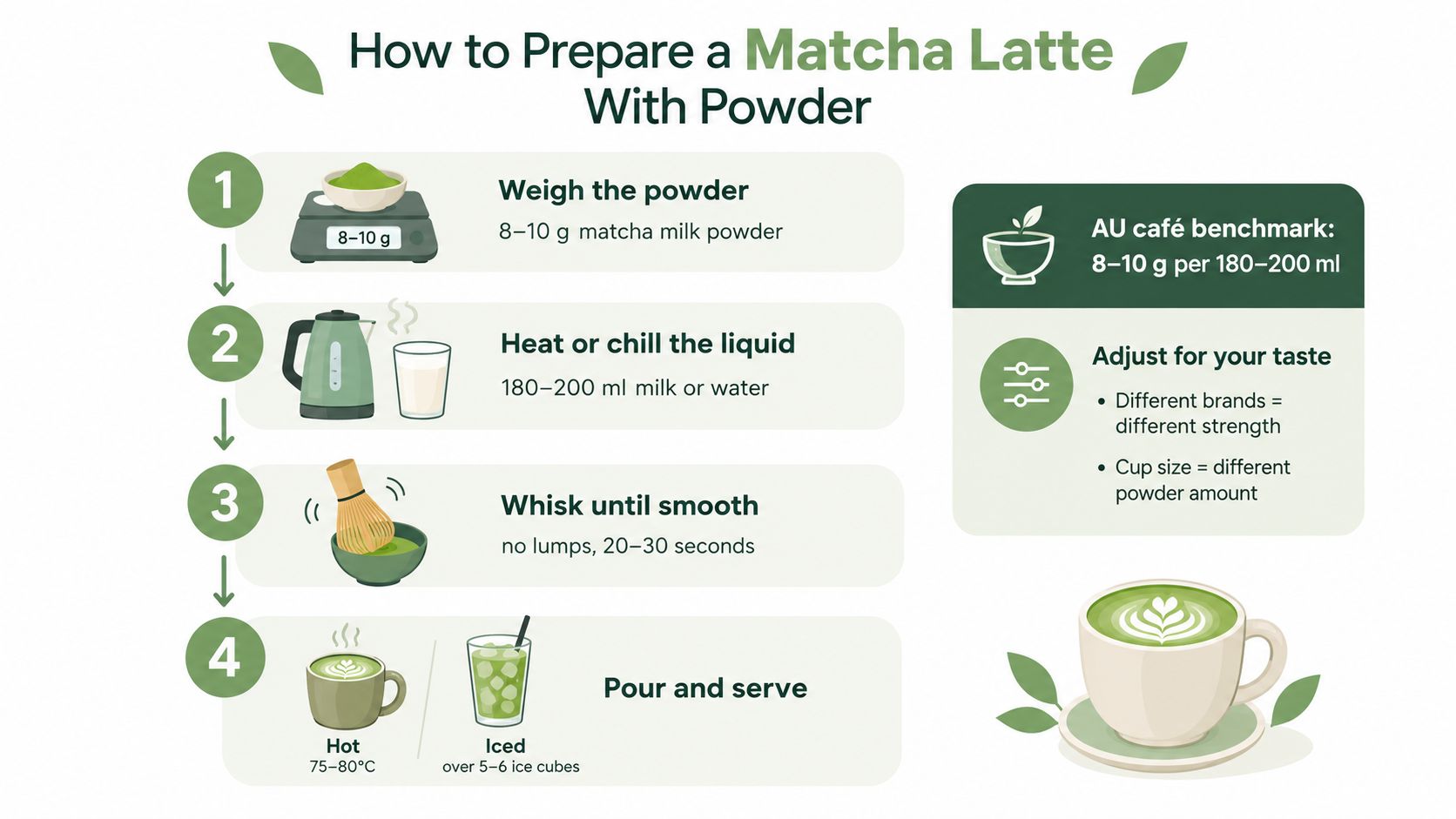
Hot preparation
- Measure the powder. Weigh it rather than relying on a heaped spoon. Consistent dosing matters behind a bar and makes home recipes easier to repeat.
- Add a small amount of liquid. Use warm water or milk first and stir it into a smooth paste. This prevents dry pockets from surviving beneath the surface.
- Add the remaining liquid gradually. Water around 75 to 80°C is a useful working range for a hot latte. Very hot liquid can scorch milk solids and make the tea taste harsh.
- Froth until glossy. A steam wand gives the smoothest microfoam, while a handheld frother works well at home. Stop once the drink looks even and lightly aerated.
A sealed jar can replace a whisk for the dissolving stage. Add the powder and liquid, leave enough room for movement, and shake firmly before pouring into a cup. If you're interested in beverage formulation beyond tea, this comparison of high-protein coffee for athletes is a useful reminder that powders need thorough mixing to avoid sediment and uneven texture.
Iced preparation
For an iced matcha latte, dissolve the powder in a small amount of warm water first. Pour that concentrate over cold milk, stir or shake until smooth, and then build the drink over ice. Adding powder directly to cold milk often produces floating specks and stubborn clumps.
Service rule: Taste the liquid before adding ice. If the drink already seems weak, ice will make the problem more obvious.
A quick calibration method is to make one sample at your intended dose and compare its intensity with a single espresso-strength drink. You're not trying to make matcha taste like coffee. You're checking whether the tea still carries through the milk.
For more traditional whisking guidance, see how to make matcha tea from powder.
Choosing the Right Milk for Hot and Iced Drinks
The right milk depends on the drink you want, the equipment available, and the customer you're serving. No single milk performs perfectly in every matcha milk powder recipe.
Full-cream dairy gives a rounded texture and carries sweetness well. It's a dependable choice for a classic hot latte, although low-fat dairy can produce a thinner drink and may make the powder's texture more noticeable.
Oat milk is popular in café service because its mild flavour allows matcha to remain present while its texture usually stretches well under steam. Different brands behave differently, so test the exact product you plan to serve rather than assuming every oat milk will foam identically.
Soy milk can provide substantial body and a stable foam, especially for customers seeking a more protein-rich plant option. Its distinctive flavour can either complement or compete with grassy matcha.
Almond milk produces a lighter drink with a nutty note, but its foam can be less durable. Coconut milk brings a clear tropical character and works especially well with vanilla, mango, lime, or ginger. A coconut-based matcha can be explored through Pep Tea's matcha coconut milk recipe.
| Milk Type | Texture & Body | Froth Stability | Flavour Carry | AU Cost Note |
|---|---|---|---|---|
| Full-cream dairy | Rich and rounded | Reliable when steamed correctly | Carries sweetness and umami | Often a practical café baseline |
| Oat | Creamy and smooth | Generally strong with barista-style products | Mild, allowing matcha to lead | Compare brands before costing a menu |
| Soy | Full and protein-driven | Can produce good foam | More distinctive than oat | Useful for a protein-conscious audience |
| Almond | Light and clean | Usually less durable | Nutty and delicate | Suits lighter drinks and iced formats |
| Coconut | Thick or silky, depending on product | Variable | Tropical and noticeable | Best positioned as a flavoured variation |
Cold drinks need more control
Cold milk dissolves powder more slowly than warm liquid. Make a smooth concentrate first, then add the chilled milk and ice. Avoid filling a glass with ice before mixing, because the drink becomes harder to stir and the extra dilution can flatten the colour.
Customers comparing dairy options may also find this practical guide to calories in one percent milk useful. For cafés, the important point is to list the milk clearly and cost each version separately. Milk choice affects flavour, foam, portion size, and ingredient cost.
Recipe Variations Beyond the Standard Latte
Matcha milk powder works beyond the familiar hot takeaway cup. Because the blend already contains milk solids and sweetener, it can be convenient in recipes where you want tea flavour and body in one scoop.
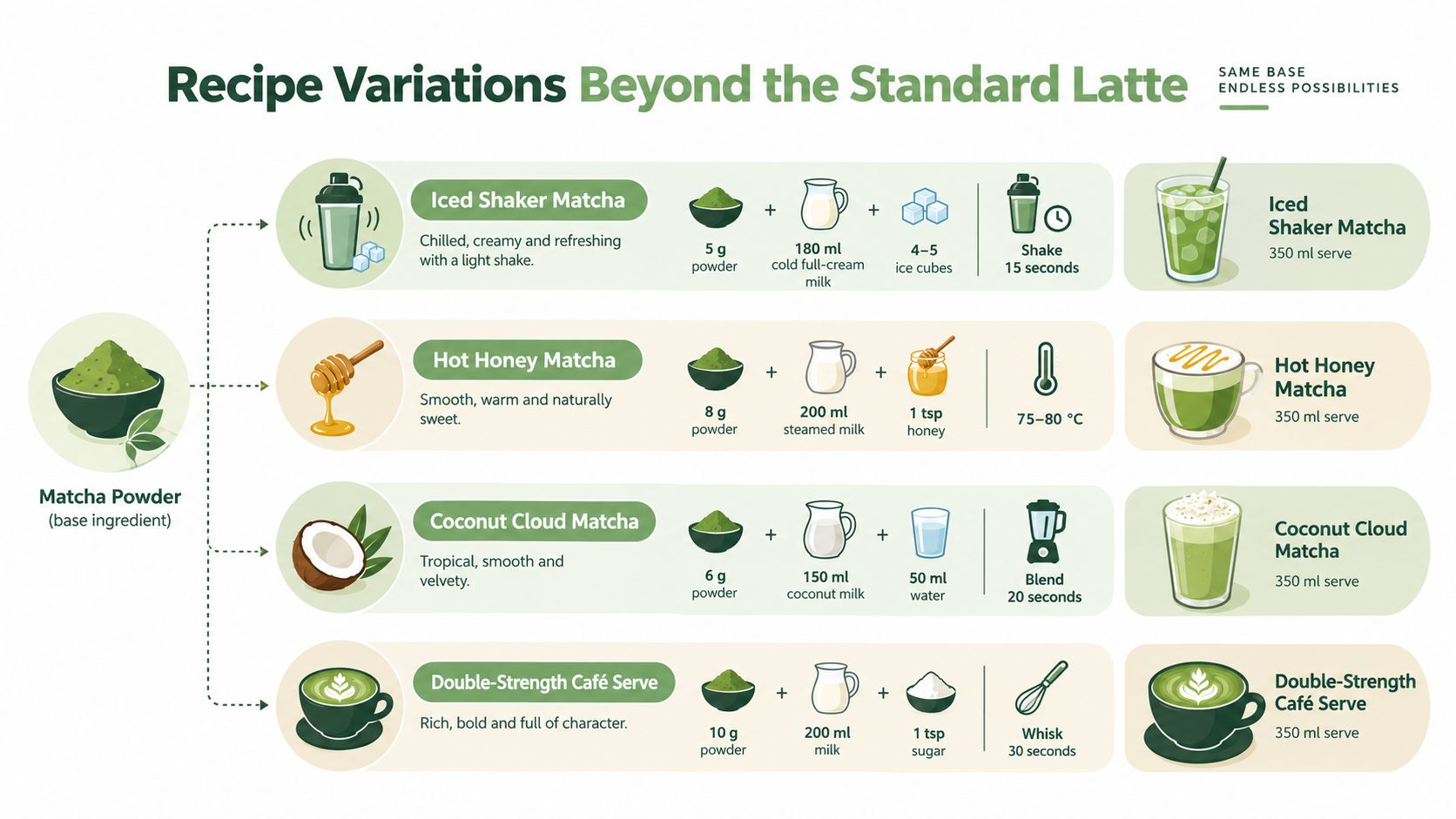
Iced shaker matcha
For a 350 mL serve, combine 5 g matcha milk powder, 180 mL cold full-cream or oat milk, and 60 mL chilled water in a sealed shaker. Add ice and shake hard for 15 seconds. The movement creates a light foam without a steam wand.
Use oat milk for a softer café-style texture, or full-cream dairy for a sweeter, fuller result. If your blend is already sweetened, taste before adding syrup.
Breakfast smoothie
Blend 6 g powder, 150 mL oat milk, one frozen banana, and a spoon of cashew butter. The banana masks some of the grassy character that can appear in a less refined blend, while cashew butter adds richness.
This is a good place for culinary-grade matcha or a latte blend that you wouldn't necessarily drink with water. Keep the mixture cold so the colour stays fresh and the banana remains the dominant texture.
Matcha baking mix
For cookies or a single-serve mug cake, combine 8 g matcha milk powder with 15 g sugar as part of the dry ingredients. Replace a small portion of the flour with the powder and add 20 mL extra milk to protect the crumb from drying.
Check the blend before adding sugar. A pre-sweetened powder may need little or none, particularly in a café recipe where toppings or icing add sweetness later.
Honey and ginger matcha
Warm 200 mL full-cream milk with a slice of bruised ginger. Mix 4 g powder with a small amount of warm water, then add the infused milk and 10 mL honey. Keep the milk warm rather than boiling so the drink stays smooth.
For a plant-based version, oat milk provides gentle sweetness, while coconut milk gives the drink a more obvious tropical direction. Ginger, honey, and coconut can each become strong flavours, so use them as accents rather than allowing them to hide the matcha completely.
Substitutions, Storage, and Shelf Life
A café can run out of a blend without removing matcha from the menu, but the substitute needs to be written down and tested. For one serve, replace 8 g matcha milk powder with 4 g culinary-grade pure matcha, 150 mL milk, 2 g skim milk powder, and 4 g sugar. This recreates some of the body and sweetness, although it won't reproduce the original blend exactly.
At home, a screw-top jar is a practical alternative to a steam wand. Shake the liquid and powder for 20 seconds, open the lid carefully, and pour immediately. Don't use a jar with a damaged seal or fill it completely, because the mixture needs room to move.
| Scenario | Storage Time | Container | Emergency Substitute per Serve |
|---|---|---|---|
| Unopened tin | Up to 12 months from production | Sealed tin, below 25°C, away from light | Use a tested pure-matcha blend if required |
| Opened pouch | 4 to 6 weeks once sealed | Airtight container with desiccant | Pure matcha, milk powder, and sugar formula |
| Café service jar | Rotate using FIFO | Labelled 500 g jar with tight lid | Pre-weighed substitute recipe |
| Home working supply | Use promptly after opening | Original pouch inside an airtight container | Pure matcha prepared separately |
Manage stock before it becomes a menu problem
Australia's Japanese green tea imports reached 195,319 kilograms between January and August 2025, a 131% year-on-year increase, according to reporting on Australia's matcha supply and import growth. That growing demand sits alongside shortages that began in 2024 and worsened through 2025, with tighter supply and record import costs affecting cafés, as reported by the ABC's coverage of matcha shortages and prices.
For a café, sensible controls include:
- Hold a safety stock: Keep roughly four weeks of cover where the product is central to the menu.
- Qualify another supplier: Test a second blend before the first supplier becomes unavailable.
- Avoid single-lane dependence: A product that relies on one import route creates more exposure during shortages.
- Use FIFO: Label the open date and move older stock forward.
- Record the recipe: Staff need the dose, milk volume, temperature, and substitution formula in one place.
Mixed tea products can also fall under different Australian biosecurity conditions. The Australian Government's plant product import guidance explains that tea made purely from Camellia sinensis is considered minimal biosecurity risk, while mixed products may require different conditions. The government also advises that plant-origin tea materials must be thoroughly dried before entry, which matters for blends containing other ingredients.
Why Some Matcha Milk Powders Disappoint
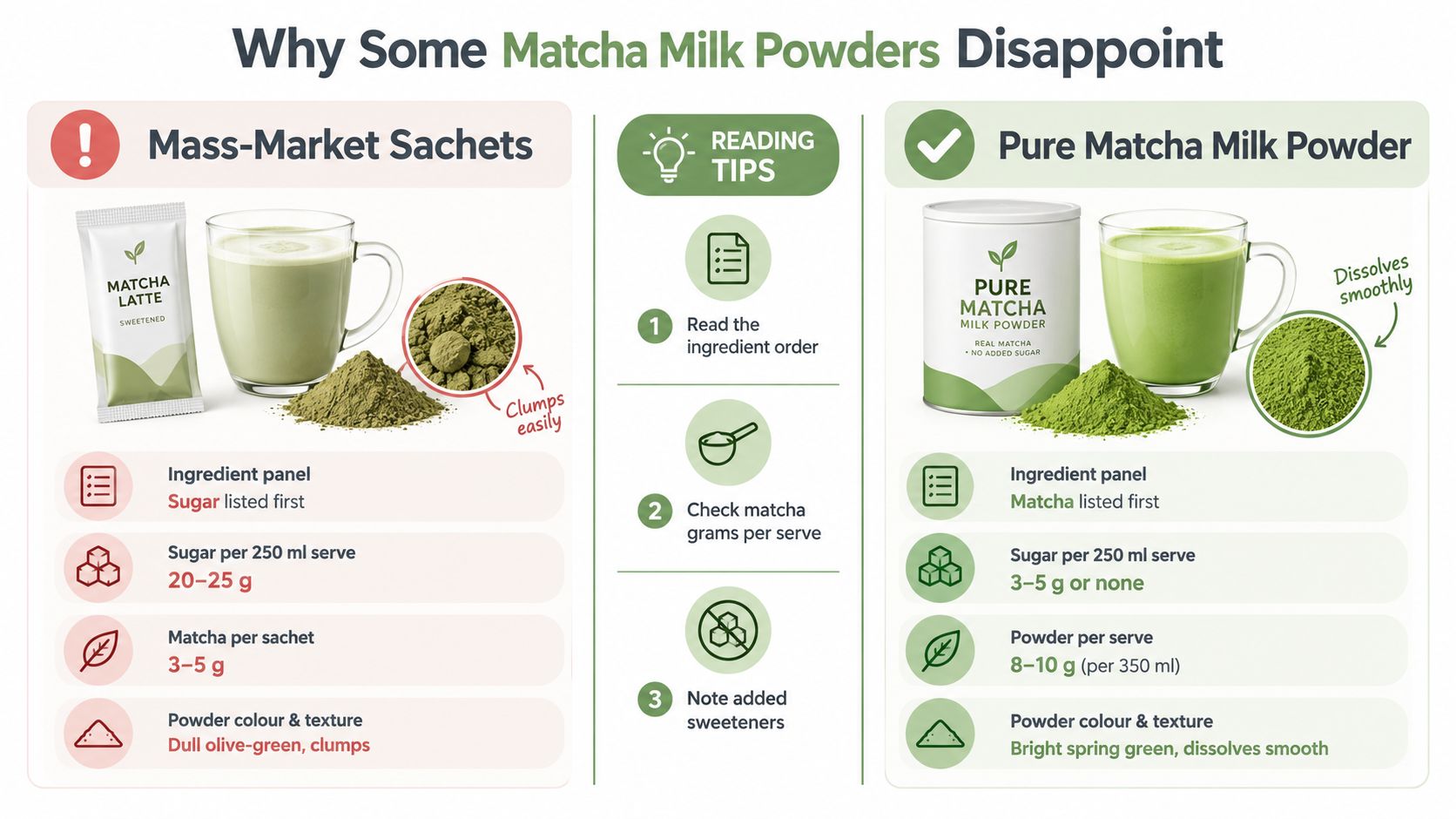
A sweeter powder isn't automatically a better shortcut. Many mass-market sachets are designed to taste immediately pleasant, so sugar, maltodextrin, dextrin, vegetable fat creamer, or other milk-style ingredients can dominate the blend before the tea has a chance to show its colour and savoury character.
The ingredient panel tells you more than the packaging. Some products list sugar or maltodextrin first, followed by creamer and only a small amount of matcha, sometimes below 10%. That can produce a muted olive-green colour, a powdery finish, and a latte that tastes more like sweetened milk than tea.
What the extras change
Sugar reduces perceived bitterness but can make it difficult to control sweetness across hot, iced, and blended drinks. Dextrin can improve powder handling, yet too much may leave a chalky texture. Creaming agents add body, but they can leave a film on cups and make commercial frothers harder to clean.
The tea itself may also feel flat when milk solids coat the palate. You get thickness without much umami, and the bright green colour expected from matcha becomes less convincing.
Label test: Look for matcha high in the ingredient order, check the grams of tea per serve, and identify every added sweetener before you judge value.
Unflavoured blends built around a higher proportion of matcha can give a more defensible café drink, while pure ceremonial-grade matcha gives you maximum control over dosing and sweetness. The trade-off is extra preparation. You'll need to weigh, sift, whisk, and add the milk separately, but you can adjust the drink for each customer and recipe.
For a café, also watch the cleaning burden. A powder that clumps or leaves residue may slow service even when its purchase price appears attractive. A product that dissolves cleanly, tastes balanced, and has a written recipe can cost less operationally than a cheaper blend that needs repeated reworking.
Practical Takeaways and Where to Go Next
The best matcha milk powder is the one that suits the drink you're making. A sweetened blend may be convenient for a quick iced latte, while pure matcha is better when you want control over tea intensity, milk choice, and sugar. Cafés need to judge both sensory quality and service performance.
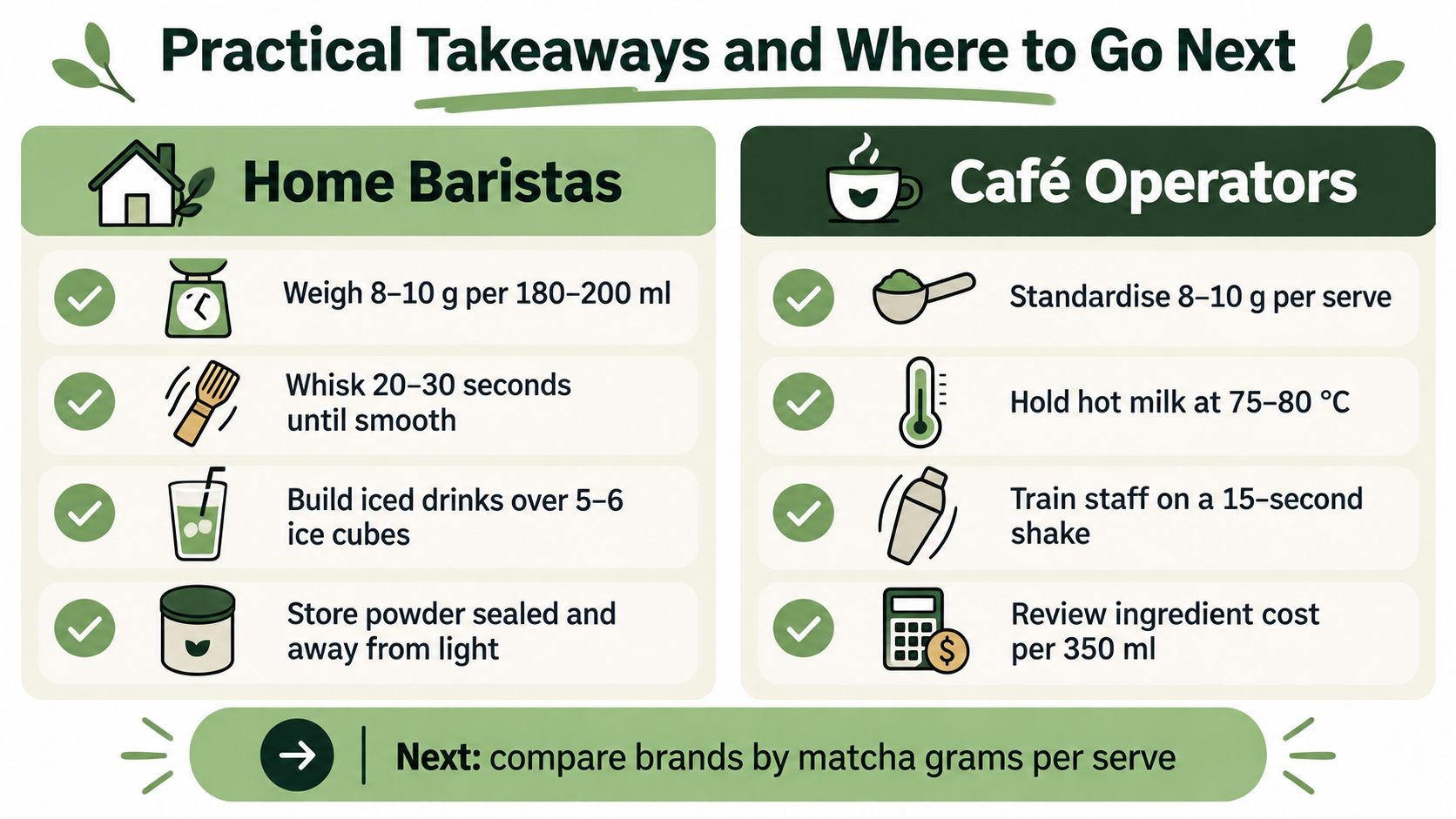
For home baristas
- Weigh the powder: Start with the product's recommended serve, then adjust by taste rather than adding sweetness automatically.
- Use filtered water below 80°C: This helps protect the texture and reduces the harshness associated with overheated liquid.
- Sift before mixing: Sifting breaks up compacted powder and makes a smoother paste.
- Build iced drinks carefully: Mix the concentrate before adding milk and ice.
- Taste it plain first: Assess bitterness, sweetness, and tea strength before adding honey or syrup.
- Store it well: Keep the powder sealed, dry, and away from light.
For café operators
Standardise the recipe by cup size and train staff to use the same dose, liquid volume, and frothing method. Record the cost of the powder, chosen milk, sweetener, and any toppings before setting the menu price.
Keep stock organised with FIFO rotation and a supply buffer. Review the ingredient panel whenever you change supplier, because a substitution can alter sweetness, colour, foam, and customer expectations even when the name on the menu stays the same.
Australia's matcha audience includes traditional tea drinkers, latte customers, home cooks, and people looking for alternatives to heavily sweetened drinks. A clear ingredient list and a consistent recipe help you serve all of them honestly.
If you're ready to compare organic, single-origin, and sugar-free matcha options for home or café use, explore the range from Pep Tea and choose a format that gives you the level of sweetness and control you want.
Pep Tea offers organic Japanese matcha in ceremonial and culinary grades, along with guidance for hot lattes, iced drinks, and baking. Visit Pep Tea to compare matcha options and find a practical fit for your pantry or café menu.
Best Matcha Latte Recipe for Café-Style Flavour at Home

You've picked up a vivid green matcha latte on the way to work, taken two sips, and realised it tastes more like sweetened milk than tea. At home, the same drink can be smoother, fresher, and much easier to adjust. The difference usually isn't an expensive coffee machine. It's fresh matcha, controlled water temperature, proper sifting, and milk that can hold its texture.
Australia's matcha habit has moved well beyond a niche tea order. The market generated more than AUD 54 million in 2024 and one industry forecast expects it to exceed AUD 81 million by 2030, a projection covered by SBS News. That growth has brought better access, more café experimentation, and higher expectations for the cup.
This is the best matcha latte recipe I use as a practical starting point. It works hot or iced, with dairy or plant milk, and gives you enough control to make a café-style drink without hiding the tea under syrup.
Why Your Morning Matcha Latte Costs Too Much
A Sydney or Melbourne takeaway can cost close to A$8, while cafés in major Australian cities commonly charge AUD 6 to AUD 8 per serve, according to Australian tea market coverage. One occasional purchase is easy to justify. Five weekday drinks, however, can put roughly A$40 a week toward takeaway matcha.
Home preparation changes the calculation without requiring bargain-basement powder. A carefully portioned latte costs around A$2 a serve with ceremonial matcha, or roughly A$1.20 with culinary matcha, depending on the matcha, milk, and sweetener. At five drinks a week, that is about A$10 for ceremonial matcha or A$6 for culinary matcha, compared with roughly A$40 from a café.
The lower cost also gives you control over the cup:
- Matcha grade: Ceremonial matcha offers a cleaner, more delicate flavour, while culinary matcha can bring stronger bitterness at a lower serving cost. Neither replaces good technique.
- Sweetness: Use honey, maple, a sugar-free option, or nothing, rather than accepting a café's preset balance.
- Milk: Dairy, oat, almond, soy, and coconut milk change the texture and how clearly the tea comes through.
- Tea flavour: With enough matcha and restrained sweetness, umami and gentle vegetal notes remain noticeable instead of disappearing under syrup.
Supply can affect the choice. If ceremonial matcha is difficult to find or too expensive, fresh culinary matcha is a practical substitute for a daily latte. Sifting it carefully, controlling the water temperature, and choosing milk that froths well will matter more than paying for a premium label alone.
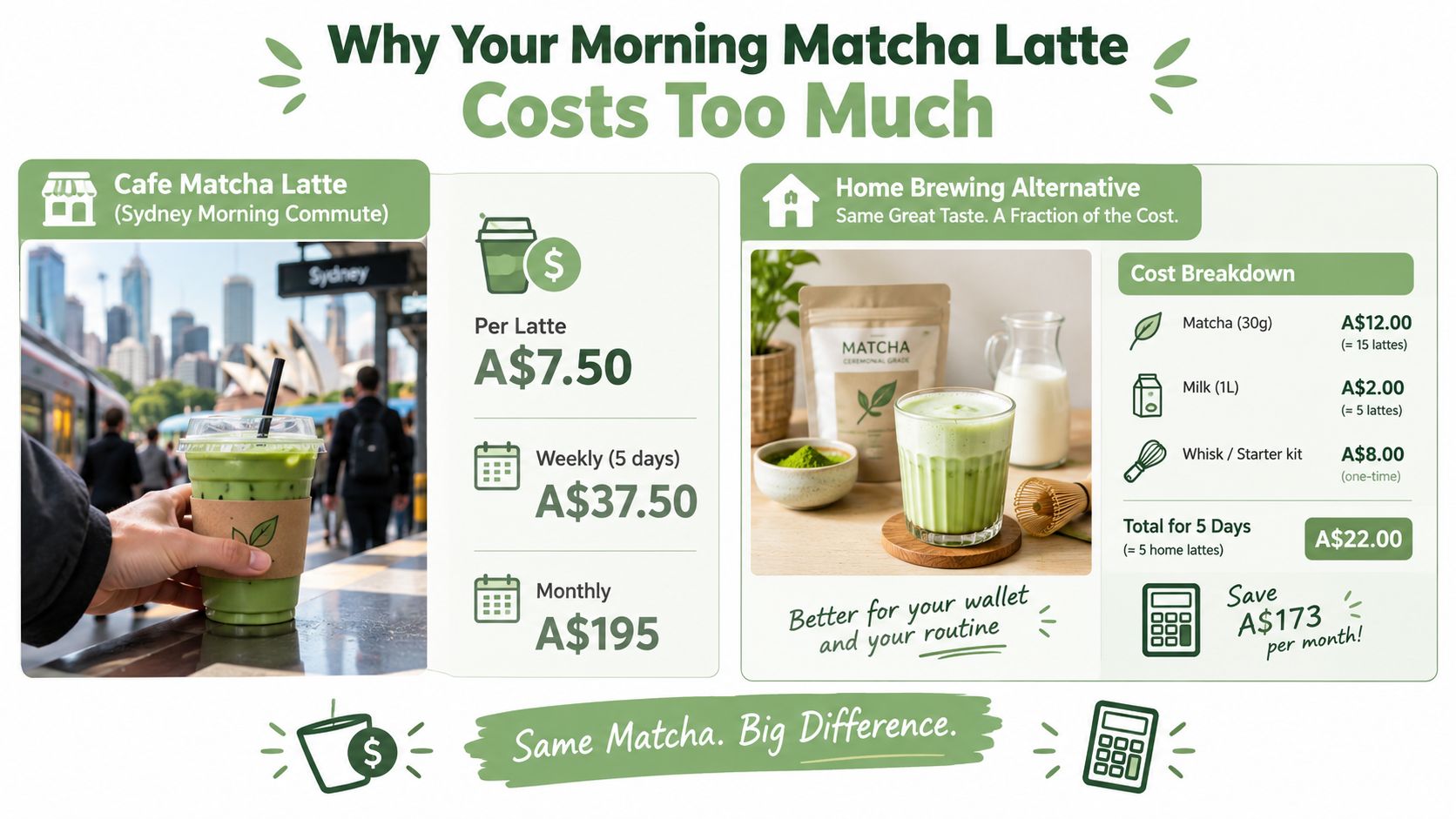
The home method costs about the same as one takeaway drink once the basic ingredients are in your kitchen. The return is a fresher, more adjustable cup, with attention and technique doing more work than expensive equipment.
The Core Method for a Smooth, Vibrant Cup
The smoothest latte starts with a small matcha concentrate, not powder dumped directly into a full glass of milk. Matcha is finely ground tea leaf, so it won't dissolve like sugar. Sifting and emulsifying suspend the particles evenly and prevent dry pockets from floating through the drink.
Start with a fine matcha base
Measure 2 g, about 1 teaspoon, of matcha into a small bowl, wide mug, or matcha bowl. Pass it through a fine sieve before adding water. This takes a few seconds and removes the compacted pieces that a spoon tends to leave behind.
Add 60 ml of water at 70–80°C. This temperature range is the most important control in the recipe. Australian matcha preparation guidance recommends this window because it helps preserve flavour, reduces bitterness, and supports a more stable foam, as described in this Australian matcha latte method.
Build a paste, then whisk
First, work the water into the powder to make a thick paste. Use a bamboo chasen or small whisk and press any remaining lumps against the side of the bowl. Don't rush straight to a large volume of water. The paste stage gives every particle a chance to hydrate evenly.
Add a second small splash of the remaining water if the paste feels tight, then whisk rapidly for 15–20 seconds in a W or M motion. A circular stir moves liquid around the bowl but doesn't incorporate air as effectively. The target is a glossy, fully suspended base with fine pale-green bubbles across the surface.
Practical rule: If your water has just boiled, let it cool before it touches the matcha. Water above the recommended range is the fastest route to a harsh cup.
Warm 150–200 ml of milk and pour it into the matcha base. For an iced latte, use cold milk and pour the whisked matcha over ice. Keep the milk volume toward the lower end when you want a stronger tea flavour, and use the higher end for a softer, milkier drink.
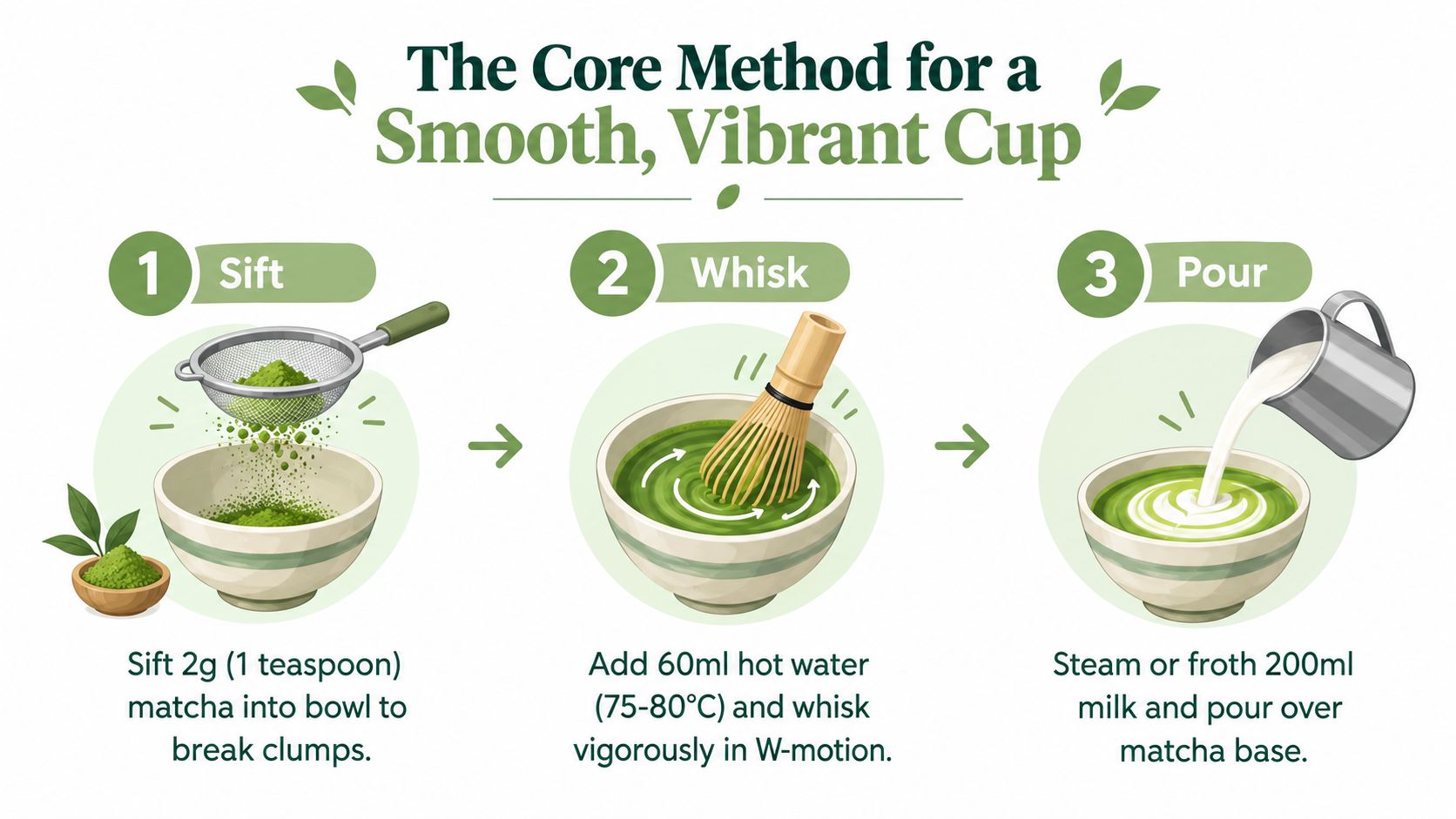
For a visual demonstration of the whisking technique, see PepTea's guide to whisking matcha.
A bamboo chasen is traditional, but a handheld electric frother or small wire whisk works perfectly well for a home latte. The method matters more than the tool.
Choosing the Right Matcha Grade for Your Budget
Ceremonial and culinary matcha aren't interchangeable in every drink, but the more expensive option isn't automatically the better latte powder. Ceremonial matcha is generally selected for drinking with water, where its colour, aroma, texture, and finish have nowhere to hide. Culinary matcha is made for recipes in which milk, sweetener, fruit, chocolate, or flour share the stage.
| Attribute | Ceremonial Grade | Culinary Grade |
|---|---|---|
| Flavour | Smooth, umami-rich, vegetal, gently sweet | Deeper, toastier, and more astringent |
| Colour | Brighter, vivid green | Often darker or duller green |
| Price guide | Typically A$35–A$60 per 30 g tin | Typically A$15–A$25 per 100 g pouch |
| Best use | Straight matcha, lightly milky drinks | Everyday lattes, iced drinks, baking |
| Main advantage | Clean finish and refined aroma | Strong value and enough flavour to stand up to milk |
Those price ranges reflect the product examples described in the brief, not a universal retail rule. Matcha availability and pricing vary as Australian demand expands across cafés, supermarkets, and specialty tea suppliers. PepTea's explanation of matcha grades is useful when you're comparing a drinking powder with one intended for cooking.
My rule is simple: choose ceremonial grade when the tea itself is the focus, and save with culinary grade for regular lattes, smoothies, iced drinks, and baking. Ceremonial grade matters less than many people think when you're adding a substantial amount of oat milk, sweetener, vanilla, or ice. In that situation, a fresh culinary matcha can taste more balanced than an older, expensive tin.
Storage also affects the result. Keep opened matcha sealed, away from heat and strong light, and use clean, dry utensils so the powder retains its colour and aroma.
Milk Options and How to Froth Each One
Milk changes the latte more than most expect. It affects sweetness, body, foam, and how strongly the matcha comes through, so the right choice depends on whether you want a traditional creamy drink, a plant-based café texture, or a refreshing iced version.
| Milk | Flavour Impact | Foam Quality | Best Temperature |
|---|---|---|---|
| Full-cream dairy | Rich, rounded, naturally sweet | Stable, fine microfoam | Around 65°C |
| Oat milk | Creamy, lightly sweet, cereal-like | Usually the most stable plant foam | Around 60–65°C |
| Almond milk | Nutty and lighter-bodied | Light foam, stronger with barista blends | Warm gently |
| Soy milk | Creamy with a mild bean note | Holds foam well, but can split if overheated | Keep below boiling |
| Coconut milk | Tropical and aromatic | Thin foam, better for iced drinks | Froth cold or warm gently |
Full-cream dairy gives the most forgiving hot latte. Warm 150 ml gently to around 65°C, then froth until the surface looks glossy rather than bubbly. Overheated milk loses sweetness and can make the tea taste flatter.
Oat milk is usually the easiest plant-based substitute for a café-style texture. Barista versions often contain ingredients that improve body and emulsification, which helps them produce a more persistent foam. Soy can also foam well, but high heat may cause it to split, so stop before the milk simmers.
Almond milk heats quickly and tends to create a lighter drink. Choose a barista blend if foam matters. Coconut milk adds an appealing tropical note but usually stays thinner, so I prefer it cold over ice rather than trying to force it into a dense hot foam. PepTea's matcha coconut milk recipe is a useful format for that combination.
Two reliable cold versions
For a shaken iced latte, combine the sifted matcha with the hot water paste first, then add 200 ml cold milk and ice to a jar. Seal it firmly and shake until the drink looks evenly green and lightly foamy.
For a cold-foam finish, froth a small amount of cold milk separately with a handheld frother or French press, then spoon it over an iced matcha latte. If you're preparing drinks for a household or café, a larger piece of equipment such as this Chef Inox Elite jug milk frother from Simply Hospitality can make repeated batches easier.
Rice milk and very low-fat dairy are less reliable when you want stable foam. They can still make a pleasant latte, but expect a thinner surface and let the matcha carry more of the texture.
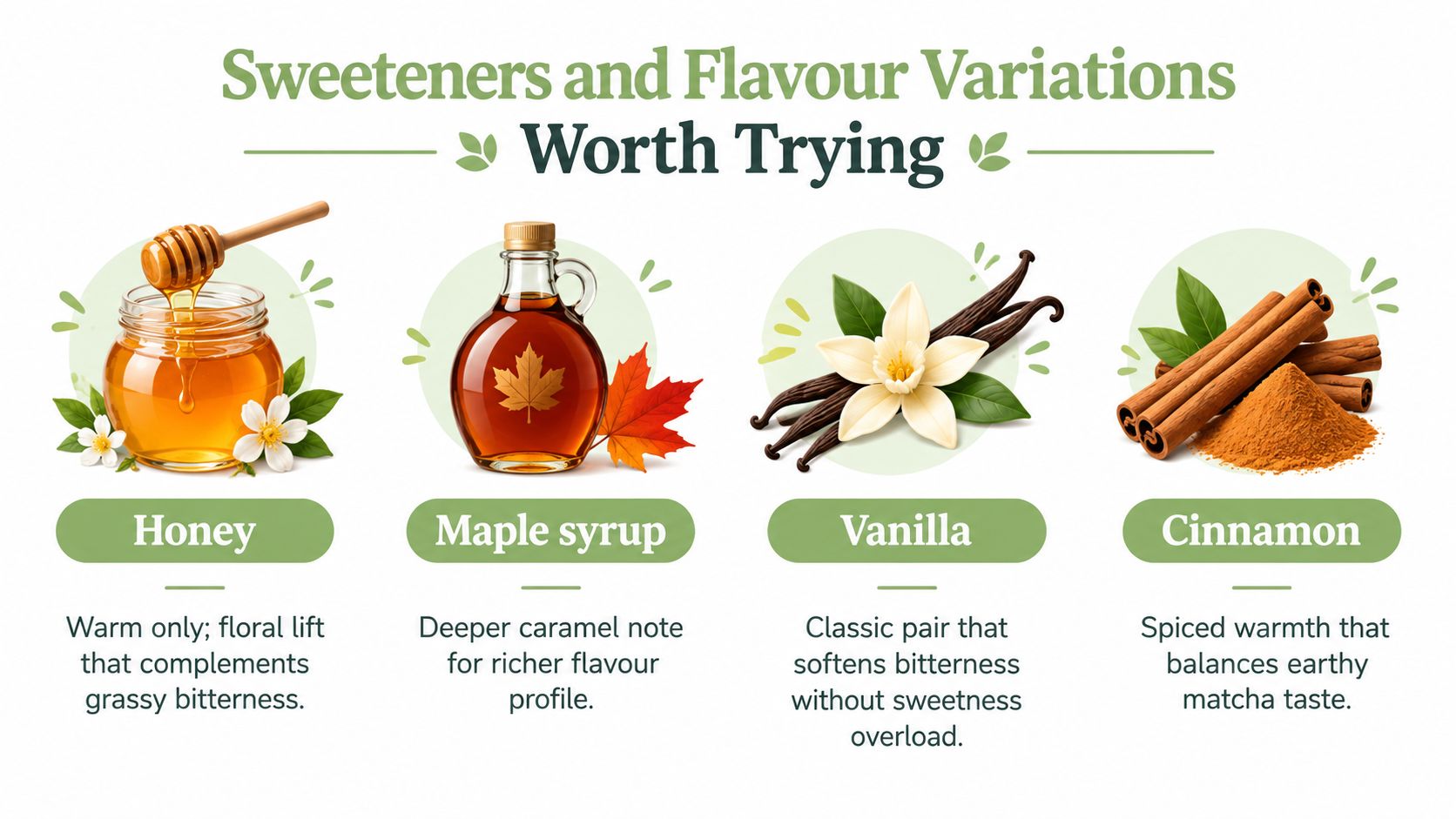
Sweeteners and Flavour Variations Worth Trying
Sweetener should support matcha's flavour, not bury it. Start with a small amount, taste after the milk is added, and remember that oat milk already brings its own sweetness.
- Honey: Begin with 1 teaspoon in the warm matcha paste. Its floral character can lift grassy notes, but don't add it to a cold drink if it won't dissolve properly.
- Maple syrup: Use 1 teaspoon for a deeper caramel note, especially with oat milk.
- Caster sugar: Add 1 teaspoon to the hot paste if you want a neutral sweetness that disappears cleanly into the drink.
- Monk fruit or stevia: Follow the product's serving guidance, because concentrations vary. These options suit a low-sugar routine, but some products leave a lingering aftertaste.
- No sweetener: Use this with a good ceremonial matcha when you want to notice its umami, aroma, and gentle vegetal sweetness.
Vanilla is one of the most useful additions. A few drops round out bitterness without turning the latte into a dessert. A pinch of fine sea salt can make sweetness feel more pronounced, while 1 teaspoon cocoa creates a matcha-mocha profile with a darker finish. For an iced tropical version, add a splash of coconut cream and reduce the milk slightly so the drink doesn't become heavy.
These small adjustments fit neatly into everyday low-sugar cooking. For broader ideas on balancing sweetness and flavour in family drinks, see these balanced cooking tips for Melbourne families.
Cinnamon works best as a finishing dusting rather than a large dose whisked into the base. It adds warmth, but too much spice can cover the tea's more delicate notes.
Fixing the Most Common Home Matcha Problems
A bitter latte isn't proof that you dislike matcha. In most home kitchens, it points to a process problem, usually water that's too hot or powder that hasn't been emulsified properly.
Bitter taste
Boiling water extracts a harsher flavour and overwhelms matcha's softer notes. Cool freshly boiled water for about 60 seconds before adding it, then stay within the 70–80°C range.
Clumps
A spoon can mix matcha into milk, but it won't break up compacted powder as reliably as a sieve and rapid whisk. Sift the dry matcha before adding any liquid, then make a paste before increasing the water volume.
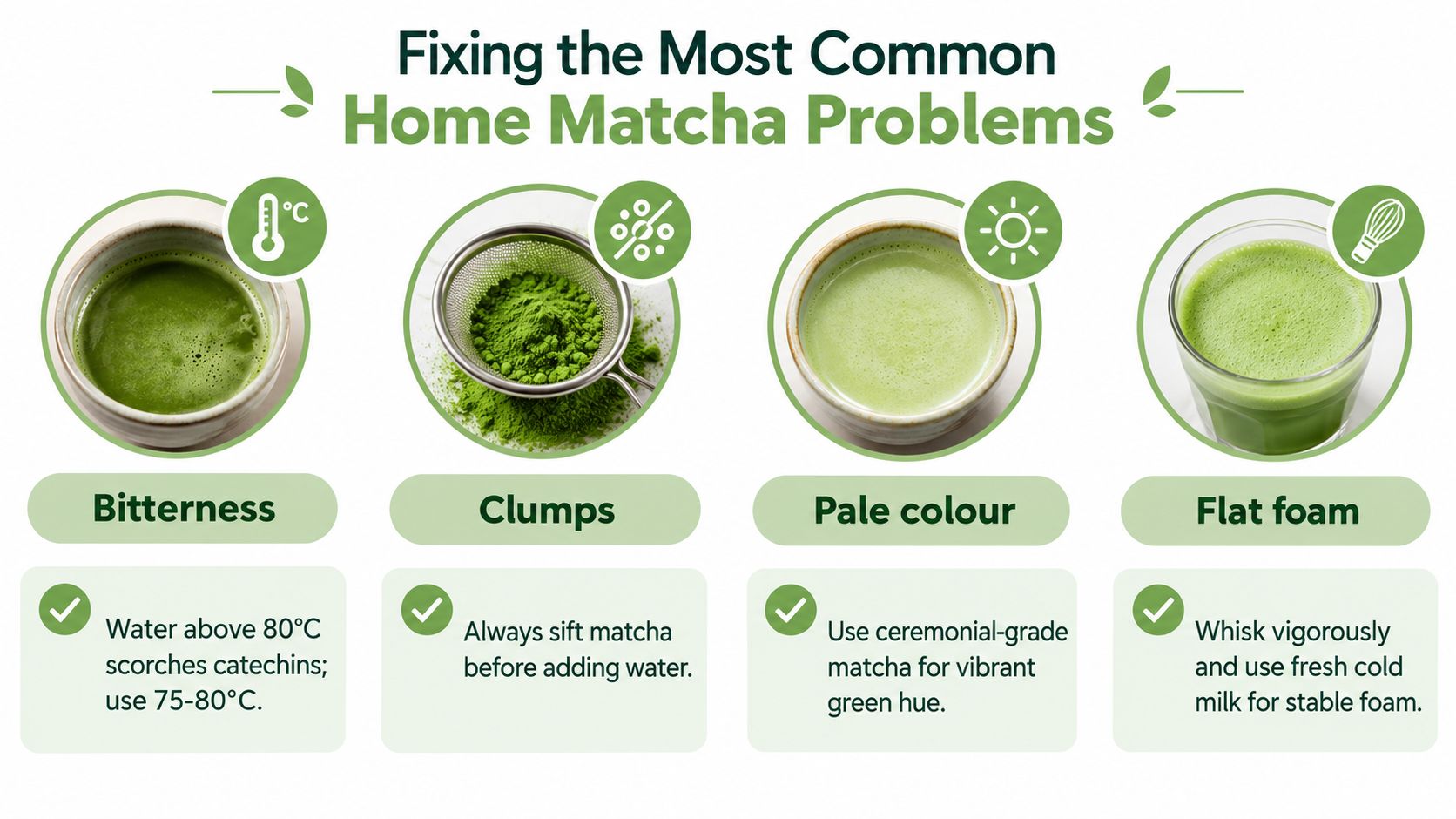
Pale colour
A weak green colour usually comes from too much milk, older oxidised powder, or using a small amount of culinary matcha in a large drink. Reduce the milk to 150 ml and use 2 g matcha before reaching for more sweetener.
Flat or disappearing foam
Overheated milk and low-protein plant milks produce large bubbles that collapse quickly. Warm dairy or barista plant milk gently toward 65°C and whisk the matcha vigorously until it has fine surface bubbles.
The most useful diagnostic is to change one variable at a time. If you alter the powder, milk, sweetener, water, and whisking method together, you won't know what fixed the cup.
Matcha can settle after standing, even when you've prepared it correctly. Serve it soon after mixing, and give an iced version another shake if it sits while you're getting ready.
Quick Answers and What to Brew Next
The recipe is easy to remember once the proportions become familiar:
- Sift: Use 1–2 teaspoons of ceremonial or culinary matcha.
- Whisk: Add 60–80 ml water at 70–80°C and whisk with a chasen or frother until smooth and foamy.
- Pour: Add 150–200 ml of steamed, warmed, or cold milk.
How hot should the water be?
Keep it between 70 and 80°C. Water that's too hot can create bitterness, while cooler water may leave the paste less expressive and harder to blend.
Does matcha contain caffeine?
Matcha contains caffeine, and the Australian Good Food recipe notes that it can contain up to three times as much caffeine as steeped tea, as reported by Good Food. The amount in your cup depends on the powder dose and preparation, so treat matcha as a caffeinated drink rather than assuming it's automatically gentle.
Can I use pre-mixed matcha latte powder?
You can, but check the ingredient list. Pre-mixed powders may include sweeteners or milk ingredients, which limits your control over flavour and sugar. Plain matcha gives you more flexibility with milk, sweetness, and strength.
How should I store an opened tin?
Seal it tightly and keep it away from heat, moisture, and direct light. Matcha's colour and aroma are strongest when the powder is protected from air and used while fresh.
Is a matcha latte different from matcha with milk?
A matcha latte is built around a whisked matcha base combined with a larger volume of warm or cold milk, often with foam and optional sweetener. Matcha with milk can be simpler, with less milk and little or no frothing, so the tea remains more prominent.
For readers ready to upgrade their everyday tin, PepTea offers organic Japanese matcha in ceremonial and culinary formats. The brand also makes sugar-free organic kombucha in the Hunter Valley, NSW, including Ginger, Lime & Ginger, and Mango, which works well as a palate-cleansing afternoon drink alongside a morning matcha ritual.
Explore the Pep Tea range for organic Japanese matcha suited to both straight preparation and lattes, then compare it with sugar-free kombucha for a refreshing, low-sugar drink later in the day. Choose the grade and milk that match your routine, and make your next café-style cup at home.
Is Matcha Sweet? a Practical Guide to Matcha Flavour

Pure matcha powder itself isn't sweet. Its natural flavour is vegetal and umami, while sweetness in a matcha drink almost always comes from added sugar, syrup, honey, sweetened milk, or a pre-sweetened blend.
So why does a pale green café latte often taste gently sweet, creamy and almost dessert-like, while a plain bowl of whisked matcha can taste grassy, sharp or savoury? The answer lies in the difference between matcha's sensory sweetness and the sweetness added during preparation.
That distinction matters in Australia, where “matcha” on a café menu may refer to anything from pure Japanese green tea powder to a flavoured latte mix. Once you know what's in the cup, you can choose a sweeter-tasting matcha without automatically choosing a sugary one.
Why Most People Ask If Matcha Is Sweet
A typical café order explains the confusion. You ask for an iced matcha latte, and the drink arrives pale green, cold, creamy and smooth. The first sip may taste softly sweet, especially if the café has used oat milk, vanilla syrup or a pre-sweetened matcha base.
That experience teaches your palate to associate matcha with sweetness. Try a different preparation at home, though. Whisk plain matcha powder with water and you'll notice a much more concentrated flavour, with fresh grassiness, savoury depth, bitterness and a drying sensation on the tongue.
Neither drink is necessarily misleading. They are just different formulations.
The powder and the finished drink are not the same thing
Australian products make this distinction clear. Pure matcha is sold as green tea powder without sugar, while sweetened sachets and latte blends list ingredients such as sugar or organic cane sugar. One Australian sweet matcha sachet lists sugar first and matcha green tea at 12%, while an Australian-made latte blend places organic unrefined cane sugar ahead of matcha powder and reports 4.0 g sugars per 100 g. These examples show that the sweetness comes from the recipe, not from the tea leaf itself. See the Australian sweet matcha product example.
The same principle applies when you order. “Plain matcha latte” may mean no extra syrup, but it doesn't always mean pure, unsweetened matcha. The powder could already contain sugar, dextrose, flavouring or another sweetening ingredient.
A useful question to ask
Before deciding whether matcha is sweet, separate the experience into two questions:
- What does pure matcha taste like? Usually vegetal, umami-rich, bitter and faintly sweet in a savoury sense.
- What does this particular drink contain? It may include milk, syrup, honey or a sweetened matcha mix.
That small distinction closes the gap between a sharp home-brewed matcha shot and the comforting café drink many Australians know first.
What Matcha Actually Tastes Like on Its Own
Pure matcha has a layered flavour rather than a simple sweet or bitter profile. The balance changes with the tea's growing conditions, grade, freshness, water and whisking technique, but four sensations appear repeatedly: umami, bitterness, astringency and faint sweetness.
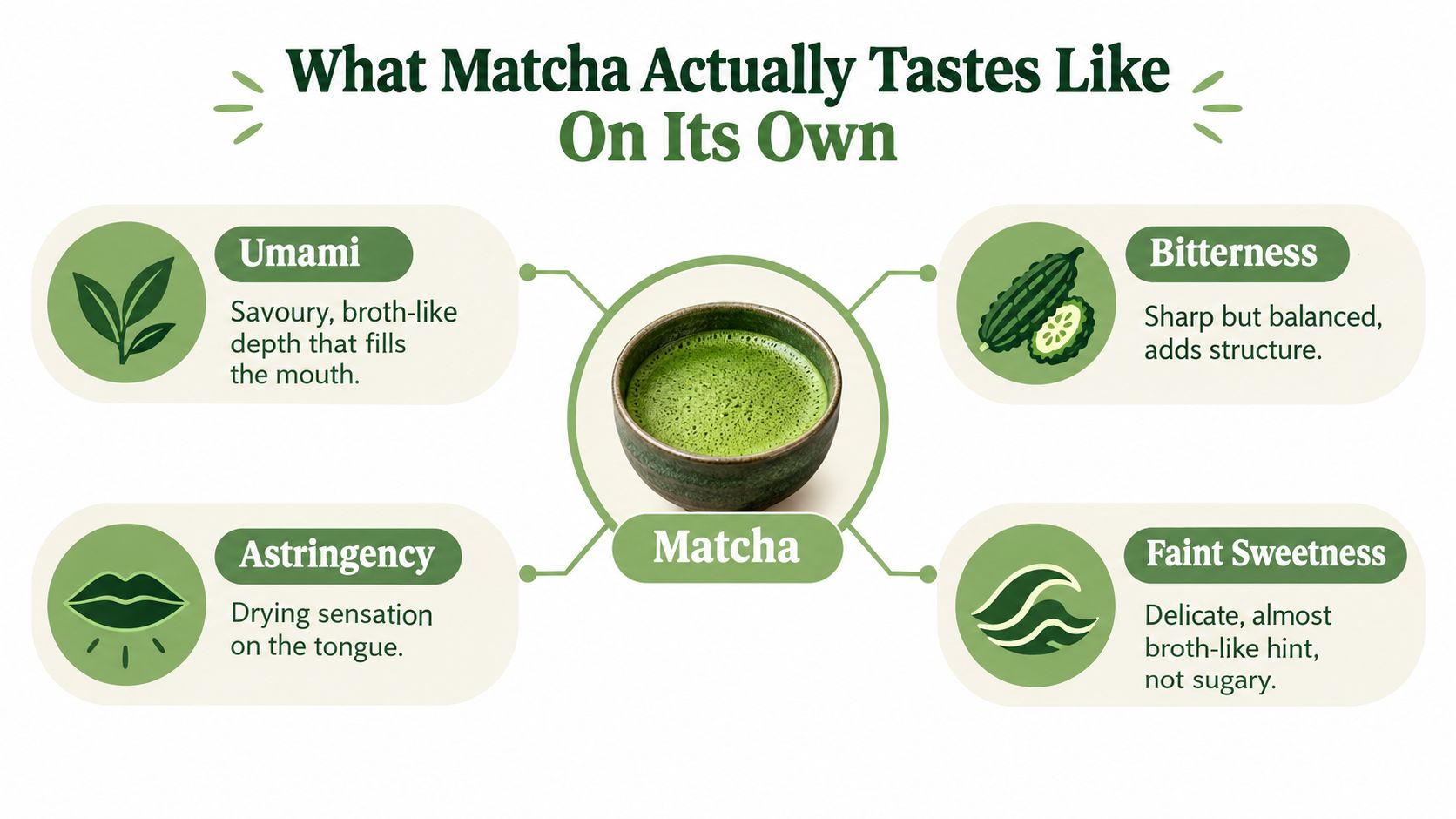
Umami comes first in a good cup
Umami is the savoury, mouth-filling quality that makes matcha feel substantial. Some people describe it as broth-like, buttery or seaweed-like, although a well-made matcha can be more delicate than those comparisons suggest.
L-theanine, an amino acid naturally present in tea, contributes to this depth. An Australian lab-tested ceremonial matcha reported 21.3 mg/g of L-theanine and 65.2 mg/g of total catechins. That composition helps explain why the cup can feel savoury and softly sweet at the same time, without tasting like sugar. Review the Australian matcha potency lab results.
The sweetness here is subtle. It may appear as a rounded finish after the initial green flavour, rather than as the immediate sweetness of fruit juice or a latte syrup.
Bitterness gives matcha structure
Matcha also contains catechins, a group of tea polyphenols. Epigallocatechin gallate, or EGCG, is one of the best-known catechins and contributes to the plant-like bite associated with green tea.
A little bitterness can make matcha feel lively and complete. Too much can dominate the bowl, particularly when the powder is lower grade, the water is too hot or the serving is overly concentrated.
Astringency is different from bitterness
Astringency is the dry, puckering feeling that remains on the tongue. It can feel chalky or tightening, as though the moisture has been drawn from your mouth.
Catechins can contribute to both bitterness and astringency, but the sensations aren't identical. Bitterness is a taste. Astringency is more of a mouthfeel. Recognising the difference helps you diagnose a difficult cup instead of just deciding that you dislike matcha.
Tasting cue: If the finish feels savoury and rounded, you're noticing matcha's umami and theanine. If your mouth feels dry and tight, astringency is probably leading the experience.
For a broader look at the powder itself, the guide to what matcha powder is can help connect the production method with the flavour in your bowl. If you're preparing tea during a physically demanding shift, you may also find this practical resource on tea hydration for hot job sites useful. The key point remains simple: pure matcha may have a faint natural sweetness, but it isn't a sugary drink.
Why Some Matcha Tastes Sweeter Than Others
The flavour is shaped long before the powder reaches your whisk. Farming choices, leaf selection and milling all influence whether a matcha tastes rounded and umami-rich or sharp and astringent.
The most important factor is often shading before harvest. Tea plants grown for matcha may be covered from direct sunlight before the leaves are picked. Australian technical guidance explains that shading suppresses the conversion of L-theanine into catechins, helping preserve a more naturally sweet umami profile. Read the Australian guide to ceremonial matcha production.
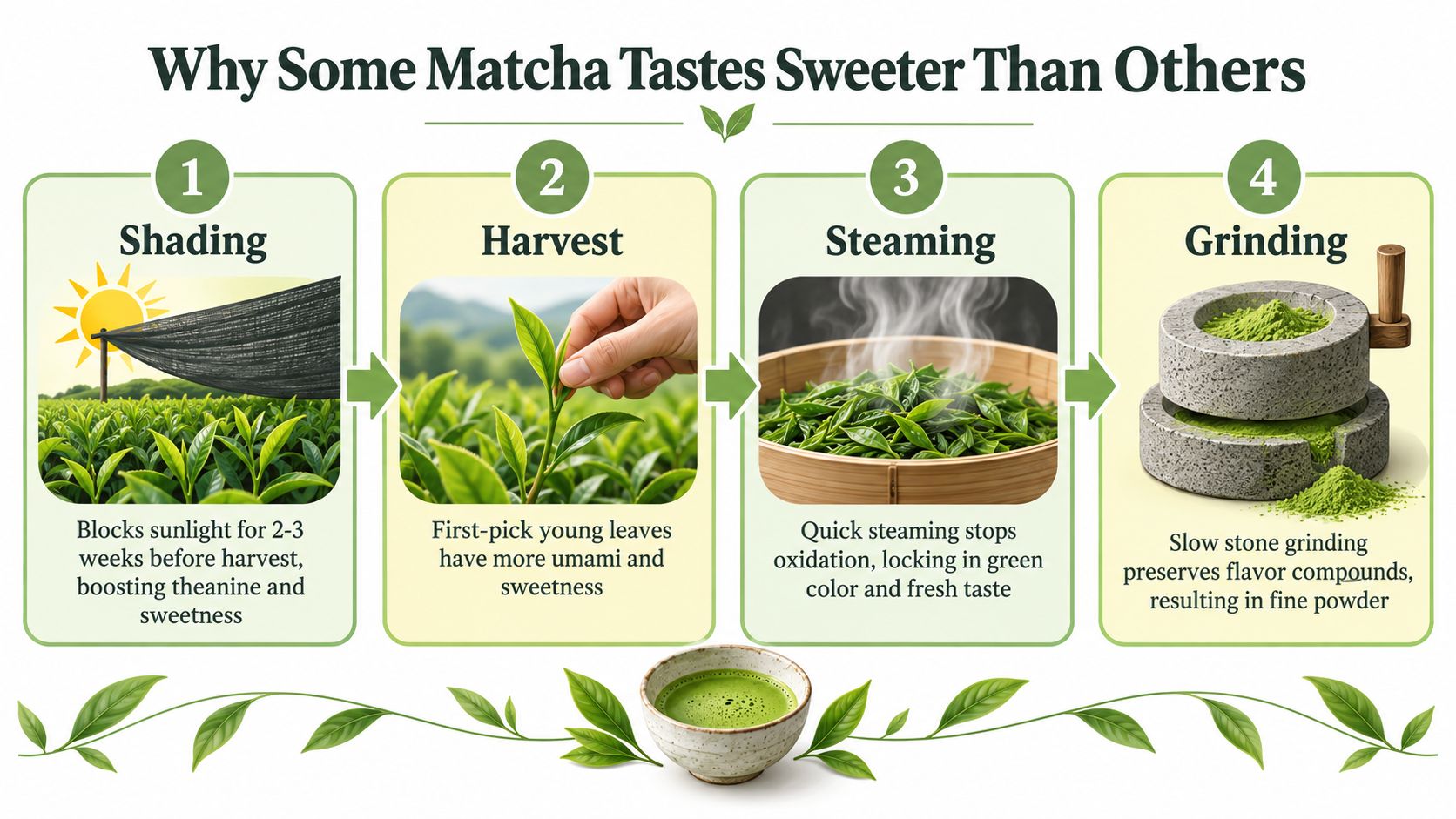
Shading changes the balance
Sunlight gives the tea plant energy, but it also encourages the chemistry that produces a more assertive, bitter profile. Shade-grown leaves retain more of the savoury character associated with L-theanine and develop a richer green appearance.
That doesn't mean every shaded matcha tastes sweet, or that bitterness is automatically a sign of poor quality. It means the balance can move towards umami, softness and lingering sweetness when the grower uses shading carefully.
Young leaves bring delicacy
Higher-grade matcha commonly uses younger, more tender leaves from the top of the plant. These leaves can produce a finer texture and a more refined flavour than older, tougher leaves.
Older leaves tend to bring stronger vegetal notes and more noticeable astringency. That bolder profile can be useful in baking or a latte, where milk and other ingredients need a flavour that won't disappear.
Milling protects texture and flavour
After harvesting and processing, the leaves are ground into an extremely fine powder. Traditional stone-grinding is slow and gentle, helping create the smooth texture expected from a well-made matcha.
Faster or rougher milling can generate more heat and may affect delicate flavour compounds. The result may taste flatter, harsher or more bitter. When you explore PepTea's matcha grades, pay attention to the intended use as well as the word “premium” or “ceremonial”.
A matcha grown in full sun, made from older leaves and processed for a bold culinary application won't taste like a carefully shaded powder intended for whisking with water. Sweetness is partly a farming and processing outcome, not just a recipe decision.
Ceremonial vs Culinary Matcha and Sweetness
Ceremonial and culinary matcha are often presented as if they were completely separate products, but the labels don't have a universal legal definition. “Grade” can be useful as a guide, yet colour, aroma, texture and intended use give you more reliable information.
| Attribute | Ceremonial Grade | Culinary Grade |
|---|---|---|
| Perceived sweetness | Often softer, rounder and more naturally umami-forward | Usually more assertive, vegetal and less sweet on its own |
| Bitterness | Typically lower when the powder is well made and properly prepared | More noticeable, which helps it stand up to milk and food |
| Colour | Vivid green to jade-like | Green can be deeper, duller or more yellow-toned |
| Texture | Fine, smooth and pleasant with water | May feel more robust, especially in a concentrated drink |
| Best use | Plain whisked matcha or lightly diluted drinks | Lattes, iced drinks, smoothies, baking and cooking |
Choose by preparation, not prestige
If you want to drink matcha with water and notice its natural flavour, choose a fresh, well-sourced ceremonial-style powder. Its softer balance makes it easier to appreciate the umami and faint sweetness without adding anything.
For a latte, culinary matcha can be practical. Milk, fruit, yoghurt or baked ingredients carry and soften the tea's sharper edges. A stronger powder may also be preferable in an iced drink, where dilution and cold temperatures can mute flavour.
A product described as ceremonial can still taste unpleasant if it's stale, poorly stored or prepared with boiling water. Conversely, culinary matcha can make a satisfying drink when you enjoy a more pronounced green tea character.
Selection rule: Buy ceremonial-style matcha for tasting the powder itself. Buy culinary-style matcha when other ingredients are meant to share the stage.
If you're comparing formats or pack sizes, an external AQEEK Coffee matcha selection offers another example of how ceremonial matcha is positioned for drinking applications. The label is a starting point, not a guarantee that the cup will taste sugary.
How to Make Matcha Taste Sweeter Without Sugar
You can make matcha seem sweeter without adding sugar. The goal is to reduce harsh bitterness, preserve theanine and give the powder a smoother texture, so your palate can notice its softer notes.
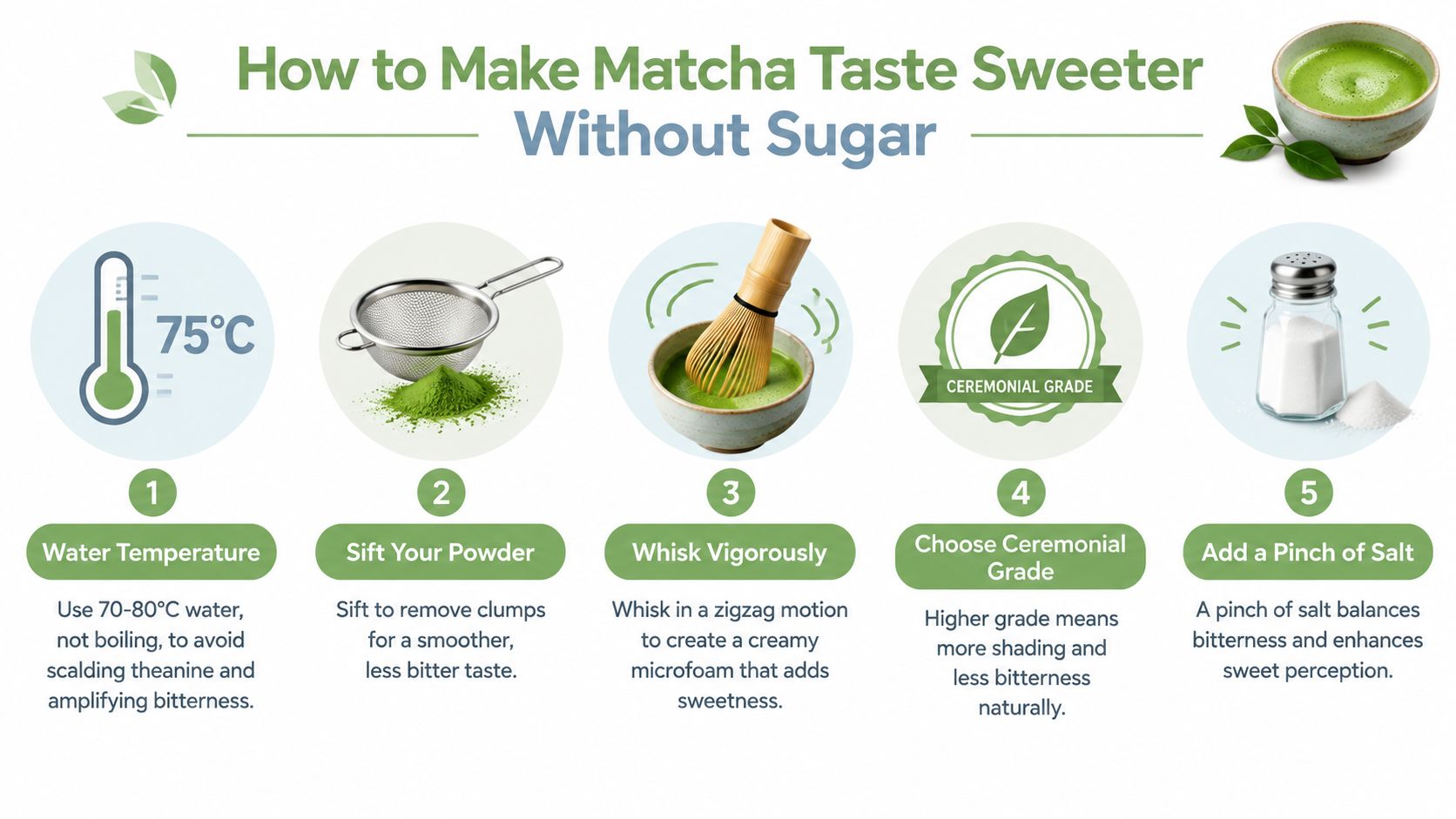
Start with the water
Use water around 70–80°C, rather than freshly boiling water. Excessive heat can make the cup taste more bitter and may overwhelm the delicate savoury qualities you want to preserve.
A temperature-controlled kettle makes this easy, but you can also pour boiling water into a separate cup and let it cool briefly. The exact temperature matters less than avoiding water that is aggressively hot.
Prepare the powder properly
Sift the matcha before whisking. Clumps dissolve unevenly, leaving some mouthfuls thin and watery while others taste intensely bitter.
Add a small amount of water first and work the powder into a smooth paste. Then add the rest of the water and whisk briskly in a W or M motion. This creates a fine foam and distributes the powder evenly, which can make the texture feel creamier and less abrasive.
Let ingredients support the tea
Milk changes the entire experience:
- Oat milk often contributes body and a naturally sweet impression.
- Dairy milk adds creaminess and softens sharp green notes.
- Nut milks can taste lighter and may leave a thinner cup, depending on the product.
A tiny pinch of fine sea salt can suppress bitterness and make existing sweet notes easier to notice. A few drops of lemon or yuzu can brighten the umami. Vanilla extract can add an impression of sweetness without adding sugar, although it changes the drink's flavour.
For a dependable starting point, try the sugar-free matcha latte method from PepTea. This video also shows the kind of whisking and frothing movement that helps create a smooth drink.
A simple unsweetened method
- Sift your matcha into a bowl.
- Add a small splash of 70–80°C water and whisk into a paste.
- Add the remaining water and whisk in a W motion until lightly frothy.
- Pour the matcha into warm oat or dairy milk.
- Add either a tiny pinch of salt or a drop of citrus, not both at first.
- Taste before making another adjustment.
Small changes work better than adding several ingredients at once. You'll learn which lever improves the cup for your palate.
Why Café Matcha in Australia Usually Tastes Sweet
Many Australian café customers encounter matcha as a latte rather than as plain whisked tea. That format naturally introduces sweetness through the milk, and cafés may also use pre-sweetened powders, syrups or blended bases to make each drink consistent.
A matcha latte mix can contain sugar, dextrose, honey powder or flavouring before the barista adds any extras. Vanilla syrups, flavoured powders and condensed milk can push the drink further towards dessert. In these cases, the word “matcha” identifies the tea flavour, but it doesn't tell you how much of the drink's sweetness comes from the powder.
Read the menu language carefully
Terms such as “matcha mix,” “premium blend” or “latte base” may indicate that the product contains more than matcha. The wording isn't enough to determine the ingredients, so ask directly.
Useful questions include:
- “Is the matcha pure powder or a pre-sweetened mix?”
- “Do you whisk it to order?”
- “Does the latte include vanilla syrup by default?”
- “Can I have it with unsweetened milk and no syrup?”
- “Could I taste a small amount of the matcha with water?”
A café may not be able to provide a plain tasting portion, but the question tells the barista exactly what you're trying to control.
Ordering scripts for a lower-sugar drink
Try: “Could I please have pure matcha, no syrup, with unsweetened milk?” If the café uses a sweetened base, ask whether they have plain matcha powder available.
You can also order a small matcha whisked with water, then add milk yourself. That approach gives you more control than relying on the café's standard recipe.
The practical lesson is straightforward. A sweet café matcha is usually a prepared beverage, not evidence that matcha powder is naturally sweet. Check the ingredient list where possible, and remember that plain powder contains no sugar itself.
Finding Your Sweet Spot With Matcha
A short tasting ritual can show you exactly where matcha's natural flavour ends and your preferred additions begin. Use a small bowl, a fine sieve and a bamboo whisk if you have them.
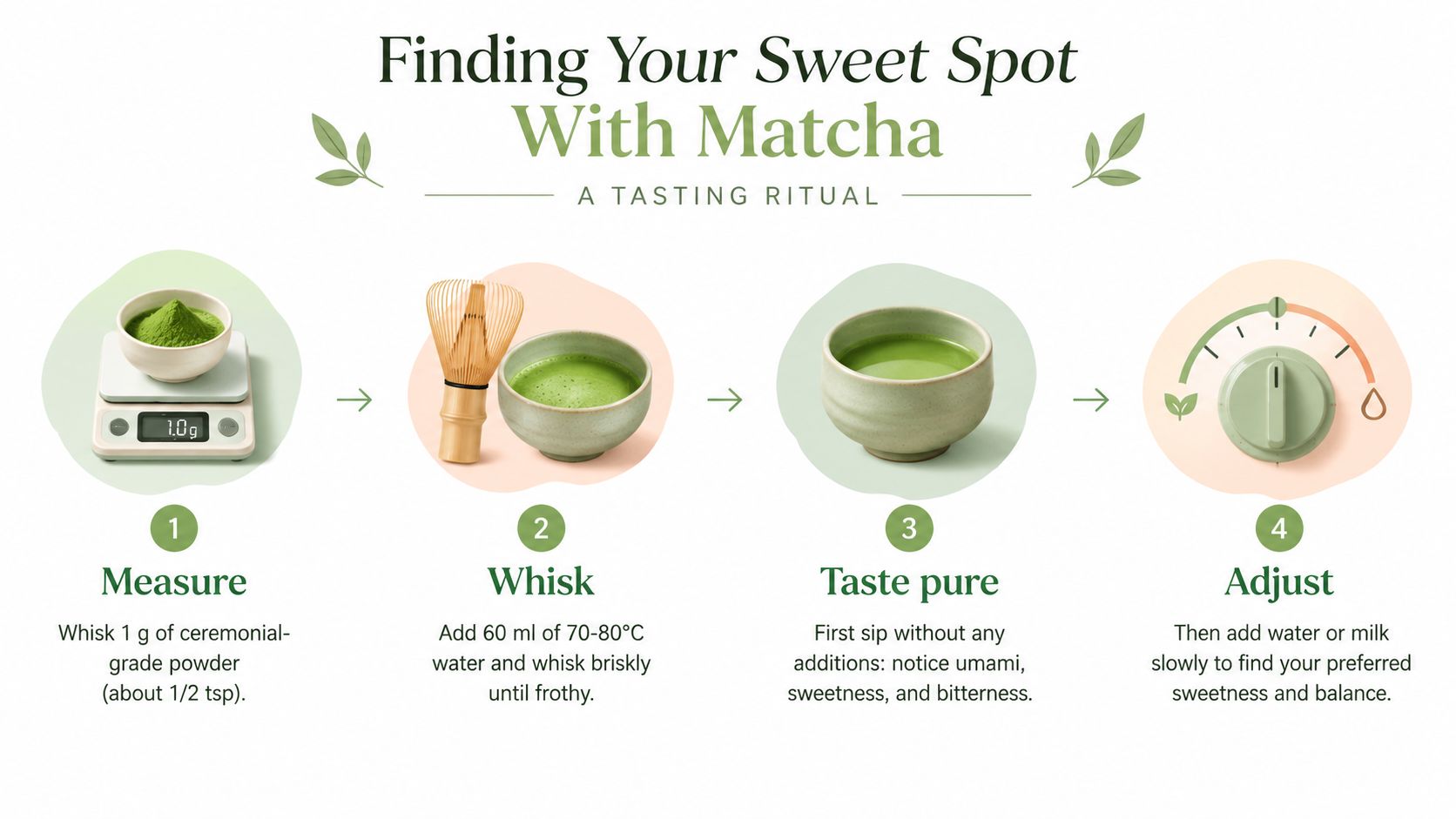
Taste it in four stages
- Measure: Weigh 1 g of ceremonial-grade powder, roughly half a teaspoon.
- Whisk: Add 60–80 ml of water at around 80°C and whisk until smooth and lightly frothy.
- Taste pure: Take a small sip without milk or sweetener. Notice the umami, green freshness, bitterness, astringency and lingering finish.
- Adjust: Add a little water, milk or ice, tasting after each change.
You don't need to force yourself to enjoy a concentrated bowl. The purpose is to identify what the powder tastes like before you customise it.
Choose the style that suits your day
- Pure matcha: Choose this when you want to explore flavour and prepare the drink with water.
- Lightly adjusted matcha: Add milk, a pinch of salt or a little citrus when you want softness without making the drink sugary.
- Café-style matcha: Choose a latte with syrup or a sweetened base when you want comfort and dessert-like flavour, treating it as a flavoured beverage rather than straight tea.
Matcha can also fit into smoothies, baking, iced drinks and other recipes, where culinary powder's stronger profile can work well. The right choice depends on the role you want the tea to play.
Keep three ideas in mind:
- Taste matcha on its own at least once before adding anything.
- Adjust sweetness through the grade, water temperature, whisking and milk before reaching for sugar.
- Treat café matcha as a formulated drink, because its sweetness may come mainly from added ingredients.
There isn't one correct matcha recipe. A few repeatable adjustments will help you find a cup that feels smooth, balanced and pleasant without assuming that pure matcha should taste like sugar.
Pep Tea offers organic Japanese matcha for whisking, lattes and culinary use, along with Australian-brewed organic kombucha made in the Hunter Valley, NSW. Visit Pep Tea to explore matcha options and choose a low-sugar beverage that suits your daily routine.
How to Make Matcha Tea from Powder at Home
You're standing at the kitchen bench with an open tin of matcha, a freshly boiled kettle and a spoon ready to go. The tempting move is to pour boiling water straight onto the powder, stir it quickly and hope for the best. The other is to skip the sieve because the powder looks fine enough. Those two shortcuts usually lead to the same disappointing bowl, harsh bitterness and pebble-sized clumps.
A well-made bowl looks different. It has a vivid jade-green colour, a fine creamy foam and a smooth texture that feels closer to warm milk than chalk. The flavour should be grassy and gently sweet, with a clean finish rather than a sharp aftertaste. Once you know how to make matcha tea from powder, the process takes only a few minutes, and each small detail has a clear purpose.
What a Good Bowl of Matcha Looks Like
Your first sip should be smooth, bright and gently sweet. The powder needs to stay evenly suspended, with no dry flecks on the surface or gritty sediment collecting at the bottom. A fine layer of microfoam shows that the matcha has dispersed well. It does not need the thick foam of a cappuccino.
Colour offers a useful clue, though it cannot judge the whole bowl. Vivid green powder usually creates a more appealing drink, while a fresh grassy aroma suggests careful storage. The flavour should be vegetal and clean, without burnt bitterness or a dusty texture.
The two rules to remember: sift the powder before it touches water, and never use boiling water.
Matcha is finely milled tea leaf, not an infusion that you strain and discard. You drink the suspended powder, so every preparation mistake remains in the bowl. A clump becomes a concentrated mouthful of bitterness, while excessively hot water can flatten sweetness and make the tea harsher.
For an Australian-style baseline, combine 2 g of matcha, roughly 1 teaspoon, with 100–120 g of water at 70–80°C. Whisk until smooth, following the preparation guidance in Tea Tonic's Australian matcha guide. A smaller, more concentrated bowl uses 60–80 ml of water at 70–80°C, as shown in the method from Zen Green Tea.
These proportions give you room to correct the two common failures. Sifting breaks apart compacted powder before water can bind it into lumps. Controlled heat preserves the tea's softer flavours, while whisking from side to side spreads the powder through the water and builds a fine foam. The result should feel creamy and lively, not cloudy, thin or aggressively bitter.
Gathering Your Equipment and Matcha
Put everything beside the bowl before heating the water. Preparation feels much easier when you're not searching for a sieve with hot water cooling on the bench.
- Matcha powder: Choose a finely milled powder with a vibrant green colour and a fresh aroma. Ceremonial or premium drinking-grade matcha is generally more suitable for a plain bowl, while culinary-grade powder works well in recipes and milk-based drinks.
- A wide bowl or cup: A small bowl gives your whisk room to move from side to side. A narrow mug can make the whisk catch against the sides, which leaves powder sitting in the corners.
- A fine mesh sieve: Matcha clumps inside its container, even when the powder looks loose. Passing it through a sieve breaks up those compacted pieces before water binds them together.
- A whisk or alternative: A bamboo chasen is traditional, but a handheld milk frother, lidded shaker or fork can also help, depending on the texture you want.
A warm bowl also makes the drink more comfortable to hold and can help maintain its temperature. Australian brewing guidance from T2 Tea includes warming the matcha bowl before adding water.
If you're building a regular home ritual, Pep Tea's matcha tea accessories can help you organise the basic tools around the way you brew. You don't need a ceremonial setup to start, though. The sieve is the most important overlooked item, and a clean wide bowl is more useful than a specialised cup that leaves no room for whisking.
Check that the matcha, bowl, sieve, spoon and whisk are within arm's reach before the kettle goes on.
The Core Preparation Method
Measure and sift before adding water
Place 1 teaspoon, about 2 g, of matcha into the dry bowl. This is a practical Australian starting point for a single serve, and the amount aligns with Zen Green Tea's Australian preparation method.
Hold the fine sieve over the bowl and press the powder through with the back of a spoon. Don't rush this part. If a compact piece remains in the mesh, gently work it through rather than tipping it into the bowl. Sifting creates a loose, even layer that water can reach more easily.
Add controlled heat
Heat fresh water to 70–80°C, keeping it well below boiling. Australian guidance from Fish River Roasters specifically warns against boiling water because excessive heat can make matcha taste bitter.
If you don't have a thermometer, allow freshly boiled water to stand for a few minutes before pouring. The water should feel hot enough to brew the tea, but it shouldn't be bubbling or aggressively steaming.
For a concentrated bowl, add 60–80 ml of water. Pour slowly, beginning with a small splash to wet the powder evenly, then add the remainder. This first contact creates a smooth slurry rather than allowing dry powder to float apart in a larger volume of water.
Whisk across the surface
Use brisk zigzag strokes, moving in a W or M pattern rather than stirring in circles. Keep the whisk close to the base at first to incorporate the slurry, then lift it slightly towards the surface as foam develops.
Whisk for roughly 15–30 seconds, a range reflected in Australian matcha instructions from Tea Tonic. Stop when the surface has a fine pale-green foam and no dry specks remain.
Sensory checkpoint: A smooth surface and clean texture mean the method has worked. Grit points to incomplete dispersal, while sharp bitterness usually points to excessive heat, old powder or overworking.
Taste the bowl while it's fresh. Matcha's flavour should be distinct, but the finish shouldn't make you want to cover it with a large amount of sweetener. If it does, adjust the water temperature and storage before changing the recipe.
Choosing How to Whisk It
The whisk changes the drink more than many first-timers expect. A tool that disperses powder efficiently can create fine foam, while an unsuitable tool may leave large bubbles or a sandy mouthfeel.
| Tool | Foam quality | Ease of use | Cleaning | Best for |
|---|---|---|---|---|
| Bamboo chasen | Fine, creamy microfoam | Requires technique | Rinse prongs and dry upright | Ceremony-style bowls |
| Electric milk frother | Quick, light foam | Very easy | Rinse immediately | Matcha lattes |
| Small lidded shaker | Thin foam, even suspension | Easy and travel-friendly | Simple rinse | Iced matcha |
| Kitchen fork | Larger bubbles, uneven texture | Available in most kitchens | Very easy | An emergency substitute |
A chasen bamboo whisk gives the most refined texture and makes the classic W or M motion feel natural. Its fine prongs need careful rinsing after use, and leaving them wet in a drawer can distort them.
A handheld electric frother is faster and more forgiving, particularly when you're making a milk-based drink. Keep the head submerged to avoid splashing, and stop as soon as the powder is dispersed. Excessive frothing can make the surface airy without improving the underlying texture.
A shaker jar suits an iced serve or a kitchen without a whisk. Add the powder and water, secure the lid and shake until combined, but expect thinner foam. A fork works when nothing else is clean, though it won't create the same fine suspension.
For a closer look at the traditional motion and care routine, use Pep Tea's guide to whisking matcha. The quick rule is straightforward: chasen for plain bowls, frother for lattes, shaker for iced drinks and fork only in a pinch.
Fixing Clumps, Bitterness, and Thin Foam
A cloudy bowl usually has two separate problems: clumps form when dry powder meets water too quickly, while bitterness often comes from overheated water or stale matcha. Treat each issue at its source, rather than trying to fix the finished bowl with extra sweetener.
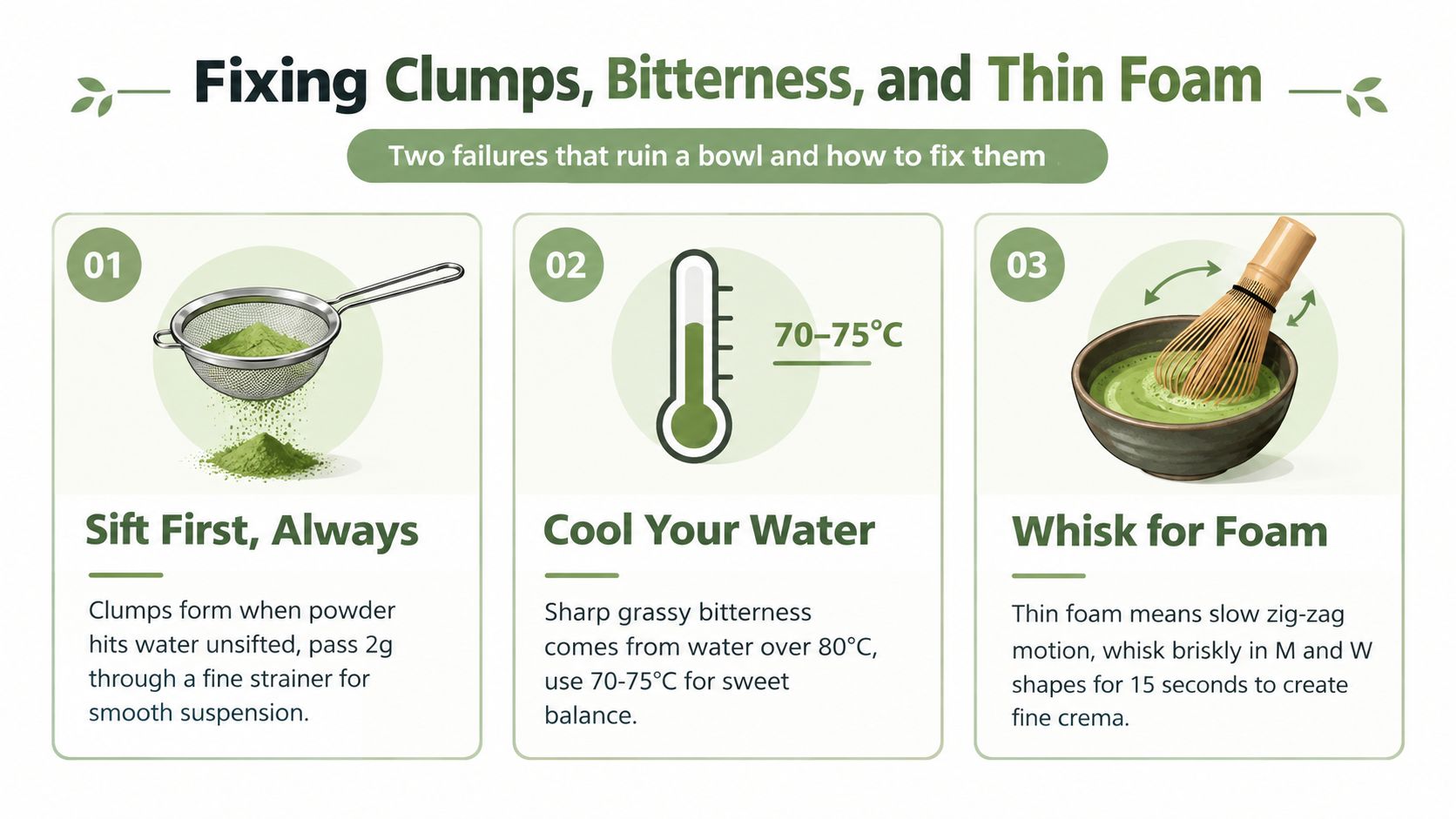
When clumps float on top
Sift the full measure through a fine mesh strainer before adding liquid. Then use a small splash of water to make a smooth paste, like wetting flour before mixing a sauce. Once the paste looks even, dilute it with the remaining water and whisk.
A heavy stream can bury dry matcha in compact islands at the bottom or leave floating lumps on the surface. Pour slowly around the bowl, especially if it is small, so the powder receives moisture in stages.
When the flavour turns bitter
For an Australian-style preparation, cool the water to 75–80°C and keep whisking to around 15 seconds. As noted earlier, water that is too hot can draw out a harsher flavour, so temperature is the first adjustment to make.
Open powder also needs protection from air, light, heat and moisture. An airtight container helps preserve its character, but older matcha may still taste flat or sharp. If the bitterness remains after correcting the water, try fresher powder before adding more sweetener.
When the foam looks thin
Whisk across the surface with a quick, shallow zigzag rather than stirring slowly in circles. The motion should agitate the top layer while keeping the whisk near the water, creating smaller bubbles instead of a loose cap of air.
With a frother, use a brief 5-second pulse at the end, then stop. For readers who mix other powders into drinks, Everti's guide to protein powder with water explains the same useful principle: add liquid gradually and control the incorporation. Matcha behaves better when the powder is dispersed step by step, not forced to disappear in one pour.
Easy Variations You Can Build From the Base
Once the plain bowl is smooth, you don't need to learn a completely new recipe for every drink. Keep the sift, slurry and whisking habits, then change the finishing liquid or temperature.
A warm matcha latte
Whisk the matcha with the concentrated water base first. Warm or steam milk separately, then replace part of the final water volume with milk and add it gently. A handheld frother can create a light topping without requiring a second complicated technique.
Choose dairy milk or a plant-based option according to taste and texture. Oat milk gives a naturally rounded impression, while a lighter milk keeps the grassy character more visible.
An iced matcha
Dissolve the sifted powder in a small splash of cool water first, forming a smooth paste before adding more liquid. Pour the whisked mixture over ice, then top with cold milk or water and stir or shake gently.
The cold serve makes clumps especially obvious because the powder doesn't have warm liquid to help it disperse. The initial slurry solves that problem without changing the core flavour.
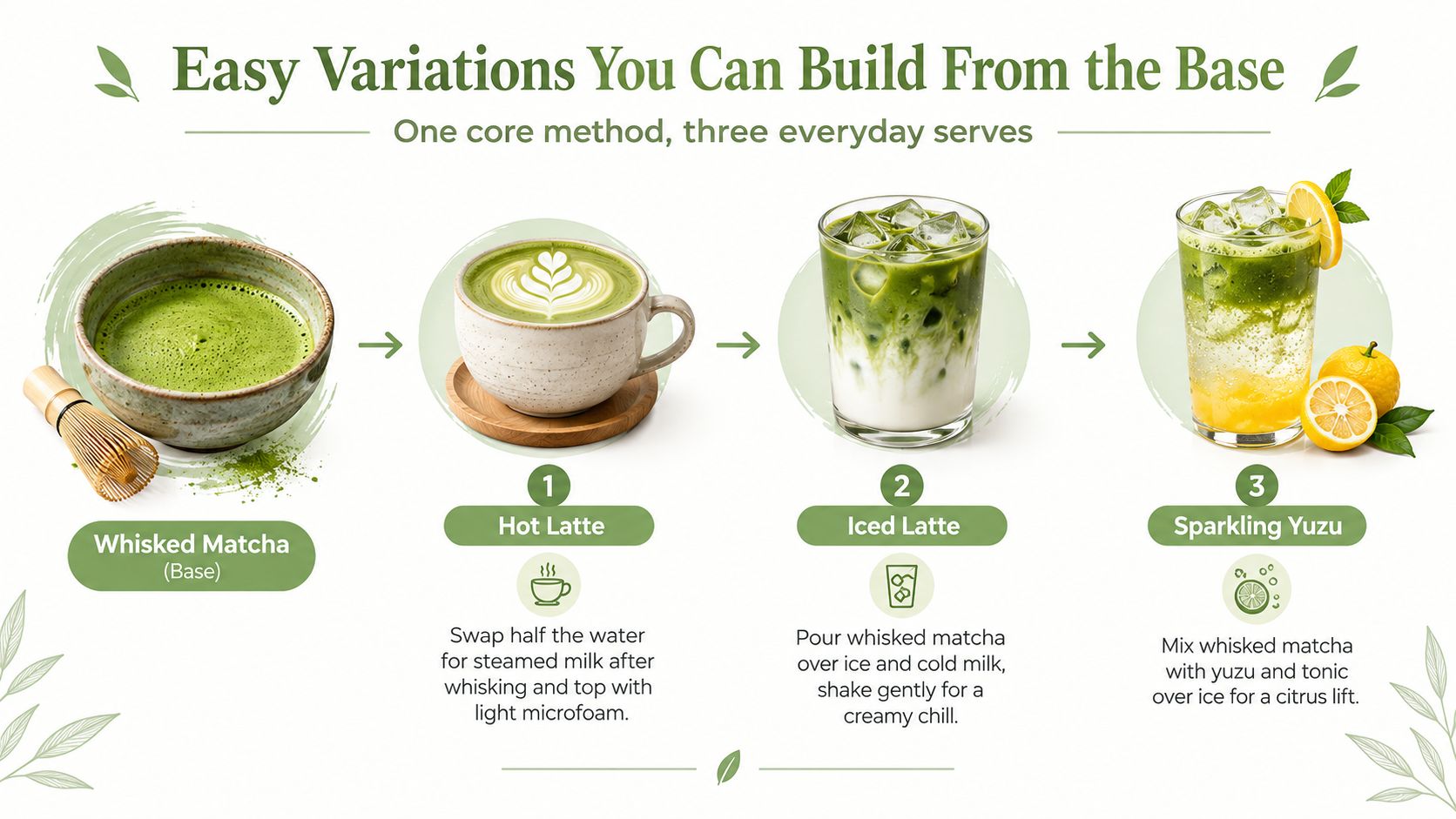
A lightly sweetened serve
Add honey, maple syrup or sugar to the hot water before introducing the powder, so the sweetener dissolves evenly. For a café-style latte, a small amount of condensed milk can be whisked into the milk, although its sweetness will be more pronounced.
Matcha also works in smoothies, baking and chilled desserts. If you use it with another bold ingredient, such as cacao, Yuve's raw cacao powder tips can help you think about balancing strong flavours in blended recipes.
Here's a short visual demonstration of the basic process:
Drink leftover whisked matcha within an hour for the best colour and flavour. It can lose its brightness as it sits, so make only what you expect to enjoy soon.
Sourcing Better Powder and Serving It Well
A smooth method can't fully rescue powder that has been stored poorly or chosen for the wrong purpose. Look for a vivid green colour, a fresh grassy or gently sweet aroma and a fine texture that disperses readily.
Ceremonial-grade matcha is suited to drinking plain, where its aroma and finish are easy to notice. Culinary-grade matcha has a stronger presence that can work well in lattes, smoothies and baking, where other ingredients share the bowl.
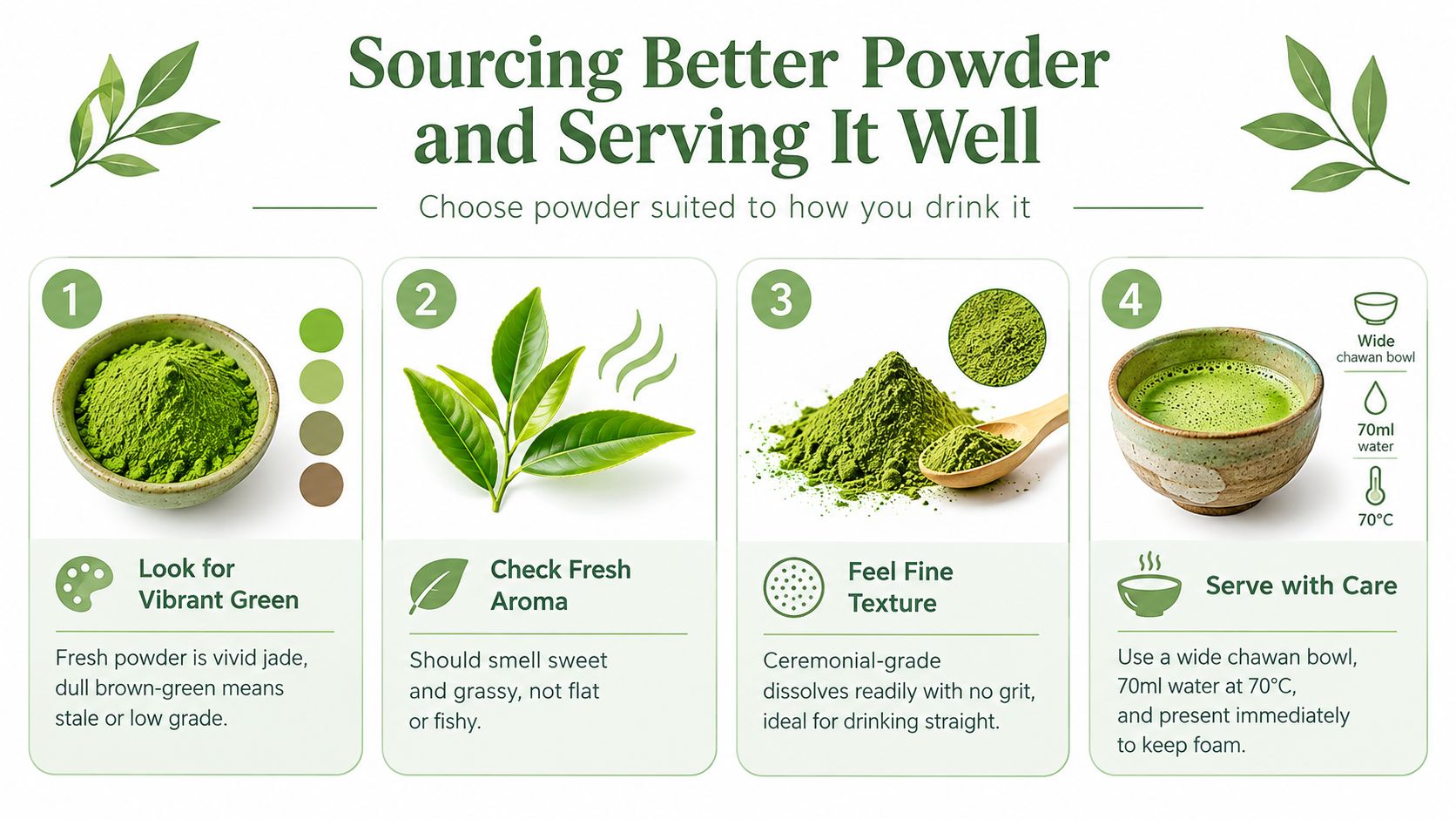
Protect the powder after opening
Keep matcha in an airtight, opaque container away from light, heat, moisture and strong odours. Refrigeration may help in a warm Australian climate, but allow the sealed container to move towards room temperature before opening so condensation doesn't reach the powder.
Serve the drink immediately after whisking, while the colour is bright and the foam remains evenly distributed. Plain matcha pairs naturally with mild sweets, fruit or light pastries, while a latte can sit comfortably alongside breakfast.
If bitterness continues, use fresher powder, slightly cooler water and a shorter whisk. Frothing milk separately and folding it in gently can create a richer latte without forcing extra air through the matcha itself. Readers wanting more detail on choosing between different powders can consult Pep Tea's guide to distinguishing ordinary and ultimate matcha tea powder.
Pep Tea offers organic Japanese matcha for plain bowls, lattes and recipes, giving Australian home brewers a way to explore different serving styles with powder selected for everyday preparation.
Visit Pep Tea to explore organic Japanese matcha and choose a powder that suits plain tea, lattes or baking. Start with a sieve, controlled water temperature and a few calm whisking strokes, then make your first bowl while the powder is fresh.
Matcha Latte Recipe Reddit Guide: How to Make One at Home

If you've ever made a matcha latte at home and ended up with something thin, grassy, or weirdly bitter, you're in good company. The first cup often teaches the wrong lesson, because matcha punishes sloppy ratios and hot water faster than many expect.
That's why the matcha latte recipe Reddit crowd matters. Across r/Matcha and r/MatchaEverything, home drinkers have slowly converged on a reliable benchmark, 4 g matcha, 40 mL water, and 140 to 160 mL milk, with a practical two-stage method that makes the drink smoother and less clumpy. One thread describes 4 grams matcha, 40 millilitres hot water, and about 100 to 150 millilitres oat milk, another condenses the formula to 4/40/140, and an iced version lands at 4 g matcha, 40 mL water, and 160 mL milk for a 12 oz latte (Reddit matcha latte recipes).
That crowd-sourced consistency is the core story. It isn't a fad ratio, it's a community-standard that keeps showing up because it works in ordinary kitchens, with ordinary tools, and with milk choices that suit Australian café habits at home.
The Reddit Method That Delivers
The first time you make matcha, it's easy to treat it like instant coffee. You sprinkle powder into milk, stir once, and wonder why the drink looks speckled and tastes flat. Reddit's best advice cuts straight through that mistake, because the powder needs to be fully hydrated before milk ever enters the bowl.
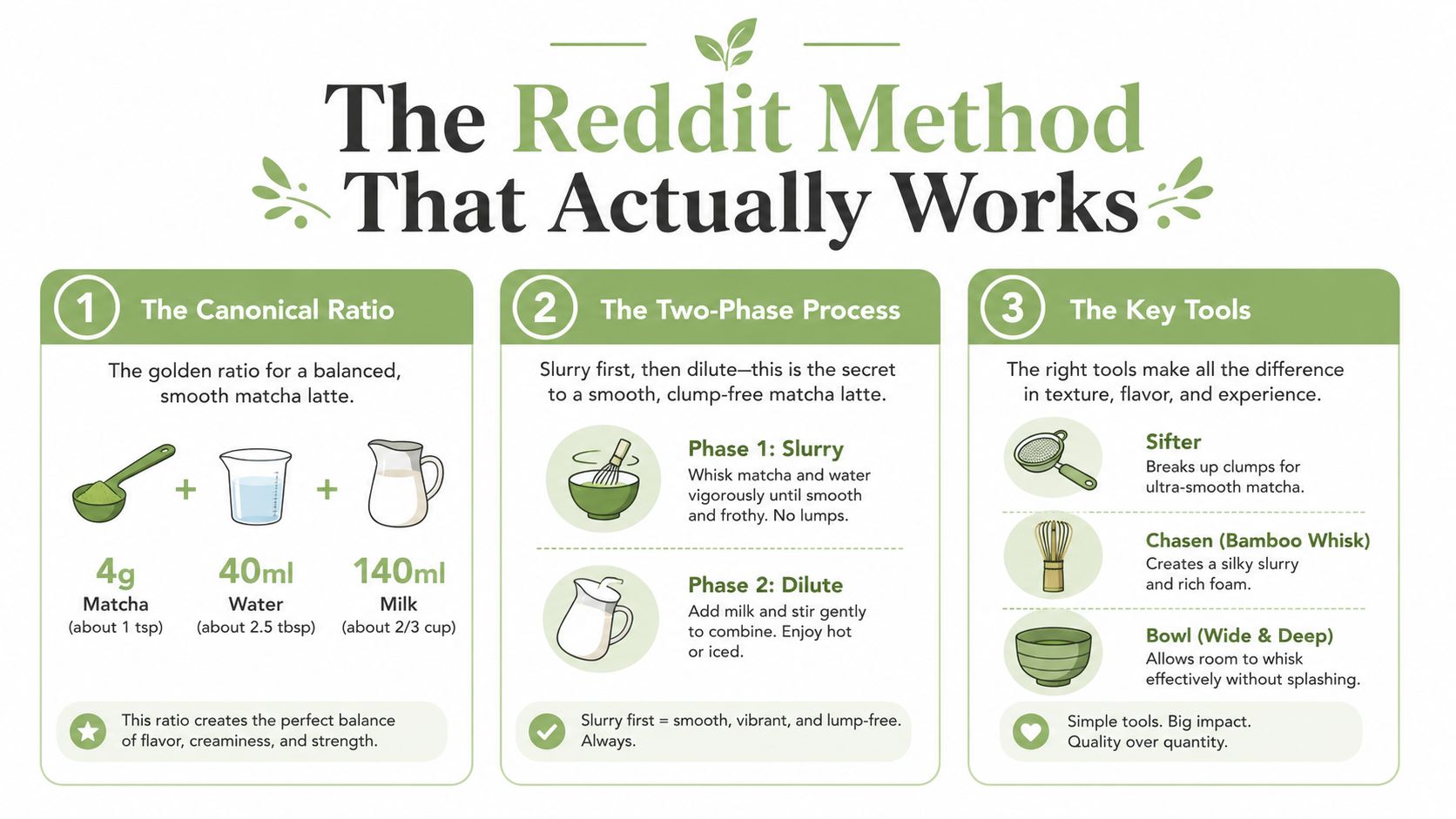
Why the crowd settled on one ratio
The repeated benchmark is 4 g matcha, 40 mL water, and 140 to 160 mL milk, which sits close to a 1:10 powder-to-water ratio and a roughly 1:4 milk-to-water finishing ratio for a single serve. That gives the powder enough liquid to disperse properly, while still keeping the finished drink full and creamy instead of thin. The same structure also appears in an iced version built around 4 g matcha, 40 mL water, and 160 mL milk for a 12 oz latte, which shows the method holds up in both hot and cold drinks (Reddit matcha latte recipes).
Practical rule: if the powder meets too little water, it clumps. If it meets too much milk too early, it never fully opens up.
The two-phase method behind the benchmark
Reddit's strongest recipes do not start with milk, they start with a slurry. Users consistently recommend sifting, then whisking the matcha into a small water phase before adding milk or ice. That sequence keeps the fine powder from sitting dry in the cup, and it gives the matcha room to hydrate before dilution. It is the reason the method keeps showing up in good home recipes instead of disappearing after one viral post.
For home baristas, that matters more than chasing a one-off version from a single creator. The strongest matcha latte recipe Reddit posts point to the same logic, a small hydrated base first, then milk to finish. That is the version worth keeping on repeat, especially if you are using oat milk and want something that feels café-made rather than muddy.
The 4-40-140 Hot Matcha Latte Method
A hot matcha latte works best when the cup is ready before the whisk starts. Pre-warm the mug so the drink holds heat instead of cooling fast, and sift the powder so the finest clumps do not survive the first stir. Those two small steps stop a lot of the grainy, uneven cups people run into at home.
Build the slurry first
Measure 4 g matcha and sift it into a bowl or wide cup. Add 40 mL hot water, kept around 75 to 80°C rather than boiling, because hotter water can push the flavour toward bitterness. Whisk the matcha into the water in a W or zigzag motion for about 15 to 30 seconds, until the surface looks smooth and the powder is fully dispersed (matcha latte guidance).
That motion matters because it moves the whisk across more of the surface, which breaks up fine particles more evenly than a lazy circle. The goal is not foam at this stage. The goal is a clean, even base that can take milk without turning speckled or gritty.
A good slurry also gives you a clearer read on the matcha itself. If the colour looks dull or the flavour tastes thin at this stage, milk will not fix it later. It will only soften the problem.
Finish with milk, not the other way round
Once the slurry looks smooth, pour in 140 mL milk for the standard hot serve. That keeps the drink balanced and gives you the benchmark 4/40/140 ratio that keeps showing up in the stronger Reddit versions. If you want a slightly larger café-style cup, the same method can stretch a little, but the drink still needs enough matcha presence to taste like tea, not sweet milk.
Froth the milk for 10 to 15 seconds if you want a silkier texture, and keep it around 60 to 70°C so it stays sweet instead of tasting cooked. That temperature range matters more than people expect, especially if you use oat milk, which can flatten when overheated. A short froth is usually enough for a home setup, and it keeps the drink from turning airy when you really want body.
Home-barista shortcut: pre-warm the bowl or cup, then work quickly. Matcha tastes cleaner when the drink stays hot enough to serve right away, not lukewarm by the time you sit down.
For anyone following the matcha latte recipe Reddit trail, this is the version that holds together in a normal kitchen. It is simple, but it is not careless, and that difference shows up in the cup.
Choosing the Right Milk for Your Latte
Milk choice changes matcha more than you might expect. The same 4 g matcha base can taste round and dessert-like in one milk, then sharp and thin in another, even when the whisking is identical. That's why Reddit threads keep circling the question without ever settling it completely, because the “best” milk depends on whether you want creaminess, sweetness, or a cleaner tea finish.
How the common options behave
| Milk type | Creaminess | Natural sweetness | Froth stability | Best with |
|---|---|---|---|---|
| Oat milk | High | Medium to high | Strong | Iced lattes, café-style drinks |
| Dairy milk | High | Medium | Strong | Hot lattes, fuller body |
| Soy milk | Medium to high | Low to medium | Good | Ceremonial-grade matcha |
| Almond milk | Low to medium | Low | Weaker | Light drinks, lower-calorie preference |
Oat milk has become the natural fit for Australian café-style matcha because it gives body without fighting the tea's flavour. Dairy is still the easiest route to a plush, classic latte texture. Soy can work beautifully with cleaner, higher-quality matcha because it doesn't drown out the tea note, while almond milk tends to read thinner unless you specifically want a lighter cup.
Matching milk to the drink you want
If you want a latte that feels rounded and café-like, choose oat. If you want the matcha to taste more like tea than dessert, soy is often the cleaner call. Almond works when you want restraint, but it's the least forgiving if the powder wasn't whisked properly in the first place.
If you're comparing plant milks for different recipes, Pep Tea's matcha coconut milk guide sits in the same practical territory, because question is always texture first, flavour second.
Good matcha doesn't need a heavy milk mask. The better the powder, the less you have to rely on sweetness to make the cup feel complete.
For anyone testing the matcha latte recipe Reddit formula at home, start with oat if you want the safest result. Switch to soy if you're chasing a cleaner finish, or dairy if you want the richest texture with the least fuss.
The Iced Matcha Latte Without the Watery Bottom
Iced matcha fails in one very specific way. The cup looks gorgeous for a minute, then the ice melts, the milk thins out, and the green layer on top turns into a sad puddle at the bottom. The fix is to separate hydration, whisking, and dilution so the drink stays strong from first sip to last.
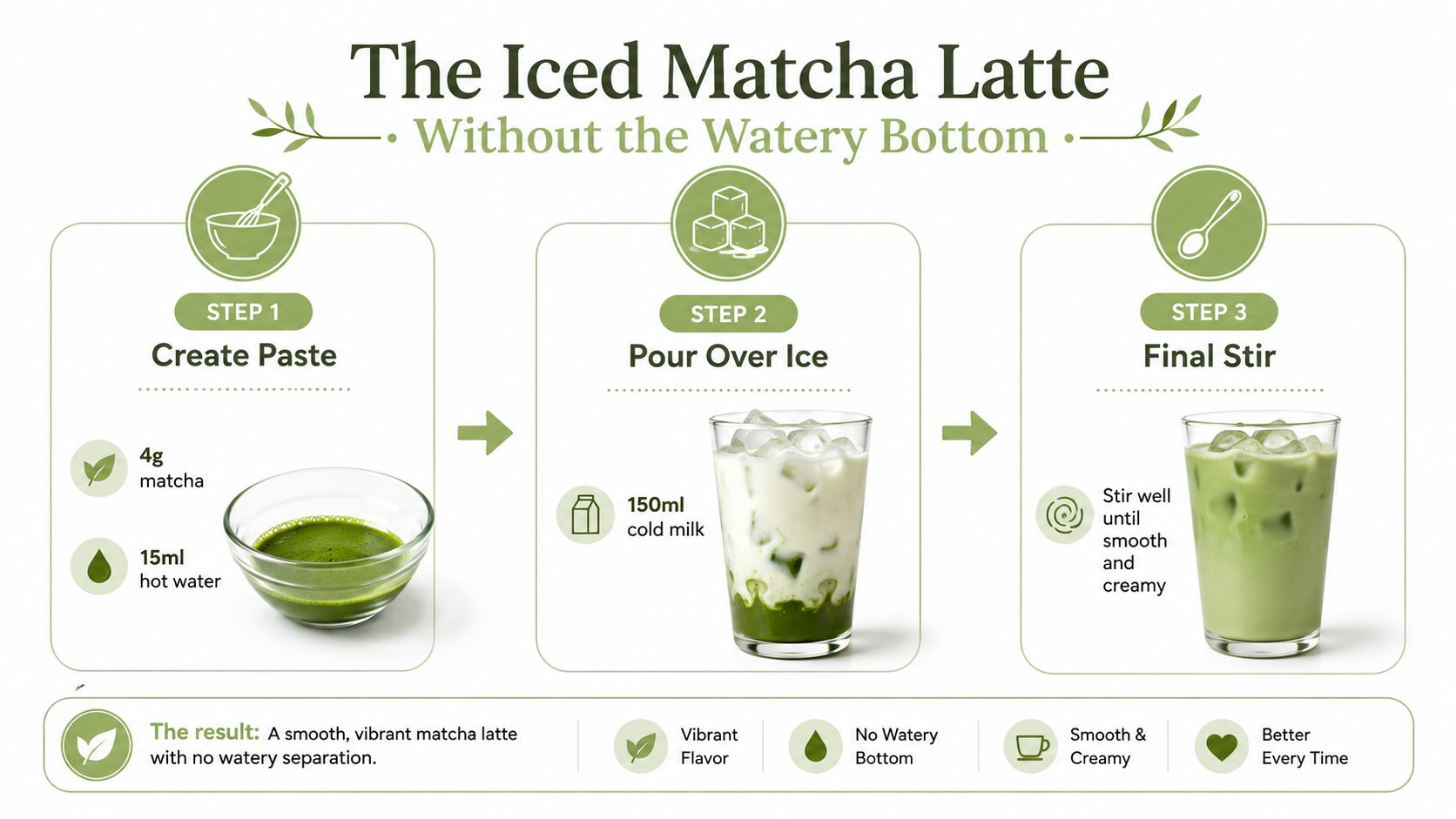
The paste first method
Use 4 g matcha powder and add 15 mL water first, just enough to make a paste. Then add another 45 mL water for whisking, so the powder can fully disperse before the milk goes in (iced matcha Reddit recipe). After that, pour over plenty of ice and add 120 mL milk. The sequence matters because it separates the wetting stage from the flavour-building stage, which helps stop clumps and keeps the drink strong enough after dilution.
A tall glass works better than a short one here, because it gives the layers room to sit visibly before you stir. Large cubes are more useful than crushed ice if you want slower melting and a cleaner layered look. Cold milk is fine, but don't start with such a large ice load that the drink loses its tea flavour before you've even picked it up.
When a shaker makes more sense
The café-style shaken version is faster and more uniform. It's the better choice when you're making a takeaway iced latte or want a drink that feels brisk rather than layered. A shaker blends the matcha and milk more aggressively, so you lose the visual separation, but you gain speed and consistency.
If you want a more detailed visual walkthrough, Pep Tea's how to make iced matcha latte guide fits neatly with this method. The linked YouTube tutorial below is also useful if you prefer to watch the pour order instead of reading it.
The chilled version rewards patience more than the hot one does. If you rush the order, you get weak flavour and a watery bottom, and that's the exact problem the Reddit-derived method is trying to avoid.
The Sugar-Free Matcha Latte That Actually Tastes Good
A lot of home recipes hide matcha behind sugar, syrup, or sweetened instant powder. That can make the drink easier to drink, but it also buries the very flavour people are usually chasing in the first place. If the matcha is good enough, and the ratio is tight enough, the cup doesn't need to be sweet to feel satisfying.
Why less dilution often tastes better
A smaller, stronger latte can taste smoother than a bigger one with more milk and more sugar. That's especially true when you use a better-grade matcha and keep the water phase tight, because the tea flavour stays present instead of getting washed out. Reddit recipes often lean sweet, but they don't really solve the core problem, which is balance.
Unsweetened matcha is also where milk choice matters most. Oat milk can make a sugar-free latte feel rounder, soy keeps the tea more visible, and dairy adds richness without needing syrup. Almond milk is the least forgiving in a no-sugar cup because it doesn't contribute much body on its own.
Optional sweeteners, if you still want them
If you want a little sweetness without turning the drink into dessert, use a light hand. Honey, maple, or monk fruit can sit in the background without flattening the tea note. The point is not to make matcha taste like a flavoured milkshake, it's to soften the edges just enough for your palate.
A better sugar-free latte is often a smaller latte. Stronger matcha, less dilution, and the right milk can do more for flavour than another spoon of sweetener.
That approach fits the direction many Australians are already heading, toward cleaner drinks with a more functional feel and less sugar load. It also lines up neatly with Pep Tea's own organic matcha positioning, which keeps the focus on authenticity and natural flavour rather than masking the tea.
Troubleshooting the Most Common Matcha Latte Problems
Most bad matcha lattes fail for one of three reasons. The powder clumps, the drink tastes harsh, or the foam looks pale and collapses quickly. Once you know which symptom you're seeing, the fix is usually simple.
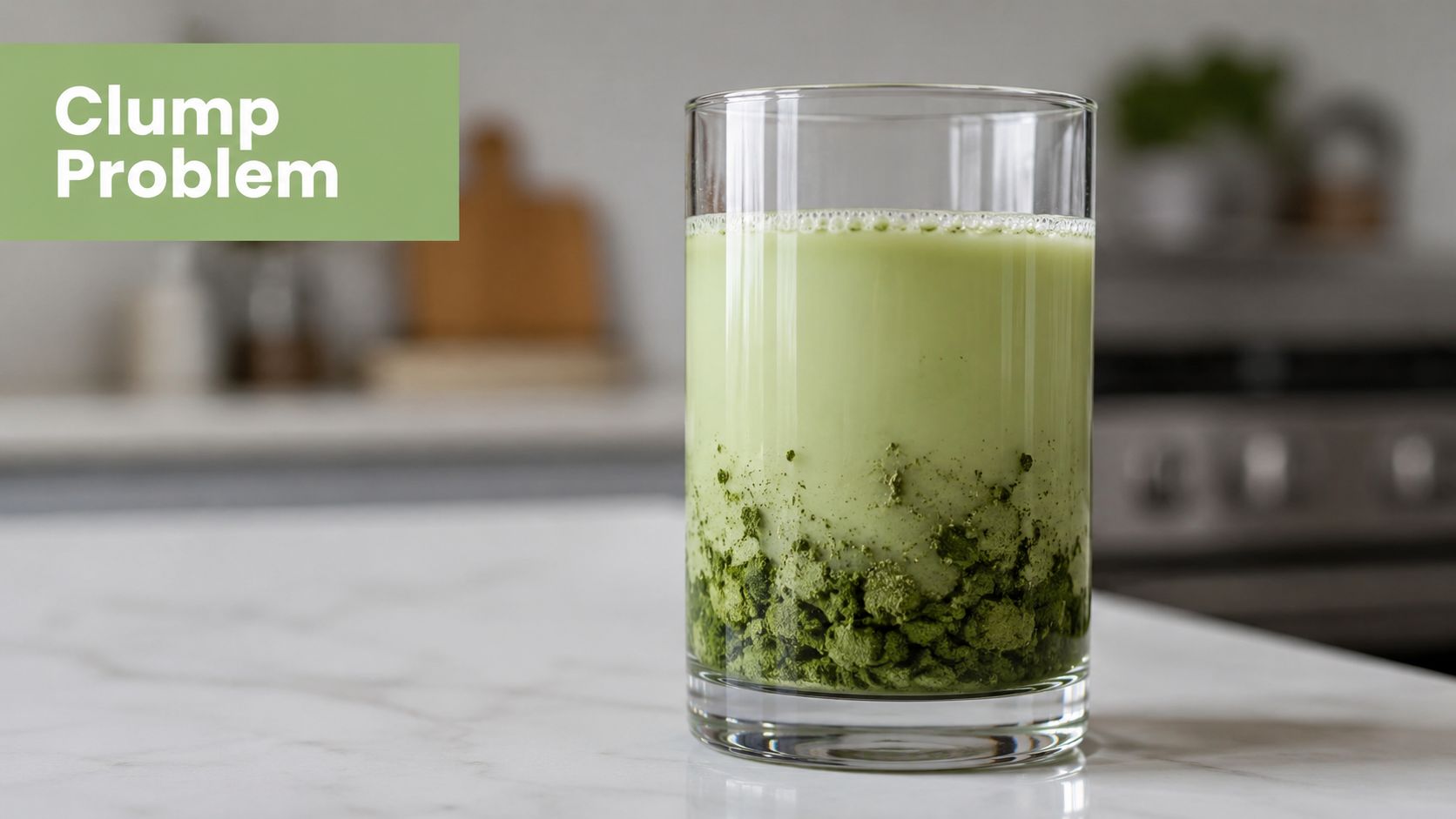
Quick diagnosis
A clumpy cup usually means the powder never fully hydrated. Sifting helps, but the slurry step matters just as much. Give the matcha enough water to disperse before the milk goes in, and whisk until the surface looks even rather than speckled.
Bitterness usually points to heat or handling. Water that is too hot can push the tea toward a sharper finish, and overwhisking can make the drink feel thin and aggressive. Keep the water around 75 to 80°C, then stop once the slurry is smooth, as shown in matcha latte guidance.
Pale foam that disappears fast is usually a milk problem. The milk may not have enough structure, or it may have been froth warmed too little to hold microfoam. Warm it gently, then give it a short final froth instead of chasing a big airy cap that falls apart in the cup.
A bamboo chasen still gives the most reliable surface texture, especially if you care about a fine, even foam. A handheld milk frother is easier to use and works well once the matcha is already hydrated. A shaker bottle is the fastest option, though the texture is rougher, and an electric whisk sits between the two, quick enough for home use but less polished than a chasen.
For whisking technique that helps the slurry come together, Pep Tea's how to whisk matcha guide is a practical reference. The base has to be right first. No frother fixes a clumpy slurry.
Taking the Reddit Recipe From Home to Your Café Menu
The home version scales cleanly into café service because the logic stays the same. A good venue doesn't need to reinvent matcha, it needs to reproduce the same ratio, texture, and pour order every shift. That's especially useful for Australian cafés that want one signature hot latte, one signature iced latte, and a sugar-free option without sending staff down a rabbit hole.
Menu structure that makes sense
A straightforward menu can run from the same base. Use the 4/40/140 style as the internal benchmark, then scale the milk volume to suit your cup size and whether the drink is served hot or iced. A 12 oz iced serve maps well to the Reddit-style formula already mentioned, and a larger glass can stretch the same method without changing the flavour logic.
Ceremonial-grade matcha makes the strongest case on a menu where the drink is sold as a premium tea beverage, while culinary-grade matcha makes more sense in baking, blended drinks, or cost-sensitive applications. That isn't about hype, it's about matching quality level to the drink's role. If the matcha is the hero, use the cleaner powder. If it's one ingredient among several, the cheaper grade can be the practical choice.
Training staff for consistency
Staff need the same physical sequence every time. Sift, whisk the slurry, then add milk or ice. If one shift dumps powder straight into milk and another uses a proper slurry, the drink won't taste like the same product.
Consistency sells the second cup, not just the first one.
If your venue wants a reliable organic source for that menu build, one option is Pep Tea's organic matcha range, which is positioned for cafés, wholesale, and home use in Australia. It fits the same practical standard the Reddit recipes point toward, just in a form a venue can stock and repeat.
If you're ready to turn a clumpy home experiment into a drink you'll want to remake, explore Pep Tea's organic matcha and tea range at Pep Tea. We keep the focus on clean ingredients, café-friendly recipes, and practical brewing support so you can make a smoother matcha at home or serve one with confidence in your venue.
Instant Matcha Tea: What It Is and How to Use It

Instant matcha tea gets treated like a shortcut, but that's only half the story. Some products are a genuine convenience format, while others are just instant green tea powders wearing a matcha label, and those two things don't behave the same in a cup or in a café.
For Australian buyers, that difference matters more than most guides admit. If you're choosing a powder for lattes, iced drinks, desserts, or a fast home ritual, the label tells you more than the marketing does, and a clear understanding of processing, solubility, flavour, and nutrition will save you from buying the wrong tin.
What Instant Matcha Tea Actually Is
A lot of people assume every green powder called matcha is basically the same product. It isn't. True matcha is made from tencha leaf that's stone-ground into a fine powder, while instant matcha tea is usually a processed instant tea powder designed to dissolve quickly, often from brewed tea concentrates and sometimes with additives like maltodextrin or citric acid for better flow and shelf life, according to the product distinction explained by matcha.com.
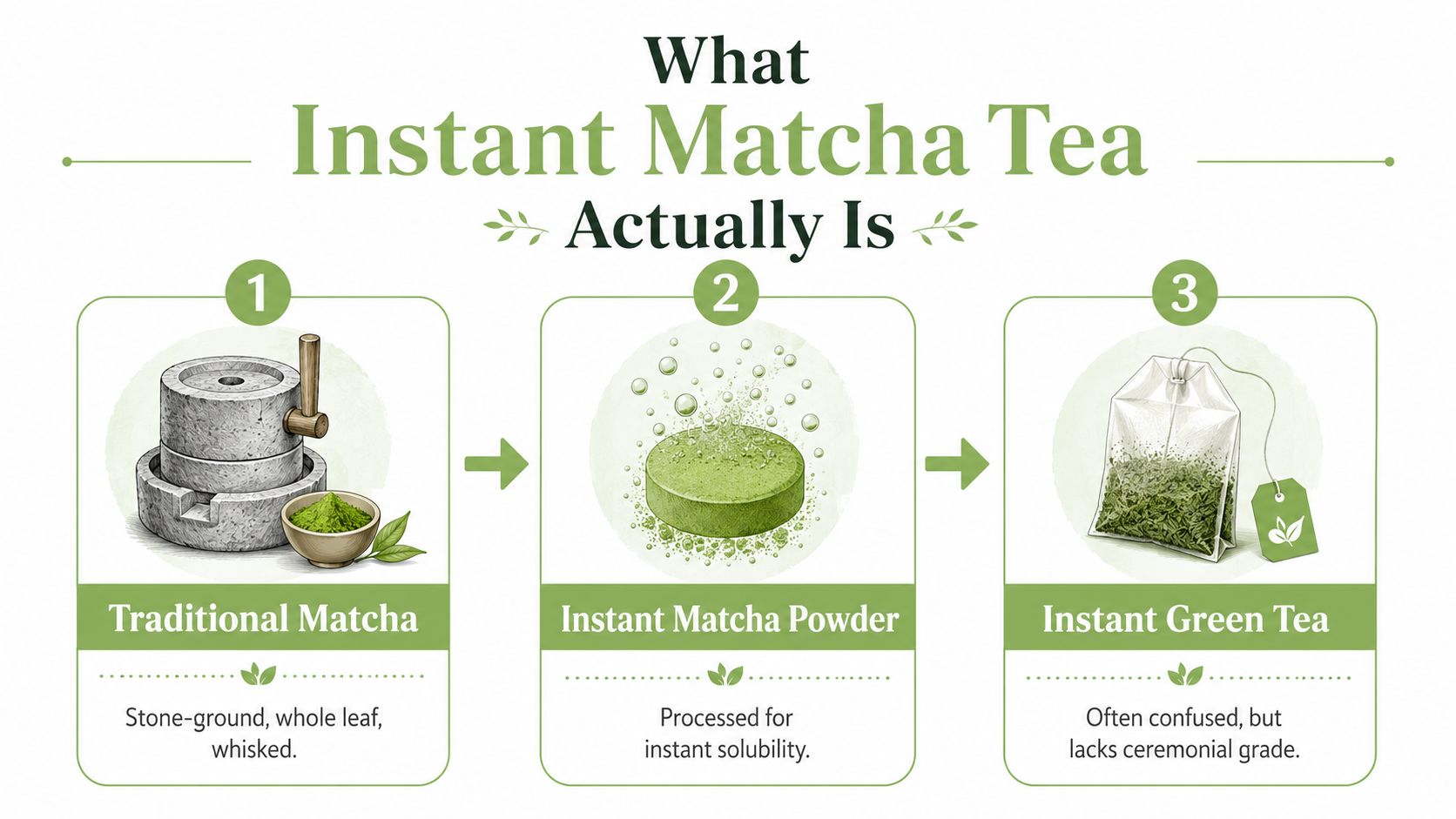
Why the label causes so much confusion
Australian shoppers often see “matcha” and assume heritage tea, bright colour, and full nutritional value. That assumption only holds when the powder is made from ground tea leaf. Instant tea powders are made for convenience first, so they're meant to disperse fast in water or milk, not necessarily to preserve the character of the leaf.
That matters in service settings too. A café team training on speed, consistency, and drink build will need a different workflow from someone preparing ceremonial tea at home, which is why a practical resource like barista training Australia can be useful when you're mapping a menu or onboarding staff.
Practical rule: if the ingredient list reads like a processed beverage mix, you're probably not buying traditional stone-ground matcha, even if the front label says “matcha”.
What to look for on a packet
You don't need a tea degree to read the label well. Start with the ingredients, then look for anything that suggests instant solubility rather than whole-leaf powder. If the powder dissolves completely and leaves little sediment, that's often by design, but it doesn't automatically mean it's equivalent to matcha in flavour or composition.
A simple label check helps:
- Ingredient list first, because additives often signal an instant format.
- Country of origin next, because true matcha is tied to Japanese production.
- Product language last, because words like “instant”, “blend”, or “soluble” tell you how it behaves in the cup.
For café owners, that distinction changes how you build drinks. For home users, it changes expectations. Instant matcha tea can be a smart convenience product, but it shouldn't be judged as though it were the same thing as traditional matcha.
Instant vs Ceremonial vs Culinary Matcha Compared
Start with the cup itself, because that usually clears up the confusion. Ceremonial matcha is made for drinking on its own, culinary matcha is made to stand up in milk, batter, and sauce, and instant matcha tea is designed for speed and easy dispersion. Each one solves a different problem, so the right choice depends on whether you need flavour clarity, kitchen flexibility, or fast service.
Matcha Grades at a Glance
| Attribute | Instant Matcha | Culinary Matcha | Ceremonial Matcha |
|---|---|---|---|
| Processing | Usually made for instant solubility, often from brewed concentrate | Stone-ground tea leaf, usually from slightly older leaves | Stone-ground tea leaf, usually from the youngest shade-grown leaves |
| Texture | Designed to dissolve quickly | Mixes well, may need whisking or frothing | Best whisked, can form a fine foam |
| Flavour | Neutral to mild, sometimes flatter | Stronger, more pronounced | Delicate, smoother, more umami |
| Best use | Iced drinks, fast service, automated prep | Lattes, baking, cooking | Straight tea, ceremonial use, premium drinks |
| Nutritional trade-off | Convenience first, so the whole-leaf profile is usually reduced | Retains more of the leaf than instant forms | Closest to the full leaf experience |
For a practical buyer's guide, PepTea's comparison of ceremonial vs culinary matcha helps separate drinking quality from kitchen use without turning the decision into guesswork.
What each grade is really for
Ceremonial matcha suits moments where the tea itself should lead. The flavour is cleaner, the finish is more refined, and the drink works best when nothing else is crowding the bowl or cup.
Culinary matcha belongs in a different setting. In a latte, smoothie, cake, or biscuit, its fuller taste has enough weight to come through milk, sugar, and other ingredients, which is why it is often the more practical choice for recipes. A Japanese home cooking resource such as the Just Cook It recipe collection is useful when you want to see how matcha behaves beyond a plain tea preparation and into everyday cooking.
Instant matcha tea sits alongside those options rather than replacing them. It is handy when the drink needs to be quick, cold, and consistent, especially in an Australian café where prep time and repeatability matter. That convenience comes with a trade-off, because it is not the same ingredient category as a traditional stone-ground powder, and that difference affects both cup quality and how much of the leaf you are using. Once you separate those roles, the choice becomes easier to make for both café menus and home kitchens.
Short version: ceremonial for drinking, culinary for cooking, instant for convenience.
Nutritional Benefits and What You Might Be Missing
Matcha earns its reputation because you consume the whole leaf, not just the brewed water. Reviews summarised in the medical literature report caffeine around 18.9 to 44.4 mg/g, total polyphenols around 169 to 273 mg gallic acid equivalents per gram, and a composition that is roughly 60 to 70% insoluble material plus 30 to 40% soluble compounds such as catechins, amino acids, and minerals, according to PubMed review data. That's the heart of the nutrition argument in favour of true matcha.
Why whole-leaf powder matters
When you whisk stone-ground matcha, you're taking in the material suspended in the cup as well as what dissolves into the liquid. That's why people value it as a functional drink rather than a simple infusion. The profile can vary a lot by source and dose, but the key point is that true matcha delivers more of the leaf than a typical instant tea powder.
Instant matcha tea often trades some of that completeness for convenience. If a powder is made from extract or concentrate and engineered for solubility, it can be easier to use in iced drinks and automatic dispensing, but it may not carry the same density of leaf-derived compounds. In other words, it may behave better in a machine, while true matcha gives you more of the plant itself.
What readers usually expect from matcha
Most buyers are looking for three things:
- Antioxidants, especially catechin-rich compounds.
- Calm energy, because matcha combines caffeine with amino acids.
- A greener, fuller flavour, which signals freshness and leaf quality.
That's why it helps to keep expectations precise. If you want a product for fast drinks and low-fuss use, instant matcha can make sense. If your priority is nutrition and the classic tea experience, stone-ground matcha is the better fit.
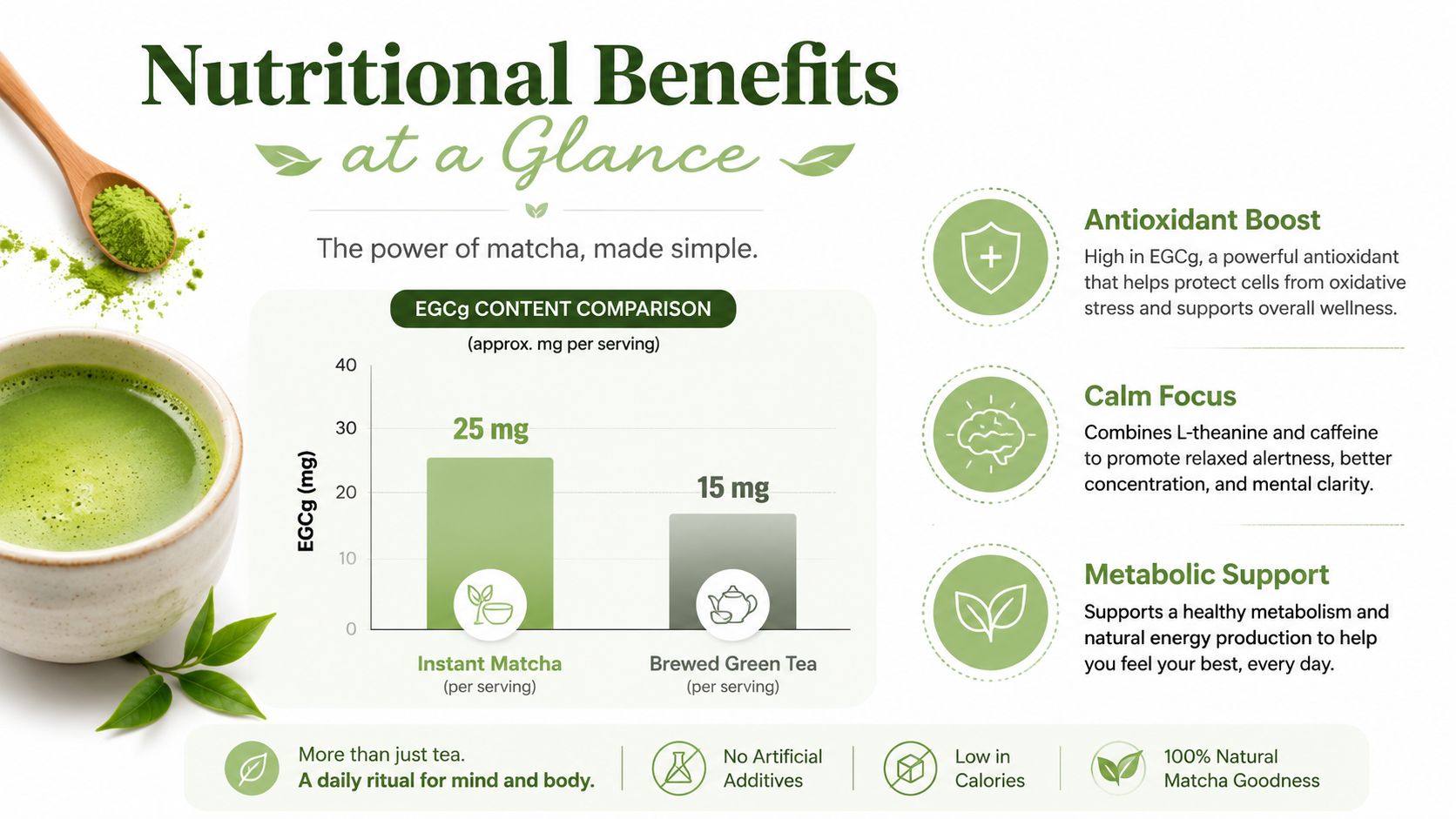
A useful way to think about it is this, the more a product is engineered for instant mixing, the more you should ask what has been gained in speed and what has been lost in whole-leaf character.
How to Prepare Instant Matcha Tea Properly
Instant matcha tea is easier to handle than traditional powder, but the method still matters. If you dump it straight into cold milk and walk away, you'll often end up with weak flavour or an uneven texture. A little technique goes a long way.
Hot, iced, and latte preparation
For a hot drink, start with a small amount of water first, then add the rest once the powder has dispersed. That helps the powder hydrate evenly and keeps the flavour from going flat. If the product is very fine or highly soluble, a quick stir may be enough, but if the cup looks grainy, a small whisk or milk frother helps.
For iced drinks, instant matcha usually outperforms traditional powder because it's designed to disperse more easily in colder liquid. That makes it a practical choice for café iced lattes, shaker bottles, or takeaway formats where speed matters.
For a latte, build it like this:
- Dissolve the powder in a small splash of hot water.
- Stir or froth until smooth.
- Add milk, then ice if needed.
- Taste before sweetening, because some instant blends already include a sweetener or filler.
If you use traditional matcha instead, a proper whisking method matters. PepTea's guide on how to whisk matcha is a useful reference if you want to compare the two workflows side by side.
Fixing common problems
Grainy texture usually means the powder needs more agitation. Weak flavour usually means the dose is too low for the product's concentration. Bitterness often comes from water that's too hot or from a product that already includes more processed tea solids than you expected.
Good café habit: build one test drink before you scale the recipe for service. Instant powders can vary a lot, so a fast calibration saves waste.
If you're making drinks at home, a shaker bottle works well for cold recipes, and a blender helps when milk, ice, and powder all need to combine quickly. For hot drinks, simple stirring is often enough if the powder is soluble.
Recipes and Use Cases for Home and Hospitality
Instant matcha tea makes the most sense when the drink has to move quickly. At home, that usually means morning routines. In hospitality, it usually means iced menus, batch builds, and prep consistency across staff shifts.
Where it works well
A home barista can use instant matcha in a few straightforward ways. A quick iced matcha latte is the obvious one, because the powder disperses easily and doesn't need the same whisking discipline as ceremonial tea. It can also slip into smoothies, overnight oats, or simple baking where the green tea flavour just needs to show up cleanly.
For cafés, the strongest use case is speed. Instant powder can be handy in:
- Iced drinks, where fast dispersion reduces clumping.
- Automated or semi-automated service, where repeatability matters.
- Batch drinks, when a team needs consistent colour and flavour across service.
That said, there are also places where a prepared version wins without question. If a customer expects vivid green colour, foamy texture, and the layered umami of a properly whisked tea, a conventional matcha powder is still the right call.
Simple serving ideas
A few practical pairings work especially well:
- Oat milk latte, because its body softens the tea.
- Coconut milk iced drink, because it reads as tropical and creamy.
- Vanilla smoothie, because the flavour is mild enough to sit beside fruit.
- Matcha muffins or slice, if the recipe only needs background tea notes.
PepTea also offers organic matcha tea products online, including bulk formats suited to retail and food service, which makes sense for kitchens that need a reliable powder rather than a one-off novelty.
For cafés, the decision usually comes down to ticket time versus drink identity. For home users, it comes down to whether you want a fast green drink or a more traditional tea ritual. Both can have a place, but they're not interchangeable.
Buying and Storing Matcha the Right Way
Reading a matcha label properly saves money and disappointment. The easiest mistake is buying by colour alone. A bright tin doesn't always mean good tea, and a smooth powder doesn't always mean it's true matcha.
What to look for on the label
Start with the ingredient list. A clean matcha product should be easy to understand, and if you see a long list of sweeteners, fillers, or anti-caking agents, that's a sign to slow down and ask what the powder is made of. A trusted origin matters too, especially in Australia where the market is largely import-led.
That matters because Australia imported about A$14.2 million of “tea, whether or not flavoured” from Japan in 2024, and Japan External Trade Organization data says Japan remains the world's leading supplier of matcha, with export volume rising 16.1% in 2024 to 8,798 tonnes, about 10 times the level of 20 years earlier, according to the market summary at Ooika. For Australian buyers, that points to a supply chain that's heavily tied to origin-country production.
A simple checklist helps:
- Look for origin transparency, ideally Japan and, when available, a specific region.
- Check for added ingredients, especially if you want authentic matcha.
- Prefer reputable packers or suppliers, because freshness matters more than flashy packaging.
How to store it well
Matcha is sensitive to light, heat, and oxygen. Store it sealed, cool, and away from the cupboard door where temperature swings are common. Once opened, use it promptly, as freshness drops faster than you might expect.
A small airtight tin or jar is better than leaving the powder in a half-open bag. If you've already opened a pouch, a dedicated storage container helps protect flavour and colour, and PepTea's matcha storage container is one practical example of the kind of setup that keeps powder in better shape.
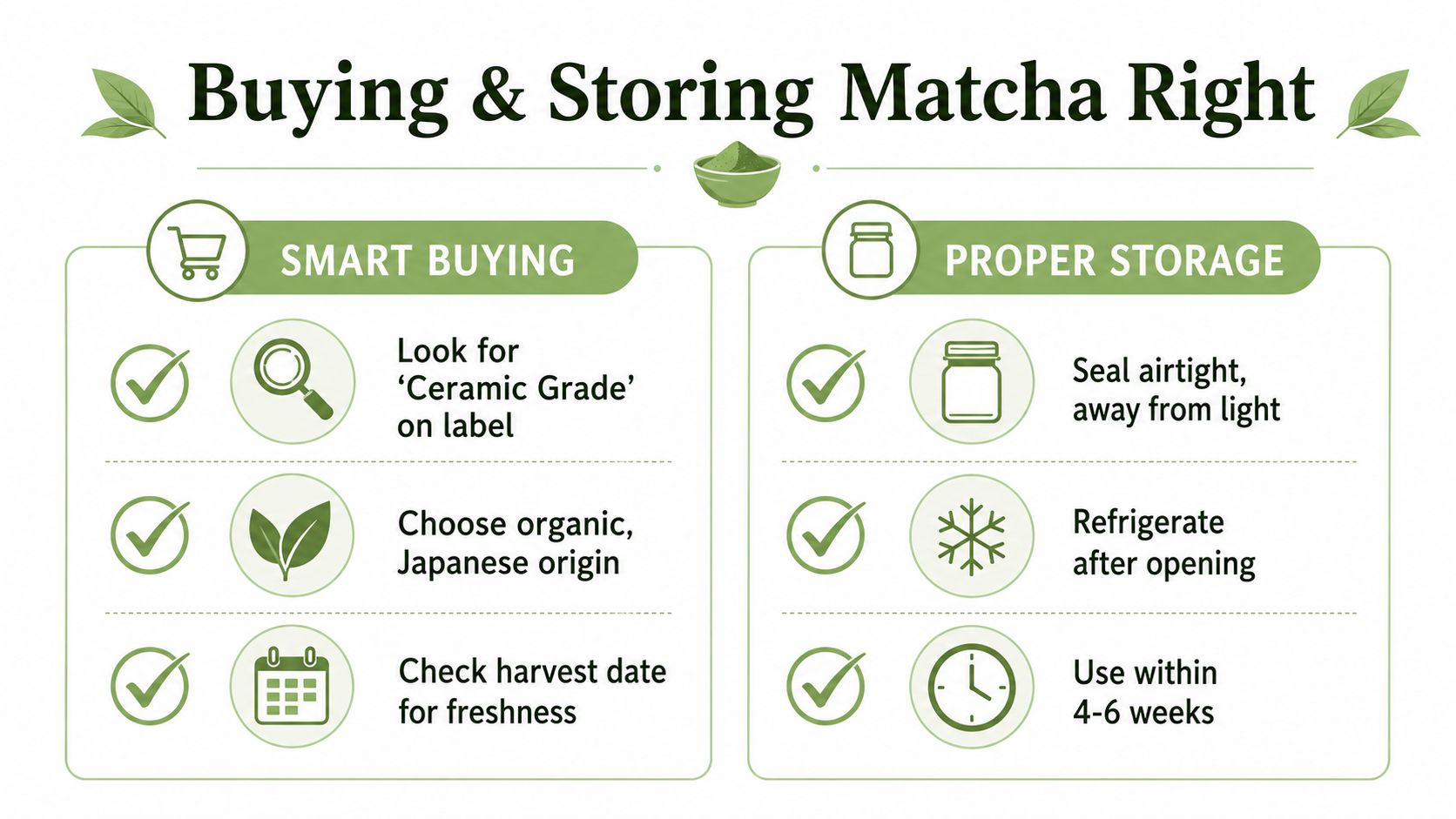
If you buy online, prioritise clear photos of the ingredient panel and packaging date. If you buy in-store, open the conversation with the staff and ask what kind of matcha it is before you decide whether it suits drinking, lattes, or baking.
Choosing the Right Matcha for Your Needs
The decision comes down to one question, what do you want the powder to do? If your answer is “be quick, cold, and easy to mix,” instant matcha tea can be the right tool. If your answer is “taste like real matcha and deliver the fuller leaf experience,” you'll want stone-ground culinary or ceremonial powder instead.
For café owners, the smartest choice often depends on the menu. Instant powder can help with speed and consistency, but a premium matcha earns its place when customers are paying for texture, aroma, and a more authentic cup. For home users, the split is even simpler, convenience versus tradition.
If you're still deciding, keep these priorities in mind:
- Choose instant when you need fast dispersion and straightforward cold-drink prep.
- Choose culinary when you want a stronger flavour for lattes or baking.
- Choose ceremonial when the tea is the whole point.
PepTea's range of premium organic Japanese matcha is built around authenticity, clean ingredients, and practical use in real kitchens and cafés. If you want to compare options and choose the right grade for your routine, explore Pep Tea and pick the powder that fits the drink you want to make.
How to Create Your Matcha Green Tea Latte Recipe At Home?

Matcha Tea Latte a popular tea beverage was unheard in Australia before a decade ago but now almost every coffee shop provides with this delicious Matcha powder drink. It has been given various names by most of the famous cafes in Australia while some boasts of its meditative qualities others call it as the “perfect Zen” or “the healthy superfood”. The best thing about Matcha Latte is that it can easily be made at home.
Buy the Imperial Matcha Tea powder from Peptea and take it in a mug or cup. Then add warm water and mix it with a spoon until it turns into a dark green paste. Warm the milk in a saucepan and pour it into the mug and stir well till it turns light green in color. Then add a few sprinkles of Matcha Powder on top for decorations. If you are looking for an ice-cold Matcha Latte then use cold milk instead of hot milk and add some ice cubes for the chill.
Order your Imperial Matcha Powder wholesale right now from Peptea.