
What Is EGCG and Why It Matters for Your Daily Tea

EGCG, short for epigallocatechin gallate, is the most abundant catechin in green tea, and it can make up more than 50% of total green-tea catechins. That's why EGCG is the compound most closely tied to matcha's celebrated health reputation, not just “antioxidants” in general.
Hearing the word antioxidant is a start, but that's too broad to be useful. If you run a café, sell tea, or want a smarter daily cup, the key question is what's in the glass, how much of it you're getting, and whether the format matters.
Why EGCG Deserves Your Attention Beyond Generic Antioxidants
“All antioxidants are the same” sounds neat, but tea does not work that way. Green tea gets much of its reputation from catechins, and EGCG stands out because it is the dominant one in the leaf and one of the most studied in tea nutrition in PepTea's antioxidant tea guide.
That matters in Australia because people are asking more exact questions now. They do not just want to know whether a drink is “healthy”, they want to know which active compounds are present, how much they are likely to get, and whether a tea, matcha, or extract behaves in the same way.
Why specificity matters in real beverage choices
EGCG matters because it gives green tea, especially matcha, a measurable profile rather than a loose wellness story. Independent review data places it at more than half of total green-tea catechins and notes that brewed tea commonly contains about 200–300 mg of EGCG per cup in some contexts (PMC review). For café owners, that kind of detail shifts the conversation from general claims to formulation choices.
A product that says “antioxidants” leaves too much unsaid. The useful question is which compound is doing the work, and what serving size delivers it.
The difference shows up in everyday use. A ceremonial matcha latte, a plain brewed green tea, and a capsule extract all contain EGCG, but they do not deliver it in the same way or at the same dose. That is why EGCG is more than a chemistry term, it affects purchasing, menu design, and how a beverage is described to customers.
EGCG also sits at the point where wellness language meets careful label reading. For tea drinkers, that helps make sense of what is in the cup. For operators, it helps explain why a green tea beverage is not just another hot drink, but a distinct option with a different nutritional profile.
The Chemistry and Mechanism Behind EGCG
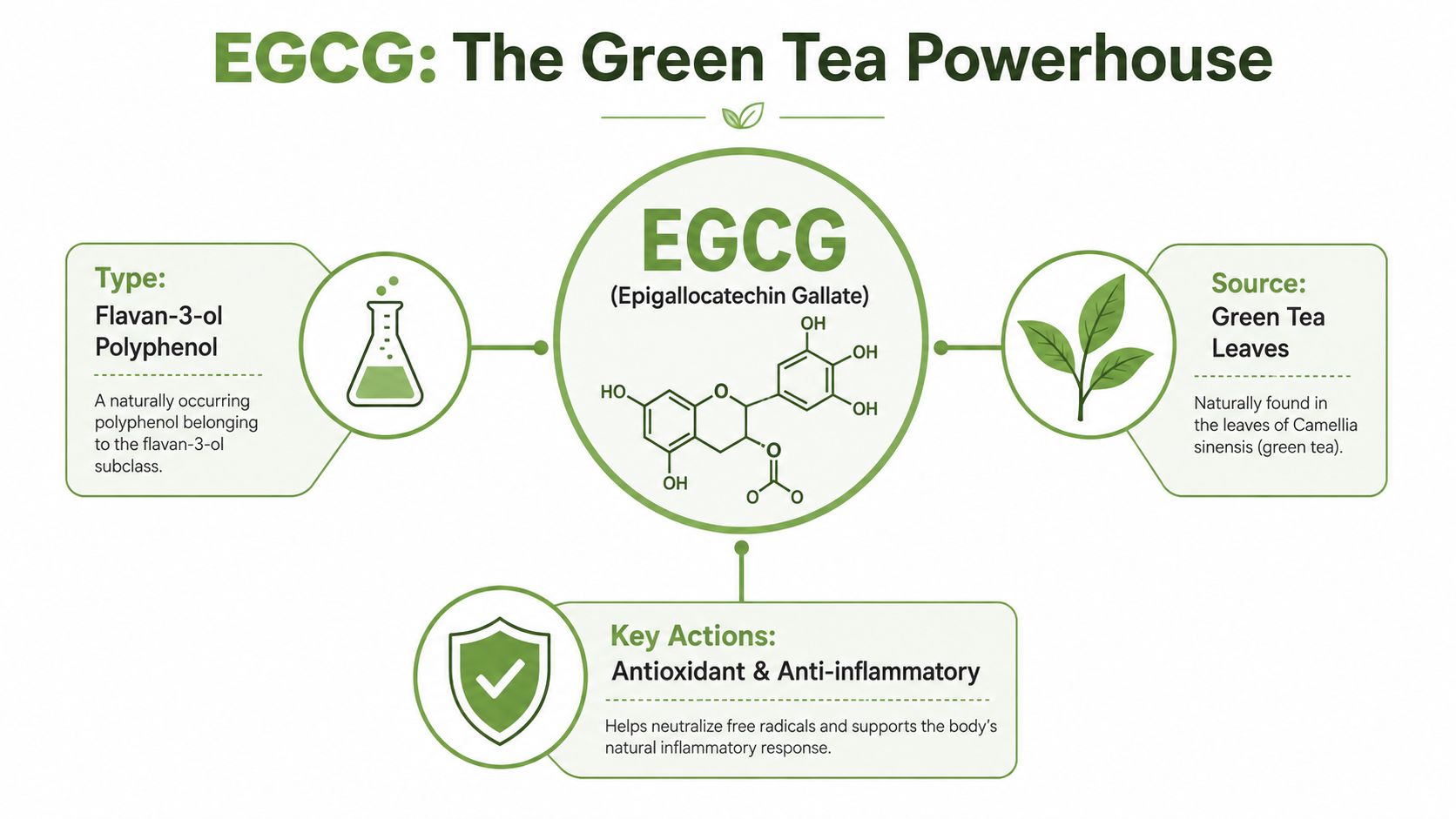
EGCG is a catechin, a subclass of polyphenols, and scientific reviews describe it as the principal bioactive compound in Camellia sinensis (Molecules review). In practical terms, it is one of the plant compounds that gives green tea its sharp, fresh, slightly astringent edge.
Why its structure matters
EGCG stands for epigallocatechin-3-gallate, with a formula of C22H18O11 and a molecular weight of about 458.4 g/mol. That structure gives it strong redox activity, which means it can interact with unstable molecules and support the body's antioxidant defences (technical source).
The molecule has multiple reactive sites, so it can engage with its surroundings in several ways at once. That is part of why tea scientists pay close attention to it, and also why it is more fragile than some other catechins. It is useful chemistry, but not indestructible chemistry.
Why freshness and preparation matter
EGCG is water soluble, so hot-water extraction can pull it into a drink efficiently (technical source). It is also sensitive to storage, pH, oxygen exposure, and heat, so processing and preparation change how much reaches the cup.
Tea is a chemistry system, and EGCG is one of the parts that changes most readily.
That explains why matcha quality can vary so much. Freshness, shading, grinding, and storage all affect how much of the plant's chemistry survives to the finished drink. A bright, clean matcha and a flat, dull one often differ before the whisk even hits the bowl, because the leaf material itself has already been handled differently.
For café owners, that makes product quality a practical issue. A well-stored matcha can support a cleaner flavour and a more consistent beverage experience, while a poorly handled product loses the very compounds people are buying it for, as shown in PepTea's Uji matcha range.
What the Scientific Evidence Shows About Health Benefits
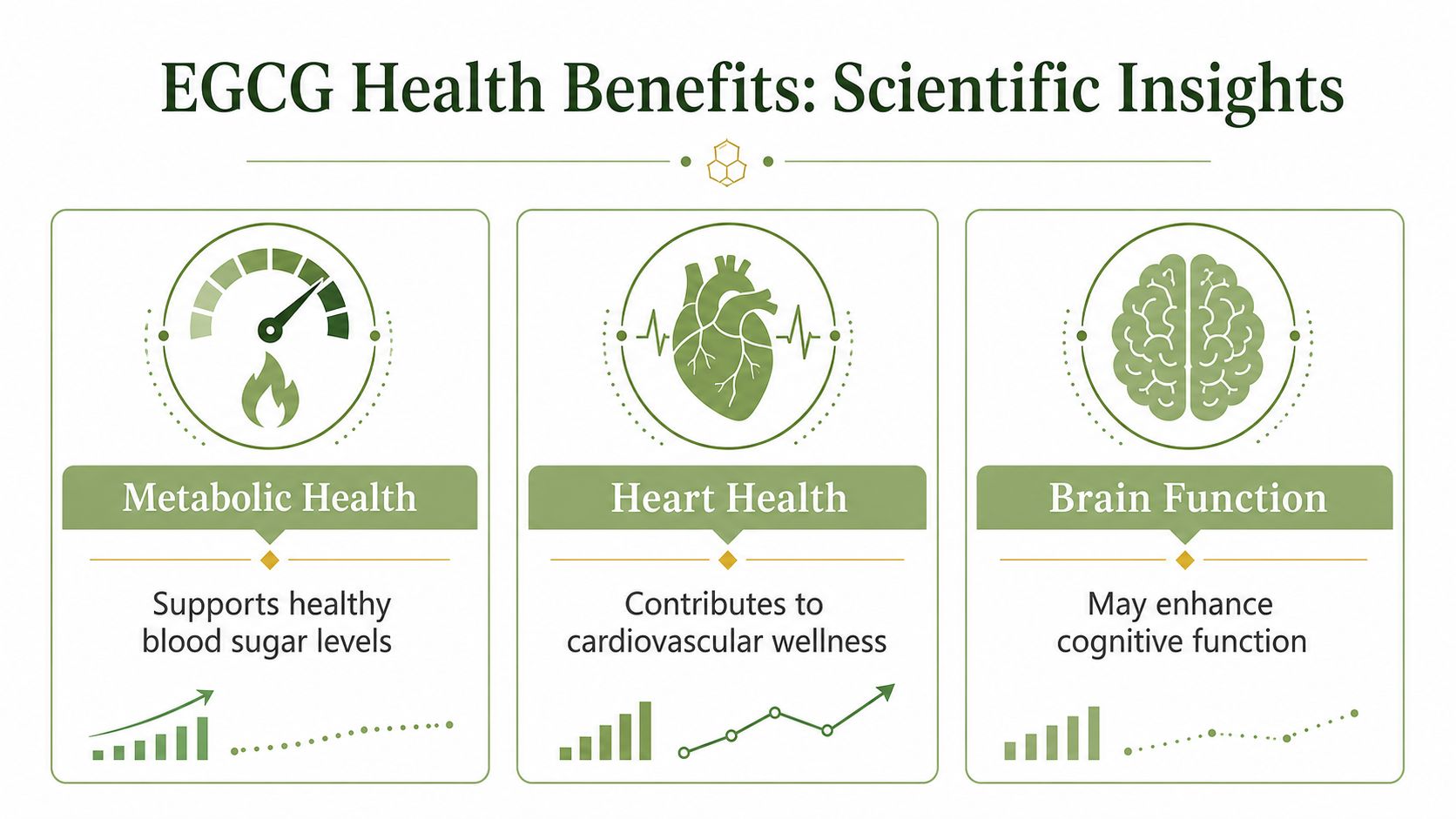
EGCG gets attention because the research does not treat tea as a vague wellness habit. It looks at a specific plant compound and asks what it may be associated with in human studies. For café owners and health-conscious consumers, that distinction matters, because it keeps the conversation grounded in what the evidence can support.
A recent meta-analysis reported that green tea was associated with a 9% lower cancer risk overall (RR 0.91), while EGCG specifically was associated with a 28% lower risk (RR 0.72) versus controls (PubMed). Those findings are part of why EGCG has moved from a tea chemistry topic into broader nutrition conversations.
What that means, and what it doesn't
The numbers are useful, but they are not a promise. They show associations in the research literature, not proof that drinking more tea prevents disease. That difference matters on a menu board, in a wellness shop, or in any setting where EGCG might be described as part of a healthy routine.
The same analysis reported stronger associations for some cancers, including prostate cancer (RR 0.43), oral cancer (RR 0.44), gallbladder cancer (RR 0.72), and hematological cancers (RR 0.72) (PubMed). Separate physiological research also found that EGCG supplementation changed energy metabolism in adults, with a mean reduction in respiratory quotient of 0.02 and an increase in energy expenditure of 158.05 kJ/day compared with placebo. That helps explain why EGCG appears in conversations about metabolic support and functional beverages.
How to read the evidence responsibly
A practical reading of the evidence is straightforward. EGCG has enough human data behind it to deserve attention, but not enough to justify exaggerated claims. Its strongest place is within an overall tea pattern, not as a stand-alone cure or a miracle ingredient.
For café operators, that means you can speak about tea catechins, metabolic support, and plant-based bioactives without making medical promises. For consumers, it means a daily matcha or green tea can fit a sensible routine, while still sitting alongside the rest of a healthy diet and lifestyle.
Where to Find EGCG in Your Diet and Daily Drinks
Green tea is still the main practical source. EGCG also appears in smaller amounts in white tea, black tea, and oolong tea, and trace amounts show up in some fruits, nuts, and beans such as berries, plums, apples, hazelnuts, and peanuts (PMC review). For everyday drinking, tea remains the clearest way to obtain it.
If you like tracking what ends up in the cup, log teas with Drinkist can help you notice how leaf quality, water temperature, and steeping style change the drink from day to day.
Approximate EGCG content by source
| Source | Typical Serving | Approximate EGCG |
|---|---|---|
| Brewed green tea | 1 cup | About 50–150 mg (technical source) |
| Matcha | 1 serving | Higher than a typical infusion because you consume the whole leaf, not just the water (technical source) |
| Concentrated supplement | 1 serving | About 100–800 mg/day in common supplement formats (technical source) |
| Brewed tea in a conservative safety benchmark | 1 cup per day | About 100 mg EGCG/day |
| Conservative higher tea intake | 3 cups per day | About 300 mg EGCG/day |
Why matcha feels stronger than brewed tea
Matcha changes the serving picture because you consume the powdered leaf rather than an infusion. That usually means more catechins per cup than a standard steeped tea, even though the exact amount still depends on grade, dose, and how it is prepared.
Kombucha sits in a different category. If it is brewed on a green tea base, it may carry some EGCG from the tea used in fermentation, but the final amount depends on the starting brew and the process, so it should not be treated as equal to matcha or a strong green tea infusion.
For cafés, menu language matters. “Green tea based” and “matcha” are not interchangeable, and customers who care about function will notice the difference.
Safe Intake Levels and Understanding the Supplement Gap
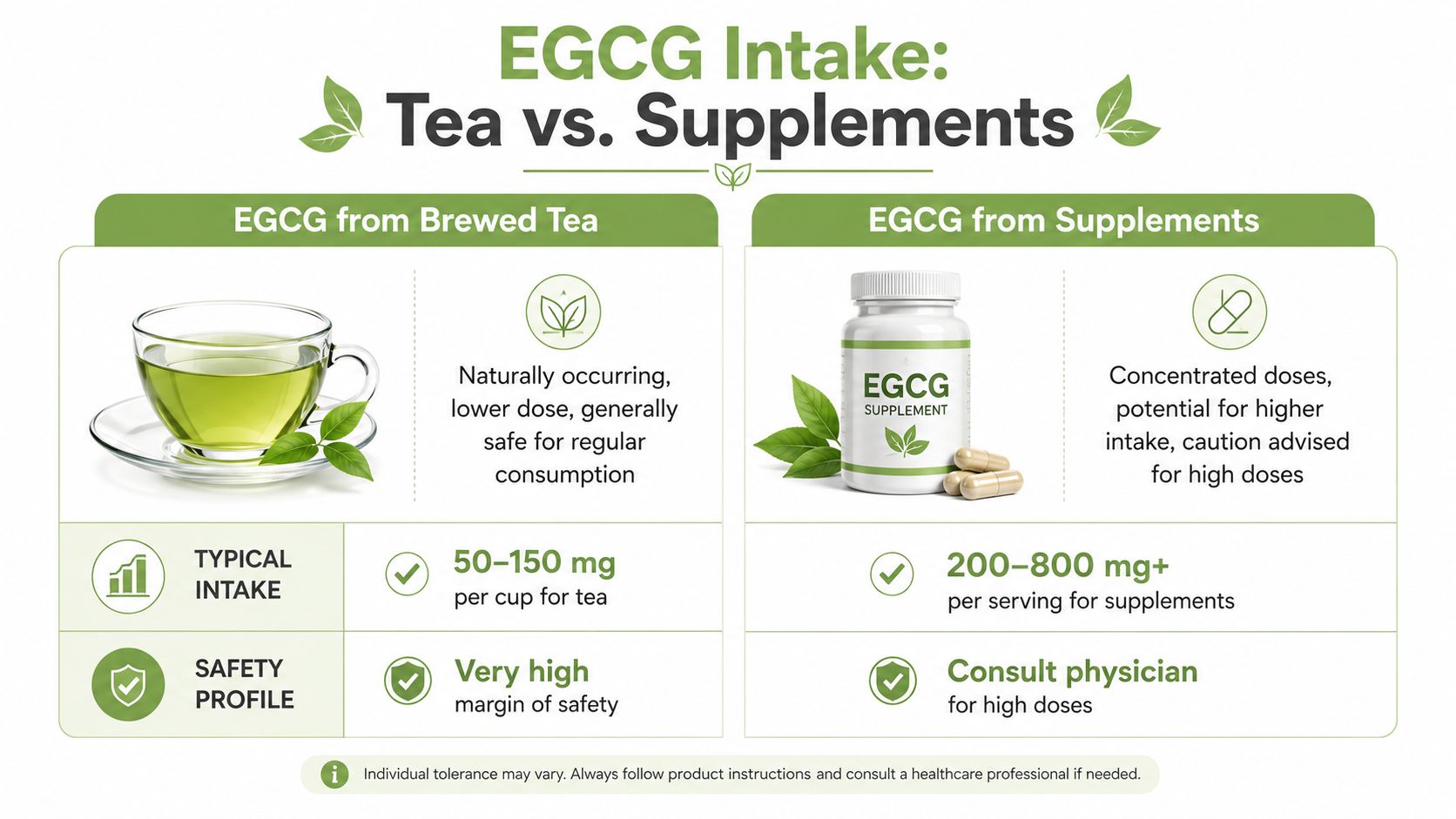
The main mistake with EGCG is treating tea and supplements as if they deliver the same thing in the body. They do not. In a PMC safety review, analysts used a conservative benchmark that places a typical background intake at about 1 cup of green tea per day, or ~100 mg EGCG/day, while a higher conservative intake was 3 cups per day, or ~300 mg EGCG/day.
Tea is not the same as an extract
That same safety literature also discusses a proposed adult safe intake level of 338 mg EGCG per day for EGCG in solid bolus supplement form. That detail matters because it shows why brewed tea and concentrated extracts should not be grouped together.
A simple way to read the difference is this. Tea delivers EGCG inside a food matrix, while a capsule delivers a concentrated dose in a form that behaves differently in the body. A cup of tea sits inside normal food and drink habits, but a supplement can push someone much closer to the upper range without them noticing.
Practical rule: if the label focuses on milligrams of EGCG, treat it like a supplement, not like a tea.
How to read labels without getting lost
If you compare products, check whether the figure refers to per serve, per capsule, or per daily dose. Then read the rest of the ingredient panel, because a product that combines catechins with other concentrated extracts needs closer attention.
That caution matters most for people with liver conditions, pregnant individuals, and anyone taking medicines that may interact with green tea or caffeine. For those readers, regular brewed tea is a very different decision from capsules or high-dose wellness blends. If you are comparing formats, this green tea capsule guide helps separate tea-based intake from supplement-style products.
For cafés and beverage brands, the safest language is straightforward. Describe tea as a traditional drink with plant compounds, not as a treatment. That keeps the message accurate and keeps the menu honest.
Practical Applications for Consumers and Hospitality Professionals
A good matcha routine doesn't need to be complicated. For home drinkers, a whisked bowl in the morning gives a clean way to use the plant whole, while a latte can make the flavour more accessible if you keep the sugar low. If caffeine sensitivity matters, start with a smaller serve and see how it fits your day.
What to do in a café setting
For hospitality teams, EGCG knowledge is useful because it gives you a clearer way to position drinks. A properly made matcha, a brewed green tea, and a kombucha built on tea are different menu items, and each should be described that way. That helps customers make better choices without crossing into medical claims.
A smart menu can highlight organic matcha, sugar-free kombucha, and clean, functional beverage options alongside coffee. If you're building a drinks program, a tea-focused beverage line can give people a lower-sugar alternative without pushing them into overly sweet soft drinks.
Good menu language tells the truth about the drink first, then the experience second.
Operations also matter. If you're selling a beverage with tea-based functional framing, it helps to keep ingredient communication tight and allergen processes organised. A restaurant allergen compliance checklist is a practical reference for tightening that side of service.
For home use, keep the approach simple. Use fresh water, respect the leaf, and choose a format that matches your goal, whether that's a calm morning cup or a more versatile ingredient for lattes and baking. We also see interest in organic matcha because it works across both café service and kitchen use, which is one reason Pep Tea's Australian-brewed kombucha and matcha range fits so naturally into functional drinks menus.
Common Questions About EGCG Answered
EGCG can survive tea brewing well, but preparation matters. In kombucha, some of the tea's catechins may carry through the process, yet the final amount depends on the tea base and fermentation style, so it's best to think of kombucha as a tea-derived drink rather than a concentrated EGCG source.
Matcha pairs naturally with caffeine and L-theanine, which is why many people describe the lift as smoother than coffee. Cooking or baking with matcha can still leave you with useful tea compounds, but the more heat and air exposure you introduce, the less you should expect the finished dish to behave like a fresh whisked cup.
Individuals won't “feel” EGCG in the dramatic way a stimulant works. If anything, its value is cumulative and routine-based, which is why consistency matters more than chasing a huge dose.
Pep Tea makes organic matcha and sugar-free organic kombucha for people who want tea-based drinks with clear ingredients and real-world use cases. If you're comparing matcha for your home routine or building a café menu around functional beverages, visit Pep Tea to explore options that fit a daily tea habit rather than a supplement-style shortcut.