
Tag: ceremonial matcha
What Is Matcha Tea Powder and How to Use It Well
What is matcha tea powder if it's made from the same plant as the green tea in a bag? Matcha is a finely milled powder made from shade-grown green tea leaves that you whisk into water and consume whole, rather than steeping the leaves and throwing them away. That single difference, eating the leaf instead of only drinking its infusion, explains the vivid colour, the fuller flavour, and why the amount of powder in your cup matters so much.
What Matcha Tea Powder Actually Is
Matcha isn't a different species and it isn't an herbal blend. It's made from Camellia sinensis, the same plant used for green, black and oolong tea, but it's grown, processed and consumed in a specific way. The leaves are shaded before harvest, steamed, dried and milled into a very fine powder.
With a tea bag, hot water extracts flavour and compounds, then you discard the leaves. With matcha, the powder stays suspended in the liquid. You drink the leaf material itself, so your serve is set mainly by how many grams of powder you use, not just by how long something steeped.
If you've only used tea bags, the tin can look unfamiliar. Fine green powder doesn't behave like leaf tea, and it won't dissolve neatly like instant coffee. It forms a suspension, which is why whisking matters and why a thin layer may settle if a drink sits.
A Simple Working Definition
If the whole powdered leaf ends up in the cup, think matcha. If the leaf stays in a bag or pot and only the water reaches the cup, think steeped tea.
In Australia, matcha is also grouped with other non-fermented green teas for import purposes, rather than sitting in its own separate customs category. The Australian green tea import classification records for tea in smaller packings sit within Harmonized System heading 0902, including code 0902.10.00 where the general duty is listed as Free. That detail sounds bureaucratic, but it's useful. It tells you national trade figures usually describe green tea broadly, not matcha alone.
It also clears up a common confusion. Matcha isn't automatically Japanese, organic, low in caffeine or high grade because it's green powder. Matcha describes a processing format. Origin, cultivar, harvest, certification and grade still need separate checking.
From here, it helps to follow the journey from shaded field to tin, then compare that powder with steeped green tea. After that, you'll be able to judge a label, prepare a bowl or latte by weight, and place the caffeine claims in a realistic Australian context.
How Matcha Is Grown and Milled
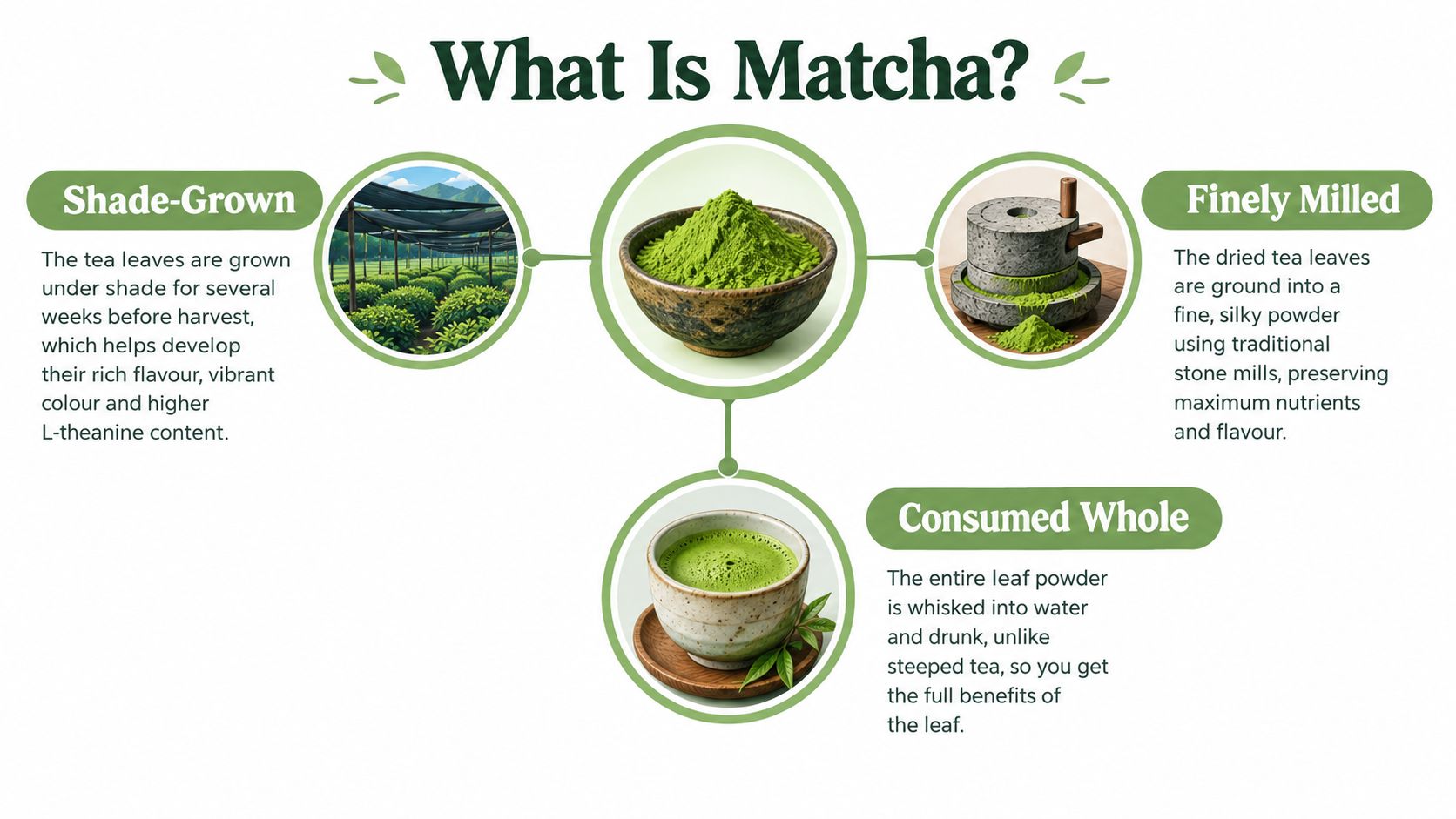
Start in the field, a few weeks before harvest. Growers cover the tea bushes so the leaves develop in reduced light. Australian academic researchers describe matcha leaves as typically cultivated under approximately 90% shade before harvest in their review of matcha bioactive compounds and analytical techniques.
That shade changes how the plant works. With less light, the leaf produces and retains more chlorophyll, which supports the deep green colour. Shading also reduces light-driven catechin formation while helping preserve or increase L-theanine and caffeine, two compounds that shape matcha's savoury, smooth character.
From Leaf to Tencha
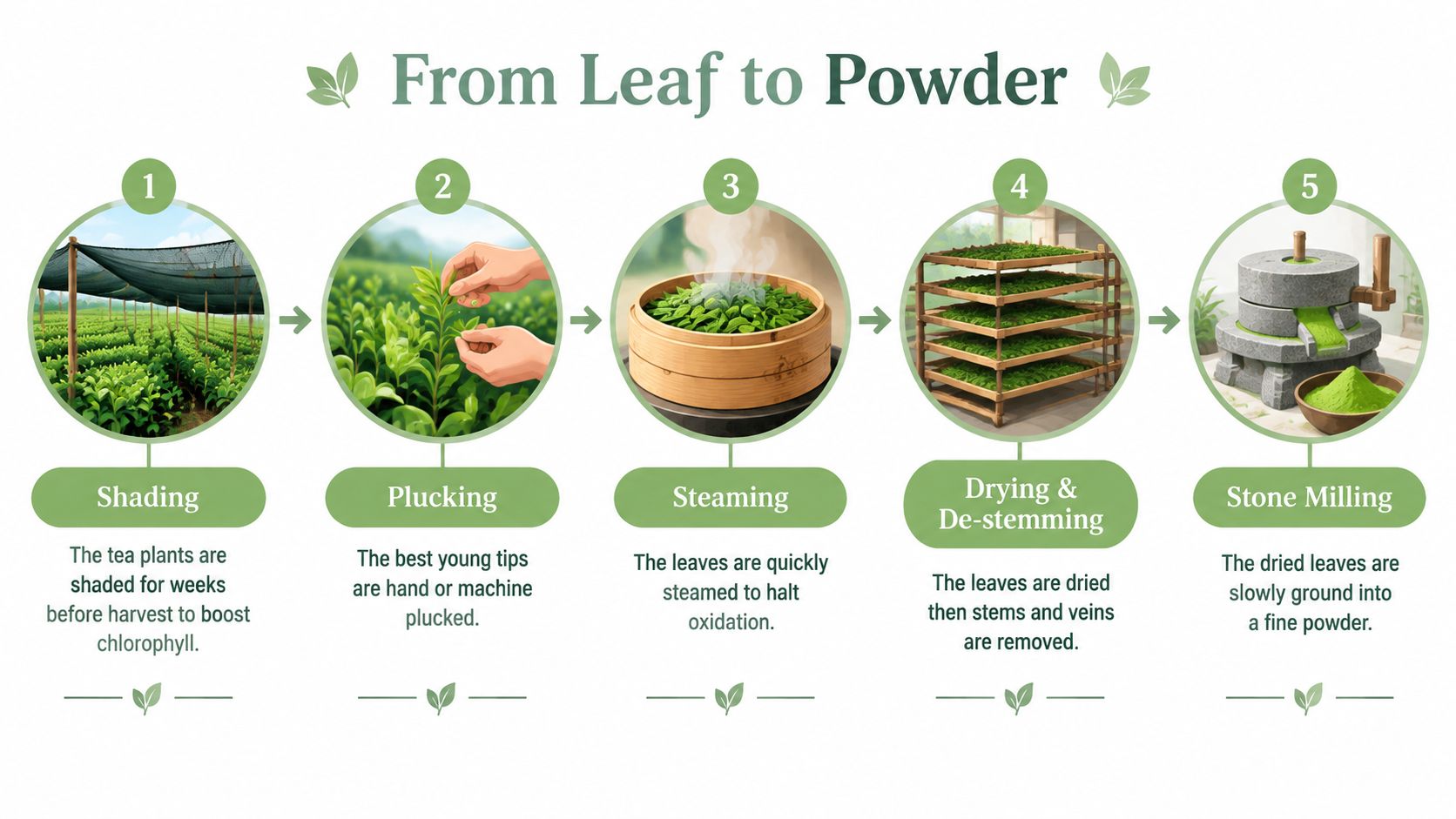
At harvest, growers pluck young leaf material by hand or machine, depending on the farm and grade. The fresh leaves are steamed quickly to halt oxidation. That quick steam helps keep them green, much as blanching vegetables sets their colour, although tea handling is more delicate.
The steamed leaves are then dried and sorted. Stems and larger veins are removed, leaving flat, flaky leaf material called tencha. Think of tencha as a brittle green tea biscuit, dry and fragile, waiting to be reduced to powder. It isn't the finished product yet, and you wouldn't brew it the same way as loose-leaf sencha.
This intermediate step matters when you shop. A powder ground from whole, unspecified green tea leaves, stems included, may look green in a smoothie but taste harsher and feel coarser. Proper matcha starts with leaf material prepared for milling.
Milling the Powder
Producers mill tencha slowly into powder, traditionally between granite stones. Slow milling creates a fine particle size and limits heat. The result should feel silky, clump lightly because it's so fine, and whisk into a smooth suspension rather than a gritty drink.
Fine milling also explains some of the cost. Shading, careful plucking, steaming, drying, sorting and gradual grinding add labour at every stage. A very cheap tin isn't automatically poor, but there's a production reason genuine matcha rarely behaves like a bulk culinary colouring.
If you're explaining it to a friend, keep it to three ideas. The plants are shaded, the leaves are steamed and dried into tencha, and that tencha is milled so you can consume the leaf itself. Everything else, from grade names to café lattes, builds on that sequence.
Matcha Compared to Steeped Green Tea
The practical question is why you'd bother with powder when a tea bag is easier. The answer isn't that matcha is automatically better. It's a different format with a different dose, texture, flavour and routine.
Steeped green tea gives you compounds that move from leaf into water during brewing. Matcha gives you the compounds present in the weighed leaf material, including parts that don't extract fully into an infusion. That's why two drinks from the same plant can feel noticeably different.
| Factor | Steeped green tea | Matcha powder |
|---|---|---|
| What you consume | Water infused with leaf compounds | The suspended powdered leaf itself |
| Dose control | Leaf amount, water and steeping time | Mainly grams of powder used |
| Flavour | Lighter, often grassy or bitter | Fuller, savoury and creamy when well made |
| Texture | Clear liquid | Opaque, frothy suspension |
| Equipment | Bag, pot or infuser | Bowl or cup, whisk or frother |
| Best use | Simple hot or iced tea | Whisked tea, lattes, smoothies and baking |
What Changes in the Cup
Because you consume the leaf, matcha generally contains catechins, L-theanine and caffeine at higher levels than green tea infusions. Concentrations still vary substantially with cultivar, shading, growing conditions, processing and test method. Bright colour alone can't tell you the exact potency of a tin.
That variability is important for cafés and home users who want consistency. Supplier specifications or batch testing give you a firmer basis for standardising a recipe than the word ceremonial on packaging. At home, weighing your serve is the simplest consistency tool you have.
Flavour shifts too. Steeped green tea is clear and light, and over-steeping can make it bitter. Well-made matcha has body because the powder remains in the drink. You may notice sweetness and umami before bitterness, especially with powder intended for drinking straight.
Keeping Health Claims Grounded
The Australian Dietary Guidelines on green and black tea catechins and cardiovascular risk factors identify green and black tea as sources of polyphenols called catechins and state that consumption of green and black tea is associated with a reduced risk of stroke. The guidelines also describe catechins as compounds reported to influence factors including hypertension, atherosclerosis, thrombogenesis, nitric oxide production and endothelial health.
Those statements support describing matcha as a concentrated green tea powder containing tea polyphenols. They don't prove matcha cures disease, and they don't turn every antioxidant claim on social media into clinical evidence. The cited association concerns green and black tea consumption generally.
Caffeine also needs context. FSANZ reports a caffeine concentration range of 0 to 90 mg per 100 g for tea in its assessment of tea as a naturally occurring caffeine source. For matcha, the amount you consume depends on the grams of powder, the product composition and the serving size.
Cost per cup typically rises with matcha because production is more involved and there's no discarded leaf carrying unused material away. In exchange, you get a format that works in milk, baking and cold drinks in ways a tea bag can't. Choose steeped tea for simplicity, matcha for concentration and versatility. Neither choice needs hype to justify it.
How to Choose Quality Matcha in Australia
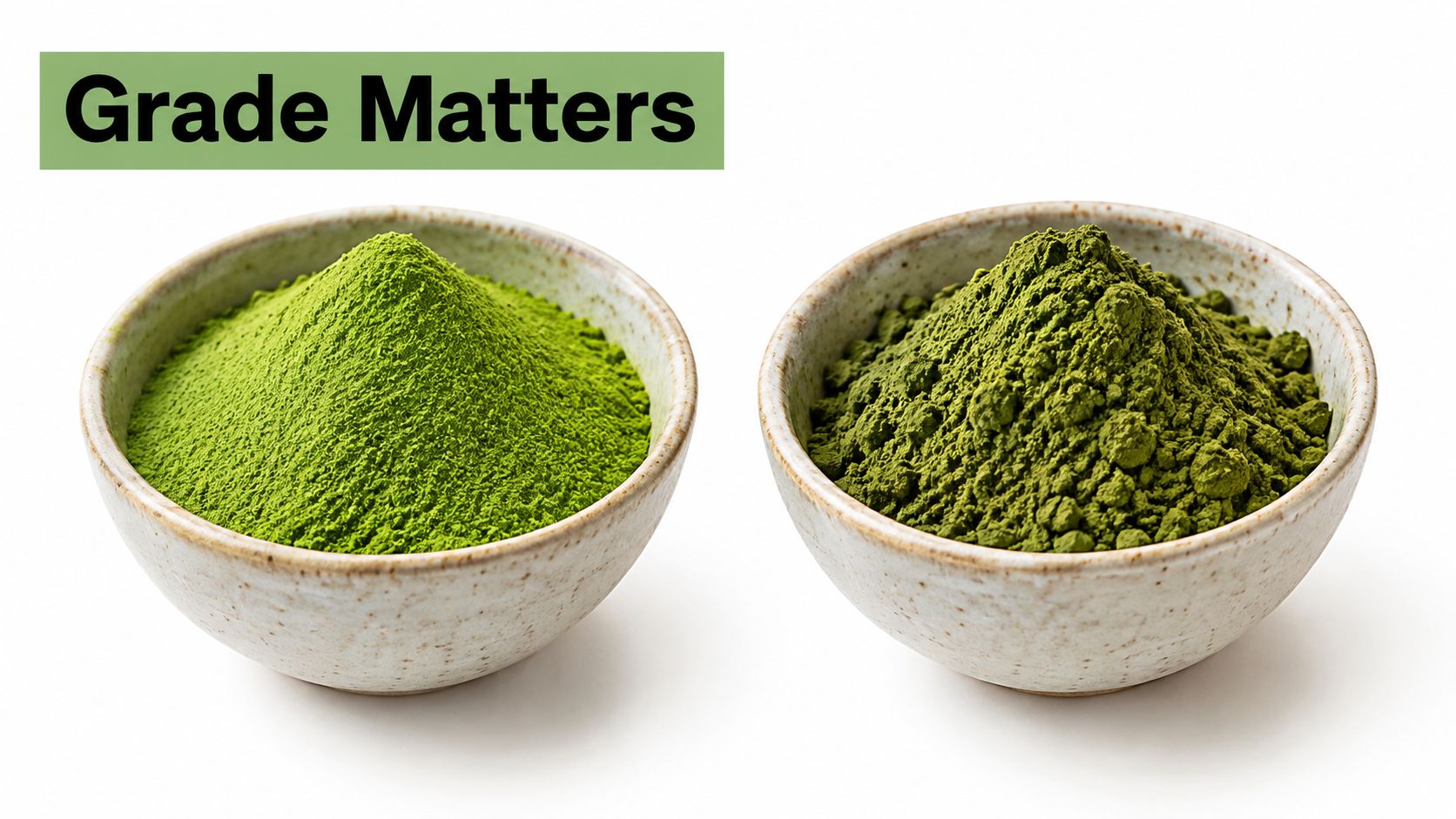
A useful starting point is intended use. Ceremonial grade usually signals matcha selected for whisking with water, where sweetness, fine texture and low bitterness matter. Culinary grade is generally intended for milk drinks, smoothies and baking, where stronger flavour and lower cost are practical. These labels aren't a guarantee by themselves, so treat them as a category, not proof.
If you're deciding between them for home or café use, our guide to ceremonial and culinary matcha grades sets out the practical differences. The short version is to buy for the job. A delicate drinking powder can disappear under sweetened oat milk, while a sturdy culinary powder can taste rough as straight tea.
Reading an Australian Label
- Country of origin: Check where the tea was grown, not only where it was packed.
- Ingredient purity: Look for matcha as the ingredient, without unnecessary fillers or sweeteners.
- Certification: If organic matters to you, look for recognised certification details.
- Batch information: Harvest, milling or batch details support traceability.
- Storage guidance: Powder should be protected from air, light, heat and moisture.
Colour helps, but it isn't the whole test. A dull, yellowish or brownish powder may be older, less carefully processed or made from leaf material that wasn't handled as tencha. A vivid green is promising, yet it still can't confirm caffeine content, nutrition or purity.
Why Origin and Price Have Shifted
Australia's wider green tea supply is import-dependent. In 2024, Australia imported approximately 2,135,520 kilograms worth about US$20.62 million in packings of 3 kg or less, according to Australian import data for small-pack green tea by partner country. India supplied the largest volume at 1,253,690 kilograms, while Japan supplied 155,951 kilograms valued at approximately US$4.39 million in that same category.
Demand for Japanese tea has also tightened. SBS reported Japan exported 195,319 kg of green tea to Australia from January through August 2025, a 131% year-on-year increase, while tencha reached 8,235 yen per kilogram at a Kyoto auction in May 2025, up 170% year on year, in its reporting on Australia's matcha boom and Japanese supply pressure. Those figures help explain price changes, gaps on shelves and substitution risk.
This short video is a handy visual check on how different powders can look before you commit to a larger bag.
We stock PepTea organic Japanese matcha as one Australian retail example, but the same checks apply to any supplier. Ask what's in the tin, where it came from, how it's packed and whether the grade suits your drink. Green flags are clear origin, pure ingredients, fine texture, fresh aroma and sensible storage advice.
Preparing and Using Matcha at Home
Start with weight, not guesswork. A spoonful varies with how tightly the powder packs and how fine it is. A small kitchen scale helps you repeat a drink you like and adjust caffeine exposure in a predictable direction. Use more powder for stronger flavour, less for a gentler cup.
Water should be hot but not boiling. Boiling water can push matcha toward bitterness and flatten its aroma. Let the kettle sit briefly, add a little water first to make a paste, then whisk in the rest.
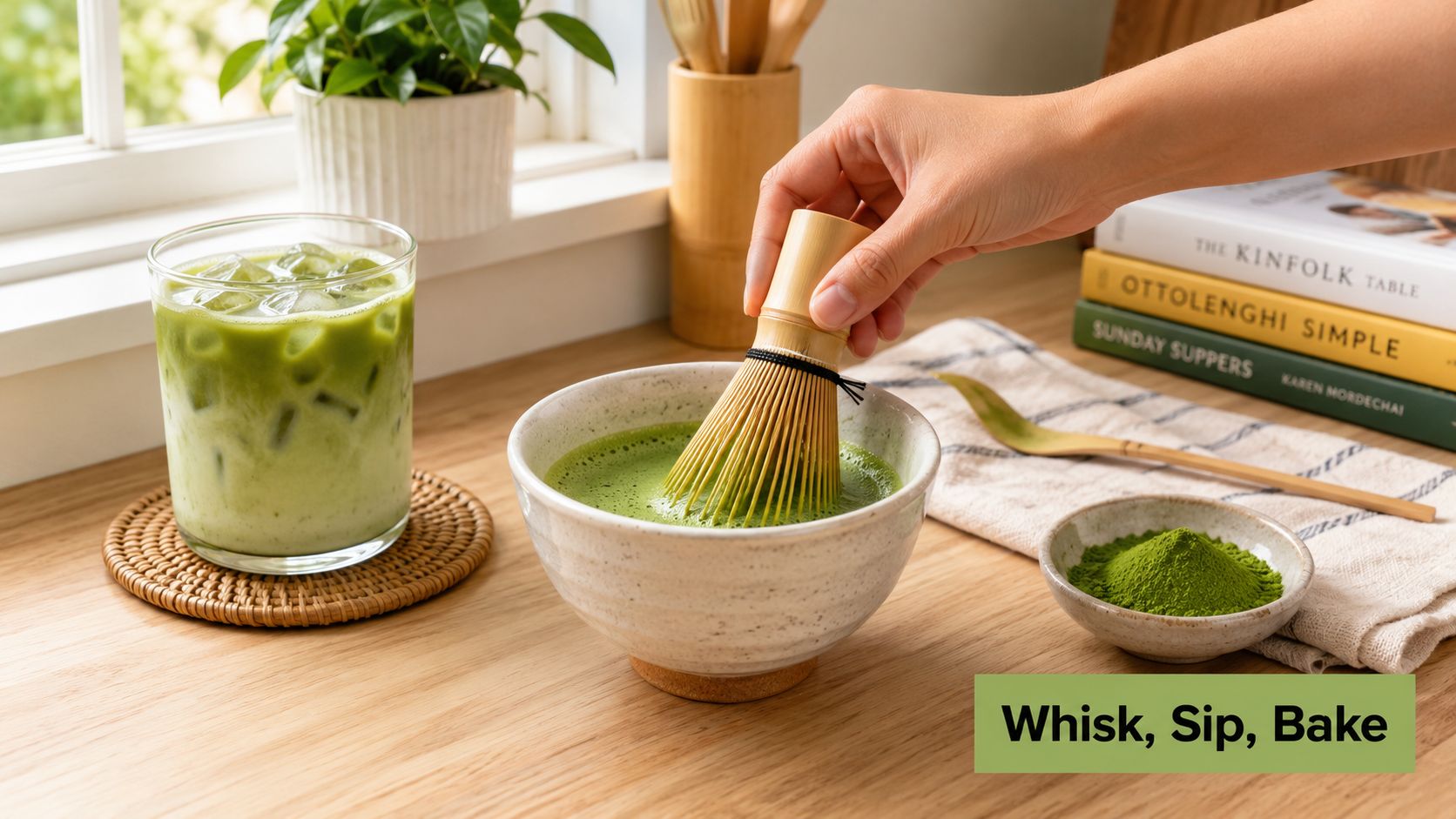
Three Ways to Use One Tin
- Whisked tea: Sift the powder into a bowl, add warm water and whisk briskly until frothy. A smoother drinking grade earns its place here.
- Hot or iced latte: Whisk the powder into a concentrated paste, then add steamed milk or pour over cold milk and ice. A culinary grade often stands up better to milk.
- Smoothies and baking: Blend or mix the powder through yoghurt, banana, batter or icing. Match the amount to the total recipe so one serve doesn't become unexpectedly strong.
A bamboo whisk is designed to break clumps and create foam, but a small handheld milk frother can work for lattes. Sifting first makes either tool more effective. If you want the bowl technique in detail, our step-by-step guide to whisking matcha shows the motion and common fixes.
Practical rule: Make a smooth paste with a splash of water before adding the full amount. Most clumps start because dry powder met a full cup at once.
Matcha behaves differently once other ingredients arrive. In a latte, milk softens bitterness and rounds out the grassy notes. In baking, heat and sugar mute freshness, so culinary powder usually makes more financial sense. In a smoothie, fruit can cover a delicate grade completely.
For savoury cooking, use a light hand. A small amount whisked into a dressing, soup finish or noodle broth adds colour and a tea note without turning the dish into dessert. Add it late where possible, taste, then decide whether the recipe needs more.
Store the tin sealed in a cool, dark place and use a dry spoon. Once opened, smaller amounts bought more often can taste fresher than a large bag kept beside the kettle. Good preparation can't rescue stale powder, but careful storage protects the powder you've paid for.
Caffeine, Calmness and Who Should Be Careful
The phrase calm energy needs unpacking. Matcha contains L-theanine as well as caffeine, and many drinkers experience it differently from coffee. That doesn't mean the caffeine stops acting like caffeine. Sensory smoothness isn't a safety standard.
A teaspoon isn't a standard dose. Powder mass changes with scooping, particle size and recipe, and composition changes with cultivar, harvest and processing. If caffeine matters to you, weigh the serve and check supplier information rather than judging by colour or flavour.
Australian Safety Context
FSANZ states naturally occurring caffeine in foods such as tea is typically no more than 100 mg in a standard serving, and acute intake up to 200 mg is not generally associated with safety concerns in healthy adults, in its caffeine advice for Australian consumers. The same advice reports evidence of increased anxiety in children at approximately 3 mg/kg body weight per day and notes caffeine was consumed by 87% of Australians in national dietary survey day-one data.
For pregnancy, Australian public health guidance recommends limiting total caffeine intake to about 200 mg per day, as summarised in the FSANZ material on caffeine sources and pregnancy guidance. Matcha counts toward that total together with coffee, tea, chocolate, soft drinks, energy drinks and caffeine-containing medicines.
If you want to place tea drinks in that wider budget, our overview of caffeine content in green tea is a useful companion. The key habit is counting the whole day, not treating each café drink as isolated.
Who Should Take Extra Care
- Children: Don't assume a sweetened matcha latte is caffeine-free because it's milk-based.
- Pregnant people: Add matcha to all other caffeine sources for the day.
- People with anxiety or sleep sensitivity: Start small and avoid late-day serves to see how you respond.
- Café operators: Standardise grams per serve and retain supplier documentation.
- Anyone using medicines or supplements: Check labels and seek professional advice if you're unsure.
Matcha is a naturally caffeinated food, not a concentrated caffeine powder. FSANZ states solid or semi-solid foods containing 5% or more caffeine, equivalent to at least 50 mg caffeine per gram, are prohibited from retail sale to the public in its guidance on caffeine powders and high-caffeine foods. That restriction targets highly concentrated products and doesn't prohibit naturally occurring caffeine in ordinary tea.
The sensible middle ground is simple. Enjoy matcha as tea, portion it by grams, and don't let L-theanine marketing erase the caffeine line in your daily total.
Bringing Matcha Into Your Daily Routine
You now have the core picture. Matcha is shade-grown green tea, steamed and dried into tencha, then milled into powder and consumed whole. It differs from steeped tea in dose and texture, not because it's a mysterious new plant.
That understanding makes daily use easier. Choose grade by purpose, check origin and ingredients on the label, weigh your serve, and use water below boiling for drinking tea. Treat the powder as a caffeinated ingredient, especially when a recipe serves children or someone tracking pregnancy limits.
A Week That Makes Sense
Try a small whisked serve on mornings when you want tea instead of coffee, and notice how timing affects your sleep. Use a culinary powder for weekday iced lattes, where milk and ice need a stronger tea flavour. Keep baking for the weekend, when you can share portions and judge how much powder the recipe needs.
Start with one repeatable serve, weighed the same way each time. Adjust only one thing, powder, water or milk, until it suits your taste.
For Australian households, freshness and traceability are practical quality markers. Buy a size you'll finish while it still smells fresh, store it away from kettle steam, and ask suppliers direct questions when labels are vague. A higher price doesn't automatically mean stronger nutrition, and a famous grade name doesn't replace batch information.
Matcha works best when it fits your routine rather than chasing a perfect ritual. A reliable morning bowl, a café-style latte at your desk, or green buttercream for a family bake all count. Once you understand what is matcha tea powder and how it's made, you can choose the format that earns its place in your kitchen.
Ready to try a tin with clear Japanese origin and organic certification for whisking, lattes or baking at home? Explore the matcha range at Pep Tea, choose the grade that matches how you will use it, and start with one weighed serve you can repeat with confidence.
Organic Matcha Green Tea Powder Australia: A Full Guide 2026
Certified organic matcha sold in Australia is generally imported from Japan rather than grown locally at commercial scale. Australia's certified organic agricultural land increased by 48.9% between 2021 and 2022, while the country has more than 53 million hectares of certified organic farmland, about 12.4% of its agricultural land. IndexBox's Australian matcha market overview provides the market context, but those figures describe organic agriculture overall, not domestic matcha production.
You may be standing at a café counter with a new matcha latte on the menu, or comparing tins online after deciding that your usual green tea doesn't deliver the colour or flavour you want. The search for organic matcha green tea powder Australia often creates one immediate confusion: Australian availability doesn't mean Australian origin. The tea may be imported, while the business selling, testing, distributing and educating customers operates locally.
That distinction matters because matcha is a whole-leaf powder. Unlike a brewed infusion, the leaf isn't removed after steeping. Organic certification can help verify how the tea was grown and handled, but it doesn't automatically tell you whether the powder is fresh, potent, well processed or suitable for your recipe. The useful question isn't only whether a tin says “organic”. It's whether the product has a traceable origin, credible certification, suitable grade and testing that matches the risks you need to manage.
Finding Quality Organic Matcha in Australia
A café owner in Newcastle may need a vivid green latte that dissolves cleanly. A home baker in Melbourne may want a stronger powder that remains noticeable in oats, icing or banana bread. Searching for organic matcha green tea powder Australia brings up products with different origins, grades, certification records and handling practices.
For Australian buyers, the local part of the supply chain usually involves importing, distribution and hospitality, rather than cultivation. Matcha is generally imported from overseas tea-growing regions, particularly Japan, where shaded tea leaves are processed into tencha and stone-ground into powder. National organic farmland data can show that Australia has established certification systems and traceability practices, but it does not prove that a product is Australian-grown matcha. The Australian matcha market context helps clarify the difference between local availability and domestic production.

What Australian buyers should look for
A reliable product description gives you several points to check instead of relying on one premium-sounding claim.
- Country and region of origin: “Japan” identifies the country, while a named region gives more supply-chain detail.
- Certification identity: Check the certifier, certificate number and certification scope. Ask the importer for its ACO or JAS certificate number, then verify it through the certifier's public database before purchasing.
- Grade and intended use: Powder for whisking may not suit a café producing large volumes of lattes.
- Lot traceability: A lot number should connect the retail pack with supplier records and relevant testing.
- Storage information: Light, heat, air and moisture can affect matcha, so packaging and handling influence the final cup.
“Ceremonial grade” can indicate intended use, but it is not a universal government-controlled matcha grade. Assess colour, aroma, texture and flavour alongside the label. Fresh matcha should smell clean and vegetal, disperse finely and avoid a harsh, stale or dusty finish.
For an Australian supplier presenting its range and product details, compare the Pep Tea matcha tea powder collection with the documentation supplied by other sellers. The practical goal is a powder with an identifiable origin, verifiable certification, suitable handling information and a flavour profile you can explain to customers.
Ceremonial vs Culinary Matcha Grades Explained
“Ceremonial” and “culinary” are practical buying terms, not a complete quality-control system. In Japan and internationally, “ceremonial grade” doesn't have one universal regulated definition, so a buyer should still examine origin, harvest information, processing, freshness and test documentation.
Ceremonial-style matcha is usually selected for drinking directly with water. It tends to be brighter in colour, finer in texture and more rounded in flavour, with an umami character that can stand on its own. Culinary matcha is usually chosen for recipes where the powder must remain noticeable beside milk, fruit, oats, flour or sweetener. It can have a more assertive bitterness and a less delicate finish, which may be an advantage rather than a defect.
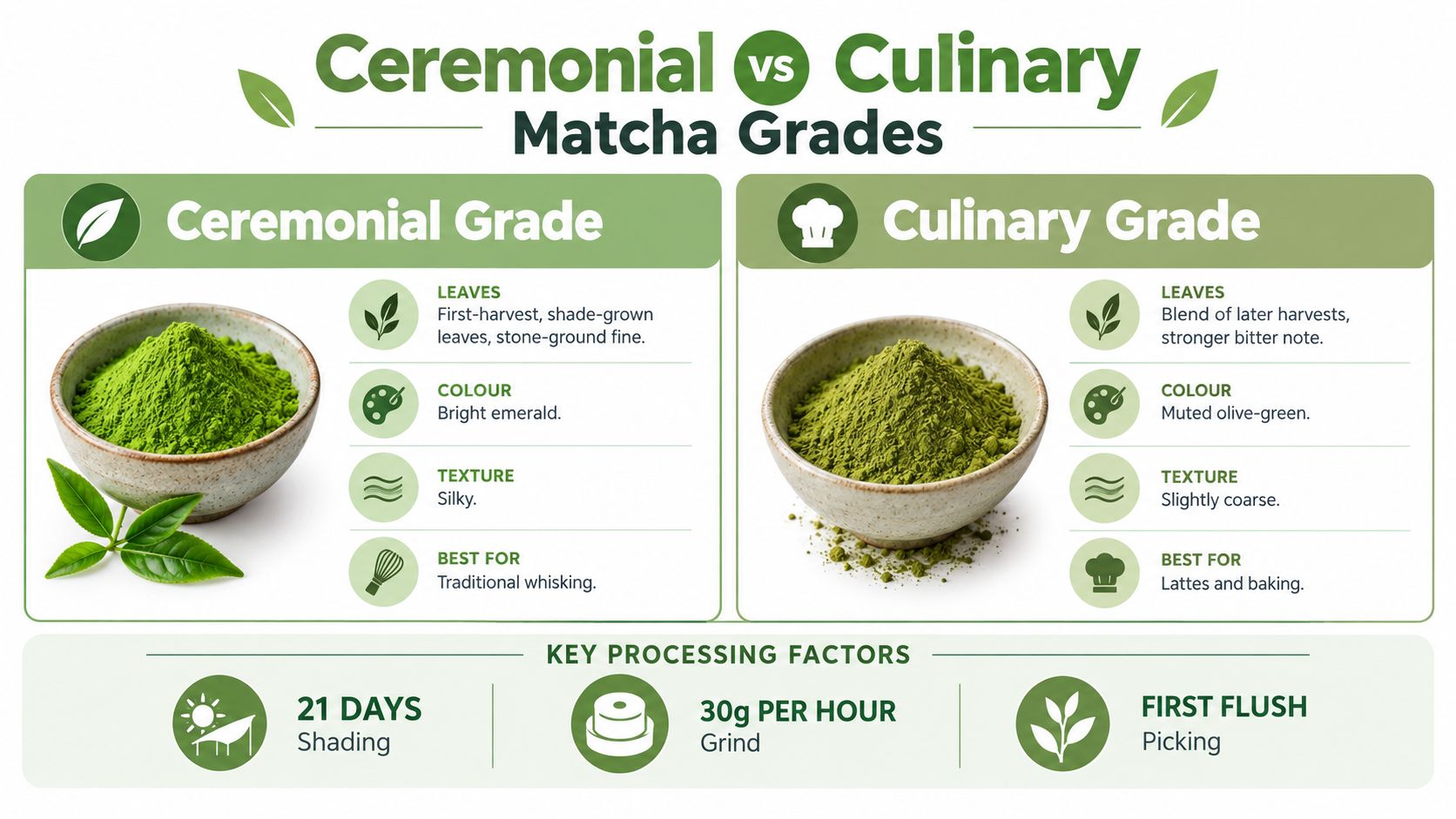
How processing changes the cup
Tea plants used for matcha are shaded before harvest, then processed into tencha, with stems and veins removed before grinding. Shading can influence the leaf's colour and flavour, while cultivar, harvest timing and processing also affect the powder's chemical composition. The Western Sydney University review of matcha's bioactive compounds reports that matcha generally contains catechins, L-theanine and caffeine, but concentrations vary substantially between products.
Stone-grinding is associated with a fine powder and a smooth mouthfeel. However, the phrase “stone-ground” isn't enough to prove that a matcha will taste good. A powder may have been well processed and still be old, poorly stored or unsuitable for the drink you're making.
Try the following comparison:
| Matcha grade | Best for | Key characteristics |
|---|---|---|
| Ceremonial-style | Traditional whisking, thin tea and direct drinking | Brighter colour, fine texture, softer bitterness and a flavour designed to be enjoyed with water |
| Culinary-style | Lattes, smoothies, baking, desserts and sauces | More robust flavour, stronger bitterness and enough presence to work with other ingredients |
Choose by application, not status
A delicate ceremonial-style powder can taste excellent in a bowl but become wasteful in a strongly flavoured latte. Milk, ice and sweeteners can mute subtle notes, so a practical culinary powder may perform better while keeping the menu cost under control.
The reverse problem appears in direct drinking. A coarse or bitter culinary powder whisked with water can leave astringency on the tongue, especially if the water is too hot or the powder is poorly stored. That doesn't mean culinary matcha is inferior. It means the product has been selected for a different job.
Organic status addresses farming and handling standards, not whether a powder is ceremonial-style, culinary-style, mild, strong, fresh or compositionally consistent. For serious café purchasing, ask for the supplier's intended use, batch information and preparation recommendation. The Pep Tea guide to ceremonial and culinary matcha can sit alongside a sensory trial, where staff prepare both powders using the same recipe and taste them in the actual menu format.
One final caution concerns caffeine. Matcha is powdered tea, so the amount consumed depends on powder mass, cultivar, processing and preparation. A supplier shouldn't present a single caffeine number as universal for every tin or serve.
Understanding Organic Certification and Standards
A café can receive a bag labelled “organic” without knowing how that claim was verified. Organic claim and certified-organic status are different. Australian domestic organic sales do not always require mandatory certification, while a business using a certified-organic label must ensure the product meets the stated arrangement. The Australian Government describes AS 6000-2015, the Australian Standard for organic and biodynamic products, as covering production, processing, storage, transport, labelling and importation. The government's organic and biodynamic factsheet explains why checks need to extend through the supply chain, not stop at the farm.
Certification answers one set of questions
Certification verifies the production system, permitted inputs and relevant handling practices. It can support claims about how tea was grown, processed and represented, provided the finished imported product falls within the applicable certification arrangement. For an Australian buyer, the certifier, certificate holder, product scope and import documentation all matter.
See how certification is verified locally in the Pep Tea guide to organic certification in Australia.
Certified status does not establish that every powder has the same caffeine level, catechin profile, moisture content, colour or flavour. The Western Sydney University review found variable bioactive profiles in commercially marketed matcha from different countries. Organic certification is therefore a baseline for production claims, not a guarantee of potency or consistency.
For a café, use separate checks for separate decisions:
- Certification: Was the product produced and handled under the stated organic standard?
- Composition testing: What does this batch contain in terms of caffeine and selected compounds?
- Contaminant testing: Has this batch been assessed for hazards such as heavy metals, pesticides or microbes?
- Sensory evaluation: Does the powder meet the flavour, colour and texture required for the menu?
Certification verifies the production system; laboratory testing verifies what is in this specific lot. Sensory evaluation then shows whether the powder performs in the intended drink. A certificate cannot tell you whether a matcha is too bitter for a latte, while a taste test cannot establish organic status.
Read labels with appropriate caution
The word “natural” offers less verification than a named certification system. A credible pack should identify the product, importer or responsible business, origin and relevant certification information so those details can be checked against supplier records.
Matcha uses the whole leaf, so it is consumed as a powder rather than brewed and discarded. The Food Standards Australia New Zealand caffeine advice distinguishes naturally occurring caffeine in tea from concentrated caffeine products. Organic certification does not make matcha caffeine-free or establish a particular physiological effect.
Businesses should keep certification separate from health marketing. Matcha may contribute naturally occurring tea compounds to the diet, but claims about immunity, detoxification, metabolism or disease prevention require evidence and careful regulatory review. A clear description of origin, grade and preparation gives customers more useful information than benefits a supplier cannot substantiate.
How to Verify Quality and Sourcing
A responsible matcha purchase starts with paperwork, then moves to the powder itself. This approach works for a home buyer comparing tins and for a café owner assessing a wholesale supplier.
Ask for the documents that connect product to batch
Request the following information before committing to a large order:
- A current certificate of conformity. Check the certifier, certificate holder, product scope and validity.
- Country and region of origin. A named Japanese region is more informative than an unexplained “imported” claim.
- Lot number. Confirm that the lot on the pack matches the supplier's documentation.
- Testing date. Recent testing is more useful when it clearly identifies the tested lot.
- Laboratory scope. Find out whether the report covers heavy metals, pesticide residues, microbiological quality and other relevant parameters.
- Product specification. Ask for storage conditions, recommended serving mass, grade, packaging and expected shelf life.
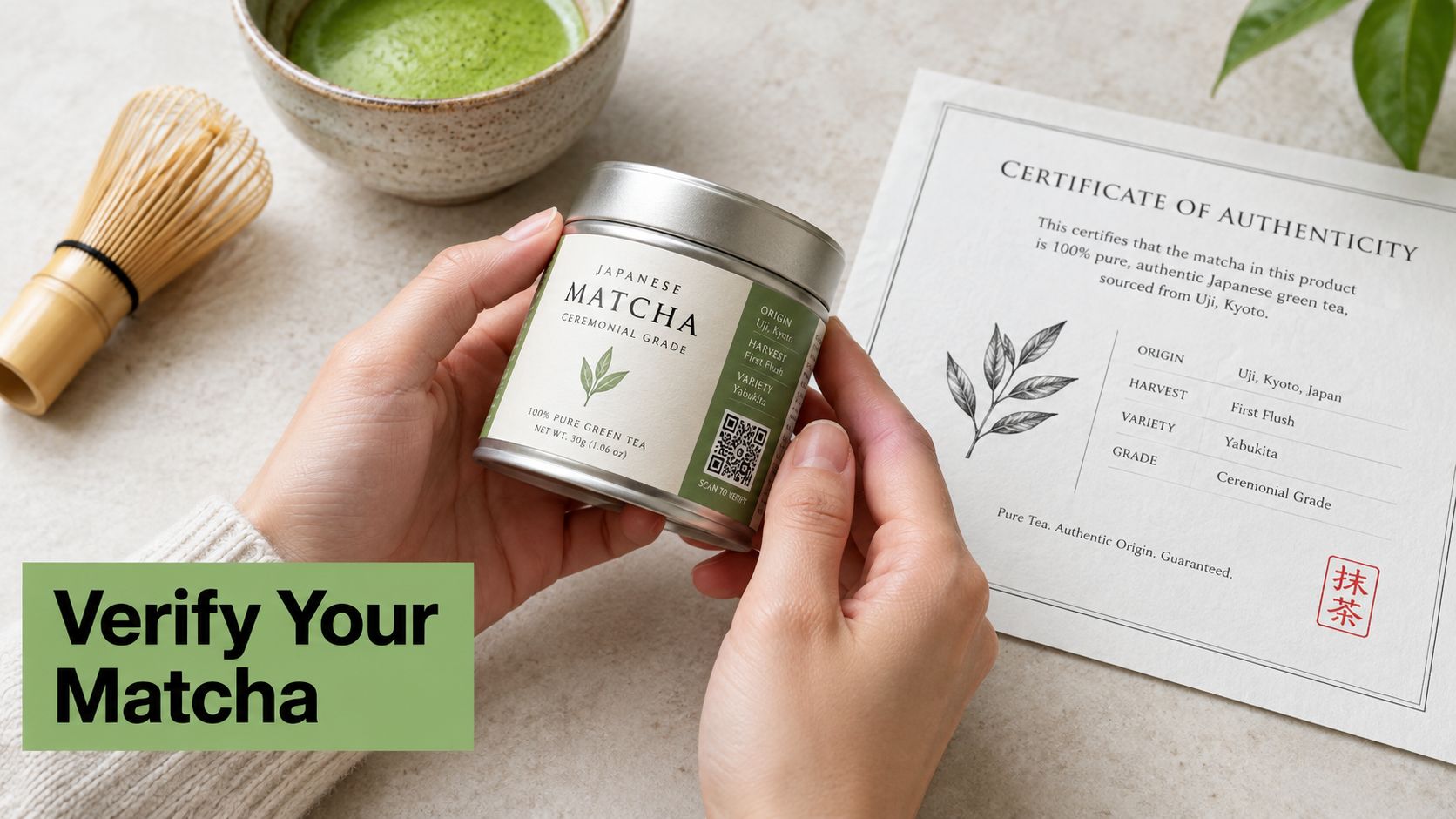
A certificate of conformity is valuable, but it shouldn't be treated as a complete safety report. Organic certification and laboratory testing answer different questions. The certification concerns the production system. Laboratory analysis tests selected hazards or compositional features in a particular sample.
Interpret testing without overclaiming
The available Australian regulatory material doesn't establish one simple matcha-specific consumer threshold for every concern a shopper may have, including lead, cadmium, pesticides and microbial hazards. That's why suppliers should be precise about what was tested, by which method, on what date and for which lot, rather than writing “fully tested” without detail.
For cafés and retailers, the Western Sydney University review recommends batch-level testing where possible, ideally using validated HPLC or UPLC methods for caffeine and major catechins such as EGCG, alongside checks for moisture, microbiological quality and heavy metals. The practical reason is straightforward: colour and sensory grade can't reliably predict functional composition.
Practical rule: Certification tells you how the product was produced. A laboratory report tells you what a particular test found. Keep both records.
Taste and storage remain part of verification
Open the pack and inspect the powder. A lively green colour, fresh aroma and fine texture are useful signs, while dull colour, stale odour, visible moisture or persistent clumping deserve questions. These observations don't replace laboratory testing, but they can reveal poor storage or age.
Keep the powder sealed, away from heat, light, air and moisture. A café should also record when a pack was opened and use a consistent recipe. If one barista uses a light spoonful and another uses a heavily packed scoop, customers won't receive a consistent drink, even if the underlying matcha is sound.
Australian Use Cases and Product Selection
Australian matcha works best when the grade matches the service format. A home user drinking a small bowl with water has different needs from a café building an iced latte, and a food manufacturer needs documentation that a casual buyer may never request.
Matcha preparation at home and in cafés
For direct drinking, sift the powder into a bowl, add warm water and whisk until the surface becomes lightly foamy. Water that's too hot can exaggerate bitterness, so use comfortably hot rather than boiling water. The right technique won't rescue stale matcha, but it can prevent avoidable clumping and harshness.
For a latte, dissolve the powder in a small amount of warm water first, then add milk or a plant-based alternative. Culinary-style matcha usually makes economic and sensory sense here because its stronger flavour can hold up against milk, ice and optional sweetener. Keep the drink unsweetened if the aim is to provide a low-sugar menu option, and let customers choose additions separately.
This video demonstrates a practical preparation approach for customers and café teams:
The same powder can be used in a smoothie with banana and oats, folded into yoghurt, blended into ice cream or added to baking. Heat and strong ingredients change the final flavour, so a powder that tastes slightly assertive on its own may be the better recipe ingredient.
| Matcha grade | Best for | Key characteristics |
|---|---|---|
| Ceremonial-style | Bowl preparation and simple iced matcha | Fine texture, vivid colour and a balanced flavour that remains exposed |
| Culinary-style | Café lattes, smoothies and baking | More pronounced tea flavour and better compatibility with milk or food |
Matcha alongside kombucha
Matcha and kombucha serve different roles. Matcha is a powdered tea ingredient that contributes tea flavour and naturally occurring caffeine. Kombucha is a fermented beverage requiring controlled acidity, clean equipment, reliable cultures and documented process monitoring.
FSANZ identifies kombucha as a beverage requiring careful control. The initial tea infusion is typically around pH 5, and it should be cooled from 60°C to 20°C within two hours. During fermentation, acidity should reduce the drink to pH 4.2 or below, while the finished beverage should generally remain at pH 2.5 or above and below 1% alcohol. These controls are set out in FSANZ's kombucha guidance.
That difference matters for cafés. A properly fermented sugar-free kombucha can provide an alcohol-free, low-sugar menu option, but “fermented” alone doesn't prove that the drink was made safely or contains no residual sugar. Read the nutrition information and ask how the producer manages acidity, alcohol and hygiene. Pep Tea offers organic Japanese matcha and Australian-brewed organic kombucha from the Hunter Valley, NSW, as separate beverage options rather than treating them as interchangeable products.
Australian beverage menus can also use matcha and kombucha in different dayparts. A matcha latte suits a morning or afternoon service, while chilled kombucha can work as a refreshing alternative to soft drinks or alcohol. For venues managing customer questions at scale, drink industry chatbot examples can help inspire ways to organise menu information, ingredient answers and service workflows without replacing staff knowledge.
Your Organic Matcha Shopping Checklist
Use this checklist before buying organic matcha green tea powder in Australia:
- Confirm the origin: Look for Japan and, where available, a named region.
- Verify the certification: Ask which certifier issued it and whether the finished imported powder is covered.
- Match grade to use: Choose ceremonial-style powder for direct whisking and culinary-style powder for lattes, smoothies and baking.
- Request batch details: Certificate, lot number, testing date and product specification should connect to the pack.
- Separate certification from testing: Organic status doesn't replace independent checks for heavy metals, pesticide residues or microbiological quality.
- Ask about caffeine: A serving's caffeine depends on powder mass, cultivar, processing and preparation. Healthdirect Australia's caffeine guidance gives healthy adults a general daily upper guideline of around 400 mg, but that isn't a target and doesn't suit every person.
- Inspect the powder: Fresh aroma, fine texture and lively colour support a better drinking experience.
- Check storage: Heat, light, air and moisture can reduce freshness after importation.
If you're presenting products online or building a café menu, strong photography should show the powder, colour, preparation and serving context accurately. A practical food product photography workflow from MerchLoom can help teams organise those visual assets without making unsupported claims about the product.
Pep Tea offers organic Japanese matcha in grades suited to direct drinking, café lattes and culinary use, alongside Australian-brewed organic kombucha from the Hunter Valley, NSW. Visit Pep Tea to compare the range, review product details and enquire about options for your home, café or wholesale menu.
Matcha Tea Powder Australia: The Complete Buyer’s Guide
Australia's matcha imports jumped 62.91% from 2023 to 2024, showing how quickly local demand for Japanese-style matcha powder is rising. If you're buying matcha tea powder in Australia, the important question isn't which packet looks greenest, but whether the grade, origin, testing and supply chain match the way you'll use it.
Matcha now sits at the intersection of café culture, mindful caffeine and practical food preparation. You'll find it whisked with water, blended into iced lattes, folded through baking mixtures and stocked by cafés that need a dependable alternative to coffee. Yet supply shortages and vague grading terms mean Australian buyers need more than a fashionable label.
This guide explains what genuine matcha is, how to compare grades, which technical details matter and how to choose a product that performs consistently at home or in a commercial kitchen.
Why Matcha Is Surging in Australian Pantries
Australia's matcha market was estimated to grow at a 14.94% compound annual growth rate from 2020 to 2024. That rise reflects a shift from occasional café orders to a pantry ingredient used in lattes, baking, iced drinks and home tea routines. (Australian matcha market and import data)
Matcha is entering a market that already has a strong tea habit. Roy Morgan found that, in the 12 months to March 2015, 42% of Australians aged 14 and over bought tea in an average four-week period, compared with 45% who bought coffee. Within tea, 11% bought green tea, while 35% bought regular tea and 8% bought herb or fruit tea. More recent commentary puts green tea at 25% of Australian tea sales in 2023, giving many shoppers a familiar starting point for matcha's flavour and preparation. (Australian tea and matcha consumption context)
Why supply matters to your buying decision
Growing demand does not guarantee steady stock. Australian coverage of the matcha shortage described one venue facing wholesale prices that had tripled, while ordering almost three months ahead was needed to secure supply. Japanese green tea imports into Australia reached 195,319 kilograms between January and August 2025, up 131% year on year, making Australia the eighth-largest export destination for Japanese green tea. (Australian matcha shortage and supply pressures)
Japan remains a major source of premium matcha, especially from areas associated with Kyoto and Uji. Australian buyers therefore depend on harvest conditions, tencha availability, shipping schedules and demand from other countries. The supply chain works like a queue. When harvests are tight or overseas orders rise, a smaller market may wait longer or pay more.
For a home drinker, that pressure may mean a favourite tin disappears from the shelf. For a café, it can require a menu change, a price increase or an explanation to regular customers. Check the powder's origin, the grade suited to your use, whether testing information is available and how quickly the supplier can replenish it.
Practical rule: Choose matcha for the drink you will actually make, then confirm that the supplier can keep providing that grade.
How Shade-Grown Matcha Differs From Regular Green Tea
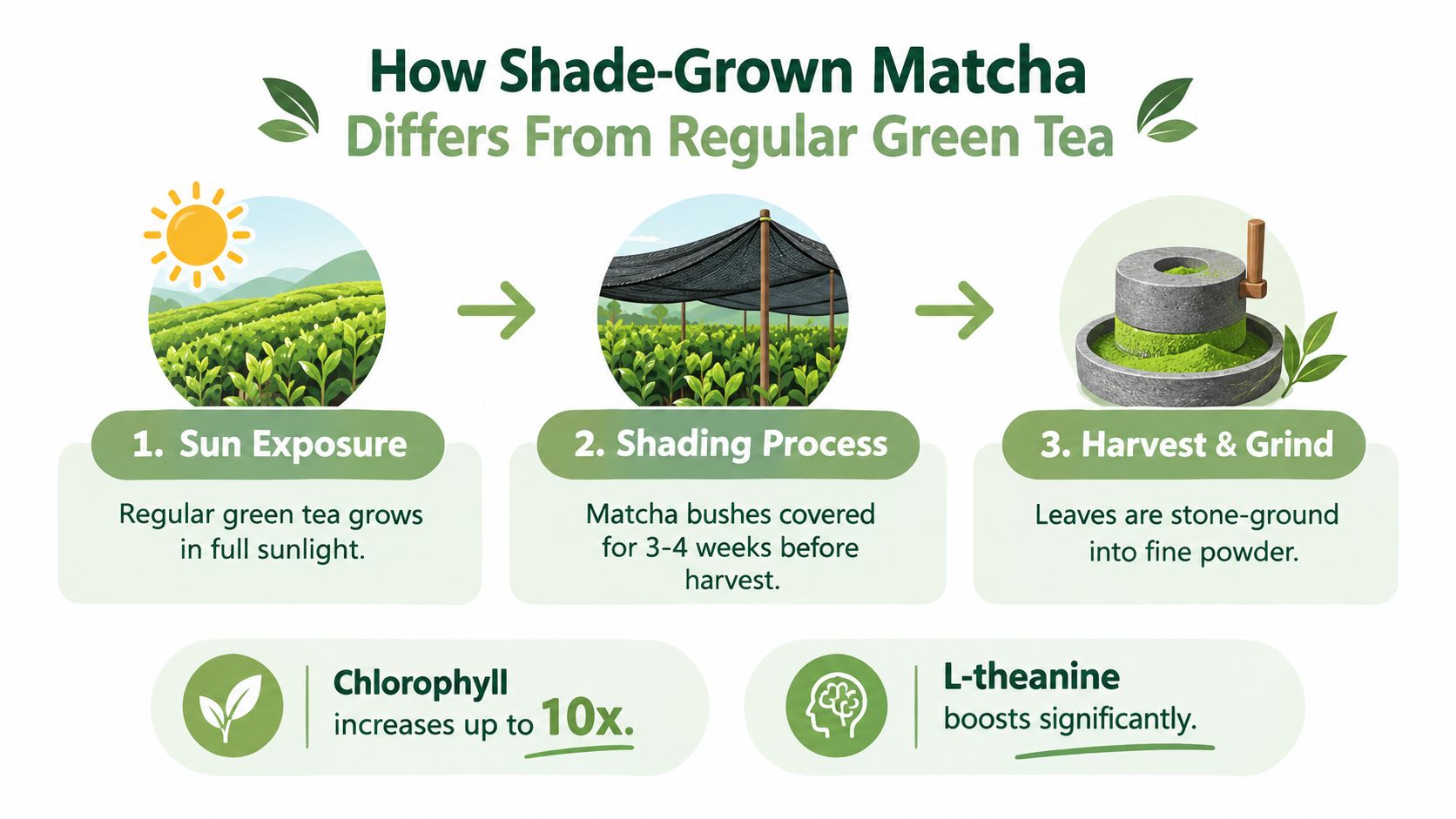
Matcha and regular green tea both come from Camellia sinensis, but they aren't prepared in the same way. With ordinary green tea, you steep the leaves and discard them. With matcha, specially prepared tea leaves are ground into powder, so you consume the leaf rather than only the water-soluble compounds released during steeping.
The key difference begins before harvest. Matcha bushes are shaded for three to four weeks before the leaves are picked. Think of the covering as a curtain that changes the plant's growing conditions. With less direct sunlight, the leaves develop more chlorophyll and L-theanine, which contributes to matcha's vivid colour, savoury umami character and gentler feeling of alertness. (Shade-grown matcha production and serving information)
From leaf to powder
After harvesting, producers process the leaves into tencha, removing stems and veins before milling the leaf material into a fine powder. Traditional stone milling is slow and careful because excessive heat can affect the powder's colour and aroma.
That process explains why matcha behaves differently in a cup:
- Regular green tea gives you a brewed liquid with a lighter body and a flavour shaped by steeping time and water temperature.
- Matcha gives you a suspended powder with a fuller texture, stronger vegetal notes and more direct contact with the leaf.
- Shade-grown matcha often has a rounded umami taste, while poorly prepared or low-quality powder can taste harsh, stale or overly bitter.
Matcha still contains caffeine. An Australian product specification lists approximately 30 to 40 milligrams per 2-gram serving, which is a useful practical reference for cafés and home recipes. (Australian matcha product specification)
The presence of L-theanine doesn't mean matcha is caffeine-free or suitable for everyone. It means matcha offers a different combination of caffeine and amino acids from a standard cup of coffee. If you're sensitive to caffeine, start with a modest serving and pay attention to how your body responds.
For a clearer side-by-side explanation, see how matcha differs from green tea.
Ceremonial Grade Versus Culinary Grade Matcha
The words ceremonial grade and culinary grade are useful shopping shorthand, but they shouldn't be treated as a universal legal or industry grading system. A seller can use these terms differently, so the label should be considered alongside colour, aroma, texture, origin and intended use.
| Feature | Ceremonial Grade | Culinary Grade |
|---|---|---|
| Typical texture | Very fine and smooth | Fine, but selected for mixing into food and drinks |
| Colour | Usually vivid green | Green, with variation depending on origin and processing |
| Flavour | Softer, rounded umami for drinking with water | More assertive flavour that can stand up to milk and other ingredients |
| Caffeine | Contains caffeine, with the amount depending on the product and serving | Contains caffeine, with the amount depending on the product and serving |
| Best use | Straight matcha, thin tea or thick tea | Lattes, smoothies, baking, sauces and desserts |
Choose ceremonial for the plain-water ritual
Ceremonial-style matcha makes sense when you want the powder itself to lead the experience. Whisk it with water and you'll notice its aroma, mouthfeel, sweetness and bitterness without milk or fruit masking the details.
A good example is a quiet morning ritual. Sift the powder into a bowl, add a small amount of warm water, whisk until smooth and then adjust the consistency. At this stage, freshness and fine milling matter most because there are no other ingredients to hide roughness.
Choose culinary for recipes and café drinks
Culinary matcha is often the more practical choice for a latte, smoothie or baked recipe. Milk, fruit, vanilla, chocolate and sweeteners all change the balance of a drink, so a powder selected for blending doesn't need to perform exactly like one intended for sipping on its own.
Use culinary grade for:
- Matcha lattes: Its flavour can remain present after adding milk.
- Smoothies: It combines easily with fruit, yoghurt or plant-based ingredients.
- Baking: It adds colour and tea flavour to biscuits, cakes and slices.
- Desserts: It works in ice cream, icing and custards where other ingredients share the spotlight.
Buying shortcut: If your main drink is straight matcha, prioritise refinement and flavour. If you're making lattes or recipes, prioritise reliable blending, a clean taste and consistent supply.
Ask the seller what the powder is designed for rather than assuming the most expensive option will be the best fit. A ceremonial label won't improve a latte if the product is old or difficult to dissolve, and culinary matcha may be wasted if your favourite preparation is a simple bowl of whisked tea.
Reading Quality Markers on Matcha Packaging
A bright packet and an attractive origin story can't tell you everything. For Australian buyers, a technical specification or certificate of analysis can reveal whether a supplier understands commercial quality control.
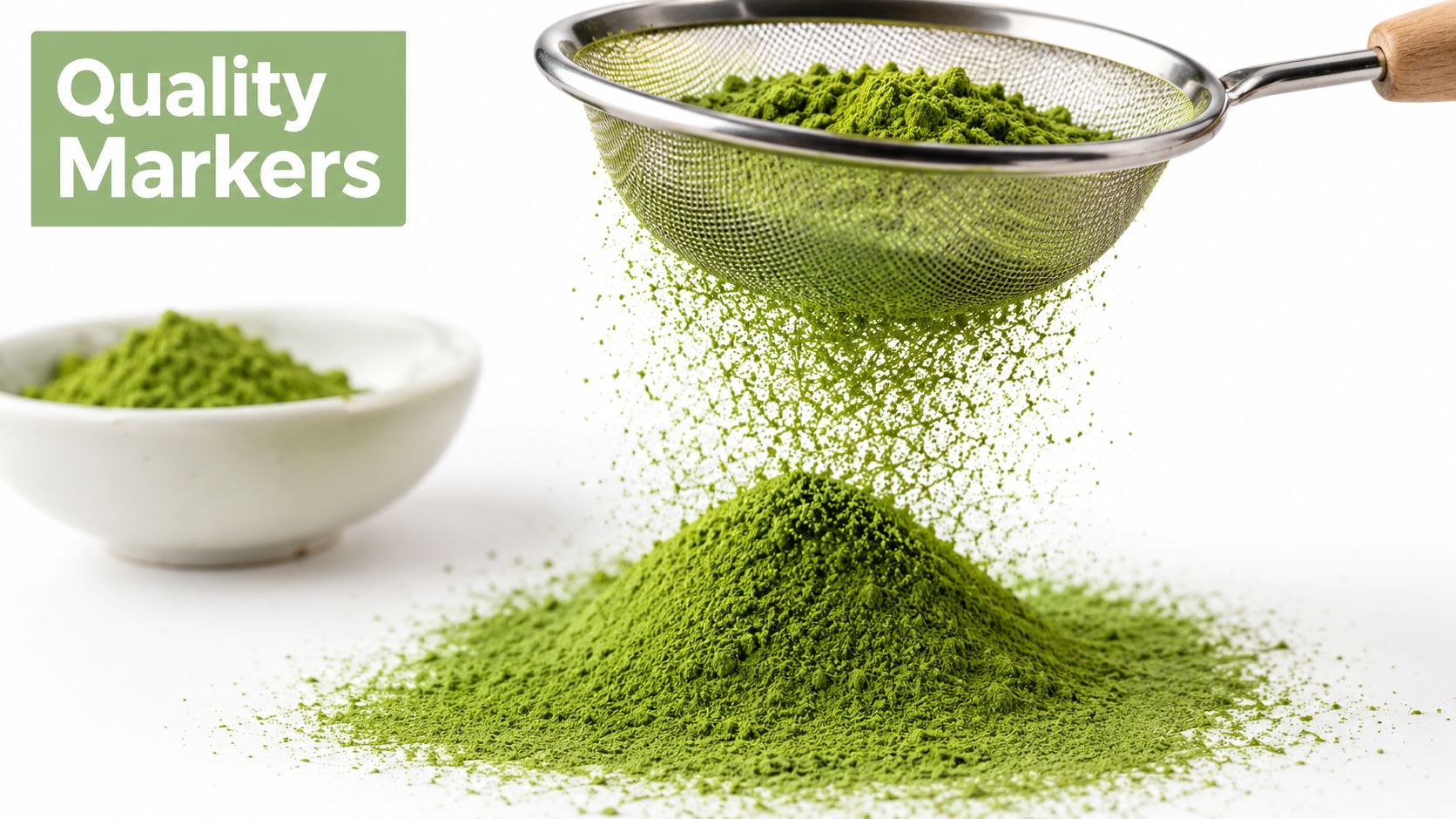
Start with particle size. One Australia-supplied technical specification reports 95% passing through 200 mesh. In plain language, that indicates a very fine powder. Fine particles suspend more evenly, which can improve the mouthfeel of a latte and reduce the gritty sensation that appears when matcha hasn't been milled or sifted well. (Australian matcha technical specification)
What the technical numbers tell you
The same specification reports loss on drying of no more than 8.0%, total heavy metals below 10 parts per million, a total plate count below 10,000 colony-forming units per gram, and yeast and mould below 300 colony-forming units per gram. These markers don't describe flavour on their own, but they help buyers assess moisture control, contamination limits and batch hygiene. (Australian matcha technical specification)
Moisture matters because matcha has a large surface area. A powder exposed to humidity can clump, lose freshness and become harder to whisk. Microbiological results provide additional reassurance, particularly for cafés, retailers and businesses storing larger quantities.
Look for packaging that identifies:
- Origin: The country and, where available, the region or producer.
- Grade or intended use: Straight drinking, lattes, baking or foodservice.
- Batch information: A lot or batch reference helps with traceability.
- Testing: Ask whether heavy metal, microbiological or other laboratory results are available.
- Storage guidance: Good suppliers explain how to protect the powder after opening.
A lab result isn't a substitute for tasting the tea, but it's more useful than an unsupported phrase such as “ultra premium”. This video can also help you visualise the preparation and handling of matcha powder.
What Organic Certification Really Means for Matcha Buyers
"Organic" should describe a verifiable production and certification pathway, not just a natural-looking package. When you're comparing matcha tea powder in Australia, check whether the product is certified, who holds or verifies that certification and whether the claim applies to the matcha itself rather than only to another ingredient in a blend.
A practical check involves four steps:
- Find the certification mark or controller details. Look for an Accredited Controller of Organics label or another recognised certification reference.
- Match the name to the product. The certificate, brand and product description should clearly relate to the powder you're buying.
- Check the ingredient list. Pure matcha should be identified plainly. A latte mix may contain sugar, milk ingredients or flavourings, so don't assume every green powder is pure tea.
- Ask for evidence if the wording is vague. A supplier should be able to explain the certification basis rather than relying on a green leaf graphic.
Certified organic and organic ingredients aren't identical
“Certified organic matcha” points to a certification claim for the tea. “Made with organic ingredients” can describe a broader product containing a mixture of ingredients, and it may not communicate the same thing about the matcha powder itself.
That distinction matters if you're trying to reduce unnecessary additives, control sugar or choose a product that aligns with your household values. It also matters for cafés that need clear answers when customers ask where an ingredient came from.
Organic status won't automatically tell you whether the powder is fresh, smooth or suitable for a latte. You still need to assess origin, packaging, testing and storage. Use this guide to organic certification in Australia to understand the language before you compare products.
A transparent supplier should make the certification information easy to find and explain what it covers. If the claim is difficult to verify, treat that uncertainty as part of the buying decision.
Where to Buy Matcha in Australia
Australian buyers can find matcha through specialist online tea retailers, cafés, natural food stores, supermarkets and foodservice distributors. The right source depends on whether you need a small tin for personal use, a steady supply for a café or a larger pack for a bakery or hospitality business.
Start with provenance and purpose
A specialist retailer may provide more information about Japanese origin, harvest style, grade and preparation. A supermarket can be convenient, but the label may offer less detail about milling, laboratory testing or supply continuity. A wholesale distributor can be suitable for cafés, although you'll want to ask about lead times, minimum order quantities and what happens when a particular batch sells out.
Kyoto and Uji are familiar names in Japanese tea, but a famous region alone doesn't guarantee that a powder suits your menu. Match the origin information with the intended use:
- For straight drinking: Look for a refined powder, fresh aroma and a flavour that isn't dominated by bitterness.
- For café lattes: Ask about suspension, consistency between batches and foodservice pack sizes.
- For baking: Focus on clean flavour, dependable colour and a cost that works across repeated recipes.
- For retail shelves: Prioritise clear labelling, organic evidence, a useful best-before date and replenishment options.
Ask the supplier practical questions
The recent shortage has made supply reliability part of product quality. A cheap product that disappears during a busy period may cost a café more than a slightly higher-priced product with dependable availability.
Before ordering, ask:
- Where was the matcha grown and processed?
- Is the powder intended for drinking, lattes or culinary use?
- Are laboratory results available?
- How is it packed and stored before dispatch?
- Can the supplier support wholesale volumes?
- What lead time should a café allow for its next order?
Price comparison also needs context. A small retail tin, a larger hospitality pack and a product with documented testing aren't directly interchangeable. Compare the amount of usable powder, not just the ticket price, and avoid paying a premium for a vague grade label without supporting information.
For Australian hospitality buyers, a local supplier can simplify communication, delivery and replenishment. That doesn't remove Japan's role in the supply chain, but it can make the final purchasing relationship more responsive.
Storing Matcha and Using It at Home
Matcha is finely ground, so air, light, heat and moisture can affect it quickly once the package is open. Keep it in an airtight container, away from sunlight and strong-smelling foods. A cool, dark cupboard may work for short-term use, while refrigeration can help preserve freshness when the container is sealed carefully and protected from condensation.
Don't leave the lid open while you prepare breakfast. Scoop what you need, close the container promptly and use a dry spoon. If powder has been chilled, let the sealed container come towards room temperature before opening it, so humid air doesn't settle on the matcha.
For more detailed storage guidance, follow these matcha storage recommendations.
Three easy ways to start
Classic whisked matcha
Sift matcha into a bowl, add a small splash of warm water and whisk briskly in a zigzag motion until the powder is dispersed. Add more water to reach your preferred strength. The aim isn't perfect technique. It's a smooth drink without dry clumps.
Café-style matcha latte
Dissolve the powder in a small amount of warm water first. Add warmed milk or a plant-based alternative and sweeten only if you want to. This two-stage method prevents dry powder from floating across the surface of the latte.
Matcha smoothie bowl
Blend matcha with banana, yoghurt or your preferred milk, then pour the mixture into a bowl. Add fruit, seeds or toasted grains for texture. Culinary-grade powder is a sensible choice here because the recipe already contains several strong flavours.
A sieve is useful for all three preparations. It breaks up compacted powder before water or milk is added, giving your whisk a much easier job.
Common Matcha Mistakes Australian Buyers Make
Mistake one, treating all green powder as matcha. Matcha is made from prepared tea leaves that are shade-grown and ground into powder. A product labelled only “green tea powder” may be processed differently and may not offer the same colour, texture or umami flavour.
Mistake two, assuming the brightest green packet must be the best. Colour is a useful clue, but it isn't a complete quality test. Fresh aroma, fine texture, transparent origin, suitable packaging and a clean flavour matter too.
Mistake three, choosing ceremonial grade for every recipe. If you mostly make iced lattes, smoothies or baked goods, culinary grade may be the more sensible fit. Save a refined drinking matcha for preparations where you taste its subtle character.
Mistake four, ignoring supply continuity. Australian cafés have already faced shortages, price pressure and long ordering lead times. A supplier's ability to provide the same product consistently deserves as much attention as the first sample.
Mistake five, storing an opened pouch beside the kettle. Heat and steam are a poor combination for delicate powder. Seal it, keep it cool and dark, and avoid opening the container in a humid kitchen.
A quick buyer checklist
- Authenticity: Is it clearly identified as matcha made from Camellia sinensis?
- Fit: Is the grade suited to water, milk, baking or foodservice?
- Evidence: Can the supplier provide certification or testing information?
- Freshness: Is the packaging protective, sealed and clearly dated?
- Supply: Can you reorder without facing uncertain lead times?
Pep Tea offers organic Japanese matcha tea powder in Supreme, Imperial and Premium grades, with retail and wholesale pack options for Australian buyers. Explore the range, compare the intended uses and choose the powder that fits your daily ritual or café menu through Pep Tea.
What Is Ceremonial Matcha? the Real Difference
Most advice about matcha starts with colour: if the powder is bright green, it must be ceremonial. That's a useful first clue, but it isn't enough. In Australia, products carrying similar “ceremonial” language can vary in origin, processing, flavour and price, while the term itself doesn't provide a universal grading standard.
So, what is ceremonial matcha? It's the highest-grade form of matcha, traditionally made from the youngest tea leaves picked during the first harvest. Those leaves are shaded before picking, processed into tencha, stripped of stems and veins, and stone-milled into an exceptionally fine powder. The result is designed to be whisked with water and enjoyed on its own, not hidden in sugar, milk or flour.
Understanding that journey makes it easier to judge a product by what's behind the label, rather than by packaging alone.
Defining Ceremonial Matcha Beyond the Label
Not every green tea powder is matcha, and not every product called ceremonial matcha offers the same experience. The word has become common in Australian cafés and online shops, but the useful question isn't just, "Does the tin say ceremonial?" It's, "What leaves were used, how were they grown, and how were they processed?"
Ceremonial matcha is made from the youngest leaves of the first harvest, often called ichibancha. These leaves are valued for their bright colour, fine texture and naturally rounded flavour. Producers shade the plants before harvest, then turn the leaves into tencha before grinding them into powder. Because you consume the whole leaf rather than steeping it and discarding it, the raw material and processing have a direct effect on what ends up in your bowl.
Historical accounts trace powdered tea practices from China to Japan in the 12th century, while the Japanese tea ceremony was fully established by the late 15th century. That gives ceremonial matcha a place within over 500 years of ritualised use in Japan, as described in this history of Japanese matcha in Australia.
What you're paying for
A premium price should reflect more than a vivid label. You're paying for careful cultivation, selective harvesting, refined processing, stone milling and appropriate handling. Those choices influence whether the powder tastes creamy and umami-rich or harsh, dusty and bitter.
Ceremonial matcha is traditionally intended for straight preparation with water. That doesn't mean you can't use it in a latte, smoothie or dessert. It means the powder should be pleasant enough to drink without needing other ingredients to cover flaws.
The simplest quality test is also the most revealing: can you enjoy it with water alone?
The term “ceremonial” can help shoppers find the style of matcha they want, but it shouldn't replace checking the product details. Look for a clear Japanese origin, first-harvest information, shade-growing details, tencha processing and sensible storage guidance. These details tell you much more than the front of the pouch.
The Cultivation and Processing of Premium Tencha
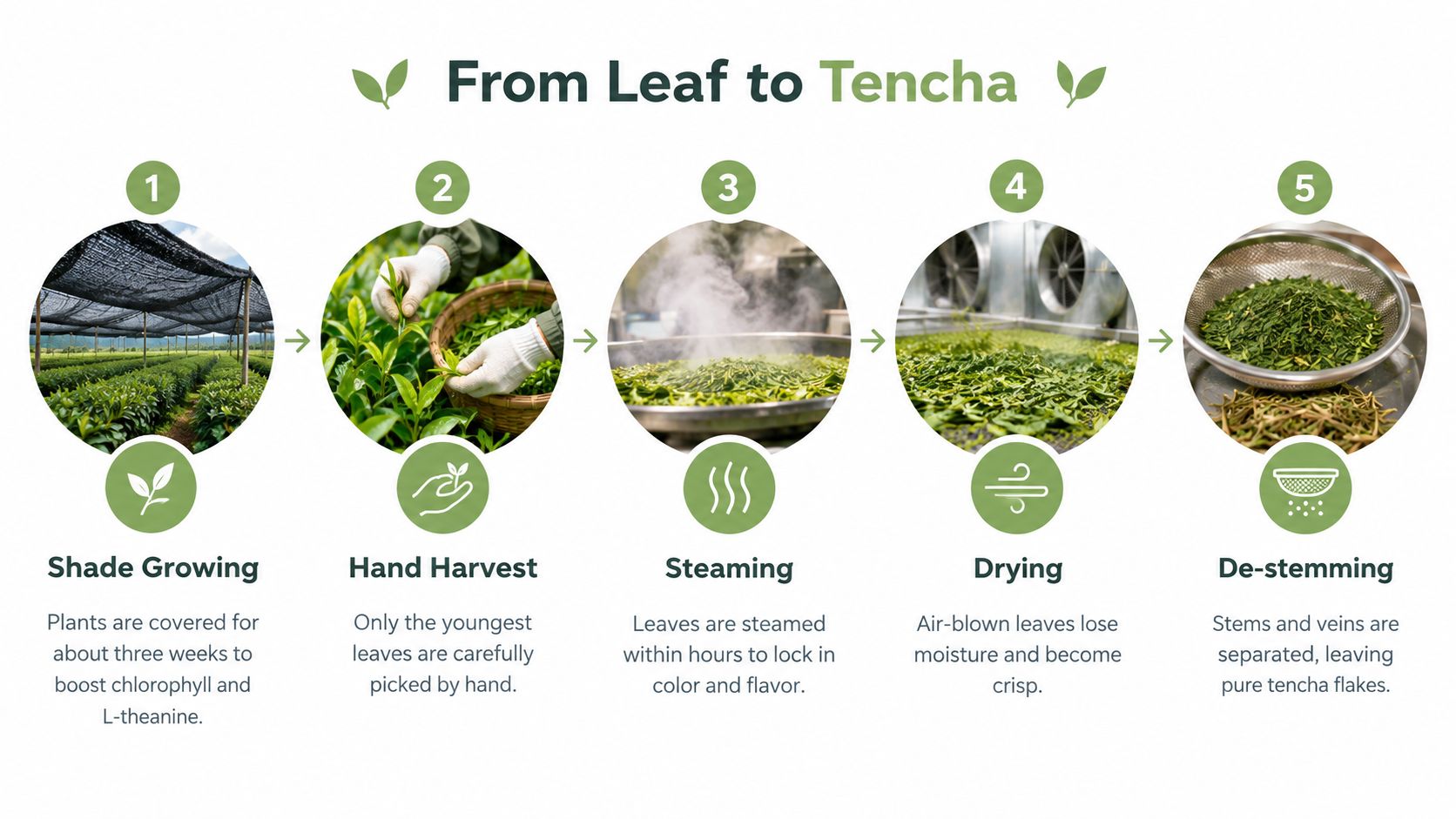
A ceremonial bowl begins in a tea field long before anyone reaches for a bamboo whisk. Farmers first prepare the plants for a controlled period of shade, then harvest the youngest leaves and process them quickly to protect their colour and flavour.
Shade changes the leaf
Producers commonly shade tea plants for about 20 to 40 days before harvest. This limited sunlight encourages the plant to retain more chlorophyll and preserve L-theanine, an amino acid associated with sweeter flavour and reduced bitterness. The result is the deep green colour and savoury-sweet umami that people expect from well-made matcha. See this explanation of matcha grades and shading for more detail.
The plants are then harvested for their youngest leaves, usually during the first spring picking. Timing matters because older leaves tend to produce a more assertive, astringent cup, while tender first-harvest leaves are better suited to drinking straight.
From fresh leaf to tencha
After harvest, the leaves are steamed to halt oxidation and help retain their green character. They're then dried, creating the material that will be refined into matcha. Unlike many other tea styles, the leaves aren't rolled into familiar needle shapes.
The stems and veins are removed next, since these tougher parts can add coarseness and unwanted bitterness. The remaining leaf material is called tencha, the raw material used for authentic matcha. This guide to how matcha tea is made provides a practical look at the stages involved.
Finally, producers stone-mill the tencha into a very fine powder. Slow milling helps create the silky mouthfeel associated with ceremonial matcha, although it also makes production careful and labour-intensive. The finished powder is more than dried green tea ground up at random. It's the product of shade management, selective harvesting and specialised processing.
That craftsmanship also explains why fresh ceremonial matcha can taste so different from ordinary green tea powder. The leaf has been cultivated for a particular flavour profile, prepared for suspension in water and milled finely enough to become part of the drink's texture.
The Biochemical Profile and Health Benefits
Matcha's distinctive appeal comes partly from the fact that you drink the powdered leaf. With ordinary green tea, you steep the leaves and remove them. With matcha, the prepared powder remains in the bowl, so the drink contains the compounds present in the leaf material.
One Australian analytical report for a ceremonial matcha product lists total catechins at 65,200 micrograms per gram, including 56,000 micrograms per gram of EGCG, with L-theanine at 21,300 micrograms per gram and caffeine at 33,300 micrograms per gram. These figures come from the product's published analysis, not from a universal value for every ceremonial matcha, so they're best understood as an example of the biochemical profile that can occur in a carefully produced product. The published ceremonial matcha analysis shows why laboratory information can be more useful than broad wellness language.
Antioxidants and EGCG
Catechins are naturally occurring compounds in tea. EGCG, or epigallocatechin gallate, is one of the best-known tea catechins and is often discussed for its antioxidant activity. Antioxidants help protect cells from oxidative stress, but matcha shouldn't be treated as a medicine or a substitute for a varied diet.
If you'd like a plain-language explanation of the compound itself, Pep Tea's guide to what EGCG is is a useful place to start. The practical takeaway is simple: a high-quality matcha can contribute tea polyphenols to your daily routine, but the product's actual composition depends on cultivar, harvest, cultivation, processing and storage.
L-theanine and caffeine
L-theanine gives matcha much of its character, both in flavour and in how the drink feels. Paired with caffeine, it may support a state of calm alertness, which many people experience as focused energy rather than the sharper lift associated with coffee.
That doesn't mean matcha can never feel stimulating or that everyone will respond in the same way. Caffeine sensitivity varies, and serving size, timing and whether you've eaten all matter. People who are pregnant, managing a medical condition or taking medication should seek individual advice from a qualified health professional.
Matcha is also sometimes described as immune-supporting because tea compounds and a balanced diet may contribute to general wellbeing. Keep the claim proportionate. Ceremonial matcha can be a nutrient-rich, enjoyable beverage, but it isn't an immunity cure.
Ceremonial Grade Versus Culinary Grade Matcha
Ceremonial and culinary matcha aren't rival products where one is automatically good and the other is automatically poor. They're made for different jobs.
Ceremonial matcha is selected for drinking with water. Culinary matcha is generally chosen for recipes where the powder needs to hold its flavour against milk, sugar, flour, fruit or other strong ingredients. It may come from later harvests or use leaf material with a more pronounced bitterness, which can be useful in baking and blended drinks.
| Feature | Ceremonial Grade | Culinary Grade |
|---|---|---|
| Primary use | Whisked with water and enjoyed straight | Lattes, smoothies, baking, sauces and desserts |
| Leaf selection | Young first-harvest leaves | Often later-harvest or more robust leaf material |
| Flavour | Smooth, umami-rich and naturally rounded | More assertive, grassy or astringent |
| Colour | Usually vivid green | Can be green but often less luminous |
| Texture | Very fine and silky | Fine powder, though texture can vary |
| Best buying question | Is it enjoyable without added flavour? | Will it remain noticeable in the finished recipe? |
Choose for the way you'll drink it
If your morning ritual is a small bowl of matcha and water, ceremonial grade makes sense because its delicate sweetness and umami are exposed. Poor-quality powder has nowhere to hide in that preparation.
For a matcha latte, the choice is more personal. A good culinary powder can be practical, especially if you're adding milk and a sweetener. A ceremonial powder can also make an excellent latte, particularly when you want a softer flavour and a cleaner finish. The important point is not to buy the most expensive product automatically. Buy the grade that suits your actual use.
Where the confusion begins
Some Australian listings describe ceremonial matcha as water-only, while others promote the same style for lattes. That isn't necessarily a contradiction. “Ceremonial” describes the intended quality and drinking style, not a rule that forbids every other recipe.
The distinction becomes clearer when you think about flavour. Use ceremonial matcha when the tea itself is the centre of attention. Use culinary matcha when it's one ingredient among several.
How to Identify Authentic Ceremonial Matcha in Australia
Australian shoppers have plenty of choice, but the variety can make comparison difficult. Similar products may use the same words, while prices for comparable-sounding listings can range from about A$35 to A$69.99, as shown in this Australian ceremonial matcha product listing. Price alone can't prove quality, but it should encourage you to inspect the details.
Use a practical checklist
Read the harvest description. Look for first harvest or ichibancha language, rather than relying only on “premium” or “ceremonial”.
Check the colour. Fresh ceremonial matcha is generally a vibrant green. A dull, yellowish or brownish appearance can indicate older material, oxidation or poor storage, although colour should always be judged alongside taste and provenance.
Inspect the texture. The powder should feel exceptionally fine and silky. Grittiness suggests that the product hasn't been milled or refined to the standard expected of a whisked tea.
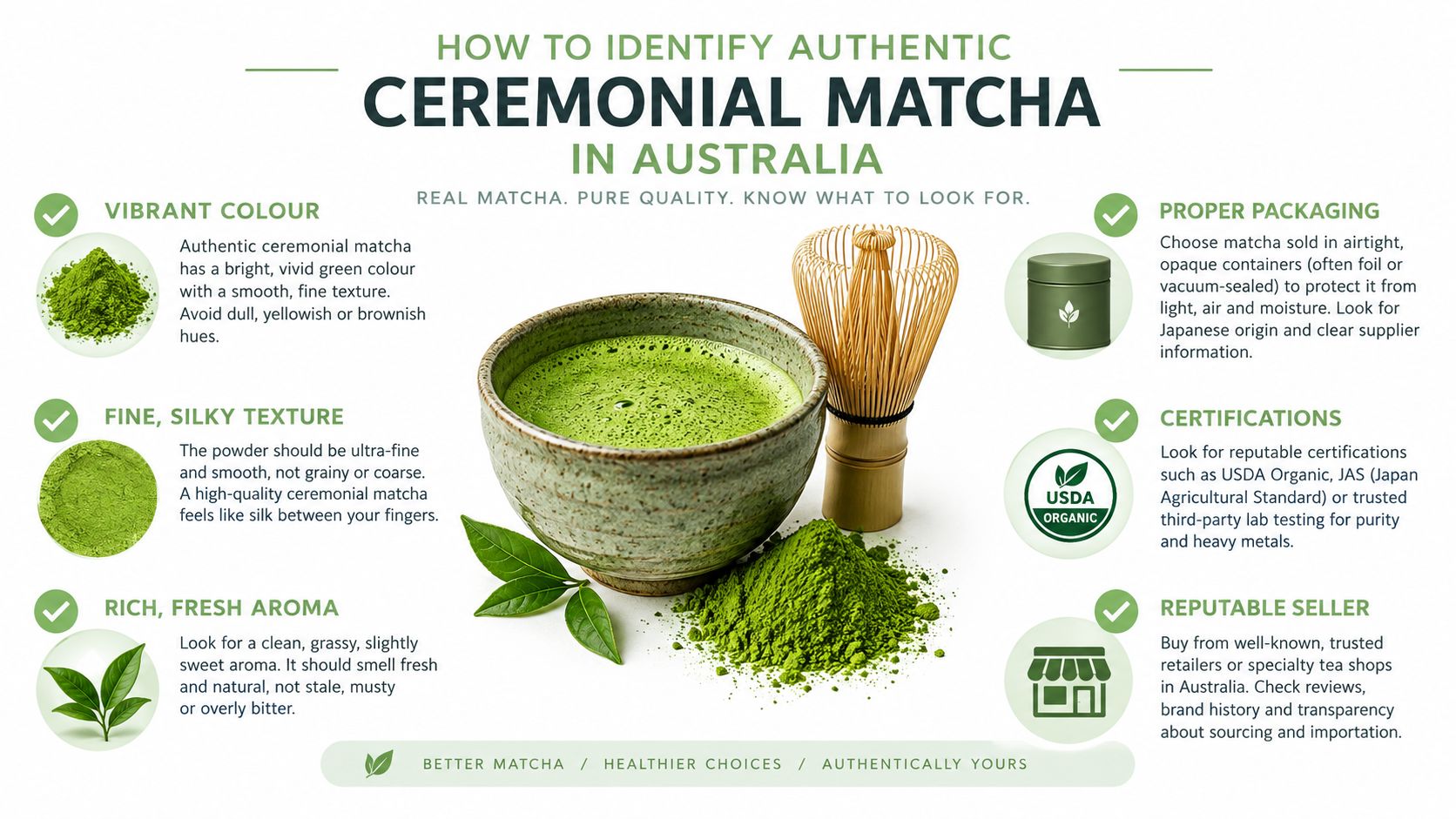
Look for tencha processing. A credible product description should explain that the leaves were de-stemmed and de-veined before stone milling. This overview of ceremonial matcha processing explains why those steps affect texture.
Ask where it was grown and packed. Japanese origin should be clear, not buried under vague language such as “Japanese-style”.
Treat pricing as context, not proof. First-harvest tea, careful shading and stone milling require more work, so an unusually low price deserves closer inspection. A high price doesn't guarantee authenticity either.
Ask for evidence, not adjectives
Look for batch information, organic certification where relevant, storage guidance and analytical information. A supplier that can explain the leaf, harvest and processing gives you something concrete to evaluate.
The most reliable buyer doesn't chase the brightest green pouch. They compare the agricultural and processing story with the sensory result in the cup.
Traditional Preparation and Tasting Notes
Premium matcha is forgiving once you understand the basics, but it isn't prepared like a teabag. The traditional setup uses a chawan, or bowl, and a chasen, the fine bamboo whisk. A small sieve is also helpful because it breaks up clumps before they become difficult to disperse.
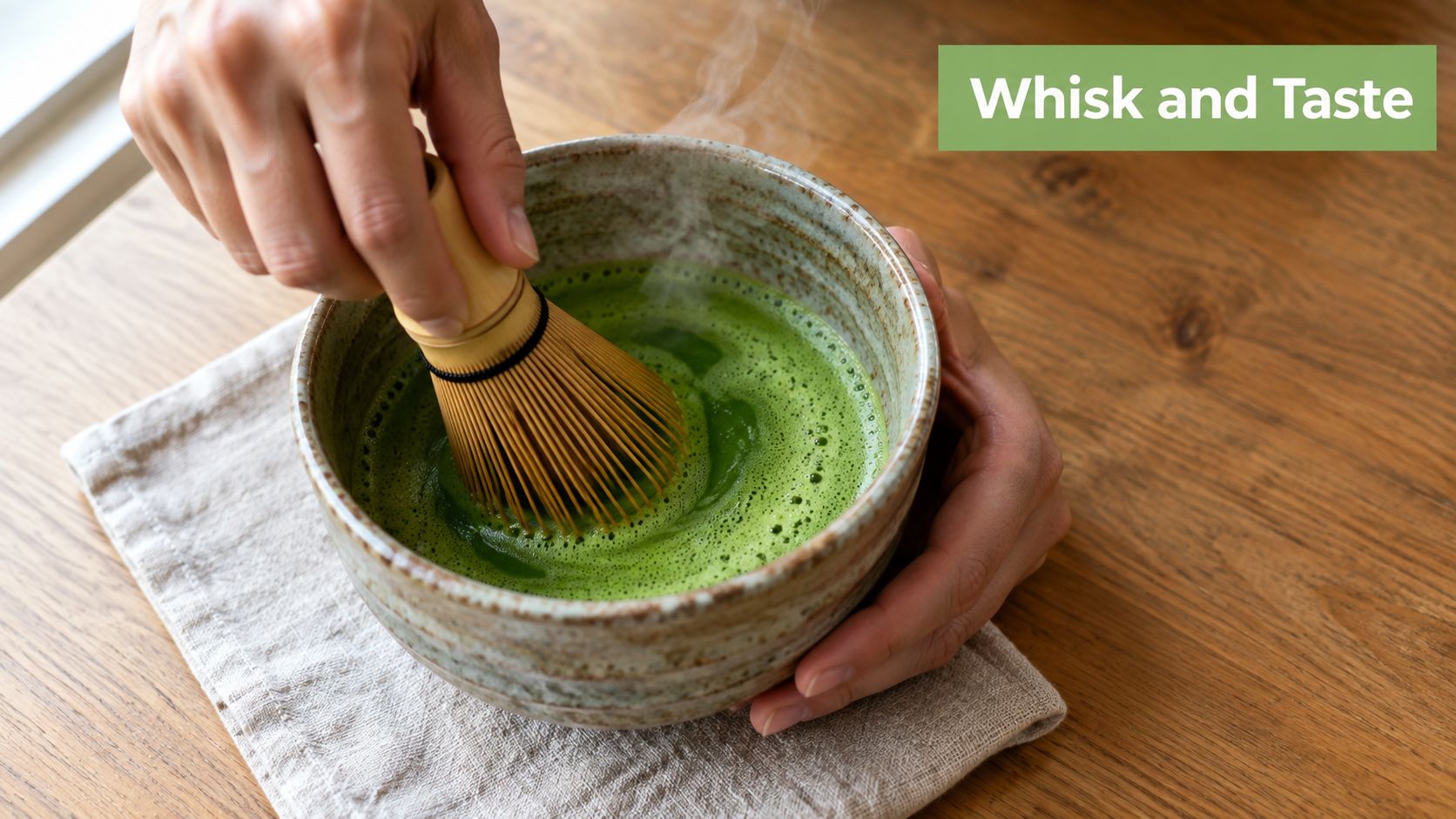
A simple bowl method
Warm the bowl, then discard the warming water.
Sift the matcha into the bowl. Sifting isn't ceremonial theatre. It helps the fine powder combine with water smoothly.
Add a small amount of hot water that has cooled below boiling. Water that's too hot can push delicate flavours towards harshness and flatten the tea's sweeter notes.
Whisk briskly using a light W or M motion, keeping the whisk near the surface rather than stirring slowly around the edges.
Add more water to reach your preferred strength, then drink soon after whisking so the powder stays evenly suspended.
The bowl should feel creamy rather than sandy. Expect fresh vegetal notes, gentle sweetness and a savoury umami finish. A little bitterness can be part of tea's character, but pronounced harshness often points to water that's too hot, too much powder, an older product or unsuitable raw material.
For a closer look at the ritual, explore Pep Tea's guide to the matcha tea ceremony.
Here's a visual demonstration of the whisking rhythm and bowl preparation:
If your first bowl tastes strong, adjust one variable at a time. Try cooler water before reducing the powder, then experiment with a little more water. Matcha rewards attention, but it doesn't require perfection.
Integrating Premium Matcha Into Your Daily Routine
Ceremonial matcha can fit neatly into an Australian morning without turning every cup into a formal tea ceremony. Prepare it traditionally when you have a quiet moment, or whisk it into a small latte when you're heading into work. The quality still matters because a smooth powder gives you more flexibility, especially when you sometimes drink it with water and sometimes with milk.
Many people prefer matcha earlier in the day, when its caffeine and L-theanine profile suits focused work, study or a calm start. If you're sensitive to caffeine, drink a smaller serving, have it with food and pay attention to how your body responds.
Keep the ritual realistic
A useful routine might look like this:
- Morning focus: whisk matcha with water before opening your phone or starting your commute.
- Café-style break: make a simple latte without heavy syrups so you can taste the tea.
- Recipe use: reserve culinary grade for smoothies, baking, ice cream and other recipes where stronger ingredients are involved.
- Thoughtful storage: protect the powder from heat, moisture, light and air, and follow the supplier's storage instructions.
Australia's interest in matcha has accelerated sharply. One market source reports that Australian matcha imports rose 62.91% from 2023 to 2024, while another report says Australia imported 195,319 kilograms of Japanese green tea between January and August 2025, a 131% year-on-year increase, ranking Australia as the eighth-largest export destination for Japanese green tea. These figures are reported in the Australia matcha tea market data, and they help explain why shoppers need clearer quality guidance as more products appear.
The best choice is the matcha you'll prepare and enjoy regularly. For some people, that means a delicate bowl of ceremonial powder. For others, it means keeping ceremonial grade for water preparation and using culinary grade for creative recipes.
Pep Tea offers organic Japanese matcha, including ceremonial-grade powder, alongside Australian-brewed sugar-free organic kombucha from the Hunter Valley, NSW. Visit Pep Tea to explore the matcha range, learn more about preparation and find functional drinks suited to everyday routines.
How to Make an Organic Matcha Latte at Home

You're standing in the kitchen with a steaming kettle, a tin of vivid green powder and one important question: will this organic matcha latte taste smooth and gently sweet, or grassy and bitter? A good latte should have a silky texture, a light umami savouriness and a calm lift that doesn't overwhelm the delicate tea.
The recipe matters, but it isn't the whole story. Grade, leaf shading, powder freshness and whisking technique decide whether milk brings out matcha's character or hides a poor-quality powder. Here's how to choose your ingredients, set up your tools and build a repeatable ritual at home.
Setting Up for Your Best Organic Matcha Latte
Before measuring anything, choose a matcha that's suitable for drinking. Ceremonial-grade organic matcha is generally the better starting point for a latte where the tea should remain noticeable through the milk. Culinary-grade powder can work well when you're adding stronger flavours, using matcha in baking or blending it into smoothies, but it may taste more assertive or less rounded in a simple drink.
Three decisions shape the result.
Start with grade and leaf quality
Ceremonial matcha is made for whisking with water, so it should taste balanced before milk or sweetener enters the bowl. Look for a bright jade colour, a powder with an almost silk-like fineness and an aroma that suggests fresh grass, sweetness and gentle savouriness rather than stale hay.
Culinary matcha has a useful role, too. Its more robust flavour can stand up to oat milk, vanilla, fruit, chocolate and baking, where a subtle ceremonial powder might disappear.
Understand shading
Matcha comes from tea leaves that are shaded before harvest and then processed into tencha, the leaf material that is stone-ground into powder. Shading encourages a deeper green appearance and supports the development of compounds associated with matcha's savoury taste and smoothness, including L-theanine.
A New South Wales study of tea leaves grown on the Central Coast identified L-theanine, caffeine and five catechins, EGC, EC, EGCG, GCG and ECG, as important markers when assessing matcha-relevant leaf quality. The research also found that shading materially altered these constituents, making controlled shading an important production decision for a smoother, less harsh cup. Read the NSW matcha-quality research summary.
Gather a simple setup
You don't need a picture-perfect tea station. You need a bowl with enough room to whisk, water at the right temperature and a powder that dissolves cleanly. A small scale and a proper bamboo whisk make the ritual much easier to repeat, while the PepTea matcha tea accessories can help you assemble the essentials without cluttering the bench.
What Makes Organic Matcha Worth Choosing
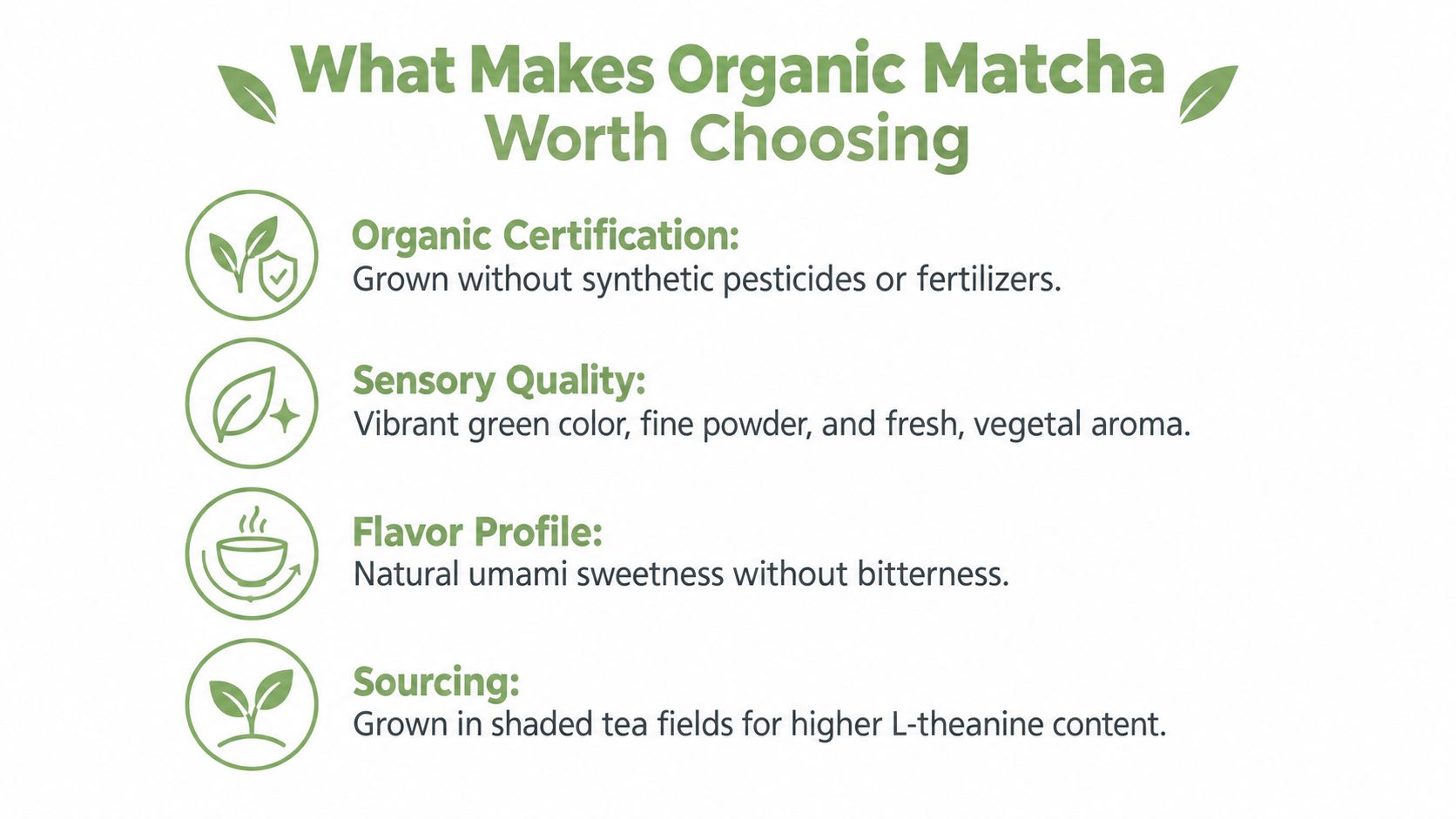
The word organic describes how the tea is grown and handled, not a guarantee that every cup will taste delicious. Organic certification gives you useful information about farming standards and restricted inputs, while the powder's origin, grade, harvest and storage still affect flavour.
Matcha differs from ordinary infused green tea because you consume the powdered leaf rather than steeping leaves and discarding them. That makes sourcing especially relevant to many drinkers who want to know how the tea was cultivated. Certification should be viewed as one part of the buying decision, alongside a clear ingredient list and transparent origin information.
Read the powder with your senses
A beginner can learn a great deal before taking a sip.
- Colour: A lively green usually looks more promising than a dull olive or brownish powder.
- Aroma: Fresh vegetal notes, marine umami and a soft sweetness suggest a more appealing drinking profile than a flat, dusty smell.
- Texture: Fine stone-milled matcha should feel soft and light. Gritty particles can signal poor milling or clumping caused by exposure to moisture.
- Taste: A quality drinking matcha should offer savouriness and sweetness before bitterness takes over.
Ceremonial-grade matcha is commonly selected for its refined flavour, fine texture and ability to taste good with water. Culinary-grade matcha is built to contribute colour and flavour alongside other ingredients. Neither label removes the need to taste critically.
Keep health language grounded
Matcha naturally contains caffeine, L-theanine and catechins. Shading and leaf selection can influence the balance of these compounds, but a latte shouldn't be treated as a medical treatment or a guaranteed source of calm focus. The most honest description is that matcha may provide a distinctive combination of stimulant energy and tea-derived savoury flavour.
An Australian green-tea quality study found significant variation in L-theanine across tested products, with three samples showing undetectable levels and the highest concentrations appearing in only a subset. That finding supports checking batch quality and supplier information rather than trusting a grade label alone. Explore the difference between regular and organic matcha.
Label check: Look for organic certification, a named origin, a clear grade, a short ingredient list and packaging that protects the powder from air, light and moisture.
Tools and Ingredients You Actually Need
Lay everything out before you start. The core setup is pleasantly small:
- A chasen: This bamboo whisk disperses matcha through water and creates the fine foam that makes a latte feel creamy rather than powdery.
- A chashaku: The traditional scoop is useful for portioning, although a scale is more consistent when you're learning.
- A wide bowl or chawan: A cereal bowl can work if it gives your wrist room to move. A narrow mug makes whisking awkward and encourages clumps.
- A fine mesh sieve: Sifting breaks apart compacted powder before water reaches it.
- A small kitchen scale: Consistent dosing helps you adjust strength deliberately rather than guessing.
- A thermometer: Water between 70 and 80°C is hot enough to dissolve matcha while reducing the risk of a harsh, scalded flavour.
A standard kitchen whisk is a poor substitute for a chasen. Its wires are rigid and widely spaced, so it tends to move powder around rather than distribute it evenly through a small volume of water. A handheld frother can make a serviceable base, but use short bursts and avoid whipping air into a large, bubbly head.
For ingredients, buy ceremonial-grade organic matcha, filtered water and the milk and sweetener that suit your taste. Pep Tea offers organic matcha products for drinkers who want an Australian supplier and a powder-focused approach to home preparation. Keep the tin sealed and away from heat, light and moisture.
Optional tools can wait. An electric milk frother is convenient for thick, consistent foam, and a milk pitcher helps with pouring. You don't need either to make a balanced latte. If Japanese food and tea interest you more broadly, Just Cook It's Japanese cooking guide is a useful companion for learning how ingredients, texture and restraint shape Japanese-style preparation.
For the whisking movement itself, use this guide to whisking matcha before experimenting with latte variations.
Brewing Hot and Iced Lattes Step by Step
The hot and iced versions begin with the same concentrated matcha base. The difference comes after whisking, when you choose warm frothed milk or chilled milk and ice.
Build the matcha base
- Sift 2 grams of organic matcha into a wide bowl or chawan.
- Add 60 ml of hot water at 80°C, or 175°F. It must not be boiling.
- Use the chasen in a fast W or M motion for 15 to 20 seconds, keeping the whisk close to the base of the bowl.
- Stop when the powder has formed a smooth liquid with a fine, even foam and no visible clumps.
The water temperature controls more than comfort. Boiling water can pull out an aggressive bitterness and make the catechin profile taste harsh. Cooler water gives you more room to preserve matcha's sweetness and umami, although very cold water makes direct whisking more difficult.
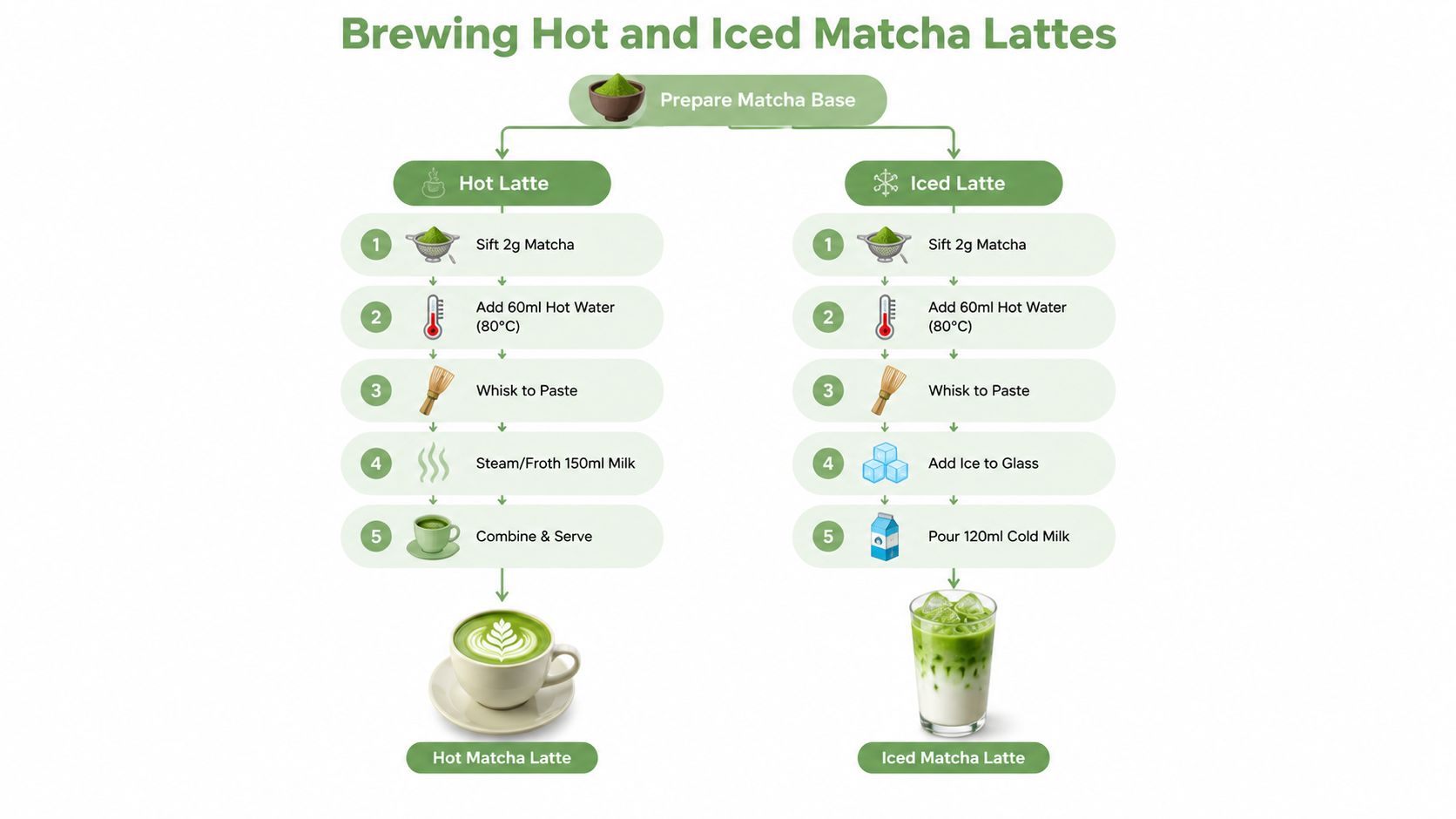
Make the hot version
Warm 200 to 240 ml of milk to about 140°F. Don't let it boil. Heat changes the milk's sweetness and texture, while excessive heat can make the final drink taste flat beside the tea.
Froth the milk until it has a fine, pourable texture. Add the matcha base to your cup first, then pour in the milk gradually. A 1:3 to 1:4 matcha-to-milk ratio gives you a balanced starting point, with enough milk for body without turning the tea invisible.
Make the iced version
For iced preparation, use chilled milk and a glass filled with ice. Sift the matcha into a bowl, add the 60 ml of hot water and whisk as usual. The small amount of warm water dissolves the powder more reliably than tipping it directly into cold milk.
Pour the matcha over the ice, add your chilled milk and stir. If you prefer a stronger drink, reduce the milk slightly or increase the matcha gradually. If it tastes too intense, add milk rather than extra sweetener first.
Froth according to your equipment
- French press: Add warm milk, plunge repeatedly until the surface looks smooth and lightly aerated, then pour promptly.
- Handheld frother: Froth in a tall jug with the whisk head below the surface to avoid large bubbles.
- Electric steamer: Stretch the milk briefly, then create a fine whirlpool for a glossy finish.
The best ratio is the one that lets you taste both ingredients. More matcha creates a greener, firmer drink, while more milk produces a softer café-style latte.
Choosing Milks and Sweeteners That Work
Matcha behaves differently from coffee. The milk should soften bitterness without covering the tea's fresh, vegetal character.
Whole dairy milk gives the fullest body and tends to round off grassy notes. Oat milk is often the easiest plant-based pairing because its natural sweetness and creamy texture support matcha without demanding much added sugar. Almond milk keeps the drink relatively clean and light, although some brands can taste thin beside a concentrated matcha base.
Soy milk can soften bitterness effectively, but very hot liquid may cause some varieties to split. Choose a barista-style soy milk and avoid pouring freshly boiled water or overheated milk into the cup. Barista formulations are designed to handle heat and foam more predictably, partly because their protein and fat balance supports a stable texture.
Sweeteners change the flavour as much as the sweetness. Monk fruit and stevia can keep the cup light, honey adds floral warmth, and maple syrup deepens matcha's earthy side. Refined sugar dissolves easily, but it can flatten the contrast between umami, sweetness and bitterness.
| Latent Goal | Best Milk | Best Sweetener | Why It Works |
|---|---|---|---|
| Creamiest hot latte | Whole dairy | Honey | Rich body carries floral sweetness |
| Sweet plant-based latte | Oat milk | Maple syrup | Natural sweetness supports earthy notes |
| Light, clean iced drink | Almond milk | Monk fruit | Keeps the finish relatively delicate |
| Gentle bitterness | Barista soy milk | Stevia | Extra creaminess rounds the tea |
| Minimal added sugar | Oat or almond milk | None | Lets the matcha's own flavour lead |
Taste the latte before sweetening it. A powder that needs heavy sweetening may be poorly matched to the milk, too bitter from overheated water, or not suited to a delicate drink.
Is an Organic Matcha Latte Really Worth the Premium
The premium can be justified, but not every expensive tin offers meaningful value. Australia's organic green-tea category relies heavily on imports, with imports estimated to cover 95 to 98 per cent of domestic consumption by volume, while domestic organic tea production is described as negligible and limited to a few small farms in Queensland and New South Wales. The category is estimated at 12 to 18 per cent of the overall tea market by volume and 25 to 35 per cent by value, which reflects strong premium positioning. See the Australian organic green-tea market analysis.
Matcha sits at the upper end of that market. The same analysis places ceremonial-grade matcha at AUD 30 to 80 per 100 g, while culinary-grade matcha is listed at AUD 18 to 35 per 100 g. That helps explain why an organic matcha latte is usually treated as a premium functional beverage rather than an everyday commodity drink.
Paying more makes sense in two situations:
- You drink matcha regularly and want a powder with a clear grade, credible origin and clean, balanced flavour.
- You drink the tea with minimal milk or sweetener, so the powder's quality remains obvious.
The premium is less convincing when a mid-grade culinary powder has a bright colour but no named origin, harvest information or meaningful supply-chain detail. In that case, the label may be doing more work than the leaf.
Practical rule: Pay extra when the listing identifies the grade and origin clearly. Be cautious when neither appears.
Fixes, Variations, and Where to Go Next
A disappointing latte usually gives you a useful clue.
- Bitterness: Water that's too hot is the common culprit. Use water at 80°C, or 175°F, rather than boiling water.
- Clumping: Powder added straight to milk tends to gather into stubborn pockets. Sift it first, then whisk it with a small amount of water.
- A thin, pale layer: Under-whisked matcha often leaves a weak-looking surface. Whisk the base vigorously and use properly frothed milk.
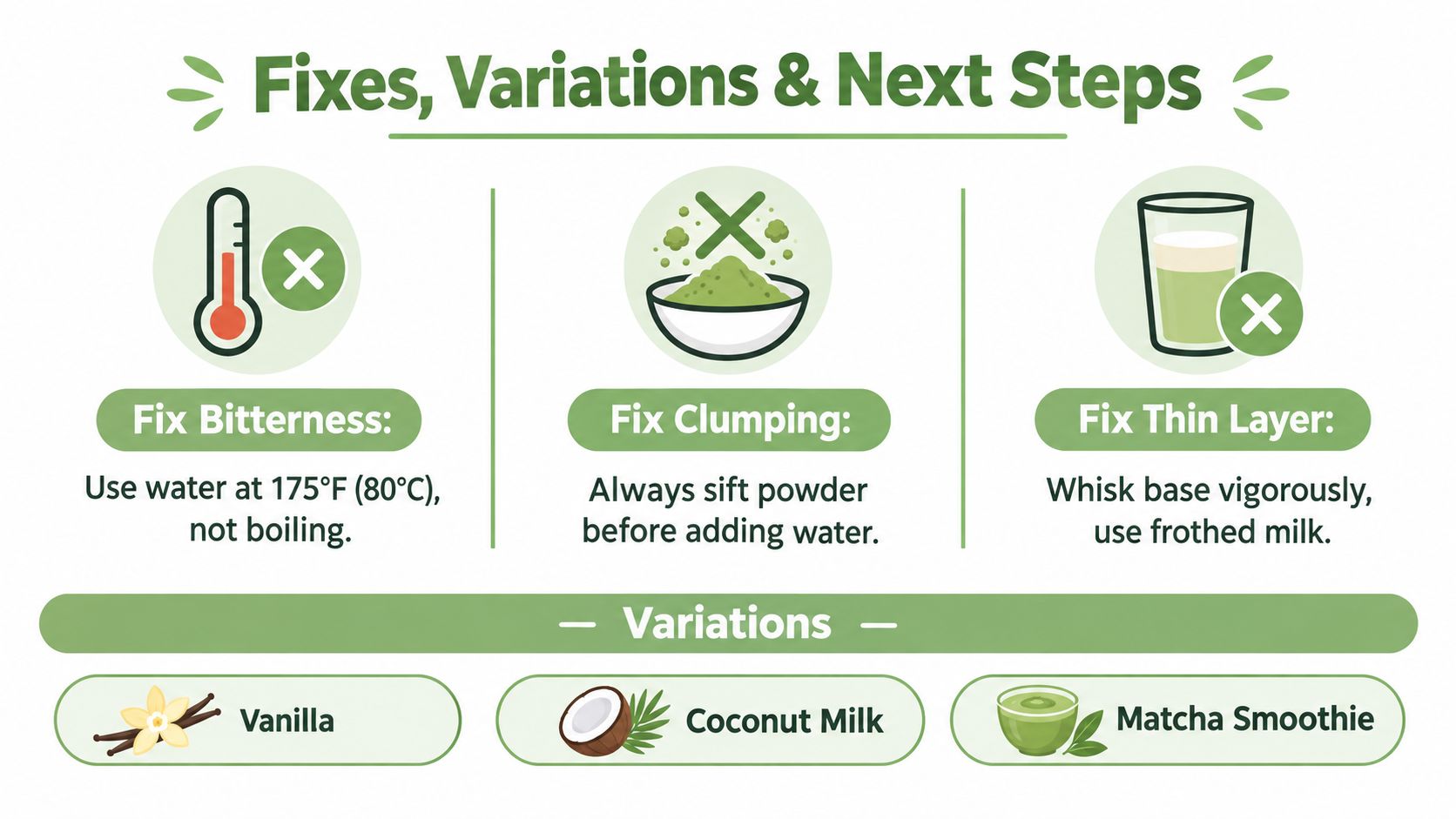
Once the base is reliable, variations become easy:
- Vanilla bean: Add 1 ml vanilla extract or a small scrape of vanilla bean to the warm milk.
- Ginger-lemongrass: Infuse the milk with 2 thin slices of ginger and a small piece of lemongrass, then strain before frothing.
- Coconut-mint: Use coconut milk and add 2 fresh mint leaves while warming, then remove them before pouring.
- Pumpkin spice: Stir 1/4 teaspoon pumpkin spice into the matcha base before adding milk.
A latte can be the beginning of a broader tea habit. Taste ceremonial matcha with water to understand what the milk is changing, then explore roasted hojicha or nutty genmaicha when you want a different profile.
Pep Tea offers organic matcha products for home lattes, whisking and everyday tea exploration, along with Australian-brewed organic kombucha from the Hunter Valley for low-sugar beverage routines. Visit Pep Tea to explore the organic matcha range and choose the powder that suits your next hot or iced latte.
Organic Ceremonial Matcha Guide for Health and Brewing
Australia's matcha market generated more than $54 million in 2024, while Japanese green tea exports to Australia reached 195,319 kg between January and August 2025, a 131% year-on-year increase according to SBS News coverage of Australia's matcha boom. That growth has pushed organic ceremonial matcha from a niche tea-shop ingredient into a mainstream wellness product, but popularity also creates confusion. A green powder labelled “ceremonial” isn't automatically authentic, organic, fresh, or nutritionally consistent.
Organic ceremonial matcha is whole, shade-grown green tea leaf, processed into a fine powder and consumed rather than steeped and discarded. Its appeal comes from a combination of Japanese provenance, organic certification, vibrant flavour, naturally occurring caffeine, L-theanine and catechins, plus the calm ritual of whisking a fresh bowl.
For Australian buyers, quality involves more than colour and branding. You'll need to consider origin, certification, harvest and processing information, packaging, taste, and preferably lot-specific laboratory data. This guide breaks down those decisions, then shows you how to brew organic ceremonial matcha, use it in lattes and recipes, and buy it with greater confidence.
Introduction to Organic Ceremonial Matcha
Matcha differs from ordinary green tea because you consume the leaf itself. Loose-leaf tea works like an infusion: hot water extracts selected compounds, while the leaves remain in the strainer. Matcha instead keeps finely milled powder suspended in water, so storage, preparation, and sourcing shape the result.
Organic describes the tea's production system and the certification supporting that claim. It does not promise a particular flavour, caffeine level, or freshness. Ceremonial generally indicates matcha intended for whisking with water and drinking on its own, yet the term has no universal quality standard. A grade name is therefore only one clue, not proof of authenticity.
Australia's import-dependent supply makes provenance details especially useful. Industry market analysis reports that over 90% of consumed matcha volume is imported, with combined green tea powder imports estimated to have risen at a 13–17% CAGR from 2020 to 2025. Premium buyers consequently depend largely on imported certified products, particularly Japanese matcha.
Start with three checks: can the supplier identify the powder's origin, show its organic certification, and provide laboratory testing that supports its quality? These records work like a product passport. Colour and branding may suggest quality, but traceable documents offer stronger evidence when choosing organic ceremonial matcha in Australia.
Understanding What Makes Matcha Ceremonial
Ceremonial matcha begins as Camellia sinensis, the same tea plant used for green, black and white tea. The difference lies in cultivation and processing. Before harvest, producers shade the plants, often using structures that reduce direct sunlight. This encourages the leaves to retain a deep green colour and develop a softer, umami-led flavour.
From shaded leaf to tencha
The youngest leaves are selected because they're tender and well suited to drinking without milk or sugar. Producers quickly steam the fresh leaves to limit oxidation, then dry them. Stems and veins are removed, leaving tencha, the leaf material that becomes matcha.
Think of tencha as the carefully prepared flour of the tea world. A baker wouldn't describe a coarse bran mixture as the same thing as finely sifted pastry flour. In a similar way, removing tougher leaf parts helps create the smooth texture expected from matcha designed for whisking.
Why stone grinding matters
The dried tencha is slowly ground into an exceptionally fine powder, traditionally using stone mills. The process resembles artisan flour milling, where patience and controlled movement matter more than speed. The result should disperse smoothly when whisked, rather than feel gritty or heavy on the tongue.
This whole-leaf format explains why matcha has a more concentrated taste than a cup of steeped green tea. It also means poor storage can affect the aroma and colour directly, because there's no separate leaf to remove after brewing.
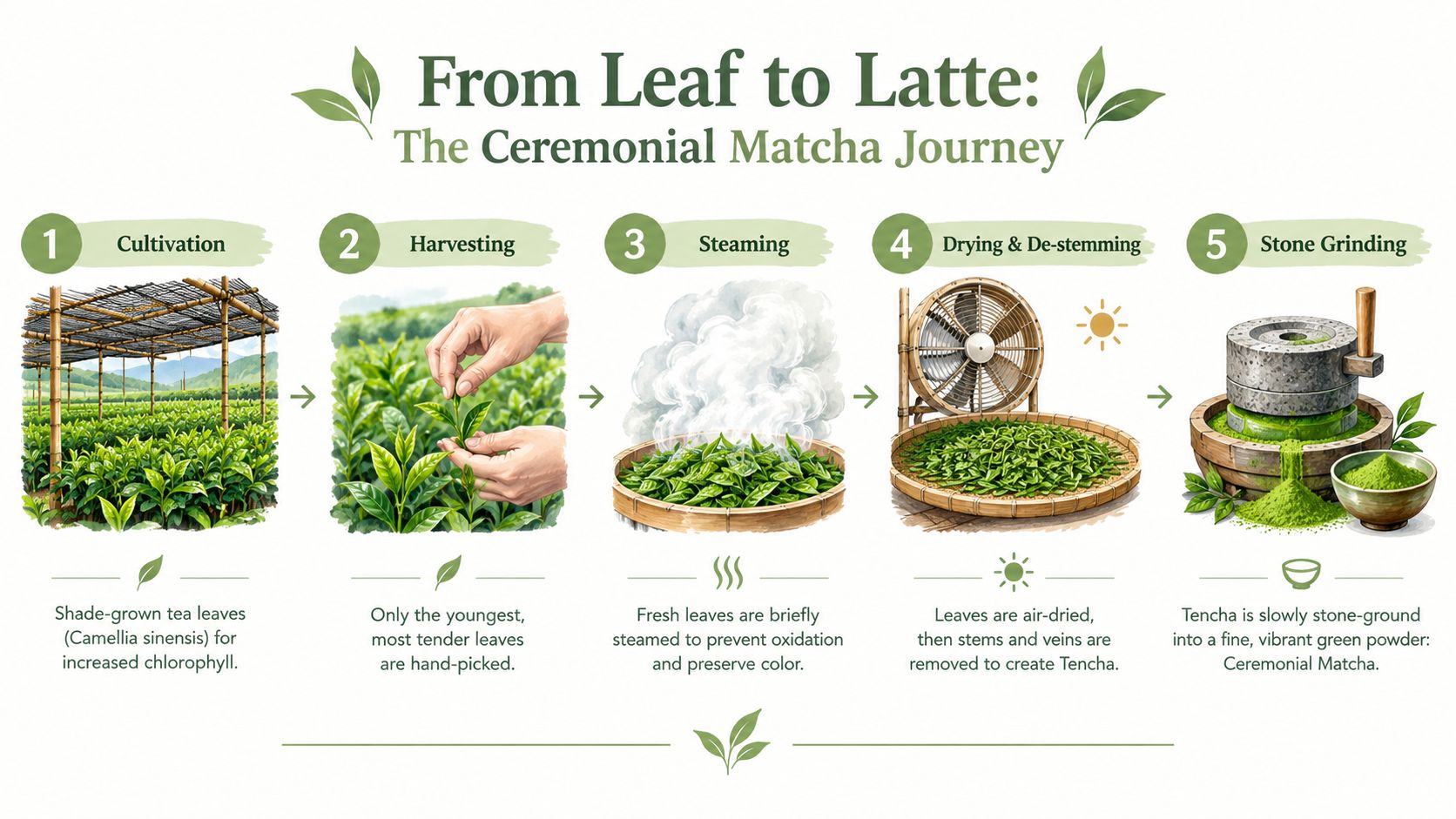
For readers comparing powdered tea formats, this guide to choosing instant matcha can help clarify the difference between convenience powders and matcha intended for a more traditional preparation. PepTea also provides a useful overview of how matcha tea is made, including the transformation from leaf to powder.
Health Benefits and Key Compounds
Organic ceremonial matcha contains several naturally occurring compounds that shape both its flavour and its physiological effects. The main trio is catechins, L-theanine and caffeine. It's more accurate to say matcha may support alertness and focused energy than to promise a medical outcome.
Catechins are plant compounds with antioxidant activity. EGCG, or epigallocatechin gallate, is one of the best-known catechins in green tea. A useful everyday analogy is a clean-up crew. Antioxidants help the body manage oxidative processes, but they aren't a cure-all and shouldn't replace a balanced diet or medical advice.
L-theanine is an amino acid associated with tea's characteristic savoury, rounded taste. Caffeine provides stimulation, while L-theanine may help make the experience feel calmer and less abrupt for some people. The combination can feel different from drinking a strongly caffeinated beverage on its own.
Practical rule: Treat matcha as a whole-leaf food and a caffeinated drink, not as a medicine.
A randomized placebo-controlled study used 2.07 g of matcha per day, providing 50.3 mg of theanine, 171.0 mg of catechins and 72.5 mg of caffeine. Participants showed a statistically significant reduction in reaction time and more correct responses on an emotion-perception task, as reported in the published study available through PubMed Central. That result supports interest in the combined matrix, but it doesn't mean every product or serving delivers the same composition.
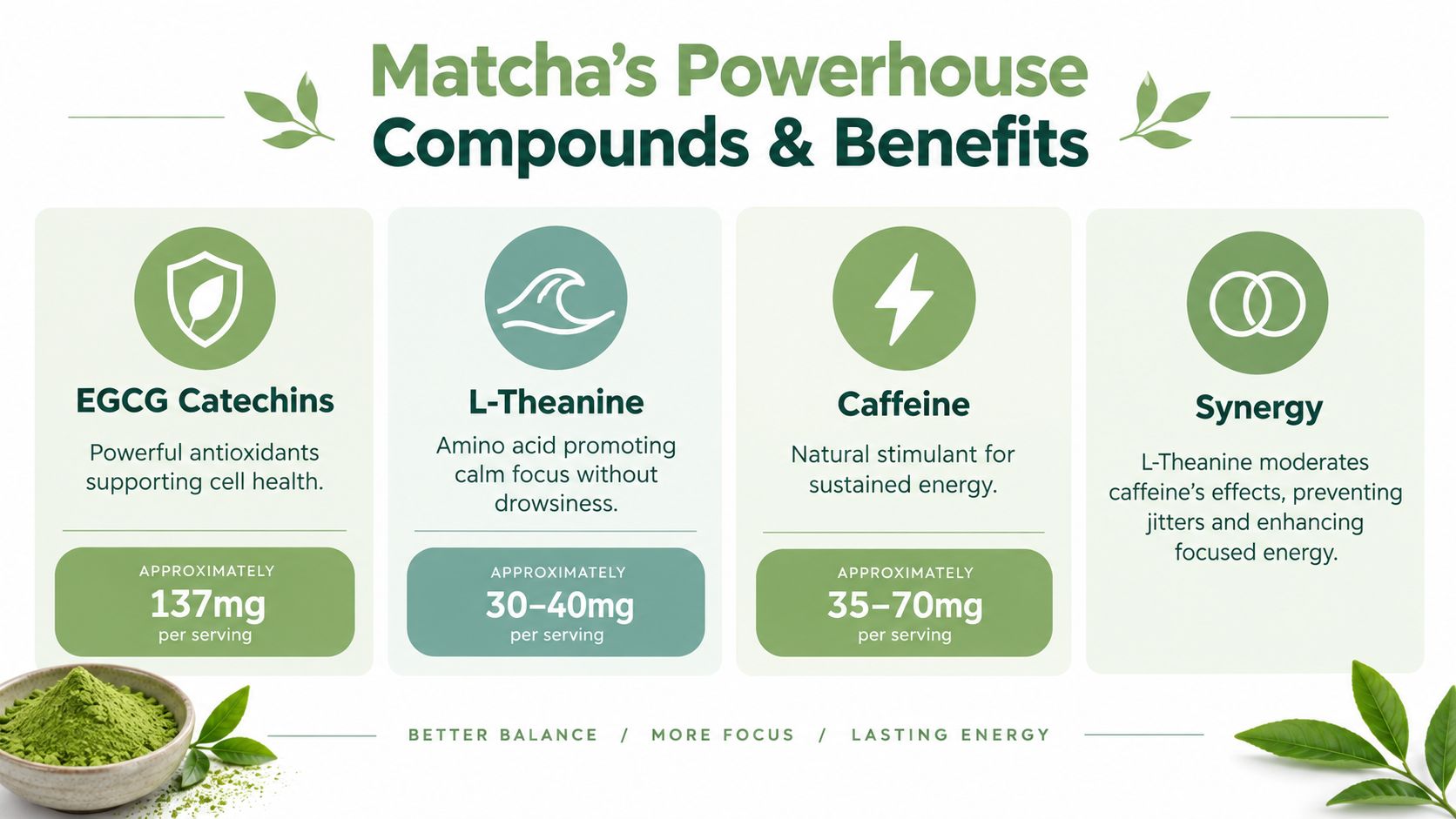
Preparation can change the sensory experience. Very hot water may draw out more bitterness, while excessive milk or sweetener can hide the fresh, grassy and umami notes that distinguish good matcha. Readers interested in the role of EGCG can explore what EGCG is before deciding how much weight to place on antioxidant language.
Grading Origins and Sourcing in Australia
Australia's ceremonial matcha market depends heavily on imported products, so a packet's origin story matters as much as its colour or label. The terms ceremonial, premium and culinary provide useful starting points, but they describe intended use more than they prove authenticity.
Ceremonial matcha is generally selected for a fine texture, attractive colour and balanced flavour when whisked with water. Premium matcha may suit everyday drinking or lattes. Culinary matcha usually has a stronger flavour designed to remain noticeable alongside milk, fruit, flour or chocolate. These categories work like menu labels, not independent laboratory standards.
Origin adds another layer. Japanese matcha is associated with established shading and processing traditions and with umami-focused drinking styles. Chinese matcha is also sold in various grades, often for culinary applications. A country name alone cannot confirm that a product is organic, fresh or appropriate for ceremonial preparation.
Why Australian provenance matters
IndexBox's Australian market analysis describes Australia as an import-dependent market, with Japan supplying much of the value associated with premium matcha and China contributing substantially to import volume. That pattern makes traceability, stock continuity and accurate labelling practical concerns for Australian buyers.
Supply pressure can also affect availability. Australian hospitality coverage describes a fast-growing category, new supply agreements and pressure on shipments of ceremonial Japanese matcha. Treat vague wording such as “Japanese style” or “inspired by Japan” as a prompt to ask questions. Look for the producing country, region where available, importer and batch details.
Reading organic certification
Certification connects an organic claim with an identifiable standard and certifying body. Australian shoppers may see:
- Australian Certified Organic: A certification scheme used for eligible organic products sold in Australia.
- NASAA Certified Organic: Another recognised Australian organic certification pathway.
- JAS: Japan's Agricultural Standards system, relevant when Japanese organic certification is stated.
Check the logo, certification details, product name and importer together. Japanese origin does not automatically mean certified organic, and organic certification does not establish ceremonial grade. For stronger verification, compare the label with lot-specific laboratory data, such as a certificate of analysis showing the tested batch and relevant contaminant or composition results.
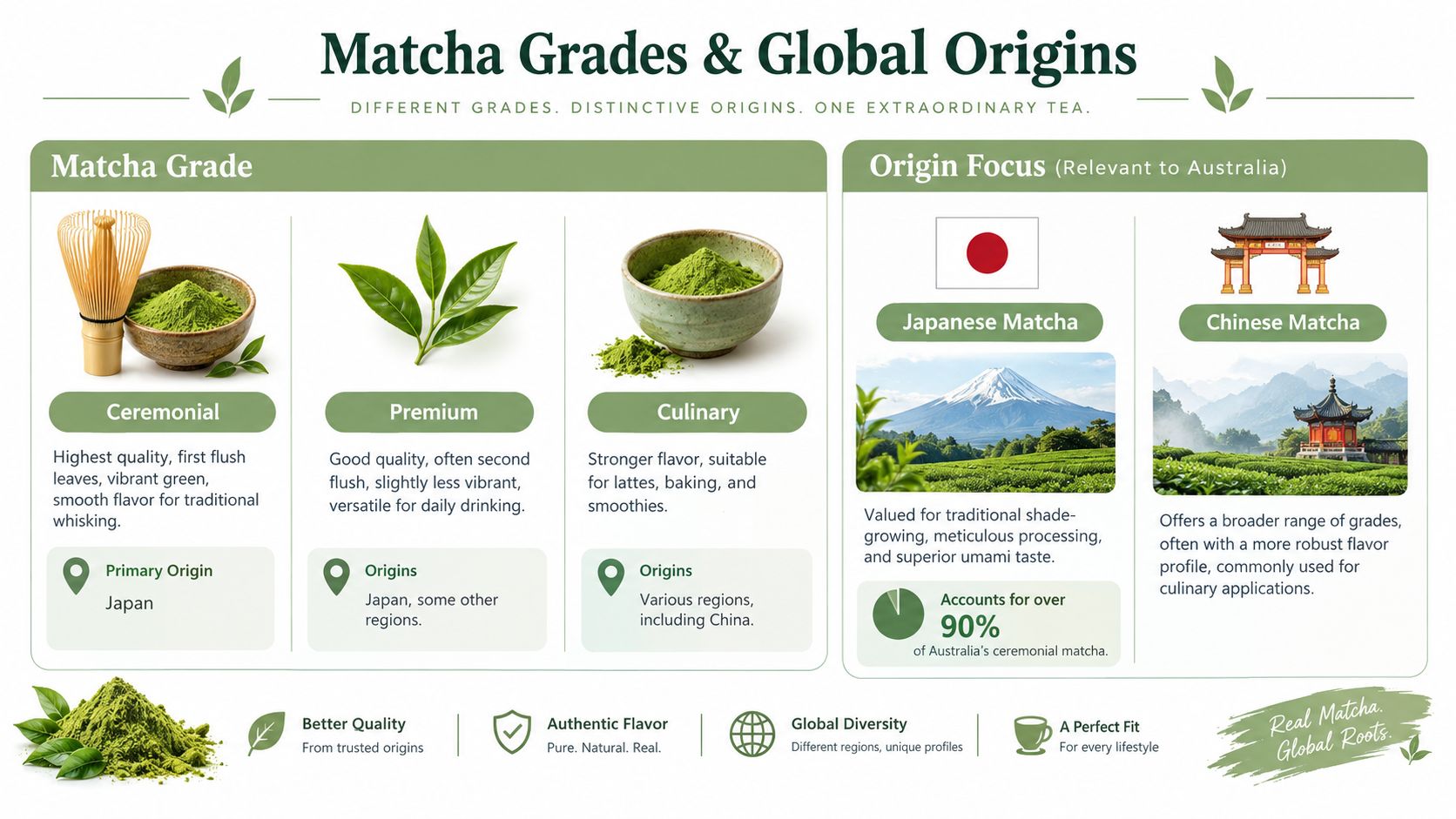
How to Choose High Quality Ceremonial Matcha
Start with transparency, not the colour of the tin. A bright jade-green powder can be a positive sign, but appearance alone can't verify origin, organic status, freshness or potency. The most dependable choice combines sensory checks with documentation.
Use the five-part check
-
Read the origin statement. Look for the producing country and, where available, the region, cultivar, harvest information and importer. A specific statement is more useful than a broad phrase such as “Japanese matcha blend”.
-
Verify organic certification. Check for an identifiable certification mark, not just the word “organic” in large type. If the package is unclear, ask the supplier which body certified the product and whether the certification applies to that particular matcha.
-
Inspect the powder. Fresh ceremonial matcha should look vivid rather than dull, yellowed or grey-green. It should feel fine and silky between the fingers, without obvious coarse particles.
-
Smell before tasting. A fresh, gently sweet and vegetal aroma is more encouraging than a stale, musty or hay-like smell. Once whisked, the flavour should be rounded and umami-led, with bitterness and astringency kept in balance.
-
Ask for a lot-specific COA. A certificate of analysis should identify the tested batch and show relevant results rather than relying on generic marketing copy.
The final point deserves particular attention. Independent ceremonial matcha lab results show substantial variation between samples. One analysis reported EGCG at 69.73 mg/g, EGC at 24.47 mg/g and caffeine at 35.01 mg/g. Another test reported L-theanine at 21.3 mg/g and caffeine at 56 mg/g.
Those figures don't create a universal pass or fail threshold, but they demonstrate why “ceremonial” isn't a reliable proxy for potency. A lot-specific COA can help you understand the likely bitterness, intensity and serving consistency of the product in front of you.
A sealed package protects quality, but it can't replace traceability. You need both.
Choose packaging that limits exposure to light and air, check the best-before information, and note the lot number before opening. If a supplier won't answer basic questions about certification, origin or batch testing, choose a product with clearer documentation instead.
Brewing Basics and Creative Use Cases
The simplest way to taste organic ceremonial matcha is to whisk it with water. Use a clean bowl, a bamboo whisk called a chasen, a small sieve and fresh water. Sifting breaks up compacted powder before it meets the water, so you won't need to fight stubborn lumps.
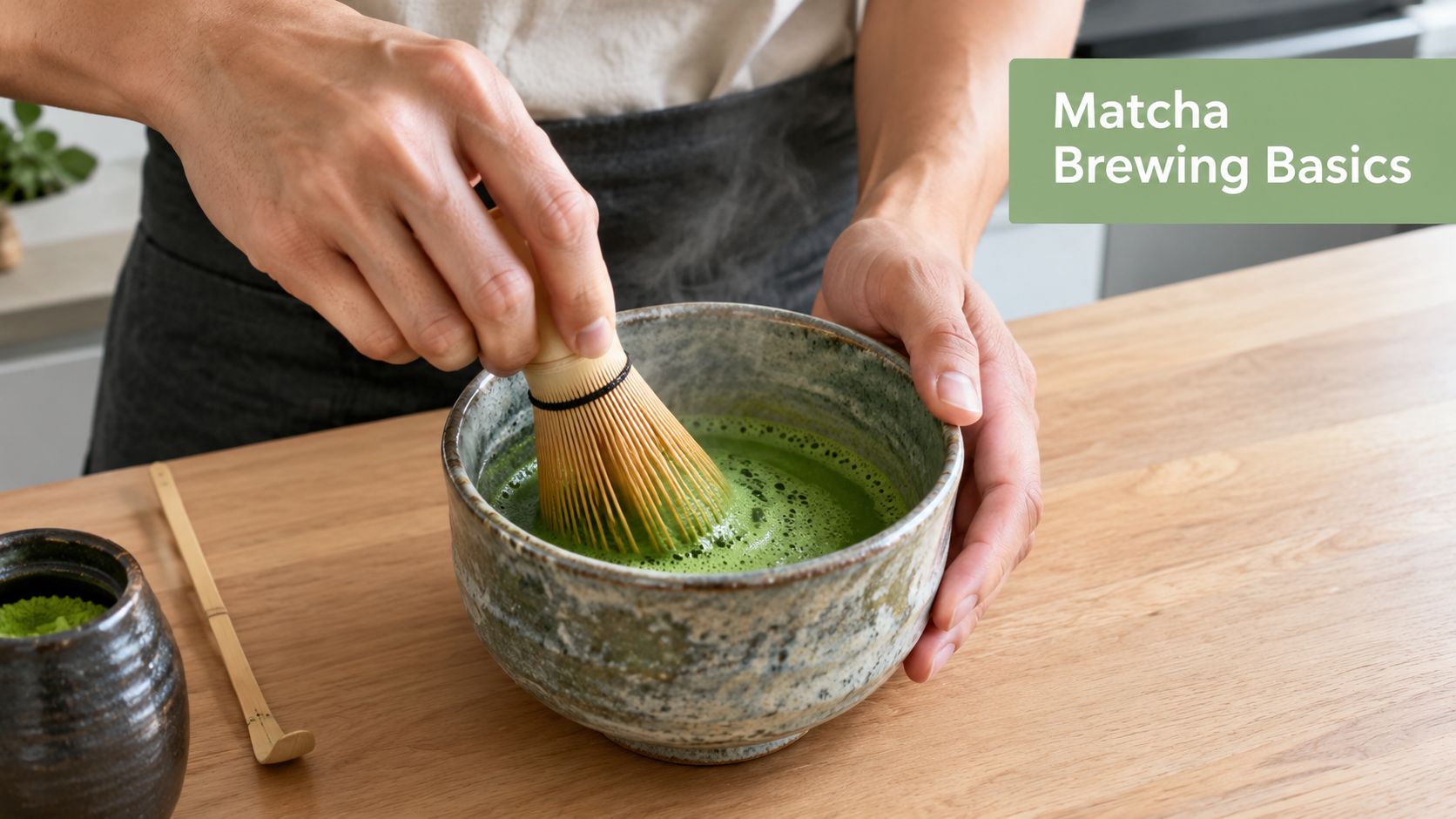
A reliable bowl method
- Warm the bowl, then discard the warming water.
- Sift your chosen amount of matcha into the bowl.
- Add a small amount of warm water and work the powder into a smooth paste.
- Add more water and whisk briskly in a back-and-forth W motion.
- Stop when the surface looks lightly foamy and the powder is evenly suspended.
Avoid boiling water. Excessive heat can make the drink taste harsh, while cooler water tends to preserve delicate sweetness and umami. For a more precise guide, use PepTea's instructions on matcha brewing temperature.
You can also follow the technique visually before adapting it to your own bowl and whisk.
Turning matcha into everyday drinks
A latte starts with a concentrated matcha paste. Whisk the powder with warm water first, then add steamed or chilled dairy milk or plant milk. Oat milk brings sweetness and body, while unsweetened almond milk keeps the tea profile lighter. Add sweetener only after tasting, because sugar can quickly cover the powder's natural character.
For an iced drink, make the concentrate, pour it over ice, then add cold milk or water. A matcha smoothie works well with banana, yoghurt or fruit, but use enough matcha to remain noticeable among the other ingredients. Strong culinary matcha can be practical here because its flavour is designed to stand up to food.
Baking gives you even more flexibility:
- Muffins: Sift matcha with the dry ingredients to distribute the powder evenly.
- Brownies: Stir it into part of the batter for a green tea swirl beside chocolate.
- Ice cream: Blend matcha into the dairy or plant-based base before chilling.
- Smoothies: Combine matcha with fruit, yoghurt and liquid, then taste before adding sweetness.
Cafés can benefit from consistent weighing, water temperature and milk volume. Teams wanting to strengthen their coffee and tea service can also explore TP Training's barista programs for broader beverage preparation skills.
Shopping Guide and Quality Certifications
Buying organic ceremonial matcha in Australia becomes easier when you separate four questions: Is it organic? Is it from the stated origin? Is it fresh? Can the supplier support the quality claim?
Specialist tea retailers, established cafés and direct brand websites can all be useful, provided the product page or packaging gives enough information. Look for a named certification scheme such as NASAA, Australian Certified Organic or JAS, then check that the certification applies to the product rather than only to the business generally.
Use this quick shopping sequence:
- Confirm the label: Check origin, grade description, organic mark, importer details and lot information.
- Examine the pack: Prefer sealed, light-protective packaging that limits air exposure.
- Check freshness: Read the best-before information and avoid products with unclear dating.
- Request evidence: Ask for a lot-specific COA showing relevant compounds such as catechins, caffeine and L-theanine.
- Store it carefully: Keep opened matcha sealed, away from heat, light, moisture and strong kitchen odours.
PepTea offers organic Japanese matcha products, including organic premium and ceremonial-style powders intended for whisking, alongside its Australian-brewed organic kombucha range. That gives shoppers one local supplier option to investigate while comparing certification and product documentation across the category.
A supplier that can't explain its certification, origin or testing may still sell an enjoyable powder, but you won't have enough information to verify the claims. Choose transparency first, then judge the flavour for yourself.
Explore the organic matcha range at Pep Tea to compare Japanese powders for whisking, lattes and recipes. You can also browse its Australian organic kombucha options when you're building a lower-sugar, functional drinks routine.
Matcha Tea Kyoto: A Guide to Japan’s Green Gold

I still remember standing in Kyoto with a bowl of fresh matcha in hand, then walking a few streets over and seeing tins sold as if every green powder were the same. That's the trap with Kyoto matcha. The place is famous for a reason, but the labels don't always teach you how to buy well.
Your Guide to True Kyoto Matcha
Kyoto has a pull on tea lovers that's hard to overstate. You feel it in old tea shops, in the quiet rhythm of whisking, and in the way locals speak about Uji as if it's not just a region but a standard.
That romance is real, but so is the pressure on supply. The average price for first flush Tencha, the leaf used for matcha, in Kyoto rose from JPY 5,500 per kilogram in 2024 to JPY 14,333 in 2025, a 265% increase driven by declining harvests in this premium region, according to reporting on Kyoto Tencha pricing and supply. If you're buying for a home ritual, a café menu, or wholesale use in Australia, that matters.
It matters because scarcity makes surface-level buying riskier. A beautiful tin, a Kyoto reference, or a ceremonial label doesn't automatically mean the matcha suits what you want to make. Some powders are made to be whisked with water and enjoyed on their own. Others are better in lattes, smoothies, or baking where milk, sweetness, or heat change the flavour.
Practical rule: In a tight market, knowing the right grade matters almost as much as knowing the right origin.
That's where a lot of travel guides fall short. They'll tell you where to drink matcha in Kyoto, but not how to tell true Kyoto matcha from a product that borrows the city's reputation. They also rarely explain the difference between a bowl made for quiet sipping and a powder meant for a busy Australian café service.
If you're planning a tea-focused trip, thoughtfully built personalized Japan itineraries can help you experience Kyoto's tea culture with more context than a quick souvenir stop. If you're buying from home, the same principle applies. Slow down, ask better questions, and match the powder to the purpose.
The Ancient Roots of Matcha in Kyoto
Kyoto didn't become the spiritual home of matcha by accident. Its reputation was built over centuries, through monks, growers, tea makers, and ceremony practitioners who kept refining what powdered tea could be.
Zen Master Eisai introduced tea seeds and powdered tea methods to Japan in 1191, and tea production formally began in Uji, Kyoto, in the early 12th century, establishing the region's legacy for high-umami tea, as outlined in this history of Kyoto matcha culture. That's the moment many tea historians point to as the beginning of the Japanese matcha tradition we recognise today.
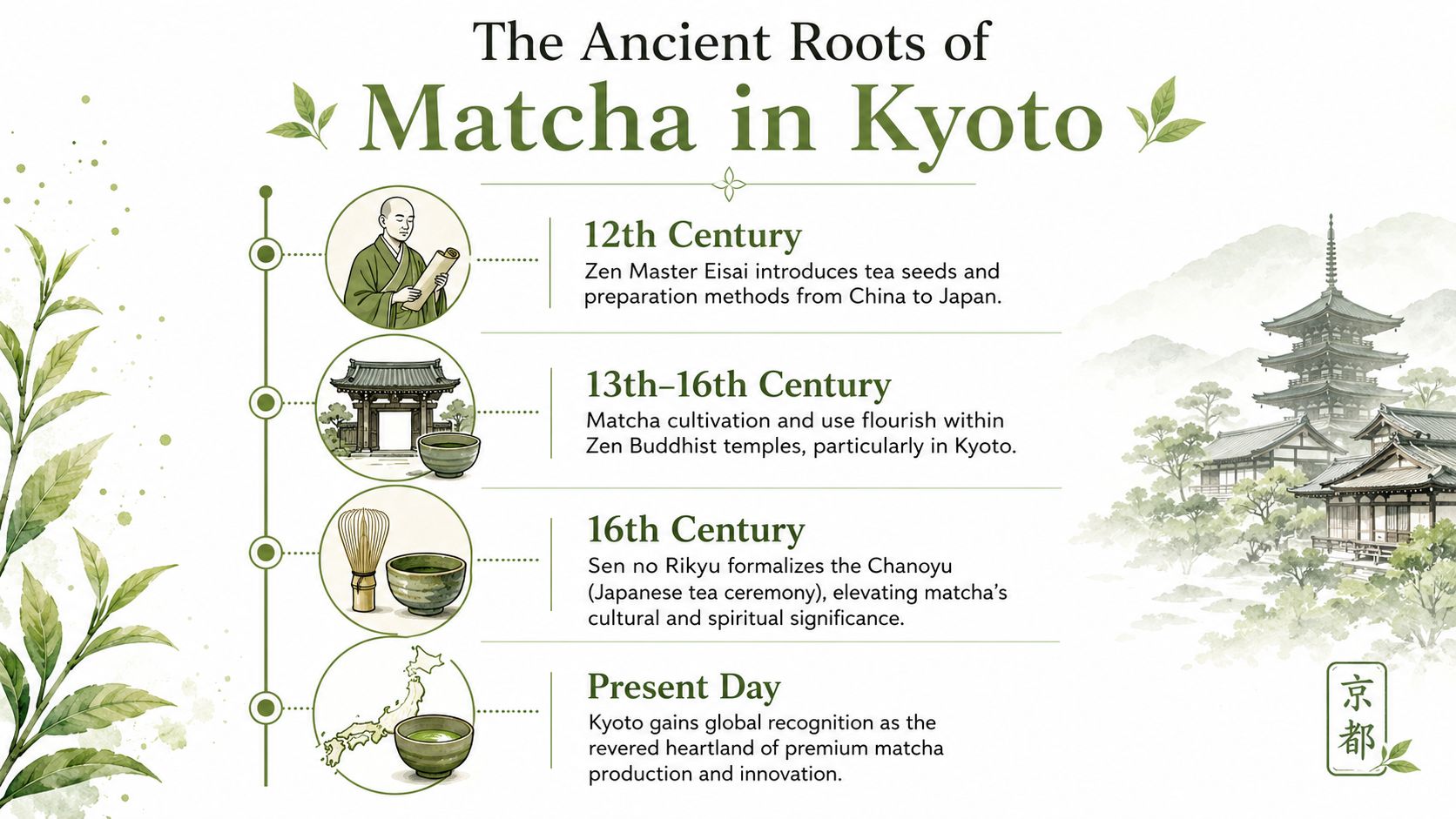
How Uji became the heart of the craft
Uji matters because tea culture in Japan didn't just need a starting point. It needed a place where technique and taste could mature together. Under the teachings of Myoe Shonin, tea production took root in Uji, and over time that local identity became known as Uji tea.
People often hear “Kyoto matcha” and think of a broad map label. Tea people usually hear “Uji” and think of a deeper marker of tradition, flavour, and handling. That distinction still matters now.
A few turning points shaped that identity:
- Tea methods arrived with Zen influence. Matcha wasn't only a drink. It was tied to focus, ritual, and temple culture.
- Stone milling changed the texture. By the 14th century, Japan had developed specialised stone mills for tea, producing a much finer powder than rough grinders.
- Shaded cultivation transformed the leaf. In the 16th-century Azuchi-Momoyama period, growers refined shading methods that became essential to premium Tencha and matcha.
Why the history still affects your cup
When you whisk a good Kyoto matcha today, you're tasting old decisions that never disappeared. Shading before harvest, careful grinding, and the idea that tea can express both flavour and calm all come from that historical line.
Matcha in Kyoto isn't famous just because it's old. It's famous because generations kept improving the same craft without losing the spirit behind it.
If you'd like a local Australian reference point for that story, our own brief history of matcha tea is a helpful companion read.
Understanding Kyoto's Terroir The Uji Difference
When tea people talk about terroir, they mean the way place shapes flavour. Soil, climate, water, air movement, and farming practice all leave a mark. Wine drinkers know the idea well. Matcha deserves the same respect.
In Kyoto, the most prized expression of terroir is often linked to Uji. That doesn't mean every tea from the broader prefecture tastes identical, or that every green powder with a Kyoto label belongs in the same class. The details matter.

According to this overview of Uji matcha terroir and processing, the terroir of Uji, Kyoto creates a creamy texture and a sweet ooi-ka aroma, and authentic ceremonial grade matcha is stone-ground to a particle size finer than 20 microns, about as fine as cornstarch. That's a technical detail, but you can feel it immediately in the bowl. Fine grinding helps the tea suspend smoothly, foam more evenly, and avoid the sandy mouthfeel you get from poorer powders.
What terroir means in plain language
If you're new to the term, think of terroir as the reason one matcha feels rounded and soft while another tastes sharp, flat, or overly grassy.
Here's how that shows up in the cup:
- Texture. Uji matcha often feels creamy rather than coarse.
- Aroma. The sweet, marine-leaning ooi-ka note is one of the clearest sensory clues.
- Sweetness and finish. Better terroir often gives a cleaner sweetness and less harsh bitterness.
That's especially useful for Australian buyers shopping online. If a seller says “Kyoto” but gives no clue about cultivation, milling, or flavour markers, you don't have enough information yet.
Kyoto is broad. Uji is specific
“Kyoto-grown” can be meaningful. “Uji” is usually more specific in the minds of serious matcha drinkers because it points to a historic tea area with a very strong quality identity.
That doesn't mean every Uji matcha will suit every use. It means the origin gives you a stronger starting point when you're looking for a ceremonial-style tea with a softer umami profile.
For a closer look at how origin fits into buying decisions, this Uji matcha powder guide is useful if you're comparing labels in the Australian market.
A short visual look at tea-growing conditions can make that difference easier to grasp:
What to notice before you drink
You don't need to be a tea judge to assess terroir cues. Start with a small checklist.
- Look at the powder. It should appear vivid and alive rather than dull.
- Smell it before whisking. A sweet, creamy scent is a good sign. A flat grassy smell can indicate a different style or lower refinement.
- Feel the finish. Good matcha lingers cleanly. Poorer matcha often leaves a rough, drying edge.
Decoding Matcha Grades Ceremonial vs Culinary
The first time I watched an Australian café make a matcha latte with an expensive Kyoto ceremonial powder, I knew what was about to happen. Beautiful colour, lovely aroma, and then milk, vanilla, and ice buried the tea's finer notes. The matcha was excellent. It was doing the wrong job.
That mix-up happens because grade names sound like rankings. In practice, they work more like choosing the right coffee roast for espresso versus filter, or the right olive oil for finishing versus cooking. A higher grade is not automatically better for every use. It is better for a specific style of drinking.
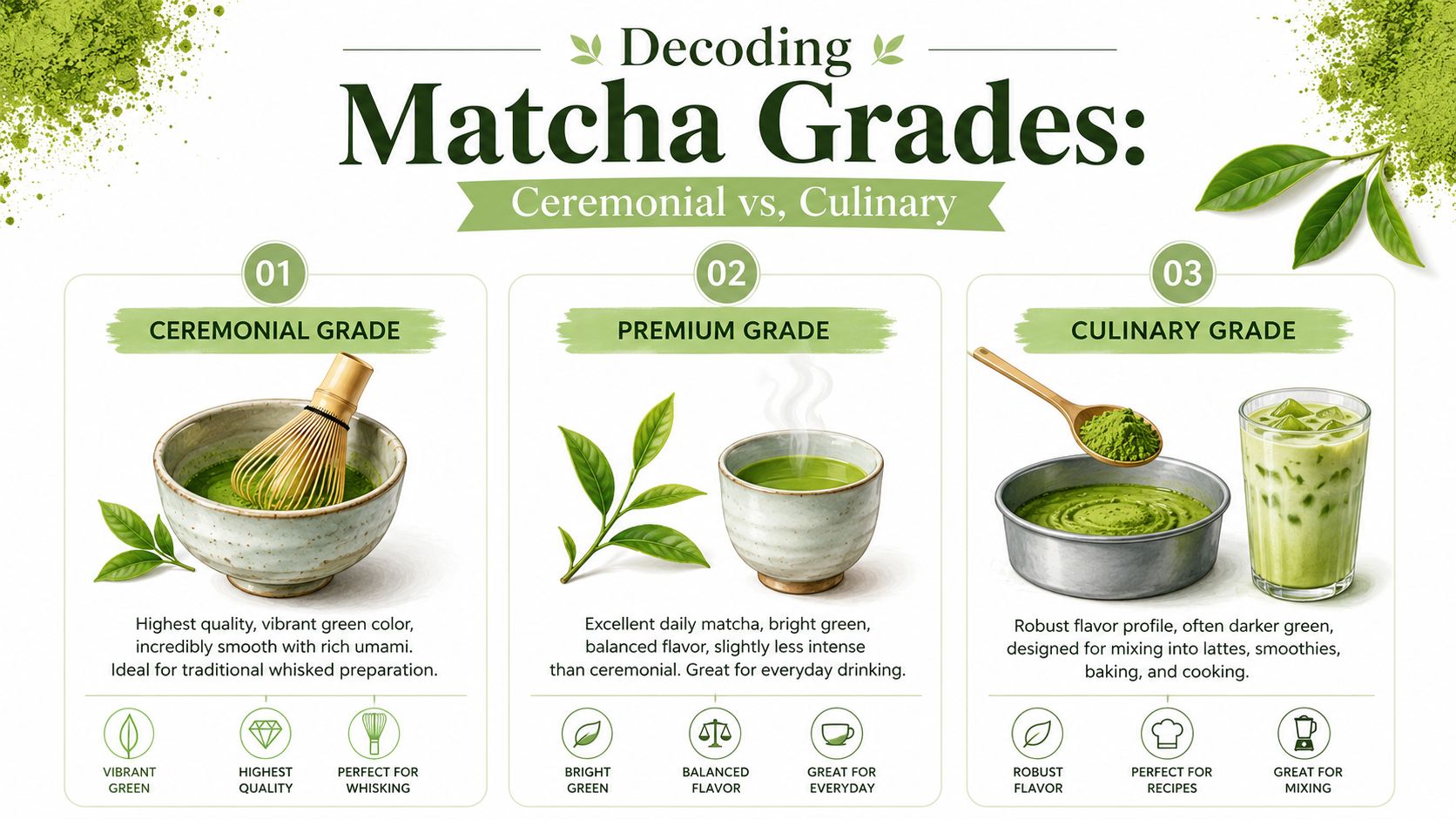
The simplest way to read matcha grades
Start with the cup you want to make.
If you plan to whisk matcha with water and drink it on its own, ceremonial grade is the right place to look. Good ceremonial Kyoto matcha is usually made from carefully shaded tencha and processed to highlight sweetness, umami, and a smooth finish. The point is clarity. You are tasting the tea itself, with nothing to hide behind.
Premium grade sits in the middle. It often suits daily drinking, lighter lattes, and home use where you want a pleasing balance between softness, freshness, and value.
Culinary grade is chosen for strength of flavour in recipes. Milk, sugar, chocolate, banana, or heat all compete with the tea. A powder for baking or café lattes needs enough presence to still taste like matcha after everything else goes in.
That is why grade is really a use guide.
Why ceremonial matcha can disappoint in a latte
Ceremonial matcha is prized for delicacy. In a straight bowl, that delicacy shows up as sweetness, creamy texture, gentle marine notes, and a rounded umami finish. In a latte, many of those subtleties fade.
Australian drinkers often run into this problem because café matcha culture and traditional tea culture ask for different things. A whisked bowl rewards finesse. A latte rewards presence. If your regular order is oat milk with a little sweetness, a premium or culinary Kyoto matcha will often give you a clearer tea flavour than a more delicate ceremonial powder.
The best matcha for your kitchen or café is the one that suits the drink in front of you.
Matcha Grades At a Glance
| Grade | Best For | Flavour Profile | Colour | Price Point |
|---|---|---|---|---|
| Ceremonial | Traditional whisked tea, slow morning ritual, tasting straight with water | Smooth, umami-forward, low bitterness | Vibrant green | Higher |
| Premium | Daily drinking, lighter lattes, flexible home use | Balanced, fresh, approachable | Bright green | Mid-range |
| Culinary | Lattes, smoothies, baking, desserts | Stronger, more assertive, designed to cut through other ingredients | Usually deeper or less luminous green | Lower |
A practical guide for Australian homes and cafés
For cafés, this choice affects both flavour and cost. Using ceremonial matcha in a heavily flavoured latte can be like pouring a delicate pinot into sangria. You can do it, but you lose what made it special in the first place.
For home drinkers, the same rule helps:
- Straight whisked bowl with water. Choose ceremonial.
- Daily latte or iced matcha. Choose premium, or culinary if you want a bolder tea taste.
- Baking, desserts, and smoothies. Choose culinary.
If you want another reference point, this comprehensive guide for Japanese matcha shows how different matcha styles are presented for different uses. For an Australia-focused buying breakdown, our ceremonial vs culinary matcha guide for everyday use explains what to choose for whisking, lattes, and recipes.
What to check on the label
Grade terms are not perfectly regulated, so the front of the tin never tells the whole story. Look for clues that match your purpose.
- For ceremonial use, look for wording around whisking, smoothness, umami, shading, or first harvest style.
- For lattes, trust sellers who clearly say the powder suits milk drinks.
- For baking, choose flavour intensity over delicacy.
A simple question helps cut through the marketing. Are you trying to taste the tea alone, or are you asking it to stand up inside a recipe? Once you answer that, Kyoto matcha grades start to make much more sense.
How to Brew and Enjoy Kyoto Matcha
Once you've chosen the right grade, matcha becomes much easier and more enjoyable. Most brewing problems come from one of three things. The wrong powder for the job, water that's too hot, or a rushed mixing method.
How to whisk a traditional bowl at home
For a simple bowl of usucha, you don't need a formal tea room. You just need a few basic tools and a little care.
You'll want:
- A chawan. That's the bowl.
- A chasen. A bamboo whisk.
- A fine sifter. This helps prevent clumps.
- A scoop or spoon. Keep it consistent each time.
A beginner-friendly method looks like this:
- Warm the bowl with hot water, then tip it out and dry it.
- Sift the matcha into the bowl so the powder loosens.
- Add warm water, not boiling. Overheated water can make matcha taste harsh.
- Whisk briskly in a quick zig-zag motion until you get a light foam.
- Drink straight away while the aroma is fresh.
What a good bowl should taste like
A well-made ceremonial bowl shouldn't taste like lawn clippings. It should feel rounded, smooth, and lively, with a pleasant vegetal depth rather than rough bitterness.
If your bowl tastes overly sharp, check these factors:
- The water may be too hot
- The powder may be too old
- The matcha may be better suited to lattes than straight whisking
Good matcha rewards small adjustments. A slight change in water temperature or whisking can transform the cup.
A simple organic matcha latte
Australian homes and cafés often meet matcha through the latte first, and that's perfectly fine. The key is using a powder that can handle milk without disappearing.
Try this easy version:
- Sift your matcha into a cup or bowl
- Add a small splash of warm water and whisk into a smooth paste
- Top with hot or cold milk of your choice
- Sweeten lightly if you want, but keep it subtle so the tea still shows through
If you're making iced matcha, dissolve the powder well first. Dumping it straight onto cold milk almost guarantees clumps.
For recipes like bliss balls, pancakes, smoothies, or cakes, use culinary grade. It gives you the green tea character you want without paying for delicate notes that won't survive heat and other ingredients anyway.
Everyday ways Australians can use matcha
You don't have to keep matcha locked in one ritual style. It fits easily into daily life.
- Morning whisked bowl for a slower start
- Iced latte before work or after the gym
- Smoothie addition with banana and yoghurt
- Baking ingredient for muffins, slices, or cheesecakes
One practical option in Australia is Pep Tea's organic matcha green tea, which is offered for broad use across drinking and recipe applications. What matters most is matching the grade and flavour style to how you'll prepare it.
Finding Authentic Matcha Experiences in Kyoto
Kyoto has no shortage of matcha stops, but not all of them will teach you much. Some are beautiful and memorable. Others are mostly packaging, queues, and gift tins.
A useful starting point is to look beyond “famous” and look for signs of care. Tea houses with a long local relationship to tea tend to explain origin, harvest timing, preparation style, and flavour more clearly than shops built around quick tourist turnover.
What to ask when buying matcha in Kyoto
Many travellers overspend due to a critical gap for tourists: 78% of matcha sold in Kyoto souvenir shops is ceremonial grade, while culinary uses like lattes are often better suited to more affordable, heat-stable premium culinary grades, according to this Kyoto matcha shopping guide.
That means you should ask direct questions before buying:
- What is this best used for. Whisking, latte, or baking?
- Is it from Uji or another area of Kyoto.
- Is this intended for first flush ceremonial use.
- How would you prepare it at home.
The answers matter more than the display.
What a worthwhile tea experience looks like
The best tea experiences in Kyoto usually share a few qualities:
- They teach, not just serve. Someone explains the bowl, the whisk, or the origin.
- They distinguish grades clearly. You're not pushed toward the priciest tin by default.
- They respect the ritual. Even a casual tasting can still feel deliberate.
If you're planning a broader Kyoto trip around food, culture, and neighbourhoods, a thoughtful local guide for Kyoto travelers can help you build a better itinerary around genuine tea stops rather than random souvenir rows.
Buy the tea you'll actually use. The wrong expensive tin is less authentic to your life than the right everyday one.
Small signs of authenticity
When you're standing in a shop, trust your senses and the conversation.
A good seller can usually tell you how the tea should smell, whether it's better straight or with milk, and why one tin costs more than another. If they can't explain those basics, keep walking.
Sourcing Authentic Organic Matcha in Australia
You don't need to fly to Japan to buy carefully. In Australia, the challenge is different. You're not navigating Kyoto side streets. You're reading product pages, labels, and importer claims from your phone or laptop.
That means your buying checklist needs to be sharper.
What to check before you buy
Start with the core markers of authenticity and fit.
- Origin clarity. Look for a clear statement of Japanese origin, and ideally more detail than just “Japan”.
- Grade clarity. The seller should tell you whether the matcha is meant for whisking, lattes, or cooking.
- Organic credentials. If organic matters to you, the label should say so plainly.
- Usage guidance. Good retailers explain how to prepare the product, not just how pretty the tin is.
If a listing is vague on all four points, it's hard to know what you're paying for.
Why this matters more for Australian cafés
For cafés, buying matcha isn't only about romance or provenance. It's about menu design, consistency, and staff confidence. Your team needs to know which powder belongs in a straight matcha, which one stands up in a latte, and how to describe the difference to customers.
That education piece matters. It helps a customer move from “I want something green and healthy” to “I want a smooth whisked bowl” or “I want a bold iced latte.”

How we think about matcha at home in Australia
At Pep Tea, we focus on helping Australians understand what they're buying, not just selling them a tea term they've heard on social media. That means being clear about Japanese origin, practical use, and the difference between ceremonial-style drinking and culinary application.
For many households, matcha sits alongside other daily wellness drinks rather than in a separate ceremonial category. One day it's a morning bowl. The next it's part of a smoothie or an afternoon latte. For cafés, it may sit naturally beside a non-alcoholic menu that also includes low-sugar and fermented options such as kombucha.
The most reliable way to buy matcha tea Kyoto-style in Australia is simple:
- Check where it's from
- Check what it's for
- Check how it's milled and described
- Buy from a seller who can explain the difference without jargon
That's how you avoid paying ceremonial prices for a baking ingredient, or buying a latte powder when you wanted a quiet, silky bowl.
If you're ready to put this into practice, explore Pep Tea for organic matcha options and practical guidance on choosing the right style for whisking, lattes, recipes, or café service in Australia.
Best Matcha Cafe Sydney: 2026 Guide

You’ve probably noticed it already. You grab a coffee in Surry Hills, wander through Newtown, or meet a friend near Bondi, and suddenly half the tables around you are holding bright green drinks instead of flat whites. Some look smooth and elegant. Others look sugary, pale, and more like dessert than tea. If you’re curious about the matcha cafe sydney scene, you’re not alone.
A lot of Sydneysiders are in the same spot. They want to know which cafés are worth trying, why one matcha tastes silky and sweet while another tastes harsh, and whether the higher price means better quality. Café owners are asking a similar question from the other side of the counter. Is matcha just a trend, or is it now a serious menu category that deserves proper sourcing and staff training?
Welcome to Sydney’s Matcha Moment
Walk through the inner city at the right time of day and the signs are hard to miss. Iced matcha in takeaway cups. Strawberry matcha on specials boards. Baristas whisking bright green powder with the same care they’d usually reserve for a single-origin espresso. That change didn’t happen overnight.

The shift became especially noticeable when Australia’s matcha trend accelerated during 2024 to 2025, with interest surging over the six months leading up to late 2025 according to Tony Kwok of Qualitea in Sydney’s Strand Arcade, and premium Sydney matcha drinks typically landing in the $6 to $12 range, as reported by Salience Eats Sydney’s look at Australia’s matcha mania.
That explains why so many people feel slightly behind. Matcha used to sit in the “wellness niche” corner. Now it’s part of everyday café culture. You can still find the mindful, ceremonial side of it, but you’ll also see it folded into the daily Sydney rhythm of brunch, takeaway, beach walks, and afternoon catch-ups.
Why the local buzz feels bigger now
Sydney has a way of turning a food trend into a neighbourhood habit. Once a drink lands in the right cafés, gets shared across social feeds, and starts appearing in a few creative forms, it stops being “something new” and starts becoming normal. That’s exactly what happened with matcha.
The interesting part isn’t only that more cafés serve it. It’s that more customers now expect it to be done properly. They’re noticing colour, taste, texture, milk balance, sweetness, and whether the café can say anything meaningful about where the matcha came from.
Sydney drinkers aren’t just ordering matcha for the colour. They’re learning to tell the difference.
Why this guide matters
Most round-ups tell you where to go. That’s useful, but it’s not enough if every green drink gets called matcha without much discussion of grade, freshness, or preparation. A good matcha cafe sydney guide should help you make smarter choices, not just longer lists.
If you’re a customer, that means knowing how to order confidently and spot quality. If you run a café, it means understanding what separates a forgettable matcha latte from one people return for.
What Exactly Is Matcha and Why Is It So Special
Matcha is often described as powdered green tea, and that’s technically true. But it misses the point.
What makes matcha special is the way it’s grown, processed, and prepared. Instead of steeping leaves and throwing them away, you whisk the finely ground tea itself into water or milk and drink the whole leaf. That gives matcha a richer body, a more layered flavour, and a different drinking experience from a standard green tea bag.

It’s not just “green tea, but trendy”
Beginners often get confused here. They assume any green powder is matcha, or that all matcha is basically the same. It isn’t.
Good matcha starts with tea leaves that are handled very differently from ordinary green tea. The powder should be fine, fresh-looking, and easy to whisk. The flavour should have some softness and depth, not just bitterness.
If you want a deeper primer on the basics, Pep Tea has a straightforward explainer on what matcha powder is.
Two grades you’ll see most often
The simplest way to understand matcha grades is to think about purpose.
| Grade | Best use | What it’s like |
|---|---|---|
| Ceremonial grade | Straight whisked matcha, premium lattes | Smoother, more delicate, more pleasant on its own |
| Culinary grade | Baking, smoothies, desserts, blended drinks | Stronger, more assertive, designed to mix with other flavours |
Ceremonial grade is the one people usually mean when they talk about a refined café matcha. It’s meant to stand on its own or carry a latte without needing heaps of sweetener.
Culinary grade has a different job. It needs enough presence to cut through milk, chocolate, syrups, or baking ingredients. That doesn’t make it bad. It just means it’s designed for a different context.
A simple way to remember it
A useful analogy is this:
- Ceremonial grade is like a bottle you’d happily pour for guests on its own.
- Culinary grade is like an ingredient you choose because it still performs well once other flavours join in.
Where people get disappointed is when a café charges premium prices for a drink made with powder that tastes flat, gritty, or heavily sweetened to hide bitterness. The menu might say “matcha”, but that single word doesn’t tell you much about quality.
Good matcha should taste intentional. If a drink only works once syrup is added, the powder may not be doing much of the heavy lifting.
Why Sydney drinkers care
Matcha sits at the intersection of flavour, ritual, and function. Some people love the grassy, umami edge. Some want a coffee alternative that feels smoother. Others enjoy the calm pace of a drink that asks for a bit more attention.
That’s why the best Sydney cafés treat matcha as its own category, not just a green add-on. When a barista understands grade, temperature, whisking, and balance, the result tastes completely different.
Navigating the Menu at a Sydney Matcha Cafe
A Sydney matcha menu can look simple until you’re standing at the counter trying to decide whether you want a hot latte, iced strawberry matcha, or a traditional bowl. If you’re new to it, the easiest way to order well is to think in terms of style, sweetness, and setting.
Start with the style of drink
Most cafés will serve matcha in one of a few broad formats.
Traditional whisked matcha
This is the purest option. Matcha is whisked with water, not drowned in milk or syrup. If you want to taste the tea itself, this method provides the quickest understanding.Hot matcha latte
This is the entry point for many people. Milk softens the grassy notes and makes the drink feel familiar, especially if you’re coming from coffee.Iced matcha latte
Sydney weather makes this one a staple. A good iced version should still taste like tea, not just cold milk with a faint green tint.Creative specials
Strawberry matcha, coconut versions, layered drinks, and dessert-style pours are common in trend-forward cafés. These can be fun, but they vary wildly in balance.
Know what to ask for
You don’t need to sound like a tea judge. A few simple questions will tell you a lot.
- Ask if it can be unsweetened. A confident café usually won’t panic at this request.
- Ask which milk works best. Some baristas will have a clear recommendation because they’ve tested the balance.
- Ask whether the matcha is more delicate or stronger. Even if they don’t use formal grade language, their answer can reveal how much they understand the product.
- Ask if it’s whisked fresh. Fresh preparation usually gives you better texture.
What different neighbourhoods tend to offer
Sydney’s geography shapes the experience. The city’s inner suburbs account for 48% of cafés and lead specialty beverage adoption, especially in places such as Surry Hills, Newtown, and Paddington, according to Coffee Analytica’s overview of Sydney café distribution. Those neighbourhoods draw customers who actively seek quality and are willing to explore drinks beyond standard coffee.
That’s why matcha-focused venues show up so often in these pockets. Names mentioned in that same source include Parami in Surry Hills and Sunday’s Bondi. Even without memorising a list of addresses, the pattern matters. If you’re hunting for a stronger matcha offering, inner-suburban café strips usually give you better odds than a generic convenience stop.
Ordering based on your taste, not the trend
If you’re not sure where to begin, this rough guide helps.
| If you usually like | Try this first | Why it works |
|---|---|---|
| Flat whites or cappuccinos | Hot matcha latte | Familiar texture, gentler introduction |
| Cold brew or iced coffee | Iced matcha latte | Refreshing and clean |
| Green tea or less sweet drinks | Traditional whisked matcha | Lets the tea speak |
| Desserts and sweet café drinks | A creative matcha special | Easy entry, but quality varies |
Common mistakes first-timers make
Some disappointments aren’t about the café. They come from ordering a style that doesn’t suit your palate.
- Choosing a layered novelty drink first can make it hard to know whether you like matcha itself.
- Judging all matcha by one bad latte is another trap. Poor powder or poor preparation can flatten the experience.
- Expecting coffee flavour sets you up for confusion. Matcha is grassy, savoury, creamy, and sometimes gently sweet. It’s a different language.
Order your first cup as simply as you can tolerate. The simpler the drink, the easier it is to learn what the café is serving.
A practical first-order strategy
If you’re walking into a new matcha cafe sydney spot for the first time, this is a sensible approach:
- First visit. Try a regular hot or iced latte with minimal sweetness.
- Second visit. Order it unsweetened or ask for the house-preferred version.
- Third visit. If the café seems serious about tea, try it with water rather than milk.
By then, you’ll know whether you love the place or just loved the Instagram colour.
How to Spot Authentic High-Quality Matcha
The Sydney matcha conversation takes a more interesting turn. Plenty of cafés can make a drink that looks appealing. Far fewer tell you much about the powder itself.
That matters because quality starts long before the whisk touches the bowl. A café can have beautiful ceramics, soft lighting, and a queue out the door, yet still serve matcha that’s stale, overly bitter, or chosen mainly for cost and colour.
What your eyes can tell you first
The first clue is the powder itself, if you can see it, or the colour in the finished drink.

High-quality matcha usually looks vivid and lively. Low-grade powder often drifts into dull green, olive, or yellowish territory. In milk, the colour will soften, but it should still look fresh rather than murky.
Texture tells a similar story. Fine matcha should whisk smoothly and feel almost creamy on the tongue. Coarser powder can taste dusty or gritty, especially when the drink cools down.
The taste test matters more than the colour
A bright colour helps, but flavour is the ultimate giveaway.
Good matcha often has a gentle umami character. You might notice grassy notes, some natural sweetness, and a rounded finish. Poorer matcha tends to hit with aggressive bitterness or dryness, which is why some cafés bury it under vanilla syrup, strawberry puree, or sweet cream.
Use this simple comparison if you’re unsure:
| Quality marker | Higher-quality matcha | Lower-quality matcha |
|---|---|---|
| Colour | Bright, fresh green | Dull, muddy, yellow-green |
| Texture | Fine and silky | Coarse or chalky |
| Aroma | Fresh, vegetal, softly sweet | Flat, stale, or harsh |
| Taste | Umami, smooth, balanced | Bitter, sharp, one-note |
| Aftertaste | Clean and lingering | Drying or unpleasant |
Here’s a helpful visual guide before you order or buy.
Why shade-grown matcha stands out
The biggest quality clue isn’t always visible on the menu. It’s how the tea was grown.
In top Sydney cafés, premium shade-grown organic matcha can reach EGCg antioxidant levels of up to 137 mg/g, compared with 60 to 80 mg/g in standard varieties. The same source notes that pre-harvest shading also boosts L-Theanine, creating a synergy associated with calm focus over 4 to 6 hours, and links this quality difference to repeat customer behaviour in Sydney’s competitive café market, according to Eat Drink Play’s Sydney matcha coverage.
For everyday drinkers, the science matters because you can feel the difference in the cup. Shade-grown matcha tends to taste softer and deeper. It often feels steadier too. That’s part of why people who switch from rushed coffee habits to good matcha often talk about a more even experience.
Practical rule: if a café can explain whether its matcha is shade-grown, organic, and selected for flavour rather than just colour, that’s a strong sign it takes the category seriously.
Questions worth asking at the counter
A lot of Sydney guides focus on aesthetics, but the primary issue is transparency around sourcing, grade, and preparation. That gives you a chance to ask better questions.
Try a few of these:
- Where is the matcha sourced from? Clear origin is better than vague answers.
- Is it ceremonial or culinary? The right answer depends on the drink, but the staff should understand the difference.
- Do you whisk each drink fresh? Fresh whisking improves texture.
- Do you sweeten it by default? This tells you whether the café expects the tea to stand on its own.
If the answer to every question is hazy, the matcha probably isn’t the star product.
Signs a café respects the tea
You don’t need a formal tea ceremony to get a good result. But serious cafés tend to share certain habits.
- They store matcha carefully. Light, heat, and air dull flavour.
- They sift before whisking. This helps prevent clumps.
- They use water that isn’t too hot. Overheating can push bitterness forward.
- They talk about flavour, not just wellness. Good matcha is first a delicious ingredient, then a functional one.
A quality-focused café usually doesn’t need to oversell. The drink speaks for itself.
Why sourcing transparency matters in Sydney
This is the part many customers have been waiting for without realising it. Sydney’s matcha scene has become stylish very quickly, but style alone doesn’t protect quality. The more mainstream matcha becomes, the easier it is for cafés to treat all green powder as interchangeable.
That’s where careful sourcing changes everything. When a café chooses authentic organic matcha with a clear purpose, trains staff to prepare it properly, and explains the difference to customers, the category becomes more than a trend. It becomes part of a long-term beverage identity.
Creative Pairings for Matcha and Kombucha
Matcha doesn’t have to sit alone on a menu. In a modern Sydney café, it works beautifully beside food, pastries, and alcohol-free drinks that share the same fresh, functional feel.

Pairings that make flavour sense
Matcha has a layered profile. It can be grassy, creamy, savoury, soft, and slightly sweet. That means it pairs best with foods that either echo its calm richness or cut through it cleanly.
A few combinations work especially well:
- Mochi or lightly sweet rice cakes because they don’t overpower the tea.
- Yuzu or citrus tarts because acidity brightens matcha’s deeper notes.
- Buttery pastries because the fat rounds out the tea’s grassy edge.
- Sesame desserts because nutty flavours sit comfortably beside umami.
- Simple savoury bites such as egg sandwiches or mushroom toast, which can make a whisked matcha feel surprisingly natural.
Where kombucha fits in
Kombucha belongs in the same conversation because it offers a different kind of refreshment. Matcha is grounding and creamy. Kombucha is lifted and lively. Together they create a strong non-alcoholic pairing language for cafés and home drinkers.
If you’re curious about how these two drinks support a broader tea ritual, Pep Tea has a useful piece on green tea benefits across matcha and kombucha.
Easy pairing ideas for home or café menus
| Matcha item | Pair it with | Why it works |
|---|---|---|
| Iced matcha latte | Ginger kombucha | Spice and acidity sharpen the finish |
| Hot ceremonial matcha | Plain mochi | Lets the tea stay centre stage |
| Matcha brownie | Lime or citrus-forward kombucha | Fresh contrast against richness |
| Matcha mousse | A drier kombucha style | Keeps the dessert from feeling heavy |
A good pairing doesn’t need more sugar. It needs contrast, balance, and enough restraint to let the matcha stay recognisable.
A useful idea for Sydney cafés
Many venues still treat matcha as a single drink and kombucha as a fridge add-on. There’s more potential than that. A café can build a whole “clean energy” section that includes a straight matcha, a house matcha latte, and a kombucha pairing chosen for contrast.
That approach works just as well at home. If your afternoon usually swings between a second coffee and something sweet, a matcha and kombucha pairing can feel more considered without becoming fussy.
A Cafe Owner’s Guide to Adding Matcha to Your Menu
For café owners, matcha is no longer just a courtesy option for the one customer who doesn’t drink coffee. Sydney customers are paying more attention to it, and many are starting to ask the right questions.
The opportunity is clear because so much current café coverage still centres on aesthetics while leaving out grade, sourcing, and preparation. That transparency gap gives venues a practical way to stand apart, as noted in this discussion of matcha quality and sourcing transparency in Sydney cafés.
Start with a clear menu role
Don’t add matcha because other cafés have it. Add it because you know what role it plays in your offer.
A simple framework helps:
- Signature drink role. A carefully made hot or iced matcha latte with clear sourcing details.
- Functional beverage role. A calmer alternative for customers who don’t want another coffee.
- Kitchen ingredient role. Matcha for baking, soft serve, cookies, slices, or specials.
If you try to do all of that with one powder, quality and consistency usually suffer.
Match grade to application
Many venues cut corners, buying one product and forcing it into every format.
That rarely works well.
- Use ceremonial-grade matcha for straight service and premium lattes where the tea flavour is exposed.
- Use culinary-grade matcha for baking, desserts, smoothies, and recipes where it needs to carry through other ingredients.
For cafés that need a practical supply format for recipes and batch use, bulk buy culinary grade organic matcha is the sort of category worth evaluating alongside your existing supplier options.
Train staff on a few non-negotiables
Your barista doesn’t need to become a tea historian. They do need a repeatable method.
Focus on these points:
Sift the powder
Clumps create a rough texture and uneven flavour.Use appropriate water temperature
Water that’s too hot can make the drink taste harsher than it should.Whisk properly before adding milk
A smooth base matters more than latte art.Set one house recipe
If one barista serves a pale, sweet drink and another serves a dense, earthy one, customers won’t know what your café stands for.Teach one short sourcing script
Staff should be able to answer basic questions about grade, origin, and whether the drink is sweetened.
Customers remember inconsistency faster than they remember novelty.
Write the menu like a specialist, not a trend chaser
A generic menu line that says “matcha latte” leaves too much unsaid. Better wording tells the customer why your version is worth ordering.
You don’t need hype. You need clarity.
Try including:
- the grade or intended style
- whether it’s organic
- whether it’s served unsweetened by default
- whether it’s whisked fresh
- any thoughtful pairing you recommend
That kind of detail builds trust quickly, especially for customers who’ve had disappointing matcha elsewhere.
Show the drink properly
Once you’ve improved the product, present it like it matters. Many cafés lose interest at the exact point where they should communicate quality.
That includes:
- cleaner visual merchandising on the counter
- a visible whisking setup where practical
- menu boards that explain the difference between straight matcha and a latte
- product photography that looks natural rather than overly filtered
If your team is building social content around drinks, practical resources on high-quality food visuals for restaurants can help sharpen how your menu appears online without turning the whole brand into a gimmick.
Don’t ignore kombucha on the same menu
A strong non-alcoholic program often works better when matcha isn’t standing alone. Kombucha gives you another fridge-ready option for customers seeking something lighter, fermented, or less coffee-driven. It also opens the door to bundles, pastry pairings, and grab-and-go combinations.
That matters because customers who care about matcha quality often care about ingredient integrity more broadly. They notice whether a venue has a coherent point of view.
What café owners often get wrong
Some common mistakes are easy to avoid.
| Mistake | What happens | Better move |
|---|---|---|
| Buying the cheapest green powder available | Colour may look fine, flavour won’t hold up | Source for flavour first |
| Oversweetening every drink | Customers can’t taste the tea | Offer unsweetened as standard |
| No staff language around origin or grade | Trust drops quickly | Prepare a short, consistent script |
| Treating matcha as seasonal novelty | No menu identity forms | Keep one core matcha drink all year |
The cafés that do well with matcha usually make one quiet decision. They stop treating it like a decoration and start treating it like a serious beverage category.
Your Next Great Cup Awaits
Sydney’s matcha scene is exciting because it’s no longer one thing. It’s a quick iced latte on a warm day, a careful whisked bowl in a quiet corner café, a premium menu addition for hospitality operators, and a sign that drinkers are becoming more ingredient-aware.
For customers, the biggest shift is confidence. Once you know what to look for, you stop being impressed by colour alone. You start noticing texture, bitterness, freshness, balance, and whether the café can tell you something useful about the tea.
For café owners, the opportunity sits in that same knowledge gap. Plenty of venues can copy the look of matcha. Fewer can explain the grade, prepare it well, and build trust around sourcing. That’s where lasting value sits.
A good matcha cafe sydney experience doesn’t need to be complicated. It just needs care. Better powder. Better preparation. Better questions.
The next time you see a green drink on a Sydney table, you’ll know what might be inside the cup, and what should be.
If you’d like to keep exploring, Pep Tea offers organic matcha, educational guides, and options for both home drinkers and hospitality venues looking to build a more thoughtful functional beverage range.
Matcha Whisk Set: Your Complete Australian Guide

You order a matcha at your favourite café. It arrives bright green, smooth, lightly creamy, and somehow calmer than coffee without feeling flat. Then you try making one at home and end up with floating clumps, weak foam, and a whisk that already looks stressed.
That gap usually isn’t about effort. It’s about tools and technique.
A matcha whisk set looks simple, but it solves the exact problems that frustrate most beginners. The bowl gives you room to whisk properly. The scoop helps with consistent measuring. The whisk is built to suspend fine powder in water and create the soft froth that makes matcha feel rounded rather than gritty. Once you use the set as intended, the whole process starts to make sense.
There’s also a reason these tools have lasted for centuries. The Asia-Pacific region, including Australia, represents 45% of the global matcha whisk set market, a dominance tied to long tea traditions reaching back to the Muromachi period (Research Intelo market report). For Australians, that matters in a practical way. It means strong access to authentic tools, better importing pathways, and more choice for homes and cafés that want to prepare matcha properly.

Matcha also rewards good preparation. The powder is delicate, and the way you mix it changes texture, flavour, and your overall experience of the drink. A whisk set turns matcha from “green powder in hot water” into a repeatable ritual you can enjoy before work, after the gym, or during a quieter afternoon.
If you run a hospitality venue, the same principle applies. Small tool choices shape consistency. For teams building a broader beverage offering, this guide to tea for cafés and offices is a useful companion read because it looks at tea service from an operational point of view rather than only from a home kitchen lens.
Great matcha isn’t mysterious. It comes from the right bowl, the right whisk, the right water, and a few habits that become second nature very quickly.
Introduction The Secret to Cafe-Quality Matcha at Home
The matcha often gets the initial blame. Fair enough. Powder quality matters. But if your whisking tool is wrong, even a beautiful ceremonial-grade matcha can turn dull, clumpy, or bitter.
A proper matcha whisk set gives each part of the process a job. That’s why it feels more organised than using a mug, a teaspoon, and whatever frother happens to be in the drawer. The set was designed around one goal. Make powdered tea combine evenly with water while preserving texture and balance.
Why the set matters more than people think
A lot of confusion starts with the idea that any whisk will do. It won’t. Matcha is not brewed like loose-leaf tea. You’re drinking the leaf itself in powdered form, so the powder has to be dispersed thoroughly through the liquid.
That’s where the set changes everything:
- The whisk creates suspension so the powder doesn’t sit in grainy pockets.
- The bowl supports movement because you need space to whisk briskly.
- The scoop adds consistency so each cup starts with a repeatable amount.
- The holder protects the whisk so performance stays reliable over time.
For home drinkers, this means fewer failed cups. For cafés, it means a more consistent workflow and better texture from one serve to the next.
Why café matcha feels different
When café matcha tastes better, it’s usually because the basics are dialled in. The person making it has the right bowl shape, a whisk in decent condition, and a method they repeat every time. The drink feels silky because the powder was incorporated properly, not because there was some secret ingredient.
That’s encouraging news. You don’t need years of tea ceremony training to make a lovely bowl at home. You just need to understand what each piece does and how to use it with intention.
Deconstructing the Traditional Matcha Whisk Set
A traditional matcha whisk set is beautifully simple. Each piece looks modest on its own, but together they form a system that’s been refined over generations.
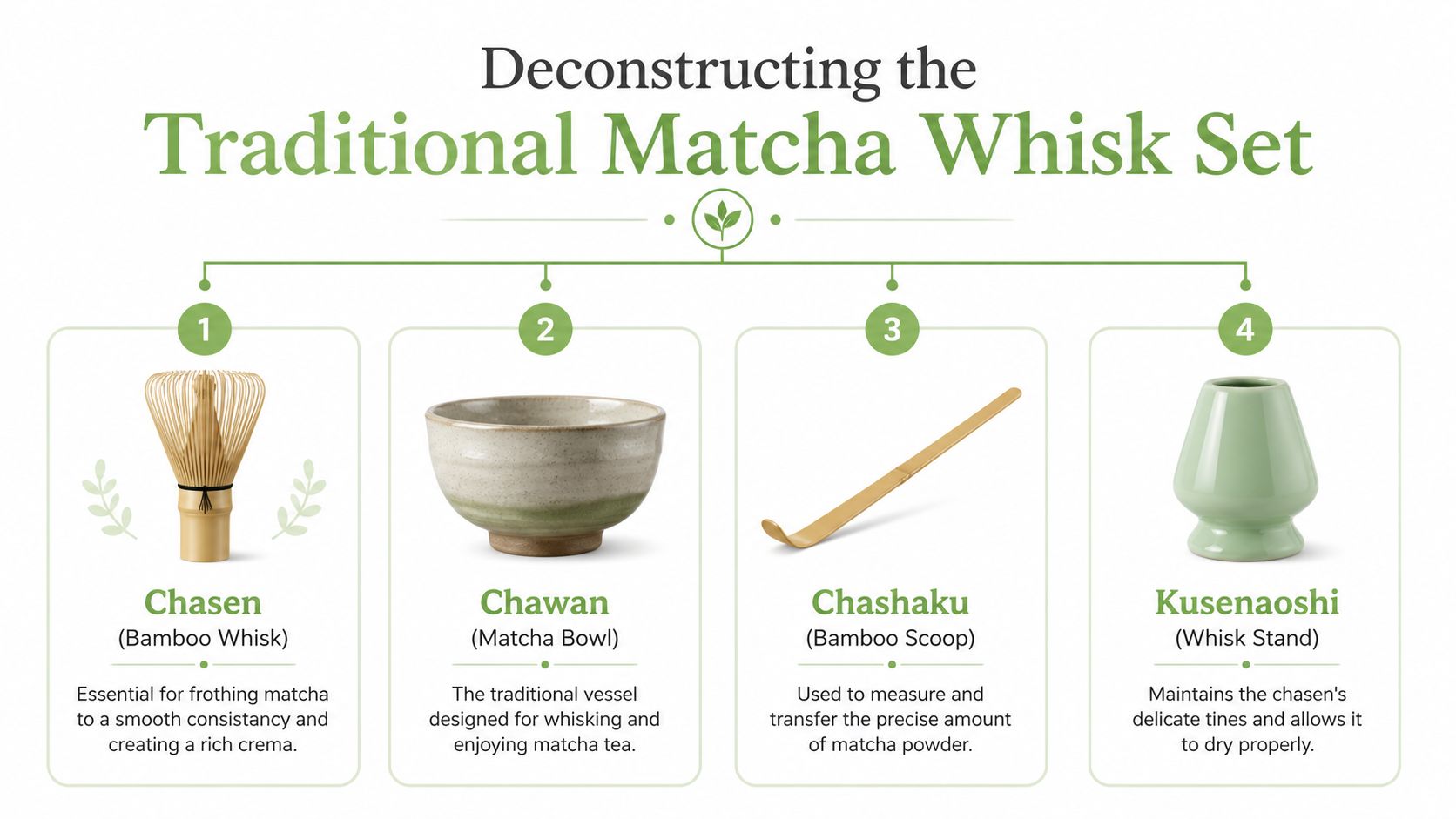
Chasen the bamboo whisk
The chasen is the heart of the set. It’s the traditional bamboo whisk used to mix and froth matcha. Unlike a kitchen whisk, it’s carved from a single piece of bamboo and shaped into many fine tines that move through liquid with surprising delicacy.
Its job isn’t just to stir. It breaks up small clusters of powder, lifts air into the tea, and helps create that soft foam many people associate with well-made usucha. If you’ve only ever mixed matcha with a spoon, using a chasen is the moment the drink starts to feel proper.
If you want to see a dedicated option for this tool, Pep Tea’s matcha tea brush collection shows the style commonly associated with a traditional whisk.
Chawan the matcha bowl
The chawan is the bowl used for preparing and drinking matcha. Its wider shape is functional, not decorative. You need room at the base for the whisk to move quickly in a zigzag motion without banging into narrow sides.
A mug can work in a pinch, but it makes whisking awkward. The bowl gives you control. It also helps you see the texture developing as you whisk, which is useful when you’re learning what “smooth enough” looks like.
Practical rule: If the vessel is too narrow for fast wrist movement, it’s too narrow for easy matcha.
Chashaku the bamboo scoop
The chashaku is the curved bamboo scoop used to transfer matcha from tin to bowl. It looks very minimal, and that’s part of its charm. It encourages a measured, repeatable approach instead of guessing with a kitchen spoon.
That consistency matters more than people realise. Matcha is sensitive to ratio. Too much powder can make the drink thick or harsh. Too little can leave it washed out. The scoop helps turn the ritual into something calm and dependable.
Kusenaoshi the whisk holder
The kusenaoshi is the whisk holder or stand. It’s one of the most underrated pieces in the set because people often think it’s optional. In practice, it helps the whisk keep its shape and dry more evenly after use.
That matters because bamboo is natural and responsive. If a whisk dries crumpled or stays damp in the wrong spots, the tines lose their neat form faster. A holder helps preserve that open, tulip-like shape that lets the chasen work properly.
Why the set works as one system
The beauty of a matcha whisk set is that none of the tools are trying to do too much. Each one solves a very specific problem. The bowl creates space. The scoop creates consistency. The whisk creates texture. The stand protects the whisk between uses.
Here’s the short version:
- Chasen for mixing and frothing
- Chawan for whisking room and drinking
- Chashaku for measured dosing
- Kusenaoshi for shape retention and drying
When people say matcha feels mindful, this is often what they mean. The tools slow you down just enough to do things well.
How to Choose the Right Matcha Whisk Set for You
Buying a matcha whisk set gets confusing fast because many sets look similar online. Differences are in whisk design, materials, and whether the set matches how you’ll use it.
If you mainly drink usucha, whisk performance matters most. Australian tea experts recommend a chasen with 80 to 120 tines for the best froth in usucha, and a 100-prong whisk can produce 20 to 30% more stable foam than a 64-tine version (tea expert demonstration). That’s the kind of detail worth paying attention to because it directly affects what ends up in your bowl.
Start with the whisk, not the packaging
Many shoppers focus on whether the set comes in a gift box, includes extras, or matches their kitchen. Nothing wrong with that. But the whisk is still the working part.
These practical checkpoints are often considered:
- Tine count for usucha matters if you want that light foam and smoother mouthfeel.
- Bamboo quality affects how evenly the whisk opens and how delicate the tines feel.
- A whisk holder included is useful if you want the set to last.
- A wider bowl makes learning easier than a narrow, decorative cup.
If you love a pared-back kitchen setup, this HYDAWAY minimalist kitchen guide is a nice reminder that the best tools are often the ones with one clear purpose and daily usefulness.
Bamboo versus modern alternatives
There’s a practical gap in most matcha content. It often tells you bamboo is traditional, but it doesn’t always explain whether that matters in daily Australian use.
Here’s the honest version. Bamboo is traditional because it works beautifully with matcha. It’s flexible, light, and designed for the whisking motion that this drink requires. Plastic or metal alternatives may look durable, but they change the feel of preparation and often miss the softer aeration you get from a proper chasen.
For many readers, the decision comes down to priorities:
- Choose bamboo if you care about texture, ritual, and authentic preparation.
- Choose a simpler starter set if you’re new and want to learn without overthinking.
- Choose sets with replaceable core pieces if you make matcha often and expect wear over time.
Matcha Whisk Set Buyer’s Guide
| Feature | Best for Beginners | Best for Enthusiasts | Best for Cafés |
|---|---|---|---|
| Whisk style | Bamboo chasen with an easy-to-use tine count suited to everyday usucha | Finely crafted bamboo chasen chosen for feel, control, and foam quality | Multiple bamboo chasen kept in rotation for service consistency |
| Bowl choice | Wide bowl that gives plenty of room to learn the motion | Bowl selected for comfort, weight, and whisking response | Durable bowls with enough width for repeat prep during busy periods |
| Scoop | Standard bamboo scoop for consistent habits | Traditional scoop used with a more deliberate ritual | Scoop or measured workflow that supports repeatable dosing |
| Whisk holder | Strongly recommended | Essential | Essential for storage and turnover |
| Best use case | Home practice, lattes, daily ritual | Straight matcha, intentional preparation, collecting quality teaware | Hot matcha, iced matcha, latte service, staff training |
| Buying focus | Simplicity and ease | Craft and performance | Consistency, replacement planning, workflow |
What suits different readers
A beginner usually does best with a straightforward set that includes the four basics and doesn’t demand too much fuss. The goal is building confidence.
An enthusiast often notices finer points. How springy the whisk feels. How the bowl sits in the hand. Whether the foam is delicate rather than coarse.
A café owner needs something else again. Reliability matters more than romance during service. Sets need to be easy for staff to use correctly, easy to dry properly, and easy to replace when parts wear out. A practical place to browse supporting tools is Pep Tea’s matcha tea accessories range.
The right set isn’t the fanciest one. It’s the one that matches your drinking habits and helps you make good matcha consistently.
A Step-by-Step Guide to Whisking Perfect Matcha
Technique is where the whole set comes alive. The good news is that proper whisking is simple once you know what to pay attention to.
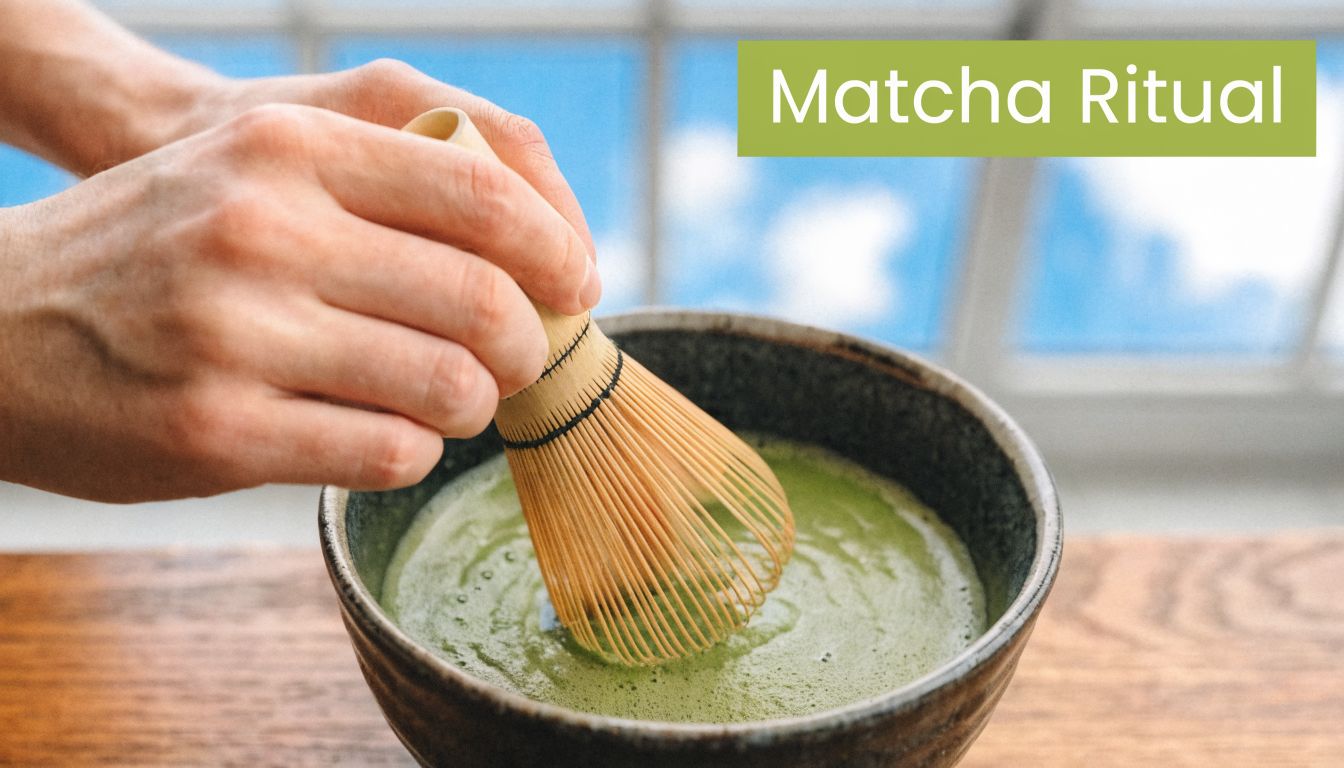
Wake up the whisk first
Don’t use a dry bamboo whisk straight away. The chasen activation process involves soaking the whisk in 80°C water for 1 to 2 minutes, which unfurls the tines and can increase surface area by up to 35% for better dispersion (preparation guide).
That step sounds small, but it changes everything. A softened whisk is less likely to snap and much better at moving through the tea. Dry, tight tines don’t glide properly.
Build the bowl properly
Add your matcha to the bowl using the scoop. If your powder has compacted in the tin, sift it first. Sifting isn’t fussy. It helps prevent little dry lumps that no whisk can completely rescue once they’re wet.
Then add warm water, keeping your temperature in the 70 to 80°C range mentioned in the preparation benchmarks from the earlier cited tea guidance. Water that’s too hot can push flavour in a harsher direction. Water that’s too cool can leave the drink flat and underdeveloped.
A useful reference for broader tea brewing habits is this guide to the secrets to perfect Japanese green tea, especially if you enjoy exploring how temperature changes flavour across different Japanese teas.
Use the W motion, not circles
This is the point most beginners get wrong. Circular stirring feels natural, but it doesn’t whisk matcha efficiently. The same preparation guidance notes that a rapid W-shaped whisking pattern is superior to circular motions, which tend to trap air unevenly in the liquid.
Try this sequence:
- Hold the bowl steady with your free hand.
- Keep the whisk low so the tips move through the liquid, not above it.
- Whisk briskly in a W or M motion from the wrist, not the whole arm.
- Ease off at the end and lift gently to settle the foam.
You’re not beating eggs. You’re creating fast, light agitation close to the surface.
After you’ve read the steps, it helps to watch the movement once in real time.
What good matcha should look like
You’re aiming for a smooth liquid with fine foam across the top for usucha. Not giant bubbles. Not a thick cap. Just a neat layer that looks even and lively.
If you make matcha for lattes, think of this whisked bowl as your base. Once the powder is fully dispersed and the top looks smooth, you can pour it over milk or ice without fighting clumps later.
Small, quick wrist motions beat big dramatic ones every time.
A simple home routine
If you want a practical rhythm, keep it uncomplicated:
- Warm the whisk
- Add matcha to bowl
- Sift if needed
- Add warm water
- Whisk in a W
- Drink as is or turn it into a latte
After a few days, the process feels less like a recipe and more like muscle memory.
Caring for Your Set in the Australian Climate
Australian conditions are hard on natural materials. Coastal humidity, warm kitchens, and quick temperature changes can all shorten the life of a bamboo whisk if you leave it damp or crushed after use.
That’s why aftercare matters almost as much as whisking technique.
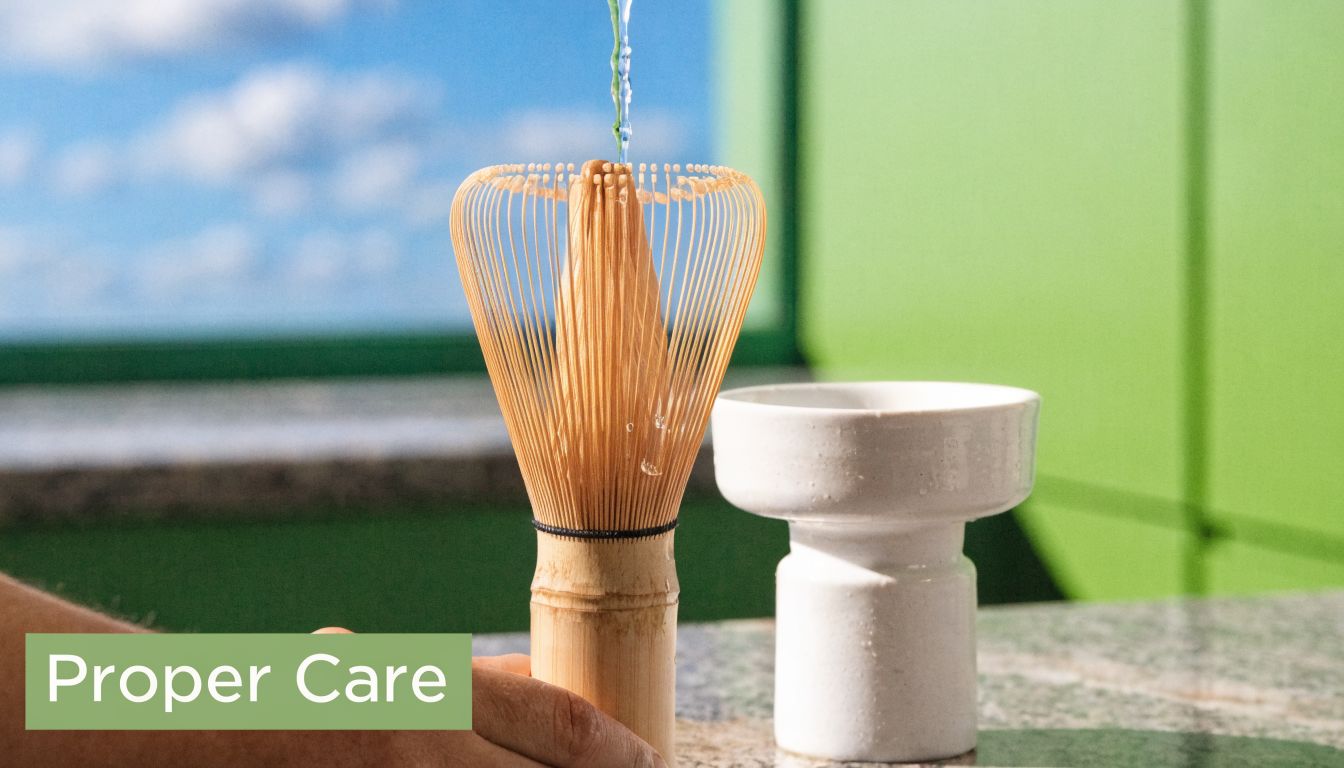
Clean it gently and straight away
As soon as you’ve finished making matcha, rinse the whisk under warm water. Skip soap. Bamboo can hold onto detergent smell and flavour, which you don’t want in the next bowl.
The bowl can be washed as you would other ceramics, and the scoop can be wiped clean and kept dry. The whisk needs the most attention because its tines are thin and vulnerable when left coated with drying matcha.
Why the whisk holder matters in Australia
Generic tea advice often ignores climate. In Australia, with humid conditions in many areas, a ceramic whisk holder can reduce breakage by up to 40% compared with leaving the whisk unprotected because it helps maintain bristle integrity and airflow (regional care note).
That’s not a decorative extra. It’s practical equipment.
A holder helps by:
- Supporting the whisk’s shape as it dries
- Allowing better airflow around the inner tines
- Reducing stress on bent bristles
- Making storage tidier if your tea station is used daily
If you need one, Pep Tea’s matcha whisk stand is the type of tool designed for that exact job.
Smart storage habits
Where you store your set matters more than people expect. Avoid sealing a damp whisk in a drawer or cupboard with poor airflow. Keep it away from direct sun as well, since harsh drying can make bamboo brittle.
A few habits help a lot:
- Let the whisk dry fully before tucking things away
- Store the set somewhere airy rather than cramped and steamy
- Keep the bowl dry so moisture doesn’t build around the base
- Check the whisk regularly for bent, split, or darkened tines
A whisk wears out gradually. If the tines have lost their shape or the bamboo no longer opens well after soaking, it’s time to replace it.
When to retire a whisk
No bamboo whisk lasts forever. With regular use, some tines will eventually fray, break, or sit unevenly. That doesn’t mean you’ve done anything wrong. It means a natural tool has been used.
The aim isn’t to preserve it forever. It’s to help it age well, stay clean, and work reliably for as long as possible.
Troubleshooting Common Matcha Making Problems
Even with a good matcha whisk set, a few issues show up again and again. Most are easy to fix once you know what’s causing them.
Why isn’t my matcha frothing
The first culprit is usually technique. If you’re stirring in circles, whisking too slowly, or using a vessel that’s too narrow, foam will struggle to form. The second culprit is the whisk itself. If the tines are cramped, damaged, or not softened first, they won’t move enough air into the tea.
Check these points:
- Use a wide bowl, not a narrow mug
- Soak the whisk before use so the tines open properly
- Whisk from the wrist in a fast zigzag motion
- Use fresh matcha that hasn’t compacted or dulled in storage
Why is my matcha clumpy
Clumps usually start before whisking. Matcha powder is very fine, so it tends to gather if it’s been sitting in the tin or exposed to moisture. Once wet, those tiny clumps become harder to break up.
The fix is simple. Sift the powder before adding water, then whisk briskly once liquid goes in. If you still get little pockets of powder, your whisk may need replacing or your motion may be too slow.
Why does my matcha taste bitter
Bitter matcha is often overheated matcha. Water that’s too hot can pull the drink out of balance quickly. Preparation also matters. If the powder isn’t dispersed evenly, you can get concentrated sips that taste rougher than the rest of the bowl.
Quality plays a role too. Smoother organic matcha intended for drinking tends to be more forgiving than powder meant mainly for cooking. If you’re making straight matcha often, choosing a grade suited to drinking makes the experience much easier.
Why is my whisk breaking or getting mouldy
This comes down to care. Bamboo doesn’t like being left wet, crammed, or coated in drying matcha residue. If the whisk goes back into storage damp and unsupported, damage follows.
A quick reset usually solves the problem:
- Rinse immediately after use
- Let it air dry on a holder
- Keep it out of sealed damp spaces
- Replace it once the tines are heavily split or misshapen
Most matcha problems aren’t signs that you’re bad at making matcha. They’re signs that one small part of the process needs adjusting.
Beyond the Bowl Simple Recipes and Ideas
Once you can whisk a smooth bowl of matcha, your set becomes useful far beyond traditional preparation. The trick is to use the whisk set to create a silky matcha base first, then build your drink from there.
Classic matcha latte
Start by whisking your matcha with warm water in the bowl until smooth and lightly frothy. Pour that into a cup, then add your milk of choice. If you like a softer, rounded drink, warm the milk first.
This approach works because the powder is already fully dispersed before the milk goes in. You avoid the green lumps that happen when people try to stir matcha straight into a full mug of milk.
Iced matcha latte for Australian weather
For warmer days, whisk your matcha base exactly as you would for a hot drink. Then pour it over ice and cold milk. That gives you a cleaner flavour and a brighter colour than trying to shake dry powder into a chilled drink.
A simple format looks like this:
- Whisk matcha with warm water until smooth
- Fill a glass with ice
- Add cold milk
- Pour the matcha over the top
- Stir before drinking
The result feels café-friendly but still easy enough for a weekday morning.
Smoothies and kitchen use
A matcha whisk set can also help with small-batch prep for smoothies or simple kitchen recipes. Whisk a concentrated matcha base first, then pour it into yoghurt, oats, or a smoothie blender. Starting with a smooth liquid base gives you more even colour and flavour.
Ceremonial and culinary uses
People often ask whether the set is only for ceremonial-grade matcha. Not at all. The set is designed around proper preparation, but the final liquid can head in different directions. Use drinking-grade matcha for a more direct bowl or a refined latte. Use culinary matcha when the drink or recipe includes other stronger flavours.
That flexibility is part of why the set earns its place in the kitchen. It supports a traditional method, but it fits easily into modern Australian routines.
Conclusion Your Partner in the Perfect Cup
A matcha whisk set isn’t a decorative extra. It’s the tool that makes matcha easier to understand, easier to enjoy, and far more consistent from cup to cup.
The key ideas are simple. Choose a set that suits how you drink matcha. Learn the basic whisking motion properly. Care for the bamboo well, especially in Australian conditions where humidity can shorten its life. Once those habits click, the whole process feels less intimidating and much more rewarding.
That’s true whether you’re making a quiet morning bowl at home or training staff to serve matcha lattes with confidence. The right setup gives you control over texture, flavour, and ritual.
We’re big believers in making matcha approachable. If you’re ready to build your own daily routine, explore the curated range at Pep Tea for organic matcha, accessories, and practical tools that support the process from first whisk to final sip.
Unlock the Perfect Matcha Tea Whisk and Bowl

You’re probably here because your matcha looked promising in the tin and disappointing in the bowl. The colour was right. The whisk looked beautiful. Then the drink turned out clumpy, flat, or oddly bitter.
That’s not a matcha problem. It’s usually a matcha tea whisk and bowl problem, or more precisely, a technique problem shaped by the tools in your hands.
A good bowl of matcha isn’t about ceremony for ceremony’s sake. The whisk and bowl exist because matcha is a suspended powder, not a leaf infusion. If the powder isn’t fully dispersed and aerated, the texture suffers first, then the flavour. Once you understand what the whisk is doing, and why the bowl is shaped the way it is, everything gets easier.
The Ritual of Matcha Why Your Whisk and Bowl Matter
It usually starts on a rushed weekday morning. Matcha goes into the nearest mug, hot water follows, a spoon gets a quick spin, and the cup looks dull before you even taste it. Then the first sip lands harsh, powdery, and flatter than the bright, creamy bowl you were hoping for.
A chasen and chawan fix that because they solve a physical problem, not a decorative one.
Matcha is a fine stone-ground powder suspended in water. It does not dissolve the way instant drinks do. To taste sweet, savoury, and smooth, those particles need to be dispersed evenly and lifted with air. A bamboo whisk does that fast without bruising the liquid. A proper bowl gives the whisk the width and curve it needs to move freely.
That matters even more in Australia, where home water can change a bowl more than many people expect. Hard water in some suburbs can mute sweetness and make bitterness show up sooner. A heavy café-style mug also tends to trap your wrist in a tight angle, which leads to stirring instead of whisking. Good tools create better mechanics, and better mechanics create better texture.
These tools shape the cup
The whisk controls agitation. The bowl controls space, temperature, and the way the liquid rolls back on itself as you whisk. That combination is why the same matcha can taste soft and rounded in one vessel, then sharp and grainy in another.
I see this all the time with Australian café drinkers trying to recreate their favourite order at home. They buy better powder, often something clean and vibrant like Pep Tea, but keep using a cereal bowl or coffee mug. The matcha is fine. The setup is fighting the result.
A proper matcha bowl does three jobs at once:
- Creates room for whisking so the tines can travel quickly across the surface without crashing into the sides
- Buffers heat so the water stays closer to the gentle range matcha prefers
- Supports foam formation because the wider base helps build a fine layer of froth instead of a few large bubbles
Practical rule: If your whisk taps the sides every few seconds, your vessel is too narrow.
There is art in this, but there is physics first. Fast wrist movement pulls air into the liquid. The flexible bamboo tines break up clumps and spread the powder through the water. The bowl’s shape lets that motion stay light and efficient. Once those parts work together, flavour opens up. You get more sweetness, less harshness, and a fuller body.
The ritual also changes how you taste. A slower setup gives the powder a fair chance and gives you a moment to notice what is in the bowl. That is part of why matcha has lasted for centuries. For useful context on how this practice developed, Pep Tea’s brief history of matcha tea is a good place to start.
How to Select the Right Matcha Whisk and Bowl
A rushed weekday prep in Melbourne or Sydney usually exposes weak tools fast. The powder may be excellent, the water temperature may be close, but if the whisk is stiff or the bowl is cramped, the texture falls apart before you even taste it.
Good selection starts with your routine. A person making one careful bowl each morning needs a different setup from someone whisking concentrated matcha for iced lattes after lunch. Australian water also changes the equation. In hard-water areas, matcha can show more bitterness and less softness, so a whisk and bowl that help you mix quickly and evenly are worth more than decorative details.

What to look for in a chasen
A chasen is a precision tool, even if it looks simple. The number, spacing, and thinness of the tines all affect how air enters the liquid and how quickly powder disperses. More tines usually give a finer foam with less effort. Slightly thicker, fewer tines often feel steadier when making a stronger bowl or a small paste for latte prep.
Choosing Your Chasen Matcha Whisk
| Tine Count | Best For | Foam Type |
|---|---|---|
| 80 | Daily usucha, beginners, lighter bowls | Soft, light foam |
| Around 100 | Traditional all-round use | Fine, even microfoam |
| 120 | Thicker preparation, richer bowls, concentrated matcha | Denser surface texture |
What matters at purchase:
- Single-piece bamboo construction flexes more naturally and tends to last better than poorly assembled imitations.
- Clean, even tine cuts help the whisk move consistently across the bowl instead of catching and skipping.
- A handle that sits comfortably in the fingers reduces tension in the wrist, which improves your whisking speed and control.
I usually suggest an all-round whisk with about 100 tines for home drinkers. It gives enough finesse for a smooth bowl made with a high-grade matcha such as Pep Tea, but it is still forgiving if your technique is not perfect at 7 am.
What to look for in a chawan
The bowl decides how usable the whisk becomes. For everyday matcha, choose a bowl with a broad base, open top, and enough depth to keep liquid inside while you whisk briskly. Traditional tea bowls often sit in the 12 to 15 cm range across, and that shape works well because it gives the wrist room to move without forcing the whisk into the walls.
Material matters too. Thicker ceramic holds warmth longer, which helps in cooler Australian kitchens and during winter mornings in places like Hobart or Canberra. A thinner bowl responds faster and can feel lighter in the hand, but it loses heat more quickly. If your local tap water runs hard or heavily mineral, a bowl that keeps temperature steady can make the flavour feel rounder and less sharp.
A few practical checks help:
- Flat or gently curved interior makes it easier to break up small clumps.
- Stable foot keeps the bowl from shifting on the bench.
- Comfortable rim improves the drinking experience, especially with straight matcha rather than lattes.
Match your tools to your routine
For straight matcha, go wider and more traditional. For latte prep, choose a bowl with enough room to whisk a smooth concentrate before adding milk. If you drink both, pick the more versatile option rather than building a collection too early.
The best matcha tea whisk and bowl set is the one that lets you repeat good technique on an ordinary Tuesday morning.
There is always a trade-off between delicacy and durability. Fine tines create prettier foam, but they punish rough handling. Heavier bowls feel steady and hold heat well, but they can be less pleasant if you like to cradle the bowl in your hands. Choose the setup that fits your real habit, not the one that only looks good on a shelf.
The Art of Whisking a Perfect Bowl of Matcha
Technique matters more than people expect. A high-quality powder can still turn out gritty if the method is sloppy. A modest bowl can produce a lovely texture if your whisking is organised and deliberate.
The process is simple once the sequence is right.
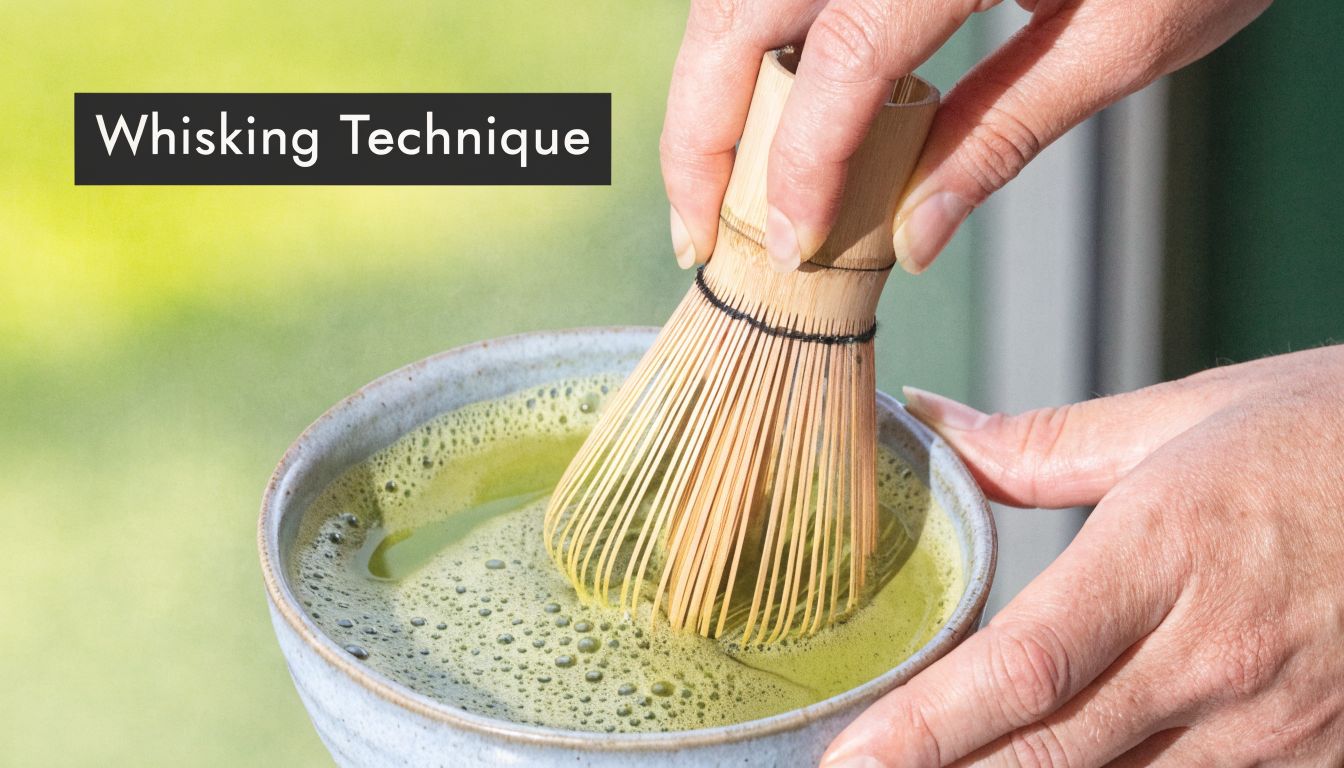
Start by preparing the whisk
Before the matcha touches the bowl, soak the whisk briefly in warm water. This softens the bamboo tines so they open gently and are less likely to snap during use.
A dry whisk is stiff. A softened whisk glides.
The step most people skip
Sift the matcha first. This one action solves an enormous share of home-prep problems.
According to the preparation benchmark cited by Fellow’s matcha set guide, using sifted matcha and 75 to 80°C water achieves a 92% success rate in producing optimal froth, and the vigorous W whisking motion at 200 to 300 strokes per minute is central to building that foam.
Use a fine sieve and press the powder through directly into the bowl. Don’t dump compacted powder into hot water and hope the whisk will rescue it.
A reliable whisking method
Use this sequence when you want a traditional bowl with smooth body and a fine top layer.
Sift the matcha into the bowl
A small mound of fluffy powder is easier to dissolve than compressed clumps.Add hot, not boiling, water
Water in the 75 to 80°C range protects flavour. If it’s too hot, bitterness rises quickly.Begin with slow blending
Use a gentle motion near the base of the bowl to turn the matcha and water into a smooth liquid with no dry pockets.Shift to fast W whisking
Once the powder is dissolved, whisk briskly from the wrist, not the shoulder. The motion should be light, fast, and close to the surface.Stop when the foam looks tight and even
You want fine bubbles, not large froth.
Don’t stir in circles. Circular stirring mixes, but it doesn’t aerate nearly as well.
The physics in plain English
The whisk’s tines break apart tiny clusters of powder while pulling air into the liquid. The bowl’s width gives those movements enough travel to generate a suspended, creamy texture instead of a muddy one.
That’s why the wrist matters. A loose wrist creates speed and lift. A rigid arm creates splashing and uneven mixing.
Here’s a useful visual if you want to watch the motion in real time:
What a finished bowl should look like
A properly whisked bowl should have:
- A smooth body with no visible powder islands
- A fine foam layer rather than big soap-like bubbles
- An even green colour across the surface
- A clean first sip without grit collecting on the tongue
If the bowl tastes grassy but pleasant, you’re close. If it tastes harsh and flat, check water temperature and sifting before blaming the matcha itself.
From Clumps to Flat Foam Troubleshooting Your Technique
You whisk a bowl before work, the colour looks right, but the surface stays flat and the sip turns grainy halfway through. That usually points to a specific fault in the setup, not a mysterious lack of skill.
Matcha is sensitive to small variables. Powder size, bowl shape, whisk flexibility, and local water all change how air and liquid behave in the bowl. In many Australian homes, water straight from the tap carries enough mineral content to affect flavour and tool feel over time, especially compared with the softer water many cafés filter before service.
Persistent clumps usually start before whisking
Clumps form because matcha is hygroscopic. It pulls in moisture from the air, then compresses into little pellets that hot water struggles to break apart. Once those pellets hit the bowl, the outer layer wets first and seals the dry powder inside.
That is why a proper matcha tea sifter matters so much. It separates the powder before water touches it, which gives you a smoother mix and a cleaner texture with less effort from the wrist.
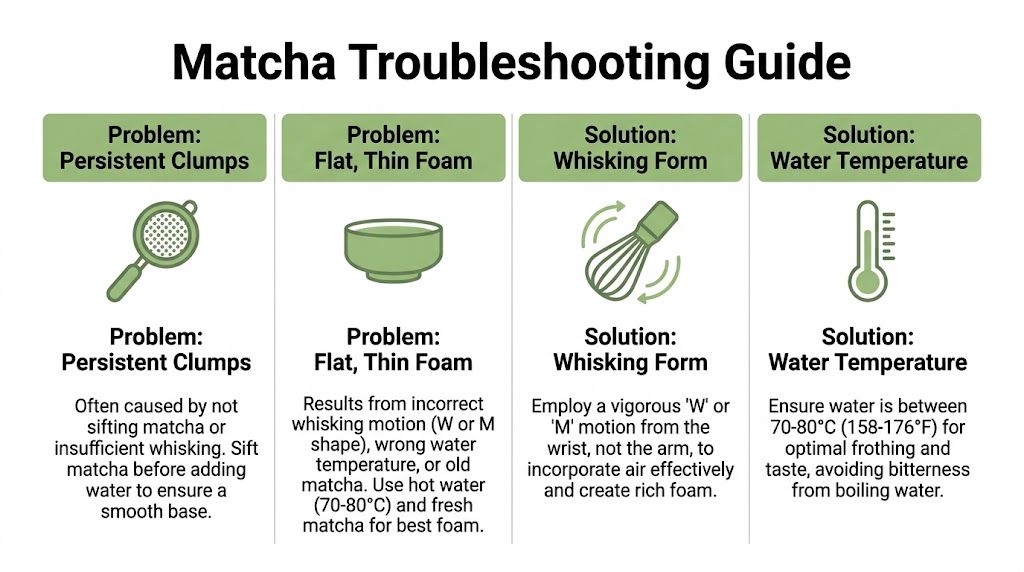
If clumps keep showing up even after sifting, check the age and grade of your matcha. Fresh, finely milled powder disperses far more easily. A clean, vibrant matcha such as Pep Tea’s also gives you a wider margin for error, because the powder itself is milled for a smoother bowl.
Flat foam usually comes from one of three things
Start with the whisk. If the tines feel stiff, stick together, or curl inward, they stop flicking air into the liquid efficiently. Foam depends on many tiny bubbles held in suspension. A tired whisk makes larger bubbles, then those bubbles collapse fast.
Next, check the water. Very hot water weakens sweetness and pushes bitterness forward, but mineral-heavy water can also mute the texture and leave bamboo feeling rough after repeated use.
Then check the bowl. A narrow mug blocks the whisk’s side-to-side travel, so the motion turns into stirring instead of rapid surface aeration. The whisk needs horizontal room to build a tight foam cap.
Quick fixes that usually work
For clumps
Sift into the bowl, add a small splash of water first, and press out any stubborn spots before full whisking.For bitterness
Use water below boiling. If the bowl tastes sharp and hollow, heat is usually the first thing to correct.For weak foam
Inspect the chasen before blaming your technique. Split, brittle, or inward-bent tines cannot trap air properly.For mineral build-up
If your water is hard, rinse the whisk well after each use. An occasional brief soak in warm water with a little white vinegar can loosen residue, followed by a thorough rinse.
When the bowl is the real problem
I see this often with people who start matcha using whatever mug is in the cupboard. The powder can dissolve, but the foam never gets that fine café-style finish because the whisk cannot move freely near the surface.
A wide bowl gives you two advantages at once. It lets the tines travel quickly, and it spreads the liquid into a shallower layer, which makes it easier to pull air through the top. That is the small piece of physics many home brewers miss.
If your motion has improved and your matcha is still coming out thin, change the vessel before changing everything else. Sometimes the best correction is giving the whisk enough room to do its job.
Keeping Your Matcha Whisk and Bowl in Perfect Condition
A bamboo whisk is a working tool. Treat it gently and it rewards you with better texture, cleaner foam, and a more consistent bowl.
The key is speed and simplicity after use.
How to clean the whisk properly
Rinse the whisk under warm water as soon as you finish. Don’t leave matcha drying between the tines, because dried residue makes the whisk stiff and awkward next time.
Skip soap. Bamboo can absorb smell and flavour, and that can end up in the next bowl.
A whisk also dries better when it keeps its natural curve. A matcha whisk stand helps the tines hold their shape while air circulates around them.
How to care for the bowl
The bowl is much easier. Wash it by hand with warm water and a soft cloth, then dry it well before storing. Gentle handling is enough.
A few habits make a real difference:
- Rinse immediately so matcha doesn’t cling to the surface
- Avoid harsh cleaners if you want the bowl’s finish to age well
- Store fully dry to prevent musty cupboard odour
- Keep bamboo out of prolonged soaking because constant saturation weakens it over time
Good maintenance isn’t separate from the ritual. It’s part of the ritual.
When your tools stay clean and correctly shaped, your technique stays reliable. That’s the whole point.
Beyond the Bowl Creative Matcha Recipes
A proper bowl teaches habits that carry into every modern matcha drink Australians make at home. The order stays the same. Sift, add water, whisk smooth, then build the rest around that base.
That matters even more here, because local water can change the result. Softer water often gives a rounder, sweeter bowl, while harder water can make green notes taste sharper, especially once milk or ice enters the mix. Starting with a clean, glossy matcha concentrate gives you more control.
Turn the bowl into a latte base
For a hot latte, whisk a short, strong base in the bowl first. Use less water than for usucha, then whisk until the surface shows a fine foam and the liquid underneath looks fully unified. After that, pour it into warm milk.
This is the part many cafés rush, and the cup shows it. Matcha added straight to milk tends to float, cling to fat, and leave dark specks on the finish. A concentrated base fixes that by hydrating the powder before dilution. Pep Tea’s fine grind makes that step easier, because the particles disperse quickly and stay smoother in the cup.
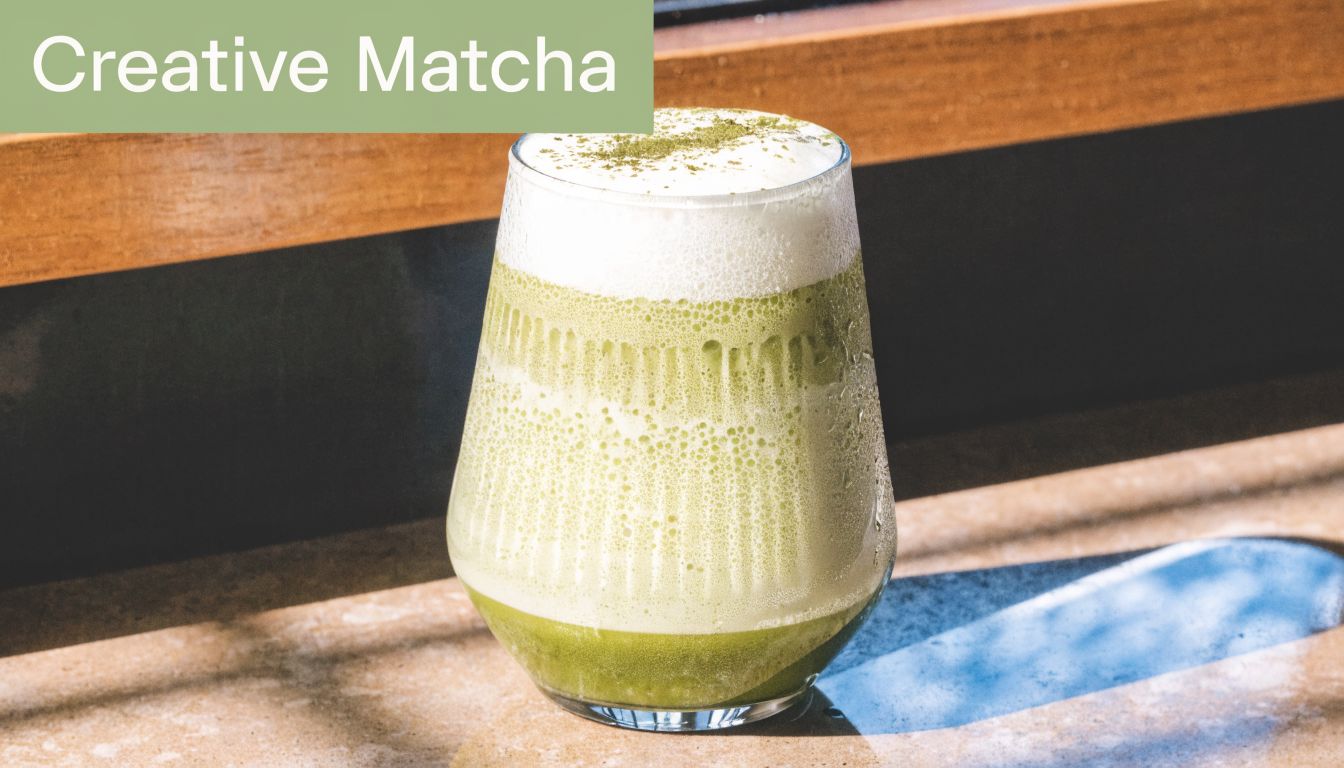
Iced matcha works best when the first step stays traditional
Cold drinks magnify mistakes. Any clump you leave in the bowl becomes more obvious over ice.
Whisk the concentrate with warm water first, then pour it over ice and cold milk. Warm water helps the powder wet evenly. Ice then locks in the texture and keeps the drink bright instead of muddy. If you shake unsifted matcha straight in a jar, you usually get foam on top and sediment underneath, which is a very different drink from a properly built iced matcha.
If you enjoy functional variations, Mushroom Matcha Benefits is a useful read for seeing how matcha is being paired with other wellness ingredients.
Creative recipes that still respect the bowl
A bowl and whisk are not limited to plain matcha. They are the best starting tools for recipes where texture matters.
Try these:
- Iced strawberry matcha. Make the matcha concentrate in the bowl, add strawberry puree to the glass separately, then pour slowly so the layers stay clean.
- Matcha coconut latte. Use coconut milk for body, but keep the matcha base lighter so the drink does not turn heavy or chalky.
- Sparkling matcha tonic. Whisk matcha with a small amount of water until smooth, then top with chilled tonic. The bitterness of tonic can sharpen lower-grade matcha, so this works best with a clean, sweet powder.
- Matcha affogato. Pour a concentrated bowl over vanilla ice cream. The contrast only works if the matcha is smooth and vivid.
Each recipe asks for a different concentration, but the same physics apply. Fine particles need full hydration. Air needs to be introduced in a controlled way. The bowl gives you room to do both before extra ingredients get in the way.
What cafés need to consider
Home drinkers and cafés solve different problems. At home, the goal is pleasure and consistency. In a busy Australian café, speed, staff training, milk workflow, and water filtration all affect the cup.
Many venues now use a hybrid approach. They whisk a proper base for flavour and texture, then adapt the build for service. That trade-off makes sense. Good technique is still good technique, even when the setting is faster and the menu includes iced lattes, strawberry matcha, and seasonal specials.
The bowl remains the quiet advantage. It gives the whisk enough space to move, helps the powder dissolve evenly, and turns recipe experiments into drinks that still taste like real matcha.
Your Matcha Questions Answered
Can I use an electric frother instead of a bamboo whisk
You can. It’s better than using a spoon. But it usually creates larger bubbles and a looser texture.
A bamboo whisk is shaped to produce a finer foam and a smoother mouthfeel. It also gives you more control over how vigorously the matcha is aerated.
Is culinary matcha okay to drink
Yes, especially in lattes, smoothies, and baking. It tends to be stronger and more assertive, which helps it stand up to milk and other ingredients.
For drinking with just water, ceremonial-style matcha is usually the more elegant choice because the flavour is more exposed.
Why does my matcha taste bitter even when I whisk properly
Usually because the water is too hot, or because the powder wasn’t sifted and dissolved cleanly before vigorous whisking. A rough bowl often tastes harsher than a smooth one, even when using the same matcha.
Do I need the bowl, or can I use any cup
Any cup can hold liquid. That’s not the same as helping you make good matcha. A proper bowl gives the whisk room to move, which directly affects texture.
How often should I replace my whisk
Replace it when the tines lose flexibility, begin breaking, or stop producing the texture you expect even with good technique and clean water.
If you’re ready to build a better daily ritual, explore Pep Tea for premium organic matcha, practical accessories, and Australian guidance that makes the process feel approachable rather than fussy.