
Category: Learn About Tea
Matcha Tea Preparation: A Practical Guide for 2026
“Just add a teaspoon and hot water” is convenient advice, but it's a poor foundation for consistent matcha tea preparation. A spoonful isn't a dependable dose, and an expensive tin won't rescue powder that's badly dispersed. Start with a scale, controlled water temperature and a repeatable whisking method instead.
Consistency matters even more when your usual matcha disappears from the shelf. Australian reporting on matcha supply pressures describes growing café demand alongside shortages and higher prices. The useful skill isn't memorising a recipe for a particular tin. It's knowing what to adjust when the next batch tastes different.
Setting Up Your Matcha Station
A practical matcha station should make measuring, sifting and whisking easy. You don't need a ceremonial display, but you do need enough room to work without tipping powder across the bench.
Matcha differs from ordinary green tea because you consume the powdered leaf rather than discard it after steeping. It's made from shade-grown tencha leaves that are steamed, dried and finely stone-ground, then suspended in water, as described in Gourmet Traveller's Australian matcha guide. That makes dispersion a preparation priority, not a finishing flourish.
The tools worth bench space
- Bamboo chasen: Choose this for the traditional whisking method. It gives you control over both mixing and surface foam.
- Kitchen scale: Use the scale for repeatability. A bamboo chashaku is useful for transferring powder, but don't treat a scoop as a fixed weight.
- Fine sieve: Sift directly into the bowl so dry clumps don't become wet lumps.
- Wide ceramic bowl: Give the whisk room to travel across the liquid rather than trapping it inside a narrow mug.
- Temperature-controlled kettle: Remove the guesswork from your water preparation.
Use this checklist to organise the station before opening the tin.
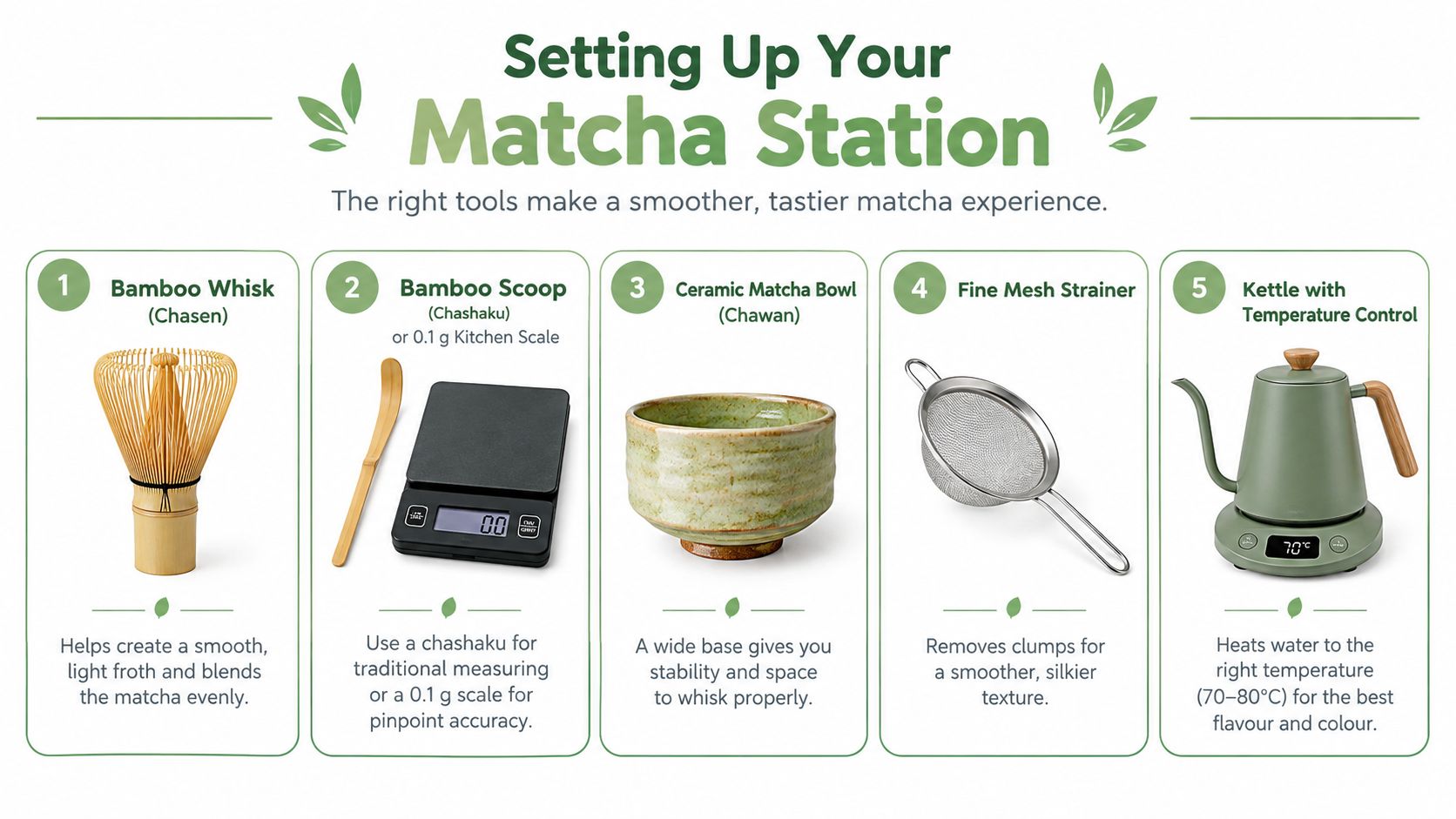
For water, work within 70–80°C rather than using it straight from a boiling kettle. Boiling water can bring bitterness forward and flatten aroma, while Australian preparation guidance commonly starts with 1–2 g of powder for a 200–250 mL drink, using a smaller quantity of water to make the concentrate first, as outlined in this matcha latte preparation guide.
Practical rule: Spend on accurate measuring and effective mixing before buying decorative accessories.
Choose for the drink you make
Treat ceremonial and culinary labels as starting points, not a substitute for tasting. Compare aroma, colour, bitterness and texture in the drink you intend to serve. A powder you enjoy straight may not be your preferred choice once milk enters the cup.
If you're assembling equipment, compare the components of a matcha tea set in Australia against what you already own. Buy the missing functional pieces rather than duplicating a useful bowl or scale.
The Traditional Whisk Method
The first contact between powder and water deserves more attention than the final flourish of foam. Pouring water onto an unsifted mound makes the whisk do unnecessary work. Start with loose, evenly distributed powder.
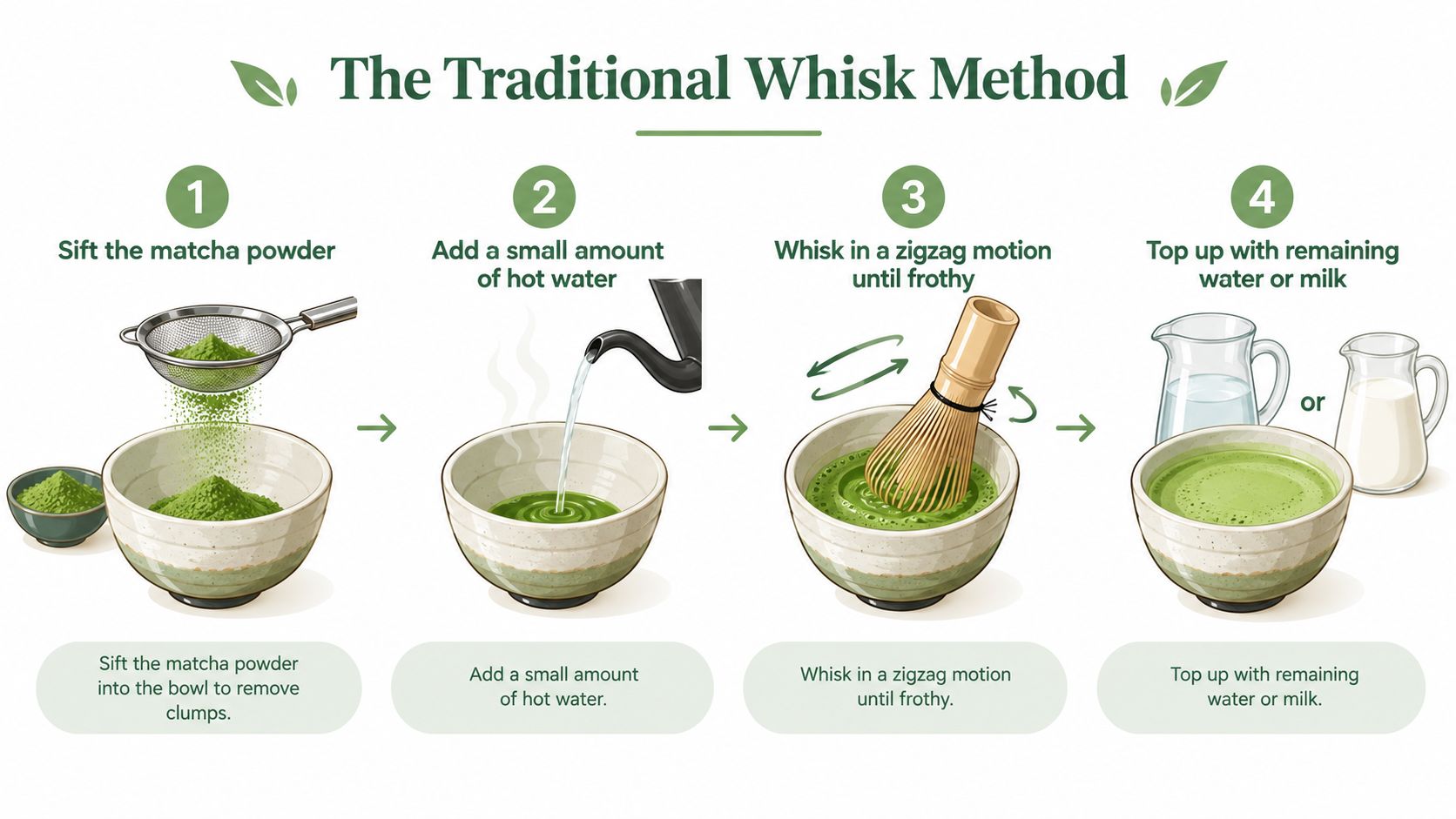
The sequence below shows the basic workflow. For the most controlled result, fully disperse the concentrate before making any final adjustment with water or milk.
Build the suspension before chasing foam
A useful home-barista baseline is approximately 2 g of sifted matcha with 50–60 mL of water, whisked for 15–30 seconds using rapid W- or M-shaped strokes, following this gram-based matcha preparation method.
- Weigh and sift. Put the bowl on your scale, tare it and measure the powder. Pass it through the sieve rather than trying to crush dry lumps after adding water.
- Add a small splash from your measured water and gently work it into a smooth slurry. Pause here. If you can still see dry pockets, incorporate them before adding the rest.
- Add the remaining water. Keep the bowl steady and begin short, brisk strokes across the base. Move your wrist rather than swinging your whole arm.
- As the mixture becomes uniform, raise the whisk slightly towards the surface. Continue with lighter strokes until the top looks finely aerated rather than covered in large, uneven bubbles.
The critical transition is from mixing through the liquid to refining the surface. Don't lift the whisk so early that you create attractive foam above poorly dispersed powder. Equally, don't keep scraping the bottom once the drink is uniform.
Judge the cup, not just the photograph
Circular stirring moves the liquid around, but it's less effective at creating the uniform suspension described in the preparation method above. A pale, lightly frothy surface is a useful cue, yet mouthfeel matters more: the drink shouldn't contain obvious powdery lumps.
For a visual companion, watch the whisk movement and the change in height as the surface develops.
Serve promptly rather than leaving the bowl on the bench while you prepare everything else. Matcha particles settle during holding, so arrange your cup and any accompaniments before whisking.
For a separate resource on safety considerations, consult IFM Gourmet's guide to safe matcha from IFM Gourmet Food Store. Keep technique and suitability separate: a beautifully whisked bowl still needs an appropriate serving size.
Lattes, Iced Matcha, and Everyday Drinks
The concentrate is the starting point for café-style drinks, not the finished recipe. Milk, ice and flavourings change how strongly you perceive the tea, so decide on the finished drink before reaching for a larger cup.
Don't compensate for every weak latte by adding more powder. First check whether the cup contains more milk or melted ice than your usual recipe. Changing the liquid quantity may restore balance without changing the caffeine dose.
Hot matcha latte
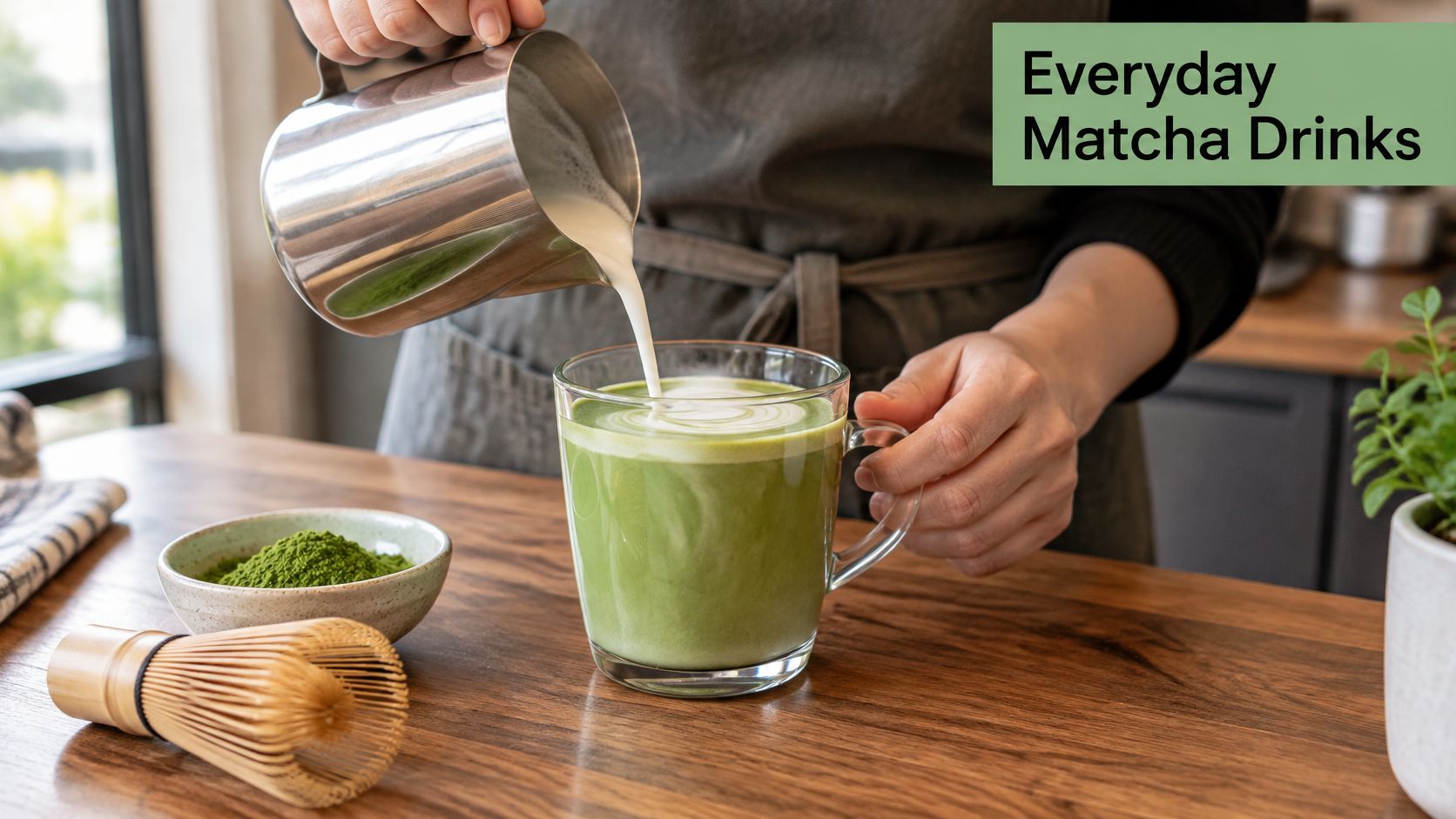
Pre-warm the serving cup, then prepare the concentrate separately. Steam or warm your chosen milk gently, aiming for a texture you can pour rather than a stiff cap you have to spoon out.
There isn't a milk-steaming temperature established in the preparation references used here, so don't borrow the water setting and assume it applies to milk. Follow suitable guidance for your milk and equipment, and keep the result consistent between drinks.
- Combine deliberately: Pour a little milk into the concentrate and swirl, then add the remainder.
- Keep the tea recognisable: Taste before adding sweetener. If you can't identify the matcha, review the milk quantity first.
- Watch the cup: A cold, heavy mug can leave a carefully prepared hot drink lukewarm.
The pour should bring milk and tea together, not hide an unmixed layer beneath the foam.
Iced, shaken and lightly flavoured
For an iced latte, prepare the concentrate, let it cool, then pour over chilled milk and ice. Use the established serving volume as your starting point rather than filling any glass to the rim. This iced matcha latte method offers a dedicated workflow for that format.
A chasen suits careful concentrate preparation. For an everyday iced drink, a cocktail shaker or small blender is an alternative worth testing, especially when you want the ingredients thoroughly combined rather than layered. Don't shake hot liquid in a sealed vessel.
Standardise the glass, milk quantity and ice before deciding that a new matcha needs a stronger dose.
For flavour, try ginger, citrus zest or a sugar-free syrup sparingly. Treat these as recipe suggestions, not a requirement to sweeten matcha. If you enjoy textured café drinks, Just Cook It's step-by-step grass jelly tea guide provides a separate recipe to explore.
For an adult non-alcoholic serve, try cooled concentrate with a little sugar-free organic kombucha. Our Ginger or Lime & Ginger options offer a different direction from a milk-based drink; combine gently rather than shaking a carbonated mixer.
Getting the Caffeine Dose Right
A bowl, teaspoon or large iced cup doesn't tell you how much caffeine you're drinking. Powder weight is the useful control, while product-specific caffeine information, when available, is more informative than a grade name.
Australian guidance gives a broad estimate of 19–44 mg of caffeine per gram, making a 2 g preparation approximately 38–88 mg, with variation between products and servings, as explained in our guide to whether matcha tea has caffeine. These are estimates, not a laboratory result for your tin.
Typical caffeine in a matcha serve by size and powder weight
| Serve | Powder | Caffeine range | Best for |
|---|---|---|---|
| Usucha-style bowl | Weighed baseline dose described above | Baseline estimated range above | Tasting matcha without milk |
| Standard hot or iced latte | Same baseline dose | Same estimated range, provided no other caffeinated ingredient is added | Keeping the tea dose consistent across formats |
| Smaller, lighter drink | Reduced weighed dose | Lower than the baseline for the same powder, but product-dependent | Adjusting a recipe to personal preference |
| Double-matcha iced latte | Double the usual weighed dose | Higher than the baseline; calculate from supplier information | A clearly identified stronger serve, not a routine default |
Milk and ice change concentration and flavour, not the quantity of powder already measured into the drink. If you reduce the powder, consider reducing the milk or water too, rather than accepting a washed-out result.
Ceremonial doesn't mean lower caffeine. Testing cited in Australian consumer guidance on matcha caffeine variation reported higher average caffeine concentrations in ceremonial samples than culinary samples. Choose a grade for its suitability to the drink, not as a caffeine-management shortcut.
Count the whole day
Healthdirect's caffeine advice states that around 400 mg daily is generally considered safe for healthy adults, while pregnant or breastfeeding people should limit intake to 200 mg daily. Those figures aren't targets or guarantees of individual tolerance.
- Include other sources: Count coffee, tea, energy drinks and chocolate alongside matcha.
- Identify stronger recipes: Cafés should make larger powder doses clear rather than relying on cup size to communicate strength.
- Ask about individual suitability: Children and caffeine-sensitive guests shouldn't be treated as smaller versions of a standard adult order.
If coffee is also part of your routine, Everti's discussion of double shot espresso caffeine content is a useful companion when reviewing your drinks. Use actual serving information wherever possible rather than assuming every coffee or matcha contains the same amount.
Common Mistakes and How to Fix Them
“You bought the wrong grade” is often an unhelpful diagnosis. Before replacing the tin, check whether the preparation has changed. A new mug, an unmeasured pour or a rushed mixing step can make a familiar powder taste disappointing.
Fix the process before replacing the powder
| Problem | What to change |
|---|---|
| Harsh bitterness after using boiling water | Return to the controlled kettle setting established earlier before adding sweetener. |
| Powdery lumps | Sift into a dry bowl and inspect the initial slurry before continuing. |
| Uneven texture after circular stirring | Use the cross-bowl whisking movement rather than repeatedly tracing the rim. |
| A latte that tastes mostly of milk | Check the finished liquid quantity and ice before increasing the tea dose. |
| Different strength every morning | Replace the heaped teaspoon with a recorded weight. |
| Flat or disappointing flavour | Compare the powder's aroma and condition with what you normally use, then test it without flavourings. |
These fixes don't mean every powder will taste excellent. They help you separate a preparation fault from a product you don't enjoy.
When the usual tin runs out
Treat a replacement matcha as a small recipe calibration, not an automatic like-for-like swap. Make it with your established method first so you have a fair comparison. Record what you notice before changing anything.
- Compare colour and aroma: Use them as observations, not a universal quality score. Taste still decides whether the powder suits your menu.
- Change temperature independently: If the replacement tastes harsher, test a cooler setting within the established working range.
- Adjust quantity carefully: A stronger dose might help a latte, but it also changes caffeine exposure.
- Reassess milk and sweetness: Don't preserve an old recipe blindly if it overwhelms the replacement tea.
For café teams, write the revised recipe beside the workstation and identify the powder being used. Otherwise, different staff may each “correct” the drink in a different direction, making customer feedback difficult to interpret.
A repeatable method gives you a fair test of the tea. Without one, you're judging the powder and your preparation at the same time.
You won't make every tin taste identical, and that shouldn't be the goal. Aim for a drink that's balanced, clearly identifiable and straightforward to reproduce, even when the supplier or batch changes.
Pep Tea offers Japanese organic matcha for straight tea, lattes and everyday recipes, alongside preparation guidance for home drinkers and hospitality teams. Visit Pep Tea to explore the matcha range, choose a powder for your preferred drink or enquire about café supply.
Does Matcha Tea Have Caffeine? Amounts and Effects

Yes, matcha tea does have caffeine, and a typical Australian 250 mL serving is commonly estimated at approximately 60–75 mg. That amount isn't fixed, because the quantity of powder and the final serving size can materially change what ends up in your cup. If you've ever ordered a matcha latte thinking its smooth flavour meant it must be barely caffeinated, you're not alone. Taste is a poor guide to dose, and that misunderstanding is worth unpacking carefully.
Does Matcha Tea Have Caffeine
You are at a café counter, you want something gentler than coffee, and you choose the green drink because it tastes earthy, creamy and calm. It's an understandable choice, but the question people type into search engines as matcha tea have caffeine has a plain answer. Yes, matcha contains naturally occurring caffeine from the tea leaf itself.
Flavour doesn't reveal that fact. A matcha latte can taste softer and less bitter than coffee while still delivering a meaningful amount of caffeine, because milk, sweetness and the savoury character of the powder change perception rather than chemistry. A strong, powder-heavy serve can also take you well past the typical benchmark mentioned above.
Why the Smooth Taste Misleads People
Like cordial strength hidden by ice, a drink can taste milder when diluted or creamy, yet the amount of the active ingredient depends on what was put in at the start. With matcha, that starting point is the powder quantity.
- Flavour intensity: A grassy, bold taste suggests more powder, but it can't tell you a milligram figure.
- Milk and sweeteners: These soften bitterness and texture, they don't remove caffeine.
- Cup size: A larger drink may contain a second portion of powder, not just extra liquid.
A calm taste is not the same thing as a low caffeine dose.
What Determines Your Answer
Two questions matter more than the menu name. How much powder did the maker use, and how large is the finished drink? Once you know those basics, the rest of the picture becomes easier to judge, from how caffeine enters the leaf to why matcha can feel different from coffee for some people. Keep both questions in mind whenever you're comparing a home bowl with a café latte, because the word matcha describes an ingredient, not a standardised dose.
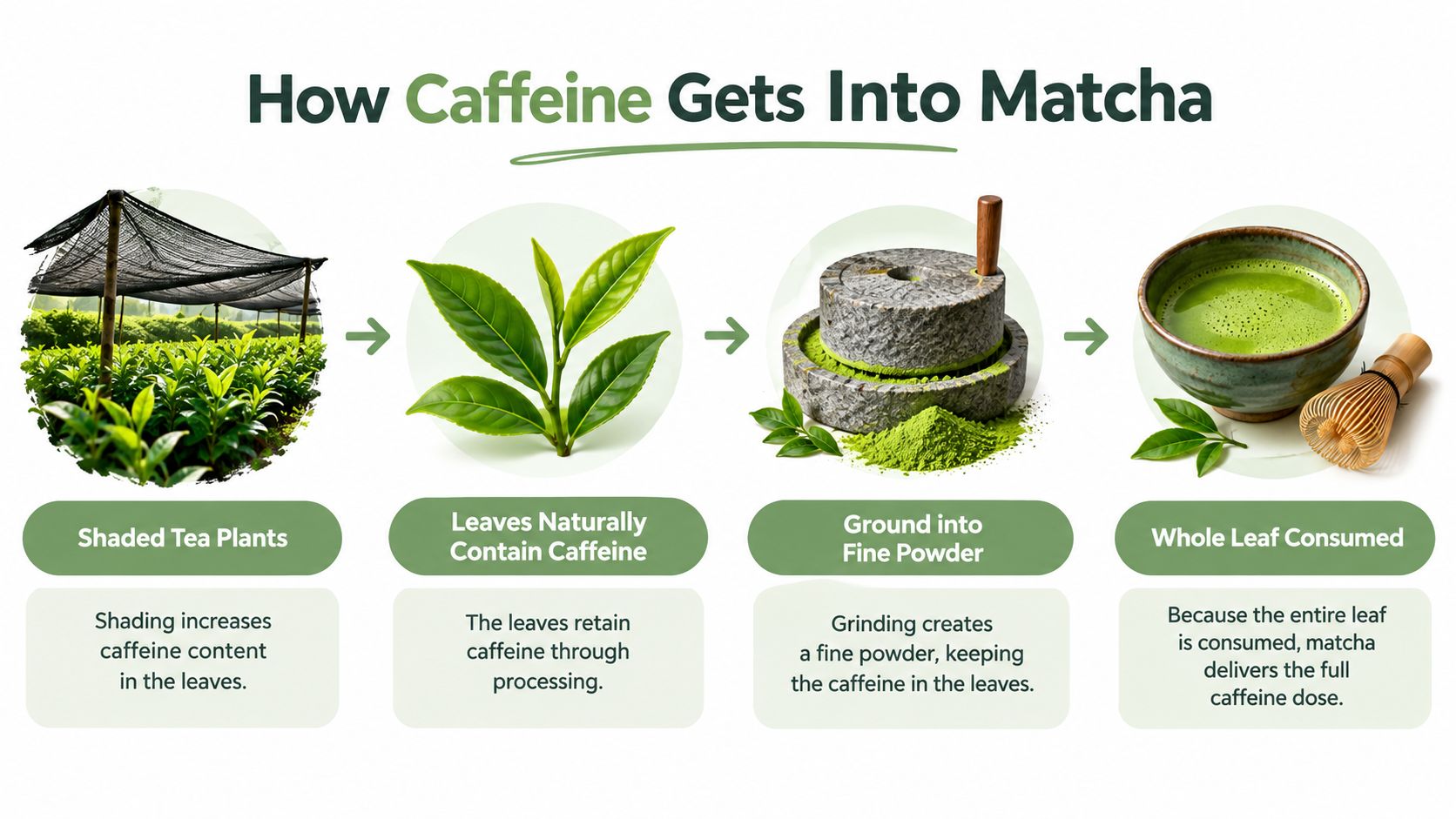
How Caffeine Gets Into Matcha
Matcha begins as Camellia sinensis, the same tea species used for green and black tea, so caffeine is already in the leaf before processing. The key difference is what happens to that leaf before it reaches your bowl.
For matcha, growers shade the plants in the weeks before harvest, then dry the leaves and mill them into powder, a production path Australian pharmacology expert Treasure McGuire of Bond University has described in ABC reporting. Shade changes how the leaf develops and helps create the dried leaf called tencha used for milling. Once ground, the leaf is no longer a filter you remove; it becomes the drink itself.
Steeping Compared With Whisking
A brewed cup works like a rinse: water pulls soluble compounds out, then the spent leaf stays behind. Matcha works more like blending spinach into a smoothie. Fine particles stay suspended, so you swallow leaf material along with the liquid.
That single difference explains why drink strength and caffeine dose are separate ideas. A delicate-looking bowl can still carry a substantial serve if it was made with a heavy scoop, while a bold grassy taste may come from cultivar or freshness rather than extra caffeine.
What Colour and Texture Cannot Tell You
Greenness signals style, not milligrams. Particle size, powder mass, water volume and dilution shape what ends up in the cup, and two drinks with a similar jade colour can behave differently once prepared.
The controllable part is the scoop. Measure powder the same way each time, watch one café preparation before copying it, then adjust by recipe instead of guessing from taste. Any softer feel has more to do with the rest of the leaf chemistry than with caffeine vanishing.
Matcha Compared With Other Caffeinated Drinks
A fair comparison starts with equal volume, then treats the result as a benchmark rather than a guarantee. As noted earlier, Treasure McGuire reported roughly 60 to 75 mg for a 250 mL matcha serving, placing it between brewed green tea and coffee at the same volume. The useful lesson is simple: cup strength describes taste and body, while caffeine dose describes how much leaf material and extract reached your mug.
| Drink | Approximate caffeine per 250 mL | How to interpret it |
|---|---|---|
| Matcha | 60 to 75 mg | Generally above brewed green tea because powdered leaf is consumed |
| Brewed green tea | 24 to 45 mg | Steeped and strained, so only extracted compounds remain |
| Black tea | 45 to 75 mg | Can overlap with matcha depending on brewing strength |
| Coffee | around 100 mg | Usually above a typical matcha serving at this volume |
Reading the Table Sensibly
Matcha often surprises people because it looks gentler than espresso yet usually sits above a strained green tea. It can touch black tea territory at the upper end, while a standard café coffee commonly remains higher. A calm way to read it is to see matcha as a middle lane: steady enough to notice, rarely the heaviest option in the room.
The edges blur once recipes leave the lab. Extra espresso, a longer extraction or a larger cup lifts the coffee side. A heaped scoop or a double matcha lifts the tea side. Milk stretches volume and softens bitterness, although the caffeine from the powder is still present; syrup changes sweetness more than dose.
If your real choice is between a morning flat white and a matcha latte, our guide to matcha energy compared with coffee looks at how the two tend to feel over a few hours. Let the table set the expectation, then let your usual order adjust it.
Compare the actual serving in front of you before trusting the reputation of the drink.
A pale bowl can still be brisk, and a milky latte can be gentler than its colour suggests. That is why dose and strength deserve separate labels: one is measured in milligrams, the other is judged by aroma, bitterness and texture.
Why Your Matcha Serving Can Differ
Two people can both say they had a matcha this morning and receive materially different caffeine doses. The main reason is powder mass, because more finely ground leaf means more of the compounds naturally present in that leaf. Final drink volume matters too, but mainly because larger café drinks often use more powder rather than more water or milk.
Independent Australian guidance cited a wider range of roughly 38–176 mg depending on whether a recipe used half to one teaspoon of powder, as discussed in Australian guidance on matcha latte caffeine ranges. That broad spread is exactly why a single universal number can mislead. A strong café latte can approach coffee-level caffeine, while a lightly prepared home drink may contain far less.
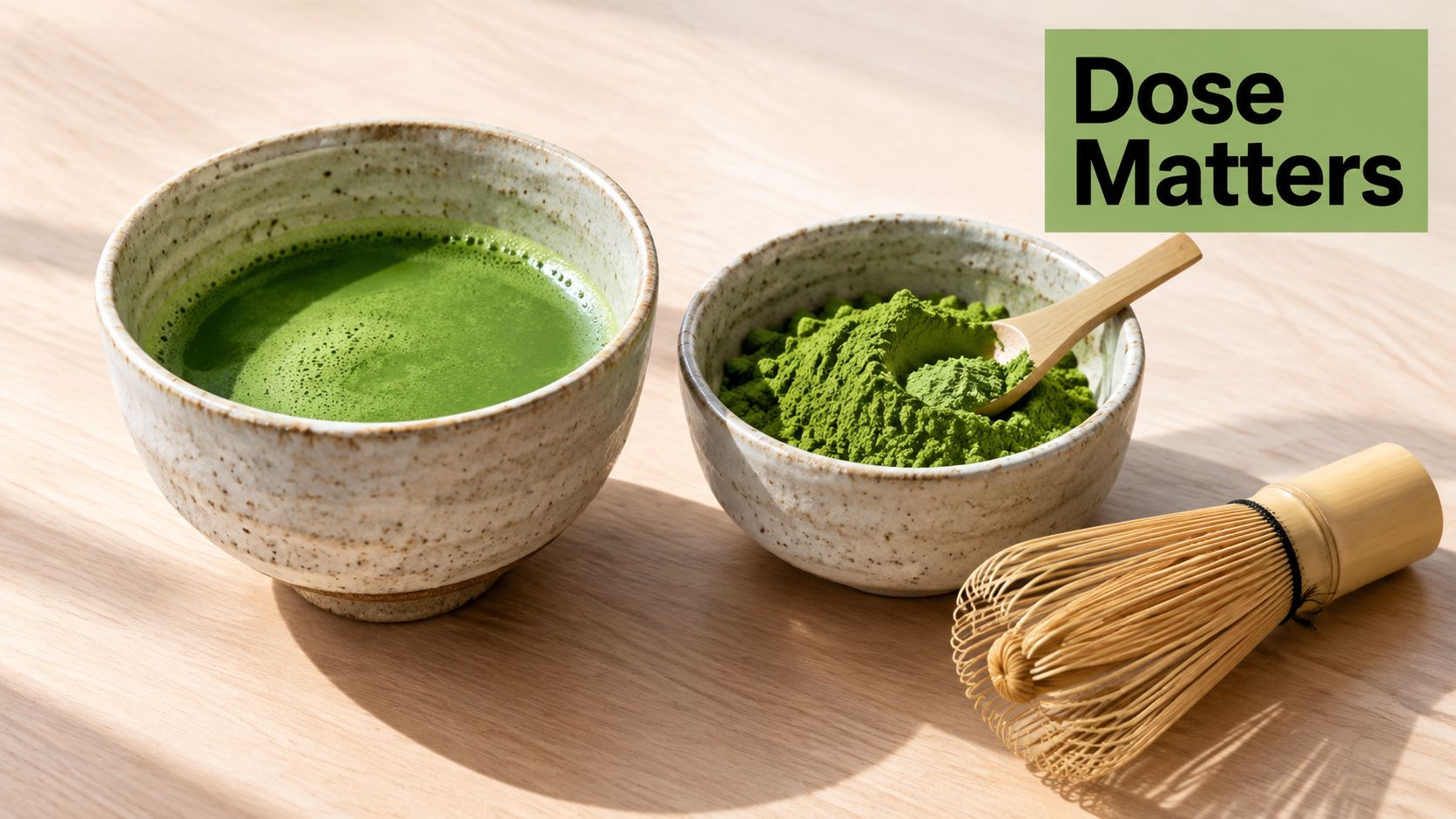
This is the point where looking at the powder itself is more informative than looking at the finished colour.
The Variables Behind Your Cup
- Powder amount: The clearest lever you can measure at home or ask about at a café.
- Number of servings whisked together: A double portion in one cup doubles down on the leaf material, even if the cup size barely changes.
- Dilution: Extra milk or water can make flavour seem milder without reducing the powder already added.
- Cultivar and harvest: Growing conditions influence the leaf before production, so powders aren't identical.
- Preparation conditions: Serving mass and method affect what you consume.
Food Standards Australia New Zealand reported Australian tea caffeine concentrations spanning approximately 0–90 mg per 100 g in FSANZ dietary intake assessment material. The lesson is practical rather than technical. Without knowing the recipe, you can't calculate an exact dose from taste, colour or whether the tin says ceremonial or culinary.
Grade names also cause confusion. Ceremonial and culinary describe intended uses and flavour profiles, they're not caffeine labels with a guaranteed figure. Ask your café how much powder goes into a regular and a large, and at home, use the same scoop for a week so your own routine becomes predictable. Predictability beats guessing by sip.
How Caffeine and L-Theanine Work Together
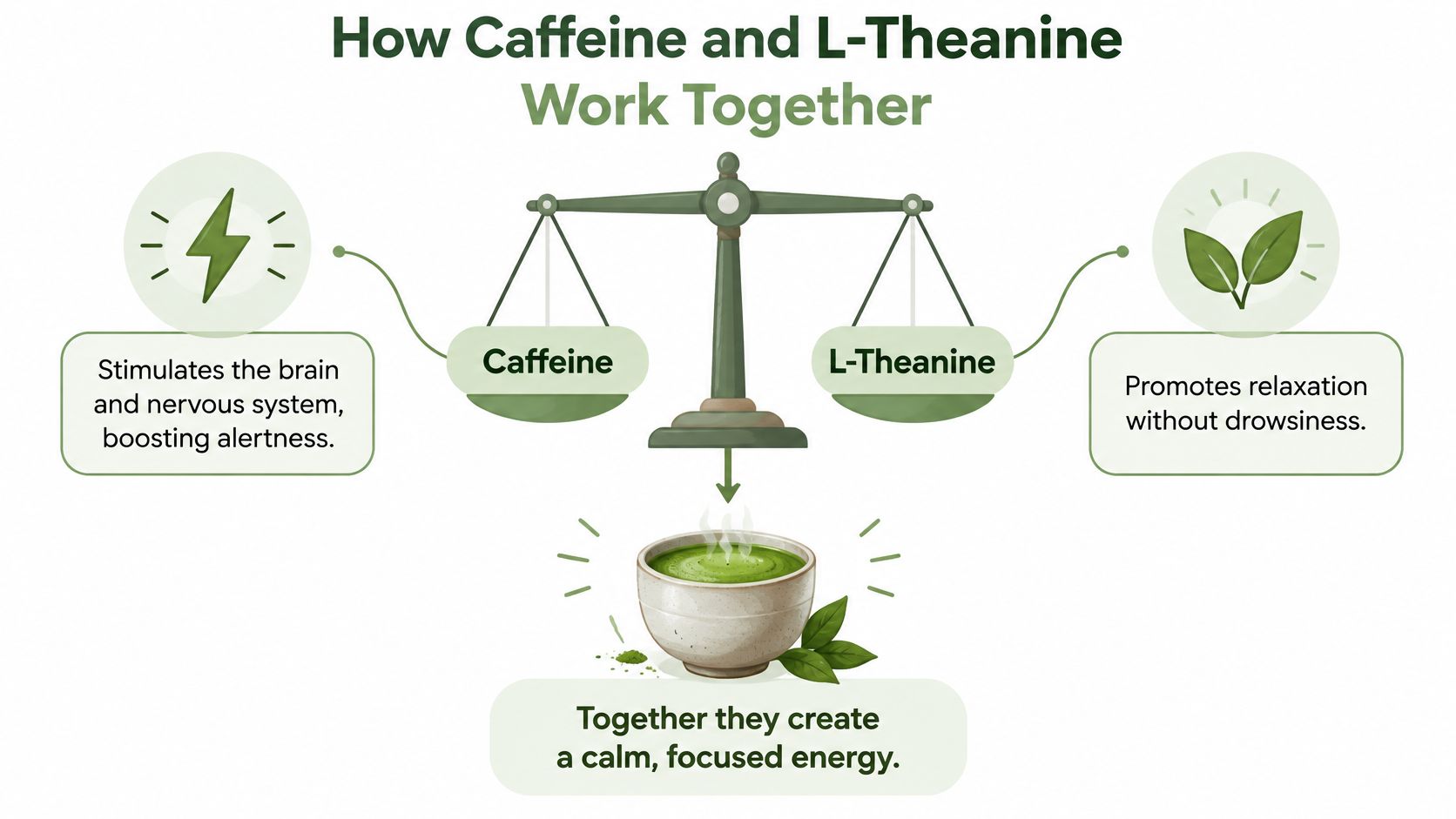
Matcha contains caffeine alongside L-theanine, an amino acid naturally present in tea. Healthdirect describes caffeine as a stimulant affecting the brain and nervous system in Healthdirect caffeine guidance for Australian consumers. That stimulant effect is the alertness side of the experience, while L-theanine is part of why drinkers often describe matcha differently from coffee alone.
This concept visual shows the pairing as a balance rather than a contest between stimulation and calm.
A Simple Balance Analogy
Picture caffeine as the accelerator and L-theanine as a steadier hand on the steering wheel. Many people describe the combination as calmer, smoother or more focused than coffee, but that description is an individual experience, not a guaranteed outcome. How much caffeine is present, when you drink it and how sensitive you are still matter.
For readers who want a plain explanation of the amino acid itself, our page on what L-theanine is and where it occurs gives useful background. A complementary consumer resource is NZ Supps on L-theanine, which discusses the common description of L-theanine smoothing the feel of caffeine. Treat those descriptions as context for the experience, not proof that the caffeine has disappeared.
The short video below is a helpful visual pause point before you think about your own response to a serving.
What Calm Focus Does Not Mean
L-theanine doesn't make matcha caffeine-free, and it doesn't neutralise caffeine in the cup. Someone who feels jittery after coffee may still react to a strong matcha, particularly on an empty stomach or after other caffeinated drinks. Someone else may feel steady after the same bowl.
Pay attention to your own pattern over several days rather than judging from one café order. Note the powder amount if you know it, the time of day and what else you'd consumed. That small record tells you more than a promise that matcha always feels calm.
A Practical Caffeine and Matcha Routine
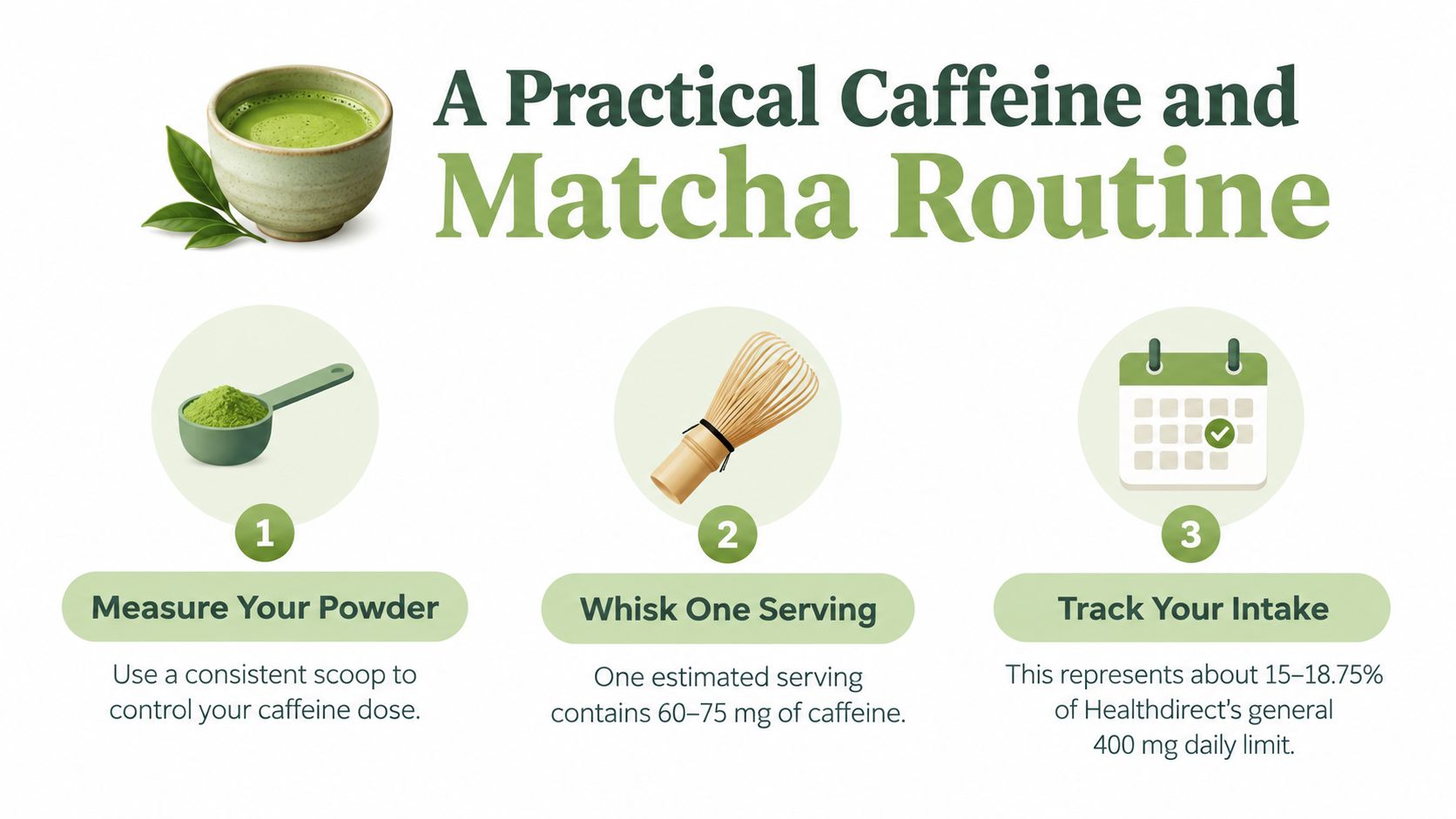
A routine works when you count matcha as part of your whole day, not as a separate wellness category. Using the Healthdirect reference discussed earlier, one estimated matcha serving represents about 15–18.75% of the 400 mg general daily amount for healthy adults. Two servings provide approximately 120–150 mg, or 30–37.5%, so the contribution grows quickly once coffee, black tea, cola, chocolate or energy drinks join the picture.
This routine visual reduces the maths to three habits you can repeat without turning breakfast into a spreadsheet exercise.
Build the Routine Around the Day
- Choose the moment first: Decide whether you want alertness for morning work, study or exercise, then place matcha there deliberately.
- Measure the powder: Use a consistent scoop at home, adjust gradually, and avoid changing powder amount and cup size on the same day.
- Add up other sources: Count the flat white, afternoon cola or chocolate alongside matcha instead of treating tea as an exception.
- Check your response: Note sleep, restlessness and focus, then reduce the powder or move the drink earlier if the pattern doesn't suit you.
Two Servings, Two Different Decisions
A lightly prepared home bowl may fit comfortably into a morning where you've had no coffee. A larger café latte, especially one made with extra powder, needs more deliberate accounting because the benchmark serving no longer describes it well. Four estimated servings could reach roughly 240–300 mg, leaving only 100–160 mg before the general adult benchmark, based on the Healthdirect reference already cited above.
Don't stack a large matcha automatically on top of another large caffeine source and call it gentle because it's green.
Timing is personal. Healthdirect notes individual responses depend on amount and timing, so a late afternoon matcha that suits one person may disturb another person's evening. Start with a measured morning serving, keep the rest of the day visible, and adjust from evidence about your own body rather than chasing a guaranteed energy curve.
Matcha Caffeine Safety for Sensitive Drinkers
Natural doesn't mean inactive. Caffeine from tea is still pharmacologically active caffeine, and Food Standards Australia New Zealand identifies it as naturally occurring in tea with a long history as a mild stimulant in FSANZ consumer guidance on caffeine. The plant origin explains where it comes from, it doesn't remove the need for moderation.
FSANZ also states there's no recognised health-based Acceptable Daily Intake for caffeine, while its expert review found evidence of increased anxiety in children at approximately 3 mg per kilogram of body weight per day, in the same consumer guidance linked above. That uncertainty is a reason to use ranges and context carefully, especially for children, adolescents, pregnant and lactating women and caffeine-sensitive consumers.
Australian Thresholds Worth Knowing
- Healthy adults: FSANZ consumer guidance sets intake at no more than 400 mg per day and no more than 200 mg in one serving, according to FSANZ guidance on caffeine powders and high caffeine foods.
- Pregnant and breastfeeding people: The same guidance advises staying at or below 200 mg per day.
- People under 18: FSANZ uses a single-serving threshold of no more than 3 mg per kilogram of body weight, illustrated as 120 mg for a 40 kg child.
A standard estimated serving would equal 1.5–1.875 mg/kg for a 40 kg child, based on the serving estimate used earlier, but a stronger preparation could approach or exceed that child's single-serving threshold. Child-sized on the menu refers to cup volume, not necessarily powder quantity. Parents and cafés should ask about the recipe rather than assuming a small green drink is low in caffeine.
Where Caution Belongs
If you're pregnant, our resource on matcha during pregnancy is a more specific starting point, alongside advice from your own clinician. People taking medicines affected by stimulants, adolescents and anyone who notices anxiety, sleep disruption or palpitations after caffeine should use more conservative, clinician-informed limits. General thresholds aren't personalised medical advice.
Energy drink rules shouldn't be used to guess a matcha dose either, since formulated caffeinated beverages have their own regulatory labelling framework. Ordinary tea products may not provide an equivalent per-serve figure on the pack. State the powder amount, count total exposure from all sources and don't imply that naturally occurring caffeine has no effect.
Choosing Matcha for Your Energy Routine
A good choice comes from answering three questions together. How much caffeine is your recipe likely to contain, what else have you consumed today, and how do you usually respond to caffeine? Those answers matter more than labelling matcha healthy or unsafe in the abstract.
A lighter serving may suit a gentler routine, particularly if you've already had coffee or you know late caffeine affects your sleep. A powder-heavy latte can still have a place, perhaps earlier in the day, but it deserves honest accounting. Pairing your drink with a satisfying breakfast is also sensible planning, and this guide on what to eat to avoid the crash offers food-focused ideas for steadier mornings.
Ceremonial and culinary aren't caffeine categories, and L-theanine doesn't remove the need for moderation. At Pep Tea, we supply premium Japanese organic matcha as one option for readers who want a measured home ritual and clear preparation at home. Choose the grade for its intended use, measure the powder for your needs, and let your own response guide whether matcha belongs in your morning, your pre-workout window or only occasionally.
If you'd like to put a measured matcha routine into practice, explore the organic matcha range and sugar-free organic kombucha brewed for Australian households and cafés at Pep Tea. You'll find Japanese matcha for whisking, lattes and baking, plus education to help you prepare each serving with confidence.
Kombucha from Scoby

Your first jar of kombucha from a SCOBY may look lively: a pale layer is forming on top, bubbles cling to the glass, and the tea smells sharper than it did when you brewed it. But is it ready, or just getting sour? For a careful home brewer, success isn't a taste test alone. It's a fermentation process you can observe, measure and repeat.
Kombucha can be rewarding to make, but a living culture doesn't follow an exact timetable. Cooling, acidity, oxygen, cleanliness and fermentation conditions all shape the result. Here's how to work with those variables, recognise what you can't confirm by sight, and make safer decisions about each batch.
Why SCOBY Kombucha Needs Careful Control
A jar can be busy on day three and still be early: bubbles rise, the aroma turns sharper, and a pale film spreads across the surface. Useful signs, all of them. They show fermentation is active; they do not prove the tea has cooled safely, acidified enough, or stayed below an alcohol level that suits your household.
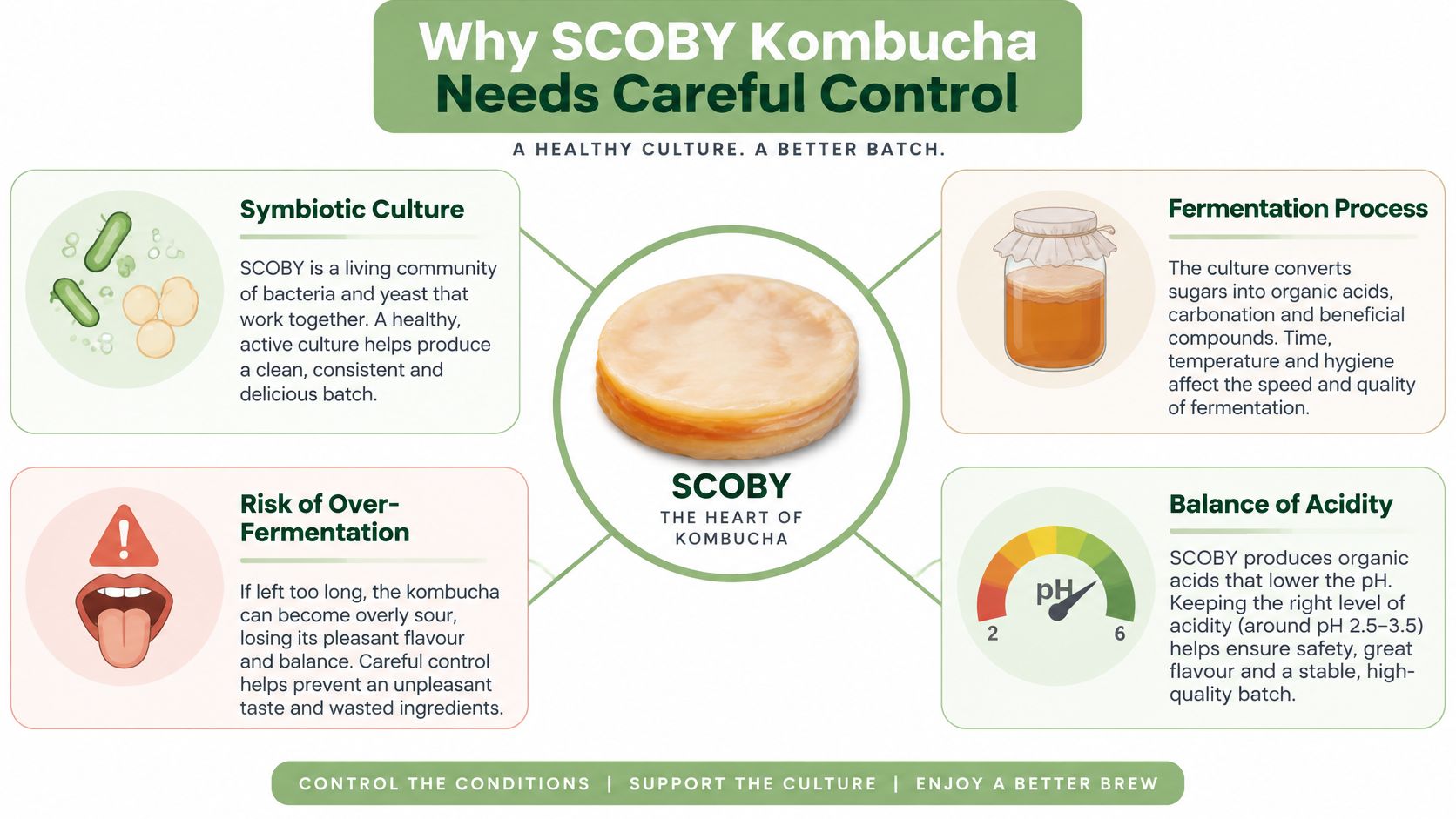
Treat the brew as a controlled process rather than a recipe that finishes itself. A SCOBY is a symbiotic culture of bacteria and yeast. The yeast portion converts sucrose into glucose and fructose, then makes ethanol and carbon dioxide. Acetic-acid bacteria need oxygen to turn that ethanol through acetaldehyde into acetic acid, which is why airflow through a tight cloth, temperature and time all change the same batch.
Treat sensory signs as clues, then measure
Australian food-safety guidance puts numbers around those stages, from fresh tea around pH 5 before the culture brings it down, to hot tea cooling from 60°C to 20°C within two hours before inoculation, to pH 4.2 or below during fermentation as an acidity checkpoint for limiting pathogen growth and toxin production, with a typical finished kombucha described as pH of at least 2.5 and a common final alcohol target less than 1% while some state rules are stricter: Australian fermented-beverages food-safety guidance
Those figures work like gauges on a dashboard. Sweetness, fizz and a pleasant tang are the warning lights that tell you something is happening; pH, cooling time and an alcohol-aware endpoint tell you whether the batch is moving in the right direction. If alcohol content matters for children, pregnancy, driving or medication in your home, decide that limit before bottling rather than after the flavour seems right.
This guide is educational and cannot make a home batch commercially validated or automatically safe. A written cooling time, a clean routine and recorded pH give you a firmer basis for each decision than bubbles, smell or a brave sip.
Prepare Your SCOBY Brew
Before brewing, set up a clean workspace and gather the equipment you'll use to make and monitor the batch. You don't need a complicated laboratory, but you do need a consistent routine.
Choose a culture from a batch that has fermented normally and smells clean and pleasantly tart. The culture is present in the liquid as well as in the familiar rubbery surface layer, so keep some fermented starter liquid with the SCOBY. A new surface layer may form during brewing, but its shape or thickness isn't a reliable test of safety.
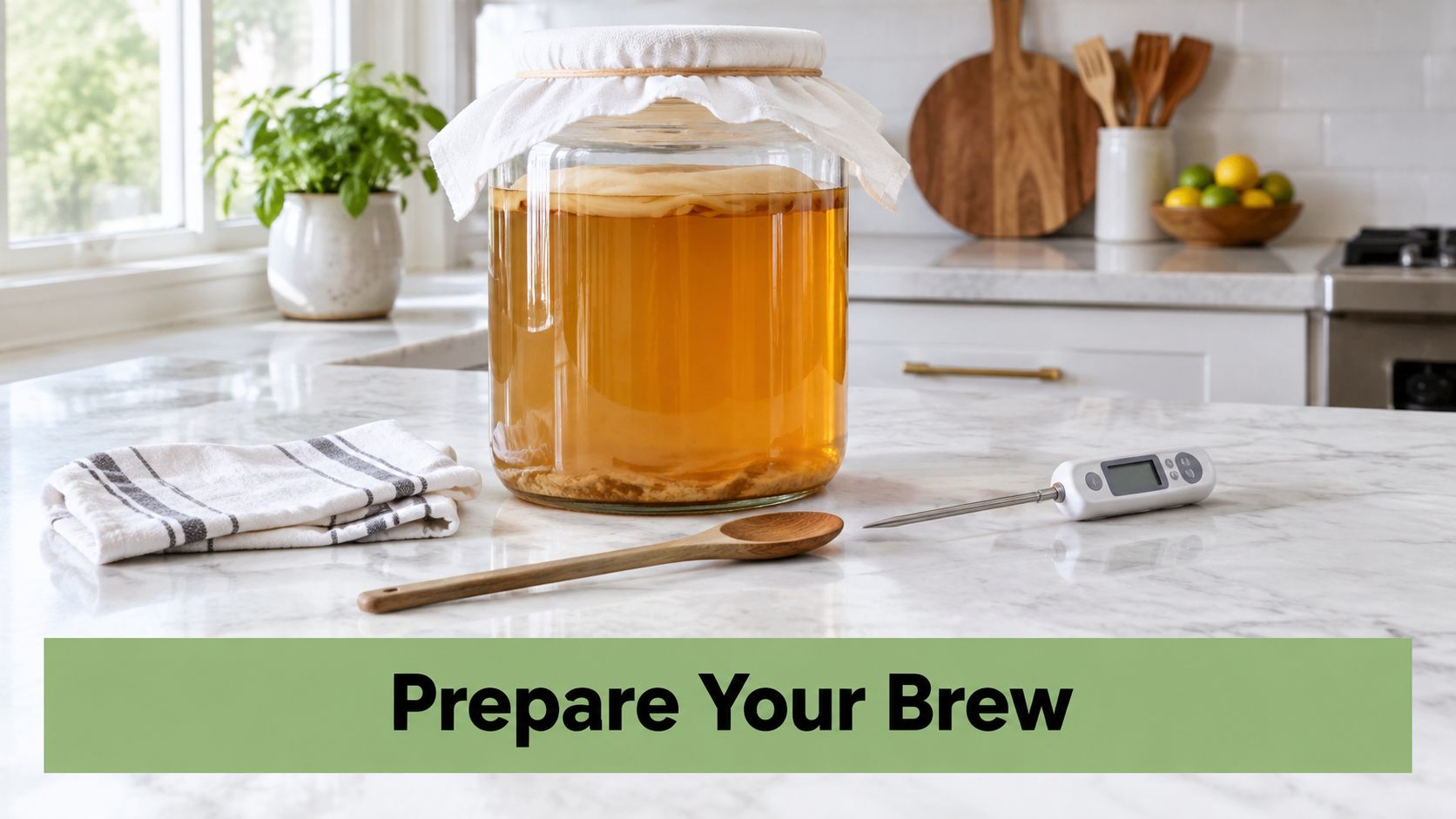
Gather a practical setup
- A clean fermentation vessel: Choose a food-safe vessel that's easy to inspect. A wide opening makes it simpler to add the culture and take samples.
- A breathable cover: Use a clean, tightly secured cloth to keep out insects and debris while allowing air to reach the brew.
- A strainer and clean utensils: These help you handle tea leaves and culture without introducing unwanted residue.
- A way to test pH: Use a calibrated meter or validated pH strips, following the product instructions. Keep testing equipment clean and suitable for food use.
- A batch log: Record ingredients, cooling and inoculation times, temperature observations and pH readings.
For a base formula, use clean water, tea, sugar, a SCOBY and fermented starter liquid from a reliable batch. There isn't one ratio that suits every culture or tea; a recipe that works in one kitchen may behave differently with another tea, a different amount of starter or changed room conditions. Treat the sugar as food for fermentation, not as a sweetener you can remove without changing the process.
Black and green tea are common choices, and other suitable teas may be used if they support a healthy culture. Choose clean, food-grade ingredients, and opt for organic tea and sugar if that fits your preferences. Most of all, don't add the culture to hot tea. Build a routine around measured cooling and clean handling rather than improvising when the kettle is already on.
Brew Kombucha With a SCOBY
Brew the sweet tea and dissolve the sugar fully while the liquid is still hot, then strain out the leaves. Undissolved sugar sinks to the bottom of the vessel and gives the culture an uneven starting point, which makes the batch harder to interpret later on.
Cool the infusion promptly. Australian home-brewing pH and temperature guidance recommends moving the liquid from 60°C to 20°C within two hours, the same cooling logic a commercial kitchen applies to cooked food: a warm, sweet, unacidified liquid gives contaminants time to multiply before fermentation can protect it. Once the tea has cooled, add the SCOBY and starter liquid straight away rather than letting the vessel stand.
The starter liquid earns its place here. It carries acid from a finished batch into the fresh tea, so the pH begins falling immediately instead of drifting in the vulnerable range while the culture wakes up.
Pour everything into the fermentation vessel and leave headspace at the top. Secure a breathable cloth over the opening so insects stay out but air still reaches the surface. Oxygen matters at this stage because the acetic-acid bacteria need it to convert the alcohol the yeast produce into acetic acid. A sealed lid would stall the very reaction that makes the brew acidic and safe.
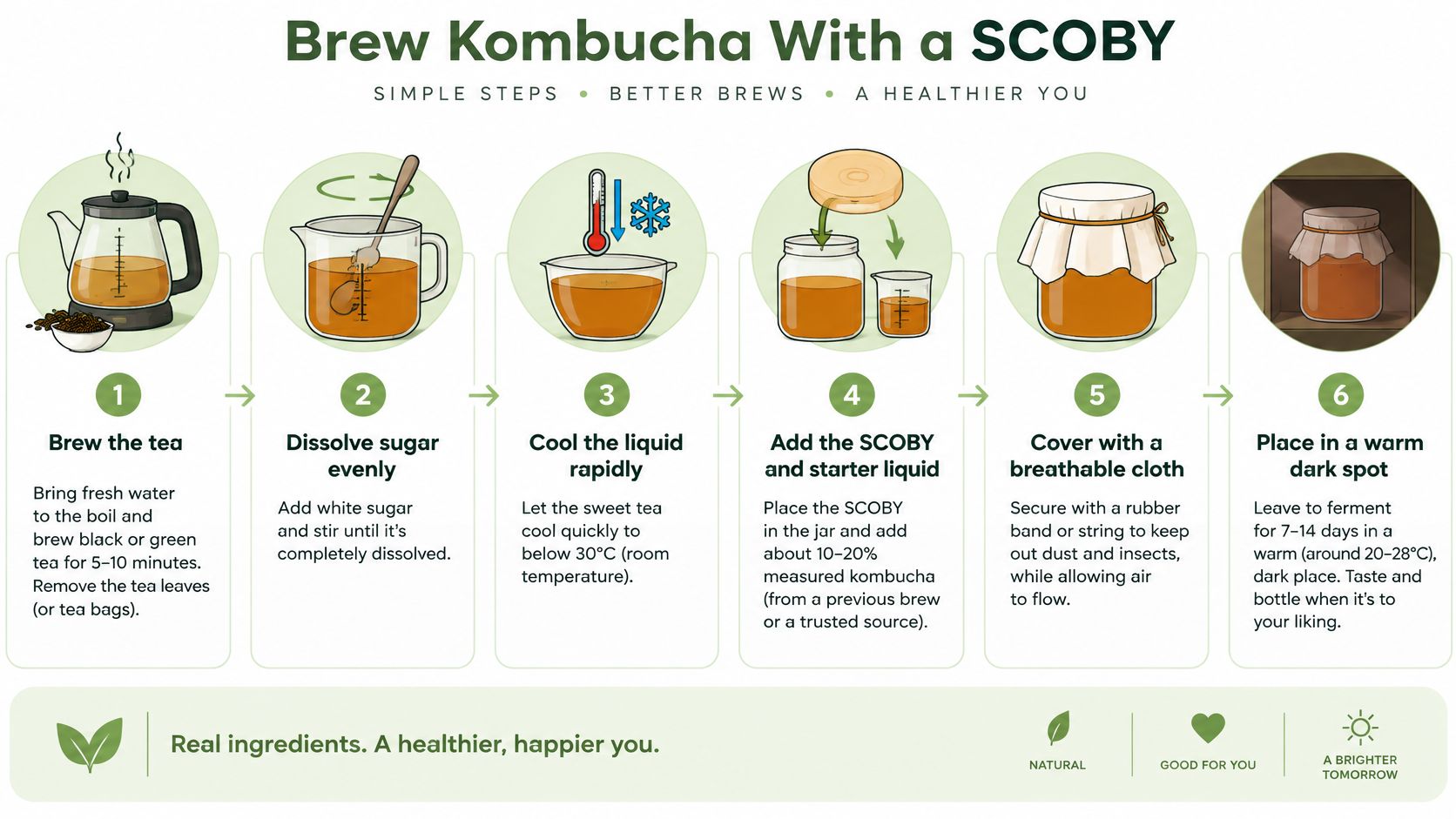
Label the vessel and write down the ingredients, when the tea was brewed, when it finished cooling and when the culture went in. That start time is your reference point for every reading that follows.
Keep the record with the jar. A taste note can describe the flavour, but a process log can help explain why this batch behaved differently from the last one.
A video can help you visualise the handling sequence before your first batch.
For another perspective on fermented and other digestive drinks, see AloeCure's guide to gut drinks. Use any general drink ideas as inspiration only, not as a replacement for monitoring a live fermentation.
Guide Fermentation With pH and Time
During primary fermentation, the yeast and bacteria steadily transform the sweet tea. You may see bubbles, a surface film or shifts in colour, and the smell may turn sharper. These signs tell you the culture is alive, but they can't tell you how acidic the liquid has become or how much alcohol it holds. Treat them the way a teacher treats a student's raised hand: a signal to look closer, not proof of understanding.
The reliable check is a measured one. Take pH readings with a clean, sample-safe method and log each result beside your temperature observations, working from the start time you recorded when the culture went in. The acidity checkpoints described earlier still apply: fresh sweet tea sits in a range where contaminants can grow, so your job is to confirm the brew acidifies promptly. For a controlled home process, a practical benchmark is reaching the safe-acidity threshold by about day 7, though this isn't a universal schedule. Culture strength, sugar concentration, temperature, tea type and starter volume all shift the pace. A slow batch isn't automatically unsafe, but a reading that barely moves across a week deserves attention rather than patience.
A calibrated meter gives you a precise number, while validated strips offer a workable alternative when you follow their instructions. Whichever you use, pull the sample cleanly and never return it to the vessel. If you're weighing up equipment, a digital pH meter for kombucha testing removes the guesswork of matching a strip's colour to a chart.
Decide on the endpoint, not just the flavour
Once the primary ferment has cleared the acidity checkpoint, taste becomes a preference question rather than a safety test. As covered earlier, finished kombucha typically sits at pH 2.5 or lower; what matters here is deciding when to stop. Letting the ferment run longer won't make it safer. It pushes the flavour towards vinegar and makes the batch harder to predict.
Secondary fermentation is a separate stage with its own risks. Bottling for flavour or carbonation removes the oxygen the primary vessel allowed, so the acetic-acid bacteria slow down while yeast keeps producing carbon dioxide in a sealed space. Pressure builds. Use bottles rated for carbonation, open them carefully, and treat refrigeration as a brake on fermentation rather than a stop button.
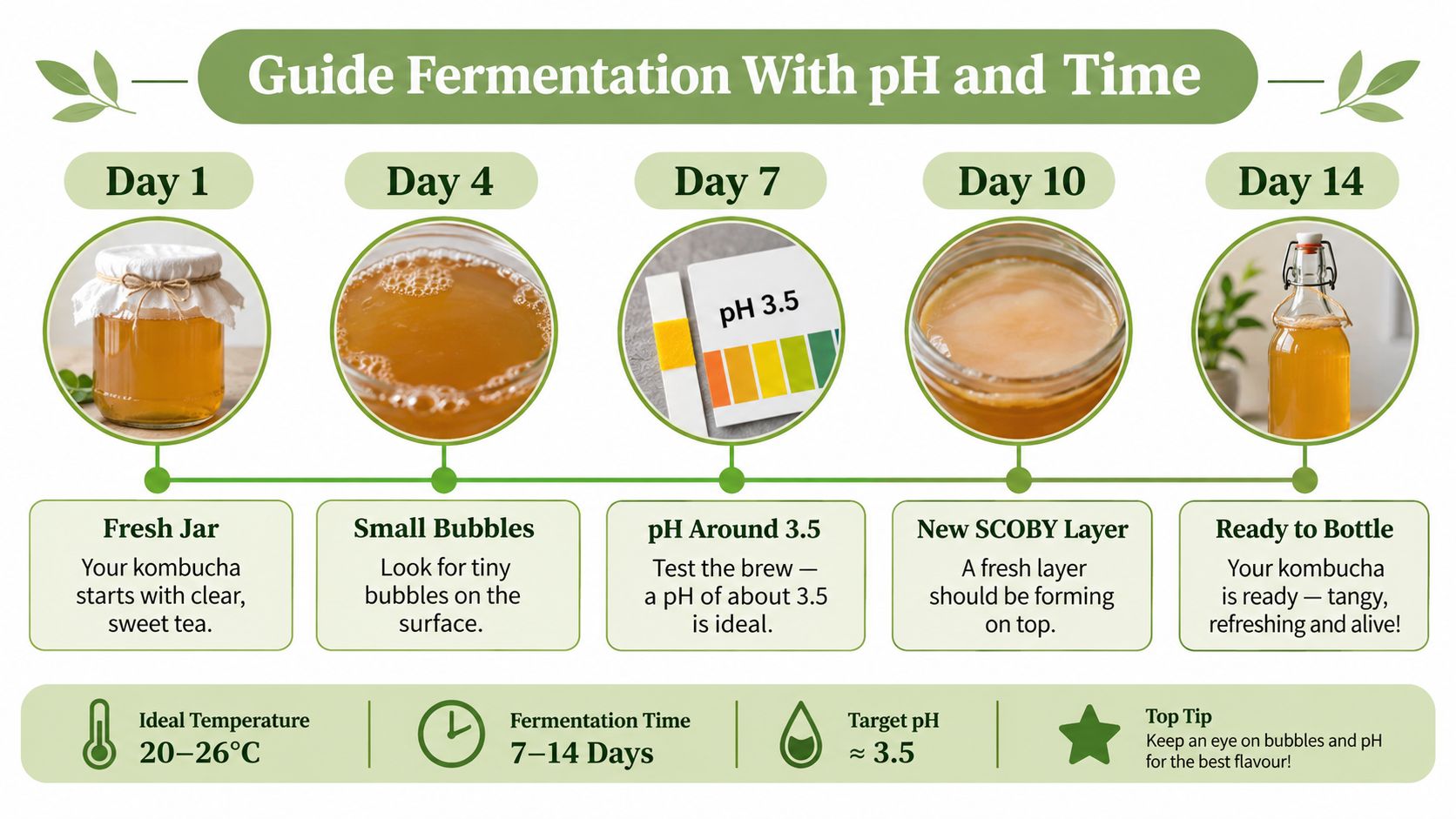
Strain or transfer the drink with clean equipment, then chill it to slow further change. Write down the final pH and what you did next, and keep that record with the batch. The goal isn't an identical number of days every time; it's learning how your culture behaves so each batch improves on the last.
Keep Hygiene Under Control
A clean routine won't turn a home kitchen into a sterile laboratory, and it doesn't need to. Its purpose is to reduce avoidable contamination by making every handling step deliberate.
Before brewing, wash your hands and clean the work surface, vessel, cover, strainer and utensils. Rinse cleaning products away where needed, and let equipment dry or use it as directed. If you use a thermometer or pH meter, keep the parts that touch the sample clean, and don't return a used sample to the vessel.
When moving the SCOBY, use clean hands or a clean utensil. Keep it away from fresh ingredients, used cloths and surfaces where raw food or dirty dishes have been handled. Don't share tools between the fermenting jar and other foods without washing them first. A brewing container with a suitable opening and cover can make handling easier; see this guide to a kombucha brewing container.
Know when not to reuse a culture
A new surface layer may look uneven, folded or thin, and that alone doesn't tell you the batch has failed. By contrast, fuzzy growth, an unusual appearance you can't confidently assess, or a persistent musty or rotten smell should prompt caution. Don't scrape off suspicious growth and keep the liquid. If the batch looks contaminated or otherwise questionable, discard the contents and culture rather than trying to rescue them.
Home fermentation carries risks. If you're immunocompromised or otherwise vulnerable, ask a health professional whether home-fermented drinks are appropriate for you. If alcohol content is a concern, don't rely on home observations or a recipe alone to establish it.
Before each batch, check:
- Hands and surfaces: Wash hands and clean the workspace before handling the culture.
- Equipment: Use clean vessels, covers, strainers and sample tools.
- Culture: Return only a culture from a batch you're comfortable reusing.
- Records: Write down the batch details and keep pH results together.
- Uncertainty: Discard a batch if contamination or its condition is unclear.
Troubleshoot SCOBY Fermentation Problems
Diagnosis starts with your records, not the surface of the jar. A quiet fermenter can still be acidifying, and a lively one can still produce something you shouldn't drink. Before changing anything, pull out the batch log and compare it with your earlier brews.
If no new surface layer has formed, that alone doesn't mean failure. The visible film is only part of the culture; the microbes working through the liquid matter more than what floats on top. Check the pH trend first. If acidity is falling steadily, the batch is fermenting, just without the cosmetic layer some brewers expect.
Weak activity usually traces back to the start of the batch. Revisit the cooling and inoculation notes: tea that went in too hot can damage the culture, a late inoculation delays acidification, and too little starter liquid leaves the sweet tea less acidic at the outset, which widens the window where competing microbes can establish themselves.
For a slow or inconsistent batch, compare temperature observations, starter quantity and pH readings against earlier brews. A different tea, a changed sugar concentration or an older culture can each shift the pace. Records let you separate a batch that is slow from one you can't explain, and unexplained is the category that deserves caution.
For excessive acidity, stop fermenting rather than waiting for the flavour to come back. A very low reading, below the finished range discussed earlier, calls for caution rather than more time on the bench.
For something you can't identify, the useful question here is why it happened rather than what to do with it, since the discard rules are covered above. Look for the route in: airborne spores settling on an uncovered jar, a fruit fly breach through a loose cover, or tools that touched other foods. The oxygen exposure at the surface that kombucha relies on is also what lets mould colonise the top of a poorly acidified brew. Find the cause before brewing again, or the next batch may repeat it.
Alcohol is the last thing to check. An Australian government review reported that 64.8% of surveyed samples in Queensland, Tasmania and Victoria exceeded the 0.5% ABV threshold used there for alcoholic beverages, while in states and territories using the 1.15% ABV threshold, 22.9% exceeded it and 77.1% were below it. Australian fermented-beverages outcomes review Survey figures are not a prediction for your jar. They show why a home brewer can't assume fermentation stopped producing alcohol, so if strength matters to someone drinking it, treat an unusual batch accordingly rather than tasting your way to an answer.
Store Kombucha and Reuse the SCOBY
A finished brew keeps fermenting on the bench, so chilling is the first decision. Cold slows the yeast and bacteria enough to hold flavour close to where you left it, which is why the move to the fridge matters more than the move to a bottle. Transfer the kombucha with clean equipment into clean glass containers filled close to the top, since less headspace means less oxygen and slower change. For a fuller walkthrough of chilling and holding the finished drink, see our guide on how to store kombucha.
If alcohol content matters to someone drinking it, hold the batch to the alcohol target discussed earlier. An unusually warm or long ferment deserves caution, and neither taste nor refrigeration alone confirms where the alcohol level ended up.
Then turn to the culture. A SCOBY hotel works like a pantry for future batches, holding spare cultures until you need them. Keep only cultures from sound, mould-free batches, and store them in a clean glass jar with at least 200 ml of starter liquid per culture, covered with a breathable cloth. Refresh the liquid every few weeks so the culture stays fed and acidic. Discard anything that smells off or shows fuzzy growth, because a questionable culture carries its problems into the next brew.
Before you start again, confirm the vessel and tools are clean, the culture looks healthy, and you are ready to record cooling time and pH. If you would rather skip the next cycle, Pep Tea offers sugar-free organic kombucha brewed in the Hunter Valley, NSW.
Explore Pep Tea's sugar-free organic kombucha range if you'd like a ready-to-drink alternative to a home SCOBY brew. Visit Pep Tea to browse its kombucha and organic tea offerings.
What Is Matcha Tea Powder and How to Use It Well
What is matcha tea powder if it's made from the same plant as the green tea in a bag? Matcha is a finely milled powder made from shade-grown green tea leaves that you whisk into water and consume whole, rather than steeping the leaves and throwing them away. That single difference, eating the leaf instead of only drinking its infusion, explains the vivid colour, the fuller flavour, and why the amount of powder in your cup matters so much.
What Matcha Tea Powder Actually Is
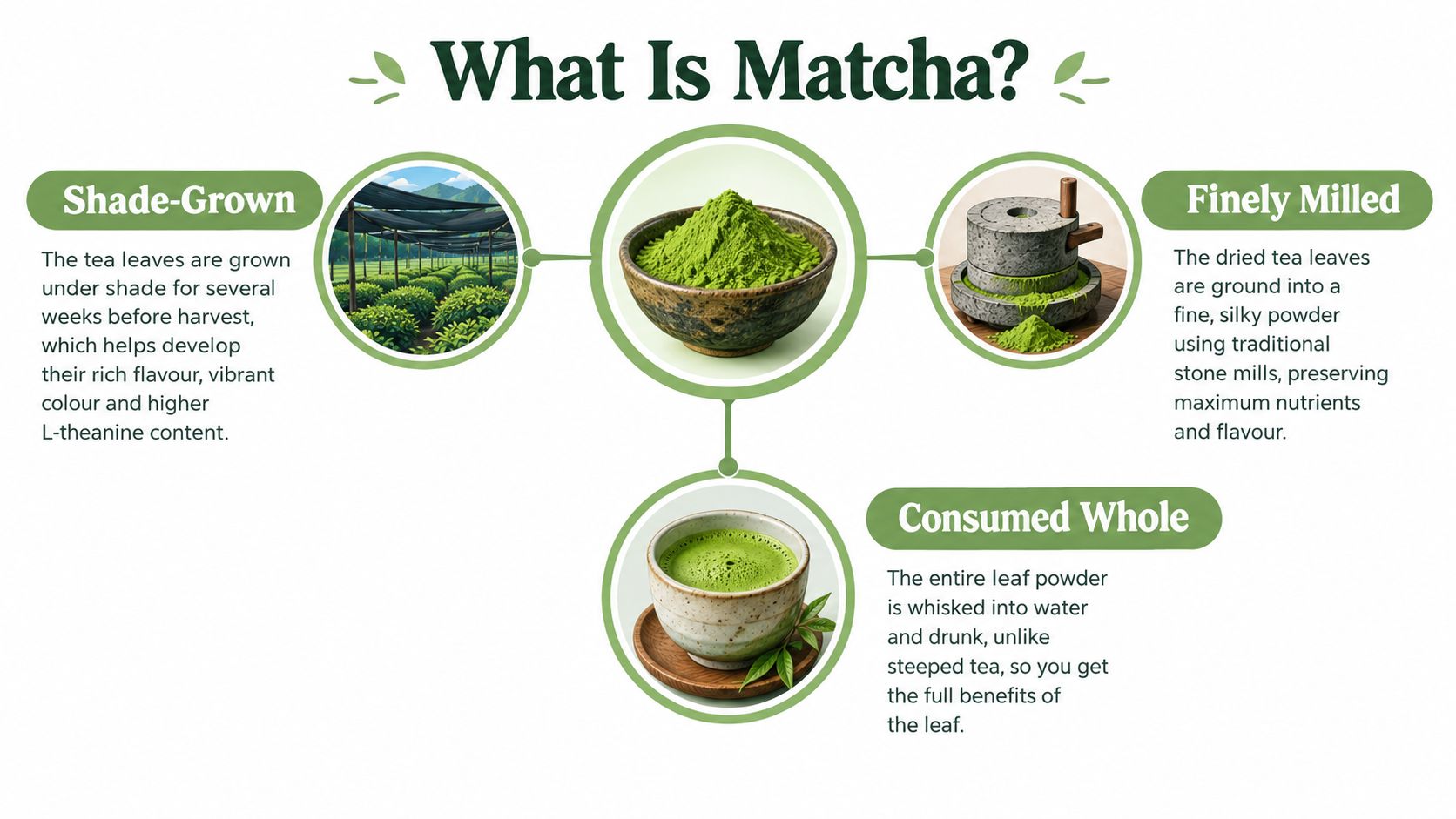
Matcha isn't a different species and it isn't an herbal blend. It's made from Camellia sinensis, the same plant used for green, black and oolong tea, but it's grown, processed and consumed in a specific way. The leaves are shaded before harvest, steamed, dried and milled into a very fine powder.
With a tea bag, hot water extracts flavour and compounds, then you discard the leaves. With matcha, the powder stays suspended in the liquid. You drink the leaf material itself, so your serve is set mainly by how many grams of powder you use, not just by how long something steeped.
If you've only used tea bags, the tin can look unfamiliar. Fine green powder doesn't behave like leaf tea, and it won't dissolve neatly like instant coffee. It forms a suspension, which is why whisking matters and why a thin layer may settle if a drink sits.
A Simple Working Definition
If the whole powdered leaf ends up in the cup, think matcha. If the leaf stays in a bag or pot and only the water reaches the cup, think steeped tea.
In Australia, matcha is also grouped with other non-fermented green teas for import purposes, rather than sitting in its own separate customs category. The Australian green tea import classification records for tea in smaller packings sit within Harmonized System heading 0902, including code 0902.10.00 where the general duty is listed as Free. That detail sounds bureaucratic, but it's useful. It tells you national trade figures usually describe green tea broadly, not matcha alone.
It also clears up a common confusion. Matcha isn't automatically Japanese, organic, low in caffeine or high grade because it's green powder. Matcha describes a processing format. Origin, cultivar, harvest, certification and grade still need separate checking.
From here, it helps to follow the journey from shaded field to tin, then compare that powder with steeped green tea. After that, you'll be able to judge a label, prepare a bowl or latte by weight, and place the caffeine claims in a realistic Australian context.
How Matcha Is Grown and Milled
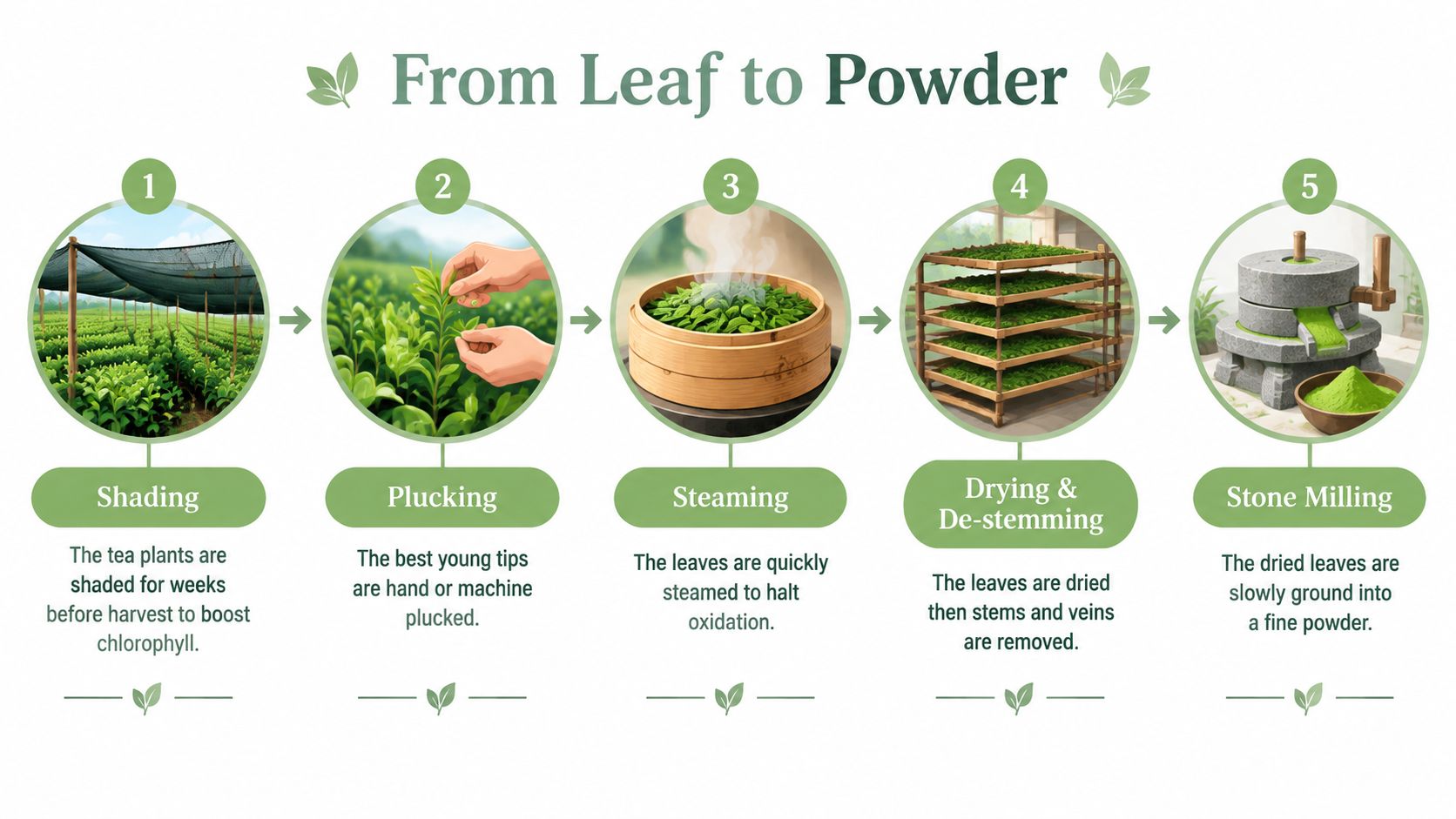
Start in the field, a few weeks before harvest. Growers cover the tea bushes so the leaves develop in reduced light. Australian academic researchers describe matcha leaves as typically cultivated under approximately 90% shade before harvest in their review of matcha bioactive compounds and analytical techniques.
That shade changes how the plant works. With less light, the leaf produces and retains more chlorophyll, which supports the deep green colour. Shading also reduces light-driven catechin formation while helping preserve or increase L-theanine and caffeine, two compounds that shape matcha's savoury, smooth character.
From Leaf to Tencha
At harvest, growers pluck young leaf material by hand or machine, depending on the farm and grade. The fresh leaves are steamed quickly to halt oxidation. That quick steam helps keep them green, much as blanching vegetables sets their colour, although tea handling is more delicate.
The steamed leaves are then dried and sorted. Stems and larger veins are removed, leaving flat, flaky leaf material called tencha. Think of tencha as a brittle green tea biscuit, dry and fragile, waiting to be reduced to powder. It isn't the finished product yet, and you wouldn't brew it the same way as loose-leaf sencha.
This intermediate step matters when you shop. A powder ground from whole, unspecified green tea leaves, stems included, may look green in a smoothie but taste harsher and feel coarser. Proper matcha starts with leaf material prepared for milling.
Milling the Powder
Producers mill tencha slowly into powder, traditionally between granite stones. Slow milling creates a fine particle size and limits heat. The result should feel silky, clump lightly because it's so fine, and whisk into a smooth suspension rather than a gritty drink.
Fine milling also explains some of the cost. Shading, careful plucking, steaming, drying, sorting and gradual grinding add labour at every stage. A very cheap tin isn't automatically poor, but there's a production reason genuine matcha rarely behaves like a bulk culinary colouring.
If you're explaining it to a friend, keep it to three ideas. The plants are shaded, the leaves are steamed and dried into tencha, and that tencha is milled so you can consume the leaf itself. Everything else, from grade names to café lattes, builds on that sequence.
Matcha Compared to Steeped Green Tea
The practical question is why you'd bother with powder when a tea bag is easier. The answer isn't that matcha is automatically better. It's a different format with a different dose, texture, flavour and routine.
Steeped green tea gives you compounds that move from leaf into water during brewing. Matcha gives you the compounds present in the weighed leaf material, including parts that don't extract fully into an infusion. That's why two drinks from the same plant can feel noticeably different.
| Factor | Steeped green tea | Matcha powder |
|---|---|---|
| What you consume | Water infused with leaf compounds | The suspended powdered leaf itself |
| Dose control | Leaf amount, water and steeping time | Mainly grams of powder used |
| Flavour | Lighter, often grassy or bitter | Fuller, savoury and creamy when well made |
| Texture | Clear liquid | Opaque, frothy suspension |
| Equipment | Bag, pot or infuser | Bowl or cup, whisk or frother |
| Best use | Simple hot or iced tea | Whisked tea, lattes, smoothies and baking |
What Changes in the Cup
Because you consume the leaf, matcha generally contains catechins, L-theanine and caffeine at higher levels than green tea infusions. Concentrations still vary substantially with cultivar, shading, growing conditions, processing and test method. Bright colour alone can't tell you the exact potency of a tin.
That variability is important for cafés and home users who want consistency. Supplier specifications or batch testing give you a firmer basis for standardising a recipe than the word ceremonial on packaging. At home, weighing your serve is the simplest consistency tool you have.
Flavour shifts too. Steeped green tea is clear and light, and over-steeping can make it bitter. Well-made matcha has body because the powder remains in the drink. You may notice sweetness and umami before bitterness, especially with powder intended for drinking straight.
Keeping Health Claims Grounded
The Australian Dietary Guidelines on green and black tea catechins and cardiovascular risk factors identify green and black tea as sources of polyphenols called catechins and state that consumption of green and black tea is associated with a reduced risk of stroke. The guidelines also describe catechins as compounds reported to influence factors including hypertension, atherosclerosis, thrombogenesis, nitric oxide production and endothelial health.
Those statements support describing matcha as a concentrated green tea powder containing tea polyphenols. They don't prove matcha cures disease, and they don't turn every antioxidant claim on social media into clinical evidence. The cited association concerns green and black tea consumption generally.
Caffeine also needs context. FSANZ reports a caffeine concentration range of 0 to 90 mg per 100 g for tea in its assessment of tea as a naturally occurring caffeine source. For matcha, the amount you consume depends on the grams of powder, the product composition and the serving size.
Cost per cup typically rises with matcha because production is more involved and there's no discarded leaf carrying unused material away. In exchange, you get a format that works in milk, baking and cold drinks in ways a tea bag can't. Choose steeped tea for simplicity, matcha for concentration and versatility. Neither choice needs hype to justify it.
How to Choose Quality Matcha in Australia
A useful starting point is intended use. Ceremonial grade usually signals matcha selected for whisking with water, where sweetness, fine texture and low bitterness matter. Culinary grade is generally intended for milk drinks, smoothies and baking, where stronger flavour and lower cost are practical. These labels aren't a guarantee by themselves, so treat them as a category, not proof.
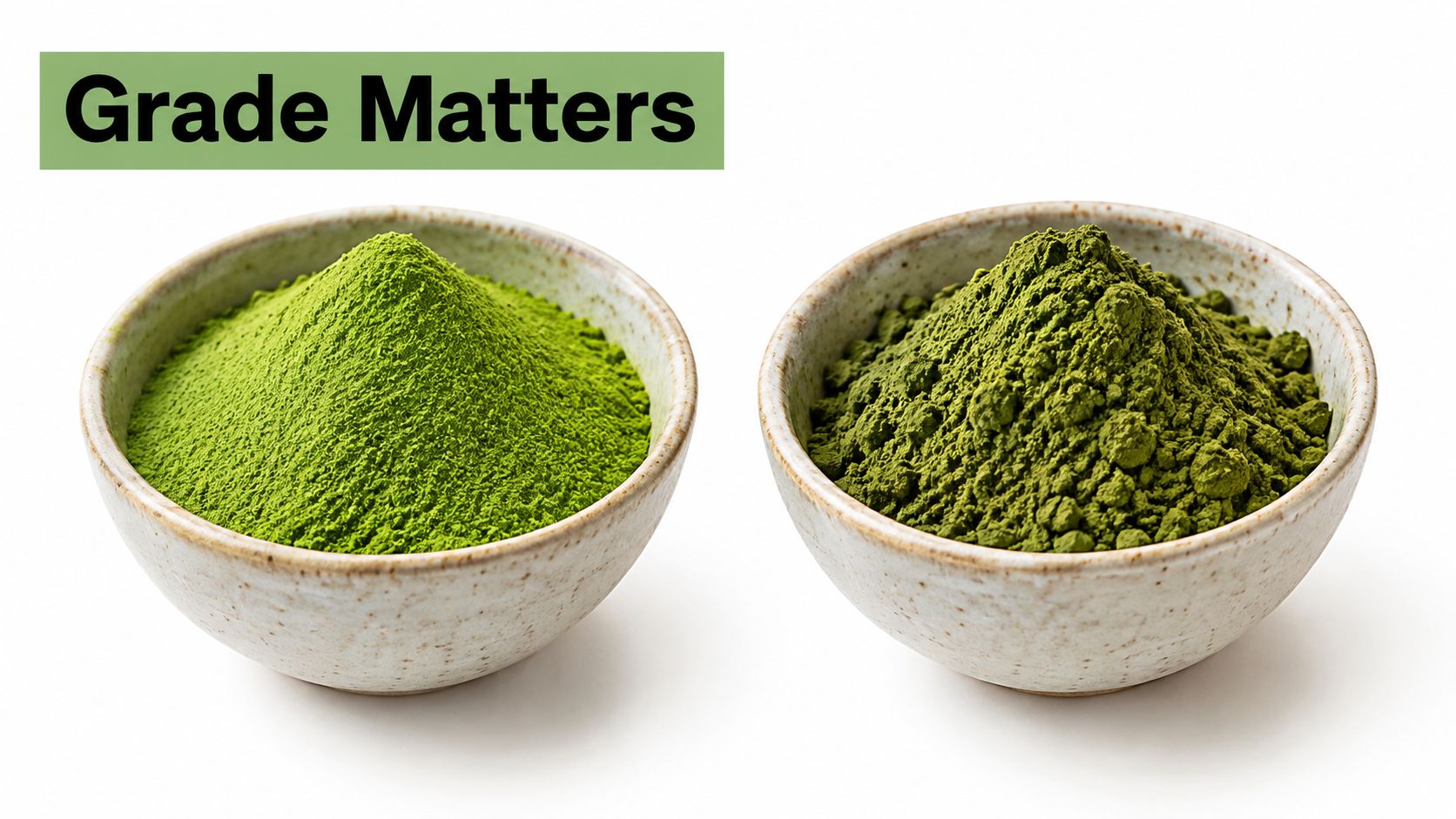
If you're deciding between them for home or café use, our guide to ceremonial and culinary matcha grades sets out the practical differences. The short version is to buy for the job. A delicate drinking powder can disappear under sweetened oat milk, while a sturdy culinary powder can taste rough as straight tea.
Reading an Australian Label
- Country of origin: Check where the tea was grown, not only where it was packed.
- Ingredient purity: Look for matcha as the ingredient, without unnecessary fillers or sweeteners.
- Certification: If organic matters to you, look for recognised certification details.
- Batch information: Harvest, milling or batch details support traceability.
- Storage guidance: Powder should be protected from air, light, heat and moisture.
Colour helps, but it isn't the whole test. A dull, yellowish or brownish powder may be older, less carefully processed or made from leaf material that wasn't handled as tencha. A vivid green is promising, yet it still can't confirm caffeine content, nutrition or purity.
Why Origin and Price Have Shifted
Australia's wider green tea supply is import-dependent. In 2024, Australia imported approximately 2,135,520 kilograms worth about US$20.62 million in packings of 3 kg or less, according to Australian import data for small-pack green tea by partner country. India supplied the largest volume at 1,253,690 kilograms, while Japan supplied 155,951 kilograms valued at approximately US$4.39 million in that same category.
Demand for Japanese tea has also tightened. SBS reported Japan exported 195,319 kg of green tea to Australia from January through August 2025, a 131% year-on-year increase, while tencha reached 8,235 yen per kilogram at a Kyoto auction in May 2025, up 170% year on year, in its reporting on Australia's matcha boom and Japanese supply pressure. Those figures help explain price changes, gaps on shelves and substitution risk.
This short video is a handy visual check on how different powders can look before you commit to a larger bag.
We stock PepTea organic Japanese matcha as one Australian retail example, but the same checks apply to any supplier. Ask what's in the tin, where it came from, how it's packed and whether the grade suits your drink. Green flags are clear origin, pure ingredients, fine texture, fresh aroma and sensible storage advice.
Preparing and Using Matcha at Home
Start with weight, not guesswork. A spoonful varies with how tightly the powder packs and how fine it is. A small kitchen scale helps you repeat a drink you like and adjust caffeine exposure in a predictable direction. Use more powder for stronger flavour, less for a gentler cup.
Water should be hot but not boiling. Boiling water can push matcha toward bitterness and flatten its aroma. Let the kettle sit briefly, add a little water first to make a paste, then whisk in the rest.
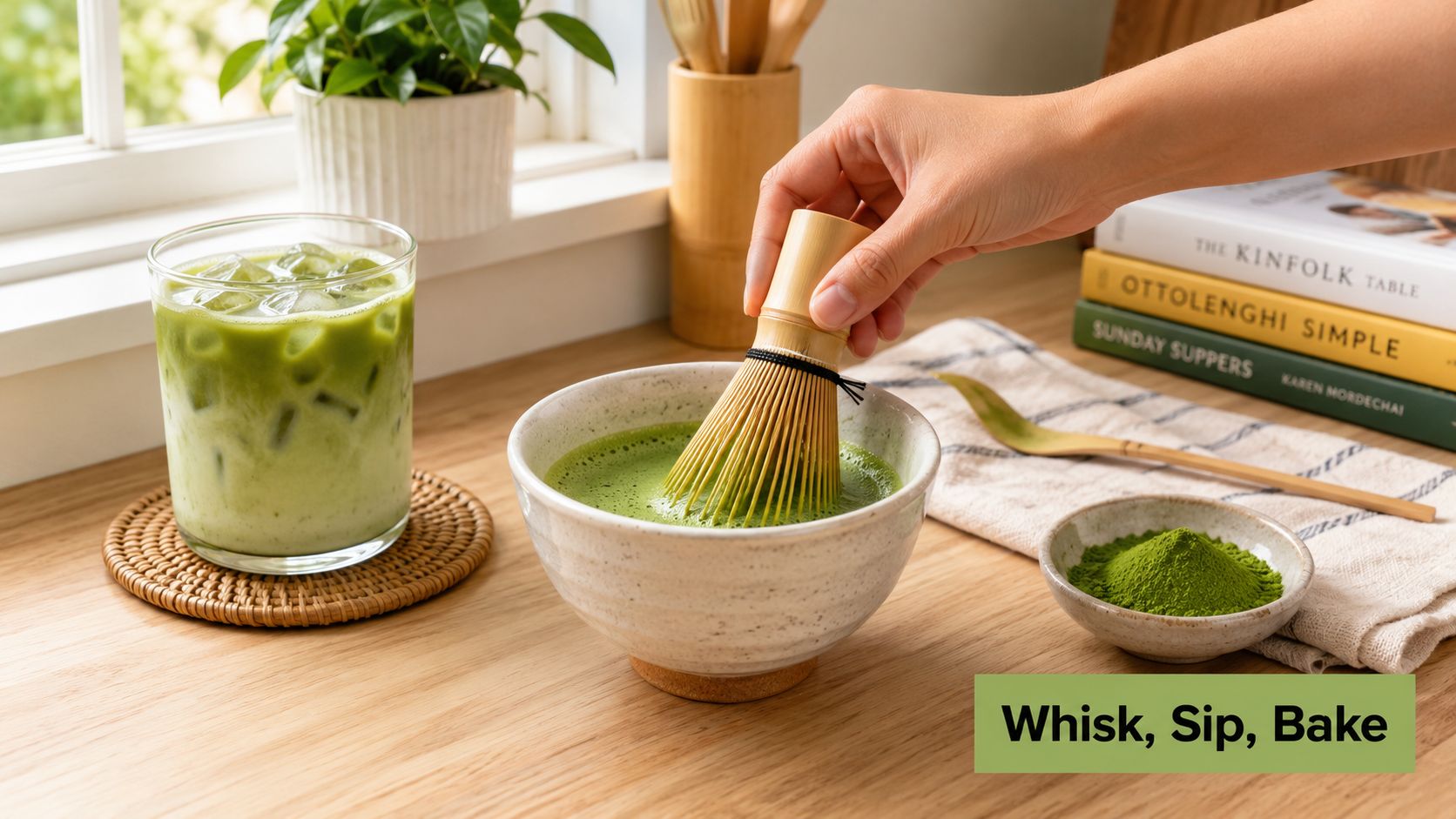
Three Ways to Use One Tin
- Whisked tea: Sift the powder into a bowl, add warm water and whisk briskly until frothy. A smoother drinking grade earns its place here.
- Hot or iced latte: Whisk the powder into a concentrated paste, then add steamed milk or pour over cold milk and ice. A culinary grade often stands up better to milk.
- Smoothies and baking: Blend or mix the powder through yoghurt, banana, batter or icing. Match the amount to the total recipe so one serve doesn't become unexpectedly strong.
A bamboo whisk is designed to break clumps and create foam, but a small handheld milk frother can work for lattes. Sifting first makes either tool more effective. If you want the bowl technique in detail, our step-by-step guide to whisking matcha shows the motion and common fixes.
Practical rule: Make a smooth paste with a splash of water before adding the full amount. Most clumps start because dry powder met a full cup at once.
Matcha behaves differently once other ingredients arrive. In a latte, milk softens bitterness and rounds out the grassy notes. In baking, heat and sugar mute freshness, so culinary powder usually makes more financial sense. In a smoothie, fruit can cover a delicate grade completely.
For savoury cooking, use a light hand. A small amount whisked into a dressing, soup finish or noodle broth adds colour and a tea note without turning the dish into dessert. Add it late where possible, taste, then decide whether the recipe needs more.
Store the tin sealed in a cool, dark place and use a dry spoon. Once opened, smaller amounts bought more often can taste fresher than a large bag kept beside the kettle. Good preparation can't rescue stale powder, but careful storage protects the powder you've paid for.
Caffeine, Calmness and Who Should Be Careful
The phrase calm energy needs unpacking. Matcha contains L-theanine as well as caffeine, and many drinkers experience it differently from coffee. That doesn't mean the caffeine stops acting like caffeine. Sensory smoothness isn't a safety standard.
A teaspoon isn't a standard dose. Powder mass changes with scooping, particle size and recipe, and composition changes with cultivar, harvest and processing. If caffeine matters to you, weigh the serve and check supplier information rather than judging by colour or flavour.
Australian Safety Context
FSANZ states naturally occurring caffeine in foods such as tea is typically no more than 100 mg in a standard serving, and acute intake up to 200 mg is not generally associated with safety concerns in healthy adults, in its caffeine advice for Australian consumers. The same advice reports evidence of increased anxiety in children at approximately 3 mg/kg body weight per day and notes caffeine was consumed by 87% of Australians in national dietary survey day-one data.
For pregnancy, Australian public health guidance recommends limiting total caffeine intake to about 200 mg per day, as summarised in the FSANZ material on caffeine sources and pregnancy guidance. Matcha counts toward that total together with coffee, tea, chocolate, soft drinks, energy drinks and caffeine-containing medicines.
If you want to place tea drinks in that wider budget, our overview of caffeine content in green tea is a useful companion. The key habit is counting the whole day, not treating each café drink as isolated.
Who Should Take Extra Care
- Children: Don't assume a sweetened matcha latte is caffeine-free because it's milk-based.
- Pregnant people: Add matcha to all other caffeine sources for the day.
- People with anxiety or sleep sensitivity: Start small and avoid late-day serves to see how you respond.
- Café operators: Standardise grams per serve and retain supplier documentation.
- Anyone using medicines or supplements: Check labels and seek professional advice if you're unsure.
Matcha is a naturally caffeinated food, not a concentrated caffeine powder. FSANZ states solid or semi-solid foods containing 5% or more caffeine, equivalent to at least 50 mg caffeine per gram, are prohibited from retail sale to the public in its guidance on caffeine powders and high-caffeine foods. That restriction targets highly concentrated products and doesn't prohibit naturally occurring caffeine in ordinary tea.
The sensible middle ground is simple. Enjoy matcha as tea, portion it by grams, and don't let L-theanine marketing erase the caffeine line in your daily total.
Bringing Matcha Into Your Daily Routine
You now have the core picture. Matcha is shade-grown green tea, steamed and dried into tencha, then milled into powder and consumed whole. It differs from steeped tea in dose and texture, not because it's a mysterious new plant.
That understanding makes daily use easier. Choose grade by purpose, check origin and ingredients on the label, weigh your serve, and use water below boiling for drinking tea. Treat the powder as a caffeinated ingredient, especially when a recipe serves children or someone tracking pregnancy limits.
A Week That Makes Sense
Try a small whisked serve on mornings when you want tea instead of coffee, and notice how timing affects your sleep. Use a culinary powder for weekday iced lattes, where milk and ice need a stronger tea flavour. Keep baking for the weekend, when you can share portions and judge how much powder the recipe needs.
Start with one repeatable serve, weighed the same way each time. Adjust only one thing, powder, water or milk, until it suits your taste.
For Australian households, freshness and traceability are practical quality markers. Buy a size you'll finish while it still smells fresh, store it away from kettle steam, and ask suppliers direct questions when labels are vague. A higher price doesn't automatically mean stronger nutrition, and a famous grade name doesn't replace batch information.
Matcha works best when it fits your routine rather than chasing a perfect ritual. A reliable morning bowl, a café-style latte at your desk, or green buttercream for a family bake all count. Once you understand what is matcha tea powder and how it's made, you can choose the format that earns its place in your kitchen.
Ready to try a tin with clear Japanese origin and organic certification for whisking, lattes or baking at home? Explore the matcha range at Pep Tea, choose the grade that matches how you will use it, and start with one weighed serve you can repeat with confidence.
Matcha Whisk Woolworths Availability and Buying Guide

You've bought matcha, put the kettle on, and stirred a spoonful into your favourite mug. Now there are green clumps floating on top and a gritty patch at the bottom. A quick search for matcha whisk Woolworths seems like the sensible next move, but the important detail isn't just which whisk appears. It's who sells and ships it.
My advice is straightforward: buy a bamboo chasen if you want to drink matcha with water and enjoy the texture. Before ordering through Woolworths, check the seller and delivery details rather than assuming it'll arrive with your groceries.
Why a Good Whisk Matters More Than You Think
That first disappointing mug doesn't necessarily mean you've bought disappointing tea. You might be asking a teaspoon to do a job it wasn't designed for. Stirring around the rim can leave you chasing the same clumps instead of properly working through the powder.
A chasen, the traditional bamboo matcha whisk, is the tool I'd choose for a bowl of straight matcha. Its purpose is different from stirring sugar into black tea. You're aiming for an evenly mixed drink with a lightly foamed surface, not merely moving green water around.
Don't expect a whisk to rescue a powder whose flavour you dislike, though. Better preparation and better ingredients are separate decisions. A smooth drink can still taste too strong for your preference, and adding more force won't fix that.
Texture deserves the same attention as the powder. Get the preparation right before deciding that matcha isn't for you.
Start with the bowl, not just the whisk
Give yourself room to work. I recommend a bowl with enough width for a comfortable wrist movement, rather than a narrow mug that keeps knocking the whisk against its sides.
You don't need an elaborate ceremonial setup to begin. Our guide to choosing a matcha bowl in Australia is a useful starting point if you're deciding whether your existing kitchen bowl will do.
- For straight matcha, prioritise a bamboo whisk and a bowl you can comfortably whisk in.
- For lattes, concentrate on making a smooth matcha base before adding milk.
- For occasional recipes, buy equipment that fits how often you will use it.
Woolworths can be a convenient place to discover specialist tea equipment online. That doesn't make every listed tool supermarket shelf stock, or every bundled accessory necessary. Choose the preparation method first, then buy the tool that suits it.
What You Actually Find on Woolworths Australia
The Woolworths listings make more sense once you separate the product from the fulfilment arrangement. A familiar retailer's website can display an item sold by another business, and that distinction matters when you're planning a purchase.
The Matcha Maiden bamboo matcha whisk listing describes a chasen made from a single piece of natural, sustainable bamboo with 100 prongs, designed to separate powder, introduce air and create creamy froth, and identifies it as sold and shipped by Cutprice Online through Everyday Market. The same listing also describes using the whisk to make a matcha-and-water paste for recipes.
That's a specialist marketplace offering, not a promise that your local Woolies has a whisk beside the tea bags.
Whisk-only purchases and ceremonial bundles
The following image illustrates the kind of preparation setup you might be considering, rather than confirming any particular seller's current stock.
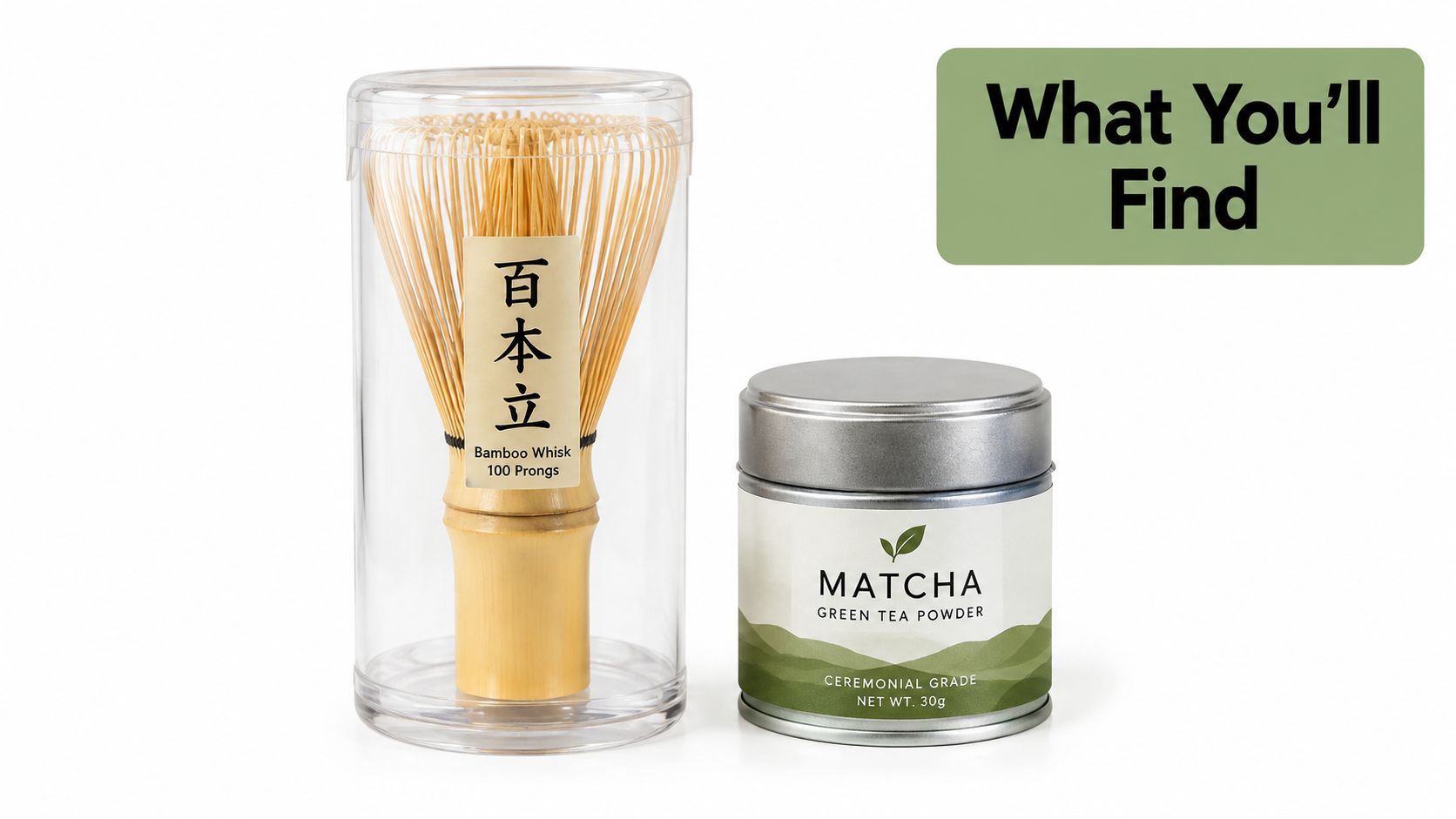
Woolworths also has an Avanti ceremonial set listing containing three components: a bamboo whisk, bamboo spoon and ceramic bowl, with catalogue listing dates showing these bundled tools were represented by 14 December 2022. Its description presents the whisk as a mixing and aerating tool, while the spoon measures powder and can stir settled matcha.
Buy a set if you need the bowl and scoop. If you already own a suitable bowl, a standalone whisk may be the tidier purchase.
Before paying, check:
- Seller identity, especially whether the item is an Everyday Market purchase.
- Delivery arrangements, including your postcode and the estimated arrival shown.
- Bundle contents, rather than assuming everything in a styled photograph is included.
- Seller terms, including returns and what to do if the whisk arrives damaged.
These listings establish an Australian retail presence, not uninterrupted availability. Don't turn a historical catalogue date into an assumption about today's stock, and don't rely on a marketplace order when you need a whisk for this afternoon.
Bamboo Chasen vs Electric Whisk Which One Actually Works
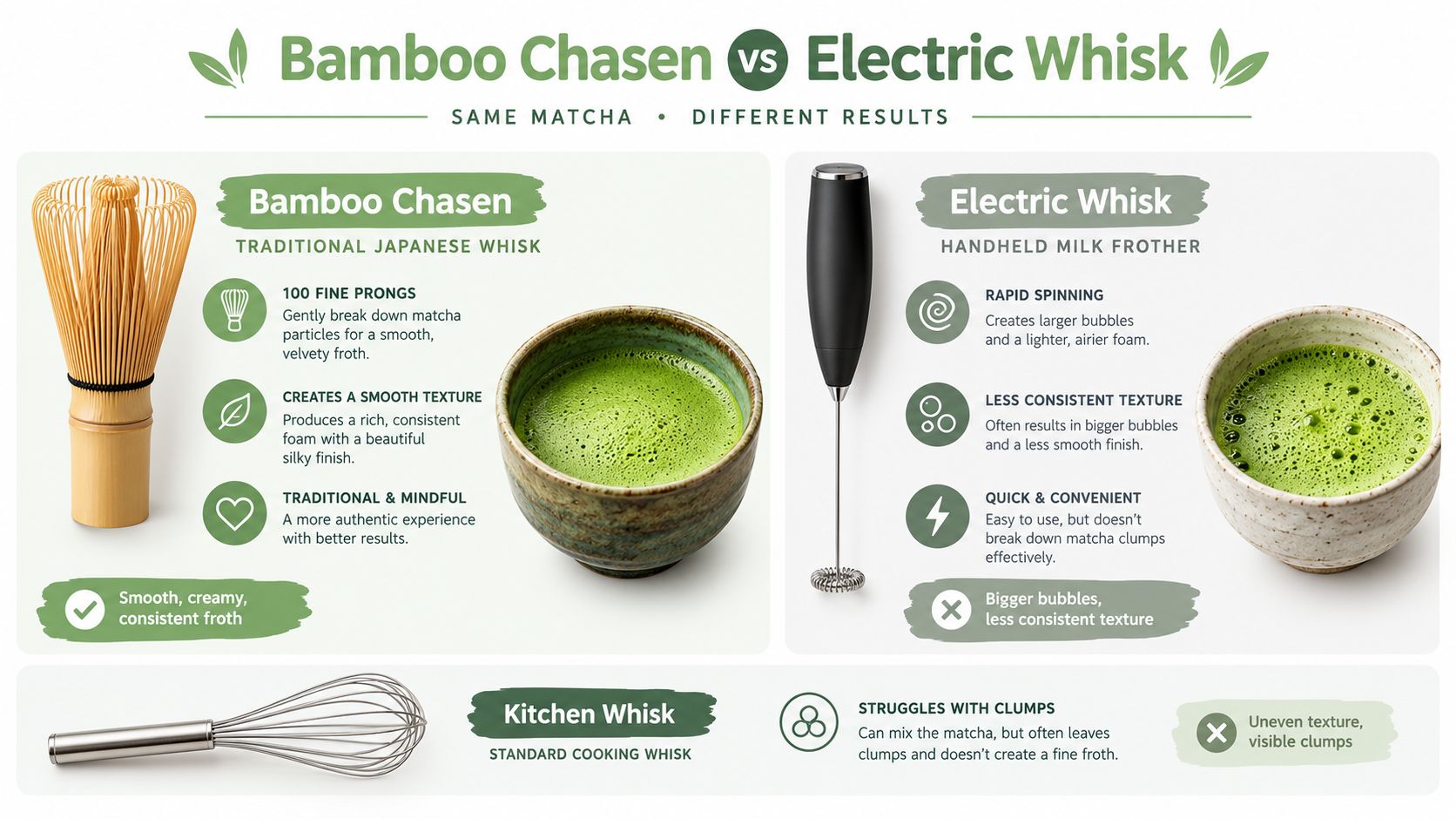
Choose according to what you drink. For matcha served with water, my preference is a bamboo chasen. For a weekday latte made while you're packing lunch and hunting for your keys, a handheld electric frother is a reasonable compromise.
The listed bamboo construction gives you a tool specifically intended for matcha preparation. An electric milk frother gives you a motorised alternative, but I wouldn't buy one solely because a product photograph shows an impressive cap of foam. Foam height isn't my measure of a well-prepared drink.
An ordinary small kitchen whisk is worth trying if it's already in your drawer. I wouldn't make it my first purchase for a dedicated matcha routine, especially if you'll be working in a small bowl.
Bamboo chasen vs electric whisk at a glance
These are practical buying judgements, not laboratory performance ratings.
| Factor | Bamboo chasen | Electric whisk |
|---|---|---|
| Froth quality | My preference for a lightly foamed bowl | Judge the drink underneath the foam, not its height |
| Learning curve | Practise a relaxed wrist movement | Simple controls, but placement still matters |
| Portability | No batteries or charging to organise | Check the power arrangement before travelling |
| Care effort | Needs gentle hand care and thorough drying | Follow the model's cleaning instructions |
| Best-use case | Straight matcha and a slower preparation ritual | Quick lattes and convenience-led routines |
The comparison below gives a visual overview of the tool choices.
Don't buy equipment for someone else's routine
If you love the deliberate process of making a bowl, the manual movement is part of the appeal. If you mainly want a milky drink before work, there's no need to perform a ceremony you don't enjoy.
For café use, I'd also consider who'll clean the tool, where it'll dry and how comfortably staff can repeat the preparation. A tool that looks lovely but doesn't fit the workflow is a poor purchase.
My recommendation: choose bamboo for straight matcha and electric for convenience-led lattes. Keep a kitchen whisk as a fallback, rather than buying it as your dedicated matcha solution.
How to Whisk Matcha the Right Way
Start with a clear bench and organise everything before adding water. You'll want a chasen, a matcha bowl or suitable small bowl, a sieve, a scoop or spoon, matcha powder and warm filtered water.
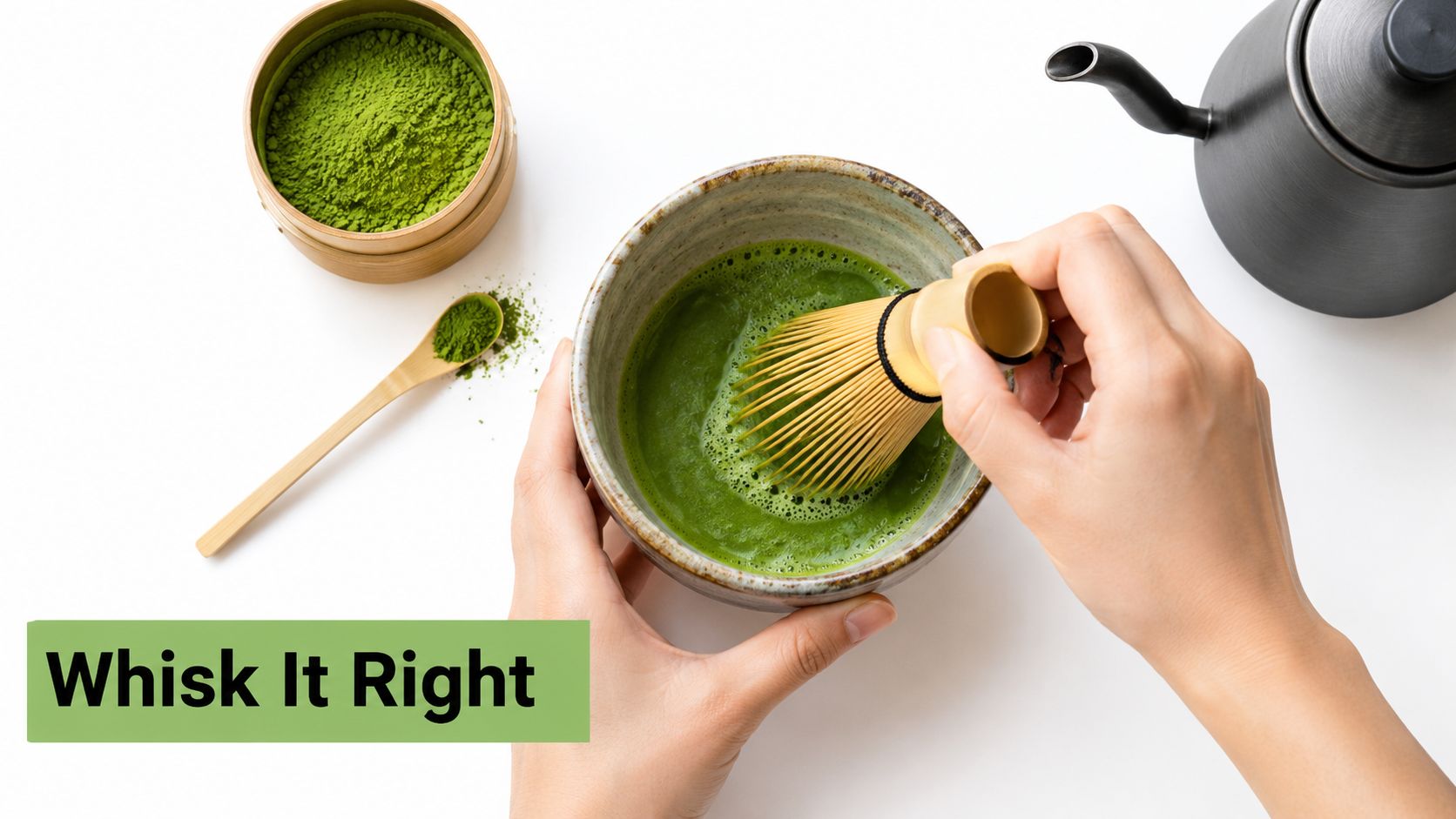
The hand position and bowl space shown below are useful details to notice.
Prepare gently, then whisk briskly
Soften the bamboo first. The Matcha Maiden preparation and care guidance recommends warm-water soaking for 1–2 minutes before use, because hydrated tines are more flexible and less prone to fracture than dry bamboo.
Sift your powder into the bowl. I recommend this rather than trying to crush every visible clump with the whisk. Use the powder maker's serving guidance as your starting point, then adjust to your taste.
Make a smooth base. Add a splash of warm water and gently work it into the powder. Check for dry pockets before adding the remaining water.
Whisk with your wrist. Use a brisk W or M movement instead of large circles around the bowl. Keep the motion light, and don't grind the prongs into the ceramic.
Finish by checking the drink. Look for an evenly mixed base and a fine surface foam. If you're making a latte, add your chosen milk after preparing the matcha.
For water temperature, follow your matcha's preparation guidance rather than treating every powder identically. I'd also avoid judging success by a stopwatch: stop when the texture looks right, not when an arbitrary countdown ends.
Our practical guide to whisking matcha offers another reference while you get comfortable with the movement.
Watch the preparation in motion, then practise without forcing the whisk.
Worth the effort: treat whisking as a short kitchen skill to learn, not a performance. A relaxed hand is more useful than an aggressive scramble.
Looking After Your Bamboo Whisk So It Lasts
The least glamorous part of owning a chasen is also the part I'd take seriously: rinse it and let it dry properly. Don't leave it sitting in yesterday's matcha while you decide whether you've got time to clean up.
The Matcha Maiden care guidance linked earlier calls for hand rinsing without soap, gentle handling and complete drying. It also explains that the centre naturally opens with repeated use. That change in shape isn't, by itself, a reason to throw the whisk away.
An opening centre isn't the same as broken prongs
Inspect the individual tines rather than expecting the bloom to stay exactly as it looked in the packaging. A reshaped centre and a cracked tine are different observations.
I'd stop using a whisk with broken pieces or visibly compromised prongs. Don't try to restore a showroom shape by pulling, twisting or squeezing the bamboo.
This visual checklist is handy to keep beside your preparation area.
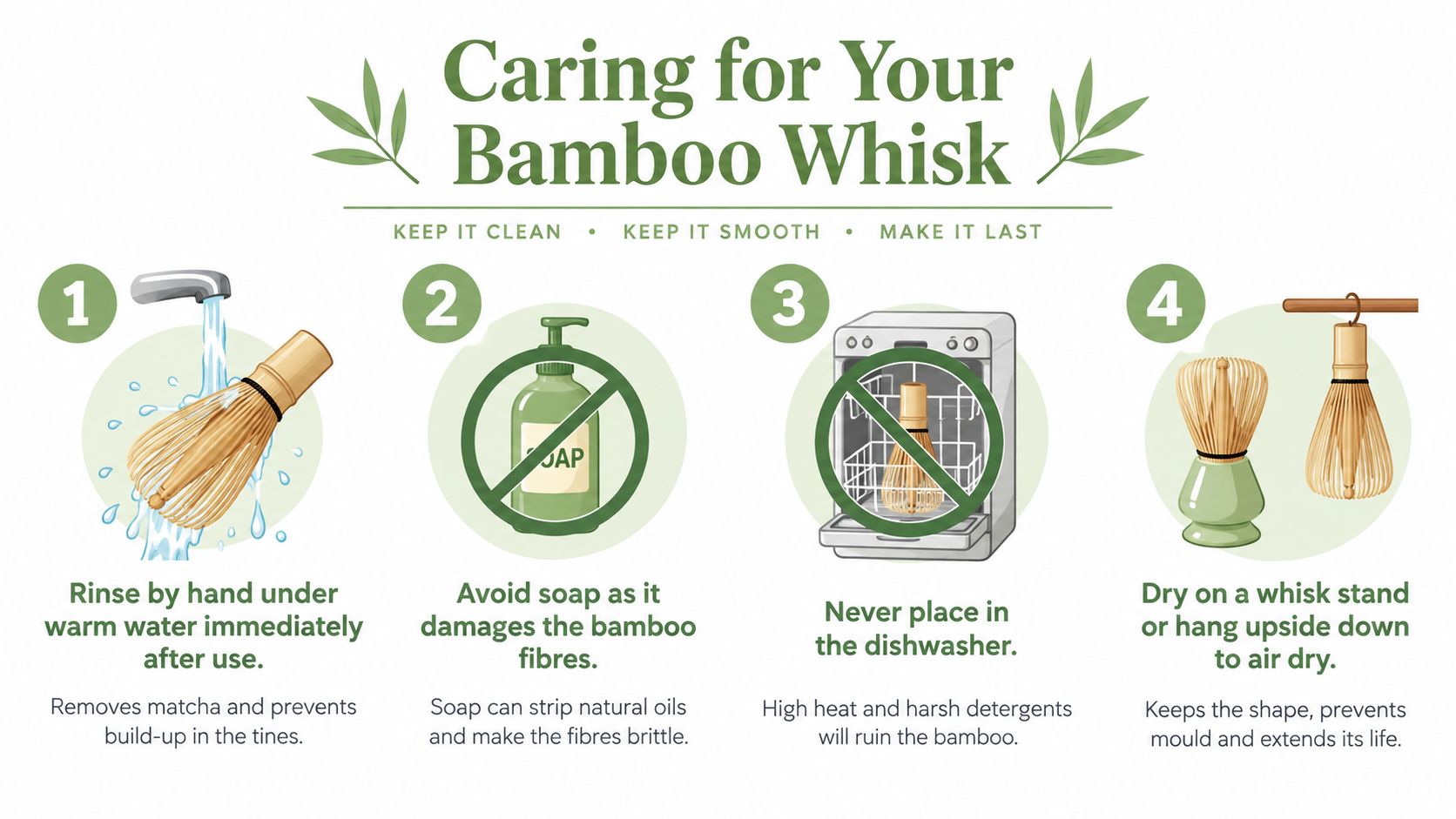
- Rinse by hand with warm water after preparing your drink.
- Skip soap and the dishwasher, following the gentle care approach already described.
- Remove droplets gently, without snapping your wrist or striking the whisk against the sink.
- Dry with airflow, using a suitable whisk holder or a secure hanging arrangement that doesn't crush the tines.
- Store sensibly, away from direct sunlight and places where other utensils can squash it.
- Check before use, replacing the whisk when prongs crack or no longer work comfortably.
Don't pack it into a closed container while it's still damp. For a café, give the chasen a designated drying spot rather than dropping it into a crowded utensil tub.
I wouldn't promise a fixed lifespan. Your useful measure is its condition and how it performs, not a calendar date or the seller's most optimistic description.
Better Australian Alternatives to Woolworths
A specialist retailer is worth considering when you want advice, not just a checkout. That doesn't automatically make its equipment superior. Ask clear questions and compare the actual whisk, rather than assuming a tea-focused website guarantees better craftsmanship.
For Australian buyers, I'd compare specialist tea shops, kitchenware retailers and direct-to-consumer matcha businesses. Each can suit a different purchase, but none deserves a blank cheque.
Compare the service as well as the tool
| Buying channel | What I'd look for | Who it suits |
|---|---|---|
| Specialist tea or matcha shop | Clear construction details, origin information and usable care advice | Drinkers choosing a dedicated chasen |
| Kitchenware shop or department store | A tool you can inspect, clear returns and practical handling | Buyers comparing bamboo and electric options |
| Online matcha specialist | Preparation guidance that matches the powder you're buying | Home drinkers building a complete routine |
Ask a tea specialist how the whisk should be used and dried. At a kitchenware shop, check whether the handle feels comfortable and whether the product instructions explain cleaning properly.
For an online purchase, read the description beyond the word ceremonial. I wouldn't pay extra for decorative language without useful details about the tool itself.
Make the price comparison honestly
There isn't a verified current price comparison to give you. Compare the total delivered cost, then decide whether the bundle includes accessories you need.
- Already have a bowl? Price the whisk alone before buying another set.
- Need something today? Contact a physical shop and confirm stock before leaving home.
- Want help choosing? Prefer a retailer that answers preparation and care questions clearly.
- Buying for a café? Ask about repeat availability and replacement arrangements.
Use Woolworths when the listed product, seller terms and delivery suit you. Choose a specialist when its advice and product detail justify the purchase, not because someone promises a chasen will last for years.
Most notably, don't confuse an online marketplace listing with same-day local access. Convenience only counts if the fulfilment works for your actual deadline.
Matching the Whisk to Quality Matcha and Your Routine
A sensible setup starts with what you want in the cup. I'd choose ceremonial-grade organic matcha for a water-only bowl and consider culinary-grade matcha for lattes, smoothies and baking, while still reading the maker's intended-use guidance.
Don't assume a better whisk makes every powder interchangeable. The tool helps with preparation; your powder choice and how strongly you make the drink still matter. Our organic matcha powder range gives you a place to compare options against the way you plan to use them.
For a slow Sunday bowl, I'd reach for the chasen. For a weekday latte, I'd prepare a smooth base using whichever tool I'll reliably clean and put away.
Texture isn't a caffeine claim
Whisking doesn't remove caffeine. Healthdirect states that healthy adults can generally consume around 400 milligrams of caffeine per day, roughly equivalent to two espressos, four instant coffees or eight cups of black tea, in its Australian caffeine guidance.
That's general adult guidance, not the caffeine content of your matcha serving or a target to reach. Matcha's caffeine depends on the powder quantity and preparation, so count your other caffeinated drinks too.
There's also an important distinction between ordinary tea and concentrated caffeine products. Food Standards Australia New Zealand's caffeine-product rules prohibit retail sale of solid or semi-solid foods containing 5 percent or more caffeine, and liquid foods containing 1 percent or more caffeine; those concentrated-product thresholds shouldn't be confused with ordinary culinary matcha.
Build a routine you'll keep
- At home, choose equipment that fits your bench space and cleaning habits.
- For lattes, match the powder to a drink you enjoy without automatically adding sweetener.
- In a café, give staff a clear preparation method rather than relying on individual improvisation.
Buy thoughtfully, learn the movement and care for the bamboo. That's a more useful approach than collecting accessories or expecting your morning bowl to deliver unverified wellness promises.
Pep Tea offers Japanese organic matcha for home preparation, recipes and café drinks. Pair your chosen powder with a whisk that suits your routine, then visit Pep Tea to explore the range and practical preparation guides.
T2 Matcha Bowl Compared to Traditional Chawan Alternatives
The most common advice about a T2 matcha bowl is to choose the one that looks best on the kitchen shelf. That's backwards. A matcha bowl is preparation equipment first and serveware second: its shape needs to give a bamboo whisk room to move, while its capacity and care requirements need to suit the way you'll make matcha.
T2's Australian range treats the bowl as a contemporary take on the Japanese chawan, with options in porcelain, stoneware, handmade stoneware and borosilicate glass. The right choice depends less on colour than on practical questions: Can you whisk without splashing? Does the bowl sit securely? Can you clean it without guesswork? And is its size right for a traditional serving, a latte or iced matcha?
| Bowl choice | Best suited to | What to check |
|---|---|---|
| 300 ml stoneware | Traditional single-serve preparation and a gift set | Whether the form feels comfortable for your whisking style |
| 500 ml borosilicate glass | Flexible home or café preparation, including iced drinks | Confirmed dishwasher and microwave suitability |
| 500 ml handmade stoneware | A design-led bowl with room to whisk | Care details and how the bowl feels in daily use |
| Traditional chawan | Buyers prioritising a particular Japanese craft tradition | Shape, stability, finish and care instructions from the maker |
Why a T2 Matcha Bowl Is Really Just a Modern Chawan
A T2 matcha bowl isn't merely a branded mug with a pleasant colour. It's best understood as a modern chawan, a bowl shaped around the practical demands of whisked matcha. That distinction matters because matcha isn't brewed like ordinary leaf tea, where the leaves steep and are removed. The powder remains in the drink, so the whisk has to disperse it evenly in water.
A chawan's broad opening gives the chasen, or bamboo whisk, space to move across the surface. Its sides also help contain the liquid as you whisk. A narrow mug can hold matcha, but it makes the whisking action cramped and awkward. If you're choosing a vessel for regular preparation, the working shape deserves more attention than the pattern.
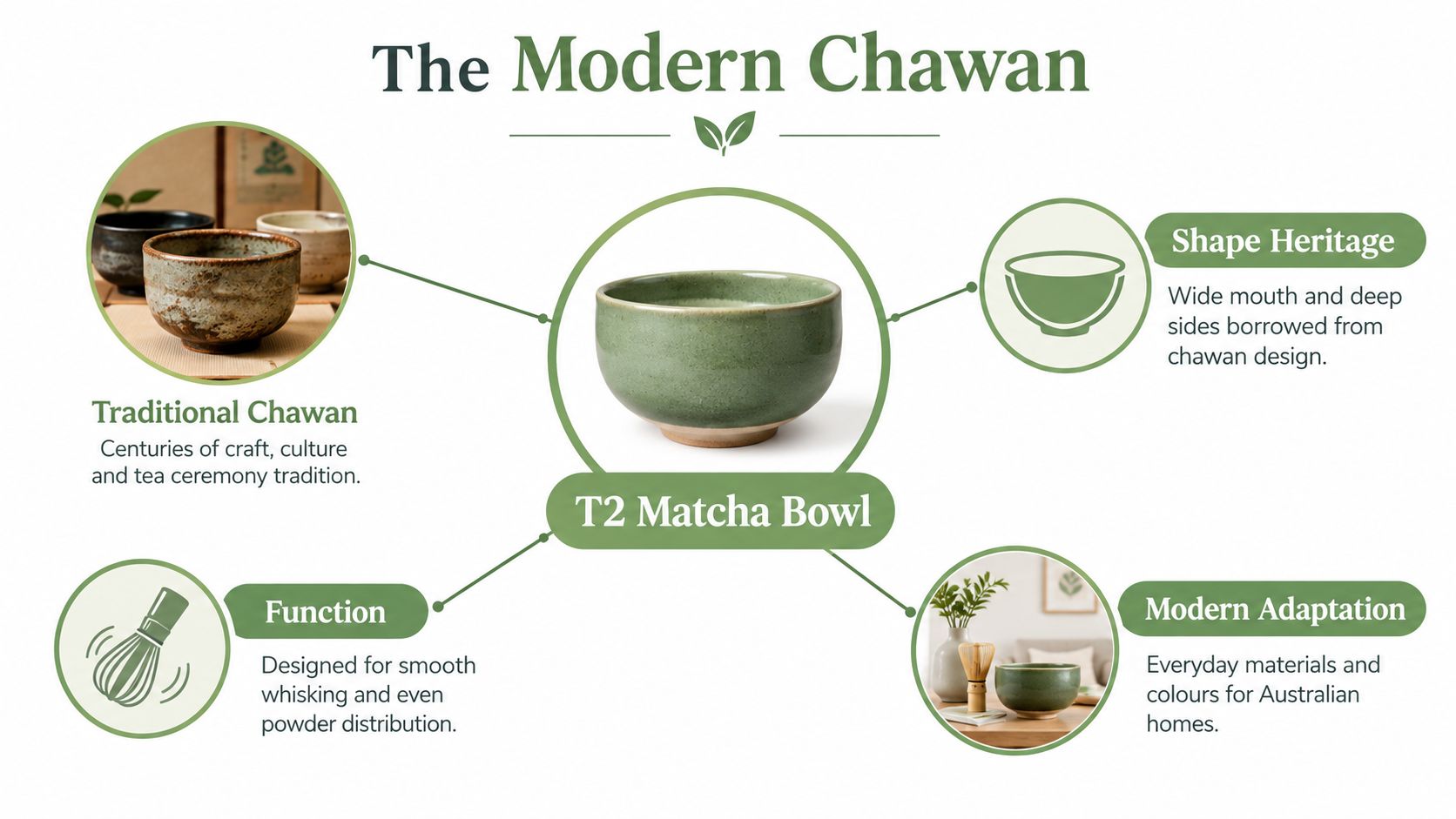
Bowl shape is part of the brewing method
The T2 range brings that chawan-inspired function into a contemporary Australian retail setting, with different materials and finishes rather than one fixed ceremonial style. The useful question isn't whether a modern bowl is identical to a traditional Japanese bowl. It's whether the bowl gives you enough room to whisk comfortably and feels right for your routine.
That's the standard I'd use when comparing a T2 bowl with a traditional chawan: function, stability, capacity and care come before decoration. A beautiful finish is a bonus, not a substitute for a bowl that lets you prepare matcha properly.
If you're comparing customised drinkware for a café or event alongside tea equipment, promotional coffee mugs are a separate serveware option. They're not a replacement for a wide matcha bowl, where free movement of the whisk is central to preparation.
What a Chawan Actually Is and Where the T2 Range Sits
Chawan is the Japanese term for a tea bowl. In matcha preparation, it refers to the open vessel in which powder and water are whisked together. The bowl isn't just a cup that happens to be wide. Its shape supports the movement of a chasen and gives the prepared tea room to develop a smooth texture.
T2's Australian matcha-tool collection places its bowls within a coordinated set of traditional implements: a chawan bowl, a chasen whisk and a chashaku scoop. That's a sensible starting point for a newcomer. The bowl holds the preparation, the whisk disperses the powder, and the scoop helps measure it.
A retail range built for everyday use
The Matcha Method Gift Pack gives a clear example of T2's approach. It includes a 300 ml stoneware bowl handmade in Portugal, 30 g of certified-organic matcha, an everyday chasen and a preparation guide, with a listed price of $129 AUD (T2 Matcha Method Gift Pack). It's a bundled introduction to making matcha at home, rather than a specialist tea-ceremony set.
T2's Australian range also shows how broad the contemporary chawan category can be. The listed bowls include porcelain, stoneware, borosilicate glass and handmade stoneware. The T2 x SoCA Kalamata bowl is handmade in Brunswick, Australia, using historical tea-ware techniques. It has a 500 ml capacity and measures 12 cm × 8 cm × 12 cm (T2 x SoCA Matcha Bowl).
That mix makes T2 a mainstream Australian source for chawan-style preparation: the equipment reflects traditional use, while the materials, retail formats and designs suit everyday kitchens. For a plain-language guide to the utensils and preparation ritual, Pep Tea's matcha tea ceremony guide offers useful background.
Comparing Materials Across the T2 and Traditional Bowl Range
Material changes how a bowl feels in the hand, how it behaves around heat and how much care you can safely assume. But product names alone don't tell you everything. A handmade finish may be appealing, while a glass bowl may offer clearer visibility of the mixture. Neither automatically wins on daily practicality.
T2 lists bowls across porcelain, stoneware, borosilicate glass and handmade stoneware. Its Contour Glass Matcha Bowl is artisan-made, hand-blown and hand-detailed, while the SoCA Kalamata is handmade stoneware. The Matcha Method Gift Pack includes a stoneware bowl handmade in Portugal. These are concrete examples, but the listings don't provide a full side-by-side set of performance or care specifications for every material.
Matcha bowl materials at a glance
| Material | Heat retention | Weight in hand | Care | Typical T2 example |
|---|---|---|---|---|
| Porcelain | Exact performance isn't specified in the available T2 listing | Product-specific; no comparative weight is stated | Check the individual product instructions | T2 porcelain matcha bowls |
| Stoneware | No comparative heat-retention data is listed | Depends on the bowl's form and build | Don't assume dishwasher or microwave suitability without confirmation | Matcha Method Gift Pack bowl |
| Borosilicate glass | The listing describes heat-safe use but gives no comparative retention figure | Product-specific; exact weight isn't stated | Contour Glass is listed as microwave- and dishwasher-safe | T2 Contour Glass Matcha Bowl |
| Handmade stoneware | No performance figure is listed | Handmade construction can feel distinctive, but weight isn't specified | Confirm care instructions for the exact bowl | T2 x SoCA Kalamata |
Choose for the job, not the material label
For a low-guesswork routine, the Contour Glass stands out because T2 confirms that it's microwave- and dishwasher-safe. Its borosilicate construction and hand-blown finish make it a practical option when you want glass, but don't buy it expecting published data on whisking speed or superior heat retention. Those claims aren't established by the product details.
Choose handmade stoneware when tactile character and a local design story matter to you, but ask for the maker's care advice before treating it as a daily-use workhorse. For travel, don't assume any bowl is durable just because it feels substantial. The listings don't provide comparative impact testing, so a bowl you'd be unhappy to chip belongs at home, not loose in a bag.
Size and Capacity for Single-Serves, Lattes and Iced Matcha
Capacity is a working feature, not a sales detail. A smaller bowl can feel natural for a single serving of whisked matcha, while a larger one gives you more room to move the whisk or add ingredients. Neither is automatically better. Pick the size that suits the drink you make most often.
T2's Matcha Method Gift Pack includes a 300 ml stoneware bowl, a compact format for a traditional single-serving routine. It's a deliberate size for preparing matcha in the bowl, not a signal that you should fill the vessel to the top. The purpose is to leave space for whisking.
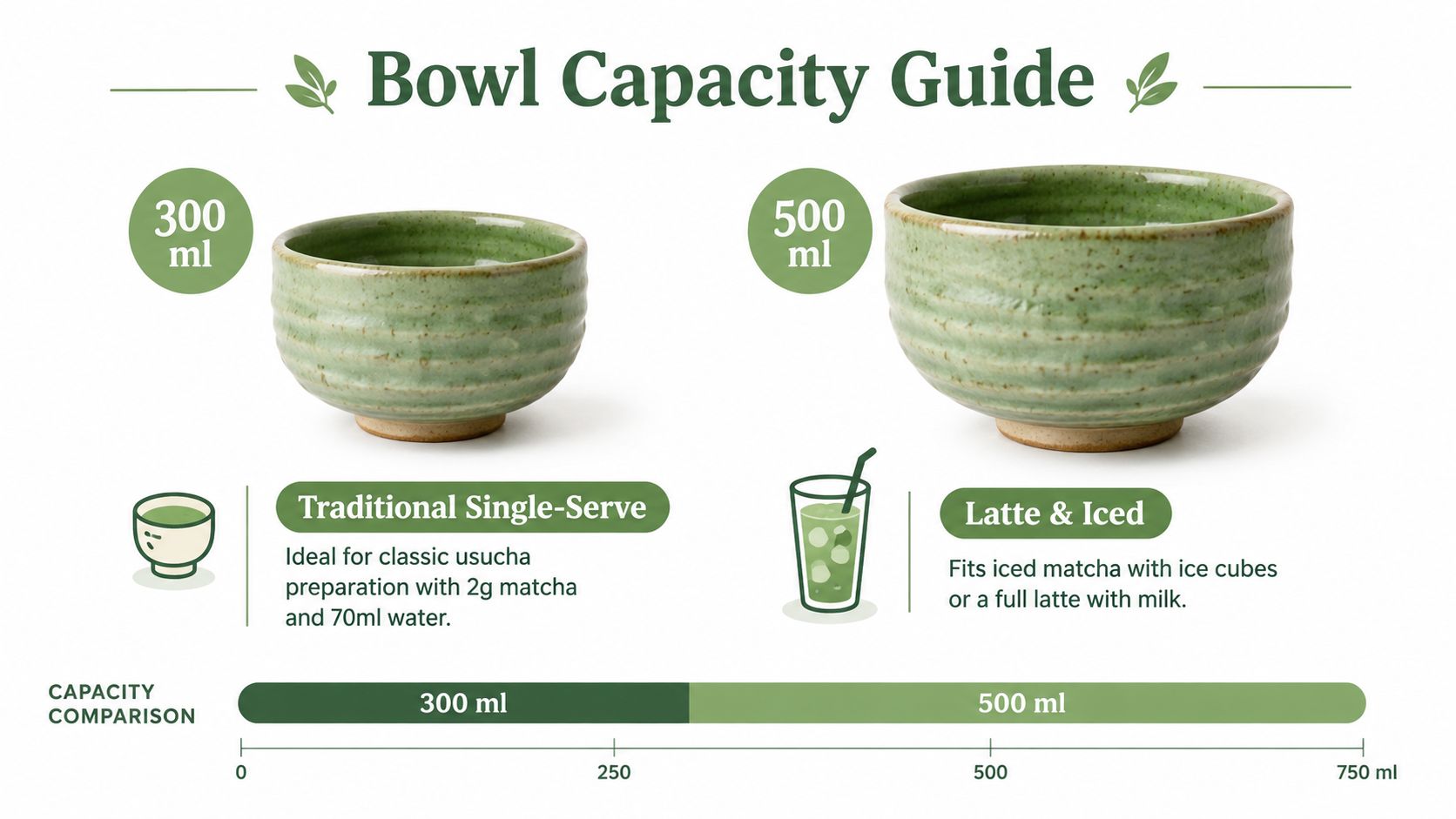
When a larger bowl earns its place
The T2 Contour Glass Matcha Bowl has a 500 mL working capacity and measures 8.4 cm × 12 cm × 8.4 cm. T2 presents it as suitable for microwave and dishwasher use, and its larger volume gives you room for whisking and for iced matcha preparation. The bowl is hand-blown and hand-detailed, so visual or dimensional variation may occur between pieces (T2 Contour Glass Matcha Bowl).
The SoCA Kalamata is also 500 ml, with dimensions of 12 cm × 8 cm × 12 cm. Its size makes it a larger-format option, though its handmade stoneware form is a different proposition from glass. Choose between them by considering the finish you want and what the maker confirms about care.
Practical rule: Leave headroom. A bowl designed for whisk movement isn't meant to be filled to the rim, especially when you're working in ice or milk.
For a classic whisked serving, the smaller bowl is the straightforward choice. For a full latte or iced drink, a larger bowl gives ingredients and whisk more space before you pour into a glass. Pep Tea's iced matcha latte guide can help you match the bowl to your preferred preparation.
Price Bands and Where T2 Sits in the Australian Market
Pay for a bowl's usefulness before its styling. T2 sits in a mid-range, design-led retail tier, with individual Australian matcha bowls listed at $35, $40 and $50 AUD (T2 matcha bowls). Those prices cover different materials, finishes and capacities, so compare the individual products rather than treating the range as one bowl in different colours.
A contemporary T2 chawan deserves the same practical scrutiny as a traditional Japanese bowl. Does the shape support comfortable whisking? Does the glaze suit your preferences, and are the cleaning requirements manageable? Buy the bowl that fits your routine.
Mass-market bowls can be a sensible starting point for someone trying matcha. A handmade Japanese chawan from a specialist workshop offers a different craft proposition, which deserves consideration on its own terms. Neither category earns a recommendation on price alone. Compare the actual vessel, and decide how much its workmanship and daily usefulness are worth to you.
What the price buys
The Matcha Method Gift Pack combines a bowl with matcha, a whisk and a preparation guide. Judge that bundle by how much of it you'll use. For a beginner who needs the full setup, it offers a packaged introduction; for someone who already owns a whisk, a standalone bowl is the more focused purchase.
T2's Australian site also advertises purchase incentives, including a selected free matcha bowl with a $100 purchase and free delivery at a $50 threshold (T2 current offers). Check the current terms before ordering. Treat any offer as a saving on a purchase you already need, rather than a reason to add unwanted items.
My recommendation: pay for the size, material and care profile you'll use, then choose the finish you enjoy. Ceremonial styling alone doesn't justify spending more.
Care, Hygiene and Daily Durability Reality Check
A bowl can look excellent and still frustrate you every morning. Before buying, check whether the base sits steadily while you whisk, whether the interior is easy to rinse, and whether the maker has confirmed dishwasher and microwave suitability. Don't infer food-safety, stain-resistance or heat limits from appearance alone.
T2 confirms that the Contour Glass Matcha Bowl is microwave- and dishwasher-safe. The available T2 listings don't establish those same specifications for every stoneware or handmade stoneware bowl, nor do they confirm glaze composition or stain resistance across the range. If those details matter to your routine, check the product's current care instructions or ask the retailer before purchase.
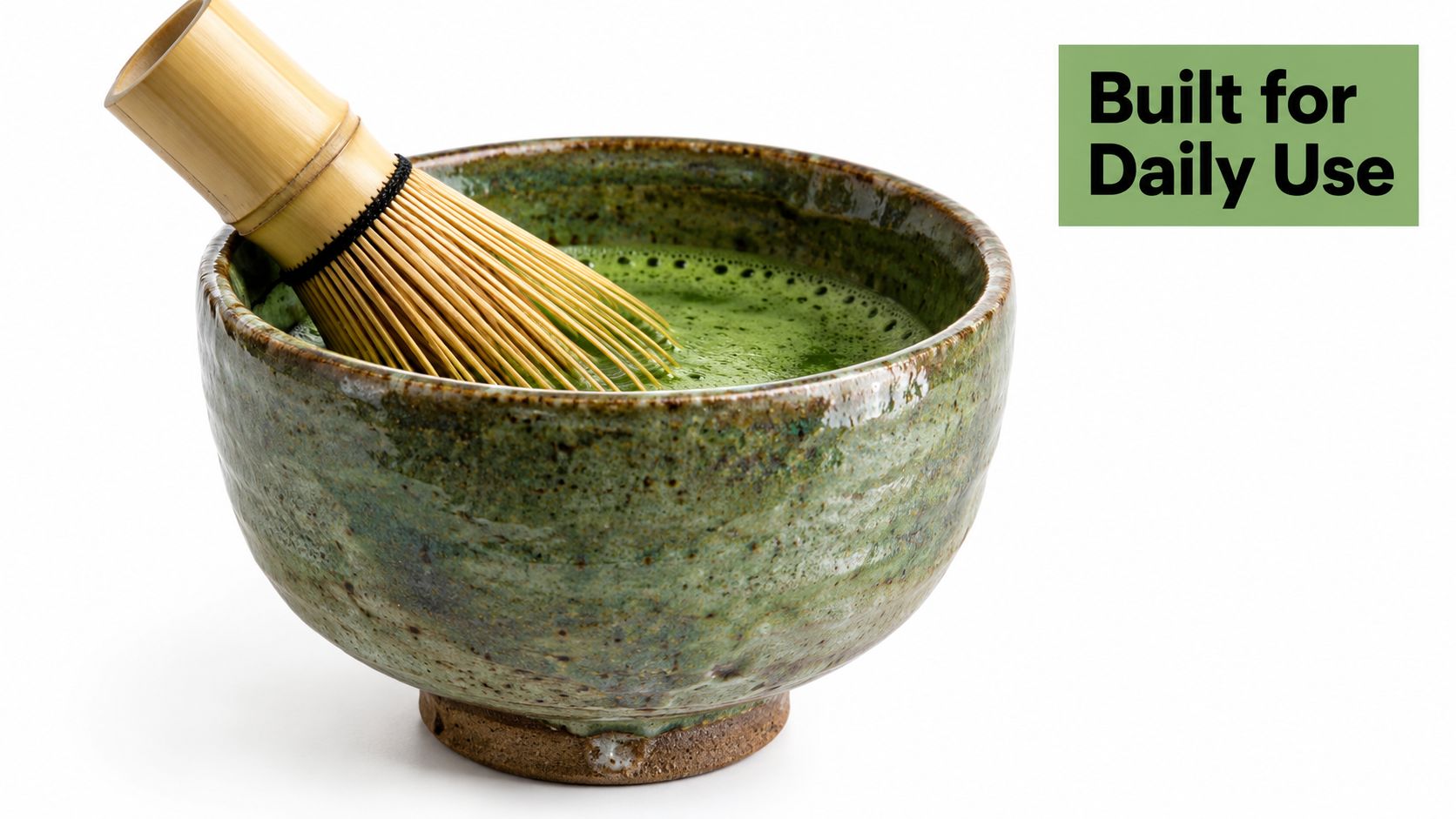
A simple daily-use check
Try this routine with any bowl before committing to it as your everyday vessel:
- Test the base: Set the bowl on a dry, level bench and whisk gently. If it shifts, hold it securely or choose a more stable form.
- Check the interior: Look for an opening that lets the whisk move freely without striking the sides.
- Rinse promptly: Matcha residue is easier to remove before it dries. Rinse the bowl after use, then wash it according to the maker's instructions.
- Follow confirmed care advice: Use a dishwasher or microwave only when the product listing or maker specifically confirms it's suitable.
The practical question matters more as matcha becomes part of a regular home routine. Tastewise's Australian consumer-panel reporting says matcha interest was up 53% in the preceding year, with convenience-first formats among the leading trends (Tastewise's Australia food trends). That trend doesn't prove a particular bowl will withstand daily wear. It does make a clear care check more useful than choosing on appearance alone.
For the whisking side of the routine, Pep Tea's guide to the T2 matcha whisk is a relevant companion. Keep the bowl clean, dry it appropriately for its material, and avoid guessing about care instructions.
Best Use Scenarios for Cafes, Home Baristas and Gift Buyers
A café needs repeatable preparation and quick cleaning. A home barista may care more about the feel of a bowl used every morning. A gift buyer usually wants the recipient to have the essential tools without sourcing each piece separately. Those are different jobs, so they shouldn't lead to the same recommendation.
Café service
For a café adding matcha to a brunch menu, start with workflow. The Contour Glass Matcha Bowl is a practical candidate because its 500 mL capacity gives room to whisk, and T2 confirms microwave and dishwasher suitability. That doesn't make it a guaranteed commercial solution: test the bowl on your own bench, check how staff handle it, and confirm the manufacturer's instructions meet your service needs.
If your menu includes iced matcha or lattes, the larger format is more flexible than a small single-serve bowl. Keep the preparation steps consistent and make sure staff know not to overfill during whisking.
Home ritual and gifting
For a home barista who wants a locally made, design-led bowl, the T2 x SoCA Kalamata offers handmade stoneware and a generous working capacity. It's the choice I'd consider when the bowl itself is part of the daily ritual, provided its care instructions fit your habits.
For a first-time matcha drinker, the Matcha Method Gift Pack is the cleanest starting point because it brings together a bowl, whisk, matcha and preparation guide. If you're also choosing a culturally meaningful gift, useful advice on selecting an appropriate item can be found in HD Asian Art's Buddha gift guide. A gift should be chosen with the recipient and context in mind, not just the packaging.
Choosing the Right Matcha Bowl for Your Setup
My recommendations are straightforward. For a café or home routine that prioritises a dishwasher-safe workflow, consider the T2 Contour Glass Matcha Bowl, then confirm it fits your bench and recipe. For a handmade bowl with a design focus, look at the SoCA Kalamata, but check its care requirements before making it your everyday choice.
If you're buying an introduction set, the Matcha Method Gift Pack makes sense when the recipient wants the bowl, whisk and matcha together. For a smaller traditional serving, its 300 ml bowl is the more focused option; for lattes and iced preparations, choose a larger bowl with enough headroom for whisking.
The bowl is only half the preparation. Powder quality and the amount you use shape the drink, so match your bowl to the kind of matcha you plan to whisk. For a clearer explanation of what ceremonial grade means, see ceremonial grade matcha explained.
Pep Tea offers certified-organic Japanese matcha for whisked bowls, lattes and everyday recipes, alongside sugar-free organic kombucha brewed in the Hunter Valley, NSW. Explore the Pep Tea range to choose matcha that suits the bowl and the way you like to drink it.
Bottles of Australia: A Practical Sourcing Guide

You've got the fermentation right, the flavour is balanced, and a café buyer has asked for your wholesale pack-out. Then you're standing beside three sample crates, comparing a clear PET bottle, an amber glass bottle and a sleek aluminium format, wondering which one will still make sense after freight, refrigeration, deposit returns and a few weeks of live fermentation.
That decision is bigger than appearance. Bottles of Australia sit at the intersection of carbonation control, food safety, labelling, transport, customer perception and end-of-life recovery. A premium bottle can protect the drink and strengthen a brand story, but it can also add breakage, freight weight or a minimum order that a growing brewery can't absorb.
There isn't one perfect format. The practical choice depends on the beverage, the route to market and the recovery system your customers will use.
Why the Right Bottle Matters More Than the Recipe
A bottle becomes part of the product specification the moment a kombucha founder accepts a wholesale order. It must protect the intended sparkle, keep the label readable in a chilled display and give a café buyer confidence that the pack will handle everyday service.
A café manager forms an opinion quickly from the shape, colour, closure and label finish. The bottle may need to sit beside cold-pressed juice, a soft drink alternative or craft beer. Staff then test that choice in less glamorous ways: safe storage, clean opening, crate movement and empty-bottle handling.
Four tests every bottle should pass
Start with material performance. Kombucha can continue producing carbon dioxide after filling, so the container, closure and filling process must be assessed as one system. A bottle designed for still tea may not tolerate a live, lightly sparkling drink.
Next, check food-safety and regulatory fit. Ask the supplier for food-contact documentation covering the intended application, then confirm that your production team has validated cleaning, filling and storage controls. The Food Standards Australia New Zealand guidance identifies pH, cooling, sanitation and alcohol monitoring among the controls relevant to fermented tea production.
Test the Australian recovery pathway as a complete pack. A resin code alone does not confirm collection or reprocessing. Colour, label material, closures and container-deposit arrangements can change the result between states and territories.
Then examine commercial practicality. A low unit price can conceal a pallet commitment, imported freight, specialised caps and extra storage. One small brewery can tie up working cash in packaging that moves slowly, while a slightly higher unit price may preserve room for ingredients, labour and freight.
A bottle that passes the technical tests can still fail the launch test if the minimum order exceeds realistic sales.
Practical rule: Do not approve a bottle from a desktop image. Fill production samples, chill them, transport them, stack them and ask the intended recycler how the complete pack behaves.
Glass, PET, Aluminium and Refillable Formats
Australian beverage buyers usually narrow the field to four formats. Each solves a different problem, and each creates work somewhere else.
Glass gives a premium hand-feel, excellent product visibility and strong consumer familiarity. It suits cafés and specialty retail, particularly when colour and ritual matter. The trade-off is weight, breakage and freight handling. A delivery route with stairs, tight storage or frequent crate movement exposes those weaknesses quickly.
PET is light, efficient to transport and widely used for chilled beverages. Clear, food-grade PET can suit kombucha when the bottle has an appropriate pressure rating and the design avoids features that interfere with sorting. Lightweighting needs restraint. A bottle that feels flimsy, deforms in a case or struggles under carbonation can create more waste and complaints than it saves.
Aluminium creates a strong barrier to light and gives a modern, premium visual language. It requires a suitable internal lining for an acidic beverage, and the closure or can-end system must match the filling line. It can work well for drinks where light protection and portability matter, but canning economics often depend on line availability and production volume.
Refillable glass can support a compelling local hospitality story, but only when return logistics work. You need collection, inspection, washing, sanitisation, storage and a reliable return rate. Reuse isn't a claim you can print onto a label and leave to the customer.
| Format | Typical weight | Carbonation tolerance | Australian recyclability | Best fit |
|---|---|---|---|---|
| Glass | Heavier | Strong when correctly specified | Established stream, with deposit pathways varying by state | Premium cafés and specialty retail |
| PET | Lightweight | Strong when pressure-rated and validated | Depends on collection, sorting, colour and reprocessing | National chilled distribution |
| Aluminium | Lightweight | Strong with the correct lining and filling system | Established metal recovery pathway | Light-sensitive or portable formats |
| Refillable | Higher system weight | Strong when inspected and controlled | Reuse first, recycling later | Closed hospitality and local delivery loops |
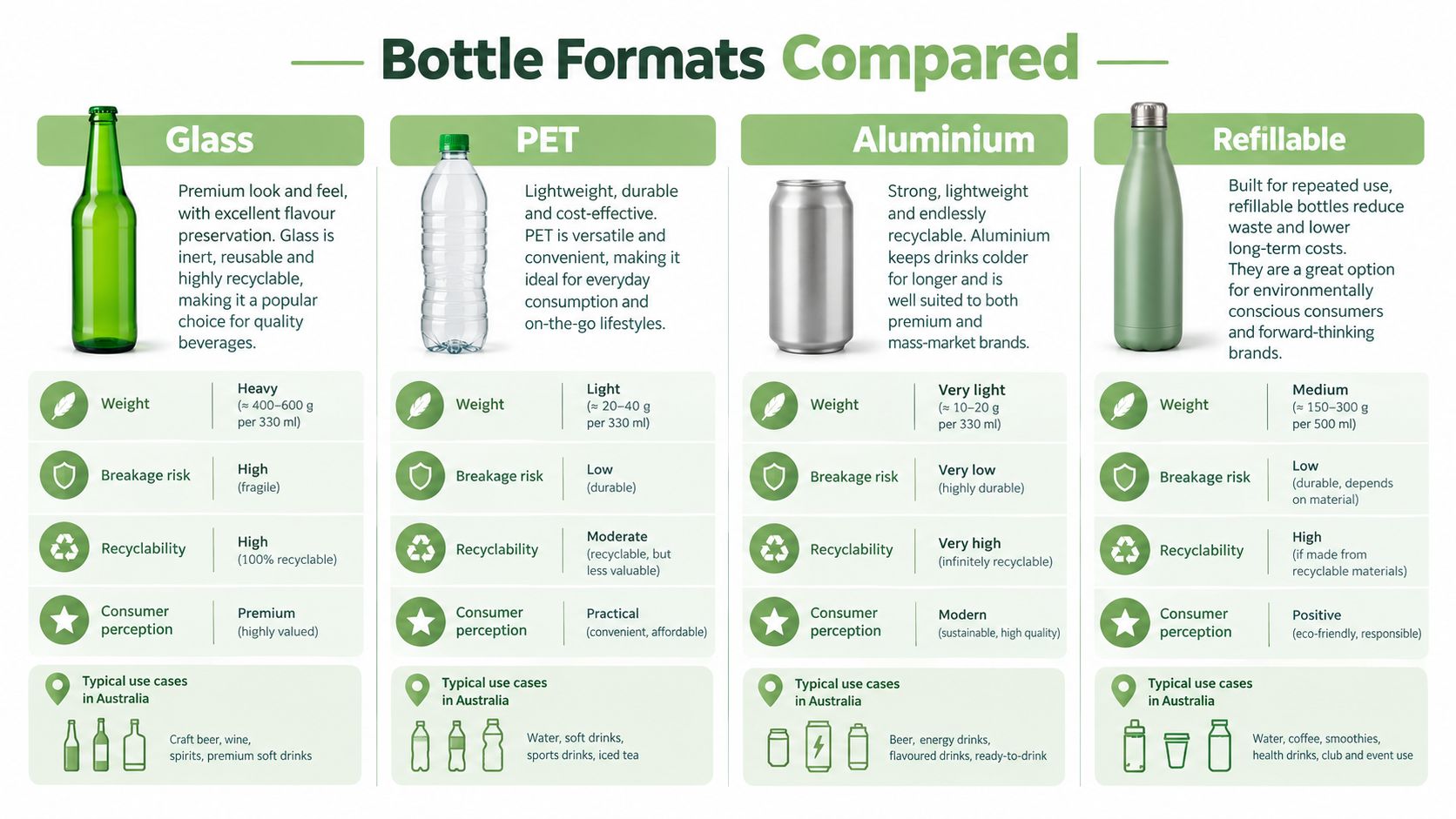
For any format, sanitation is essential. A useful operational resource is check WipesBlog.com for sanitation tips, particularly when you're reviewing filler contact points, reusable containers and cleaning routines.
Before requesting quotes, write a one-page specification covering product acidity, carbonation, fill temperature, closure, storage and route to market. For home or small-batch trials, home brew bottles can help you test handling, although commercial production still needs supplier documentation and process validation.
Kombucha-Specific Risks Inside the Bottle
Kombucha keeps changing after filling. Live cultures, residual fermentable material, temperature shifts and a sealed package can increase pressure and alter alcohol content. The bottle therefore needs to suit the fermentation process, not just the finished brand design.
FSANZ describes the initial tea infusion as typically around pH 5, a range where potential contaminants can grow. Its guidance recommends cooling the infusion from 60°C to 20°C within 2 hours, inoculating it promptly and fermenting to pH 4.2 or lower to help limit pathogen growth and toxin production. Finished kombucha is typically kept at pH 2.5 or higher, so the drink does not become excessively acidic. Treat these figures as process controls, then validate them against the actual recipe and production method.
Pressure, light and material compatibility
Test the filled package, not only the empty bottle. Ask suppliers for rated working pressure, burst pressure, closure specifications and recommended headspace. Run filled samples through the intended cold chain, warehouse handling and delivery conditions. PET can reduce transport weight while providing pressure performance, but the preform, wall thickness and bottle geometry must match the product.
Glass handles carbonation well when correctly specified. Breakage, however, creates a higher safety consequence because it produces shards. Amber glass can reduce light exposure for green-tea kombucha, especially in bright retail displays.
Aluminium requires a lining compatible with the beverage's acidity. A can that performs well for one drink may not suit another formula. Request food-contact and lining documentation for the actual kombucha, including any flavourings, acids and processing aids.
The closure needs the same scrutiny as the container. A cap, liner or can end must maintain its seal across the product's pressure range. Leaks commonly emerge during temperature cycling rather than a quiet bench test.
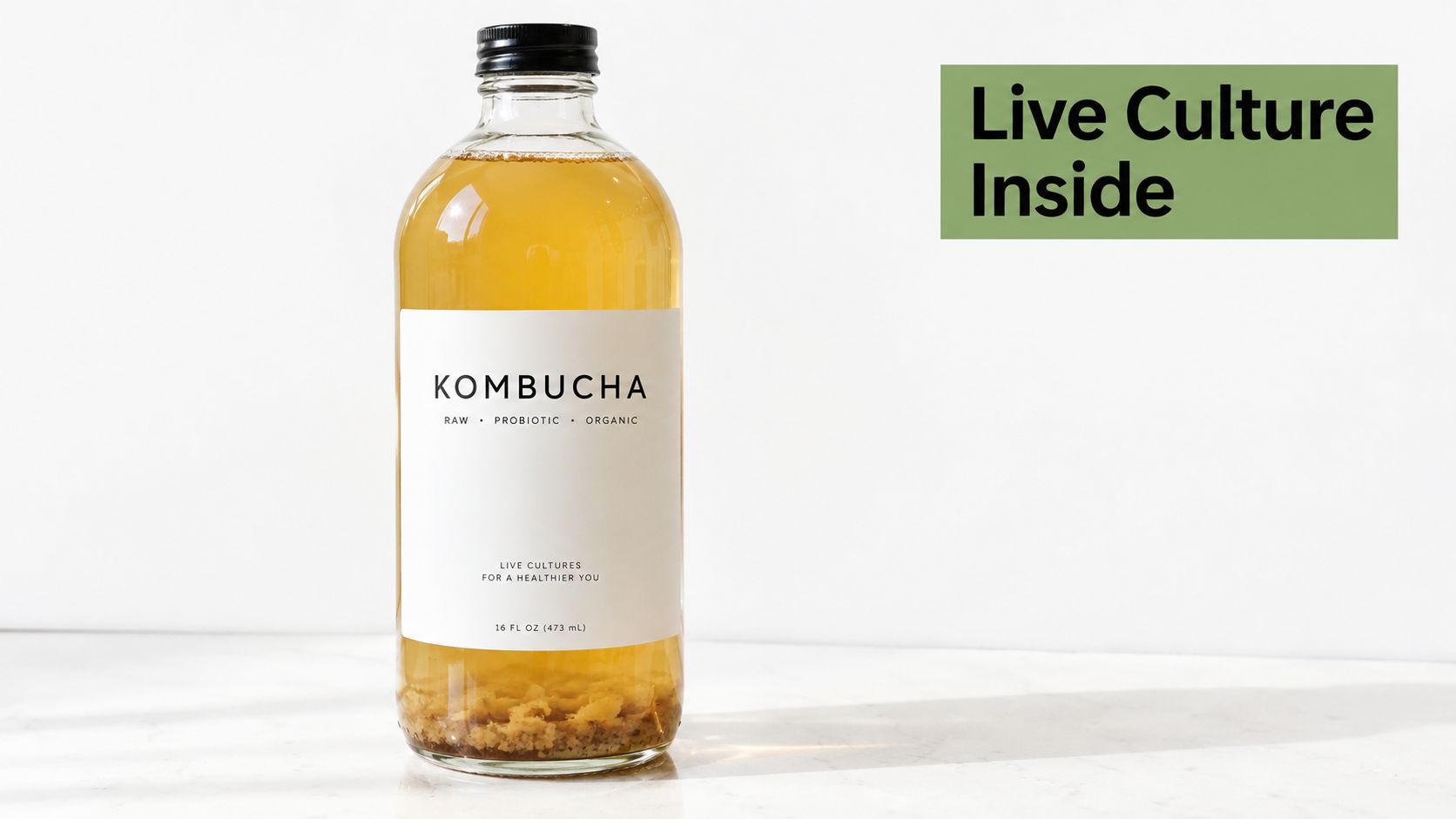
Alcohol and storage are process controls
“Non-alcoholic” does not automatically mean alcohol-free. A coordinated Australian survey tested 239 fermented soft drinks. Only 35.2% measured below 0.5% ABV, 21.6% measured from 0.5% to below 1.15%, and 9.8% exceeded 1.15% (Food Regulators survey of fermented soft drinks). NSW Health separately reports that around 65% of tested kombucha samples exceeded 0.5% ABV, so founders should arrange testing rather than assume the label category from the recipe.
Specify pressure testing, light protection, closure compatibility, cold-chain requirements, shelf-life validation, ABV testing and a clear use-by framework in the supplier brief. A practical second-fermentation guide also shows why sealed bottles need tighter process control than ordinary iced tea.
Australian Compliance, Labelling and Deposit Rules
Packaging artwork should begin only after the product specification is stable. Changing the bottle, fill volume, closure or fermentation profile late in the process can affect the label, deposit eligibility, transport pack and retailer documentation.
Your artwork checklist should cover:
- Mandatory label information: Confirm the product name, ingredient declaration, nutrition information, lot identification, use-by or best-before details and storage instructions with your food-labelling adviser.
- Country-of-origin information: Build the required country-of-origin statement into the artwork rather than treating it as a sticker applied at the last minute.
- Organic claims: Use “organic” only in a way supported by your certification and the applicable claim rules. Keep certification details and permitted marks aligned with the artwork, as outlined in Pep Tea's organic certification standards resource.
- Alcohol disclosure: Establish how your measured ABV, product category and intended claims affect labelling. Fermentation can change the result during storage, so one early laboratory test isn't enough to support every production batch.
- Deposit-scheme artwork: Check the requirements for each state and territory where the container will be sold. In NSW, container-deposit eligibility and refund marking can affect the label, barcode and approved container format.
Design for automated sorting
Use a label material and adhesive that won't compromise sorting or reprocessing. Avoid heavily pigmented PET when a clear format is suitable, and ask the intended recycler about sleeves, inks, caps and adhesive coverage.
A barcode must remain readable after condensation, refrigeration and handling. The container shape should also remain stable enough for automated equipment to identify it. Ask suppliers for a dieline that shows the printable area, seam or mould constraints, neck finish and closure dimensions before your designer finalises artwork.
HACCP-aligned controls matter to buyers because they show that the brewery can manage hazards consistently. A contract packer or wholesaler may also ask for evidence of your premises, process controls, product testing and traceability before accepting a new drink. Treat those documents as part of the packaging project, not a separate administrative task.
Cost Bands and Minimum Order Quantities in 2026
A founder pricing a fermented drink needs the delivered packaging cost, not just the empty container price. Freight, pallets, closures, labels, sleeves, cartons, storage and breakage can change the result. The ranges below are illustrative planning placeholders, not established 2026 market prices or supplier quotes. Confirm every figure and minimum order quantity with Australian suppliers before committing.
| Format | Illustrative unit-price range | Illustrative minimum order quantity |
|---|---|---|
| Glass | $0.80 to $1.50 | 5,000 |
| PET | $0.30 to $0.60 | 10,000 |
| Aluminium | $0.50 to $0.90 | 15,000 |
| Refillable | $1.20 to $2.00 | 2,000 |
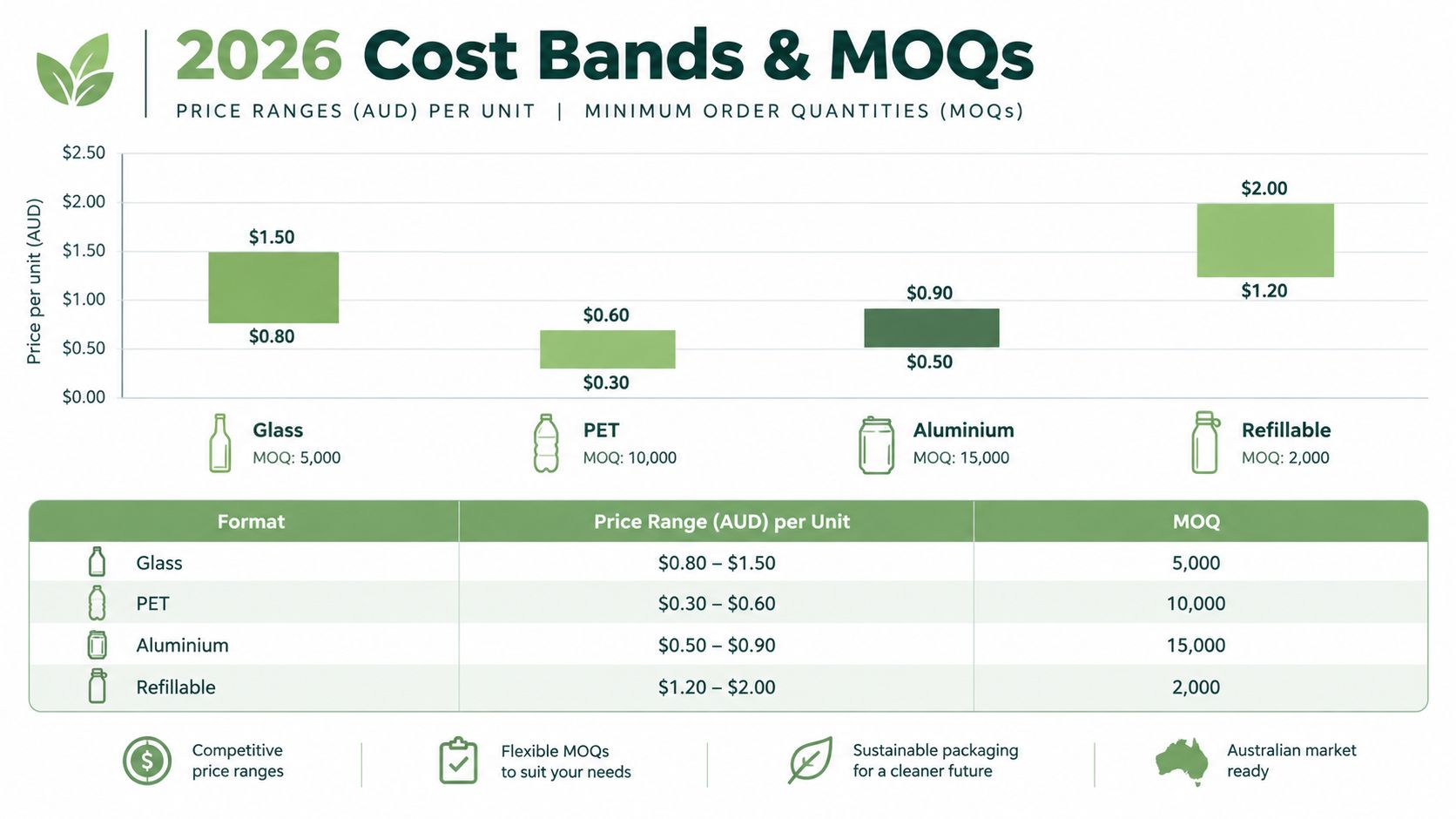
What moves the quote
Stock glass and stock PET are usually the simplest launch options because the mould already exists. Custom PET brings tooling and development work. Custom glass can require a larger manufacturer commitment. For aluminium, the minimum may depend on can availability and the filling line's format and setup requirements, rather than the can supplier alone.
The headline price also leaves out costs that can strain cashflow:
- Closures and liners: A specialist cap, liner or tamper-evident finish changes the delivered cost.
- Labels and sleeves: Short runs often attract setup charges. Sleeves can also affect sorting and application.
- Freight: State-to-state routes, pallet configuration and rural delivery affect the final cost.
- Storage: Empty containers and finished stock need clean, dry space.
- Damage allowance: Glass needs a practical handling and breakage allowance.
- Artwork and tooling: Custom shapes, embossing and colour matching add development work.
Kombucha founders should also price the container against pressure, acidity and shelf-life requirements. A lower unit price is a poor result if the format increases leakage, rejects or line stoppages.
For a first production run, compare two stock formats with one custom option. Calculate the filled product's delivered cost, including wastage and handling, rather than comparing empty containers alone. Custom design is easier to justify when it improves line efficiency, reduces damage, supports repeat wholesale orders or makes a return system workable.
Supplier Profiles for Australian Beverage Brands
The right supplier depends on your volume, geography and production method. A founder buying a few pallets for cafés should approach the market differently from a national brand preparing a long production schedule.
| Supplier category | Useful for | Questions to ask first |
|---|---|---|
| Glass manufacturer or importer | Premium presentation and established bottle shapes | Is the bottle rated for carbonated acidic drinks? What pallet quantities and breakage terms apply? |
| PET producer or distributor | Lightweight national distribution | Is the resin food-grade and suitable for the required pressure? Can the supplier provide clear, sorting-compatible stock? |
| Aluminium supplier and canning partner | Light protection and efficient pack-out | Which lining is used? What line format, end type and production schedule are available? |
| Refillable operator | Local hospitality loops | Who owns the crates? Who collects, inspects and washes the bottles? What happens to damaged units? |
Manufacturers often offer better access to technical documentation and consistent supply, but they may require larger commitments. Packaging distributors can be more practical for launch runs because they may hold stock, combine formats or organise mixed pallets. The price can be higher, yet the lower commitment may protect working capital.
Lead times vary with stock, imports, artwork, tooling and seasonal demand, so ask for a written schedule rather than relying on a verbal estimate. Your first enquiry should include product type, carbonation level, fill volume, closure, target markets, forecast volume, delivery postcode and whether the bottle will enter a container-deposit scheme.
Artwork causes avoidable delays. Request the dieline before designing the label, then confirm the neck finish, cap supplier, label application method and carton configuration. A bottle that fits the filler but not the label applicator still isn't a workable package.
For a broader supplier search, Genpire's sourcing hub can help you identify packaging and manufacturing contacts before you narrow the list through technical and commercial checks.
Beyond the Recycle Symbol
A recycle triangle describes a material category. It doesn't prove that a particular bottle will be collected, sorted and made into a useful new product.
Australia's national plastics data illustrates the gap. In 2017–18, Australians consumed approximately 3.4 million tonnes of plastics, while only 320,000 tonnes were recycled, producing a 9.4% national plastics recycling rate. Plastic packaging performed better than plastics overall, but the combined packaging recycling rate was still only 20.6% (Australian Plastics Recycling Survey 2017–18).
The system has changed, but the distinction remains. In 2020–21, 6.74 million tonnes of packaging were placed on the Australian market. The government reported that 86% had good recyclability, yet 35% was recyclable but not collected or reprocessed, and 44% was disposed of in landfill (Australian Government packaging data).
Design for the pathway, not the artwork
PET illustrates the issue clearly. A life-cycle assessment using the 2020–21 baseline of 12.6% plastics recycling modelled a pathway towards the national 2030 objective of 80% recycling. Its intermediate scenario required approximately 58% recycled PET content by 2027, while proposed Australian facilities could process the equivalent of about 1 billion 600 mL bottles annually (Australian PET life-cycle assessment).
Queensland's container-deposit results also show why material and collection pathway matter. During 2023–24, reported recovery was 57.1% for PET and 88.0% for glass, while the scheme-wide rate was 67.4%, below the legislated 85% target (Australian recycling infrastructure assessment). Glass can recover well, but its greater weight can increase distribution demands.
Give your supplier this checklist:
- Resin and colour: Prefer materials and colours accepted by the intended recycler.
- Label system: Confirm that label stock and adhesive are removable or sorting-compatible.
- Closure: Ask whether the cap and neck combination is accepted in the relevant stream.
- Transport balance: Reduce unnecessary mass without making the package fragile.
- Reuse feasibility: If claiming reuse, document collection, washing, inspection and return logistics.
A refillable model can be the better choice for a café loop, but only when customers and staff consistently return containers. Otherwise, a well-designed single-use bottle with a realistic recovery pathway may outperform a theoretical reuse system that loses most of its bottles after the first sale.
Your Supplier Shortlist Checklist
Before signing a purchase order, ask for written answers to these questions:
- Pressure rating: Has the filled bottle been tested with your actual kombucha, closure and expected temperature range?
- pH compatibility: Is the bottle, lining, cap and seal suitable for the product's acidity?
- Light protection: Does the format protect the drink sufficiently for its storage and display conditions?
- Closure fit: Does the cap or can end match the filler, torque settings and tamper-evident requirements?
- Dieline control: Have you approved the neck finish, label panel, barcode area, adhesive and application method?
- Deposit readiness: Is the container eligible for the schemes where you'll sell it, and does the artwork carry the required information?
- ABV pathway: Do you have a testing plan that supports the intended product description and storage period?
- Commercial fit: Does the minimum order suit your forecast, storage capacity and cashflow?
- Freight reality: What is the delivered cost to the brewery, including pallets, cartons and breakage terms?
- End-of-life design: Can the intended Australian collection and reprocessing pathway accept the complete package?
Take the next step with samples, not assumptions. Order filled trial units from two shortlisted suppliers, run them through refrigeration and transport, inspect the closures and labels, and ask your target recycler about the finished pack. That small test will reveal more than a polished catalogue image.
Pep Tea produces premium organic Japanese Matcha and sugar-free organic Kombucha brewed in the Hunter Valley, NSW, with options for households, cafés and wholesale buyers. If you're sourcing a beverage whose bottle, fermentation and brand story need to work together, visit Pep Tea to explore the range and discuss products for your menu or retail offer.
How to Order Matcha Powder the Smart Way
You're ready to order matcha powder, but the product page gives you little more than a green tin, a premium-sounding label, and a price. The safest choice isn't automatically the most expensive one. It's the powder whose grade, origin, packaging, serving size, and intended use match what you'll do with it.
That matters in Australia, where more than 90% of domestic matcha demand is met through imports and combined green-tea-powder imports grew at an estimated 13–17% CAGR from 2020 to 2025, according to Australian matcha market analysis. Supply changes can affect availability, substitutions, and pricing, so a smart order starts with product information, not branding.
Why Ordering Matcha Powder Deserves More Thought Than a Cart Click
A large pouch can look economical until you open it weeks later and find faded colour, a stale aroma, or a bitter drink that needs plenty of sweetener. Matcha is finely ground, so air, moisture, light, and heat reach more of the tea than they do with intact loose-leaf tea. Buy more than you can use while it is fresh and the saving quickly loses its appeal.
Start with the job the powder must do: how will you use the matcha? A bowl whisked with water exposes its colour, aroma, texture, and aftertaste. A latte brings milk and perhaps syrup. Baking adds sugar, flour, butter, and heat. Each use calls for a different balance, so the highest grade is not automatically the best purchase.
Practical rule: Buy for the drink or recipe you make most often, not for the most impressive grade name on the label.
Origin matters, but “Japanese matcha” does not answer every useful question. A product page should explain whether the powder is genuine matcha made from shaded tea leaves or green-tea powder using matcha-style language. Check the listed origin, ingredients, batch details, and packaging. Those details help you judge the seller's supply chain and freshness before paying.
Australian buyers also need a continuity plan. Japanese green-tea imports to Australia rose nearly 20% year over year in 2024, per Australian matcha market reporting, while some Australian cafés reported matcha-latte prices of approximately AUD 6–8. If supply tightens, ask whether the seller will keep the stated origin and grade, substitute another source, reduce the serving size, or raise the price.
Compare cost per prepared serve, not just the tin price. A powder that suits your usual latte or recipe can offer better value than an expensive ceremonial powder whose finer flavours disappear under milk, syrup, or other ingredients.
A specialist such as The Matcha Bike Miami matcha service shows how a focused matcha business presents preparation and service. For an Australian order, check delivery, labelling, freshness, and provenance yourself.
Understanding Matcha Grades and What Each One Is Actually For
Matcha grades are best treated as use-case labels, not universal quality rankings. “Ceremonial” usually signals a powder designed to be enjoyed with water, while “culinary” points towards recipes where other ingredients share the stage. “Premium” can sit between those uses, but sellers don't apply these terms identically.
Ceremonial grade for a clean, direct drink
Ceremonial matcha is the choice for a whisked bowl where the powder's colour, aroma, texture, and aftertaste are obvious. Choose it when you enjoy matcha with water and don't want milk or sugar to carry the flavour.
A vivid green colour can be encouraging, but it isn't enough on its own. Look for 100% matcha, Japanese origin, a clear lot or batch reference where available, and packaging that protects the powder from oxygen and light. A good ceremonial powder should whisk smoothly after sifting and taste balanced rather than harshly bitter.
Premium or ceremonial-blend for everyday flexibility
Premium or ceremonial-blend matcha is often the most useful middle ground for a regular home drinker. It can work in a latte, iced matcha, smoothie, or a lighter bowl, without making every preparation feel like a special occasion.
Value becomes personal here. If you mostly add milk, fruit, or other strong flavours, a balanced mid-range powder may give you more satisfaction than an expensive powder whose subtle notes disappear in the recipe.
Culinary grade for baking and blended drinks
Culinary grade is made for recipes that need matcha's colour and distinctive tea character alongside other ingredients. It suits muffins, biscuits, brownies, cheesecake, ice cream, smoothies, and strongly flavoured lattes.
That doesn't mean culinary grade should taste rough or unpleasant. It should still be clearly identified, fresh, finely milled, and free from unnecessary additives. A culinary powder may bring a more assertive tea flavour that holds up better against chocolate, citrus, dairy, or plant-based milk.
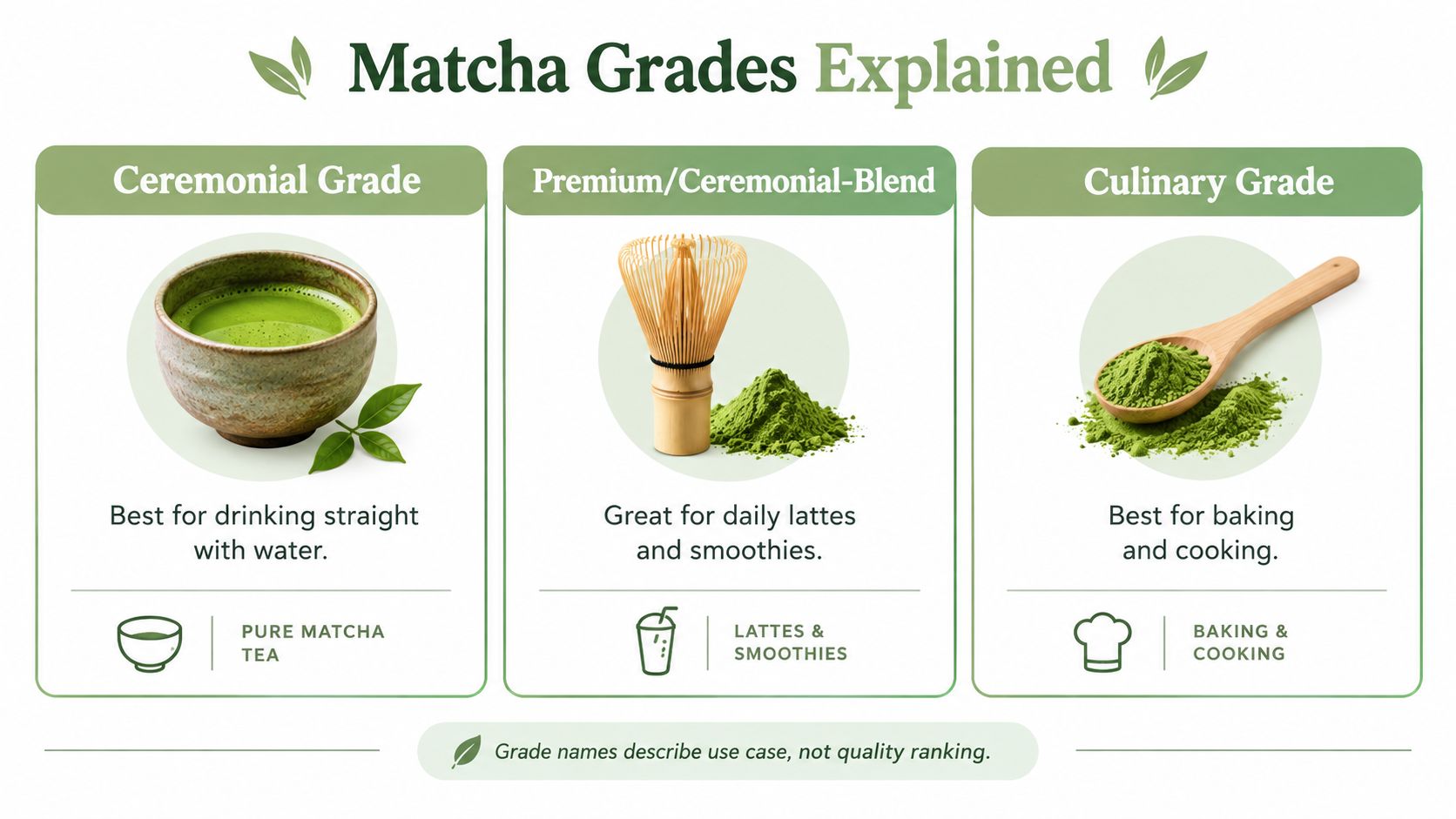
The practical distinction is simple: ceremonial is for drinking straight, premium is for flexible daily use, and culinary is for cooking and baking. Pep Tea's guide to different matcha grades is a useful reference when a product page uses several overlapping grade terms.
Don't pay for a high-grade powder because the label sounds luxurious. If the powder will disappear into a sweetened iced latte or a batch of baked goods, culinary or premium matcha can be the more sensible order.
Matching the Grade to Your Cup, Latte, or Recipe
The right matcha becomes much easier to choose once you name the preparation. A plain whisked bowl rewards smoothness and balance. A latte needs enough flavour to remain noticeable through milk. Baking needs colour and resilience rather than delicate tasting notes.
| Use case | Ceremonial grade | Premium grade | Culinary grade |
|---|---|---|---|
| Whisked bowl with water | Best fit for a clean, direct taste | Suitable for an everyday bowl | Usually too assertive or coarse-tasting |
| Hot matcha latte | Excellent, but may be more than needed | Strong everyday choice | Suitable when milk or sweetener dominates |
| Iced matcha | Smooth and refined | Practical balance of flavour and value | Works well with fruit, syrup, or bold milk |
| Smoothie | Often unnecessary | Versatile option | Good for stronger fruit or protein blends |
| Baking and desserts | Usually wasteful | Useful for lighter recipes | Best fit for colour and pronounced tea flavour |
A ceremonial powder earns its price when you can taste it directly. It's the logical choice for a small bowl of matcha and water, where there's nowhere for bitterness or stale notes to hide. It can also suit a minimalist iced drink with little more than water and ice.
Premium grade is the useful compromise for people who alternate between bowls, lattes, and smoothies. You'll get flexibility without building your entire routine around a powder that should be consumed quickly and treated carefully.
Culinary grade often delivers the best cost per prepared serve for a café-style latte, especially if you use milk, fruit, cocoa, vanilla, or sweetener. A cheaper powder isn't better if it tastes unpleasant, but a high-grade powder isn't better if its character is buried under several other ingredients.
The honest trade-off: Premium doesn't automatically mean better. It means the powder may be better suited to a particular preparation.
Before you order, write down your likely use in one sentence. “I want a plain morning bowl” points towards ceremonial. “I want iced lattes and smoothies” points towards premium. “I'm baking and making flavoured drinks” points towards culinary.
The Australian Ordering Checklist Before You Check Out
A good product page should answer your important questions without forcing you to search through vague marketing copy. Run these checks before adding matcha to your cart.
Check the product identity
Look for 100% matcha in the ingredient list. Genuine matcha is powdered tea, not a blend padded with sugar, starch, flavouring, or anti-caking ingredients. “Green tea powder” can describe a broader category, so check whether the seller explains the tea's origin and production clearly.
Japanese origin is a useful starting point, but ask for more detail where possible. A prefecture, harvest information, cultivar, or producer reference gives you a clearer picture than a generic country label. Tencha is the leaf material traditionally associated with matcha production, whereas ordinary green-tea powder may be made from a different raw material and processed for a different purpose.
Check certification and traceability
Organic certification can matter if organic purchasing is part of your priorities, but the word should be supported by identifiable certification information. Also look for a lot or batch reference, best-before information, and a seller who can explain how the product is packed and restocked.
Harvest details are helpful because matcha is a fresh powdered tea, not a pantry ingredient that improves with age. A product page doesn't need to make dramatic freshness promises. It should give you enough information to judge whether the powder has been sitting in an uncertain supply chain.
Check the format and delivery
A metal tin can protect a small quantity from light and repeated handling. A resealable pouch may suit a larger quantity if it has a reliable barrier and you transfer or seal it carefully. Sachets are convenient for travel and portion control, but usually offer less flexibility when you want to adjust the recipe.
Shipping matters in Australia's warmer conditions. Ask how the seller protects the product from prolonged heat, whether it ships promptly, and how the powder is sealed before dispatch. For cafés or wholesale buyers, affordable courier cost advice can help when comparing delivery arrangements, but freight cost should be assessed alongside packaging quality and stock reliability.
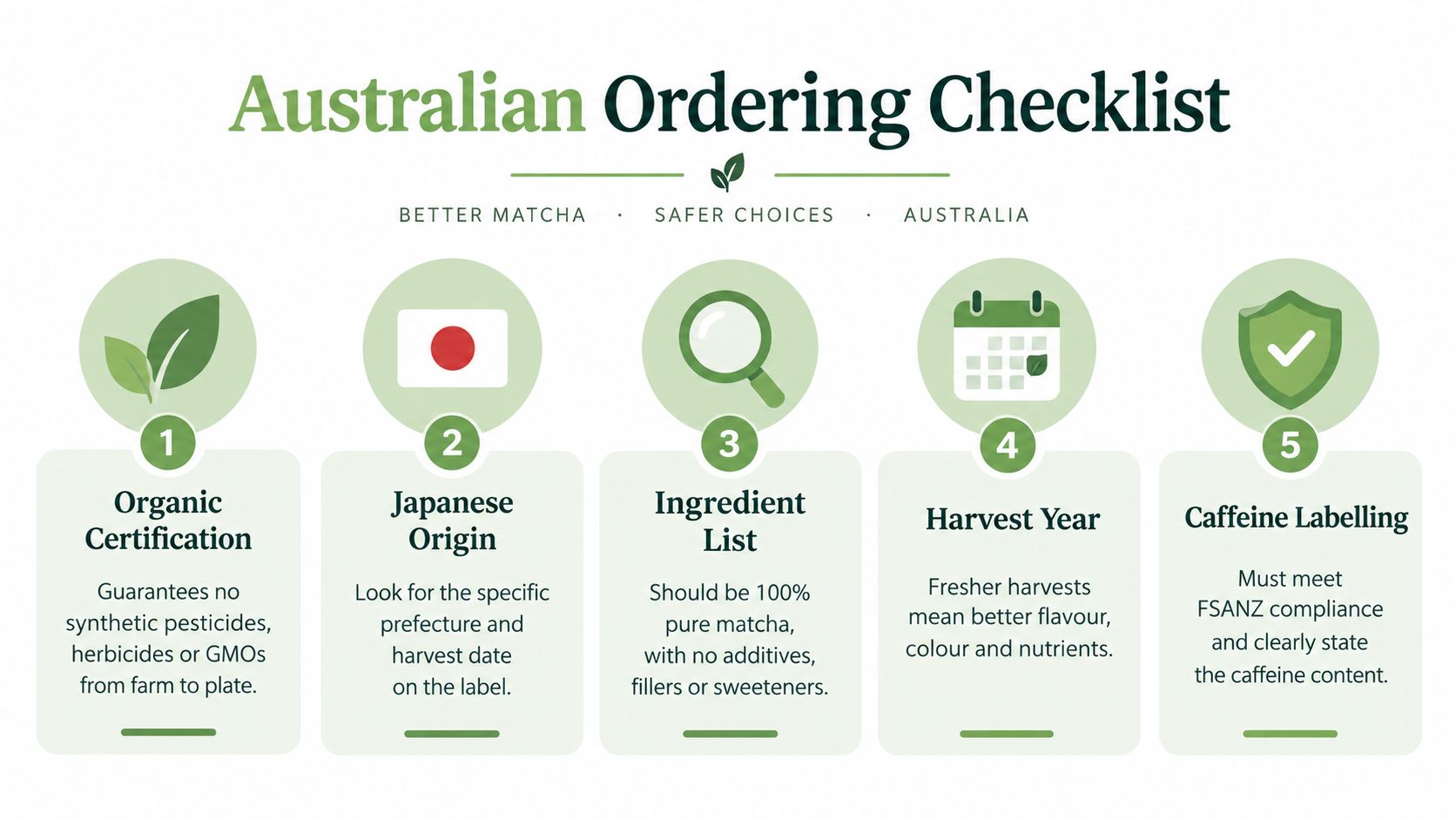
Use the Australian matcha tea powder range as one example of the type of product information worth comparing. Then calculate value by prepared serve, not tin price. A larger pack only saves money if you can finish it while the flavour remains enjoyable.
Caffeine Awareness and How to Read a Matcha Label
Matcha is a caffeinated food, so the serving size deserves attention. The entire powdered leaf is consumed, unlike a conventional tea infusion where water is separated from the leaves. That means the amount of powder in your bowl or latte, along with the recipe and drink size, influences your caffeine intake.
Australian sports-nutrition guidance gives a useful comparison: a 250-millilitre serving of green tea generally contains about 30–50 milligrams of caffeine according to the Australian Institute of Sport. A matcha drink isn't automatically equivalent because preparation can use different quantities of powder.
Understand the food-safety distinction
Food Standards Australia New Zealand prohibits the retail sale of solid or semi-solid foods containing 5% or more caffeine, equivalent to at least 50 milligrams per gram, and liquid products containing 1% or more caffeine, according to FSANZ guidance on caffeine powders and high-caffeine foods. These rules target highly concentrated caffeine powders and similar products.
Traditional tea products are treated differently because tea, coffee, and cocoa have an established history of food use. For someone ordering matcha, the practical distinction is clear: choose a clearly identified, food-grade tea powder, not a product marketed as a concentrated caffeine supplement.
FSANZ also states that caffeine must be declared in the ingredient statement when it is present as an ingredient. Read the serving guidance, preparation instructions, and ingredient list together. If a product page emphasises stimulant strength but says little about tea origin or serving size, choose another listing.
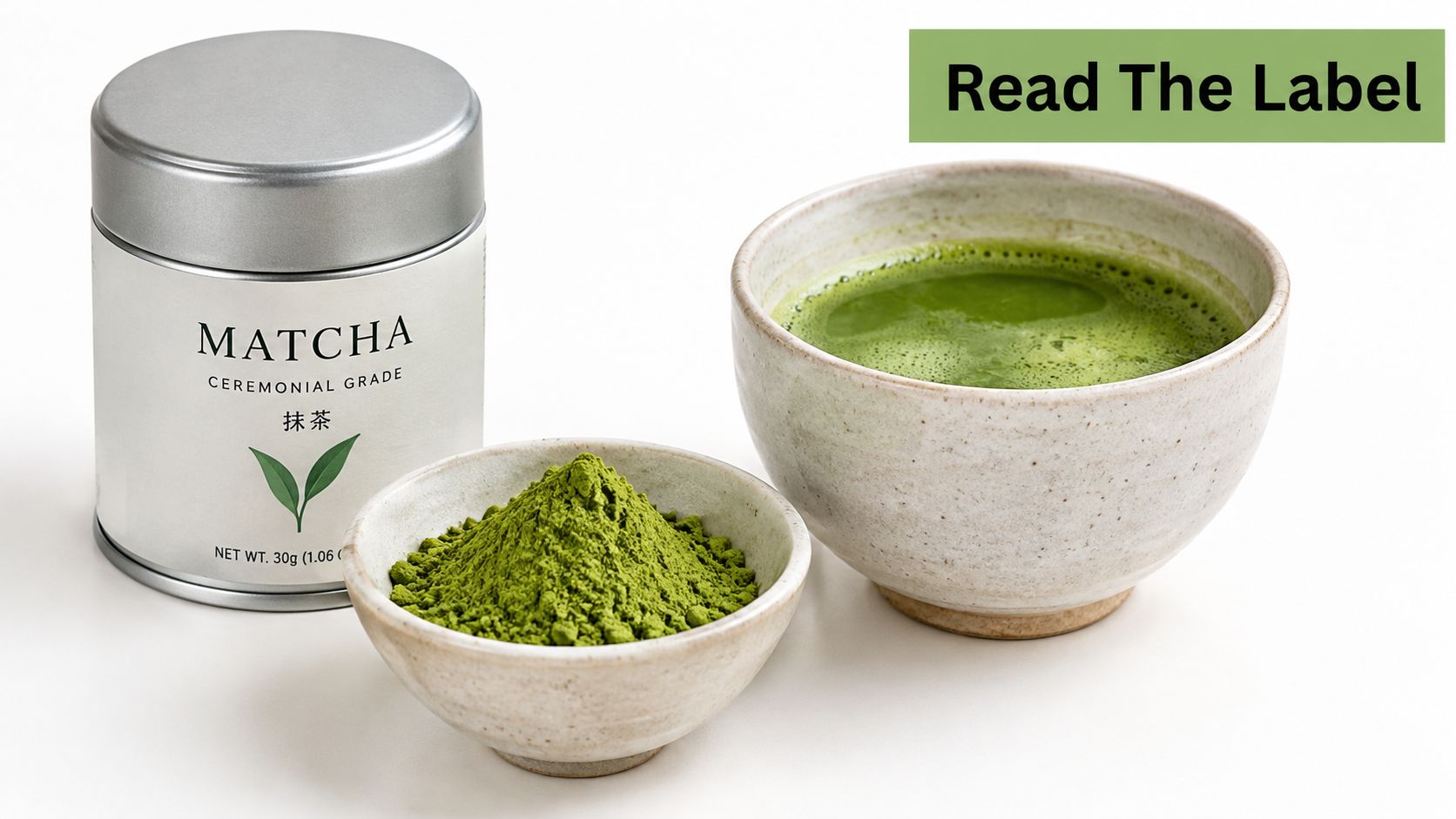
Healthdirect describes 400 milligrams of caffeine per day as generally safe for healthy adults, with individual circumstances affecting what is appropriate, as explained in its caffeine guidance. Count caffeine from coffee, tea, energy drinks, and chocolate across the day. If you're pregnant, breastfeeding, sensitive to caffeine, or taking relevant medicines, seek individual medical advice rather than relying on a general benchmark.
For a closer look at tea comparisons, Pep Tea's guide to caffeine content in green tea provides useful preparation context. The sensible approach is portion awareness, not chasing the highest number on a label.
Packaging, Storage, and Beginner Brewing Without the Guesswork
Your matcha can arrive in excellent condition and still disappoint if you leave the lid loose beside a sunny window. Light, oxygen, heat, and moisture are the enemies of fresh powdered tea. Store an unopened pack according to the seller's instructions, then keep an opened tin or pouch airtight, cool, and away from steam.
A tin is convenient for daily use and protects against light. A resealable pouch can work well for a larger quantity, provided you press out excess air and seal it properly. Single-serve sachets are useful for travel, work, and consistent portions, but they're less practical if you change the strength of your drink.
For most home drinkers, order a quantity you can use within roughly six to eight weeks of opening for peak flavour. Refrigeration can help, but avoid opening a cold container in a humid environment, where condensation may enter the powder. Let a sealed pack adjust before opening, and always use a dry spoon.
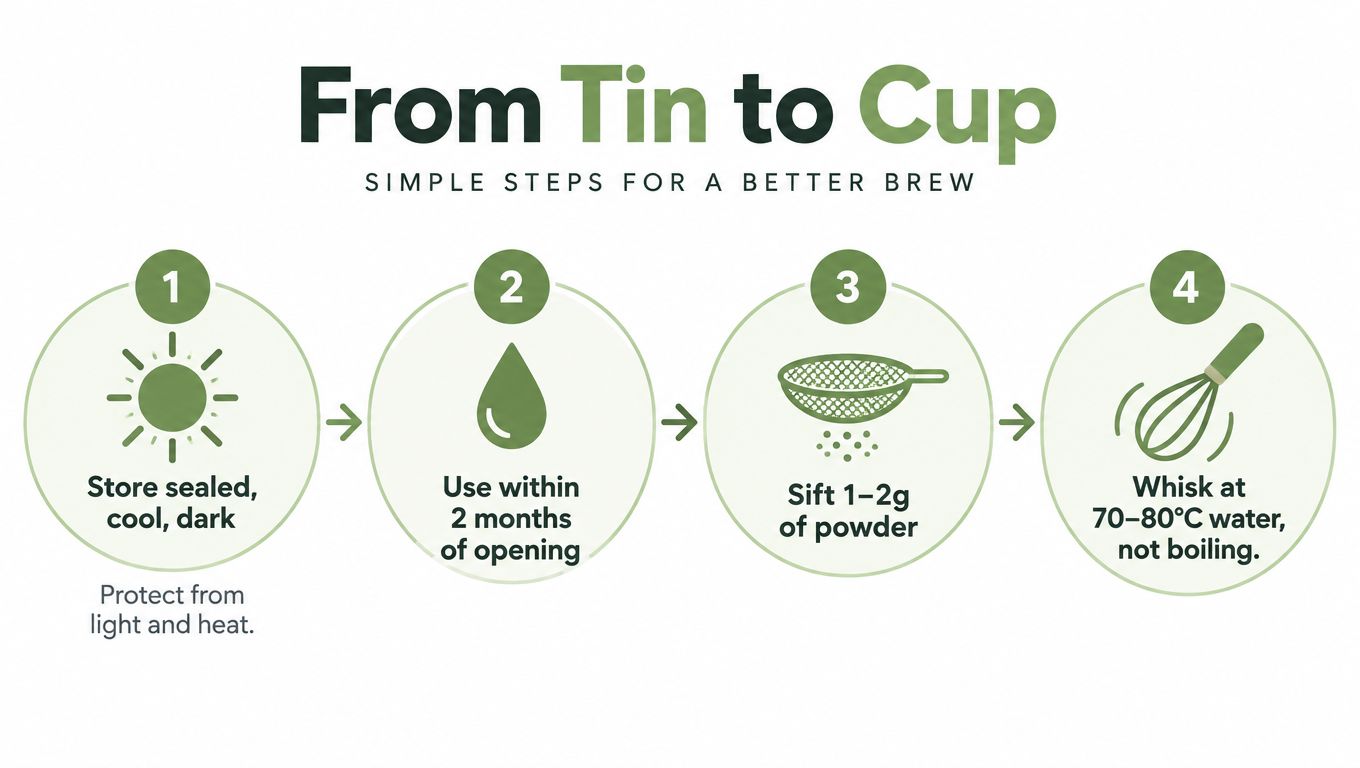
Three easy ways to prepare it
Whisked bowl: Sift around 1–2 grams of matcha into a bowl. Add a small amount of warm water, whisk into a smooth paste, then add more water and whisk briskly until lightly foamy. Water around 70–80°C is a forgiving starting point, because boiling water can make the drink taste harsh.
Hot latte: Sift the powder, mix it with a small amount of warm water, and whisk until smooth. Add warmed milk and adjust the strength to taste. A handheld frother works if you don't own a bamboo whisk.
Iced matcha: Make a concentrated paste with sifted powder and warm water first. Add cold water or milk, then pour over ice. Mixing the powder directly into a full glass of cold liquid often leaves clumps.
A bowl, fine sieve, bamboo whisk, and temperature-controlled kettle make the process easier, but you don't need a ceremonial equipment collection to start. The basics are accurate measuring, water that isn't boiling, and powder protected from moisture.
If you're also choosing lower-sugar drinks, the Australian Bureau of Statistics reports that 28.9% of Australians consumed sweetened beverages in 2023, while 23.8% consumed soft drinks or flavoured mineral waters, as shown in its food and nutrition data. An unsweetened matcha can fit a sugar-reduction routine, but the final sugar content still depends on the milk, syrup, or flavoured ingredients you add.
Putting It Together and Ordering With Confidence
Two questions settle most matcha purchases: what will you make, and how quickly will you use it?
For plain whisked tea, choose a well-documented ceremonial powder in a pack size you can finish while it stays fresh. Daily lattes and iced drinks suit premium grade. For baking, smoothies, and strongly flavoured recipes, culinary grade often gives better value because other ingredients carry the flavour.
Check the product page for ingredients, Japanese origin or a clearly stated source, grade, batch information, packaging, serving guidance, and delivery conditions. Compare the price per prepared serve, not only the tin price. Choose a larger pack only if your routine will use it before freshness falls.
With grade, pack size, and freshness aligned to your routine, the final check should take minutes, not become a research project.
Pep Tea supplies organic Japanese matcha powder for whisked bowls, lattes, smoothies, baking, and café use, alongside Australian-brewed sugar-free organic kombucha from the Hunter Valley, NSW. Visit Pep Tea to compare ceremonial and culinary-style options, then order the grade and pack size that match your actual use.
Kombucha Starter Liquid: What It Is and Why It Matters

You've brewed the tea, dissolved the sugar and waited for it to cool. The SCOBY is ready beside the jar, but one small detail can decide whether the batch starts cleanly or sits vulnerable for too long: kombucha starter liquid.
At a Hunter Valley café, this is the part of the process that's easy to overlook because it doesn't look dramatic. It's mature, tangy kombucha. Yet that liquid carries the established culture and acidity that help guide fresh sweet tea towards a safer fermentation. Treating it as leftover drink misses its most important job.
The Hidden Foundation of Every Successful Brew
A new brewer often spends plenty of time choosing black or green tea, measuring sugar and planning flavours such as ginger or mango. Then the tea cools, the SCOBY goes in, and the jar is covered. If the batch develops an odd smell or takes too long to turn tart, the starter liquid may have been the missing piece.
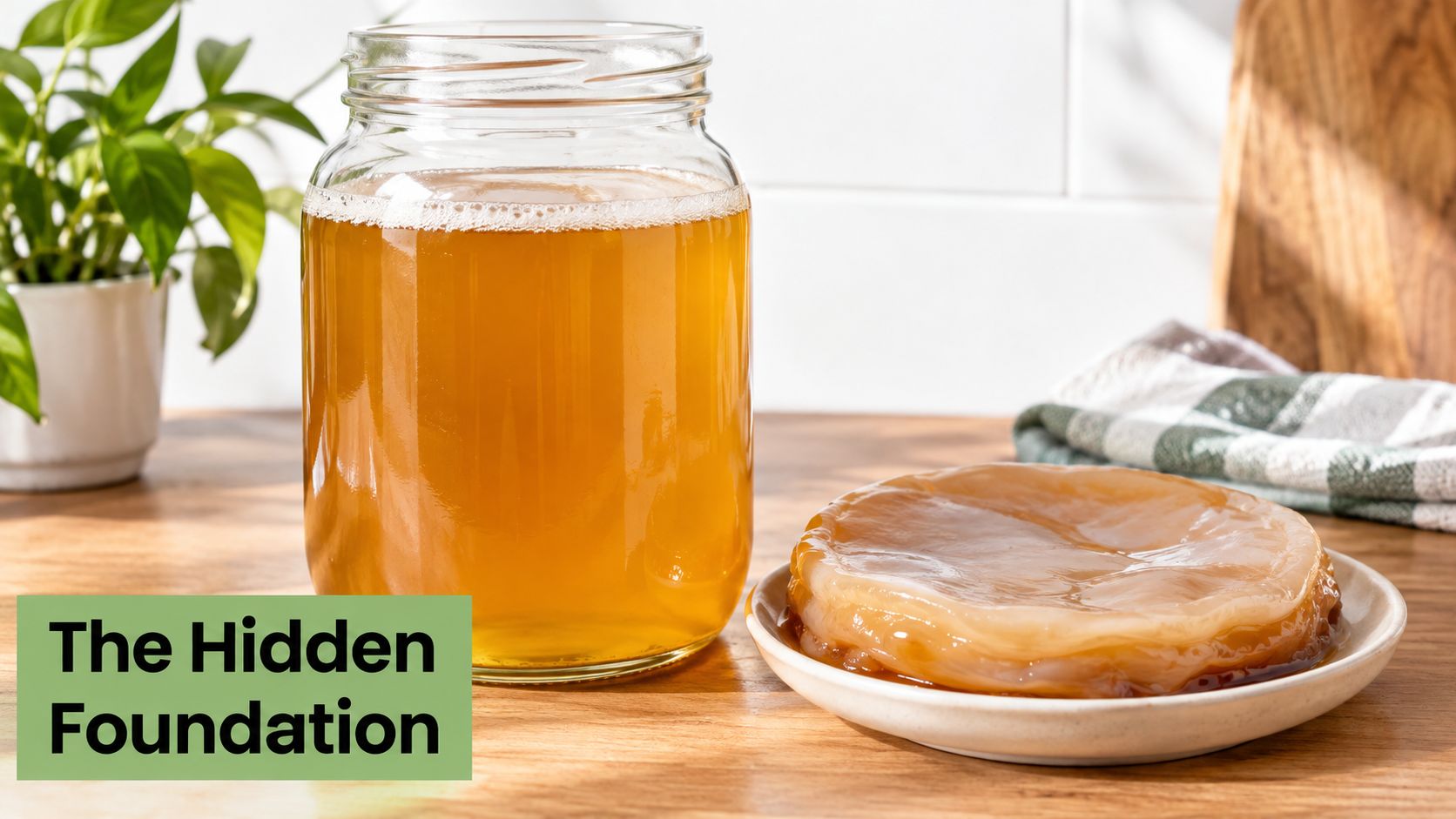
Starter liquid is the mature kombucha reserved from an active, successful batch. It brings an established community of yeasts and bacteria into the new tea, while its existing acidity changes the starting conditions straight away. The SCOBY matters too, but the liquid surrounding it is an active part of the fermentation system, not just a carrying medium.
Picture planting a garden bed. Fresh sweet tea is the prepared soil, the SCOBY is part of the living garden, and starter liquid brings an established population that can begin working immediately. Without that head start, the new batch has to develop its balance while the sweet tea remains in a condition where unwanted microorganisms may gain an opportunity.
Practical rule: A healthy-looking SCOBY without sufficiently active, acidic liquid isn't a complete fermentation plan.
This matters at home, but it matters even more in cafés and small production spaces. A hospitality team needs repeatable batches, predictable flavour and responsible control of a living drink after it leaves the brew vessel. The first pour of starter liquid influences all three.
Starter liquid also changes how you judge a recipe. Rather than measuring only by volume, you need to consider its acidity, smell, activity and history. A small amount of reliable mature kombucha can help a fresh batch move in the right direction, while weak, contaminated or poorly stored liquid can create uncertainty from the beginning.
What Kombucha Starter Liquid Actually Is
Kombucha starter liquid is finished, acidic kombucha from an active fermentation, usually taken from the vessel before flavouring or bottling. It contains the yeasts and acetic-acid bacteria that have already adapted to the tea environment. When added to fresh sweet tea, these organisms continue the sequence that creates kombucha's characteristic tartness.
The roles are complementary:
- Yeasts use available sugar and produce ethanol and carbon dioxide as part of fermentation.
- Acetic-acid bacteria use oxygen and convert yeast-produced ethanol into organic acids, including acetic acid.
- The liquid itself carries acidity and living culture into the next batch.
- The SCOBY is the visible cellulose-rich layer formed by the culture. It can support fermentation, but it isn't the only place where the active organisms live.
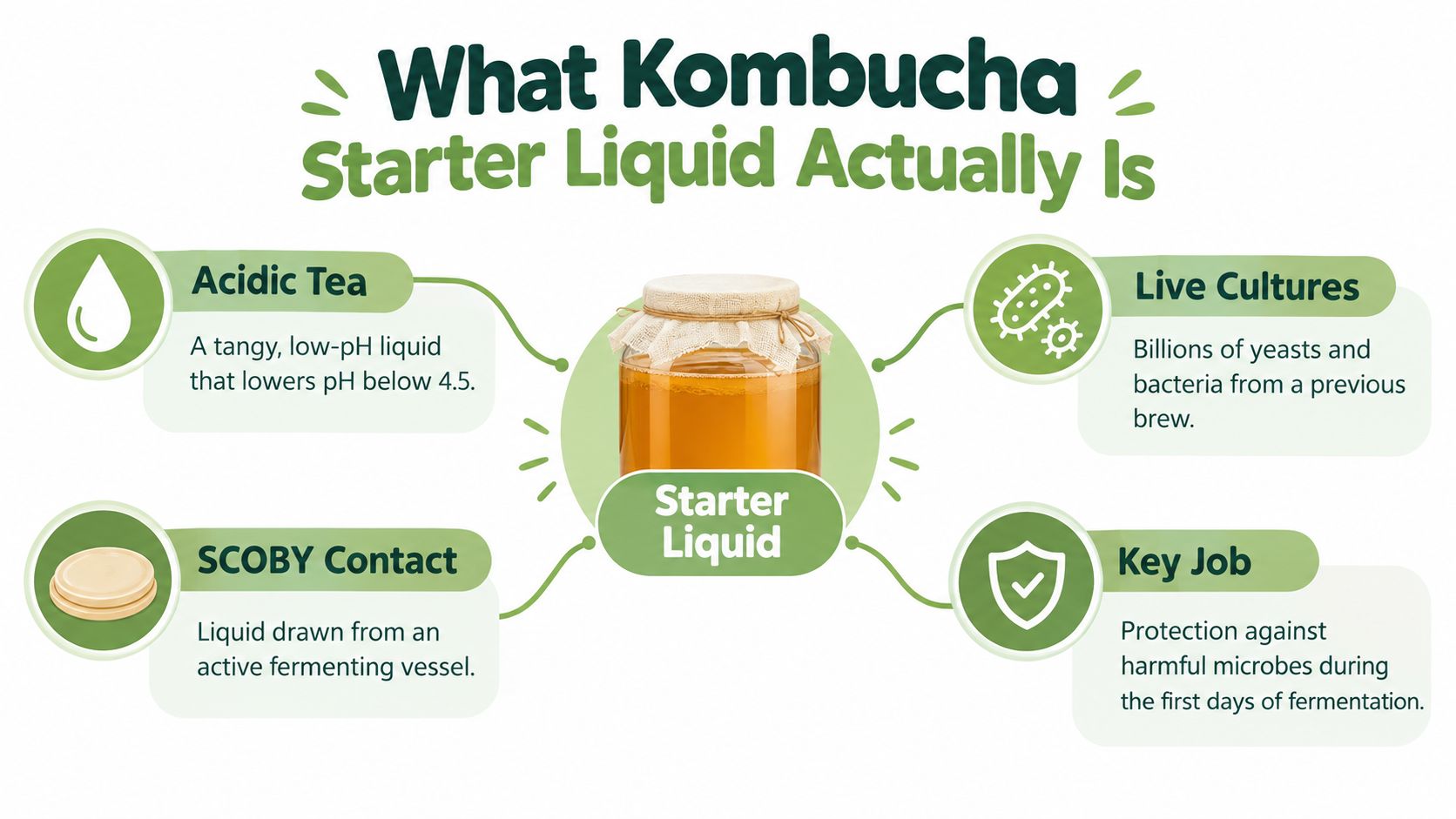
The simplest comparison is a sourdough starter. You wouldn't expect a dry piece of crust to ferment a fresh dough reliably. The living mixture around it carries much of the activity. Kombucha starter liquid plays a similar practical role, although the organisms and process are different.
Starter liquid and a SCOBY are not interchangeable
Adding a SCOBY alone can leave the new tea without enough acidity at the beginning. The liquid helps lower the starting pH and introduces organisms throughout the batch, rather than relying only on contact with a floating or sinking disc.
The liquid should come from a batch that smells pleasantly sour or tea-like, without fuzzy growth, rotten odours or unexplained discolouration. A SCOBY can naturally sink, float or sit at an angle, so its position isn't a reliable test of culture health. The condition of the liquid and the way the brew progresses matter more.
Why mature liquid is carried forward
Each successful batch leaves behind a portion of mature kombucha that can seed the next one. This creates continuity. You're not starting with a blank jar each time, but carrying forward a working culture that has already converted sweet tea into an acidic ferment.
That's why starter liquid deserves to be measured and protected. It is both an inoculum, meaning a source of living culture, and an early acidification control.
How pH Control Makes Starter Liquid a Safety Tool
Freshly brewed sweet tea begins at approximately pH 5, a range in which potential contaminants can grow. Food Standards Australia New Zealand advises cooling tea rapidly from 60°C to 20°C within 2 hours, then adding a proven, uncontaminated starter culture as soon as possible. You can review the broader fermentation context in Yuve's gut health guide, but kombucha brewing needs its own careful controls.
Starter liquid helps the culture begin producing acid sooner. The yeasts and acetic-acid bacteria work in sequence, and oxygen supports the bacteria as they oxidise yeast-produced ethanol into acetic acid. That gradual acidification lowers pH and changes the environment in favour of the intended culture.
The useful pH milestones
Australian guidance identifies pH 4.2 or below as the point at which kombucha becomes a non-potentially hazardous food that doesn't support pathogen growth or toxin production. The practical lesson is simple: the batch needs to reach that milestone promptly, not merely taste sour after a long wait.
A final pH of approximately 2.5 or higher is described as typical. Excessive acidification can produce an aggressively sharp drink and may create additional safety concerns, so lower isn't automatically better.
| Brewing question | Practical answer |
|---|---|
| Is taste enough? | No. Taste can help judge flavour, but it doesn't replace measurement. |
| Does oxygen matter? | Yes. Aerobic fermentation supports acetic-acid production. |
| What should be measured? | Track pH during fermentation with a calibrated meter. |
| Is the starting liquid important? | Yes. Its acidity and culture activity influence how quickly the new batch changes. |
A calibrated digital pH meter for kombucha brewing gives you a clearer view than elapsed time alone. Two jars brewed in different kitchens can move at different speeds because of temperature, tea, culture condition and handling. Recording pH gives a café team or home brewer evidence to work with.
Taste tells you what the drink is becoming. A pH meter tells you whether the process is moving into the intended safety range.
Use clean equipment, cool the tea before adding culture and keep the ferment exposed to suitable air circulation. If the pH doesn't move as expected, don't solve the problem by waiting indefinitely. Review the starter's condition, the temperature, the equipment and the possibility of contamination.
Where to Source or Make Your Starter Liquid
There are two sensible routes. You can obtain starter liquid from an established kombucha producer, or reserve it from your own healthy batch. The right choice depends on whether you're learning at home, restarting after a break or trying to keep café production consistent.
Buying from a reliable producer
A supplied starter should have a clear origin and handling information. Ask how it was brewed, whether it has been kept clean and whether the supplier can explain how to use it with your tea. A reputable source should be able to describe the culture rather than treating the liquid as a generic flavour additive.
For a first batch, a packaged option such as PepTea's starter tea kombucha product can be useful because it is presented specifically for establishing fermentation alongside a SCOBY. The important point isn't the packaging itself. It's knowing what the liquid is, where it came from and how it has been handled.
Reserving liquid from your own batch
Before flavouring or bottling a successful brew, decant clean mature kombucha into a sanitised container. Choose liquid from a batch with a pleasant acidic aroma and no visible mould. If the brew has an unusual smell, fuzzy growth or signs of spoilage, don't preserve it as your next starter.
A small café should label the container with the batch identity and date, then store it under the same controlled conditions used for the rest of the production process. Home brewers can use a simpler note on the jar, but the principle is identical: know which batch you're carrying forward.
How much is enough
PepTea's product guidance describes mature acidic kombucha at approximately 10% of a new batch as a way to lower initial pH and establish fermentation. The exact suitability depends on the acidity and activity of the liquid, so volume alone shouldn't be your only check.
If the starter is unusually mild, old, diluted or uncertain, adding more by guesswork won't guarantee a safe result. Measure pH, use a known culture and keep your process consistent. A starter liquid with strong acidity and healthy activity gives the new tea a more dependable beginning.
Storing and Maintaining Starter Liquid Correctly
Starter liquid is alive, so storage is about slowing change without treating it as a lifeless ingredient. A clean container, stable refrigeration and careful handling help preserve its useful acidity and culture activity between brews.
Use a clean glass container with enough room for safe handling. Keep the lid secure, but avoid repeatedly opening the jar just to smell it. Every opening creates another opportunity for dust, insects or accidental contact to enter.
A simple storage routine
- Label the jar: Record the batch source and storage date so nobody has to guess what it contains.
- Keep it cold: Refrigeration slows fermentation and helps maintain a more stable flavour and activity profile.
- Protect the liquid: If a SCOBY is stored with it, keep the culture covered so it doesn't dry out.
- Use clean utensils: Never dip a used spoon or tasting glass into the container.
- Inspect before use: Look for mould, unpleasant odours or a change that doesn't resemble normal acidic fermentation.
A refrigerated starter can become more sour over time, and its activity may change. “It still smells acidic” is useful information, but it isn't proof that the liquid is suitable for every new batch. Measure and observe rather than assuming that starter liquid never expires.
Freezing can also alter texture and culture activity, so it isn't automatically the best preservation method. For a short brewing pause, stable refrigeration is the more straightforward routine. If you're unsure about a stored culture, discard it rather than trying to rescue a questionable ferment.
The following video can help visualise practical SCOBY storage habits:
For a longer pause between batches, keep the culture submerged in mature kombucha and avoid repeated transfers. PepTea's guide to storing a SCOBY between brews offers a useful reference for maintaining the culture without letting it dry out.
Spotting Contamination and Managing Alcohol Risk
A healthy kombucha culture can look different from batch to batch. The SCOBY may float, sink or form an uneven new layer, and strands or sediment can appear as yeast activity continues. Those changes aren't automatically contamination.
Mould is different. Fuzzy or dry growth, especially with suspicious colours, is a reason to discard the affected batch and starter rather than skim the surface. A rotten, solvent-like or otherwise offensive smell also deserves caution. If the liquid has been exposed to dirty equipment, insects or questionable water, don't use it to seed another brew. For general background on checking water quality, how to test well water for E. coli is a useful resource, although a home water test doesn't replace good brewing hygiene.
Alcohol can change after bottling
Acidity is only half the control problem. Yeasts can remain active after the SCOBY is removed, particularly when residual sugar, warm storage, sealed bottles or a second fermentation give them favourable conditions.
A national survey of 239 fermented soft drink samples found that only 35.2 per cent of kombucha tested below 0.5 per cent alcohol by volume, while some products increased in alcohol during shelf life. The findings are reported in the Australian fermented-beverages issues paper.
In the same survey, 41.9 per cent of all sampled fermented drinks measured above 0.5 per cent and below 1.15 per cent ABV, while 22.9 per cent exceeded 1.15 per cent ABV. Kombucha represented 132 samples, or 55.2 per cent, of the total fermented-drink sample. These figures show why a bottle that tastes fine at filling can't automatically be treated as stable throughout its shelf life.
Practical controls for cafés and home brewers
- Reduce uncontrolled sugar: Residual fermentable sugar gives yeast more material to convert.
- Control warmth: Cold storage slows, but doesn't magically erase, ongoing fermentation.
- Treat sealed bottles carefully: Carbonation stages can trap gas and support continued yeast activity.
- Check the finished product: Commercial operators should validate alcohol at bottling and during shelf-life studies.
- Avoid blanket claims: Don't describe a living fermented drink as alcohol-free without appropriate testing and awareness of applicable Australian requirements.
In New South Wales, guidance states that kombucha sold as a non-alcoholic beverage must contain less than 0.5% ABV, as outlined by the NSW Food Authority. Requirements and classification can vary between states, so a café serving or selling kombucha should document its controls rather than rely on assumptions.
Best Practices for Home Brewers and Hospitality Use
The best process is the one you can repeat. Home brewers need a clean jar, reliable starter liquid and a way to check progress. Cafés need those same foundations, plus batch records, staff consistency and a clear approach to storage and product claims.
Keep the framework practical:
- Start with known liquid. Use mature starter from a healthy ferment or a traceable supplier.
- Cool before inoculating. Hot tea can damage the living culture.
- Measure pH. Don't rely on taste, smell or the calendar alone.
- Keep equipment hygienic. Clean jars, utensils, bottles and meter probes after use.
- Provide oxygen during primary fermentation. The acetic-acid bacteria need it for their work.
- Control the post-bottling stage. Residual sugar, active yeast and warm storage can keep fermentation moving.
- Record what happened. Note the starter source, pH observations, storage conditions and any alcohol testing.
A café doesn't need a laboratory bench beside the espresso machine, but commercial production does benefit from organised testing and suitable food-grade workspaces. Businesses planning more formal analysis can browse food testing lab benches for context on laboratory furniture and workflow design.
Home brewers can keep their notes in a notebook. Hospitality teams should make the process easy for every staff member to follow. In both settings, starter liquid should be treated as a safety control and fermentation tool, not an optional flavouring.
Pep Tea offers Australian-brewed, sugar-free organic kombucha from the Hunter Valley, along with organic Japanese matcha and practical guidance for mindful beverage routines. Visit Pep Tea to explore the range, learn more about kombucha culture care and enquire about options for home, café or wholesale use.
Matcha Cookies Recipe Easy: Perfect Bake

You're halfway through a batch of cookies when the matcha clumps into bitter green pockets, the dough spreads across the tray, and you realise nobody has measured the portions. This matcha cookies recipe easy approach avoids those problems with a controlled mixing process, sensible portioning, and a few Australian food-safety details that many recipes leave out.
The result is a fragrant biscuit with a soft centre and lightly set edges. Matcha adds colour and tea flavour, but it doesn't turn a flour, sugar, and fat-based cookie into a health food. Australian dietary guidance places sweet biscuits in the discretionary category, so the most useful approach is honest ingredient information, considered portions, and a recipe that works reliably.
Gathering Your Ingredients and Equipment
A smooth bake starts before the oven is switched on. Bring the butter to a soft, workable texture, weigh the dry ingredients, and clear enough bench space for a tray, cooling rack, and mixing bowl. A kitchen scale is more dependable than packed cups, particularly when flour and matcha are involved.
Ingredients for a practical batch
Use:
- Plain flour: Provides the main structure and chew.
- Culinary-grade matcha: Adds the characteristic tea flavour and green colour. Choose a fresh, aromatic powder rather than one that smells stale or looks dull.
- Unsalted butter: Controls richness, spread, and crispness. Softened butter should bend under pressure but not look oily.
- Caster sugar: Sweetens the dough and helps the edges set with a fine texture.
- Egg: Binds the mixture and contributes moisture.
- Baking powder: Supplies lift without making the cookie cakey.
- Fine salt: Sharpens the matcha and balances sweetness.
The exact quantity of matcha should reflect its flavour strength. A culinary powder intended for baking usually gives a more practical balance than using a prized drinking matcha in a strongly flavoured dough. The distinction between ceremonial and culinary products is explained clearly in PepTea's guide to ceremonial and culinary matcha.
Equipment that prevents avoidable errors
Set out a kitchen scale, measuring spoons, a large metal or glass bowl, a whisk, a spatula, baking trays, and parchment paper. A fine sieve is essential because matcha compresses into small lumps during storage. Sifting it with the flour distributes the powder before it reaches the wet ingredients.
Practical rule: Mix matcha into the dry ingredients, not directly into the butter. That single choice prevents concentrated green pockets and makes the flavour much more even.
Use a portion scoop or weigh each piece of dough. Consistent pieces bake at the same rate, while a tray containing small and large cookies forces you to choose between pale centres and overdone edges. Keep a cooling rack nearby, too, because cookies continue to firm as they leave the oven.
Mixing and Baking for the Perfect Texture
The best texture comes from controlling air, flour development, and fat temperature. Soft butter should combine smoothly with the sugar, but it doesn't need prolonged beating. Excessive aeration can encourage the cookies to rise and then collapse or spread unevenly.
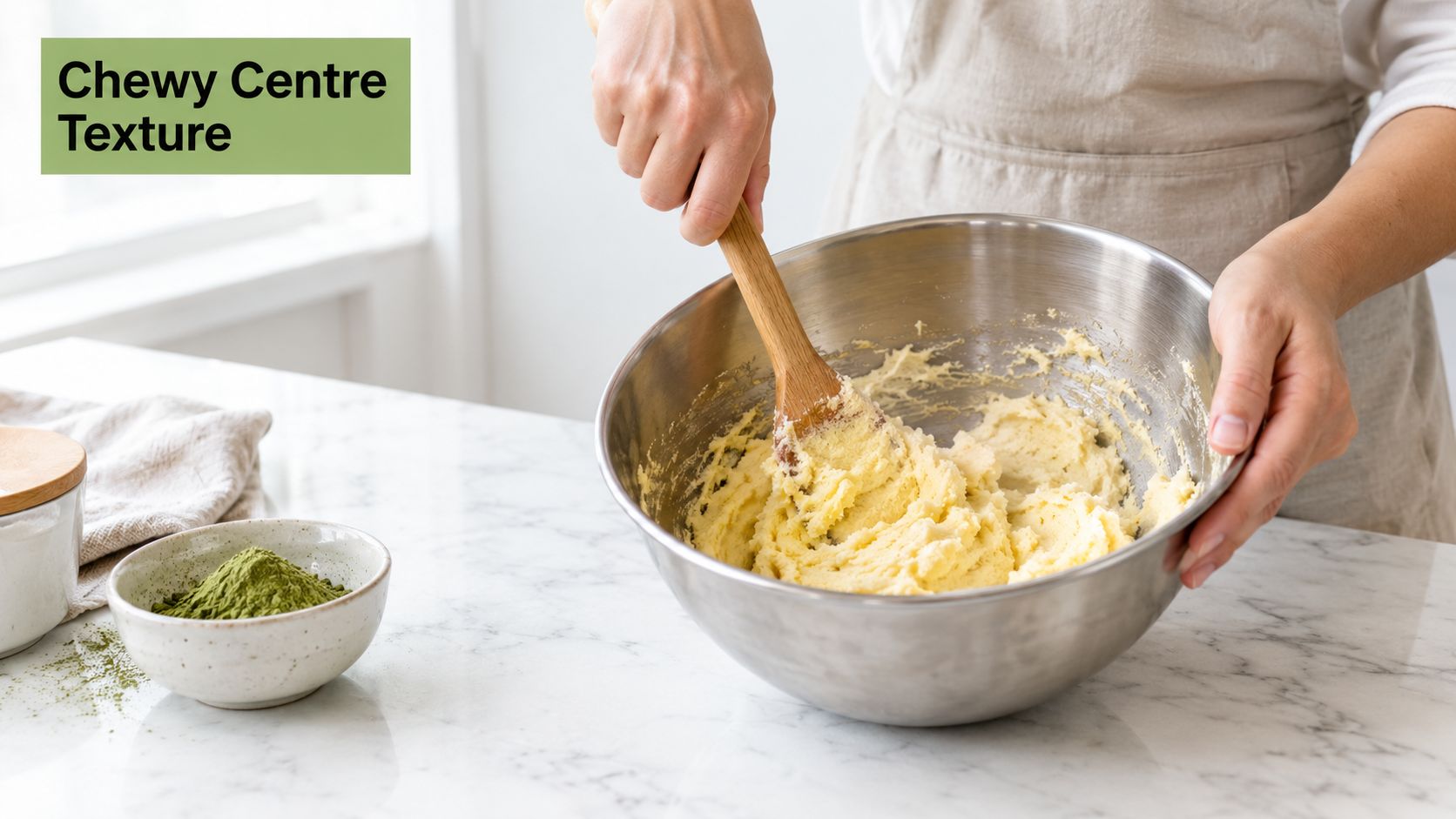
A controlled mixing sequence
- Prepare the dry mixture. Whisk the flour, matcha, baking powder, and salt, then sift them together.
- Combine butter and sugar. Cream softened butter with the sugar only until the mixture is uniform and smooth.
- Add the egg. Mix until combined, scraping the bowl so no buttery streaks remain.
- Add the dry ingredients. Fold or mix on low speed just until no dry flour is visible. Stop there. Continued mixing develops the flour and can make the finished biscuit tough.
- Portion the dough. Place evenly sized mounds on parchment, leaving room for spreading.
- Chill when necessary. If the dough feels glossy, loose, or warm, chill the portioned pieces before baking. Colder fat melts later, helping the cookies keep a thicker centre.
Preheat the oven fully rather than placing dough into a warming oven. An oven thermometer is useful because the displayed setting and the actual centre temperature can differ. Bake until the edges look set and the centres no longer look wet. Matcha can keep the surface visibly green, so colour alone isn't a reliable doneness test.
For an egg-containing biscuit, verify that the centre reaches approximately 71–72°C when food safety is critical, following the controlled-temperature method described by CSIRO's egg-quality guidance.
The tray still has a job after baking. Leave the cookies on it briefly before moving them to a rack, allowing the residual heat to finish setting the crumb. Transferring them immediately can cause soft centres to tear, while leaving them on a hot tray too long can darken the bases.
For more ideas on using matcha beyond a single batch of biscuits, see PepTea's matcha baking guide.
Understanding Portion Sizes and Caffeine Content
Matcha remains in the finished cookie. Baking changes texture and aroma, but you shouldn't assume it removes the powder's naturally occurring caffeine. The amount in each biscuit depends on the matcha quantity, the supplier's specification, and the final yield.
Calculate the approximate amount
Start with the total matcha used in the batch. Divide that amount by the number of cookies, then use the supplier's caffeine information to estimate the matcha-derived caffeine per cookie. This is more defensible than judging caffeine from colour or a teaspoon because matcha powders vary.
A café or home baker can record three details:
- Batch matcha: Weigh the complete quantity added to the dough.
- Final yield: Count the baked cookies, not the intended yield.
- Serving estimate: Divide the batch figure by the actual number produced.
The result is still approximate. It should be presented as an estimate, particularly for children, pregnant or breastfeeding people, and anyone sensitive to caffeine. Smaller cookies, less matcha, or replacing part of the matcha with a non-caffeinated culinary flavouring can make the recipe easier to manage for an evening or family menu. FSANZ's caffeine information explains the regulatory context for caffeine in food and why commercial labelling needs care.
Australian serving guidance gives sweet biscuits a recommended maximum retail serving size of 30 g and an approximate energy level of 600 kJ per serving. It reports a median amount consumed of 26 g, with observed amounts from 18 g for plain biscuits to 36 g for chocolate varieties. These benchmarks appear in the Australian serving-size rationale.
| Cookie size | Approx. weight | Estimated matcha per cookie | Energy benchmark |
|---|---|---|---|
| Small home portion | 18 g | Total batch matcha divided by final yield | Below the retail maximum benchmark |
| Typical portion | 26 g | Total batch matcha divided by final yield | Around the reported median biscuit amount |
| Retail maximum benchmark | 30 g | Total batch matcha divided by final yield | Approximately 600 kJ |
The energy column is a benchmark, not a nutrition calculation for this particular recipe. Butter, sugar, flour, chocolate, nuts, and the final yield all change the result. For a café, weigh the finished portions rather than relying on a scoop that may gradually become larger.
Readers who drink matcha as well as eating it can use PepTea's matcha serving guide to think about their total daily intake rather than treating the cookie as caffeine-free.
Adapting the Recipe for Dietary Needs
Dietary substitutions work best when you replace the function of an ingredient, not just its name. Wheat flour provides structure, butter brings water and fat, and egg binds the dough. Remove one of those elements without compensation and the cookie may crumble, spread excessively, or lose its chew.
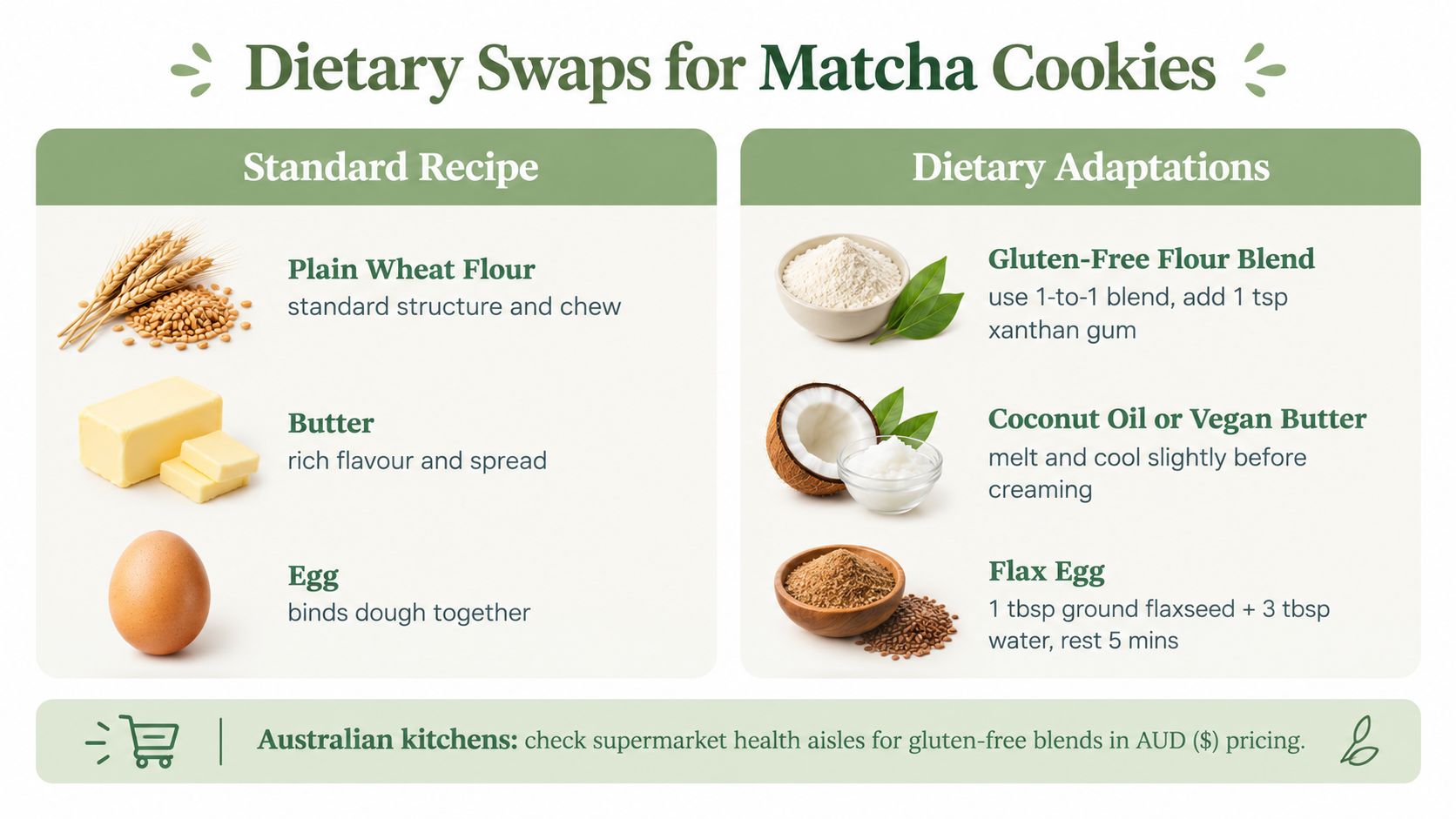
Gluten-free structure
A one-to-one gluten-free flour blend is the most practical starting point, but blends behave differently. Choose one designed for baking and check whether it already contains a binding ingredient. If it doesn't, a small amount of xanthan gum may help hold the dough together, although too much can produce a gummy bite.
Resting the dough before baking can improve hydration because alternative flours often absorb liquid at a different rate from wheat flour. If the dough crumbles when pressed, add moisture cautiously rather than pouring in a large amount at once. If it spreads, chill the portions and check that the substitute fat hasn't been overheated.
Australian wording matters as much as texture. A food labelled “gluten-free” must contain no detectable gluten and must not contain oats or oat products, while gluten-containing cereals and relevant allergens must be declared, according to NSW food-allergen guidance. Use certified ingredients, clean equipment, fresh parchment, and separate utensils where cross-contact is a concern. “Made without wheat” isn't interchangeable with “gluten-free”.
Vegan alternatives
Vegan butter generally gives the closest spread and familiar biscuit flavour. Coconut oil can work, but it behaves differently as it warms and may create a more fragile cookie with a noticeable coconut character. Let melted fat cool before mixing, and expect to adjust chilling time.
A flax egg, made by combining 1 tablespoon of ground flaxseed with 3 tablespoons of water and resting for 5 minutes, adds binding but less richness than an egg. The resulting cookie may be slightly softer or darker, depending on the plant fat and flour blend. Aquafaba can bind some doughs, but it can also make the texture less predictable when used without testing.
The safest adaptation is to change one variable at a time. Test the flour first, then the fat, then the egg replacement. That makes it clear whether spreading, crumbling, or toughness comes from the ingredient or the mixing method.
Storing Your Cookies and Troubleshooting Mistakes
Cool the cookies completely before storage. Warm biscuits release steam into the container, softening edges and making the surface tacky. Once cool, place them in an airtight container with parchment between layers and keep them away from heat and sunlight.
Portioned unbaked dough can be chilled or frozen in individual pieces, then baked from cold with the timing checked visually. Label the container with the matcha quantity and date so you can calculate the approximate caffeine per cookie after the final yield is known.
Quick diagnosis
- Thin, wide cookies: The butter or dough was too warm, the tray was warm, or the portions needed chilling. Chill the next batch and bake on a cool lined tray.
- Tough cookies: The flour was mixed for too long after addition. Stop as soon as the dry streaks disappear.
- Dry centres: The cookies stayed in the oven too long or were portioned too small. Use edge-setting and centre appearance together.
- Uneven green flavour: Matcha was added directly to the wet mixture or wasn't sifted. Distribute it through the dry ingredients first.
- Soft bases: The cookies were moved before the crumb set or stored while warm. Rest them briefly on the tray, then cool fully on a rack.
A reliable batch record helps cafés and regular home bakers identify patterns. Note the dough weight, oven setting, portion weight, and whether chilling was needed.
Food Safety and Ingredient Sourcing Answers
Raw egg dough isn't a ready-to-eat snack. Food Standards Australia New Zealand identifies raw doughs and batters containing egg, including biscuit and cake batter, as higher-risk foods. Keep eggs refrigerated, wash hands after handling them, and bake the cookies fully rather than tasting the mixture, particularly when children, pregnant people, older adults, or immunocompromised people may eat them.
Reducing white sugar doesn't automatically support a “low sugar” claim. For solid foods, the Code's example threshold for such a claim is no more than 5 g of sugar per 100 g, and total sugars include naturally present and added sugars, as explained by FSANZ's sugar-labelling guidance. Chocolate, dried fruit, and other additions still contribute to the total.
For packaged sale, calculate nutrition from the final recipe and yield rather than presenting a homemade estimate as an official declaration. Quality culinary matcha should taste fresh and tea-like, with enough character to remain noticeable after baking. Pep Tea offers organic Japanese matcha and Australian-brewed sugar-free kombucha from its Hunter Valley, NSW operation, giving bakers and cafés options for both matcha recipes and non-alcoholic drinks.
Explore the organic Japanese matcha range at Pep Tea for a baking powder with clear flavour and dependable sourcing, then pair your cookies with sugar-free organic kombucha for a balanced café-style serving. Visit Pep Tea to find matcha education, recipe ideas, and Australian-made beverage options for home or hospitality use.