
Tag: matcha storage
How to Order Matcha Powder the Smart Way
You're ready to order matcha powder, but the product page gives you little more than a green tin, a premium-sounding label, and a price. The safest choice isn't automatically the most expensive one. It's the powder whose grade, origin, packaging, serving size, and intended use match what you'll do with it.
That matters in Australia, where more than 90% of domestic matcha demand is met through imports and combined green-tea-powder imports grew at an estimated 13–17% CAGR from 2020 to 2025, according to Australian matcha market analysis. Supply changes can affect availability, substitutions, and pricing, so a smart order starts with product information, not branding.
Why Ordering Matcha Powder Deserves More Thought Than a Cart Click
A large pouch can look economical until you open it weeks later and find faded colour, a stale aroma, or a bitter drink that needs plenty of sweetener. Matcha is finely ground, so air, moisture, light, and heat reach more of the tea than they do with intact loose-leaf tea. Buy more than you can use while it is fresh and the saving quickly loses its appeal.
Start with the job the powder must do: how will you use the matcha? A bowl whisked with water exposes its colour, aroma, texture, and aftertaste. A latte brings milk and perhaps syrup. Baking adds sugar, flour, butter, and heat. Each use calls for a different balance, so the highest grade is not automatically the best purchase.
Practical rule: Buy for the drink or recipe you make most often, not for the most impressive grade name on the label.
Origin matters, but “Japanese matcha” does not answer every useful question. A product page should explain whether the powder is genuine matcha made from shaded tea leaves or green-tea powder using matcha-style language. Check the listed origin, ingredients, batch details, and packaging. Those details help you judge the seller's supply chain and freshness before paying.
Australian buyers also need a continuity plan. Japanese green-tea imports to Australia rose nearly 20% year over year in 2024, per Australian matcha market reporting, while some Australian cafés reported matcha-latte prices of approximately AUD 6–8. If supply tightens, ask whether the seller will keep the stated origin and grade, substitute another source, reduce the serving size, or raise the price.
Compare cost per prepared serve, not just the tin price. A powder that suits your usual latte or recipe can offer better value than an expensive ceremonial powder whose finer flavours disappear under milk, syrup, or other ingredients.
A specialist such as The Matcha Bike Miami matcha service shows how a focused matcha business presents preparation and service. For an Australian order, check delivery, labelling, freshness, and provenance yourself.
Understanding Matcha Grades and What Each One Is Actually For
Matcha grades are best treated as use-case labels, not universal quality rankings. “Ceremonial” usually signals a powder designed to be enjoyed with water, while “culinary” points towards recipes where other ingredients share the stage. “Premium” can sit between those uses, but sellers don't apply these terms identically.
Ceremonial grade for a clean, direct drink
Ceremonial matcha is the choice for a whisked bowl where the powder's colour, aroma, texture, and aftertaste are obvious. Choose it when you enjoy matcha with water and don't want milk or sugar to carry the flavour.
A vivid green colour can be encouraging, but it isn't enough on its own. Look for 100% matcha, Japanese origin, a clear lot or batch reference where available, and packaging that protects the powder from oxygen and light. A good ceremonial powder should whisk smoothly after sifting and taste balanced rather than harshly bitter.
Premium or ceremonial-blend for everyday flexibility
Premium or ceremonial-blend matcha is often the most useful middle ground for a regular home drinker. It can work in a latte, iced matcha, smoothie, or a lighter bowl, without making every preparation feel like a special occasion.
Value becomes personal here. If you mostly add milk, fruit, or other strong flavours, a balanced mid-range powder may give you more satisfaction than an expensive powder whose subtle notes disappear in the recipe.
Culinary grade for baking and blended drinks
Culinary grade is made for recipes that need matcha's colour and distinctive tea character alongside other ingredients. It suits muffins, biscuits, brownies, cheesecake, ice cream, smoothies, and strongly flavoured lattes.
That doesn't mean culinary grade should taste rough or unpleasant. It should still be clearly identified, fresh, finely milled, and free from unnecessary additives. A culinary powder may bring a more assertive tea flavour that holds up better against chocolate, citrus, dairy, or plant-based milk.
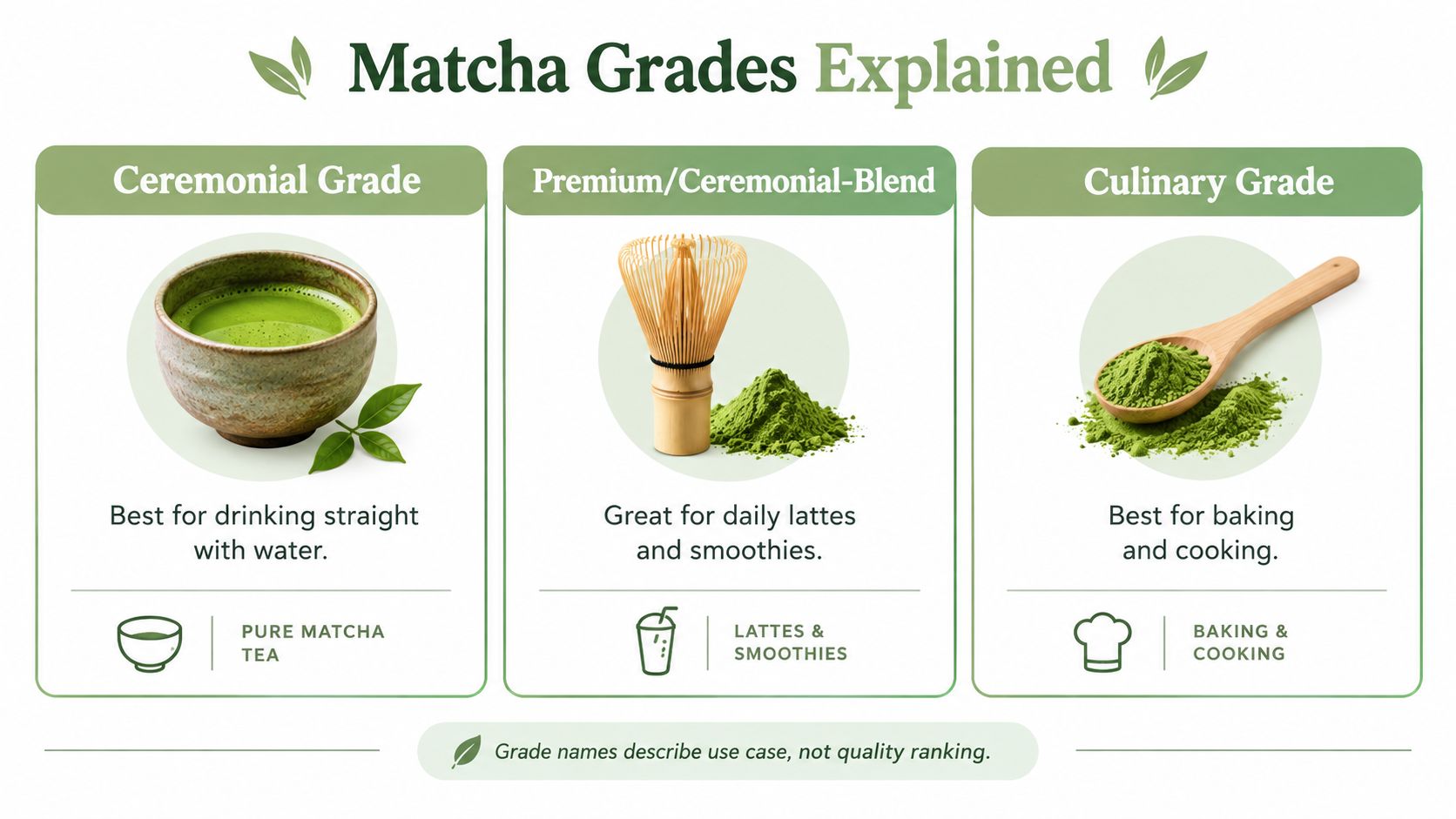
The practical distinction is simple: ceremonial is for drinking straight, premium is for flexible daily use, and culinary is for cooking and baking. Pep Tea's guide to different matcha grades is a useful reference when a product page uses several overlapping grade terms.
Don't pay for a high-grade powder because the label sounds luxurious. If the powder will disappear into a sweetened iced latte or a batch of baked goods, culinary or premium matcha can be the more sensible order.
Matching the Grade to Your Cup, Latte, or Recipe
The right matcha becomes much easier to choose once you name the preparation. A plain whisked bowl rewards smoothness and balance. A latte needs enough flavour to remain noticeable through milk. Baking needs colour and resilience rather than delicate tasting notes.
| Use case | Ceremonial grade | Premium grade | Culinary grade |
|---|---|---|---|
| Whisked bowl with water | Best fit for a clean, direct taste | Suitable for an everyday bowl | Usually too assertive or coarse-tasting |
| Hot matcha latte | Excellent, but may be more than needed | Strong everyday choice | Suitable when milk or sweetener dominates |
| Iced matcha | Smooth and refined | Practical balance of flavour and value | Works well with fruit, syrup, or bold milk |
| Smoothie | Often unnecessary | Versatile option | Good for stronger fruit or protein blends |
| Baking and desserts | Usually wasteful | Useful for lighter recipes | Best fit for colour and pronounced tea flavour |
A ceremonial powder earns its price when you can taste it directly. It's the logical choice for a small bowl of matcha and water, where there's nowhere for bitterness or stale notes to hide. It can also suit a minimalist iced drink with little more than water and ice.
Premium grade is the useful compromise for people who alternate between bowls, lattes, and smoothies. You'll get flexibility without building your entire routine around a powder that should be consumed quickly and treated carefully.
Culinary grade often delivers the best cost per prepared serve for a café-style latte, especially if you use milk, fruit, cocoa, vanilla, or sweetener. A cheaper powder isn't better if it tastes unpleasant, but a high-grade powder isn't better if its character is buried under several other ingredients.
The honest trade-off: Premium doesn't automatically mean better. It means the powder may be better suited to a particular preparation.
Before you order, write down your likely use in one sentence. “I want a plain morning bowl” points towards ceremonial. “I want iced lattes and smoothies” points towards premium. “I'm baking and making flavoured drinks” points towards culinary.
The Australian Ordering Checklist Before You Check Out
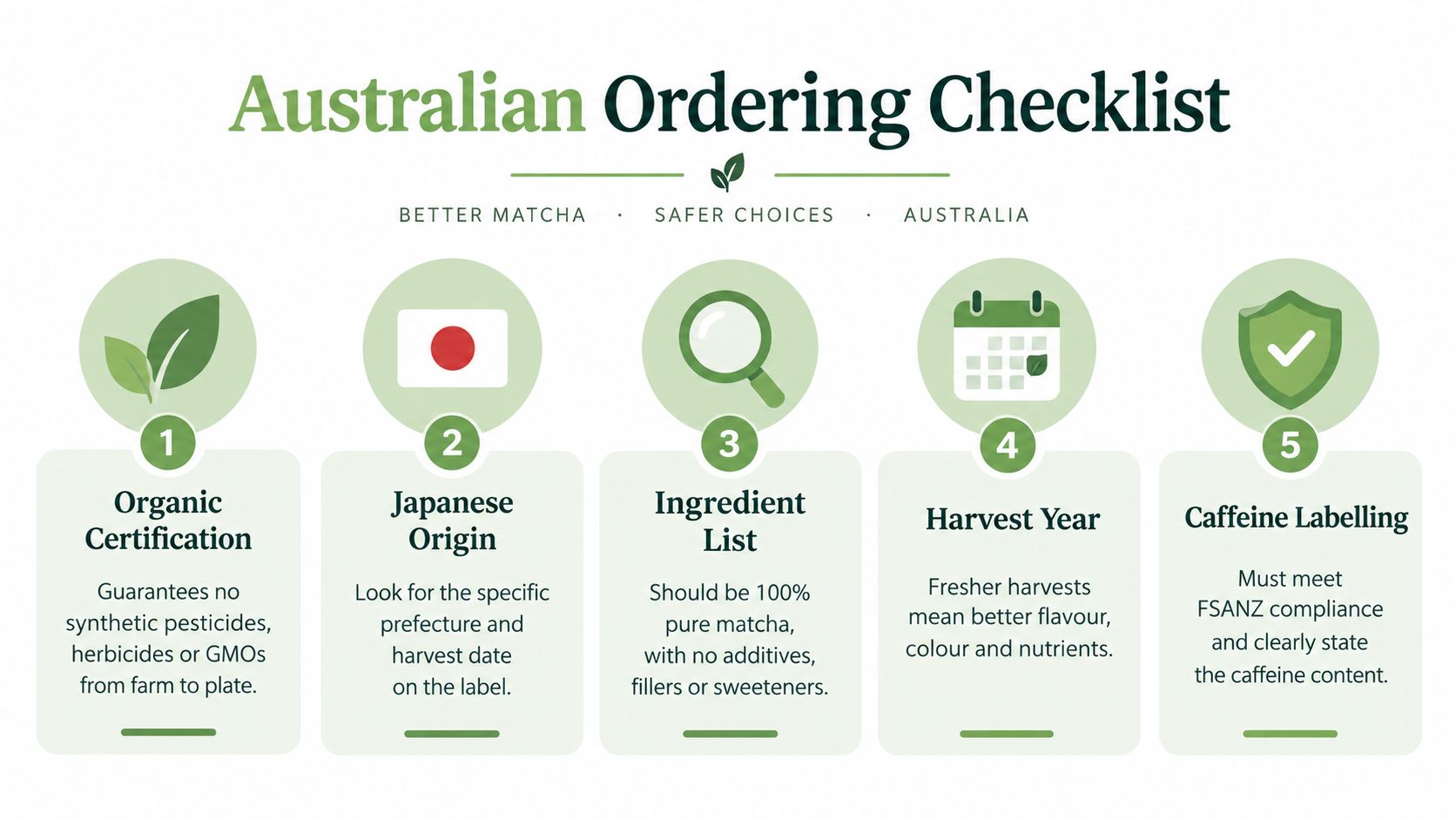
A good product page should answer your important questions without forcing you to search through vague marketing copy. Run these checks before adding matcha to your cart.
Check the product identity
Look for 100% matcha in the ingredient list. Genuine matcha is powdered tea, not a blend padded with sugar, starch, flavouring, or anti-caking ingredients. “Green tea powder” can describe a broader category, so check whether the seller explains the tea's origin and production clearly.
Japanese origin is a useful starting point, but ask for more detail where possible. A prefecture, harvest information, cultivar, or producer reference gives you a clearer picture than a generic country label. Tencha is the leaf material traditionally associated with matcha production, whereas ordinary green-tea powder may be made from a different raw material and processed for a different purpose.
Check certification and traceability
Organic certification can matter if organic purchasing is part of your priorities, but the word should be supported by identifiable certification information. Also look for a lot or batch reference, best-before information, and a seller who can explain how the product is packed and restocked.
Harvest details are helpful because matcha is a fresh powdered tea, not a pantry ingredient that improves with age. A product page doesn't need to make dramatic freshness promises. It should give you enough information to judge whether the powder has been sitting in an uncertain supply chain.
Check the format and delivery
A metal tin can protect a small quantity from light and repeated handling. A resealable pouch may suit a larger quantity if it has a reliable barrier and you transfer or seal it carefully. Sachets are convenient for travel and portion control, but usually offer less flexibility when you want to adjust the recipe.
Shipping matters in Australia's warmer conditions. Ask how the seller protects the product from prolonged heat, whether it ships promptly, and how the powder is sealed before dispatch. For cafés or wholesale buyers, affordable courier cost advice can help when comparing delivery arrangements, but freight cost should be assessed alongside packaging quality and stock reliability.
Use the Australian matcha tea powder range as one example of the type of product information worth comparing. Then calculate value by prepared serve, not tin price. A larger pack only saves money if you can finish it while the flavour remains enjoyable.
Caffeine Awareness and How to Read a Matcha Label
Matcha is a caffeinated food, so the serving size deserves attention. The entire powdered leaf is consumed, unlike a conventional tea infusion where water is separated from the leaves. That means the amount of powder in your bowl or latte, along with the recipe and drink size, influences your caffeine intake.
Australian sports-nutrition guidance gives a useful comparison: a 250-millilitre serving of green tea generally contains about 30–50 milligrams of caffeine according to the Australian Institute of Sport. A matcha drink isn't automatically equivalent because preparation can use different quantities of powder.
Understand the food-safety distinction
Food Standards Australia New Zealand prohibits the retail sale of solid or semi-solid foods containing 5% or more caffeine, equivalent to at least 50 milligrams per gram, and liquid products containing 1% or more caffeine, according to FSANZ guidance on caffeine powders and high-caffeine foods. These rules target highly concentrated caffeine powders and similar products.
Traditional tea products are treated differently because tea, coffee, and cocoa have an established history of food use. For someone ordering matcha, the practical distinction is clear: choose a clearly identified, food-grade tea powder, not a product marketed as a concentrated caffeine supplement.
FSANZ also states that caffeine must be declared in the ingredient statement when it is present as an ingredient. Read the serving guidance, preparation instructions, and ingredient list together. If a product page emphasises stimulant strength but says little about tea origin or serving size, choose another listing.
Healthdirect describes 400 milligrams of caffeine per day as generally safe for healthy adults, with individual circumstances affecting what is appropriate, as explained in its caffeine guidance. Count caffeine from coffee, tea, energy drinks, and chocolate across the day. If you're pregnant, breastfeeding, sensitive to caffeine, or taking relevant medicines, seek individual medical advice rather than relying on a general benchmark.
For a closer look at tea comparisons, Pep Tea's guide to caffeine content in green tea provides useful preparation context. The sensible approach is portion awareness, not chasing the highest number on a label.
Packaging, Storage, and Beginner Brewing Without the Guesswork
Your matcha can arrive in excellent condition and still disappoint if you leave the lid loose beside a sunny window. Light, oxygen, heat, and moisture are the enemies of fresh powdered tea. Store an unopened pack according to the seller's instructions, then keep an opened tin or pouch airtight, cool, and away from steam.
A tin is convenient for daily use and protects against light. A resealable pouch can work well for a larger quantity, provided you press out excess air and seal it properly. Single-serve sachets are useful for travel, work, and consistent portions, but they're less practical if you change the strength of your drink.
For most home drinkers, order a quantity you can use within roughly six to eight weeks of opening for peak flavour. Refrigeration can help, but avoid opening a cold container in a humid environment, where condensation may enter the powder. Let a sealed pack adjust before opening, and always use a dry spoon.
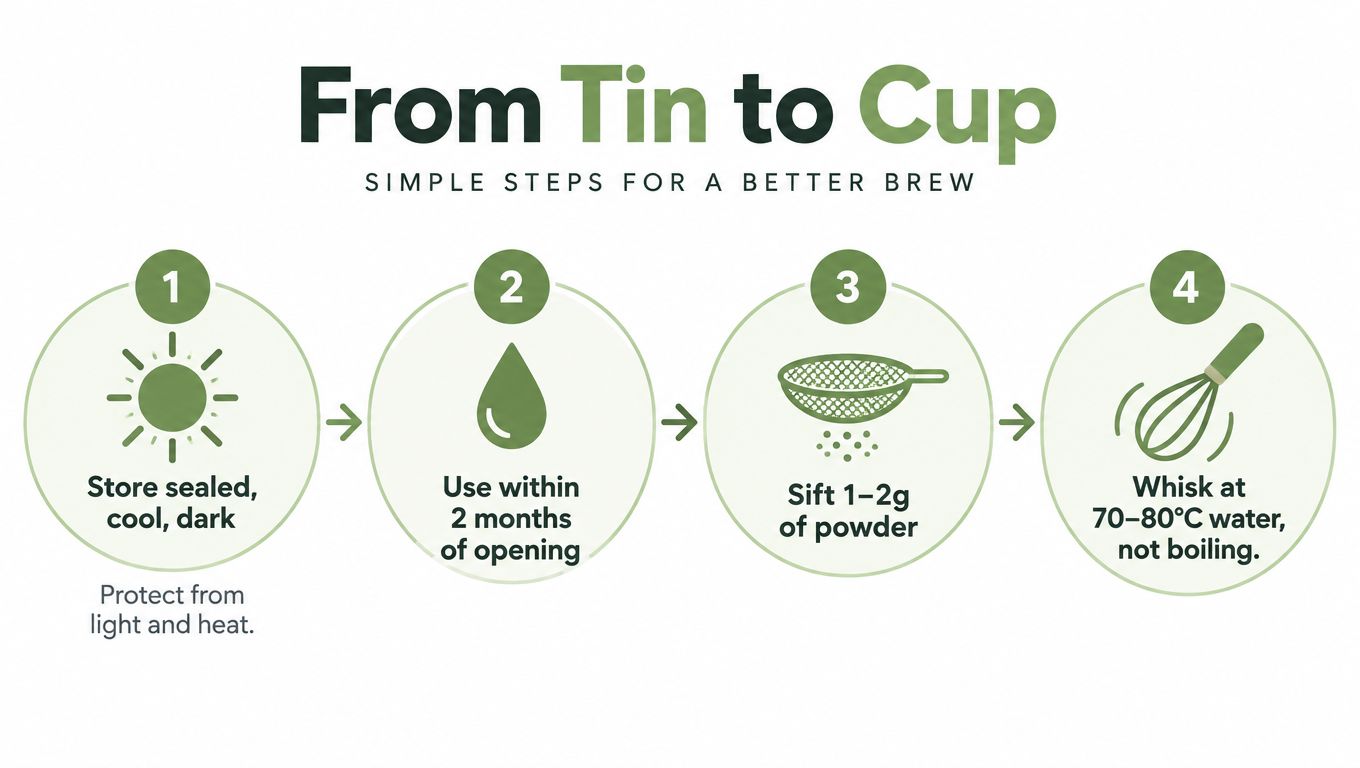
Three easy ways to prepare it
Whisked bowl: Sift around 1–2 grams of matcha into a bowl. Add a small amount of warm water, whisk into a smooth paste, then add more water and whisk briskly until lightly foamy. Water around 70–80°C is a forgiving starting point, because boiling water can make the drink taste harsh.
Hot latte: Sift the powder, mix it with a small amount of warm water, and whisk until smooth. Add warmed milk and adjust the strength to taste. A handheld frother works if you don't own a bamboo whisk.
Iced matcha: Make a concentrated paste with sifted powder and warm water first. Add cold water or milk, then pour over ice. Mixing the powder directly into a full glass of cold liquid often leaves clumps.
A bowl, fine sieve, bamboo whisk, and temperature-controlled kettle make the process easier, but you don't need a ceremonial equipment collection to start. The basics are accurate measuring, water that isn't boiling, and powder protected from moisture.
If you're also choosing lower-sugar drinks, the Australian Bureau of Statistics reports that 28.9% of Australians consumed sweetened beverages in 2023, while 23.8% consumed soft drinks or flavoured mineral waters, as shown in its food and nutrition data. An unsweetened matcha can fit a sugar-reduction routine, but the final sugar content still depends on the milk, syrup, or flavoured ingredients you add.
Putting It Together and Ordering With Confidence
Two questions settle most matcha purchases: what will you make, and how quickly will you use it?
For plain whisked tea, choose a well-documented ceremonial powder in a pack size you can finish while it stays fresh. Daily lattes and iced drinks suit premium grade. For baking, smoothies, and strongly flavoured recipes, culinary grade often gives better value because other ingredients carry the flavour.
Check the product page for ingredients, Japanese origin or a clearly stated source, grade, batch information, packaging, serving guidance, and delivery conditions. Compare the price per prepared serve, not only the tin price. Choose a larger pack only if your routine will use it before freshness falls.
With grade, pack size, and freshness aligned to your routine, the final check should take minutes, not become a research project.
Pep Tea supplies organic Japanese matcha powder for whisked bowls, lattes, smoothies, baking, and café use, alongside Australian-brewed sugar-free organic kombucha from the Hunter Valley, NSW. Visit Pep Tea to compare ceremonial and culinary-style options, then order the grade and pack size that match your actual use.
Matcha Milk Powder Guide: How to Use It Well
You've probably seen matcha milk powder on a café menu, in a supermarket sachet, or beside the oat milk at home and wondered what you are truly buying. Is it matcha with milk powder, or is it a sweetened latte mix with only a little tea? The answer matters because the ingredient list affects colour, flavour, texture, caffeine, sweetness, and how consistently the drink performs.
Australia's matcha market generated more than A$54 million in revenue in 2024 and is projected to exceed A$81 million by 2030, with powder holding a 55.08% share of revenue in 2024, according to Australian matcha latte powder market reporting. Matcha milk powder is already suited to cafés, retail shelves, home lattes, smoothies, and baking. The practical question is how to choose and use it without sacrificing the character of the tea.
What Matcha Milk Powder Actually Is
Matcha milk powder is a pre-blended drink mix. It usually combines finely ground Japanese green tea with dairy or plant-based milk solids, a sweetener, and functional ingredients that help the powder dissolve, remain stable, or produce foam.
That makes it different from pure matcha. Ceremonial-grade and culinary-grade matcha are generally sold as tea powder, so you add the milk, water, and sweetener separately. A traditional café matcha latte also starts with matcha whisked with water, followed by steamed milk. It isn't the same product as a pre-mixed latte powder.
| Format | Main Ingredients | Prep Method | Typical Use |
|---|---|---|---|
| Matcha milk powder | Matcha, milk solids, sweetener, stabilisers or creamer | Mix with hot or cold liquid, then froth | Fast home drinks, cafés, takeaway menus |
| Pure matcha | Stone-ground tea leaves | Sift and whisk with water, then add milk separately | Traditional tea, controlled lattes, baking |
| Café latte | Pure matcha, water, fresh dairy or plant milk | Whisk matcha, steam or froth milk | Made-to-order café service |
Read the ingredient list before the front label
Australian matcha milk powders commonly contain sugar, dextrose, maltodextrin, skim milk powder, non-dairy creamer, vegetable oil, emulsifiers, and stabilisers. These ingredients aren't automatically a problem. Manufacturers use them to improve shelf stability, reduce clumping, create body, and help the drink froth.
The trade-off is that every added ingredient changes the tea. Sugar can soften bitterness but may dominate delicate umami. Creamer can create a fuller mouthfeel, while dextrin and milk solids may make the drink appear paler or feel chalky if the powder is over-diluted. Excess heat can also affect colour and texture.
Use the guide to what matcha powder is to refresh the distinction between pure matcha and blended products. For a broader look at powdered green tea products, the VitzAi.com green tea powder review offers useful comparison context, although you should still judge any product by its own ingredient panel.
Start with three checks:
- Matcha position: Ingredients are listed from greatest to least amount. Matcha appearing near the beginning generally gives you more confidence that tea is central to the blend.
- Sweetener level: Decide whether you want a ready-sweetened latte or a product that leaves room for your own honey, sugar, or syrup.
- Milk source: Check whether the blend contains skim milk, lactose, plant milk, coconut ingredients, or a non-dairy creamer.
How to Prepare a Matcha Latte With Powder
A reliable drink starts with a repeatable dose. An Australian retail benchmark uses 4 g of powder with 200 mL of water for a latte-style preparation, as described in Australian matcha powder market coverage. For café testing, a practical starting point is 8 to 10 g of matcha milk powder per 180 to 200 mL of milk or water, then adjust for the brand's strength, sweetness, and cup size.
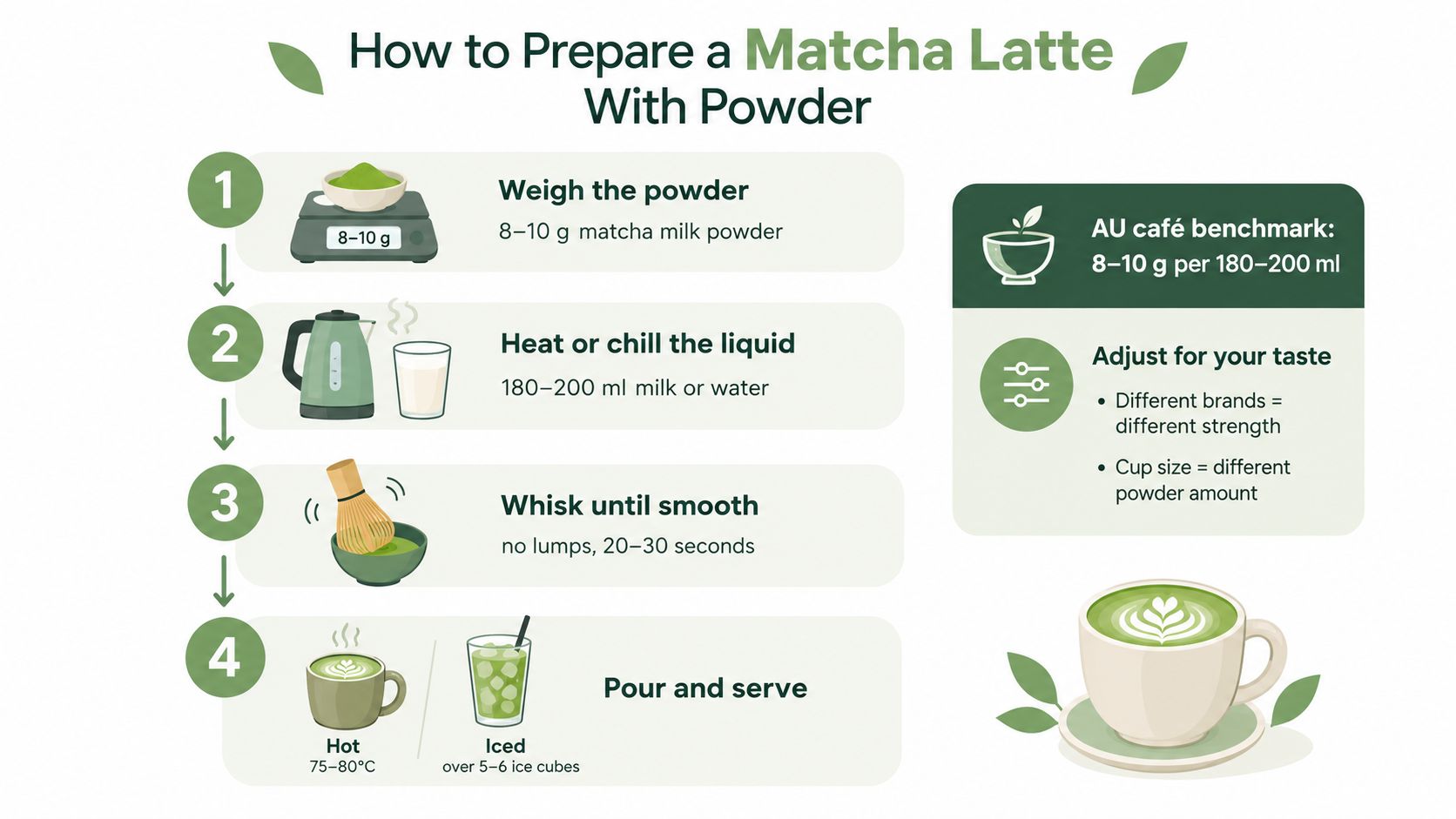
Hot preparation
- Measure the powder. Weigh it rather than relying on a heaped spoon. Consistent dosing matters behind a bar and makes home recipes easier to repeat.
- Add a small amount of liquid. Use warm water or milk first and stir it into a smooth paste. This prevents dry pockets from surviving beneath the surface.
- Add the remaining liquid gradually. Water around 75 to 80°C is a useful working range for a hot latte. Very hot liquid can scorch milk solids and make the tea taste harsh.
- Froth until glossy. A steam wand gives the smoothest microfoam, while a handheld frother works well at home. Stop once the drink looks even and lightly aerated.
A sealed jar can replace a whisk for the dissolving stage. Add the powder and liquid, leave enough room for movement, and shake firmly before pouring into a cup. If you're interested in beverage formulation beyond tea, this comparison of high-protein coffee for athletes is a useful reminder that powders need thorough mixing to avoid sediment and uneven texture.
Iced preparation
For an iced matcha latte, dissolve the powder in a small amount of warm water first. Pour that concentrate over cold milk, stir or shake until smooth, and then build the drink over ice. Adding powder directly to cold milk often produces floating specks and stubborn clumps.
Service rule: Taste the liquid before adding ice. If the drink already seems weak, ice will make the problem more obvious.
A quick calibration method is to make one sample at your intended dose and compare its intensity with a single espresso-strength drink. You're not trying to make matcha taste like coffee. You're checking whether the tea still carries through the milk.
For more traditional whisking guidance, see how to make matcha tea from powder.
Choosing the Right Milk for Hot and Iced Drinks
The right milk depends on the drink you want, the equipment available, and the customer you're serving. No single milk performs perfectly in every matcha milk powder recipe.
Full-cream dairy gives a rounded texture and carries sweetness well. It's a dependable choice for a classic hot latte, although low-fat dairy can produce a thinner drink and may make the powder's texture more noticeable.
Oat milk is popular in café service because its mild flavour allows matcha to remain present while its texture usually stretches well under steam. Different brands behave differently, so test the exact product you plan to serve rather than assuming every oat milk will foam identically.
Soy milk can provide substantial body and a stable foam, especially for customers seeking a more protein-rich plant option. Its distinctive flavour can either complement or compete with grassy matcha.
Almond milk produces a lighter drink with a nutty note, but its foam can be less durable. Coconut milk brings a clear tropical character and works especially well with vanilla, mango, lime, or ginger. A coconut-based matcha can be explored through Pep Tea's matcha coconut milk recipe.
| Milk Type | Texture & Body | Froth Stability | Flavour Carry | AU Cost Note |
|---|---|---|---|---|
| Full-cream dairy | Rich and rounded | Reliable when steamed correctly | Carries sweetness and umami | Often a practical café baseline |
| Oat | Creamy and smooth | Generally strong with barista-style products | Mild, allowing matcha to lead | Compare brands before costing a menu |
| Soy | Full and protein-driven | Can produce good foam | More distinctive than oat | Useful for a protein-conscious audience |
| Almond | Light and clean | Usually less durable | Nutty and delicate | Suits lighter drinks and iced formats |
| Coconut | Thick or silky, depending on product | Variable | Tropical and noticeable | Best positioned as a flavoured variation |
Cold drinks need more control
Cold milk dissolves powder more slowly than warm liquid. Make a smooth concentrate first, then add the chilled milk and ice. Avoid filling a glass with ice before mixing, because the drink becomes harder to stir and the extra dilution can flatten the colour.
Customers comparing dairy options may also find this practical guide to calories in one percent milk useful. For cafés, the important point is to list the milk clearly and cost each version separately. Milk choice affects flavour, foam, portion size, and ingredient cost.
Recipe Variations Beyond the Standard Latte
Matcha milk powder works beyond the familiar hot takeaway cup. Because the blend already contains milk solids and sweetener, it can be convenient in recipes where you want tea flavour and body in one scoop.
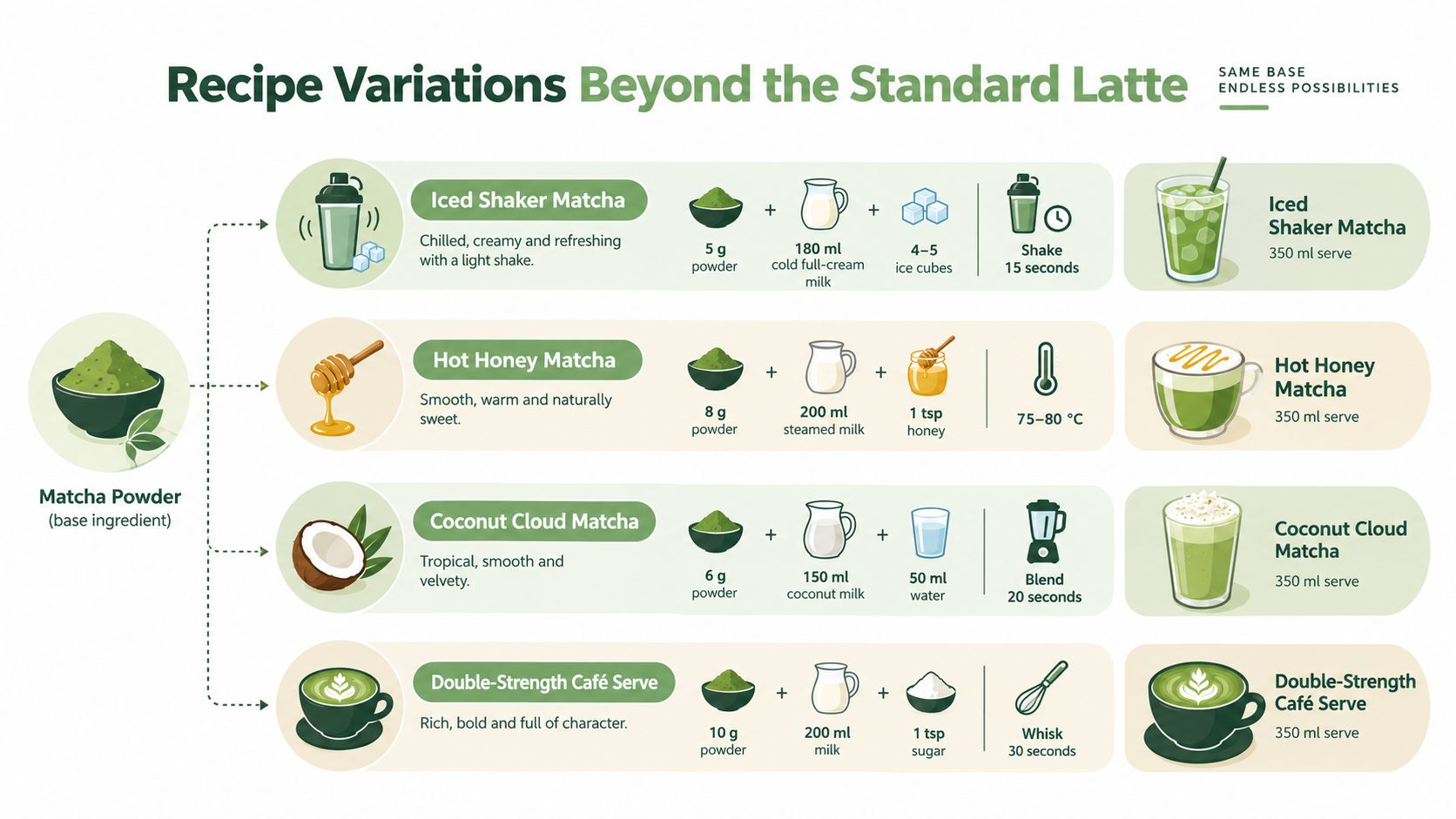
Iced shaker matcha
For a 350 mL serve, combine 5 g matcha milk powder, 180 mL cold full-cream or oat milk, and 60 mL chilled water in a sealed shaker. Add ice and shake hard for 15 seconds. The movement creates a light foam without a steam wand.
Use oat milk for a softer café-style texture, or full-cream dairy for a sweeter, fuller result. If your blend is already sweetened, taste before adding syrup.
Breakfast smoothie
Blend 6 g powder, 150 mL oat milk, one frozen banana, and a spoon of cashew butter. The banana masks some of the grassy character that can appear in a less refined blend, while cashew butter adds richness.
This is a good place for culinary-grade matcha or a latte blend that you wouldn't necessarily drink with water. Keep the mixture cold so the colour stays fresh and the banana remains the dominant texture.
Matcha baking mix
For cookies or a single-serve mug cake, combine 8 g matcha milk powder with 15 g sugar as part of the dry ingredients. Replace a small portion of the flour with the powder and add 20 mL extra milk to protect the crumb from drying.
Check the blend before adding sugar. A pre-sweetened powder may need little or none, particularly in a café recipe where toppings or icing add sweetness later.
Honey and ginger matcha
Warm 200 mL full-cream milk with a slice of bruised ginger. Mix 4 g powder with a small amount of warm water, then add the infused milk and 10 mL honey. Keep the milk warm rather than boiling so the drink stays smooth.
For a plant-based version, oat milk provides gentle sweetness, while coconut milk gives the drink a more obvious tropical direction. Ginger, honey, and coconut can each become strong flavours, so use them as accents rather than allowing them to hide the matcha completely.
Substitutions, Storage, and Shelf Life
A café can run out of a blend without removing matcha from the menu, but the substitute needs to be written down and tested. For one serve, replace 8 g matcha milk powder with 4 g culinary-grade pure matcha, 150 mL milk, 2 g skim milk powder, and 4 g sugar. This recreates some of the body and sweetness, although it won't reproduce the original blend exactly.
At home, a screw-top jar is a practical alternative to a steam wand. Shake the liquid and powder for 20 seconds, open the lid carefully, and pour immediately. Don't use a jar with a damaged seal or fill it completely, because the mixture needs room to move.
| Scenario | Storage Time | Container | Emergency Substitute per Serve |
|---|---|---|---|
| Unopened tin | Up to 12 months from production | Sealed tin, below 25°C, away from light | Use a tested pure-matcha blend if required |
| Opened pouch | 4 to 6 weeks once sealed | Airtight container with desiccant | Pure matcha, milk powder, and sugar formula |
| Café service jar | Rotate using FIFO | Labelled 500 g jar with tight lid | Pre-weighed substitute recipe |
| Home working supply | Use promptly after opening | Original pouch inside an airtight container | Pure matcha prepared separately |
Manage stock before it becomes a menu problem
Australia's Japanese green tea imports reached 195,319 kilograms between January and August 2025, a 131% year-on-year increase, according to reporting on Australia's matcha supply and import growth. That growing demand sits alongside shortages that began in 2024 and worsened through 2025, with tighter supply and record import costs affecting cafés, as reported by the ABC's coverage of matcha shortages and prices.
For a café, sensible controls include:
- Hold a safety stock: Keep roughly four weeks of cover where the product is central to the menu.
- Qualify another supplier: Test a second blend before the first supplier becomes unavailable.
- Avoid single-lane dependence: A product that relies on one import route creates more exposure during shortages.
- Use FIFO: Label the open date and move older stock forward.
- Record the recipe: Staff need the dose, milk volume, temperature, and substitution formula in one place.
Mixed tea products can also fall under different Australian biosecurity conditions. The Australian Government's plant product import guidance explains that tea made purely from Camellia sinensis is considered minimal biosecurity risk, while mixed products may require different conditions. The government also advises that plant-origin tea materials must be thoroughly dried before entry, which matters for blends containing other ingredients.
Why Some Matcha Milk Powders Disappoint
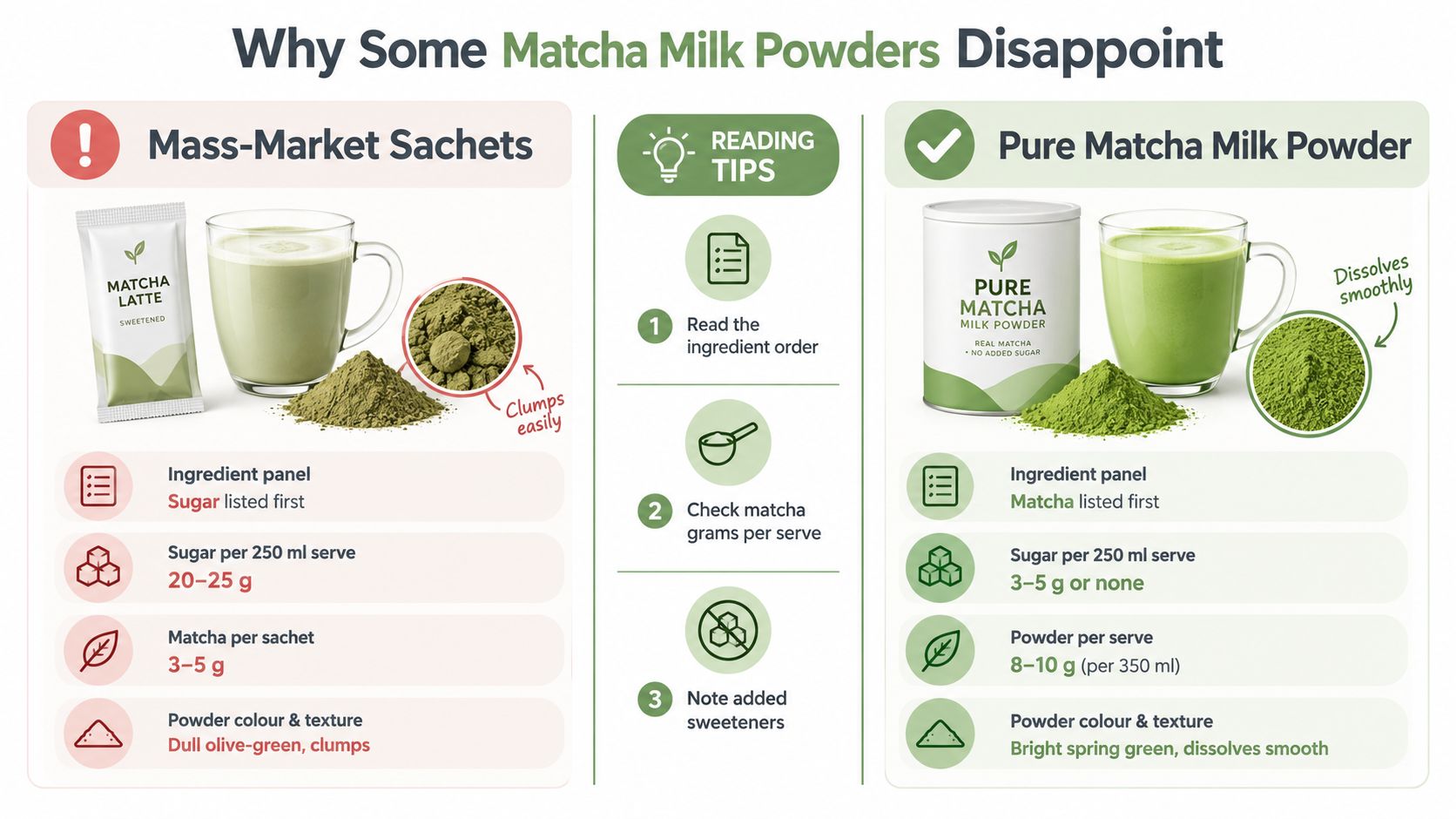
A sweeter powder isn't automatically a better shortcut. Many mass-market sachets are designed to taste immediately pleasant, so sugar, maltodextrin, dextrin, vegetable fat creamer, or other milk-style ingredients can dominate the blend before the tea has a chance to show its colour and savoury character.
The ingredient panel tells you more than the packaging. Some products list sugar or maltodextrin first, followed by creamer and only a small amount of matcha, sometimes below 10%. That can produce a muted olive-green colour, a powdery finish, and a latte that tastes more like sweetened milk than tea.
What the extras change
Sugar reduces perceived bitterness but can make it difficult to control sweetness across hot, iced, and blended drinks. Dextrin can improve powder handling, yet too much may leave a chalky texture. Creaming agents add body, but they can leave a film on cups and make commercial frothers harder to clean.
The tea itself may also feel flat when milk solids coat the palate. You get thickness without much umami, and the bright green colour expected from matcha becomes less convincing.
Label test: Look for matcha high in the ingredient order, check the grams of tea per serve, and identify every added sweetener before you judge value.
Unflavoured blends built around a higher proportion of matcha can give a more defensible café drink, while pure ceremonial-grade matcha gives you maximum control over dosing and sweetness. The trade-off is extra preparation. You'll need to weigh, sift, whisk, and add the milk separately, but you can adjust the drink for each customer and recipe.
For a café, also watch the cleaning burden. A powder that clumps or leaves residue may slow service even when its purchase price appears attractive. A product that dissolves cleanly, tastes balanced, and has a written recipe can cost less operationally than a cheaper blend that needs repeated reworking.
Practical Takeaways and Where to Go Next
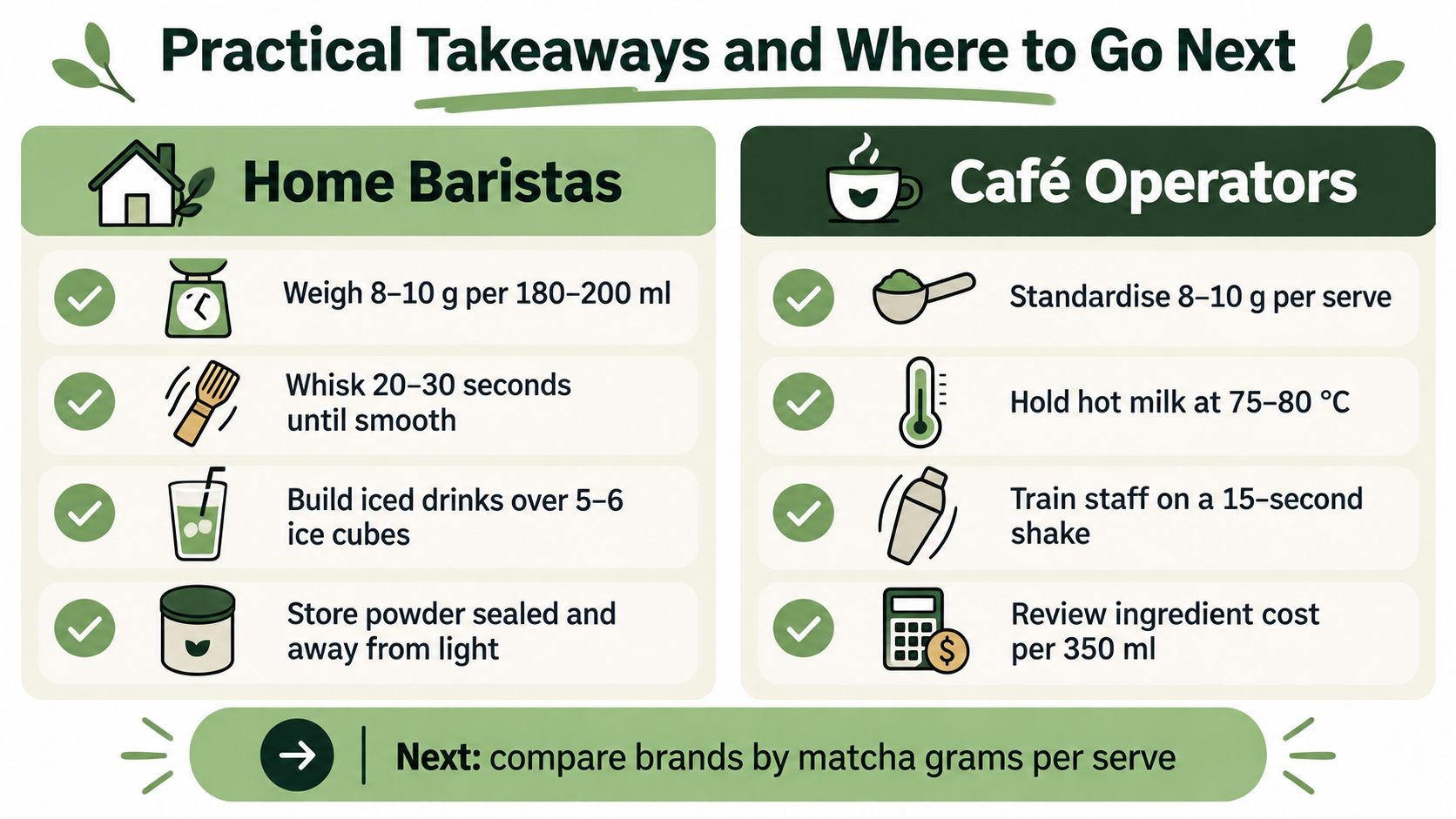
The best matcha milk powder is the one that suits the drink you're making. A sweetened blend may be convenient for a quick iced latte, while pure matcha is better when you want control over tea intensity, milk choice, and sugar. Cafés need to judge both sensory quality and service performance.
For home baristas
- Weigh the powder: Start with the product's recommended serve, then adjust by taste rather than adding sweetness automatically.
- Use filtered water below 80°C: This helps protect the texture and reduces the harshness associated with overheated liquid.
- Sift before mixing: Sifting breaks up compacted powder and makes a smoother paste.
- Build iced drinks carefully: Mix the concentrate before adding milk and ice.
- Taste it plain first: Assess bitterness, sweetness, and tea strength before adding honey or syrup.
- Store it well: Keep the powder sealed, dry, and away from light.
For café operators
Standardise the recipe by cup size and train staff to use the same dose, liquid volume, and frothing method. Record the cost of the powder, chosen milk, sweetener, and any toppings before setting the menu price.
Keep stock organised with FIFO rotation and a supply buffer. Review the ingredient panel whenever you change supplier, because a substitution can alter sweetness, colour, foam, and customer expectations even when the name on the menu stays the same.
Australia's matcha audience includes traditional tea drinkers, latte customers, home cooks, and people looking for alternatives to heavily sweetened drinks. A clear ingredient list and a consistent recipe help you serve all of them honestly.
If you're ready to compare organic, single-origin, and sugar-free matcha options for home or café use, explore the range from Pep Tea and choose a format that gives you the level of sweetness and control you want.
Pep Tea offers organic Japanese matcha in ceremonial and culinary grades, along with guidance for hot lattes, iced drinks, and baking. Visit Pep Tea to compare matcha options and find a practical fit for your pantry or café menu.
How to Store Matcha Tea and Keep It Fresh

You open the matcha tin for your morning latte and notice the colour has shifted from vivid green to something duller. The aroma that once smelled sweet and grassy now reminds you of hay, even though the powder is still within its printed date. In an Australian kitchen, that change can happen quickly when matcha sits beside a toaster, on a sunny shelf, or in a humid cupboard.
Learning how to store matcha tea isn't about treating a pantry like a laboratory. It's about controlling air, light, heat and moisture, then building a routine that prevents condensation and repeated exposure. Store it properly and your matcha will keep its fresh aroma, smooth flavour and vibrant colour for far longer.
Why Your Matcha Is Going Off Faster Than You Think
The first sign is often subtle. You whisk your usual morning bowl, but the fragrance is flat and the flavour tastes more like cut grass than fresh, sweet greenery. The tin was sealed after yesterday's use, so you assume the problem must be the matcha itself.
Usually, the problem is exposure. Matcha is made by grinding tea leaves into an extremely fine powder, which means oxygen can reach a much larger exposed surface than it can with intact loose leaves. Its delicate colour, aroma and flavour are therefore vulnerable every time you open the container. You can learn more about that transformation in this guide to how matcha tea is made.
Australian conditions make careless storage harder to forgive. A warm summer kitchen, a humid apartment near the coast and a cupboard above the oven all expose matcha to conditions that shorten its best flavour window. Frequent fridge opening creates another issue, because temperature changes can encourage condensation inside the packaging.
Freshness isn't the same as safety
Matcha may remain usable after its best sensory qualities have faded. Australian guidance commonly recommends using opened matcha within 2 to 3 months, because flavour and nutritional benefits peak early and decline with air, light and moisture exposure. Unopened product is often kept for up to 12 months, although some suppliers recommend 6 to 12 months for best quality. (Australian Matcha Society guidance)
That distinction matters. A powder can be technically within its storage window while its aroma has already disappeared, its colour has dulled and its flavour has become bitter or bland. Treat the printed date as a safety and quality reference, not permission to leave an opened tin untouched for months.
Practical rule: If the colour, aroma and flavour have clearly deteriorated, better storage won't restore them. Use fresher matcha next time and protect it from the moment you open it.
The Four Enemies of Fresh Matcha
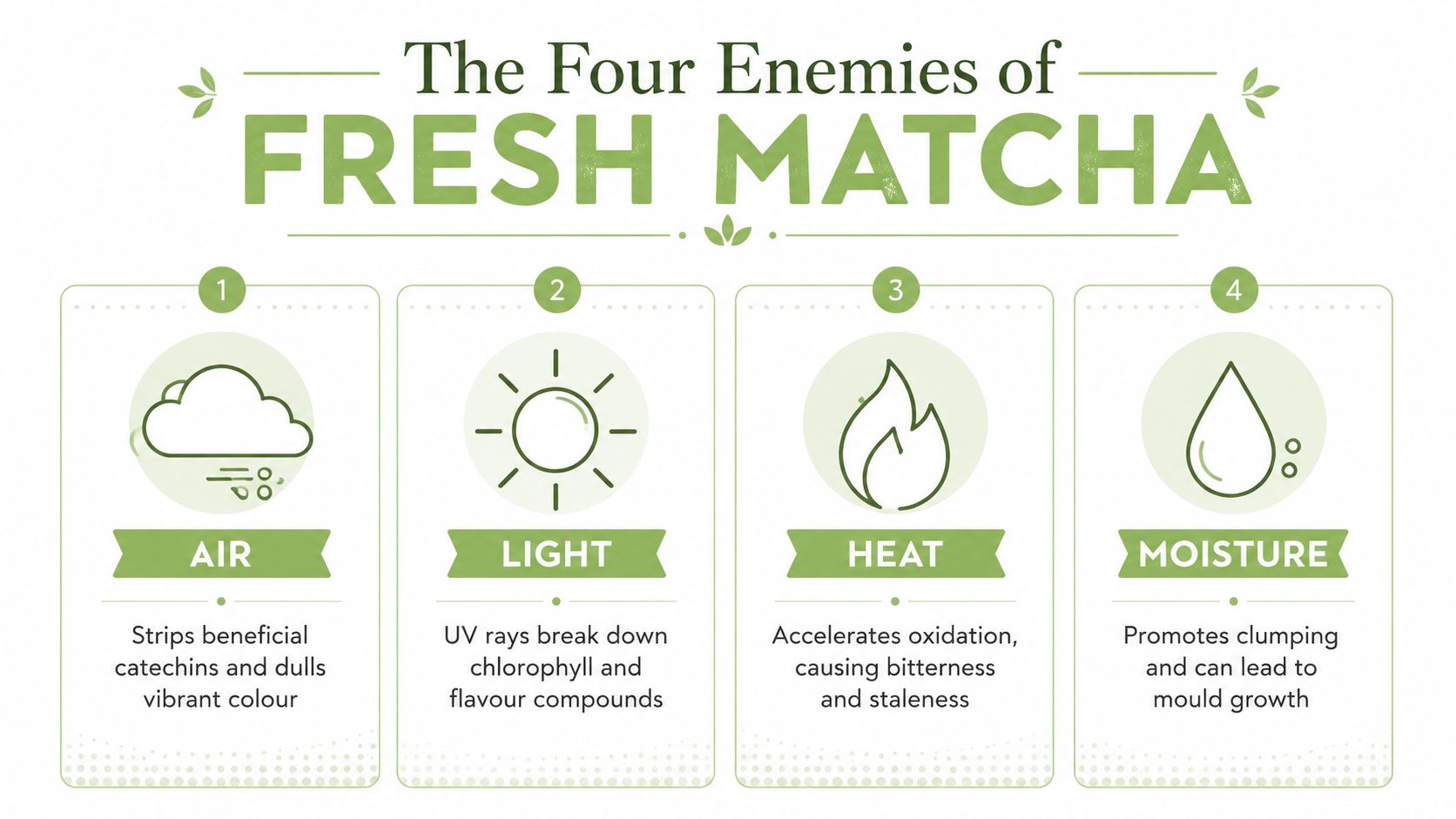
Audit your current storage setup against four causes of deterioration. Fix the biggest exposure first, then make the rest part of your normal kitchen routine.
Air
Oxygen gradually dulls matcha's colour, aroma and flavour. A pouch that contains a large pocket of air is already working against you.
Spot it: The powder looks less vibrant around the surface or tastes flat despite being tightly closed.
Counter it: Squeeze excess air from a resealable pouch before closing it, or transfer the powder to the smallest suitable airtight container. Australian storage advice specifically recommends smaller packs and limiting repeated air exposure. (Kenkō Tea storage guidance)
Light
Direct sunlight and bright kitchen lighting can fade the green colour and weaken the fresh vegetal character.
Spot it: Your container sits on an open shelf, windowsill or bench in full daylight.
Counter it: Use an opaque tin or place the sealed container inside a dark cupboard. A clear canister may look attractive, but it's a poor choice for long-term matcha storage.
Heat
Heat accelerates quality loss. Keep matcha away from ovens, kettles, stovetops, dishwashers and other warm appliances. Australian guidance identifies 0°C to 20°C as an ideal storage band and recommends relative humidity at or below 60%. (Kenkō Tea storage guidance)
Spot it: The tin feels warm, or it lives in a cupboard above an appliance.
Counter it: Move it to the coolest dark cupboard available, or use the fridge when your home is consistently hot or humid.
Moisture
Humidity causes clumping and can compromise the powder's quality. Steam from a kettle, a damp teaspoon or condensation from a cold container can introduce enough moisture to change the texture.
Spot it: The matcha forms stubborn lumps or feels damp rather than silky.
Counter it: Use a completely dry spoon, close the container immediately and never open chilled matcha until it has returned to room temperature.
Start with air and heat, then eliminate light and moisture. A perfect container won't compensate for a hot shelf or a wet spoon.
Pantry, Fridge or Freezer Where Should Matcha Live
There isn't one universal storage zone. The right choice depends on your household temperature, humidity and how quickly you use the powder.
| Location | Ideal Temperature | Typical Shelf Life | Best For |
|---|---|---|---|
| Pantry | Around 25°C or cooler | Opened matcha is best used within 2 to 3 months | Daily drinkers with a genuinely cool, dark cupboard |
| Fridge | Cool and stable, within the recommended 0°C to 20°C band | Opened matcha is commonly used within 2 to 3 months for best quality | Hot or humid Australian homes |
| Freezer | Frozen and consistently sealed | Some Australian guidance allows unopened matcha to be kept for longer, but quality depends on avoiding moisture and temperature swings | Large, sealed reserves or café stock |
The pantry is perfectly practical when it stays cool, dry and dark. Store the matcha in its airtight opaque packaging, away from direct light and heat sources. An Australian tea guide recommends around 25°C or cooler, with refrigeration or desiccants reserved for humid conditions. (Tavalon Australia storage advice)
The fridge is the better choice for a hot Australian summer or a humid apartment. Put the sealed container inside a protective airtight food container and keep it away from strong-smelling foods. Don't open it straight from the fridge. Let it reach room temperature first, otherwise warm humid air can condense on the powder.
Freezing is a specialist option, not my default recommendation for a household tin. Use it only when the matcha is sealed thoroughly and you won't keep moving it between frozen and room-temperature storage. A freezer can extend storage for a bulk reserve, but condensation during thawing can undo the benefit.
My recommendation: Daily users should choose a cool dark pantry if it stays stable. If summer heat or humidity makes that unreliable, use the fridge consistently. Occasional users should buy smaller packs rather than relying on long-term freezing.
Choosing the Right Container and Packaging
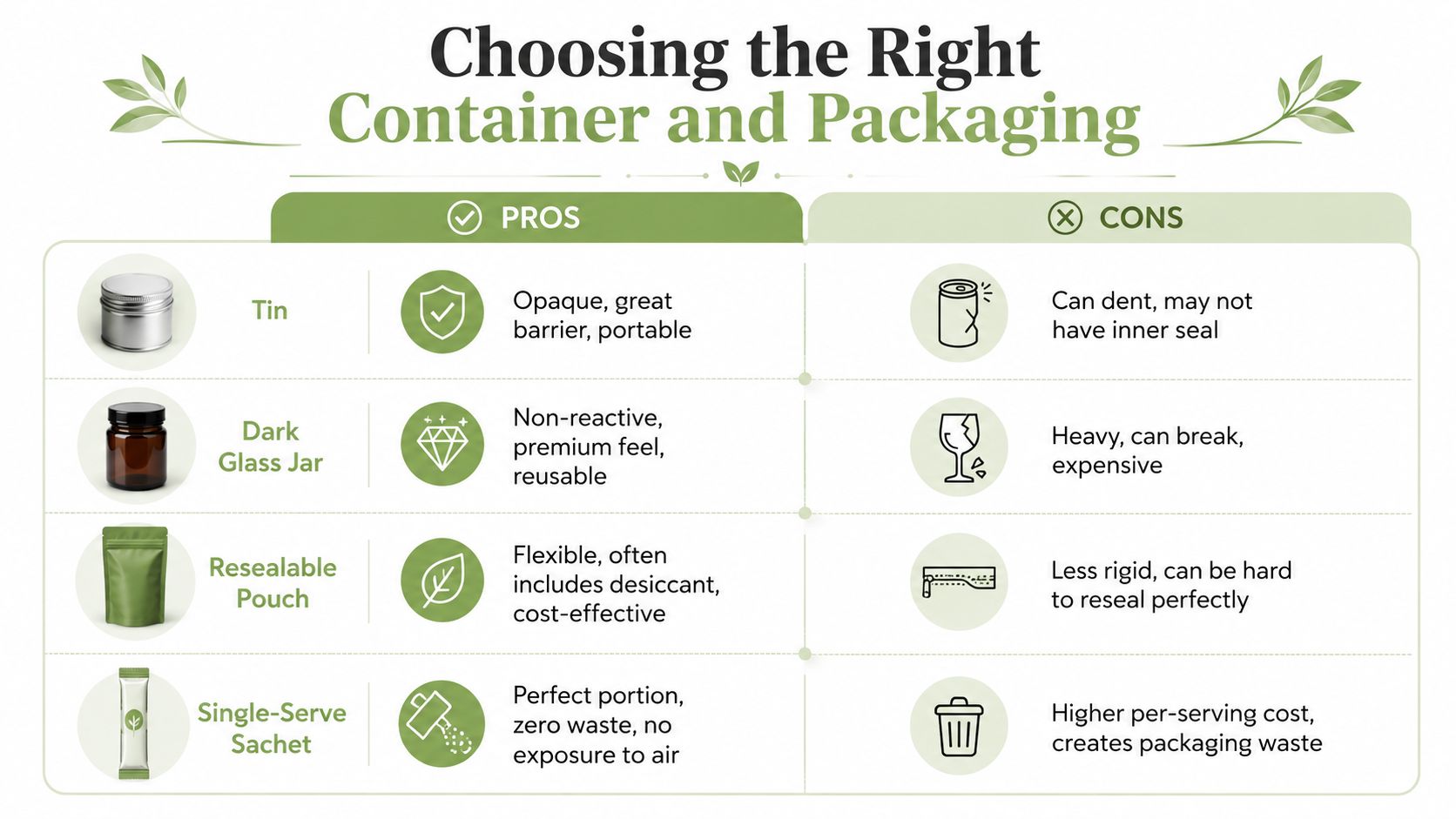
The best matcha container is airtight, opaque, clean and appropriately sized. Don't choose a clear decorative jar because it looks good on the bench. Light and excess air matter more than presentation.
Tins for regular home use
A metal tin is my first choice for a daily drinker. It blocks light, travels well and usually gives you a strong barrier against the kitchen environment. Look for a tight inner seal, because a lid that merely rests on the rim isn't enough.
The weakness is practical. Tins can dent, and some have no reliable inner seal. Keep the original pouch inside the tin if it closes securely, or use a food-safe airtight insert that doesn't leave a large air gap.
Dark glass jars for careful storage
Dark glass is non-reactive, reusable and attractive on a kitchen shelf, provided it blocks light effectively. It's heavier than a tin and can break, so it suits a stationary home setup better than a café service area.
Fill the jar sensibly rather than leaving a large empty space above the powder. Wash it thoroughly, dry it completely and never transfer matcha into a container that retains steam or detergent odour.
Resealable pouches and sachets
Resealable pouches are flexible and efficient, especially when they include a suitable barrier layer or desiccant. Squeeze excess air out before resealing, and don't assume a zip closure remains perfect forever. For a useful packaging example, compare the format of this matcha green tea pouch 40g.
Single-serve sachets offer excellent portion control. Each serving remains protected until use, but the packaging creates more waste and can cost more per serving. They make sense for cafés with inconsistent demand, travel kits and hospitality service where an opened bulk pouch would sit exposed.
For more container-specific guidance, see this practical resource on a matcha storage container. For cafés and retail, vacuum-sealed or nitrogen-flushed pouches can reduce oxygen exposure before opening, but staff still need a disciplined system after the seal breaks.
Pack Sizes, Rotation and Everyday Habits That Matter Most
A better container helps. Smaller packs and disciplined rotation help more. Matcha begins losing quality as soon as the seal is broken, so a quantity that gets used promptly is a smarter purchase than a large bargain pack that remains open through changing weather.
Australian guidance recommends smaller packs, with about 50 g suggested for people who drink matcha daily to reduce repeated air exposure. Some Australian advice also recommends consuming opened matcha within about 2 months. (Kenkō Tea storage guidance)
Use a simple FIFO system
Cafés should mark the opening date on every pouch or tin and use first in, first out rotation. Put the oldest opened stock at the front of the shelf, not behind a newer delivery. Households can use the same approach by writing the opening date on masking tape and keeping one active pack at a time.
Don't bulk-buy simply because a sale makes the larger size appear economical. The saving disappears when the powder sits open, loses its aroma and forces you to compromise on flavour in lattes, baking or ceremonial preparation.
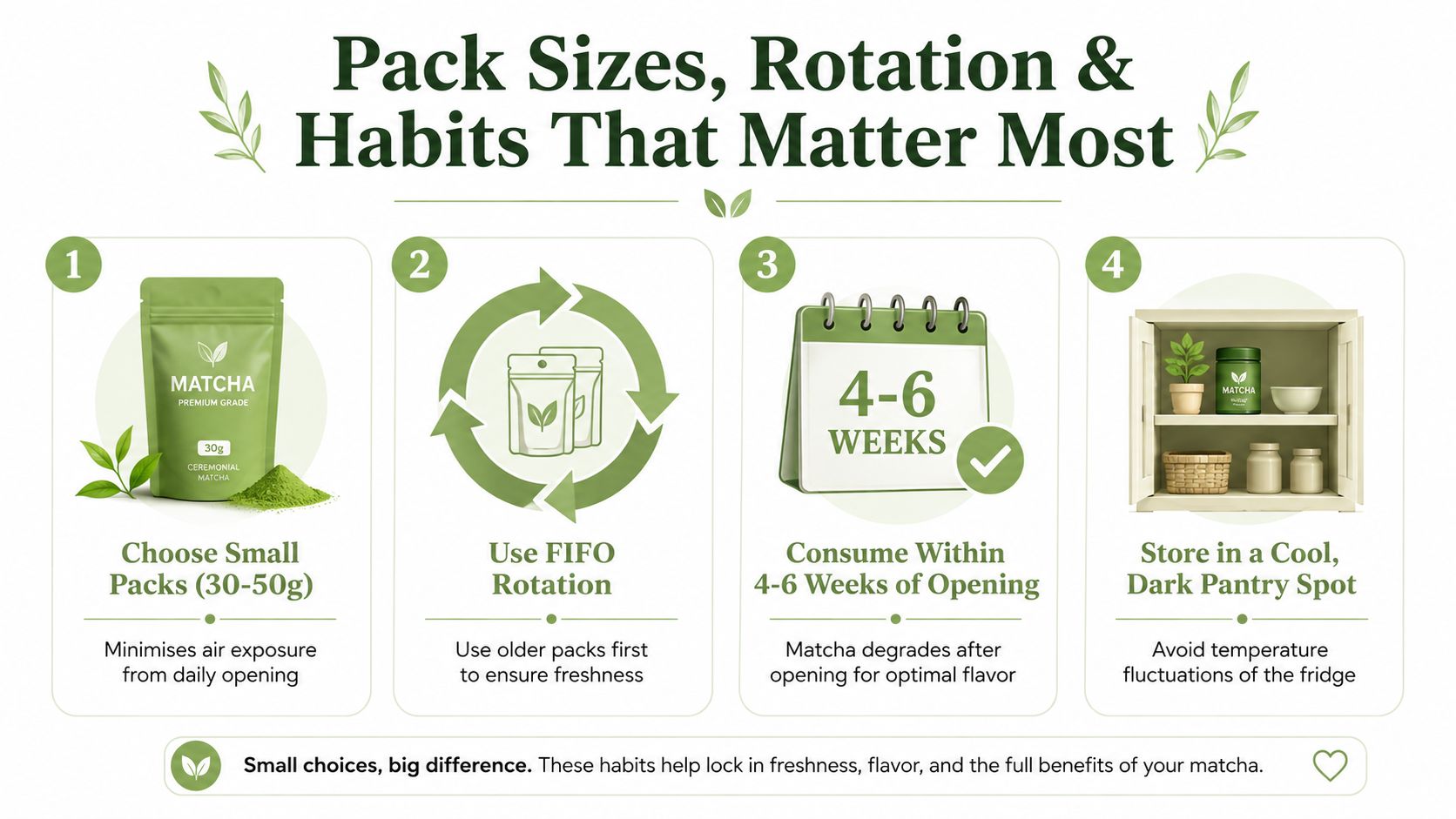
A useful routine is to keep a small working amount in a daily tin while the main pack stays sealed. Refill that tin only when necessary, and return the main pack to its cool storage immediately. This reduces the number of times you expose the full supply to air.
For more detail on quality windows and handling, use this guide to matcha shelf life. The exact container matters less than opening only what you can use promptly.
Troubleshooting Common Matcha Storage Mistakes
Most storage failures leave visible or aromatic clues. Use this checklist before deciding whether your matcha needs replacing.
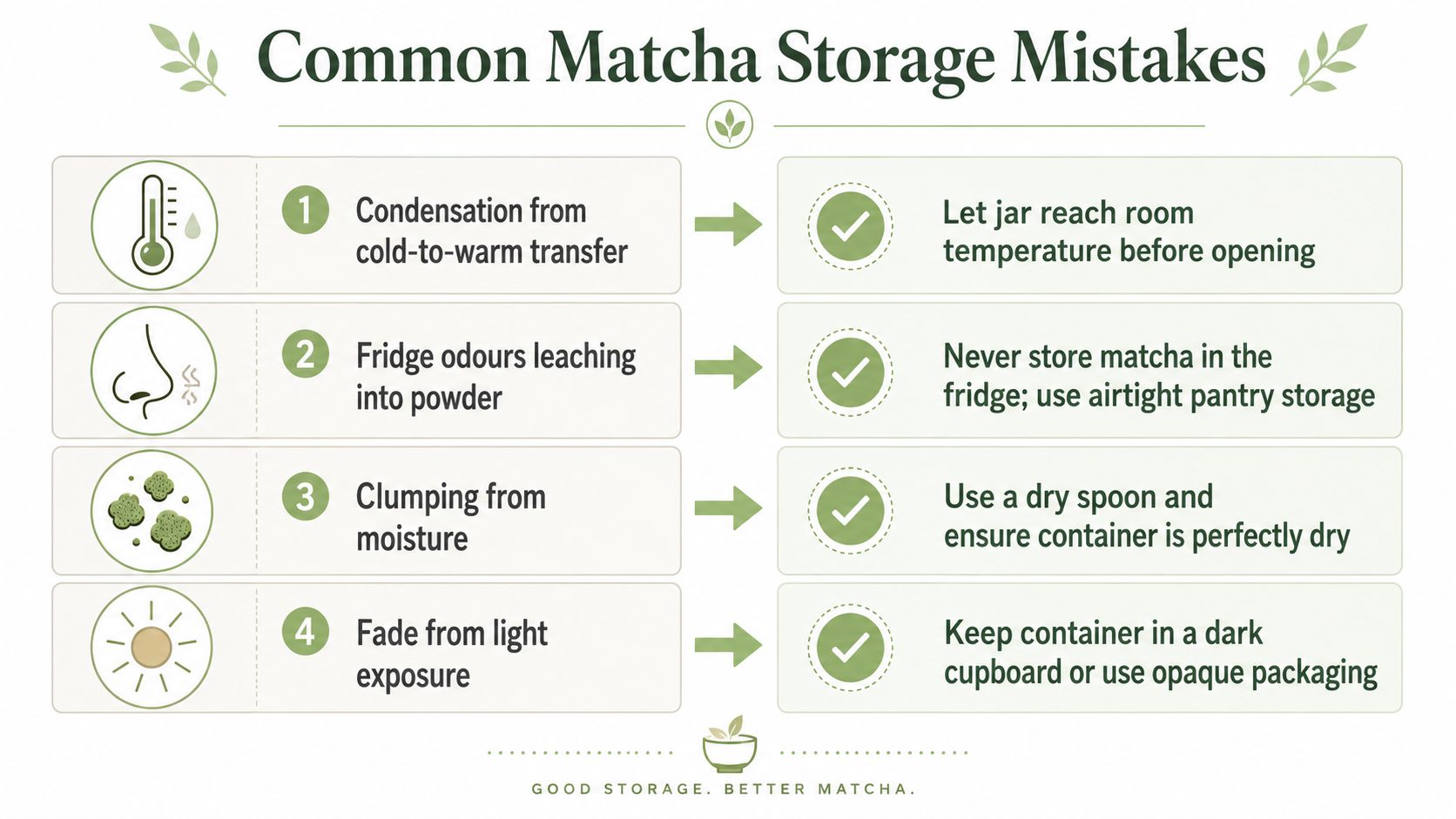
Condensation after refrigeration
If you open a cold tin in warm kitchen air, moisture can form inside. That moisture lands directly on the powder and creates clumps.
Fix: Keep the container sealed while it returns to room temperature. Don't speed up the process by opening the lid on the bench.
Fridge odours in the powder
Matcha can pick up nearby food smells, particularly when packaging isn't fully airtight.
Fix: Store it inside a second airtight food container and keep it away from strongly scented foods. If the aroma has already changed to garlic, onion or another fridge smell, the container has failed at its job.
Clumping from moisture
Small soft lumps may come from a damp spoon or steam near the kettle. Hard, persistent clumps suggest more serious moisture exposure.
Fix: Use a dry spoon every time, ensure the container is completely dry and keep the lid off only while measuring. Never scoop matcha over a steaming mug or saucepan.
Faded colour
Fresh matcha should look lively and green. A dull green, greyish or brown appearance, paired with a flat or stale aroma, indicates oxidation and quality loss.
Fix: Don't try to rescue it with extra powder or sweetener. Replace it, then protect the new pack from light, air, heat and moisture from day one.
A Simple Daily Storage Routine You Can Stick To
Good storage should be easy enough to follow on a busy weekday. This routine takes only a few minutes to organise and removes most of the avoidable exposure from daily use.
Set up the main pack
Choose a small opaque tin for the amount you'll use regularly. On a quiet day, portion enough matcha for several daily preparations into that working tin, then close the main pouch firmly and return it to its chosen storage zone.
If your main supply lives in the fridge, keep it sealed while it warms before opening. Don't keep moving it between the fridge and pantry. Stable conditions are safer than constant temperature changes.
Handle the powder properly
Before scooping, wipe the teaspoon completely dry. A clean, dry bamboo scoop or teaspoon is fine, but a wet utensil can introduce moisture in seconds.
Measure what you need, then close the daily tin immediately. Never leave the lid upside down on the bench, where condensation, steam or crumbs can reach the seal. Put the lid back on as soon as the powder is out.
Keep the storage spot organised
Choose a dark cupboard away from the oven, toaster, kettle and dishwasher. If the kitchen becomes hot or humid during an Australian summer, move the sealed supply to the fridge instead, using the same careful warm-up routine before opening.
Label the opened date and keep older stock in front. That simple habit prevents forgotten tins from hiding behind newer purchases and gives cafés a practical way to manage multiple matcha grades.
Buy packaging that supports the routine
Fresh, well-packaged matcha makes this process much easier. An opaque, airtight pack already protects the powder from the main storage threats, so you only need to add sensible handling, quick resealing and a dry utensil.
Australian storage guidance varies on unopened quality windows, with one guide allowing up to 18 months in a cool, dry place when excess air is removed from resealable pouches and opaque airtight packaging is used. (Mindya Matcha storage guide) That longer unopened window doesn't change the central rule: once opened, prioritise flavour and volatility retention over keeping the powder until it is technically usable.
At home or in a café, choose a pack size you can finish promptly, keep it cool and dark, and make resealing automatic. That's how to store matcha tea without turning every morning cup into a storage experiment.
Choose Pep Tea for premium organic Japanese matcha in formats suited to everyday drinking, cafés and culinary use. Visit Pep Tea to find matcha that arrives properly packaged, then make the simple routine above part of your daily preparation.