
Tag: Matcha tea
Matcha Tea Bags Benefits: The Ultimate Guide

Monday morning hits fast. The kettle's on, your inbox is already noisy, and you still want the calm, steady lift that matcha promises without turning the kitchen into a ritual bench. That's where matcha tea bags benefits start to matter in real life, because convenience only counts if the cup still feels worth drinking.
A good tea bag can bridge the gap between premium matcha and an actual human schedule. A bad one tastes thin, bitter, or dusty, and you feel like you've compromised for nothing. The difference isn't just format, it's extraction, bag design, and how much of the tea's natural character survives the brew.
The Modern Morning Ritual
The kettle is boiling while the school run is approaching, a meeting is about to start, and the café queue is already too long. A tea bag earns its place in that morning because it removes the whisk, bowl, and extra preparation that can turn matcha into a weekend ritual. The useful question is whether the quicker format still gives you a cup you want to drink.

Convenience can support quality
A poorly designed bag produces thin, bitter tea that tastes like compromise. A well-made one can deliver a cleaner, more repeatable brew, although it will not offer the same control, texture, or intensity as ceremonial-grade powder whisked in a bowl.
In Australia, matcha has moved from a niche product into the mainstream. The category generated more than $54 million in revenue in 2024 and is projected to exceed $81 million by 2030, with 7.1% annual growth, according to SBS. That market growth reflects a practical shift: people are making matcha part of ordinary wellness routines, not reserving it for cafés or elaborate preparation.
Practical rule: if the format makes you skip the drink, it is the wrong format for daily use.
Tea bags suit people who want matcha's flavour and functional lift without treating every cup like a ceremony. They also give cafés a consistent method across staff, shifts, and busy service periods.
What the format actually changes
A well-designed bag shortens the route from kettle to cup, reduces mess, and removes the need to measure powder or clean a frother. The result is less control over strength and mouthfeel, but greater repeatability. That trade-off matters on rushed mornings, particularly for anyone building a habit rather than pursuing a perfectly whisked serving.
Whisked powder wins for control and intensity. Tea bags win when preparation time determines whether the drink happens at all. In practice, the more convenient format may provide greater day-to-day value because it gets used consistently.
Understanding EGCg and L-theanine
Matcha's effect comes from compounds in the leaf, not its colour alone. EGCg is the catechin most associated with green tea research, while L-theanine contributes to matcha's calmer style of alertness. For a practical explanation, see what EGCg does in green tea. Harvard Health notes that matcha contains abundant antioxidants, including catechins, and that L-theanine has been associated with concentration and alertness (Harvard Health).
Why the pairing feels different from coffee
Coffee often arrives with a sharper sensory hit. Matcha can feel smoother because caffeine is accompanied by L-theanine. In the Australian context, one health source reports that matcha commonly provides about 30 to 40 mg caffeine per 1 g serve and 20 to 45 mg L-theanine per 1 g serve, depending on grade (Alchemist Wellness). That combination helps explain why drinkers describe matcha as supporting sustained alertness rather than a sudden spike followed by a drop.
The same source associates one to two 1 g serves with roughly 100 to 275 mg of EGCG. Use those figures as a reference, not a guarantee. A tea bag's actual result depends on the leaf, the amount it contains, water temperature, steeping time, and how freely the leaves can expand.
A bag also changes the extraction experience. A well-made bag can deliver a clean, steady cup, while a cramped bag or weak portion may taste thin and provide less of the character associated with whisked powder.
What I notice in the cup: when the brew is balanced, it tastes rounder, less grassy, and less aggressive on the finish.
What the compounds do in practice
EGCg provides the antioxidant profile people seek from green tea. L-theanine helps explain the calmer feel of matcha alongside caffeine. Together, they suit drinkers who want focus without feeling overstimulated.
A well-made tea bag will not create the same intensity as ceremonial-grade powder, but it can preserve enough of matcha's functional profile to become a reliable part of a morning routine. If the cup helps you begin work clearly and stay steady through the morning, the convenient format has earned its place.
Tea Bags Versus Loose Powder
This is the comparison that decides whether matcha becomes an occasional treat or a daily staple. Loose powder offers more ceremony, more control, and that vivid green colour people love. Tea bags offer less drama and more repeatability, which is often the better trade for weekday life.
Matcha Format Comparison
| Feature | Tea Bags | Loose Powder |
|---|---|---|
| Prep time | Fast, low-fuss | Slower, needs more steps |
| Consistency | More repeatable portioning | Depends on measuring and whisking |
| Cleanup | Simple | More equipment to wash |
| Texture | Usually lighter body | Fuller, more direct mouthfeel |
| Best use | Daily convenience | Ritual, cafés, special moments |
Loose powder still has prestige. It gives you the most hands-on control and, when whisked well, a more layered flavour. But it asks for a bowl, a whisk, and a little skill to avoid clumps.
Tea bags work differently. They're the practical option when you want a reliable cup without fuss, and high-quality pyramid bags give the leaf more room than flat paper bags. If you want to browse a broader range of tea formats while comparing styles, tea selection is a useful place to look at how different teas are organised for different routines.
What matters more than the romance of the format
A tea bag is not “less serious” just because it's easier. It's serious in a different way. It's built for consistency, portion control, and speed.
Rule of thumb: choose loose powder when you want the ritual, choose a well-made tea bag when you want the habit.
That's the actual decision. If your weekly reality includes early starts, shared kitchens, or café service, the tea bag often delivers better day-to-day value. If you only reach for matcha on slower mornings, loose powder still has a strong case.
Brewing the Perfect Cup
Even a good tea bag can brew badly if the water is wrong. Boiling water can scorch the tea and pull out more bitterness than flavour, which is why temperature matters so much. The sweet spot is around 80 degrees Celsius, a detail that shows up consistently in matcha brewing guidance, including PepTea's own matcha brewing temperature guide.
A simple brewing method that works
- Heat the water, then let it settle. Don't pour straight from a rolling boil. Let it come down to about 80 degrees Celsius so the flavour stays smoother.
- Steep briefly. Start with a short steep, then taste. Tea bags can over-extract if left too long, and that's usually where the bitterness creeps in.
- Press gently, don't squeeze hard. Aggressive squeezing can force out more astringency.
- Use the tea bag once, well. Matcha bags are designed for one clean extraction, not repeated weak steeps.
The quality of the bag matters too. Independent Australian tea research notes that bag construction and steeping time materially affect polyphenol yield, and that solubility can vary enough to act as a quality-control marker for filter-paper permeability (Australian tea quality study). In plain terms, a better bag can improve what ends up in the cup.
Hot, iced, or latte style
A hot cup is the easiest starting point. An iced version works well on warm days, especially if you brew it a little stronger before chilling. For a latte, brew the tea bag in a small amount of hot water first, then add your milk of choice.
That gives you a cleaner base than dropping a tea bag straight into milk. It also keeps the flavour balanced instead of muddy. The goal is not to hide the matcha, it's to let it carry the drink.
Sustainability and Taste Evolution
People want convenience, but they also want less waste. That tension has pushed tea brands to rethink packaging, bag shape, and freshness, and it's changed the way matcha tea bags are perceived. A well-made bag now has to do two jobs, brew well and fit a more responsible product story.
Better bags can mean better cups
Tea bags have improved a lot. Modern formats are often made to hold their shape better, give the leaves more room, and preserve freshness more effectively than older bulk-storage habits. That matters because flavour fades when tea sits exposed to light and air, and matcha is especially sensitive to poor handling.
The best part is that convenience no longer has to mean stale flavour. A quality tea bag can protect the tea well enough for daily use while still giving you the bright, fresh character you want from matcha. That's the evolution worth paying attention to.
Why sourcing still matters
The brewing format can only do so much if the tea itself is weak. PepTea's own how matcha tea is made page is a useful reminder that source material and processing shape the final cup. That applies whether the tea ends up in a bowl, a sachet, or a café menu item.
If you care about organic, functional tea, look at both the leaf and the pack. A neat bag with poor tea inside won't impress anyone. A good bag with well-selected tea can make daily matcha feel surprisingly close to a whisked cup, especially for casual drinkers who value freshness over ceremony.
Sustainability only matters if the cup is still enjoyable. When the tea tastes flat, people stop buying it, and the habit disappears.
That's why taste and responsibility need to move together. The smarter product is the one people want to drink tomorrow.
Who Should Switch to Matcha Bags
A tea bag earns its place when the alternative is skipping matcha altogether. It suits people who want a repeatable cup without specialist equipment, while still caring about flavour and function. Busy professionals, parents, café teams, and anyone building a low-friction wellness routine can all benefit from the format, provided they accept that a bag will not offer the same control as whisked powder.
The people who usually get the most value
- Office workers: A tea bag provides a predictable mid-morning drink when back-to-back calls leave little time for preparation.
- Parents and carers: One clean cup is easier to manage before the school rush than a bowl, whisk, and separate cleanup.
- Hospitality teams: Consistent preparation helps when service speed, shared workspaces, or staff changes make specialist brewing impractical.
- New matcha drinkers: The simpler method reduces the learning curve and gives beginners a better chance of enjoying their first cup.
- Home users who dislike mess: A bag removes the powder, whisk, and bowl cleanup that can make regular brewing feel like work.
The format also suits buyers who need clear product information. Australia's food regulator treats caffeine as a safety issue in concentrated products and requires added caffeine to appear in the ingredients statement when it is added to food for sale (Food Standards Australia New Zealand). Check the label, serving guidance, and preparation instructions before choosing a functional drink.
When the tea bag beats the bowl
Choose a tea bag when routine matters more than ceremony, or when a café and workplace need a clean, repeatable service method. Choose loose powder when you want to control dose, texture, strength, and whisking. The right option depends on whether convenience helps you drink matcha consistently without making the quality trade-off unacceptable.
If the format makes healthy habits easier, it's doing useful work.
Matcha's growing presence in Australia has shifted attention from ceremony alone to everyday use, including how easily people can prepare it (SBS). Tea bags fit that practical demand. They can turn occasional interest into a regular habit, as long as the tea tastes fresh enough to earn the next cup.
Conclusion and Your Next Steps
The strongest case for matcha tea bags is simple. They let you keep the functional appeal of matcha, including the caffeine and L-theanine profile people want, without turning every cup into a production. When the bag is well made and the brew is handled properly, the result can be genuinely satisfying, not just convenient.
The trade-off is still real. Loose powder gives you more ceremony and control, while tea bags give you speed, consistency, and a much easier daily habit. For most busy Australians, especially those trying to build a calm, reliable morning routine, that trade makes sense.
If you're buying for home, café service, or a workplace pantry, look for tea that's clearly sourced, properly packaged, and easy to prepare well. That's where quality shows up, not in marketing language, but in the cup itself.
PepTea offers Australian-focused organic matcha and sugar-free kombucha for people who want functional drinks without the fuss. If you're ready to make matcha part of a realistic daily routine, visit Pep Tea and explore the range for home, café, or wholesale use.
How to Make Matcha Tea from Powder at Home
You're standing at the kitchen bench with an open tin of matcha, a freshly boiled kettle and a spoon ready to go. The tempting move is to pour boiling water straight onto the powder, stir it quickly and hope for the best. The other is to skip the sieve because the powder looks fine enough. Those two shortcuts usually lead to the same disappointing bowl, harsh bitterness and pebble-sized clumps.
A well-made bowl looks different. It has a vivid jade-green colour, a fine creamy foam and a smooth texture that feels closer to warm milk than chalk. The flavour should be grassy and gently sweet, with a clean finish rather than a sharp aftertaste. Once you know how to make matcha tea from powder, the process takes only a few minutes, and each small detail has a clear purpose.
What a Good Bowl of Matcha Looks Like
Your first sip should be smooth, bright and gently sweet. The powder needs to stay evenly suspended, with no dry flecks on the surface or gritty sediment collecting at the bottom. A fine layer of microfoam shows that the matcha has dispersed well. It does not need the thick foam of a cappuccino.
Colour offers a useful clue, though it cannot judge the whole bowl. Vivid green powder usually creates a more appealing drink, while a fresh grassy aroma suggests careful storage. The flavour should be vegetal and clean, without burnt bitterness or a dusty texture.
The two rules to remember: sift the powder before it touches water, and never use boiling water.
Matcha is finely milled tea leaf, not an infusion that you strain and discard. You drink the suspended powder, so every preparation mistake remains in the bowl. A clump becomes a concentrated mouthful of bitterness, while excessively hot water can flatten sweetness and make the tea harsher.
For an Australian-style baseline, combine 2 g of matcha, roughly 1 teaspoon, with 100–120 g of water at 70–80°C. Whisk until smooth, following the preparation guidance in Tea Tonic's Australian matcha guide. A smaller, more concentrated bowl uses 60–80 ml of water at 70–80°C, as shown in the method from Zen Green Tea.
These proportions give you room to correct the two common failures. Sifting breaks apart compacted powder before water can bind it into lumps. Controlled heat preserves the tea's softer flavours, while whisking from side to side spreads the powder through the water and builds a fine foam. The result should feel creamy and lively, not cloudy, thin or aggressively bitter.
Gathering Your Equipment and Matcha
Put everything beside the bowl before heating the water. Preparation feels much easier when you're not searching for a sieve with hot water cooling on the bench.
- Matcha powder: Choose a finely milled powder with a vibrant green colour and a fresh aroma. Ceremonial or premium drinking-grade matcha is generally more suitable for a plain bowl, while culinary-grade powder works well in recipes and milk-based drinks.
- A wide bowl or cup: A small bowl gives your whisk room to move from side to side. A narrow mug can make the whisk catch against the sides, which leaves powder sitting in the corners.
- A fine mesh sieve: Matcha clumps inside its container, even when the powder looks loose. Passing it through a sieve breaks up those compacted pieces before water binds them together.
- A whisk or alternative: A bamboo chasen is traditional, but a handheld milk frother, lidded shaker or fork can also help, depending on the texture you want.
A warm bowl also makes the drink more comfortable to hold and can help maintain its temperature. Australian brewing guidance from T2 Tea includes warming the matcha bowl before adding water.
If you're building a regular home ritual, Pep Tea's matcha tea accessories can help you organise the basic tools around the way you brew. You don't need a ceremonial setup to start, though. The sieve is the most important overlooked item, and a clean wide bowl is more useful than a specialised cup that leaves no room for whisking.
Check that the matcha, bowl, sieve, spoon and whisk are within arm's reach before the kettle goes on.
The Core Preparation Method
Measure and sift before adding water
Place 1 teaspoon, about 2 g, of matcha into the dry bowl. This is a practical Australian starting point for a single serve, and the amount aligns with Zen Green Tea's Australian preparation method.
Hold the fine sieve over the bowl and press the powder through with the back of a spoon. Don't rush this part. If a compact piece remains in the mesh, gently work it through rather than tipping it into the bowl. Sifting creates a loose, even layer that water can reach more easily.
Add controlled heat
Heat fresh water to 70–80°C, keeping it well below boiling. Australian guidance from Fish River Roasters specifically warns against boiling water because excessive heat can make matcha taste bitter.
If you don't have a thermometer, allow freshly boiled water to stand for a few minutes before pouring. The water should feel hot enough to brew the tea, but it shouldn't be bubbling or aggressively steaming.
For a concentrated bowl, add 60–80 ml of water. Pour slowly, beginning with a small splash to wet the powder evenly, then add the remainder. This first contact creates a smooth slurry rather than allowing dry powder to float apart in a larger volume of water.
Whisk across the surface
Use brisk zigzag strokes, moving in a W or M pattern rather than stirring in circles. Keep the whisk close to the base at first to incorporate the slurry, then lift it slightly towards the surface as foam develops.
Whisk for roughly 15–30 seconds, a range reflected in Australian matcha instructions from Tea Tonic. Stop when the surface has a fine pale-green foam and no dry specks remain.
Sensory checkpoint: A smooth surface and clean texture mean the method has worked. Grit points to incomplete dispersal, while sharp bitterness usually points to excessive heat, old powder or overworking.
Taste the bowl while it's fresh. Matcha's flavour should be distinct, but the finish shouldn't make you want to cover it with a large amount of sweetener. If it does, adjust the water temperature and storage before changing the recipe.
Choosing How to Whisk It
The whisk changes the drink more than many first-timers expect. A tool that disperses powder efficiently can create fine foam, while an unsuitable tool may leave large bubbles or a sandy mouthfeel.
| Tool | Foam quality | Ease of use | Cleaning | Best for |
|---|---|---|---|---|
| Bamboo chasen | Fine, creamy microfoam | Requires technique | Rinse prongs and dry upright | Ceremony-style bowls |
| Electric milk frother | Quick, light foam | Very easy | Rinse immediately | Matcha lattes |
| Small lidded shaker | Thin foam, even suspension | Easy and travel-friendly | Simple rinse | Iced matcha |
| Kitchen fork | Larger bubbles, uneven texture | Available in most kitchens | Very easy | An emergency substitute |
A chasen bamboo whisk gives the most refined texture and makes the classic W or M motion feel natural. Its fine prongs need careful rinsing after use, and leaving them wet in a drawer can distort them.
A handheld electric frother is faster and more forgiving, particularly when you're making a milk-based drink. Keep the head submerged to avoid splashing, and stop as soon as the powder is dispersed. Excessive frothing can make the surface airy without improving the underlying texture.
A shaker jar suits an iced serve or a kitchen without a whisk. Add the powder and water, secure the lid and shake until combined, but expect thinner foam. A fork works when nothing else is clean, though it won't create the same fine suspension.
For a closer look at the traditional motion and care routine, use Pep Tea's guide to whisking matcha. The quick rule is straightforward: chasen for plain bowls, frother for lattes, shaker for iced drinks and fork only in a pinch.
Fixing Clumps, Bitterness, and Thin Foam
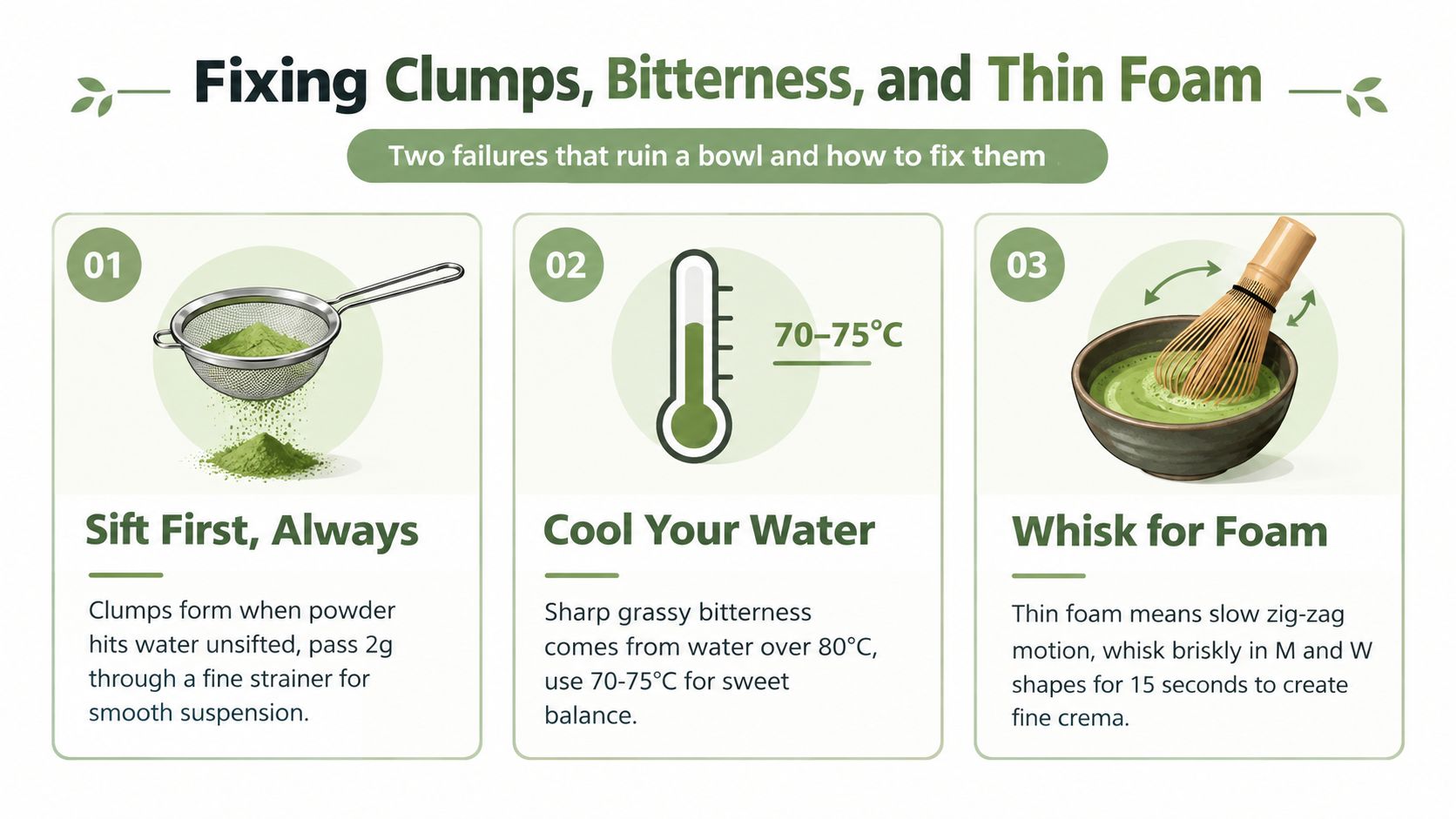
A cloudy bowl usually has two separate problems: clumps form when dry powder meets water too quickly, while bitterness often comes from overheated water or stale matcha. Treat each issue at its source, rather than trying to fix the finished bowl with extra sweetener.
When clumps float on top
Sift the full measure through a fine mesh strainer before adding liquid. Then use a small splash of water to make a smooth paste, like wetting flour before mixing a sauce. Once the paste looks even, dilute it with the remaining water and whisk.
A heavy stream can bury dry matcha in compact islands at the bottom or leave floating lumps on the surface. Pour slowly around the bowl, especially if it is small, so the powder receives moisture in stages.
When the flavour turns bitter
For an Australian-style preparation, cool the water to 75–80°C and keep whisking to around 15 seconds. As noted earlier, water that is too hot can draw out a harsher flavour, so temperature is the first adjustment to make.
Open powder also needs protection from air, light, heat and moisture. An airtight container helps preserve its character, but older matcha may still taste flat or sharp. If the bitterness remains after correcting the water, try fresher powder before adding more sweetener.
When the foam looks thin
Whisk across the surface with a quick, shallow zigzag rather than stirring slowly in circles. The motion should agitate the top layer while keeping the whisk near the water, creating smaller bubbles instead of a loose cap of air.
With a frother, use a brief 5-second pulse at the end, then stop. For readers who mix other powders into drinks, Everti's guide to protein powder with water explains the same useful principle: add liquid gradually and control the incorporation. Matcha behaves better when the powder is dispersed step by step, not forced to disappear in one pour.
Easy Variations You Can Build From the Base
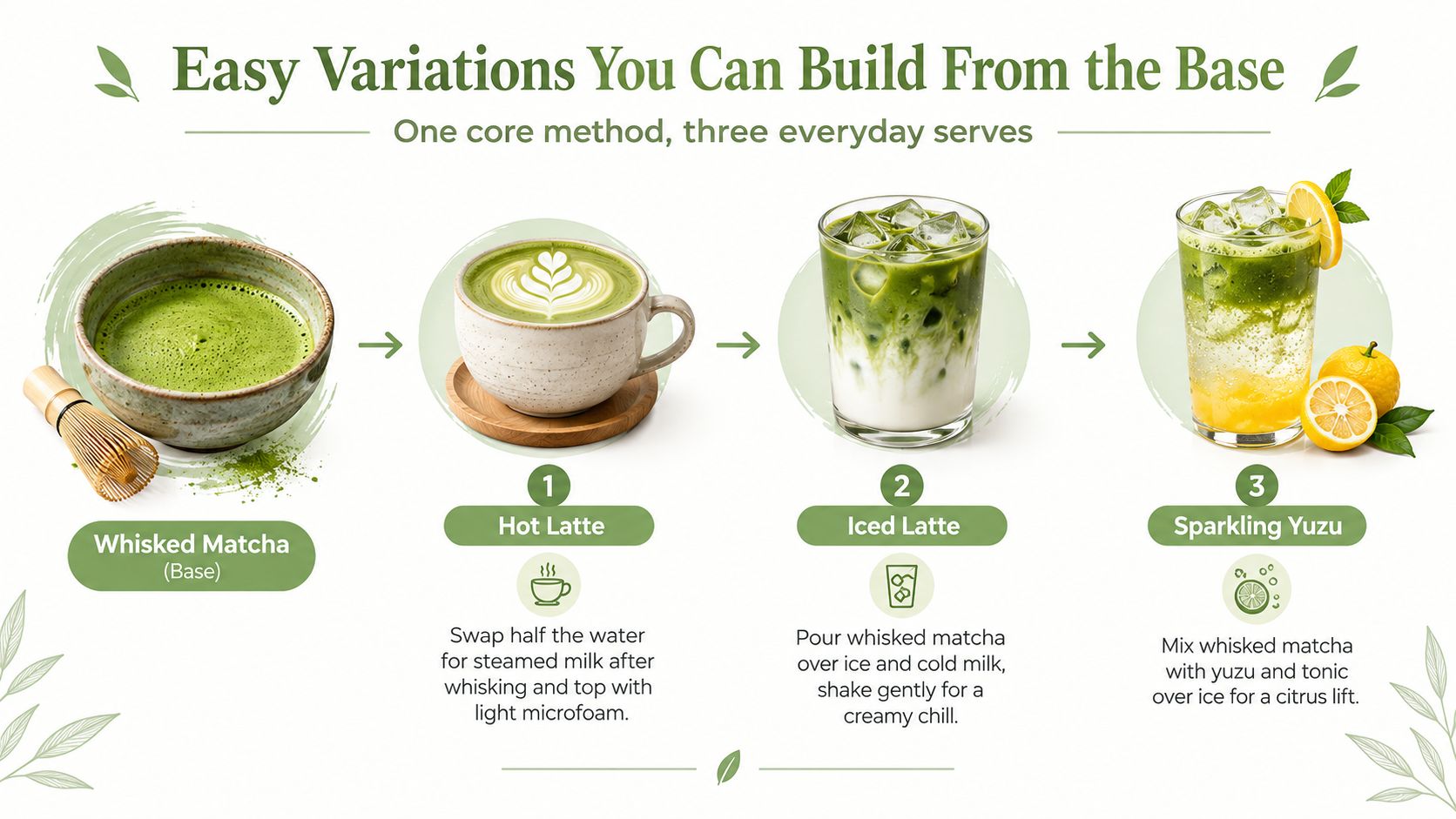
Once the plain bowl is smooth, you don't need to learn a completely new recipe for every drink. Keep the sift, slurry and whisking habits, then change the finishing liquid or temperature.
A warm matcha latte
Whisk the matcha with the concentrated water base first. Warm or steam milk separately, then replace part of the final water volume with milk and add it gently. A handheld frother can create a light topping without requiring a second complicated technique.
Choose dairy milk or a plant-based option according to taste and texture. Oat milk gives a naturally rounded impression, while a lighter milk keeps the grassy character more visible.
An iced matcha
Dissolve the sifted powder in a small splash of cool water first, forming a smooth paste before adding more liquid. Pour the whisked mixture over ice, then top with cold milk or water and stir or shake gently.
The cold serve makes clumps especially obvious because the powder doesn't have warm liquid to help it disperse. The initial slurry solves that problem without changing the core flavour.
A lightly sweetened serve
Add honey, maple syrup or sugar to the hot water before introducing the powder, so the sweetener dissolves evenly. For a café-style latte, a small amount of condensed milk can be whisked into the milk, although its sweetness will be more pronounced.
Matcha also works in smoothies, baking and chilled desserts. If you use it with another bold ingredient, such as cacao, Yuve's raw cacao powder tips can help you think about balancing strong flavours in blended recipes.
Here's a short visual demonstration of the basic process:
Drink leftover whisked matcha within an hour for the best colour and flavour. It can lose its brightness as it sits, so make only what you expect to enjoy soon.
Sourcing Better Powder and Serving It Well
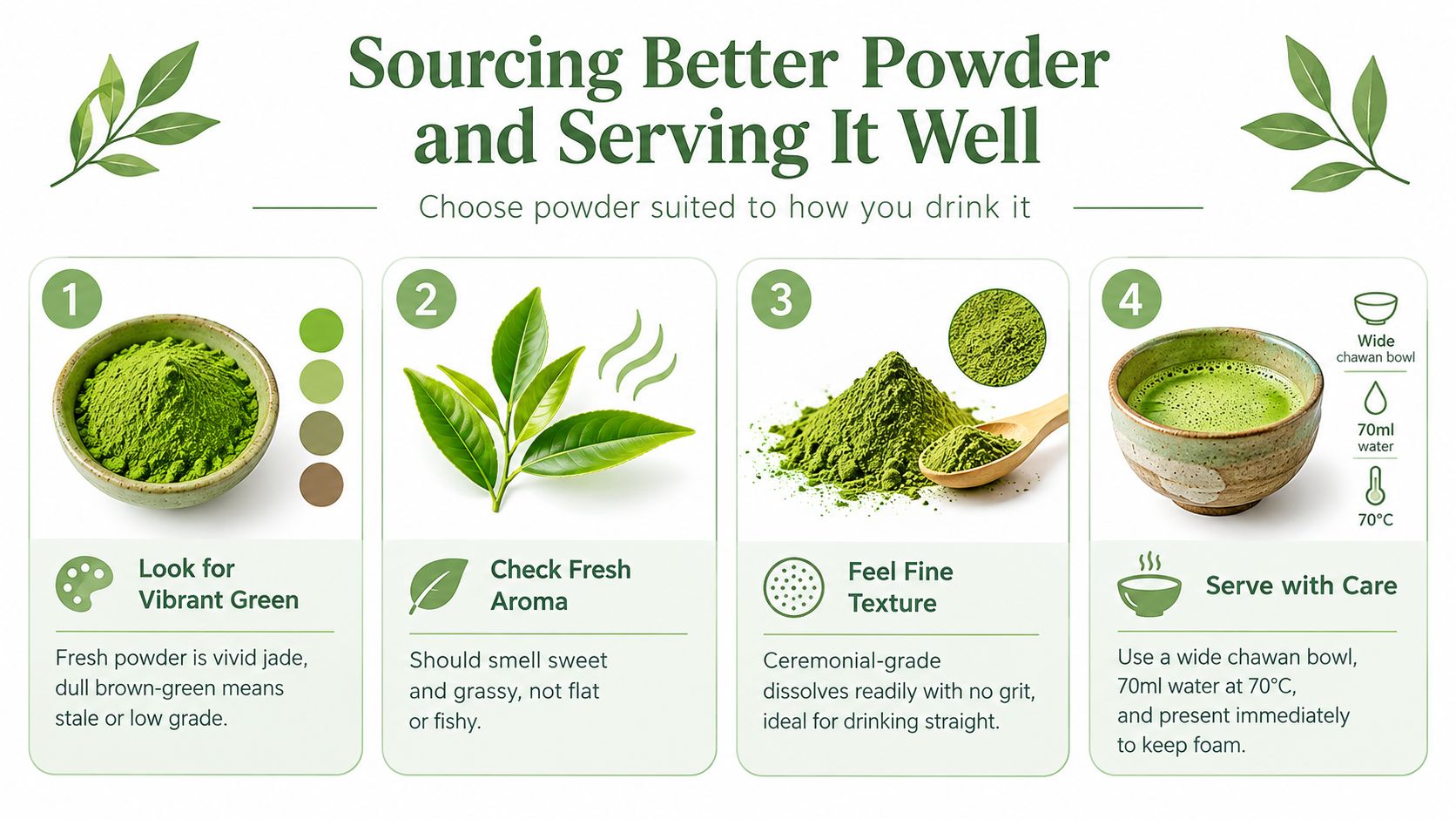
A smooth method can't fully rescue powder that has been stored poorly or chosen for the wrong purpose. Look for a vivid green colour, a fresh grassy or gently sweet aroma and a fine texture that disperses readily.
Ceremonial-grade matcha is suited to drinking plain, where its aroma and finish are easy to notice. Culinary-grade matcha has a stronger presence that can work well in lattes, smoothies and baking, where other ingredients share the bowl.
Protect the powder after opening
Keep matcha in an airtight, opaque container away from light, heat, moisture and strong odours. Refrigeration may help in a warm Australian climate, but allow the sealed container to move towards room temperature before opening so condensation doesn't reach the powder.
Serve the drink immediately after whisking, while the colour is bright and the foam remains evenly distributed. Plain matcha pairs naturally with mild sweets, fruit or light pastries, while a latte can sit comfortably alongside breakfast.
If bitterness continues, use fresher powder, slightly cooler water and a shorter whisk. Frothing milk separately and folding it in gently can create a richer latte without forcing extra air through the matcha itself. Readers wanting more detail on choosing between different powders can consult Pep Tea's guide to distinguishing ordinary and ultimate matcha tea powder.
Pep Tea offers organic Japanese matcha for plain bowls, lattes and recipes, giving Australian home brewers a way to explore different serving styles with powder selected for everyday preparation.
Visit Pep Tea to explore organic Japanese matcha and choose a powder that suits plain tea, lattes or baking. Start with a sieve, controlled water temperature and a few calm whisking strokes, then make your first bowl while the powder is fresh.
Organic Matcha Green Tea a Healthy Drink to Boost Immune Systems
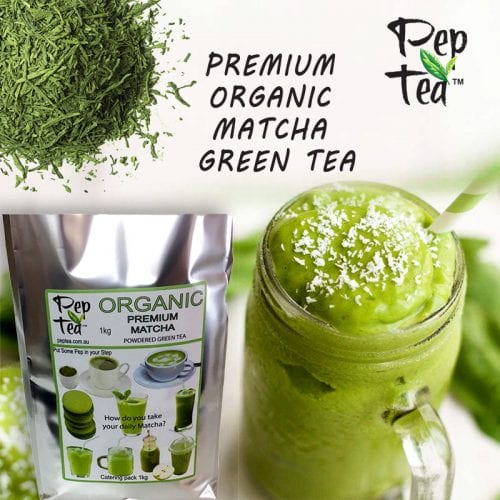
Pep Tea supplies great organic kombucha and organic matcha powder wholesale. Our premium grade organic matcha green tea is very much popular among those that enjoy the taste fine and superior. Pep Tea’s Matcha tea powders are one of the few authentic matcha teas imported from Japan and certified organic by the Japanese ministry of Agriculture.
Premium organic matcha green tea is our special high quality organic culinary grade for fine cooking. It is produced from autumn crops and it is grown organically in Japan. The cultivation of matcha tea is generally done in the regions of Kagoshima, Kyoto, Mie as well as Aichi parts of Japan. The powder of Matcha green tea is produced from the tea leaves which are grown in the hilly areas. Then the leaves are ground into fine powder.
Premium organic matcha green tea is available in foil lined and resealable pouches. The front label of the pouches shows the process of making matcha tea and back label shows the logo of organic certification of Japanese ministry of Agriculture.
Visit our online store to know more details about the product. Buy your favorite product now and get online discounts on various products.
Matcha an Anti-Oxidant Powerhouse Decreases Cholesterol and Blood Sugar Levels
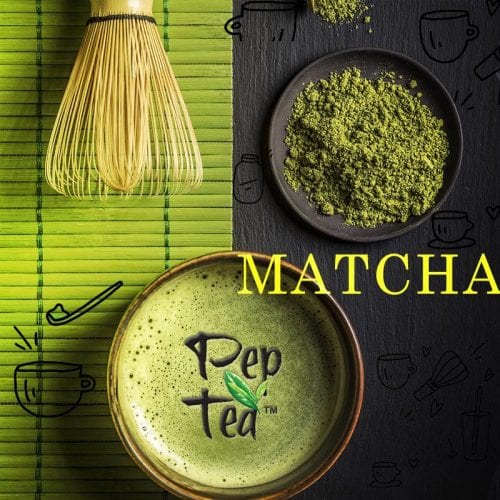
Matcha tea powder is a product of Australia’s Pep Tea brand. Pep Tea is basically specialized in wholesale distribution of high-quality organic teas especially Japanese organic green matcha tea that is popular for its quality, purity and other health benefits.
Matcha is rich in vitamins, fiber as well as chlorophyll. Matcha is considered to be an antioxidant powerhouse that provides certain health benefits. It contributes selenium, vitamin C, chromium, zinc as well as magnesium. Matcha tea aids to strengthen the mood and concentration of an individual. The health benefits of consuming Matcha include lowering cholesterol levels, blood pressure, blood sugar and many more.
Pep Tea is referred to as the name of an Australian business and also it is a registered trademark of Opera Foods Pty Ltd.
You can buy organic Matcha wholesale from Pep Tea or our parent company Opera Foods.
How to Create Your Matcha Green Tea Latte Recipe At Home?
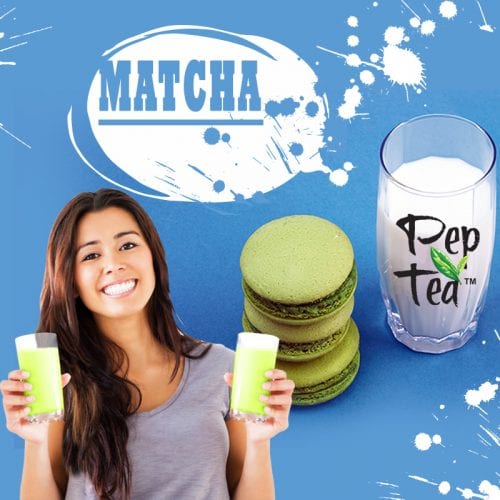
Matcha Tea Latte a popular tea beverage was unheard in Australia before a decade ago but now almost every coffee shop provides with this delicious Matcha powder drink. It has been given various names by most of the famous cafes in Australia while some boasts of its meditative qualities others call it as the “perfect Zen” or “the healthy superfood”. The best thing about Matcha Latte is that it can easily be made at home.
Buy the Imperial Matcha Tea powder from Peptea and take it in a mug or cup. Then add warm water and mix it with a spoon until it turns into a dark green paste. Warm the milk in a saucepan and pour it into the mug and stir well till it turns light green in color. Then add a few sprinkles of Matcha Powder on top for decorations. If you are looking for an ice-cold Matcha Latte then use cold milk instead of hot milk and add some ice cubes for the chill.
Order your Imperial Matcha Powder wholesale right now from Peptea.
Why Matcha Tea Powder Is A “Powerhouse Of Antioxidants”

Matcha Tea powder contains a powerhouse of antioxidants. In recent years people have become more aware of the different health benefits which can be gained by drinking just a cup of Green Tea. But still, it is just unthinkable that every day unknowingly we throw away such huge quantities of antioxidants and minerals which are present in tea leaves.
A cup of green tea is only able to extract a limited amount of minerals and antioxidants but that does not mean you have to start eating tea leaves.
We suggest you switch your taste to matcha tea which provides a simple solution as it uses the whole of the tea leaf. It provides numerable minerals and antioxidants and proven health benefits. It has even been proven that 1 cup of Matcha tea is equal to drinking 10 cups of green tea.
Pep Tea is an Australian brand which specializes in organic Matcha wholesale. We have different varieties of Matcha Tea powder available in our store. All our products are organic and of high quality which are grown in the famous southern tea plantations of Japan.
Pep Tea brand matcha products are certified by the Japanese agriculture ministry before packing. We have the Supreme, Imperial and Premium Matcha tea powder which are available in packs of 30gm, 100gm, and 1kg. All these products can be ordered from wholesale matcha distributor Opera Foods.
How Many Cups of Matcha Tea Powder are Safe Per Day?
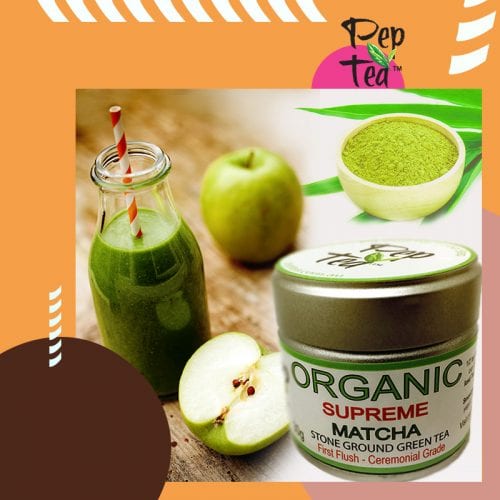
Matcha is a type of green tea which is grown in the famous tea plantations of Japan and also in China. The drinking of powdered green tea leaves for heath reasons became a ceremonial tradition which was practiced in Japan. Over the centuries the tradition is still being continued in Japan whereas in China it had slowly lost some its importance until recent years. Where ceremonies were held the High grade matcha tea is made and served according to the auspicious rituals of the Japanese tea ceremony.
Pep Tea a leading brand of Kombucha and Matcha was established with the vision to bring the old tradition of Matcha tea to Australia. Besides the authentic traditional facts they also provide amazing benefits to our body.
Caffeine in Matcha
Like coffee, matcha contains caffeine, but instead of the jitters it gives you a clean high. A matcha tea provides more caffeine than black tea around the same as a cup of brewed coffee but less than the amount of an espresso, however, the tea’s buzz is much more energising and longer-lasting
It depends on how strong you drink it of course but on average Matcha tea contains on average around 70mg of caffeine for an 8 ounce cup. Whereas black tea contains, on average, around 55 mg of caffeine per 8 ounces, and coffee contains around 100 mg. Interestingly, green tea also contains the amino acid L-theanine.
Caffeine is usually thought to be safe in moderate amounts. Experts consider 200–300 mg of caffeine a day to be a moderate amount for adults. So a moderate dose of caffeine through drinking Matcha tea is about 3 cups per day.
Consuming Matcha tea on a daily basis increases the antioxidant compounds in our body which can protect us from heart disease, diabetes, cancer, and dementia. Whereas you should also be careful about the amount of Matcha consumption you take as overdose of caffeine can leads to side effect. To make one cup of Matcha Tea you should use 1/2 teaspoon of Matcha Powder as one cup of Matcha green tea is equivalent to 10 cups of ordinary Green Tea. So Generally it is though that if you consume Matcha Tea on a daily basis you should probably not have more than 5 cups a day. If you keep these things in check then the Matcha Tea is capable to keep you energized throughout the day and give you great health benefits.
Order high-grade Matcha powder wholesale from our online store. Pep Tea is a trademarked brand of Opera Foods who deliver products overnight to most postcodes in Australia.
A Brief History of Matcha Tea

The word Matcha has its origin from Japan. In Japanese “Cha” means tea, and “Ma” means powder. Hence the unique traditional style of making tea in Japan was called Matcha. In this technique, the tea leaves are ground into a fine powder. Over the years the Japanese perfected the art of ceremonial Matcha tea making.
All our Matcha powder products are authentic Japanese certified and organic in nature. The Matcha Powder of Peptea is grown by the ministry of agriculture, Japan in the southern regions of Japan like Kyoto Mie and Aichi.
Our Matcha products are one of the most powerful natural superfoods available in Australia. After the Matcha leaves are grounded into fine powder they are stored away from sunlight and oxygen to preserve its bright green color and antioxidant properties.
Matcha Tea is a powerhouse of antioxidant, order Peptea’s Matcha from matcha powder wholesale distributor Opera Foods, and enjoy the amazing benefits by drinking a cup every day.
How to Distinguish Between Ordinary and Ultimate Matcha Tea Powder?

Though Matcha has originated in Japan and China it has recently gained popularity in Australia. Organic Matcha Tea has become the most loved tea among various other Green Tea because of its amazing health benefits.
High Grade Matchan ot only tastes a little sweeter but it also makes you feel better before you start your day. But you have to be cautious when you are buying the Matcha green tea powder; you have to notice several factors like it’s Colour, Price, and Benefits. If it has a vibrant green colour it means the leaves have been the first crop of the season grown in shade to have maximum chlorophyll content. On the other hand, if it has a browner colour it means they are from a later season harvest and contains less chlorophyll.
Buy the best Matcha Tea powder from Peptea and if you want Organic Matcha wholesale you can order from our wholesale supplier Opera Foods.
Hot Matcha Tea or Iced Matcha Tea

Matcha tea is also a type of green tea in which the young tea leaves are ground down into a bright green powder. In a normal green tea, you are just getting a part of the nutrients as the rest are thrown away but with Matcha tea, you’re drinking the whole tea leaves.
You can drink Matcha tea with hot water as well as cold water and ice because with Matcha tea you can experience the same benefits in both the ways.
You can make a Hot Matcha Tea when you are drinking tea with a casual breakfast. The combination to make your perfect Matcha tea, you should keep the ratio as one teaspoon of our Peptea brand organic Matcha powder and six ounces of water. Boil the water first and then let it cool down a bit. Take one teaspoon of powder and mix it with two ounces of water first, then add the rest of the water into it. You can also add sweeteners to taste and be sure to stir the cup once the powder settles down at the bottom.
If you feel like drinking tea at any time of the day you can go for the Iced Matcha Tea. It is easier to make than the Hot Matcha Tea. The combination to make your perfect Iced Matcha tea, take one-half teaspoon of our Pep tea brand organic Matcha powder and mix it with few ounces of water to create a smooth paste. Add about 10-12 ounces of water, and sugar. Keep it in direct sunlight for about 15-20 minutes and add Ice and sweetener to enjoy your delicious cup of Iced Matcha Tea.