
Tag: matcha tools
Matcha Whisk Woolworths Availability and Buying Guide

You've bought matcha, put the kettle on, and stirred a spoonful into your favourite mug. Now there are green clumps floating on top and a gritty patch at the bottom. A quick search for matcha whisk Woolworths seems like the sensible next move, but the important detail isn't just which whisk appears. It's who sells and ships it.
My advice is straightforward: buy a bamboo chasen if you want to drink matcha with water and enjoy the texture. Before ordering through Woolworths, check the seller and delivery details rather than assuming it'll arrive with your groceries.
Why a Good Whisk Matters More Than You Think
That first disappointing mug doesn't necessarily mean you've bought disappointing tea. You might be asking a teaspoon to do a job it wasn't designed for. Stirring around the rim can leave you chasing the same clumps instead of properly working through the powder.
A chasen, the traditional bamboo matcha whisk, is the tool I'd choose for a bowl of straight matcha. Its purpose is different from stirring sugar into black tea. You're aiming for an evenly mixed drink with a lightly foamed surface, not merely moving green water around.
Don't expect a whisk to rescue a powder whose flavour you dislike, though. Better preparation and better ingredients are separate decisions. A smooth drink can still taste too strong for your preference, and adding more force won't fix that.
Texture deserves the same attention as the powder. Get the preparation right before deciding that matcha isn't for you.
Start with the bowl, not just the whisk
Give yourself room to work. I recommend a bowl with enough width for a comfortable wrist movement, rather than a narrow mug that keeps knocking the whisk against its sides.
You don't need an elaborate ceremonial setup to begin. Our guide to choosing a matcha bowl in Australia is a useful starting point if you're deciding whether your existing kitchen bowl will do.
- For straight matcha, prioritise a bamboo whisk and a bowl you can comfortably whisk in.
- For lattes, concentrate on making a smooth matcha base before adding milk.
- For occasional recipes, buy equipment that fits how often you will use it.
Woolworths can be a convenient place to discover specialist tea equipment online. That doesn't make every listed tool supermarket shelf stock, or every bundled accessory necessary. Choose the preparation method first, then buy the tool that suits it.
What You Actually Find on Woolworths Australia
The Woolworths listings make more sense once you separate the product from the fulfilment arrangement. A familiar retailer's website can display an item sold by another business, and that distinction matters when you're planning a purchase.
The Matcha Maiden bamboo matcha whisk listing describes a chasen made from a single piece of natural, sustainable bamboo with 100 prongs, designed to separate powder, introduce air and create creamy froth, and identifies it as sold and shipped by Cutprice Online through Everyday Market. The same listing also describes using the whisk to make a matcha-and-water paste for recipes.
That's a specialist marketplace offering, not a promise that your local Woolies has a whisk beside the tea bags.
Whisk-only purchases and ceremonial bundles
The following image illustrates the kind of preparation setup you might be considering, rather than confirming any particular seller's current stock.
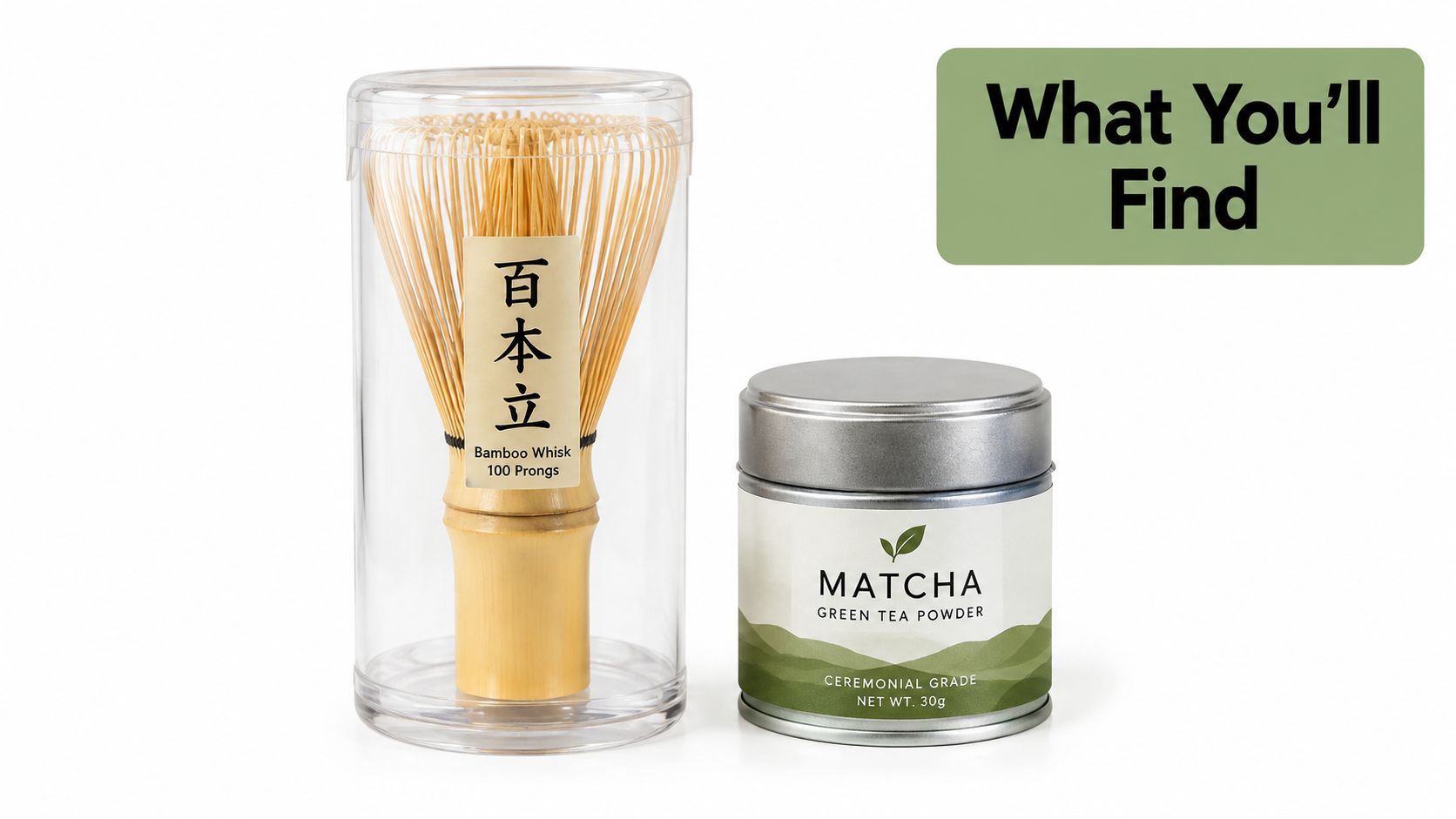
Woolworths also has an Avanti ceremonial set listing containing three components: a bamboo whisk, bamboo spoon and ceramic bowl, with catalogue listing dates showing these bundled tools were represented by 14 December 2022. Its description presents the whisk as a mixing and aerating tool, while the spoon measures powder and can stir settled matcha.
Buy a set if you need the bowl and scoop. If you already own a suitable bowl, a standalone whisk may be the tidier purchase.
Before paying, check:
- Seller identity, especially whether the item is an Everyday Market purchase.
- Delivery arrangements, including your postcode and the estimated arrival shown.
- Bundle contents, rather than assuming everything in a styled photograph is included.
- Seller terms, including returns and what to do if the whisk arrives damaged.
These listings establish an Australian retail presence, not uninterrupted availability. Don't turn a historical catalogue date into an assumption about today's stock, and don't rely on a marketplace order when you need a whisk for this afternoon.
Bamboo Chasen vs Electric Whisk Which One Actually Works
Choose according to what you drink. For matcha served with water, my preference is a bamboo chasen. For a weekday latte made while you're packing lunch and hunting for your keys, a handheld electric frother is a reasonable compromise.
The listed bamboo construction gives you a tool specifically intended for matcha preparation. An electric milk frother gives you a motorised alternative, but I wouldn't buy one solely because a product photograph shows an impressive cap of foam. Foam height isn't my measure of a well-prepared drink.
An ordinary small kitchen whisk is worth trying if it's already in your drawer. I wouldn't make it my first purchase for a dedicated matcha routine, especially if you'll be working in a small bowl.
Bamboo chasen vs electric whisk at a glance
These are practical buying judgements, not laboratory performance ratings.
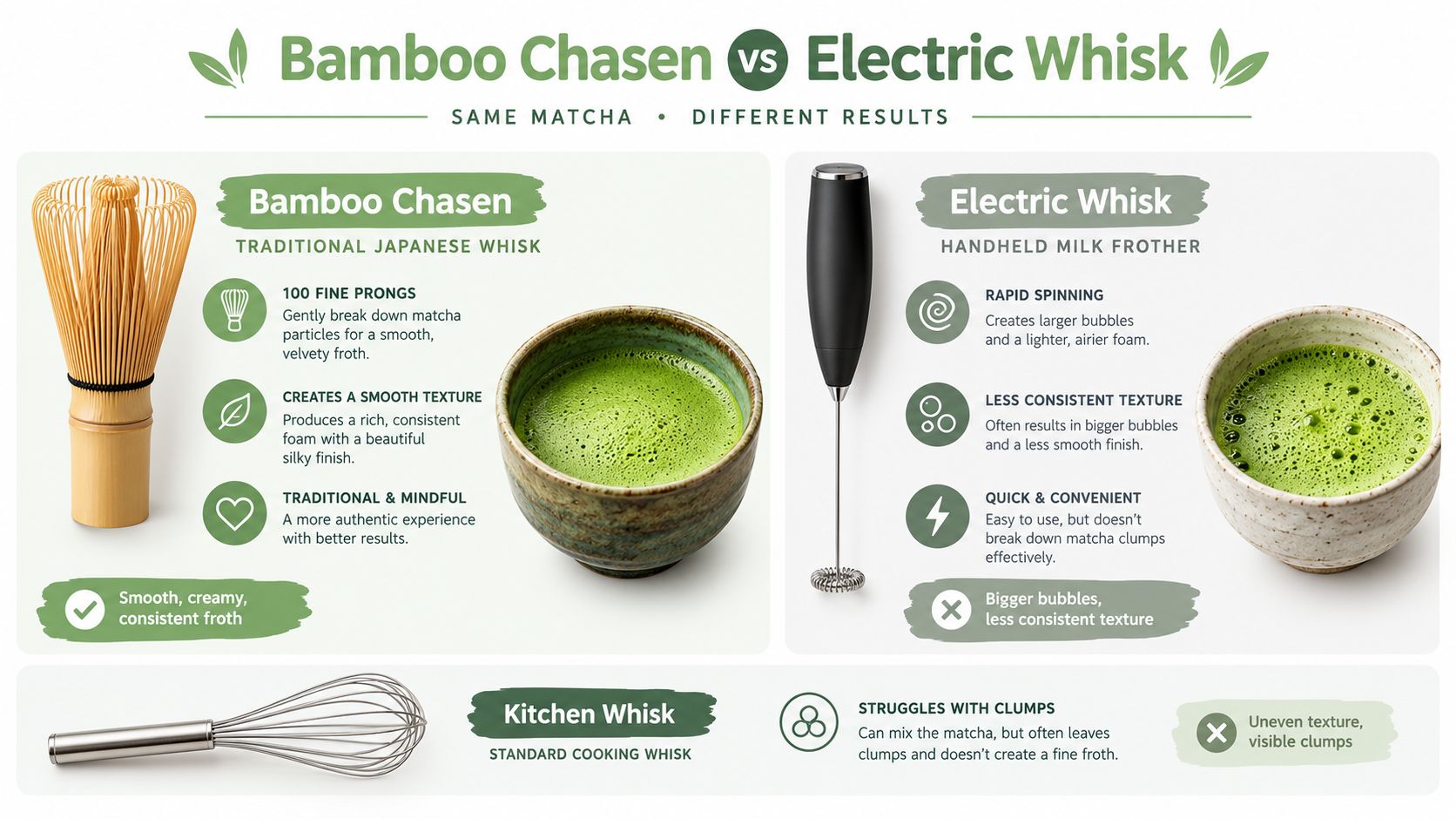
| Factor | Bamboo chasen | Electric whisk |
|---|---|---|
| Froth quality | My preference for a lightly foamed bowl | Judge the drink underneath the foam, not its height |
| Learning curve | Practise a relaxed wrist movement | Simple controls, but placement still matters |
| Portability | No batteries or charging to organise | Check the power arrangement before travelling |
| Care effort | Needs gentle hand care and thorough drying | Follow the model's cleaning instructions |
| Best-use case | Straight matcha and a slower preparation ritual | Quick lattes and convenience-led routines |
The comparison below gives a visual overview of the tool choices.
Don't buy equipment for someone else's routine
If you love the deliberate process of making a bowl, the manual movement is part of the appeal. If you mainly want a milky drink before work, there's no need to perform a ceremony you don't enjoy.
For café use, I'd also consider who'll clean the tool, where it'll dry and how comfortably staff can repeat the preparation. A tool that looks lovely but doesn't fit the workflow is a poor purchase.
My recommendation: choose bamboo for straight matcha and electric for convenience-led lattes. Keep a kitchen whisk as a fallback, rather than buying it as your dedicated matcha solution.
How to Whisk Matcha the Right Way
Start with a clear bench and organise everything before adding water. You'll want a chasen, a matcha bowl or suitable small bowl, a sieve, a scoop or spoon, matcha powder and warm filtered water.
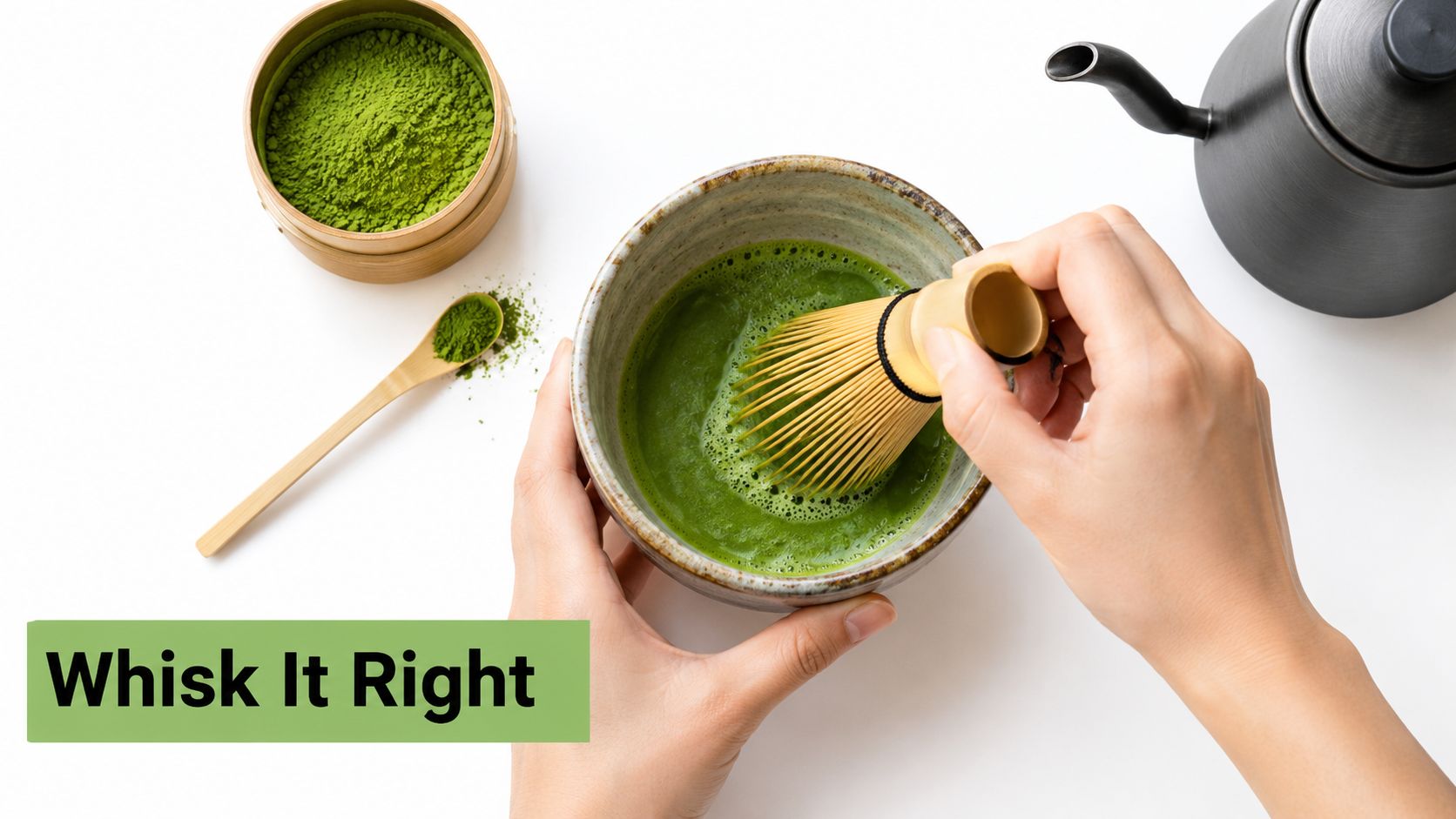
The hand position and bowl space shown below are useful details to notice.
Prepare gently, then whisk briskly
Soften the bamboo first. The Matcha Maiden preparation and care guidance recommends warm-water soaking for 1–2 minutes before use, because hydrated tines are more flexible and less prone to fracture than dry bamboo.
Sift your powder into the bowl. I recommend this rather than trying to crush every visible clump with the whisk. Use the powder maker's serving guidance as your starting point, then adjust to your taste.
Make a smooth base. Add a splash of warm water and gently work it into the powder. Check for dry pockets before adding the remaining water.
Whisk with your wrist. Use a brisk W or M movement instead of large circles around the bowl. Keep the motion light, and don't grind the prongs into the ceramic.
Finish by checking the drink. Look for an evenly mixed base and a fine surface foam. If you're making a latte, add your chosen milk after preparing the matcha.
For water temperature, follow your matcha's preparation guidance rather than treating every powder identically. I'd also avoid judging success by a stopwatch: stop when the texture looks right, not when an arbitrary countdown ends.
Our practical guide to whisking matcha offers another reference while you get comfortable with the movement.
Watch the preparation in motion, then practise without forcing the whisk.
Worth the effort: treat whisking as a short kitchen skill to learn, not a performance. A relaxed hand is more useful than an aggressive scramble.
Looking After Your Bamboo Whisk So It Lasts
The least glamorous part of owning a chasen is also the part I'd take seriously: rinse it and let it dry properly. Don't leave it sitting in yesterday's matcha while you decide whether you've got time to clean up.
The Matcha Maiden care guidance linked earlier calls for hand rinsing without soap, gentle handling and complete drying. It also explains that the centre naturally opens with repeated use. That change in shape isn't, by itself, a reason to throw the whisk away.
An opening centre isn't the same as broken prongs
Inspect the individual tines rather than expecting the bloom to stay exactly as it looked in the packaging. A reshaped centre and a cracked tine are different observations.
I'd stop using a whisk with broken pieces or visibly compromised prongs. Don't try to restore a showroom shape by pulling, twisting or squeezing the bamboo.
This visual checklist is handy to keep beside your preparation area.
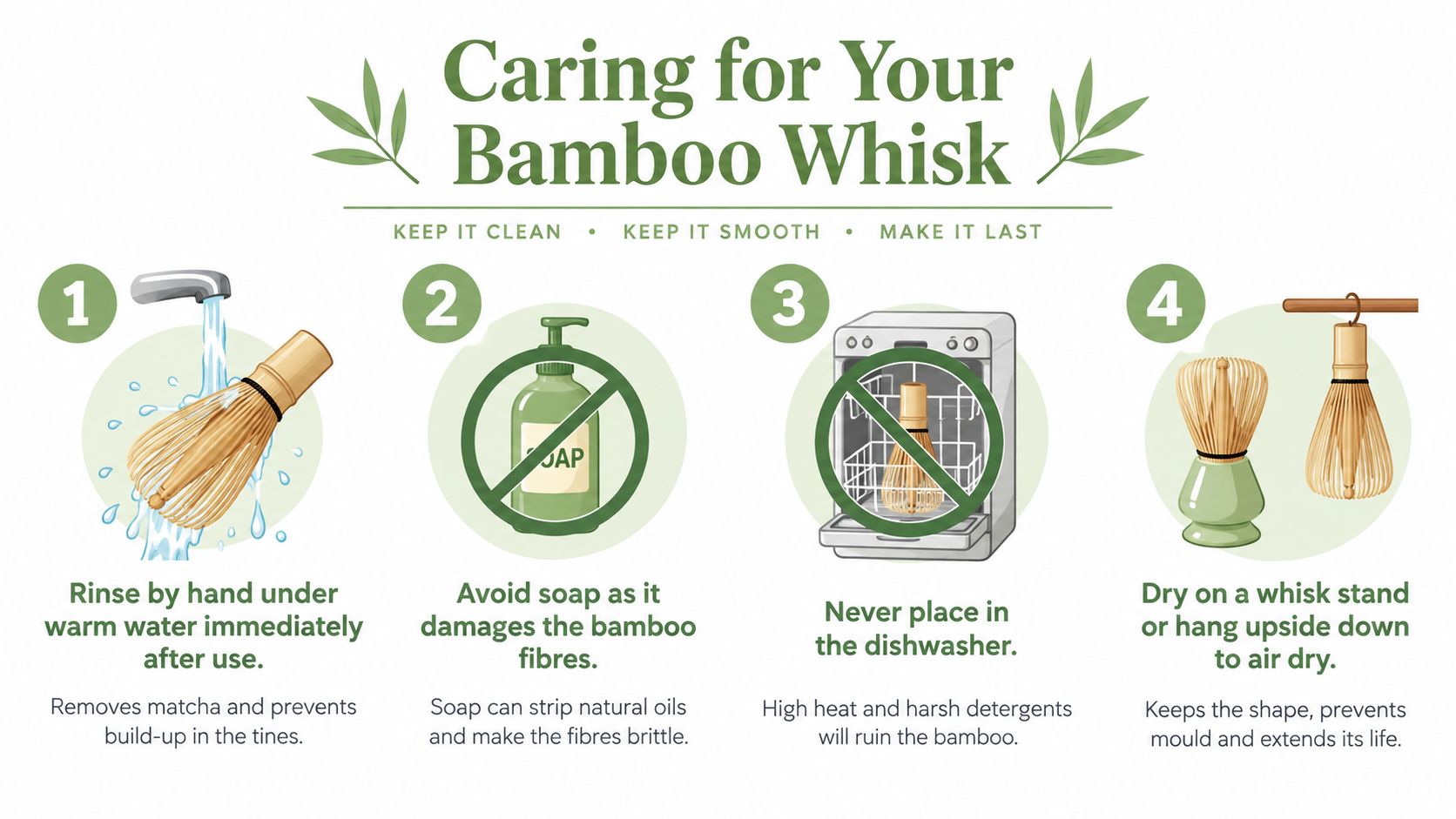
- Rinse by hand with warm water after preparing your drink.
- Skip soap and the dishwasher, following the gentle care approach already described.
- Remove droplets gently, without snapping your wrist or striking the whisk against the sink.
- Dry with airflow, using a suitable whisk holder or a secure hanging arrangement that doesn't crush the tines.
- Store sensibly, away from direct sunlight and places where other utensils can squash it.
- Check before use, replacing the whisk when prongs crack or no longer work comfortably.
Don't pack it into a closed container while it's still damp. For a café, give the chasen a designated drying spot rather than dropping it into a crowded utensil tub.
I wouldn't promise a fixed lifespan. Your useful measure is its condition and how it performs, not a calendar date or the seller's most optimistic description.
Better Australian Alternatives to Woolworths
A specialist retailer is worth considering when you want advice, not just a checkout. That doesn't automatically make its equipment superior. Ask clear questions and compare the actual whisk, rather than assuming a tea-focused website guarantees better craftsmanship.
For Australian buyers, I'd compare specialist tea shops, kitchenware retailers and direct-to-consumer matcha businesses. Each can suit a different purchase, but none deserves a blank cheque.
Compare the service as well as the tool
| Buying channel | What I'd look for | Who it suits |
|---|---|---|
| Specialist tea or matcha shop | Clear construction details, origin information and usable care advice | Drinkers choosing a dedicated chasen |
| Kitchenware shop or department store | A tool you can inspect, clear returns and practical handling | Buyers comparing bamboo and electric options |
| Online matcha specialist | Preparation guidance that matches the powder you're buying | Home drinkers building a complete routine |
Ask a tea specialist how the whisk should be used and dried. At a kitchenware shop, check whether the handle feels comfortable and whether the product instructions explain cleaning properly.
For an online purchase, read the description beyond the word ceremonial. I wouldn't pay extra for decorative language without useful details about the tool itself.
Make the price comparison honestly
There isn't a verified current price comparison to give you. Compare the total delivered cost, then decide whether the bundle includes accessories you need.
- Already have a bowl? Price the whisk alone before buying another set.
- Need something today? Contact a physical shop and confirm stock before leaving home.
- Want help choosing? Prefer a retailer that answers preparation and care questions clearly.
- Buying for a café? Ask about repeat availability and replacement arrangements.
Use Woolworths when the listed product, seller terms and delivery suit you. Choose a specialist when its advice and product detail justify the purchase, not because someone promises a chasen will last for years.
Most notably, don't confuse an online marketplace listing with same-day local access. Convenience only counts if the fulfilment works for your actual deadline.
Matching the Whisk to Quality Matcha and Your Routine
A sensible setup starts with what you want in the cup. I'd choose ceremonial-grade organic matcha for a water-only bowl and consider culinary-grade matcha for lattes, smoothies and baking, while still reading the maker's intended-use guidance.
Don't assume a better whisk makes every powder interchangeable. The tool helps with preparation; your powder choice and how strongly you make the drink still matter. Our organic matcha powder range gives you a place to compare options against the way you plan to use them.
For a slow Sunday bowl, I'd reach for the chasen. For a weekday latte, I'd prepare a smooth base using whichever tool I'll reliably clean and put away.
Texture isn't a caffeine claim
Whisking doesn't remove caffeine. Healthdirect states that healthy adults can generally consume around 400 milligrams of caffeine per day, roughly equivalent to two espressos, four instant coffees or eight cups of black tea, in its Australian caffeine guidance.
That's general adult guidance, not the caffeine content of your matcha serving or a target to reach. Matcha's caffeine depends on the powder quantity and preparation, so count your other caffeinated drinks too.
There's also an important distinction between ordinary tea and concentrated caffeine products. Food Standards Australia New Zealand's caffeine-product rules prohibit retail sale of solid or semi-solid foods containing 5 percent or more caffeine, and liquid foods containing 1 percent or more caffeine; those concentrated-product thresholds shouldn't be confused with ordinary culinary matcha.
Build a routine you'll keep
- At home, choose equipment that fits your bench space and cleaning habits.
- For lattes, match the powder to a drink you enjoy without automatically adding sweetener.
- In a café, give staff a clear preparation method rather than relying on individual improvisation.
Buy thoughtfully, learn the movement and care for the bamboo. That's a more useful approach than collecting accessories or expecting your morning bowl to deliver unverified wellness promises.
Pep Tea offers Japanese organic matcha for home preparation, recipes and café drinks. Pair your chosen powder with a whisk that suits your routine, then visit Pep Tea to explore the range and practical preparation guides.
Matcha Bamboo Scoop: What It Is and How to Use It

Most advice treats a matcha bamboo scoop as a charming accessory and stops there. That misses the practical issue. A chashaku is a small portioning tool, and its output changes with the way you fill it, the density of the powder, and the moisture in the surrounding air. If you prepare matcha at home, that affects flavour. If you run a café, it affects recipe consistency, stock usage, and margin.
Australian guidance commonly places a full bamboo scoop at about 1 gram, while other Australian listings describe a serving at approximately 2 grams, so the scoop isn't a fixed-mass measuring instrument. One Australian product guide makes that variation clear, and another matcha scoop guide uses roughly 1 gram per full scoop as a practical rule.
The useful approach is simple. Learn the tool's shape, establish your own fill method, care for the bamboo properly, and keep a digital scale nearby whenever exact dosing matters.
Why a Matcha Bamboo Scoop Matters More Than You Think
A chashaku earns its place through repeatable handling, not decoration. Its slim body and curved tip let you lift matcha from a tin without pressing hard into the powder, which helps you transfer it neatly to a bowl or sifter. Used with the same fill level each time, it gives a familiar portioning rhythm that a teaspoon rarely provides.
That doesn't mean one scoop always equals exactly the same mass. Powder density, humidity, particle size and the difference between a level and heaped fill all affect the result. Australian retail guidance describes a single scoop as about 1 gram, while other local guidance places a serving at approximately 2 grams, so operators should treat the chashaku as a volumetric tool rather than a precision scale. Australian listings describe the scoop's approximate serving role, but they don't remove the need for calibration.
Practical rule: Use the scoop to transfer matcha, then use a scale to learn what your particular scoop and powder deliver.
At home, this distinction helps explain why the same latte can taste gentle one day and bitter or intense the next. In a café, small differences repeated across service can alter the drink's strength and the amount of powder taken from stock. The sensible workflow is to standardise one scoop style, record its result, and train staff to copy it.
By the end of this guide, you'll be able to identify useful chashaku geometry, dose more consistently, compare bamboo with other materials, protect the scoop in Australian conditions, and decide when a scale belongs beside it. The object has ceremony behind it, but its everyday value is practical.
What a Chashaku Actually Is and Where It Comes From
A chashaku, often called a matcha bamboo scoop, is the narrow utensil traditionally used to move powdered tea from its container into a matcha bowl. It belongs to the Japanese tea ceremony toolkit alongside the chawan and chasen. Unlike a teaspoon, it was shaped around the handling of a very fine powder and the controlled movements of tea preparation.
Traditional chashaku are carved from a single piece of bamboo. Australian tea retailers commonly preserve that description, along with a length of around 18.5 centimetres, which reflects the familiar long, slim form used in Japanese tea practice. Australian tea-ceremony listings describe handcrafted bamboo construction and traditional dimensions, connecting the utensils available today with the object's established design language.
From ceremonial object to Australian kitchen tool
In Japan, the chashaku carries cultural meaning as well as practical purpose. Its curve, finish and material invite careful handling, and individual pieces can be appreciated for their craftsmanship. Australian retailers have adapted that tradition for modern homes, tea counters and cafés, where the scoop may be used for a daily latte rather than a formal gathering.
That shift doesn't make the utensil meaningless. It shows how a specialised object can move between contexts while keeping its basic identity. A product page that labels the utensil chashaku rather than generic spoon is preserving that connection to tea ceremony.
For readers exploring the cultural background, PepTea's matcha tea ceremony guide provides a useful companion to the physical tool. The key point is to hold both ideas together. A chashaku is a cultural artefact, but it also has a clear job on a contemporary Australian preparation bench.
The Design Details That Change How It Performs
The chashaku's shape isn't arbitrary. Australian listings describe examples around 18 to 18.7 centimetres long, with one listing giving dimensions of 18.7 cm × 0.3 cm × 0.9 cm and another describing an 18 cm scoop weighing 6 grams. This Australian matcha scoop listing shows how narrow and light the format is intended to be.
The curve does the work
The curved tip lets you lift dry matcha from the surface of a tin without scraping aggressively or compressing the powder. A long, slim stem keeps your fingers away from the container and gives you control when transferring the scoop to a sifter or bowl.
The small cross-section also means less powder remains trapped on the utensil. A smooth finish helps the chashaku move gently around a ceramic bowl, although the scoop itself should be used for transferring powder, not for stirring or whisking.
Australian descriptions also preserve the traditional making process. Some chashaku are heated, bent and carved from bamboo, while vintage examples available locally show that the form has continued as a collectible object as well as a working utensil.
What this means on the bench
A generic bamboo spoon may hold more powder and may have a different bowl depth. A chashaku's narrow profile encourages a controlled amount, but it doesn't promise a fixed gram weight. Its main technical advantage is repeatable volume when your technique remains consistent.
The best test is to compare two tools using the same matcha and fill method. If one spoon encourages you to press, scrape or heap unpredictably, it isn't serving the same purpose as a chashaku. The design supports consistency, but the person using it still controls the dose.
How to Measure Matcha With a Bamboo Scoop
Consistent matcha dosing depends less on the scoop's label than on how you fill it. Start with dry, settled powder and a clean chashaku. Place the curved end into the matcha with a controlled downward movement, rather than forcing it in at an angle. Lift without compressing the powder, then follow the recipe's chosen fill style.
Australian product guidance may describe a heaped bamboo scoop as roughly 1 gram, while another listing gives approximately 2 grams for one serve. A local chashaku listing explains this variation shows why the café needs a defined method, especially when powder density and humidity change.
Three practical fill styles
Level fill: Draw the scoop across the tin's edge, or remove the excess with a finger. It is straightforward to teach and repeat.
Heaped fill: Leave a small mound above the scoop. This produces a stronger drink, but a slightly larger mound can change the dose quickly.
Pinched transfer: Lift the powder with the scoop, then adjust it between your fingers. This informal home method is difficult to standardise in a café and creates a hygiene concern.
For a commercial recipe, weigh the selected method. A kitchen scale shows what your particular matcha, storage tin and filling technique deliver, rather than assuming that level or heaped means a universal mass.
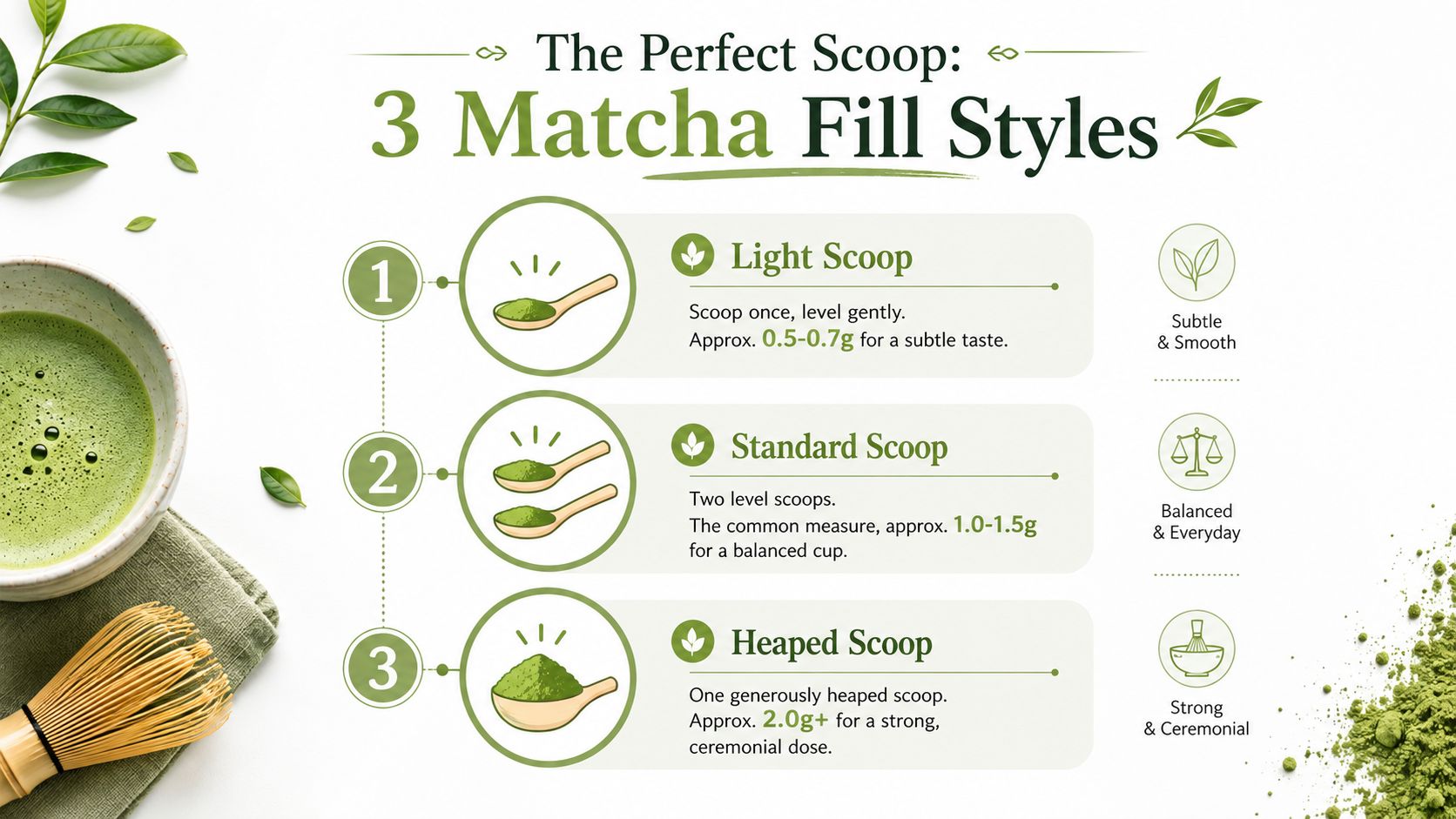
Use three test fills to identify variation. For example, record each level scoop separately after the powder has been stored in the same conditions. If the results spread noticeably between a dry morning and a humid service period, keep the fill motion and recipe dose fixed, then check again after changing matcha grade or storage. That result can guide portion costing as well as flavour consistency. A matcha tea sifter can remove clumps before filling, so compacted powder does not distort the scoop.
Bamboo Versus Steel, Plastic, and Ceramic Spoons
The right scoop depends on where and how you'll use it. Bamboo feels natural in a tea ritual and transfers powder neatly, but moisture can affect its condition and its volumetric output. Stainless steel is easier to sanitise and more resistant to humidity, while plastic is practical for busy service and ceramic suits visible presentation.
| Material | Dosing accuracy | Hygiene | Durability | Cost AU | Ceremony feel |
|---|---|---|---|---|---|
| Bamboo | Consistent by volume when technique is standardised, but mass varies with conditions | Requires dry handling and careful storage | Can split, darken or absorb odour | Varies by product and craftsmanship | Strong |
| Stainless steel | Useful for repeatable portions when sized consistently | Easy to clean and sanitise | Highly durable | Varies by product | Low |
| Plastic | Consistent if the scoop is clearly sized and staff use the same fill method | Often easy to wash, with some materials suitable for dishwashing | Practical, but may stain or retain aroma | Usually accessible | Low |
| Ceramic | Depends on the bowl volume and shape | Washable, but chips need attention | Can chip or break | Varies by design | Moderate to strong |
Choosing for the setting
For a home ritual, bamboo is a natural choice. It connects the movement of measuring with the history of matcha and feels pleasant in the hand. It also suits single-origin tasting, gift presentation and preparation where the utensil remains visible.
For high-volume café work, stainless steel or colour-coded plastic usually makes the operational decision easier. Staff can identify a dedicated utensil quickly, clean it as part of a normal workflow and replace it without treating it as a keepsake. Resources covering spoons for cafés and events can help operators compare general service utensils before choosing a matcha-specific format.
Ceramic works best when presentation matters and the spoon stays on a tasting tray. It echoes the chawan, but breakage and variation between pieces make it less suitable as the sole dosing control in a busy bar.
Caring for a Bamboo Scoop in Australian Conditions
Bamboo and moisture don't make a relaxed partnership. Coastal homes, humid kitchens and steam near an espresso machine can leave a scoop damp long after the powder has disappeared. Air-conditioned offices create the opposite challenge, with dry air and temperature changes that can encourage splitting if the tool is stored carelessly.
After each use, remove loose matcha with a dry, lint-free cloth or a soft brush. Don't soak the chashaku, place it in a dishwasher or coat it with food oil. A damp wooden utensil needs to dry completely, and oil can create an unwanted surface for residue and mould, particularly in warm, humid conditions.
A practical storage routine
- Wipe immediately: Remove powder before it settles into the curve or handle.
- Air-dry fully: Rest the scoop vertically or in a holder so air can reach the curved tip.
- Keep it away from steam: Store it away from kettles, sinks, stovetops and espresso steam wands.
- Use dedicated storage: Cafés should keep staff scoops labelled and separate from utensils used with raw ingredients.
In a commercial kitchen, follow the venue's food-safety procedures and keep preparation tools clean, dry and assigned to their intended ingredient. End-of-shift storage should leave the scoop dry rather than sealed while damp.
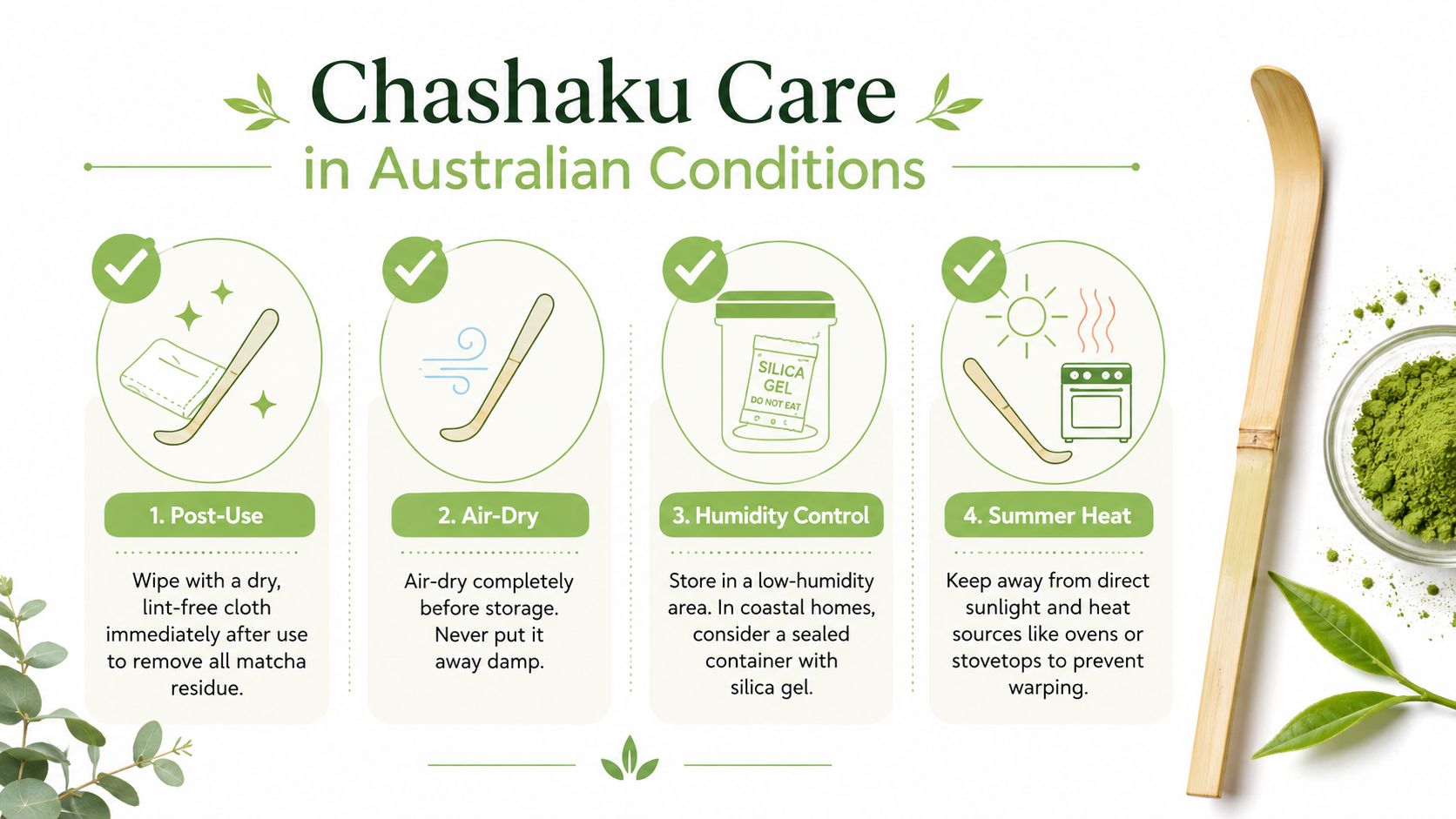
Retire the scoop when you see cracks, splinters, darkening, persistent odour or powder that keeps clinging after drying. Australian product pages show that chashaku are readily available as standard teaware, so replacement is preferable to continuing with a damaged utensil. PepTea's matcha tea accessories collection is one place to compare compatible preparation tools.
When a Scoop Is Not Enough for a Café Workflow
A bamboo scoop can work beautifully at the tea counter, but it shouldn't be the café's only dose-control system. The volume changes when the powder is denser, more humid, more finely settled or filled differently, so two apparently identical scoops can produce different drinks.
That matters as Australian matcha demand and supply pressure increase. Market coverage reported matcha revenue above US$54 million in 2024, projected annual growth of 7.1%, and Japan-to-Australia green tea exports up 131% year on year by August 2025. The same coverage noted cafés in Sydney, Melbourne, Brisbane, Perth and Adelaide charging about A$6 to A$8 for a matcha latte in 2025 amid shortages. SBS News provides that Australian market context.
A better service system
- Calibrate the scoop: Weigh a level fill with a scale that reads to 0.1 gram.
- Test several fills: Record the results rather than relying on a single reading.
- Set the recipe: Choose a target dose in the 1 to 2 gram range when that suits the menu, then document the fill method.
- Train the team: Use one dedicated scoop and one agreed levelling technique.
- Check stock: Compare expected powder use with actual consumption and investigate drift.
Batch-weighing portions into clean, labelled containers can speed service, while the chashaku remains useful for presentation and small adjustments. A scale should stay available for opening a new matcha, checking staff technique and investigating changes in flavour or stock use.
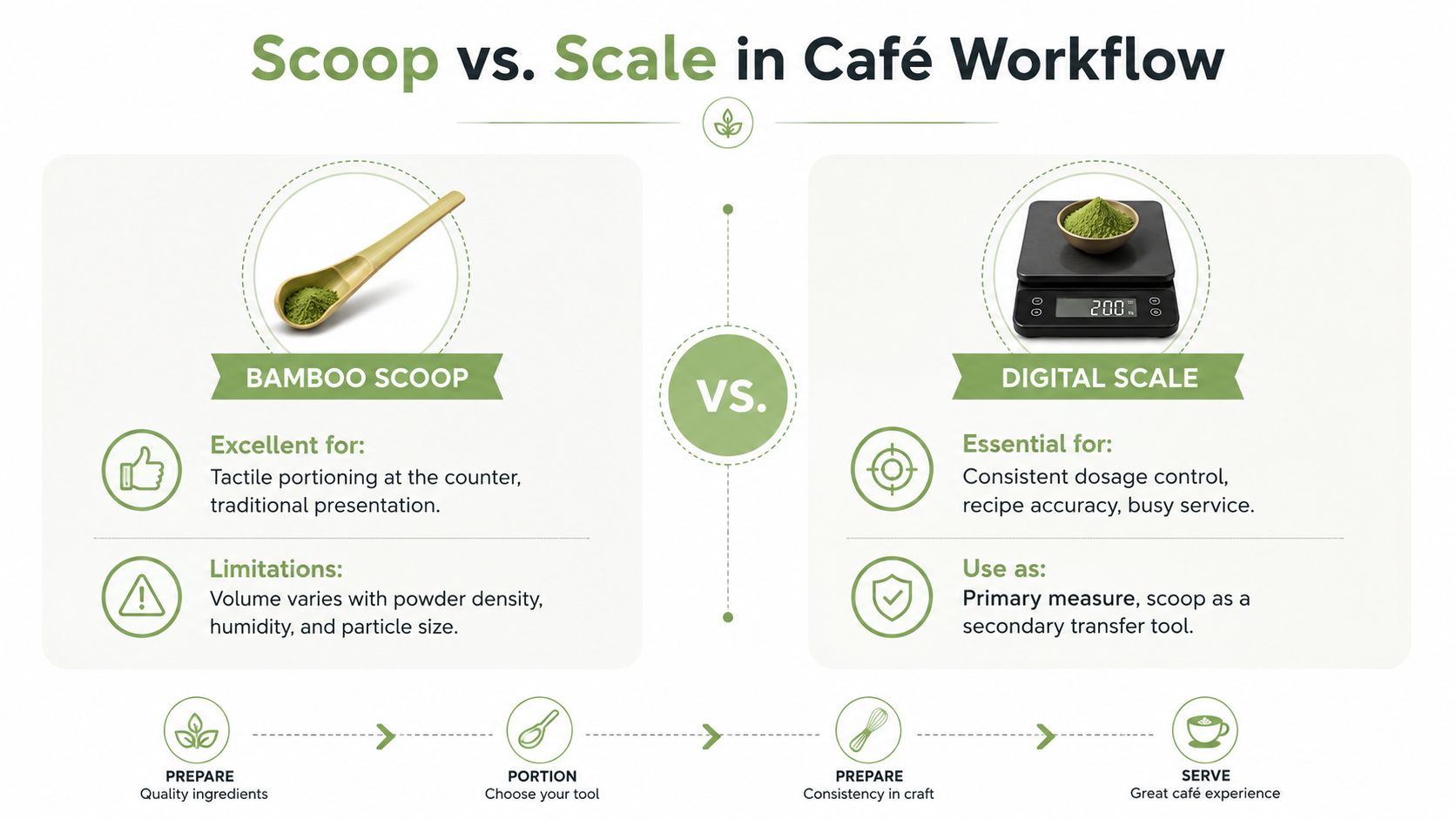
The aim isn't to remove tradition from café service. It's to pair the tactile familiarity of bamboo with a system that protects drink quality, ingredient control and customer expectations.
Bringing It All Together With Your Matcha Ritual
A matcha bamboo scoop works best when you treat it as a measured portioning tool with cultural character. Its traditional bamboo form and curved tip make it especially satisfying for ceremonial preparation, while the same geometry helps transfer powder neatly for everyday lattes, smoothies or baking.
Choose one fill style and repeat it. Use a digital scale when a recipe needs tight control, and don't assume that a heaped scoop will match another person's heaped scoop. Keep the chashaku dry, remove residue after use and replace it when it cracks, splinters, develops a musty smell or shows mould.
For home brewers, bamboo offers connection, handling and a gentle sense of ritual. For cafés, it works best alongside calibration, labelled storage and a backup measuring method. Once the tool is understood this way, it becomes less mysterious and more useful.
Pep Tea offers organic Japanese matcha powders, including Premium 100g Organic Matcha Green Tea and Organic Matcha Japanese Imperial Tea Powder, for home preparation and café use. Visit Pep Tea to explore the matcha range and choose a powder that suits your scoop, recipe and daily tea ritual.
Matcha Bowl Set: The Complete Buyer’s and Brewing Guide

You've got a bag of matcha, a favourite mug, and the hope that this cup will finally taste like the café version you keep thinking about. Then the powder clumps, the surface stays flat, and the first sip lands bitter instead of smooth. That frustration usually isn't about the matcha alone, it's about the vessel and the tools.
A proper matcha bowl set changes the whole experience because it gives the whisk room to move, the powder room to disperse, and the drink room to foam. In Japan, the matcha bowl, or chawan, has deep roots in tea culture, with traditions commonly traced to the 9th century in the Heian period and, in later tea-ceremony practice, to the 12th century when Zen monks helped popularise powdered tea in Japan what is a matcha bowl. That history matters, but the practical point matters even more, a good bowl is a working tool, not just a pretty object.
Australian cafés have pushed expectations higher. People now want matcha that looks clean, tastes balanced, and feels consistent from one serve to the next. That's exactly where the right bowl geometry and whisk compatibility make the biggest difference.
Why Your Regular Mug Is Failing Your Matcha
The common beginner move is easy to spot. Someone grabs a regular mug, adds matcha, pours in hot water, and stirs with a spoon or a small whisk. The cup often ends up patchy, the flavour turns harsh, and dry powder clings to the sides.
The problem starts with shape
A regular mug is too narrow for proper whisking. The bamboo whisk, or chasen, needs room to sweep across the surface and break up clumps, and a cramped vessel cuts that motion short before it can do its job. A wider, rounded bowl gives the whisk clearance, which helps create the fine foam people expect from well-made matcha.
Practical rule: if the whisk keeps hitting the sides, the vessel is working against you.
The second issue is aeration. Matcha is a suspended powder, so it needs more than a quick stir. The bowl's open profile supports the whisking pattern that lifts, disperses, and froths the tea properly. Without that movement, sediment settles at the bottom and the first sip tastes uneven.
Temperature adds a third layer. Matcha is delicate, and a bowl designed for the job makes it easier to keep the drink in the right range instead of rushing the process. That matters in home kitchens, and it matters just as much in busy Australian cafés, where every cup needs to look and taste consistent.
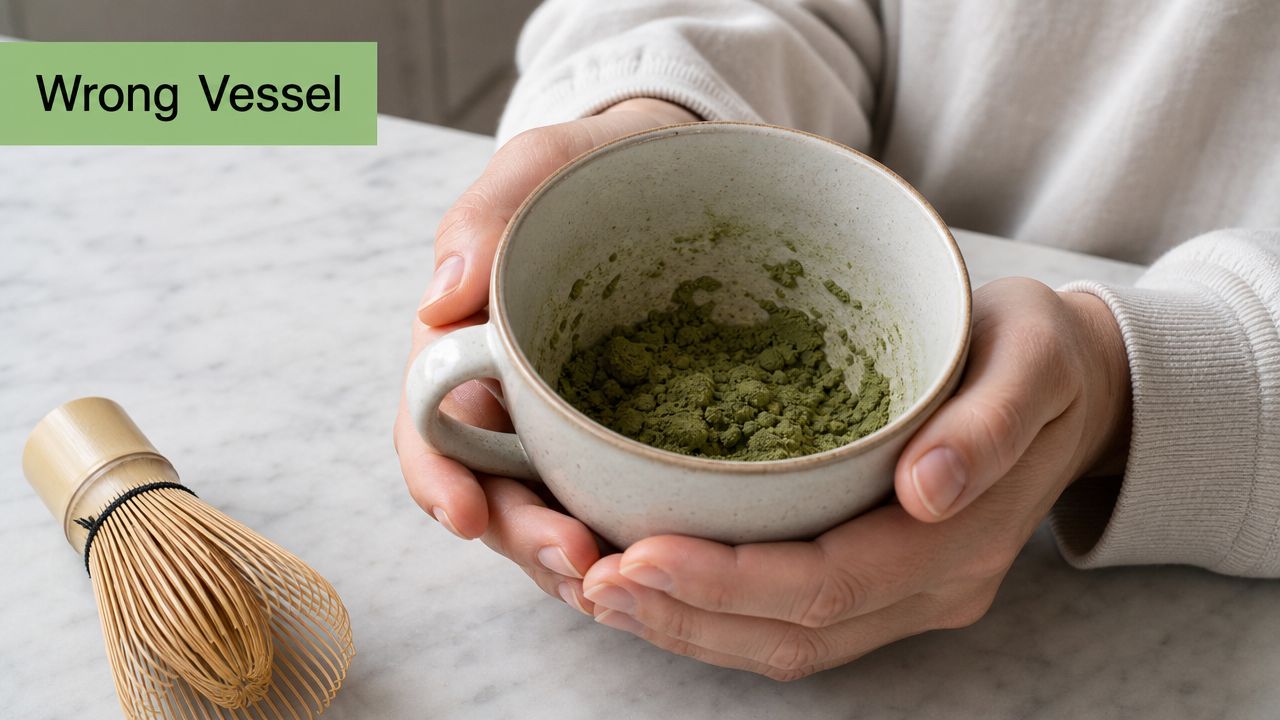
The takeaway is straightforward. A matcha bowl set is not about ceremony for ceremony's sake. It solves the basic mechanics that make matcha pleasant to drink, and that is why serious home drinkers and café operators keep coming back to the proper tools.
Components of a Matcha Bowl Set
A good matcha bowl set works like a small prep station. Each piece has a different job, and the fit between them matters more than the display shelf version of the set. In an Australian home kitchen, or behind a café bench during a morning rush, that fit is what makes the results repeatable.
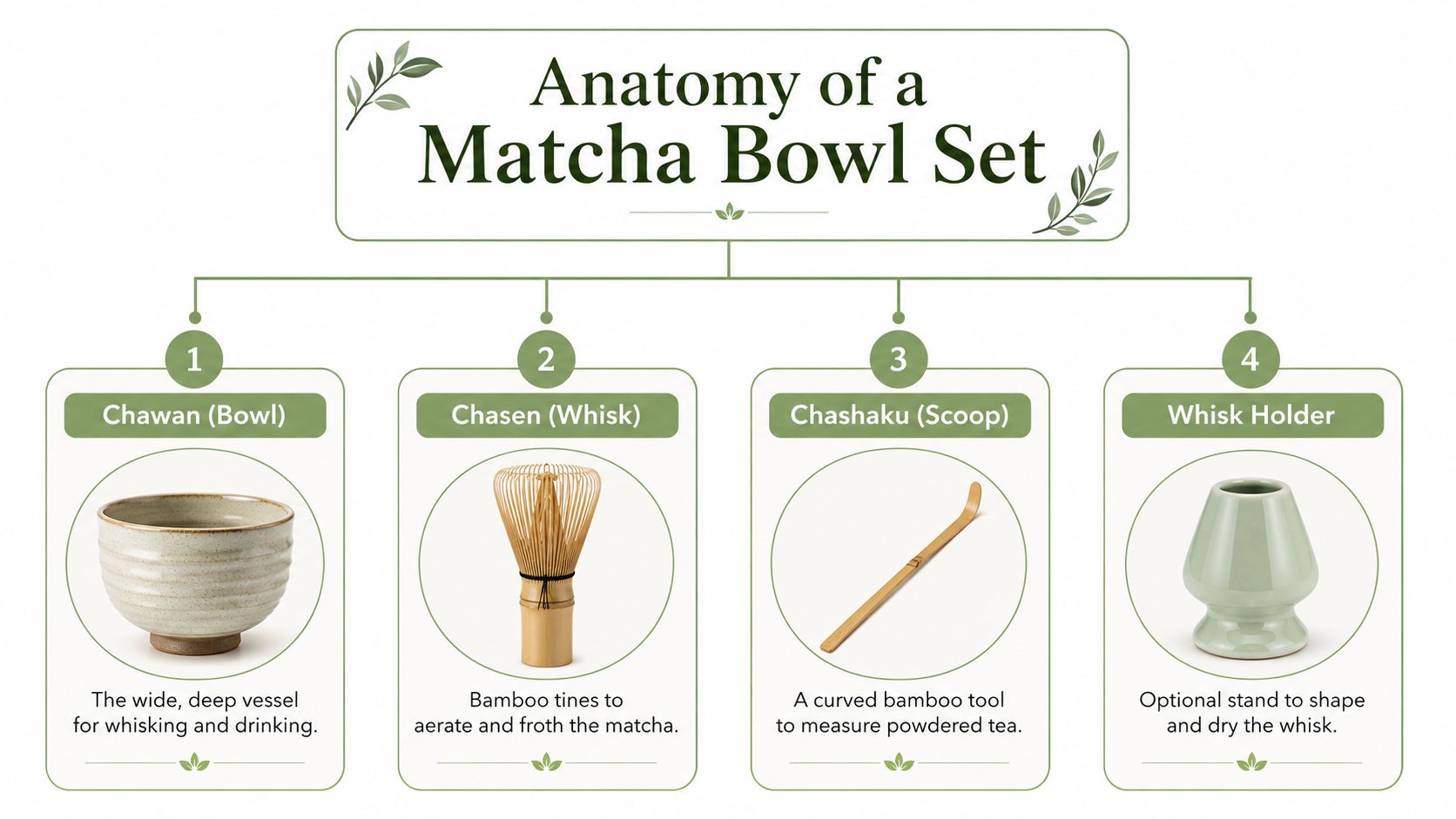
The core tools and what they do
A chawan is the bowl itself. Its wide, rounded shape gives the whisk room to move, so the tea and water can stay in motion instead of collecting in one tight spot. That geometry is the practical reason a proper bowl outperforms a random ceramic bowl from the cupboard.
A chasen is the bamboo whisk. Its flexible tines whip air into the tea and create the light foam people expect from well-made matcha. A spoon can stir the liquid, but it cannot make the same texture because it does not sweep the surface in the same way.
A chashaku is the curved bamboo scoop. The scoop looks simple, yet it matters because dosing changes the feel of the drink very quickly. Too much matcha in a small bowl can leave you with a dense, bitter cup that is hard to smooth out, especially if you are making drinks one after another.
A whisk holder is optional, but it helps keep the whisk in shape as it dries. For anyone who uses the set often, it gives the tines a proper resting place instead of leaving them bent or splayed in a drawer.
If you want to compare the usual accessories before buying, the matcha tea accessories collection at PepTea is a practical reference point for seeing how the tools relate to one another.
The set works best as a system, not as a pile of separate items.
The same idea carries into the kitchen. Matcha sits comfortably alongside authentic Japanese home cooking recipes, especially when you are building a routine around simple preparation and consistent flavour.
The common mistake is treating the bowl as the only part that matters. The bowl sets the shape of the work, but the whisk, scoop, and holder are what make the process reliable. When the pieces match the task, the tea is easier to prepare well, whether you are making one cup at home or repeating the same method for customers in a café.
Choosing the Right Materials and Sizes
A matcha bowl can look beautiful on the shelf and still be awkward in the hand. The key test is whether it supports steady whisking, comfortable pouring, and repeatable results for the way you brew at home or serve in a café. For Australian buyers, those practical details usually matter more than surface style.
Material trade-offs that affect everyday use
Ceramic is the most familiar option. It usually feels stable in the hand and suits the rounded shape that matcha needs. Porcelain can feel smoother and lighter, while glass shows the colour of the tea clearly, but can feel less forgiving in a busy kitchen.
| Matcha Bowl Materials Comparison | Heat Retention | Durability | Best For |
|---|---|---|---|
| Ceramic | Good warmth and a solid hand feel | Generally sturdy, but can chip if knocked | Home use, café service, everyday matcha |
| Porcelain | Even, clean finish | Can be strong, but still needs careful handling | Presentation-focused serving |
| Glass | Lower heat feel and more visual clarity | More fragile in active kitchens | Display use and occasional home brewing |
The best material depends on where the bowl will live. A café bench, a home cupboard, and a gift box all call for different priorities. Choose based on your actual brewing routine, then check whether the bowl is easy to clean, easy to store, and able to handle a busy morning rush without feeling delicate. If you are comparing options across a wider set of tools, the matcha tea accessories range is a useful way to see how the bowl fits with the whisk and scoop.
Why size and rim width matter
A standard matcha bowl is typically 400 to 500 mL, with a rim around 4.5 to 5.5 inches, or roughly 12 to 15 cm, in diameter what is a matcha bowl. That size gives the whisk enough room to move without splashing. A bowl that is too narrow makes the whisk collide with the sides, which breaks the foam and slows you down. A wider opening gives the tines space to work, which is helpful whether you are making a single bowl at home or repeating the same method for customers in a café. As noted earlier, the bowl is built for small, precise servings where whisking and foam formation matter more than volume.
For a deeper practical view of how bowl shape supports daily tea routines, the material and sizing advice in the same matcha bowl set category is worth comparing with the way you already make drinks at home. If your routine leans toward pantry-friendly meals as well, the same logic applies to tools used across authentic Japanese home cooking recipes.
Buy for the way you brew, not for the most beautiful shelf photo.
Handmade pieces can be lovely, especially if you enjoy ritual and presentation. Mass-produced bowls can be more practical for cafés, shared kitchens, or anyone who needs stackability and predictable cleaning. A handmade bowl may suit the quiet pace of home preparation, while a sturdier, more uniform piece often works better where cups are made back to back. The right answer is the one that matches your usage, not the one that looks aspirational on day one.
Mastering the Basic Whisking Technique
A good matcha cup starts with the whisk, the bowl, and the water working together. In an Australian kitchen or café bench, the goal is repeatable texture, not a lucky first try.
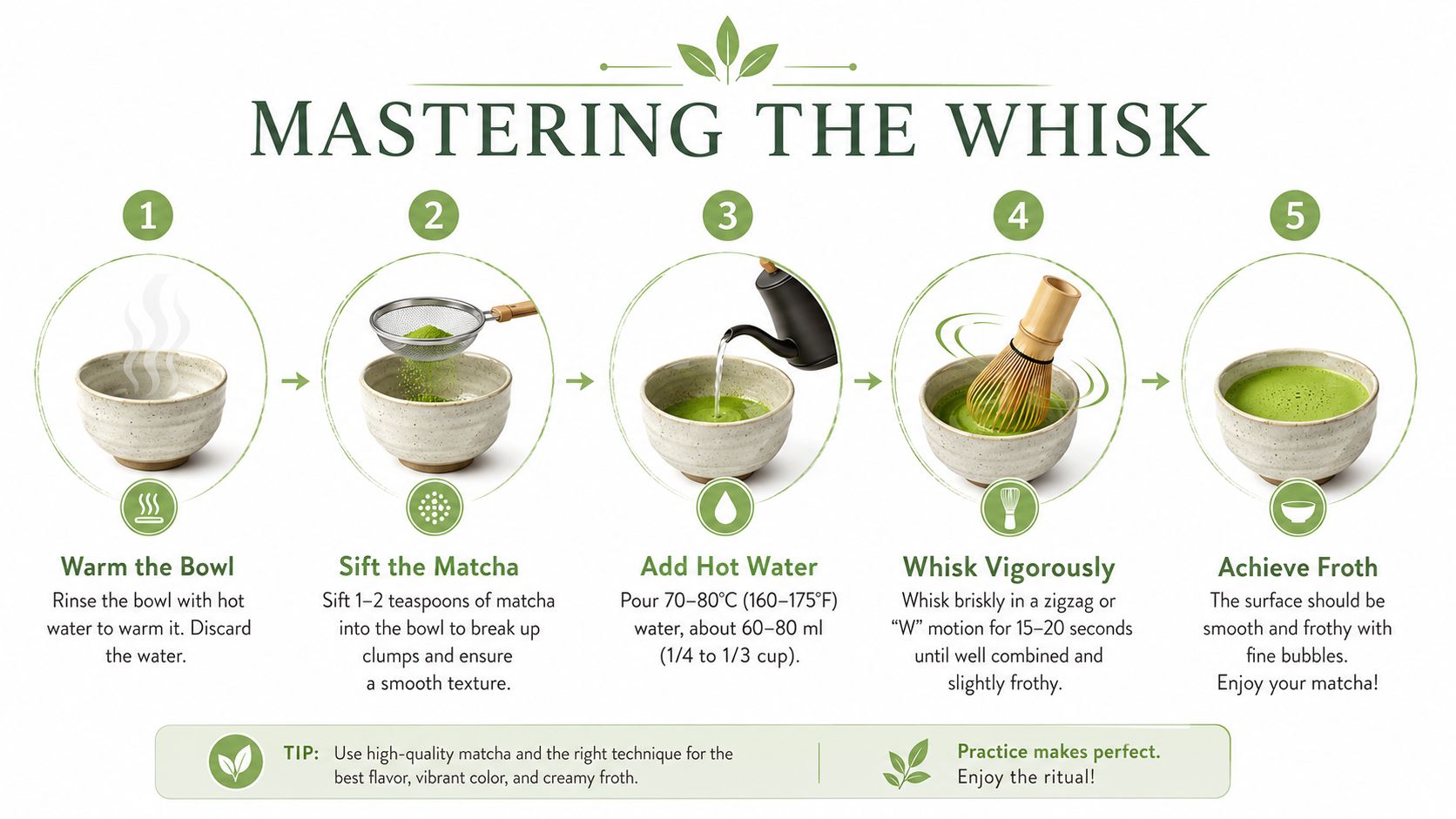
The preparation flow
Warm the bowl first. A pre-warmed vessel gives you a more settled working surface, and it helps the whole process feel under control.
Sift 1 to 2 g of matcha into the bowl next. Matcha is a fine powder, so it clumps easily, much like cocoa left untouched in a dry tin. Sifting gives the whisk less work to do and helps the drink finish smoother.
Add 60 to 80 mL of water at 60 to 70°C. Water that is too hot can push the flavour into a sharper, harsher place, especially if you are still learning how much pressure your whisk needs. The cooler range helps keep the taste cleaner.
Whisk in a W-shaped motion for 10 to 15 seconds. Use quick, light movements rather than force. The bamboo tines need space to move across the bowl, and a well-shaped bowl keeps them from scraping the sides, which helps build a more even foam.
If you want to see the motion before trying it yourself, the tutorial at how to whisk matcha shows the W-shaped whisking pattern at a steady pace, so you can match the rhythm while you practise.
Common mistakes and quick fixes
- If the tea looks grainy: you probably skipped sifting or stopped whisking too soon.
- If it tastes bitter: the water may have been too hot, or the matcha dose may be too heavy.
- If the surface stays flat: the bowl may be too narrow, or the whisk motion may be too circular.
- If it splashes out: the vessel is likely too small for the movement you are using.
A lot of beginners stir matcha like instant coffee. That approach leaves clumps behind and gives you weak foam. The whisk needs room, the bowl needs clearance, and the tea needs a short, decisive burst of motion.
For a fuller walkthrough of hand position and rhythm, the guide on how to whisk matcha is a practical companion. That same method also holds up when you are making drinks for guests or refining café service, because it gives you texture you can repeat instead of guessing from cup to cup.
Picking the Perfect Set for Your Situation
The best set for one person isn't always the best set for another. A home drinker, a café operator, and a gift buyer each care about different things, and the smartest purchase reflects that.
For home baristas
If you're making matcha most mornings, choose a set that's easy to clean and forgiving while you learn. A medium-sized bowl with a comfortable grip and a whisk that feels flexible is usually a better choice than an ornate showpiece. Storage matters too, especially in smaller kitchens where stackability can be a real bonus.
For café operators
Cafés need repeatable texture, fast cleaning, and a bowl that can handle frequent use. Durability matters more than decorative detailing, and the bowl should sit steadily on a bench during service. Whisk compatibility is essential, because the wrong bowl slows down preparation and makes foam quality less consistent across multiple serves.
For gift buyers
Presentation counts here. A set that arrives neatly packaged, looks polished, and includes a short guide for use tends to feel more complete. The recipient shouldn't have to guess which tool does what.
The best gift set is the one that helps someone make a good cup on the first try.
A simple way to think about it is this:
- Home use: prioritise easy cleaning and a bowl that feels comfortable in the hand.
- Café use: prioritise durability, consistency, and whisk clearance.
- Gifting: prioritise presentation, clear components, and user-friendly guidance.
If you're shopping for home use, it's easy to overbuy on extras you won't touch. If you're buying for a café, it's just as easy to under-invest and end up replacing tools too soon. A balanced matcha bowl set saves more time than it costs because it matches the job in front of you.
Caring for Your Matcha Tools
Bamboo and ceramic both last longer when you treat them gently. The maintenance routine is simple, and it pays off quickly because the tools stay usable and look better for longer.
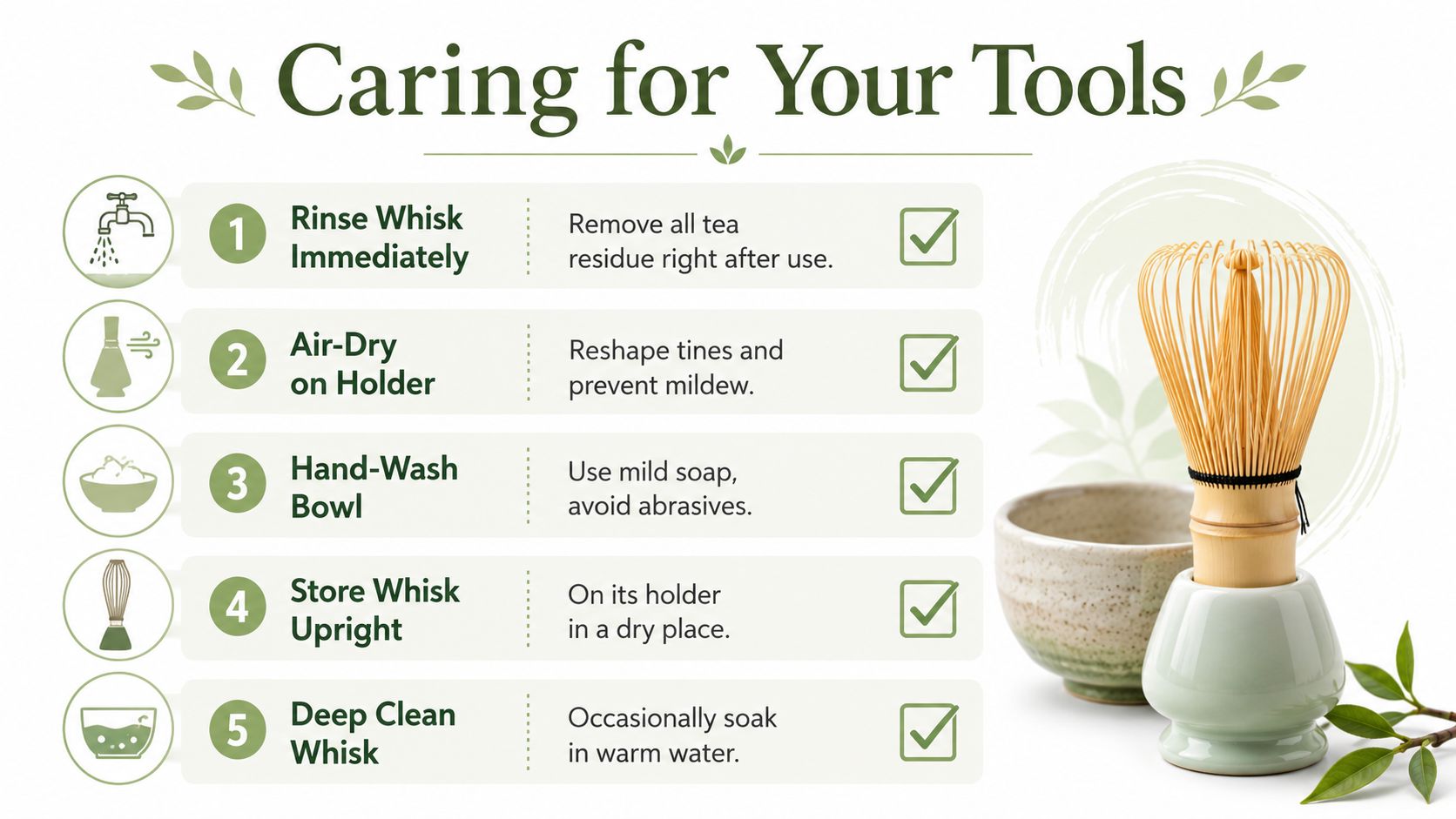
A routine that actually fits real life
Rinse the whisk right after use. Matcha dries fast, and once it sets into the tines, it becomes harder to remove without bending them. Let the whisk air-dry on a holder so the shape stays open instead of collapsing inward.
Wash the bowl by hand with mild soap and a soft sponge. Abrasive pads can dull the finish and make stains more obvious over time. For stubborn residue, warm water and a little patience usually do the job without damaging the surface.
Store the whisk upright in a dry place. Bamboo doesn't like being left damp, especially in humid conditions. In Australian homes, that matters in summer, when moisture can linger longer than you expect.
For a practical storage option, a dedicated matcha whisk stand like the one at PepTea helps the tines keep their shape between uses.
Signs it's time to replace a tool
- Bent whisk tines that no longer spring back properly.
- Persistent staining or odour that survives normal cleaning.
- Chipped bowl edges that make the vessel awkward or unsafe to use.
- Loose or splintering bamboo that no longer feels comfortable in the hand.
The point of good care is not perfection, it's longevity. A few deliberate habits take less time than replacing damaged tools, and they help your set stay ready for daily brewing instead of becoming a drawer of half-used accessories.
Creative Recipes Using Your Matcha Set
A good bowl set earns its place because it's useful beyond the classic hot serve. The same whisking technique gives you a better base for iced drinks, blended drinks, and even baking.
Three easy ways to use it
For an iced matcha latte, whisk matcha with a small amount of warm water first, then pour it over ice and top with milk. Starting with a smooth matcha base matters because the cold drink won't hide clumps later. The bowl helps you build that base properly instead of relying on a spoon and hoping for the best.
For a matcha smoothie, whisk the powder with water first before blending it with fruit, yoghurt, or milk. That tiny prep step improves dispersion and keeps the colour and flavour more even through the drink.
For matcha baking, sift the powder before adding it to batter. The bowl and whisk help you break it down first, which gives cakes, biscuits, and slice batter a cleaner flavour and more even colour.
PepTea's organic matcha works well as a base here because a consistent powder makes the result easier to repeat. That matters whether you're making one serve for yourself or scaling a recipe for a small café menu.
Good matcha prep is a foundation, not a finish line.
If you're entertaining, just keep the same ratios and multiply the servings. A proper bowl set gives you a dependable starting point, which is exactly what you want when drinks need to come out looking and tasting the same.
Your Next Steps to Better Matcha
The right decision comes down to four things, bowl geometry, whisk compatibility, technique, and whether the set fits the way you drink matcha. Once those pieces line up, the drink gets easier to prepare and more satisfying to serve.
If you're starting from scratch, choose a bowl with enough width for the whisk to move freely, a bamboo whisk that feels flexible in hand, and a scoop that helps you keep the dose consistent. If you already own a bowl but keep getting clumps or weak foam, the problem is usually not the powder alone. It's often the vessel, the motion, or the way the tools fit together.
For home drinkers, the safest upgrade is usually a practical, easy-care set that removes friction from the morning routine. For cafés, the better move is durability and consistency, because those two things affect every cup that leaves the bench. For gifts, look for clear presentation and tools that help the recipient succeed quickly.
A matcha bowl set doesn't need to be complicated to be effective. Once you understand what each piece is doing, you can make better matcha with less guesswork and more confidence. Explore Pep Tea's organic matcha range and the matching tools that help turn a powder into a proper cup.
A CTA for Pep Tea.
Matcha Bowl with Spout: Latte Perfection

You whisk the matcha carefully. The colour looks right. The foam finally sits on top in a soft green layer. Then you pour it into your mug and half of it runs down the outside of the bowl, onto the bench, and into that annoying puddle near the spoon.
If that sounds familiar, you’re not doing anything wrong. You’re just using the wrong vessel for the last part of the job.
A matcha bowl with spout fixes one of the most frustrating parts of making matcha at home or in a café. It helps you whisk properly, then pour cleanly. That sounds simple, but it changes the whole experience. Your latte looks better, your bench stays cleaner, and the texture you worked for makes it into the cup.
The Secret to a Spill-Free Matcha Latte
A lot of people assume the hard part of matcha is the whisking. It isn’t always. Often, the pour is where things fall apart.
You can make a smooth bowl of matcha, heat your milk well, and still end up with streaks down the side of your mug because a standard bowl has no clean pouring point. The liquid rolls over the rim wherever gravity sends it. That’s fine if you’re drinking straight from the bowl. It’s less fine when you’re topping an iced latte, filling a takeaway cup, or trying to keep service moving in a busy café.
The familiar home kitchen problem
At home, the mess is mostly annoying. You wipe the bench, rinse the bowl, and try again.
In hospitality, it becomes a workflow issue. Staff lose time. The presentation slips. Foam breaks while the person pouring slows down to avoid spills. A drink that should feel calm and polished starts to feel fiddly.
A good matcha pour should feel controlled from the first tilt, not like you’re hoping for the best.
Milk also matters here. If you’re building a latte, your poured matcha has to meet milk that’s still silky and in the right range. If you want a useful reference point for that side of the drink, this guide to ideal milk temperature for lattes gives practical context for getting the texture right.
The simple tool that changes the result
That’s where the spouted bowl comes in.
A matcha bowl with spout is designed for one specific problem. It lets you whisk in an open bowl, then pour with precision. No awkward tipping. No dribbling down the side. No sacrificing foam just to get the liquid into the cup.
For home enthusiasts, it makes your morning ritual neater and easier. For café owners, it turns a beautiful but messy drink into something more repeatable.
What Exactly Is a Matcha Bowl With Spout
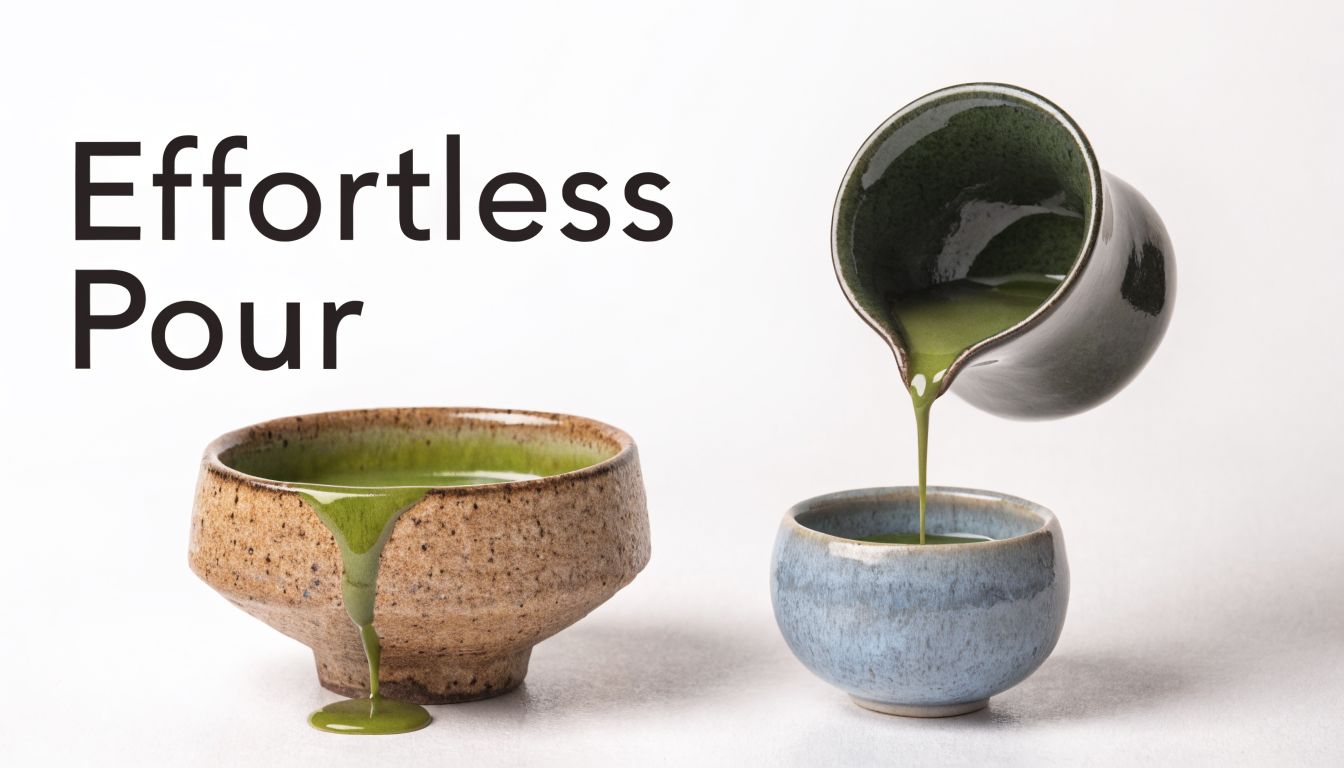
You will often see this bowl called a katakuchi. In practical terms, it is a whisking bowl with a shaped pouring lip on one side, made to move matcha cleanly from bowl to cup.
That sounds like a small change. It is not.
A standard chawan is brilliant for preparing and drinking matcha in the bowl itself. A matcha bowl with spout keeps that open, whisk-friendly shape, then adds control at the moment many home baristas and café staff struggle with most. The pour.
Built for whisking first, pouring second
The best way to understand a spouted matcha bowl is to start with the job matcha asks the bowl to do. You are not steeping leaves and waiting. You are combining very fine tea powder with water, breaking up small clumps, and whisking enough air into the surface to create a light foam.
That process works better in a bowl that gives the whisk room to move.
Harmony Leaf’s katakuchi product guide describes this style as a wide ceramic bowl with a rounded interior and a pouring lip. Those details matter because the curved base helps the chasen sweep through the liquid more freely, while the lip gives you a clear exit point when it is time to transfer the matcha into a mug, latte glass, or mixing vessel.
For an Australian café, that means fewer messy handoffs during service. For a home barista, it means your bench stays cleaner and your foam has a better chance of reaching the cup intact.
The shape explains the purpose
A spouted matcha bowl works like a mixing bowl with a proper pouring edge. The comparison is simple, but useful. A regular bowl can hold the liquid, yet it does not guide it well once you tilt it.
A good katakuchi usually includes:
- A broad opening so the whisk can move quickly without knocking the sides
- A curved interior so powder and water collect in the centre instead of hiding in corners
- Ceramic walls with some weight so the bowl feels steady in the hand during whisking
- A defined spout so the finished matcha lands where you intend
Each feature answers a specific problem. More room helps with whisk speed. A rounded base helps with consistency. A proper lip helps with transfer.
An old tea form adapted to modern service
The bowl itself sits within a much older tea tradition. Powdered tea was prepared in China during the Song Dynasty, and that style of tea preparation later influenced Japanese tea culture, including the development of the chawan, as outlined in this history of chawan and tea culture.
The spouted version reflects a modern need. Many people still enjoy matcha straight from the bowl, but cafés, home latte drinkers, and dessert makers often need to whisk in one vessel and pour into another. The katakuchi answers that exact workflow.
That is why this tool matters beyond definition. It is not only a ceramic bowl with a lip. It is a practical bridge between traditional matcha preparation and the cleaner, faster service expected in homes and cafés across Australia.
Why the Spout Is a Game Changer for Your Matcha
It is 8:15 on a Sydney breakfast rush. One person wants an iced strawberry matcha, another wants oat milk, and a third wants theirs extra strong. At home, the pressure looks different, but the problem is the same. You whisk a lovely bowl of matcha, then lose control in the last two seconds as it dribbles down the side of the bowl instead of into the cup.
That final pour decides more than people realise.
A spout improves three parts of the process at once. It gives you a cleaner line into the cup, helps protect the foam you just whisked, and saves time when you need to make more than one serve. For anyone building a reliable setup, whether that is a home station or a café bar, the right matcha tea whisk and bowl set makes the whole workflow easier to repeat.
Precision without the drips
The most obvious benefit is control.
A standard bowl often lets liquid spread along the rim before it drops. That spread turns into drips on the bench, streaks on the cup, and wasted matcha. A shaped spout brings the liquid into a narrower stream, so you can aim into a mug, a latte glass, or a bottle without the usual mess.
It works a bit like the difference between pouring from a saucepan and pouring from a milk jug. Both hold liquid. Only one is designed to send it where you want it to go.
That matters in a café where speed counts, but it also matters at home. Less wiping up means the ritual stays enjoyable instead of fiddly.
Better texture in the cup
Texture is the part many beginners miss.
Freshly whisked matcha has a delicate layer of fine foam across the top. If the pour comes out in a broad, uneven sheet, that foam breaks apart before it reaches the drink. A spout guides the liquid more cleanly, which gives the foam a better chance of staying intact as it moves from bowl to cup.
The bowl does not create good foam on its own. Your sift, water temperature, and whisking technique still do the heavy lifting. The spout protects that work during transfer.
If your matcha looks silky in the bowl but flatter in the glass, the weak point is often the pour rather than the whisk.
Faster service, fewer repeated motions
The speed benefit becomes clear once you make matcha regularly.
Ippodo Tea’s page on spouted chawan notes that some Mino-yaki styles are designed for whisking multiple servings and pouring with less loss, which offers a key operational advantage for cafés and busy home cooks alike: fewer repeated prep cycles, less waste around the rim, and more even portioning across drinks. You can see that product guidance on Ippodo’s site at https://ippodotea.com/.
For Australian cafés, that matters because matcha is no longer an occasional extra. It sits in the same service rhythm as coffee, chai, and iced drinks. A bowl that lets staff whisk, pour, and reset quickly helps keep quality steady during a rush.
Home baristas benefit too. If you are making two morning lattes, or one drink plus a matcha cream or syrup for dessert, a spouted bowl cuts down the stop-start feeling of the process. It is the same reason kitchens use pouring jugs for sauces and batters. Cleaner transfer improves consistency.
That crossover between beverage service and food presentation is easy to spot in other hospitality tools as well, including packaging choices covered in this paper ice cream cups buying guide.
Why this matters in real Australian use
In many Australian homes, matcha now sits beside the espresso machine rather than in a once-a-week tea drawer. In cafés, it has to perform under pressure, not just look good on a shelf.
A spouted bowl suits both settings because it solves a practical handoff problem. You whisk in one vessel and pour into another with less mess, better control, and more predictable results.
| Situation | Standard bowl | Spouted bowl |
|---|---|---|
| Home latte | Pour can spread across the rim | Cleaner line into the mug |
| Iced drinks | Harder to aim around ice | Better control into tall glass |
| Busy café service | More wiping and rework | Quicker, tidier portioning |
| Recipe prep | Tricky to divide neatly | Easier to pour into cups or jars |
For a tea drinker, that means better-looking matcha with less cleanup. For a café owner buying wholesale, it means a tool that supports consistency and pace during service.
The spout is small. Its effect on the workflow is not.
How to Choose the Right Spouted Matcha Bowl
Choosing a spouted matcha bowl is a bit like choosing milk jugs for café service. The right one makes the job easier every single day. The wrong one feels fine in your hand for ten seconds, then starts causing small frustrations with every whisk and pour.
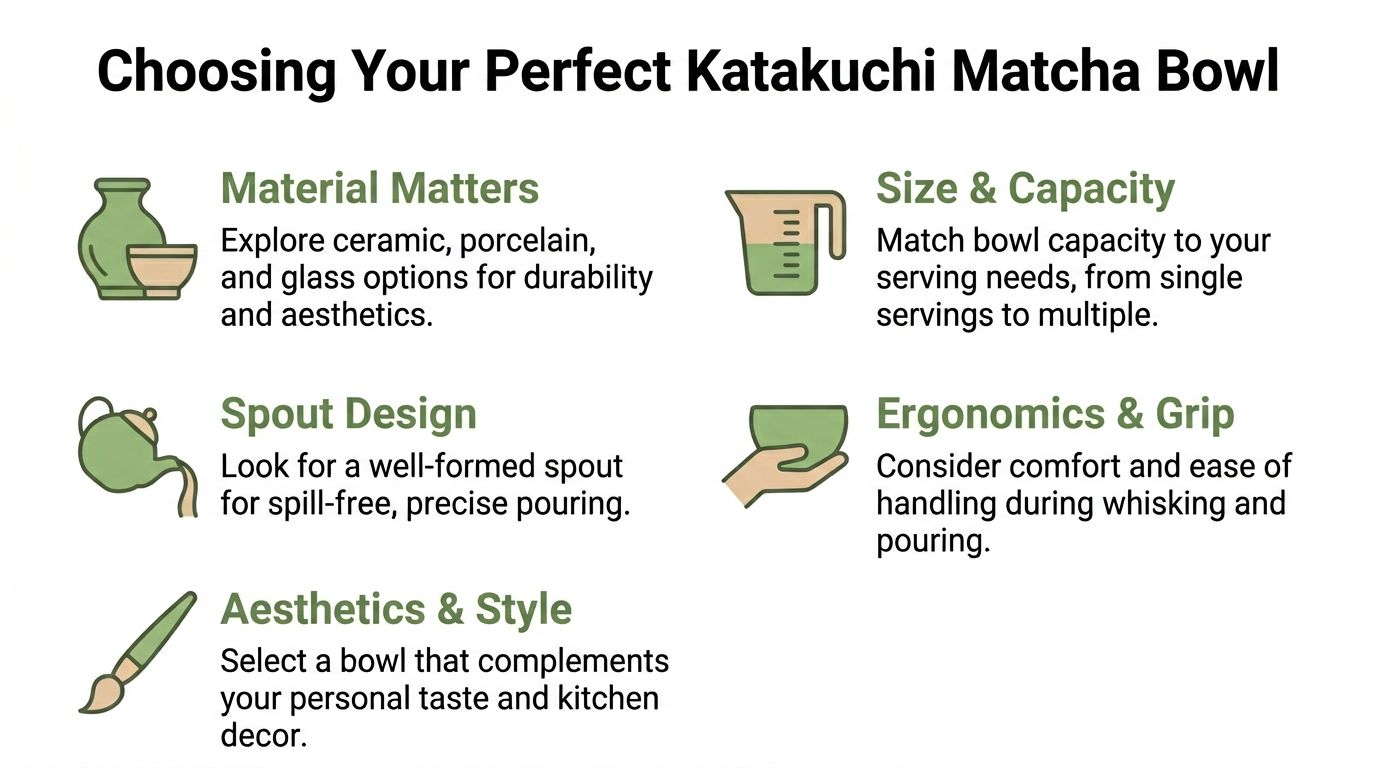
For an Australian home barista, that usually means finding a bowl that feels pleasant to use before work and pours neatly into the mug you already love. For a café owner or wholesale buyer, the question is broader. You need a bowl that helps staff repeat the same result during a busy service, with less waste and less bench cleanup.
Start with the job the bowl needs to do
A bowl for occasional straight matcha does not need the same capacity as one used for back-to-back iced lattes. If you mainly make one serve at home, a smaller bowl can feel more balanced and easier to store. If you prepare larger drinks, split pours, or recipe bases, more room in the bowl gives the whisk space to move and lowers the chance of splashing over the rim.
That is why capacity matters in a practical way, not just on a product label.
For many cafés, a bowl around 500 ml or larger is a sensible starting point because it leaves room for whisking and controlled pouring. For home use, smaller bowls often feel more comfortable, especially if you value a slower ritual and a lighter vessel.
Material changes how the bowl behaves
Material is not only about looks. It affects grip, heat, weight, and how confident the pour feels.
| Material | Best for | What to expect |
|---|---|---|
| Ceramic | Daily use at home or in cafés | Good heat retention, stable in the hand, forgiving to whisk in |
| Porcelain | Minimal, refined setups | Smoother finish, usually lighter, often a sharper visual style |
| Glass | Visual preparation and presentation | Attractive to watch, but can feel hotter, lighter, and less secure when wet |
Ceramic is usually the most practical all-round option. It has enough weight to stay steady while whisking, and it tends to feel more controlled during the pour. That balance matters if you are trying to reproduce café-quality matcha at home, or standardise service across staff in a venue.
Check the shape, not just the photos
A bowl can look beautiful online and still be awkward in use.
Start with the interior. A rounded base helps the chasen move freely, much like a curved mixing bowl helps a whisk catch everything instead of pushing ingredients into corners. You get fewer clumps stuck at the edges and a more even texture with less effort.
Then look closely at the spout. A well-formed spout should guide liquid into a narrow stream. If it looks shallow, uneven, or decorative rather than functional, you may get drips down the side of the bowl after each pour. That is annoying at home and costly in a café where tiny delays add up across a full shift.
What to test before you buy
A quick checklist helps separate a display piece from a working tool:
- Capacity: Enough room for your usual recipe without crowding the whisk.
- Rounded interior: Better whisk movement and less powder trapped around the edge.
- Defined spout: Cleaner stream, less dripping, and more accurate pouring into cups or glasses.
- Balanced weight: Comfortable to lift when full, not clumsy or too delicate.
- Grip: A finish that feels secure even with damp hands.
A useful comparison comes from serviceware buying in other parts of hospitality. This paper ice cream cups buying guide covers a different product, but the same buying logic applies. Capacity, handling, material, and real service conditions should shape the choice.
Match the bowl to the user
The best spouted bowl depends on who is using it and how often.
- Home barista: Choose comfort, a manageable size, and a spout that pours neatly into your usual cup or glass.
- Busy café: Choose durability, larger capacity, and a shape that different staff members can use consistently without retraining their pour every shift.
- Retail customer buying a gift: Choose a bowl that looks attractive but still has a rounded interior and a properly formed spout.
- Wholesale buyer for café supply: Choose pieces that support repeatable drink quality and efficient service, because those are the details venues notice after the first week of use.
If you want a practical benchmark for how the bowl fits into the full preparation setup, this matcha whisk and bowl set shows the core tools that work together.
Mastering Your Whisk and Pour Technique
Owning a good bowl helps, but technique is what turns the tool into a better drink.
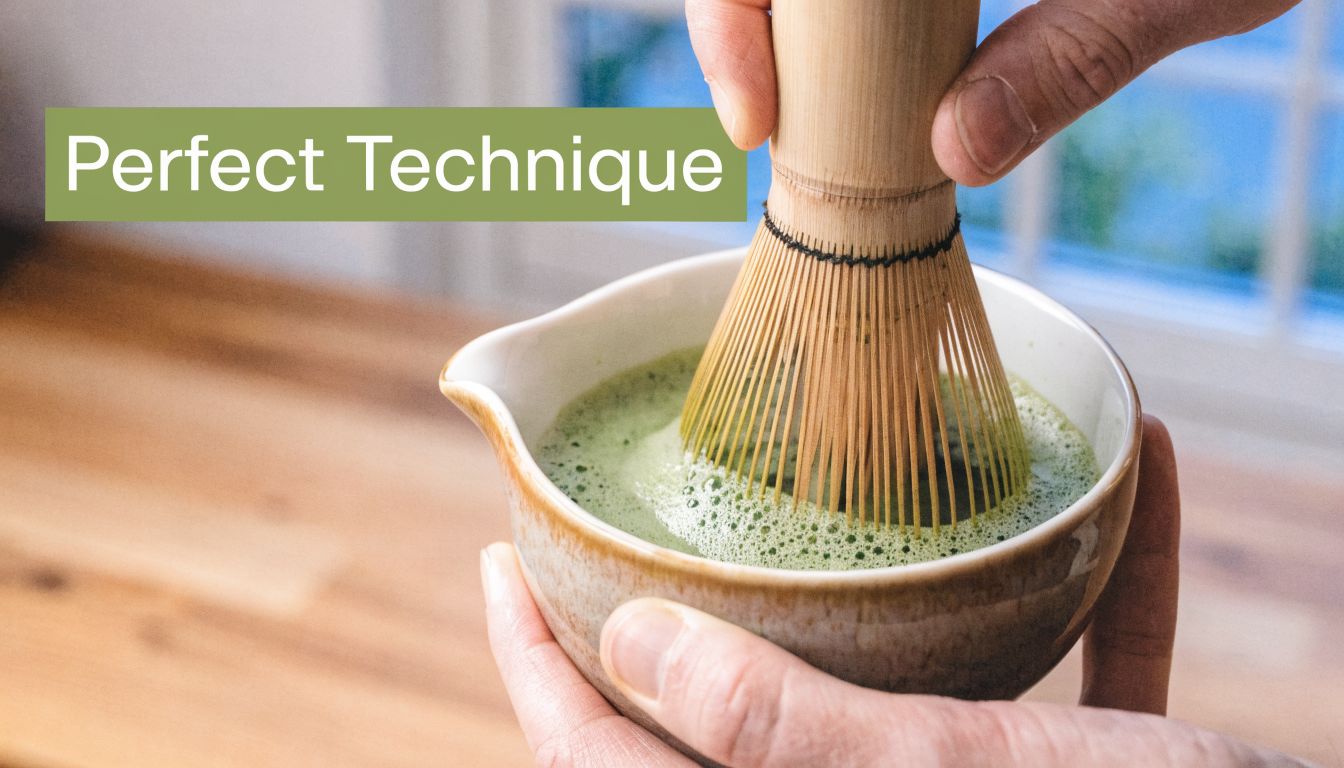
Step one with the bowl
Start by warming the bowl with hot water, then empty and dry it. A warmed bowl helps keep the preparation stable and makes whisking feel smoother.
Next, sift your matcha into the bowl if you can. Sifting isn’t fussy for the sake of it. It breaks up clumps before water hits the powder, which makes a smoother drink with less effort.
The whisking motion that works
Add a small amount of hot water and begin whisking with a chasen.
Don’t stir in circles like soup. Use a quick M or W motion with your wrist, keeping the whisk tips near the surface as the foam begins to build. The aim is a fine froth, not giant bubbles.
Small correction: If your whisk is scraping heavily at the base, you’re probably pressing too hard. Let the whisk move lightly and quickly.
A rounded bowl helps here because the whisk can travel freely. You’re less likely to get powder stuck in corners, and the movement feels more natural.
How to pour without collapsing the texture
Once the matcha is whisked, pause for a second. Let the surface settle just enough that you can see the pour.
Grip the bowl firmly with one hand and guide the spout toward the centre of your cup or glass. Tilt smoothly. Don’t jerk the bowl upward at the end. That sudden stop is what often causes the final drip.
For lattes, pour the matcha first or over the milk depending on the style you want. Either works, but the key is keeping the stream controlled.
A visual guide can help if you’re refining your hand motion:
A simple routine to repeat
- Warm the bowl so the preparation starts evenly.
- Sift the matcha to avoid stubborn lumps.
- Add water gradually rather than flooding the powder.
- Whisk fast with the wrist until the top looks fine and frothy.
- Pour from the spout in one smooth tilt instead of hesitating halfway.
If you want a practical latte method to pair with this bowl technique, this make matcha latte guide gives a simple reference for building the drink itself.
Creative Recipes Beyond the Traditional Tea
Saturday morning at home or the middle of a café rush, the same problem shows up fast. You need matcha that is smooth, evenly mixed, and easy to pour without green streaks across the bench. A spouted bowl helps with all three, which is why it suits both the home barista chasing café-quality drinks and venues that need speed without slipping on consistency.
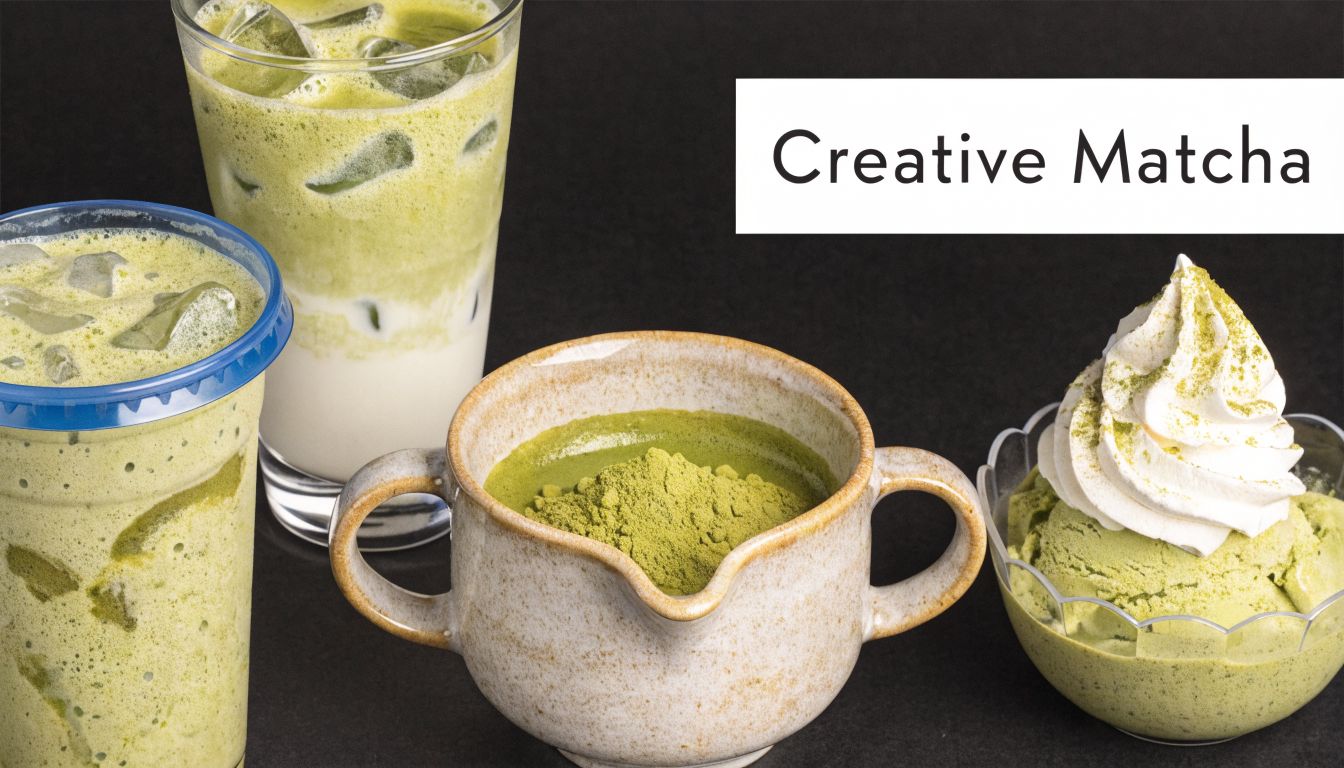
The useful part is not just the whisking. It is what happens after. Once your matcha is properly blended, the spout lets you place that liquid exactly where you want it, whether that is over ice, into a muffin mix, or across the top of sparkling kombucha for a layered special. For Australian cafés, that control means cleaner service and less waste. For home use, it means fewer failed pours and a result that looks far more polished.
Iced matcha latte
An iced latte shows the benefit straight away because ice cubes tend to interrupt the pour. A regular bowl often sends matcha around the cubes and onto the rim of the glass. A spout narrows the stream, so more of the matcha lands in the drink instead of on your hands.
Whisk the matcha with hot water until smooth and lightly frothy. Fill a glass with ice, add cold milk, then pour the matcha slowly over the top. If you want a distinct layered look, pour against the inside of the glass. If you want a more blended drink, pour into the centre and stir once.
Matcha pancake or muffin batter
This bowl is handy in the kitchen too, especially for small batches.
Start by whisking matcha with a little warm liquid to make a loose paste. That step matters because dry matcha dropped straight into batter often forms tiny green clumps, a bit like cocoa powder that refuses to mix in. Once smooth, pour it into your pancake or muffin batter and fold gently.
For pancakes, the spout helps you portion batter onto the pan with better control. For muffins, it makes filling cases neater, which is useful if you are baking for a market stall, a café cabinet, or just trying not to clean batter off the tray later.
Matcha kombucha spritzer
A kombucha spritzer gives matcha a brighter, more refreshing style. It works well for warm weather menus and for customers who want something lighter than a milk-based drink.
Whisk a small serve of matcha, let it cool slightly, then pour it into a glass with ice and chilled kombucha. The flavour changes depending on the base:
- Plain kombucha base: Keeps the matcha front and centre.
- Ginger kombucha: Adds a gentle kick.
- Citrus-leaning kombucha: Brings out the fresher green notes.
This kind of recipe also shows why the bowl matters for service. If you are trialling specials in a café, a controlled pour makes it easier to repeat the same look from one glass to the next. If you are making drinks at home, it makes creative matcha feel less fiddly.
A spouted matcha bowl is a mixing bowl, measuring helper, and pouring jug in one. That is the quiet reason it gets used so often. It earns space in the cupboard because it solves practical problems, not because it is decorative.
Caring For Your Spouted Matcha Bowl
A good bowl can last for years if you treat it gently. The basics are simple, but they make a real difference.
Daily care that keeps it looking good
Rinse the bowl soon after use. Matcha can leave a green tint if it dries onto the glaze, especially around the spout.
Wash with warm water and a soft sponge. If you use detergent, keep it mild and rinse well so no scent or residue lingers for the next bowl.
What to avoid
A few habits shorten the life of handmade ceramics.
- Don’t use abrasive scrubbers: They can mark the glaze and dull the surface.
- Don’t knock the spout against the sink: That edge is often the most vulnerable point.
- Don’t stack carelessly: The rim and pouring lip can chip if bowls rub together.
Dry the bowl fully before storing it. If it lives on an open shelf, give it enough space that you’re not bumping it every time you reach for a mug.
A matcha bowl with spout is a working tool, but it’s still ceramic. A bit of care keeps the pour clean and the bowl pleasant to use.
Elevate Your Matcha Ritual With the Right Tools
A matcha bowl with spout does more than make pouring tidy. It improves how matcha is whisked, transferred, and served. That matters whether you’re making one calm morning latte at home or building a sharper non-alcoholic menu in a busy Australian café.
The right bowl makes the whole process feel more natural. You whisk with confidence, pour with control, and waste less of the drink you’ve just prepared. That’s a small shift in equipment, but a big shift in results.
If you’re building out your setup, a dedicated collection of matcha tea accessories can help you pair the bowl with the right whisk and serving tools.
If you’re ready to put these techniques into practice, explore Pep Tea for organic matcha, brewing accessories, and café-friendly options that make it easier to create smooth, vibrant matcha at home or in service.
Unlock the Perfect Matcha Tea Whisk and Bowl

You’re probably here because your matcha looked promising in the tin and disappointing in the bowl. The colour was right. The whisk looked beautiful. Then the drink turned out clumpy, flat, or oddly bitter.
That’s not a matcha problem. It’s usually a matcha tea whisk and bowl problem, or more precisely, a technique problem shaped by the tools in your hands.
A good bowl of matcha isn’t about ceremony for ceremony’s sake. The whisk and bowl exist because matcha is a suspended powder, not a leaf infusion. If the powder isn’t fully dispersed and aerated, the texture suffers first, then the flavour. Once you understand what the whisk is doing, and why the bowl is shaped the way it is, everything gets easier.
The Ritual of Matcha Why Your Whisk and Bowl Matter
It usually starts on a rushed weekday morning. Matcha goes into the nearest mug, hot water follows, a spoon gets a quick spin, and the cup looks dull before you even taste it. Then the first sip lands harsh, powdery, and flatter than the bright, creamy bowl you were hoping for.
A chasen and chawan fix that because they solve a physical problem, not a decorative one.
Matcha is a fine stone-ground powder suspended in water. It does not dissolve the way instant drinks do. To taste sweet, savoury, and smooth, those particles need to be dispersed evenly and lifted with air. A bamboo whisk does that fast without bruising the liquid. A proper bowl gives the whisk the width and curve it needs to move freely.
That matters even more in Australia, where home water can change a bowl more than many people expect. Hard water in some suburbs can mute sweetness and make bitterness show up sooner. A heavy café-style mug also tends to trap your wrist in a tight angle, which leads to stirring instead of whisking. Good tools create better mechanics, and better mechanics create better texture.
These tools shape the cup
The whisk controls agitation. The bowl controls space, temperature, and the way the liquid rolls back on itself as you whisk. That combination is why the same matcha can taste soft and rounded in one vessel, then sharp and grainy in another.
I see this all the time with Australian café drinkers trying to recreate their favourite order at home. They buy better powder, often something clean and vibrant like Pep Tea, but keep using a cereal bowl or coffee mug. The matcha is fine. The setup is fighting the result.
A proper matcha bowl does three jobs at once:
- Creates room for whisking so the tines can travel quickly across the surface without crashing into the sides
- Buffers heat so the water stays closer to the gentle range matcha prefers
- Supports foam formation because the wider base helps build a fine layer of froth instead of a few large bubbles
Practical rule: If your whisk taps the sides every few seconds, your vessel is too narrow.
There is art in this, but there is physics first. Fast wrist movement pulls air into the liquid. The flexible bamboo tines break up clumps and spread the powder through the water. The bowl’s shape lets that motion stay light and efficient. Once those parts work together, flavour opens up. You get more sweetness, less harshness, and a fuller body.
The ritual also changes how you taste. A slower setup gives the powder a fair chance and gives you a moment to notice what is in the bowl. That is part of why matcha has lasted for centuries. For useful context on how this practice developed, Pep Tea’s brief history of matcha tea is a good place to start.
How to Select the Right Matcha Whisk and Bowl
A rushed weekday prep in Melbourne or Sydney usually exposes weak tools fast. The powder may be excellent, the water temperature may be close, but if the whisk is stiff or the bowl is cramped, the texture falls apart before you even taste it.
Good selection starts with your routine. A person making one careful bowl each morning needs a different setup from someone whisking concentrated matcha for iced lattes after lunch. Australian water also changes the equation. In hard-water areas, matcha can show more bitterness and less softness, so a whisk and bowl that help you mix quickly and evenly are worth more than decorative details.

What to look for in a chasen
A chasen is a precision tool, even if it looks simple. The number, spacing, and thinness of the tines all affect how air enters the liquid and how quickly powder disperses. More tines usually give a finer foam with less effort. Slightly thicker, fewer tines often feel steadier when making a stronger bowl or a small paste for latte prep.
Choosing Your Chasen Matcha Whisk
| Tine Count | Best For | Foam Type |
|---|---|---|
| 80 | Daily usucha, beginners, lighter bowls | Soft, light foam |
| Around 100 | Traditional all-round use | Fine, even microfoam |
| 120 | Thicker preparation, richer bowls, concentrated matcha | Denser surface texture |
What matters at purchase:
- Single-piece bamboo construction flexes more naturally and tends to last better than poorly assembled imitations.
- Clean, even tine cuts help the whisk move consistently across the bowl instead of catching and skipping.
- A handle that sits comfortably in the fingers reduces tension in the wrist, which improves your whisking speed and control.
I usually suggest an all-round whisk with about 100 tines for home drinkers. It gives enough finesse for a smooth bowl made with a high-grade matcha such as Pep Tea, but it is still forgiving if your technique is not perfect at 7 am.
What to look for in a chawan
The bowl decides how usable the whisk becomes. For everyday matcha, choose a bowl with a broad base, open top, and enough depth to keep liquid inside while you whisk briskly. Traditional tea bowls often sit in the 12 to 15 cm range across, and that shape works well because it gives the wrist room to move without forcing the whisk into the walls.
Material matters too. Thicker ceramic holds warmth longer, which helps in cooler Australian kitchens and during winter mornings in places like Hobart or Canberra. A thinner bowl responds faster and can feel lighter in the hand, but it loses heat more quickly. If your local tap water runs hard or heavily mineral, a bowl that keeps temperature steady can make the flavour feel rounder and less sharp.
A few practical checks help:
- Flat or gently curved interior makes it easier to break up small clumps.
- Stable foot keeps the bowl from shifting on the bench.
- Comfortable rim improves the drinking experience, especially with straight matcha rather than lattes.
Match your tools to your routine
For straight matcha, go wider and more traditional. For latte prep, choose a bowl with enough room to whisk a smooth concentrate before adding milk. If you drink both, pick the more versatile option rather than building a collection too early.
The best matcha tea whisk and bowl set is the one that lets you repeat good technique on an ordinary Tuesday morning.
There is always a trade-off between delicacy and durability. Fine tines create prettier foam, but they punish rough handling. Heavier bowls feel steady and hold heat well, but they can be less pleasant if you like to cradle the bowl in your hands. Choose the setup that fits your real habit, not the one that only looks good on a shelf.
The Art of Whisking a Perfect Bowl of Matcha
Technique matters more than people expect. A high-quality powder can still turn out gritty if the method is sloppy. A modest bowl can produce a lovely texture if your whisking is organised and deliberate.
The process is simple once the sequence is right.
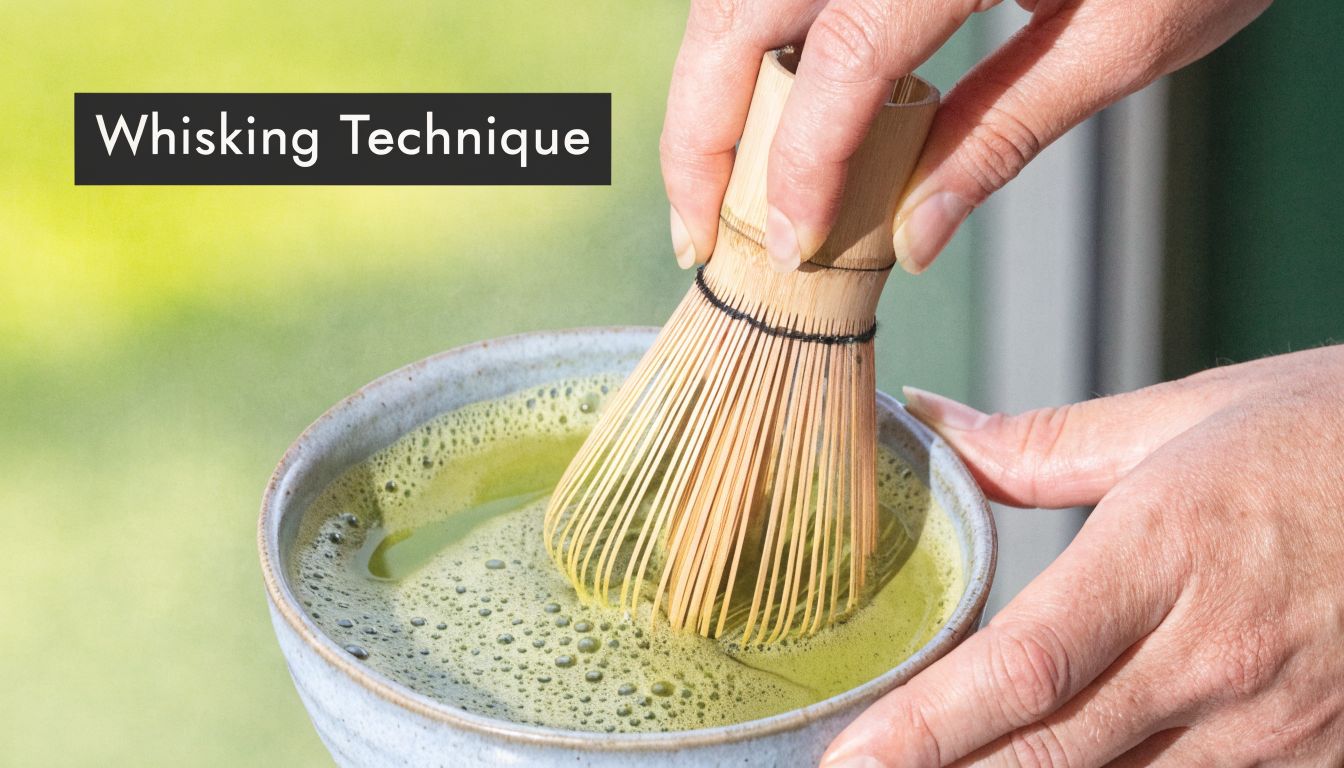
Start by preparing the whisk
Before the matcha touches the bowl, soak the whisk briefly in warm water. This softens the bamboo tines so they open gently and are less likely to snap during use.
A dry whisk is stiff. A softened whisk glides.
The step most people skip
Sift the matcha first. This one action solves an enormous share of home-prep problems.
According to the preparation benchmark cited by Fellow’s matcha set guide, using sifted matcha and 75 to 80°C water achieves a 92% success rate in producing optimal froth, and the vigorous W whisking motion at 200 to 300 strokes per minute is central to building that foam.
Use a fine sieve and press the powder through directly into the bowl. Don’t dump compacted powder into hot water and hope the whisk will rescue it.
A reliable whisking method
Use this sequence when you want a traditional bowl with smooth body and a fine top layer.
Sift the matcha into the bowl
A small mound of fluffy powder is easier to dissolve than compressed clumps.Add hot, not boiling, water
Water in the 75 to 80°C range protects flavour. If it’s too hot, bitterness rises quickly.Begin with slow blending
Use a gentle motion near the base of the bowl to turn the matcha and water into a smooth liquid with no dry pockets.Shift to fast W whisking
Once the powder is dissolved, whisk briskly from the wrist, not the shoulder. The motion should be light, fast, and close to the surface.Stop when the foam looks tight and even
You want fine bubbles, not large froth.
Don’t stir in circles. Circular stirring mixes, but it doesn’t aerate nearly as well.
The physics in plain English
The whisk’s tines break apart tiny clusters of powder while pulling air into the liquid. The bowl’s width gives those movements enough travel to generate a suspended, creamy texture instead of a muddy one.
That’s why the wrist matters. A loose wrist creates speed and lift. A rigid arm creates splashing and uneven mixing.
Here’s a useful visual if you want to watch the motion in real time:
What a finished bowl should look like
A properly whisked bowl should have:
- A smooth body with no visible powder islands
- A fine foam layer rather than big soap-like bubbles
- An even green colour across the surface
- A clean first sip without grit collecting on the tongue
If the bowl tastes grassy but pleasant, you’re close. If it tastes harsh and flat, check water temperature and sifting before blaming the matcha itself.
From Clumps to Flat Foam Troubleshooting Your Technique
You whisk a bowl before work, the colour looks right, but the surface stays flat and the sip turns grainy halfway through. That usually points to a specific fault in the setup, not a mysterious lack of skill.
Matcha is sensitive to small variables. Powder size, bowl shape, whisk flexibility, and local water all change how air and liquid behave in the bowl. In many Australian homes, water straight from the tap carries enough mineral content to affect flavour and tool feel over time, especially compared with the softer water many cafés filter before service.
Persistent clumps usually start before whisking
Clumps form because matcha is hygroscopic. It pulls in moisture from the air, then compresses into little pellets that hot water struggles to break apart. Once those pellets hit the bowl, the outer layer wets first and seals the dry powder inside.
That is why a proper matcha tea sifter matters so much. It separates the powder before water touches it, which gives you a smoother mix and a cleaner texture with less effort from the wrist.
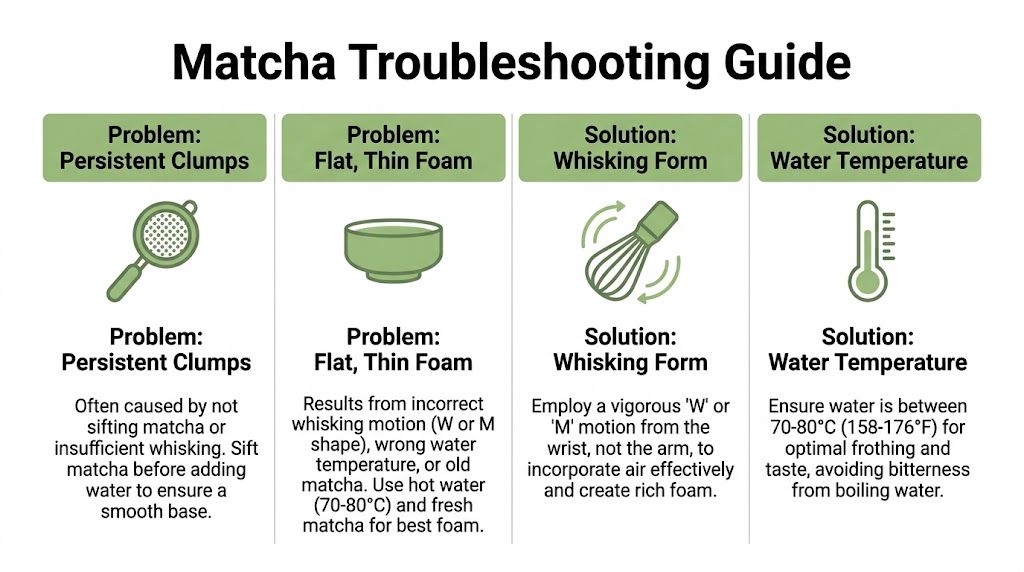
If clumps keep showing up even after sifting, check the age and grade of your matcha. Fresh, finely milled powder disperses far more easily. A clean, vibrant matcha such as Pep Tea’s also gives you a wider margin for error, because the powder itself is milled for a smoother bowl.
Flat foam usually comes from one of three things
Start with the whisk. If the tines feel stiff, stick together, or curl inward, they stop flicking air into the liquid efficiently. Foam depends on many tiny bubbles held in suspension. A tired whisk makes larger bubbles, then those bubbles collapse fast.
Next, check the water. Very hot water weakens sweetness and pushes bitterness forward, but mineral-heavy water can also mute the texture and leave bamboo feeling rough after repeated use.
Then check the bowl. A narrow mug blocks the whisk’s side-to-side travel, so the motion turns into stirring instead of rapid surface aeration. The whisk needs horizontal room to build a tight foam cap.
Quick fixes that usually work
For clumps
Sift into the bowl, add a small splash of water first, and press out any stubborn spots before full whisking.For bitterness
Use water below boiling. If the bowl tastes sharp and hollow, heat is usually the first thing to correct.For weak foam
Inspect the chasen before blaming your technique. Split, brittle, or inward-bent tines cannot trap air properly.For mineral build-up
If your water is hard, rinse the whisk well after each use. An occasional brief soak in warm water with a little white vinegar can loosen residue, followed by a thorough rinse.
When the bowl is the real problem
I see this often with people who start matcha using whatever mug is in the cupboard. The powder can dissolve, but the foam never gets that fine café-style finish because the whisk cannot move freely near the surface.
A wide bowl gives you two advantages at once. It lets the tines travel quickly, and it spreads the liquid into a shallower layer, which makes it easier to pull air through the top. That is the small piece of physics many home brewers miss.
If your motion has improved and your matcha is still coming out thin, change the vessel before changing everything else. Sometimes the best correction is giving the whisk enough room to do its job.
Keeping Your Matcha Whisk and Bowl in Perfect Condition
A bamboo whisk is a working tool. Treat it gently and it rewards you with better texture, cleaner foam, and a more consistent bowl.
The key is speed and simplicity after use.
How to clean the whisk properly
Rinse the whisk under warm water as soon as you finish. Don’t leave matcha drying between the tines, because dried residue makes the whisk stiff and awkward next time.
Skip soap. Bamboo can absorb smell and flavour, and that can end up in the next bowl.
A whisk also dries better when it keeps its natural curve. A matcha whisk stand helps the tines hold their shape while air circulates around them.
How to care for the bowl
The bowl is much easier. Wash it by hand with warm water and a soft cloth, then dry it well before storing. Gentle handling is enough.
A few habits make a real difference:
- Rinse immediately so matcha doesn’t cling to the surface
- Avoid harsh cleaners if you want the bowl’s finish to age well
- Store fully dry to prevent musty cupboard odour
- Keep bamboo out of prolonged soaking because constant saturation weakens it over time
Good maintenance isn’t separate from the ritual. It’s part of the ritual.
When your tools stay clean and correctly shaped, your technique stays reliable. That’s the whole point.
Beyond the Bowl Creative Matcha Recipes
A proper bowl teaches habits that carry into every modern matcha drink Australians make at home. The order stays the same. Sift, add water, whisk smooth, then build the rest around that base.
That matters even more here, because local water can change the result. Softer water often gives a rounder, sweeter bowl, while harder water can make green notes taste sharper, especially once milk or ice enters the mix. Starting with a clean, glossy matcha concentrate gives you more control.
Turn the bowl into a latte base
For a hot latte, whisk a short, strong base in the bowl first. Use less water than for usucha, then whisk until the surface shows a fine foam and the liquid underneath looks fully unified. After that, pour it into warm milk.
This is the part many cafés rush, and the cup shows it. Matcha added straight to milk tends to float, cling to fat, and leave dark specks on the finish. A concentrated base fixes that by hydrating the powder before dilution. Pep Tea’s fine grind makes that step easier, because the particles disperse quickly and stay smoother in the cup.

Iced matcha works best when the first step stays traditional
Cold drinks magnify mistakes. Any clump you leave in the bowl becomes more obvious over ice.
Whisk the concentrate with warm water first, then pour it over ice and cold milk. Warm water helps the powder wet evenly. Ice then locks in the texture and keeps the drink bright instead of muddy. If you shake unsifted matcha straight in a jar, you usually get foam on top and sediment underneath, which is a very different drink from a properly built iced matcha.
If you enjoy functional variations, Mushroom Matcha Benefits is a useful read for seeing how matcha is being paired with other wellness ingredients.
Creative recipes that still respect the bowl
A bowl and whisk are not limited to plain matcha. They are the best starting tools for recipes where texture matters.
Try these:
- Iced strawberry matcha. Make the matcha concentrate in the bowl, add strawberry puree to the glass separately, then pour slowly so the layers stay clean.
- Matcha coconut latte. Use coconut milk for body, but keep the matcha base lighter so the drink does not turn heavy or chalky.
- Sparkling matcha tonic. Whisk matcha with a small amount of water until smooth, then top with chilled tonic. The bitterness of tonic can sharpen lower-grade matcha, so this works best with a clean, sweet powder.
- Matcha affogato. Pour a concentrated bowl over vanilla ice cream. The contrast only works if the matcha is smooth and vivid.
Each recipe asks for a different concentration, but the same physics apply. Fine particles need full hydration. Air needs to be introduced in a controlled way. The bowl gives you room to do both before extra ingredients get in the way.
What cafés need to consider
Home drinkers and cafés solve different problems. At home, the goal is pleasure and consistency. In a busy Australian café, speed, staff training, milk workflow, and water filtration all affect the cup.
Many venues now use a hybrid approach. They whisk a proper base for flavour and texture, then adapt the build for service. That trade-off makes sense. Good technique is still good technique, even when the setting is faster and the menu includes iced lattes, strawberry matcha, and seasonal specials.
The bowl remains the quiet advantage. It gives the whisk enough space to move, helps the powder dissolve evenly, and turns recipe experiments into drinks that still taste like real matcha.
Your Matcha Questions Answered
Can I use an electric frother instead of a bamboo whisk
You can. It’s better than using a spoon. But it usually creates larger bubbles and a looser texture.
A bamboo whisk is shaped to produce a finer foam and a smoother mouthfeel. It also gives you more control over how vigorously the matcha is aerated.
Is culinary matcha okay to drink
Yes, especially in lattes, smoothies, and baking. It tends to be stronger and more assertive, which helps it stand up to milk and other ingredients.
For drinking with just water, ceremonial-style matcha is usually the more elegant choice because the flavour is more exposed.
Why does my matcha taste bitter even when I whisk properly
Usually because the water is too hot, or because the powder wasn’t sifted and dissolved cleanly before vigorous whisking. A rough bowl often tastes harsher than a smooth one, even when using the same matcha.
Do I need the bowl, or can I use any cup
Any cup can hold liquid. That’s not the same as helping you make good matcha. A proper bowl gives the whisk room to move, which directly affects texture.
How often should I replace my whisk
Replace it when the tines lose flexibility, begin breaking, or stop producing the texture you expect even with good technique and clean water.
If you’re ready to build a better daily ritual, explore Pep Tea for premium organic matcha, practical accessories, and Australian guidance that makes the process feel approachable rather than fussy.
Matcha Tea Accessories: Your Complete 2026 Guide

You buy a good tin of matcha, heat the water, stir it with a spoon, and somehow end up with green lumps floating in a drink that tastes sharper than it should. Many assume the problem is the powder.
Usually, it’s the setup.
Matcha behaves differently from leaf tea because you drink the whole powdered leaf. That means texture, water temperature, and tool choice all show up in the cup straight away. The right matcha tea accessories don’t just make things look traditional. They change how the powder dissolves, how the foam forms, and how balanced the final drink tastes.
That’s one reason these tools have become more common in Australian kitchens and cafés. Australia’s tea market, including matcha, grew at a 3.2% CAGR from 2018 to 2023 and reached $450 million in revenue, while premium segments such as matcha accessories contributed 15 to 20%. A 2024 Euromonitor International study also found that 68% of surveyed Melbourne and Sydney cafés added matcha to menus post-2020, which helped drive 25% annual growth in accessory imports according to the summary in this matcha accessories overview.
If you’ve been curious about whisks, bowls, sifters, or whether they’re worth buying at all, the short answer is yes. But each tool matters for a different reason. Once you know what each piece does, matcha feels much simpler.
Why Your Matcha is Lumpy and How to Fix It
Lumpy matcha usually comes from two things. The powder has compacted in storage, and the mixing method isn’t strong or fine enough to break those clumps apart.
A spoon pushes powder around. It doesn’t suspend it evenly. A fork does a bit better, but it still tends to leave tiny gritty pockets that settle to the bottom.
What’s going wrong
Matcha is extremely fine. The moment it meets moisture, little balls of powder can form. Once that happens, stirring often makes the outside wet while the centre stays dry.
That’s why a cup can look mixed but still taste rough.
Common signs you’re fighting the tools instead of the tea:
- Dry specks on the surface that never fully disappear
- A sandy finish at the bottom of the bowl or mug
- Bitterness that seems stronger than expected
- Flat foam or no foam at all
A smooth bowl of matcha starts before the water goes in.
The simplest fix
Use a sifter first, then whisk in a wide bowl.
A fine sifter breaks up compacted powder before it has a chance to clump. If you want a dedicated tool for that step, a matcha tea sifter makes the process much easier than pressing powder through a generic kitchen strainer.
Then whisk with short, brisk motions near the surface rather than stirring in circles. That movement disperses the powder and adds the light foam that softens matcha’s edge.
A better home routine
Try this order next time:
- Warm the bowl with a little hot water, then dry it.
- Sift the matcha directly into the bowl.
- Add a small splash of warm water first and make a loose paste.
- Add the remaining water and whisk briskly.
- Stop when the surface looks fine and even, not bubbly like dish foam.
If your matcha has been disappointing, don’t change everything at once. Start with the tool that prevents clumps. Many notice the difference immediately.
The Essential Trio for Authentic Matcha Preparation
Three tools do most of the heavy lifting in traditional preparation. The chasen, chashaku, and chawan aren’t decorative extras. They solve three separate problems. Mixing, measuring, and whisking space.
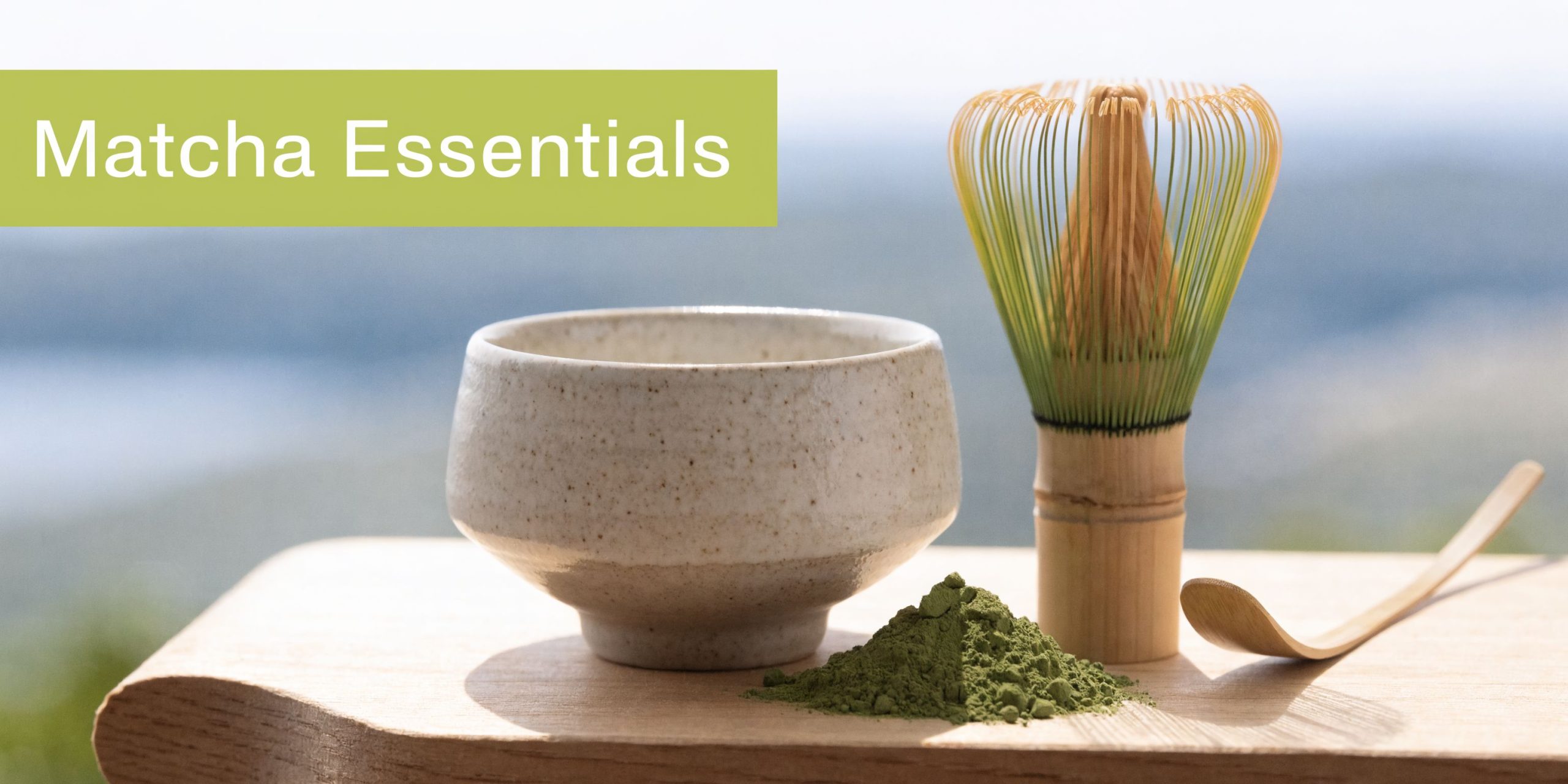
If you’re starting from scratch, a complete matcha tea set Australia option is a practical way to get the core pieces in one go.
The chasen and why it works
The chasen is the bamboo whisk. It’s the tool that changes the cup most.
In premium Australian matcha preparation, a bamboo chasen with 80 to 120 finely split tines is used to aerate 2g of matcha in 60 to 80ml of water at 75 to 80°C, creating a stable crema layer. That froth can enhance EGCg bioavailability by 15 to 20%, while unsifted, unwhisked brews can reduce antioxidant extraction by 30%, according to this detailed guide on matcha accessories and whisking technique. The same source notes that poor whisking leads to clumping and more bitterness from uneven heat exposure.
That sounds technical, but the practical meaning is simple. The whisk creates tiny, even bubbles and keeps the powder suspended. A spoon can’t do that. An electric frother creates a different kind of foam, which matters for mouthfeel.
The chashaku and why scooping matters
The chashaku is the curved bamboo scoop. It looks delicate, but it has a very practical job.
It lets you portion matcha without compacting it or introducing moisture from a metal spoon that’s been sitting near steam. It also makes your routine repeatable. If one day’s cup tastes balanced and the next feels harsh, inconsistent measuring is often part of the reason.
Consider salting food with your fingers versus using a measured spoon. Both can work. One is easier to repeat accurately.
The chawan gives your wrist room to work
The chawan, or matcha bowl, is wider than a mug for a reason.
Whisking in a narrow cup forces the whisk into the sides. Your motion gets smaller. The powder stays less evenly mixed. A wide bowl gives you enough surface area to whisk quickly without splashing.
The bowl also changes the drinking experience in a way people often underestimate:
- Better movement for the whisk
- More even mixing across the base
- A more stable grip while whisking
- A nicer aroma release than a tall glass or travel mug
Practical rule: If the whisk keeps tapping the sides, the bowl is too narrow for proper matcha.
Why this trio is enough for many
You don’t need a shelf full of specialised gear to make a good bowl.
For daily matcha, this trio does the important work:
| Tool | Main job | What improves in the cup |
|---|---|---|
| Chasen | Aerates and suspends the powder | Foam, texture, smoother flavour |
| Chashaku | Measures consistently | Balance, repeatability |
| Chawan | Creates whisking space | Even mixing, less mess |
If you only buy three matcha tea accessories, make them these. Everything else helps refine the process, but this is the working foundation.
Expanding Your Toolkit Beyond the Basics
Once your core setup is sorted, a few extra tools make matcha less fiddly and more consistent. These pieces don’t change the ritual for the sake of it. They remove the little annoyances that ruin an otherwise good cup.
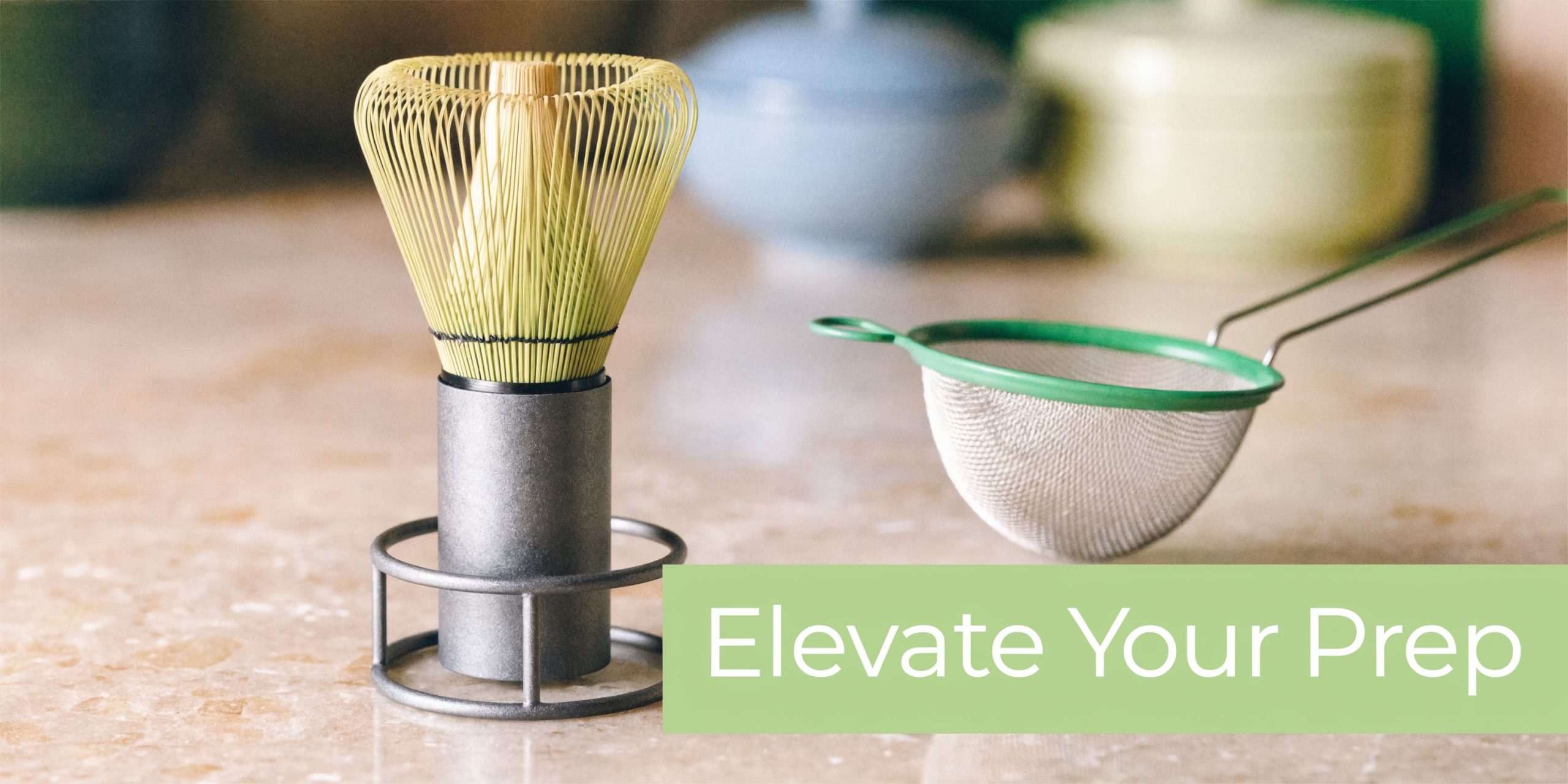
The sifter is the quiet problem-solver
If one extra accessory deserves a place in almost every kitchen, it’s the sifter.
Matcha powder naturally compacts. Even a fresh tin can contain small clumps from storage and humidity. Sifting fluffs the powder before water touches it, which means the whisk spends less effort breaking lumps and more effort creating smooth foam.
A small step, but it changes the result.
The whisk holder protects the whisk you already paid for
The whisk holder, often called a kusenaoshi, helps the bamboo whisk dry in its proper shape.
Without one, the tines can dry bent, flattened, or uneven. That makes whisking less effective and shortens the useful life of the tool. With a holder, airflow improves and the whisk keeps the open curve it needs.
This matters more than people expect because a whisk that looks only slightly misshapen often performs much worse.
A proper storage tin protects the powder itself
People often focus on the whisk and forget that matcha is sensitive to its environment. Air, light, and moisture all work against freshness.
A good storage tin helps preserve:
- Colour, so the powder stays vibrant rather than dull
- Aroma, which fades quickly when left exposed
- Flavour, especially the softer sweet and savoury notes
- Texture, because less humidity means fewer clumps
The accessories that earn their place
Not every extra belongs in every setup. These are the upgrades that usually make sense first:
- Fine sifter for anyone tired of lumps
- Whisk holder for anyone using bamboo regularly
- Airtight tin for anyone buying better-quality matcha
- Clean tea cloth for drying bowls and keeping the area tidy
A lot of matcha tea accessories are sold on appearance. These three are worth owning because they solve preparation problems.
Modern Alternatives Electric Frothers and Scales
Traditional tools aren’t the only option. Plenty of people make matcha with an electric frother, a shaker bottle, or a small blender. That doesn’t make the result wrong. It just changes the drink.
Electric frother versus bamboo whisk
An electric frother is fast. It’s handy when you’re making a quick latte before work or mixing matcha into milk.
A bamboo whisk is slower, but it creates a finer foam and a gentler texture. That matters most when you’re drinking matcha with water rather than masking it with milk and sweetener.
The main differences look like this:
| Tool | Strength | Trade-off |
|---|---|---|
| Electric frother | Speed and convenience | Larger bubbles, less refined texture |
| Bamboo chasen | Fine micro-foam and traditional mouthfeel | More hands-on, needs care |
If you mainly drink iced lattes, an electric frother can be perfectly reasonable. If you want to taste the detail in ceremonial-style matcha, the chasen is still the better tool.
Where a digital scale helps
A small digital scale is one of the most useful modern additions, especially if you like consistency.
The bamboo scoop gives you a traditional feel, but a scale helps when you want to repeat a recipe exactly. That’s useful at home, and even more useful in hospitality where one person’s “slightly heaped scoop” can become another person’s “too much powder”.
A scale is particularly handy for:
- Testing recipes for iced drinks or baking
- Comparing different matcha grades
- Training café staff to prepare drinks consistently
- Troubleshooting when a cup tastes too thin or too strong
For lattes, convenience can win. For straight matcha, texture usually decides.
A sensible middle ground
You don’t have to choose between old and new.
Many people settle into a hybrid routine. Traditional whisk, proper bowl, and a digital scale. Or ceremonial-style preparation on weekends, frother-made iced lattes on busy weekdays. The best setup is the one you’ll use often enough to enjoy good matcha regularly.
Choosing Your Accessories Home vs Café Use
The right setup at home isn’t always the right setup behind a busy bar. A home drinker usually wants ease, comfort, and a sense of ritual. A café needs consistency, speed, and tools that hold up under repeated use.
That’s where total cost of ownership becomes more useful than the sticker price.
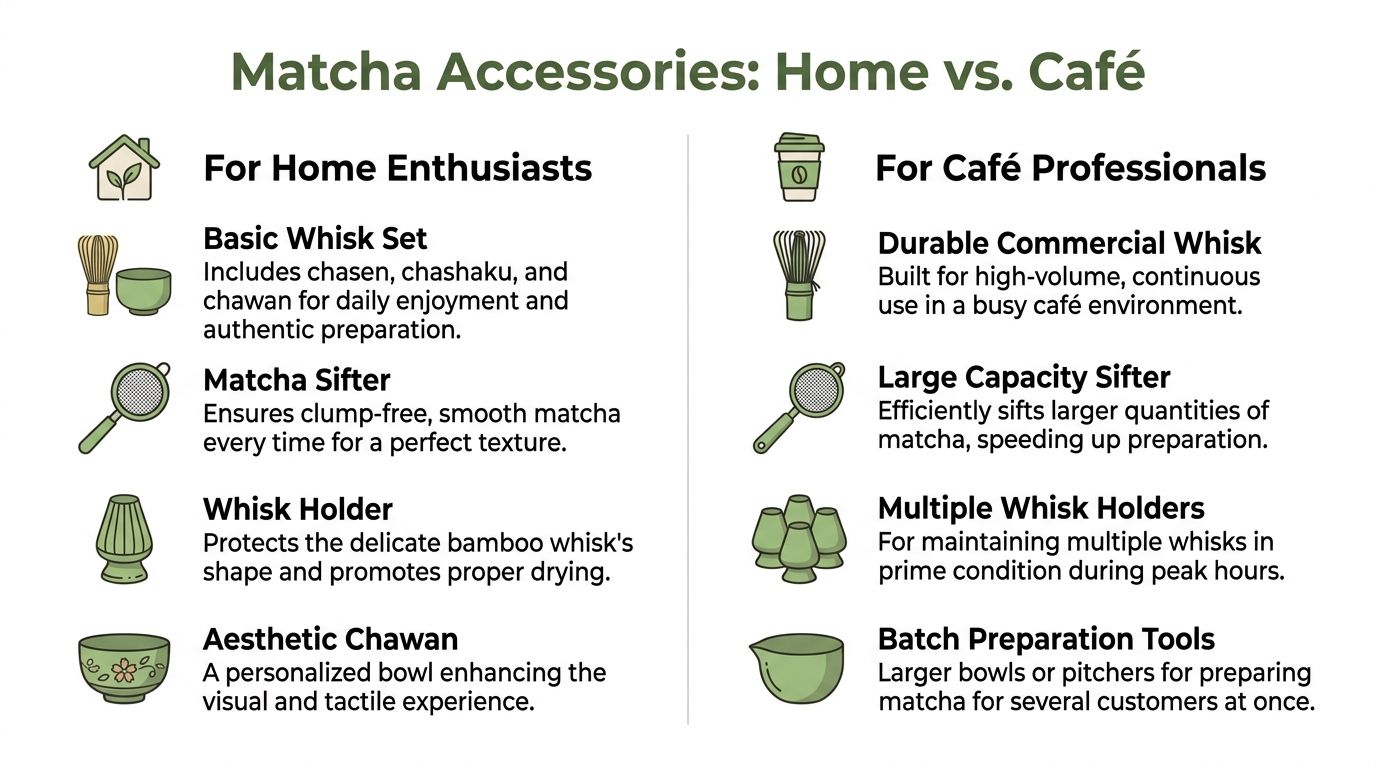
What matters most at home
For home use, it makes sense to keep the kit simple and enjoyable.
A good starter setup usually includes a whisk, bowl, scoop, and sifter. If you drink matcha several times a week, a whisk holder quickly becomes worthwhile too. You don’t need commercial-grade anything. You do need tools that feel pleasant to use and easy to clean.
Home buyers usually care about:
- A balanced starter set rather than individual specialty pieces
- A bowl shape they enjoy holding
- A whisk that feels flexible, not stiff
- Easy storage in a small kitchen
There’s also the visual side. If a bowl and whisk are attractive enough to leave on the bench, you’re more likely to use them.
What changes in a café
In a café, the questions shift.
The issue isn’t whether the whisk looks lovely on a shelf. It’s whether the setup supports fast prep, reliable results, and manageable replacement costs over time. The research around matcha tea accessories often skips these practical realities. This summary on traditional and non-traditional matcha tools notes that buyers need clearer guidance on durability, climate effects, maintenance, and long-term cost comparisons, especially in Australian conditions.
That’s the key buying question for hospitality. Not “What’s traditional?” but “What keeps service smooth without lowering quality?”
Thinking in total cost, not just upfront spend
A cheaper whisk can become expensive if it warps quickly, sheds tines, or gives inconsistent texture that leads staff to remake drinks. A better-made whisk may cost more initially but can be easier to maintain and more reliable in service.
For cafés, it helps to think in layers:
Preparation quality
Does the tool support a repeatable drink with the right texture?Durability in your environment
A coastal or humid venue may need stricter drying and storage habits for bamboo.Staff usability
If a tool is awkward, people won’t use it well during busy periods.Replacement rhythm
Tools that hold shape longer are easier to budget for.
Material choices and practical trade-offs
A café doesn’t have to be rigidly traditional to be thoughtful.
For example:
- Bamboo whisks offer the texture many customers expect in premium matcha
- Stainless steel sifters can make sense in higher-volume settings because they’re sturdy and easy to clean
- Larger bowls or pitchers may help when building a smooth matcha base before pouring into cups
- Multiple whisk holders make daily drying more organised
If you’re fitting out a broader beverage station, it can also help to look at well-designed general kitchen accessories for storage, prep flow, and cleaning tools around the matcha setup itself.
A useful rule of thumb
Home drinkers should buy for pleasure and consistency.
Cafés should buy for workflow, training, and maintenance discipline.
Those goals overlap, but they’re not identical. The most practical accessory setup is the one that fits how matcha is made in your space, not the one that looks most impressive in a product photo.
Care Maintenance and Sustainable Sourcing
Good matcha tools aren’t high-maintenance, but they do need the right kind of care. Bamboo especially rewards gentle habits.
Australia has also seen a long rise in demand for these tools. Matcha accessories entered Australia prominently in 2005 alongside the first certified organic matcha imports, and Australian Department of Agriculture trade data recorded matcha-related imports rising from 150 tonnes in 2010 to 1,200 tonnes by 2023, a 700% increase. Accessories such as chasen whisks and chawan bowls accounted for 22% of value, or AUD 4.2 million. In NSW, a 2024 Nielsen survey found 62% of wellness consumers prioritise accessories for authentic preparation, and whisk holders can extend chasen life by 6 to 12 months, reducing replacement rates by 40%, as summarised in this article on matcha accessory adoption in Australia.
How to clean each tool properly
The biggest mistake is over-cleaning. Matcha tools usually need less soap and less soaking than people think.
For the chasen
- Rinse with warm water only straight after use
- Don’t use detergent because bamboo can retain odour and residue
- Don’t leave it soaking in a bowl or sink
- Place it on a holder to dry in shape
If you need a proper drying stand, a matcha whisk stand is designed for that exact job.
For the chashaku
Wipe it clean and keep it dry. Avoid washing it like cutlery. Bamboo can swell or lose shape if it’s exposed to water too often.
For the chawan
Rinse it soon after drinking, wipe gently, and let it dry fully before putting it away. If matcha sits in the bowl too long, staining becomes more likely.
Bamboo lasts longer when it’s cleaned quickly, dried well, and left alone the rest of the time.
Storage matters more than people realise
Steam, humidity, and trapped moisture do a lot of quiet damage. A whisk left near the kettle, or stored before fully drying, won’t age well.
Helpful habits include:
- Keeping bamboo away from direct steam
- Letting every tool dry fully before storage
- Storing matcha separately from strong food odours
- Avoiding direct sunlight on bamboo and tea powder
Sustainable choices start with longer use
One of the most sustainable things you can do is keep a well-made tool in use for longer. That means buying thoughtfully and maintaining it properly, rather than cycling through cheap accessories.
If sustainability is already part of how you organise your kitchen, broader ideas around materials and lower-waste habits can be useful too. This guide to eco-friendly kitchen products is a handy reference point for that wider mindset.
What to look for when sourcing accessories
You don’t need a museum-grade set. You do want tools that feel intentional.
Look for:
- Responsibly sourced bamboo where possible
- Evenly cut whisk tines
- Bowls with a stable base and enough whisking room
- Craftsmanship that supports repeated use, not just gifting
That approach fits the spirit of matcha nicely. Better tools, fewer replacements, less waste, and a calmer daily routine.
Putting Your Tools to Work With Pep Tea Matcha
Once the tools make sense, the ritual gets much easier. You don’t need complicated recipes to feel the difference. A simple bowl of usucha and a clean iced latte are enough to show what good preparation does.
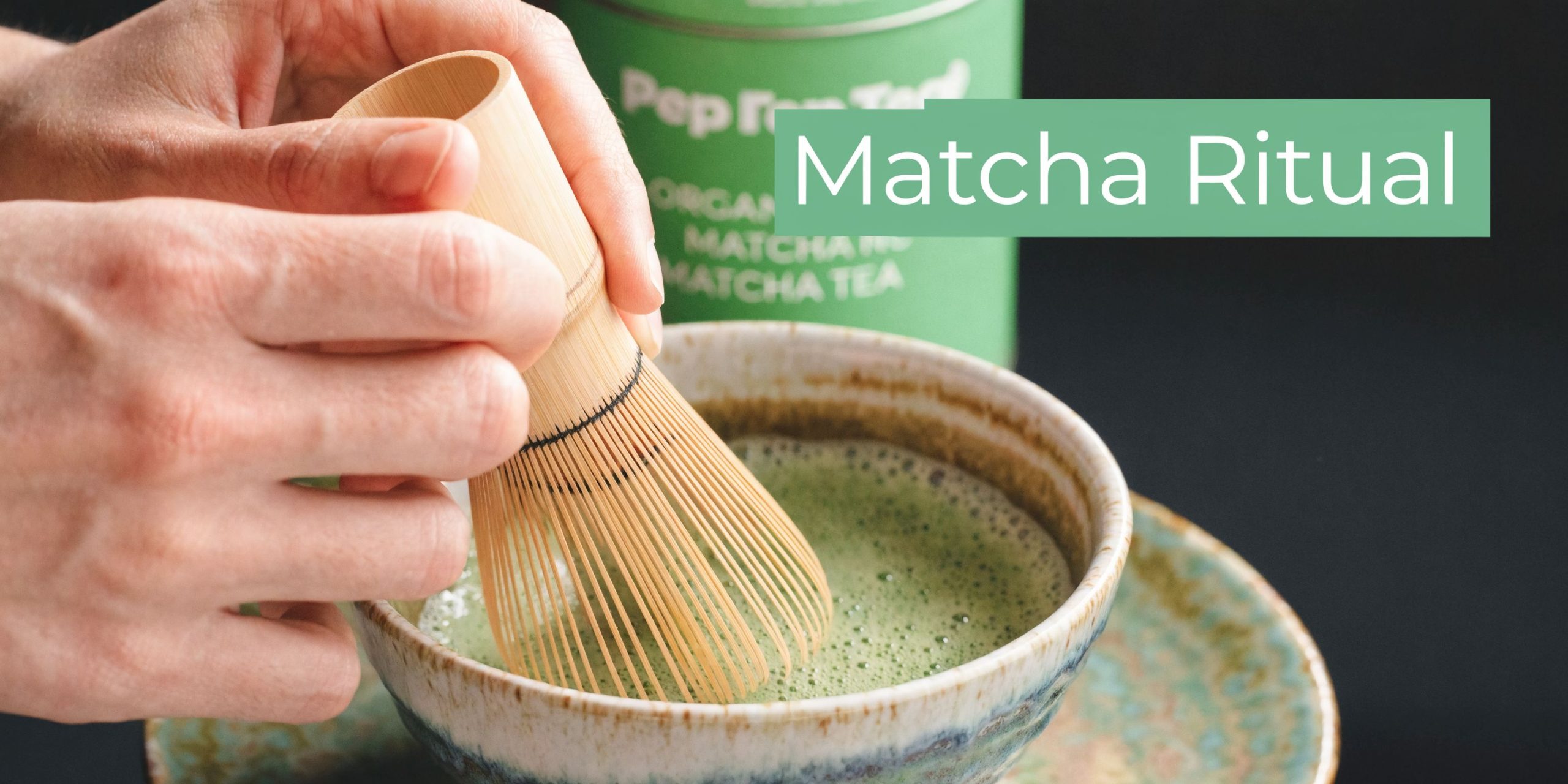
Pep Tea offers organic matcha in grades suited to different uses, including ceremonial-style preparation and lattes, so it’s a practical example of how the right tea and the right tools work together.
A simple usucha for quiet mornings
Use your ceremonial grade organic matcha when you want to drink it with water and appreciate the flavour on its own.
Try this method:
- Warm the chawan, then dry it.
- Sift matcha into the bowl.
- Add a little warm water and mix into a smooth paste.
- Add more water.
- Whisk briskly in a W motion until the surface looks smooth and lightly foamy.
The goal isn’t giant bubbles. It’s a fine, even top layer and a clean, rounded taste.
An iced matcha latte that stays smooth
For milk-based drinks, culinary grade organic matcha is usually the better fit because it stands up well in a latte.
A simple approach:
- Sift the matcha into the bowl
- Add a small amount of warm water
- Whisk until fully smooth
- Pour that concentrate over ice
- Top with your milk of choice
Starting with a smooth concentrate matters. If you add dry powder straight into cold milk, it’s much harder to dissolve properly.
Here’s a quick visual guide for whisking technique and setup:
Small adjustments that improve both drinks
These details make a noticeable difference:
- Sift first if your matcha has been sitting for a while
- Use warm, not boiling, water for the initial mix
- Whisk near the surface for better foam
- Rinse the whisk immediately after use so it stays in working shape
A good bowl of matcha feels light, smooth, and integrated. It shouldn’t taste like powder added to water at the last minute.
Once you’ve made a few bowls this way, the accessories stop feeling specialised. They just feel like the right tools for the drink.
From a Simple Drink to a Mindful Ritual
The nicest thing about matcha tea accessories is that they solve practical problems and slow you down in a good way at the same time.
A sifter gets rid of lumps. A chasen improves texture. A whisk holder helps your tools last. Those are useful, concrete benefits. But the experience goes further than utility. The act of warming the bowl, sifting the powder, and whisking until the surface turns glossy gives the drink a shape in the day. It asks for attention, but not much time.
That’s why these tools appeal to very different people. A home drinker may want a few quiet minutes before work. A café may want a more authentic matcha service and a better-looking cup. Both are using accessories to make the drink more intentional.
The good news is that you don’t need to become a purist. You just need to understand what each tool is for and choose the pieces that match the way you drink matcha. Start small if you like. A whisk, a bowl, a scoop, and a sifter are enough to transform the result.
Once the process becomes familiar, the ritual doesn’t feel complicated. It feels organised, calming, and repeatable. That’s part of matcha’s appeal. It brings together flavour, craft, and a little moment of focus in the middle of ordinary life.
If you’re ready to build a better matcha routine, explore Pep Tea for organic matcha, accessories, and practical guidance for home kitchens, cafés, and everyday wellness.
Matcha Tea Sifter: Smooth, Clump-Free Brews

You whisk. You pour. You take a sip. And instead of a smooth, vivid bowl of matcha, you get little green lumps, a sandy finish, and a drink that feels far less special than the powder you started with.
That’s one of the most common matcha frustrations I see. It happens to beginners, and it happens to café teams too. People often blame the whisk, the water, or their technique. Usually, the underlying issue started a few seconds earlier.
The fix is simple. Use a matcha tea sifter.
This tiny tool looks modest, but it changes almost everything about the cup in front of you. It helps your powder fall light and fluffy into the bowl, makes whisking easier, and gives your matcha a better chance to taste smooth, creamy, and balanced. If you’ve invested in quality powder, whether you drink it straight, make lattes, or build it into a café menu, sifting is one of the easiest ways to respect the tea.
The Secret to Lump-Free Matcha Begins Here
A lot of people have the same first matcha experience. They buy a beautiful tin of green powder, maybe inspired by a café latte they loved, and they expect the home version to feel calm, rich, and silky. Instead, the powder sticks together, floats in clumps, and turns the whole ritual into a small annoyance.
That moment matters because matcha is personal. You’re not just making a drink. You’re preparing something you’ve chosen for flavour, focus, and a better daily rhythm. When the texture is gritty, it’s disappointing in a way that feels bigger than it should.

The small tool that changes the whole bowl
A matcha tea sifter is the quiet hero here. Before any water touches the powder, the sifter breaks up tiny compacted bits so the matcha lands in the bowl as a soft, even layer. That gives your whisk a fair chance to do its job.
If you’ve been exploring different grades and styles, it also helps to compare how preparation changes the experience across different powders. Looking at options such as high-quality matcha tea from Key West Coffee Company can be useful because it reminds you that quality and technique work together. Good powder still needs good handling.
A great whisk can’t fully rescue matcha that went into the bowl already clumped.
For beginners, that’s encouraging. It means you probably don’t need stronger wrists or a more complicated ritual. You just need one extra step that takes only moments and makes the rest of the process easier.
For café owners, the same lesson applies at scale. If the base isn’t smooth, the final drink won’t be either, no matter how polished your service is.
Why Sifting Matcha Powder Is Non-Negotiable
The first thing to know is that clumps don’t mean your matcha is poor quality. In fact, fine matcha often clumps precisely because it’s so delicate. The powder is extremely light, and it reacts quickly to moisture in the air and to static.
In Australian preparation settings, that matters even more. Humidity and storage conditions can make a fresh tin behave very differently from one day to the next.
What a matcha tea sifter does
The Japanese name for this tool is chakoshi. In practical terms, it’s a fine-mesh strainer designed to turn compressed powder back into a loose, airy mound before whisking begins.
According to this reference on a matcha tea sifter and tea strainer, a chakoshi in premium matcha preparation commonly uses mesh apertures finer than 10 microns, and matcha clumps formed by static and moisture can reach 50 to 100 microns. The same source notes that unsifted matcha can lead to a grainy texture with 20 to 30% reduced froth volume, because clumps reduce powder-water contact area by 40%. It also states that sifting can increase effective surface area by 3 to 5x, lifting extraction efficiency from 65% to 95% in a 2g/60ml brew.
Those numbers sound technical, but the takeaway is simple. When the powder is evenly dispersed, water can reach more of it quickly and consistently.
Why clumps create bigger problems than you think
A clump isn’t just a lump sitting in your bowl. It acts like a barrier.
Instead of each fine particle meeting water and whisk movement, parts of the powder stay trapped inside little packed pockets. That leads to a few familiar issues:
- Uneven mixing means some sips taste dull while others taste sharp or bitter.
- Poor suspension means sediment drops faster to the bottom.
- Weaker froth means the top of the bowl looks flat rather than lively.
- Less control means you keep whisking harder, which often makes the ritual feel frustrating.
Why this matters for premium matcha
The better the matcha, the more you want to protect what makes it special. If you’re working with a fine ceremonial powder, proper prep helps you taste the softness, sweetness, and savoury depth the producer intended. If you want to understand how grade affects preparation, our guide to https://peptea.com.au/different-grades-of-matcha/ is a helpful place to start.
It’s also useful to compare sift-friendly powders when learning. Browsing products such as Ceremonial Grade Matcha from AQEEK Coffee can help you notice how very fine powders benefit from careful handling.
Practical rule: If your matcha is worth buying, it’s worth sifting.
Improve Flavour, Texture, and Crema
People often think the matcha tea sifter is only about removing lumps. That’s true, but it’s only the beginning. Sifting changes how the drink feels, how it tastes, and how the foam forms on top.
Those three things are closely linked. Better particle distribution gives you better contact with water. Better contact gives you smoother whisking. Smoother whisking gives you a more balanced cup.
Texture starts before the whisk
Texture is often where the difference is first noticed.
When matcha falls through a fine mesh, it becomes light and even. That means your whisk meets a fluffy powder bed instead of stubborn little pebbles. The result is a bowl that feels softer across the tongue, with less graininess and less sludge left behind.
If your goal is a velvety usucha or a café-style latte base, this matters. A smooth base carries milk better, blends more cleanly, and leaves less sediment at the bottom of the cup.
Flavour becomes more balanced
Unsifted matcha doesn’t dissolve evenly. Some parts stay trapped in little clumps while others overexpose to water and agitation. That’s one reason a bowl can taste oddly bitter in one sip and flat in the next.
A more even powder bed supports a more even extraction. In plain language, the bowl tastes more coherent. You’re more likely to notice sweetness, savoury depth, and the gentle grassy freshness people chase in good matcha.
Foam and crema improve in a visible way
Here, the change becomes obvious, especially for café service. According to this reference on a matcha hand strainer, sifted matcha froths to 2 to 3x higher foam height, reaching 15 to 20mm, with microbubble stability lasting 4 to 6 minutes. The same source links that improvement to 30% improved L-theanine-caffeine synergy (1:2 ratio) and notes that unsifted matcha can produce a thinner, more bitter brew due to a 15% increase in polyphenol oxidation.
That sounds scientific, but the visual cue is easy to recognise. Sifted matcha tends to produce a finer, more even top layer. It looks creamy rather than bubbly and rough.
If you’re still working on your whisking motion, our guide to https://peptea.com.au/how-to-whisk-matcha/ pairs well with this step, because sifting and whisking work best together.
What this means in the cup
Here’s a simple perspective:
- Better texture makes the bowl feel luxurious, not chalky.
- Better flavour makes the tea feel composed, not scattered.
- Better crema makes the drink look alive and drink beautifully from the first sip.
Smooth matcha isn’t only a visual win. It changes the whole drinking experience.
For home drinkers, that means a more enjoyable ritual. For cafés, it means a more consistent product that looks good, tastes right, and holds up better on the pass.
How to Choose the Right Matcha Sifter
Not every sifter feels the same in use. Some are made for a single bowl on a quiet morning. Others are more practical for a busy café bench. The right choice depends on how much matcha you prepare, how often you make it, and whether hygiene and workflow need to meet commercial standards.
There’s also a growing Australian angle here. According to this video reference discussing the local market and tool selection, there has been a 35% rise in Australian searches for “organic matcha tools” since Q1 2025, alongside growing interest in sifters that align with FSANZ Code requirements for premium organic handling in hospitality settings: organic matcha tools in Australia.
The two common sifter styles
Many choose between a small handle-style strainer and a larger canister-style sifter.
The handle-style version is the classic choice for making one bowl at a time. You rest it over the chawan, add the powder, and press it through with a scoop or small spatula.
The canister style is built for batching. It’s more useful when you want to pre-sift a larger amount for service, recipe prep, or repeated drinks across a shift.
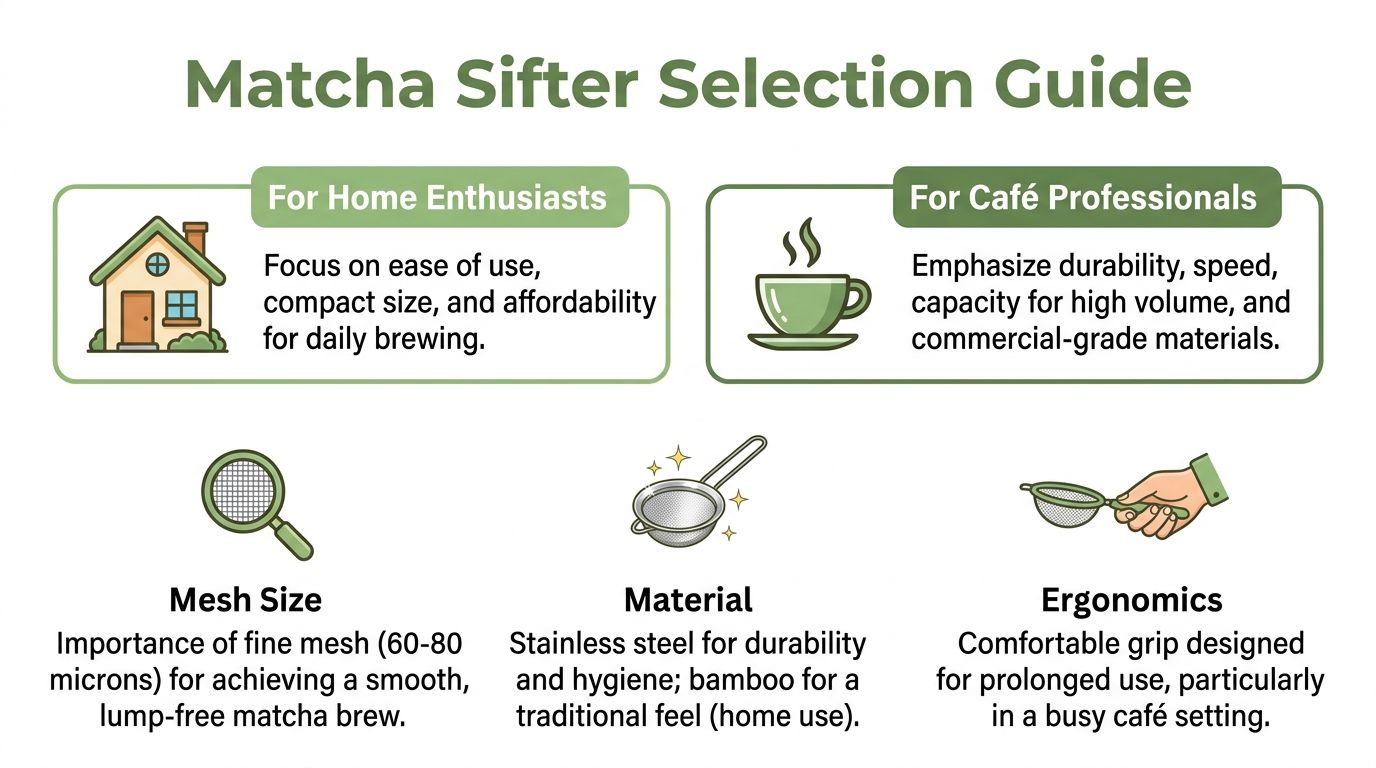
What to look for in the material and mesh
Food-grade stainless steel is usually the safest practical choice. It’s easy to clean, durable, and better suited to repeated use in a home kitchen or commercial setting.
A very fine mesh matters too. A generic kitchen sieve might work in a pinch, but it often isn’t designed for such fine powder. That’s why dedicated matcha tools feel easier and more predictable.
If you’re shopping as a beginner and want an all-in-one setup, the https://peptea.com.au/matcha-tea-set-australia/ page shows a full set format that includes the key preparation tools, including a sifter.
Matcha Sifter Comparison
| Sifter Type | Best For | Material | Pros | Cons |
|---|---|---|---|---|
| Handle-style strainer | Daily home use, single bowls, small latte prep | Usually stainless steel | Easy to store, simple to use, precise for one serve | Slower for batch work |
| Canister-style sifter | Café prep, repeated service, recipe batching | Usually stainless steel | Better for volume, tidier for larger prep | Takes more space, less nimble for one bowl |
| Bamboo-style traditional option | Home enthusiasts who value ritual and aesthetics | Bamboo or mixed materials | Traditional feel, visually appealing | Harder to sanitise well, less practical for commercial use |
| Generic kitchen sieve | Emergency substitute only | Varies | Easy to find | Mesh may be too coarse, less control, less tidy |
A simple buying checklist
- Choose stainless steel if you want durability and easier cleaning.
- Check the mesh and avoid anything that looks obviously coarse.
- Think about volume. One bowl at a time and café prep are different jobs.
- Consider ergonomics if you’ll use it repeatedly during service.
- Keep compliance in mind if you run a venue and need cleaner, more controlled tool choices.
One mention worth making here is practical rather than promotional. Pep Tea’s Japanese Matcha Set includes a sifter, which is useful for people who want the core tools together in one setup.
Your Step-by-Step Sifting Method
Sifting looks refined, but it’s very straightforward once you’ve done it once or twice. Many learn it in minutes.

The easiest way to do it
Start with a completely dry bowl and a dry sifter. Moisture is the enemy at this stage, so even a few drops can make the powder catch.
Then follow this sequence:
Set the sifter over the bowl
Make sure it sits securely. You don’t want it wobbling while you work.Measure your matcha into the sifter
Use your bamboo scoop or measuring spoon and place the powder gently into the centre.Press lightly, don’t mash
Use the scoop, a small spoon, or a spatula to coax the powder through the mesh. Gentle circular movements work well.Tap only if needed
If a little powder clings to the mesh, a light tap can help. Don’t smack the sifter hard or you’ll create a puff of green dust.Whisk straight after sifting
Once the matcha is airy and loose in the bowl, add your water and whisk while it’s at its freshest.
Common beginner mistakes
A few tiny habits make the process much easier:
- Using a damp tool causes immediate sticking.
- Forcing the powder through too aggressively can compact it again.
- Sifting too far ahead can expose the powder to more air than necessary.
- Overfilling the sifter makes the process messier than it needs to be.
Keep the motion light. You’re fluffing the powder, not grinding it.
If seeing the movement helps, this short video shows the rhythm clearly:
How long should it take
Not long. Once your tools are within reach, sifting becomes one of the quickest parts of the ritual. It often saves time overall because whisking becomes easier and more predictable afterward.
For a café team, that’s good news. For a beginner, it’s even better. One small habit removes a lot of unnecessary frustration.
Troubleshooting and Advanced Tips for Cafés
Sometimes the problem isn’t your technique. It’s the room.
In parts of Australia, especially through humid periods in NSW and QLD, matcha can start clumping much faster than people expect. That’s why a method that worked perfectly on a cool dry day suddenly feels messy and stubborn in summer.
When humidity keeps ruining your prep
This Australian matcha reference notes that searches for matcha spike 42% in summer, and that matcha agglomeration can happen 3x faster in humidity above 70%. It also reports that home users can pre-chill sifters to -5°C for 10 minutes to cut clumping by 50%, while cafés handling larger amounts may use electric vibrating sieves for 100g batches: sifting matcha powder in humid conditions.
That’s useful because it gives us two practical paths. One for the home kitchen, and one for service.

Quick fixes at home
If your matcha keeps clumping, try these:
- Sift just before use rather than preparing it well in advance.
- Keep tools dry and cool so moisture doesn’t catch on the mesh.
- Use a fine tea strainer temporarily if you don’t own a dedicated matcha tea sifter yet.
- Store your matcha tightly sealed and away from steam, sunlight, and heat.
A regular fine tea strainer can work as a stopgap, but it usually feels less tidy and less precise. It’s a practical substitute, not a long-term matcha ritual tool.
Workflow tips for cafés
For hospitality teams, speed matters, but consistency matters more. A rushed bowl with lumps isn’t saving time if the drink comes back or pours poorly into milk.
Try a workflow like this:
- Assign one dry prep zone for matcha only.
- Pre-portion small service amounts instead of exposing a larger container repeatedly.
- Use batch sifting tools only when turnover justifies it.
- Train every staff member the same way so texture stays consistent across shifts.
In a café, the best sifting method is the one staff will repeat accurately during a busy service.
That’s true whether you’re serving straight matcha, iced lattes, or using matcha as part of a non-alcoholic menu.
Caring for Your Tools and Your Tea
A good matcha tea sifter doesn’t need complicated care. It needs clean, gentle care.
Rinse metal sifters with warm water after use if powder has caught in the mesh, then dry them thoroughly before putting them away. Avoid leaving them damp in a drawer or on a crowded sink. If you can brush out dry powder first, that’s often even easier.
Soap can be useful for a deeper clean when needed, but residue is the thing to avoid. You don’t want cleaning smells lingering on a tool that sits close to a delicate tea.
Good habits that protect flavour
A few small habits make a real difference:
- Keep the sifter dry before the next use.
- Store matcha airtight so moisture and kitchen odours stay out.
- Avoid heat and light because they dull freshness.
- Clean promptly so powder doesn’t cake into the mesh.
The bigger point is simple. Sifting is an act of care. It respects the work that went into growing, grinding, packing, and preparing matcha.
If you’ve been skipping this step, don’t feel bad. Many do at first. Once you make it part of your routine, it quickly feels natural, and the bowl in front of you reflects that care straight away.
If you’d like to put this into practice, explore Pep Tea for organic matcha, tea education, and tools that support a smoother everyday ritual at home or in hospitality.
Japanese Matcha Set: Your 2026 Buyer’s Guide
You’ve probably seen it happen. A beautiful bowl of vivid green matcha appears in your feed, sitting beside a bamboo whisk and a handmade bowl, and suddenly the whole ritual looks equal parts calming and confusing.
A japanese matcha set can seem like something meant for experts only. In reality, it’s a practical group of tools that helps you make smoother, better-tasting matcha with less fuss. Once you know what each piece does, the set stops feeling formal and starts feeling useful.
For many Australians, matcha now sits at the meeting point of wellness, café culture, and everyday routine. It can be your quiet morning drink, your afternoon reset, or a thoughtful addition to a non-alcoholic menu. The ritual matters, but it does not need to feel intimidating.
An Invitation to the Matcha Ritual
A lot of people begin in the same place. They buy a tin of matcha, stir it with a spoon, end up with lumps, then wonder whether the traditional tools are more about looks than function.
They are not just decorative. They help turn powdered tea into a drink that feels rounded, smooth, and intentional.
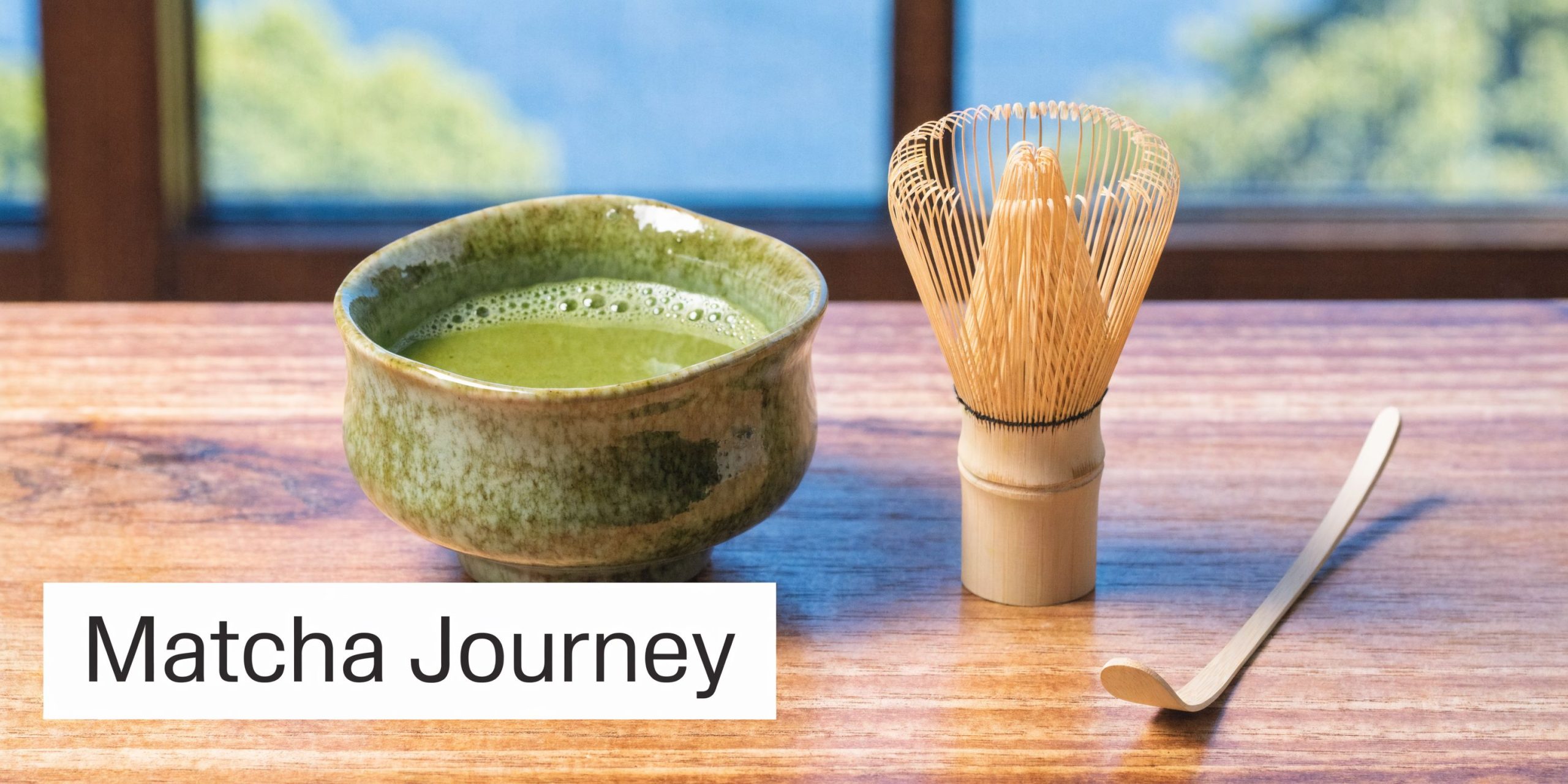
The appeal of matcha today goes far beyond trendiness. People want rituals that slow them down for a minute. They want drinks that feel clean, grounding, and a little bit special. A japanese matcha set fits that beautifully because it gives shape to the moment. Bowl, scoop, sift, whisk, sip.
That interest is part of a much bigger movement. In 2024, Japan’s tea exports reached a record ¥36.4 billion, up 24.7% from the previous year, with powdered teas such as matcha making up 58% of export volume, according to Nippon’s report on Japan’s tea export record. For Australian drinkers, that matters because it points to strong global demand and continuing access to authentic matcha and traditional tools.
Why the ritual feels so different
When you make matcha this way, you are not only preparing a drink. You are giving yourself a repeatable pause in the day.
That can look like:
- A quick morning reset before emails and school drop-off
- A café-quality afternoon cup without leaving home
- A hospitality moment that feels more thoughtful than another standard hot drink
A good ritual does not need to be complicated. It just needs a few reliable tools and a little attention.
Deconstructing Your Japanese Matcha Set
Open a japanese matcha set and you’ll usually find a small group of tools with very specific jobs. Each one solves a common matcha problem.
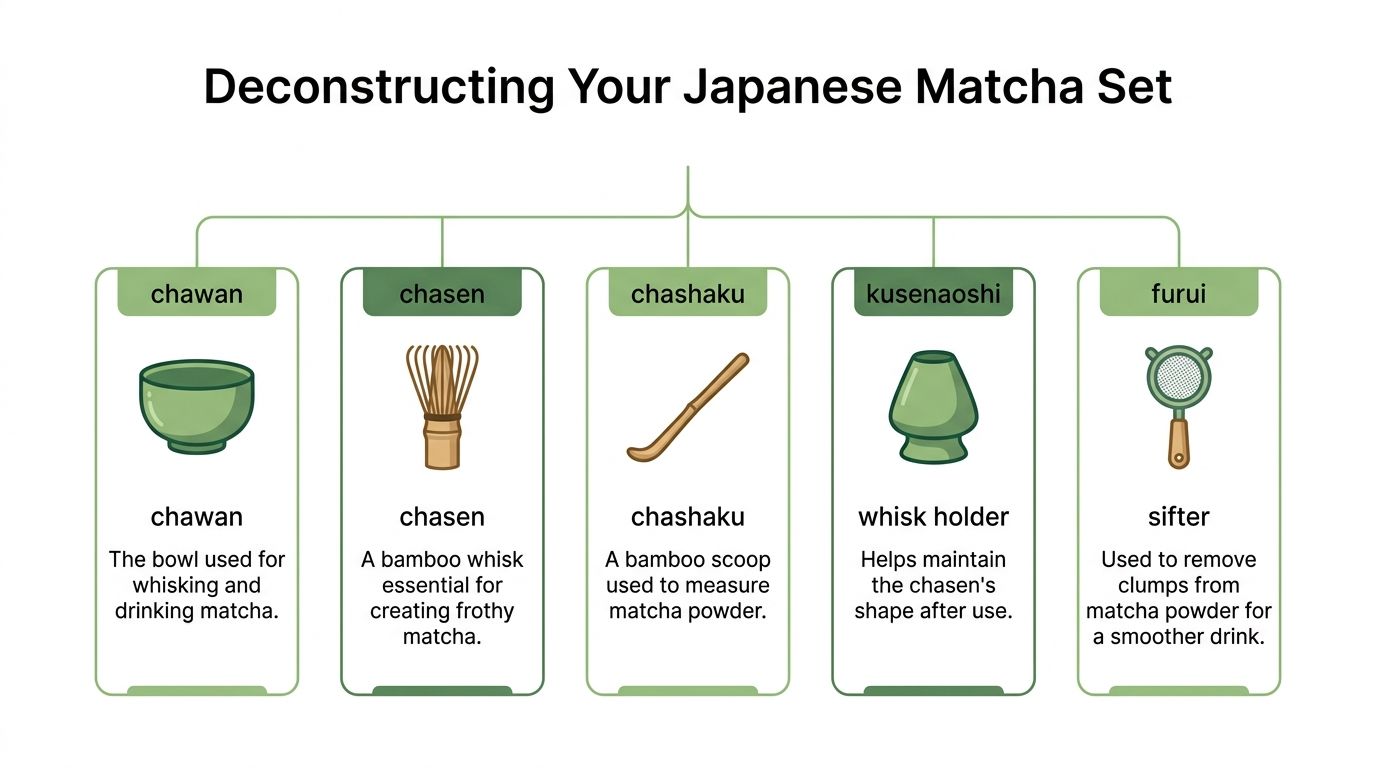
The core pieces
The chawan is the bowl. It is wide enough to whisk in comfortably and deep enough to keep the liquid from splashing everywhere. You drink from it too, which is part of the charm. It keeps the process simple.
The chasen is the bamboo whisk. This is the heart of the set. Its fine tines break up powder, lift air into the tea, and create the light froth people associate with properly prepared matcha.
The chashaku is the bamboo scoop. It helps you measure powder consistently without guessing. That matters more than many beginners realise. Too much matcha can taste heavy. Too little can taste thin.
The kuse naoshi, or whisk holder, helps the chasen keep its shape after use. Without it, the tines can dry unevenly and lose the form needed for good whisking.
Many sets also include a sifter. This step is easy to skip, but it makes a real difference because matcha powder naturally clumps.
Why each piece matters in practice
If you’ve ever stirred matcha in a mug and wondered why it felt gritty, the answer is usually a mix of clumps, uneven suspension, and the wrong vessel.
A proper set improves all three.
- The bowl gives you room to whisk quickly and evenly
- The whisk creates suspension so the tea feels smoother to drink
- The scoop improves consistency from one cup to the next
- The holder protects the whisk after you finish
- The sifter removes lumps before they become a texture problem
The set is traditional, but not precious
Some readers worry they need to follow a strict tea ceremony to “use it properly”. You don’t.
You can honour the tradition while still making matcha in a modern Australian kitchen before work. You can use a handmade bowl on a quiet Sunday, or prep several bowls in a café service window. The tools stay the same. The context changes.
If a tool helps you make better matcha more easily, it belongs in your routine.
How to Choose the Right Matcha Set
Not every japanese matcha set suits every drinker. A beginner at home needs something different from a café team serving matcha all day.
The best way to choose is to match the set to your actual habits, not your ideal self.
Start with the whisk, not the bowl
People often focus on the bowl because it is the most visible piece. The better starting point is the chasen.
A proper whisk with 80 to 96 prongs works especially well for ceremonial-style preparation. According to Japanese Taste’s product guide for an organic ceremonial set, using a proper chasen with sifted ceremonial-grade matcha can increase the bioavailability of EGCg antioxidants by up to 30% compared with stirring without a whisk. The reason is practical. Fine froth keeps the powdered leaf evenly suspended, so you drink the whole bowl more evenly.
That does not mean the bowl is unimportant. It means function should lead the decision.
Materials and fit matter
A good set should feel easy to use, clean, and store.
Look for:
- A bowl with enough width for whisking without knocking the sides
- A whisk with fine, even tines rather than thick, rough ones
- A scoop that feels balanced in the hand
- A whisk holder included if you want the set to last
If you enjoy traditional preparation, a ceramic bowl such as Mino-yaki can feel lovely in the hand. If you are buying for a café, durability and consistency matter more than visual romance alone.
Matcha Set Comparison Home Use vs. Café Use
| Feature | Ideal for Home Baristas | Essential for Cafés & Hospitality |
|---|---|---|
| Bowl | Comfortable to hold and wide enough for easy whisking | Durable, stackable, and consistent in shape |
| Whisk | Fine bamboo chasen for daily use | Multiple chasen on hand for service continuity |
| Scoop | Traditional chashaku for measured ritual | Consistent portioning method staff can repeat |
| Sifter | Helpful for smoother texture | Important for speed and consistency across orders |
| Holder | Strongly recommended | Necessary if you want to protect tool life |
| Matcha choice | Ceremonial grade for straight drinking | Ceremonial for premium service, culinary for recipes and lattes |
Buy for the way you drink
If you mostly drink straight matcha, choose a set that supports slower preparation. If you make lattes, smoothies, or recipe bases, you still benefit from proper tools, but you may not need the most delicate ceremonial setup.
If you’re still sorting out powder styles, Pep Tea’s guide to different grades of matcha is useful for deciding what belongs in the bowl and what belongs in recipes.
Your First Matcha A Simple Preparation Guide
The first bowl does not need to be perfect. It just needs to be pleasant enough that you want to make a second one.
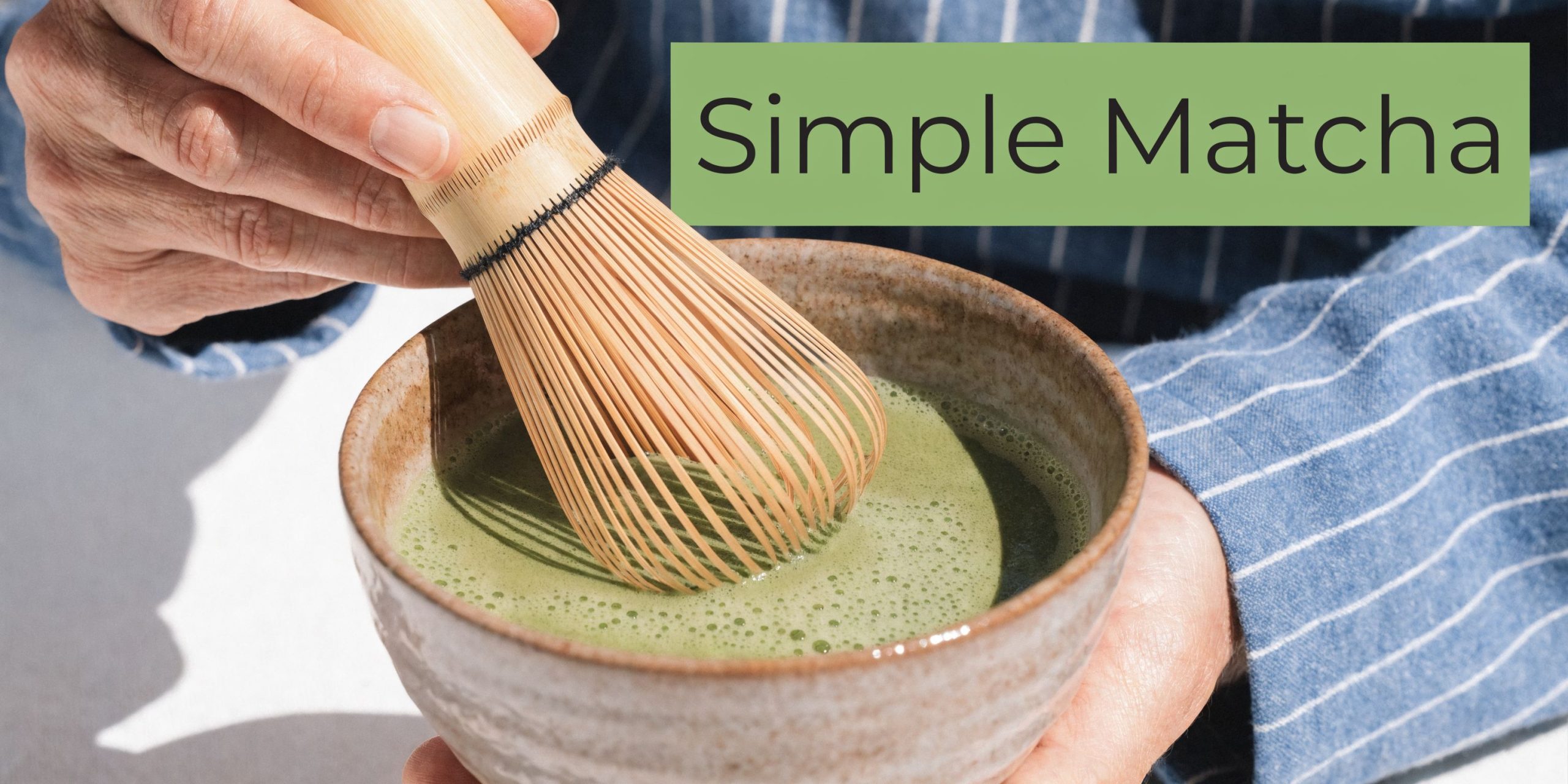
A simple method that works
Use 2g of matcha, which is about 3 scoops with a chashaku, and 60ml of water at 70 to 80°C, based on the preparation details in the verified product data for ceremonial matcha sets. Start by sifting the powder into your bowl. This step removes lumps before you add water.
Add a small splash of warm water first and make a loose paste. Then pour in the rest.
Now whisk briskly using a quick W motion across the surface rather than stirring in circles. Aim for a fine froth on top.
What beginners usually get wrong
Boiling water is the most common mistake. It flattens the flavour and can make matcha taste harsher than it should.
The second mistake is pressing the whisk against the bottom of the bowl. The whisk should move lightly and quickly, almost skimming the tea.
- Too many clumps usually means the powder was not sifted
- Flat texture usually means the whisking motion was too slow
- Bitterness often points to water that was too hot
- Weak flavour usually means too much water for the amount of matcha
For a visual walkthrough, Pep Tea’s guide on how to whisk matcha can help if the hand motion feels awkward at first.
Watch the hand movement
A short demo often makes the process click faster than written instructions alone.
Stop whisking once the surface looks fine and lively. You are aiming for smoothness and lift, not a giant foam cap.
Cleaning and Caring for Your Matcha Tools
A japanese matcha set lasts longer when you treat it as kitchenware with a rhythm, not as something you toss in the sink and deal with later.
The most important tool to protect is the chasen. Bamboo is strong, but the fine tines are delicate.
The care habit that saves money
According to Matcha.com’s starter kit guide, high-quality bamboo whisks stored on a ceramic holder can withstand over 500 uses before significant deformation, reducing replacement costs by up to 60% compared with whisks left to dry on their side.
That is a practical reason to care for your whisk properly. Better shape means better froth. Better froth means better matcha.
Simple cleaning steps
Rinse the bowl with warm water soon after use. Matcha dries fast and can cling to ceramic if left sitting.
For the whisk, use warm water only. Swirl it gently in clean water to release any trapped matcha. Avoid soap, which can linger in bamboo and interfere with flavour.
Then place the whisk on a kuse naoshi so the tines dry evenly.
- Do rinse straight away after each use
- Do let tools air dry fully before storing them
- Do use the holder to help maintain whisk shape
- Don’t scrub the bamboo
- Don’t leave the whisk flat on the bench
- Don’t store damp tools in a closed drawer
The small ritual after the ritual
These few seconds of care are part of the experience. They also protect the investment you made when choosing a quality set.
A whisk that keeps its form performs better, looks better, and asks less of your wallet over time.
Beyond the Bowl Creative Matcha Recipes
Once you’re comfortable using your japanese matcha set, you can move beyond the traditional bowl without abandoning the tools that got you there.
The whisk, bowl, and sifter are just as helpful for modern drinks as they are for classic preparation.

Everyday drinks you can make with the same set
A hot matcha latte starts with whisked matcha in the bowl. Once smooth, pour it over warmed milk or your preferred plant milk.
An iced matcha latte works best when the matcha is fully whisked first, then poured over ice and cold milk. This avoids dry specks floating on top.
A matcha smoothie is easy too. Whisk the matcha with a little water before blending it with banana, yoghurt, oats, or mango. Pre-whisking helps it distribute more evenly.
A Pep Tea inspired pairing
Matcha also plays well with modern non-alcoholic drinks. One of the most refreshing combinations is a simple Matcha Kombucha Fizz.
Try this at home:
- Whisk a small bowl of matcha until smooth.
- Let it cool slightly.
- Pour it over ice.
- Top with chilled kombucha.
- Add a slice of citrus if you like a brighter finish.
The result is layered and lively. You get the earthy depth of matcha with the sparkling lift of kombucha. For cafés, it’s a smart way to create a more interesting alcohol-free option using functional ingredients already familiar to wellness-minded customers.
Baking and kitchen use
You can also use the set for recipe prep. The bowl is handy for making a lump-free matcha paste before adding it to:
- Pancake batter
- Yoghurt bowls
- Chia pudding
- Icing or glaze
- Simple desserts
Ceremonial matcha suits straight drinking. Culinary matcha usually makes more sense in recipes where milk, fruit, or sweetness share the spotlight.
A Guide for Australian Cafés and Retailers
For hospitality businesses, a japanese matcha set is not only a retail item or a styling prop. It is part of service design.
If you plan to offer traditional matcha, premium lattes, or wellness-led specials, the tools and sourcing process need to support consistency.
What cafés should prioritise first
Start with repeatable preparation. Staff should know the portion, water temperature, sifting step, and whisking motion expected for every serve.
That matters whether you are preparing a straight bowl of matcha or building a latte base.
A practical setup often includes:
- Dedicated bowls and sifters for prep speed
- More than one whisk so service does not stop during cleaning or drying
- Clear staff training on texture and presentation
- The right powder for the menu item, whether ceremonial or culinary
For venues serving larger volumes or building recipe programs, Pep Tea offers bulk buy culinary grade organic matcha for recipe and café use.
The importing issue many guides skip
Australian businesses importing Japanese matcha tools need to think beyond aesthetics.
According to the verified compliance data tied to this retailer background page, the Biosecurity Act 2015 scrutinises untreated bamboo items such as whisks, and ceramics must meet FSANZ standards for lead and cadmium. The same verified data notes that 2025 DAFF data shows tea-related imports are frequently flagged, which can create costly delays for cafés that are not prepared.
That means a set can be beautiful and still be a poor buying decision if paperwork, treatment status, or food-safety documentation are unclear.
Questions worth asking suppliers
Before placing an order, ask:
- Are the bamboo tools treated and documented for Australian import requirements
- Do the ceramics have food-contact compliance information
- Is the matcha organic certified in a way that aligns with your purchasing needs
- Can the supplier support repeat orders, not just one-off sets
For retailers, this also shapes customer trust. Shoppers increasingly want authenticity, but they also want clarity. A thoughtful product page should explain what the tools are made from, how they are used, and what standards matter in Australia.
Embrace Your Daily Matcha Moment
A japanese matcha set is more than a bowl and whisk. It is a simple way to make your tea smoother, your routine calmer, and your daily drink a little more intentional.
You do not need to master a formal ceremony to enjoy it. You only need a few good tools, a little practice, and the willingness to slow down for a minute. That is where the pleasure begins, at home, in the café, or anywhere you want a steadier kind of energy.
If you’re ready to begin, explore Pep Tea for premium organic matcha and practical guidance on bringing matcha into everyday Australian life.
Your 2026 Guide to the Best Matcha Tea Set in Australia

That perfect, frothy bowl of matcha doesn't happen by accident. The secret starts long before you even think about adding hot water. A proper matcha tea set isn't just about nodding to tradition; it's the difference between a clumpy, bitter brew and unlocking the deep umami flavour and creamy texture of a truly great matcha.
As more of us in Australia are discovering this daily ritual, getting the right tools is the first, and most important, step.
Why the Right Tools Matter for Your Matcha Ritual

If you've ever tried whisking matcha with a kitchen fork or a milk frother, you already know the disappointment. You end up with a lumpy, uneven drink that tastes nothing like what you get in a good café. You’re not alone, and there’s a simple reason for it: preparing exceptional matcha requires tools designed specifically for the job.
This isn’t about being fussy. It’s about physics. Each piece in a traditional matcha tea set has a specific role, all working together to turn a fine green powder into something special.
A bamboo whisk, the Chasen, has over 100 delicate tines that are expertly crafted to aerate the tea and create that signature creamy foam. A metal whisk just can't do this; it tears the powder instead of suspending it. Likewise, the wide, flat-bottomed bowl, or Chawan, gives you the perfect surface area for effective whisking, making sure every last particle is suspended beautifully in the water.
It’s About Process and Flavour
Using the right tools is also a way of honouring the centuries-old Japanese tea ceremony. This ritual is just as much about the quiet, mindful process as it is about the drink itself. For anyone new to matcha, using a proper set can completely change your perception of what it should taste and feel like, bringing its subtle sweetness and umami notes to the front.
When you have the right set, you unlock a completely different level of enjoyment.
- The Right Texture: Nothing creates that smooth, velvety foam like a bamboo Chasen. It’s the hallmark of a well-made matcha.
- Better Flavour: The right tools mean no more bitter clumps. The powder is fully dissolved, letting all the complex, delicate flavours shine through.
- A Mindful Moment: The simple, deliberate actions of scooping, sifting, and whisking create a small pocket of calm in your day. It turns a tea break into a moment of focus.
Here at PepTea, we're passionate about our premium organic matcha, but we're just as passionate about giving you the knowledge to prepare it properly. Understanding the 'why' behind each tool is the first step. For a deep dive into the fascinating history of this practice, our article on the brief history of matcha tea is a great place to start. And if you're looking to build a truly exceptional collection, exploring guides on the world's best luxury tableware brands can provide some beautiful inspiration.
The Tools of the Trade: Your Authentic Matcha Tea Set

If you've ever tried stirring matcha powder into hot water with a spoon, you already know the result: a lumpy, bitter disappointment. An authentic matcha tea set isn't just a collection of beautiful objects; it’s a purpose-built toolkit where every single piece has a job to do.
Getting the right tools is the difference between a clumpy mess and a perfect, frothy bowl of vibrant green tea. Understanding what each one does transforms the process from a chore into a genuinely mindful ritual. These four core components work together to turn fine powder into a beautiful, smooth elixir.
At its heart, a traditional matcha set is built around four essential tools. Each plays a critical role in creating that perfect brew, and leaving one out compromises the final result. Here’s a quick guide to what they are and why they matter.
The Four Essential Tools in a Matcha Tea Set
| Tool Name (Japanese) | Common Name | Primary Function | Why It's Essential |
|---|---|---|---|
| Chasen | Bamboo Whisk | To froth the tea and suspend the powder | Creates the signature creamy foam and smooth texture. A metal whisk can't do this. |
| Chawan | Tea Bowl | To provide the ideal space for whisking | Its wide, flat base allows the whisk to move freely, ensuring full aeration and no clumps. |
| Chashaku | Bamboo Scoop | To measure the matcha powder | Delivers a consistent 1-2 gram serving, which is key to repeatable, balanced flavour. |
| Furui | Sifter | To break up clumps in the powder | Ensures the matcha is ultra-fine before whisking, leading to a silky-smooth finish. |
While you can technically make matcha without them, the experience and the final taste just won't be the same. Let's take a closer look at how each one contributes to the magic.
The Chasen (Bamboo Whisk): The Heart of the Froth
The Chasen, or bamboo whisk, is easily the most important piece in the set. It’s hand-carved from a single piece of bamboo, with its fine tines painstakingly separated and curled. That high number of prongs—usually between 80 and 120—isn't just for looks. They are engineered to do something a metal kitchen whisk simply can't.
When you move the Chasen in a quick ‘W’ or ‘M’ motion, its flexible tines suspend the matcha powder evenly throughout the water while whipping air into the liquid. This is what creates that signature creamy microfoam, known as usucha. It’s this foam that unlocks the tea’s delicate aroma and mellows its flavour, delivering a smooth, rich taste without any bitterness.
The Chawan (Tea Bowl): The Perfect Stage for Whisking
Next up is the Chawan, the ceramic tea bowl. This is much more than just a pretty mug; its shape is entirely functional. A proper Chawan has a wide, relatively flat bottom and tall sides, creating the perfect stage for the Chasen to perform.
This generous shape gives you plenty of room to whisk vigorously without splashing everywhere, helping you create that beautiful, thick foam. Trying to do this in a narrow coffee mug just doesn't work—the whisk can't move properly, and you'll never get a consistent froth. The Chawan’s design is a quiet masterclass in function.
Why the Shape Matters: The Chawan's broad base is crucial because it allows the Chasen’s tines to make contact with all the tea, preventing powder from getting stuck at the bottom. This is the secret to a consistently smooth texture right down to the final sip.
The Supporting Cast: The Chashaku and Furui
While the whisk and bowl get most of the attention, two other tools are non-negotiable if you want to achieve a perfect, consistent brew every single time. They set the foundation for an amazing cup.
Chashaku (Bamboo Scoop): This elegant, curved bamboo scoop is the traditional way to measure your matcha. A single heaping scoop typically holds about 1 to 2 grams of powder, which is the perfect starting point for a standard bowl. Using the Chashaku helps you nail a consistent dose every time, which is the key to mastering your brew.
Furui (Sifter): This is the unsung hero of the matcha set. Matcha powder is incredibly fine and loves to clump together due to static, especially with Australia’s humid and varied climates. Pushing your matcha through a fine-mesh sifter before whisking breaks up every single one of those clumps. This small step is your secret weapon for a guaranteed silky-smooth texture.
When you’re looking to buy a matcha tea set in Australia, making sure it includes these four core pieces is the first step toward an authentic and truly enjoyable experience. Each tool plays its part, coming together to honour the tea and produce a perfect cup.
How to Identify Quality Craftsmanship in a Matcha Set
When you start looking for a matcha tea set in Australia, it's easy to feel a bit lost. The choices are endless. But telling the difference between a set that will make your daily ritual something special and one that’s just a letdown isn't about the price tag. It’s about knowing what to look for in each tool.
This is the practical stuff that matters. A little knowledge here means you’ll end up with a beautiful, durable set that works perfectly and honours the tradition behind the tea. And trust us, a well-made set doesn’t just last longer—it makes a noticeably better bowl of matcha.
The Chasen (Bamboo Whisk) Quality Test
The chasen is where the magic happens. This is the tool responsible for that perfect, creamy froth, and its quality all comes down to the bamboo and the number of tines. A well-crafted whisk is a small work of art.
Tine Count and Shape: You’re looking for a whisk with a high tine count—ideally around 100 tines. This density is what creates that fine, delicate microfoam. The tips should also be curled inwards; it’s a small detail, but it’s crucial for whisking air into the tea efficiently.
Bamboo Quality: A good chasen is carved from a single piece of seasoned, flexible bamboo. It should feel strong but pliable in your hand. Steer clear of any whisks that look brittle or have splinters. They’ll break quickly and can even shed bits of bamboo into your tea.
A cheap whisk with fewer, stiffer tines just can't do the job. You’ll be left with a flat, often clumpy drink. The investment in a superior whisk pays you back with every smooth, frothy bowl.
The Chawan (Tea Bowl) Signs of a Superior Bowl
The chawan isn't just a bowl; it’s the stage for your matcha. Its design directly affects how well you can whisk and the whole sensory experience of your ritual. While looks are personal, a few practical features are non-negotiable.
First, always check for a food-safe glaze. This is critical to ensure no unwanted chemicals leach into your hot tea. The inside of the bowl should be smooth, allowing the whisk to glide freely without snagging.
The shape and texture also play a huge part. A bowl with a wide, flat bottom gives you the room you need for a vigorous whisking motion. The feel of the ceramic in your hands is a small but important part of the ritual. For those building a collection, something like an elegant matcha green ceramic mug can be a beautiful, functional addition.
A Note on Material: Traditional Japanese bowls are often made from stoneware or earthenware. These materials are fantastic at retaining heat, keeping your matcha warm while protecting your hands.
The Chashaku and Sifter What to Look For
They might seem like minor players, but the chashaku (scoop) and furui (sifter) are your secret weapons for consistency and a flawless texture. With these tools, quality is all about precision and durability.
A good chashaku is carved from bamboo and steamed to create its signature curve. That curve should be smooth and the scoop end well-defined. This allows you to measure out a consistent amount of matcha powder every single time.
For the sifter, the mesh is everything. It needs to be fine enough to break down all the tiny clumps that naturally form in matcha powder—a common issue in Australia’s humid climate. Stainless steel mesh is the best choice here for its durability and how easy it is to clean. A solid sifter is the difference between lumpy matcha and a silky-smooth brew. It's a non-negotiable step.
To really appreciate why this matters, it helps to understand the journey from leaf to powder. Our guide on how matcha tea is made gives you a deeper look into the process.
The Rise of the Matcha Ritual Across Australia
Not so long ago, matcha was something you’d only find tucked away in a health food store. Today, it’s a non-negotiable part of Australian wellness culture, lighting up café menus from Sydney to Perth and finding its way into kitchens across the country.
This isn't just another food trend. It’s a genuine cultural shift.
Australians are starting to ask for more from their daily brew than just a caffeine hit. We're consciously moving away from sugary drinks and intense energy spikes, searching instead for drinks that actually do something for us. We want sustained energy without the inevitable crash, calm focus instead of frazzled nerves, and clean ingredients we can feel good about.
From Morning Coffee to Mindful Matcha
This search for mindful wellness is exactly what’s fuelling the matcha boom. Matcha delivers precisely what so many health-conscious Aussies are looking for.
It all comes down to its unique combination of caffeine and the amino acid L-theanine. This pairing provides a gentle, sustained energy lift that encourages a state of calm alertness—a world away from the jolt and jitters of a strong coffee.
This powerful duo is the main reason so many people are now swapping their morning latte for a bowl of matcha. It gives them the focus they need for a productive day, but without the anxiety or the classic 3 pm slump. As we champion natural wellness here at PepTea, it’s been incredible to watch so many people embrace the clean energy our premium organic matcha provides.
This shift isn't just something we're noticing on the ground; the numbers back it up. Australia's matcha tea market is expanding at a remarkable rate, reflecting this nationwide move toward healthier habits.
Forecasts predict the market will climb from USD 340 million in 2025 to an impressive USD 790 million by 2031, with a compound annual growth rate of 14.8%. This surge is being driven by wellness-focused consumers who are ditching sugary drinks for antioxidant-rich alternatives that promise real, sustained energy. You can learn more about the growth of the Australian matcha market and its drivers.
Bringing the Café Experience Home
As matcha becomes a cherished part of the daily routine, more Australians are wanting to bring that authentic café experience into their own homes. This is where the demand for a quality matcha tea set in Australia has really taken off.
People are discovering that the ritual of preparing matcha is just as rewarding as drinking it.
The act of sifting the bright green powder, whisking it into a frothy foam, and savouring the earthy aroma is a powerful form of daily mindfulness. It’s a quiet moment of focus and intention in an otherwise busy day.
This personal connection to the brewing process is changing how we think about tea. It’s no longer just about popping a tea bag in a mug; it’s about taking part in a genuine wellness practice.
As this lifestyle continues to grow, finding a trusted Australian supplier for both high-quality organic matcha and the authentic tools to prepare it is becoming more important than ever.
Buying a Matcha Tea Set in Australia: Retail vs. Wholesale
So, you’re ready to buy a matcha tea set in Australia. You’ve got two main roads you can take: retail or wholesale. The right path really just comes down to who you are—a home enthusiast looking to start a daily ritual, or a café owner ready to scale up.
For the individual matcha lover, online retailers and specialty tea shops are your go-to. They offer convenience and a well-chosen selection, which is perfect when you’re just buying a single set. But for businesses, or even very serious home brewers, going straight to a specialist supplier opens up a completely different world of possibilities.
The Case for Retail: For the Home Brewer
For most people just starting their matcha journey, buying from a trusted online retailer is the simplest and most direct way to get started. The best ones will give you detailed product descriptions, clear photos, and customer reviews to help you feel confident in your choice.
Here’s what you should be looking for when buying a retail matcha set in Australia:
- A Complete Set: Make sure it has the four essential pieces—the Chasen (whisk), Chawan (bowl), Chashaku (scoop), and a sifter.
- Quality Indicators: Pay attention to the details. Look for a whisk with an 80-100 tine count and check that the bowl has a food-safe glaze.
- Supplier Trust: Stick with an Australian-based seller. They’ll understand the local market and be transparent about where their tools are sourced from.
This retail approach is perfect for personal use. It lets you get everything you need in one clean purchase without having to commit to a large order. It’s all about convenience and finding that one perfect set to begin your practice.
Wholesale: The Smart Choice for Businesses and Cafés
For Australian cafés, restaurants, or wellness studios, buying your matcha gear wholesale isn’t just an option; it’s the logical next step. Sourcing directly from a specialist supplier like PepTea brings some serious advantages that go way beyond the initial price tag.
Wholesale purchasing is built for volume and, just as importantly, consistency. These are two things that are absolutely critical to running a successful business.
Why Go Wholesale? It’s about more than just a lower price per unit. It’s about building a partnership with a supplier who can guarantee consistent quality, reliable stock levels, and provide expert advice tailored to a commercial environment.
This direct relationship helps streamline your entire operation. It ensures your customers get the exact same high-quality matcha experience every single time they visit. It also means you have reliable access to both the tools and the high-grade tea needed to support your menu. You can explore our options for a bulk buy of culinary grade organic matcha to see how we help support Australian businesses.
The explosion in matcha’s popularity is impossible to ignore. In fact, data on trends shaping Australia’s matcha market shows a massive 62.91% surge in matcha tea imports to Australia from 2023 to 2024 alone. This isn't a fluke; it's driven by health-conscious consumers and cafés looking for premium, functional drinks. For any business looking to meet this rising demand, sourcing wholesale isn't just smart—it's essential.
How to Prepare Your First Perfect Bowl: A Step-by-Step Guide
Right, you’ve got your new matcha set laid out, and it looks beautiful. Now for the part that actually matters: making your first bowl.
It can feel a little intimidating, like a ritual with rules you don’t know yet. But it’s not. With the right gear and a bit of practice, you’ll be making cafe-quality matcha at home in no time. Let's walk through it. This is about turning a few simple ingredients into that signature feeling of calm, focused energy. We’ll make the process as enjoyable as the tea itself.
Step 1: Prep Your Tools and Water
First, get your gear in order: the Chawan (bowl), Chasen (whisk), Chashaku (scoop), and your sifter.
A good habit to get into is "blooming" the whisk. Just stand it in your bowl with a splash of warm water for a minute. This softens the bamboo tines, making them more flexible and much less likely to snap when you’re whisking.
Now, the water. You’re aiming for 80°C. Boiling water (100°C) is the enemy of good matcha; it will scorch the delicate powder and leave you with a bitter, disappointing brew. If you don't have a fancy temperature-controlled kettle, just boil the water and let it cool for a few minutes. Simple.
Step 2: Sift Your Matcha
Whatever you do, don't skip this. It's the single most important step for getting that silky, clump-free texture. Matcha powder is incredibly fine and loves to clump together, especially with the static that builds up in Australia's varied climates.
- Place your sifter over the dry Chawan.
- Use your Chashaku to measure one or two scoops of matcha (that’s about 1-2 grams, or half a teaspoon) into the sifter.
- Gently push the powder through the mesh with the back of your scoop. You’ll be left with an airy, almost fluffy pile of vibrant green powder. This is what you want.
Honestly, the quality of your powder makes a huge difference here. A high-quality powder like PepTea's Ceremonial Grade Organic Matcha is milled so finely that it almost begs to be sifted. Its bright, umami flavour is the foundation of a genuinely superior drink.
Step 3: Add Water and Whisk
Here’s where the magic happens. Pour a small amount of your 80°C water—about 60-70ml, or roughly a quarter of a cup—over the sifted matcha.
Now, grab your whisk. Hold the bowl firmly with one hand and the Chasen in the other. The trick is to keep your wrist relaxed and whisk vigorously in a fast ‘W’ or ‘M’ pattern. You’re not stirring in circles; you're trying to inject air into the tea.
Keep this up for about 15–20 seconds. Make sure the tines of the whisk are scraping the bottom and sides of the bowl to incorporate every last bit of powder. You’re done when a delicate, creamy foam covers the entire surface.
Pro Tip: For that perfect, velvety microfoam, slow your whisking right at the end and gently glide the whisk across the surface. This pops any larger bubbles, leaving you with a beautiful, uniform froth.
This move towards mastering the home brew is a huge reason why ceremonial-grade matcha is dominating Australia's booming tea market. It taps into a desire for quality among health-savvy consumers, making it the largest and fastest-growing segment. This isn't just about tea; the same premium powder is driving applications in everything from lattes and bakery goods to nutraceuticals. It's a market that shot from USD 46.7 million in 2024 to a projected USD 81.86 million by 2033, and PepTea’s focus on high-antioxidant, organic matcha is right at the heart of this shift toward calm, functional energy. You can read more about Australia's matcha market trends on deepmarketinsights.com.
Finally, lift your whisk from the centre of the bowl. Take a moment. Smell that incredible aroma. Your first perfect bowl of matcha is ready. Sip it, don't gulp, and enjoy it.
Your Matcha Set Questions Answered (FAQ)
Find quick answers to common queries about choosing, using, and caring for your matcha tea set.
| Question | Answer |
|---|---|
| Can I just use a metal whisk or milk frother? | No. A traditional bamboo chasen has over 100 flexible tines designed to aerate matcha perfectly. A metal whisk or frother can't create the same smooth, creamy foam and often leaves clumps behind, compromising the authentic texture and flavour. |
| How do I clean and care for my bamboo whisk? | Rinse your chasen immediately under warm water (no soap). Gently run your fingers through the tines to remove residue. The most important step is to let it air dry on a kusenaoshi (whisk holder) to maintain its shape and prevent mould. |
| What’s the difference between a cheap set and an expensive one? | It comes down to craftsmanship and material quality. A higher-quality matcha tea set uses superior, more flexible bamboo for the chasen and a thoughtfully shaped chawan (bowl) with a durable, food-safe glaze. Cheaper sets often use brittle materials that lead to a frustrating experience. |
| Is a sifter really necessary? | Yes, absolutely. Matcha powder is so fine it clumps easily, especially in Australia's humid climates. Sifting is the non-negotiable first step to guarantee a silky-smooth, lump-free consistency. No amount of whisking can fix clumps that have already formed. |
Understanding the purpose behind each tool and how to care for them is a small investment that makes every single cup a moment of pure enjoyment.
Can I Just Use a Metal Whisk or a Milk Frother?
The short answer is no, and the reason is all about texture. A traditional bamboo whisk, or chasen, isn't just for stirring. Its 100 or so delicate, flexible tines are engineered to do one job perfectly: aerate the matcha and suspend the fine powder in water.
This is what creates that signature creamy, frothy head. A kitchen whisk or an electric milk frother is just too aggressive. They’ll stir the powder around, sure, but you’ll end up with an uneven, often clumpy brew that completely misses the authentic texture and delicate flavour you’re after. It's a shortcut that skips the magic.
How Do I Clean and Care for My Bamboo Whisk?
Looking after your chasen is simpler than it looks, but it’s the key to making it last. Proper care is all about gentle handling and correct drying.
- Rinse Immediately: Don't let the matcha dry on the tines. As soon as you’re done, rinse the whisk under a gentle stream of warm water. Never use soap—the bamboo will absorb it and taint your tea.
- Clean Gently: A light run of your fingers through the tines is usually enough to dislodge any leftover matcha.
- Dry Correctly: This is the most important step. Place your whisk on a ceramic holder, called a kusenaoshi. This little stand isn't just for show; it helps the whisk hold its unique shape and allows air to circulate, preventing mould from ever getting a foothold.
What Is the Difference Between a Cheap Set and an Expensive One?
With a matcha tea set, price usually reflects two things: the quality of the materials and the level of craftsmanship. While you don’t need to spend a fortune, investing a little more almost always pays off in durability and, more importantly, a better brewing experience.
A higher-quality set will give you a chasen made from more flexible, resilient bamboo that won’t snap. The chawan (bowl) will have a durable, food-safe glaze and a shape that’s actually designed for effective whisking. Cheaper sets are where corners get cut—brittle bamboo, poorly glazed bowls, and frustrating results are common.
Is a Sifter Really Necessary?
We consider it non-negotiable. Matcha powder is incredibly fine, which makes it extremely prone to clumping from static electricity and moisture. In many of Australia’s humid climates, this is a real issue.
This simple infographic shows why sifting is the crucial first step.

No amount of frantic whisking can properly break down clumps once they’ve formed in the water. Pushing the powder through a fine mesh sifter beforehand is the only way to guarantee that velvety, lump-free consistency every single time. It’s the difference between a good cup and a great one.
Why "Ceremonial Grade" Can Be Confusing: You’ll see "Ceremonial Grade" on a lot of matcha. It's important to know there is no official, regulated system for this term. It generally implies a higher quality suitable for drinking straight, but it's not a guarantee. The best indicators of quality are always vibrant green colour, a fresh, grassy aroma, and a smooth, umami-rich flavour.
Ready to start your own matcha ritual with authentic, high-quality tools? At Pep Tea, we provide everything you need to create the perfect bowl, from premium organic matcha to beautifully crafted sets.
Explore our complete range of matcha and tea accessories at Pep Tea