
Tag: matcha preparation
Matcha Bamboo Scoop: What It Is and How to Use It

Most advice treats a matcha bamboo scoop as a charming accessory and stops there. That misses the practical issue. A chashaku is a small portioning tool, and its output changes with the way you fill it, the density of the powder, and the moisture in the surrounding air. If you prepare matcha at home, that affects flavour. If you run a café, it affects recipe consistency, stock usage, and margin.
Australian guidance commonly places a full bamboo scoop at about 1 gram, while other Australian listings describe a serving at approximately 2 grams, so the scoop isn't a fixed-mass measuring instrument. One Australian product guide makes that variation clear, and another matcha scoop guide uses roughly 1 gram per full scoop as a practical rule.
The useful approach is simple. Learn the tool's shape, establish your own fill method, care for the bamboo properly, and keep a digital scale nearby whenever exact dosing matters.
Why a Matcha Bamboo Scoop Matters More Than You Think
A chashaku earns its place through repeatable handling, not decoration. Its slim body and curved tip let you lift matcha from a tin without pressing hard into the powder, which helps you transfer it neatly to a bowl or sifter. Used with the same fill level each time, it gives a familiar portioning rhythm that a teaspoon rarely provides.
That doesn't mean one scoop always equals exactly the same mass. Powder density, humidity, particle size and the difference between a level and heaped fill all affect the result. Australian retail guidance describes a single scoop as about 1 gram, while other local guidance places a serving at approximately 2 grams, so operators should treat the chashaku as a volumetric tool rather than a precision scale. Australian listings describe the scoop's approximate serving role, but they don't remove the need for calibration.
Practical rule: Use the scoop to transfer matcha, then use a scale to learn what your particular scoop and powder deliver.
At home, this distinction helps explain why the same latte can taste gentle one day and bitter or intense the next. In a café, small differences repeated across service can alter the drink's strength and the amount of powder taken from stock. The sensible workflow is to standardise one scoop style, record its result, and train staff to copy it.
By the end of this guide, you'll be able to identify useful chashaku geometry, dose more consistently, compare bamboo with other materials, protect the scoop in Australian conditions, and decide when a scale belongs beside it. The object has ceremony behind it, but its everyday value is practical.
What a Chashaku Actually Is and Where It Comes From
A chashaku, often called a matcha bamboo scoop, is the narrow utensil traditionally used to move powdered tea from its container into a matcha bowl. It belongs to the Japanese tea ceremony toolkit alongside the chawan and chasen. Unlike a teaspoon, it was shaped around the handling of a very fine powder and the controlled movements of tea preparation.
Traditional chashaku are carved from a single piece of bamboo. Australian tea retailers commonly preserve that description, along with a length of around 18.5 centimetres, which reflects the familiar long, slim form used in Japanese tea practice. Australian tea-ceremony listings describe handcrafted bamboo construction and traditional dimensions, connecting the utensils available today with the object's established design language.
From ceremonial object to Australian kitchen tool
In Japan, the chashaku carries cultural meaning as well as practical purpose. Its curve, finish and material invite careful handling, and individual pieces can be appreciated for their craftsmanship. Australian retailers have adapted that tradition for modern homes, tea counters and cafés, where the scoop may be used for a daily latte rather than a formal gathering.
That shift doesn't make the utensil meaningless. It shows how a specialised object can move between contexts while keeping its basic identity. A product page that labels the utensil chashaku rather than generic spoon is preserving that connection to tea ceremony.
For readers exploring the cultural background, PepTea's matcha tea ceremony guide provides a useful companion to the physical tool. The key point is to hold both ideas together. A chashaku is a cultural artefact, but it also has a clear job on a contemporary Australian preparation bench.
The Design Details That Change How It Performs
The chashaku's shape isn't arbitrary. Australian listings describe examples around 18 to 18.7 centimetres long, with one listing giving dimensions of 18.7 cm × 0.3 cm × 0.9 cm and another describing an 18 cm scoop weighing 6 grams. This Australian matcha scoop listing shows how narrow and light the format is intended to be.
The curve does the work
The curved tip lets you lift dry matcha from the surface of a tin without scraping aggressively or compressing the powder. A long, slim stem keeps your fingers away from the container and gives you control when transferring the scoop to a sifter or bowl.
The small cross-section also means less powder remains trapped on the utensil. A smooth finish helps the chashaku move gently around a ceramic bowl, although the scoop itself should be used for transferring powder, not for stirring or whisking.
Australian descriptions also preserve the traditional making process. Some chashaku are heated, bent and carved from bamboo, while vintage examples available locally show that the form has continued as a collectible object as well as a working utensil.
What this means on the bench
A generic bamboo spoon may hold more powder and may have a different bowl depth. A chashaku's narrow profile encourages a controlled amount, but it doesn't promise a fixed gram weight. Its main technical advantage is repeatable volume when your technique remains consistent.
The best test is to compare two tools using the same matcha and fill method. If one spoon encourages you to press, scrape or heap unpredictably, it isn't serving the same purpose as a chashaku. The design supports consistency, but the person using it still controls the dose.
How to Measure Matcha With a Bamboo Scoop
Consistent matcha dosing depends less on the scoop's label than on how you fill it. Start with dry, settled powder and a clean chashaku. Place the curved end into the matcha with a controlled downward movement, rather than forcing it in at an angle. Lift without compressing the powder, then follow the recipe's chosen fill style.
Australian product guidance may describe a heaped bamboo scoop as roughly 1 gram, while another listing gives approximately 2 grams for one serve. A local chashaku listing explains this variation shows why the café needs a defined method, especially when powder density and humidity change.
Three practical fill styles
Level fill: Draw the scoop across the tin's edge, or remove the excess with a finger. It is straightforward to teach and repeat.
Heaped fill: Leave a small mound above the scoop. This produces a stronger drink, but a slightly larger mound can change the dose quickly.
Pinched transfer: Lift the powder with the scoop, then adjust it between your fingers. This informal home method is difficult to standardise in a café and creates a hygiene concern.
For a commercial recipe, weigh the selected method. A kitchen scale shows what your particular matcha, storage tin and filling technique deliver, rather than assuming that level or heaped means a universal mass.
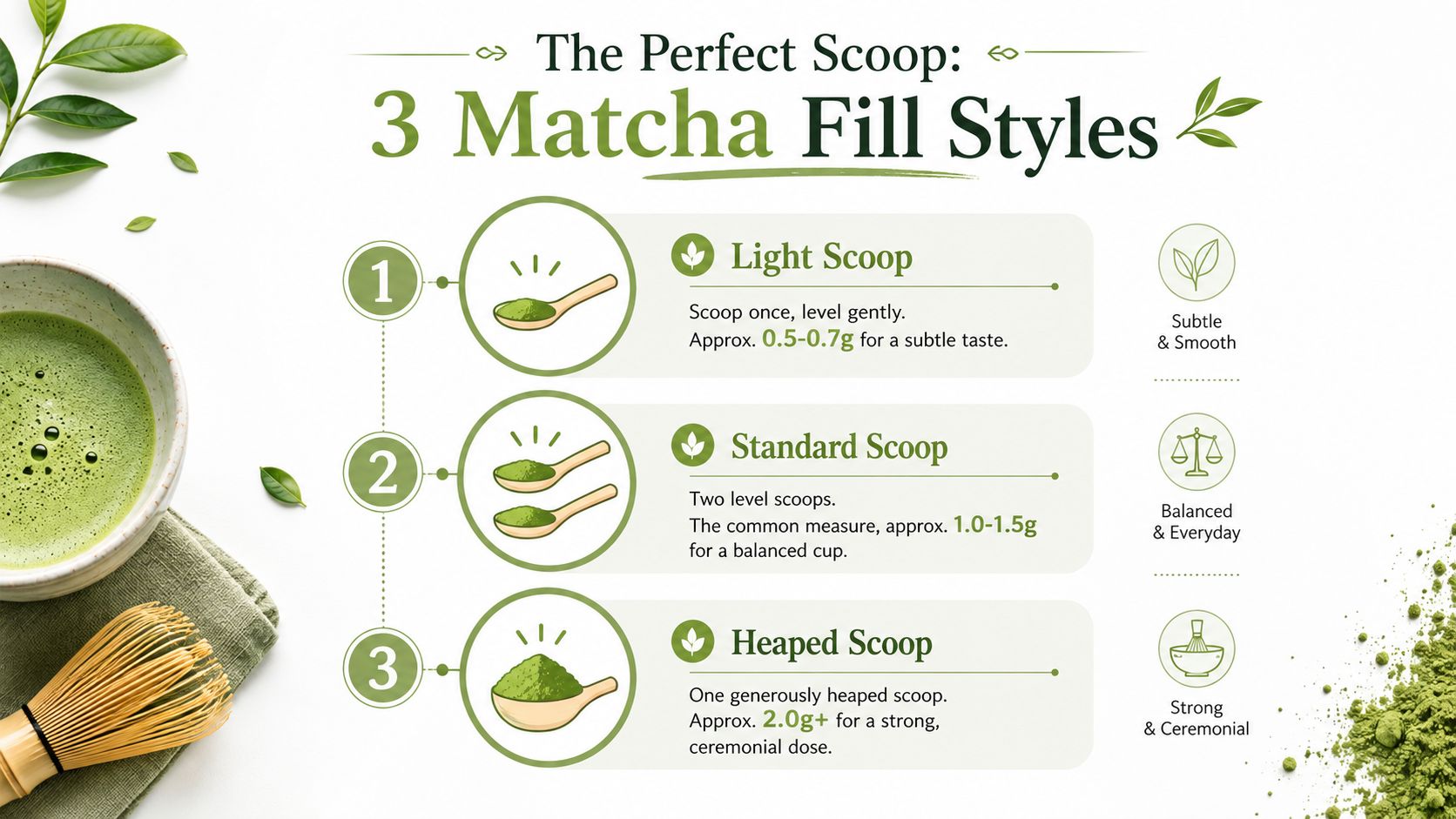
Use three test fills to identify variation. For example, record each level scoop separately after the powder has been stored in the same conditions. If the results spread noticeably between a dry morning and a humid service period, keep the fill motion and recipe dose fixed, then check again after changing matcha grade or storage. That result can guide portion costing as well as flavour consistency. A matcha tea sifter can remove clumps before filling, so compacted powder does not distort the scoop.
Bamboo Versus Steel, Plastic, and Ceramic Spoons
The right scoop depends on where and how you'll use it. Bamboo feels natural in a tea ritual and transfers powder neatly, but moisture can affect its condition and its volumetric output. Stainless steel is easier to sanitise and more resistant to humidity, while plastic is practical for busy service and ceramic suits visible presentation.
| Material | Dosing accuracy | Hygiene | Durability | Cost AU | Ceremony feel |
|---|---|---|---|---|---|
| Bamboo | Consistent by volume when technique is standardised, but mass varies with conditions | Requires dry handling and careful storage | Can split, darken or absorb odour | Varies by product and craftsmanship | Strong |
| Stainless steel | Useful for repeatable portions when sized consistently | Easy to clean and sanitise | Highly durable | Varies by product | Low |
| Plastic | Consistent if the scoop is clearly sized and staff use the same fill method | Often easy to wash, with some materials suitable for dishwashing | Practical, but may stain or retain aroma | Usually accessible | Low |
| Ceramic | Depends on the bowl volume and shape | Washable, but chips need attention | Can chip or break | Varies by design | Moderate to strong |
Choosing for the setting
For a home ritual, bamboo is a natural choice. It connects the movement of measuring with the history of matcha and feels pleasant in the hand. It also suits single-origin tasting, gift presentation and preparation where the utensil remains visible.
For high-volume café work, stainless steel or colour-coded plastic usually makes the operational decision easier. Staff can identify a dedicated utensil quickly, clean it as part of a normal workflow and replace it without treating it as a keepsake. Resources covering spoons for cafés and events can help operators compare general service utensils before choosing a matcha-specific format.
Ceramic works best when presentation matters and the spoon stays on a tasting tray. It echoes the chawan, but breakage and variation between pieces make it less suitable as the sole dosing control in a busy bar.
Caring for a Bamboo Scoop in Australian Conditions
Bamboo and moisture don't make a relaxed partnership. Coastal homes, humid kitchens and steam near an espresso machine can leave a scoop damp long after the powder has disappeared. Air-conditioned offices create the opposite challenge, with dry air and temperature changes that can encourage splitting if the tool is stored carelessly.
After each use, remove loose matcha with a dry, lint-free cloth or a soft brush. Don't soak the chashaku, place it in a dishwasher or coat it with food oil. A damp wooden utensil needs to dry completely, and oil can create an unwanted surface for residue and mould, particularly in warm, humid conditions.
A practical storage routine
- Wipe immediately: Remove powder before it settles into the curve or handle.
- Air-dry fully: Rest the scoop vertically or in a holder so air can reach the curved tip.
- Keep it away from steam: Store it away from kettles, sinks, stovetops and espresso steam wands.
- Use dedicated storage: Cafés should keep staff scoops labelled and separate from utensils used with raw ingredients.
In a commercial kitchen, follow the venue's food-safety procedures and keep preparation tools clean, dry and assigned to their intended ingredient. End-of-shift storage should leave the scoop dry rather than sealed while damp.
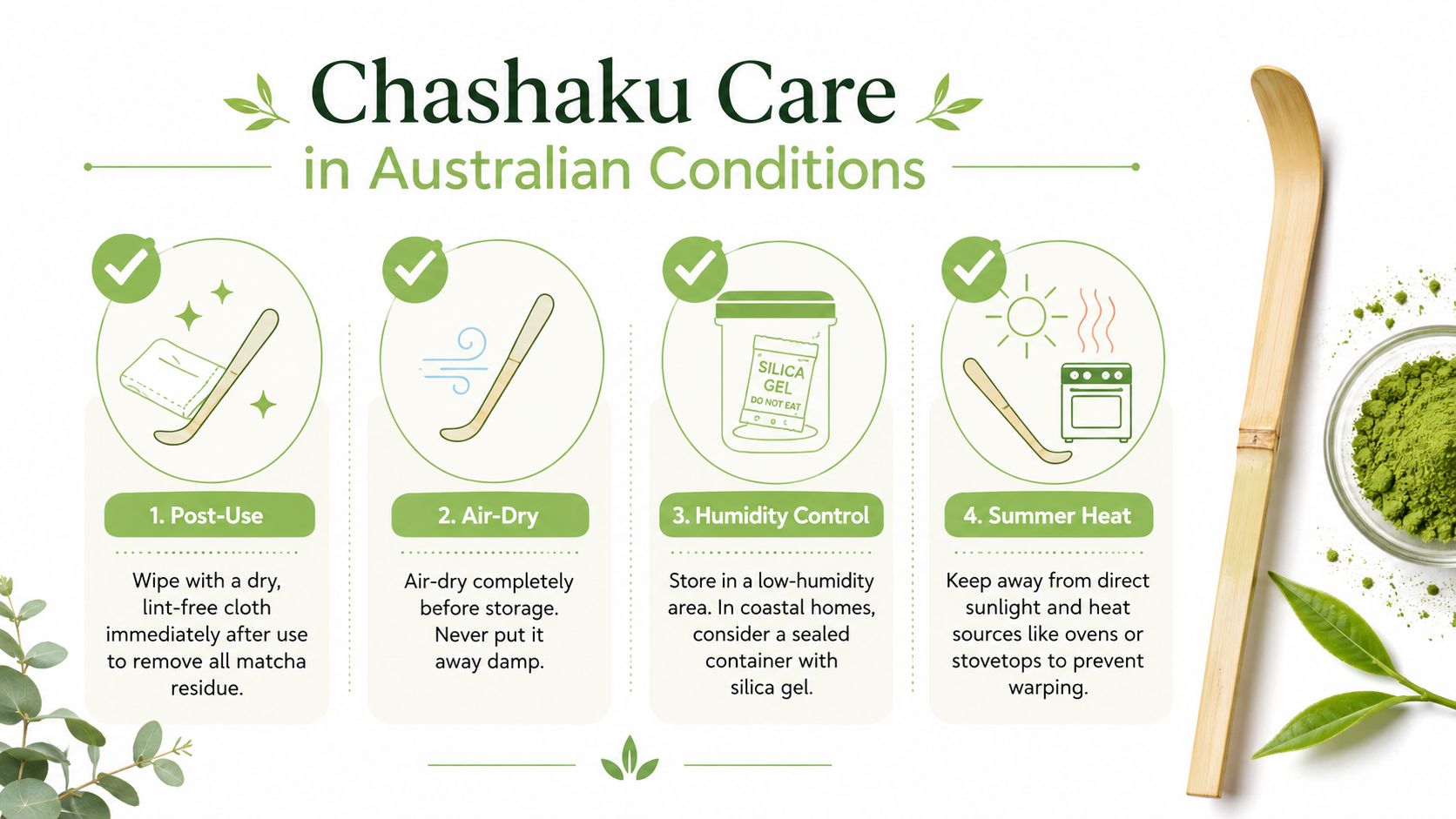
Retire the scoop when you see cracks, splinters, darkening, persistent odour or powder that keeps clinging after drying. Australian product pages show that chashaku are readily available as standard teaware, so replacement is preferable to continuing with a damaged utensil. PepTea's matcha tea accessories collection is one place to compare compatible preparation tools.
When a Scoop Is Not Enough for a Café Workflow
A bamboo scoop can work beautifully at the tea counter, but it shouldn't be the café's only dose-control system. The volume changes when the powder is denser, more humid, more finely settled or filled differently, so two apparently identical scoops can produce different drinks.
That matters as Australian matcha demand and supply pressure increase. Market coverage reported matcha revenue above US$54 million in 2024, projected annual growth of 7.1%, and Japan-to-Australia green tea exports up 131% year on year by August 2025. The same coverage noted cafés in Sydney, Melbourne, Brisbane, Perth and Adelaide charging about A$6 to A$8 for a matcha latte in 2025 amid shortages. SBS News provides that Australian market context.
A better service system
- Calibrate the scoop: Weigh a level fill with a scale that reads to 0.1 gram.
- Test several fills: Record the results rather than relying on a single reading.
- Set the recipe: Choose a target dose in the 1 to 2 gram range when that suits the menu, then document the fill method.
- Train the team: Use one dedicated scoop and one agreed levelling technique.
- Check stock: Compare expected powder use with actual consumption and investigate drift.
Batch-weighing portions into clean, labelled containers can speed service, while the chashaku remains useful for presentation and small adjustments. A scale should stay available for opening a new matcha, checking staff technique and investigating changes in flavour or stock use.
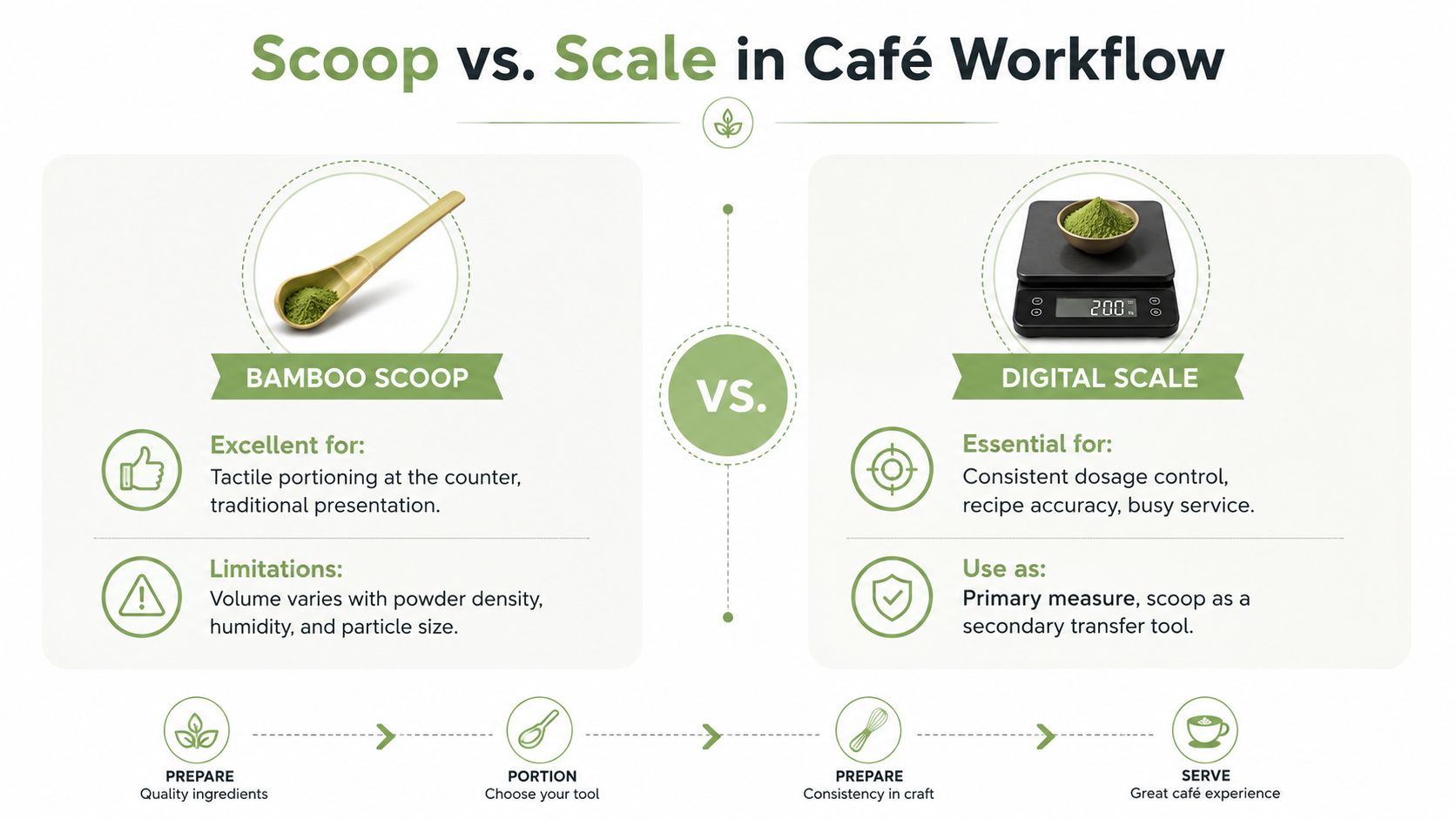
The aim isn't to remove tradition from café service. It's to pair the tactile familiarity of bamboo with a system that protects drink quality, ingredient control and customer expectations.
Bringing It All Together With Your Matcha Ritual
A matcha bamboo scoop works best when you treat it as a measured portioning tool with cultural character. Its traditional bamboo form and curved tip make it especially satisfying for ceremonial preparation, while the same geometry helps transfer powder neatly for everyday lattes, smoothies or baking.
Choose one fill style and repeat it. Use a digital scale when a recipe needs tight control, and don't assume that a heaped scoop will match another person's heaped scoop. Keep the chashaku dry, remove residue after use and replace it when it cracks, splinters, develops a musty smell or shows mould.
For home brewers, bamboo offers connection, handling and a gentle sense of ritual. For cafés, it works best alongside calibration, labelled storage and a backup measuring method. Once the tool is understood this way, it becomes less mysterious and more useful.
Pep Tea offers organic Japanese matcha powders, including Premium 100g Organic Matcha Green Tea and Organic Matcha Japanese Imperial Tea Powder, for home preparation and café use. Visit Pep Tea to explore the matcha range and choose a powder that suits your scoop, recipe and daily tea ritual.
Automatic Tea Maker Guide for Australian Homes and Cafés

The most popular advice about an automatic tea maker is also the least useful: buy the most advanced machine you can afford and great tea will follow. It won't. A machine can control water temperature, steeping time and basket movement, but it can't choose the right tea, judge freshness or replace a thoughtful brewing routine.
For some Australian homes, a kettle with temperature control and a timer is the better purchase. For a busy café, office or self-service station, automation may earn its bench space through repeatability and reduced handling. The right decision depends on how often you brew, which teas you use, how much adjustment they need and who'll clean the equipment.
Do You Really Need an Automatic Tea Maker
An automatic tea maker solves a practical problem, not a romantic one. It can heat water to a selected temperature, lower an infuser, lift it at the end of a programmed steep and keep the finished tea warm. That's valuable when several people want the same drink or staff need to repeat a recipe without watching a timer.
At home, the case is less obvious. If you usually make one mug of black tea, a standard kettle and a reliable timer may do everything you need. A temperature-controlled kettle becomes more useful when you switch between green tea, black tea, herbal infusions and delicate organic blends, because each style can need a different approach.
Start with your actual routine
Ask yourself:
- Frequency: Do you brew repeatedly throughout the day, or only occasionally?
- Variety: Do you mostly drink one tea, or change between styles?
- Consistency: Does the same person prepare every cup, or do several users share the equipment?
- Cleaning: Will you rinse the basket and jug after use, even on busy mornings?
- Workflow: Do you enjoy measuring, timing and whisking, or would you rather press a button?
An automatic tea maker makes the strongest argument when consistency matters more than ritual. A café serving a house black tea, an office supplying staff drinks or a household preparing several cups may benefit from programmed brewing. A tea enthusiast who adjusts every infusion by taste may find the machine restrictive.
The appliance market is moving towards more automated, higher-specification formats, including precision temperature control, digital interfaces and automated cleaning. A recent Australian coffee-machine market model describes value growth outpacing unit growth and projects shipments from about 650,000 units in 2025 to 862,000 in 2031, but that evidence comes from coffee machines, not automatic tea makers, so it shouldn't be treated as proof that every tea drinker needs one. The Australian coffee machine market model supports a more careful conclusion: buyers increasingly pay for convenience when it solves a real workflow problem.
Practical rule: Buy automation for repeated work, not because a complicated control panel makes tea sound more serious.
The Surprising Australian History of Automatic Tea Makers
Automatic tea makers aren't a new response to busy mornings. Australia's documented connection with the category reaches back to the pre-war electric-appliance era.
The Museum Victoria collection includes a Goblin automatic tea-maker used in Toorak, Victoria. Its record identifies the appliance as made in England by 1936 or earlier, with later models commonly marketed as “Teasmade”. Independent Australian collection records also trace the electric tea-maker patent line to the early 1930s, including William Hermann Brenner Thornton's 1933 patent, which was sold to the British Vacuum Cleaner and Engineering Co. That company commercialised the Goblin Teasmade. Museum Victoria's Goblin automatic tea-maker record provides a useful local link between an imported appliance and Australian household use.
The early design was straightforward in principle. A timer arranged for water to heat and tea to brew, turning a morning drink into a scheduled domestic task. Wartime interruption affected availability, but the category returned to public attention after the war.
From novelty to household familiarity
The Powerhouse Collection records that Teasmades returned to popularity after wartime interruption. By the late 1960s, about 300,000 units were sold annually in the UK and some Commonwealth countries, according to the collection history. Collections WA's Teasmade record adds that Teasmades peaked during the 1960s and 1970s, declined afterwards and experienced a partial revival in the 2000s as a retro novelty.
That history matters for Australian buyers because it shows the appliance wasn't just a modern gadget invented for digital kitchens. Commonwealth distribution helped move automatic tea-making from a niche invention towards broad household familiarity, even though Australia wasn't necessarily the main manufacturing base.
The modern machine adds temperature sensing, programmable steeping and more deliberate control over extraction. The underlying promise remains familiar, but the technology has moved beyond waking someone with a cup of hot tea.
How Automatic Tea Makers Work
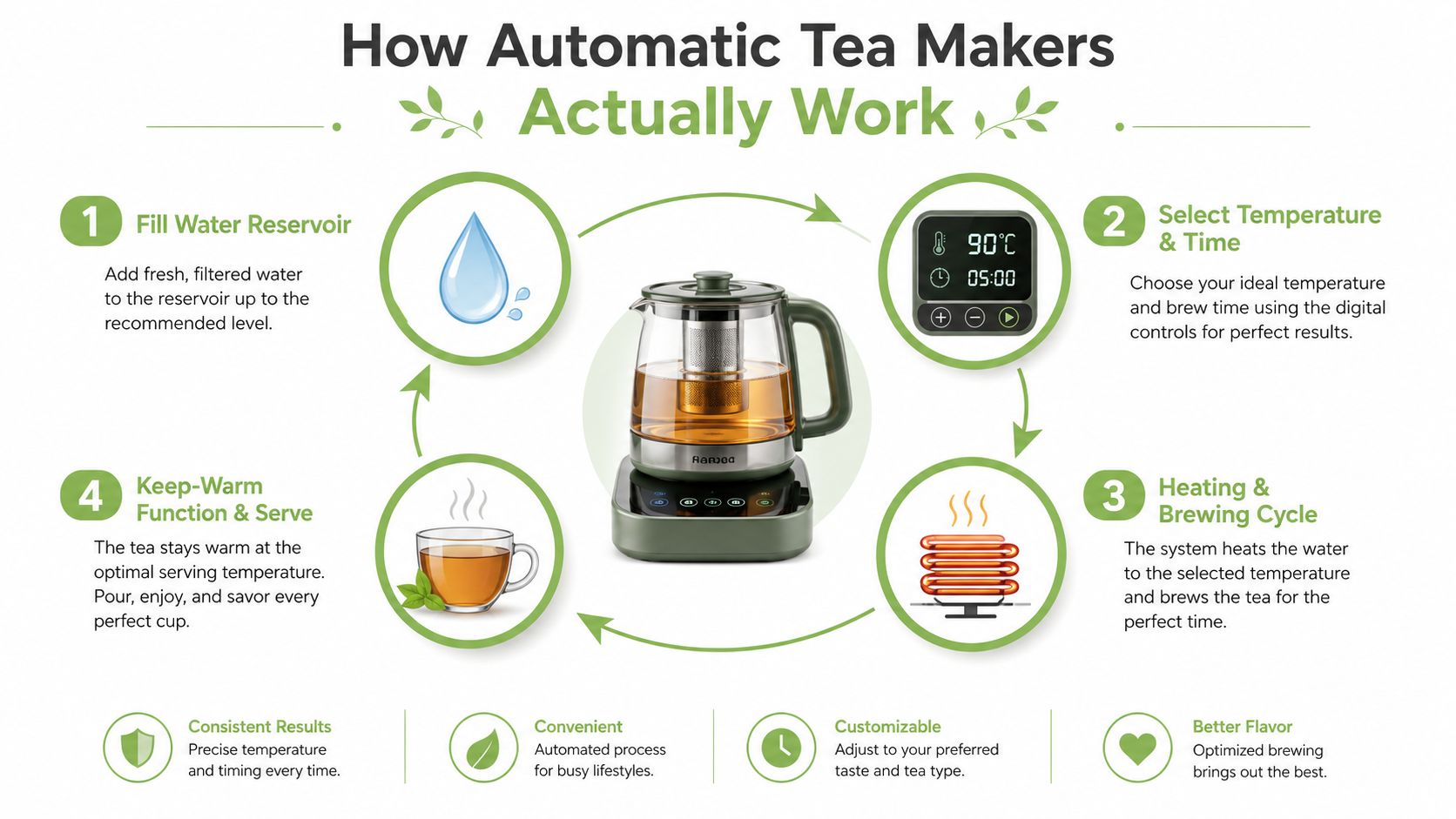
An automatic tea maker combines a kettle, timer and infuser in one unit. The heating element raises the water towards the selected temperature, while a sensor checks the water rather than relying only on heating time.
Starting temperature, water volume and the surrounding environment all affect heating speed. A higher wattage rating can shorten the wait, but sensor feedback helps the machine stop at the intended temperature.
Four parts that affect the cup
Heating element: This supplies the energy for heating. More power may produce faster results, but it does not by itself create suitable brewing conditions.
Temperature sensor: The sensor checks the water and helps the controller hold the selected setting. That control is useful when switching between green tea and black tea.
Infuser basket: Loose leaves sit in the basket as water moves around them. With auto-lower and auto-lift functions, the basket enters the water at the beginning and rises when the programmed steep ends.
Keep-warm function: The heater maintains the drink after brewing. This can help an office or café serve several cups from one cycle, although tea can change in flavour if it remains hot for too long.
Australian brewing guidance places green tea around 80–85°C and black tea around 90–95°C. CoffeePlus's Australian tea brewing temperature chart shows why a temperature setting offers more control than a basic “boil” function. Hotter water extracts compounds faster, which can make delicate green tea bitter, while black tea generally suits a higher range.
A programmable basket replaces the hand movement of lifting an infuser. It does not make every tea identical, so tasting and adjustment still matter.
A manual workflow can be just as practical. A French press gives a clear view of the steep, making these french press tea recipe tips useful for comparing hands-on infusion with a programmed cycle. For organic matcha, neither method replaces whisking the powder into a smooth suspension. Kombucha also calls for separate preparation and fermentation control, rather than a hotter or longer tea cycle.
Automation therefore suits repeatable leaf-tea brewing, especially where several servings follow the same recipe. A kettle and infuser may offer better control for small batches or changing teas.
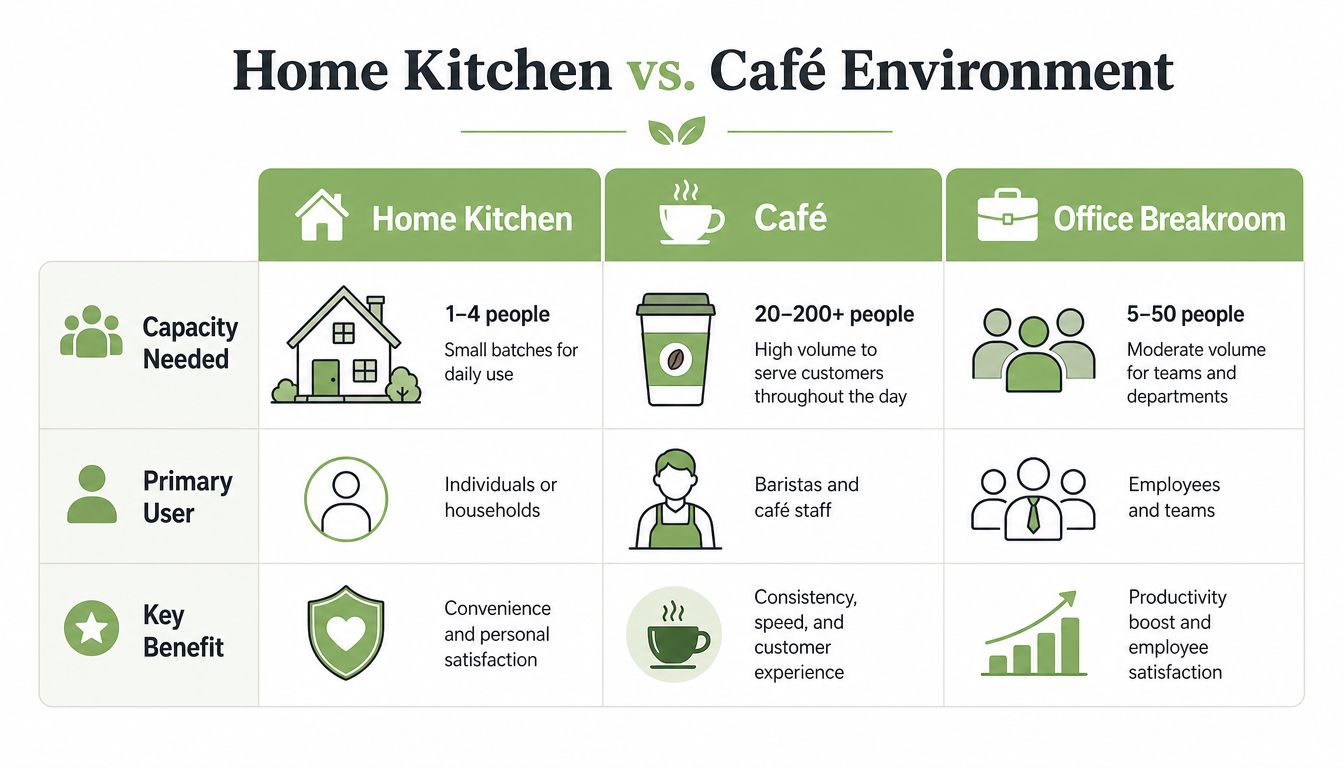
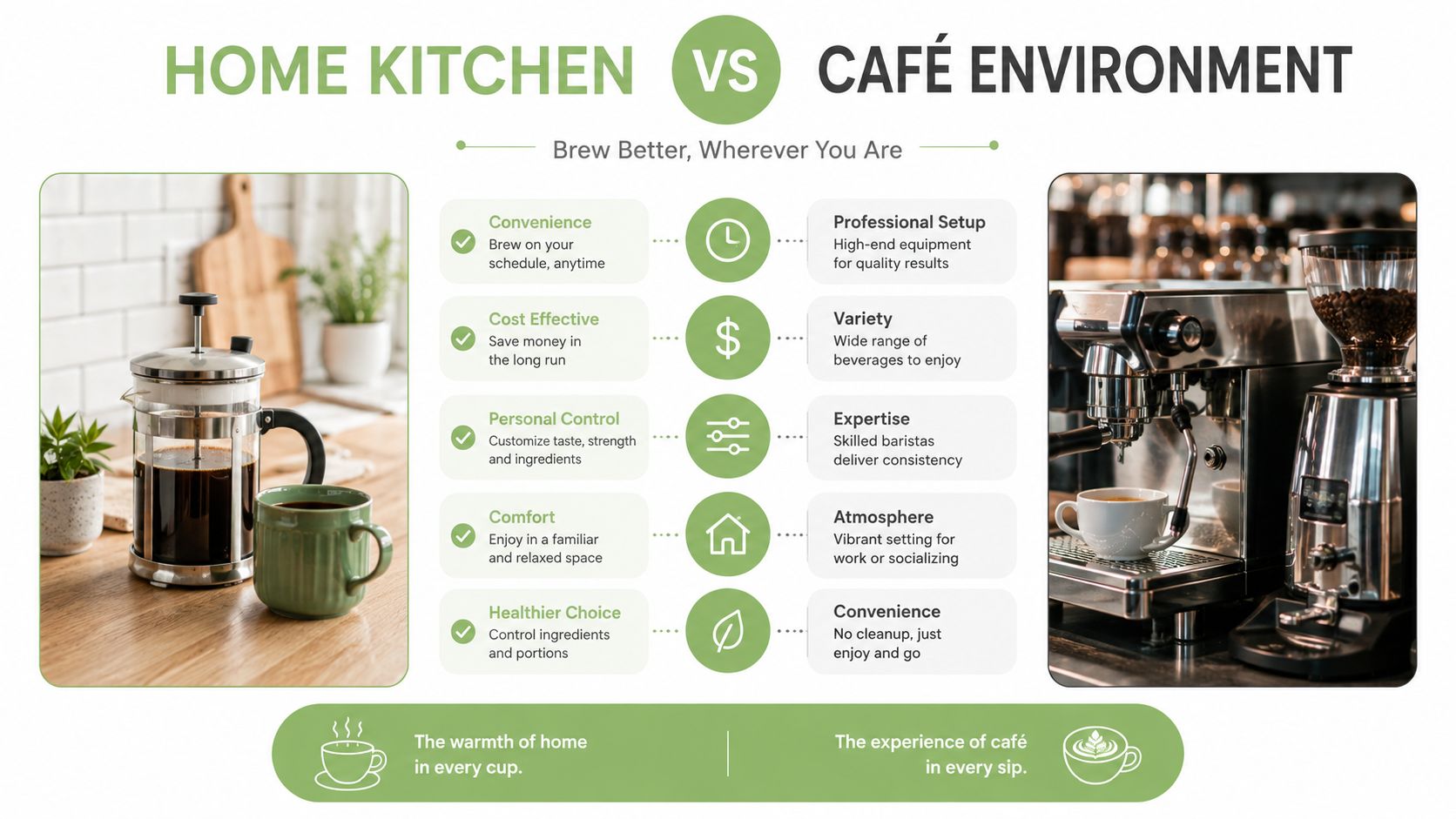
Home Kitchen Versus Café Environment
The same automatic tea maker can feel luxurious at home and inadequate in a café. The difference isn't only capacity. It's the number of people using the machine, the number of tea styles on the menu, the pace of service and the consequences of an inconsistent cup.
Home kitchen
A home user often values flexibility. You might prepare ceremonial matcha in the morning, a green tea later and a herbal infusion at night. An automatic tea maker can simplify water heating, but it won't replace the separate whisking step required for matcha, and a single jug may need careful rinsing between strongly flavoured teas.
A manual kettle and infuser may be the better fit when you enjoy changing variables. You can shorten a steep, add more leaves or pour immediately when the aroma reaches the right point. Automation is more attractive for households that prepare multiple cups, want repeatable temperature settings or dislike monitoring the clock.
Café and hospitality
A café has a stronger operational case. Staff can use programmed settings for a core tea menu, reducing variation between shifts. Portion control and self-service can also matter in hotels, diners and venues operating around the clock. Australian listings already market automated tea solutions to these environments, but the machine still creates work through refilling, rinsing, descaling and checking the basket.
Use automation for repeatability, not for every drink. A specialty tea program may need manual adjustment for delicate leaves, botanical blends or unusual steeping sequences. Before buying, find efficient prep tools and map the full workflow, including storage, cleaning and service space.
Office breakroom
An office sits between the two. Users may want simple operation and predictable results, but they won't always share the same tea preferences or clean equipment carefully. Clear labels, a limited set of presets and an accessible rinse routine can matter more than advanced customisation.
For menu planning, pair the equipment decision with practical café menu ideas. A tea station can support a broader non-alcoholic offering, but only if the chosen drinks match the machine's capacity and cleaning demands.
Key Features and Specifications to Evaluate
A good specification sheet should answer a simple question: will this machine protect the tea and fit the workflow? Capacity, wattage and digital controls matter, but they don't matter equally.
The Breville Tea Maker BTM800 offers a useful Australian benchmark. It has a 1.5 L capacity, five preset temperature settings, three tea-strength presets, an auto-lower and auto-lift basket, a temperature sensor, a 60-minute keep-warm function and 2000 W heating power. Breville's BTM800 product information shows the feature combination buyers should examine rather than judging the machine by wattage alone.
Temperature control comes first
Green tea and black tea don't share the same ideal brewing range. A machine that only boils water may be convenient, but it gives you less control over extraction. An Australian automatic tea-maker instruction booklet describes adjustment in 5°C increments from 70°C to 100°C, while also setting separate volume limits for heating and brewing. The Australian instruction booklet illustrates how small temperature steps can support different tea styles.
| Tea Type | Temperature Range | Key Consideration |
|---|---|---|
| Green tea | 80–85°C | Lower heat helps preserve delicate aroma and reduce harsh extraction. |
| Black tea | 90–95°C | Higher heat supports a fuller infusion. |
| Matcha preparation | Around 80°C | Heat water first, then whisk the powder separately. |
| Herbal or botanical blends | Follow the product guidance | Ingredients vary, so don't assume one preset suits every blend. |
Read beyond the headline features
- Basket movement: Auto-lift is useful because it ends contact between leaves and water. Confirm that the mechanism is easy to remove and rinse.
- Capacity: Choose enough volume for your normal service, not an imagined peak. A larger jug can also mean more water and tea left sitting warm.
- Keep-warm duration: This supports staggered serving, but it isn't a substitute for brewing fresh when flavour is the priority.
- Material and handling: Look for a clear jug, readable fill markings, stable controls and components that can be cleaned properly.
- Wattage: Treat power as a heating specification, not a quality score. Sensor accuracy and basket timing have a more direct relationship with extraction.
If you're mainly interested in controlled water temperature rather than automated steeping, an electric tea kettle with temperature control may deliver the simpler solution.
Integrating Automatic Tea Makers with Matcha and Kombucha
An automatic tea maker can support matcha and kombucha, but it shouldn't be used in exactly the same way for both.
Matcha is finely ground powder, not loose leaf. The machine can heat water to a suitable temperature, but you'll still need a bowl, whisk and proper mixing technique. For a delicate ceremonial-grade matcha, water around 80°C is a sensible starting point within the Australian green-tea guidance range. Pour the heated water over the powder and whisk until smooth rather than placing matcha directly into a basket designed for leaves.
A practical matcha workflow
- Heat fresh water using the machine's temperature setting.
- Sift matcha into a bowl to reduce clumps.
- Add a small amount of the heated water.
- Whisk briskly until the powder disperses.
- Add more water or chilled milk for a latte.
For an iced matcha latte, cool the prepared matcha over ice before adding milk. The appliance handles the temperature-controlled water, while you retain control over texture and strength.
Kombucha uses a different process. An automatic tea maker can produce a consistent green or black tea base, but the tea must cool before it meets a SCOBY and fermentation culture. Hot water is useful at the extraction stage. It's not suitable for live cultures.
Keep the stages separate
Brew the tea base, dissolve any recipe ingredients according to your method, then allow the liquid to cool before fermentation. Don't use the machine as a kombucha fermenter, and don't place a SCOBY or finished live kombucha in the jug. For broader functional beverage ideas, explore this immune-supporting drink guide while keeping health language realistic. Matcha may contribute antioxidants and naturally occurring L-theanine, and kombucha can provide a low-sugar fermented option, but neither drink replaces medical care or a balanced diet.
Maintenance Routines and Troubleshooting Common Issues
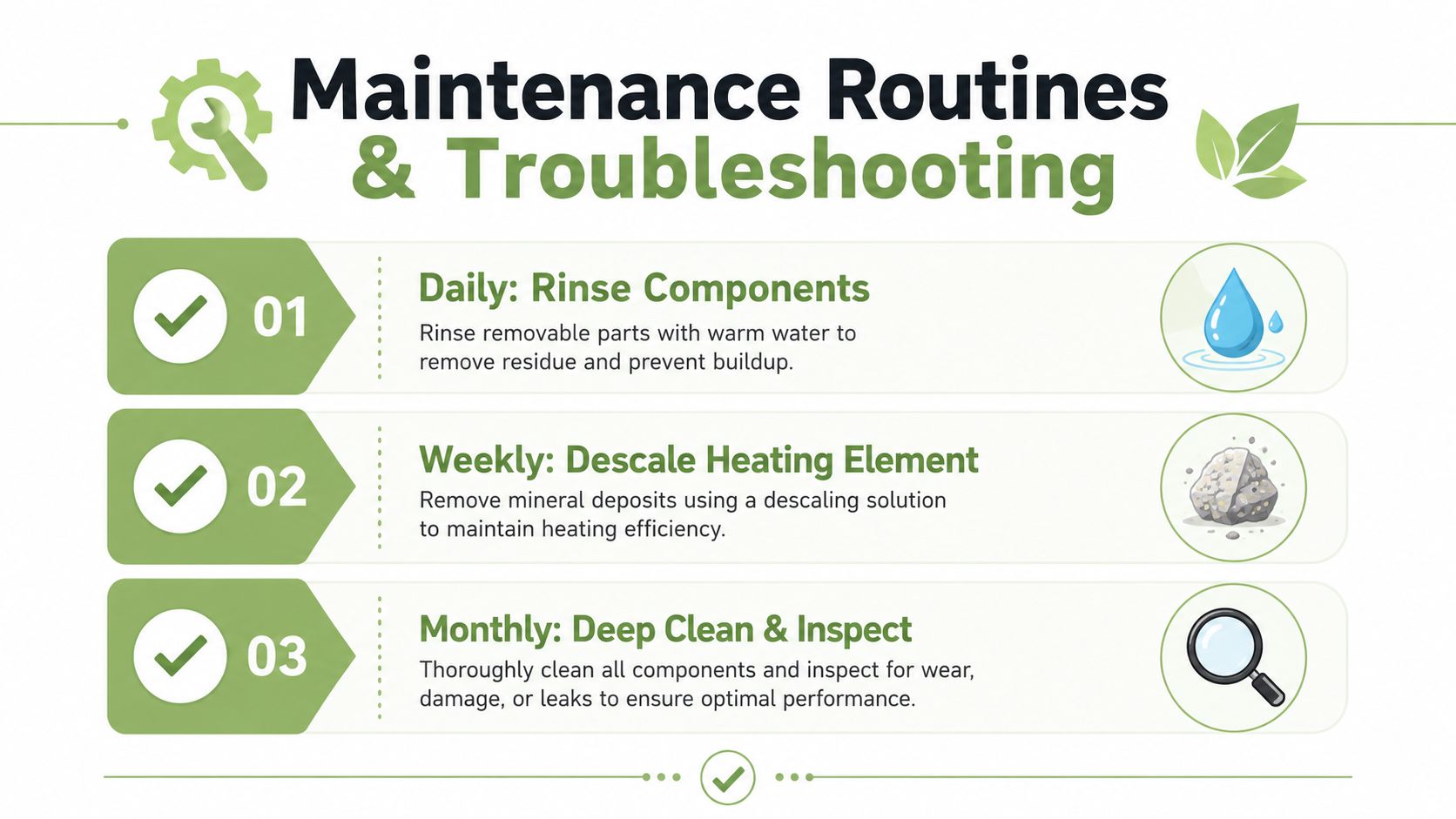
Tea leaves leave fine particles, tannins and aromatic oils behind. Australian tap water can also deposit minerals around the heating element and temperature sensor. Over time, that buildup may produce stale flavours, slower heating or inconsistent temperature readings. For cafés, these faults can appear first during busy service, when repeated cycles expose weak cleaning habits.
Follow the manufacturer's instructions for descaling products and dishwasher-safe parts. Keep daily rinsing separate from periodic scale removal, because a clean basket cannot remove deposits inside the heating area.
A workable cleaning rhythm
- After each use: Empty the basket, rinse away leaves and wash the jug if residue remains.
- Daily: Rinse removable components with clean water and leave them open to dry.
- Weekly: Inspect the heating area for scale. Descale only when the manufacturer permits it.
- Monthly: Deep-clean the basket, lid, jug and moving parts, then check that the auto-lift mechanism travels freely.
Fill lines are part of the machine's operating system, not decoration. Follow the manufacturer's fill-line instructions when heating and brewing. Filling beyond the permitted level can cause spills, obstruct basket movement and create a burn hazard.
Troubleshoot by symptom
The tea tastes bitter: Check water temperature, steep duration and leaf quantity. Green tea can become harsh when brewed too hot or held in water too long.
The machine heats slowly: Mineral deposits may be reducing heat transfer. In a hard-water home or café, compare the heating time with a freshly cleaned unit, then follow the approved descaling process. Avoid abrasive tools, which can damage surfaces or sensors.
The basket won't move: Switch off and unplug the unit before checking for leaves or residue around the mechanism. Never force the basket.
The jug leaks or overflows: Confirm that the water is below the correct fill line and that the lid and basket are seated properly.
The temperature seems wrong: Scale near the sensor can distort readings. Clean the area as directed, test with fresh water, and keep the machine out of service if the reading remains unreliable.
Buying Considerations and Australian Safety Standards
A buying decision should include more than presets and appearance. Check the warranty, replacement-part availability, bench footprint, power requirements and whether the jug and infuser are practical to wash. For a café, calculate cleaning time and staff training as part of the purchase. For a home, ask whether the extra appliance will simplify your morning or add another object to maintain.
Hot-water safety becomes critical when a machine connects to plumbing or serves customers, children, older people or people with disability. South Australian guidance limits heated water connected to plumbing fixtures used for personal hygiene to 50°C, with a 45°C maximum in specified public-building areas such as aged-care, patient-care, early-childhood and school settings. South Australian hot-water safety guidance explains why delivery temperature must be considered separately from tea-brewing temperature.
A NSW Health document defines hot water as heated water delivered or used above 45.0°C, and includes a thermal shut-off at 46.0°C in its temperature categories. The NSW scald-prevention document reinforces that small temperature differences can be safety-critical in facilities.
Queensland guidance uses a dual-temperature approach. Storage water must reach at least 60°C to help prevent Legionella, while delivery to taps is limited to 50°C through a temperature-control device. Queensland hot-water system guidance is particularly relevant to plumbed hospitality systems.
Choose a standalone unit unless your venue needs an integrated installation. If plumbing is involved, have the setup assessed by a qualified professional and keep brewing temperature controls separate from safe point-of-use delivery.
Pep Tea offers premium organic Japanese matcha and Australian-brewed, sugar-free organic kombucha from the Hunter Valley, NSW, giving homes and cafés quality ingredients to use with either manual brewing or an automatic tea maker. Visit Pep Tea to explore the organic matcha range, kombucha options and wholesale support for a more considered non-alcoholic drinks menu.
Matcha Bowl Set: The Complete Buyer’s and Brewing Guide
You've got a bag of matcha, a favourite mug, and the hope that this cup will finally taste like the café version you keep thinking about. Then the powder clumps, the surface stays flat, and the first sip lands bitter instead of smooth. That frustration usually isn't about the matcha alone, it's about the vessel and the tools.
A proper matcha bowl set changes the whole experience because it gives the whisk room to move, the powder room to disperse, and the drink room to foam. In Japan, the matcha bowl, or chawan, has deep roots in tea culture, with traditions commonly traced to the 9th century in the Heian period and, in later tea-ceremony practice, to the 12th century when Zen monks helped popularise powdered tea in Japan what is a matcha bowl. That history matters, but the practical point matters even more, a good bowl is a working tool, not just a pretty object.
Australian cafés have pushed expectations higher. People now want matcha that looks clean, tastes balanced, and feels consistent from one serve to the next. That's exactly where the right bowl geometry and whisk compatibility make the biggest difference.
Why Your Regular Mug Is Failing Your Matcha
The common beginner move is easy to spot. Someone grabs a regular mug, adds matcha, pours in hot water, and stirs with a spoon or a small whisk. The cup often ends up patchy, the flavour turns harsh, and dry powder clings to the sides.
The problem starts with shape
A regular mug is too narrow for proper whisking. The bamboo whisk, or chasen, needs room to sweep across the surface and break up clumps, and a cramped vessel cuts that motion short before it can do its job. A wider, rounded bowl gives the whisk clearance, which helps create the fine foam people expect from well-made matcha.
Practical rule: if the whisk keeps hitting the sides, the vessel is working against you.
The second issue is aeration. Matcha is a suspended powder, so it needs more than a quick stir. The bowl's open profile supports the whisking pattern that lifts, disperses, and froths the tea properly. Without that movement, sediment settles at the bottom and the first sip tastes uneven.
Temperature adds a third layer. Matcha is delicate, and a bowl designed for the job makes it easier to keep the drink in the right range instead of rushing the process. That matters in home kitchens, and it matters just as much in busy Australian cafés, where every cup needs to look and taste consistent.
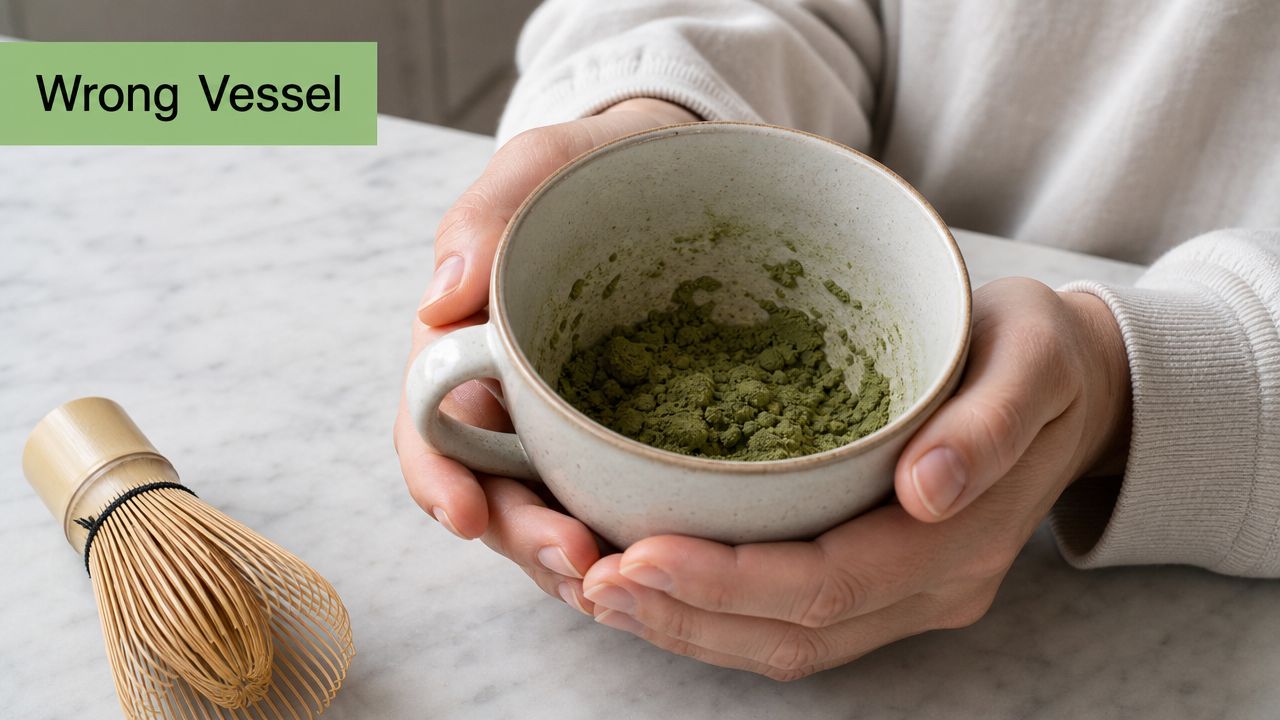
The takeaway is straightforward. A matcha bowl set is not about ceremony for ceremony's sake. It solves the basic mechanics that make matcha pleasant to drink, and that is why serious home drinkers and café operators keep coming back to the proper tools.
Components of a Matcha Bowl Set
A good matcha bowl set works like a small prep station. Each piece has a different job, and the fit between them matters more than the display shelf version of the set. In an Australian home kitchen, or behind a café bench during a morning rush, that fit is what makes the results repeatable.
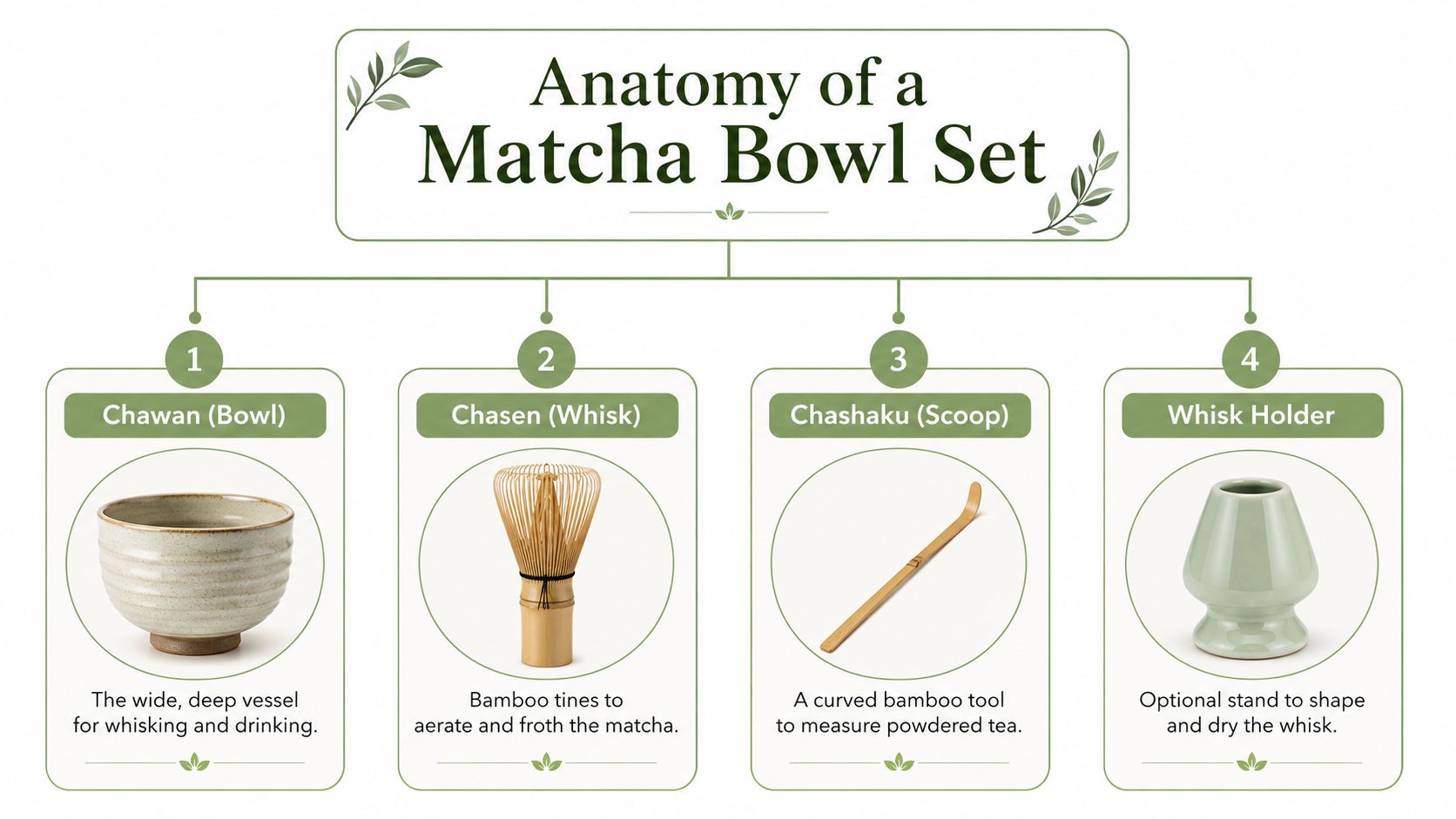
The core tools and what they do
A chawan is the bowl itself. Its wide, rounded shape gives the whisk room to move, so the tea and water can stay in motion instead of collecting in one tight spot. That geometry is the practical reason a proper bowl outperforms a random ceramic bowl from the cupboard.
A chasen is the bamboo whisk. Its flexible tines whip air into the tea and create the light foam people expect from well-made matcha. A spoon can stir the liquid, but it cannot make the same texture because it does not sweep the surface in the same way.
A chashaku is the curved bamboo scoop. The scoop looks simple, yet it matters because dosing changes the feel of the drink very quickly. Too much matcha in a small bowl can leave you with a dense, bitter cup that is hard to smooth out, especially if you are making drinks one after another.
A whisk holder is optional, but it helps keep the whisk in shape as it dries. For anyone who uses the set often, it gives the tines a proper resting place instead of leaving them bent or splayed in a drawer.
If you want to compare the usual accessories before buying, the matcha tea accessories collection at PepTea is a practical reference point for seeing how the tools relate to one another.
The set works best as a system, not as a pile of separate items.
The same idea carries into the kitchen. Matcha sits comfortably alongside authentic Japanese home cooking recipes, especially when you are building a routine around simple preparation and consistent flavour.
The common mistake is treating the bowl as the only part that matters. The bowl sets the shape of the work, but the whisk, scoop, and holder are what make the process reliable. When the pieces match the task, the tea is easier to prepare well, whether you are making one cup at home or repeating the same method for customers in a café.
Choosing the Right Materials and Sizes
A matcha bowl can look beautiful on the shelf and still be awkward in the hand. The key test is whether it supports steady whisking, comfortable pouring, and repeatable results for the way you brew at home or serve in a café. For Australian buyers, those practical details usually matter more than surface style.
Material trade-offs that affect everyday use
Ceramic is the most familiar option. It usually feels stable in the hand and suits the rounded shape that matcha needs. Porcelain can feel smoother and lighter, while glass shows the colour of the tea clearly, but can feel less forgiving in a busy kitchen.
| Matcha Bowl Materials Comparison | Heat Retention | Durability | Best For |
|---|---|---|---|
| Ceramic | Good warmth and a solid hand feel | Generally sturdy, but can chip if knocked | Home use, café service, everyday matcha |
| Porcelain | Even, clean finish | Can be strong, but still needs careful handling | Presentation-focused serving |
| Glass | Lower heat feel and more visual clarity | More fragile in active kitchens | Display use and occasional home brewing |
The best material depends on where the bowl will live. A café bench, a home cupboard, and a gift box all call for different priorities. Choose based on your actual brewing routine, then check whether the bowl is easy to clean, easy to store, and able to handle a busy morning rush without feeling delicate. If you are comparing options across a wider set of tools, the matcha tea accessories range is a useful way to see how the bowl fits with the whisk and scoop.
Why size and rim width matter
A standard matcha bowl is typically 400 to 500 mL, with a rim around 4.5 to 5.5 inches, or roughly 12 to 15 cm, in diameter what is a matcha bowl. That size gives the whisk enough room to move without splashing. A bowl that is too narrow makes the whisk collide with the sides, which breaks the foam and slows you down. A wider opening gives the tines space to work, which is helpful whether you are making a single bowl at home or repeating the same method for customers in a café. As noted earlier, the bowl is built for small, precise servings where whisking and foam formation matter more than volume.
For a deeper practical view of how bowl shape supports daily tea routines, the material and sizing advice in the same matcha bowl set category is worth comparing with the way you already make drinks at home. If your routine leans toward pantry-friendly meals as well, the same logic applies to tools used across authentic Japanese home cooking recipes.
Buy for the way you brew, not for the most beautiful shelf photo.
Handmade pieces can be lovely, especially if you enjoy ritual and presentation. Mass-produced bowls can be more practical for cafés, shared kitchens, or anyone who needs stackability and predictable cleaning. A handmade bowl may suit the quiet pace of home preparation, while a sturdier, more uniform piece often works better where cups are made back to back. The right answer is the one that matches your usage, not the one that looks aspirational on day one.
Mastering the Basic Whisking Technique
A good matcha cup starts with the whisk, the bowl, and the water working together. In an Australian kitchen or café bench, the goal is repeatable texture, not a lucky first try.
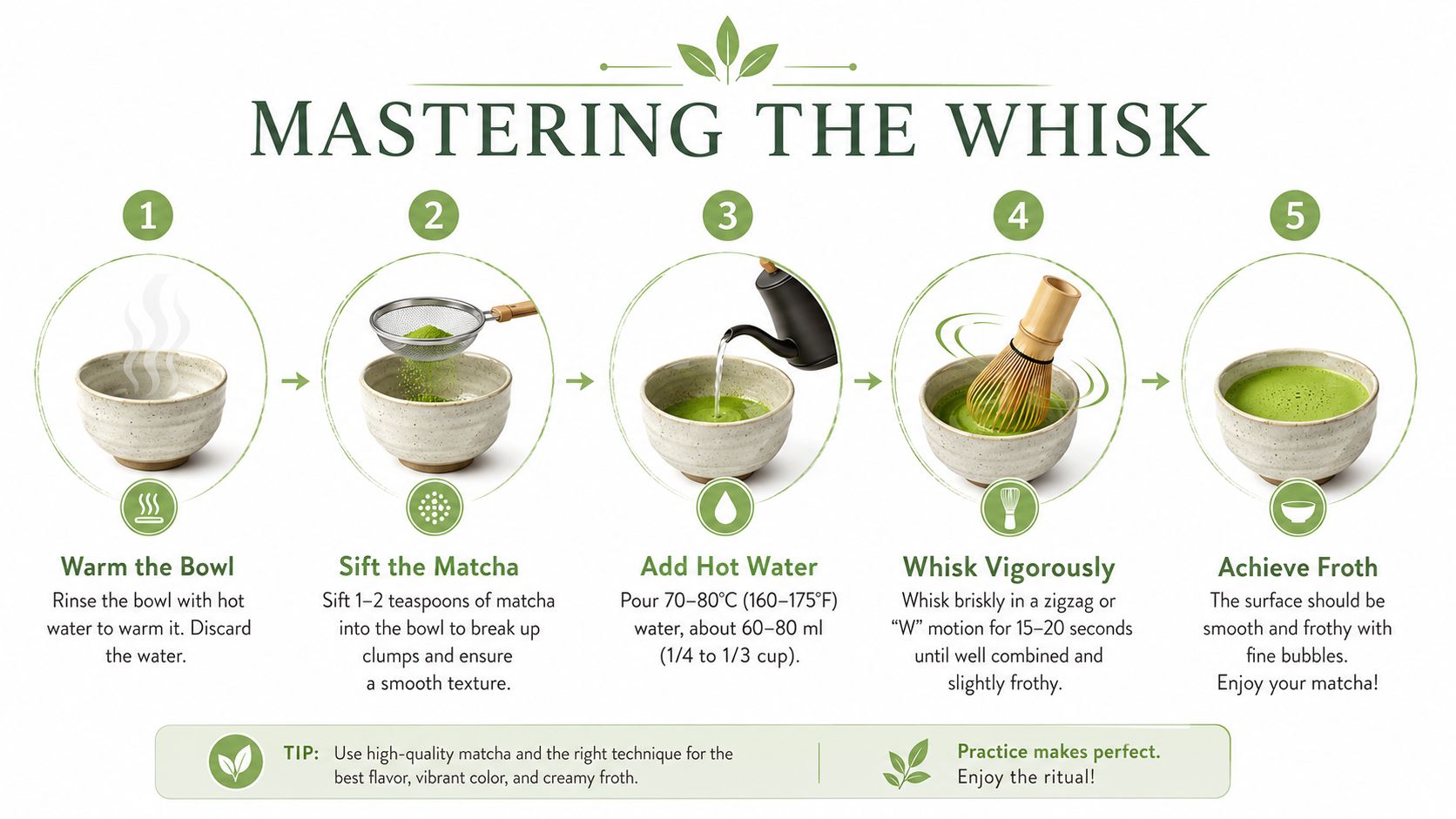
The preparation flow
Warm the bowl first. A pre-warmed vessel gives you a more settled working surface, and it helps the whole process feel under control.
Sift 1 to 2 g of matcha into the bowl next. Matcha is a fine powder, so it clumps easily, much like cocoa left untouched in a dry tin. Sifting gives the whisk less work to do and helps the drink finish smoother.
Add 60 to 80 mL of water at 60 to 70°C. Water that is too hot can push the flavour into a sharper, harsher place, especially if you are still learning how much pressure your whisk needs. The cooler range helps keep the taste cleaner.
Whisk in a W-shaped motion for 10 to 15 seconds. Use quick, light movements rather than force. The bamboo tines need space to move across the bowl, and a well-shaped bowl keeps them from scraping the sides, which helps build a more even foam.
If you want to see the motion before trying it yourself, the tutorial at how to whisk matcha shows the W-shaped whisking pattern at a steady pace, so you can match the rhythm while you practise.
Common mistakes and quick fixes
- If the tea looks grainy: you probably skipped sifting or stopped whisking too soon.
- If it tastes bitter: the water may have been too hot, or the matcha dose may be too heavy.
- If the surface stays flat: the bowl may be too narrow, or the whisk motion may be too circular.
- If it splashes out: the vessel is likely too small for the movement you are using.
A lot of beginners stir matcha like instant coffee. That approach leaves clumps behind and gives you weak foam. The whisk needs room, the bowl needs clearance, and the tea needs a short, decisive burst of motion.
For a fuller walkthrough of hand position and rhythm, the guide on how to whisk matcha is a practical companion. That same method also holds up when you are making drinks for guests or refining café service, because it gives you texture you can repeat instead of guessing from cup to cup.
Picking the Perfect Set for Your Situation
The best set for one person isn't always the best set for another. A home drinker, a café operator, and a gift buyer each care about different things, and the smartest purchase reflects that.
For home baristas
If you're making matcha most mornings, choose a set that's easy to clean and forgiving while you learn. A medium-sized bowl with a comfortable grip and a whisk that feels flexible is usually a better choice than an ornate showpiece. Storage matters too, especially in smaller kitchens where stackability can be a real bonus.
For café operators
Cafés need repeatable texture, fast cleaning, and a bowl that can handle frequent use. Durability matters more than decorative detailing, and the bowl should sit steadily on a bench during service. Whisk compatibility is essential, because the wrong bowl slows down preparation and makes foam quality less consistent across multiple serves.
For gift buyers
Presentation counts here. A set that arrives neatly packaged, looks polished, and includes a short guide for use tends to feel more complete. The recipient shouldn't have to guess which tool does what.
The best gift set is the one that helps someone make a good cup on the first try.
A simple way to think about it is this:
- Home use: prioritise easy cleaning and a bowl that feels comfortable in the hand.
- Café use: prioritise durability, consistency, and whisk clearance.
- Gifting: prioritise presentation, clear components, and user-friendly guidance.
If you're shopping for home use, it's easy to overbuy on extras you won't touch. If you're buying for a café, it's just as easy to under-invest and end up replacing tools too soon. A balanced matcha bowl set saves more time than it costs because it matches the job in front of you.
Caring for Your Matcha Tools
Bamboo and ceramic both last longer when you treat them gently. The maintenance routine is simple, and it pays off quickly because the tools stay usable and look better for longer.
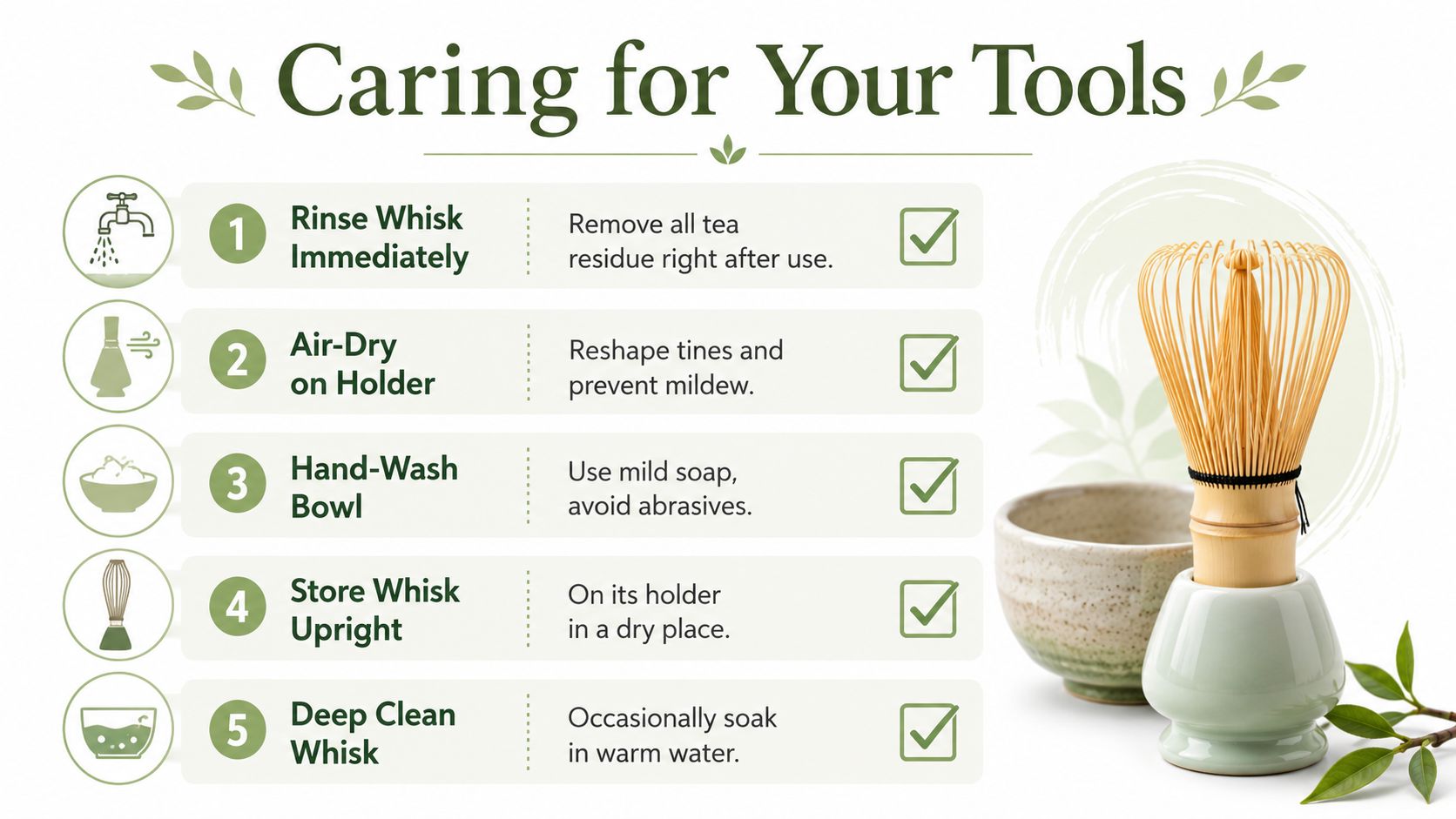
A routine that actually fits real life
Rinse the whisk right after use. Matcha dries fast, and once it sets into the tines, it becomes harder to remove without bending them. Let the whisk air-dry on a holder so the shape stays open instead of collapsing inward.
Wash the bowl by hand with mild soap and a soft sponge. Abrasive pads can dull the finish and make stains more obvious over time. For stubborn residue, warm water and a little patience usually do the job without damaging the surface.
Store the whisk upright in a dry place. Bamboo doesn't like being left damp, especially in humid conditions. In Australian homes, that matters in summer, when moisture can linger longer than you expect.
For a practical storage option, a dedicated matcha whisk stand like the one at PepTea helps the tines keep their shape between uses.
Signs it's time to replace a tool
- Bent whisk tines that no longer spring back properly.
- Persistent staining or odour that survives normal cleaning.
- Chipped bowl edges that make the vessel awkward or unsafe to use.
- Loose or splintering bamboo that no longer feels comfortable in the hand.
The point of good care is not perfection, it's longevity. A few deliberate habits take less time than replacing damaged tools, and they help your set stay ready for daily brewing instead of becoming a drawer of half-used accessories.
Creative Recipes Using Your Matcha Set
A good bowl set earns its place because it's useful beyond the classic hot serve. The same whisking technique gives you a better base for iced drinks, blended drinks, and even baking.
Three easy ways to use it
For an iced matcha latte, whisk matcha with a small amount of warm water first, then pour it over ice and top with milk. Starting with a smooth matcha base matters because the cold drink won't hide clumps later. The bowl helps you build that base properly instead of relying on a spoon and hoping for the best.
For a matcha smoothie, whisk the powder with water first before blending it with fruit, yoghurt, or milk. That tiny prep step improves dispersion and keeps the colour and flavour more even through the drink.
For matcha baking, sift the powder before adding it to batter. The bowl and whisk help you break it down first, which gives cakes, biscuits, and slice batter a cleaner flavour and more even colour.
PepTea's organic matcha works well as a base here because a consistent powder makes the result easier to repeat. That matters whether you're making one serve for yourself or scaling a recipe for a small café menu.
Good matcha prep is a foundation, not a finish line.
If you're entertaining, just keep the same ratios and multiply the servings. A proper bowl set gives you a dependable starting point, which is exactly what you want when drinks need to come out looking and tasting the same.
Your Next Steps to Better Matcha
The right decision comes down to four things, bowl geometry, whisk compatibility, technique, and whether the set fits the way you drink matcha. Once those pieces line up, the drink gets easier to prepare and more satisfying to serve.
If you're starting from scratch, choose a bowl with enough width for the whisk to move freely, a bamboo whisk that feels flexible in hand, and a scoop that helps you keep the dose consistent. If you already own a bowl but keep getting clumps or weak foam, the problem is usually not the powder alone. It's often the vessel, the motion, or the way the tools fit together.
For home drinkers, the safest upgrade is usually a practical, easy-care set that removes friction from the morning routine. For cafés, the better move is durability and consistency, because those two things affect every cup that leaves the bench. For gifts, look for clear presentation and tools that help the recipient succeed quickly.
A matcha bowl set doesn't need to be complicated to be effective. Once you understand what each piece is doing, you can make better matcha with less guesswork and more confidence. Explore Pep Tea's organic matcha range and the matching tools that help turn a powder into a proper cup.
A CTA for Pep Tea.
Best Electric Kettle Australia: 2026 Buyer’s Guide

You buy a beautiful Japanese green tea or a fresh ceremonial matcha. You heat the water, pour it in, whisk or steep carefully, then take a sip and wonder why it tastes flat, bitter, or oddly harsh.
That disappointment often gets blamed on the tea. In many kitchens, the actual problem is the kettle.
For tea lovers in Australia, the kettle isn't just a fast way to boil water. It's a brewing tool that shapes flavour, aroma, texture, and balance. If you love matcha, sencha, hojicha, oolong, or even a good breakfast tea, the right kettle can make the difference between a rushed cup and a memorable one. That matters at home, in a café, and anywhere hospitality is part of the experience.
Your Guide to the Perfect Brew Starts Here
A common tea mistake is simple. People treat all hot water as the same.
You might boil a standard kettle to its hottest setting, pour that water straight over delicate leaves, and accidentally cook away the sweetness you paid for. With matcha, the result can be even more obvious. Instead of a soft, creamy bowl with gentle umami, you get bitterness and a slightly aggressive finish. The tea hasn't failed you. The water has.
That's why electric kettle Australia searches have become more meaningful than they first appear. Many buyers aren't just replacing an old appliance. They're looking for better control, better flavour, and a better daily ritual.
Australia's electric kettle market was estimated at USD 57.3 million in 2025 and is forecast to reach USD 115.0 million by 2034, with growth linked to convenience, energy efficiency, and features such as temperature control, according to IMARC's Australia electric kettle market overview. That tells us something important. More Australians are starting to see the kettle as a smarter kitchen tool, not just a basic necessity.
Why this matters for real tea drinkers
If you mostly drink black tea, a simple kettle may still do the job well.
But if your cupboard includes green tea, white tea, oolong, or premium matcha, precision matters. Water that's too hot can overwhelm delicate flavours. Water that's too cool can leave the cup tasting dull and under-extracted. The sweet spot changes with the tea.
Practical rule: Better tea starts before the leaf ever touches the cup.
At Pep Tea, we care about this because quality ingredients deserve respectful preparation. A good kettle helps you get more from the tea you already love. It protects subtle notes, supports consistency, and makes daily brewing feel less random.
The shift from boiling to brewing
A kettle with thoughtful features changes your routine in small but powerful ways:
- Temperature selection helps you brew green tea and matcha more gently.
- Steady pouring gives you better control for bowls, teapots, and café service.
- Reliable shut-off makes everyday use safer and less stressful.
- Good materials help keep the water tasting clean and neutral.
For tea drinkers, that isn't fussiness. It's care.
Why Temperature Control Changes Everything for Tea Lovers
Boiling water is useful. It just isn't right for every tea.
Tea leaves and powdered tea react differently depending on heat. When the water is too hot, delicate flavours can disappear fast. What should taste smooth and layered can turn sharp, bitter, or hollow. If you've ever wondered why café matcha can taste rounded and sweet while yours tastes rough at home, temperature is one of the first places to look.
Think of tea like gentle cooking
The easiest way to understand this is through food.
You wouldn't cook every ingredient at the same heat. A slow simmer suits one dish. A hot sear suits another. Tea works in a similar way. Stronger teas can handle hotter water because you want a fuller, stronger extraction. More delicate teas need restraint.
With matcha, this is especially important. Matcha is suspended in the water, not strained out. That means the flavour impact is immediate. If the water is too hot, bitterness can dominate the bowl and cover the creamy, savoury character that makes good matcha special.
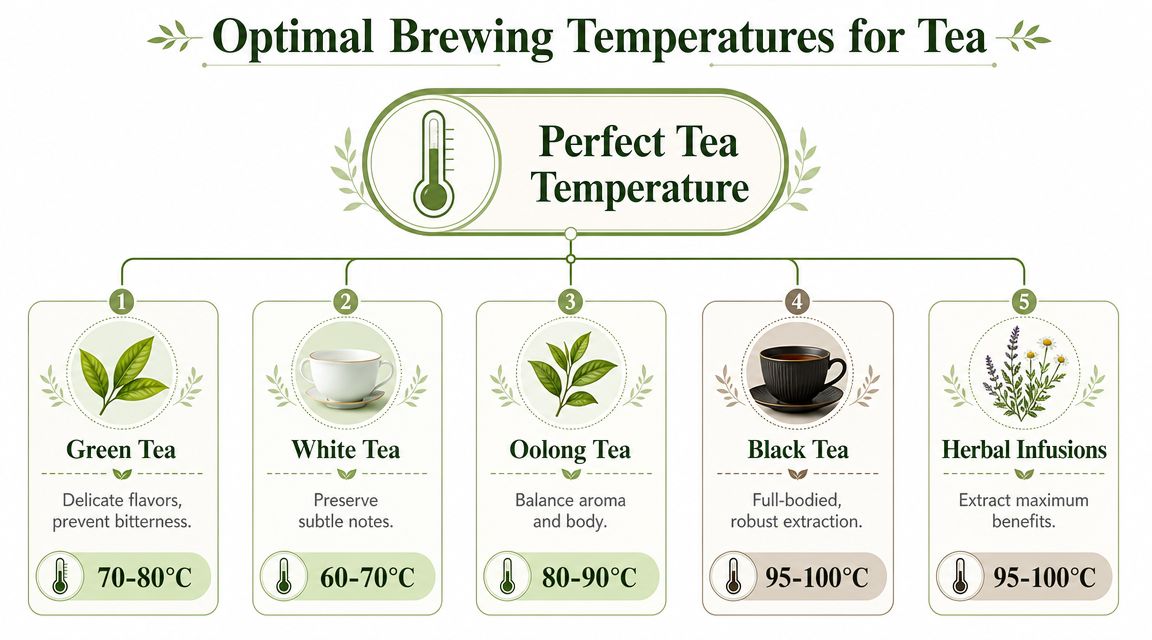
Ideal brewing temperatures for different teas
| Tea Type | Ideal Temperature (Celsius) |
|---|---|
| Green Tea | 70-80°C |
| White Tea | 60-70°C |
| Oolong Tea | 80-90°C |
| Black Tea | 95-100°C |
| Herbal Infusions | 95-100°C |
For tea lovers, a variable temperature kettle takes the guesswork out of this. Instead of waiting for boiled water to cool and hoping you've timed it right, you choose the temperature you want and brew with more confidence.
Why matcha lovers notice this first
Premium matcha rewards care. It's one of the clearest examples of why the kettle matters.
Water that sits around the gentler range often preserves a softer mouthfeel and lets the grassy, marine, sweet notes come through more clearly. When you overshoot the temperature, the bowl can taste stern rather than soothing.
That's why many tea drinkers move beyond basic on-off kettles and choose a model with finer control, such as an electric tea kettle with temperature control, especially if matcha is part of the daily routine.
Too much heat can make premium tea taste cheaper than it is.
Stability matters as much as the target temperature
There's another layer here. It isn't just about reaching the right heat once. It's about holding it steadily while you brew.
Coffee people talk about this often, and the lesson applies neatly to tea as well. This explanation of why temperature stability affects coffee is useful because it highlights a broader truth. Consistent heat supports consistent extraction. In tea, that means fewer surprise cups and more repeatable flavour.
If you serve guests, run a café, or want your morning matcha to taste the way it tasted yesterday, this consistency becomes part of the experience. It turns brewing from luck into method.
Choosing Your Kettle Material and Design
The kettle's body changes more than its look on the bench. Material influences taste, durability, weight, and how pleasant the kettle is to use every day.
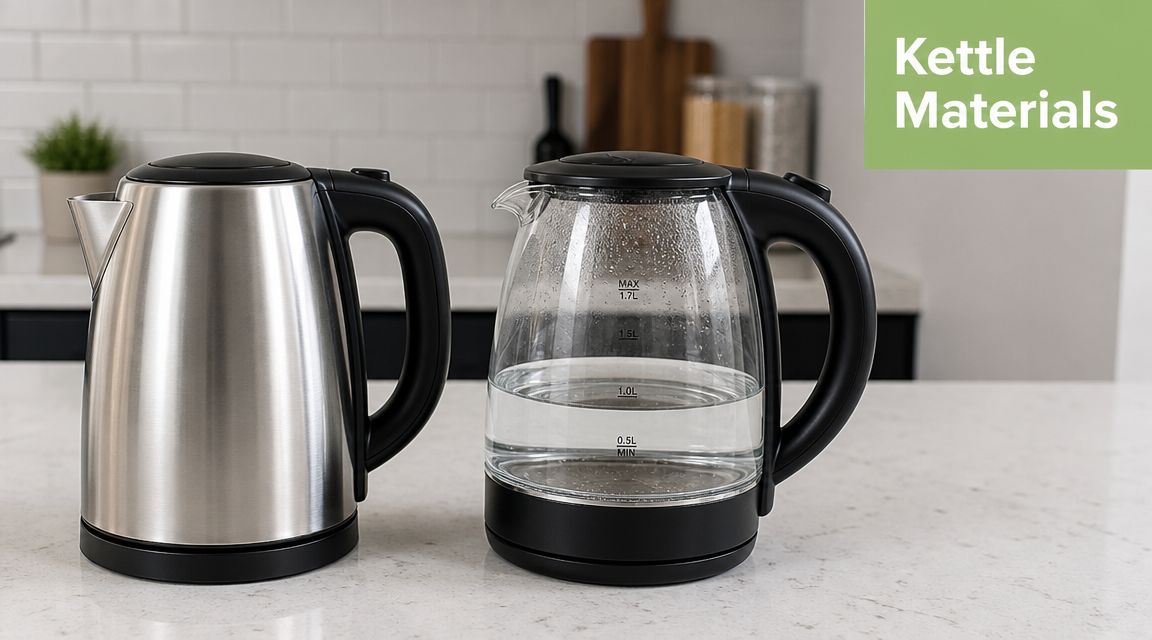
Stainless steel, glass, or plastic
Each material has trade-offs. The right choice depends on what you value most.
| Material | What it does well | What to watch for |
|---|---|---|
| Stainless steel | Durable, practical, often neutral for water taste | Exterior can feel more utilitarian than decorative |
| Glass | Lets you see the water, looks clean and refined | Can feel less forgiving in busy kitchens |
| Plastic | Lightweight and often budget-friendly | Some drinkers dislike the feel or worry about taste transfer |
For tea lovers, taste neutrality matters. If you're brewing delicate Japanese greens, white tea, or matcha water for whisking, you want the water to stay as clean and unobtrusive as possible. A kettle should help the tea speak, not add distractions.
What tea drinkers usually care about most
If your goal is pure flavour, focus on these questions:
- How does the water taste? Neutral water helps subtle tea notes come through.
- How easy is it to clean? A kettle that's awkward to clean can build up scale and affect flavour over time.
- How sturdy is it in daily use? Home kitchens, cafés, and office settings all create different kinds of wear.
- How does it feel to pour? Pour control matters more than many buyers expect.
A lot of buyers start by comparing appearance. Tea drinkers often end up caring more about pour behaviour.
Why spout design matters
A wide, fast pour is fine when you want hot water in a mug.
A gooseneck spout is different. It slows the flow and gives you control. That matters when you want to fill a small teapot gently, pour into a matcha bowl without splashing, or serve with more grace in front of guests. It also suits people who enjoy the ritual side of tea making, where the pour itself becomes part of the experience.
If you want to see that style in action, this Fellow Stagg EKG Electric Kettle guide is a useful example of how design and precision can work together for tea preparation.
A closer look at kettle form can help here:
Worth remembering: The best-looking kettle isn't always the best-brewing kettle.
Matching design to your routine
A tea drinker who prepares one careful matcha each morning may prefer elegance and precision.
A family kitchen may prioritise sturdiness and simple handling. A front-of-house café setup may need both visual appeal and repeatable performance. Good design isn't only about style. It's about fit. The right kettle feels natural in your hand and disappears into the ritual, which is exactly what a well-designed tea tool should do.
Understanding Australian Kettle Features and Standards
Australian buyers should pay attention to local power and everyday practicality, not just aesthetics. A kettle can look perfect online and still be annoying in a real kitchen if the features don't match local use.
What wattage means in Australia
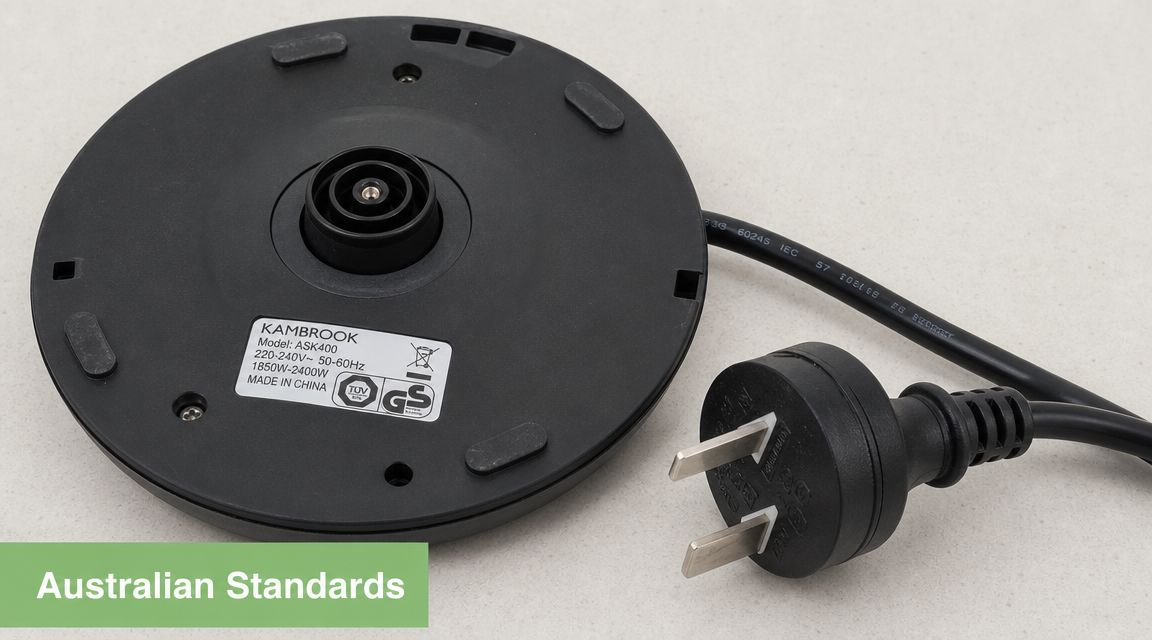
In Australia, a typical electric kettle is designed for 220-240V at 50Hz, with common power ratings around 1,850W to 2,400W, as shown in this Australian-market kettle example from Cuckoo Australia. In simple terms, that wattage range supports the quick boil many Australians expect during a busy morning.
Higher wattage usually means the kettle can heat water faster, but speed still depends on how much water you're heating and how the kettle is built. If you're only warming a small amount for one bowl of matcha, the experience may feel very different from filling a large household kettle to the top.
Safety features that matter in daily life
For most homes, two features matter immediately:
- Auto-shutoff keeps the kettle from continuing once the boil or selected cycle is complete.
- Boil-dry protection helps protect the unit if it's switched on without enough water.
These aren't flashy features, but they make the kettle easier to trust. In a home kitchen, that means less stress when the morning gets hectic. In hospitality, it helps staff move confidently between tasks.
Running costs are often less of a worry than people think
A lot of people hesitate over a powerful kettle because they assume it will be expensive to run.
According to CHOICE's kettle buying guide, boiling a full kettle a couple of times a day for a year costs about $32 at 40 cents per kWh, and CHOICE says most electric kettles are “not expensive to run”. The same guide notes kettle prices can range from around $15 for basic models to more than $200 for premium units, and measured boil noise can range from 47 dB to 65 dB.
That gives buyers useful perspective. A better kettle may cost more upfront, but running it day to day is still relatively modest.
A kettle's value often comes from flavour control and ease of use, not just boil speed.
Small details that improve the experience
When comparing kettles for the Australian market, look beyond the headline features and check the little things:
- Clear controls make temperature selection easier when you're half-awake.
- Comfortable handles matter if you pour often or serve guests.
- A stable base makes repeated use feel safer and smoother.
- Manageable noise can be a genuine quality-of-life feature in open-plan homes.
These are the details that separate a kettle you tolerate from one you enjoy using.
Finding the Right Electric Kettle for Your Needs
The right kettle depends on how you brew, who you're serving, and how much precision you want in daily life. One person wants a calm morning matcha ritual. Another wants fast, dependable hot water for a full household.
The matcha and tea purist
If tea quality is the main event, choose variable temperature control first and design second.
A gooseneck kettle usually suits this buyer well because the slower, more controlled pour feels deliberate. That's useful for matcha bowls, smaller teapots, and anyone who enjoys the ceremony of tea. If you're building a proper setup, a collection of matcha tea accessories can sit naturally alongside a precision kettle.
This is also the one place where a tea-focused retailer can make sense as part of your research. Pep Tea publishes tea and kettle resources for Australian users, which may help if you're trying to match brewing tools to premium matcha rather than buying a generic kitchen appliance blindly.
The busy Australian household
This buyer usually needs reliability more than ritual.
A practical household kettle should feel sturdy, easy to fill, simple to read, and safe to leave on the bench for everyone to use. Fast heating is helpful, but clear controls and easy handling often matter more over time. If several people use the kettle for different drinks, a temperature function can still be valuable even if only one person in the house is serious about tea.
Look for a model that doesn't make daily use feel fiddly.
The modern café owner
Cafés and hospitality venues need consistency. Staff need to move quickly, but the drinks still have to taste intentional.
For tea service, matcha lattes, and premium loose-leaf menus, control helps create a more repeatable result. Durability matters too. A kettle that feels elegant in a home may not hold up the same way under constant commercial rhythm. In front-of-house spaces, visual design also matters because guests notice the details.
Good hospitality often lives in the small tools guests rarely name but always feel.
The traveller, office worker, or small-space buyer
There's another category that doesn't get enough neutral guidance in Australia. Compact and portable kettles.
Search interest exists around smaller kettles and travel-friendly models, as noted in this discussion of small kettle Australia search demand and content gaps. The primary question isn't just whether a kettle is small. It's whether it makes sense for your use case.
A compact kettle can be practical for:
- Office use when you want your own tea setup
- Small apartments where bench space is limited
- Domestic travel when convenience matters
- Some overseas travel if voltage compatibility is appropriate
For many Australians, a travel kettle is a second kettle, not a main one. That distinction helps buyers avoid disappointment.
Keeping Your Kettle Clean and Limescale-Free
Even a brilliant kettle won't brew at its best if it's coated in scale.
Limescale is the chalky mineral build-up that forms inside kettles over time. In some parts of Australia, it appears faster than people expect. You may first notice it as cloudy marks, flakes, or a slightly dull taste in the water. For tea, that matters. Clean water is part of clean flavour.
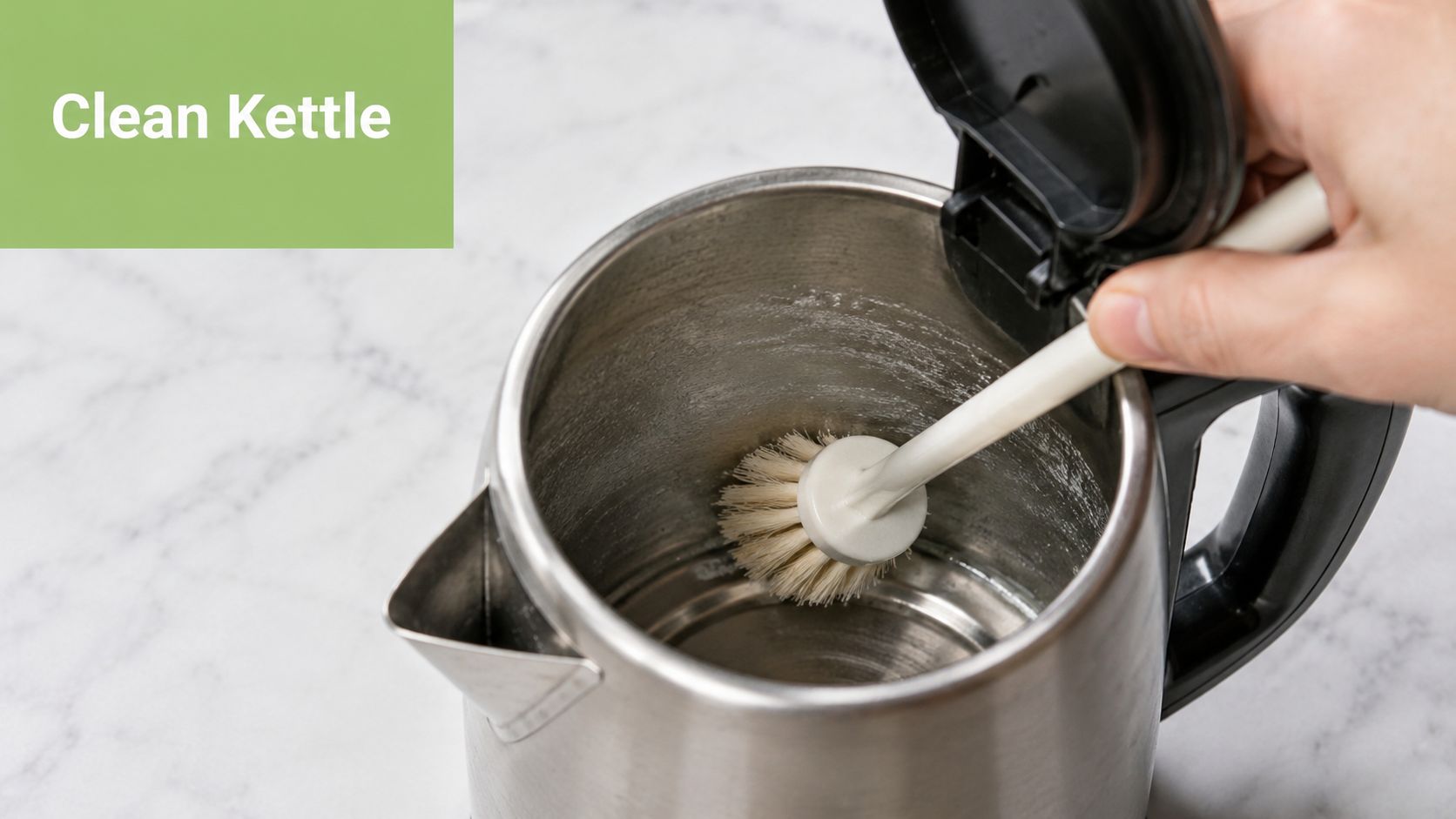
A simple natural cleaning routine
You don't need anything fancy. A gentle home method is often enough.
- Fill the kettle partway with a mix of water and white vinegar, or use lemon juice if you prefer.
- Let it sit long enough for the mineral build-up to loosen.
- Boil if your kettle instructions allow it, then leave it to settle briefly.
- Empty and rinse well so no cleaning taste remains.
- Boil fresh water once more and discard it before making tea.
Always check the manufacturer's care advice first, especially for premium finishes or specialised interiors.
Why this matters for flavour
Scale doesn't just look untidy. It can interfere with the clean taste you want from the water.
If you drink black tea with milk, you might notice this less. If you drink green tea, white tea, or matcha, stale or mineral-heavy water tends to show itself more clearly. The cleaner the kettle, the easier it is to taste the tea itself.
For a broader home-care walkthrough, this limescale removal guide offers practical context on removing build-up around the home.
Easy habits that help
A little regular care goes a long way:
- Empty standing water instead of leaving it in the kettle overnight.
- Rinse occasionally even when the kettle looks clean.
- Descale before build-up gets heavy because light maintenance is easier than deep cleaning.
- Wipe the outside and lid area so the whole kettle stays pleasant to use.
A clean kettle protects flavour and keeps the ritual feeling fresh.
Your Next Great Cup of Tea Awaits
The right kettle changes more than your bench setup. It changes what ends up in the cup.
For Australian tea drinkers, the best electric kettle Australia choice often comes down to one idea. Precision brings out quality. When you control temperature, choose suitable materials, and keep the kettle clean, you give your tea a fair chance to shine. That matters for a quiet bowl of matcha before work, a pot of green tea in the afternoon, or a polished tea service in a café.
A kettle can be fast and convenient. It can also be thoughtful.
That's the difference many people notice once they move from basic boiling to intentional brewing. You stop asking why your tea tastes inconsistent. You start enjoying the kind of flavour that made you buy good tea in the first place.
If you've invested in premium leaves or matcha, your water tool should respect that choice. Better brewing doesn't have to be complicated. It just has to be considered.
If you're refining your tea setup, Pep Tea is a useful place to explore organic matcha, brewing education, and tea tools that support a more precise daily ritual.