
Tag: organic matcha Australia
Organic Matcha Green Tea Powder Australia: A Full Guide 2026
Certified organic matcha sold in Australia is generally imported from Japan rather than grown locally at commercial scale. Australia's certified organic agricultural land increased by 48.9% between 2021 and 2022, while the country has more than 53 million hectares of certified organic farmland, about 12.4% of its agricultural land. IndexBox's Australian matcha market overview provides the market context, but those figures describe organic agriculture overall, not domestic matcha production.
You may be standing at a café counter with a new matcha latte on the menu, or comparing tins online after deciding that your usual green tea doesn't deliver the colour or flavour you want. The search for organic matcha green tea powder Australia often creates one immediate confusion: Australian availability doesn't mean Australian origin. The tea may be imported, while the business selling, testing, distributing and educating customers operates locally.
That distinction matters because matcha is a whole-leaf powder. Unlike a brewed infusion, the leaf isn't removed after steeping. Organic certification can help verify how the tea was grown and handled, but it doesn't automatically tell you whether the powder is fresh, potent, well processed or suitable for your recipe. The useful question isn't only whether a tin says “organic”. It's whether the product has a traceable origin, credible certification, suitable grade and testing that matches the risks you need to manage.
Finding Quality Organic Matcha in Australia
A café owner in Newcastle may need a vivid green latte that dissolves cleanly. A home baker in Melbourne may want a stronger powder that remains noticeable in oats, icing or banana bread. Searching for organic matcha green tea powder Australia brings up products with different origins, grades, certification records and handling practices.
For Australian buyers, the local part of the supply chain usually involves importing, distribution and hospitality, rather than cultivation. Matcha is generally imported from overseas tea-growing regions, particularly Japan, where shaded tea leaves are processed into tencha and stone-ground into powder. National organic farmland data can show that Australia has established certification systems and traceability practices, but it does not prove that a product is Australian-grown matcha. The Australian matcha market context helps clarify the difference between local availability and domestic production.

What Australian buyers should look for
A reliable product description gives you several points to check instead of relying on one premium-sounding claim.
- Country and region of origin: “Japan” identifies the country, while a named region gives more supply-chain detail.
- Certification identity: Check the certifier, certificate number and certification scope. Ask the importer for its ACO or JAS certificate number, then verify it through the certifier's public database before purchasing.
- Grade and intended use: Powder for whisking may not suit a café producing large volumes of lattes.
- Lot traceability: A lot number should connect the retail pack with supplier records and relevant testing.
- Storage information: Light, heat, air and moisture can affect matcha, so packaging and handling influence the final cup.
“Ceremonial grade” can indicate intended use, but it is not a universal government-controlled matcha grade. Assess colour, aroma, texture and flavour alongside the label. Fresh matcha should smell clean and vegetal, disperse finely and avoid a harsh, stale or dusty finish.
For an Australian supplier presenting its range and product details, compare the Pep Tea matcha tea powder collection with the documentation supplied by other sellers. The practical goal is a powder with an identifiable origin, verifiable certification, suitable handling information and a flavour profile you can explain to customers.
Ceremonial vs Culinary Matcha Grades Explained
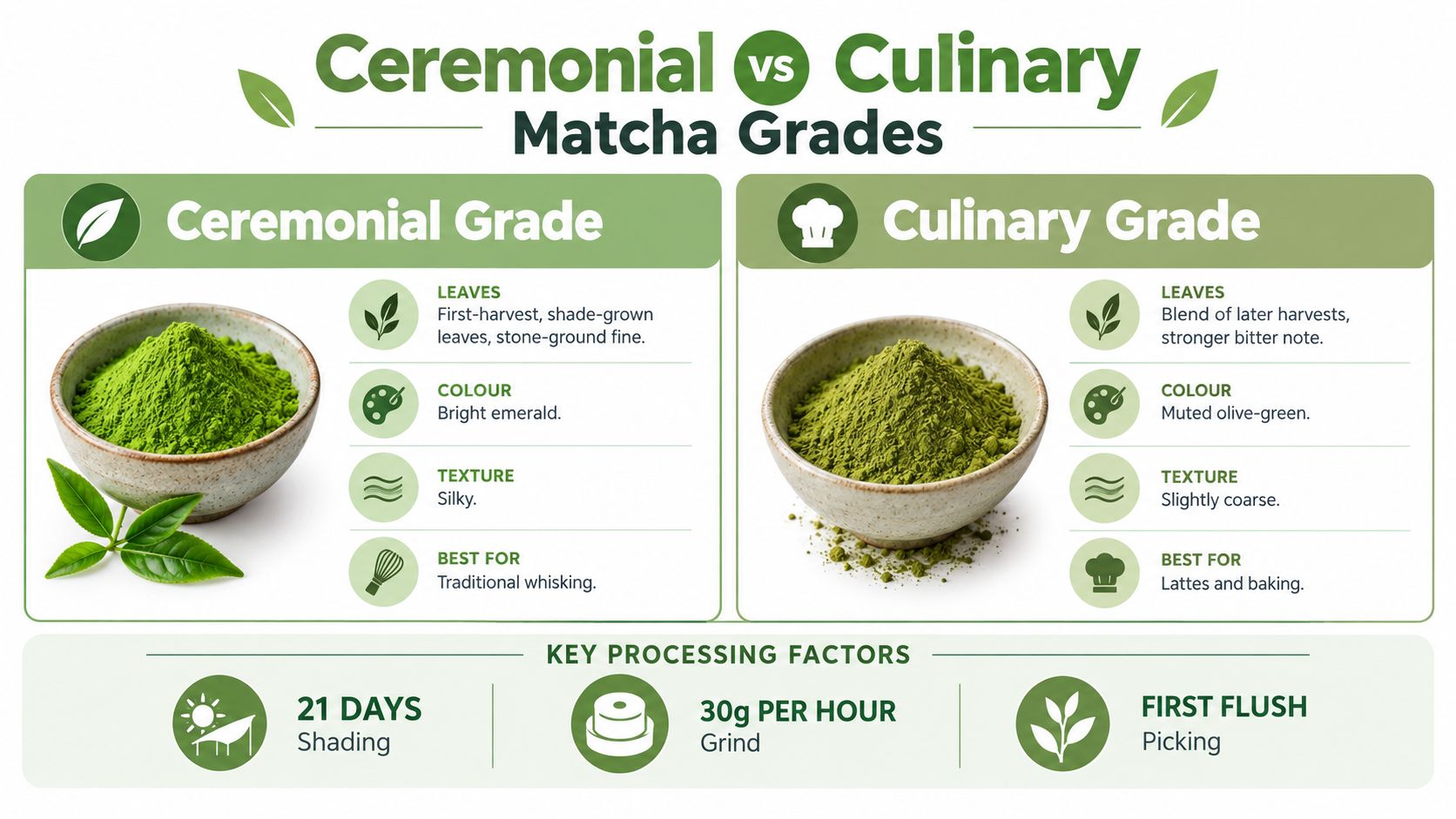
“Ceremonial” and “culinary” are practical buying terms, not a complete quality-control system. In Japan and internationally, “ceremonial grade” doesn't have one universal regulated definition, so a buyer should still examine origin, harvest information, processing, freshness and test documentation.
Ceremonial-style matcha is usually selected for drinking directly with water. It tends to be brighter in colour, finer in texture and more rounded in flavour, with an umami character that can stand on its own. Culinary matcha is usually chosen for recipes where the powder must remain noticeable beside milk, fruit, oats, flour or sweetener. It can have a more assertive bitterness and a less delicate finish, which may be an advantage rather than a defect.
How processing changes the cup
Tea plants used for matcha are shaded before harvest, then processed into tencha, with stems and veins removed before grinding. Shading can influence the leaf's colour and flavour, while cultivar, harvest timing and processing also affect the powder's chemical composition. The Western Sydney University review of matcha's bioactive compounds reports that matcha generally contains catechins, L-theanine and caffeine, but concentrations vary substantially between products.
Stone-grinding is associated with a fine powder and a smooth mouthfeel. However, the phrase “stone-ground” isn't enough to prove that a matcha will taste good. A powder may have been well processed and still be old, poorly stored or unsuitable for the drink you're making.
Try the following comparison:
| Matcha grade | Best for | Key characteristics |
|---|---|---|
| Ceremonial-style | Traditional whisking, thin tea and direct drinking | Brighter colour, fine texture, softer bitterness and a flavour designed to be enjoyed with water |
| Culinary-style | Lattes, smoothies, baking, desserts and sauces | More robust flavour, stronger bitterness and enough presence to work with other ingredients |
Choose by application, not status
A delicate ceremonial-style powder can taste excellent in a bowl but become wasteful in a strongly flavoured latte. Milk, ice and sweeteners can mute subtle notes, so a practical culinary powder may perform better while keeping the menu cost under control.
The reverse problem appears in direct drinking. A coarse or bitter culinary powder whisked with water can leave astringency on the tongue, especially if the water is too hot or the powder is poorly stored. That doesn't mean culinary matcha is inferior. It means the product has been selected for a different job.
Organic status addresses farming and handling standards, not whether a powder is ceremonial-style, culinary-style, mild, strong, fresh or compositionally consistent. For serious café purchasing, ask for the supplier's intended use, batch information and preparation recommendation. The Pep Tea guide to ceremonial and culinary matcha can sit alongside a sensory trial, where staff prepare both powders using the same recipe and taste them in the actual menu format.
One final caution concerns caffeine. Matcha is powdered tea, so the amount consumed depends on powder mass, cultivar, processing and preparation. A supplier shouldn't present a single caffeine number as universal for every tin or serve.
Understanding Organic Certification and Standards
A café can receive a bag labelled “organic” without knowing how that claim was verified. Organic claim and certified-organic status are different. Australian domestic organic sales do not always require mandatory certification, while a business using a certified-organic label must ensure the product meets the stated arrangement. The Australian Government describes AS 6000-2015, the Australian Standard for organic and biodynamic products, as covering production, processing, storage, transport, labelling and importation. The government's organic and biodynamic factsheet explains why checks need to extend through the supply chain, not stop at the farm.
Certification answers one set of questions
Certification verifies the production system, permitted inputs and relevant handling practices. It can support claims about how tea was grown, processed and represented, provided the finished imported product falls within the applicable certification arrangement. For an Australian buyer, the certifier, certificate holder, product scope and import documentation all matter.
See how certification is verified locally in the Pep Tea guide to organic certification in Australia.
Certified status does not establish that every powder has the same caffeine level, catechin profile, moisture content, colour or flavour. The Western Sydney University review found variable bioactive profiles in commercially marketed matcha from different countries. Organic certification is therefore a baseline for production claims, not a guarantee of potency or consistency.
For a café, use separate checks for separate decisions:
- Certification: Was the product produced and handled under the stated organic standard?
- Composition testing: What does this batch contain in terms of caffeine and selected compounds?
- Contaminant testing: Has this batch been assessed for hazards such as heavy metals, pesticides or microbes?
- Sensory evaluation: Does the powder meet the flavour, colour and texture required for the menu?
Certification verifies the production system; laboratory testing verifies what is in this specific lot. Sensory evaluation then shows whether the powder performs in the intended drink. A certificate cannot tell you whether a matcha is too bitter for a latte, while a taste test cannot establish organic status.
Read labels with appropriate caution
The word “natural” offers less verification than a named certification system. A credible pack should identify the product, importer or responsible business, origin and relevant certification information so those details can be checked against supplier records.
Matcha uses the whole leaf, so it is consumed as a powder rather than brewed and discarded. The Food Standards Australia New Zealand caffeine advice distinguishes naturally occurring caffeine in tea from concentrated caffeine products. Organic certification does not make matcha caffeine-free or establish a particular physiological effect.
Businesses should keep certification separate from health marketing. Matcha may contribute naturally occurring tea compounds to the diet, but claims about immunity, detoxification, metabolism or disease prevention require evidence and careful regulatory review. A clear description of origin, grade and preparation gives customers more useful information than benefits a supplier cannot substantiate.
How to Verify Quality and Sourcing
A responsible matcha purchase starts with paperwork, then moves to the powder itself. This approach works for a home buyer comparing tins and for a café owner assessing a wholesale supplier.
Ask for the documents that connect product to batch
Request the following information before committing to a large order:
- A current certificate of conformity. Check the certifier, certificate holder, product scope and validity.
- Country and region of origin. A named Japanese region is more informative than an unexplained “imported” claim.
- Lot number. Confirm that the lot on the pack matches the supplier's documentation.
- Testing date. Recent testing is more useful when it clearly identifies the tested lot.
- Laboratory scope. Find out whether the report covers heavy metals, pesticide residues, microbiological quality and other relevant parameters.
- Product specification. Ask for storage conditions, recommended serving mass, grade, packaging and expected shelf life.
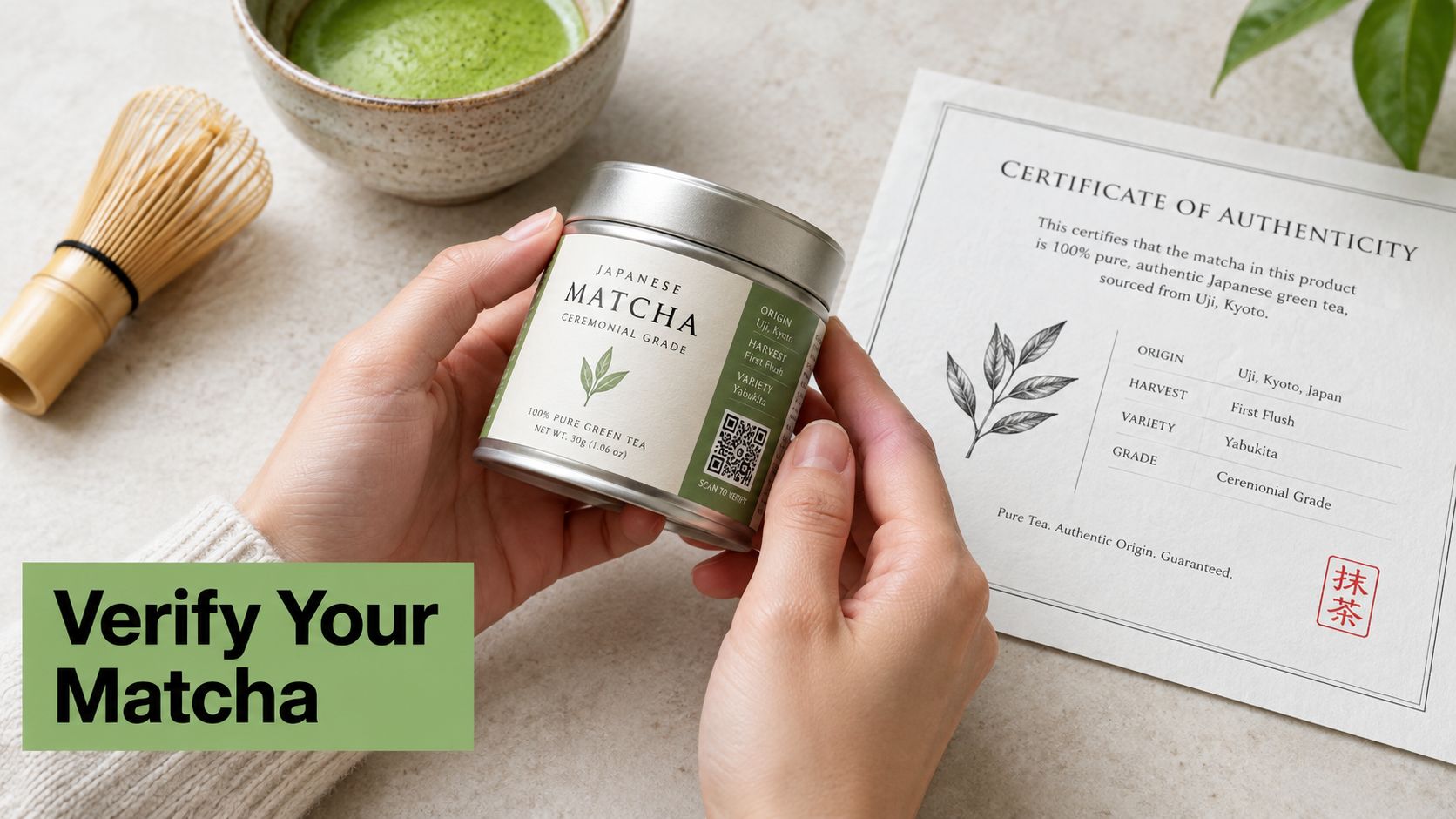
A certificate of conformity is valuable, but it shouldn't be treated as a complete safety report. Organic certification and laboratory testing answer different questions. The certification concerns the production system. Laboratory analysis tests selected hazards or compositional features in a particular sample.
Interpret testing without overclaiming
The available Australian regulatory material doesn't establish one simple matcha-specific consumer threshold for every concern a shopper may have, including lead, cadmium, pesticides and microbial hazards. That's why suppliers should be precise about what was tested, by which method, on what date and for which lot, rather than writing “fully tested” without detail.
For cafés and retailers, the Western Sydney University review recommends batch-level testing where possible, ideally using validated HPLC or UPLC methods for caffeine and major catechins such as EGCG, alongside checks for moisture, microbiological quality and heavy metals. The practical reason is straightforward: colour and sensory grade can't reliably predict functional composition.
Practical rule: Certification tells you how the product was produced. A laboratory report tells you what a particular test found. Keep both records.
Taste and storage remain part of verification
Open the pack and inspect the powder. A lively green colour, fresh aroma and fine texture are useful signs, while dull colour, stale odour, visible moisture or persistent clumping deserve questions. These observations don't replace laboratory testing, but they can reveal poor storage or age.
Keep the powder sealed, away from heat, light, air and moisture. A café should also record when a pack was opened and use a consistent recipe. If one barista uses a light spoonful and another uses a heavily packed scoop, customers won't receive a consistent drink, even if the underlying matcha is sound.
Australian Use Cases and Product Selection
Australian matcha works best when the grade matches the service format. A home user drinking a small bowl with water has different needs from a café building an iced latte, and a food manufacturer needs documentation that a casual buyer may never request.
Matcha preparation at home and in cafés
For direct drinking, sift the powder into a bowl, add warm water and whisk until the surface becomes lightly foamy. Water that's too hot can exaggerate bitterness, so use comfortably hot rather than boiling water. The right technique won't rescue stale matcha, but it can prevent avoidable clumping and harshness.
For a latte, dissolve the powder in a small amount of warm water first, then add milk or a plant-based alternative. Culinary-style matcha usually makes economic and sensory sense here because its stronger flavour can hold up against milk, ice and optional sweetener. Keep the drink unsweetened if the aim is to provide a low-sugar menu option, and let customers choose additions separately.
This video demonstrates a practical preparation approach for customers and café teams:
The same powder can be used in a smoothie with banana and oats, folded into yoghurt, blended into ice cream or added to baking. Heat and strong ingredients change the final flavour, so a powder that tastes slightly assertive on its own may be the better recipe ingredient.
| Matcha grade | Best for | Key characteristics |
|---|---|---|
| Ceremonial-style | Bowl preparation and simple iced matcha | Fine texture, vivid colour and a balanced flavour that remains exposed |
| Culinary-style | Café lattes, smoothies and baking | More pronounced tea flavour and better compatibility with milk or food |
Matcha alongside kombucha
Matcha and kombucha serve different roles. Matcha is a powdered tea ingredient that contributes tea flavour and naturally occurring caffeine. Kombucha is a fermented beverage requiring controlled acidity, clean equipment, reliable cultures and documented process monitoring.
FSANZ identifies kombucha as a beverage requiring careful control. The initial tea infusion is typically around pH 5, and it should be cooled from 60°C to 20°C within two hours. During fermentation, acidity should reduce the drink to pH 4.2 or below, while the finished beverage should generally remain at pH 2.5 or above and below 1% alcohol. These controls are set out in FSANZ's kombucha guidance.
That difference matters for cafés. A properly fermented sugar-free kombucha can provide an alcohol-free, low-sugar menu option, but “fermented” alone doesn't prove that the drink was made safely or contains no residual sugar. Read the nutrition information and ask how the producer manages acidity, alcohol and hygiene. Pep Tea offers organic Japanese matcha and Australian-brewed organic kombucha from the Hunter Valley, NSW, as separate beverage options rather than treating them as interchangeable products.
Australian beverage menus can also use matcha and kombucha in different dayparts. A matcha latte suits a morning or afternoon service, while chilled kombucha can work as a refreshing alternative to soft drinks or alcohol. For venues managing customer questions at scale, drink industry chatbot examples can help inspire ways to organise menu information, ingredient answers and service workflows without replacing staff knowledge.
Your Organic Matcha Shopping Checklist
Use this checklist before buying organic matcha green tea powder in Australia:
- Confirm the origin: Look for Japan and, where available, a named region.
- Verify the certification: Ask which certifier issued it and whether the finished imported powder is covered.
- Match grade to use: Choose ceremonial-style powder for direct whisking and culinary-style powder for lattes, smoothies and baking.
- Request batch details: Certificate, lot number, testing date and product specification should connect to the pack.
- Separate certification from testing: Organic status doesn't replace independent checks for heavy metals, pesticide residues or microbiological quality.
- Ask about caffeine: A serving's caffeine depends on powder mass, cultivar, processing and preparation. Healthdirect Australia's caffeine guidance gives healthy adults a general daily upper guideline of around 400 mg, but that isn't a target and doesn't suit every person.
- Inspect the powder: Fresh aroma, fine texture and lively colour support a better drinking experience.
- Check storage: Heat, light, air and moisture can reduce freshness after importation.
If you're presenting products online or building a café menu, strong photography should show the powder, colour, preparation and serving context accurately. A practical food product photography workflow from MerchLoom can help teams organise those visual assets without making unsupported claims about the product.
Pep Tea offers organic Japanese matcha in grades suited to direct drinking, café lattes and culinary use, alongside Australian-brewed organic kombucha from the Hunter Valley, NSW. Visit Pep Tea to compare the range, review product details and enquire about options for your home, café or wholesale menu.
Matcha Latte Calories and How to Reduce Them

A matcha latte isn't automatically a light drink. In Australia, the phrase can describe anything from a low-energy sachet prepared at home to a flavoured café drink with several hundred calories. The matcha powder matters, but milk, portion size, syrups and toppings usually shape the final energy load far more.
That's why a single online answer to “how many calories are in a matcha latte?” can be misleading. A standard iced drink, a pistachio version, a bubble tea serve and a supermarket sachet aren't nutritionally interchangeable. Learning to read the recipe behind the label is the practical way to manage matcha latte calories without giving up the creamy, earthy drink you enjoy.
The Truth About Matcha Latte Calories
Many Australians order matcha expecting a universally wholesome alternative to coffee or hot chocolate. Pure matcha has a reputation for being clean and functional, but a café latte is a prepared recipe, not just green tea in a cup. Once milk, sugar, flavour syrup, cream or toppings enter the picture, the energy content can change sharply.
Australian menus make that variation clear. McCafé lists a Matcha Latte at about 184 kcal, while Jamaica Blue lists its Medium Matcha Latte at 177 kcal. Starbucks Australia lists an Iced Matcha Green Tea Latte at 240 kcal for a Grande, whereas its flavoured iced products range from 318 kcal to 339 kcal, depending on the recipe and size. These examples are shown in this Australian matcha latte guide, and they make one point hard to miss: “matcha latte” isn't a reliable calorie description on its own.
The label hides the recipe
A café menu may tell you the drink name and size without clearly showing the milk, sweetener concentration or topping formula. Two drinks with the same name can therefore have very different kilojoule and calorie counts.
Starbucks Australia's Pistachio Flavoured Matcha Latte rises from 318 kcal in a Small to 626 kcal in a Venti, while the listed serving sizes also increase from 273 mL to 591 mL. That's a difference of more than 300 kcal, driven by the combined effect of a larger serve and flavouring. The Starbucks Australia product listing provides the serving details.
Practical rule: Treat the flavour name and cup size as nutrition information, not decoration.
A matcha latte can still fit comfortably into a balanced routine. The useful question isn't whether matcha is “good” or “bad”. Ask instead: what's in this particular drink, and how often am I choosing it?
Breaking Down the Ingredients and Energy Load
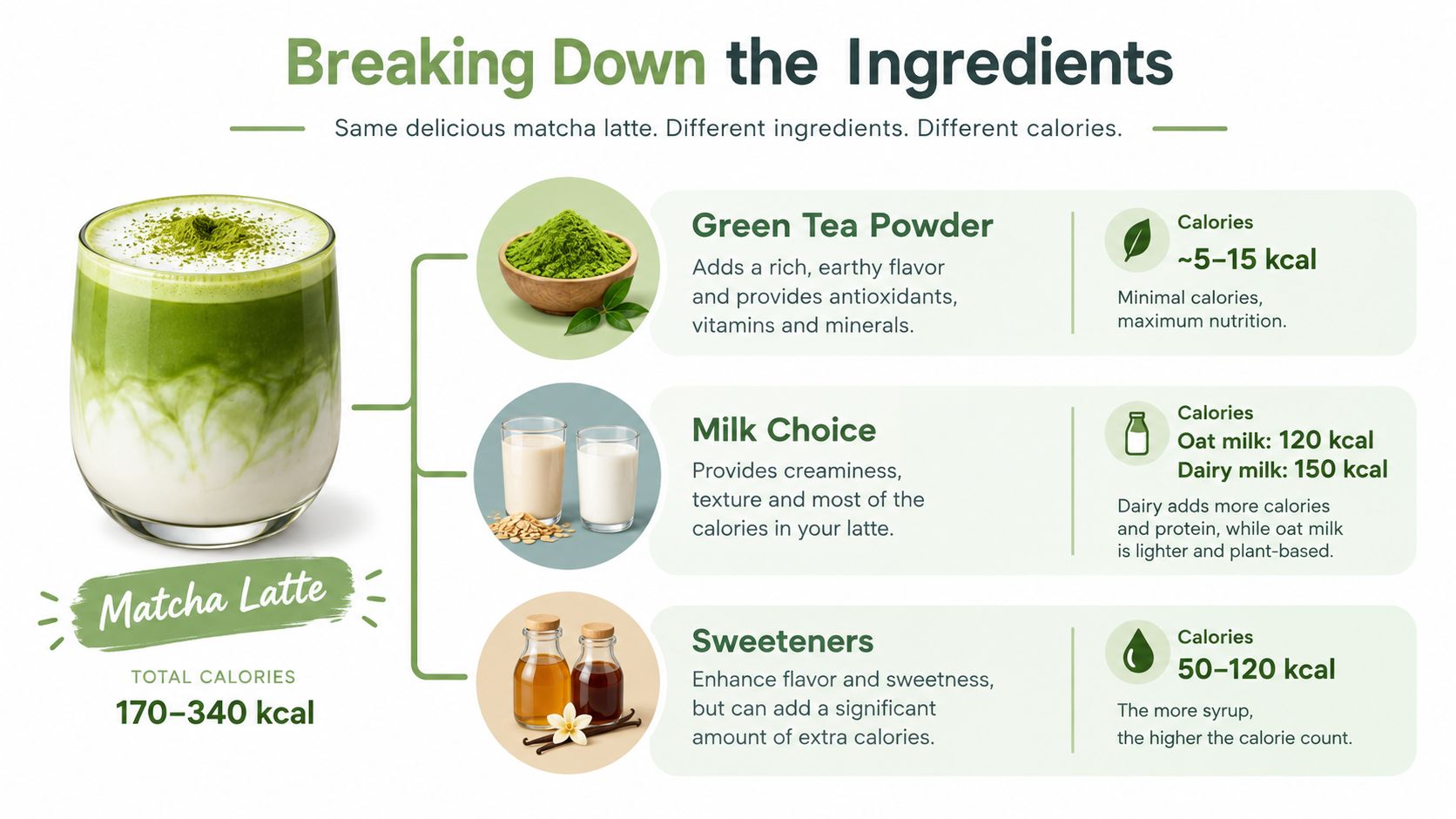
A matcha latte has three main energy contributors: the powder, the liquid base and anything added for sweetness or flavour. Pure matcha is usually the smallest contributor. The larger differences come from the volume and type of milk, plus sugar-containing powders, syrups and toppings.
Matcha powder is rarely the main issue
Matcha is finely ground green tea leaf, so it contributes flavour, colour and naturally occurring compounds such as catechins and L-theanine. In a latte, however, the powder itself generally accounts for far less energy than a generous serving of milk or sweetened flavour base. Increasing the powder dose may make the drink stronger and more bitter, but it isn't usually the most effective way to reduce matcha latte calories.
The liquid base has a much bigger practical effect. A neutral Australian calories guide gives an at-home range of about 52 kcal with almond milk to 154 kcal with whole dairy, showing how milk choice can outweigh the matcha itself. Those figures are discussed in the Australian matcha latte nutrition overview.
Milk and sweeteners set the total
Milk contributes energy through its natural or added carbohydrate, fat and protein. Plant-based options also vary, particularly when they're sweetened or formulated for café steaming. The word “oat” or “almond” doesn't automatically mean low-energy, so check the product or café nutrition information where it's available.
Sweeteners create another layer of variation:
- Plain powder: Gives you control over the final drink, especially when mixed with unsweetened milk.
- Pre-mixed powder: May include sugar and milk solids before you add any extra sweetener.
- Flavoured syrup: Can turn a simple tea latte into a dessert-style drink.
- Toppings: Creamy foams, sauces and confectionery-style additions add energy without making the cup feel much larger.
Woolworths lists Twinings Matcha Latte Sachets at 251 kJ per serving, about 60 kcal, with 12.2 g of carbohydrate and 10.4 g of sugars, while Morning Made Matcha Latte Original is listed at 80 kJ per serving, about 19 kcal, with 0.2 g of sugars. The contrast appears in the Morning Made product information. It's a formulation comparison, not a judgement about every sachet.
For a home recipe, you can enter the exact milk and sweetener quantities into a recipe calorie calculator. That's more useful than relying on a generic matcha latte estimate when your ingredients differ from a café recipe.
One more detail deserves attention: caffeine isn't the same thing as calories. Matcha can contribute caffeine even when the drink is prepared with little energy. For a clearer explanation of what affects caffeine in the cup, see how caffeine works in a matcha latte.
Comparing Popular Australian Cafes and Retail Brands
Real menus show why matcha latte calories need an Australian context. The figures below come from café and retail listings, but they shouldn't be treated as a universal ranking. Recipes, sizes and preparation methods differ, and a product can change over time.
| Brand / Product | Size / Serve | Calories (kcal) |
|---|---|---|
| McCafé Matcha Latte | One serving | 184 |
| Jamaica Blue Matcha Latte | Medium | 177 |
| Chatime Matcha Latte | Regular | 192 |
| Chatime Matcha Latte | Large | 246 |
| Starbucks Iced Matcha Green Tea Latte | Tall, 354 mL | 184 |
| Starbucks Iced Matcha Green Tea Latte | Grande, 473 mL | 240 |
| Starbucks Pistachio Flavoured Matcha Latte | Small, 273 mL | 318 |
| Starbucks Pistachio Flavoured Matcha Latte | Tall | 390 |
| Starbucks Pistachio Flavoured Matcha Latte | Grande | 519 |
| Starbucks Pistachio Flavoured Matcha Latte | Venti, 591 mL | 626 |
| Twinings Matcha Latte Sachets | One serving | About 60 |
| Morning Made Matcha Latte Original | One listed serving | About 19 |
The Jamaica Blue figures come from its Australian iced matcha menu information. Chatime's Regular and Large values, including the 54 kcal difference between sizes, are listed by Macro Menu Australia. Starbucks' standard iced figures and flavoured examples come from the linked Australian product listings cited above.
What the comparison tells you
The café examples cluster differently from the low-energy retail products because they're prepared as milk-based drinks, often with a larger liquid volume. The flavoured Starbucks range shows how quickly a sweetened recipe can move into dessert territory. A standard iced matcha and a pistachio matcha may share a green colour, but they don't share the same nutritional profile.
Retail sachets require label reading too. Twinings' sachet contains substantially more energy and sugar than Morning Made's listed serving, despite both being sold as matcha latte products. A pre-mixed base can be convenient, but convenience doesn't tell you how much sugar or milk powder is included.
The useful comparison isn't brand versus brand. It's unsweetened versus sweetened, smaller versus larger, and plain versus flavoured.
When ordering, ask whether the powder is sweetened, which milk is used and whether the syrup is optional. That short conversation can reveal more than the drink name.
How to Order and Brew Lighter Matcha Lattes
You don't need to drink matcha plain to lower the energy content. The strongest approach is to control the ingredients that contribute most, while keeping enough milk to create the texture you like.
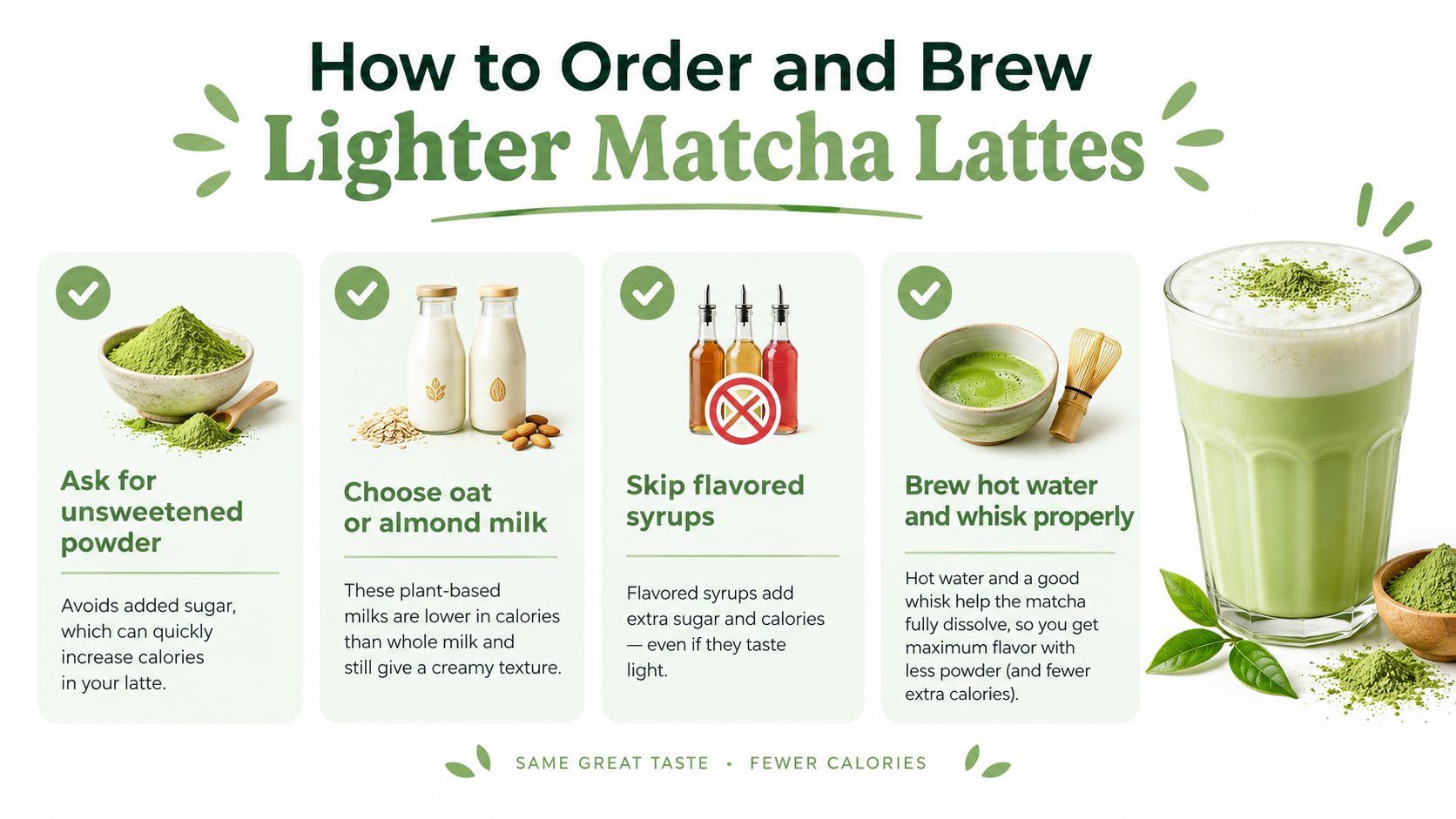
Ordering at a café
Use a specific order rather than asking vaguely for a “healthy” matcha. Café staff may interpret that request in different ways.
- Ask for unsweetened powder. Some café bases are already sweetened, so removing an added syrup won't necessarily remove all the sugar.
- Choose your milk deliberately. Unsweetened almond milk can be a lower-energy option, while oat and dairy recipes vary by brand and pour size. If the café publishes nutrition information, use that rather than guessing.
- Skip flavoured syrups and dessert toppings. Pistachio, white chocolate, cream foam and sauce are the additions most likely to change a simple latte into a richer treat.
- Choose a smaller size if you want the same style of drink less often. The Chatime comparison demonstrates that serving volume alone can create a measurable difference.
- Ask for the recipe if you're tracking closely. “Is the matcha sweetened, and what milk do you use?” is more useful than relying on the menu title.
Making one at home
Home preparation gives you control without removing the ritual. Whisk the powder with a small amount of hot water first, then add chilled or warmed unsweetened milk. Proper whisking disperses the tea and helps the drink taste smoother, which can reduce the temptation to cover bitterness with sugar.
A simple method looks like this:
- Sift the matcha if it's lumpy. This creates a more even texture.
- Add hot, not boiling, water. Very high heat can make the flavour seem harsher.
- Whisk briskly until smooth. A bamboo whisk or handheld frother works well.
- Pour in unsweetened milk. Adjust the amount for a stronger tea flavour or creamier finish.
- Taste before sweetening. If you need sweetness, add a small amount deliberately rather than using a pre-sweetened base by default.
Start with the powder and milk you actually want, then add sweetness only if the finished drink needs it.
This method also makes it easier to compare your home recipe with a café drink. You'll know whether the difference comes from milk, sweetener or serving size instead of blaming the matcha.
Clean Energy and Sustained Focus Without the Crash
A lower-calorie drink can be useful, but the quality of the whole beverage matters too. Pure, unsweetened matcha supplies the tea leaf itself, while a heavily flavoured latte can deliver much more sugar and energy without necessarily providing a better tea experience.

Matcha contains naturally occurring catechins, including antioxidant compounds, and L-theanine. L-theanine is an amino acid found in tea that many people associate with a calmer, more settled experience alongside caffeine. That doesn't make matcha a medical treatment or guarantee a particular feeling, but it helps explain why some drinkers prefer it for focused work.
The caffeine amount depends on the quantity of powder used and the recipe. It also deserves attention if you're sensitive to caffeine or already drink coffee during the day. A lower-calorie latte isn't automatically suitable at every time of day, especially if it affects your sleep or makes you feel uncomfortable.
Sweetness changes the experience
A strongly sweetened drink can taste immediately rewarding, but it can also make the earthy character of quality matcha difficult to notice. When you reduce syrup gradually, your palate has more opportunity to recognise vegetal, creamy and lightly umami notes.
That matters for cafés and home drinkers alike. A café menu can offer a satisfying non-alcoholic option without relying on heavy flavouring, while a home routine can use organic Japanese matcha, unsweetened milk and careful whisking. The result is a drink built around tea rather than a sweet dessert base.
Choose the version that supports your day, not just the version with the most appealing name. Clean energy starts with a clear ingredient list and a serving you can enjoy consistently.
Building a Mindful Matcha Routine at Home
A home matcha habit makes the recipe visible. You choose the powder, measure the milk, decide whether sweetness is needed and can prepare a smaller or larger drink according to the occasion. That control is often more valuable than searching for one universal matcha latte calorie number.
For a weekday cup, use authentic stone-ground Japanese matcha with a naturally vibrant colour and balanced flavour. A ceremonial-grade matcha is suited to whisking with water or milk, while a culinary-grade matcha is practical for smoothies, baking and other recipes where stronger flavours are already present. Neither grade removes the need to check the rest of the recipe.
Keep the routine simple:
- Whisk matcha with hot water.
- Add unsweetened milk.
- Taste before adding sweetener.
- Reserve flavoured versions for an occasional treat.
- Notice how the drink fits into your overall day.
Australia's café and retail market shows that milk, added sugar and portion size drive matcha latte calories far more than the green tea label suggests. Once you understand that, you can enjoy matcha with less guesswork and make choices that suit your preferences.
Pep Tea offers premium organic Japanese matcha for mindful home preparation, along with Australian-brewed sugar-free organic kombucha from the Hunter Valley, NSW. Explore the range at Pep Tea and choose a clean, low-sugar option for your next daily drink.
How to Use Matcha Powder in Smoothies for Creamy Energy

You've blended a bright green smoothie, taken the first sip, and found a stubborn pocket of bitter matcha at the bottom. Or perhaps you've added honey, flavoured milk and extra fruit to hide the bitterness, only to end up with something closer to a dessert than a clean morning drink. Learning how to use matcha powder in smoothies is mostly about three decisions: choosing a suitable grade, hydrating the powder before blending, and matching the serving to your taste and caffeine preferences.
The good news is that matcha works beautifully with banana, berries, yoghurt, milk and dairy-free bases. With the right method, you'll get a creamy drink with vibrant colour, gentle tea character and no powdery clumps.
Why Matcha Works So Well in Smoothies
The first time many people use matcha in a smoothie, they expect it to behave like a mild green tea. It doesn't. Because you consume the finely ground tea leaf rather than an infusion, matcha brings a more concentrated flavour, a green colour and naturally occurring tea compounds to the glass. Fruit and creamy ingredients soften its earthy edge, making a smoothie a more approachable format than drinking the powder with water alone.
A practical Australian benchmark is a 4 g matcha serving, labelled by one Australian product at 48 kJ, or 11 kcal, 1.1 g protein, 0.2 g fat, 1.5 g carbohydrates and 0.4 g dietary fibre per serve. The Australian smoothie recipe and product data show why this amount can work as a functional add-in without substantially changing the smoothie's overall calorie load.
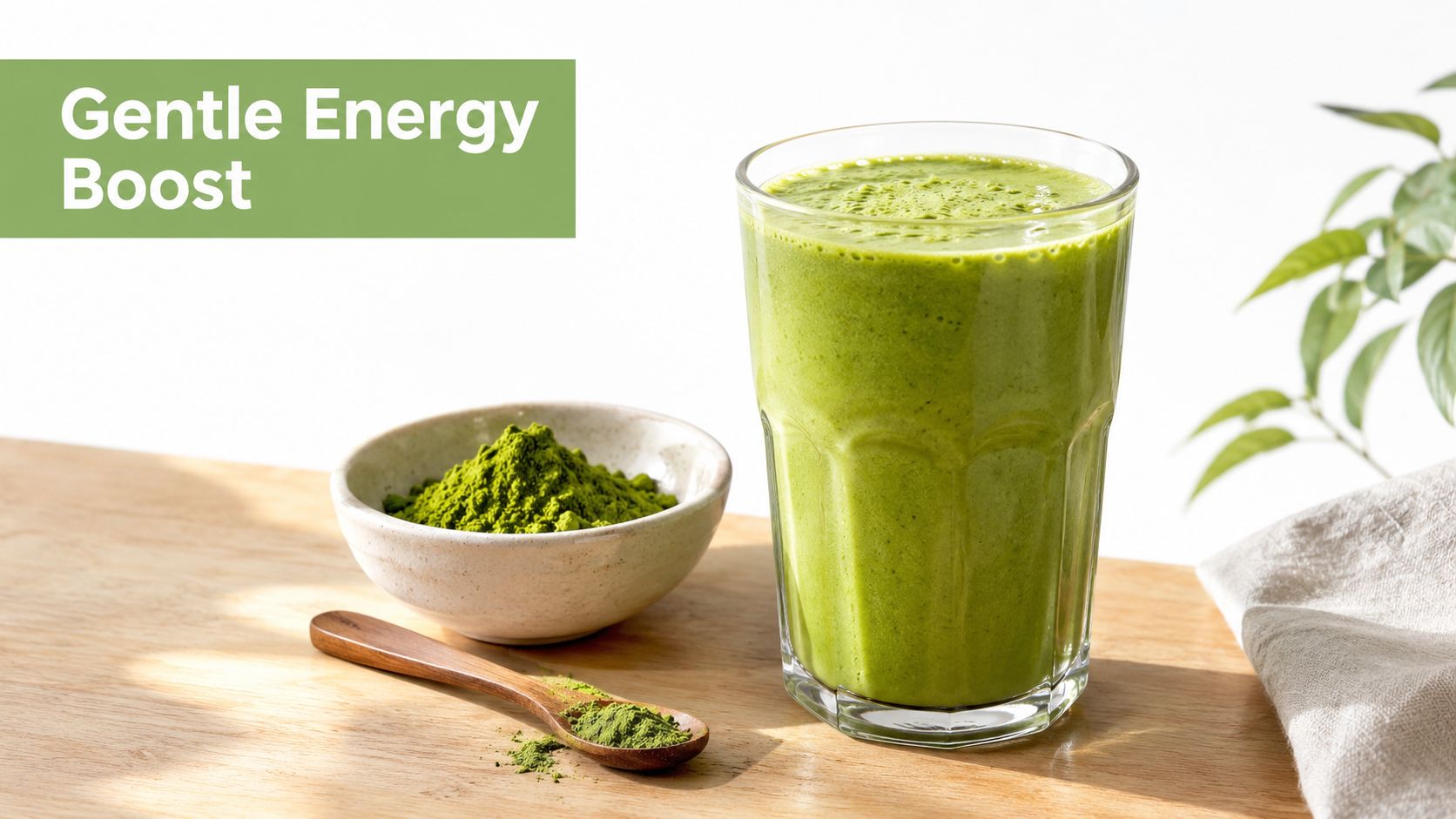
What matcha contributes to the glass
Matcha contains caffeine alongside L-theanine, an amino acid naturally found in tea. That combination is why many people describe matcha as a smoother, calmer alternative to a strongly coffee-led morning routine, although individual responses vary. You can learn more about the role of matcha, green tea and L-theanine if you want to understand the tea beyond its colour.
Australian lab testing reported 21.3 mg/g theanine, 33.3 mg/g caffeine and 65,200 µg/g total catechins in one matcha sample. If a product matched those assay values, a 4 g smoothie serve could contribute roughly 85 mg theanine, 133 mg caffeine and 261 mg total catechins. Those figures describe that tested sample, not every matcha powder, so treat them as a guide rather than a guarantee. The Australian matcha laboratory results provide the full context.
Why the smoothie format helps
Banana contributes body and natural sweetness. Yoghurt adds tang and creaminess, while oat, soy, almond or dairy milk can soften the tea's grassy notes. Frozen fruit and ice also help create a thicker texture, so the drink feels rounded rather than watery.
Matcha can taste fresh, vegetal and slightly bitter. That isn't a fault, but the flavour needs a partner. A ripe banana, creamy base and a little acidity from berries or citrus can make the tea taste balanced without relying on a large amount of added sugar.
Choosing the Right Matcha and How Much to Use
The word “matcha” covers powders intended for different uses. Ceremonial-grade matcha is generally selected for drinking on its own, where its colour, aroma and delicate flavour are fully exposed. Culinary-grade matcha has a bolder profile that can stand up to fruit, milk, yoghurt and other ingredients, which makes it a practical choice for smoothies.
That doesn't mean culinary matcha is automatically poor quality, or that ceremonial matcha is the only suitable option. If you enjoy a refined, gentle tea flavour, ceremonial grade can be lovely in a simple smoothie. If you're blending banana, berries, greens or protein ingredients, a culinary grade may offer better flavour definition and sensible value. Pep Tea also explains the distinction in its guide to different grades of matcha.
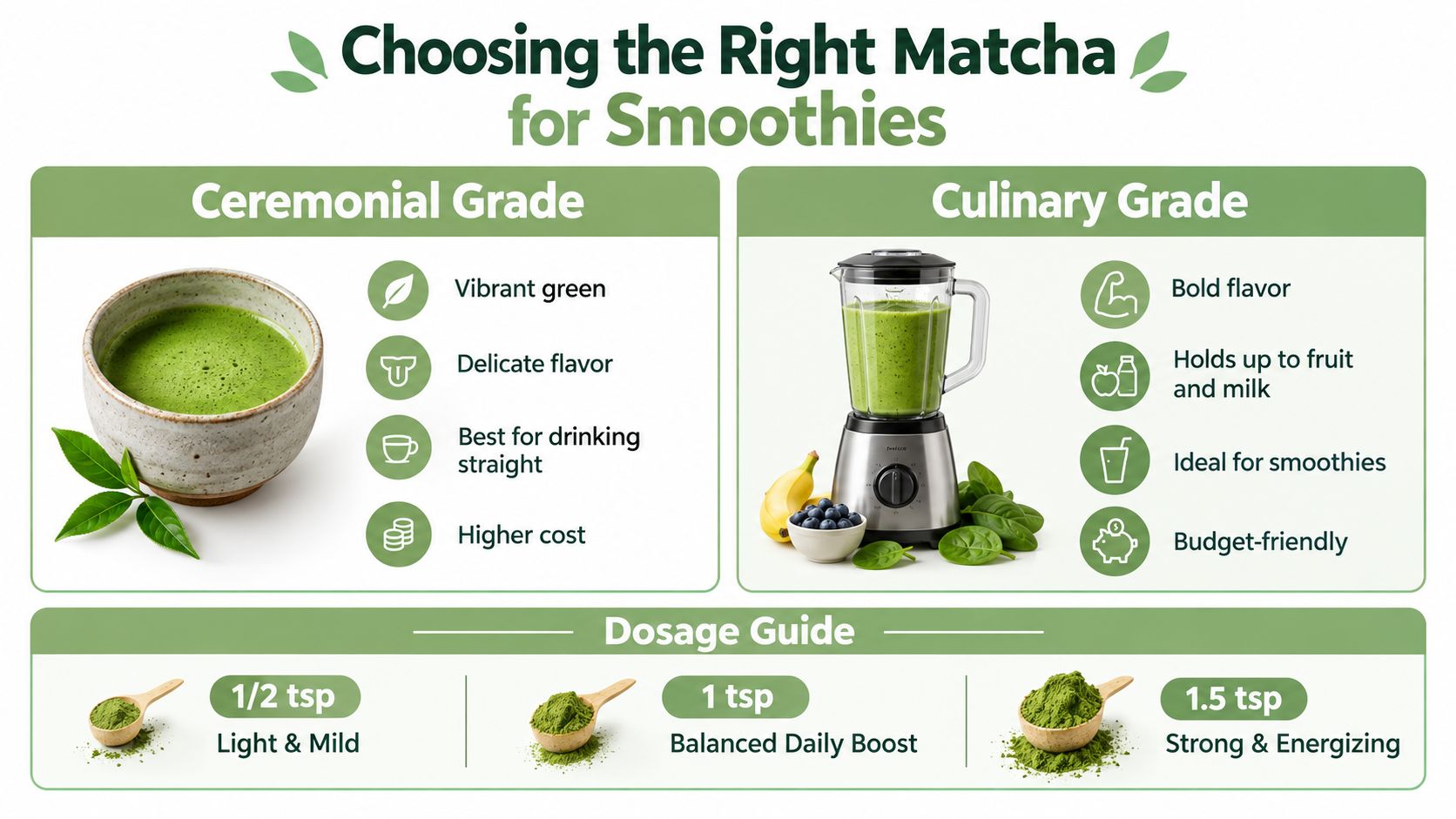
Start with the amount that suits the drink
For a single smoothie, use the texture and flavour of the rest of the recipe as your guide:
- A light, mild serve: Start with 1–2 g, especially if you're new to matcha or using delicate fruit. This gives the smoothie a subtle tea note.
- A balanced daily serve: A practical starting point is around 2 g, which is often enough to make the matcha noticeable without dominating banana, berries or yoghurt.
- A stronger serve: Move towards 4 g when the smoothie contains bold flavours, a larger liquid base or ingredients that can handle more bitterness.
Australian preparation guidance commonly recommends 1–2 g for a serve, while Australian consumer reporting places a typical matcha serve around 60–75 mg of caffeine. ABC News' Australian comparison of matcha and coffee also describes standard matcha as roughly 60–70 mg per 2 g serving, or around 35–70 mg per teaspoon, depending on the product and measure.
Match the dose to the ingredients
A banana smoothie can carry more matcha than a lightly flavoured berry blend because banana's sweetness and thickness soften the tea. A yoghurt smoothie has its own tang, so use enough matcha to remain visible without allowing bitterness to take over. Unsweetened plant milks are usually gentler than flavoured versions, which may already contribute sweetness.
Measuring by teaspoon isn't perfectly consistent because powders settle differently. A level teaspoon is a useful kitchen starting point, but a small digital scale gives you more control when you're adjusting caffeine or creating a café recipe. If you're sensitive to caffeine, begin at the lower end and avoid increasing the amount to make the colour brighter.
For readers comparing plain matcha with blended functional products, it can also help to compare matcha mushroom supplements before choosing an ingredient. Check the full label, including the matcha amount, added ingredients and caffeine information, rather than assuming every green powder will behave the same way.
How to Blend Matcha Smoothly Without Clumps
A blender can break down fruit and ice, but it doesn't always disperse dry matcha evenly. Powder dropped straight onto a cold smoothie base may float, stick to the jug or gather into bitter green pockets. The café solution is simple: sift and pre-hydrate the matcha before it meets the rest of the ingredients.
Prepare the matcha first
- Sift the powder. Pass the matcha through a fine tea sifter or small kitchen sieve. This breaks up compacted particles before liquid is added. Pep Tea's matcha tea sifter is designed for this type of preparation.
- Add a small amount of liquid. Use warm water or milk, rather than tipping the dry powder into a full blender jug.
- Whisk until smooth. Work the liquid into the powder until you have a thin paste or smooth suspension with no visible dry patches.
- Add the mixture to the blender. Once hydrated, the matcha disperses much more evenly through the fruit, liquid and ice.
An Australian preparation guide recommends sifting 1–2 g of matcha, combining it with 30–80 mL of water at about 70–80°C, and whisking until smooth and frothy. Health Emporium's matcha preparation guidance provides that temperature and liquid range. Water that's too hot can make the tea taste harsher, so don't use freshly boiling water.
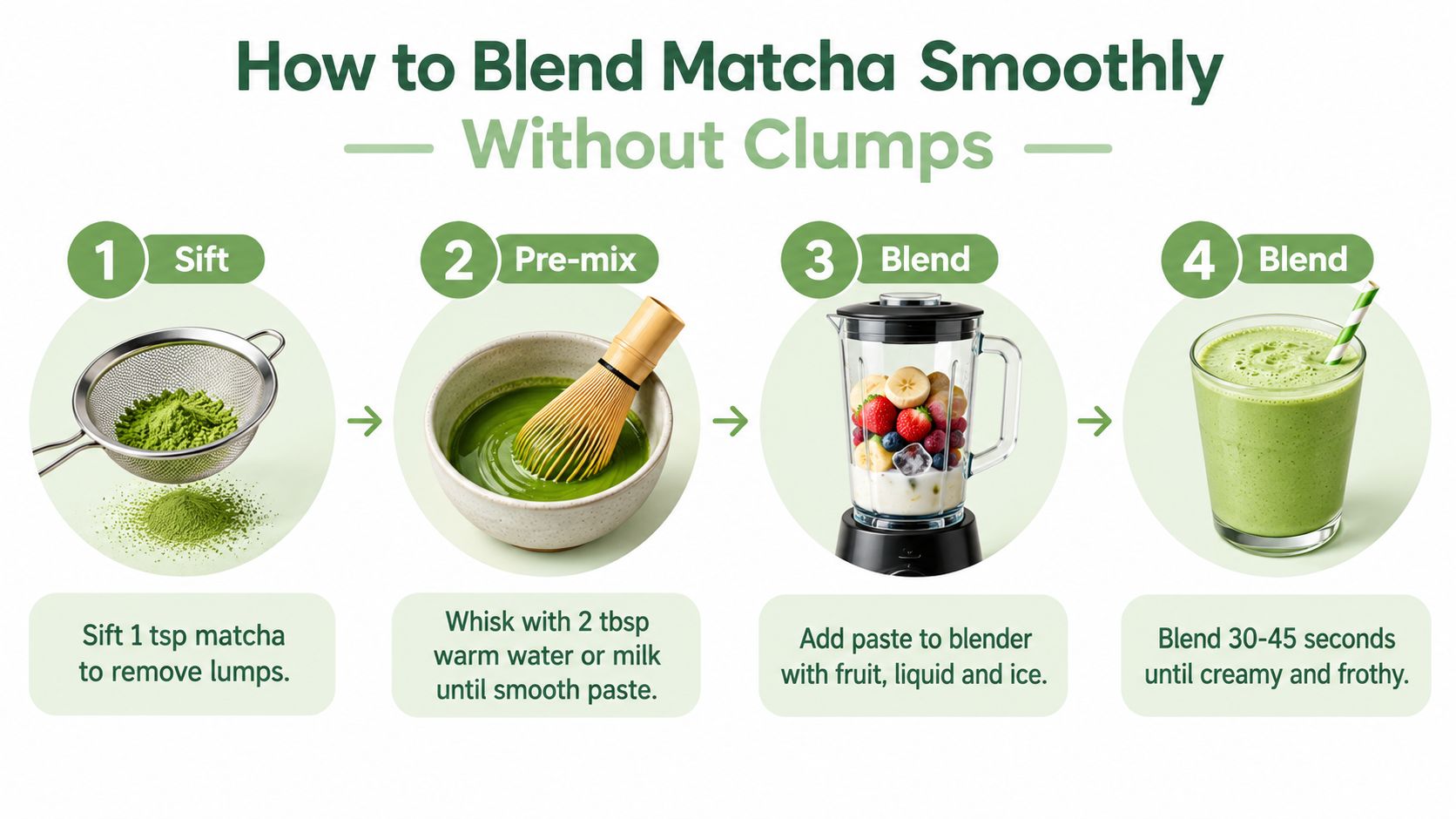
Load the blender in a sensible order
Put liquid into the blender first, followed by yoghurt or soft ingredients, fruit, hydrated matcha and ice. This gives the blades room to move and helps prevent thick ingredients from forming a dry cap around the blade assembly.
Start at a lower speed if your blender allows it, then increase until the mixture circulates. Stop to scrape the sides if the fruit is frozen or the smoothie is particularly thick. Add a little more liquid only when needed, because too much can turn a creamy smoothie thin.
The supplied café guidance also recommends keeping prepared matcha batches refrigerated or in an ice bath, away from sunlight, and using them within the day. Australian café matcha storage advice notes that oxidation can dull the colour and taste, so blending close to serving time is the better habit.
Practical rule: Dry matcha belongs in the sifter, not directly on top of a cold smoothie. A short pre-whisk gives the powder somewhere to disperse before the blender does the heavy work.
For a visual demonstration of the preparation sequence, watch this short matcha blending guide:
Four Easy Matcha Smoothie Variations to Try
Once the powder is hydrated, the recipe can stay remarkably simple. The best combination depends on whether you want a bright fruit flavour, a substantial breakfast, a creamy post-workout drink or a lighter iced blend.
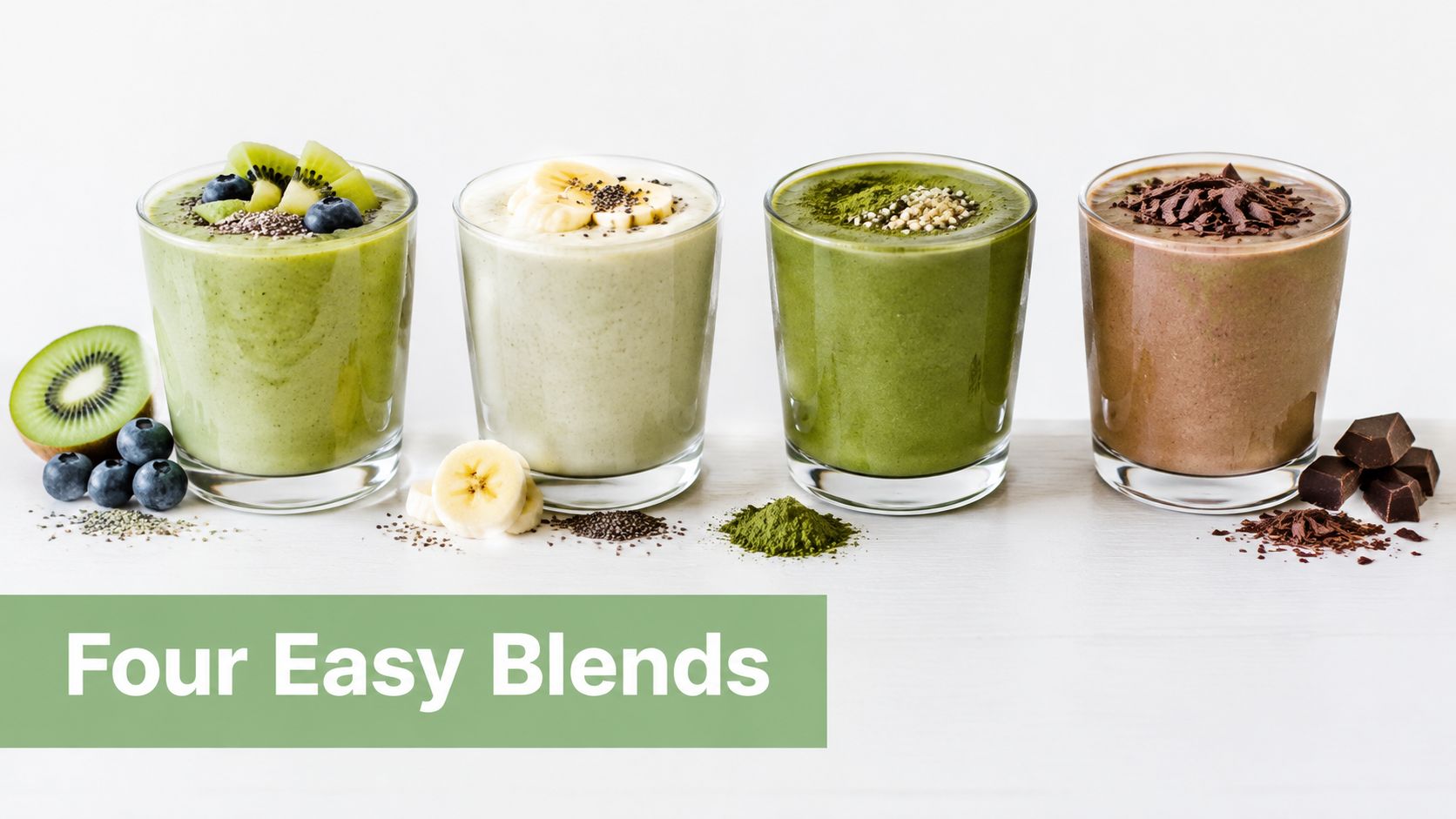
1. Bright banana and berry matcha
Use:
- Fruit: Frozen banana and a handful of berries
- Liquid: Unsweetened almond milk or dairy milk
- Matcha: Your preferred light or balanced serve, sifted and pre-whisked
- Optional finish: A squeeze of lemon if the berries are very sweet
Banana brings body and sweetness, while berries add acidity that cuts through matcha's earthy character. This is a good starting point if you want the tea to remain present but not dominate.
For a café menu, list the fruit, milk choice and matcha grade clearly. A digital menu tool such as TopFoodApp's menu maker can help a venue present those options neatly, particularly when customers want dairy-free or lower-sugar substitutions.
2. Creamy protein-style breakfast blend
Try:
- Base: Unsweetened soy milk or yoghurt
- Texture: Frozen banana or avocado
- Add-in: Plain protein powder, hemp seeds or another familiar breakfast ingredient
- Matcha: A balanced serve, pre-hydrated before blending
- Flavour support: Vanilla or cinnamon without added syrup
Soy milk and yoghurt give this version more savoury depth than a fruit-only smoothie. Vanilla can soften the green notes, but check whether a protein powder or flavoured milk already contains sweeteners before adding anything else.
3. Green breakfast smoothie
Combine:
- Greens: Baby spinach or another mild leafy green
- Fruit: Banana, pear or mango
- Liquid: Coconut water or unsweetened plant milk
- Matcha: A light serve at first
- Optional texture: Chia or hemp seeds
Mild greens increase the fresh, vegetal character, so keep the matcha restrained until you know how the combination tastes. Pear offers a softer sweetness, while mango creates a fuller, more tropical profile. If the result tastes too green, add creaminess before adding sweetener.
4. Refreshing iced matcha smoothie
For a lighter style, use:
- Liquid: Cold coconut water or unsweetened almond milk
- Fruit: Frozen pineapple, berries or a small amount of banana
- Matcha: Pre-whisked with warm water, then cooled briefly
- Ice: Enough to chill and thicken the drink
- Acidity: Lime juice to taste
This version suits warmer Australian mornings and café service because the flavour stays crisp. Pineapple and lime can make matcha taste sharper and brighter, while banana makes the drink rounder and more filling.
Blend each recipe only after the matcha paste is smooth. If you're testing a menu, prepare one variation at a time and write down the matcha grade, liquid, fruit and sweetener so staff can reproduce the same flavour.
Getting the Taste Caffeine and Sweetness Balance Right
A good matcha smoothie shouldn't need to taste like a sugary café frappe. Matcha brings bitterness and depth, so balance it with natural sweetness, creaminess and acidity rather than adding every sweet ingredient at once.
Start with the fruit. Ripe banana, mango and pear can soften the tea naturally, while berries and citrus add brightness. If the smoothie still tastes sharp, add yoghurt or a little more unsweetened milk before reaching for honey, maple syrup or flavoured creamer. Those ingredients can quickly shift a low-sugar drink into a sweet treat.
Use a simple adjustment order
- Too bitter: Add creaminess or sweeter fruit, then taste again.
- Too sweet: Add a sharper element such as berries or lime, or increase the unsweetened liquid.
- Too weak: Increase the matcha gradually, particularly if the smoothie contains strong fruit flavours.
- Too grassy: Use less matcha next time, or pair it with banana, vanilla or yoghurt.
- Too stimulating: Reduce the serving and avoid combining the smoothie with other caffeinated drinks at the same time.
Australian lab data illustrates why small quantities can still matter. In the tested sample described earlier, 33.3 mg/g caffeine and 21.3 mg/g theanine were reported, but products vary, so the package information remains important. Australian food standards also state that retail foods must not contain caffeine at concentrations of 1% or more for liquid products, or 5% or more for powders and other non-liquid products. Food Standards Australia New Zealand's caffeine information is useful context for home formulators and cafés.
| Matcha Amount | Approx Caffeine | Best For | Flavour Tip |
|---|---|---|---|
| 1–2 g | Product-dependent, with Australian guidance commonly describing a typical serve around 60–75 mg | New users or caffeine-sensitive drinkers | Pair with banana, yoghurt or mild plant milk |
| Around 2 g | Australian consumer guidance describes roughly 60–70 mg per 2 g serving, depending on the product | A balanced smoothie with noticeable tea flavour | Use berries or pear for freshness |
| Up to 4 g | A tested sample could contribute roughly 133 mg at 4 g, if it matched the cited assay values | Strong fruit, larger or more robust smoothie recipes | Add enough creamy texture to prevent bitterness |
The table is a practical guide, not a promise of exact caffeine content. Matcha variety, growing conditions, processing and serving size all influence the final drink, so start modestly and adjust according to your own response.
A smoothie can look virtuous and still be sugar-forward. Check the fruit, milk, yoghurt and sweetener together, not one ingredient at a time.
Bringing It All Together for Your Perfect Matcha Smoothie
The reliable method is easy to remember. Choose a grade that suits the recipe, sift the powder, pre-whisk it with warm liquid, then blend it with your base. Culinary grade usually makes practical sense for bold fruit and milk combinations, while ceremonial grade can suit a simpler smoothie where the tea flavour takes centre stage.
Start with a modest serve and let the other ingredients do some of the balancing. Banana and yoghurt soften bitterness, berries and lime add lift, and unsweetened milk lets you control the final sweetness. If the drink tastes gritty, the first correction should be better hydration, not more liquid or more sweetener.
Make one change at a time. Try the same smoothie with a different fruit, then compare a dairy-free base, then adjust the matcha amount. That approach helps you learn what your palate and routine prefer.
Pep Tea's Australian range includes organic Japanese matcha for home preparation, café recipes and blended drinks. The brand also makes Australian-brewed organic kombucha in the Hunter Valley, NSW, for people building a broader low-sugar, functional beverage routine.
Explore the organic matcha options and recipe inspiration available from Pep Tea, then choose a ceremonial or culinary powder that suits your smoothie style. With the right dose and pre-whisking habit, you can make a smooth, vibrant matcha drink at home without relying on excess sugar.
Matcha Latte Benefits: What the Science Actually Says

The most popular advice about matcha latte benefits is also the least precise: “It's a healthier coffee.” Sometimes that's a reasonable swap. Sometimes it's a large, sweetened café drink with a wellness halo and only a modest amount of matcha.
The useful question isn't whether matcha is healthy in isolation. It's what's in the beverage you're drinking, including the matcha dose, grade, milk, sweeteners, preparation and serving size. The evidence supports promising benefits from matcha's catechins, caffeine and L-theanine, but human trials are still limited, and a latte isn't automatically equivalent to plain matcha whisked with water.
Why a Matcha Latte Is Not the Same as Matcha Tea
A traditional bowl of matcha and a café latte share the same powdered tea, but they're different drinks. A café latte is usually built around steamed milk, sometimes sweetened, with a relatively small amount of powder. That changes the concentration of the compounds people associate with matcha, as well as the drink's energy and sugar content.
Matcha itself is made by consuming the whole tea leaf rather than steeping leaves and discarding them. Research cited in Australian university material reports that catechins can make up up to 30% of green tea leaf dry weight, while EGCG can account for up to 60% of total catechins (matcha chemistry research). That makes matcha a concentrated source of tea compounds, but the amount in your cup still depends on how much powder you use.
The four questions that matter
When I assess a matcha latte, I look at four things:
- Dose: How many grams of matcha went into the cup?
- Grade: Is it a fresh, vibrant powder intended for drinking, or a more assertive culinary powder intended for blended recipes?
- Preparation: Was the matcha properly sifted and whisked, or stirred into hot milk?
- Add-ins: Is the drink unsweetened, lightly sweetened, or built around syrup and flavoured powder?
An Australian café benchmark places mainstream matcha drinks at roughly 56–81 mg of caffeine per serve (Starbucks Australia Matcha Misu Latte). That's enough to make the drink stimulating, while generally sitting below a standard coffee. It doesn't tell us the exact catechin or L-theanine content, though, because recipes and powder doses vary.
A practical rule: Treat “matcha latte” as a recipe, not a health category. The ingredients and proportions decide whether it's a functional everyday drink or an occasional sweet treat.
The rest of the answer comes down to how those four variables affect the beverage as served. Matcha may support alertness and provide concentrated bioactive compounds, but those advantages can be diluted by a low powder dose or offset by a heavily sweetened recipe.
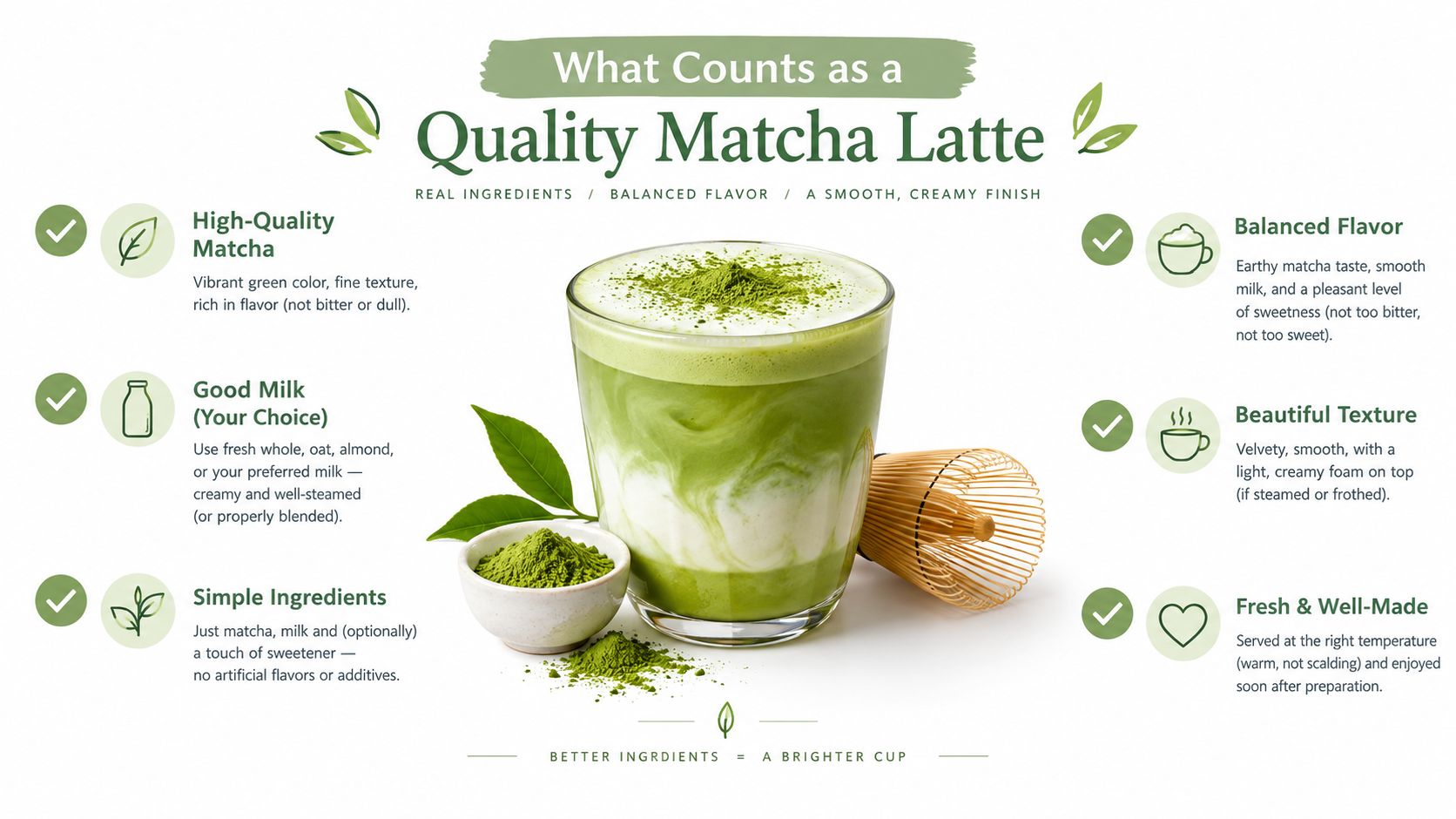
What Counts as a Quality Matcha Latte
A quality matcha latte starts with a powder that tastes good enough to drink without hiding it under syrup. Ceremonial-grade matcha is generally made from tender, carefully processed leaves and is valued for its smooth texture, bright colour and savoury sweetness. Culinary-grade matcha is more intense and often more astringent, which makes it useful in baking, smoothies and strongly flavoured drinks.
Both are matcha. The label alone doesn't prove a specific health outcome, and “ceremonial” isn't a universal medical or nutritional standard. For a daily latte, choose a powder with clear Japanese sourcing, a vivid green appearance, fine texture and a fresh harvest or packaging date where available.
Prepare the powder before adding milk
Water that's too hot can make matcha taste harsh. For a smoother drink, use water around 70–80 °C, sift the powder, add a small amount of water and whisk until it becomes a lump-free paste. Then add warmed milk.
This method distributes the powder through the drink instead of leaving clumps floating on top. It also gives you more control over bitterness, which is especially helpful when using a higher-quality powder with delicate grassy and umami notes.
A traditional serving can use more matcha than a typical café recipe. Australian-style guidance commonly describes a serving of about 2 g of powder, with around 60–70 mg of caffeine (Australian matcha serving guide). The caffeine figure is a useful practical benchmark, but it will vary with the tea and dose.
A simple quality checklist
Look for:
- Matcha as the main ingredient, rather than a sweetened “matcha-flavoured” blend.
- Bright green colour, not a dull or brownish appearance.
- Fine, smooth powder, which whiskes more evenly.
- Transparent sourcing, ideally identifying where the tea was grown and processed.
- A recipe you can taste, with little or no syrup needed.
The latte format can still be a good way to enjoy matcha. It just needs enough real powder and not so many additions that the tea becomes decoration.
Antioxidant Power and EGCg Concentration
Matcha's antioxidant reputation rests mainly on catechins, a group of tea polyphenols. The best-known member is epigallocatechin gallate, usually written as EGCG or EGCg. These compounds show antioxidant activity in laboratory tests, but chemical activity in a controlled experiment does not establish a specific health benefit for people drinking a matcha latte.
The whole-leaf format changes the comparison with steeped tea. Because the powdered leaf is consumed rather than removed after brewing, matcha can provide more catechins. One Australian source reports that a standard serving may contain about two to three times the catechins of a cup of steeped green tea. An Australian product laboratory report measured total catechins at 65,200 μg/g and EGCG at 56,000 μg/g (Australian matcha catechin analysis). These are measurements from tested products, not a guarantee for every powder sold in Australia.
Growing conditions also affect matcha's chemistry. Shading before harvest changes the balance of compounds in the plant, including chlorophyll and L-theanine. A 2020 analysis measured matcha's fibre, vitamin C, caffeine, chlorophyll, phenolics and antioxidant activity, showing that its composition extends beyond colour and flavour (2020 matcha composition analysis).
What the measurements can and can't tell you
Tests such as ORAC and DPPH measure chemical activity under controlled conditions. They cannot show that a matcha latte will prevent disease, repair cellular damage or create a noticeable change in how you feel. A high catechin reading is evidence about composition, not proof of an outcome.
Human trials provide a more relevant test. An Australian systematic review screened 122,429 records and identified only 8 randomised controlled trials. Those trials reported significant reductions in body weight, body mass index and blood pressure, plus improvements in plasma cholesterol and lipids, with all reported results at p<0.05 (Australian systematic review of green tea catechins). The review concluded that supplementation in the range of 300–1500 mg per day may help reduce anthropometric and cardiovascular biomarkers in people with obesity and people with type 2 diabetes.
That range describes supplementation, not a café recipe. Extracts and concentrated preparations may contain far more catechins than the amount in a served latte. For a plain-language explanation of what EGCg is and why it matters, Pep Tea provides a useful chemistry overview.
The practical comparison is straightforward. Matcha's whole-leaf format can increase catechin exposure, while the actual amount still depends on the powder dose, product and preparation.
| Source | Serving Size | EGCg (mg) | Total Catechins (mg) | Notes |
|---|---|---|---|---|
| Matcha | Varies by powder dose | Product-dependent | Product-dependent | Whole-leaf powder is consumed |
| Steeped green tea | Varies by tea and brewing | Product-dependent | Product-dependent | Leaves are removed after brewing |
| Green tea catechin preparation | Research-dependent | Research-dependent | 300–1500 mg/day supplementation range | This range comes from the Australian systematic review, not a standard latte |
The matcha powder supplies the catechins, so its grade and dose matter when assessing the finished drink. The latte format changes the serving context, which is why ingredient-level antioxidant claims need to be read alongside the actual recipe.
Sustained Energy From Caffeine and L-Theanine
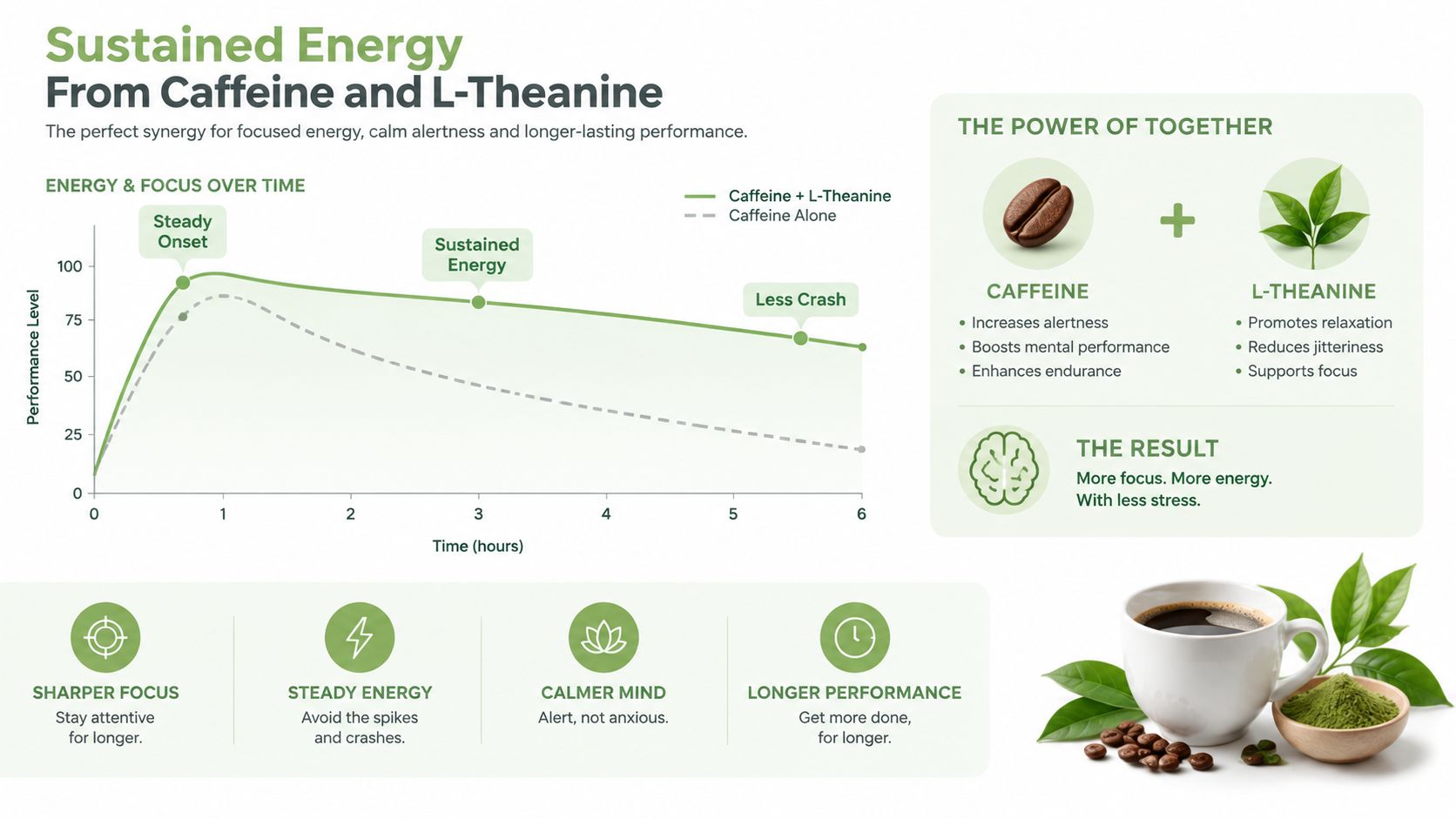
A matcha latte's most credible everyday benefit is its caffeine, not a guaranteed wellness effect. It can provide moderate stimulation with a smoother feel than some coffee drinks, partly because matcha supplies caffeine alongside L-theanine.
Caffeine supports alertness through the brain's adenosine signalling. L-theanine is an amino acid found naturally in tea, and technical reviews link the caffeine and L-theanine combination with smoother cognitive performance than caffeine alone (technical review of matcha composition and effects). The pairing may help explain why some drinkers experience focused attention rather than a pronounced buzz. Individual responses still vary, and the latte format can change the overall experience.
A useful benchmark
One clinical review cited a daily intake of about 2.07 g of matcha providing 72.5 mg of caffeine, 50.3 mg of theanine and 171.0 mg of catechins (technical review of matcha composition and effects). That is a research benchmark, not a fixed amount for every scoop or café recipe.
A mainstream Australian matcha drink can provide roughly 56–81 mg caffeine per serve (Australian café matcha caffeine benchmark). This generally places matcha above a typical brewed green tea and below a standard coffee, although the comparison depends on preparation. More powder or a larger café serve increases the total caffeine.
Milk does not remove caffeine. It can make a large latte taste and feel gentler because the caffeine is spread through more liquid, while the drink may still contain more caffeine than expected.
How to use the lift well
Choose an earlier serving if caffeine affects your sleep. A matcha latte may also suit a focused work period or exercise session, particularly when it replaces a sweeter drink or a stronger caffeine hit.
Food can make the experience feel gentler by slowing digestion, but it does not cancel caffeine. Include coffee, black tea, cola, energy drinks and chocolate when considering your overall intake.
Calm focus still contains caffeine. If you are caffeine-sensitive, L-theanine may change the drink's feel, but it cannot guarantee good sleep after a late serve.
Matcha grade does not set a fixed caffeine level. Dose, leaf material, harvest and preparation all influence the finished cup. Pep Tea explains the relationship between matcha, green tea and L-theanine in its educational resource.
Metabolic and Cognitive Benefits in Human Trials
Matcha's metabolic and cognitive claims need a clear distinction between plausible mechanisms and measured human outcomes. Catechins may affect pathways associated with cardiovascular markers, while caffeine and L-theanine may support alertness. Those possibilities do not show that a sweetened latte causes weight loss, removes anxiety or improves sleep.
An Australian review of green tea catechin trials reported improvements in body measurements, blood pressure, cholesterol and lipids among the small group of randomised studies. Its conclusion about 300–1500 mg per day referred to catechin supplementation in relevant populations, not to every café latte. As noted earlier, the amount of matcha in a served drink can differ substantially from a research dose.
What researchers measured in people
Australian-facing coverage of a 2023 review describes only five experimental studies in which matcha was given to people, generally at doses around 2–4 g per day (Australian-facing summary of matcha research). The findings were mixed. Some studies reported lower stress and anxiety, better memory or cognition, and improved sleep in older adults. Other results showed little sleep effect in younger adults, no mood effect, and no additional weight-loss benefit in people with obesity.
This evidence supports continued interest in matcha, while leaving its clinical role uncertain. A trial serving of plain matcha is not interchangeable with a large latte containing milk and syrup.
| Claim | Evidence | Typical Result |
|---|---|---|
| Better alertness | Caffeine and L-theanine have a plausible combined effect | May support attention and calm wakefulness |
| Cardiovascular markers | Green tea catechin trials reported improvements in several markers | Promising, but not proof that a latte prevents disease |
| Weight loss | Human matcha evidence is limited and mixed | No reliable standalone weight-loss result |
| Anxiety reduction | Some experimental findings point to lower stress or anxiety | Inconsistent and dependent on the person and dose |
| Sleep improvement | Results differ between groups | Not a dependable sleep aid |
The research base is generally small or short, and many preparations do not resemble a milk-based café drink. Milk changes the recipe, while syrup changes its nutritional profile, so ingredient-level claims cannot automatically be transferred to the beverage as served.
Matcha may fit a heart-conscious, balanced lifestyle and may help some people with attention. It isn't proven to replace sleep, movement, medical treatment or a nutritious eating pattern.
How Milk, Sugar and Serving Size Change the Equation
The latte format changes more than taste. Milk adds volume, protein and energy, while sweeteners can turn a low-sugar tea into a dessert-style drink. The result may still be enjoyable, but its overall nutritional profile is no longer represented by the matcha powder alone.
Research and commentary on matcha often focus on the leaf's catechins, caffeine and L-theanine. Café buyers experience the whole recipe. A small unsweetened home latte and a large syrup-based café drink may share a name while delivering very different amounts of matcha, sugar and milk.
Milk isn't the main concern, sugar is
Milk proteins may interact with tea catechins, and the effect on antioxidant absorption remains debated. Human results don't support a simple rule that dairy cancels matcha's benefits, so there's no need to avoid milk automatically.
Sweetener deserves more attention. Honey, vanilla syrup and pre-sweetened powders can shift the drink away from the low-sugar profile people expect from plain matcha. If you're buying a drink, ask whether the café uses pure matcha powder or a flavoured blend, then request no syrup or a reduced amount if that suits your palate.
For people planning drinks around travel, ingredient labels and serving choices are easier to manage with practical resources such as this guide to practical nutrition for travelers.
Choose the format that matches your goal
| Situation | Better choice | Why |
|---|---|---|
| Hot at home | Pure matcha, water and warmed unsweetened milk | You control dose and sweetness |
| Iced at home | Whisk matcha with a little water before adding cold milk | Reduces clumps and keeps the flavour clear |
| Café order | Ask for pure matcha and no syrup | Separates the tea from the dessert-style additions |
| Flavoured baking or smoothies | Culinary-grade matcha | Stronger flavour works with other ingredients |
A “matcha-flavoured” powder may contain little real matcha and can be dominated by sugar or other ingredients. Read the label rather than relying on the green colour.
For a controlled home version, follow Pep Tea's method for making a sugar-free matcha latte. The key idea is simple: keep the matcha real, keep the powder dose sensible and let sweetness be optional.
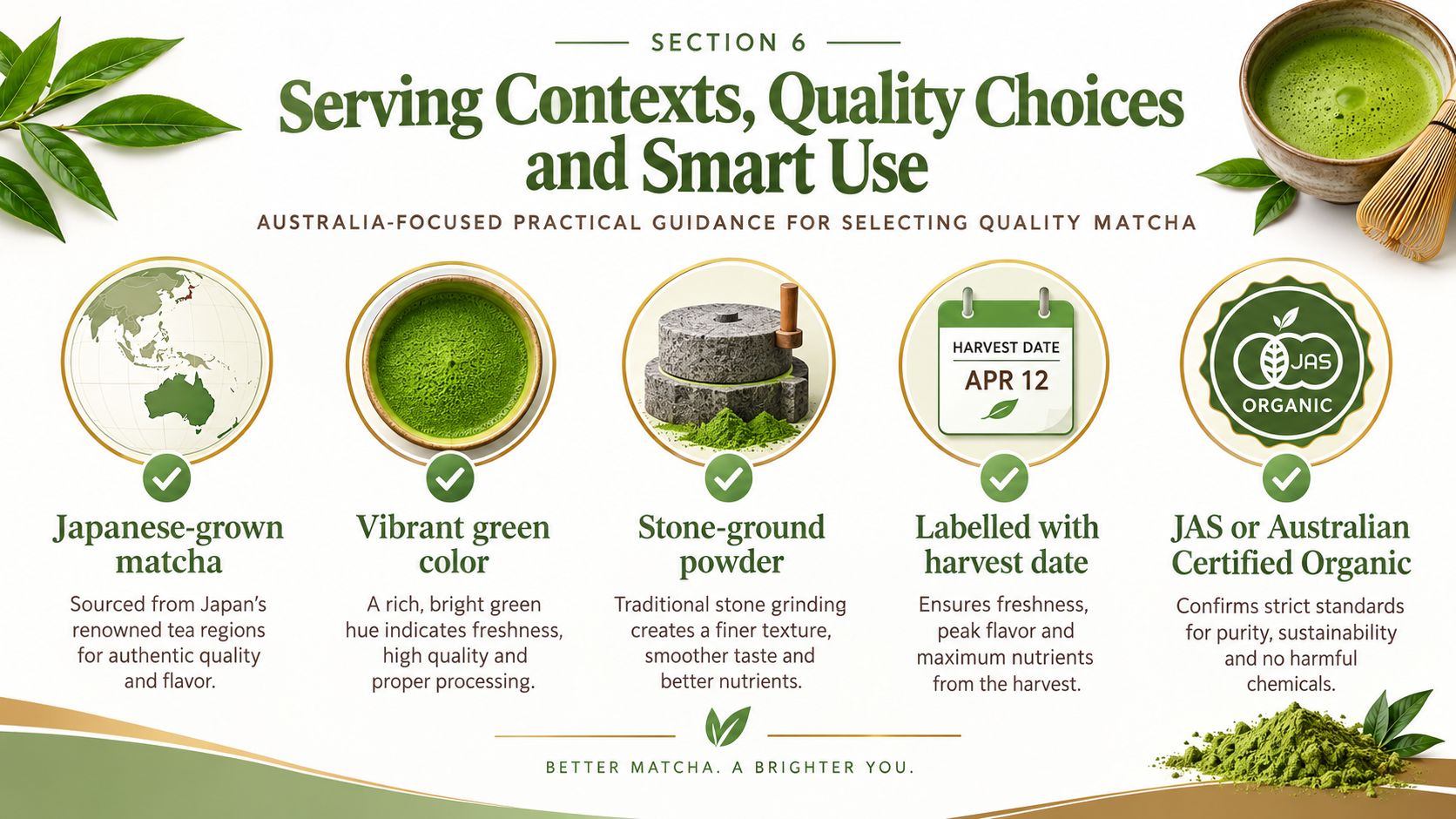
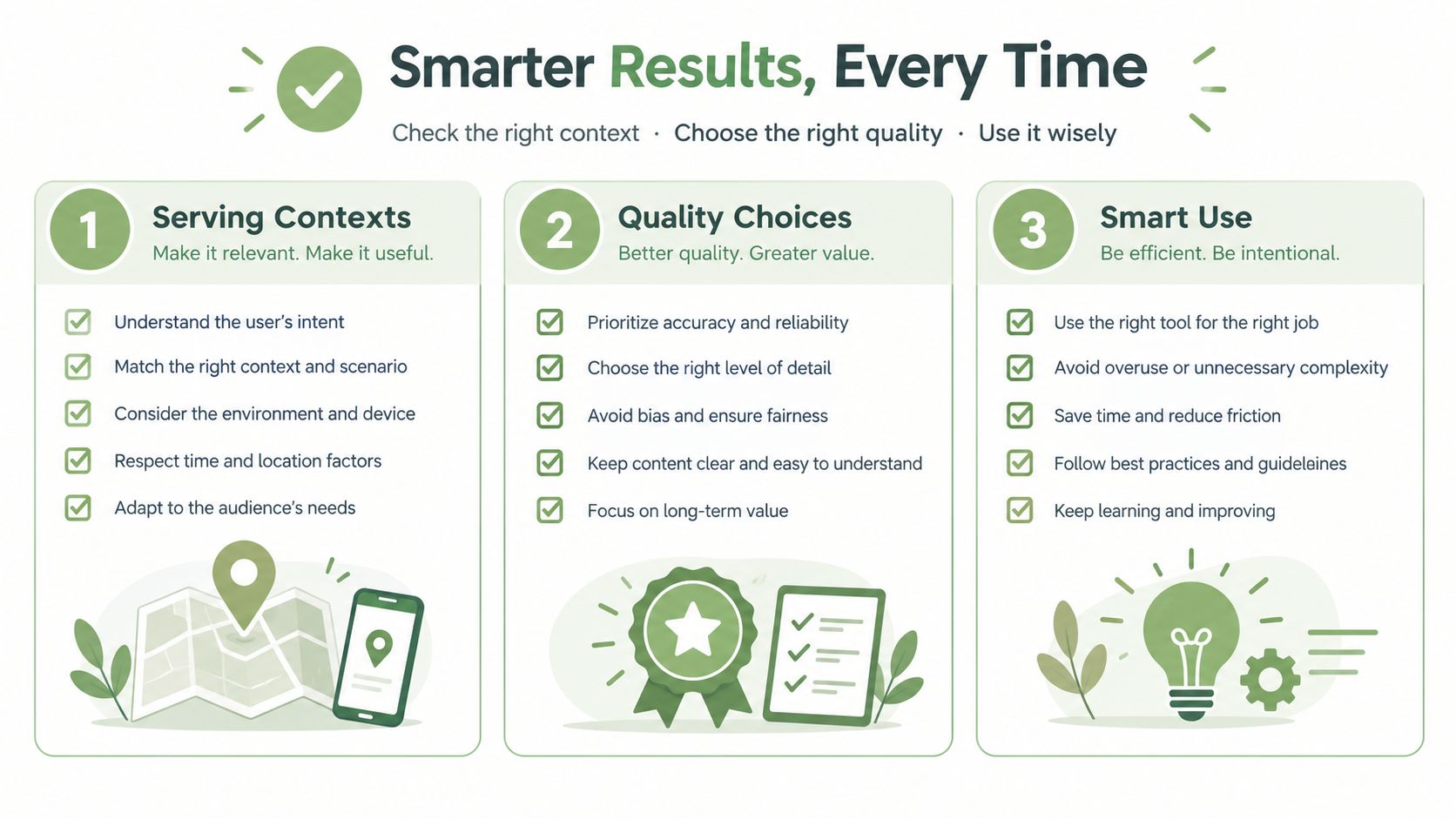
Serving Contexts, Quality Choices and Smart Use
A useful matcha latte starts with buying decisions, not health promises. Choose Japanese-grown matcha from a supplier that identifies the product clearly, look for a vibrant green colour, and favour powder that's stone-ground and fresh. Organic certification, such as JAS or Australian Certified Organic certification, can also help shoppers assess production standards.
For a daily latte, a pleasant drinking-grade powder makes sense because flavour determines whether you'll keep using it. Reserve culinary grade for smoothies, baking and recipes where matcha is combined with fruit, yoghurt or other assertive flavours.
A dependable home method
For a 200–250 mL serve, start with 1–2 g of matcha, whisk it with about 60 mL of water at 80 °C, then add warmed milk. These quantities are a practical recipe framework, not a guarantee of a particular caffeine or catechin content.
Morning is the easiest timing. A pre-workout latte can be a coffee alternative, while sleep-sensitive drinkers may prefer to avoid matcha after 2 pm. Anyone who notices anxiety, palpitations or disrupted sleep should reduce the dose or stop and discuss persistent symptoms with a qualified health professional.
People who are pregnant, take blood thinners or iron supplements, or manage anxiety should be especially cautious with caffeine and tea compounds. Keep to one small serve unless a doctor or pharmacist advises otherwise, and consider the timing of matcha around iron supplements or meals.
What to ask at a café
Ask:
- Is the drink made with pure matcha?
- How much powder goes into the cup?
- Does the powder already contain sugar?
- Can you make it without syrup?
- Can I choose a smaller size?
At home, keep a fine sieve, a bamboo whisk or handheld frother, a small bowl and a reliable way to judge water temperature. If you're helping a remote team explore café culture, a guide to latte tasting for remote managers offers useful ideas for comparing preparation and flavour, even though the same tasting approach can be adapted to matcha.
Pep Tea offers organic Japanese matcha alongside Australian-brewed, sugar-free organic kombucha made in the Hunter Valley, NSW. If you want to compare clean, low-sugar beverage options, visit Pep Tea to explore the range and choose a matcha suited to your preferred latte style.
Green Tea Australia Brands a Shopper’s Guide for 2026

You're probably here because you've stood in front of a supermarket shelf, opened five browser tabs, and realised that “green tea” in Australia can mean very different things. One box says organic. Another says matcha. Another looks healthy but is packed like a soft drink. Then there are imported tins, local blends, tea bags, loose leaf, sparkling cans, probiotic bottles, and labels full of wellness language that don't always tell you much.
That confusion makes sense. The Australian green tea aisle has become more crowded, and shoppers are paying closer attention because they want drinks that feel lighter, cleaner, and more purposeful. Interest isn't niche anymore. In Australia, the organic green tea market reached a retail value between AUD 180 million and AUD 250 million in 2025, with health-conscious consumers driving a significant portion of demand, according to IndexBox's Australia organic green tea market analysis.
A good guide to Green Tea Australia brands shouldn't just hand you a list of names. It should help you recognise quality markers, understand what type of green tea suits your day, and know when a label is saying something meaningful versus sounding impressive.
Navigating the World of Australian Green Tea
A lot of Australians start with the same assumption. Green tea is green tea, so choosing one brand should be simple.
Then the practical choices show up.
You might buy tea bags for convenience, then notice a bright tin of Japanese matcha beside them. A café menu offers a matcha latte. The fridge section has kombucha made from green tea. A wellness shop stocks loose-leaf sencha and premium powders with very different prices. Suddenly you're not comparing one product type. You're comparing several categories that all sit under the same broad umbrella.
Why the category feels crowded
Part of the confusion comes from the fact that these products solve different problems.
- Tea bags suit quick weekday brewing.
- Loose-leaf green tea suits people who care about flavour and ritual.
- Matcha appeals to anyone chasing a more concentrated, versatile green tea experience.
- Kombucha attracts drinkers who want something cold, lively, and a bit more social.
That's why brand lists alone often fall short. A “best brands” roundup can lump very different products together without explaining what you are purchasing.
Green tea isn't one single shopping decision. It's a category of formats, origins, and processing styles.
Start with your real goal
Before you compare labels, ask a simpler question. What do you want this green tea to do in your life?
Maybe you want a calm morning drink instead of another coffee. Maybe you want a low-sugar fridge staple. Maybe you're after a ceremonial matcha for whisking, or a culinary powder for smoothies and baking. Some shoppers want local brewing and traceable production. Others care most about organic certification and clean ingredients.
Once you know your goal, the shelf makes more sense. You stop asking, “Which brand is best?” and start asking better questions.
- Is this for sipping hot or cold?
- Do I want convenience or a ritual?
- Am I paying for better leaf quality, better processing, or just better packaging?
- Is the “organic” claim supported?
Those questions turn a confusing category into an organised one.
How to Read a Green Tea Label Like an Expert
A strong green tea label should help you trust the product. If it leaves you guessing, that's already useful information.
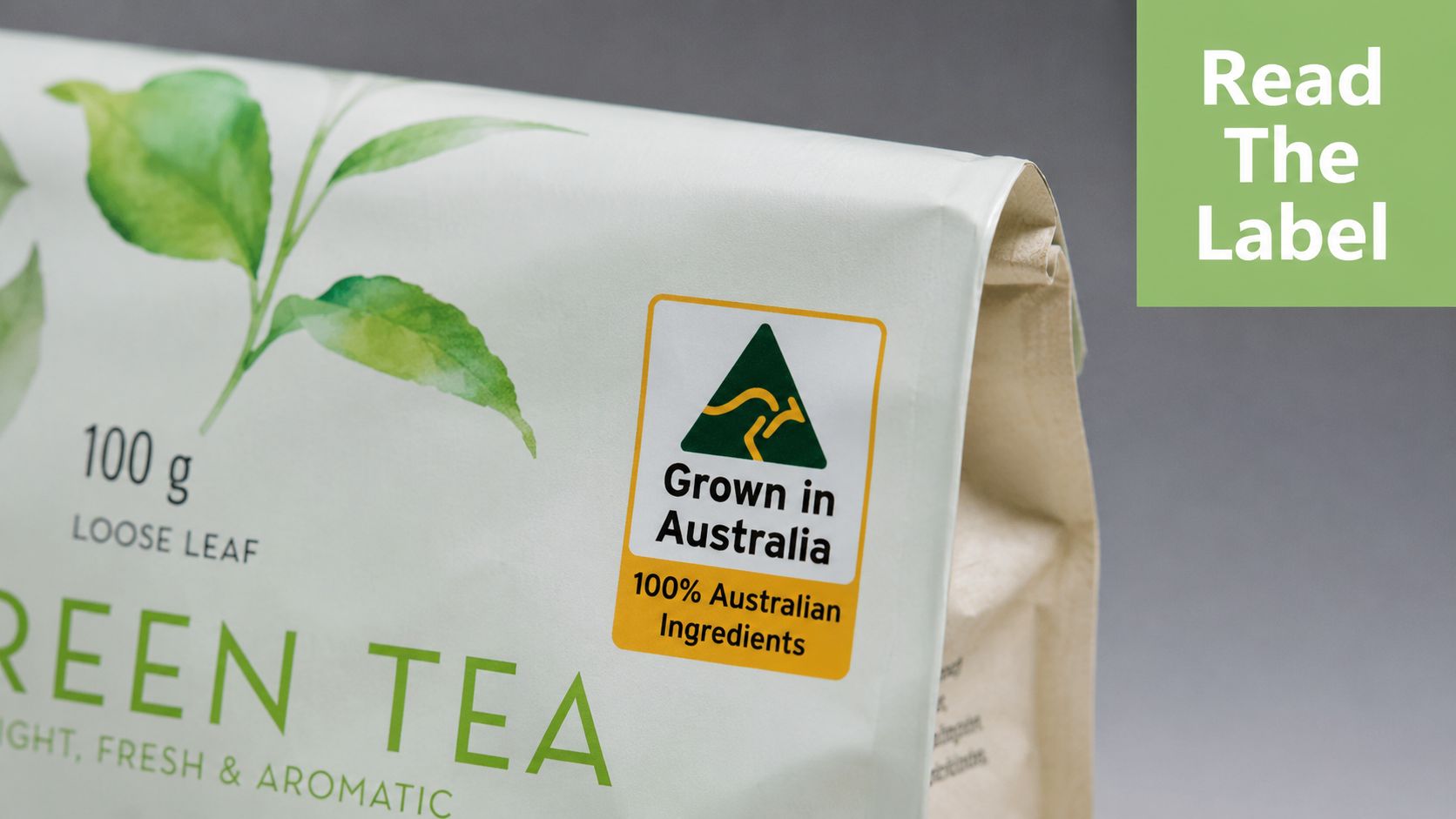
Check the certification first
The word organic gets used loosely. That's one of the biggest traps in this category.
Consumers are often misled by brands using “organic” without third-party validation, and shoppers should look for recognised certification marks such as ACCOA, as noted in this discussion of organic certification literacy in Australia. If the front of pack says organic but the label gives you no certifier, no mark, and no traceable standard, pause before you buy.
A quick way to build confidence is to learn what recognised standards look like and what they cover. A practical starting point is this guide to organic certification standards, which helps decode what a certification is meant to signal.
Look for origin, not just branding
A polished brand name doesn't tell you where the tea comes from. Origin matters because it often shapes flavour, processing style, and buyer expectations.
If a product is Japanese green tea or Japanese matcha, the label should make that clear. If it's Australian grown, that should also be visible and specific. “Packed in Australia” is not the same thing as “grown in Australia”. Shoppers often miss that distinction.
Here's a useful way to read that part of the pack:
Find the country of origin
Don't stop at the front label. Check the side or back panel.Notice whether the tea is grown, packed, blended, or brewed locally
Those are different claims.See if the origin matches the product type
For example, many premium matcha products highlight Japanese sourcing because that's central to the style and processing.
Scan for processing clues
Processing changes the final cup more than many people realise.
A tea bag often contains finely cut leaf for speed and consistency. Loose-leaf tea tends to show more of the leaf itself. Matcha is powdered whole leaf. Kombucha is brewed and fermented. Each format needs a different label lens.
Look for clues such as:
Leaf form
Whole leaf, loose leaf, powder, or brewed beverage.Intended use
Drinking straight, lattes, recipes, or ready-to-drink refreshment.Storage guidance
This can hint at freshness sensitivity, especially with powdered green tea.
Practical rule: If a pack makes a premium claim, it should also give you premium detail.
Know what vague language sounds like
Some wording looks reassuring but says very little.
“Natural”, “clean”, “premium”, and “wellness” aren't useless words, but they aren't proof of quality on their own. Treat them as supporting language, not deciding factors. The details that count are the certifier, origin, ingredients, and processing information.
That's when Green Tea Australia brands become easier to sort. You stop buying the prettiest pack and start buying the clearest one.
The Four Faces of Green Tea in Australia
Not every green tea belongs in the same routine. The easiest way to cut through the noise is to separate the category into its main formats and compare them by use.
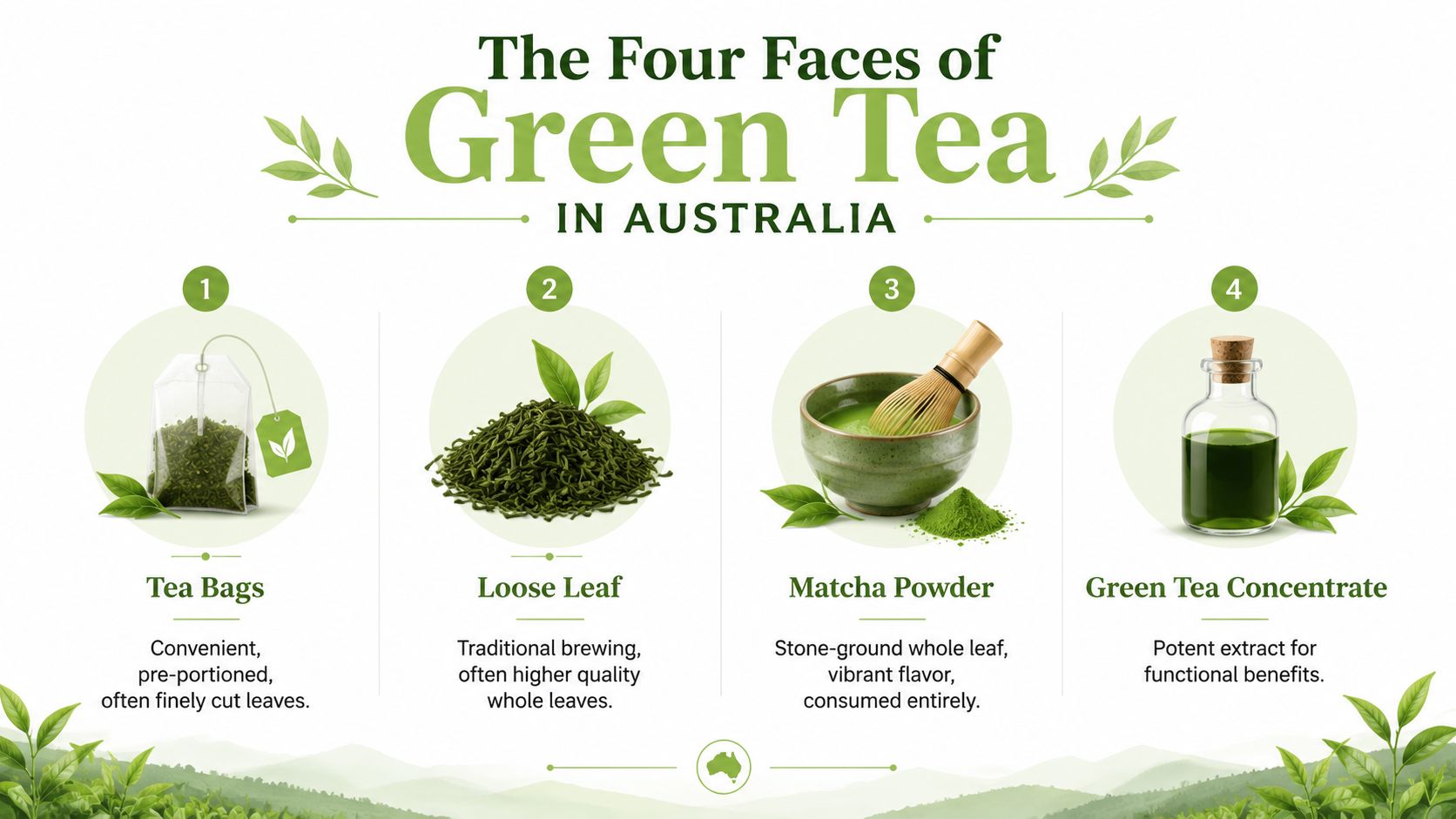
Convenience still drives a lot of buying. In Australia, green tea bags hold a 45.9% market share in 2025, while premium varieties like matcha are seeing rapid adoption because of their antioxidant appeal and versatility in drinks and recipes, according to IMARC's Australia green tea market overview.
Tea bags
Tea bags are the familiar entry point. They're easy, portable, and forgiving.
They suit office kitchens, rushed mornings, and anyone who wants a quick cup without measuring or equipment. The trade-off is that the experience can be simpler in flavour and less expressive than whole-leaf formats.
Loose-leaf green tea
Loose leaf asks for a bit more attention, but it often rewards you with a more nuanced cup.
You can usually see the leaf, adjust the strength, and pay attention to aroma in a way that tea bags don't always allow. It's a good fit if you enjoy the brewing ritual and want your daily tea to feel more intentional.
Matcha powder
Matcha changes the equation because you consume the powdered leaf rather than steeping and discarding it.
That's one reason people see it differently from a standard brewed green tea. It also moves well across routines. Some drink it whisked with water, others build lattes, smoothies, iced drinks, or baking recipes around it.
If you want green tea as both a drink and an ingredient, matcha opens more doors than bags or loose leaf.
Kombucha made from green tea
Kombucha belongs to the same conversation, but it solves a different need.
It's for people who want a chilled, fermented, ready-to-drink option with more lift and personality than plain water. It can work as an alcohol alternative, an afternoon fridge drink, or a café menu option that feels adult without being heavy.
Green Tea Forms at a Glance
| Format | Preparation | Key Benefit | Best For |
|---|---|---|---|
| Tea bags | Steep in hot water | Convenience | Busy mornings, work, travel |
| Loose leaf | Brew with infuser or pot | Better flavour control | Tea drinkers who enjoy ritual |
| Matcha | Whisk powder with water or milk | Whole-leaf versatility | Lattes, focused mornings, recipes |
| Kombucha | Ready to drink cold | Fermented, refreshing format | Gut-friendly routines, alcohol-free swaps |
How to choose the right one for your day
A helpful way to shop is to stop thinking in terms of “best” and think in terms of “best fit”.
For speed
Tea bags are hard to beat.For flavour exploration
Loose leaf gives you more to notice.For a wellness ritual with culinary flexibility
Matcha makes the strongest case.For a fridge staple
Kombucha offers convenience with a more social feel.
Some households keep more than one format on hand. That isn't indecisive. It's practical. A weekday desk drawer and a Sunday morning kitchen bench don't need the same thing.
Why categories matter more than brand popularity
Shoppers often search for Green Tea Australia brands as if every product competes on one shared scale. It doesn't work that way.
A strong tea bag brand may not be the best matcha source. A beautiful matcha label may tell you nothing about kombucha quality. A local brand may be excellent at brewing beverages but not focused on loose leaf at all.
Once you separate the category into formats, comparing brands gets much cleaner. You compare tea bags with tea bags, matcha with matcha, and kombucha with kombucha. That's when quality markers start to stand out.
A Deeper Dive into Matcha's Magic
Matcha is one of the few drinks that can feel both grounding and energising at the same time. That's why people often try it once out of curiosity, then keep coming back for the effect as much as the flavour.
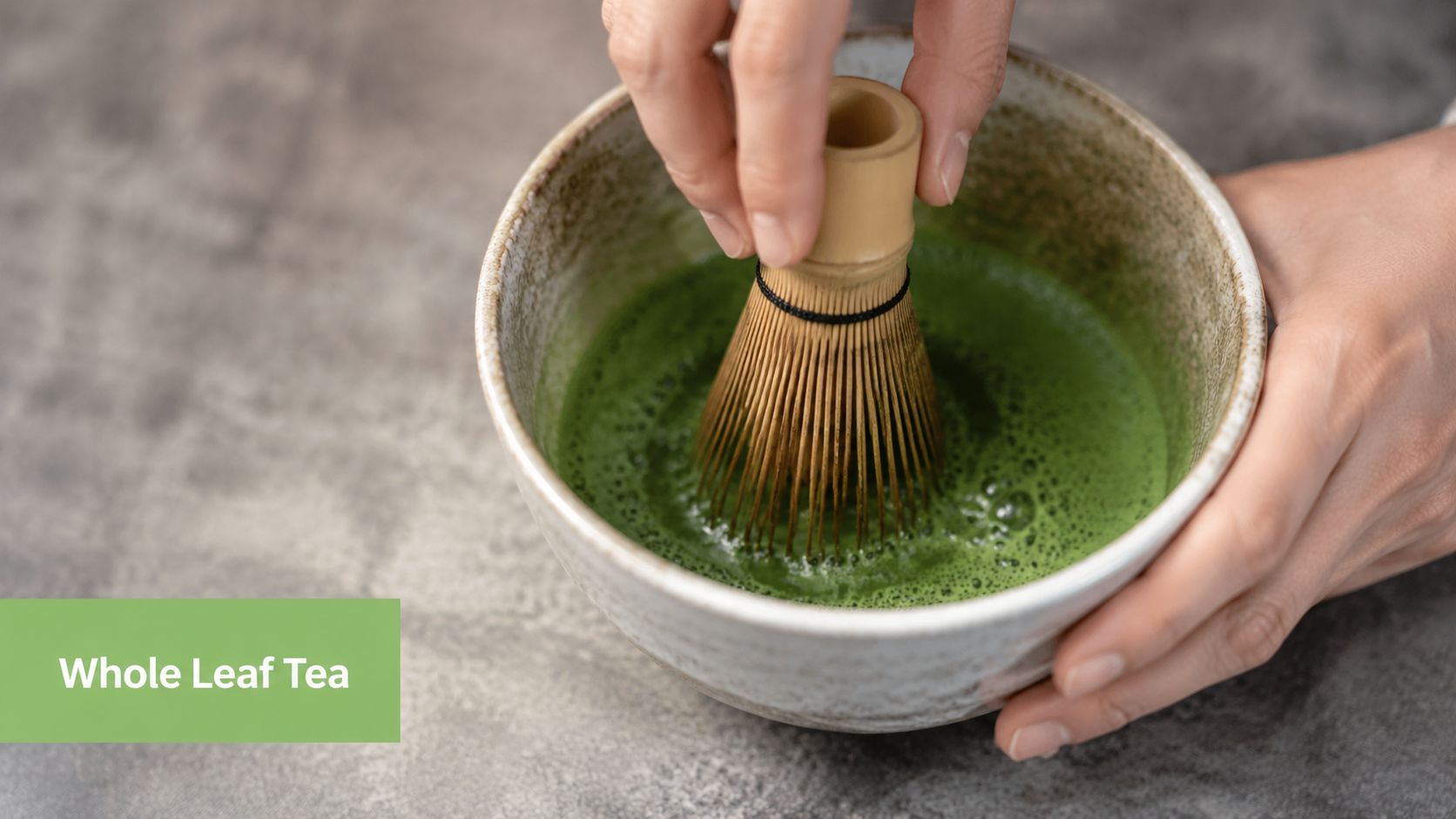
Why matcha feels different
The biggest shift is simple. You're not just infusing water with leaves. You're consuming the powdered leaf itself.
That changes how people use it and how they talk about quality. Colour, texture, aroma, and smoothness matter a lot. A vibrant green powder with a fine texture usually signals more care in cultivation and processing than a dull, khaki-looking powder that tastes flat or harsh.
Shade-grown ceremonial-grade matcha contains higher levels of L-theanine, which moderates caffeine absorption and can produce a sense of calm focus without the sharper spike and crash people often associate with other stimulants, according to this matcha quality and comparison guide.
Ceremonial and culinary in plain English
These labels confuse plenty of shoppers because they sound formal and absolute. In practice, they're more useful as buying cues than fixed rules.
Ceremonial matcha
Best suited to whisking with water when you want the powder itself to shine.Culinary matcha
Better suited to lattes, smoothies, baking, desserts, and recipes where matcha shares the stage with other ingredients.
If you want help choosing between them, this breakdown of different grades of matcha is a practical reference.
What to look for in a good tin or pouch
A shopper doesn't need to be a tea master to make a smart choice. A few sensory checks go a long way.
Colour matters
Look for a lively green rather than a brownish or yellowed powder.Texture tells a story
A fine, soft powder tends to whisk more smoothly.Smell is part of quality
Fresh matcha should smell alive, not stale.Use case should match the label
Don't pay for a premium drinking powder if you only want it for banana bread or protein smoothies.
A quick visual guide can help if you're learning the whisking basics:
Good matcha should make sense on the palate and on the label. If the flavour, colour, and product description don't line up, keep looking.
A simple way to use it daily
Try one teaspoon sifted into a bowl, add a small amount of hot water that isn't boiling, then whisk until frothy. From there, you can drink it straight or pour it over warm or iced milk for a latte.
That flexibility is a big part of matcha's appeal. It isn't locked into one ritual. It can be traditional at 7 am and playful by 3 pm.
Understanding Real Australian Kombucha
Kombucha often gets treated like a trendy flavoured drink with a healthy halo. That misses the point.
Real kombucha starts with tea, live cultures, and fermentation. The result should taste alive, not just sweet and fizzy. When shoppers realise that, they start reading kombucha labels very differently.
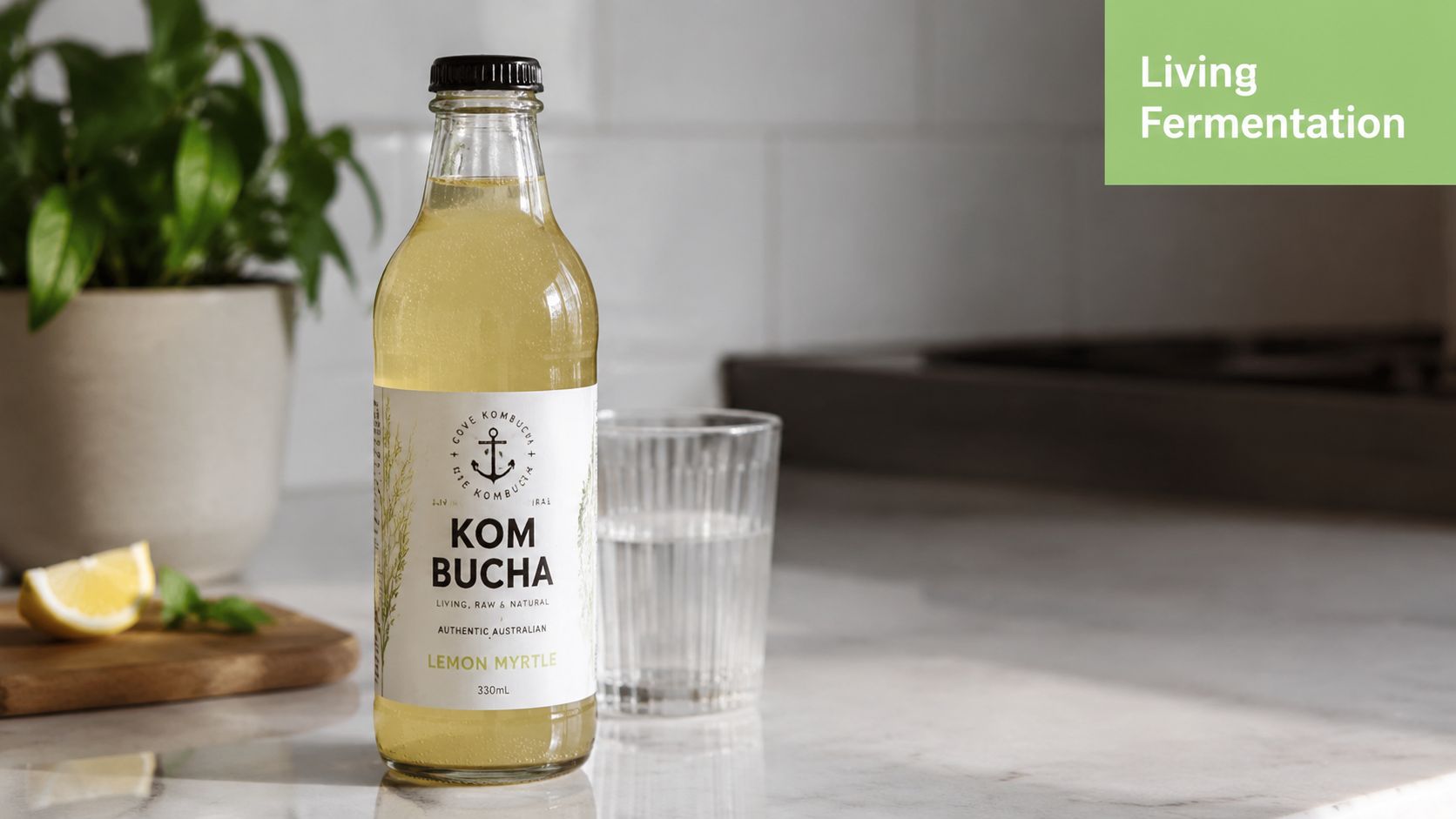
Not all kombucha is doing the same job
Some drinks borrow kombucha language but don't give you the same experience as a properly fermented product. They may lean heavily on sweetness, flavouring, or shelf-friendly positioning while giving the fermentation side far less importance than the front label suggests.
That's why it helps to ask a few direct questions:
- Was it properly fermented?
- Does the brand talk clearly about live cultures?
- Is it built as a low-sugar or sugar-free option?
- Is the producer transparent about where and how it's brewed?
What real fermentation adds
A proper kombucha process starts with brewed tea and a SCOBY, then time does the work. During fermentation, the drink develops its tang, complexity, and living character.
When a kombucha is made with care, people often describe it as cleaner, drier, and more grown-up than a soft drink. That matters in homes and cafés alike. It gives you a cold drink option that feels functional rather than sugary.
A kombucha shouldn't taste like soft drink wearing a wellness label.
Why local brewing matters
Australian shoppers often care where a product is made, especially in categories tied to freshness, trust, and food standards.
Pep Tea's organic kombucha is made in a HACCP-accredited brewery in the Hunter Valley, NSW, using organic green tea and live cultures to create a probiotic-rich, sugar-free beverage, according to Opera Foods' Pep Tea brand profile. That kind of production detail matters because it tells you the kombucha isn't just branded well. It's brewed with a clear standard behind it.
If you want a better feel for what separates properly fermented kombucha from shortcut versions, this guide to real raw organics kombucha is worth reading.
Easy ways to enjoy it
Kombucha doesn't need a complicated ritual.
Some people keep it simple and pour it over ice with lunch. Others use it as a non-alcoholic alternative in the evening. Cafés can also use it to build sharper, lighter drinks without relying on sugary mixers.
A few practical ideas:
Midday fridge pick-me-up
Serve cold on its own.Alcohol-free spritz substitute
Pour into a wine glass with ice and citrus.Café menu option
Pair it with clean food, brunch dishes, or wellness-focused menus.
Real kombucha earns its place when the label, flavour, and fermentation story all line up.
Creating Your Daily Green Tea Ritual
A good green tea habit doesn't need to look polished or complicated. It just needs to fit your real day.
Build around moments, not rules
If mornings are rushed, keep tea bags or ready-to-drink kombucha where you'll reach for them. If you like a slower start, use loose leaf or whisked matcha and let the preparation become part of the ritual.
A simple routine might look like this:
Morning focus
Make a matcha with hot water, or turn it into an iced latte if coffee feels too heavy.Midday reset
Brew loose-leaf green tea for a cleaner lunch drink.Afternoon swap
Reach for kombucha instead of a sugary soft drink.
Keep one easy recipe in rotation
If you're new to matcha, start with a basic latte.
Sift your matcha into a bowl or mug, add a small splash of hot water, whisk until smooth, then top with warm or iced milk. Once that feels easy, use culinary matcha in smoothies, bliss balls, yoghurt, or baking. It's one of the simplest ways to make green tea part of your kitchen rather than just your mug.
Make quality the habit
The most useful thing you can do is stay curious about what you're buying. Read the label. Check the certification. Notice the origin. Match the product type to the way you live.
That's the lesson behind sorting through Green Tea Australia brands. Buy with a bit more literacy and a bit less guesswork, and the whole category becomes more enjoyable.
If you'd like to put that knowledge into practice, explore Pep Tea for premium organic matcha and Australian-brewed sugar-free kombucha. It's a simple place to start if you want certified quality, clean flavour, and a greener daily ritual that feels easy to keep.
Green Tea Energy Powder: A Guide to Matcha’s Calm Boost
You're probably reading this in one of two moments. It's either early morning and you want energy that won't leave you rattled by mid-morning, or it's the middle of the afternoon and your brain has gone foggy while your to-do list hasn't.
That's where green tea energy powder enters the conversation. For many Australians, the interest isn't just about caffeine anymore. It's about finding something steadier, gentler, and easier to build into a daily routine. Matcha often sits at the centre of that shift because it offers more than a quick jolt. It brings ritual, flavour, and a different kind of focus.
Tea is still a smaller part of everyday beverage intake than water and coffee in Australia, but it remains part of the daily mix. In 2023, Australians consumed an average of 1,926 grams of non-alcoholic beverages per day, with tea at 153 grams, coffee and substitutes at 191 grams, and water at 1,352 grams, according to the Australian Bureau of Statistics food and nutrition release.
What matters more than the headline trend is the reason people keep returning to matcha. It feels cleaner. It fits a smoothie, a latte, or a quiet tea bowl. And when it's high quality, it can become one of the easiest swaps in a wellness routine.
The Search for a Smarter Energy Boost
The true desire isn't for ‘more energy' in the abstract. Instead, individuals want to get through a meeting without zoning out. They want to train after work without reaching for a sugary can. They want morning focus without the shaky hands that can come with too much coffee.
That's why matcha has become such an appealing option in the green tea energy powder category. It sits in the middle ground between comfort and function. You still get a proper drink, not a pill or an artificial pre-workout. But you also get compounds that many people associate with focus, steadier alertness, and a more balanced lift.
The broader Australian market reflects that interest. The Australian green tea market was valued at USD 319.0 million in 2025 and is projected to reach USD 521.6 million by 2034, with a 5.41% compound annual growth rate from 2026 to 2034, according to IMARC Group's Australia green tea market analysis. That same analysis notes that powder forms remain highly relevant in the extract segment, and that green tea's functional benefits are helping drive demand across beverages, supplements, and café applications.
Why people move away from harsher energy options
Some people are tired of the crash. Others want fewer additives.
A good matcha can feel more grounded because it belongs to a familiar food culture. You whisk it with water, blend it with milk, or stir it into breakfast. That changes the whole experience. It becomes part of your day rather than a rescue mission.
Matcha suits people who want energy with a bit more control. Not flat. Not frantic. Just more even.
Where confusion starts
The phrase green tea energy powder sounds simple, but it covers very different products:
- Whole-leaf matcha used in drinks and recipes
- General green tea powders that may vary in quality and processing
- Concentrated green tea extracts sold in capsules or formulation powders
Those aren't interchangeable. The benefits, taste, use, and safety profile can differ quite a bit. That distinction matters more than most labels make clear.
What Exactly Is Green Tea Energy Powder
When people talk about premium green tea energy powder, they're usually talking about matcha. Matcha is a finely ground powder made from green tea leaves, traditionally shade-grown before harvest and then milled into a soft powder.
That whole-leaf format changes everything. Instead of steeping leaves in water and discarding them, you consume the leaf itself. The result is a drink with a fuller flavour, deeper colour, and a very different nutritional profile from standard tea bags.
Matcha isn't just “green tea in powder form”
Regular green tea and matcha come from the same plant, but they're not handled the same way. Matcha is grown and prepared for powder use. The leaf is selected, processed, and ground with drinking in mind.
That's why authentic matcha tends to have:
- A brighter green colour from careful growing and processing
- A finer texture that whisks into water rather than floating in gritty clumps
- A fuller taste with grassy, savoury, and sometimes creamy notes
If a powder looks dull, tastes flat, or feels sandy, you're usually dealing with lower quality leaf, rougher milling, or a product designed more for blending than for drinking straight.
Whole-leaf powder versus concentrated extract
This is the distinction many guides skip, and it's the one worth understanding clearly.
Whole-leaf matcha is a food. You prepare it as a drink or use it in recipes.
Green tea extract powder is a concentrated ingredient, often standardised for compounds such as EGCG. In the Australian nutraceutical market, green tea extract powder for energy formulations is typically standardised to 50% to 70% EGCG, while certified organic matcha contains about 5% to 10% total polyphenols. That means the extract can be 5 to 14 times more concentrated in bioactive catechins per gram, according to Elchemy's analysis of green tea extract powder.
That same source notes that standardised extracts can more strongly inhibit COMT and are associated with an increase in 24-hour energy expenditure by 4% to 5%. Useful in some formulation contexts, yes. But very different from whisking up a bowl of matcha at home.
A simple way to think about it
Use this rule of thumb:
| Product type | Best thought of as | Typical use |
|---|---|---|
| Matcha | A whole-food tea powder | Lattes, tea, smoothies, baking |
| Green tea extract | A concentrated functional ingredient | Supplements or specialised formulations |
Practical rule: If you want a daily green tea energy powder for drinking, start with whole-leaf matcha, not a concentrated extract.
The Science of Calm and Sustained Energy
The reason matcha feels different from coffee isn't just marketing language. It comes down to the relationship between naturally occurring caffeine and L-theanine.
A single 2g serving of Australian-grade shade-grown matcha powder contains approximately 60 to 70 mg of caffeine, paired with L-theanine, according to Asian Pantry's matcha guide. That same source explains that L-theanine is linked with “calm alertness” through its effect on alpha-wave activity in the brain.
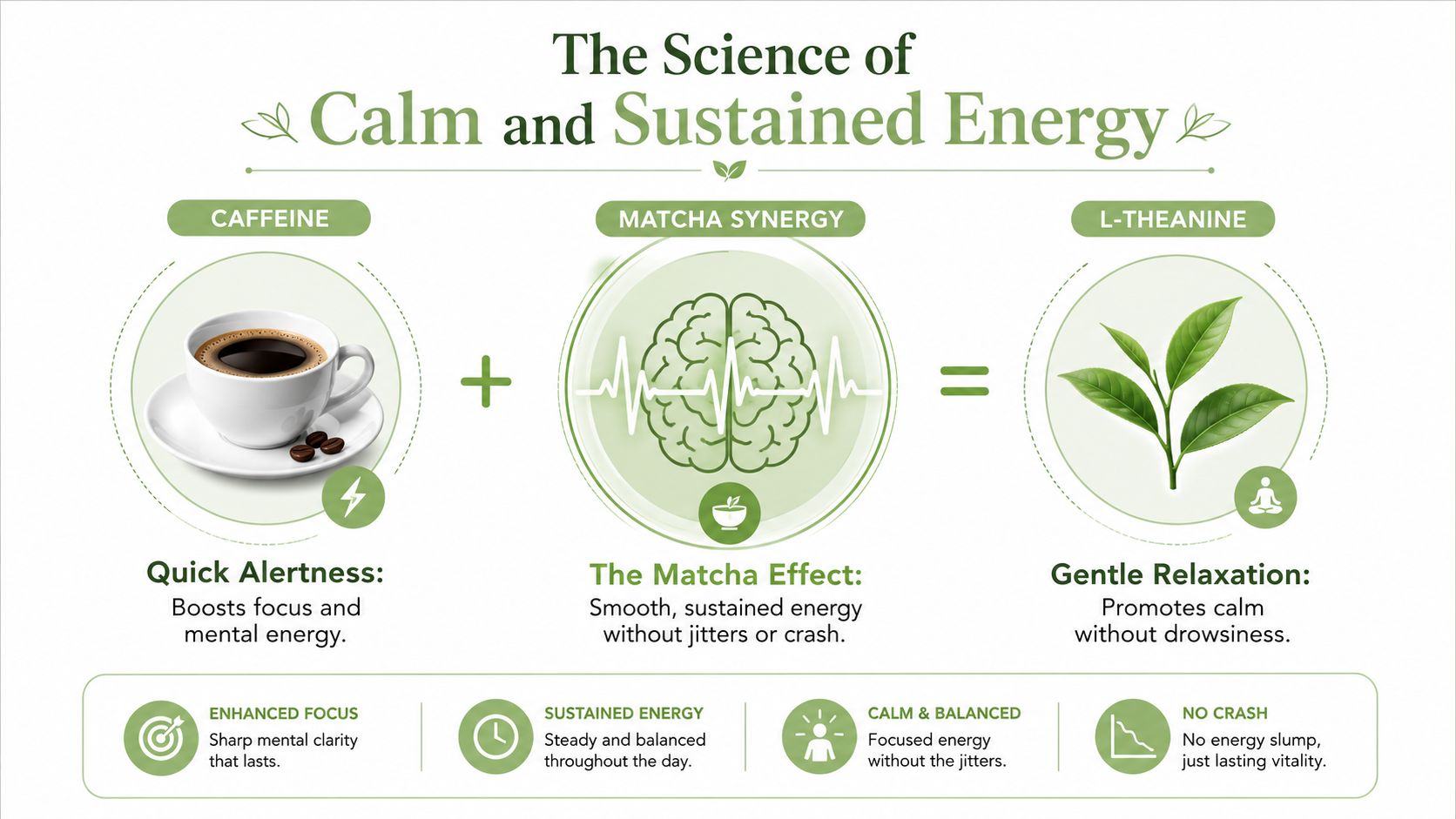
Why the pairing matters
Caffeine on its own often feels sharp. For some people, that's exactly what they want. For others, it can tip into jitteriness, tension, or a rapid rise and fall in energy.
Matcha behaves differently because the caffeine doesn't arrive alone. L-theanine changes the feel of the experience. Instead of a jagged spike, many drinkers describe a smoother curve. Focus comes on, but the body feels more settled.
Another source on matcha notes that L-theanine may modulate caffeine absorption to support a sustained energy release over 4 to 6 hours, while also supporting attention, reaction time, and memory in study settings, as described on Zen Green Tea's matcha information page.
Coffee versus matcha in plain language
This isn't about declaring one winner. It's about choosing the right tool.
- Coffee often suits moments when you want a quick, obvious lift.
- Matcha tends to suit work that needs steadiness, such as writing, study, long meetings, or travel days.
If coffee feels like a bright overhead light, matcha feels more like daylight through a window. You're awake, but not overwhelmed.
For readers who want a closer look at how this compares in a latte format, this guide on caffeine in a matcha latte is a helpful next step.
What “calm alertness” actually feels like
People sometimes expect matcha to hit like an energy drink and then assume it isn't working when it feels subtler. That's a misunderstanding.
The point isn't a dramatic rush. The point is usability.
It's the kind of energy that lets you keep going without feeling pushed around by it.
That makes matcha especially useful for mornings when you need concentration, or afternoons when you want to reset without wrecking your evening sleep rhythm.
More Than Just a Buzz Exploring the Health Benefits
A lot of people come to green tea energy powder for one simple reason. They want energy that feels usable. What often surprises them is that good matcha can offer more than that, because you are drinking finely ground whole tea leaf rather than a stripped-down stimulant or a concentrated extract.
That distinction matters. Whole-leaf matcha brings caffeine, L-theanine, catechins, and other plant compounds together in their natural mix. Extract products are different. They can be far more concentrated, and they do not always behave in the body the same way a traditional tea does. If we want an honest view of benefits, we have to keep those two categories separate.
One of the compounds people talk about most is EGCG, a catechin found in green tea. According to Matcha Direct Kyoto's guide to EGCG and catechins in matcha, matcha is particularly rich in catechins because you consume the whole powdered leaf.
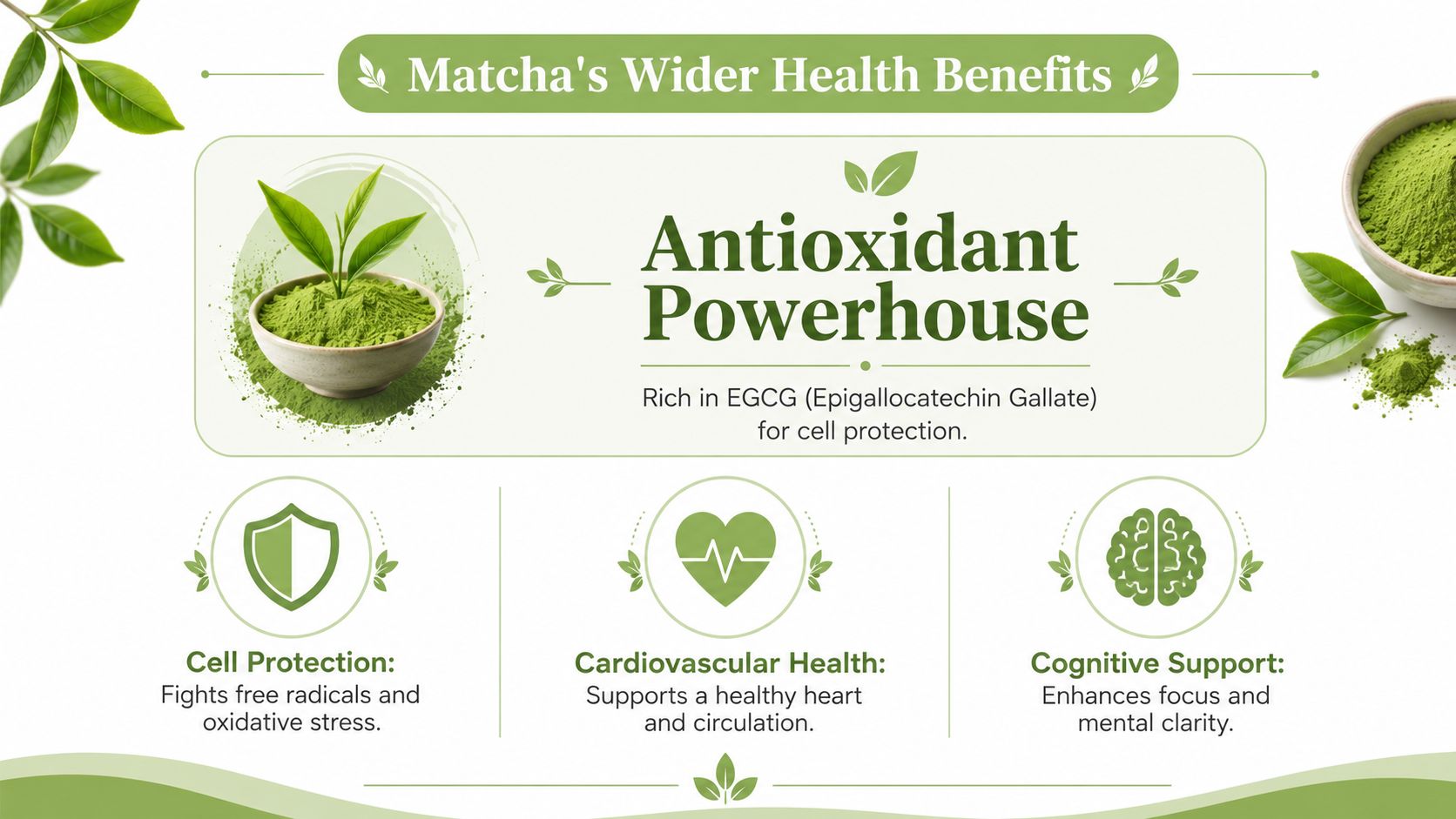
Antioxidant support
Catechins act a bit like the plant's built-in defence system, and when we drink matcha, we take in those compounds as part of the leaf itself. Researchers continue to study EGCG and related catechins for their role in helping the body manage oxidative stress, which is one reason matcha has earned its healthy reputation.
That said, matcha is still a food, not a cure-all.
The useful way to look at it is this. A daily cup can be part of a well-rounded routine, especially if it replaces drinks loaded with sugar or leaves you feeling rattled.
Benefits that may reach beyond energy
Green tea has also been studied for heart and metabolic health. A review published in Molecules on green tea catechins examines evidence linking these compounds with effects on lipid metabolism, glucose regulation, and cardiovascular function.
That does not mean every cup produces a dramatic result you can feel by lunchtime. It means regular green tea intake may support health in slower, background ways, much like exercise or sleep habits do. Subtle does not mean unimportant.
Why whole-leaf matcha deserves its own category
Wellness content often gets blurry. A headline about "green tea benefits" may be referring to brewed tea, whole-leaf matcha, or isolated green tea extract. Those are related, but they are not interchangeable.
Matcha works more like eating the whole orange instead of taking a heavily concentrated shot of one compound from the peel. You get the broader package, in a traditional food form, with effects that tend to be gentler and easier to use day to day. If you want help preparing it properly so taste and texture don't put you off, our guide to making matcha tea at home is a good place to start.
A better way to frame the benefits
Matcha can support health in a few layers at once:
- Immediate support: steady, workable energy for mornings or long focus blocks
- Nutritional support: catechins and other tea compounds that may contribute to long-term wellbeing
- Habit support: an easier swap for harsher, sweeter, or more processed energy options
That third layer is often the one people underestimate. Sometimes the benefit comes from the compounds in the cup. Sometimes it comes from what the cup replaces.
Your Practical Guide to Using Matcha Daily
The easiest way to make matcha stick is to stop treating it like a complicated wellness project. It's just a powder with a few very useful jobs. It can wake you up, slot into breakfast, or become your café-style afternoon drink at home.
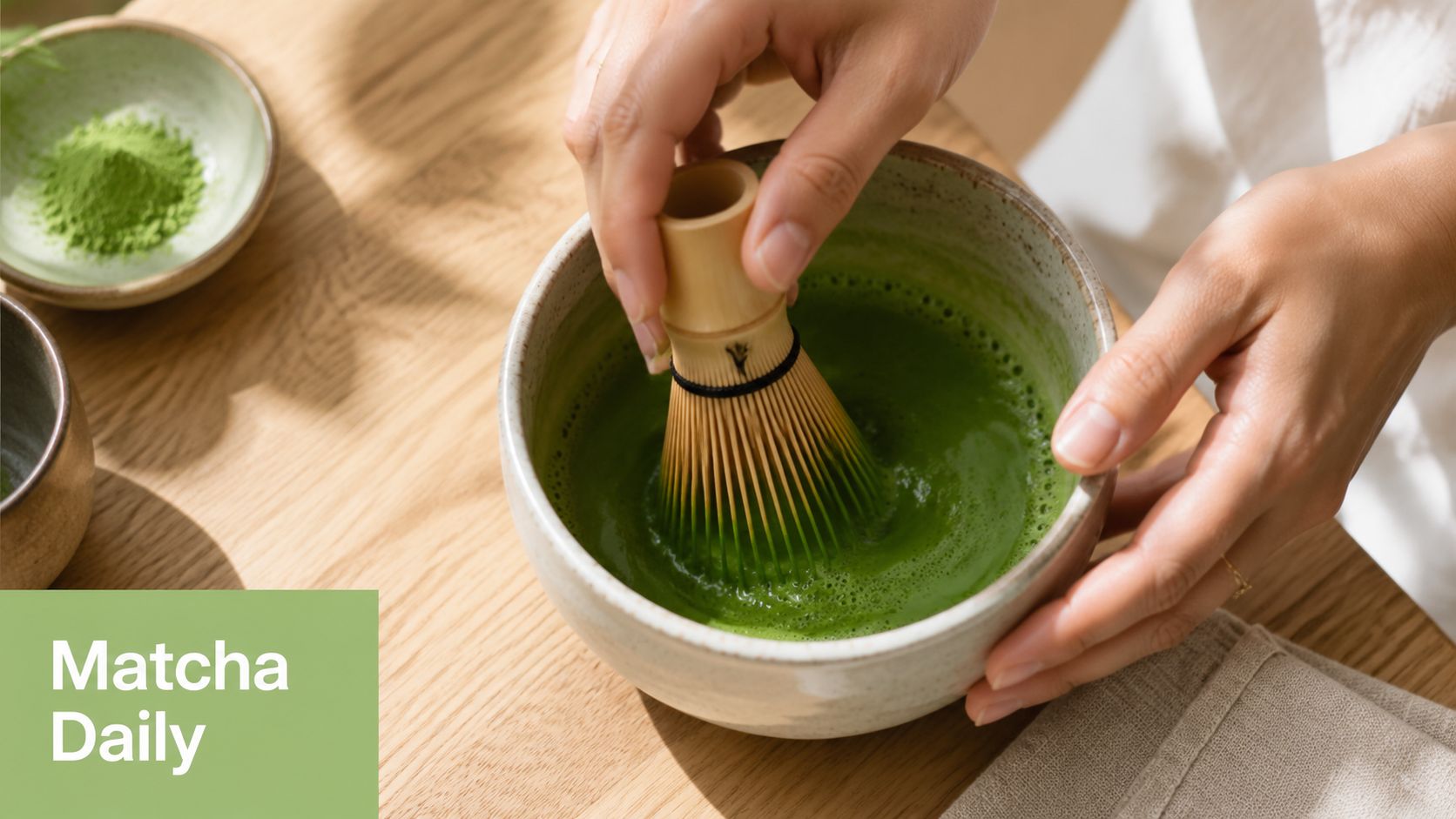
Start small and pay attention
If you're new to green tea energy powder, begin with a modest serve and notice how you feel. Matcha is generally gentler than many energy products, but it still contains caffeine.
A simple approach works well:
- Begin with a small amount if you're caffeine-sensitive
- Use it earlier in the day while you learn your ideal timing
- Keep the rest of the recipe plain at first so you can taste the matcha itself
A simple hot matcha latte
This is the most accessible entry point.
- Sift your matcha into a bowl or mug to avoid clumps.
- Add a small amount of warm water.
- Whisk until smooth and lightly frothy.
- Top with warmed milk of your choice.
- Leave it unsweetened at first, then adjust only if needed.
Ceremonial-style powders usually shine with fewer extras. If you're making a stronger latte or adding spices, a culinary-style powder often works better.
An iced version for warm Australian afternoons
Iced matcha is brilliant when you want refreshment as much as energy.
Try this method:
- Whisk matcha with a little water until smooth
- Fill a glass with ice
- Add cold milk
- Pour the matcha over the top
- Stir just before drinking
The colour alone makes it feel like a café order.
For a visual walkthrough, this guide on making matcha tea is useful if you want to refine your whisking and water technique.
Matcha in smoothies and baking
You don't have to drink it traditionally every day. Matcha works beautifully in food.
A few easy uses:
- Morning smoothie: Blend matcha with banana, yoghurt, oats, and milk.
- Yoghurt bowl: Stir a little through yoghurt for a grassy, creamy note.
- Baking: Add it to muffins, pancakes, or bliss balls for colour and earthiness.
Here's a quick video if you want to see the basics in action before trying your own routine.
Best times to use it
Matcha's personality suits certain moments better than others.
| Time of day | Why it works well |
|---|---|
| Morning | A gentler start than heavier caffeine options |
| Mid-afternoon | Useful when you want focus without feeling overcooked |
| Before quiet exercise | Often suits walking, yoga, or longer sessions that need steadiness |
A daily matcha habit works best when it feels easy. Pick one time, one recipe, and repeat it until it becomes automatic.
How to Choose a High Quality Green Tea Powder
Not all green tea energy powder deserves space in your pantry. Some powders are vibrant, smooth, and fresh. Others are bitter, dull, and disappointing before the first sip is finished.
The quickest way to buy better is to focus on a handful of quality markers rather than marketing noise.
Look at grade, colour, and texture
For drinking, many people prefer ceremonial-grade matcha because it's made to stand on its own with water or milk. Culinary-grade matcha is often the better fit for baking, smoothies, and stronger flavoured recipes.
Use your senses too:
- Colour matters: A lively green tone usually signals better handling and fresher leaf.
- Texture matters: Fine powder should feel soft, not gritty.
- Taste matters: Good matcha can be grassy and savoury, but it shouldn't taste harsh for the sake of it.
Origin and certification matter
Japan remains the benchmark many buyers look for, especially when they care about traditional production and consistency. Organic certification also matters because matcha is consumed as the whole leaf rather than infused and discarded.
Pep Tea's organic Japanese Matcha is certified by the Japanese Ministry of Agriculture, which validates its organic status and confirms it is grown without synthetic pesticides or fertilisers in southern Japan's tea-growing regions, as shown on the Pep Tea Organic Japanese Matcha product page.
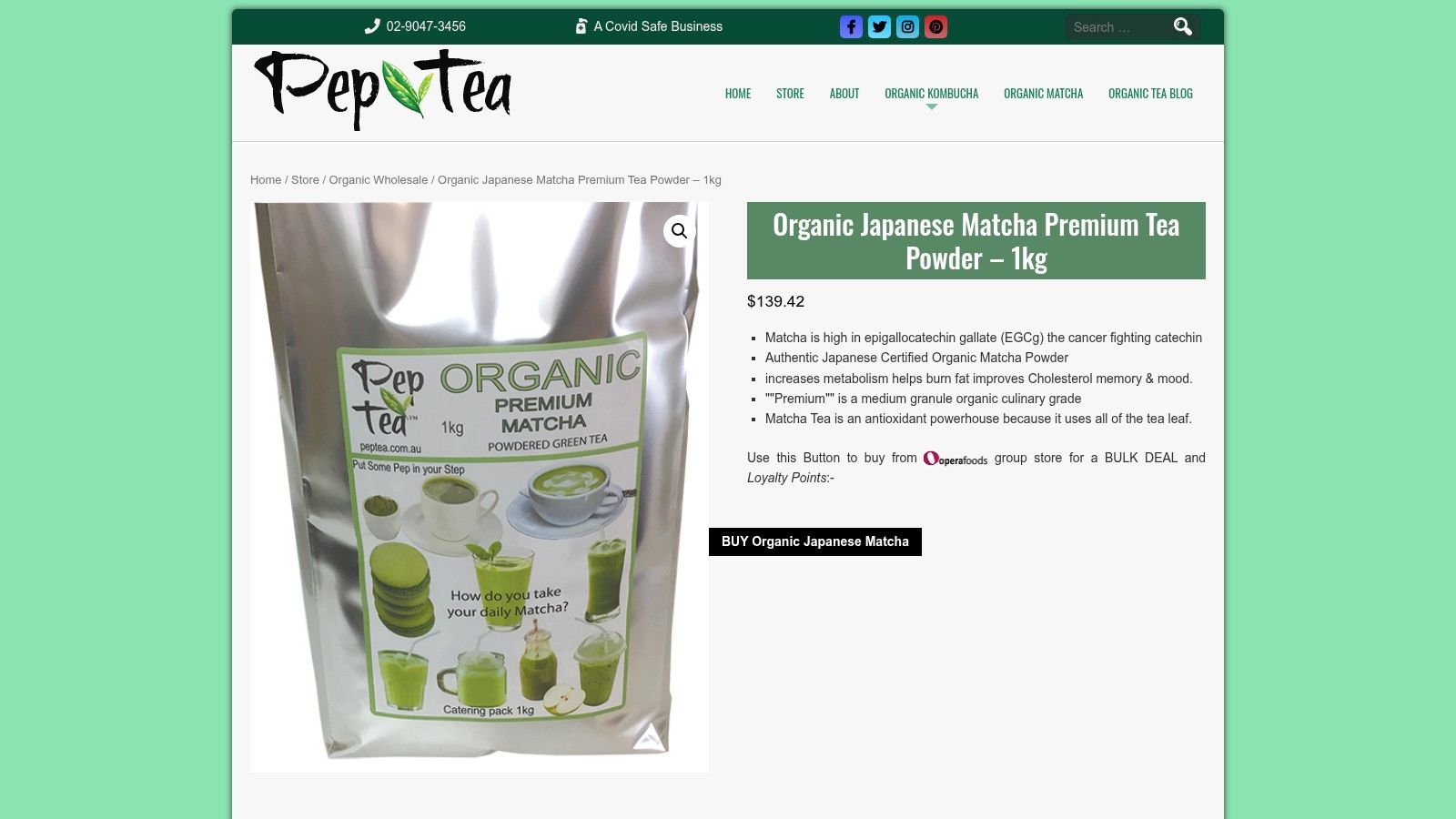
A buyer's checklist
If you're choosing for home or for a café, ask these questions:
- Is it from Japan? Specific origin tends to be a good sign.
- Is the intended use clear? Drinking matcha and cooking matcha don't have to be the same product.
- Is it certified organic? That's especially valuable with whole-leaf powders.
- Does the seller explain the grade? If the description is vague, quality often is too.
For a clearer breakdown of styles and uses, this guide to different grades of matcha can help you match the powder to the job.
Buy for purpose. If you want a clean daily drink, prioritise freshness, origin, and drinkability over flashy claims.
Common Questions on Matcha Safety and Efficacy
People often assume all green tea powders are equally safe because they're all “natural”. That's where things get murky.
Is matcha safe to drink every day
Drinking whole-leaf matcha as a beverage is a different situation from taking high-dose green tea extract supplements. That difference matters. Reporting covered by ABC Science on green tea extract and liver risk documents multiple cases in which green tea extract supplements were linked to acute liver damage and jaundice requiring hospitalisation. Brewed tea isn't typically associated with that same risk in the same way.
That doesn't mean more matcha is always better. It means whole-leaf matcha and concentrated extract pills shouldn't be treated as the same thing.
Is matcha good pre-workout
Sometimes. It depends on the workout.
If you want calm focus for walking, long sessions, yoga, or general training, matcha can fit beautifully. If you want a rapid, punchy lift for sprinting or heavy lifting, it may feel too gentle. Coverage on matcha green tea powder and caffeine timing points to the slower, steadier profile that many people like for focus, but that same profile may not suit fast-twitch performance demands.
What's the smartest takeaway
Use matcha as a beverage, not as a shortcut.
Choose high-quality whole-leaf powder. Start modestly. Notice how your body responds. And be cautious around concentrated extract products that promise a lot in very small servings.
If you'd like to try a cleaner daily tea ritual, explore Pep Tea for premium organic Japanese matcha and Australian-brewed sugar-free organic kombucha. Whether you're whisking a morning bowl, making a latte at home, or adding a functional option to your café menu, we're here to help you choose well and enjoy it properly.
Matcha Storage Container: Keep Your Tea Fresh
You open a fresh pouch of matcha, expecting that bright green colour and sweet, creamy aroma. Instead, the powder looks flat, a bit khaki, and the flavour tastes sharper than you remember. That moment is frustrating, especially when you've bought good-quality tea and treated it like any other pantry item.
This happens all the time in Australian kitchens. A tin sits near the kettle. A pouch gets folded over and clipped shut. A clear jar looks pretty on the bench. Then a humid week rolls through, the afternoon sun hits the counter, and your matcha starts losing what made it special in the first place.
A good matcha storage container isn't a decorative extra. It's part of the ritual, just like a whisk or bowl. If you're not sure how long your powder should stay fresh, this guide on matcha shelf life is a useful companion.
Why Your Matcha Loses Its Magic and How to Stop It
One of the easiest ways to understand matcha is to stop thinking of it as a tough dried tea and start treating it more like a delicate spice. If you left premium saffron, fresh vanilla powder, or a finely ground herb sitting in warm air and sunlight, you'd expect it to fade. Matcha behaves the same way, only faster.
That vivid green colour isn't just for looks. It tells you a lot about freshness. When matcha dulls, you're often also losing the soft umami notes, the clean finish, and the gentle sweetness that make ceremonial-grade tea such a pleasure to drink.
What the dull colour is really telling you
A faded powder usually means the tea has been exposed to the wrong environment. Light can affect chlorophyll. Oxygen can flatten aroma. Heat speeds up the reactions that make matcha taste stale. Moisture changes texture and can make powder clump.
In other words, the container matters because the powder is exposed on all sides.
Fresh matcha should feel alive in the bowl. If it looks tired before you whisk it, the storage setup is usually the first thing to question.
Why this matters more in Australia
Australian homes and cafés often deal with warm rooms, changing temperatures, and coastal humidity. That combination is rough on a finely milled tea powder. A loose lid or a clear jar might seem harmless in winter, then become a real problem during a humid Queensland summer or a run of hot days in NSW.
The good news is that protecting matcha doesn't require complicated gear. You just need to understand what's damaging it and choose a container that blocks those threats instead of inviting them in.
Matcha's Four Enemies Light Air Heat and Moisture
If you remember only one thing, remember this. Matcha is vulnerable because it's powdered. Once tea is ground so finely, it has far more surface area exposed to the environment. That's why a premium powder can change quickly if it's stored carelessly.
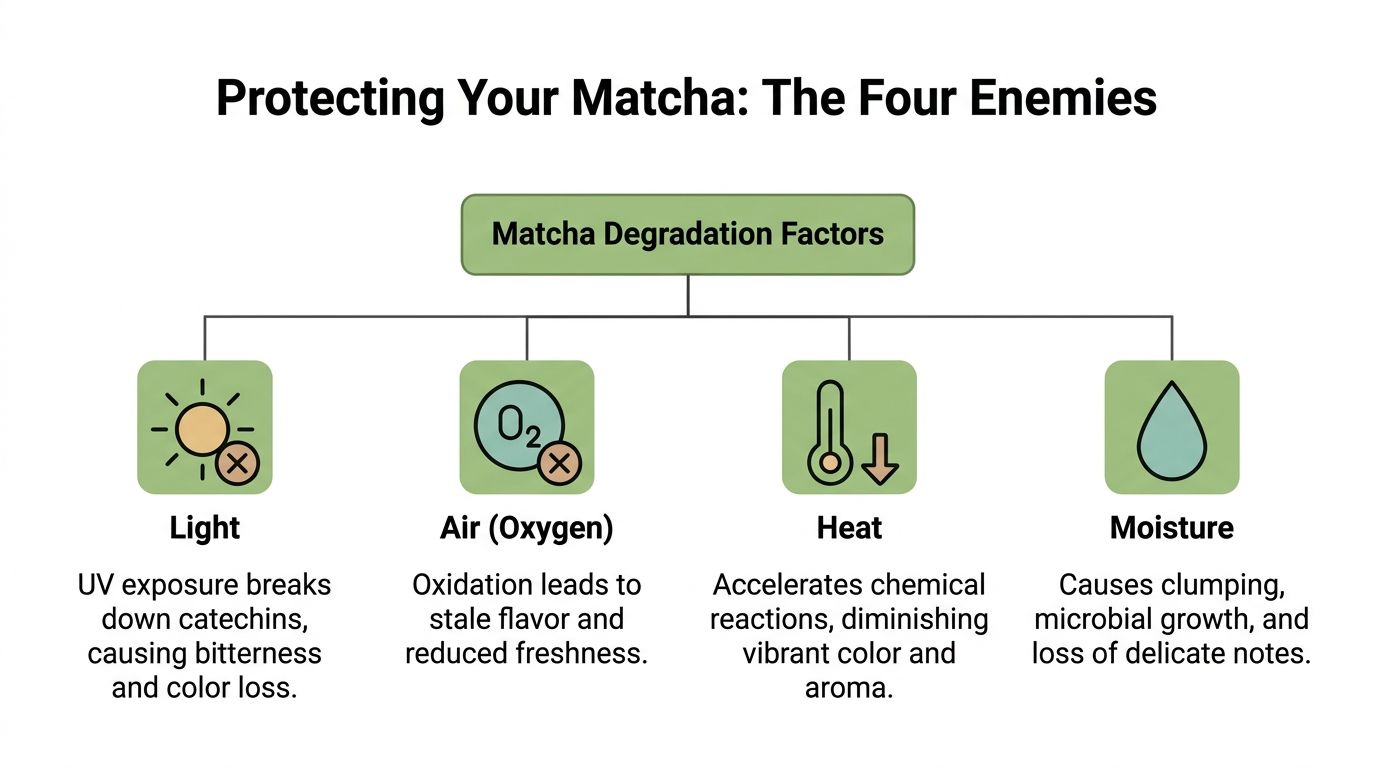
Light strips away freshness
Light is one of the easiest problems to overlook because the damage is subtle at first. A clear jar on an open shelf might look elegant, but it lets in the very thing matcha doesn't want. Over time, light exposure can fade that electric green tone and leave the powder looking duller and older than it should.
This is why opaque storage matters. If you can see your matcha through the container, light can reach it too.
Air starts the slide into staleness
Every time oxygen reaches the powder, freshness starts slipping. The aroma softens first. Then the flavour becomes flatter or rougher. If you've ever opened a container and found the smell surprisingly weak, that's often the result of too much air contact over time.
A useful analogy is ground coffee, but even more delicate. Matcha doesn't have much tolerance for repeated opening and closing if there's too much empty space in the container.
Heat speeds everything up
Heat doesn't just warm the powder. It accelerates the chemical changes that make matcha lose colour and flavour. For unopened, sealed ground matcha, quality is stable at or below 4°C but degrades rapidly above 25°C, even in sealed bags, according to Yunomi's matcha storage guidance. That matters in Australia, especially in NSW and QLD where rooms and storerooms often rise above that threshold.
A pantry can be fine in cool conditions for short-term daily use. But if the cupboard sits near an oven, dishwasher, sunny wall, or warm café service area, it isn't doing your tea any favours.
Moisture ruins texture and invites trouble
Matcha should be soft, fine, and easy to sift. Moisture changes that fast. It causes clumping, affects how the powder whiskes, and can dull the fragrance. This is why using a damp spoon or opening a cold container straight from the fridge can create problems.
Keep matcha away from steam, wet utensils, and that cupboard above the kettle. Convenience often becomes the reason freshness disappears.
A simple way to remember it
Think of matcha as a powder that wants four protections:
- Darkness so light can't fade it
- A tight seal so oxygen stays out
- Cool conditions so heat doesn't accelerate degradation
- Dry surroundings so moisture doesn't affect texture
Once those four enemies make sense, the design of the right matcha storage container becomes much easier to judge.
The Anatomy of a Perfect Matcha Canister
A strong matcha storage container does a simple job well. It creates a small, dark, sealed environment that protects a very delicate powder from the kitchen around it. The details matter, though, because plenty of containers look suitable and still fail on the basics.
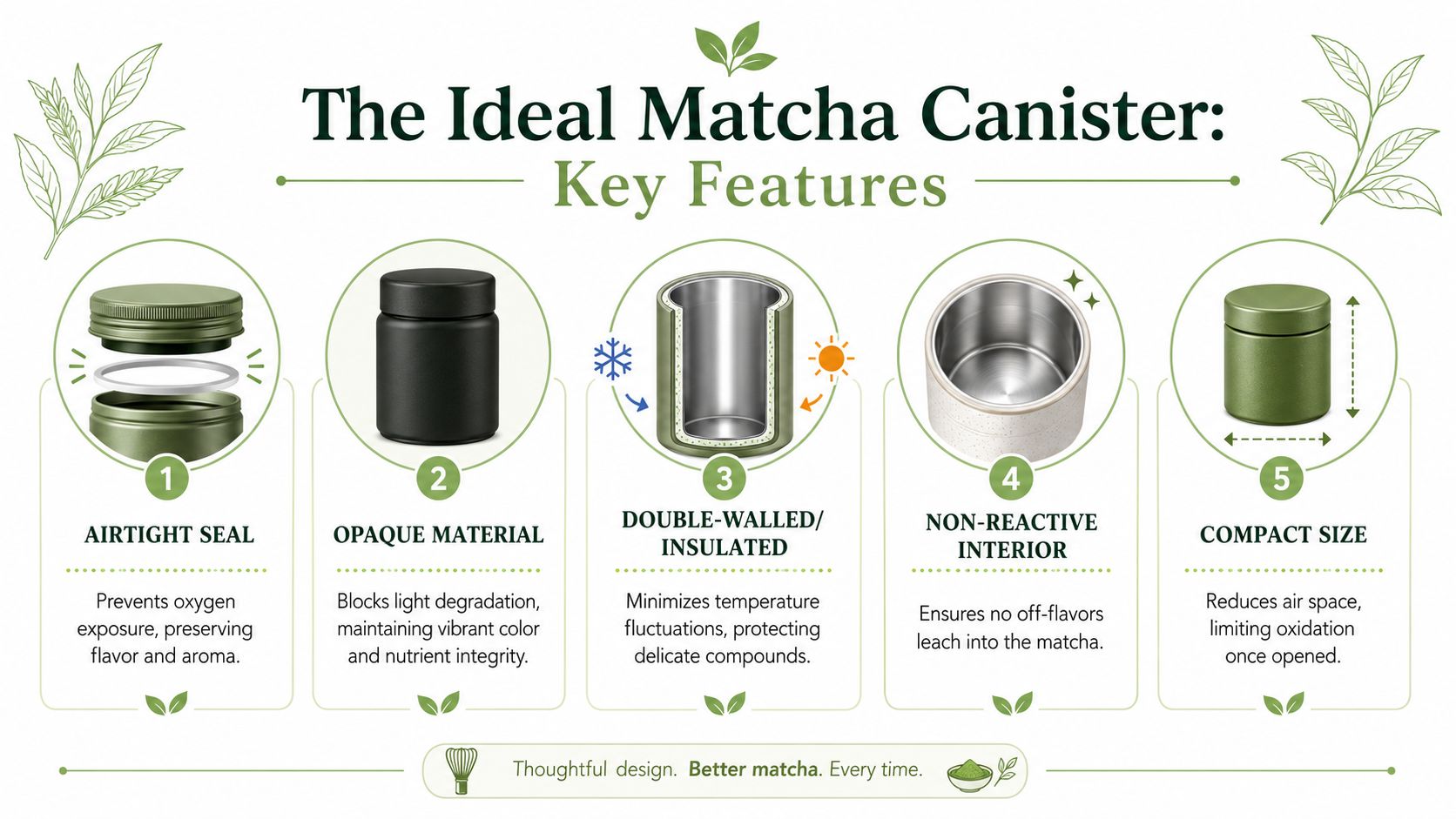
Start with the seal
The lid is the first thing to inspect. If it doesn't close firmly, the rest of the container doesn't matter much. The ideal matcha storage container must be airtight, opaque, hermetic against odour intrusion, and impervious to moisture, according to Ooika's matcha storage guide. The same source notes that 78% of matcha spoilage incidents in cafés stem from storing powder in clear glass jars or plastic bags.
That figure says a lot. Many spoilage problems don't start with bad tea. They start with the wrong vessel.
Material matters more than looks
Some materials are better suited to matcha.
| Container material | How it performs for matcha | Best use |
|---|---|---|
| Opaque metal | Excellent light protection and a strong barrier | Daily home use and café decanting |
| Ceramic with tight lid | Good light protection if fully opaque | Home storage in cool areas |
| Clear glass | Poor against light unless stored completely in the dark | Not ideal for regular use |
| Thin plastic | Often weaker against odours, air, and moisture | Best avoided for premium matcha |
Food-grade stainless steel and properly finished ceramic are usually the safest bets because they're non-reactive and easy to keep clean. Clear glass is the classic mistake. It lets you admire the colour while helping it disappear.
Shape and size affect air exposure
The best container is rarely oversized. A huge canister with a small amount of matcha inside leaves too much air around the powder after each opening. A compact canister that matches your usage is usually smarter because it limits headspace.
If you're comparing options for pantry organisation more broadly, Everti's container buyer's guide is a handy read for thinking through lid quality, material, and practicality before you buy.
Details worth checking before you buy
A good matcha canister should have:
- An opaque body that blocks light completely
- A snug gasket or tight-fitting lid to reduce air exchange
- A non-reactive interior so no stray flavours transfer to the tea
- A manageable opening that lets you scoop cleanly without spilling
- A size that suits your routine instead of leaving lots of empty space
A storage container should protect the tea first and look nice second. If it does both, that's a bonus.
If you're building a proper setup at home, a few purpose-built matcha tea accessories make the process tidier and help reduce unnecessary exposure during prep.
Finding the Right Container Size for Home Cafe or Travel
Container size isn't just about how much powder fits. It changes how often your tea meets air, heat, and movement. The right choice depends on whether you're making one bowl each morning, carrying a small amount to work, or running a busy café bar.
For home users
Most home drinkers do best with a medium canister. You want enough room for a practical amount of tea, but not so much space that half the container is air. If you drink matcha daily, keeping a smaller active canister and refilling it from a better-protected reserve supply is often the neatest system.
A small travel tin also makes sense for a desk drawer or overnight bag. It keeps your main supply safer at home and stops you opening the larger container all the time.
For cafés and busy kitchens
Commercial use needs a different rhythm. Premium stone-ground matcha is slow to produce. Traditional Japanese stone mills yield only 30 grams per hour, and a 100g batch represents roughly 3 to 4 hours of continuous grinding, as explained by The S Tradition's overview of matcha production.
That makes waste feel very different. When café teams understand how slowly premium matcha is made, they're usually quicker to stop storing it in oversized bench jars.
A practical café system often looks like this:
- Bulk reserve storage kept sealed and cold
- A smaller service canister used on the bench for short periods
- Frequent top-ups instead of leaving the full supply exposed
- A clear labelling routine so older stock is used first
If you buy in larger volumes, a catering format such as the premium 1kg organic matcha green tea catering pack makes storage planning even more important. Bulk quantity saves hassle only if the tea is portioned sensibly once opened.
A quick comparison by use case
| Use case | Best container approach | Why it works |
|---|---|---|
| Daily home bowl or latte | Medium opaque airtight canister | Easy access without excessive air space |
| Travel or office use | Small sealed tin | Less mess, less repeated opening of main supply |
| Café service | Small countertop canister plus cold bulk reserve | Faster workflow with less exposure |
| Wholesale or high-volume kitchen | Batch-based decanting system | Better stock control and cleaner handling |
The smartest setup is the one that fits your actual habits. Convenience matters, but only if it doesn't sacrifice the tea.
Practical Steps for Long-Lasting Freshness
Good storage starts the moment you open the pouch. If the transfer is rushed, the lid is loose, or the container isn't fully dry, you can shorten freshness before the tea even reaches the shelf.
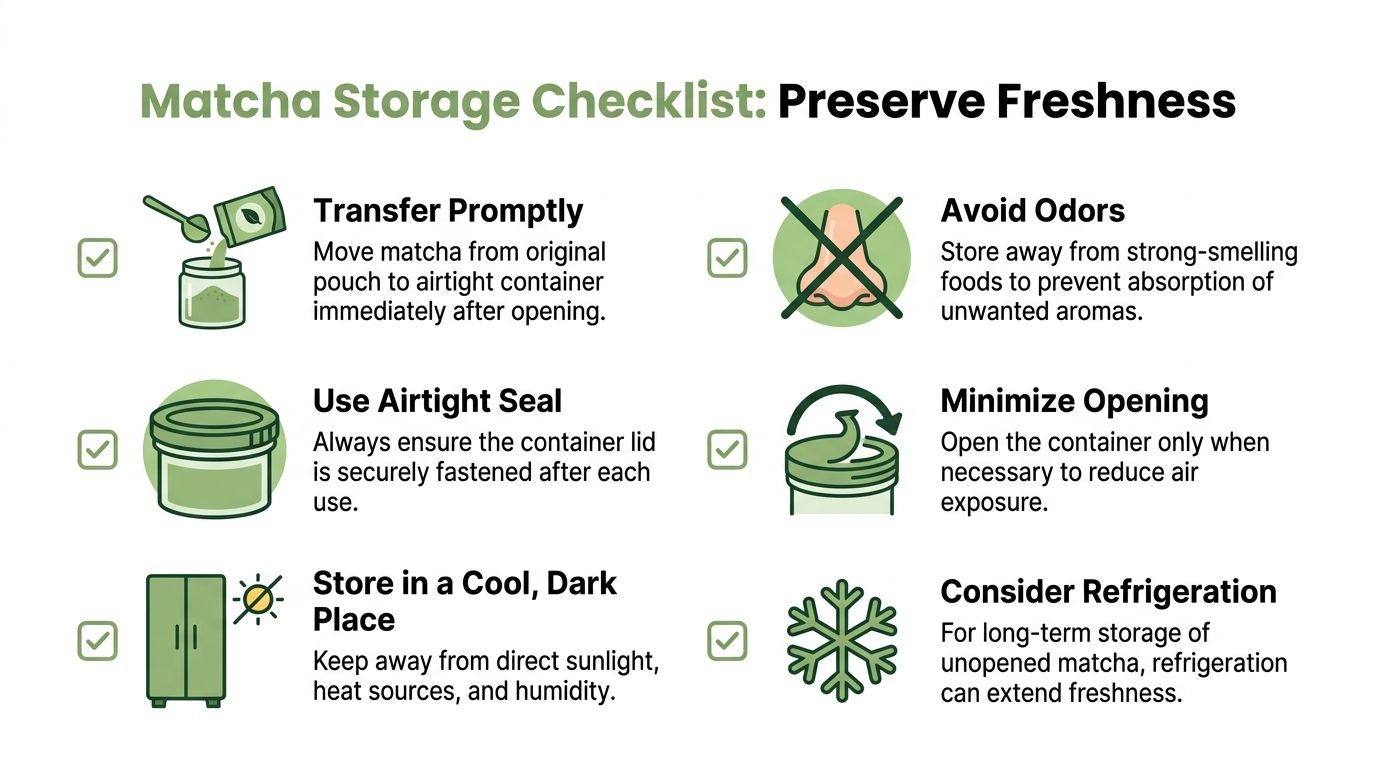
How to fill a matcha storage container properly
Use this simple routine:
- Wash the container ahead of time if it's new or has held anything else.
- Dry it completely. Not almost dry. Completely dry.
- Open the pouch only when you're ready to transfer the powder.
- Pour or spoon the matcha in quickly and gently to limit exposure.
- Seal the lid straight away and store it in the right place.
If you're reusing a canister, make sure no old powder is stuck in the corners. Tiny leftovers can affect flavour and freshness when mixed with a new batch.
Practical rule: never refill a canister that still feels cool, damp, or carries the smell of coffee, spices, or another tea.
Fridge or pantry
Refrigeration often leads to confusion. It is excellent for protecting sealed or reserve matcha, but only if you handle it carefully. To preserve the high antioxidant content and bright green colour of authentic Japanese ceremonial-grade matcha, the finished powder should be stored between 2°C and 5°C immediately after grading, as noted in Matcha Wellness Australia's production guide.
That tells us something important. Cool storage supports freshness. But daily use still needs common sense.
A reliable home method is:
- Keep your main supply cold in a sealed, moisture-safe container
- Use a smaller daily canister at room temperature if you make matcha often
- Let chilled matcha come closer to room temperature before opening so condensation doesn't form inside
- Store away from strong smells because matcha can absorb them
Here's a useful visual guide to handling and storing powder well:
Cleaning habits that protect flavour
A matcha canister doesn't need harsh cleaners or scented products. Warm water and careful drying are usually enough. If you use detergent, rinse thoroughly so no fragrance remains.
Check these habits regularly:
- Use dry scoops only so moisture never enters the container
- Close the lid immediately after measuring
- Don't store beside coffee, onions, spices, or cleaning products
- Keep the canister away from sunlight, ovens, and kettles
A good storage routine isn't fussy. It's organised.
Your Partner in Preserving Premium Matcha
A well-chosen matcha storage container protects more than powder. It protects the flavour, aroma, colour, and quiet pleasure you were hoping for when you bought the tea. Once you understand the four big threats and choose a container that blocks them, the rest becomes much easier.
The strongest setups are simple. Use an airtight, opaque container with a reliable seal. Keep it cool. Keep it dry. Match the size to how quickly you use the tea. If you do that, you give your matcha a much better chance of tasting the way it should.
That care makes a real difference over time. High-quality airtight, opaque containers with rubber gaskets can extend matcha's shelf life to 12–18 months by reducing oxidation rates by 90%, while matcha can lose up to 30% of its antioxidant potency within 3 months in non-hermetic containers, according to Aprika Matcha's storage article.
The bigger idea is this. Brewing matcha well starts before the water goes in. Storage is part of preparation. When you protect the powder properly, every bowl has a better chance of showing the tea at its best.
If you're ready to enjoy fresher bowls, brighter lattes, and better everyday matcha habits, explore Pep Tea for premium organic matcha, practical accessories, and Australian expertise that helps you get the most from every gram.
Ceremonial vs Culinary Matcha: A Complete Guide for 2026
Most advice on ceremonial vs culinary matcha gets one thing wrong straight away. It treats “ceremonial” and “culinary” like official Japanese grades, as if one is formally certified as superior and the other is a lesser version.
That's not how matcha works.
In practice, those labels are best understood as usage terms. They tell you what a powder is intended for. One is generally suited to being whisked with water and enjoyed on its own. The other is usually built to perform in lattes, smoothies, desserts, and baking. That distinction matters far more than the badge on the tin.
A lot of Australian shoppers are understandably confused. One source notes that in Japan there is no official grading system for “ceremonial” versus “culinary”, and that these labels were created by Western brands to indicate intended use. The same source says 68% of Australian matcha buyers in 2025 reported confusion over grade terminology in a Nielsen AU survey on functional beverage trends, according to Ooika's explanation of ceremonial vs culinary matcha.
If you remember only one idea, make it this one: buy matcha for the job you want it to do.
Here's a quick side by side view before we get into the details:
| Feature | Ceremonial matcha | Culinary matcha |
|---|---|---|
| Main purpose | Drinking with water | Mixing into recipes |
| Leaf selection | Young, tender spring leaves | Older or later harvest leaves |
| Colour | Bright, vivid green | More muted green |
| Taste | Sweet, umami, low bitterness | Bolder, earthier, more astringent |
| Texture | Very fine and silky | Often less delicate |
| Best uses | Straight matcha, mindful sipping | Lattes, smoothies, baking, desserts |
| Price | Usually higher | Usually more accessible |
Practical rule: If you want to taste the matcha itself, choose ceremonial style. If milk, fruit, chocolate, or heat are involved, culinary usually makes more sense.
From Leaf to Powder The Production Journey
Both ceremonial and culinary matcha begin with the same plant, Camellia sinensis. The split happens in the field.
For ceremonial-grade matcha, growers focus on the youngest, most tender leaf material. One detailed production guide explains that ceremonial matcha is made from the youngest two leaves at the tip of new shoots, harvested in spring, typically mid-April to mid-May, after 4 weeks of shading under bamboo mats or dark cloth that can block up to 90% of sunlight to build chlorophyll and L-theanine, as outlined in this explanation of how matcha is made.
That shading step changes everything. Less direct light pushes the plant toward a deeper green colour and a softer flavour profile. The leaves are being prepared for a bowl where there's nowhere to hide.
Two leaves, two futures
Think of two tea leaves from the same garden.
The first is selected from the delicate spring flush. It's shaded carefully, picked young, then handled with a lot of restraint because the final powder needs to taste balanced with nothing more than water.
The second comes from a later harvest or from older leaves chosen for strength rather than delicacy. It still becomes matcha, but it's expected to hold its own in a latte, biscuit batter, smoothie, or soft serve. That demands a sturdier personality.
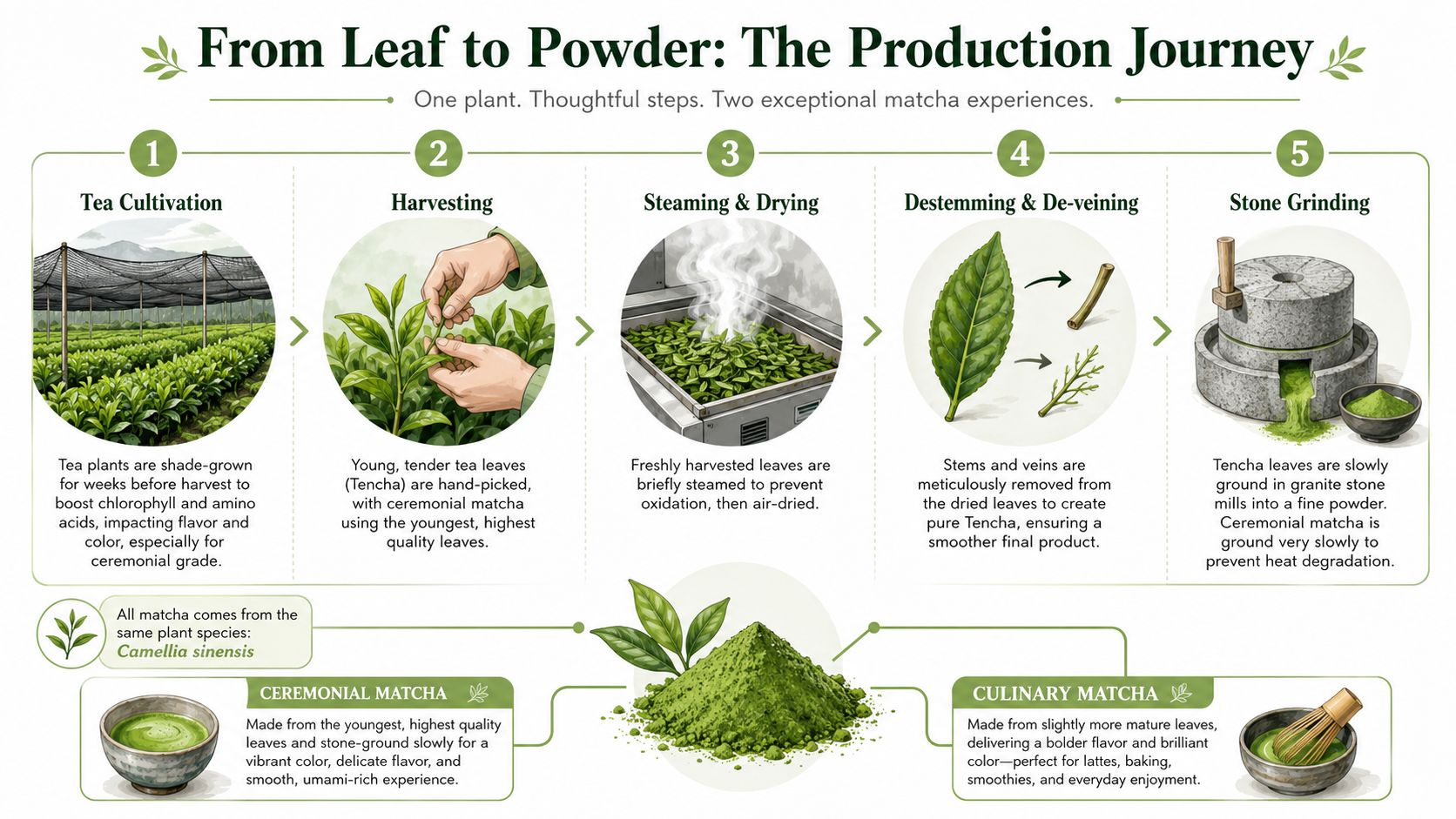
The production path after harvest is careful for both styles. Leaves are steamed to stop oxidation, dried, and stripped of stems and veins to create tencha before grinding. But when the goal is premium drinking matcha, each decision is tighter and less forgiving.
Why the field matters more than the label
You can't fix poor leaf selection later with fancy packaging. The matcha's character is shaped early by:
- Shading method: Longer, more intensive shade growing supports the sweet, soft style people expect from ceremonial matcha.
- Harvest timing: Spring leaf material is prized for delicacy, while later harvests lean stronger and more assertive.
- Leaf age: Younger leaves tend to deliver a gentler cup. Older leaves bring more bite.
- Final purpose: Producers don't process every batch with the same intended use in mind.
If you want a deeper look at that farm-to-powder process, how matcha tea is made is worth reading.
A Difference You Can See Smell and Taste
Open the tin before you taste anything. Your eyes will usually tell you a lot.
Ceremonial matcha tends to look lively and bright. Culinary matcha often appears more subdued. One Australian reference explains that ceremonial matcha comes from the youngest leaves of the first harvest and can show more than 15% higher chlorophyll concentration, which helps create that vivid green colour and sweet, umami-forward flavour. The same source notes that culinary matcha is generally duller green, more astringent, and better suited to lattes and baking, according to Pure Matcha's guide to ceremonial and culinary differences.
What to look for in the powder
A good ceremonial powder often looks almost luminous. It usually has a finer, softer appearance in the bowl. Culinary powder can still be good quality, but it's commonly less radiant and a touch more practical than precious.
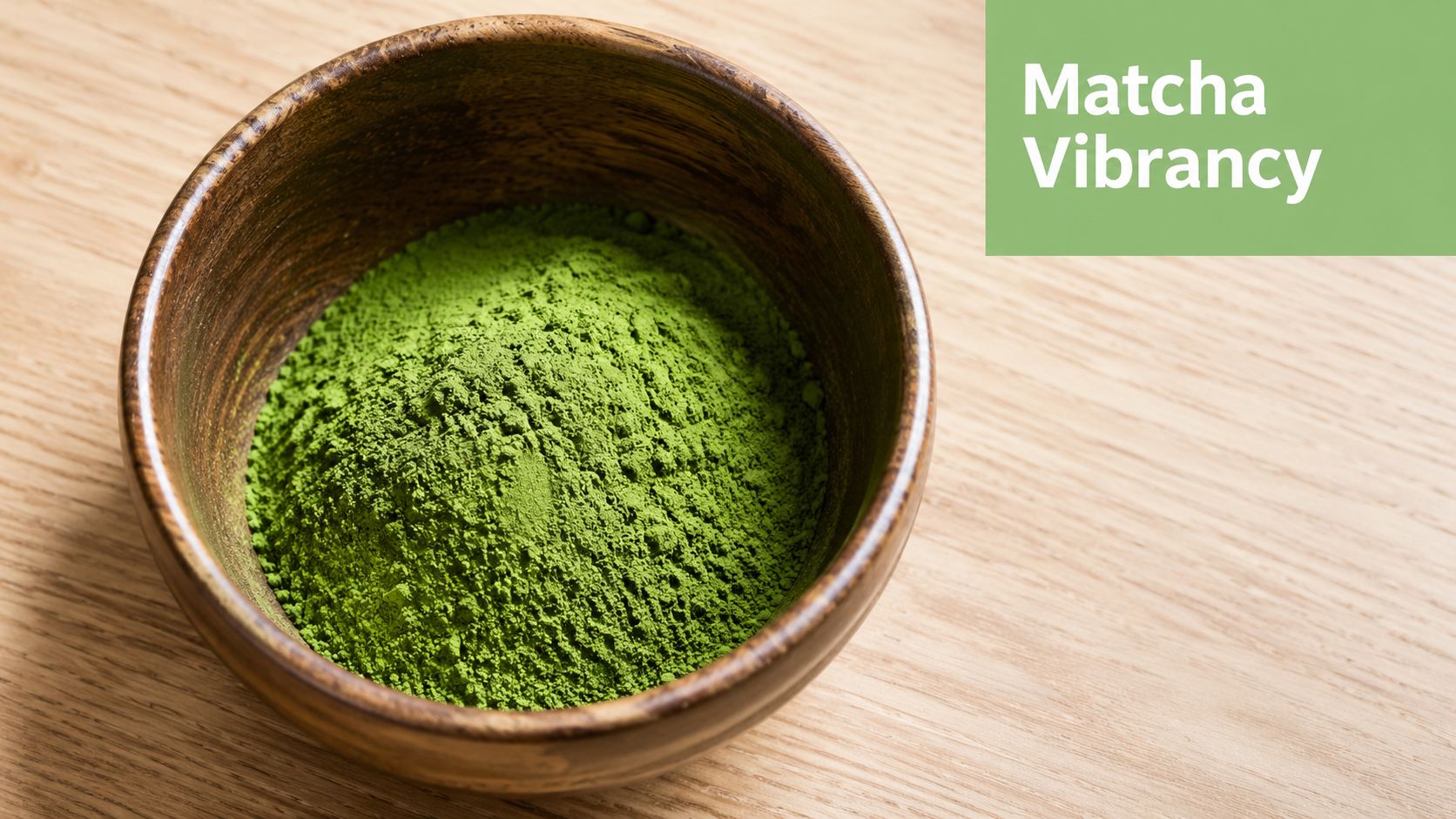
Use this quick sensory check:
- Colour: Ceremonial usually leans bright green. Culinary often looks flatter or more olive-toned.
- Aroma: Ceremonial tends to smell fresh, grassy, sweet, and savoury. Culinary is usually bolder and more direct.
- Texture: Drinking-grade matcha should feel very fine. A recipe-focused powder may feel a little less silky.
- Taste: Ceremonial aims for softness and umami. Culinary aims for presence.
What happens in the cup
Whisk ceremonial matcha with water and you should notice a smooth, rounded taste with minimal bitterness. It's the sort of matcha you sip slowly because the flavour is the point.
Culinary matcha behaves differently. On its own, it can taste firmer, earthier, and more drying. Add milk or sweetener, though, and that structure becomes an advantage. The stronger flavour keeps showing up instead of disappearing behind the rest of the drink.
A latte made with delicate ceremonial matcha can taste lovely, but it can also be a waste of subtle flavour. A strong culinary matcha often performs better because it was built for that role.
Why Is Premium Matcha More Expensive
The price gap between ceremonial and culinary matcha isn't just branding. A lot of it comes down to labour, pace, and how much powder a producer can realistically make.
Traditional stone milling is the clearest example. Authentic Japanese matcha made this way is ground very slowly to keep the powder fine and to avoid heat building up during processing. According to The S's Traditions explanation of matcha production, a traditional stone mill yields only 30 grams per hour, and producing 100 grams of premium powder can take roughly 3 to 4 hours.
That helps explain why good ceremonial matcha doesn't come cheaply. It's not only about exclusivity. It's about throughput. You can't rush this process and still expect the same result.
Where the cost comes from
Ceremonial matcha usually costs more because several high-effort choices stack together:
- More selective picking: The youngest leaf material is limited and carefully chosen.
- More demanding cultivation: Shade growing takes planning and close management.
- Traditional milling: Slow grinding preserves texture and character, but output is low.
- Smaller margin for flaws: When matcha is meant to be drunk plain, every rough edge shows.
Culinary matcha is usually more economical because it can be made from later harvests or slightly older leaves, and some producers use more modern grinding systems with higher output. That doesn't make it inferior across the board. It makes it fit for a different use case.
Expensive doesn't mean better for every job
A common mistake is assuming the most expensive matcha is always the smartest buy. It isn't.
If you're making an iced vanilla matcha latte, blending matcha into banana oats, or whisking it into muffin batter, subtle sweetness and fine aromatic detail can get buried. In those settings, a bold culinary powder often gives you a clearer matcha flavour at a more sensible cost.
Worth remembering: Price tells you something about craftsmanship. It doesn't tell you whether that matcha is right for your recipe.
Calm Focus vs Bold Flavour Nutritional Contrasts
Here's the part that often gets oversimplified. “Ceremonial” and “culinary” are not official nutrition categories from Japan. They are marketing labels that usually point to intended use, so the key question is not which one is “healthier” in the abstract. It is which powder suits the way you use it.
Both styles come from the same plant, and with matcha you consume the whole leaf in powdered form rather than steeping and discarding it. That is why both can contribute catechins, chlorophyll, caffeine, and L-theanine. The differences are usually a matter of degree, driven by factors like shading, harvest timing, and leaf selection.
Ceremonial-style matcha is often associated with a softer, steadier feeling and a sweeter, more umami-led cup. Culinary-style matcha tends to taste stronger, greener, and more direct, which is exactly why it works so well in recipes. Flavour shapes perception here. A smoother matcha can feel gentler to drink plain, while a punchier one can feel more lively because the bitterness and astringency stand out more clearly.
What that can feel like in a cup
L-theanine is one reason matcha is often described as giving calm focus instead of the sharper lift some people get from coffee. Still, it helps to keep expectations sensible. Ceremonial-style matcha is not a special wellness tier, and culinary matcha is not suddenly lacking in benefits. They tend to deliver a different balance of taste and sensation.
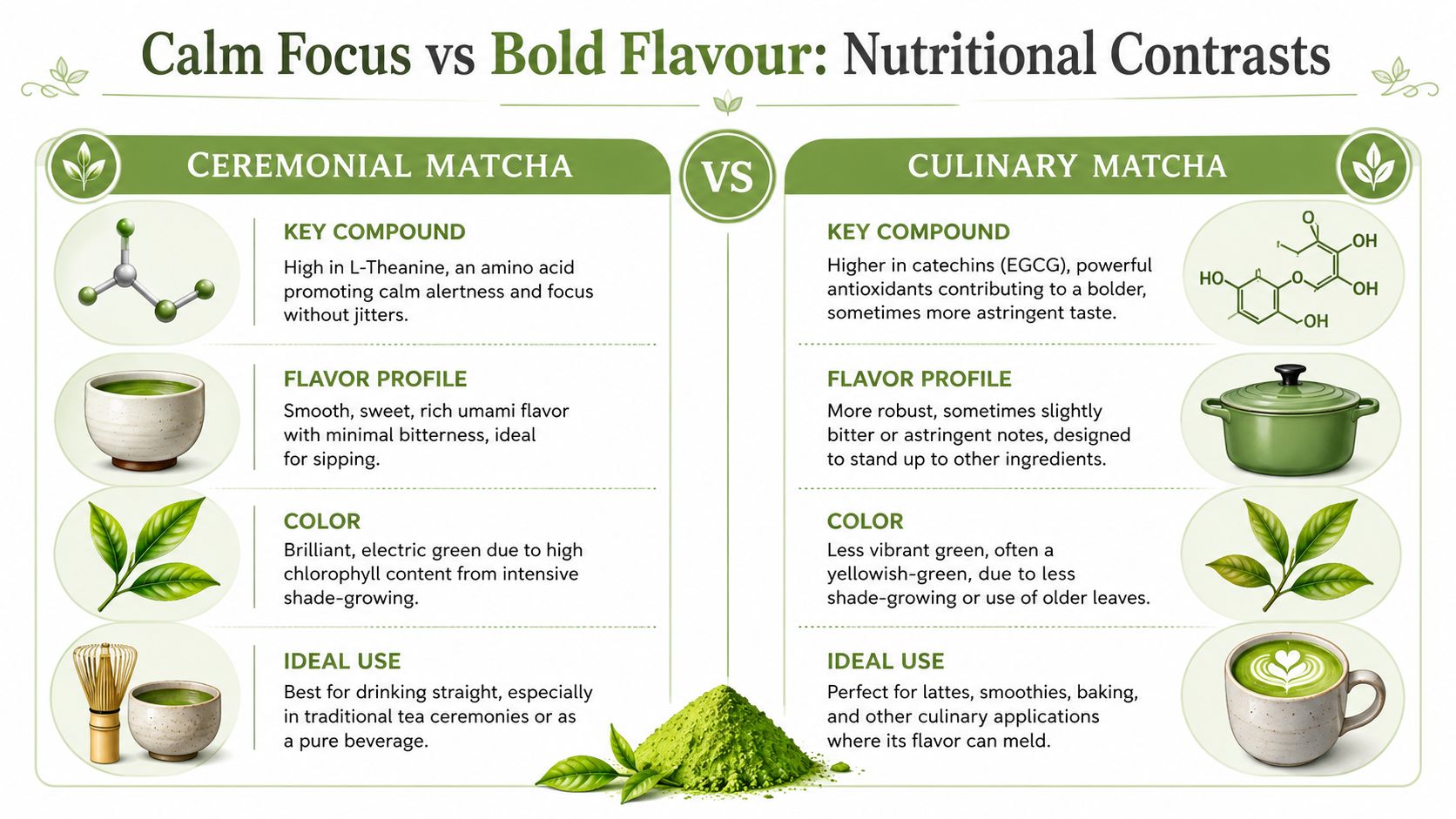
A practical way to read the difference is this:
| Matcha type | Typical feel | Flavour expression | Best fit |
|---|---|---|---|
| Ceremonial | Smoother, calmer, more centred | Sweet, umami, softer finish | Morning bowl, mindful break, straight whisking |
| Culinary | Brisker, more assertive | Stronger green tea character | Lattes, smoothies, baking, recipes |
If you want a clearer primer on how these labels are used, our guide to different grades of matcha explains where the names help and where they can mislead.
A good rule is to judge matcha the way you would judge cooking chocolate versus single-origin chocolate for eating. Both come from cacao. Both have value. You just notice different qualities depending on how you use them.
A lot of tea drinkers also ask about antioxidants such as EGCg. Matcha is well regarded partly because the whole leaf is consumed, so both styles can fit neatly into a daily routine. The more useful question is simple. Which one will you enjoy often enough to use well?
For a visual explainer, this video gives a helpful overview:
Choose for the experience, not the label
If you like whisking matcha with water and noticing sweetness, creaminess, and a lingering umami finish, ceremonial-style powder usually makes more sense.
If your usual order is an iced latte, a smoothie, or weekend baking, culinary-style matcha is often the smarter pick because its flavour stays present once milk, oats, vanilla, or sugar enter the mix.
That is the key distinction. Not a formal Japanese hierarchy. A difference in application.
The Right Matcha for the Job How to Use Each Grade
The easiest way to stop overthinking ceremonial vs culinary matcha is to treat them like different kitchen tools. You wouldn't use a chef's knife for peeling apples if a small paring knife is the better fit. Matcha works the same way.
One producer notes that culinary-grade matcha often uses slightly older leaves or later harvests, creating a more astringent, less umami-rich profile suited to lattes and baking, while ceremonial-grade matcha sticks to first-flush, fully shaded, hand-picked, stone-ground tencha for delicate sweetness and frothability, as described in Pure Matcha's production notes.
Best uses for ceremonial matcha
Ceremonial matcha shines when water is the main companion.
Try this simple method at home:
- Sift a small amount of matcha into a bowl to remove clumps.
- Add a splash of warm water and make a smooth paste.
- Pour in more warm water and whisk briskly until a fine foam forms.
- Drink it straight away while the aroma is fresh and the texture is lively.
This style suits anyone who wants to notice sweetness, umami, and a softer finish. It's also the better choice for a traditional presentation at home or in a café tasting.
Best uses for culinary matcha
Culinary matcha comes alive when other ingredients enter the mix.
It works especially well for:
- Lattes: Its bolder profile cuts through dairy and plant milks.
- Smoothies: Banana, mango, yoghurt, oats, and spinach won't overpower it as easily.
- Baking: Muffins, cookies, cheesecakes, pancakes, and slices hold the flavour well.
- Desserts: Matcha icing, custard, ice cream, and energy balls all benefit from that stronger edge.
A practical trick for lattes is to sift the powder first, whisk it with a little warm water into a slurry, then add milk. That avoids green clumps floating on top.
If you'd like a clearer overview of which powder suits which preparation, different grades of matcha gives a useful starting point.
If your recipe includes milk, sweetener, fruit, chocolate, vanilla, or baking heat, culinary matcha is usually the safer pick.
How to Choose and Buy Authentic Matcha in Australia
The smartest matcha buyers in Australia ignore the hype first and read the details second.
The biggest myth to let go of is this: ceremonial and culinary are not official Japanese regulatory grades. They are market terms used to guide intended use. Once you understand that, shopping gets much easier. You stop asking, “Which one is the top grade?” and start asking, “Which one suits what I'm making?”
A checklist that actually helps
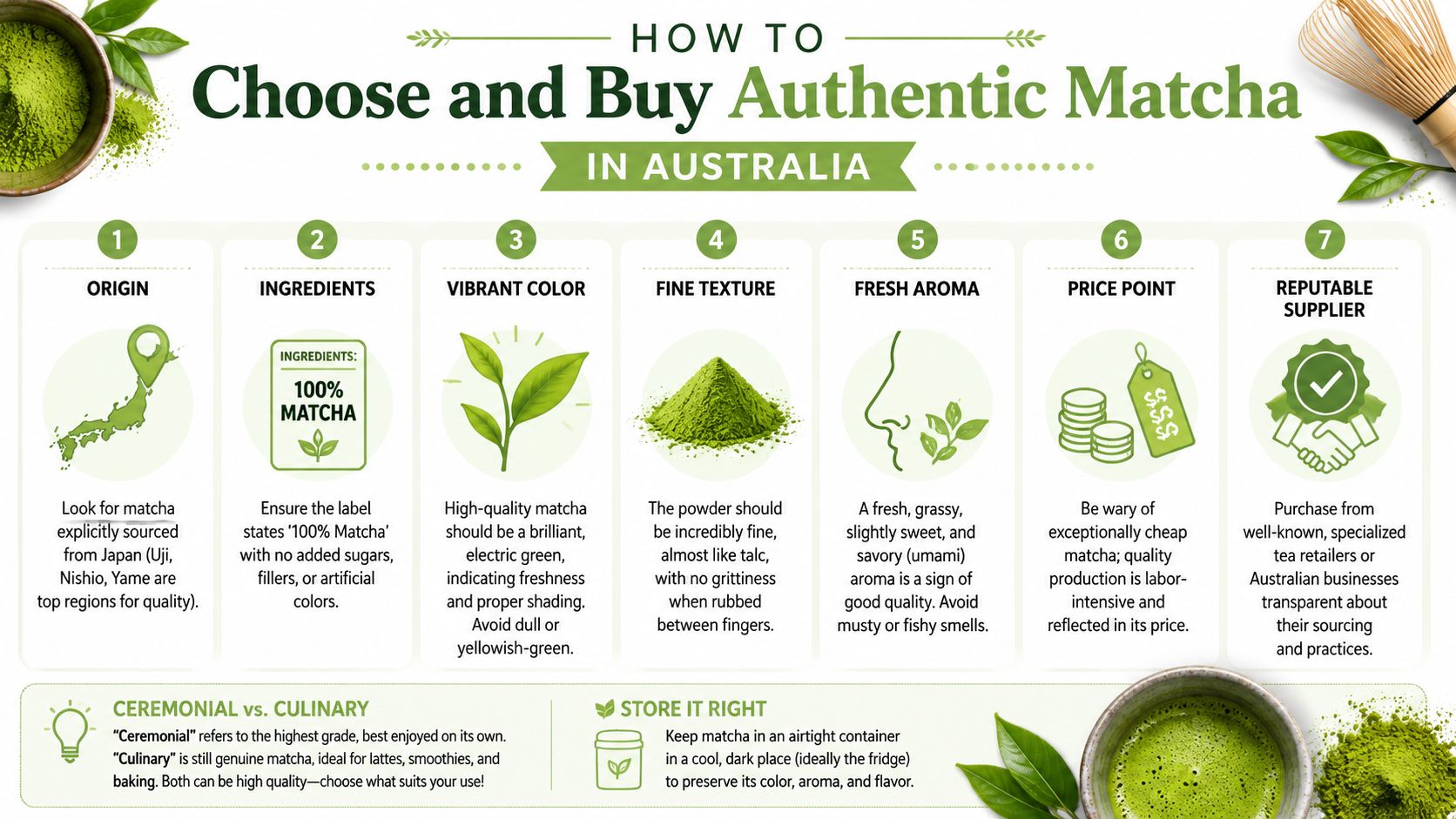
Use this buying checklist when comparing tins online or in store:
- Origin matters: Look for matcha sourced from Japan.
- Ingredient list: It should say 100% matcha. No fillers, sugars, or flavouring if you want a pure product.
- Colour check: Fresh, high-quality matcha should look bright and lively, not flat or brownish.
- Texture clue: Fine powder usually signals better milling and a smoother cup.
- Aroma test: Fresh matcha should smell grassy, clean, and slightly savoury.
- Packaging: Airtight tins or well-sealed packs help protect freshness.
- Seller transparency: Good retailers usually tell you where the matcha comes from and how it's meant to be used.
What to avoid
A few red flags show up again and again:
| Sign | Why it matters |
|---|---|
| Dull, khaki, or brown-leaning powder | Often points to age, poor handling, or lower quality leaf material |
| No origin information | Makes it hard to assess authenticity |
| Vague “superfood blend” wording | May mean it isn't pure matcha |
| A very cheap price with premium claims | Can signal mismatch between marketing and quality |
Storage matters after purchase too. Matcha loses its best character when exposed to air, light, heat, and moisture. Keep it sealed, cool, and out of direct light. If you buy it for plain drinking, freshness becomes even more important.
For a broader look at buying quality tea online, organic green tea online can help you compare what trustworthy tea retailers tend to disclose.
Your Matcha Questions Answered
Can I drink culinary matcha plain
Yes. You can whisk culinary matcha with water and drink it on its own.
The catch is expectation. If you want a soft, creamy bowl with gentle sweetness, culinary matcha can feel sharper, more bitter, or a bit more drying on the palate. If you already enjoy stronger green tea flavours, though, plain culinary matcha may suit you just fine.
Is ceremonial matcha always better
Use decides what “better” means.
This is the part many shoppers miss. “Ceremonial” and “culinary” are not official Japanese grades sitting on a legal ladder from best to worst. In Australia and other Western markets, they are usually shorthand for intended use. Ceremonial usually points to matcha chosen for drinking with water. Culinary usually points to matcha chosen for lattes, smoothies, desserts, and baking.
So if you are making usucha at home, ceremonial-style matcha often gives a smoother result. If you are blending with milk, chocolate, banana, or vanilla, culinary matcha is often the smarter buy because its bolder character still comes through.
Is more expensive matcha always worth it
Price matters most when the matcha is the whole show.
In a plain bowl, you can notice the finer texture, sweeter aroma, and cleaner finish that often come with a better matcha. In a banana smoothie or brownie batter, those subtleties can disappear quickly. Paying more only makes sense if your preparation lets you taste what you paid for.
What's the easiest way to choose between ceremonial vs culinary matcha
Start with your cup, not the label.
Ask yourself, “Will I mostly drink this with water, or with other ingredients?” That one question clears up a lot of confusion. Water-first drinkers should usually choose ceremonial-style matcha. Latte and recipe fans should usually choose culinary-style matcha.
How should I store matcha once opened
Keep it tightly sealed and away from light, air, heat, and moisture.
A cool cupboard is usually enough. If you store it in the fridge, use a very well-sealed container and let it come back to room temperature before opening. That helps stop condensation from settling into the powder.
Is it worth keeping both at home
For plenty of households, yes.
A small tin for straight whisking and a separate pouch for lattes or baking is a practical setup. It is a bit like keeping one olive oil for finishing and another for cooking. You use each one where it performs best, and you waste less money trying to make one product do every job.
What's the biggest mistake beginners make
Treating “ceremonial” as proof of quality all by itself.
A better approach is to read the full picture. Look at intended use, origin, freshness, colour, texture, and how clearly the seller explains the product. A trustworthy matcha listing should help you choose the right powder for your habits, not just wave a premium label around.
If you're ready to try both styles with confidence, explore Pep Tea for premium organic Japanese matcha and a broader range of functional organic drinks, including Australian-brewed sugar-free kombucha from the Hunter Valley, NSW.
Matcha Collagen Powder: Your 2026 Australian Guide
You're probably here because your routine already feels crowded. Maybe you've got a tin of matcha in the pantry, a collagen tub on the bench, a half-finished smoothie plan in your head, and a genuine desire to feel better without turning breakfast into a chemistry set.
That's exactly why matcha collagen powder has caught on with health-conscious Australians. It brings together two habits people were already building separately. One for steady, cleaner-feeling energy. One for skin, joints, and everyday support. Put them together in one scoop, and the ritual gets simpler.
The appeal isn't just convenience. It's also about choosing functional ingredients that still feel like food and drink, not a chore. For people juggling work, training, family life, café catch-ups, and a growing interest in low-sugar wellness, matcha collagen powder lands in a sweet spot.
The New Centrepiece of Your Wellness Routine
A lot of people don't need more supplements. They need fewer moving parts.
Think about a typical weekday. You wake up wanting focus, but not the shaky edge that can come from overdoing coffee. By lunchtime, you're also thinking about bigger picture goals like supporting your skin, keeping joints comfortable, or building a routine you'll stick to. Matcha collagen powder fits neatly into that moment because it turns two separate intentions into one daily habit.
For some people, that habit looks like a warm morning latte before work. For others, it's a smoothie after a walk, a gym session, or the school drop-off. The format is flexible, and that matters. Wellness routines only work when they can survive real life.
Why this blend feels different
Matcha already has a strong following in Australia because it offers a more mindful kind of lift. Collagen has become popular for similar reasons. It feels practical, easy to add, and connected to long-term wellbeing rather than quick-fix energy. Together, they create a modern ritual that suits people who want both focus and support in the same cup.
Matcha collagen powder works best when it replaces friction, not when it adds another complicated step to your day.
It also suits the way many people now shop and ask questions. They want cleaner labels, fewer fillers, and straightforward explanations. Brands in wellness are paying more attention to that demand, and tools like a Shopify chatbot for wellness brands show how much education matters when customers are choosing between ingredients, formats, and claims.
Who usually loves it most
A matcha collagen routine often appeals to:
- Busy professionals: They want a calm, organised start rather than a harsh caffeine spike.
- Active adults: They like a product that feels supportive without becoming a full supplement stack.
- Café regulars and home baristas: They enjoy the ritual of whisking, blending, and sipping something that feels premium.
- People cutting back on sugar: They're looking for functional drinks that don't taste like dessert disguised as wellness.
That blend of practicality and ritual is why matcha collagen powder has become more than a trend. For many people, it becomes the thing they actually use consistently.
How Matcha and Collagen Work Better Together
The simplest way to understand matcha collagen powder is to think of it as a team effort.
Collagen peptides do the rebuilding work. They provide amino acids such as glycine, lysine, and proline, which the body uses for structural repair. Matcha brings the protective side. Its catechins, especially EGCG, help defend against oxidative stress that can damage collagen before the body can make good use of it. According to NIH technical data, oral collagen supplementation increased skin elasticity by 13.6% within 8 weeks, and matcha collagen powder is described as leveraging a synergistic mechanism where matcha's catechins inhibit oxidative degradation of collagen peptides while the peptides supply those structural amino acids.
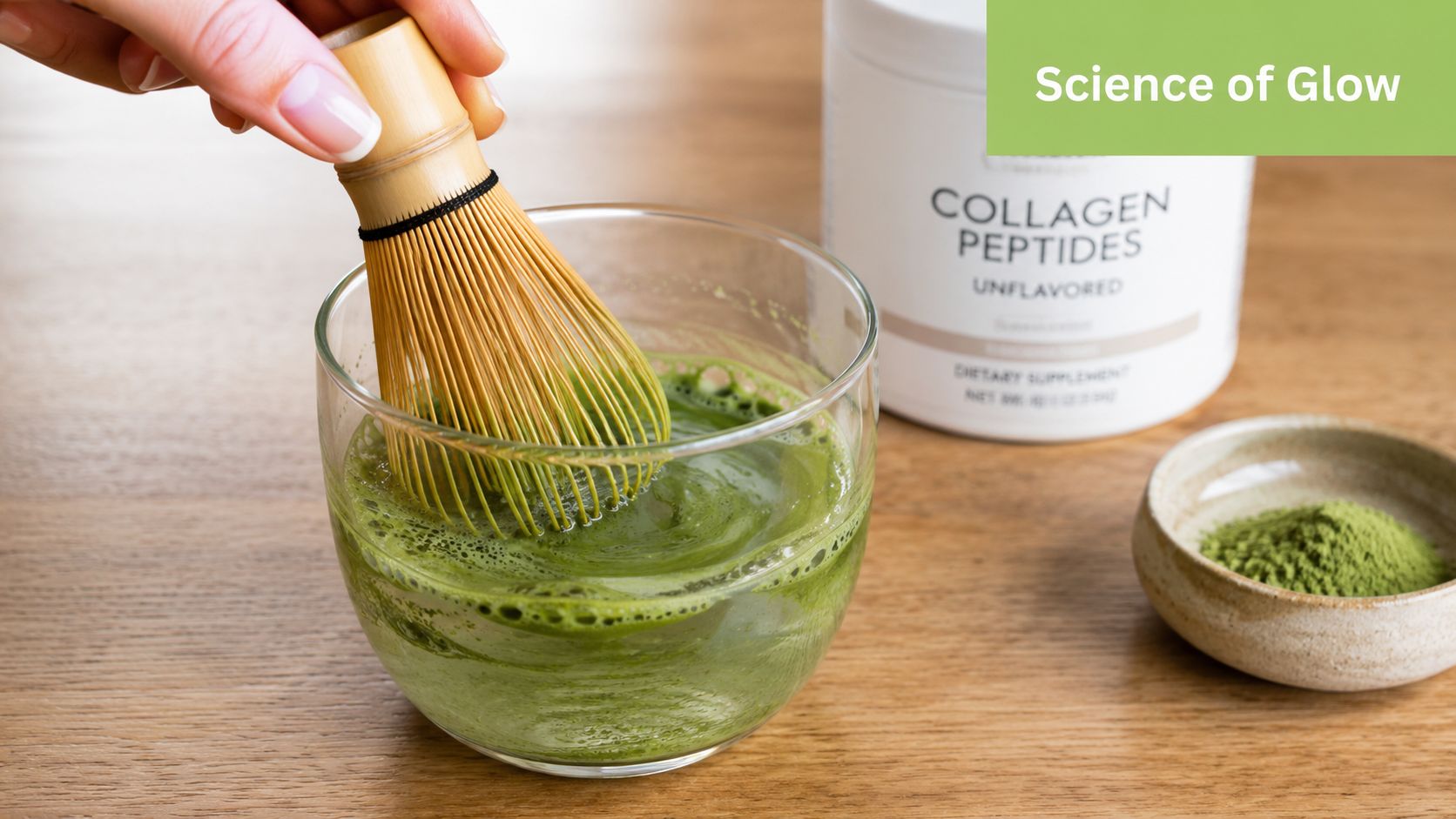
The construction crew analogy
Picture a building site.
The collagen peptides are the construction crew. They arrive with the raw materials needed for repair and maintenance. The matcha antioxidants are the security team around the site. They protect the crew and the materials from damage while the work is happening. Without that protection, the environment is tougher. With it, the repair job has a better chance of staying on track.
That's the key idea behind the blend. It isn't just two fashionable ingredients sharing a label. Each one does a different job.
Why the pairing makes sense in real life
The science offers practical benefits. People usually notice matcha first because of how it feels. Smoother focus. A cleaner ritual. Less of the wired feeling some get from stronger stimulant drinks. Collagen is less noticeable in the moment, but people choose it because they want ongoing support, not just a quick lift.
When those two needs come together, the product becomes easier to use consistently.
A few quality factors also shape how effective and pleasant it feels:
- Japanese matcha matters: Higher-quality matcha tends to bring a cleaner taste and a better everyday drinking experience.
- Hydrolysed collagen matters: This form is processed for easier mixing and absorption.
- Low-clump solubility matters: If a powder blends smoothly, people keep using it.
Practical rule: If your matcha collagen powder tastes grassy in a harsh way, forms stubborn lumps, or leaves you avoiding it after a week, the formula probably isn't doing the ritual side of wellness any favours.
If you want a stronger grounding in the tea side of the equation, this guide on what matcha powder is helps explain why shade-growing, stone-grinding, and grade all influence flavour and function.
Matcha Collagen Versus The Alternatives
A fair question comes up all the time. Why not just drink matcha on its own and take collagen separately?
You can. For some people, that's the right setup. But a combined powder changes the experience in a few useful ways. It reduces prep, keeps the flavour profile in one place, and gives you a more efficient habit to repeat each day.
The other important point is ingredient quality. Organic Japanese Matcha contains 137 times the concentration of antioxidants compared to standard brewed green tea, according to this matcha and collagen overview. That's one reason matcha isn't interchangeable with every green tea-flavoured powder on the shelf.
The side-by-side view
| Factor | Matcha Collagen Powder | Matcha Only | Collagen Only |
|---|---|---|---|
| Convenience | One scoop, one routine | Simple drink, but no collagen built in | Easy to add, but usually needs a separate drink |
| Functional range | Combines focus ritual with collagen support | Best if your priority is tea ritual and antioxidants | Best if your priority is collagen alone |
| Taste experience | Can be balanced into one formula | Pure tea flavour, often more vibrant | Usually neutral, but not especially enjoyable on its own |
| Daily consistency | Easier for many people to repeat | Strong if you already love preparing matcha | Strong if you already use collagen every day |
| Flexibility | Good for lattes, smoothies, and recipes | Excellent for traditional tea and café-style drinks | Easy to hide in foods and drinks |
| Who it suits | People who want fewer steps | Matcha purists | People who don't care about tea flavour or ritual |
Where separate products still make sense
Separate products can work well if you're very particular about both ingredients.
A traditional matcha drinker might want ceremonial matcha on its own, prepared carefully with water only. Someone else may prefer an unflavoured collagen they can stir into oats, soups, or baking. That approach offers control, especially if you like adjusting flavour and dosage independently.
Still, there's a reason combined formulas appeal to busy households and cafés. One product often means less mess, fewer decisions, and a clearer habit loop.
The real decision point
This usually comes down to your main goal.
Choose a combined powder if you want:
- Less friction: One product is easier to remember than two.
- A built-in ritual: It turns support ingredients into something enjoyable to drink.
- A café-friendly format: It works well in lattes and smoothies without extra steps.
Choose separate products if you want:
- Maximum customisation: You can change your tea and collagen independently.
- Pure matcha sessions: Useful if you care a lot about traditional preparation.
- Different use cases: You may want collagen in food and matcha only as tea.
People who are also reviewing broader protein options may find this guide to protein powder substitutes useful when thinking about how collagen blends compare with other pantry staples.
In short, matcha collagen powder isn't automatically better than separate products. It's better for the person who values ease, consistency, and a two-in-one routine they'll maintain.
A Buyer's Guide to Quality Powder
The label on the front rarely tells the full story.
Matcha collagen powder can look premium and still disappoint once you open it. Some blends taste flat. Some hide sweeteners or fillers. Some use vague sourcing language that sounds reassuring without telling you where the matcha came from, how it was processed, or what kind of collagen is present.
That's why quality matters more here than in many other wellness powders. You're paying for both the tea and the collagen. If either side is weak, the blend won't earn a place in your routine.
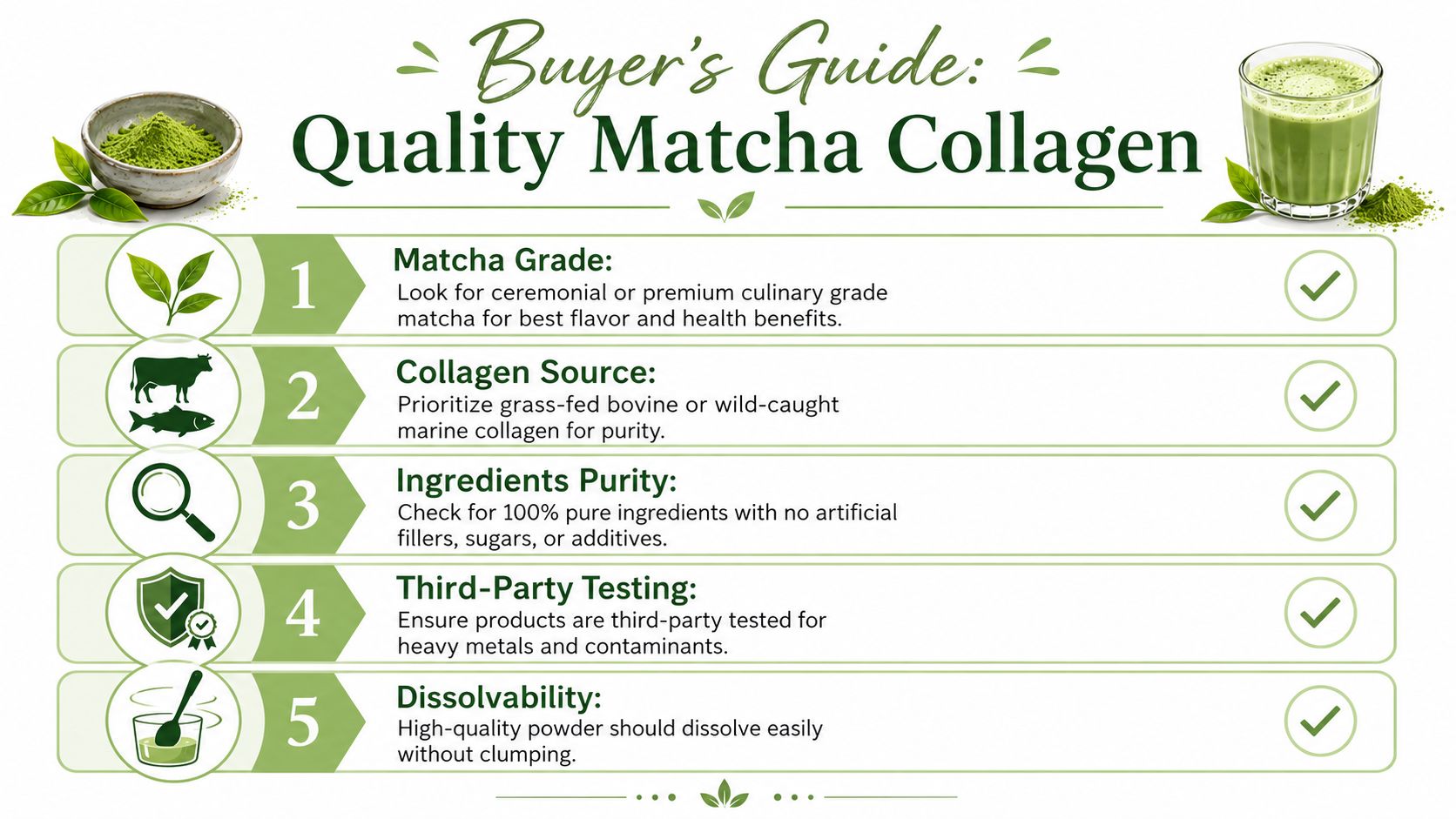
What to check before you buy
A good formula should answer basic questions clearly.
- Matcha grade: Look for ceremonial or premium culinary grade if you want better flavour and a smoother drinking experience.
- Collagen source: The label should identify whether the collagen is bovine or marine, not leave it vague.
- Hydrolysed form: Hydrolysed collagen generally dissolves more easily and suits drinks better.
- Ingredient purity: A shorter ingredient list is usually easier to trust.
- Testing and transparency: If a brand talks about purity, it should be willing to show how it checks for it.
The Australian quality issue many people miss
One of the least discussed parts of this category is authenticity versus appearance. A powder can look bright green and still fail the deeper quality test.
According to Australian Food Standards Authority data, 34% of imported “ceremonial grade” matcha powders in the Australian market exceed heavy metal thresholds, while many Australian organic matcha brands meet strict EGCg retention standards above 120mg/g. That's a serious reminder to look for origin details, processing transparency, and testing, not just attractive packaging.
If a brand won't tell you where the matcha was grown or how the powder was processed, that silence is part of the product.
Processing affects what you're drinking. Overheated or poorly handled matcha can lose the qualities buyers assume they're getting. The same goes for collagen. If the source isn't identified, you can't make an informed choice about allergens, flavour, or personal preference.
A simple checklist for shoppers
Use this quick filter when you compare products:
- Can you identify the matcha origin clearly?
- Does the brand specify marine or bovine collagen?
- Is the powder free from obvious fillers, sugars, and unnecessary additives?
- Is there any sign of third-party testing or contaminant screening?
- Will it dissolve cleanly in hot or cold drinks?
If you want a stronger understanding of how tea grades affect quality, colour, flavour, and value, this guide to grade and quality matcha tea is worth bookmarking.
A smart buyer doesn't just ask whether a powder contains matcha and collagen. They ask whether the matcha is authentic, whether the collagen is clear and traceable, and whether the product is transparent enough to trust.
How to Use Matcha Collagen Every Day
The easiest routine is usually the one that sticks.
For matcha collagen powder, that means keeping preparation simple and using it in drinks or foods you already enjoy. In Australia, the standard daily dosage is 10 to 15 grams, delivering roughly 8 to 10 grams of hydrolysed collagen peptides and around 50mg of caffeine per serving, which is described as the industry benchmark for efficacy in TGA-linked guidance.
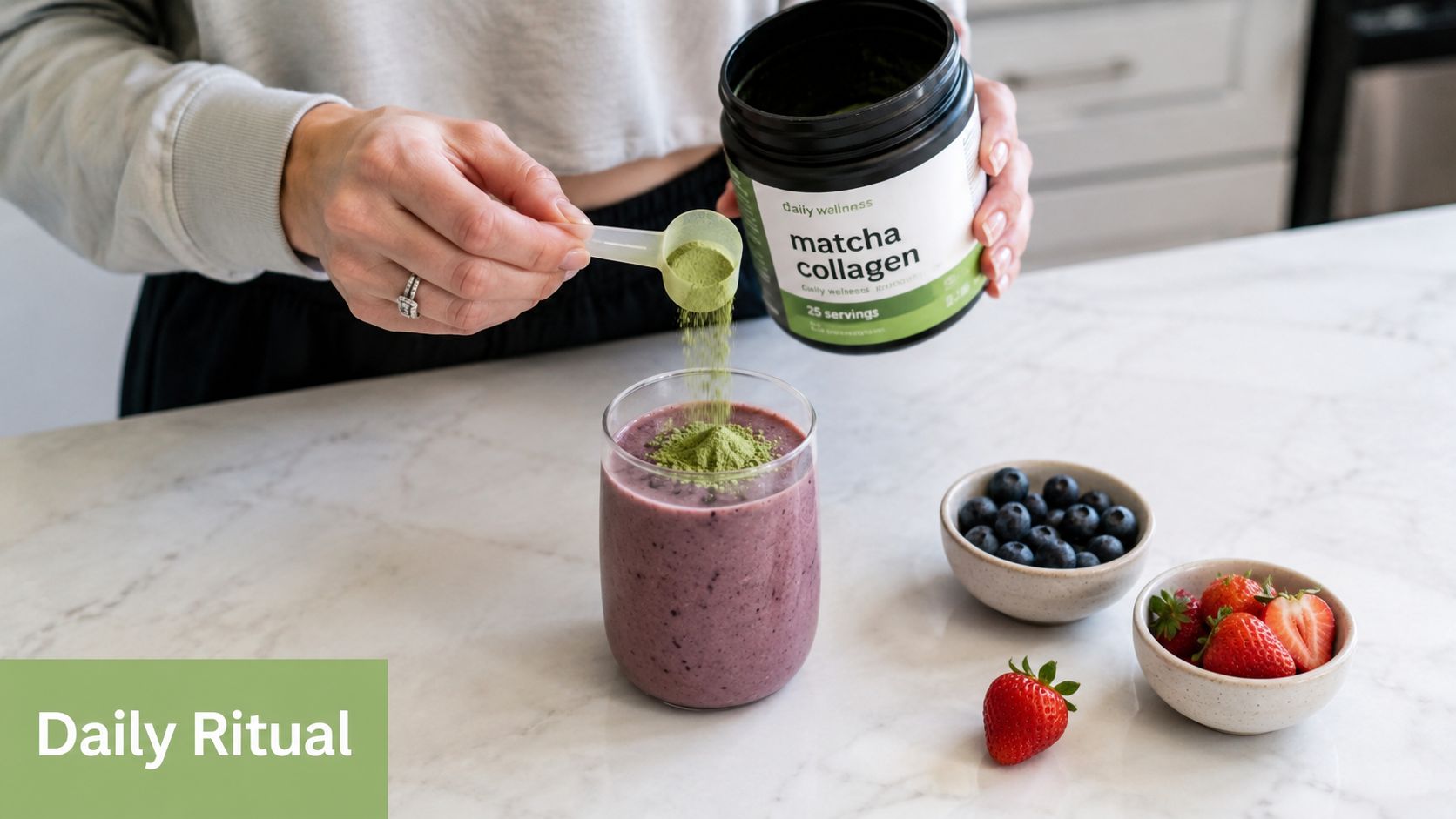
Best times to have it
There isn't one perfect time for everyone, but a few patterns work well.
- Morning: Great if you want a gentle start with calm focus.
- Late morning: Useful as a bridge between breakfast and lunch.
- Early afternoon: Handy when you want something lighter than another coffee.
If you're sensitive to caffeine, earlier is usually better. Even though matcha often feels smoother than coffee, it still contains caffeine.
Three easy ways to use it
Warm matcha collagen latte
This is the most natural starting point.
- Add your serve of matcha collagen powder to a cup.
- Mix with a small amount of warm water first to form a smooth paste.
- Top with warm milk or your preferred dairy-free option.
- Whisk or froth until silky.
A paste-first method helps prevent lumps and gives a more café-style finish.
Smoothie upgrade
A smoothie makes sense if you already have a blender routine.
Try blending:
- Your matcha collagen serve
- A banana or mild fruit
- Milk or a dairy-free base
- Ice
- Optional extras like spinach or nut butter if they suit your taste
For more ideas around this format, see this matcha protein shake guide, which can spark flavour combinations and prep shortcuts.
No-bake snacks or baking
Matcha collagen powder doesn't have to stay in a mug.
It can work in:
- Energy balls: Mix with oats, nut butter, and seeds.
- Muffins: Add to dry ingredients for a subtle green tea note.
- Yoghurt bowls: Stir in for a quick breakfast upgrade.
Kitchen tip: Start with less than you think you need in recipes. Matcha's flavour can become too assertive if the rest of the ingredients are mild.
A quick visual can help if you're still figuring out technique:
Storage and prep habits that help
Keep the powder sealed, dry, and out of direct heat. Matcha is delicate, and poor storage can dull both flavour and freshness.
A few practical habits make a noticeable difference:
- Use a dry scoop: Moisture encourages clumping.
- Whisk with a small amount first: This gives a smoother texture.
- Don't overcomplicate it: If your weekday method is too fussy, simplify it.
The best daily use isn't the most elaborate one. It's the version you can repeat on a Monday morning when you're short on time and still want something that feels good to drink.
For Australian Cafés and Retailers
For cafés, matcha collagen powder works best when it's treated as a menu idea, not just an ingredient. Customers already understand matcha. Many also recognise collagen. Bringing the two together gives staff a simple story to tell and gives customers an easy reason to try something new.
That's especially useful on menus built around low-sugar, functional, non-alcoholic options. A well-made matcha collagen drink can sit comfortably beside kombucha, smoothies, and specialty tea lattes without feeling gimmicky.

Menu ideas that are easy to sell
A few formats are especially approachable:
- Glow latte: A warm matcha collagen latte with a silky finish and simple wellness positioning.
- Smoothie booster: Offer it as an add-on for green smoothies or fruit blends.
- Wellness shot: A small-format functional serve for customers who want convenience.
- Retail shelf add-on: Place packaged powder near takeaway counters or fridge displays.
- Recipe cards: Give customers an idea for using it at home, not just in-store.
What makes it work commercially
Staff education matters more than long menu descriptions. If the team can explain taste, texture, and use in plain language, customers are far more likely to trust the recommendation.
Retailers can also benefit by merchandising it near adjacent categories. Matcha drinkers often browse tea tools, latte ingredients, and wellness pantry items. Shoppers interested in functional beverages may also be exploring kombucha, low-sugar café options, and home smoothie upgrades.
A product sells more easily when customers can picture tomorrow morning, not just admire the label today.
For Australian venues, the category also fits broader menu shifts toward mindful drinking and premium non-alcoholic choices. It gives cafés something fresh to offer without leaving the comfort zone of drinks customers already understand.
Frequently Asked Questions
Some of the most useful questions about matcha collagen powder aren't about flavour. They're about compatibility, expectations, and the details many brands skip.
Can I mix matcha collagen with kombucha
This is one of the most overlooked questions in the category.
A growing query on Australian wellness forums asks, “Can I mix matcha collagen with my daily kombucha without killing the probiotics?” According to IBISWorld Australia-linked discussion of the category, it's a key unanswered question, and heat plus preparation method can be a factor. In plain terms, collagen peptides are generally stable, but probiotic drinks are more delicate. If you want to combine them, avoid high heat and use a properly fermented kombucha rather than treating every fizzy fermented drink as equal.
Will I notice results quickly
Some people notice the ritual benefits first. Better routine. Easier mornings. A more satisfying alternative to another sugary or overly strong drink.
Physical changes are usually a consistency game. If you're using the product sporadically, it's harder to judge anything fairly. A daily habit gives you the clearest read.
Is marine or bovine collagen better
Neither is universally “better”. It depends on your preferences.
Marine collagen may appeal to people who avoid bovine products. Bovine collagen may appeal to people looking for a different sourcing option or flavour profile. The key is that the source should be named clearly on the label so you can choose deliberately.
Are there any downsides
There can be. Some people don't enjoy the taste of low-quality matcha blends. Others may be sensitive to caffeine, even in a gentler format. And some products contain too many extras.
That's why the smartest approach is to start with a transparent formula, use the recommended serve, and pay attention to how it fits your own routine.
Why do so many product pages feel vague
Because this category often gets marketed around broad ideas like glow, energy, and clean living while skipping practical detail. That's exactly why readers spend time in frequently asked questions sections across wellness brands. People want straight answers on mixing, taste, sourcing, and what a product does in daily life.
The best matcha collagen powder isn't the one with the most polished label. It's the one that tells you what's in it, where it came from, how to use it, and why that should matter to you.
If you're ready to bring more clarity to your daily ritual, explore Pep Tea for premium organic matcha, Australian-brewed sugar-free kombucha, and practical guidance that makes functional drinks feel simple, trustworthy, and enjoyable.
Matcha Tea Ceremony: An Approachable Australian Guide
Most advice gets the matcha tea ceremony wrong from the first sentence. It's often framed as either a museum piece or an impossibly strict ritual that only trained experts can understand. That misses the point.
A Matcha tea ceremony is disciplined, yes, but it isn't about showing off rare knowledge. At its heart, it's a way of paying attention. The bowl, the whisk, the water temperature, the quiet pace, the way you receive the tea. Each part helps people slow down and notice what they're doing.
That's a big reason the practice feels so relevant in Australia right now. Many people want less rush, less noise, and fewer automatic habits around food and drink. They want a morning routine that feels grounding, or a café experience that feels more intentional than another takeaway cup. In that setting, the matcha tea ceremony stops looking old-fashioned and starts looking useful.
For home drinkers, it can become a short daily ritual. For hospitality operators, it can become a refined non-alcoholic offering with real cultural depth. For anyone curious about Japanese tea, it's also a reminder that matcha isn't just an ingredient for lattes and smoothies. It comes from a long, organised tradition of preparation and service.
An Ancient Ritual for Modern Mindfulness
The common assumption is that a matcha tea ceremony only matters if you're sitting in a formal Japanese tearoom. In practice, the deeper value travels well. The ceremony teaches a set of habits that modern life often strips away: patience, care, restraint, and presence.
That matters because many people approach matcha backwards. They focus first on caffeine, colour, or social media aesthetics. The ceremony starts somewhere else. It asks a simpler question. How do you prepare and share tea in a way that creates calm?
Why it still speaks to modern life
A fast drink serves one purpose. A ceremony serves several at once.
- Attention: You stop multitasking and focus on one action.
- Sensory awareness: You notice texture, aroma, warmth, and sound.
- Connection: If you share it, the preparation becomes part of hospitality.
- Rhythm: Repeating the same careful motions can settle a busy mind.
For Australians building wellness routines, that's a practical shift. You don't need a dedicated tea room to make tea with intention. You need a few good tools, decent matcha, and a willingness to slow your pace.
A matcha tea ceremony isn't valuable because it's elaborate. It's valuable because it gives ordinary actions a clear purpose.
What accessibility really looks like
Accessibility doesn't mean stripping away all tradition until nothing remains. It means understanding what is essential and what is contextual. The essential part is respect for the tea, the tools, and the people involved. The contextual part is whether you're in a formal setting, at your kitchen bench in Newcastle, or adding a ceremonial bowl of matcha to a café menu in Sydney.
That's why beginners shouldn't feel put off by the ceremony's reputation. You can appreciate its cultural depth while still starting with ease. In fact, that's often the best approach.
The Heart of Chanoyu Origins and Philosophy
Chanoyu did not begin as a polished cultural performance. It grew from tea practices linked to Zen Buddhism, then gradually took shape in Japan as a disciplined way of preparing, serving, and receiving powdered tea. A clear overview of that longer arc appears in this history of matcha tea ceremonies, and Pep Tea's own brief history of matcha tea helps place that story in a broader timeline.
That shift matters. It explains why chanoyu feels both spiritual and practical at once. The ceremony carries the quiet focus of monastic life, but it also became a social art shaped by taste, hospitality, architecture, ceramics, and seasonal awareness.
From monastery practice to refined cultural art
A beginner can easily mistake the ceremony for a formal way of drinking tea. It is closer to a carefully composed meal or a piece of chamber music. Every tool, gesture, pause, and placement has a role, and the parts only make full sense when they work together.
By the sixteenth century, tea practice in Japan had developed into recognisable ceremonial forms. Two terms still help people understand the range:
| Format | What it means |
|---|---|
| Chaji | A full, formal gathering with a meal and tea, designed as a complete host-guest experience |
| Chakai | A lighter, shorter tea gathering, often easier for modern guests and home hosts to relate to |
Tea master Sen no Rikyū gave lasting shape to this culture of tea. His influence is still felt in how students learn the ceremony, how hosts prepare a space, and how utensils are chosen for mood and season.
The four principles in plain language
Rikyū's four principles are often given in Japanese and English. They can sound lofty until you connect them to ordinary actions in the tea room, or even at a kitchen bench in Brisbane or a café in Melbourne.
- Harmony means the setting feels coherent. The bowl suits the season. The sweet suits the tea. The mood suits the guest.
- Respect shows up in conduct. You handle the bowl with care because it matters, and because the person receiving it matters too.
- Purity includes physical cleanliness, but it also points to mental tidiness. You leave distraction at the door and attend to what is in front of you.
- Tranquility is the result of practising the other three often enough that calm stops feeling forced.
The Metropolitan Museum of Art's essay on the Japanese tea ceremony explains that the ceremony became an important social setting in sixteenth-century Japan and also influenced utensil culture and ceramic traditions such as Raku, Shino, and Oribe. That helps explain why chanoyu is never only about drinking matcha. It is also about how beauty, status, craft, and hospitality meet in one shared act.
A useful way to read these principles is to treat them as operating instructions. They guide how to clean a bowl, how to enter a room, how to offer food, how to receive tea, and how to notice the moment.
For Australians interested in wellness, this philosophy translates surprisingly well to modern life. A traditional gathering might be formal, but the underlying values travel easily. You can apply harmony, respect, purity, and tranquility to a quiet morning bowl at home, a thoughtful service ritual in a café, or a pairing that places ceremonial matcha beside a well-made local kombucha. The form may adapt. The attitude should stay clear.
Understanding the Essential Tools and Terms
The ceremony starts to feel far less intimidating once the utensils stop looking like mysterious props and start acting like a well-designed kit. Each piece has a clear role. Together, they create order, much like having the right saucepan, knife, and chopping board makes cooking calmer and more precise.
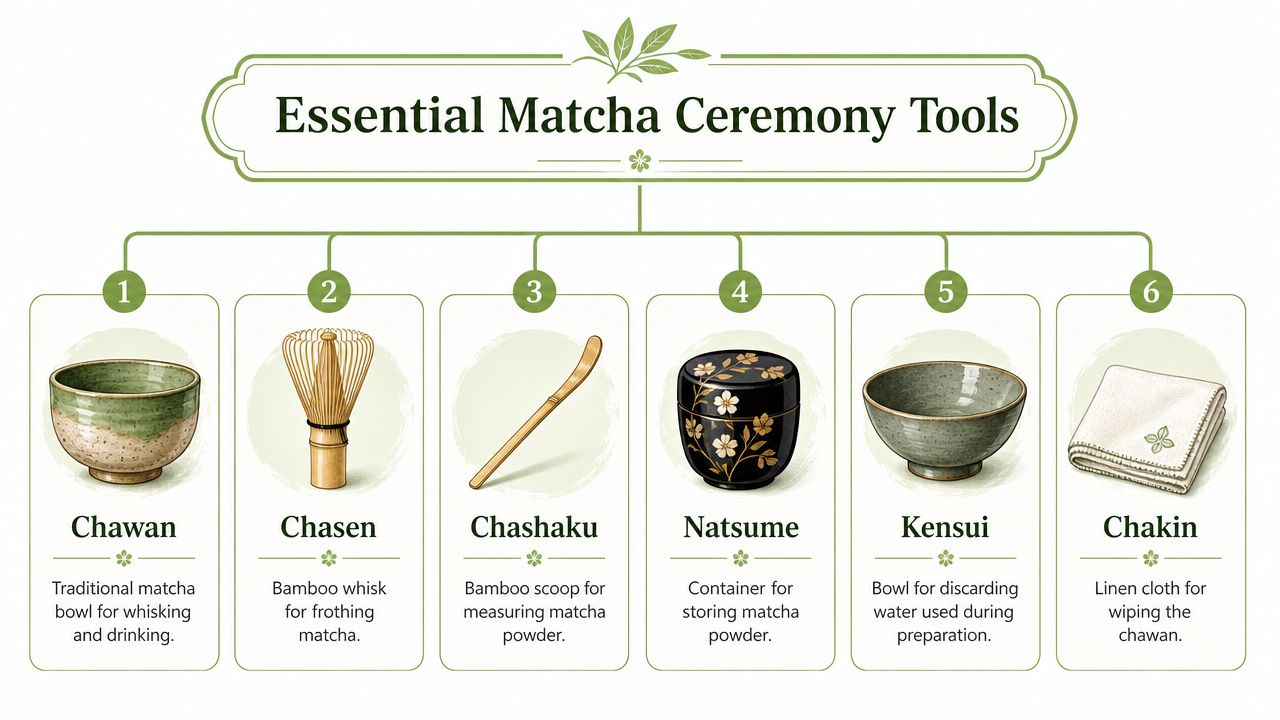
If you are putting together your own setup for home practice or café service, a practical place to start is a collection of matcha tea accessories.
The core utensils most people should know
Some utensils matter from your first bowl. Others help you understand the language and structure of a more formal gathering.
- Chawan: The tea bowl. You whisk in it and drink from it, so its depth and shape affect both texture and comfort.
- Chasen: The bamboo whisk. Its fine tines suspend the powder in water and help create the soft foam used in usucha.
- Chashaku: The bamboo scoop for portioning matcha with consistency.
- Natsume: A tea caddy for holding matcha during service.
- Kensui: A vessel for discarded water used while preparing utensils.
- Chakin: A cloth used to wipe and prepare the bowl.
For a simple practice at home, you do not need every item at once. A bowl, whisk, and scoop will carry most beginners a long way. The other pieces become useful when you want to understand formal service more clearly, or when an Australian café wants to present matcha with a little more ceremony instead of treating it like just another powdered drink.
Usucha and koicha are two different styles of tea
One term pair causes confusion more than any other. Usucha and koicha are not small variations of the same bowl. They are different preparations with different textures, different etiquette, and a different level of difficulty.
Wikipedia's article on the Japanese tea ceremony explains that usucha is the thinner, whisked style commonly encountered initially, while koicha is made with much more tea and much less water, creating a thick, concentrated drink that is kneaded rather than foamed. If usucha is closer to a light broth in texture, koicha is closer to a glossy paste. That shift changes flavour, mouthfeel, and technique in one go.
| Term | What it's like |
|---|---|
| Usucha | Lighter, whisked, foamy, and the usual starting point for new drinkers |
| Koicha | Thicker, denser, more concentrated, and harder to prepare well |
That distinction matters in modern settings too. If you are serving matcha at home before a yoga session, or offering it in a café beside a local kombucha pairing, usucha usually suits the occasion better because it feels brisk, bright, and approachable. Koicha asks for quieter attention, higher-grade tea, and more practiced hands.
Your first bowl does not need to look perfect.
Learn the job of each tool first. Then practise the motions. Skill grows through repetition, and that is true whether you are studying chanoyu seriously or trying to bring a more grounded tea ritual into an Australian morning.
A Simple Guide to the Ceremony Sequence
A full tea gathering can be highly formal, but the basic flow is easier to understand than many people expect. For most readers, it helps to think in terms of a short chakai, which is the more approachable gathering format.
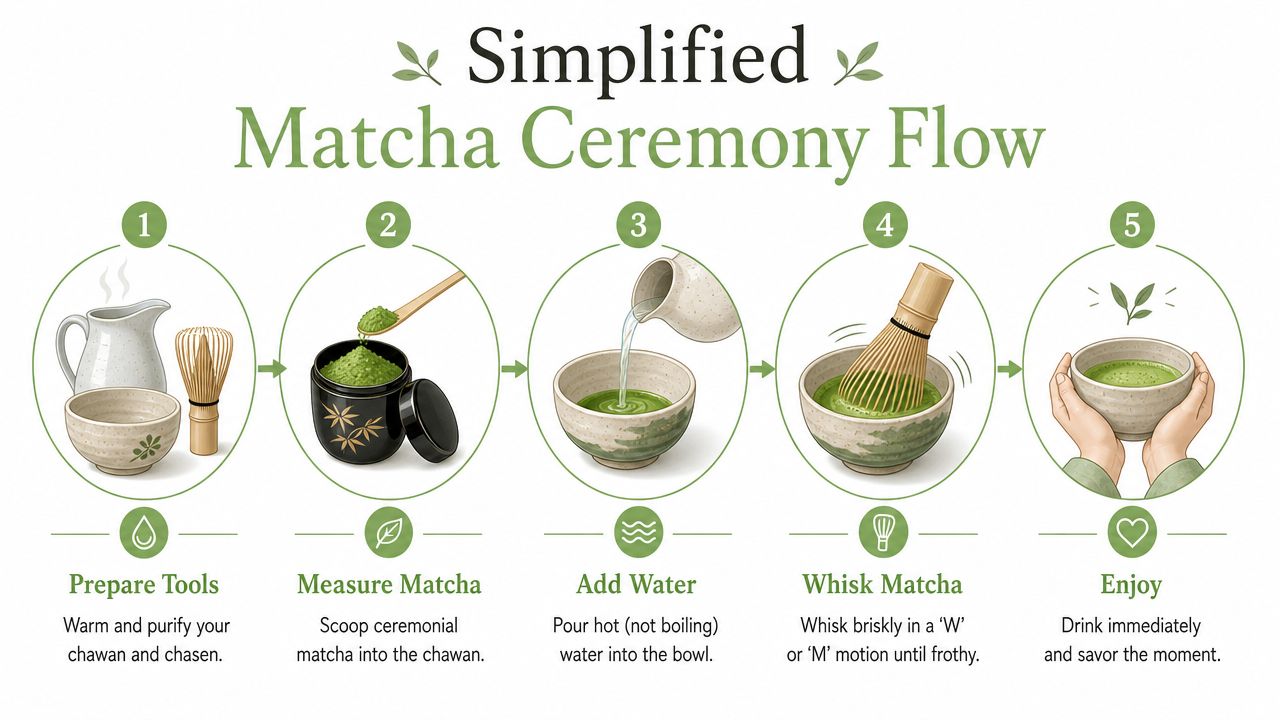
If you want to see the whisking mechanics in more detail, Pep Tea has a practical guide on how to whisk matcha.
The simplified ceremony flow
The ceremony is structured, but not random. The sequence helps everyone arrive mentally before they drink.
Arrival and settling in
Guests enter, become quiet, and leave outside distractions behind. In more formal settings, cleansing and careful entry carry symbolic meaning.Preparation of tools
The host handles the bowl, whisk, and other utensils with deliberate care. Even when cleaning is symbolic, it shapes the atmosphere.Sweets are served
A small sweet often comes before the tea. It prepares the palate for matcha's natural character.Tea is prepared
The host measures, adds water, and whisks or kneads depending on the style of tea.Tea is received and appreciated
The guest accepts the bowl respectfully, drinks, and notices both the tea and the vessel.
Simple guest etiquette
Newcomers often feel nervous at this stage. The good news is that basic courtesy matters more than theatrical perfection.
- Receive the bowl carefully: Hold it with attention rather than grabbing it casually.
- Acknowledge the host: A small nod or word of thanks suits a modern, respectful setting.
- Turn the bowl slightly: In traditional etiquette, rotating the bowl shows respect before drinking.
- Drink without rushing: The point isn't speed. It's appreciation.
- Notice the bowl itself: In ceremonial practice, the vessel is part of the experience.
A useful benchmark for understanding ceremony length comes from the verified historical background: chaji is a full ceremony of about four hours, while chakai is a shorter gathering of about 30–60 minutes, which is why a chakai-style format makes more sense for most modern homes and cafés.
Why sequence matters
The order creates the feeling. If you skip straight to “drink the tea”, you lose what makes the matcha tea ceremony distinct. The pauses, the bowl handling, the sweets, and the pace are what turn preparation into hospitality.
That's also why cafés can borrow from the ceremony without pretending to replicate a formal tea school experience. A well-designed service can keep the spirit of the sequence even in a simpler setting.
Choosing Your Perfect Matcha for the Occasion
A ceremony-grade experience starts with choosing the right matcha. Consequently, many people waste good powder or blame themselves for a result that was never possible with the product they bought.
The key choice is between ceremonial grade and culinary grade. They aren't rivals. They serve different purposes.
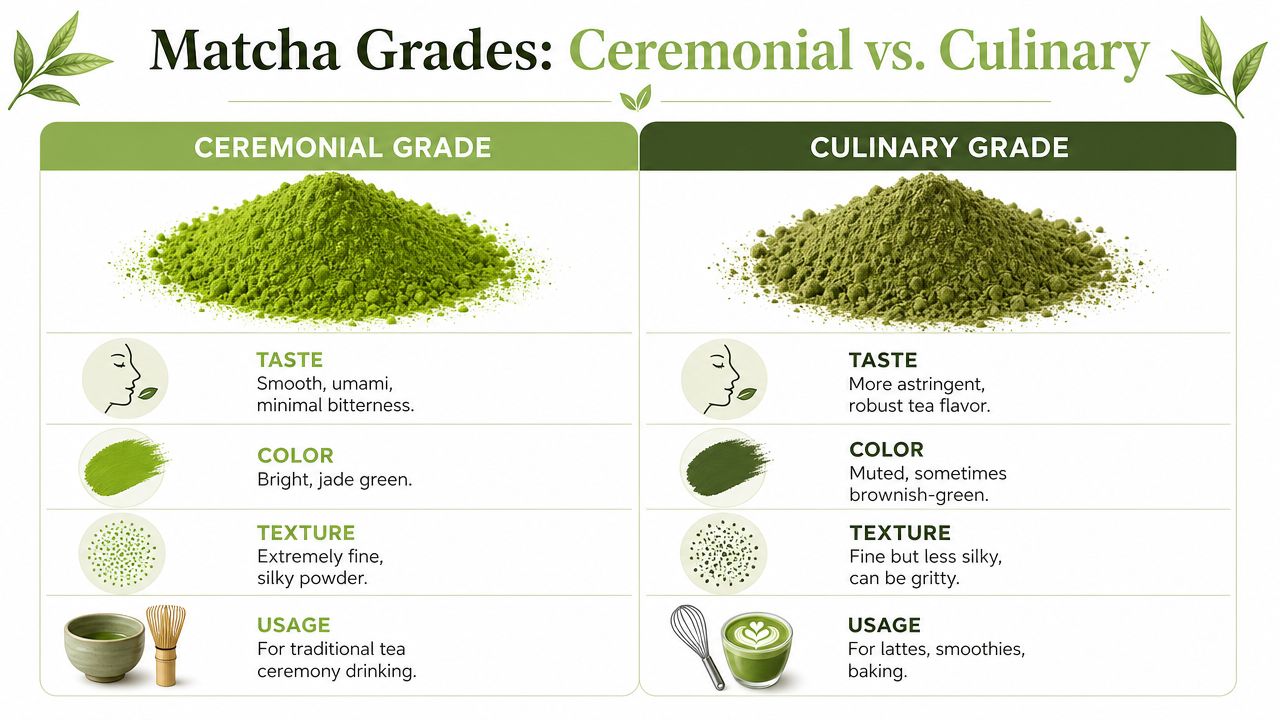
Ceremonial and culinary grade side by side
Here's the practical distinction most drinkers need.
| Grade | Best use | What to expect |
|---|---|---|
| Ceremonial grade | Traditional drinking, straight matcha, mindful preparation | Smoother profile, bright green colour, fine texture |
| Culinary grade | Lattes, smoothies, baking, desserts | Stronger tea character that can stand up to milk or other ingredients |
If you're preparing a bowl to drink on its own, ceremonial grade is the better fit. If you're blending matcha with milk, fruit, or flour, culinary grade often makes more sense.
For an Australian buyer, this can save frustration. A latte-focused matcha may taste forceful and rough when served as straight tea. A delicate ceremonial matcha may be lost once mixed into a heavily flavoured recipe.
What quality looks like in the bowl
You don't need to speak like a tea judge to assess quality. A few practical cues help.
- Colour: Ceremonial matcha should look vivid and lively, not flat or dull.
- Texture: A fine, silky powder disperses more evenly.
- Taste: You're looking for balance. Smooth, savoury, and gently sweet notes are welcome. Harsh bitterness is not.
- Aftertaste: Better matcha tends to finish cleaner.
For readers who want one straightforward option among many, Pep Tea carries organic ceremonial-grade and culinary-grade matcha, which makes it easier to match product type to use rather than treating all matcha as the same.
Practical rule: if you plan to drink matcha with only water, choose ceremonial grade first.
Preparation can rescue or ruin a good powder
Even excellent matcha can taste rough if it's prepared badly. A reliable benchmark for usucha is 70–80°C water and roughly 2 g of matcha to 60 ml of water, with a quick “M” or “W” whisking motion to create fine foam, as described in this guide to matcha tea ceremony preparation. The same source notes that hotter water can increase bitterness.
That one detail solves a lot of beginner confusion. People often assume the answer is “buy more expensive matcha”, when the actual problem is boiling water or timid whisking.
Hosting a Modern Matcha Moment at Home or in Your Café
Australia has plenty of general writing about the cultural meaning of tea ceremony, but there's still a gap regarding local, practical guidance on how to access it, adapt it, and make it feel achievable. That gap matters because many people are interested in premium, wellness-focused drinks but don't know where the ceremony fits into ordinary life, as reflected in the Japan travel guide's discussion of the tea ceremony as a codified art with formal and informal formats in this overview from Japan Travel.
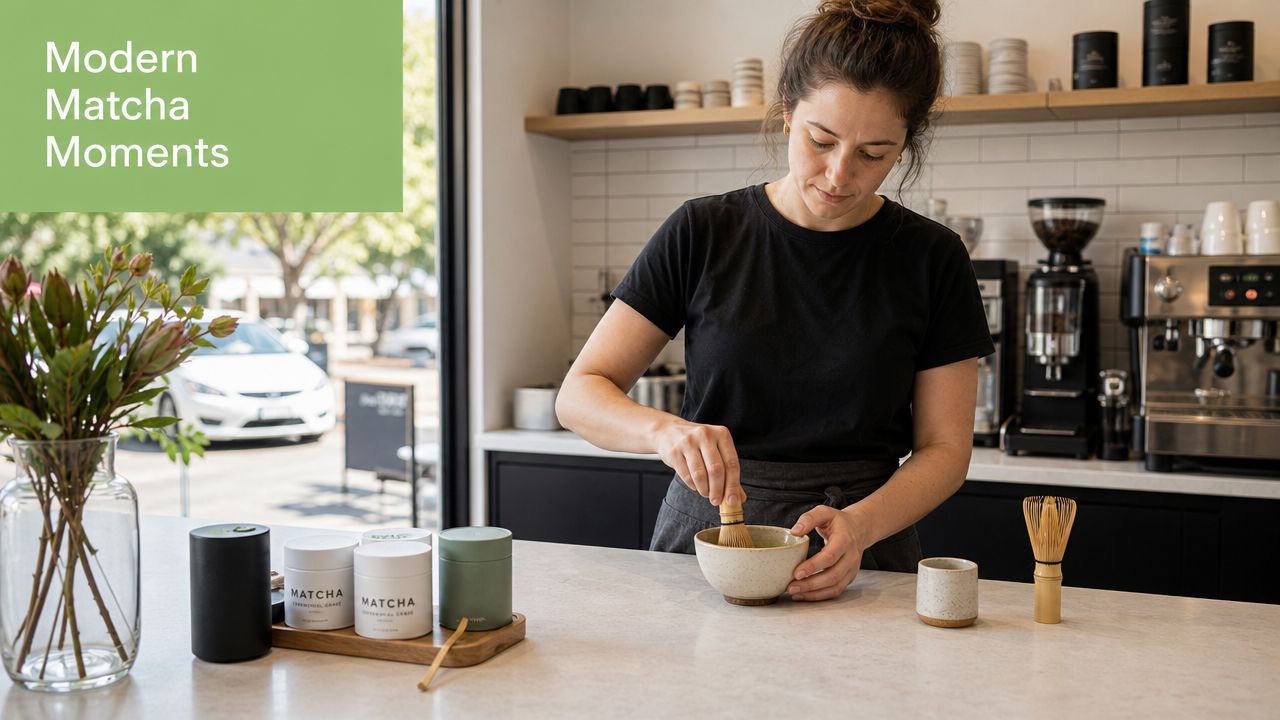
The good news is that the spirit of the matcha tea ceremony adapts beautifully. You can honour the tradition without pretending your kitchen bench is a formal tea room.
At home, keep it uncluttered and intentional
A modern home version doesn't need rare ceramics or perfect Japanese architecture. It needs care.
Try this approach:
- Clear a small space: Even one tidy section of the table changes how the ritual feels.
- Use a dedicated bowl: Reaching for the same chawan each time creates continuity.
- Prepare one serving well: Don't multitask with emails, podcasts, and breakfast prep.
- Serve a small sweet if you like: This helps frame the tea as an experience, not a chore.
- Sit down to drink it: Standing at the sink changes the whole mood.
A home ceremony can be short and still meaningful. The point isn't to imitate every formal detail. It's to build a repeatable pocket of calm.
In a café, make the service understandable
For hospitality teams, the matcha tea ceremony offers more than visual theatre. It gives staff a way to present matcha as a premium non-alcoholic service.
A simple menu idea might include a bowl of ceremonial matcha served with a small sweet, plus a short explanation of the bowl, whisking style, and origin of the tea. That works especially well in venues already attracting customers who value slower, thoughtful experiences.
A helpful training focus for staff is consistency:
| Service point | Why it matters |
|---|---|
| Water temperature | Prevents unnecessary bitterness |
| Whisk technique | Improves texture and presentation |
| Language used with guests | Makes the ritual feel welcoming, not intimidating |
| Tool care | Supports quality and respect for the process |
The following video gives a useful visual sense of preparation and pace.
A local adaptation can still be respectful
The strongest café versions don't oversell “authenticity” in a vague way. They're clear about what they are: a simplified service inspired by ceremonial values.
That honesty matters. Customers don't need a fake performance. They need a thoughtful bowl of matcha, prepared correctly, presented well, and explained clearly. When that happens, the ceremony becomes relevant to Australian hospitality rather than stuck behind glass.
Beyond the Bowl Creative Pairings and Wellness Recipes
The matcha tea ceremony starts with a bowl, but it doesn't have to end there. Once you understand the flavour and rhythm of ceremonial matcha, it becomes easier to use it in a broader wellness routine.
At home, some people keep the ceremonial bowl for quiet mornings and use matcha more casually later in the day. In cafés, the same logic can shape a menu. One offering can be formal and minimal. Another can be more playful.
Pairings that work without fighting the tea
Traditional sweets make sense because they soften matcha's natural bite. In Australia, you can also think more broadly while keeping balance in mind.
Good pairings often share one quality: restraint.
- Simple Japanese-style sweets: Mild sweetness lets the tea stay central.
- Light Australian pastries: Not too sugary, not too buttery, not too dominant.
- Fresh fruit plates: Clean, bright, and easy in warm weather.
- Kombucha as a palate reset: A small serve of sugar-free kombucha after matcha can feel crisp and refreshing rather than heavy.
For cafés, that opens an interesting idea: a quiet, non-alcoholic tasting flight built around one bowl of matcha and a small fermented drink served separately. The contrast in texture and flavour can make the experience feel contemporary while still centred on tea.
The most successful pairings don't overpower matcha. They give it room.
Two easy ways to bring matcha into everyday life
You don't need to perform a full ritual every time you use matcha. Once you've learned to appreciate it properly, everyday recipes become more intuitive.
Simple matcha latte
Use ceremonial grade if you want a softer, fuller flavour.
- Sift matcha into a bowl.
- Add a small amount of hot water and whisk until smooth.
- Warm your milk of choice separately.
- Combine and serve immediately.
This gives you a gentler bridge between formal matcha and a daily café-style drink.
Quick matcha smoothie
A smoothie is useful when you want something cold, simple, and easy to fit into a busy morning.
Blend matcha with fruit and your preferred base until smooth. Keep the other flavours moderate so the tea still comes through. If the smoothie tastes muddy, the recipe usually needs fewer competing ingredients, not more matcha.
The beauty of the matcha tea ceremony is that it teaches attention first. Once you learn that lesson, everything else improves. Your straight matcha tastes better. Your latte has more balance. Your café service feels more considered. Even your pairings become cleaner and more deliberate.
If you'd like to bring that ritual into your own routine, explore Pep Tea for organic matcha and wellness drinks that suit both simple home preparation and modern Australian café service.