
Tag: matcha brewing
Pure Matcha Green Tea Powder: How to Choose Real Quality
The most popular advice about matcha is also the least useful: “Choose pure matcha and you've chosen quality.” Purity matters, but it only tells you that nothing has been added. It doesn't automatically confirm the tea's origin, freshness, grade, growing practices, flavour, or tested composition.
That distinction matters in Australia, where demand is moving quickly. SBS News reported that Australia's matcha market generated more than AUD 54 million in 2024 and is forecast to grow at approximately 7.1% annually over the following five years, exceeding AUD 81 million by 2030 according to reporting based on industry data. More products can mean more choice, but it can also make a confident-looking label harder to evaluate.
What “Pure” Really Means on a Matcha Label
Pure matcha green tea powder answers a narrow question. Is the tin only matcha, or has something else been mixed in?
On an Australian label, that usually means the ingredient list shows 100% matcha or 100% powdered green tea, with no sugar, milk powder, flavouring, colouring, or filler. That is useful, but it is only the first checkpoint. “Pure” does not tell you whether the tea was selected for drinking, whether it is fresh, or whether it will taste smooth once you whisk it.
It also does not mean caffeine-free. Matcha is powdered green tea, so if it is pure, it still naturally contains caffeine. In other words, purity describes what has not been added. Quality describes what the product brings to the cup.
Purity and quality are different questions
Purity covers ingredients. Quality covers a wider set of buying decisions.
- Purity: Is anything else mixed into the powder?
- Origin: Where was the tea grown and processed?
- Freshness: When was it harvested, milled, packed, or opened?
- Grade: Was it chosen for straight drinking, lattes, or cooking?
- Composition: Are there credible test results or batch records?
- Use: Does the flavour fit how you plan to prepare it?
That distinction saves shoppers from a common mistake. A front label can say “pure” and still leave out the details that affect aroma, colour, bitterness, and value for money.
Practical rule: Treat “pure” as the starting point of your assessment, not the final verdict.
The same reading habit applies beyond tea. A clear pure aloe vera gel guide shows how a simple ingredient claim can be true while bigger questions about sourcing, processing, and suitability still remain. Matcha works the same way.
From Tea Leaf to Stone Ground Powder
Matcha starts with the same tea plant as other green tea, Camellia sinensis. The difference lies in how growers cultivate and process it before you ever open the tin.
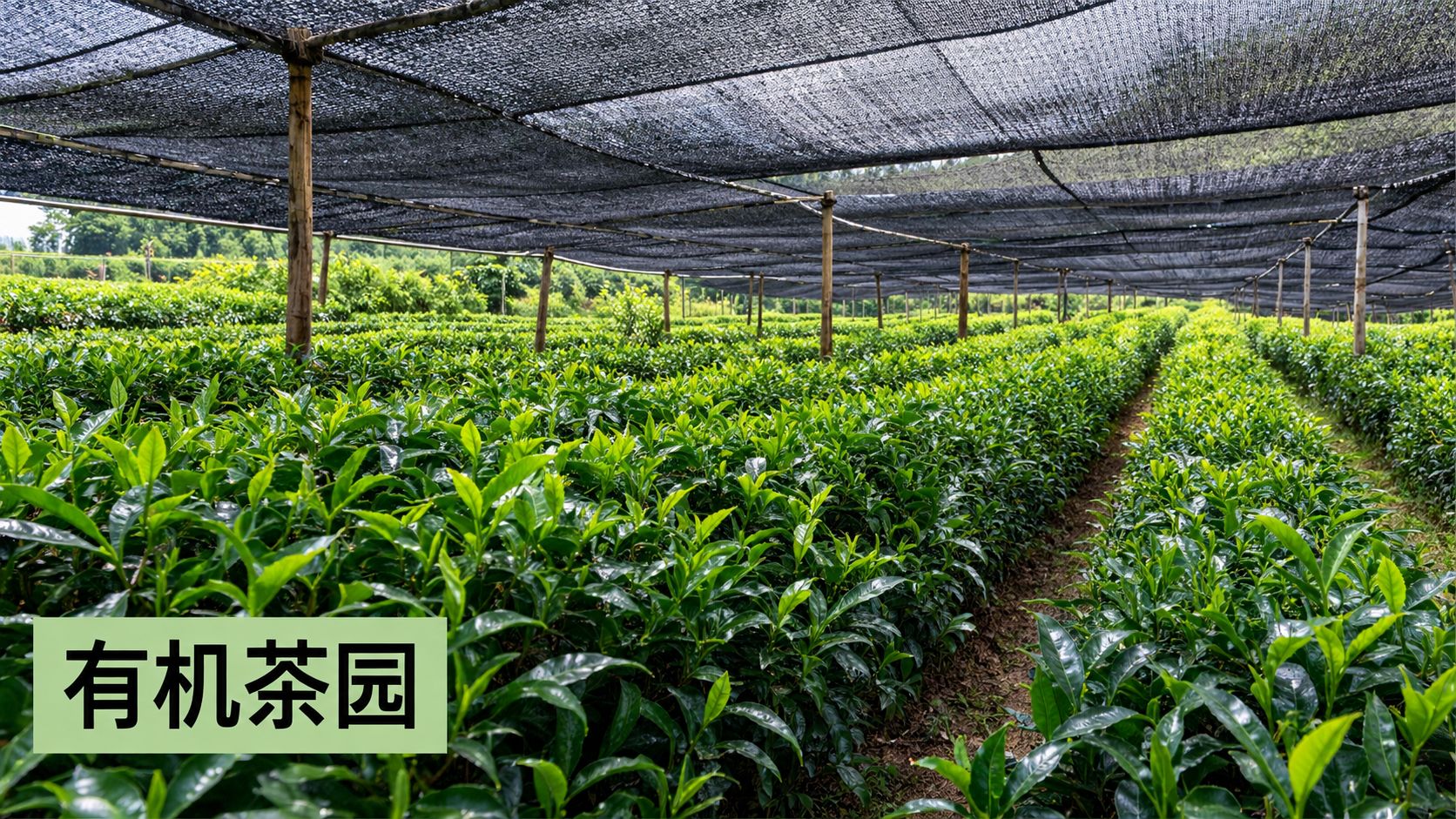
Several weeks before harvest, growers shade the tea plants from direct sunlight. This changes the leaf's growth conditions and contributes to matcha's deep green appearance, savoury umami character, and naturally occurring L-theanine. Farmers then harvest the leaves, steam them to limit oxidation, dry them, and remove stems and veins. The remaining leaf material is called tencha.
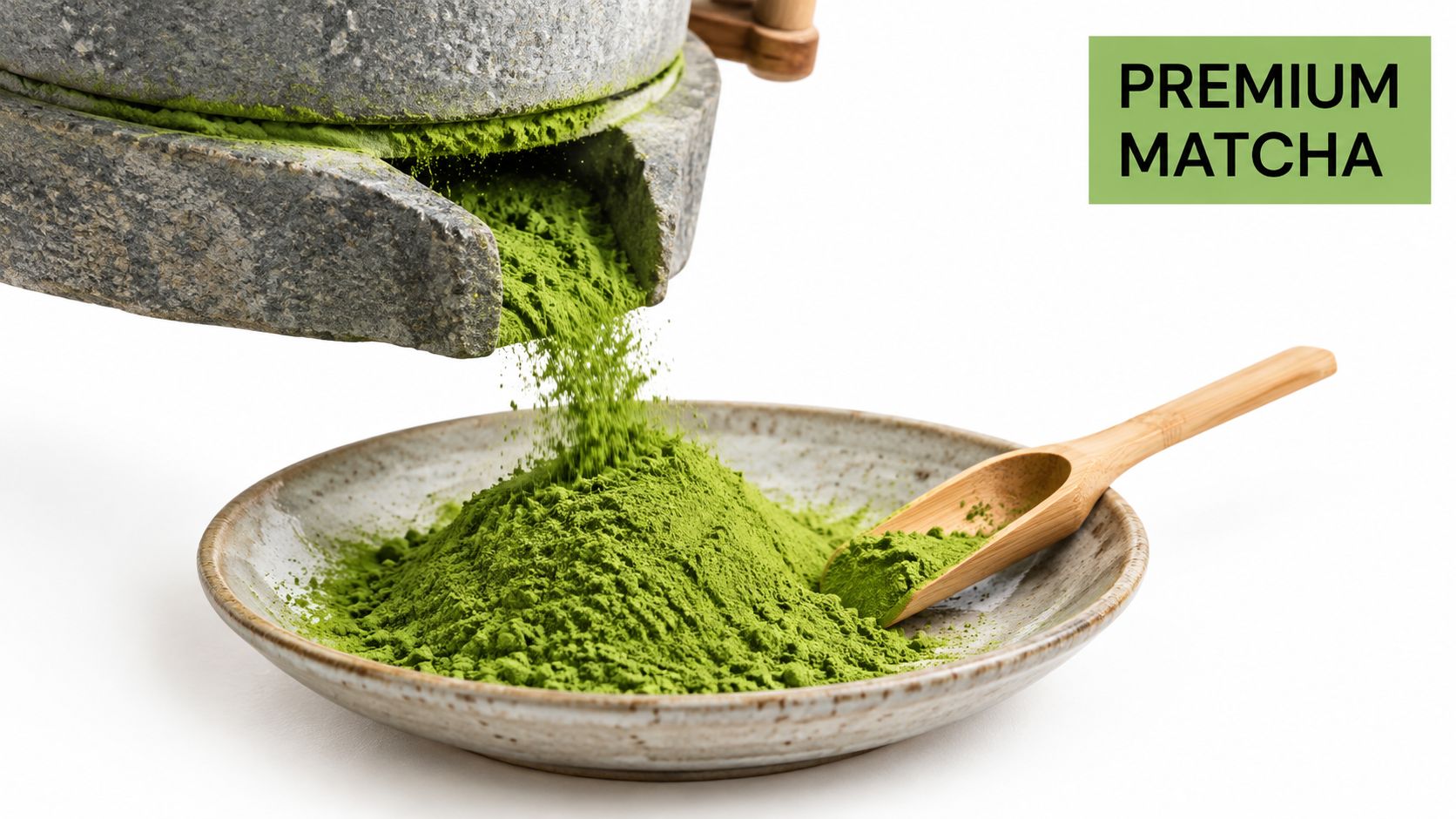
Tencha is slowly ground between stones, traditionally granite, until it becomes an exceptionally fine powder. That slow milling is why authentic matcha feels almost talc-like between your fingers rather than gritty like a coarsely ground green tea ingredient.
What your senses can tell you
A vibrant green colour can be a useful freshness and processing clue, but colour alone can't certify quality. Look for a powder that is fine, evenly coloured, and aromatic, with a fresh grassy or vegetal scent rather than a flat, dusty smell.
Taste gives you more information. Good matcha can have grassy notes, umami depth, gentle sweetness, and some bitterness. Harsh bitterness may come from the grade, preparation, age, or a powder intended for cooking rather than drinking.
The whole-leaf format also changes the way you consume the tea. With ordinary brewed green tea, water extracts compounds from the leaves and you discard the leaves. With matcha, you whisk the powder into water or milk, so the powdered leaf remains in the drink. For a visual explanation of the production stages, see how matcha tea is made.
Analytical testing of commercially available matcha found caffeine concentrations ranging from 17.11 to 35.01 milligrams per gram. Ceremonial matcha averaged 31.45 ± 1.08 mg/g, while culinary matcha averaged 26.29 ± 1.86 mg/g, compared with 23.08 ± 1.43 mg/g for bagged or gunpowder green tea in the reported testing. Those figures are useful context, but they aren't a guarantee for every product or serving.
Ceremonial, Culinary, and Everyday Grades Compared
Matcha grades aren't universal legal categories in the way some shoppers assume. Producers and sellers use them to communicate intended use, sensory character, and leaf selection. The label still needs supporting information, because “ceremonial” by itself doesn't prove a particular origin or laboratory profile.
The simplest decision is practical. If you'll drink the matcha with water, choose a powder that tastes smooth and balanced. If you'll combine it with milk, fruit, chocolate, or flour, a stronger culinary powder may provide better value and a more noticeable tea flavour.
Match the powder to the job
| Grade | Best for | Sensory cues | Typical price band |
|---|---|---|---|
| Ceremonial | Whisked tea and simple drinks | Bright colour, fine texture, softer bitterness, rounded umami | Higher |
| Premium culinary | Lattes, iced drinks, smoothies, and everyday use | Fresh green aroma, fuller flavour, enough strength for milk | Mid to high |
| Ingredient-grade culinary | Baking, ice cream, sauces, and savoury recipes | More robust, earthy, or bitter profile that stands up to other ingredients | Lower to mid |
A ceremonial powder can be wasted in a recipe where chocolate, dairy, or fruit dominates. Conversely, an inexpensive cooking powder may taste rough when whisked with water because there's nowhere for its bitterness to hide.
Choose by preparation, not prestige
For a traditional bowl of matcha, sensory refinement matters most. You're tasting the tea directly, so freshness, texture, sweetness, and umami carry the experience.
For a café latte, a bright premium culinary powder can be a sensible option. Milk softens bitterness, while the matcha needs enough flavour to remain present after dilution. For pancakes, biscuits, frosting, or ice cream, ingredient-grade culinary matcha often makes more sense because you're buying functional flavour rather than a delicate drinking experience.
Compare ceremonial and culinary matcha before buying. The right grade isn't the one with the most impressive name. It's the one that performs well in your favourite preparation.
Caffeine, EGCg, and L-Theanine Explained
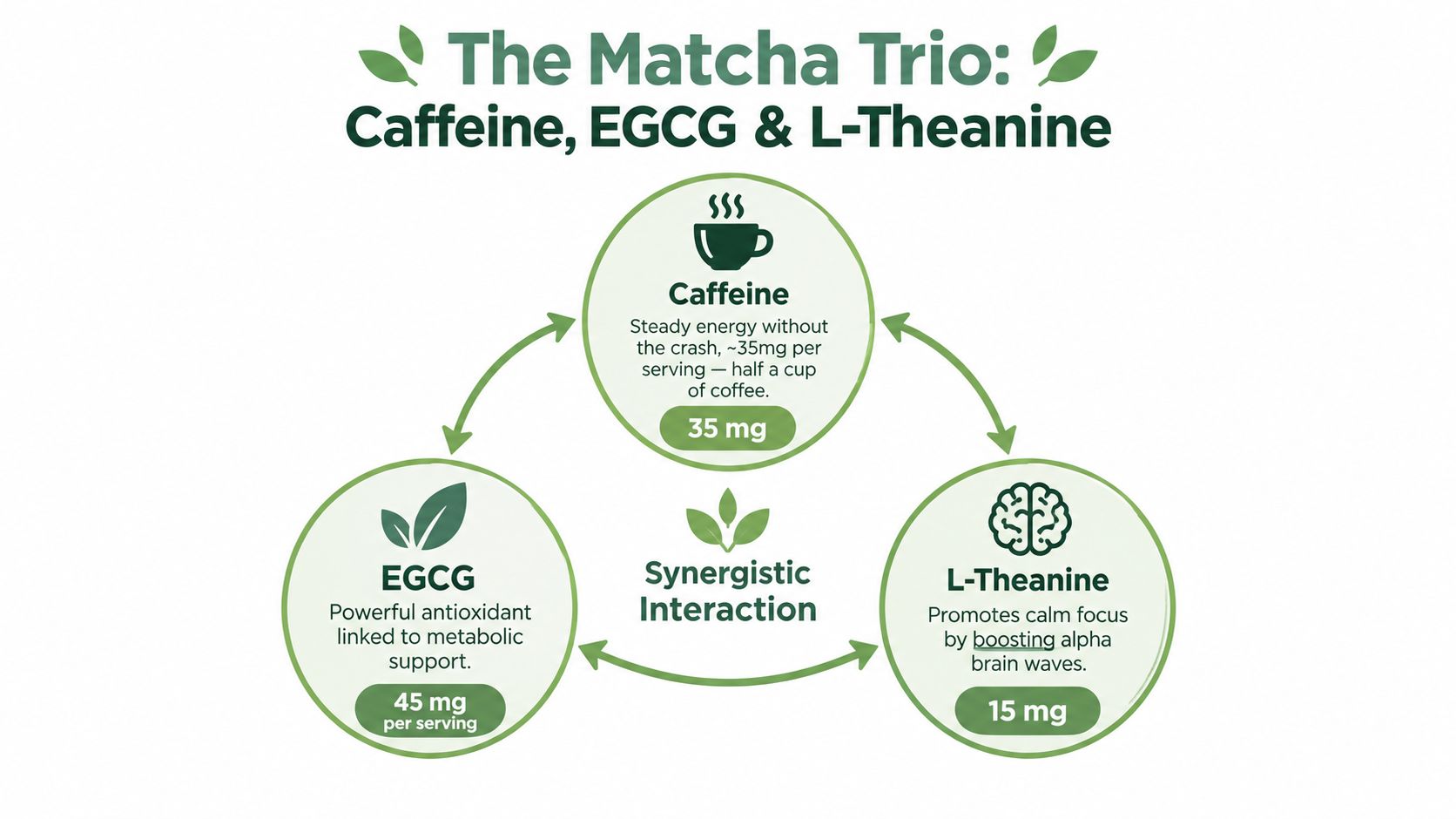
Matcha is often described as a calmer alternative to coffee. That description can be useful as a personal observation, but it shouldn't hide the fact that pure matcha contains caffeine. The powder brings several naturally occurring compounds into the same drink, including caffeine, EGCg, and L-theanine.
Caffeine contributes to alertness. EGCg, or epigallocatechin gallate, is one of the green-tea catechins commonly discussed in relation to antioxidant content. L-theanine is an amino acid associated with tea, and many people describe the combination of tea caffeine and L-theanine as feeling smoother than caffeine alone. That subjective experience varies, and L-theanine doesn't remove stimulant exposure or guarantee a performance effect.
The serving-size maths
Experimental literature reports approximate dry-weight concentrations of 4% caffeine and 6 to 7% EGCg in matcha. L-theanine commonly exceeds 1% and can exceed 3% in high-grade material in the cited experimental literature.
At a hypothetical 2 g serve, those benchmarks work out to roughly:
- 80 mg caffeine
- 120 to 140 mg EGCg
- At least 20 mg L-theanine
That calculation is illustrative, not a certificate of analysis. Cultivar, shading, harvest, processing, grade, serving size, and laboratory method can all change the result.
For a plain-language explanation of EGCg and its place in matcha, read what EGCg is. Cafés should use gram-weight recipes rather than “one scoop”, because a scoop can vary between staff members and tools.
A useful comparison is not matcha versus coffee in isolation. It's your whole day. If you drink matcha alongside coffee, cola, pre-workout products, or energy drinks, count the sources together. FSANZ identifies 400 mg per day as the maximum daily caffeine dose used in alignment with European Food Safety Authority recommendations in relevant regulatory work, and flags increased anxiety in children at approximately 3 mg per kilogram of body weight per day in its caffeine guidance. That isn't a universal personal allowance, so people who are pregnant, sensitive to caffeine, taking medication, or managing a health condition should seek individual advice.
For a broader look at audits and product information, a resource such as Grumspot Shopify Plus audits illustrates why clear product communication matters. A café menu should never imply that matcha is caffeine-free or automatically calming.
How to Read a Matcha Label Before You Buy
A good label answers practical questions without making you chase the seller for basic information. Start at the back of the pack, not the marketing headline.
Work through the ingredient and origin details
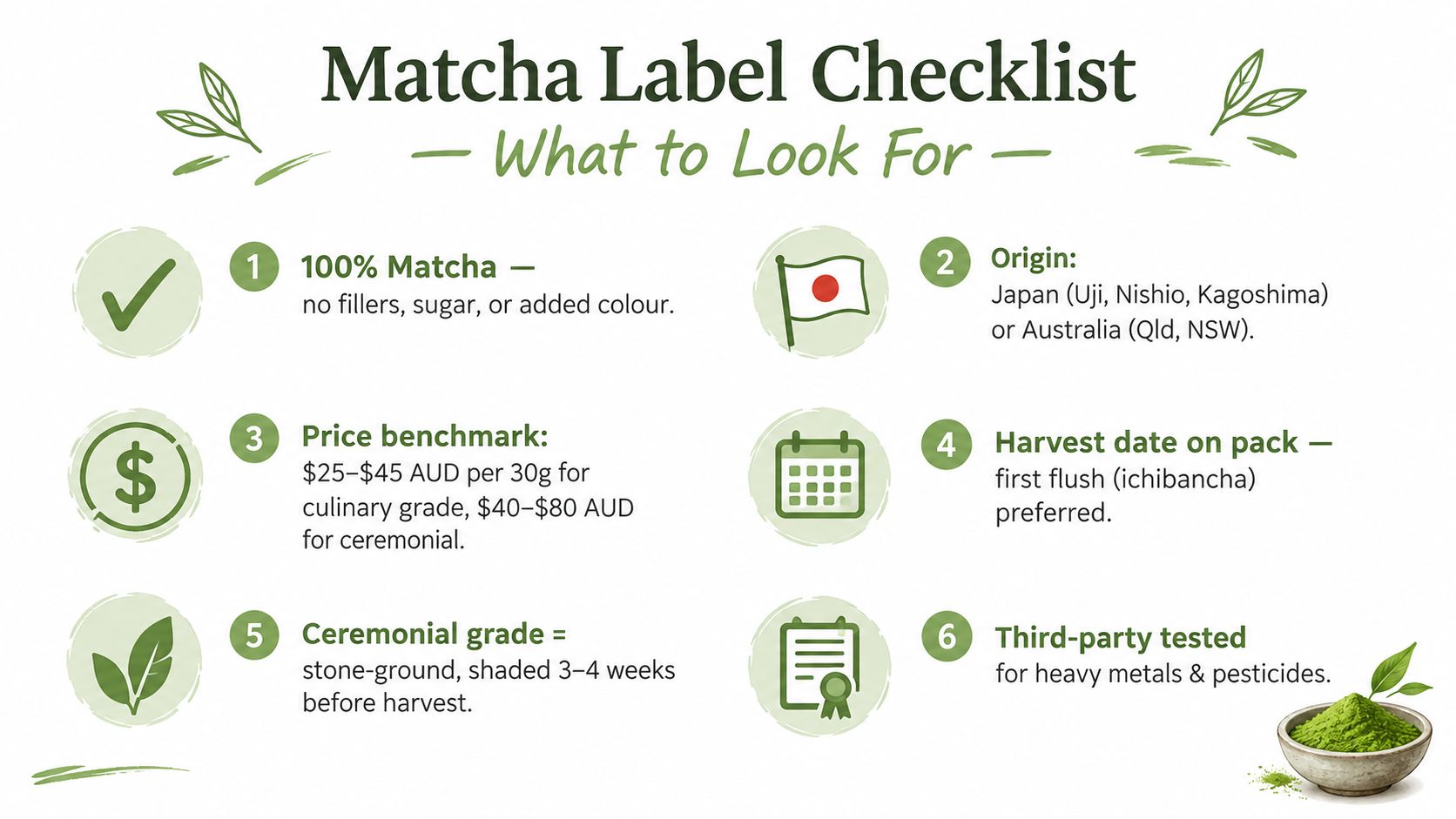
Look for an ingredient list that says 100% matcha or 100% powdered green tea. If you're buying a flavoured latte blend, the label should name every added ingredient so you can distinguish a pure powder from a prepared mix.
Then check the origin. A Japanese growing region such as Uji, Kagoshima, or Nishio can tell you more than a vague phrase such as “Japanese style”. If the pack names a cultivar, harvest, mill, or batch, that extra detail helps you ask better questions about flavour and consistency.
Organic claims deserve the same care. Look for the named certification body rather than assuming that “natural”, “clean”, or “chemical-free” means certified organic. A seller who can explain the certification and provide traceability is giving you stronger evidence than a decorative leaf on the front panel.
Look for evidence, not adjectives
Words such as “super”, “premium”, and “ceremonial” can help describe positioning, but they aren't enough on their own. Ask whether the seller provides storage guidance, batch information, a clear use recommendation, and testing relevant to the product.
For cafés and retailers, ask for documentation covering heavy metals and microbiological safety. For home buyers, a transparent ingredient list, origin statement, certification details where claimed, and sensible freshness guidance are useful signals. A step-by-step guide for DTC brands offers helpful context on why product descriptions should answer specific buyer questions rather than rely on vague promotional language.
Caffeine is another labelling consideration. FSANZ's guidance means the word “pure” doesn't make a powder caffeine-free, and it doesn't replace responsible serving advice. If you're combining matcha with other caffeinated drinks, choose a repeatable serving and keep a simple record of your total intake.
Brewing, Lattes, and Cooking with Pure Matcha
The same powder can taste elegant, creamy, bitter, or flat depending on how you prepare it. Water temperature and technique matter, but so does grade. Save delicate ceremonial matcha for preparations where you'll taste it directly, and use culinary powder where other ingredients need to share the stage.
Start with a whisked bowl
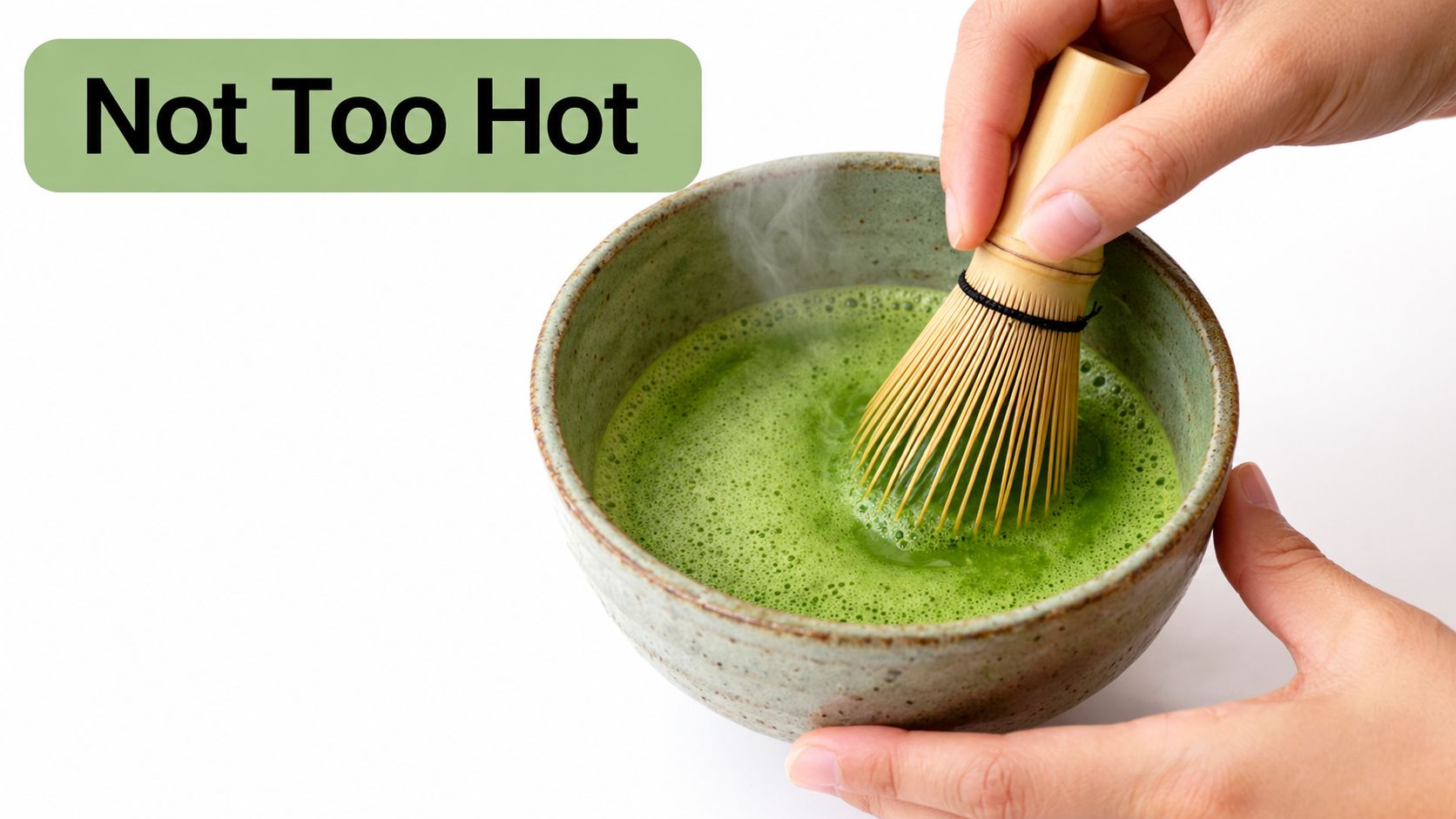
For a traditional drink, sift the powder into a bowl, add hot water around 80°C, and whisk briskly with a bamboo chasen until the liquid is smooth and lightly frothy. Water that's too hot can make the drink taste more bitter, while insufficient whisking leaves clumps.
For an iced matcha, shake sifted powder with a small amount of cool or lukewarm water in a sealed jar or shaker before adding ice and milk. This creates a smooth concentrate without requiring a full traditional setup.
A latte follows the same principle. Whisk the matcha with a little water first, then add textured milk. Keep the sweetener modest if you want the tea's umami and grassy character to remain noticeable.
Take it beyond the cup
Culinary matcha works well in:
- Baking: Add it to pancakes, biscuits, sponge mixtures, icing, or shortbread.
- Cold desserts: Blend it into ice cream, yoghurt, or a creamy frozen mixture.
- Smoothies: Combine it with banana, berries, milk, or yoghurt.
- Savoury dishes: Stir a small amount into salad dressing, a glaze, or a marinade.
Store opened matcha in an airtight tin away from light, heat, moisture, and strong kitchen odours. Refrigeration can help protect freshness, but allow the sealed container to come back towards room temperature before opening so condensation doesn't reach the powder.
Sourcing Matcha for Cafés and Retailers
For cafés and retailers, the first sourcing problem is rarely flavour. It is repeatability. If one staff member uses a rounded spoon, another uses a level scoop, and a third adds extra powder to rescue a weak drink, customers end up buying three different versions of the same matcha latte.
That is why pure and good should never be treated as the same buying standard. A powder can be pure because nothing has been added, yet still be a poor fit for direct drinking, inconsistent in colour, or difficult to trace by batch. For a business, quality means a stable supply, clear origin, freshness, and information your team can use on the floor.
Build consistency into purchasing
A good supplier relationship works like a recipe card for your whole business. It reduces guesswork before the tin is even opened. Ask an importer or distributor for:
- Origin records: Country and, where available, growing region.
- Certification evidence: Documentation supporting organic claims.
- Batch information: A way to trace stock and manage rotation.
- Safety testing: Certificates covering heavy metals and microbiological hazards.
- Preparation guidance: Recommended gram weight, water volume, and application.
- Caffeine communication: Accurate information for staff and customers.
Then standardise service by weight, not by eye. Record the gram dose, water volume, milk type, sweetener, and serving method for each menu item. Staff should also understand that ceremonial and culinary powders suit different jobs. Substituting one for the other can shift taste, colour, and margin.
A practical range usually stays tight. One drinking-focused option, one latte powder, and one baking or wholesale format is often enough. Clear purpose matters more than a long catalogue, because customers and staff both make better decisions when each product has an obvious role.
Menu context matters too. The Australian Bureau of Statistics reported in the National Nutrition and Physical Activity Survey release that sweetened beverages supplied 25.4% of all free sugars consumed in Australia in 2023, that Australians consumed an average of 159 mL of sweetened beverages per day, and that these drinks contributed about 11 g of free sugars daily. An unsweetened or lightly sweetened matcha option can meet that demand for lower-sugar choices, but the menu still needs to describe the product accurately. Pure matcha is not caffeine-free, and staff should be ready to explain that clearly.
Quick Answers and a Practical Checklist
A confident purchase doesn't require specialist vocabulary. It requires a few checks that connect the label to the way you'll use the powder.
The buyer's checklist
- Ingredient: Choose a powder that clearly states 100% matcha or powdered green tea.
- Origin: Look for a named country and, where available, a growing region.
- Quality evidence: Check certification details, batch information, storage advice, and relevant testing.
- Grade: Use ceremonial for direct drinking, premium culinary for lattes, and ingredient-grade culinary for recipes.
- Freshness: Buy an amount you can seal and use while the colour and aroma remain lively.
- Storage: Keep it airtight, cool, dry, and protected from light and odours.
Common questions
How much caffeine does matcha contain?
There isn't one universal amount. The tested products discussed earlier ranged from 17.11 to 35.01 mg per gram, so your exposure depends on the product, gram weight, and preparation. Count matcha alongside your other caffeine sources rather than treating it as a caffeine-free wellness drink.
Is matcha the same as green tea powder?
Not always. Matcha is a specific powdered tea made from specially cultivated and processed leaves, while “green tea powder” can describe a broader range of products. Check the production details and ingredient statement.
Is pure matcha safe during pregnancy?
Pure matcha contains caffeine, so pregnancy changes the question from “Is it pure?” to “How much caffeine does my total daily intake contain?” Ask your midwife, doctor, or qualified health professional for advice suited to you.
Why does my matcha taste bitter?
Possible causes include a naturally strong culinary grade, an older powder, too much powder, water that's too hot, or poor whisking. Milk can soften the flavour, but better preparation and a grade suited to drinking usually make the bigger difference.
Pep Tea offers certified organic Japanese matcha in drinking and culinary formats, with pack sizes suitable for home users and wholesale customers. If you're ready to compare pure matcha green tea powder by grade, origin, use, and supporting information, visit Pep Tea and explore the organic matcha range.
Variable Temperature Kettle: A Guide for Aussie Tea Lovers

A variable temperature kettle is an electric kettle with selectable heat settings, usually from 50°C to 100°C, designed to extract the best flavour from different types of tea without burning delicate leaves. For many Australian tea drinkers, it's worth considering if you regularly prepare matcha, green tea or other brews that taste noticeably different when the water is too hot.
You've probably had this experience. You prepare a beautiful green tea or whisk a bowl of matcha, take the first sip and find a harsh, drying bitterness instead of sweetness and umami. It's easy to blame the tea, but the water may be the true culprit.
A standard kettle gives you one main result, boiling water. A variable temperature kettle gives you more control over the part of brewing that happens before the leaves, powder or infusion ever touches your cup.
Why Your Matcha Might Taste Bitter
The morning ritual starts well. You sift your matcha into a bowl, add water and whisk until a soft layer of foam forms on the surface. Yet the first sip tastes gritty, chalky or aggressively bitter. You try more whisking, less powder and a different mug, but the problem remains.
The missing variable is often water temperature.
Boiling water can pull bitter and drying compounds from delicate tea more aggressively than cooler water. An Australian kettle manual explains that lower-temperature brewing is relevant for sensitive infusions because boiling water can over-extract catechins and contribute to bitterness, while cooler water allows more repeatable control over the result in its guidance for variable-temperature brewing.
Matcha needs particular care because you drink the whole leaf in powdered form rather than steeping leaves and removing them. That makes texture, concentration and water temperature especially noticeable. If your water is too hot, the tea's more delicate flavours can become hidden behind astringency.
The simple brewing adjustment
Try changing the water before changing the matcha. Use cooler water, whisk thoroughly and taste the result before deciding that the powder itself is poor quality. A smoother cup can make the natural sweetness, savoury character and creamy body easier to notice.
For a practical guide to the complete process, including preparing the powder and whisking technique, follow this guide to making matcha tea from powder.
This principle also applies if you're using tea as part of a calmer alternative to strong coffee. Resources on natural energy boosters without jitters can help you compare different beverage routines, but the preparation method still matters. A carefully brewed tea can be more enjoyable because it tastes balanced.
Practical rule: If green tea or matcha tastes sharp and drying, adjust the water temperature before adding sweetener.
A variable temperature kettle doesn't improve every tea automatically. It gives you the ability to repeat a temperature that suits the particular drink, which is far more useful than boiling water and guessing when it has cooled enough.
What Is a Variable Temperature Kettle
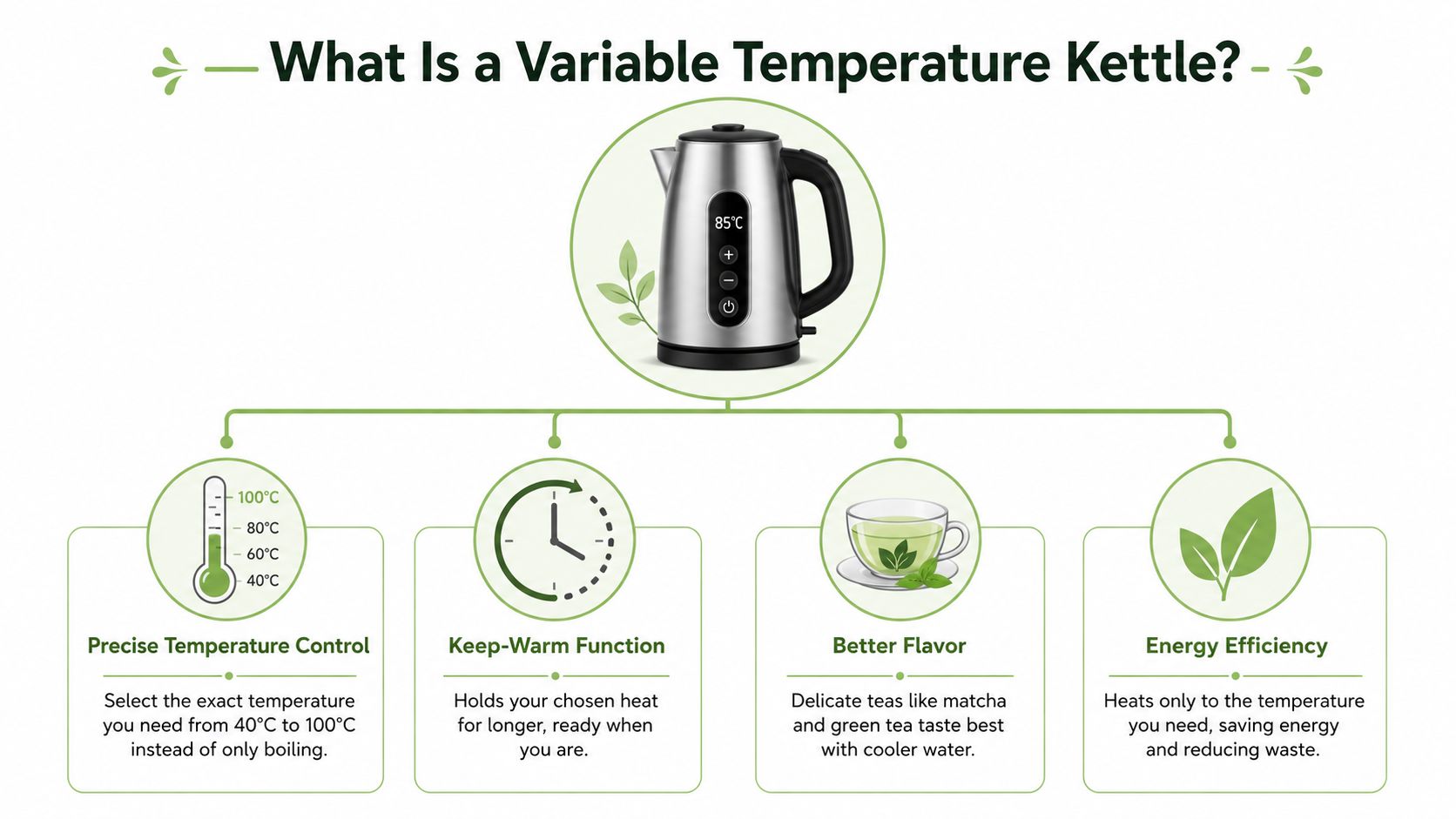
A variable temperature kettle heats water to a selected temperature rather than stopping only at a full boil. Most models in Australia offer a range that broadly spans 50°C to 100°C, although the number of selectable points varies between products.
Smeg Australia's variable kettle range, for example, lists seven settings, at 50°C, 60°C, 70°C, 80°C, 90°C, 95°C and 100°C on its Australian product page. Those settings turn the kettle into something closer to a basic brewing tool. You can choose a gentler temperature for green tea, a warmer setting for oolong or a near-boil for a fuller-bodied infusion.
The category has also spread across different parts of the Australian retail market. Shoppers can find simpler variable-temperature options through mass-market retailers such as Kmart, alongside premium models sold through stores including Myer and Harvey Norman. The difference isn't only appearance. It can include temperature range, display design, pouring control, heat retention and how accurately the kettle reaches its selected setting.
The features that matter
A good model usually combines several functions:
- Selectable heat: You choose a target instead of waiting for boiling water to cool.
- Keep-warm control: The kettle can maintain the selected temperature for later pours, depending on the model.
- Automatic shut-off: The appliance stops heating when it reaches its target or detects a safety issue.
- Clear controls: A readable display or well-marked buttons make repeatable brewing easier.
- Suitable capacity: A compact kettle can suit individual tea preparation, while a larger one may be more convenient for a household.
The key distinction is control, not complexity for its own sake. If you mostly boil water for pasta or make drinks that require boiling water, you may not use the extra settings often. If you drink different teas through the week, those settings can remove a frustrating amount of guesswork.
Here's a visual demonstration of how temperature selection and kettle design can fit into a brewing routine:
Optimal Brewing Temperatures for Tea
There isn't one perfect temperature for every tea. Water that suits black tea can overwhelm green tea, while water that produces a gentle green tea may leave some stronger infusions tasting thin.
Use the following as practical starting points rather than rigid rules:
| Drink | Useful starting point | Why it matters |
|---|---|---|
| Green tea | Around 70°C to 80°C | Helps limit harsh extraction from delicate leaves |
| Matcha | Around 70°C to 80°C | Supports a smoother balance of sweetness and umami |
| Oolong | Around 80°C | Gives semi-oxidised leaves enough heat without treating them like a boil-only infusion |
| Black tea | Around 95°C to 100°C | Provides the heat needed for a fuller, more robust cup |
| Herbal infusions | Near boiling | Suits ingredients that need hotter water to release their flavour |
These ranges reflect the broad brewing guidance published for Australian tea drinkers, including recommendations of roughly 75°C to 85°C for green tea, temperatures near 95°C to 100°C for black tea, and an intermediate range for oolong in this Australian tea FAQ. Your exact preference may depend on the tea's origin, the amount used and how long it steeps.
Why a few degrees can change the cup
Heat affects extraction. As water gets hotter, it can draw flavour compounds from tea more quickly. That can be helpful for a strong black tea, but it can make a delicate green tea taste more drying or bitter.
For matcha, temperature also affects the relationship between texture and flavour. Cooler water won't remove the powder's natural character, but it can make the cup feel less aggressive. If your matcha tastes flat rather than bitter, try improving your sifting and whisking before increasing the heat.
You can find more practical guidance in this matcha brewing temperature guide, then adjust gradually rather than changing temperature, powder quantity and brewing time all at once.
The best setting is the one that gives you a balanced cup and that you can repeat tomorrow.
A variable kettle is useful for more than traditional teacups. It can help with matcha lattes, cocoa and other hot drinks where boiling water may damage flavour or make the drink difficult to combine smoothly. If you enjoy steeping tea in alternative equipment, these French press tea tips from PureHQ Inc. offer another preparation option, although a variable kettle still gives you more control over the water before it reaches the press.
Is a Variable Temperature Kettle Worth It
You have a fresh green tea, a good matcha and a busy morning. A basic kettle boils water quickly, yet the cup turns sharp because the water was hotter than the tea needed. In that situation, a variable temperature kettle can make a noticeable difference. Its value depends on what you drink, how often you prepare it and whether you want the same flavour each time.
A basic kettle remains perfectly suitable for black tea, herbal infusions and cooking water. Green tea and matcha make the case for more control, especially when you prepare them regularly. The feature matters because it connects the kettle's settings with the chemistry of the cup. Smeg's seven settings, for example, may look like a reason to upgrade, but the useful question is whether you will use those options for different teas.
Australian shoppers can face a wide gap between entry-level and premium products. A Kmart model can be listed at $69, while premium options may sit around $299 to $349, according to the Australian buying context described by CHOICE in its kettle buying guide. A higher price does not automatically produce better tea. It may pay for sturdier construction, a more polished interface, a better pour or steadier temperature control. Choose features that fit your habits rather than paying for settings that will stay unused.
The energy question
More controls do not automatically mean much higher electricity use. The bigger influence is usually how much water you heat. Filling the kettle for one mug uses less energy than boiling a full chamber, regardless of whether the kettle has a temperature display.
Heating less water to a lower selected temperature may suit some brewing routines, but a variable kettle should not be purchased solely for dramatic savings. Electricity pricing, fill level and daily use affect the result. Its strongest benefits are flavour control, convenience and consistency.
A useful decision test
Choose a basic kettle if:
- You normally prepare drinks with boiling water.
- You do not notice much difference between a gentler and hotter brew.
- Your budget is better spent on higher-quality tea or other kitchen essentials.
Consider upgrading if:
- You prepare green tea or matcha regularly.
- You make several different types of tea.
- You want to repeat a preferred temperature without waiting for boiled water to cool.
- You use a keep-warm function during a longer tea session.
A premium kettle can be a worthwhile daily tool, but it is not required for good tea. A modest variable model may provide the control you need without charging you for design features you will not use.
Buying and Maintaining Your Kettle
A kettle can look impressive on an Australian benchtop without making better tea. Start with performance: it should reach the selected temperature consistently, show clear controls and include practical safety features. A higher price does not automatically mean greater accuracy, lower running costs or a better pour. Match the appliance to the drinks you prepare.
Australian consumer testing treats temperature accuracy as a real performance measure. CHOICE checks accuracy at each variable-temperature setting and conducts a dry-boil safety test, so temperature control and automatic shut-off deserve attention when comparing models in its explanation of kettle testing.
What to check before buying
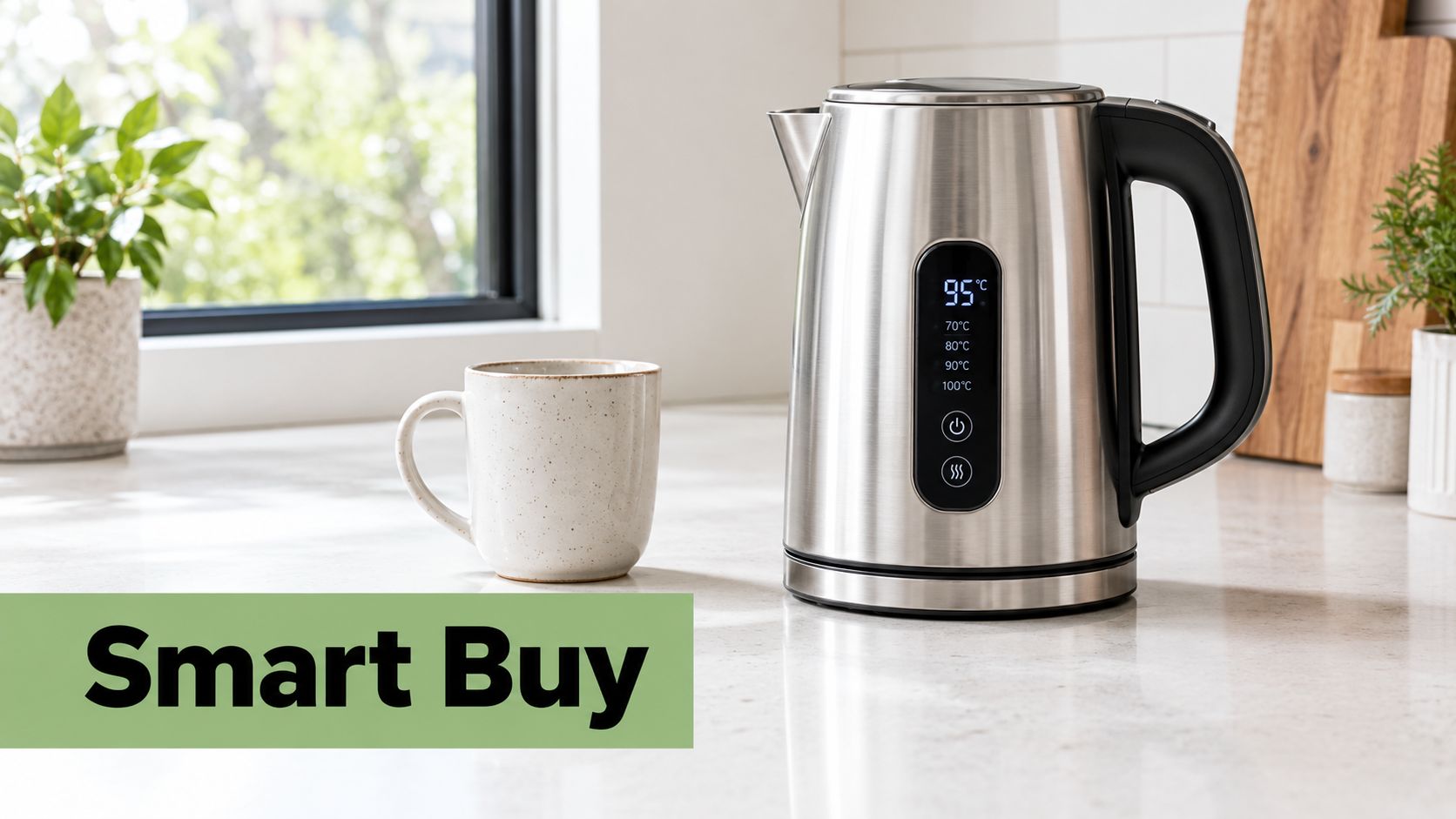
Start with the controls. A readable display and simple temperature selection matter more than a crowded panel. Smeg's seven settings, for example, can be useful when you move between matcha, green tea and hotter brews, provided the selected temperatures suit the chemistry of each drink. Matcha needs water that will not scorch its delicate flavour, while green tea can become harsh when brewed too hot.
For capacity and accuracy comparisons, see our guide to choosing an electric kettle in Australia. Australian products range from compact 1L gooseneck kettles to family-sized 1.7L models, with some combining temperature selection and heat retention in this Australian product listing. Choose the size that fits your usual cups. A larger chamber can encourage unnecessary boiling, while a smaller one may suit a solo morning ritual.
Check the spout. A gooseneck design supports a slower, controlled pour for manual brewing. A wider spout may suit a teapot or French press better.
Keep the water and kettle clean
Mineral deposits can affect flavour and heating performance. Descale according to the manufacturer's directions, particularly if your local water leaves visible residue, then rinse thoroughly so the next cup does not taste of cleaner.
Use a stable, heat-resistant surface, keep the cord away from the bench edge, and avoid overfilling or running the kettle dry. Empty stale water rather than leaving it inside for long periods.
Regular care keeps fresh water, accurate heat and your tea in clean contact.
Elevating Your Daily Tea Ritual
A variable temperature kettle changes the role of water in your routine. Instead of treating every tea as if it needs the same treatment, you can respond to the drink in front of you. Green tea can have a gentler setting, oolong can receive more heat and black tea can still be prepared close to boiling.
That small act of selection encourages a more mindful approach. You notice aroma before drinking, taste the difference between astringency and bitterness, and learn which settings suit your preferred matcha or tea. The kettle becomes useful because it helps you build a repeatable habit, not because it promises to fix every brewing mistake.
Match the tool to the ingredient
Premium tea deserves careful preparation, but equipment can't compensate for stale ingredients, poor storage or an unsuitable recipe. Start with fresh water, use the amount of tea you need and change one variable at a time. If the first cup tastes too sharp, lower the temperature. If it tastes weak, adjust the tea quantity or steeping approach before assuming you need a new appliance.
The same mindset works across a wellness-focused beverage routine. A carefully prepared matcha can be part of a calm morning ritual, while an organic kombucha can offer a low-sugar alternative when you want something refreshing. Neither drink needs exaggerated promises. Their value starts with quality ingredients, thoughtful preparation and choosing a beverage that fits your day.
For Australian households, the best variable temperature kettle is the one that makes those choices simple. It should be safe, easy to clean and accurate enough to help you repeat the cups you enjoy. If you mostly drink one tea, a standard kettle may be all you need. If you move between matcha, green tea, oolong and other infusions, selectable heat can make the difference between guessing and brewing with intention.
Explore organic Japanese matcha and Australian-brewed sugar-free kombucha from Pep Tea, with options suited to home routines, cafés and wellness-focused menus. Visit the range, try your preferred brew at a gentler temperature and discover how better control can bring out more character in every cup.
Is Matcha Sweet? a Practical Guide to Matcha Flavour

Pure matcha powder itself isn't sweet. Its natural flavour is vegetal and umami, while sweetness in a matcha drink almost always comes from added sugar, syrup, honey, sweetened milk, or a pre-sweetened blend.
So why does a pale green café latte often taste gently sweet, creamy and almost dessert-like, while a plain bowl of whisked matcha can taste grassy, sharp or savoury? The answer lies in the difference between matcha's sensory sweetness and the sweetness added during preparation.
That distinction matters in Australia, where “matcha” on a café menu may refer to anything from pure Japanese green tea powder to a flavoured latte mix. Once you know what's in the cup, you can choose a sweeter-tasting matcha without automatically choosing a sugary one.
Why Most People Ask If Matcha Is Sweet
A typical café order explains the confusion. You ask for an iced matcha latte, and the drink arrives pale green, cold, creamy and smooth. The first sip may taste softly sweet, especially if the café has used oat milk, vanilla syrup or a pre-sweetened matcha base.
That experience teaches your palate to associate matcha with sweetness. Try a different preparation at home, though. Whisk plain matcha powder with water and you'll notice a much more concentrated flavour, with fresh grassiness, savoury depth, bitterness and a drying sensation on the tongue.
Neither drink is necessarily misleading. They are just different formulations.
The powder and the finished drink are not the same thing
Australian products make this distinction clear. Pure matcha is sold as green tea powder without sugar, while sweetened sachets and latte blends list ingredients such as sugar or organic cane sugar. One Australian sweet matcha sachet lists sugar first and matcha green tea at 12%, while an Australian-made latte blend places organic unrefined cane sugar ahead of matcha powder and reports 4.0 g sugars per 100 g. These examples show that the sweetness comes from the recipe, not from the tea leaf itself. See the Australian sweet matcha product example.
The same principle applies when you order. “Plain matcha latte” may mean no extra syrup, but it doesn't always mean pure, unsweetened matcha. The powder could already contain sugar, dextrose, flavouring or another sweetening ingredient.
A useful question to ask
Before deciding whether matcha is sweet, separate the experience into two questions:
- What does pure matcha taste like? Usually vegetal, umami-rich, bitter and faintly sweet in a savoury sense.
- What does this particular drink contain? It may include milk, syrup, honey or a sweetened matcha mix.
That small distinction closes the gap between a sharp home-brewed matcha shot and the comforting café drink many Australians know first.
What Matcha Actually Tastes Like on Its Own
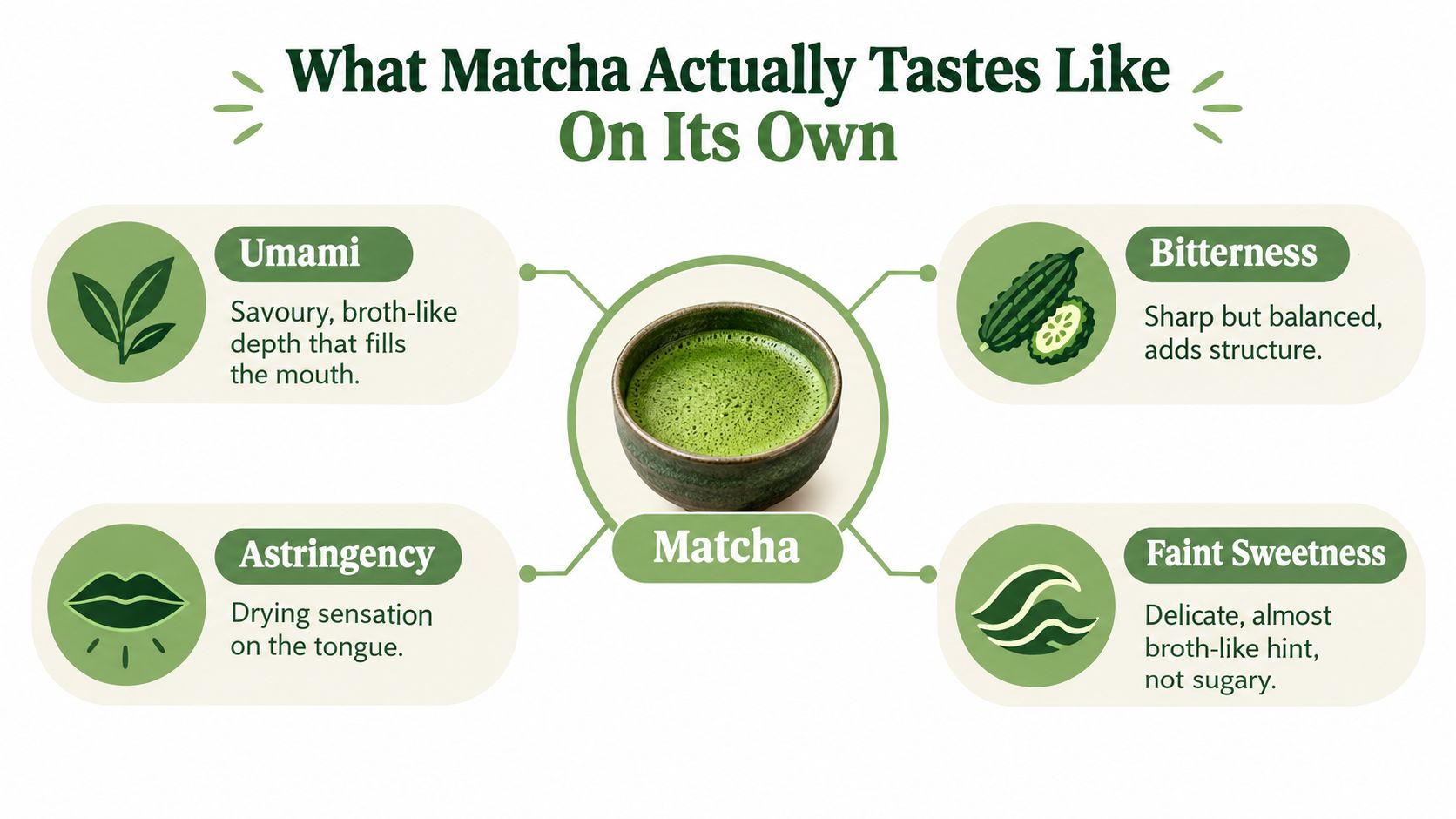
Pure matcha has a layered flavour rather than a simple sweet or bitter profile. The balance changes with the tea's growing conditions, grade, freshness, water and whisking technique, but four sensations appear repeatedly: umami, bitterness, astringency and faint sweetness.
Umami comes first in a good cup
Umami is the savoury, mouth-filling quality that makes matcha feel substantial. Some people describe it as broth-like, buttery or seaweed-like, although a well-made matcha can be more delicate than those comparisons suggest.
L-theanine, an amino acid naturally present in tea, contributes to this depth. An Australian lab-tested ceremonial matcha reported 21.3 mg/g of L-theanine and 65.2 mg/g of total catechins. That composition helps explain why the cup can feel savoury and softly sweet at the same time, without tasting like sugar. Review the Australian matcha potency lab results.
The sweetness here is subtle. It may appear as a rounded finish after the initial green flavour, rather than as the immediate sweetness of fruit juice or a latte syrup.
Bitterness gives matcha structure
Matcha also contains catechins, a group of tea polyphenols. Epigallocatechin gallate, or EGCG, is one of the best-known catechins and contributes to the plant-like bite associated with green tea.
A little bitterness can make matcha feel lively and complete. Too much can dominate the bowl, particularly when the powder is lower grade, the water is too hot or the serving is overly concentrated.
Astringency is different from bitterness
Astringency is the dry, puckering feeling that remains on the tongue. It can feel chalky or tightening, as though the moisture has been drawn from your mouth.
Catechins can contribute to both bitterness and astringency, but the sensations aren't identical. Bitterness is a taste. Astringency is more of a mouthfeel. Recognising the difference helps you diagnose a difficult cup instead of just deciding that you dislike matcha.
Tasting cue: If the finish feels savoury and rounded, you're noticing matcha's umami and theanine. If your mouth feels dry and tight, astringency is probably leading the experience.
For a broader look at the powder itself, the guide to what matcha powder is can help connect the production method with the flavour in your bowl. If you're preparing tea during a physically demanding shift, you may also find this practical resource on tea hydration for hot job sites useful. The key point remains simple: pure matcha may have a faint natural sweetness, but it isn't a sugary drink.
Why Some Matcha Tastes Sweeter Than Others
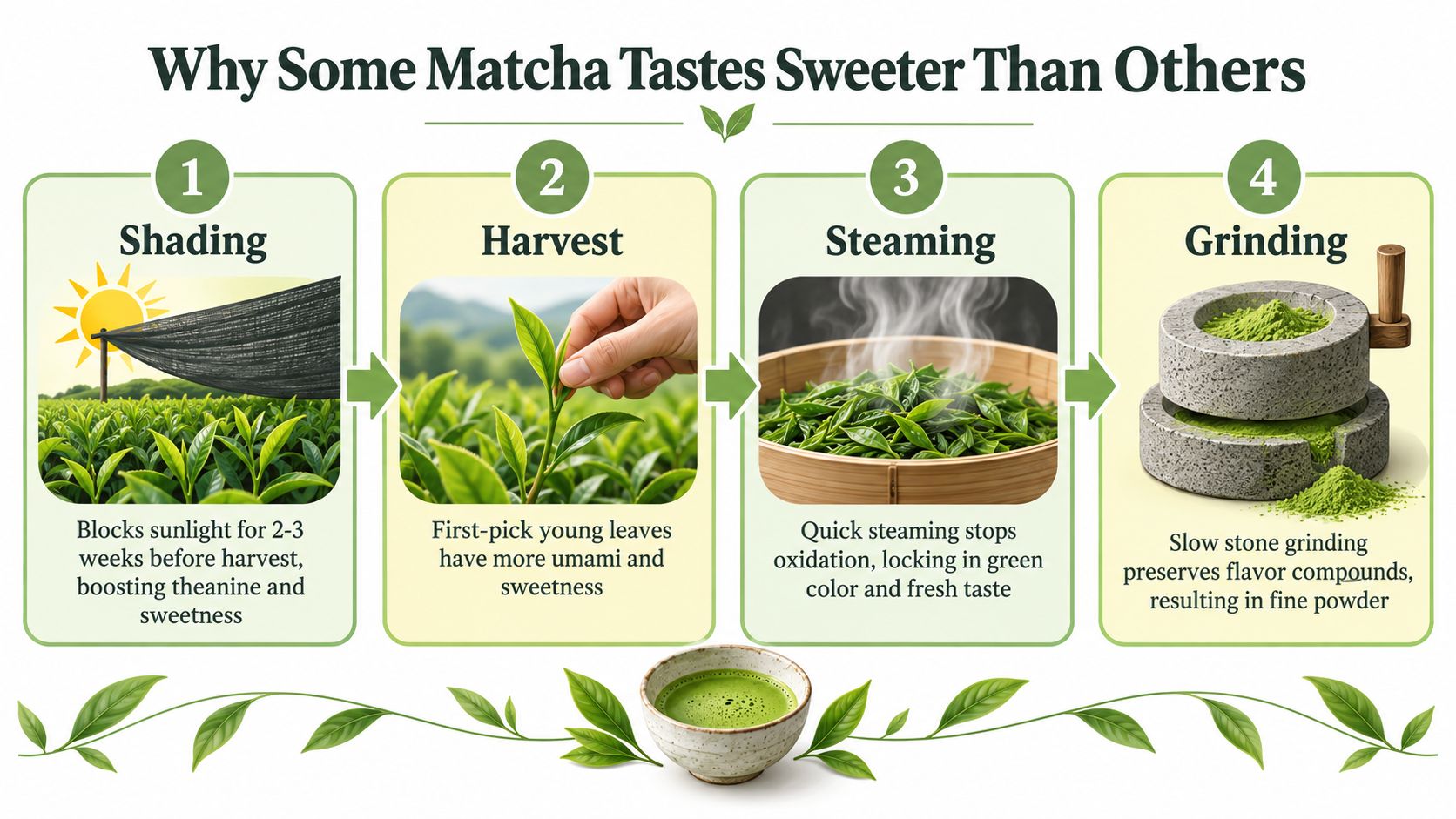
The flavour is shaped long before the powder reaches your whisk. Farming choices, leaf selection and milling all influence whether a matcha tastes rounded and umami-rich or sharp and astringent.
The most important factor is often shading before harvest. Tea plants grown for matcha may be covered from direct sunlight before the leaves are picked. Australian technical guidance explains that shading suppresses the conversion of L-theanine into catechins, helping preserve a more naturally sweet umami profile. Read the Australian guide to ceremonial matcha production.
Shading changes the balance
Sunlight gives the tea plant energy, but it also encourages the chemistry that produces a more assertive, bitter profile. Shade-grown leaves retain more of the savoury character associated with L-theanine and develop a richer green appearance.
That doesn't mean every shaded matcha tastes sweet, or that bitterness is automatically a sign of poor quality. It means the balance can move towards umami, softness and lingering sweetness when the grower uses shading carefully.
Young leaves bring delicacy
Higher-grade matcha commonly uses younger, more tender leaves from the top of the plant. These leaves can produce a finer texture and a more refined flavour than older, tougher leaves.
Older leaves tend to bring stronger vegetal notes and more noticeable astringency. That bolder profile can be useful in baking or a latte, where milk and other ingredients need a flavour that won't disappear.
Milling protects texture and flavour
After harvesting and processing, the leaves are ground into an extremely fine powder. Traditional stone-grinding is slow and gentle, helping create the smooth texture expected from a well-made matcha.
Faster or rougher milling can generate more heat and may affect delicate flavour compounds. The result may taste flatter, harsher or more bitter. When you explore PepTea's matcha grades, pay attention to the intended use as well as the word “premium” or “ceremonial”.
A matcha grown in full sun, made from older leaves and processed for a bold culinary application won't taste like a carefully shaded powder intended for whisking with water. Sweetness is partly a farming and processing outcome, not just a recipe decision.
Ceremonial vs Culinary Matcha and Sweetness
Ceremonial and culinary matcha are often presented as if they were completely separate products, but the labels don't have a universal legal definition. “Grade” can be useful as a guide, yet colour, aroma, texture and intended use give you more reliable information.
| Attribute | Ceremonial Grade | Culinary Grade |
|---|---|---|
| Perceived sweetness | Often softer, rounder and more naturally umami-forward | Usually more assertive, vegetal and less sweet on its own |
| Bitterness | Typically lower when the powder is well made and properly prepared | More noticeable, which helps it stand up to milk and food |
| Colour | Vivid green to jade-like | Green can be deeper, duller or more yellow-toned |
| Texture | Fine, smooth and pleasant with water | May feel more robust, especially in a concentrated drink |
| Best use | Plain whisked matcha or lightly diluted drinks | Lattes, iced drinks, smoothies, baking and cooking |
Choose by preparation, not prestige
If you want to drink matcha with water and notice its natural flavour, choose a fresh, well-sourced ceremonial-style powder. Its softer balance makes it easier to appreciate the umami and faint sweetness without adding anything.
For a latte, culinary matcha can be practical. Milk, fruit, yoghurt or baked ingredients carry and soften the tea's sharper edges. A stronger powder may also be preferable in an iced drink, where dilution and cold temperatures can mute flavour.
A product described as ceremonial can still taste unpleasant if it's stale, poorly stored or prepared with boiling water. Conversely, culinary matcha can make a satisfying drink when you enjoy a more pronounced green tea character.
Selection rule: Buy ceremonial-style matcha for tasting the powder itself. Buy culinary-style matcha when other ingredients are meant to share the stage.
If you're comparing formats or pack sizes, an external AQEEK Coffee matcha selection offers another example of how ceremonial matcha is positioned for drinking applications. The label is a starting point, not a guarantee that the cup will taste sugary.
How to Make Matcha Taste Sweeter Without Sugar
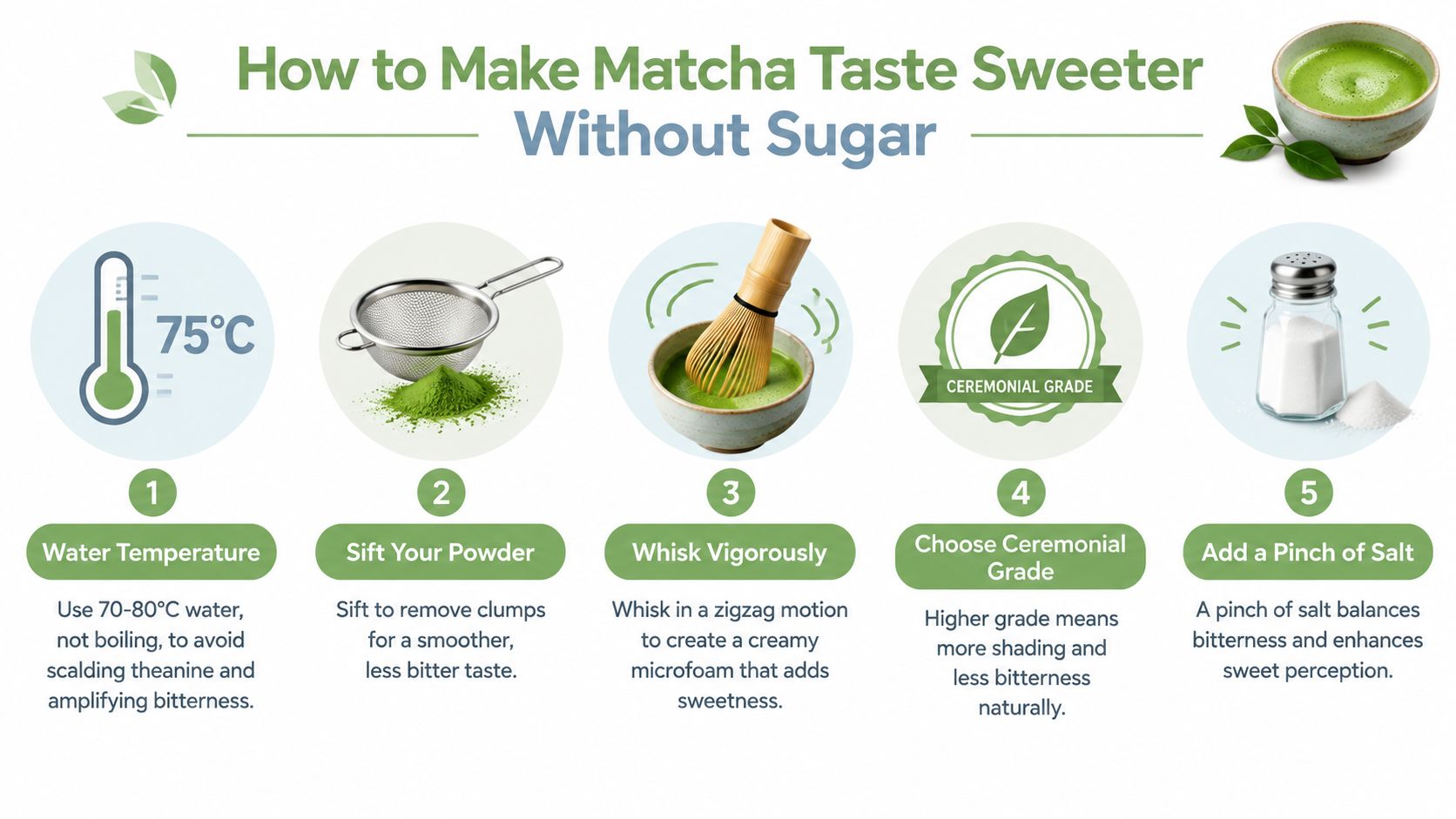
You can make matcha seem sweeter without adding sugar. The goal is to reduce harsh bitterness, preserve theanine and give the powder a smoother texture, so your palate can notice its softer notes.
Start with the water
Use water around 70–80°C, rather than freshly boiling water. Excessive heat can make the cup taste more bitter and may overwhelm the delicate savoury qualities you want to preserve.
A temperature-controlled kettle makes this easy, but you can also pour boiling water into a separate cup and let it cool briefly. The exact temperature matters less than avoiding water that is aggressively hot.
Prepare the powder properly
Sift the matcha before whisking. Clumps dissolve unevenly, leaving some mouthfuls thin and watery while others taste intensely bitter.
Add a small amount of water first and work the powder into a smooth paste. Then add the rest of the water and whisk briskly in a W or M motion. This creates a fine foam and distributes the powder evenly, which can make the texture feel creamier and less abrasive.
Let ingredients support the tea
Milk changes the entire experience:
- Oat milk often contributes body and a naturally sweet impression.
- Dairy milk adds creaminess and softens sharp green notes.
- Nut milks can taste lighter and may leave a thinner cup, depending on the product.
A tiny pinch of fine sea salt can suppress bitterness and make existing sweet notes easier to notice. A few drops of lemon or yuzu can brighten the umami. Vanilla extract can add an impression of sweetness without adding sugar, although it changes the drink's flavour.
For a dependable starting point, try the sugar-free matcha latte method from PepTea. This video also shows the kind of whisking and frothing movement that helps create a smooth drink.
A simple unsweetened method
- Sift your matcha into a bowl.
- Add a small splash of 70–80°C water and whisk into a paste.
- Add the remaining water and whisk in a W motion until lightly frothy.
- Pour the matcha into warm oat or dairy milk.
- Add either a tiny pinch of salt or a drop of citrus, not both at first.
- Taste before making another adjustment.
Small changes work better than adding several ingredients at once. You'll learn which lever improves the cup for your palate.
Why Café Matcha in Australia Usually Tastes Sweet
Many Australian café customers encounter matcha as a latte rather than as plain whisked tea. That format naturally introduces sweetness through the milk, and cafés may also use pre-sweetened powders, syrups or blended bases to make each drink consistent.
A matcha latte mix can contain sugar, dextrose, honey powder or flavouring before the barista adds any extras. Vanilla syrups, flavoured powders and condensed milk can push the drink further towards dessert. In these cases, the word “matcha” identifies the tea flavour, but it doesn't tell you how much of the drink's sweetness comes from the powder.
Read the menu language carefully
Terms such as “matcha mix,” “premium blend” or “latte base” may indicate that the product contains more than matcha. The wording isn't enough to determine the ingredients, so ask directly.
Useful questions include:
- “Is the matcha pure powder or a pre-sweetened mix?”
- “Do you whisk it to order?”
- “Does the latte include vanilla syrup by default?”
- “Can I have it with unsweetened milk and no syrup?”
- “Could I taste a small amount of the matcha with water?”
A café may not be able to provide a plain tasting portion, but the question tells the barista exactly what you're trying to control.
Ordering scripts for a lower-sugar drink
Try: “Could I please have pure matcha, no syrup, with unsweetened milk?” If the café uses a sweetened base, ask whether they have plain matcha powder available.
You can also order a small matcha whisked with water, then add milk yourself. That approach gives you more control than relying on the café's standard recipe.
The practical lesson is straightforward. A sweet café matcha is usually a prepared beverage, not evidence that matcha powder is naturally sweet. Check the ingredient list where possible, and remember that plain powder contains no sugar itself.
Finding Your Sweet Spot With Matcha
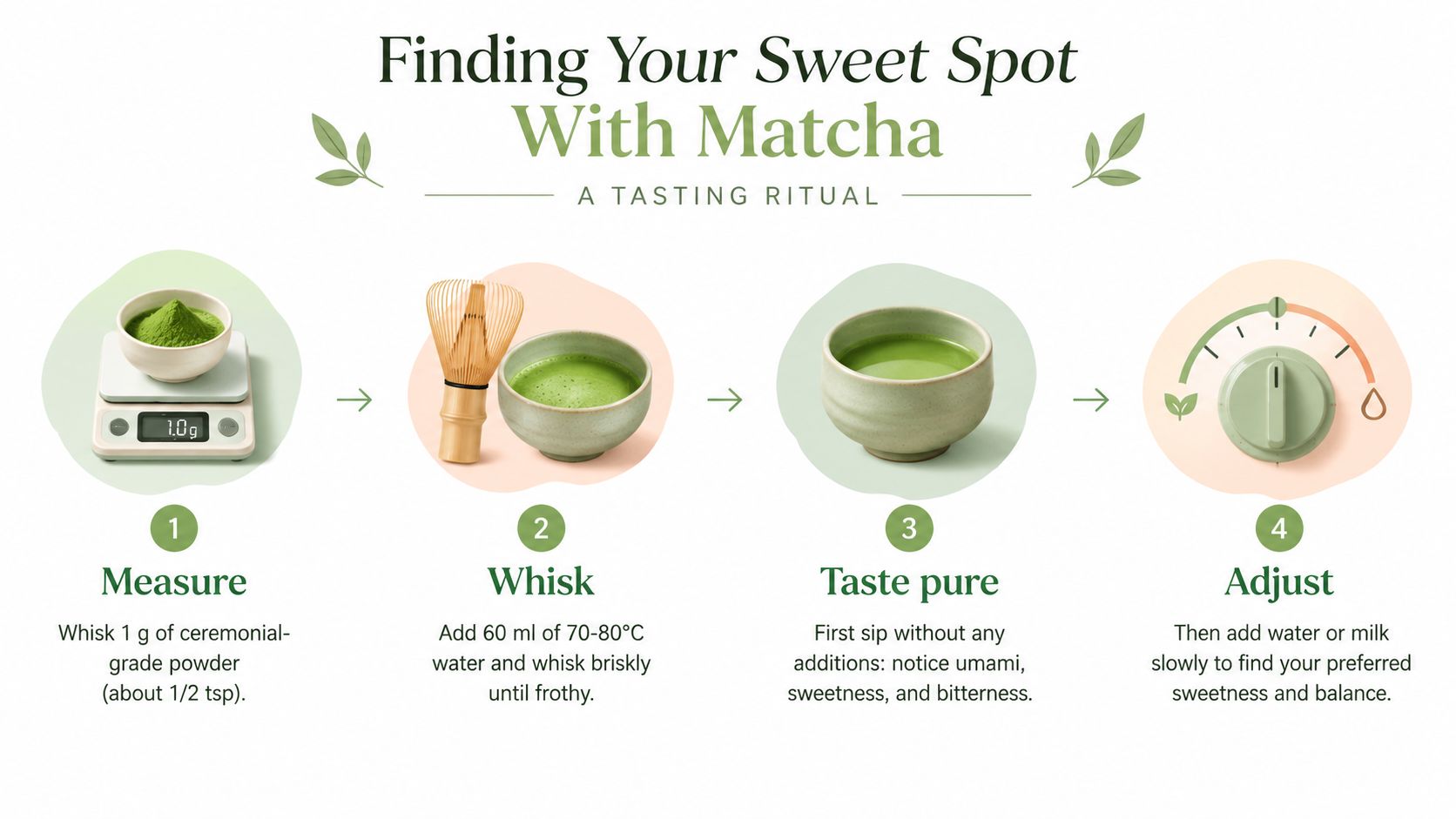
A short tasting ritual can show you exactly where matcha's natural flavour ends and your preferred additions begin. Use a small bowl, a fine sieve and a bamboo whisk if you have them.
Taste it in four stages
- Measure: Weigh 1 g of ceremonial-grade powder, roughly half a teaspoon.
- Whisk: Add 60–80 ml of water at around 80°C and whisk until smooth and lightly frothy.
- Taste pure: Take a small sip without milk or sweetener. Notice the umami, green freshness, bitterness, astringency and lingering finish.
- Adjust: Add a little water, milk or ice, tasting after each change.
You don't need to force yourself to enjoy a concentrated bowl. The purpose is to identify what the powder tastes like before you customise it.
Choose the style that suits your day
- Pure matcha: Choose this when you want to explore flavour and prepare the drink with water.
- Lightly adjusted matcha: Add milk, a pinch of salt or a little citrus when you want softness without making the drink sugary.
- Café-style matcha: Choose a latte with syrup or a sweetened base when you want comfort and dessert-like flavour, treating it as a flavoured beverage rather than straight tea.
Matcha can also fit into smoothies, baking, iced drinks and other recipes, where culinary powder's stronger profile can work well. The right choice depends on the role you want the tea to play.
Keep three ideas in mind:
- Taste matcha on its own at least once before adding anything.
- Adjust sweetness through the grade, water temperature, whisking and milk before reaching for sugar.
- Treat café matcha as a formulated drink, because its sweetness may come mainly from added ingredients.
There isn't one correct matcha recipe. A few repeatable adjustments will help you find a cup that feels smooth, balanced and pleasant without assuming that pure matcha should taste like sugar.
Pep Tea offers organic Japanese matcha for whisking, lattes and culinary use, along with Australian-brewed organic kombucha made in the Hunter Valley, NSW. Visit Pep Tea to explore matcha options and choose a low-sugar beverage that suits your daily routine.
Organic Ceremonial Matcha Guide for Health and Brewing
Australia's matcha market generated more than $54 million in 2024, while Japanese green tea exports to Australia reached 195,319 kg between January and August 2025, a 131% year-on-year increase according to SBS News coverage of Australia's matcha boom. That growth has pushed organic ceremonial matcha from a niche tea-shop ingredient into a mainstream wellness product, but popularity also creates confusion. A green powder labelled “ceremonial” isn't automatically authentic, organic, fresh, or nutritionally consistent.
Organic ceremonial matcha is whole, shade-grown green tea leaf, processed into a fine powder and consumed rather than steeped and discarded. Its appeal comes from a combination of Japanese provenance, organic certification, vibrant flavour, naturally occurring caffeine, L-theanine and catechins, plus the calm ritual of whisking a fresh bowl.
For Australian buyers, quality involves more than colour and branding. You'll need to consider origin, certification, harvest and processing information, packaging, taste, and preferably lot-specific laboratory data. This guide breaks down those decisions, then shows you how to brew organic ceremonial matcha, use it in lattes and recipes, and buy it with greater confidence.
Introduction to Organic Ceremonial Matcha
Matcha differs from ordinary green tea because you consume the leaf itself. Loose-leaf tea works like an infusion: hot water extracts selected compounds, while the leaves remain in the strainer. Matcha instead keeps finely milled powder suspended in water, so storage, preparation, and sourcing shape the result.
Organic describes the tea's production system and the certification supporting that claim. It does not promise a particular flavour, caffeine level, or freshness. Ceremonial generally indicates matcha intended for whisking with water and drinking on its own, yet the term has no universal quality standard. A grade name is therefore only one clue, not proof of authenticity.
Australia's import-dependent supply makes provenance details especially useful. Industry market analysis reports that over 90% of consumed matcha volume is imported, with combined green tea powder imports estimated to have risen at a 13–17% CAGR from 2020 to 2025. Premium buyers consequently depend largely on imported certified products, particularly Japanese matcha.
Start with three checks: can the supplier identify the powder's origin, show its organic certification, and provide laboratory testing that supports its quality? These records work like a product passport. Colour and branding may suggest quality, but traceable documents offer stronger evidence when choosing organic ceremonial matcha in Australia.
Understanding What Makes Matcha Ceremonial
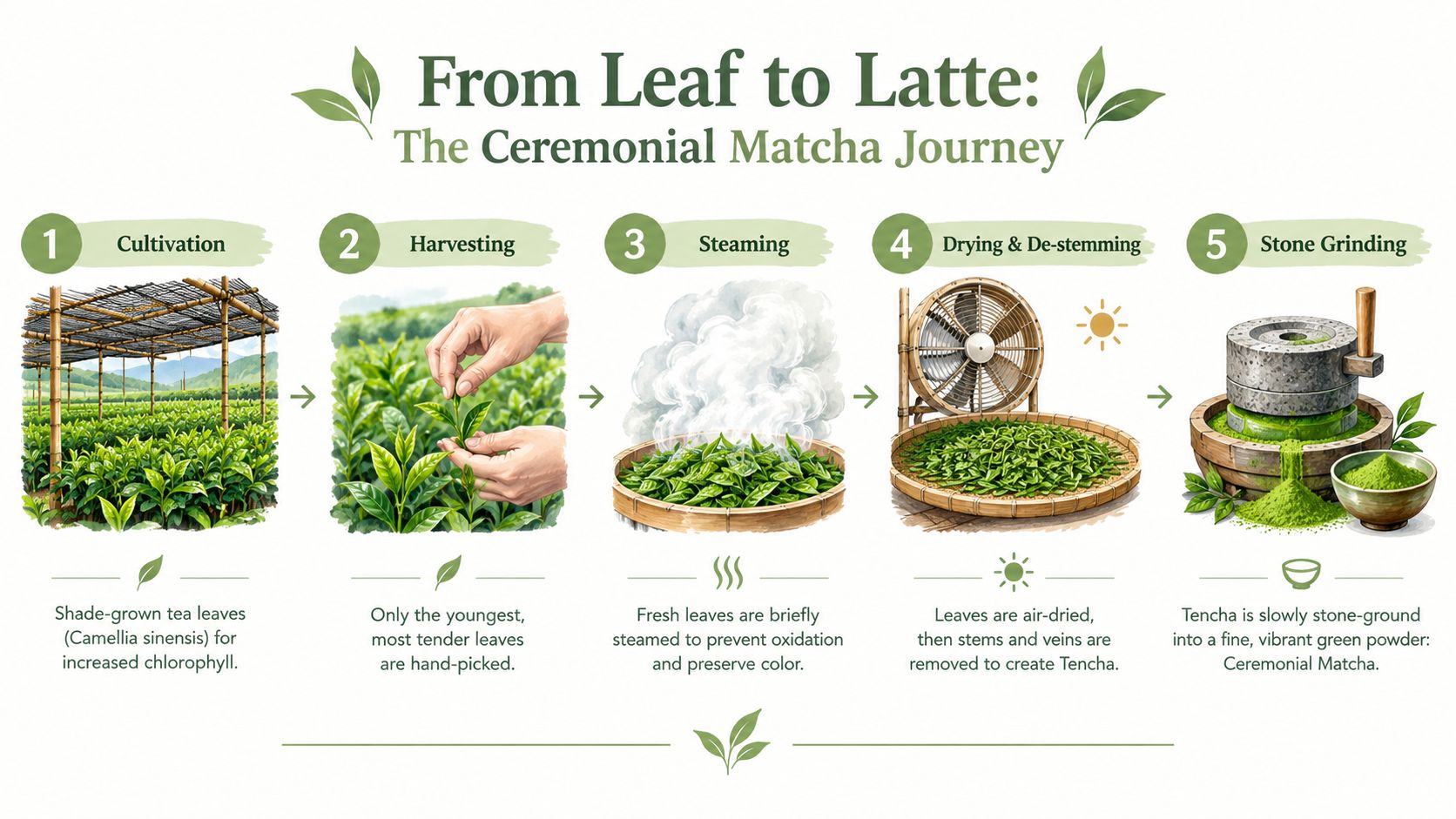
Ceremonial matcha begins as Camellia sinensis, the same tea plant used for green, black and white tea. The difference lies in cultivation and processing. Before harvest, producers shade the plants, often using structures that reduce direct sunlight. This encourages the leaves to retain a deep green colour and develop a softer, umami-led flavour.
From shaded leaf to tencha
The youngest leaves are selected because they're tender and well suited to drinking without milk or sugar. Producers quickly steam the fresh leaves to limit oxidation, then dry them. Stems and veins are removed, leaving tencha, the leaf material that becomes matcha.
Think of tencha as the carefully prepared flour of the tea world. A baker wouldn't describe a coarse bran mixture as the same thing as finely sifted pastry flour. In a similar way, removing tougher leaf parts helps create the smooth texture expected from matcha designed for whisking.
Why stone grinding matters
The dried tencha is slowly ground into an exceptionally fine powder, traditionally using stone mills. The process resembles artisan flour milling, where patience and controlled movement matter more than speed. The result should disperse smoothly when whisked, rather than feel gritty or heavy on the tongue.
This whole-leaf format explains why matcha has a more concentrated taste than a cup of steeped green tea. It also means poor storage can affect the aroma and colour directly, because there's no separate leaf to remove after brewing.
For readers comparing powdered tea formats, this guide to choosing instant matcha can help clarify the difference between convenience powders and matcha intended for a more traditional preparation. PepTea also provides a useful overview of how matcha tea is made, including the transformation from leaf to powder.
Health Benefits and Key Compounds
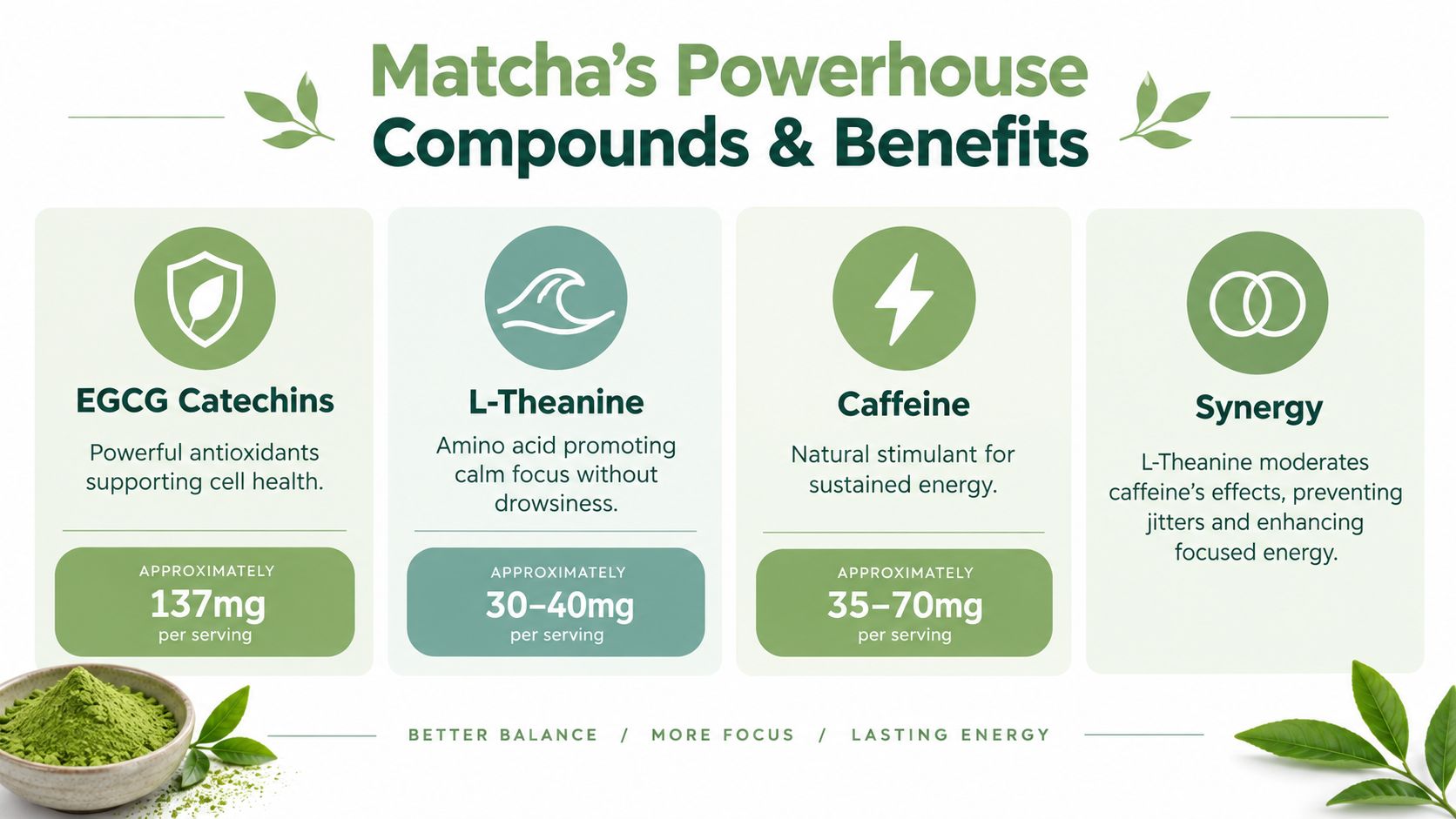
Organic ceremonial matcha contains several naturally occurring compounds that shape both its flavour and its physiological effects. The main trio is catechins, L-theanine and caffeine. It's more accurate to say matcha may support alertness and focused energy than to promise a medical outcome.
Catechins are plant compounds with antioxidant activity. EGCG, or epigallocatechin gallate, is one of the best-known catechins in green tea. A useful everyday analogy is a clean-up crew. Antioxidants help the body manage oxidative processes, but they aren't a cure-all and shouldn't replace a balanced diet or medical advice.
L-theanine is an amino acid associated with tea's characteristic savoury, rounded taste. Caffeine provides stimulation, while L-theanine may help make the experience feel calmer and less abrupt for some people. The combination can feel different from drinking a strongly caffeinated beverage on its own.
Practical rule: Treat matcha as a whole-leaf food and a caffeinated drink, not as a medicine.
A randomized placebo-controlled study used 2.07 g of matcha per day, providing 50.3 mg of theanine, 171.0 mg of catechins and 72.5 mg of caffeine. Participants showed a statistically significant reduction in reaction time and more correct responses on an emotion-perception task, as reported in the published study available through PubMed Central. That result supports interest in the combined matrix, but it doesn't mean every product or serving delivers the same composition.
Preparation can change the sensory experience. Very hot water may draw out more bitterness, while excessive milk or sweetener can hide the fresh, grassy and umami notes that distinguish good matcha. Readers interested in the role of EGCG can explore what EGCG is before deciding how much weight to place on antioxidant language.
Grading Origins and Sourcing in Australia
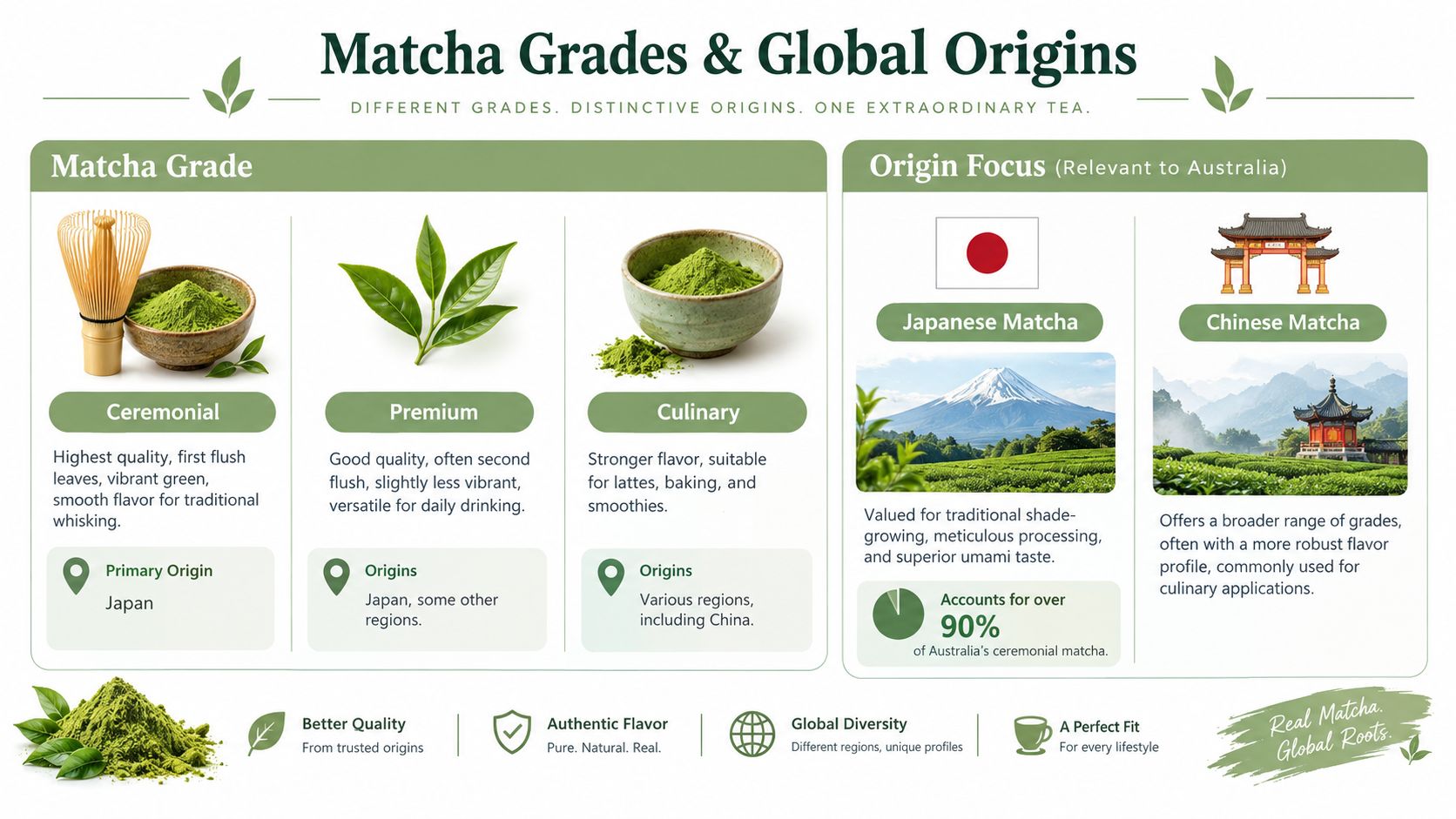
Australia's ceremonial matcha market depends heavily on imported products, so a packet's origin story matters as much as its colour or label. The terms ceremonial, premium and culinary provide useful starting points, but they describe intended use more than they prove authenticity.
Ceremonial matcha is generally selected for a fine texture, attractive colour and balanced flavour when whisked with water. Premium matcha may suit everyday drinking or lattes. Culinary matcha usually has a stronger flavour designed to remain noticeable alongside milk, fruit, flour or chocolate. These categories work like menu labels, not independent laboratory standards.
Origin adds another layer. Japanese matcha is associated with established shading and processing traditions and with umami-focused drinking styles. Chinese matcha is also sold in various grades, often for culinary applications. A country name alone cannot confirm that a product is organic, fresh or appropriate for ceremonial preparation.
Why Australian provenance matters
IndexBox's Australian market analysis describes Australia as an import-dependent market, with Japan supplying much of the value associated with premium matcha and China contributing substantially to import volume. That pattern makes traceability, stock continuity and accurate labelling practical concerns for Australian buyers.
Supply pressure can also affect availability. Australian hospitality coverage describes a fast-growing category, new supply agreements and pressure on shipments of ceremonial Japanese matcha. Treat vague wording such as “Japanese style” or “inspired by Japan” as a prompt to ask questions. Look for the producing country, region where available, importer and batch details.
Reading organic certification
Certification connects an organic claim with an identifiable standard and certifying body. Australian shoppers may see:
- Australian Certified Organic: A certification scheme used for eligible organic products sold in Australia.
- NASAA Certified Organic: Another recognised Australian organic certification pathway.
- JAS: Japan's Agricultural Standards system, relevant when Japanese organic certification is stated.
Check the logo, certification details, product name and importer together. Japanese origin does not automatically mean certified organic, and organic certification does not establish ceremonial grade. For stronger verification, compare the label with lot-specific laboratory data, such as a certificate of analysis showing the tested batch and relevant contaminant or composition results.
How to Choose High Quality Ceremonial Matcha
Start with transparency, not the colour of the tin. A bright jade-green powder can be a positive sign, but appearance alone can't verify origin, organic status, freshness or potency. The most dependable choice combines sensory checks with documentation.
Use the five-part check
-
Read the origin statement. Look for the producing country and, where available, the region, cultivar, harvest information and importer. A specific statement is more useful than a broad phrase such as “Japanese matcha blend”.
-
Verify organic certification. Check for an identifiable certification mark, not just the word “organic” in large type. If the package is unclear, ask the supplier which body certified the product and whether the certification applies to that particular matcha.
-
Inspect the powder. Fresh ceremonial matcha should look vivid rather than dull, yellowed or grey-green. It should feel fine and silky between the fingers, without obvious coarse particles.
-
Smell before tasting. A fresh, gently sweet and vegetal aroma is more encouraging than a stale, musty or hay-like smell. Once whisked, the flavour should be rounded and umami-led, with bitterness and astringency kept in balance.
-
Ask for a lot-specific COA. A certificate of analysis should identify the tested batch and show relevant results rather than relying on generic marketing copy.
The final point deserves particular attention. Independent ceremonial matcha lab results show substantial variation between samples. One analysis reported EGCG at 69.73 mg/g, EGC at 24.47 mg/g and caffeine at 35.01 mg/g. Another test reported L-theanine at 21.3 mg/g and caffeine at 56 mg/g.
Those figures don't create a universal pass or fail threshold, but they demonstrate why “ceremonial” isn't a reliable proxy for potency. A lot-specific COA can help you understand the likely bitterness, intensity and serving consistency of the product in front of you.
A sealed package protects quality, but it can't replace traceability. You need both.
Choose packaging that limits exposure to light and air, check the best-before information, and note the lot number before opening. If a supplier won't answer basic questions about certification, origin or batch testing, choose a product with clearer documentation instead.
Brewing Basics and Creative Use Cases
The simplest way to taste organic ceremonial matcha is to whisk it with water. Use a clean bowl, a bamboo whisk called a chasen, a small sieve and fresh water. Sifting breaks up compacted powder before it meets the water, so you won't need to fight stubborn lumps.
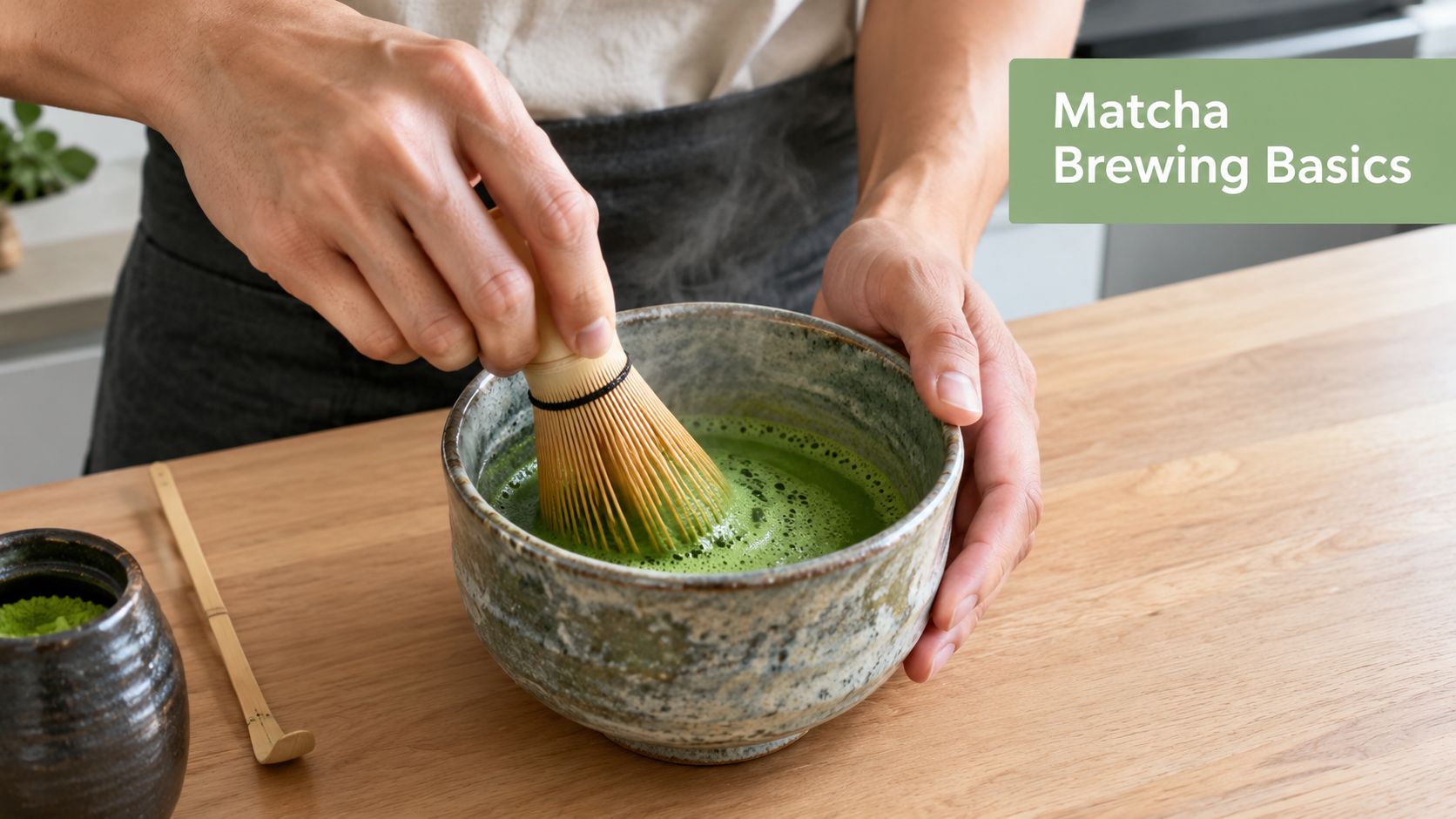
A reliable bowl method
- Warm the bowl, then discard the warming water.
- Sift your chosen amount of matcha into the bowl.
- Add a small amount of warm water and work the powder into a smooth paste.
- Add more water and whisk briskly in a back-and-forth W motion.
- Stop when the surface looks lightly foamy and the powder is evenly suspended.
Avoid boiling water. Excessive heat can make the drink taste harsh, while cooler water tends to preserve delicate sweetness and umami. For a more precise guide, use PepTea's instructions on matcha brewing temperature.
You can also follow the technique visually before adapting it to your own bowl and whisk.
Turning matcha into everyday drinks
A latte starts with a concentrated matcha paste. Whisk the powder with warm water first, then add steamed or chilled dairy milk or plant milk. Oat milk brings sweetness and body, while unsweetened almond milk keeps the tea profile lighter. Add sweetener only after tasting, because sugar can quickly cover the powder's natural character.
For an iced drink, make the concentrate, pour it over ice, then add cold milk or water. A matcha smoothie works well with banana, yoghurt or fruit, but use enough matcha to remain noticeable among the other ingredients. Strong culinary matcha can be practical here because its flavour is designed to stand up to food.
Baking gives you even more flexibility:
- Muffins: Sift matcha with the dry ingredients to distribute the powder evenly.
- Brownies: Stir it into part of the batter for a green tea swirl beside chocolate.
- Ice cream: Blend matcha into the dairy or plant-based base before chilling.
- Smoothies: Combine matcha with fruit, yoghurt and liquid, then taste before adding sweetness.
Cafés can benefit from consistent weighing, water temperature and milk volume. Teams wanting to strengthen their coffee and tea service can also explore TP Training's barista programs for broader beverage preparation skills.
Shopping Guide and Quality Certifications
Buying organic ceremonial matcha in Australia becomes easier when you separate four questions: Is it organic? Is it from the stated origin? Is it fresh? Can the supplier support the quality claim?
Specialist tea retailers, established cafés and direct brand websites can all be useful, provided the product page or packaging gives enough information. Look for a named certification scheme such as NASAA, Australian Certified Organic or JAS, then check that the certification applies to the product rather than only to the business generally.
Use this quick shopping sequence:
- Confirm the label: Check origin, grade description, organic mark, importer details and lot information.
- Examine the pack: Prefer sealed, light-protective packaging that limits air exposure.
- Check freshness: Read the best-before information and avoid products with unclear dating.
- Request evidence: Ask for a lot-specific COA showing relevant compounds such as catechins, caffeine and L-theanine.
- Store it carefully: Keep opened matcha sealed, away from heat, light, moisture and strong kitchen odours.
PepTea offers organic Japanese matcha products, including organic premium and ceremonial-style powders intended for whisking, alongside its Australian-brewed organic kombucha range. That gives shoppers one local supplier option to investigate while comparing certification and product documentation across the category.
A supplier that can't explain its certification, origin or testing may still sell an enjoyable powder, but you won't have enough information to verify the claims. Choose transparency first, then judge the flavour for yourself.
Explore the organic matcha range at Pep Tea to compare Japanese powders for whisking, lattes and recipes. You can also browse its Australian organic kombucha options when you're building a lower-sugar, functional drinks routine.
Matcha Tea Bags vs Powder: An Honest Australian Guide
Most advice on matcha tea bags vs powder gets the question wrong. People talk as if bags are just a cheaper, weaker version of powder, but that's too simple. In practice, you're usually choosing between a blended infusion and whole-leaf consumption, and that changes everything from flavour to caffeine to value.
If you buy smart in Australia, the label matters more than the marketing. A bag can say matcha and still contain only a tiny amount of actual matcha, while powder is the full leaf, whisked and consumed. That's why the better choice depends on what job you want it to do, not which format sounds more premium.
| Format | What you're really getting | Best for | Main trade-off |
|---|---|---|---|
| Matcha tea bags | Often a blend with only 1–2% matcha and other tea material | Fast cups, portion control, office use | Lower ingredient concentration |
| Matcha powder | 100% pure matcha consumed whole | Ritual, lattes, stronger matcha character | Higher price per cup |
Why the Tea Bag vs Powder Question Is Misleading
The wrong debate starts with a false ranking, tea bags below powder. The split is between packets that contain a little matcha in a bag and products that are entirely matcha powder, because product-ingredient reviews report many “matcha tea bags” contain only 1–2% matcha while powdered matcha is 100% pure matcha (ingredient review).
What the format actually does
Powder is whisked into water, then consumed in full. Tea bags are steeped and discarded. That difference changes how much of the leaf ends up in your cup, and it is why the powder format is consistently described as the more nutrient-dense option (format comparison).
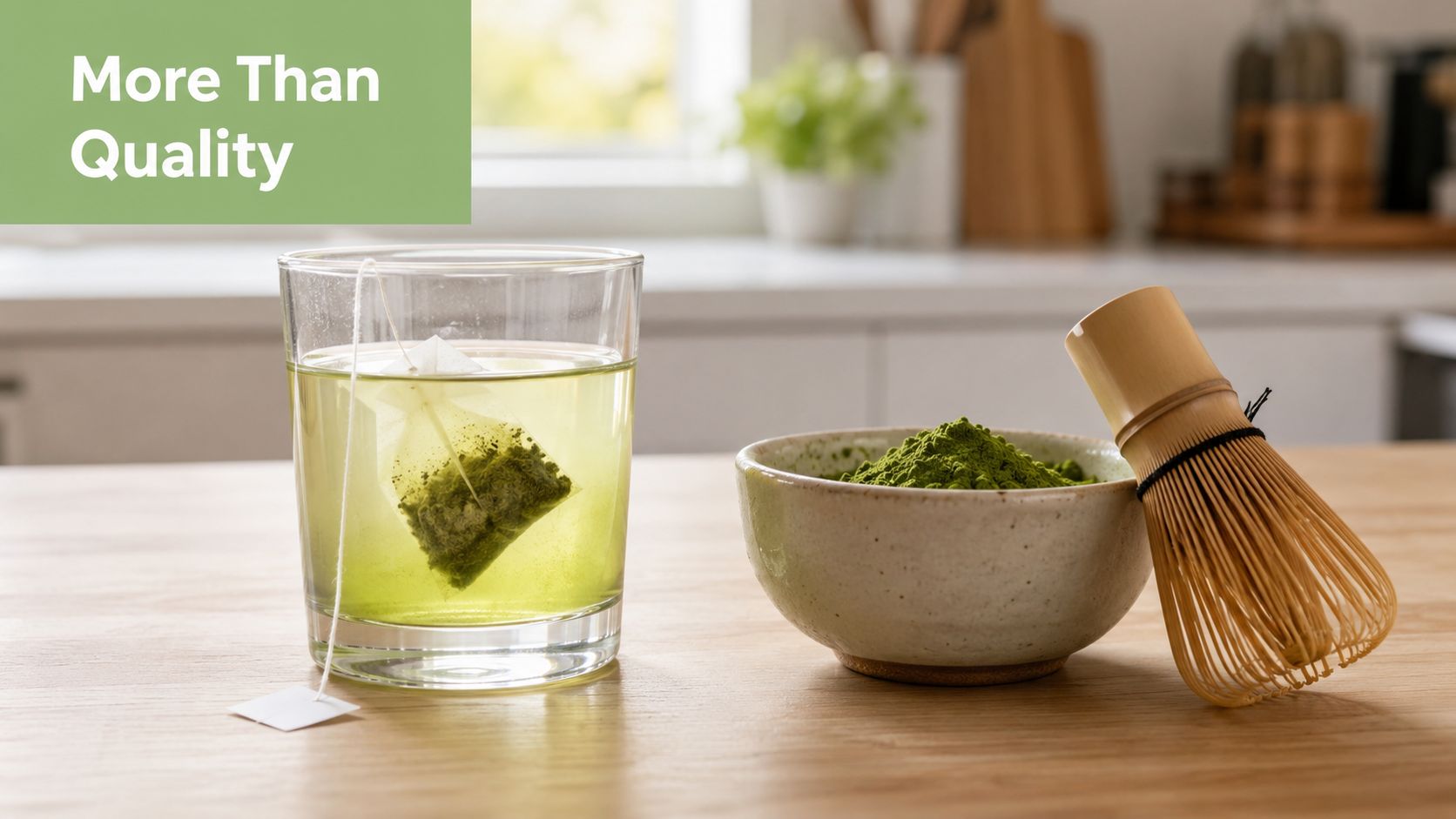
Australian shoppers need to read that difference plainly. If you want a true matcha experience, buy the whole leaf and whisk it. If you want a quick green tea drink with a matcha-style label, the bag can serve that job, but it is not the same product in the cup. For a plain explanation of the powder format, Pep Tea's matcha powder guide is a useful starting point.
Practical rule: read the ingredient panel before you read the front of the packet. The front often sells the idea, the panel tells you what is inside.
That is also why the choice should be tied to the job, not the prestige. A tea bag can suit office use, café back-up service, or a quick cup at home. Powder suits a morning ritual, a proper latte build, or anyone who wants the leaf rather than a trace amount of it. For readers comparing matcha for wellness and energy, matcha for wellness and energy is a relevant reference point.
Independent food-science research also shows that bagged green teas and some standard bagged products can perform well on antioxidant measures depending on the product, so format alone does not guarantee quality. What matters is the ingredient composition, not the marketing language on the box (comparison of bagged and powdered products).
Matcha Grades and What You Are Buying
Shelf labels use the word “matcha” very loosely, so Australian shoppers need to read the ingredient panel before they trust the front of the packet. Some products are true stone-ground matcha, others are diluted blends dressed up with green tea branding. For a plain guide to grading and sourcing, Pep Tea's guide to different grades of matcha is a useful starting point.
Ceremonial and culinary serve different jobs
Ceremonial-grade matcha is the smoother, more delicate style meant for drinking straight. Culinary-grade matcha is built for lattes, baking, and mixing into recipes. That split matters because a cup you whisk and drink on its own needs a different leaf profile from the powder you hide in milk or batter.
A bag that says matcha but contains only 1–2% matcha is not giving you a full matcha experience. It is a green tea blend with matcha branding. Buyers get tripped up because the front of the packet suggests purity while the ingredient list reveals the actual story.
What to check on the pack
Start with the ingredient list. A true matcha powder should read plainly as matcha, not a long blend padded out with other tea material.
Origin details matter too. Japanese regions such as Uji or Nishio usually give you more transparency about sourcing. For Australian buyers who want cleaner inputs, organic certification is another sensible filter. Colour and texture matter as well, because bright, fine powder usually points to a more deliberate product than dull, coarse material.
Buyer's rule: if the brand will not say what percentage of matcha is in the bag, treat it as a blended tea product.
That is why the powder-versus-bag question starts with honesty, not hype. Powder can be true matcha, while a bag can be a convenience format. They are not interchangeable just because both mention green tea. For a buying framework that keeps the purity question front and centre, this Australian matcha powder versus tea bag comparison is useful.
Antioxidants, Caffeine and L-Theanine by Format
The format choice matters because it changes how much of the leaf ends up in the cup. Matcha powder gives you the whole material, while tea bags steep only what sits inside the bag. That is why caffeine delivery, antioxidant intake, and L-theanine exposure usually favour powder when you compare the two formats on equal terms.
Caffeine is a serving question, not just a leaf question
One comparison source reports roughly 70 mg of caffeine per cup for matcha powder versus about 34 mg per cup for matcha tea bags, so powder can deliver about double the caffeine per serve (caffeine comparison). For Australians who want steady energy without guesswork, that is the number to watch.
The key point is not chasing the highest dose. The format changes the stimulant load, and that changes the cup. If you are brewing for morning focus, latte service, or a pre-workout routine, powder gives a stronger and more predictable matcha result.
Antioxidants and L-theanine follow the leaf
The same logic applies to the compounds people usually value in matcha. Powder uses the whole leaf, so the drinker gets more of what the leaf contains. Tea bags make an infusion, so the dose is lower by design.
For a broader wellness framing of matcha powder, matcha for wellness and energy is a useful companion read. Keep the comparison honest, though. Some bagged green teas can still perform well on antioxidant measures depending on the product, so a “matcha” label alone does not guarantee a stronger result.
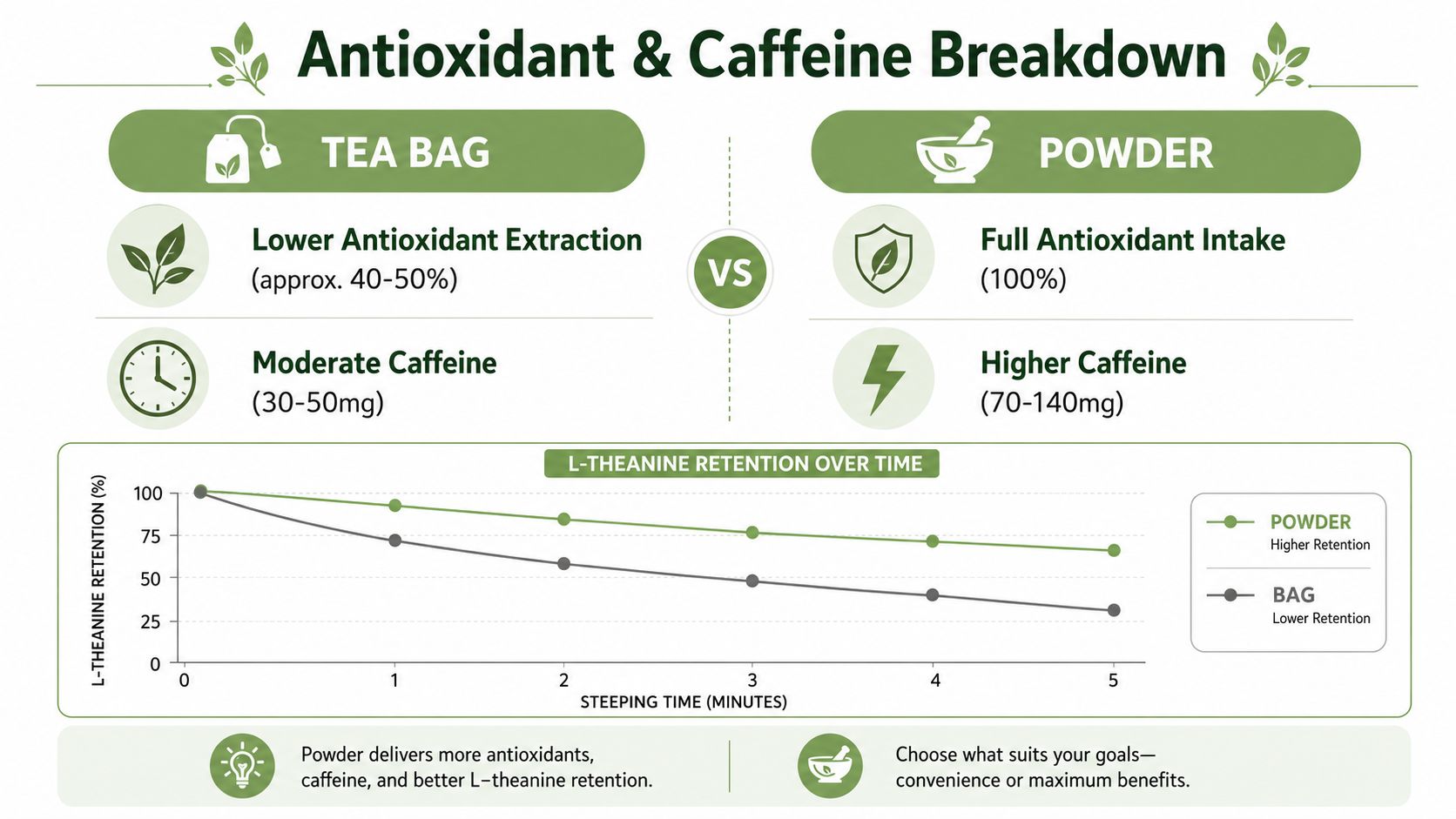
Bottom line: if your goal is clean energy, focus, and the fuller matcha profile, powder is the format that delivers the leaf.
Brewing Methods, Equipment and Everyday Use
Tea bags are dead simple. Drop one into a cup, pour hot water over it, wait a couple of minutes, and you're done. That speed is why they work in offices, hotels, and anywhere a staff member needs a consistent serve with almost no training.
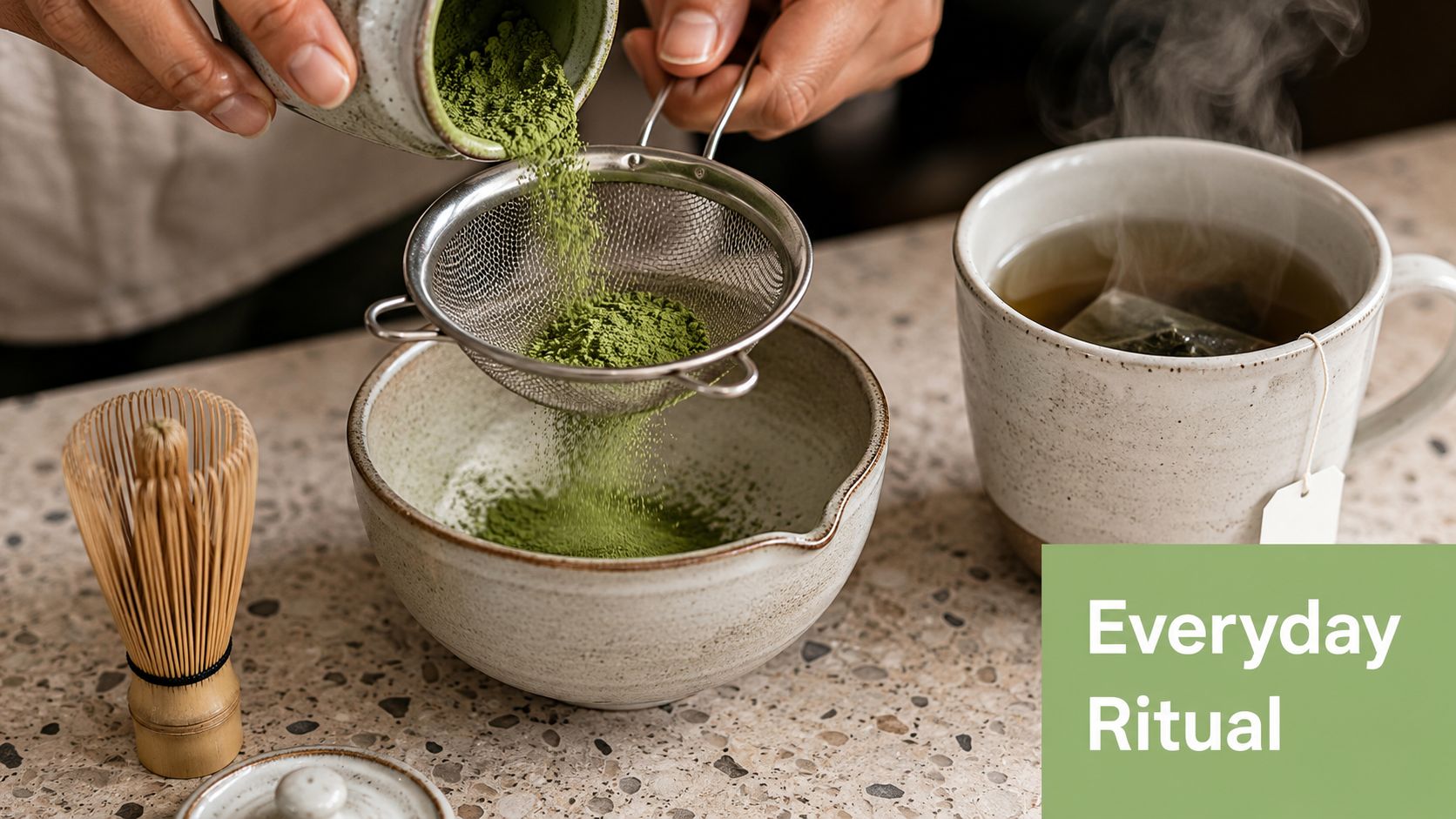
Matcha powder asks for a little more attention, but not much. Sift it, add water at around 80°C, and whisk it with a bamboo chasen until smooth. Once the motion becomes automatic, it's quick, and the result is more consistent than many expect. For a practical walk-through, Pep Tea's how-to-whisk-matcha guide covers the basics well.
The gear each format needs
Tea bags need almost nothing beyond a kettle and a cup. Powder usually benefits from a chasen, a small sifter, a chashaku scoop, and a bowl wide enough for whisking. That sounds fussy until you realise you're setting up a ritual drink, not just making hot water taste green.
You don't need café gear to make powder properly. You need a bowl, a whisk, and a few calm seconds.
That's why powder suits a slower morning or a weekend brew. Tea bags suit a rushed weekday or a shared office kitchen. In café service, powder also gives staff a better base for a latte because the dose can be pre-portioned and built into a repeatable workflow.
Latte service is where powder earns its keep
A latte made from powder has stronger matcha character and a cleaner visual finish. A tea bag is easier to manage, but it won't give the same depth. For cafés, that means powder usually makes more sense when the menu promises a proper matcha drink, while tea bags make sense for simple tea service or back-of-house speed.
Cost Per Cup, Cost Per Nutrient, and Value
Price is where the decision gets honest. ConsumerLab's pricing comparison found brewed tea from bagged green tea could cost as little as US$0.10 per serving, while a serving of matcha powder was about US$1.00 (pricing comparison). That gap is real, and it explains why tea bags keep winning in homes, offices, and cafés that count every cup.
The cheaper cup is not always the better value
If you only want a hot green drink, the bag wins on unit price. If you want actual matcha character, the powder earns its price by putting the whole leaf in the cup. That is the cleaner way to judge value, because a low-priced cup that misses the brief is still poor value.
ConsumerLab also found that getting 200 mg of EGCG from matcha cost over US$2, while it could cost as little as 27 cents from bagged brewed tea. That puts the economics in plain language. If your aim is a specific antioxidant dose, tea bags are the cheaper route. If your aim is full-powder matcha service, powder costs more because you are paying for the whole-leaf format, not just a green-flavoured drink.
Cost Comparison of Matcha Formats
| Format | Avg cost per serving | Cost per 200 mg EGCG | Typical use case |
|---|---|---|---|
| Bagged green tea | as little as US$0.10 | as little as US$0.27 | Low-cost daily cups, offices, bulk hospitality |
| Matcha powder | about US$1.00 | over US$2 | Ritual drinking, lattes, premium menu builds |
For households, that means powder belongs in a smaller, more intentional rotation. For cafés and retailers, it means powder should be priced as a premium drink input, not as a cheap tea bag substitute. The spend only makes sense when the menu or routine calls for the stronger matcha format.
Storage, Shelf Life and Environmental Footprint
Matcha powder is sensitive to air, light, and heat. Once a tin is open, it can lose colour, aroma, and intensity if it sits unrefrigerated and unsealed. Tea bags are usually more forgiving because the product is already portioned and often packed for stability, which suits pantry storage and casual use.
How to store each format properly
Keep matcha powder in a sealed tin or pouch, away from light and moisture, and use it regularly. A premium powder should be treated like a fresh ingredient, not a permanent pantry item.
Tea bags need less care, but packaging still matters. Look for resealable pouches, compostable bags where possible, and packaging that clearly avoids unnecessary plastic mesh. Australian buyers who care about waste should check whether the bag itself is compostable, not just the outer box.
Packaging trade-offs are real
Tea bags create more single-use material per cup, but they can be lower-impact if the bag and sachet are compostable. Powder usually creates less packaging waste overall, especially when it comes in a tin or refill pouch. Stone-grinding and shipping a fine powder takes more energy than a simple bagged format, so pretending powder is automatically greener would be sloppy.
Simple sustainability rule: choose the format you'll finish, then buy it in the least wasteful packaging you can verify.
That is the honest middle ground. If you drink matcha often, powder in a sealed tin makes sense. If you want the occasional cup and hate waste, a well-specified tea bag product can be the cleaner fit. The right answer depends on how fast you use it, not just how polished the label looks.
Which Format Suits Home Drinkers, Cafés and Retailers
Home drinkers should stop thinking in absolutes. A hybrid setup usually makes the most sense, with tea bags for quick weekday cups and a small tin of organic matcha powder for weekends, lattes, and the moments when you want the proper matcha ritual. That way you get speed without giving up the authentic experience.
Home drinkers
If you want convenience first, keep tea bags on hand. If you want a fuller matcha experience, buy powder and learn to whisk it properly. The decision rule is simple, bags for routine, powder for ritual.
Cafés and hospitality venues
Cafés need consistency, menu clarity, and a drink that matches the price on the board. Powder is the stronger default because it gives staff a repeatable serve, a better latte base, and a more premium story to tell the customer. Tea bags still have a place for fast service, office catering, and low-complexity tea offerings, but they shouldn't be passed off as the same thing as a true matcha drink.
Retailers and specialty grocers
Retail buyers should think about shelf life, label clarity, and customer intent. Stock tea bags for entry-level shoppers who want ease, then stock powder for buyers who already know they want the whole-leaf format. If you want one example of a powder-led range in Australia, Pep Tea carries organic matcha powder alongside its Hunter Valley-brewed kombucha, which gives retailers a clean functional-drink pairing without mixing formats.
Decision rule: if the drink needs to feel premium, build it around powder. If the job is speed and portion control, use bags.
Making the Right Choice for Your Cup
Pick the format that matches the outcome you want. If you want concentration, choose powder. If you want convenience, choose tea bags. If you want the cheapest route to a measured green-tea-style cup, bags usually win. If you want whole-leaf consumption, stronger flavour intensity, and the proper matcha ritual, powder is the answer.
The trade-offs are plain. Cost per cup favours bags. Cost per nutrient depends on what nutrient you're chasing, and whole-leaf consumption favours powder for the matcha experience. Steeped infusion and whisked powder are not interchangeable methods, so don't let a label talk you into treating them like the same product.
My one-question tiebreaker is this. What do you want the cup to do? If the answer is “get me through the morning fast,” tea bags are fine. If the answer is “give me proper matcha,” buy powder and don't settle for a diluted blend in a bag.
For Australian buyers, that's the honest line. Read the ingredient panel, ignore the prettiest part of the packet, and choose the format that fits your kitchen bench, café counter, or retail shelf.
Pep Tea makes it easy to choose with purpose, with organic matcha powder for proper whisked drinks and Hunter Valley-brewed kombucha for a different kind of clean, functional refreshment. If you want to compare formats, check the labels properly, and buy from an Australian tea specialist, visit Pep Tea and look through the range.
Glass Kettle Temperature Control for Better Tea
You've probably had that cup of green tea that should've been fresh, sweet, and clean, but instead landed sharp, grassy, and a bit unforgiving. That's usually not the leaf's fault. More often, it's the water, and with delicate teas and matcha, temperature is the difference between a silky cup and a bitter one.
A glass kettle temperature control setup turns that difference into something you can steer. Instead of guessing, waiting, or repeatedly overshooting the boil, you choose the heat that suits the drink in front of you. That matters whether you're whisking matcha at home, making back-to-back cups in a café, or just trying to stop your “healthy” tea habit from tasting harsh.
The Bitter Cup Problem and Why Temperature Matters
The common mistake is simple. Water boils, the kettle clicks off, and the leaves get whatever comes out next. For sturdy black tea, that can be fine. For green tea, white tea, and especially matcha, it's often too aggressive.
Why boiling water can flatten a good tea
Boiling water pulls flavour out fast, but fast isn't always kind. With more delicate teas, too much heat can bring out the bitter side of the leaf before the sweeter and more savoury notes have a chance to show up. That's why a cup made with lower-temperature water often tastes rounder, softer, and cleaner.
Matcha is a good example because you're not steeping a leaf, you're suspending finely milled tea in the water itself. PepTea's own organic Matcha range is a natural example of a tea that rewards gentle handling, since the aim is smooth texture and balanced flavour, not a harsh blast of heat.
Practical rule: if the tea tastes bitter before it tastes fragrant, the water was probably too hot for that style.
A lot of people think “hotter” means “better extraction”, but the real goal is the right extraction. With a glass kettle temperature control model, the difference isn't academic, it's right there in the cup. If you've ever made a second cup that tasted worse because you guessed the cooling time, you already know why precision matters.
For a simple starting point, it helps to look at the kettle as a flavour tool, not just a water heater. If you want a deeper dive into suitable gear, you can check the dedicated electric tea kettle with temperature control page as a reference point for the kind of setup tea drinkers often look for.
What Temperature Control Actually Means on a Glass Kettle
Temperature control means the kettle doesn't just race to a boil and stop. It lets you choose a setpoint, then uses heat, sensors, and a controller to stop at that target instead of overshooting it. That's the key difference between “hot water” and “the right water”.
On-off switch versus dimmer switch
The easiest way to think about it is this. A basic kettle behaves like an on-off wall switch, it's either heating or not heating. A precision kettle behaves more like a dimmer switch, where you choose the level you want instead of jumping straight to full blast.
That's also why product pages often mention preset temperatures, keep-warm, hold mode, or auto shut-off. Presets are the quick buttons, keep-warm means the kettle tries to stay near the chosen setting, and auto shut-off means it stops once the target is reached. A basic electric kettle usually shuts off when water reaches 212°F / 100°C through an internal thermostat or steam-activated switch, which is the core principle behind automatic shutoff in many kettles, as discussed in an engineering thread on how electric kettles trigger shutoff.
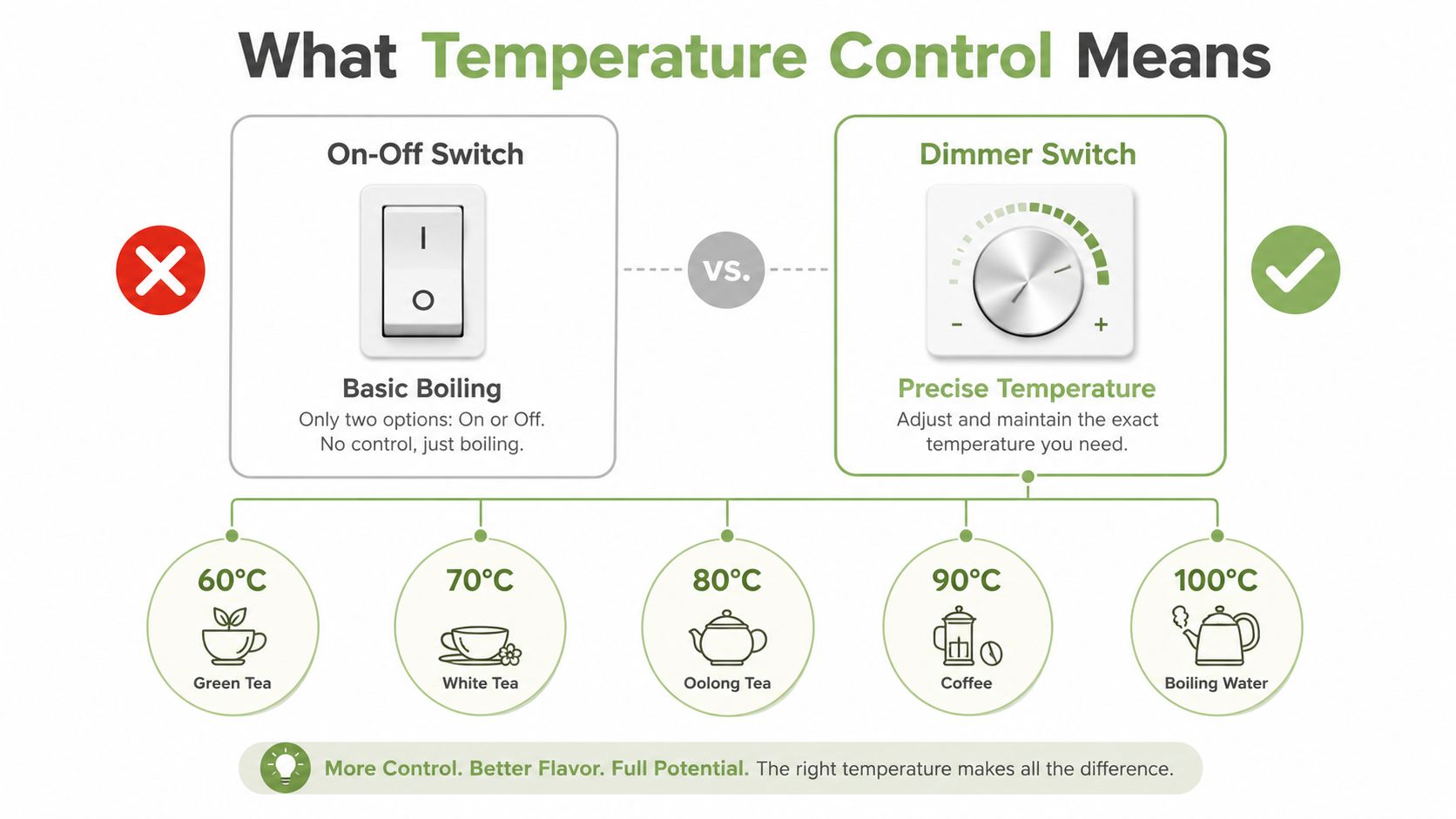
What the buttons usually mean
A glass kettle with precision control often gives you familiar targets like 60°C, 70°C, 80°C, 90°C, and 100°C. One glass-kettle manual lists exactly those setpoints, which makes the choice much easier for tea drinkers who don't want to think in theory every morning. It also shows how the machine handles timing, heating automatically after selection and switching off when the job is done, which removes a lot of human error. You can see a similar preset-style approach in the manual for a glass kettle with listed targets of 60°C, 70°C, 80°C, 90°C, and 100°C at this instruction guide.
A stovetop glass kettle is different. There, the brewer manages the heat, then uses a thermometer or timing method to hit the target manually. That's useful to know because not every “glass kettle” listing means the same thing.
If you see keep-warm, read the temperature list carefully. It usually means holding one or a few chosen settings, not every possible number.
How Modern Glass Kettles Actually Hit and Hold a Temperature
The story starts well before smart kitchen gear. The modern electric kettle is commonly traced to 1922, while earlier electric kettles date to 1891, which shows the long gap between a first electric model and a safer, more practical version for everyday use, as noted in this historical overview. That history matters because the whole idea of modern temperature control came from the move away from simple boil-only behaviour.
What the thermostat is doing
Early temperature-controlled kettles used bimetallic thermostats. In plain English, that means a heat-sensitive part bends as the water warms up, and once the target temperature is reached, it cuts power to the heating element. The kettle doesn't need to “think”, it just responds to heat in a predictable way.
Later versions add electronic sensors and a controller. The sensor measures water temperature, the controller compares that reading with your selected setpoint, and heating stops when the target is reached. If the kettle has a hold function, the system may reheat after the temperature falls below the chosen point. A general explanation of this sensor-and-controller approach appears in this temperature-control guide.
Why placement and keep-warm matter
Sensor placement matters because heat doesn't spread evenly in every kettle body. A sensor near the base can react quickly, but it may also be more sensitive to thermal lag or local hotspots if the design isn't well tuned. That's one reason two kettles can both advertise “variable temperature” and still feel different in the cup.
Keep-warm modes are useful, but they're not always universal across every setting. One glass-kettle manual says keep-warm only operates at 160°F, 175°F, 185°F, and 195°F, and the kettle reheats when sensed temperature falls below the setpoint, which is a good reminder that holding performance is often more limited than marketing copy suggests. You can see that behaviour in this glass kettle manual.
For buyers comparing models, a precision-focused option such as the Fellow Stagg EKG electric kettle shows why people pay attention to controls, not just looks. The point isn't shiny hardware, it's whether the kettle can land on the number you picked.
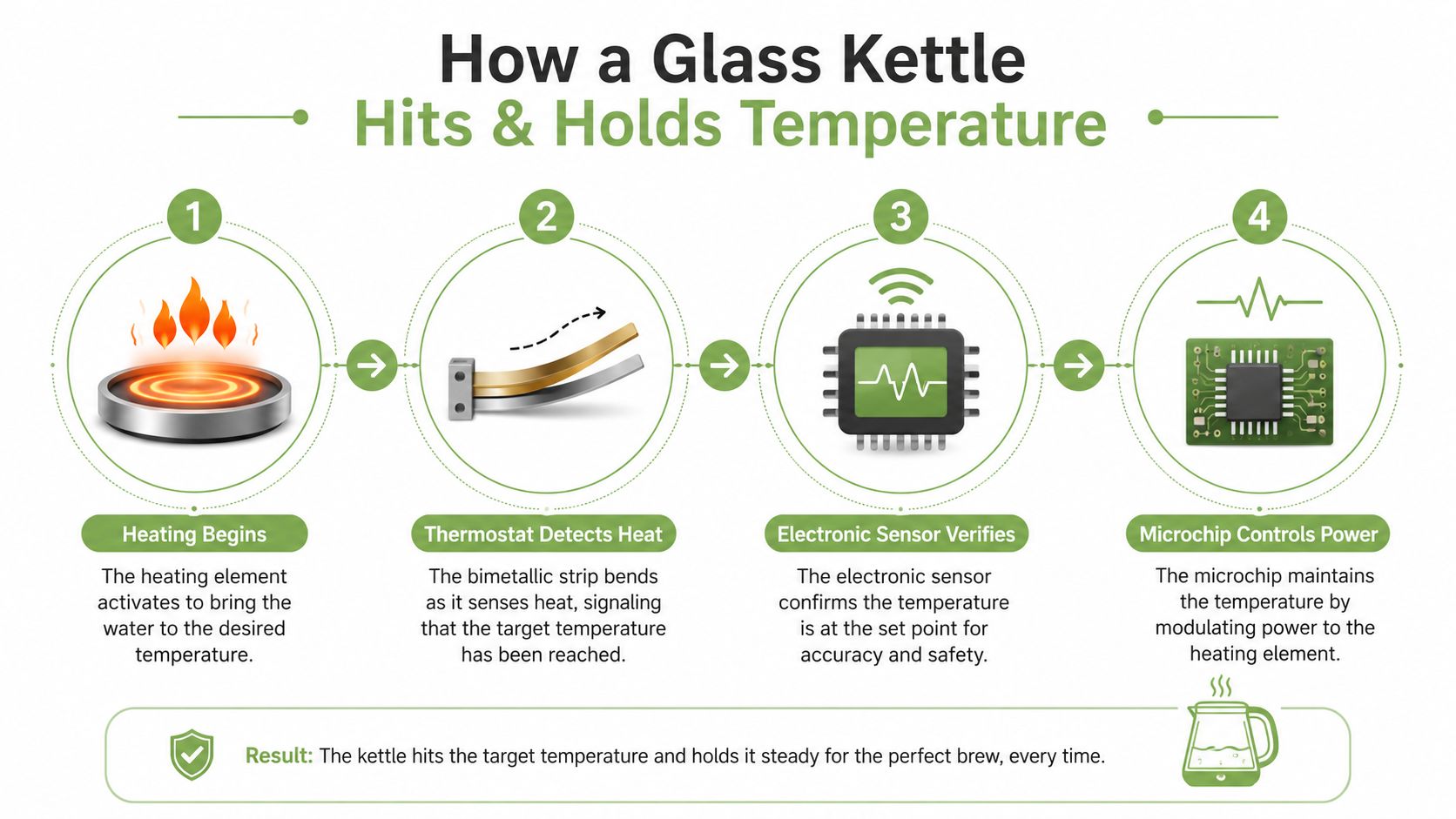
Matching Temperature to Tea Type
Tea gets easier when you stop asking, “How hot should the water be?” and start asking, “What am I making?” Different leaves respond to heat differently, and the same kettle can handle all of them if you choose the right setting.
Ideal water temperatures by tea style
| Tea Type | Target Temperature | Steep Time | Too-Hot Result |
|---|---|---|---|
| Japanese green tea | 70°C to 80°C | Brief steeping | More bitterness, less sweetness |
| Matcha | About 70°C to 80°C, using cooled water | Whisk immediately | Harsh flavour, duller texture |
| White tea | 75°C to 85°C | Gentle steeping | Reduced delicacy, sharper edges |
| Oolong | 85°C to 95°C | Moderate steeping | Can taste thinner than intended |
| Black tea | Near boiling | Short to moderate steeping | Less extraction if too cool |
| Pu-erh | Near boiling | Short to moderate steeping | Can seem flat if underheated |
The reason is chemical, but it's easy to feel in practice. Hotter water pulls out more of the compounds that can create bitterness, while cooler water gives the sweeter and more umami side of the leaf more room to show up. That's why green tea and matcha are usually treated more gently than black tea.
A simple tea-by-tea mindset
Japanese green tea is usually happiest in the lower range because it's easy to overdo. White tea likes warmth, but not force. Oolong sits in the middle, and darker teas are the ones that usually welcome a proper boil.
Matcha deserves special care because you're tasting the whole tea, not a leaf left behind in a strainer. A well-handled cup should taste smooth, not scorched. That's one reason gentle water handling matters so much for ceremonial-grade organic Matcha.
Useful shortcut: if a tea tastes oddly dry or harsh, try dropping the water temperature before changing anything else.
A glass kettle temperature control unit makes those adjustments much easier because the same appliance can move between styles without guesswork. That's handy at home, and even more useful in a café where one person might want green tea, another wants black tea, and someone else wants matcha in the same service run.
Three Practical Ways to Reach Your Target Temperature
There's more than one way to get good water, and the best method depends on your setup. A precise kettle is the simplest route, but a thermometer or a timing trick can still give you good results if you stay consistent.
The three methods side by side
Electric kettle with presets. A precision glass kettle with buttons for 60°C, 70°C, 80°C, 90°C, and 100°C is the most direct option. You press the setting, wait, and pour once it finishes. That's the least fiddly approach for anyone making tea daily.
Manual kettle plus thermometer. This works well on a stovetop or with any plain kettle. Heat the water, check the temperature with a probe thermometer, then take it off the heat or let it cool a little if it runs hot. It takes more attention, but it's universal.
Boil, then wait. If you've got no gear at hand, boil the water and let it sit briefly before pouring. The exact cooling time depends on your kettle, room temperature, and water volume, so this is more of a practical habit than a strict formula. In a busy café or event setting, that kind of timing often works best when it's written into a simple service routine.
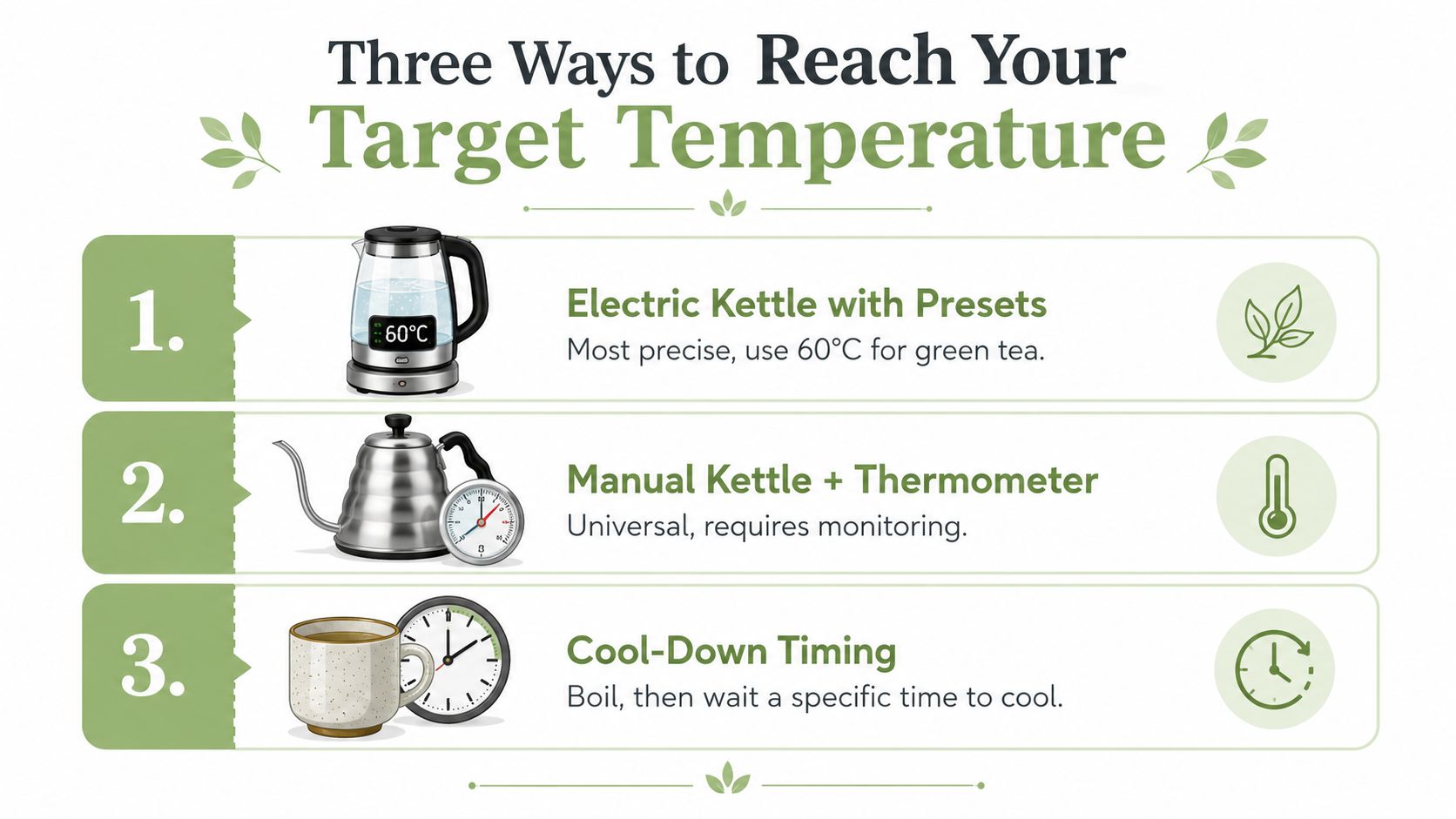
Choosing the method that fits your day
If you brew the same tea most mornings, presets remove friction. If you switch between drinks and only have basic tools, a thermometer gives you more control. If you're teaching staff or organising service across a team, a clear process matters even more than the device itself, and a centralised event management platform can be a useful way to keep timings, run sheets, and drink prep notes in one place.
Best takeaway: the right method is the one you'll use consistently, not the one that sounds the most technical.
Accuracy, Keep-Warm, and the Price Trap
A pricier kettle doesn't automatically mean a more accurate one. That's the trap. Some models look premium, have glowing buttons, and still drift enough to make repeated cups taste different from one another.
What to test before you trust the label
The key question is not whether a kettle says variable temperature, but whether it lands close to the chosen setting and stays there after repeated use. An independent buying guide for glass electric kettles highlights a useful benchmark: variable-temp kettles should ideally stay within about ±1.5°C at 80°C; larger errors can point to poor calibration and uneven brewing results, according to this buyer's guide.
That's especially relevant for lower-temp drinks, where a small miss can change flavour more than you might expect. If a kettle overshoots badly, your green tea may taste sharper than intended. If it undershoots, a bold tea may seem flat.
Keep-warm isn't the same as precision
Keep-warm can be handy, but only if it behaves predictably. Some kettles only hold at a few settings rather than the whole range, so a menu with several tea styles can expose the limits quickly. That matters in home service, but it matters even more in cafés where one kettle may need to support several different drinks in a row.
For comparison shopping, the electric kettle Australia page is a useful place to think through what features matter for real brewing habits. A good-looking kettle is nice. A kettle that consistently holds the number you asked for is better.
If you're testing a kettle in person, check whether the water tastes the same on the first cup and the third cup. Inconsistent flavour usually means inconsistent temperature control.
Safety, Cleaning, and Care for a Glass Kettle
Glass looks lovely, but it asks for a bit more care than stainless steel. The upside is obvious, you can see the water level and spot buildup early. The trade-off is that glass doesn't forgive rough handling.
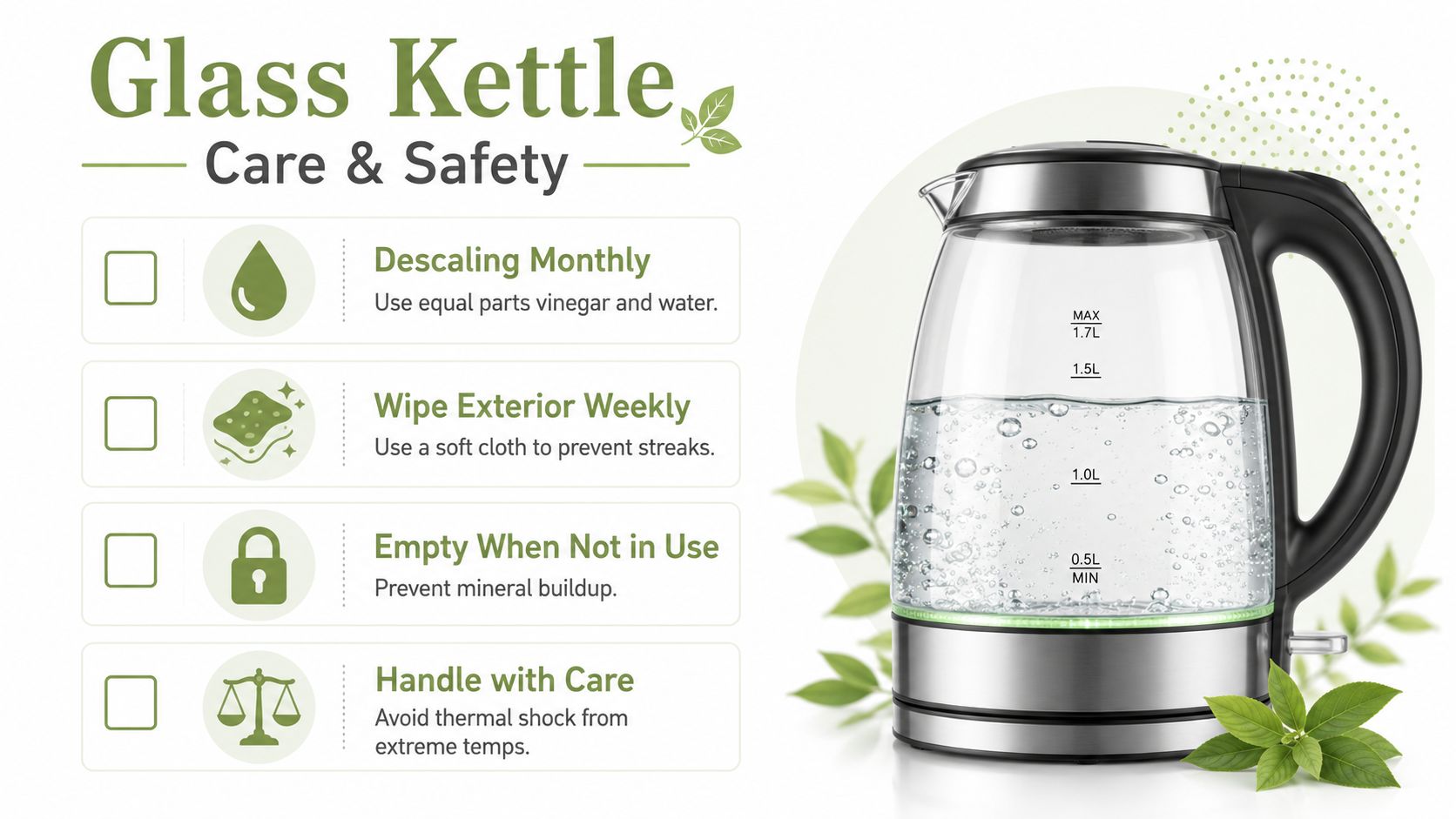
A simple care routine
- Descale regularly: use a mild descaling routine with citric acid or vinegar and water, especially in hard-water areas.
- Wipe the body gently: a soft cloth keeps the glass clear without scratching.
- Empty stale water: leaving water sitting around invites mineral buildup and stale flavour.
- Avoid thermal shock: don't pour cold water into a hot glass kettle body.
A good habit for both homes and cafés is to treat the kettle as a brewing surface, not just a container. Residue builds up on the element and in the spout, and that can affect taste before it affects appearance.
The mistake that hurts both taste and gear
Running the kettle dry, or repeatedly reboiling the same water, is a fast way to weaken flavour and wear the element.
That advice sounds boring until you taste the difference. Fresh water gives you cleaner extraction, and a kettle that's cleaned and handled well will usually feel more reliable over time.
Check the cord, the base, and the lid if the kettle lives in a busy space. In home kitchens, that's a monthly glance. In hospitality, it should be part of normal close-down and opening checks.
Quick Answers for Common Glass Kettle Questions
Is it safe to leave a glass kettle on keep-warm?
Usually, yes, if the model is designed for it and you're using the correct setting. The better question is whether the keep-warm function holds your chosen temperature consistently enough for the drink you're making.
Does reboiling water change the taste?
It can. Repeated heating often makes people notice a flatter or less fresh flavour, especially in delicate teas where water quality and temperature are already doing a lot of the work.
How often should I descale in Australia?
There isn't one universal schedule, because water hardness varies. In harder-water areas, a regular cleaning habit matters more than waiting until the kettle looks obviously scaled.
Can a stovetop glass kettle match electric precision?
It can get close with a thermometer and good attention, but it takes more hands-on control. Electric presets are still easier for repeatable tea brewing.
What setting should I use for matcha?
A cooler setting around the green-tea range is usually a better starting point than boiling water. Matcha responds best when the water is gentle, not punishing.
If you want better tea at home, start with the water before you start changing the leaves. Then match the kettle to the drink, keep it clean, and choose a setting with intent instead of habit. Explore the Pep Tea range at Pep Tea if you're ready to pair precise water handling with organic Matcha or sugar-free organic Kombucha that fits a cleaner daily routine.