
Small Batch Kombucha: A Complete Australian Guide
Most advice about small batch kombucha starts with romance: handmade, raw, alive, and somehow automatically healthier. That framing misses the part that decides whether a bottle is safe, consistent, and legally sold. In Australia, fermentation changes acidity, sugar, carbonation and alcohol content, so the brewer's real work happens in the measurements, records and cold storage, not just in the attractive label.
Australia's kombucha story has deep roots. The drink appeared in Australian press as a “mysterious medicine” from Mongolia and eastern Siberia in 1945, while Mojo in South Australia is identified as the country's first commercial producer, with Anthony Crabb beginning sales at the Willunga Farmers' Market in 2009 (Australian Food Timeline). That path from home brewing and farmers' markets to broader retail helps explain why craft-style fermentation still matters, but it doesn't excuse loose process control.
What Small Batch Kombucha Actually Means
“Small batch” doesn't automatically mean better. It describes a way of producing kombucha, not a guarantee about sugar, live cultures, flavour or safety.
A small-batch brewer usually ferments limited volumes in individual vessels, monitors those vessels by hand and accepts that one batch may taste slightly different from the next. The producer may work with a shorter supply chain, buy tea and botanicals in smaller quantities, and bottle closer to the place of brewing. Those choices can create a more distinctive drink, but they also create more variables.
A factory can use filtration, pasteurisation, controlled carbonation and tightly standardised inputs to make every bottle taste familiar. A small producer may preserve more of the living fermentation, which can mean more sediment, changing acidity and a shorter stability window. Neither format deserves a halo by default.
The Australian boundary that matters
The phrase also carries a regulatory consequence. Queensland guidance says fermented foods should reach a pH of 4.6 or lower, ideally within 24 hours, and that final alcohol content must not exceed 0.5% ABV for general food classification (ABC News). Queensland guidance also identifies 1.15% ABV as the maximum for brewed soft drinks under the Food Standards Code, while products at 0.5% ABV or above require alcohol declaration on the label.
That means “small batch” isn't merely a visual style or a farmers' market story. Fermentation can continue after bottling, particularly when residual sugar, yeast and warmth are present. A brewer needs to control the batch before packaging and understand what happens during transport and storage.
Practical rule: Treat every small batch as its own production event. Record its tea, sugar, fermentation conditions, pH, flavour additions, packaging date and storage conditions.
The rest of the buying decision follows from that reality. Taste may be more expressive, but the buyer should also ask whether the producer manages pH, alcohol drift, refrigeration and batch consistency with the same care given to branding.
How Small Batch Kombucha Is Brewed
A useful way to understand small batch kombucha is to follow one brew from sweet tea to finished bottle. The culture commonly called a SCOBY, or symbiotic culture of bacteria and yeast, works with starter liquid to transform sweetened tea into a tart fermented drink.
Start with filtered water, black or green tea, white or raw sugar, a healthy SCOBY and acidic starter liquid from a previous batch. The sugar feeds the culture during fermentation. It isn't poured into the finished drink for the consumer to consume, although fermentation doesn't guarantee that every gram disappears.
Building the primary ferment
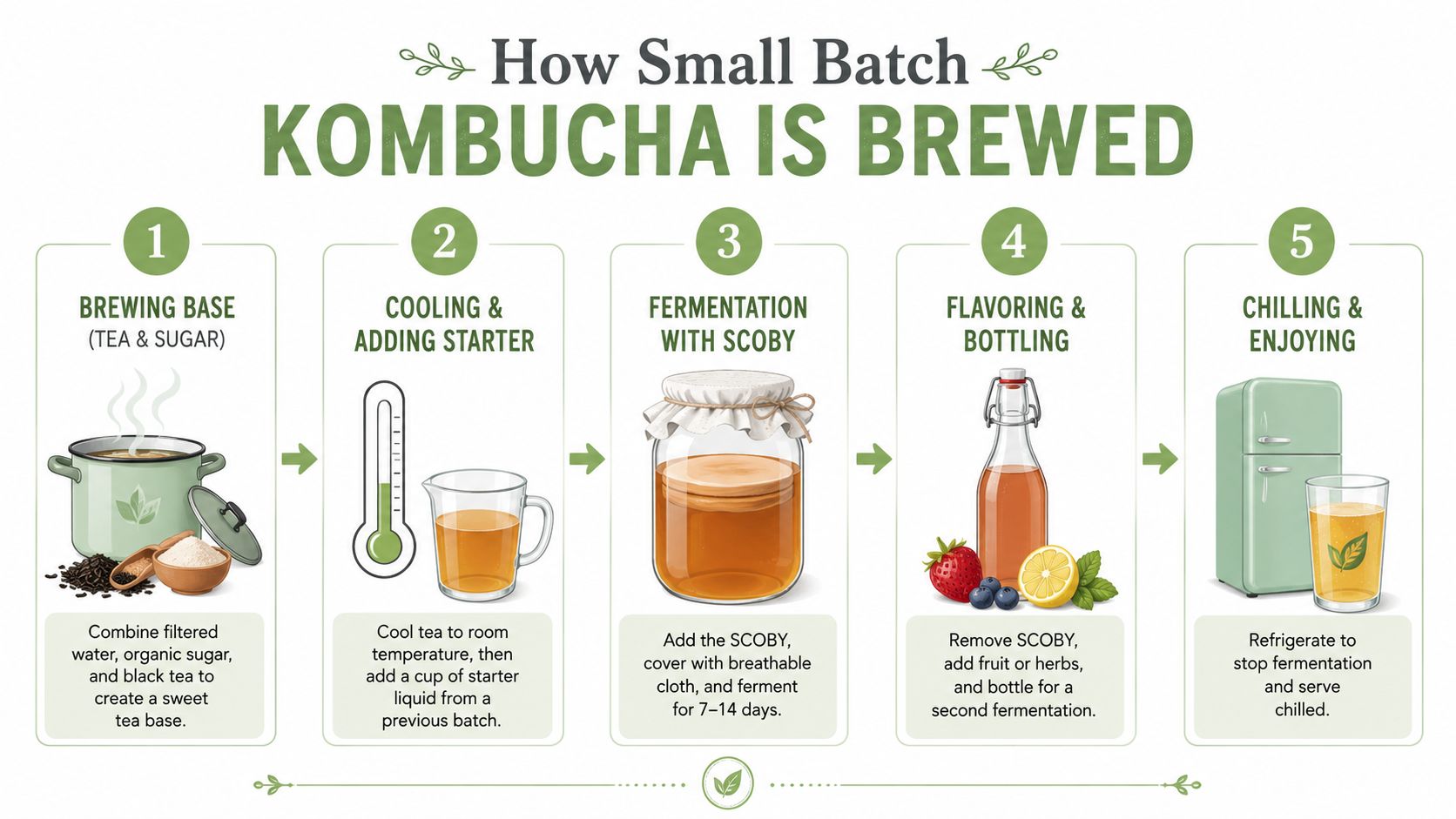
Brew the tea base. Steep the tea in hot water, dissolve the sugar, then allow the liquid to cool fully. Hot sweet tea can damage the culture, so patience at this stage prevents trouble later.
Add starter and SCOBY. Transfer the cooled tea to a clean, food-grade vessel. Add starter liquid, then place the SCOBY into the brew. The starter helps lower the initial pH and gives the new batch a stronger beginning.
Cover and ferment. Use a breathable cloth or cover that keeps insects and debris out while allowing air exchange. A working temperature around 22 to 26°C is commonly used, with primary fermentation often taking 7 to 14 days, but taste and pH should guide the decision rather than a calendar alone.
Taste and measure. The brew becomes sharper as the culture consumes sugar and produces acids. Use a reliable pH meter, clean sampling technique and consistent records. A pleasant flavour isn't a substitute for a safety check.
Basic equipment includes a food-grade vessel, breathable cover, bottles, a pH meter and a hydrometer for tracking fermentation-related changes. Brewers also need a repeatable cleaning and sanitising routine. Commercial or serious home operations can benefit from learning about food industry lab solutions when designing a hygienic workspace, especially where wet areas, sampling and storage need to stay organised.
Why the second ferment changes the drink
After primary fermentation, remove the SCOBY and add fruit, herbs, spices or juice before bottling. This second fermentation lets remaining yeast work on fresh sugars, creating natural carbonation. It can also increase alcohol content, change acidity and produce pressure inside the bottle.
A SCOBY hotel is a separate container of SCOBYs and strong starter liquid, maintained so a brewer has reserve cultures available. It's useful for continuity, but it still needs clean handling and regular observation. For a practical home-brewing starting point, Pep Tea provides a home-brew kombucha guide that can help turn the broad process into a repeatable routine.
The safest habit is to chill bottled kombucha once the desired carbonation develops. Cold storage slows fermentation. It doesn't magically reverse it, so bottles should still be checked, handled carefully and kept within the producer's instructions.
Small Batch Versus Mass Produced Kombucha
Small-batch kombucha often shows more tea character, sharper acidity and visible sediment. Those features reflect how much of the fermented drink remains in the bottle, rather than proving superior health value. Mass-produced kombucha may be filtered, pasteurised or stabilised, which can create a cleaner appearance and a longer, more predictable retail life.
The practical difference is control versus variation. A small producer must manage pH, fermentation time, carbonation and alcohol drift across changing temperatures and cultures. Industrial production can apply tighter process controls, but the label and storage instructions still determine what reaches the customer.
Sugar also cuts through broad marketing claims. Retail kombucha products have been found with sugar levels from less than 0.1 g to 3.8 g per 100 mL, while the Australian Food Standards Code defines low sugar as 2.5 g or less per 100 mL, according to CHOICE. The word “kombucha” tells you very little about sweetness. Read the nutrition panel.
| Attribute | Small Batch | Mass Produced |
|---|---|---|
| Taste | More variation between batches, with tea, acidity and botanicals often prominent | More standardised flavour from controlled processing |
| Residual sugar | Can vary with fermentation time and flavour additions | Usually managed for a consistent labelled profile |
| Live cultures | May retain live cultures when sold raw and refrigerated | May be reduced through pasteurisation or filtration |
| Alcohol control | Requires close monitoring because fermentation can continue | Industrial controls can improve consistency, but the label still matters |
| Batch consistency | Natural variation is more likely | Repeatability is usually the commercial priority |
A live, unpasteurised bottle can keep changing in the fridge. That suits fermentation enthusiasts, but it also requires a reliable cold chain and a realistic best-before period. Warmer storage can speed fermentation, increase pressure and allow ABV to drift, so a producer needs records and repeatable handling rather than a promising label alone.
Shelf-stable kombucha is easier to distribute and store. Its processing may reduce culture activity, so buyers should not assume it behaves like raw kombucha. Small-batch producers can offer distinctive, flavour-forward drinks, while mass-produced brands usually prioritise consistent taste and supply. The better choice depends on fermentation character, storage convenience, sugar control and the serving context.
Safety, pH and Quality Standards in Australia
A small-batch brewer should treat safety as a sequence of checks, not a final paperwork exercise. The first question is whether the fermentation acidifies quickly and consistently enough to discourage harmful bacteria.
Australian food-safety guidance recommends a final pH below 3.0 for kombucha. If the brew hasn't fallen below 3.0 by day 10, it should be discarded, and guidance recommends measuring around day 7 before deciding whether fermentation should continue (Food Safety Australia). A weak starter culture, low temperature or contamination can all contribute to inadequate acidification.
A brewer's control sequence
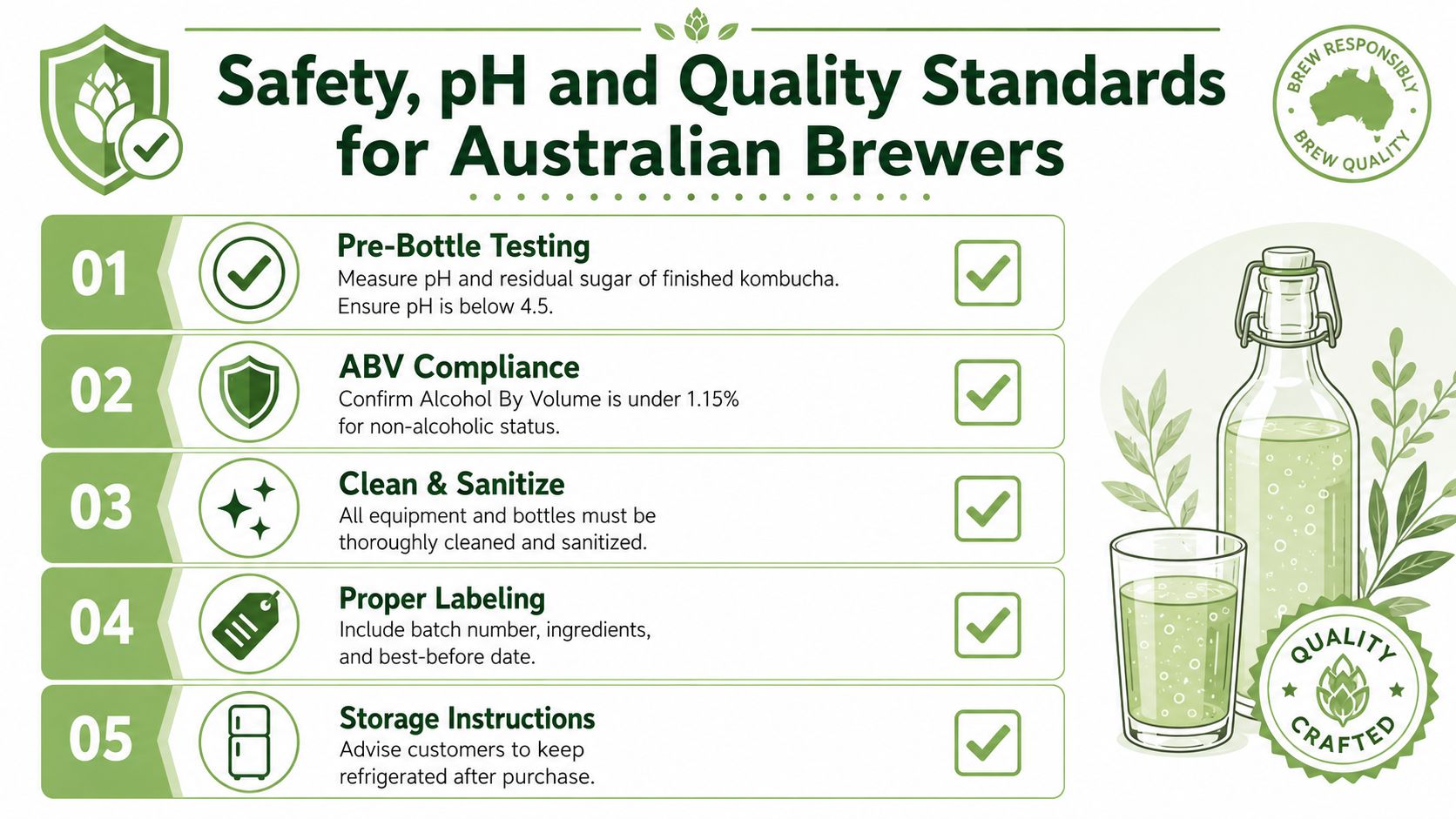
First, control the vessel. Clean and sanitise the fermentation vessel, utensils, bottles and sampling equipment. Handle the SCOBY with clean hands or suitable food-safe tools, and keep a batch record that identifies the date, tea, sugar, culture and observations.
Second, monitor acidification. Measure pH with a calibrated meter rather than relying only on taste. Queensland guidance uses 4.6 or lower as a fermented-food safety threshold, while kombucha-specific guidance recommends going below 3.0 and discarding a batch that hasn't reached that target by day 10.
Third, manage alcohol. NSW Health states that drinks above 0.5% ABV require alcohol-content labelling, while products above 1.15% ABV are considered alcoholic in NSW (NSW Health). The practical controls are sugar loading, fermentation time, temperature, flavour additions, packaging and refrigeration. A hydrometer can support production records, but producers may need more appropriate alcohol testing when compliance decisions depend on the result.
Finally, validate the finished product. Check pH and residual sugar before bottling, assess carbonation behaviour, and establish a shelf-life method through real-time and accelerated testing. Live, unpasteurised kombucha needs refrigerated distribution because cold slows, but doesn't eliminate, ongoing fermentation.
For label design and broader food-information obligations, producers can consult Australian food labelling requirements and confirm requirements relevant to their product, state and sales channel. A digital pH meter can also make routine acidity checks easier, provided the brewer calibrates, cleans and stores it correctly.
A basic HACCP approach helps identify hazards at each stage. The critical points include culture handling, sanitation, acidification, alcohol formation, bottle pressure, temperature control, allergen or ingredient declarations and recall records. Good process control isn't the enemy of craft. It's what lets a small producer keep making an honest product.
Flavouring, Second Fermentation and Recipe Ideas
Flavouring is where small batch kombucha becomes expressive, but it's also where a stable ferment can become unpredictable. Fruit sugars feed yeast, acidity shifts with juice and botanicals, and a sealed bottle can build pressure quickly.
Use small trials before committing a full batch. Keep the base kombucha, addition, dose, bottling date, refrigeration date and sensory result in a record. Never fill a bottle right to the top, and release pressure carefully when testing an active second ferment.
| Flavour Profile | Ferment Stage | Dose Rate | ABV Impact | Best Use |
|---|---|---|---|---|
| Ginger and lemon | Finish in primary ferment or short bottle conditioning | Fresh grated ginger with a modest amount of lemon juice | Low to moderate, depending on residual sugar and time | A sharp everyday serve |
| Berry and hibiscus | Second fermentation | A small amount of crushed berries and hibiscus infusion | Moderate potential because fruit sugars feed yeast | Colourful café bottle or brunch pairing |
| Cold-brew coffee | Flavour after primary fermentation | Strained cold-brew coffee blended into the finished kombucha | Variable, with coffee adding flavour rather than being the main fermentable | A bitter, grown-up alternative to sweet drinks |
| Cucumber and mint | Short second ferment or direct serve | Thin cucumber slices and a restrained mint infusion | Usually lower when no sugary fruit is added, though the base still matters | A light summer café pour |
Berry and hibiscus are visually dramatic, but they deserve close attention. Natural carbonation can increase as yeast consumes fruit sugar, while fruit acids can push pH lower. Cucumber and mint are gentler additions for a low-sugar serve, although they can lose freshness if held too long.
Coffee kombucha needs clean, well-filtered cold brew. Excess coffee solids can make the bottle muddy and may overpower the tea. Ginger and lemon are forgiving, but lemon juice can make the finished drink noticeably sharper, so taste before adding more.
Bottle warning: Carbonation is not proof of quality. A swollen cap, aggressive foaming or a bottle that hisses violently needs careful handling and should not be served casually.
Chill bottles as soon as the desired fizz develops. The colder environment slows yeast activity, protects the flavour profile and reduces pressure growth. Flavour additions also affect alcohol drift, so a producer who sells the drink commercially must test the finished, flavoured product rather than assuming the plain base tells the whole story.
Serving Small Batch Kombucha in Cafés and Retail
A café should buy small batch kombucha as a perishable fermented product, not as ordinary shelf-stable soft drink. The service plan starts with the format.
Kegs can support a fresh draft experience but require compatible equipment, clean lines and disciplined rotation. Bottles are simpler to display and sell, although they take more refrigerator space and still need clear handling instructions. Live product belongs in chilled storage. Ambient placement suits a pasteurised product only when the producer's label and process support that decision.
A working hospitality checklist
- Confirm the product status: Ask whether the kombucha is raw, live, pasteurised or filtered, and request storage and shelf-life instructions in writing.
- Check wholesale documentation: Review food-safety systems, insurance, organic certification claims and the supplier's recall procedure. If a producer claims Australian Certified Organic status, ask what the certification covers.
- Train the team: Staff should know the flavour profile, sugar information, alcohol declaration and whether sediment is normal. They shouldn't make medical promises about gut health or immunity.
- Plan the serve: A chilled glass that shows carbonation and aroma works well. Offer the drink beside sparkling water, cold-brew coffee and alcohol-free menu choices rather than hiding it in a vague “wellness” category.
- Rotate every delivery: Record the arrival date, best-before date, batch number and fridge location. Don't mix old and new stock without checking dates.
Tap lines need a cleaning schedule that matches the product and manufacturer guidance. Bottles should remain sealed until service, and staff should avoid shaking a warm bottle before opening. The producer's instructions take priority because live fermentation behaves differently across recipes.
For menus, describe the actual drink. “Raw ginger kombucha, brewed tea, chilled” tells a customer more than “detox fizz”. A clear description builds trust and helps people choose between kombucha, soda, coffee or wine without pretending that one drink suits every occasion.
Buying Small Batch Kombucha as a Consumer
Begin with the nutrition panel. Check sugar per 100 mL before being persuaded by phrases such as “naturally sweetened” or “crafted with fruit”. Retail kombucha can range from very little sugar to noticeably sweet, and Australian food labelling treats 2.5 g or less per 100 mL as low sugar. The number gives you a more useful starting point than the front label.
Then check the alcohol information. Drinks above 0.5% ABV require alcohol-content labelling in Australia, and live fermentation can continue during storage. Refrigeration, best-before dates and batch identification therefore matter. If any of these details are unclear, ask the retailer or producer before buying.
What the bottle can reveal
- Ingredients: Look for brewed tea, fruit, herbs or spices. “Natural flavours” may describe a broader formulation, so the ingredient list deserves a close read.
- Processing: Live, unpasteurised kombucha and shelf-stable pasteurised kombucha are different products. The first can continue changing in the bottle, while the second is processed for easier storage.
- Cold chain: Keep a refrigerated bottle cold from shop to home. Sediment can occur in a living drink. Mould, a leaking seal or damaged packaging means the bottle should stay unopened.
- Certification: Australian Certified Organic claims can provide useful information about the supply chain. Check which ingredients and production steps the certification covers.
Packaging also gives clues about how the product is handled. A 250 mL glass bottle, 330 mL can or growler-style refill involves different compromises around freshness, transport and price per litre. Smaller formats suit one serve. Refill formats can reduce packaging, but they require dependable refrigeration and quicker turnover.
Market growth does not make every health claim meaningful. The Australian functional beverage category has grown strongly, but it includes drinks such as coconut water, protein water and alkaline water rather than representing kombucha alone (6Wresearch). Read “probiotic”, “low sugar” and “non-alcoholic” as separate descriptions. They answer different questions about the drink.
Australian kombucha is also projected to grow substantially, with estimates reported by the Australian Beverages Council. That commercial interest makes production details more important, especially pH control, alcohol drift and consistent cold storage. A lively bottle can be appealing, but it still needs clear handling information.
For local purchasing options, see this guide to where to buy organic kombucha in Australia.
Pep Tea offers Australian-brewed sugar-free organic kombucha made with live cultures in the Hunter Valley, NSW, alongside organic Japanese Matcha for tea-based energy. Visit Pep Tea to explore kombucha flavours, matcha products and options for home, cafés and wholesale.