
Tag: matcha benefits
Pure Matcha Green Tea Powder: How to Choose Real Quality
The most popular advice about matcha is also the least useful: “Choose pure matcha and you've chosen quality.” Purity matters, but it only tells you that nothing has been added. It doesn't automatically confirm the tea's origin, freshness, grade, growing practices, flavour, or tested composition.
That distinction matters in Australia, where demand is moving quickly. SBS News reported that Australia's matcha market generated more than AUD 54 million in 2024 and is forecast to grow at approximately 7.1% annually over the following five years, exceeding AUD 81 million by 2030 according to reporting based on industry data. More products can mean more choice, but it can also make a confident-looking label harder to evaluate.
What “Pure” Really Means on a Matcha Label
Pure matcha green tea powder answers a narrow question. Is the tin only matcha, or has something else been mixed in?
On an Australian label, that usually means the ingredient list shows 100% matcha or 100% powdered green tea, with no sugar, milk powder, flavouring, colouring, or filler. That is useful, but it is only the first checkpoint. “Pure” does not tell you whether the tea was selected for drinking, whether it is fresh, or whether it will taste smooth once you whisk it.
It also does not mean caffeine-free. Matcha is powdered green tea, so if it is pure, it still naturally contains caffeine. In other words, purity describes what has not been added. Quality describes what the product brings to the cup.
Purity and quality are different questions
Purity covers ingredients. Quality covers a wider set of buying decisions.
- Purity: Is anything else mixed into the powder?
- Origin: Where was the tea grown and processed?
- Freshness: When was it harvested, milled, packed, or opened?
- Grade: Was it chosen for straight drinking, lattes, or cooking?
- Composition: Are there credible test results or batch records?
- Use: Does the flavour fit how you plan to prepare it?
That distinction saves shoppers from a common mistake. A front label can say “pure” and still leave out the details that affect aroma, colour, bitterness, and value for money.
Practical rule: Treat “pure” as the starting point of your assessment, not the final verdict.
The same reading habit applies beyond tea. A clear pure aloe vera gel guide shows how a simple ingredient claim can be true while bigger questions about sourcing, processing, and suitability still remain. Matcha works the same way.
From Tea Leaf to Stone Ground Powder
Matcha starts with the same tea plant as other green tea, Camellia sinensis. The difference lies in how growers cultivate and process it before you ever open the tin.
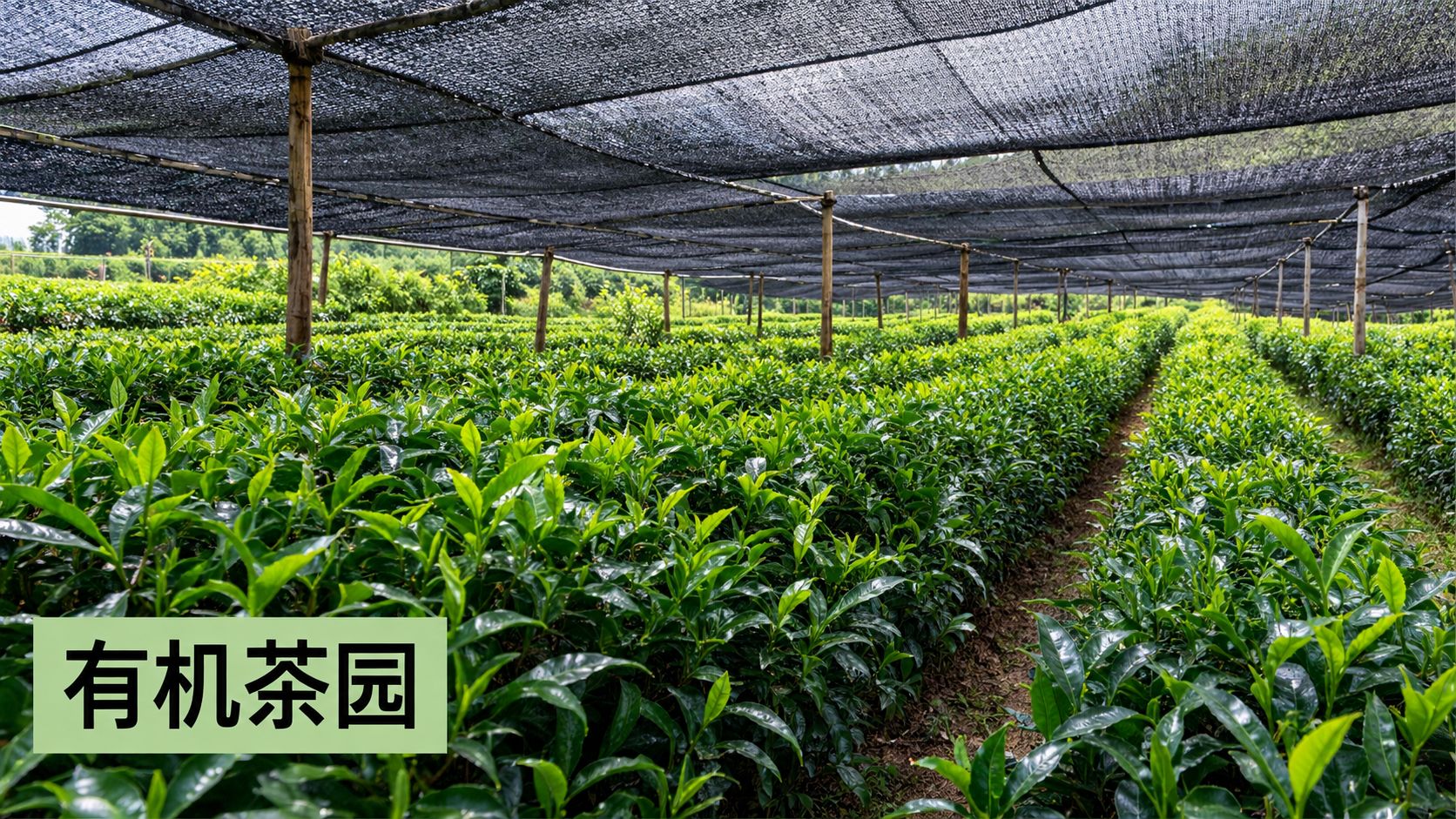
Several weeks before harvest, growers shade the tea plants from direct sunlight. This changes the leaf's growth conditions and contributes to matcha's deep green appearance, savoury umami character, and naturally occurring L-theanine. Farmers then harvest the leaves, steam them to limit oxidation, dry them, and remove stems and veins. The remaining leaf material is called tencha.
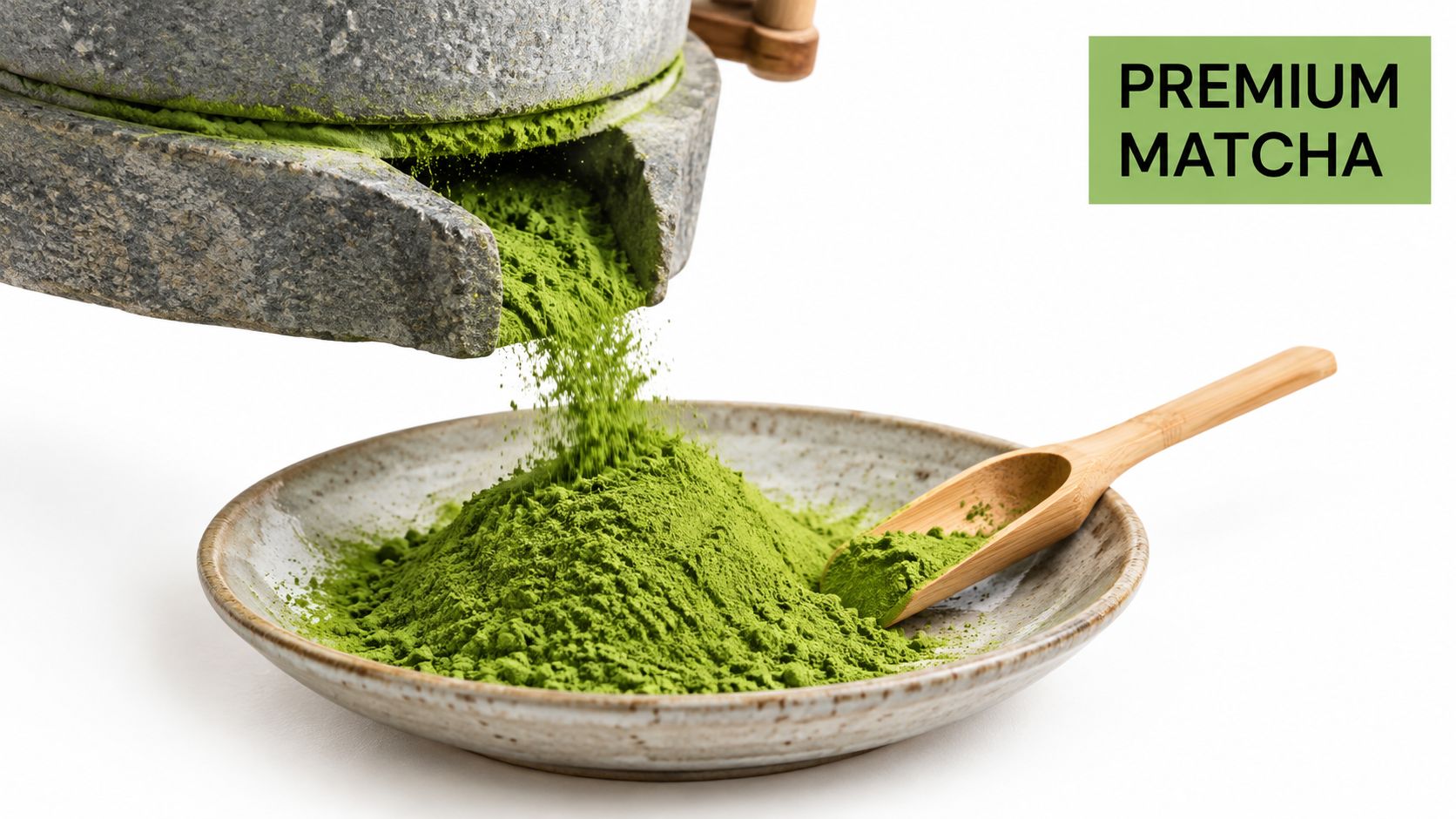
Tencha is slowly ground between stones, traditionally granite, until it becomes an exceptionally fine powder. That slow milling is why authentic matcha feels almost talc-like between your fingers rather than gritty like a coarsely ground green tea ingredient.
What your senses can tell you
A vibrant green colour can be a useful freshness and processing clue, but colour alone can't certify quality. Look for a powder that is fine, evenly coloured, and aromatic, with a fresh grassy or vegetal scent rather than a flat, dusty smell.
Taste gives you more information. Good matcha can have grassy notes, umami depth, gentle sweetness, and some bitterness. Harsh bitterness may come from the grade, preparation, age, or a powder intended for cooking rather than drinking.
The whole-leaf format also changes the way you consume the tea. With ordinary brewed green tea, water extracts compounds from the leaves and you discard the leaves. With matcha, you whisk the powder into water or milk, so the powdered leaf remains in the drink. For a visual explanation of the production stages, see how matcha tea is made.
Analytical testing of commercially available matcha found caffeine concentrations ranging from 17.11 to 35.01 milligrams per gram. Ceremonial matcha averaged 31.45 ± 1.08 mg/g, while culinary matcha averaged 26.29 ± 1.86 mg/g, compared with 23.08 ± 1.43 mg/g for bagged or gunpowder green tea in the reported testing. Those figures are useful context, but they aren't a guarantee for every product or serving.
Ceremonial, Culinary, and Everyday Grades Compared
Matcha grades aren't universal legal categories in the way some shoppers assume. Producers and sellers use them to communicate intended use, sensory character, and leaf selection. The label still needs supporting information, because “ceremonial” by itself doesn't prove a particular origin or laboratory profile.
The simplest decision is practical. If you'll drink the matcha with water, choose a powder that tastes smooth and balanced. If you'll combine it with milk, fruit, chocolate, or flour, a stronger culinary powder may provide better value and a more noticeable tea flavour.
Match the powder to the job
| Grade | Best for | Sensory cues | Typical price band |
|---|---|---|---|
| Ceremonial | Whisked tea and simple drinks | Bright colour, fine texture, softer bitterness, rounded umami | Higher |
| Premium culinary | Lattes, iced drinks, smoothies, and everyday use | Fresh green aroma, fuller flavour, enough strength for milk | Mid to high |
| Ingredient-grade culinary | Baking, ice cream, sauces, and savoury recipes | More robust, earthy, or bitter profile that stands up to other ingredients | Lower to mid |
A ceremonial powder can be wasted in a recipe where chocolate, dairy, or fruit dominates. Conversely, an inexpensive cooking powder may taste rough when whisked with water because there's nowhere for its bitterness to hide.
Choose by preparation, not prestige
For a traditional bowl of matcha, sensory refinement matters most. You're tasting the tea directly, so freshness, texture, sweetness, and umami carry the experience.
For a café latte, a bright premium culinary powder can be a sensible option. Milk softens bitterness, while the matcha needs enough flavour to remain present after dilution. For pancakes, biscuits, frosting, or ice cream, ingredient-grade culinary matcha often makes more sense because you're buying functional flavour rather than a delicate drinking experience.
Compare ceremonial and culinary matcha before buying. The right grade isn't the one with the most impressive name. It's the one that performs well in your favourite preparation.
Caffeine, EGCg, and L-Theanine Explained
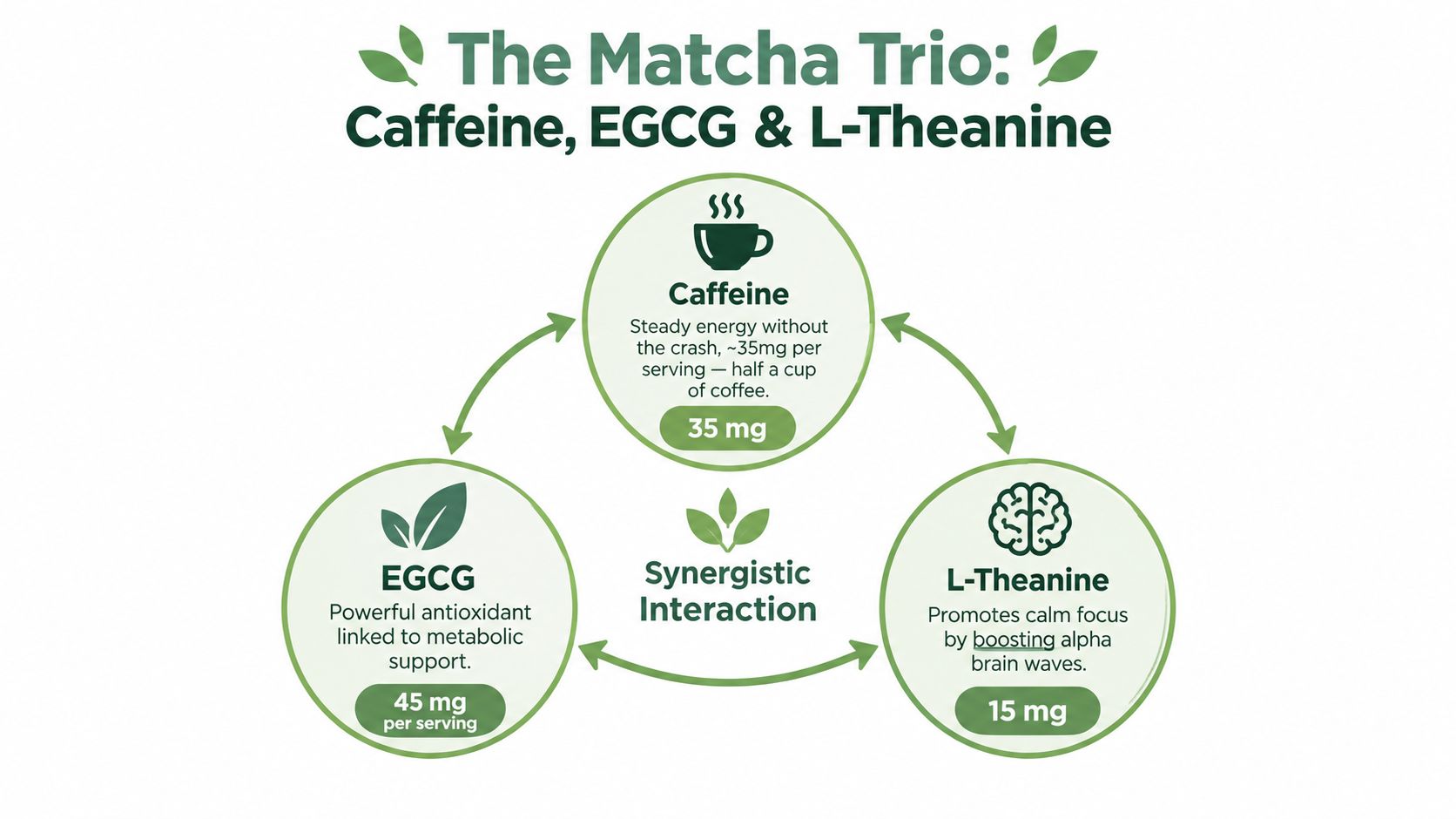
Matcha is often described as a calmer alternative to coffee. That description can be useful as a personal observation, but it shouldn't hide the fact that pure matcha contains caffeine. The powder brings several naturally occurring compounds into the same drink, including caffeine, EGCg, and L-theanine.
Caffeine contributes to alertness. EGCg, or epigallocatechin gallate, is one of the green-tea catechins commonly discussed in relation to antioxidant content. L-theanine is an amino acid associated with tea, and many people describe the combination of tea caffeine and L-theanine as feeling smoother than caffeine alone. That subjective experience varies, and L-theanine doesn't remove stimulant exposure or guarantee a performance effect.
The serving-size maths
Experimental literature reports approximate dry-weight concentrations of 4% caffeine and 6 to 7% EGCg in matcha. L-theanine commonly exceeds 1% and can exceed 3% in high-grade material in the cited experimental literature.
At a hypothetical 2 g serve, those benchmarks work out to roughly:
- 80 mg caffeine
- 120 to 140 mg EGCg
- At least 20 mg L-theanine
That calculation is illustrative, not a certificate of analysis. Cultivar, shading, harvest, processing, grade, serving size, and laboratory method can all change the result.
For a plain-language explanation of EGCg and its place in matcha, read what EGCg is. Cafés should use gram-weight recipes rather than “one scoop”, because a scoop can vary between staff members and tools.
A useful comparison is not matcha versus coffee in isolation. It's your whole day. If you drink matcha alongside coffee, cola, pre-workout products, or energy drinks, count the sources together. FSANZ identifies 400 mg per day as the maximum daily caffeine dose used in alignment with European Food Safety Authority recommendations in relevant regulatory work, and flags increased anxiety in children at approximately 3 mg per kilogram of body weight per day in its caffeine guidance. That isn't a universal personal allowance, so people who are pregnant, sensitive to caffeine, taking medication, or managing a health condition should seek individual advice.
For a broader look at audits and product information, a resource such as Grumspot Shopify Plus audits illustrates why clear product communication matters. A café menu should never imply that matcha is caffeine-free or automatically calming.
How to Read a Matcha Label Before You Buy
A good label answers practical questions without making you chase the seller for basic information. Start at the back of the pack, not the marketing headline.
Work through the ingredient and origin details
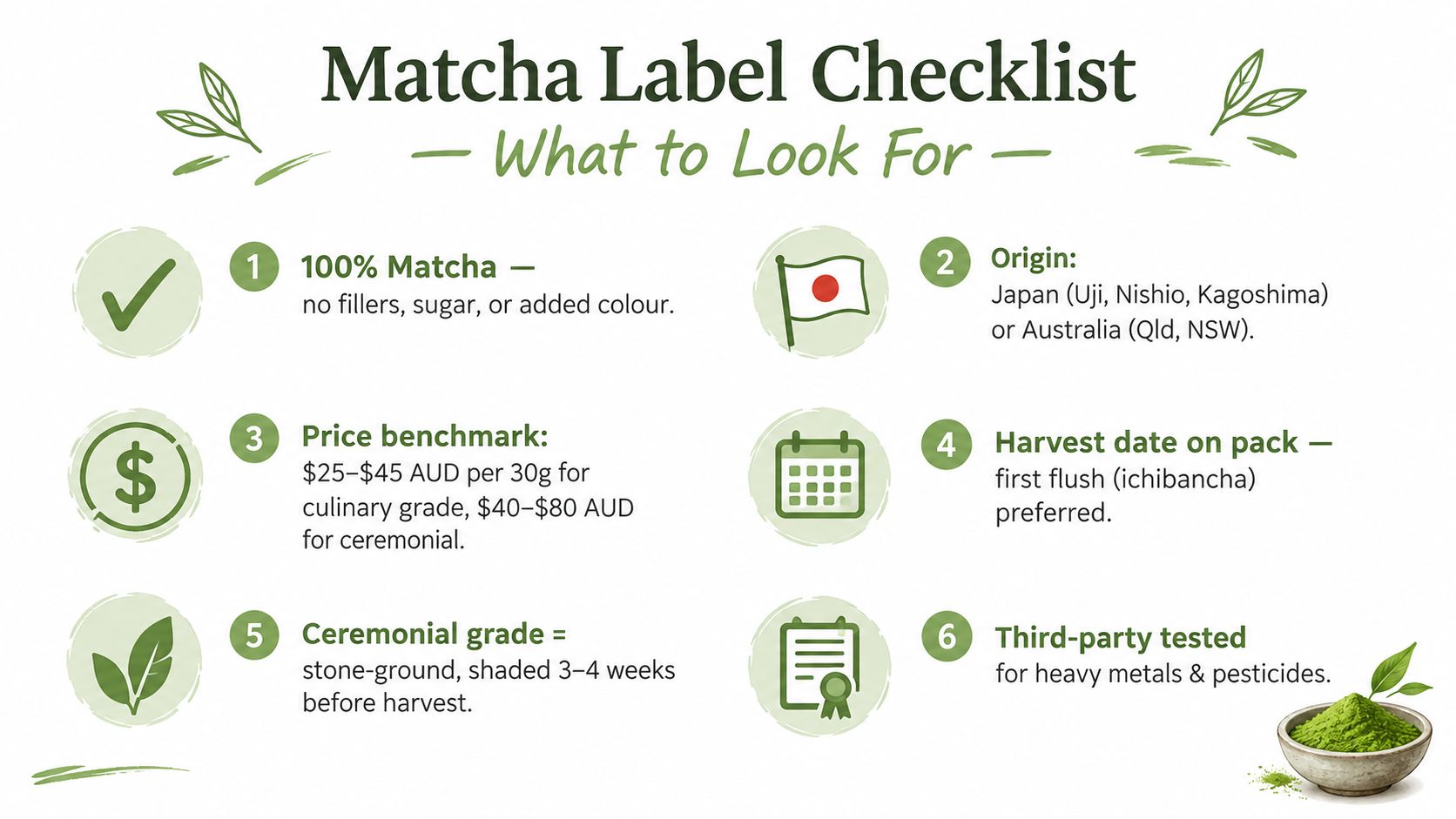
Look for an ingredient list that says 100% matcha or 100% powdered green tea. If you're buying a flavoured latte blend, the label should name every added ingredient so you can distinguish a pure powder from a prepared mix.
Then check the origin. A Japanese growing region such as Uji, Kagoshima, or Nishio can tell you more than a vague phrase such as “Japanese style”. If the pack names a cultivar, harvest, mill, or batch, that extra detail helps you ask better questions about flavour and consistency.
Organic claims deserve the same care. Look for the named certification body rather than assuming that “natural”, “clean”, or “chemical-free” means certified organic. A seller who can explain the certification and provide traceability is giving you stronger evidence than a decorative leaf on the front panel.
Look for evidence, not adjectives
Words such as “super”, “premium”, and “ceremonial” can help describe positioning, but they aren't enough on their own. Ask whether the seller provides storage guidance, batch information, a clear use recommendation, and testing relevant to the product.
For cafés and retailers, ask for documentation covering heavy metals and microbiological safety. For home buyers, a transparent ingredient list, origin statement, certification details where claimed, and sensible freshness guidance are useful signals. A step-by-step guide for DTC brands offers helpful context on why product descriptions should answer specific buyer questions rather than rely on vague promotional language.
Caffeine is another labelling consideration. FSANZ's guidance means the word “pure” doesn't make a powder caffeine-free, and it doesn't replace responsible serving advice. If you're combining matcha with other caffeinated drinks, choose a repeatable serving and keep a simple record of your total intake.
Brewing, Lattes, and Cooking with Pure Matcha
The same powder can taste elegant, creamy, bitter, or flat depending on how you prepare it. Water temperature and technique matter, but so does grade. Save delicate ceremonial matcha for preparations where you'll taste it directly, and use culinary powder where other ingredients need to share the stage.
Start with a whisked bowl
For a traditional drink, sift the powder into a bowl, add hot water around 80°C, and whisk briskly with a bamboo chasen until the liquid is smooth and lightly frothy. Water that's too hot can make the drink taste more bitter, while insufficient whisking leaves clumps.
For an iced matcha, shake sifted powder with a small amount of cool or lukewarm water in a sealed jar or shaker before adding ice and milk. This creates a smooth concentrate without requiring a full traditional setup.
A latte follows the same principle. Whisk the matcha with a little water first, then add textured milk. Keep the sweetener modest if you want the tea's umami and grassy character to remain noticeable.
Take it beyond the cup
Culinary matcha works well in:
- Baking: Add it to pancakes, biscuits, sponge mixtures, icing, or shortbread.
- Cold desserts: Blend it into ice cream, yoghurt, or a creamy frozen mixture.
- Smoothies: Combine it with banana, berries, milk, or yoghurt.
- Savoury dishes: Stir a small amount into salad dressing, a glaze, or a marinade.
Store opened matcha in an airtight tin away from light, heat, moisture, and strong kitchen odours. Refrigeration can help protect freshness, but allow the sealed container to come back towards room temperature before opening so condensation doesn't reach the powder.
Sourcing Matcha for Cafés and Retailers
For cafés and retailers, the first sourcing problem is rarely flavour. It is repeatability. If one staff member uses a rounded spoon, another uses a level scoop, and a third adds extra powder to rescue a weak drink, customers end up buying three different versions of the same matcha latte.
That is why pure and good should never be treated as the same buying standard. A powder can be pure because nothing has been added, yet still be a poor fit for direct drinking, inconsistent in colour, or difficult to trace by batch. For a business, quality means a stable supply, clear origin, freshness, and information your team can use on the floor.
Build consistency into purchasing
A good supplier relationship works like a recipe card for your whole business. It reduces guesswork before the tin is even opened. Ask an importer or distributor for:
- Origin records: Country and, where available, growing region.
- Certification evidence: Documentation supporting organic claims.
- Batch information: A way to trace stock and manage rotation.
- Safety testing: Certificates covering heavy metals and microbiological hazards.
- Preparation guidance: Recommended gram weight, water volume, and application.
- Caffeine communication: Accurate information for staff and customers.
Then standardise service by weight, not by eye. Record the gram dose, water volume, milk type, sweetener, and serving method for each menu item. Staff should also understand that ceremonial and culinary powders suit different jobs. Substituting one for the other can shift taste, colour, and margin.
A practical range usually stays tight. One drinking-focused option, one latte powder, and one baking or wholesale format is often enough. Clear purpose matters more than a long catalogue, because customers and staff both make better decisions when each product has an obvious role.
Menu context matters too. The Australian Bureau of Statistics reported in the National Nutrition and Physical Activity Survey release that sweetened beverages supplied 25.4% of all free sugars consumed in Australia in 2023, that Australians consumed an average of 159 mL of sweetened beverages per day, and that these drinks contributed about 11 g of free sugars daily. An unsweetened or lightly sweetened matcha option can meet that demand for lower-sugar choices, but the menu still needs to describe the product accurately. Pure matcha is not caffeine-free, and staff should be ready to explain that clearly.
Quick Answers and a Practical Checklist
A confident purchase doesn't require specialist vocabulary. It requires a few checks that connect the label to the way you'll use the powder.
The buyer's checklist
- Ingredient: Choose a powder that clearly states 100% matcha or powdered green tea.
- Origin: Look for a named country and, where available, a growing region.
- Quality evidence: Check certification details, batch information, storage advice, and relevant testing.
- Grade: Use ceremonial for direct drinking, premium culinary for lattes, and ingredient-grade culinary for recipes.
- Freshness: Buy an amount you can seal and use while the colour and aroma remain lively.
- Storage: Keep it airtight, cool, dry, and protected from light and odours.
Common questions
How much caffeine does matcha contain?
There isn't one universal amount. The tested products discussed earlier ranged from 17.11 to 35.01 mg per gram, so your exposure depends on the product, gram weight, and preparation. Count matcha alongside your other caffeine sources rather than treating it as a caffeine-free wellness drink.
Is matcha the same as green tea powder?
Not always. Matcha is a specific powdered tea made from specially cultivated and processed leaves, while “green tea powder” can describe a broader range of products. Check the production details and ingredient statement.
Is pure matcha safe during pregnancy?
Pure matcha contains caffeine, so pregnancy changes the question from “Is it pure?” to “How much caffeine does my total daily intake contain?” Ask your midwife, doctor, or qualified health professional for advice suited to you.
Why does my matcha taste bitter?
Possible causes include a naturally strong culinary grade, an older powder, too much powder, water that's too hot, or poor whisking. Milk can soften the flavour, but better preparation and a grade suited to drinking usually make the bigger difference.
Pep Tea offers certified organic Japanese matcha in drinking and culinary formats, with pack sizes suitable for home users and wholesale customers. If you're ready to compare pure matcha green tea powder by grade, origin, use, and supporting information, visit Pep Tea and explore the organic matcha range.
Matcha Tea Bags Benefits: The Ultimate Guide

Monday morning hits fast. The kettle's on, your inbox is already noisy, and you still want the calm, steady lift that matcha promises without turning the kitchen into a ritual bench. That's where matcha tea bags benefits start to matter in real life, because convenience only counts if the cup still feels worth drinking.
A good tea bag can bridge the gap between premium matcha and an actual human schedule. A bad one tastes thin, bitter, or dusty, and you feel like you've compromised for nothing. The difference isn't just format, it's extraction, bag design, and how much of the tea's natural character survives the brew.
The Modern Morning Ritual
The kettle is boiling while the school run is approaching, a meeting is about to start, and the café queue is already too long. A tea bag earns its place in that morning because it removes the whisk, bowl, and extra preparation that can turn matcha into a weekend ritual. The useful question is whether the quicker format still gives you a cup you want to drink.

Convenience can support quality
A poorly designed bag produces thin, bitter tea that tastes like compromise. A well-made one can deliver a cleaner, more repeatable brew, although it will not offer the same control, texture, or intensity as ceremonial-grade powder whisked in a bowl.
In Australia, matcha has moved from a niche product into the mainstream. The category generated more than $54 million in revenue in 2024 and is projected to exceed $81 million by 2030, with 7.1% annual growth, according to SBS. That market growth reflects a practical shift: people are making matcha part of ordinary wellness routines, not reserving it for cafés or elaborate preparation.
Practical rule: if the format makes you skip the drink, it is the wrong format for daily use.
Tea bags suit people who want matcha's flavour and functional lift without treating every cup like a ceremony. They also give cafés a consistent method across staff, shifts, and busy service periods.
What the format actually changes
A well-designed bag shortens the route from kettle to cup, reduces mess, and removes the need to measure powder or clean a frother. The result is less control over strength and mouthfeel, but greater repeatability. That trade-off matters on rushed mornings, particularly for anyone building a habit rather than pursuing a perfectly whisked serving.
Whisked powder wins for control and intensity. Tea bags win when preparation time determines whether the drink happens at all. In practice, the more convenient format may provide greater day-to-day value because it gets used consistently.
Understanding EGCg and L-theanine
Matcha's effect comes from compounds in the leaf, not its colour alone. EGCg is the catechin most associated with green tea research, while L-theanine contributes to matcha's calmer style of alertness. For a practical explanation, see what EGCg does in green tea. Harvard Health notes that matcha contains abundant antioxidants, including catechins, and that L-theanine has been associated with concentration and alertness (Harvard Health).
Why the pairing feels different from coffee
Coffee often arrives with a sharper sensory hit. Matcha can feel smoother because caffeine is accompanied by L-theanine. In the Australian context, one health source reports that matcha commonly provides about 30 to 40 mg caffeine per 1 g serve and 20 to 45 mg L-theanine per 1 g serve, depending on grade (Alchemist Wellness). That combination helps explain why drinkers describe matcha as supporting sustained alertness rather than a sudden spike followed by a drop.
The same source associates one to two 1 g serves with roughly 100 to 275 mg of EGCG. Use those figures as a reference, not a guarantee. A tea bag's actual result depends on the leaf, the amount it contains, water temperature, steeping time, and how freely the leaves can expand.
A bag also changes the extraction experience. A well-made bag can deliver a clean, steady cup, while a cramped bag or weak portion may taste thin and provide less of the character associated with whisked powder.
What I notice in the cup: when the brew is balanced, it tastes rounder, less grassy, and less aggressive on the finish.
What the compounds do in practice
EGCg provides the antioxidant profile people seek from green tea. L-theanine helps explain the calmer feel of matcha alongside caffeine. Together, they suit drinkers who want focus without feeling overstimulated.
A well-made tea bag will not create the same intensity as ceremonial-grade powder, but it can preserve enough of matcha's functional profile to become a reliable part of a morning routine. If the cup helps you begin work clearly and stay steady through the morning, the convenient format has earned its place.
Tea Bags Versus Loose Powder
This is the comparison that decides whether matcha becomes an occasional treat or a daily staple. Loose powder offers more ceremony, more control, and that vivid green colour people love. Tea bags offer less drama and more repeatability, which is often the better trade for weekday life.
Matcha Format Comparison
| Feature | Tea Bags | Loose Powder |
|---|---|---|
| Prep time | Fast, low-fuss | Slower, needs more steps |
| Consistency | More repeatable portioning | Depends on measuring and whisking |
| Cleanup | Simple | More equipment to wash |
| Texture | Usually lighter body | Fuller, more direct mouthfeel |
| Best use | Daily convenience | Ritual, cafés, special moments |
Loose powder still has prestige. It gives you the most hands-on control and, when whisked well, a more layered flavour. But it asks for a bowl, a whisk, and a little skill to avoid clumps.
Tea bags work differently. They're the practical option when you want a reliable cup without fuss, and high-quality pyramid bags give the leaf more room than flat paper bags. If you want to browse a broader range of tea formats while comparing styles, tea selection is a useful place to look at how different teas are organised for different routines.
What matters more than the romance of the format
A tea bag is not “less serious” just because it's easier. It's serious in a different way. It's built for consistency, portion control, and speed.
Rule of thumb: choose loose powder when you want the ritual, choose a well-made tea bag when you want the habit.
That's the actual decision. If your weekly reality includes early starts, shared kitchens, or café service, the tea bag often delivers better day-to-day value. If you only reach for matcha on slower mornings, loose powder still has a strong case.
Brewing the Perfect Cup
Even a good tea bag can brew badly if the water is wrong. Boiling water can scorch the tea and pull out more bitterness than flavour, which is why temperature matters so much. The sweet spot is around 80 degrees Celsius, a detail that shows up consistently in matcha brewing guidance, including PepTea's own matcha brewing temperature guide.
A simple brewing method that works
- Heat the water, then let it settle. Don't pour straight from a rolling boil. Let it come down to about 80 degrees Celsius so the flavour stays smoother.
- Steep briefly. Start with a short steep, then taste. Tea bags can over-extract if left too long, and that's usually where the bitterness creeps in.
- Press gently, don't squeeze hard. Aggressive squeezing can force out more astringency.
- Use the tea bag once, well. Matcha bags are designed for one clean extraction, not repeated weak steeps.
The quality of the bag matters too. Independent Australian tea research notes that bag construction and steeping time materially affect polyphenol yield, and that solubility can vary enough to act as a quality-control marker for filter-paper permeability (Australian tea quality study). In plain terms, a better bag can improve what ends up in the cup.
Hot, iced, or latte style
A hot cup is the easiest starting point. An iced version works well on warm days, especially if you brew it a little stronger before chilling. For a latte, brew the tea bag in a small amount of hot water first, then add your milk of choice.
That gives you a cleaner base than dropping a tea bag straight into milk. It also keeps the flavour balanced instead of muddy. The goal is not to hide the matcha, it's to let it carry the drink.
Sustainability and Taste Evolution
People want convenience, but they also want less waste. That tension has pushed tea brands to rethink packaging, bag shape, and freshness, and it's changed the way matcha tea bags are perceived. A well-made bag now has to do two jobs, brew well and fit a more responsible product story.
Better bags can mean better cups
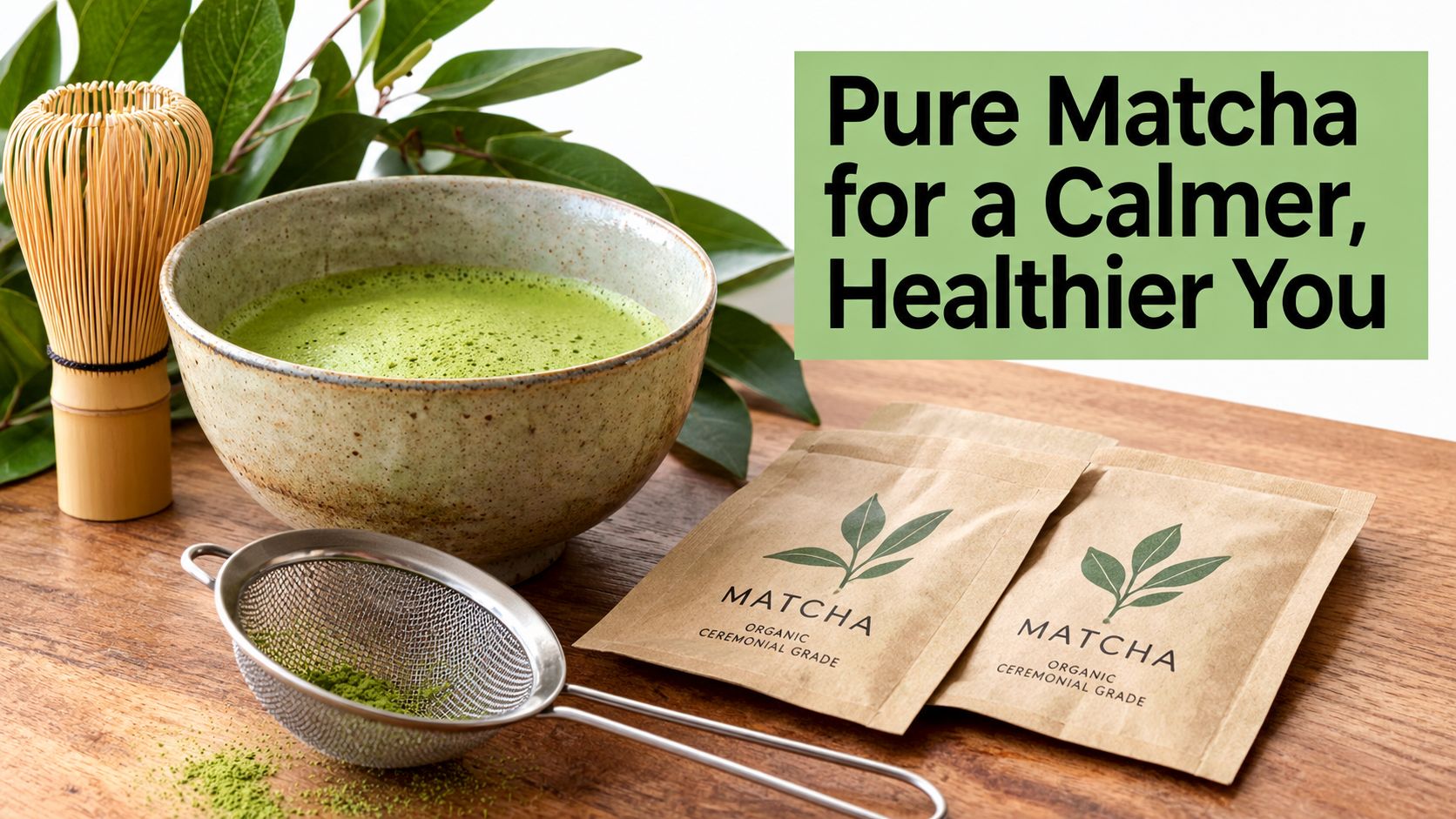
Tea bags have improved a lot. Modern formats are often made to hold their shape better, give the leaves more room, and preserve freshness more effectively than older bulk-storage habits. That matters because flavour fades when tea sits exposed to light and air, and matcha is especially sensitive to poor handling.
The best part is that convenience no longer has to mean stale flavour. A quality tea bag can protect the tea well enough for daily use while still giving you the bright, fresh character you want from matcha. That's the evolution worth paying attention to.
Why sourcing still matters
The brewing format can only do so much if the tea itself is weak. PepTea's own how matcha tea is made page is a useful reminder that source material and processing shape the final cup. That applies whether the tea ends up in a bowl, a sachet, or a café menu item.
If you care about organic, functional tea, look at both the leaf and the pack. A neat bag with poor tea inside won't impress anyone. A good bag with well-selected tea can make daily matcha feel surprisingly close to a whisked cup, especially for casual drinkers who value freshness over ceremony.
Sustainability only matters if the cup is still enjoyable. When the tea tastes flat, people stop buying it, and the habit disappears.
That's why taste and responsibility need to move together. The smarter product is the one people want to drink tomorrow.
Who Should Switch to Matcha Bags
A tea bag earns its place when the alternative is skipping matcha altogether. It suits people who want a repeatable cup without specialist equipment, while still caring about flavour and function. Busy professionals, parents, café teams, and anyone building a low-friction wellness routine can all benefit from the format, provided they accept that a bag will not offer the same control as whisked powder.
The people who usually get the most value
- Office workers: A tea bag provides a predictable mid-morning drink when back-to-back calls leave little time for preparation.
- Parents and carers: One clean cup is easier to manage before the school rush than a bowl, whisk, and separate cleanup.
- Hospitality teams: Consistent preparation helps when service speed, shared workspaces, or staff changes make specialist brewing impractical.
- New matcha drinkers: The simpler method reduces the learning curve and gives beginners a better chance of enjoying their first cup.
- Home users who dislike mess: A bag removes the powder, whisk, and bowl cleanup that can make regular brewing feel like work.
The format also suits buyers who need clear product information. Australia's food regulator treats caffeine as a safety issue in concentrated products and requires added caffeine to appear in the ingredients statement when it is added to food for sale (Food Standards Australia New Zealand). Check the label, serving guidance, and preparation instructions before choosing a functional drink.
When the tea bag beats the bowl
Choose a tea bag when routine matters more than ceremony, or when a café and workplace need a clean, repeatable service method. Choose loose powder when you want to control dose, texture, strength, and whisking. The right option depends on whether convenience helps you drink matcha consistently without making the quality trade-off unacceptable.
If the format makes healthy habits easier, it's doing useful work.
Matcha's growing presence in Australia has shifted attention from ceremony alone to everyday use, including how easily people can prepare it (SBS). Tea bags fit that practical demand. They can turn occasional interest into a regular habit, as long as the tea tastes fresh enough to earn the next cup.
Conclusion and Your Next Steps
The strongest case for matcha tea bags is simple. They let you keep the functional appeal of matcha, including the caffeine and L-theanine profile people want, without turning every cup into a production. When the bag is well made and the brew is handled properly, the result can be genuinely satisfying, not just convenient.
The trade-off is still real. Loose powder gives you more ceremony and control, while tea bags give you speed, consistency, and a much easier daily habit. For most busy Australians, especially those trying to build a calm, reliable morning routine, that trade makes sense.
If you're buying for home, café service, or a workplace pantry, look for tea that's clearly sourced, properly packaged, and easy to prepare well. That's where quality shows up, not in marketing language, but in the cup itself.
PepTea offers Australian-focused organic matcha and sugar-free kombucha for people who want functional drinks without the fuss. If you're ready to make matcha part of a realistic daily routine, visit Pep Tea and explore the range for home, café, or wholesale use.
What Is Ceremonial Matcha? the Real Difference
Most advice about matcha starts with colour: if the powder is bright green, it must be ceremonial. That's a useful first clue, but it isn't enough. In Australia, products carrying similar “ceremonial” language can vary in origin, processing, flavour and price, while the term itself doesn't provide a universal grading standard.
So, what is ceremonial matcha? It's the highest-grade form of matcha, traditionally made from the youngest tea leaves picked during the first harvest. Those leaves are shaded before picking, processed into tencha, stripped of stems and veins, and stone-milled into an exceptionally fine powder. The result is designed to be whisked with water and enjoyed on its own, not hidden in sugar, milk or flour.
Understanding that journey makes it easier to judge a product by what's behind the label, rather than by packaging alone.
Defining Ceremonial Matcha Beyond the Label
Not every green tea powder is matcha, and not every product called ceremonial matcha offers the same experience. The word has become common in Australian cafés and online shops, but the useful question isn't just, "Does the tin say ceremonial?" It's, "What leaves were used, how were they grown, and how were they processed?"
Ceremonial matcha is made from the youngest leaves of the first harvest, often called ichibancha. These leaves are valued for their bright colour, fine texture and naturally rounded flavour. Producers shade the plants before harvest, then turn the leaves into tencha before grinding them into powder. Because you consume the whole leaf rather than steeping it and discarding it, the raw material and processing have a direct effect on what ends up in your bowl.
Historical accounts trace powdered tea practices from China to Japan in the 12th century, while the Japanese tea ceremony was fully established by the late 15th century. That gives ceremonial matcha a place within over 500 years of ritualised use in Japan, as described in this history of Japanese matcha in Australia.
What you're paying for
A premium price should reflect more than a vivid label. You're paying for careful cultivation, selective harvesting, refined processing, stone milling and appropriate handling. Those choices influence whether the powder tastes creamy and umami-rich or harsh, dusty and bitter.
Ceremonial matcha is traditionally intended for straight preparation with water. That doesn't mean you can't use it in a latte, smoothie or dessert. It means the powder should be pleasant enough to drink without needing other ingredients to cover flaws.
The simplest quality test is also the most revealing: can you enjoy it with water alone?
The term “ceremonial” can help shoppers find the style of matcha they want, but it shouldn't replace checking the product details. Look for a clear Japanese origin, first-harvest information, shade-growing details, tencha processing and sensible storage guidance. These details tell you much more than the front of the pouch.
The Cultivation and Processing of Premium Tencha
A ceremonial bowl begins in a tea field long before anyone reaches for a bamboo whisk. Farmers first prepare the plants for a controlled period of shade, then harvest the youngest leaves and process them quickly to protect their colour and flavour.
Shade changes the leaf
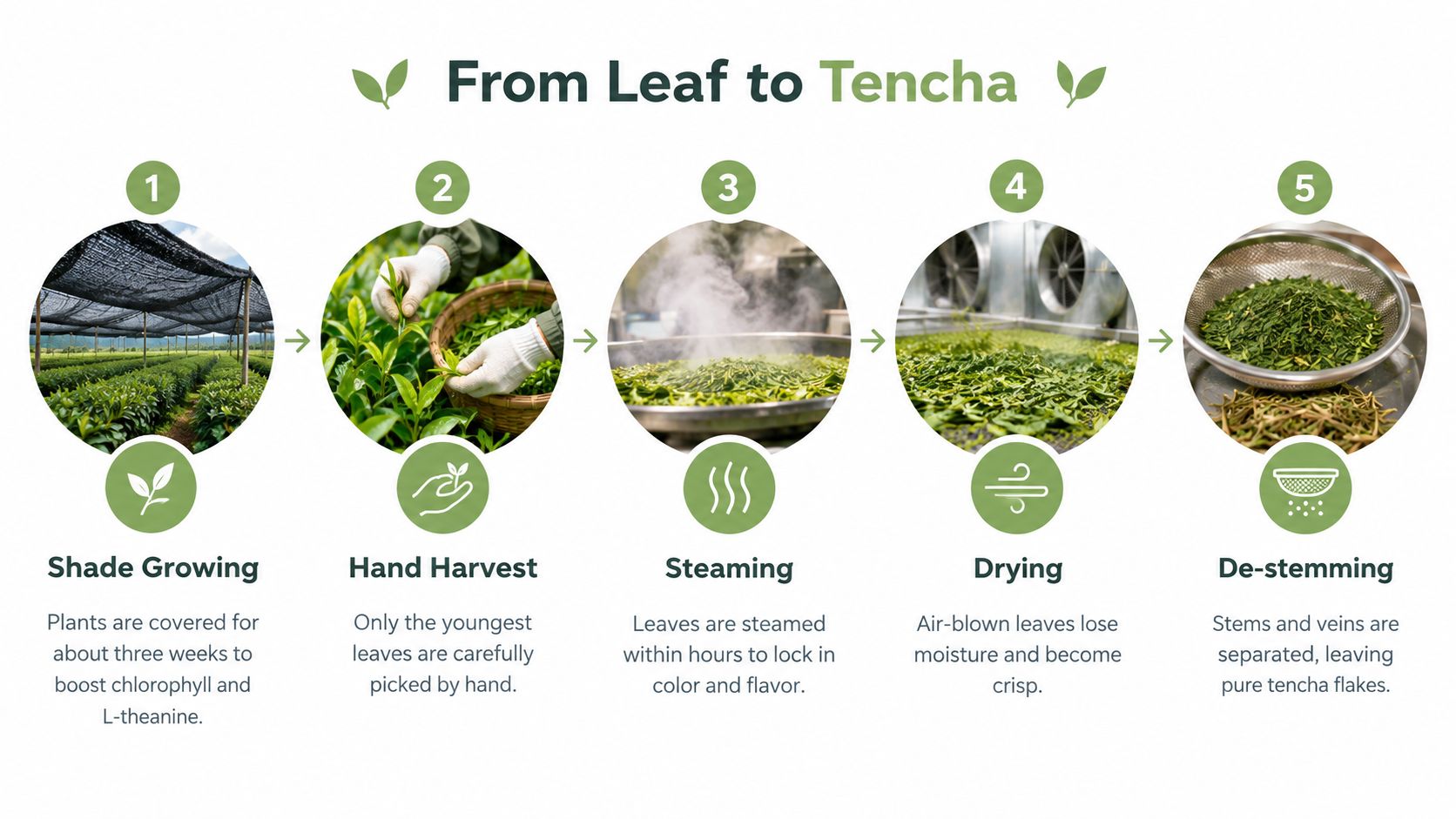
Producers commonly shade tea plants for about 20 to 40 days before harvest. This limited sunlight encourages the plant to retain more chlorophyll and preserve L-theanine, an amino acid associated with sweeter flavour and reduced bitterness. The result is the deep green colour and savoury-sweet umami that people expect from well-made matcha. See this explanation of matcha grades and shading for more detail.
The plants are then harvested for their youngest leaves, usually during the first spring picking. Timing matters because older leaves tend to produce a more assertive, astringent cup, while tender first-harvest leaves are better suited to drinking straight.
From fresh leaf to tencha
After harvest, the leaves are steamed to halt oxidation and help retain their green character. They're then dried, creating the material that will be refined into matcha. Unlike many other tea styles, the leaves aren't rolled into familiar needle shapes.
The stems and veins are removed next, since these tougher parts can add coarseness and unwanted bitterness. The remaining leaf material is called tencha, the raw material used for authentic matcha. This guide to how matcha tea is made provides a practical look at the stages involved.
Finally, producers stone-mill the tencha into a very fine powder. Slow milling helps create the silky mouthfeel associated with ceremonial matcha, although it also makes production careful and labour-intensive. The finished powder is more than dried green tea ground up at random. It's the product of shade management, selective harvesting and specialised processing.
That craftsmanship also explains why fresh ceremonial matcha can taste so different from ordinary green tea powder. The leaf has been cultivated for a particular flavour profile, prepared for suspension in water and milled finely enough to become part of the drink's texture.
The Biochemical Profile and Health Benefits
Matcha's distinctive appeal comes partly from the fact that you drink the powdered leaf. With ordinary green tea, you steep the leaves and remove them. With matcha, the prepared powder remains in the bowl, so the drink contains the compounds present in the leaf material.
One Australian analytical report for a ceremonial matcha product lists total catechins at 65,200 micrograms per gram, including 56,000 micrograms per gram of EGCG, with L-theanine at 21,300 micrograms per gram and caffeine at 33,300 micrograms per gram. These figures come from the product's published analysis, not from a universal value for every ceremonial matcha, so they're best understood as an example of the biochemical profile that can occur in a carefully produced product. The published ceremonial matcha analysis shows why laboratory information can be more useful than broad wellness language.
Antioxidants and EGCG
Catechins are naturally occurring compounds in tea. EGCG, or epigallocatechin gallate, is one of the best-known tea catechins and is often discussed for its antioxidant activity. Antioxidants help protect cells from oxidative stress, but matcha shouldn't be treated as a medicine or a substitute for a varied diet.
If you'd like a plain-language explanation of the compound itself, Pep Tea's guide to what EGCG is is a useful place to start. The practical takeaway is simple: a high-quality matcha can contribute tea polyphenols to your daily routine, but the product's actual composition depends on cultivar, harvest, cultivation, processing and storage.
L-theanine and caffeine
L-theanine gives matcha much of its character, both in flavour and in how the drink feels. Paired with caffeine, it may support a state of calm alertness, which many people experience as focused energy rather than the sharper lift associated with coffee.
That doesn't mean matcha can never feel stimulating or that everyone will respond in the same way. Caffeine sensitivity varies, and serving size, timing and whether you've eaten all matter. People who are pregnant, managing a medical condition or taking medication should seek individual advice from a qualified health professional.
Matcha is also sometimes described as immune-supporting because tea compounds and a balanced diet may contribute to general wellbeing. Keep the claim proportionate. Ceremonial matcha can be a nutrient-rich, enjoyable beverage, but it isn't an immunity cure.
Ceremonial Grade Versus Culinary Grade Matcha
Ceremonial and culinary matcha aren't rival products where one is automatically good and the other is automatically poor. They're made for different jobs.
Ceremonial matcha is selected for drinking with water. Culinary matcha is generally chosen for recipes where the powder needs to hold its flavour against milk, sugar, flour, fruit or other strong ingredients. It may come from later harvests or use leaf material with a more pronounced bitterness, which can be useful in baking and blended drinks.
| Feature | Ceremonial Grade | Culinary Grade |
|---|---|---|
| Primary use | Whisked with water and enjoyed straight | Lattes, smoothies, baking, sauces and desserts |
| Leaf selection | Young first-harvest leaves | Often later-harvest or more robust leaf material |
| Flavour | Smooth, umami-rich and naturally rounded | More assertive, grassy or astringent |
| Colour | Usually vivid green | Can be green but often less luminous |
| Texture | Very fine and silky | Fine powder, though texture can vary |
| Best buying question | Is it enjoyable without added flavour? | Will it remain noticeable in the finished recipe? |
Choose for the way you'll drink it
If your morning ritual is a small bowl of matcha and water, ceremonial grade makes sense because its delicate sweetness and umami are exposed. Poor-quality powder has nowhere to hide in that preparation.
For a matcha latte, the choice is more personal. A good culinary powder can be practical, especially if you're adding milk and a sweetener. A ceremonial powder can also make an excellent latte, particularly when you want a softer flavour and a cleaner finish. The important point is not to buy the most expensive product automatically. Buy the grade that suits your actual use.
Where the confusion begins
Some Australian listings describe ceremonial matcha as water-only, while others promote the same style for lattes. That isn't necessarily a contradiction. “Ceremonial” describes the intended quality and drinking style, not a rule that forbids every other recipe.
The distinction becomes clearer when you think about flavour. Use ceremonial matcha when the tea itself is the centre of attention. Use culinary matcha when it's one ingredient among several.
How to Identify Authentic Ceremonial Matcha in Australia
Australian shoppers have plenty of choice, but the variety can make comparison difficult. Similar products may use the same words, while prices for comparable-sounding listings can range from about A$35 to A$69.99, as shown in this Australian ceremonial matcha product listing. Price alone can't prove quality, but it should encourage you to inspect the details.
Use a practical checklist
Read the harvest description. Look for first harvest or ichibancha language, rather than relying only on “premium” or “ceremonial”.
Check the colour. Fresh ceremonial matcha is generally a vibrant green. A dull, yellowish or brownish appearance can indicate older material, oxidation or poor storage, although colour should always be judged alongside taste and provenance.
Inspect the texture. The powder should feel exceptionally fine and silky. Grittiness suggests that the product hasn't been milled or refined to the standard expected of a whisked tea.
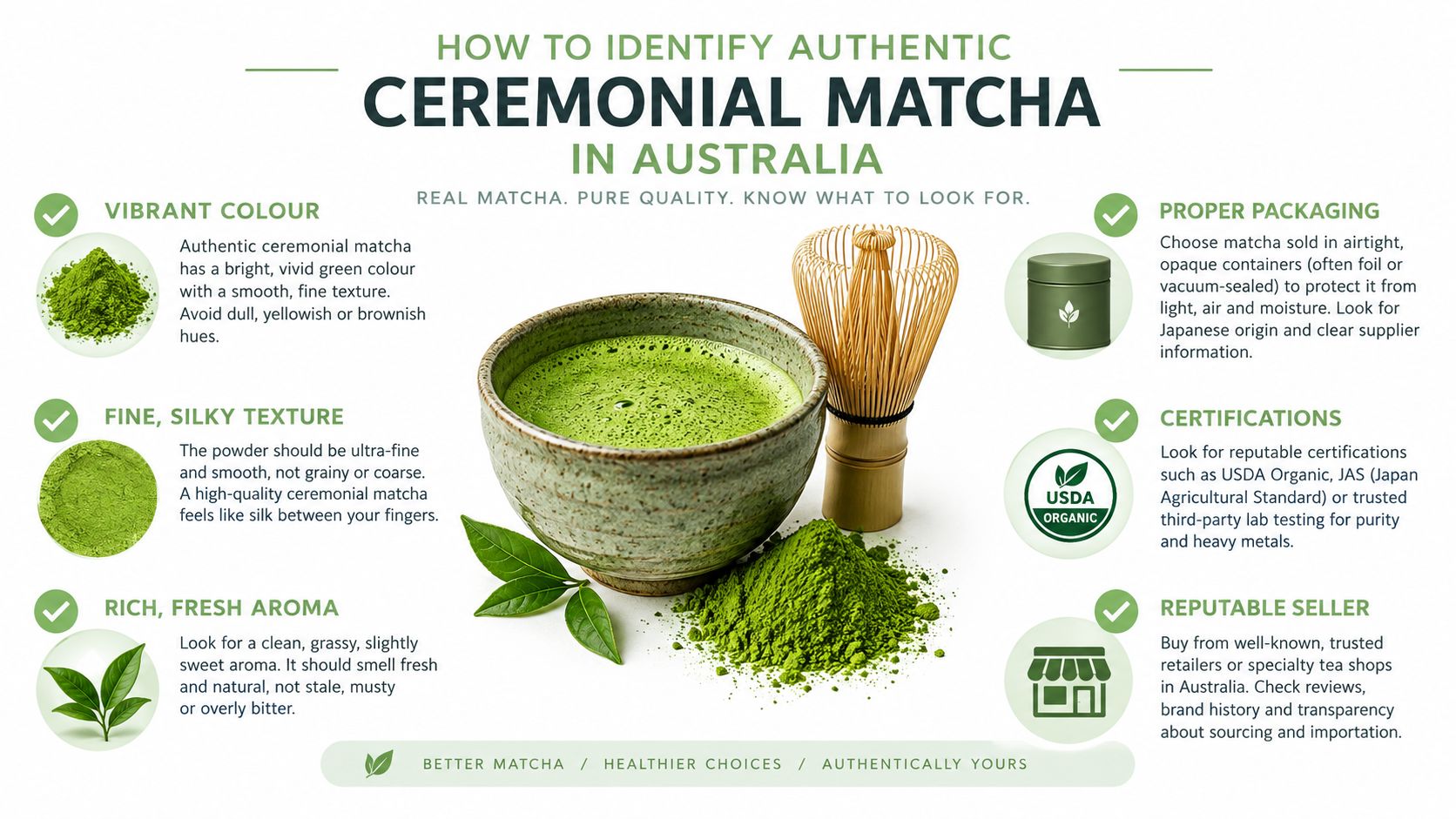
Look for tencha processing. A credible product description should explain that the leaves were de-stemmed and de-veined before stone milling. This overview of ceremonial matcha processing explains why those steps affect texture.
Ask where it was grown and packed. Japanese origin should be clear, not buried under vague language such as “Japanese-style”.
Treat pricing as context, not proof. First-harvest tea, careful shading and stone milling require more work, so an unusually low price deserves closer inspection. A high price doesn't guarantee authenticity either.
Ask for evidence, not adjectives
Look for batch information, organic certification where relevant, storage guidance and analytical information. A supplier that can explain the leaf, harvest and processing gives you something concrete to evaluate.
The most reliable buyer doesn't chase the brightest green pouch. They compare the agricultural and processing story with the sensory result in the cup.
Traditional Preparation and Tasting Notes
Premium matcha is forgiving once you understand the basics, but it isn't prepared like a teabag. The traditional setup uses a chawan, or bowl, and a chasen, the fine bamboo whisk. A small sieve is also helpful because it breaks up clumps before they become difficult to disperse.
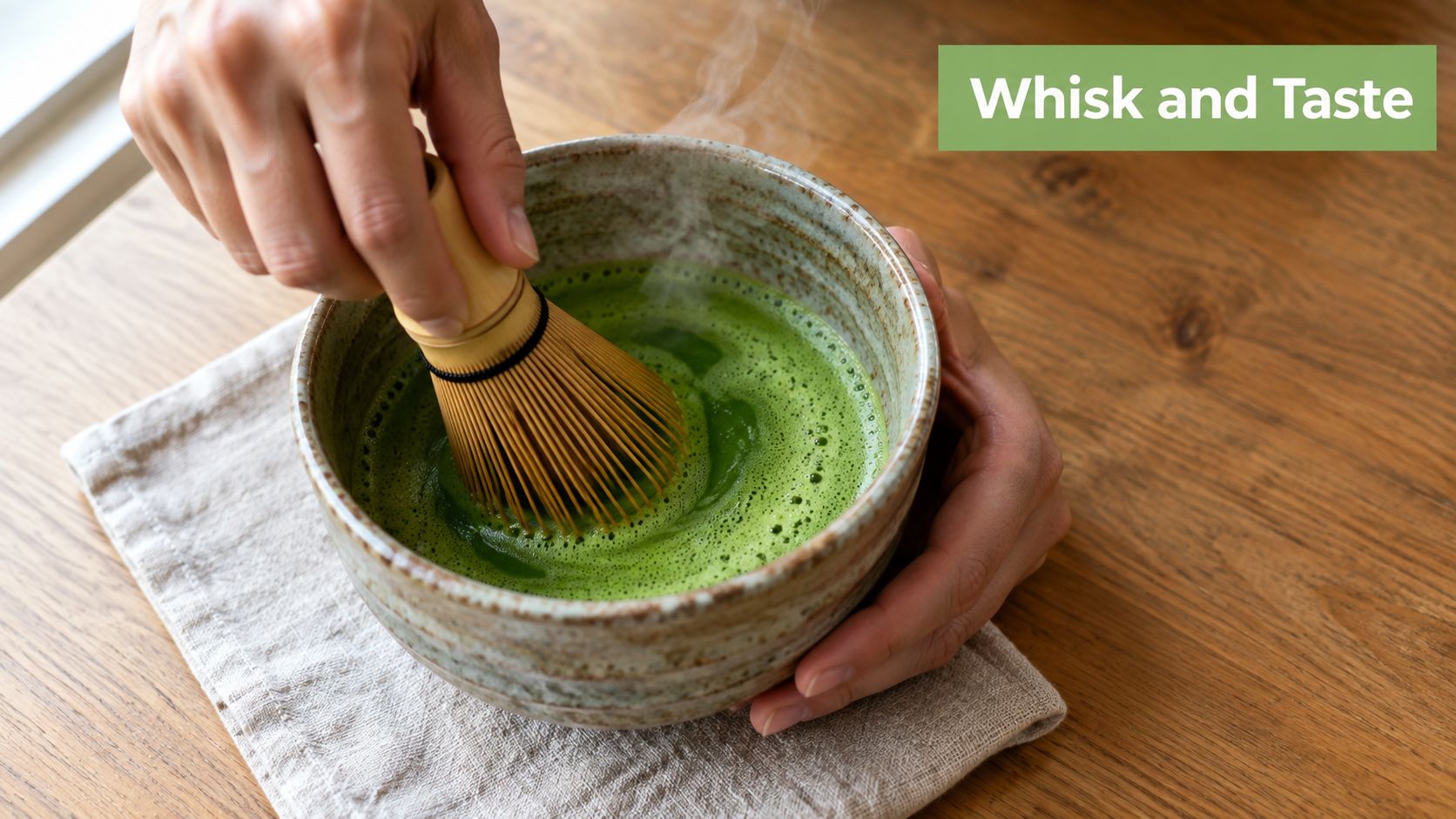
A simple bowl method
Warm the bowl, then discard the warming water.
Sift the matcha into the bowl. Sifting isn't ceremonial theatre. It helps the fine powder combine with water smoothly.
Add a small amount of hot water that has cooled below boiling. Water that's too hot can push delicate flavours towards harshness and flatten the tea's sweeter notes.
Whisk briskly using a light W or M motion, keeping the whisk near the surface rather than stirring slowly around the edges.
Add more water to reach your preferred strength, then drink soon after whisking so the powder stays evenly suspended.
The bowl should feel creamy rather than sandy. Expect fresh vegetal notes, gentle sweetness and a savoury umami finish. A little bitterness can be part of tea's character, but pronounced harshness often points to water that's too hot, too much powder, an older product or unsuitable raw material.
For a closer look at the ritual, explore Pep Tea's guide to the matcha tea ceremony.
Here's a visual demonstration of the whisking rhythm and bowl preparation:
If your first bowl tastes strong, adjust one variable at a time. Try cooler water before reducing the powder, then experiment with a little more water. Matcha rewards attention, but it doesn't require perfection.
Integrating Premium Matcha Into Your Daily Routine
Ceremonial matcha can fit neatly into an Australian morning without turning every cup into a formal tea ceremony. Prepare it traditionally when you have a quiet moment, or whisk it into a small latte when you're heading into work. The quality still matters because a smooth powder gives you more flexibility, especially when you sometimes drink it with water and sometimes with milk.
Many people prefer matcha earlier in the day, when its caffeine and L-theanine profile suits focused work, study or a calm start. If you're sensitive to caffeine, drink a smaller serving, have it with food and pay attention to how your body responds.
Keep the ritual realistic
A useful routine might look like this:
- Morning focus: whisk matcha with water before opening your phone or starting your commute.
- Café-style break: make a simple latte without heavy syrups so you can taste the tea.
- Recipe use: reserve culinary grade for smoothies, baking, ice cream and other recipes where stronger ingredients are involved.
- Thoughtful storage: protect the powder from heat, moisture, light and air, and follow the supplier's storage instructions.
Australia's interest in matcha has accelerated sharply. One market source reports that Australian matcha imports rose 62.91% from 2023 to 2024, while another report says Australia imported 195,319 kilograms of Japanese green tea between January and August 2025, a 131% year-on-year increase, ranking Australia as the eighth-largest export destination for Japanese green tea. These figures are reported in the Australia matcha tea market data, and they help explain why shoppers need clearer quality guidance as more products appear.
The best choice is the matcha you'll prepare and enjoy regularly. For some people, that means a delicate bowl of ceremonial powder. For others, it means keeping ceremonial grade for water preparation and using culinary grade for creative recipes.
Pep Tea offers organic Japanese matcha, including ceremonial-grade powder, alongside Australian-brewed sugar-free organic kombucha from the Hunter Valley, NSW. Visit Pep Tea to explore the matcha range, learn more about preparation and find functional drinks suited to everyday routines.
Organic Ceremonial Matcha Guide for Health and Brewing
Australia's matcha market generated more than $54 million in 2024, while Japanese green tea exports to Australia reached 195,319 kg between January and August 2025, a 131% year-on-year increase according to SBS News coverage of Australia's matcha boom. That growth has pushed organic ceremonial matcha from a niche tea-shop ingredient into a mainstream wellness product, but popularity also creates confusion. A green powder labelled “ceremonial” isn't automatically authentic, organic, fresh, or nutritionally consistent.
Organic ceremonial matcha is whole, shade-grown green tea leaf, processed into a fine powder and consumed rather than steeped and discarded. Its appeal comes from a combination of Japanese provenance, organic certification, vibrant flavour, naturally occurring caffeine, L-theanine and catechins, plus the calm ritual of whisking a fresh bowl.
For Australian buyers, quality involves more than colour and branding. You'll need to consider origin, certification, harvest and processing information, packaging, taste, and preferably lot-specific laboratory data. This guide breaks down those decisions, then shows you how to brew organic ceremonial matcha, use it in lattes and recipes, and buy it with greater confidence.
Introduction to Organic Ceremonial Matcha
Matcha differs from ordinary green tea because you consume the leaf itself. Loose-leaf tea works like an infusion: hot water extracts selected compounds, while the leaves remain in the strainer. Matcha instead keeps finely milled powder suspended in water, so storage, preparation, and sourcing shape the result.
Organic describes the tea's production system and the certification supporting that claim. It does not promise a particular flavour, caffeine level, or freshness. Ceremonial generally indicates matcha intended for whisking with water and drinking on its own, yet the term has no universal quality standard. A grade name is therefore only one clue, not proof of authenticity.
Australia's import-dependent supply makes provenance details especially useful. Industry market analysis reports that over 90% of consumed matcha volume is imported, with combined green tea powder imports estimated to have risen at a 13–17% CAGR from 2020 to 2025. Premium buyers consequently depend largely on imported certified products, particularly Japanese matcha.
Start with three checks: can the supplier identify the powder's origin, show its organic certification, and provide laboratory testing that supports its quality? These records work like a product passport. Colour and branding may suggest quality, but traceable documents offer stronger evidence when choosing organic ceremonial matcha in Australia.
Understanding What Makes Matcha Ceremonial
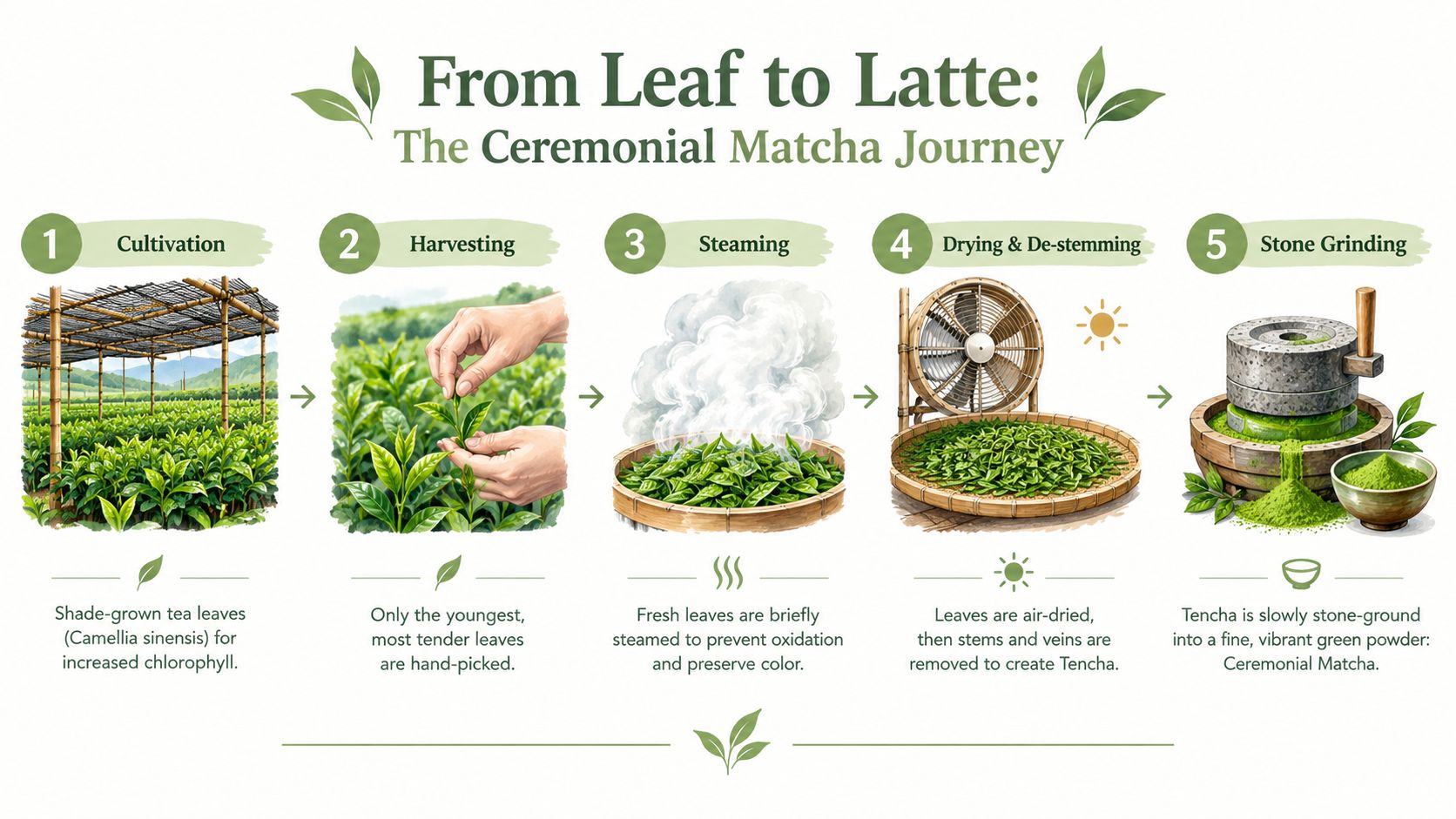
Ceremonial matcha begins as Camellia sinensis, the same tea plant used for green, black and white tea. The difference lies in cultivation and processing. Before harvest, producers shade the plants, often using structures that reduce direct sunlight. This encourages the leaves to retain a deep green colour and develop a softer, umami-led flavour.
From shaded leaf to tencha
The youngest leaves are selected because they're tender and well suited to drinking without milk or sugar. Producers quickly steam the fresh leaves to limit oxidation, then dry them. Stems and veins are removed, leaving tencha, the leaf material that becomes matcha.
Think of tencha as the carefully prepared flour of the tea world. A baker wouldn't describe a coarse bran mixture as the same thing as finely sifted pastry flour. In a similar way, removing tougher leaf parts helps create the smooth texture expected from matcha designed for whisking.
Why stone grinding matters
The dried tencha is slowly ground into an exceptionally fine powder, traditionally using stone mills. The process resembles artisan flour milling, where patience and controlled movement matter more than speed. The result should disperse smoothly when whisked, rather than feel gritty or heavy on the tongue.
This whole-leaf format explains why matcha has a more concentrated taste than a cup of steeped green tea. It also means poor storage can affect the aroma and colour directly, because there's no separate leaf to remove after brewing.
For readers comparing powdered tea formats, this guide to choosing instant matcha can help clarify the difference between convenience powders and matcha intended for a more traditional preparation. PepTea also provides a useful overview of how matcha tea is made, including the transformation from leaf to powder.
Health Benefits and Key Compounds
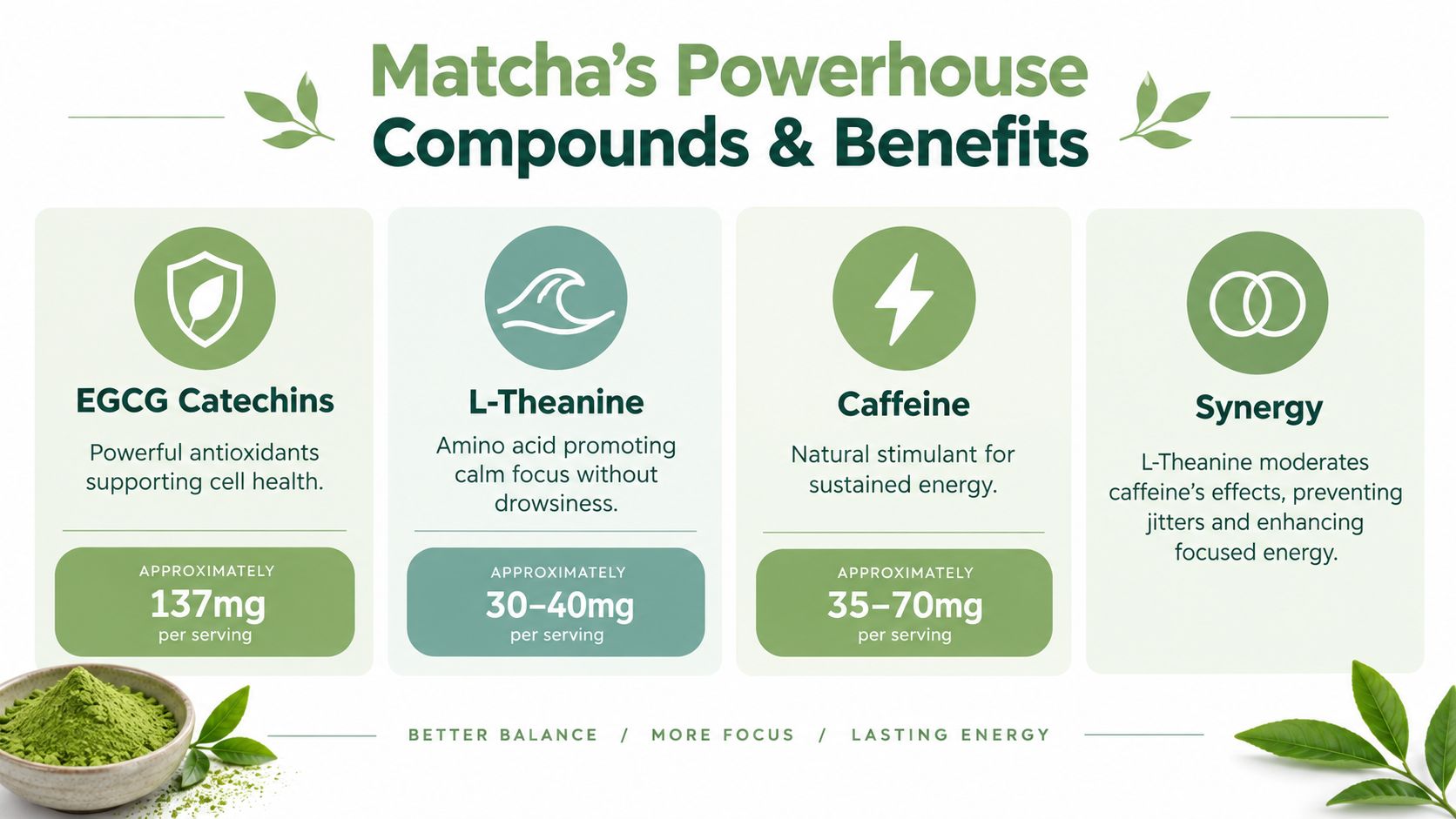
Organic ceremonial matcha contains several naturally occurring compounds that shape both its flavour and its physiological effects. The main trio is catechins, L-theanine and caffeine. It's more accurate to say matcha may support alertness and focused energy than to promise a medical outcome.
Catechins are plant compounds with antioxidant activity. EGCG, or epigallocatechin gallate, is one of the best-known catechins in green tea. A useful everyday analogy is a clean-up crew. Antioxidants help the body manage oxidative processes, but they aren't a cure-all and shouldn't replace a balanced diet or medical advice.
L-theanine is an amino acid associated with tea's characteristic savoury, rounded taste. Caffeine provides stimulation, while L-theanine may help make the experience feel calmer and less abrupt for some people. The combination can feel different from drinking a strongly caffeinated beverage on its own.
Practical rule: Treat matcha as a whole-leaf food and a caffeinated drink, not as a medicine.
A randomized placebo-controlled study used 2.07 g of matcha per day, providing 50.3 mg of theanine, 171.0 mg of catechins and 72.5 mg of caffeine. Participants showed a statistically significant reduction in reaction time and more correct responses on an emotion-perception task, as reported in the published study available through PubMed Central. That result supports interest in the combined matrix, but it doesn't mean every product or serving delivers the same composition.
Preparation can change the sensory experience. Very hot water may draw out more bitterness, while excessive milk or sweetener can hide the fresh, grassy and umami notes that distinguish good matcha. Readers interested in the role of EGCG can explore what EGCG is before deciding how much weight to place on antioxidant language.
Grading Origins and Sourcing in Australia
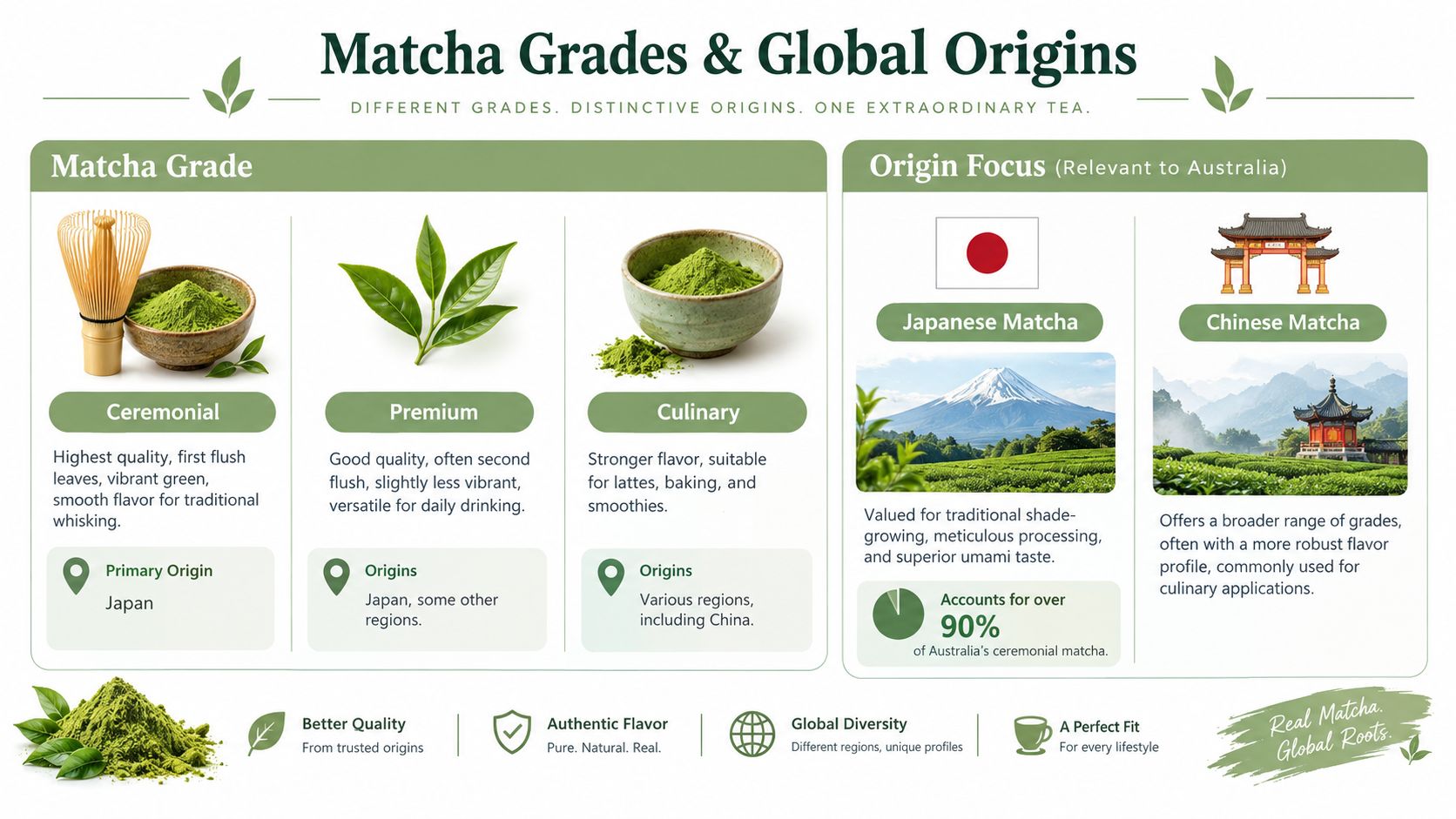
Australia's ceremonial matcha market depends heavily on imported products, so a packet's origin story matters as much as its colour or label. The terms ceremonial, premium and culinary provide useful starting points, but they describe intended use more than they prove authenticity.
Ceremonial matcha is generally selected for a fine texture, attractive colour and balanced flavour when whisked with water. Premium matcha may suit everyday drinking or lattes. Culinary matcha usually has a stronger flavour designed to remain noticeable alongside milk, fruit, flour or chocolate. These categories work like menu labels, not independent laboratory standards.
Origin adds another layer. Japanese matcha is associated with established shading and processing traditions and with umami-focused drinking styles. Chinese matcha is also sold in various grades, often for culinary applications. A country name alone cannot confirm that a product is organic, fresh or appropriate for ceremonial preparation.
Why Australian provenance matters
IndexBox's Australian market analysis describes Australia as an import-dependent market, with Japan supplying much of the value associated with premium matcha and China contributing substantially to import volume. That pattern makes traceability, stock continuity and accurate labelling practical concerns for Australian buyers.
Supply pressure can also affect availability. Australian hospitality coverage describes a fast-growing category, new supply agreements and pressure on shipments of ceremonial Japanese matcha. Treat vague wording such as “Japanese style” or “inspired by Japan” as a prompt to ask questions. Look for the producing country, region where available, importer and batch details.
Reading organic certification
Certification connects an organic claim with an identifiable standard and certifying body. Australian shoppers may see:
- Australian Certified Organic: A certification scheme used for eligible organic products sold in Australia.
- NASAA Certified Organic: Another recognised Australian organic certification pathway.
- JAS: Japan's Agricultural Standards system, relevant when Japanese organic certification is stated.
Check the logo, certification details, product name and importer together. Japanese origin does not automatically mean certified organic, and organic certification does not establish ceremonial grade. For stronger verification, compare the label with lot-specific laboratory data, such as a certificate of analysis showing the tested batch and relevant contaminant or composition results.
How to Choose High Quality Ceremonial Matcha
Start with transparency, not the colour of the tin. A bright jade-green powder can be a positive sign, but appearance alone can't verify origin, organic status, freshness or potency. The most dependable choice combines sensory checks with documentation.
Use the five-part check
-
Read the origin statement. Look for the producing country and, where available, the region, cultivar, harvest information and importer. A specific statement is more useful than a broad phrase such as “Japanese matcha blend”.
-
Verify organic certification. Check for an identifiable certification mark, not just the word “organic” in large type. If the package is unclear, ask the supplier which body certified the product and whether the certification applies to that particular matcha.
-
Inspect the powder. Fresh ceremonial matcha should look vivid rather than dull, yellowed or grey-green. It should feel fine and silky between the fingers, without obvious coarse particles.
-
Smell before tasting. A fresh, gently sweet and vegetal aroma is more encouraging than a stale, musty or hay-like smell. Once whisked, the flavour should be rounded and umami-led, with bitterness and astringency kept in balance.
-
Ask for a lot-specific COA. A certificate of analysis should identify the tested batch and show relevant results rather than relying on generic marketing copy.
The final point deserves particular attention. Independent ceremonial matcha lab results show substantial variation between samples. One analysis reported EGCG at 69.73 mg/g, EGC at 24.47 mg/g and caffeine at 35.01 mg/g. Another test reported L-theanine at 21.3 mg/g and caffeine at 56 mg/g.
Those figures don't create a universal pass or fail threshold, but they demonstrate why “ceremonial” isn't a reliable proxy for potency. A lot-specific COA can help you understand the likely bitterness, intensity and serving consistency of the product in front of you.
A sealed package protects quality, but it can't replace traceability. You need both.
Choose packaging that limits exposure to light and air, check the best-before information, and note the lot number before opening. If a supplier won't answer basic questions about certification, origin or batch testing, choose a product with clearer documentation instead.
Brewing Basics and Creative Use Cases
The simplest way to taste organic ceremonial matcha is to whisk it with water. Use a clean bowl, a bamboo whisk called a chasen, a small sieve and fresh water. Sifting breaks up compacted powder before it meets the water, so you won't need to fight stubborn lumps.
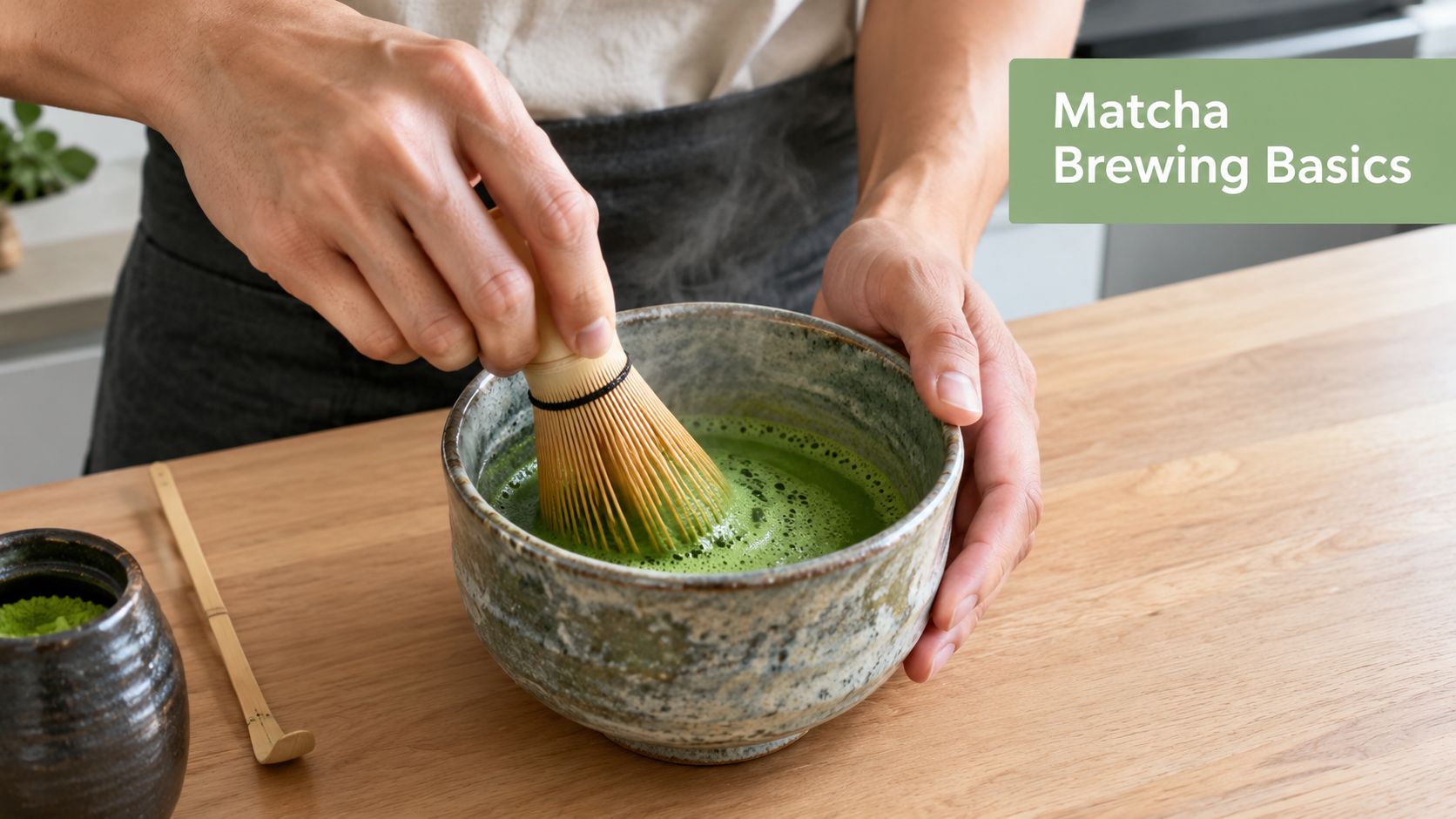
A reliable bowl method
- Warm the bowl, then discard the warming water.
- Sift your chosen amount of matcha into the bowl.
- Add a small amount of warm water and work the powder into a smooth paste.
- Add more water and whisk briskly in a back-and-forth W motion.
- Stop when the surface looks lightly foamy and the powder is evenly suspended.
Avoid boiling water. Excessive heat can make the drink taste harsh, while cooler water tends to preserve delicate sweetness and umami. For a more precise guide, use PepTea's instructions on matcha brewing temperature.
You can also follow the technique visually before adapting it to your own bowl and whisk.
Turning matcha into everyday drinks
A latte starts with a concentrated matcha paste. Whisk the powder with warm water first, then add steamed or chilled dairy milk or plant milk. Oat milk brings sweetness and body, while unsweetened almond milk keeps the tea profile lighter. Add sweetener only after tasting, because sugar can quickly cover the powder's natural character.
For an iced drink, make the concentrate, pour it over ice, then add cold milk or water. A matcha smoothie works well with banana, yoghurt or fruit, but use enough matcha to remain noticeable among the other ingredients. Strong culinary matcha can be practical here because its flavour is designed to stand up to food.
Baking gives you even more flexibility:
- Muffins: Sift matcha with the dry ingredients to distribute the powder evenly.
- Brownies: Stir it into part of the batter for a green tea swirl beside chocolate.
- Ice cream: Blend matcha into the dairy or plant-based base before chilling.
- Smoothies: Combine matcha with fruit, yoghurt and liquid, then taste before adding sweetness.
Cafés can benefit from consistent weighing, water temperature and milk volume. Teams wanting to strengthen their coffee and tea service can also explore TP Training's barista programs for broader beverage preparation skills.
Shopping Guide and Quality Certifications
Buying organic ceremonial matcha in Australia becomes easier when you separate four questions: Is it organic? Is it from the stated origin? Is it fresh? Can the supplier support the quality claim?
Specialist tea retailers, established cafés and direct brand websites can all be useful, provided the product page or packaging gives enough information. Look for a named certification scheme such as NASAA, Australian Certified Organic or JAS, then check that the certification applies to the product rather than only to the business generally.
Use this quick shopping sequence:
- Confirm the label: Check origin, grade description, organic mark, importer details and lot information.
- Examine the pack: Prefer sealed, light-protective packaging that limits air exposure.
- Check freshness: Read the best-before information and avoid products with unclear dating.
- Request evidence: Ask for a lot-specific COA showing relevant compounds such as catechins, caffeine and L-theanine.
- Store it carefully: Keep opened matcha sealed, away from heat, light, moisture and strong kitchen odours.
PepTea offers organic Japanese matcha products, including organic premium and ceremonial-style powders intended for whisking, alongside its Australian-brewed organic kombucha range. That gives shoppers one local supplier option to investigate while comparing certification and product documentation across the category.
A supplier that can't explain its certification, origin or testing may still sell an enjoyable powder, but you won't have enough information to verify the claims. Choose transparency first, then judge the flavour for yourself.
Explore the organic matcha range at Pep Tea to compare Japanese powders for whisking, lattes and recipes. You can also browse its Australian organic kombucha options when you're building a lower-sugar, functional drinks routine.
7 Healthy Caffeine Alternatives for Energy and Calm

Replacing coffee isn't one decision, because people want different things from their daily drink. You might be looking for calm focus, a coffee-like morning ritual, a pre-exercise lift, a sugar-free refreshment, or a caffeine-free option for the evening. The best healthy caffeine alternatives depend on the feeling and routine you want to support.
This guide compares seven practical choices, from organic matcha and kombucha to roasted dandelion blends, brewed cacao and mushroom cacao. “Stimulant intensity” is used as a practical guide, not a medical measurement. Individual tolerance varies, and ingredients, serving size, timing and label instructions all matter. If you're managing pregnancy, medication, a medical condition or strong caffeine sensitivity, check with a qualified health professional.
Australia already has a strong tea culture. Roy Morgan data published through the Australian National University found that 9.8 million Australians aged 14 and over, about half the population, drank tea in an average week during the 12 months to June 2016. The comparison below focuses on caffeine level, flavour, preparation effort, best use and practical cautions. For readers concerned about caffeine and hormonal symptoms, this caffeine and hot flashes guide offers useful additional context.
1. Pep Tea
Pep Tea is the most versatile choice here because it covers two different routines, smooth energy from organic Japanese matcha and refreshing, fermented hydration from Australian-brewed kombucha. That makes it useful for a home morning ritual, an iced afternoon drink, or a café menu that needs premium non-alcoholic options without relying on sugary soft drinks.
Pep Tea's matcha is stone-ground from organically grown Japanese tea. Because you consume the finely ground leaf rather than only an infusion, matcha has a full, grassy flavour and contains naturally occurring L-theanine and catechins, including EGCg. Those compounds don't make matcha risk-free or medically proven to improve every aspect of wellness, but they help explain why many people experience it as a steadier, calmer lift than a sharper coffee hit. Matcha generally sits in the moderate stimulant category, so it isn't the right choice for a caffeine-free evening.
Practical rule: Start with a modest amount, whisk it thoroughly, and assess your response before making matcha a stronger daily drink.
For a simple cup, sift matcha into a bowl, add a small amount of warm water, whisk until smooth, then add more water or your preferred milk. Ceremonial-grade matcha suits drinking on its own, while culinary-grade matcha works well in iced lattes, smoothies, baking and desserts. Pep Tea's educational resources also cover storage, recipes and practical ways to use matcha beyond a traditional bowl.
Kombucha for a different kind of refreshment
Pep Tea's kombucha is raw, living and brewed in the Hunter Valley, NSW, in a purpose-built HACCP-accredited facility. The sugar-free range uses organic green tea, fermentation and live cultures, with flavours including Ginger, Lime & Ginger and Mango. It's naturally sharp, lightly sparkling and ready to drink chilled, or to use as a mixer for a non-alcoholic café serve.
Kombucha can contain live bacteria and yeast, but CHOICE's discussion of kombucha evidence notes that human clinical evidence for broad claimed benefits remains limited. “Probiotic-rich” should therefore describe the presence of live cultures, not promise a guaranteed gut-health outcome. Pep Tea's guide to whether kombucha contains caffeine is useful when choosing a product for your own tolerance, and labels remain the final check.
Pros
- Organic sourcing: Pep Tea focuses on certified-organic matcha and kombucha.
- Two routines in one range: Matcha supports a focused daytime ritual, while kombucha offers a cold fermented refreshment.
- Hospitality support: Cafés and retailers can use the products in lattes, mocktails, recipes and ready-to-serve menus.
- Education: Guides cover matcha storage, fermentation basics, SCOBY care and recipe ideas.
Cons
- Pricing requires an enquiry: Public retail and wholesale pricing isn't consistently displayed.
- Flavour needs a little adjustment: Matcha's vegetal taste and kombucha's acidity may be unfamiliar at first.
- Caffeine varies by product: Check the specific label, especially if you're sensitive.

2. Teeccino
Teeccino is for the person who misses the coffee ritual, not necessarily the caffeine. Its roasted herbal blends combine ingredients such as chicory, carob, barley, dates, figs and ramón seeds to create a dark, nutty drink that can be brewed in a drip machine, French press or refillable pod. It's designed to be caffeine-free and coffee-like, making it a natural fit for a morning mug or an afternoon replacement.
The brand offers a broad range of dark and medium roast flavours in grounds and tea-bag formats. Some blends have organic or gluten-free positioning, but those features vary by product, so the individual packet matters more than the brand name. The stimulant intensity is none from caffeine, although the warm roasted flavour and familiar preparation can still feel energising as a routine.
Why it suits coffee drinkers
Teeccino gives you control over texture and strength. Brew it like plunger coffee for a fuller cup, use a drip method for a cleaner result, or choose tea bags when you want less equipment. A splash of milk can soften the roasted bitterness, while a latte preparation makes the drink feel closer to a café order.
Chicory contains inulin, a type of fibre that some people tolerate well and others find difficult. People managing digestive sensitivities, particularly those avoiding FODMAPs, should check the ingredients and start cautiously. Many blends also contain barley, which means they aren't suitable for people avoiding gluten unless the specific product is clearly labelled otherwise.
For Australians, availability is more practical through third-party retailers than direct local distribution. Before ordering, check shipping, blend ingredients and whether the format suits your equipment. The product can be a useful addition to a broader natural energy drinks Australia guide, particularly for readers who want a coffee-style experience without caffeine.
Best use: A slow morning ritual, office plunger or evening decaf-style drink when you still want roasted flavour.
Potential drawback: It won't taste exactly like espresso, and chicory or gluten-containing ingredients may rule out some blends.

3. Kintra Foods Roasted Dandelion Blend
Kintra Foods' roasted dandelion and chicory blend is one of the easiest choices for Australians who want a caffeine-free coffee ritual with local availability. It comes in filter bags, jars and larger pouches, with a fine grind designed for café-style preparation. You can brew it in a percolator, plunger or coffee machine, depending on the format you buy.
The drink has a toasted, earthy profile rather than the sharp bitterness of coffee. That distinction matters. It may satisfy the habit of grinding, brewing and serving a warm dark drink, but people seeking a true espresso flavour may need time to adjust. The stimulant intensity is caffeine-free, so it works better for evening routines than matcha or brewed cacao.
A practical café option
The fine grind is particularly useful for cafés that want to offer a dandelion latte without buying another complicated system. Steam milk separately, combine it with the brewed blend and adjust the ratio until the roasted flavour sits comfortably beneath the milk. At home, filter bags make the simplest entry point, while the larger formats suit frequent use or hospitality service.
Kintra describes the blend as preservative-free, lactose-free and gluten-free. It contains chicory, however, so the absence of gluten doesn't automatically make it suitable for people avoiding inulin or FODMAP ingredients. Always read the current pack, especially if you're serving customers with allergies or dietary requirements.
Best use: A caffeine-free morning latte, workplace drink or café menu addition.
Intensity: None from caffeine. The sensory effect comes from warmth, aroma and a familiar coffee-style ritual.
Main trade-off: The roasted dandelion and chicory profile is distinct, and it won't reproduce every quality of coffee. Its Australian ownership and production, plus broad supermarket and health-store availability, make it a convenient choice for local shoppers.
4. Bonvit Roasted Dandelion Blend
Bonvit's roasted dandelion and chicory blend takes a similar idea and makes it practical for shoppers who want affordability, easy sourcing and multiple preparation formats. It's available in medium and fine grinds, with pack sizes ranging from smaller household options to larger formats suitable for regular service. The fine grind can be used for espresso-style preparation or a milk-based latte.
The blend is marketed as caffeine-free, gluten-free and lactose-free, and it carries Vegan Australia Certification. Those labels help narrow the search, but they don't remove the need to check the ingredients. Chicory and dandelion create a recognisable roasted flavour and may not suit people who want a dark, smoky coffee substitute with no earthy notes.
Matching the grind to the routine
Choose a filter or medium-style format when you want a straightforward brewed cup. A fine grind makes more sense for a café or home barista who wants to build a latte around the drink. Add steamed dairy or plant milk, then taste before adding sweetener. The natural roasted flavour can work well with cinnamon or cacao, but you don't need sugar to make it function as a daily beverage.
Bonvit is a zero-caffeine option, so it belongs at the gentle end of the stimulant scale. It may replace the sensory cues of coffee, but it won't recreate caffeine's physiological stimulation. That difference is helpful when your priority is reducing caffeine rather than finding an identical energy effect.
Pros
- Easy to find: It's widely stocked online and in Australian stores.
- Flexible formats: Medium and fine grinds support different preparation styles.
- Café friendly: Larger packs and fine grind options suit hospitality menus.
- Dietary labels: Vegan Australia Certification, gluten-free and lactose-free positioning help with initial screening.
Cons
- Distinct flavour: Dandelion and chicory taste more earthy than coffee.
- Stock varies: Retailers may carry only selected grinds or pack sizes.
- Digestive caution: Chicory's inulin content may not suit everyone.

5. Dandy Blend
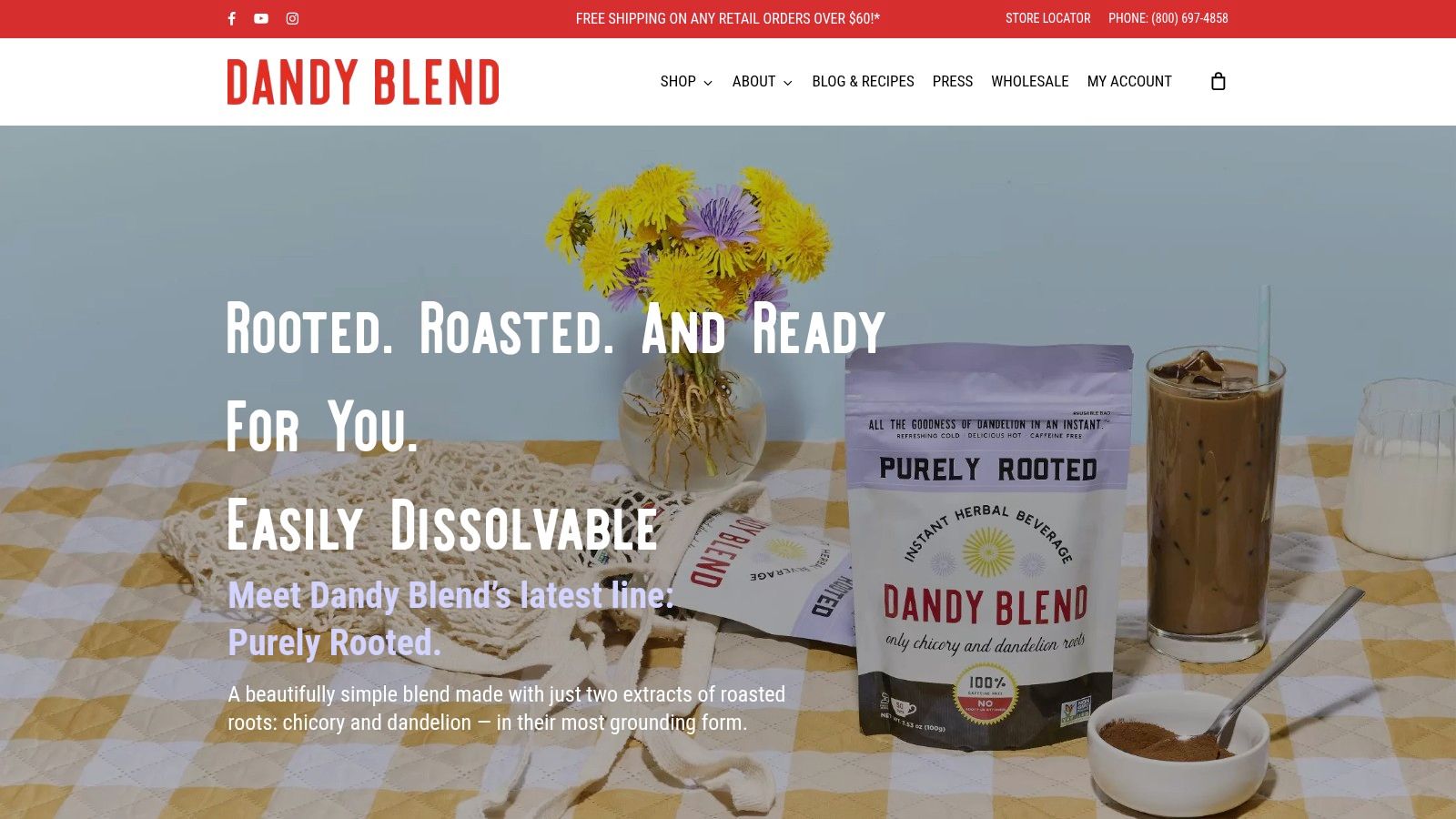
Dandy Blend is built around one advantage, speed. It's an instant roasted herbal powder that dissolves in hot water, so you don't need a grinder, plunger, coffee machine or steeping time. That makes it particularly suitable for travel, an office drawer, a quick morning latte or a café that needs a fast caffeine-free base.
Its roasted ingredients include dandelion, chicory, beets, rye and barley. The drink is designed to mimic coffee aroma and taste, with several bag sizes, single-serve sachets and an organic line available. The stimulant intensity is caffeine-free, but the preparation can still preserve the psychological comfort of a coffee break.
The convenience trade-off
Add the powder to hot water, stir, then add milk if you want a latte. You can adjust strength without changing brewing equipment, which is useful when different people want different cup sizes. Cold preparation is also possible, although a hot drink usually integrates the powder more smoothly.
The most important caution is gluten. Because the formula contains rye and barley, it isn't suitable for people with coeliac disease or strict gluten-free requirements. It also contains chicory, so anyone sensitive to inulin should check the label and consider a cautious trial. Australian availability can be inconsistent, and international online ordering may involve shipping delays or retailer differences.
Best use: Travel, office routines and rapid café service.
Best for: People who want coffee-like flavour but don't want to brew.
Not ideal for: Anyone who needs a gluten-free formula, dislikes roasted herbal notes or wants a locally stocked product with simple supermarket access.
The instant format also makes it easy to experiment. Try a small amount in a milk-based drink first, then adjust the concentration rather than sweetening heavily to cover unfamiliar flavour.
6. Crio Bru Brewed Cacao
Crio Bru is for people who want a gentle lift and a brewed ritual, but don't want the full intensity of coffee. It uses roasted, ground cacao brewed like coffee in a French press, drip machine or pour-over setup. The result is chocolate-forward, aromatic and lightly roasty, with a flavour closer to unsweetened cacao than a conventional mocha.
The product information lists approximately 10 mg of caffeine per 8-ounce cup, a figure that should be checked against the current product label and cited product details at Crio Bru's website. That is a low level compared with many caffeinated drinks, but it means Crio Bru is not caffeine-free. It also contains theobromine, another naturally occurring cacao compound, which contributes to its distinctive, gentler stimulation.
Brewing and serving ideas
Use it much like coffee grounds. A French press creates a fuller, heavier cup, while pour-over preparation produces a cleaner chocolate profile. You can drink it black, add milk, or use it as a base for a cacao latte. Some single-origin and flavoured roasts make it easier to choose between fruitier, darker or more dessert-like notes.
The preparation effort is moderate because you still need brewing equipment and time. In return, you get a drink that feels more substantial than herbal tea and less coffee-like than a dandelion blend. It may suit a late-morning ritual better than an evening one, particularly for people who respond strongly to even small amounts of caffeine.
Read the label before treating “low caffeine” as “no caffeine.”
Availability in Australia can be limited, and international retailers may be the most practical source. Consider delivery conditions, product freshness and serving guidance before ordering. If you want a chocolate drink with no caffeine at all, choose a clearly labelled caffeine-free cacao or herbal formula instead.
7. Teelixir Mushroom Cacao Latte
Teelixir Mushroom Cacao Latte is designed for an evening wind-down, not a coffee imitation. The Australian blend combines organic cacao and rose with a 10:1 reishi fruiting-body extract. It's caffeine-free, has no added sugar according to the product description, and can be prepared hot, iced or as a café latte base.
The flavour is chocolate-led, with an earthy mushroom note that some people enjoy and others find challenging. That makes it a better fit for drinkers who like cacao, botanical flavours or functional beverage menus than for someone trying to recreate a dark roast. The stimulant intensity is zero from caffeine, so the experience comes from warmth, flavour and the ritual of making something deliberately calming.
A flexible home and hospitality formula
For a hot latte, whisk the powder into a small amount of warm water before adding steamed milk. An iced version works with chilled milk and plenty of ice, while cafés can use the blend as a distinctive non-coffee menu option. Teelixir offers formats ranging from sample sizes to a 1 kg pouch, which supports both home experimentation and hospitality service.
The product has third-party testing information and transparent ingredient details, but “mushroom” should not be treated as a guarantee of a health outcome. Reishi may interact with some medicines, and people who are pregnant, managing a condition or taking regular medication should ask a health professional before using functional mushroom products. Product labels can change, so check the current directions and allergen information.
Pros
- Caffeine-free: Suitable for an evening beverage routine.
- Australian brand: Local production and bulk options suit households and cafés.
- Versatile preparation: Serve it hot, iced or as a latte.
- No added sugar: Helpful for people reducing sweetened drinks, subject to the current label.
Cons
- Earthy flavour: Mushroom notes won't appeal to every palate.
- Not coffee-like: Cacao provides comfort, but not a roasted coffee replica.
- Ingredient considerations: Reishi and other functional ingredients deserve careful label reading.
This kind of drink fits naturally alongside broader natural focus enhancers, although a caffeine-free evening beverage should be chosen for the routine it supports rather than promised effects.
Comparison of 7 Healthy Caffeine Alternatives
| Item | 🔄 Implementation complexity | ⚡ Resources & availability | ⭐📊 Expected outcomes (quality & impact) | 💡 Ideal use cases / tips |
|---|---|---|---|---|
| Pep Tea | Moderate, small‑batch, HACCP kombucha & certified organic matcha production | Good B2B distribution; certified organic sourcing; wholesale pricing via enquiry | High, antioxidant-rich matcha (calm sustained energy) and probiotic, sugar‑free kombucha ⭐📊 | Cafés, hospitality menus, specialty grocers, health‑focused consumers; use as mixer or menu feature |
| Teeccino | Low, roasted herbal blends produced at scale; simple brewing | Wide product range; often available via third‑party retailers (limited direct AU shipping) ⚡ | Effective, convincing caffeine‑free coffee substitute with broad flavor options ⭐📊 | Home brews, drip/French press, variety seekers; choose blends for desired roast profile |
| Kintra Foods Roasted Dandelion Blend | Low, mass production with café grind options | High availability across Australian supermarkets and health stores | Good, caffeine‑free, latte‑ready option; coffee‑like but distinct flavor ⭐📊 | Supermarkets and cafés wanting easy-to-stock caffeine‑free lattes; use fine grind for espresso machines |
| Bonvit Roasted Dandelion Blend | Low, standard retail production, multiple pack sizes | Very good, widely stocked nationwide and affordably priced ⚡ | Reliable, affordable caffeine‑free substitute; flavour differs from dark coffee ⭐📊 | Cost‑conscious cafés and shoppers; bulk packs for high‑volume use |
| Dandy Blend | Low prep complexity, instant powder (no brewing required) | Variable, not always stocked locally; often bought via international e‑commerce | Fast & convenient, instant coffee‑like cup, caffeine‑free; contains gluten grains ⚡📊 | Travel, office or quick café service; use sachets for single‑serve convenience |
| Crio Bru Brewed Cacao | Low, brew like coffee (press/drip); requires cacao sourcing | Limited AU availability; usually via international retailers | Gentle lift, low caffeine, high theobromine; chocolate‑forward, low acidity ⭐📊 | Chocolate lovers or those who want a gentle stimulant; brew like coffee for latte bases |
| Teelixir Mushroom Cacao Latte | Moderate, formulated with concentrated mushroom extracts and testing | Good AU availability; certified organic, bulk sizes and third‑party tested | Calming, caffeine‑free, mushroom + cacao blend for relaxation and flavour ⭐📊 | Evening drinks, cafés offering functional hot‑chocolate/latte options; dose transparently for servings |
Choose Your Caffeine Alternative by Routine
The right choice becomes clearer when you start with the moment you're trying to improve. Matcha is the strongest fit for a focused daytime drink, especially when you want a tea ritual with a smoother feel. Kombucha works when you want cold refreshment, acidity and gentle carbonation rather than a hot mug. Roasted dandelion blends and Teeccino are more useful when the coffee ritual matters most, while brewed cacao sits between caffeine-free comfort and a low-stimulant lift.
For Australian shoppers, local access also changes the decision. Kintra Foods and Bonvit offer practical roasted alternatives that are easier to find in local retail channels. Pep Tea combines Japanese organic matcha with Australian-brewed kombucha from the Hunter Valley, giving cafés and households two different beverage formats from one specialist supplier. Teelixir adds an Australian caffeine-free cacao option for evening menus, while Teeccino, Dandy Blend and Crio Bru may require more careful retailer and shipping checks.
A simple decision guide
Treat the table as a starting point, not a promise about how your body will respond. Caffeine sensitivity varies, and even a low-caffeine product can feel too stimulating for some people. If you're reducing coffee, tapering gradually may feel more comfortable than changing everything overnight, particularly if you regularly experience headaches or fatigue when you miss your usual drink.
Ingredient checks matter just as much. Chicory-based products contain inulin, which may not suit people avoiding FODMAPs or managing digestive sensitivity. Teeccino, Dandy Blend and some similar roasted formulas contain barley or rye, so they aren't suitable for coeliacs or strict gluten-free diets unless the individual product clearly states otherwise. Kombucha can contain live cultures, but limited human clinical evidence means you should avoid turning “probiotic-rich” into a guaranteed gut-health claim. With matcha and kombucha, check the product label for caffeine information and serving guidance.
Choose one alternative that matches your routine, not five products that create another decision every morning.
Try one option for a week and keep the preparation simple. Use matcha at the time you'd normally reach for coffee, pour kombucha over ice when you want a cold afternoon drink, or prepare a roasted blend in the same mug and milk style you already enjoy. If the flavour feels unfamiliar, adjust temperature, dilution and milk before adding sugar. For an evening drink, choose a clearly caffeine-free product and give yourself enough time to notice how it fits your sleep routine.
Australia's beverage market supports more than one definition of a healthy caffeine alternative. Roy Morgan's Australian tea data shows that tea is already well established, while market research from Grand View Research describes strong projected growth for Australian kombucha through 2033, with the figures presented as estimates rather than guarantees. Grand View Research's Australian matcha outlook also describes an import-dependent category with growing matcha consumption and ready-to-drink interest. These trends give cafés, retailers and households more room to choose drinks by experience, sugar level, caffeine exposure and preparation style.
For a focused start, explore Pep Tea's organic matcha and try it as a whisked bowl, iced latte or recipe ingredient. For a cold, sugar-free option, compare the kombucha flavours and use them in a simple mocktail with citrus, herbs and ice. The best swap is the one you'll enjoy preparing often, can source reliably and can adjust safely to your own tolerance.
Pep Tea offers premium organic Japanese matcha for calm, focused routines and raw, sugar-free organic kombucha brewed in the Hunter Valley for refreshing everyday drinks and café menus. Visit Pep Tea to explore the range, find practical recipes and enquire about Australian wholesale supply.
Is Matcha Green Tea Latte Good for You? a Real Look

A matcha green tea latte can be a healthy everyday drink or a sugar bomb in disguise, depending almost entirely on how it's prepared. A standard iced serving sold in Australia contains 240 kJ, 28 g of carbohydrate, 26 g of sugar, and 75 mg of caffeine, while an unsweetened preparation can look very different.
So, is matcha green tea latte good for you? The honest answer isn't a simple yes or no. Matcha powder, milk, sweeteners, serving size, and brewing strength all shape what ends up in your cup. The same vivid green drink can support a lower-sugar routine when whisked with unsweetened milk, or become closer to a sweet café treat when made with syrup, sweetened powder, and a large milk base.
A tea professional would start with the ingredient system, not the marketing around the word “matcha”. Let's look at what changes the experience, from whole-leaf processing and caffeine to powder quality, milk choice, and the sweetener hiding in many café recipes.
What Makes a Matcha Latte Different From Your Usual Coffee
Matcha starts with a different physical format from both steeped green tea and brewed coffee. Producers shade tea plants before harvest, then process the leaves and grind them into a fine powder. When you drink matcha, you consume the powdered leaf rather than drinking water that has passed over or through the leaves.
That distinction matters because the whole leaf brings along its naturally occurring polyphenols, catechins, chlorophyll, caffeine, and amino acids. Published analyses report total polyphenols in matcha at 169–273 mg GAE/g and caffeine at 18.9–44.4 mg/g. You can read the compositional analysis in this peer-reviewed matcha study.
The taste is part of the quality signal
Good matcha usually has an earthy, savoury umami character, with gentle vegetal sweetness and a rounded finish. Coffee offers roasted aromas and bitterness, while steeped green tea tends to taste lighter because the leaf remains outside the cup.
A harsh or dusty flavour doesn't automatically mean matcha is unsafe, but it can indicate a powder that needs help from sugar or flavouring. Culinary matcha has a stronger flavour profile designed to work in baking, smoothies, and other recipes. Ceremonial-style matcha is generally selected for drinking, where colour, aroma, texture, and balance are easier to notice.
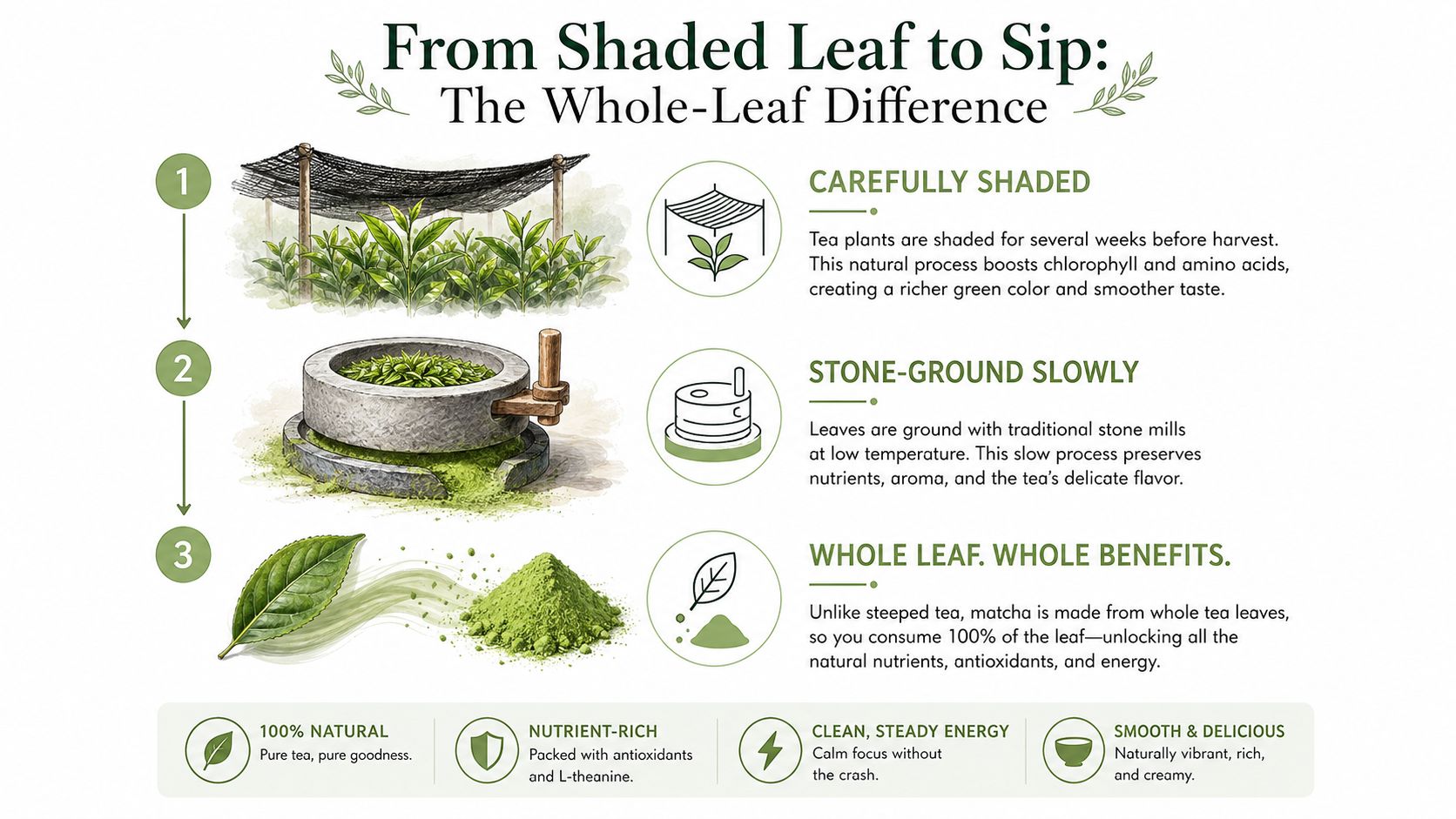
Practical rule: Judge the latte by three levers, powder grade, milk choice, and sweetener load. Those choices often matter more than the word “matcha” on the menu.
Antioxidants and L-Theanine Inside a Genuine Matcha Powder
Matcha is often discussed as an antioxidant-rich tea because the whole powdered leaf remains in the drink. Its catechins include EGCG, a compound associated with antioxidant activity, along with other plant compounds such as rutin, quercetin, and chlorophyll. Australian nutrition guidance describes EGCG as being investigated for antioxidative, antiviral, anti-inflammatory, anti-obesity, and hypolipidemic effects, while also stressing that more research is needed for most health conditions. The same guidance discusses a commonly recommended green tea intake of 2 to 3 cups daily, providing about 240 to 320 mg of polyphenols. You can explore that cautious overview in Australian green tea nutrition guidance.
The important distinction is exposure, not magic. A steeped tea infusion extracts some compounds into water, while matcha leaves the finely ground leaf in the cup. That can make matcha more concentrated, but it also means the amount of powder used and the quality of the product matter.
Why L-Theanine feels different
L-Theanine is an amino acid naturally present in tea. Matcha drinkers often describe the combination of caffeine and L-Theanine as calm focus, but individual responses vary. It shouldn't be treated as a guarantee against jitters, anxiety, or an afternoon energy dip.
Water temperature also affects flavour. Boiling water can make matcha taste more bitter and less smooth, encouraging people to add more sweetener. A gentler approach helps preserve the drink's delicate texture and allows the umami character to remain noticeable.
| Compound | Matcha Latte Serve | Steeped Green Tea |
|---|---|---|
| Catechins and other polyphenols | Whole powdered leaf is consumed, so the drink may provide a concentrated amount | Compounds are extracted into the infusion, with the leaves discarded |
| Caffeine | A moderate stimulant dose, shaped by the powder amount | Lower concentration varies with tea and brewing |
| L-Theanine | Naturally present in the leaf powder | Present in green tea infusion |
| Chlorophyll | Consumed with the powdered leaf | Less directly consumed because leaves are removed |
For readers interested in the relationship between this amino acid and matcha, PepTea explains L-Theanine in matcha green tea. The sensible conclusion is that matcha may contribute useful plant compounds, but it isn't a cure-all. A low-sugar recipe lets those qualities remain part of a balanced beverage rather than burying them under sweetness.
Caffeine Compared With Coffee, Black Tea, and Green Tea
Is matcha closer to green tea or coffee for caffeine? It depends on the powder amount, milk, and serving size. Australian reporting places a 250-millilitre cup of matcha at about 60–75 mg of caffeine, compared with about 24–45 mg for green tea and about 100 mg for coffee in the same volume. These figures are summarised in Australian reporting on matcha and coffee caffeine.
Black tea also varies. The Australian Institute of Sport lists green tea at about 30–50 mg per 250 mL cup and black tea at 25–110 mg per 250 mL cup. The range makes the drink name an incomplete guide. Powder grade and quantity, cup size, and the recipe all shape the final caffeine dose. A further benchmark appears in this Australian matcha caffeine reference.
What changes the caffeine in your cup
A small homemade latte using a modest amount of powder will usually contain less caffeine than a large café drink made with a generous scoop. Milk changes texture and flavour, not the caffeine from the matcha itself. A second caffeinated drink later in the day also adds to your overall intake.
Some people experience matcha as a steadier lift than coffee. The tea's natural combination of caffeine and L-Theanine may contribute to that impression, but it does not remove caffeine's effects. If you are prone to palpitations, anxiety, disrupted sleep, or caffeine headaches, choose the powder amount and timing with care.
A useful comparison: Matcha often sits between ordinary green tea and coffee for common serving sizes. “Natural” describes the source, not an absence of stimulant effects.
The Sugar Question Most Matcha Latte Advice Skips Over
The most important question may be what else is in the cup. A matcha latte made with unsweetened powder and plain milk is a different beverage from one made with flavoured syrup, vanilla sauce, sweetened milk, or condensed milk.
An Australian standard iced matcha green tea latte provides 26 g of sugar and 28 g of carbohydrate per serving, alongside 75 mg of caffeine and 240 kJ. Those figures come directly from the Australian product nutrition information for an iced matcha latte. The matcha may still contribute catechins, but the added ingredients change the overall nutritional picture.
Read the order as an ingredient list
Cafés often use sugar to soften bitterness, especially when the powder is culinary grade or when the drink is served cold. The common additions include:
- Flavoured syrups: Vanilla, caramel, or other syrups can make the latte taste more like a dessert.
- Sweetened powders: Some commercial matcha blends contain sugar before the powder reaches the shaker.
- Honey or maple syrup: These may sound more natural, but they still add free sugar.
- Condensed milk: This creates a rich texture and pronounced sweetness, but it can substantially increase the sugar content.
| Drink Preparation (Large/16 oz) | Approx. Added Sugar | % of WHO Daily Free-Sugar Limit (25 g) |
|---|---|---|
| Unsweetened matcha with unsweetened milk | No added sugar from the recipe | Not applicable |
| Sweetened café-style matcha | Varies by powder, syrup, and milk | Check the café nutrition panel |
| Standard iced Australian café example | 26 g total sugar per serving | Compare with the 25 g reference limit, noting that total sugar isn't automatically the same as added sugar |
The table needs a careful reading. The Australian product figure is total sugar, so it shouldn't be relabelled as added sugar without a full ingredient breakdown. It still demonstrates why a reader should ask whether the café uses sweetened matcha or milk. For a practical recipe without added sugar, see PepTea's guide to making a sugar-free matcha latte.
An unsweetened Australian matcha latte blend can list only 0.2 g of sugars per serving while still containing caffeine, showing that the ingredient system, not matcha powder alone, determines whether the drink is low sugar. Naturally occurring lactose in dairy milk isn't the same as added sucrose from syrup, so you don't need to demonise milk or sweetness. You need to know which type you're drinking and how much has been added.
Milk Choices and a Simple Home Method for a Healthier Cup
Milk changes more than the colour of a matcha latte. It affects body, foam, flavour, protein, fat, and any sugar already present in the carton. Dairy milk usually provides a familiar creamy texture and useful protein, while skim milk creates a lighter drink. Soy milk can foam well and brings plant protein, whereas almond milk is lighter and often less creamy.
Oat milk gives a naturally soft, sweet flavour, but barista-style versions can contain added oils and sweeteners. Coconut milk contributes a distinctive richness, while almond and coconut options may provide less protein than dairy or soy. Always check the ingredient panel, especially for “barista” blends, because recipes differ between brands.
A reliable home method
- Sift the powder. Use 1–2 g of ceremonial-grade matcha to remove clumps and create a smoother texture.
- Add hot water. Pour in 60 mL of hot water below 80°C, then whisk until the powder forms a smooth, lightly frothy suspension.
- Warm the milk. Heat 200–220 mL of your chosen milk separately. Don't boil it, as overheating can flatten the flavour.
- Combine gently. Pour the milk into the whisked matcha and taste before sweetening.
- Adjust only if needed. Unsweetened vanilla can add aroma without much sweetness. If you prefer maple syrup, start with half a teaspoon and see whether you still taste the tea.
The water temperature is a practical quality control step. Very hot water can intensify bitterness, which often leads to a heavier pour of syrup. Unsweetened milk also keeps the drink closer to the whole-leaf tea you intended to enjoy.
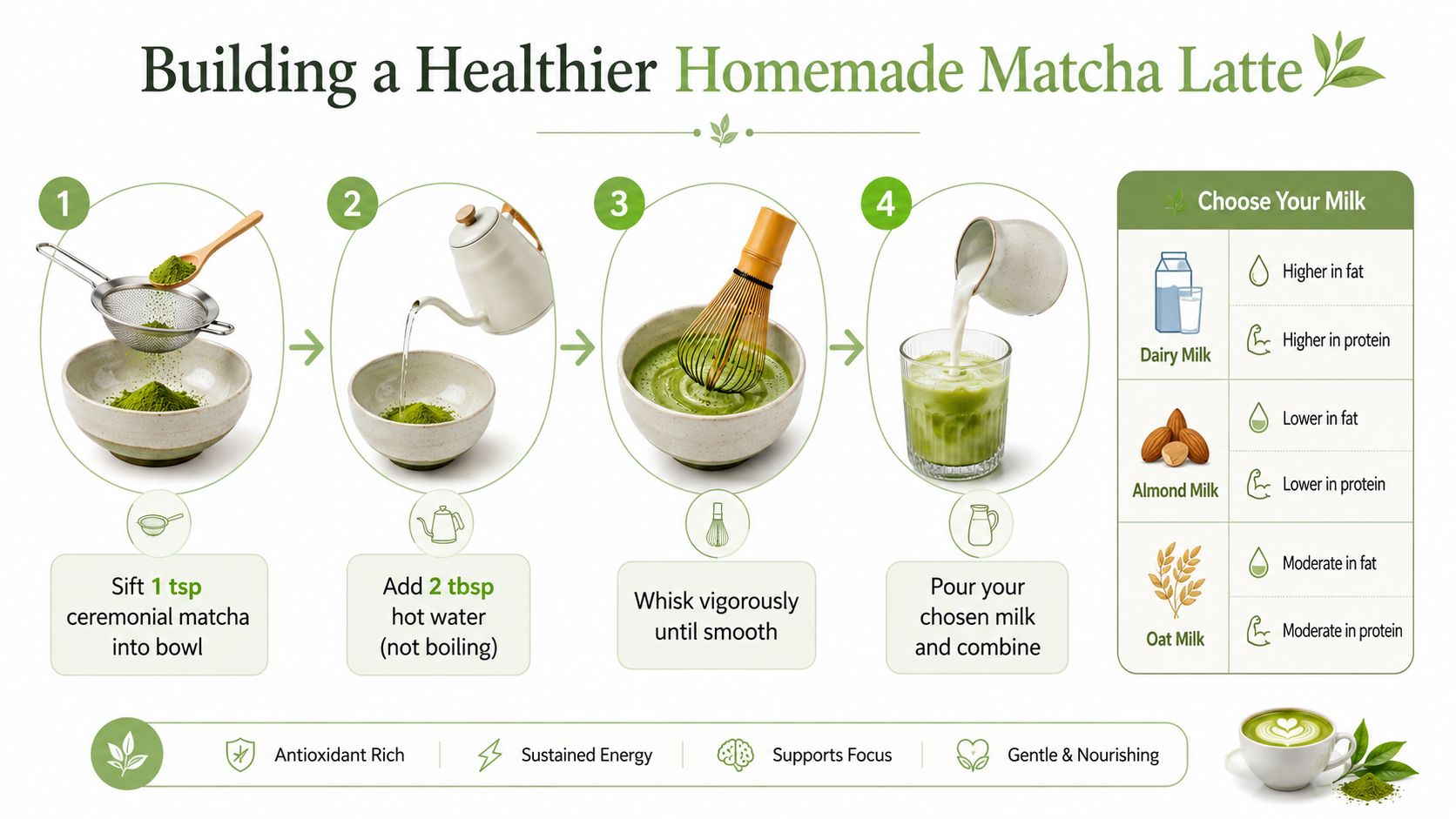
If you're developing café recipes or preparing a menu, a clear visual recipe card can help staff and customers understand the ingredients. Resources designed to boost conversions with food templates can also make preparation instructions easier to present.
For a more detailed home version, use PepTea's matcha green tea latte recipe.
Who Should Adjust Their Matcha Latte Habits
Who benefits from adjusting a matcha latte habit? The answer depends on three levers: how much powder is in the cup, when you drink it, and how much caffeine you consume from other sources. Pregnancy, childhood, and caffeine sensitivity call for more careful choices than a general wellness label suggests.
Pregnancy and breastfeeding
Australian guidance commonly uses a 200 mg daily limit during pregnancy, counting caffeine from coffee, tea, cola, energy drinks, chocolate, and supplements. A typical 250 mL matcha cup contains about 60–75 mg, so one latte earlier in the day may fit for many people, provided the rest of the day's intake is included. As noted earlier, matcha caffeine can vary with the amount and preparation of powder.
Personal circumstances still matter. Ask your midwife, doctor, or pharmacist for advice, especially if you have a pregnancy complication or medication concern. A smaller, unsweetened latte with food is easier to account for than a large, heavily sweetened café drink.
Children and teenagers
Matcha contains caffeine, so it is not the same as a caffeine-free green drink. Young children generally do not need caffeinated beverages, while adolescents should keep intake modest, particularly when a café latte also carries substantial sugar.
A warm milk drink without matcha can preserve the café ritual without adding caffeine. For a child, a sweetened matcha latte fits better as an occasional treat than as a daily wellness drink.
Caffeine-sensitive adults
If coffee causes a racing heart, nervousness, headaches, or poor sleep, begin with less matcha powder. A smaller cup, food alongside the drink, and a morning serving make your response easier to observe.
People with palpitations or relevant medical conditions should discuss caffeine with a healthcare professional. Matcha's plant origin does not remove the need to consider individual tolerance, medications, and health conditions.
Late-day drinkers
Caffeine may affect sleep even without a strong feeling of stimulation. If an evening latte keeps you awake, move it earlier, reduce the powder, or choose a caffeine-free drink. Keeping matcha to the morning or early afternoon, then watching your sleep, gives you a more useful answer than assuming every cup has a “smooth” effect.
| Audience | Daily Caffeine Ceiling | Suggested Matcha Latte Approach | Best Drinking Window |
|---|---|---|---|
| Pregnant people | 200 mg per day across all sources | Count every caffeinated drink and discuss personal advice with a clinician | Morning, preferably with food |
| Children | No general daily matcha habit recommended | Choose caffeine-free alternatives | Not applicable |
| Caffeine-sensitive adults | Individual tolerance matters | Use less powder and a smaller serving | Early day |
| Late-day drinkers | Individual sleep response matters | Avoid evening servings if sleep changes | Morning or early afternoon |
Key Takeaways and Common Questions About Matcha Lattes
A good answer to “is matcha green tea latte good for you” comes down to four checks:
- Powder grade: Use a drinking-grade powder when you want a smooth latte, and reserve culinary powder for recipes where stronger flavour will be balanced.
- Brew strength: More powder means more caffeine and more concentrated leaf compounds.
- Milk choice: Select dairy or plant milk according to your protein, texture, allergy, and sugar preferences.
- Sweetener level: Start without added sugar, then add the smallest amount that makes the drink enjoyable.
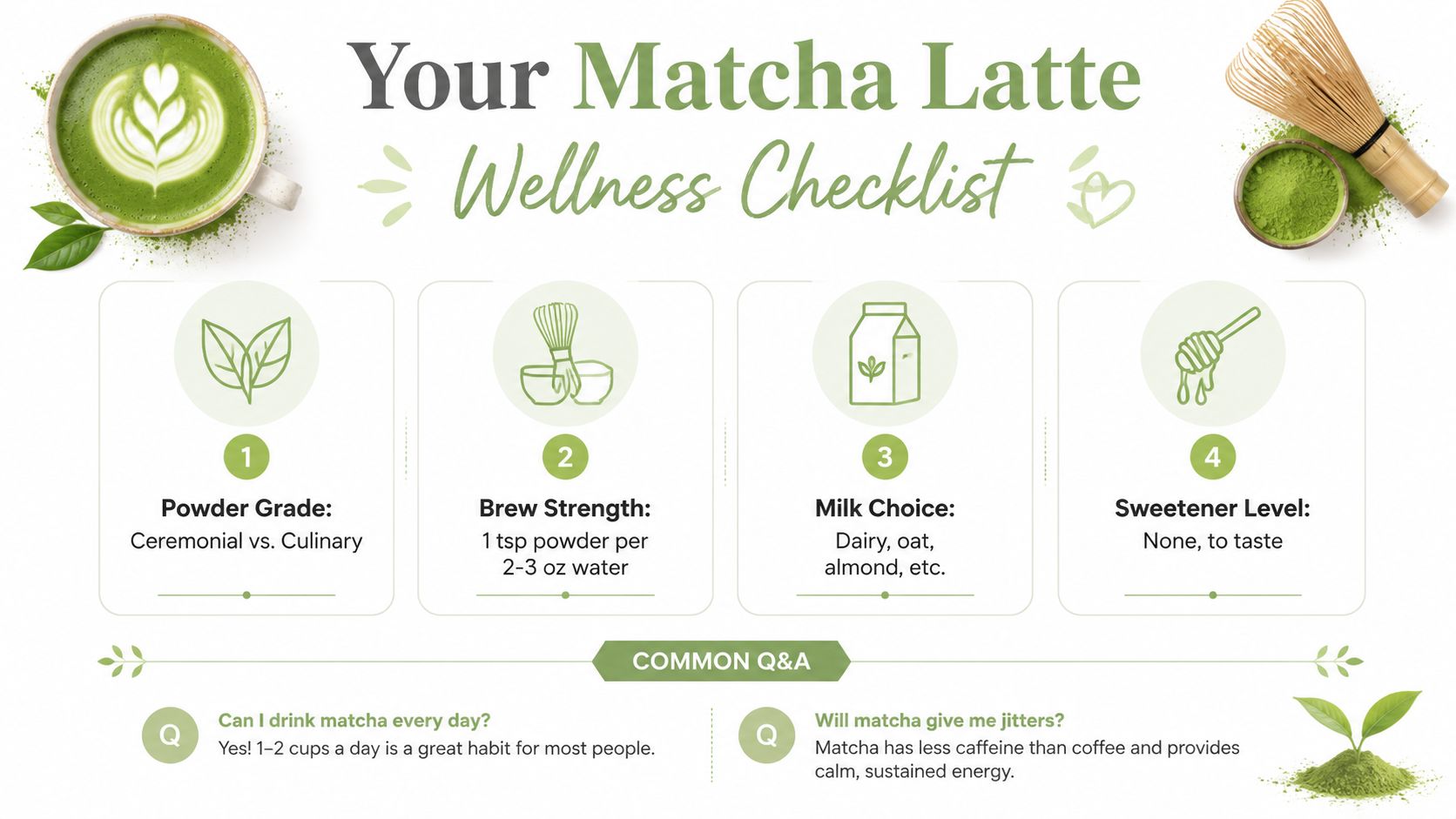
Can a matcha latte help with weight management?
Matcha shouldn't be marketed as a weight-loss treatment. Its catechins and caffeine make it a functional beverage, but the latte can become energy-dense when you add syrup, sweetened milk, or condensed milk. The practical move is to reduce added sugar and treat matcha as one part of an overall eating pattern.
How often can I drink one?
A moderate routine may suit many adults, but there isn't one universal serving limit that works for everyone. Count the caffeine from your entire day, pay attention to sleep and anxiety, and reduce the amount if your body signals that the drink is too strong.
Does an iced matcha latte have the same benefits?
Cold preparation doesn't remove the powdered leaf, so an iced drink can still provide matcha's characteristic plant compounds. The bigger issue is the recipe. Ice, unsweetened milk, and plain matcha create a different drink from a sweetened café blend with syrup.
Should leftover matcha be refrigerated?
Matcha is sensitive to air, light, heat, and moisture. Store the powder sealed in a cool, dry, dark place and use clean, dry utensils. A prepared latte is best consumed fresh, particularly if it contains milk, rather than left sitting for long periods.
Pep Tea offers organic Japanese matcha for drinking and cooking, along with practical guidance for preparing lower-sugar lattes at home. Visit Pep Tea to explore the matcha range and choose a powder that suits your preferred cup.
What Is Matcha Green Tea Good for: A Practical Guide
What is matcha green tea good for, really? Is it mainly an antioxidant-rich wellness drink, a gentler coffee alternative, or a vivid green café trend? The most useful answer sits between those ideas. Matcha is a whole-leaf Japanese green tea that can provide calm focus, moderate caffeine and concentrated catechins, but its benefits depend on the serving, the product and how your body responds.
For Australians, matcha makes practical sense as an unsweetened morning drink, an iced café-style latte, a smoothie ingredient or a way to replace a sugary beverage. It isn't a miracle cure, and the evidence for cognitive and metabolic effects is measured rather than dramatic. Used thoughtfully, however, it can become a simple part of an everyday routine.
What Matcha Actually Is and Why It Stands Out
Matcha is made from Camellia sinensis, the same tea plant used for other green, black and white teas. The difference is what happens to the leaf. Producers grow suitable tea bushes under shade, harvest and process the leaves, then grind the prepared leaf into a fine powder. When you drink matcha, you consume that powder rather than removing the leaves after steeping.
That whole-leaf format explains why matcha is often associated with higher antioxidant intake. Standard green tea releases some compounds into water, while the spent leaf is discarded. Matcha keeps the leaf material in the cup, so its catechins, chlorophyll and amino acids remain part of the drink. A review of matcha research describes it as a powdered green tea with particularly high antioxidant potential, and reports that matcha infusions showed the highest antioxidant potential among the tea types considered in that review. A later comparative study reported antioxidant activity 1.2 to 2.5 times higher than standard green tea, depending on the assay used, as outlined in this scientific review of matcha.
Ceremonial and culinary grades
The words ceremonial-grade and culinary-grade describe intended use more than a universal legal standard. Ceremonial matcha is generally selected for drinking with water, where colour, aroma, texture and umami are easy to notice. Culinary matcha is designed to work with milk, yoghurt, fruit, flour and other ingredients, so its stronger flavour can hold its own in recipes.
Neither grade automatically makes a person healthier. A well-made culinary powder can be useful in a latte or smoothie, while a good ceremonial powder is best appreciated whisked with water. The key is to match the product to the way you'll use it.
Practical rule: Choose matcha for the drink or recipe you actually want to make, not for the label alone.
How Matcha Is Grown and Made
Matcha's flavour and colour begin in the tea field. Producers shade tea bushes from direct sunlight for three to four weeks before harvest, a practice discussed in the research literature on matcha composition. Reduced light supports the vivid green appearance and helps create matcha's rounded, savoury flavour.
The production sequence involves several linked decisions:
- Shading: Covers block direct sunlight before harvest. This encourages chlorophyll and helps preserve the amino-acid profile associated with a smooth, umami character.
- Harvesting: Producers select young leaves and buds. They become the raw material for tencha, the leaf prepared for matcha, rather than sencha, which is commonly brewed and removed.
- Steaming: Japanese tea processing quickly steams the leaves to halt oxidation. This helps retain their green colour and fresh vegetal flavour.
- Drying and deveining: The leaves are dried, then stems and veins are removed. The remaining leaf flesh is called tencha.
- Stone-grinding: Granite mills slowly turn tencha into a fine powder. Properly prepared matcha should feel silky, not gritty.
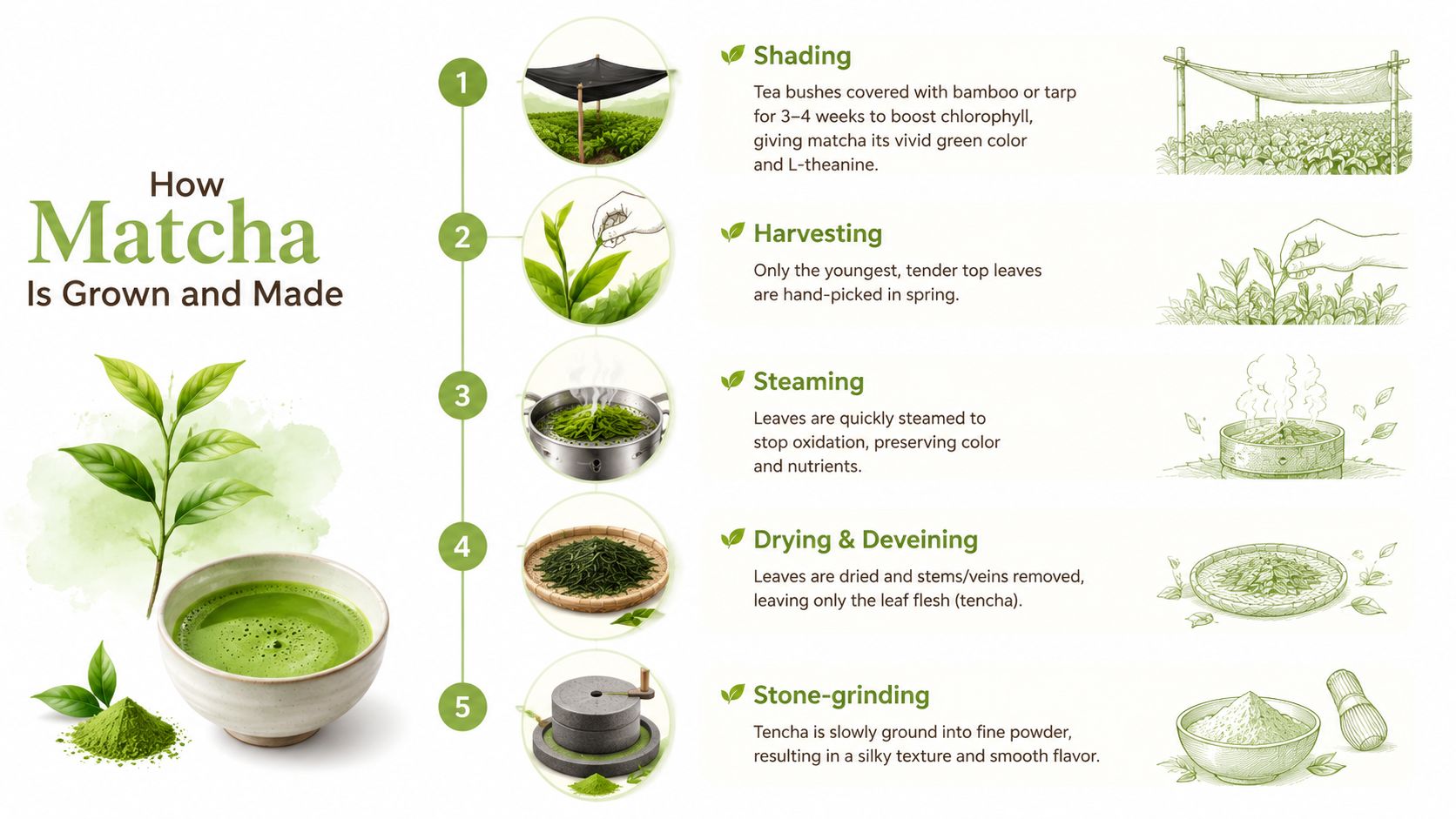
Why whole-leaf processing matters
Brewing extracts compounds into water, while matcha keeps the processed leaf suspended in the cup. The final composition still varies with tea variety, growing conditions, grade, storage and preparation. That difference matters for Australian drinkers choosing between a straight whisked cup, a café-style latte or a recipe.
You can follow each production stage in PepTea's guide to how matcha tea is made. The process also helps explain flavour differences. Fresh, well-stored matcha may taste sweet, grassy and umami-rich, while older or lower-quality powder can seem flat, dusty or harsh. Choose a grade suited to the drink or recipe you want to make.
The Key Compounds Behind Matcha's Benefits
What makes matcha feel different from ordinary green tea or coffee? Its character comes from three naturally occurring compounds working together: catechins, L-theanine and caffeine. They do not make matcha a medicine. They help explain why a whisked cup can feel alerting while remaining more even for some drinkers than coffee.
Catechins and EGCg
Catechins are plant compounds with antioxidant activity. The best-known catechin in matcha is epigallocatechin gallate, usually shortened to EGCg or EGCG. Because matcha is made from powdered leaf, you consume the leaf rather than only the compounds extracted into water. That makes it a catechin-rich beverage, although the amount varies with the tea, grade, storage and preparation.
Laboratory antioxidant activity is not the same as a predictable health outcome. Human effects depend on serving size, diet, lifestyle and individual biology. Research interest includes cardio-metabolic and cellular protection, but a daily cup should not be presented as disease prevention or a guaranteed way to change body composition.
For a plain-language explanation of this major catechin, see PepTea's guide to what EGCg is.
L-theanine and the feel of focus
L-theanine is an amino acid naturally found in tea. Shading during cultivation and consuming the whole powdered leaf help make it part of a matcha serving, though levels differ between products and preparation methods. Studies examine its relationship with relaxed attention and the way caffeine feels.
A review of randomised clinical trials reported that matcha decreased stress and slightly enhanced attention and memory, with no effect on mood. The finding supports a measured description: matcha may suit focused work for some people, but it is not a guaranteed productivity enhancer.
The practical analogy is a dimmer switch rather than a second engine. Caffeine provides stimulation, while L-theanine may contribute to a calmer experience. Individual responses still vary.
Caffeine and realistic expectations
How much caffeine is in the cup matters to Australian drinkers. A typical serving contains about 60 to 75 mg of caffeine, according to an Australian Broadcasting Corporation explainer cited in the matcha review above. That can suit morning alertness or an afternoon work block, but a café latte may contain a different amount depending on the powder and recipe.
Matcha is not caffeine-free energy. People sensitive to caffeine can still experience restlessness, a racing heart or disrupted sleep, especially with a larger serving or late-day use. Start with a modest serve, check the product guidance, and choose morning or early afternoon if sleep is easily affected. The research overview above gives useful context for how cultivation and processing influence matcha's composition.
Matcha Versus Coffee and Green Tea
Could matcha offer a middle ground between brewed green tea and coffee? In Australian café use, a standard matcha serve is often described as roughly 70 mg of caffeine, while the comparison for coffee is 80 to 100 mg. ABC reporting These amounts change with the powder, recipe and serving size, so treat them as a guide rather than a promise. Some drinkers also prefer matcha because they associate it with less of a coffee crash, although that experience differs between individuals.
The preparation method explains much of the difference. Brewed green tea uses water to draw compounds from the leaves, while matcha mixes powdered leaf into the drink. Matcha therefore provides whole-leaf exposure, including catechins such as EGCg, but the amount still varies by product and preparation.
| Beverage, 1 serve | Caffeine | EGCg catechins | Energy profile | Best time of day |
|---|---|---|---|---|
| Matcha | About 60 to 75 mg, ABC reporting | Varies by product and preparation | Alerting, with L-theanine-associated calm focus | Morning or early afternoon |
| Coffee | About 80 to 100 mg in the Australian comparison | Varies widely | Faster, sharper stimulation for many drinkers | Morning or earlier in the day |
| Steeped green tea | Varies by tea and steeping method | Less whole-leaf exposure than matcha | Lighter, gentler stimulation | Across the day, depending on tolerance |
Choosing by sensitivity
Coffee can feel too stimulating for some people, making matcha a practical café substitution. Choose an unsweetened preparation when you want to avoid added sugar, start with a smaller serve, and watch your own sleep and concentration rather than assuming the same response as another drinker.
Timing also matters. A late espresso may interfere with sleep, whereas an early-afternoon matcha may suit a work routine for some people. That is an individual response, not a universal rule.
Practical Ways to Use Matcha Every Day
Matcha doesn't need to stay inside a traditional tea ceremony. Its powder format makes it useful in drinks, breakfasts, baking and savoury food. The following serving ideas give beginners a clear place to start.
Straight and milky drinks
For traditional whisked matcha, sift one teaspoon into a bowl. Add a small amount of hot, not boiling, water and whisk until smooth, then add more water to taste. A bamboo whisk creates the familiar foam, but a small handheld frother can work for an everyday kitchen version.
For an iced oat matcha latte, use two teaspoons of matcha, first mixed with a little hot water to form a smooth paste. Pour it over cold oat milk and ice. Keep the drink unsweetened initially so you can taste the powder's natural balance before deciding whether it needs anything else.
Breakfast and snacks
A morning smoothie can take one and a half teaspoons of matcha with banana, spinach and almond milk. Banana softens matcha's vegetal edge, while the greens make the colour feel at home. Start with less if you're sensitive to bitterness or caffeine.
For a yoghurt bowl, stir a teaspoon through Greek yoghurt, then add berries and a small amount of honey if desired. This is a simple way to use culinary matcha without turning it into a strongly flavoured drink.
Baking and savoury cooking
Culinary matcha works well in blondies, energy balls, muffins, pancakes and ice cream. Sift it with the dry ingredients to reduce lumps, and remember that heat, flour and dairy will soften its flavour.
Savoury uses are less common but worth trying. Mix matcha into salt for roasted vegetables, or add a small amount to a vinaigrette with citrus and olive oil. Use a light hand. Matcha should add freshness and umami, not dominate the dish.
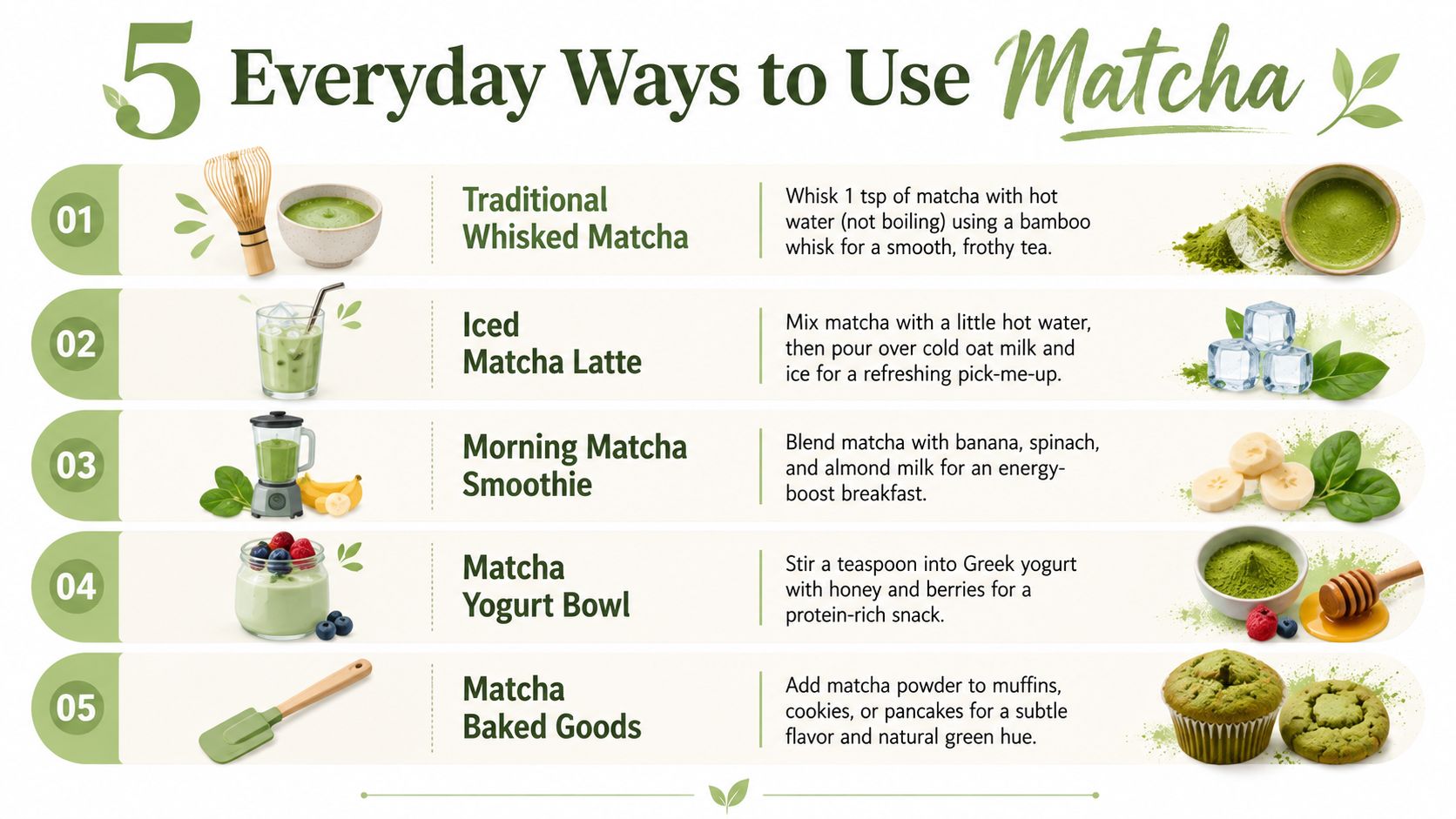
Store opened matcha sealed, protected from heat, light, air and moisture. Refrigeration can help preserve freshness, but let the container come to room temperature before opening so condensation doesn't enter the powder.
How to Choose Quality Organic Matcha
A good matcha announces itself through several sensory cues. Don't rely on a premium-sounding name alone. Terms such as ceremonial and premium aren't universal proof of quality, so inspect the powder and check the supplier's origin and testing information.
Four useful checks
- Colour: Look for a vivid jade-green powder. Yellow or brown tones can indicate older material, oxidation or poor storage.
- Aroma: Fresh matcha should smell grassy and gently sweet. Hay-like, stale or fishy notes are warning signs.
- Texture: The powder should be very fine and talc-like. It should whisk into water smoothly rather than remain sandy or heavily lumpy.
- Taste: A quality drinking matcha tends to have clean umami, mild sweetness and a rounded finish. Aggressive bitterness can point to quality, storage or preparation problems.
Origin matters, too. Japanese regions such as Uji and Nishio are well known for matcha production, but a named origin doesn't replace sensory quality or transparent product information. Look for a clear ingredient list, organic certification where that matters to you, and evidence that the product is matcha rather than a sweetened blend or powder containing fillers.
For Australian shoppers, organic certification can provide useful reassurance about production standards and synthetic pesticide use. Buy a size you can finish while the powder is fresh. Smaller tins are often more practical than a large container that sits open in a warm kitchen for months.
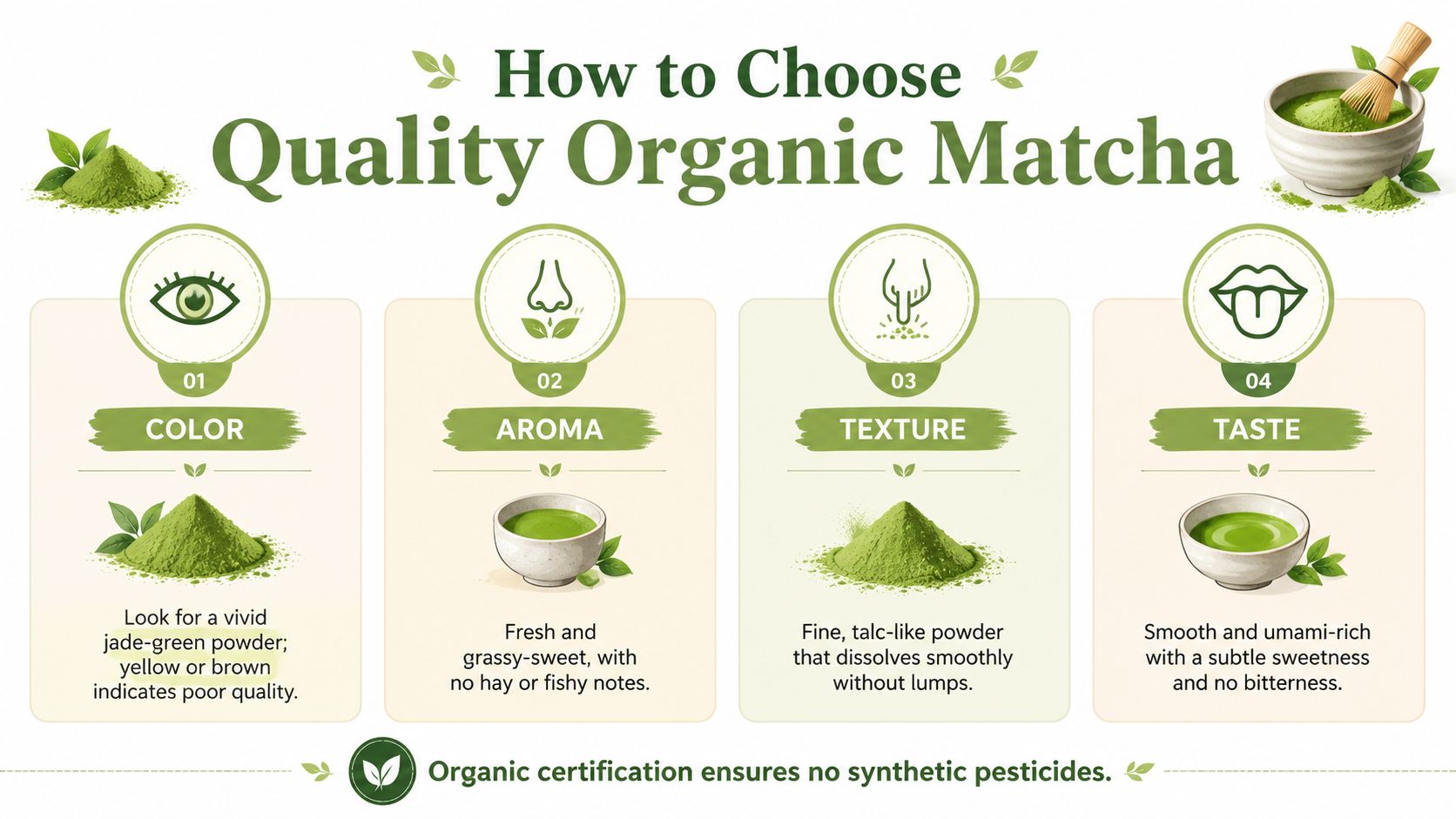
The following visual guide shows how colour, aroma, texture and taste work together:
For a deeper explanation of grades and buying cues, see PepTea's matcha grade and quality guide.
Serving Sizes, Safety, and Common Myths
A sensible starting point for many healthy adults is one level teaspoon, about 2 g, per serve. A practical daily ceiling is around three serves for most healthy adults, with less appropriate for pregnant people, children and anyone who is caffeine-sensitive. These are cautious everyday guidelines rather than a substitute for individual medical advice.
Caffeine isn't the only consideration. Tea compounds can affect the absorption of non-haem iron from plant foods, so people managing iron deficiency may want to separate matcha from iron-rich meals and discuss their routine with a healthcare professional. Drinking matcha with food may also feel gentler than taking it on an empty stomach.
What matcha isn't
- Not a detox cure: Matcha is a healthy beverage option, not a miracle treatment.
- Not the same as an extract: Concentrated green tea extracts can deliver far higher doses than a normal drink.
- Not automatically better by grade: Ceremonial grade is generally chosen for straight drinking, but it isn't a guarantee of superior health effects.
- Not unlimited energy: More powder means more caffeine and more catechins, not necessarily more benefit.
The Australian Therapeutic Goods Administration states that rare liver injury cases have been linked to concentrated green tea extracts, while the majority of green tea use, including beverage form, is unlikely to cause harm. That distinction matters. Typical matcha is a food-format drink, whereas capsules and concentrated extracts deserve more caution, particularly if you have a medical condition or take medication.
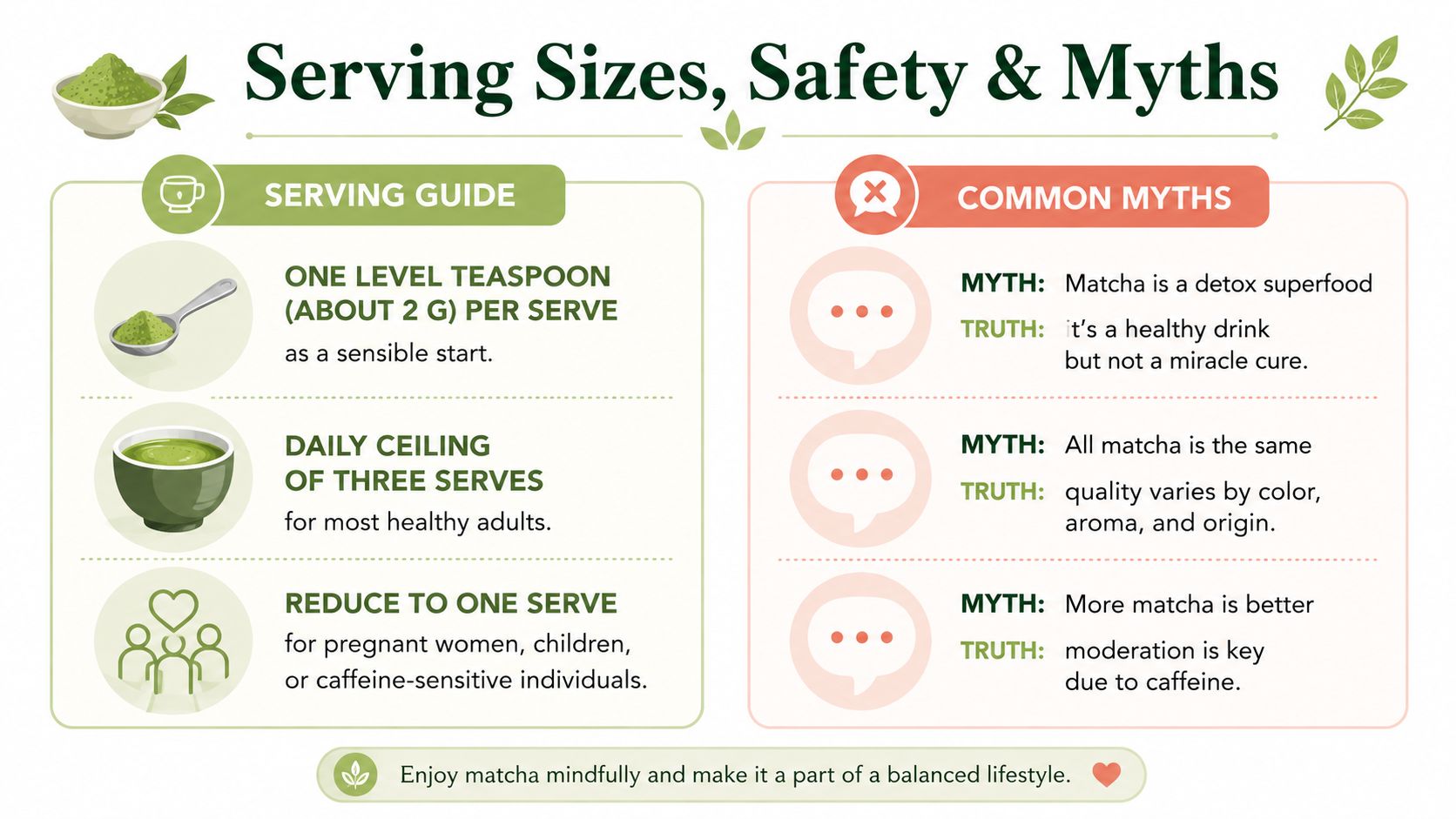
Bringing Matcha Into Your Routine
The easiest routine is the one you can repeat. Start with one morning matcha in place of a coffee, using a modest serving and no added sugar. Give yourself time to notice the flavour, alertness and effect on sleep before adding another serving.
Keep a small sealed tin beside the kettle, but store it away from heat and direct light. Whisking matcha into hot water is the quickest default. Across the week, you can turn the same powder into an iced oat latte, a smoothie, overnight oats or a yoghurt bowl.
A pre-workout or mid-afternoon serve may suit some adults, but caffeine tolerance varies. If you notice restlessness or disrupted sleep, reduce the amount or move matcha earlier. Pregnant people, children and people taking medication should seek personalised advice before making matcha a daily habit.
Consistency matters more than chasing perfect gram precision. Choose a grade that fits your use, buy a quantity you'll finish while fresh, and treat matcha as one useful beverage within a varied diet rather than as a replacement for proper meals or medical care.
PepTea offers organic Japanese matcha for straight drinking, lattes and cooking, making it a convenient Australian source for readers who want to begin with a clearly defined product and serving style.
Explore the organic matcha range at Pep Tea and choose a powder suited to whisking, lattes or recipes. Start with one simple morning serve, then build your matcha routine around the flavour and caffeine level that work for you.
Matcha Green Tea L Theanine: Benefits for Calm Focus
Matcha contains naturally occurring L-theanine, an amino acid that, paired with caffeine, is associated with calm alertness. However, a typical 2 g serve delivers far less L-theanine than the 200–400 mg/day doses used in clinical sleep and anxiety studies, so the experience depends heavily on grade, shading, and dose.
Have you ever wondered whether matcha's famous “energy without the jitters” reputation comes from the drink itself, or from a much larger dose of purified L-theanine than your cup can realistically provide? That distinction matters. Matcha green tea L-theanine is a useful food-and-beverage story, but it isn't the same thing as taking a controlled supplement.
Matcha can still be a pleasant source of caffeine, amino acids and antioxidant compounds. The sensible question is not whether it's a magic calm-focus drink. It's what a particular serve contains, how you prepare it, and what the human evidence can tell us.
Why Everyone Is Talking About Matcha and L-Theanine
Matcha has moved from specialist tea counters into cafés, wellness shelves and social feeds. The usual promise is familiar: smooth energy, better concentration and fewer sharp edges than coffee. The compound most often placed at the centre of that story is L-theanine, an amino acid naturally found in the leaves of the tea plant, Camellia sinensis.
At a chemical level, L-theanine is one of the compounds that contributes to tea's savoury, rounded character. It helps explain why some green teas taste brothy or umami rather than just bitter. Tea plants produce it as part of their natural chemistry, and shading the plants changes the balance of compounds inside the leaf.
That's why marketers talk about L-theanine whenever matcha appears in a conversation about focus. The drink combines the amino acid with caffeine, so people often describe the result as alert but less edgy than a strongly caffeinated drink. Human research has examined isolated L-theanine in stressful conditions, with a systematic review identifying 9 peer-reviewed randomised controlled trials and concluding that 200–400 mg per day may help reduce stress and anxiety in people exposed to stress, while also noting that larger and longer studies are needed. Read the systematic review on L-theanine and stress
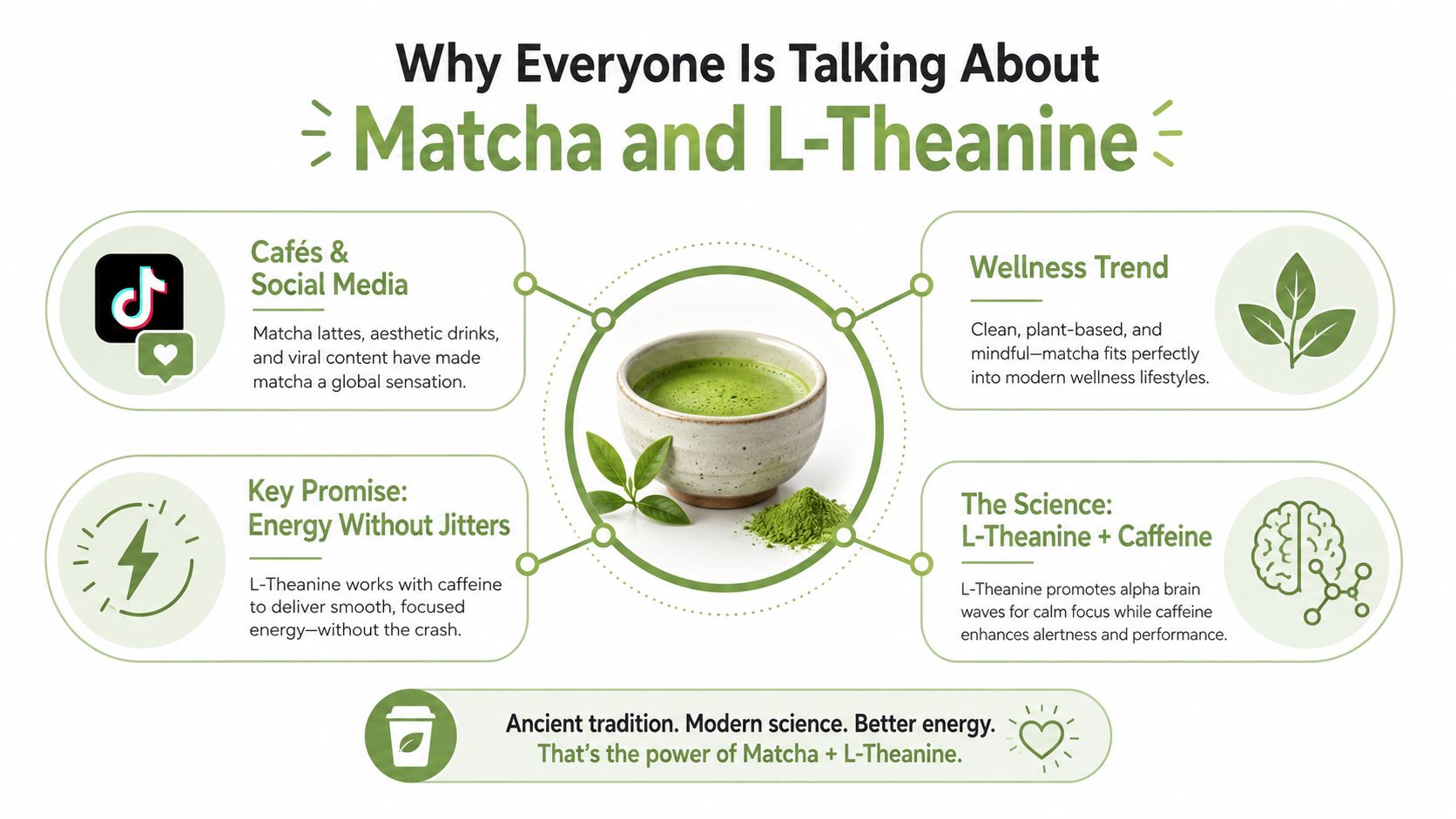
The molecule behind the message
The important catch is dose. A clinical study of isolated L-theanine doesn't automatically prove that a café latte produces the same effect. Matcha is a whole-leaf beverage matrix, containing caffeine, polyphenols, flavour compounds and amino acids in proportions that vary between products.
So, when you see matcha green tea L-theanine described as a calm-focus solution, read the phrase carefully. It points to a plausible combination, not a guaranteed outcome. Explore PepTea's matcha education and products to see how the ingredient fits into a broader tea ritual.
What Matcha Actually Is and Why Its Chemistry Differs
Matcha isn't just green tea brewed more strongly. With ordinary loose-leaf green tea, hot water draws compounds out of the leaves, and you usually discard the leaves. With matcha, you drink finely stone-ground leaf powder, so the preparation includes the leaf itself.
The difference begins in the field. Matcha plants are shade-grown before harvest. A useful café analogy is to think of the leaves as wearing sunscreen. With less direct sunlight, the plant's chemistry shifts, supporting more chlorophyll and preserving more amino-acid character, including L-theanine. The leaves also retain caffeine, which is why matcha can feel more concentrated than a typical green-tea infusion.
Ceremonial and culinary grades
Ceremonial-grade matcha is generally selected for drinking. It tends to have a brighter colour, finer texture and more delicate balance, so whisking it with water can produce a clean, rounded cup. Culinary-grade matcha is designed to hold its flavour in foods such as smoothies, cakes, sauces and ice cream, where milk, fruit, sugar or other ingredients compete with the tea.
Those labels describe intended use more than they guarantee a precise L-theanine amount. A higher price, vivid colour or ceremonial wording cannot replace a product-specific lab result. Shading, cultivar, harvest conditions, processing and storage all influence the finished powder.
Stone-grinding matters because it turns the prepared leaf into a fine powder rather than an infusion. That gives matcha its dense texture and concentrated flavour, but it doesn't create a fixed dose of L-theanine. Two powders can look similar while delivering different amounts per gram.
A useful mental model: matcha is a concentrated leaf preparation, not a standardised L-theanine capsule.
That distinction also explains why matcha can taste both rich and slightly bitter. L-theanine contributes savoury softness, while caffeine and polyphenols add bitterness and astringency. The balance depends on the leaf and on your brewing technique.
How L-Theanine and Caffeine Create Calm Focus
The phrase calm focus describes a combined experience, not a single switch in the brain. Caffeine supports alertness, while L-theanine has been studied for its relationship with relaxation and stress responses. Researchers have also examined L-theanine in relation to alpha brain-wave activity, GABA and other neurotransmitter systems, but these mechanisms shouldn't be treated as proof that every matcha drink produces a predictable mental state.
A helpful analogy is lighting. Caffeine alone can feel like a bright strobe for some people, especially when taken quickly or on an empty stomach. L-theanine may make the experience feel more like a steady LED bulb, where alertness remains present without the same sense of sharp stimulation. That analogy is useful, but individual responses still vary.
What the evidence can and cannot show
Human evidence is strongest for isolated L-theanine doses, particularly in the 200–400 mg/day range discussed in the systematic review of stress and anxiety trials. Typical matcha beverages usually contain much less, so it would be a mistake to copy a supplement claim directly onto a teaspoon of powder.
L-theanine also isn't a sedative in the usual sense. A person may feel less tense while staying awake, but that doesn't mean matcha will treat anxiety, insomnia or a medical condition. Caffeine can also work against relaxation if the serving is large, the drink is consumed late, or the drinker is especially sensitive.
The caffeine-to-theanine relationship is central to the way matcha is marketed. An Australian matcha education source describes matcha caffeine as being absorbed and released slowly over 6–8 hours, and positions L-theanine as part of the drink's smoother focus profile. That is a useful description of the product narrative, but it shouldn't be read as a guarantee for every person or every preparation. Read Australian matcha guidance on caffeine and L-theanine
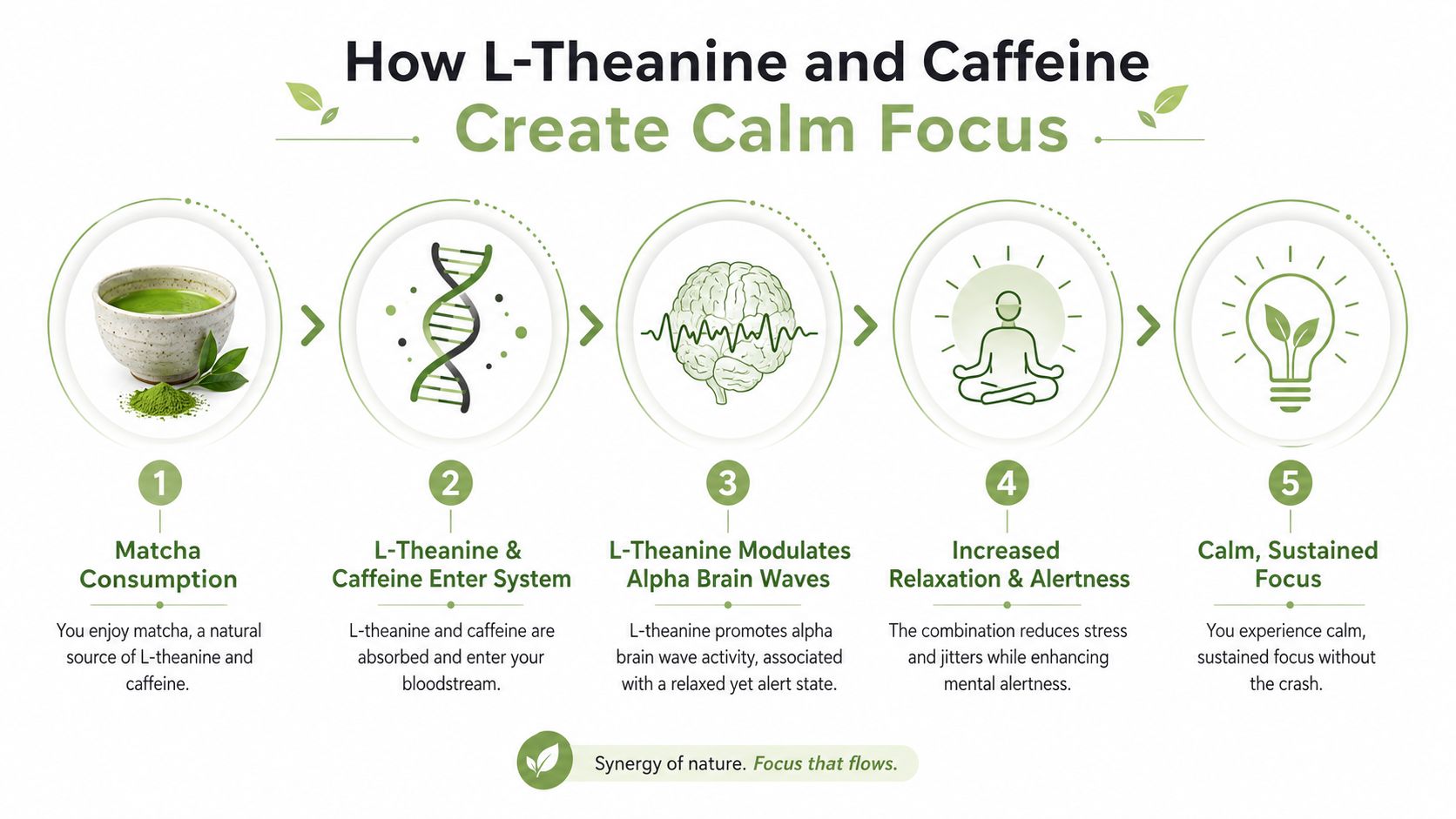
For a visual explanation of the calm-focus idea, this video provides an accessible introduction:
If you'd like the chemistry explained in more detail, learn what L-theanine is before deciding how much weight to give the claim. The honest summary is simple: matcha may feel smoother than some caffeinated drinks, but it isn't a guaranteed focus pill.
Matcha Versus Other Teas and Supplements on L-Theanine
How much L-theanine does matcha provide compared with ordinary tea or a supplement? The answer depends on both the product and the form being compared.
One Australian lab-tested matcha product contained 21.3 mg of L-theanine per gram and 33.3 mg of caffeine per gram. The cited averages across 36 commercial green teas were lower, at 6.46 mg of theanine per gram and 16.28 mg of caffeine per gram. View the Australian matcha potency results
| Source | Typical L-theanine per gram | Typical caffeine per gram | Notes |
|---|---|---|---|
| Lab-tested Australian matcha product | 21.3 mg | 33.3 mg | Product-specific laboratory result |
| Cited mean across commercial green teas | 6.46 mg | 16.28 mg | Mean across 36 commercial teas |
| Isolated L-theanine used in human research | 200–400 mg/day | Not applicable | Clinical dose range, not a tea measurement |
The difference comes partly from preparation. Matcha contains powdered whole leaf, while a standard green-tea infusion contains only the compounds that move into the water. Even so, the higher concentration in this tested product does not make an ordinary matcha serving equivalent to the isolated amounts used in supplement research.
Oolong and black tea cannot be assigned one fixed L-theanine value. Cultivar, harvest, oxidation, processing and brewing can all alter the final cup. Saying that green tea generally contains more may offer a rough direction, but it cannot replace analysis of the specific tea.
Why supplements are a different category
An L-theanine supplement is built around a stated amount of one compound. Matcha is a food with naturally variable composition, and it brings caffeine plus other tea constituents along with the L-theanine. The result is a beverage with taste, texture and a whole-leaf ritual, rather than a precisely controlled research dose.
The choice depends on the goal. Matcha suits someone who wants L-theanine as part of a drink and daily routine. A supplement suits someone who needs clearer control over the amount. Neither format automatically delivers the same experience or evidence base as the other.
The Dose Reality Most Articles Skip Over
How much L-theanine does a normal cup of matcha provide? The answer depends on the powder and serving size, so the word matcha alone cannot predict a clinical dose.
An Australian nutrition panel listing 180 mg of L-theanine per 100 g works out to about 7.2 mg in a 4 g serve. That example shows why labels matter: products can differ substantially in composition. Review the Australian nutrition panel example
The same arithmetic helps put supplement claims in perspective. A serving may contribute L-theanine as part of a drink, but it does not automatically deliver the isolated amounts used in research. A larger serve could move the beverage closer to those research doses, while also increasing caffeine intake. The result is less like taking a measured tablet and more like eating a food whose ingredients arrive together.
Caffeine is the main reason dose comparisons need care. Matcha supplies L-theanine alongside caffeine and other tea compounds, so increasing the powder changes more than one variable. Someone who wants a predictable L-theanine amount may find a supplement easier to measure. Someone who values flavour, texture and a daily ritual may prefer matcha, accepting that its composition varies.
Dose matters more than the word “matcha”. Check the powder's serving size, L-theanine information and caffeine content before assuming your cup mirrors a clinical trial.
There is no universal cup count that suits everyone. Body size, caffeine sensitivity, preparation strength, timing and other sources of caffeine all affect the experience. For practical guidance on serving amounts and personal tolerance, read this guide to how many cups of matcha powder may be suitable per day. Anyone who is pregnant, taking medication, managing a health condition or unusually sensitive to caffeine should discuss regular use with a qualified health professional.
What the 2026 Australian Research Is Telling Us
Australia's L-theanine research is becoming more practical, but it hasn't settled the question of what an everyday matcha latte does for everyone. An Australian clinical trial registered in 2026 for the THESleep project recruited 60 healthy adults aged 18–65 with mild to moderate sleep disturbances. The design included 4 arms, testing 100 mg, 200 mg and 400 mg of L-theanine or placebo over 14 days, following a 7-day baseline. Review the Australian THESleep trial record
That design is valuable because it tests several defined doses against placebo. It also highlights the translation problem. Participants receive a measured amount of isolated L-theanine, while a matcha drink contains a variable amount of L-theanine alongside caffeine and other compounds.
What this means for a real kitchen
The evidence supports caution rather than cynicism. Matcha may fit comfortably into a morning routine for someone who enjoys its flavour and tolerates caffeine. It shouldn't be described as a sleep treatment, a sedative or a substitute for professional care.
Timing becomes especially important. A morning serve may suit focus, while an afternoon or evening serve could be less comfortable for someone whose sleep is caffeine-sensitive. Food, hydration, regular movement and a consistent sleep routine remain more reliable foundations than trying to push a beverage towards a supplement dose.
Local research also shows why Australian readers deserve more than imported wellness slogans. The science is developing, and carefully controlled trials are useful, but a trial of purified L-theanine doesn't erase the variability of matcha powder.
Practical Ways to Get the Most From Matcha's L-Theanine
How can you make matcha's L-theanine useful without treating the powder like a supplement? Start with a drink you can prepare and tolerate regularly. A smooth ceremonial-grade powder generally suits plain drinking, while culinary-grade matcha works well in smoothies, baking or ice cream, where its stronger tea flavour can balance other ingredients.
Brewing changes the cup's flavour more predictably than its exact L-theanine content. Use warm rather than boiling water, sift the powder if it clumps, then whisk with a bamboo chasen or small electric frother until evenly mixed. Very hot water can make matcha taste harsh. A cooler approach improves the drinking experience, but it does not create more L-theanine.
A practical serving guide
The earlier Australian lab results are useful for understanding the relationship between powder, caffeine and L-theanine. They should guide preparation, not encourage chasing a supplement-style dose. Begin with a modest amount, especially if you are sensitive to caffeine, and adjust only after noticing how the drink feels.
For steadier flavour, dissolve the powder in a small amount of warm water first, then add more water or milk. Drinking it with breakfast may feel more comfortable than taking concentrated caffeine on an empty stomach. A latte can also spread the flavour through a larger drink, although it does not change the powder's measured L-theanine content.
Matcha values vary between products. One Australian nutrition panel reported a much smaller amount of L-theanine for a larger serve than the lab-tested product discussed earlier. Grade, sourcing, storage and testing can all affect what reaches the cup, so a package label is more useful than assuming every matcha has the same chemistry.
Four questions to ask before brewing
Should I drink matcha before sleep? If caffeine disrupts your sleep, late-day matcha may be a poor fit, whatever its L-theanine content. Research on isolated L-theanine does not establish that an ordinary matcha beverage improves sleep.
Does lower-temperature water preserve more L-theanine? It can produce a smoother, less bitter cup. It cannot turn a small beverage serving into a clinical dose.
Can I combine matcha with coffee? You can, but both drinks contribute caffeine. If you feel wired, reduce one drink first rather than trying to offset it with extra L-theanine.
What should I pair with matcha? Breakfast with protein, fibre and carbohydrates may feel steadier than concentrated caffeine on an empty stomach. That is a practical eating choice, not proof that food changes L-theanine absorption.
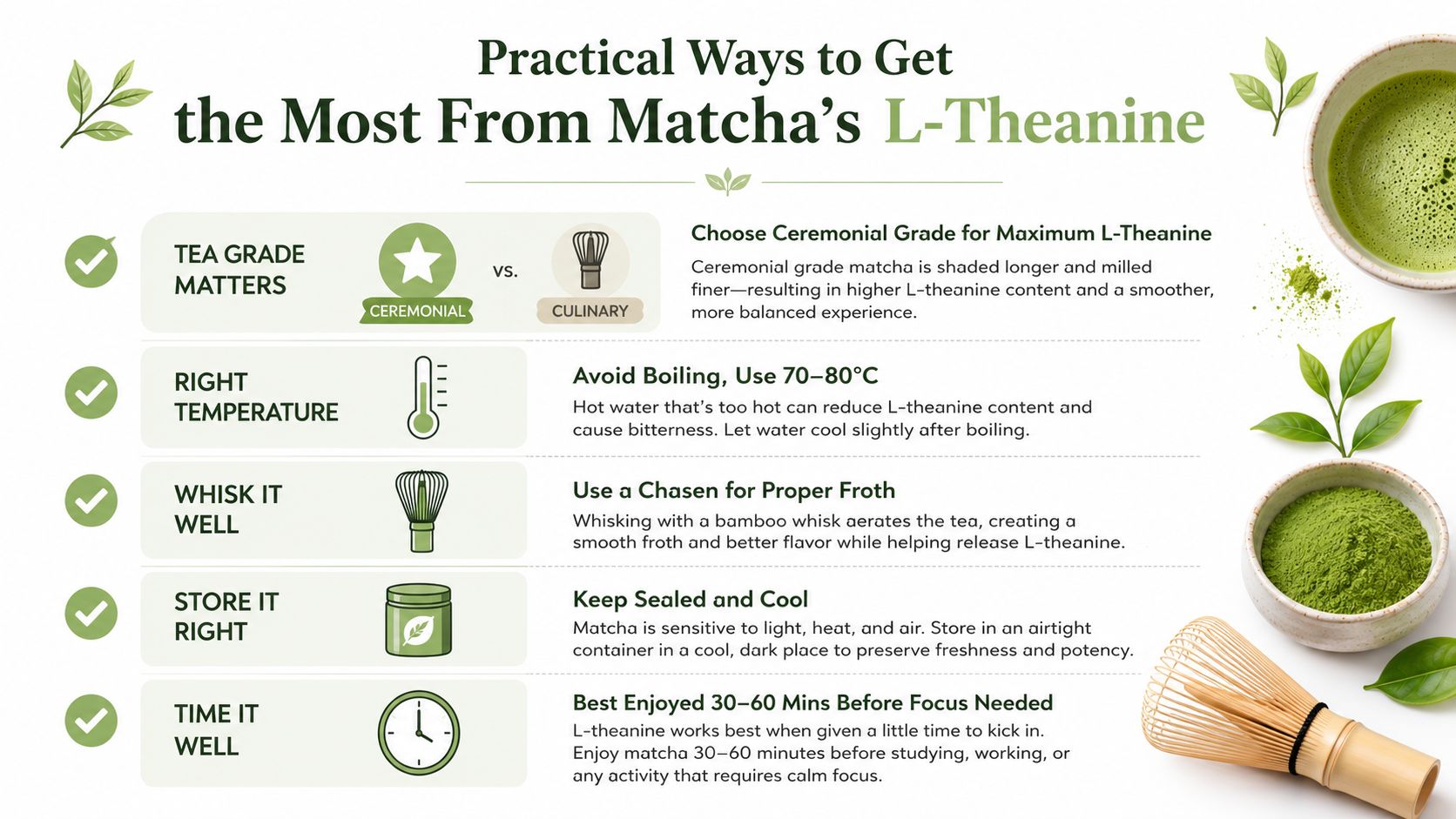
Answers to Common Matcha and L-Theanine Questions
Does matcha improve sleep?
Matcha contains L-theanine, and human research on isolated L-theanine has examined stress, anxiety and sleep-related outcomes. Matcha also contains caffeine, so a late serve may make sleep harder for caffeine-sensitive people. The evidence doesn't justify calling ordinary matcha a sleep treatment.
Is L-theanine in matcha enough to make a difference?
It may contribute to the drink's character and to an individual's experience of calm alertness. However, the studied isolated range of 200–400 mg/day is much higher than the amount supplied by many beverage serves, so you shouldn't assume that matcha reproduces a supplement result.
What if caffeine hits me too hard?
Use a smaller serve and drink it earlier in the day. You can also make a latte with less powder, eat beforehand and avoid stacking the drink with coffee until you know how your body responds.
How does matcha compare with an L-theanine capsule for studying?
Matcha gives you a beverage ritual, caffeine and a variable amount of L-theanine. A capsule gives you a stated amount of isolated L-theanine, which is closer to the format used in clinical research. Neither option guarantees better concentration, and sleep, stress, food and study conditions still matter.
Is daily matcha sensible?
For many adults, a modest morning matcha can be a reasonable beverage habit if they tolerate caffeine. Sensible use means treating matcha as part of a balanced routine, not increasing the powder aggressively to chase a supplement-style effect.
Does matcha have benefits beyond L-theanine?
Matcha is also a concentrated source of plant compounds. A 2020 analysis indexed in PubMed reported phenolic measurements of 169–273 mg gallic acid equivalents per gram and flavonoid measurements of 99–139 mg rutin equivalents per gram in matcha fractions, supporting its description as a concentrated source of antioxidant compounds. Read the PubMed analysis of matcha phenolics and flavonoids
Does matcha contain more L-theanine than regular green tea?
A tested Australian matcha product reported a higher L-theanine density than the cited mean across commercial green teas. The comparison is useful, but it doesn't mean every matcha powder has the same composition or that every brewed cup reaches a particular threshold.
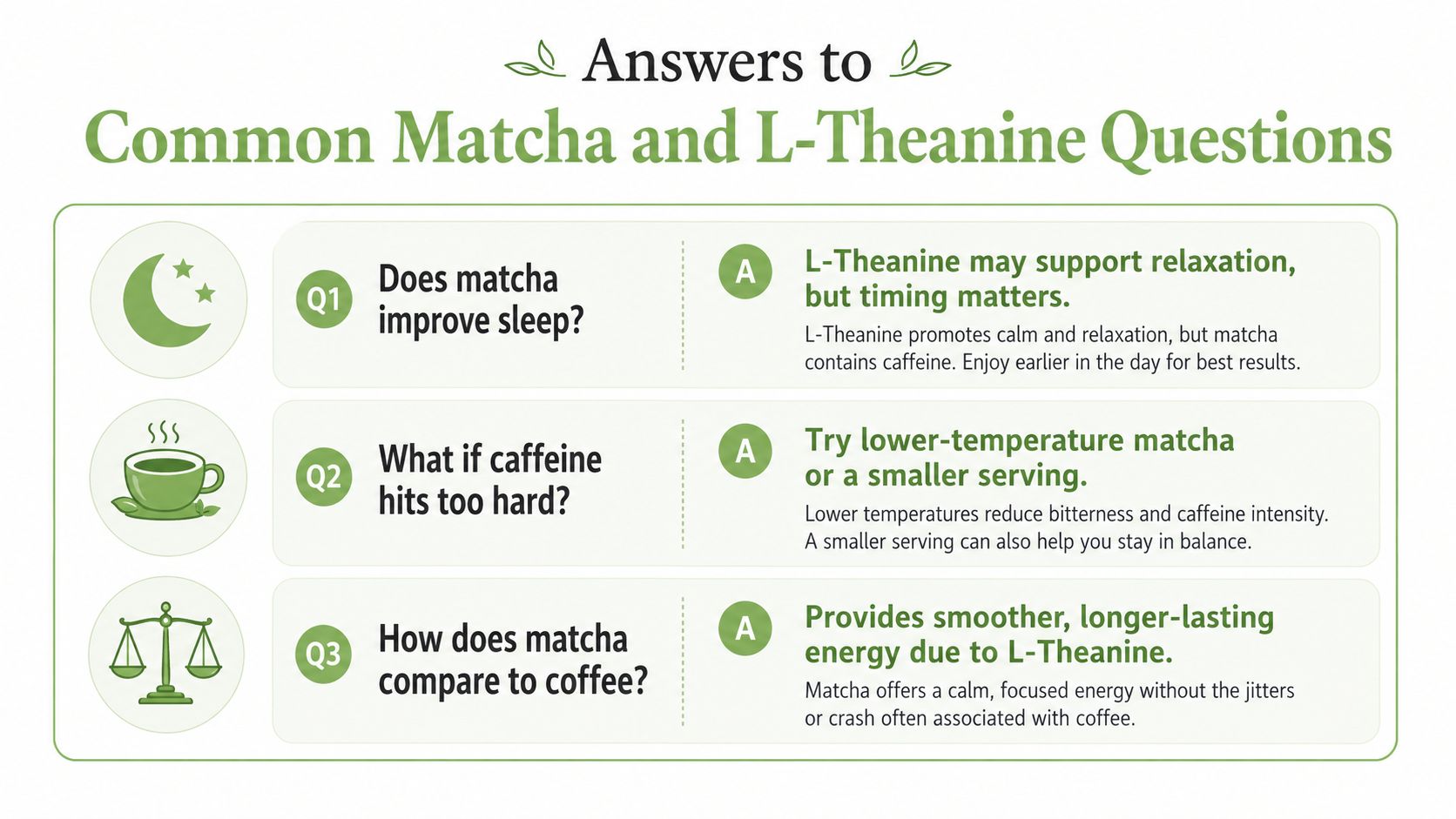
The most useful mantra is matcha is a low-to-moderate L-theanine habit, not a stand-alone focus drug. It contains L-theanine and can provide more of it per gram than the cited green-tea average, but beverage servings remain far below many isolated supplement doses. Australian research is helping close the local evidence gap, while also showing why dose and study design matter.
For readers who want to make the ritual part of their day, Pep Tea offers organically grown Japanese matcha, including premium ceremonial-grade and culinary-style options for drinking and recipes. Visit Pep Tea to explore the organic matcha range and choose a powder that suits your serving style, caffeine tolerance and everyday routine.
Yerba Mate vs Matcha: Caffeine, Benefits, and Taste Compared
It's 3pm, your inbox is full, and you're standing at the café counter deciding between the bright green bowl and the earthy gourd. That choice feels simple until you realise it isn't really about taste, it's about how you want the next few hours to feel. Yerba mate vs matcha is a better question when you frame it around your actual day, your sleep, and the kind of energy you can live with.
| Attribute | Yerba Mate | Matcha |
|---|---|---|
| Plant | Ilex paraguariensis leaf | Shade-grown Camellia sinensis leaf |
| Form | Loose leaf infusion | Stone-ground powder |
| Typical drinking style | Shared, refilled, sipped over time | Measured, whisked, usually one serving |
| Flavour | Earthy, smoky, bitter, herbal | Grassy, umami, slightly sweet |
| Best fit | Social ritual, longer sipping | Focused work, controlled dose |
Why These Two Teas Keep Getting Compared
The comparison keeps coming up because both drinks sit in the same decision space. You're not choosing between a soft drink and tea, you're choosing between two caffeinated rituals that feel cleaner than coffee and more deliberate than a can of anything. In Australia, that matters at the desk, on the school run, and in the late afternoon when you still need to function but don't want your sleep ruined.

The real question behind the comparison
Yerba mate is a South American leaf infusion, usually brewed and topped up through the day. Matcha is Japanese powdered green tea, whisked so the whole leaf ends up in the cup. That difference alone changes texture, dose, ritual, and how your body tends to experience the drink.
A decent comparison has to go beyond “which one is healthier”. It needs to ask which one fits focused work, which one suits a social afternoon, which one is easier to keep inside your caffeine limit, and which one you'll enjoy enough to drink regularly. For Australian buyers, the market reality matters too, matcha has a far stronger import signal, with Australia importing 2,020 tonnes of green tea in 2023–24, worth A$45.2 million at an average import price of A$22.38/kg according to ABARES, while yerba mate remains much more niche in national trade summaries. ABARES green tea import data and market context
Practical rule: if you want a one-cup, measured dose, matcha is the cleaner choice. If you want a drink you can keep returning to, yerba mate makes more sense.
For café owners and home drinkers alike, that distinction is useful because it changes menu design, pricing, and preparation. A good coffee buyer thinks like this already, and the same logic applies here. If you want the espresso-like analogue in tea form, this useful guide on ground espresso for home brewing is a handy reminder that dose, grind, and extraction shape the final cup just as much in coffee as they do in tea.
For people buying in Australia, the mate category is still relatively niche, which is why you'll see matcha more often in specialty cafés and retail ranges. That doesn't make mate irrelevant, it just means the choice is less about trend and more about fit. If you want a more detailed local overview of mate as a product category, see Pep Tea's mate drink Australia page.
Origins, Plant, and How Each Tea Is Made
Two drinks, two completely different production logics
Yerba mate comes from Ilex paraguariensis, a South American holly plant with a long-established drinking culture. Matcha comes from Camellia sinensis, the same tea species behind green tea, but grown and processed very differently. Yerba mate is usually air-dried and often smoked, then steeped in a gourd and drunk through a bombilla. Matcha is shade-grown, steamed, deveined, and stone-ground into a fine powder that's whisked into water.
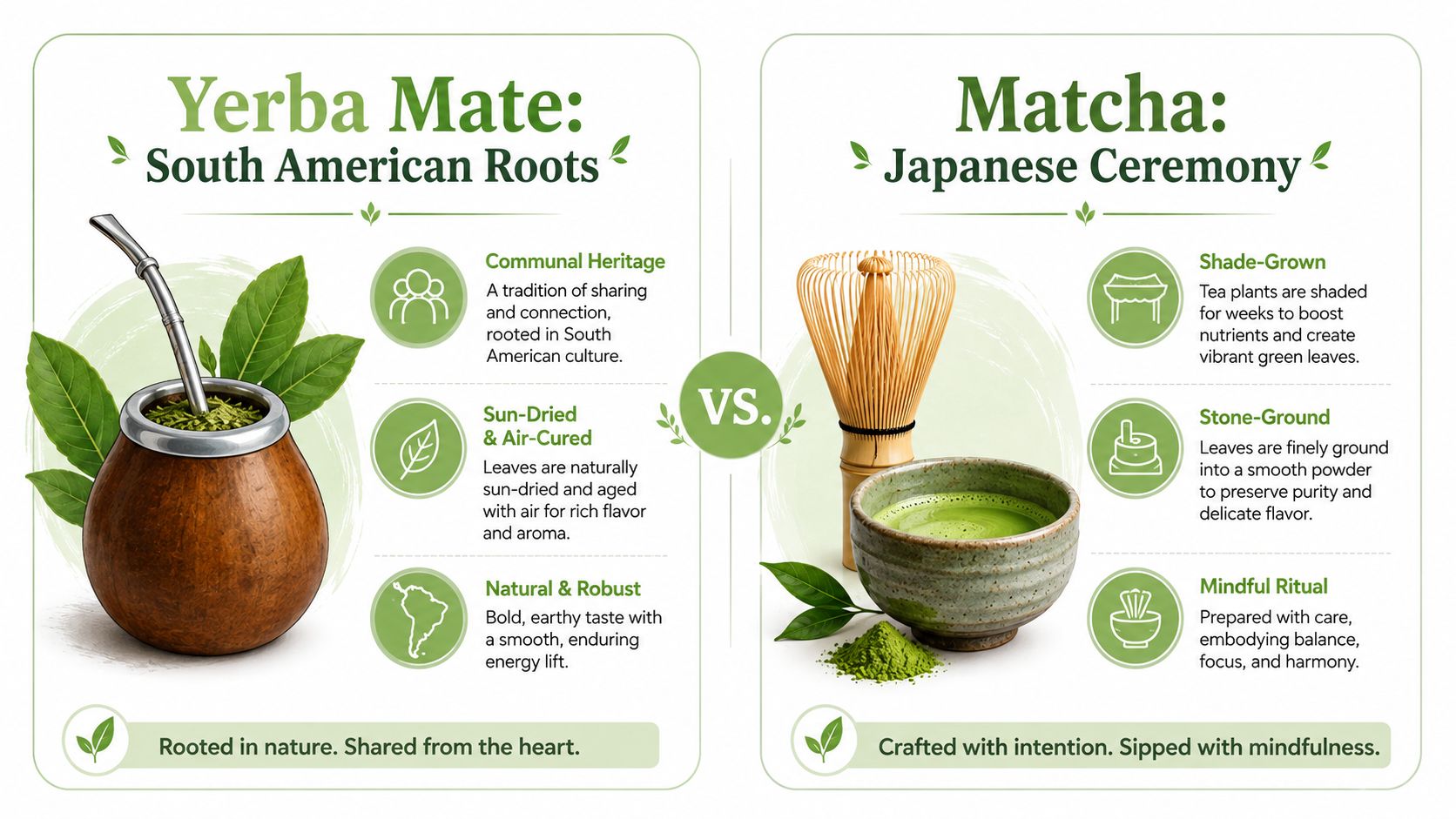
That difference matters because it changes what ends up in your cup. With mate, you're extracting flavour from leaves through repeated infusions. With matcha, you're consuming the powdered leaf itself, so the whole dose is present from the start. That's why matcha often tastes denser, brighter, and more concentrated, while mate feels more drawn out and evolving over time.
Why the processing shapes flavour
Steaming preserves the green colour and gives matcha its grassy, umami-heavy profile. Traditional mate drying tends to push the flavour toward earthier, smokier, and more bitter notes. Neither is a flaw; they are the result of different traditions with different goals.
The ritual follows the plant. Yerba mate is made to be shared or refilled. Matcha is made to be measured and whisked. If you've ever watched a café team pull together a quick iced matcha versus a hot mate service, you can see the contrast immediately. One feels precise and contained. The other feels open-ended and communal.
Here's the easiest way to think about it. Matcha behaves like a specialty ingredient. Mate behaves like a drinking session. That's why one fits dessert menus, lattes, and baking, while the other works well as a social beverage or a slow afternoon companion. They're both green, but they're not interchangeable green powders.
If you want an Australian market lens, that same trade pattern above tells you the story. Matcha is already the more established specialty buy. Mate is still the more distinctive, less common choice.
Caffeine and L-Theanine Compared
The dose is the point
A matcha serve usually lands at about 60–70 mg of caffeine, while brewed yerba mate often sits around 30–50 mg per 8 oz in widely cited comparisons. Matcha and yerba mate caffeine benchmark That is the starting point, not the whole story. Matcha is usually measured as a single portion, so the dose is clear. Yerba mate is often topped up over a longer session, which makes it easy to drink far more than you intended.
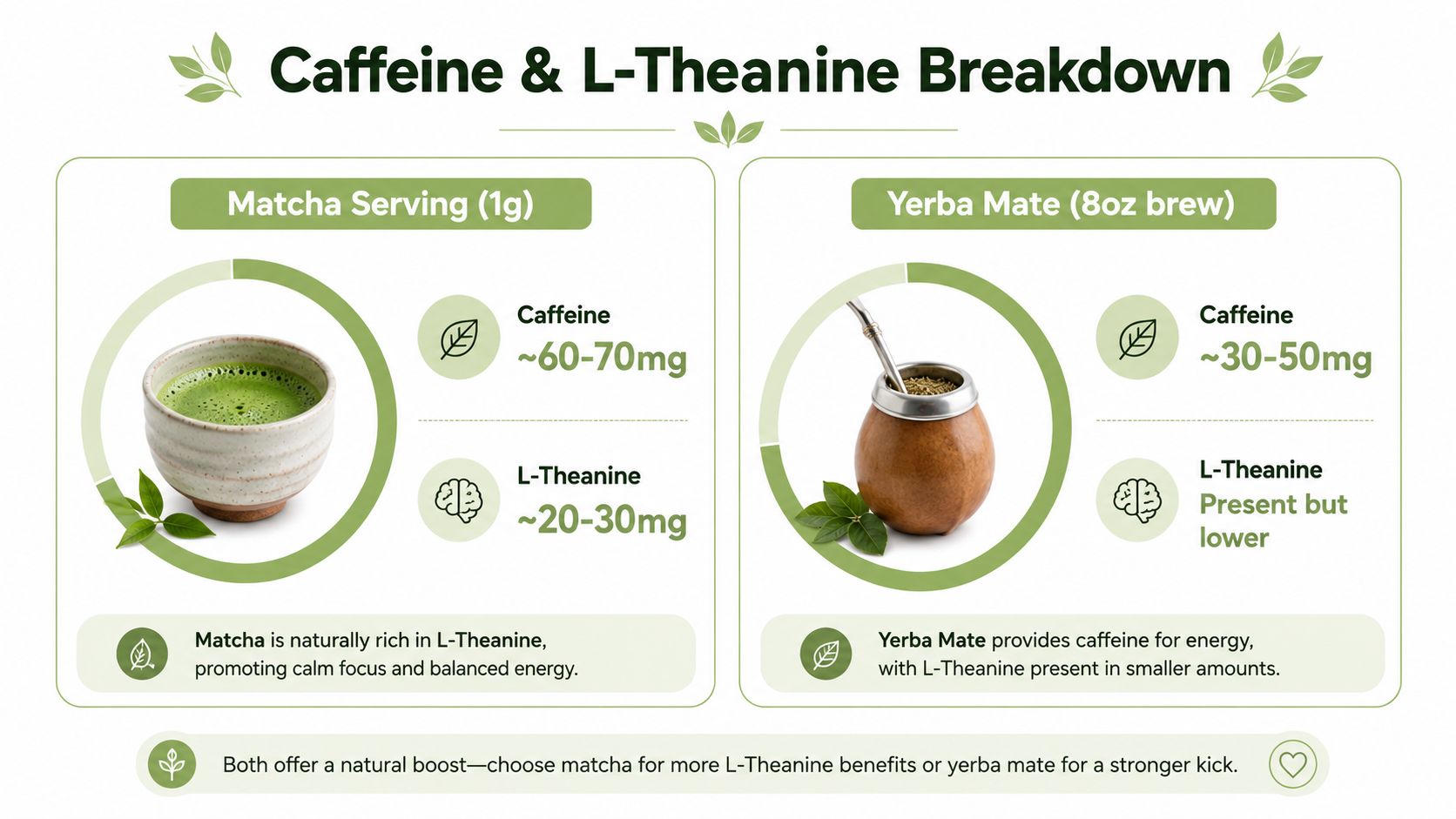
Why the energy feels different
Matcha brings L-theanine with its caffeine, and that is why the effect feels smoother and more controlled in the cup. Whole-leaf use gives matcha a clearer calm-focus profile, which is exactly why it works so well for concentrated desk work. Yerba mate can still feel steady, but it usually reads as more driving and less restrained.
The National Health and Medical Research Council advises no more than 400 mg of caffeine per day for adults, and 200 mg per day for pregnant and breastfeeding women. NHMRC caffeine guidance As noted above, the NHMRC ceiling is 400 mg per day. That matters in a normal Australian day, because a few refills, a large café order, or a second green drink after lunch can push you close to your limit fast.
Caffeine rule of thumb: if you need something at 2pm and still want to sleep later, one measured matcha is easier to control than an open-ended mate session.
Which one fits the workday
For long desk work, matcha is the better tool. It gives you a more predictable dose, a cleaner finish line, and less risk of drifting into late-afternoon overstimulation. For a long afternoon that includes conversation, errands, or time outside, yerba mate makes more sense because the ritual can keep going without every refill feeling like a fresh hit.
If you want a drink you can measure, matcha wins again. That matters for pregnant drinkers, caffeine-sensitive Australians, and anyone trying to keep sleep intact after an early-afternoon cup. If you want more on beverage caffeine in green tea forms, Pep Tea's caffeine content in green tea guide is a useful reference.
A café buyer should read the two drinks the same way. Matcha suits a fixed serve, fast prep, and tight portion control. Yerba mate suits a slower service style, larger vessels, and customers who want to sit with the drink instead of finishing it and moving on. For operators planning iced drinks, the guide to iced coffee for Oklahoma facilities is a useful reminder that cold caffeine drinks live or die on portion control and service speed.
Bottom line: matcha is the better call for controlled afternoon focus. Yerba mate is the better call when you want a longer caffeine curve and a more social pace.
Antioxidants, Polyphenols, and Real Health Effects
What each drink genuinely brings
Matcha is known for its catechins, especially EGCg, because shade growth and whole-leaf consumption concentrate the compounds in the cup. Yerba mate brings a different antioxidant profile, with chlorogenic acids and caffeoylquinic acids among its meaningful polyphenols. Neither drink is a miracle cure, and anyone claiming otherwise is overselling it.
The sensible view is simpler. Both drinks can be part of a wellness routine because they contribute antioxidants and deliver a functional lift. Matcha is the more concentrated tea if you want catechin-heavy green tea benefits. Mate is the more distinctive choice if you prefer its polyphenol mix and its slower social drinking style.
Wellness claims need discipline
A lot of marketing gets sloppy here. Australian food labelling rules require that a beverage marketed as “probiotic” must contain live microorganisms at the end of shelf life and be backed by evidence of benefit for the stated strain and dose under the FSANZ Code. That matters because it separates genuine fermentation from vague gut-health language. A label saying “good bacteria” isn't the same thing as a properly fermented product with compliant claims. FSANZ probiotic and labelling context
If a drink sounds medically bold but the label can't support the claim, treat the promise with suspicion.
That matters in this comparison because people often lump mate, matcha, and kombucha together as “health drinks”. They're not the same. Matcha and mate are tea-based caffeine sources with different polyphenols. Properly fermented kombucha is a separate category with a different regulatory and microbiological reality.
For a deeper look at green tea's antioxidant profile, Pep Tea's antioxidant tea benefits guide is the right place to go. The practical takeaway here is straightforward. Matcha is the better option if you want a more concentrated green-tea antioxidant profile. Mate is still a legitimate antioxidant beverage, just with a different chemistry and a more social cup.
Taste, Texture, and the Drinking Ritual
Flavour is why people stick with one drink
Matcha tastes vegetal, umami, and slightly sweet when it is decent quality and whisked properly. The mouthfeel is smoother and almost creamy, especially in a bowl or a well-made latte. Yerba mate is earthier, smokier, more herbal, and often more bitter, with a drier, full-bodied finish that many people either love immediately or learn to appreciate.
| Attribute | Yerba Mate | Matcha |
|---|---|---|
| First impression | Bold, earthy, bitter | Fresh, grassy, umami |
| Texture | Light infusion | Smooth, creamy, dense |
| Finish | Dry and full-bodied | Soft, rounded, lingering |
| Ritual | Shared, refilled gourd | Whisked bowl or latte |
| Best use | Social sipping, cold brew | Lattes, baking, focused drinks |
Ritual changes the pace
Mate changes the drinking session more than the sip itself. One gourd can stay on the table for a long time, and the shared refill pattern changes the whole social mood. Matcha feels more individual and self-contained. You whisk it, drink it, and move on.
That difference matters in daily life. A café guest who wants something meditative and photogenic will usually be happier with matcha. A person who wants to talk, sit outside, and keep the drink in rotation for an hour or two will often prefer mate. The beverage shapes tempo as much as flavour.
Matcha also works as the more versatile base. You can foam it into a latte, blend it into a smoothie, or use it in baking. Mate holds up well in cold brew and can be a strong menu item in its own right, especially when a customer wants something a little more rugged and less dessert-like.
Sensory shortcut: if you like green flavours, fine texture, and a cleaner finish, choose matcha. If you like bitterness, smoke, and a drink that feels more rustic, mate is your drink.
How to Brew Each Tea Properly at Home and in a Café
Brewing mate: temperature and technique
Mate turns harsh fast if you treat it like black tea. Keep the water around 70 to 80°C, never boiling, or the cup goes bitter and thin at the same time. In a traditional gourd, tilt the leaves to one side, add a little cool water first, then pour gently so the leaf bed is not shocked. A French press works well in a café because it gives staff control over the steep and keeps service tidy.
Cold mate has a real place on a café menu. It suits batch prep and summer drinks, but only if the flavour stays balanced. Go too heavy on the leaf or too hot on the water and the drink turns sharp. Mate should taste dry and full-bodied, not scorched.
Brewing matcha: whisking and water
Matcha needs proper whisking, not guesswork. Ceremonial service uses a chasen and a bowl, while cafés often rely on a shaker, frother, or whisk for iced matcha and lattes. The water should be hot, but not scalding, because overheated water makes the powder taste flat and bitter. Milk needs the same care, because scorched milk buries the tea.
The gear matters, but only up to a point. A basic bamboo whisk, a kettle with temperature control, and a good tin of matcha are enough to start. Mate asks for a gourd, a bombilla, and the leaf itself. For café operators, matcha usually gives the stronger presentation. Mate usually wins on simplicity and a brew method that is easy to repeat.
Buy by the cup, not by the label. Good matcha should taste clean, not muddy. Good mate should feel full-bodied, not burnt.
If you want a clean reference point for premium matcha quality, PepTea's organic matcha range is a solid benchmark.
Who Should Choose Yerba Mate and Who Should Choose Matcha
Matcha suits the measured moments
Matcha is the better choice if you want a single dose of clean focus, especially for desk work, creative sessions, and afternoons when you need control. It's also the stronger pick for bakers and home baristas because it does more than one job. Pregnant or caffeine-sensitive drinkers usually do better with the drink they can measure precisely, and that points to matcha.
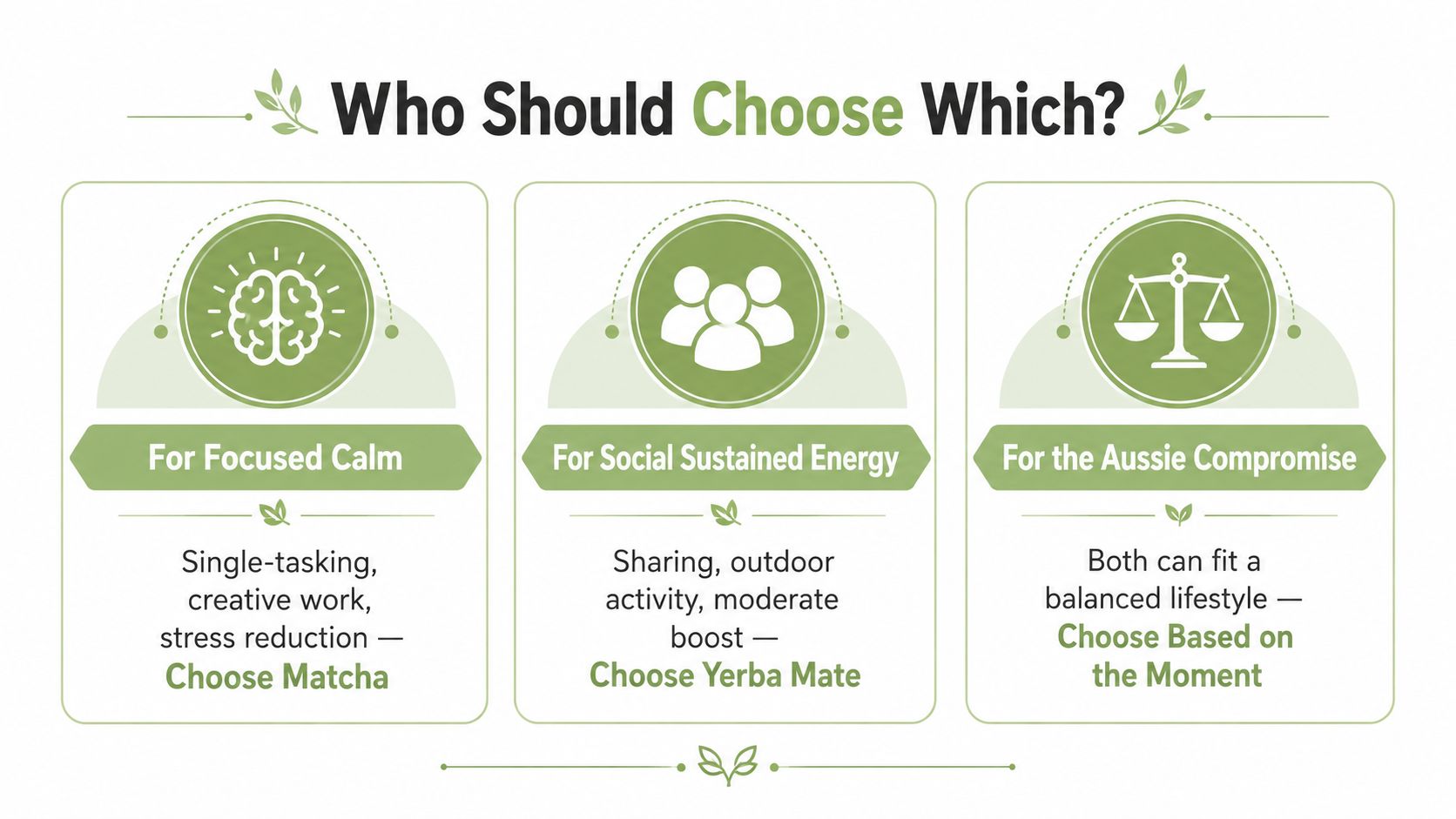
Mate suits the social moments
Yerba mate is the better pick for long shared afternoons, outdoor activity, and anyone who likes a more full-bodied, earthy flavour. It's the drink you keep passing around, not the drink you rush through. If the goal is conversation, ritual, and a lower per-cup caffeine hit you can sip over time, mate has the edge.
For café menus, matcha is the better photogenic, premium add-on. Mate is the better conversation piece and a stronger fit when you want a more distinctive, less sweet drink. If sleep matters, default to matcha earlier in the day and keep an eye on the total number of serves. If ritual and conversation matter, mate is hard to beat.
My plain answer: matcha wins for control. Yerba mate wins for atmosphere.
Pep Tea focuses on premium organic matcha and sugar-free organic kombucha for Australians who want clean energy, better habits, and drinks that actually fit real life. If you're deciding between yerba mate vs matcha, start with the matcha range at Pep Tea, then look at the kombucha line for a second functional drink that suits the same wellness-minded routine.
Instant Matcha Tea: What It Is and How to Use It
Instant matcha tea gets treated like a shortcut, but that's only half the story. Some products are a genuine convenience format, while others are just instant green tea powders wearing a matcha label, and those two things don't behave the same in a cup or in a café.
For Australian buyers, that difference matters more than most guides admit. If you're choosing a powder for lattes, iced drinks, desserts, or a fast home ritual, the label tells you more than the marketing does, and a clear understanding of processing, solubility, flavour, and nutrition will save you from buying the wrong tin.
What Instant Matcha Tea Actually Is
A lot of people assume every green powder called matcha is basically the same product. It isn't. True matcha is made from tencha leaf that's stone-ground into a fine powder, while instant matcha tea is usually a processed instant tea powder designed to dissolve quickly, often from brewed tea concentrates and sometimes with additives like maltodextrin or citric acid for better flow and shelf life, according to the product distinction explained by matcha.com.
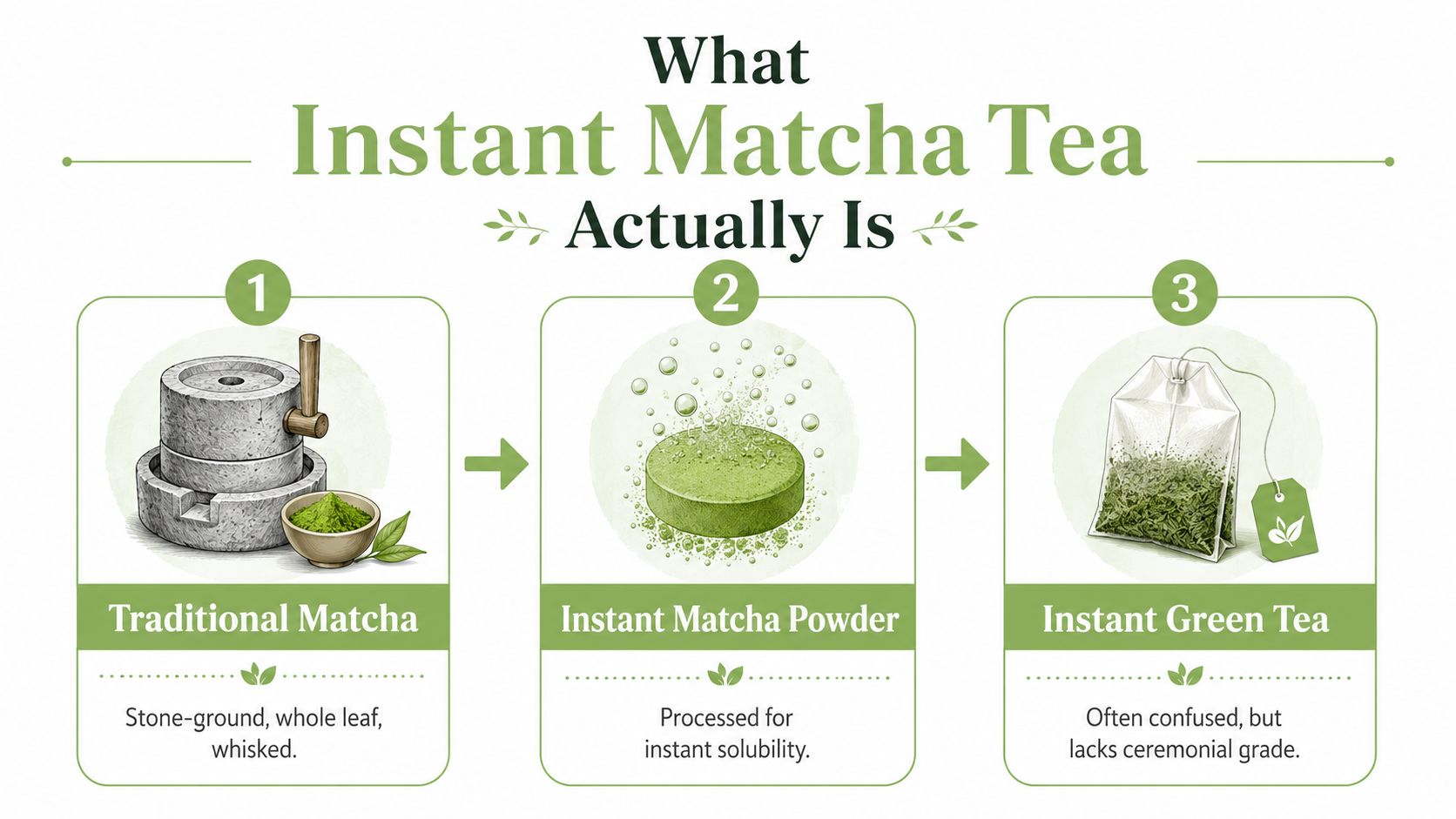
Why the label causes so much confusion
Australian shoppers often see “matcha” and assume heritage tea, bright colour, and full nutritional value. That assumption only holds when the powder is made from ground tea leaf. Instant tea powders are made for convenience first, so they're meant to disperse fast in water or milk, not necessarily to preserve the character of the leaf.
That matters in service settings too. A café team training on speed, consistency, and drink build will need a different workflow from someone preparing ceremonial tea at home, which is why a practical resource like barista training Australia can be useful when you're mapping a menu or onboarding staff.
Practical rule: if the ingredient list reads like a processed beverage mix, you're probably not buying traditional stone-ground matcha, even if the front label says “matcha”.
What to look for on a packet
You don't need a tea degree to read the label well. Start with the ingredients, then look for anything that suggests instant solubility rather than whole-leaf powder. If the powder dissolves completely and leaves little sediment, that's often by design, but it doesn't automatically mean it's equivalent to matcha in flavour or composition.
A simple label check helps:
- Ingredient list first, because additives often signal an instant format.
- Country of origin next, because true matcha is tied to Japanese production.
- Product language last, because words like “instant”, “blend”, or “soluble” tell you how it behaves in the cup.
For café owners, that distinction changes how you build drinks. For home users, it changes expectations. Instant matcha tea can be a smart convenience product, but it shouldn't be judged as though it were the same thing as traditional matcha.
Instant vs Ceremonial vs Culinary Matcha Compared
Start with the cup itself, because that usually clears up the confusion. Ceremonial matcha is made for drinking on its own, culinary matcha is made to stand up in milk, batter, and sauce, and instant matcha tea is designed for speed and easy dispersion. Each one solves a different problem, so the right choice depends on whether you need flavour clarity, kitchen flexibility, or fast service.
Matcha Grades at a Glance
| Attribute | Instant Matcha | Culinary Matcha | Ceremonial Matcha |
|---|---|---|---|
| Processing | Usually made for instant solubility, often from brewed concentrate | Stone-ground tea leaf, usually from slightly older leaves | Stone-ground tea leaf, usually from the youngest shade-grown leaves |
| Texture | Designed to dissolve quickly | Mixes well, may need whisking or frothing | Best whisked, can form a fine foam |
| Flavour | Neutral to mild, sometimes flatter | Stronger, more pronounced | Delicate, smoother, more umami |
| Best use | Iced drinks, fast service, automated prep | Lattes, baking, cooking | Straight tea, ceremonial use, premium drinks |
| Nutritional trade-off | Convenience first, so the whole-leaf profile is usually reduced | Retains more of the leaf than instant forms | Closest to the full leaf experience |
For a practical buyer's guide, PepTea's comparison of ceremonial vs culinary matcha helps separate drinking quality from kitchen use without turning the decision into guesswork.
What each grade is really for
Ceremonial matcha suits moments where the tea itself should lead. The flavour is cleaner, the finish is more refined, and the drink works best when nothing else is crowding the bowl or cup.
Culinary matcha belongs in a different setting. In a latte, smoothie, cake, or biscuit, its fuller taste has enough weight to come through milk, sugar, and other ingredients, which is why it is often the more practical choice for recipes. A Japanese home cooking resource such as the Just Cook It recipe collection is useful when you want to see how matcha behaves beyond a plain tea preparation and into everyday cooking.
Instant matcha tea sits alongside those options rather than replacing them. It is handy when the drink needs to be quick, cold, and consistent, especially in an Australian café where prep time and repeatability matter. That convenience comes with a trade-off, because it is not the same ingredient category as a traditional stone-ground powder, and that difference affects both cup quality and how much of the leaf you are using. Once you separate those roles, the choice becomes easier to make for both café menus and home kitchens.
Short version: ceremonial for drinking, culinary for cooking, instant for convenience.
Nutritional Benefits and What You Might Be Missing
Matcha earns its reputation because you consume the whole leaf, not just the brewed water. Reviews summarised in the medical literature report caffeine around 18.9 to 44.4 mg/g, total polyphenols around 169 to 273 mg gallic acid equivalents per gram, and a composition that is roughly 60 to 70% insoluble material plus 30 to 40% soluble compounds such as catechins, amino acids, and minerals, according to PubMed review data. That's the heart of the nutrition argument in favour of true matcha.
Why whole-leaf powder matters
When you whisk stone-ground matcha, you're taking in the material suspended in the cup as well as what dissolves into the liquid. That's why people value it as a functional drink rather than a simple infusion. The profile can vary a lot by source and dose, but the key point is that true matcha delivers more of the leaf than a typical instant tea powder.
Instant matcha tea often trades some of that completeness for convenience. If a powder is made from extract or concentrate and engineered for solubility, it can be easier to use in iced drinks and automatic dispensing, but it may not carry the same density of leaf-derived compounds. In other words, it may behave better in a machine, while true matcha gives you more of the plant itself.
What readers usually expect from matcha
Most buyers are looking for three things:
- Antioxidants, especially catechin-rich compounds.
- Calm energy, because matcha combines caffeine with amino acids.
- A greener, fuller flavour, which signals freshness and leaf quality.
That's why it helps to keep expectations precise. If you want a product for fast drinks and low-fuss use, instant matcha can make sense. If your priority is nutrition and the classic tea experience, stone-ground matcha is the better fit.
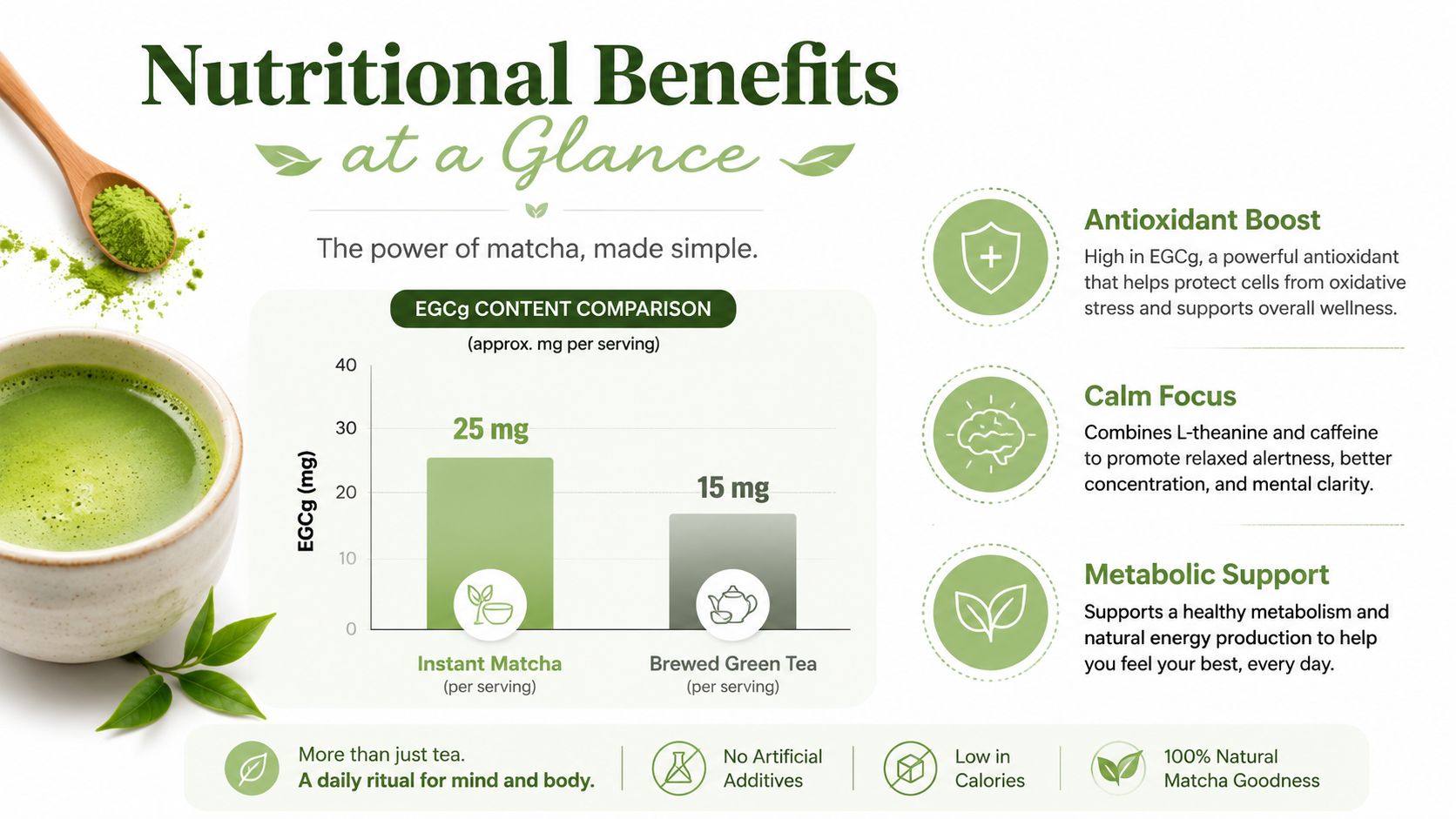
A useful way to think about it is this, the more a product is engineered for instant mixing, the more you should ask what has been gained in speed and what has been lost in whole-leaf character.
How to Prepare Instant Matcha Tea Properly
Instant matcha tea is easier to handle than traditional powder, but the method still matters. If you dump it straight into cold milk and walk away, you'll often end up with weak flavour or an uneven texture. A little technique goes a long way.
Hot, iced, and latte preparation
For a hot drink, start with a small amount of water first, then add the rest once the powder has dispersed. That helps the powder hydrate evenly and keeps the flavour from going flat. If the product is very fine or highly soluble, a quick stir may be enough, but if the cup looks grainy, a small whisk or milk frother helps.
For iced drinks, instant matcha usually outperforms traditional powder because it's designed to disperse more easily in colder liquid. That makes it a practical choice for café iced lattes, shaker bottles, or takeaway formats where speed matters.
For a latte, build it like this:
- Dissolve the powder in a small splash of hot water.
- Stir or froth until smooth.
- Add milk, then ice if needed.
- Taste before sweetening, because some instant blends already include a sweetener or filler.
If you use traditional matcha instead, a proper whisking method matters. PepTea's guide on how to whisk matcha is a useful reference if you want to compare the two workflows side by side.
Fixing common problems
Grainy texture usually means the powder needs more agitation. Weak flavour usually means the dose is too low for the product's concentration. Bitterness often comes from water that's too hot or from a product that already includes more processed tea solids than you expected.
Good café habit: build one test drink before you scale the recipe for service. Instant powders can vary a lot, so a fast calibration saves waste.
If you're making drinks at home, a shaker bottle works well for cold recipes, and a blender helps when milk, ice, and powder all need to combine quickly. For hot drinks, simple stirring is often enough if the powder is soluble.
Recipes and Use Cases for Home and Hospitality
Instant matcha tea makes the most sense when the drink has to move quickly. At home, that usually means morning routines. In hospitality, it usually means iced menus, batch builds, and prep consistency across staff shifts.
Where it works well
A home barista can use instant matcha in a few straightforward ways. A quick iced matcha latte is the obvious one, because the powder disperses easily and doesn't need the same whisking discipline as ceremonial tea. It can also slip into smoothies, overnight oats, or simple baking where the green tea flavour just needs to show up cleanly.
For cafés, the strongest use case is speed. Instant powder can be handy in:
- Iced drinks, where fast dispersion reduces clumping.
- Automated or semi-automated service, where repeatability matters.
- Batch drinks, when a team needs consistent colour and flavour across service.
That said, there are also places where a prepared version wins without question. If a customer expects vivid green colour, foamy texture, and the layered umami of a properly whisked tea, a conventional matcha powder is still the right call.
Simple serving ideas
A few practical pairings work especially well:
- Oat milk latte, because its body softens the tea.
- Coconut milk iced drink, because it reads as tropical and creamy.
- Vanilla smoothie, because the flavour is mild enough to sit beside fruit.
- Matcha muffins or slice, if the recipe only needs background tea notes.
PepTea also offers organic matcha tea products online, including bulk formats suited to retail and food service, which makes sense for kitchens that need a reliable powder rather than a one-off novelty.
For cafés, the decision usually comes down to ticket time versus drink identity. For home users, it comes down to whether you want a fast green drink or a more traditional tea ritual. Both can have a place, but they're not interchangeable.
Buying and Storing Matcha the Right Way
Reading a matcha label properly saves money and disappointment. The easiest mistake is buying by colour alone. A bright tin doesn't always mean good tea, and a smooth powder doesn't always mean it's true matcha.
What to look for on the label
Start with the ingredient list. A clean matcha product should be easy to understand, and if you see a long list of sweeteners, fillers, or anti-caking agents, that's a sign to slow down and ask what the powder is made of. A trusted origin matters too, especially in Australia where the market is largely import-led.
That matters because Australia imported about A$14.2 million of “tea, whether or not flavoured” from Japan in 2024, and Japan External Trade Organization data says Japan remains the world's leading supplier of matcha, with export volume rising 16.1% in 2024 to 8,798 tonnes, about 10 times the level of 20 years earlier, according to the market summary at Ooika. For Australian buyers, that points to a supply chain that's heavily tied to origin-country production.
A simple checklist helps:
- Look for origin transparency, ideally Japan and, when available, a specific region.
- Check for added ingredients, especially if you want authentic matcha.
- Prefer reputable packers or suppliers, because freshness matters more than flashy packaging.
How to store it well
Matcha is sensitive to light, heat, and oxygen. Store it sealed, cool, and away from the cupboard door where temperature swings are common. Once opened, use it promptly, as freshness drops faster than you might expect.
A small airtight tin or jar is better than leaving the powder in a half-open bag. If you've already opened a pouch, a dedicated storage container helps protect flavour and colour, and PepTea's matcha storage container is one practical example of the kind of setup that keeps powder in better shape.
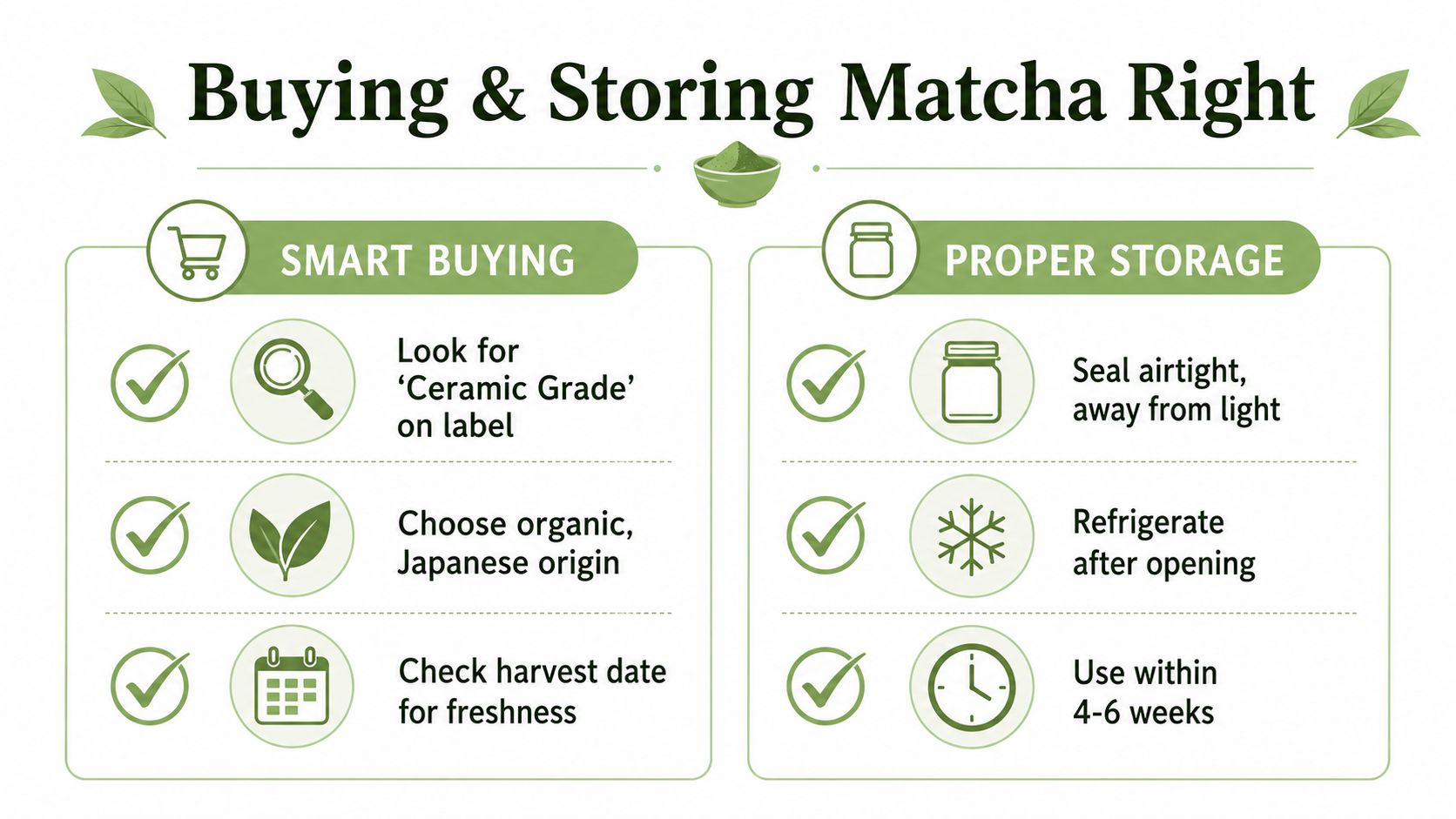
If you buy online, prioritise clear photos of the ingredient panel and packaging date. If you buy in-store, open the conversation with the staff and ask what kind of matcha it is before you decide whether it suits drinking, lattes, or baking.
Choosing the Right Matcha for Your Needs
The decision comes down to one question, what do you want the powder to do? If your answer is “be quick, cold, and easy to mix,” instant matcha tea can be the right tool. If your answer is “taste like real matcha and deliver the fuller leaf experience,” you'll want stone-ground culinary or ceremonial powder instead.
For café owners, the smartest choice often depends on the menu. Instant powder can help with speed and consistency, but a premium matcha earns its place when customers are paying for texture, aroma, and a more authentic cup. For home users, the split is even simpler, convenience versus tradition.
If you're still deciding, keep these priorities in mind:
- Choose instant when you need fast dispersion and straightforward cold-drink prep.
- Choose culinary when you want a stronger flavour for lattes or baking.
- Choose ceremonial when the tea is the whole point.
PepTea's range of premium organic Japanese matcha is built around authenticity, clean ingredients, and practical use in real kitchens and cafés. If you want to compare options and choose the right grade for your routine, explore Pep Tea and pick the powder that fits the drink you want to make.