
Tag: Organic kombucha
7 Healthy Caffeine Alternatives for Energy and Calm

Replacing coffee isn't one decision, because people want different things from their daily drink. You might be looking for calm focus, a coffee-like morning ritual, a pre-exercise lift, a sugar-free refreshment, or a caffeine-free option for the evening. The best healthy caffeine alternatives depend on the feeling and routine you want to support.
This guide compares seven practical choices, from organic matcha and kombucha to roasted dandelion blends, brewed cacao and mushroom cacao. “Stimulant intensity” is used as a practical guide, not a medical measurement. Individual tolerance varies, and ingredients, serving size, timing and label instructions all matter. If you're managing pregnancy, medication, a medical condition or strong caffeine sensitivity, check with a qualified health professional.
Australia already has a strong tea culture. Roy Morgan data published through the Australian National University found that 9.8 million Australians aged 14 and over, about half the population, drank tea in an average week during the 12 months to June 2016. The comparison below focuses on caffeine level, flavour, preparation effort, best use and practical cautions. For readers concerned about caffeine and hormonal symptoms, this caffeine and hot flashes guide offers useful additional context.
1. Pep Tea
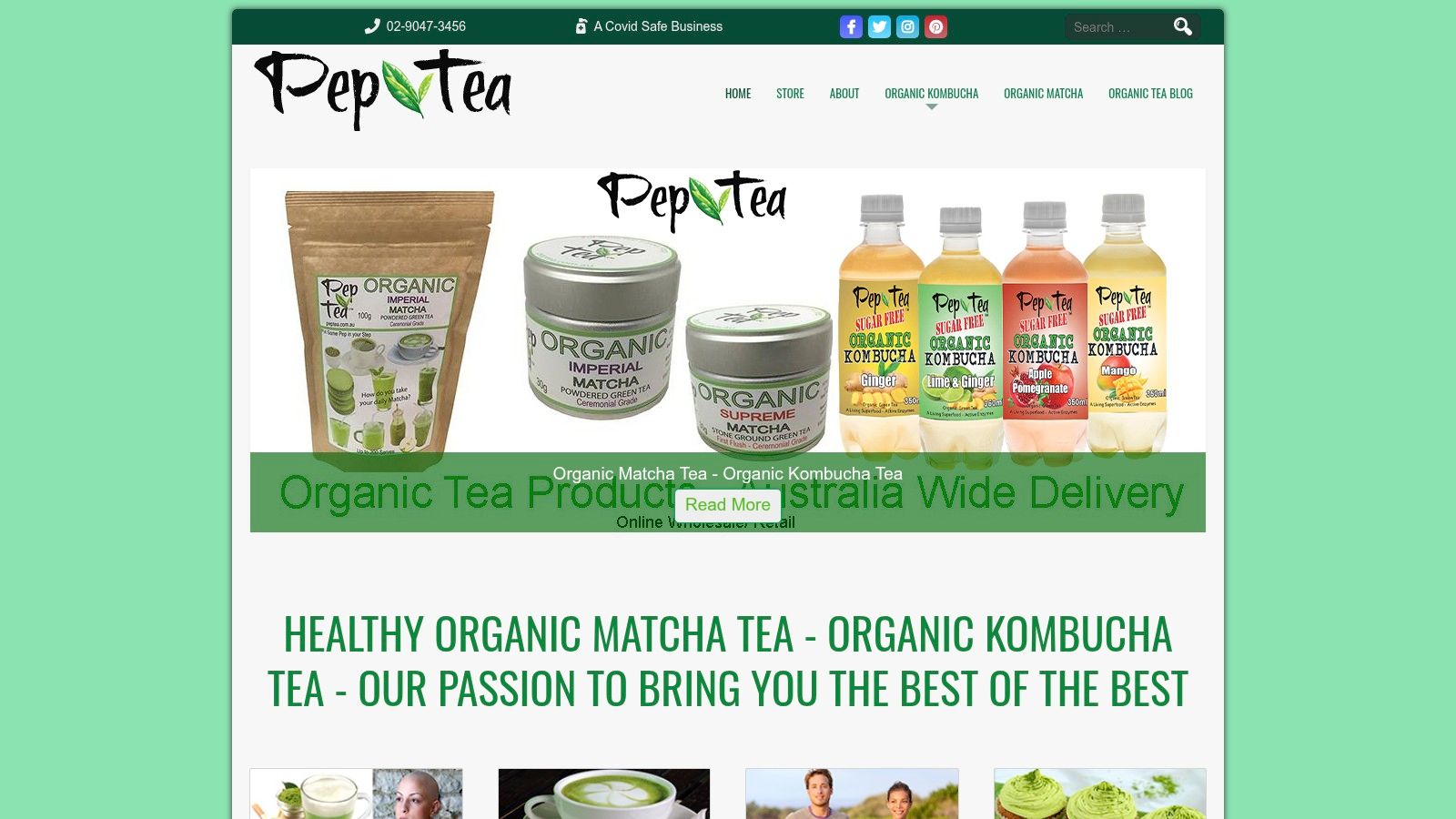
Pep Tea is the most versatile choice here because it covers two different routines, smooth energy from organic Japanese matcha and refreshing, fermented hydration from Australian-brewed kombucha. That makes it useful for a home morning ritual, an iced afternoon drink, or a café menu that needs premium non-alcoholic options without relying on sugary soft drinks.
Pep Tea's matcha is stone-ground from organically grown Japanese tea. Because you consume the finely ground leaf rather than only an infusion, matcha has a full, grassy flavour and contains naturally occurring L-theanine and catechins, including EGCg. Those compounds don't make matcha risk-free or medically proven to improve every aspect of wellness, but they help explain why many people experience it as a steadier, calmer lift than a sharper coffee hit. Matcha generally sits in the moderate stimulant category, so it isn't the right choice for a caffeine-free evening.
Practical rule: Start with a modest amount, whisk it thoroughly, and assess your response before making matcha a stronger daily drink.
For a simple cup, sift matcha into a bowl, add a small amount of warm water, whisk until smooth, then add more water or your preferred milk. Ceremonial-grade matcha suits drinking on its own, while culinary-grade matcha works well in iced lattes, smoothies, baking and desserts. Pep Tea's educational resources also cover storage, recipes and practical ways to use matcha beyond a traditional bowl.
Kombucha for a different kind of refreshment
Pep Tea's kombucha is raw, living and brewed in the Hunter Valley, NSW, in a purpose-built HACCP-accredited facility. The sugar-free range uses organic green tea, fermentation and live cultures, with flavours including Ginger, Lime & Ginger and Mango. It's naturally sharp, lightly sparkling and ready to drink chilled, or to use as a mixer for a non-alcoholic café serve.
Kombucha can contain live bacteria and yeast, but CHOICE's discussion of kombucha evidence notes that human clinical evidence for broad claimed benefits remains limited. “Probiotic-rich” should therefore describe the presence of live cultures, not promise a guaranteed gut-health outcome. Pep Tea's guide to whether kombucha contains caffeine is useful when choosing a product for your own tolerance, and labels remain the final check.
Pros
- Organic sourcing: Pep Tea focuses on certified-organic matcha and kombucha.
- Two routines in one range: Matcha supports a focused daytime ritual, while kombucha offers a cold fermented refreshment.
- Hospitality support: Cafés and retailers can use the products in lattes, mocktails, recipes and ready-to-serve menus.
- Education: Guides cover matcha storage, fermentation basics, SCOBY care and recipe ideas.
Cons
- Pricing requires an enquiry: Public retail and wholesale pricing isn't consistently displayed.
- Flavour needs a little adjustment: Matcha's vegetal taste and kombucha's acidity may be unfamiliar at first.
- Caffeine varies by product: Check the specific label, especially if you're sensitive.
2. Teeccino
Teeccino is for the person who misses the coffee ritual, not necessarily the caffeine. Its roasted herbal blends combine ingredients such as chicory, carob, barley, dates, figs and ramón seeds to create a dark, nutty drink that can be brewed in a drip machine, French press or refillable pod. It's designed to be caffeine-free and coffee-like, making it a natural fit for a morning mug or an afternoon replacement.
The brand offers a broad range of dark and medium roast flavours in grounds and tea-bag formats. Some blends have organic or gluten-free positioning, but those features vary by product, so the individual packet matters more than the brand name. The stimulant intensity is none from caffeine, although the warm roasted flavour and familiar preparation can still feel energising as a routine.
Why it suits coffee drinkers
Teeccino gives you control over texture and strength. Brew it like plunger coffee for a fuller cup, use a drip method for a cleaner result, or choose tea bags when you want less equipment. A splash of milk can soften the roasted bitterness, while a latte preparation makes the drink feel closer to a café order.
Chicory contains inulin, a type of fibre that some people tolerate well and others find difficult. People managing digestive sensitivities, particularly those avoiding FODMAPs, should check the ingredients and start cautiously. Many blends also contain barley, which means they aren't suitable for people avoiding gluten unless the specific product is clearly labelled otherwise.
For Australians, availability is more practical through third-party retailers than direct local distribution. Before ordering, check shipping, blend ingredients and whether the format suits your equipment. The product can be a useful addition to a broader natural energy drinks Australia guide, particularly for readers who want a coffee-style experience without caffeine.
Best use: A slow morning ritual, office plunger or evening decaf-style drink when you still want roasted flavour.
Potential drawback: It won't taste exactly like espresso, and chicory or gluten-containing ingredients may rule out some blends.

3. Kintra Foods Roasted Dandelion Blend
Kintra Foods' roasted dandelion and chicory blend is one of the easiest choices for Australians who want a caffeine-free coffee ritual with local availability. It comes in filter bags, jars and larger pouches, with a fine grind designed for café-style preparation. You can brew it in a percolator, plunger or coffee machine, depending on the format you buy.
The drink has a toasted, earthy profile rather than the sharp bitterness of coffee. That distinction matters. It may satisfy the habit of grinding, brewing and serving a warm dark drink, but people seeking a true espresso flavour may need time to adjust. The stimulant intensity is caffeine-free, so it works better for evening routines than matcha or brewed cacao.
A practical café option
The fine grind is particularly useful for cafés that want to offer a dandelion latte without buying another complicated system. Steam milk separately, combine it with the brewed blend and adjust the ratio until the roasted flavour sits comfortably beneath the milk. At home, filter bags make the simplest entry point, while the larger formats suit frequent use or hospitality service.
Kintra describes the blend as preservative-free, lactose-free and gluten-free. It contains chicory, however, so the absence of gluten doesn't automatically make it suitable for people avoiding inulin or FODMAP ingredients. Always read the current pack, especially if you're serving customers with allergies or dietary requirements.
Best use: A caffeine-free morning latte, workplace drink or café menu addition.
Intensity: None from caffeine. The sensory effect comes from warmth, aroma and a familiar coffee-style ritual.
Main trade-off: The roasted dandelion and chicory profile is distinct, and it won't reproduce every quality of coffee. Its Australian ownership and production, plus broad supermarket and health-store availability, make it a convenient choice for local shoppers.
4. Bonvit Roasted Dandelion Blend
Bonvit's roasted dandelion and chicory blend takes a similar idea and makes it practical for shoppers who want affordability, easy sourcing and multiple preparation formats. It's available in medium and fine grinds, with pack sizes ranging from smaller household options to larger formats suitable for regular service. The fine grind can be used for espresso-style preparation or a milk-based latte.
The blend is marketed as caffeine-free, gluten-free and lactose-free, and it carries Vegan Australia Certification. Those labels help narrow the search, but they don't remove the need to check the ingredients. Chicory and dandelion create a recognisable roasted flavour and may not suit people who want a dark, smoky coffee substitute with no earthy notes.
Matching the grind to the routine
Choose a filter or medium-style format when you want a straightforward brewed cup. A fine grind makes more sense for a café or home barista who wants to build a latte around the drink. Add steamed dairy or plant milk, then taste before adding sweetener. The natural roasted flavour can work well with cinnamon or cacao, but you don't need sugar to make it function as a daily beverage.
Bonvit is a zero-caffeine option, so it belongs at the gentle end of the stimulant scale. It may replace the sensory cues of coffee, but it won't recreate caffeine's physiological stimulation. That difference is helpful when your priority is reducing caffeine rather than finding an identical energy effect.
Pros
- Easy to find: It's widely stocked online and in Australian stores.
- Flexible formats: Medium and fine grinds support different preparation styles.
- Café friendly: Larger packs and fine grind options suit hospitality menus.
- Dietary labels: Vegan Australia Certification, gluten-free and lactose-free positioning help with initial screening.
Cons
- Distinct flavour: Dandelion and chicory taste more earthy than coffee.
- Stock varies: Retailers may carry only selected grinds or pack sizes.
- Digestive caution: Chicory's inulin content may not suit everyone.

5. Dandy Blend
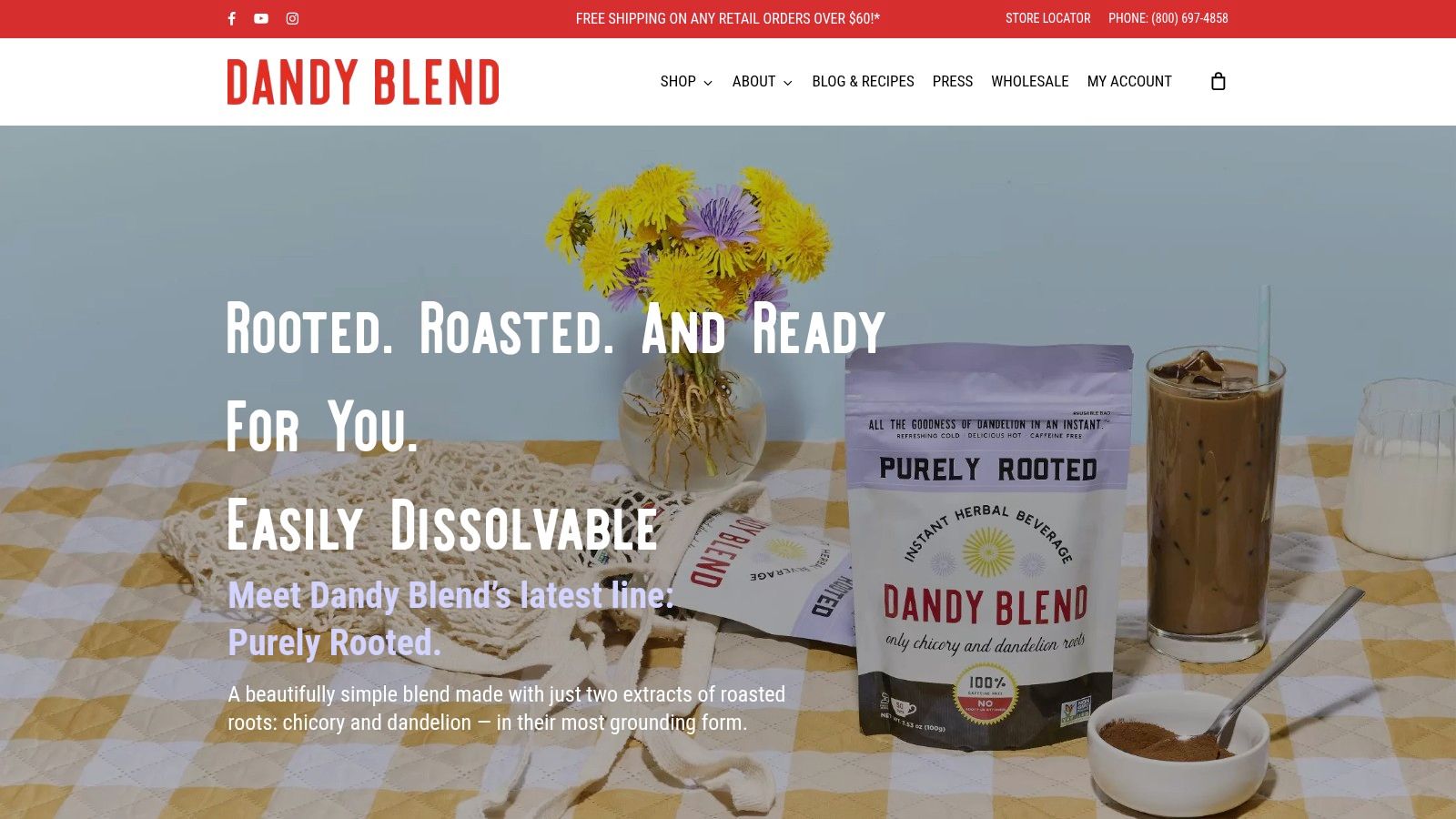
Dandy Blend is built around one advantage, speed. It's an instant roasted herbal powder that dissolves in hot water, so you don't need a grinder, plunger, coffee machine or steeping time. That makes it particularly suitable for travel, an office drawer, a quick morning latte or a café that needs a fast caffeine-free base.
Its roasted ingredients include dandelion, chicory, beets, rye and barley. The drink is designed to mimic coffee aroma and taste, with several bag sizes, single-serve sachets and an organic line available. The stimulant intensity is caffeine-free, but the preparation can still preserve the psychological comfort of a coffee break.
The convenience trade-off
Add the powder to hot water, stir, then add milk if you want a latte. You can adjust strength without changing brewing equipment, which is useful when different people want different cup sizes. Cold preparation is also possible, although a hot drink usually integrates the powder more smoothly.
The most important caution is gluten. Because the formula contains rye and barley, it isn't suitable for people with coeliac disease or strict gluten-free requirements. It also contains chicory, so anyone sensitive to inulin should check the label and consider a cautious trial. Australian availability can be inconsistent, and international online ordering may involve shipping delays or retailer differences.
Best use: Travel, office routines and rapid café service.
Best for: People who want coffee-like flavour but don't want to brew.
Not ideal for: Anyone who needs a gluten-free formula, dislikes roasted herbal notes or wants a locally stocked product with simple supermarket access.
The instant format also makes it easy to experiment. Try a small amount in a milk-based drink first, then adjust the concentration rather than sweetening heavily to cover unfamiliar flavour.
6. Crio Bru Brewed Cacao
Crio Bru is for people who want a gentle lift and a brewed ritual, but don't want the full intensity of coffee. It uses roasted, ground cacao brewed like coffee in a French press, drip machine or pour-over setup. The result is chocolate-forward, aromatic and lightly roasty, with a flavour closer to unsweetened cacao than a conventional mocha.
The product information lists approximately 10 mg of caffeine per 8-ounce cup, a figure that should be checked against the current product label and cited product details at Crio Bru's website. That is a low level compared with many caffeinated drinks, but it means Crio Bru is not caffeine-free. It also contains theobromine, another naturally occurring cacao compound, which contributes to its distinctive, gentler stimulation.
Brewing and serving ideas
Use it much like coffee grounds. A French press creates a fuller, heavier cup, while pour-over preparation produces a cleaner chocolate profile. You can drink it black, add milk, or use it as a base for a cacao latte. Some single-origin and flavoured roasts make it easier to choose between fruitier, darker or more dessert-like notes.
The preparation effort is moderate because you still need brewing equipment and time. In return, you get a drink that feels more substantial than herbal tea and less coffee-like than a dandelion blend. It may suit a late-morning ritual better than an evening one, particularly for people who respond strongly to even small amounts of caffeine.
Read the label before treating “low caffeine” as “no caffeine.”
Availability in Australia can be limited, and international retailers may be the most practical source. Consider delivery conditions, product freshness and serving guidance before ordering. If you want a chocolate drink with no caffeine at all, choose a clearly labelled caffeine-free cacao or herbal formula instead.
7. Teelixir Mushroom Cacao Latte
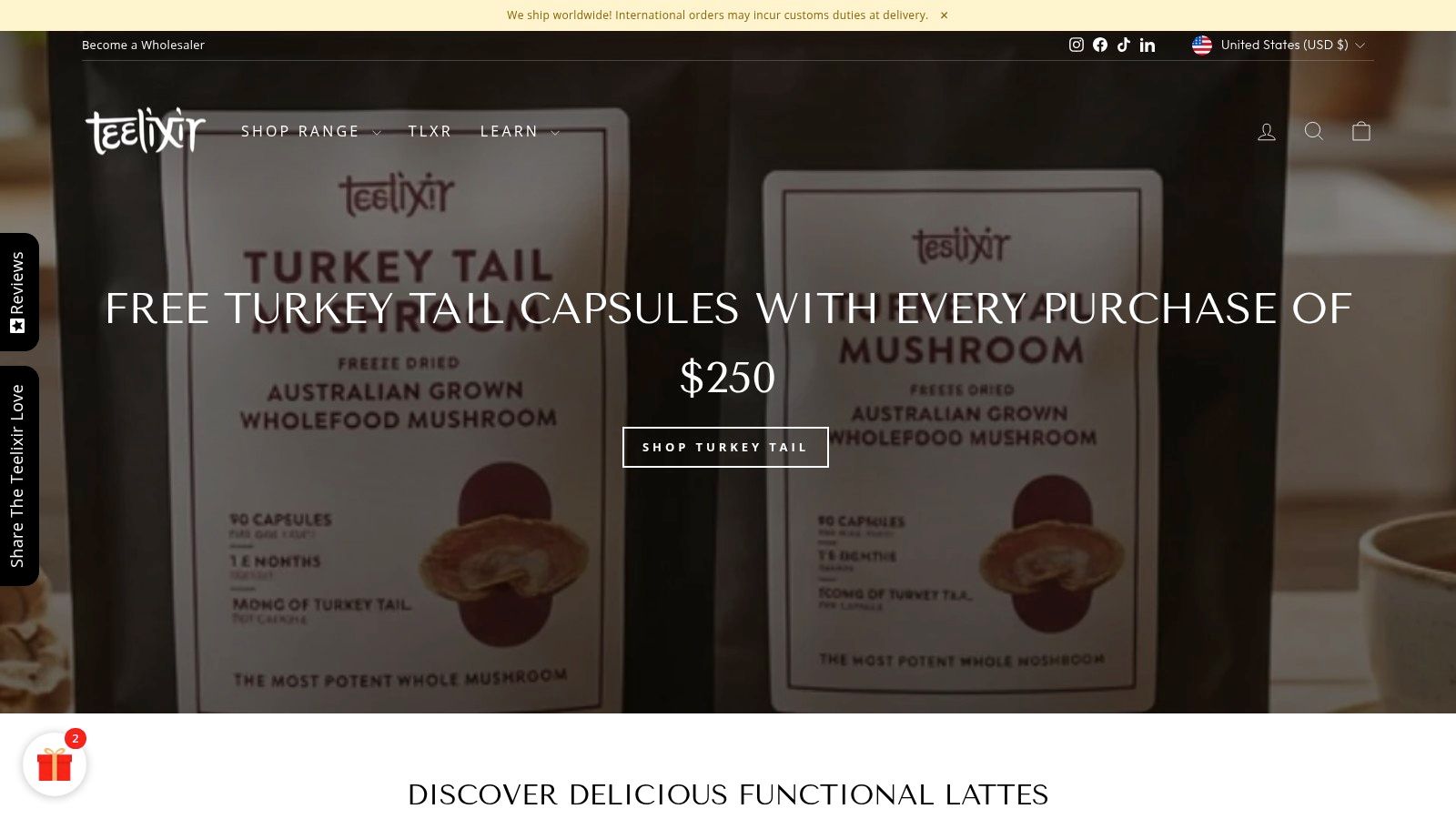
Teelixir Mushroom Cacao Latte is designed for an evening wind-down, not a coffee imitation. The Australian blend combines organic cacao and rose with a 10:1 reishi fruiting-body extract. It's caffeine-free, has no added sugar according to the product description, and can be prepared hot, iced or as a café latte base.
The flavour is chocolate-led, with an earthy mushroom note that some people enjoy and others find challenging. That makes it a better fit for drinkers who like cacao, botanical flavours or functional beverage menus than for someone trying to recreate a dark roast. The stimulant intensity is zero from caffeine, so the experience comes from warmth, flavour and the ritual of making something deliberately calming.
A flexible home and hospitality formula
For a hot latte, whisk the powder into a small amount of warm water before adding steamed milk. An iced version works with chilled milk and plenty of ice, while cafés can use the blend as a distinctive non-coffee menu option. Teelixir offers formats ranging from sample sizes to a 1 kg pouch, which supports both home experimentation and hospitality service.
The product has third-party testing information and transparent ingredient details, but “mushroom” should not be treated as a guarantee of a health outcome. Reishi may interact with some medicines, and people who are pregnant, managing a condition or taking regular medication should ask a health professional before using functional mushroom products. Product labels can change, so check the current directions and allergen information.
Pros
- Caffeine-free: Suitable for an evening beverage routine.
- Australian brand: Local production and bulk options suit households and cafés.
- Versatile preparation: Serve it hot, iced or as a latte.
- No added sugar: Helpful for people reducing sweetened drinks, subject to the current label.
Cons
- Earthy flavour: Mushroom notes won't appeal to every palate.
- Not coffee-like: Cacao provides comfort, but not a roasted coffee replica.
- Ingredient considerations: Reishi and other functional ingredients deserve careful label reading.
This kind of drink fits naturally alongside broader natural focus enhancers, although a caffeine-free evening beverage should be chosen for the routine it supports rather than promised effects.
Comparison of 7 Healthy Caffeine Alternatives
| Item | 🔄 Implementation complexity | ⚡ Resources & availability | ⭐📊 Expected outcomes (quality & impact) | 💡 Ideal use cases / tips |
|---|---|---|---|---|
| Pep Tea | Moderate, small‑batch, HACCP kombucha & certified organic matcha production | Good B2B distribution; certified organic sourcing; wholesale pricing via enquiry | High, antioxidant-rich matcha (calm sustained energy) and probiotic, sugar‑free kombucha ⭐📊 | Cafés, hospitality menus, specialty grocers, health‑focused consumers; use as mixer or menu feature |
| Teeccino | Low, roasted herbal blends produced at scale; simple brewing | Wide product range; often available via third‑party retailers (limited direct AU shipping) ⚡ | Effective, convincing caffeine‑free coffee substitute with broad flavor options ⭐📊 | Home brews, drip/French press, variety seekers; choose blends for desired roast profile |
| Kintra Foods Roasted Dandelion Blend | Low, mass production with café grind options | High availability across Australian supermarkets and health stores | Good, caffeine‑free, latte‑ready option; coffee‑like but distinct flavor ⭐📊 | Supermarkets and cafés wanting easy-to-stock caffeine‑free lattes; use fine grind for espresso machines |
| Bonvit Roasted Dandelion Blend | Low, standard retail production, multiple pack sizes | Very good, widely stocked nationwide and affordably priced ⚡ | Reliable, affordable caffeine‑free substitute; flavour differs from dark coffee ⭐📊 | Cost‑conscious cafés and shoppers; bulk packs for high‑volume use |
| Dandy Blend | Low prep complexity, instant powder (no brewing required) | Variable, not always stocked locally; often bought via international e‑commerce | Fast & convenient, instant coffee‑like cup, caffeine‑free; contains gluten grains ⚡📊 | Travel, office or quick café service; use sachets for single‑serve convenience |
| Crio Bru Brewed Cacao | Low, brew like coffee (press/drip); requires cacao sourcing | Limited AU availability; usually via international retailers | Gentle lift, low caffeine, high theobromine; chocolate‑forward, low acidity ⭐📊 | Chocolate lovers or those who want a gentle stimulant; brew like coffee for latte bases |
| Teelixir Mushroom Cacao Latte | Moderate, formulated with concentrated mushroom extracts and testing | Good AU availability; certified organic, bulk sizes and third‑party tested | Calming, caffeine‑free, mushroom + cacao blend for relaxation and flavour ⭐📊 | Evening drinks, cafés offering functional hot‑chocolate/latte options; dose transparently for servings |
Choose Your Caffeine Alternative by Routine
The right choice becomes clearer when you start with the moment you're trying to improve. Matcha is the strongest fit for a focused daytime drink, especially when you want a tea ritual with a smoother feel. Kombucha works when you want cold refreshment, acidity and gentle carbonation rather than a hot mug. Roasted dandelion blends and Teeccino are more useful when the coffee ritual matters most, while brewed cacao sits between caffeine-free comfort and a low-stimulant lift.
For Australian shoppers, local access also changes the decision. Kintra Foods and Bonvit offer practical roasted alternatives that are easier to find in local retail channels. Pep Tea combines Japanese organic matcha with Australian-brewed kombucha from the Hunter Valley, giving cafés and households two different beverage formats from one specialist supplier. Teelixir adds an Australian caffeine-free cacao option for evening menus, while Teeccino, Dandy Blend and Crio Bru may require more careful retailer and shipping checks.
A simple decision guide
Treat the table as a starting point, not a promise about how your body will respond. Caffeine sensitivity varies, and even a low-caffeine product can feel too stimulating for some people. If you're reducing coffee, tapering gradually may feel more comfortable than changing everything overnight, particularly if you regularly experience headaches or fatigue when you miss your usual drink.
Ingredient checks matter just as much. Chicory-based products contain inulin, which may not suit people avoiding FODMAPs or managing digestive sensitivity. Teeccino, Dandy Blend and some similar roasted formulas contain barley or rye, so they aren't suitable for coeliacs or strict gluten-free diets unless the individual product clearly states otherwise. Kombucha can contain live cultures, but limited human clinical evidence means you should avoid turning “probiotic-rich” into a guaranteed gut-health claim. With matcha and kombucha, check the product label for caffeine information and serving guidance.
Choose one alternative that matches your routine, not five products that create another decision every morning.
Try one option for a week and keep the preparation simple. Use matcha at the time you'd normally reach for coffee, pour kombucha over ice when you want a cold afternoon drink, or prepare a roasted blend in the same mug and milk style you already enjoy. If the flavour feels unfamiliar, adjust temperature, dilution and milk before adding sugar. For an evening drink, choose a clearly caffeine-free product and give yourself enough time to notice how it fits your sleep routine.
Australia's beverage market supports more than one definition of a healthy caffeine alternative. Roy Morgan's Australian tea data shows that tea is already well established, while market research from Grand View Research describes strong projected growth for Australian kombucha through 2033, with the figures presented as estimates rather than guarantees. Grand View Research's Australian matcha outlook also describes an import-dependent category with growing matcha consumption and ready-to-drink interest. These trends give cafés, retailers and households more room to choose drinks by experience, sugar level, caffeine exposure and preparation style.
For a focused start, explore Pep Tea's organic matcha and try it as a whisked bowl, iced latte or recipe ingredient. For a cold, sugar-free option, compare the kombucha flavours and use them in a simple mocktail with citrus, herbs and ice. The best swap is the one you'll enjoy preparing often, can source reliably and can adjust safely to your own tolerance.
Pep Tea offers premium organic Japanese matcha for calm, focused routines and raw, sugar-free organic kombucha brewed in the Hunter Valley for refreshing everyday drinks and café menus. Visit Pep Tea to explore the range, find practical recipes and enquire about Australian wholesale supply.
Store Bought Kombucha vs Homemade
The phrase store bought kombucha vs homemade often leads to the assumption that the home version wins by default. It's cheaper, it feels more hands-on, and the word “live” gets people thinking it must be the fresher, healthier choice.
That shortcut misses the trade-off. Homemade kombucha can offer a richer antioxidant profile in some comparisons, but it also carries more room for contamination, batch variation, and plain old brewing mistakes. Commercial kombucha can be less variable and easier to trust on a busy shelf, though some products are processed in ways that change their live-culture profile and sensory character. The smarter choice depends on what you value most, quality, safety, consistency, cost, or convenience.
| Factor | Homemade | Store-Bought |
|---|---|---|
| Control over ingredients | High, you choose the tea, sugar, and flavouring | Lower, recipe is set by the producer |
| Safety oversight | Depends on your hygiene and process | Usually higher, with commercial controls |
| Live cultures | Can stay active if handled well | Can be reduced by pasteurisation or stabilisation |
| Antioxidant profile | Can be higher in some studies | Can be lower in some comparisons |
| Cost | Usually cheaper over time | Usually more expensive per litre |
| Convenience | Requires patience and attention | Ready to drink |
The Assumption That Homemade Kombucha Is Always Better
Homemade kombucha gets an easy reputation boost because it sounds purer. You're mixing tea, sugar, and a culture in your own kitchen, so it feels more natural than something bottled in a factory. That instinct makes sense, but it doesn't automatically make the home version the better drink for every person or every setting.
The strongest argument for homemade is control. You decide the tea base, sweetness, fermentation time, and flavouring, which gives you a lot of flexibility. Cost is another draw, especially in Australia, where one retailer estimates homemade kombucha can come in at about $1 to $1.50 per litre versus roughly $10 per litre for commercial bottles, a big retail gap for households and hospitality buyers alike homemade kombucha can cost about $1 to $1.50 per litre.
What people usually mean when they say better
Usually, they mean one of three things. They want more live culture, less sugar, or better value. Homemade can support all three goals if you brew carefully, but none of them comes for free.
Practical rule: if you're judging kombucha only by taste or price, you're missing half the picture. Safety and consistency matter just as much as the label on the bottle.
Commercial kombucha also has genuine strengths. It's made to be consistent, easier to transport, and more predictable on shelf. For cafés, grocers, and venues, that consistency often matters more than the romance of a jar on the counter.
The fairest way to think about store bought kombucha vs homemade is this, homemade rewards effort and attention, while store-bought rewards reliability and convenience. If you're brewing for your own kitchen and enjoy the process, home fermentation can be a great fit. If you need something stable, repeatable, and easy to serve, a well-made commercial product can be the more practical option.
How Store-Bought and Homemade Kombucha Are Made
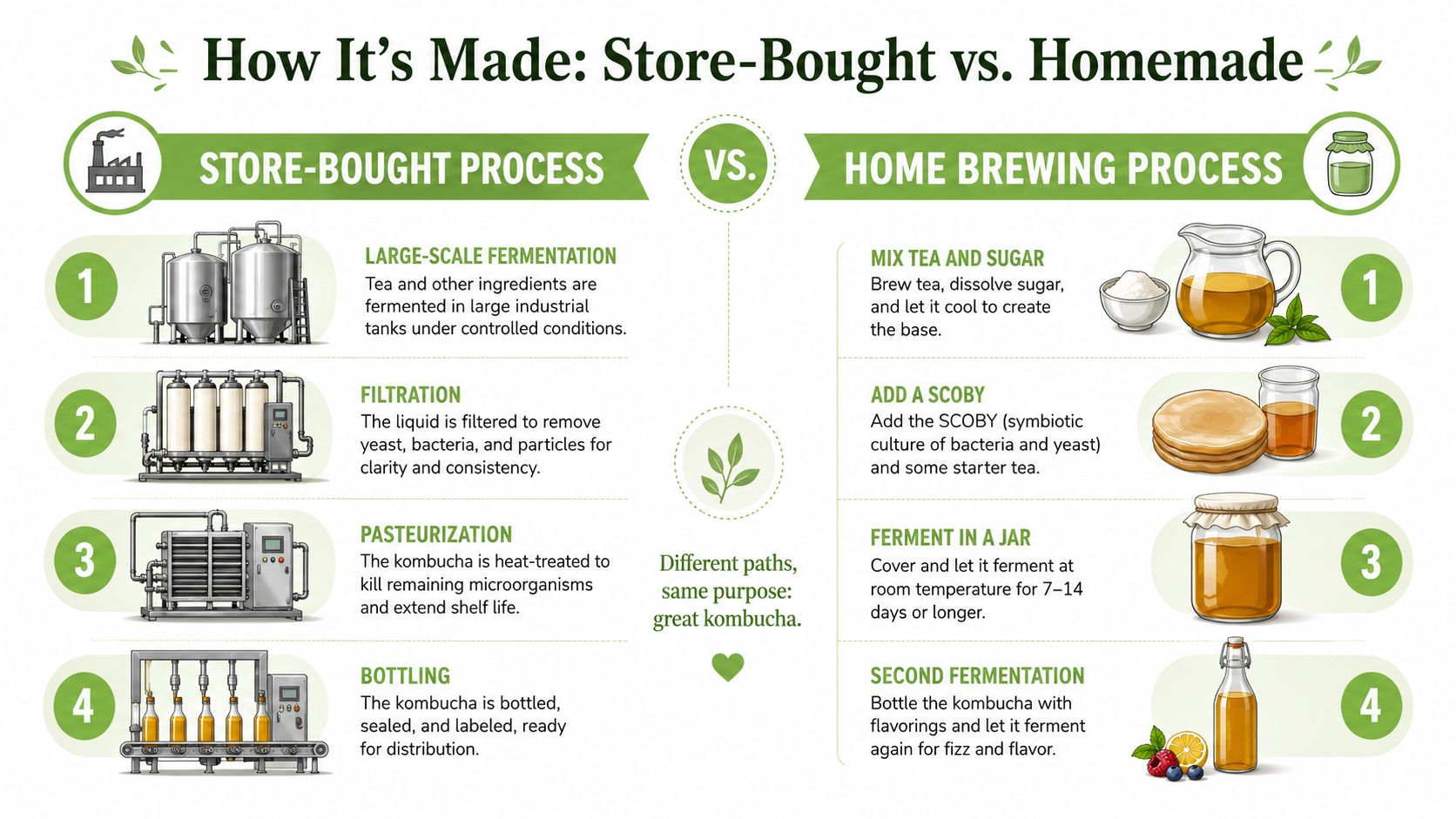
Homemade kombucha starts with sweet tea and a culture, then sits through fermentation in a jar. The brewer controls the tea strength, the sugar level, the room temperature, and the flavouring stage, which is why two home batches can taste completely different. That flexibility is part of the appeal, but it also means the outcome depends heavily on the brewer's habits.
A common starting point is a SCOBY, which stands for Symbiotic Culture Of Bacteria and Yeast. In home brewing, the tea ferments in a covered vessel, then often moves into a second stage for flavour and carbonation. That second stage is where fruit juice, ginger, or other additions can create a more finished drink, but it's also where pressure can build if the bottles aren't handled properly.
For a plain-language primer on the drink itself, see Pep Tea's guide to what kombucha is.
Where commercial production changes the drink
Store-bought kombucha is usually brewed with scale and shelf life in mind. Some products are pasteurised, filtered, or stabilised so they won't keep fermenting in the bottle. According to Yemoos, that process can leave commercial kombucha with less variety of bacteria and yeast, and many commercial products are pasteurized, which the source says removes probiotic content from the drink commercial kombucha vs home.
That doesn't automatically make commercial kombucha inferior. It means the producer is managing risk, pressure, and consistency differently. A factory can also use ingredients such as kombucha extract or added sweeteners, and that can change the final flavour and live-culture profile in ways home brewers don't always expect.
One useful shortcut is to think in terms of priorities. A home brewer can chase freshness and experimentation. A commercial producer has to solve for shelf stability, transport, and consumer safety at scale. Both methods produce kombucha, but they don't produce the exact same drink.
Safety and Quality Differences You Should Know About
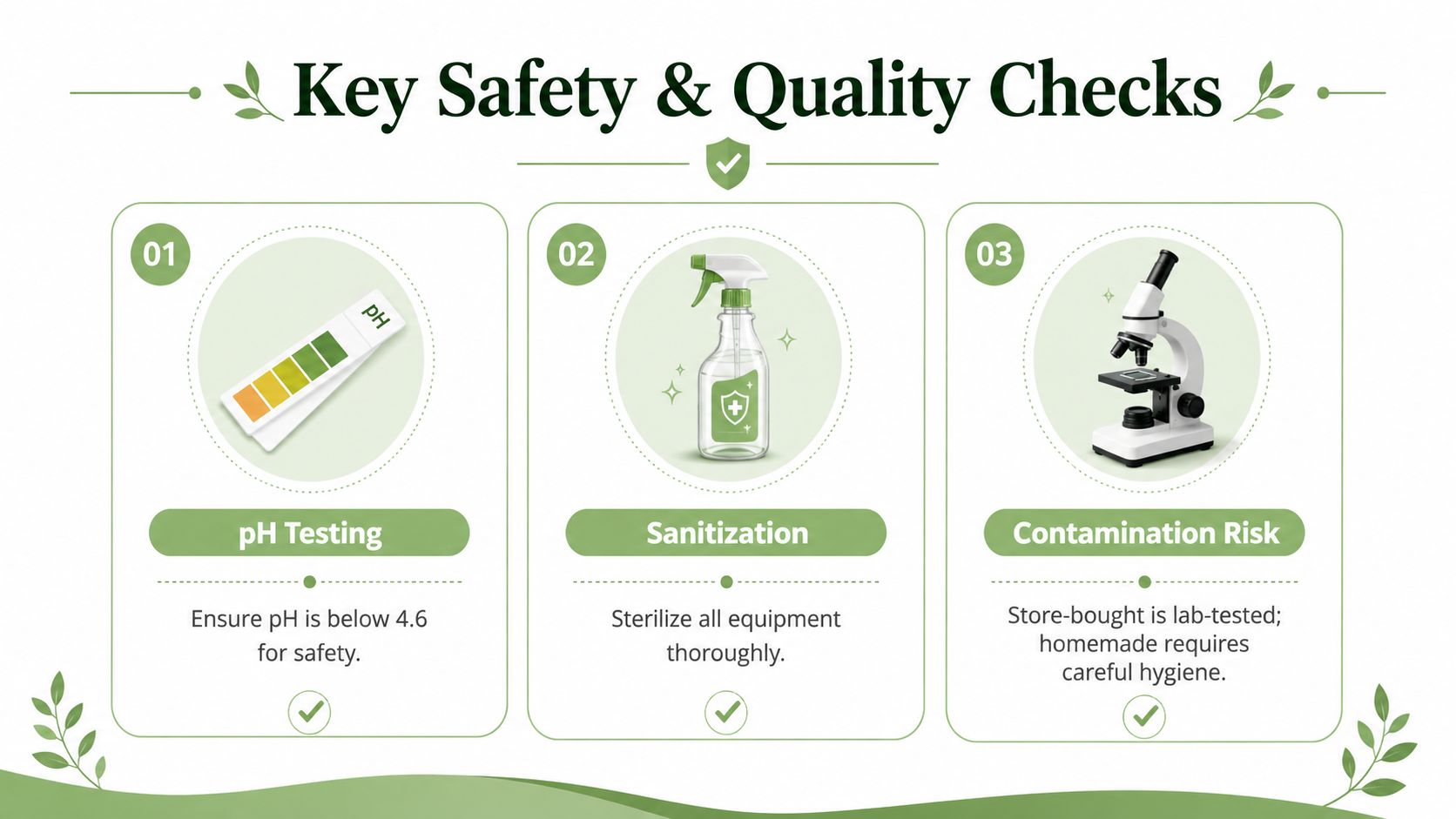
Safety is where the romantic version of home brewing can fall apart. Kombucha depends on acidity, cleanliness, and careful storage, and if any of those slip, the batch can go from pleasant to unsafe. That's why food safety guidance for consumer brewing keeps coming back to the same basics, sanitation, pH, and proper storage, all of which matter more in a kitchen than many people realise safe preparation, handling and storage guidance.
The home environment is the main issue. Unlike a commercial brewery, your kitchen isn't controlled for contamination risk, and the equipment you use may not be sterilised as thoroughly as it should be. Brew Dr. Kombucha also warns that contamination is more likely in home brewing, and notes that improperly manufactured ceramic vessels have been linked to lead poisoning because kombucha acids can leach lead from ceramic glaze buy or make kombucha.
What safe home brewing actually demands
You don't need lab gear to brew at home, but you do need discipline. The brew should be kept in glass or other food-safe containers, the tea must cool before starter liquid goes in, and anything that looks fuzzy or mouldy needs to be thrown out. If you want a broader food-safety lens for handling fermented drinks and hospitality service, Irish hospitality food safety guidance is a useful reference point for the kind of hygiene thinking that keeps problems from starting in the first place.
Homemade kombucha can be perfectly fine when the process is controlled. The risk isn't the idea of fermentation, it's sloppy handling, unsafe containers, and ignoring early warning signs.
Commercial kombucha brings different safeguards. Producers can use testing, documented processes, and food-safety systems that aren't realistic for most households. That's why a certified, HACCP-produced product can be the smarter choice for cafés and retailers that need consistency and less operational risk.
For readers comparing options, Pep Tea's real, raw organic kombucha fits that commercial safety-and-quality logic, especially when serving customers who expect dependable flavour and handling.
Nutrition and Probiotic Profiles Compared
The nutrition question is more interesting than the marketing would have you believe. A 2019 antioxidant analysis comparing homemade and commercial kombucha found that homemade samples had statistically higher concentrations of caffeine, catechin, epicatechin, EGCG, and total antioxidants, with the differences reported as significant at p < 0.05 antioxidant analysis of homemade vs commercial kombucha. A separate summary of the same research said homemade kombucha had, on average, twice the total antioxidants of store-bought kombucha homebrew is better.
That's a real difference, but it needs careful reading. Higher antioxidant counts don't prove better health outcomes, and they don't make every homemade batch superior in every way. They do show that home fermentation can preserve or produce a more complex chemical profile than some commercial products.
The probiotic part is where processing matters
Commercial kombucha may be processed to stop fermentation, and that can change the live-culture picture. If a drink is pasteurised or heavily stabilised, it may no longer behave like a living fermented beverage in the same way a fresh home brew does. On the other hand, home kombucha only keeps those active cultures if the brewer manages the batch correctly.
| Factor | Homemade | Store-Bought |
|---|---|---|
| Caffeine and tea compounds | Can be higher in some batches | Can be lower in some commercial products |
| Total antioxidants | Higher in the cited comparison | Lower in the cited comparison |
| Live cultures | Ongoing microbial activity if handled correctly | May be reduced by pasteurisation or stabilisation |
| Batch consistency | Varies by brewer | Usually more consistent |
| Shelf stability | Shorter, more variable | Usually stronger |
For a plain explanation of how probiotics fit into fermented drinks, Pep Tea's probiotic guide is a helpful companion read.
The honest takeaway is simple. Homemade kombucha can have a stronger antioxidant profile in the research cited here, but commercial kombucha may still be the better product for a café fridge or a retail shelf because it stays consistent and predictable. Better numbers on paper don't always mean better experience in the glass.
Cost and Time Investment for Home Brewing versus Buying
Cost is where a lot of people make their decision, and the gap can be wide. In the Australian figures provided, homemade kombucha can cost about $1 to $1.50 per litre, while commercial kombucha commonly sells at around $10 per litre, which implies roughly a 6.7x to 10x retail premium for store-bought bottles Australian retailer price comparison. That difference is hard to ignore if you're drinking it regularly.
The US comparison tells a similar story. Brew Buch estimates a typical store-bought 16-ounce bottle at about $3.99, with the initial home setup around $37.38, after which a 128-ounce batch costs about $0.12 per 16-ounce serving price of kombucha. Another source places homemade kombucha at $0.25 to $0.50 per 16-ounce bottle, versus $3 to $5 for store-bought price of kombucha.
The hidden cost is time
Home brewing isn't a grab-and-go habit. It asks for monitoring, bottling, waiting, and cleaning, and the batch itself can take around two weeks from start to finish in beginner guides. Store-bought kombucha wins on convenience because it's already finished, chilled, and ready when you want it.
That time difference matters for hospitality too. A café can't afford a drinks programme that depends on whether a jar fermented properly this week. It needs reliability, portion control, and service speed, which is why buying from a trusted producer often makes more sense than brewing in-house.
Practical rule: choose home brewing if the process itself is part of the value. Choose store-bought if the drink needs to behave like any other stocked menu item.
Packaging waste and refrigeration are part of the total cost as well. Bottled products bring more packaging, while home brewing uses fewer ready-to-ship containers but demands your own fridge space and attention. If you're running a venue, those details can change the overall cost of the drink more than the sticker price does.
Who Should Brew at Home and Who Should Buy from a Certified Producer
Home brewing suits people who like the process as much as the drink. If you enjoy cleaning jars, tracking fermentation, and tasting batches as they evolve, it can be a rewarding habit. It also makes sense if you want more control over ingredients and you're prepared to treat sanitation seriously.
A simple decision filter for home drinkers
- Choose home brewing if you have time, patience, and a food-safe setup.
- Choose a certified product if you've had contamination problems before, don't want to manage pressure in bottles, or prefer a consistent taste.
- Choose store-bought if convenience matters more than experimentation.
Cafés and hospitality venues sit in a different category. They need a kombucha that pours the same way every time, tastes the same across cases, and fits service standards without extra staff training. That's where a certified organic, HACCP-produced Australian kombucha becomes the smart operational choice, because the business isn't just buying flavour, it's buying consistency and reduced risk.
Retail buyers have their own priorities. Shelf stability, customer trust, and clean label communication matter more than the romance of fermentation. If a product can't hold up in distribution or creates avoidable quality issues, it becomes a liability rather than an asset.
A quick buyer's checklist
- For cafés: look for reliable supply, clear ingredients, and a product that can be served fast.
- For retailers: look for shelf clarity, strong packaging, and a brand story that's easy to explain.
- For home buyers: think about your own tolerance for batch variation and kitchen upkeep.

The best choice isn't always the most artisanal one. It's the one that fits the way you drink, serve, and store kombucha. If you're managing a business, certified production usually wins. If you're brewing for pleasure and you're happy to learn the craft, home fermentation can be worth the effort.
Practical Tips for Reading Labels and Testing Your Own Batches
Start with the label if you're buying kombucha. Look for wording that tells you whether the drink is pasteurised, filtered, or stabilised, because those processes can affect live-culture content. Also check for added sweeteners and flavourings, since some bottles are closer to a flavoured beverage than a living fermented tea.
For home batches, use your senses and a few basic checks. A healthy brew should smell pleasantly tart, not rotten or mouldy, and any fuzzy growth on the surface means the batch needs to go. If you test pH, keep an eye on acidity, because kombucha that isn't acidic enough is more vulnerable to spoilage.
Keep the home process simple
- Sanitise equipment well: jars, funnels, and bottles need to be clean before every batch.
- Watch the temperature: a stable room is better than a cold corner.
- Use safe containers: glass is the easiest place to start.
- Trust visual signs: mould looks fuzzy, not smooth.
If you're new to brewing, don't try to outsmart the process. Start with a simple recipe, keep notes on timing and taste, and make one change at a time. That's how you learn whether you actually enjoy making kombucha, rather than just liking the idea of it.
For many people, the answer in the store bought kombucha vs homemade debate is a mix of both. Brew at home if you want the ritual and can manage the care it needs, or buy from a trusted producer if you want safety, consistency, and less mess. If you'd like a reliable, Australian-made option, explore Pep Tea for organic kombucha made for everyday wellness, café service, and simple, practical enjoyment.
Organic Certification Australia: Your 2026 Guide

You've probably been here already. You've sourced organic tea, refined a kombucha recipe, designed a clean label, and started talking to cafés or retailers. Then the hard question lands: do you need organic certification, or is being careful with ingredients enough?
That's where many Australian beverage brands get stuck. The rules aren't always obvious, the terminology can feel bureaucratic, and buyers often use “organic” to mean very different things. For a matcha brand, a kombucha brewer, or a café choosing what to stock, the difference between organic ingredients, certified organic product, and a general organic claim is more critical than often perceived.
At Pep Tea, we spend a lot of time helping people sort through that confusion in a practical way. We work in a category where trust matters. Our premium Japanese organic Matcha and Australian-brewed sugar-free organic Kombucha sit in a part of the market where customers care about quality, clean ingredients, authenticity, and a product story they can believe. That makes organic certification Australia an important topic, not just for producers, but also for cafés, wholesalers, and retailers who want confidence in what they're putting on shelf or menu.
Is Organic Certification Worth It for Your Brand
A small beverage founder launches a new ginger kombucha. The tea is organic. The sugar source is chosen carefully. The fermentation process is dialled in. Early customers love it. Then a retailer asks a simple question: “Is it certified organic?”
That moment changes the conversation. It's no longer only about flavour, wellness positioning, or packaging. It becomes a trust question.
What certification changes in practice
For many small brands, certification can feel like admin layered on top of a busy production schedule. But in practice, it often works as a business signal. It tells buyers that someone independent has checked your systems, ingredients, and records.
That matters in Australia because the local organic sector is not small or fringe. Australia is a global leader in certified organic farmland, managing the largest share of the world's certified organic agricultural area. In 2018, Australia reported 35.7 million certified organic hectares, representing about half of the world's total at the time according to research on Australia's certified organic land area.
For a beverage brand, that scale sends an important message. Organics in Australia aren't a niche side category. They're part of a mature system with recognised standards, audits, and established buyer expectations.
When it's worth it
Certification tends to be more valuable when you're selling into channels where proof matters as much as the product itself.
- Retail shelves: Buyers often want clarity they can defend if customers ask questions.
- Hospitality supply: Café owners need products that fit their menu values and are easy for staff to explain.
- Premium positioning: If your label leans on purity, quality, and natural wellness, certification can support that message.
- Future flexibility: Brands that start with tighter systems often find later growth easier to manage.
Practical rule: If “organic” sits near the centre of your brand story, certification usually deserves serious consideration.
That doesn't mean every brand needs to rush into it on day one. Some businesses start by tightening sourcing and documentation first. Others certify early because they know they want stronger retail access or export options later.
For tea, matcha, and kombucha brands, the bigger question isn't whether certification is merely symbolic. It's whether your current proof matches the promise on your label.
Understanding Australian Organic Standards
When shoppers see “Certified Organic” on a pouch of matcha or a bottle of kombucha, they often assume somebody tested the final product and ticked it off. That's only part of the picture. In Australia, the system goes much deeper.
It's a process standard, not just a product claim
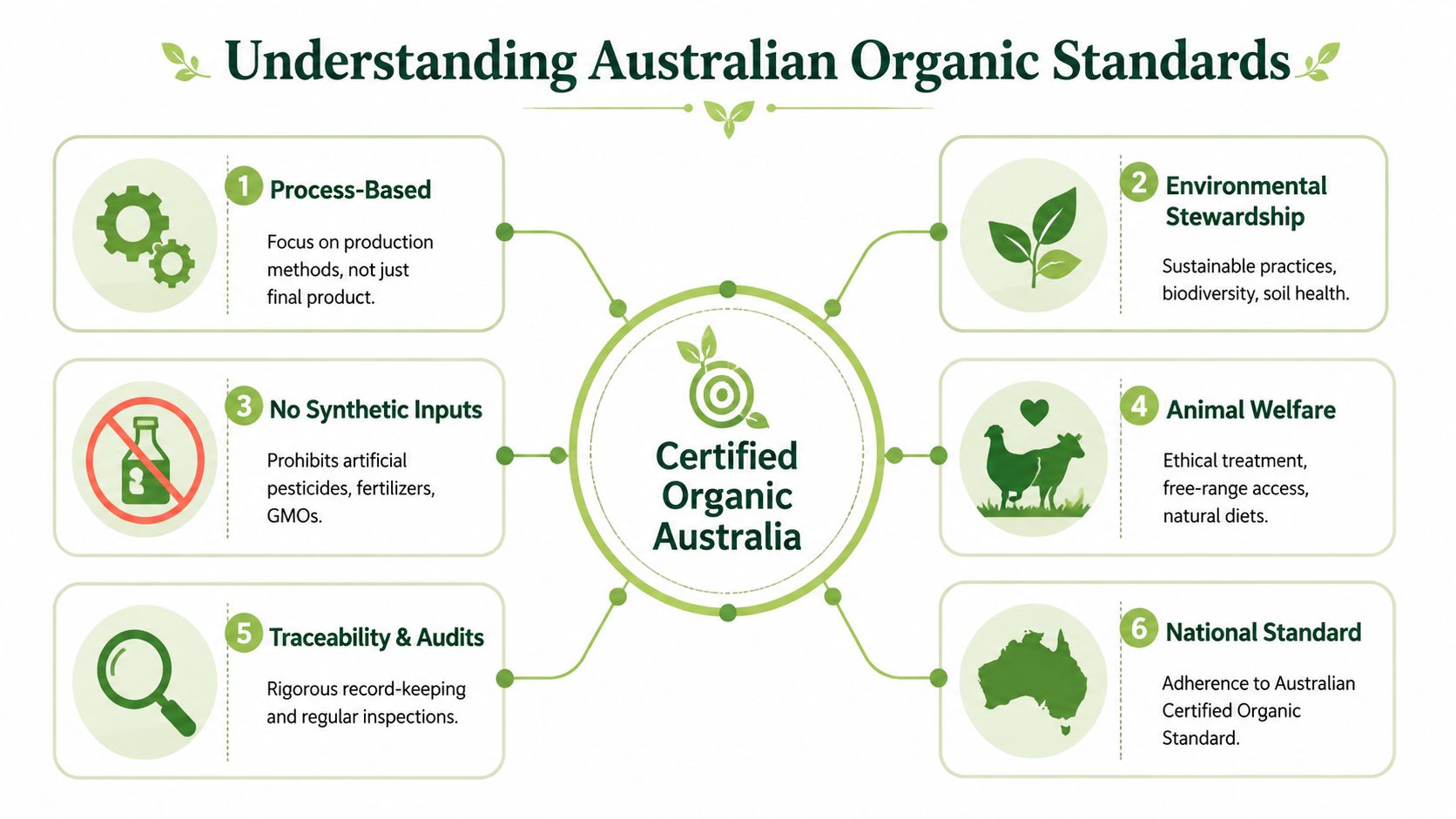
Australian organic certification is a process standard, which means auditors assess how a product is grown, handled, processed, stored, and traced through the supply chain. The checks cover inputs, animal welfare, biodiversity, and traceability under frameworks such as the National Standard for Organic and Bio-Dynamic Produce, as outlined in this explanation of Australian organic audit systems.
A simple way to think about it is a recipe with supervision at every stage. It's not enough for the final cup of matcha to look green and clean. The system asks where the leaves came from, what happened during growing, how they were processed, how they were packed, and whether records support every step.
The two standards most brands hear about
Australian brands usually come across two key frameworks.
National Standard for Organic and Bio-Dynamic Produce
This is the core export framework. If a product is being exported from Australia as organic, this standard matters in a very direct way.
It shapes how certifiers assess compliance and gives structure to the claim behind exported organic goods.
Australian Standard for Organic and Biodynamic Products
This standard, often referred to as AS 6000, is used in the domestic market and for imports. It helps create consistency for products sold within Australia, even though domestic certification rules work differently from export requirements.
Why beverage brands need to understand both
Tea and kombucha businesses sit in an interesting spot. They often rely on multiple ingredients, multiple suppliers, and processing steps that have to stay organised. That's why standards matter even if a brand starts small.
For example, a brand blending ceremonial-grade or culinary-grade matcha, bottling kombucha, or supplying cafés needs traceability that can stand up to buyer questions. If you want a plain-language introduction to how organic tea fits into that bigger picture, our guide on what organic green tea means is a useful starting point.
Certified organic isn't just a nice phrase on packaging. It's the result of a documented system that follows the product from paddock to plate.
What buyers are really relying on
When a café stocks an organic matcha for lattes or a retailer ranges an organic kombucha, they're trusting more than the ingredient list.
They're trusting that:
- Inputs were checked: The ingredients fit the standard.
- Handling was controlled: Organic and non-organic materials weren't mixed carelessly.
- Records exist: The brand can prove what went into each batch.
- Auditing happened: An independent body reviewed the process.
That's the core of organic certification Australia. It's less about marketing language and more about verified systems.
The Path to Getting Your Products Certified
The certification process feels intimidating until you break it into pieces. Most beverage brands don't struggle because the steps are impossible. They struggle because they try to understand everything at once.

Step one is getting your paperwork aligned
Before an auditor visits, a certifier usually wants a clear picture of your business. That includes what you make, where ingredients come from, how products move through your site, and how you separate any non-organic materials if they exist in the same facility.
For a kombucha producer, that might include your organic tea source, any flavour inputs, cleaning procedures, bottling flow, and batch records. For a matcha business, it often includes supplier certificates, packing or repacking details, and storage controls.
A good starting point is a practical overview like Pep Tea's guide to organic certification standards, which helps translate the rules into product-level decisions.
Your management plan matters more than people expect
Most certifiers want a written plan that explains how you maintain compliance. Think of it as your operating playbook. It should show that your team knows what to do, not just what to say.
Your plan usually needs to cover:
Ingredient sourcing
Which suppliers provide certified organic ingredients, and how you verify those claims.Production flow
How ingredients enter the site, where they're stored, and how batches are made.Cleaning and separation
What prevents cross-contact if organic and non-organic materials are both present.Labelling control
How you avoid using the wrong artwork, claims, or certification references.
What the audit actually checks
Organic certification in Australia typically follows an annual audit cycle, with on-site inspections and detailed record-keeping of inputs, practices, and sales to support traceability and consumer confidence, as described in this overview of organic certification practice.
That sounds formal, but on the ground it often comes down to organised evidence. Auditors want to see whether the story on your label matches how your operations are conducted.
They may review:
- Purchase records
- Batch sheets
- Storage areas
- Packaging and labels
- Sales records
- Cleaning logs
- Supplier documentation
Here's a short video that gives helpful visual context around certification thinking and process.
Small systems make audits smoother
The brands that cope best with certification usually aren't the biggest. They're the most organised.
Keep records as you go. Rebuilding batch history from old emails and invoices is where small teams lose time.
For beverage brands, simple habits help a lot:
- Save supplier certificates in one place
- Assign batch codes consistently
- Match sales records to production lots
- Train staff on what “organic” means in your facility
Certification is thorough, but it's not mysterious. It rewards businesses that can show their work.
Choosing Your Organic Certifying Body
Once you decide to pursue certification, the next question is who you'll work with. In Australia, the Department of Agriculture, Fisheries and Forestry accredits multiple certification bodies for organic systems used in export settings, and the market also recognises several established certifiers more broadly through domestic schemes and industry practice.
For most small beverage brands, the choice isn't about finding the “right” standard from scratch. It's about choosing a certifier whose process, support style, and market recognition fit your business.
What to compare before you sign up
Some certifiers are more familiar to supermarket buyers. Others may feel more approachable for smaller operators. Some have stronger recognition in conversations around future export readiness.
Look closely at:
- Your sales channel. Grocery, hospitality, and wholesale buyers may recognise different logos more readily.
- Support style. New applicants often need practical answers, not just policy documents.
- Paperwork expectations. Some businesses prefer a more guided onboarding process.
- International ambitions. If export is on your horizon, ask how the certifier handles equivalence and documentation.
Major Australian Organic Certifiers at a Glance
| Certifier | Market Recognition | Best For | International Equivalence |
|---|---|---|---|
| Australian Certified Organic (ACO) | Widely recognised in Australian retail and by many consumers | Brands seeking strong logo recognition on-pack | Ask directly about destination-market recognition and export pathways |
| NASAA Certified Organic (NCO) | Well known across organic agriculture and processing | Producers wanting an established certifier with broad sector familiarity | Ask directly about export documentation and partner-market acceptance |
| Australian Organic | Familiar within the domestic organic conversation | Brands comparing domestic positioning and support | Confirm how its certification pathway aligns with your market plans |
A few smart questions to ask
Before choosing, send each certifier the same short list of questions. Their replies often reveal a lot.
Ask things like:
- How do you handle mixed facilities?
- What records do beverage brands usually need ready?
- How do you support first-time applicants?
- What does your review cycle look like if labels change?
A certifier is not just an auditor. For many small brands, they become part of the operating rhythm of the business.
If you brew kombucha, repack tea, or manage several SKUs for cafés and retail, the practical fit matters as much as the logo itself.
A Practical Checklist for Food and Beverage Brands
A lot of certification stress can be avoided before the application starts. If your systems are loose, certification will feel painful. If your systems are tidy, the process becomes much more manageable.
Your pre-certification checklist
Australia's organic sector includes over 3,000 certified operators, supports more than 5,500 jobs, and is valued at A$3.8 billion in 2024-25. In the same reporting, 39% of shoppers said they would avoid an organic product without a certification logo, according to Australian organic market reporting.
That makes readiness more than a compliance issue. It's a commercial one.
Sourcing
- Confirm ingredient certificates: Make sure every key ingredient you want to describe as organic has current supporting documentation from suppliers.
- Check continuity: One certified input isn't enough if you can't maintain supply across future batches.
- Review packaging claims: Your labels should match the certification status of the finished product, not just one ingredient.
Operations
- Map your batch flow: Know what arrives, where it's stored, how it's used, and what leaves the site.
- Separate materials clearly: If your facility handles different product types, storage and production need to stay organised.
- Train your team: Staff should know what paperwork matters and what claims they can't make casually.
Commercial readiness matters too
Certification should support the way you sell. That means asking whether your likely customers will value it and whether it helps you hold your position in a premium segment.
For beverage brands, useful prompts include:
- Will cafés ask for proof before ranging your product?
- Will retailers want a logo they can trust quickly?
- Does your pricing rely on a premium organic position?
- Are you building toward larger wholesale or export conversations?
Keep your proof close
The easiest businesses to audit are usually the ones that already run clean admin.
If you can trace one bottle of kombucha or one pouch of matcha from supplier document to customer invoice, you're in a strong position.
That's especially relevant in categories like sugar-free kombucha and premium matcha, where customers often care about ingredient integrity and process quality at the same time.
Reading the Label A Guide for Cafes and Retailers
If you buy for a café, health food store, or grocery range, “organic” on a product label shouldn't end your due diligence. It should start it.

Why buyers need to check more closely
The ACCC confirms that organic certification is not mandatory for domestic products, but businesses must still be able to substantiate organic claims. That creates confusion for retailers who may struggle to tell the difference between a substantiated claim and a fully audited certified product, as noted on the ACCC page about organic claims.
For buyers, that means two products can both reference “organic” in some way while offering very different levels of assurance.
What to look for on-pack
A careful buyer should check for more than attractive green packaging or wellness language.
Look for:
- A certification logo: This is often the quickest visual cue that a product has gone through formal auditing.
- Clear product description: “Made with organic ingredients” is not the same as a certified organic finished product.
- Supplier backup: Ask for current certification documents if the claim matters to your menu or shelf standards.
- Consistency across materials: Label, website, sales sheet, and invoice language should line up.
If you're buying tea for a café menu or retail shelf, browsing products through a clear product page such as buying organic green tea online can make it easier to compare what's stated openly versus what needs follow-up.
The risk of being too casual
If your venue markets itself around clean living, premium ingredients, or natural wellness, vague organic claims can create brand risk. Staff may repeat supplier claims to customers without knowing whether those claims are certified, self-substantiated, or only ingredient-level.
That matters in beverage service. Matcha lattes, bottled kombucha, and wellness drinks are often sold with a story. If the story is fuzzy, customers notice.
Ask one simple question: “Is the finished product certified organic, and can you send the current proof?”
A safer buying habit
For cafés and retailers, the safest approach is straightforward:
- Request the certification detail.
- Check that the claim applies to the finished product.
- Keep supplier documentation on file.
- Review again when products, labels, or suppliers change.
That extra step protects your business and helps customers trust what you pour, stock, and recommend.
Your Organic Certification Questions Answered
Do I need certification to call a product organic in Australia
Not always for domestic sales. A business can make organic claims domestically if those claims are truthful and can be substantiated. The challenge is that substantiation without formal certification can be harder to communicate clearly to buyers and customers.
Is certified organic the same as using organic ingredients
No. A product can contain organic ingredients without the finished product itself being certified organic. That distinction matters a lot for processed beverages like kombucha, ready-to-drink tea, and blends with multiple inputs.
How often does certification get checked
Certification in Australia commonly works on an annual audit cycle, with inspections and record review forming part of the process. Businesses need to maintain records throughout the year, not just tidy things up when an audit is due.
What usually trips small brands up
Most problems come from documentation gaps, unclear supplier records, inconsistent labels, or poor batch traceability. The ingredient quality may be fine, but the paper trail doesn't back it up strongly enough.
Does certification matter for cafés if they aren't manufacturing
Yes, because cafés still make buying and menu claims. If a venue says it uses organic matcha or stocks organic kombucha, it should understand whether the supplier claim is certified and current.
Is certification worth it for a small beverage brand
Often, yes, if organic is central to your positioning and you want stronger credibility with retailers, hospitality buyers, and health-conscious customers. If you're not ready yet, getting your sourcing and record-keeping in order is still a smart move.
What about export later on
That's where early discipline helps. Brands that align their systems with recognised standards from the start usually have an easier path when export becomes realistic.
If you're building a beverage brand or choosing products for your café, we're always in favour of clearer proof and better questions. Explore Pep Tea for organic Matcha, sugar-free organic Kombucha, and practical guidance for Australian businesses and wellness-minded customers who want confidence in what they drink.
Real Raw Organics Kombucha: An Australian Buyer’s Guide
You're probably standing in front of a fridge full of bright labels right now, looking at words like raw, organic, living, probiotic, and real, and wondering which ones mean something and which ones are just packaging.
That confusion is fair. Kombucha has picked up a lot of wellness language, and not every bottle earns it. Some brews are carefully fermented and cold handled. Others feel more like flavoured fizzy tea dressed up to look the part.
If you've been searching for Real Raw Organics kombucha or trying to work out what matters when choosing a proper kombucha in Australia, the useful question isn't “Which label sounds healthiest?” It's “What signs tell me this was brewed with care, handled safely, and sold transparently?”
That's where this guide helps. We'll keep it practical, plain-English, and grounded in what a buyer can check on the shelf.
The Kombucha Aisle Dilemma
Walk into a health food shop, a local grocer, or even a café fridge, and you'll see the same pattern. Every bottle seems to promise purity, gut support, live cultures, and natural ingredients. At a glance, they all look similar.
The trouble starts when those words blur together. Real sounds reassuring. Raw sounds wholesome. Organic sounds cleaner. Living sounds active and beneficial. But those terms don't all point to the same thing, and they don't all tell you whether the brew was handled properly.
Some brands lean heavily on rustic branding. Murky bottle. earthy colours. farmhouse language. That can be fine, but it can also hide sloppy process. A rough-looking bottle isn't proof of authenticity. Sometimes it's just rough-looking.
A good kombucha should feel transparent, not mysterious. If a brand makes big promises but gives you little detail, that's worth noticing.
That's why a practical buying framework matters more than marketing language. You want to know what's in the bottle, how it was fermented, whether the culture is still alive, and whether the producer seems organised enough to manage a living drink safely.
If you're comparing local options, this guide on where to buy organic kombucha in Australia is a handy next step once you know what to look for.
Why buyers get stuck
A few things trip people up again and again:
- They confuse cloudy with high quality. Some sediment is normal in raw kombucha. A chaotic bottle isn't automatically better.
- They assume “organic” means “raw”. It doesn't. Organic refers to ingredients and farming standards, not whether the drink still contains live cultures.
- They treat all fizz the same. Natural fermentation and added carbonation can produce very different drinking experiences.
- They assume more claims means more quality. Often the opposite is true. Good producers usually explain their process clearly and directly.
That's the kombucha aisle dilemma. Not too few choices. Too many labels saying almost the same thing.
Defining Raw and Organic Kombucha
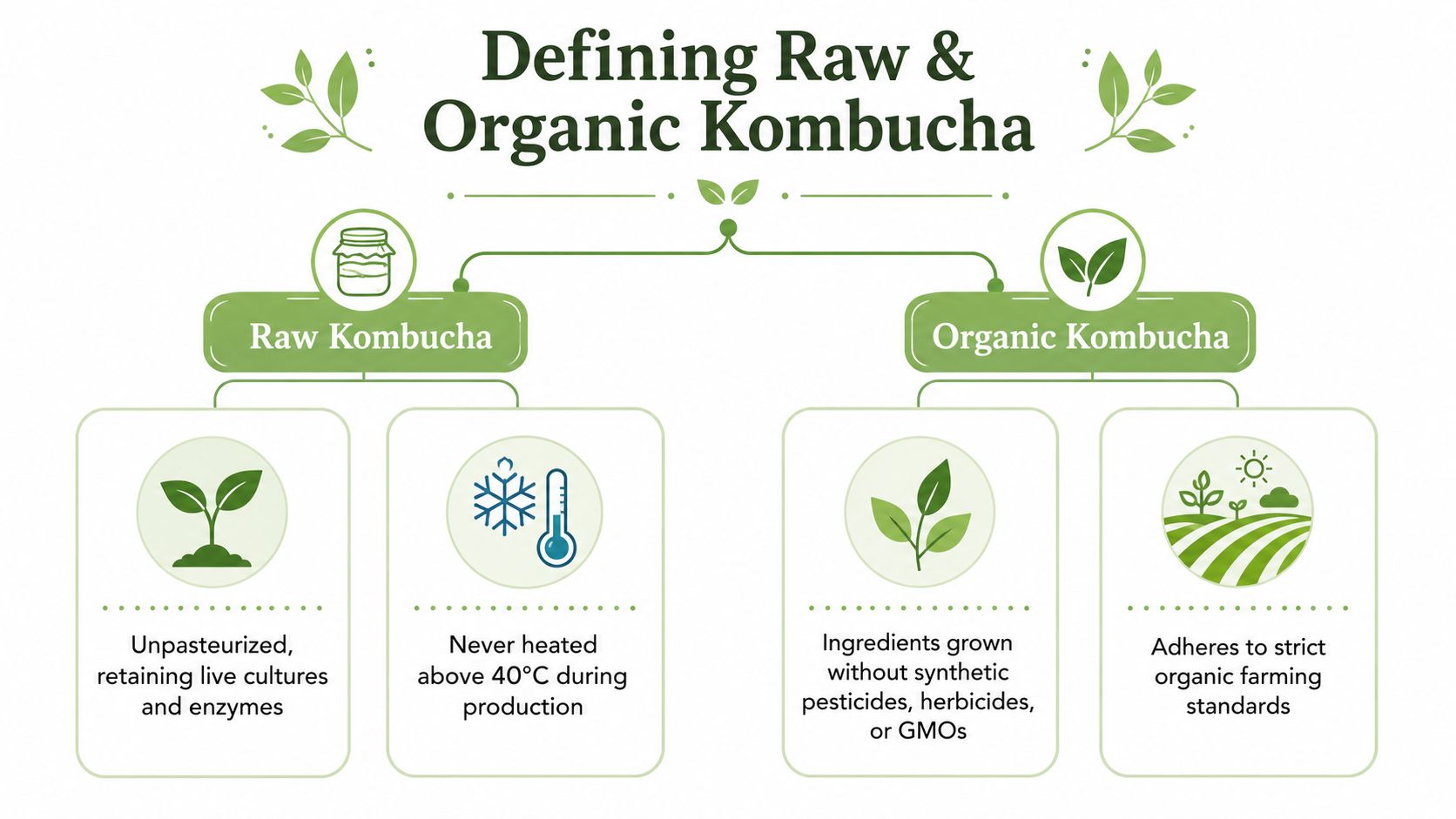
You can save yourself a lot of confusion by sorting kombucha claims into three separate ideas: raw, organic, and living. On the shelf they often get bundled together, but they answer different questions. One is about processing, one is about ingredients, and one is about whether the culture is still active in the bottle.
What raw means in practice
Raw kombucha usually means the drink has not been pasteurised after fermentation. In everyday terms, it has not been heat-treated to the point that the live culture is knocked back or wiped out. That matters because the culture is not a decorative extra. It is part of what makes kombucha kombucha.
A good way to picture it is fresh yoghurt versus a shelf-stable yoghurt dessert. They may look similar from a distance, but they are not handled the same way and they do not offer the same living character. Raw kombucha works in that same practical sense.
Raw also helps explain sediment, which confuses plenty of buyers. A light layer at the bottom, fine strands, or a bit of cloudiness can be normal in a living brew. It can come from yeast, tea particles, or new culture forming. Sediment is not a gold medal for quality, and it is not a warning sign by itself either. It is only one clue, and you need to read it alongside the label, storage instructions, and how clearly the producer explains their process.
If you want a plain-English look at how the culture develops, this guide to making and understanding a kombucha SCOBY helps connect what is happening in the jar to what you later see in the bottle.
What organic actually tells you
Organic kombucha refers to the ingredients used to make it. That usually means the tea, sugar, fruit, herbs, or spices were grown and handled under organic standards rather than conventional farming systems.
That is useful information, but it does not tell you how carefully the kombucha was brewed. A producer can start with organic ingredients and still rush fermentation, over-flavour the batch, or process it in a way that strips out the living character. The reverse can also be true. A kombucha can be raw and alive without every ingredient being organic.
For shoppers, this is the key distinction. Organic tells you about sourcing. Raw tells you about processing.
What living refers to
A living kombucha still contains active microbes from fermentation. On the label, that may appear as live cultures or similar wording. In Australia, that claim should sit comfortably with the rest of the product details, especially refrigeration and shelf-life. If a bottle presents itself as alive but is treated like a soft drink that can sit warm indefinitely, it is fair to ask more questions.
Research on kombucha composition has also found that fermentation can change the drink's profile by producing organic acids and transforming tea compounds, though the result depends heavily on the tea, sugar, culture, and brewing conditions, as described in this review of kombucha processing and composition.
That last part matters. “Living” is not a magic word. It does not guarantee a careful brew, and it does not override basic food safety.
A quick way to separate the terms
| Term | What it points to | What it does not guarantee |
|---|---|---|
| Raw | Minimal post-fermentation heat treatment | Organic ingredients |
| Organic | Farming and ingredient standards | Live cultures |
| Living | Active microbial culture remains in the drink | Careful ingredient sourcing |
Cowboy brands often blur these lines because the blur helps them sell. A better producer makes the distinctions easy to understand. That clarity is what you want. It gives you a practical way to judge the bottle for yourself, especially when you are trying to work out whether the sediment is normal, whether the culture is likely still active, and whether the product looks handled in a way that would meet Australian expectations for a refrigerated, living drink.
Behind the Brew The Authentic Fermentation Process
You pick up a bottle, give it a gentle tilt, and see a little haze drifting through the glass. For plenty of shoppers, that is the moment the doubts start. Is that a sign of a real ferment, or a sign that something has gone wrong? The answer starts with understanding how kombucha is made.
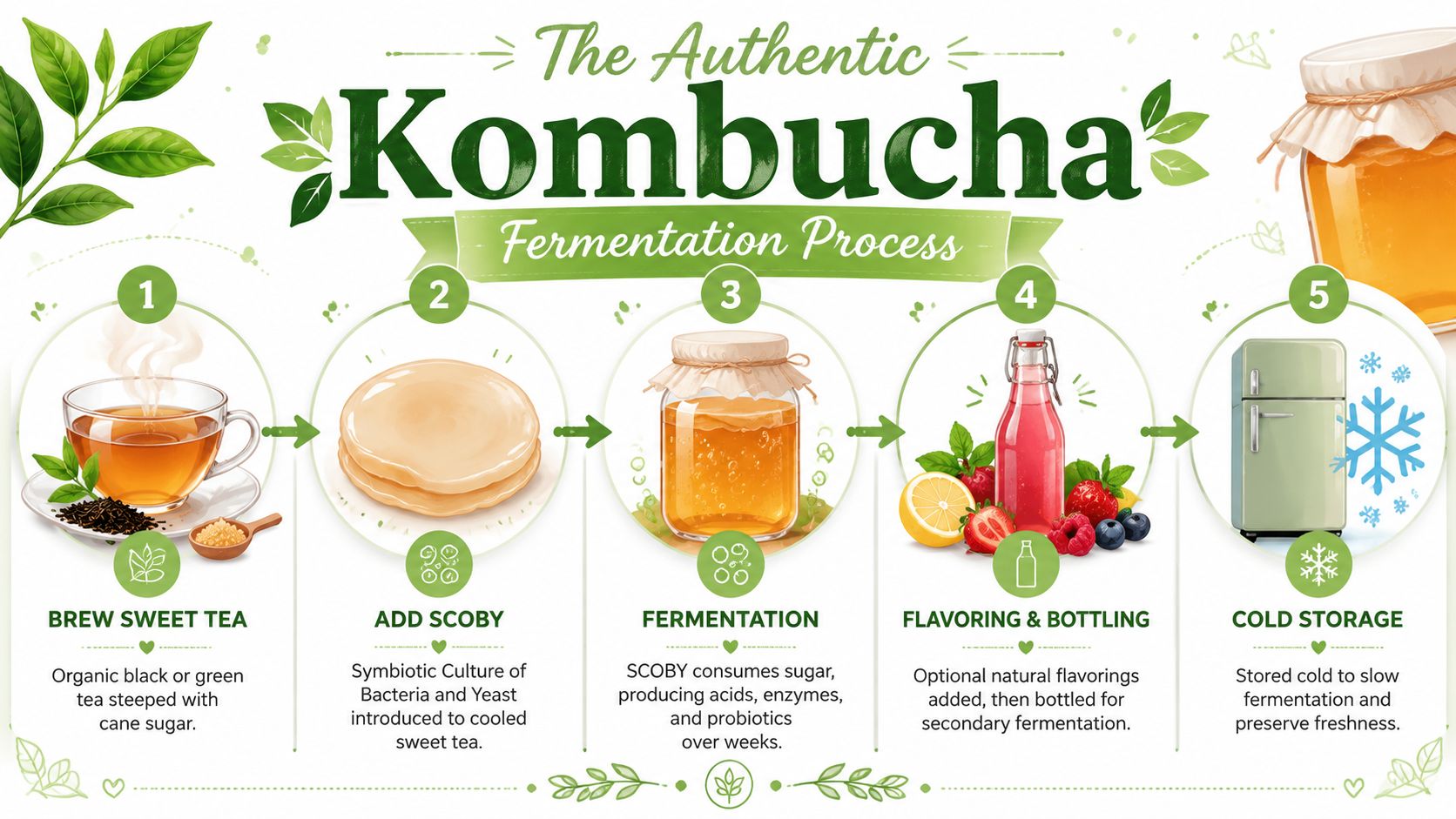
A genuine brew begins straightforwardly. Tea is steeped. Sugar is mixed in while the tea is warm. The liquid is cooled, then the SCOBY and starter liquid are added. After that, the microbes take over and slowly change sweet tea into something brighter, drier, and more complex.
What the SCOBY is actually doing
SCOBY stands for symbiotic culture of bacteria and yeast. The name sounds a bit lab-coat, but the job is easy enough to follow once you break it into stages.
First, the yeast starts feeding on the sugar. As it does, it creates alcohol and carbon dioxide. Then the bacteria use those fermentation by-products and turn them into the acids that give kombucha its clean tang. A good comparison is sourdough or yoghurt. You begin with a simple base, then a living culture reshapes it over time into something with its own character.
That also clears up one of the biggest points of confusion. Sugar is there to feed the ferment at the start. It is not there so the finished drink tastes like cordial.
Why time matters more than branding
Authentic kombucha needs time because flavour does not arrive all at once. In the early stage, the brew can taste flat and sweet. Leave it too long, and the acidity can push too far. The brewer's skill is in knowing when the tea, acidity, fizz, and remaining sweetness are in balance.
That is one of the easiest ways to spot the cowboy end of the market. Some brands build a kombucha image around fruit flavour, buzzwords, and flashy packaging, then deliver something that drinks more like soft drink with a health halo. You can add flavouring after the fact. You cannot fake the layered character that comes from a careful ferment.
A practical test helps here. If the first clear impression is sugary fruit and the tea-ferment note barely shows up, the brewing may not be doing much of the work.
For home brewers wanting to understand the culture itself, this guide on how to make a kombucha SCOBY explains the living side of the process in plain language.
What authentic fermentation looks like in the glass
A well-made raw kombucha usually leaves a few honest clues once it is poured.
- Balanced tartness. The acidity should taste refreshing and clean, not rough or aggressively vinegary.
- Natural-looking fizz. Fine bubbles usually feel more integrated than the sharp pop of a heavily force-carbonated drink.
- Tea still present. Even with ginger, citrus, or berry flavours, you should still get some sense of the tea underneath.
- A drier finish. Real fermentation often leaves the palate cleaner and less sticky than a sugary soft drink.
- Some variation bottle to bottle. Small differences can happen in living products, though a careful producer still keeps that variation under control.
Second fermentation can add more texture and lift, especially when fruit or juice is used thoughtfully. Done well, it creates extra sparkle and depth. Done poorly, it can lead to gushing bottles, muddled flavour, or sediment that looks messy rather than natural.
That point matters in Australia, where a living, fermented drink still has to be handled with care. The process should produce character, not chaos. When you understand that, sediment stops looking mysterious and starts looking like one more clue about whether the bottle in your hand comes from a real brewer or a brand just borrowing the language of one.
Reading the Signs of a Quality Brew
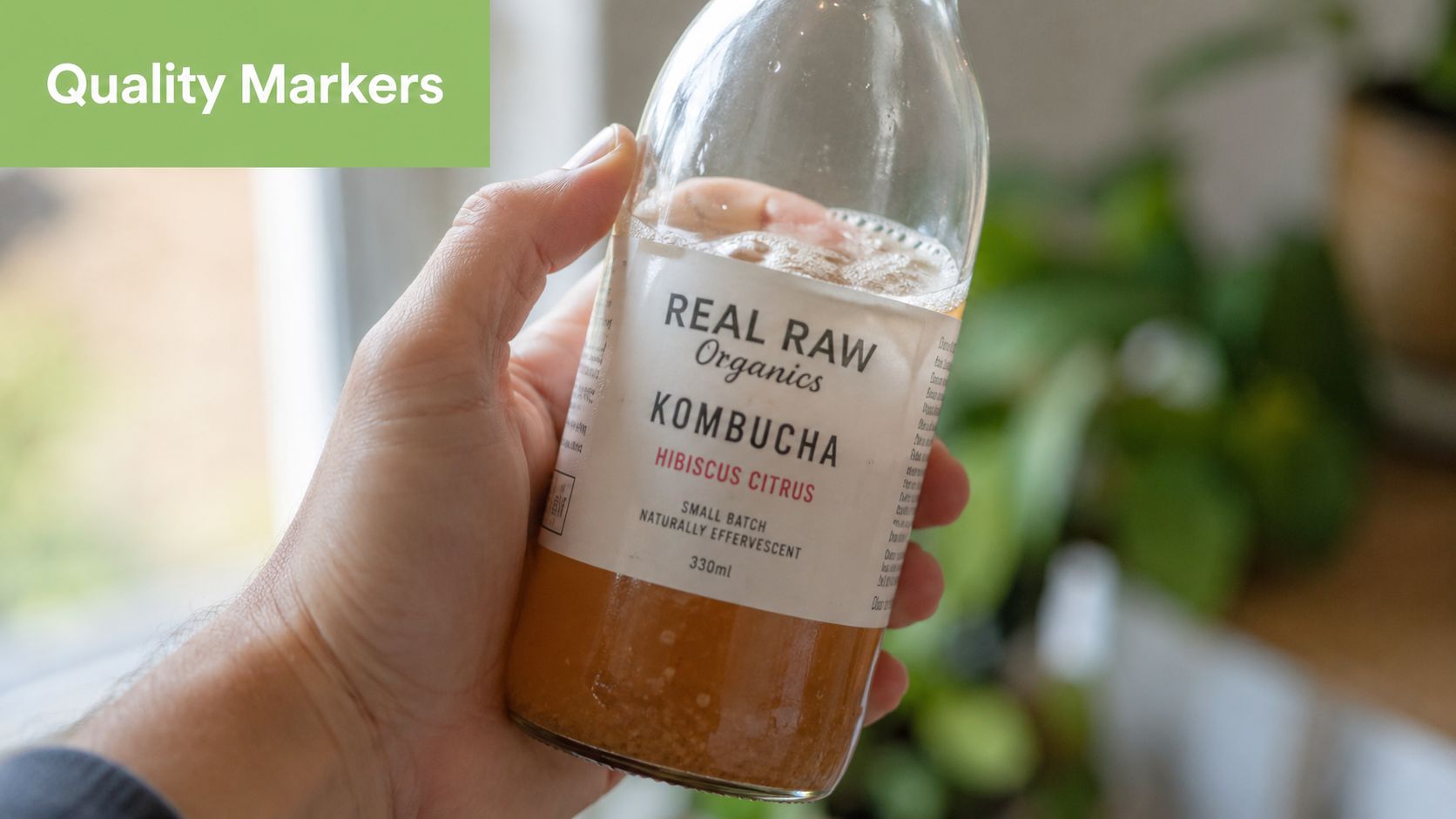
A quality kombucha gives you clues before you even open it. Label detail, ingredient list, sediment, fizz, and handling instructions all tell a story.
Start with what the label can prove
Look for specifics, not mood. “Raw”, “living”, and “organic” are useful starting words, but they should be backed by something concrete such as ingredient transparency, refrigeration guidance, or clear mention of active cultures.
Real Raw Organics states that each 16-ounce jar contains 3 billion live probiotics and says that's three times more than leading brands. The company also says the fizz comes from natural fermentation rather than force carbonation. Those are company-reported figures, so they're best treated as brand claims rather than independent lab findings, as stated on the Real Raw Organics website.
That kind of claim isn't useless. It can tell you how the brand positions its brew. But smart buyers read it as one piece of evidence, not the whole case.
What sediment really means
Sediment confuses people more than almost anything else. They see strands, flecks, or a light haze and assume one of two extremes. Either “this must be ultra-natural” or “this has gone off”.
Neither reaction is reliable.
A little sediment is normal in raw kombucha because it's a living fermented drink. Small particles of yeast, culture, or tea can settle out. That's not automatically a fault. But heavy, messy sediment can also point to less refined filtration, weaker process control, or inconsistent bottling.
A shelf-side way to think about it
- A light haze or fine sediment can be perfectly normal.
- Large floating clumps aren't always dangerous, but they may put off drinkers and suggest rough handling.
- A bottle that looks different every time you buy it can signal inconsistency.
- Clear storage instructions matter. Raw kombucha usually needs cold handling for a reason.
Sediment tells you something. It just doesn't tell you everything on its own.
Check the ingredient list with a brewer's eye
The best ingredient list is usually boring in the best possible way. Tea. sugar for fermentation. culture. maybe fruit, herbs, or spices. That's the basic frame.
If the label leans heavily on sweeteners, flavour systems, or vague “natural” language without much explanation, pause there. Kombucha should taste built, not assembled.
For buyers who want a low-sediment, certified organic Australian option, Pep Tea offers raw organic kombucha brewed in NSW as one example of a producer focusing on controlled fermentation and clean ingredient lists.
Watch how the pour behaves
This short visual is useful because quality often reveals itself once the bottle is opened and poured.
A practical buyer's checklist
| Sign | What you want to see | Why it matters |
|---|---|---|
| Culture claim | Clear language around live cultures | Suggests the drink is still active |
| Storage guidance | Kept refrigerated | Supports cold-chain handling for a living product |
| Ingredient list | Tea, fermentation inputs, recognisable flavourings | Easier to judge what's driving the taste |
| Sediment level | Some is fine, excessive isn't ideal | Helps assess process control |
| Fizz quality | Integrated natural sparkle | Often signals a more careful brew |
Good kombucha doesn't need to look rustic to be real. It needs to look managed.
Navigating Health and Safety in Australia
In Australia, the safety conversation around raw kombucha is less about drama and more about discipline. It comes down to fermentation control, alcohol management, storage, and honest labelling.
Australian food standards require fermented foods and drinks to stay within alcohol limits for their classification, and kombucha is often discussed in Australia because alcohol can vary during fermentation and storage. In practical terms, that puts the focus on labelling, batch control, and cold-chain handling, as described in the referenced note on Australian kombucha safety and alcohol variability.
Why cold storage matters
Kombucha is alive. That's a strength, but it also means the product can keep changing if it isn't stored properly. Warm conditions can push fermentation further than intended, which may affect flavour and alcohol formation.
That's why refrigeration isn't just a merchandising choice. It's part of quality control.
If you're brewing or assessing acidity at home, a digital pH meter for kombucha checks is one of the simplest tools for keeping process decisions grounded in measurement rather than guesswork.
Common questions buyers ask
Is raw kombucha safe?
For many people, a properly produced and properly stored kombucha can fit comfortably into everyday drinking. The key words there are properly produced and properly stored.
A brand should give you confidence that it understands fermentation, not just flavour.
What about pregnancy, children, or avoiding alcohol?
Those situations call for extra caution. Because kombucha is a fermented beverage, people who are pregnant, buying for children, or avoiding alcohol completely should read labels carefully and speak with a qualified health professional if unsure.
That's not fear-mongering. It's just sensible.
Does “raw” mean wild and uncontrolled?
No. In a good brewery, raw should mean carefully controlled without unnecessary heat treatment after fermentation. It shouldn't mean chaotic.
The safest raw kombucha is usually the one made by the most organised brewer.
Packaging matters too
Safety isn't only about what happens in the tank. It also includes what happens after bottling. Container choice, closure quality, and storage all affect the drinking experience.
If you're comparing reusable bottles, takeaway formats, or café service vessels, this explainer on why BPA free matters is a useful refresher on packaging considerations many buyers overlook.
How to Use Kombucha for Consumers and Cafés
Once you've found a kombucha you trust, the next question is simple. How do you use it in daily life without overthinking it?

Kombucha often works best when it replaces something less helpful. A sugary soft drink in the afternoon. A heavy mixer at dinner. Another forgettable fridge option that tastes sweet but doesn't feel refreshing.
For home drinkers
A good raw kombucha suits a few easy moments in the day:
- With lunch if you want something sharper and less sugary than soft drink
- Mid-afternoon when you're after flavour and fizz without reaching for confectionery
- With a savoury meal where acidity helps cut through richness
- As a weekend alcohol alternative poured into a proper glass, not drunk absent-mindedly from the bottle
Serve it cold, open it gently, and pour with a little care if there's visible sediment settled at the bottom.
For cafés and hospitality venues
Kombucha has become a practical menu tool because it can do more than sit in the grab-and-go fridge. It can anchor a non-alcoholic list without feeling childish or overly sweet.
A café or bar can use it in a few ways:
| Use case | Practical idea |
|---|---|
| Straight serve | Chilled bottle or glass pour with garnish |
| Mocktail base | Pair with citrus, herbs, or tonic-style elements |
| Food pairing | Match brighter flavours with brunch or lighter meals |
| Menu upgrade | Offer a fermented option beside juices and sparkling water |
Operators who want to make functional drinks easier to stock and serve also need their back-of-house systems sorted. If you're tightening purchasing and wastage control, this guide on how to optimize hospitality operations is a practical read.
Keep the serve simple
The biggest mistake cafés make with kombucha is overbuilding it. If the brew is good, it doesn't need a dozen ingredients piled on top.
Let the ferment do some of the talking. A strip of citrus peel, a clean glass, and proper chill will often beat an overcomplicated mocktail.
For drinkers at home, the same rule applies. Buy better. Fiddle less.
Your Checklist for Choosing the Best Kombucha
When you're facing a fridge full of options, keep the decision simple. Don't ask which label sounds the most natural. Ask which bottle gives the clearest signs of careful brewing.
The shortlist that matters
- Check whether it's raw or living. You're looking for signs that the culture is still active and the drink has been kept cold.
- Read the ingredients plainly. Tea, fermentation inputs, and recognisable flavourings are easier to trust than a long list of extras.
- Treat probiotic claims sensibly. Specific figures can be useful, but brand-reported numbers are still brand-reported numbers.
- Look at the sediment without romanticising it. A little can be normal. A lot isn't automatically a badge of honour.
- Consider the producer's discipline. Storage, consistency, and clear labelling tell you as much as the front label does.
- Think in Australian conditions. A living fermented drink needs good handling from brewery to shelf to home fridge.
What “real raw organics kombucha” should mean to you
It should mean more than nice packaging and wellness language. It should point to genuine fermentation, careful cold handling, sensible ingredient choices, and an honest approach to safety.
That's the difference between a proper kombucha and a cowboy one. It doesn't need to shout. It just needs to stand up to scrutiny.
If you'd like a local example of what that checklist looks like in practice, explore Pep Tea for Australian organic tea and raw kombucha options brewed with a clean, quality-focused approach.
Organic Certification Standards a Guide for AU Brands

You're probably here because you've seen an organic logo on a tea tin, kombucha label, or wholesale product sheet and thought, “We should understand this properly before we make any claims ourselves.”
That's a smart instinct.
For Australian business owners, organic certification can look simple from the outside and surprisingly technical once you get into the details. That's especially true if you're buying imported ingredients like Japanese matcha, blending multiple ingredients into a finished product, or brewing something processed like kombucha. At that point, the question isn't just “Is this ingredient organic?” It's “Can we prove the whole chain is compliant?”
That distinction matters. A lot.
Why Organic Certification Is More Than Just a Logo
A café owner starts stocking premium matcha. A small beverage brand begins trialling a kombucha line. A retailer compares two tea suppliers and notices one carries a recognised organic certification mark while the other just says “organic” on the pack. The product may look similar on the shelf, but the business risk behind those labels is very different.
That's where many owners feel torn. They want the trust that comes with certification, but they also worry it means paperwork, audits, and rules that seem built for farms rather than finished drinks.
In practice, organic certification is less about bureaucracy and more about credibility you can demonstrate.
Health-conscious customers don't just want attractive packaging or wellness language. They want to know how a product was grown, handled, packed, and transported. Certification gives you a structured way to answer those questions. Instead of asking buyers to accept your claims, you're showing that an independent system has checked them.
Why the logo carries weight
The organic logo matters because it acts like a shortcut for trust. It tells the customer that the product isn't relying on vague words like “clean”, “natural”, or “pure”. It's tied to documented standards, supplier controls, and auditing.
That's particularly useful in categories like tea and kombucha, where buyers often care about origin, processing, and ingredient integrity. Someone choosing ceremonial matcha or a low-sugar fermented drink usually reads labels closely. They want more than a nice story.
Organic certification works best when you treat it as part of your operations, not just your marketing.
For Australian brands, that can become a real commercial advantage. It helps with wholesale conversations, supports retailer confidence, and makes your internal systems sharper. Teams usually become more organised because certification forces clarity around sourcing, storage, and records.
Why it feels harder than it first appears
Organic certification sounds simple until your business has to manage real-world details.
For example:
- Imported ingredients: Your tea may come from Japan, but your finished pack is sold in Australia.
- Shared facilities: You may handle both certified and non-certified products in the same site.
- Processed products: A kombucha recipe includes tea, sugar, cultures, flavourings, cleaning controls, and batch records.
- Customer expectations: Buyers often assume “organic” is a single government-run label, when it isn't.
That's why educational content matters. If you want a useful starting point on certified tea and what buyers often look for, Pep Tea's guide to organic green tea online is a practical example of how certification connects to product quality, not just branding.
What Organic Certification Really Guarantees
Many people assume organic certification means someone tests the finished product and confirms it's “clean”. That's not really how organic certification standards work.
A better way to think about it is a verified cookbook. The certifier doesn't only inspect the final cake sitting on the bench. They check the recipe, the ingredients, the kitchen procedures, the storage, and whether the baker kept the organic flour separate from everything else. The guarantee is about the system being followed from start to finish.
It's a process guarantee
The most important idea to understand is this: certification verifies process integrity.
The operational implication of organic certification is that a brand must maintain a documented organic system, approved inputs, and traceability across farming, processing, and handling to satisfy audits. The system is designed to verify process control, including field history, input approval, segregation, and records, so any break in the chain of custody can invalidate status, as explained in this overview of organic certification process control.
That's why a finished product can lose organic status even if it still looks identical to the customer. If a non-approved cleaning input was used, if records don't match, or if organic and non-organic stock were mixed without proper controls, the issue is procedural and still serious.
What that looks like in plain language
Organic certification standards generally ask a business to prove that it can control the full path of the product.
That usually means:
- Knowing your inputs: Every ingredient, processing aid, and relevant material needs to be assessed for compliance.
- Maintaining separation: Organic goods can't just sit anywhere and hope for the best. They need clear segregation in receiving, storage, production, and packing.
- Keeping records: Purchase records, batch sheets, labels, cleaning logs, and dispatch documents all help prove what happened.
- Protecting traceability: You should be able to follow a product backward to suppliers and forward to customers.
If you're also reviewing packaging choices alongside certification, it can help to look at broader operational resources like these sustainable food packaging options UK, especially if your team is trying to align environmental decisions across product, pack, and presentation.
A certified organic product isn't simply “made from good ingredients”. It comes from a controlled, documented system.
That's why the difference between “organic” and “natural” is so important. “Natural” can mean almost anything in consumer marketing. Certified organic means a certifier can inspect the process behind the claim.
For a consumer-friendly explanation of what this means in tea, Pep Tea's article on what organic green tea is gives a useful product-level example.
The Core Requirements for Australian Businesses
In Australia, organic certification is governed by a private standards-and-audit system. A 2023 Senate inquiry noted that the sector operates through multiple approved certifiers, 11 at the time, with standards such as the National Standard for Organic and Bio-Dynamic Produce forming the core compliance framework, especially for exports, as noted in this summary of the Australian organic certification framework.
That surprises a lot of business owners. They expect a single government logo and a single public agency. Instead, you're usually working with a private certifier that audits your operation against recognised standards.
Approved inputs
The first pillar is simple in theory and detailed in practice. You need to know what comes into your business and whether it's permitted.
For a tea or kombucha operation, that may include ingredients such as tea, matcha, sugar, fruit components, flavourings, and processing aids. It can also extend to cleaning and sanitation products, depending on how they're used in the operation.
Questions certifiers usually want answered include:
- What is it? Ingredient, aid, additive, or other material.
- Who supplied it? Supplier identity and supporting documentation.
- Is it approved? Evidence that it fits your certifier's requirements.
- Where is it used? Receiving, blending, brewing, bottling, or packing.
A common mistake is assuming a supplier's marketing statement is enough. It usually isn't. You need documentation that fits the certifier's expectations.
Organic management practices
This pillar is about how your site runs.
A business may have compliant ingredients and still fail if the day-to-day handling isn't controlled. Organic management practices usually focus on physical separation, prevention of contamination, handling procedures, and clear staff routines.
A processor often needs workable rules such as:
- Segregated storage: Organic stock is clearly identified and separated.
- Controlled production runs: Staff know when and how organic products are made.
- Cleaning verification: The team can show how equipment is cleaned before an organic run.
- Label control: Packaging and finished labels are checked so the wrong claim isn't applied.
Audits and recordkeeping
Organic certification standards become very real at this point. If the first two pillars are what you do, this third one is how you prove it.
Many owners worry about “paperwork”, but it helps to think of records as your protection. Good records let you show that your claim matches your operation.
A useful basic set includes:
| Record type | Why it matters |
|---|---|
| Supplier certificates | Shows the origin and status of ingredients |
| Invoices and goods received | Connects what you bought to what you used |
| Batch sheets | Links ingredients to finished product |
| Cleaning logs | Supports process control before production |
| Label approvals | Helps prevent incorrect organic claims |
| Dispatch records | Maintains traceability to customers |
If an auditor can't follow your product from supplier to finished batch, your organic claim becomes hard to defend.
The practical takeaway is reassuring. You don't need a perfect enterprise system from day one. You do need a clear, repeatable one.
Navigating Global Organic Certification Schemes
Australian tea and beverage businesses rarely operate in a purely local bubble. You might buy matcha from Japan, import packaged ingredients from another region, pack in Australia, and sell to cafés, retailers, or export customers. That's why it helps to recognise the major certification schemes your suppliers may hold.
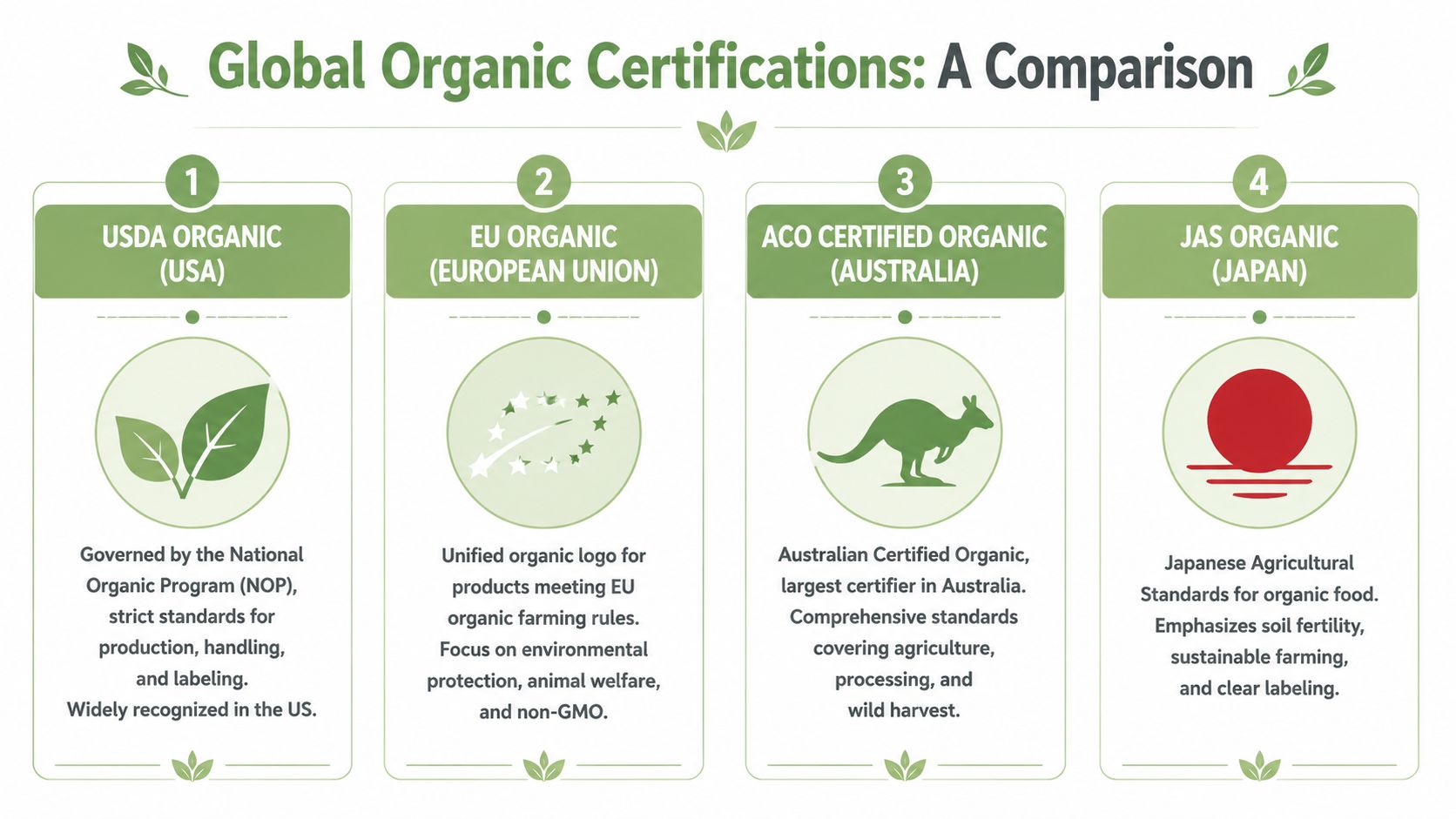
Four schemes you'll see often
Here's a plain-English comparison of the logos and systems many Australian buyers encounter.
| Scheme | Region | What it usually signals |
|---|---|---|
| USDA Organic | United States | Organic compliance for production, handling, and labelling under the US system |
| EU Organic | European Union | A unified EU organic framework with its own rules for eligible products |
| ACO Certified Organic | Australia | Certification through an Australian private certifier operating within the local framework |
| JAS Organic | Japan | Organic certification under Japanese Agricultural Standards |
The important point isn't memorising every rule difference. It's knowing that each scheme belongs to a regulatory context, and your Australian business can't assume one certificate automatically answers every local compliance question.
Why imported products create confusion
Readers often get stuck at this point.
A supplier may send you a perfectly legitimate overseas organic certificate. That's helpful, but it doesn't automatically settle how your certifier will view the ingredient inside your own certified system. You still need to confirm whether the documentation, chain of custody, and product description line up with your certifier's requirements.
That matters even more for processed ingredients. Whole leaf tea is one thing. A flavoured blend, extract, premix, or finished beverage has more moving parts.
Imported organic ingredients should be treated as verified inputs to assess, not assumptions to accept.
Where equivalency comes in
Business owners often hear about “equivalency” and assume it means easy acceptance across borders. In practice, equivalency is best understood as a pathway that may reduce duplication, not a licence to stop checking.
If you source globally or sell internationally, your team still needs to ask practical questions:
- Which scheme certified the ingredient?
- Does the certificate match the exact product?
- Who held certification during packing and export?
- Will your Australian certifier accept that evidence as sufficient?
- Will your destination market require anything additional?
For teams building a wider compliance framework beyond organic alone, this guide to a universal key for international operations can be a useful companion resource because it highlights how cross-border compliance often depends on documentation discipline, not assumptions.
A sensible sourcing mindset
The safest approach is to compare schemes with curiosity, not suspicion. Overseas certification isn't a red flag. It just needs interpretation in the context of your Australian operation.
For businesses importing Japanese matcha, that means reviewing the supplier certificate, product scope, packing details, and traceability documents before the ingredient enters your certified production stream. The same mindset applies if you're sourcing botanicals, flavourings, or bulk tea from overseas.
Your Roadmap to Becoming Certified Organic
The first certification application usually feels bigger in your head than it is on paper. Once you break it into stages, it becomes a project you can manage.
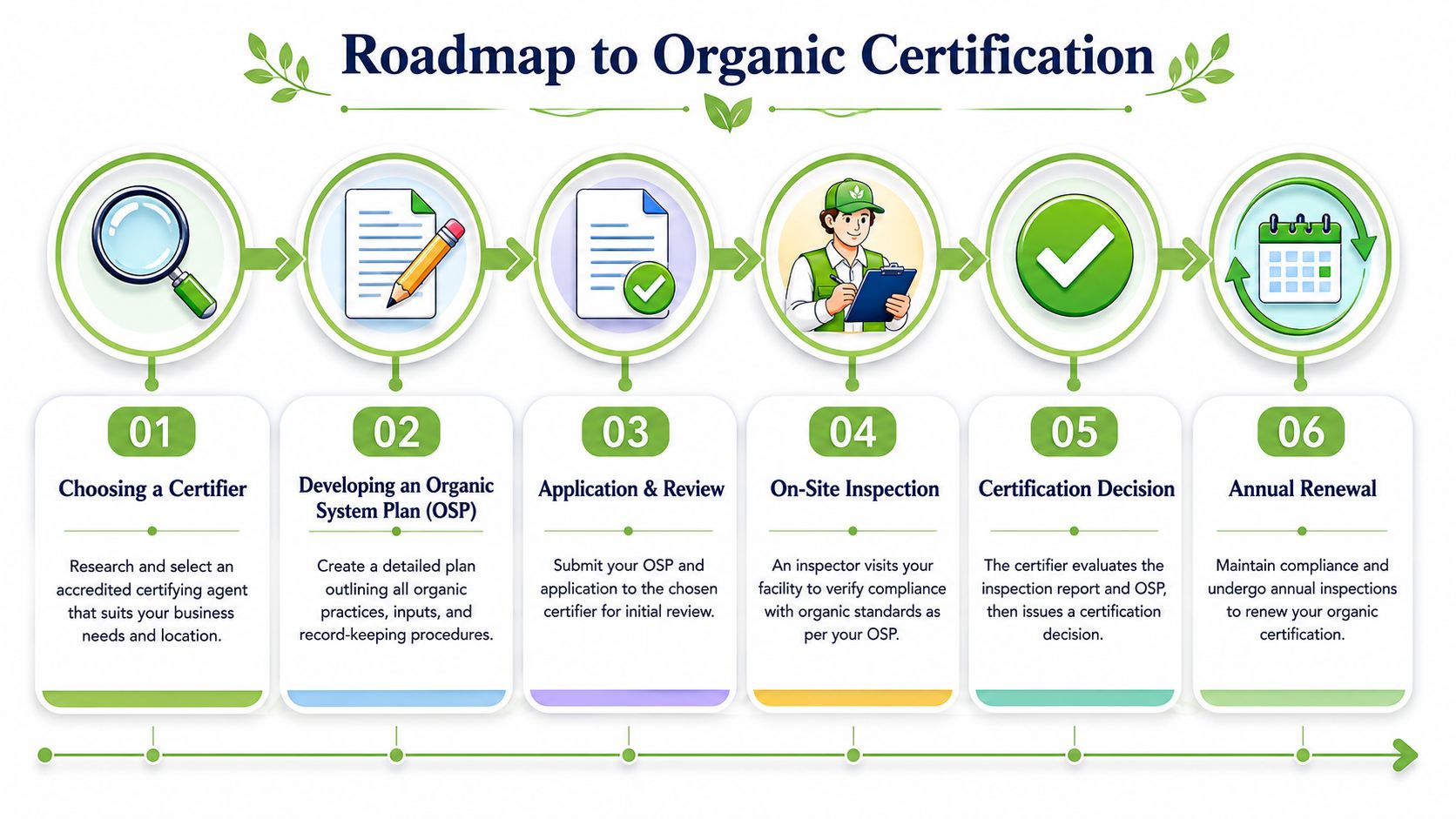
Step 1 and Step 2
Start by choosing a certifier whose scope matches your business. A farm, a tea importer, and a kombucha manufacturer won't all ask the same operational questions, so industry fit matters.
Then build your Organic System Plan or equivalent documented system. In it, you explain how ingredients are approved, how organic stock is handled, how records are maintained, and how labels are controlled.
Good plans are practical. They describe what your team does.
Step 3 and Step 4
Next comes application review and the on-site audit.
The certifier reviews your documents, then an inspector visits to compare paperwork with reality. They want to see that your documented system matches your premises, equipment flow, storage, production steps, and records.
Before the audit, it helps to run your own mini-check:
- Walk the site: Can staff clearly identify organic stock and materials?
- Trace one batch: Can you follow it from supplier invoice to finished label?
- Review inputs: Are all ingredients and relevant materials approved and current?
- Check your labels: Do your claims match what certification allows?
- Train the team: Can staff explain the process consistently?
A visual summary often makes the path feel more manageable:
Step 5 and Step 6
After inspection, the certifier makes a certification decision. If corrective actions are required, you address them. If approved, certification doesn't end the process. It becomes part of your annual operating rhythm through renewals, inspections, updates, and ongoing compliance.
Common pitfalls are usually ordinary operational mistakes, not dramatic failures:
- Unapproved substitutions: Someone buys a replacement ingredient or cleaner without checking.
- Weak traceability: Records exist, but they don't connect cleanly.
- Shared storage confusion: Organic and non-organic stock are present without clear separation.
- Label drift: Marketing wording changes before compliance review catches it.
The easiest time to fix an organic compliance issue is before the product is made, labelled, and sold.
One note on timing and cost: these vary by certifier, business type, product scope, and complexity. It's better to ask directly for a specific quote and document checklist than rely on broad online guesses.
Organic Standards for Tea and Kombucha Producers
Tea and kombucha businesses face a version of organic certification that's more layered than many farm-based examples suggest. You're often dealing with imported ingredients, processing steps, multi-ingredient recipes, sanitation controls, and final labels that need to hold up under audit.
A major blind spot in Australian content is how organic rules apply to imported and processed products, not just farms. That matters because the Australian organic sector was estimated at A$2.6 billion in 2021, and import-heavy supply chains make certification, traceability, and equivalency especially relevant for products like tea and fermented beverages, as noted in this discussion of organic requirements for imported and processed products.
For tea importers and packers
If you source Japanese matcha or other imported teas, the main challenge is proving that the ingredient's organic status survives the trip from origin to your finished Australian product.
That usually means checking:
- Supplier certification documents
- Product-level identification
- Packing and export traceability
- Handling records once stock arrives in Australia
The key question isn't just whether the tea garden was organic. It's whether the chain of custody is clear enough for your certifier to accept.
For kombucha brewers
Kombucha brings another layer because it's a processed product. You're managing tea, sugar, cultures, flavour inputs, brewing, cleaning, filling, and labelling.
That creates three practical pressure points:
Input compliance
Your tea base, sugar, flavourings, and any other relevant ingredients need to fit the standard.Process control
Organic handling needs to sit neatly beside your existing food safety systems. If you already work with HACCP discipline, that mindset helps because both systems value consistency, records, and controlled procedures.Labelling accuracy
Multi-ingredient products need careful claim review. It's not enough for one input to be organic if the final label suggests more than the certified composition allows.
What this looks like in a real Australian product category
For a business selling both imported organic matcha and locally brewed kombucha, the operational challenge is to connect two very different supply stories into one compliant system. One ingredient may begin overseas under another scheme. The finished fermented product may be produced domestically with its own controls and records.
That's why tea and kombucha brands need practical product pages and education, not just broad farm-level explanations. Pep Tea's organic kombucha range is one example of a product category where buyers often want to understand both certification and processing, especially when low sugar, live cultures, and ingredient integrity all matter at once.
Your Business Checklist and Frequently Asked Questions
If you're preparing for certification, the fastest way to reduce stress is to get organised before you contact a certifier. You don't need every answer on day one, but you do need a workable foundation.
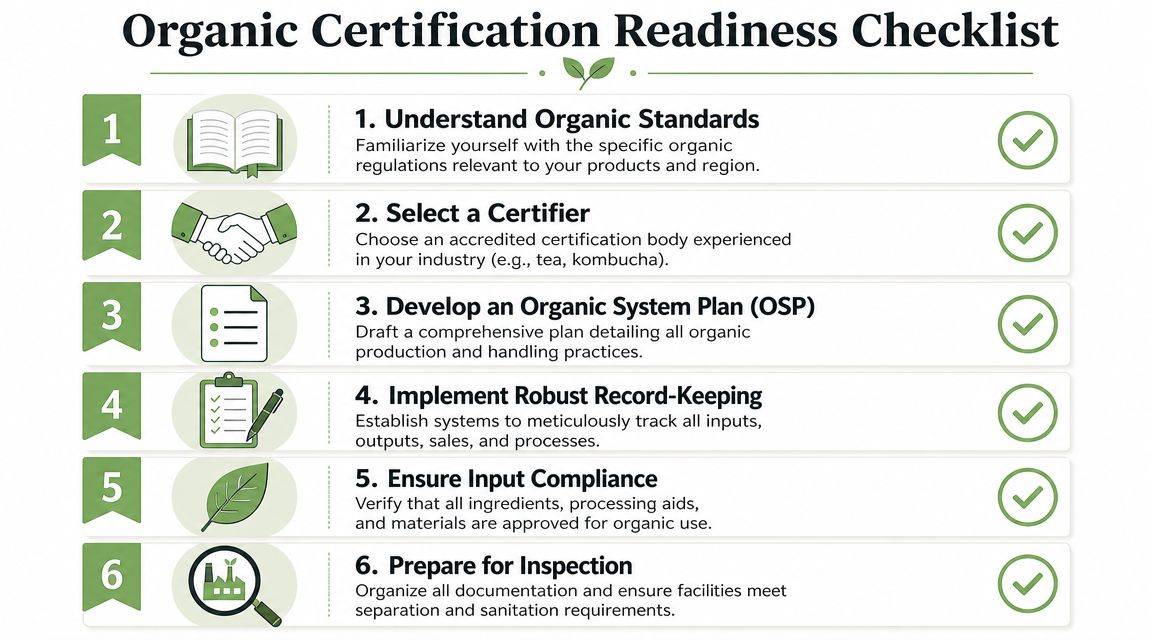
A practical readiness checklist
- Map your products: List each product, ingredient, and supplier clearly.
- Identify your risk points: Note where mixing, relabelling, repacking, or substitutions could happen.
- Gather supplier documents: Keep certificates, specifications, and invoices in one system.
- Write your operating rules: Storage, cleaning, production flow, and label approval should be documented.
- Train staff early: The team handling receiving, production, and dispatch should know the basics.
- Check imported ingredients carefully: Don't assume overseas certification will answer every local question.
Frequently asked questions
How can a café owner verify that a supplier's organic claim is legitimate
Ask for current certification details and product documentation that matches what you're buying. The key is consistency between the supplier, the product, and the claim on the pack or menu material.
What's the difference between “100% organic”, “organic”, and “made with organic ingredients”
These phrases are governed by certification and labelling rules, not just marketing preference. The exact threshold and permitted wording depend on the applicable standard and certifier. If you're selling or repacking a product, don't guess. Confirm the permitted claim before printing menus or labels.
Do imported ingredients need extra checking
Yes. Imported ingredients often create the biggest confusion because certification, traceability, and equivalency need to be reviewed together. The overseas certificate is part of the answer, not always the whole answer.
Is certification only relevant for farmers
No. It also matters for processors, packers, importers, wholesalers, retailers, and hospitality businesses that want confidence in the claims attached to what they buy or sell.
The businesses that handle certification well usually make it part of procurement and operations, not a last-minute label exercise.
If you'd like a practical product-level view of certified organic tea and kombucha in Australia, explore Pep Tea for organic matcha, Australian-brewed kombucha, and educational guides that make the standards easier to understand before you buy, stock, or develop your own range.
Experience Raspberry Lemonade Kombucha Benefits

By three o’clock, a lot of drinks start to feel like a compromise. Water is fine but not exciting. Soft drink tastes good for a moment, then leaves you feeling a bit flat. Juice can feel heavier than you wanted. Coffee isn’t always the right move, especially if you still want to sleep tonight.
That’s where raspberry lemonade kombucha earns its place. It hits that rare middle ground. Bright, fizzy, tangy, lightly fruit-driven, and much more interesting than plain sparkling water. It feels like a treat, but it can also fit neatly into a more mindful routine.
For me, it’s one of the most rewarding flavours to brew and drink here in NSW. You get the familiar comfort of raspberry and lemon, then the fermented tea base adds structure, acidity, and that clean, lively finish that keeps you going back for another sip. It works on a hot afternoon, with lunch, poured over ice for guests, or tucked into a café menu as a proper non-alcoholic option.
Your Search for the Perfect Refreshment Ends Here
A lot of people arrive at raspberry lemonade kombucha after getting tired of the same cycle. You want something cold and satisfying, but you don’t want the syrupy sweetness of soft drink or the one-note feel of flavoured soda water. You want flavour with some personality.
That’s exactly why this style stands out. Raspberry gives it a soft berry roundness. Lemon brings the sharp, refreshing edge. Kombucha ties the whole thing together with natural tartness and fine fizz. The result tastes grown-up, not childish. It’s refreshing without being boring.

In the Hunter Valley, where warm days call for something crisp and cooling, this flavour just makes sense. It has the nostalgic feel of raspberry lemonade, but fermentation gives it more depth. That’s the bit many first-time drinkers don’t expect. It’s not just “fruit flavour added to bubbles”. It’s a brewed drink with layers.
A good raspberry lemonade kombucha should feel lively and clean, with enough tartness to refresh and enough fruit to stay welcoming.
Some readers come to it for wellness. Others just want a better fridge staple. Café owners often want a polished alcohol-free option that doesn’t feel like an afterthought. Raspberry lemonade kombucha can do all three jobs at once, which is a big reason it’s become such a favourite flavour in modern Australian drinking habits.
What Makes Raspberry Lemonade Kombucha So Special
Raspberry lemonade kombucha earns its place by doing two jobs at once. It feels immediately familiar, because most Australians already know the appeal of raspberry and lemon together. At the same time, it drinks with more character than a standard fizzy fruit drink because fermentation gives the flavour shape, length, and a dry finish.
If you are new to kombucha, that difference can be hard to name at first. A simple way to understand it is to compare it with cooking. Fruit provides the bright top notes, but the brewed tea base works like stock in a good soup. You may not talk about it first, yet it is what gives everything underneath real body.
The flavour comes in clear stages
A well-made bottle does not hit your palate all at once. It unfolds.
You usually notice raspberry on the first sip. It brings soft berry perfume and gentle sweetness. Lemon follows quickly and tightens the whole drink, adding brightness and a clean, mouth-watering edge. Under both sits the brewed and fermented tea, which adds light tang, structure, and that grown-up finish people often describe as crisp.
That layering is what makes this flavour so enjoyable for both home drinkers and café service. At home, it feels more satisfying than opening another soft drink. In a café fridge or on a drinks list, it gives customers a proper alcohol-free option with enough personality to stand beside coffee, wine, or spritzes rather than feeling like a fallback.
Balance is what separates a good bottle from an average one
Some first-time drinkers worry kombucha will taste harsh or overly vinegary. That can happen in an unbalanced brew. In a good raspberry lemonade kombucha, acidity behaves more like the squeeze of lemon over fresh fruit. It sharpens and refreshes. It should never bully the berry flavour out of the glass.
Here are the signs brewers and café owners often look for:
| Quality | What you notice in the glass |
|---|---|
| Aroma | Fresh raspberry, lifted citrus, light tea character |
| Palate | Bright opening, rounded fruit, tidy tartness |
| Carbonation | Fine bubbles that carry flavour without stinging |
| Finish | Clean and dry enough to invite another sip |
That final point matters more than many people realise. A sticky finish makes a drink feel heavy. A clean finish keeps it versatile, which is one reason flavours like this suit cafés, office fridges, and even curated vending ranges alongside other best healthy vending machine snacks.
The tea base does more work than the fruit
Fruit draws people in, but tea gives kombucha its backbone. Without a proper tea base, raspberry and lemon can taste flat, thin, or overly sharp. With it, the drink has tension. It feels brewed rather than mixed.
Fermentation changes that base in practical ways too. As the culture works through the sweetened tea, the drink develops acids, fine carbonation, and the tart complexity kombucha is known for. That is why raspberry lemonade kombucha tastes more composed than sparkling juice. The fizz is only part of the story. The structure comes from brewing and fermentation.
If you want a clearer picture of how that process shapes flavour and function, Pep Tea explains more in its guide to the benefits of kombucha and how fermentation changes the drink.
Practical rule: If the raspberry tastes artificial, the lemon lands harshly, or the finish feels syrupy, the brew is out of balance.
It is one of the easiest flavours to serve well
Raspberry lemonade kombucha is approachable, but it is not simplistic. That makes it especially useful for introducing kombucha to someone who is curious yet cautious. Berry softens the entry point. Lemon keeps it lively. Fermentation adds enough depth to hold the interest of regular kombucha drinkers.
From a brewer’s perspective here in the Hunter Valley, that is the charm of this flavour. It carries a familiar Australian refreshment profile, then adds the detail and craft that come from a proper brew. Home consumers get a fridge staple with more life than soft drink. Café owners get a polished non-alcoholic pour that works with food, looks at home in a wine glass, and gives customers a reason to come back for another bottle.
Unpacking the Health Benefits Inside Every Bottle
Flavour gets people through the first sip. Function is what often brings them back.
When people talk about kombucha being “good for you”, they sometimes bundle everything together into one vague idea. It’s more helpful to break it into parts. Raspberry lemonade kombucha can offer live cultures from fermentation, tea-derived compounds, and a lighter feel than many sweeter drinks.
What live cultures actually mean
The word probiotics can sound technical, but the simple version is this. They’re beneficial microbes associated with fermented foods and drinks. In kombucha, those microbes come from the fermentation process itself.
One raspberry lemonade kombucha product states that it delivers up to 2 billion probiotics per serving, and that fermentation helps turn tea polyphenols into more bioavailable catechins such as EGCg, supporting antioxidant capacity, according to this raspberry lemonade kombucha product page.
That doesn’t mean kombucha is a magic cure. It means it can be a practical way to include fermented foods and drinks in everyday life.
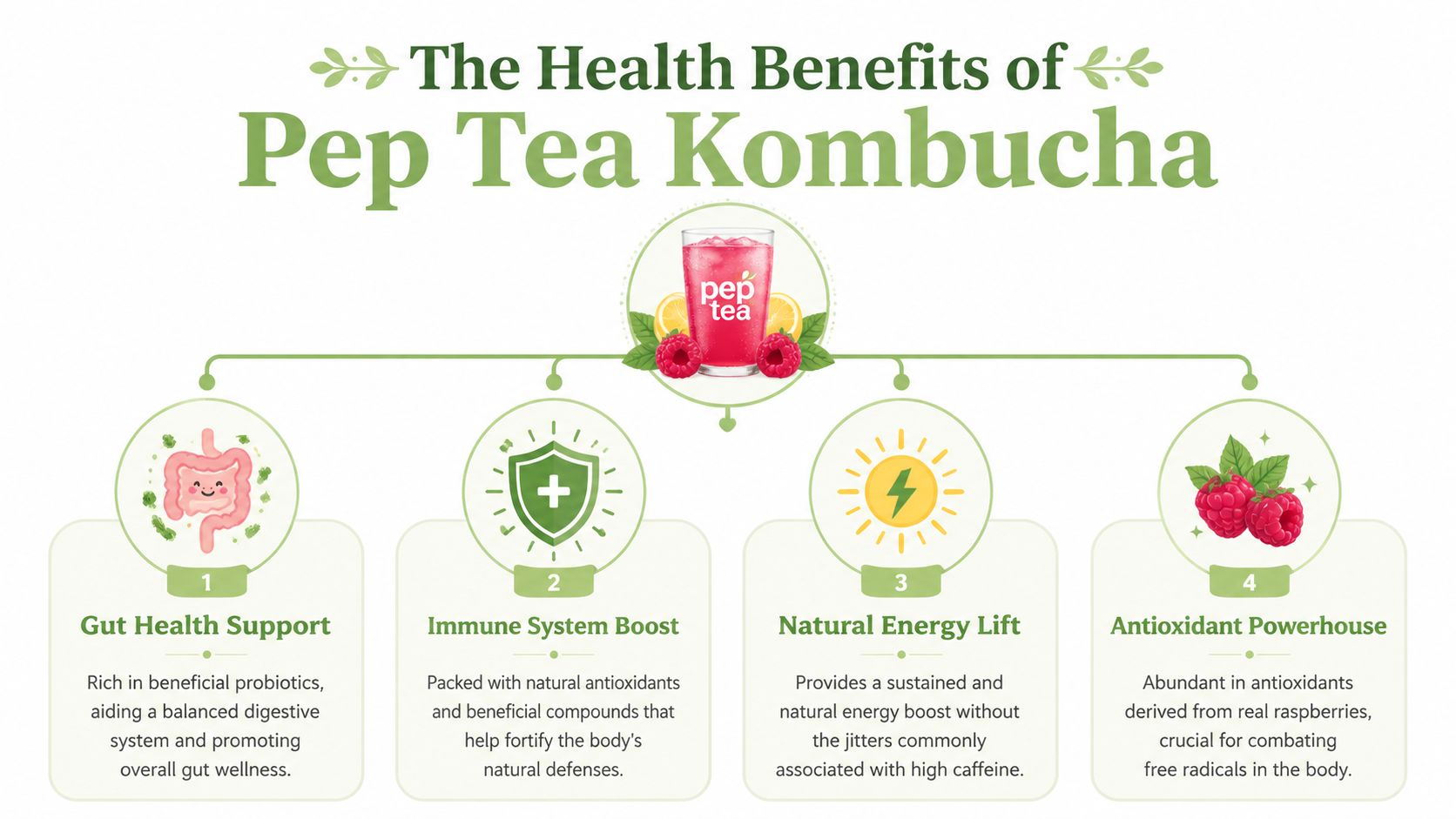
Why gut health matters in plain language
Your gut does more than digest lunch. It’s tied to how comfortably you process food and how steady you feel day to day. That’s why so many people start looking for fermented options when they want to support a more balanced routine.
Kombucha can fit nicely here because it feels easy to drink. You’re not swallowing a pill or forcing down something unpleasant. You’re enjoying a cold, tart, fruit-led drink that also comes from live culture fermentation.
If you want a broader primer on this topic, this guide to the benefits of kombucha is a useful next read.
Antioxidants are easier to understand than they sound
Antioxidants often get mentioned without explanation. A simple way to think about them is that they’re compounds found in foods and drinks that help deal with oxidative stress in the body. Tea is naturally known for these compounds, and kombucha starts with tea.
During fermentation, the drink changes. That matters because it can alter how those tea compounds show up in the final beverage. Raspberry and lemon also add to the overall sensory freshness, which is part of why this style feels so clean and lively.
Here’s where people often get mixed up. “Healthy” doesn’t have to mean bland. A drink can taste sharp, juicy, and satisfying while still fitting a wellness-minded routine.
- For the afternoon slump it can feel lighter than sugary options.
- For café fridges it gives customers a more functional-looking pick.
- For busy people it’s a simple grab-and-go choice that doesn’t feel like punishment.
If you’re stocking an office kitchen, gym foyer, or retail fridge, these ideas overlap with broader thinking around best healthy vending machine snacks, where people usually want convenience without the heavy sugar hit.
A functional drink still has to be enjoyable. If people don’t like the taste, they won’t make it part of their routine.
It can feel like a more balanced kind of lift
Some drinks come in hot. Big sweetness. Big caffeine. Big crash. Raspberry lemonade kombucha tends to feel gentler. The fruit makes it engaging, while the fermented tea base gives it some character without the intensity many people associate with energy drinks or multiple coffees.
That softer profile is part of the appeal. You’re choosing something lively, not overstimulating.
The Pep Tea Difference How We Brew in the Hunter Valley
A good raspberry lemonade kombucha should feel the same every time you crack the cap. Bright. Crisp. Tangy enough to wake up the palate, but still easy to drink with lunch, after work, or straight from a café fridge. That kind of consistency does not happen by accident. It comes from careful brewing, steady fermentation, and respect for the raw ingredients.
In the Hunter Valley, you learn quickly that fermentation rewards patience and punishes shortcuts. Tea, culture, temperature, and timing all pull on the final flavour like different players in the same band. If one rushes ahead, the drink loses balance.
It starts with strong brewing fundamentals
At the centre of kombucha is the SCOBY, the living culture that ferments sweet tea into something tart, refreshing, and far more layered than soft drink. For newcomers, the confusing part is usually the sugar. If sugar goes in at the start, how can the final drink be much lighter and less sweet?
Fermentation is the key. The culture uses that sugar as fuel, then transforms it over time. A simple way to picture it is bread dough. Yeast feeds, changes the mixture, and leaves behind something completely different from the starting ingredients. Kombucha works on the same principle, only the result is a lively, acidic tea instead of a loaf.
That process matters because flavour is built, not painted on at the end.
What careful brewing changes in the bottle
Well-made kombucha tastes clean because the sharpness comes from fermentation itself. It is not just fruit flavour trying to do all the heavy lifting. The tea base still speaks, the acidity feels natural, and the raspberry lemonade character sits on top rather than fighting underneath.
For us, brewing in a HACCP-accredited NSW facility is part of that discipline. Clean handling, controlled fermentation, and consistent bottling give both home drinkers and café owners something they can rely on. A customer at home wants a bottle that tastes fresh and balanced. A café owner wants exactly the same thing, plus a product that pours well, stores predictably, and supports repeat orders because the experience stays steady.
People in the trade sometimes talk about rough, inconsistent batches as “cowboy kombucha.” You can spot it quickly. The sourness feels harsh, the fizz is uneven, or the whole drink seems muddled. Good brewing avoids those problems before the bottle ever reaches the fridge.
A closer look at the style of brewing behind bottled kombucha helps here:
Why local brewing matters in practice
Local brewing is not just a nice story for the label. It affects freshness, consistency, and how confidently a venue can put the product on the menu. In a region like the Hunter, where food and hospitality standards are high, people notice when a drink feels thoughtfully made.
That is one reason our raspberry lemonade kombucha works for more than one kind of customer. At home, it gives people an easy fridge staple that feels more special than flavoured water. In cafés, it gives owners an Australian-brewed option they can serve as a non-alcoholic pairing, a fridge takeaway, or a base for alcohol-free spritzes and mixed drinks.
If you enjoy having fresh organic kombucha arrive ready to chill, this page on brewed and bottled organic kombucha delivered right to your door step is worth a look.
The Hunter Valley touch gives the flavour a real home
Raspberry lemonade is a familiar Australian flavour. People already know the shape of it. Sweet berries, bright citrus, instant refreshment. You can even compare it to effortless homemade lemonade, then add the extra tang and depth that only fermentation brings.
That is the part brand pages often skip. Brewing method does not only affect taste. It affects how useful the drink becomes in real life. It can sit comfortably beside a café pastry, a fresh salad, or a weekend cheese board. It can be sold as a better-for-you fridge option, or poured into a proper glass and treated like a grown-up soft drink.
Brewing kombucha well comes down to clean tea, a healthy culture, good timing, and the discipline to let the process do its job.
That connection between place, process, and practical use is the Pep Tea difference. It is Hunter Valley brewing with a clear purpose. Make kombucha that tastes authentic, works for everyday drinkers, and gives hospitality venues a product they are proud to stock.
A Nutritional Snapshot Compared to Other Drinks
When people compare drinks, they usually want one quick answer. Is this going to load me up with sugar, or not?
That’s where raspberry lemonade kombucha often stands apart. One verified product listing states that a typical serving contains just 5 calories and 0g of sugar, and notes that Australia’s kombucha market has grown by 25% annually while 68% of adults seek reduced-sugar alternatives, according to this raspberry lemonade kombucha nutrition listing.
Why the comparison matters
A drink doesn’t exist in a vacuum. Shoppers often choose between kombucha, soft drink, juice, flavoured water, or whatever else is in the fridge. Seeing them side by side makes the choice easier.
For raspberry lemonade kombucha, the strongest nutritional talking point is simple. Very low calories and no sugar. That’s the main reason it appeals to people trying to cut back without giving up flavour.
Here’s a practical comparison table. Only the kombucha row uses verified figures. The other rows are included as common beverage categories because people usually compare this drink against them.
Beverage Comparison per 350ml serving
| Beverage | Sugar (grams) | Calories |
|---|---|---|
| Sugar-free raspberry lemonade kombucha | 0g | 5 |
| Regular soft drink | Higher than sugar-free kombucha | Higher than sugar-free kombucha |
| Fruit juice | Higher than sugar-free kombucha | Higher than sugar-free kombucha |
| Energy drink | Often higher than sugar-free kombucha | Often higher than sugar-free kombucha |
That kind of contrast helps explain why kombucha gets picked up by people who are trying to reduce sweet drinks without switching to something dull.
It still feels like a treat
This is the key bit. A lot of “better choices” fail because they feel like a compromise. Raspberry lemonade kombucha doesn’t have to rely on a health halo alone. It still brings sparkle, fruit, acidity, and that little sense of occasion.
If you enjoy making your own citrus drinks at home too, this recipe for effortless homemade lemonade is a handy companion idea. It’s a nice reminder of why lemon works so well in refreshing drinks in the first place.
From Café Menus to Cocktails Creative Recipes and Pairings
One of the best things about raspberry lemonade kombucha is how easily it moves from casual fridge drink to something more polished. You can serve it straight from the bottle, but it also plays beautifully with herbs, citrus, ice, and food.
For cafés, that means a menu item with very little fuss. For home drinkers, it means you can turn one bottle into something that feels a bit special in under five minutes.

Raspberry Zinger mocktail
This one suits brunch service, baby showers, afternoon entertaining, or a café specials board. It keeps the kombucha front and centre rather than burying it.
What you’ll need
- Raspberry lemonade kombucha
- Fresh raspberries
- A squeeze of lemon
- Plenty of ice
- Mint or basil, optional
How to make it
- Add a few raspberries to a glass and press them lightly.
- Fill the glass with ice.
- Add a squeeze of lemon.
- Pour over chilled raspberry lemonade kombucha.
- Finish with mint or basil if you like a more aromatic edge.
The reason this works is balance. Fresh raspberry deepens the fruit note, while extra lemon sharpens the finish. Mint makes it feel cooler. Basil gives it a more savoury café-style twist.
Serve it in a wine glass rather than a tumbler if you want it to feel more premium with almost no extra effort.
Kombucha Spritz
If you’re after an easy evening serve, a spritz is the natural next step. You can make it with prosecco for a low-fuss cocktail, or use alcohol-free sparkling wine if you want to keep the whole thing non-alcoholic.
Simple build
- Start with ice in a large glass
- Add raspberry lemonade kombucha as the base
- Top with sparkling wine or alcohol-free sparkling wine
- Garnish with lemon peel or a few raspberries
This style works because kombucha already brings acid and fizz. You’re not building flavour from scratch. You’re just opening it up.
If you’d like more ideas in this lane, these kombucha cocktails show how well fermented tea can fit into modern drinks service.
Food pairings that make sense
Raspberry lemonade kombucha has enough brightness to cut through creamy foods and enough fruit to sit nicely next to lighter desserts. It’s quite forgiving, but some pairings are especially good.
| Food | Why it works |
|---|---|
| Goat cheese tart | The drink’s acidity cuts the richness |
| Fresh salads with herbs | Lemon and herbs echo the drink’s freshness |
| Grilled chicken | Tartness lifts simple savoury flavours |
| Lemon desserts | The citrus link feels natural |
| Berry pavlova | Fruit meets fruit, but the acidity keeps it lively |
For cafés, this means one bottle can pull double duty. It works as a grab-and-go fridge item and as part of a plated service pairing. For home drinkers, it means you don’t have to overthink it. If the food is fresh, bright, or lightly creamy, raspberry lemonade kombucha usually plays along beautifully.
Your Guide to Storing and Serving Kombucha Perfectly
A good bottle can lose some of its charm if it’s stored badly or served too warm. Kombucha is straightforward, but a few habits make a real difference.
Keep it cold and open it gently
Chilling helps preserve the crisp taste and makes the carbonation feel tighter and cleaner. Warm kombucha can taste flatter, looser, and more aggressive all at once. If the bottle has been shaken around, let it settle before opening.
Once opened, treat it like any fizzy drink you want to enjoy at its best. Recap it firmly and return it to the fridge.
The best way to pour it
You don’t need fancy glassware, but shape helps. A clean tumbler, stemless wine glass, or highball glass all work well. Pour at an angle if you want to keep the fizz under control, then straighten the glass near the end for a light head.
A few serving habits help:
- Use plenty of cold ice if you want maximum refreshment on hot days.
- Add garnish sparingly so the kombucha flavour stays clear.
- Pour before guests arrive only if you’re serving immediately, because fizz is part of the appeal.
Sediment isn’t automatically a fault. In many live-culture drinks, a little natural material in the bottle can simply be part of the product.
If it tastes different than expected
Too sour, too warm, too foamy, too flat. These issues are often serving issues, not drink issues. Chill it properly, use a clean glass, and avoid letting an opened bottle linger too long in the fridge. Most of the time, that solves it.
Frequently Asked Questions
If raspberry lemonade kombucha is sugar-free, what does the SCOBY eat
Sugar is the fuel that starts fermentation. The SCOBY, which is a living mix of yeast and bacteria, uses that fuel during brewing and changes it into acids and other flavour compounds. That is why sugar can be present at the beginning but not remain in the finished drink.
A good way to understand it is to picture firewood in a campfire. You need the wood to get the fire going, but the finished heat is not the same thing as the pile of logs you started with.
Is it safe for children
Many parents offer kombucha instead of soft drink because it has a tangy, grown-up flavour without the syrupy feel of cordial or juice. The sensible approach is to read the label, start with a small serve, and see how your child responds.
If there are medical concerns, or if you are choosing drinks for very young children, a quick check with a health professional is a wise call.
Will it make me feel bloated
It can, especially if fermented drinks are new to you or you drink a full bottle too quickly. Kombucha is lively by nature, and that fizz can feel like a lot at first.
Start with a smaller glass. Sip it with food if that feels better. Many people find the experience more comfortable that way.
What’s the sediment at the bottom
Sediment is often a normal sign of a live-culture drink. In traditionally brewed kombucha, tiny strands of culture, yeast, or fruit particles can settle at the bottom over time.
You have two good options. Swirl it gently if you want the full bottle mixed through, or pour carefully and leave the sediment behind. Café owners often choose the second option for a cleaner-looking serve, while home drinkers often do whichever suits their taste.
Is raspberry lemonade kombucha only for summer
Raspberry lemonade has a bright, warm-weather personality, but it is useful well beyond hot afternoons. In cooler months, it works beautifully alongside richer meals because the tart edge cuts through creamy, roasted, or salty foods.
That makes it a handy fridge staple for home drinkers and a flexible menu item for cafés that want a non-alcoholic option with more character than sparkling water.
What foods pair best with it
This flavour loves fresh, punchy food. Try it with salads full of herbs, grilled chicken, soft cheese, prawns, fish tacos, or a ploughman’s-style lunch with sharp cheddar and crackers.
It also plays well with desserts. Lemon tart, pavlova, berry crumbles, and white chocolate all pick up the raspberry and citrus notes without making the drink feel heavy.
If you are serving customers, it is the kind of kombucha that can sit comfortably beside brunch, lunch, or an early-evening mocktail list.
If you’re ready to try a clean, refreshing take on kombucha, explore Pep Tea for Australian organic kombucha and premium tea made with a focus on flavour, quality, and everyday wellness.
Natural Energy Drinks Australia: The Ultimate 2026 Guide

It’s 3 pm. You’ve already had a coffee, lunch has worn off, and your brain is doing that foggy little shuffle between “push through” and “find something cold and fizzy.”
A lot of Australians know that cycle well. You grab a sugary drink or another strong caffeine hit, feel a quick lift, then cop the flat feeling later. That’s usually the moment people start looking into natural energy drinks australia shoppers are reaching for, not because they want hype, but because they want energy that feels steadier and easier on the body.
For some, that means matcha instead of a second flat white. For others, it’s kombucha, yerba maté, or a botanical drink with ingredients they can recognise on the label. Café owners are seeing the same shift from the other side of the counter, with more customers asking for low-sugar, functional drinks that fit a wellness routine.
The End of the 3 PM Slump
A bloke working from home in Newcastle opens the fridge and stares at his options. Leftover soft drink. Another coffee. Sparkling water. Maybe something with a bit more life in it.
That moment says a lot about why natural energy drinks are having a real moment in Australia. People still want energy, focus, and something convenient. They just don’t want the old trade-off of a sharp spike followed by a rough slide.

That shift isn’t imaginary. The Australian energy drinks market, including a rising segment of natural and organic variants, was valued at AUD 131.52 million in 2025 and is projected to reach AUD 226.58 million by 2034, growing at a CAGR of 5.5%, according to Research and Markets’ Australia energy drink market analysis.
What matters in everyday life is what that trend looks like in practice. It looks like:
- Parents swapping high-sugar options for drinks with tea-based caffeine
- Office workers looking for focus without feeling overcooked
- Gym-goers wanting something lighter than a syrupy can
- Cafés adding non-alcoholic functional drinks to the menu
Natural energy isn’t about chasing a massive buzz. It’s about finding a drink that helps you stay switched on without feeling rattled.
That’s where this category gets interesting. “Energy drink” used to mean one very specific thing. In Australia now, it can also mean matcha, kombucha, yerba maté, green tea blends, or other plant-based options that support a more even kind of lift.
What Makes an Energy Drink Natural Anyway
A lot of people still hear “energy drink” and think of neon cans, intense sweetness, and an ingredients panel that reads like a chemistry worksheet. That’s old thinking.
Natural energy drinks sit in a different lane. They usually lean on plant-based caffeine sources, lower sugar, and ingredients people already know from tea, herbs, or whole-food style formulations.
The ingredient shift people are looking for
Australian shoppers are reading labels more closely. They’re paying attention to where the caffeine comes from, how sweet the drink is, and whether the formula looks more like food or more like a science experiment.
That change shows up in market behaviour too. As TechSci Research’s Australia energy drinks report notes, consumers are moving away from artificial additives toward natural caffeine sources for steadier energy. The same source says health-centric soft drinks like fruit and vegetable juices captured 57.1% of consumer spending in the soft drink category as of 2023.
That doesn’t mean every “natural” drink is automatically a smart choice. It means the category has widened, and you’ve got better options than the old sugar-heavy model.
Natural versus synthetic in plain language
Here’s the simplest way to think about it.
| Type | Common feel | What to look for |
|---|---|---|
| Traditional energy drink | Fast hit, often very sweet, can feel abrupt | Artificial flavours, added sugar, synthetic-style stimulant blends |
| Natural energy drink | Gentler lift, often more balanced | Tea, maté, botanical caffeine, low sugar, simpler label |
A natural energy drink often gets its lift from ingredients such as:
- Matcha or green tea for calm alertness
- Yerba maté for a more rounded stimulant feel
- Guarana when used in a cleaner formulation
- Botanicals and functional ingredients that support focus or refreshment
Why people get confused
The word “natural” isn’t magic. A drink can still be highly processed, overly sweet, or full of things you don’t want. That’s why the label matters more than the front of the can.
A useful rule is to ask three questions:
- Where does the energy come from
- How much sugar is riding along with it
- Can you recognise most of the ingredient list
Practical rule: If the energy source is clearly named and the ingredient list looks like something a real person would understand, you’re usually starting in a better place.
For many Australians, the appeal is simple. They want energy that fits a health-conscious routine, not something that fights against it.
The Power Players of Natural Energy in Australia
You can feel the difference within a sip or two.
A matcha latte on a busy Tuesday morning tends to suit a very different moment from a sparkling yerba maté after school pickup, or a kombucha pulled from the café fridge on a warm afternoon. For households, that means choosing a drink that matches the job. For café owners, it means building a menu with clear roles instead of stocking three products that all do the same thing.
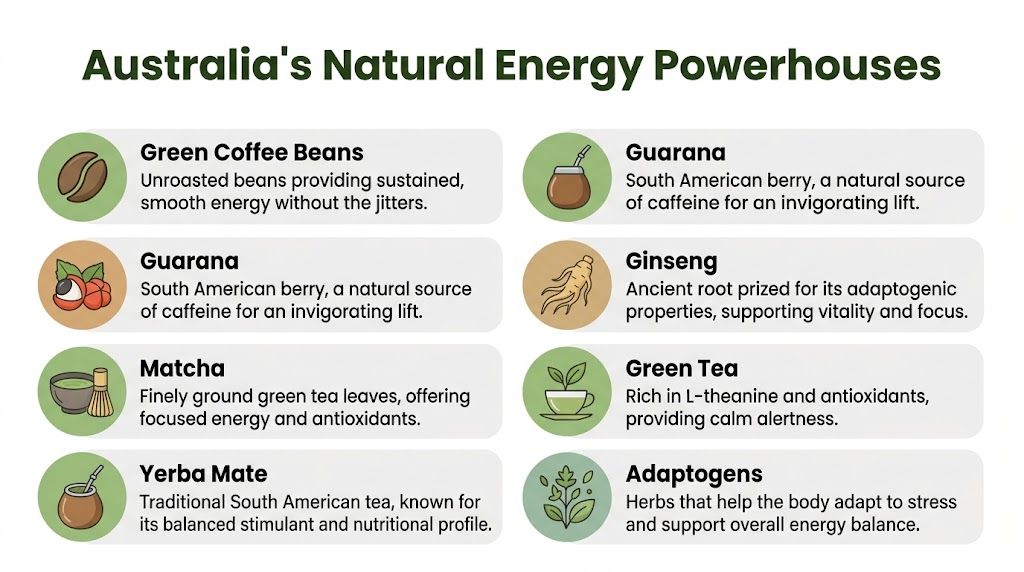
Matcha for calm focus
Matcha often suits people who want their brain switched on without feeling pushed around by their drink.
The reason is fairly simple. You are drinking the whole powdered green tea leaf, so the experience is not identical to a fast, isolated caffeine hit. Many Australians describe it as steadier and more organised, which helps explain why it keeps showing up in home kitchens, studio fridges, and café menus.
A lot of the curiosity around matcha centres on L-theanine. That pairing is one reason matcha has become such a favourite among professionals, students, and shift workers who want cleaner-feeling focus. If you want the practical safety side explained clearly, Pep Tea’s guide on how many cups of matcha tea powder are safe per day is a useful place to start.
For households, matcha is one of the easiest natural energy ingredients to work with. Hot, iced, blended into smoothies, or folded into yoghurt and oats, it adapts well.
For cafés, it also earns its shelf space because one ingredient can become several menu items:
- Hot matcha latte for regulars who want a coffee alternative
- Iced flavoured matcha for wellness-focused customers
- Sparkling matcha tonic for a lighter, sharper serve
- Smoothie add-on for gym and recovery traffic
Kombucha for a lighter daily option
Kombucha plays a different role.
People usually reach for it when they want refreshment with a bit of lift, not when they are chasing the strongest stimulant on the shelf. Tea-based fermentation, lighter flavour profiles, and lower-sugar options make it a comfortable fit for people trying to clean up their everyday drinking habits.
That gives kombucha a practical edge in Australia. It works at home as a soft drink replacement, and it works in hospitality as a chilled grab-and-go, a non-alcoholic pairing, or a mocktail base that still feels grown-up.
If matcha is the focused study drink, kombucha is often the easy afternoon reset.
Yerba maté for a brisk, sparkling lift
Yerba maté sits in the middle ground between tea culture and energy-drink convenience.
That middle ground matters. Some customers want something canned, cold, and ready to go, but they are also trying to move away from syrupy mainstream energy products. A well-made yerba maté drink answers that need neatly. It often feels brighter and cleaner, especially in sparkling formats.
For households, it can be a handy fridge option for active days or long drives. For cafés and venues, it works as a bridge item. It still speaks to the customer who normally buys an energy can, while giving health-conscious regulars a product with a more ingredient-led story.
Green tea and botanical blends for a softer profile
Some of the strongest products in this category do not rely on one headline ingredient.
Green tea, citrus, native botanicals, and herbs can work together like a good café blend. No single note has to dominate for the drink to do its job well. The result is often gentler and more rounded, which suits people who care about how they feel an hour later, not just the first 15 minutes.
In the Australian market, these blends often include:
- Green tea for a familiar tea-based caffeine source
- Matcha with citrus for freshness and a cleaner finish
- Botanicals such as lemon myrtle for flavour and local character
- Electrolyte support for hot weather, training days, or long shifts
This is also where café owners can stand out. A botanical sparkling tea or house matcha-citrus serve can feel more thoughtful than adding another canned product to the fridge.
Hydration-support drinks for flat, drained days
Some energy slumps have less to do with stimulation and more to do with fluid, food, and recovery.
That is why hydration-friendly drinks deserve a place in this conversation, even if they are not the highest-caffeine option. After a workout, a humid day, or a long hospitality shift on your feet, a drink with fluid support can make more sense than reaching straight for another stimulant.
For households, that can mean keeping a few lighter recovery-style options on hand. For cafés, it can mean offering a post-Pilates or post-beach drink that suits the customer who wants to feel better, not buzzier.
If someone is tired because they are dehydrated or under-fuelled, more caffeine may miss the real problem.
Which one suits which person
A simple matching exercise usually clears up the confusion.
| Drink type | Best suited to | Common appeal |
|---|---|---|
| Matcha | Desk work, study, morning focus | Calm alertness, flexible hot or cold |
| Kombucha | Everyday refreshment, low-sugar swaps | Light, fermented, tea-based |
| Yerba maté | Ready-to-drink energy seekers | Brighter lift, sparkling formats |
| Hydration-support drinks | Active days, recovery-minded drinkers | Fluid support, useful after heat or exercise |
| Green tea botanical blends | Gentle caffeine drinkers | Softer profile, layered flavour |
Australian buyers are getting more specific, and smart café menus are doing the same. The better question is no longer “Which drink gives energy?” It is “Which kind of energy fits this person, this moment, and this setting?”
Understanding the Health and Safety Evidence
Most confusion around natural energy drinks comes down to one word. Caffeine.
People often treat caffeine as if it always behaves the same way, no matter where it comes from. In real life, the source and the company it keeps can change the experience a fair bit.
Why natural caffeine can feel different
A tea-based drink doesn’t always land like a synthetic-style energy product. The same goes for yerba maté.
In Australian clean energy drinks, yerba maté is used for that reason. Perla’s guide to clean energy drinks describes yerba maté with natural caffeine at 30-50mg/100ml and theobromine, with a sustained release and a half-life extended 2-3x versus synthetic caffeine due to xanthine synergies.
You don’t need to memorise the chemistry. The practical takeaway is easier than that. Some plant-based caffeine sources feel smoother because they arrive with other naturally occurring compounds, not as a blunt isolated hit.
Matcha and calm alertness
Matcha notably stands out.
People don’t just drink matcha because it’s green and pretty in a bowl. They drink it because the experience often feels more organised. You’re awake, but not necessarily buzzing. Focused, but not edgy.
That’s the reason so many people use it during work, study, or long afternoons when they need their brain online without tipping into over-caffeinated territory.
If you’re wondering about sensible intake, Pep Tea has a practical guide on how many cups of matcha tea powder are safe per day.
A good natural energy drink should help you feel more like yourself, not less.
The kombucha question
Readers often ask whether kombucha “counts” as an energy drink.
It can, depending on how you use it. Kombucha made from tea can offer a mild lift, but the bigger reason many people keep it in rotation is that it feels lighter, less sugary, and easier to drink regularly than conventional soft drinks or heavy energy products.
There’s also a broader wellness link people care about. When digestion feels settled and meals aren’t swinging all over the place, daily energy often feels steadier too. That’s not a miracle claim. It’s just the practical reason many people pair low-sugar fermented drinks with a more balanced routine.
A few safety points worth keeping in mind
Natural doesn’t mean unlimited. It means you still need to pay attention.
- Check caffeine source: Tea, maté, and guarana all contribute differently to the feel of a drink.
- Watch serving size: A small bottle and a large can won’t hit the same.
- Notice timing: Late afternoon caffeine can still affect sleep, even when it feels smoother.
- Read the full label: “Natural” on the front doesn’t excuse a messy formula on the back.
For cafés, this matters too. Staff should be able to explain what’s in a matcha, kombucha, or maté-based serve in simple language. Customers appreciate that clarity.
How to Choose and Read Labels Like a Pro
You are standing at the fridge in a Newcastle café or your local health shop. Two cans both say “natural energy”. One will give you a clean, steady lift. The other is basically a soft drink in activewear.
The difference usually sits on the back label.
For everyday drinkers, that label helps you choose something you will feel good drinking again tomorrow. For café owners, it does another job too. It helps your staff explain the product in plain English, which is often the difference between a curious glance and a confident sale.
Read the back before the front
Front-of-pack words are there to catch your eye. The ingredient list tells you what is really in the bottle.
Start with the first few ingredients. They usually reveal the base of the drink, much like the first ingredients in a stock tell you whether a soup was built on vegetables or salt. If the energy source is genuine, it should be easy to spot. Look for clear names such as matcha, green tea, yerba maté, kombucha, or chia.
A shorter list can help, but length is not the whole story. Clarity matters more. If you can see what the drink is made from and why those ingredients are there, you are already ahead.
A strong label often shows four things:
- A named plant source of energy. Matcha, green tea, yerba maté, or another clearly identified ingredient
- A sensible sugar profile. Helpful if you want steadier energy rather than a quick spike
- Ingredients with a clear job. Cultures, botanicals, or hydration-supporting additions that make sense in the formula
- Plain flavour cues. Fruit, herbs, spices, and tea are easier to assess than vague flavour claims
Learn to spot the “why” behind the formula
Some drinks are built for more than stimulation. That is where label reading gets interesting.
A chia-based drink, for example, may also support hydration and make the drink feel more filling. A kombucha product may be chosen by customers who want something lighter and less syrupy. A matcha drink often appeals to people chasing focus without the heavy coffee edge. If you run a café, these distinctions matter because they shape how you place the drink on your menu and how your team describes it at the counter.
The simplest question is this: what job is this drink trying to do?
If the answer is clear, the label is doing its job.
Red flags worth slowing down for
You do not need a chemistry degree to read a label well. You just need a few filters.
Pause when you see:
- Big natural claims without a clear source of energy
- Long ingredient lists that hide the main ingredient
- Sweetness doing most of the heavy lifting
- Intense marketing words with very little explanation of formulation
- Serving sizes that make the numbers look smaller than the actual intake
That last one catches plenty of people. A bottle can look light and “better for you”, then turn out to contain more than one serve. For a household shopper, that changes what you are drinking. For a café buyer, it changes cost, portion planning, and how transparently you can present the product.
Quick test: If you cannot tell where the energy comes from and how sweet the drink is within ten seconds, put it back.
A practical label check for home and hospitality
Here is a simple way to assess a drink without overthinking it:
| Check | Why it matters |
|---|---|
| What is the actual energy ingredient? | Helps you predict whether the lift will feel tea-like, botanical, or sugar-driven |
| How sweet is the formula? | Affects flavour, repeat purchase, and how steady the experience feels |
| Is the serving size realistic? | Gives you a truer read on what one bottle or can delivers |
| Can a staff member explain it simply? | Important for cafés, delis, and wellness venues selling to curious customers |
If you are choosing for home, ask whether the drink fits your real routine. Can you have it mid-morning, pre-gym, or instead of a second coffee without regretting it later?
If you are choosing for a café, go one step further. Ask whether it fits service. Ready-to-drink options need to be easy to chill, easy to explain, and aligned with the kind of customer who already orders your matcha, kombucha, or low-sugar specials. If matcha is part of your offer, it also helps to understand the flavour profile customers expect from a well-made serve. Pep Tea’s guide to making an iced matcha latte with a smooth café-style balance is a useful reference point.
Good label reading is really pattern recognition. After a while, you stop being swayed by earthy colours and wellness buzzwords. You start seeing what is in the drink, who it suits, and whether it deserves a place in your fridge or on your menu.
Practical Uses From Your Kitchen to Your Café
A good natural energy drink shouldn’t live only in theory. It should fit into the way you eat, work, train, and socialise.
At home, that usually means speed. In a café, it means flexibility and menu appeal.

At home with minimal fuss
Matcha is one of the easiest places to start because it works in more than one format.
A few simple ways to use it:
Morning iced matcha latte
Good when you want something cooling and focused rather than another hot coffee. If you want a simple method, Pep Tea has a step-by-step guide on how to make an iced matcha latte.Smoothie boost
A small amount of culinary matcha can add a gentle tea-based lift to a banana, oat, or mango smoothie.Kombucha over ice with citrus
This works as an afternoon swap for soft drink and feels a bit more grown-up than a standard sugary mixer.Sparkling botanical serve
If you keep a yerba maté or green tea drink in the fridge, pour it into a nice glass with fresh mint or a wedge of lime. It turns a functional drink into something you look forward to.
For cafés building a better non-alc menu
Customers aren’t only asking for less alcohol. They’re also asking for more thoughtful alcohol-free options.
Natural energy drinks fit beautifully into that shift because they can sit across breakfast, lunch, and afternoon trade. They’re useful for people who want something purposeful but still café-friendly.
A practical menu mix might include:
- Hot ceremonial-style matcha latte for coffee alternators
- Iced flavoured matcha latte for warm weather and younger customers
- Kombucha by the bottle or poured serve for grab-and-go fridges
- Maté-based spritzes for premium non-alcoholic menus
- Botanical energy mocktails using tea, herbs, and citrus
This short demo gives a feel for how visual and approachable these drinks can be in service.
Why these drinks work so well in hospitality
They solve more than one problem at once.
They give cafés and casual venues a way to serve customers who want:
- Less sugar
- Less heaviness
- Less sameness than coffee or soft drink
- More interest in the fridge and on the menu
For a venue, natural energy drinks aren’t just products. They’re a way to meet morning regulars, wellness customers, and non-alc drinkers with one smarter category.
A Sourcing Guide for Households and Hospitality
Where you buy natural energy drinks shapes what you get. Range, freshness, product knowledge, and consistency all vary depending on the channel.
That matters whether you’re stocking your home fridge or planning a café drinks list.
Supermarkets and major retail shelves
This is the most convenient path.
You can compare formats quickly, spot new launches, and grab a drink with the rest of your shop. The trade-off is that range can be patchy, and the better-for-you category often sits beside mainstream products that look similar at a glance.
Retail shelves are useful when you want speed and convenience. They’re less useful when you want depth or specialist guidance.
Health food stores and independent grocers
These shops often curate more carefully.
You’re more likely to find products that lean organic, low sugar, fermented, or tea-based. Staff may also understand the category better, which helps if you’re deciding between kombucha, maté, or a matcha-based option for the first time.
This route suits shoppers who want a more thoughtful selection.
Buying direct online
Direct buying gives households access to the full range, product details, and educational content that usually doesn’t fit on a shelf tag.
If kombucha is your starting point, this guide on where to buy organic kombucha in Australia is a handy place to compare your options.
For repeat buyers, direct ordering is often the easiest way to stay consistent. You know what you like, and you don’t have to hope the local fridge is stocked.
Wholesale for cafés and hospitality venues
Wholesale is its own decision.
A venue needs more than a nice product. It needs reliable supply, a format that works in service, and a supplier who understands that drinks have to perform both on the shelf and in the glass.
For cafés, bars, and health-focused venues, the best supplier relationship usually offers:
- Consistent product quality
- Clear ingredient information for staff
- A drink story customers can understand
- Local relevance and dependable ordering
For Australian venues, local sourcing can also make the menu feel more grounded. That matters more than many businesses realise.
Your Next Step Towards Cleaner Energy
The best natural energy drinks don’t try to flatten your body into one speed. They support the way real days work. Sometimes you need focus. Sometimes you need refreshment. Sometimes you just want something that won’t leave you feeling ordinary an hour later.
That’s why this category makes sense for both households and hospitality. Matcha offers a calm, steady style of energy that suits work, study, and café menus. Kombucha brings a lighter, low-sugar option that fits daily drinking and non-alcoholic serves. Yerba maté, green tea blends, and hydration-focused drinks fill out the rest of the picture.
Cleaner energy isn’t about perfection. It’s about making better swaps, one fridge and one menu at a time.
If you’d like to explore cleaner everyday options, have a look at Pep Tea for organic matcha and Australian-made kombucha, along with practical guides for home drinkers and hospitality venues.
A Guide to Passion Fruit Kombucha in Australia

If you could bottle the taste of an Australian summer, this would be it. That’s passion fruit kombucha: a vibrant, naturally sparkling drink that perfectly captures the tropical sweetness of real passion fruit and the signature tangy finish of authentic kombucha.
Sunshine in a Bottle: The Rise of Passion Fruit Kombucha
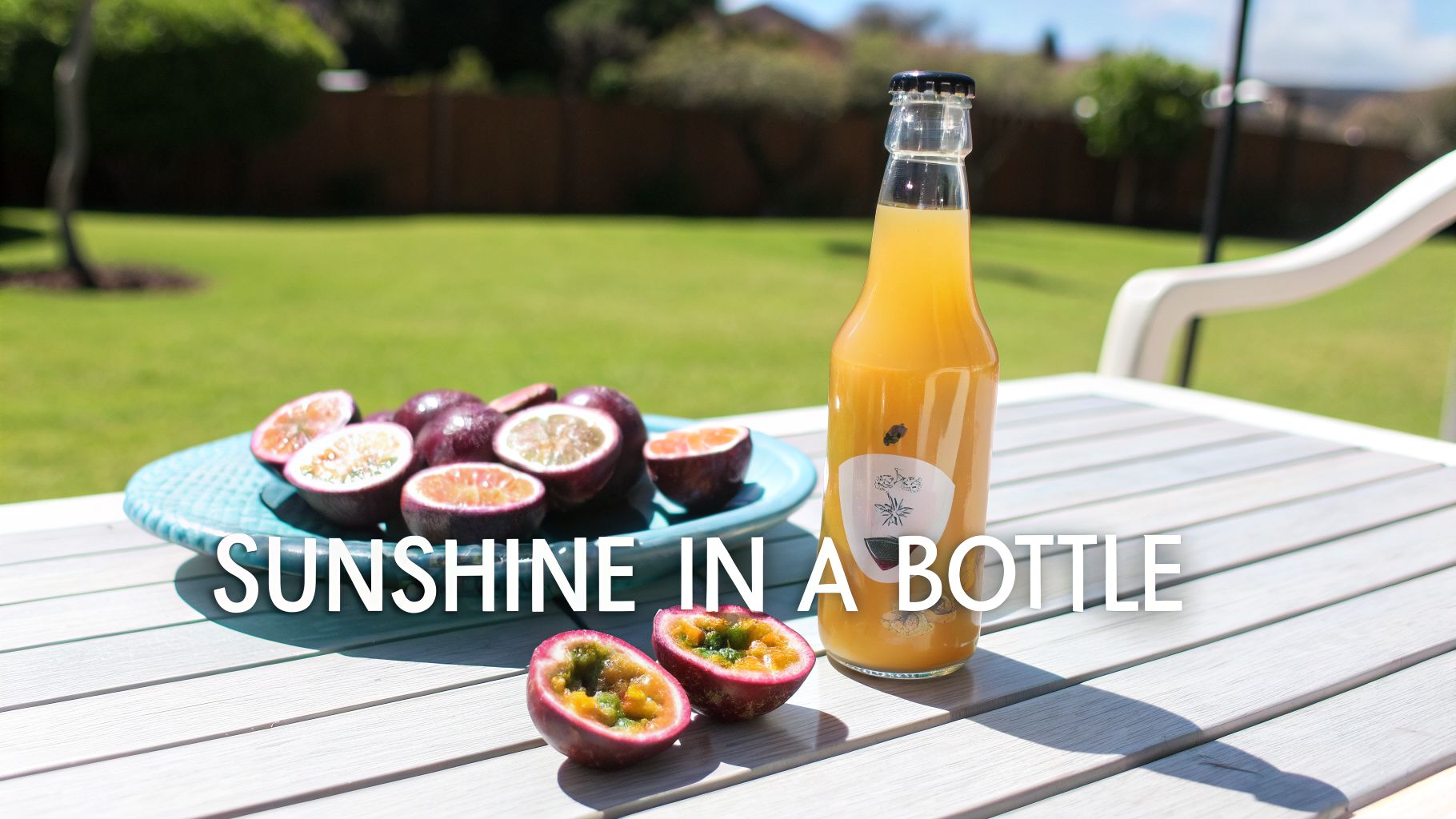
What was once a niche health drink has firmly hit the mainstream, winning over health-conscious Aussies everywhere. Passion fruit kombucha delivers that perfect sweet spot between taste and function—a bubbly, refreshing drink that feels like an indulgence but still aligns with a wellness-focused lifestyle.
The flavour is what sets it apart. It’s both complex and incredibly easy to drink; the sweet, aromatic notes of passion fruit cut through the fermented tang of the kombucha base beautifully. Each sip is like a burst of tropical sunshine, making it the go-to healthy swap for sugary soft drinks and juices. It’s a choice that feels both satisfying and genuinely beneficial.
A Flavour That Captured Australia
The growth of kombucha in Australia has been nothing short of remarkable, and the passion fruit flavour has consistently led the charge. This isn't just a fleeting trend. We've seen passion fruit varieties quickly become top sellers in major supermarkets, pointing to a clear shift in what people want from their drinks: something functional that doesn't compromise on taste.
To give you a quick snapshot, here are the key attributes of this fantastic drink.
Passion Fruit Kombucha At a Glance
| Attribute | Description |
|---|---|
| Taste Profile | A balance of sweet, tropical passion fruit and a bright, tangy finish. |
| Aroma | Fresh, aromatic, and unmistakably like ripe passion fruit. |
| Texture | Lightly carbonated with a natural, gentle fizz from fermentation. |
| Key Ingredients | Fermented tea (black or green), SCOBY, and real passion fruit. |
This combination of features is exactly why it has become such a beloved, health-forward choice for any time of day.
At its core, passion fruit kombucha is a fermented beverage crafted from sweetened tea and a SCOBY (Symbiotic Culture of Bacteria and Yeast). The real magic happens when real, organic passion fruit is infused during the brewing process, creating a drink that's not just delicious but also full of character. If you want to understand the fundamentals better, check out our guide on what kombucha is.
The final result is a beverage celebrated for its:
- Vibrant Taste: A perfect harmony of sweet tropical notes and a refreshing tang.
- Natural Sparkle: Lightly carbonated through the fermentation process, not forced.
- Pleasing Aroma: The distinct, delightful scent of fresh, ripe passion fruit.
The Probiotic Power of Passion Fruit Kombucha
There’s more to our passion fruit kombucha than just its incredible taste. It's what's known as a functional beverage, meaning it does more than just quench your thirst. Its real strength comes from two places: the gut-friendly probiotics from our authentic fermentation and the genuine nutritional kick from real, organic passion fruit.
At the core of every PepTea kombucha are live, active cultures. These are the good bacteria—the probiotics—that are a natural result of our SCOBY doing its work. It helps to think of your gut as a garden. These probiotics act like tiny gardeners, tending to the soil and helping everything in your internal ecosystem stay balanced.
More Than Just Probiotics
While probiotics get a lot of attention, the real passion fruit we use takes this drink to another level. This isn't just a flavouring; the fruit brings its own unique health-supporting compounds to the party.
This synergy creates a drink that works on multiple levels. You’re not just getting the benefits of a classic fermented tea, but you're also getting a genuine nutritional boost from the fruit itself.
When you choose passion fruit kombucha, you're getting a two-for-one wellness boost. The fermentation provides the live cultures for your gut, while the passion fruit adds its own distinct vitamins and antioxidants.
A Nutritional Powerhouse in Every Sip
When you combine authentic kombucha with real fruit, the results are genuinely impressive. Recent findings, for example, show that passion fruit-infused varieties often contain an enhanced nutritional profile.
A 2026 analysis of commercial kombuchas found those infused with passion fruit had, on average, 15% higher antioxidant levels than plain green tea versions. What's more, consumer data shows that 28% of Australian health enthusiasts now specifically seek out passion fruit kombucha for its dual benefits. A single serve of an authentically brewed kombucha can pack up to 2 billion CFUs (Colony Forming Units) and a serious dose of Vitamin C—around 45mg per 100ml, which is about 50% of your daily needs.
This combination of gut support and nutrient density is exactly why it's become such a popular choice. It's a beautiful marriage of the health properties from our organic green tea base and the vibrant goodness of real passion fruit.
To get a clearer picture of how these elements may support your body, consider the following:
- Live Probiotics: Generated during fermentation, these may help support a healthy gut microbiome, which is linked to everything from digestion to overall wellbeing.
- Antioxidants: Both our organic green tea base and the passion fruit itself are loaded with antioxidants, which help your body combat free radicals.
- Vitamin C: Passion fruit is a fantastic natural source of Vitamin C, a crucial nutrient known for its role in supporting healthy immune function.
This unique combination makes our authentically brewed, organic passion fruit kombucha a truly functional beverage. It’s a delicious, natural way to support your wellness goals. For a deeper dive into this topic, you can learn more about prebiotics and probiotics in our detailed guide.
How We Brew Our Authentic Passion Fruit Kombucha
There’s a world of difference between a mass-produced, shelf-stable drink and a truly authentic, living kombucha. Here at PepTea, we’re brewers first. Our entire process, honed in our dedicated Hunter Valley brewery, is designed to create a sugar-free, probiotic-rich drink that’s alive with both flavour and goodness.
It all comes down to the process. We start with just two premium ingredients: certified organic green tea and raw sugar. The sugar isn’t there for sweetness in the final drink; it's essential food for our SCOBY (Symbiotic Culture of Bacteria and Yeast). Think of the SCOBY as the engine of our brewery. It’s a living culture that metabolises the sweetened tea, transforming it into a complex, tangy beverage brimming with beneficial organic acids and live probiotics.
The Art of Authentic Fermentation
This is where patience comes in. Unlike drinks that are quickly produced and pasteurised for a long shelf life, our method is traditional and unhurried. We give the SCOBY the time it needs to work its magic, allowing it to consume virtually all of the sugar. This is the single most important step in making a genuinely sugar-free kombucha that’s rich in the good stuff.
The secret to real kombucha isn’t just in the ingredients, but in the process. We brew a raw, unpasteurised drink, which means we never heat-treat it. This preserves the delicate, living probiotic cultures that are the entire point of drinking kombucha for wellness.
It's a delicate dance between science and nature. We monitor this transformation closely, making sure the brew hits the perfect balance of flavour and acidity before we move to the next step. For anyone curious about the craft of brewing, getting this right is everything, and knowing how to use a digital pH meter is a key part of the process.
Infusing Pure Passion Fruit Flavour
Only when the primary fermentation is absolutely complete do we introduce the star of the show: real, organic passion fruit. We add the pure fruit pulp after the main brew, and we do this for a very specific reason. This method lets us capture the bright, tropical aroma and authentic taste of the fruit without interfering with the living cultures or adding any processed sugars or syrups.
This infographic shows the journey of key benefits from the bottle to your body, starting with gut support, then antioxidant action, and finally a boost of Vitamin C.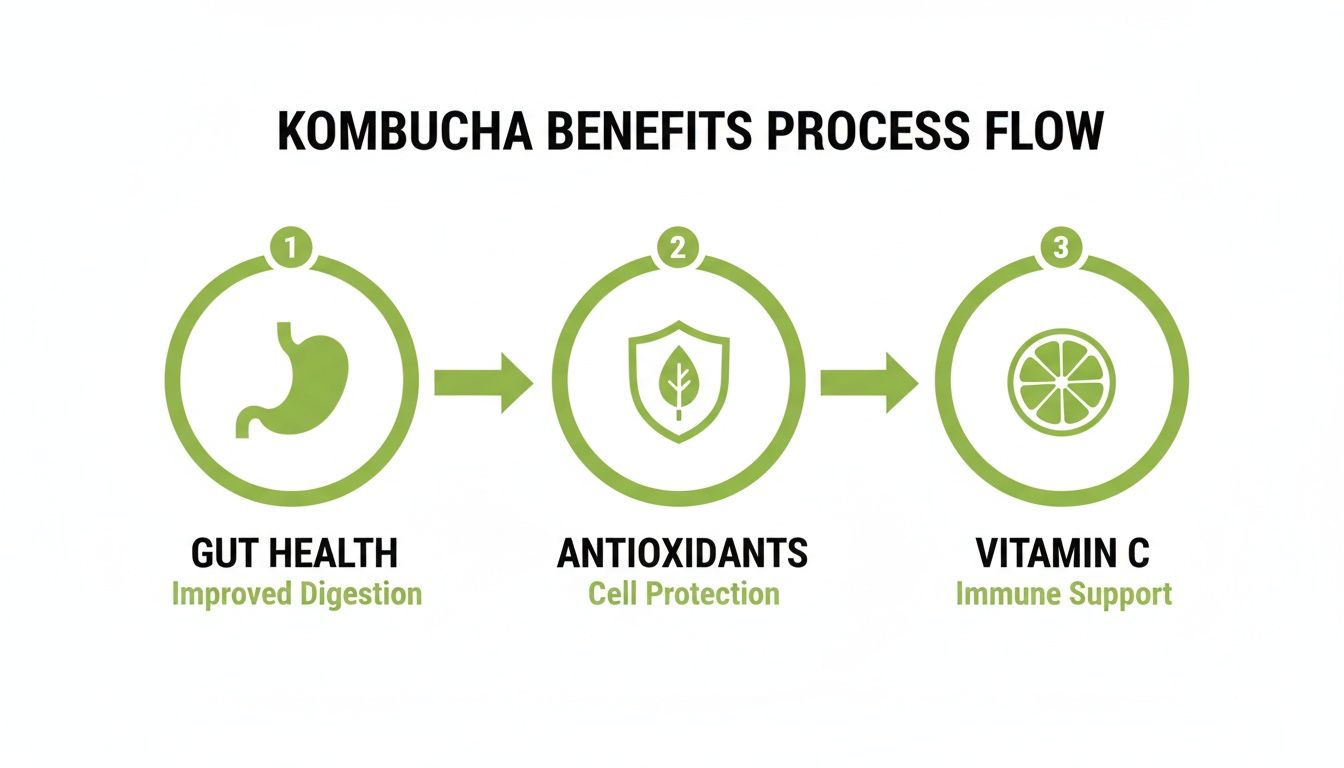
It’s a simple visual that shows how the combined elements in our passion fruit kombucha work together to support overall wellbeing. This commitment to real ingredients and an authentic, unhurried brewing method is what sets PepTea apart. It’s not a shortcut—it’s the right way to make a living drink that truly delivers.
Beyond the Bottle: How to Use Your Passion Fruit Kombucha
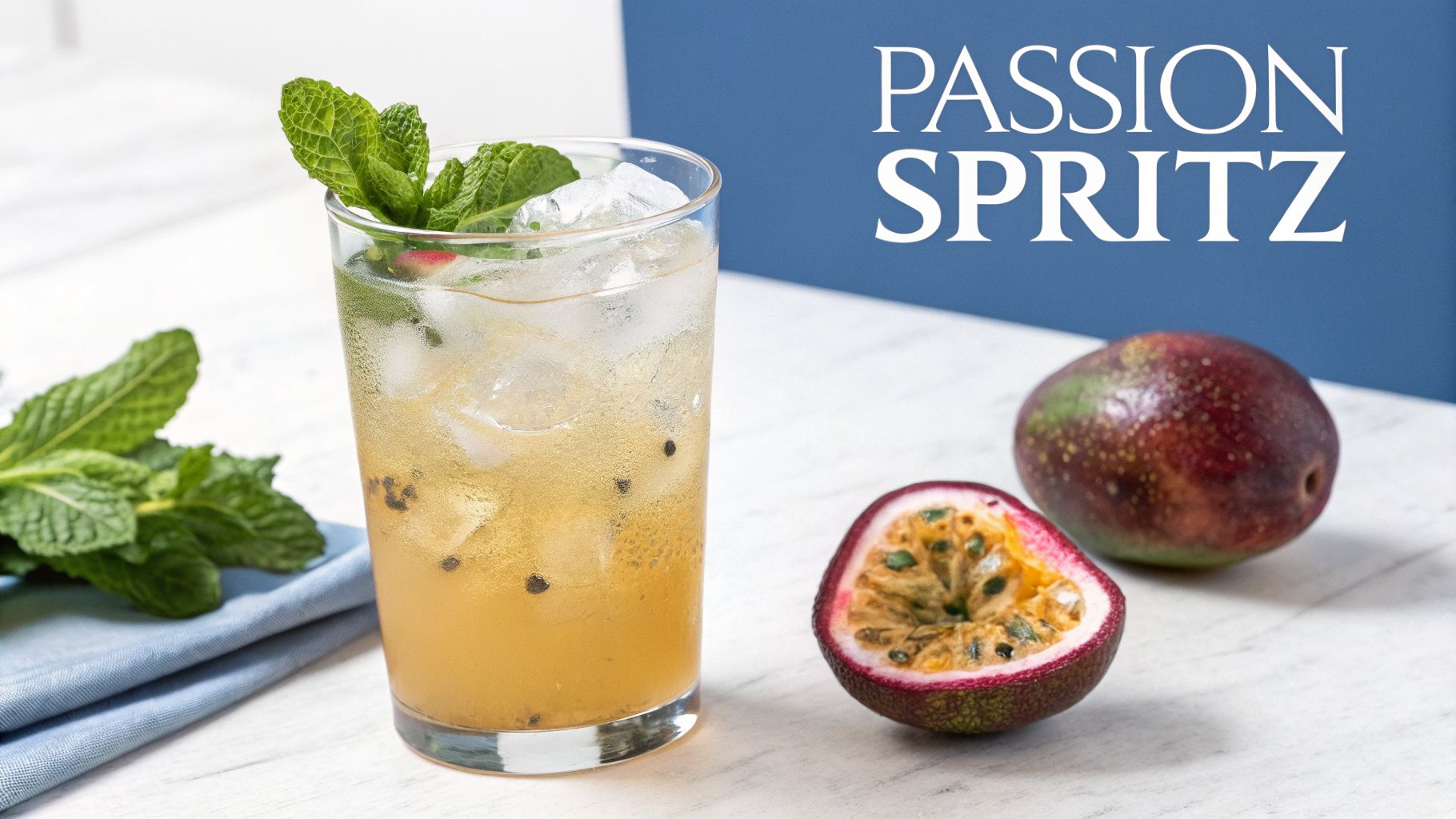
While our passion fruit kombucha is fantastic straight from the bottle, that's really just the beginning. Its true character—that balance of tropical tang and natural fizz—makes it an incredible starting point for all kinds of drinks and even a few surprising kitchen creations.
The simplest upgrade? Treat it like a proper drink. Pour it over a generous glass of ice, then add a sprig of fresh mint or a wedge of lime. It’s a small step that turns a daily wellness habit into a sophisticated ritual, perfect for a warm afternoon.
From Simple Sips to Café-Worthy Mocktails
One of the best things about our authentically brewed kombucha is its exceptionally clean finish and low sediment. This is no accident. It’s designed to be a brilliant mixer that doesn't cloud or fight with other ingredients, which is exactly why it’s found a home in so many Australian cafés and bars.
Since its rise, passion fruit kombucha has become a hospitality hero. Non-alcoholic beverage menus have grown by 48% in Australian cafés and bars, according to a 2026 industry survey. Our NSW-brewed organic kombucha is leading that charge, with our passion fruit flavour now accounting for 31% of all kombucha mixer sales in NSW venues this year. You can get a deeper insight into kombucha's journey in the beverage world and its origins as a living drink.
That professional-grade quality makes it incredibly easy to create impressive drinks at home. You can build a stunning non-alcoholic spritz, blend it into a vibrant smoothie, or even use its acidity as the base for a zesty salad dressing.
Simple Recipe: The Passion Spritz
For an instant crowd-pleaser, fill a tall glass with ice and a generous scoop of fresh passion fruit pulp. Squeeze in the juice of half a lime, top with a splash of sparkling water, and then pour over your PepTea passion fruit kombucha. A twist of lime to garnish, and you have a beautiful, bubbly mocktail that’s ready in seconds.
Get Creative in the Kitchen
To really get a feel for its versatility, it helps to start thinking of your kombucha as an ingredient. Its natural acidity and bright, tangy flavour make it a fantastic tool for cutting through richness in marinades or dressings. Here are a few ideas to get you started.
Zesty Vinaigrette: Whisk together ¼ cup of passion fruit kombucha, a tablespoon of good olive oil, a teaspoon of Dijon mustard, and a pinch of salt and pepper. It’s perfect for drizzling over a fresh garden salad, especially one with grilled chicken or prawns.
Smoothie Booster: Add a generous splash of kombucha to your morning smoothie. It pairs beautifully with mango, pineapple, and spinach for a probiotic and vitamin-packed start to your day.
Summer Popsicles: For a healthy, family-friendly treat, simply pour the kombucha into popsicle moulds with some diced fruit and freeze. The kids will love them.
Serving and Pairing Ideas
Here’s a quick-reference guide to help you get creative with your passion fruit kombucha, offering simple pairings for different occasions.
| Occasion | Serving Suggestion | Food Pairing |
|---|---|---|
| Afternoon Refresher | Poured over ice with a sprig of fresh mint. | Light snacks like rice paper rolls or a fresh fruit platter. |
| Weekend Brunch | Mixed into a Passion Spritz (see recipe above). | Smashed avocado on toast, or a goat's cheese and spinach tart. |
| Pre-Dinner Drink | Served neat in a champagne flute. | Salty nibbles like olives, salted nuts, or a cheese board. |
| Healthy Breakfast | As a liquid base for a tropical fruit smoothie. | A bowl of granola with yoghurt and berries. |
This table is just a starting point. The best way to discover what works is to experiment and see what you enjoy most.
Whether you’re looking for an effortless, refreshing drink or an innovative new idea for your café menu, our passion fruit kombucha offers a whole world of delicious possibilities.
How to Choose and Store High-Quality Kombucha
Walking down the kombucha aisle can feel like a test. With so many bottles claiming to be the real deal, how do you sort the genuinely healthy, living drinks from the impostors—the "cowboy kombuchas"?
It’s actually simpler than it looks. A few quick checks on the label are all it takes to make sure you’re bringing home something truly good for you.
First, look for two essential words: “raw” and “unpasteurised.” These are non-negotiable. They tell you the kombucha hasn't been heat-treated, which means the beneficial, living probiotics are still active. A pasteurised kombucha is really just a fancy, flavoured tea, not the functional beverage you're after.
What to Look for on the Ingredients List
Next, flip the bottle around. A quality passion fruit kombucha will have a refreshingly short and clean ingredients list: filtered water, organic tea, a SCOBY (or live cultures), and real, organic passion fruit.
Be sceptical of anything listing "natural flavours," "fruit concentrates," or extra sugars. These are often shortcuts used in mass-produced drinks that compromise the integrity of the brew.
At PepTea, we’re committed to authenticity. That means we only use certified organic ingredients, and our kombucha is genuinely sugar-free. We let the fermentation run its full course, allowing the SCOBY to consume the sugar naturally. What’s left is a pure, crisp taste without the sugary hit.
See a few cloudy wisps or a bit of sediment at the bottom? Don’t worry. That’s a great sign. Those are tiny strands of the SCOBY and yeast, proving your kombucha is raw, alive, and packed with the goodness you want. It’s the hallmark of an authentic brew.
Storing Your Kombucha to Keep it at Its Best
Once you’ve made your choice, proper storage is everything. The rule is simple: always keep your kombucha in the fridge.
Keeping it chilled is crucial for a few reasons:
- It Protects the Probiotics: The living cultures in raw kombucha are delicate. Cold temperatures keep them dormant and healthy, preserving their potency right up until you drink them.
- It Stops Over-Fermentation: If you leave a raw kombucha at room temperature, the fermentation will kick back into gear. This can create excess carbonation (think fizz explosions) and make the drink taste overly sour or vinegary.
- It Maintains Flavour: Refrigeration locks in that crisp, balanced flavour profile the brewer intended. It ensures every sip is as refreshing as the first.
By choosing a raw, organic, and genuinely low-sugar option and storing it correctly, you can be confident that you’re getting all the incredible flavour and wellness benefits your passion fruit kombucha has to offer.
Why Choose PepTea's Australian-Made Kombucha
Not all kombucha is created equal. When you look past the clever marketing, the difference often comes down to one simple thing: how it’s made, and who’s making it. At PepTea, we brew a kombucha that’s a world away from the mass-produced stuff, and it all starts with where we’re from.
We're a 100% Australian-owned family business, and every batch of our kombucha is brewed right here in the beautiful Hunter Valley, NSW. This isn't just a label on a bottle; it’s our guarantee of freshness and our connection to the local community. Choosing PepTea means you’re backing a family that’s genuinely passionate about making real, functional drinks.
Our Commitment to What's Real
Our approach is straightforward: real ingredients, real fermentation, and real health benefits. We don't cut corners. That’s why we insist on using only certified organic ingredients, from the premium green tea that forms our base to the real passion fruit pulp that gives our kombucha its authentic tropical character.
When you pick up a bottle of PepTea, you’re holding our promise. It’s our commitment to a genuinely sugar-free, probiotic-rich drink that’s raw, living, and unpasteurised. This is what sets us apart—a truly authentic kombucha, made with your wellbeing in mind.
This dedication to quality is visible in every part of our brand. For a company like PepTea, standing out requires that our values are clearly communicated, right down to our food and beverage printing needs to make sure our labels tell the full story.
Experience the PepTea Difference
Our traditional brewing process ensures our passion fruit kombucha is not just bursting with flavour but also genuinely packed with live, active cultures. We let our SCOBY do its thing, naturally fermenting away all the sugar to leave a crisp, clean refreshment you can feel good about.
Ready to taste what authentic kombucha is all about? We invite you to experience the vibrant, real flavour of a drink brewed with passion and purpose.
A Few Common Questions
Still have a few questions floating around about passion fruit kombucha? Let's clear them up. Here are the answers to some of the most common things we get asked.
Is Passion Fruit Kombucha Okay for a Low-Sugar Diet?
It absolutely can be, but you have to know what you’re looking for. Some brands will add sugar back in after fermentation for extra sweetness, but an authentically brewed kombucha like ours at PepTea is completely sugar-free.
We let our SCOBY do its job properly, allowing it to consume all the organic raw sugar during fermentation. This process is what creates the beneficial acids and probiotics, not a sweet, sugary drink. This makes our passion fruit kombucha a great choice for anyone watching their sugar intake. Always check the nutritional panel to be sure.
Does Passion Fruit Kombucha Contain Alcohol?
Because it’s a naturally fermented product, all kombucha contains trace amounts of alcohol—it's just a normal byproduct of the brewing process. The amount is tiny, typically less than 0.5% ABV.
That’s a similar level to what you might find in a very ripe piece of fruit or even a loaf of sourdough bread. In Australia, any drink with this little alcohol is legally classified as non-alcoholic.
Can I Drink Passion Fruit Kombucha Every Day?
For most people, yes. Having a daily serve of passion fruit kombucha is a fantastic way to support your gut health as part of a balanced diet.
If you’re new to fermented foods, though, we suggest starting with a smaller amount—maybe half a bottle. See how your body feels before you make it a daily habit.
What Are the Floating Bits in My Kombucha?
Those little cloudy strands you might see in the bottle are actually a great sign. They're tiny, harmless strands from the SCOBY or yeast culture, and they're proof that your kombucha is raw, living, and unpasteurised.
Think of them as a mark of authenticity. They're perfectly safe to drink and a real hallmark of a quality, craft-brewed kombucha.
Sometimes, a fermenting drink can attract fruit flies, especially for home brewers or cafés serving kombucha on tap. Learning what attracts fruit flies and how to stop them is a good way to keep your brewing environment clean.
Ready to taste what an authentic, Australian-made kombucha is all about? PepTea brews our entire range of organic, sugar-free kombucha with passion right here in the Hunter Valley.
Your Ultimate Guide to Using a Kombucha Tea Kit

If you've ever thought about brewing your own kombucha, a tea kit is the perfect way to begin. It cuts through the noise and gives you everything you need—most importantly, the living SCOBY culture—to turn sweet tea into that tangy, probiotic-rich drink you love. Think of it as your entry point into a seriously rewarding wellness practice, right from your own kitchen.
Your Home-Brew Kombucha Journey Starts Here
So, you're ready to dive into the world of home-brewed kombucha. Good on you! What might seem like a complicated science experiment is actually a simple, enjoyable process, and it all begins with your kombucha tea kit. Here at PepTea, we're passionate about authentic fermentation and natural ingredients, just like the proudly Australian, sugar-free kombucha we brew right here in the Hunter Valley, NSW.

More and more Aussies are discovering the satisfaction of home brewing, and for good reason. It’s about more than just making a drink; it's about connecting with your food, knowing exactly what’s going into your body, and unlocking some fantastic gut health benefits along the way. You’re the brewer now. You control the sweetness, the flavour, and the fizz.
Why Brew Your Own Kombucha?
Diving into home brewing isn't just a hobby; it’s a smart move towards a healthier lifestyle with a genuine sense of accomplishment.
- Total Control Over Ingredients: You pick the tea, the sugar, and the natural flavourings. That means no hidden preservatives or artificial junk.
- A Seriously Cost-Effective Habit: Brewing at home is dramatically cheaper than buying bottles from your local café, making daily kombucha an affordable wellness routine.
- An Endless Supply of 'Booch': Once you get started, your SCOBY will keep growing and reproducing. You’ll have a continuous supply for yourself, your family, and maybe even some friends.
- Endless Flavour Experiments: This is where the fun really begins. You can play around with seasonal fruits, fresh herbs, and spices to create your own signature blends.
Think of this guide as having a knowledgeable friend right there with you. We’ll walk you through every step, from unboxing your kit to that first fizzy sip. Your journey to becoming a confident home brewer starts now.
What's Inside Your Kombucha Tea Kit
Opening a new kombucha tea kit for the first time has a certain kind of magic to it. Let’s walk through what’s inside so you know exactly what you’re working with from day one. Each piece has a very specific job to do in turning simple sweet tea into that fizzy, probiotic-rich drink you’re after.
Think of it like getting the ingredients ready for a favourite recipe. The quality of each part directly shapes the taste and health of your final brew, which is why we’re big believers in starting with the best possible gear.
The Heart of Your Brew: The SCOBY and Starter Tea
The absolute centrepiece of your kombucha tea kit is the SCOBY. That stands for Symbiotic Culture of Bacteria and Yeast, and this rubbery, pancake-like disc is the living engine that drives the whole process. It’s not just an ingredient; it's a bustling little ecosystem of good bacteria and yeast that work together to ferment your sweet tea.
Your SCOBY will arrive swimming in a bit of strong, mature kombucha. This isn't just for keeping it safe during travel—it's your starter tea. This liquid is non-negotiable for a successful first batch. It immediately drops the pH of your sweet tea, creating an acidic environment that acts as a bodyguard, protecting your brew from mould and other unwanted microbes.
Always handle your SCOBY with clean hands. It's a living thing, and giving it a healthy, clean start is the single most important thing you can do for your first brew.
Your Brewing Essentials
Beyond the SCOBY, your kit has everything else you need to get fermentation started. We've chosen each item to make the process as straightforward and successful as possible.
- Glass Brewing Jar: This is your SCOBY's new home. Glass is the perfect material because it’s non-reactive and won’t hold onto weird odours or bacteria from previous uses.
- Organic Tea: The SCOBY literally feeds on the nutrients and tannins found in tea. Using a high-quality organic black or green tea—like the ones we use at PepTea—provides the best "food" for a healthy, thriving culture. To learn more about this crucial relationship, check out our guide on why kombucha needs real tea.
- Raw Organic Sugar: Don't stress about the sugar content! The SCOBY consumes almost all of it during fermentation, turning it into the beneficial organic acids that give kombucha its signature tangy kick. Most of this sugar is long gone by the time your brew is ready to drink.
- Cloth Cover and Tie: Your brew needs to breathe, but you also need to keep out dust and pesky fruit flies. A tightly woven, breathable cloth cover allows for that essential airflow while keeping your kombucha protected.
A good kombucha tea kit sets you up for success from the get-go. Here’s a quick inventory of what you'll find and why each part is so important.
Your Kombucha Tea Kit Inventory
A breakdown of each component in your kit, its function, and our tips for getting the best results.
| Component | Primary Function | PepTea Pro-Tip |
|---|---|---|
| SCOBY & Starter Tea | The living culture that ferments the tea. | Always add the starter tea to your brew. It's essential for creating the right acidic environment from the start. |
| Glass Brewing Vessel | Provides a safe, non-reactive home for fermentation. | Avoid metal or plastic containers. A wide-mouth jar makes it easier to access your SCOBY. |
| Organic Tea Leaves | The primary food source of nutrients for the SCOBY. | Stick with plain black or green tea. Flavoured teas with oils (like Earl Grey) can harm your SCOBY. |
| Organic Raw Sugar | The fuel the SCOBY consumes to produce acids and probiotics. | Don't substitute with honey or artificial sweeteners, as they can damage the culture. |
| Breathable Cloth Cover | Allows airflow while protecting the brew from contaminants. | Secure it tightly with a rubber band to keep curious fruit flies out. They love kombucha! |
| pH Strips (Optional) | Helps you monitor the acidity of your brew for safety. | A healthy brew should have a pH of 4.5 or lower within the first few days and finish between 2.5 and 3.5. |
With these components, you have a complete brewing ecosystem ready to go. Now, let’s get it set up.
Setting Up Your First Brew For Success
Getting your first brew right is more than half the battle. This is where you lay the foundation for a healthy, vibrant kombucha, and a little bit of care at this stage goes an incredibly long way. Think of it less as following a recipe and more as creating the perfect environment for your SCOBY to do its work.
We’ll walk through the hands-on process, but more importantly, we'll explain the 'why' behind each step. Understanding this from day one is how you build real brewing intuition.
The Golden Rule: Sanitation
Before you even think about boiling water, we need to talk about cleanliness. This is the single most critical part of home brewing, period. Your SCOBY is a living colony of good bacteria and yeast, and the last thing you want is for it to compete with unwanted airborne mould or other nasties.
A successful brew starts with a spotless setup. Before you begin, you need to know how to properly sterilize jars and all your equipment. For most brewing, a simple wash with hot, soapy water followed by a very thorough rinse is enough. If you want extra peace of mind, a final rinse with plain white vinegar creates an acidic barrier that contaminants hate.
- Wash Everything: Your big glass jar, spoons, and measuring cups all need a good wash with hot water and a little dish soap.
- Rinse Thoroughly: Make absolutely sure no soap residue is left. Soap can seriously harm your SCOBY.
- Clean Hands: Wash your hands well before you handle your SCOBY or any other part of your kombucha tea kit.
Brewing The Perfect Sweet Tea
With a clean station, it’s time to make the food for your SCOBY: sweet tea. It’s important to remember the sugar isn't for you—it’s the fuel your culture will consume during fermentation. Don't be tempted to cut the sugar, as an underfed SCOBY won't ferment properly and can become weak.
First, bring about 1 litre of filtered water to a rolling boil. Using filtered water is a smart move; the chlorine found in some tap water can be tough on the delicate microorganisms in your SCOBY.
Pour the boiled water into your brewing jar, add the organic tea, and let it steep for 10–15 minutes. This isn't just for flavour; it extracts the vital nutrients the SCOBY needs to thrive.
Next, remove the tea bags. Add the raw sugar and stir with a clean spoon until every last crystal is dissolved. You can't have any sugar settling at the bottom, as the SCOBY won't be able to get to it. Finally, top it up with the remaining cool, filtered water to help bring the temperature down.
CRITICAL STEP: You must wait for the sweet tea to cool completely to room temperature, which is somewhere between 20-29°C. Adding your SCOBY to hot or even warm tea will kill it. Seriously. Be patient here; it’s absolutely worth the wait.
This simple flowchart shows how the core components of your kombucha tea kit come together.

As you can see, fermentation is a process of transformation. The SCOBY takes the simple sweet tea you've made and turns it into delicious, living kombucha.
Introducing Your SCOBY To Its New Home
This is the moment it all comes together. Your tea is cool, and your SCOBY is ready to get to work.
Gently pour the entire contents of the SCOBY package—the disc itself and all of the starter liquid—into your jar of sweet tea. That starter liquid is non-negotiable. It’s a measure of strong, mature kombucha that immediately drops the pH of your brew, making the environment acidic enough to welcome your SCOBY and ward off mould.
Don't worry if your SCOBY sinks to the bottom, floats on top, or even turns sideways. This is completely normal. A new baby SCOBY will eventually form at the surface, no matter what the original one decides to do.
Finally, cover the mouth of the jar with the breathable cloth from your kombucha tea kit and secure it tightly with the rubber band. This keeps out dust and pesky fruit flies but allows your brew to breathe. Now, find a warm, dark spot away from direct sunlight, and let the magic begin.
Kicking Off the First Fermentation (F1)
Alright, your brewing jar is set up and tucked away. Now for the magic. This is the first fermentation, or F1, where your SCOBY gets to work, turning that sweet tea into the tangy, probiotic-rich drink you’re after. It’s a quiet but incredibly active process.

During this stage, the yeast and bacteria in your SCOBY are feasting on the sugar you added. They’re converting it into beneficial organic acids, a whole spectrum of B vitamins, and of course, those gut-friendly probiotics. Your only job right now is to let it do its thing.
How Long Does It Take?
Patience is a brewer’s most useful tool. A standard F1 can take anywhere from 7 to 21 days, but that’s just a rough guide. The single biggest factor is temperature.
Think of your SCOBY as a tiny engine. In a warmer Aussie kitchen, say in Brisbane, its metabolism will be in high gear, and you might have finished kombucha in just a week. But in a cooler spot, like a Melbourne pantry in winter, things will slow right down, possibly stretching to three weeks or more.
Don't get fixated on the calendar. The best kombucha is brewed to taste, not to a schedule. Your palate is the most important tool you have.
You’re part of a massive shift in how Australians think about drinks. The local kombucha market is booming, with projections showing it could hit USD 650.4 million by 2033. This isn't just a niche trend; it's a mainstream move powered by a 15.1% CAGR from 2026 to 2033 as people swap sugary soft drinks for something better. You can dive deeper into the numbers in this comprehensive market analysis by Grand View Research.
What to Look For: Signs of a Healthy Brew
It’s completely normal to feel a bit anxious with your first batch. Is it working? Is that normal? Here’s what a healthy, happy fermentation looks like:
- A New SCOBY Forming: After a few days, you should see a thin, almost clear film spreading across the surface. This is your brand new 'baby' SCOBY! It might look patchy at first but will soon grow into a solid, creamy layer.
- Tiny Bubbles: Look closely. You might spot tiny bubbles rising to the surface. That’s carbon dioxide, a natural sign that the yeast is actively fermenting the sugar. It’s alive!
- The Smell is Changing: Your brew will slowly transform from smelling like sweet tea to having a sharper, slightly vinegary aroma. That’s the smell of success—it means those healthy acids are developing.
- Brown, Stringy Bits: Don’t panic if you see brown, stringy strands dangling from your SCOBY or settling at the bottom. These are just bits of healthy yeast and are a completely normal part of the process.
The All-Important Taste Test
Around day seven, it’s time to start tasting. This is how you’ll know exactly when your kombucha is ready for the next step.
Gently push a clean straw or pipette down the side of your SCOBY, past the new growth, and draw out a small sample. You’re looking for a flavour balance that’s right for you.
- Too sweet? It tastes more like sweet tea than kombucha. The SCOBY needs more time. Pop the cloth cover back on and let it keep working its magic.
- Too tart? It’s a bit too sharp or vinegary for your liking. You’ve just let it ferment a little long. No drama at all—this extra-strong brew is the perfect starter tea for your next batch.
- Just right? It has that perfect mix of sweet and tangy. Congratulations! Your first fermentation is done.
Once you get a few brews under your belt, you might want to get a bit more precise. Using a pH meter can help you dial in your process. A finished F1 typically sits in the 2.5 to 3.5 pH range. For brewers looking to achieve that next level of consistency, you can explore the digital pH meters available to help standardise your results.
When you hit that perfect flavour profile, you’re ready for the really fun part.
Mastering Flavour and Fizz with a Second Fermentation (F2)
Right, this is where the real fun begins. The first fermentation gave you kombucha, but the second fermentation, or F2, is where you get to turn it into something special. This is the step that creates that signature fizz and lets you infuse all kinds of creative flavours. It’s how you go from just making kombucha to making your kombucha.

The science is simple. You bottle your finished kombucha in an airtight container with a small sugar source—usually fruit. The yeast that’s still active in your brew gets to work on this new sugar, producing carbon dioxide. Because the gas has nowhere to go, it dissolves into the liquid, creating that lovely natural carbonation.
Bottling for a Perfect Fizz
Before you start experimenting with flavours, we need to talk about bottles. This is the most important safety step in the entire process. Carbonation builds a surprising amount of pressure, and you have to respect it.
- Use Proper Bottles: This is absolutely non-negotiable. You must use pressure-rated, swing-top (Grolsch-style) bottles designed to hold carbonated drinks. Never, ever use regular decorative jars or thin glass bottles. They can and do explode, which is both dangerous and incredibly messy.
- Leave Some Headspace: Don't fill the bottles all the way to the top. Always leave about 2-3 centimetres of empty space. This little air pocket gives the CO2 room to build up without putting too much stress on the glass.
- Get a Good Seal: Make sure the seals on your swing-top bottles are in good condition and create an airtight lock. If the seal is weak, all that lovely carbonation you’re trying to create will just leak out, and you’ll end up with flat, flavoured tea.
Think of the second fermentation as a mini-ecosystem in a bottle. You are providing the yeast with a final meal and trapping the results. The right bottle is your most important piece of safety equipment.
Infusing with Natural Flavours
Now you get to be the artist. The Australian market for wellness drinks is booming, with a projected 9.5% CAGR from 2026 to 2032. A huge driver of that growth is the demand for exciting, natural flavour combinations. You can read more about how flavour is shaping the industry in this insightful Australian kombucha market report.
This is your chance to tap into that trend right in your own kitchen. Here are a few simple ideas to get you started, inspired by our own sugar-free PepTea range and the fantastic fresh produce we have in Australia.
- Classic Ginger: Add 1-2 teaspoons of finely grated fresh ginger to a 500ml bottle. It’s a classic for a reason, delivering a spicy, warming kick that never gets old.
- Zesty Lime & Ginger: Take the classic ginger and add a squeeze of fresh lime juice. It creates a vibrant, sharp combination that is unbelievably refreshing.
- Tropical Mango: Add 1-2 tablespoons of puréed ripe Queensland mango. The natural sugars in the fruit give the yeast plenty to work with, resulting in a fantastic fizz and a beautiful tropical flavour.
Achieving That Signature Carbonation
Once you’ve bottled and flavoured your brew, leave the bottles at room temperature for another 1-3 days. The warmer the room, the faster the carbonation will build.
You'll need to check the fizz level daily. The best way to do this is to "burp" one of the bottles—just carefully and slowly crack the seal. If you hear that satisfying psst, they’re ready. Be warned: a very active brew can gush out like a shaken soft drink, so open it over the sink.
As soon as you’re happy with the level of fizz, get all the bottles into the refrigerator immediately. The cold halts the fermentation process, stopping it from becoming over-carbonated and locking in that perfect sparkle.
And that's it. Your delicious, flavourful, fizzy home-brewed kombucha is ready to drink. Cheers to that.
SCOBY Care and Solving Common Brewing Problems
Your SCOBY is a living thing, and it’s pretty self-sufficient. As you brew more batches with your kombucha tea kit, you'll notice it growing new layers. This is a great sign—it means your culture is healthy and active.
Eventually, you’ll have more SCOBY than you need for one brew. Don’t throw the extra bits away. You can start what brewers call a “SCOBY hotel”. It’s just a spare jar where you keep your extra cultures submerged in some mature kombucha from a previous batch. This keeps them healthy and ready for your next brew or for sharing with a friend.
Your Brewing Troubleshooting Guide
Even experienced brewers run into small issues. Don't worry; most common problems are easy fixes and are just part of the learning curve. Here’s what to look out for.
A slow brew is a frequent concern. If it feels like fermentation is dragging on, temperature is almost always the reason. Your SCOBY is less active when it’s cool, so try moving your jar to a warmer spot. The top of the fridge or near another running appliance often works well, just be sure to keep it out of direct sunlight.
Another thing new brewers notice is a SCOBY that sinks, floats sideways, or just hovers in the middle of the jar. This is completely normal and doesn’t affect the fermentation. A new baby SCOBY will form on the surface, no matter what the mother culture is doing below.
Identifying and Handling Mould
The biggest fear for any new brewer is mould. Thankfully, with basic hygiene, it's quite rare. Mould looks exactly like you'd expect—fuzzy, dry, and often colourful. It will always grow on the surface of the liquid and can be white, green, blue, or black.
Good hygiene is the best defence. Learning how to prevent cross-contamination in your kitchen is a non-negotiable skill for any home brewer. This really just means washing your hands and equipment thoroughly before you start.
What isn't mould? Brown, stringy bits hanging off your SCOBY, cloudy sediment at the bottom of the jar, or even dark patches within the culture itself are usually harmless yeast strands. These are all signs of a healthy, active brew.
If you are 100% certain you have mould, the batch can't be saved. You have to throw out the entire brew, SCOBY included. Don't ever try to scoop the mould off; microscopic spores will have already contaminated the entire liquid. It happens. Just sterilise your equipment thoroughly and start again with a new culture.
Caring for your SCOBY is a hands-on learning process. For a closer look, you can learn more about the life of your kombucha SCOBY in our dedicated guide.
Your Kombucha Brewing Questions Answered
When you're just starting out with a kombucha tea kit, a few questions always come up. It's completely normal. As tea and kombucha specialists, we’ve put together the straightforward advice we give every new brewer.
Think of this as your cheat sheet for a confident and successful first brew.
Is It Actually Safe to Brew Kombucha at Home?
Yes, it’s incredibly safe. When you follow the basic sanitisation steps and start with a quality kombucha tea kit, you're creating an environment where only the good stuff can thrive.
The real magic is in the brew itself. Kombucha naturally develops a low pH, creating an acidic liquid where harmful pathogens just can't get a foothold. It’s the brew’s own clever way of protecting itself, and you.
How Much Homemade Kombucha Should I Drink a Day?
If you’re new to the world of kombucha, start slow. A small glass of about 125ml (a half cup) per day is the perfect starting point. This gives your gut a chance to get acquainted with all those new, beneficial probiotics without feeling overwhelmed.
Once your body adjusts, you can gradually work your way up. Many long-time kombucha drinkers enjoy anywhere from 250–500ml daily. The most important thing? Listen to your body. It knows best.
Can I Use Different Teas for My Kombucha?
You can, but there are a few things you need to know first. For a healthy, thriving SCOBY, nothing beats plain, unflavoured black or green tea. These teas, from the Camellia sinensis plant, provide the specific nutrients and nitrogen your culture needs to do its job properly.
Herbal teas might sound like a fun experiment, but they lack the essential compounds to keep your SCOBY strong, and can weaken it over time. Teas that contain oils, like Earl Grey or other flavoured blends, are a definite no-go for your primary fermentation—the oils can coat and damage the culture. For the best results, stick with a high-quality organic tea.
Ready to get started? PepTea has everything you need to begin brewing authentic, delicious kombucha in your own kitchen.
From Gut Health to Detox: The Benefits of Kombucha
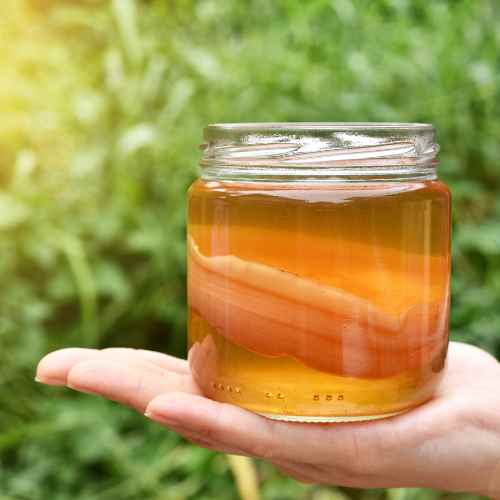
In case you missed the memo, the benefits of kombucha have been a talking point for quite a while now. From nurturing gut health with its probiotics to aiding the body’s natural detoxification process, it has emerged as a potent player in the world of functional beverages. In this article, we will look into the fascinating world of kombucha, its brewing process, and the various ways it can contribute to your health and wellness.
Where does Kombucha come from?
Kombucha originated around 2,000 years ago in Northeast China (formerly known as Manchuria). A fermented tea drink, it was highly valued for its detoxifying and energizing properties. It was then traded along the Silk Road and eventually found its way to Russia and Eastern Europe. Over time, it gained popularity in the West, and by the late 20th century, kombucha had firmly established itself as a globally loved health beverage.
Despite its seemingly recent surge in popularity, the roots of kombucha run deep, entwined with ancient cultures and age-old traditions of health and wellness.
How is Kombucha made?
Kombucha is made through a fermentation process that starts with a sweetened tea base. The magic happens when a Symbiotic Culture Of Bacteria and Yeast (SCOBY) is introduced to this sugary tea mix. This SCOBY, often referred to as the “mother” or “mushroom,” begins to feed on the sugar, initiating the fermentation process. Over a period of about 1-3 weeks, the brew is transformed into a fizzy, slightly sour, and refreshing beverage packed with probiotics, enzymes, and beneficial acids.
The specific flavour profile of kombucha can vary greatly based on factors such as the type of tea used, the duration of fermentation, and any additional flavourings added post-fermentation, such as fruits or herbs.
The Health Benefits of Kombucha
Thanks to its unique brewing process, kombucha is not just any ordinary tea. Kombucha health benefits have been celebrated for centuries and it is often touted for its ability to support a range of wellness goals – from boosting gut health to promoting detoxification and heart health.
Gut health and kombucha
Perhaps the best-known benefit of kombucha is its role in promoting a healthy gut. But why is it so good for our digestive health?
The role of probiotics in gut health
Probiotics, often referred to as “good bacteria,” play a vital role in maintaining gut health. Our gut is home to trillions of microorganisms, including various bacteria types, collectively known as the gut microbiome. When this microbiota is balanced, it aids digestion, nutrient absorption, and immune function. Probiotics contribute to this balance by inhibiting harmful bacteria’s growth, boosting the immune system, and helping to maintain the gut’s protective barrier. They can also produce substances like short-chain fatty acids, which provide nourishment for the gut lining.
How kombucha nurtures digestive health
Kombucha directly nurtures gut health through its rich composition of probiotics and acids produced during the fermentation process. These probiotics, along with acetic, gluconic, and lactic acids, can help restore the balance of the gut microbiota. The probiotics in kombucha, specifically Saccharomyces and Brettanomyces, are known to combat harmful bacteria in the gut, fostering an environment conducive to the growth of beneficial bacteria.
Additionally, the acids in kombucha can aid in maintaining an optimal pH level in the gut, further promoting digestive health by inhibiting the growth of undesirable bacteria and yeasts. Moreover, kombucha is believed to have a prebiotic effect, providing nourishment for beneficial gut bacteria and stimulating their growth.
By introducing and nourishing the beneficial bacteria in our gut, kombucha can play a vital role in maintaining and improving digestive health.
Kombucha as a detoxifying agent
Kombucha is also known as a powerful detoxifying agent, binding to the toxins present in the body and aiding in their expulsion, thus promoting a healthier liver and overall well-being.
Understanding detoxification
Detoxification is the biological process of eliminating toxins from the body. These toxins can be anything from harmful chemicals we intake through air, food, and water, to natural waste products produced by our bodily functions. The process involves several key organs, primarily the liver, which plays a central role in metabolizing substances to be removed. Toxins are processed for elimination and then excreted through channels such as sweat, urine, and faeces. The kidneys, lungs, and even skin also play crucial roles in this detoxification process.
Regular detoxification can support overall health, improving organ function, boosting energy levels, and supporting the immune system. Drinking kombucha, with its beneficial natural acids and antioxidants, is said to enhance this vital process.
The role of kombucha in the detoxification process
Kombucha plays a crucial role in the detoxification process due to its high content of glucuronic acid, a natural detoxifier. This acid binds to toxins entering the liver and converts them into soluble compounds that can be easily excreted through the kidneys.
By aiding in the efficient removal of harmful substances, kombucha helps to alleviate the burden on the liver and kidneys, resulting in enhanced overall health.
Other health benefits of kombucha
In addition to its detoxifying properties and its positive effects on digestive health, kombucha may offer plenty of other health benefits. The drink can be rich in B vitamins, known for their role in energy production and maintaining good brain health. Kombucha’s antioxidant content helps combat inflammation and protect the body from the harmful effects of free radicals.
The antioxidant power of kombucha is all down to the tea it is made from, as all the benefits of tea remain. You can find out more in our article about the benefits of green tea in kombucha.
Lastly, some studies suggest that kombucha may contribute to heart health by reducing levels of “bad” LDL cholesterol while increasing “good” HDL cholesterol. However, more research is needed in this area to fully understand the extent of kombucha’s health benefits.
Are there any downsides to kombucha?
Before we look at the downsides and potential side effects of kombucha, it is worth mentioning that not all kombucha is made equal. So it follows that the associated health benefits can vary widely from brand to brand, and even batch to batch. Always buy good quality kombucha and beware of high-sugar versions that may also contain artificial flavours and preservatives.
Our all-natural organic green tea kombucha is raw AND organic.
Like any food or drink, kombucha can also have potential side effects. While generally considered safe for most people, individuals with compromised immune systems or those who are pregnant or breastfeeding should exercise caution.
Kombucha is a fermented drink containing a small amount of alcohol and caffeine, which some people may need to avoid. It can also cause upset stomachs, infections, and allergic reactions in rare cases. Overconsumption may lead to acidosis, a condition characterized by excess acid in the body.
Always remember to consume kombucha in moderation and consult your healthcare provider if you have any concerns.
To recap, kombucha is a delicious drink with a unique flavour profile and a wealth of potential health benefits, that makes a refreshing alternative to sugary sodas. Just remember to prioritize quality, watch out for high-sugar versions, and most importantly, consume in moderation.
Have you tried our range of naturally flavoured raw organic kombucha tea?
This article was reproduced on this site with permission from operafoods.com.au the “Organic Kombucha Distributors”.
See original article:- From Gut Health to Detox: The Benefits of Kombucha