
Tag: Organic Matcha
Your 2026 Guide to the Best Matcha Cake Brisbane
You're standing in a Brisbane café, staring at a green slice of cake and wondering if it's real matcha or just a pretty sponge with colouring. That hesitation makes sense. matcha cake Brisbane searches have surged because matcha is no longer a niche order, it's now part of the city's everyday café language, but the quality gap is still wide.
The tricky part is that a cake can look right and still miss the mark completely. It might taste flat, look unnaturally bright, or feel like the matcha was added for branding rather than flavour. For Brisbane diners, the key question isn't just where to buy it, it's how to tell when a cake is worth the price.
The Search for Brisbane's Perfect Matcha Cake
Brisbane's matcha scene has grown into something far more visible than a passing trend. That matters, because once an ingredient becomes mainstream, the market fills with both thoughtful, high-quality versions and quick opportunistic ones. A recent Australian consumer panel analysis found matcha was up 53% year-on-year nationally, with the ingredient sitting at 3.58% social share and still described as “emerging” (Tastewise).
That trend shows up in menus across the city too. Iced matcha lattes now appear at major chains including McDonald's, Krispy Kreme, Starbucks, Rashays, and Chatime, and Brisbane prices in that dataset ranged from $6.30 to $18.95 (Tastewise). When an ingredient moves from specialty cafés into chain menus, dessert makers usually follow, because customers start recognising the flavour and expecting it in more formats.
Practical rule: if a city already accepts matcha as a menu flavour, cakes and pastries usually follow the drink trend.
The problem is that popularity doesn't guarantee quality. Brisbane coverage has been rich on where to find matcha, but much thinner on whether the boom is still backed by good ingredients, especially in desserts (Torrens University). That gap is exactly where smart buyers get an advantage, because a great matcha cake should taste balanced, aromatic, and fresh, not just look green.
Not All Matcha Is Created Equal
A good matcha cake starts with the right grade of powder, a distinction that often confuses many buyers. Ceremonial grade is the high-end powder people usually drink on its own, while culinary grade is built for baking and mixing. The simplest way to think about it is like cooking wine versus a fine bottle you'd pour into a glass, one is made to shine in a dish, the other is made to be savoured directly.
The reason this distinction matters in cake is flavour structure. Baking dilutes and reshapes ingredients, so a matcha that's lovely in a bowl can disappear in batter, while a culinary grade designed for mixing can hold its own through flour, eggs, and butter. That's also why the best matcha cakes tend to show a natural green colour rather than a pale, dull, or artificially bright one.
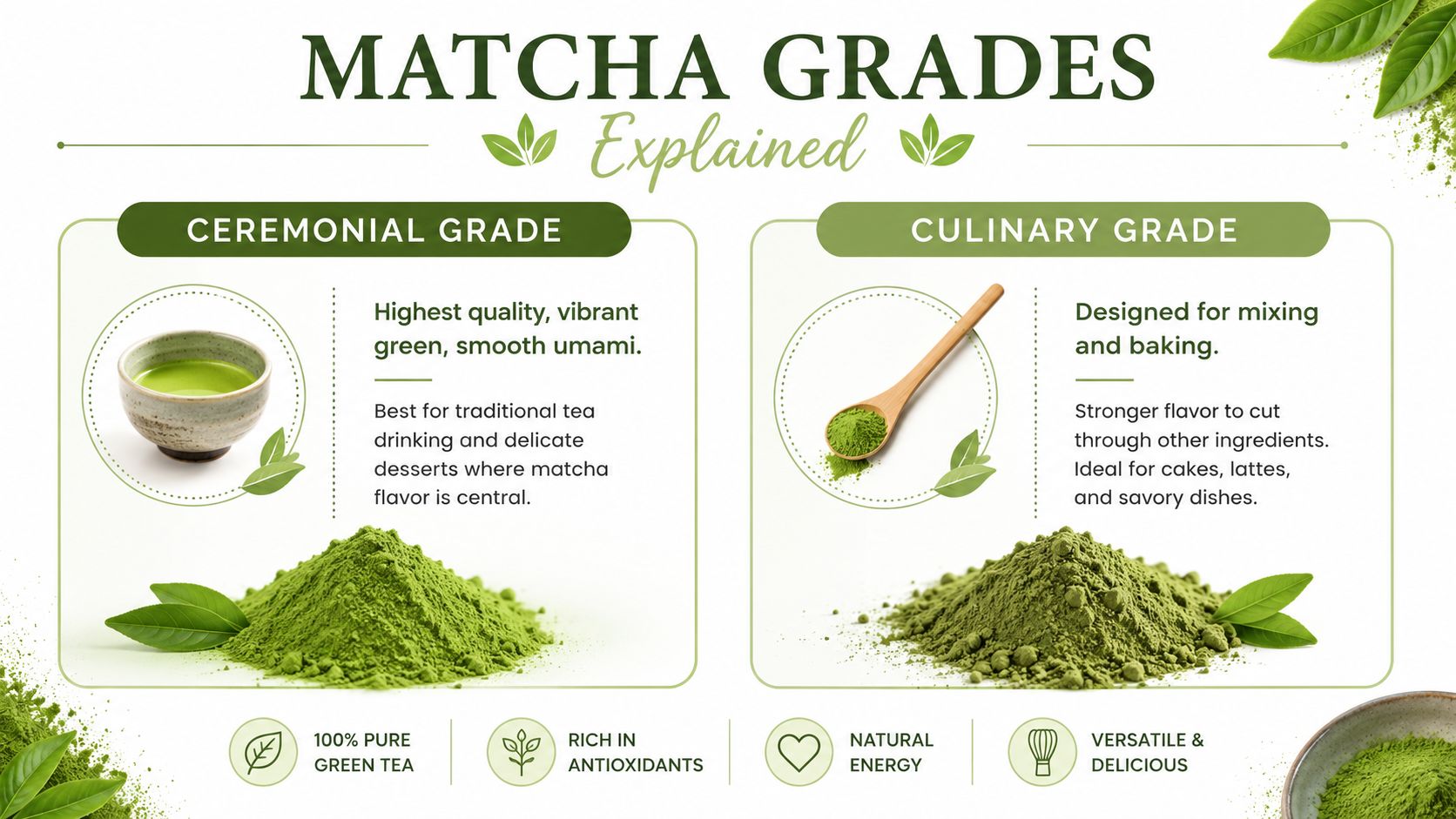
A good café menu usually gives clues if you know what to look for. A cake made with stronger culinary matcha often tastes more rounded and less sugary, while a weak one can taste mostly like vanilla sponge with a faint grassy note. When the powder is high quality, the colour is more even and the finish feels cleaner rather than bitter or dusty.
| Feature | Ceremonial Grade Matcha | Culinary Grade Matcha (High Quality) | Best For |
|---|---|---|---|
| Flavour | Smooth, delicate, umami-rich | Stronger, more robust | Drinking, delicate desserts |
| Colour | Vibrant natural green | Good green colour, slightly less delicate | Cakes, lattes, baked goods |
| Texture | Fine and refined | Designed to mix well | Whisking, batter, sauces |
| Best use case | Traditional tea preparation | Baking and recipes | Matcha cake, café drinks, desserts |
If you're shopping or ordering, ask one simple question, what grade of matcha is in the cake? If the answer is vague, that's usually a sign the product is built for appearance first.
Learn more about different grades of matcha
Where to Find Great Matcha Cake in Brisbane
Brisbane's matcha market is now broad enough that you can start your search in several parts of the city instead of chasing one hidden specialty spot. Dedicated outlets across Teneriffe, the CBD, and Sunnybank show how far the flavour has moved into the mainstream, while chain cafés have made matcha familiar to casual drinkers too (The Urban List). That broader awareness helps dessert menus, because customers already know what matcha should taste like.
The best way to judge a café is to look at how seriously it treats matcha across the menu. A venue that serves it as a throwaway novelty will usually lean on colour and sweetness. A place that treats it as a core flavour tends to show more restraint, with better balance, cleaner colour, and a more deliberate texture.
A useful buying cue: the strongest café cakes usually sit in places that already serve matcha regularly, not just once as a special.
Price can also reveal positioning. Brisbane sources note drinks ranging from $4.50 to $18.95, with dedicated tea houses like Sinmei Tea pricing cakes around A$6 to A$7 and specialty items such as a lava cake at A$20 (The Urban List; Sinmei Tea at Scrumptious Reads). Those numbers don't tell you quality by themselves, but they do show that Brisbane already accepts a premium tier for matcha products.
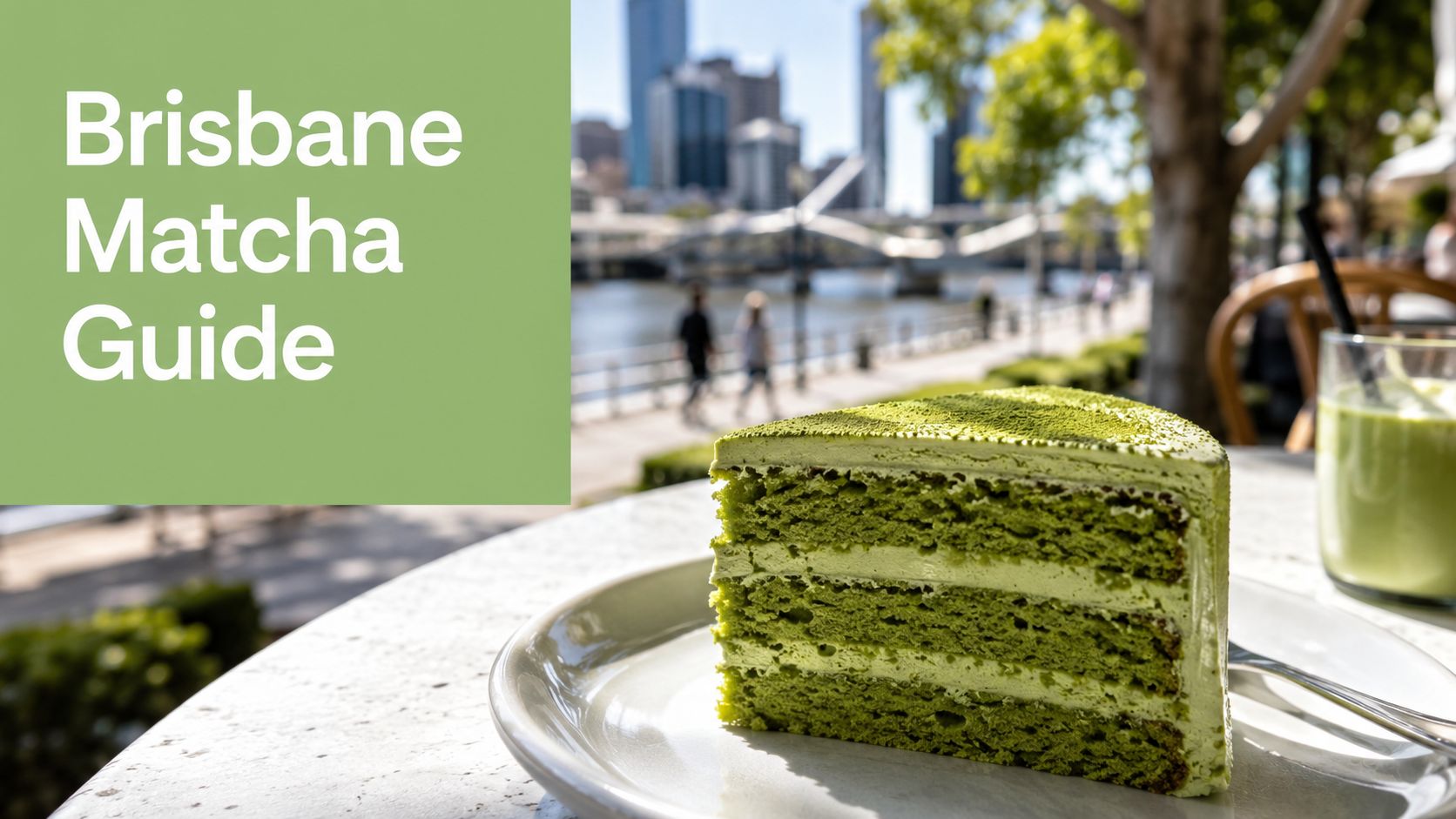
For Brisbane buyers, the smartest approach is to compare three things at once, flavour depth, colour consistency, and how the cake sits in the venue's broader dessert offer. If a café is already comfortable charging premium prices for matcha drinks, its cake is more likely to be made with intention. If you're after a starting point, look around the CBD for specialist tea houses, then check Brisbane suburbs with established dessert culture like Teneriffe and Sunnybank.
Bake Your Own with Our Pep Tea Matcha Recipe
Baking your own cake removes the guesswork. You choose the powder, control the colour, and decide whether the result tastes fresh or merely decorative. That's especially useful if you've been disappointed by cakes that look promising but collapse into sweetness once you take a bite.
The key technique comes before the oven
Matcha cake is sensitive to temperature and dispersion. One tested method bakes at 162°C and heats milk only to 82 to 85°C, which helps preserve colour, while another Australian recipe uses 180°C and stresses whipping eggs and sugar until the mixture triples in volume before folding in the dry ingredients (Texanerin; Zen Green Tea). The logic is simple, lower liquid temperature and solid aeration help reduce clumping, protect the green tone, and keep the crumb finer.
A practical home method looks like this:
- Sift the matcha first. This breaks up soft lumps before they meet liquid.
- Warm the milk carefully. Body-temperature milk can help matcha disperse more evenly, while some tested cakes heat milk to 82 to 85°C for colour control (Zen Green Tea; Texanerin).
- Pre-slurry the powder. Mix matcha with a little warm liquid before it goes into batter, because warm liquid improves solubilisation and helps prevent bitter specks (Zen Green Tea).
- Whisk for structure. If the method uses eggs and sugar, beat until the mixture is visibly lighter and expanded.
- Fold gently. Once the dry ingredients go in, keep mixing light so the batter stays airy.
If you want a beginner-friendly foundation for the sponge side of baking, the Just Cook It simple baking guide is a handy companion. It won't teach matcha nuance, but it does help with the basic rhythm of mixing, baking, and cooling.
Practical rule: if your batter contains visible green flecks, the matcha probably wasn't dispersed well enough before baking.
A simple matcha cake base
Use a light sponge or chiffon style, because those styles let matcha remain the star. Keep the sugar moderate, use a good culinary matcha, and don't overdo the add-ins. A thick frosting can drown the flavour before it reaches the palate.
For a recipe that keeps the ingredient quality front and centre, see our baking with matcha and beyond guide.
Once the cake is out of the oven, let it cool properly before slicing. Matcha colour looks strongest when the crumb is settled, not steaming hot, and the flavour usually tastes cleaner the next day.
Perfect Pairings and Smart Storage Tips
Matcha cake tastes best when the plate doesn't fight the flavour. Fresh berries, a light spoonful of cream, or a fine dusting of extra matcha all work because they add contrast without overwhelming the tea note. If the cake is already rich, keep the garnish simple and let the green tea character stay in charge.
A cold, crisp drink can make a slice feel lighter. That's one reason a sugar-free organic kombucha pairs so naturally with matcha cake, the brightness cuts through richness while keeping the overall experience clean and refreshing. If you're storing leftovers for later, keep the cake covered, refrigerate it if the filling is dairy-heavy, and bring it back to a cool room temperature before serving so the texture softens again.
For shelf-life questions, the most useful habit is to treat matcha cake like a fresh tea dessert rather than a long-life bakery item. The colour fades faster when it sits uncovered, and the crumb dries out quickly if air reaches it. This shelf-life guide is a practical reference if you want to keep the slice tasting close to day one.
A Note for Brisbane Cafés and Retailers
Brisbane diners have already accepted matcha as a premium café flavour, which means cafés and dessert bars have a clear opportunity to build trust with better ingredients. When customers can already buy matcha drinks across mainstream chains and specialist venues, a cake made with high-quality matcha becomes a visible quality signal, not just another dessert on the cabinet. That's especially important in a market where people are starting to ask whether the product is authentic or just aesthetic.
For café owners, the commercial case is straightforward. A well-made matcha cake can justify a premium price point because it gives customers a taste difference they can notice, cleaner bitterness, better colour, and a more layered finish. It also helps with repeat business, since people remember a dessert that tastes balanced rather than sugary and generic.
If you're planning a dessert offer for a café, market stall, or food truck, pairing a premium cake with a practical payment setup matters too. A resource like POS integration for food truck owners is useful when you're building a smoother service flow around specialty desserts and drinks.
The simplest strategy is also the strongest one, make the ingredient quality obvious. Use a matcha that delivers colour, aroma, and consistency, then serve the cake in a way that makes those qualities easy to notice. If Brisbane is already paying attention to matcha, the venues that respect the ingredient will stand out fastest.
If you're ready to bake, stock, or serve better matcha desserts in Brisbane, explore Pep Tea for premium organic matcha and sugar-free kombucha that fit café menus, wholesale kitchens, and home baking alike.
Matcha Love Energy Guide for Smooth Sustained Focus
A bowl of matcha can deliver a sustained energy lift for 4–6 hours through the interaction between natural caffeine and L-theanine, rather than the quick rise and fall many people know from coffee, as noted in this Australian matcha caffeine explainer. That single detail changes how a lot of people think about tea.
For plenty of Australians, the usual weekday rhythm is familiar. Coffee on the way to work. Another one mid-morning. Maybe a third before the afternoon meeting, school pick-up, gym session, or café shift. The problem isn't always getting energy. It's keeping it steady.
That's where Matcha Love Energy makes sense as more than a catchy phrase. It describes the kind of energy people are chasing: focused, smoother, and easier to live with. Not buzzy. Not shaky. Not a hard crash an hour later.
A home drinker might want better concentration for a long day at a desk. A café customer may want a greener alternative to a flat white. A hospitality venue might need a non-alcoholic menu option that feels functional as well as premium. Matcha sits neatly in all three worlds.
Introduction to Matcha Love Energy
Matcha love energy starts with a simple shift in mindset. Instead of asking, “How do I wake up faster?” it asks, “How do I stay switched on without feeling rattled?”
That difference matters in everyday life. Think about the person who starts strong at 8 am, loses steam before lunch, then reaches for something sweet or another caffeine hit just to get through the afternoon. Matcha appeals because it tends to support a more even experience, which is why it keeps showing up in morning rituals, iced lattes, workout routines, and café menus across Australia.
Why matcha feels different
The reason many beginners get confused is that matcha still contains caffeine, so they expect it to behave exactly like coffee. It doesn't. The experience is often described as calmer and more organised.
That's because matcha isn't just “green coffee”. It's a powdered tea with a distinct composition, and the way those compounds work together changes how the energy feels.
Matcha isn't about maximum intensity. It's about usable energy you can actually work, study, train, or socialise with.
What people usually want to know first
Most readers come to this topic with a few practical questions:
- How long does matcha energy last? People want to know if it can carry them through a work block or long shift.
- Will it make me jittery? This is often the deciding factor for anyone who has had a rough time with strong coffee or energy drinks.
- How much should I use? Too little can feel underwhelming. Too much can ruin flavour and make the ritual less enjoyable.
- Can I do more than drink it plain? Yes. Matcha works in lattes, cold drinks, snacks, and even café-ready mocktails.
The useful part of matcha love energy is that it's both scientific and practical. You can understand the chemistry, then turn around and use that knowledge in a whisked bowl, an iced latte, or a café menu special.
Understanding the Science Behind Matcha Energy
The easiest way to understand matcha energy is to stop thinking about caffeine as a solo act.
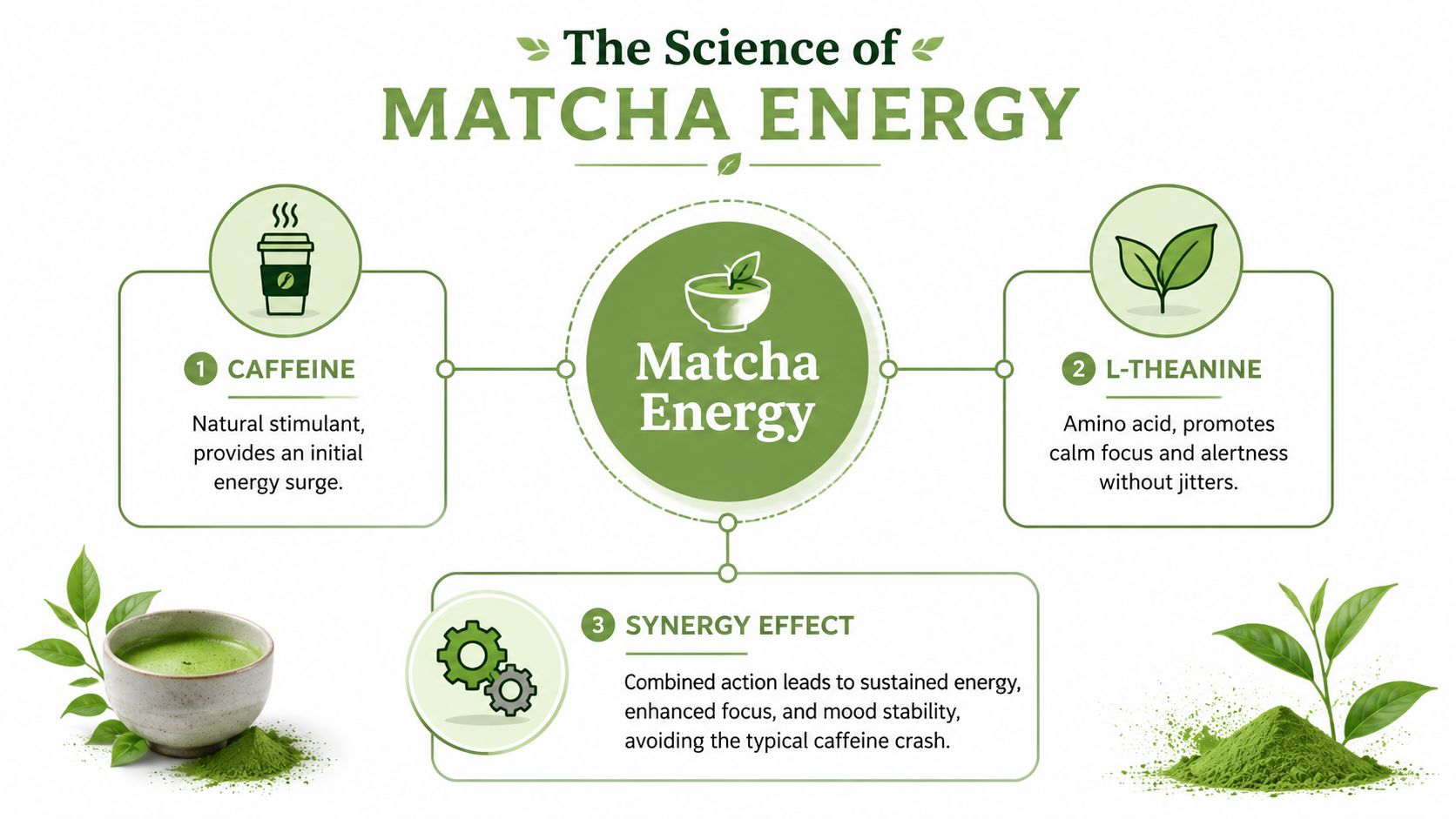
In matcha, caffeine works alongside L-theanine, an amino acid that changes the feel of stimulation. According to Vybey's Australian guide to matcha and caffeine, matcha delivers a sustained energy lift lasting 4–6 hours due to the synergistic interaction between its natural caffeine and L-Theanine, which helps counter the jittery effects often associated with coffee.
Caffeine gives the lift
Caffeine is the part that is widely understood. It helps you feel more awake, more alert, and more ready to act.
If matcha only contained caffeine, the story would be much simpler. It would just be another stimulant. But matcha is more layered than that.
L-theanine changes the texture of energy
L-theanine is what makes beginners pause and say, “This feels different.”
Matcha acts as a built-in counterbalance. Instead of your energy rushing upward all at once, L-theanine helps smooth the experience so your focus feels steadier. Coffee can feel like flipping on a bright light, while matcha often feels more like a gradual sunrise.
Australian clinical discussion cited by MedReport's article on the science behind matcha notes that matcha contains roughly 20–30 mg of L-Theanine per gram and 30–40 mg of caffeine per gram, with that combination linked to improved vigilance and reaction time while reducing jittery overstimulation compared with coffee.
Practical rule: If coffee makes you feel alert but scattered, matcha may suit you because the goal isn't just wakefulness. It's calmer concentration.
For readers who want a simple breakdown of how this translates into everyday drinks, this guide to caffeine in a matcha latte is useful context.
EGCG matters too
Matcha energy isn't only about stimulation. It also comes with compounds people often associate with overall wellness, especially EGCG, a well-known catechin.
A review published on PMC notes that polyphenols can account for up to 30% of matcha's dry weight, and EGCG makes up about 50–60% of total catechins. In practical terms, that means a small serving of matcha carries a meaningful concentration of tea compounds in a compact form.
Why this matters in real life
Matcha love energy becomes easier to apply. The point isn't to memorise biochemistry. The point is to know why a bowl of matcha may feel better suited to:
- Focused desk work
- Study sessions
- Longer creative tasks
- Pre-meeting concentration
- A calmer alternative to a second or third coffee
If you've ever felt “awake but not productive”, you already understand the difference. Matcha's appeal is that it may support alertness without tipping so easily into that noisy, over-caffeinated state.
Benefits Compared to Coffee and Energy Drinks
One rarely chooses matcha in a vacuum. It's chosen as an alternative to something already in the routine, typically coffee or an energy drink.
That comparison is where matcha love energy becomes much clearer.
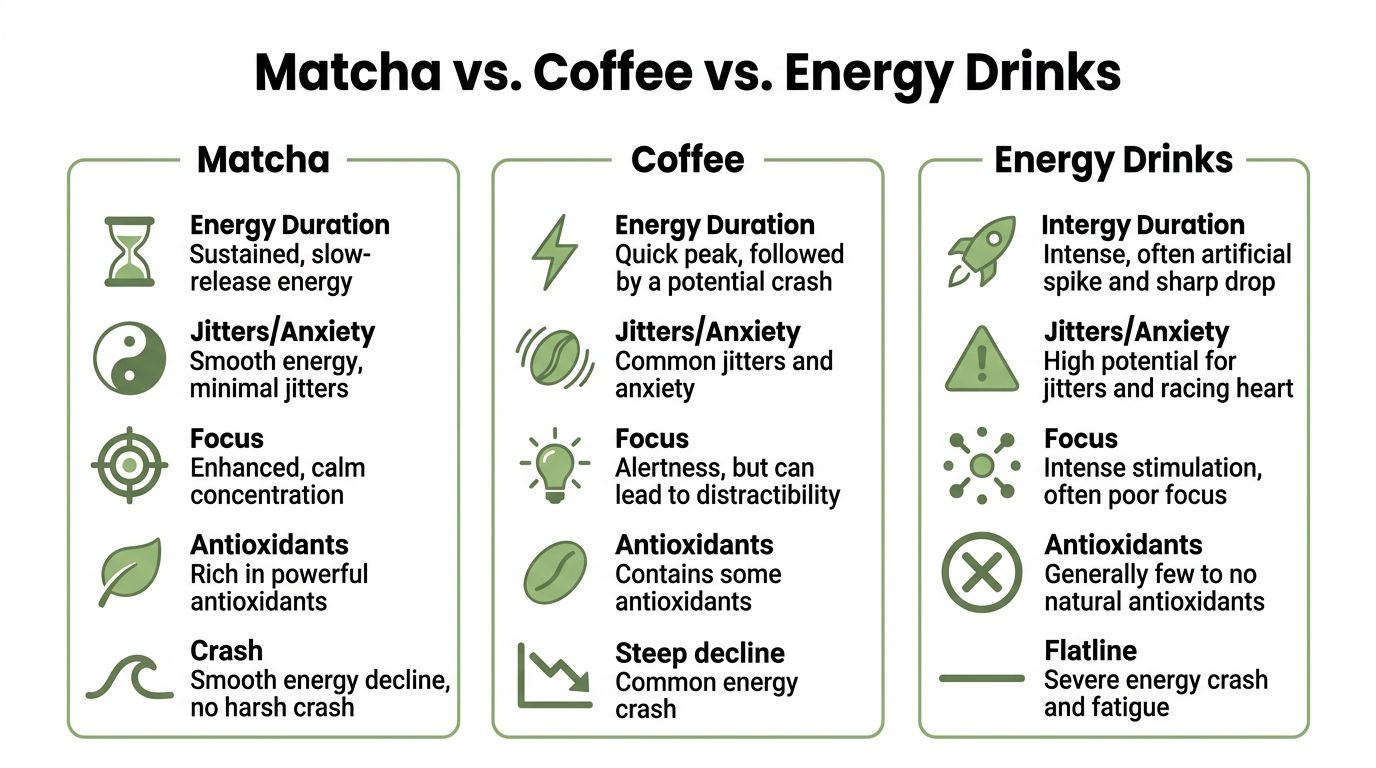
A quick side by side view
| Drink | Energy feel | Focus style | Antioxidant angle | Common downside |
|---|---|---|---|---|
| Matcha | More gradual and steady | Calm, centred | Strong catechin content | Can taste grassy if brewed badly |
| Coffee | Fast and obvious | Sharp at first | Some antioxidants | Can feel spiky or jittery |
| Energy drinks | Intense, often aggressive | Can feel scattered | Usually not the reason people choose them | Hard drop-off for some drinkers |
This table is simplified, but it matches how many people describe the experience.
Matcha has a broader wellness profile
One reason matcha stands apart is that people aren't only drinking it for stimulation. They're also drawn to the tea compounds it naturally contains.
According to Kitchen by Nine, matcha contains approximately 60% epigallocatechin gallate (EGCG) and delivers nearly double the vitamin C content found in other green teas. That helps explain why matcha often sits in a different category from a standard caffeine hit.
Coffee drinkers usually compare flavour, strength, and roast. Matcha drinkers often talk about energy, ritual, antioxidants, and how they feel a few hours later.
Coffee isn't the enemy, but it is different
Coffee has plenty going for it. It's familiar, fast, and ingrained in Australian café culture. But for people who feel anxious, overstimulated, or peaky on coffee, the experience can be hard to manage.
If you want to understand how coffee styles themselves differ, this guide on compare filter coffee and espresso is a handy reference because brew method changes intensity, flavour, and pace of drinking.
Some people don't need less caffeine. They need a different caffeine experience.
That's often where matcha enters the picture.
Energy drinks solve one problem and create another
Energy drinks are usually chosen for speed and convenience. They can make sense in a rush, but they rarely offer the same sense of ritual, ingredient simplicity, or tea-based identity that draws people to matcha.
For a lot of health-conscious drinkers, energy drinks also feel disconnected from the rest of a wellness routine. Matcha fits more naturally beside breakfast, a pre-walk drink, a work session, or an afternoon reset.
A few practical decision points help:
- Choose matcha if you want a calmer rhythm and enjoy the ritual of preparation.
- Choose coffee if you want familiar flavour and immediate punch.
- Choose an energy drink only if speed matters more to you than ritual, ingredient profile, or a gentler feel.
The keyword in matcha love energy is love, and that matters. People tend to stick with matcha not just because it works, but because the drink itself feels better to live with.
Brewing and Dosing Guide for Optimal Energy
Brewing matcha well isn't complicated, but small details make a big difference. Bad matcha technique usually creates two problems at once. It tastes rough, and the whole experience feels less balanced.
The first fix is temperature. The second is dose.
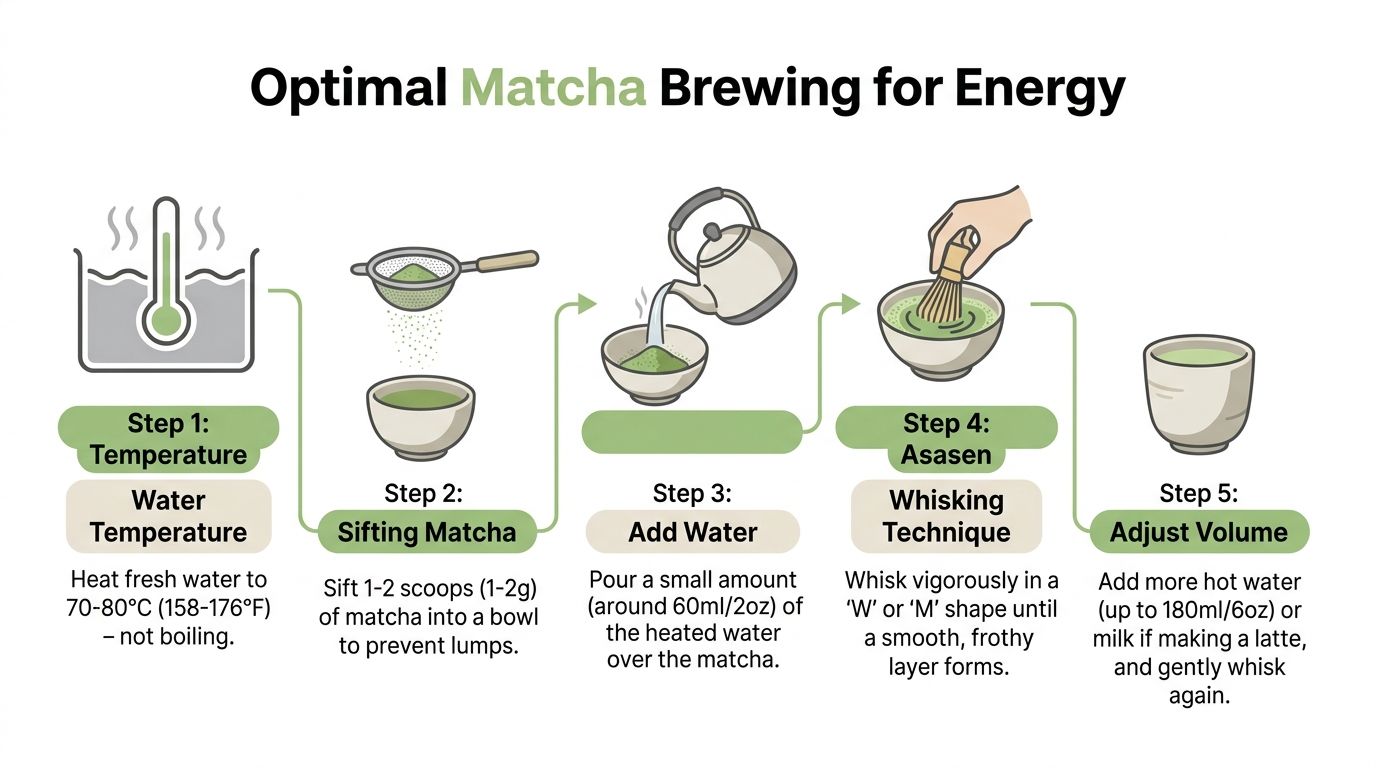
Start with the right basic method
A simple bowl is enough. You don't need a perfect tea ceremony set to make good matcha at home.
- Heat fresh water to 70–80°C. Water that's too hot can make matcha taste bitter.
- Sift 1–2g of matcha into a bowl. Sifting helps break up clumps before they hit the water.
- Add a small amount of water first. Around 60 ml is enough to create a smooth base.
- Whisk briskly in a W or M shape. Aim for a light froth rather than heavy foam.
- Top up with more water or milk. You can take it to about 180 ml depending on how strong you like it.
If you want to see the movement, this whisking demo is helpful:
For a closer walk-through of technique, this how to whisk matcha guide is a practical reference.
How much matcha should you use
A common beginner mistake is assuming more powder automatically means better energy. Usually it just means stronger flavour and less balance.
According to Matcha.com's overview of catechins and EGCG in matcha, one standard serving of premium stone-ground Japanese matcha (1g) contains approximately 30–35mg of EGCG, with total EGCG ranging from 50–110mg per gram depending on grade and cultivar.
That makes a good starting point:
- For a lighter daily bowl use 1g
- For a stronger morning serve or latte use 2g
- If you're sensitive to caffeine stay at the lower end and drink it earlier in the day
Ceremonial style or latte style
The brew style changes the experience as much as the dose.
| Style | Best for | Texture | Flavour |
|---|---|---|---|
| Traditional bowl | Morning focus, tea ritual | Light and frothy | Clean, grassy, more direct |
| Matcha latte | New drinkers, afternoon comfort | Creamier | Softer and rounder |
| Iced matcha | Warm weather, on-the-go energy | Refreshing | Crisp and bright |
If matcha tastes harsh, don't assume you dislike matcha. Lower the water temperature first, then check your dose.
A simple timing approach
Matcha often works well when you want energy that matches a task rather than a rush. Good moments include the start of focused work, the hour before a workout, or an afternoon period when coffee would feel too heavy.
Keep the method simple. Measure carefully. Give yourself a few days to notice how your own body responds. Matcha rewards consistency more than intensity.
Recipe Inspirations with Matcha for Everyday Energy
Once you understand the flavour and feel of matcha, it stops being “just tea powder” and starts becoming a very flexible ingredient.
That's where matcha love energy becomes fun. You can shape it around the day instead of forcing yourself into one fixed routine.
The easiest everyday options
The most useful recipes are usually the least complicated.
Classic hot matcha latte
This is often the best entry point for beginners who find straight matcha too grassy.
What you need
- 1 to 2g matcha
- a small splash of warm water
- your preferred milk
- optional cinnamon or vanilla
How to make it
Whisk the matcha with a little warm water until smooth. Heat and froth the milk separately, then combine. If you like a sweeter style, use a small amount of your preferred sweetener rather than loading it up.
Iced matcha shaker
This suits warm weather, busy mornings, and people who don't own a whisk.
What you need
- 1 to 2g matcha
- cold water
- ice
- optional milk
Shake hard until the powder disperses, then pour over ice. It's fast and easy, which matters when a habit needs to fit real life.
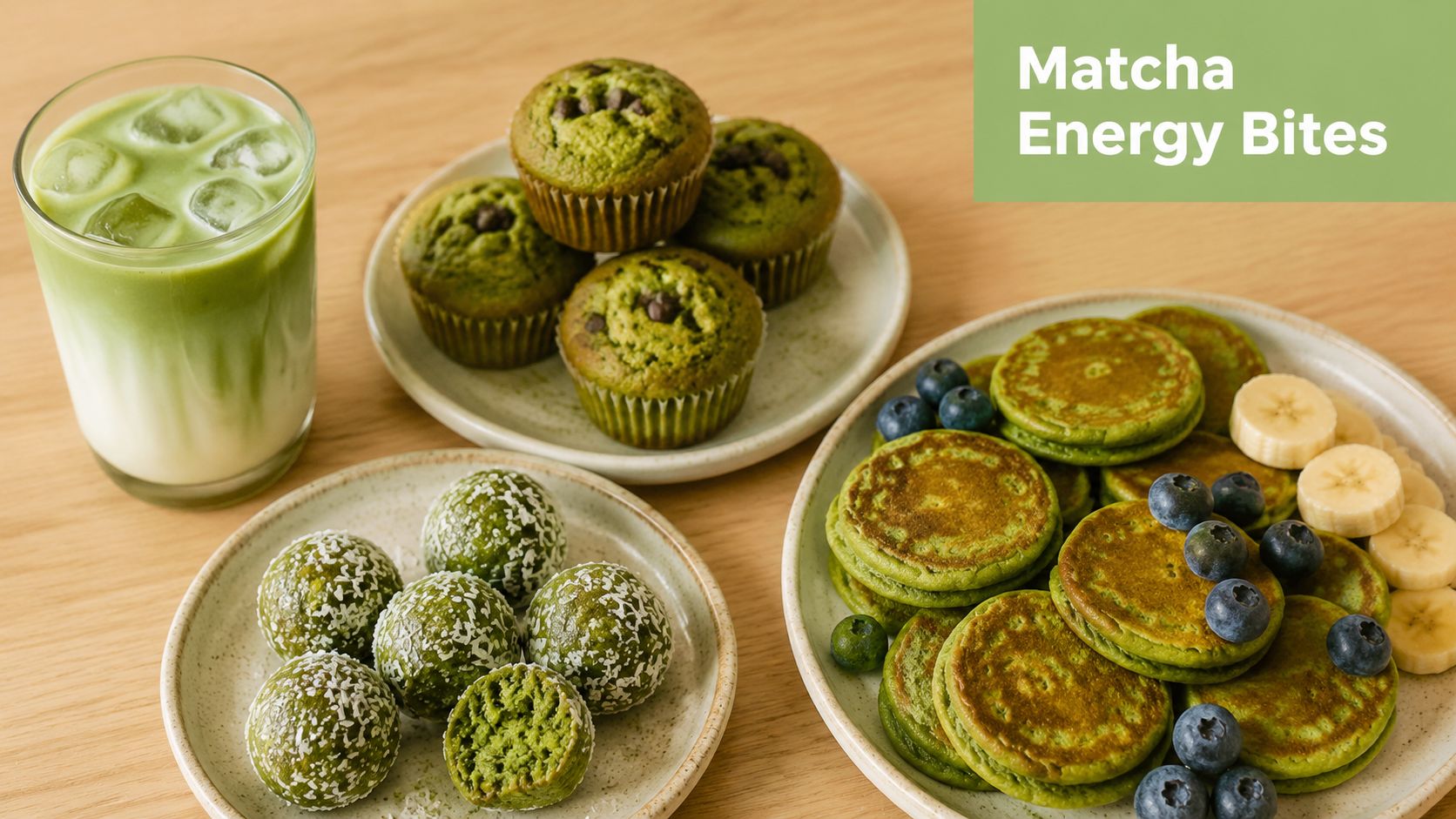
Matcha in snacks and quick bakes
Matcha works best in recipes where its flavour can stay present without becoming too dominant.
A few reliable ideas:
- Matcha overnight oats for a make-ahead breakfast with a gentle lift
- Matcha yoghurt bowl with fruit for a lighter morning option
- Matcha pancakes when you want weekend comfort with a fresh green note
- Matcha energy bites for afternoon snacking. A good place to start is this matcha energy balls recipe
Pairing matcha with kombucha
This is a gap most beginner guides skip, and it's one of the most interesting directions for Australian cafés and home drinkers.
Matcha and kombucha can work together because they bring different strengths. Matcha offers calm-focus energy. Kombucha brings acidity, lift, and a fermented flavour edge that can make non-alcoholic drinks feel more grown-up.
Try these combinations:
Matcha and ginger kombucha mocktail
Use a small chilled matcha shot as the base, then top with ginger kombucha over ice. The earthiness of matcha and the spice of ginger sit well together.Citrus matcha spritz
Build a light matcha base, add ice, then finish with a lime-forward kombucha. This suits a daytime menu or a low-sugar social drink.Layered green cooler
Pour cold whisked matcha first, then slowly add kombucha so the drink keeps visual separation for a few minutes before stirring.
A good matcha recipe doesn't hide the tea. It gives the tea a better setting.
How to match the recipe to the moment
Not every format suits every part of the day.
| Moment | Good matcha format | Why it works |
|---|---|---|
| Early morning | Straight bowl or hot latte | Feels grounding and organised |
| Late morning | Iced matcha | Refreshing without feeling heavy |
| Afternoon slump | Matcha snack or latte | More satisfying than another plain coffee |
| Social, non-alcoholic occasion | Matcha kombucha mocktail | Functional but still feels special |
The more useful way to think about recipes is not “What can I put matcha in?” but “What kind of energy do I want right now?” That question leads to better choices and better flavour.
Safety and Contraindications to Consider
One common myth is that matcha is automatically gentle for everyone because it's tea. That isn't quite right. Matcha may feel steadier than coffee for many people, but it still contains caffeine and active compounds, so personal tolerance matters.
Australian clinical discussion referenced by MedReport notes that the combination of L-Theanine at 20–30 mg per gram and caffeine at 30–40 mg per gram can support vigilance and reaction time while reducing jittery overstimulation compared with coffee. That helps explain why some people tolerate matcha better, but “better tolerated” doesn't mean “risk free for every person in every context”.
Who should take extra care
A cautious approach makes sense if you:
- Are sensitive to caffeine and already react strongly to tea, coffee, or cola
- Are pregnant or breastfeeding and have been advised to watch caffeine intake
- Take medication where caffeine or concentrated tea products may be relevant
- Have a medical condition affected by stimulants or dietary changes
A sensible approach for beginners
If you're new to matcha, start small and pay attention to timing. A lighter serve earlier in the day is usually the easiest place to begin.
Watch for your own signals:
- trouble sleeping
- feeling overstimulated
- stomach discomfort
- using matcha on top of several other caffeinated drinks
If your body says “too much”, listen to that before blaming the ingredient.
Good café and retail practice
If you serve or recommend matcha professionally, keep the language responsible. Say it may support calm focus. Don't promise medical outcomes. Don't assume every customer wants the same strength.
That balanced approach builds trust. It also makes matcha more approachable for people who are curious but cautious.
How Cafés and Retailers Can Feature Matcha Energy
Matcha belongs on more Australian menus than it currently appears on, not because it's trendy, but because it solves a real menu problem. Customers want functional non-alcoholic options that feel premium, modern, and easy to understand.
There's also a clear gap in hospitality-specific evidence. As noted in Tea & Coffee Trade Journal's coverage of the matcha love energy niche, AU-specific data is lacking on how L-Theanine's sustained release affects shift workers in hospitality, even though that group often wants reliable energy without a harsh crash.
Menu ideas that make sense
A café doesn't need a huge matcha program to do this well. It needs a few drinks and food pairings that are easy for staff to repeat.
Consider a compact line-up:
- Signature matcha latte with a clean, unsweet style and an optional flavoured version
- Iced matcha spritz for warmer months and grab-and-go trade
- Matcha kombucha mocktail for afternoon and early evening non-alcoholic menus
- Matcha snack pairing such as an energy ball, muffin, or light cake
How to present it so people order it
Customers often hesitate when they don't know what matcha will taste like. Staff language matters.
Use plain menu wording:
- smooth energy
- calm focus
- earthy green tea flavour
- great hot or iced
For takeaway service, presentation also helps. Cup choice affects heat retention, appearance, and the overall impression of quality. If you're refining the serve format, this guide to selecting the right tea cups is a useful operational reference.
Retail shelf and staff training tips
Retailers and cafés both benefit from the same rule. Don't overcomplicate the story.
Train staff to explain:
- what matcha is
- why it feels different from coffee
- how to prepare it without bitterness
- which customers might prefer ceremonial style versus latte style
A good display or menu card can also connect matcha to broader non-alcoholic and wellness habits. Customers who are reducing sugar, rethinking alcohol, or looking for a more measured caffeine ritual are often already open to the category. They just need a clear invitation.
Conclusion and Next Steps
Matcha love energy makes sense because it joins two things people rarely get at once. Useful alertness and a calmer feel. For many drinkers, that combination is the primary attraction.
A better brew, a sensible dose, and the right format for the time of day can make matcha much more enjoyable. It also opens up strong possibilities for cafés, retailers, and non-alcoholic menus that want something functional and premium without sounding gimmicky.
If you're curious, start simple. Try a well-made bowl, an iced latte, or a matcha-based snack and notice how the experience fits your day.
If you'd like to put this into practice, explore Pep Tea for premium organic matcha and sugar-free organic kombucha made for everyday rituals, café menus, and clean Australian wellness routines.
The Real Organic Tea Benefits: A Complete Australian Guide
You're probably here because tea has become more than just a hot drink. It's your morning reset, your afternoon swap for another coffee, or the one thing that helps you slow down for five minutes between work, family, training, and everything else life throws at you.
That's where the conversation around organic tea benefits gets interesting. For many Australians, organic starts as a safety question. Fewer chemicals. Cleaner farming. Better peace of mind. But once you dig deeper, organic tea isn't only about what's missing. It's also about what stays intact in the leaf, in the brew, and in the flavour.
A well-grown organic tea can offer a cleaner cup, a more expressive taste, and a more functional daily ritual. That matters even more with high-performance teas like Japanese matcha and properly fermented kombucha, where quality shows up in every sip.
More Than a Buzzword The Real Meaning of Organic Tea
A lot of people start with tea because they want one of three things. Calm. Energy. Comfort. Sometimes all three at once.
You swap a sugary drink for green tea because you want something lighter. You try matcha because coffee feels too sharp. You reach for kombucha because your body wants something refreshing that doesn't feel heavy. Then the label catches your eye. Organic. It sounds good, but what does it really change?
Organic changes the whole experience
Organic tea isn't just conventional tea with nicer branding. It reflects a different growing philosophy. In practical terms, it means the tea is produced without the synthetic inputs many people are trying to avoid in the rest of their food and drink choices.
That matters because tea is an ingredient you often consume daily. If something is part of your routine every morning or every afternoon, the quality of that product matters more than it does with an occasional treat.
For readers who want to understand the farming side in plain English, it helps to look at organic tea farming practices in Australia.
Organic tea feels different because it asks a better question. Not just “does this taste nice?” but “what kind of cup am I inviting into my body every day?”
Why people notice the difference
Organic tea isn't first noticed in a lab report. It's noticed in the cup.
A vibrant matcha tastes cleaner and more rounded. A carefully brewed kombucha tastes alive, bright, and balanced rather than loud or syrupy. Even a simple loose-leaf green tea can feel fresher and more expressive when the leaf has been handled with care from the start.
Three organic tea benefits often stand out quickly:
- Cleaner everyday drinking because many health-conscious tea drinkers want to reduce routine exposure to synthetic agricultural chemicals.
- Better functional potential because the natural compounds in tea are the reason many people drink it for wellness in the first place.
- Richer flavour because quality farming and careful processing tend to reward your palate, not just your principles.
That's why organic isn't a restriction. It's a filter. It helps you choose tea that supports the way you want to feel.
Why Organic Certification Matters for Your Tea
The word “organic” gets thrown around so often that it can lose meaning. In tea, certification matters because it gives the word substance.
What certified organic actually signals
When tea is certified organic, it isn't just marketed as natural or clean. It's grown and handled according to standards that limit or prohibit a range of synthetic agricultural and processing inputs.
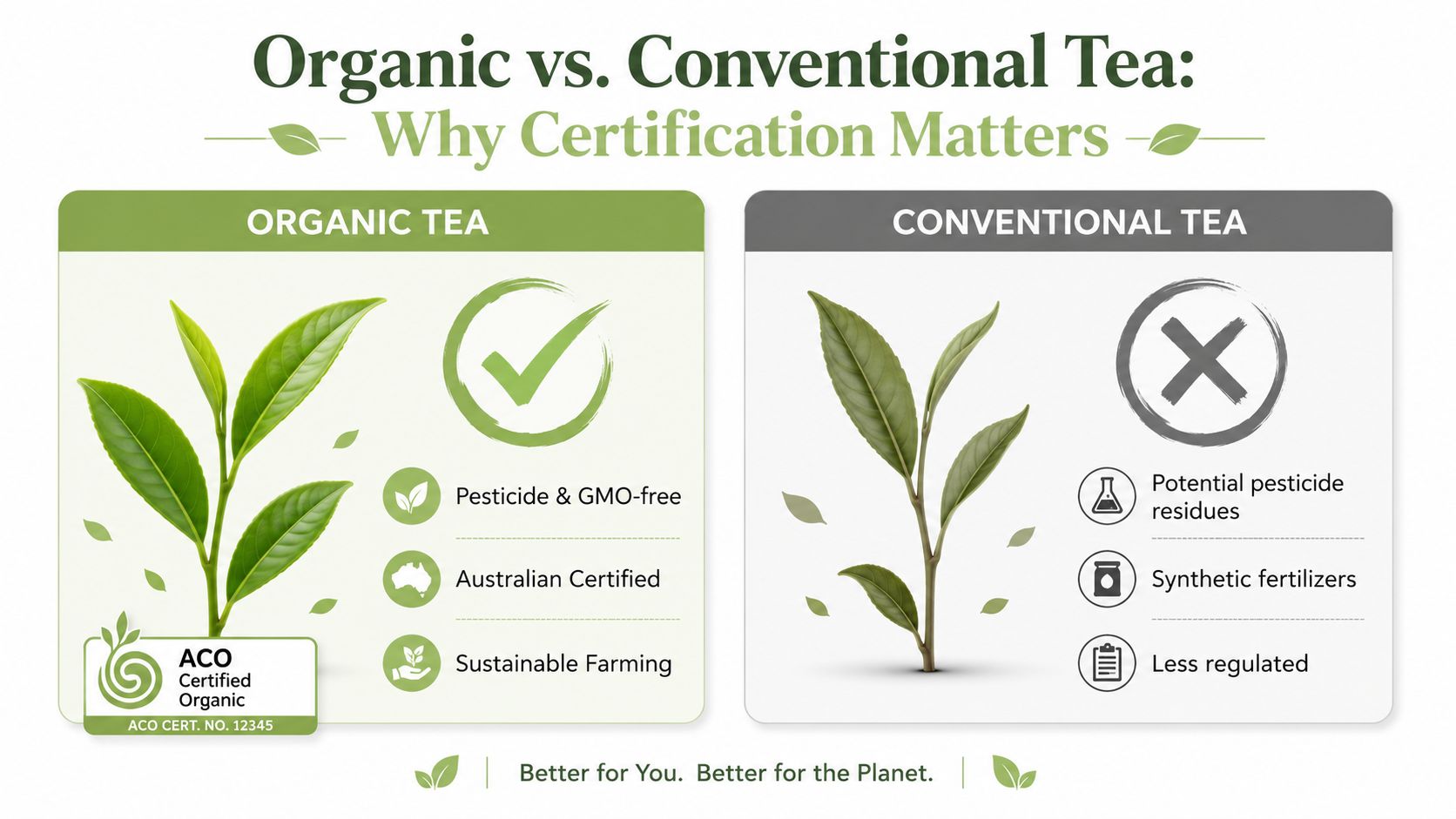
In Australia, that distinction matters. Organic tea is distinguished from conventional tea by its significantly lower levels of harmful chemical residues, as organic farming prohibits the use of synthetic pesticides, herbicides, chemical fertilizers, GMOs, preservatives, and fungicides, resulting in a safer product for consumers concerned about chemical exposure, as outlined in this explanation of organic vs conventional tea.
If you want a practical overview of what local certification means, this guide to organic tea certification in Australia is a useful place to start.
Why lower residue matters in a daily ritual
Tea often feels harmless because it's simple. Water, leaves, cup. But that simplicity is exactly why sourcing matters.
If you drink tea every day, you're not making a one-off choice. You're building a repeated habit. For many people, that's why organic tea benefits feel especially relevant here. A cleaner agricultural approach supports a cleaner daily routine.
Here's a simple comparison:
| Tea type | What the growing approach focuses on | What many drinkers value |
|---|---|---|
| Organic tea | Avoiding synthetic pesticides, herbicides, chemical fertilisers, GMOs, preservatives, and fungicides | A cleaner cup and confidence in how the tea was produced |
| Conventional tea | Standard agricultural methods that may include synthetic inputs | Wider availability, but with fewer assurances about residue levels |
Certification protects more than the absence of chemicals
The best way to think about organic certification is that it protects the integrity of the tea. It's not just about what's left out. It's also about what the plant is allowed to express.
That can shape:
- Leaf quality through gentler, more considered growing systems
- Flavour clarity because the cup isn't competing with a rougher profile
- Functional value because tea drinkers often choose green tea, matcha, and kombucha for their natural compounds, not just their taste
Practical rule: If you're drinking tea for wellness, don't treat sourcing as an afterthought. The benefit starts long before the kettle boils.
The Science-Backed Health Benefits of Organic Tea
Tea's reputation for wellness doesn't come out of nowhere. Its natural compounds, especially catechins and polyphenols, are where the primary interest lies, known for their antioxidant activity.
What antioxidants are doing in simple terms
Oxidative stress sounds technical, but the idea is straightforward. Your body deals with ongoing wear and tear from normal metabolism and from daily life. Antioxidants help counter some of that stress.
Tea naturally contains compounds that support this process. That's one reason it keeps showing up in discussions about long-term wellbeing, especially for people trying to make better everyday choices rather than chasing quick fixes.
A useful way to think about tea is this: it's a small habit with a cumulative effect. One cup won't transform your health overnight. But a good routine can support the bigger picture.
What the research on green tea shows
The strongest evidence in the material available here relates to green tea. According to Harvard's overview of tea and health, regular consumption of green tea is linked to a 14% reduced risk of stroke in individuals drinking 2–3 cups daily, and a 20% reduced risk for those consuming 4 or more cups, based on a 13-year cohort study of 82,369 Japanese men and women.
That matters because it gives the conversation some grounding. Tea isn't only associated with a pleasant ritual. It's also linked with meaningful health outcomes in large population studies.
The same source also describes broader links between tea intake and cardiovascular health, including observational findings around heart disease, stroke, and type 2 diabetes. That doesn't make tea a treatment, but it does support the idea that tea can be part of a smart, steady lifestyle pattern.
Why organic can strengthen the value of that habit
Many readers get confused because the research often focuses on tea itself, especially green tea. So where does “organic” fit in?
Organic doesn't create catechins and polyphenols from scratch. Tea naturally has them. What organic farming may do, based on the verified material available, is help preserve the tea's natural integrity by avoiding synthetic residues that many health-conscious consumers would rather not bring into a wellness routine.
That means the habit becomes more coherent. If you're drinking tea because you want something clean, supportive, and functional, organic aligns the farming method with the reason you're drinking it.
A simple way to use that in daily life:
- Choose tea you'll drink consistently. Daily habits matter more than occasional bursts of enthusiasm.
- Keep it unsweetened when possible. Let the leaf do the work.
- Treat tea as support, not magic. It works best alongside sleep, food, movement, and stress management.
Tea fits best in a wellness routine when it replaces something less helpful, not when it's expected to do everything on its own.
Focus and Energy The Organic Matcha Advantage
If green tea is a strong all-rounder, matcha is the concentrated version of that story. It's one of the clearest examples of why organic tea benefits can feel more noticeable in real life.
Why matcha feels different from regular green tea
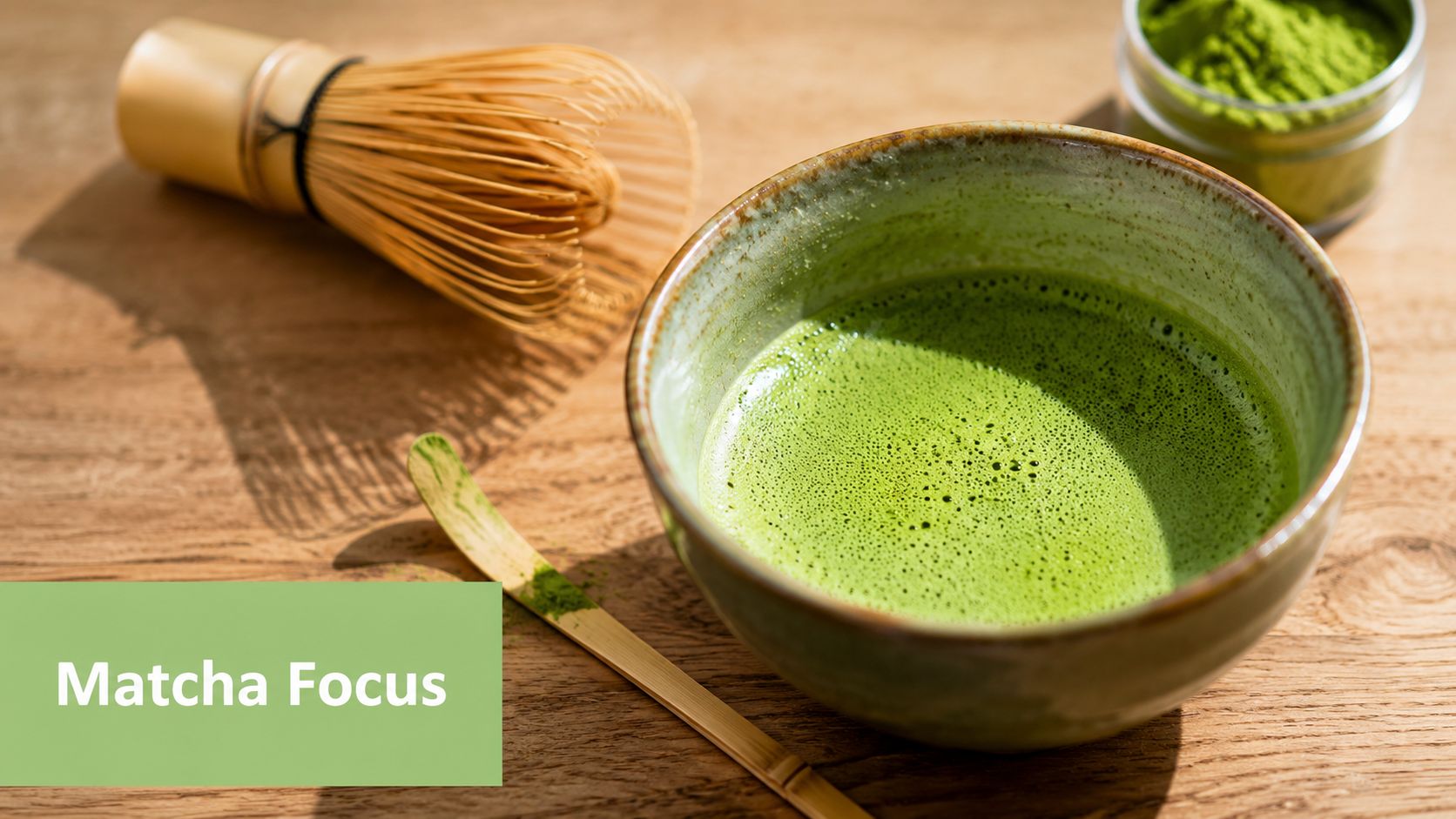
With brewed green tea, you steep the leaves and drink the infusion. With matcha, you whisk the stone-ground leaf into water and consume the whole thing.
That changes the experience. It's one reason matcha drinkers often describe the effect as steadier and more immersive. You're not just tasting tea. You're taking in the finely milled leaf itself.
According to this review of EGCG and antioxidants in matcha, matcha contains approximately 100–200 mg of EGCG per cup, with EGCG comprising 50–60% of total catechins, whereas regular brewed green tea delivers only 30–400 µmol TE/g in antioxidant activity compared to matcha's 1,300–1,600 µmol TE/g.
That's a big reason matcha has become such a favourite for people chasing functional drinks with substance.
Calm focus, not chaotic stimulation
Many Australians come to matcha because coffee stops working for them the way it used to. The first cup is fine. The second pushes them into jitters, irritability, or an afternoon slump.
Matcha tends to appeal to a different goal. People want energy, but they also want clarity. They want alertness without feeling scattered. Readers often associate this with the combination of tea caffeine and naturally occurring L-theanine in matcha, which is why matcha has developed a reputation for calmer focus.
That doesn't mean every matcha delivers the same experience. Grade, freshness, origin, and processing all matter. A vibrant Japanese organic matcha is usually smoother, sweeter, and easier to drink than dull, stale powder that tastes flat or bitter.
What to look for in a quality matcha
A quick checklist helps:
- Colour should look bright and lively rather than khaki or brownish.
- Texture should feel fine and soft, not gritty.
- Taste should be fresh, rounded, and pleasantly vegetal, not harsh.
- Origin and production matter, especially if you care about both flavour and farming standards.
For a simple visual on preparation, this video is a good reference point:
When matcha makes the most sense
Matcha works especially well when you want a beverage that supports performance without feeling aggressive.
It suits:
| Moment | Why matcha fits |
|---|---|
| Morning start | It gives your day a more deliberate pace than rushing into another coffee |
| Pre-work focus | Many people like it before writing, planning, or study sessions |
| Afternoon reset | It can feel cleaner than reaching for sweets or another strong caffeine hit |
A good matcha doesn't just wake you up. It helps you stay with what you're doing.
Gut Health and Vitality The Power of Real Organic Kombucha
Kombucha can be one of the most misunderstood drinks in the wellness space. Some bottles are carefully fermented and alive with character. Others taste like soft drink wearing a health halo.
That difference matters if you care about organic tea benefits beyond buzzwords.
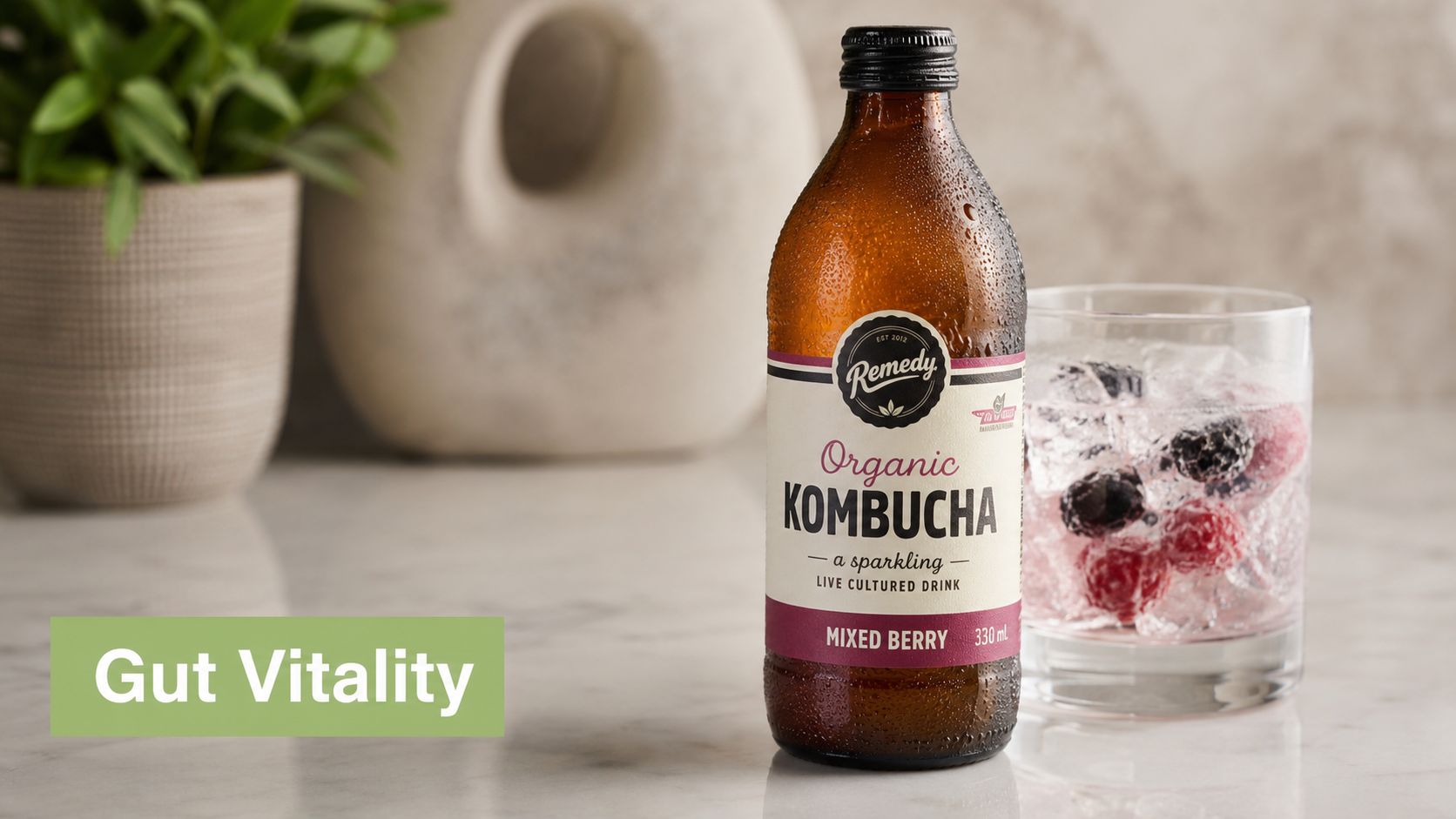
Real kombucha starts with real tea
Authentic kombucha begins with brewed tea, culture, and time. The process transforms the original sweetened tea into something tangy, layered, and much lighter than many people expect.
For readers who are trying to understand what separates proper fermentation from shortcuts, this guide to real raw organic kombucha explains the distinction well.
When kombucha is made with organic tea, the starting point already aligns with a cleaner product philosophy. That won't automatically make every bottle excellent, but it does set a stronger foundation.
Why fermentation quality matters
People often assume kombucha is healthy just because it's called kombucha. That's where things get messy.
Some products lean heavily on flavourings, sweetness, or marketing language. A properly fermented kombucha, by contrast, earns its place through the brewing process itself. If you're drinking it for gut-friendly potential and as an alternative to sugary beverages, the details matter.
A useful way to compare them:
- Properly fermented kombucha often tastes tart, refreshing, and balanced. It feels like a brewed beverage.
- Mass-market imitation styles can taste flat, overly sweet, or more like flavoured soda.
The best kombucha doesn't try to hide fermentation. It lets fermentation create the flavour.
Where kombucha fits in daily life
Kombucha is often less about one dramatic health promise and more about replacing less helpful habits.
It can work well for people who want:
- A low-sugar alternative to soft drinks or sweet mixers
- A grown-up non-alcoholic option that still feels interesting
- A refreshing fridge staple that supports a more mindful routine
This is also where Australian-made kombucha has a special appeal. Local brewing, especially when done carefully, gives drinkers a product that feels close to home and easier to trust. For cafés, it also creates a stronger menu story. Customers increasingly want non-alcoholic drinks that feel thoughtful rather than like an afterthought.
A note on flavour and function
Good kombucha should taste like something you'd want to drink even if health benefits were never mentioned. Ginger, lime and ginger, or mango styles can all work beautifully when they're built on a genuine fermented base rather than sugar and flavour alone.
That's the heart of the argument for real organic kombucha. If the tea is well sourced and the fermentation is done properly, the drink becomes more than a trend. It becomes a practical, enjoyable part of modern Australian drinking habits.
How to Use Organic Tea at Home and in Your Café
The easiest way to enjoy organic tea benefits is to make them routine. You don't need a complicated wellness plan. You need a few reliable ways to use tea that fit your day.
Simple ideas for home

Try these:
Ceremonial-style matcha
Sift your matcha into a bowl, add a little warm water, then whisk until smooth and frothy. Keep the flavour front and centre. No sweetener needed if the powder is good.Quick matcha latte
Make a smooth matcha base first, then add your preferred milk hot or cold. If you like a softer flavour, this is often the easiest daily entry point.Kombucha mocktail
Pour chilled kombucha over ice with fresh citrus or mint. It gives you the ritual of a mixed drink without the heaviness.
A practical reason to keep green tea in rotation
One reason many people stay committed to green tea and matcha is that the habit is easy to repeat. There's also a strong wellness argument for doing so. According to this article on tea as a health drink, organic green tea including matcha delivers a bioactive dose of EGCg that directly inhibits reactive oxygen species, with a 2020 Australian Curtin University study quantifying that consuming three cups daily reduces the likelihood of developing prostate and ovarian cancer by neutralizing free radicals that damage DNA.
That doesn't mean everyone needs three cups every day. It does show why regular use, rather than occasional novelty, is where tea becomes meaningful.
Smart menu ideas for cafés
For cafés and hospitality venues, organic tea can do more than fill a menu gap. It can shape a more modern drinks offer.
Consider adding:
| Menu idea | Why customers respond |
|---|---|
| Straight matcha | It suits customers who want a clean, premium hot drink |
| Iced matcha latte | It appeals to regular café traffic looking for a coffee alternative |
| Kombucha by the bottle or glass | It gives non-alcoholic drinkers something with personality |
| Seasonal mocktails using kombucha | It helps venues build a wellness-friendly drinks list |
For home drinkers and cafés alike, the key is consistency. Keep the ingredients clean. Keep the preparation simple. Let the tea do the heavy lifting.
Your Organic Tea Questions Answered
Is organic tea automatically safer in every way?
It's safer in one important sense. Organic certification helps reduce exposure to synthetic agricultural chemicals. But it doesn't answer every sourcing question.
According to this explanation of what to look for when buying organic tea wholesale, while organic certification ensures tea avoids pesticides, it doesn't automatically screen for soil-derived heavy metals, and no recent 2024–2025 Australian report compares heavy metal levels in imported organic versus conventional matcha. If you drink matcha daily, it's reasonable to care about origin, supplier transparency, and testing standards.
Is matcha stronger than regular green tea?
Functionally, yes, many people experience it that way. You're consuming the whole powdered leaf, so the experience is more concentrated than a standard brewed green tea. That's part of why matcha often feels more substantial and more sustaining.
Can I drink organic tea every day?
For most adults, tea works best as a daily habit rather than an occasional health kick. The main questions are your caffeine sensitivity, the type of tea you choose, and whether it fits the rest of your routine.
What about pregnancy or medication interactions?
If you're pregnant, breastfeeding, managing a health condition, or taking medication, it's smart to check with your doctor before making tea, matcha, or kombucha a bigger part of your routine. Tea can be wonderfully supportive, but personal advice matters.
Is organic kombucha always low in sugar?
Not always. “Organic” and “low sugar” aren't the same thing. Read the label, pay attention to the fermentation style, and choose a product that aligns with why you're drinking it.
If you're ready to turn all of this into an everyday ritual, explore Pep Tea for premium organic matcha and Australian-brewed sugar-free organic kombucha. It's a simple way to bring cleaner flavour, functional benefits, and a more enjoyable wellness routine into your day.
Does Organic Tea Have Pesticides: Understanding Organic Tea

Certified organic tea in Australia should not contain synthetic pesticides because the standard explicitly prohibits them, and Australia's tea residue limit is often 0.05 mg/kg, compared with the European Union's 0.01 mg/kg. But the word organic on its own isn't the whole story, because the safety difference often comes down to whether a tea is properly certified, where it was grown, and how transparent the brand is about testing.
A lot of people ask, “does organic tea have pesticides?” and expect a simple yes or no. The honest answer is more useful than that. If your tea is certified organic, that's very different from a pack that merely uses feel-good language like “natural”, “pure” or “organically grown”.
That distinction matters even more when you drink matcha, because you consume the whole leaf, and when you drink kombucha, because the final brew starts with tea. If the base ingredient isn't clean, the finished drink doesn't magically become cleaner.
Tea labels can get confusing for Australian shoppers. The front of the pack might look wholesome, earthy, even premium. But a certification mark tells you far more than the colour scheme or the marketing copy ever will. Once you know what to look for, it gets much easier to shop with confidence.
So Does Your Organic Tea Contain Pesticides
If the tea is certified organic in Australia, the answer is that it shouldn't contain synthetic pesticides. That's the reassuring part. The part many people miss is that not every tea sold as “organic” gives you the same level of confidence.

Tea is one of those products where the details matter. A loose-leaf black tea, a green tea bag, a ceremonial matcha and a bottle of kombucha might all sit in the same kitchen, but they don't carry the same exposure risks or the same certification signals. That's why the blanket question “does organic tea have pesticides” often leaves people more confused than informed.
The short version
Here's the practical way to understand it:
- Certified organic tea means synthetic pesticides are prohibited under the certification standard.
- A generic organic claim isn't always enough on its own if you can't see a recognised certification mark.
- Source matters because tea plants can absorb more than just pesticides from their environment.
- Product type matters because matcha is consumed differently from steeped tea.
Practical rule: Don't judge tea safety by the word “organic” alone. Judge it by the certification behind it.
There's another reason this topic trips people up. People often assume “organic” means every possible contamination issue has been solved. It hasn't. Organic certification is powerful, but it answers one part of the question very well and other parts only partially.
For most shoppers, that's good news. You don't need to become a chemist to buy better tea. You just need to know how to separate a certified claim from a marketing claim, and how to read the cues that matter most.
Decoding The Organic Label on Tea in Australia
The easiest way to understand certified organic is to compare it with qualifications. If someone says they're a great cook, that might be true. If they've completed formal training and passed assessments, you have something independent to rely on. Tea works the same way.
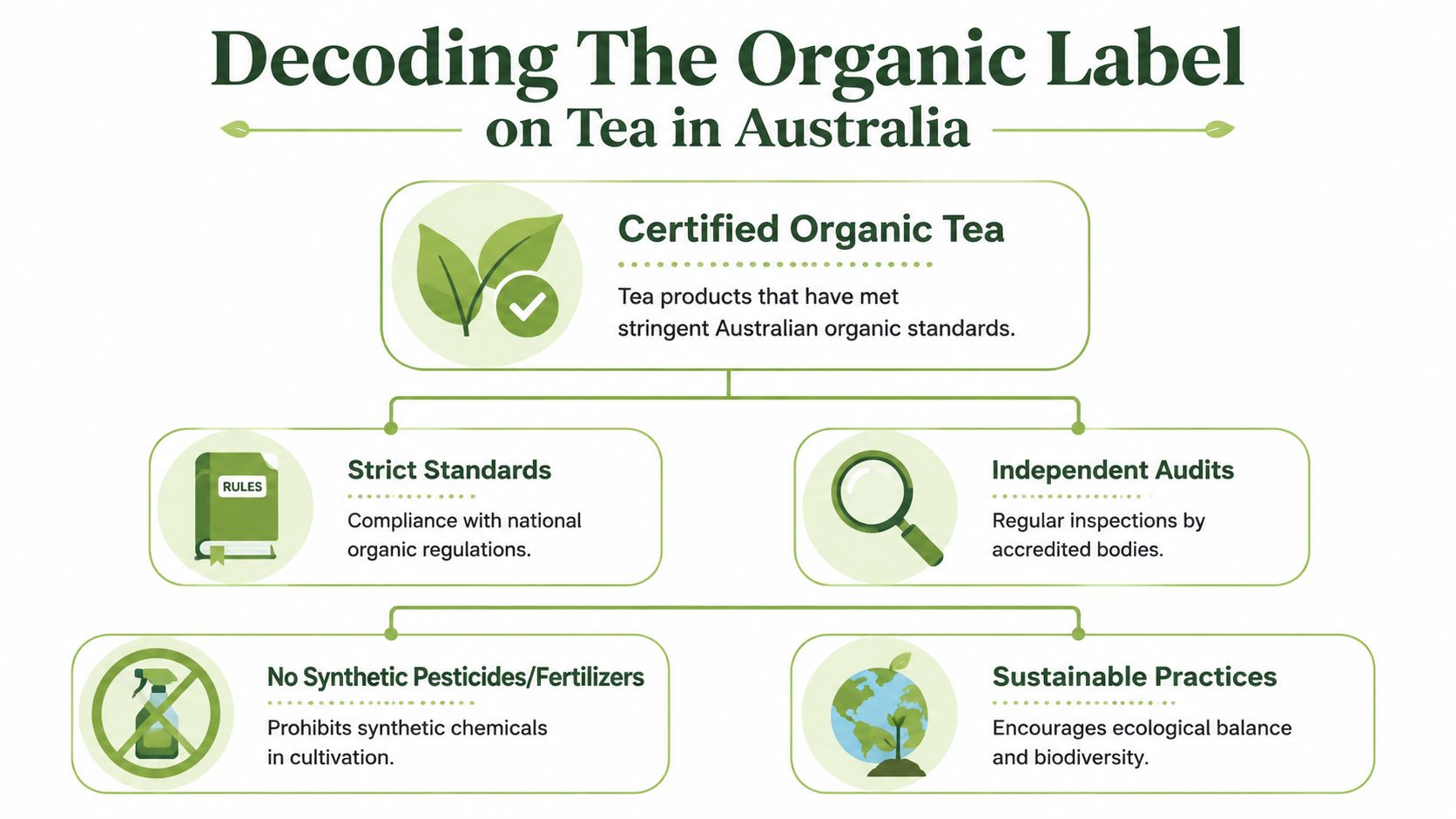
In Australia, organic tea is certified to contain zero synthetic pesticides because the Australian Certified Organic standard explicitly prohibits their use. The same standard also prohibits synthetic chemicals, herbicides and artificial preservatives, which is why many health-conscious buyers treat certification as a meaningful safety marker rather than a branding extra. The underlying standard is discussed in this overview of organic certification standards and is reflected in the explanation from Pure Matcha on Australian organic tea standards.
What certification actually tells you
A proper organic certification logo isn't decorative. It tells you the product has been assessed against a defined set of rules.
That matters because tea packaging is full of soft language that sounds healthy but doesn't carry the same weight, such as:
- Natural means very little by itself.
- Eco-friendly may describe packaging or brand positioning, not farming inputs.
- Pure is a marketing word, not a certification category.
- Organically grown can sound reassuring, but without a recognised certifier, you're still relying on the brand's own wording.
Why this matters in daily shopping
When you're standing in a supermarket aisle or browsing online, you're often making a decision in seconds. A certification mark simplifies that decision. It says, in effect, that the tea wasn't just described as clean. It was produced under rules designed to keep synthetic pesticides out of the process.
A recognised certification logo does the heavy lifting that marketing language can't.
That doesn't mean every uncertified tea is automatically poor quality. It means you don't have the same level of independent assurance. For many Australians, especially those drinking tea every day, that assurance is worth looking for.
The consumer takeaway
If you remember one thing from this section, make it this: certified organic is a stronger claim than organic-looking.
A genuine certification gives you a clearer line from farm to finished product. It's one of the simplest ways to cut through label noise and make a more informed choice.
Conventional vs Organic Tea A Look at Pesticide Residues
The gap between conventional tea and certified organic tea becomes clearer when you look at residue findings and the rules that govern them.
A Tea Leaves Australia article on tea pesticide limits notes that the Australian Pesticides and Veterinary Medicines Authority sets tea Maximum Residue Levels often at 0.05 mg/kg, while the European Union threshold is 0.01 mg/kg. That means Australia's limit is five times higher, and products that fail EU standards can sometimes still be sold legally in Australia.
That point alone surprises many tea drinkers. People assume “legal” automatically means “as strict as possible”. In food regulation, it often means “within the limits set by that country”.
What conventional tea can carry
Documented findings in the material above show why some buyers prefer certified organic tea for peace of mind.
One example: a 2012 Greenpeace China investigation found that 100% of tested tea samples from China contained at least three types of pesticides, and 78% (14 out of 18) contained pesticides harmful to human consumption. Another reported survey found conventional tea could contain up to 17 different pesticide types. These figures don't mean every conventional tea is identical, but they do show why residue concerns haven't come from nowhere.
Organic vs. Conventional Tea at a Glance
| Aspect | Certified Organic Tea | Conventional Tea |
|---|---|---|
| Synthetic pesticides | Prohibited under certification standards | May be used in cultivation |
| Residue concern | Certification is designed to avoid synthetic pesticide residue exposure | Residues may be present within legal limits |
| Consumer confidence | Based on independent standards and audits | Often depends on regulatory compliance alone |
| Australian market context | Bypasses the residue limit gap discussed above | Some products legal in Australia may not meet stricter EU limits |
| Label clarity | Strongest when backed by recognised certification | “Conventional” may not be obvious on front-of-pack packaging |
Why legal limits don't settle the whole question
A residue limit is not the same thing as zero residue. That's where people often get tripped up. Conventional tea may comply with the law and still contain detectable pesticide residues.
Certified organic tea appeals to many buyers because it aims to remove that concern at the farming stage rather than managing it at an allowable threshold later.
If you want the simplest route to avoiding synthetic pesticide residue, certified organic is the cleaner choice.
There's also a trust issue. Tea is often imported, blended, repacked and sold under familiar household brand names. Unless a product gives you a strong certification cue, you may be relying on a chain of decisions you can't see.
For Australians who drink several cups a day, that can be reason enough to choose tea with a clearer paper trail and stricter production rules.
Why This Matters More for Matcha and Kombucha
Matcha changes the conversation because you're not just brewing leaves and discarding them. You're drinking the leaf itself in powdered form. That makes the quality of the leaf much more important.
If regular steeped tea is like cooking vegetables in water and then straining them out, matcha is more like blending the whole lot into your drink. That's why many experienced tea drinkers are far stricter about matcha sourcing than they are about an ordinary tea bag.
Matcha is a whole leaf product
For premium matcha, certification and origin matter. Pure Matcha's explanation of Organic JAS matcha states that true organic matcha certified under the Organic JAS standard is produced from tea plantations in southern Japan, including Uji, where pollution and soil contamination are described as lower than in other tea-producing regions, with zero traces of chemical pesticides or fertilisers during cultivation.
That's a strong reason to pay attention to Japanese certification, not just broad organic wording. It's also why tea lovers often compare flavour and sourcing together. If you want a helpful example of how sourcing language and taste notes come together, this guide to Buttery umami matcha is a useful reference point.
For readers trying to understand quality tiers, this comparison of regular and ultimate matcha tea powder also helps clarify why not all matcha behaves the same in the bowl, latte or smoothie.
Kombucha is only as clean as its tea base
Kombucha can sound like a completely separate category, but it starts with tea. If the base tea is poor quality, heavily processed or murky in origin, fermentation doesn't erase that history.
The cleaner the tea, the cleaner the starting point for a drink many people choose for its simple, natural feel. That's especially relevant for sugar-free and low-sugar kombucha drinkers who are already trying to make more mindful choices.
Why these products raise the stakes
This topic matters more for matcha and kombucha for three practical reasons:
- Matcha increases exposure relevance because the powdered leaf goes straight into the cup.
- Kombucha depends on ingredient integrity because fermentation starts with tea, not with a blank slate.
- Premium buyers usually care about more than flavour. They care about origin, process and clean production.
The more directly you consume the leaf, the more the quality of that leaf matters.
That doesn't mean other teas don't matter. It means these two products make the certification question harder to ignore.
How to Choose a Genuinely Pesticide-Free Tea
Tea shopping gets easier when you stop reading the front of the pack first. Start with the proof points instead.
For Japanese matcha, one of the strongest signals is Organic JAS. According to Matcha Direct's explanation of Organic JAS certification, this certification is a third-party verified process that prohibits all synthetic pesticides and chemical fertilisers, and any product carrying the official JAS mark is guaranteed to have no pesticide residues from farm to finished powder.
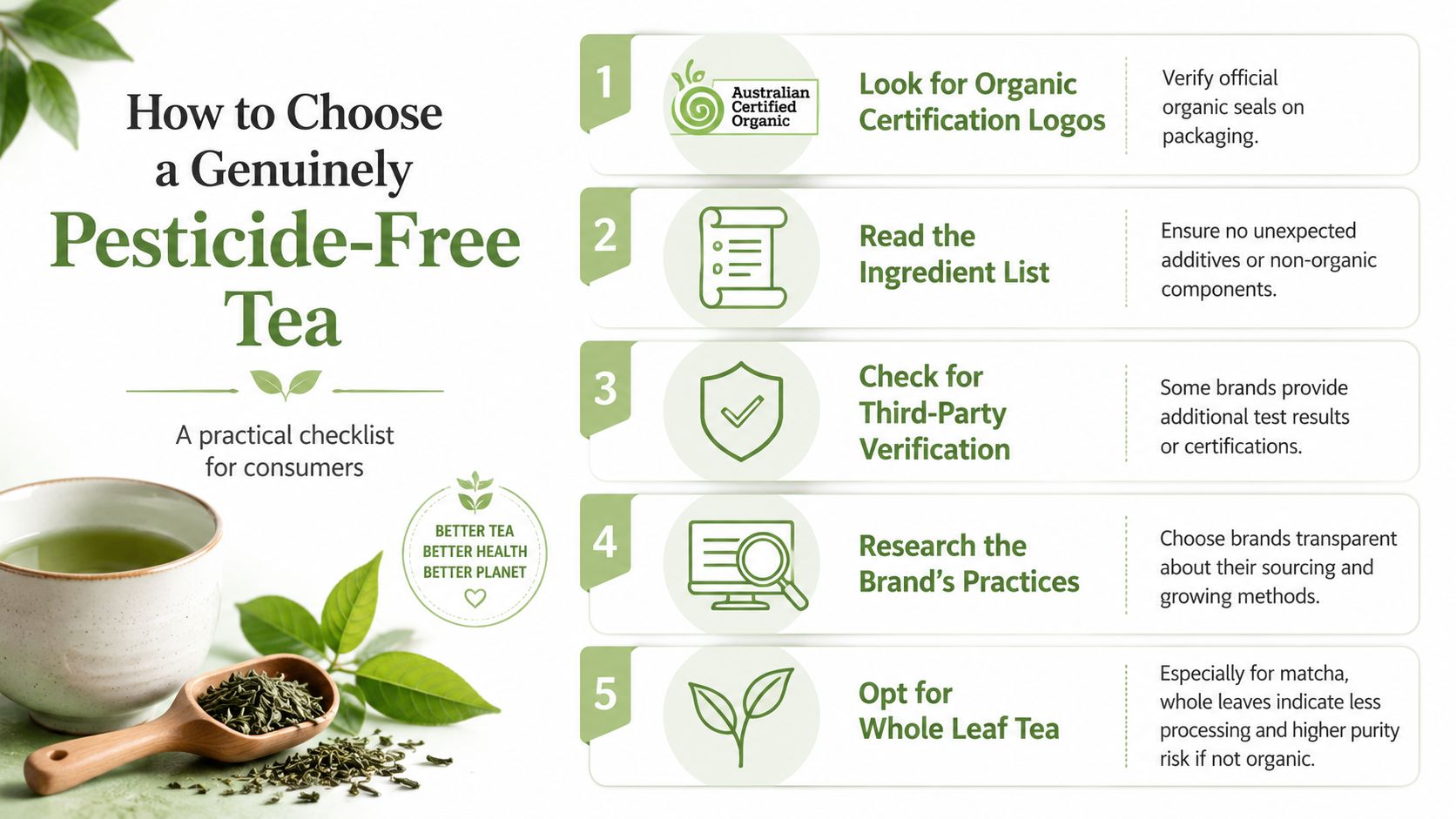
A simple shopping checklist
Use this when you're choosing tea online or in-store:
- Look for recognised certification logos. For Australian products, check for established organic certification marks. For matcha from Japan, look for Organic JAS.
- Read past the front label. Words like “clean”, “pure” and “natural” aren't enough on their own.
- Check the ingredient list. Simpler is usually better. Tea should look like tea, not a list of fillers and vague flavour systems.
- Look for brand transparency. Brands that explain sourcing and standards usually make shopping easier.
- Be stricter with matcha. Because you consume the leaf, this is the category where weak sourcing claims matter most.
Questions worth asking before you buy
Not every tea buyer wants to interrogate a packet, but a few simple questions help:
| Question | Why it matters |
|---|---|
| Is it certified organic, or just described that way? | This separates verified claims from marketing language |
| Where was it grown? | Region can influence overall quality and confidence |
| Is the brand transparent about standards? | Clear brands are easier to trust |
| Is it matcha or a steeped tea? | Whole leaf products deserve more scrutiny |
If you also enjoy coffee and want to compare how other beverage buyers think about sourcing and residue concerns, this overview of sustainable coffee options gives a useful parallel.
For readers browsing green tea more broadly, a curated organic green tea collection can also make it easier to compare product types and certification cues side by side.
Buy the proof, not the mood. Tea packaging can suggest wellness. Certification is what confirms it.
The labels that should make you pause
A few claims deserve extra caution:
- Organically grown, with no recognised certifier named
- Pesticide free, with no explanation of verification
- Premium imported tea, with no origin detail
- Wellness tea blend, where the tea source is unclear
These aren't automatic deal-breakers. They're prompts to look closer.
What Organic Certification May Not Cover
Organic certification does an important job. It tackles synthetic pesticides. But it doesn't automatically answer every safety question a careful tea drinker might have.
One of the most overlooked issues is that tea plants can absorb naturally occurring substances from the soil. As noted in this discussion of fluoride and heavy metals in tea, organic certification doesn't regulate naturally absorbed contaminants in the same way, and some organic teas may still accumulate fluoride or heavy metals like lead depending on where and how they're grown.
The hidden confusion
Many shoppers often find this confusing. They hear “organic” and reasonably assume “completely clean”. In practice, organic means the farming system avoids prohibited synthetic inputs. It doesn't mean the plant is isolated from its environment.
That's especially relevant for tea because the leaf is the product. What the plant absorbs matters.
What a careful buyer should do with that information
This isn't a reason to panic or stop drinking organic tea. It's a reason to go one step further in your thinking.
A more complete quality picture includes:
- Certification for pesticide-related assurance
- Source region for broader environmental confidence
- Brand transparency about testing and quality control
- Product type awareness, especially for matcha
Organic certification solves one major problem well. It doesn't replace good sourcing.
That nuance is reassuring. Once you understand it, you can make sharper choices instead of assuming every tea with an organic-looking label is identical. The strongest products tend to pair recognised certification with careful sourcing and clear communication.
Your Questions on Organic Tea and Pesticides Answered
Can I wash or brew away pesticides from conventional tea?
Brewing may change what ends up in the cup, but it doesn't turn conventional tea into certified organic tea. If avoiding synthetic pesticide concerns matters to you, it's better to choose certified organic from the start.
Is decaffeinated organic tea still pesticide-free?
If it's properly certified organic, the key issue remains the same. Certification is what matters most, not whether the tea contains caffeine.
Is matcha worth being fussier about?
Yes. Matcha deserves more scrutiny because you consume the powdered leaf itself, not just an infusion.
Does local or transparent sourcing help?
Usually, yes. A brand that clearly explains its certification, origin and standards is easier to trust than one relying on vague wellness language.
Does organic mean completely risk-free?
No food claim is that simple. Organic certification is excellent for avoiding synthetic pesticide use, but thoughtful shoppers should still care about origin, transparency and overall quality.
If you're looking for a cleaner cup with clearer sourcing, explore Pep Tea for premium organic matcha and Australian-brewed organic kombucha. We're passionate about making healthy tea choices easier to understand, whether you're choosing ceremonial-grade matcha for calm energy or a refreshing low-sugar kombucha for everyday wellness.
Matcha Tea Kyoto: A Guide to Japan’s Green Gold
I still remember standing in Kyoto with a bowl of fresh matcha in hand, then walking a few streets over and seeing tins sold as if every green powder were the same. That's the trap with Kyoto matcha. The place is famous for a reason, but the labels don't always teach you how to buy well.
Your Guide to True Kyoto Matcha
Kyoto has a pull on tea lovers that's hard to overstate. You feel it in old tea shops, in the quiet rhythm of whisking, and in the way locals speak about Uji as if it's not just a region but a standard.
That romance is real, but so is the pressure on supply. The average price for first flush Tencha, the leaf used for matcha, in Kyoto rose from JPY 5,500 per kilogram in 2024 to JPY 14,333 in 2025, a 265% increase driven by declining harvests in this premium region, according to reporting on Kyoto Tencha pricing and supply. If you're buying for a home ritual, a café menu, or wholesale use in Australia, that matters.
It matters because scarcity makes surface-level buying riskier. A beautiful tin, a Kyoto reference, or a ceremonial label doesn't automatically mean the matcha suits what you want to make. Some powders are made to be whisked with water and enjoyed on their own. Others are better in lattes, smoothies, or baking where milk, sweetness, or heat change the flavour.
Practical rule: In a tight market, knowing the right grade matters almost as much as knowing the right origin.
That's where a lot of travel guides fall short. They'll tell you where to drink matcha in Kyoto, but not how to tell true Kyoto matcha from a product that borrows the city's reputation. They also rarely explain the difference between a bowl made for quiet sipping and a powder meant for a busy Australian café service.
If you're planning a tea-focused trip, thoughtfully built personalized Japan itineraries can help you experience Kyoto's tea culture with more context than a quick souvenir stop. If you're buying from home, the same principle applies. Slow down, ask better questions, and match the powder to the purpose.
The Ancient Roots of Matcha in Kyoto
Kyoto didn't become the spiritual home of matcha by accident. Its reputation was built over centuries, through monks, growers, tea makers, and ceremony practitioners who kept refining what powdered tea could be.
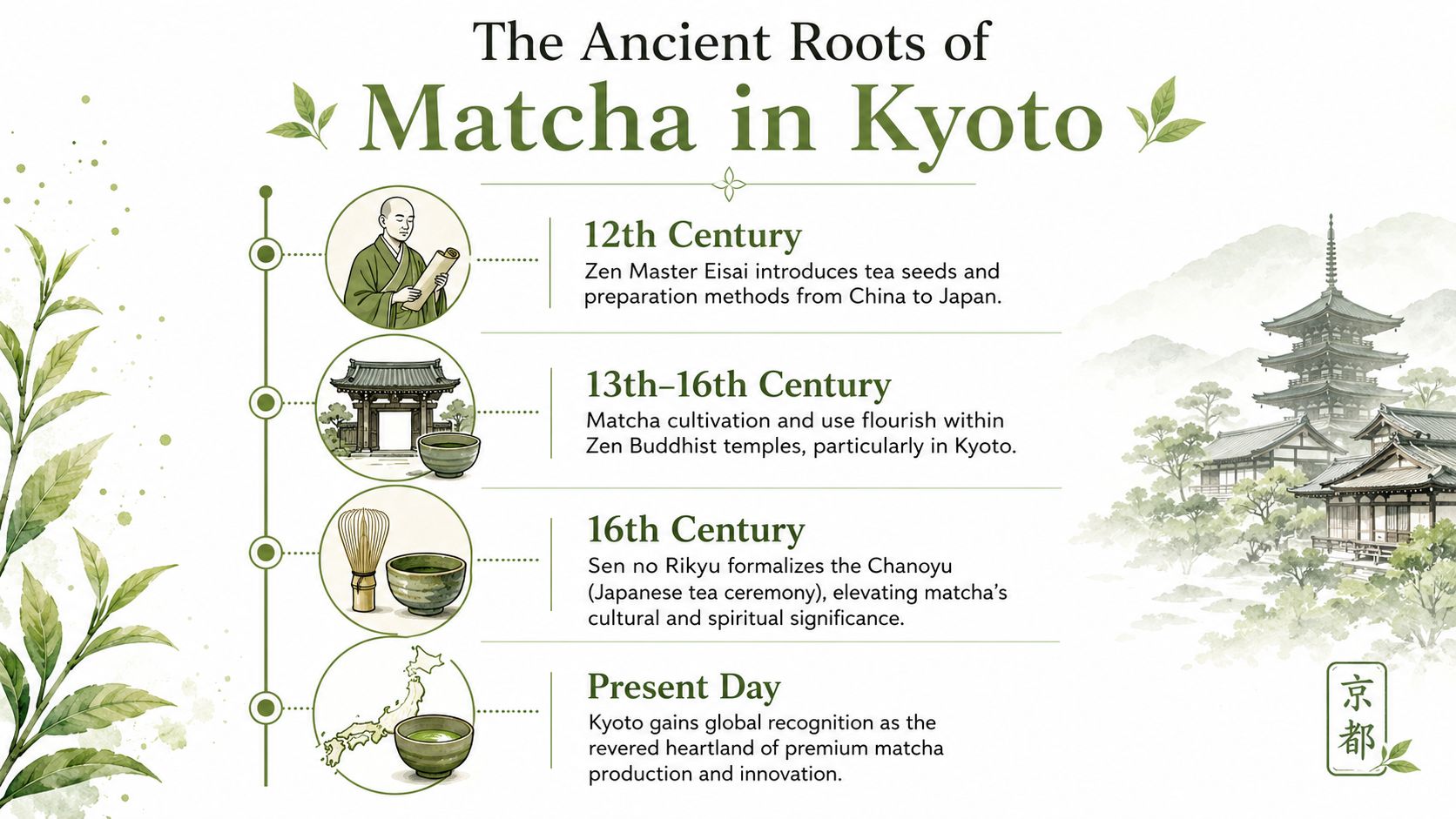
Zen Master Eisai introduced tea seeds and powdered tea methods to Japan in 1191, and tea production formally began in Uji, Kyoto, in the early 12th century, establishing the region's legacy for high-umami tea, as outlined in this history of Kyoto matcha culture. That's the moment many tea historians point to as the beginning of the Japanese matcha tradition we recognise today.
How Uji became the heart of the craft
Uji matters because tea culture in Japan didn't just need a starting point. It needed a place where technique and taste could mature together. Under the teachings of Myoe Shonin, tea production took root in Uji, and over time that local identity became known as Uji tea.
People often hear “Kyoto matcha” and think of a broad map label. Tea people usually hear “Uji” and think of a deeper marker of tradition, flavour, and handling. That distinction still matters now.
A few turning points shaped that identity:
- Tea methods arrived with Zen influence. Matcha wasn't only a drink. It was tied to focus, ritual, and temple culture.
- Stone milling changed the texture. By the 14th century, Japan had developed specialised stone mills for tea, producing a much finer powder than rough grinders.
- Shaded cultivation transformed the leaf. In the 16th-century Azuchi-Momoyama period, growers refined shading methods that became essential to premium Tencha and matcha.
Why the history still affects your cup
When you whisk a good Kyoto matcha today, you're tasting old decisions that never disappeared. Shading before harvest, careful grinding, and the idea that tea can express both flavour and calm all come from that historical line.
Matcha in Kyoto isn't famous just because it's old. It's famous because generations kept improving the same craft without losing the spirit behind it.
If you'd like a local Australian reference point for that story, our own brief history of matcha tea is a helpful companion read.
Understanding Kyoto's Terroir The Uji Difference
When tea people talk about terroir, they mean the way place shapes flavour. Soil, climate, water, air movement, and farming practice all leave a mark. Wine drinkers know the idea well. Matcha deserves the same respect.
In Kyoto, the most prized expression of terroir is often linked to Uji. That doesn't mean every tea from the broader prefecture tastes identical, or that every green powder with a Kyoto label belongs in the same class. The details matter.

According to this overview of Uji matcha terroir and processing, the terroir of Uji, Kyoto creates a creamy texture and a sweet ooi-ka aroma, and authentic ceremonial grade matcha is stone-ground to a particle size finer than 20 microns, about as fine as cornstarch. That's a technical detail, but you can feel it immediately in the bowl. Fine grinding helps the tea suspend smoothly, foam more evenly, and avoid the sandy mouthfeel you get from poorer powders.
What terroir means in plain language
If you're new to the term, think of terroir as the reason one matcha feels rounded and soft while another tastes sharp, flat, or overly grassy.
Here's how that shows up in the cup:
- Texture. Uji matcha often feels creamy rather than coarse.
- Aroma. The sweet, marine-leaning ooi-ka note is one of the clearest sensory clues.
- Sweetness and finish. Better terroir often gives a cleaner sweetness and less harsh bitterness.
That's especially useful for Australian buyers shopping online. If a seller says “Kyoto” but gives no clue about cultivation, milling, or flavour markers, you don't have enough information yet.
Kyoto is broad. Uji is specific
“Kyoto-grown” can be meaningful. “Uji” is usually more specific in the minds of serious matcha drinkers because it points to a historic tea area with a very strong quality identity.
That doesn't mean every Uji matcha will suit every use. It means the origin gives you a stronger starting point when you're looking for a ceremonial-style tea with a softer umami profile.
For a closer look at how origin fits into buying decisions, this Uji matcha powder guide is useful if you're comparing labels in the Australian market.
A short visual look at tea-growing conditions can make that difference easier to grasp:
What to notice before you drink
You don't need to be a tea judge to assess terroir cues. Start with a small checklist.
- Look at the powder. It should appear vivid and alive rather than dull.
- Smell it before whisking. A sweet, creamy scent is a good sign. A flat grassy smell can indicate a different style or lower refinement.
- Feel the finish. Good matcha lingers cleanly. Poorer matcha often leaves a rough, drying edge.
Decoding Matcha Grades Ceremonial vs Culinary
The first time I watched an Australian café make a matcha latte with an expensive Kyoto ceremonial powder, I knew what was about to happen. Beautiful colour, lovely aroma, and then milk, vanilla, and ice buried the tea's finer notes. The matcha was excellent. It was doing the wrong job.
That mix-up happens because grade names sound like rankings. In practice, they work more like choosing the right coffee roast for espresso versus filter, or the right olive oil for finishing versus cooking. A higher grade is not automatically better for every use. It is better for a specific style of drinking.
The simplest way to read matcha grades
Start with the cup you want to make.
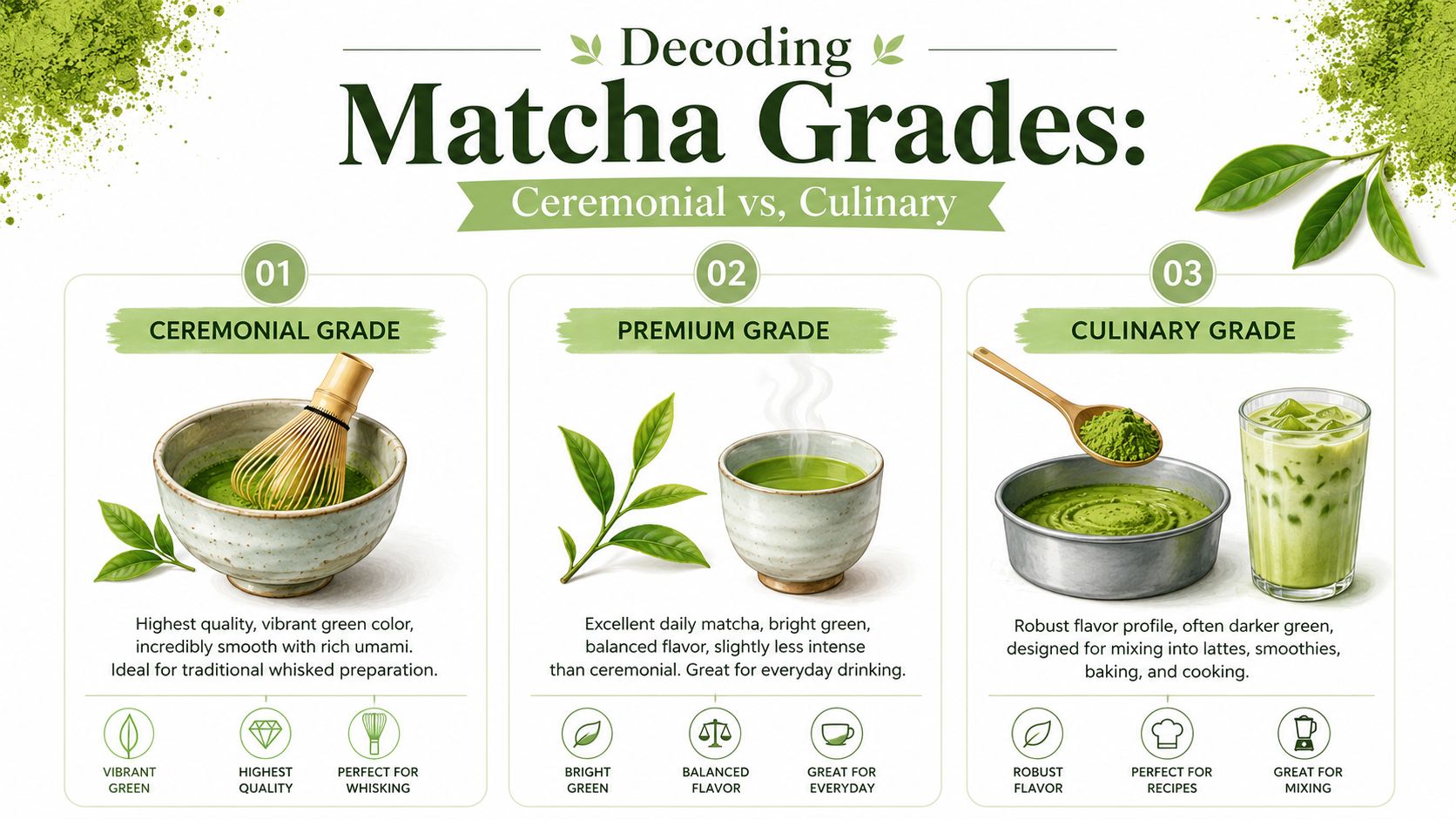
If you plan to whisk matcha with water and drink it on its own, ceremonial grade is the right place to look. Good ceremonial Kyoto matcha is usually made from carefully shaded tencha and processed to highlight sweetness, umami, and a smooth finish. The point is clarity. You are tasting the tea itself, with nothing to hide behind.
Premium grade sits in the middle. It often suits daily drinking, lighter lattes, and home use where you want a pleasing balance between softness, freshness, and value.
Culinary grade is chosen for strength of flavour in recipes. Milk, sugar, chocolate, banana, or heat all compete with the tea. A powder for baking or café lattes needs enough presence to still taste like matcha after everything else goes in.
That is why grade is really a use guide.
Why ceremonial matcha can disappoint in a latte
Ceremonial matcha is prized for delicacy. In a straight bowl, that delicacy shows up as sweetness, creamy texture, gentle marine notes, and a rounded umami finish. In a latte, many of those subtleties fade.
Australian drinkers often run into this problem because café matcha culture and traditional tea culture ask for different things. A whisked bowl rewards finesse. A latte rewards presence. If your regular order is oat milk with a little sweetness, a premium or culinary Kyoto matcha will often give you a clearer tea flavour than a more delicate ceremonial powder.
The best matcha for your kitchen or café is the one that suits the drink in front of you.
Matcha Grades At a Glance
| Grade | Best For | Flavour Profile | Colour | Price Point |
|---|---|---|---|---|
| Ceremonial | Traditional whisked tea, slow morning ritual, tasting straight with water | Smooth, umami-forward, low bitterness | Vibrant green | Higher |
| Premium | Daily drinking, lighter lattes, flexible home use | Balanced, fresh, approachable | Bright green | Mid-range |
| Culinary | Lattes, smoothies, baking, desserts | Stronger, more assertive, designed to cut through other ingredients | Usually deeper or less luminous green | Lower |
A practical guide for Australian homes and cafés
For cafés, this choice affects both flavour and cost. Using ceremonial matcha in a heavily flavoured latte can be like pouring a delicate pinot into sangria. You can do it, but you lose what made it special in the first place.
For home drinkers, the same rule helps:
- Straight whisked bowl with water. Choose ceremonial.
- Daily latte or iced matcha. Choose premium, or culinary if you want a bolder tea taste.
- Baking, desserts, and smoothies. Choose culinary.
If you want another reference point, this comprehensive guide for Japanese matcha shows how different matcha styles are presented for different uses. For an Australia-focused buying breakdown, our ceremonial vs culinary matcha guide for everyday use explains what to choose for whisking, lattes, and recipes.
What to check on the label
Grade terms are not perfectly regulated, so the front of the tin never tells the whole story. Look for clues that match your purpose.
- For ceremonial use, look for wording around whisking, smoothness, umami, shading, or first harvest style.
- For lattes, trust sellers who clearly say the powder suits milk drinks.
- For baking, choose flavour intensity over delicacy.
A simple question helps cut through the marketing. Are you trying to taste the tea alone, or are you asking it to stand up inside a recipe? Once you answer that, Kyoto matcha grades start to make much more sense.
How to Brew and Enjoy Kyoto Matcha
Once you've chosen the right grade, matcha becomes much easier and more enjoyable. Most brewing problems come from one of three things. The wrong powder for the job, water that's too hot, or a rushed mixing method.
How to whisk a traditional bowl at home
For a simple bowl of usucha, you don't need a formal tea room. You just need a few basic tools and a little care.
You'll want:
- A chawan. That's the bowl.
- A chasen. A bamboo whisk.
- A fine sifter. This helps prevent clumps.
- A scoop or spoon. Keep it consistent each time.
A beginner-friendly method looks like this:
- Warm the bowl with hot water, then tip it out and dry it.
- Sift the matcha into the bowl so the powder loosens.
- Add warm water, not boiling. Overheated water can make matcha taste harsh.
- Whisk briskly in a quick zig-zag motion until you get a light foam.
- Drink straight away while the aroma is fresh.
What a good bowl should taste like
A well-made ceremonial bowl shouldn't taste like lawn clippings. It should feel rounded, smooth, and lively, with a pleasant vegetal depth rather than rough bitterness.
If your bowl tastes overly sharp, check these factors:
- The water may be too hot
- The powder may be too old
- The matcha may be better suited to lattes than straight whisking
Good matcha rewards small adjustments. A slight change in water temperature or whisking can transform the cup.
A simple organic matcha latte
Australian homes and cafés often meet matcha through the latte first, and that's perfectly fine. The key is using a powder that can handle milk without disappearing.
Try this easy version:
- Sift your matcha into a cup or bowl
- Add a small splash of warm water and whisk into a smooth paste
- Top with hot or cold milk of your choice
- Sweeten lightly if you want, but keep it subtle so the tea still shows through
If you're making iced matcha, dissolve the powder well first. Dumping it straight onto cold milk almost guarantees clumps.
For recipes like bliss balls, pancakes, smoothies, or cakes, use culinary grade. It gives you the green tea character you want without paying for delicate notes that won't survive heat and other ingredients anyway.
Everyday ways Australians can use matcha
You don't have to keep matcha locked in one ritual style. It fits easily into daily life.
- Morning whisked bowl for a slower start
- Iced latte before work or after the gym
- Smoothie addition with banana and yoghurt
- Baking ingredient for muffins, slices, or cheesecakes
One practical option in Australia is Pep Tea's organic matcha green tea, which is offered for broad use across drinking and recipe applications. What matters most is matching the grade and flavour style to how you'll prepare it.
Finding Authentic Matcha Experiences in Kyoto
Kyoto has no shortage of matcha stops, but not all of them will teach you much. Some are beautiful and memorable. Others are mostly packaging, queues, and gift tins.
A useful starting point is to look beyond “famous” and look for signs of care. Tea houses with a long local relationship to tea tend to explain origin, harvest timing, preparation style, and flavour more clearly than shops built around quick tourist turnover.
What to ask when buying matcha in Kyoto
Many travellers overspend due to a critical gap for tourists: 78% of matcha sold in Kyoto souvenir shops is ceremonial grade, while culinary uses like lattes are often better suited to more affordable, heat-stable premium culinary grades, according to this Kyoto matcha shopping guide.
That means you should ask direct questions before buying:
- What is this best used for. Whisking, latte, or baking?
- Is it from Uji or another area of Kyoto.
- Is this intended for first flush ceremonial use.
- How would you prepare it at home.
The answers matter more than the display.
What a worthwhile tea experience looks like
The best tea experiences in Kyoto usually share a few qualities:
- They teach, not just serve. Someone explains the bowl, the whisk, or the origin.
- They distinguish grades clearly. You're not pushed toward the priciest tin by default.
- They respect the ritual. Even a casual tasting can still feel deliberate.
If you're planning a broader Kyoto trip around food, culture, and neighbourhoods, a thoughtful local guide for Kyoto travelers can help you build a better itinerary around genuine tea stops rather than random souvenir rows.
Buy the tea you'll actually use. The wrong expensive tin is less authentic to your life than the right everyday one.
Small signs of authenticity
When you're standing in a shop, trust your senses and the conversation.
A good seller can usually tell you how the tea should smell, whether it's better straight or with milk, and why one tin costs more than another. If they can't explain those basics, keep walking.
Sourcing Authentic Organic Matcha in Australia
You don't need to fly to Japan to buy carefully. In Australia, the challenge is different. You're not navigating Kyoto side streets. You're reading product pages, labels, and importer claims from your phone or laptop.
That means your buying checklist needs to be sharper.
What to check before you buy
Start with the core markers of authenticity and fit.
- Origin clarity. Look for a clear statement of Japanese origin, and ideally more detail than just “Japan”.
- Grade clarity. The seller should tell you whether the matcha is meant for whisking, lattes, or cooking.
- Organic credentials. If organic matters to you, the label should say so plainly.
- Usage guidance. Good retailers explain how to prepare the product, not just how pretty the tin is.
If a listing is vague on all four points, it's hard to know what you're paying for.
Why this matters more for Australian cafés
For cafés, buying matcha isn't only about romance or provenance. It's about menu design, consistency, and staff confidence. Your team needs to know which powder belongs in a straight matcha, which one stands up in a latte, and how to describe the difference to customers.
That education piece matters. It helps a customer move from “I want something green and healthy” to “I want a smooth whisked bowl” or “I want a bold iced latte.”
How we think about matcha at home in Australia
At Pep Tea, we focus on helping Australians understand what they're buying, not just selling them a tea term they've heard on social media. That means being clear about Japanese origin, practical use, and the difference between ceremonial-style drinking and culinary application.
For many households, matcha sits alongside other daily wellness drinks rather than in a separate ceremonial category. One day it's a morning bowl. The next it's part of a smoothie or an afternoon latte. For cafés, it may sit naturally beside a non-alcoholic menu that also includes low-sugar and fermented options such as kombucha.
The most reliable way to buy matcha tea Kyoto-style in Australia is simple:
- Check where it's from
- Check what it's for
- Check how it's milled and described
- Buy from a seller who can explain the difference without jargon
That's how you avoid paying ceremonial prices for a baking ingredient, or buying a latte powder when you wanted a quiet, silky bowl.
If you're ready to put this into practice, explore Pep Tea for organic matcha options and practical guidance on choosing the right style for whisking, lattes, recipes, or café service in Australia.
Matcha Shelf Life: Preserve Its Vibrant Flavor
You open a fresh tin of matcha, peel back the seal, and get that first burst of deep green colour and sweet grassy aroma. It feels a bit special. Then real life kicks in. A few morning lattes, one forgotten week in the pantry, a warm kitchen, and suddenly you're wondering whether your matcha is still good.
That's where a lot of people get tripped up. Matcha shelf life isn't really about a dramatic moment when the powder “goes off”. It's more about protecting a delicate ingredient so it keeps its vibrant flavour, creamy umami, and fresh aroma for as long as possible. Premium matcha is finely ground, sensitive, and much less forgiving than many pantry staples.
For Australian households, that matters even more. Warm weather, bright kitchens, and long shipping journeys can all chip away at freshness before your tin is even halfway empty. If you've ever asked, “Is this still safe to drink?” when the better question was “Has this gone stale?”, you're not alone.
If you're still getting familiar with the tea itself, this guide to what matcha powder is gives useful background. Once you understand why matcha behaves differently from loose leaf tea, shelf life makes much more sense.
Your Guide to Matcha Shelf Life and Freshness
Fresh matcha has a personality. It looks lively, smells clean and green, and tastes rounded rather than harsh. Older matcha can still be usable, but it often loses the very qualities that made you buy it in the first place.
That's why it helps to think in terms of peak quality rather than panic over a printed date. A best-before date tells you about enjoyment. It doesn't always tell you what's happening in the bowl, on the whisk, or on your palate. Matcha usually fades gradually. First the aroma softens. Then the colour dulls. Then the taste becomes flatter, drier, or more bitter.
Practical rule: Judge matcha the way you'd judge fresh coffee beans or good olive oil. The closer you are to opening, the more vivid the experience.
The good news is that keeping matcha in great condition isn't complicated. You only need to understand three things:
- What timeframe you're working with so you buy realistic quantities
- What damages matcha most quickly in an ordinary kitchen
- What signs tell you it's stale, not necessarily unsafe
A lot of shelf life advice online stays vague. It tells you a range of weeks or months but doesn't help you decide what to do with the tin sitting in your cupboard right now. That's the practical gap individuals need filled.
By the end of this guide, you'll know how long matcha generally keeps its best character, how to spot quality loss with your eyes and nose, and how to store it properly so each scoop gives you the flavour you paid for.
How Long Does Matcha Really Last
You open a tin expecting that sweet, creamy, almost spinach-fresh aroma you fell in love with, and instead the powder smells faint and tastes a little sharp. The label may still say it is within date. Your bowl is telling a different story.
That is the core shelf life question with matcha. There is a difference between safe to use and still at peak quality. Best-before dates speak to the first part. Your eyes, nose, and palate are often better guides for the second, especially in Australia, where warmth, humidity, and long shipping routes can shorten matcha's best window. As noted by Uji Matcha Tea's guide to matcha shelf life, unopened matcha is often labelled for much longer than its true peak, while opened matcha is usually best enjoyed within a much shorter period.
Matcha shelf life at a glance
| Matcha Form | Peak Quality Window | What that means in practice |
|---|---|---|
| Unopened powder | Usually best within a few months of milling | A sealed tin protects matcha, but it does not stop gradual flavour loss |
| Opened powder | Usually best within several weeks | Once air starts getting in regularly, aroma and sweetness fade faster |
| Prepared matcha drink | Best enjoyed soon after mixing | The fresh flavour drops off quickly, especially with heat, milk, or time in the fridge |
A sealed tin helps, but it does not pause time. Matcha is a finely milled green tea, so it has much more exposed surface area than loose leaf tea. That makes it a bit like ground coffee. Freshness slips away faster once oxygen has a chance to work on it.
This also explains why two tins with the same printed date can taste completely different. One may have been stored cool from milling to your kitchen. Another may have sat in warm transit, on a sunny shelf, or in a humid pantry. Same date, different result.
Why the label and your senses can disagree
Best-before dates are broad. They are useful for stock control, but they are not a promise that your matcha will still taste vivid, sweet, and full of umami right up to that day.
Peak quality is narrower. Premium matcha has delicate aromatic compounds and colour pigments that fade gradually over time, even before you break the seal. Once opened, the clock speeds up. If you buy ceremonial matcha for straight whisking, that shorter peak window matters a lot more than it does for baking or blending into smoothies.
Grade matters too. A latte-friendly powder can still be enjoyable after it has softened a little, while a delicate ceremonial matcha shows age much sooner in the cup. If you are unsure which style you are buying, this guide to different grades of matcha can help you match the tea to how you drink it.
A practical rule: buy the amount you can finish while the tea still tastes bright, not the amount that looks cheapest per gram.
A more useful way to judge how long yours will last
Use the calendar as a rough guide, then confirm with your senses.
- Bright green colour and fresh, grassy aroma: ideal for straight whisked matcha
- Still green but less fragrant: usually fine for lattes, iced drinks, and smoothies
- Duller colour and flatter taste: better moved to baking or cooking
- Musty smell, damp clumps, or obvious moisture exposure: discard it
That last point is about safety, not just quality. A stale matcha is disappointing. A damp, musty matcha is a different issue.
So how long does matcha really last? Long enough to stay usable for quite a while if stored well, but only a shorter window where it tastes lively. If you care about getting the sweet, creamy, vivid side of premium matcha, freshness after opening matters far more than the printed date alone.
The Four Enemies of Fresh Matcha
Matcha doesn't usually fade for one mysterious reason. It fades because everyday kitchen conditions keep working against it. Four things do most of the damage: light, oxygen, heat, and moisture.
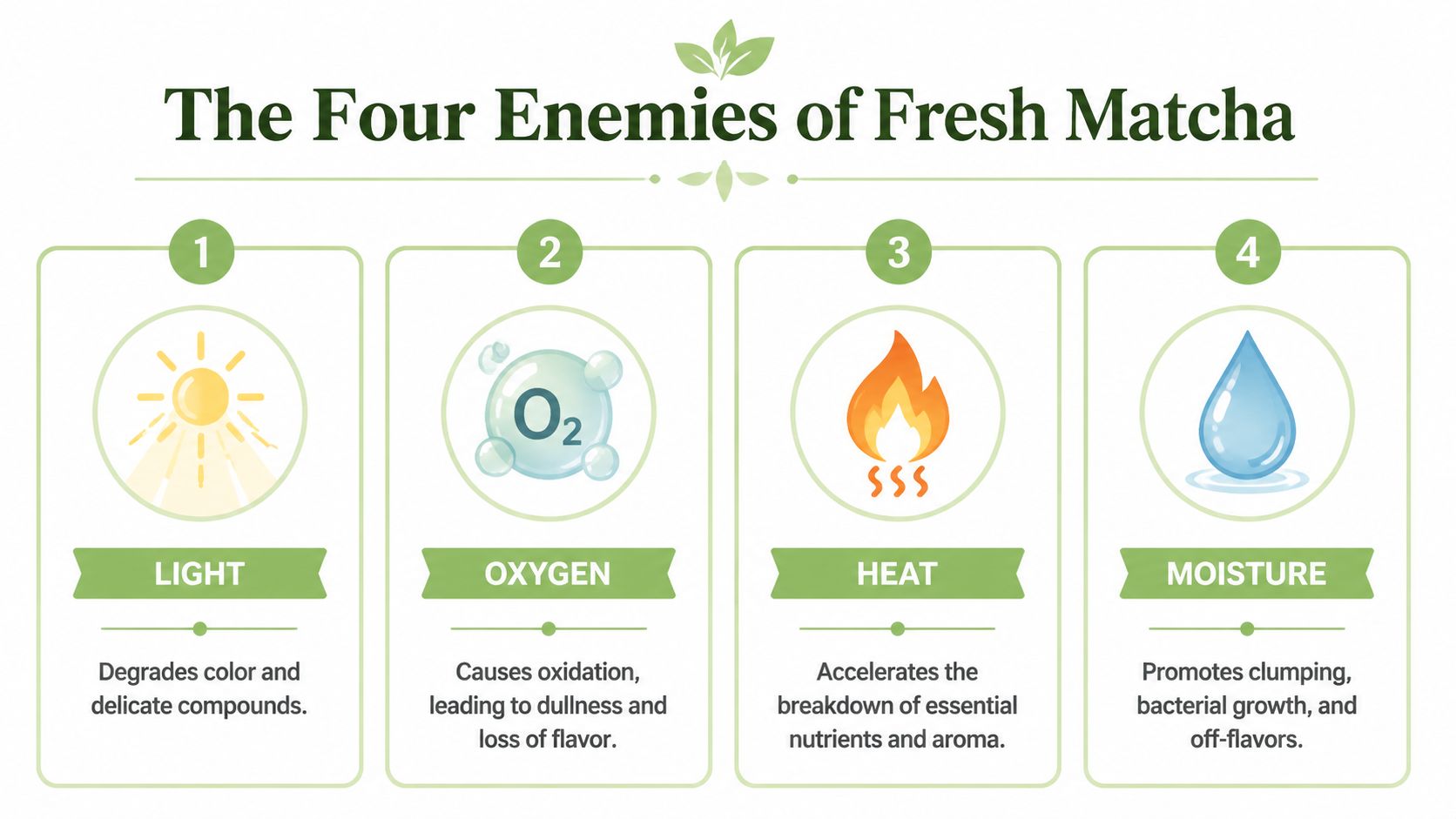
Light strips away colour
Fresh matcha gets its vivid green look from delicate plant pigments. Leave the powder exposed to light, especially strong daylight, and that colour starts to fade. What was once bright green can shift towards olive, yellow-green, or a tired-looking dull tone.
If you've ever seen matcha stored in a clear jar on an open shelf, it may look lovely on day one. It's not doing the powder any favours.
Oxygen steals flavour
Every time you open the tin, oxygen gets in. That starts oxidation, which is the main reason matcha loses its sweetness, umami, and aromatic lift. The powder won't suddenly become dangerous because air touched it. It just becomes less interesting, less rounded, and more blunt on the tongue.
This is why a half-empty container often seems to age faster. More headspace means more air around the powder.
Matcha doesn't need dramatic mishandling to lose quality. Repeated small exposures add up.
Heat speeds everything up
Heat is the accelerator. A warm pantry, a shelf near the kettle, or a sunny benchtop can push matcha along its ageing curve much faster. Heat doesn't work alone. It makes the effects of oxygen and light happen faster.
In Australia, this catches people out all the time. A cupboard that feels “fine” in winter can become a poor storage spot in summer.
Moisture causes the biggest practical problems
Moisture is the enemy that changes both texture and safety risk. Dry matcha is fairly stable. Damp matcha is not. Once moisture gets into the powder, it starts clumping, loses its silky feel, and can develop off smells.
Here's what each enemy tends to do in real life:
- Light dulls colour and can make premium matcha look tired
- Oxygen flattens aroma and pushes flavour towards bitterness
- Heat speeds up all of the quality loss
- Moisture causes clumps and creates the biggest reason to discard the powder
Why this matters more for matcha than loose leaf tea
Loose leaf tea still has some natural protection in the leaf itself. Matcha is a powder, so much more of it is exposed all at once. That's why it behaves less like a sturdy pantry tea and more like a fresh ingredient you want to shield from the environment.
Once you understand those four enemies, good storage stops feeling fussy. It then becomes logical.
How to Tell If Your Matcha Has Gone Stale
The question often posed is, “Is it expired?” Yet, the true inquiry should be, “Is it still worth drinking?” These are different questions.
According to Japanese Tea Pedia's explanation of matcha shelf life, a commonly missed point is the difference between safety and quality. Matcha is a dry, low-moisture product, so the date on the tin is usually a best-enjoyment window, not a food-safety cut-off. That's why sensory checks matter so much.
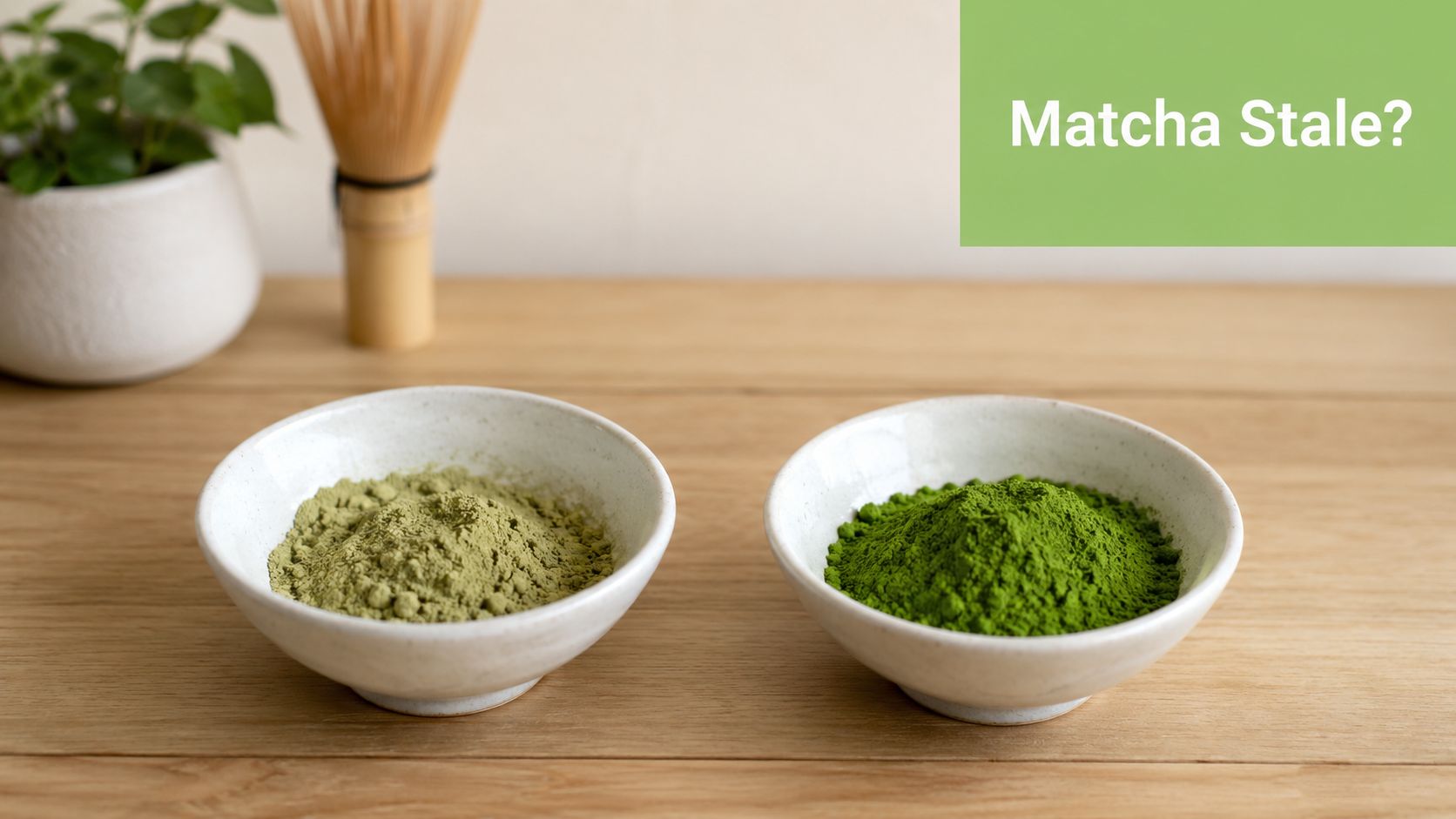
Start with colour
Fresh matcha usually looks vivid and alive. Not neon, not fake-bright, but clearly fresh. As it stales, the powder tends to look duller. You may notice olive tones, a yellow cast, or a brownish tinge.
Colour alone doesn't tell the whole story, but it's often the first clue.
Ask yourself:
- Does it still look vibrant when you open the tin?
- Has it shifted towards khaki or yellow-green?
- Does the whisked tea look muddy rather than lively?
If the visual spark has gone, the flavour often has too.
Smell the powder before you whisk
Aroma tells you even more. Fresh matcha should smell green, clean, and softly sweet. Depending on the style, you might notice grassy, leafy, or savoury notes. Stale matcha smells weak, dusty, flat, or hay-like.
A musty smell is different again. That can point to poor storage and possible moisture exposure.
If your matcha smells dull but clean, it's usually stale. If it smells musty, sour, or damp, don't try to rescue it.
Taste is the final test
The bowl never lies. Fresh matcha should taste balanced. Even when it has pleasant bitterness, there's usually some softness, depth, or umami underneath. Stale matcha loses that shape. It can become sharp, thin, chalky, or overly astringent.
Here's a simple at-home freshness check:
- Sift a small amount into a bowl
- Whisk it with water rather than masking it in milk first
- Taste it plain before deciding what condition it's in
If you want to watch the powder and foam closely as you prepare it, this quick visual guide can help:
Texture gives away moisture problems
Good matcha feels very fine and soft. It should sift easily. If the powder is forming hard little pellets, sticking together, or feeling grainy, moisture has probably reached it. A few soft clumps can happen naturally and may break apart with a sieve. Damp, hardened clumps are more concerning.
When to keep it, repurpose it, or toss it
Use this simple decision rule:
- Still bright, aromatic, and smooth means drink it proudly
- Duller but dry and normal-smelling means use it in lattes, smoothies, or baking
- Musty odour, odd dampness, or severe clumping means discard it
That's the key distinction. Stale matcha is disappointing. Spoiled matcha is suspicious. Your senses are usually better guides than the printed date alone.
Best Storage Practices to Extend Matcha Freshness
Good storage isn't about turning your kitchen into a lab. It's about reducing exposure every single time you use the tin. If you control air, light, warmth, and humidity, you give your matcha the best chance of staying fresh.
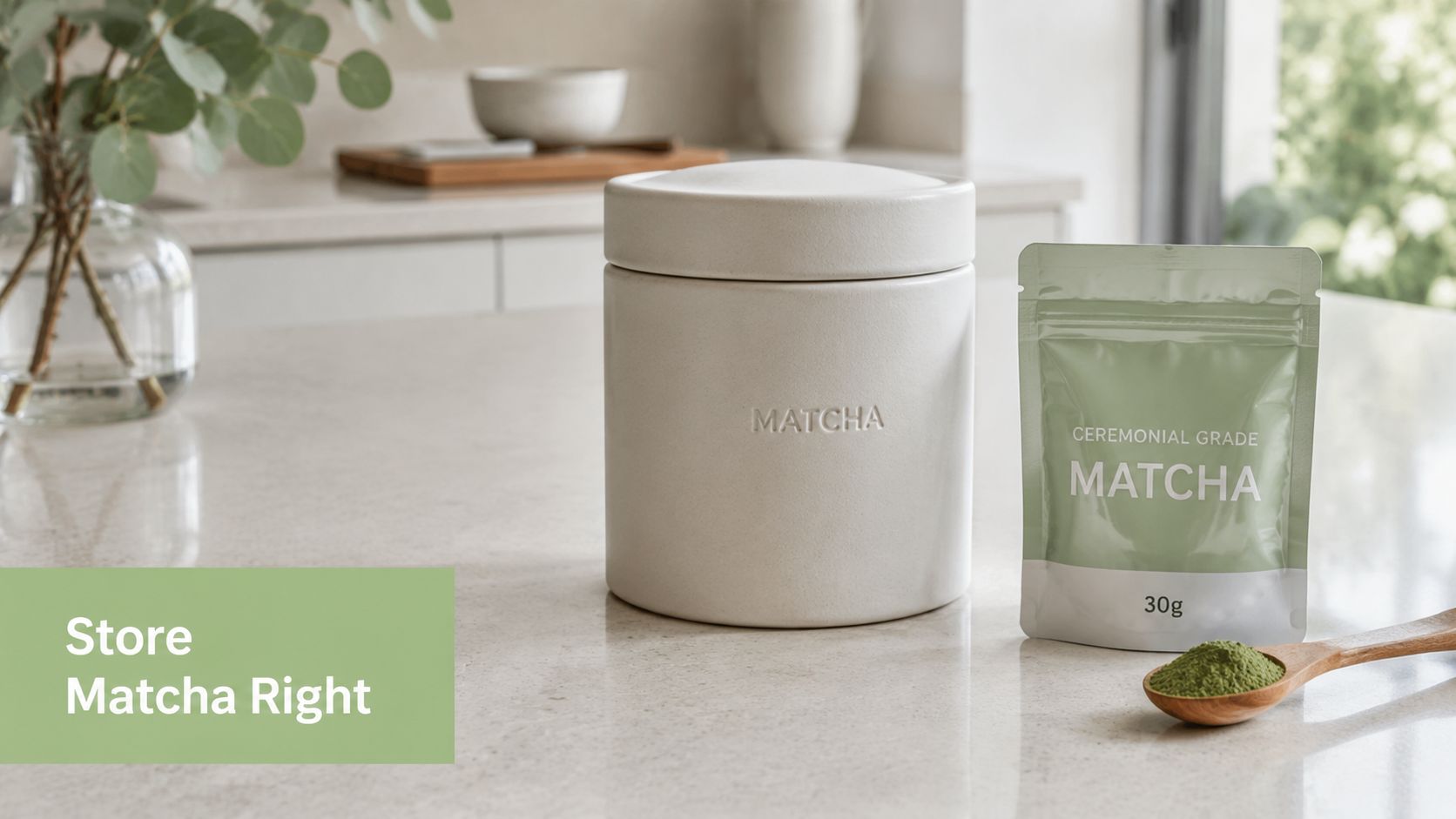
For home kitchens
If you drink matcha regularly, the simplest setup is often the best. Keep it in an airtight, opaque container in a cool, dark place, away from the stove, dishwasher, toaster, and direct sunlight.
A few habits make a real difference:
- Open briefly and close the container straight away
- Use a dry spoon every time
- Avoid steam from kettles or cooking
- Don't store it beside strong smells because matcha can pick them up
A lot of the same principles apply across tea storage generally. If you'd like a broader refresher on storing loose leaf tea correctly, that guide offers helpful common-sense rules that also support better matcha care.
Fridge or pantry
Many people often hesitate. The pantry is easier. The fridge is cooler. Both can work, but they come with trade-offs.
Pantry storage is practical if you'll finish the matcha fairly quickly and your cupboard stays cool, dark, and dry.
Refrigeration can help preserve quality, especially for delicate matcha, but only if the container is tightly sealed. The biggest risk isn't the cold itself. It's condensation when you open a chilled container too soon.
Take refrigerated matcha out and let it come fully to room temperature before opening. That one habit can save you from moisture damage.
Freezing for longer holds
Freezing can make sense for unopened backup packs you won't touch for a while. It's less useful for a tin you open every day. Repeated freezing and thawing creates more chances for condensation, which defeats the purpose.
If you freeze matcha:
- Keep it sealed
- Portion it if possible, so you're not reopening the whole supply
- Warm to room temperature before opening
For cafés and busy households
High-use settings need a different rhythm. If you're making matcha all day, don't keep opening the main stock bag over and over. Decant a smaller working amount into a daily-use tin, then keep the main supply sealed.
That reduces repeated oxygen exposure and protects the rest of the powder. It also makes service faster and cleaner.
Useful tools make storage easier
The right accessories help good habits stick. A small tin with a strong seal, a dry scoop, and a fine sieve all reduce mess and unnecessary exposure. If you're building a better setup, these matcha tea accessories show the kinds of tools that make regular preparation easier and gentler on the powder.
The big takeaway is simple. Matcha stays freshest when you buy sensible amounts, keep it sealed, and protect it from heat and humidity. Fancy rituals are optional. Consistent storage isn't.
Frequently Asked Questions About Matcha Shelf Life
Can old matcha make you sick
Usually, dry matcha that's been stored properly is more likely to become stale than unsafe. The bigger concern is quality loss. If it smells musty, seems damp, or has unusual clumping that suggests moisture got in, don't use it.
Does ceremonial grade go off faster than culinary grade
In practice, many tea drinkers notice that ceremonial grade seems to lose its sparkle sooner. That's not necessarily because it has a completely different shelf life on paper. It's because its delicate aroma, sweetness, and umami are easier to notice when they fade. Culinary matcha can hide age a little better in baking and lattes.
How long does a made matcha latte last
A matcha latte is best consumed soon after making it. Once matcha is mixed with water or milk, freshness drops quickly. The foam settles, the flavour changes, and chilled ingredients can separate or taste flat. If you need to make one ahead, keep it refrigerated and treat it as a same-day drink for best enjoyment.
Can I still use stale matcha for recipes
Yes, if it's dry, clean-smelling, and past its prime. Older matcha often works better in smoothies, cakes, pancakes, or biscuits than in a plain whisked bowl.
Fresh matcha is one of those small daily pleasures that rewards good care. If you'd like to enjoy premium organic matcha at its best, explore the range at Pep Tea for ceremonial and culinary options suited to everyday whisking, lattes, and recipes.
Matcha Protein Shake: Healthy Blends for 2026 Energy
Some mornings call for more than a flat white and good intentions. You want something cold, fast, satisfying, and steady enough to carry you through a workout, a commute, or a packed morning of meetings without feeling like you've had dessert for breakfast.
That's where a good Matcha protein shake earns its keep. Done well, it isn't just green powder plus protein. It's a balanced drink with clean flavour, real texture, and a practical job to do. It can sit comfortably between breakfast and café ritual, between recovery drink and daily wellness habit.
The problem is that most recipes stop at “blend and enjoy”. That's not enough if you've ever ended up with a gritty mouthfeel, a bitter finish, or a shake so thick it barely moves through the straw. The better approach is to understand what each ingredient is doing, especially the protein source, because whey, pea, and collagen all behave differently once matcha enters the mix.
Why a Matcha Protein Shake is Your New Morning Ritual
There's a reason this style of drink keeps showing up in home kitchens, gym bags, and café fridges. It suits the way many Australians eat and drink now. People want convenience, but they also want something that feels purposeful.
Australian beverage market data from Mintel shows that half of non-alcoholic beverage buyers seek products with added health benefits, and matcha fits neatly into that demand because it brings protein for satiety together with matcha's natural caffeine at around 70 mg per serve as reported in this functional beverage overview.

It solves two common morning problems
Coffee can be brilliant, but it isn't always enough on its own. If you're hungry an hour later, or you feel like your energy spikes and then falls away, a shake with both matcha and protein can be a more useful first drink.
Protein changes the feel of the morning. It adds staying power. Matcha changes the mood of it. Instead of reading like a treat or a random smoothie, the drink starts to function like a proper part of your routine.
For anyone trying to build a more reliable breakfast habit, practical nutrition matters more than novelty. If you're also trying to lift your daily protein intake without overcomplicating meals, PlateBird's protein intake guide is a handy companion resource because it helps frame where a shake fits into the bigger picture.
Practical rule: A Matcha protein shake works best when you treat it like a functional breakfast or recovery drink, not a milkshake with wellness branding.
Matcha brings more than flavour
A lot of people first come to matcha for the taste and colour, then stay for the ritual. In a shake, though, matcha does something slightly different. It lifts the whole drink. Vanilla protein tastes cleaner with it. Banana tastes less heavy. Even richer bases like oat milk or yoghurt can feel brighter.
Nutritionally, matcha contributes some protein and fibre, but it's still a modest protein contributor on its own. A peer-reviewed analysis found matcha powder contains about 17.3 g of protein per 100 g, and one tablespoon, about 12 g, provides roughly 2 g of protein and 6.73 g of dietary fibre, equal to 26.92% of an adult's recommended daily fibre allowance, according to the peer-reviewed analysis of matcha composition. That same analysis also noted that the fibre is predominantly insoluble.
That matters because matcha isn't replacing your protein powder. It's improving the drink's functional profile, flavour complexity, and satiety appeal.
Why it fits modern café and home routines
At home, a Matcha protein shake is easy to scale up or down. In cafés, it gives staff a drink that can sit between smoothie, iced latte, and wellness menu item. It also speaks to customers who want low-sugar options without giving up flavour or ritual.
If you're curious about the broader wellness appeal of matcha itself, this guide to the amazing benefits of matcha green tea is a helpful read.
Choosing Your Ingredients for the Perfect Shake
A great shake starts before the blender turns on. Ingredient choice decides whether the final drink is silky and fresh, or grassy, lumpy, and strangely sweet.
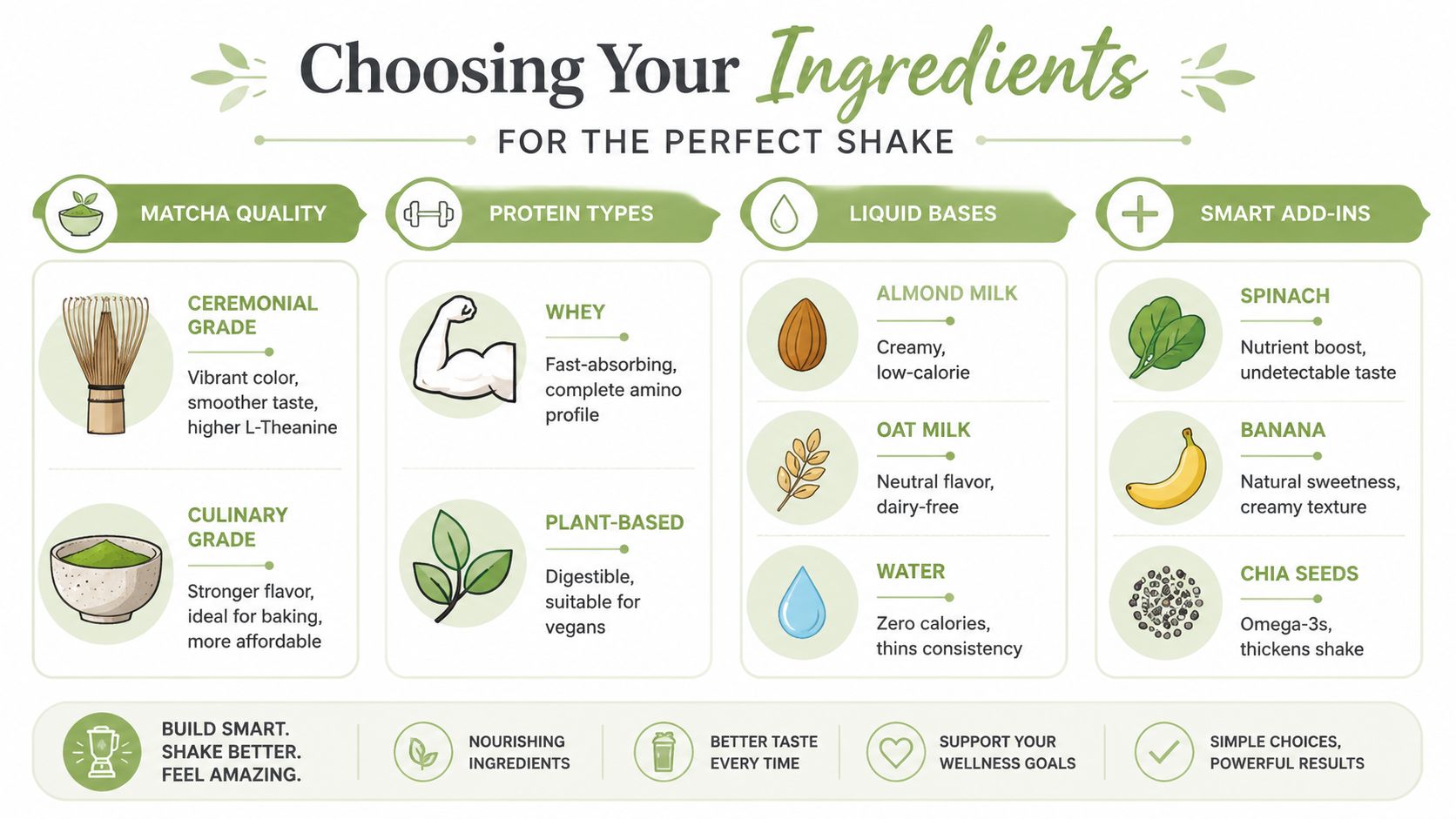
Pick the right matcha for blending
For shakes, culinary-grade matcha usually makes more sense than ceremonial. Ceremonial grade is lovely for whisking with water, where its finer flavour can shine on its own. In a shake, that subtlety often gets buried under milk, protein, fruit, or ice.
A strong culinary matcha stands up better in the blender. It gives you a clearer tea flavour and usually offers better value if you're making shakes regularly at home or serving them in a café setting.
If you want a clearer sense of what separates one grade from another, this matcha grade and quality guide breaks down the key differences.
Your protein choice changes everything
Most weak recipes treat protein powder as interchangeable. It isn't. Texture, sweetness, thickness, and how the shake sits on the palate all depend on the protein base.
The broad rule is simple. Plant-based proteins often need more liquid, while whey isolate tends to blend more cleanly, a point noted in this recipe discussion on protein texture and blending behaviour.
Here's how the common options behave in practice:
| Protein type | What usually works | What often goes wrong |
|---|---|---|
| Whey isolate | Smooth, light texture, easy to blend, lets matcha stay bright | Can taste overly sweet if flavoured strongly |
| Pea protein | More filling, good for dairy-free drinkers, sturdy in thicker shakes | Can turn chalky or earthy without enough liquid |
| Collagen | Dissolves easily, keeps the drink lighter | Doesn't create the same creamy body as whey or pea |
| Soy protein | Better emulsifying than some plant blends, fuller body | Can dominate the flavour if the powder is strong |
| Mixed plant blends | Useful for vegan formats and menu flexibility | Texture can vary wildly from silky to sandy |
Matcha is delicate, but it isn't shy. The best protein powder supports it instead of fighting for attention.
Liquid bases matter more than people think
The liquid decides body and finish. Water gives you the cleanest tea flavour, but the thinnest result. Unsweetened almond milk keeps things light. Oat milk adds roundness and makes the shake feel more café-style. Dairy milk creates a fuller, sweeter profile naturally.
For training-focused shakes, some people prefer a simpler base so the drink feels cleaner after exercise. For breakfast shakes, a creamier liquid often makes the drink feel complete enough to replace a meal.
A few reliable pairings:
- Unsweetened almond milk brings a lighter body and lets grassy notes stay crisp.
- Oat milk softens sharper matcha edges and makes vanilla proteins taste more rounded.
- Dairy milk adds natural richness and can balance stronger matcha doses.
- Water plus yoghurt can work well if you want body without too much sweetness.
Smart add-ins that actually improve the drink
Not every “healthy” add-in helps. Some just muddy the flavour.
The useful ones tend to do one of three jobs:
- Creaminess: banana, avocado, Greek yoghurt
- Sweetness: banana, dates, a small amount of honey or maple if needed
- Satiety: chia seeds, nut butter, extra fibre-rich ingredients
If the goal is a clean, vibrant Matcha protein shake, restraint usually wins. One creamy ingredient and one sweetness adjustment are often enough. Once you add too many boosters, the tea disappears.
Four Essential Matcha Protein Shake Recipes
A Matcha protein shake can be light and brisk, thick and filling, or somewhere in the middle. The best recipe depends on what you want the drink to do.
Independent recipe and product references note that a well-built matcha-protein drink can land in the range of 20 g to 41 g of protein per serve and roughly 92 to 100 mg of caffeine per serve when formulated with more concentrated matcha servings, as outlined in this matcha protein shake recipe reference.
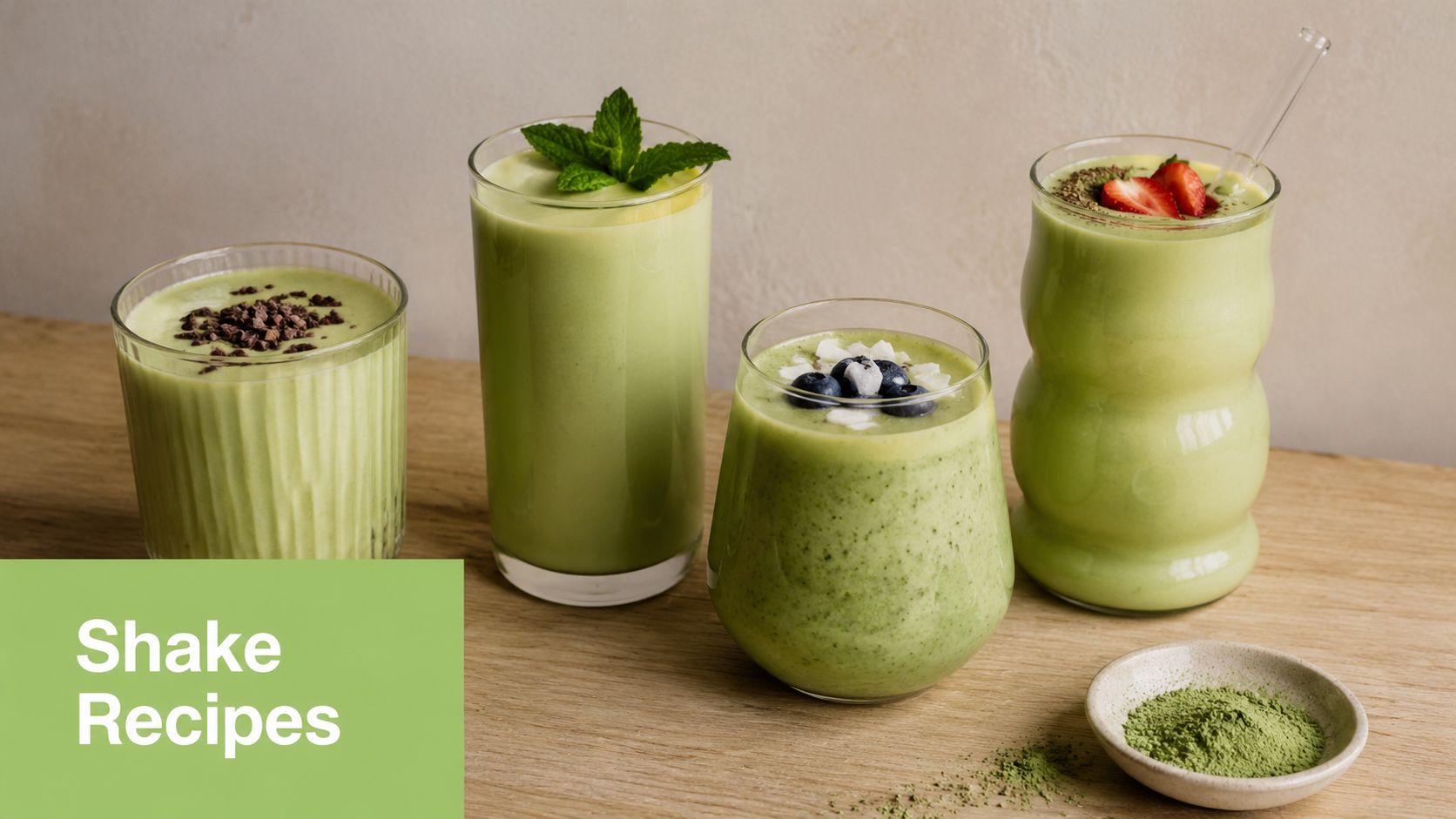
The Classic Energiser
This is the one to make when you want a dependable daily blend. It's balanced, not too heavy, and easy to repeat on busy mornings.
You'll need
- 1 teaspoon matcha
- 1 scoop vanilla whey isolate
- 1 cup unsweetened almond milk
- 1/2 frozen banana
- A small handful of ice
Start with the almond milk in the blender, then add the matcha and whey. Finish with banana and ice. Blend until the colour turns evenly green and the texture looks glossy.
The banana rounds out the edges without making the shake taste like dessert. Whey isolate keeps the body smooth and lets the tea stay centre stage.
The Creamy Vegan Powerhouse
Plant-based protein can be excellent with matcha, but it needs more care. This version leans into richness so the shake feels intentional rather than compromise-driven.
You'll need
- 1 teaspoon matcha
- 1 scoop pea or mixed plant protein
- 1 cup oat milk
- 1/2 frozen banana
- 1 tablespoon chia seeds
- A few ice cubes
Blend the oat milk and matcha first if you can, then add the plant protein. Once that's incorporated, add banana, chia, and ice. Give it a little extra blending time.
Pea protein can pull the drink towards chalkiness if the liquid is too low. Oat milk and banana solve much of that. Chia thickens the shake and gives it a more complete breakfast feel.
The Iced Post-Workout Refresher
After training, some people don't want a thick smoothie. They want something cold, brisk, and easy to drink. This one is lighter on the palate.
You'll need
- 1 teaspoon matcha
- 1 scoop unflavoured or lightly flavoured whey isolate
- 3/4 cup cold water
- 1/4 cup unsweetened almond milk
- Ice
Keep the flavour profile clean. Blend just until smooth and drink it straight away. The water lifts the freshness, while a smaller amount of almond milk stops it feeling thin.
This is a good format if heavy dairy or a thick vegan blend doesn't sit well after exercise.
A quick visual can help if you like seeing the process before trying your own variations.
The Ultimate Meal Replacement
This is the version for long mornings, late breakfasts, or anyone who wants one glass to do more work.
You'll need
- 1 teaspoon matcha
- 1 scoop protein powder of choice
- 1 cup milk of choice
- 1/2 avocado
- 1 tablespoon nut butter
- 1 tablespoon chia seeds
- Ice as needed
This one should be blended until fully velvety. Avocado creates body without adding obvious flavour. Nut butter gives the shake more substance. Chia helps it stay satisfying for longer.
Use collagen if you want this version to stay lighter. Use whey if you want the smoothest body. Use pea protein if you want the biggest breakfast feel.
Mastering the Blend for a Smooth Clump-Free Shake
If your shake is gritty, the problem usually isn't the blender. It's the order. People often throw everything in together, then wonder why matcha sticks to the sides and protein forms damp little pockets that never fully dissolve.
Recipe testing points to a simple fix. Add wet ingredients first, then powders like matcha and protein, which helps stop powder sticking and improves emulsion, as noted in this blending method guide.
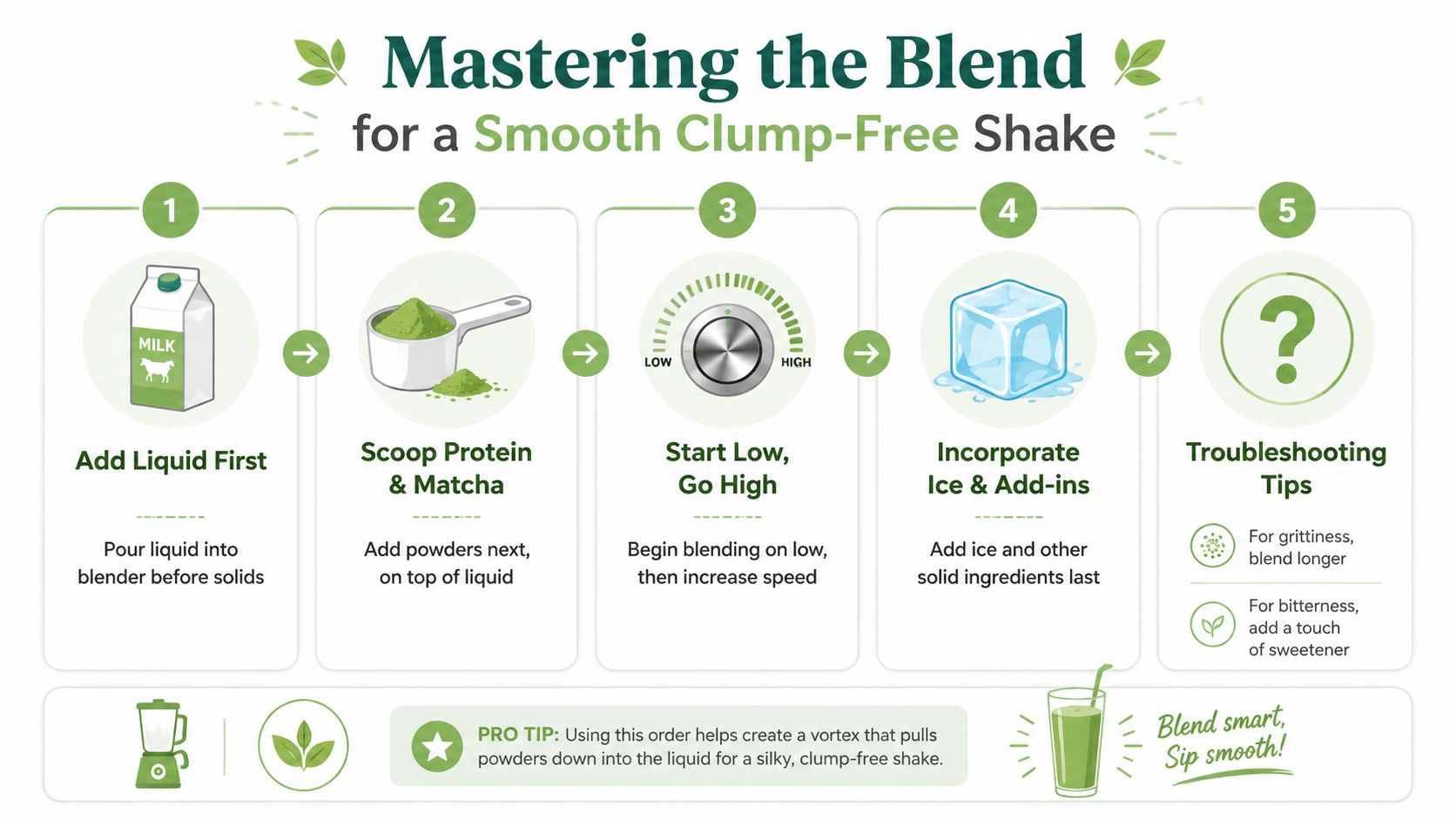
The order that works
Use this sequence every time:
- Pour in your liquid first so the blades have immediate movement.
- Add matcha and protein next so they disperse into liquid instead of compacting under frozen ingredients.
- Add soft ingredients like banana, yoghurt, or avocado.
- Finish with ice or frozen fruit so the heavier solids don't trap dry powder underneath.
This one adjustment fixes most beginner mistakes.
Pre-mix if you want café-level texture
Matcha behaves best when it's given a little attention before blending. If you've got thirty extra seconds, whisk it with a small amount of liquid into a loose slurry first. That prevents dry tea particles from lingering in the finished shake.
A fine sifter helps too, especially if your matcha has compacted in the tin. A dedicated matcha tea sifter makes it easier to break up small clumps before they ever hit the blender.
A silky Matcha protein shake usually comes from preparation, not power. Even a strong blender can't fully rescue badly layered ingredients.
How to fix common problems fast
A few small adjustments can save a disappointing shake:
- Too thick means add a splash more liquid, then re-blend.
- Too thin means add a little more ice, chia, or frozen banana.
- Too bitter usually means too much matcha, or a matcha that's too harsh for cold drinks.
- Too chalky often points to plant protein needing more liquid and more blending time.
If the flavour feels flat, don't automatically add sweetener. A pinch more vanilla, a creamier milk, or a little banana often improves the drink without pushing it into sugary territory.
Serving Storage and Cafe Menu Inspiration
A Matcha protein shake is best fresh, when the top is still lightly frothy and the colour is brightest. That said, real life isn't always fresh-blended and leisurely. Sometimes you need to make it ahead, cap it, and get out the door.
At home, the easiest make-ahead approach is to blend the shake, refrigerate it in a sealed bottle, and give it a hard shake before drinking. Separation is normal, especially with lighter liquids or collagen-based blends. A quick stir usually brings it back.
Small serving touches make it feel better
The drink tastes the same either way, but presentation changes the experience. A simple garnish can make a weekday shake feel less utilitarian.
A few good finishing touches:
- Dusting of matcha for aroma and colour
- Hemp seeds for a subtle nutty top note
- Mint leaf if you want it to read fresh and café-like
- Clear glass to show off the vivid green
Why cafés should pay attention
For cafés, this drink fills an increasingly useful gap. It sits comfortably beside smoothies and iced drinks, but it carries a more premium, wellness-led identity. It also gives staff room to customise.
One café-friendly approach is to prep a house matcha base in advance, then build to order with different protein options. That lets customers choose what suits them best, whether that's whey for smoother texture, pea for dairy-free service, or collagen for a lighter feel.
A compact menu could offer:
- An everyday Matcha protein shake with vanilla protein and almond milk
- A vegan version with oat milk and plant protein
- An upgrade option with greens, chia, or collagen
- A lower-sweetness format for customers who don't want banana in every blend
That kind of flexibility works well in Australian cafés where people often want something quick, functional, and not overloaded with sugar.
Storage without disappointment
If you're storing one overnight, keep expectations sensible. The flavour will still be good, but the texture is rarely as lively as it is straight from the blender. Thicker shakes hold better than very icy ones, and banana-heavy versions often need a good re-blend or extra shake in the morning.
The best compromise is often prep-ahead rather than fully blend-ahead. Measure the dry ingredients, portion the frozen ingredients, and keep the liquid ready in the fridge. In the morning, it takes only moments to finish.
Embrace Your New Favourite Healthy Habit
A good Matcha protein shake earns a permanent place in the routine because it solves practical problems. It gives you a more satisfying start than a plain caffeinated drink, a more interesting flavour than many standard protein shakes, and enough flexibility to suit breakfast, post-workout recovery, or an afternoon reset.
The key difference comes from making it properly. Use a matcha that can stand up in a cold drink. Choose a protein that suits your goal and your digestion. Blend in the right order. Adjust the liquid before you blame the recipe.
That's when the drink shifts from trend to habit.
There's plenty of room to make it your own. Keep it lean and brisk with water and whey. Build it creamy and filling with oat milk, chia, and plant protein. Go lighter with collagen. Go fuller with avocado. Once you understand how the ingredients behave, you can shape the shake around your day instead of forcing yourself to drink a version that never quite works.
If you're ready to make your own Matcha protein shake with better flavour and cleaner ingredients, explore Pep Tea for premium organic matcha suited to daily blending, lattes, and wellness recipes.
Your Perfect Matcha Cheesecake Recipe No Bake
You're probably here because you want a dessert that looks polished, tastes grown-up, and doesn't ask you to heat the kitchen. That's exactly where a good matcha cheesecake recipe no bake shines.
This is the kind of dessert that feels right in an Australian summer, on a dinner-party table, or tucked into the fridge the night before guests arrive. It has the cool creaminess of cheesecake, the gentle depth of green tea, and that striking green colour that makes everyone think you've gone to far more effort than you did.
An Elegant Dessert Without the Oven
You get home to a warm kitchen, want a dessert that looks polished, and have no interest in baking a cheesecake in summer. A no-bake matcha version solves that beautifully. You press in a biscuit base, whisk and fold the filling, chill it, and let the fridge do the setting.
That simplicity is part of its appeal, but the magic resides in its texture. A good no-bake matcha cheesecake should land somewhere between classic cheesecake and mousse. It needs enough body to slice neatly, yet enough air to feel soft and light on the spoon. That is why technique matters so much here. If you beat everything together too aggressively, the filling can turn heavy. If you fold with a gentle hand, you keep the whipped cream airy and the final texture far more delicate.
In practical terms, it is also an easy dessert for Australian home cooks. You can make it ahead, keep the kitchen cool, and pull out a cake that feels calm and considered rather than last-minute.
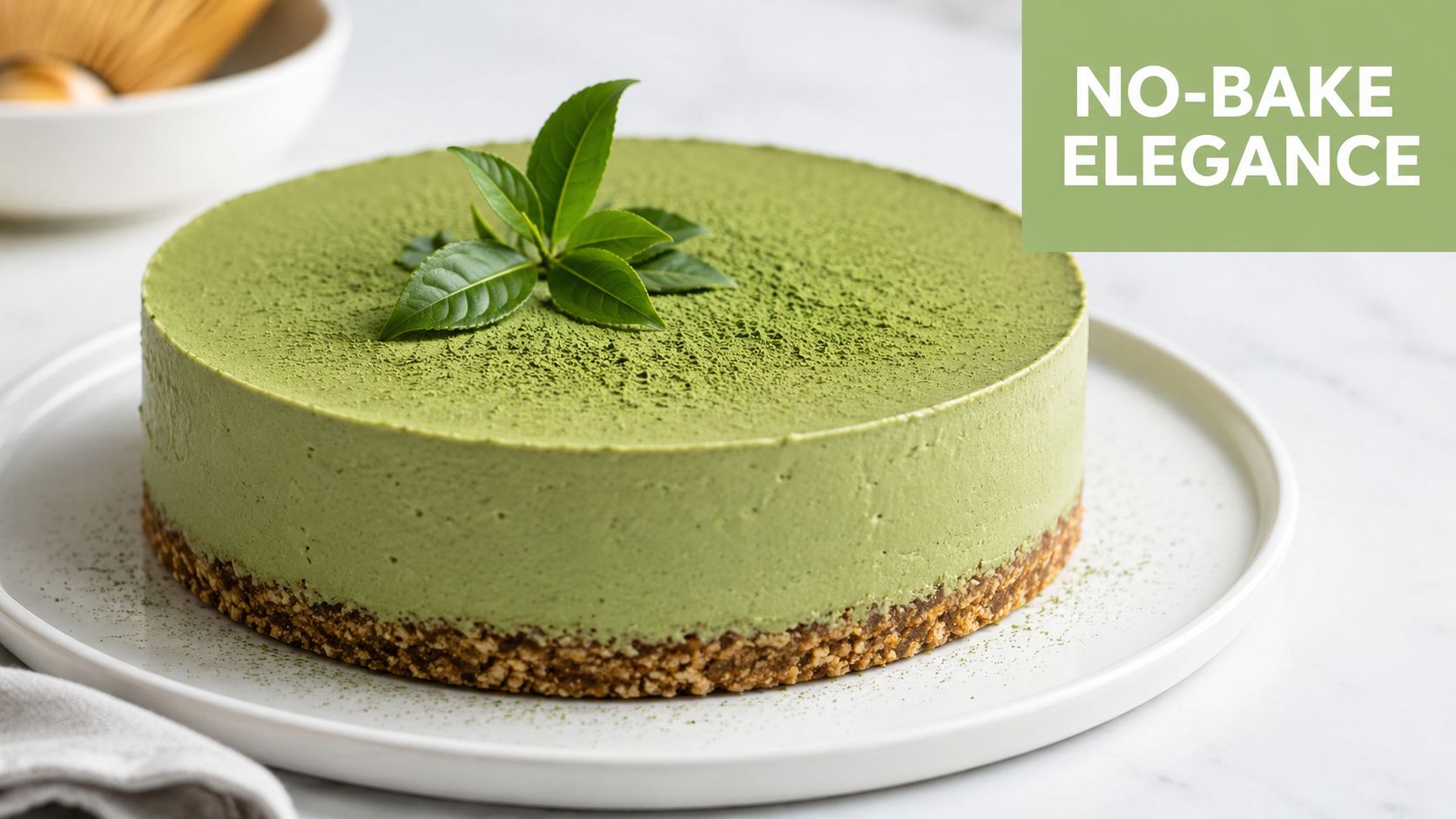
Why this dessert feels so special
Matcha does much more than tint the filling green. Good matcha brings gentle bitterness, fresh grassy notes, a little sweetness, and that clean tea finish that keeps cream cheese from feeling too rich. The result tastes poised and balanced, with richness held in check by the tea.
The choice of matcha makes a bigger difference than many recipes admit. Low-quality powder can taste flat, muddy, or sharply bitter, which is often why homemade matcha desserts disappoint. For baking and desserts, I like using organic culinary matcha powder chosen for cooking because it gives you stronger flavour and better colour without forcing you to use an excessive amount. If you want to find unique matcha from local makers, look for a powder with a fresh aroma and a vibrant green tone rather than an olive or brown cast.
The pan style is flexible too. Many home bakers use a springform tin for clean edges, but the same filling can work in a smaller pan or sliced bars if you want a different presentation.
A good no-bake cheesecake should feel cool, creamy and light on the palate, not dense and stodgy.
What success looks like
When this cheesecake is made well, each layer has a clear role. The base is firm enough to hold together, the filling is smooth and airy, and the matcha comes through clearly without any harsh, dry finish.
You should get creaminess first, then the green tea notes, then a clean finish that invites the next bite. That is what gives the dessert its elegant feel. It is refined, yes, but still very achievable at home when you use good ingredients and treat the filling gently.
Your Ingredients and Equipment Checklist
The ingredient list is short, but each item has a job. In a no-bake cheesecake, you don't have heat doing the setting for you, so texture comes from fat, temperature and technique. That's why this recipe works best when you use the proper ingredients, not lighter substitutes.
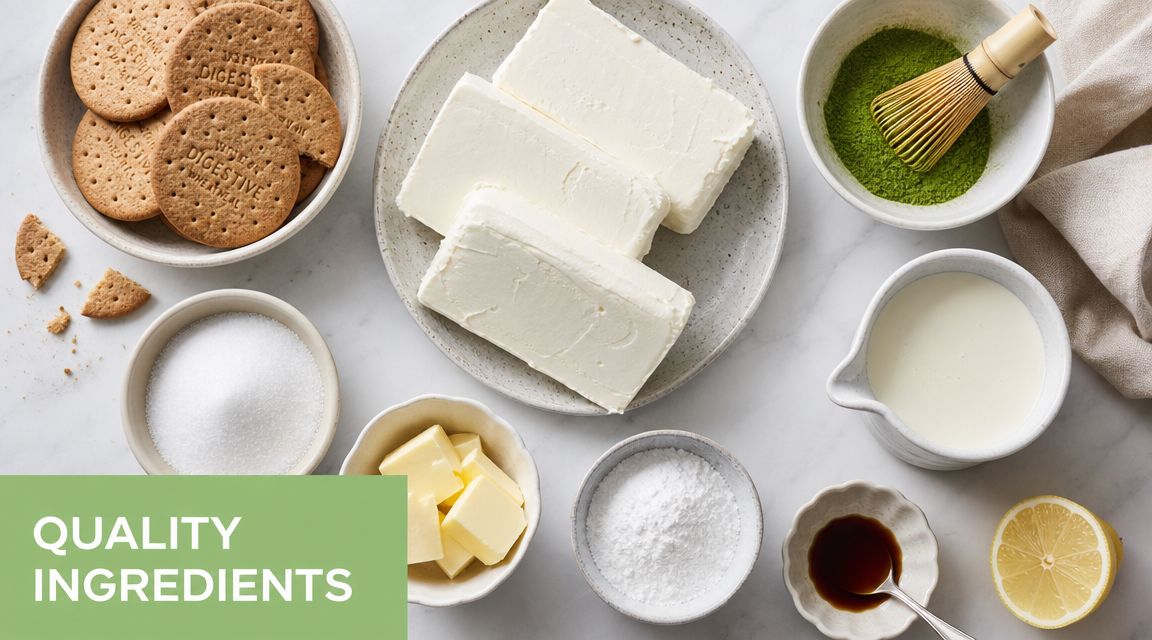
The core ingredients
For the base and filling, keep your shopping list simple:
- Plain sweet biscuits such as digestives or similar. These crush evenly and make a tidy, buttery base.
- Melted butter to bind the crumbs so the crust slices cleanly.
- Full-fat cream cheese for body, richness and structure.
- Caster sugar or icing sugar, depending on your preferred texture.
- Thickened cream or heavy cream to create the light finish.
- A little acid such as lemon juice. It brightens the filling and helps balance richness.
- Pure matcha powder for flavour and colour.
A lot of confusion starts with the cream cheese. Use block-style, full-fat cream cheese if you can. Spreadable tub versions are often softer and can leave the filling looser than you want.
Choosing the right matcha
Often, recipes become vague. One of the biggest gaps in no-bake matcha cheesecake recipes is that they often tell readers to add “matcha” without explaining how culinary grade versus ceremonial grade affects flavour, colour or bitterness, as discussed in this matcha cheesecake guide.
That matters because cheesecake is rich. The dairy can mute delicate tea notes, so your matcha needs enough presence to come through clearly.
Here's the practical rule:
- Use high-quality culinary matcha for baking and desserts. It has the strength to stand up to cream cheese, cream and sugar.
- Don't reach straight for ceremonial matcha unless you know the flavour profile you want. Ceremonial matcha is lovely whisked as tea, but in a cheesecake it can be an expensive ingredient whose subtle notes get lost.
- Sift the matcha first so you don't end up with little dark green lumps in the filling.
If you enjoy comparing tea styles before choosing one for baking, it can help to find unique matcha from local makers and notice how colour, aroma and bitterness differ from one powder to another.
For dessert use, a dedicated organic culinary matcha powder for cooking is the easiest starting point because it's designed to perform well in recipes, not just in a tea bowl.
The best matcha for cheesecake gives you a fresh green colour and a rounded tea flavour, not an aggressive grassy finish.
Equipment that makes life easier
You don't need a professional kitchen. You do need a few reliable tools:
| Tool | Why it helps |
|---|---|
| Springform pan | Releases the cheesecake neatly without damaging the sides |
| Electric mixer | Smooths the cream cheese properly |
| Mixing bowls | One for the cream cheese base, one for the whipped cream |
| Spatula | Essential for folding without knocking out air |
| Fine sieve or sifter | Breaks up clumps in the matcha |
| Food processor or rolling pin | Crushes the biscuits evenly |
A 20 cm springform pan is the usual home-baker choice in Australia and sits comfortably within the common 9-inch recipe style found in published no-bake versions.
The Step-by-Step No-Bake Method
The secret to a mousse-like cheesecake isn't luck. It comes from handling the filling in two distinct stages. Recipe sources consistently warn that the main failure point is overmixing, and that the best texture comes when you beat the cream cheese and flavourings until smooth, whip the cream separately to stiff peaks, then gently fold it in according to this technique-focused recipe.
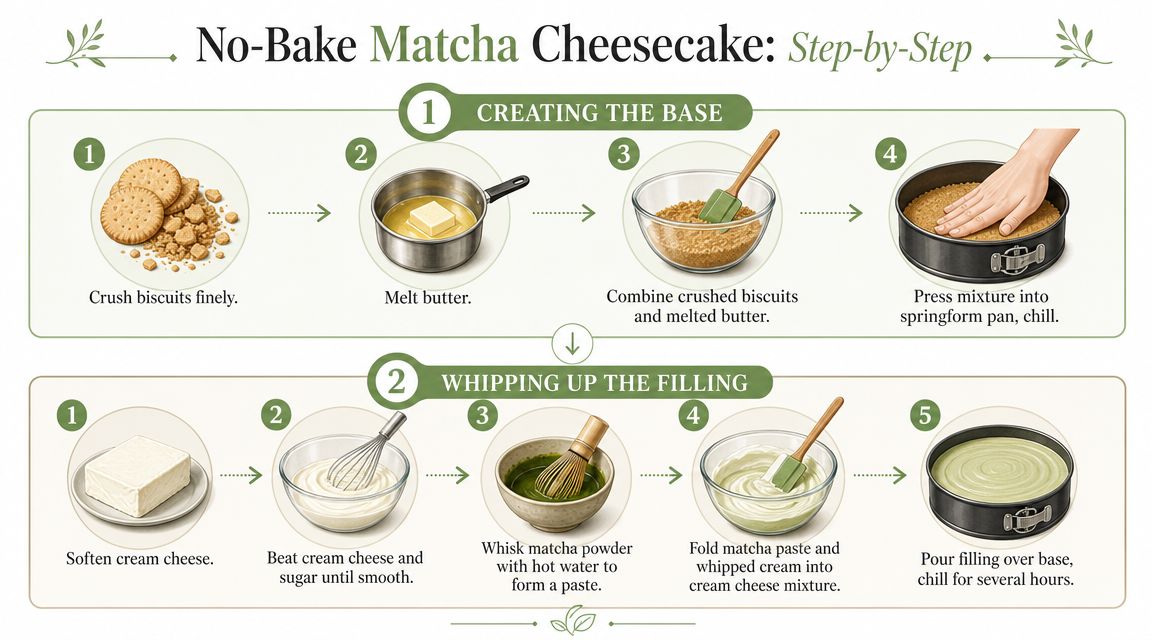
Stage one for the biscuit base
Crush the biscuits finely.
You want an even crumb, almost like damp sand once the butter is added. Large chunks make the base harder to slice neatly.Stir through melted butter.
Mix until every crumb looks coated. If some crumbs stay dry, the base won't hold together well.Press the mixture into your springform pan.
Use the back of a spoon or the base of a glass. Press firmly across the bottom and slightly up the sides if you like a taller edge.Chill the base while you make the filling.
This helps it firm up early so it doesn't shift when the filling goes in.
Stage two for the filling
Here, the texture is won or lost.
Beat the cream cheese until smooth.
It should be soft enough to mix without lumps. Cold cream cheese fights back and leaves grainy bits through the filling.Add sugar, matcha and any flavourings.
Sift the matcha before adding it. If you like, whisk the matcha with a small amount of liquid first to make a smooth paste before it goes into the bowl. That helps the colour distribute evenly.Mix until fully homogenous.
You're aiming for one smooth, green mixture with no streaks and no pockets of unmixed cream cheese.Whip the cream separately to stiff peaks.
This matters more than many readers realise. Stiff peaks mean the cream holds shape when you lift the beaters. That whipped air is what gives the cheesecake its lighter body.
For a smoother, lump-free finish in the tea itself, a matcha tea sifter is useful before the powder ever reaches the mixing bowl.
Practical rule: Stop the mixer once the cream reaches stiff peaks. Keep going and you risk turning silky cream into a grainier mixture that won't fold as cleanly.
The folding step that changes everything
Fold the whipped cream into the matcha cream cheese mixture gently.
Use a spatula, not the mixer. Scoop from the bottom of the bowl and lift over the top in broad, slow motions.Work in batches if that feels easier.
Fold in a small amount first to loosen the base, then add the rest. This makes it easier to keep the air you've whipped in.Stop once combined.
The mixture should look smooth and airy. If you keep stirring after that point, you'll deflate the whipped cream and lose the mousse-like texture.
This is the step many home bakers rush. Mixing feels faster, but folding is what protects the tiny air bubbles in the cream. Those bubbles help the filling feel soft and elegant instead of compact and heavy.
Finish the cheesecake properly
Spoon the filling over the chilled base.
Spread it gently to the edges with a spatula.Smooth the top.
A small offset spatula works well, but the back of a spoon is fine too.Cover and refrigerate.
Let the cold do the setting.
A simple workflow helps:
- Room-temperature dairy for mixing makes the filling smoother.
- Cold cream for whipping gives better volume.
- Gentle folding at the end protects the final texture.
If you keep those three ideas straight, this dessert becomes very reliable.
Achieving the Perfect Set and Finish
You lift the springform tin, slide in the knife for the first slice, and hope the centre holds. This is the stage where a no-bake matcha cheesecake becomes either beautifully mousse-like or a little too loose. The difference usually comes down to time, temperature, and restraint.
This cheesecake sets in the fridge as the fats in the cream and cream cheese firm up and the airy filling settles into a stable structure. Cold does the work slowly, which is why a rushed chill often gives you soft, untidy slices. An overnight rest gives the cleanest result, but a longer daytime chill can still work well if the filling was folded gently and whipped to the right stage earlier.
Texture matters here just as much as appearance. A good no-bake matcha cheesecake should hold a neat edge on the plate, then soften quickly on the fork. That is the sweet spot. You want a dessert that feels light, almost like a set cream, not dense or rubbery.
What a proper set looks like
The outer edge should look smooth and hold its shape when the ring is removed. The centre may have a slight wobble, but it should not ripple like liquid. If you press the top very lightly with a clean fingertip, it should feel softly springy.
That gentle wobble can confuse home bakers. It does not mean failure. It means the filling is chilled yet still delicate, which is exactly what gives this cheesecake its mousse-like character.
How to finish it neatly
Keep the decoration simple so the matcha can stay the star, both in flavour and colour. High-quality organic culinary matcha earns that spotlight. It gives you a fresher green hue and a fuller tea flavour, without the dull colour or harsh bitterness that can make other versions taste flat.
A few finishing options work especially well:
- A fine dusting of matcha just before serving for a clean, classic look
- Fresh raspberries for brightness and contrast
- White chocolate shavings for a softer, sweeter finish
- Black sesame seeds for a nutty accent and a striking dark detail
Use a light hand. Too many toppings can hide the clean flavour of the tea and make the dessert look busy.
Small finishing habits that make a big difference
For the cleanest slices, warm your knife in hot water, wipe it dry, and clean it between cuts. Chill the cheesecake fully before dusting with matcha, or the powder can darken in patches on the damp surface. If you are making this for guests, topping it shortly before serving keeps the finish sharp and fresh.
If you enjoy learning how fine powders behave in desserts, instant coffee baking techniques offer useful ideas about dissolving flavour evenly without creating gritty pockets. The principle is similar with matcha. A smooth, even finish starts with careful handling from the beginning and pays off at the end.
Patience gives you the final polish here. Let the chill do its job, keep the finish elegant, and your cheesecake will slice with confidence and taste as lovely as it looks.
Troubleshooting and Recipe Variations
Even when the recipe is straightforward, small things can throw the texture off. The good news is that most problems come from one of a few easy-to-fix causes.
If something went wrong
The filling seems too soft
The cream may not have been whipped firmly enough, or the cheesecake may need more time in the fridge.The cheesecake tastes bitter
The matcha may be too strong for the amount of dairy and sugar, or the powder itself may be lower quality and more astringent.The base crumbles when sliced
It usually needs a little firmer pressing next time. Very uneven biscuit crumbs can also make the crust less stable.The filling looks lumpy
Cream cheese that was too cold is often the culprit. Beat it until smooth before adding anything else.
Easy ways to adapt it
This recipe is flexible enough to suit different dietary needs:
- Gluten-free version uses gluten-free biscuits for the base.
- Lower-sugar option works best with a powdered sweetener so the filling stays smooth rather than gritty.
- Vegan version can be made with vegan cream cheese and coconut cream or a whipped plant-based alternative, though the final texture may differ.
If you enjoy flavour layering in desserts, it's worth studying methods from other baking niches too. For example, instant coffee baking techniques offer useful ideas about dissolving bold powders smoothly into creamy mixtures, and that same thinking can help when you're trying to avoid matcha clumps or harsh pockets of flavour.
Most no-bake cheesecake problems aren't disasters. They're texture clues. Once you know what caused them, the next one is usually excellent.
How to Serve and Pair Your Creation
You have chilled the cheesecake, lifted out a clean slice, and that soft green centre looks almost like a set matcha mousse. This is the moment to keep everything else simple, so the texture stays the star and the flavour of the matcha stays clear.
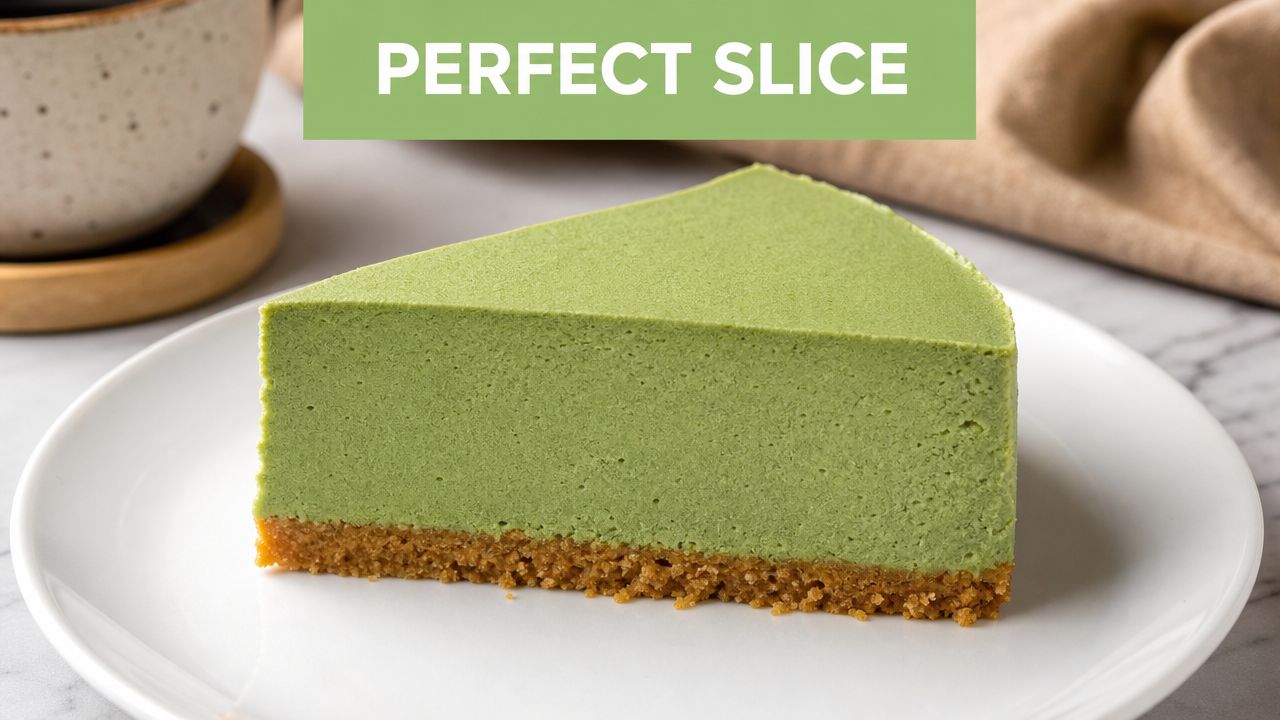
For the neatest slices, use a sharp knife dipped in hot water, then wipe it dry before cutting. Clean the blade between each slice too. It works like cutting custard with a warm spoon. You glide through the filling instead of dragging it, which keeps those layers distinct and protects that light, airy structure you worked so carefully to build.
Serve each slice well chilled, but not ice-cold straight from the back of the fridge. A few minutes at room temperature lets the creaminess soften slightly, and the matcha becomes easier to taste. This matters even more if you used a good organic culinary matcha, because its grassy sweetness and vivid colour deserve room to show themselves. Lower-quality matcha can taste flat or bitter, so keep garnishes and drinks restrained rather than piling on extra sweetness to cover it.
Pairings that make the dessert feel complete
The best pairing refreshes your palate between bites. Sparkling water with lemon, a cold yuzu drink, or lightly sweetened iced tea all do that job beautifully because they cut through the richness without fighting the tea notes.
An iced matcha drink can work well too, as long as it is lighter and less creamy than the cheesecake itself. If you enjoy matching dessert with a tea-based drink, this guide on how to make an iced matcha latte is a lovely companion read.
For garnish, less is usually more. A small dusting of matcha, a few white chocolate curls, or a couple of fresh raspberries give contrast without distracting from the filling. White chocolate is especially good with matcha because its sweetness rounds out any faint astringency and lets the green tea flavour feel softer and fuller. If you want to add coloured chocolate details or a decorative drizzle, DBakerAid™'s expert chocolate coloring advice is a helpful resource.
A quick visual guide can help before you plate your own.
A thoughtful plate is enough. One clean slice, one restrained garnish, one fresh drink on the side. That balance lets the mousse-like texture and the clean flavour of quality matcha come through clearly.
If you'd like to make this with premium organic matcha chosen for both drinking and kitchen use, explore Pep Tea for Australian matcha and tea inspiration, including recipe ideas, iced matcha guides and pantry staples for your next bake.
What Is Organic Green Tea: Benefits & How It’s Grown

You've probably seen a tea packet labelled organic and thought, “Great, that means no pesticides.” That's part of the story, but it's not the whole story. If you've ever wondered what is organic green tea, the answer starts much earlier than the cup in your hand. It starts with how the tea plant is grown, how the soil is treated, how the product is certified, and how accurately it's presented to you.
That matters because green tea already carries a strong wellness reputation. Organic green tea adds another layer. It connects farming practice, product integrity, and the daily ritual of choosing something clean and considered. In Australia, that question is especially useful because many teas are imported, and shoppers are often left to sort through a mix of genuine certification, vague “natural” language, and premium-looking packaging.
Green tea itself comes from Camellia sinensis leaves that are minimally processed. That lighter processing helps preserve more of the tea's catechins than black tea, and EGCG is the best-known catechin linked to green tea's antioxidant reputation, as outlined in this organic green tea market overview. The same source notes that Australia's tea market was valued at about USD 650.3 million in 2024 and is projected to reach about USD 913.8 million by 2030, which helps explain why wellness-led tea formats continue to attract attention in cafés, retail, and home routines.
An Introduction to Organic Green Tea
Organic green tea is green tea grown according to organic farming standards. In simple terms, that means growers use methods designed to work with natural systems rather than relying on synthetic agricultural inputs. The tea is still green tea. It still comes from the same plant. What changes is the farming approach behind it.
That distinction clears up a common confusion. Some people assume “organic” describes a different species of tea or a stronger health effect on its own. It doesn't. Organic tells you about how the tea was produced. Green tea tells you what the tea is.
A farm-first way of thinking
Organic tea production is rooted in a bigger idea than just avoiding certain sprays. It treats the tea garden as an ecosystem. Healthy soil, balanced plant life, careful cultivation, and traceable handling all matter.
Organic is best understood as a farming standard, not a flavour note and not a magic health shortcut.
For tea drinkers, that makes the label more meaningful. It points to production choices that many people prefer for environmental, ethical, and personal reasons. It also helps explain why two teas that both say “green tea” on the front can represent very different growing systems.
Why Australians often get stuck on the label
Australian shoppers often face an extra layer of uncertainty because many premium green teas, including Japanese styles, are imported. That's why it helps to understand both the tea itself and the certification around it. If you'd like a broader grounding in tea before getting into organic specifics, this guide on the story of tea is a helpful place to start.
By the end of this guide, you'll know what organic really means in practice, how it compares with conventional green tea, which compounds make green tea so valued, and how to brew it in a way that does the leaf justice.
What Organic Really Means for Your Tea
When people say organic tea is “pesticide-free”, they usually mean well. But that shorthand is too narrow. Organic is a full production system. It covers how the land is managed, how crops are supported, how inputs are controlled, and how the final product earns the right to carry an organic claim.
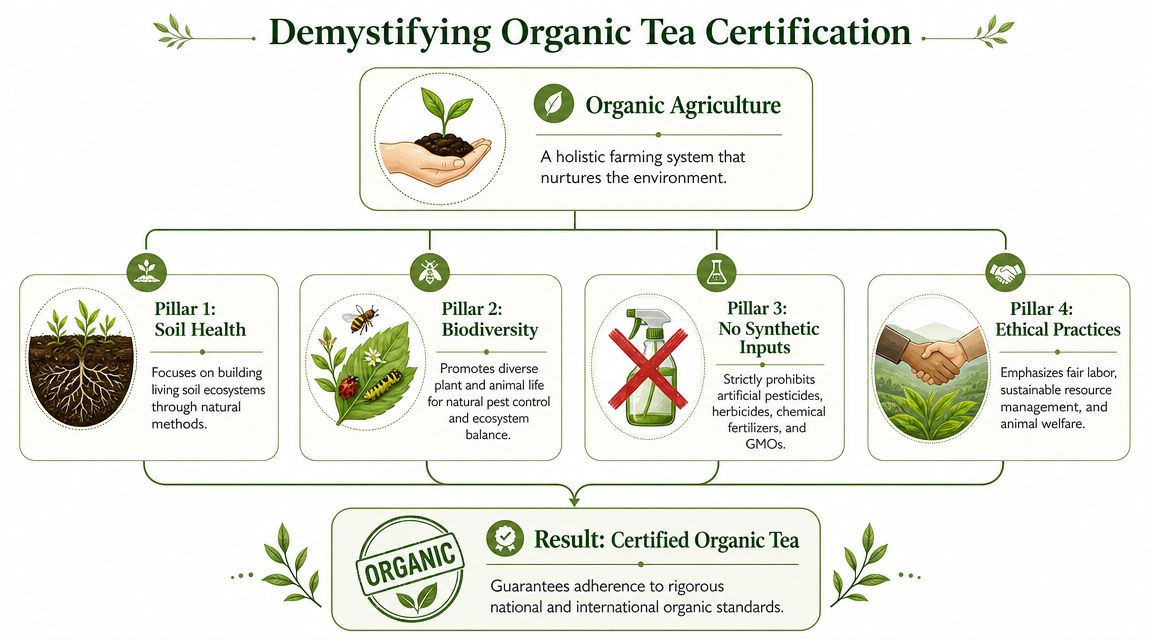
The four ideas behind organic farming
Organic tea farming usually rests on a few core principles:
- Living soil matters. Growers focus on building fertile, active soil rather than treating soil as a neutral base that holds the plant upright.
- Biodiversity helps. A healthier farm environment can support balance between plants, insects, and surrounding ecology.
- Synthetic inputs are restricted. The system is built around avoiding artificial pesticides, herbicides, and chemical fertilisers.
- The process must be verified. A tea isn't organic because the packaging looks earthy or the brand uses words like pure, natural, or clean.
That last point is the one many shoppers miss.
What verification looks like in Australia
In Australia, practical trust comes from certification and compliance, not marketing language. That's why this matters so much for tea buyers. The article discussing organic green tea and certification in the Australian context notes that the Australian organic market was valued at about A$2.59 billion in 2023, while consumer understanding of certification remains uneven, which is exactly why shoppers need to know how to confirm a tea is organic in this Australia-focused discussion of organic verification.
Here's what to look for when you pick up a tea:
- A recognised certification mark on the pack, rather than vague wellness wording.
- Clear origin information, especially if the tea is imported.
- Specific organic language that suggests formal certification rather than loose branding.
- Retail transparency, where the seller explains what standard the tea meets.
Practical rule: If a tea says “natural” but doesn't clearly show how its organic claim is verified, treat it as unproven until you can confirm more.
Imported tea can absolutely be organic. That includes Japanese green tea and matcha. What matters is whether the product has been certified to an accepted standard and marketed in line with Australian requirements. If you want a tea-specific breakdown, this article on the difference between regular and organic matcha adds useful context.
Organic as part of a wider lifestyle choice
For many people, choosing organic tea also fits into a broader low-waste, lower-impact way of living. If that's part of your thinking, this guide on how to start your zero waste journey is a practical companion read.
Organic Versus Conventional Green Tea
Organic and conventional green tea can both taste good. Both come from the same tea plant. The difference lies in how the crop is grown and managed, and that can shape how people think about quality, environmental impact, and value.
A balanced comparison helps here. This isn't about turning conventional tea into a villain. It's about understanding trade-offs clearly enough to make your own call.
Organic vs. Conventional Green Tea at a Glance
| Attribute | Organic Green Tea | Conventional Green Tea |
|---|---|---|
| Farming approach | Grown under organic standards with a focus on ecological balance | Grown using conventional agricultural methods |
| Soil management | Emphasises soil health and natural fertility practices | May rely more heavily on synthetic fertilisers |
| Pest and weed control | Uses organic-compliant methods | May use synthetic pesticides or herbicides |
| Certification | Requires formal certification to support the claim | Not sold as organic unless certified |
| Shopper confidence | Easier to assess when certification marks are clear | Depends more on brand transparency and sourcing detail |
| Environmental approach | Often chosen by people seeking lower-impact farming systems | Can vary widely by producer |
| Flavour experience | Often described as clean, bright, and expressive of origin | Can also be enjoyable, though farming style varies |
| Price | Often priced at a premium because of production and certification requirements | Often available at a wider range of price points |
Where the difference is most practical
The decision often comes down to priorities.
If you care most about certification-backed farming standards, organic will usually appeal more. If your priority is finding a tea you enjoy at an accessible price, conventional tea may still suit you. Plenty of tea drinkers move between both categories depending on the style, source, and budget.
One useful way to think about it is this. Organic tea asks you to pay attention to the system behind the leaf, not just the final beverage. That often resonates with people who already care about ingredients, traceability, and farming methods in the rest of their food.
Why growing method can affect perceived quality
Tea is sensitive. Soil condition, water, climate, leaf handling, and processing all influence what ends up in your cup. The growing method is only one part of that picture, but it does shape how many people evaluate quality.
If you're interested in the broader farming conversation, this piece on how to compare organic vs chemical fertilizers gives useful background on why growers and consumers view these systems differently.
A higher price doesn't automatically mean a better tea. But a certified organic tea gives you a clearer explanation of what you're paying for.
The Wellness Compounds in Every Sip
Green tea's wellness reputation starts with what is inside the leaf. Organic certification matters for how the tea is grown, handled, and verified, especially under Australian organic standards, but the compounds people care about come from the tea plant itself. What organic can do is give you more confidence in the growing system behind those compounds, which matters if you want a cleaner, more traceable daily habit.
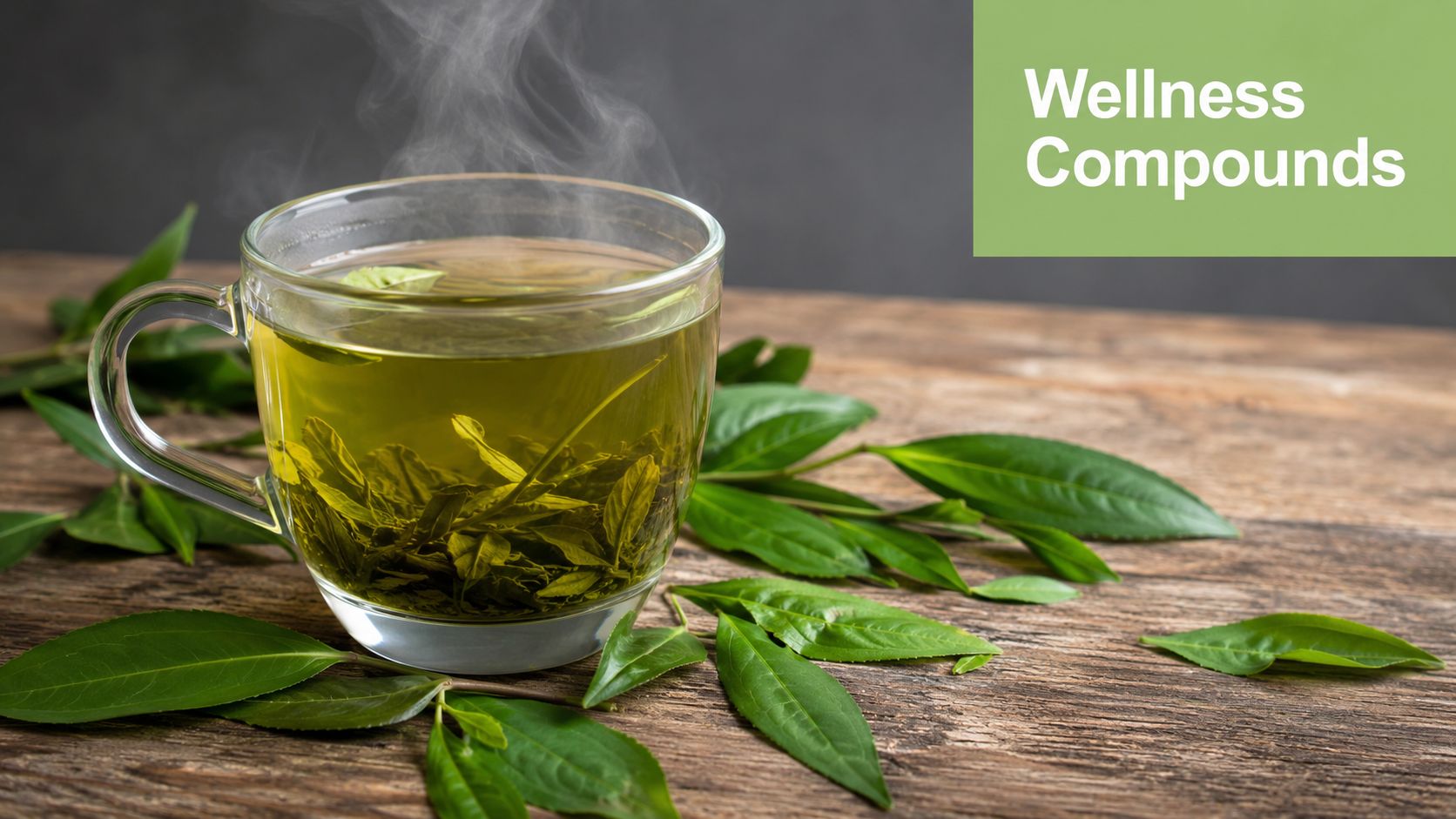
Polyphenols and catechins
Green tea is rich in polyphenols, a broad group of plant compounds linked to its antioxidant profile. A review of green tea bioactives and brewing conditions explains that these compounds make up a large share of the leaf and notes that green tea contains thousands of naturally occurring bioactive substances.
Within that group, catechins are the stars. EGCG gets the most attention because it is one of the best-studied catechins in green tea. If the tea leaf were a small orchestra, catechins would be the instruments you hear most clearly in the final performance. They shape much of what people mean when they talk about green tea as a wellness drink.
That does not mean every cup feels the same. Leaf quality, freshness, and preparation all affect what reaches your mug.
L-theanine and calm alertness
Green tea also contains L-theanine, an amino acid that helps explain why tea feels different from coffee for many drinkers. The combination of L-theanine and caffeine often creates a gentler sense of alertness, more like a steady tide than a sudden wave.
This is one reason green tea fits so well into everyday routines. A morning cup can help you settle into work. An afternoon brew can feel refreshing without the sharp edge some people notice from stronger caffeinated drinks.
Organic farming does not create L-theanine or catechins. The plant does that naturally. In practical terms, organic certification in Australia gives you a checked and documented production system, which can make it easier to choose tea with the level of traceability and ingredient confidence many wellness-focused drinkers want.
Brewing changes what you get from the cup
Brewing is where leaf chemistry becomes a real-life experience. Water that is too hot can push green tea toward bitterness, while a gentler temperature usually gives you a smoother cup with better balance. As noted earlier in that same preparation review, moderate brewing temperatures and a short steep help extract beneficial compounds without making the tea harsh.
A simple way to picture it is cooking vegetables. Too little heat and you do not get the best texture or flavour. Too much heat and the result turns dull or unpleasant. Green tea works in a similar way.
If you want to put that into practice, starting with a quality loose-leaf option makes a noticeable difference. PepTea's guide to the best organic green tea loose leaf is a useful place to compare styles that suit everyday brewing.
Here's a short visual explainer if you want to see green tea compounds discussed in a more accessible format.
Green tea works best as a daily ritual, not as a miracle product. Its value comes from consistent enjoyment, good brewing, and leaves from a source you trust.
Your Guide to Popular Organic Green Teas
Walk into a good tea shop and you'll quickly learn that green tea isn't one thing. It's a family of styles. Two of the most useful examples are Sencha and Matcha. They show how processing changes not just flavour, but the whole drinking experience.
Sencha for a fresh everyday cup
Sencha is the classic daily green tea for many drinkers. You brew the leaves in water, let them steep, and then remove them. The result is usually light to medium-bodied, grassy, fresh, and gently savoury.
It suits the kind of moment where you want a clean, uncomplicated cup. Mid-morning at your desk. A quiet reset after lunch. A teapot shared with someone who's curious about green tea but not ready for anything too intense.
Matcha for the whole-leaf experience
Matcha is different from almost every other tea because you don't steep and strain it. You whisk the powdered tea directly into water, so you consume the whole leaf.
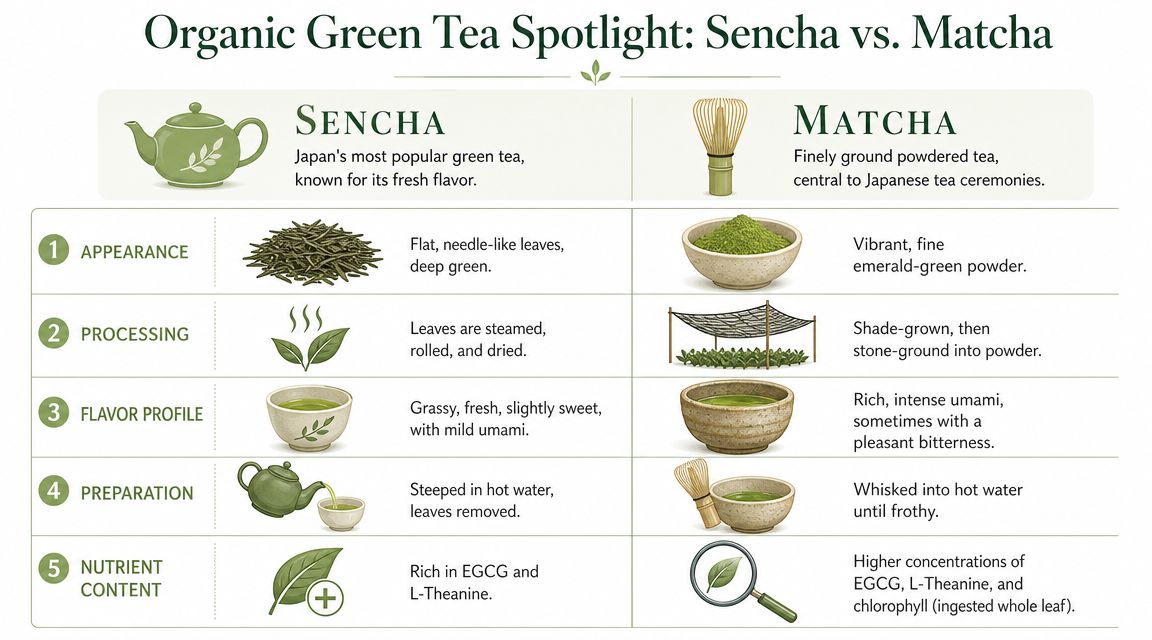
That changes texture, flavour, and intensity. Matcha tends to feel richer, creamier, and more concentrated than a standard leaf brew. The source used in this article notes that a standard cup of brewed green tea can provide 178 to 823 mg of catechins, while products like Matcha that use the entire leaf offer a more concentrated source of those compounds in this green tea overview.
If Sencha feels like a clear, bright conversation, Matcha feels like the full orchestra.
Choosing by mood and use
A simple way to choose:
- Pick Sencha when you want a classic steeped tea with lift and freshness.
- Choose Matcha when you want a fuller texture, a more immersive tea ritual, or a tea that works beautifully in lattes and recipes.
- Use high-quality green tea in other formats if you enjoy wellness drinks beyond the teacup. Green tea is also the traditional base for kombucha, which is one reason it appears so often in functional beverage spaces.
If you want to keep exploring styles beyond these two, this guide to the best organic green tea loose leaf is a useful next read.
Bringing Green Tea Into Your Daily Routine
Knowing what organic green tea is helps. Knowing how to buy, brew, and store it makes the difference between a tea you admire on the shelf and one you enjoy every day.
How to buy with confidence
Look for three things first:
- Certification you can identify. Don't rely on soft words like pure or natural.
- Clear origin details. Tea that tells you where it comes from usually gives you more confidence than tea with a vague back label.
- Fresh-looking leaf or powder. Matcha should look vividly green rather than dull or khaki. Loose green tea should look lively, not tired and dusty.
The one golden brewing rule
Don't pour boiling water straight onto green tea.
Green tea is delicate. If the water is too hot, bitterness can jump forward and flatten the sweeter, softer notes in the cup. Use water that's hot but not aggressively boiling, and give the tea enough time to open without overdoing it.
A simple routine works well:
- Heat your water.
- Let it cool slightly if it has just boiled.
- Brew gently rather than aggressively.
- Taste and adjust next time.
How to store it so it stays good
Tea hates three things: air, heat, and light.
Store green tea in an airtight, opaque container somewhere cool and dry. Keep it away from the stove, sunny windows, and constantly opened pantry spots. Matcha is especially sensitive, so freshness matters even more.
Buy the best tea you can, then protect it properly. Poor storage can undo the care taken in growing and processing it.
Your Organic Green Tea Questions Answered
Can I drink organic green tea every day
For many people, yes. Organic green tea can sit comfortably in a daily routine, much like a regular walk or a bowl of oats. The practical question is not only whether it is organic, but whether the tea suits your body, your caffeine tolerance, and the way you drink it.
With green tea, the key is paying attention to how your body responds. A lighter sencha in the morning may feel very different from a strong matcha in the afternoon. If you are pregnant, managing a health condition, or taking medication, check with a qualified health professional before making it an everyday habit.
Does organic green tea have less caffeine than coffee
Usually, green tea contains less caffeine per cup than coffee, but the experience is often different for another reason too. Green tea also contains L-theanine, an amino acid that can soften the sharper edge people sometimes feel from coffee.
That is why one cup of green tea may feel steadier, while coffee can feel more abrupt. Brewing style matters here. A longer steep, more leaf, or a bowl of matcha can all change the caffeine level in your cup.
Is organic green tea better for the environment
In Australia, organic means more than a nice label on the front of the pack. It points to a certified farming system with rules around synthetic chemicals, soil care, and production methods. For a tea drinker, that matters because the standard connects what happens on the farm to what ends up in your cup.
A healthier farming system can support better soil structure, more balanced growing conditions, and cleaner handling practices. Organic certification does not guarantee that every tea will taste the same or that every farm operates identically. It does give you clearer proof that the grower has met a recognised standard rather than relying on vague claims like natural or clean.
That clarity is a big part of quality.
Organic green tea is best understood through four parts: plant, place, processing, and certification. The leaf is still green tea, but the organic standard asks more of the producer and gives the buyer more confidence in return.
If you're ready to turn that knowledge into a daily ritual, explore Pep Tea for premium organic Matcha and Australian-brewed organic kombucha made for clean flavour, steady energy, and everyday wellness.
Functional Beverage Trends: Top Innovations for 2026

Beyond the Buzz: Real Trends Shaping What We Drink
The phrase functional beverage trends gets thrown around so often that it can start to mean everything and nothing at once. A powder gets added, a bold claim lands on the can, and suddenly it's positioned as the future of wellness. In practice, that's not what separates a drink people try once from a drink they build into daily life.
The strongest shift heading into 2026 is simpler than the hype cycle suggests. Australians are choosing drinks with a clearer job to do. They want calm energy, better hydration, lower sugar, gut-friendly options, and ingredients they can recognise. They also want labels and claims that hold up under scrutiny, especially in a local market where compliant wording matters as much as flavour.
That lines up with broader category movement. Food Navigator reported that market research valued the global functional drinks market at about USD 149 billion in 2025, with a projected CAGR of 8.9% to nearly USD 250 billion by 2030, while noting that Australian category tracking points to growing demand for wellness-oriented drinks with clearer health positioning and lower sugar in this functional drinks market report.
For us at Pep Tea, that isn't a new idea. It's been the baseline from the start. Real organic Matcha. Properly brewed Kombucha. No hiding behind vague “wellness” language when quality, sourcing, fermentation, and taste should do the heavy lifting. If you're a consumer, café owner, or hospitality buyer, these are the trends worth acting on.
1. Adaptogenic & Nootropic Blends
Adaptogen and nootropic drinks are moving into everyday café language. You'll now see mushrooms, roots, and botanical add-ins pitched around focus, balance, and calm. The opportunity is real, but so is the risk of cluttered menus and loose claims.

What tends to work in Australia is restraint. A good base drink still has to taste good without a lecture attached. If a venue adds lion's mane to a latte, or reishi to a cacao blend, the drink needs one primary promise customers can understand fast. “Calm focus” lands better than a five-ingredient wellness stack with murky intent.
What actually lands on menu
Matcha is one of the best base formats for this trend because it already carries a clean energy story. It doesn't need to be overbuilt. In many cafés, the smartest move is a short line-up:
- Pure option: Organic ceremonial Matcha for customers who want the cleanest expression.
- Focus option: Matcha paired with one complementary mushroom or botanical.
- Evening option: A lower-caffeine botanical latte instead of forcing matcha into every daypart.
The trade-off is operational. Every extra powder adds training, stock management, and inconsistency risk. Café owners often underestimate how quickly a “wellness menu” turns into a messy bench and a confused team.
Practical rule: If staff can't explain why an ingredient is in the drink in one sentence, it probably shouldn't be on the menu.
For home use, the same applies. Start with high-quality Matcha and add one extra element only if it improves the ritual or flavour. Better ingredients usually beat bigger ingredient lists.
2. Radical Transparency in Probiotics & Gut Health
“Gut health” still pulls attention, but vague probiotic language doesn't cut it anymore. Shoppers are getting better at spotting the difference between properly fermented Kombucha and a sweet fizzy drink wearing health-food branding.
In Australia, that matters because compliant claims are a real issue, not a branding detail. Industry commentary has pointed out that local brands often face a gap between trendy wellness messaging and what can be supported under Australian rules, especially for drinks positioned around mood, gut health, focus, or energy in this analysis of functional beverage claim challenges.
What transparency looks like in real life
For consumers, transparency starts with basic questions. Was it properly fermented? Is it low in sugar because the fermentation process did the work, or because sweetness was manipulated later? Does the brand explain what the drink is, instead of just selling a vibe?
For cafés and retailers, brand selection is key. If you're stocking Kombucha, choose producers that are open about process and quality. Drinks positioned as healthy probiotic drinks should earn that trust through clarity, not buzzwords.
A practical benchmark is Pep Tea's style of Kombucha. Australian-brewed, organic, sugar-free, and built around real fermentation rather than a soft-drink shortcut. That sort of product makes service easier because staff can talk about what the drink is with confidence.
Customers don't need a microbiology lesson. They do need a reason to believe the bottle is more than flavoured fizz.
What doesn't work is overclaiming. “Supports digestion” is a very different tone from promising life-changing results. The best gut-health brands stay credible by staying specific and measured.
3. Clean Energy & Active Lifestyle Integration
The energy category is getting cleaned up. More Australians want a lift they can fit into a workday, gym session, school run, or long afternoon without feeling rattled afterward. That's why matcha keeps gaining ground as a practical energy drink, not just a café trend.
Independent market commentary has highlighted that Australian shoppers are increasingly choosing beverages for specific benefits such as energy, digestion, and mental wellbeing, with functional drinks becoming part of everyday routines rather than staying trapped in sport or supplement culture in this functional beverage market overview.
Better energy for real routines
This trend works best when the drink already fits a habit. A morning Matcha latte, an iced Matcha before a workout, or a Kombucha after lunch all make sense because they replace something people already drink.
For café owners, “clean energy” only works if the menu language is clear:
- Morning crowd: Offer a straight ceremonial Matcha and a Matcha latte.
- Fitness crowd: Position matcha as a smoother option for pre-training focus.
- Afternoon crowd: Use lighter serves and less sweetness so the drink feels refreshing, not heavy.
For consumers, choosing the best green tea for energy usually comes down to quality and preparation. Low-grade matcha with loads of syrup defeats the whole point. A clean whisked Matcha or an unsweetened iced version is where this trend delivers.
I've found cafés get the best repeat orders when they stop trying to mimic energy drinks and let Matcha be Matcha. The bright flavour, the colour, and the calmer feel are already the selling points.
4. Sophisticated Non-Alcoholic Mixology
Non-alcoholic menus have grown up. People still want complexity, bitterness, acidity, aroma, and proper presentation. They just don't always want alcohol in the glass.

Kombucha and Matcha both slot naturally into this shift. Kombucha brings acidity and fermentation character. Matcha brings bitterness, savoury depth, and colour. Used well, they help bars and cafés build drinks that feel adult and intentional rather than sugary and apologetic.
What makes a non-alc drink feel premium
The drinks that work usually borrow structure from classic cocktails. A ginger or lime-forward Kombucha can stand in for sparkle and acid. Matcha can replace part of the bitter backbone in a spritz-style serve or tea-based cooler. Herbs, citrus peel, and proper glassware do the rest.
What fails is trying to cover weak ingredients with garnish theatre. If the base liquid isn't good, the mocktail won't be either. That's why real Kombucha matters. It gives the drink shape.
For venues wanting ideas that customers will order, fruity and non-alcoholic kombucha cocktails are a strong starting point because they build on flavour pairings people already understand.
Here's a quick visual on where this trend is heading in service style and presentation.
A simple example for hospitality is a Ginger Kombucha serve with rosemary, citrus twist, and chilled stemware. It takes almost no extra labour, but it looks and drinks like a considered menu item. That's the sweet spot.
5. Zero-Sugar & Naturally Sweetened
Low sugar used to sound impressive on its own. Now people read the label more closely. They want to know what created the sweetness, what replaced the sugar, and whether the drink still tastes balanced without becoming weirdly artificial.

This is one of the clearest functional beverage trends in Australia because the wider category is already moving toward better-for-you drinks with stronger low-sugar positioning, as noted earlier. The takeaway for buyers is simple. “Healthier” means very little if the ingredient panel tells another story.
Sugar reduction that still tastes good
The hard part is flavour. Plenty of drinks remove sugar but strip out pleasure at the same time. The best products solve that with process and ingredient quality.
Kombucha is a strong example. A properly fermented sugar-free Kombucha can keep acidity, complexity, and refreshment without tasting flat. Pep Tea's organic Kombucha fits that benchmark because the drink is brewed for a clean result rather than relying on a heavy-handed sweetener profile.
For cafés, zero-sugar options also make menu design easier:
- Pair with food: Less sweet drinks work better across breakfast and lunch menus.
- Reduce fatigue: Staff don't need to explain why a “healthy” drink tastes like dessert.
- Broaden appeal: Customers avoiding alcohol, soft drinks, or sugary juices all have a place to land.
The strongest zero-sugar drinks don't taste like a compromise. They taste deliberate.
At home, this trend is worth acting on by checking what you reach for at 3 pm. If it's a soft drink or sweet iced coffee out of habit, a crisp Kombucha or an unsweetened iced Matcha can shift the whole routine.
6. Ready-to-Drink RTD Matcha
RTD Matcha is a convenience play, but convenience alone won't keep it growing. People have become more selective. If a bottle says matcha, they expect it to taste like matcha, not like vanilla syrup with a green tint.
That's where a lot of RTD products still miss. They chase shelf appeal first and tea quality second. For Australian consumers, the better direction is obvious. Fewer additives, cleaner flavour, lower sugar, and a real connection to the tea itself.
Convenience without losing integrity
There's a genuine place for grab-and-go Matcha. Not everyone has time to sift, whisk, and warm water between meetings or school drop-off. RTD formats can make sense for offices, gyms, independent grocers, and café fridges, but only if they preserve what makes Matcha worthwhile.
A good RTD Matcha should still feel vegetal, fresh, and lightly creamy if milk is involved. It shouldn't lean on excessive sweetness to hide poor powder quality. Consequently, understanding the differences between ceremonial-grade and culinary-grade matters. A café might use culinary Matcha for blended drinks and reserve ceremonial Matcha for premium serves, but both still need to be good.
For operators, the RTD trade-off is margin versus theatre. Bottled Matcha is fast and consistent. Fresh-whisked Matcha has more ceremony and often more perceived value. Many venues will do best with both. Grab-and-go in the fridge, and a made-to-order Matcha menu for customers who want the full experience.
If Pep Tea ever sets the benchmark here, it should be the same rule we apply to every category. The format can change. The integrity can't.
7. Gut-Mind Connection and Beverages for Mood
This is one of the more interesting shifts because people aren't separating physical wellness from mental wellbeing as neatly as they used to. They're looking for drinks that support how they feel, not just how they fuel.
Industry commentary for 2025 noted rising demand for gut-friendly drinks with prebiotic and probiotic ingredients, with launches in markets including Australia and Japan increasingly carrying digestive health claims. The same commentary also pointed to a global functional beverage estimate of USD 151.80 billion in 2025, with a forecast to reach USD 239.95 billion by 2031, implying a 7.93% CAGR from 2026 to 2031 in this functional beverage trends update.
Why mood-friendly drinks are getting traction
In practical terms, people understand “calm focus” and “settled stomach” far better than abstract wellness language. That's why Matcha and Kombucha sit so neatly in this space. Matcha already has a reputation for smoother, steadier energy. Kombucha already fits the digestive wellness conversation.
The key is not to oversell either one. A drink can be part of a better routine without becoming a miracle product. For consumers, that might mean replacing a jittery second coffee with Matcha, or swapping a sugary afternoon drink for Kombucha. For cafés, it means writing menus that sound grounded and believable.
A good example is a simple iced ceremonial Matcha promoted as a clean option for focus, or a sugar-free Kombucha listed as a refreshing fermented drink for customers who want something lighter. That tone respects both the product and the customer.
Mood-supportive beverage marketing works best when it sounds like a daily habit, not a medical promise.
8. Sustainable & Ethical Sourcing Story
People don't just want functional drinks. They want to feel good about the chain of decisions behind them. Where was the tea grown? How was it handled? Who made the drink locally? Was the product built with care or just assembled for trend appeal?
This matters even more in premium categories because the sourcing story is part of the quality story. With Matcha, origin and grade aren't decorative details. They shape flavour, colour, texture, and trust. With Kombucha, local brewing and disciplined production matter because “craft” can mean excellence or inconsistency depending on who's doing the work.
The sourcing story has to be real
Australian consumers have become very good at sniffing out vague ethical language. A brand that says it values sustainability but won't explain packaging, sourcing, or production choices feels flimsy fast.
What tends to resonate is specificity:
- Japanese organic Matcha: Clear origin and grade information.
- Australian-brewed Kombucha: Local production with a visible standard.
- Clean ingredient panel: No need to hide behind marketing fog.
Pep Tea has a natural advantage here because the story is grounded in actual product decisions. Organic Japanese Matcha. Kombucha brewed in the Hunter Valley, NSW. Australian ownership. Those details help cafés and retailers sell with confidence because they're concrete.
For hospitality, this trend isn't only moral. It's commercial. Staff can tell a short, credible story tableside. Customers remember that. A sourced-well product also tends to hold its flavour standard better, which matters more than any sustainability slogan.
9. Culinary Crossover with Matcha and Kombucha as Ingredients
One of the smartest shifts in functional drinks is that they're no longer trapped in the cup. Matcha and Kombucha are becoming pantry ingredients, and that opens up more occasions to use them without inventing a whole new ritual.
For home cooks, Matcha already makes sense in baking, smoothies, overnight oats, and desserts. For cafés, it lifts everything from muffins to soft serve to glaze. Kombucha has a different strength. Its acidity and fermented edge make it useful in dressings, marinades, shrubs, and low-sugar syrups.
Ingredient use creates repeat value
This trend matters because it deepens product relevance. A customer who buys Matcha only for weekend lattes might buy it more often once they start using it in bliss balls, cheesecake filling, or pancake batter. A venue that pours Kombucha by the glass might also use it in a non-alc spritz, salad dressing, or seasonal granita.
Some practical combinations work especially well:
- Ceremonial Matcha: Best for straight tea and cleaner iced drinks.
- Culinary Matcha: Better for baking, smoothies, and kitchen prep.
- Ginger or Lime Kombucha: Great in vinaigrettes, mocktail bases, and marinades.
What doesn't work is forcing “functional” into dishes that don't need it. A fluorescent green cake with weak flavour is still a weak cake. Quality ingredient, appropriate use, and proper balance matter more than trend-chasing.
If you run a café, this is one of the easiest ways to extend a premium product across the menu without adding another supplier. One excellent Matcha can support drinks, cabinet food, and seasonal specials.
10. Functional Hydration with Benefits
Hydration has become more layered. People still want refreshment first, but they also want the drink to do a little more. Maybe that means antioxidants, maybe it means a lower-sugar format, maybe it means a cleaner alternative to neon sports drinks.
This trend works best when the beverage still behaves like a thirst-quencher. If a “hydration” drink feels syrupy, medicinal, or overloaded with claims, people won't come back to it. That's why tea-based and fermented drinks have an edge. They can feel light, adult, and useful without trying too hard.
Everyday hydration is replacing occasion-only wellness
For consumers, the practical move is to think beyond workouts. Functional hydration can sit at a desk, in a lunchbox, in the car, or beside a meal. An iced Matcha with no heavy sweetener can refresh and sharpen attention. A crisp sugar-free Kombucha can replace soft drink at lunch without feeling punitive.
For cafés and foodservice, this creates room for a broader cold-drinks strategy. Sparkling water still belongs. So do premium mixers and mineral waters. If you're building a more thoughtful drinks fridge or table service list, it's worth including premium hydration options like explore Lurisia at IFM Gourmet alongside Kombucha and Matcha-based serves.

A key trade-off here is simplicity. A good hydration menu doesn't need ten fortified beverages. It needs a few excellent options with clear roles. Sparkling mineral water. Unsweetened iced Matcha. Proper Kombucha. That's enough to cover most modern drinking occasions well.
Top 10 Functional Beverage Trends Comparison
For Australian consumers and venue operators, the best trend is not the flashiest one. It is the one you can explain in ten seconds, source reliably, price properly, and serve again next week without quality slipping. That is why authentic Matcha and properly fermented Kombucha remain useful benchmarks. They make it easier to sort real function from marketing noise.
| Trend | Implementation Complexity 🔄 | Resource Requirements ⚡ | Expected Outcomes 📊 | Ideal Use Cases 💡 | Key Advantages ⭐ |
|---|---|---|---|---|---|
| Adaptogenic & Nootropic Blends | 🔄 Moderate, formulation, dosing and regulatory controls | ⚡ Medium, certified adaptogens, quality testing, staff education | 📊 Stronger perceived focus and stress-support appeal, with premium pricing potential | 💡 Premium cafés, wellness retail, limited-edition launches | ⭐ Clear point of difference, especially when paired with quality Matcha |
| Radical Transparency in Probiotics & Gut Health | 🔄 High, strain identification, CFU tracking, cold chain and quality control | ⚡ High, lab testing, refrigerated logistics, documentation | 📊 More trust, clearer claims, better repeat purchase potential | 💡 Refrigerated retail, educational marketing, health-focused outlets | ⭐ Credibility and authenticity, especially for serious Kombucha brands |
| Clean Energy & Active Lifestyle Integration | 🔄 Low to moderate, mainly positioning with minor reformulation if needed | ⚡ Low, existing Matcha or Kombucha range, simple partnerships | 📊 Better appeal for active daytime occasions and steady everyday use | 💡 Gyms, sports events, fitness retail, pre or post-training rituals | ⭐ Natural sustained energy from Matcha, without the rough energy-drink feel |
| Premium Non-Alcoholic Mixology | 🔄 Moderate, recipe development and staff training | ⚡ Medium, product samples, venue training, hospitality partnerships | 📊 Higher-margin venue sales and stronger presence in bars and restaurants | 💡 Bars, restaurants, events, signature mocktails and spritzes | ⭐ Strong mixability, layered flavour, and access to premium hospitality |
| Zero-Sugar & Naturally Sweetened | 🔄 Low, maintain flavour balance, fermentation standards and transparent labelling | ⚡ Low, mostly clear messaging with minimal reformulation | 📊 Broad appeal and easier health positioning | 💡 Health-focused retail, sugar-conscious shoppers, café fridges | ⭐ Strong core differentiator, especially when the sugar-free claim is genuine |
| Ready-to-Drink (RTD) Matcha | 🔄 Moderate, packaging, shelf-stability and distribution setup | ⚡ Medium, bottling or canning, packaging, supply chain support | 📊 More grab-and-go sales and broader retail reach | 💡 Convenience retail, cafés with bottled options, office fridges | ⭐ Builds on Matcha expertise and creates an extra convenience-led revenue stream |
| Gut-Mind Connection: Beverages for Mood | 🔄 Moderate, compliant claims and customer education | ⚡ Medium, research-based messaging, content creation, staff training | 📊 Stronger emotional connection and more repeat interest | 💡 Wellness subscriptions, mental wellbeing campaigns, premium retail | ⭐ Integrated story connecting gut health, mood and focus without overclaiming |
| Sustainable & Ethical Sourcing Story | 🔄 Low to moderate, traceability systems and clear storytelling | ⚡ Medium, certifications, audits, supplier documentation, content production | 📊 Increased trust and stronger willingness to pay for quality | 💡 Premium retail, conscious consumers, hospitality menus with provenance cues | ⭐ Authentic sourcing story that supports premium pricing if the product quality matches |
| Culinary Crossover: Matcha & Kombucha as Ingredients | 🔄 Low, recipe development and simple collaborations | ⚡ Low, chef partnerships, recipe cards, menu testing | 📊 More usage occasions and greater volume per customer | 💡 Foodservice, recipe-led retail, bakery and brunch menus | ⭐ Versatility that turns these drinks into ingredients, not just finished products |
| Functional Hydration with Benefits | 🔄 Low, mostly positioning with optional formulation tweaks | ⚡ Medium, marketing support and possible electrolyte inputs | 📊 Wider appeal across everyday drinking occasions | 💡 Office, summer promotions, lunch trade, all-day café fridges | ⭐ Broader hydration appeal with a cleaner wellness angle |
A practical read on this table is simple. High-complexity trends can build trust and margin, but they demand discipline. Lower-complexity trends move faster, yet they only work if the base product is already good. Pep Tea sets the right benchmark here. Start with ingredient integrity, then add a function people can feel and understand.
For café owners, the strongest options are usually RTD Matcha, zero-sugar serves, premium alcohol-free drinks, and culinary crossover applications. They are easier to train, easier to merchandise, and easier to sell in busy Australian service environments. For consumers, the safer bet is similar. Choose products with clear ingredients, believable benefits, and flavour you would still want even without the wellness claim.
Putting Function into Practice: Your Next Sip
The most useful functional beverage trends aren't the loudest ones. They're the ones that fit real Australian habits and hold up once the marketing fades. People want drinks that feel better to live with. Less sugar, clearer benefits, stronger ingredient integrity, and more versatility across home, café, and hospitality settings.
That's why Matcha and Kombucha keep showing up in serious conversations about the future of drinks. They aren't novelty formats. They're adaptable, recognisable, and capable of delivering exactly what many people are after right now. Matcha fits the clean-energy conversation beautifully when it's high quality and prepared properly. Kombucha fits the gut-health and non-alcoholic conversation when it's properly fermented and balanced, not dressed up as a health halo product.
For consumers, the practical move is to simplify. Don't chase every new powder or trending botanical. Start with drinks that already make sense in your routine. A morning Matcha instead of a second coffee. A sugar-free Kombucha in place of soft drink. An iced tea-based option in the afternoon that doesn't leave you flat. Good routines beat exotic ingredient lists every time.
For café owners and hospitality operators, the same principle applies. Build a drinks range that your staff can explain, your customers can understand, and your kitchen can execute consistently. The strongest menu usually isn't the biggest one. It's the one with a few high-quality functional options that each do a clear job. One premium Matcha line. One or two excellent Kombucha flavours. A couple of well-built non-alcoholic serves. That's often enough to feel current without becoming chaotic.
There's also a bigger strategic lesson in all of this. Australian buyers are becoming more literate. They're reading labels, questioning claims, and rewarding brands that act like grown-ups. That means quality isn't just a nice-to-have. It's the filter people use to separate products with staying power from products built for a short trend cycle.
Pep Tea is a strong benchmark because it reflects what these trends look like when they're done properly. Organic Japanese Matcha with real quality behind it. Australian-brewed sugar-free organic Kombucha made in the Hunter Valley. Clean flavour, clear purpose, and none of the wellness theatre that gets in the way of trust.
The future of drinking looks intentional. It also looks more enjoyable. That's the part worth keeping.
If you're ready to bring these functional beverage trends into your daily routine or your café menu, explore Pep Tea for premium organic Matcha, Australian-made sugar-free Kombucha, and practical guidance on choosing drinks that earn their place in the fridge, on the shelf, or behind the bar.