
Tag: matcha baking tips
Best Matcha Cake How to Bake a Vibrant Fluffy Masterpiece
You've mixed the batter carefully, watched it rise, and still ended up with a sponge that's dull khaki rather than vivid green, or pleasantly earthy rather than sharply bitter. That familiar disappointment usually isn't caused by matcha alone. Grade, dosage, aeration, oven timing and storage all decide whether your cake tastes like a polished café dessert or a dry green tea experiment.
The best matcha cake for Australian bakers isn't necessarily the brightest cake on social media. It's the cake that keeps a clean tea aroma, soft crumb and balanced bitterness, while using a matcha grade that's available and sensible for the format. That matters as supply tightens. Australian reporting describes matcha demand outpacing supply, including pressure on commonly used latte grades, while the local market has already moved well beyond its niche beginnings (ABC News explains the Australian matcha shortage).
Café adoption has helped pull matcha desserts along with the latte trend. A 2025 survey reported that 40% of Australians aged 18 to 24 had ordered a matcha drink in the previous six months, and one in three Gen Z respondents named matcha their favourite café beverage (MarketersMedia's Australian matcha market commentary). A cake served with an iced matcha latte now feels familiar, not experimental.
This guide focuses on what works in an Australian kitchen: choosing ceremonial or culinary matcha for the job, protecting colour, building a fluffy foam-based batter, adapting the cake for sugar-free and gluten-free guests, and selecting formats that survive delivery. You'll also find practical fixes for bitterness, collapse and dry edges, plus pairings that suit PepTea matcha drinks and sugar-free organic kombucha.
Choosing the Right Matcha Grade and How Much to Use
The best matcha cake starts with the grade that suits the format, not the most expensive powder on the shelf. Ceremonial-grade matcha is intended for drinking, while culinary-grade matcha is selected to work with flour, eggs, dairy, fruit and chocolate. For most Australian cake batters, culinary matcha is the practical starting point.
| Baking consideration | Ceremonial-grade matcha | Culinary-grade matcha |
|---|---|---|
| Flavour | Delicate, fresh and rounded when whisked with water | More assertive, earthy and suited to mixing |
| Colour | Can be exceptionally bright, depending on freshness and storage | Often gives dependable colour in a full batter |
| Cost | Better reserved for drinking, dusting or finishing | More practical for cakes, loaves and cupcakes |
| Availability | May be harder to replace during supply pressure | Often the sensible choice for regular baking |
| Best use | Frosting, glaze, cream and final dusting | Sponge, chiffon, butter cake and muffin batter |
Grade should follow the cake's job. A delicate ceremonial powder can disappear beneath butter, vanilla and sugar, whereas a stronger culinary powder may keep its tea character after baking. A ceremonial powder can still make sense in frosting, glaze or a finishing dusting, where its fresh flavour and colour remain exposed. PepTea's guide to ceremonial versus culinary matcha explains the distinction before you buy.
PepTea supplies stone-ground Japanese organic matcha in ceremonial and culinary styles. For baking, choose a finely milled powder with no added ingredients and a fresh aroma. Sweet grass, fresh peas or a gentle marine note are useful signs. A dusty, stale or hay-like smell will usually remain noticeable after baking.
Dosage without the bitterness
Begin with a restrained amount and adjust for the cake style. A teaspoon suits a standard 9-inch round sponge when you want a gentle tea note, while a stronger layer cake may take more. An Australian layer-cake method uses 30 g of matcha in 22 cm tins, demonstrating how widely quantities can vary (an Australian matcha cake method from Zen Green Tea). Treat that amount as recipe-specific, not as a default for a light sponge. Flour quantity, frosting, matcha grade and the desired intensity all affect the balance.
Sift the matcha with the flour so it disperses evenly, rather than tipping it straight into wet ingredients. Keep opened powder sealed and away from heat, light and moisture. For vivid colour without a bitter sponge, reserve ceremonial matcha for buttercream or dust it over the finished cake.
Mixing and Baking for Vibrant Colour and Fluffy Texture
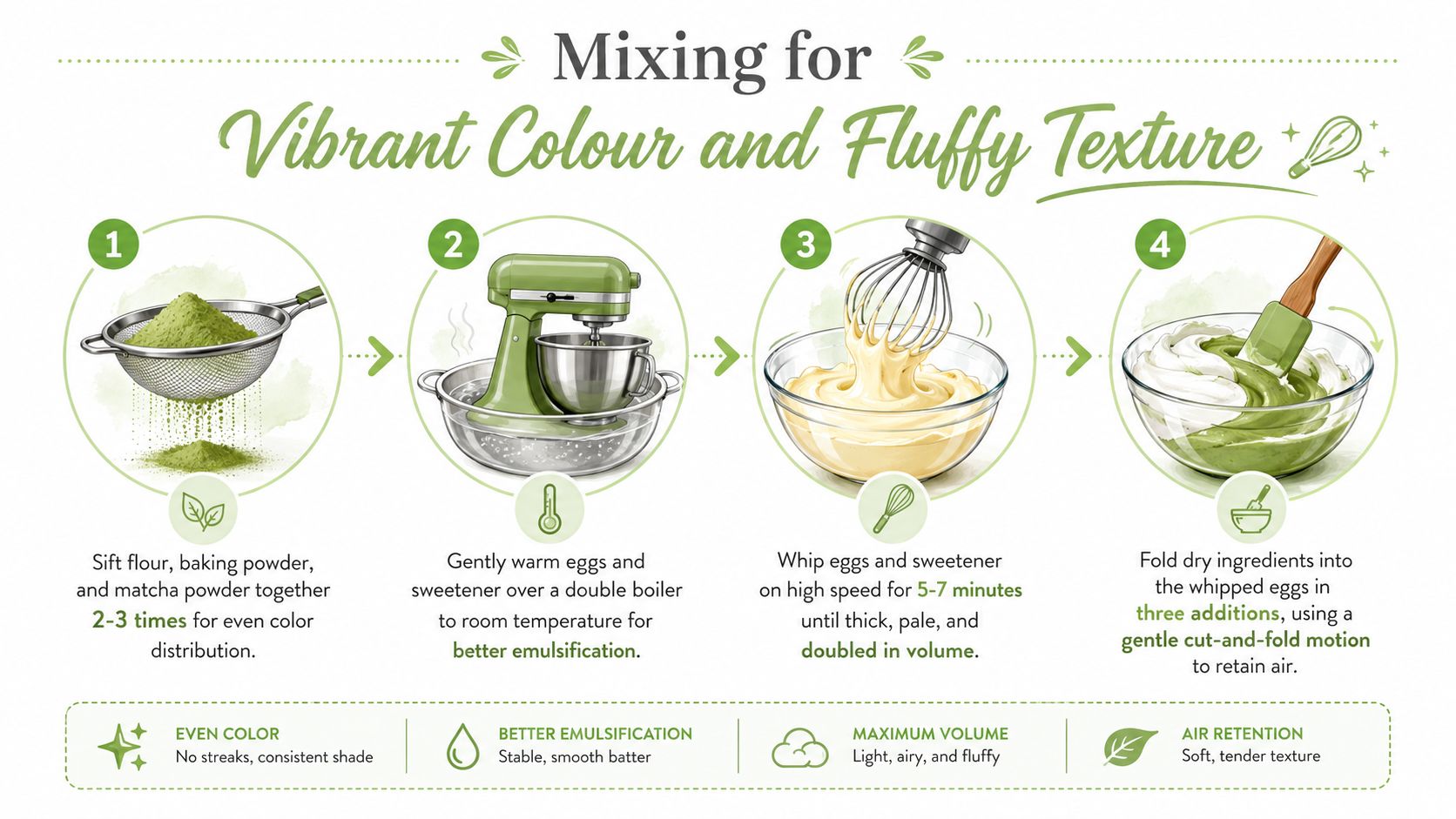
A matcha sponge can lose its colour and lift before it reaches the oven. Aerated eggs provide most of the lift, so prepare the tin and heat the oven first. Fold, pan and bake promptly once the foam is ready.
Build the foam first
Sift the flour and matcha together several times. This breaks up clumps and spreads the powder through the batter, reducing the need for aggressive folding later. For a foam-based sponge, warm the eggs and sugar over gently simmering water until they no longer feel cold, then beat until the mixture is pale and roughly tripled in volume.
Use a heatproof bowl over water that is barely simmering, with the bowl's base kept above the waterline. Stir continuously so the eggs warm evenly. The mixture is ready when it looks thick and airy, and a lifted whisk leaves a ribbon that sits briefly on the surface. If the ribbon disappears immediately, continue beating.
Fold in three deliberate additions
Mix the sifted flour and matcha with a small portion of the foam first. Fold that lighter mixture into the remaining foam in three additions, using a broad spatula. Scrape from the base upwards while rotating the bowl, and stop as soon as the batter looks even.
Practical rule: A few small streaks of flour are easier to correct than a bowl of collapsed foam. Fold only until the batter is even.
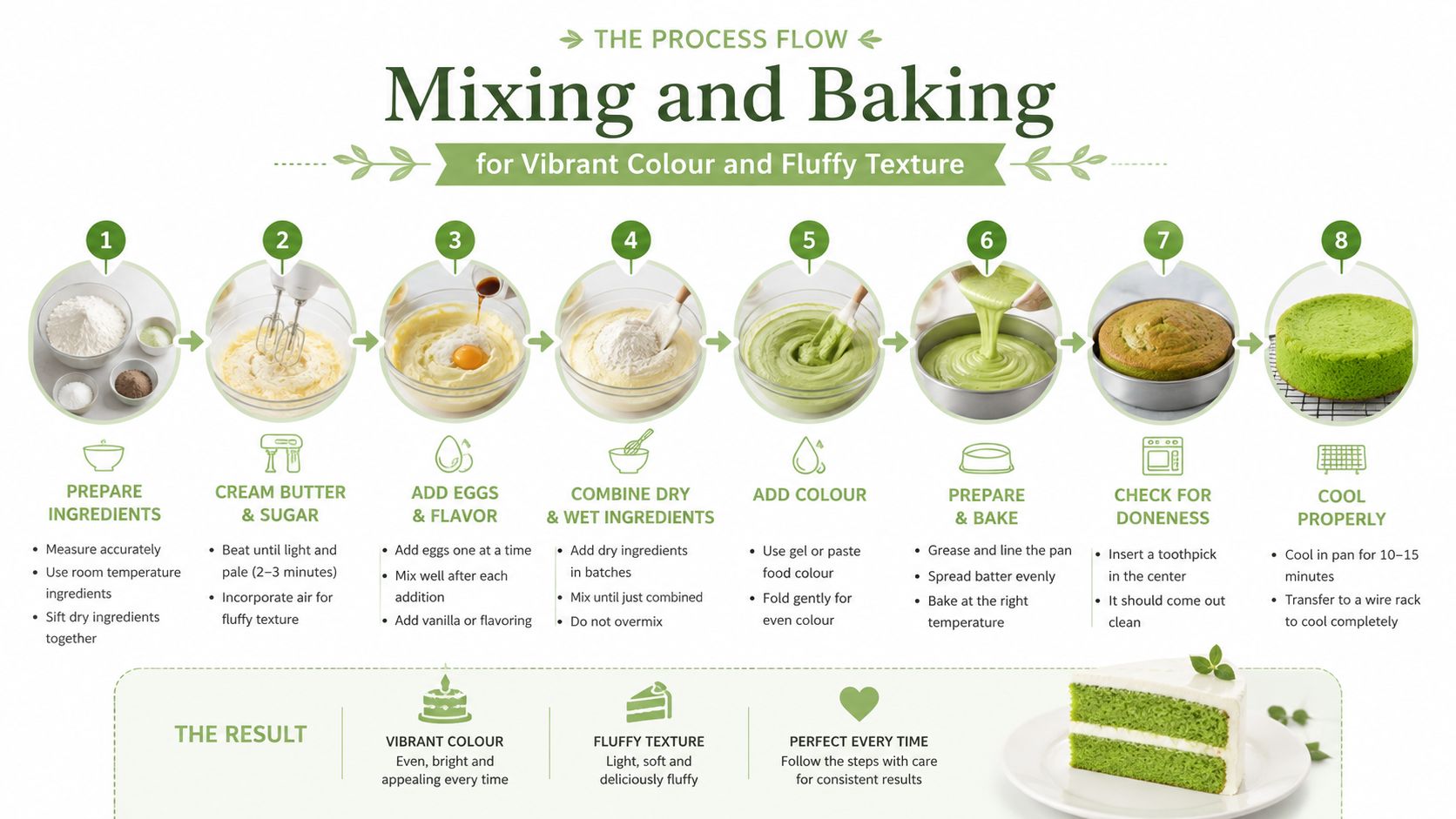
Line the base of the tin with parchment and leave the sides mostly ungreased where possible, allowing the batter to grip as it rises. Pour steadily, level the surface, and place the tin straight into a fully heated oven. A moderate oven around 180°C for about 25 minutes suits many standard sponges, but batter depth and pan material can change the result.
For practical guidance on equipment, pan preparation and basic doneness checks, use this guide to baking a simple cake as a beginner.
Adapt the timing to the format
A standard round cake may finish in approximately 25 minutes. Layer cakes baked in 22 cm tins can take roughly 25 to 30 minutes, while cupcakes usually need checking earlier because their smaller volume sets faster. These are starting points, not fixed promises. Oven calibration, pan colour and batter depth all affect baking time.
The centre should spring back lightly when pressed. A skewer should emerge clean or with a few moist crumbs, never wet batter. Cool the cake briefly in its tin, then move it to a rack so trapped steam does not soften the base.
Bright green colour depends on more than oven timing. Excessive heat, overbaking and prolonged exposure to air can dull matcha, while too much powder can make the crumb bitter. For ideas beyond a single sponge, PepTea's guide to baking with matcha and beyond shows ways to use the ingredient across different baked formats.
Smart Ingredient Swaps for Sugar Free and Gluten Free Baking
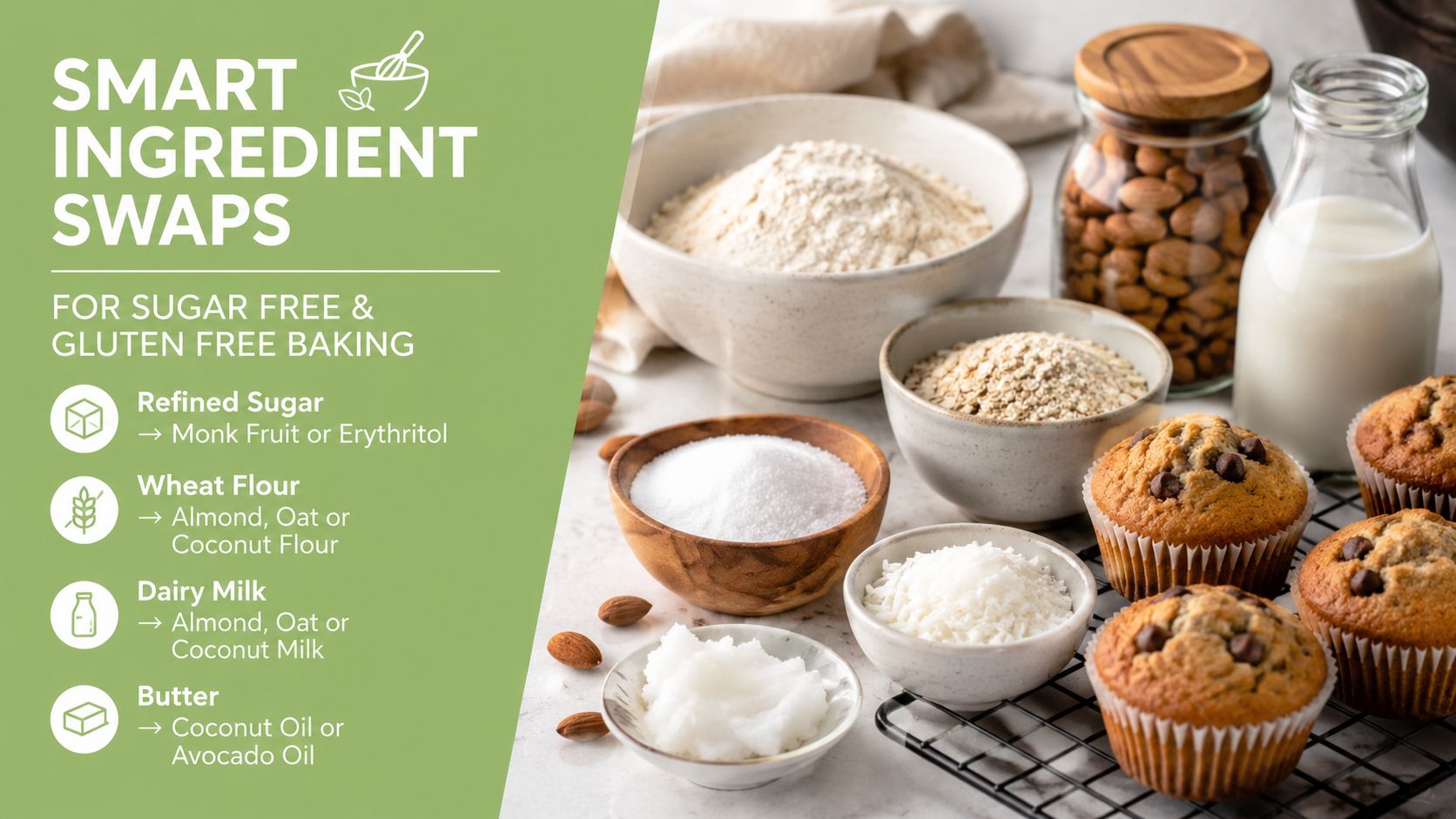
Removing sugar changes more than sweetness. Sugar adds moisture, tenderness, colour and bulk, so a matcha cake can turn firm, pale and more bitter when it disappears. Replace those functions deliberately rather than making a one-for-one swap.
Lower-sugar choices
For a reduced-sugar sponge, retain enough sweetener to soften matcha's bitterness and support the whipped structure. A granulated alternative that measures and behaves like sugar is generally easier to manage than a concentrated liquid sweetener. If you use an intensely sweet product, add suitable dry bulk and reassess the liquid balance.
A fully sugar-free sponge can taste thin. In practice, a lower-sugar cake with a lightly sweetened or unsweetened cream layer often gives better results. Berries, white chocolate or naturally sweet fruit can round out the flavour while keeping matcha noticeable. This approach also suits cakes prepared for delivery, because the topping can carry sweetness without weakening the sponge.
Matcha contains caffeine, so both the quantity of powder and the portion size affect the serving. FSANZ guidance on caffeine explains the food safety and consumer considerations in Australia and New Zealand. Take extra care when serving children, people sensitive to caffeine or guests who may already have consumed tea or coffee.
Gluten-free structure
A dependable gluten-free cake blend usually combines a mild flour with starch and a suitable binder. A commercial blend made for cakes can simplify this choice. Keep the base neutral, because strong nut or legume flours can cover the fresh tea character and make a delicate matcha batter taste heavy.
Some blends need a short rest to hydrate, but a foam-based batter should go into the oven soon after the eggs are whipped and the dry ingredients are folded in. Butter cakes can benefit from added moisture such as yoghurt or milk, which helps limit crumbling. Sponges need gentler handling. Gluten-free flour cannot restore structure after vigorous mixing has collapsed the foam.
Dairy-free bakers can use neutral plant milk and neutral oil. Egg-free cakes require a different structure, usually a chemically leavened batter instead of an egg-foam method. PepTea's gluten-free raspberry and white chocolate muffins offer a practical flavour pairing for this style of baking.
If a packet says “organic matcha”, check the claim rather than assuming certification. The ACCC explains that Australian businesses do not legally need organic certification to describe a product as organic, while AS 6000-2015 is a voluntary domestic standard for growers and manufacturers (ACCC guidance on organic claims). Treat organic status as a labelling and sourcing detail to verify, especially when choosing powder for a cake sold or delivered to customers.
Troubleshooting Common Matcha Cake Problems and Quick Fixes
Matcha cake failures usually leave clues. The colour, smell and crumb can tell you whether the problem started with the powder, the mixing or the oven.
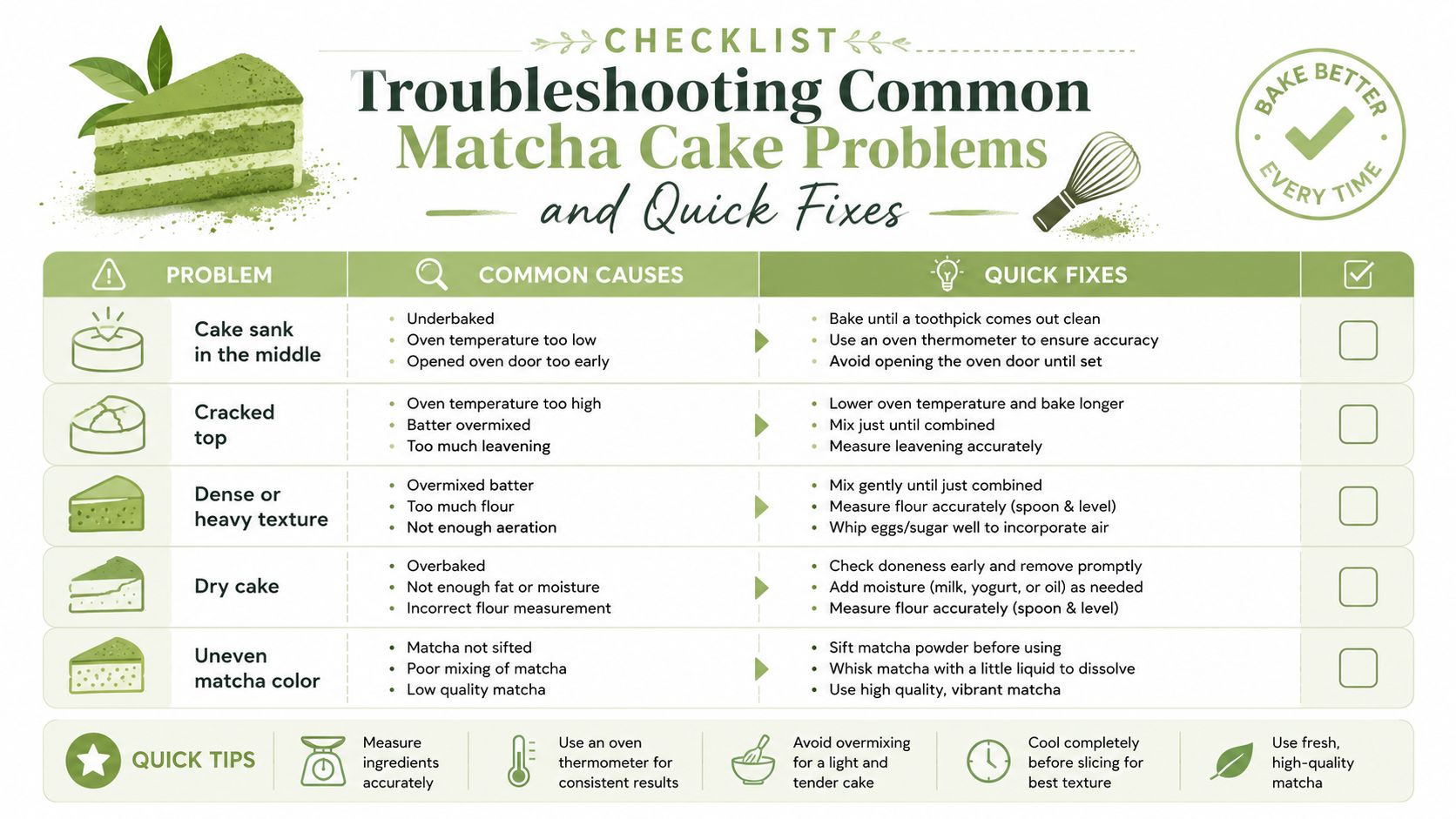
Dull colour
Cause: The matcha is old, the batter sat before baking, or the oven was too hot.
Fix: Use fresher powder, sift it thoroughly, bake immediately after folding and avoid excessive heat. A pale green sponge can still taste good. Brightness isn't the only measure of quality.
Bitter or grassy flavour
Cause: Too much matcha, a harsh grade, insufficient sweetness or overbaking.
Fix: Reduce the powder in the sponge and move the stronger tea character into the icing. White chocolate, vanilla, mascarpone and raspberry can soften the perception of bitterness without hiding the matcha entirely.
Dense or gummy crumb
Cause: The egg foam collapsed during folding, or the centre needed more baking.
Fix: Fold in smaller additions, scrape the bowl's base gently and put the batter into the oven straight away. Check the centre with a skewer rather than relying only on browned edges.
Sunken centre
Cause: The cake was removed too early, the oven door opened prematurely, or the batter lost too much air.
Fix: Wait for a light spring-back in the centre and a skewer carrying only moist crumbs. If the top has already sunk, trim it level and use a layer of cream or ganache rather than trying to inflate the baked structure.
A sunken sponge is often salvageable. A bitter sponge is harder to disguise, so measure matcha carefully before you start.
Dry edges and uneven rise
Cause: A dark tin, shallow batter, hot spots or overbaking.
Fix: Use parchment, check the oven with a reliable thermometer and rotate only if your oven allows it without disturbing the rise. Trim dry edges, brush layers lightly with milk or a mild syrup, and keep the filling generous but not wet.
Variations Storage and Pairings Worth Serving
The right format depends on where the cake is going. A tall layer cake looks impressive for a celebration, but a simple loaf is easier to slice, wrap and transport. Cupcakes are practical for cafés and shared gatherings because each portion can be finished separately without exposing a whole cake to handling.
For delivery, choose a firm butter cake, loaf or compact cupcake over a fragile high-rise sponge. A chiffon-style cake is airy and elegant, but it needs careful packaging and a stable filling. A layer cake with mascarpone, white chocolate or fruit should travel chilled and level, with enough support to stop the layers sliding.
A pistachio, raspberry and coconut direction can turn the cake into an Australian-inspired lamington-style dessert. For broader ideas on matching sweet flavours with drinks, the McLaren Vale Cellars dessert pairings guide is a useful source of inspiration, even when you're serving a non-alcoholic pairing.
Storage that protects the crumb
Keep an unfrosted cake airtight at room temperature when it will be served soon and the weather is mild. Refrigeration protects cream-based fillings, but it can firm the crumb and mute aroma, so bring the cake back towards serving temperature before eating.
Wrap unfrosted layers well before chilling or freezing. Freeze individual slices in airtight packaging, then thaw them while still wrapped to reduce condensation on the surface. Frosting should be added after thawing when possible, particularly if you want a clean jade colour and a fresh finish.
An iced matcha latte gives the cake a creamy, tea-forward companion. Sugar-free organic kombucha brewed in the Hunter Valley, NSW, brings acidity and lift beside a rich white chocolate or mascarpone topping. If you serve kombucha, check the product label rather than assuming every fermented drink is alcohol-free. FSANZ and NSW Health state that beverages containing more than 0.5% alcohol by volume need alcohol-content labelling, and NSW Health identifies products above 1.15% ABV as alcoholic drinks in NSW (NSW Health's fermented drinks guidance). FSANZ's coordinated survey also found sampled fermented soft drinks across several alcohol ranges, with labelling wording dependent on the measured level (FSANZ's fermented soft drinks survey).
Pep Tea offers organic Japanese matcha in ceremonial and culinary formats, along with sugar-free organic kombucha options such as Ginger, Lime & Ginger and Mango. Visit Pep Tea to choose a matcha suited to your cake, find a drink for serving, or discuss wholesale options for an Australian café menu.