
Tag: peptea
Where to Buy Matcha Whisk in Australia: Practical Guide

Australian specialty tea retailers and curated online marketplaces are usually the most reliable places to buy a matcha whisk today, with local listings ranging from A$18.80 for basic bamboo chasen styles to A$90.00 for a premium Takayama whisk. If you're in Australia, you'll generally find the widest choice by checking specialist tea shops first, then broader kitchenware and marketplace sellers.
Starting with a simple shopping question often leads to getting stuck on the wrong comparison. They look at price first, when the better question is: what kind of froth do you want every morning, and how often will you use the whisk?
That's the gap I see again and again. A matcha whisk isn't just a box to tick off with your powder and bowl. Prong count, material, and how the whisk is made all shape the texture in your cup. For traditional usucha, a bamboo chasen behaves very differently from a resin or stainless option. For a milk-heavy latte, the trade-off may change.
At Pep Tea, we spend a lot of time helping Australians understand the tools behind a good cup, not just the tea itself. If you've been wondering where to buy matcha whisk options in Australia, and which one is worth it for your routine, this guide will help you buy with more confidence and less guesswork.
Finding Your Matcha Whisk in Australia
Where should you buy a matcha whisk in Australia when ten product photos look nearly identical?

A useful starting point is the seller, not the price tag. The right shop helps you compare how a whisk will behave in daily use. That means looking at prong count, material, and intended drink style, instead of treating every whisk as the same tool with a different markup.
For many Australian buyers, specialty tea retailers are the clearest place to begin. They are more likely to explain whether a whisk suits thin traditional matcha or a thicker latte routine, and whether the shape is designed for fine foam or basic mixing. That matters because a 100-prong bamboo chasen and a stiffer resin whisk can sit in the same search results while producing very different texture in the bowl.
Broader kitchenware stores and larger marketplaces still have a place. They can be useful if you want to compare several tool types at once or need a quick local delivery option. The trade-off is that some listings focus on appearance, bundle size, or discount pricing while saying very little about the whisk itself.
Where most Australian buyers should look first
Three shopping channels tend to cover most needs:
- Specialist tea retailers: Usually the best option for bamboo chasen, clearer usage notes, and better detail on froth quality.
- Kitchenware stores: Handy if you are comparing tea tools with other home items and want Australian shipping.
- Large marketplaces: Good for range, but you need to read carefully because product descriptions can be thin or inconsistent.
A simple rule helps here. Buy from the kind of retailer that can explain what the whisk does in the cup, not only how fast it can post the parcel.
What a good product listing should tell you
A useful listing gives you enough detail to predict performance. If it skips the basics, comparison gets harder.
Look for these points:
- Material, such as bamboo, resin, or stainless steel
- Approximate prong count or tine style
- Intended use, such as usucha, thicker matcha, or lattes
- Whether stock ships from Australia
- Whether care instructions are included
- Whether it is sold on its own or in a set
Prong count is where many buyers miss value. More prongs often help create finer foam with lighter matcha preparations, much like a brush with more bristles leaves a smoother finish. Fewer or thicker tines can be more durable, but they may produce larger bubbles or need more effort to get a creamy surface. If you drink matcha most mornings, that difference shows up quickly.
Care advice is another quiet sign of a reliable seller. A shop that tells you how to rinse, dry, and store a bamboo whisk usually understands that the tool is meant to last longer than one gift season.
Understanding Bamboo Chasen Construction
A bamboo chasen isn't a tiny kitchen whisk. It works more like a fine brush that happens to whip liquid. The carved tines flex, gather the matcha, and help create a surface foam without smashing the powder into clumps.
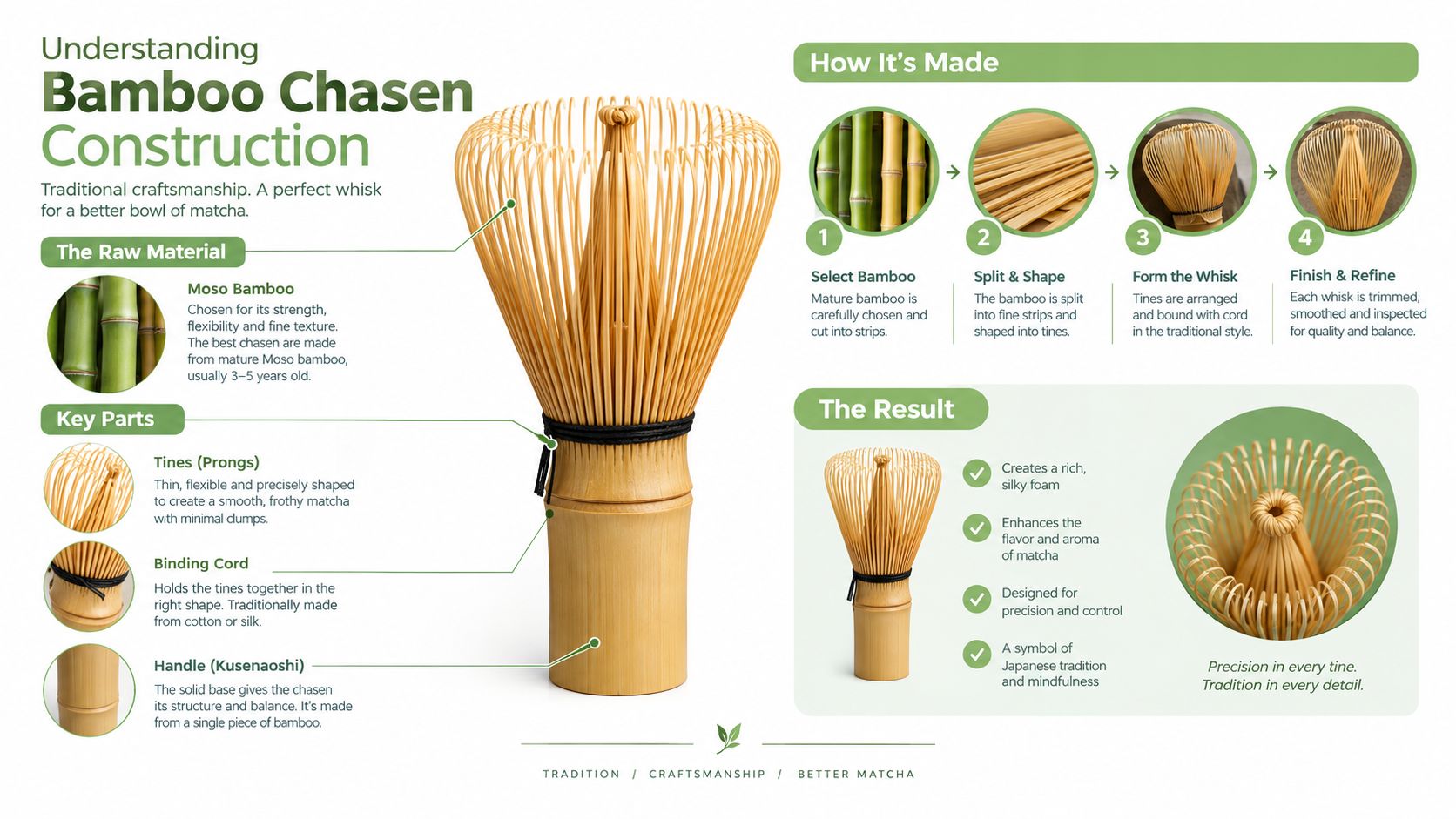
What the parts actually do
The central idea is simple. A chasen is carved from bamboo so the tines are thin, springy, and closely spaced. That shape lets the whisk move through a shallow pool of matcha and water with less resistance than a bulky metal whisk.
Think of it this way:
- The outer tines help agitate the liquid and build foam.
- The inner tines help break up small clumps and refine the texture.
- The handle gives you control without forcing a heavy stirring motion.
One Australian retailer notes that a chasen is made from bamboo specifically to create the frothy texture needed for matcha, which is a useful reminder that the material isn't decorative. It's part of the brewing result (matcha whisk product guidance).
Why construction affects your cup
A poorly shaped whisk can still mix matcha. It just won't do it elegantly. You may end up with larger bubbles, weak foam, or sediment that settles too quickly.
If you're learning at home, a traditional whisk also teaches better movement. That's one reason many people still choose a dedicated chasen rather than treating matcha like a protein powder.
For readers comparing tools, our matcha tea brush collection shows the kind of purpose-built whisk Australians often look for when they want a proper preparation tool instead of a generic frother.
Here's a useful visual demonstration of how a bamboo whisk is shaped and used in practice.
A simple test before you buy
Practical rule: If the listing doesn't show the tine shape clearly, you're buying half-blind.
Check for:
| Detail | Why it matters |
|---|---|
| Clear tine definition | Suggests the whisk is designed for actual matcha preparation |
| Material description | Helps you distinguish bamboo from resin or metal alternatives |
| Use instructions | Often a sign the seller understands the product |
| Set or standalone listing | Helps you decide if you also need a holder |
Bamboo Versus Alternative Matcha Tools
Australian retailers don't sell just one kind of matcha whisk anymore. Local listings include traditional bamboo chasen, resin reusable whisks, and stainless-steel mechanical whisks, with prices ranging from about AU$18.80 to AU$59.00 across these formats (Australian matcha whisk collection).
That broader choice is useful, but it can also blur the decision. Different tools suit different routines.
How the main options compare
| Tool type | Froth quality | Durability | Cleanup | Best fit |
|---|---|---|---|---|
| Bamboo chasen | Fine, traditional foam | More delicate | Easy if rinsed promptly | Daily matcha tea, mindful prep, usucha |
| Resin whisk | More convenient feel, less traditional texture | Reusable and sturdier | Straightforward | Frequent casual use |
| Stainless or mechanical whisk | Good for mixing, especially with milk | Stronger build | Usually easy | Lattes, quick prep, busy kitchens |
What bamboo does better
Bamboo is still the benchmark if your goal is a classic bowl of matcha with a light foam and smooth top. The tines are designed for that motion. They skim and whip rather than churn.
It also feels better in the hand for traditional preparation. That may sound minor, but the whisking motion is easier to learn when the tool was made for the task.
When alternatives earn their place
Resin and stainless options make sense for people who prioritise convenience. If you make iced lattes, add milk often, or want something less fragile, they can be practical.
One Australian retail category also shows a much cheaper entry point for mechanical whisks at about A$4.80, while bamboo and premium handmade options sit much higher. That spread shows why buyers shouldn't assume all “matcha whisks” solve the same problem (Australian matcha accessories range).
Bamboo usually wins on texture. Alternative tools often win on speed.
For many households, that's the trade-off.
Choosing Prong Count by Drink Style
Prong count sounds technical, but it's one of the easiest ways to narrow your choice. In simple terms, more prongs usually mean a finer, softer foam, while fewer prongs can feel a bit sturdier and forgiving for thicker or milk-based drinks.
Australian listings give a clear pricing snapshot: a 64-prong bamboo chasen is A$18.80, an 80-prong whisk is A$18.80, a 100-prong whisk is A$34.80, a 120-prong whisk is A$39.80, and a premium Takayama chasen is A$90.00 (Australian chasen pricing examples).
A practical way to match prongs to your routine
Use this simple guide:
Choose lower prong counts for casual milk drinks.
If you mostly make matcha lattes, a 64-prong whisk can be perfectly sensible. You're blending for smoothness, but the milk will shape much of the final texture.Choose mid-range prong counts for everyday all-round use.
An 80-prong whisk suits many home drinkers because it can handle both straight matcha and occasional lattes without feeling too specialised.Choose higher prong counts for finer foam.
If you enjoy more traditional preparation and want a silkier surface, a 100-prong or 120-prong whisk is often the more satisfying choice.
Don't let price lead the whole decision
The jump in price doesn't always mean the whisk is “better” for you. It may reflect finer workmanship, workshop provenance, or a more specialised shape.
Ask yourself these questions before you buy:
- Do I drink straight matcha or mostly lattes?
- Will I use it daily or only on weekends?
- Am I replacing a damaged whisk or buying my first one?
- Do I care more about ritual, durability, or speed?
A lower-priced whisk can be excellent value if it matches your drink style. A premium whisk only makes sense when you'll appreciate what it does differently.
Sourcing Matches Where Australian Buyers Shop
Where should an Australian buyer look for a good matcha whisk, once price stops being the only filter?
The short answer is that you have more options than many first-time buyers expect. Matcha whisks are sold through specialist tea shops, broader kitchen retailers, and large online marketplaces. That wider retail spread matters because it changes how you compare options. Instead of asking only, “What is the cheapest chasen I can find?”, you can ask, “What am I getting for this material, this prong count, and this level of finish?”
Australia already has an established retail channel for tea and tea tools. Industry context from IBISWorld shows a mature local online market for kitchen and diningware, which helps explain why matcha accessories are not limited to hard-to-find niche imports (Australian online kitchen and diningware industry context).
That practical availability helps in two ways.
First, it gives you room to compare construction details, not just shipping costs. A bamboo whisk with neatly separated tines and a shape suited to your drink style will usually produce better daily foam than a cheap option with uneven cuts, even if both look similar in a product photo. Second, local stock makes it easier to replace a whisk before a worn-out one starts giving you flat, clumpy results.
Where quality differences usually show up
A chasen is a bit like a paintbrush. From a distance, several may look alike. In use, the cut of the bristles, the flexibility of the material, and the overall shape change the result.
When you shop in Australia, check whether the seller clearly states:
- the whisk material, such as traditional bamboo or a non-bamboo substitute
- the prong count, especially if you care about finer foam for straight matcha
- the origin or workshop details, if provenance matters to you
- whether the item is stocked locally, which affects delivery speed and returns
Those details help close the decision gap many buyers run into. Two whisks can sit close together on price, but one may suit daily usucha far better because the prongs are finer and more numerous. Another may be better value for latte drinkers because it is simpler, sturdier, and less fussy.
Local stock can make comparison easier
One dedicated Australian seller states that its chasen are sourced from the Takayama workshop of Chikumeido and says it is the only stockist they supply in Australia. That shows some Japan-made whisks are available domestically, rather than only through direct overseas ordering (Takayama chasen listing in Australia).
That kind of listing is useful because it gives you something concrete to assess. If a seller explains where the whisk was made, what style it is, and who it suits, you can judge value more clearly. If the page says very little beyond “matcha whisk,” you may be buying blind.
Australian interest in matcha appears to be growing, as noted earlier. That helps explain why more local shops now carry preparation tools. For buyers, the main benefit is simple. Better availability means more chances to compare prong count, material, and build quality side by side, instead of treating every whisk as the same product with a different price tag.
Simple Care Routines for Longevity
A bamboo whisk can last well if you treat it gently. Most breakage happens because the prongs dry out, get pressed flat, or are scrubbed like ordinary kitchen gear.
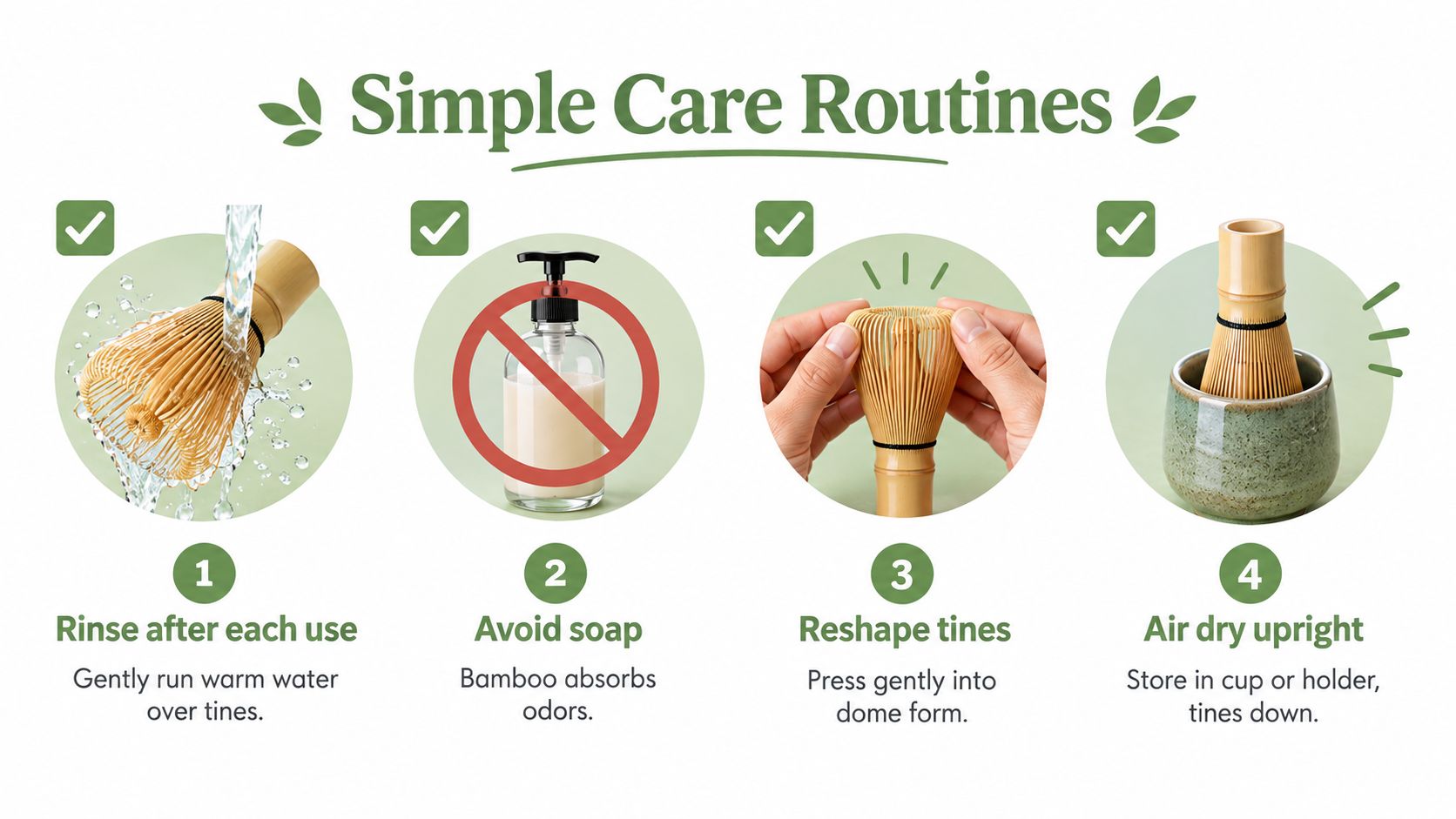
Several Australian sellers advise pre-soaking the whisk in warm water before use to help prevent breakage and improve foam formation, and one guide recommends whisking 2 scoops of matcha with 100 ml of 70°C water in a figure-of-eight motion before rinsing and air-drying upright (Amazon Australia matcha guide).
The daily routine that makes the biggest difference
You don't need special products. You need consistency.
- Before whisking: Soak the tines briefly in warm water so the bamboo softens.
- After whisking: Rinse with warm water soon after use.
- While drying: Let it air-dry upright, not trapped in a drawer.
- For shape support: A holder helps the whisk keep its curve between uses.
If you use a bamboo whisk often, a dedicated matcha whisk stand is a practical add-on because it supports the tine shape while drying.
What not to do
Don't treat a chasen like a dishwasher-safe gadget. It's carved bamboo, and it responds better to gentle habits than hard cleaning.
Avoid these common mistakes:
| Mistake | What happens |
|---|---|
| Leaving matcha to dry on the tines | Residue stiffens the prongs |
| Using soap | Bamboo can hold odours and flavours |
| Storing wet in a closed cupboard | Moisture lingers where air can't circulate |
| Pressing hard against the bowl base | Tines can bend or snap sooner |
A little care goes a long way. With bamboo, maintenance is part of the tool, not an optional extra.
When Mechanical or Electric Whisks Make Sense
Traditionalists sometimes dismiss mechanical or electric whisks too quickly. That isn't always fair. For some Australian households, they solve a real problem.
If you're making a fast weekday latte, or prepping several milk-based drinks in a café, a mechanical tool can be the more practical choice. It's especially relevant because local sellers do offer these alternatives alongside bamboo and resin models, rather than treating them as unrelated kitchen gadgets.
The best use case for a shortcut
Mechanical and electric whisks make the most sense when:
- You mostly drink matcha with milk
- You care more about speed than ritual
- You want a sturdier tool for frequent handling
- You're less concerned with traditional surface foam
That last point matters. A quick frother can blend powder and liquid well, but the texture often feels different from a hand-whisked bowl made with a chasen.
Where they fall short
A mechanical whisk can over-aerate, create a different bubble structure, or miss the softer finish many people want in straight matcha. If your goal is a calm bowl of usucha, bamboo still tends to feel more precise.
For readers who know they prefer convenience, an electric matcha whisk option is one route worth considering, especially for latte-heavy routines where speed matters more than ceremony.
The key is honesty about the drink you make. A shortcut is only a compromise if you wanted the traditional result in the first place.
Final Thoughts on Choosing Wisely
The best answer to where to buy matcha whisk in Australia isn't just the name of a shop. It's the combination of the right seller and the right whisk style for your drink habits.
If you want the safest starting point, check an Australian specialty tea retailer first. If you want broad comparison shopping, curated marketplaces and kitchenware stores can be useful. Then narrow the choice by material, prong count, and whether you'll be making straight matcha or mostly milk-based drinks.
The decision that matters most
A few buyers need handmade provenance. Some need a durable daily tool. Others just need a whisk that won't leave clumps in a morning latte.
That's why price alone doesn't help much. An A$18.80 whisk may be a smart buy for one person, while another will be happier paying more for a finer whisk geometry or Japan-based workshop sourcing, as covered earlier.
A simple buying checklist
Before you click buy, make sure you know:
- Your main drink style
- Your preferred material
- Whether you need a set or a standalone whisk
- Whether the seller offers local stock and clear care advice
The right whisk should fit your routine so naturally that you stop thinking about the tool and start enjoying the tea.
Good matcha preparation doesn't need to be complicated. It just needs a bit of thought at the start, then a little care afterwards.
If you're building a better matcha routine at home or for your café, Pep Tea offers premium organic Japanese matcha, practical preparation guidance, and the kind of tea education that helps you choose tools with confidence. You can explore our matcha range, learn how to whisk it properly, and find straightforward advice for everyday Australian matcha drinking.
Caffeine Content in Green Tea: Your Complete Guide

Is your green tea giving you a light lift, or is it packing an almost coffee-like punch?
That's the question often overlooked. A common tendency is to hear one tidy number for caffeine and assume every green tea sits in the same lane. It doesn't. A basic tea bag, a smooth sencha, a shaded gyokuro, and a bowl of ceremonial matcha can feel completely different in the body, even though they all come from the same tea plant.
That's why understanding caffeine content in green tea matters. If you're choosing a morning drink, planning an afternoon cuppa, ordering a matcha latte at your local café, or trying to avoid feeling overstimulated at night, the details matter more than the label.
At Pep Tea, we spend a lot of time helping Australians make sense of tea without the fluff. Green tea isn't just “low caffeine”. Sometimes it is. Sometimes it isn't. Ultimately, the answer lies in the leaves, the growing method, and the way you brew it.
How Much Caffeine Is Really in Your Green Tea
The short answer is yes, green tea has caffeine. The more useful answer is that the amount can shift quite a bit from cup to cup.
It's understandable to want a single number. But with green tea, a single number can be misleading because “green tea” covers a huge range of styles, from supermarket tea bags to finely stone-ground Japanese matcha. If you've ever wondered why one cup feels soft and steady while another feels almost too energising, you're not imagining it.
A good starting point is to think of green tea as a category, not a fixed recipe. It's a bit like saying “bread”. A slice of sourdough and a sweet brioche are both bread, but they're not the same experience. Green tea works the same way. The plant may be the same, yet the final caffeine level depends on what part of the plant was used, how it was grown, and how it was prepared.
For a simple overview focused on calm energy, our guide to organic green tea caffeine is a handy companion. The key idea is this: the caffeine in your cup isn't random, but it also isn't universal.
Most confusion starts when people compare a standard brewed green tea with matcha as if they were the same drink. They're not.
That difference matters even more in Australia, where many cafés now serve premium Japanese teas alongside coffee. A customer who expects a gentle green tea may be surprised when a matcha latte feels much stronger. Once you know what changes the caffeine, the numbers start to make sense, and your daily tea choices become much easier.
The Standard Range and Why It Varies So Much
For a standard benchmark, a 240 ml cup of green tea contains approximately 25 to 45 mg of caffeine, which is about one-fourth to one-third of brewed coffee at 95 to 200 mg and roughly half the caffeine of black tea at 40 to 70 mg, according to Teapigs Australia's guide to caffeine in green tea.
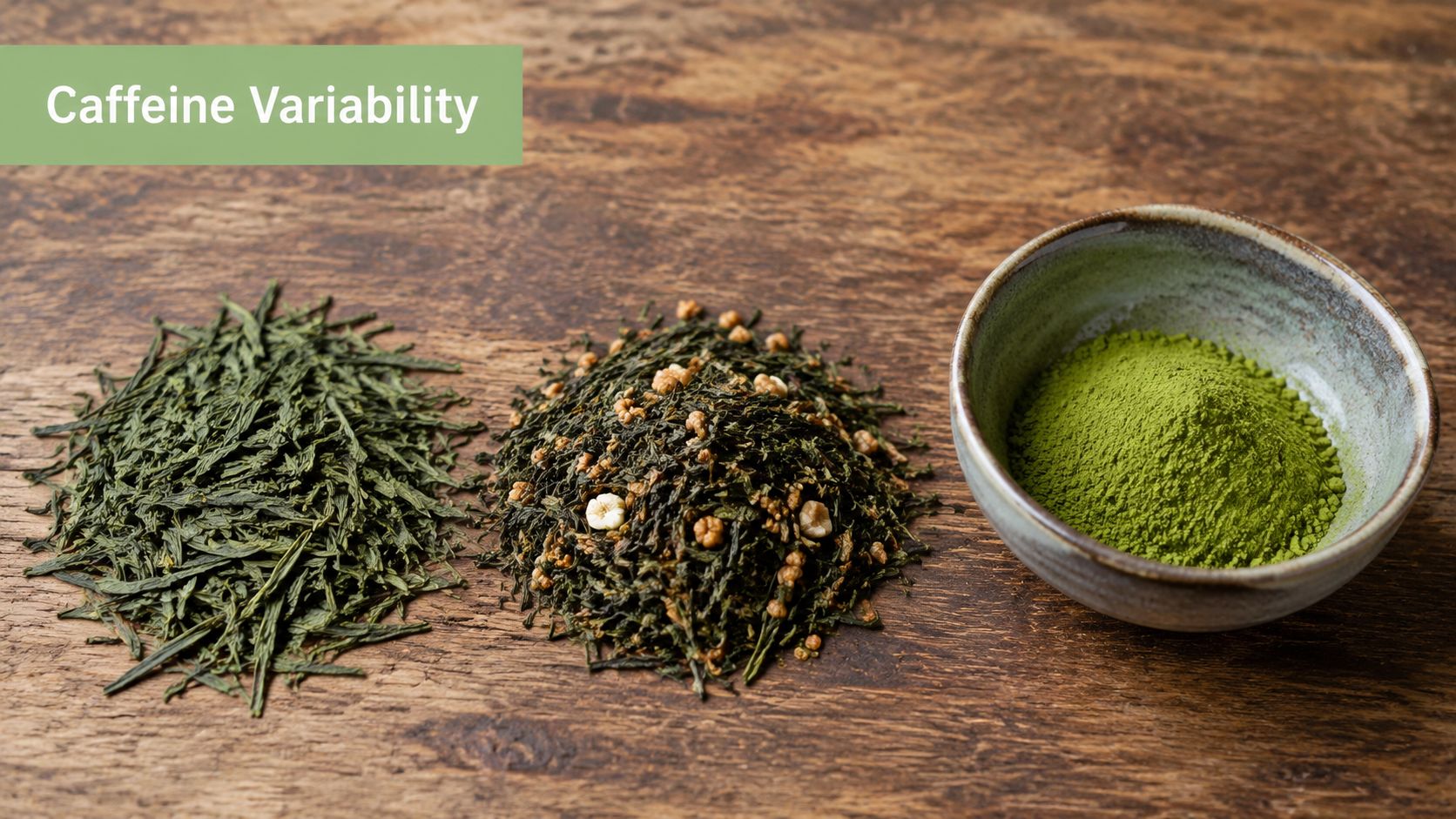
That range is useful, but it's only the front door. Variability is the key point. Green tea leaves naturally contain caffeine because the Camellia sinensis plant produces it in its leaves. What ends up in your mug depends on how much caffeine was in the leaf to begin with, and how much hot water pulls out during brewing.
The leaf matters
Tea is a bit like wine grapes. The same species can produce very different results depending on variety, growing conditions, and harvest style.
Younger, more delicate leaves tend to be associated with stronger, more refined teas, and they can also carry more caffeine. Older leaves usually brew a softer cup. That's one reason two green teas can taste different and energise you differently even before you touch the kettle.
Processing changes the outcome
Green tea isn't one uniform product. Some teas are grown in full sun. Others are shaded before harvest. Some are sold as whole leaves. Others are ground into powder.
These choices shape both flavour and caffeine. Shade-growing, in particular, is important for some Japanese teas because it changes the chemistry of the leaf before it's picked. That's one of the big reasons premium Japanese green teas often sit outside the “standard” range people expect.
Your brew is the final filter
Even if two people use the same tea, they can end up drinking different amounts of caffeine.
- More leaf means more potential caffeine in the cup.
- Hotter water extracts more quickly than cooler water.
- Longer steeping pulls out more from the same leaves.
- Powdered tea changes the equation because you consume the leaf itself rather than just infusing it.
Practical rule: Treat the printed tea name as the beginning of the caffeine story, not the end of it.
That's why broad averages help, but they can't tell you exactly what your own cuppa contains. For that, you need to know which green tea you're drinking and how it was made.
Caffeine in Sencha vs Gyokuro vs Matcha
If you want to understand caffeine content in green tea in a practical way, compare three familiar Japanese styles: sencha, gyokuro, and matcha. They all belong to the green tea family, but they don't sit anywhere near each other on the caffeine spectrum.
A quick comparison
| Tea Type | Typical Preparation | Estimated Caffeine (mg) |
|---|---|---|
| Sencha | Brewed leaf tea | Lower than shaded Japanese styles |
| Gyokuro | Brewed shade-grown leaf tea | 120 to 140 |
| Matcha | Whisked powdered tea | 136 in an 8 oz cup |
The sharp jump in the table isn't a typo. Gyokuro contains 120 to 140 mg per serving, while high-quality ceremonial matcha reaches 136 mg in an 8 oz cup, as noted in Nioteas' comparison of green tea and coffee caffeine.
For a broader look at what separates these styles, this guide on the difference between matcha green tea and green tea is useful reading.
Sencha feels familiar because it is
Sencha is what many tea drinkers picture when they hear “green tea”. It's brewed from leaves, usually with a fresh, grassy, lightly savoury character.
In everyday terms, sencha is the gentle middle ground. It's often what people mean when they quote a modest green tea caffeine figure. If you brew a normal loose-leaf green tea and get a smooth, manageable lift, you're probably experiencing something closer to this style than to the more intense Japanese teas below.
Gyokuro climbs because of shade
Gyokuro surprises people. It's still brewed like a leaf tea, yet its caffeine can rise dramatically.
The reason is cultivation. Gyokuro is shade-grown before harvest. You can think of shading like putting the plant on a different training program. The leaves respond by changing their internal chemistry, and one result is a much more concentrated tea. The cup often tastes deeper, sweeter, and more umami-rich, but the stimulation can be far stronger than people expect from something called “green tea”.
Gyokuro is one of the clearest examples of why a single caffeine number for green tea doesn't work.
This matters for Australian cafés as well. If a menu says “Japanese green tea”, the customer may assume a mild drink. If the tea is gyokuro, that assumption can be well off the mark.
Matcha is different because you drink the leaf
Matcha shifts the conversation again. With brewed tea, you steep the leaves and discard them. With matcha, the leaf is stone-ground into powder and whisked into water, so you consume the entire leaf.
That's why matcha often feels more substantial. You're not just drinking what water extracted. You're drinking the leaf material itself. If sencha is like simmering vegetables in broth, matcha is more like blending the vegetables into the soup.
A useful second benchmark comes from Australia as well. Kenko Tea's matcha caffeine page states that a cup of matcha contains 30 mg of caffeine per 1 gram serve, while brewed green tea averages about 15 mg per cup. The exact figure depends on how much powder you use, but the pattern is clear. Matcha usually sits above standard brewed green tea.
Why this matters in real life
If your goal is a softer afternoon drink, sencha makes sense. If you want a more powerful tea experience without switching to coffee, gyokuro and matcha enter the conversation quickly.
That's also why ceremonial matcha lattes can catch people off guard. They may taste creamy and soothing, but caffeine-wise they can be much closer to a deliberate energy drink than to a light green tea bag.
How Your Brewing Method Fine-Tunes Caffeine
Even after you choose the tea, you still have one big lever left. Brewing.
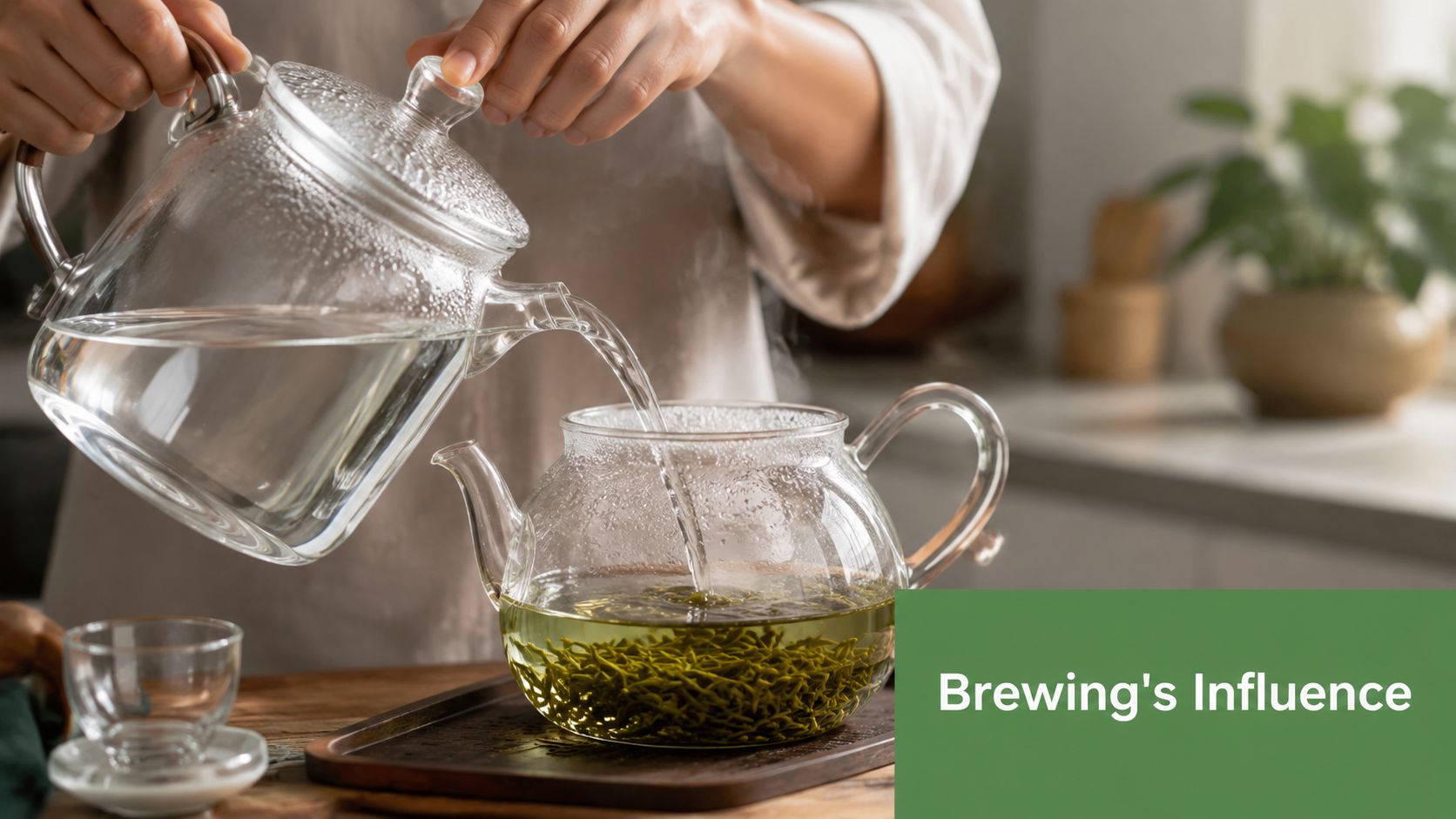
Caffeine is water-soluble, so brewing is basically an extraction exercise. Hotter water and longer contact usually pull more out of the leaf. Cooler water and shorter steeps usually pull less. That sounds simple, but it gives you real control over what lands in your cup.
Time and heat both matter
One of the clearest data points on this comes from Tavalon Australia's tea caffeine guide, which notes that brewing longer or with hotter water significantly increases caffeine, with Indian and Kenyan green teas yielding 59 mg and 58 mg respectively when steeped for 3 minutes, compared with a standard 20 to 30 mg average.
That's a useful reminder that the same category of tea can behave very differently depending on brewing style. If you've ever had one green tea that seemed mild and another that felt much punchier, the kettle may be part of the answer.
A simple home approach
You don't need lab gear to fine-tune caffeine. You just need to decide what kind of effect you want.
- For a gentler cup use cooler water and keep the steep short.
- For a stronger morning brew use warmer water and let the tea sit a little longer.
- For matcha remember that the serving size matters because adding more powder means drinking more leaf.
- For café drinks a larger matcha serve in a latte can change the feel of the drink even if the flavour still seems smooth.
If flavour is the song, brewing is the volume knob. Caffeine rises and falls with it.
A quick visual on technique can help if you're trying to improve consistency at home or in a café.
What about decaf and fermented tea
For people who are very sensitive to caffeine, decaf green tea is a separate category. In general, it still contains a trace amount rather than absolutely none.
Fermented tea drinks add another layer. Kombucha starts with tea, so it begins with some caffeine in the brew. During fermentation, the final drink can end up gentler than the tea it started from. That's one reason some people find kombucha feels lighter than a straight cup of tea, though the exact result depends on how it's made.
An easy rule for daily use
Try matching the brew to the time of day.
- Morning focus suits a fuller extraction.
- Mid-afternoon often works better with a moderate brew.
- Evening usually calls for shorter, cooler infusions or a lower-caffeine option altogether.
That one habit helps people enjoy green tea more without guessing why one cup feels completely different from the next.
Green Tea vs Coffee vs Kombucha A Comparison
Numbers are easier to understand when you can place them beside drinks you already know.
In Australia, green tea contains 24 to 45 mg of caffeine per 250 ml cup, compared with matcha at 60 to 75 mg per cup and black tea at 45 to 75 mg per cup, according to ABC News reporting cited here. That alone tells an important story. Standard green tea often sits at the lower end of the caffeinated drink spectrum, while matcha steps into a noticeably stronger zone.
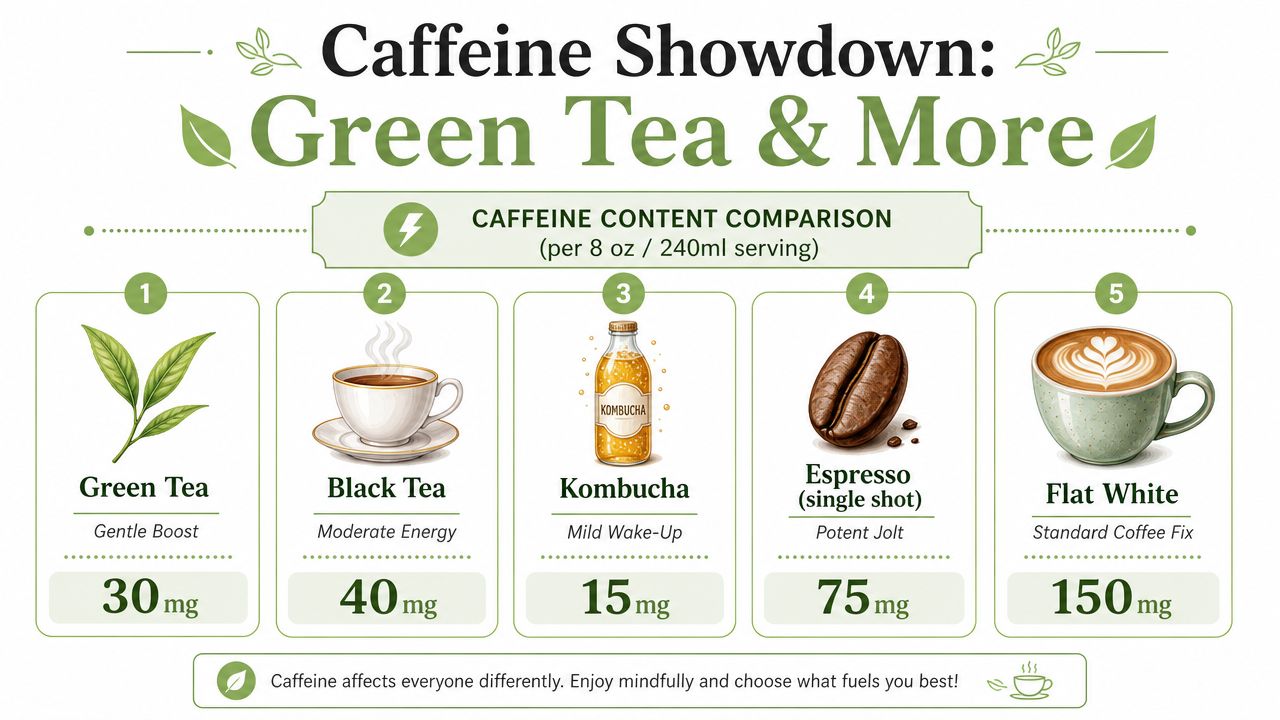
If you're curious about where fermented tea fits, our article on whether kombucha has caffeine adds more context.
It's not only about the number
Coffee tends to announce itself quickly. Green tea often arrives more gently. Many tea drinkers describe the effect as steadier and easier to live with.
That difference is one reason matcha has become so popular with people who want clean energy for work, study, or training. Tea naturally contains L-theanine alongside caffeine, and that pairing is widely valued for a calmer style of alertness.
A practical way to think about the line-up
- Green tea suits people who want a lighter lift.
- Black tea usually sits a step above standard green tea.
- Matcha can move much closer to coffee territory than many people expect.
- Kombucha is often the softer option when you want refreshment with less intensity.
- Coffee remains the obvious pick for those chasing a stronger jolt.
A flat white, a bowl of matcha, and a bottle of kombucha don't just taste different. They shape the pace of your day differently too.
For cafés, this comparison is useful on menus. “Green tea” and “matcha” shouldn't be treated as interchangeable. One is usually a mild brewed drink. The other can be a more functional, focus-oriented option.
Choosing the Right Green Tea for Your Day
Once you understand the range, the best tea becomes a timing question.
If you want a sharper start, organic matcha tea provides approximately double the caffeine content of a standard brewed green tea and half the caffeine of an espresso, while offering a more sustained lift due to L-Theanine, as noted on Pep Tea. That makes matcha a strong fit for morning concentration, a pre-work session, or the part of the day when coffee feels too abrupt.
Match your tea to the moment
- For focused mornings choose matcha when you want something more substantial than a standard leaf tea.
- For a balanced afternoon go with a classic brewed green tea such as sencha if you want a gentler rise.
- For evenings keep the brew light, shorten the steep, or switch to a lower-caffeine option.
- For café orders ask what kind of green tea is being used. That one question can save a surprise.
A note for café owners
This is one of the easiest menu education wins. Customers already understand coffee strength because cafés talk about single shots, double shots, and roast style. Tea deserves the same clarity.
A menu line like “ceremonial matcha latte” tells only part of the story. It helps to train staff to explain that matcha is different from standard brewed green tea because the whole leaf is consumed. That turns confusion into confidence, and it helps customers choose a drink that suits the time of day.
Keep the choice practical
You don't need to memorise every tea cultivar or brewing chart. A simple framework works well:
| Goal | Better fit | Why it helps |
|---|---|---|
| Morning energy | Matcha | Stronger, steadier feel |
| Midday reset | Sencha or standard green tea | Lighter lift |
| Late-day sipping | Lower-caffeine brew | Less chance of overdoing it |
If you want one product example, Pep Tea organic matcha is a relevant option for people specifically looking for a stronger green tea format rather than a mild brewed cup. The useful distinction isn't “good” versus “bad”. It's brewed leaf versus powdered leaf, and gentle lift versus more pronounced energy.
The best green tea for you isn't the strongest one. It's the one that fits your day, your sensitivity, and the kind of clarity you want from your cuppa.
If you're exploring cleaner ways to support focus, energy, and daily wellness, Pep Tea is a great place to start. You can browse our organic matcha range, learn more about sugar-free organic kombucha brewed in the Hunter Valley, NSW, and find practical guides for choosing the right tea for your routine.
Ceremonial vs Culinary Matcha: A Complete Guide for 2026

Most advice on ceremonial vs culinary matcha gets one thing wrong straight away. It treats “ceremonial” and “culinary” like official Japanese grades, as if one is formally certified as superior and the other is a lesser version.
That's not how matcha works.
In practice, those labels are best understood as usage terms. They tell you what a powder is intended for. One is generally suited to being whisked with water and enjoyed on its own. The other is usually built to perform in lattes, smoothies, desserts, and baking. That distinction matters far more than the badge on the tin.
A lot of Australian shoppers are understandably confused. One source notes that in Japan there is no official grading system for “ceremonial” versus “culinary”, and that these labels were created by Western brands to indicate intended use. The same source says 68% of Australian matcha buyers in 2025 reported confusion over grade terminology in a Nielsen AU survey on functional beverage trends, according to Ooika's explanation of ceremonial vs culinary matcha.
If you remember only one idea, make it this one: buy matcha for the job you want it to do.
Here's a quick side by side view before we get into the details:
| Feature | Ceremonial matcha | Culinary matcha |
|---|---|---|
| Main purpose | Drinking with water | Mixing into recipes |
| Leaf selection | Young, tender spring leaves | Older or later harvest leaves |
| Colour | Bright, vivid green | More muted green |
| Taste | Sweet, umami, low bitterness | Bolder, earthier, more astringent |
| Texture | Very fine and silky | Often less delicate |
| Best uses | Straight matcha, mindful sipping | Lattes, smoothies, baking, desserts |
| Price | Usually higher | Usually more accessible |
Practical rule: If you want to taste the matcha itself, choose ceremonial style. If milk, fruit, chocolate, or heat are involved, culinary usually makes more sense.
From Leaf to Powder The Production Journey
Both ceremonial and culinary matcha begin with the same plant, Camellia sinensis. The split happens in the field.
For ceremonial-grade matcha, growers focus on the youngest, most tender leaf material. One detailed production guide explains that ceremonial matcha is made from the youngest two leaves at the tip of new shoots, harvested in spring, typically mid-April to mid-May, after 4 weeks of shading under bamboo mats or dark cloth that can block up to 90% of sunlight to build chlorophyll and L-theanine, as outlined in this explanation of how matcha is made.
That shading step changes everything. Less direct light pushes the plant toward a deeper green colour and a softer flavour profile. The leaves are being prepared for a bowl where there's nowhere to hide.
Two leaves, two futures
Think of two tea leaves from the same garden.
The first is selected from the delicate spring flush. It's shaded carefully, picked young, then handled with a lot of restraint because the final powder needs to taste balanced with nothing more than water.
The second comes from a later harvest or from older leaves chosen for strength rather than delicacy. It still becomes matcha, but it's expected to hold its own in a latte, biscuit batter, smoothie, or soft serve. That demands a sturdier personality.
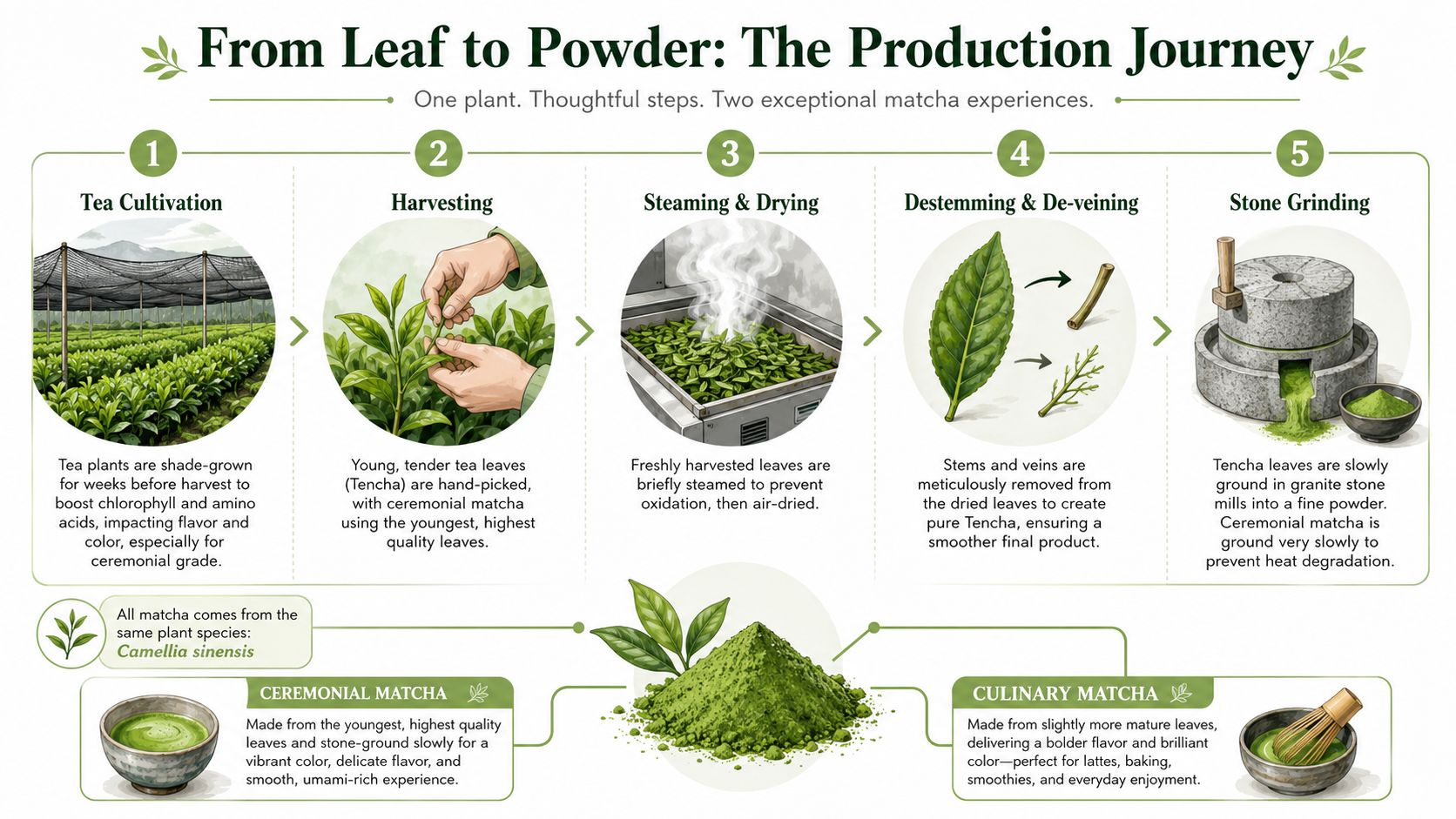
The production path after harvest is careful for both styles. Leaves are steamed to stop oxidation, dried, and stripped of stems and veins to create tencha before grinding. But when the goal is premium drinking matcha, each decision is tighter and less forgiving.
Why the field matters more than the label
You can't fix poor leaf selection later with fancy packaging. The matcha's character is shaped early by:
- Shading method: Longer, more intensive shade growing supports the sweet, soft style people expect from ceremonial matcha.
- Harvest timing: Spring leaf material is prized for delicacy, while later harvests lean stronger and more assertive.
- Leaf age: Younger leaves tend to deliver a gentler cup. Older leaves bring more bite.
- Final purpose: Producers don't process every batch with the same intended use in mind.
If you want a deeper look at that farm-to-powder process, how matcha tea is made is worth reading.
A Difference You Can See Smell and Taste
Open the tin before you taste anything. Your eyes will usually tell you a lot.
Ceremonial matcha tends to look lively and bright. Culinary matcha often appears more subdued. One Australian reference explains that ceremonial matcha comes from the youngest leaves of the first harvest and can show more than 15% higher chlorophyll concentration, which helps create that vivid green colour and sweet, umami-forward flavour. The same source notes that culinary matcha is generally duller green, more astringent, and better suited to lattes and baking, according to Pure Matcha's guide to ceremonial and culinary differences.
What to look for in the powder
A good ceremonial powder often looks almost luminous. It usually has a finer, softer appearance in the bowl. Culinary powder can still be good quality, but it's commonly less radiant and a touch more practical than precious.
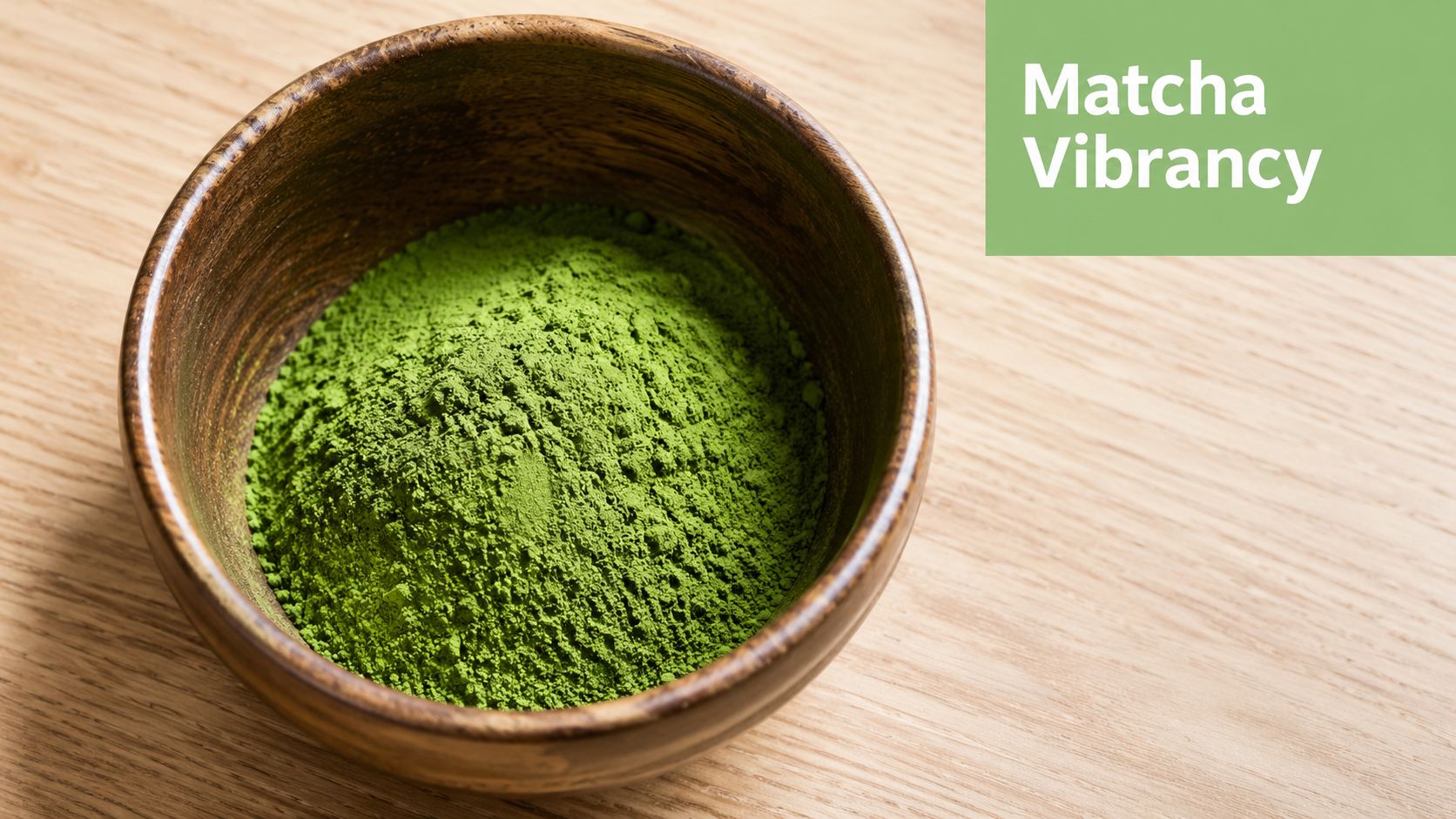
Use this quick sensory check:
- Colour: Ceremonial usually leans bright green. Culinary often looks flatter or more olive-toned.
- Aroma: Ceremonial tends to smell fresh, grassy, sweet, and savoury. Culinary is usually bolder and more direct.
- Texture: Drinking-grade matcha should feel very fine. A recipe-focused powder may feel a little less silky.
- Taste: Ceremonial aims for softness and umami. Culinary aims for presence.
What happens in the cup
Whisk ceremonial matcha with water and you should notice a smooth, rounded taste with minimal bitterness. It's the sort of matcha you sip slowly because the flavour is the point.
Culinary matcha behaves differently. On its own, it can taste firmer, earthier, and more drying. Add milk or sweetener, though, and that structure becomes an advantage. The stronger flavour keeps showing up instead of disappearing behind the rest of the drink.
A latte made with delicate ceremonial matcha can taste lovely, but it can also be a waste of subtle flavour. A strong culinary matcha often performs better because it was built for that role.
Why Is Premium Matcha More Expensive
The price gap between ceremonial and culinary matcha isn't just branding. A lot of it comes down to labour, pace, and how much powder a producer can realistically make.
Traditional stone milling is the clearest example. Authentic Japanese matcha made this way is ground very slowly to keep the powder fine and to avoid heat building up during processing. According to The S's Traditions explanation of matcha production, a traditional stone mill yields only 30 grams per hour, and producing 100 grams of premium powder can take roughly 3 to 4 hours.
That helps explain why good ceremonial matcha doesn't come cheaply. It's not only about exclusivity. It's about throughput. You can't rush this process and still expect the same result.
Where the cost comes from
Ceremonial matcha usually costs more because several high-effort choices stack together:
- More selective picking: The youngest leaf material is limited and carefully chosen.
- More demanding cultivation: Shade growing takes planning and close management.
- Traditional milling: Slow grinding preserves texture and character, but output is low.
- Smaller margin for flaws: When matcha is meant to be drunk plain, every rough edge shows.
Culinary matcha is usually more economical because it can be made from later harvests or slightly older leaves, and some producers use more modern grinding systems with higher output. That doesn't make it inferior across the board. It makes it fit for a different use case.
Expensive doesn't mean better for every job
A common mistake is assuming the most expensive matcha is always the smartest buy. It isn't.
If you're making an iced vanilla matcha latte, blending matcha into banana oats, or whisking it into muffin batter, subtle sweetness and fine aromatic detail can get buried. In those settings, a bold culinary powder often gives you a clearer matcha flavour at a more sensible cost.
Worth remembering: Price tells you something about craftsmanship. It doesn't tell you whether that matcha is right for your recipe.
Calm Focus vs Bold Flavour Nutritional Contrasts
Here's the part that often gets oversimplified. “Ceremonial” and “culinary” are not official nutrition categories from Japan. They are marketing labels that usually point to intended use, so the key question is not which one is “healthier” in the abstract. It is which powder suits the way you use it.
Both styles come from the same plant, and with matcha you consume the whole leaf in powdered form rather than steeping and discarding it. That is why both can contribute catechins, chlorophyll, caffeine, and L-theanine. The differences are usually a matter of degree, driven by factors like shading, harvest timing, and leaf selection.
Ceremonial-style matcha is often associated with a softer, steadier feeling and a sweeter, more umami-led cup. Culinary-style matcha tends to taste stronger, greener, and more direct, which is exactly why it works so well in recipes. Flavour shapes perception here. A smoother matcha can feel gentler to drink plain, while a punchier one can feel more lively because the bitterness and astringency stand out more clearly.
What that can feel like in a cup
L-theanine is one reason matcha is often described as giving calm focus instead of the sharper lift some people get from coffee. Still, it helps to keep expectations sensible. Ceremonial-style matcha is not a special wellness tier, and culinary matcha is not suddenly lacking in benefits. They tend to deliver a different balance of taste and sensation.
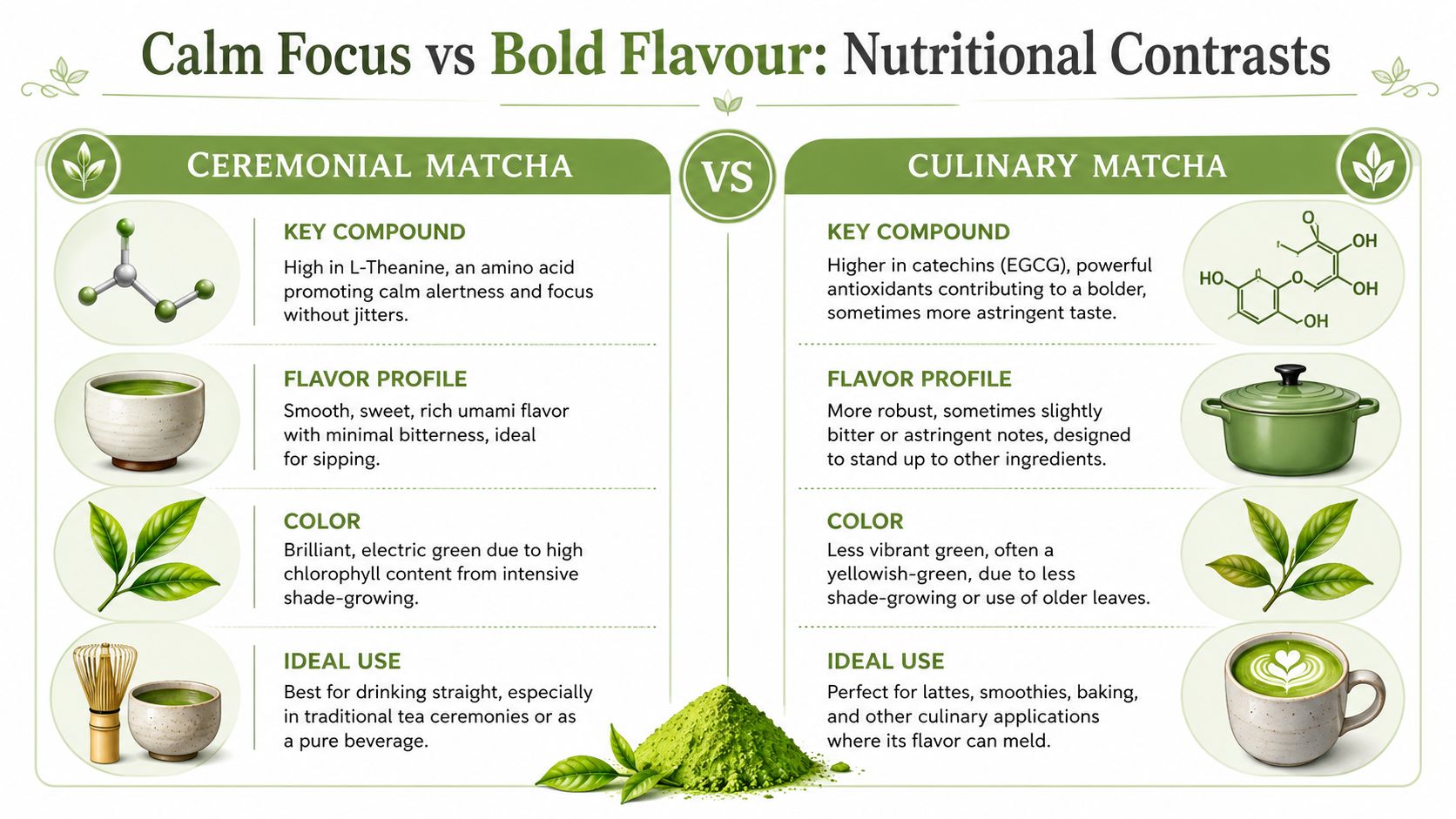
A practical way to read the difference is this:
| Matcha type | Typical feel | Flavour expression | Best fit |
|---|---|---|---|
| Ceremonial | Smoother, calmer, more centred | Sweet, umami, softer finish | Morning bowl, mindful break, straight whisking |
| Culinary | Brisker, more assertive | Stronger green tea character | Lattes, smoothies, baking, recipes |
If you want a clearer primer on how these labels are used, our guide to different grades of matcha explains where the names help and where they can mislead.
A good rule is to judge matcha the way you would judge cooking chocolate versus single-origin chocolate for eating. Both come from cacao. Both have value. You just notice different qualities depending on how you use them.
A lot of tea drinkers also ask about antioxidants such as EGCg. Matcha is well regarded partly because the whole leaf is consumed, so both styles can fit neatly into a daily routine. The more useful question is simple. Which one will you enjoy often enough to use well?
For a visual explainer, this video gives a helpful overview:
Choose for the experience, not the label
If you like whisking matcha with water and noticing sweetness, creaminess, and a lingering umami finish, ceremonial-style powder usually makes more sense.
If your usual order is an iced latte, a smoothie, or weekend baking, culinary-style matcha is often the smarter pick because its flavour stays present once milk, oats, vanilla, or sugar enter the mix.
That is the key distinction. Not a formal Japanese hierarchy. A difference in application.
The Right Matcha for the Job How to Use Each Grade
The easiest way to stop overthinking ceremonial vs culinary matcha is to treat them like different kitchen tools. You wouldn't use a chef's knife for peeling apples if a small paring knife is the better fit. Matcha works the same way.
One producer notes that culinary-grade matcha often uses slightly older leaves or later harvests, creating a more astringent, less umami-rich profile suited to lattes and baking, while ceremonial-grade matcha sticks to first-flush, fully shaded, hand-picked, stone-ground tencha for delicate sweetness and frothability, as described in Pure Matcha's production notes.
Best uses for ceremonial matcha
Ceremonial matcha shines when water is the main companion.
Try this simple method at home:
- Sift a small amount of matcha into a bowl to remove clumps.
- Add a splash of warm water and make a smooth paste.
- Pour in more warm water and whisk briskly until a fine foam forms.
- Drink it straight away while the aroma is fresh and the texture is lively.
This style suits anyone who wants to notice sweetness, umami, and a softer finish. It's also the better choice for a traditional presentation at home or in a café tasting.
Best uses for culinary matcha
Culinary matcha comes alive when other ingredients enter the mix.
It works especially well for:
- Lattes: Its bolder profile cuts through dairy and plant milks.
- Smoothies: Banana, mango, yoghurt, oats, and spinach won't overpower it as easily.
- Baking: Muffins, cookies, cheesecakes, pancakes, and slices hold the flavour well.
- Desserts: Matcha icing, custard, ice cream, and energy balls all benefit from that stronger edge.
A practical trick for lattes is to sift the powder first, whisk it with a little warm water into a slurry, then add milk. That avoids green clumps floating on top.
If you'd like a clearer overview of which powder suits which preparation, different grades of matcha gives a useful starting point.
If your recipe includes milk, sweetener, fruit, chocolate, vanilla, or baking heat, culinary matcha is usually the safer pick.
How to Choose and Buy Authentic Matcha in Australia
The smartest matcha buyers in Australia ignore the hype first and read the details second.
The biggest myth to let go of is this: ceremonial and culinary are not official Japanese regulatory grades. They are market terms used to guide intended use. Once you understand that, shopping gets much easier. You stop asking, “Which one is the top grade?” and start asking, “Which one suits what I'm making?”
A checklist that actually helps
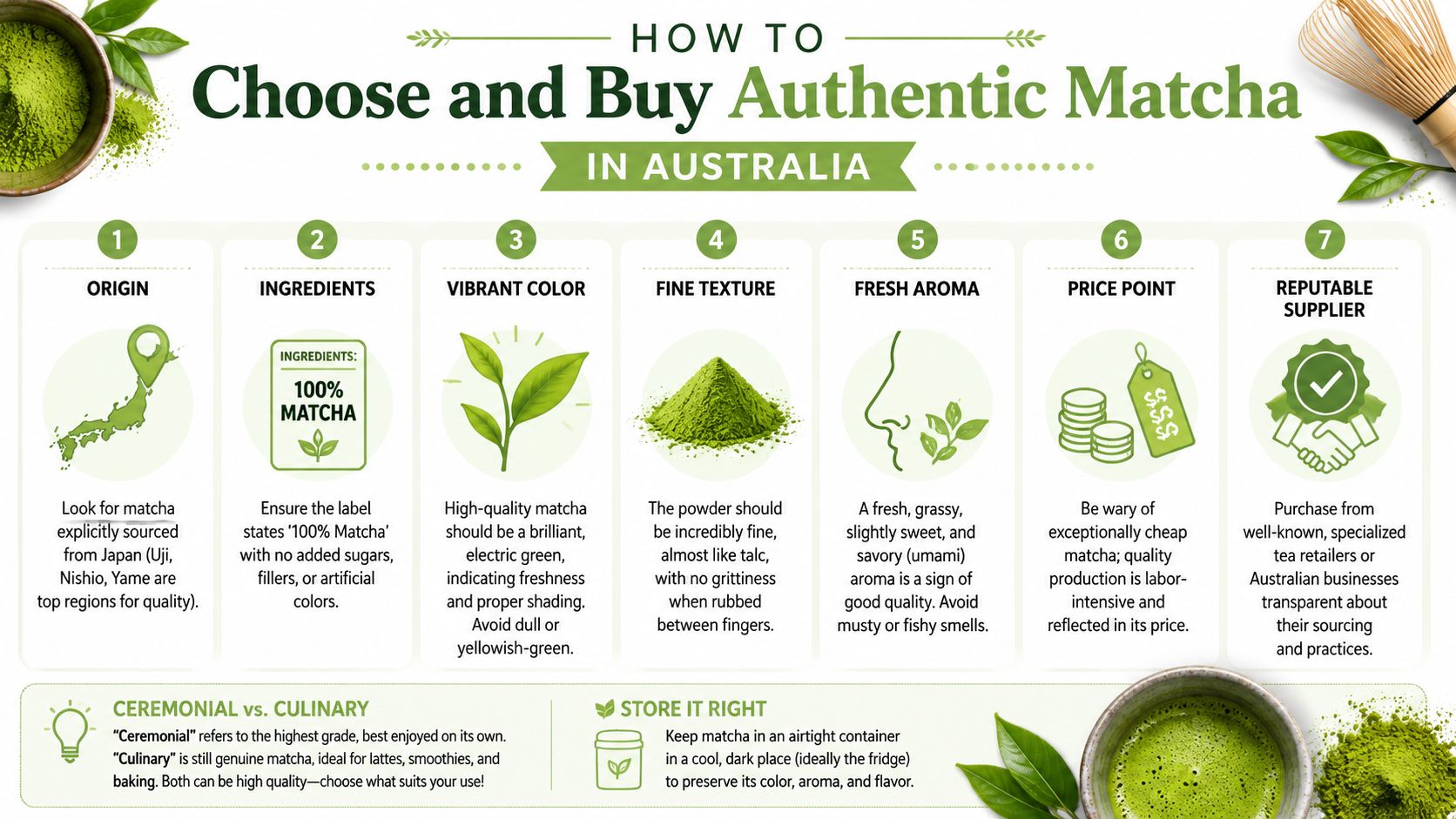
Use this buying checklist when comparing tins online or in store:
- Origin matters: Look for matcha sourced from Japan.
- Ingredient list: It should say 100% matcha. No fillers, sugars, or flavouring if you want a pure product.
- Colour check: Fresh, high-quality matcha should look bright and lively, not flat or brownish.
- Texture clue: Fine powder usually signals better milling and a smoother cup.
- Aroma test: Fresh matcha should smell grassy, clean, and slightly savoury.
- Packaging: Airtight tins or well-sealed packs help protect freshness.
- Seller transparency: Good retailers usually tell you where the matcha comes from and how it's meant to be used.
What to avoid
A few red flags show up again and again:
| Sign | Why it matters |
|---|---|
| Dull, khaki, or brown-leaning powder | Often points to age, poor handling, or lower quality leaf material |
| No origin information | Makes it hard to assess authenticity |
| Vague “superfood blend” wording | May mean it isn't pure matcha |
| A very cheap price with premium claims | Can signal mismatch between marketing and quality |
Storage matters after purchase too. Matcha loses its best character when exposed to air, light, heat, and moisture. Keep it sealed, cool, and out of direct light. If you buy it for plain drinking, freshness becomes even more important.
For a broader look at buying quality tea online, organic green tea online can help you compare what trustworthy tea retailers tend to disclose.
Your Matcha Questions Answered
Can I drink culinary matcha plain
Yes. You can whisk culinary matcha with water and drink it on its own.
The catch is expectation. If you want a soft, creamy bowl with gentle sweetness, culinary matcha can feel sharper, more bitter, or a bit more drying on the palate. If you already enjoy stronger green tea flavours, though, plain culinary matcha may suit you just fine.
Is ceremonial matcha always better
Use decides what “better” means.
This is the part many shoppers miss. “Ceremonial” and “culinary” are not official Japanese grades sitting on a legal ladder from best to worst. In Australia and other Western markets, they are usually shorthand for intended use. Ceremonial usually points to matcha chosen for drinking with water. Culinary usually points to matcha chosen for lattes, smoothies, desserts, and baking.
So if you are making usucha at home, ceremonial-style matcha often gives a smoother result. If you are blending with milk, chocolate, banana, or vanilla, culinary matcha is often the smarter buy because its bolder character still comes through.
Is more expensive matcha always worth it
Price matters most when the matcha is the whole show.
In a plain bowl, you can notice the finer texture, sweeter aroma, and cleaner finish that often come with a better matcha. In a banana smoothie or brownie batter, those subtleties can disappear quickly. Paying more only makes sense if your preparation lets you taste what you paid for.
What's the easiest way to choose between ceremonial vs culinary matcha
Start with your cup, not the label.
Ask yourself, “Will I mostly drink this with water, or with other ingredients?” That one question clears up a lot of confusion. Water-first drinkers should usually choose ceremonial-style matcha. Latte and recipe fans should usually choose culinary-style matcha.
How should I store matcha once opened
Keep it tightly sealed and away from light, air, heat, and moisture.
A cool cupboard is usually enough. If you store it in the fridge, use a very well-sealed container and let it come back to room temperature before opening. That helps stop condensation from settling into the powder.
Is it worth keeping both at home
For plenty of households, yes.
A small tin for straight whisking and a separate pouch for lattes or baking is a practical setup. It is a bit like keeping one olive oil for finishing and another for cooking. You use each one where it performs best, and you waste less money trying to make one product do every job.
What's the biggest mistake beginners make
Treating “ceremonial” as proof of quality all by itself.
A better approach is to read the full picture. Look at intended use, origin, freshness, colour, texture, and how clearly the seller explains the product. A trustworthy matcha listing should help you choose the right powder for your habits, not just wave a premium label around.
If you're ready to try both styles with confidence, explore Pep Tea for premium organic Japanese matcha and a broader range of functional organic drinks, including Australian-brewed sugar-free kombucha from the Hunter Valley, NSW.
Matcha Collagen Powder: Your 2026 Australian Guide

You're probably here because your routine already feels crowded. Maybe you've got a tin of matcha in the pantry, a collagen tub on the bench, a half-finished smoothie plan in your head, and a genuine desire to feel better without turning breakfast into a chemistry set.
That's exactly why matcha collagen powder has caught on with health-conscious Australians. It brings together two habits people were already building separately. One for steady, cleaner-feeling energy. One for skin, joints, and everyday support. Put them together in one scoop, and the ritual gets simpler.
The appeal isn't just convenience. It's also about choosing functional ingredients that still feel like food and drink, not a chore. For people juggling work, training, family life, café catch-ups, and a growing interest in low-sugar wellness, matcha collagen powder lands in a sweet spot.
The New Centrepiece of Your Wellness Routine
A lot of people don't need more supplements. They need fewer moving parts.
Think about a typical weekday. You wake up wanting focus, but not the shaky edge that can come from overdoing coffee. By lunchtime, you're also thinking about bigger picture goals like supporting your skin, keeping joints comfortable, or building a routine you'll stick to. Matcha collagen powder fits neatly into that moment because it turns two separate intentions into one daily habit.
For some people, that habit looks like a warm morning latte before work. For others, it's a smoothie after a walk, a gym session, or the school drop-off. The format is flexible, and that matters. Wellness routines only work when they can survive real life.
Why this blend feels different
Matcha already has a strong following in Australia because it offers a more mindful kind of lift. Collagen has become popular for similar reasons. It feels practical, easy to add, and connected to long-term wellbeing rather than quick-fix energy. Together, they create a modern ritual that suits people who want both focus and support in the same cup.
Matcha collagen powder works best when it replaces friction, not when it adds another complicated step to your day.
It also suits the way many people now shop and ask questions. They want cleaner labels, fewer fillers, and straightforward explanations. Brands in wellness are paying more attention to that demand, and tools like a Shopify chatbot for wellness brands show how much education matters when customers are choosing between ingredients, formats, and claims.
Who usually loves it most
A matcha collagen routine often appeals to:
- Busy professionals: They want a calm, organised start rather than a harsh caffeine spike.
- Active adults: They like a product that feels supportive without becoming a full supplement stack.
- Café regulars and home baristas: They enjoy the ritual of whisking, blending, and sipping something that feels premium.
- People cutting back on sugar: They're looking for functional drinks that don't taste like dessert disguised as wellness.
That blend of practicality and ritual is why matcha collagen powder has become more than a trend. For many people, it becomes the thing they actually use consistently.
How Matcha and Collagen Work Better Together
The simplest way to understand matcha collagen powder is to think of it as a team effort.
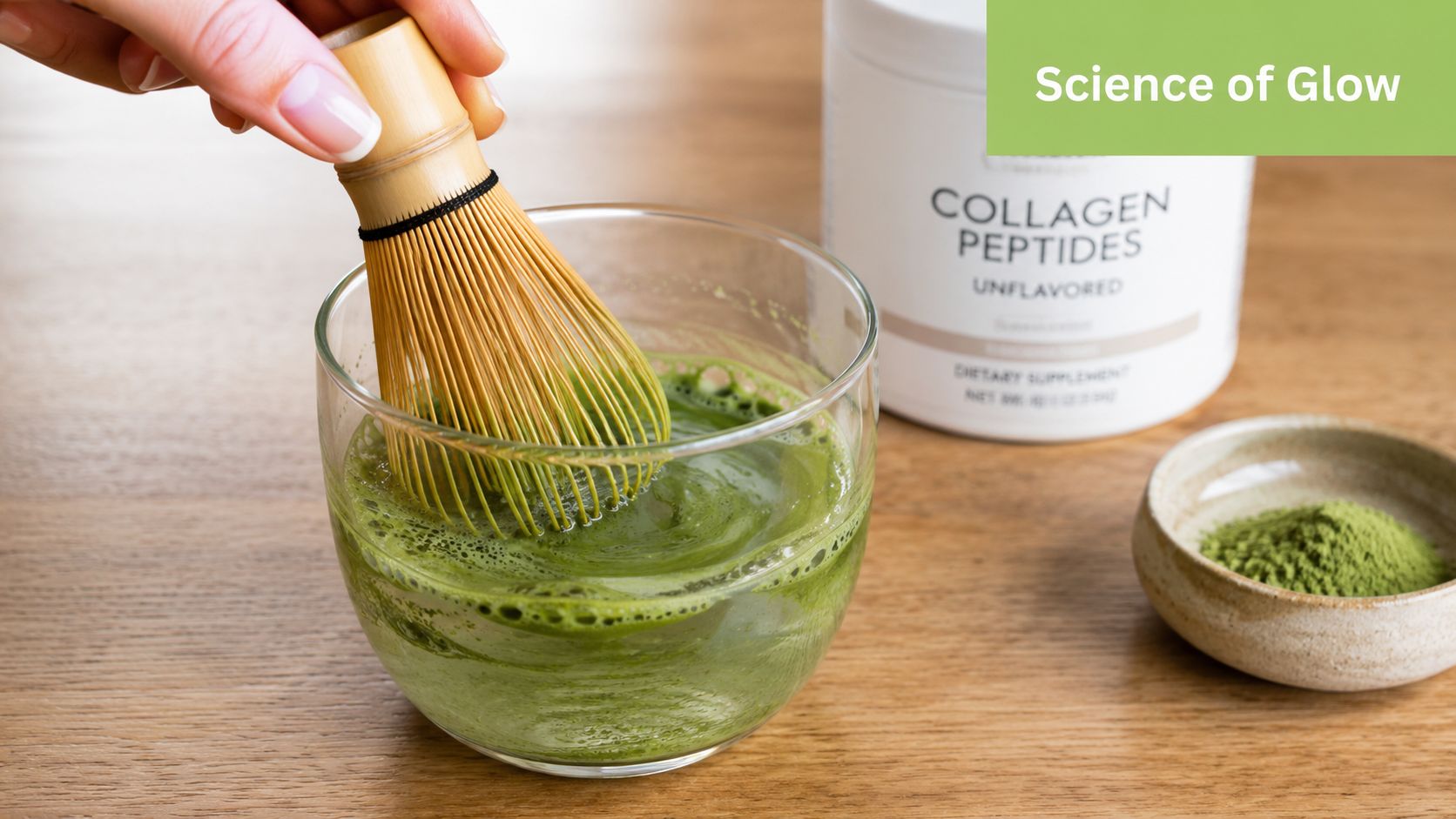
Collagen peptides do the rebuilding work. They provide amino acids such as glycine, lysine, and proline, which the body uses for structural repair. Matcha brings the protective side. Its catechins, especially EGCG, help defend against oxidative stress that can damage collagen before the body can make good use of it. According to NIH technical data, oral collagen supplementation increased skin elasticity by 13.6% within 8 weeks, and matcha collagen powder is described as leveraging a synergistic mechanism where matcha's catechins inhibit oxidative degradation of collagen peptides while the peptides supply those structural amino acids.
The construction crew analogy
Picture a building site.
The collagen peptides are the construction crew. They arrive with the raw materials needed for repair and maintenance. The matcha antioxidants are the security team around the site. They protect the crew and the materials from damage while the work is happening. Without that protection, the environment is tougher. With it, the repair job has a better chance of staying on track.
That's the key idea behind the blend. It isn't just two fashionable ingredients sharing a label. Each one does a different job.
Why the pairing makes sense in real life
The science offers practical benefits. People usually notice matcha first because of how it feels. Smoother focus. A cleaner ritual. Less of the wired feeling some get from stronger stimulant drinks. Collagen is less noticeable in the moment, but people choose it because they want ongoing support, not just a quick lift.
When those two needs come together, the product becomes easier to use consistently.
A few quality factors also shape how effective and pleasant it feels:
- Japanese matcha matters: Higher-quality matcha tends to bring a cleaner taste and a better everyday drinking experience.
- Hydrolysed collagen matters: This form is processed for easier mixing and absorption.
- Low-clump solubility matters: If a powder blends smoothly, people keep using it.
Practical rule: If your matcha collagen powder tastes grassy in a harsh way, forms stubborn lumps, or leaves you avoiding it after a week, the formula probably isn't doing the ritual side of wellness any favours.
If you want a stronger grounding in the tea side of the equation, this guide on what matcha powder is helps explain why shade-growing, stone-grinding, and grade all influence flavour and function.
Matcha Collagen Versus The Alternatives
A fair question comes up all the time. Why not just drink matcha on its own and take collagen separately?
You can. For some people, that's the right setup. But a combined powder changes the experience in a few useful ways. It reduces prep, keeps the flavour profile in one place, and gives you a more efficient habit to repeat each day.
The other important point is ingredient quality. Organic Japanese Matcha contains 137 times the concentration of antioxidants compared to standard brewed green tea, according to this matcha and collagen overview. That's one reason matcha isn't interchangeable with every green tea-flavoured powder on the shelf.
The side-by-side view
| Factor | Matcha Collagen Powder | Matcha Only | Collagen Only |
|---|---|---|---|
| Convenience | One scoop, one routine | Simple drink, but no collagen built in | Easy to add, but usually needs a separate drink |
| Functional range | Combines focus ritual with collagen support | Best if your priority is tea ritual and antioxidants | Best if your priority is collagen alone |
| Taste experience | Can be balanced into one formula | Pure tea flavour, often more vibrant | Usually neutral, but not especially enjoyable on its own |
| Daily consistency | Easier for many people to repeat | Strong if you already love preparing matcha | Strong if you already use collagen every day |
| Flexibility | Good for lattes, smoothies, and recipes | Excellent for traditional tea and café-style drinks | Easy to hide in foods and drinks |
| Who it suits | People who want fewer steps | Matcha purists | People who don't care about tea flavour or ritual |
Where separate products still make sense
Separate products can work well if you're very particular about both ingredients.
A traditional matcha drinker might want ceremonial matcha on its own, prepared carefully with water only. Someone else may prefer an unflavoured collagen they can stir into oats, soups, or baking. That approach offers control, especially if you like adjusting flavour and dosage independently.
Still, there's a reason combined formulas appeal to busy households and cafés. One product often means less mess, fewer decisions, and a clearer habit loop.
The real decision point
This usually comes down to your main goal.
Choose a combined powder if you want:
- Less friction: One product is easier to remember than two.
- A built-in ritual: It turns support ingredients into something enjoyable to drink.
- A café-friendly format: It works well in lattes and smoothies without extra steps.
Choose separate products if you want:
- Maximum customisation: You can change your tea and collagen independently.
- Pure matcha sessions: Useful if you care a lot about traditional preparation.
- Different use cases: You may want collagen in food and matcha only as tea.
People who are also reviewing broader protein options may find this guide to protein powder substitutes useful when thinking about how collagen blends compare with other pantry staples.
In short, matcha collagen powder isn't automatically better than separate products. It's better for the person who values ease, consistency, and a two-in-one routine they'll maintain.
A Buyer's Guide to Quality Powder
The label on the front rarely tells the full story.
Matcha collagen powder can look premium and still disappoint once you open it. Some blends taste flat. Some hide sweeteners or fillers. Some use vague sourcing language that sounds reassuring without telling you where the matcha came from, how it was processed, or what kind of collagen is present.
That's why quality matters more here than in many other wellness powders. You're paying for both the tea and the collagen. If either side is weak, the blend won't earn a place in your routine.
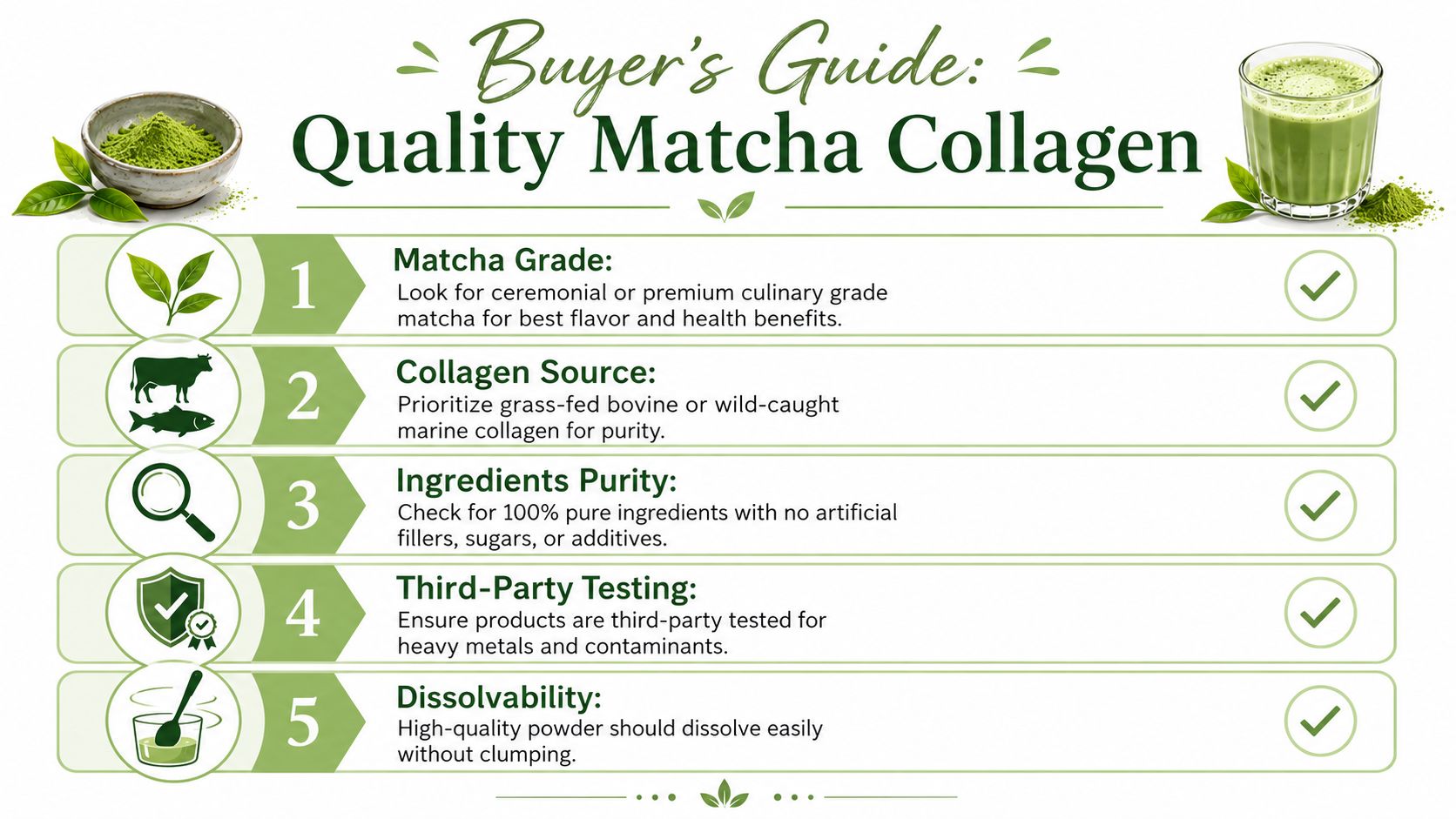
What to check before you buy
A good formula should answer basic questions clearly.
- Matcha grade: Look for ceremonial or premium culinary grade if you want better flavour and a smoother drinking experience.
- Collagen source: The label should identify whether the collagen is bovine or marine, not leave it vague.
- Hydrolysed form: Hydrolysed collagen generally dissolves more easily and suits drinks better.
- Ingredient purity: A shorter ingredient list is usually easier to trust.
- Testing and transparency: If a brand talks about purity, it should be willing to show how it checks for it.
The Australian quality issue many people miss
One of the least discussed parts of this category is authenticity versus appearance. A powder can look bright green and still fail the deeper quality test.
According to Australian Food Standards Authority data, 34% of imported “ceremonial grade” matcha powders in the Australian market exceed heavy metal thresholds, while many Australian organic matcha brands meet strict EGCg retention standards above 120mg/g. That's a serious reminder to look for origin details, processing transparency, and testing, not just attractive packaging.
If a brand won't tell you where the matcha was grown or how the powder was processed, that silence is part of the product.
Processing affects what you're drinking. Overheated or poorly handled matcha can lose the qualities buyers assume they're getting. The same goes for collagen. If the source isn't identified, you can't make an informed choice about allergens, flavour, or personal preference.
A simple checklist for shoppers
Use this quick filter when you compare products:
- Can you identify the matcha origin clearly?
- Does the brand specify marine or bovine collagen?
- Is the powder free from obvious fillers, sugars, and unnecessary additives?
- Is there any sign of third-party testing or contaminant screening?
- Will it dissolve cleanly in hot or cold drinks?
If you want a stronger understanding of how tea grades affect quality, colour, flavour, and value, this guide to grade and quality matcha tea is worth bookmarking.
A smart buyer doesn't just ask whether a powder contains matcha and collagen. They ask whether the matcha is authentic, whether the collagen is clear and traceable, and whether the product is transparent enough to trust.
How to Use Matcha Collagen Every Day
The easiest routine is usually the one that sticks.
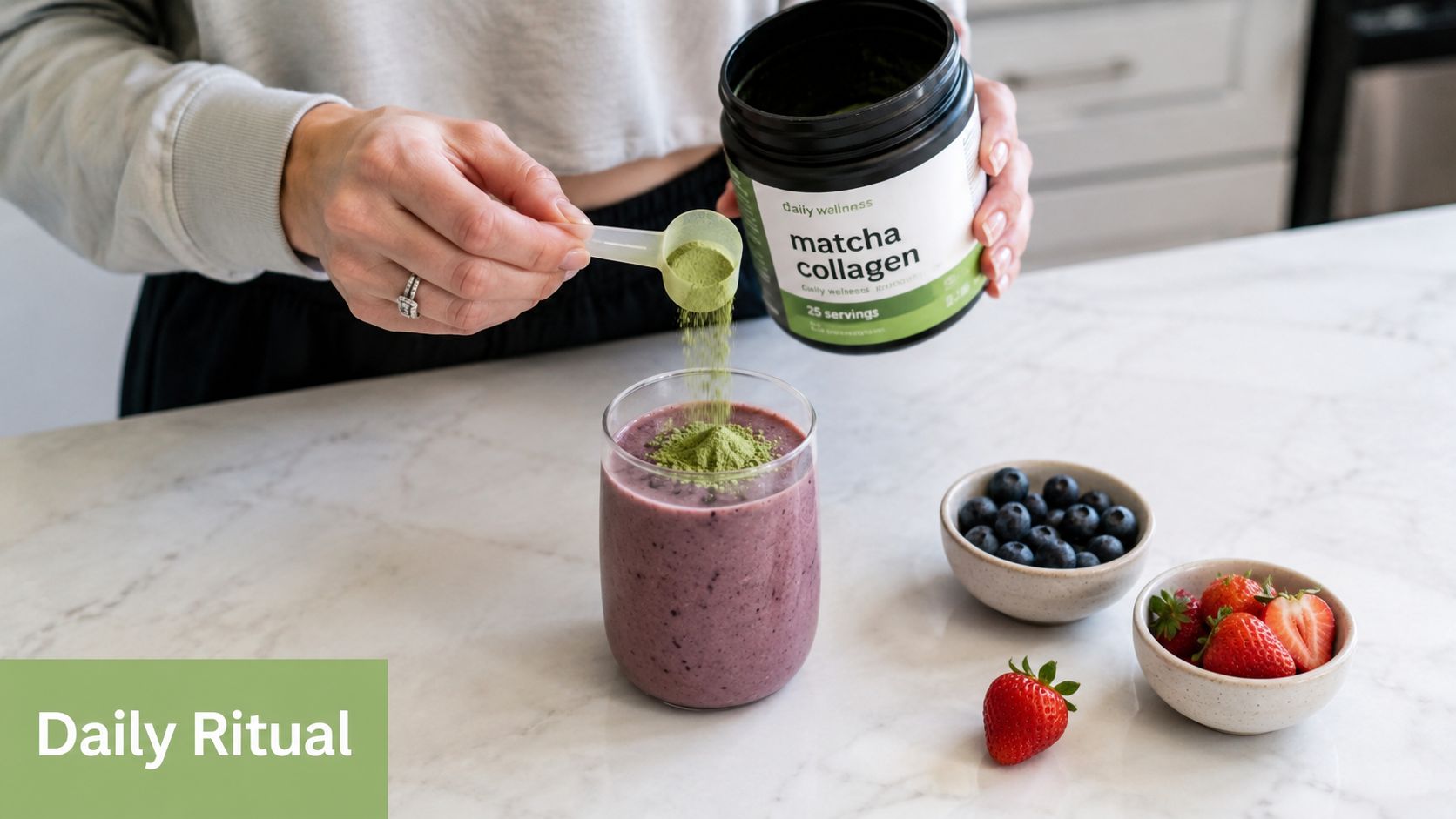
For matcha collagen powder, that means keeping preparation simple and using it in drinks or foods you already enjoy. In Australia, the standard daily dosage is 10 to 15 grams, delivering roughly 8 to 10 grams of hydrolysed collagen peptides and around 50mg of caffeine per serving, which is described as the industry benchmark for efficacy in TGA-linked guidance.
Best times to have it
There isn't one perfect time for everyone, but a few patterns work well.
- Morning: Great if you want a gentle start with calm focus.
- Late morning: Useful as a bridge between breakfast and lunch.
- Early afternoon: Handy when you want something lighter than another coffee.
If you're sensitive to caffeine, earlier is usually better. Even though matcha often feels smoother than coffee, it still contains caffeine.
Three easy ways to use it
Warm matcha collagen latte
This is the most natural starting point.
- Add your serve of matcha collagen powder to a cup.
- Mix with a small amount of warm water first to form a smooth paste.
- Top with warm milk or your preferred dairy-free option.
- Whisk or froth until silky.
A paste-first method helps prevent lumps and gives a more café-style finish.
Smoothie upgrade
A smoothie makes sense if you already have a blender routine.
Try blending:
- Your matcha collagen serve
- A banana or mild fruit
- Milk or a dairy-free base
- Ice
- Optional extras like spinach or nut butter if they suit your taste
For more ideas around this format, see this matcha protein shake guide, which can spark flavour combinations and prep shortcuts.
No-bake snacks or baking
Matcha collagen powder doesn't have to stay in a mug.
It can work in:
- Energy balls: Mix with oats, nut butter, and seeds.
- Muffins: Add to dry ingredients for a subtle green tea note.
- Yoghurt bowls: Stir in for a quick breakfast upgrade.
Kitchen tip: Start with less than you think you need in recipes. Matcha's flavour can become too assertive if the rest of the ingredients are mild.
A quick visual can help if you're still figuring out technique:
Storage and prep habits that help
Keep the powder sealed, dry, and out of direct heat. Matcha is delicate, and poor storage can dull both flavour and freshness.
A few practical habits make a noticeable difference:
- Use a dry scoop: Moisture encourages clumping.
- Whisk with a small amount first: This gives a smoother texture.
- Don't overcomplicate it: If your weekday method is too fussy, simplify it.
The best daily use isn't the most elaborate one. It's the version you can repeat on a Monday morning when you're short on time and still want something that feels good to drink.
For Australian Cafés and Retailers
For cafés, matcha collagen powder works best when it's treated as a menu idea, not just an ingredient. Customers already understand matcha. Many also recognise collagen. Bringing the two together gives staff a simple story to tell and gives customers an easy reason to try something new.
That's especially useful on menus built around low-sugar, functional, non-alcoholic options. A well-made matcha collagen drink can sit comfortably beside kombucha, smoothies, and specialty tea lattes without feeling gimmicky.

Menu ideas that are easy to sell
A few formats are especially approachable:
- Glow latte: A warm matcha collagen latte with a silky finish and simple wellness positioning.
- Smoothie booster: Offer it as an add-on for green smoothies or fruit blends.
- Wellness shot: A small-format functional serve for customers who want convenience.
- Retail shelf add-on: Place packaged powder near takeaway counters or fridge displays.
- Recipe cards: Give customers an idea for using it at home, not just in-store.
What makes it work commercially
Staff education matters more than long menu descriptions. If the team can explain taste, texture, and use in plain language, customers are far more likely to trust the recommendation.
Retailers can also benefit by merchandising it near adjacent categories. Matcha drinkers often browse tea tools, latte ingredients, and wellness pantry items. Shoppers interested in functional beverages may also be exploring kombucha, low-sugar café options, and home smoothie upgrades.
A product sells more easily when customers can picture tomorrow morning, not just admire the label today.
For Australian venues, the category also fits broader menu shifts toward mindful drinking and premium non-alcoholic choices. It gives cafés something fresh to offer without leaving the comfort zone of drinks customers already understand.
Frequently Asked Questions
Some of the most useful questions about matcha collagen powder aren't about flavour. They're about compatibility, expectations, and the details many brands skip.
Can I mix matcha collagen with kombucha
This is one of the most overlooked questions in the category.
A growing query on Australian wellness forums asks, “Can I mix matcha collagen with my daily kombucha without killing the probiotics?” According to IBISWorld Australia-linked discussion of the category, it's a key unanswered question, and heat plus preparation method can be a factor. In plain terms, collagen peptides are generally stable, but probiotic drinks are more delicate. If you want to combine them, avoid high heat and use a properly fermented kombucha rather than treating every fizzy fermented drink as equal.
Will I notice results quickly
Some people notice the ritual benefits first. Better routine. Easier mornings. A more satisfying alternative to another sugary or overly strong drink.
Physical changes are usually a consistency game. If you're using the product sporadically, it's harder to judge anything fairly. A daily habit gives you the clearest read.
Is marine or bovine collagen better
Neither is universally “better”. It depends on your preferences.
Marine collagen may appeal to people who avoid bovine products. Bovine collagen may appeal to people looking for a different sourcing option or flavour profile. The key is that the source should be named clearly on the label so you can choose deliberately.
Are there any downsides
There can be. Some people don't enjoy the taste of low-quality matcha blends. Others may be sensitive to caffeine, even in a gentler format. And some products contain too many extras.
That's why the smartest approach is to start with a transparent formula, use the recommended serve, and pay attention to how it fits your own routine.
Why do so many product pages feel vague
Because this category often gets marketed around broad ideas like glow, energy, and clean living while skipping practical detail. That's exactly why readers spend time in frequently asked questions sections across wellness brands. People want straight answers on mixing, taste, sourcing, and what a product does in daily life.
The best matcha collagen powder isn't the one with the most polished label. It's the one that tells you what's in it, where it came from, how to use it, and why that should matter to you.
If you're ready to bring more clarity to your daily ritual, explore Pep Tea for premium organic matcha, Australian-brewed sugar-free kombucha, and practical guidance that makes functional drinks feel simple, trustworthy, and enjoyable.
Organic Green Tea Leaves: Your Ultimate Aussie Guide

You pick up one box for a calming cup after dinner, then another for smoothies or baking, and suddenly the label words start blurring together. Organic. Natural. Pure. Premium. They sound reassuring, but they do not all tell you the same thing.
That's where many Australian tea drinkers get stuck.
Organic green tea leaves can be a lovely choice, but the practical question is simpler than the marketing. Are you looking at a tea that merely uses the word organic, or one that has been checked against recognised standards? In Australia, that difference matters because certified organic gives you something concrete. It means the growing and handling process has been assessed against defined rules, rather than left as a vague brand promise. If you want a clearer picture of what those rules involve, PepTea explains the basics of Australian organic certification standards for tea.
That distinction helps at shelf level. A certified organic loose leaf tea may suit your everyday ritual when you want a clean, steady cup with clear origin and careful processing. A brighter, more assertive green tea might be the better pick for iced tea, matcha-style drinks, or cooking, where flavour needs to hold up with milk, citrus, or heat. The leaf you choose should match how you will use it.
Health interest is part of the appeal, of course, but green tea is not magic in a packet. Its reputation comes from naturally occurring plant compounds such as polyphenols, including catechins like EGCG, alongside the way the leaf is grown, processed, and stored. Good tea is a bit like good produce from the farmers market. The ingredient matters, and so does the proof behind it.

Your Journey into the World of Green Tea
A good place to start is this. Green tea isn't one single thing.
Two packets can both say green tea and deliver completely different experiences in the cup. One might be brisk and refreshing. Another might be silky, savoury, and naturally sweet. That difference comes from growing conditions, harvesting, processing, storage, and whether the tea is sold as whole leaf, broken leaf, or powder.
Why people get stuck
Most shoppers aren't confused because tea is complicated. They're confused because labels blur together.
Words like organic, natural, clean, and premium often sit side by side, even though they don't mean the same thing. If you're trying to choose a tea for a calm daily ritual, a morning lift, or a matcha latte, those details matter. The right tea feels simple. The wrong one ends up at the back of the pantry.
Tea gets easier to buy once you stop asking “Which one is healthiest?” and start asking “Which leaf suits the way I'll actually use it?”
A more useful way to think about green tea
Instead of treating all green tea as one bucket, think about three practical questions:
- How will I drink it most often. A quick weekday cup, a slow whisked matcha, or an iced drink after lunch.
- What flavour do I enjoy. Fresh and grassy, sweet and umami-rich, or bold enough for smoothies and baking.
- What proof of quality do I want. Certified organic status, whole leaf appearance, clear origin, and careful storage.
That shift changes everything. You stop buying based on front-of-pack promises and start buying based on fit.
What matters most in this guide
If you remember only one idea, make it this. Organic green tea leaves are most useful when you match the leaf to the job.
A calming daily cup isn't the same as a culinary ingredient. A tea you steep gently in a mug isn't the same as one you whisk into a latte. And in Australia, the difference between a loose organic-style claim and a properly certified organic product matters for safety, sourcing, and trust.
What Makes Green Tea Leaves Truly Organic in Australia
You see two packs on the shelf. One says organic in big green letters. The other says certified organic and gives clear details about the standard behind the claim. They may look similar, but they are not offering the same level of proof.
That distinction matters in Australia because tea is sold as a food product, not just a wellness item. Products sold here must meet the Australia New Zealand Food Standards Code for food safety and contaminant limits. Organic claims also sit within a recognised regulatory framework, as explained in this review of regulation and standards relevant to tea and food products.
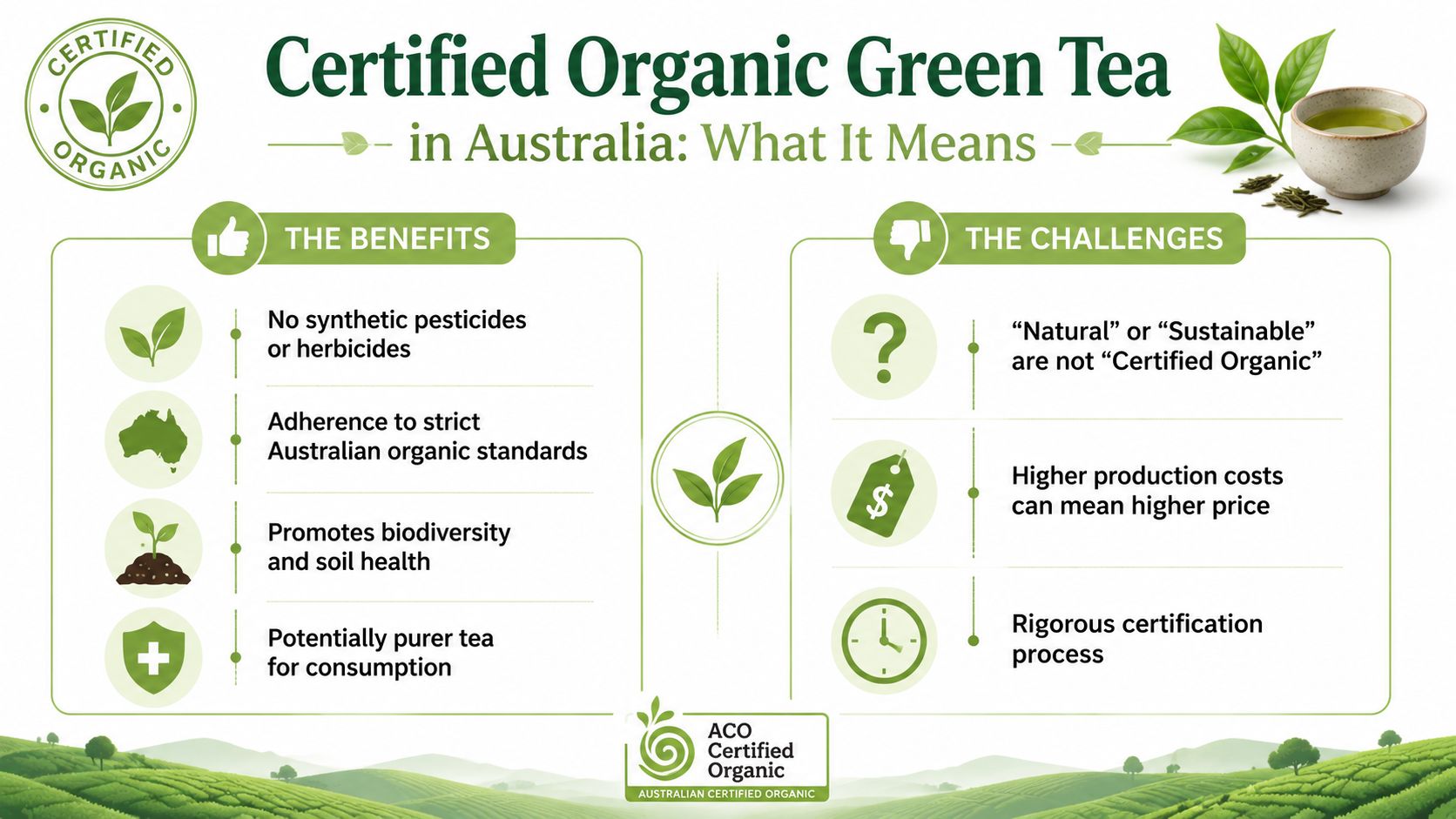
Organic and certified organic are not interchangeable
This is the point that catches many Australian tea buyers.
In everyday conversation, organic often means clean, natural, or grown with care. On a label, certified organic means the product has gone through a documented system of standards, checks, and verification. That includes rules around synthetic pesticides, herbicides, and fertilisers, plus record-keeping through the supply chain.
A simple way to read it is this. “Organic” can sound like a promise. “Certified organic” gives you something to verify.
If you want a closer look at how that works at brand level, Pep Tea explains the process in its guide to organic certification standards for tea in Australia.
Why that difference changes your buying decision
For a calm daily cup, certification helps answer a basic question. Has someone checked the claim, or am I just reading attractive packaging?
For matcha, the answer matters even more because you consume the whole powdered leaf rather than just an infusion. For culinary use, such as smoothies, baking, or lattes, a certified product can give more confidence about how the tea was grown and handled before it reached your kitchen.
That does not mean every non-certified tea is poor quality. It means certified organic gives you a clearer paper trail. In a category filled with soft marketing words, that clarity is useful.
What to look for on the label
A good tea label should help you choose without guesswork. If the pack is vague, treat that as a signal to slow down.
Look for:
- Certified organic wording linked to a recognised standard or certifier.
- Clear country of origin so you know where the leaf was grown.
- Packing or supplier information that tells you who is responsible for importing or selling it in Australia.
- Plain-language quality details about sourcing, testing, or handling.
This is less glamorous than reading tasting notes, but it is often more helpful.
Safety is part of quality
Tea advice often jumps straight to antioxidants, flavour, or caffeine. Sensible buyers also ask about residues, contaminants, and packaging.
That is where certified organic becomes practical rather than abstract. It supports tighter supplier verification and better traceability. If you are choosing a tea for everyday drinking, that can make the difference between a product that sounds wholesome and one backed by a clearer standard.
Loose leaf can also be a sensible option if you want more control over what ends up in the cup. It lets you inspect the leaf more easily, adjust the amount you brew, and avoid some of the unknowns that can come with low-quality bagged tea.
A useful rule: ask for proof, not mood. Certified organic, clear origin, and visible supplier accountability tell you much more than earthy colours and words like “pure” or “clean.”
A practical way to choose
If you want a reliable everyday green tea, start with certified organic loose leaf from a supplier that explains origin and handling clearly. If you want a vivid tea for cooking or whisking, apply the same test, but pay closer attention to whether the product suits full-leaf use, as with matcha.
This highlights the value of understanding organic tea in Australia. You move from broad health claims to concrete choices that fit how you drink tea.
A Guide to Popular Organic Green Tea Types
Once you know what organic means, the next question is more enjoyable. Which kind of green tea do you want to drink?
Japanese green teas are a great place to learn because the differences are easy to taste. Three styles come up again and again. Sencha, Gyokuro, and Matcha. They all come from the tea plant, but how they're grown and processed changes the flavour and the experience.
Sencha for everyday drinking
Sencha is the green tea many people meet first. It's usually sun-grown, then steamed, rolled, and dried. The flavour tends to feel lively and fresh, with a balance of sweetness, grassiness, and a little briskness.
If you want a tea for your work mug, your afternoon reset, or an iced green tea in summer, Sencha is often the easiest place to start. It feels familiar quite quickly.
Gyokuro for a softer, sweeter cup
Gyokuro is shade-grown before harvest. That matters because shading tea plants increases chlorophyll and L-theanine, producing a sweeter, less bitter leaf, as described in this guide to organic loose-leaf green tea styles and handling.
The cup is usually more savoury and umami-rich than Sencha. Less sharp. More rounded. If Sencha is a bright conversation, Gyokuro is a quieter one.
Matcha for full-leaf drinking and versatility
Matcha is also shade-grown, but instead of steeping the leaves and removing them, the leaf is processed into a fine powder and whisked into water. You're drinking the tea itself, not just an infusion.
That makes Matcha particularly useful if you want one tea that can move across rituals and recipes. A traditional bowl in the morning. A latte after lunch. A baking ingredient on the weekend.
If you're deciding between styles, Pep Tea's explainer on the difference between Matcha, green tea and green tea helps sort out the common confusion.
Organic Green Tea Comparison
| Tea Type | Processing | Flavour Profile | Best For |
|---|---|---|---|
| Sencha | Sun-grown leaves, steamed and rolled | Fresh, grassy, lightly sweet, sometimes brisk | Daily cups, iced tea, easy entry into green tea |
| Gyokuro | Shade-grown before harvest, then processed as loose leaf | Sweet, umami-rich, softer, less bitter | Slow sipping, a calming ritual, refined tasting |
| Matcha | Shade-grown leaves processed into fine powder and whisked | Creamy, vegetal, savoury, can be sweet if high quality | Ceremonial drinking, lattes, smoothies, baking |
Which one suits your day
Here's the easiest shortcut.
- Choose Sencha if you want a straightforward loose-leaf tea you can brew without much fuss.
- Reach for Gyokuro if bitterness puts you off and you enjoy a sweeter, more layered cup.
- Pick Matcha if you want versatility and don't mind a more hands-on preparation.
Whole-leaf quality and uniformity usually signal better handling. That matters more than flashy packaging when you're buying for flavour and consistency.
A lot of Australians now use green tea in lattes, desserts, and non-alcoholic menus, so this isn't just about tradition. It's about function. The tea you choose should fit the job.
The Science of Wellness in Every Leaf
You brew a cup after dinner, take that first sip, and feel your shoulders drop a little. That everyday moment is where green tea's wellness story makes the most sense. The value is not in vague health promises. It is in what is in the leaf, how it is grown, and whether you can trust what the label says.
The chemistry of green tea starts with polyphenols, a group of plant compounds that help protect the leaf itself. Among them, catechins get the most attention, especially EGCG, short for epigallocatechin gallate. You do not need to remember the full name. The practical point is simple. Fresh, well-handled green tea contains natural compounds that are widely studied for their antioxidant activity.
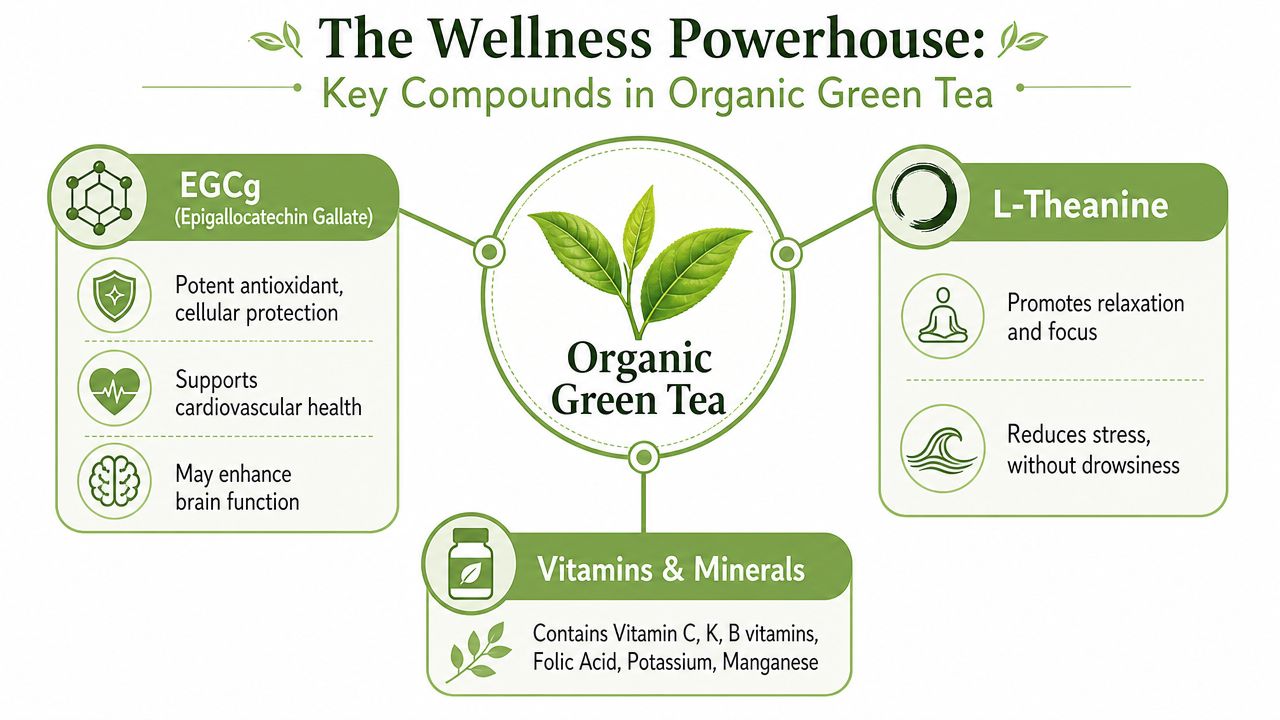
Why one green tea can feel different from another
Green tea is not a single experience.
A brisk sencha for your daily mug and a smooth, shaded matcha for a slow morning can affect you differently because the balance of compounds changes with cultivar, growing conditions, shading, harvest timing, and processing. That is one reason quality matters so much. If a seller uses “organic” loosely, you still do not know much about residues, handling, or consistency. In Australia, certified organic gives you a clearer standard to trust, which matters even more if you are consuming the whole leaf in powdered tea like matcha.
Another compound worth knowing is L-theanine, a naturally occurring amino acid found in tea. It is often linked with the calm, steady feeling many tea drinkers describe, especially in shaded teas such as Matcha and Gyokuro. Coffee can feel like a floodlight. Green tea often feels more like a lamp on your desk. You are awake, but not pushed around.
What research suggests, and what it does not
Large observational studies have linked regular tea drinking with positive long-term health patterns, including heart and metabolic health, as summarised in Harvard's overview of tea and population research.
That does not mean green tea acts like a prescription or guarantees a specific outcome. Observational research shows associations, not proof of cause and effect. Still, the pattern is encouraging enough to support a sensible takeaway. A consistent tea habit can sit comfortably inside a healthy lifestyle.
How to turn that science into a useful choice
People often get stuck. They hear “antioxidants” and “wellness” and still do not know what to buy.
Start with your real use case. If you want a calming daily cup, choose a certified organic loose-leaf tea you enjoy drinking regularly, because consistency beats perfection. If you want a vibrant ingredient for smoothies, lattes, or baking, certified organic matcha makes more sense because you are consuming the entire leaf. That is also where clean sourcing matters most. At PepTea, that quality focus is part of the job, not a marketing flourish.
One good cup a day is plenty for many people. Brew it well, choose certified organic when safety and residue standards matter to you, and let the habit do the quiet work.
How to Choose and Store Quality Green Tea
You bring home a tea that looked promising on the shelf, then a week later it tastes flat, dusty, or oddly dull. That usually comes down to two things. What you bought, and how you stored it.
Choosing well starts before the first sip. In Australia, one of the clearest quality signals is the difference between tea labelled organic and tea that is certified organic. The first can sound reassuring. The second gives you a standard that can be checked, which matters if you want confidence about how the leaves were grown and handled. At PepTea, that focus on verified quality is part of the selection process, especially for teas people drink often or use in recipes where the leaf plays a bigger role.
What to look for when buying
Good green tea should give off signs of life.
Colour is your first clue. Loose-leaf green tea should look fresh and clean, with greens that suit the style of tea rather than browns that suggest age or poor storage. Matcha should look bright and lively. If it resembles faded lawn clippings, it will usually taste the same way.
Then look at the leaf itself. Even size and careful rolling or shaping suggest more attentive processing. A bag full of broken bits and dust can still make a drinkable cup, but it often loses aroma faster and brews less cleanly.
Smell matters too. Fresh green tea often carries grassy, sweet, nutty, marine, or soft umami notes. A stale tea smells papery, musty, or tired, a bit like opening an old pantry packet that has been forgotten at the back of the shelf.
Questions worth asking before you buy
A good seller should be able to answer plain, practical questions without hiding behind fancy language.
- Is this certified organic, or only described as organic?
- Where was it packed, and how fresh is the current batch?
- Is it better for daily drinking, or for cooking and matcha-based recipes?
- Should I buy loose leaf, tea bags, or matcha for the way I use tea?
- What storage advice do you give after opening?
These questions help you match the tea to the job. A calming daily cup and a vibrant ingredient for baking or lattes are not always the same purchase.
Match the tea to your use
This part helps people avoid expensive mistakes.
If you want a reliable everyday tea, choose a certified organic loose-leaf green tea with an aroma and flavour profile you enjoy. You are far more likely to brew it regularly, and regular enjoyment beats buying a fancy tea that sits untouched in the cupboard.
If you want green tea for smoothies, desserts, iced drinks, or matcha lattes, certified organic matcha makes more sense. You are using the whole powdered leaf, so clean sourcing and careful storage matter even more. Culinary use also calls for a tea with enough colour and flavour to hold its own among milk, fruit, or sweet ingredients.
The four enemies of freshness
Green tea is delicate, a bit like fresh herbs. Leave basil in heat and sun and it loses its sparkle. Tea reacts in a similar way.
| Enemy | What it does | What to do |
|---|---|---|
| Air | Softens aroma and flattens flavour | Reseal quickly after each use |
| Light | Speeds up quality loss | Keep tea in an opaque tin or cupboard |
| Heat | Ages the leaf faster | Store away from kettles, ovens, and sunny benches |
| Moisture | Damages texture and taste | Use a dry spoon and avoid humid areas |
Buy an amount you can finish while it still tastes fresh. A smaller bag of well-made tea often gives more pleasure than a large bargain pack that lingers for months.
A home storage habit that works
Store green tea in a sealed container, in a cool dark cupboard, away from steam, spices, and coffee. Tea leaves absorb surrounding smells with surprising ease, so a beautifully fresh sencha can pick up kitchen odours faster than many people expect.
Keep the routine simple. Open, measure, reseal. If you do that consistently, you protect the flavour you paid for and give yourself a much better cup each time.
Brewing the Perfect Cup and Beyond
You fill the kettle, pour boiling water over a lovely green tea, take a sip, and get a mouthful of bitterness. It happens all the time. The leaf was probably fine. The water was the problem.
Green tea asks for a gentler hand than black tea. Heat works a bit like turning up the flame under fresh spinach. A little warmth softens it. Too much and the sweet, delicate character disappears fast. That is why even high-quality certified organic tea can taste rough if the brewing is careless.

How to brew loose-leaf green tea
A good first cup does not require special equipment. It requires attention to temperature, leaf amount, and time.
- Warm your cup or pot with a little hot water, then tip it out.
- Add your loose leaves using the tea's directions as your starting point.
- Let the water cool slightly after boiling so it does not shock the leaf.
- Infuse briefly first and taste. If it feels too light, add a little more time next round.
- Rebrew if the tea allows it. Many green teas give a lovely second infusion with a softer, rounder character.
If you are wondering why this matters so much, here is the simple version. Hotter water pulls compounds from the leaf faster. That includes the pleasant savoury and grassy notes, but it can also pull more bitterness than you want. Small changes make a big difference.
Loose leaf also gives you more control than a sealed tea bag. You can see the leaf, adjust the quantity, and match the brew to the moment. For a quiet daily cup, a softer infusion often suits. For iced tea, you may choose a slightly stronger brew so the flavour still shows up once chilled.
How to make Matcha without overthinking it
Matcha feels formal from the outside, but the home method is straightforward.
- Sift the Matcha if it has clumps.
- Add a small amount of warm water to the bowl.
- Whisk briskly until smooth and lightly frothy.
- Drink it straight, or add milk for a latte.
Matcha works differently from loose leaf because you are drinking the whole powdered leaf, not just an infusion. That is one reason certified organic matters in a practical way, not just as a label on the pack. If the tea is going into your bowl, your smoothie, or your baking mix, clean sourcing and careful handling become more meaningful.
If you are using Matcha in the kitchen, culinary grade is usually the smarter pick. It has enough colour and presence to come through milk, fruit, chocolate, or batter. A calmer, finer Matcha is better saved for drinking with water, where you can notice its texture and sweetness.
Here's a helpful visual if you'd like to see technique in action.
Beyond the cup
Green tea earns its place in the kitchen because it can play different roles depending on the type you choose.
- A gentle loose-leaf brew for an afternoon cup when you want something calm and clean
- A stronger chilled brew for warm weather
- Matcha in a latte when coffee feels too heavy
- Matcha in smoothies or baking when you want colour, freshness, and a mild savoury edge
- A pinch in dressings or desserts for depth without much effort
That practical difference in use is where choice becomes clearer. Certified organic loose leaf is a sensible option for everyday drinking. Certified organic Matcha is often the better fit for recipes and drinks where the whole leaf is part of what you consume. Pep Tea applies that same respect for the leaf in its Australian-brewed kombucha range, showing how organic green tea can move from teapot to fermented drink without losing its character.
Your Practical Green Tea Questions Answered
Is green tea better than coffee
They do different jobs. Coffee is often chosen for intensity. Green tea is often chosen for a gentler lift and a calmer ritual. If coffee feels too sharp for you, green tea can be a more settled option.
Are loose organic green tea leaves better than tea bags
Often, yes. Loose leaf usually gives you better visibility of leaf quality, more control over brewing, and, as noted earlier, may reduce microplastic exposure compared with tea bags. It also tends to feel more like a food ingredient than a convenience product.
Can I use any green tea for a latte
Not really. A standard loose-leaf green tea won't blend into milk the way Matcha does. If you want lattes, choose Matcha, ideally a grade suited to either drinking straight or mixing.
Why does my green tea taste bitter
The usual causes are water that's too hot, steeping too long, or using a tea that doesn't match your taste preferences. If you dislike bitterness, start with a shaded style or a smoother Matcha.
Is certified organic worth paying attention to
Yes, especially in Australia. Certified organic gives you more than a feel-good claim. It points to a regulated standard around inputs and verification, which is useful if you care about sourcing, residues, and clarity.
If you're ready to try organic green tea leaves with a bit more confidence, have a look at Pep Tea. We share practical guides, organic Matcha options, and ideas for using tea in everyday Australian routines, from a quiet morning bowl to café-style drinks at home.
Matcha Protein Shake: Healthy Blends for 2026 Energy

Some mornings call for more than a flat white and good intentions. You want something cold, fast, satisfying, and steady enough to carry you through a workout, a commute, or a packed morning of meetings without feeling like you've had dessert for breakfast.
That's where a good Matcha protein shake earns its keep. Done well, it isn't just green powder plus protein. It's a balanced drink with clean flavour, real texture, and a practical job to do. It can sit comfortably between breakfast and café ritual, between recovery drink and daily wellness habit.
The problem is that most recipes stop at “blend and enjoy”. That's not enough if you've ever ended up with a gritty mouthfeel, a bitter finish, or a shake so thick it barely moves through the straw. The better approach is to understand what each ingredient is doing, especially the protein source, because whey, pea, and collagen all behave differently once matcha enters the mix.
Why a Matcha Protein Shake is Your New Morning Ritual
There's a reason this style of drink keeps showing up in home kitchens, gym bags, and café fridges. It suits the way many Australians eat and drink now. People want convenience, but they also want something that feels purposeful.
Australian beverage market data from Mintel shows that half of non-alcoholic beverage buyers seek products with added health benefits, and matcha fits neatly into that demand because it brings protein for satiety together with matcha's natural caffeine at around 70 mg per serve as reported in this functional beverage overview.

It solves two common morning problems
Coffee can be brilliant, but it isn't always enough on its own. If you're hungry an hour later, or you feel like your energy spikes and then falls away, a shake with both matcha and protein can be a more useful first drink.
Protein changes the feel of the morning. It adds staying power. Matcha changes the mood of it. Instead of reading like a treat or a random smoothie, the drink starts to function like a proper part of your routine.
For anyone trying to build a more reliable breakfast habit, practical nutrition matters more than novelty. If you're also trying to lift your daily protein intake without overcomplicating meals, PlateBird's protein intake guide is a handy companion resource because it helps frame where a shake fits into the bigger picture.
Practical rule: A Matcha protein shake works best when you treat it like a functional breakfast or recovery drink, not a milkshake with wellness branding.
Matcha brings more than flavour
A lot of people first come to matcha for the taste and colour, then stay for the ritual. In a shake, though, matcha does something slightly different. It lifts the whole drink. Vanilla protein tastes cleaner with it. Banana tastes less heavy. Even richer bases like oat milk or yoghurt can feel brighter.
Nutritionally, matcha contributes some protein and fibre, but it's still a modest protein contributor on its own. A peer-reviewed analysis found matcha powder contains about 17.3 g of protein per 100 g, and one tablespoon, about 12 g, provides roughly 2 g of protein and 6.73 g of dietary fibre, equal to 26.92% of an adult's recommended daily fibre allowance, according to the peer-reviewed analysis of matcha composition. That same analysis also noted that the fibre is predominantly insoluble.
That matters because matcha isn't replacing your protein powder. It's improving the drink's functional profile, flavour complexity, and satiety appeal.
Why it fits modern café and home routines
At home, a Matcha protein shake is easy to scale up or down. In cafés, it gives staff a drink that can sit between smoothie, iced latte, and wellness menu item. It also speaks to customers who want low-sugar options without giving up flavour or ritual.
If you're curious about the broader wellness appeal of matcha itself, this guide to the amazing benefits of matcha green tea is a helpful read.
Choosing Your Ingredients for the Perfect Shake
A great shake starts before the blender turns on. Ingredient choice decides whether the final drink is silky and fresh, or grassy, lumpy, and strangely sweet.
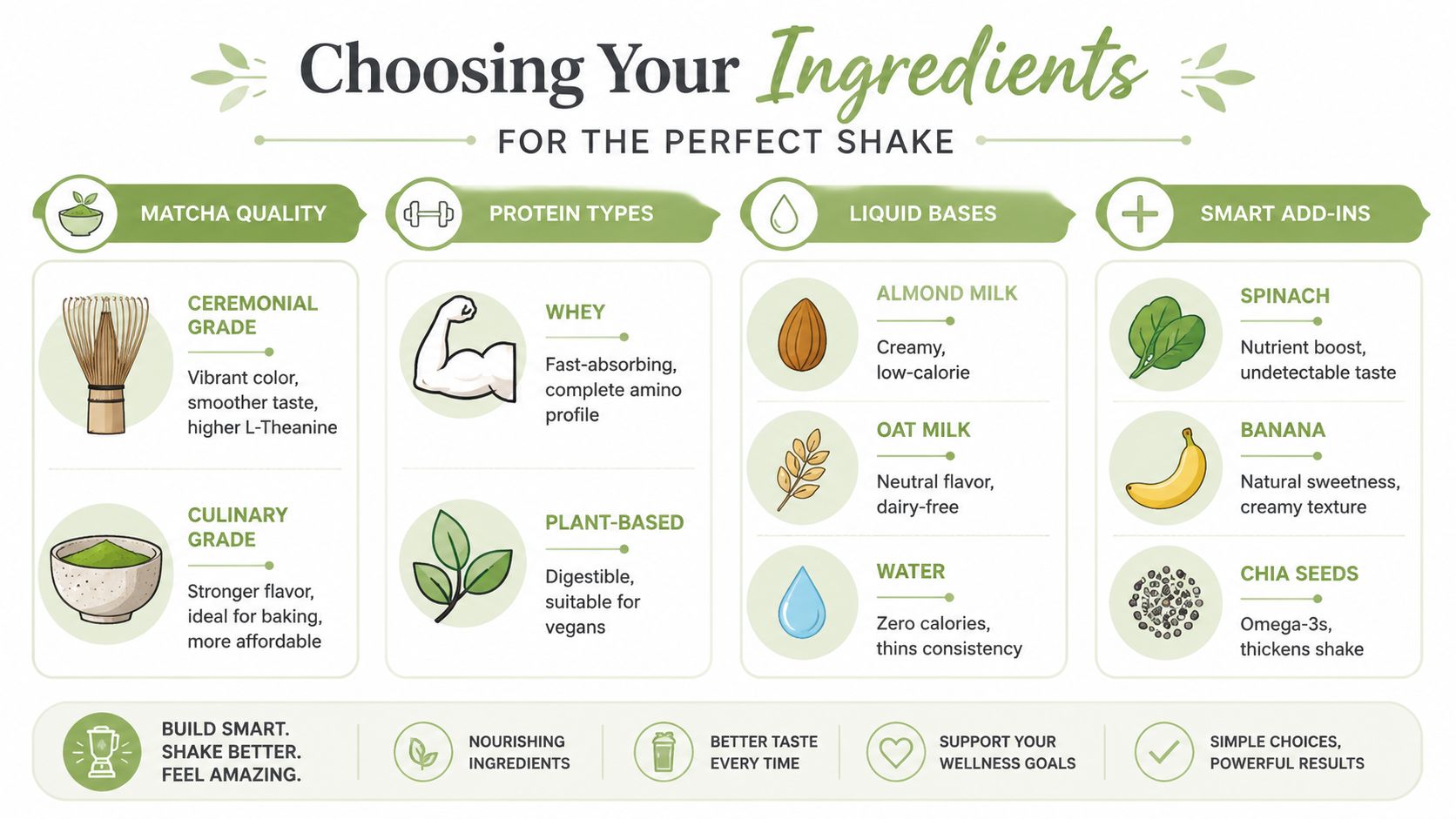
Pick the right matcha for blending
For shakes, culinary-grade matcha usually makes more sense than ceremonial. Ceremonial grade is lovely for whisking with water, where its finer flavour can shine on its own. In a shake, that subtlety often gets buried under milk, protein, fruit, or ice.
A strong culinary matcha stands up better in the blender. It gives you a clearer tea flavour and usually offers better value if you're making shakes regularly at home or serving them in a café setting.
If you want a clearer sense of what separates one grade from another, this matcha grade and quality guide breaks down the key differences.
Your protein choice changes everything
Most weak recipes treat protein powder as interchangeable. It isn't. Texture, sweetness, thickness, and how the shake sits on the palate all depend on the protein base.
The broad rule is simple. Plant-based proteins often need more liquid, while whey isolate tends to blend more cleanly, a point noted in this recipe discussion on protein texture and blending behaviour.
Here's how the common options behave in practice:
| Protein type | What usually works | What often goes wrong |
|---|---|---|
| Whey isolate | Smooth, light texture, easy to blend, lets matcha stay bright | Can taste overly sweet if flavoured strongly |
| Pea protein | More filling, good for dairy-free drinkers, sturdy in thicker shakes | Can turn chalky or earthy without enough liquid |
| Collagen | Dissolves easily, keeps the drink lighter | Doesn't create the same creamy body as whey or pea |
| Soy protein | Better emulsifying than some plant blends, fuller body | Can dominate the flavour if the powder is strong |
| Mixed plant blends | Useful for vegan formats and menu flexibility | Texture can vary wildly from silky to sandy |
Matcha is delicate, but it isn't shy. The best protein powder supports it instead of fighting for attention.
Liquid bases matter more than people think
The liquid decides body and finish. Water gives you the cleanest tea flavour, but the thinnest result. Unsweetened almond milk keeps things light. Oat milk adds roundness and makes the shake feel more café-style. Dairy milk creates a fuller, sweeter profile naturally.
For training-focused shakes, some people prefer a simpler base so the drink feels cleaner after exercise. For breakfast shakes, a creamier liquid often makes the drink feel complete enough to replace a meal.
A few reliable pairings:
- Unsweetened almond milk brings a lighter body and lets grassy notes stay crisp.
- Oat milk softens sharper matcha edges and makes vanilla proteins taste more rounded.
- Dairy milk adds natural richness and can balance stronger matcha doses.
- Water plus yoghurt can work well if you want body without too much sweetness.
Smart add-ins that actually improve the drink
Not every “healthy” add-in helps. Some just muddy the flavour.
The useful ones tend to do one of three jobs:
- Creaminess: banana, avocado, Greek yoghurt
- Sweetness: banana, dates, a small amount of honey or maple if needed
- Satiety: chia seeds, nut butter, extra fibre-rich ingredients
If the goal is a clean, vibrant Matcha protein shake, restraint usually wins. One creamy ingredient and one sweetness adjustment are often enough. Once you add too many boosters, the tea disappears.
Four Essential Matcha Protein Shake Recipes
A Matcha protein shake can be light and brisk, thick and filling, or somewhere in the middle. The best recipe depends on what you want the drink to do.
Independent recipe and product references note that a well-built matcha-protein drink can land in the range of 20 g to 41 g of protein per serve and roughly 92 to 100 mg of caffeine per serve when formulated with more concentrated matcha servings, as outlined in this matcha protein shake recipe reference.
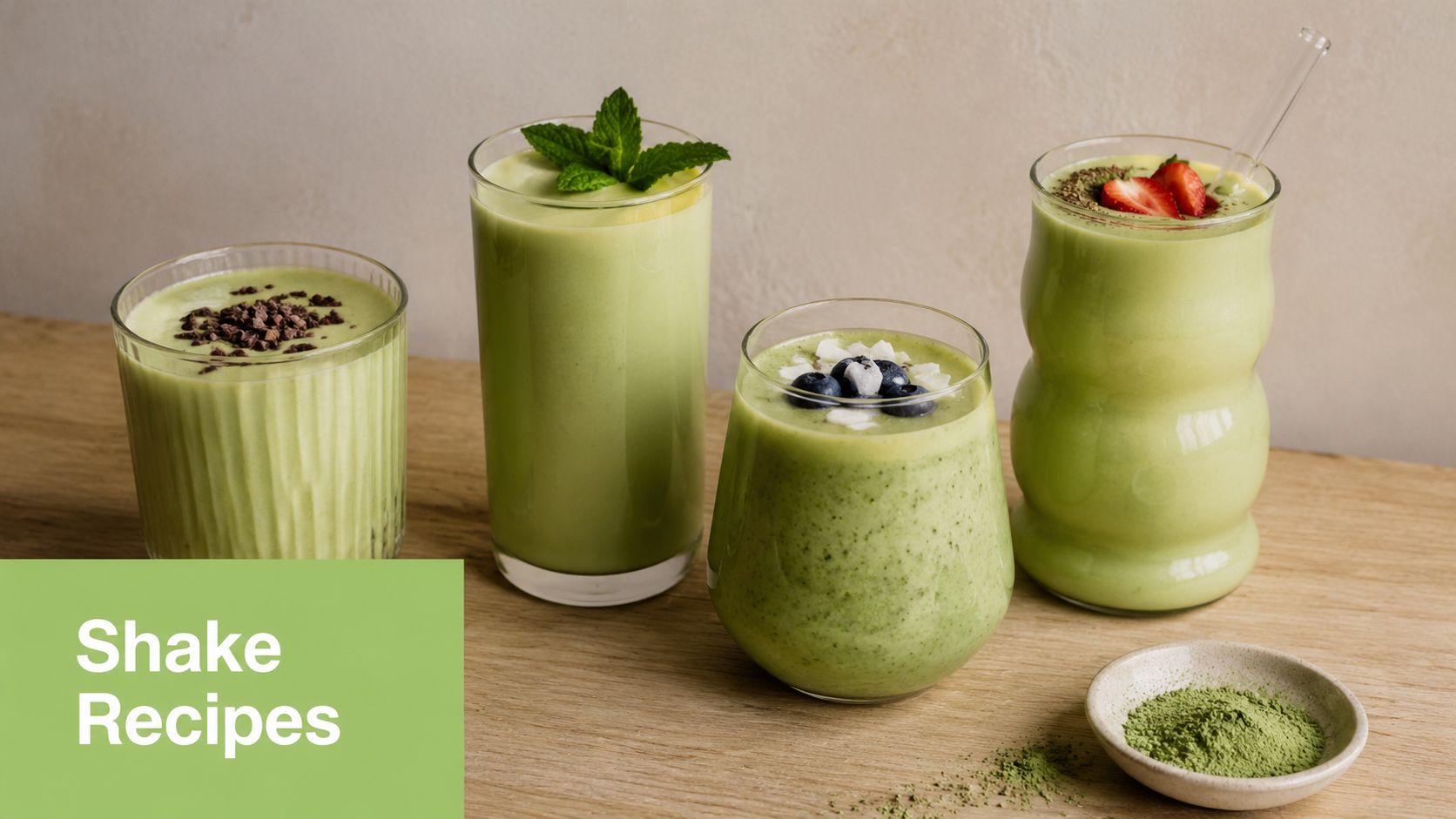
The Classic Energiser
This is the one to make when you want a dependable daily blend. It's balanced, not too heavy, and easy to repeat on busy mornings.
You'll need
- 1 teaspoon matcha
- 1 scoop vanilla whey isolate
- 1 cup unsweetened almond milk
- 1/2 frozen banana
- A small handful of ice
Start with the almond milk in the blender, then add the matcha and whey. Finish with banana and ice. Blend until the colour turns evenly green and the texture looks glossy.
The banana rounds out the edges without making the shake taste like dessert. Whey isolate keeps the body smooth and lets the tea stay centre stage.
The Creamy Vegan Powerhouse
Plant-based protein can be excellent with matcha, but it needs more care. This version leans into richness so the shake feels intentional rather than compromise-driven.
You'll need
- 1 teaspoon matcha
- 1 scoop pea or mixed plant protein
- 1 cup oat milk
- 1/2 frozen banana
- 1 tablespoon chia seeds
- A few ice cubes
Blend the oat milk and matcha first if you can, then add the plant protein. Once that's incorporated, add banana, chia, and ice. Give it a little extra blending time.
Pea protein can pull the drink towards chalkiness if the liquid is too low. Oat milk and banana solve much of that. Chia thickens the shake and gives it a more complete breakfast feel.
The Iced Post-Workout Refresher
After training, some people don't want a thick smoothie. They want something cold, brisk, and easy to drink. This one is lighter on the palate.
You'll need
- 1 teaspoon matcha
- 1 scoop unflavoured or lightly flavoured whey isolate
- 3/4 cup cold water
- 1/4 cup unsweetened almond milk
- Ice
Keep the flavour profile clean. Blend just until smooth and drink it straight away. The water lifts the freshness, while a smaller amount of almond milk stops it feeling thin.
This is a good format if heavy dairy or a thick vegan blend doesn't sit well after exercise.
A quick visual can help if you like seeing the process before trying your own variations.
The Ultimate Meal Replacement
This is the version for long mornings, late breakfasts, or anyone who wants one glass to do more work.
You'll need
- 1 teaspoon matcha
- 1 scoop protein powder of choice
- 1 cup milk of choice
- 1/2 avocado
- 1 tablespoon nut butter
- 1 tablespoon chia seeds
- Ice as needed
This one should be blended until fully velvety. Avocado creates body without adding obvious flavour. Nut butter gives the shake more substance. Chia helps it stay satisfying for longer.
Use collagen if you want this version to stay lighter. Use whey if you want the smoothest body. Use pea protein if you want the biggest breakfast feel.
Mastering the Blend for a Smooth Clump-Free Shake
If your shake is gritty, the problem usually isn't the blender. It's the order. People often throw everything in together, then wonder why matcha sticks to the sides and protein forms damp little pockets that never fully dissolve.
Recipe testing points to a simple fix. Add wet ingredients first, then powders like matcha and protein, which helps stop powder sticking and improves emulsion, as noted in this blending method guide.
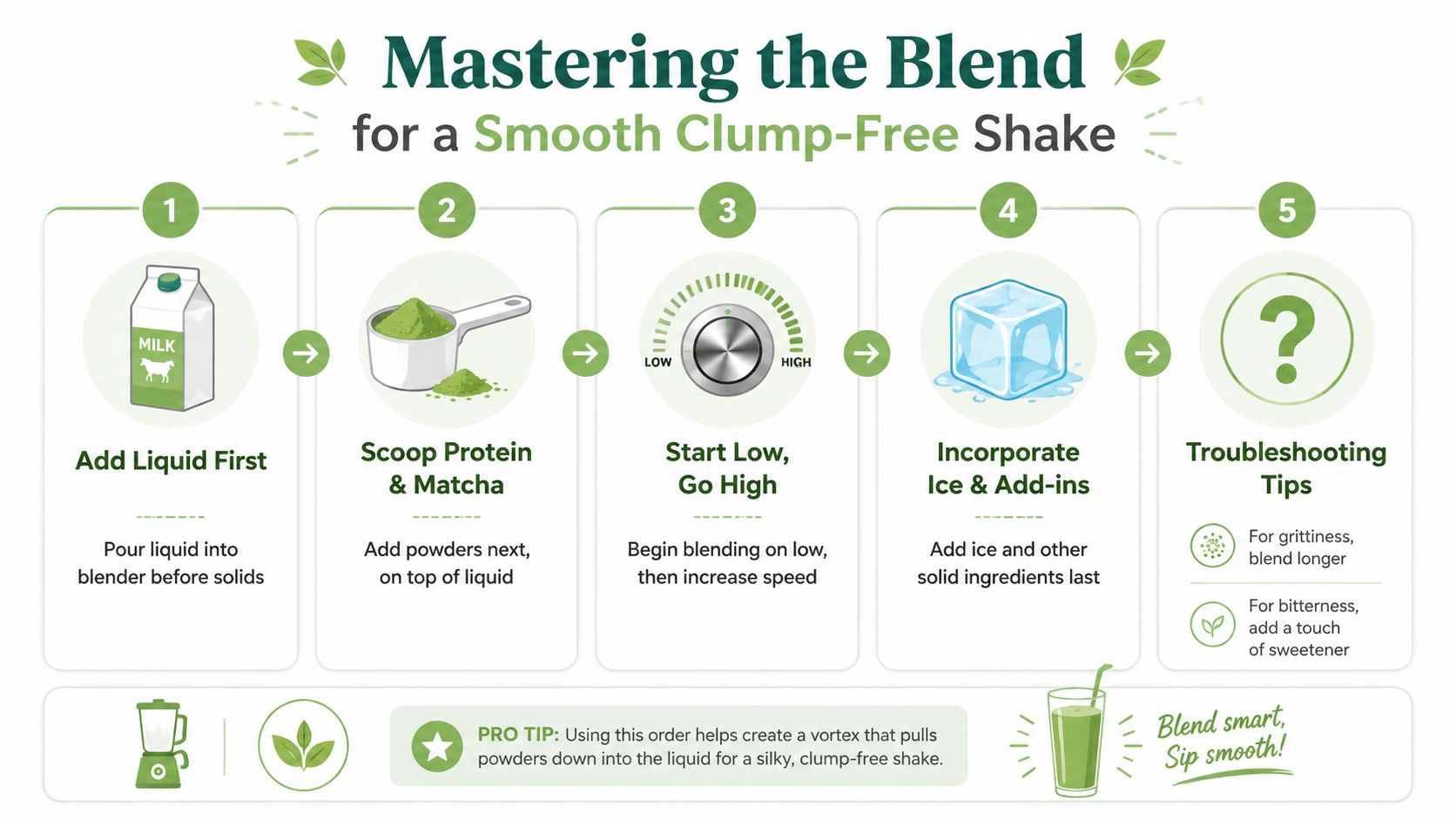
The order that works
Use this sequence every time:
- Pour in your liquid first so the blades have immediate movement.
- Add matcha and protein next so they disperse into liquid instead of compacting under frozen ingredients.
- Add soft ingredients like banana, yoghurt, or avocado.
- Finish with ice or frozen fruit so the heavier solids don't trap dry powder underneath.
This one adjustment fixes most beginner mistakes.
Pre-mix if you want café-level texture
Matcha behaves best when it's given a little attention before blending. If you've got thirty extra seconds, whisk it with a small amount of liquid into a loose slurry first. That prevents dry tea particles from lingering in the finished shake.
A fine sifter helps too, especially if your matcha has compacted in the tin. A dedicated matcha tea sifter makes it easier to break up small clumps before they ever hit the blender.
A silky Matcha protein shake usually comes from preparation, not power. Even a strong blender can't fully rescue badly layered ingredients.
How to fix common problems fast
A few small adjustments can save a disappointing shake:
- Too thick means add a splash more liquid, then re-blend.
- Too thin means add a little more ice, chia, or frozen banana.
- Too bitter usually means too much matcha, or a matcha that's too harsh for cold drinks.
- Too chalky often points to plant protein needing more liquid and more blending time.
If the flavour feels flat, don't automatically add sweetener. A pinch more vanilla, a creamier milk, or a little banana often improves the drink without pushing it into sugary territory.
Serving Storage and Cafe Menu Inspiration
A Matcha protein shake is best fresh, when the top is still lightly frothy and the colour is brightest. That said, real life isn't always fresh-blended and leisurely. Sometimes you need to make it ahead, cap it, and get out the door.
At home, the easiest make-ahead approach is to blend the shake, refrigerate it in a sealed bottle, and give it a hard shake before drinking. Separation is normal, especially with lighter liquids or collagen-based blends. A quick stir usually brings it back.
Small serving touches make it feel better
The drink tastes the same either way, but presentation changes the experience. A simple garnish can make a weekday shake feel less utilitarian.
A few good finishing touches:
- Dusting of matcha for aroma and colour
- Hemp seeds for a subtle nutty top note
- Mint leaf if you want it to read fresh and café-like
- Clear glass to show off the vivid green
Why cafés should pay attention
For cafés, this drink fills an increasingly useful gap. It sits comfortably beside smoothies and iced drinks, but it carries a more premium, wellness-led identity. It also gives staff room to customise.
One café-friendly approach is to prep a house matcha base in advance, then build to order with different protein options. That lets customers choose what suits them best, whether that's whey for smoother texture, pea for dairy-free service, or collagen for a lighter feel.
A compact menu could offer:
- An everyday Matcha protein shake with vanilla protein and almond milk
- A vegan version with oat milk and plant protein
- An upgrade option with greens, chia, or collagen
- A lower-sweetness format for customers who don't want banana in every blend
That kind of flexibility works well in Australian cafés where people often want something quick, functional, and not overloaded with sugar.
Storage without disappointment
If you're storing one overnight, keep expectations sensible. The flavour will still be good, but the texture is rarely as lively as it is straight from the blender. Thicker shakes hold better than very icy ones, and banana-heavy versions often need a good re-blend or extra shake in the morning.
The best compromise is often prep-ahead rather than fully blend-ahead. Measure the dry ingredients, portion the frozen ingredients, and keep the liquid ready in the fridge. In the morning, it takes only moments to finish.
Embrace Your New Favourite Healthy Habit
A good Matcha protein shake earns a permanent place in the routine because it solves practical problems. It gives you a more satisfying start than a plain caffeinated drink, a more interesting flavour than many standard protein shakes, and enough flexibility to suit breakfast, post-workout recovery, or an afternoon reset.
The key difference comes from making it properly. Use a matcha that can stand up in a cold drink. Choose a protein that suits your goal and your digestion. Blend in the right order. Adjust the liquid before you blame the recipe.
That's when the drink shifts from trend to habit.
There's plenty of room to make it your own. Keep it lean and brisk with water and whey. Build it creamy and filling with oat milk, chia, and plant protein. Go lighter with collagen. Go fuller with avocado. Once you understand how the ingredients behave, you can shape the shake around your day instead of forcing yourself to drink a version that never quite works.
If you're ready to make your own Matcha protein shake with better flavour and cleaner ingredients, explore Pep Tea for premium organic matcha suited to daily blending, lattes, and wellness recipes.
Organic Green Tea Gift Set: The 2026 Ultimate Gifting Guide

You're probably here because you need a gift that feels caring, useful, and a bit more personal than the usual candle, wine, or last-minute voucher. Maybe it's for a friend who's trying to cut back on sugar, a colleague who's flat out, or a family member who loves a quiet morning ritual.
That's where an organic green tea gift set stands out. Done well, it doesn't just give someone “tea”. It gives them a small routine they can return to. A pause. A cup they look forward to. A moment that feels organised, calming, and intentional.
Beyond the Basics Why Gift an Organic Green Tea Set
Tea already belongs in everyday Australian life, which is one reason it works so well as a gift. Australians spent A$1,084.3 million on tea in 2023–24, according to ABS household expenditure data cited in this green tea gift set market overview. That matters because you're not asking someone to adopt a completely unfamiliar habit. You're elevating one they likely already have.
A thoughtful tea gift lands differently from a generic hamper. It says, “I noticed what you enjoy, and I picked something that helps you slow down.”
A good example is the friend who says they “love wellness” but never quite buys anything for themselves. They might not splash out on quality green tea, a whisk, or a nice cup. But if it arrives as a gift, beautifully chosen and easy to use, it feels special rather than indulgent.
Why green tea feels more personal
Green tea has range. It can feel light and restorative in loose-leaf form, focused and ceremonial as matcha, or refreshing and lively when paired with a chilled fermented drink in a broader wellness hamper. That makes it adaptable for different personalities and budgets.
It also suits modern gifting because it can be:
- Practical for daily use
- Gentle in tone, rather than flashy
- Giftable for birthdays, thank-yous, housewarmings, and corporate occasions
- Easy to personalise with teaware, snacks, journals, or self-care items
A memorable gift often works because the recipient can use it the very next day.
If you're still deciding what style of tea gift makes sense, it can help to start with a simple explainer on what organic green tea is, especially if you want the gift to feel informed rather than random.
For readers sending gifts abroad, it's also useful to look at shops that send coffee and tea baskets nationwide, just to see how other markets package tea as a complete gifting experience. Even if you're building your own hamper in Australia, those examples can spark ideas about presentation and pairings.
Decoding the Perfect Green Tea Experience
A premium tea gift isn't defined by a ribbon or a fancy box. It's defined by the experience inside the box.
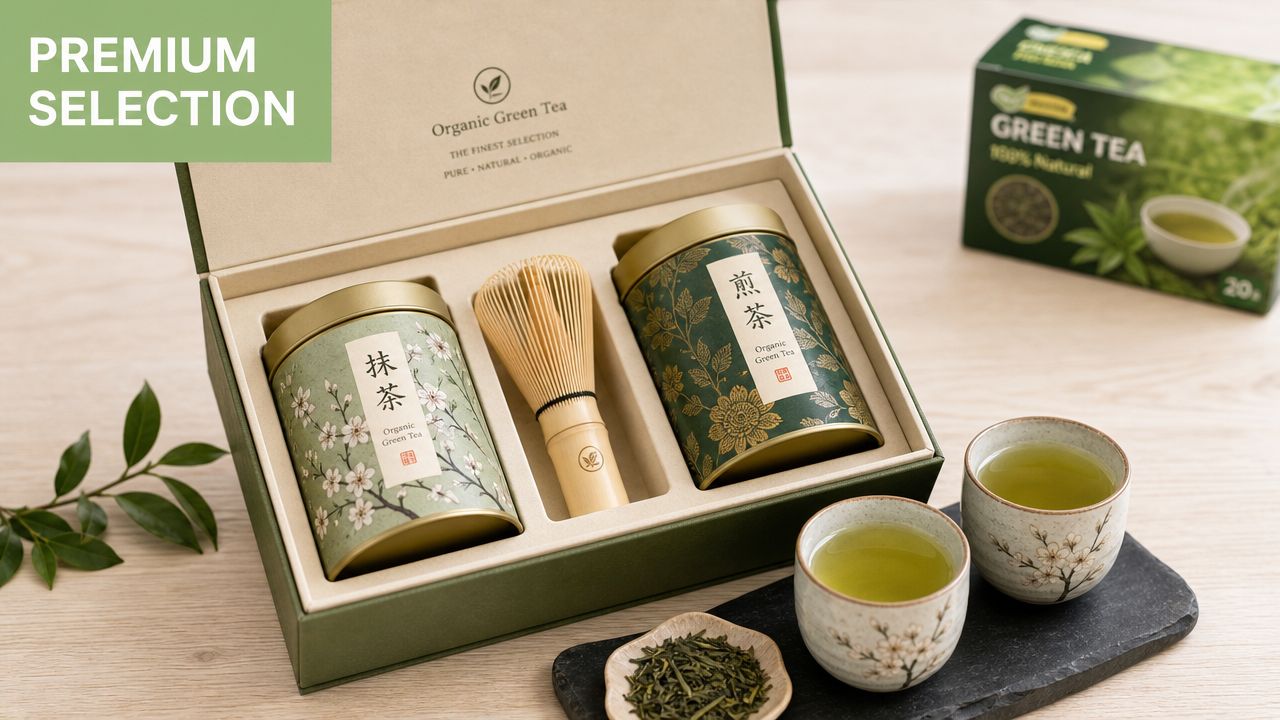
A basic supermarket pack usually focuses on convenience first. There's nothing wrong with that. But a gift should offer something more sensory and more deliberate. You want the recipient to notice the colour of the leaves, the aroma when the tea opens, the feel of a proper cup in the hand, and the little ritual of preparing it.
More than a box of tea bags
The best organic green tea gift set usually includes one or more of these elements:
- Loose-leaf green tea for aroma, shape, and a more involved brewing ritual
- Matcha for a vivid, whisked tea experience that feels focused and grounding
- Useful teaware such as a whisk, scoop, infuser, or cup
- Thoughtful companions like a small snack, a note card, or a storage tin
Each part changes the experience. Loose leaf invites someone to slow down. Matcha creates a visible ritual. Teaware removes friction so the gift gets used instead of stored away in a cupboard.
What quality feels like
When people first try better green tea, they usually notice one of three things. The tea looks fresher, smells cleaner, or tastes smoother than expected.
That's why a strong gift set should feel cohesive rather than crowded. Instead of stuffing in unrelated items, choose pieces that support one calm, enjoyable routine.
Practical rule: If every item helps the recipient brew, sip, or savour the tea, the hamper feels curated. If half the items could belong in any generic gift basket, it won't.
You can think of the experience in three layers:
| Experience layer | What the recipient notices | Why it matters |
|---|---|---|
| Tea itself | Aroma, colour, flavour | This is the heart of the gift |
| Ritual | Whisking, steeping, pouring | This makes the gift memorable |
| Setting | Cup, tray, snack, note | This makes it feel personal |
A well-built tea gift doesn't need to be extravagant. It needs to be coherent. One beautiful tea, one practical tool, and one thoughtful extra can feel far more generous than a crowded box of filler.
Key Quality Signals for Your Gift Set
If you want your gift to feel premium, there are a few signs worth checking before you buy. These clues tell you whether the set is well-marketed or built on quality.
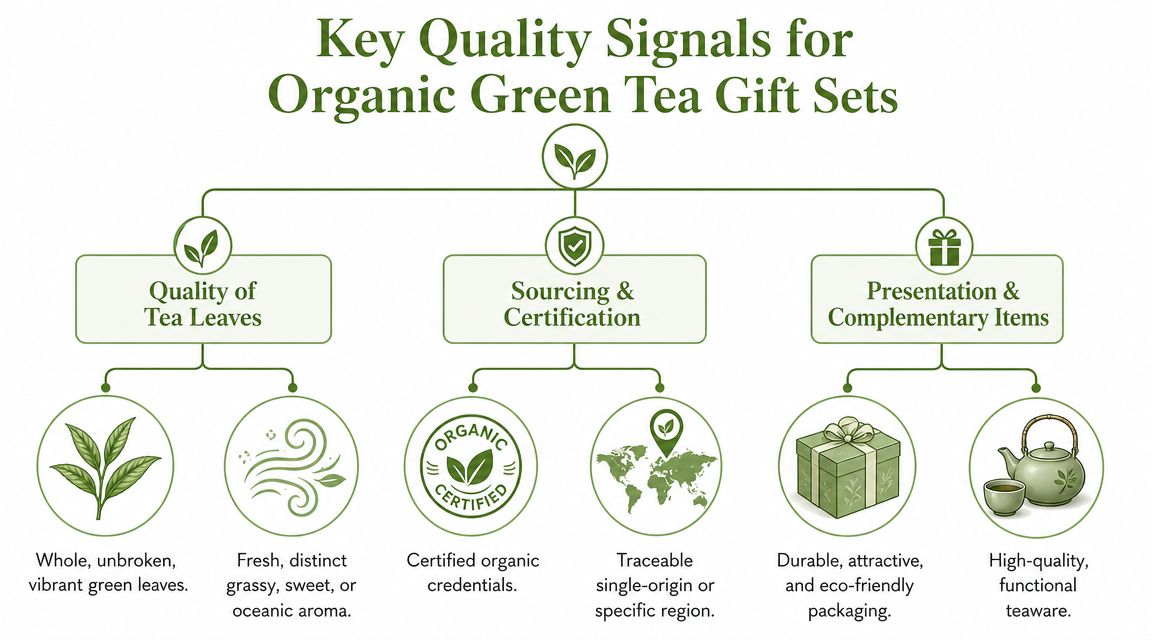
Look for real organic credibility
Organic matters in tea because the leaves are the product. You're not peeling them like fruit. You're infusing them directly in water or whisking them into the cup.
Australia's organic market was valued at A$2.6 billion in 2023, and the country's certified organic area covered about 53 million hectares, according to this overview of the Australian organic sector. For gift buyers, that's a useful signal that organic isn't a fringe claim. It sits within a well-established certification and sourcing environment.
When you're choosing an organic green tea gift set, check for:
- Clear certification wording rather than vague “natural” language
- Origin details where possible
- Packaging that protects freshness, not just appearance
If you enjoy extending the ritual beyond the tea itself, pairing the set with premium GOTS organic loungewear can turn a simple tea gift into a full wind-down kit.
Understand the role of matcha grade
Many buyers get stuck here. They assume all matcha is the same, or that “premium” is enough information. It isn't.
A simple way to think about it is this:
| Matcha type | Best use | What to expect |
|---|---|---|
| Ceremonial grade | Drinking with water | Smoother, more refined, suited to simple preparation |
| Culinary grade | Lattes, smoothies, baking | Stronger presence, useful when mixed with other ingredients |
If the recipient is likely to whisk and drink the tea plain, ceremonial grade makes sense. If they love iced lattes, baking, or adding tea to recipes, culinary grade is often the more practical choice.
For a deeper buying guide, this article on the best organic green tea loose leaf is a helpful starting point.
Don't ignore the non-tea parts
A gift set can have excellent tea and still disappoint if the extras feel flimsy. Thin cups, poor lids, or decorative packaging that doesn't protect the tea can lower the whole experience.
A reliable set usually gets three things right:
- The tea is clearly described.
- The tools are functional, not just decorative.
- The presentation supports freshness and gifting at the same time.
That combination is what separates a nice-looking box from a gift someone remembers using.
Gift Ideas Tailored to Every Personality
Some gifts fail because they're too generic. Tea gifts work best when they match the recipient's habits. The same organic green tea gift set won't suit every person in the same way.
A busy professional may want a fast weekday ritual. A foodie may want ingredients to play with. Someone reducing sugar may appreciate a broader drinks hamper that still feels celebratory.
Organic Green Tea Gift Set Pairings
| Recipient Persona | Core PepTea Product | Perfect Pairing Ideas |
|---|---|---|
| The Health-Focused Yogi | Ceremonial Matcha | Bamboo whisk, handmade bowl, soft journal, herbal eye pillow |
| The Busy Professional | Ceremonial Matcha or loose-leaf green tea | Insulated cup, simple teaspoon, desk tin, calming note card |
| The Creative Foodie | Culinary Matcha | Recipe card, dark chocolate, baking spoon, shortbread or nut biscuits |
| The Friend Ditching Sugar | Sugar-free organic Kombucha | Stemless glass, citrus garnish, snack plate ideas, picnic-ready tote |
| The Minimalist | A single-origin style green tea | One beautiful cup, neutral tray, linen napkin |
| The New Tea Explorer | Matcha tea set | Whisk, scoop, beginner brewing guide, tasting notes card |
Four gifting styles that rarely miss
For the yogi or wellness lover, keep it soft and uncluttered. Matcha, a whisk, and a beautiful bowl are enough. Add one tactile item, such as a linen cloth or a journal, and stop there.
For the office worker who says they're always tired, choose ease. They're more likely to use a gift that fits into a weekday routine than one that requires a full tea ceremony.
For the foodie, make the gift interactive. Culinary matcha works well because it can move from morning latte to afternoon baking project. This recipient usually enjoys experimenting.
A gift feels more thoughtful when it matches the way someone already lives, not the way we wish they lived.
For the person cutting back on sugar or alcohol, think beyond hot tea alone. A tea-centred hamper with chilled options and fresh garnishes can feel social, adult, and useful.
If you want a ready-made starting point for this kind of gift, browsing a matcha tea set in Australia can help you picture how the pieces fit together.
Assemble Your Own Organic Green Tea Hamper
Building your own hamper is often the best option if you want the gift to feel specific and personal. It also gives you more control over quality, packaging, and budget.
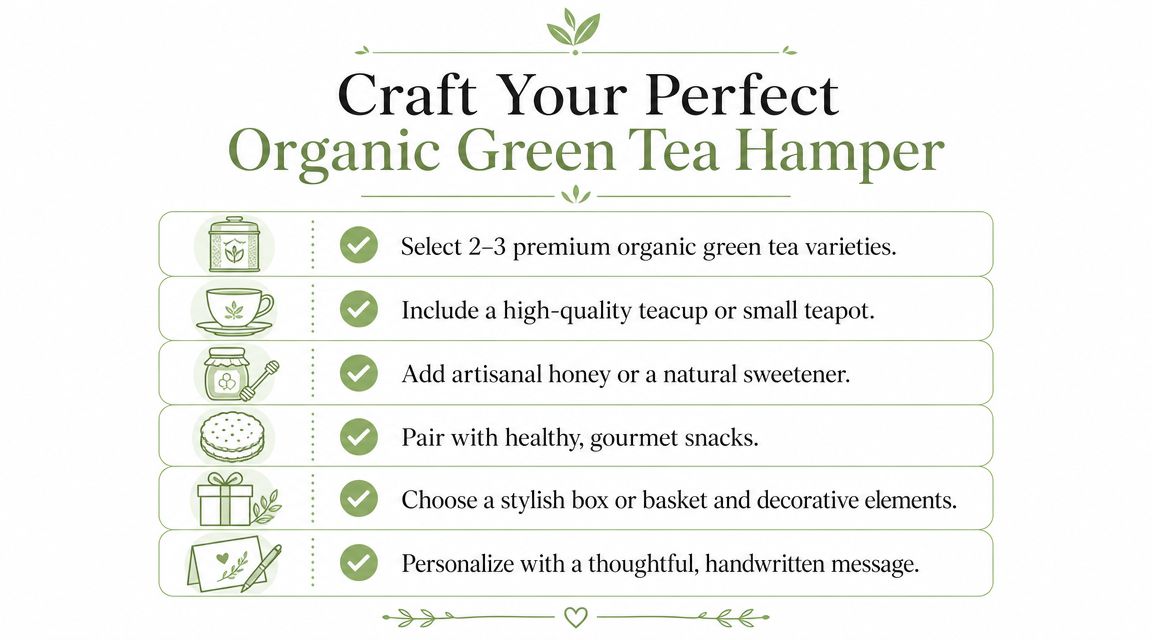
Start with a theme
A hamper is easier to build when it has one clear purpose. That theme acts like an editing tool. It helps you decide what belongs and what doesn't.
Good theme ideas include:
- Morning ritual with matcha, a bowl, and a light snack
- Quiet evening with loose-leaf tea, a cup, and a small self-care extra
- Gourmet explorer with culinary matcha, recipe ideas, and pantry treats
- Fresh fridge reset with tea plus chilled wellness drinks and glassware
Choose the tea first
Always anchor the hamper with the tea itself. Everything else should support it.
A simple build might look like this:
- One principal tea item
- One brewing tool
- One edible pairing
- One personal detail, such as a handwritten note
That order keeps the hamper useful. It also stops you from overbuying decorative filler.
Think about freshness and packaging
Packaging isn't only about looks. Green tea is sensitive to oxidation, aroma loss, and moisture uptake during storage and shelf display, which is why airtight and light-protective formats matter. In the market, compostable inner formats are already being used in giftable tea products, including an example with 12 individual pyramid sachets that are 100% compostable, as noted in this organic green tea gift packaging example.
That's useful for DIY hampers because it tells you what to prioritise:
- Airtight storage for tea quality
- Low-waste materials where possible
- A sturdy outer box that protects the gift in transit
If you're making hampers at scale for events, staff gifts, or deliveries, browsing plain cardboard boxes can help you compare sizes and structures before you dress them up with tissue, ribbon, or custom notes.
Choose packaging that protects the tea first. Pretty presentation comes second.
Arrange it so it feels generous
Presentation changes how a hamper is received. Place the tallest item at the back, medium items in the centre, and smaller items toward the front. Keep colours calm and natural. Greens, creams, kraft tones, and soft whites suit tea beautifully.
Avoid overfilling. A little empty space can make the contents feel more considered.
A handwritten message often becomes the most memorable item in the box. It doesn't need to be poetic. A simple note about why you chose the tea is enough.
How to Serve and Savour Your Green Tea Gift
A beautiful gift only works if the recipient knows how to enjoy it. Green tea can be wonderfully forgiving, but a few simple brewing habits make a huge difference.
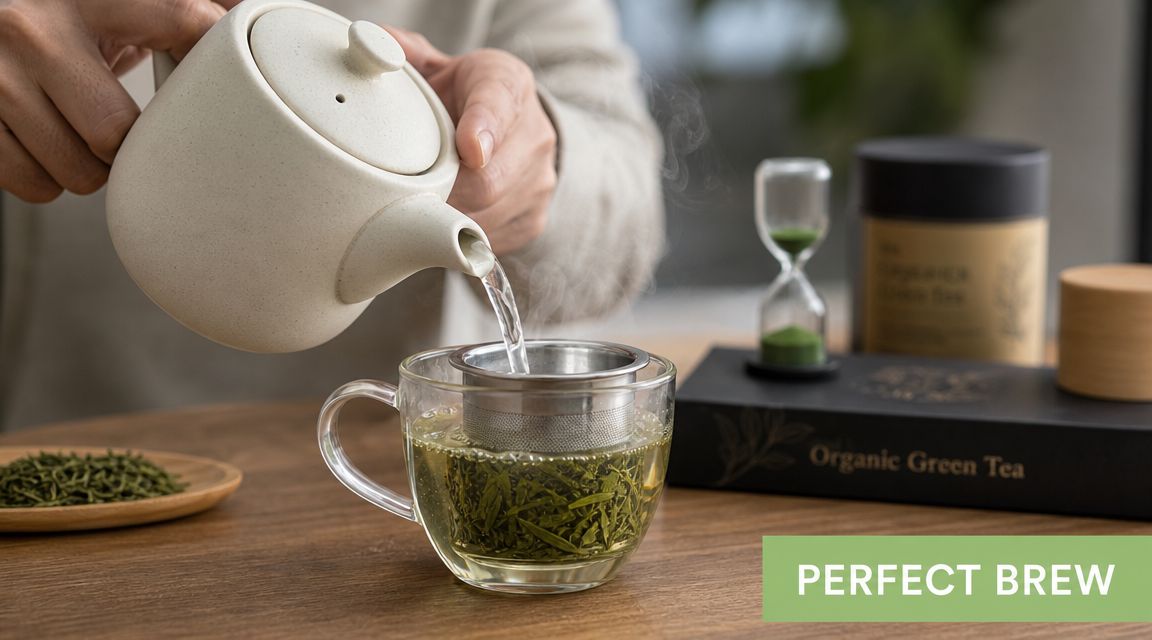
Brew green tea gently
One of the most common mistakes is using fully boiling water. Green tea is temperature-sensitive, and tea educators commonly recommend keeping water below a full boil to reduce bitterness and preserve sweetness, as explained in this green tea gift brewing guide. The same guidance notes that green tea can often be re-steeped multiple times, which adds value to a gift set.
That means the recipient doesn't need to rush or overbrew. They can savour the leaves across more than one infusion.
A simple note to include with the gift:
- Use water below a full boil
- Measure the leaf or matcha carefully
- Taste the first infusion before changing time or temperature
- Re-steep good leaves rather than throwing them out immediately
How to whisk matcha
For matcha, the ritual is part of the pleasure. Sift the powder if you can. Add a small amount of warm water, then whisk until the tea looks smooth and lightly frothy.
If you're gifting matcha to a beginner, pass on this idea in plain language:
- Warm the bowl first.
- Add matcha.
- Pour in hot water that isn't boiling.
- Whisk briskly until smooth.
- Drink straight away.
Lower-temperature water usually gives a softer, sweeter cup. Hotter water pulls out bitterness more quickly.
For a visual walk-through, this short video is a handy companion for first-time matcha drinkers:
Easy ways to enjoy the full gift
Not everyone wants to drink tea the same way every day. That's why variety helps a gift feel generous.
Try these serving ideas:
- Morning with plain matcha in a bowl
- Afternoon with loose-leaf green tea and a small biscuit
- Weekend with matcha in a latte or smoothie
- Warm weather with a chilled fermented tea drink served in a proper glass with citrus or mint
The more approachable the ritual feels, the more likely the gift becomes part of someone's routine instead of a special-occasion item they never open.
Frequently Asked Questions About Green Tea Gifts
How should I store matcha to keep it fresh?
Keep matcha sealed, dry, and away from heat, light, and moisture. If the pouch or tin is opened often, make sure it's closed promptly after each use. The goal is to protect colour, aroma, and flavour.
What should I look for in a gift set if I want it to feel premium?
Focus on three things. The tea should be clearly described, the packaging should protect freshness, and the tools should be practical enough to use regularly. Good gifts aren't always the largest ones. They're the ones that feel coherent.
Is loose leaf better than tea bags for gifting?
Often, yes, if the recipient enjoys the ritual of brewing. Loose leaf usually feels more special because the leaves, aroma, and preparation are part of the experience. Tea bags can still work in a gift if they're well made and packaged thoughtfully.
What's a safe choice if I don't know the person's taste well?
Go simple. A gentle green tea, one attractive cup, and a handwritten note are hard to get wrong. If you're unsure about strong flavours or niche accessories, keep the set clean and easy to use.
Are green tea gifts suitable for someone who is pregnant?
That depends on the person and their circumstances. If you're buying for someone who is pregnant, it's sensible to choose cautiously and encourage them to check any dietary questions with their healthcare professional.
Where can I find good tools like a whisk or bowl in Australia?
Specialist tea retailers are usually a better bet than general gift shops because they tend to stock tools designed for actual brewing, not just display. Look for sturdy bamboo whisks, bowls with enough width for whisking, and scoops or spoons that feel balanced in the hand.
If you're ready to build a tea gift that feels thoughtful and easy to enjoy, explore Pep Tea for organic matcha, Australian-brewed sugar-free organic kombucha, and tea-focused inspiration that can help turn a simple present into a daily wellness ritual.
Buy Organic Green Tea Online: Quality Guide 2026

You're probably doing what a lot of Australians do when they start shopping for tea online. You type in a simple search, open six tabs, and suddenly every packet looks “premium”, “pure”, “ceremonial”, “clean”, or “organic”. The photos are lovely. The claims sound reassuring. But it's not always obvious what matters once that tea lands in your kitchen.
That confusion is normal. Tea is one of those products where the label can look clear while the buying decision still feels murky. You can't smell the leaves through a screen. You can't inspect colour, freshness, or texture in person. And if you care about wellness, taste, and clean sourcing, you want more than a pretty pouch and a vague promise.
Your Guide to Buying Organic Green Tea Online
A common scene goes like this. Someone wants a better afternoon drink than another coffee or a sugary option. They start looking for organic green tea online, hoping for something cleaner, lighter, and easier to build into a daily routine. Then the questions hit. Is loose leaf better than matcha? Does organic mean residue-free? Will it taste fresh after shipping? Is the higher price justified?
Those questions sit inside a much bigger shift in how people buy tea. The global organic tea market was valued at USD 2.12 billion in 2025 and is projected to reach nearly USD 4.26 billion by 2032, growing at a 10.5% CAGR, according to the Teeverband 2025 tea report. For Australian shoppers, that matters because it reflects a clear move toward higher-quality, certified-organic tea sold through practical online channels.
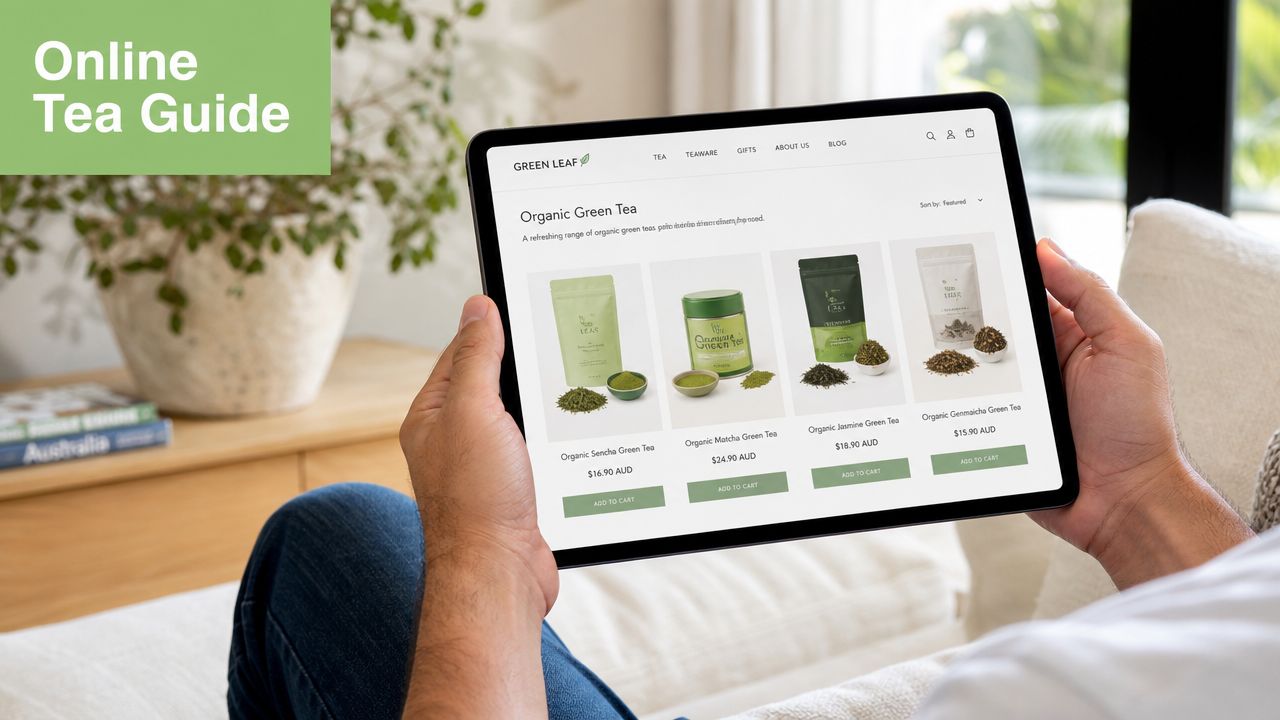
Why this matters in Australia
Australia sits in a region where tea demand is strong, but many premium green teas are sourced from overseas. That means online buying isn't a niche habit. It's often the most practical way to access the kind of tea people want, especially if they're looking for certified-organic Japanese green tea, matcha, or premium loose leaf.
If you're curious about the supply side, it also helps to understand how products move into Australia. This guide on how to navigate importing from Japan through AUSFF gives useful context on the logistics behind imported goods, including the sort of care and compliance buyers often assume happens automatically.
Buying tea online gets much easier once you stop asking “Which pack looks healthiest?” and start asking “What proof does this brand give me?”
What a good online tea guide should actually do
You don't need a lecture on tea culture. You need a practical filter.
A useful buying guide should help you:
- Read past marketing words so “organic” means something specific
- Check quality signals like origin, testing, and packaging
- Choose the right format for your routine, whether that's matcha or loose leaf
- Brew it properly so good tea doesn't taste bitter by accident
That's where most shoppers get stuck, and it's exactly where a little clarity makes a big difference.
What Makes Green Tea Genuinely Organic
A lot of Australian shoppers click on a tea listing, see the word “organic”, and assume the hard checking is done. Online, that assumption can trip you up. The label matters, but the true question is what sits behind it.
Organic green tea is tea grown and processed under certified standards, not just described with clean-sounding marketing. Those standards usually restrict synthetic pesticides, herbicides, chemical fertilisers, and genetically modified organisms. In plain terms, the farm has to follow rules, and an independent certifier has to verify that those rules are being followed.
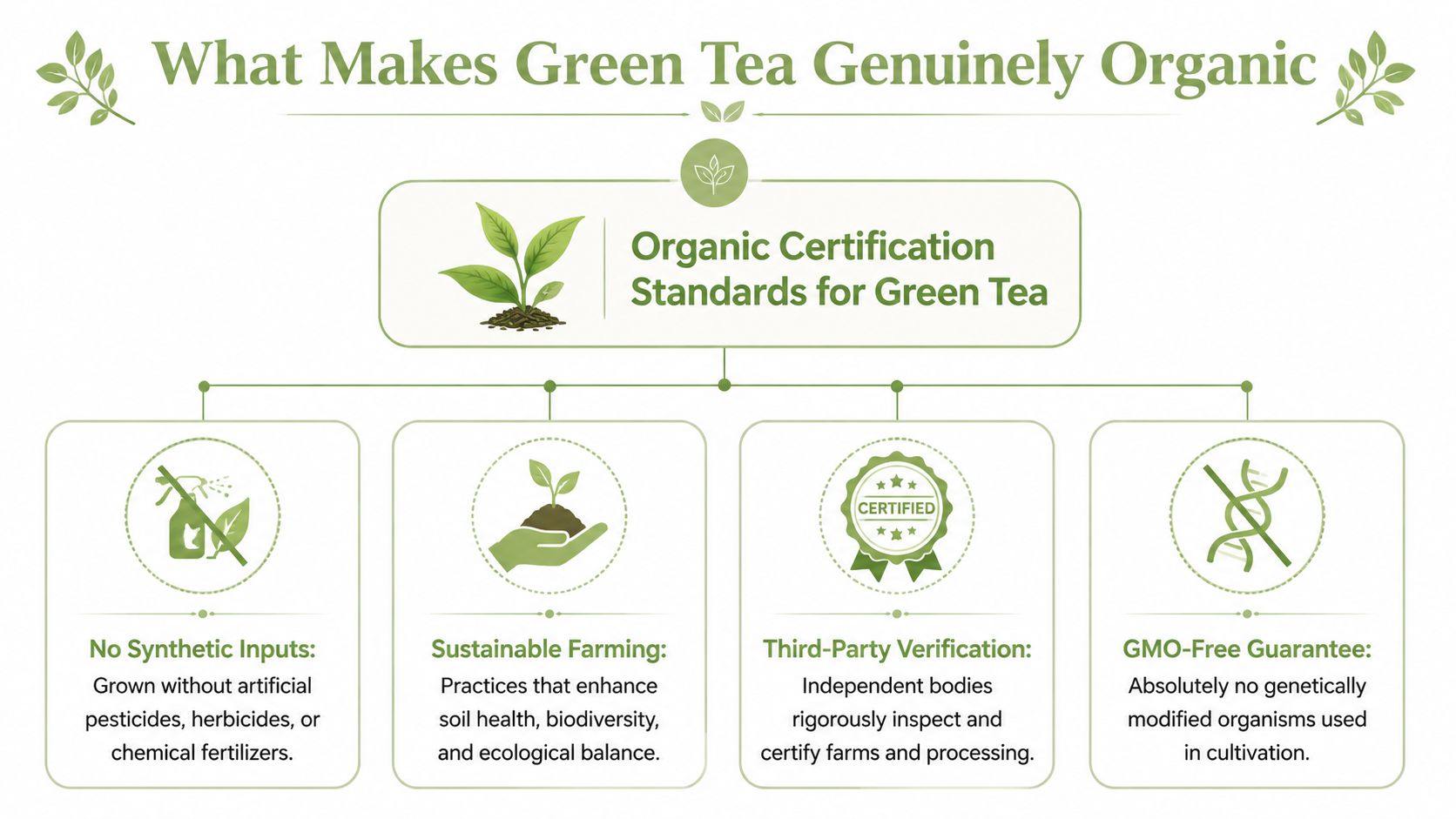
What the organic label should point to
For online buyers, “organic” works like a receipt trail. If a brand uses the word properly, you should be able to trace it back to something concrete.
A reliable product page should help you understand:
- How the tea was grown. Organic farming avoids synthetic chemical inputs and follows stricter cultivation standards.
- Who verified the farm or producer. Certification should come from an independent body, not the seller marking their own homework.
- How the tea was handled after harvest. Processing, packing, and storage still shape purity, aroma, and shelf life.
- How clearly the source is explained. “From Japan” is a start. A named region, producer, or style tells you far more.
If you want a simple breakdown before comparing listings, Pep Tea has a clear guide on what organic green tea means.
Why drinkers care about it
People choose organic tea for practical reasons. Some want to limit exposure to synthetic agricultural inputs. Others care about farming systems that support healthier soil and a cleaner growing environment.
There is also a trust factor, especially when you are buying through a screen. A well-documented organic tea often appeals to the same buyer who cares about harvest date, careful packing, and whether the tea will arrive tasting lively rather than tired. It does not guarantee beautiful flavour on its own, but it often sits in the same conversation as freshness and careful sourcing.
That matters with green tea because it is a delicate product. Poor handling shows up quickly in the cup. Flat aroma, dull colour, or rough bitterness can come from age, weak storage, or careless processing, even if the tea was grown under organic standards.
Practical rule: Organic means more when it comes with traceable sourcing and clear certification detail.
Where online buyers get mixed up
The biggest confusion is treating organic as a complete quality guarantee.
It is not.
Organic certification answers a farming question. It tells you the tea met a defined production standard. It does not automatically tell you whether the leaves are fresh, whether the powder has been protected from heat and light, or whether the seller is transparent enough for an Australian buyer to trust the product before ordering.
That distinction is worth keeping in your head. Organic is one filter. Purity, authenticity, and freshness still need their own proof. Brands that explain those points clearly set a much stronger benchmark, and that is the standard careful tea buyers should expect.
Decoding Quality and Purity When Buying Online
Buying tea online asks you to trust information before you trust taste. That's why a careful buyer should judge the product page like they'd judge the tea itself. If a seller can't explain origin, testing, and handling clearly, the problem usually isn't your caution. The problem is the missing detail.
The most important shift is this. Don't treat “organic” as the finish line. Treat it as the starting point. Independent coverage of contamination concerns points out that while organic certification is valuable, it doesn't automatically guarantee freedom from environmental contaminants like heavy metals. That's why buyers should look for origin transparency and batch testing results, especially for products imported into Australia, as discussed in this review of organic and lead-free green tea concerns.
What to check on a product page
A strong listing usually answers your practical questions before you email support.
Look for these signals:
- Named origin. Not just the country, but ideally the producing region or style.
- Certification detail. A clear statement of certified-organic status is more useful than wellness language.
- Testing transparency. Brands that mention batch testing, residue checks, or quality controls give you something concrete to assess.
- Packaging photos. Good images help you see whether the product is likely to stay fresh after opening.
- Preparation guidance. Sellers who know their tea usually explain how to brew it properly.
Purity means more than a logo
Many shoppers often get tripped up. They see “organic”, assume “clean”, and stop reading. But tea is an agricultural product. It comes from soil, weather, transport, processing, and storage. Each step matters.
If you're buying matcha, this becomes even more important because you consume the powdered leaf itself rather than steeping and discarding it. That's one reason grading, origin, and transparency matter so much in this category. If you'd like a simple breakdown of how quality tiers differ, this guide to different grades of matcha is a useful reference.
Ask a plain question when you shop: “What evidence does this seller provide beyond the word organic?”
A quick credibility filter
When a store page feels polished but vague, use this short test.
| Check | What you want to see |
|---|---|
| Origin | Specific sourcing information |
| Purity | Mention of testing or quality control |
| Certification | Clear certified-organic wording |
| Freshness | Packaging designed to protect tea from air and light |
| Education | Brewing advice that matches the tea type |
If a brand gives you three or more of those clearly, you're usually dealing with a seller that understands tea properly. If everything leans on mood, lifestyle imagery, and broad claims, keep browsing.
What good transparency feels like
A trustworthy tea brand doesn't make you work hard to feel informed. It explains what the tea is, where it comes from, how to use it, and why the product is packed the way it is. That kind of clarity is especially valuable for Australians ordering premium green tea online, where quality has to survive shipping as well as scrutiny.
Choosing Your Perfect Form Matcha vs Loose Leaf
Once you've narrowed quality down, the next question is personal. Do you want a tea you whisk, or a tea you steep?
This choice shapes everything. Flavour, routine, equipment, mouthfeel, convenience, and how often you'll reach for it on a busy morning all depend on the format. There isn't one right answer. There's only the one that fits your day.
Green tea holds about 39.6% of the organic tea market, and matcha is described as the fastest-growing format, with 68% of global consumers associating green tea with high antioxidant levels and choosing it for long-term health benefits, according to Maximize Market Research's organic tea market report. That helps explain why so many Australian shoppers land on matcha first when searching for organic green tea online.
Organic Matcha vs Loose Leaf Green Tea at a Glance
| Feature | Organic Matcha | Organic Loose Leaf Green Tea |
|---|---|---|
| Preparation | Whisked into water or milk | Steeped in hot water |
| Drinking style | Full-leaf powder consumed in the cup | Infused liquor, leaves removed after brewing |
| Flavour | Richer, fuller, often creamy or savoury | Lighter, cleaner, more delicate |
| Best for | Ritual drinking, lattes, smoothies, recipes | Daily cups, teapots, simple brewing |
| Equipment | Bowl or cup, whisk or frother, sieve helpful | Infuser, teapot, or basket |
| Texture | Smooth, suspended tea body | Clearer, lighter mouthfeel |
Choose matcha if your routine is hands-on
Matcha suits people who like ritual and versatility. You can drink it straight, whisk it into a latte, blend it into smoothies, or use it in baking. It feels more immersive because preparation is part of the experience.
That's also why grade matters. Ceremonial-style matcha is usually the pick for straight drinking, while culinary-style matcha works better in lattes, desserts, and recipes where the tea shares the stage with other ingredients.
Choose loose leaf if you want a simpler cup
Loose leaf green tea suits people who want ease without sacrificing quality. You measure the leaf, add water, wait a few minutes, and drink. No whisking. No frothing. No powder settling at the bottom of the cup.
For many Australians, that makes loose leaf the easiest daily entry point into better tea. If that sounds closer to your style, Pep Tea's best organic green tea loose leaf page shows the sort of product category to look for when you want quality without the ceremony.
Some people love matcha for focus and routine. Others want a clean, grassy cup they can brew half-awake before work. Both are good choices.
A quick self-check
If you're still torn, use these prompts:
- Go for matcha if you enjoy café-style drinks, want one tea for drinking and recipes, or like a more concentrated green tea experience.
- Go for loose leaf if you value speed, lighter flavour, and a more traditional brew.
- Try both if your weekday and weekend habits are different. Many tea drinkers keep loose leaf for everyday use and matcha for mornings, lattes, or baking.
The best organic green tea online isn't the one with the most dramatic description. It's the one you'll prepare properly and drink often.
Brewing and Using Your Organic Green Tea
A lot of “bad” green tea is good tea brewed poorly. That's encouraging news, because it means one small adjustment can improve the cup immediately.
Peer-reviewed review data show that green tea is typically brewed at 80 to 90 °C for 3 to 4 minutes, and that most EGCG and caffeine extraction occurs around 80 °C, according to this review of green tea extraction and bioactive compounds. In simple terms, water that's too hot can push bitterness hard. Water in the right range gives you a better balance.
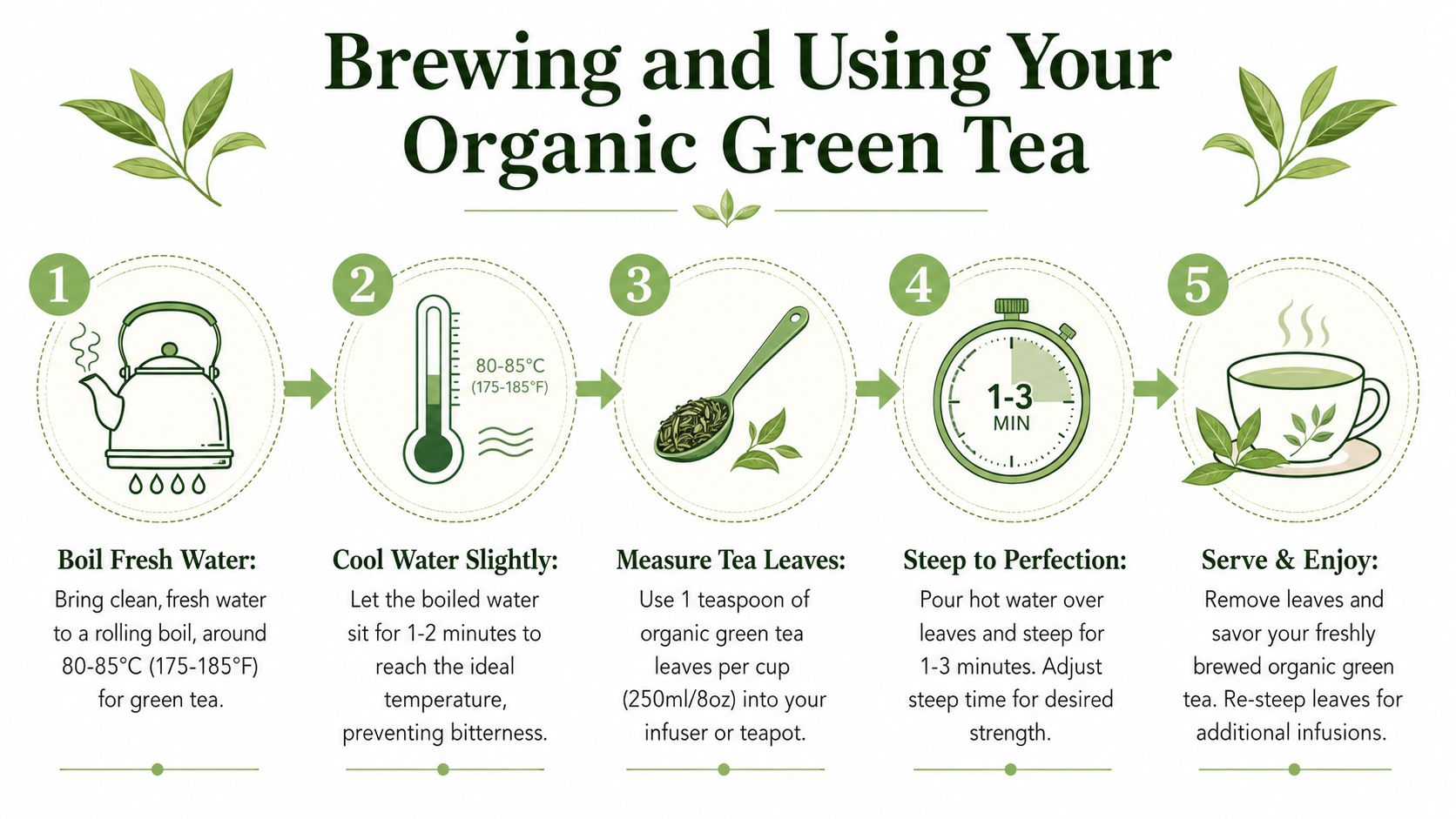
How to brew loose leaf well
You don't need specialist gear to get this right. You need a kettle, an infuser, and a timer.
Try this simple method:
- Boil fresh water, then let it cool slightly so it sits in the green tea range rather than straight off a hard boil.
- Add your leaf to an infuser or teapot.
- Pour and steep for a short, controlled time rather than guessing.
- Taste and adjust the next cup if needed. A shorter steep usually softens bitterness.
If your tea tastes harsh, don't blame the leaf first. Check temperature and time.
How to prepare matcha without lumps
Matcha is less about steeping and more about suspension. You're mixing powdered tea directly into liquid, so texture matters.
A reliable home method:
- Sift the matcha first if you can. This helps prevent clumping.
- Add a small amount of warm water and whisk into a smooth paste.
- Whisk briskly with more water until the surface looks evenly mixed and lightly frothy.
- For a latte, add your milk after the matcha is smooth.
For readers who like a visual guide, this short video is handy:
Easy ways to use it beyond a plain cup
Good organic green tea online should earn its place in your pantry. Matcha and loose leaf can both do more than one job.
A few practical uses:
- Morning latte. Matcha whisked with warm milk for a smoother start to the day.
- Iced drink. Chill brewed green tea and pour over ice.
- Smoothie add-in. Matcha works well when you want a green tea note in blended drinks.
- Baking and desserts. Culinary matcha suits slices, muffins, yoghurt bowls, and more.
- Food pairing. Loose leaf green tea can be a clean match for light lunches or sushi-style meals.
At Pep Tea, products like ceremonial-grade and culinary-grade organic matcha are examples of how different green tea formats suit different uses rather than one replacing the other.
Storage Freshness and Shipping Considerations
Fresh tea can lose its spark faster than many people expect. Light, air, moisture, and heat all work against flavour. If you've ever bought green tea that smelled flat or tasted dull within days, storage was probably part of the problem.
That's why packaging matters so much when you buy organic green tea online. User behaviour shows growing interest in how price, freshness, and packaging waste trade off when ordering online, along with a shift from conventional tea bags toward premium matcha and functional tea beverages, as noted in this retail-focused organic green tea collection page.
What to do once your tea arrives
Keep it simple and consistent:
- Store it airtight so the tea isn't repeatedly exposed to oxygen.
- Keep it out of direct light because light can flatten flavour over time.
- Avoid warm spots like windowsills, above kettles, or near the stove.
- Use the original pouch if it's well designed. Resealable, opaque packaging is usually there for a reason.
What to look for before you order
A product page can tell you a lot about freshness protection before you buy.
Check for:
- Opaque packaging rather than clear windows that expose the tea
- Resealable closures that make daily use easier
- Pack size that fits your habits so you're not opening the same bag for too long
- Clear shipping information that suggests the seller has thought about safe transit
If you're buying matcha, freshness protection matters even more because powder exposes a lot of surface area. Once opened, it deserves a bit of care.
Your Wellness Journey with Organic Tea
Buying organic green tea online doesn't need to feel like decoding a secret club. Once you know what to look for, the decision gets much calmer. You're checking for real certification, clear origin, sensible transparency, the format that suits your routine, and packaging that protects freshness.
That combination does more than help you choose a product. It helps you build a habit. A good green tea can become the quiet part of your day that feels organised, steady, and genuinely enjoyable. For some people that's a whisked matcha in the morning. For others it's a loose leaf pot in the afternoon instead of another coffee or a sugary drink.
The best tea choice is the one that fits your life closely enough that you'll keep reaching for it.
If you've been overwhelmed by choice, take that as a sign to simplify rather than give up. Look for proof over promises. Buy from sellers who educate as well as sell. And trust your own preferences once the basics are covered.
If you're ready to put that into practice, Pep Tea is a good place to explore organic matcha and green tea options with an Australian focus, clear education, and products designed for everyday use at home or in a café.
Matcha Whisk Set: Your Complete Australian Guide

You order a matcha at your favourite café. It arrives bright green, smooth, lightly creamy, and somehow calmer than coffee without feeling flat. Then you try making one at home and end up with floating clumps, weak foam, and a whisk that already looks stressed.
That gap usually isn’t about effort. It’s about tools and technique.
A matcha whisk set looks simple, but it solves the exact problems that frustrate most beginners. The bowl gives you room to whisk properly. The scoop helps with consistent measuring. The whisk is built to suspend fine powder in water and create the soft froth that makes matcha feel rounded rather than gritty. Once you use the set as intended, the whole process starts to make sense.
There’s also a reason these tools have lasted for centuries. The Asia-Pacific region, including Australia, represents 45% of the global matcha whisk set market, a dominance tied to long tea traditions reaching back to the Muromachi period (Research Intelo market report). For Australians, that matters in a practical way. It means strong access to authentic tools, better importing pathways, and more choice for homes and cafés that want to prepare matcha properly.

Matcha also rewards good preparation. The powder is delicate, and the way you mix it changes texture, flavour, and your overall experience of the drink. A whisk set turns matcha from “green powder in hot water” into a repeatable ritual you can enjoy before work, after the gym, or during a quieter afternoon.
If you run a hospitality venue, the same principle applies. Small tool choices shape consistency. For teams building a broader beverage offering, this guide to tea for cafés and offices is a useful companion read because it looks at tea service from an operational point of view rather than only from a home kitchen lens.
Great matcha isn’t mysterious. It comes from the right bowl, the right whisk, the right water, and a few habits that become second nature very quickly.
Introduction The Secret to Cafe-Quality Matcha at Home
The matcha often gets the initial blame. Fair enough. Powder quality matters. But if your whisking tool is wrong, even a beautiful ceremonial-grade matcha can turn dull, clumpy, or bitter.
A proper matcha whisk set gives each part of the process a job. That’s why it feels more organised than using a mug, a teaspoon, and whatever frother happens to be in the drawer. The set was designed around one goal. Make powdered tea combine evenly with water while preserving texture and balance.
Why the set matters more than people think
A lot of confusion starts with the idea that any whisk will do. It won’t. Matcha is not brewed like loose-leaf tea. You’re drinking the leaf itself in powdered form, so the powder has to be dispersed thoroughly through the liquid.
That’s where the set changes everything:
- The whisk creates suspension so the powder doesn’t sit in grainy pockets.
- The bowl supports movement because you need space to whisk briskly.
- The scoop adds consistency so each cup starts with a repeatable amount.
- The holder protects the whisk so performance stays reliable over time.
For home drinkers, this means fewer failed cups. For cafés, it means a more consistent workflow and better texture from one serve to the next.
Why café matcha feels different
When café matcha tastes better, it’s usually because the basics are dialled in. The person making it has the right bowl shape, a whisk in decent condition, and a method they repeat every time. The drink feels silky because the powder was incorporated properly, not because there was some secret ingredient.
That’s encouraging news. You don’t need years of tea ceremony training to make a lovely bowl at home. You just need to understand what each piece does and how to use it with intention.
Deconstructing the Traditional Matcha Whisk Set
A traditional matcha whisk set is beautifully simple. Each piece looks modest on its own, but together they form a system that’s been refined over generations.
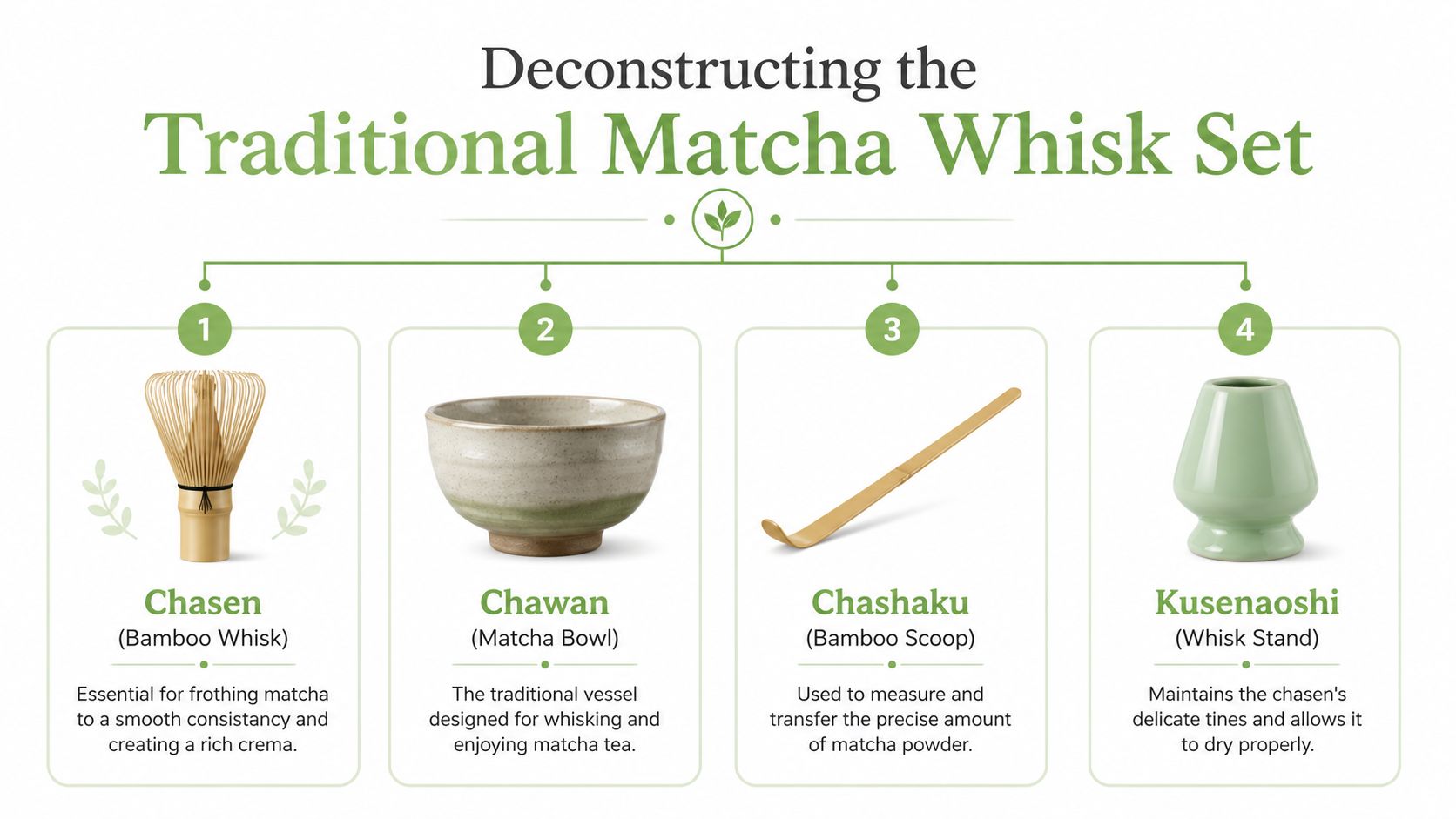
Chasen the bamboo whisk
The chasen is the heart of the set. It’s the traditional bamboo whisk used to mix and froth matcha. Unlike a kitchen whisk, it’s carved from a single piece of bamboo and shaped into many fine tines that move through liquid with surprising delicacy.
Its job isn’t just to stir. It breaks up small clusters of powder, lifts air into the tea, and helps create that soft foam many people associate with well-made usucha. If you’ve only ever mixed matcha with a spoon, using a chasen is the moment the drink starts to feel proper.
If you want to see a dedicated option for this tool, Pep Tea’s matcha tea brush collection shows the style commonly associated with a traditional whisk.
Chawan the matcha bowl
The chawan is the bowl used for preparing and drinking matcha. Its wider shape is functional, not decorative. You need room at the base for the whisk to move quickly in a zigzag motion without banging into narrow sides.
A mug can work in a pinch, but it makes whisking awkward. The bowl gives you control. It also helps you see the texture developing as you whisk, which is useful when you’re learning what “smooth enough” looks like.
Practical rule: If the vessel is too narrow for fast wrist movement, it’s too narrow for easy matcha.
Chashaku the bamboo scoop
The chashaku is the curved bamboo scoop used to transfer matcha from tin to bowl. It looks very minimal, and that’s part of its charm. It encourages a measured, repeatable approach instead of guessing with a kitchen spoon.
That consistency matters more than people realise. Matcha is sensitive to ratio. Too much powder can make the drink thick or harsh. Too little can leave it washed out. The scoop helps turn the ritual into something calm and dependable.
Kusenaoshi the whisk holder
The kusenaoshi is the whisk holder or stand. It’s one of the most underrated pieces in the set because people often think it’s optional. In practice, it helps the whisk keep its shape and dry more evenly after use.
That matters because bamboo is natural and responsive. If a whisk dries crumpled or stays damp in the wrong spots, the tines lose their neat form faster. A holder helps preserve that open, tulip-like shape that lets the chasen work properly.
Why the set works as one system
The beauty of a matcha whisk set is that none of the tools are trying to do too much. Each one solves a very specific problem. The bowl creates space. The scoop creates consistency. The whisk creates texture. The stand protects the whisk between uses.
Here’s the short version:
- Chasen for mixing and frothing
- Chawan for whisking room and drinking
- Chashaku for measured dosing
- Kusenaoshi for shape retention and drying
When people say matcha feels mindful, this is often what they mean. The tools slow you down just enough to do things well.
How to Choose the Right Matcha Whisk Set for You
Buying a matcha whisk set gets confusing fast because many sets look similar online. Differences are in whisk design, materials, and whether the set matches how you’ll use it.
If you mainly drink usucha, whisk performance matters most. Australian tea experts recommend a chasen with 80 to 120 tines for the best froth in usucha, and a 100-prong whisk can produce 20 to 30% more stable foam than a 64-tine version (tea expert demonstration). That’s the kind of detail worth paying attention to because it directly affects what ends up in your bowl.
Start with the whisk, not the packaging
Many shoppers focus on whether the set comes in a gift box, includes extras, or matches their kitchen. Nothing wrong with that. But the whisk is still the working part.
These practical checkpoints are often considered:
- Tine count for usucha matters if you want that light foam and smoother mouthfeel.
- Bamboo quality affects how evenly the whisk opens and how delicate the tines feel.
- A whisk holder included is useful if you want the set to last.
- A wider bowl makes learning easier than a narrow, decorative cup.
If you love a pared-back kitchen setup, this HYDAWAY minimalist kitchen guide is a nice reminder that the best tools are often the ones with one clear purpose and daily usefulness.
Bamboo versus modern alternatives
There’s a practical gap in most matcha content. It often tells you bamboo is traditional, but it doesn’t always explain whether that matters in daily Australian use.
Here’s the honest version. Bamboo is traditional because it works beautifully with matcha. It’s flexible, light, and designed for the whisking motion that this drink requires. Plastic or metal alternatives may look durable, but they change the feel of preparation and often miss the softer aeration you get from a proper chasen.
For many readers, the decision comes down to priorities:
- Choose bamboo if you care about texture, ritual, and authentic preparation.
- Choose a simpler starter set if you’re new and want to learn without overthinking.
- Choose sets with replaceable core pieces if you make matcha often and expect wear over time.
Matcha Whisk Set Buyer’s Guide
| Feature | Best for Beginners | Best for Enthusiasts | Best for Cafés |
|---|---|---|---|
| Whisk style | Bamboo chasen with an easy-to-use tine count suited to everyday usucha | Finely crafted bamboo chasen chosen for feel, control, and foam quality | Multiple bamboo chasen kept in rotation for service consistency |
| Bowl choice | Wide bowl that gives plenty of room to learn the motion | Bowl selected for comfort, weight, and whisking response | Durable bowls with enough width for repeat prep during busy periods |
| Scoop | Standard bamboo scoop for consistent habits | Traditional scoop used with a more deliberate ritual | Scoop or measured workflow that supports repeatable dosing |
| Whisk holder | Strongly recommended | Essential | Essential for storage and turnover |
| Best use case | Home practice, lattes, daily ritual | Straight matcha, intentional preparation, collecting quality teaware | Hot matcha, iced matcha, latte service, staff training |
| Buying focus | Simplicity and ease | Craft and performance | Consistency, replacement planning, workflow |
What suits different readers
A beginner usually does best with a straightforward set that includes the four basics and doesn’t demand too much fuss. The goal is building confidence.
An enthusiast often notices finer points. How springy the whisk feels. How the bowl sits in the hand. Whether the foam is delicate rather than coarse.
A café owner needs something else again. Reliability matters more than romance during service. Sets need to be easy for staff to use correctly, easy to dry properly, and easy to replace when parts wear out. A practical place to browse supporting tools is Pep Tea’s matcha tea accessories range.
The right set isn’t the fanciest one. It’s the one that matches your drinking habits and helps you make good matcha consistently.
A Step-by-Step Guide to Whisking Perfect Matcha
Technique is where the whole set comes alive. The good news is that proper whisking is simple once you know what to pay attention to.
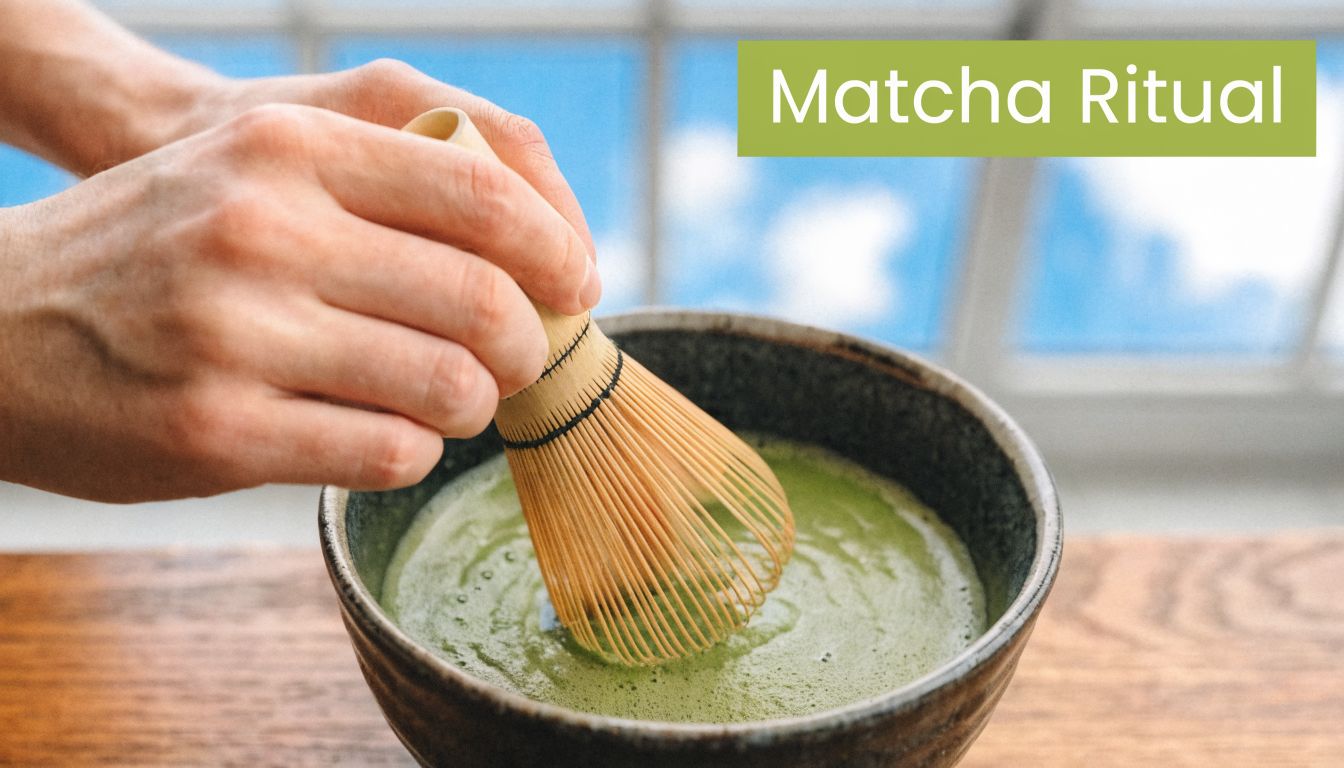
Wake up the whisk first
Don’t use a dry bamboo whisk straight away. The chasen activation process involves soaking the whisk in 80°C water for 1 to 2 minutes, which unfurls the tines and can increase surface area by up to 35% for better dispersion (preparation guide).
That step sounds small, but it changes everything. A softened whisk is less likely to snap and much better at moving through the tea. Dry, tight tines don’t glide properly.
Build the bowl properly
Add your matcha to the bowl using the scoop. If your powder has compacted in the tin, sift it first. Sifting isn’t fussy. It helps prevent little dry lumps that no whisk can completely rescue once they’re wet.
Then add warm water, keeping your temperature in the 70 to 80°C range mentioned in the preparation benchmarks from the earlier cited tea guidance. Water that’s too hot can push flavour in a harsher direction. Water that’s too cool can leave the drink flat and underdeveloped.
A useful reference for broader tea brewing habits is this guide to the secrets to perfect Japanese green tea, especially if you enjoy exploring how temperature changes flavour across different Japanese teas.
Use the W motion, not circles
This is the point most beginners get wrong. Circular stirring feels natural, but it doesn’t whisk matcha efficiently. The same preparation guidance notes that a rapid W-shaped whisking pattern is superior to circular motions, which tend to trap air unevenly in the liquid.
Try this sequence:
- Hold the bowl steady with your free hand.
- Keep the whisk low so the tips move through the liquid, not above it.
- Whisk briskly in a W or M motion from the wrist, not the whole arm.
- Ease off at the end and lift gently to settle the foam.
You’re not beating eggs. You’re creating fast, light agitation close to the surface.
After you’ve read the steps, it helps to watch the movement once in real time.
What good matcha should look like
You’re aiming for a smooth liquid with fine foam across the top for usucha. Not giant bubbles. Not a thick cap. Just a neat layer that looks even and lively.
If you make matcha for lattes, think of this whisked bowl as your base. Once the powder is fully dispersed and the top looks smooth, you can pour it over milk or ice without fighting clumps later.
Small, quick wrist motions beat big dramatic ones every time.
A simple home routine
If you want a practical rhythm, keep it uncomplicated:
- Warm the whisk
- Add matcha to bowl
- Sift if needed
- Add warm water
- Whisk in a W
- Drink as is or turn it into a latte
After a few days, the process feels less like a recipe and more like muscle memory.
Caring for Your Set in the Australian Climate
Australian conditions are hard on natural materials. Coastal humidity, warm kitchens, and quick temperature changes can all shorten the life of a bamboo whisk if you leave it damp or crushed after use.
That’s why aftercare matters almost as much as whisking technique.
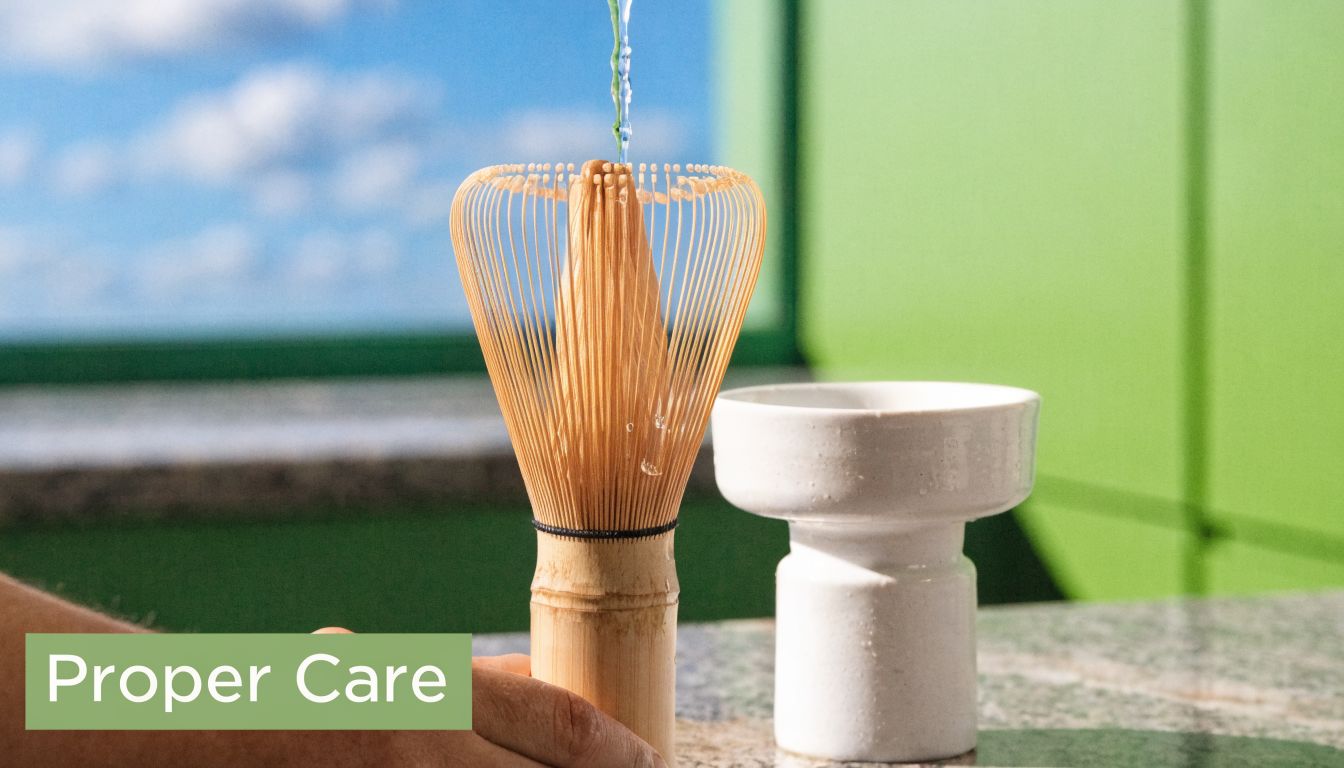
Clean it gently and straight away
As soon as you’ve finished making matcha, rinse the whisk under warm water. Skip soap. Bamboo can hold onto detergent smell and flavour, which you don’t want in the next bowl.
The bowl can be washed as you would other ceramics, and the scoop can be wiped clean and kept dry. The whisk needs the most attention because its tines are thin and vulnerable when left coated with drying matcha.
Why the whisk holder matters in Australia
Generic tea advice often ignores climate. In Australia, with humid conditions in many areas, a ceramic whisk holder can reduce breakage by up to 40% compared with leaving the whisk unprotected because it helps maintain bristle integrity and airflow (regional care note).
That’s not a decorative extra. It’s practical equipment.
A holder helps by:
- Supporting the whisk’s shape as it dries
- Allowing better airflow around the inner tines
- Reducing stress on bent bristles
- Making storage tidier if your tea station is used daily
If you need one, Pep Tea’s matcha whisk stand is the type of tool designed for that exact job.
Smart storage habits
Where you store your set matters more than people expect. Avoid sealing a damp whisk in a drawer or cupboard with poor airflow. Keep it away from direct sun as well, since harsh drying can make bamboo brittle.
A few habits help a lot:
- Let the whisk dry fully before tucking things away
- Store the set somewhere airy rather than cramped and steamy
- Keep the bowl dry so moisture doesn’t build around the base
- Check the whisk regularly for bent, split, or darkened tines
A whisk wears out gradually. If the tines have lost their shape or the bamboo no longer opens well after soaking, it’s time to replace it.
When to retire a whisk
No bamboo whisk lasts forever. With regular use, some tines will eventually fray, break, or sit unevenly. That doesn’t mean you’ve done anything wrong. It means a natural tool has been used.
The aim isn’t to preserve it forever. It’s to help it age well, stay clean, and work reliably for as long as possible.
Troubleshooting Common Matcha Making Problems
Even with a good matcha whisk set, a few issues show up again and again. Most are easy to fix once you know what’s causing them.
Why isn’t my matcha frothing
The first culprit is usually technique. If you’re stirring in circles, whisking too slowly, or using a vessel that’s too narrow, foam will struggle to form. The second culprit is the whisk itself. If the tines are cramped, damaged, or not softened first, they won’t move enough air into the tea.
Check these points:
- Use a wide bowl, not a narrow mug
- Soak the whisk before use so the tines open properly
- Whisk from the wrist in a fast zigzag motion
- Use fresh matcha that hasn’t compacted or dulled in storage
Why is my matcha clumpy
Clumps usually start before whisking. Matcha powder is very fine, so it tends to gather if it’s been sitting in the tin or exposed to moisture. Once wet, those tiny clumps become harder to break up.
The fix is simple. Sift the powder before adding water, then whisk briskly once liquid goes in. If you still get little pockets of powder, your whisk may need replacing or your motion may be too slow.
Why does my matcha taste bitter
Bitter matcha is often overheated matcha. Water that’s too hot can pull the drink out of balance quickly. Preparation also matters. If the powder isn’t dispersed evenly, you can get concentrated sips that taste rougher than the rest of the bowl.
Quality plays a role too. Smoother organic matcha intended for drinking tends to be more forgiving than powder meant mainly for cooking. If you’re making straight matcha often, choosing a grade suited to drinking makes the experience much easier.
Why is my whisk breaking or getting mouldy
This comes down to care. Bamboo doesn’t like being left wet, crammed, or coated in drying matcha residue. If the whisk goes back into storage damp and unsupported, damage follows.
A quick reset usually solves the problem:
- Rinse immediately after use
- Let it air dry on a holder
- Keep it out of sealed damp spaces
- Replace it once the tines are heavily split or misshapen
Most matcha problems aren’t signs that you’re bad at making matcha. They’re signs that one small part of the process needs adjusting.
Beyond the Bowl Simple Recipes and Ideas
Once you can whisk a smooth bowl of matcha, your set becomes useful far beyond traditional preparation. The trick is to use the whisk set to create a silky matcha base first, then build your drink from there.
Classic matcha latte
Start by whisking your matcha with warm water in the bowl until smooth and lightly frothy. Pour that into a cup, then add your milk of choice. If you like a softer, rounded drink, warm the milk first.
This approach works because the powder is already fully dispersed before the milk goes in. You avoid the green lumps that happen when people try to stir matcha straight into a full mug of milk.
Iced matcha latte for Australian weather
For warmer days, whisk your matcha base exactly as you would for a hot drink. Then pour it over ice and cold milk. That gives you a cleaner flavour and a brighter colour than trying to shake dry powder into a chilled drink.
A simple format looks like this:
- Whisk matcha with warm water until smooth
- Fill a glass with ice
- Add cold milk
- Pour the matcha over the top
- Stir before drinking
The result feels café-friendly but still easy enough for a weekday morning.
Smoothies and kitchen use
A matcha whisk set can also help with small-batch prep for smoothies or simple kitchen recipes. Whisk a concentrated matcha base first, then pour it into yoghurt, oats, or a smoothie blender. Starting with a smooth liquid base gives you more even colour and flavour.
Ceremonial and culinary uses
People often ask whether the set is only for ceremonial-grade matcha. Not at all. The set is designed around proper preparation, but the final liquid can head in different directions. Use drinking-grade matcha for a more direct bowl or a refined latte. Use culinary matcha when the drink or recipe includes other stronger flavours.
That flexibility is part of why the set earns its place in the kitchen. It supports a traditional method, but it fits easily into modern Australian routines.
Conclusion Your Partner in the Perfect Cup
A matcha whisk set isn’t a decorative extra. It’s the tool that makes matcha easier to understand, easier to enjoy, and far more consistent from cup to cup.
The key ideas are simple. Choose a set that suits how you drink matcha. Learn the basic whisking motion properly. Care for the bamboo well, especially in Australian conditions where humidity can shorten its life. Once those habits click, the whole process feels less intimidating and much more rewarding.
That’s true whether you’re making a quiet morning bowl at home or training staff to serve matcha lattes with confidence. The right setup gives you control over texture, flavour, and ritual.
We’re big believers in making matcha approachable. If you’re ready to build your own daily routine, explore the curated range at Pep Tea for organic matcha, accessories, and practical tools that support the process from first whisk to final sip.
Master Matcha Making Kit: Your Perfect Brew Awaits

You’ve probably seen a matcha making kit online, loved the look of the bowl and whisk, then paused at the checkout wondering whether you need all of it. Fair question. A lot of first kits are bought on impulse, used twice, then pushed to the back of the cupboard because the tea came out bitter, lumpy, or oddly flat.
The good news is that making proper matcha at home isn’t hard. It’s just precise. A few simple tools, the right powder, and a couple of small habits make all the difference. Once those pieces are in place, your morning cup starts to feel less like a fiddly task and more like a ritual you’ll want to repeat.
A good matcha making kit should do two jobs well. It should help you whisk a smooth bowl of tea, and it should remove doubt about what you’re putting into that bowl. For Australian drinkers, that second part matters more than most guides admit.
Choosing Your First Matcha Making Kit
The cheapest kit is rarely the best first buy.
That doesn’t mean you need something ornate or collector-level. It means your matcha making kit should be built around safety, usability, and powder quality, not just aesthetics. Plenty of kits look lovely in product photos but fall short where it counts. The whisk splays too quickly, the bowl is awkward to whisk in, or the included matcha is an afterthought.
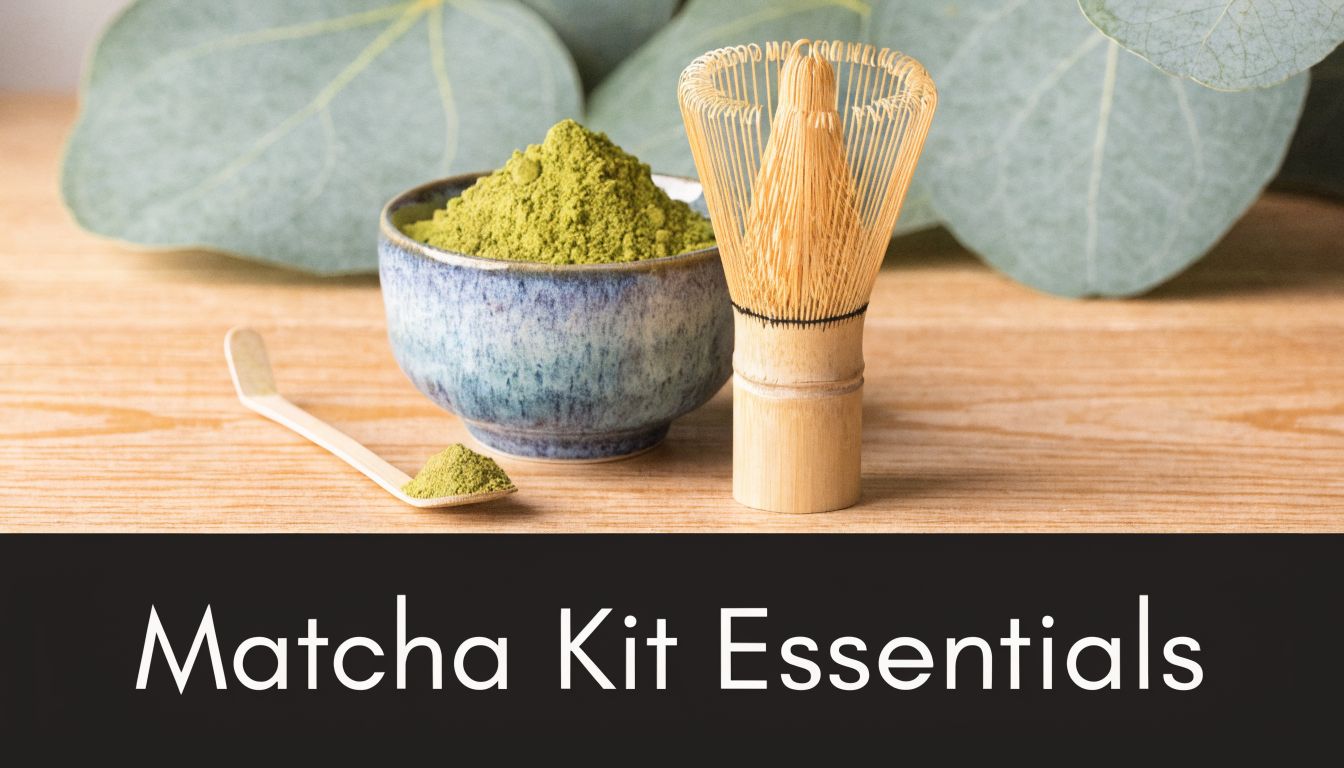
What a first kit should include
At minimum, look for these pieces:
- A chawan bowl: Wide enough to whisk in comfortably. A narrow mug makes frothing harder and usually leaves clumps around the edges.
- A chasen whisk: This is the bamboo whisk that gives matcha its light foam and smooth texture.
- A chashaku scoop: Helpful for consistent portions and part of the traditional process.
- A fine sifter: Often skipped in budget sets, but it’s one of the most useful tools in the whole routine.
If a set omits the sifter, I’d still consider buying it, but only if you’re happy to add a fine kitchen sieve yourself. Skipping sifting is one of the quickest ways to end up with gritty matcha.
The real buying question isn’t price
Most beginners compare kits by appearance first and price second. I’d reverse that thinking. Compare them by what they let you avoid.
You want to avoid a whisk with rough or brittle tines. You want to avoid unclear materials. You want to avoid powder with vague sourcing. And you want to avoid kits that bundle in low-grade matcha just to look complete.
Practical rule: If the seller is detailed about the tools but vague about the matcha, treat that as a warning sign.
There’s a genuine gap in the Australian market around organic certification and sourcing. One review of starter kit content notes that many kits focus on the tools while leaving buyers with very little clarity about certified-organic powder and food-grade tool standards, which matters for Australian consumers trying to buy carefully from trusted suppliers (matcha kit sourcing and certification gaps).
What matters most for Australian buyers
If you care about clean ingredients, don’t treat the powder as separate from the kit. Treat it as the centrepiece.
A whisk can help texture. A bowl can help technique. But the flavour, colour, aroma, and overall drinking experience come from the matcha itself. For that reason, I’d rather see a simple kit paired with certified organic matcha than a deluxe set with uncertain powder.
Here’s the short version of what to check before buying:
| What to check | Why it matters |
|---|---|
| Organic certification | Gives you a clearer standard for how the powder was produced |
| Food-grade tool materials | Helps you avoid uncertainty around bamboo and glaze quality |
| Wide bowl shape | Makes whisking easier and improves foam |
| Separate scoop and sifter | Keeps your portioning and texture more consistent |
| Clear sourcing information | Usually signals better care and transparency overall |
For gifting, presentation still matters. If you’re comparing more polished options for birthdays, housewarmings, or wellness gifts, it can help to browse various gift guides and then come back to the practical checklist above so the set looks good and works well.
What works and what usually disappoints
What works:
- A simple ceramic bowl with room to whisk
- A bamboo whisk that feels springy, not dry or fragile
- Matcha sold with clear quality cues rather than bundled as filler
- A set from a supplier that understands preparation, not just packaging
What often disappoints:
- Tiny bowls: Pretty on a shelf, frustrating in use
- Decorative kits with no sifter: You’ll fight clumps from day one
- Mystery matcha: Dull colour, harsh taste, poor value
- Ultra-cheap bundles: Fine for photos, less fine for daily drinking
If you want an example of a straightforward set designed for home preparation, Pep Tea offers a Japanese matcha set that includes the traditional tool format essential for most beginners.
Your First Bowl A Mindful Matcha Ritual
Making your first bowl of matcha goes better when you stop trying to rush it.
The best bowls I’ve made at home haven’t come from speed. They’ve come from giving each part of the process a reason. Warm the bowl because temperature matters. Sift the powder because texture matters. Whisk with focus because the final cup shows every shortcut.
Start by warming the bowl
Pour hot water into your bowl and let it sit briefly. Then warm the whisk in that same water for a moment.
This step does two useful things. It takes the chill off the bowl so your tea stays pleasant to drink, and it softens the whisk tines slightly so they’re less likely to feel stiff or scratchy when you begin. Empty the bowl, then dry it well. If the bowl is wet before the powder goes in, the matcha can stick and form paste-like lumps.
Sift the powder every single time
For a traditional everyday bowl of usucha, use 2g per serving. Sift it into the dry bowl.
That amount is small enough to feel approachable and strong enough to show the character of the tea. Sifting is the difference between smooth and frustrating. Matcha is a fine powder, but it still clumps easily in the tin. Once hot water hits those clumps, they’re harder to break apart cleanly.
Skip sifting once and you’ll usually spend the rest of the bowl chasing little green lumps around the bottom.
Add water that’s hot, not scalding
Your water should be hot enough to wake up the matcha, but not so hot that it knocks the life out of it. If you’ve just boiled the kettle, let the water cool a little before pouring.
When the water is too hot, matcha can taste sharper and less balanced. When the temperature is gentler, you’re more likely to notice sweetness, softness, and that fresh green character people are often chasing in cafés.
A helpful beginner method is this:
- Boil your kettle
- Warm the bowl and whisk
- Dry the bowl
- Sift in your 2g of matcha
- Add a small amount of hot water first
- Whisk into a loose paste before adding the rest
That first small splash of water matters. It helps the powder open up evenly rather than floating in dry pockets.
Let your senses guide the process
As you whisk, listen for the light tapping sound of bamboo moving quickly across the surface. Watch the colour brighten. Notice when the texture changes from thin and watery to silky and lightly foamed.
A good first bowl doesn’t need to look perfect. It just needs to feel integrated. No dry clumps, no sludge at the base, no harsh burnt note from overheated water.
Here’s a simple sensory checklist:
- Colour: Fresh, vivid green rather than dull olive
- Aroma: Grassy, creamy, or softly vegetal, not burnt
- Texture: Smooth and fine, with a light layer of froth
- Finish: Clean and rounded, not aggressively bitter
Drink it while it’s alive
Matcha doesn’t improve by sitting around. Once whisked, drink it promptly.
That’s part of why the ritual feels grounding. You make one bowl, you hold it warm in your hands, and you drink it in the moment it was prepared. It isn’t a brew to forget on the bench while you answer emails.
Small habit, big payoff: Sit down for the first few bowls you make. When you’re standing and distracted, you’ll rush the whisking and miss the flavour cues.
If you’re new to the taste, don’t judge matcha by your first sip alone. The opening can feel grassy or savoury if your palate expects sweetness. Give it a few mouthfuls. Good matcha tends to settle into itself as you drink, and your palate catches up quickly.
Mastering the Whisk The Art of the Perfect Froth
The chasen, or bamboo whisk, is the heart of the matcha making kit. It has been central to matcha preparation since Japan’s Muromachi period (1336–1573), while the broader practice of whipping powdered tea reaches back to China’s Song Dynasty (960–1279 AD), which gives this simple tool a long history in tea preparation (history of the matcha whisk).
That history is lovely, but what matters in your kitchen is this. The whisk isn’t there to stir. It’s there to aerate.
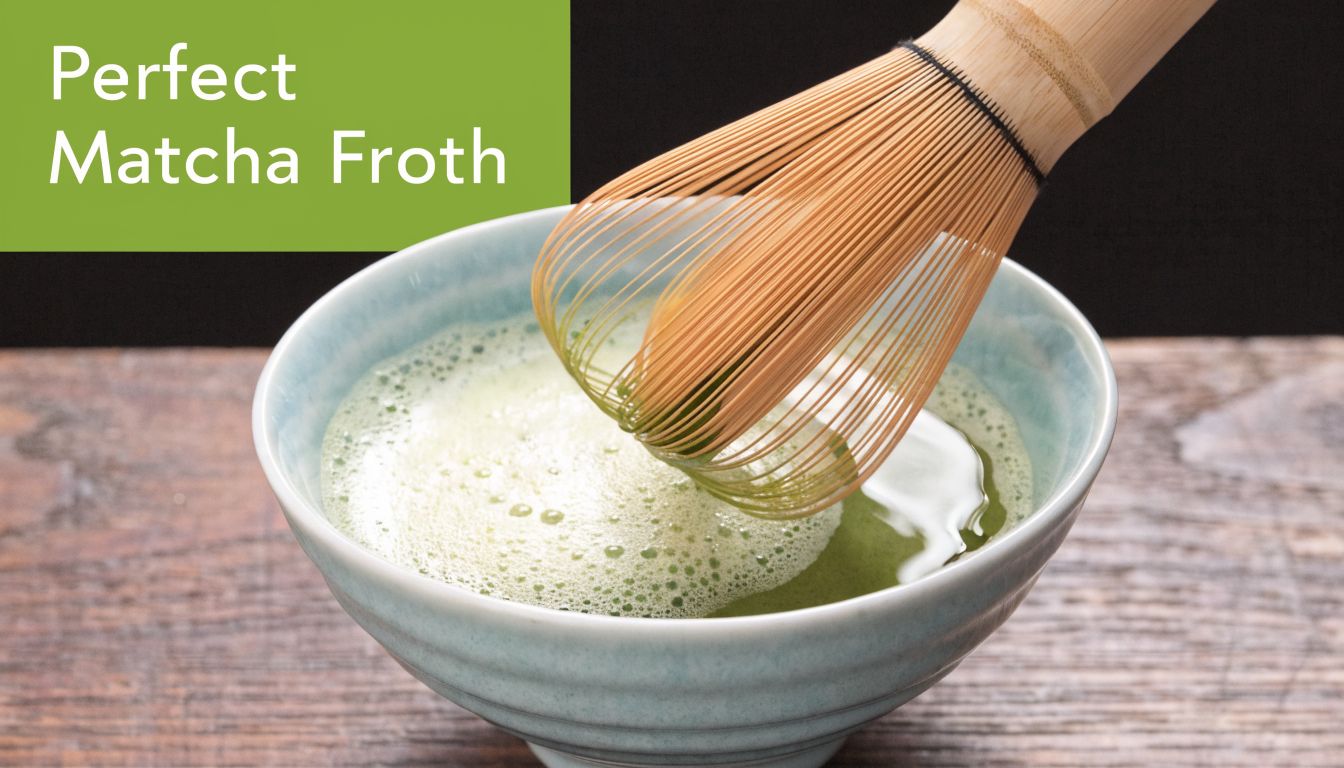
Use your wrist, not your whole arm
A lot of beginners whisk matcha as if they’re beating cake batter. Big arm movement, lots of effort, not much foam.
The better approach is smaller and quicker. Hold the bowl steady with one hand. Hold the whisk lightly with the other. Then move from the wrist in quick M or W motions near the surface of the tea.
The whisk should glide, not grind. If you press the tines hard into the bottom of the bowl, you’ll wear them out faster and get less froth.
What the motion should feel like
Think of it as fast sketching, not stirring.
You’re not tracing perfect letters, but the motion is similar. Short, rapid passes create tiny bubbles and a finer foam. Slow circles usually produce a flatter drink with larger bubbles.
A few signs you’re on track:
- The surface starts to lighten
- Fine foam forms across the top rather than only at the edges
- The whisk moves freely without scraping
- The tea underneath looks evenly blended
If you hit a stubborn little clump, press it gently against the side of the bowl first, then return to whisking. Don’t keep attacking it in the middle of the bowl.
For a closer look at hand position and movement, Pep Tea’s guide on how to whisk matcha is useful if you like seeing the technique broken down visually.
Finish cleanly
Once you’ve got a fine foam, slow down. A gentle final sweep across the surface tidies the top and settles any oversized bubbles.
That last movement changes the look of the bowl more than people expect. The tea appears more even, the foam looks finer, and the whole drink feels more deliberate.
A quick visual demo helps here:
Don’t chase huge foam. Chase fine foam. Matcha should look soft and velvety, not like aggressively frothed milk.
Beyond the Bowl Three Simple Matcha Creations
Once your whisking is organised, your matcha making kit becomes more versatile than people expect. The same bowl, whisk, and sifted powder can take you from a quiet morning tea to an iced afternoon drink or a quick kitchen add-in.
The trick is not changing everything. It’s keeping the matcha base smooth, then adapting what surrounds it.
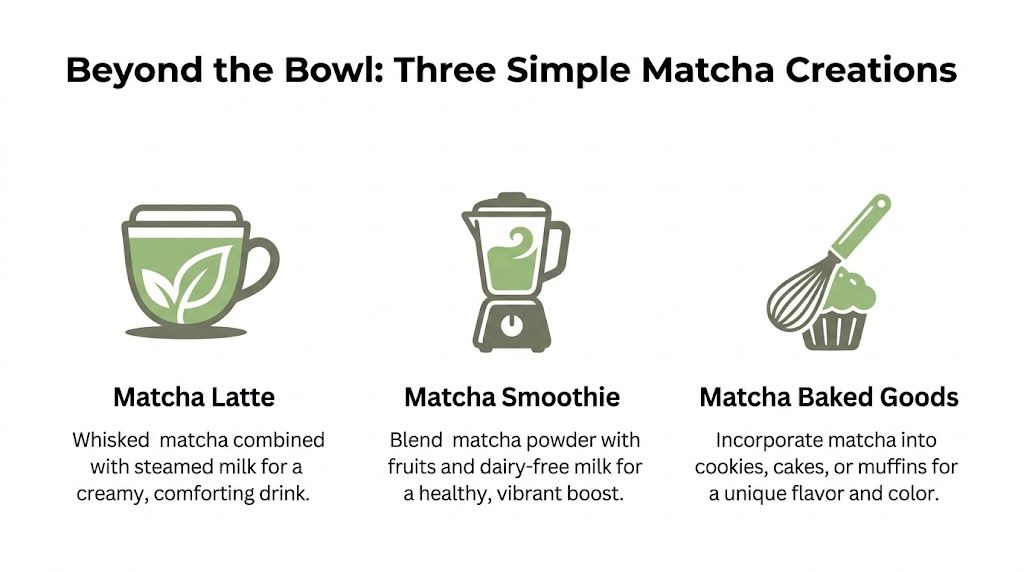
Matcha latte
A latte is often the easiest way for new drinkers to settle into matcha because milk softens the grassy edge.
Start by making a small concentrate in your bowl:
- Sift your matcha first: This keeps the latte smooth rather than chalky.
- Add a small amount of hot water: Whisk until fully blended and lightly foamy.
- Pour in warmed milk or cold milk over ice: Oat milk is popular for body, but use what you enjoy.
If your latte tastes weak, the issue usually isn’t the milk. It’s that the concentrate was too diluted before the milk went in. Keep the base strong, then stretch it.
A good matcha latte still tastes like tea. If it only tastes like milk, build a stronger bowl before you pour.
Iced matcha
Iced matcha can be fresh and crisp, but it turns disappointing fast if you skip the basic prep and try to shake dry powder straight into cold water.
Do this instead:
- Sift the matcha into your bowl
- Whisk with a small amount of hot water until smooth
- Add that concentrate to a glass of cold water and ice
- Stir or shake briefly, then drink straight away
That small amount of hot water matters because it dissolves the powder properly. Cold liquid alone doesn’t handle clumps nearly as well.
If the drink tastes sharp, reduce your brewing water temperature next time when you make the concentrate. The bitterness usually starts earlier than people think.
Matcha in smoothies and baking
Grade matters here.
For a straight bowl or a simple whisked tea, ceremonial-style matcha is the better fit because the flavour sits front and centre. For smoothies, yoghurt, muffins, pancakes, or biscuits, culinary matcha usually makes more sense because it’s designed to work with other ingredients.
A few easy uses:
- Smoothies: Add a small spoonful to banana, mango, or vanilla-based blends
- Yoghurt bowls: Stir through plain yoghurt and top with fruit
- Baking: Fold into cake batter, icing, cookies, or muffins
- No-bake snacks: Mix into energy balls or chia puddings
Here’s a simple comparison:
| Use | Better style |
|---|---|
| Traditional whisked bowl | Ceremonial-style matcha |
| Hot or iced latte | Ceremonial-style matcha or a smooth everyday blend |
| Smoothies | Culinary matcha |
| Baking | Culinary matcha |
If you’re using matcha in the kitchen regularly, keep one powder for drinking and another for recipes. It’s cleaner, more practical, and saves you using your nicest tea where subtle flavour will get buried.
Caring For Your Tools A Guide to Longevity
A matcha making kit lasts much longer when you clean it straight after use.
That’s especially true for the whisk. Bamboo is practical and beautiful, but it doesn’t respond well to neglect. Leave matcha residue sitting in the tines, or tuck the whisk away damp, and you’ll shorten its life quickly.
How to clean the whisk properly
Rinse the whisk under warm water as soon as you finish your bowl. Use your fingers very gently if a bit of powder is caught between the tines, but don’t scrub and don’t use soap.
Soap can linger in bamboo and affect flavour later. Rough handling can snap the fine tines or pull them out of shape.
A simple routine works best:
- Rinse immediately: Dried matcha is harder to remove later
- Use warm water only: Enough to release residue without stressing the bamboo
- Shake off excess water: Don’t leave it dripping on the bench
- Air dry thoroughly: Moisture is the enemy
Why a whisk stand helps
A kusenaoshi, or whisk stand, helps the chasen dry in a more natural shape. That matters because the curved form supports better whisking and reduces stress on the tines over time.
If you use your kit often, a matcha whisk stand is a practical addition rather than a decorative extra.
Store the whisk upright only after it has been rinsed and allowed to dry properly. A damp cupboard is where bamboo tools start going wrong.
Bowl and scoop care
The bowl is the easiest part of the set to maintain. Wash it with warm water and a soft cloth or sponge. If you use dish liquid, rinse it thoroughly so no scent remains.
The scoop needs a lighter touch. Wipe it clean or rinse briefly if needed, then dry it well. Don’t leave bamboo pieces soaking in water.
For best flavour, keep all tools away from strong kitchen smells. Matcha is delicate enough to pick up unwanted aromas over time.
Troubleshooting Common Matcha Mistakes
Even with a solid matcha making kit, the first few bowls can be inconsistent. That’s normal. Most problems come down to one of three things: water, whisking, or powder prep.
Why does my matcha taste bitter
The usual culprit is water that’s too hot. If you pour freshly boiled water straight onto the powder, the cup can taste harsher than it should.
Another common issue is using more powder than your palate is ready for. Strong matcha isn’t the same as balanced matcha.
Try this:
- Let the water cool slightly after boiling
- Stick to a modest serving when you’re learning
- Choose matcha suited to drinking, not baking
- Whisk thoroughly so the flavour is evenly distributed
If the bitterness is only at the end of the bowl, check whether sediment is collecting at the bottom. That often points to weak whisking or poor sifting.
Why am I getting clumps
Clumps usually begin before the whisk ever touches the bowl.
Matcha compacts in storage, so the powder needs air introduced back into it. That’s what sifting does. Once you skip it, the whisk has to work much harder.
The fix is straightforward:
- Sift into a dry bowl
- Add a small amount of water first
- Make a smooth paste
- Then add the rest of the water
- Break any stubborn bits gently against the side
Don’t dump all the water in at once and hope the whisk sorts it out. Sometimes it can. Often it won’t.
Why am I not getting any foam
Foam depends on technique more than force.
If you’re whisking in slow circles, you’re mixing, not aerating. If you’re pressing the whisk heavily into the bowl, the tines can’t flick the liquid properly. And if there’s too much water for the amount of matcha, the surface won’t build the same fine froth.
A quick diagnosis table helps:
| Problem | Likely cause | Better approach |
|---|---|---|
| Flat surface | Circular stirring | Use quick wrist-led M or W motions |
| Big bubbles only | Whisking too high or too slow | Keep the whisk low and fast near the surface |
| No foam with clumps | Unsifted powder | Sift first, then whisk |
| Thin, weak bowl | Too much water | Keep the base more concentrated |
Most bad bowls aren’t ruined bowls. They’re useful feedback. Change one variable at a time and the pattern becomes obvious.
Once you get the feel for the whisk and start noticing how bowl shape, water temperature, and powder texture affect the cup, matcha becomes much easier to repeat well.
If you’re ready to build a calmer, cleaner daily ritual, Pep Tea offers organic matcha, preparation tools, and practical guides for making matcha at home with more confidence and less guesswork.