
How to Purchase Matcha Green Tea Powder Well in 2026
Buying ceremonial matcha isn't automatically the smartest choice. If you're making a latte or baking a cake, you may pay for delicate flavours that milk, butter and sugar will hide. And an expensive tin still tells you very little if the seller won't explain its origin, freshness or caffeine content.
To purchase matcha green tea powder well, start with what you'll make, then compare label evidence, price per gram and caffeine per serve. The right powder should suit your taste and routine, not just carry the most impressive grade name.
Matcha Grades Compared for Drinking, Lattes and Baking
| Grade | Best for | Colour and taste | Harvest and processing | Price guide |
|---|---|---|---|---|
| Ceremonial | Drinking plain, whisked tea | Vivid green, smooth, sweet umami | First harvest, shade-grown tencha, stone-ground | Highest of the three |
| Premium | Lattes and iced drinks | Bright green, mild, slightly bitter | Early harvest or blend, stone-ground | Mid-range |
| Culinary | Baking, smoothies, sauces, ice cream | Dull olive green, bold and bitter | Later harvest, may include stems and veins | Lowest per gram |
These are common trade conventions, not standardised legal definitions. Sellers use grade names differently, so treat the table as a starting point for questions rather than proof of what's inside.
When you're drinking matcha plain
Ceremonial matcha is intended to taste balanced with water alone. Look for sweetness, savoury umami and a smooth finish, rather than assuming that any bitterness means you've bought a bad product. Some astringency can be part of the tea's character.
Preparation matters too. Sift the powder into a bowl, add hot water that's cooled below boiling, then use a bamboo whisk, or chasen, with quick back-and-forth movements. Around 70–80°C is a practical starting point for preparation, adjusting to the tea and your taste.
Matcha forms a suspension rather than dissolving like sugar. A fine sieve helps remove ordinary clumps, but it won't turn coarse powder into silky tea.
When milk or other ingredients carry the flavour
For lattes, a premium blend often makes more sense than the most delicate ceremonial option. You want enough tea flavour to remain noticeable in your chosen milk, without needing syrup to cover harshness. Test it in the milk you use, because dairy, oat and soy drinks don't produce identical results.
Culinary matcha earns its place in baking, smoothies, ice cream and sauces. Its stronger flavour can stand up to other ingredients, although a dull olive colour shouldn't be confused with brown, stale powder. You're buying an ingredient for a job, not accepting deterioration.
Practical rule: If you'll drink it plain, start with ceremonial. If you'll add milk, sugar or butter, consider premium or culinary before paying more.
For a closer comparison, use our ceremonial versus culinary matcha guide. If you're choosing between breakfast drinks rather than tea grades, Gym Snack's guide to coffee with protein for gym-goers is a useful separate resource, especially when deciding whether you want a tea ritual or a protein-containing drink.
Finish your shelf inspection with these checks:
- Colour: Look for a lively green appropriate to the grade, not brown or yellowed powder.
- Texture: Expect a fine, silky powder rather than obvious grit.
- Aroma: Fresh grassy, sweet or savoury notes are more promising than hay, dust or mustiness.
Origin, Harvest Date and Certifications That Matter
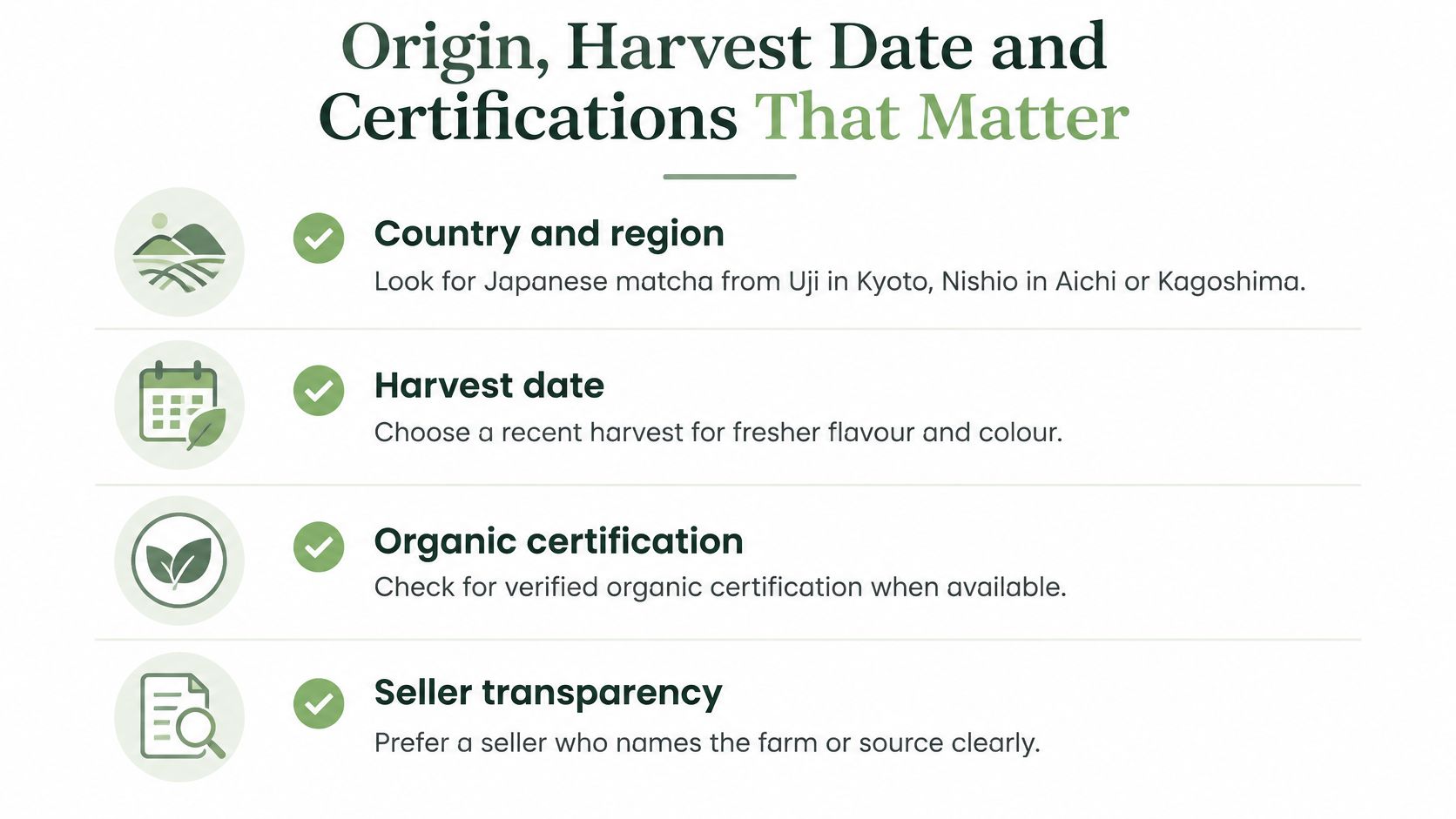
A region name can guide a search, but it cannot grade the powder. Uji in Kyoto, Nishio in Aichi and Kagoshima are useful starting points; the seller's batch details tell you more about the tin in your hand.
Japanese matcha has also faced supply pressure. SBS reporting on Australia's matcha boom describes premium Japanese matcha rising from about A$390 to A$500 per kilogram. That figure is a market signal, not a quality test. Compare the price per gram and per serving, then check whether the seller can explain the product's origin and handling.
Ask questions that produce checkable answers
Where was the tea grown and processed? Look for a country and region, plus an explanation of whether the matcha comes from one producer or a regional blend. Blending is not a defect. A Japanese-style name on Australian packaging does not establish Japanese origin.
When was it harvested, and when was it milled? Harvest information describes the leaf; milling information helps you judge how long the powder may have been stored. A best-before date alone answers neither question. Ask how the stock was packed and held before dispatch.
What does the batch code identify? A useful code connects the tin to a farm, processor or production lot. If the seller cannot explain what it traces, the number offers little practical reassurance.
For more context on what an origin label can and cannot tell you, see this guide to Uji matcha powder.
Separate organic status from other evidence
For organic certification, look for an identifiable certifier, such as Australian Certified Organic, and a certificate number that can be checked. Confirm that certification covers the product being sold. A leaf symbol or the word “natural” is not equivalent evidence.
Ask separately about heavy-metal and pesticide-residue testing. A useful product sheet names the laboratory, test date and relevant batch or sampling arrangement. Organic status and contaminant testing answer different questions, so neither replaces the other.
Stone milling is another detail to check. Ask whether the stated method applies to this product and whether the seller can explain its process or hourly output. A mill photograph is not evidence of how the matcha was made, and output alone does not establish flavour.
Before buying, use this checklist:
- Provenance: Named country, region and source or processor.
- Freshness: Harvest or milling information, plus storage conditions.
- Traceability: A batch code the supplier can explain.
- Certification: Checkable organic certification covering the product.
- Testing: Clear contaminant-testing information.
- Purpose: An honest recommendation for drinking, lattes or cooking.
Red Flags and Caffeine Gaps to Avoid
Premium packaging can hide an ordinary product. More to the point, it can distract you from the question that affects your daily routine: how much caffeine will your serving contain?
Watch for these purchase red flags:
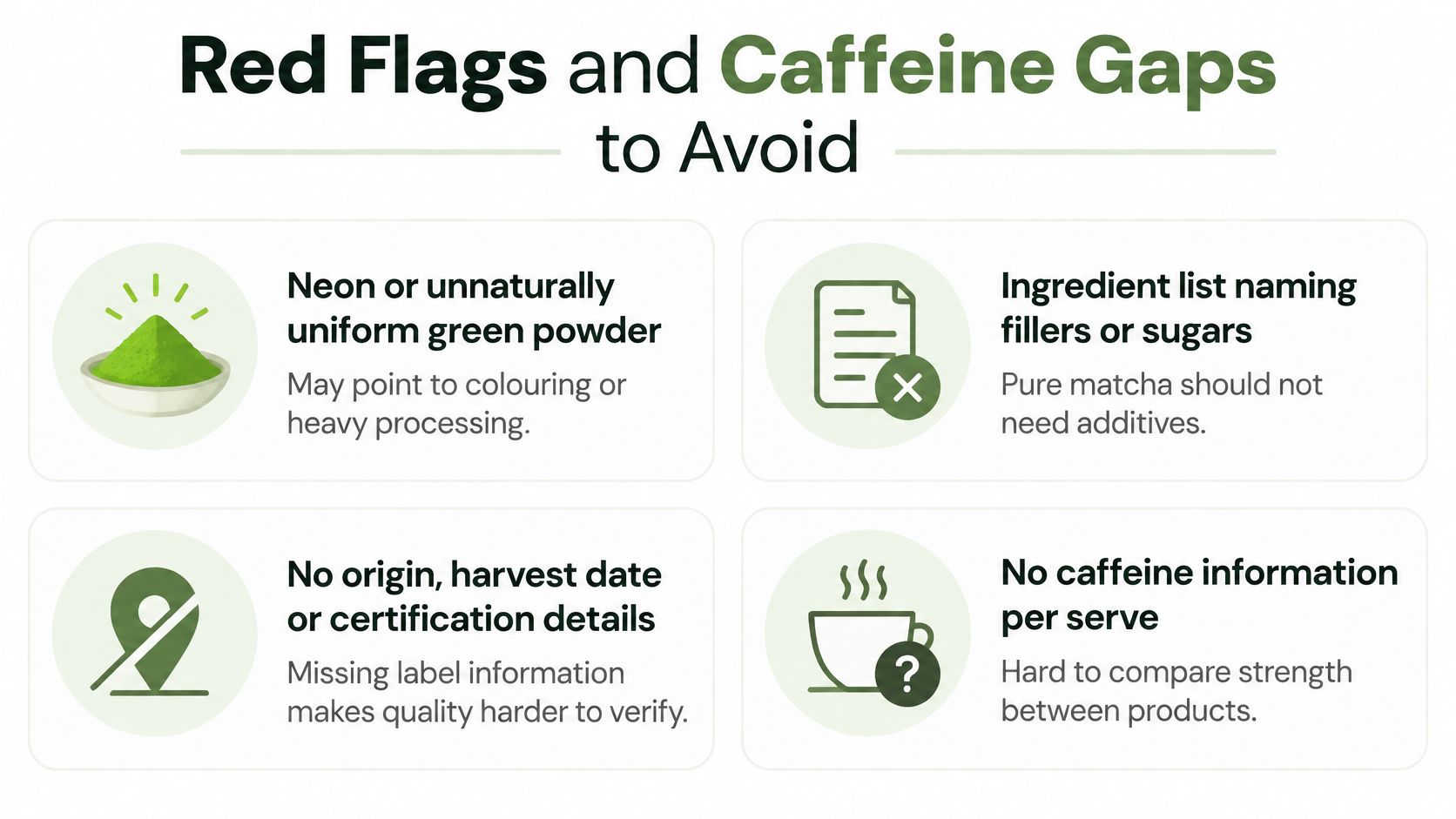
- Suspiciously neon powder: An unnatural appearance warrants questions about colouring, but colour alone can't establish adulteration. Product photography and screen settings can also mislead.
- Unexpected ingredients: Sugar, flavourings and fillers don't belong in a product presented as pure matcha. A latte blend is a different product and should be clearly labelled.
- An unexplained bargain: A strikingly low price needs a credible explanation, such as culinary positioning, pack size or clearance stock.
- Unsupported wellness promises: Claims about crash-free energy, antioxidants or immunity aren't a substitute for product information or evidence.
Use this visual reminder when a product page gives you more lifestyle language than practical detail.
Ask about the serving, not the grade
Food Standards Australia New Zealand's caffeine guidance states that caffeine occurs naturally in tea and that Australia has no recognised health-based guidance value equivalent to an acceptable daily intake for caffeine. That doesn't mean unlimited intake is safe, or that individual sensitivity doesn't matter.
With matcha, you consume the powdered leaf rather than discard infused leaves. A serving may therefore deliver more caffeine than steeped green tea, depending on the product and preparation.
Ask the seller:
- Serving content: How many milligrams of caffeine are in a 2 g serve?
- Verification: Is that independently tested, which laboratory tested it, and does the result represent this product?
- Latte strength: How much caffeine would a latte made with two serves contain?
Those are comparison questions, not a claim that every product contains the same amount.
Ceremonial describes a proposed use. It doesn't tell you your caffeine dose.
Beginners can start with half the seller's stated serving and assess tolerance. Regular users should count coffee and energy drinks too. Pregnant or breastfeeding readers, adolescents and caffeine-sensitive people should seek personalised advice from a health professional rather than assume a smaller matcha is automatically suitable.
How to Compare Price Per Gram Honestly
Compare net powder weight, not tin size, and keep pure matcha separate from sweetened latte mixes. Otherwise, you may be comparing the price of tea with the price of a blend containing cheaper ingredients.
The arithmetic is straightforward:
- Price per gram: Divide the pack price by its weight in grams.
- Price per 100 g: Multiply the price per gram by 100.
- Price per serve: Multiply the price per gram by the grams you use.
Price per gram and per serve at reference prices
The reference prices below illustrate the conversion, rather than representing current retail quotes for a particular tin.
| Price per kilogram | Price per 100 g |
|---|---|
| A$390 | A$39 |
| A$500 | A$50 |
| Your pack | Pack price ÷ net grams × 100 |
Using a hypothetical 2 g serving for comparison, those reference prices work out to approximately A$0.78 and A$1.00 per serve, respectively. These are calculated ingredient costs, not complete latte costs, and exclude milk, delivery and wastage.
For your own pack, use its actual serving weight rather than relying on a rounded number of servings printed for marketing purposes. A small kitchen scale makes this easier than comparing heaped teaspoons, which aren't consistent.
Where a cheap pack stops being good value
A low-priced culinary powder isn't a saving if you dislike drinking it and leave it untouched. Equally, there's little reason to pay a ceremonial premium for a strongly flavoured cake when a suitable culinary product gives you the result you want.
For cafés, test the powder in the finished menu drink. Record the weighed dose, milk choice and whether staff can reproduce it without adding extra syrup or powder to compensate.
Buying judgement: Start with a small trial pack of the grade you intend to use. Commit to bulk only after the finished drink or recipe works.
A larger pack may offer a lower unit price, but unused powder still costs money. Include delivery in your comparison, resist buying extra solely to qualify for free shipping, and choose a quantity that fits your actual consumption.
How to Keep Matcha Fresh After You Open It
Keep matcha away from light, heat, air and moisture. For a working tin, use an airtight, opaque container in a cool, dark cupboard away from the stove, dishwasher and sunny windowsill.
Close it promptly after measuring, and use a clean, dry spoon. Leaving the lid off while you make breakfast exposes the whole pack unnecessarily.
Storage conditions and approximate freshness windows
These are practical flavour guidelines, not laboratory-validated shelf-life guarantees. Follow product-specific instructions where they're more restrictive, and remember that packaging, handling and starting freshness affect the result.
| Storage | Conditions | Best within (approximate) |
|---|---|---|
| Unopened tin | Cool, dark cupboard away from heat | Until the best-before date, check the harvest date too |
| Opened tin, pantry | Airtight and opaque, away from light | About 1 month |
| Opened, refrigerated | Sealed bag in the fridge, warmed before opening | About 1 to 2 months |
| Opened, frozen | Sealed portions, thawed before opening | Up to about 3 months |
If you refrigerate or freeze matcha, let the sealed portion reach room temperature before opening it. Opening cold packaging in humid air can allow condensation onto the powder, undermining the reason you chilled it.
Avoid repeatedly moving your entire supply between cold storage and the kitchen bench. Small, well-sealed portions are easier to manage, particularly in a warm Australian kitchen.
Notice deterioration before changing the recipe
A dull or yellowing colour, hay-like smell and flat taste suggest the powder has lost freshness. Ordinary soft clumps can be sifted out; stubborn clumps associated with dampness deserve more caution. Don't taste powder that smells musty or shows signs of mould.
Adding more powder won't restore the aroma of stale matcha. It can make the drink stronger and less pleasant.
- Date the tin: Write the opening date where you'll see it.
- Separate reserve stock: Portion extra powder into suitable airtight freezer bags before freezing.
- Keep the working pack small: Refill only with dry equipment, without mixing fresh stock into old residue.
Our matcha shelf-life guide gives further help with freshness and storage decisions.
Choose Your Grade and Buy with Confidence
The strongest buying decision combines a suitable flavour with information you can verify. A beautiful label, a famous region or a low unit price can each be useful, but none should decide the purchase alone.
Compare the actual packs rather than relying on their front-label descriptions.
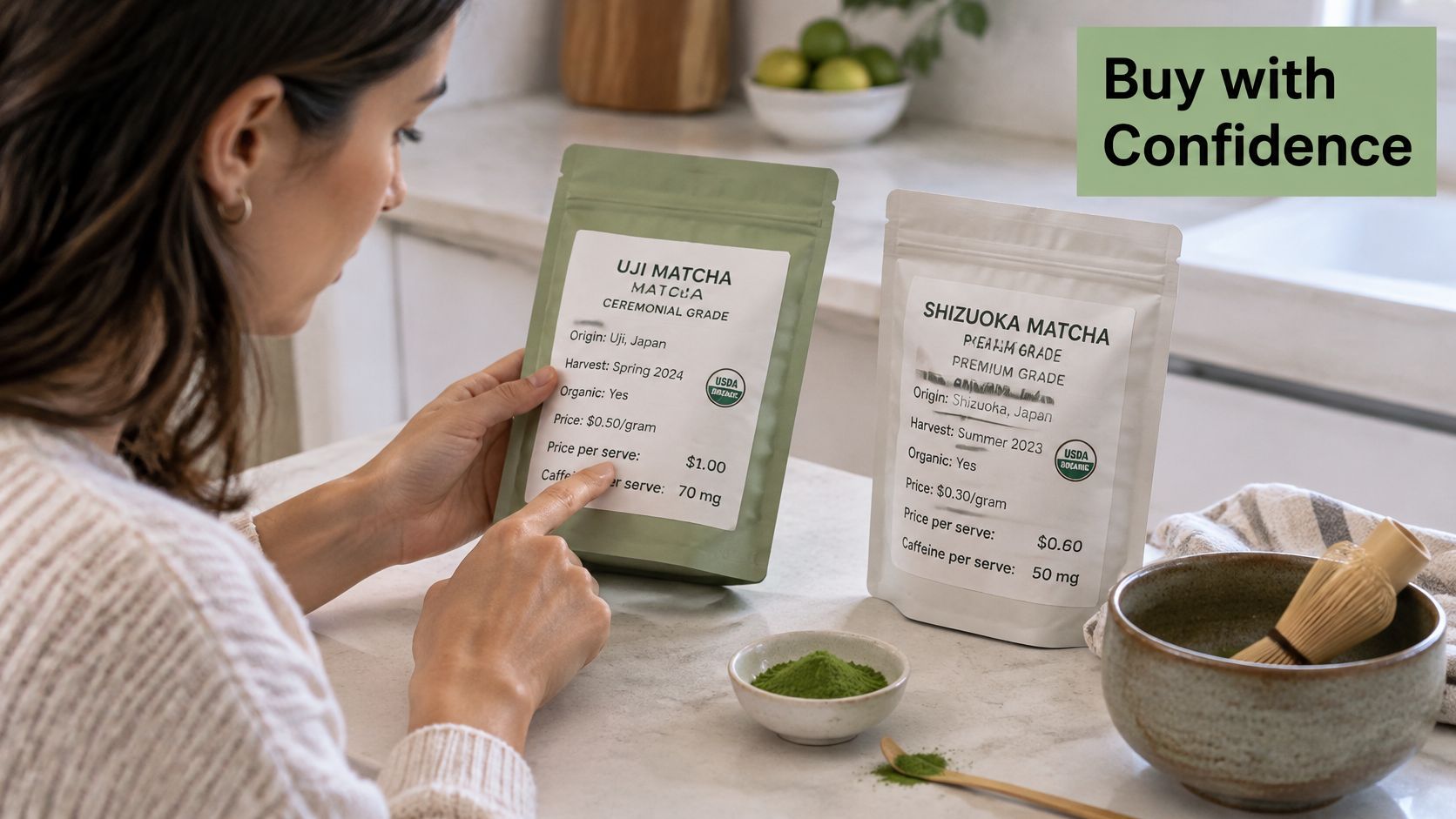
Match the seller to the way you buy
A specialist tea retailer is useful when you need help distinguishing flavour profiles and preparation styles. Look for product sheets that describe the tea itself, not just the lifestyle associated with drinking it.
A café can be a practical tasting stop if staff can name the powder they serve and explain whether the retail pack is the same product. Order it in your usual preparation rather than choosing a heavily sweetened special that disguises the tea.
For online shopping, favour stores that make batch, certification and testing information accessible, or answer direct questions without evasion. A seller who admits that a particular detail isn't available is more useful than one who substitutes another wellness slogan.
Use this short buying route:
- Choose the job: Plain tea, latte or cooking.
- Check the evidence: Origin, freshness, organic status and traceability.
- Calculate the true cost: Use net weight and your intended dose.
- Resolve caffeine uncertainty: Ask for product-specific information before making it a daily habit.
- Trial the result: Taste it in your usual drink before ordering more.
A preparation demonstration can also help you recognise which tools and handling steps you'll need at home.
Let taste settle the final choice
When your trial pack arrives, try it whisked with water and in your usual latte. Note sweetness, bitterness, texture and whether the tea remains noticeable in milk. You don't need elaborate tasting vocabulary, just a clear record of what you enjoyed.
If you're buying for a household, don't assume the same caffeinated drink suits every family member. For hospitality, choose a recipe staff can weigh and repeat, then ask the supplier about availability before committing it to a permanent menu.
Your next step today is simple: shortlist a suitable trial pack, calculate its serving cost and send the seller any unanswered questions before checkout.
At Pep Tea, we offer organic Japanese matcha in ceremonial and culinary grades for home preparation, cooking and hospitality. Browse our matcha range, check the origin and organic certification information on the product pages, and compare a trial-size option against your buying checklist before choosing your next pack.