
Instant Matcha Tea: What It Is and How to Use It
Instant matcha tea gets treated like a shortcut, but that's only half the story. Some products are a genuine convenience format, while others are just instant green tea powders wearing a matcha label, and those two things don't behave the same in a cup or in a café.
For Australian buyers, that difference matters more than most guides admit. If you're choosing a powder for lattes, iced drinks, desserts, or a fast home ritual, the label tells you more than the marketing does, and a clear understanding of processing, solubility, flavour, and nutrition will save you from buying the wrong tin.
What Instant Matcha Tea Actually Is
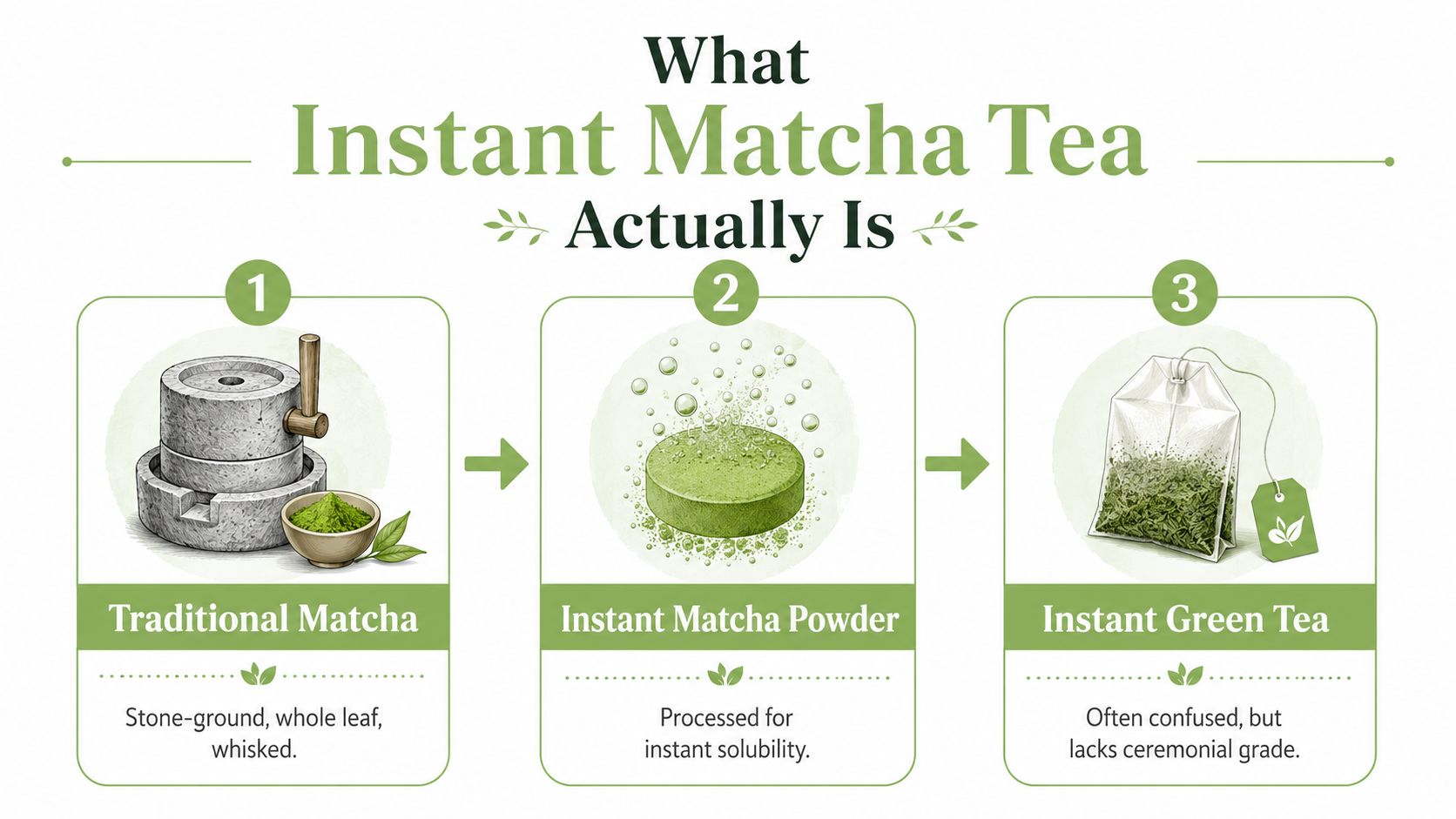
A lot of people assume every green powder called matcha is basically the same product. It isn't. True matcha is made from tencha leaf that's stone-ground into a fine powder, while instant matcha tea is usually a processed instant tea powder designed to dissolve quickly, often from brewed tea concentrates and sometimes with additives like maltodextrin or citric acid for better flow and shelf life, according to the product distinction explained by matcha.com.
Why the label causes so much confusion
Australian shoppers often see “matcha” and assume heritage tea, bright colour, and full nutritional value. That assumption only holds when the powder is made from ground tea leaf. Instant tea powders are made for convenience first, so they're meant to disperse fast in water or milk, not necessarily to preserve the character of the leaf.
That matters in service settings too. A café team training on speed, consistency, and drink build will need a different workflow from someone preparing ceremonial tea at home, which is why a practical resource like barista training Australia can be useful when you're mapping a menu or onboarding staff.
Practical rule: if the ingredient list reads like a processed beverage mix, you're probably not buying traditional stone-ground matcha, even if the front label says “matcha”.
What to look for on a packet
You don't need a tea degree to read the label well. Start with the ingredients, then look for anything that suggests instant solubility rather than whole-leaf powder. If the powder dissolves completely and leaves little sediment, that's often by design, but it doesn't automatically mean it's equivalent to matcha in flavour or composition.
A simple label check helps:
- Ingredient list first, because additives often signal an instant format.
- Country of origin next, because true matcha is tied to Japanese production.
- Product language last, because words like “instant”, “blend”, or “soluble” tell you how it behaves in the cup.
For café owners, that distinction changes how you build drinks. For home users, it changes expectations. Instant matcha tea can be a smart convenience product, but it shouldn't be judged as though it were the same thing as traditional matcha.
Instant vs Ceremonial vs Culinary Matcha Compared
Start with the cup itself, because that usually clears up the confusion. Ceremonial matcha is made for drinking on its own, culinary matcha is made to stand up in milk, batter, and sauce, and instant matcha tea is designed for speed and easy dispersion. Each one solves a different problem, so the right choice depends on whether you need flavour clarity, kitchen flexibility, or fast service.
Matcha Grades at a Glance
| Attribute | Instant Matcha | Culinary Matcha | Ceremonial Matcha |
|---|---|---|---|
| Processing | Usually made for instant solubility, often from brewed concentrate | Stone-ground tea leaf, usually from slightly older leaves | Stone-ground tea leaf, usually from the youngest shade-grown leaves |
| Texture | Designed to dissolve quickly | Mixes well, may need whisking or frothing | Best whisked, can form a fine foam |
| Flavour | Neutral to mild, sometimes flatter | Stronger, more pronounced | Delicate, smoother, more umami |
| Best use | Iced drinks, fast service, automated prep | Lattes, baking, cooking | Straight tea, ceremonial use, premium drinks |
| Nutritional trade-off | Convenience first, so the whole-leaf profile is usually reduced | Retains more of the leaf than instant forms | Closest to the full leaf experience |
For a practical buyer's guide, PepTea's comparison of ceremonial vs culinary matcha helps separate drinking quality from kitchen use without turning the decision into guesswork.
What each grade is really for
Ceremonial matcha suits moments where the tea itself should lead. The flavour is cleaner, the finish is more refined, and the drink works best when nothing else is crowding the bowl or cup.
Culinary matcha belongs in a different setting. In a latte, smoothie, cake, or biscuit, its fuller taste has enough weight to come through milk, sugar, and other ingredients, which is why it is often the more practical choice for recipes. A Japanese home cooking resource such as the Just Cook It recipe collection is useful when you want to see how matcha behaves beyond a plain tea preparation and into everyday cooking.
Instant matcha tea sits alongside those options rather than replacing them. It is handy when the drink needs to be quick, cold, and consistent, especially in an Australian café where prep time and repeatability matter. That convenience comes with a trade-off, because it is not the same ingredient category as a traditional stone-ground powder, and that difference affects both cup quality and how much of the leaf you are using. Once you separate those roles, the choice becomes easier to make for both café menus and home kitchens.
Short version: ceremonial for drinking, culinary for cooking, instant for convenience.
Nutritional Benefits and What You Might Be Missing
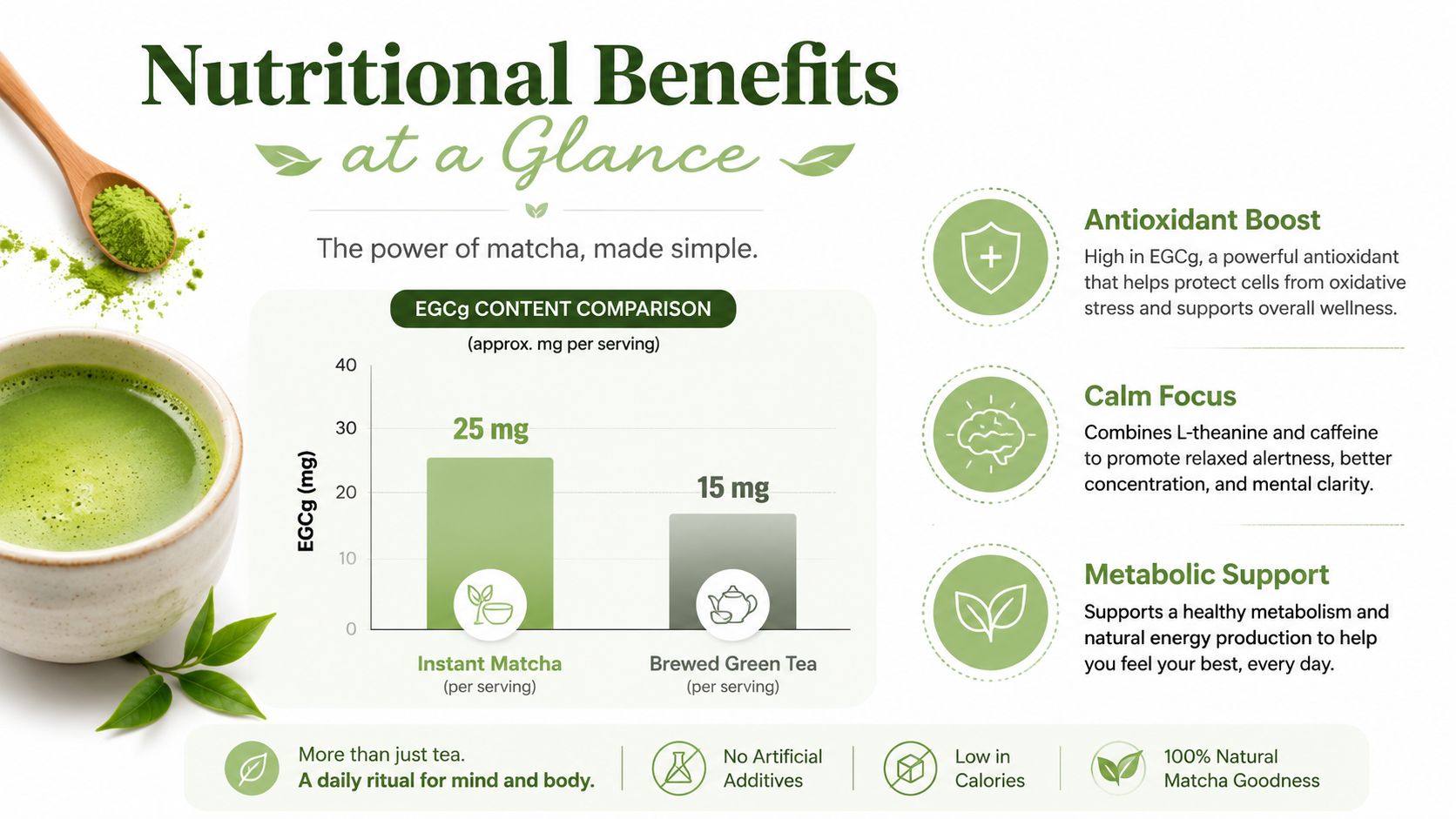
Matcha earns its reputation because you consume the whole leaf, not just the brewed water. Reviews summarised in the medical literature report caffeine around 18.9 to 44.4 mg/g, total polyphenols around 169 to 273 mg gallic acid equivalents per gram, and a composition that is roughly 60 to 70% insoluble material plus 30 to 40% soluble compounds such as catechins, amino acids, and minerals, according to PubMed review data. That's the heart of the nutrition argument in favour of true matcha.
Why whole-leaf powder matters
When you whisk stone-ground matcha, you're taking in the material suspended in the cup as well as what dissolves into the liquid. That's why people value it as a functional drink rather than a simple infusion. The profile can vary a lot by source and dose, but the key point is that true matcha delivers more of the leaf than a typical instant tea powder.
Instant matcha tea often trades some of that completeness for convenience. If a powder is made from extract or concentrate and engineered for solubility, it can be easier to use in iced drinks and automatic dispensing, but it may not carry the same density of leaf-derived compounds. In other words, it may behave better in a machine, while true matcha gives you more of the plant itself.
What readers usually expect from matcha
Most buyers are looking for three things:
- Antioxidants, especially catechin-rich compounds.
- Calm energy, because matcha combines caffeine with amino acids.
- A greener, fuller flavour, which signals freshness and leaf quality.
That's why it helps to keep expectations precise. If you want a product for fast drinks and low-fuss use, instant matcha can make sense. If your priority is nutrition and the classic tea experience, stone-ground matcha is the better fit.
A useful way to think about it is this, the more a product is engineered for instant mixing, the more you should ask what has been gained in speed and what has been lost in whole-leaf character.
How to Prepare Instant Matcha Tea Properly
Instant matcha tea is easier to handle than traditional powder, but the method still matters. If you dump it straight into cold milk and walk away, you'll often end up with weak flavour or an uneven texture. A little technique goes a long way.
Hot, iced, and latte preparation
For a hot drink, start with a small amount of water first, then add the rest once the powder has dispersed. That helps the powder hydrate evenly and keeps the flavour from going flat. If the product is very fine or highly soluble, a quick stir may be enough, but if the cup looks grainy, a small whisk or milk frother helps.
For iced drinks, instant matcha usually outperforms traditional powder because it's designed to disperse more easily in colder liquid. That makes it a practical choice for café iced lattes, shaker bottles, or takeaway formats where speed matters.
For a latte, build it like this:
- Dissolve the powder in a small splash of hot water.
- Stir or froth until smooth.
- Add milk, then ice if needed.
- Taste before sweetening, because some instant blends already include a sweetener or filler.
If you use traditional matcha instead, a proper whisking method matters. PepTea's guide on how to whisk matcha is a useful reference if you want to compare the two workflows side by side.
Fixing common problems
Grainy texture usually means the powder needs more agitation. Weak flavour usually means the dose is too low for the product's concentration. Bitterness often comes from water that's too hot or from a product that already includes more processed tea solids than you expected.
Good café habit: build one test drink before you scale the recipe for service. Instant powders can vary a lot, so a fast calibration saves waste.
If you're making drinks at home, a shaker bottle works well for cold recipes, and a blender helps when milk, ice, and powder all need to combine quickly. For hot drinks, simple stirring is often enough if the powder is soluble.
Recipes and Use Cases for Home and Hospitality
Instant matcha tea makes the most sense when the drink has to move quickly. At home, that usually means morning routines. In hospitality, it usually means iced menus, batch builds, and prep consistency across staff shifts.
Where it works well
A home barista can use instant matcha in a few straightforward ways. A quick iced matcha latte is the obvious one, because the powder disperses easily and doesn't need the same whisking discipline as ceremonial tea. It can also slip into smoothies, overnight oats, or simple baking where the green tea flavour just needs to show up cleanly.
For cafés, the strongest use case is speed. Instant powder can be handy in:
- Iced drinks, where fast dispersion reduces clumping.
- Automated or semi-automated service, where repeatability matters.
- Batch drinks, when a team needs consistent colour and flavour across service.
That said, there are also places where a prepared version wins without question. If a customer expects vivid green colour, foamy texture, and the layered umami of a properly whisked tea, a conventional matcha powder is still the right call.
Simple serving ideas
A few practical pairings work especially well:
- Oat milk latte, because its body softens the tea.
- Coconut milk iced drink, because it reads as tropical and creamy.
- Vanilla smoothie, because the flavour is mild enough to sit beside fruit.
- Matcha muffins or slice, if the recipe only needs background tea notes.
PepTea also offers organic matcha tea products online, including bulk formats suited to retail and food service, which makes sense for kitchens that need a reliable powder rather than a one-off novelty.
For cafés, the decision usually comes down to ticket time versus drink identity. For home users, it comes down to whether you want a fast green drink or a more traditional tea ritual. Both can have a place, but they're not interchangeable.
Buying and Storing Matcha the Right Way
Reading a matcha label properly saves money and disappointment. The easiest mistake is buying by colour alone. A bright tin doesn't always mean good tea, and a smooth powder doesn't always mean it's true matcha.
What to look for on the label
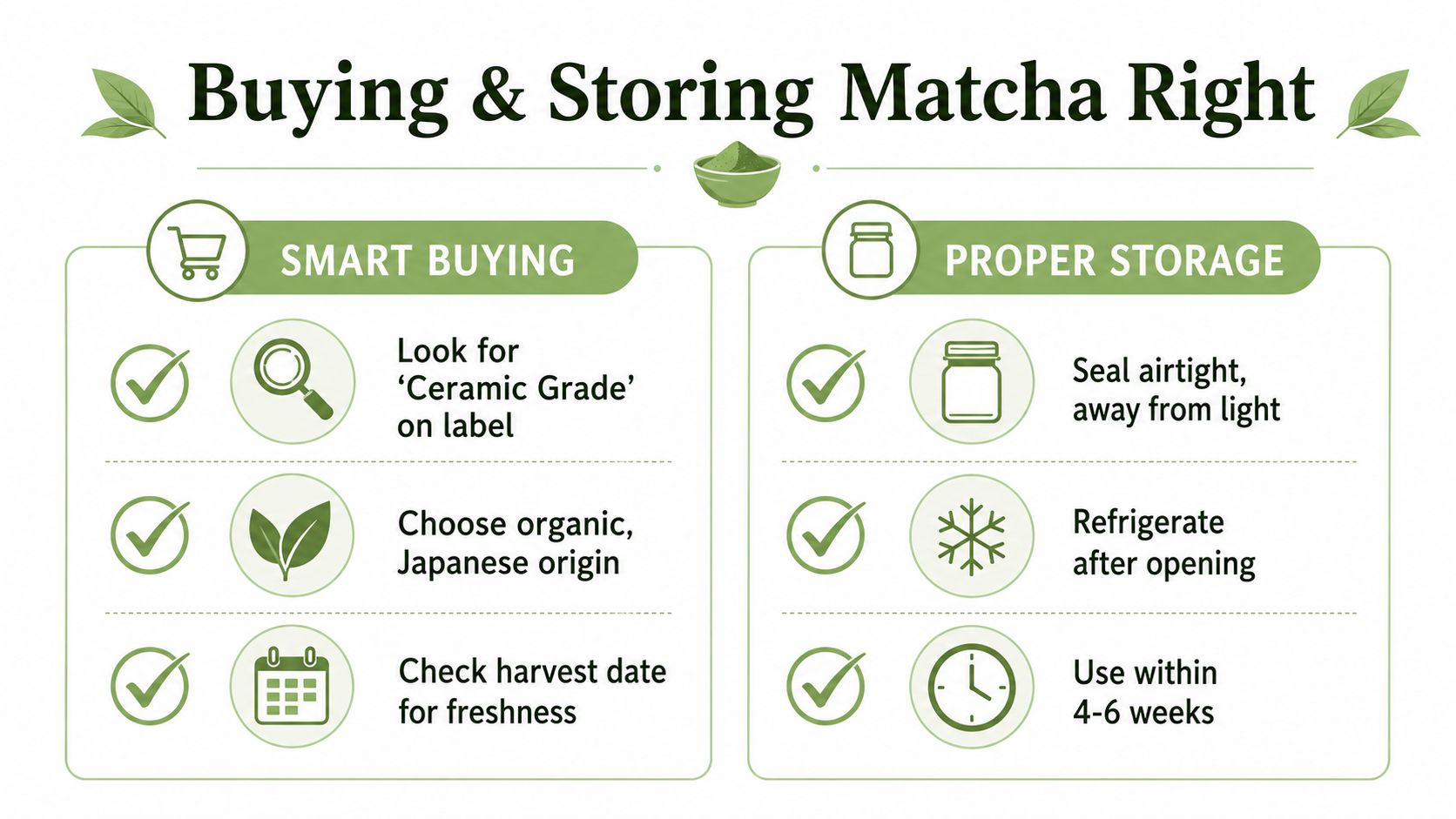
Start with the ingredient list. A clean matcha product should be easy to understand, and if you see a long list of sweeteners, fillers, or anti-caking agents, that's a sign to slow down and ask what the powder is made of. A trusted origin matters too, especially in Australia where the market is largely import-led.
That matters because Australia imported about A$14.2 million of “tea, whether or not flavoured” from Japan in 2024, and Japan External Trade Organization data says Japan remains the world's leading supplier of matcha, with export volume rising 16.1% in 2024 to 8,798 tonnes, about 10 times the level of 20 years earlier, according to the market summary at Ooika. For Australian buyers, that points to a supply chain that's heavily tied to origin-country production.
A simple checklist helps:
- Look for origin transparency, ideally Japan and, when available, a specific region.
- Check for added ingredients, especially if you want authentic matcha.
- Prefer reputable packers or suppliers, because freshness matters more than flashy packaging.
How to store it well
Matcha is sensitive to light, heat, and oxygen. Store it sealed, cool, and away from the cupboard door where temperature swings are common. Once opened, use it promptly, as freshness drops faster than you might expect.
A small airtight tin or jar is better than leaving the powder in a half-open bag. If you've already opened a pouch, a dedicated storage container helps protect flavour and colour, and PepTea's matcha storage container is one practical example of the kind of setup that keeps powder in better shape.
If you buy online, prioritise clear photos of the ingredient panel and packaging date. If you buy in-store, open the conversation with the staff and ask what kind of matcha it is before you decide whether it suits drinking, lattes, or baking.
Choosing the Right Matcha for Your Needs
The decision comes down to one question, what do you want the powder to do? If your answer is “be quick, cold, and easy to mix,” instant matcha tea can be the right tool. If your answer is “taste like real matcha and deliver the fuller leaf experience,” you'll want stone-ground culinary or ceremonial powder instead.
For café owners, the smartest choice often depends on the menu. Instant powder can help with speed and consistency, but a premium matcha earns its place when customers are paying for texture, aroma, and a more authentic cup. For home users, the split is even simpler, convenience versus tradition.
If you're still deciding, keep these priorities in mind:
- Choose instant when you need fast dispersion and straightforward cold-drink prep.
- Choose culinary when you want a stronger flavour for lattes or baking.
- Choose ceremonial when the tea is the whole point.
PepTea's range of premium organic Japanese matcha is built around authenticity, clean ingredients, and practical use in real kitchens and cafés. If you want to compare options and choose the right grade for your routine, explore Pep Tea and pick the powder that fits the drink you want to make.