
Tag: matcha powder
How to Order Matcha Powder the Smart Way
You're ready to order matcha powder, but the product page gives you little more than a green tin, a premium-sounding label, and a price. The safest choice isn't automatically the most expensive one. It's the powder whose grade, origin, packaging, serving size, and intended use match what you'll do with it.
That matters in Australia, where more than 90% of domestic matcha demand is met through imports and combined green-tea-powder imports grew at an estimated 13–17% CAGR from 2020 to 2025, according to Australian matcha market analysis. Supply changes can affect availability, substitutions, and pricing, so a smart order starts with product information, not branding.
Why Ordering Matcha Powder Deserves More Thought Than a Cart Click
A large pouch can look economical until you open it weeks later and find faded colour, a stale aroma, or a bitter drink that needs plenty of sweetener. Matcha is finely ground, so air, moisture, light, and heat reach more of the tea than they do with intact loose-leaf tea. Buy more than you can use while it is fresh and the saving quickly loses its appeal.
Start with the job the powder must do: how will you use the matcha? A bowl whisked with water exposes its colour, aroma, texture, and aftertaste. A latte brings milk and perhaps syrup. Baking adds sugar, flour, butter, and heat. Each use calls for a different balance, so the highest grade is not automatically the best purchase.
Practical rule: Buy for the drink or recipe you make most often, not for the most impressive grade name on the label.
Origin matters, but “Japanese matcha” does not answer every useful question. A product page should explain whether the powder is genuine matcha made from shaded tea leaves or green-tea powder using matcha-style language. Check the listed origin, ingredients, batch details, and packaging. Those details help you judge the seller's supply chain and freshness before paying.
Australian buyers also need a continuity plan. Japanese green-tea imports to Australia rose nearly 20% year over year in 2024, per Australian matcha market reporting, while some Australian cafés reported matcha-latte prices of approximately AUD 6–8. If supply tightens, ask whether the seller will keep the stated origin and grade, substitute another source, reduce the serving size, or raise the price.
Compare cost per prepared serve, not just the tin price. A powder that suits your usual latte or recipe can offer better value than an expensive ceremonial powder whose finer flavours disappear under milk, syrup, or other ingredients.
A specialist such as The Matcha Bike Miami matcha service shows how a focused matcha business presents preparation and service. For an Australian order, check delivery, labelling, freshness, and provenance yourself.
Understanding Matcha Grades and What Each One Is Actually For
Matcha grades are best treated as use-case labels, not universal quality rankings. “Ceremonial” usually signals a powder designed to be enjoyed with water, while “culinary” points towards recipes where other ingredients share the stage. “Premium” can sit between those uses, but sellers don't apply these terms identically.
Ceremonial grade for a clean, direct drink
Ceremonial matcha is the choice for a whisked bowl where the powder's colour, aroma, texture, and aftertaste are obvious. Choose it when you enjoy matcha with water and don't want milk or sugar to carry the flavour.
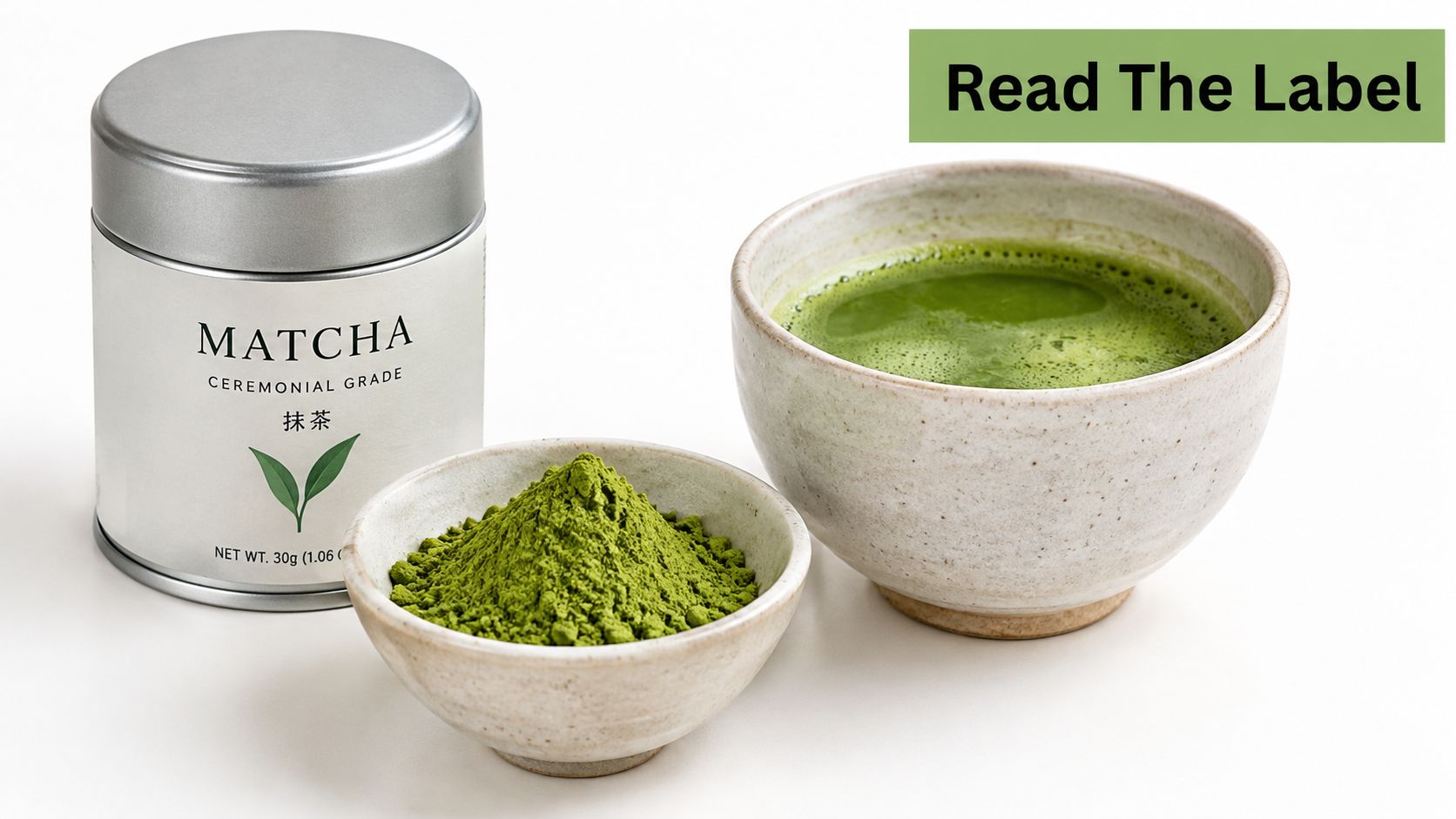
A vivid green colour can be encouraging, but it isn't enough on its own. Look for 100% matcha, Japanese origin, a clear lot or batch reference where available, and packaging that protects the powder from oxygen and light. A good ceremonial powder should whisk smoothly after sifting and taste balanced rather than harshly bitter.
Premium or ceremonial-blend for everyday flexibility
Premium or ceremonial-blend matcha is often the most useful middle ground for a regular home drinker. It can work in a latte, iced matcha, smoothie, or a lighter bowl, without making every preparation feel like a special occasion.
Value becomes personal here. If you mostly add milk, fruit, or other strong flavours, a balanced mid-range powder may give you more satisfaction than an expensive powder whose subtle notes disappear in the recipe.
Culinary grade for baking and blended drinks
Culinary grade is made for recipes that need matcha's colour and distinctive tea character alongside other ingredients. It suits muffins, biscuits, brownies, cheesecake, ice cream, smoothies, and strongly flavoured lattes.
That doesn't mean culinary grade should taste rough or unpleasant. It should still be clearly identified, fresh, finely milled, and free from unnecessary additives. A culinary powder may bring a more assertive tea flavour that holds up better against chocolate, citrus, dairy, or plant-based milk.
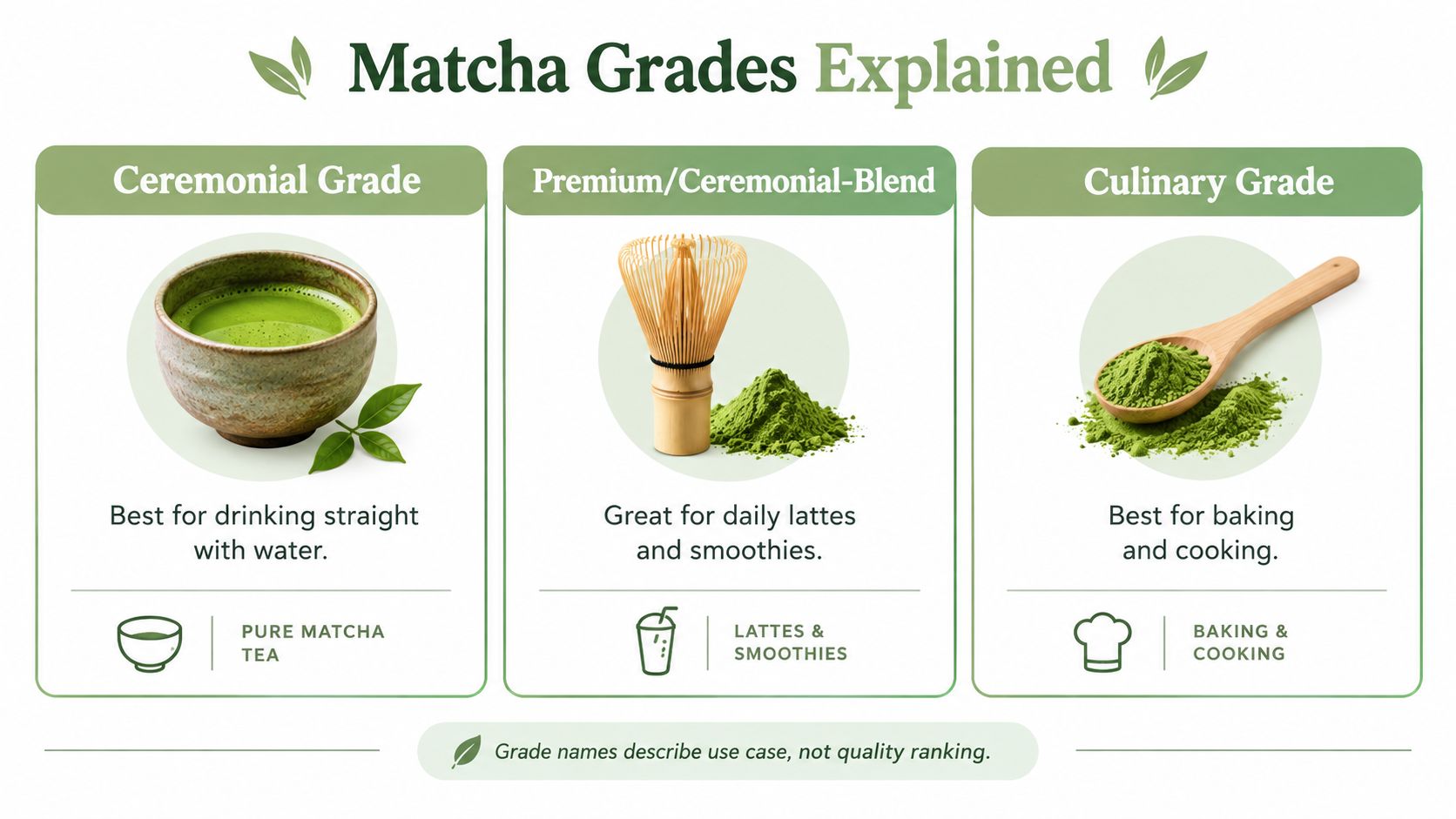
The practical distinction is simple: ceremonial is for drinking straight, premium is for flexible daily use, and culinary is for cooking and baking. Pep Tea's guide to different matcha grades is a useful reference when a product page uses several overlapping grade terms.
Don't pay for a high-grade powder because the label sounds luxurious. If the powder will disappear into a sweetened iced latte or a batch of baked goods, culinary or premium matcha can be the more sensible order.
Matching the Grade to Your Cup, Latte, or Recipe
The right matcha becomes much easier to choose once you name the preparation. A plain whisked bowl rewards smoothness and balance. A latte needs enough flavour to remain noticeable through milk. Baking needs colour and resilience rather than delicate tasting notes.
| Use case | Ceremonial grade | Premium grade | Culinary grade |
|---|---|---|---|
| Whisked bowl with water | Best fit for a clean, direct taste | Suitable for an everyday bowl | Usually too assertive or coarse-tasting |
| Hot matcha latte | Excellent, but may be more than needed | Strong everyday choice | Suitable when milk or sweetener dominates |
| Iced matcha | Smooth and refined | Practical balance of flavour and value | Works well with fruit, syrup, or bold milk |
| Smoothie | Often unnecessary | Versatile option | Good for stronger fruit or protein blends |
| Baking and desserts | Usually wasteful | Useful for lighter recipes | Best fit for colour and pronounced tea flavour |
A ceremonial powder earns its price when you can taste it directly. It's the logical choice for a small bowl of matcha and water, where there's nowhere for bitterness or stale notes to hide. It can also suit a minimalist iced drink with little more than water and ice.
Premium grade is the useful compromise for people who alternate between bowls, lattes, and smoothies. You'll get flexibility without building your entire routine around a powder that should be consumed quickly and treated carefully.
Culinary grade often delivers the best cost per prepared serve for a café-style latte, especially if you use milk, fruit, cocoa, vanilla, or sweetener. A cheaper powder isn't better if it tastes unpleasant, but a high-grade powder isn't better if its character is buried under several other ingredients.
The honest trade-off: Premium doesn't automatically mean better. It means the powder may be better suited to a particular preparation.
Before you order, write down your likely use in one sentence. “I want a plain morning bowl” points towards ceremonial. “I want iced lattes and smoothies” points towards premium. “I'm baking and making flavoured drinks” points towards culinary.
The Australian Ordering Checklist Before You Check Out
A good product page should answer your important questions without forcing you to search through vague marketing copy. Run these checks before adding matcha to your cart.
Check the product identity
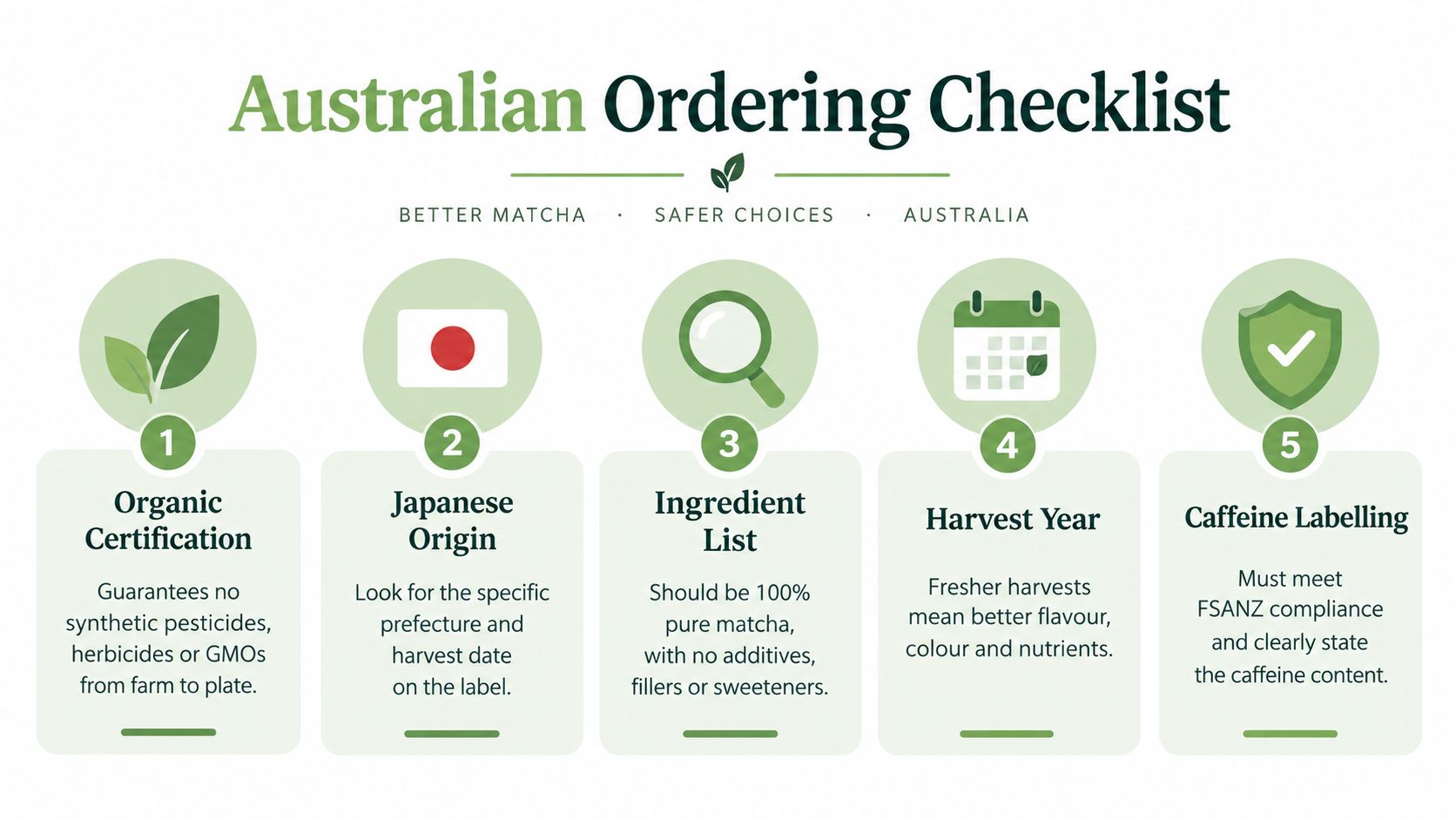
Look for 100% matcha in the ingredient list. Genuine matcha is powdered tea, not a blend padded with sugar, starch, flavouring, or anti-caking ingredients. “Green tea powder” can describe a broader category, so check whether the seller explains the tea's origin and production clearly.
Japanese origin is a useful starting point, but ask for more detail where possible. A prefecture, harvest information, cultivar, or producer reference gives you a clearer picture than a generic country label. Tencha is the leaf material traditionally associated with matcha production, whereas ordinary green-tea powder may be made from a different raw material and processed for a different purpose.
Check certification and traceability
Organic certification can matter if organic purchasing is part of your priorities, but the word should be supported by identifiable certification information. Also look for a lot or batch reference, best-before information, and a seller who can explain how the product is packed and restocked.
Harvest details are helpful because matcha is a fresh powdered tea, not a pantry ingredient that improves with age. A product page doesn't need to make dramatic freshness promises. It should give you enough information to judge whether the powder has been sitting in an uncertain supply chain.
Check the format and delivery
A metal tin can protect a small quantity from light and repeated handling. A resealable pouch may suit a larger quantity if it has a reliable barrier and you transfer or seal it carefully. Sachets are convenient for travel and portion control, but usually offer less flexibility when you want to adjust the recipe.
Shipping matters in Australia's warmer conditions. Ask how the seller protects the product from prolonged heat, whether it ships promptly, and how the powder is sealed before dispatch. For cafés or wholesale buyers, affordable courier cost advice can help when comparing delivery arrangements, but freight cost should be assessed alongside packaging quality and stock reliability.
Use the Australian matcha tea powder range as one example of the type of product information worth comparing. Then calculate value by prepared serve, not tin price. A larger pack only saves money if you can finish it while the flavour remains enjoyable.
Caffeine Awareness and How to Read a Matcha Label
Matcha is a caffeinated food, so the serving size deserves attention. The entire powdered leaf is consumed, unlike a conventional tea infusion where water is separated from the leaves. That means the amount of powder in your bowl or latte, along with the recipe and drink size, influences your caffeine intake.
Australian sports-nutrition guidance gives a useful comparison: a 250-millilitre serving of green tea generally contains about 30–50 milligrams of caffeine according to the Australian Institute of Sport. A matcha drink isn't automatically equivalent because preparation can use different quantities of powder.
Understand the food-safety distinction
Food Standards Australia New Zealand prohibits the retail sale of solid or semi-solid foods containing 5% or more caffeine, equivalent to at least 50 milligrams per gram, and liquid products containing 1% or more caffeine, according to FSANZ guidance on caffeine powders and high-caffeine foods. These rules target highly concentrated caffeine powders and similar products.
Traditional tea products are treated differently because tea, coffee, and cocoa have an established history of food use. For someone ordering matcha, the practical distinction is clear: choose a clearly identified, food-grade tea powder, not a product marketed as a concentrated caffeine supplement.
FSANZ also states that caffeine must be declared in the ingredient statement when it is present as an ingredient. Read the serving guidance, preparation instructions, and ingredient list together. If a product page emphasises stimulant strength but says little about tea origin or serving size, choose another listing.
Healthdirect describes 400 milligrams of caffeine per day as generally safe for healthy adults, with individual circumstances affecting what is appropriate, as explained in its caffeine guidance. Count caffeine from coffee, tea, energy drinks, and chocolate across the day. If you're pregnant, breastfeeding, sensitive to caffeine, or taking relevant medicines, seek individual medical advice rather than relying on a general benchmark.
For a closer look at tea comparisons, Pep Tea's guide to caffeine content in green tea provides useful preparation context. The sensible approach is portion awareness, not chasing the highest number on a label.
Packaging, Storage, and Beginner Brewing Without the Guesswork
Your matcha can arrive in excellent condition and still disappoint if you leave the lid loose beside a sunny window. Light, oxygen, heat, and moisture are the enemies of fresh powdered tea. Store an unopened pack according to the seller's instructions, then keep an opened tin or pouch airtight, cool, and away from steam.
A tin is convenient for daily use and protects against light. A resealable pouch can work well for a larger quantity, provided you press out excess air and seal it properly. Single-serve sachets are useful for travel, work, and consistent portions, but they're less practical if you change the strength of your drink.
For most home drinkers, order a quantity you can use within roughly six to eight weeks of opening for peak flavour. Refrigeration can help, but avoid opening a cold container in a humid environment, where condensation may enter the powder. Let a sealed pack adjust before opening, and always use a dry spoon.
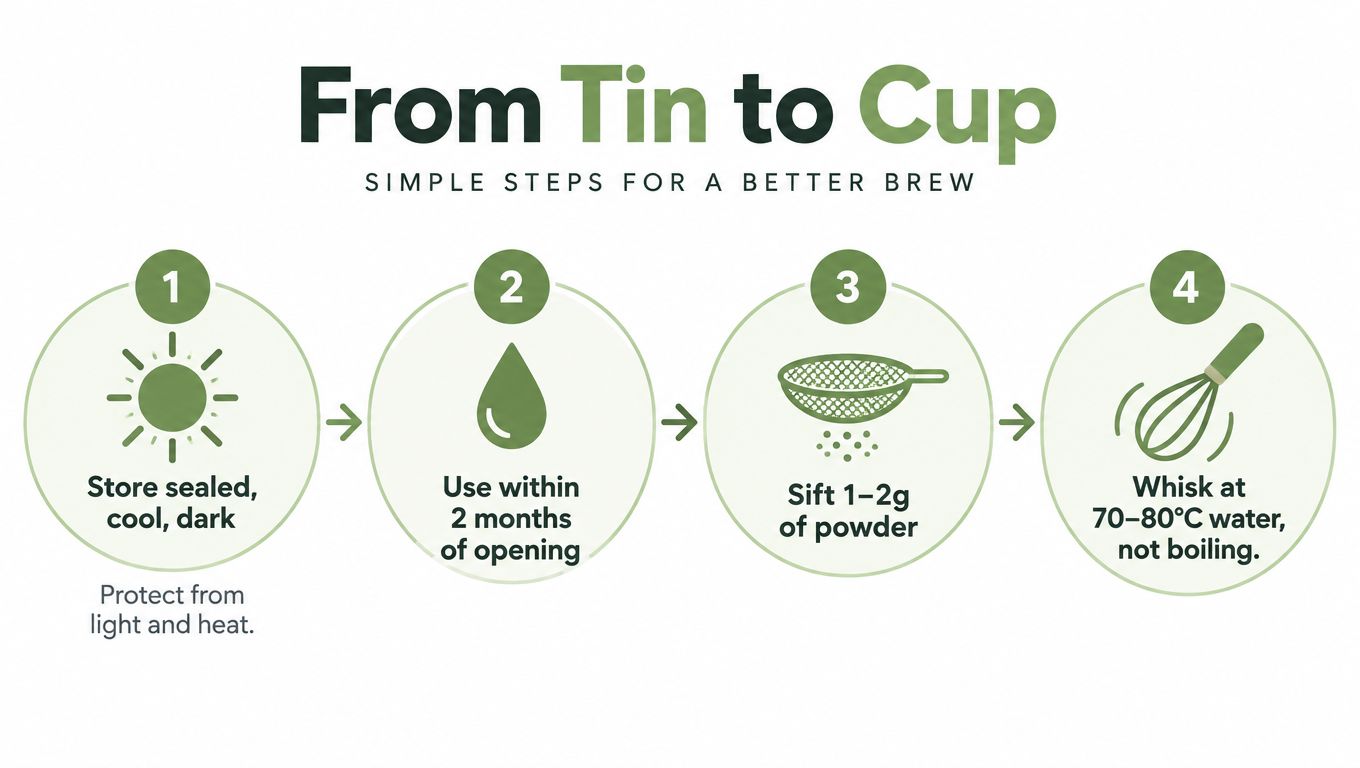
Three easy ways to prepare it
Whisked bowl: Sift around 1–2 grams of matcha into a bowl. Add a small amount of warm water, whisk into a smooth paste, then add more water and whisk briskly until lightly foamy. Water around 70–80°C is a forgiving starting point, because boiling water can make the drink taste harsh.
Hot latte: Sift the powder, mix it with a small amount of warm water, and whisk until smooth. Add warmed milk and adjust the strength to taste. A handheld frother works if you don't own a bamboo whisk.
Iced matcha: Make a concentrated paste with sifted powder and warm water first. Add cold water or milk, then pour over ice. Mixing the powder directly into a full glass of cold liquid often leaves clumps.
A bowl, fine sieve, bamboo whisk, and temperature-controlled kettle make the process easier, but you don't need a ceremonial equipment collection to start. The basics are accurate measuring, water that isn't boiling, and powder protected from moisture.
If you're also choosing lower-sugar drinks, the Australian Bureau of Statistics reports that 28.9% of Australians consumed sweetened beverages in 2023, while 23.8% consumed soft drinks or flavoured mineral waters, as shown in its food and nutrition data. An unsweetened matcha can fit a sugar-reduction routine, but the final sugar content still depends on the milk, syrup, or flavoured ingredients you add.
Putting It Together and Ordering With Confidence
Two questions settle most matcha purchases: what will you make, and how quickly will you use it?
For plain whisked tea, choose a well-documented ceremonial powder in a pack size you can finish while it stays fresh. Daily lattes and iced drinks suit premium grade. For baking, smoothies, and strongly flavoured recipes, culinary grade often gives better value because other ingredients carry the flavour.
Check the product page for ingredients, Japanese origin or a clearly stated source, grade, batch information, packaging, serving guidance, and delivery conditions. Compare the price per prepared serve, not only the tin price. Choose a larger pack only if your routine will use it before freshness falls.
With grade, pack size, and freshness aligned to your routine, the final check should take minutes, not become a research project.
Pep Tea supplies organic Japanese matcha powder for whisked bowls, lattes, smoothies, baking, and café use, alongside Australian-brewed sugar-free organic kombucha from the Hunter Valley, NSW. Visit Pep Tea to compare ceremonial and culinary-style options, then order the grade and pack size that match your actual use.
Matcha Tea Bags Benefits: The Ultimate Guide

Monday morning hits fast. The kettle's on, your inbox is already noisy, and you still want the calm, steady lift that matcha promises without turning the kitchen into a ritual bench. That's where matcha tea bags benefits start to matter in real life, because convenience only counts if the cup still feels worth drinking.
A good tea bag can bridge the gap between premium matcha and an actual human schedule. A bad one tastes thin, bitter, or dusty, and you feel like you've compromised for nothing. The difference isn't just format, it's extraction, bag design, and how much of the tea's natural character survives the brew.
The Modern Morning Ritual
The kettle is boiling while the school run is approaching, a meeting is about to start, and the café queue is already too long. A tea bag earns its place in that morning because it removes the whisk, bowl, and extra preparation that can turn matcha into a weekend ritual. The useful question is whether the quicker format still gives you a cup you want to drink.

Convenience can support quality
A poorly designed bag produces thin, bitter tea that tastes like compromise. A well-made one can deliver a cleaner, more repeatable brew, although it will not offer the same control, texture, or intensity as ceremonial-grade powder whisked in a bowl.
In Australia, matcha has moved from a niche product into the mainstream. The category generated more than $54 million in revenue in 2024 and is projected to exceed $81 million by 2030, with 7.1% annual growth, according to SBS. That market growth reflects a practical shift: people are making matcha part of ordinary wellness routines, not reserving it for cafés or elaborate preparation.
Practical rule: if the format makes you skip the drink, it is the wrong format for daily use.
Tea bags suit people who want matcha's flavour and functional lift without treating every cup like a ceremony. They also give cafés a consistent method across staff, shifts, and busy service periods.
What the format actually changes
A well-designed bag shortens the route from kettle to cup, reduces mess, and removes the need to measure powder or clean a frother. The result is less control over strength and mouthfeel, but greater repeatability. That trade-off matters on rushed mornings, particularly for anyone building a habit rather than pursuing a perfectly whisked serving.
Whisked powder wins for control and intensity. Tea bags win when preparation time determines whether the drink happens at all. In practice, the more convenient format may provide greater day-to-day value because it gets used consistently.
Understanding EGCg and L-theanine
Matcha's effect comes from compounds in the leaf, not its colour alone. EGCg is the catechin most associated with green tea research, while L-theanine contributes to matcha's calmer style of alertness. For a practical explanation, see what EGCg does in green tea. Harvard Health notes that matcha contains abundant antioxidants, including catechins, and that L-theanine has been associated with concentration and alertness (Harvard Health).
Why the pairing feels different from coffee
Coffee often arrives with a sharper sensory hit. Matcha can feel smoother because caffeine is accompanied by L-theanine. In the Australian context, one health source reports that matcha commonly provides about 30 to 40 mg caffeine per 1 g serve and 20 to 45 mg L-theanine per 1 g serve, depending on grade (Alchemist Wellness). That combination helps explain why drinkers describe matcha as supporting sustained alertness rather than a sudden spike followed by a drop.
The same source associates one to two 1 g serves with roughly 100 to 275 mg of EGCG. Use those figures as a reference, not a guarantee. A tea bag's actual result depends on the leaf, the amount it contains, water temperature, steeping time, and how freely the leaves can expand.
A bag also changes the extraction experience. A well-made bag can deliver a clean, steady cup, while a cramped bag or weak portion may taste thin and provide less of the character associated with whisked powder.
What I notice in the cup: when the brew is balanced, it tastes rounder, less grassy, and less aggressive on the finish.
What the compounds do in practice
EGCg provides the antioxidant profile people seek from green tea. L-theanine helps explain the calmer feel of matcha alongside caffeine. Together, they suit drinkers who want focus without feeling overstimulated.
A well-made tea bag will not create the same intensity as ceremonial-grade powder, but it can preserve enough of matcha's functional profile to become a reliable part of a morning routine. If the cup helps you begin work clearly and stay steady through the morning, the convenient format has earned its place.
Tea Bags Versus Loose Powder
This is the comparison that decides whether matcha becomes an occasional treat or a daily staple. Loose powder offers more ceremony, more control, and that vivid green colour people love. Tea bags offer less drama and more repeatability, which is often the better trade for weekday life.
Matcha Format Comparison
| Feature | Tea Bags | Loose Powder |
|---|---|---|
| Prep time | Fast, low-fuss | Slower, needs more steps |
| Consistency | More repeatable portioning | Depends on measuring and whisking |
| Cleanup | Simple | More equipment to wash |
| Texture | Usually lighter body | Fuller, more direct mouthfeel |
| Best use | Daily convenience | Ritual, cafés, special moments |
Loose powder still has prestige. It gives you the most hands-on control and, when whisked well, a more layered flavour. But it asks for a bowl, a whisk, and a little skill to avoid clumps.
Tea bags work differently. They're the practical option when you want a reliable cup without fuss, and high-quality pyramid bags give the leaf more room than flat paper bags. If you want to browse a broader range of tea formats while comparing styles, tea selection is a useful place to look at how different teas are organised for different routines.
What matters more than the romance of the format
A tea bag is not “less serious” just because it's easier. It's serious in a different way. It's built for consistency, portion control, and speed.
Rule of thumb: choose loose powder when you want the ritual, choose a well-made tea bag when you want the habit.
That's the actual decision. If your weekly reality includes early starts, shared kitchens, or café service, the tea bag often delivers better day-to-day value. If you only reach for matcha on slower mornings, loose powder still has a strong case.
Brewing the Perfect Cup
Even a good tea bag can brew badly if the water is wrong. Boiling water can scorch the tea and pull out more bitterness than flavour, which is why temperature matters so much. The sweet spot is around 80 degrees Celsius, a detail that shows up consistently in matcha brewing guidance, including PepTea's own matcha brewing temperature guide.
A simple brewing method that works
- Heat the water, then let it settle. Don't pour straight from a rolling boil. Let it come down to about 80 degrees Celsius so the flavour stays smoother.
- Steep briefly. Start with a short steep, then taste. Tea bags can over-extract if left too long, and that's usually where the bitterness creeps in.
- Press gently, don't squeeze hard. Aggressive squeezing can force out more astringency.
- Use the tea bag once, well. Matcha bags are designed for one clean extraction, not repeated weak steeps.
The quality of the bag matters too. Independent Australian tea research notes that bag construction and steeping time materially affect polyphenol yield, and that solubility can vary enough to act as a quality-control marker for filter-paper permeability (Australian tea quality study). In plain terms, a better bag can improve what ends up in the cup.
Hot, iced, or latte style
A hot cup is the easiest starting point. An iced version works well on warm days, especially if you brew it a little stronger before chilling. For a latte, brew the tea bag in a small amount of hot water first, then add your milk of choice.
That gives you a cleaner base than dropping a tea bag straight into milk. It also keeps the flavour balanced instead of muddy. The goal is not to hide the matcha, it's to let it carry the drink.
Sustainability and Taste Evolution
People want convenience, but they also want less waste. That tension has pushed tea brands to rethink packaging, bag shape, and freshness, and it's changed the way matcha tea bags are perceived. A well-made bag now has to do two jobs, brew well and fit a more responsible product story.
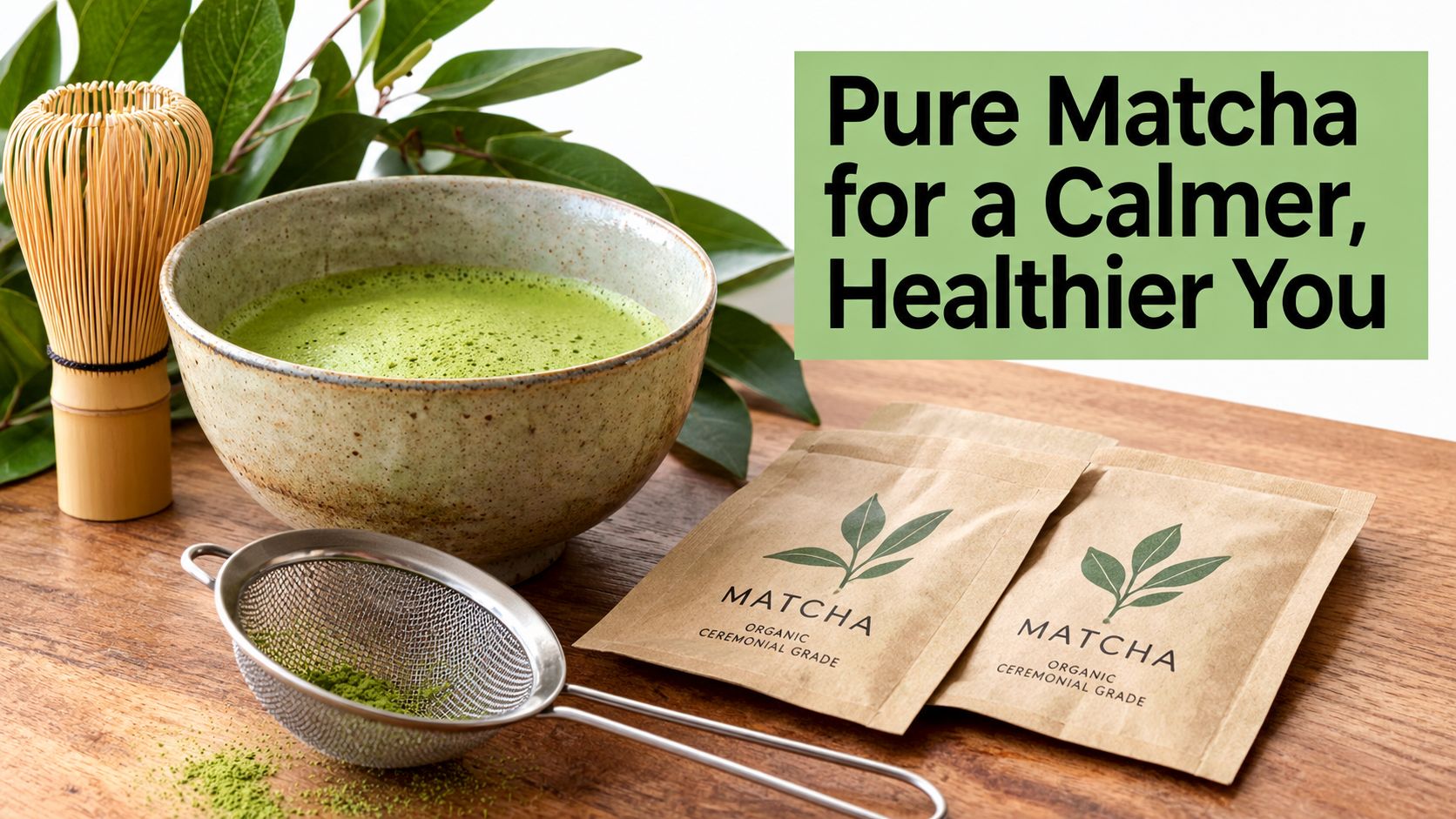
Better bags can mean better cups
Tea bags have improved a lot. Modern formats are often made to hold their shape better, give the leaves more room, and preserve freshness more effectively than older bulk-storage habits. That matters because flavour fades when tea sits exposed to light and air, and matcha is especially sensitive to poor handling.
The best part is that convenience no longer has to mean stale flavour. A quality tea bag can protect the tea well enough for daily use while still giving you the bright, fresh character you want from matcha. That's the evolution worth paying attention to.
Why sourcing still matters
The brewing format can only do so much if the tea itself is weak. PepTea's own how matcha tea is made page is a useful reminder that source material and processing shape the final cup. That applies whether the tea ends up in a bowl, a sachet, or a café menu item.
If you care about organic, functional tea, look at both the leaf and the pack. A neat bag with poor tea inside won't impress anyone. A good bag with well-selected tea can make daily matcha feel surprisingly close to a whisked cup, especially for casual drinkers who value freshness over ceremony.
Sustainability only matters if the cup is still enjoyable. When the tea tastes flat, people stop buying it, and the habit disappears.
That's why taste and responsibility need to move together. The smarter product is the one people want to drink tomorrow.
Who Should Switch to Matcha Bags
A tea bag earns its place when the alternative is skipping matcha altogether. It suits people who want a repeatable cup without specialist equipment, while still caring about flavour and function. Busy professionals, parents, café teams, and anyone building a low-friction wellness routine can all benefit from the format, provided they accept that a bag will not offer the same control as whisked powder.
The people who usually get the most value
- Office workers: A tea bag provides a predictable mid-morning drink when back-to-back calls leave little time for preparation.
- Parents and carers: One clean cup is easier to manage before the school rush than a bowl, whisk, and separate cleanup.
- Hospitality teams: Consistent preparation helps when service speed, shared workspaces, or staff changes make specialist brewing impractical.
- New matcha drinkers: The simpler method reduces the learning curve and gives beginners a better chance of enjoying their first cup.
- Home users who dislike mess: A bag removes the powder, whisk, and bowl cleanup that can make regular brewing feel like work.
The format also suits buyers who need clear product information. Australia's food regulator treats caffeine as a safety issue in concentrated products and requires added caffeine to appear in the ingredients statement when it is added to food for sale (Food Standards Australia New Zealand). Check the label, serving guidance, and preparation instructions before choosing a functional drink.
When the tea bag beats the bowl
Choose a tea bag when routine matters more than ceremony, or when a café and workplace need a clean, repeatable service method. Choose loose powder when you want to control dose, texture, strength, and whisking. The right option depends on whether convenience helps you drink matcha consistently without making the quality trade-off unacceptable.
If the format makes healthy habits easier, it's doing useful work.
Matcha's growing presence in Australia has shifted attention from ceremony alone to everyday use, including how easily people can prepare it (SBS). Tea bags fit that practical demand. They can turn occasional interest into a regular habit, as long as the tea tastes fresh enough to earn the next cup.
Conclusion and Your Next Steps
The strongest case for matcha tea bags is simple. They let you keep the functional appeal of matcha, including the caffeine and L-theanine profile people want, without turning every cup into a production. When the bag is well made and the brew is handled properly, the result can be genuinely satisfying, not just convenient.
The trade-off is still real. Loose powder gives you more ceremony and control, while tea bags give you speed, consistency, and a much easier daily habit. For most busy Australians, especially those trying to build a calm, reliable morning routine, that trade makes sense.
If you're buying for home, café service, or a workplace pantry, look for tea that's clearly sourced, properly packaged, and easy to prepare well. That's where quality shows up, not in marketing language, but in the cup itself.
PepTea offers Australian-focused organic matcha and sugar-free kombucha for people who want functional drinks without the fuss. If you're ready to make matcha part of a realistic daily routine, visit Pep Tea and explore the range for home, café, or wholesale use.
Instant Matcha Tea: What It Is and How to Use It
Instant matcha tea gets treated like a shortcut, but that's only half the story. Some products are a genuine convenience format, while others are just instant green tea powders wearing a matcha label, and those two things don't behave the same in a cup or in a café.
For Australian buyers, that difference matters more than most guides admit. If you're choosing a powder for lattes, iced drinks, desserts, or a fast home ritual, the label tells you more than the marketing does, and a clear understanding of processing, solubility, flavour, and nutrition will save you from buying the wrong tin.
What Instant Matcha Tea Actually Is
A lot of people assume every green powder called matcha is basically the same product. It isn't. True matcha is made from tencha leaf that's stone-ground into a fine powder, while instant matcha tea is usually a processed instant tea powder designed to dissolve quickly, often from brewed tea concentrates and sometimes with additives like maltodextrin or citric acid for better flow and shelf life, according to the product distinction explained by matcha.com.
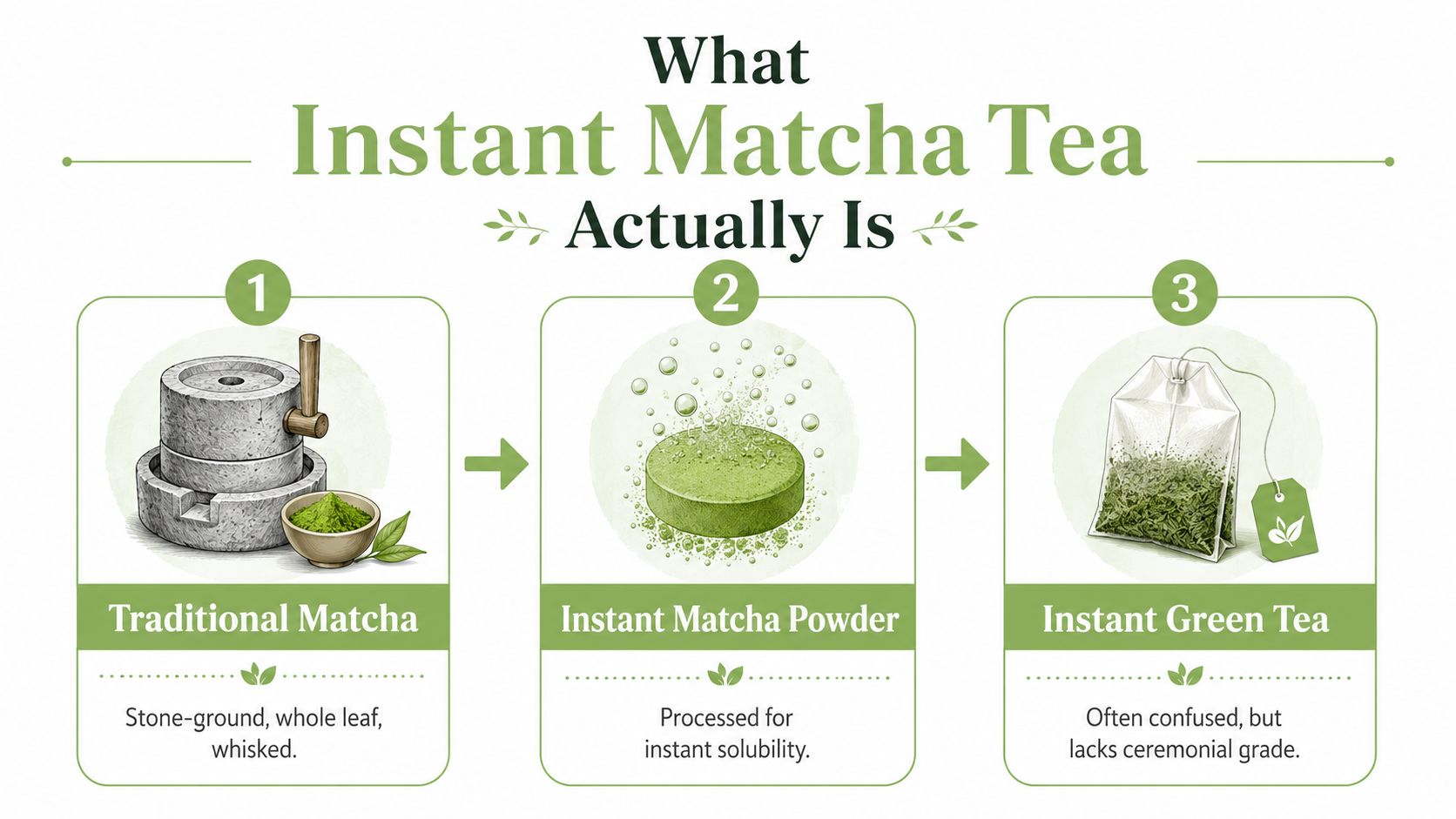
Why the label causes so much confusion
Australian shoppers often see “matcha” and assume heritage tea, bright colour, and full nutritional value. That assumption only holds when the powder is made from ground tea leaf. Instant tea powders are made for convenience first, so they're meant to disperse fast in water or milk, not necessarily to preserve the character of the leaf.
That matters in service settings too. A café team training on speed, consistency, and drink build will need a different workflow from someone preparing ceremonial tea at home, which is why a practical resource like barista training Australia can be useful when you're mapping a menu or onboarding staff.
Practical rule: if the ingredient list reads like a processed beverage mix, you're probably not buying traditional stone-ground matcha, even if the front label says “matcha”.
What to look for on a packet
You don't need a tea degree to read the label well. Start with the ingredients, then look for anything that suggests instant solubility rather than whole-leaf powder. If the powder dissolves completely and leaves little sediment, that's often by design, but it doesn't automatically mean it's equivalent to matcha in flavour or composition.
A simple label check helps:
- Ingredient list first, because additives often signal an instant format.
- Country of origin next, because true matcha is tied to Japanese production.
- Product language last, because words like “instant”, “blend”, or “soluble” tell you how it behaves in the cup.
For café owners, that distinction changes how you build drinks. For home users, it changes expectations. Instant matcha tea can be a smart convenience product, but it shouldn't be judged as though it were the same thing as traditional matcha.
Instant vs Ceremonial vs Culinary Matcha Compared
Start with the cup itself, because that usually clears up the confusion. Ceremonial matcha is made for drinking on its own, culinary matcha is made to stand up in milk, batter, and sauce, and instant matcha tea is designed for speed and easy dispersion. Each one solves a different problem, so the right choice depends on whether you need flavour clarity, kitchen flexibility, or fast service.
Matcha Grades at a Glance
| Attribute | Instant Matcha | Culinary Matcha | Ceremonial Matcha |
|---|---|---|---|
| Processing | Usually made for instant solubility, often from brewed concentrate | Stone-ground tea leaf, usually from slightly older leaves | Stone-ground tea leaf, usually from the youngest shade-grown leaves |
| Texture | Designed to dissolve quickly | Mixes well, may need whisking or frothing | Best whisked, can form a fine foam |
| Flavour | Neutral to mild, sometimes flatter | Stronger, more pronounced | Delicate, smoother, more umami |
| Best use | Iced drinks, fast service, automated prep | Lattes, baking, cooking | Straight tea, ceremonial use, premium drinks |
| Nutritional trade-off | Convenience first, so the whole-leaf profile is usually reduced | Retains more of the leaf than instant forms | Closest to the full leaf experience |
For a practical buyer's guide, PepTea's comparison of ceremonial vs culinary matcha helps separate drinking quality from kitchen use without turning the decision into guesswork.
What each grade is really for
Ceremonial matcha suits moments where the tea itself should lead. The flavour is cleaner, the finish is more refined, and the drink works best when nothing else is crowding the bowl or cup.
Culinary matcha belongs in a different setting. In a latte, smoothie, cake, or biscuit, its fuller taste has enough weight to come through milk, sugar, and other ingredients, which is why it is often the more practical choice for recipes. A Japanese home cooking resource such as the Just Cook It recipe collection is useful when you want to see how matcha behaves beyond a plain tea preparation and into everyday cooking.
Instant matcha tea sits alongside those options rather than replacing them. It is handy when the drink needs to be quick, cold, and consistent, especially in an Australian café where prep time and repeatability matter. That convenience comes with a trade-off, because it is not the same ingredient category as a traditional stone-ground powder, and that difference affects both cup quality and how much of the leaf you are using. Once you separate those roles, the choice becomes easier to make for both café menus and home kitchens.
Short version: ceremonial for drinking, culinary for cooking, instant for convenience.
Nutritional Benefits and What You Might Be Missing
Matcha earns its reputation because you consume the whole leaf, not just the brewed water. Reviews summarised in the medical literature report caffeine around 18.9 to 44.4 mg/g, total polyphenols around 169 to 273 mg gallic acid equivalents per gram, and a composition that is roughly 60 to 70% insoluble material plus 30 to 40% soluble compounds such as catechins, amino acids, and minerals, according to PubMed review data. That's the heart of the nutrition argument in favour of true matcha.
Why whole-leaf powder matters
When you whisk stone-ground matcha, you're taking in the material suspended in the cup as well as what dissolves into the liquid. That's why people value it as a functional drink rather than a simple infusion. The profile can vary a lot by source and dose, but the key point is that true matcha delivers more of the leaf than a typical instant tea powder.
Instant matcha tea often trades some of that completeness for convenience. If a powder is made from extract or concentrate and engineered for solubility, it can be easier to use in iced drinks and automatic dispensing, but it may not carry the same density of leaf-derived compounds. In other words, it may behave better in a machine, while true matcha gives you more of the plant itself.
What readers usually expect from matcha
Most buyers are looking for three things:
- Antioxidants, especially catechin-rich compounds.
- Calm energy, because matcha combines caffeine with amino acids.
- A greener, fuller flavour, which signals freshness and leaf quality.
That's why it helps to keep expectations precise. If you want a product for fast drinks and low-fuss use, instant matcha can make sense. If your priority is nutrition and the classic tea experience, stone-ground matcha is the better fit.
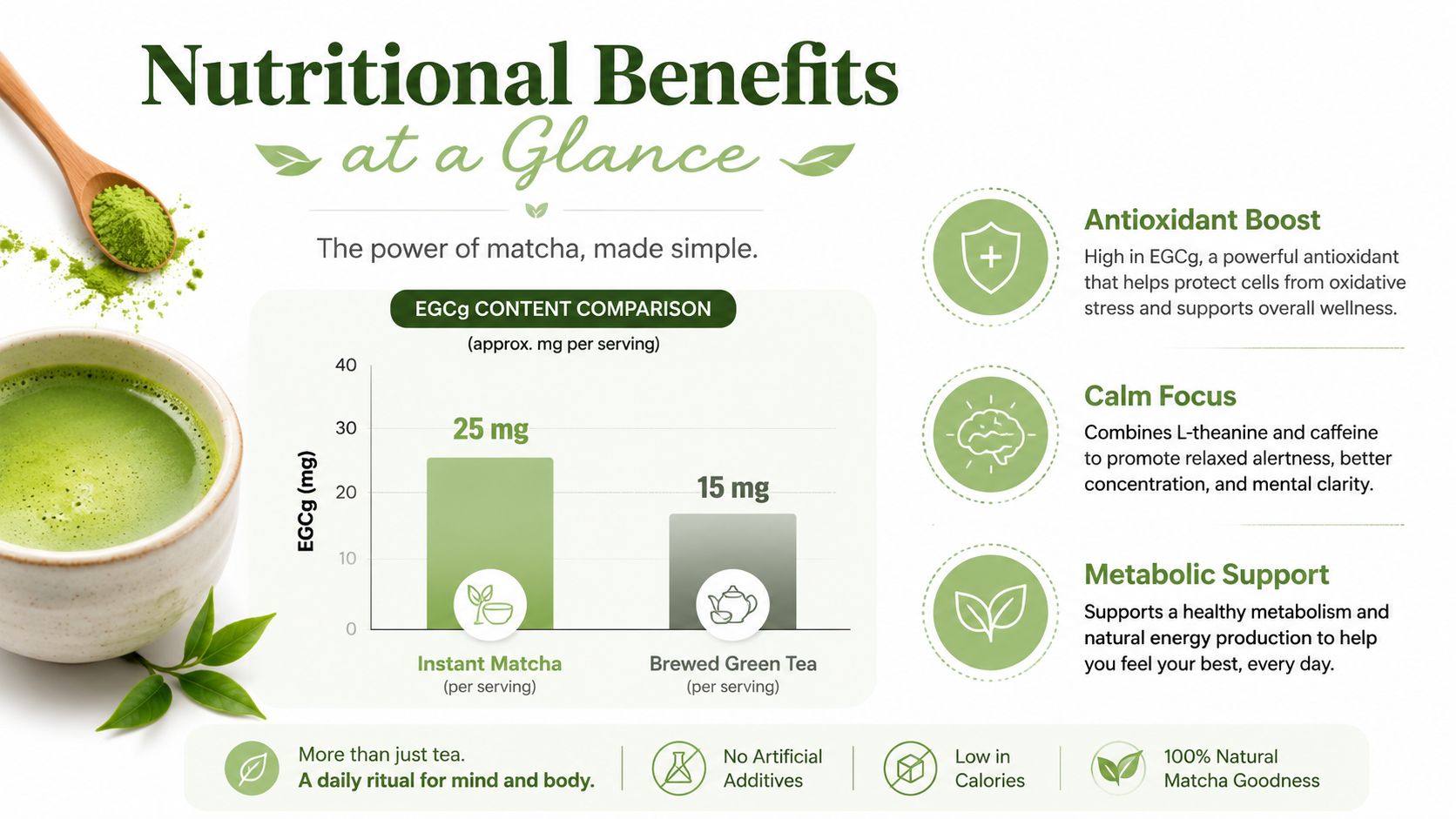
A useful way to think about it is this, the more a product is engineered for instant mixing, the more you should ask what has been gained in speed and what has been lost in whole-leaf character.
How to Prepare Instant Matcha Tea Properly
Instant matcha tea is easier to handle than traditional powder, but the method still matters. If you dump it straight into cold milk and walk away, you'll often end up with weak flavour or an uneven texture. A little technique goes a long way.
Hot, iced, and latte preparation
For a hot drink, start with a small amount of water first, then add the rest once the powder has dispersed. That helps the powder hydrate evenly and keeps the flavour from going flat. If the product is very fine or highly soluble, a quick stir may be enough, but if the cup looks grainy, a small whisk or milk frother helps.
For iced drinks, instant matcha usually outperforms traditional powder because it's designed to disperse more easily in colder liquid. That makes it a practical choice for café iced lattes, shaker bottles, or takeaway formats where speed matters.
For a latte, build it like this:
- Dissolve the powder in a small splash of hot water.
- Stir or froth until smooth.
- Add milk, then ice if needed.
- Taste before sweetening, because some instant blends already include a sweetener or filler.
If you use traditional matcha instead, a proper whisking method matters. PepTea's guide on how to whisk matcha is a useful reference if you want to compare the two workflows side by side.
Fixing common problems
Grainy texture usually means the powder needs more agitation. Weak flavour usually means the dose is too low for the product's concentration. Bitterness often comes from water that's too hot or from a product that already includes more processed tea solids than you expected.
Good café habit: build one test drink before you scale the recipe for service. Instant powders can vary a lot, so a fast calibration saves waste.
If you're making drinks at home, a shaker bottle works well for cold recipes, and a blender helps when milk, ice, and powder all need to combine quickly. For hot drinks, simple stirring is often enough if the powder is soluble.
Recipes and Use Cases for Home and Hospitality
Instant matcha tea makes the most sense when the drink has to move quickly. At home, that usually means morning routines. In hospitality, it usually means iced menus, batch builds, and prep consistency across staff shifts.
Where it works well
A home barista can use instant matcha in a few straightforward ways. A quick iced matcha latte is the obvious one, because the powder disperses easily and doesn't need the same whisking discipline as ceremonial tea. It can also slip into smoothies, overnight oats, or simple baking where the green tea flavour just needs to show up cleanly.
For cafés, the strongest use case is speed. Instant powder can be handy in:
- Iced drinks, where fast dispersion reduces clumping.
- Automated or semi-automated service, where repeatability matters.
- Batch drinks, when a team needs consistent colour and flavour across service.
That said, there are also places where a prepared version wins without question. If a customer expects vivid green colour, foamy texture, and the layered umami of a properly whisked tea, a conventional matcha powder is still the right call.
Simple serving ideas
A few practical pairings work especially well:
- Oat milk latte, because its body softens the tea.
- Coconut milk iced drink, because it reads as tropical and creamy.
- Vanilla smoothie, because the flavour is mild enough to sit beside fruit.
- Matcha muffins or slice, if the recipe only needs background tea notes.
PepTea also offers organic matcha tea products online, including bulk formats suited to retail and food service, which makes sense for kitchens that need a reliable powder rather than a one-off novelty.
For cafés, the decision usually comes down to ticket time versus drink identity. For home users, it comes down to whether you want a fast green drink or a more traditional tea ritual. Both can have a place, but they're not interchangeable.
Buying and Storing Matcha the Right Way
Reading a matcha label properly saves money and disappointment. The easiest mistake is buying by colour alone. A bright tin doesn't always mean good tea, and a smooth powder doesn't always mean it's true matcha.
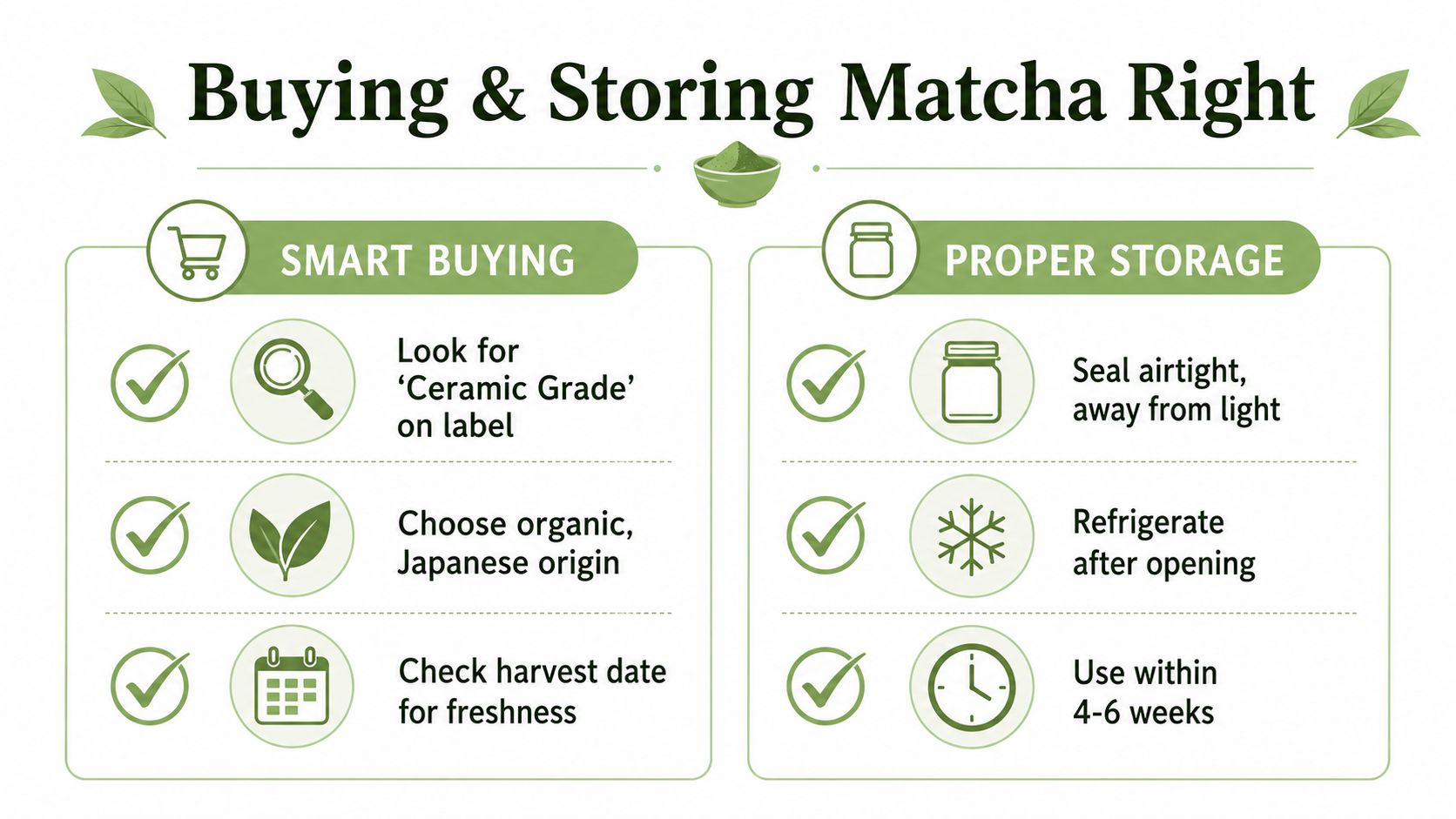
What to look for on the label
Start with the ingredient list. A clean matcha product should be easy to understand, and if you see a long list of sweeteners, fillers, or anti-caking agents, that's a sign to slow down and ask what the powder is made of. A trusted origin matters too, especially in Australia where the market is largely import-led.
That matters because Australia imported about A$14.2 million of “tea, whether or not flavoured” from Japan in 2024, and Japan External Trade Organization data says Japan remains the world's leading supplier of matcha, with export volume rising 16.1% in 2024 to 8,798 tonnes, about 10 times the level of 20 years earlier, according to the market summary at Ooika. For Australian buyers, that points to a supply chain that's heavily tied to origin-country production.
A simple checklist helps:
- Look for origin transparency, ideally Japan and, when available, a specific region.
- Check for added ingredients, especially if you want authentic matcha.
- Prefer reputable packers or suppliers, because freshness matters more than flashy packaging.
How to store it well
Matcha is sensitive to light, heat, and oxygen. Store it sealed, cool, and away from the cupboard door where temperature swings are common. Once opened, use it promptly, as freshness drops faster than you might expect.
A small airtight tin or jar is better than leaving the powder in a half-open bag. If you've already opened a pouch, a dedicated storage container helps protect flavour and colour, and PepTea's matcha storage container is one practical example of the kind of setup that keeps powder in better shape.
If you buy online, prioritise clear photos of the ingredient panel and packaging date. If you buy in-store, open the conversation with the staff and ask what kind of matcha it is before you decide whether it suits drinking, lattes, or baking.
Choosing the Right Matcha for Your Needs
The decision comes down to one question, what do you want the powder to do? If your answer is “be quick, cold, and easy to mix,” instant matcha tea can be the right tool. If your answer is “taste like real matcha and deliver the fuller leaf experience,” you'll want stone-ground culinary or ceremonial powder instead.
For café owners, the smartest choice often depends on the menu. Instant powder can help with speed and consistency, but a premium matcha earns its place when customers are paying for texture, aroma, and a more authentic cup. For home users, the split is even simpler, convenience versus tradition.
If you're still deciding, keep these priorities in mind:
- Choose instant when you need fast dispersion and straightforward cold-drink prep.
- Choose culinary when you want a stronger flavour for lattes or baking.
- Choose ceremonial when the tea is the whole point.
PepTea's range of premium organic Japanese matcha is built around authenticity, clean ingredients, and practical use in real kitchens and cafés. If you want to compare options and choose the right grade for your routine, explore Pep Tea and pick the powder that fits the drink you want to make.
Green means glow – with a matcha tea face mask
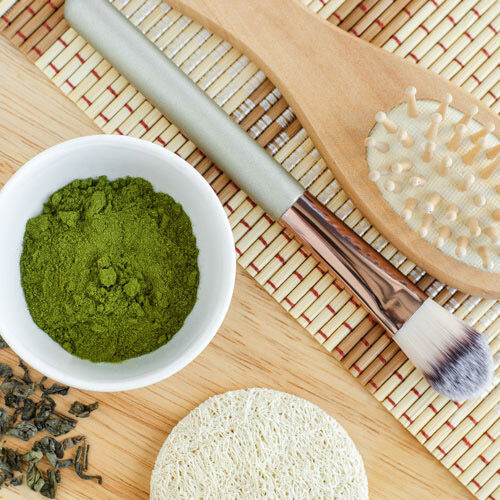
Green tea has many health benefits. Containing powerful antioxidants, it comes as no surprise that many of these involve our skin.
Many studies suggest that there are benefits to both drinking green tea and applying it topically. Making a matcha tea face mask is the ideal place to begin exploring the benefits of matcha skin care.
Is matcha green tea good for your skin?
Matcha green tea is good for your skin in so many ways. It contains a group of antioxidants known as catechins, more specifically a compound known as EGCG, that are directly involved in cell growth and repair. Green tea also has many anti-inflammatory and anti-microbial properties that can help with hormonal acne. as well as Vitamin B2 for maintaining collagen levels and Vitamin E to nourish and hydrate.
The benefits of a matcha face mask
Many of the benefits of green tea are triggered from within but there are specific benefits to using it directly on the skin.
- Brighten dull skin
- Help retain moisture and hydration
- Fight wrinkles and firm sagging skin
- Work against acne bacteria and reduce sebum production
- Help puffy eyes
- Clearing clogged pores
Make a matcha tea face mask
If you make your own matcha skin mask then you are in full control of the ingredients. Green tea is a big thing in the beauty world but the quality and quantity of active ingredients can vary. Many cosmetic brands contain artificial ingredients and preservatives to extend shelf life. Whilst these may be deemed skin safe what you put on your body is as important as what you put in your body. Thankfully all of our matcha green tea powder is 100% certified organic.
When creating your own DIY beauty products it is just as important to do a patch test. Apply a small amount to the skin on the inside of your elbow to make sure your skin is not sensitive to the ingredients you are using.
The recipe below is for a honey and matcha face mask, because why not harness the healing power of honey too. You could also use natural yoghurt or olive oil. Or just make a paste with plain old water. Whatever suits you.
Recipe for honey and matcha face mask
This makes enough for one faceful, but you could make up more and store it in an airtight container in a cool dark place.
1 tsp matcha green tea powder
1 tbsp raw honey
- Mix the ingredients together well.
- Apply all over the face, avoiding the eyes but covering the skin around the eyes.
- Leave on for 10 to 15 minutes and remove with a warm wet cloth.
Use once a week.
We stock a variety of grades of high quality organic matcha powder. Our green tea powder is also available to buy in bulk online at wholesale prices.
This article was reproduced on this site only with permission from operafoods.com.au the “Gourmet Online Wholesale Grocer”. See original article:- Green Means Glow With a Matcha Tea Face Mask
Is matcha different from Japanese green tea?
Most of us are by now familiar with green tea powder but there is more to Japanese green tea than just matcha.
Like most things in Japan, tea growing is done with careful consideration. An art form that honours tradition and spares no attention to detail.
Types of Japanese green tea
Whilst there are many types of Japanese green tea, they can be sorted into two main categories. Tea that is grown in the shade and tea that is grown in full sun. Matcha may be a powder, but it begins life as all tea does; the green leaves of the tea plant.
Matcha and gyokuro green teas
Matcha belongs to the group of teas that are grown in the shade. As we saw in our article on the different grades of matcha, some green tea in Japan is grown in the shade for around the last month before the harvest. This reduces the rate of photosynthesis, concentrating chlorophyll and increasing levels of theanine. A process that results in sweet mellow flavours, with less bitter undertones, and deep green colour.
Both matcha and gyokuro green teas are grown in this way. After processing, matcha ends up as a fine green powder whereas gyokuro is a leaf tea. The leaves are steamed and dried, then kneaded before sorting. Kneading breaks down the fibres so that flavour and nutrients are more readily extracted during brewing. Gyokuro karigane is a less expensive version of the tea made from the stems rather than the leaves.
Sencha green tea
Other teas are grown in full sunlight right up until harvest. This results in a concentration of catechins rather than theanine and these give tea its characteristic bitter flavour. With less chlorophyll than shade grown tea, the leaves are a golden green colour.
Sencha and genmaicha teas are both grown in full sunlight. The most popular green leaf tea in Japan, sencha is a bright energising everyday tea. It has a mellow and refreshing flavour with a balanced bitterness. There are many different types of sencha available.
Genmaicha is a blend of Japanese green tea made from sencha leaves mixed with toasted brown rice. Originally a cost effective way of making expensive green tea leaves go further, genmaicha is prized for its rich roasted flavour reminiscent of coffee that makes it ideal at breakfast time.
Hojicha is sencha that has been roasted. It is more similar to black tea but has a fresher flavour profile.
The difference between black and green tea
Tea all looks the same when it is harvested. It is the processing that makes the difference between green and black tea.
Once harvested, tea leaves destined to be black tea are left to wither and ferment. The process of fermentation allows the leaves to oxidise, changing the colour from green to brown then black. But it is not just the colour that changes. The deep earthy flavour of black tea is all down to careful control of this oxidation process.
On the other hand, leaves for green tea are exposed to heat as soon as they are picked. Usually steaming, this process halts oxidation and results in not only the green colour but the fresh grassy herbal tones of green tea.
Is matcha different from green tea?
Matcha is just one of many varieties of Japanese green tea, yet it is unique in that it takes the form of a powder. The entire leaf is processed and ground, with the resulting powder brewed and drunk. This is different from most teas, where the leaf is brewed and then thrown away.
Does Japanese green tea contain caffeine?
Japanese green teas are often higher in caffeine due to the gentle steaming process. The caffeine in tea is bound to antioxidants which slow the rate of absorption. This makes for a more gradual caffeine hit with none of the jitters associated with coffee. Gyokuro and matcha, the shade grown teas, have the most caffeine. Hojicha has very little caffeine, whilst sencha comes somewhere in between.
Making Japanese green tea
The subtle nuances of Japanese green tea can be lost if not brewed with consideration. Temperature and brew time are both of importance.
To brew sencha tea, boil water and let it stand for a few minutes to come down to 80C. Brew for 1 minute before lifting out the leaves.
Matcha tea is whisked into water of between 70 and 85C.
Genmaicha tea is brewed in freshly boiled water for 1 minute.
Hojicha tea is brewed in freshly boiled water for 30 seconds.
Health benefits matcha vs green tea
Matcha and other varieties of green tea share potent antioxidant benefits but it is thought that matcha is more beneficial to health as the whole leaf is ingested.
Why not explore our range of matcha green tea or buy online from our gourmet grocery store?
Matcha an Anti-Oxidant Powerhouse Decreases Cholesterol and Blood Sugar Levels
Matcha tea powder is a product of Australia’s Pep Tea brand. Pep Tea is basically specialized in wholesale distribution of high-quality organic teas especially Japanese organic green matcha tea that is popular for its quality, purity and other health benefits.
Matcha is rich in vitamins, fiber as well as chlorophyll. Matcha is considered to be an antioxidant powerhouse that provides certain health benefits. It contributes selenium, vitamin C, chromium, zinc as well as magnesium. Matcha tea aids to strengthen the mood and concentration of an individual. The health benefits of consuming Matcha include lowering cholesterol levels, blood pressure, blood sugar and many more.
Pep Tea is referred to as the name of an Australian business and also it is a registered trademark of Opera Foods Pty Ltd.
You can buy organic Matcha wholesale from Pep Tea or our parent company Opera Foods.
How to Create Your Matcha Green Tea Latte Recipe At Home?
Matcha Tea Latte a popular tea beverage was unheard in Australia before a decade ago but now almost every coffee shop provides with this delicious Matcha powder drink. It has been given various names by most of the famous cafes in Australia while some boasts of its meditative qualities others call it as the “perfect Zen” or “the healthy superfood”. The best thing about Matcha Latte is that it can easily be made at home.
Buy the Imperial Matcha Tea powder from Peptea and take it in a mug or cup. Then add warm water and mix it with a spoon until it turns into a dark green paste. Warm the milk in a saucepan and pour it into the mug and stir well till it turns light green in color. Then add a few sprinkles of Matcha Powder on top for decorations. If you are looking for an ice-cold Matcha Latte then use cold milk instead of hot milk and add some ice cubes for the chill.
Order your Imperial Matcha Powder wholesale right now from Peptea.
Why Matcha Tea Powder Is A “Powerhouse Of Antioxidants”

Matcha Tea powder contains a powerhouse of antioxidants. In recent years people have become more aware of the different health benefits which can be gained by drinking just a cup of Green Tea. But still, it is just unthinkable that every day unknowingly we throw away such huge quantities of antioxidants and minerals which are present in tea leaves.
A cup of green tea is only able to extract a limited amount of minerals and antioxidants but that does not mean you have to start eating tea leaves.
We suggest you switch your taste to matcha tea which provides a simple solution as it uses the whole of the tea leaf. It provides numerable minerals and antioxidants and proven health benefits. It has even been proven that 1 cup of Matcha tea is equal to drinking 10 cups of green tea.
Pep Tea is an Australian brand which specializes in organic Matcha wholesale. We have different varieties of Matcha Tea powder available in our store. All our products are organic and of high quality which are grown in the famous southern tea plantations of Japan.
Pep Tea brand matcha products are certified by the Japanese agriculture ministry before packing. We have the Supreme, Imperial and Premium Matcha tea powder which are available in packs of 30gm, 100gm, and 1kg. All these products can be ordered from wholesale matcha distributor Opera Foods.
How Many Cups of Matcha Tea Powder are Safe Per Day?
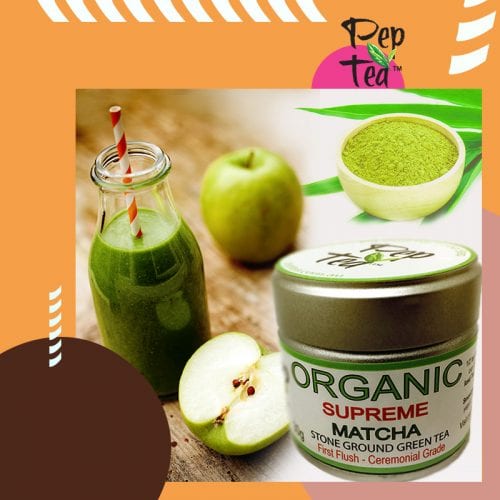
Matcha is a type of green tea which is grown in the famous tea plantations of Japan and also in China. The drinking of powdered green tea leaves for heath reasons became a ceremonial tradition which was practiced in Japan. Over the centuries the tradition is still being continued in Japan whereas in China it had slowly lost some its importance until recent years. Where ceremonies were held the High grade matcha tea is made and served according to the auspicious rituals of the Japanese tea ceremony.
Pep Tea a leading brand of Kombucha and Matcha was established with the vision to bring the old tradition of Matcha tea to Australia. Besides the authentic traditional facts they also provide amazing benefits to our body.
Caffeine in Matcha
Like coffee, matcha contains caffeine, but instead of the jitters it gives you a clean high. A matcha tea provides more caffeine than black tea around the same as a cup of brewed coffee but less than the amount of an espresso, however, the tea’s buzz is much more energising and longer-lasting
It depends on how strong you drink it of course but on average Matcha tea contains on average around 70mg of caffeine for an 8 ounce cup. Whereas black tea contains, on average, around 55 mg of caffeine per 8 ounces, and coffee contains around 100 mg. Interestingly, green tea also contains the amino acid L-theanine.
Caffeine is usually thought to be safe in moderate amounts. Experts consider 200–300 mg of caffeine a day to be a moderate amount for adults. So a moderate dose of caffeine through drinking Matcha tea is about 3 cups per day.
Consuming Matcha tea on a daily basis increases the antioxidant compounds in our body which can protect us from heart disease, diabetes, cancer, and dementia. Whereas you should also be careful about the amount of Matcha consumption you take as overdose of caffeine can leads to side effect. To make one cup of Matcha Tea you should use 1/2 teaspoon of Matcha Powder as one cup of Matcha green tea is equivalent to 10 cups of ordinary Green Tea. So Generally it is though that if you consume Matcha Tea on a daily basis you should probably not have more than 5 cups a day. If you keep these things in check then the Matcha Tea is capable to keep you energized throughout the day and give you great health benefits.
Order high-grade Matcha powder wholesale from our online store. Pep Tea is a trademarked brand of Opera Foods who deliver products overnight to most postcodes in Australia.
A Brief History of Matcha Tea

The word Matcha has its origin from Japan. In Japanese “Cha” means tea, and “Ma” means powder. Hence the unique traditional style of making tea in Japan was called Matcha. In this technique, the tea leaves are ground into a fine powder. Over the years the Japanese perfected the art of ceremonial Matcha tea making.
All our Matcha powder products are authentic Japanese certified and organic in nature. The Matcha Powder of Peptea is grown by the ministry of agriculture, Japan in the southern regions of Japan like Kyoto Mie and Aichi.
Our Matcha products are one of the most powerful natural superfoods available in Australia. After the Matcha leaves are grounded into fine powder they are stored away from sunlight and oxygen to preserve its bright green color and antioxidant properties.
Matcha Tea is a powerhouse of antioxidant, order Peptea’s Matcha from matcha powder wholesale distributor Opera Foods, and enjoy the amazing benefits by drinking a cup every day.