
Tag: Matcha Latte Recipe
How to Make a Sugar Free Matcha Latte (Complete Guide)

A proper sugar free matcha latte uses 4–5 g of ceremonial-grade matcha, sifted into 40–60 mL of 70–80 °C water, followed by 180–200 mL of frothed milk at around 65 °C. This workflow prevents clumps and bitterness while keeping the drink naturally sugar-free.
You order a matcha latte at your local café, expecting a clean, earthy drink, then notice the sweetness before you notice the tea. That's a common experience. Matcha powder is sometimes blended with sweetened ingredients, and milk products can also add sugar, so a drink that sounds wholesome may not match your intention to reduce sugar.
Australians consumed an average of 43 g of free sugars per person per day in 2023, with most coming from added sugars, according to the Australian Bureau of Statistics food and nutrients data. Sweetened beverages alone supplied an average of 11 g of free sugars per day, about 2.5 teaspoons, and contributed 25.4% of nationally consumed free sugars in 2023, as reported in the ABS sweetened beverages release.

Introduction Why a Sugar Free Matcha Latte Is Worth the Effort
Removing added sugar is only half the job. A sugar free matcha latte still has to taste rounded, creamy and satisfying, otherwise you'll reach for the café version again. The usual failures are predictable: bitter powder, floating clumps, watery plant milk or a sweetness that masks the matcha completely.
The solution is a controlled preparation method rather than a complicated recipe. Use a matcha with enough natural umami to work with milk, disperse it in warm water before adding the milk, and treat temperature as part of the recipe. That gives you a drink with a fresh green flavour instead of a harsh, grassy finish.
Why sugar reduction makes sense
Australia's beverage market has already moved towards lower-sugar formulations. A national analysis found that total sugar content in non-alcoholic beverages fell from 7.5 g per 100 mL in 2015 to 6.2 g per 100 mL in 2019, a 17.1% decrease, while 56% of beverages contained added sugars in 2019. Ready-to-drink coffees were particularly relevant, with added sugar present in 85% of products examined in that study, published in this Australian beverage analysis.
That context gives the sugar free matcha latte a practical place on a home routine or café menu. It offers the ritual and texture of a café drink while allowing you to control the matcha, milk and sweetener instead of accepting a pre-sweetened formula.
The drink can also suit people exploring functional beverages, non-alcoholic café choices or a gentler alternative to heavily sweetened soft drinks. Matcha contains naturally occurring caffeine, so sugar-free preparation doesn't remove the need to think about strength and timing. Taste, sugar content and caffeine dose all deserve attention.
Choosing the Right Matcha for a Sugar Free Latte
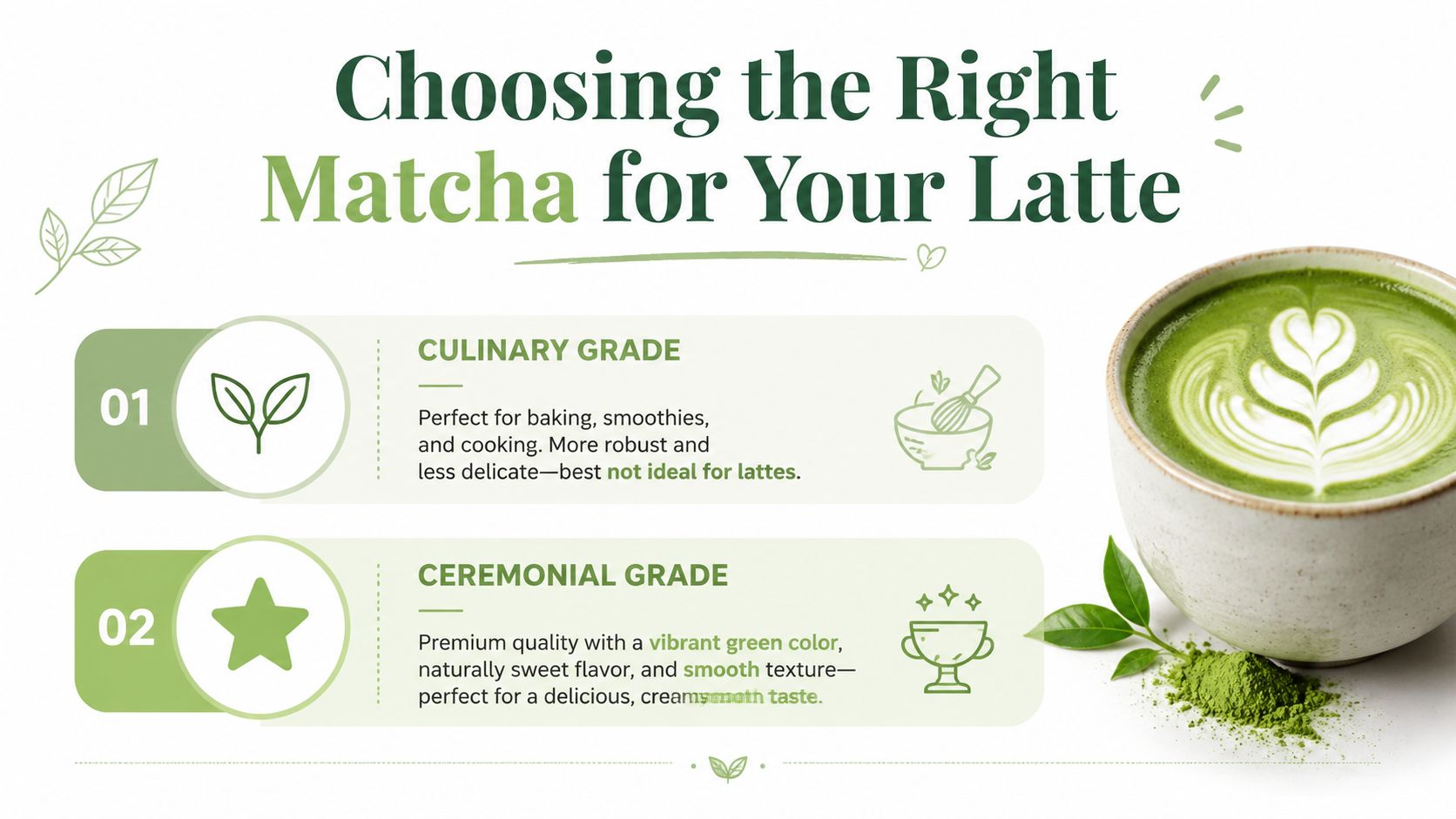
The matcha powder determines the starting point for flavour. For a latte, choose ceremonial-grade matcha when you want a smoother, more balanced drink, particularly if you aren't adding sweetener. Culinary-grade matcha has a useful role in baking, smoothies and desserts, but its stronger, more assertive profile can taste rough when mixed with milk.
Look for a vibrant green colour, a fine texture and an aroma that suggests fresh, savoury umami rather than stale hay. Japanese stone-ground matcha is made from finely milled tea leaves, so freshness and storage matter. Keep the pouch sealed, away from heat, light and moisture, and use a clean, dry spoon each time.
For a single latte, measure 4–5 g of matcha. Measuring by weight gives more repeatable results than relying on an unlevel teaspoon, especially when you're serving customers or preparing the same drink every morning.
Sifting is part of the recipe
Matcha naturally forms small clumps because the powder is extremely fine and reacts to moisture and static. Put the powder through a fine tea sieve into a bowl before adding water. Skipping this step makes whisking harder and leaves undissolved pockets in the finished latte.
PepTea's guide to matcha grades is useful when deciding whether a powder suits drinking, cooking or both. Whatever brand you choose, don't assume a darker or more bitter powder will create a stronger, better latte. Strength should come from a controlled dose, not from forcing an unsuitable matcha to work.
Barista rule: If the matcha tastes aggressively bitter before milk is added, changing the water temperature and grade will help more than adding extra sweetener.
How to Make a Sugar Free Matcha Latte Hot and Iced Recipes
The hot and iced versions begin with the same matcha concentrate. That's important because milk should never be the first liquid to meet dry matcha. Water gives you the space and movement needed to disperse the powder properly.
Hot recipe
- Sift the matcha. Place 4–5 g of ceremonial-grade matcha in a warm bowl.
- Add warm water. Pour in 40–60 mL of water at 70–80 °C. Water that's boiling or close to boiling can push the flavour towards bitterness.
- Whisk thoroughly. Use a bamboo chasen, small electric frother or handheld whisk until the concentrate looks smooth, with a light foam across the surface.
- Prepare the milk. Heat and froth 180–200 mL of milk to about 65 °C. Aim for glossy microfoam rather than large bubbles.
- Combine slowly. Pour the milk into the matcha concentrate and stir gently. For a layered café appearance, hold back some foam with a spoon and place it on top at the end.
This formula is also a practical starting point for cafés because it creates a clear sequence that staff can repeat during a busy service.
Iced recipe
Prepare the matcha concentrate using the same sifting and whisking steps. Fill a glass with ice, add your chosen cold milk, then pour the matcha over the top and stir gently. Since ice dilutes the drink, keep the concentrate at the more concentrated end of the water range rather than adding extra powder immediately.
For another detailed iced method, follow PepTea's iced matcha latte recipe. It's particularly helpful if you're moving between a home hand frother and a café-style preparation.
A short visual demonstration can make the whisking motion easier to copy:
Sugar Free Sweetener Options That Actually Taste Good
A well-made ceremonial matcha latte may not need sweetener. Milk brings body and a mild natural sweetness, while good matcha contributes umami. If the drink tastes harsh, fix the grade, temperature or dispersion before assuming you need a large amount of sweetener.
If you do want sweetness, add it to the warm matcha concentrate so it dissolves fully. For an iced drink, dissolve the sweetener before adding ice. The right choice depends on whether you prefer a clean finish, a rounded mouthfeel or the closest possible substitute for sugar.
| Sweetener | Taste Profile | Best For |
|---|---|---|
| Stevia | Concentrated sweetness with a possible herbal or bitter finish when overused | Drinkers who want a small amount of plant-derived sweetness |
| Monk fruit extract | Generally clean and rounded, though blends vary | Matcha lattes where you want sweetness without a strong aftertaste |
| Erythritol | Mild sweetness with a cooling sensation | Iced lattes and recipes where easy dissolution matters |
| Allulose | Soft sweetness and a mouthfeel closer to sugar | Café-style formulations where texture is as important as sweetness |
Australian beverage development is increasingly using sweetener systems such as stevia and monk fruit in zero-sugar products, while consumer preference is moving towards lower-sugar drinks. Market reporting cited by the Australian Beverages Council notes that low- and no-sugar drinks represented 55.5% of sales volumes, with zero-sugar soft drink choice at 35% among consumers.
Those figures describe beverage purchasing, not the ideal recipe for every person. A sugar-free label shouldn't become a health halo. Some sweeteners create an aftertaste, and too much of any concentrated sweetener can flatten matcha's delicate aroma. Start with none, taste the finished latte, then adjust in small increments.
Milk and Frothing Techniques for Creamy Texture
Milk choice changes the drink's body, aroma and foam more than many home brewers expect. Whole dairy milk tends to produce rich texture, while oat barista blends are a dependable plant-based choice because they create creamy foam and complement matcha's earthy character. Soy can also perform well because its protein helps support a stable foam.
Coconut milk is less predictable. It can separate during heating and may bring a strong coconut flavour that competes with the tea. If you use it, choose a formulation designed for coffee or frothing rather than assuming every carton will behave the same way.
What good foam looks like
Heat the milk to about 65 °C, then froth until it becomes glossy and integrated. Australian matcha preparation guidance recommends avoiding boiling milk, and a commonly used frothing window is 30–40 seconds for building foam volume. The exact time depends on the tool and milk, so use texture and temperature as your final checks.
A steam wand should introduce air gently at the beginning, then roll the milk into a whirlpool. A handheld electric frother works well at home, while a French press can create foam by pumping warm milk. Neither method should leave a layer of coarse bubbles that collapses immediately.
Texture check: The milk should look like wet paint. If you see stiff bubbles or a skin forming, the milk has probably been overheated or over-aerated.
Pour the milk in a steady stream into the matcha base. Foam that sits separately on top usually means the milk wasn't rolled or the matcha concentrate wasn't mixed smoothly enough. PepTea's matcha whisking guide covers the movement needed to create a fine suspension before milk enters the cup.
Troubleshooting Common Sugar Free Matcha Latte Problems
A sugar free matcha latte can still be unbalanced. Removing sugar exposes preparation mistakes that a sweet syrup might otherwise hide. The most useful troubleshooting approach is to identify whether the problem started with the powder, the water, the milk or the final ratio.
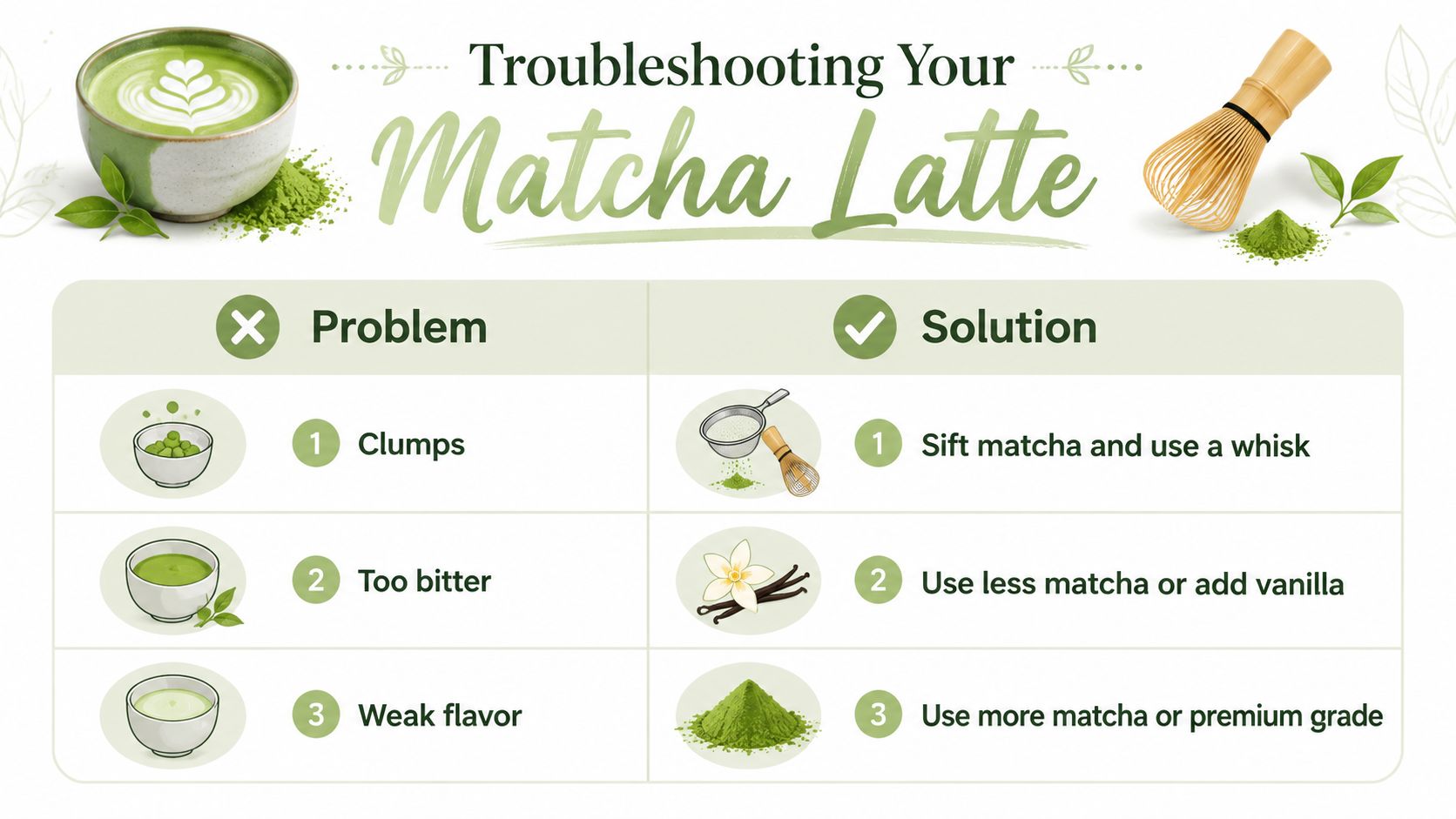
Clumps
Clumps form when dry matcha hits a larger volume of liquid without enough initial movement. Sift first, add the water in the recommended range, and whisk the concentrate before adding milk. If the drink is already made, pass it through a fine mesh sieve and whisk the recovered liquid gently.
Bitterness
Bitter flavour usually points to overheated water or a matcha grade that isn't suited to drinking. Keep the water between 70 and 80 °C, and don't compensate for harshness by adding more powder. A smaller amount of suitable matcha can taste more complete than a larger amount of an overly astringent powder.
Weak flavour and thin texture
A thin latte usually comes from under-frothed milk, a low-body plant milk or too much milk relative to the matcha concentrate. Use an oat barista blend, whole dairy milk or soy, then check whether the milk has a glossy texture before pouring.
There's another trade-off that sugar-free recipes often overlook: caffeine. Australian data puts average adult caffeine intake at about 175 mg per day, while at least 25% of adults consume more than 230 mg per day, according to the Australian caffeine reference. One Australian matcha caffeine reference lists approximately 35–70 mg per 1 teaspoon serve, so a strong latte may matter to people managing anxiety, replacing coffee or protecting sleep.
The important distinction: Sugar free doesn't automatically mean suitable for unlimited daily use. Strength, cup size and timing can make caffeine the main consideration.
Café and Hospitality Serving Tips for Sugar Free Matcha Lattes
A café that adds a sugar free matcha latte to its menu needs more than a good recipe. The drink must be easy for staff to reproduce, clear for customers to understand and consistent enough to earn a second order.
Menu wording should describe the experience without making medical promises. Phrases such as ceremonial-grade matcha, no added sugar and sweetened to your preference communicate the important choices. If the recipe includes milk with naturally occurring sugar, avoid implying that every version is chemically sugar-free. In Australia, the Food Standards Code uses 2.5 g of sugar or less per 100 mL as the threshold for describing a drink as low sugar, as explained by CHOICE's Food Standards Code guidance.
Build a repeatable service routine
Train staff to follow the same order every time:
- Sift and dose: Weigh the matcha rather than relying on an inconsistent scoop.
- Pre-dissolve: Use the small water volume first, then whisk until smooth.
- Control heat: Bring milk to approximately 65 °C and stop before it boils.
- Finish deliberately: Combine the liquids smoothly and check the foam before serving.
Clear recipes also help hospitality teams manage substitutions. Record the default dairy option, the preferred oat barista blend and the soy alternative, then note which milks need gentler heating. A customer asking for an iced version should receive the same matcha concentrate logic, not a powder shaken directly into cold milk.
Low- and no-sugar drinks now represent more than half of beverage sales, with 55.5% of sales volumes in the cited Australian market data, and zero-sugar soft drink choice was reported at 35% among consumers in the same market context. These figures support menu experimentation, but they don't replace sensory testing. Taste the drink without sweetener, with a small amount of monk fruit or stevia, and with different milk options before settling on the final menu version.
Make the presentation work
A clear takeaway cup can show the green colour and foam layers, but presentation shouldn't come at the expense of temperature or spill resistance. For iced service, a visible separation between milk and matcha can look attractive before the customer stirs it. For hot service, glossy foam and a clean pour signal care more effectively than excessive garnish.
Cafés can also place the drink beside other functional, non-alcoholic options. PepTea produces sugar-free organic kombucha brewed in the Hunter Valley, NSW, with flavours including Ginger, Lime & Ginger and Mango. Offering a fermented drink alongside matcha gives customers a choice between a creamy tea latte and a bright, refreshing alternative, without relying on high-sugar soft drinks.
For cafés selling beans, tea or recurring pantry products online, a RecurX coffee subscription solution can help organise subscription-style purchasing. The same recurring model can be relevant to cafés and retailers building regular matcha or beverage supply routines, provided the product, delivery schedule and customer expectations are clearly explained.
A successful sugar free matcha latte isn't successful because it carries a fashionable label. It succeeds when the matcha tastes smooth, the milk has proper body and the team can reproduce the result during a busy morning. Start with the measured workflow, taste before sweetening and keep caffeine awareness part of the customer conversation.
PepTea offers organic Japanese matcha for home brewers, matcha enthusiasts and Australian cafés, along with sugar-free organic kombucha brewed in the Hunter Valley, NSW. Visit Pep Tea to explore the matcha range, compare beverage options and find ingredients for a cleaner café-style routine.
Matcha Coconut Milk Guide: Ratios, Recipes, and Pro Tips
You're halfway through making a matcha latte at home, or you've just ordered one at a café, and the drink in front of you tastes richer, sweeter, and a bit more rounded than the one you made last week. Nine times out of ten, the difference isn't the whisking. It's the coconut milk.
In Australia, matcha coconut milk sits right where premium tea and plant-based milks meet, which is why it shows up so often on café menus and in home kitchens. The drink can be creamy and balanced, but the result changes a lot depending on whether you use canned full-fat coconut milk, a barista carton, or a lighter carton version. That choice affects texture, froth, flavour, and even how the matcha lands on the palate.
For a quick gut-check on matcha's broader appeal, PepTea has a useful overview of matcha tea powder as a powerhouse of antioxidants, which helps explain why so many people want to build a better latte around it. Coconut milk can absolutely work with matcha, but it works best when you match the milk format to the drink you want.
Why Matcha and Coconut Milk Work So Well Together
The first time a coconut milk matcha really clicks, it usually happens in a café. The drink arrives with that vivid green top, a soft creaminess underneath, and enough natural sweetness that you don't need to pile on syrup to make it pleasant. At home, the same thing can happen, but only if the coconut milk suits the style of drink you're making.
Matcha has a grassy, umami edge that can feel sharp if it's whisked into plain water and served without balance. Coconut milk softens that edge because its fat carries flavour and its natural sweetness rounds off bitterness. That's why it feels like such an obvious pairing in iced lattes, blended drinks, and café-style hot drinks, especially in Australia where plant-based menu options are now part of everyday ordering rather than a special request.
The commercial side matters too. A 2026 industry snapshot reported that matcha latte sales in Australian cafés reached AUD 50 million in 2023 worldmetrics.org. That doesn't just tell you matcha is trending, it explains why cafés keep testing different milk bases and why coconut milk keeps showing up on the board. It's one of the few dairy alternatives that can make matcha feel indulgent without needing cream.
The decision is simpler than most recipe posts make it sound. Don't start with “matcha coconut milk” as if it were one fixed drink. Start with the format of the coconut milk, then build the texture and flavour from there.
Practical rule: if you want a richer, rounder latte, choose the coconut milk first, then adjust matcha strength second.
Core Ratios and Equipment You Need Before You Start
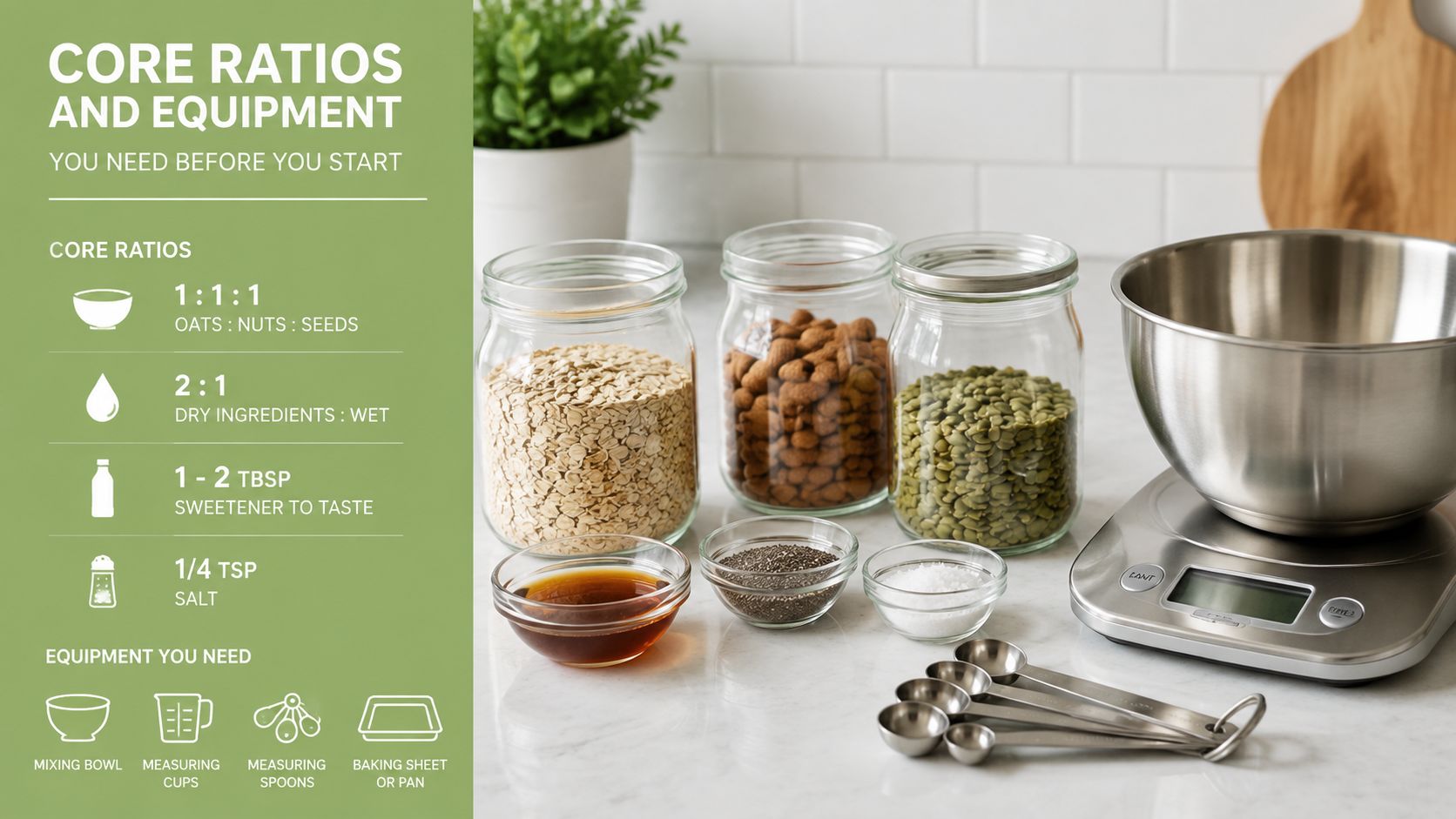
A good matcha coconut milk drink starts with a small, repeatable formula. For a home latte, a solid base is 2 g matcha to 30 ml hot water, then 180 to 220 ml coconut milk depending on how creamy you want the cup to feel. For a café-strength serve, 3 g matcha to 45 ml hot water with 220 to 250 ml coconut milk gives a stronger tea note that still holds up after ice or foam is added.
Water temperature matters just as much as the ratio. Keep it around 80°C, not boiling, so the matcha doesn't scorch or turn harsh. Whisk the powder into the hot water first, then add coconut milk after the matcha is smooth. If you dump everything together at once, you'll often get clumps or a flatter colour.
Your kit doesn't need to be fancy, but it does need to be the right kind of simple. A bamboo chasen gives you the best whisked texture, though a handheld frother works well for quick service. A fine sieve helps stop little green pockets from forming. A kitchen scale keeps the matcha dose consistent, and a small milk pitcher makes pouring cleaner, especially if you're layering a hot latte.
Key takeaway: whisk matcha and water first, keep the water near 80°C, then add coconut milk after the paste is completely smooth.
A small café counter setup makes the process easier if you're doing this daily. PepTea's matcha tea accessories page is a useful reference point for the sort of basic tools that make repeatable drinks less fiddly.
Choosing the Right Coconut Milk for the Job
Most recipes go vague and then wonder why the drink split, looked thin, or tasted oddly flat. In practice, canned full-fat coconut milk, barista-blend carton coconut milk, and light carton coconut milk behave very differently in matcha.
| Coconut Milk Formats for Matcha Drinks | Typical Fat % | Froth Behaviour | Best For | Watch Out For |
|---|---|---|---|---|
| Canned full-fat | Higher, usually the richest format | Thick, creamy, not ideal for light foam | Blended drinks, iced lattes, dessert-style serves | Can feel heavy and very saturated |
| Barista carton | Moderate, formulated for steaming | Best foam stability and pour control | Hot lattes, café service, layered drinks | Check for added sweeteners or flavours |
| Light carton | Lower | Thin foam, lighter body | Lower-calorie menus, smaller drinks | Can taste watery and struggle to hold matcha well |
Commercially listed nutrition makes the differences obvious. A typical coconut-milk matcha latte can sit around 38 kcal per 100 ml or 76 kcal per 200 ml serving, with 1.5 g fat per 100 ml and 4.3 g carbohydrate per 100 ml in one formulation Phytomorphology review. Another listed coconut-milk matcha example comes in at 120 calories, 7 g fat, 10 g carbohydrates, and 2 g protein per 240 g serving Eat This Much.
For café work, the practical benchmark is the fat band. Coconut milks in the 12 to 20% fat range tend to give the best mouthfeel and foam support, while products below 8% often drink too thin for a proper latte texture Alibaba guide. That's why canned works so well in blended drinks, barista cartons perform better in hot service, and light cartons are mainly for people deliberately chasing a thinner cup.
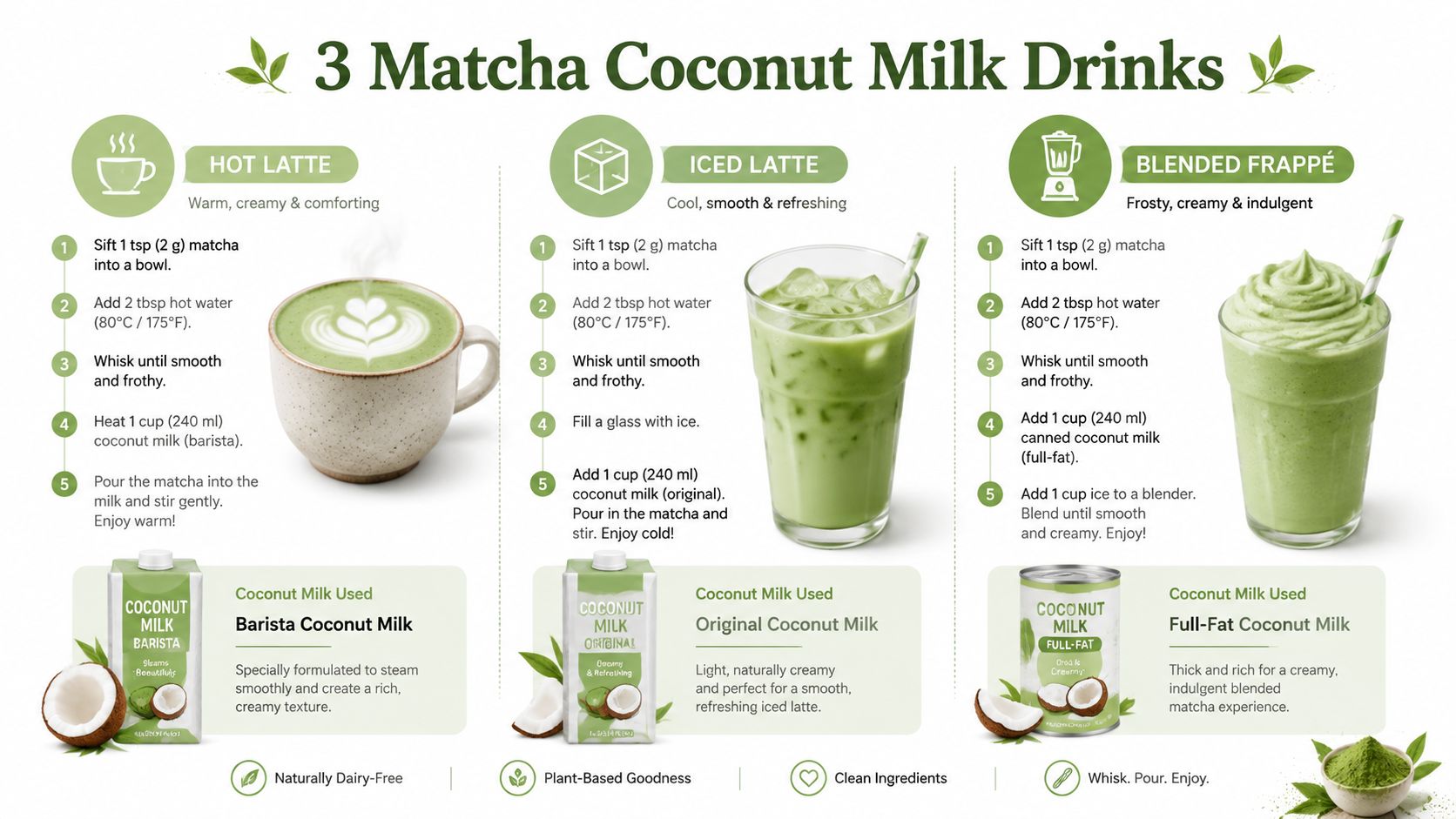
Three Ways to Build a Matcha Coconut Milk Drink
Hot Latte With Barista Coconut Milk
Use 2 g matcha, 30 ml water at about 80°C, and 180 ml barista coconut milk. Sift the matcha, whisk the water into a smooth paste, then steam the coconut milk to around 60 to 65°C so it stays stable and doesn't split. Pour the milk slowly into the matcha, then finish with a thin layer of foam.
If you're working by hand, keep the whisk tight and fast for about 15 to 20 seconds. The goal is a glossy surface, not a mountain of bubbles. A small milk pitcher helps you pour in a steady line instead of dumping the milk and flattening the top.
Iced Latte With Canned Coconut Milk
For a colder, richer drink, use 3 g matcha, 45 ml water, 120 ml plain water or milk base if you like a longer drink, and 100 to 120 ml canned full-fat coconut milk. Whisk the matcha with hot water first, then add a little room-temperature liquid if you want it looser, and pour over ice only after the matcha is fully dissolved.
The trick is to pour the coconut milk down the side of the glass so the foam sits on top rather than disappearing into the ice. This works especially well in a tall glass where the layers can show. It's also the version that handles sweetness best if you want to add a touch of maple or vanilla.
Blended Frappé With Lighter Coconut Milk
For a blended drink, use 2.5 g matcha, 40 ml hot water, 150 ml light coconut milk, and a good handful of ice. Blend for 20 to 30 seconds until the texture looks smooth and aerated, not watery. If the drink comes out too thin, the coconut milk is probably too light for the style.
This version is useful when you want the matcha flavour without the density of canned milk. It works better with a lighter carton than with a heavy one, because the blend stays colder and less claggy. The colour also stays bright if you blend only until the ice breaks down.
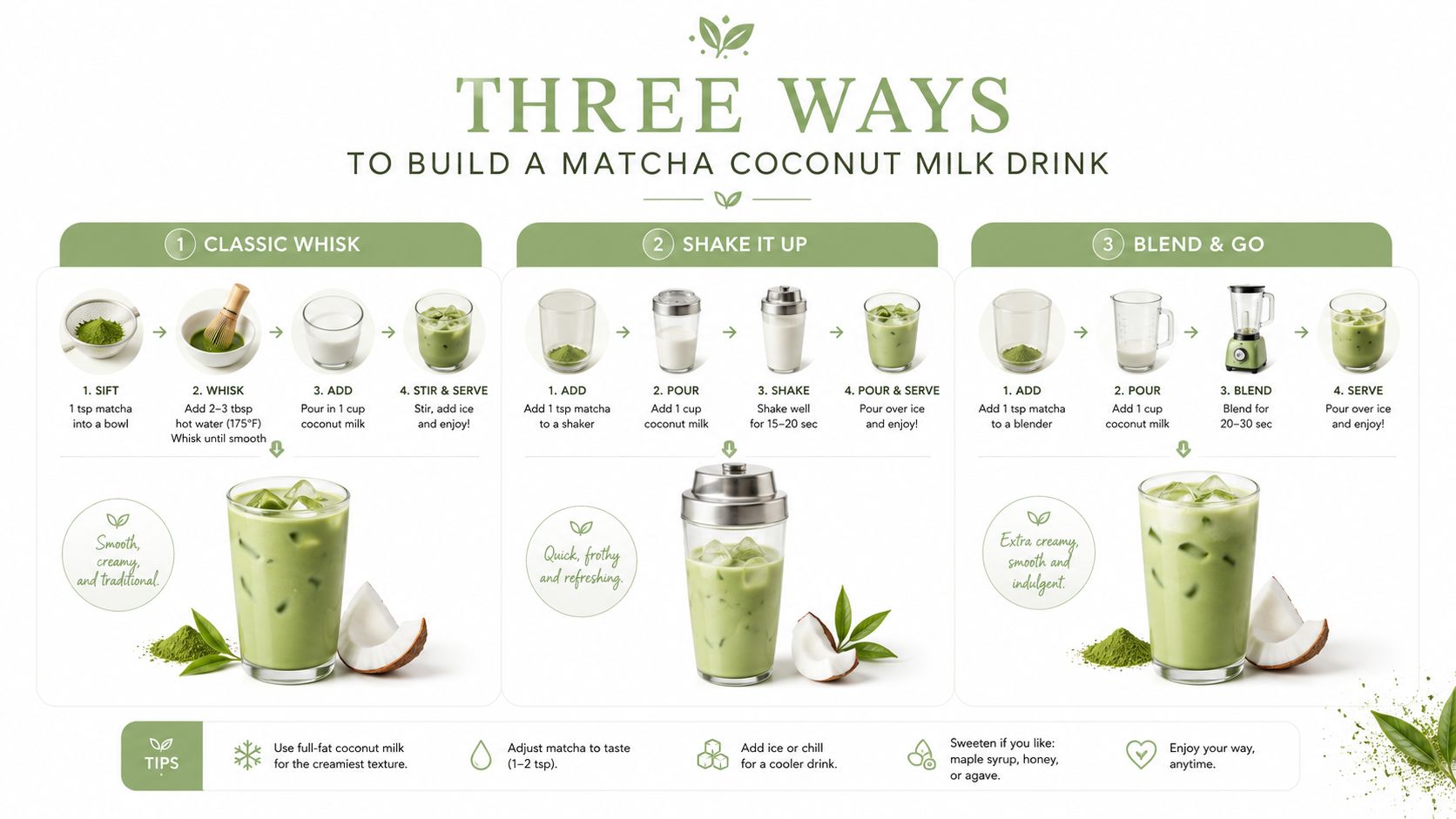
Nutrition, Antioxidants, and the Coconut Milk Trade-Off
Coconut milk makes matcha feel more luxurious, but it also changes what the drink is doing nutritionally. One listed coconut-milk matcha latte comes in at 129 calories, 11 g fat, 12.9 g carbohydrate, and 0.99 g protein in a 330 g serving, with 10 g saturated fat making up 50% of daily value worldmetrics.org. Another listing shows 265 calories, 25 g fat, 8 g carbohydrates, and 3 g protein in a 150 ml coconut-milk matcha serve Arise app. That spread tells you how much the final cup shifts with formulation and portion size.
The more important functional point is what happens to the matcha itself. A review of milk variants in matcha tea found that adding milk, regardless of source, significantly reduces matcha's antioxidant profile, including total phenolic content, total flavonoid content, DPPH radical scavenging activity, metal chelating ability, and ferric-reducing power Phytomorphology review. In plain language, the drink still tastes like matcha, but the antioxidant-dense profile of pure matcha is diluted once coconut milk goes in.
That's why I wouldn't sell this drink as a protein option or a low-calorie tea. In Australian cafés, it lands more naturally as a premium creamy functional beverage. If you want to keep the profile lighter, use a smaller serve, choose a lighter coconut milk, or make the matcha stronger so it doesn't disappear behind the fat.
Sweetened versions can add another layer. One commercial listing for Starbucks' Matcha Green Tea Latte with coconut milk shows 143 calories, 20.3 g sugars, and 60 mg caffeine per serving CalorieKing. That's useful as a calibration point, because it shows how quickly sugar can change the drink from creamy to sweetened café treat.
PepTea's guide on how many cups of matcha tea powder are safe per day is a sensible companion read if you're balancing strength, serving size, and how often you want to drink matcha coconut milk.
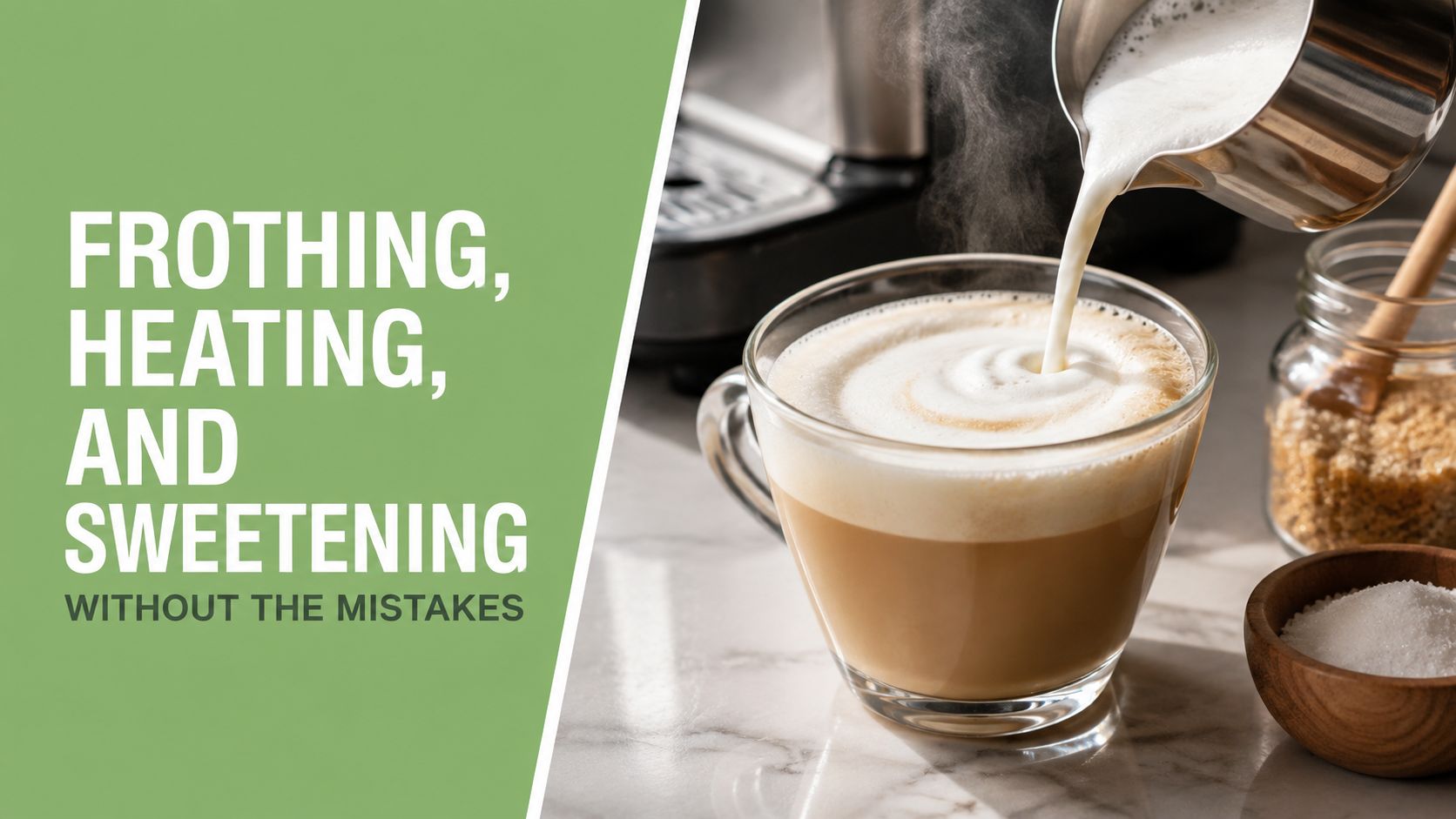
Frothing, Heating, and Sweetening Without the Mistakes
If the Milk Splits
Heat the coconut milk gently and stop at around 60 to 65°C. Go much hotter and the drink can separate, especially if you're using a thinner carton or a product with fewer stabilisers. Barista blends usually behave better because they include emulsifiers that hold the milk together under steam.
If the Foam Is Weak
The fat is probably too low. Light carton coconut milk can still taste fine, but it rarely gives you the same foam structure as a barista blend, and it'll often collapse before you finish the cup. If you want a proper cappuccino-style top, switch to a higher-fat format or use a stronger steam stretch and pour immediately.
If the Matcha Tastes Bitter or Chalky
The matcha wasn't fully whisked before it hit cold liquid. Always dissolve it into hot water first, then add the coconut milk after the paste is smooth. If you need sweetness, a little maple syrup or vanilla works more naturally with matcha than heavy sweeteners, and a small amount is usually enough.
For something different, a cold sugar-free kombucha topper can work well with an iced matcha coconut build when you want acidity instead of extra sweetness. PepTea's own Hunter Valley-brewed kombucha is one example of the kind of drink that can sit beside matcha rather than compete with it. That combo keeps the finish brighter, especially in summer service.
Serving It at Home, in a Café, or on a Wholesale Menu
A good café menu uses the coconut milk format on purpose. A hot ceremonial matcha coconut latte works well with barista coconut milk, a low-sugar iced matcha coconut can be finished with a kombucha top, and a blended frappé-style version suits canned or richer coconut milk when you want a dessert-like texture. For wholesale planning, it helps to think in terms of milk cost, matcha dose, and serve size rather than just “one latte recipe”, and a practical wholesale pricing structure guide can be useful when you're mapping margins for menu testing.
For home use, the path is simpler. Try one milk format, keep the matcha dose steady, and note how the mouthfeel changes. If the drink gets too heavy, switch to a lighter carton. If it turns thin, move up to a barista or canned format.
PepTea's organic matcha grades and sugar-free kombucha fit naturally into those use cases as reference products for café and home drinks, especially if you want a clean, low-sugar menu base. Use them as the benchmark, not the shortcut.
If you want a drink that fits your palate, start with one of these three steps today: swap one coconut milk format, and log the result on taste, foam, and body. Then build the version that suits your kitchen, your café, or your regular order.
Pep Tea offers organic matcha and sugar-free kombucha that slot neatly into café drinks and home recipes like the ones above. If you want to compare matcha formats, test coconut milk pairings, or build a cleaner drink list for your menu, visit Pep Tea and explore the range.
Uji Matcha Latte: Your Authentic Recipe (Hot & Iced)

You're probably here because you've had one of those matcha lattes that looked stunning but tasted flat, gritty, or oddly sweet. Then you try making one at home, and it turns into a clumpy green milk drink that feels nothing like what a good café serves.
A proper uji matcha latte is different. It should taste smooth, creamy, fresh, and softly vegetal, with a clean finish rather than a harsh one. When the matcha is good and the method is right, you don't need to hide it under heaps of sugar or syrup.
At PepTea, we love teaching this drink because it sits right at the intersection of craft and everyday comfort. You can make it in a home kitchen before work, or build it into a polished café menu. The secret isn't complexity. It's understanding the ingredient, then treating it with care.
What Makes an Uji Matcha Latte Special
The first thing to know is that Uji isn't just a flavour label. It refers to a famous tea-producing area in Japan, and that place name carries real weight in tea.
In Australian cafés, “uji matcha latte” often signals something more refined than a standard matcha drink. It suggests provenance, not just colour. That matters because matcha buyers are often trying to work out whether they're paying for true quality or just attractive branding.
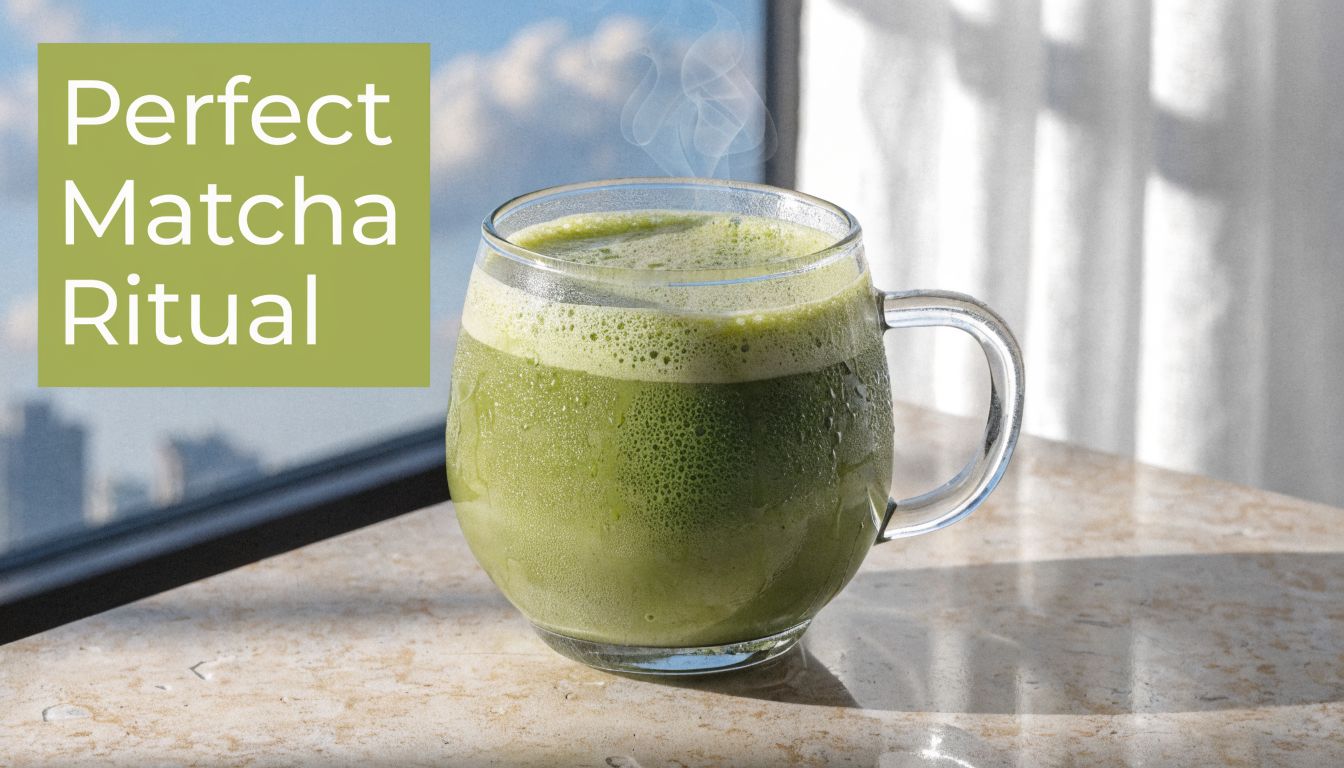
Why Uji carries so much prestige
Uji's reputation as Japan's premier tea region dates back to the Kamakura period (1185–1333), and by the 16th century Uji tea masters had developed the shaded cultivation method that became the origin of modern ceremonial matcha, according to Nippon's history of Uji tea.
That history still shapes what drinkers expect today. When you order an uji matcha latte, you're not just ordering something green and milky. You're buying into a long tradition of tea cultivation and preparation that helped define what premium matcha is meant to be.
Uji matters because it gives the drink a story, a standard, and a point of reference. That's why the name feels different on a café menu.
What that means for Australian drinkers
For home brewers, Uji gives you a useful benchmark. If a powder is sold as Uji-origin, you can start asking sharper questions about colour, texture, taste, and how the drink is built.
For café owners, it helps frame the latte as a premium tea beverage rather than a generic sweetened mix. That's especially useful when customers are looking for cleaner energy options and are comparing matcha with coffee. If you're exploring that broader shift, this guide to Peak Performance coffee alternatives is a helpful companion read.
If you want to start with an origin-specific powder, one practical place to begin is Uji matcha powder from PepTea.
Selecting the Right Uji Matcha Grade
A great latte starts before the kettle goes on. It starts when you choose the powder.
Many people get stuck on one phrase: ceremonial grade. It sounds reassuring, but it doesn't tell you everything you need to know. For Australian consumers, the more useful test is whether the matcha has the right colour, texture, purity, and value per serve.
What to judge instead of the label
A practical rule from the Australian buying angle is this: a premium Uji matcha for lattes should be judged on its vibrant colour, fine texture, and grams-per-serve value, not just a ceremonial label. It's also important to check whether the product is 100% pure matcha, because many options on the market are sweetened pre-mixes, as noted by Chicago Tea House's Uji matcha product guidance.
That point clears up a common confusion. A sweetened mix can still look nice in a tin or on a shelf, but it behaves differently in the cup. It can taste flatter, dissolve differently, and make it harder to control sweetness.
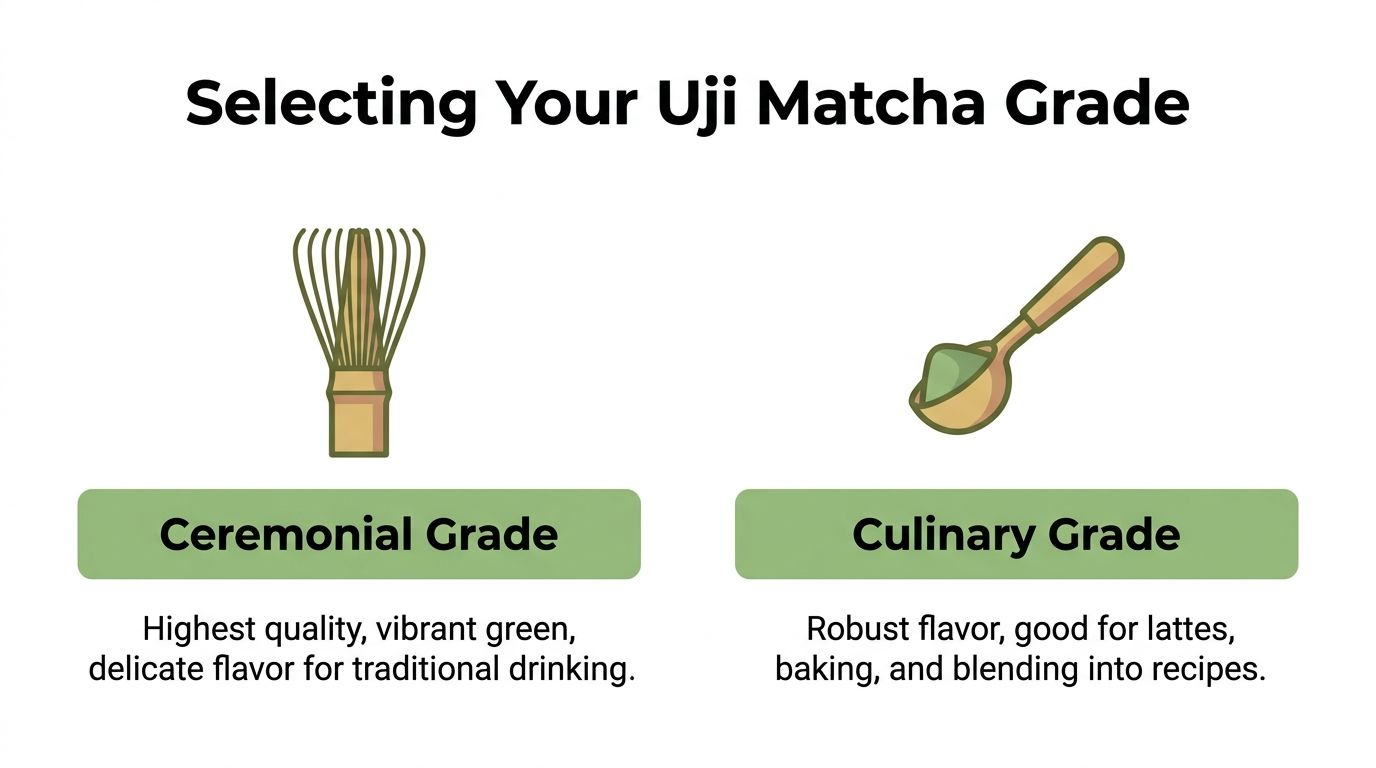
Ceremonial or culinary for a latte
Both grades can have a place. What matters is your goal.
| Grade | Best fit | What to expect |
|---|---|---|
| Ceremonial grade | Straight drinking, premium lattes, minimal sweetener | Softer flavour, brighter colour, finer finish |
| Culinary grade | Baking, smoothies, blended recipes, stronger latte style | More robust taste, usually better when mixed with other ingredients |
For a café-style uji matcha latte where the tea still needs to shine through milk, a better-quality ceremonial or latte-friendly premium blend is usually easier to work with. You'll spend less time trying to correct bitterness with sweetener.
A simple buying checklist
When you're standing in an aisle or comparing tins online, check these first:
- Colour first: Look for a lively green rather than a dull, brownish, or yellow-leaning tone.
- Texture matters: Fine powder should look silky, not coarse.
- Ingredient list: If it isn't pure matcha, it's a different product.
- Serving logic: Think in grams per serve, not just pack size.
- Origin claim: “Uji” should mean more than a decorative word on the front label.
Buying shortcut: If a product leans heavily on marketing terms but doesn't help you judge purity, colour, or serve size, keep looking.
If you'd like a clearer breakdown of how different styles are used, PepTea's guide to different grades of matcha is useful for comparing what suits lattes versus traditional bowls.
Mastering the Hot Uji Matcha Latte
Technique is where most home-made matcha lattes go wrong. Not because people are careless, but because matcha responds badly to shortcuts. If you stir powder straight into a full mug of hot milk, you usually get lumps, uneven flavour, and a muddy finish.
The better approach is to build the drink in stages.
Start with the paste, not the milk
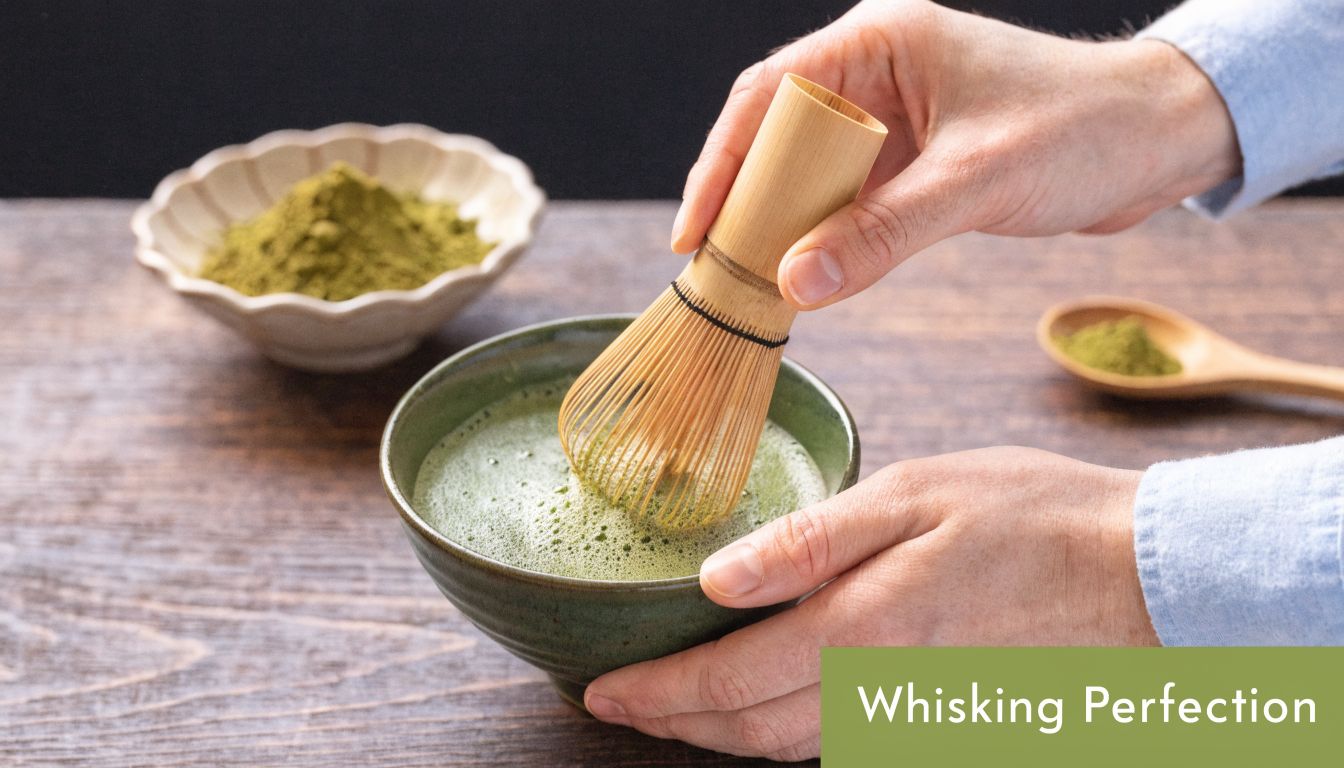
For a smooth uji matcha latte, whisk 2 teaspoons of sifted matcha with a small amount of room-temperature water to make a paste. Then add water at 75–85°C and whisk in an M or W pattern for 15–30 seconds. This is the technique recommended in Uji Matcha Tea's preparation guide.
That method does two important jobs. First, it hydrates the powder evenly so you don't get dry clumps. Second, it builds the fine foam that makes the drink feel creamy before the milk even goes in.
Why temperature changes the whole drink
A lot of people assume hotter water equals better dissolving. With matcha, that's not the goal. Boiling water can flatten the flavour and push the drink toward bitterness.
The sweet spot is warm enough to disperse the powder, but gentle enough to protect the character of the tea. If your latte has ever tasted sharp, scorched, or dull, temperature is often the first thing to check.
Practical rule: If you wouldn't sip the water comfortably, it's probably too hot for premium matcha.
Whisking for texture, not ceremony alone
A bamboo chasen isn't just a traditional accessory. It helps create the tiny bubbles that give matcha a soft, even texture.
Move the whisk briskly in a loose M or W motion rather than stirring in circles. Circular stirring tends to push the powder around the bowl. The faster patterned motion suspends it and creates that fine surface froth you see in a well-made café cup.
If you want to see the motion in action, this quick demonstration helps:
Bringing in the milk properly
Once the matcha base is smooth, heat your milk separately and keep it below a boil. You're aiming for warm, silky milk, not scorched milk.
Here's the part many people skip. Don't pour cold milk into the bowl and hope the whisk fixes everything. Build the tea base first, then pour the warm milk in a steady stream. If you're frothing milk, keep the foam soft and fine so it supports the matcha rather than burying it.
A reliable workflow looks like this:
- Sift the matcha into a bowl or wide cup.
- Add a small splash of room-temperature water and mix into a smooth paste.
- Pour in hot water within the recommended range and whisk briskly until lightly foamy.
- Warm the milk separately until hot but not boiling.
- Combine gently and taste before adding anything extra.
For readers who want to improve their whisking technique specifically, this PepTea how-to on whisking matcha is a practical reference.
Your Guide to a Refreshing Iced Matcha Latte
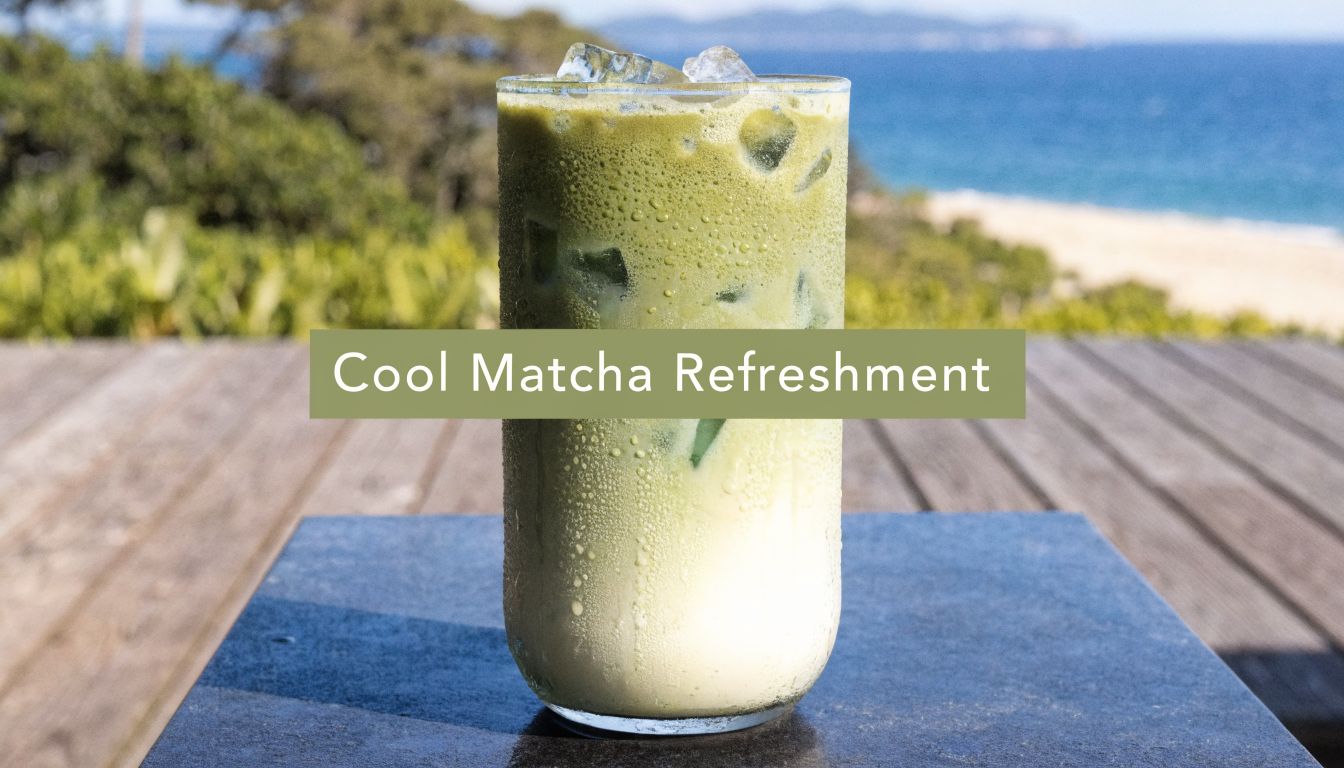
An iced uji matcha latte isn't just the hot version poured over ice. Cold drinks magnify flaws. If the powder isn't properly dispersed, you'll notice grit straight away.
That's why the best iced version starts with a concentrated matcha base.
Build the matcha shot first
Sift your matcha, add a small amount of water, and work it into a smooth paste before adding more liquid. This matters even more for iced drinks because cold milk won't help dissolve stubborn clumps.
If you like a layered café look, make the matcha base separately and pour it over milk and ice at the end. The result looks polished, but it also gives you more control over flavour.
Sweeten at the right moment
For a smooth hot or iced uji matcha latte, add any sweetener after whisking the matcha into a paste but before adding the bulk of the liquid, which helps it dissolve fully and prevents crystallisation in iced drinks, as explained in Ocha & Co's matcha latte method.
That one detail saves a lot of frustration. If you add sweetener too late, especially in a cold drink, it can sit at the bottom or throw off the texture.
An easy assembly method
Try this order for a cleaner result:
- First the glass: Fill it with ice.
- Then the milk: Add your dairy or plant milk.
- Next the matcha base: Pour slowly over the top for a layered look.
- Final adjustment: Stir just before drinking so the flavour is even.
A good iced matcha latte should taste crisp and creamy at the same time, not watery, chalky, or syrupy.
Pro Tips and Healthy Variations
Once your basic method is sound, small adjustments make a big difference. These refinements ensure an everyday uji matcha latte becomes your version of the drink.
Fixing the most common problems
If your latte tastes bitter, the issue is often heat or powder quality rather than matcha itself.
If it's lumpy, the fix is usually mechanical. Sift first, make a paste, then whisk properly. Most texture problems begin before the milk goes in.
A quick troubleshooting list helps:
- Bitter cup: Check whether your water was too hot or your powder too rough.
- Flat flavour: Use less sweetener so the tea can still come through.
- Gritty finish: Sift the powder and spend longer on the paste stage.
- Weak colour: Review the quality of the matcha itself before changing the recipe.
Choosing milk for flavour and texture
Different milks push the latte in different directions.
Oat milk often gives a rounder, creamier feel. Almond milk can make the drink lighter and a little nuttier. Soy can hold its structure well in a café setting. Dairy gives a familiar richness, but it can also soften some of the tea's sharper edges.
The best milk is the one that lets the matcha remain recognisable. If the milk completely dominates, the tea disappears.
Keeping it sugar-free or lower sugar
Health-conscious Australian drinkers often get more selective. If you've bought a good Uji powder, you may not need much sweetener at all.
Try these approaches:
- Go unsweetened first: Taste the latte before adding anything.
- Use a small amount only if needed: A light touch keeps the tea present.
- Avoid pre-mixes: They remove your control over sweetness and flavour balance.
For café service, consistency matters as much as flavour. Standardise your scoop, whisking time, and milk pour. If you're batching for busy periods, keep the matcha base fresh and don't let it sit too long before service.
Some venues also use commercial blending tools for fast cold drinks and menu variations. If that's relevant to your setup, Vitamix blenders for hospitality are worth reviewing alongside your tea tools.
One practical option for Australian buyers looking for an origin-led powder is Pep Tea's Uji matcha range, particularly when you want a format suitable for controlled latte prep rather than a sugary shortcut.
Your Uji Matcha Latte Questions Answered
How should I store matcha powder?
Keep it sealed, dry, and away from heat, light, and moisture. Matcha is delicate. Once opened, good storage helps preserve colour and aroma.
Can I make an uji matcha latte without a bamboo whisk?
Yes, though a chasen gives the nicest texture. If you don't have one, use a small handheld frother or shake the matcha paste and water in a tightly sealed jar before adding milk. The key is still the same. Break up the powder fully before the main liquid goes in.
Is café matcha always better than homemade?
Not always. A café can still use a sweetened pre-mix or poor technique. At home, you often get a better result when you start with pure matcha and pay attention to temperature and whisking.
What should a good uji matcha latte taste like?
Smooth, fresh, creamy, and balanced. You should notice the tea, not just milk or sweetness.
If you'd like to put this into practice, explore Pep Tea for organic matcha options, brewing guides, and everyday ideas for making café-style matcha at home or on your menu.
Mastering Making Matcha Tea At Home

You’re probably here because you’ve had one of two matcha moments.
The first is the café one. You order a beautiful bright green bowl or latte, take a sip, and wonder why it tastes smooth, creamy and clean there, yet muddy or bitter when you try making matcha tea at home.
The second is the wellness one. You want something that feels steadier than coffee, more intentional than a quick tea bag, and a little more special than another rushed morning drink.
Good news. Matcha isn’t hard. It is precise.
Small details make the difference between a sweet, rounded cup and one that tastes flat or sharp. That’s why matcha feels like both an art and a science. The ritual matters, but technique matters just as much.
Beyond the Green Powder The Art of Making Matcha
A lot of people first meet matcha through a latte. That makes sense in Australia, where café culture shapes what ends up in our kitchens. But once you start making matcha tea properly, it stops feeling like a trend and starts feeling like a practice.
The appeal isn’t just flavour. It’s the kind of energy matcha offers. Many tea drinkers reach for it because it supports a calmer, more focused feeling, which is why matcha has become part of so many wellness routines.
That local interest isn’t imagined. In Australia, matcha imports from Japan increased by over 150% between 2018 and 2023, and café adoption of matcha lattes rose 78% in Sydney and Melbourne venues by 2022, according to this overview of the global matcha tea industry.
Those numbers line up with what’s happening on the ground. More cafés are serving matcha. More people want to make it at home. More shoppers are learning that not all green powder is the same.
Practical rule: Great matcha is less about fancy gear and more about doing a few simple things properly.
That starts with understanding what matcha is meant to be. It isn’t brewed like ordinary leaf tea. You’re whisking powdered tea directly into water, so every choice matters. The powder quality, the water temperature, the bowl shape, the whisking motion, even whether you sift first.
When people struggle with matcha, it usually isn’t because they’re bad at it. It’s because nobody showed them the small mechanics that change the result.
If you want the full background on sourcing and production, how matcha tea is made is worth reading before you buy your next tin. Knowing how it gets from leaf to stone-ground powder helps you understand why fresh, well-handled matcha behaves so differently in the bowl.
Making matcha tea well is a skill. The nice part is that it’s a very learnable one.
Gathering Your Tools and Choosing Your Matcha
Before the water goes on, set yourself up properly. Matcha rewards preparation. A little order at the start makes the whole process smoother.
The classic tools and what each one does
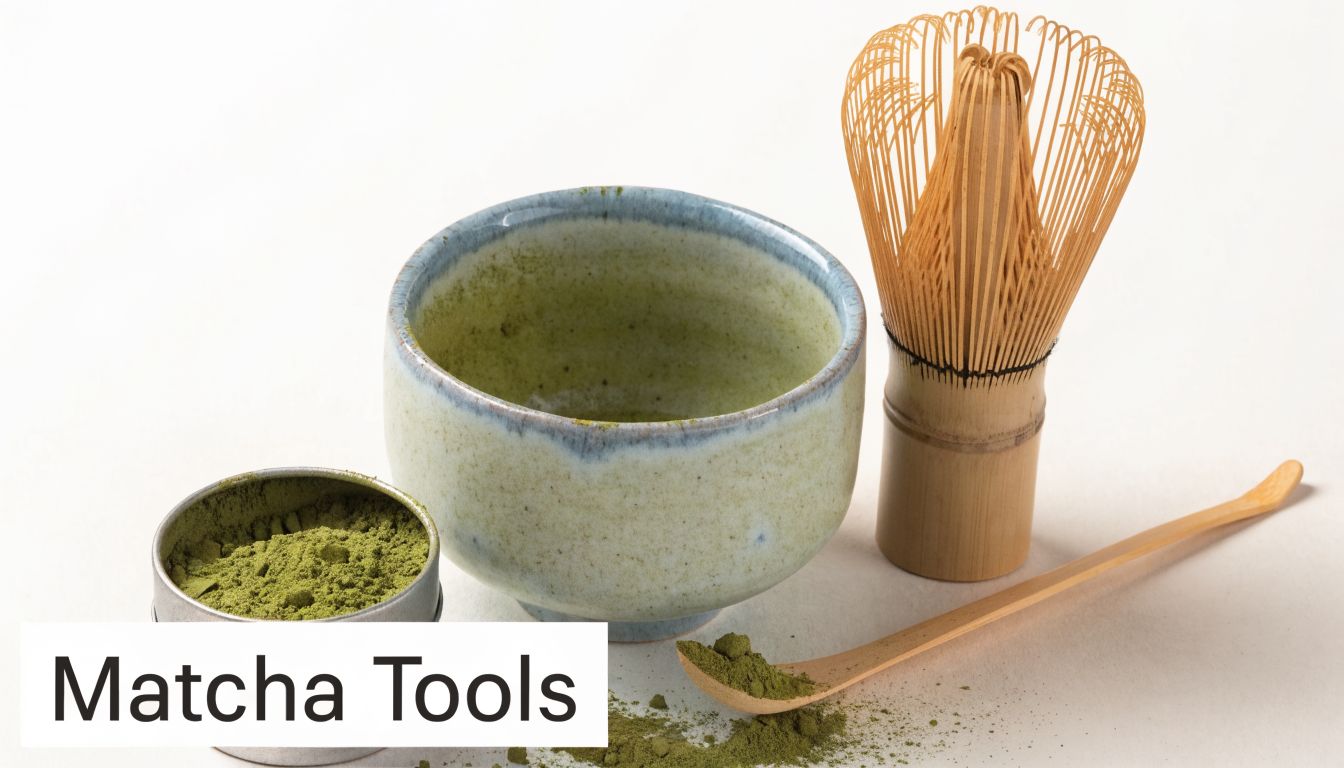
The traditional setup is simple.
- Chawan: This is the bowl. Its wide shape gives you room to whisk properly and helps the foam form instead of splashing up the sides.
- Chasen: The bamboo whisk. This is the tool that transforms matcha and water into a smooth suspension rather than a gritty drink.
- Chashaku: The bamboo scoop. It helps with consistent portioning and makes the ritual feel more deliberate.
- Fine sieve: Not always included in a starter set, but essential if you want a smooth cup.
- Kettle and thermometer: Useful because water temperature is one of the most important variables.
A good bowl and whisk do most of the heavy lifting. If you only invest in two things, make them those.
What to use if you don’t have traditional gear
You do not need a formal tea setup to start making matcha tea at home.
A small cereal bowl can stand in for a chawan. A kitchen sieve works well for sifting. If you don’t own a chasen yet, a handheld milk frother is the most practical substitute for lattes and casual home use.
That said, alternatives do change the experience.
A bamboo whisk gives you more control in a traditional bowl of matcha. It creates a finer foam and lets you feel the texture changing as you whisk. A milk frother is convenient, but it can over-aerate or create larger bubbles, especially in a narrow mug.
If you want ritual and texture, use a chasen. If you want speed on a weekday morning, use what gets you drinking good matcha consistently.
Ceremonial and culinary grade are not interchangeable
At this stage, many people waste good powder, or judge matcha unfairly.
Ceremonial-grade matcha is best for drinking with water. It should taste softer, cleaner and more nuanced on its own. When you’re preparing usucha or koicha, this is the right place to spend more.
Culinary-grade matcha is better for recipes where it has support. Think lattes, smoothies, baking, overnight oats or energy balls. It’s designed to hold its character when mixed with milk, fruit, sweeteners or fats.
Here’s the easiest way to decide.
| Use | Best matcha choice | Why |
|---|---|---|
| Traditional bowl with water | Ceremonial grade | The flavour has nothing to hide behind |
| Hot latte | Culinary or robust ceremonial | Milk softens edges and changes the balance |
| Iced latte | Culinary grade | Cold drinks often need a stronger flavour presence |
| Smoothies and baking | Culinary grade | Better value and more assertive character |
If you’re still comparing options, this guide to different grades of matcha helps clarify what each grade is for and what to look for before buying.
What quality looks like before you even taste it
You can spot a lot from the tin.
Look for:
- Colour: A lively green is a good sign. Dull, khaki or yellow-green powder often signals age, oxidation or lower drinking quality.
- Texture: Good matcha should feel very fine, almost silky.
- Aroma: Fresh matcha smells green, soft and slightly sweet. If it smells stale or dusty, it probably tastes that way too.
- Behaviour in water: Better matcha incorporates more willingly and tastes more balanced.
A simple home setup that works
If you’re building a practical home station, keep it modest:
- One bowl you enjoy using
- One bamboo whisk
- One sieve
- One matcha for drinking
- One matcha for lattes and recipes
That setup covers nearly all common preparations. You don’t need a collection. You need tools that suit the way you drink matcha.
Mastering the Ceremonial Brew for a Mindful Moment
The most satisfying bowl of matcha is often the simplest one. No milk. No sweetener. Just powder, water, air, and a few minutes of attention.
Traditional usucha, or thin matcha, is the ideal style for beginners. It teaches you what matcha tastes like and makes every later drink better, including lattes.
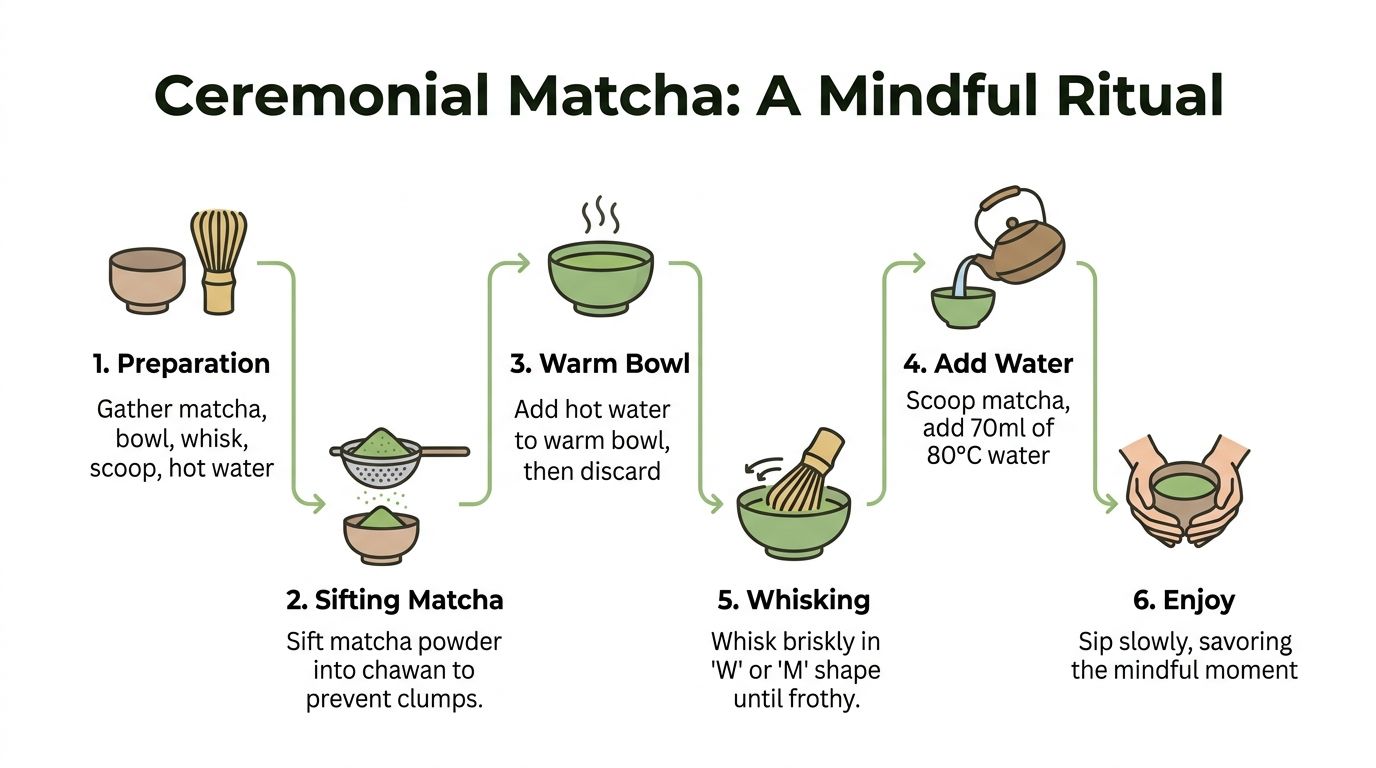
Start with warmth and order
Warm the bowl first. Add a little hot water, swirl it around, and let the whisk soften briefly in the bowl. Then tip the water out and dry the bowl.
That little preparation step matters. A warm bowl helps the powder disperse more evenly and makes the ritual feel settled from the first movement.
Sift your matcha into the bowl. For usucha, use 1 to 2 teaspoons, or 2 to 4 grams, and pass it through a fine mesh sieve. The reason is simple. Matcha clumps easily, and once wet, those clumps are harder to break apart cleanly.
According to this usucha preparation guide, the usual method starts by sifting 1 to 2 teaspoons (2 to 4g) of ceremonial-grade matcha into a preheated bowl before adding water.
The water matters more than people think
Most bad homemade matcha comes down to one problem. The water is too hot.
For usucha, use water at 70 to 80°C. That same guide notes that 70 to 80°C is the critical range, and that overheating can degrade beneficial compounds and create bitterness.
If you’ve just boiled the kettle, let it sit briefly before pouring. If you own a temperature-control kettle, use it. If you don’t, make a habit of slowing down rather than pouring straight off the boil.
Here’s a practical ratio that works well for a bowl of usucha:
- 2 to 4g matcha
- 60ml warm water to begin
- More hot water if you want a longer, lighter bowl
You’re not trying to drown the powder. You’re trying to suspend it smoothly.
Water that’s too hot makes matcha taste harsher than it is. People often blame the powder when the kettle is the real problem.
Whisk for foam, not force
Once the water is in, start by gently combining the powder and water so there are no dry pockets. Then whisk briskly with the chasen in a zigzag M or W motion.
Don’t stir in circles. Circular stirring blends, but it doesn’t create the same fine foam.
The same usucha source notes that whisking vigorously for 30 to 45 seconds is key to building a creamy froth layer over 2mm thick. That foam isn’t just for looks. It changes how the liquid feels on the palate and gives the bowl a softer first sip.
A few technique notes help:
- Use your wrist, not your whole arm
- Keep the whisk tips near the surface once the mixture is combined
- Finish with a gentle sweep to tidy larger bubbles
- Drink promptly while the texture is lively
The finished bowl should look vibrant, lightly glossy and topped with fine foam rather than big soap-like bubbles.
Taste it before changing it
Sip before you decide it needs sweetener.
Well-made ceremonial matcha should have a balance of green freshness, slight savoury depth, gentle bitterness and a round finish. If it’s aggressively bitter, something usually went wrong in preparation.
Common causes include:
| Result in the bowl | Likely cause | What to change |
|---|---|---|
| Sharp bitterness | Water too hot | Lower the temperature |
| Gritty texture | Powder not sifted well | Sift before whisking |
| Flat or weak flavour | Too much water | Use less water first |
| No foam | Poor whisking motion | Use a fast zigzag movement |
Turn it into a quiet ritual
One reason people stick with matcha is that the process slows them down in a useful way. There’s enough technique to hold your attention, but not so much that it becomes fussy.
If you enjoy pairing your tea with a few minutes of breathing or stillness, these simple meditation techniques are an easy companion resource. Matcha and a short mindful pause work well together because both ask you to pay attention to small things.
The best ceremonial bowl isn’t the one that looks perfect. It’s the one that makes you slow down enough to notice it.
For enthusiasts who want to try koicha
Koicha is thick matcha. It’s richer, denser and far less forgiving than usucha.
The method changes noticeably. The verified preparation guidance for koicha calls for 4g (2 tsp) of sifted matcha with 30ml of 75°C water, then slow kneading rather than vigorous whisking, as outlined in this koicha technique guide.
A few distinctions matter:
- Texture: Koicha should be glossy and thick, more like a smooth paste than a frothy tea.
- Movement: You knead and press with the whisk rather than beating air into the bowl.
- Powder quality: Koicha demands excellent matcha. Lower grades become unpleasant quickly.
- Serving style: It’s sipped slowly in small amounts.
If usucha is your daily practice, koicha is your deep dive. Start there only after you can make a balanced bowl of thin tea without guessing.
Creating the Perfect Matcha Latte and Iced Drinks
A good matcha latte should still taste like matcha. Too many homemade versions end up as sweet milk with a green tint.
The fix is straightforward. Build a proper matcha base first, then add milk.
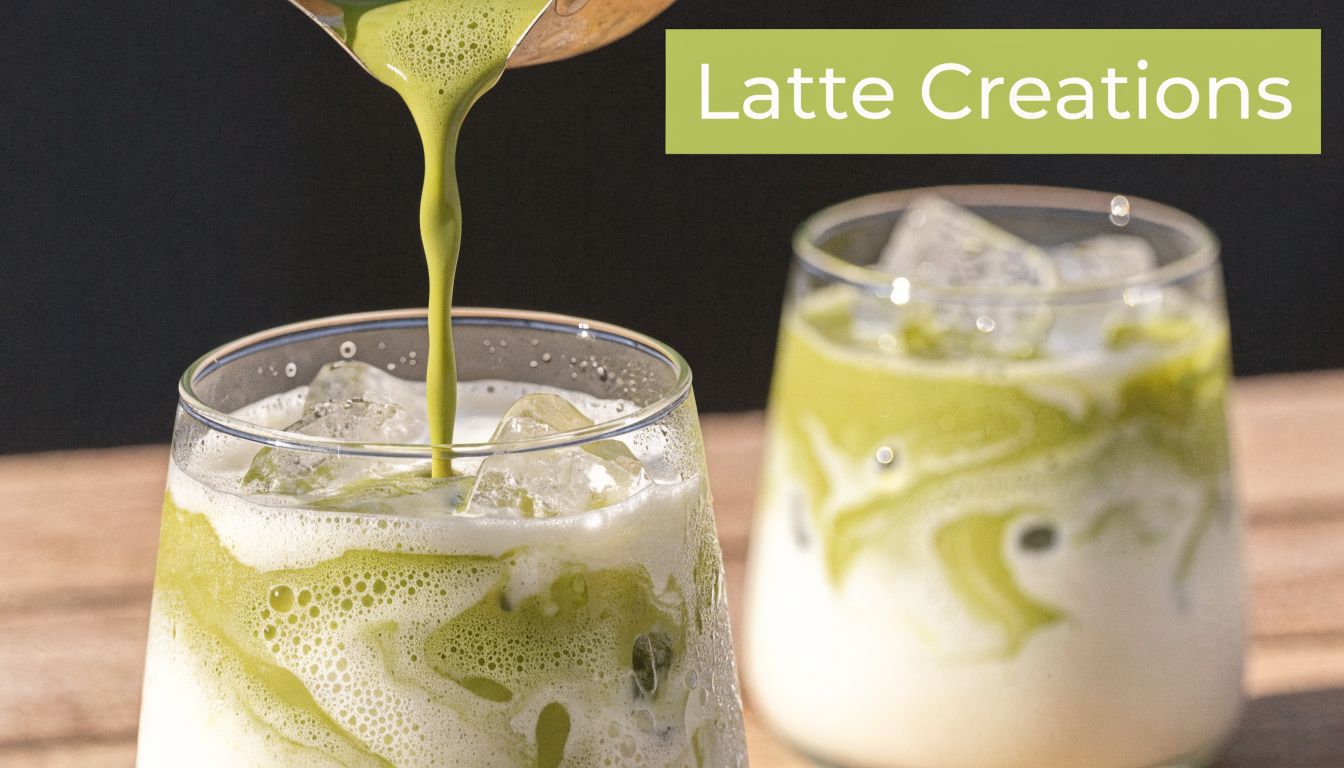
The hot latte method that stays smooth
Start with sifted matcha in a bowl or cup. Add a small amount of hot water, just enough to make a smooth paste. Whisk or froth until there are no lumps.
Then add warm or steamed milk.
That order matters. If you dump powder straight into a full cup of milk, it tends to float, clump or leave sediment at the bottom. A concentrate-first method gives you colour, flavour and a much cleaner texture.
A practical home formula looks like this:
- Use culinary-grade matcha for everyday lattes
- Make a smooth paste with a little hot water
- Add your preferred milk
- Sweeten lightly only if needed
Which milk works best
Different milks change the drink more than people expect.
Oat milk gives body and softness. It’s often the easiest route to a café-style texture.
Soy milk has enough protein to foam well and gives a more structured finish.
Almond milk can taste lighter and nuttier, though some versions split more easily.
Dairy milk creates richness, but it can mute delicate matcha if you use too much.
For café service, consistency matters as much as flavour. Whatever milk you use, keep it stable across drinks so the matcha behaves predictably from one cup to the next.
Iced matcha needs a stronger base
Cold dulls flavour. That’s why an iced matcha latte usually needs a slightly bolder concentrate than a hot one.
Make the matcha base first, let it smooth out completely, then pour it over ice and cold milk. If you build it directly in the glass without dissolving the powder, you’ll often get clumps stuck to the ice or streaks of unmixed powder.
If you want a fuller method with serving ideas, how to make iced matcha latte is a useful reference.
For anyone experimenting beyond the classic version, this Strawberry Matcha Latte is a good example of how fruit can work when the layers are kept clean and the matcha base is made properly first.
Here’s a quick visual if you like seeing the pour and texture in action.
What works in cafés and what doesn’t
For home drinkers, making one latte at a time is fine. For cafés, speed changes the approach.
What works:
- Batching a matcha concentrate for short service windows
- Sifting powder in advance for rush periods
- Training staff to dissolve matcha before milk is added
- Using the same cup size and milk ratio every time
What doesn’t:
- Scooping matcha straight into cold milk
- Relying on vigorous shaking to fix poor mixing
- Using boiling water for the base
- Over-sweetening low-quality powder to hide bitterness
In latte prep, smoothness starts before milk enters the cup. If the concentrate is rough, the finished drink will be rough too.
Keep the flavour in balance
The best latte still lets you taste the tea.
If you need lots of syrup to enjoy it, the issue may be the matcha choice, the water temperature, or the ratio. Start by correcting those before adding more sweetness.
That’s the trick to making matcha tea in modern café form. Respect the original ingredient even when the drink is casual.
Troubleshooting and Storing Your Matcha for Lasting Freshness
Most matcha problems look mysterious but aren’t. The bowl tells you what went wrong if you know what to watch for.
Why your matcha tastes bitter
People often assume bitterness means they bought the wrong powder. Sometimes that’s true. More often, the water was too hot or the ratio was off.
If your matcha tastes harsh, check three things first:
- Water temperature: Boiling water is a common culprit.
- Powder amount: Too much matcha in too little water can create an unpleasantly dense bowl.
- Drink style: A powder suited to lattes may taste rough when prepared with just water.
A bitter bowl is often a preparation problem before it’s a product problem.
Why it’s clumpy or gritty
Clumps come from moisture, static, storage conditions, or skipping the sieve.
The quickest fix is also the simplest. Sift every time. It takes seconds and improves texture immediately.
If your matcha still feels gritty after whisking, the powder may already have absorbed some moisture in storage. That’s common in humid kitchens.
Why it won’t froth
No foam usually comes down to one of four issues:
| Problem | Likely reason | Better move |
|---|---|---|
| Flat surface | Stirring instead of whisking | Use a quick zigzag motion |
| Large bubbles only | Whisking too high or too slowly | Keep whisk tips near the surface |
| Thin weak foam | Too much water too early | Start with less |
| Poor texture overall | Old or poorly stored matcha | Open a fresher tin |
Storage matters more in Australia
A common assumption is that preparation gets all the attention and storage barely matters. In practice, storage can ruin excellent matcha before you even whisk it.
Verified guidance notes that matcha oxidises when exposed to light and air, and that for warm, humid climates like many parts of Australia, it should be kept in an airtight, opaque container in the refrigerator to preserve flavour and antioxidant quality, as explained in this storage advice on common matcha mistakes.
A good Australian storage routine
This works well for most homes and hospitality settings:
- Keep it sealed tight: Air is one of the fastest ways to dull aroma and colour.
- Use an opaque container: Light exposure gradually strips away freshness.
- Store in the fridge: Especially helpful in warm or humid conditions.
- Avoid steam zones: Don’t keep matcha above the kettle or near the dishwasher.
- Open only when needed: Repeated warm-air exposure shortens the life of the powder.
Fresh matcha smells alive when you open the container. If the aroma has almost disappeared, the cup usually has too.
If you refrigerate matcha, let the container come closer to room temperature before opening. That reduces the chance of condensation settling into the powder.
Expanding Your Matcha Horizons Beyond the Tea Bowl
Once you can make a clean bowl and a reliable latte, matcha becomes much more than a drink. It turns into a flexible pantry ingredient.
That’s where culinary-grade matcha earns its keep. You can use it often, generously, and without feeling like you’re wasting a tea meant for quiet sipping.
Easy ways to use matcha daily
Some of the best uses are the least complicated.
- Morning smoothie: Blend matcha with banana, yoghurt or plant milk, and a handful of ice.
- Overnight oats: Stir a little into your oat mixture for a greener, more savoury breakfast profile.
- Yoghurt bowl: Mix a small amount with honey or yoghurt, then top with fruit and seeds.
- Baking: Add it to cookies, muffins, bliss balls or pancake batter.
- No-bake snacks: Matcha works well in coconut-based bites and cashew slices.
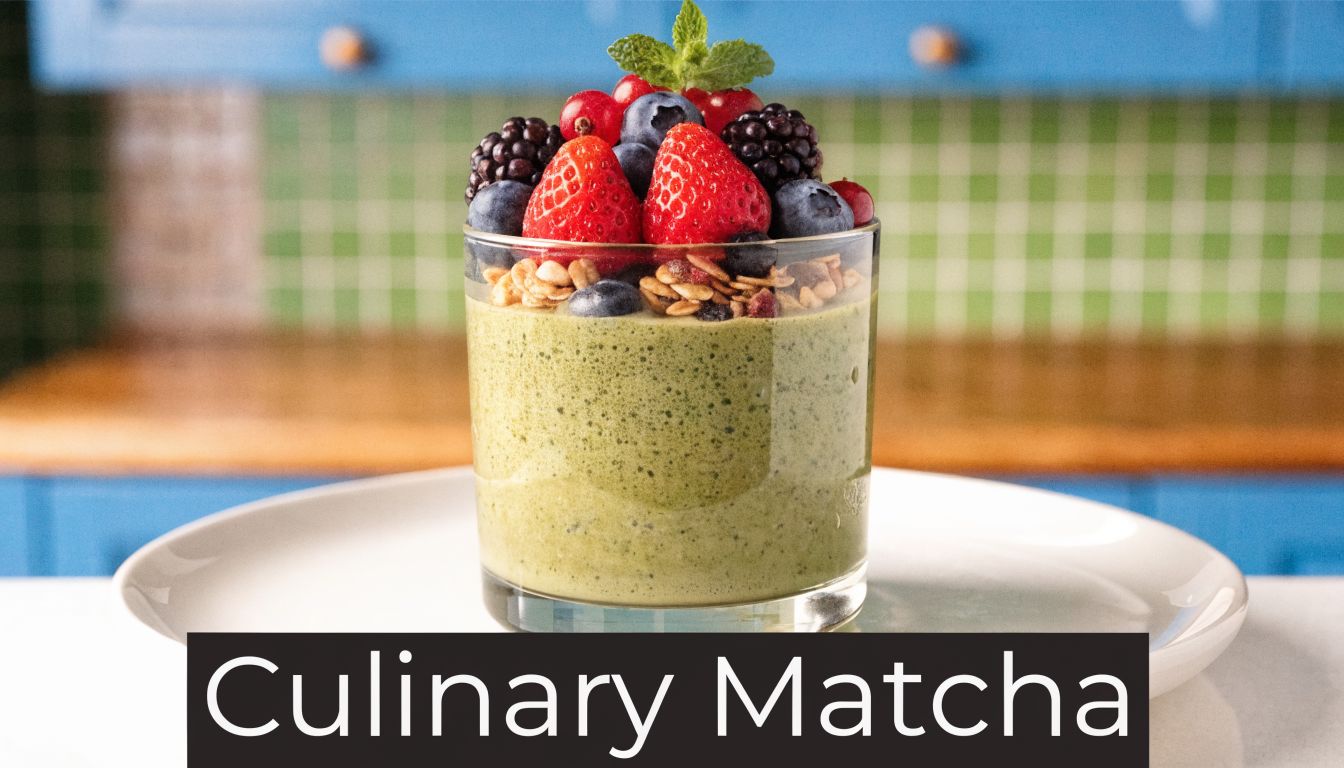
The main rule is balance. Matcha has a distinct green, slightly savoury personality. Pair it with ingredients that support that rather than bury it.
Matcha works best when the format suits the grade
A lot of disappointment comes from using one type of matcha for everything.
Use ceremonial matcha when you want the tea to stand alone. Use culinary matcha when other ingredients are involved. That simple decision makes recipes cleaner and more cost-effective.
A thoughtful matcha and kombucha pairing
For wellness-focused drinkers, one of the more interesting ideas is pairing matcha with kombucha.
The verified brief notes that combining matcha with kombucha is an emerging trend in functional beverages and that the pairing brings together matcha’s L-Theanine for calm focus with kombucha’s probiotics for gut health, while also pointing out that existing online guidance on this combination is still limited.
That makes sense from a practical point of view. Matcha offers depth and structure. Kombucha adds acidity, lift and fermentation character.
A simple way to explore the pairing at home is to whisk a small, smooth matcha concentrate first, let it cool slightly, then add it to a glass with ice and a plain or gently flavoured kombucha. You want the tea integrated, not dumped in dry.
A few trade-offs matter:
- Acidity changes flavour perception: Kombucha can sharpen matcha’s edges.
- Sweetness level matters: A drier kombucha tends to let the tea show through more clearly.
- Texture needs care: If the matcha isn’t mixed smoothly first, the drink can feel chalky.
Matcha and kombucha can complement each other nicely, but only when each one still tastes like itself.
For cafés, this pairing opens up non-alcoholic menu ideas that feel more thoughtful than another sugary spritz. For home drinkers, it’s a good reminder that making matcha tea well gives you a base for far more than the traditional bowl.
Your Questions About Making Matcha Answered
Do I need a bamboo whisk to make matcha?
No, but it helps. A chasen is still the best tool for traditional matcha because it disperses the powder gently and creates fine foam. If you’re making lattes, a handheld milk frother is a practical substitute. A standard spoon is the least effective option because it tends to leave clumps behind.
Why isn’t my homemade matcha as bright green as the café version?
Usually it’s one of three things. The matcha may be older, the grade may be better suited to recipes than straight drinking, or your ratio may be too diluted. Lighting also changes what you see in the cup or glass, especially with iced drinks.
Is matcha better than coffee?
That depends on what you want from it. Coffee is direct and punchy. Matcha tends to feel steadier and more ritualistic. Many people prefer matcha when they want a calmer kind of focus and a slower start to the day.
Can I make matcha without sweetener?
Absolutely. In fact, learning to enjoy it unsweetened is one of the best ways to judge powder quality and improve your technique. If it tastes unpleasant without sweetener, fix the preparation before assuming the drink always needs sugar.
Should I use ceremonial matcha in a latte?
You can, but it isn’t always necessary. For everyday lattes, a good culinary-grade matcha often makes more sense. Save ceremonial-grade powder for bowls where you want to taste the tea on its own.
Can I prepare matcha in advance?
You can make a short-term concentrate for convenience, especially for lattes, but freshly whisked matcha always has the best texture. If you’re drinking it as a bowl of tea, make it and drink it straight away.
If you’re ready to put this into practice, explore Pep Tea for premium organic matcha and Australian-made sugar-free organic kombucha. Whether you want a ceremonial bowl, a café-style iced latte, or a more functional daily ritual, we’ve got the ingredients to help you make it well.
Your Guide to the Best Latte Matcha Powder in 2026

Let's get one thing straight: ‘latte matcha powder’ isn’t an official category you’ll find on a shelf. It’s a term we use to describe a type and quality of matcha that’s just right for the job of making a creamy, brilliant latte.
Think of it like flour. You wouldn’t use heavy bread flour for a delicate sponge cake, and you shouldn’t be using a low-grade, bitter matcha for your daily latte. Getting this one detail right is the difference between a café-quality drink and a bitter, lumpy disappointment.
Your Guide to the Perfect Latte Matcha Powder
The right powder has a vibrant, almost electric green colour, a texture as fine as silk, and a flavour profile that’s smooth and balanced, not harsh. It’s the single most critical choice you’ll make.
And it’s a choice more and more Australians are making. Cafés across Sydney, Melbourne, and our own Hunter Valley have seen a huge jump in matcha latte sales, a clear signal that people are looking for drinks that feel both healthy and intentional. You can read more on the global shift towards matcha to understand the bigger picture.
As an Australian-owned family business built on authentic, organic matcha, we at PepTea want to show you how to choose wisely. It all comes down to a few key attributes.
What to Look For in a Latte Powder
When you’re choosing a matcha, you’re looking for characteristics that promise a smooth, velvety experience when mixed with milk. A great powder dissolves almost instantly, creating that beautiful mouthfeel without any grassy bitterness.
Here’s a quick guide to what separates the good from the bad.
Quick Guide to Choosing Matcha for Lattes
This table breaks down the essential attributes you need to look for. Think of it as your checklist for sourcing a matcha that will perform beautifully in a latte, whether at home or in your café.
| Attribute | Ideal for Lattes | Why It Matters for Your Drink |
|---|---|---|
| Colour | Vibrant, deep green | Indicates freshness and high chlorophyll; a dull or yellowish colour often means old or low-quality leaves. |
| Texture | Ultra-fine, silky powder | A fine grind (ideally stone-ground) ensures the powder dissolves completely, avoiding clumps and a gritty texture. |
| Aroma | Fresh, sweet, and vegetal | A good matcha should smell inviting and clean, never musty or stale. This hints at the flavour to come. |
| Origin | Sourced from Japan | Regions like Uji and Nishio are the heartland of quality matcha, with centuries of perfected cultivation and processing techniques. |
| Flavour Profile | Smooth, with a hint of sweetness and umami | The powder needs to be bold enough to not get lost in the milk, but smooth enough to not taste bitter. |
Ultimately, a brilliant latte matcha is all about that balance. You need a flavour that is robust enough to stand up to milk but delicate enough to remain smooth and pleasant on the palate.
The goal is to find a matcha with a flavour profile robust enough to stand up to milk but delicate enough to avoid bitterness. This balance is what defines a true 'latte grade' powder and turns a simple drink into a daily wellness ritual.
Our organic matcha range is stone-ground in Japan from the finest shade-grown leaves, specifically to deliver that perfect balance, every time.
In the next section, we’ll dive deeper into the specific grades of matcha and help you decide which one is right for your home or café.
Choosing Between Ceremonial and Culinary Grade Matcha
When you start looking for a good matcha, you’ll run into two main categories pretty quickly: Ceremonial and Culinary. Getting this choice right is the single biggest factor in whether your matcha latte ends up smooth, vibrant, and delicious—or just bitter and flat.
Think of it like choosing olive oil. You have that beautiful, cold-pressed extra virgin olive oil you’d use to dress a delicate salad, and then you have your everyday cooking oil. Both are essential, but using the right one for the job makes all the difference.
The Prestige of Ceremonial Grade
Ceremonial grade matcha is the absolute peak of quality. It’s what’s traditionally used in Japanese tea ceremonies, where it’s prepared with just hot water. This grade is made from the youngest, most tender tea leaves, picked during the very first harvest of the year. The leaves are then meticulously stone-ground into an impossibly fine, silky powder.
What sets this grade apart is its:
- Vibrant, jewel-toned green colour, a clear sign of high chlorophyll content and freshness.
- Delicate, subtly sweet flavour with deep umami notes and practically no bitterness.
- Extremely fine texture that whisks into a perfectly smooth, frothy drink.
You can absolutely make a latte with Ceremonial grade, and it will be luxuriously smooth. But its very delicate notes can sometimes get a bit lost when mixed with milk. It's an exceptional choice, but often there’s a more practical option for a daily latte.
The Versatility of Culinary Grade
Culinary grade matcha comes from leaves harvested later in the season. These more mature leaves give it a bolder, more robust flavour profile that can be a little more astringent. That strength is exactly what helps it stand up to other ingredients in baking, smoothies, and cooking.
But "culinary" is a huge umbrella term. Inside that category, you'll find a whole spectrum of quality. And this is where the real secret to a perfect latte is hiding.
The sweet spot for a latte is a high-quality culinary matcha, often called 'Premium Culinary' or 'Latte Grade'. It has the robust flavour needed to cut through milk, but with the smoothness of a better-quality grind, offering fantastic value.
For anyone who wants to go deeper on the specifics, we have a complete breakdown in our guide to the different grades of matcha.
Making Your Choice: A Quick Comparison
Ultimately, the right powder comes down to your personal taste, your budget, and what you’re making. Matcha lattes are booming in Australia, especially as a focus-boosting alternative to coffee. Many health-conscious Aussies are making the switch, finding that the L-theanine in matcha provides sustained energy without the coffee crash. You can learn more about matcha's rich traditions and modern appeal.
To make it even simpler, this decision-tree infographic gives you a clear path for picking the right matcha for your latte.

The visual guide really nails it: while Ceremonial Grade is fantastic for purists drinking it straight, a high-quality Culinary or 'Latte Grade' is the ideal, balanced choice for a delicious daily latte.
To put it all side-by-side, here’s a direct comparison to help you find the best latte matcha powder for your needs.
Comparing Matcha Grades for Your Latte
This table breaks down the key differences to help you select the perfect matcha powder for your daily latte, whether at home or in the café.
| Feature | Ceremonial Grade Matcha | Culinary Grade Matcha | Our Recommendation for Lattes |
|---|---|---|---|
| Leaf Source | First harvest, youngest leaves | Later harvest, mature leaves | Ceremonial for luxury, high-quality Culinary for daily enjoyment. |
| Colour | Vibrant, jewel-toned green | Duller, yellowish-green | Always look for a bright green to ensure quality and freshness. |
| Flavour Profile | Subtly sweet, umami, no bitterness | Robust, slightly bitter/astringent | A smooth, mellow flavour that beautifully complements milk. |
| Best Use | Drinking with water (traditional style) | Baking, smoothies, cooking | Premium Culinary or Ceremonial is perfect for lattes. |
| Price Point | Higher | More affordable | Invest in the best quality you can for a superior latte. |
Ultimately, a great latte starts with great matcha. At PepTea, we source premium organic Japanese matcha that’s perfect for lattes, ensuring you get that vibrant colour and smooth taste in every single cup.
How to Make the Perfect Matcha Latte at Home
Ready to skip the expensive café runs and become your own barista? Making a brilliant matcha latte at home isn't about complex techniques. It's a simple ritual that, once you nail the basics, becomes deeply satisfying. This isn't just about dumping powder in milk; it’s about a few key moves that guarantee a smooth, creamy, and vibrant result, every single time.
We'll walk you through the whole process, explaining not just what to do, but why each step is so critical for getting that flawless, café-quality finish.

The Essential Steps for a Flawless Hot Matcha Latte
Think of this as your core recipe. The real secret to a velvety, clump-free latte is creating a smooth matcha paste before you even think about the milk. This one technique is what separates a good latte from a great one.
What You'll Need:
- 1 teaspoon of high-quality latte matcha powder, like PepTea's organic range.
- 60ml of hot water (around 80°C, not boiling).
- 180-200ml of your milk of choice (dairy or plant-based).
- A small sieve, a bamboo whisk (chasen) or electric frother, and your favourite mug.
- Optional: A natural sweetener like honey or maple syrup.
Now, let's get into it.
Sift Your Matcha: This is the non-negotiable step for a smooth latte. Sift 1 teaspoon of matcha powder through a small sieve directly into your mug. This single action breaks up any tiny clumps and aerates the powder, making it a dream to dissolve.
Create the Paste: Pour the 60ml of hot water over the sifted matcha. Now, using your bamboo whisk or electric frother, whisk hard in a ‘W’ or ‘M’ pattern until a frothy paste forms. You shouldn't see any lumps or dry powder at all.
Sweeten (If You Want): If you're adding a sweetener, now’s the time. Stir your honey or maple syrup directly into the matcha paste until it fully dissolves. This ensures the sweetness is evenly mixed through the final drink, not just sitting at the bottom.
Froth Your Milk: Gently heat your milk on the stove or in the microwave until it’s warm—don't boil it. Use a milk frother to create a light, velvety foam. You're aiming for silky microfoam, not big, airy bubbles.
Combine and Serve: Pour the frothed milk into the mug over your matcha paste. A neat trick is to hold back the foam with a spoon, pour in the liquid milk, and then spoon the remaining foam on top. Give it a gentle stir and enjoy.
Why 80°C Water?
Boiling water (100°C) is matcha’s enemy. It scorches the delicate powder, instantly releasing a bitter, harsh flavour. 80°C is the sweet spot that coaxes out the beautiful umami and sweet notes without scalding them.
How to Make a Refreshing Iced Matcha Latte
On a warm Australian day, an iced matcha latte is just the ticket. The method is just as straightforward, with a couple of small changes to keep it perfectly chilled and refreshing.
The Method:
- Follow steps 1-3 from the hot latte recipe: sift the matcha, create a smooth paste with 60ml of hot water, and dissolve your sweetener into it.
- Fill a tall glass to the top with ice cubes.
- Pour your cold milk of choice directly over the ice.
- Gently pour the prepared matcha paste over the milk. You'll get a beautiful cascade of vibrant green through the white milk, which looks fantastic.
- Give it a good stir to combine everything before you take that first sip. It’s that simple.
Choosing the Best Milk for Your Latte
The milk you pick makes a huge difference to the final flavour and texture. There’s no single "best" option, but here's a quick rundown of how different milks play with your latte matcha powder.
Dairy Milk: Full-cream dairy milk is a classic for a reason. It froths like a dream and its natural creaminess delivers a rich latte that perfectly balances matcha’s earthy notes.
Oat Milk: This is the café favourite right now. Oat milk has a natural, subtle sweetness and a creamy body that froths exceptionally well. It's a brilliant dairy-free partner for matcha.
Almond Milk: A great choice if you prefer a lighter latte. The nutty flavour complements matcha nicely, though it doesn’t always froth as thickly as oat or dairy milk.
Soy Milk: Soy gives you a thick, creamy consistency and froths very reliably. Its flavour is more distinct, so just make sure you’re a fan of it before pairing it with your best matcha.
The best part of making lattes at home is the freedom to experiment. Try a few different milks and see what you like. When you start with a quality latte matcha powder, you’re already halfway to a perfect drink.
Achieving Café-Worthy Froth Without a Machine
That gorgeous, velvety microfoam from a café latte often feels like a luxury you can't possibly replicate at home. But here’s the secret: you don't need a pricey espresso machine to get that silky texture. The magic isn't in the equipment; it's all in the technique.
First, let's get clear on what we're actually aiming for. We want microfoam—millions of tiny, uniform bubbles that create a texture like liquid velvet. This is a world away from the big, airy bubbles you’d find on a classic cappuccino. Microfoam is what integrates perfectly with your latte matcha powder, giving you a consistently creamy drink right to the last sip.

Simple Tools for Superior Froth
The good news is you probably have something in your kitchen right now that can do the job. For those of us without professional gear, there are several surprisingly effective ways of frothing milk without a steam wand. These are our three favourite low-cost, high-impact methods.
1. The Handheld Electric Frother
This is our top pick for any home barista. It’s affordable, quick, and incredibly good at its job. These little battery-powered whisks are champions at whipping air into milk, creating a dense, stable foam in less than a minute.
- How to use it: Warm your milk to about 65°C. Dip the head of the frother just below the surface and switch it on. As the foam starts to build, slowly lower the frother deeper into the milk. This incorporates the foam and creates that silky microfoam texture. It’s a genuine game-changer.
2. The Traditional Bamboo Whisk (Chasen)
If you already use a chasen to make your matcha paste, you can absolutely use it for your milk too. It takes a bit more elbow grease, but it connects you to the traditional way of preparing matcha.
- How to use it: After warming your milk, pour it into a wide bowl (your matcha bowl is perfect) and whisk vigorously. Use a rapid 'W' or 'M' motion, just as you would for your matcha. This technique, which you can master with our guide on how to whisk matcha properly, folds air into the milk to create a light foam.
3. The Sealed Jar Method
No frother? No whisk? No problem at all. All you need is a clean jar with a lid that seals tightly.
- How to use it: Fill your jar about halfway with cold milk and seal it. Now, shake it like you mean it for 30-60 seconds. You'll see the foam build up quickly. Once you're done, take the lid off and microwave the jar for about 30 seconds to warm the milk and stabilise the foam.
Key Takeaway: The quality of your froth is just as important as the quality of your latte matcha powder. Silky microfoam elevates the entire experience, turning a homemade latte into a genuine café treat.
Tips for the Perfect Foam Every Time
Nailing the perfect foam is fast becoming a core skill for home baristas, especially in places with a strong café culture. In Victoria, for instance, searches for 'matcha latte' have soared, lining up with reports of increased sales from the specialty coffee community, proving more and more people want that premium experience at home.
To make sure your foam is flawless every single time:
- Start with cold milk: Cold milk always froths better. The proteins are more stable and can hold air more effectively.
- Don’t overheat: Pushing milk past 70°C will scald it, giving it a burnt taste and destroying its ability to foam well. Aim for around 65°C—warm to the touch, but not uncomfortably hot.
- Choose the right milk: Full-cream dairy and barista-style oat milk consistently produce the best, most stable foam. It all comes down to their higher protein and fat content.
With these simple techniques, you’ll be creating matcha lattes with a beautiful, creamy head of foam that can stand up against anything from your favourite local café.
Creative Recipes Beyond the Standard Latte
A quality latte matcha powder is too good to be kept in one cup. While a perfect matcha latte is a thing of beauty, the real fun begins when you invite that vibrant green powder into your kitchen. This is where it moves beyond a simple drink and becomes a genuine wellness ingredient.
Think of it as a superfood seasoning. That unique earthy, slightly sweet flavour plays surprisingly well with all sorts of ingredients—from fruits and oats to nuts and natural sweeteners. It’s a chance to get creative and give your favourite snacks a boost of colour, flavour, and clean energy.

Here are three simple, healthy recipes that go way beyond the standard latte. Each one is designed to be easy and nourishing, proving that good matcha is a cornerstone of a healthy, vibrant life.
Morning Boost Matcha Smoothie
Kickstart your day with a smoothie that actually energises and nourishes. This recipe combines the calm focus from matcha with fibre, vitamins, and healthy fats to keep you full and switched on until lunch. It’s also a brilliant way to sneak in some greens without even trying.
Ingredients:
- 1 cup of your preferred milk (almond or oat works beautifully)
- 1 frozen banana, for that creamy texture and natural sweetness
- 1 large handful of fresh spinach
- 1 tablespoon of chia seeds or almond butter for protein and healthy fats
- 1 teaspoon of a premium culinary matcha powder
- A few ice cubes
Method:
Just throw everything into a blender and blitz until it’s completely smooth and creamy. Pour it into a glass and drink it straight away for the best flavour and texture.
This smoothie is the perfect example of matcha's versatility. It provides the sustained energy of L-theanine and caffeine without the crash, making it a smarter choice than a sugary breakfast cereal or a simple coffee to power your morning.
No-Bake Matcha Energy Balls
Feeling that 3pm slump coming on? These no-bake energy balls are the answer. They’re packed with wholesome ingredients, take just minutes to whip up, and make the perfect grab-and-go snack that satisfies a sweet craving while delivering a gentle lift.
Ingredients:
- 1 cup of rolled oats
- ½ cup of desiccated coconut (plus extra for rolling)
- ½ cup of almond meal
- ¼ cup of pure maple syrup or honey
- 2 tablespoons of coconut oil, melted
- 1-2 teaspoons of latte matcha powder, depending on how bold you want the flavour
Method:
- In a large bowl, mix the rolled oats, desiccated coconut, and almond meal.
- Pour in the maple syrup, melted coconut oil, and matcha powder.
- Stir everything together until a sticky dough forms. If it feels a bit dry, add another splash of coconut oil; if it’s too wet, a bit more almond meal will fix it.
- Roll the mixture into bite-sized balls (about one tablespoon each).
- Toss each ball in the extra desiccated coconut to coat.
- Place them on a tray and pop them in the fridge for at least 30 minutes to firm up. They’ll keep in an airtight container in the fridge for up to a week.
Simple Matcha Icing for Healthy Treats
Elevate your favourite baked goods with this simple, vibrant, and surprisingly healthy matcha icing. It’s perfect for drizzling over muffins, cakes, or cookies, adding a beautiful pop of colour and a sophisticated, earthy flavour that cuts through sweetness perfectly.
Ingredients:
- 1 cup of icing sugar (or a powdered natural alternative like erythritol)
- 1 teaspoon of latte matcha powder
- 2-3 tablespoons of milk or water
Method:
- Sift the icing sugar and matcha powder into a bowl to get rid of any lumps. Don’t skip this step—it’s the secret to a silky-smooth finish.
- Add 2 tablespoons of milk or water and whisk until a smooth, thick but pourable icing comes together.
- If it’s too thick, add more liquid one teaspoon at a time until you get the consistency you’re after. Drizzle it over your favourite treats immediately.
Sourcing and Storing Matcha Powder in Australia
To get that delicious, vibrant latte every single time, you need to think about your latte matcha powder long before it hits the mug. Matcha is a delicate, living product. Its greatest enemies are light, air, and heat—all of which can quickly ruin its beautiful colour, smooth flavour, and potent antioxidant benefits.
Think of your precious powder like premium coffee beans or a fine spice. You wouldn’t leave them out on the counter in a clear jar, and the same rule absolutely applies here. Protecting it is key.
How to Store Your Matcha for Lasting Freshness
Proper storage is simple but completely non-negotiable. The whole goal is to keep it away from the elements that cause it to oxidise and lose its charm.
- Airtight and Opaque: Always store your matcha in an airtight container that light cannot get through. Most high-quality matcha, like what we offer at PepTea, comes in a small, sealed tin which is perfect for this.
- Cool and Dark: Find a cool, dark spot for your matcha tin. A pantry or cupboard is ideal. For long-term storage of an unopened tin, the fridge is an excellent option, but let it return to room temperature before opening to avoid condensation.
- Use It Up: Matcha is best enjoyed fresh. We recommend buying smaller quantities more often to ensure you’re always using a powder that’s at its peak. Aim to finish an opened tin within 4-6 weeks.
Storing your matcha correctly is just as important as buying good quality powder. An airtight, opaque container in a cool, dark place is your best defence against flavour loss and colour degradation.
What to Look for When Buying Matcha in Australia
Sourcing great matcha in Australia has become much easier, but it really pays to be a discerning customer. When you’re looking to buy, keep an eye out for these clear markers of quality.
First, check for organic certification. This ensures the tea was grown without synthetic pesticides, which is better for you and the environment. Second, confirm its Japanese origin. Regions like Uji and Nishio in Japan are world-renowned for their matcha expertise. Finally, look for recent harvest dates or a supplier you trust to manage their stock properly.
For businesses looking to bring high-quality matcha into the Australian market, understanding international logistics is also a key piece of the puzzle. You can research general methods for shipping from China to Australia to get a feel for the process.
At PepTea, we handle all that hard work for you. We’re committed to sourcing premium, stone-ground, certified organic Japanese matcha. Our direct relationships and focus on freshness mean the product you receive is always vibrant, flavourful, and packed with goodness. If you want to explore the difference quality makes, you can browse our full organic matcha tea range.
Common Questions About Latte Matcha Powder
As you get ready to dive into the world of matcha, it's completely normal to have a few questions. We hear them all the time from home baristas and café owners alike. Think of this as the final piece of the puzzle, clearing up those common queries so you can start making matcha lattes with total confidence.
How Much Caffeine Is in a Matcha Latte?
This is probably the number one question we get, especially from people looking to switch from coffee. A standard matcha latte, made with about one teaspoon of powder, lands somewhere between 30-70mg of caffeine. That’s quite a bit less than your average cup of coffee, which often starts at 95mg and goes up from there.
But the real story isn't just about the numbers. It's about how that caffeine feels. Matcha contains a unique amino acid called L-theanine, which works in harmony with the caffeine to create a feeling of calm, focused alertness. You get hours of sustained energy without the jitters or the dreaded afternoon crash that coffee can bring.
Why Is My Matcha Latte Clumpy or Bitter?
This is a classic frustration, but the fix is almost always surprisingly simple. If you're getting clumps, you've likely skipped the most important step: sifting. Always, always pass your latte matcha powder through a small, fine-mesh sieve before you add any liquid. It breaks up any static and makes for a perfectly smooth dissolve.
If bitterness is the problem, it usually points to one of two things:
- Your water is too hot. Never use boiling water (100°C). It literally scorches the delicate tea powder and brings out a harsh, unpleasant flavour. Aim for water around 80°C for a sweet, smooth result.
- The matcha quality isn't there. Older, lower-grade matcha will always have a more bitter profile. Investing in a good culinary or ceremonial grade powder, like the ones in the Pep Tea organic range, is the single best thing you can do for flavour.
Can I Sweeten My Matcha Latte?
Of course! While a truly great matcha has its own beautiful, natural sweetness, the goal is always to make a drink that you genuinely love. A little extra sweetness is absolutely fine.
We find that natural sweeteners work best. A small drizzle of pure maple syrup, a dollop of local honey, or even a pinch of stevia can complement the matcha's flavour beautifully. The trick is to mix your sweetener into the matcha paste before you add the frothed milk. This helps it dissolve completely, giving you a perfectly balanced flavour from the first sip to the last.
Is Drinking a Matcha Latte Every Day Healthy?
Yes, for most people, a daily matcha latte is a brilliant and healthy ritual. Matcha is a nutritional powerhouse, loaded with antioxidants—especially a catechin called EGCg, which is widely studied for its role in supporting metabolism and overall health.
It’s a fantastic way to up your antioxidant intake while enjoying the gentle, focus-enhancing effects of L-theanine. To keep it as healthy as possible, just make sure you're using a quality organic latte matcha powder and go easy on the added sugars.
We hope this guide has left you feeling inspired and ready to create your own beautiful matcha lattes. At PepTea, we're passionate about bringing you the finest organic ingredients to support your wellness journey.
Ready to taste the difference? Explore our premium range of Japanese organic matcha powder today.
Pep Tea’s Imperial – The Best Matcha I Have Had

Here is what a new customer had to say about Pep Tea’s Imperial Matcha tea powder today.
By: Brenton on 13 February 2017
“The matcha is exquisite. The best matcha I have had, the Imperial is very refined, with a fine, light but clear green tea flavour with a smooth profile whose exquisitely subtle taste curve calls out for another sip.
My favorite tipple, in the heat of the Northern Rivers’ summer, is as an Iced Match Latte, made with our home-made almond milk, a touch of honey and vanilla, cinnamon and nutmeg – shaken in a cocktail shaker with lots of ice. Purists might grimace, or even scowl and howl, but our daily morning tea ceremony is sacred to us – and refreshing, uplifting and stimulating!
Thanks Michele for a great product – and your very ethical and sincere business attitude.
Warm Regards”
BP, Chinderah NSW