
Tag: organic tea australia
Variable Temperature Kettle: A Guide for Aussie Tea Lovers
A variable temperature kettle is an electric kettle with selectable heat settings, usually from 50°C to 100°C, designed to extract the best flavour from different types of tea without burning delicate leaves. For many Australian tea drinkers, it's worth considering if you regularly prepare matcha, green tea or other brews that taste noticeably different when the water is too hot.
You've probably had this experience. You prepare a beautiful green tea or whisk a bowl of matcha, take the first sip and find a harsh, drying bitterness instead of sweetness and umami. It's easy to blame the tea, but the water may be the true culprit.
A standard kettle gives you one main result, boiling water. A variable temperature kettle gives you more control over the part of brewing that happens before the leaves, powder or infusion ever touches your cup.
Why Your Matcha Might Taste Bitter
The morning ritual starts well. You sift your matcha into a bowl, add water and whisk until a soft layer of foam forms on the surface. Yet the first sip tastes gritty, chalky or aggressively bitter. You try more whisking, less powder and a different mug, but the problem remains.
The missing variable is often water temperature.
Boiling water can pull bitter and drying compounds from delicate tea more aggressively than cooler water. An Australian kettle manual explains that lower-temperature brewing is relevant for sensitive infusions because boiling water can over-extract catechins and contribute to bitterness, while cooler water allows more repeatable control over the result in its guidance for variable-temperature brewing.
Matcha needs particular care because you drink the whole leaf in powdered form rather than steeping leaves and removing them. That makes texture, concentration and water temperature especially noticeable. If your water is too hot, the tea's more delicate flavours can become hidden behind astringency.
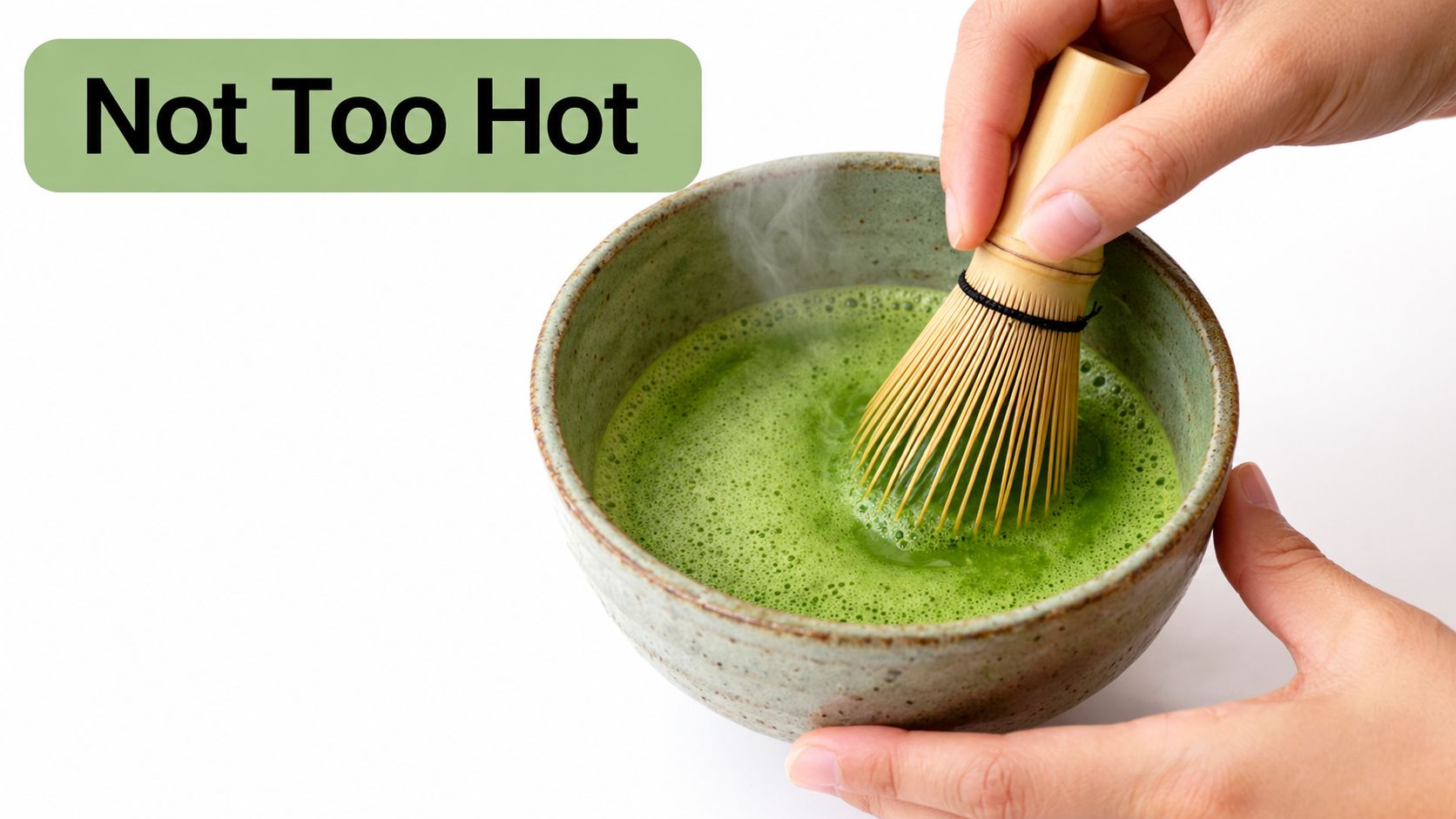
The simple brewing adjustment
Try changing the water before changing the matcha. Use cooler water, whisk thoroughly and taste the result before deciding that the powder itself is poor quality. A smoother cup can make the natural sweetness, savoury character and creamy body easier to notice.
For a practical guide to the complete process, including preparing the powder and whisking technique, follow this guide to making matcha tea from powder.
This principle also applies if you're using tea as part of a calmer alternative to strong coffee. Resources on natural energy boosters without jitters can help you compare different beverage routines, but the preparation method still matters. A carefully brewed tea can be more enjoyable because it tastes balanced.
Practical rule: If green tea or matcha tastes sharp and drying, adjust the water temperature before adding sweetener.
A variable temperature kettle doesn't improve every tea automatically. It gives you the ability to repeat a temperature that suits the particular drink, which is far more useful than boiling water and guessing when it has cooled enough.
What Is a Variable Temperature Kettle
A variable temperature kettle heats water to a selected temperature rather than stopping only at a full boil. Most models in Australia offer a range that broadly spans 50°C to 100°C, although the number of selectable points varies between products.
Smeg Australia's variable kettle range, for example, lists seven settings, at 50°C, 60°C, 70°C, 80°C, 90°C, 95°C and 100°C on its Australian product page. Those settings turn the kettle into something closer to a basic brewing tool. You can choose a gentler temperature for green tea, a warmer setting for oolong or a near-boil for a fuller-bodied infusion.
The category has also spread across different parts of the Australian retail market. Shoppers can find simpler variable-temperature options through mass-market retailers such as Kmart, alongside premium models sold through stores including Myer and Harvey Norman. The difference isn't only appearance. It can include temperature range, display design, pouring control, heat retention and how accurately the kettle reaches its selected setting.
The features that matter
A good model usually combines several functions:
- Selectable heat: You choose a target instead of waiting for boiling water to cool.
- Keep-warm control: The kettle can maintain the selected temperature for later pours, depending on the model.
- Automatic shut-off: The appliance stops heating when it reaches its target or detects a safety issue.
- Clear controls: A readable display or well-marked buttons make repeatable brewing easier.
- Suitable capacity: A compact kettle can suit individual tea preparation, while a larger one may be more convenient for a household.
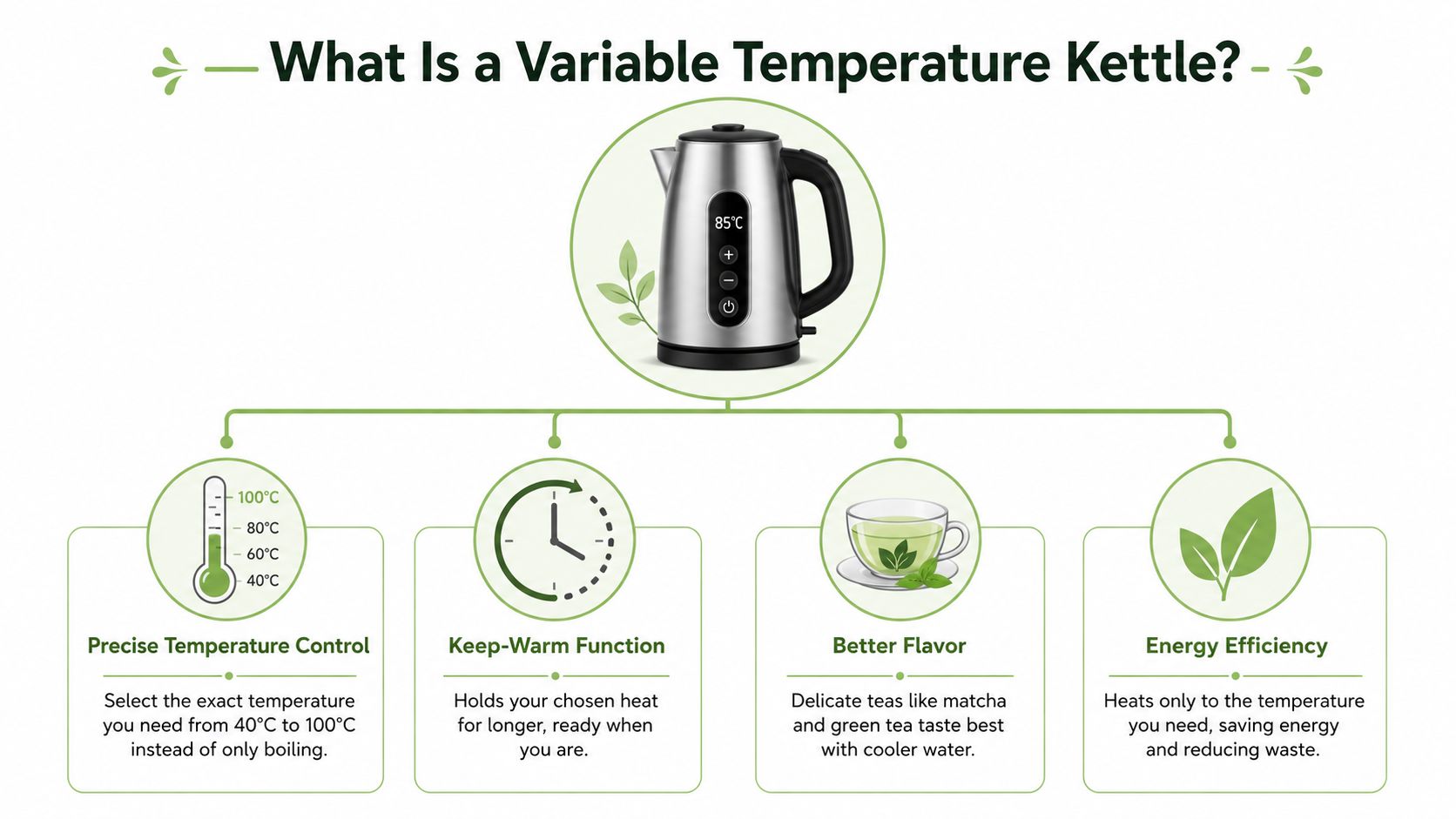
The key distinction is control, not complexity for its own sake. If you mostly boil water for pasta or make drinks that require boiling water, you may not use the extra settings often. If you drink different teas through the week, those settings can remove a frustrating amount of guesswork.
Here's a visual demonstration of how temperature selection and kettle design can fit into a brewing routine:
Optimal Brewing Temperatures for Tea
There isn't one perfect temperature for every tea. Water that suits black tea can overwhelm green tea, while water that produces a gentle green tea may leave some stronger infusions tasting thin.
Use the following as practical starting points rather than rigid rules:
| Drink | Useful starting point | Why it matters |
|---|---|---|
| Green tea | Around 70°C to 80°C | Helps limit harsh extraction from delicate leaves |
| Matcha | Around 70°C to 80°C | Supports a smoother balance of sweetness and umami |
| Oolong | Around 80°C | Gives semi-oxidised leaves enough heat without treating them like a boil-only infusion |
| Black tea | Around 95°C to 100°C | Provides the heat needed for a fuller, more robust cup |
| Herbal infusions | Near boiling | Suits ingredients that need hotter water to release their flavour |
These ranges reflect the broad brewing guidance published for Australian tea drinkers, including recommendations of roughly 75°C to 85°C for green tea, temperatures near 95°C to 100°C for black tea, and an intermediate range for oolong in this Australian tea FAQ. Your exact preference may depend on the tea's origin, the amount used and how long it steeps.
Why a few degrees can change the cup
Heat affects extraction. As water gets hotter, it can draw flavour compounds from tea more quickly. That can be helpful for a strong black tea, but it can make a delicate green tea taste more drying or bitter.
For matcha, temperature also affects the relationship between texture and flavour. Cooler water won't remove the powder's natural character, but it can make the cup feel less aggressive. If your matcha tastes flat rather than bitter, try improving your sifting and whisking before increasing the heat.
You can find more practical guidance in this matcha brewing temperature guide, then adjust gradually rather than changing temperature, powder quantity and brewing time all at once.
The best setting is the one that gives you a balanced cup and that you can repeat tomorrow.
A variable kettle is useful for more than traditional teacups. It can help with matcha lattes, cocoa and other hot drinks where boiling water may damage flavour or make the drink difficult to combine smoothly. If you enjoy steeping tea in alternative equipment, these French press tea tips from PureHQ Inc. offer another preparation option, although a variable kettle still gives you more control over the water before it reaches the press.
Is a Variable Temperature Kettle Worth It
You have a fresh green tea, a good matcha and a busy morning. A basic kettle boils water quickly, yet the cup turns sharp because the water was hotter than the tea needed. In that situation, a variable temperature kettle can make a noticeable difference. Its value depends on what you drink, how often you prepare it and whether you want the same flavour each time.
A basic kettle remains perfectly suitable for black tea, herbal infusions and cooking water. Green tea and matcha make the case for more control, especially when you prepare them regularly. The feature matters because it connects the kettle's settings with the chemistry of the cup. Smeg's seven settings, for example, may look like a reason to upgrade, but the useful question is whether you will use those options for different teas.
Australian shoppers can face a wide gap between entry-level and premium products. A Kmart model can be listed at $69, while premium options may sit around $299 to $349, according to the Australian buying context described by CHOICE in its kettle buying guide. A higher price does not automatically produce better tea. It may pay for sturdier construction, a more polished interface, a better pour or steadier temperature control. Choose features that fit your habits rather than paying for settings that will stay unused.
The energy question
More controls do not automatically mean much higher electricity use. The bigger influence is usually how much water you heat. Filling the kettle for one mug uses less energy than boiling a full chamber, regardless of whether the kettle has a temperature display.
Heating less water to a lower selected temperature may suit some brewing routines, but a variable kettle should not be purchased solely for dramatic savings. Electricity pricing, fill level and daily use affect the result. Its strongest benefits are flavour control, convenience and consistency.
A useful decision test
Choose a basic kettle if:
- You normally prepare drinks with boiling water.
- You do not notice much difference between a gentler and hotter brew.
- Your budget is better spent on higher-quality tea or other kitchen essentials.
Consider upgrading if:
- You prepare green tea or matcha regularly.
- You make several different types of tea.
- You want to repeat a preferred temperature without waiting for boiled water to cool.
- You use a keep-warm function during a longer tea session.
A premium kettle can be a worthwhile daily tool, but it is not required for good tea. A modest variable model may provide the control you need without charging you for design features you will not use.
Buying and Maintaining Your Kettle
A kettle can look impressive on an Australian benchtop without making better tea. Start with performance: it should reach the selected temperature consistently, show clear controls and include practical safety features. A higher price does not automatically mean greater accuracy, lower running costs or a better pour. Match the appliance to the drinks you prepare.
Australian consumer testing treats temperature accuracy as a real performance measure. CHOICE checks accuracy at each variable-temperature setting and conducts a dry-boil safety test, so temperature control and automatic shut-off deserve attention when comparing models in its explanation of kettle testing.
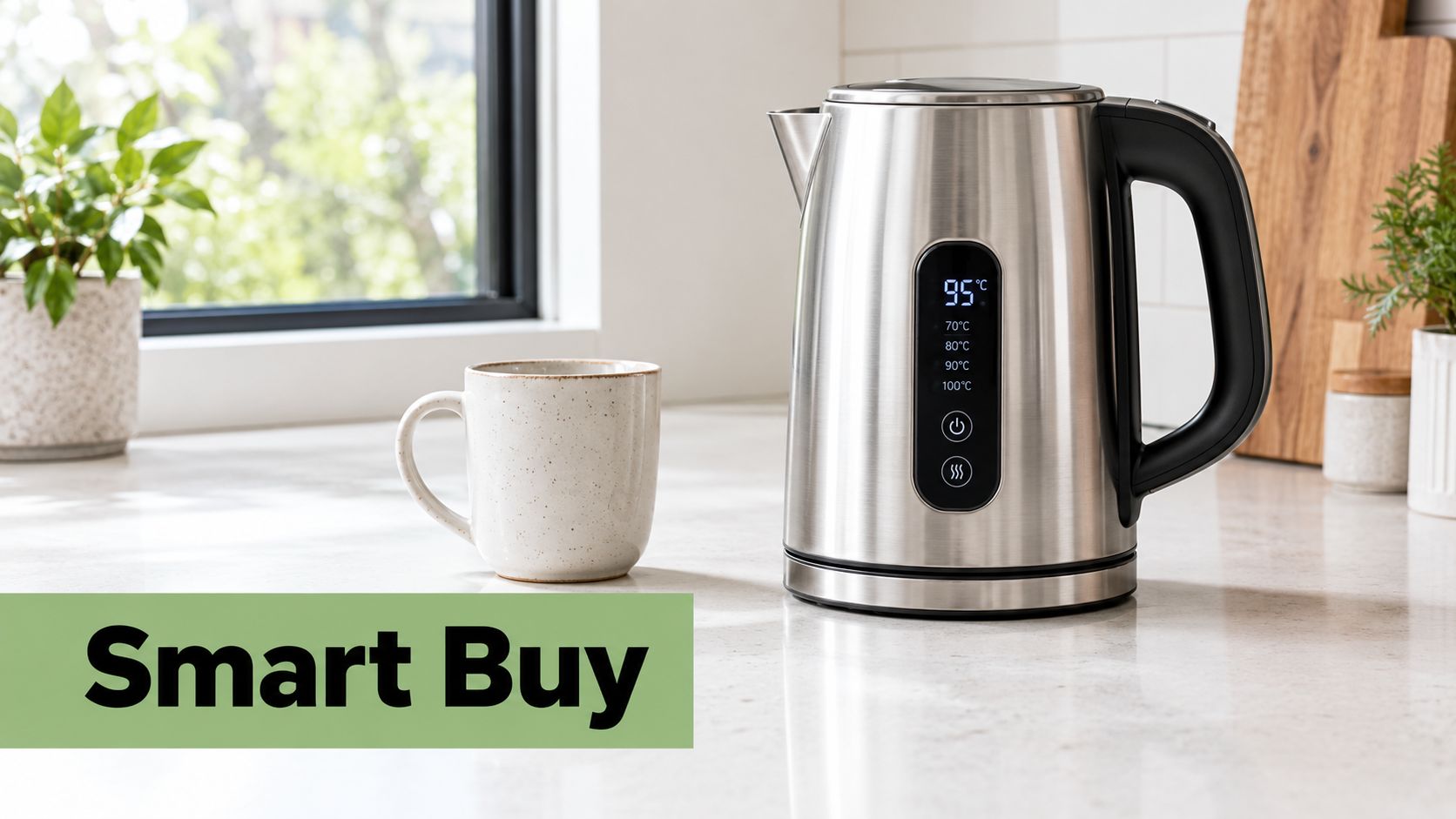
What to check before buying
Start with the controls. A readable display and simple temperature selection matter more than a crowded panel. Smeg's seven settings, for example, can be useful when you move between matcha, green tea and hotter brews, provided the selected temperatures suit the chemistry of each drink. Matcha needs water that will not scorch its delicate flavour, while green tea can become harsh when brewed too hot.
For capacity and accuracy comparisons, see our guide to choosing an electric kettle in Australia. Australian products range from compact 1L gooseneck kettles to family-sized 1.7L models, with some combining temperature selection and heat retention in this Australian product listing. Choose the size that fits your usual cups. A larger chamber can encourage unnecessary boiling, while a smaller one may suit a solo morning ritual.
Check the spout. A gooseneck design supports a slower, controlled pour for manual brewing. A wider spout may suit a teapot or French press better.
Keep the water and kettle clean
Mineral deposits can affect flavour and heating performance. Descale according to the manufacturer's directions, particularly if your local water leaves visible residue, then rinse thoroughly so the next cup does not taste of cleaner.
Use a stable, heat-resistant surface, keep the cord away from the bench edge, and avoid overfilling or running the kettle dry. Empty stale water rather than leaving it inside for long periods.
Regular care keeps fresh water, accurate heat and your tea in clean contact.
Elevating Your Daily Tea Ritual
A variable temperature kettle changes the role of water in your routine. Instead of treating every tea as if it needs the same treatment, you can respond to the drink in front of you. Green tea can have a gentler setting, oolong can receive more heat and black tea can still be prepared close to boiling.
That small act of selection encourages a more mindful approach. You notice aroma before drinking, taste the difference between astringency and bitterness, and learn which settings suit your preferred matcha or tea. The kettle becomes useful because it helps you build a repeatable habit, not because it promises to fix every brewing mistake.
Match the tool to the ingredient
Premium tea deserves careful preparation, but equipment can't compensate for stale ingredients, poor storage or an unsuitable recipe. Start with fresh water, use the amount of tea you need and change one variable at a time. If the first cup tastes too sharp, lower the temperature. If it tastes weak, adjust the tea quantity or steeping approach before assuming you need a new appliance.
The same mindset works across a wellness-focused beverage routine. A carefully prepared matcha can be part of a calm morning ritual, while an organic kombucha can offer a low-sugar alternative when you want something refreshing. Neither drink needs exaggerated promises. Their value starts with quality ingredients, thoughtful preparation and choosing a beverage that fits your day.
For Australian households, the best variable temperature kettle is the one that makes those choices simple. It should be safe, easy to clean and accurate enough to help you repeat the cups you enjoy. If you mostly drink one tea, a standard kettle may be all you need. If you move between matcha, green tea, oolong and other infusions, selectable heat can make the difference between guessing and brewing with intention.
Explore organic Japanese matcha and Australian-brewed sugar-free kombucha from Pep Tea, with options suited to home routines, cafés and wellness-focused menus. Visit the range, try your preferred brew at a gentler temperature and discover how better control can bring out more character in every cup.
Automatic Tea Maker Guide for Australian Homes and Cafés

The most popular advice about an automatic tea maker is also the least useful: buy the most advanced machine you can afford and great tea will follow. It won't. A machine can control water temperature, steeping time and basket movement, but it can't choose the right tea, judge freshness or replace a thoughtful brewing routine.
For some Australian homes, a kettle with temperature control and a timer is the better purchase. For a busy café, office or self-service station, automation may earn its bench space through repeatability and reduced handling. The right decision depends on how often you brew, which teas you use, how much adjustment they need and who'll clean the equipment.
Do You Really Need an Automatic Tea Maker
An automatic tea maker solves a practical problem, not a romantic one. It can heat water to a selected temperature, lower an infuser, lift it at the end of a programmed steep and keep the finished tea warm. That's valuable when several people want the same drink or staff need to repeat a recipe without watching a timer.
At home, the case is less obvious. If you usually make one mug of black tea, a standard kettle and a reliable timer may do everything you need. A temperature-controlled kettle becomes more useful when you switch between green tea, black tea, herbal infusions and delicate organic blends, because each style can need a different approach.
Start with your actual routine
Ask yourself:
- Frequency: Do you brew repeatedly throughout the day, or only occasionally?
- Variety: Do you mostly drink one tea, or change between styles?
- Consistency: Does the same person prepare every cup, or do several users share the equipment?
- Cleaning: Will you rinse the basket and jug after use, even on busy mornings?
- Workflow: Do you enjoy measuring, timing and whisking, or would you rather press a button?
An automatic tea maker makes the strongest argument when consistency matters more than ritual. A café serving a house black tea, an office supplying staff drinks or a household preparing several cups may benefit from programmed brewing. A tea enthusiast who adjusts every infusion by taste may find the machine restrictive.
The appliance market is moving towards more automated, higher-specification formats, including precision temperature control, digital interfaces and automated cleaning. A recent Australian coffee-machine market model describes value growth outpacing unit growth and projects shipments from about 650,000 units in 2025 to 862,000 in 2031, but that evidence comes from coffee machines, not automatic tea makers, so it shouldn't be treated as proof that every tea drinker needs one. The Australian coffee machine market model supports a more careful conclusion: buyers increasingly pay for convenience when it solves a real workflow problem.
Practical rule: Buy automation for repeated work, not because a complicated control panel makes tea sound more serious.
The Surprising Australian History of Automatic Tea Makers
Automatic tea makers aren't a new response to busy mornings. Australia's documented connection with the category reaches back to the pre-war electric-appliance era.
The Museum Victoria collection includes a Goblin automatic tea-maker used in Toorak, Victoria. Its record identifies the appliance as made in England by 1936 or earlier, with later models commonly marketed as “Teasmade”. Independent Australian collection records also trace the electric tea-maker patent line to the early 1930s, including William Hermann Brenner Thornton's 1933 patent, which was sold to the British Vacuum Cleaner and Engineering Co. That company commercialised the Goblin Teasmade. Museum Victoria's Goblin automatic tea-maker record provides a useful local link between an imported appliance and Australian household use.
The early design was straightforward in principle. A timer arranged for water to heat and tea to brew, turning a morning drink into a scheduled domestic task. Wartime interruption affected availability, but the category returned to public attention after the war.
From novelty to household familiarity
The Powerhouse Collection records that Teasmades returned to popularity after wartime interruption. By the late 1960s, about 300,000 units were sold annually in the UK and some Commonwealth countries, according to the collection history. Collections WA's Teasmade record adds that Teasmades peaked during the 1960s and 1970s, declined afterwards and experienced a partial revival in the 2000s as a retro novelty.
That history matters for Australian buyers because it shows the appliance wasn't just a modern gadget invented for digital kitchens. Commonwealth distribution helped move automatic tea-making from a niche invention towards broad household familiarity, even though Australia wasn't necessarily the main manufacturing base.
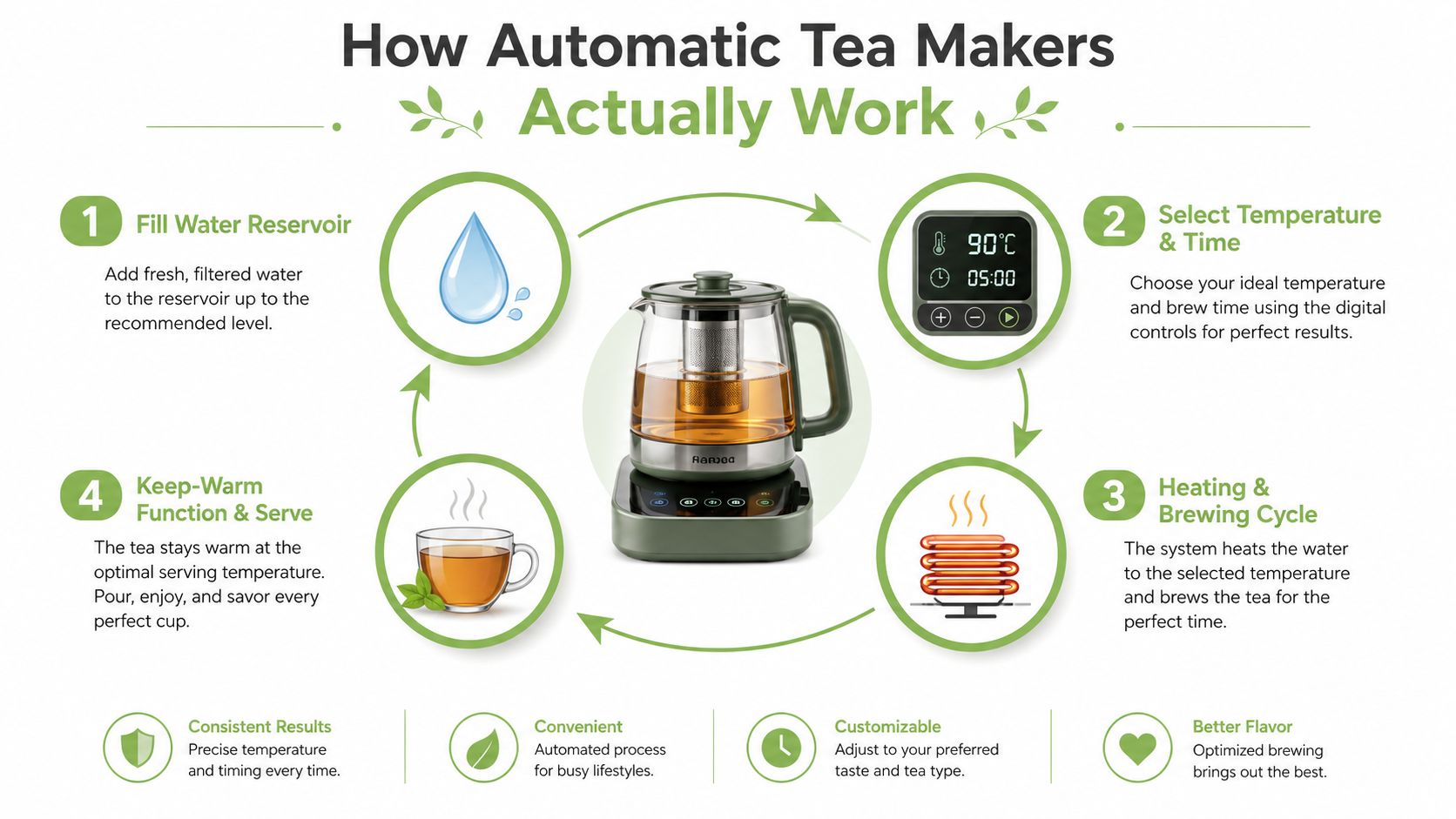
The modern machine adds temperature sensing, programmable steeping and more deliberate control over extraction. The underlying promise remains familiar, but the technology has moved beyond waking someone with a cup of hot tea.
How Automatic Tea Makers Work
An automatic tea maker combines a kettle, timer and infuser in one unit. The heating element raises the water towards the selected temperature, while a sensor checks the water rather than relying only on heating time.
Starting temperature, water volume and the surrounding environment all affect heating speed. A higher wattage rating can shorten the wait, but sensor feedback helps the machine stop at the intended temperature.
Four parts that affect the cup
Heating element: This supplies the energy for heating. More power may produce faster results, but it does not by itself create suitable brewing conditions.
Temperature sensor: The sensor checks the water and helps the controller hold the selected setting. That control is useful when switching between green tea and black tea.
Infuser basket: Loose leaves sit in the basket as water moves around them. With auto-lower and auto-lift functions, the basket enters the water at the beginning and rises when the programmed steep ends.
Keep-warm function: The heater maintains the drink after brewing. This can help an office or café serve several cups from one cycle, although tea can change in flavour if it remains hot for too long.
Australian brewing guidance places green tea around 80–85°C and black tea around 90–95°C. CoffeePlus's Australian tea brewing temperature chart shows why a temperature setting offers more control than a basic “boil” function. Hotter water extracts compounds faster, which can make delicate green tea bitter, while black tea generally suits a higher range.
A programmable basket replaces the hand movement of lifting an infuser. It does not make every tea identical, so tasting and adjustment still matter.
A manual workflow can be just as practical. A French press gives a clear view of the steep, making these french press tea recipe tips useful for comparing hands-on infusion with a programmed cycle. For organic matcha, neither method replaces whisking the powder into a smooth suspension. Kombucha also calls for separate preparation and fermentation control, rather than a hotter or longer tea cycle.
Automation therefore suits repeatable leaf-tea brewing, especially where several servings follow the same recipe. A kettle and infuser may offer better control for small batches or changing teas.
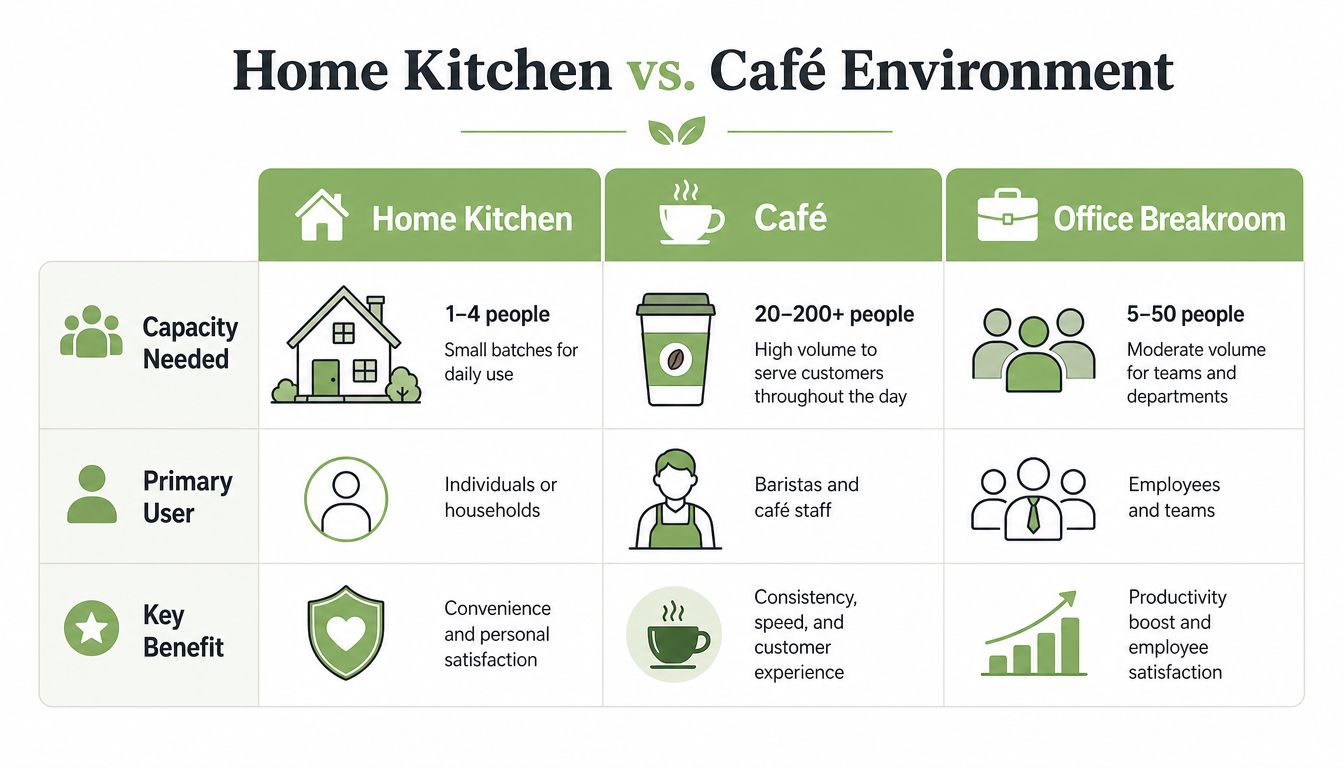
Home Kitchen Versus Café Environment
The same automatic tea maker can feel luxurious at home and inadequate in a café. The difference isn't only capacity. It's the number of people using the machine, the number of tea styles on the menu, the pace of service and the consequences of an inconsistent cup.
Home kitchen
A home user often values flexibility. You might prepare ceremonial matcha in the morning, a green tea later and a herbal infusion at night. An automatic tea maker can simplify water heating, but it won't replace the separate whisking step required for matcha, and a single jug may need careful rinsing between strongly flavoured teas.
A manual kettle and infuser may be the better fit when you enjoy changing variables. You can shorten a steep, add more leaves or pour immediately when the aroma reaches the right point. Automation is more attractive for households that prepare multiple cups, want repeatable temperature settings or dislike monitoring the clock.
Café and hospitality
A café has a stronger operational case. Staff can use programmed settings for a core tea menu, reducing variation between shifts. Portion control and self-service can also matter in hotels, diners and venues operating around the clock. Australian listings already market automated tea solutions to these environments, but the machine still creates work through refilling, rinsing, descaling and checking the basket.
Use automation for repeatability, not for every drink. A specialty tea program may need manual adjustment for delicate leaves, botanical blends or unusual steeping sequences. Before buying, find efficient prep tools and map the full workflow, including storage, cleaning and service space.
Office breakroom
An office sits between the two. Users may want simple operation and predictable results, but they won't always share the same tea preferences or clean equipment carefully. Clear labels, a limited set of presets and an accessible rinse routine can matter more than advanced customisation.
For menu planning, pair the equipment decision with practical café menu ideas. A tea station can support a broader non-alcoholic offering, but only if the chosen drinks match the machine's capacity and cleaning demands.
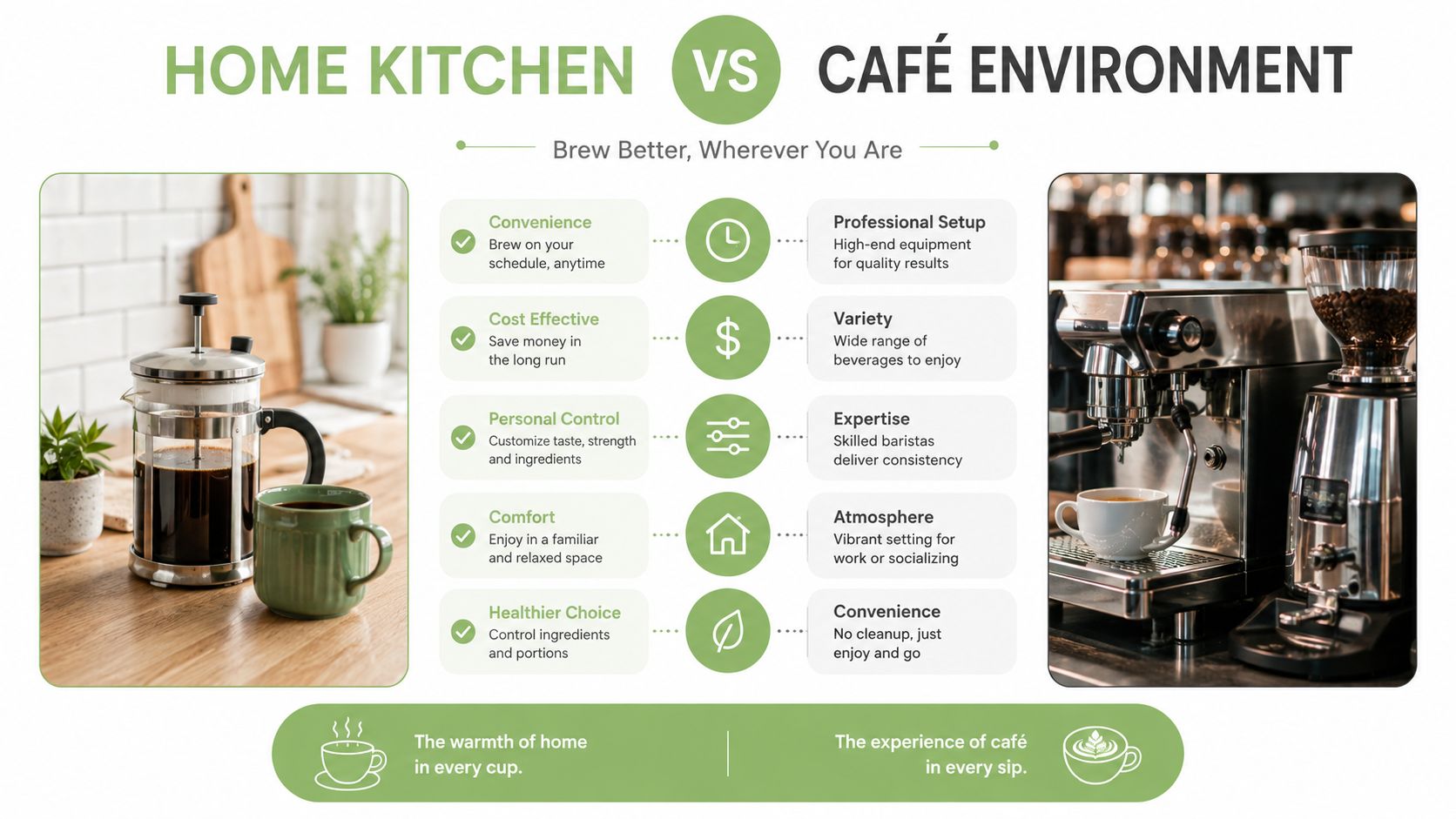
Key Features and Specifications to Evaluate
A good specification sheet should answer a simple question: will this machine protect the tea and fit the workflow? Capacity, wattage and digital controls matter, but they don't matter equally.
The Breville Tea Maker BTM800 offers a useful Australian benchmark. It has a 1.5 L capacity, five preset temperature settings, three tea-strength presets, an auto-lower and auto-lift basket, a temperature sensor, a 60-minute keep-warm function and 2000 W heating power. Breville's BTM800 product information shows the feature combination buyers should examine rather than judging the machine by wattage alone.
Temperature control comes first
Green tea and black tea don't share the same ideal brewing range. A machine that only boils water may be convenient, but it gives you less control over extraction. An Australian automatic tea-maker instruction booklet describes adjustment in 5°C increments from 70°C to 100°C, while also setting separate volume limits for heating and brewing. The Australian instruction booklet illustrates how small temperature steps can support different tea styles.
| Tea Type | Temperature Range | Key Consideration |
|---|---|---|
| Green tea | 80–85°C | Lower heat helps preserve delicate aroma and reduce harsh extraction. |
| Black tea | 90–95°C | Higher heat supports a fuller infusion. |
| Matcha preparation | Around 80°C | Heat water first, then whisk the powder separately. |
| Herbal or botanical blends | Follow the product guidance | Ingredients vary, so don't assume one preset suits every blend. |
Read beyond the headline features
- Basket movement: Auto-lift is useful because it ends contact between leaves and water. Confirm that the mechanism is easy to remove and rinse.
- Capacity: Choose enough volume for your normal service, not an imagined peak. A larger jug can also mean more water and tea left sitting warm.
- Keep-warm duration: This supports staggered serving, but it isn't a substitute for brewing fresh when flavour is the priority.
- Material and handling: Look for a clear jug, readable fill markings, stable controls and components that can be cleaned properly.
- Wattage: Treat power as a heating specification, not a quality score. Sensor accuracy and basket timing have a more direct relationship with extraction.
If you're mainly interested in controlled water temperature rather than automated steeping, an electric tea kettle with temperature control may deliver the simpler solution.
Integrating Automatic Tea Makers with Matcha and Kombucha
An automatic tea maker can support matcha and kombucha, but it shouldn't be used in exactly the same way for both.
Matcha is finely ground powder, not loose leaf. The machine can heat water to a suitable temperature, but you'll still need a bowl, whisk and proper mixing technique. For a delicate ceremonial-grade matcha, water around 80°C is a sensible starting point within the Australian green-tea guidance range. Pour the heated water over the powder and whisk until smooth rather than placing matcha directly into a basket designed for leaves.
A practical matcha workflow
- Heat fresh water using the machine's temperature setting.
- Sift matcha into a bowl to reduce clumps.
- Add a small amount of the heated water.
- Whisk briskly until the powder disperses.
- Add more water or chilled milk for a latte.
For an iced matcha latte, cool the prepared matcha over ice before adding milk. The appliance handles the temperature-controlled water, while you retain control over texture and strength.
Kombucha uses a different process. An automatic tea maker can produce a consistent green or black tea base, but the tea must cool before it meets a SCOBY and fermentation culture. Hot water is useful at the extraction stage. It's not suitable for live cultures.
Keep the stages separate
Brew the tea base, dissolve any recipe ingredients according to your method, then allow the liquid to cool before fermentation. Don't use the machine as a kombucha fermenter, and don't place a SCOBY or finished live kombucha in the jug. For broader functional beverage ideas, explore this immune-supporting drink guide while keeping health language realistic. Matcha may contribute antioxidants and naturally occurring L-theanine, and kombucha can provide a low-sugar fermented option, but neither drink replaces medical care or a balanced diet.
Maintenance Routines and Troubleshooting Common Issues
Tea leaves leave fine particles, tannins and aromatic oils behind. Australian tap water can also deposit minerals around the heating element and temperature sensor. Over time, that buildup may produce stale flavours, slower heating or inconsistent temperature readings. For cafés, these faults can appear first during busy service, when repeated cycles expose weak cleaning habits.
Follow the manufacturer's instructions for descaling products and dishwasher-safe parts. Keep daily rinsing separate from periodic scale removal, because a clean basket cannot remove deposits inside the heating area.
A workable cleaning rhythm
- After each use: Empty the basket, rinse away leaves and wash the jug if residue remains.
- Daily: Rinse removable components with clean water and leave them open to dry.
- Weekly: Inspect the heating area for scale. Descale only when the manufacturer permits it.
- Monthly: Deep-clean the basket, lid, jug and moving parts, then check that the auto-lift mechanism travels freely.
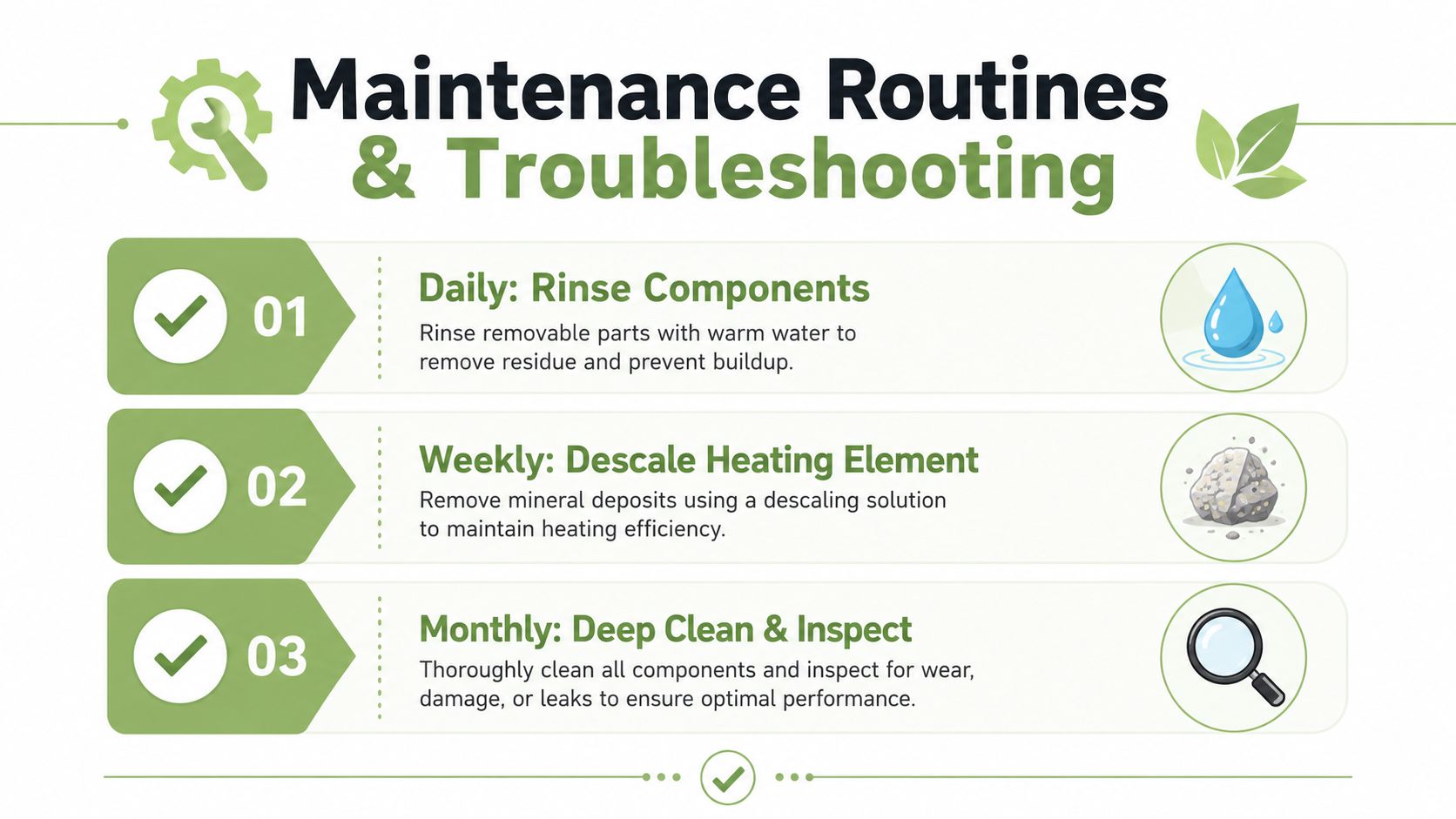
Fill lines are part of the machine's operating system, not decoration. Follow the manufacturer's fill-line instructions when heating and brewing. Filling beyond the permitted level can cause spills, obstruct basket movement and create a burn hazard.
Troubleshoot by symptom
The tea tastes bitter: Check water temperature, steep duration and leaf quantity. Green tea can become harsh when brewed too hot or held in water too long.
The machine heats slowly: Mineral deposits may be reducing heat transfer. In a hard-water home or café, compare the heating time with a freshly cleaned unit, then follow the approved descaling process. Avoid abrasive tools, which can damage surfaces or sensors.
The basket won't move: Switch off and unplug the unit before checking for leaves or residue around the mechanism. Never force the basket.
The jug leaks or overflows: Confirm that the water is below the correct fill line and that the lid and basket are seated properly.
The temperature seems wrong: Scale near the sensor can distort readings. Clean the area as directed, test with fresh water, and keep the machine out of service if the reading remains unreliable.
Buying Considerations and Australian Safety Standards
A buying decision should include more than presets and appearance. Check the warranty, replacement-part availability, bench footprint, power requirements and whether the jug and infuser are practical to wash. For a café, calculate cleaning time and staff training as part of the purchase. For a home, ask whether the extra appliance will simplify your morning or add another object to maintain.
Hot-water safety becomes critical when a machine connects to plumbing or serves customers, children, older people or people with disability. South Australian guidance limits heated water connected to plumbing fixtures used for personal hygiene to 50°C, with a 45°C maximum in specified public-building areas such as aged-care, patient-care, early-childhood and school settings. South Australian hot-water safety guidance explains why delivery temperature must be considered separately from tea-brewing temperature.
A NSW Health document defines hot water as heated water delivered or used above 45.0°C, and includes a thermal shut-off at 46.0°C in its temperature categories. The NSW scald-prevention document reinforces that small temperature differences can be safety-critical in facilities.
Queensland guidance uses a dual-temperature approach. Storage water must reach at least 60°C to help prevent Legionella, while delivery to taps is limited to 50°C through a temperature-control device. Queensland hot-water system guidance is particularly relevant to plumbed hospitality systems.
Choose a standalone unit unless your venue needs an integrated installation. If plumbing is involved, have the setup assessed by a qualified professional and keep brewing temperature controls separate from safe point-of-use delivery.
Pep Tea offers premium organic Japanese matcha and Australian-brewed, sugar-free organic kombucha from the Hunter Valley, NSW, giving homes and cafés quality ingredients to use with either manual brewing or an automatic tea maker. Visit Pep Tea to explore the organic matcha range, kombucha options and wholesale support for a more considered non-alcoholic drinks menu.
Pesticide Free Tea Australia: Shop & Verify Safely

Many shoppers looking for pesticide free tea Australia assume an organic label settles the question. It doesn't. In Australia, organic certification tells you a grower or handler followed an audited system, but it doesn't automatically prove the tea in your cup is free from measurable residues, and that's the detail many buyers miss.
That distinction matters because tea is often treated like a simple pantry staple, when in reality it sits at the intersection of farming, compliance, traceability, and even packaging. If you're buying for your own kitchen, a café menu, or retail shelves, the core question isn't just “is it organic?”, it's “what proof do I have that this batch is clean enough for the claim I'm making?”
Why Organic Does Not Always Mean Pesticide Free
The cleanest way to think about tea in Australia is this, organic and pesticide free are related, but they're not the same promise. A compliant organic certificate shows that a supply chain has followed the relevant standards and audits, yet it doesn't replace chemical analysis of the finished lot. For a shopper, that gap is the whole story.
What the label actually tells you
Domestic organic labelling is governed by a voluntary standard, AS 6000–2015, while export organic products must comply with the National Standard for Organic and Bio-Dynamic Produce. The Australian Competition and Consumer Commission says that distinction matters, because a certificate mainly verifies farming and handling controls, not a residue test on the final tea.
For that reason, a buyer who needs a true pesticide free claim should look for batch-level multi-residue testing. That's the only way to substantiate a specific lot as residue-free in a practical, evidence-based sense.
Practical rule: if a seller can show certification but can't show a batch test, you've got assurance about process, not proof about residues.
If you want a plain-English primer on this distinction, PepTea's guide on whether organic tea can still contain pesticides is a useful place to start.
Why the difference matters in real life
Many tea guides stop at "organic" and leave readers thinking the job is done. In reality, cafés, retailers, and careful home buyers need to know whether the claim covers the farming system only, or the actual leaf in the packet.
That's especially relevant if you're choosing teas for customers who care about clean labels, because trust is built on specifics. A certificate says the supply chain was audited. A residue report says the product met a tighter, batch-specific standard.
Australian Pesticide Residue Standards Explained
Australian tea compliance sits on a fairly strict baseline, and that baseline shapes what “pesticide free” can legally mean. The APVMA and the Food Standards Code set maximum residue limits, and Tea Leaves Australia says the MRL is generally set at or around the limit of quantitation, typically about 0.05 mg/kg. That matters because even tiny measurable residues can become relevant to both compliance and consumer perception.
What the numbers mean
A residue limit isn't a marketing slogan, it's a regulatory line. If a product falls under it, that doesn't automatically make it a clean-label winner in the eyes of a cautious shopper. It means the product complies with the limit in that jurisdiction.
The historical context is useful here. A 2003 Choice magazine test of 55 tea products found pesticide traces in nearly 40% of samples, including 7 of 17 green teas, 8 of 20 black teas, and 6 of 18 herbal infusions. The same test reported 12 teas still contained pesticides within acceptable Food Standards Code limits, while 7 brands had cypermethrin above the limit and 3 of those were more than 20 times the MRL. That old snapshot still matters because it shows residue concerns were measurable across mainstream retail tea, not confined to one niche category. See the original report in the Sydney Morning Herald coverage of the Choice tea test.
Why clean-label positioning keeps growing
The commercial side is moving too. Tea Leaves Australia notes that IMARC estimates the Australia organic tea market was worth USD 28.00 million in 2024 and is projected to reach USD 54.18 million by 2033, implying a 7.61% CAGR from 2025 to 2033. That's a projection, not a guarantee, but it does show why residue-free positioning is becoming more important in shelf decisions and café menus. The market is rewarding brands that can explain provenance and proof, not just flavour.
| Metric | Value | Significance |
|---|---|---|
| Tea products tested in the 2003 Choice survey | 55 | Shows the issue was checked across a broad retail sample |
| Samples with pesticide traces | nearly 40% | Indicates residues were common enough to matter |
| Green teas with traces | 7 of 17 | Suggests the issue wasn't limited to black tea |
| Black teas with traces | 8 of 20 | Reinforces that mainstream tea categories were affected |
| Herbal infusions with traces | 6 of 18 | Shows herbal blends weren't automatically clean |
| Australian organic tea market, 2024 | USD 28.00 million | Clean-label demand has real commercial weight |
| Projected market value, 2033 | USD 54.18 million | Growth makes verification more commercially relevant |
Organic Certification Versus Batch Residue Testing
Certification and residue testing solve different problems, and buyers often blur them together. Certified organic systems focus on how tea is grown, handled, and traced. Batch testing focuses on what's in a particular shipment.
Side by side, the difference is obvious
Certified organic supply chains commonly rely on annual third-party audits, plus controls like soil, groundwater, and fresh-product sampling. Industry guidance from Australian tea sellers also notes that transaction certificates are used as the final lot-level control. By contrast, a batch residue test checks whether the tea itself shows pesticide residues at the time of testing.
The strongest assurance isn't one or the other, it's both together.
| Assurance path | What it checks | What it doesn't prove |
|---|---|---|
| Certified organic | Farming and handling controls, audit trail, transaction certificates | That the final batch is residue-free |
| Batch residue testing | Chemical results for a specific lot | That the farm followed organic methods throughout |
| Both together | Process controls plus chemical evidence | Much stronger low-residue confidence |
If you're buying for a café, that combined approach is the one that reduces awkward questions later. A wholesaler can show a certificate and still leave you guessing about the actual shipment. A batch report closes that gap.
For more detail on the audit side, PepTea's page on organic certification standards is a handy reference.
What a robust assurance package looks like
A supplier serious about pesticide free tea Australia should be able to show you a neat paper trail. At minimum, ask for:
- Organic certificate, so you can verify the supply chain sits under an approved system.
- Transaction certificate, so you know the lot you're buying is the lot that was certified.
- Batch residue report, so you've got chemical evidence for the specific shipment.
- Clear lot numbers, so the paperwork matches the packet or bulk carton.
A café owner doesn't need to become a lab technician. They do need to ask for the documents that prove the story on the menu.
How to Verify Pesticide Free Claims When Shopping
A good tea label should answer simple questions quickly. Who grew it, where was it packed, and what proof sits behind the clean claim? If the label goes vague at that point, treat it as a warning sign.
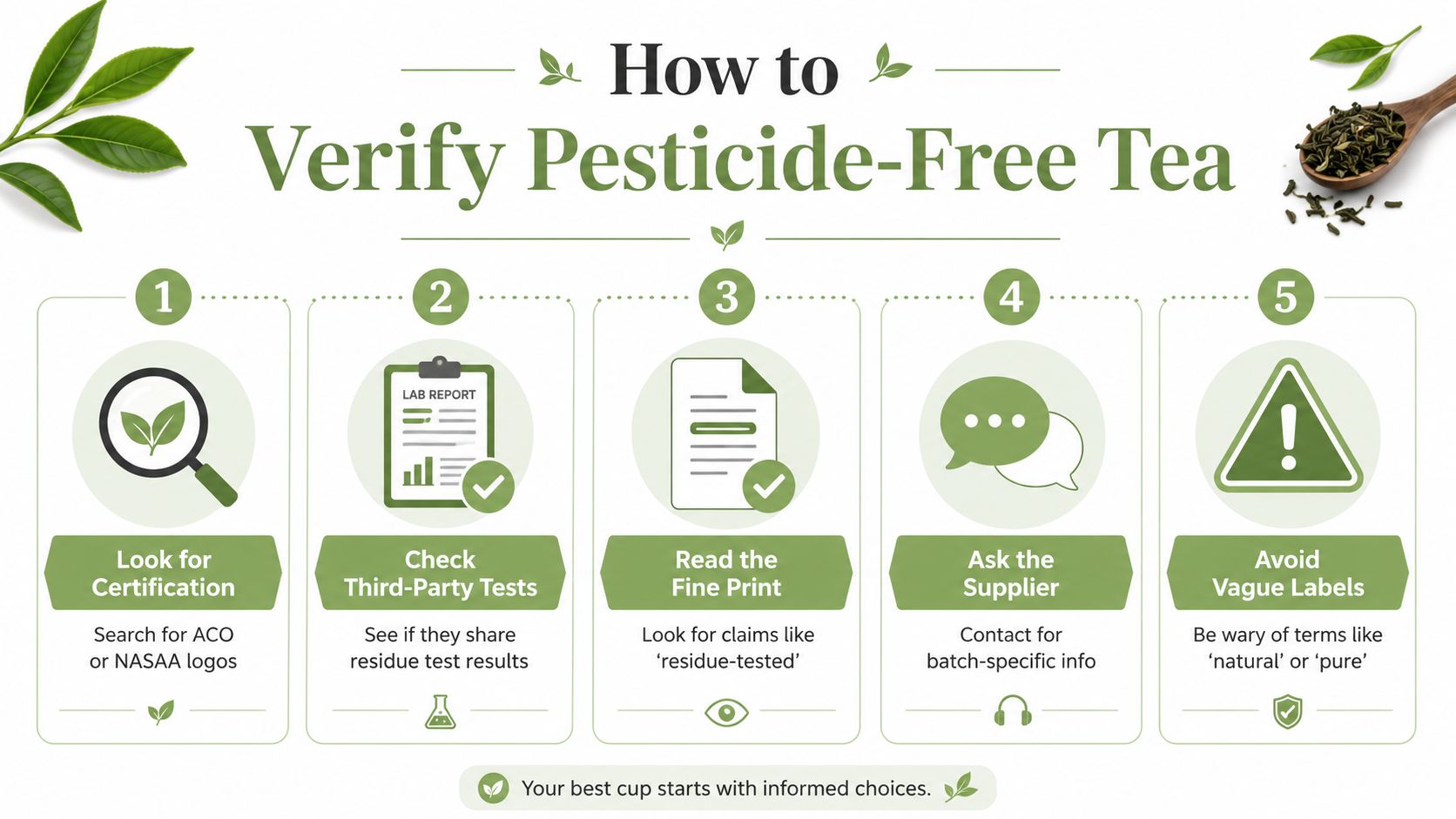
Start with the label and paperwork
Look for a real certification mark, batch number, and country of origin. If you're buying online, read the product page carefully and see whether the brand gives you access to test certificates or a lot code you can ask about later. A few brands make this easy, many don't.
Loose leaf tea often gives you better traceability than pre-bagged tea, because there are fewer layers between the leaf and the pack. That doesn't mean all teabags are a problem, but it does mean the paperwork matters more when you can't see the leaf itself.
Ask the supplier the right questions
The conversation doesn't have to be confrontational. A straightforward supplier will understand the questions and answer them plainly.
- Is this batch certified organic? Ask for the certificate number or lot reference.
- Do you have a residue report for this shipment? The answer should be batch-specific, not generic.
- Where was it grown and packed? Australian-grown tea can have a different risk profile, but imported tea can still be safe if it's independently tested.
- Can you match the test to the lot? If the lot numbers don't line up, the paperwork isn't doing its job.
Independent Australian guidance notes that tea can be grown domestically in north Queensland through to Victoria and Tasmania, and that Australian-grown tea may have low or no pesticide contamination because quarantine has helped prevent pest entry. That same guidance also recommends loose leaf, organically grown tea, or homegrown tea as practical ways to minimise exposure. See the Australian overview from Sustainable Gardening Australia.
For a quick walkthrough of what to look for on shelves, PepTea's organic green tea online page gives you a useful example of how a product page can support the buying decision.
Sourcing Clean Tea for Cafés and Retailers
A café buyer isn't just choosing flavour, they're choosing documentation, consistency, and the ease of answering customer questions. One supplier might offer lovely tea and a vague promise. Another will hand over certificates, batch details, and a cleaner story for the menu board.
What to ask before you list a tea
Start with the basics, then move to evidence. Ask for the organic certificate, the transaction certificate for the current lot, and any multi-residue test report tied to that batch. If a supplier hesitates, that's useful information too.
The cleaner the supply chain, the easier the menu story. Terms like certified organic, batch-tested, and traceable by lot mean more when you can back them up at the point of sale. That's especially helpful for venues that position tea as a premium, health-conscious drink rather than a filler option.
For wholesalers and operators, Everti's guide to brewing coffee tea bags is a practical read if you're also thinking about service workflow and presentation in busy hospitality settings.
A simple procurement example
A café might taste three teas that all look similar on the cup list. One comes with a certificate only, one comes with a certificate and lot number, and one comes with both plus a recent residue report. The third option gives the buyer the cleanest paper trail, even if the flavour is comparable.
That's the model worth using in procurement meetings:
- Process proof from certification.
- Batch proof from residue testing.
- Traceability proof from lot codes and transaction certificates.
- Service fit from format, whether loose leaf, bagged, or matcha.
PepTea is one example of a brand in this space, with certified organic Japanese matcha and Australian-brewed kombucha in its range. For cafés, the practical point is not the brand name, it's the kind of documentation and product clarity you should expect from any supplier in this category.
The Hidden Risk of Packaging and Brewing Habits
A tea can be clean at the farm gate and still lose some of its clean-label appeal in the bag. That's why packaging deserves more attention than it usually gets in pesticide free tea Australia searches.
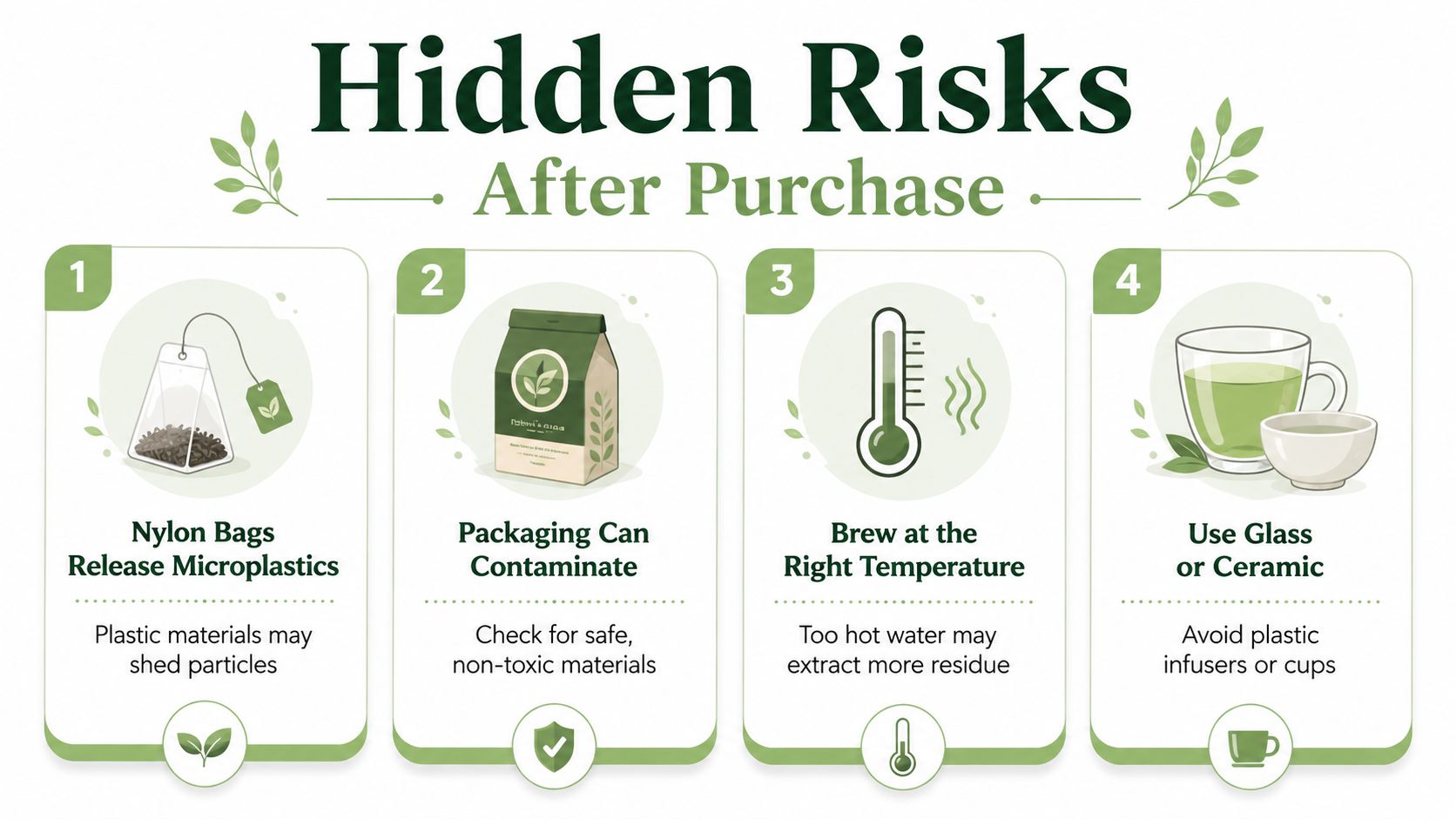
Why the bag matters
Recent Australian consumer and media commentary in 2026 highlighted that nylon pyramid tea bags can release large numbers of microplastic particles into a cup. The practical takeaway is simple. If the leaves are clean but the bag is nylon, the final drink may still carry avoidable plastic exposure. That's why plant-based, plastic-free bags and loose leaf formats are safer choices when you care about the whole cup.
Clean tea is a chain, not a claim. If one part of the chain is compromised, the promise gets weaker.
Brewing and storage still affect quality
Brewing habits can't turn bad tea good, but they can protect the good tea you've already bought. Use the right water temperature for the style you're making, keep tea in airtight containers, and store it away from light so flavour and aroma stay intact longer. Those habits matter even more for matcha, which is a delicate powder and loses freshness faster once exposed to air.
For matcha drinkers, the storage rule is simple. Keep it sealed, cool, and dark, and use it promptly after opening. That helps preserve the bright colour and cleaner flavour people expect from a quality powder.
Building Your Clean Tea Routine in Australia
A clean tea routine starts with a sequence, not a slogan. Certified organic farming, lot-specific residue testing, plastic-free packaging, and proper storage are the four pieces that hold the promise together. Leave one out and the claim gets softer.
A practical routine you can actually use
Begin with what's already in your cupboard. Check whether the tea has a clear lot number, a credible organic certificate, and any evidence of batch testing. If it doesn't, don't panic, just decide whether you want that tea for everyday use or whether you'd rather switch to a more transparent option.
Then make one packaging decision that reduces hassle long term. Choose loose leaf or plastic-free bags where you can, and store everything in airtight containers away from light. For buyers who want a clean, low-fuss routine, that's a simple upgrade with real benefits in the cup.
If you're choosing products for a household, café, or retail shelf, the same logic applies every time. Ask for proof, check traceability, and favour suppliers who can explain their process without getting defensive. That's the difference between a nice-sounding claim and one you can stand behind.
PepTea offers organic matcha and Australian-brewed kombucha for people who want a cleaner, more transparent tea routine. If you're comparing options for home, café, or retail use, visit Pep Tea and look for products that match the proof you'd want in your own cup.
Caffeine Free Matcha Tea: An Honest Guide for Australians
A 100% caffeine free matcha tea made from the tea plant doesn't exist. Standard matcha contains 19 to 44.4 mg of caffeine per gram, and even decaffeinated matcha sold in Australia still retains about 6 mg per serving, with some products described as low-caffeine at around 4 to 8 mg per 2 g serving.
That surprises a lot of people because the label language in this category can be confusing. If you've been searching for a matcha that gives you the ritual, colour, and wellness appeal without the stimulant hit, the better question isn't “Where can I find real caffeine-free matcha?” It's “Which low-caffeine matcha or caffeine-free alternative suits me best?”
For Australians, that distinction matters. It matters if you're sensitive to caffeine, trying to protect sleep, managing anxiety, watching your intake during pregnancy, or choosing products for a café menu where clear labelling builds trust. It also matters because matcha isn't just any green tea. The way it's grown makes it naturally richer in caffeine, which is why the words on the front of the pack don't always tell the full story.
There is good news, though. You still have options. Some are decaffeinated matcha with small residual caffeine. Others are naturally caffeine-free powders and herbal teas that deliver a similar whisk-and-sip ritual without pretending to be tea leaf matcha. Once you know how to read the category properly, it gets much easier to make a smart choice.
The Truth About Caffeine Free Matcha Tea
A tea leaf matcha that is caffeine-free does not exist.
That sounds blunt, but it clears up a lot of label confusion. Matcha is made by grinding whole green tea leaves from Camellia sinensis into a fine powder. Because you consume the leaf itself rather than just an infusion, you are taking in the compounds naturally present in that leaf, including caffeine.
Why the wording causes confusion
The tricky part is marketing language. On Australian shelves, phrases like “decaf matcha”, “low caffeine”, and “caffeine free matcha tea” can look similar at a glance, especially in online listings or café supplier catalogues. They do not mean the same thing.
A useful way to read those labels is to separate the product into two categories. One is real matcha that has had some caffeine removed. The other is a caffeine-free powder or herbal blend that copies the colour, ritual, or flavour direction of matcha but is not true tea leaf matcha.
That distinction matters in real life. If you are choosing for pregnancy, sleep, anxiety, medication interactions, or a late-night café menu, “very low” and “none” are different promises.
Practical rule for Australian buyers: If it is described as matcha and made from tea leaves, assume some caffeine remains unless the pack clearly says it is a non-tea alternative.
Why true matcha always starts with caffeine
Matcha is not made from ordinary green tea leaves. The plants are shaded before harvest, which helps create matcha's deep green colour and savoury, soft umami character. That same growing style also contributes to the chemistry people are trying to avoid.
In other words, asking for caffeine-free matcha is a bit like asking for lactose-free milk that still comes exactly from dairy and tastes exactly the same. Processing can reduce one component, but the original ingredient starts with it for a reason.
For cafés, clear menu wording is helpful. “Low-caffeine matcha” is accurate. “Caffeine-free matcha” is risky unless the drink uses a different base altogether.
What this means for shoppers and café owners
For some people, a small amount of residual caffeine is manageable. For others, even a low-caffeine serve can be enough to affect sleep or trigger jitters.
If you are comparing drinks rather than dry powder labels, our guide to caffeine in a matcha latte gives a more practical sense of what ends up in the cup.
The takeaway is simple:
- True matcha contains caffeine by nature.
- Decaffeinated matcha is reduced-caffeine matcha, not zero-caffeine matcha.
- A genuinely caffeine-free option will usually be a herbal or non-tea substitute, not tea leaf matcha.
Australian consumers are better served by plain language than by wishful wording. Once you know what the label is really saying, it becomes much easier to choose the right product for your pantry, your café menu, or your customers.
The Science of Decaffeinated Matcha
Decaffeinating matcha is a bit like trying to remove one thread from a tightly woven fabric. You can do it, but the surrounding threads may shift as well.
That's why decaf matcha often tastes and feels a little different from standard matcha. The goal is to reduce caffeine while preserving flavour, colour, antioxidants, and the compounds that make matcha distinctive.
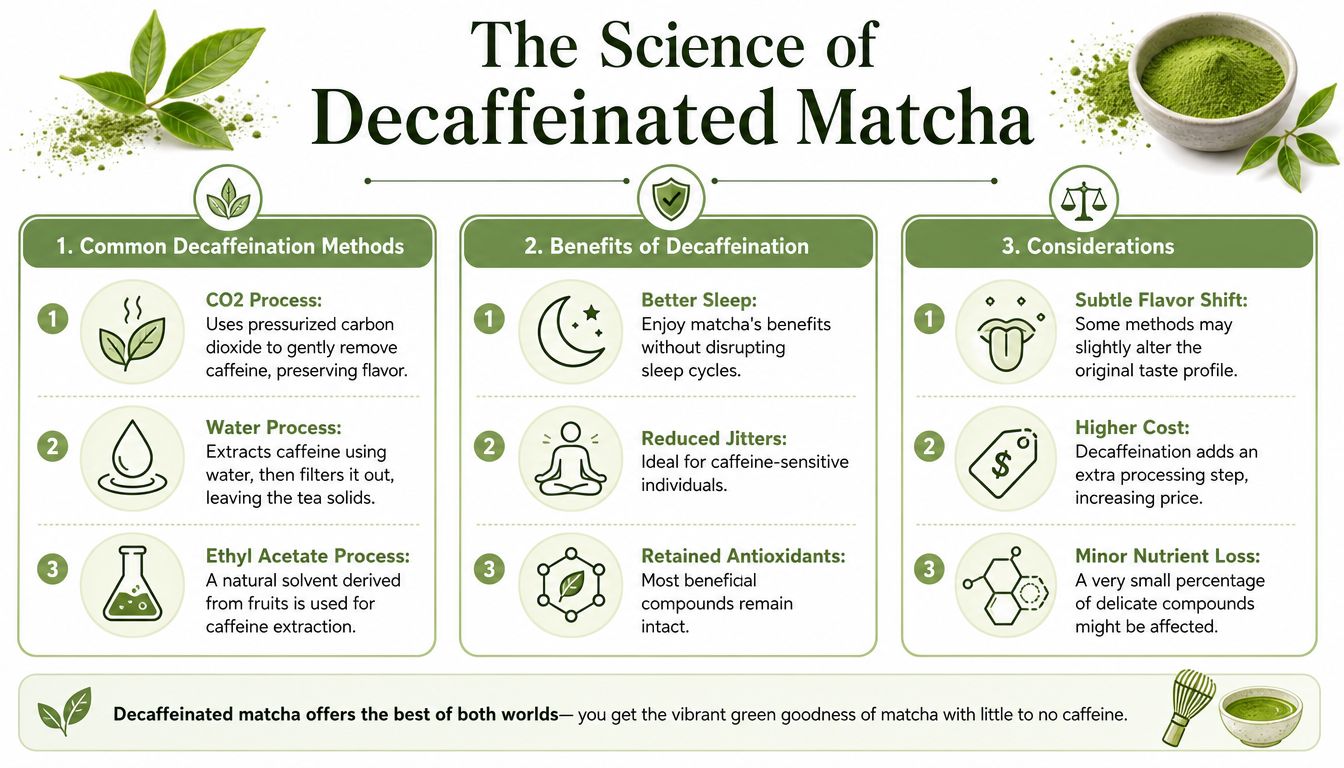
How decaffeination works
Producers use extraction methods to pull caffeine out of the tea material before the final product reaches your cup. You'll commonly see references to:
- CO2 processing, which uses pressurised carbon dioxide
- Water processing, which separates caffeine through water-based extraction
- Ethyl acetate processing, which uses a solvent approach
The exact method matters because matcha is more than caffeine. It also contains amino acids, catechins, and aromatic compounds that shape the drinking experience.
Why L-theanine matters
One of the most important compounds in matcha is L-theanine, the amino acid associated with matcha's savoury, soft umami character and its calmer feel compared with harsher caffeine sources.
A detailed industry explainer on decaf matcha notes that decaffeination must be carefully calibrated because it can degrade up to 30 to 50% of L-theanine, changing both flavour and the familiar “smooth, sustained energy lift” many matcha drinkers look for (decaf matcha processing and L-theanine trade-offs).
Remove caffeine carelessly, and you don't just change the stimulant level. You change the taste, the texture, and the way the tea feels in the body.
What you're likely to notice in the cup
If you taste regular ceremonial matcha and decaf matcha side by side, a few differences often stand out:
| Feature | Regular matcha | Decaffeinated matcha |
|---|---|---|
| Flavour | More umami, fuller | Often softer, sometimes flatter |
| Mouthfeel | Creamier, richer | Can feel lighter |
| Energy profile | More noticeable lift | Gentler, less stimulating |
| Best use | Straight tea, premium latte | Evening latte, lower-caffeine routine |
That doesn't make decaf matcha inferior. It makes it a different product with a different purpose.
Who should choose it
Decaf matcha makes sense when your priority is lowering stimulation rather than preserving every part of the classic matcha experience.
That may include:
- Evening drinkers who want the ritual without disturbing sleep.
- Caffeine-sensitive people who still enjoy matcha flavour.
- Gradual reducers cutting back from coffee or stronger caffeinated drinks.
A good decaf matcha should still taste pleasant, whisk smoothly, and work well in lattes. It just won't behave exactly like the full-strength version.
The Benefits of Lowering Your Caffeine Intake
Some people don't need less caffeine. Others feel better when they cut back.
That's where lower-caffeine matcha products can be helpful. They offer a middle ground for people who still enjoy matcha's flavour and wellness appeal but don't want the full stimulant load.

When lower caffeine makes sense
For Australian readers, this often comes up in everyday situations rather than extreme ones.
You might be someone who:
- Gets jittery easily after tea or coffee
- Finds caffeine affects sleep even earlier in the day
- Prefers a gentler afternoon drink
- Needs to be cautious because of pregnancy, breastfeeding, or medication conversations with a health professional
- Wants the ritual without the buzz
An Australian-focused source notes that reducing caffeine can be particularly relevant for people following guidance around caffeine sensitivity, while decaffeinated matcha can still retain strong levels of tea compounds such as polyphenols at 1765.1 mg/L and flavonoids at 1968.8 mg/L (overview of catechins and tea compounds in matcha).
It's not only about energy
Lowering caffeine intake can change more than how “wired” you feel.
People often choose low-caffeine options because they want:
- a calmer evening routine
- less chance of overstimulation
- more flexibility with timing
- a tea they can enjoy without second-guessing how they'll feel later
That's especially useful if your day already includes coffee, pre-workout drinks, cola, or dark chocolate. Sometimes the issue isn't one drink. It's the combined load.
Here's a helpful visual guide if you'd like to see matcha preparation in action:
What you still keep
Choosing decaf or low-caffeine matcha isn't about settling for nothing. It's about changing the balance.
Worth remembering: lower caffeine and zero caffeine are not the same thing, but lower caffeine can still be the right choice if your goal is moderation rather than strict avoidance.
You may still get the sensory parts people love about matcha: the whisking ritual, the green colour, the savoury note, and the feeling of choosing something more intentional than a sugary drink. For many drinkers, that's enough reason to make the switch.
Exploring Naturally Caffeine-Free Alternatives
If you want the ritual of matcha without any tea-plant caffeine at all, alternatives get interesting very quickly.
Some don't taste like matcha, and they shouldn't pretend to. What they do offer is a similar preparation style: sift, whisk, froth, sip. That makes them ideal for people who love the ceremony but want a caffeine-free cup.
A better way to think about alternatives
Instead of asking which product “copies” matcha best, ask which one suits the mood you want.
Some alternatives are earthy and comforting. Others are floral or vibrant. Some make a beautiful latte. Others work better iced or blended into smoothies. If you enjoy keeping notes on flavour and texture, this AI tea tasting guide is a handy way to compare what you notice from cup to cup.
Caffeine-Free Matcha Alternatives
| Alternative | Taste Profile | Key Health Benefit | Best For |
|---|---|---|---|
| Rooibos powder | Earthy, mellow, slightly sweet | Naturally caffeine-free everyday option | Lattes, evening drinks |
| Butterfly pea flower powder | Light, floral, visually striking | Colourful ritual and visual appeal | Iced drinks, layered lattes |
| Carob powder blends | Toasted, cocoa-like, comforting | Dessert-style drink without tea caffeine | Winter drinks, kids' drinks |
| Roasted herbal powders | Nutty or toasty depending on blend | Café-style warmth without tea leaf stimulants | After-dinner cups |
Rooibos is often the easiest starting point
Rooibos works especially well for people who want body and warmth without grassy notes. It doesn't taste like Japanese matcha, but it does make a satisfying whisked drink with milk.
If you want to learn more about rooibos as a wellness tea in its own right, our guide to organic green rooibos tea goes deeper into flavour and everyday uses.
Rooibos isn't a substitute in the strict sense. It's a different drink that solves the same problem for many people.
A simple Sunset Rooibos Latte
This is one of the easiest ways to create a comforting, café-style drink at home.
What you'll need
- Rooibos powder or very fine rooibos blend
- Warm milk of choice
- A little honey or maple syrup, if you like
- Pinch of cinnamon or vanilla
How to make it
- Sift the powder into a bowl or mug so it doesn't clump.
- Add a small splash of warm milk and whisk into a smooth paste.
- Pour in more warm milk while whisking or frothing.
- Sweeten lightly if needed.
- Finish with cinnamon for a sunset-coloured top note.
Frothing tips that help
- Use warm, not boiling milk so the drink stays smooth.
- Whisk the paste first before topping up with more liquid.
- Choose a wider bowl or mug if you're using a bamboo whisk.
- Add spices last so they sit on top rather than sinking into lumps.
Other rituals worth trying
A few good ways to enjoy these powders:
- Evening latte with rooibos and oat milk
- Iced blue drink with butterfly pea flower and coconut milk
- Layered mocktail for cafés wanting an alcohol-free hero drink
- Smoothie add-in for colour and texture
For strict caffeine avoidance, these alternatives are often more straightforward than chasing a “caffeine-free” matcha label that still belongs to the tea category.
Smart Choices for Your Cafe Menu or Store Shelf
For cafés and retailers, this topic isn't just about product knowledge. It's about trust.
Customers ask direct questions. “Is this caffeine-free?” “Can I have this at night?” “Is this okay if I'm avoiding caffeine?” If the menu board says one thing and the product reality says another, confidence disappears quickly.

Label the offer honestly
The simplest fix is clear naming.
Instead of listing a drink as “Caffeine-Free Matcha Latte”, consider language such as:
- Low-Caffeine Matcha Latte
- Decaf Matcha Latte
- Rooibos Latte
- Blue Butterfly Pea Latte
- Herbal Matcha-Style Latte
Those names do two jobs. They help customers choose quickly, and they reduce awkward conversations at the counter.
Menu advice: Name the ingredient honestly, then train staff to explain the difference in one sentence.
Supply matters as much as wording
Australian venues have also had to deal with supply pressure. A hospitality industry update reported that the Australian sector faced a severe matcha shortage starting in 2024, driven by record-high import costs and strong demand, which directly affected cafés and retailers sourcing premium matcha (Australian matcha shortage and supply chain pressure).
That matters for specialty lines even more than regular ones. If you're offering ceremonial matcha, decaf matcha, and caffeine-free herbal alternatives, stock planning becomes part of customer service.
A practical menu mix
A strong drinks list usually includes a spectrum rather than a single answer.
| Customer need | Best menu fit | Why it works |
|---|---|---|
| Wants classic matcha | Ceremonial matcha latte | Full flavour and traditional profile |
| Wants less stimulation | Decaf or low-caffeine matcha latte | Keeps some matcha character |
| Wants zero tea caffeine | Rooibos or herbal latte | Clear and genuinely caffeine-free |
| Wants visual novelty | Butterfly pea or layered wellness drink | Strong café appeal |
If you're reviewing broader beverage positioning, our article on profitable café menu ideas can help you think through where these drinks fit.
Small details shape perception
Presentation counts too. If you're serving takeaway drinks, cup choice affects heat retention, branding, and the overall feel of a premium non-alcoholic menu. Afida's paper cup guide is a useful reference if you're comparing practical options for café service.
For retailers, the equivalent is shelf clarity. Use signage that separates:
- true matcha,
- decaffeinated matcha,
- naturally caffeine-free alternatives.
That structure makes the category easier to shop and easier to trust.
Your Questions on Caffeine Free Matcha Answered
The biggest point to clear up is simple. “Caffeine-free matcha” and “decaf matcha” are not the same thing, and that distinction matters if you are buying for yourself, your family, or an Australian cafe menu.
Is decaf matcha completely caffeine-free
No. Decaffeination reduces caffeine, but it does not turn matcha into a zero-caffeine product. Matcha is made from whole tea leaves ground into powder, so even after processing, some caffeine usually remains.
That is why Australians who need to avoid caffeine altogether should look beyond decaf matcha and choose a naturally caffeine-free option instead, such as rooibos or an herbal latte blend.
Is decaf matcha safe during pregnancy
This is a question for your doctor or midwife, because pregnancy advice depends on your overall daily caffeine intake, your health history, and how sensitive you are to caffeine.
The useful rule is to treat “decaf” as “lower caffeine,” not “no caffeine.” If you are checking labels in an Australian supermarket, health store, or cafe, that one mindset shift helps prevent a very common mistake.
Does decaf matcha taste the same as regular matcha
Usually, no.
Many drinkers notice less umami, less savoury depth, and a softer finish. A good comparison is coffee beans after decaffeination. The drink can still be enjoyable, but the flavour profile often changes because processing affects more than just caffeine.
In a latte, milk can smooth over some of that difference. In a straight whisked bowl, the gap is easier to notice.
How can I lower caffeine at home if I'm using regular matcha
You cannot remove caffeine from regular matcha in your kitchen, but you can lower how much you drink in a serve.
A few practical changes help:
- Use a smaller amount of powder. Less matcha in the bowl means less caffeine in the cup.
- Make it as a larger latte. More milk and less matcha gives you a gentler drink.
- Drink it earlier in the day. For many people, timing affects sleep as much as dose.
- Keep it to one serve. Refill habits often add more caffeine than people realise.
This is often the most realistic option for Australian households. You keep the flavour and ritual of matcha, but adjust the strength to suit your routine.
What about hojicha
Hojicha is roasted green tea, and it is often chosen by people who want a warmer, toastier, lower-caffeine tea experience.
It is not caffeine-free, and it does not taste like matcha. Still, it can be a smart middle ground for someone who enjoys Japanese tea but wants less intensity. For cafes, hojicha lattes also make sense as a menu option because staff can explain them clearly in one line: roasted green tea, softer flavour, lower caffeine than matcha.
What should I look for on an Australian label
Start with the product name, then check the ingredient list. Those two parts should match.
Clear wording includes:
- decaffeinated matcha
- low-caffeine matcha
- herbal powder
- rooibos latte blend
- butterfly pea powder
Be cautious with vague phrases on the front of the pack if the ingredients still list green tea or matcha. Name the ingredient accurately, then train staff to explain the difference in one sentence. That approach works well in retail and in cafes because it builds trust quickly.
For zero tea caffeine, choose products labelled as herbal or rooibos based, not tea based. Clear and completely caffeine-free is very different from reduced caffeine.
If you'd like help choosing between premium organic matcha and other functional tea options, explore Pep Tea for Australian-focused guidance, organic tea education, and a carefully selected range built around quality, authenticity, and everyday wellness.
Best Green Tea for Weight Loss in Hindi: 2026 Guide
If you've searched for the best green tea for weight loss in Hindi, you've probably seen the same advice repeated again and again. Pick any brand. Drink it twice a day. Watch the fat disappear.
That advice isn't honest.
Green tea can play a useful role in a healthy routine, but it isn't a shortcut. What matters most isn't flashy packaging or a random “top 10” list. It's tea quality, EGCG content, how you drink it, and what else you're doing with food, movement, sleep, and stress.
This guide takes a clearer approach. Instead of another brand list, it explains why some green teas are far more worthwhile than others, why matcha stands out, and how to use tea in a practical way that supports wellness without overpromising.
The Honest Truth About Green Tea and Weight Loss
A lot of Hindi-language content treats green tea like a fat-loss trick. That's the first myth to drop.
Apollo Hospitals notes that “there is no solid scientific evidence that green tea consumption significantly reduces excess body weight in obese people,” and it should be seen as a supportive tool alongside diet and exercise, not a standalone solution.
That single point clears up a lot of confusion. If you're drinking green tea but still eating in a calorie surplus, sleeping poorly, and barely moving, tea won't rescue the situation. If you're already building better habits, green tea may support the process.
What people often get wrong
Many readers assume “healthy drink” automatically means “weight-loss drink”. It doesn't.
Green tea sits in a more realistic category:
- It may support appetite awareness for some people
- It may replace sugary drinks if you normally reach for juice, soft drink, or sweet café beverages
- It may fit well before exercise or between meals
- It doesn't melt fat on its own
Green tea works best when it supports habits that already make sense.
That's also why some people benefit from broader support, not just a pantry change. If someone is dealing with persistent weight concerns, medical factors, or appetite regulation issues, structured care such as ProMD Health integrated wellness care can be more useful than relying on one drink.
A better way to think about it
Instead of asking, “Which tea burns the most fat?” ask these questions:
- Am I using tea to replace something less healthy?
- Am I choosing a high-quality tea with meaningful active compounds?
- Am I pairing it with exercise and sensible eating?
- Am I expecting support, not miracles?
That mindset is far more helpful than chasing hype. It also makes the phrase best green tea for weight loss in Hindi much more straightforward to answer. The best choice isn't the loudest brand. It's the tea that gives you real quality and fits into a routine you are able to maintain.
How Green Tea Actually Supports Your Metabolism
Green tea helps through a small metabolic nudge, not a dramatic body transformation. The two key players are catechins, especially EGCG, and caffeine.
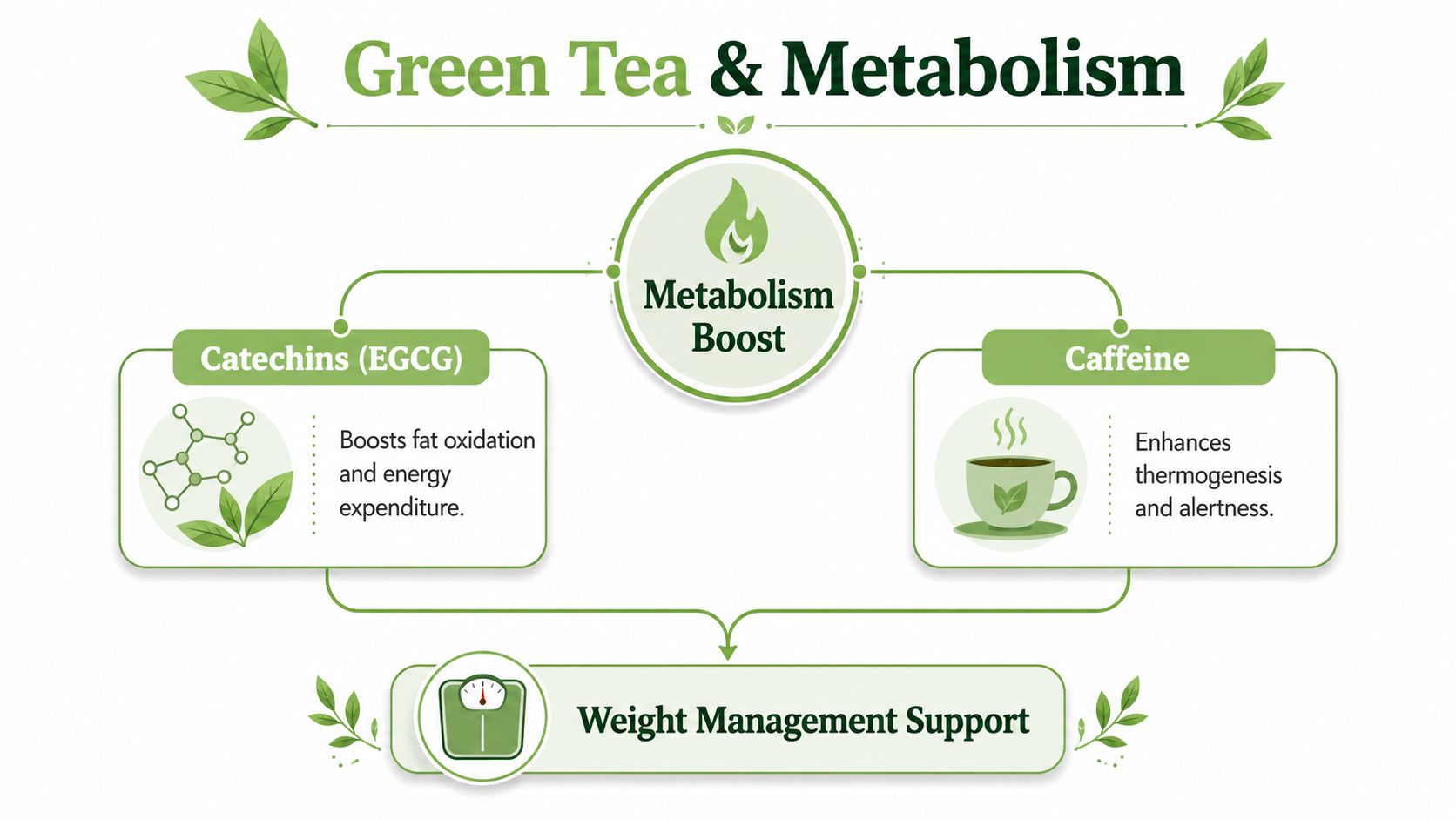
The simple version of the science
Think of your metabolism as your body's energy engine. Green tea doesn't replace the engine. It just gives it a gentle push.
EGCG is a catechin found in green tea. It's linked with fat oxidation, which means your body becomes a bit better at using fat for energy. Caffeine adds a mild stimulant effect, which can support thermogenesis, meaning the body uses energy to produce heat.
Together, those compounds may help with:
- Fat use during activity
- A slight lift in energy expenditure
- Better focus before a walk or workout
- Replacing higher-calorie beverages
What the evidence actually says
A Cochrane review discussed by CHOICE found that green tea preparations cause only modest weight loss, but a secondary analysis found that regular consumption over 12 weeks was linked to 1.3 kg greater weight loss than non-consumers. That's useful, but it also shows the effect is not huge.
People often expect green tea to do the heavy lifting. It won't. The effect is better described as incremental.
Practical rule: Green tea can support momentum. It doesn't create momentum from nothing.
Why that still matters
Small effects aren't useless. They're useful when they stack with other good habits.
For example, green tea may help if you:
- Drink it before exercise and feel more switched on
- Swap it for sweet milk tea or packaged drinks
- Use it as part of an organised morning routine
- Pair it with better food choices and consistent movement
If you're looking at the bigger picture, it also helps to learn about evidence-based metabolic foods so tea becomes one part of a sensible pattern, not the whole plan.
The takeaway
Green tea supports metabolism through EGCG and caffeine, but the support is modest. That's not bad news. It's just realistic news. Once you accept that, you can stop looking for magic and start choosing tea more intelligently.
Why Not All Green Teas Are Created Equal
Most articles answering “which brand is best?” skip the most important detail. Not all green tea delivers the same amount of useful compounds.
That's why one person drinks cheap tea bags and notices nothing, while another chooses a better product and has a very different experience.
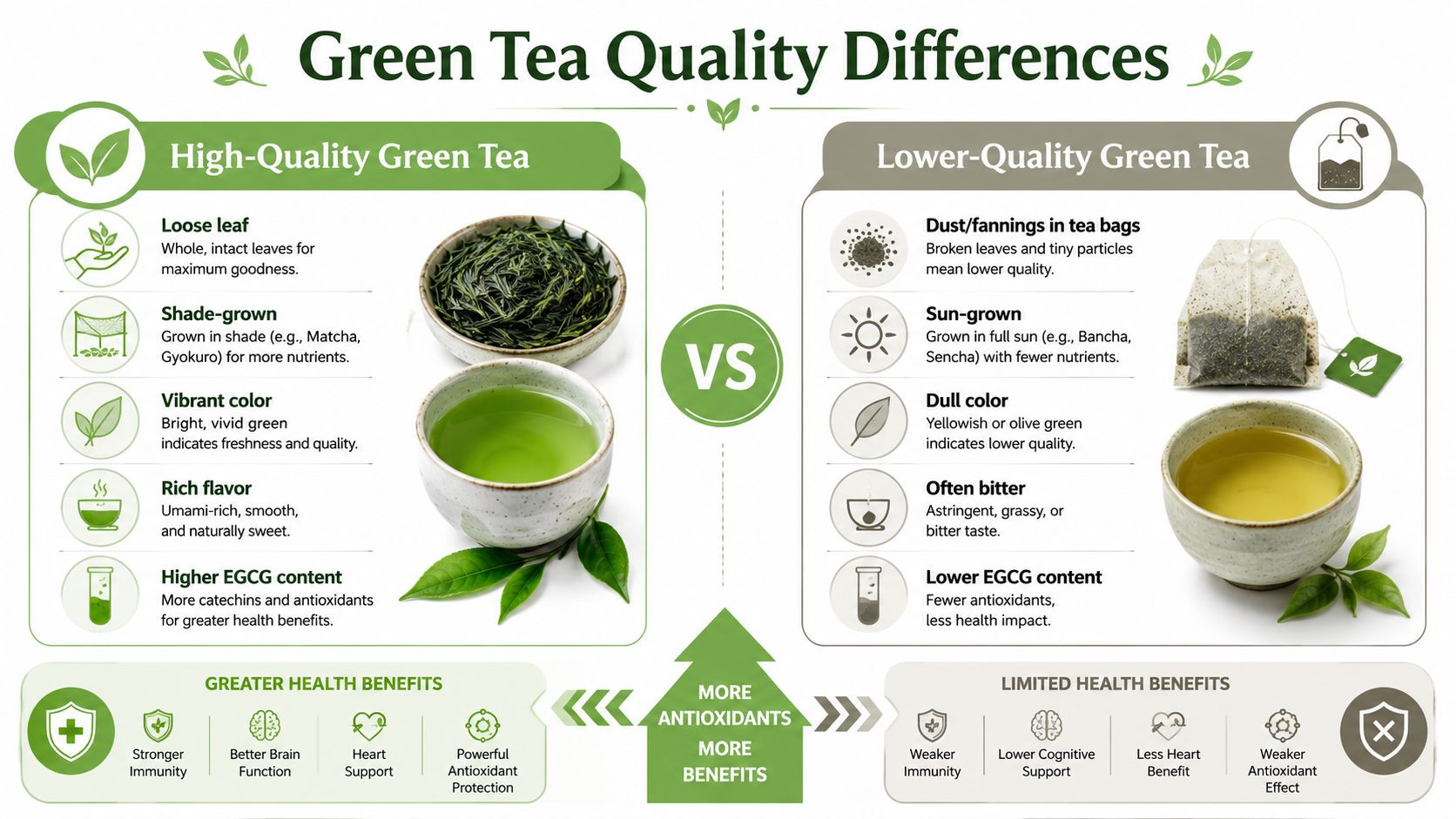
EGCG content matters more than branding
A key point from Lybrate's discussion is that the effectiveness of green tea for weight loss hinges on its EGCG concentration, which varies dramatically between products. It also notes that studies show 200–300mg of EGCG per serving is needed for a metabolic boost, and low-grade tea bags often don't reach that level.
So when readers ask for the best green tea for weight loss in Hindi, the better question is this: what kind of green tea gives me a worthwhile amount of EGCG?
Green Tea Formats Compared
| Feature | Standard Tea Bags | Loose-Leaf Tea | High-Grade Matcha |
|---|---|---|---|
| Leaf quality | Often lower-grade particles or dust | Better whole-leaf integrity | Finely stone-ground whole leaf |
| Flavour | Can taste flat or bitter | Fresher and more layered | Rich, vibrant, full-bodied |
| Nutrient access | Limited to what infuses into water | Better infusion potential | You consume the whole leaf |
| EGCG potential | Often lower | Moderate to good | Typically the strongest option |
| Best for | Convenience | Everyday tea drinkers | People prioritising potency and quality |
What to look for instead of a hypey label
A useful buying checklist looks like this:
- Leaf form: Whole leaf or powder usually tells you more than brand popularity.
- Colour: Dull, brownish-green tea often signals poorer freshness or handling.
- Processing: Careful processing helps preserve flavour and active compounds.
- Ingredient transparency: If a product leans on trendy add-ins but says little about the tea itself, be cautious.
If a tea is marketed for fat loss but tells you nothing about quality, that's a warning sign.
Cheap tea bags aren't always a bargain
A lower price can be fine if you want a light daily drink. But if your goal is metabolic support, quality becomes the key filter.
That's where many “best brand” lists fall apart. They compare names, flavours, and celebrity appeal, but they don't explain why one tea format may be more meaningful than another. Once you start judging tea by quality and EGCG potential, the conversation changes completely.
Spotlight on Matcha The Antioxidant Powerhouse
If standard green tea is a gentle wellness drink, matcha is the concentrated version. The reason is simple. With matcha, you consume the powdered leaf itself rather than just steeping leaves in water and discarding them.
That makes matcha especially interesting for readers who want the strongest green tea option in a practical daily form.
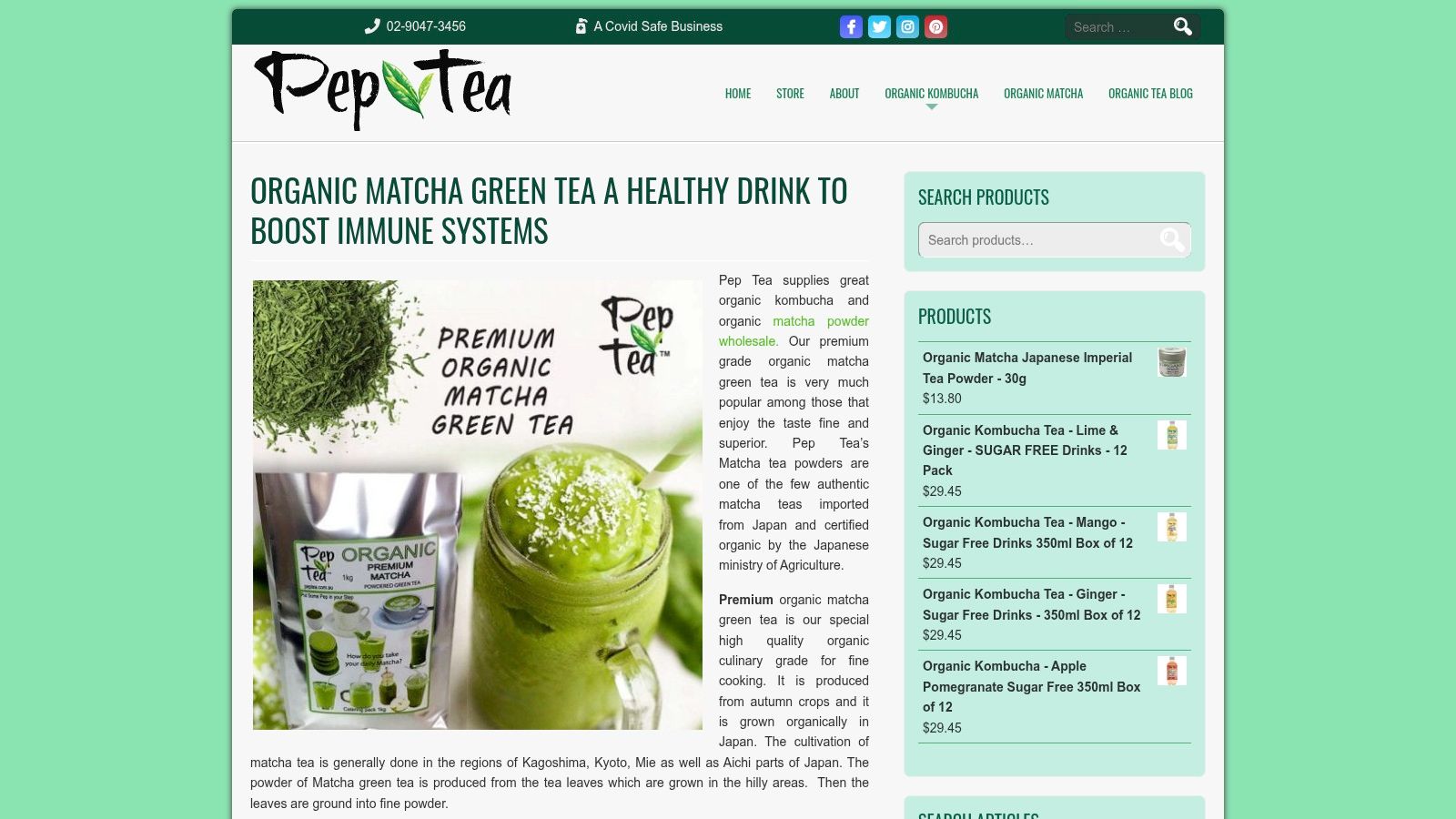
Why matcha stands out
Matcha is rich, vibrant, and more substantial than regular brewed green tea. Because it's a powder, every sip contains the leaf material itself. That's one reason it has become a favourite among people who want a cleaner pre-workout drink or a calmer alternative to coffee.
The most compelling point here comes from Pure Matcha's review of the evidence. It reports that high-grade organic matcha powder can increase fat-burning by 17% during exercise, largely due to its high EGCG concentration, which enhances thermogenesis and can block digestive enzymes when consumed 30 minutes before activity.
That's a very different claim from “drink tea and lose weight on the couch”. It ties the benefit to exercise, timing, and quality.
Matcha also suits real life
People often ask whether matcha is too intense, too grassy, or too hard to prepare. It doesn't have to be.
A good matcha offers:
- Smooth energy
- A more concentrated green tea experience
- Easy use in hot drinks, iced drinks, and smoothies
- A simple option before walking, gym work, or yoga
For readers who want to understand the broader nutritional appeal, this guide on matcha tea powder as a powerhouse of antioxidants gives helpful context.
Ceremonial or culinary
This is another point that often confuses people.
Ceremonial-grade matcha is usually chosen for drinking straight because the flavour is smoother and more refined. Culinary-grade matcha is often better for lattes, baking, smoothies, or recipes where other ingredients are involved.
If your main goal is a daily wellness drink, quality matters more than trendy packaging. Choose matcha that looks vibrant and tastes clean, not dull and harsh.
When seeking the “best” green tea in Hindi, matcha deserves a serious look. Not because it's fashionable, but because it solves the biggest problem in this category: weak tea with weak payoff.
Your Practical Guide to Using Green Tea and Matcha
Knowing what to buy is only half the job. The other half is using it in a way that fits your day.
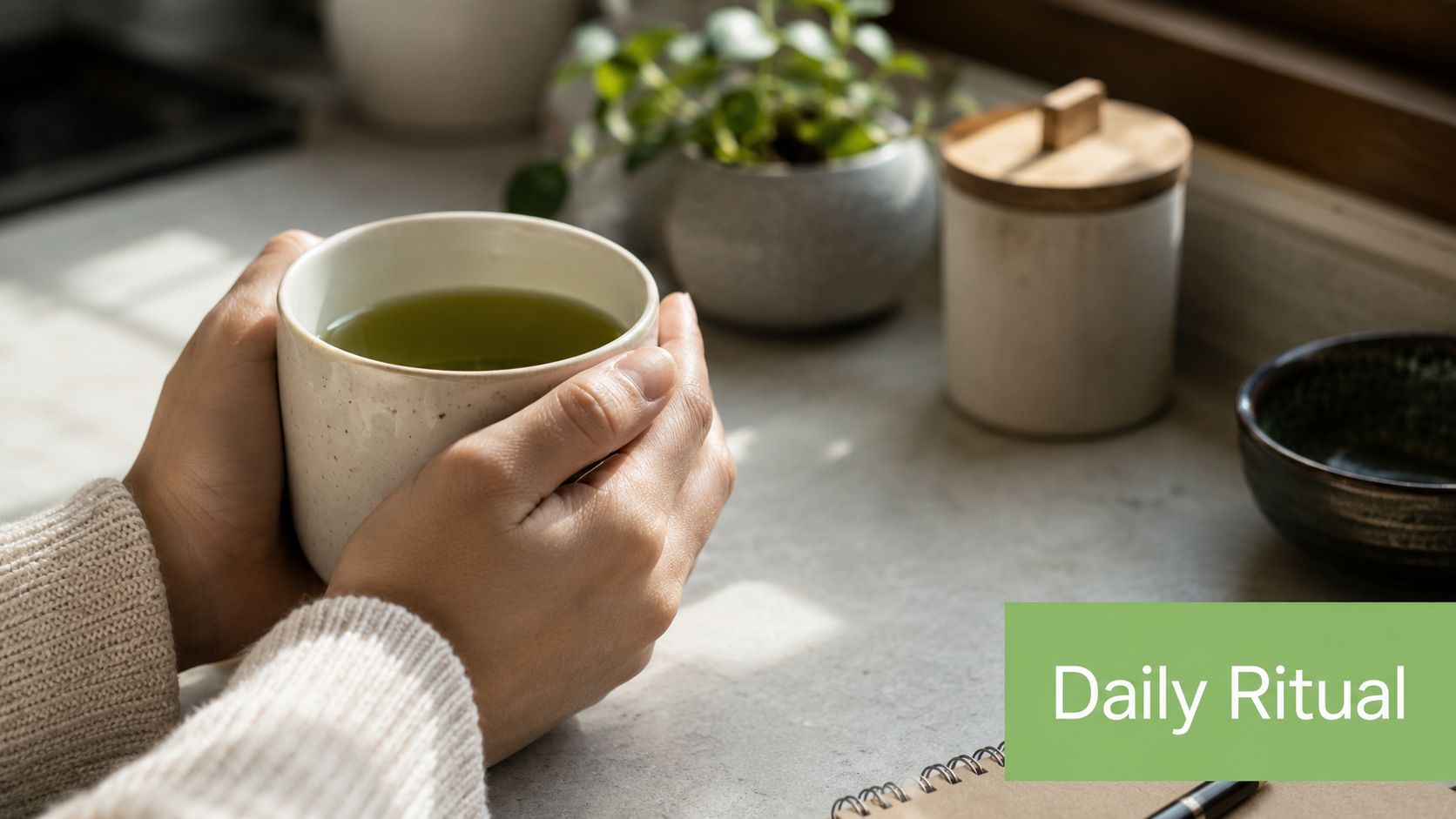
When to drink it
Timing can make tea feel more useful.
Before exercise works well for many people. Matcha is especially popular here because it feels light, focused, and easy on the stomach. If you're using matcha in an exercise routine, the earlier research discussed above points to taking it 30 minutes before activity.
Between meals can also be helpful. Some people find a warm cup reduces the urge to snack mindlessly in the afternoon.
Earlier in the day is often best if you're sensitive to caffeine.
How to brew green tea properly
Poor brewing ruins a lot of green tea. If the water is too hot, the tea can turn harsh and bitter.
A simple approach:
- Heat water, but don't use boiling water straight away
- Steep briefly
- Taste and adjust next time
- Drink it plain if possible, especially if weight management is the goal
If you usually load green tea with sugar or honey, you may cancel out part of the benefit. Start with a milder tea and let your palate adjust.
How to make matcha without lumps
Matcha sounds fancy, but the method is easy.
- Sift the powder if it clumps
- Add a small amount of water first
- Whisk until smooth
- Top up with more water or unsweetened milk
A basic matcha latte works well with unsweetened milk and no syrup. If you want flavour, cinnamon can help without turning it into dessert.
For a more detailed routine, this article on the best way to drink green tea for weight loss is useful.
Easy ways to include it
Different routines suit different people:
- Morning swap: Replace a sugary café drink with plain green tea or a simple matcha.
- Pre-walk ritual: Have matcha before a brisk walk or training session.
- Smoothie add-in: Blend matcha into a low-sugar smoothie.
- Afternoon reset: Choose green tea instead of biscuits and another coffee.
A visual guide can help if you're new to prep techniques.
What not to do
Some habits undo the point:
- Don't treat tea like compensation for overeating
- Don't assume more is always better
- Don't buy poor-quality tea and expect premium results
- Don't ignore sleep, meals, and movement
The best green tea routine is the one you can repeat calmly, not the one that sounds extreme online.
Beyond Tea The Gut Health Link with Kombucha
Weight management isn't only about metabolism. Daily choices around digestion, cravings, and drink habits matter too.
That's where kombucha enters the picture in a different way from green tea. Kombucha is a fermented tea, and many people enjoy it as part of a gut-friendly routine. It isn't a fat-loss shortcut either, but it can be a smart replacement for sugary soft drinks or alcohol-heavy habits.
Why the swap matters
A lot of people focus on one “super drink” while ignoring the bigger issue. They still consume sweet beverages through the day.
Switching to kombucha can help because it offers:
- A more interesting alternative to soft drink
- A fermented tea option that fits wellness routines
- A refreshing choice for people trying to cut back on sugar-heavy drinks
- A social, alcohol-free option for cafés and home gatherings
Gut health and everyday habits
People often talk about the gut in overly complicated terms. In plain language, your digestive system influences how you feel day to day. When your routine is all over the place, food choices usually are too.
That doesn't mean kombucha solves weight issues. It means it can fit into a broader pattern that feels cleaner and easier to sustain.
A helpful drink is often the one that replaces a less helpful habit.
For readers interested in how fermented tea fits into this picture, this overview of the benefits of kombucha is a good starting point.
A sensible role for kombucha
Use kombucha as a complement, not a cure. If green tea or matcha supports focus and routine, kombucha can support the other side of the equation by giving you a more satisfying alternative to sugary drinks.
That combination makes more sense than chasing single-product promises.
Frequently Asked Questions About Green Tea
Can I lose weight by drinking green tea alone
Probably not in any meaningful way. The evidence discussed earlier shows green tea is better seen as a supportive tool, not a standalone solution. If there's no improvement in diet, movement, or overall routine, results are likely to be disappointing.
Which is better for weight management, green tea or matcha
If you're choosing based on potency and leaf use, matcha usually has the stronger case because you consume the whole powdered leaf. Standard green tea can still be a good choice, especially if you want something lighter and simpler.
How many cups should I drink
There isn't one perfect number for everyone. It depends on the product, how strong it is, and how you respond to caffeine. A practical approach is to start modestly and pay attention to sleep, digestion, and overall comfort.
Can I drink green tea at night
You can, but many people do better having it earlier in the day because of the caffeine content. If evening tea affects your sleep, shift it to morning or afternoon.
What should Hindi-speaking buyers look for first
Look beyond “best brand” lists. Focus on:
- Tea format
- Quality
- Freshness
- Ingredient transparency
- Whether it fits your actual routine
Is a tea bag enough
Sometimes, yes, if your main goal is replacing a less healthy drink. But if you're specifically interested in metabolic support, low-grade tea bags are often not the strongest option. That's why quality becomes the deciding factor.
If you want a cleaner, more realistic way to build a tea routine, explore Pep Tea for premium organic matcha and sugar-free organic kombucha made with an Australian wellness mindset.
Does Organic Tea Have Pesticides: Understanding Organic Tea
Certified organic tea in Australia should not contain synthetic pesticides because the standard explicitly prohibits them, and Australia's tea residue limit is often 0.05 mg/kg, compared with the European Union's 0.01 mg/kg. But the word organic on its own isn't the whole story, because the safety difference often comes down to whether a tea is properly certified, where it was grown, and how transparent the brand is about testing.
A lot of people ask, “does organic tea have pesticides?” and expect a simple yes or no. The honest answer is more useful than that. If your tea is certified organic, that's very different from a pack that merely uses feel-good language like “natural”, “pure” or “organically grown”.
That distinction matters even more when you drink matcha, because you consume the whole leaf, and when you drink kombucha, because the final brew starts with tea. If the base ingredient isn't clean, the finished drink doesn't magically become cleaner.
Tea labels can get confusing for Australian shoppers. The front of the pack might look wholesome, earthy, even premium. But a certification mark tells you far more than the colour scheme or the marketing copy ever will. Once you know what to look for, it gets much easier to shop with confidence.
So Does Your Organic Tea Contain Pesticides
If the tea is certified organic in Australia, the answer is that it shouldn't contain synthetic pesticides. That's the reassuring part. The part many people miss is that not every tea sold as “organic” gives you the same level of confidence.
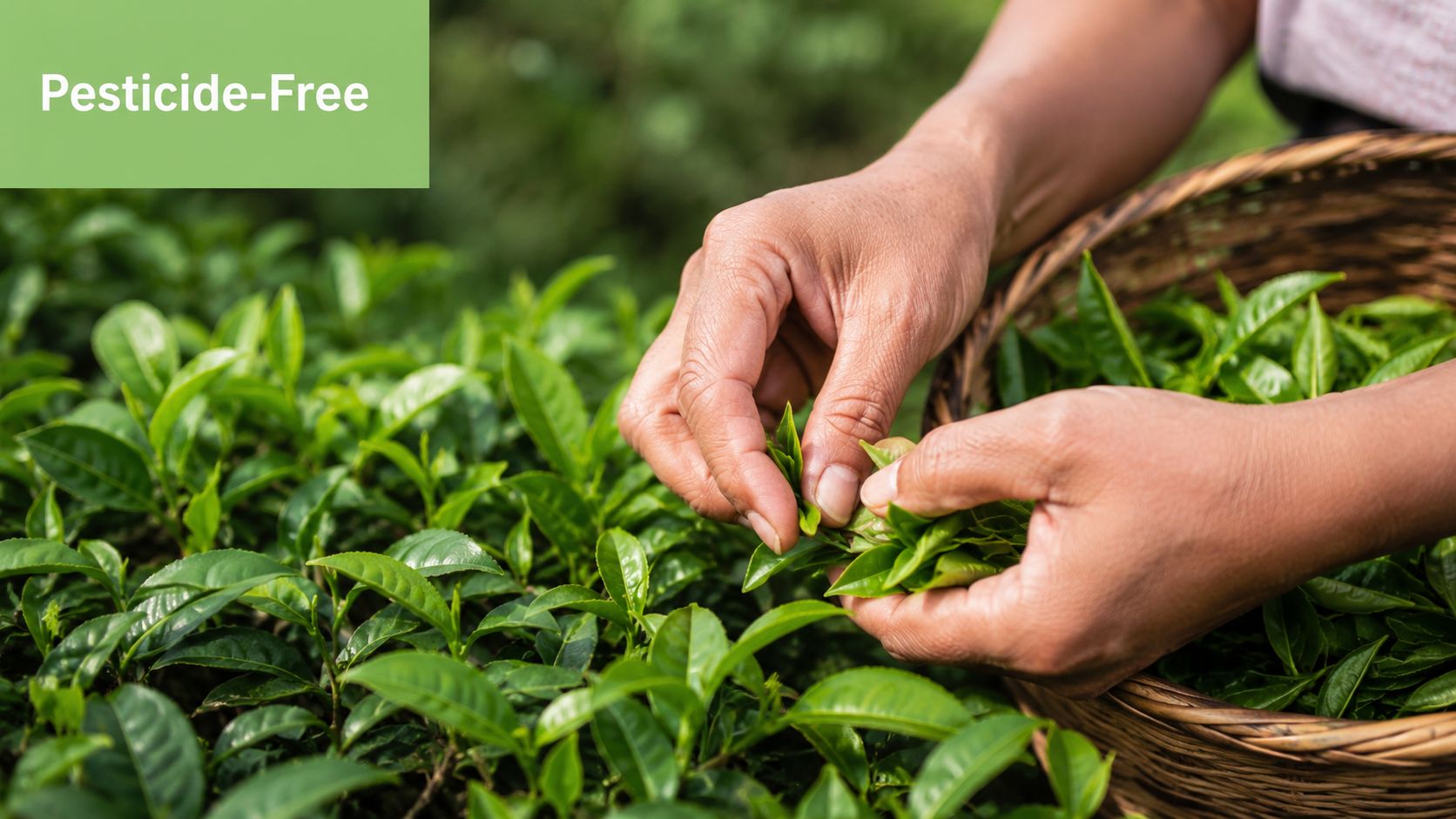
Tea is one of those products where the details matter. A loose-leaf black tea, a green tea bag, a ceremonial matcha and a bottle of kombucha might all sit in the same kitchen, but they don't carry the same exposure risks or the same certification signals. That's why the blanket question “does organic tea have pesticides” often leaves people more confused than informed.
The short version
Here's the practical way to understand it:
- Certified organic tea means synthetic pesticides are prohibited under the certification standard.
- A generic organic claim isn't always enough on its own if you can't see a recognised certification mark.
- Source matters because tea plants can absorb more than just pesticides from their environment.
- Product type matters because matcha is consumed differently from steeped tea.
Practical rule: Don't judge tea safety by the word “organic” alone. Judge it by the certification behind it.
There's another reason this topic trips people up. People often assume “organic” means every possible contamination issue has been solved. It hasn't. Organic certification is powerful, but it answers one part of the question very well and other parts only partially.
For most shoppers, that's good news. You don't need to become a chemist to buy better tea. You just need to know how to separate a certified claim from a marketing claim, and how to read the cues that matter most.
Decoding The Organic Label on Tea in Australia
The easiest way to understand certified organic is to compare it with qualifications. If someone says they're a great cook, that might be true. If they've completed formal training and passed assessments, you have something independent to rely on. Tea works the same way.
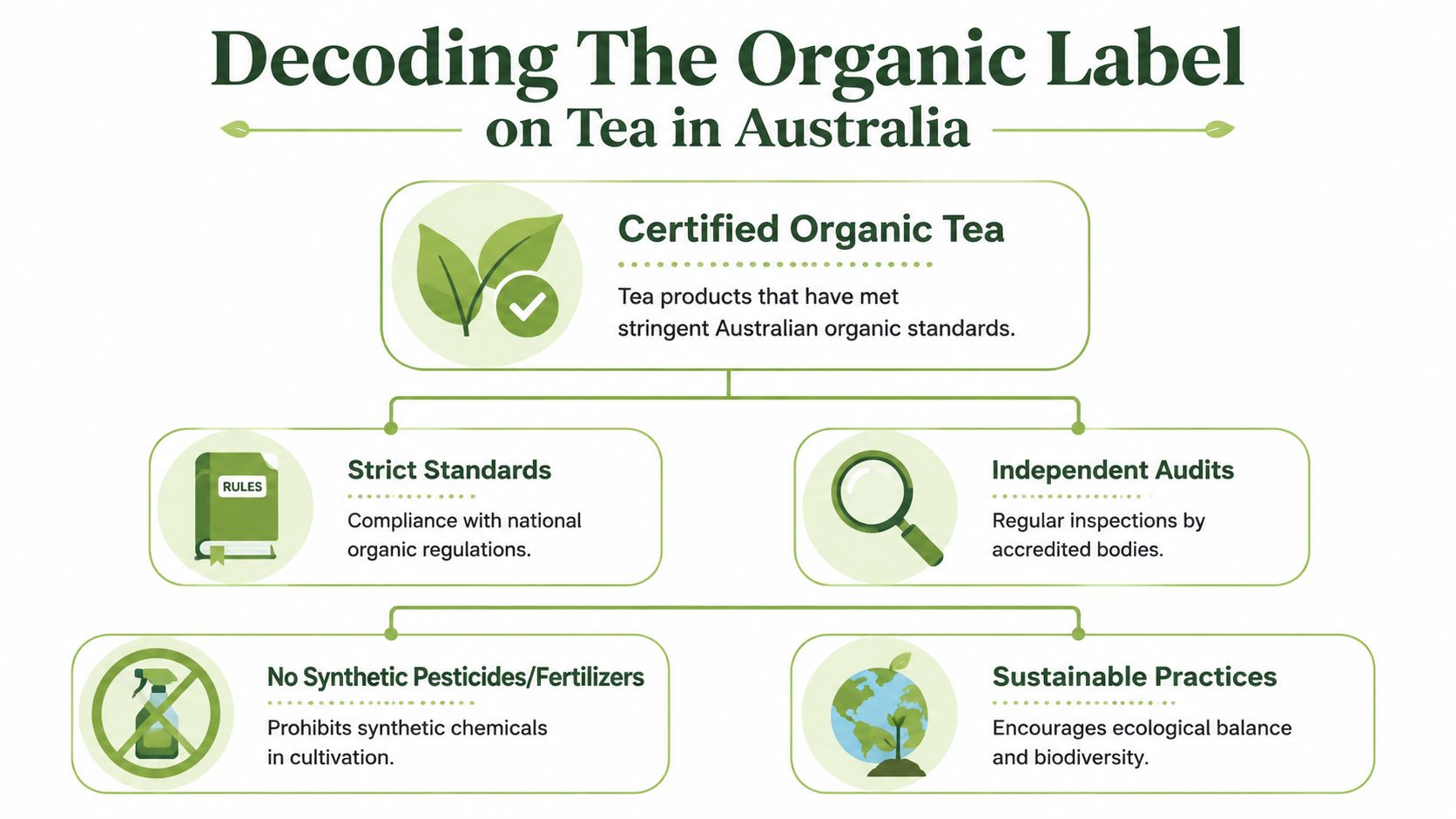
In Australia, organic tea is certified to contain zero synthetic pesticides because the Australian Certified Organic standard explicitly prohibits their use. The same standard also prohibits synthetic chemicals, herbicides and artificial preservatives, which is why many health-conscious buyers treat certification as a meaningful safety marker rather than a branding extra. The underlying standard is discussed in this overview of organic certification standards and is reflected in the explanation from Pure Matcha on Australian organic tea standards.
What certification actually tells you
A proper organic certification logo isn't decorative. It tells you the product has been assessed against a defined set of rules.
That matters because tea packaging is full of soft language that sounds healthy but doesn't carry the same weight, such as:
- Natural means very little by itself.
- Eco-friendly may describe packaging or brand positioning, not farming inputs.
- Pure is a marketing word, not a certification category.
- Organically grown can sound reassuring, but without a recognised certifier, you're still relying on the brand's own wording.
Why this matters in daily shopping
When you're standing in a supermarket aisle or browsing online, you're often making a decision in seconds. A certification mark simplifies that decision. It says, in effect, that the tea wasn't just described as clean. It was produced under rules designed to keep synthetic pesticides out of the process.
A recognised certification logo does the heavy lifting that marketing language can't.
That doesn't mean every uncertified tea is automatically poor quality. It means you don't have the same level of independent assurance. For many Australians, especially those drinking tea every day, that assurance is worth looking for.
The consumer takeaway
If you remember one thing from this section, make it this: certified organic is a stronger claim than organic-looking.
A genuine certification gives you a clearer line from farm to finished product. It's one of the simplest ways to cut through label noise and make a more informed choice.
Conventional vs Organic Tea A Look at Pesticide Residues
The gap between conventional tea and certified organic tea becomes clearer when you look at residue findings and the rules that govern them.
A Tea Leaves Australia article on tea pesticide limits notes that the Australian Pesticides and Veterinary Medicines Authority sets tea Maximum Residue Levels often at 0.05 mg/kg, while the European Union threshold is 0.01 mg/kg. That means Australia's limit is five times higher, and products that fail EU standards can sometimes still be sold legally in Australia.
That point alone surprises many tea drinkers. People assume “legal” automatically means “as strict as possible”. In food regulation, it often means “within the limits set by that country”.
What conventional tea can carry
Documented findings in the material above show why some buyers prefer certified organic tea for peace of mind.
One example: a 2012 Greenpeace China investigation found that 100% of tested tea samples from China contained at least three types of pesticides, and 78% (14 out of 18) contained pesticides harmful to human consumption. Another reported survey found conventional tea could contain up to 17 different pesticide types. These figures don't mean every conventional tea is identical, but they do show why residue concerns haven't come from nowhere.
Organic vs. Conventional Tea at a Glance
| Aspect | Certified Organic Tea | Conventional Tea |
|---|---|---|
| Synthetic pesticides | Prohibited under certification standards | May be used in cultivation |
| Residue concern | Certification is designed to avoid synthetic pesticide residue exposure | Residues may be present within legal limits |
| Consumer confidence | Based on independent standards and audits | Often depends on regulatory compliance alone |
| Australian market context | Bypasses the residue limit gap discussed above | Some products legal in Australia may not meet stricter EU limits |
| Label clarity | Strongest when backed by recognised certification | “Conventional” may not be obvious on front-of-pack packaging |
Why legal limits don't settle the whole question
A residue limit is not the same thing as zero residue. That's where people often get tripped up. Conventional tea may comply with the law and still contain detectable pesticide residues.
Certified organic tea appeals to many buyers because it aims to remove that concern at the farming stage rather than managing it at an allowable threshold later.
If you want the simplest route to avoiding synthetic pesticide residue, certified organic is the cleaner choice.
There's also a trust issue. Tea is often imported, blended, repacked and sold under familiar household brand names. Unless a product gives you a strong certification cue, you may be relying on a chain of decisions you can't see.
For Australians who drink several cups a day, that can be reason enough to choose tea with a clearer paper trail and stricter production rules.
Why This Matters More for Matcha and Kombucha
Matcha changes the conversation because you're not just brewing leaves and discarding them. You're drinking the leaf itself in powdered form. That makes the quality of the leaf much more important.
If regular steeped tea is like cooking vegetables in water and then straining them out, matcha is more like blending the whole lot into your drink. That's why many experienced tea drinkers are far stricter about matcha sourcing than they are about an ordinary tea bag.
Matcha is a whole leaf product
For premium matcha, certification and origin matter. Pure Matcha's explanation of Organic JAS matcha states that true organic matcha certified under the Organic JAS standard is produced from tea plantations in southern Japan, including Uji, where pollution and soil contamination are described as lower than in other tea-producing regions, with zero traces of chemical pesticides or fertilisers during cultivation.
That's a strong reason to pay attention to Japanese certification, not just broad organic wording. It's also why tea lovers often compare flavour and sourcing together. If you want a helpful example of how sourcing language and taste notes come together, this guide to Buttery umami matcha is a useful reference point.
For readers trying to understand quality tiers, this comparison of regular and ultimate matcha tea powder also helps clarify why not all matcha behaves the same in the bowl, latte or smoothie.
Kombucha is only as clean as its tea base
Kombucha can sound like a completely separate category, but it starts with tea. If the base tea is poor quality, heavily processed or murky in origin, fermentation doesn't erase that history.
The cleaner the tea, the cleaner the starting point for a drink many people choose for its simple, natural feel. That's especially relevant for sugar-free and low-sugar kombucha drinkers who are already trying to make more mindful choices.
Why these products raise the stakes
This topic matters more for matcha and kombucha for three practical reasons:
- Matcha increases exposure relevance because the powdered leaf goes straight into the cup.
- Kombucha depends on ingredient integrity because fermentation starts with tea, not with a blank slate.
- Premium buyers usually care about more than flavour. They care about origin, process and clean production.
The more directly you consume the leaf, the more the quality of that leaf matters.
That doesn't mean other teas don't matter. It means these two products make the certification question harder to ignore.
How to Choose a Genuinely Pesticide-Free Tea
Tea shopping gets easier when you stop reading the front of the pack first. Start with the proof points instead.
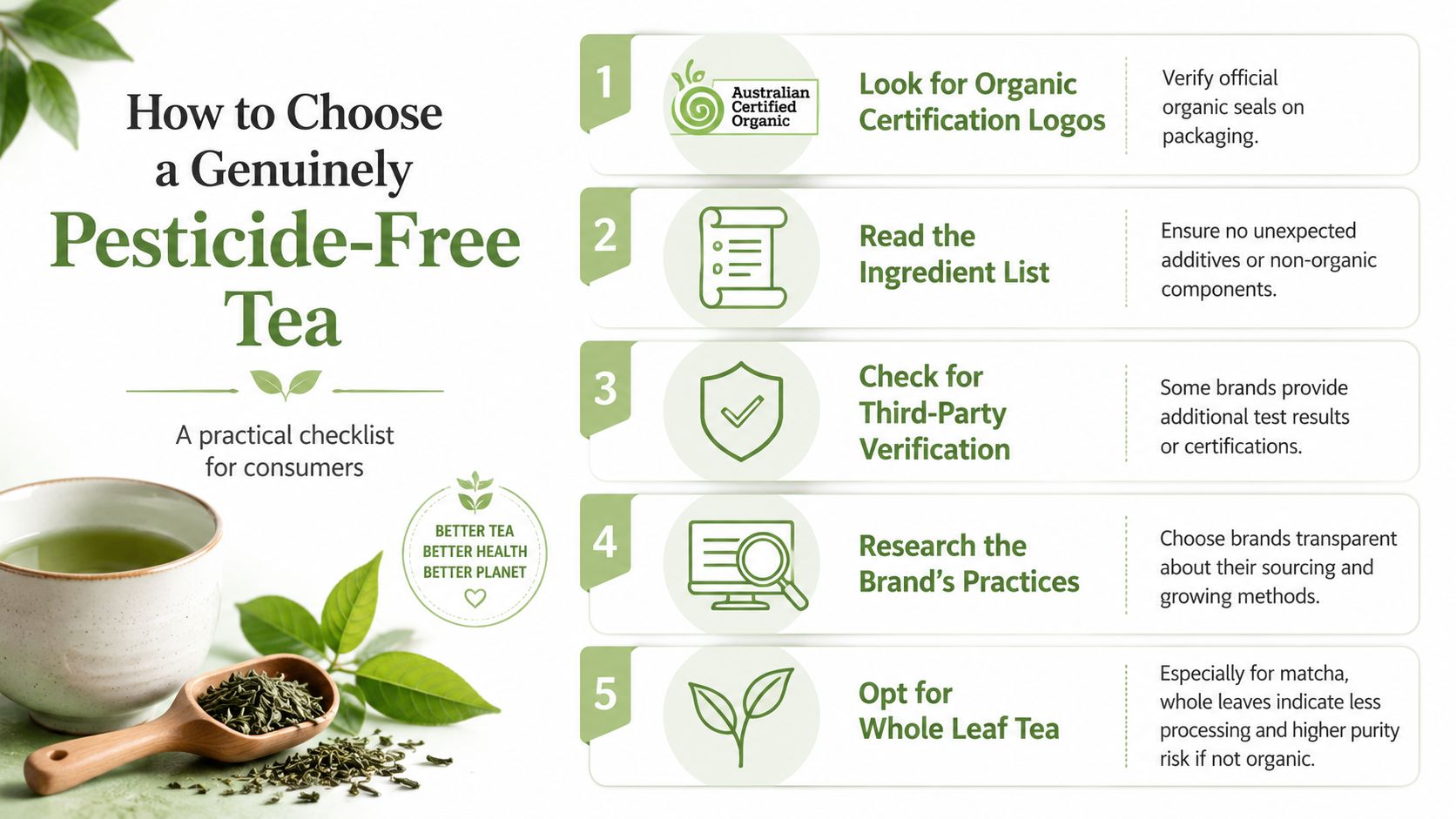
For Japanese matcha, one of the strongest signals is Organic JAS. According to Matcha Direct's explanation of Organic JAS certification, this certification is a third-party verified process that prohibits all synthetic pesticides and chemical fertilisers, and any product carrying the official JAS mark is guaranteed to have no pesticide residues from farm to finished powder.
A simple shopping checklist
Use this when you're choosing tea online or in-store:
- Look for recognised certification logos. For Australian products, check for established organic certification marks. For matcha from Japan, look for Organic JAS.
- Read past the front label. Words like “clean”, “pure” and “natural” aren't enough on their own.
- Check the ingredient list. Simpler is usually better. Tea should look like tea, not a list of fillers and vague flavour systems.
- Look for brand transparency. Brands that explain sourcing and standards usually make shopping easier.
- Be stricter with matcha. Because you consume the leaf, this is the category where weak sourcing claims matter most.
Questions worth asking before you buy
Not every tea buyer wants to interrogate a packet, but a few simple questions help:
| Question | Why it matters |
|---|---|
| Is it certified organic, or just described that way? | This separates verified claims from marketing language |
| Where was it grown? | Region can influence overall quality and confidence |
| Is the brand transparent about standards? | Clear brands are easier to trust |
| Is it matcha or a steeped tea? | Whole leaf products deserve more scrutiny |
If you also enjoy coffee and want to compare how other beverage buyers think about sourcing and residue concerns, this overview of sustainable coffee options gives a useful parallel.
For readers browsing green tea more broadly, a curated organic green tea collection can also make it easier to compare product types and certification cues side by side.
Buy the proof, not the mood. Tea packaging can suggest wellness. Certification is what confirms it.
The labels that should make you pause
A few claims deserve extra caution:
- Organically grown, with no recognised certifier named
- Pesticide free, with no explanation of verification
- Premium imported tea, with no origin detail
- Wellness tea blend, where the tea source is unclear
These aren't automatic deal-breakers. They're prompts to look closer.
What Organic Certification May Not Cover
Organic certification does an important job. It tackles synthetic pesticides. But it doesn't automatically answer every safety question a careful tea drinker might have.
One of the most overlooked issues is that tea plants can absorb naturally occurring substances from the soil. As noted in this discussion of fluoride and heavy metals in tea, organic certification doesn't regulate naturally absorbed contaminants in the same way, and some organic teas may still accumulate fluoride or heavy metals like lead depending on where and how they're grown.
The hidden confusion
Many shoppers often find this confusing. They hear “organic” and reasonably assume “completely clean”. In practice, organic means the farming system avoids prohibited synthetic inputs. It doesn't mean the plant is isolated from its environment.
That's especially relevant for tea because the leaf is the product. What the plant absorbs matters.
What a careful buyer should do with that information
This isn't a reason to panic or stop drinking organic tea. It's a reason to go one step further in your thinking.
A more complete quality picture includes:
- Certification for pesticide-related assurance
- Source region for broader environmental confidence
- Brand transparency about testing and quality control
- Product type awareness, especially for matcha
Organic certification solves one major problem well. It doesn't replace good sourcing.
That nuance is reassuring. Once you understand it, you can make sharper choices instead of assuming every tea with an organic-looking label is identical. The strongest products tend to pair recognised certification with careful sourcing and clear communication.
Your Questions on Organic Tea and Pesticides Answered
Can I wash or brew away pesticides from conventional tea?
Brewing may change what ends up in the cup, but it doesn't turn conventional tea into certified organic tea. If avoiding synthetic pesticide concerns matters to you, it's better to choose certified organic from the start.
Is decaffeinated organic tea still pesticide-free?
If it's properly certified organic, the key issue remains the same. Certification is what matters most, not whether the tea contains caffeine.
Is matcha worth being fussier about?
Yes. Matcha deserves more scrutiny because you consume the powdered leaf itself, not just an infusion.
Does local or transparent sourcing help?
Usually, yes. A brand that clearly explains its certification, origin and standards is easier to trust than one relying on vague wellness language.
Does organic mean completely risk-free?
No food claim is that simple. Organic certification is excellent for avoiding synthetic pesticide use, but thoughtful shoppers should still care about origin, transparency and overall quality.
If you're looking for a cleaner cup with clearer sourcing, explore Pep Tea for premium organic matcha and Australian-brewed organic kombucha. We're passionate about making healthy tea choices easier to understand, whether you're choosing ceremonial-grade matcha for calm energy or a refreshing low-sugar kombucha for everyday wellness.
A Guide to Australian Tea Brands for 2026
You're probably here because you've stood in a supermarket aisle, scanned a café menu, or opened an online tea store and thought, when did tea get this complicated?
It used to feel simple. Black tea bags for the morning, maybe peppermint at night, and that was about it. Now the Australian shelf is full of loose-leaf blends, organic herbal infusions, ceremonial matcha, sparkling kombucha, wellness teas, local brands, imported brands, and products that call themselves Australian without making it obvious what that means.
That mix is exciting, but it can also be a bit murky. If you care about flavour, ingredients, where a product comes from, and how it fits into a healthier routine, you need more than a list of brand names. You need a way to judge quality for yourself.
Welcome to the New World of Australian Tea
Australian tea brands aren't one neat category anymore. They sit across a few different worlds at once.
Some brands still focus on the everyday cuppa. Think supermarket black tea bags, familiar blends, fast brewing, low fuss. Others lean into loose-leaf tea, premium botanicals, or small-batch blending. Then there's the newer functional side of the market, where matcha, herbal wellness blends, and kombucha have become part of how people think about energy, digestion, sugar reduction, and mindful drinking.
That's where many people get confused. They compare products that aren't really trying to do the same job.
A plain breakfast teabag is built for convenience. A ceremonial matcha is built for whisking and drinking on its own. A culinary matcha is meant for lattes, smoothies, and baking. A properly fermented kombucha belongs in a different conversation again, because it's a brewed drink rather than a leaf you steep in a mug.
Why tea shopping feels harder now
The challenge isn't just choice. It's language.
You'll see words like organic, premium, Australian-owned, Australian-made, stone-ground, live cultures, and functional. Some of these terms matter a lot. Some are useful only if the brand explains them properly.
A good tea label should answer basic questions clearly. What is it, where is it from, and why is it made this way?
If a tea brand can't explain those points in plain English, it becomes hard to know whether you're paying for actual quality or just attractive packaging.
A better way to think about Australian tea brands
Instead of asking, “Which brand is best?”, ask these questions:
- What am I buying it for: daily convenience, calm focus, a café-style drink at home, a soft drink alternative, or something to serve guests?
- What does the label tell me: ingredients, origin, certifications, sugar level, brewing style?
- Is the product honest about what it is: Australian-owned, Australian-brewed, imported leaf, local packing, or all of the above?
That mindset makes the tea world much easier to understand. Once you know how to read the category, you can choose what suits your taste, routine, and budget without getting lost in the marketing.
The Modern Australian Tea Landscape
Tea in Australia still has a strong everyday base, but the category is changing shape. The easiest way to understand Australian tea brands today is to stop thinking of tea as one thing.
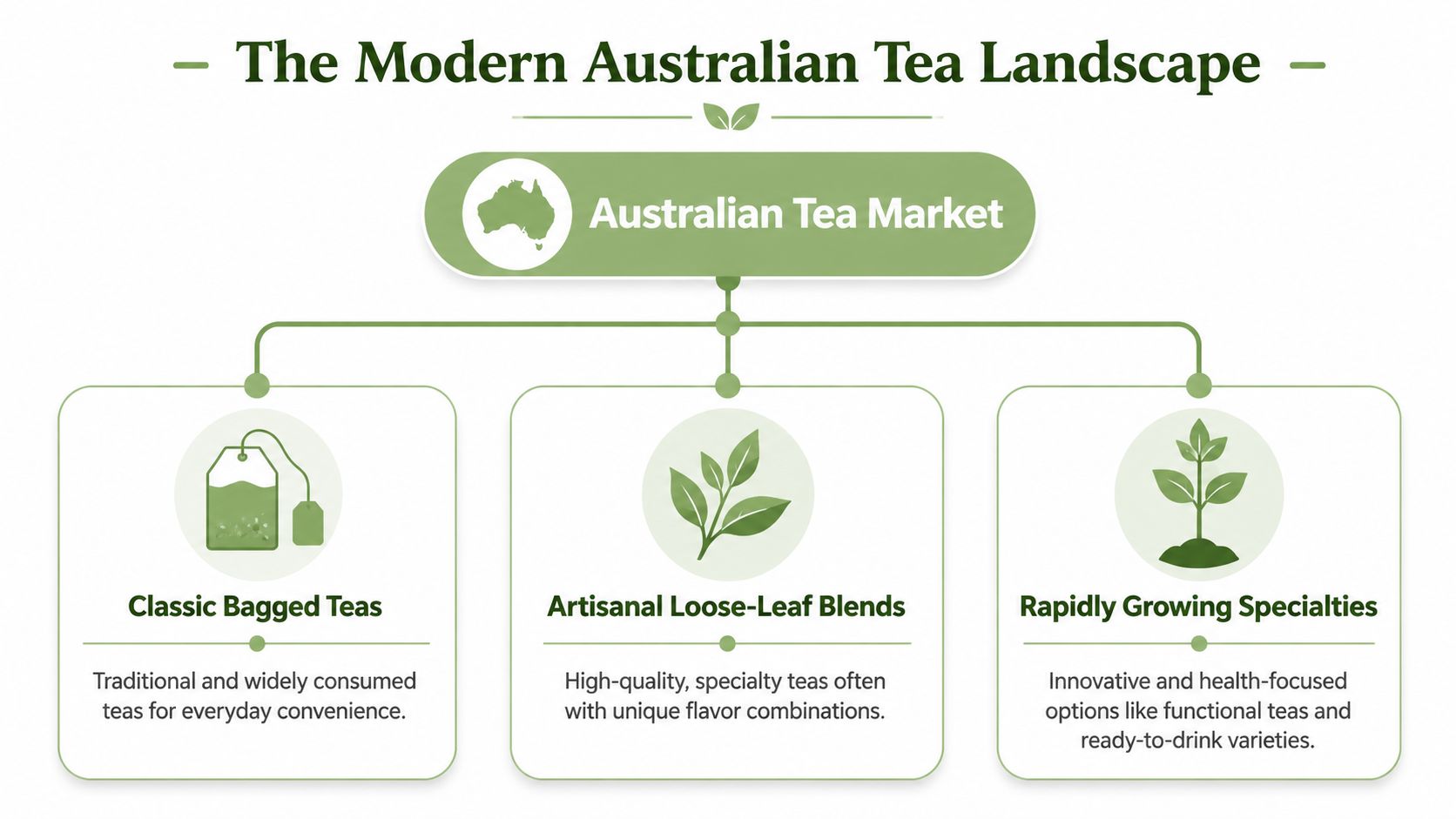
Three big parts of the market
You can picture the market in three broad groups:
| Category | What it usually includes | What buyers tend to want |
|---|---|---|
| Classic bagged teas | Black tea, English Breakfast, Earl Grey, common herbal bags | Convenience, price, consistency |
| Artisanal loose-leaf blends | Loose-leaf black, green, oolong, floral and botanical blends | Flavour, ritual, freshness |
| Rapidly growing specialties | Matcha, functional teas, ready-to-drink kombucha | Wellness, low sugar choices, café-style experience |
These groups overlap, but they solve different needs. That's why comparing a commodity teabag to a ceremonial matcha powder usually leads nowhere. They aren't competing on the same terms.
Why specialty tea keeps gaining attention
Australia's tea market was estimated at USD 535.1 million in 2025 and is forecast to reach USD 780.6 million by 2034, with growth tied to stronger demand for health-focused beverages such as organic and specialty teas, according to IMARC's Australia tea market outlook. That matters because it shows the shift isn't just about novelty. Buyers are moving toward products that feel more purposeful.
Some people want tea with a cleaner ingredient story. Others want premium café drinks at home. Many are trying to cut back on sugary drinks, or they want an afternoon option that feels lighter than coffee.
The old centre and the new edge
The traditional market hasn't disappeared. It still shapes how tea is sold, especially in supermarkets. But newer categories are changing expectations around flavour, origin, and quality cues.
A shopper who once bought one box of standard tea bags may now keep several products at home:
- A black tea for routine
- An evening herbal for winding down
- A matcha for lattes or focused work sessions
- A kombucha in the fridge as a low-sugar alternative to soft drink
That's also why content around functional beverage trends in Australia has become more useful for tea drinkers. Tea now sits inside a wider wellness and café culture conversation, not just the old “hot drink” category.
Australian tea brands now compete on purpose as much as flavour. Buyers want to know what a product fits into, not just what it tastes like.
A Closer Look at Matcha and Kombucha
Two products confuse people more than almost anything else in tea. Matcha and kombucha both sit inside the modern tea scene, but they work in completely different ways.
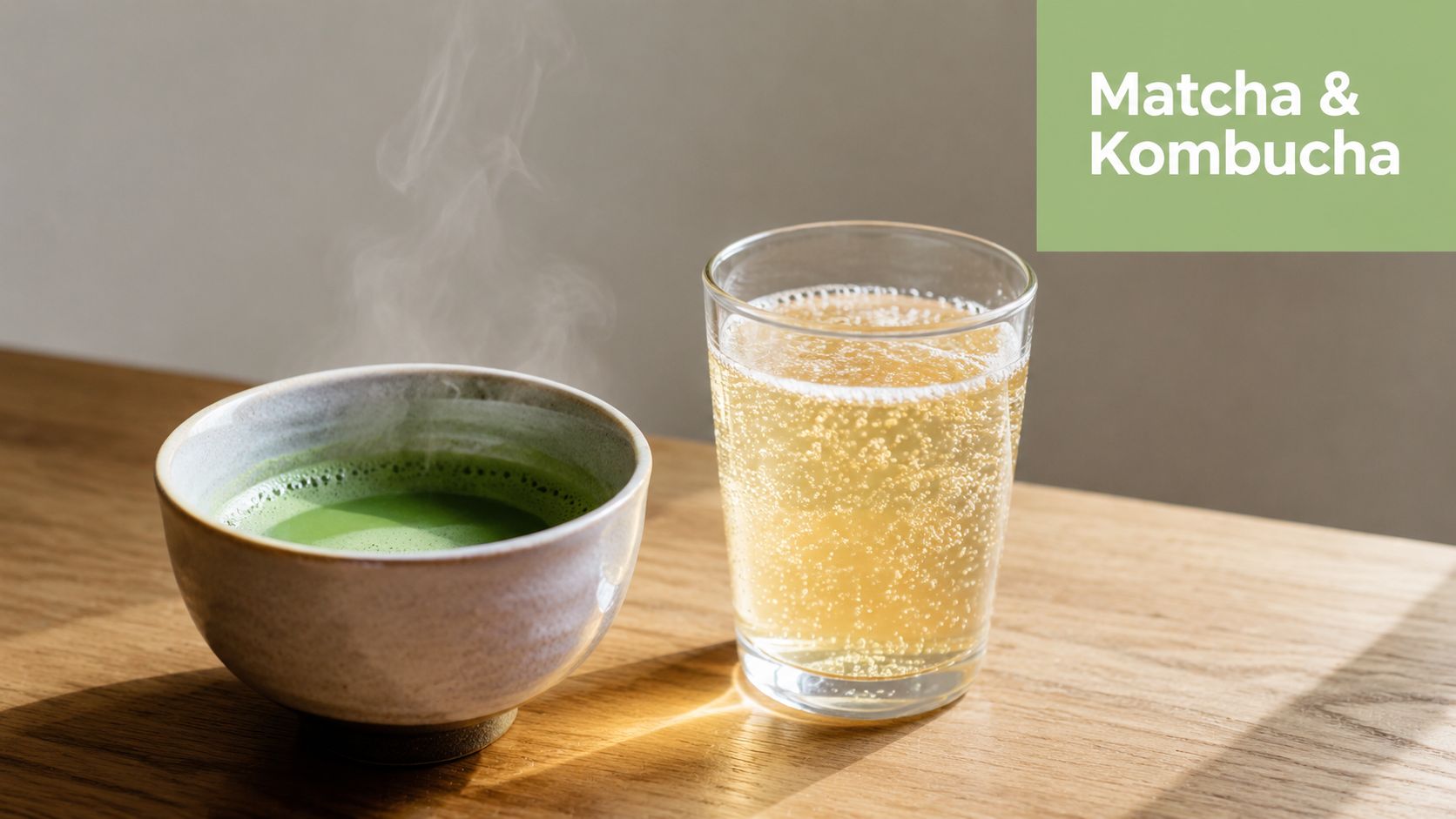
Matcha is not just powdered green tea
Matcha is made from green tea leaves that are processed into a very fine powder. Instead of steeping leaves and throwing them away, you whisk the powder into water and drink the whole leaf. That changes both the texture and the experience.
Good matcha usually looks bright and fresh rather than dull and khaki. It should smell clean, vegetal, and lively. When whisked well, it forms a smooth layer of foam.
Two terms matter most when you shop:
- Ceremonial grade means a matcha intended for drinking directly, often with water.
- Culinary grade means a matcha intended for recipes like lattes, smoothies, baking, or desserts.
Neither grade is “better” in every situation. They're just suited to different jobs.
How to choose the right matcha
If you're new to it, use this simple guide:
- For straight matcha: choose ceremonial grade. You'll notice flavour and texture more clearly.
- For lattes: culinary grade often gives you better value and enough strength to stand up to milk.
- For baking: use culinary grade, because subtle flavour notes get lost once you add other ingredients.
If you'd like a practical look at processing and what affects the final powder, Pep Tea has a useful guide on how matcha tea is made.
Practical rule: Buy matcha based on how you'll use it, not on which label sounds fancier.
Kombucha is tea transformed by fermentation
Kombucha starts as brewed tea, then goes through fermentation with a culture of yeast and bacteria. That's why it tastes different from iced tea. It's lightly tangy, often gently sparkling, and can range from crisp to complex depending on ingredients and brewing style.
People often hear the word fermentation and assume it's mysterious. It isn't. In simple terms, fermentation is a controlled process where the culture interacts with the brewed tea and sugars over time, changing the flavour and producing the tart, lively character kombucha is known for.
Quality matters here because not every kombucha on shelf gives the same experience. Some products lean heavily on sweetness or flavouring. Others put the brewing process at the centre.
What to look for in real kombucha
A well-made kombucha should be clear about a few things:
- Whether it's properly fermented
- Whether it contains artificial additives
- Whether the sugar level suits your preference
- Whether the ingredients list is simple and recognisable
If you want to see kombucha explained visually, this short video is a handy starting point.
Why these two products matter in Australian tea brands
Matcha and kombucha show how broad the tea category has become. One is rooted in traditional tea craft. The other is a modern fermented drink built from tea. Both appeal to people looking for something more intentional than a standard teabag.
They also teach an important buying lesson. A premium tea product should be able to explain its process plainly. If a brand can't clearly tell you what grade of matcha you're buying or how its kombucha is brewed, that's a sign to slow down and look closer.
Beyond the Label What Quality Really Looks Like
A lot of Australian tea brands look polished. That doesn't mean they're all equally transparent.
The tricky part is that “Australian” can mean several different things. A brand might be Australian-owned. It might be blended here. It might be packed here. It might brew here. Or it might use imported tea leaf and rely on Australian branding to do most of the talking.
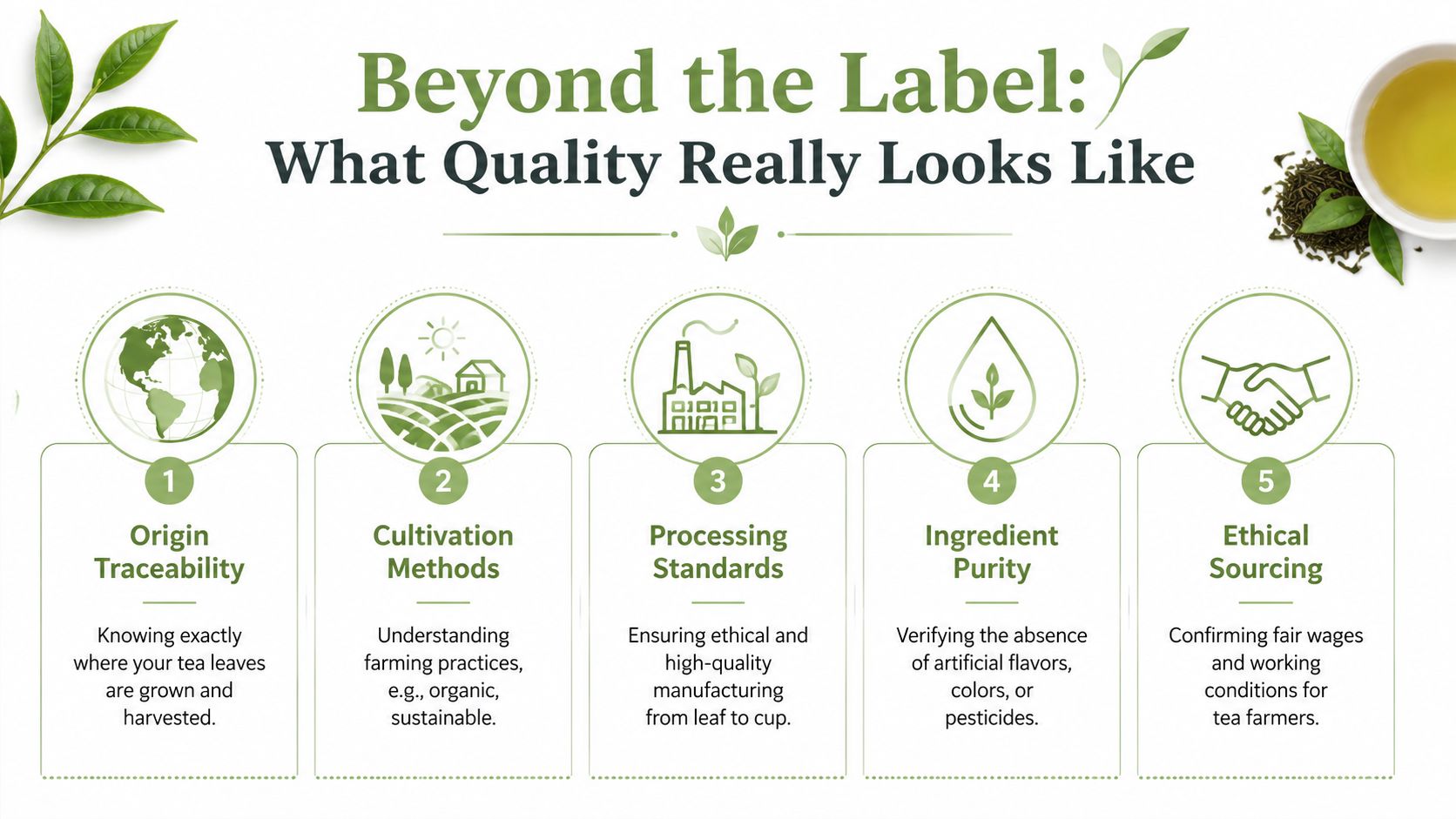
The question many shoppers don't ask
A useful industry reminder is this: local tea production in Australia is limited and expensive, so an Australian tea brand may not be using Australian-grown leaf at all. The more practical test is whether the brand gives clear information about country of origin, leaf grade, and traceability, because “organic” or “Australian” branding on its own doesn't guarantee quality, as discussed in this sourcing-focused review on Australian tea origin.
That's not a criticism of imported tea. Some of the world's finest tea comes from overseas, and certain products should come from their place of origin. Japanese matcha is the obvious example. The point is honesty.
Five signs a tea brand is taking quality seriously
Here's a checklist worth using whenever you compare products.
- Origin is stated clearly. You should be able to tell where the tea leaf was grown, not just where the packet was designed or filled.
- The ingredient list is clean. If it's a tea, you want to recognise what's in it. If it's kombucha, you want the ingredients to make sense for a fermented tea drink.
- The product tells you what kind of tea it is. Matcha grade, loose-leaf style, herbal blend ingredients, and processing details all help.
- Certification has context. Organic certification is useful, but it tells you about standards, not flavour. Pep Tea's overview of organic certification standards is a good example of the sort of clarity shoppers should expect from any tea brand.
- The brand explains processing, not just branding. Stone-ground. Blended. Brewed. Fermented. Packed. Those words should mean something concrete.
Australian-made versus Australian-grown
Readers often get tripped up here, so let's make it plain.
| Label claim | What it may mean | What to ask next |
|---|---|---|
| Australian-owned | The business is local | Where is the tea leaf from? |
| Australian-made | The product was made or brewed here | Are the ingredients local or imported? |
| Packed in Australia | Final packaging happened here | Where was it grown and processed? |
| Australian-grown | The leaf itself was grown here | Which region and what variety? |
Don't stop at the front label. The back panel usually tells you whether the brand is being genuinely transparent.
Quality is about fit, not snobbery
It's easy to think “premium” just means expensive. In tea, real quality is more practical than that. It means the product is suitable for its purpose, handled carefully, and described accurately.
A humble everyday teabag can still be decent if it's fresh and balanced. A ceremonial matcha can be poor if it tastes flat and muddy. An organic claim can be meaningful, but it isn't a shortcut around bad sourcing or weak processing.
That's why smart buyers learn to separate branding cues from quality cues. One looks nice on the shelf. The other tells you what's in the cup.
Choosing Australian Tea Brands for Your Home
Home shopping is where all of this becomes real. Consumers aren't standing in a specialty tea studio asking about harvest style. They're in a supermarket, browsing online, or adding one or two products to a grocery order.
That context matters. Australia's tea market is valued at $1.2 billion, and most spending on packaged tea happens in supermarkets, where major brands dominate and some products cost about 5 cents per teabag, according to World Tea News on Australian tea trends. That creates a very clear split between cheap everyday tea and the more specialised products people buy for flavour, quality, or a specific routine.
Shop by purpose, not by hype
If you want your tea cupboard to be more useful, buy for real situations.
- For a simple daily cuppa: choose a tea you'll make every day. There's no point buying precious leaf if you only want speed before work.
- For clean, focused energy: an organic matcha can make more sense than another ordinary green tea bag, especially if you enjoy lattes or a morning whisking ritual.
- For a fridge staple: kombucha suits people who want something cold, crisp, and less sweet than soft drink.
- For evenings: keep a calming herbal option separate from your caffeinated teas so you're not reaching for the wrong thing at night.
A quick home-buyer checklist
Use this before you click add to cart.
- Read the product type first. Is it loose leaf, bagged tea, matcha powder, or fermented ready-to-drink tea?
- Check origin and ingredients. If a brand hides them, move on.
- Match the product to your habit. Don't buy ceremonial matcha if you only bake. Don't buy a sweet fizzy drink if you wanted a cleaner kombucha.
- Start small. One quality product you'll use beats a cupboard full of “wellness” purchases you forget about.
If you're comparing matcha options specifically, this guide on best matcha powder in Australia is helpful because it focuses on how buyers can judge colour, use case, and label detail rather than chasing trend language.
One practical example
If your goal is a better afternoon drink at home, you might keep one matcha for lattes and one kombucha in the fridge for days when you want something cold instead. That's a more realistic setup than trying to make one product do everything.
Pep Tea, for example, offers Japanese organic matcha and Australian-brewed sugar-free organic kombucha, which makes it a straightforward option for households that want one powdered tea for whisking or recipes and one ready-to-drink fermented tea for the fridge.
Partnering with Tea Suppliers for Your Café
Cafés don't buy tea the same way households do. A home buyer can forgive inconsistency. A venue can't.
Staff need products that are easy to prepare correctly, stable on the menu, and clear enough to explain in one sentence to a customer who's deciding between an oat flat white, an iced matcha, and a non-alcoholic afternoon drink.

Why tea now deserves menu attention
The hospitality opportunity is bigger than the old tea pot on the side of the menu. Australia's tea market is seeing strong growth in functional and organic segments, with a projected 5.1% CAGR, driven by demand for low-sugar, additive-free, and health-supportive teas, according to Research and Markets on the Australian tea market.
For cafés, that translates into a simple commercial question. Are you giving customers better non-coffee choices, or only the bare minimum?
What café owners should look for in a tea supplier
A strong supplier relationship usually comes down to four things.
- Consistency in the cup. Your matcha should whisk the same way each shift. Your kombucha should pour and taste as expected.
- Clear product positioning. Staff should know whether a matcha is best for straight service or lattes, and how to describe a kombucha without confusion.
- Menu relevance. Organic, low-sugar, and additive-free cues matter more when customers are actively looking for lighter or more functional drinks.
- Operational ease. Products need to fit service speed, storage, and training reality.
Menu ideas that fit the current market
A tea program doesn't have to be huge to be effective.
| Drink style | Why it works in a café |
|---|---|
| Matcha latte | Familiar enough for broad appeal, distinct enough to feel premium |
| Iced matcha | Visual, refreshing, and easy to position as a coffee alternative |
| Kombucha by the bottle or glass | Gives customers a cold, alcohol-free option with personality |
| Loose-leaf pot service | Lifts the perception of tea beyond the standard tea bag |
A café doesn't need dozens of tea SKUs. It needs a small range that staff can serve confidently and customers can understand quickly.
Tea suppliers should make your menu clearer
The best supplier isn't just selling product. They're making your menu easier to execute.
If a supplier can't explain sourcing, preparation, flavour profile, and the right use case for each tea, your team ends up doing the guesswork. That usually leads to uneven drinks and weak menu language. In a café setting, clarity is part of quality.
Your Journey into Australian Tea Starts Here
The Australian tea scene is broader, more interesting, and more demanding than it used to be. That's a good thing. It means you've got more ways to find a tea that suits your taste, routine, and values.
It also means labels need a closer look.
The most useful way to judge Australian tea brands isn't by logo, trendiness, or whether the packet feels expensive. It's by asking clear questions. Where is it from? What kind of tea is it? How is it processed? Does the product fit the way you drink tea?
That's especially important now that tea includes more than the old familiar box of black bags. Matcha asks you to think about grade and preparation. Kombucha asks you to think about fermentation and ingredients. “Australian” asks you to think about ownership, brewing, packing, and origin as separate ideas.
Once you understand those distinctions, the category becomes much easier to enjoy. You stop buying vague promises and start choosing with confidence.
And that's the true pleasure of tea. Not just drinking it, but recognising what makes one product thoughtful, honest, and worth bringing into your daily life.
If you'd like to put that knowledge into practice, explore Pep Tea for organic matcha and Australian-brewed sugar-free kombucha, along with practical guides that help you choose, prepare, and enjoy tea with more confidence.
Buy Organic Green Tea Online: Quality Guide 2026
You're probably doing what a lot of Australians do when they start shopping for tea online. You type in a simple search, open six tabs, and suddenly every packet looks “premium”, “pure”, “ceremonial”, “clean”, or “organic”. The photos are lovely. The claims sound reassuring. But it's not always obvious what matters once that tea lands in your kitchen.
That confusion is normal. Tea is one of those products where the label can look clear while the buying decision still feels murky. You can't smell the leaves through a screen. You can't inspect colour, freshness, or texture in person. And if you care about wellness, taste, and clean sourcing, you want more than a pretty pouch and a vague promise.
Your Guide to Buying Organic Green Tea Online
A common scene goes like this. Someone wants a better afternoon drink than another coffee or a sugary option. They start looking for organic green tea online, hoping for something cleaner, lighter, and easier to build into a daily routine. Then the questions hit. Is loose leaf better than matcha? Does organic mean residue-free? Will it taste fresh after shipping? Is the higher price justified?
Those questions sit inside a much bigger shift in how people buy tea. The global organic tea market was valued at USD 2.12 billion in 2025 and is projected to reach nearly USD 4.26 billion by 2032, growing at a 10.5% CAGR, according to the Teeverband 2025 tea report. For Australian shoppers, that matters because it reflects a clear move toward higher-quality, certified-organic tea sold through practical online channels.
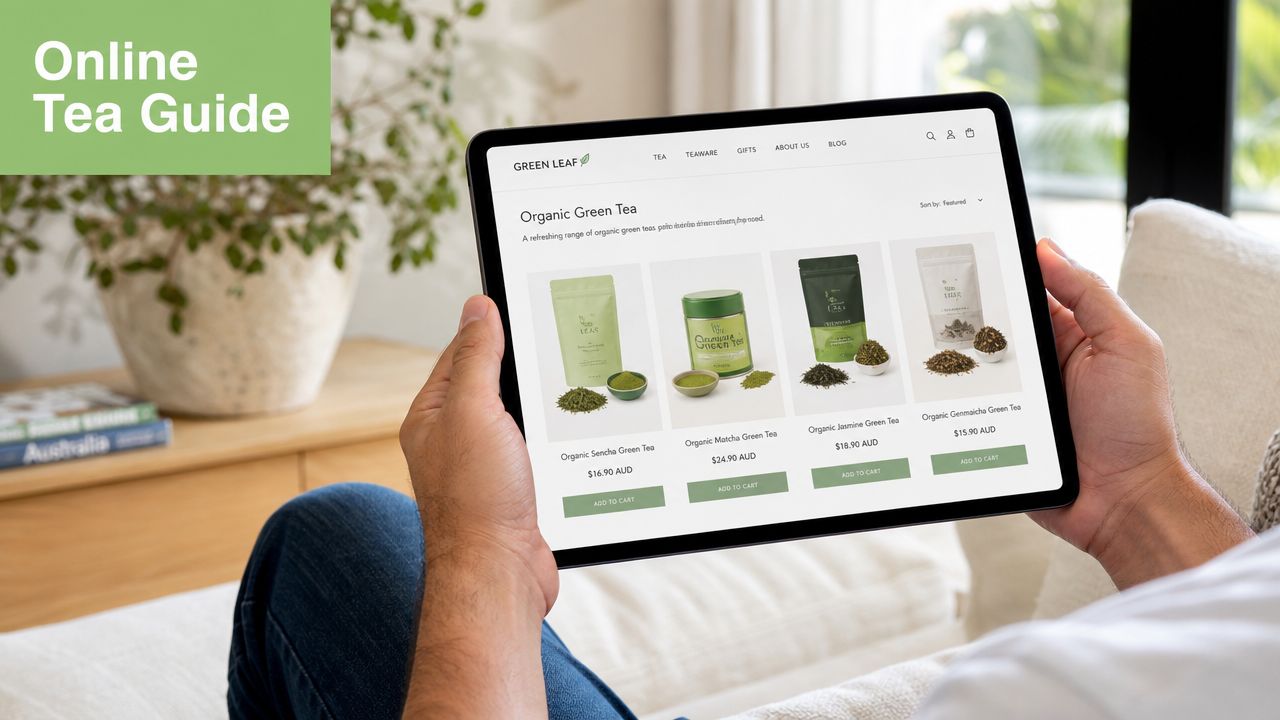
Why this matters in Australia
Australia sits in a region where tea demand is strong, but many premium green teas are sourced from overseas. That means online buying isn't a niche habit. It's often the most practical way to access the kind of tea people want, especially if they're looking for certified-organic Japanese green tea, matcha, or premium loose leaf.
If you're curious about the supply side, it also helps to understand how products move into Australia. This guide on how to navigate importing from Japan through AUSFF gives useful context on the logistics behind imported goods, including the sort of care and compliance buyers often assume happens automatically.
Buying tea online gets much easier once you stop asking “Which pack looks healthiest?” and start asking “What proof does this brand give me?”
What a good online tea guide should actually do
You don't need a lecture on tea culture. You need a practical filter.
A useful buying guide should help you:
- Read past marketing words so “organic” means something specific
- Check quality signals like origin, testing, and packaging
- Choose the right format for your routine, whether that's matcha or loose leaf
- Brew it properly so good tea doesn't taste bitter by accident
That's where most shoppers get stuck, and it's exactly where a little clarity makes a big difference.
What Makes Green Tea Genuinely Organic
A lot of Australian shoppers click on a tea listing, see the word “organic”, and assume the hard checking is done. Online, that assumption can trip you up. The label matters, but the true question is what sits behind it.
Organic green tea is tea grown and processed under certified standards, not just described with clean-sounding marketing. Those standards usually restrict synthetic pesticides, herbicides, chemical fertilisers, and genetically modified organisms. In plain terms, the farm has to follow rules, and an independent certifier has to verify that those rules are being followed.
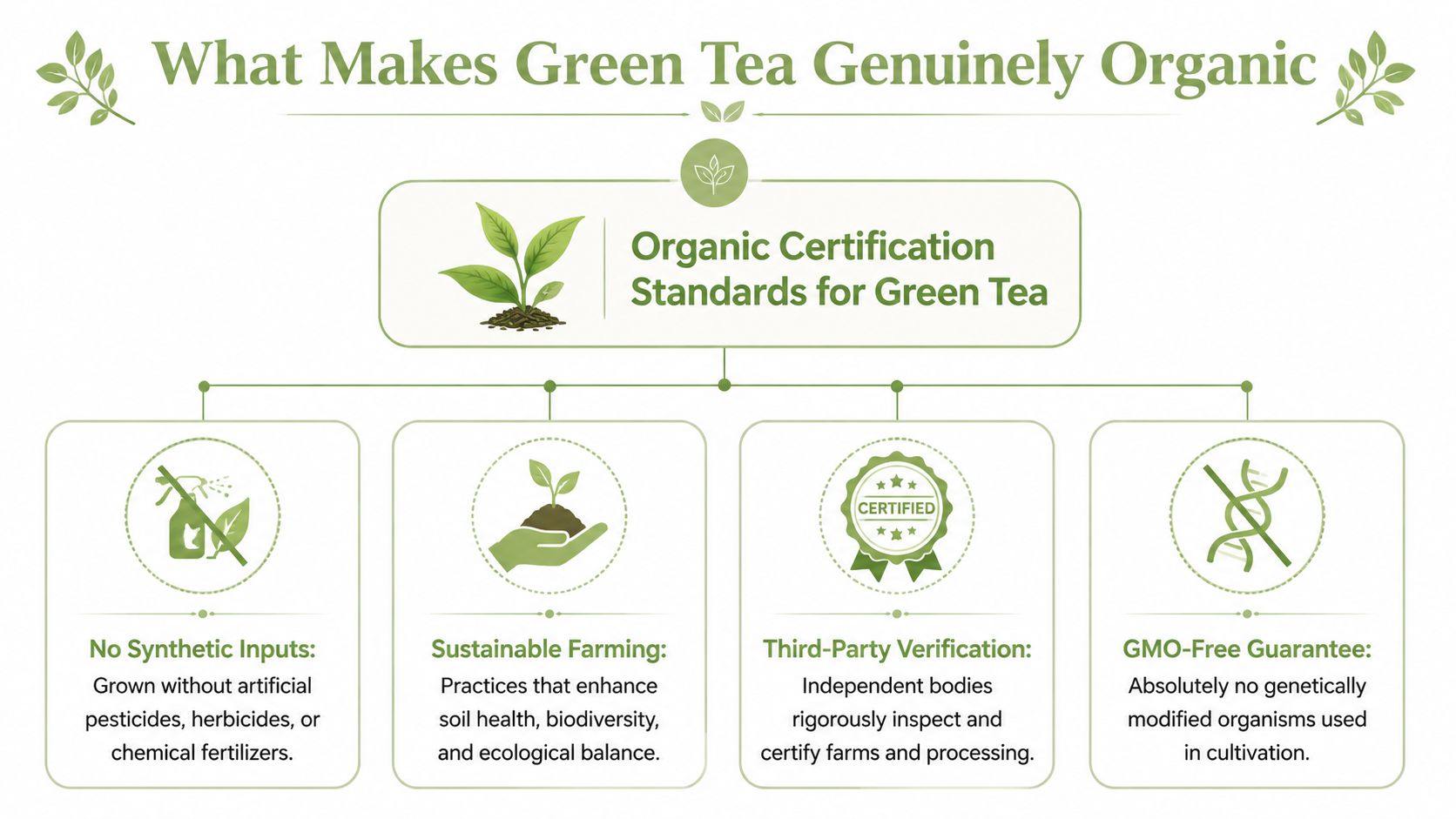
What the organic label should point to
For online buyers, “organic” works like a receipt trail. If a brand uses the word properly, you should be able to trace it back to something concrete.
A reliable product page should help you understand:
- How the tea was grown. Organic farming avoids synthetic chemical inputs and follows stricter cultivation standards.
- Who verified the farm or producer. Certification should come from an independent body, not the seller marking their own homework.
- How the tea was handled after harvest. Processing, packing, and storage still shape purity, aroma, and shelf life.
- How clearly the source is explained. “From Japan” is a start. A named region, producer, or style tells you far more.
If you want a simple breakdown before comparing listings, Pep Tea has a clear guide on what organic green tea means.
Why drinkers care about it
People choose organic tea for practical reasons. Some want to limit exposure to synthetic agricultural inputs. Others care about farming systems that support healthier soil and a cleaner growing environment.
There is also a trust factor, especially when you are buying through a screen. A well-documented organic tea often appeals to the same buyer who cares about harvest date, careful packing, and whether the tea will arrive tasting lively rather than tired. It does not guarantee beautiful flavour on its own, but it often sits in the same conversation as freshness and careful sourcing.
That matters with green tea because it is a delicate product. Poor handling shows up quickly in the cup. Flat aroma, dull colour, or rough bitterness can come from age, weak storage, or careless processing, even if the tea was grown under organic standards.
Practical rule: Organic means more when it comes with traceable sourcing and clear certification detail.
Where online buyers get mixed up
The biggest confusion is treating organic as a complete quality guarantee.
It is not.
Organic certification answers a farming question. It tells you the tea met a defined production standard. It does not automatically tell you whether the leaves are fresh, whether the powder has been protected from heat and light, or whether the seller is transparent enough for an Australian buyer to trust the product before ordering.
That distinction is worth keeping in your head. Organic is one filter. Purity, authenticity, and freshness still need their own proof. Brands that explain those points clearly set a much stronger benchmark, and that is the standard careful tea buyers should expect.
Decoding Quality and Purity When Buying Online
Buying tea online asks you to trust information before you trust taste. That's why a careful buyer should judge the product page like they'd judge the tea itself. If a seller can't explain origin, testing, and handling clearly, the problem usually isn't your caution. The problem is the missing detail.
The most important shift is this. Don't treat “organic” as the finish line. Treat it as the starting point. Independent coverage of contamination concerns points out that while organic certification is valuable, it doesn't automatically guarantee freedom from environmental contaminants like heavy metals. That's why buyers should look for origin transparency and batch testing results, especially for products imported into Australia, as discussed in this review of organic and lead-free green tea concerns.
What to check on a product page
A strong listing usually answers your practical questions before you email support.
Look for these signals:
- Named origin. Not just the country, but ideally the producing region or style.
- Certification detail. A clear statement of certified-organic status is more useful than wellness language.
- Testing transparency. Brands that mention batch testing, residue checks, or quality controls give you something concrete to assess.
- Packaging photos. Good images help you see whether the product is likely to stay fresh after opening.
- Preparation guidance. Sellers who know their tea usually explain how to brew it properly.
Purity means more than a logo
Many shoppers often get tripped up. They see “organic”, assume “clean”, and stop reading. But tea is an agricultural product. It comes from soil, weather, transport, processing, and storage. Each step matters.
If you're buying matcha, this becomes even more important because you consume the powdered leaf itself rather than steeping and discarding it. That's one reason grading, origin, and transparency matter so much in this category. If you'd like a simple breakdown of how quality tiers differ, this guide to different grades of matcha is a useful reference.
Ask a plain question when you shop: “What evidence does this seller provide beyond the word organic?”
A quick credibility filter
When a store page feels polished but vague, use this short test.
| Check | What you want to see |
|---|---|
| Origin | Specific sourcing information |
| Purity | Mention of testing or quality control |
| Certification | Clear certified-organic wording |
| Freshness | Packaging designed to protect tea from air and light |
| Education | Brewing advice that matches the tea type |
If a brand gives you three or more of those clearly, you're usually dealing with a seller that understands tea properly. If everything leans on mood, lifestyle imagery, and broad claims, keep browsing.
What good transparency feels like
A trustworthy tea brand doesn't make you work hard to feel informed. It explains what the tea is, where it comes from, how to use it, and why the product is packed the way it is. That kind of clarity is especially valuable for Australians ordering premium green tea online, where quality has to survive shipping as well as scrutiny.
Choosing Your Perfect Form Matcha vs Loose Leaf
Once you've narrowed quality down, the next question is personal. Do you want a tea you whisk, or a tea you steep?
This choice shapes everything. Flavour, routine, equipment, mouthfeel, convenience, and how often you'll reach for it on a busy morning all depend on the format. There isn't one right answer. There's only the one that fits your day.
Green tea holds about 39.6% of the organic tea market, and matcha is described as the fastest-growing format, with 68% of global consumers associating green tea with high antioxidant levels and choosing it for long-term health benefits, according to Maximize Market Research's organic tea market report. That helps explain why so many Australian shoppers land on matcha first when searching for organic green tea online.
Organic Matcha vs Loose Leaf Green Tea at a Glance
| Feature | Organic Matcha | Organic Loose Leaf Green Tea |
|---|---|---|
| Preparation | Whisked into water or milk | Steeped in hot water |
| Drinking style | Full-leaf powder consumed in the cup | Infused liquor, leaves removed after brewing |
| Flavour | Richer, fuller, often creamy or savoury | Lighter, cleaner, more delicate |
| Best for | Ritual drinking, lattes, smoothies, recipes | Daily cups, teapots, simple brewing |
| Equipment | Bowl or cup, whisk or frother, sieve helpful | Infuser, teapot, or basket |
| Texture | Smooth, suspended tea body | Clearer, lighter mouthfeel |
Choose matcha if your routine is hands-on
Matcha suits people who like ritual and versatility. You can drink it straight, whisk it into a latte, blend it into smoothies, or use it in baking. It feels more immersive because preparation is part of the experience.
That's also why grade matters. Ceremonial-style matcha is usually the pick for straight drinking, while culinary-style matcha works better in lattes, desserts, and recipes where the tea shares the stage with other ingredients.
Choose loose leaf if you want a simpler cup
Loose leaf green tea suits people who want ease without sacrificing quality. You measure the leaf, add water, wait a few minutes, and drink. No whisking. No frothing. No powder settling at the bottom of the cup.
For many Australians, that makes loose leaf the easiest daily entry point into better tea. If that sounds closer to your style, Pep Tea's best organic green tea loose leaf page shows the sort of product category to look for when you want quality without the ceremony.
Some people love matcha for focus and routine. Others want a clean, grassy cup they can brew half-awake before work. Both are good choices.
A quick self-check
If you're still torn, use these prompts:
- Go for matcha if you enjoy café-style drinks, want one tea for drinking and recipes, or like a more concentrated green tea experience.
- Go for loose leaf if you value speed, lighter flavour, and a more traditional brew.
- Try both if your weekday and weekend habits are different. Many tea drinkers keep loose leaf for everyday use and matcha for mornings, lattes, or baking.
The best organic green tea online isn't the one with the most dramatic description. It's the one you'll prepare properly and drink often.
Brewing and Using Your Organic Green Tea
A lot of “bad” green tea is good tea brewed poorly. That's encouraging news, because it means one small adjustment can improve the cup immediately.
Peer-reviewed review data show that green tea is typically brewed at 80 to 90 °C for 3 to 4 minutes, and that most EGCG and caffeine extraction occurs around 80 °C, according to this review of green tea extraction and bioactive compounds. In simple terms, water that's too hot can push bitterness hard. Water in the right range gives you a better balance.
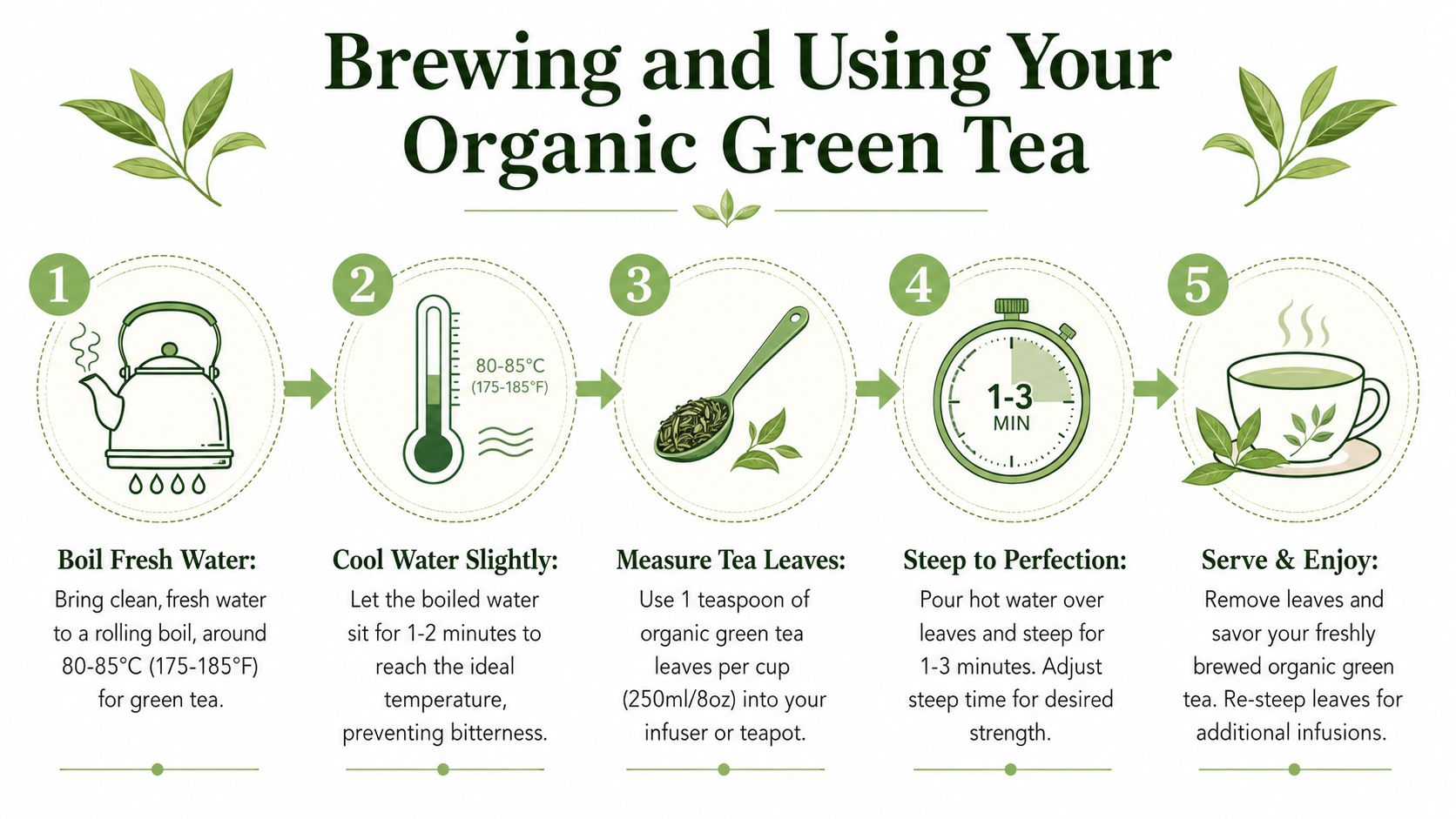
How to brew loose leaf well
You don't need specialist gear to get this right. You need a kettle, an infuser, and a timer.
Try this simple method:
- Boil fresh water, then let it cool slightly so it sits in the green tea range rather than straight off a hard boil.
- Add your leaf to an infuser or teapot.
- Pour and steep for a short, controlled time rather than guessing.
- Taste and adjust the next cup if needed. A shorter steep usually softens bitterness.
If your tea tastes harsh, don't blame the leaf first. Check temperature and time.
How to prepare matcha without lumps
Matcha is less about steeping and more about suspension. You're mixing powdered tea directly into liquid, so texture matters.
A reliable home method:
- Sift the matcha first if you can. This helps prevent clumping.
- Add a small amount of warm water and whisk into a smooth paste.
- Whisk briskly with more water until the surface looks evenly mixed and lightly frothy.
- For a latte, add your milk after the matcha is smooth.
For readers who like a visual guide, this short video is handy:
Easy ways to use it beyond a plain cup
Good organic green tea online should earn its place in your pantry. Matcha and loose leaf can both do more than one job.
A few practical uses:
- Morning latte. Matcha whisked with warm milk for a smoother start to the day.
- Iced drink. Chill brewed green tea and pour over ice.
- Smoothie add-in. Matcha works well when you want a green tea note in blended drinks.
- Baking and desserts. Culinary matcha suits slices, muffins, yoghurt bowls, and more.
- Food pairing. Loose leaf green tea can be a clean match for light lunches or sushi-style meals.
At Pep Tea, products like ceremonial-grade and culinary-grade organic matcha are examples of how different green tea formats suit different uses rather than one replacing the other.
Storage Freshness and Shipping Considerations
Fresh tea can lose its spark faster than many people expect. Light, air, moisture, and heat all work against flavour. If you've ever bought green tea that smelled flat or tasted dull within days, storage was probably part of the problem.
That's why packaging matters so much when you buy organic green tea online. User behaviour shows growing interest in how price, freshness, and packaging waste trade off when ordering online, along with a shift from conventional tea bags toward premium matcha and functional tea beverages, as noted in this retail-focused organic green tea collection page.
What to do once your tea arrives
Keep it simple and consistent:
- Store it airtight so the tea isn't repeatedly exposed to oxygen.
- Keep it out of direct light because light can flatten flavour over time.
- Avoid warm spots like windowsills, above kettles, or near the stove.
- Use the original pouch if it's well designed. Resealable, opaque packaging is usually there for a reason.
What to look for before you order
A product page can tell you a lot about freshness protection before you buy.
Check for:
- Opaque packaging rather than clear windows that expose the tea
- Resealable closures that make daily use easier
- Pack size that fits your habits so you're not opening the same bag for too long
- Clear shipping information that suggests the seller has thought about safe transit
If you're buying matcha, freshness protection matters even more because powder exposes a lot of surface area. Once opened, it deserves a bit of care.
Your Wellness Journey with Organic Tea
Buying organic green tea online doesn't need to feel like decoding a secret club. Once you know what to look for, the decision gets much calmer. You're checking for real certification, clear origin, sensible transparency, the format that suits your routine, and packaging that protects freshness.
That combination does more than help you choose a product. It helps you build a habit. A good green tea can become the quiet part of your day that feels organised, steady, and genuinely enjoyable. For some people that's a whisked matcha in the morning. For others it's a loose leaf pot in the afternoon instead of another coffee or a sugary drink.
The best tea choice is the one that fits your life closely enough that you'll keep reaching for it.
If you've been overwhelmed by choice, take that as a sign to simplify rather than give up. Look for proof over promises. Buy from sellers who educate as well as sell. And trust your own preferences once the basics are covered.
If you're ready to put that into practice, Pep Tea is a good place to explore organic matcha and green tea options with an Australian focus, clear education, and products designed for everyday use at home or in a café.
Best Green Tea for Energy: A Practical Guide for 2026

That foggy moment around 3 pm is familiar to almost everyone. You've done the morning sprint, lunch has come and gone, and suddenly your brain feels slower than your to-do list. Coffee can feel like the obvious answer, but not everyone wants the shaky hands, the wired feeling, or the late-day regret.
That's where green tea earns its reputation. The best green tea for energy isn't always the strongest one. It's the one that matches the kind of energy you want. Calm focus for work. A gentler lift for the afternoon. Something more powerful before training. Something steady enough that you still feel like yourself.
Green tea sits in a useful middle ground. It can help you feel switched on without turning the volume too high. If you're also trying to avoid the crash that often comes from sugary snacks, pairing your tea with something filling can help. A simple list of best protein snacks for work can make that afternoon reset far more reliable.
Tired of the 3 PM Slump? There's a Tea for That
A common starting point is a simple question. Which green tea gives the most energy?
It sounds sensible, but it's usually the wrong question. A better one is this. What kind of energy do you need right now?
If you're writing, studying, or sitting in meetings all afternoon, a huge stimulant hit often backfires. You don't need speed. You need clarity. That's why green tea appeals to so many people looking for a more balanced option.
Why green tea feels different
Green tea is often chosen for calm alertness rather than brute-force stimulation. That matters when you want to stay productive without feeling overcaffeinated.
A few common situations show how this plays out:
- For desk work: You want your mind switched on, but you still need patience and concentration.
- For the school pickup or late errands: You need a lift that doesn't feel too heavy.
- For a second drink later in the day: You want something gentler than another coffee.
- For a more mindful routine: You may want the ritual of making tea as much as the effect itself.
Green tea is often less about a “jolt” and more about helping you hold a better gear for longer.
The smarter energy question
When people look for the best green tea for energy, they often end up comparing matcha, sencha, gyokuro, and bancha as if one must win outright. It doesn't work that way.
The strongest option isn't always the best option. If you're caffeine-sensitive, the ideal tea may be one that gives only a mild nudge. If you need sustained concentration, you may prefer a tea that feels fuller and more immersive. If you're replacing an afternoon coffee, preparation can matter almost as much as the tea itself.
That's where green tea gets interesting. The leaf type matters. The style matters. The brew matters. And once you understand those three things, choosing the right cup becomes much easier.
The Science Behind Green Tea's Unique Energy Boost
Green tea's energy profile makes more sense once you stop thinking about caffeine on its own. It's the pairing of caffeine and L-theanine.
Caffeine is the part widely known. It supports alertness. L-theanine is the part many people overlook. It's often discussed as part of the reason green tea feels more composed and less jagged than other caffeinated drinks, including in conversations about a natural remedy for a racing mind.
Caffeine is the accelerator, L-theanine is the steady hand
A simple way to think about it is this. Caffeine gets the car moving. L-theanine helps keep it in lane.
That combination is why many people describe green tea as giving focused energy rather than nervous energy. It doesn't mean every green tea feels identical. It means the overall effect tends to be more controlled than drinks built around caffeine alone.
For Australian readers, the caffeine benchmark worth knowing comes from Food Standards Australia New Zealand. FSANZ lists brewed green tea at about 29 mg caffeine per 8-ounce cup, while brewed black tea is about 48 mg per 8-ounce cup. That makes green tea roughly 40% lower in caffeine than black tea in the same serving size (FSANZ benchmark discussed here).
That lower dose helps explain why green tea often feels easier to manage day to day.

Why the same tea can feel different from one cup to the next
Two people can drink “green tea” and have very different experiences. That's because the category is broad.
Some green teas are light and brisk. Some are savoury and deep. Some, like matcha, are consumed as powdered tea rather than an infusion. Preparation style changes the feel too, especially with matcha-based drinks.
If you're deciding between a straight tea and a latte, it helps to understand the basics of caffeine in a matcha latte, because milk, serving style, and powder amount can all influence how energising the drink feels in practice.
What readers often get wrong
A common misunderstanding is assuming “more energy” always means “better tea”. Usually it means “different tea”.
Here's the better frame:
- If you want smooth everyday focus, a moderate green tea may suit you best.
- If you want deeper concentration, a richer style may be the smarter pick.
- If you're sensitive to stimulation, gentler varieties often make more sense than chasing intensity.
Practical rule: Choose your tea for the task in front of you, not for the strongest label on the packet.
Comparing the Best Green Teas for Your Energy Needs
Once you know green tea energy isn't one-size-fits-all, the comparison becomes much more useful. The best green tea for energy depends on whether you want depth, steadiness, or a soft lift that won't crowd out the rest of your day.
Many general guides focus only on caffeine. That leaves out the steady feeling many people are chasing. One health explainer notes that green tea typically has around 30 mg of caffeine per cup, but also highlights L-theanine as the piece that helps explain the calmer focus people look for when using tea as a coffee alternative (Cleveland Clinic overview).
Green Tea Energy Profile Comparison
| Tea Type | Caffeine Level | L-Theanine Level | Energy Feel | Best For |
|---|---|---|---|---|
| Matcha | High | High | sustained, immersive, focused | Long work blocks, study, replacing a stronger morning drink |
| Gyokuro | High | Very high | deep concentration, calm intensity | Quiet work, reading, mentally demanding tasks |
| Sencha | Medium | Medium | bright, balanced, everyday lift | Daily use, afternoon tea, general productivity |
| Bancha | Low | Lower | gentle, easygoing, lighter stimulation | Caffeine-sensitive drinkers, later in the day |

Matcha for sustained alertness
Matcha is often the first tea people think of when they search for the best green tea for energy. That makes sense. It tends to feel fuller, more concentrated, and more substantial than a standard brewed cup.
The flavour is also distinctive. Expect grassy, umami-rich notes rather than a delicate brew. If you enjoy ritual, texture, and a tea that feels like an event rather than an afterthought, matcha stands out.
Gyokuro for serious concentration
Gyokuro is less talked about in mainstream guides, but it deserves attention. People who love it often want concentration rather than convenience.
Its flavour leans sweet, savoury, and marine. The energy feel is often described as composed and deep. It suits slower drinking and focused tasks better than a quick takeaway cup on the run.
Sencha for everyday productivity
If you want one tea that is widely suitable, sencha is a strong contender. It gives a cleaner, more refreshing style of energy than heavier green teas.
For many readers, sencha is the practical answer. It's approachable, versatile, and easier to fit into a daily routine than highly ceremonial styles.
Bancha for a lighter lift
Bancha doesn't get the same attention as matcha, but that's part of its value. It offers a gentler profile that suits people who still want the ritual and flavour of green tea without leaning too hard into stimulation.
Some of the best tea choices are the ones that leave enough room for the rest of your day.
If you've tried stronger green teas and found them a bit much, bancha may be the tea that finally clicks.
How to Choose the Right Tea For Your Goal
A tea can be excellent and still be wrong for you. That's the key idea most “best green tea for energy” roundups miss.
The right choice depends on the job you need the drink to do. Energy before a gym session is different from energy for spreadsheets, creative work, or a late-afternoon meeting where you still want to sleep well later.

If you need deep focus
Choose matcha or gyokuro.
These teas suit tasks that need sustained concentration. Think writing, design work, exam revision, strategy planning, or any job where mental stamina matters more than a fast rush.
Matcha is especially practical if you want something quick to prepare once you know the method. Gyokuro is better if you enjoy sitting with the tea and paying attention to the cup.
If you want a balanced daily lift
Choose sencha.
Sencha fits the broad middle. It's often the easiest recommendation for someone moving away from a second coffee. It feels cleaner and lighter, but still purposeful.
This is also the option that tends to suit shared households and office kitchens. Not everyone wants a ceremonial setup. Sencha gives you a lot of the upside with less fuss.
A short visual guide can help if you're still deciding:
If you're caffeine-sensitive
Choose bancha or a lightly steeped sencha.
That distinction matters. A lot of content treats matcha as the automatic winner, but one tea guide specifically notes that lower-caffeine choices such as bancha can be better for people who are sensitive to caffeine (Nio Teas discussion).
This is useful if you:
- Get jittery easily: Stronger green teas may feel too assertive.
- Drink tea after lunch: A lighter tea often fits better.
- Value the ritual more than the kick: You can still enjoy green tea without making energy intensity the goal.
If your goal is movement, not desk work
A stronger tea can suit pre-workout use, but be honest about tolerance. Some people enjoy matcha before training because it feels cleaner than sugary drinks. Others do better with a full-bodied sencha because it's less intense.
The mistake is assuming more is always better. If you want steady physical readiness, the best choice is the one that helps you feel switched on without tipping into overstimulation.
Decision shortcut: Choose by tolerance first, task second, flavour third. That order prevents most tea-buying mistakes.
Mastering the Brew for Maximum Clean Energy
The tea itself matters. The brew matters just as much.
A mediocre brewing method can flatten a good tea. An overly hot, careless brew can push bitterness forward and make the cup feel harsher than it needs to. If you want the best green tea for energy, you need a repeatable method.
The key variables that change the cup
For brewed green tea, the two biggest levers are water temperature and steeping time. Review data on green tea extraction shows the highest release of both EGCG and caffeine occurs at around 80 to 85 °C with about a 3-minute infusion (peer-reviewed review data here).
That's why random brewing produces random results.

A simple method for loose-leaf green tea
Use this as your starting point for sencha, gyokuro-style brewing adjustments aside.
Heat the water properly
Aim for water around 80 to 85 °C. Boiling water is usually too aggressive for green tea.Steep with intention
Start at about 3 minutes for a cup that prioritises both energy and flavour balance.Taste before changing everything
If it feels weak, don't automatically buy a different tea. First adjust the brew slightly. If it tastes harsh, shorten the infusion or lower the heat a touch.
How to brew matcha for a cleaner lift
Matcha works differently because you're whisking the tea into water rather than extracting flavour from leaves and removing them.
A few basics matter:
- Sift the powder: This helps avoid clumps.
- Use hot, not boiling, water: Excess heat can flatten flavour.
- Whisk well: You want an even suspension and a smooth surface froth.
- Keep your method consistent: If one bowl feels great and the next feels dull, preparation is often the missing variable.
If you want a visual walkthrough, this guide on how to whisk matcha is a helpful place to start.
What cafés and home brewers often miss
People often blame the tea when the core issue is process. A cooler, shorter brew can reduce the cup's energising feel. A hotter, longer brew can drag it toward bitterness.
That's why consistency matters so much. If you find a green tea you enjoy, lock in your water temperature, your steep time, and your serving style. Once those are stable, you can judge the tea properly.
Brew first for balance, then fine-tune for intensity.
Creative Recipes to Energise Your Day
Hot tea is only one way to use green tea for energy. Some of the easiest wins come from folding it into routines you already enjoy. That might be a cold drink on a warm afternoon, a quick breakfast, or a snack you can take to work.
Iced matcha latte for a clean afternoon reset
This is the drink many people reach for when they want something refreshing but still purposeful.
What you'll need
- Matcha powder
- Hot water
- Cold milk or plant milk
- Ice
How to make it
Whisk the matcha with a small amount of hot water until smooth. Fill a glass with ice and milk, then pour the matcha over the top. Stir before drinking.
The appeal here isn't just flavour. It's convenience. You get a tea-based pick-me-up in a format that feels familiar if you're used to iced coffee.
Matcha smoothie for busy mornings
If breakfast is rushed, a smoothie can make green tea feel easier to use consistently.
Try blending:
- Matcha powder for that green tea backbone
- Banana for body
- Greek yoghurt or a dairy-free alternative for creaminess
- Ice for texture
- A little honey if you like it sweeter
This works well when you want energy plus something more filling.
Energy bites with green tea flavour
If you prefer your tea alongside a snack rather than inside it, matcha works beautifully in no-bake bites. Oats, nut butter, seeds, and matcha make a practical combination for busy days.
For a ready-made idea, this matcha energy balls recipe is worth bookmarking.
Kombucha spritzers and social serves
Not every energising drink has to be a hot tea or latte. A kombucha-based spritzer can feel lighter and more social, especially in the afternoon or at gatherings where you want a grown-up non-alcoholic option.
Try pouring chilled kombucha over ice with citrus and fresh herbs. If you're entertaining and want broader inspiration, these green tea cocktail recipes can spark ideas for tea-led serves and alcohol-free adaptations.
A good tea habit sticks better when it fits your real life, not just your ideal routine.
Find Your Perfect Energising Brew with PepTea
The best green tea for energy is personal. It depends on whether you want concentration, steadiness, or a gentler lift that won't push too hard. That's why blanket advice can be so unhelpful.
Some people do best with matcha because they want sustained focus and a more immersive tea ritual. Others are happier with sencha because it fits ordinary afternoons. Some need to step back from intensity altogether and choose something softer.
The good news is that you don't need to guess blindly. Start with your goal. Decide how much stimulation you enjoy. Then pay attention to brewing, because the same tea can feel very different depending on how you prepare it.
If you've been disappointed by green tea before, don't assume the category isn't for you. It may mean you had the wrong style, the wrong timing, or the wrong brew. Small changes can turn a flat, forgettable cup into one of the most reliable parts of your day.
If you're ready to explore your own routine, Pep Tea offers premium organic matcha and Australian-made organic kombucha for clean, everyday enjoyment. Browse the range, experiment with your preferred style, and find the brew that suits the way you want to feel.
The Best Green Tea For Weight Loss in Australia for 2026

If you're looking for a natural way to support your weight management goals, the world of green tea can feel overwhelming. But the search for the best green tea for weight loss in Australia often leads back to one standout: premium organic Matcha.
The reason is simple. With Matcha, you consume the entire stone-ground leaf, not just a watery infusion. This means you get a far higher concentration of the metabolism-supporting compounds that make green tea so effective.
Finding the Best Green Tea for Your Weight Loss Journey
Welcome to a practical guide for using green tea to support your health goals. As more and more Aussies look for natural, effective ways to enhance their wellness routines, it's important to cut through the noise and focus on what actually works.
We'll get into the science behind key compounds like EGCG and caffeine, and how they can genuinely assist with metabolism and fat oxidation. Of course, tea alone isn't a silver bullet. A sustainable approach to weight management starts with the fundamentals, like understanding how to count calories for sustainable weight loss. Think of the right tea as a powerful tool to complement your efforts, not a replacement for them.

Why the Right Tea Matters
Not all green teas are created equal, especially when it comes to supporting your body. The concentration of active ingredients varies dramatically between a high-quality powder and a generic teabag, which is why your choice of product is critical for seeing any real results.
Here in Australia, where wellness is a growing priority for many, people are turning to organic green teas for that extra edge. It’s not just wishful thinking; the science backs it up. One notable study found that daily consumption of high-EGCG matcha—very similar to our premium organic blend at PepTea—led to noticeable weight loss over 12 weeks when combined with moderate exercise.
The secret is Matcha’s superior catechin profile. At up to 137mg of EGCG per gram, it can outperform standard steeped green tea by as much as three times. This makes it a clear standout for anyone serious about their weight management goals.
To make things clearer, here’s a quick rundown of the main players in the green tea world and how they stack up for supporting a wellness journey.
Quick Comparison of Teas for Weight Management
| Tea Type | Key Compound (EGCG) | Best For | PepTea Option |
|---|---|---|---|
| Organic Matcha | Very High | Maximising metabolism and focused energy. | Ceremonial Grade Matcha |
| Sencha (Steeped) | Moderate | A daily antioxidant-rich beverage. | Green tea base in our kombucha. |
| Standard Teabags | Low to Moderate | Convenience and a gentle introduction. | N/A |
| Sugar-Free Kombucha | Low (from tea base) | Supporting gut health and reducing sugar intake. | Organic Sugar-Free Kombucha |
This table shows exactly why our focus at PepTea is on premium Japanese organic Matcha and authentic, Australian-brewed sugar-free Kombucha. They offer distinct and powerful benefits that fit perfectly into a modern, holistic approach to health. It's all about making an informed choice that works for your lifestyle.
Why Organic Matcha Is a Metabolic Powerhouse
When weight management is the goal, the kind of green tea you reach for genuinely matters. While most teas come with benefits, organic matcha operates in a different league entirely for supporting your metabolism. It all comes down to a simple, powerful difference in how you drink it.
With regular green tea, you steep the leaves and then toss them out. With matcha, you’re consuming the entire stone-ground leaf. This means you get 100% of the nutritional firepower, including a far more concentrated dose of the compounds that count.
The Power of EGCG and Caffeine Synergy
The star player in green tea is a catechin called Epigallocatechin gallate (EGCG). It's a powerhouse antioxidant that’s been strongly linked to firing up your metabolism and increasing fat oxidation. Because you’re drinking the whole leaf, a single serve of matcha can deliver up to ten times the EGCG of a standard cup of steeped green tea.
But EGCG doesn’t work in isolation. Matcha’s real magic lies in its unique synergy of EGCG and caffeine. This combination gives you a clean, sustained energy boost without the jittery highs and crashing lows that coffee can bring on. It’s the perfect fuel for powering through a workout or just an active day.
This isn’t just about feeling more energetic. It translates into a real metabolic edge. The pairing helps increase thermogenesis—your body's rate of burning calories to create heat—effectively turning your system into a more efficient fat-burning engine.
This metabolic advantage is particularly relevant for many Australians. Studies have shown that daily consumption of organic matcha, mirroring the antioxidant levels in PepTea's products, may lead to a reduction in waist circumference and weight drop over several weeks. You can explore the full research on green tea catechins and their effects.
Why Organic and Ceremonial Grade Matter
Not all matcha is created equal. The quality and origin of the powder have a direct impact on its potency and, by extension, its effectiveness for managing weight.
- Vibrant Colour: High-quality, ceremonial-grade matcha has a brilliant, almost electric green colour. If it looks dull, murky, or yellowish, it’s likely a lower-grade product with fewer antioxidants.
- Purity: Choosing a certified organic product is non-negotiable. It’s your guarantee that the matcha is free from pesticides and other contaminants, so you’re only putting clean, pure goodness into your body.
- Authenticity: Sourcing from its traditional home in Japan, like our premium selection at PepTea, ensures you're getting an authentic product grown and processed for maximum potency.
By opting for a premium, ceremonial-grade organic matcha, you’re making sure you get the highest possible concentration of EGCG and L-theanine. This purity turns it from just a tea into a reliable tool in your wellness arsenal. You can learn more about the amazing benefits of Matcha green tea in our detailed guide.
Ultimately, bringing a daily matcha ritual into your life is more than just enjoying a delicious drink. It's a strategic move to support your body's natural fat-burning processes. Whether you have it as a pre-workout shot or a morning latté, you’re fuelling your body with the best nature has to offer.
Matcha vs. Sencha vs. Bagged Tea: A Nuanced Comparison
To find the best green tea for weight loss, you need to look past the packaging and understand what's really happening inside your cup. While all green tea comes from the same plant, Camellia sinensis, the way it's grown, processed, and prepared creates a world of difference in its potency. Let’s break down the three main players: matcha, sencha, and standard bagged tea.
Sencha is what most people picture when they think of green tea. It’s made by steeping whole or partial leaves in hot water, which infuses the water with flavour and some of the tea's antioxidants. It’s a fantastic, healthy beverage. No argument there.
The catch is that steeping is an inefficient delivery system. You’re essentially making a light broth, and the vast majority of the valuable compounds—including much of the fat-fighting EGCG—remain locked inside the leaves, which you then discard.
From Good, to Better, to Best
Standard bagged green tea is a step down from loose-leaf sencha. It often uses the dust and fannings—smaller, broken leaf particles—left over from processing higher-grade teas. This can lead to a more bitter flavour and a lower concentration of key nutrients. While it's convenient, it’s the least potent option if you're looking for real wellness benefits.
This is where organic matcha completely changes the game.
With matcha, you aren't steeping anything. You are consuming the entire, stone-ground leaf, whisked into a suspension. Think of it as the difference between boiling a carrot and drinking the water versus eating the whole carrot. This whole-leaf consumption is precisely what makes matcha such a powerhouse for weight management.
This decision tree helps visualise how matcha’s unique properties deliver on specific goals like weight management and energy.

As you can see, the path to both sustainable weight management and clean, focused energy leads directly to matcha, highlighting its powerful dual-action benefits.
The L-theanine Advantage for Weight Management
Another crucial differentiator is L-theanine, an amino acid that is especially abundant in high-quality, shade-grown matcha. L-theanine is the compound responsible for that feeling of calm, focused alertness—the very opposite of the jitters you get from coffee. It works in perfect harmony with caffeine to provide a smooth, sustained energy lift without the eventual crash.
This has very practical implications for weight loss. The calm focus it promotes can be a massive help in managing stress-related or emotional eating. When you feel balanced and centered, you're far less likely to reach for unhealthy snacks. While other green teas contain L-theanine, the concentration in premium matcha is significantly higher, making this benefit far more pronounced.
When you choose a premium organic matcha, you're not just buying a tea; you're investing in a more concentrated and effective tool for your wellness journey. The superior EGCG and L-theanine content delivers value that steeped teas simply cannot match.
To put this all into perspective, a side-by-side comparison makes the differences impossible to ignore.
Detailed Nutrient and Benefit Breakdown Matcha vs Other Green Teas
The table below breaks down exactly what you're getting—and what you're missing—with each type of green tea. The numbers reveal a clear winner for anyone focused on metabolic support.
| Feature | Organic Matcha (e.g., PepTea Ceremonial) | Sencha (Loose Leaf) | Standard Bagged Green Tea |
|---|---|---|---|
| EGCG Content | Very High (up to 137x more than some green teas) | Moderate | Low to Moderate |
| Antioxidant Access | 100% (whole leaf consumed) | 10-20% (from infusion only) | 5-10% (from infusion only) |
| Caffeine Level | Higher (35-70mg per serving) | Lower (20-30mg per cup) | Low (15-25mg per cup) |
| L-theanine Effect | Strong (calm, focused energy) | Mild | Minimal |
| Preparation | Whisked into water or milk | Steeped in hot water | Steeped in hot water |
| Primary Benefit | Maximising metabolism, focus, and fat oxidation support. | Daily antioxidant intake and hydration. | Convenience for a mild green tea flavour. |
The data speaks for itself. For anyone serious about using green tea to support their weight loss goals, the evidence points overwhelmingly towards a high-quality, organic matcha. It delivers the highest possible concentration of the active compounds needed to support your metabolism, energy, and focus in a way no steeped tea ever could.
The Role of Sugar-Free Kombucha in Weight Management
While matcha often gets the spotlight for its metabolism-supporting credentials, a smart weight management plan runs much deeper than a single ingredient. One of the most overlooked pieces of the puzzle is gut health, and this is where an authentically fermented drink like kombucha becomes a powerful ally. It offers a different, yet complementary, approach to supporting your wellness goals.
Many people don’t realise our own proudly Australian-brewed PepTea Kombucha starts with the very same high-quality organic green tea you’d find in a premium blend. Through a careful fermentation process right here in the Hunter Valley, NSW, we culture billions of beneficial live probiotics, creating a living drink that still holds onto some of the tea’s natural antioxidant properties.
Gut Health and Its Link to Weight
Your gut microbiome—that community of trillions of bacteria in your digestive tract—plays a surprisingly big role in how your body handles weight. A balanced microbiome is linked to better digestion, less inflammation, and even more efficient metabolic function. When your gut is happy, the whole system just runs better.
The live probiotics in a properly brewed kombucha help to nourish and diversify these good bacteria. This is crucial for optimising how you absorb nutrients and maintaining the delicate internal balance a healthy metabolism depends on.
Choosing a truly fermented, sugar-free kombucha is vital. Many commercial brands are little more than fizzy soft drinks loaded with sugar, which actively works against your weight management efforts by causing blood sugar spikes and adding empty calories.
Kombucha as a Smart Swap
One of the most practical ways sugar-free kombucha supports weight management is simply by being a satisfying, healthy substitute for other drinks. Its natural fizz and complex flavour make it a fantastic alternative to sugary soft drinks, juices, and even that evening glass of wine.
Think about these moments:
- The 3 PM Slump: Instead of reaching for a sugary energy drink, a chilled glass of our Ginger Kombucha gives you a refreshing lift without the inevitable sugar crash.
- The Evening Unwind: Swapping a glass of wine or beer for a sophisticated, bubbly kombucha can save you hundreds of calories over a week, all without feeling like you’re missing out.
- A Healthy Mixer: Our Lime & Ginger flavour is brilliant on its own or as a zesty, sugar-free base for non-alcoholic cocktails at your next get-together.
Each of these is a small, easy decision that chips away at your overall calorie and sugar intake—the cornerstone of any sustainable weight management plan. By making these smarter choices consistently, you can make significant progress without feeling deprived.
The Perfect Complement to Matcha
Think of matcha and kombucha as two sides of the same wellness coin. While matcha works directly on your metabolism with its high EGCG and caffeine content, sugar-free kombucha works indirectly by fostering a healthy gut and helping you cut down on sugar. As you'll see when you read more about our move to zero-sugar kombucha, this dual approach creates a far more robust foundation for reaching your goals.
By bringing both into your daily routine, you get a powerful, two-pronged strategy. You have the direct metabolic support from your morning matcha, and the gut-friendly, sugar-slashing benefits of kombucha throughout the day. It’s a balanced and delicious way to support your body from the inside out.
Integrating Green Tea into Your Daily Routine for Success
Knowing the science behind green tea is one thing. Turning that knowledge into real, lasting results is another. The key is consistency.
The real progress happens when you build small, enjoyable rituals into your day. This isn’t about a complete life overhaul. It's about smart adjustments that feel natural, not like another chore on your to-do list. Let's look at a few practical ways to make it happen.
Your Morning Matcha Ritual
The morning sets the tone for the entire day, which makes it the perfect time to bring in matcha. A simple morning ritual can easily replace less healthy habits, like a sugary café latté, giving you a clean, focused start.
Here are a few ways to get started:
- The Pre-Workout Shot: For a clean energy surge before exercise, nothing beats a quick shot of ceremonial matcha. Just whisk half a teaspoon of our Organic Ceremonial Grade Matcha with a bit of hot (not boiling) water. That blend of caffeine and L-theanine gives you focused energy and can enhance fat oxidation during your workout.
- The Creamy Morning Latté: Ditch the expensive, sugar-loaded café lattés and make your own at home. Whisk one teaspoon of matcha into a paste with a splash of hot water, then pour over steamed milk. It’s a comforting, powerful way to start your day.
- The Smoothie Boost: Just add a teaspoon of culinary-grade matcha to your morning smoothie. It works beautifully with ingredients like banana, spinach, and a scoop of protein powder for a breakfast that's packed with nutrients and keeps you feeling full for hours.
For a truly holistic approach, pairing your green tea routine with consistent physical activity—supported by a personalized strength training app—helps you build sustainable habits and see real progress.
Beating the Afternoon Slump and Cravings
That 3 p.m. slump is when cravings for sugary snacks and drinks tend to hit hardest. This is exactly where our Australian-brewed, sugar-free kombucha comes in.
It offers that satisfyingly fizzy and flavourful lift, but without the sugar that can completely derail your goals.
Swapping just one sugary soft drink or juice for a bottle of PepTea Kombucha each day is a simple but powerful change. It significantly cuts your weekly sugar and calorie intake, supports a healthy gut, and helps you get a handle on cravings.
An ice-cold glass of our Ginger or Lime & Ginger Kombucha can crush those afternoon sugar urges while delivering a dose of beneficial probiotics. It’s a smart swap that feels like a treat.
Simple Tips for the Perfect Bowl of Matcha
Brewing a great bowl of matcha is a mindful ritual in itself. It’s much simpler than it looks and is the secret to getting that smooth, lump-free cup every single time.
- Sift the Powder: Always use a small sifter to break up any clumps in the matcha. This one step is the key to a silky-smooth texture.
- Add Hot Water: Pour a small amount of hot water—around 80°C, never boiling—over the sifted powder. Water that's too hot will make the matcha taste bitter.
- Whisk Vigorously: Using a bamboo whisk (a chasen), whisk quickly in a 'W' or 'M' pattern until a fine, delicate foam appears on the surface.
Creating these small habits is what makes all the difference. Whether it’s that morning matcha or an afternoon kombucha, finding what you genuinely enjoy is what makes a wellness journey sustainable.
How to Choose a High-Quality Green Tea Product
The real-world benefits you expect from green tea are entirely dependent on its quality. To find the best green tea for your weight management goals, you have to know how to spot a premium product and, just as importantly, how to sidestep a poor one. This is about becoming a savvy buyer, making sure the product you choose actually delivers.

When it comes to matcha, what you see—and taste—tells you everything. Low-grade matcha is often a dull, yellowish-green and carries a bitter taste, a dead giveaway that it lacks the rich concentration of antioxidants and L-theanine you’re after.
What to Look for in a Premium Matcha
A truly high-quality matcha has distinct characteristics that are easy to spot once you know what to look for. Use your senses; they are the best guide to a product that will genuinely support your health journey.
- Vibrant Green Colour: Authentic, high-grade matcha should have a brilliant, almost electric green hue. This isn't just for show; it's a direct result of the shade-growing process, which boosts chlorophyll and antioxidant levels.
- Fine, Silky Texture: Rub a pinch of premium matcha between your fingers. It should feel incredibly fine and silky, almost like eyeshadow. A gritty or coarse texture is a red flag, signalling a lower-quality powder made from older leaves or even stems.
- Sweet, Umami Flavour: Top-tier matcha has a complex flavour profile that's slightly sweet with a rich, savoury "umami" finish. It should be smooth and pleasant, never overwhelmingly bitter or astringent. You can discover more about telling different grades apart in our detailed guide.
A 'Certified Organic' label is your most important guarantee of purity. It ensures your tea is free from harmful pesticides and chemicals, allowing you to enjoy its benefits without any unwanted additives. At PepTea, all our products are certified organic for this very reason.
How to Select a Quality Kombucha
Choosing the right kombucha is just as critical, especially when weight management is a priority. The market is flooded with options, but many are closer to sugary soft drinks than the healthy fermented beverage they claim to be.
For kombucha, the label is your best friend. Look for these key phrases to ensure you're getting an authentic, beneficial product:
- "Sugar-Free" or "Zero Sugar": This is non-negotiable. Many brands add sugar after fermentation, which just adds empty calories and can completely negate the health benefits.
- "Brewed in Australia": Supporting local is great, but this often means a fresher product that hasn't spent weeks in transit. Our PepTea Kombucha is proudly brewed right here in the Hunter Valley, NSW.
- "Contains Live Cultures" or "Raw & Unpasteurised": Pasteurisation kills the beneficial live probiotics that support gut health. An authentic kombucha should be a living drink, period.
By using these simple checks, you can confidently select products like our authentic Japanese Matcha and HACCP-accredited kombucha. You’ll be choosing quality that empowers your wellness journey from the inside out.
Frequently Asked Questions About Green Tea and Weight Management
Once you start looking seriously at green tea for weight management, a few practical questions always come up. It's one thing to know the science, but it’s another to fit it into your daily life. Let's clear up some of the most common queries we hear from our community.
How Much Green Tea Should I Drink for Weight Loss?
There isn't a single magic number, but the research points to a consistent range. Most studies showing real benefits used an amount equal to about 2–4 cups of standard green tea per day.
If you're using a more concentrated source like matcha, this translates to roughly 1–2 servings (or 1-2 teaspoons of powder). The key here is consistency, not sheer volume. Choosing a high-EGCG option, like our organic Matcha, means you can get meaningful support from smaller, regular amounts. We usually suggest starting with one serving a day and seeing how your body feels.
Is It Okay to Drink Green Tea on an Empty Stomach?
This really comes down to your personal sensitivity. Green tea contains compounds called tannins, and in a potent form like matcha, they can sometimes cause a bit of stomach upset if there's nothing else in there.
Our general advice is to have it with or after a meal, especially when you’re just starting. A matcha latté, made with your milk of choice, is often much gentler than straight tea on an empty stomach. The best rule is simple: listen to your body. If you feel perfectly fine, it’s generally considered safe.
Will Green Tea Interfere With My Sleep?
Green tea does have caffeine, but usually less than you’d find in a standard cup of coffee. One of the standout features of matcha is its high level of L-theanine, an amino acid that encourages a state of calm focus and can buffer some of caffeine's less desirable, jittery side effects.
That said, everyone’s caffeine sensitivity is different. To play it safe, we recommend enjoying your caffeinated green teas (like matcha) before 2 PM. This gives your body plenty of time to process the caffeine so it doesn't disrupt your sleep. For a satisfying and healthy evening drink, our sugar-free PepTea Kombucha is an excellent caffeine-free choice.
Is Hot or Cold Green Tea Better for Weight Loss?
Both hot and cold preparations will deliver the weight management support you're looking for. The key compounds, especially EGCG, are stable and effective regardless of whether the water is hot or cold.
Some evidence hints that hot water might slightly improve the absorption of catechins, but the difference is pretty minor in the grand scheme of things. The most important factor is simply drinking it consistently. The best green tea for weight loss is the one you'll actually enjoy and drink every single day, so choose whichever method you prefer.
Ready to discover the power of premium organic tea? Explore the PepTea difference and find the perfect addition to your wellness routine by visiting our online store.