
Tag: matcha grades
How to Order Matcha Powder the Smart Way
You're ready to order matcha powder, but the product page gives you little more than a green tin, a premium-sounding label, and a price. The safest choice isn't automatically the most expensive one. It's the powder whose grade, origin, packaging, serving size, and intended use match what you'll do with it.
That matters in Australia, where more than 90% of domestic matcha demand is met through imports and combined green-tea-powder imports grew at an estimated 13–17% CAGR from 2020 to 2025, according to Australian matcha market analysis. Supply changes can affect availability, substitutions, and pricing, so a smart order starts with product information, not branding.
Why Ordering Matcha Powder Deserves More Thought Than a Cart Click
A large pouch can look economical until you open it weeks later and find faded colour, a stale aroma, or a bitter drink that needs plenty of sweetener. Matcha is finely ground, so air, moisture, light, and heat reach more of the tea than they do with intact loose-leaf tea. Buy more than you can use while it is fresh and the saving quickly loses its appeal.
Start with the job the powder must do: how will you use the matcha? A bowl whisked with water exposes its colour, aroma, texture, and aftertaste. A latte brings milk and perhaps syrup. Baking adds sugar, flour, butter, and heat. Each use calls for a different balance, so the highest grade is not automatically the best purchase.
Practical rule: Buy for the drink or recipe you make most often, not for the most impressive grade name on the label.
Origin matters, but “Japanese matcha” does not answer every useful question. A product page should explain whether the powder is genuine matcha made from shaded tea leaves or green-tea powder using matcha-style language. Check the listed origin, ingredients, batch details, and packaging. Those details help you judge the seller's supply chain and freshness before paying.
Australian buyers also need a continuity plan. Japanese green-tea imports to Australia rose nearly 20% year over year in 2024, per Australian matcha market reporting, while some Australian cafés reported matcha-latte prices of approximately AUD 6–8. If supply tightens, ask whether the seller will keep the stated origin and grade, substitute another source, reduce the serving size, or raise the price.
Compare cost per prepared serve, not just the tin price. A powder that suits your usual latte or recipe can offer better value than an expensive ceremonial powder whose finer flavours disappear under milk, syrup, or other ingredients.
A specialist such as The Matcha Bike Miami matcha service shows how a focused matcha business presents preparation and service. For an Australian order, check delivery, labelling, freshness, and provenance yourself.
Understanding Matcha Grades and What Each One Is Actually For
Matcha grades are best treated as use-case labels, not universal quality rankings. “Ceremonial” usually signals a powder designed to be enjoyed with water, while “culinary” points towards recipes where other ingredients share the stage. “Premium” can sit between those uses, but sellers don't apply these terms identically.
Ceremonial grade for a clean, direct drink
Ceremonial matcha is the choice for a whisked bowl where the powder's colour, aroma, texture, and aftertaste are obvious. Choose it when you enjoy matcha with water and don't want milk or sugar to carry the flavour.
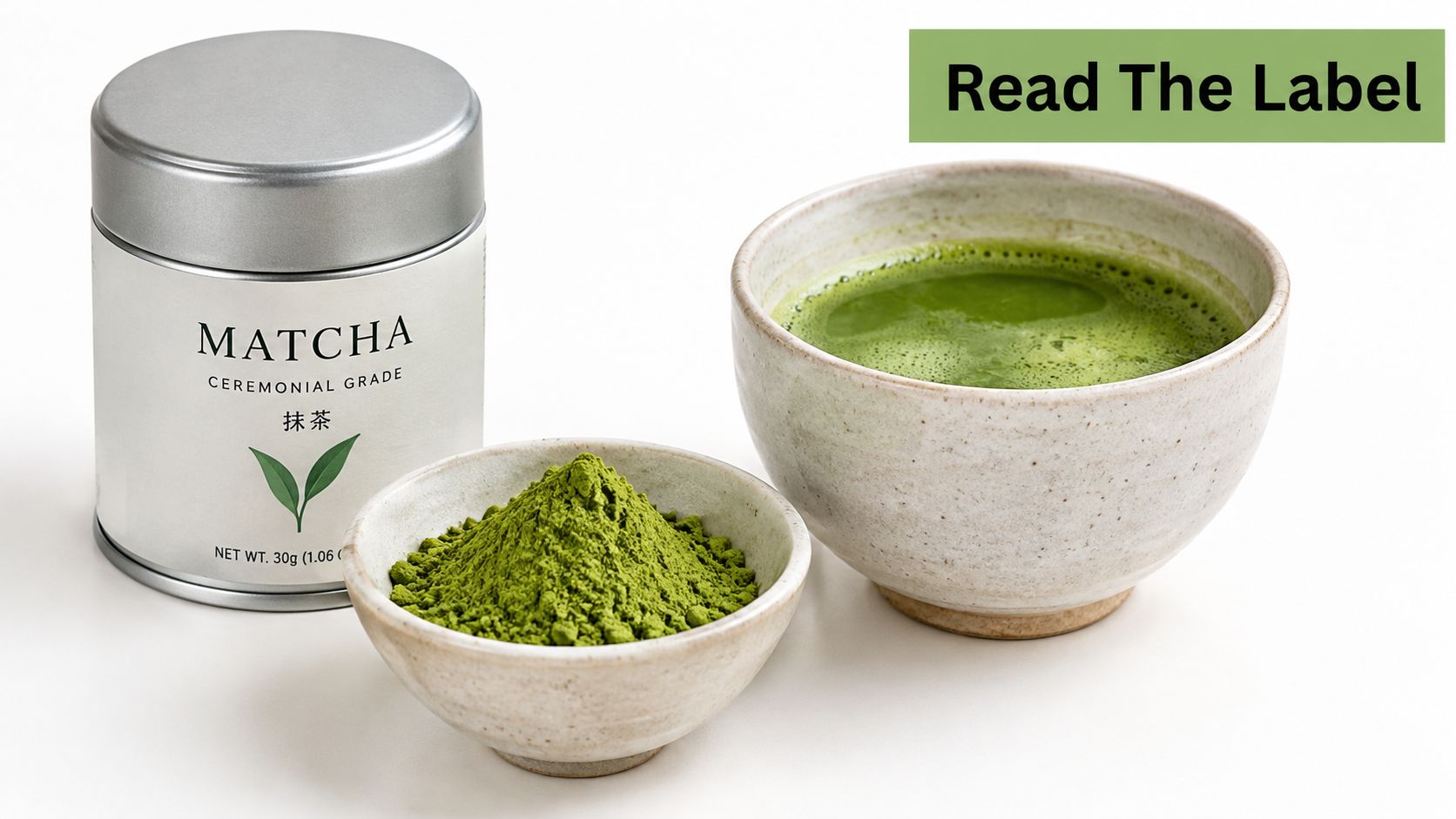
A vivid green colour can be encouraging, but it isn't enough on its own. Look for 100% matcha, Japanese origin, a clear lot or batch reference where available, and packaging that protects the powder from oxygen and light. A good ceremonial powder should whisk smoothly after sifting and taste balanced rather than harshly bitter.
Premium or ceremonial-blend for everyday flexibility
Premium or ceremonial-blend matcha is often the most useful middle ground for a regular home drinker. It can work in a latte, iced matcha, smoothie, or a lighter bowl, without making every preparation feel like a special occasion.
Value becomes personal here. If you mostly add milk, fruit, or other strong flavours, a balanced mid-range powder may give you more satisfaction than an expensive powder whose subtle notes disappear in the recipe.
Culinary grade for baking and blended drinks
Culinary grade is made for recipes that need matcha's colour and distinctive tea character alongside other ingredients. It suits muffins, biscuits, brownies, cheesecake, ice cream, smoothies, and strongly flavoured lattes.
That doesn't mean culinary grade should taste rough or unpleasant. It should still be clearly identified, fresh, finely milled, and free from unnecessary additives. A culinary powder may bring a more assertive tea flavour that holds up better against chocolate, citrus, dairy, or plant-based milk.
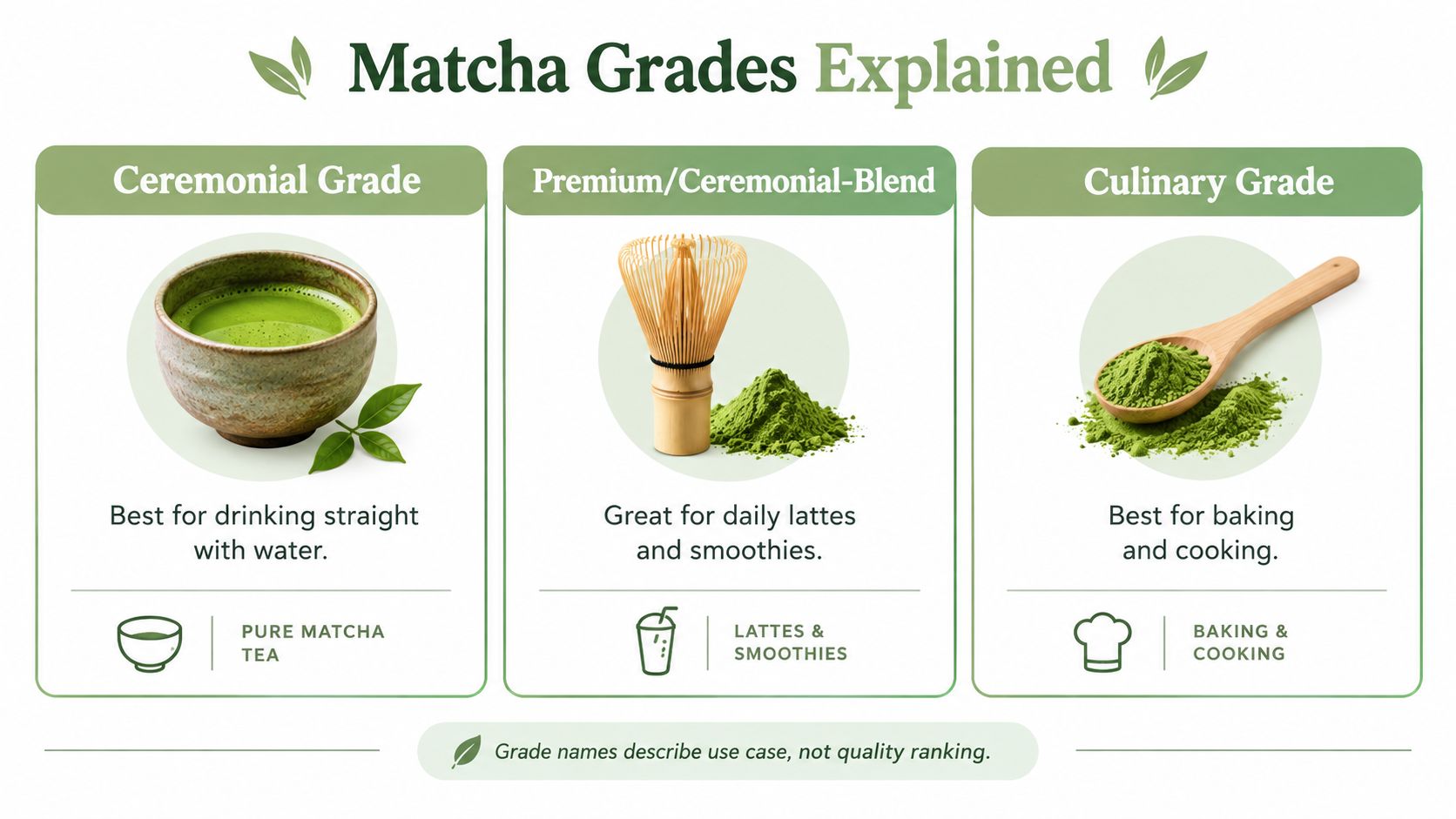
The practical distinction is simple: ceremonial is for drinking straight, premium is for flexible daily use, and culinary is for cooking and baking. Pep Tea's guide to different matcha grades is a useful reference when a product page uses several overlapping grade terms.
Don't pay for a high-grade powder because the label sounds luxurious. If the powder will disappear into a sweetened iced latte or a batch of baked goods, culinary or premium matcha can be the more sensible order.
Matching the Grade to Your Cup, Latte, or Recipe
The right matcha becomes much easier to choose once you name the preparation. A plain whisked bowl rewards smoothness and balance. A latte needs enough flavour to remain noticeable through milk. Baking needs colour and resilience rather than delicate tasting notes.
| Use case | Ceremonial grade | Premium grade | Culinary grade |
|---|---|---|---|
| Whisked bowl with water | Best fit for a clean, direct taste | Suitable for an everyday bowl | Usually too assertive or coarse-tasting |
| Hot matcha latte | Excellent, but may be more than needed | Strong everyday choice | Suitable when milk or sweetener dominates |
| Iced matcha | Smooth and refined | Practical balance of flavour and value | Works well with fruit, syrup, or bold milk |
| Smoothie | Often unnecessary | Versatile option | Good for stronger fruit or protein blends |
| Baking and desserts | Usually wasteful | Useful for lighter recipes | Best fit for colour and pronounced tea flavour |
A ceremonial powder earns its price when you can taste it directly. It's the logical choice for a small bowl of matcha and water, where there's nowhere for bitterness or stale notes to hide. It can also suit a minimalist iced drink with little more than water and ice.
Premium grade is the useful compromise for people who alternate between bowls, lattes, and smoothies. You'll get flexibility without building your entire routine around a powder that should be consumed quickly and treated carefully.
Culinary grade often delivers the best cost per prepared serve for a café-style latte, especially if you use milk, fruit, cocoa, vanilla, or sweetener. A cheaper powder isn't better if it tastes unpleasant, but a high-grade powder isn't better if its character is buried under several other ingredients.
The honest trade-off: Premium doesn't automatically mean better. It means the powder may be better suited to a particular preparation.
Before you order, write down your likely use in one sentence. “I want a plain morning bowl” points towards ceremonial. “I want iced lattes and smoothies” points towards premium. “I'm baking and making flavoured drinks” points towards culinary.
The Australian Ordering Checklist Before You Check Out
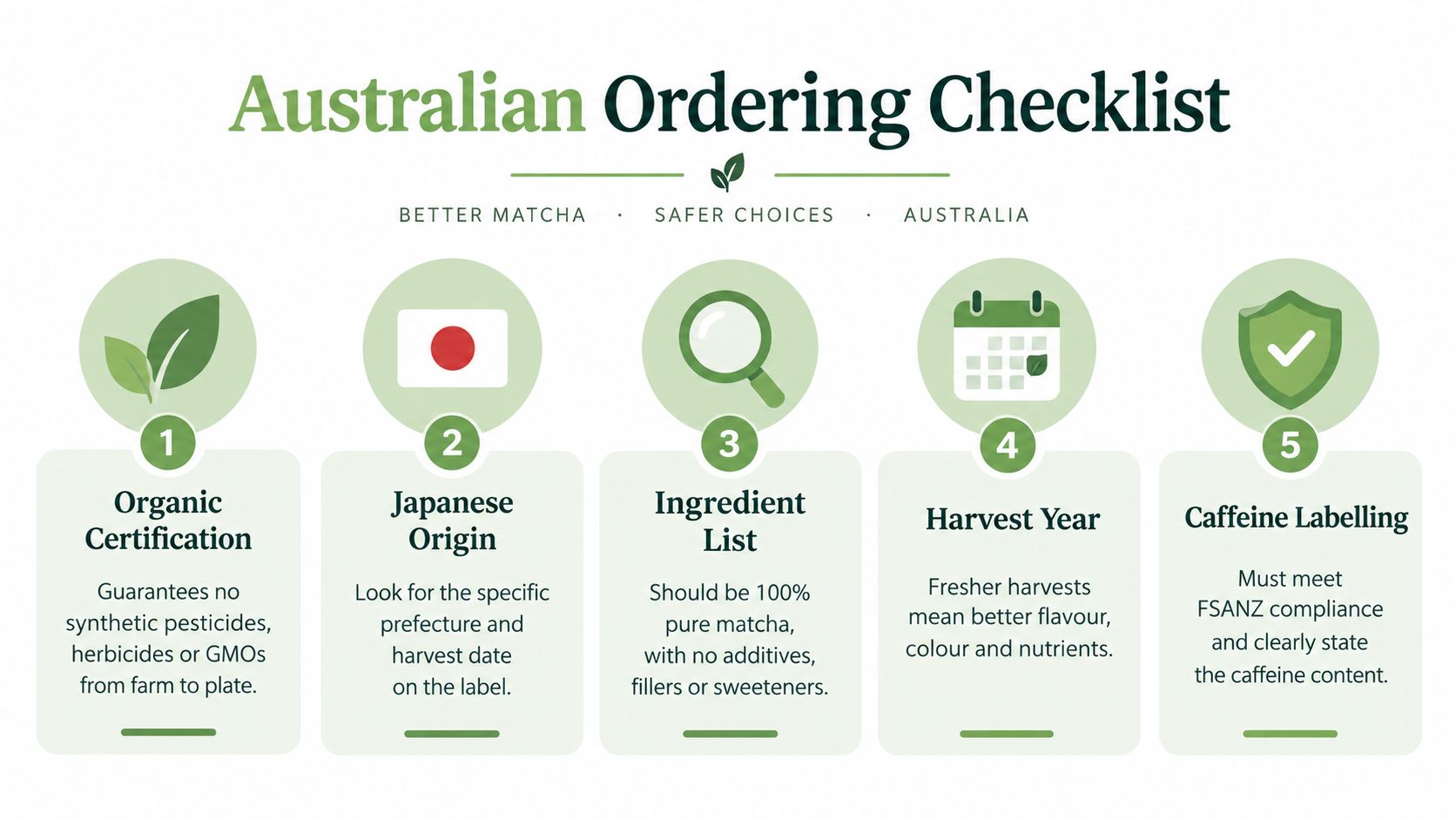
A good product page should answer your important questions without forcing you to search through vague marketing copy. Run these checks before adding matcha to your cart.
Check the product identity
Look for 100% matcha in the ingredient list. Genuine matcha is powdered tea, not a blend padded with sugar, starch, flavouring, or anti-caking ingredients. “Green tea powder” can describe a broader category, so check whether the seller explains the tea's origin and production clearly.
Japanese origin is a useful starting point, but ask for more detail where possible. A prefecture, harvest information, cultivar, or producer reference gives you a clearer picture than a generic country label. Tencha is the leaf material traditionally associated with matcha production, whereas ordinary green-tea powder may be made from a different raw material and processed for a different purpose.
Check certification and traceability
Organic certification can matter if organic purchasing is part of your priorities, but the word should be supported by identifiable certification information. Also look for a lot or batch reference, best-before information, and a seller who can explain how the product is packed and restocked.
Harvest details are helpful because matcha is a fresh powdered tea, not a pantry ingredient that improves with age. A product page doesn't need to make dramatic freshness promises. It should give you enough information to judge whether the powder has been sitting in an uncertain supply chain.
Check the format and delivery
A metal tin can protect a small quantity from light and repeated handling. A resealable pouch may suit a larger quantity if it has a reliable barrier and you transfer or seal it carefully. Sachets are convenient for travel and portion control, but usually offer less flexibility when you want to adjust the recipe.
Shipping matters in Australia's warmer conditions. Ask how the seller protects the product from prolonged heat, whether it ships promptly, and how the powder is sealed before dispatch. For cafés or wholesale buyers, affordable courier cost advice can help when comparing delivery arrangements, but freight cost should be assessed alongside packaging quality and stock reliability.
Use the Australian matcha tea powder range as one example of the type of product information worth comparing. Then calculate value by prepared serve, not tin price. A larger pack only saves money if you can finish it while the flavour remains enjoyable.
Caffeine Awareness and How to Read a Matcha Label
Matcha is a caffeinated food, so the serving size deserves attention. The entire powdered leaf is consumed, unlike a conventional tea infusion where water is separated from the leaves. That means the amount of powder in your bowl or latte, along with the recipe and drink size, influences your caffeine intake.
Australian sports-nutrition guidance gives a useful comparison: a 250-millilitre serving of green tea generally contains about 30–50 milligrams of caffeine according to the Australian Institute of Sport. A matcha drink isn't automatically equivalent because preparation can use different quantities of powder.
Understand the food-safety distinction
Food Standards Australia New Zealand prohibits the retail sale of solid or semi-solid foods containing 5% or more caffeine, equivalent to at least 50 milligrams per gram, and liquid products containing 1% or more caffeine, according to FSANZ guidance on caffeine powders and high-caffeine foods. These rules target highly concentrated caffeine powders and similar products.
Traditional tea products are treated differently because tea, coffee, and cocoa have an established history of food use. For someone ordering matcha, the practical distinction is clear: choose a clearly identified, food-grade tea powder, not a product marketed as a concentrated caffeine supplement.
FSANZ also states that caffeine must be declared in the ingredient statement when it is present as an ingredient. Read the serving guidance, preparation instructions, and ingredient list together. If a product page emphasises stimulant strength but says little about tea origin or serving size, choose another listing.
Healthdirect describes 400 milligrams of caffeine per day as generally safe for healthy adults, with individual circumstances affecting what is appropriate, as explained in its caffeine guidance. Count caffeine from coffee, tea, energy drinks, and chocolate across the day. If you're pregnant, breastfeeding, sensitive to caffeine, or taking relevant medicines, seek individual medical advice rather than relying on a general benchmark.
For a closer look at tea comparisons, Pep Tea's guide to caffeine content in green tea provides useful preparation context. The sensible approach is portion awareness, not chasing the highest number on a label.
Packaging, Storage, and Beginner Brewing Without the Guesswork
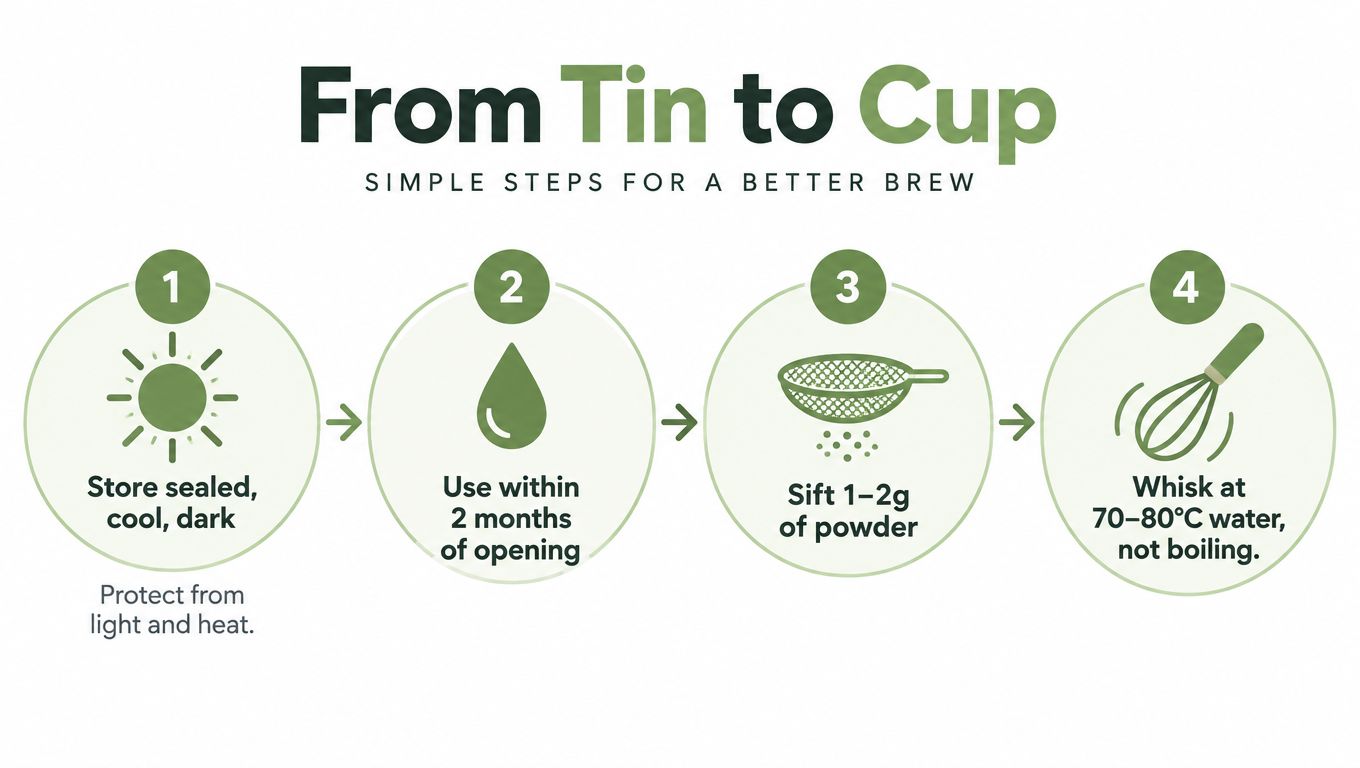
Your matcha can arrive in excellent condition and still disappoint if you leave the lid loose beside a sunny window. Light, oxygen, heat, and moisture are the enemies of fresh powdered tea. Store an unopened pack according to the seller's instructions, then keep an opened tin or pouch airtight, cool, and away from steam.
A tin is convenient for daily use and protects against light. A resealable pouch can work well for a larger quantity, provided you press out excess air and seal it properly. Single-serve sachets are useful for travel, work, and consistent portions, but they're less practical if you change the strength of your drink.
For most home drinkers, order a quantity you can use within roughly six to eight weeks of opening for peak flavour. Refrigeration can help, but avoid opening a cold container in a humid environment, where condensation may enter the powder. Let a sealed pack adjust before opening, and always use a dry spoon.
Three easy ways to prepare it
Whisked bowl: Sift around 1–2 grams of matcha into a bowl. Add a small amount of warm water, whisk into a smooth paste, then add more water and whisk briskly until lightly foamy. Water around 70–80°C is a forgiving starting point, because boiling water can make the drink taste harsh.
Hot latte: Sift the powder, mix it with a small amount of warm water, and whisk until smooth. Add warmed milk and adjust the strength to taste. A handheld frother works if you don't own a bamboo whisk.
Iced matcha: Make a concentrated paste with sifted powder and warm water first. Add cold water or milk, then pour over ice. Mixing the powder directly into a full glass of cold liquid often leaves clumps.
A bowl, fine sieve, bamboo whisk, and temperature-controlled kettle make the process easier, but you don't need a ceremonial equipment collection to start. The basics are accurate measuring, water that isn't boiling, and powder protected from moisture.
If you're also choosing lower-sugar drinks, the Australian Bureau of Statistics reports that 28.9% of Australians consumed sweetened beverages in 2023, while 23.8% consumed soft drinks or flavoured mineral waters, as shown in its food and nutrition data. An unsweetened matcha can fit a sugar-reduction routine, but the final sugar content still depends on the milk, syrup, or flavoured ingredients you add.
Putting It Together and Ordering With Confidence
Two questions settle most matcha purchases: what will you make, and how quickly will you use it?
For plain whisked tea, choose a well-documented ceremonial powder in a pack size you can finish while it stays fresh. Daily lattes and iced drinks suit premium grade. For baking, smoothies, and strongly flavoured recipes, culinary grade often gives better value because other ingredients carry the flavour.
Check the product page for ingredients, Japanese origin or a clearly stated source, grade, batch information, packaging, serving guidance, and delivery conditions. Compare the price per prepared serve, not only the tin price. Choose a larger pack only if your routine will use it before freshness falls.
With grade, pack size, and freshness aligned to your routine, the final check should take minutes, not become a research project.
Pep Tea supplies organic Japanese matcha powder for whisked bowls, lattes, smoothies, baking, and café use, alongside Australian-brewed sugar-free organic kombucha from the Hunter Valley, NSW. Visit Pep Tea to compare ceremonial and culinary-style options, then order the grade and pack size that match your actual use.
What Is Ceremonial Matcha? the Real Difference
Most advice about matcha starts with colour: if the powder is bright green, it must be ceremonial. That's a useful first clue, but it isn't enough. In Australia, products carrying similar “ceremonial” language can vary in origin, processing, flavour and price, while the term itself doesn't provide a universal grading standard.
So, what is ceremonial matcha? It's the highest-grade form of matcha, traditionally made from the youngest tea leaves picked during the first harvest. Those leaves are shaded before picking, processed into tencha, stripped of stems and veins, and stone-milled into an exceptionally fine powder. The result is designed to be whisked with water and enjoyed on its own, not hidden in sugar, milk or flour.
Understanding that journey makes it easier to judge a product by what's behind the label, rather than by packaging alone.
Defining Ceremonial Matcha Beyond the Label
Not every green tea powder is matcha, and not every product called ceremonial matcha offers the same experience. The word has become common in Australian cafés and online shops, but the useful question isn't just, "Does the tin say ceremonial?" It's, "What leaves were used, how were they grown, and how were they processed?"
Ceremonial matcha is made from the youngest leaves of the first harvest, often called ichibancha. These leaves are valued for their bright colour, fine texture and naturally rounded flavour. Producers shade the plants before harvest, then turn the leaves into tencha before grinding them into powder. Because you consume the whole leaf rather than steeping it and discarding it, the raw material and processing have a direct effect on what ends up in your bowl.
Historical accounts trace powdered tea practices from China to Japan in the 12th century, while the Japanese tea ceremony was fully established by the late 15th century. That gives ceremonial matcha a place within over 500 years of ritualised use in Japan, as described in this history of Japanese matcha in Australia.
What you're paying for
A premium price should reflect more than a vivid label. You're paying for careful cultivation, selective harvesting, refined processing, stone milling and appropriate handling. Those choices influence whether the powder tastes creamy and umami-rich or harsh, dusty and bitter.
Ceremonial matcha is traditionally intended for straight preparation with water. That doesn't mean you can't use it in a latte, smoothie or dessert. It means the powder should be pleasant enough to drink without needing other ingredients to cover flaws.
The simplest quality test is also the most revealing: can you enjoy it with water alone?
The term “ceremonial” can help shoppers find the style of matcha they want, but it shouldn't replace checking the product details. Look for a clear Japanese origin, first-harvest information, shade-growing details, tencha processing and sensible storage guidance. These details tell you much more than the front of the pouch.
The Cultivation and Processing of Premium Tencha
A ceremonial bowl begins in a tea field long before anyone reaches for a bamboo whisk. Farmers first prepare the plants for a controlled period of shade, then harvest the youngest leaves and process them quickly to protect their colour and flavour.
Shade changes the leaf
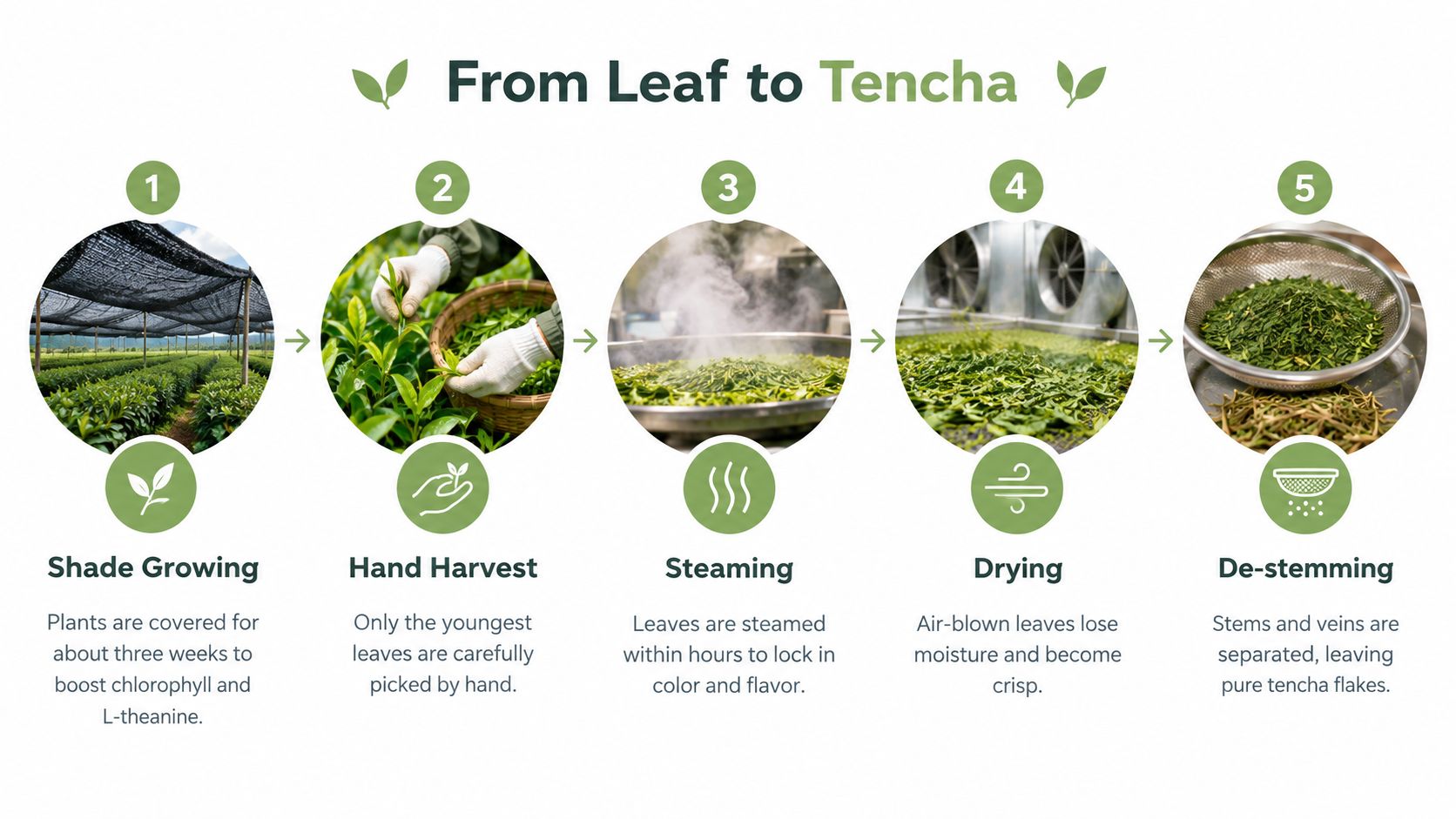
Producers commonly shade tea plants for about 20 to 40 days before harvest. This limited sunlight encourages the plant to retain more chlorophyll and preserve L-theanine, an amino acid associated with sweeter flavour and reduced bitterness. The result is the deep green colour and savoury-sweet umami that people expect from well-made matcha. See this explanation of matcha grades and shading for more detail.
The plants are then harvested for their youngest leaves, usually during the first spring picking. Timing matters because older leaves tend to produce a more assertive, astringent cup, while tender first-harvest leaves are better suited to drinking straight.
From fresh leaf to tencha
After harvest, the leaves are steamed to halt oxidation and help retain their green character. They're then dried, creating the material that will be refined into matcha. Unlike many other tea styles, the leaves aren't rolled into familiar needle shapes.
The stems and veins are removed next, since these tougher parts can add coarseness and unwanted bitterness. The remaining leaf material is called tencha, the raw material used for authentic matcha. This guide to how matcha tea is made provides a practical look at the stages involved.
Finally, producers stone-mill the tencha into a very fine powder. Slow milling helps create the silky mouthfeel associated with ceremonial matcha, although it also makes production careful and labour-intensive. The finished powder is more than dried green tea ground up at random. It's the product of shade management, selective harvesting and specialised processing.
That craftsmanship also explains why fresh ceremonial matcha can taste so different from ordinary green tea powder. The leaf has been cultivated for a particular flavour profile, prepared for suspension in water and milled finely enough to become part of the drink's texture.
The Biochemical Profile and Health Benefits
Matcha's distinctive appeal comes partly from the fact that you drink the powdered leaf. With ordinary green tea, you steep the leaves and remove them. With matcha, the prepared powder remains in the bowl, so the drink contains the compounds present in the leaf material.
One Australian analytical report for a ceremonial matcha product lists total catechins at 65,200 micrograms per gram, including 56,000 micrograms per gram of EGCG, with L-theanine at 21,300 micrograms per gram and caffeine at 33,300 micrograms per gram. These figures come from the product's published analysis, not from a universal value for every ceremonial matcha, so they're best understood as an example of the biochemical profile that can occur in a carefully produced product. The published ceremonial matcha analysis shows why laboratory information can be more useful than broad wellness language.
Antioxidants and EGCG
Catechins are naturally occurring compounds in tea. EGCG, or epigallocatechin gallate, is one of the best-known tea catechins and is often discussed for its antioxidant activity. Antioxidants help protect cells from oxidative stress, but matcha shouldn't be treated as a medicine or a substitute for a varied diet.
If you'd like a plain-language explanation of the compound itself, Pep Tea's guide to what EGCG is is a useful place to start. The practical takeaway is simple: a high-quality matcha can contribute tea polyphenols to your daily routine, but the product's actual composition depends on cultivar, harvest, cultivation, processing and storage.
L-theanine and caffeine
L-theanine gives matcha much of its character, both in flavour and in how the drink feels. Paired with caffeine, it may support a state of calm alertness, which many people experience as focused energy rather than the sharper lift associated with coffee.
That doesn't mean matcha can never feel stimulating or that everyone will respond in the same way. Caffeine sensitivity varies, and serving size, timing and whether you've eaten all matter. People who are pregnant, managing a medical condition or taking medication should seek individual advice from a qualified health professional.
Matcha is also sometimes described as immune-supporting because tea compounds and a balanced diet may contribute to general wellbeing. Keep the claim proportionate. Ceremonial matcha can be a nutrient-rich, enjoyable beverage, but it isn't an immunity cure.
Ceremonial Grade Versus Culinary Grade Matcha
Ceremonial and culinary matcha aren't rival products where one is automatically good and the other is automatically poor. They're made for different jobs.
Ceremonial matcha is selected for drinking with water. Culinary matcha is generally chosen for recipes where the powder needs to hold its flavour against milk, sugar, flour, fruit or other strong ingredients. It may come from later harvests or use leaf material with a more pronounced bitterness, which can be useful in baking and blended drinks.
| Feature | Ceremonial Grade | Culinary Grade |
|---|---|---|
| Primary use | Whisked with water and enjoyed straight | Lattes, smoothies, baking, sauces and desserts |
| Leaf selection | Young first-harvest leaves | Often later-harvest or more robust leaf material |
| Flavour | Smooth, umami-rich and naturally rounded | More assertive, grassy or astringent |
| Colour | Usually vivid green | Can be green but often less luminous |
| Texture | Very fine and silky | Fine powder, though texture can vary |
| Best buying question | Is it enjoyable without added flavour? | Will it remain noticeable in the finished recipe? |
Choose for the way you'll drink it
If your morning ritual is a small bowl of matcha and water, ceremonial grade makes sense because its delicate sweetness and umami are exposed. Poor-quality powder has nowhere to hide in that preparation.
For a matcha latte, the choice is more personal. A good culinary powder can be practical, especially if you're adding milk and a sweetener. A ceremonial powder can also make an excellent latte, particularly when you want a softer flavour and a cleaner finish. The important point is not to buy the most expensive product automatically. Buy the grade that suits your actual use.
Where the confusion begins
Some Australian listings describe ceremonial matcha as water-only, while others promote the same style for lattes. That isn't necessarily a contradiction. “Ceremonial” describes the intended quality and drinking style, not a rule that forbids every other recipe.
The distinction becomes clearer when you think about flavour. Use ceremonial matcha when the tea itself is the centre of attention. Use culinary matcha when it's one ingredient among several.
How to Identify Authentic Ceremonial Matcha in Australia
Australian shoppers have plenty of choice, but the variety can make comparison difficult. Similar products may use the same words, while prices for comparable-sounding listings can range from about A$35 to A$69.99, as shown in this Australian ceremonial matcha product listing. Price alone can't prove quality, but it should encourage you to inspect the details.
Use a practical checklist
Read the harvest description. Look for first harvest or ichibancha language, rather than relying only on “premium” or “ceremonial”.
Check the colour. Fresh ceremonial matcha is generally a vibrant green. A dull, yellowish or brownish appearance can indicate older material, oxidation or poor storage, although colour should always be judged alongside taste and provenance.
Inspect the texture. The powder should feel exceptionally fine and silky. Grittiness suggests that the product hasn't been milled or refined to the standard expected of a whisked tea.
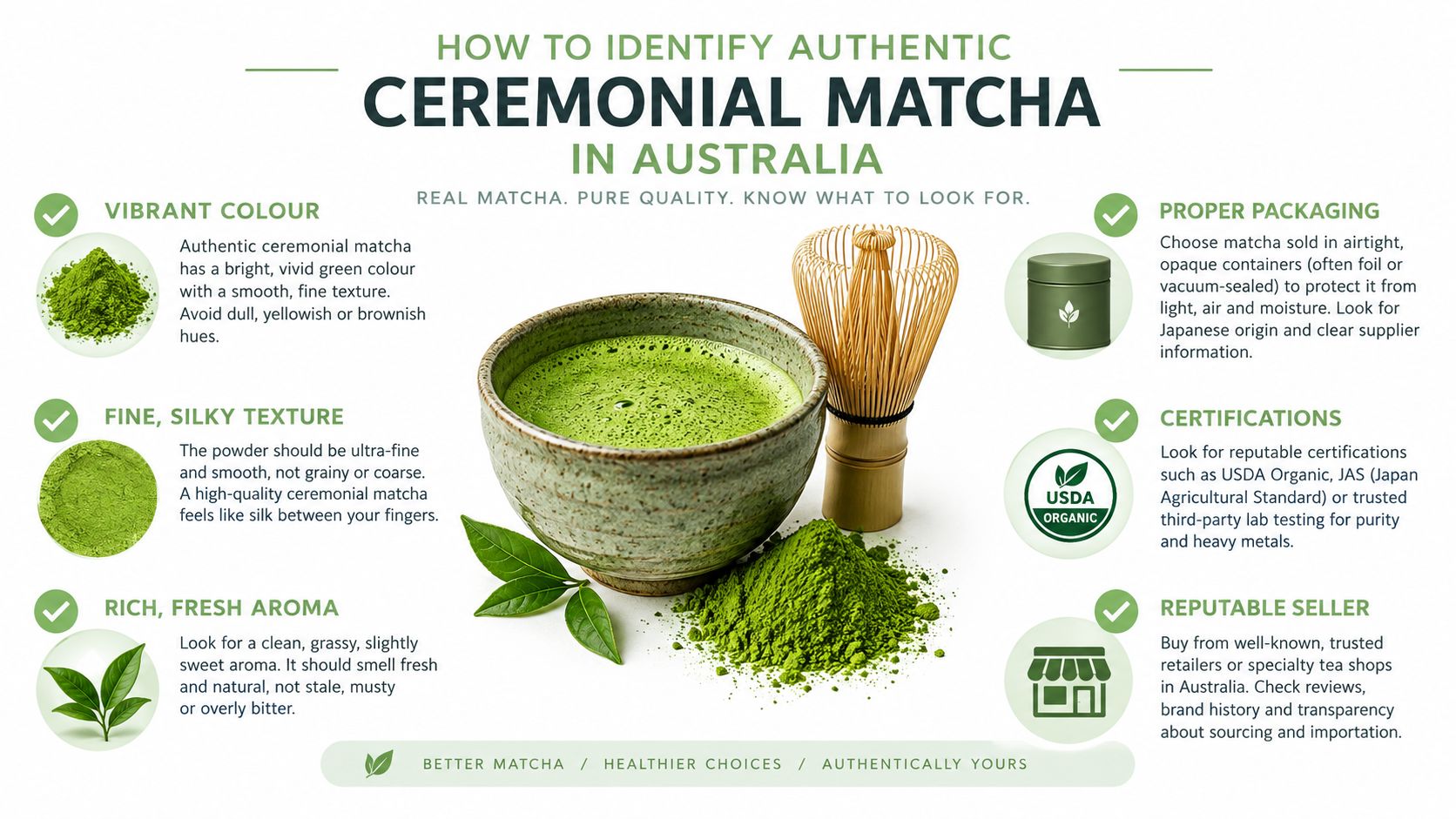
Look for tencha processing. A credible product description should explain that the leaves were de-stemmed and de-veined before stone milling. This overview of ceremonial matcha processing explains why those steps affect texture.
Ask where it was grown and packed. Japanese origin should be clear, not buried under vague language such as “Japanese-style”.
Treat pricing as context, not proof. First-harvest tea, careful shading and stone milling require more work, so an unusually low price deserves closer inspection. A high price doesn't guarantee authenticity either.
Ask for evidence, not adjectives
Look for batch information, organic certification where relevant, storage guidance and analytical information. A supplier that can explain the leaf, harvest and processing gives you something concrete to evaluate.
The most reliable buyer doesn't chase the brightest green pouch. They compare the agricultural and processing story with the sensory result in the cup.
Traditional Preparation and Tasting Notes
Premium matcha is forgiving once you understand the basics, but it isn't prepared like a teabag. The traditional setup uses a chawan, or bowl, and a chasen, the fine bamboo whisk. A small sieve is also helpful because it breaks up clumps before they become difficult to disperse.
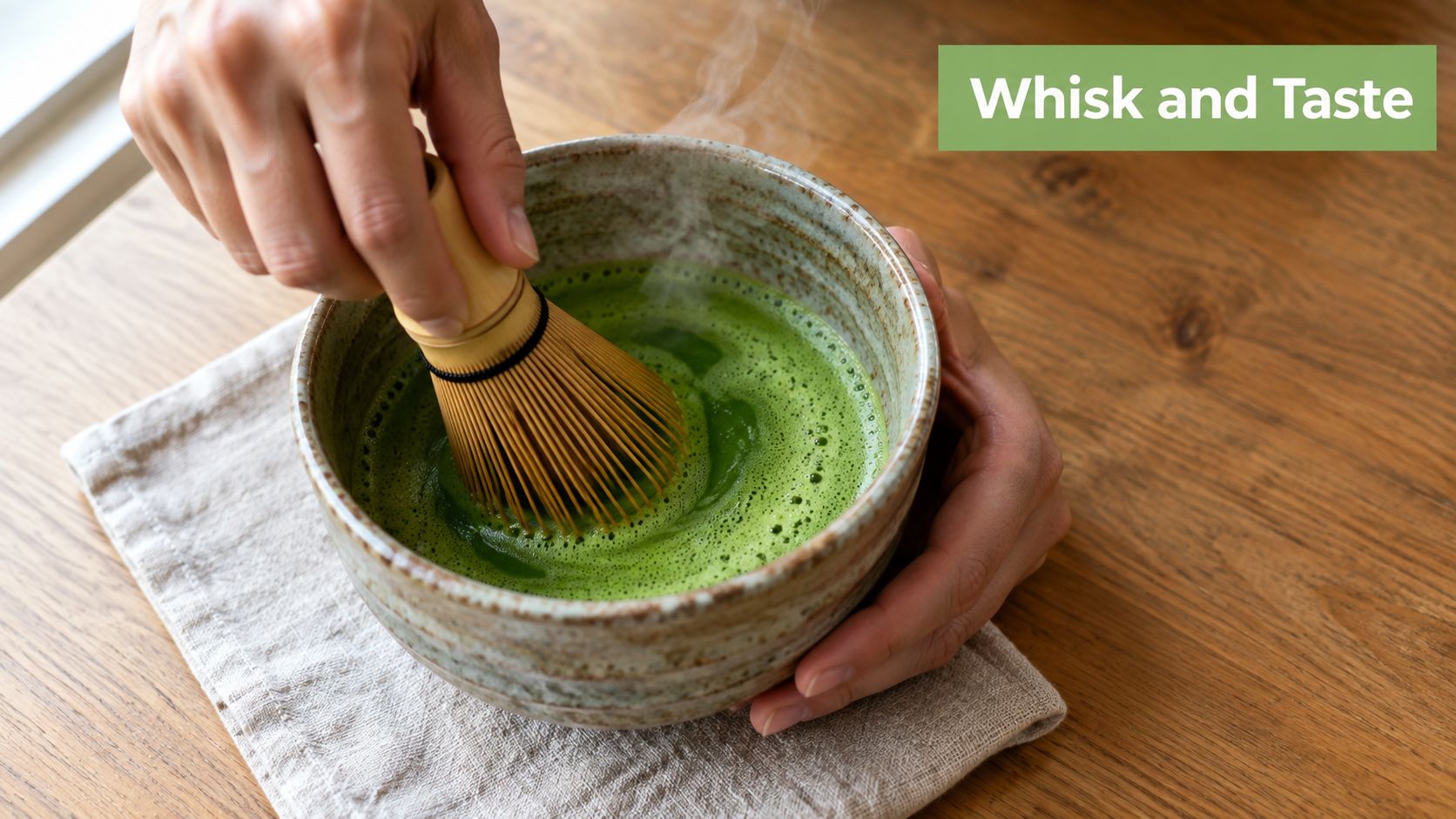
A simple bowl method
Warm the bowl, then discard the warming water.
Sift the matcha into the bowl. Sifting isn't ceremonial theatre. It helps the fine powder combine with water smoothly.
Add a small amount of hot water that has cooled below boiling. Water that's too hot can push delicate flavours towards harshness and flatten the tea's sweeter notes.
Whisk briskly using a light W or M motion, keeping the whisk near the surface rather than stirring slowly around the edges.
Add more water to reach your preferred strength, then drink soon after whisking so the powder stays evenly suspended.
The bowl should feel creamy rather than sandy. Expect fresh vegetal notes, gentle sweetness and a savoury umami finish. A little bitterness can be part of tea's character, but pronounced harshness often points to water that's too hot, too much powder, an older product or unsuitable raw material.
For a closer look at the ritual, explore Pep Tea's guide to the matcha tea ceremony.
Here's a visual demonstration of the whisking rhythm and bowl preparation:
If your first bowl tastes strong, adjust one variable at a time. Try cooler water before reducing the powder, then experiment with a little more water. Matcha rewards attention, but it doesn't require perfection.
Integrating Premium Matcha Into Your Daily Routine
Ceremonial matcha can fit neatly into an Australian morning without turning every cup into a formal tea ceremony. Prepare it traditionally when you have a quiet moment, or whisk it into a small latte when you're heading into work. The quality still matters because a smooth powder gives you more flexibility, especially when you sometimes drink it with water and sometimes with milk.
Many people prefer matcha earlier in the day, when its caffeine and L-theanine profile suits focused work, study or a calm start. If you're sensitive to caffeine, drink a smaller serving, have it with food and pay attention to how your body responds.
Keep the ritual realistic
A useful routine might look like this:
- Morning focus: whisk matcha with water before opening your phone or starting your commute.
- Café-style break: make a simple latte without heavy syrups so you can taste the tea.
- Recipe use: reserve culinary grade for smoothies, baking, ice cream and other recipes where stronger ingredients are involved.
- Thoughtful storage: protect the powder from heat, moisture, light and air, and follow the supplier's storage instructions.
Australia's interest in matcha has accelerated sharply. One market source reports that Australian matcha imports rose 62.91% from 2023 to 2024, while another report says Australia imported 195,319 kilograms of Japanese green tea between January and August 2025, a 131% year-on-year increase, ranking Australia as the eighth-largest export destination for Japanese green tea. These figures are reported in the Australia matcha tea market data, and they help explain why shoppers need clearer quality guidance as more products appear.
The best choice is the matcha you'll prepare and enjoy regularly. For some people, that means a delicate bowl of ceremonial powder. For others, it means keeping ceremonial grade for water preparation and using culinary grade for creative recipes.
Pep Tea offers organic Japanese matcha, including ceremonial-grade powder, alongside Australian-brewed sugar-free organic kombucha from the Hunter Valley, NSW. Visit Pep Tea to explore the matcha range, learn more about preparation and find functional drinks suited to everyday routines.
Is Matcha Sweet? a Practical Guide to Matcha Flavour

Pure matcha powder itself isn't sweet. Its natural flavour is vegetal and umami, while sweetness in a matcha drink almost always comes from added sugar, syrup, honey, sweetened milk, or a pre-sweetened blend.
So why does a pale green café latte often taste gently sweet, creamy and almost dessert-like, while a plain bowl of whisked matcha can taste grassy, sharp or savoury? The answer lies in the difference between matcha's sensory sweetness and the sweetness added during preparation.
That distinction matters in Australia, where “matcha” on a café menu may refer to anything from pure Japanese green tea powder to a flavoured latte mix. Once you know what's in the cup, you can choose a sweeter-tasting matcha without automatically choosing a sugary one.
Why Most People Ask If Matcha Is Sweet
A typical café order explains the confusion. You ask for an iced matcha latte, and the drink arrives pale green, cold, creamy and smooth. The first sip may taste softly sweet, especially if the café has used oat milk, vanilla syrup or a pre-sweetened matcha base.
That experience teaches your palate to associate matcha with sweetness. Try a different preparation at home, though. Whisk plain matcha powder with water and you'll notice a much more concentrated flavour, with fresh grassiness, savoury depth, bitterness and a drying sensation on the tongue.
Neither drink is necessarily misleading. They are just different formulations.
The powder and the finished drink are not the same thing
Australian products make this distinction clear. Pure matcha is sold as green tea powder without sugar, while sweetened sachets and latte blends list ingredients such as sugar or organic cane sugar. One Australian sweet matcha sachet lists sugar first and matcha green tea at 12%, while an Australian-made latte blend places organic unrefined cane sugar ahead of matcha powder and reports 4.0 g sugars per 100 g. These examples show that the sweetness comes from the recipe, not from the tea leaf itself. See the Australian sweet matcha product example.
The same principle applies when you order. “Plain matcha latte” may mean no extra syrup, but it doesn't always mean pure, unsweetened matcha. The powder could already contain sugar, dextrose, flavouring or another sweetening ingredient.
A useful question to ask
Before deciding whether matcha is sweet, separate the experience into two questions:
- What does pure matcha taste like? Usually vegetal, umami-rich, bitter and faintly sweet in a savoury sense.
- What does this particular drink contain? It may include milk, syrup, honey or a sweetened matcha mix.
That small distinction closes the gap between a sharp home-brewed matcha shot and the comforting café drink many Australians know first.
What Matcha Actually Tastes Like on Its Own
Pure matcha has a layered flavour rather than a simple sweet or bitter profile. The balance changes with the tea's growing conditions, grade, freshness, water and whisking technique, but four sensations appear repeatedly: umami, bitterness, astringency and faint sweetness.
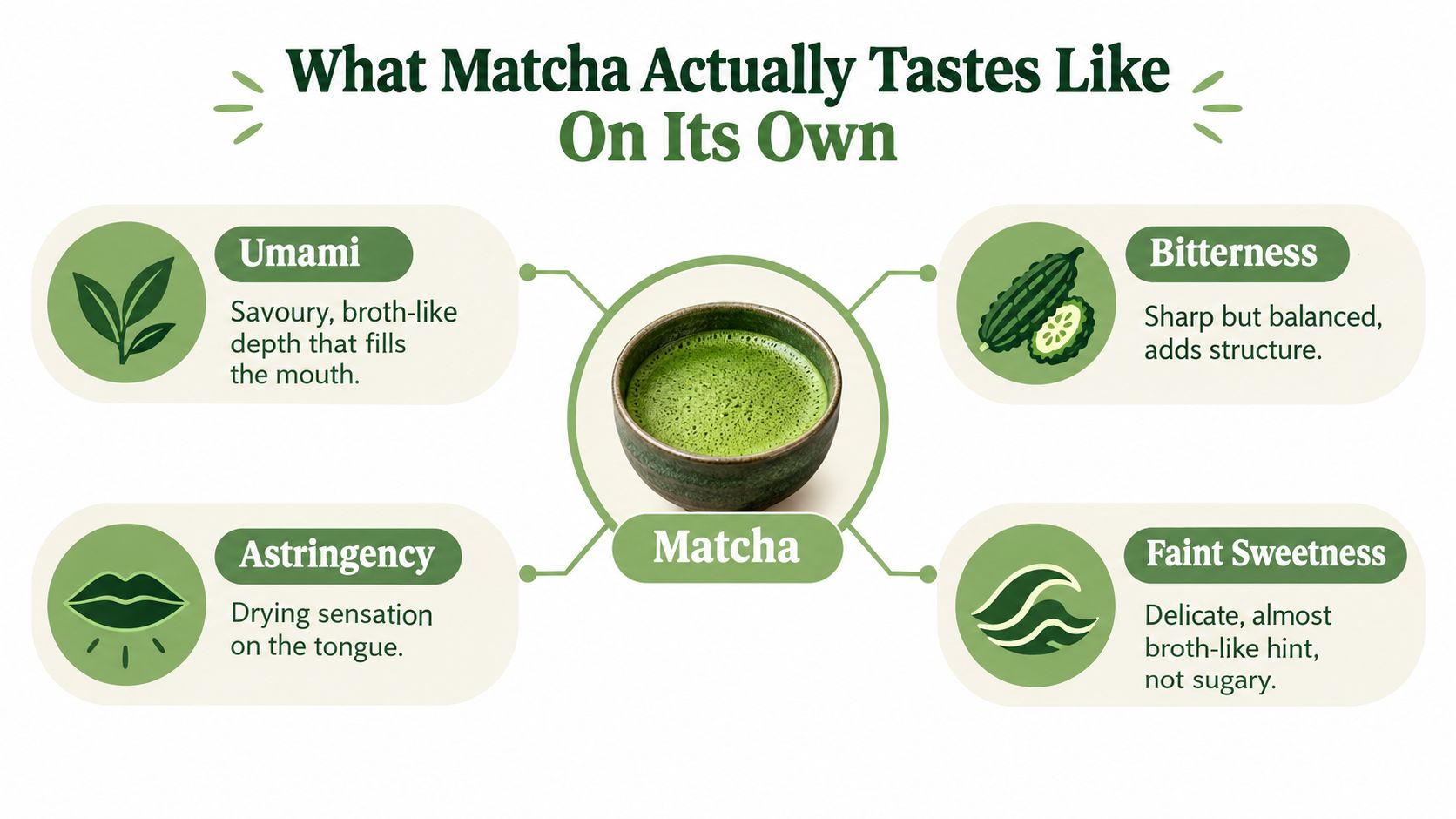
Umami comes first in a good cup
Umami is the savoury, mouth-filling quality that makes matcha feel substantial. Some people describe it as broth-like, buttery or seaweed-like, although a well-made matcha can be more delicate than those comparisons suggest.
L-theanine, an amino acid naturally present in tea, contributes to this depth. An Australian lab-tested ceremonial matcha reported 21.3 mg/g of L-theanine and 65.2 mg/g of total catechins. That composition helps explain why the cup can feel savoury and softly sweet at the same time, without tasting like sugar. Review the Australian matcha potency lab results.
The sweetness here is subtle. It may appear as a rounded finish after the initial green flavour, rather than as the immediate sweetness of fruit juice or a latte syrup.
Bitterness gives matcha structure
Matcha also contains catechins, a group of tea polyphenols. Epigallocatechin gallate, or EGCG, is one of the best-known catechins and contributes to the plant-like bite associated with green tea.
A little bitterness can make matcha feel lively and complete. Too much can dominate the bowl, particularly when the powder is lower grade, the water is too hot or the serving is overly concentrated.
Astringency is different from bitterness
Astringency is the dry, puckering feeling that remains on the tongue. It can feel chalky or tightening, as though the moisture has been drawn from your mouth.
Catechins can contribute to both bitterness and astringency, but the sensations aren't identical. Bitterness is a taste. Astringency is more of a mouthfeel. Recognising the difference helps you diagnose a difficult cup instead of just deciding that you dislike matcha.
Tasting cue: If the finish feels savoury and rounded, you're noticing matcha's umami and theanine. If your mouth feels dry and tight, astringency is probably leading the experience.
For a broader look at the powder itself, the guide to what matcha powder is can help connect the production method with the flavour in your bowl. If you're preparing tea during a physically demanding shift, you may also find this practical resource on tea hydration for hot job sites useful. The key point remains simple: pure matcha may have a faint natural sweetness, but it isn't a sugary drink.
Why Some Matcha Tastes Sweeter Than Others
The flavour is shaped long before the powder reaches your whisk. Farming choices, leaf selection and milling all influence whether a matcha tastes rounded and umami-rich or sharp and astringent.
The most important factor is often shading before harvest. Tea plants grown for matcha may be covered from direct sunlight before the leaves are picked. Australian technical guidance explains that shading suppresses the conversion of L-theanine into catechins, helping preserve a more naturally sweet umami profile. Read the Australian guide to ceremonial matcha production.
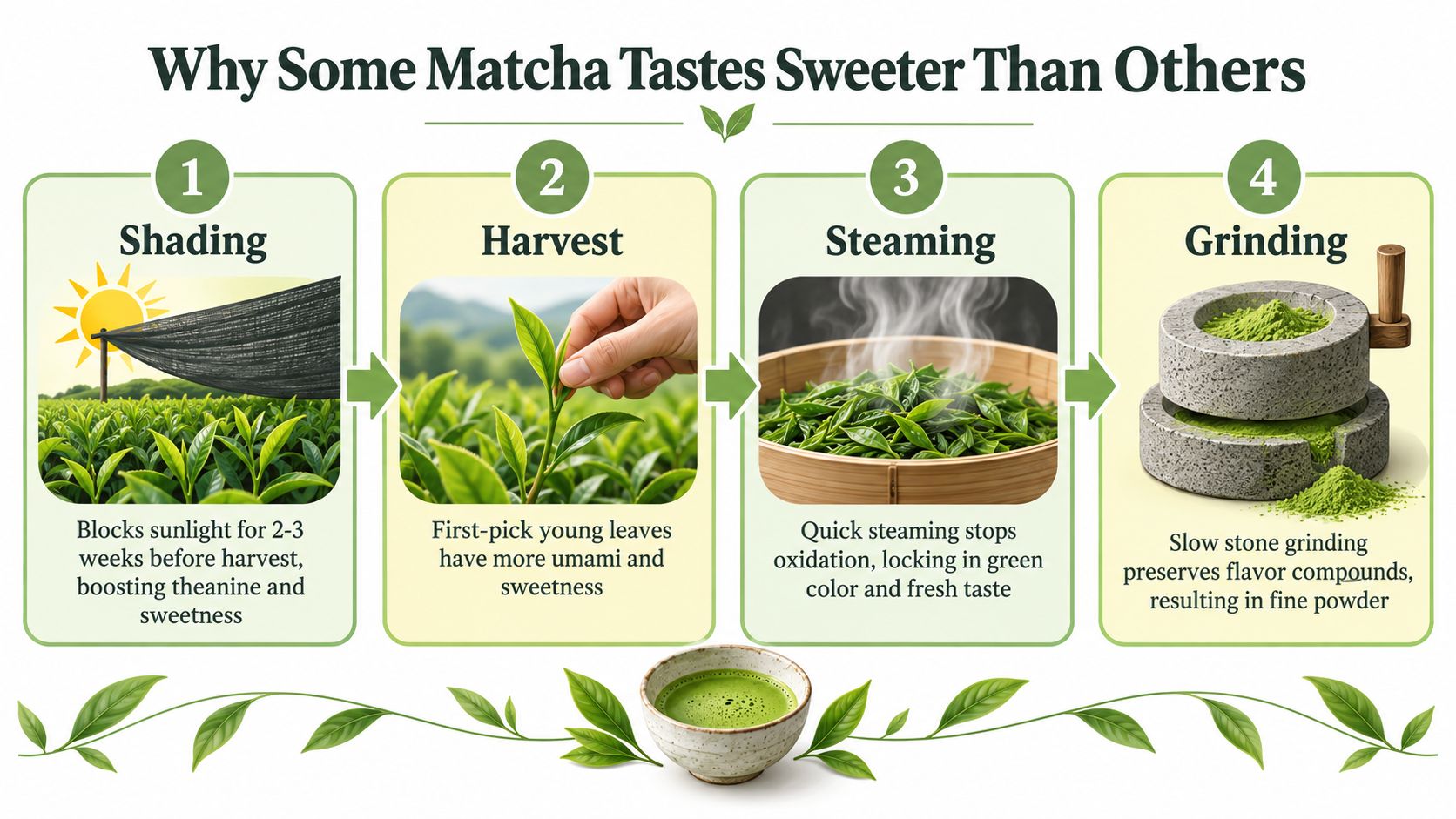
Shading changes the balance
Sunlight gives the tea plant energy, but it also encourages the chemistry that produces a more assertive, bitter profile. Shade-grown leaves retain more of the savoury character associated with L-theanine and develop a richer green appearance.
That doesn't mean every shaded matcha tastes sweet, or that bitterness is automatically a sign of poor quality. It means the balance can move towards umami, softness and lingering sweetness when the grower uses shading carefully.
Young leaves bring delicacy
Higher-grade matcha commonly uses younger, more tender leaves from the top of the plant. These leaves can produce a finer texture and a more refined flavour than older, tougher leaves.
Older leaves tend to bring stronger vegetal notes and more noticeable astringency. That bolder profile can be useful in baking or a latte, where milk and other ingredients need a flavour that won't disappear.
Milling protects texture and flavour
After harvesting and processing, the leaves are ground into an extremely fine powder. Traditional stone-grinding is slow and gentle, helping create the smooth texture expected from a well-made matcha.
Faster or rougher milling can generate more heat and may affect delicate flavour compounds. The result may taste flatter, harsher or more bitter. When you explore PepTea's matcha grades, pay attention to the intended use as well as the word “premium” or “ceremonial”.
A matcha grown in full sun, made from older leaves and processed for a bold culinary application won't taste like a carefully shaded powder intended for whisking with water. Sweetness is partly a farming and processing outcome, not just a recipe decision.
Ceremonial vs Culinary Matcha and Sweetness
Ceremonial and culinary matcha are often presented as if they were completely separate products, but the labels don't have a universal legal definition. “Grade” can be useful as a guide, yet colour, aroma, texture and intended use give you more reliable information.
| Attribute | Ceremonial Grade | Culinary Grade |
|---|---|---|
| Perceived sweetness | Often softer, rounder and more naturally umami-forward | Usually more assertive, vegetal and less sweet on its own |
| Bitterness | Typically lower when the powder is well made and properly prepared | More noticeable, which helps it stand up to milk and food |
| Colour | Vivid green to jade-like | Green can be deeper, duller or more yellow-toned |
| Texture | Fine, smooth and pleasant with water | May feel more robust, especially in a concentrated drink |
| Best use | Plain whisked matcha or lightly diluted drinks | Lattes, iced drinks, smoothies, baking and cooking |
Choose by preparation, not prestige
If you want to drink matcha with water and notice its natural flavour, choose a fresh, well-sourced ceremonial-style powder. Its softer balance makes it easier to appreciate the umami and faint sweetness without adding anything.
For a latte, culinary matcha can be practical. Milk, fruit, yoghurt or baked ingredients carry and soften the tea's sharper edges. A stronger powder may also be preferable in an iced drink, where dilution and cold temperatures can mute flavour.
A product described as ceremonial can still taste unpleasant if it's stale, poorly stored or prepared with boiling water. Conversely, culinary matcha can make a satisfying drink when you enjoy a more pronounced green tea character.
Selection rule: Buy ceremonial-style matcha for tasting the powder itself. Buy culinary-style matcha when other ingredients are meant to share the stage.
If you're comparing formats or pack sizes, an external AQEEK Coffee matcha selection offers another example of how ceremonial matcha is positioned for drinking applications. The label is a starting point, not a guarantee that the cup will taste sugary.
How to Make Matcha Taste Sweeter Without Sugar
You can make matcha seem sweeter without adding sugar. The goal is to reduce harsh bitterness, preserve theanine and give the powder a smoother texture, so your palate can notice its softer notes.
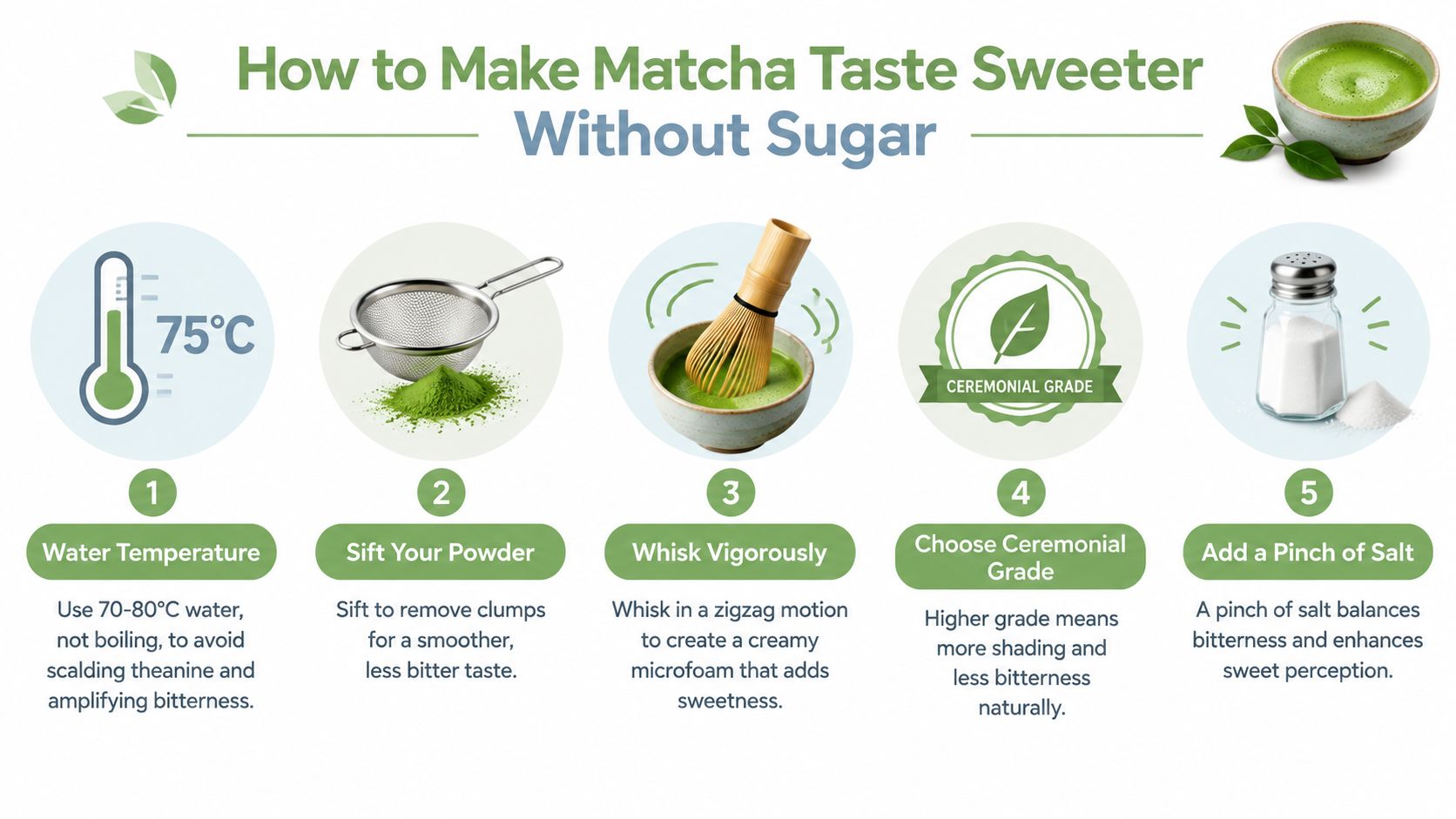
Start with the water
Use water around 70–80°C, rather than freshly boiling water. Excessive heat can make the cup taste more bitter and may overwhelm the delicate savoury qualities you want to preserve.
A temperature-controlled kettle makes this easy, but you can also pour boiling water into a separate cup and let it cool briefly. The exact temperature matters less than avoiding water that is aggressively hot.
Prepare the powder properly
Sift the matcha before whisking. Clumps dissolve unevenly, leaving some mouthfuls thin and watery while others taste intensely bitter.
Add a small amount of water first and work the powder into a smooth paste. Then add the rest of the water and whisk briskly in a W or M motion. This creates a fine foam and distributes the powder evenly, which can make the texture feel creamier and less abrasive.
Let ingredients support the tea
Milk changes the entire experience:
- Oat milk often contributes body and a naturally sweet impression.
- Dairy milk adds creaminess and softens sharp green notes.
- Nut milks can taste lighter and may leave a thinner cup, depending on the product.
A tiny pinch of fine sea salt can suppress bitterness and make existing sweet notes easier to notice. A few drops of lemon or yuzu can brighten the umami. Vanilla extract can add an impression of sweetness without adding sugar, although it changes the drink's flavour.
For a dependable starting point, try the sugar-free matcha latte method from PepTea. This video also shows the kind of whisking and frothing movement that helps create a smooth drink.
A simple unsweetened method
- Sift your matcha into a bowl.
- Add a small splash of 70–80°C water and whisk into a paste.
- Add the remaining water and whisk in a W motion until lightly frothy.
- Pour the matcha into warm oat or dairy milk.
- Add either a tiny pinch of salt or a drop of citrus, not both at first.
- Taste before making another adjustment.
Small changes work better than adding several ingredients at once. You'll learn which lever improves the cup for your palate.
Why Café Matcha in Australia Usually Tastes Sweet
Many Australian café customers encounter matcha as a latte rather than as plain whisked tea. That format naturally introduces sweetness through the milk, and cafés may also use pre-sweetened powders, syrups or blended bases to make each drink consistent.
A matcha latte mix can contain sugar, dextrose, honey powder or flavouring before the barista adds any extras. Vanilla syrups, flavoured powders and condensed milk can push the drink further towards dessert. In these cases, the word “matcha” identifies the tea flavour, but it doesn't tell you how much of the drink's sweetness comes from the powder.
Read the menu language carefully
Terms such as “matcha mix,” “premium blend” or “latte base” may indicate that the product contains more than matcha. The wording isn't enough to determine the ingredients, so ask directly.
Useful questions include:
- “Is the matcha pure powder or a pre-sweetened mix?”
- “Do you whisk it to order?”
- “Does the latte include vanilla syrup by default?”
- “Can I have it with unsweetened milk and no syrup?”
- “Could I taste a small amount of the matcha with water?”
A café may not be able to provide a plain tasting portion, but the question tells the barista exactly what you're trying to control.
Ordering scripts for a lower-sugar drink
Try: “Could I please have pure matcha, no syrup, with unsweetened milk?” If the café uses a sweetened base, ask whether they have plain matcha powder available.
You can also order a small matcha whisked with water, then add milk yourself. That approach gives you more control than relying on the café's standard recipe.
The practical lesson is straightforward. A sweet café matcha is usually a prepared beverage, not evidence that matcha powder is naturally sweet. Check the ingredient list where possible, and remember that plain powder contains no sugar itself.
Finding Your Sweet Spot With Matcha
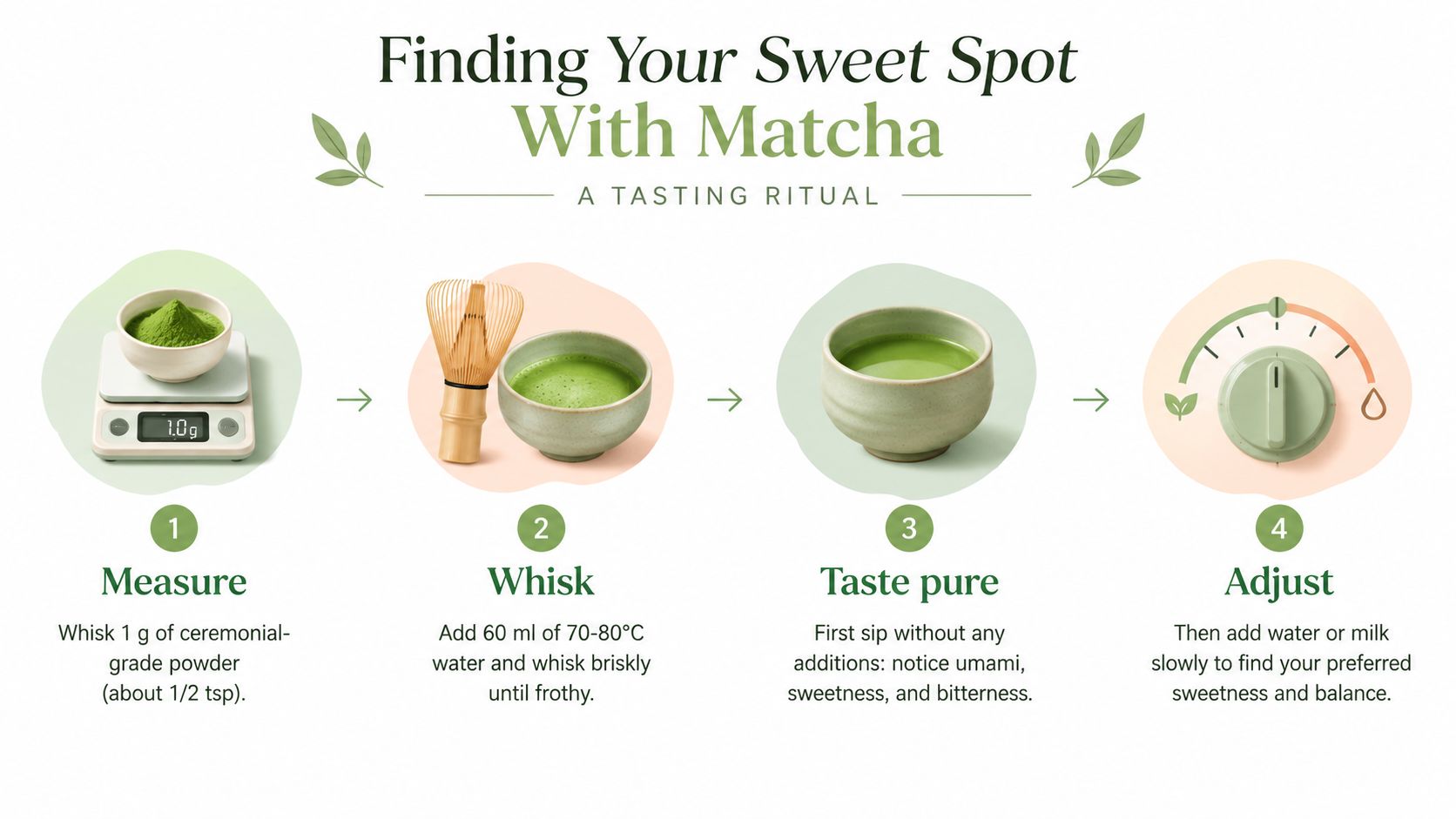
A short tasting ritual can show you exactly where matcha's natural flavour ends and your preferred additions begin. Use a small bowl, a fine sieve and a bamboo whisk if you have them.
Taste it in four stages
- Measure: Weigh 1 g of ceremonial-grade powder, roughly half a teaspoon.
- Whisk: Add 60–80 ml of water at around 80°C and whisk until smooth and lightly frothy.
- Taste pure: Take a small sip without milk or sweetener. Notice the umami, green freshness, bitterness, astringency and lingering finish.
- Adjust: Add a little water, milk or ice, tasting after each change.
You don't need to force yourself to enjoy a concentrated bowl. The purpose is to identify what the powder tastes like before you customise it.
Choose the style that suits your day
- Pure matcha: Choose this when you want to explore flavour and prepare the drink with water.
- Lightly adjusted matcha: Add milk, a pinch of salt or a little citrus when you want softness without making the drink sugary.
- Café-style matcha: Choose a latte with syrup or a sweetened base when you want comfort and dessert-like flavour, treating it as a flavoured beverage rather than straight tea.
Matcha can also fit into smoothies, baking, iced drinks and other recipes, where culinary powder's stronger profile can work well. The right choice depends on the role you want the tea to play.
Keep three ideas in mind:
- Taste matcha on its own at least once before adding anything.
- Adjust sweetness through the grade, water temperature, whisking and milk before reaching for sugar.
- Treat café matcha as a formulated drink, because its sweetness may come mainly from added ingredients.
There isn't one correct matcha recipe. A few repeatable adjustments will help you find a cup that feels smooth, balanced and pleasant without assuming that pure matcha should taste like sugar.
Pep Tea offers organic Japanese matcha for whisking, lattes and culinary use, along with Australian-brewed organic kombucha made in the Hunter Valley, NSW. Visit Pep Tea to explore matcha options and choose a low-sugar beverage that suits your daily routine.
Ceremonial vs Culinary Matcha: A Complete Guide for 2026
Most advice on ceremonial vs culinary matcha gets one thing wrong straight away. It treats “ceremonial” and “culinary” like official Japanese grades, as if one is formally certified as superior and the other is a lesser version.
That's not how matcha works.
In practice, those labels are best understood as usage terms. They tell you what a powder is intended for. One is generally suited to being whisked with water and enjoyed on its own. The other is usually built to perform in lattes, smoothies, desserts, and baking. That distinction matters far more than the badge on the tin.
A lot of Australian shoppers are understandably confused. One source notes that in Japan there is no official grading system for “ceremonial” versus “culinary”, and that these labels were created by Western brands to indicate intended use. The same source says 68% of Australian matcha buyers in 2025 reported confusion over grade terminology in a Nielsen AU survey on functional beverage trends, according to Ooika's explanation of ceremonial vs culinary matcha.
If you remember only one idea, make it this one: buy matcha for the job you want it to do.
Here's a quick side by side view before we get into the details:
| Feature | Ceremonial matcha | Culinary matcha |
|---|---|---|
| Main purpose | Drinking with water | Mixing into recipes |
| Leaf selection | Young, tender spring leaves | Older or later harvest leaves |
| Colour | Bright, vivid green | More muted green |
| Taste | Sweet, umami, low bitterness | Bolder, earthier, more astringent |
| Texture | Very fine and silky | Often less delicate |
| Best uses | Straight matcha, mindful sipping | Lattes, smoothies, baking, desserts |
| Price | Usually higher | Usually more accessible |
Practical rule: If you want to taste the matcha itself, choose ceremonial style. If milk, fruit, chocolate, or heat are involved, culinary usually makes more sense.
From Leaf to Powder The Production Journey
Both ceremonial and culinary matcha begin with the same plant, Camellia sinensis. The split happens in the field.
For ceremonial-grade matcha, growers focus on the youngest, most tender leaf material. One detailed production guide explains that ceremonial matcha is made from the youngest two leaves at the tip of new shoots, harvested in spring, typically mid-April to mid-May, after 4 weeks of shading under bamboo mats or dark cloth that can block up to 90% of sunlight to build chlorophyll and L-theanine, as outlined in this explanation of how matcha is made.
That shading step changes everything. Less direct light pushes the plant toward a deeper green colour and a softer flavour profile. The leaves are being prepared for a bowl where there's nowhere to hide.
Two leaves, two futures
Think of two tea leaves from the same garden.
The first is selected from the delicate spring flush. It's shaded carefully, picked young, then handled with a lot of restraint because the final powder needs to taste balanced with nothing more than water.
The second comes from a later harvest or from older leaves chosen for strength rather than delicacy. It still becomes matcha, but it's expected to hold its own in a latte, biscuit batter, smoothie, or soft serve. That demands a sturdier personality.
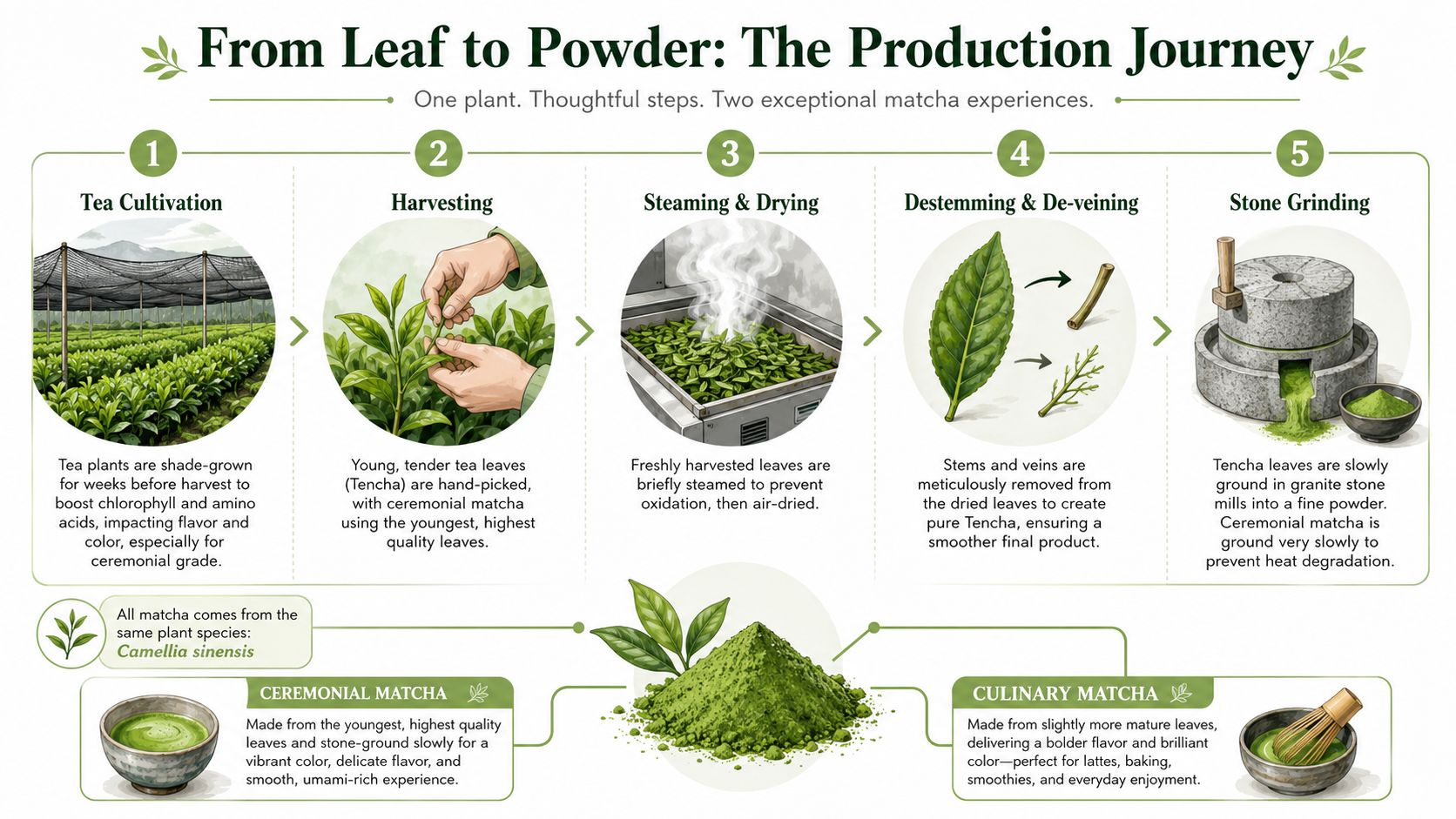
The production path after harvest is careful for both styles. Leaves are steamed to stop oxidation, dried, and stripped of stems and veins to create tencha before grinding. But when the goal is premium drinking matcha, each decision is tighter and less forgiving.
Why the field matters more than the label
You can't fix poor leaf selection later with fancy packaging. The matcha's character is shaped early by:
- Shading method: Longer, more intensive shade growing supports the sweet, soft style people expect from ceremonial matcha.
- Harvest timing: Spring leaf material is prized for delicacy, while later harvests lean stronger and more assertive.
- Leaf age: Younger leaves tend to deliver a gentler cup. Older leaves bring more bite.
- Final purpose: Producers don't process every batch with the same intended use in mind.
If you want a deeper look at that farm-to-powder process, how matcha tea is made is worth reading.
A Difference You Can See Smell and Taste
Open the tin before you taste anything. Your eyes will usually tell you a lot.
Ceremonial matcha tends to look lively and bright. Culinary matcha often appears more subdued. One Australian reference explains that ceremonial matcha comes from the youngest leaves of the first harvest and can show more than 15% higher chlorophyll concentration, which helps create that vivid green colour and sweet, umami-forward flavour. The same source notes that culinary matcha is generally duller green, more astringent, and better suited to lattes and baking, according to Pure Matcha's guide to ceremonial and culinary differences.
What to look for in the powder
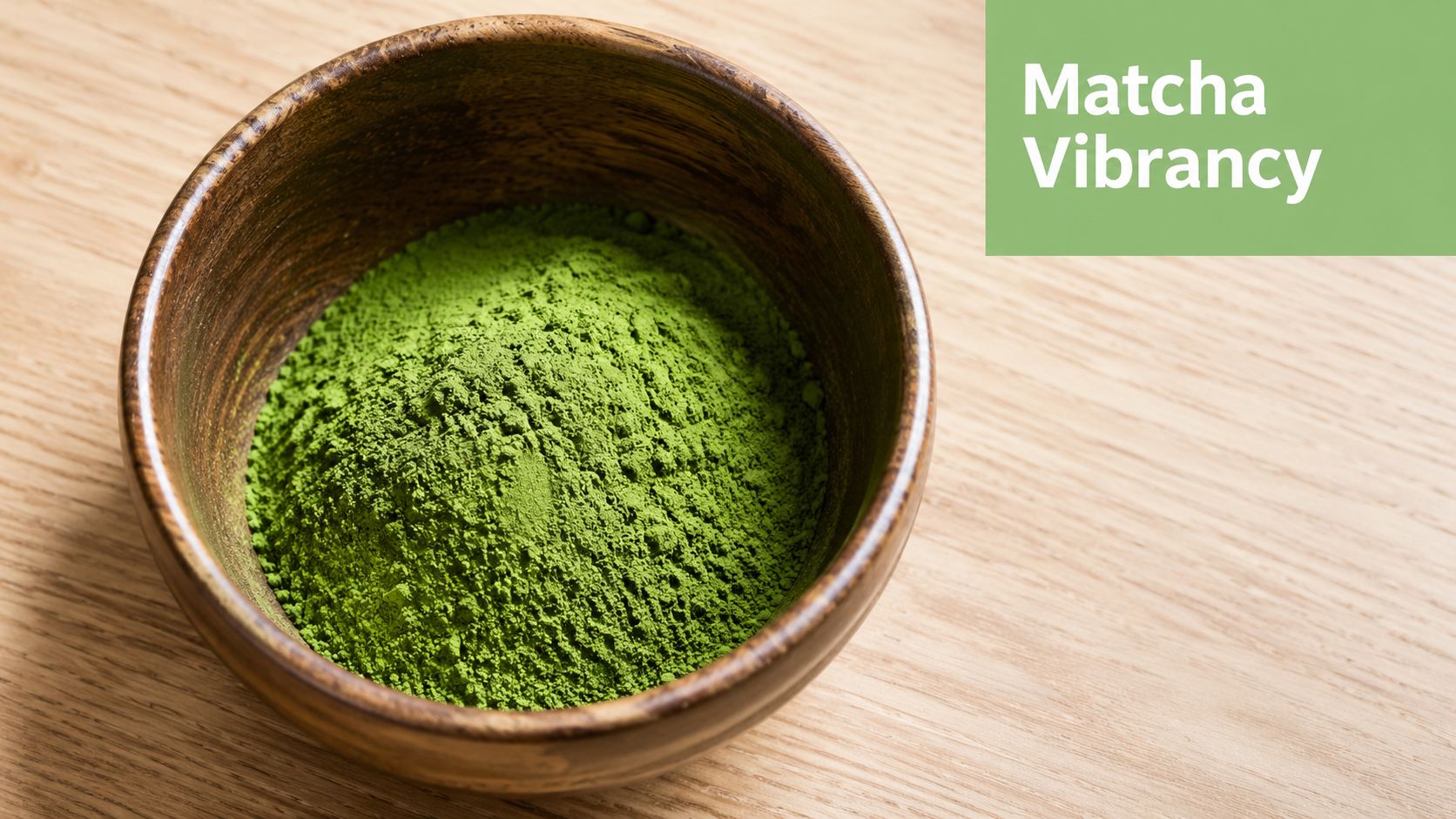
A good ceremonial powder often looks almost luminous. It usually has a finer, softer appearance in the bowl. Culinary powder can still be good quality, but it's commonly less radiant and a touch more practical than precious.
Use this quick sensory check:
- Colour: Ceremonial usually leans bright green. Culinary often looks flatter or more olive-toned.
- Aroma: Ceremonial tends to smell fresh, grassy, sweet, and savoury. Culinary is usually bolder and more direct.
- Texture: Drinking-grade matcha should feel very fine. A recipe-focused powder may feel a little less silky.
- Taste: Ceremonial aims for softness and umami. Culinary aims for presence.
What happens in the cup
Whisk ceremonial matcha with water and you should notice a smooth, rounded taste with minimal bitterness. It's the sort of matcha you sip slowly because the flavour is the point.
Culinary matcha behaves differently. On its own, it can taste firmer, earthier, and more drying. Add milk or sweetener, though, and that structure becomes an advantage. The stronger flavour keeps showing up instead of disappearing behind the rest of the drink.
A latte made with delicate ceremonial matcha can taste lovely, but it can also be a waste of subtle flavour. A strong culinary matcha often performs better because it was built for that role.
Why Is Premium Matcha More Expensive
The price gap between ceremonial and culinary matcha isn't just branding. A lot of it comes down to labour, pace, and how much powder a producer can realistically make.
Traditional stone milling is the clearest example. Authentic Japanese matcha made this way is ground very slowly to keep the powder fine and to avoid heat building up during processing. According to The S's Traditions explanation of matcha production, a traditional stone mill yields only 30 grams per hour, and producing 100 grams of premium powder can take roughly 3 to 4 hours.
That helps explain why good ceremonial matcha doesn't come cheaply. It's not only about exclusivity. It's about throughput. You can't rush this process and still expect the same result.
Where the cost comes from
Ceremonial matcha usually costs more because several high-effort choices stack together:
- More selective picking: The youngest leaf material is limited and carefully chosen.
- More demanding cultivation: Shade growing takes planning and close management.
- Traditional milling: Slow grinding preserves texture and character, but output is low.
- Smaller margin for flaws: When matcha is meant to be drunk plain, every rough edge shows.
Culinary matcha is usually more economical because it can be made from later harvests or slightly older leaves, and some producers use more modern grinding systems with higher output. That doesn't make it inferior across the board. It makes it fit for a different use case.
Expensive doesn't mean better for every job
A common mistake is assuming the most expensive matcha is always the smartest buy. It isn't.
If you're making an iced vanilla matcha latte, blending matcha into banana oats, or whisking it into muffin batter, subtle sweetness and fine aromatic detail can get buried. In those settings, a bold culinary powder often gives you a clearer matcha flavour at a more sensible cost.
Worth remembering: Price tells you something about craftsmanship. It doesn't tell you whether that matcha is right for your recipe.
Calm Focus vs Bold Flavour Nutritional Contrasts
Here's the part that often gets oversimplified. “Ceremonial” and “culinary” are not official nutrition categories from Japan. They are marketing labels that usually point to intended use, so the key question is not which one is “healthier” in the abstract. It is which powder suits the way you use it.
Both styles come from the same plant, and with matcha you consume the whole leaf in powdered form rather than steeping and discarding it. That is why both can contribute catechins, chlorophyll, caffeine, and L-theanine. The differences are usually a matter of degree, driven by factors like shading, harvest timing, and leaf selection.
Ceremonial-style matcha is often associated with a softer, steadier feeling and a sweeter, more umami-led cup. Culinary-style matcha tends to taste stronger, greener, and more direct, which is exactly why it works so well in recipes. Flavour shapes perception here. A smoother matcha can feel gentler to drink plain, while a punchier one can feel more lively because the bitterness and astringency stand out more clearly.
What that can feel like in a cup
L-theanine is one reason matcha is often described as giving calm focus instead of the sharper lift some people get from coffee. Still, it helps to keep expectations sensible. Ceremonial-style matcha is not a special wellness tier, and culinary matcha is not suddenly lacking in benefits. They tend to deliver a different balance of taste and sensation.
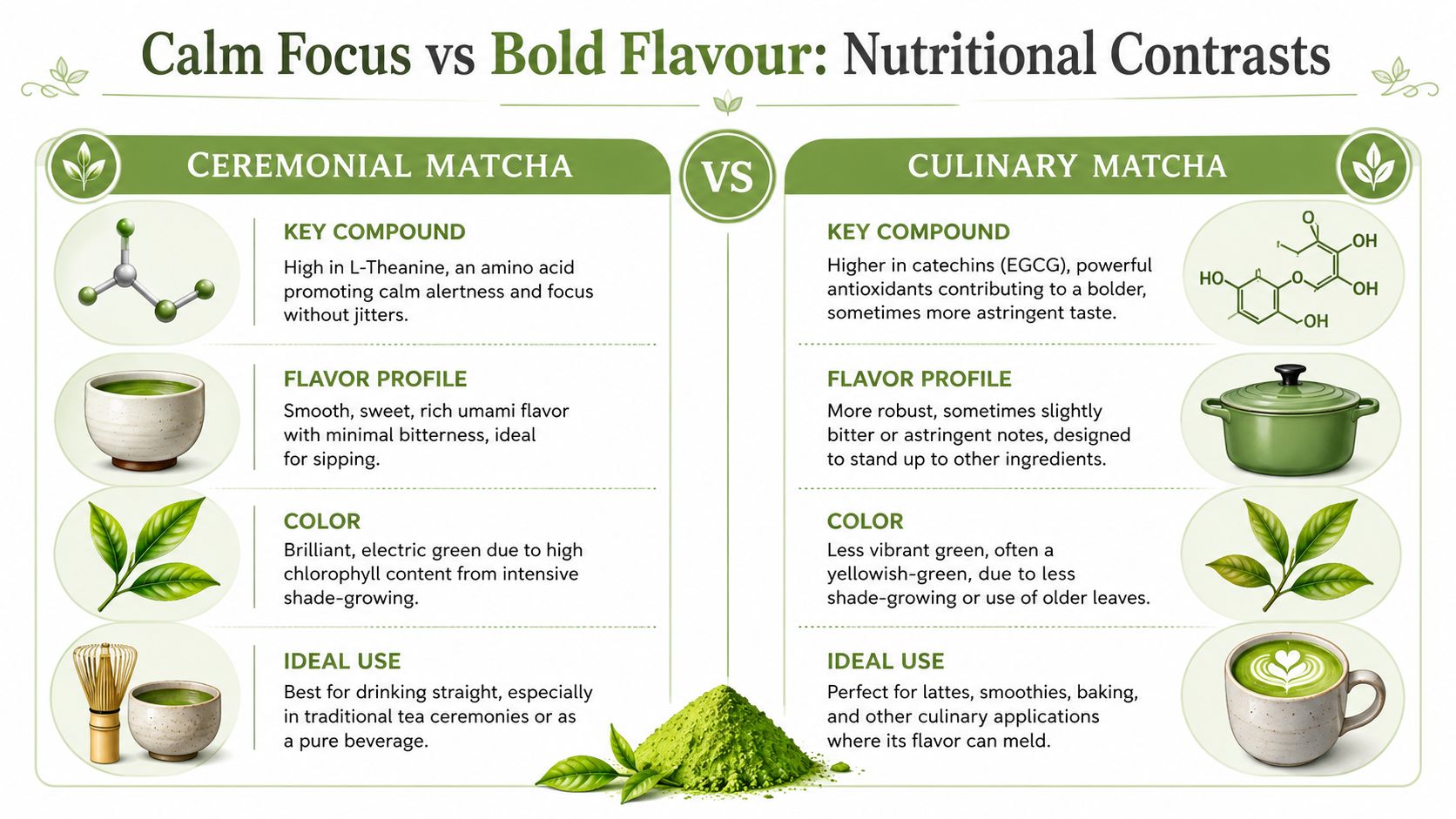
A practical way to read the difference is this:
| Matcha type | Typical feel | Flavour expression | Best fit |
|---|---|---|---|
| Ceremonial | Smoother, calmer, more centred | Sweet, umami, softer finish | Morning bowl, mindful break, straight whisking |
| Culinary | Brisker, more assertive | Stronger green tea character | Lattes, smoothies, baking, recipes |
If you want a clearer primer on how these labels are used, our guide to different grades of matcha explains where the names help and where they can mislead.
A good rule is to judge matcha the way you would judge cooking chocolate versus single-origin chocolate for eating. Both come from cacao. Both have value. You just notice different qualities depending on how you use them.
A lot of tea drinkers also ask about antioxidants such as EGCg. Matcha is well regarded partly because the whole leaf is consumed, so both styles can fit neatly into a daily routine. The more useful question is simple. Which one will you enjoy often enough to use well?
For a visual explainer, this video gives a helpful overview:
Choose for the experience, not the label
If you like whisking matcha with water and noticing sweetness, creaminess, and a lingering umami finish, ceremonial-style powder usually makes more sense.
If your usual order is an iced latte, a smoothie, or weekend baking, culinary-style matcha is often the smarter pick because its flavour stays present once milk, oats, vanilla, or sugar enter the mix.
That is the key distinction. Not a formal Japanese hierarchy. A difference in application.
The Right Matcha for the Job How to Use Each Grade
The easiest way to stop overthinking ceremonial vs culinary matcha is to treat them like different kitchen tools. You wouldn't use a chef's knife for peeling apples if a small paring knife is the better fit. Matcha works the same way.
One producer notes that culinary-grade matcha often uses slightly older leaves or later harvests, creating a more astringent, less umami-rich profile suited to lattes and baking, while ceremonial-grade matcha sticks to first-flush, fully shaded, hand-picked, stone-ground tencha for delicate sweetness and frothability, as described in Pure Matcha's production notes.
Best uses for ceremonial matcha
Ceremonial matcha shines when water is the main companion.
Try this simple method at home:
- Sift a small amount of matcha into a bowl to remove clumps.
- Add a splash of warm water and make a smooth paste.
- Pour in more warm water and whisk briskly until a fine foam forms.
- Drink it straight away while the aroma is fresh and the texture is lively.
This style suits anyone who wants to notice sweetness, umami, and a softer finish. It's also the better choice for a traditional presentation at home or in a café tasting.
Best uses for culinary matcha
Culinary matcha comes alive when other ingredients enter the mix.
It works especially well for:
- Lattes: Its bolder profile cuts through dairy and plant milks.
- Smoothies: Banana, mango, yoghurt, oats, and spinach won't overpower it as easily.
- Baking: Muffins, cookies, cheesecakes, pancakes, and slices hold the flavour well.
- Desserts: Matcha icing, custard, ice cream, and energy balls all benefit from that stronger edge.
A practical trick for lattes is to sift the powder first, whisk it with a little warm water into a slurry, then add milk. That avoids green clumps floating on top.
If you'd like a clearer overview of which powder suits which preparation, different grades of matcha gives a useful starting point.
If your recipe includes milk, sweetener, fruit, chocolate, vanilla, or baking heat, culinary matcha is usually the safer pick.
How to Choose and Buy Authentic Matcha in Australia
The smartest matcha buyers in Australia ignore the hype first and read the details second.
The biggest myth to let go of is this: ceremonial and culinary are not official Japanese regulatory grades. They are market terms used to guide intended use. Once you understand that, shopping gets much easier. You stop asking, “Which one is the top grade?” and start asking, “Which one suits what I'm making?”
A checklist that actually helps
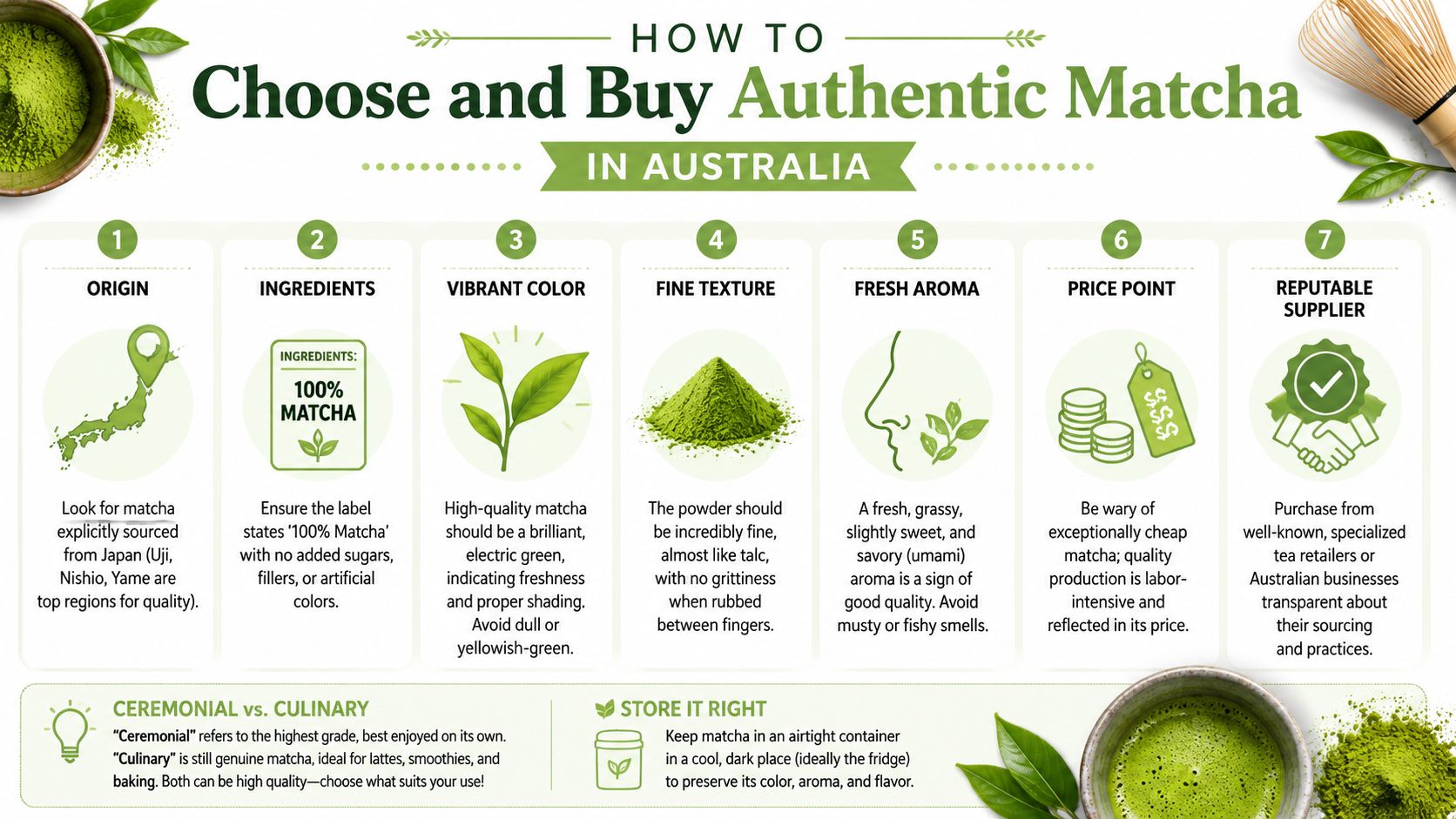
Use this buying checklist when comparing tins online or in store:
- Origin matters: Look for matcha sourced from Japan.
- Ingredient list: It should say 100% matcha. No fillers, sugars, or flavouring if you want a pure product.
- Colour check: Fresh, high-quality matcha should look bright and lively, not flat or brownish.
- Texture clue: Fine powder usually signals better milling and a smoother cup.
- Aroma test: Fresh matcha should smell grassy, clean, and slightly savoury.
- Packaging: Airtight tins or well-sealed packs help protect freshness.
- Seller transparency: Good retailers usually tell you where the matcha comes from and how it's meant to be used.
What to avoid
A few red flags show up again and again:
| Sign | Why it matters |
|---|---|
| Dull, khaki, or brown-leaning powder | Often points to age, poor handling, or lower quality leaf material |
| No origin information | Makes it hard to assess authenticity |
| Vague “superfood blend” wording | May mean it isn't pure matcha |
| A very cheap price with premium claims | Can signal mismatch between marketing and quality |
Storage matters after purchase too. Matcha loses its best character when exposed to air, light, heat, and moisture. Keep it sealed, cool, and out of direct light. If you buy it for plain drinking, freshness becomes even more important.
For a broader look at buying quality tea online, organic green tea online can help you compare what trustworthy tea retailers tend to disclose.
Your Matcha Questions Answered
Can I drink culinary matcha plain
Yes. You can whisk culinary matcha with water and drink it on its own.
The catch is expectation. If you want a soft, creamy bowl with gentle sweetness, culinary matcha can feel sharper, more bitter, or a bit more drying on the palate. If you already enjoy stronger green tea flavours, though, plain culinary matcha may suit you just fine.
Is ceremonial matcha always better
Use decides what “better” means.
This is the part many shoppers miss. “Ceremonial” and “culinary” are not official Japanese grades sitting on a legal ladder from best to worst. In Australia and other Western markets, they are usually shorthand for intended use. Ceremonial usually points to matcha chosen for drinking with water. Culinary usually points to matcha chosen for lattes, smoothies, desserts, and baking.
So if you are making usucha at home, ceremonial-style matcha often gives a smoother result. If you are blending with milk, chocolate, banana, or vanilla, culinary matcha is often the smarter buy because its bolder character still comes through.
Is more expensive matcha always worth it
Price matters most when the matcha is the whole show.
In a plain bowl, you can notice the finer texture, sweeter aroma, and cleaner finish that often come with a better matcha. In a banana smoothie or brownie batter, those subtleties can disappear quickly. Paying more only makes sense if your preparation lets you taste what you paid for.
What's the easiest way to choose between ceremonial vs culinary matcha
Start with your cup, not the label.
Ask yourself, “Will I mostly drink this with water, or with other ingredients?” That one question clears up a lot of confusion. Water-first drinkers should usually choose ceremonial-style matcha. Latte and recipe fans should usually choose culinary-style matcha.
How should I store matcha once opened
Keep it tightly sealed and away from light, air, heat, and moisture.
A cool cupboard is usually enough. If you store it in the fridge, use a very well-sealed container and let it come back to room temperature before opening. That helps stop condensation from settling into the powder.
Is it worth keeping both at home
For plenty of households, yes.
A small tin for straight whisking and a separate pouch for lattes or baking is a practical setup. It is a bit like keeping one olive oil for finishing and another for cooking. You use each one where it performs best, and you waste less money trying to make one product do every job.
What's the biggest mistake beginners make
Treating “ceremonial” as proof of quality all by itself.
A better approach is to read the full picture. Look at intended use, origin, freshness, colour, texture, and how clearly the seller explains the product. A trustworthy matcha listing should help you choose the right powder for your habits, not just wave a premium label around.
If you're ready to try both styles with confidence, explore Pep Tea for premium organic Japanese matcha and a broader range of functional organic drinks, including Australian-brewed sugar-free kombucha from the Hunter Valley, NSW.