
Tag: matcha whisk
Matcha Whisk Woolworths Availability and Buying Guide

You've bought matcha, put the kettle on, and stirred a spoonful into your favourite mug. Now there are green clumps floating on top and a gritty patch at the bottom. A quick search for matcha whisk Woolworths seems like the sensible next move, but the important detail isn't just which whisk appears. It's who sells and ships it.
My advice is straightforward: buy a bamboo chasen if you want to drink matcha with water and enjoy the texture. Before ordering through Woolworths, check the seller and delivery details rather than assuming it'll arrive with your groceries.
Why a Good Whisk Matters More Than You Think
That first disappointing mug doesn't necessarily mean you've bought disappointing tea. You might be asking a teaspoon to do a job it wasn't designed for. Stirring around the rim can leave you chasing the same clumps instead of properly working through the powder.
A chasen, the traditional bamboo matcha whisk, is the tool I'd choose for a bowl of straight matcha. Its purpose is different from stirring sugar into black tea. You're aiming for an evenly mixed drink with a lightly foamed surface, not merely moving green water around.
Don't expect a whisk to rescue a powder whose flavour you dislike, though. Better preparation and better ingredients are separate decisions. A smooth drink can still taste too strong for your preference, and adding more force won't fix that.
Texture deserves the same attention as the powder. Get the preparation right before deciding that matcha isn't for you.
Start with the bowl, not just the whisk
Give yourself room to work. I recommend a bowl with enough width for a comfortable wrist movement, rather than a narrow mug that keeps knocking the whisk against its sides.
You don't need an elaborate ceremonial setup to begin. Our guide to choosing a matcha bowl in Australia is a useful starting point if you're deciding whether your existing kitchen bowl will do.
- For straight matcha, prioritise a bamboo whisk and a bowl you can comfortably whisk in.
- For lattes, concentrate on making a smooth matcha base before adding milk.
- For occasional recipes, buy equipment that fits how often you will use it.
Woolworths can be a convenient place to discover specialist tea equipment online. That doesn't make every listed tool supermarket shelf stock, or every bundled accessory necessary. Choose the preparation method first, then buy the tool that suits it.
What You Actually Find on Woolworths Australia
The Woolworths listings make more sense once you separate the product from the fulfilment arrangement. A familiar retailer's website can display an item sold by another business, and that distinction matters when you're planning a purchase.
The Matcha Maiden bamboo matcha whisk listing describes a chasen made from a single piece of natural, sustainable bamboo with 100 prongs, designed to separate powder, introduce air and create creamy froth, and identifies it as sold and shipped by Cutprice Online through Everyday Market. The same listing also describes using the whisk to make a matcha-and-water paste for recipes.
That's a specialist marketplace offering, not a promise that your local Woolies has a whisk beside the tea bags.
Whisk-only purchases and ceremonial bundles
The following image illustrates the kind of preparation setup you might be considering, rather than confirming any particular seller's current stock.
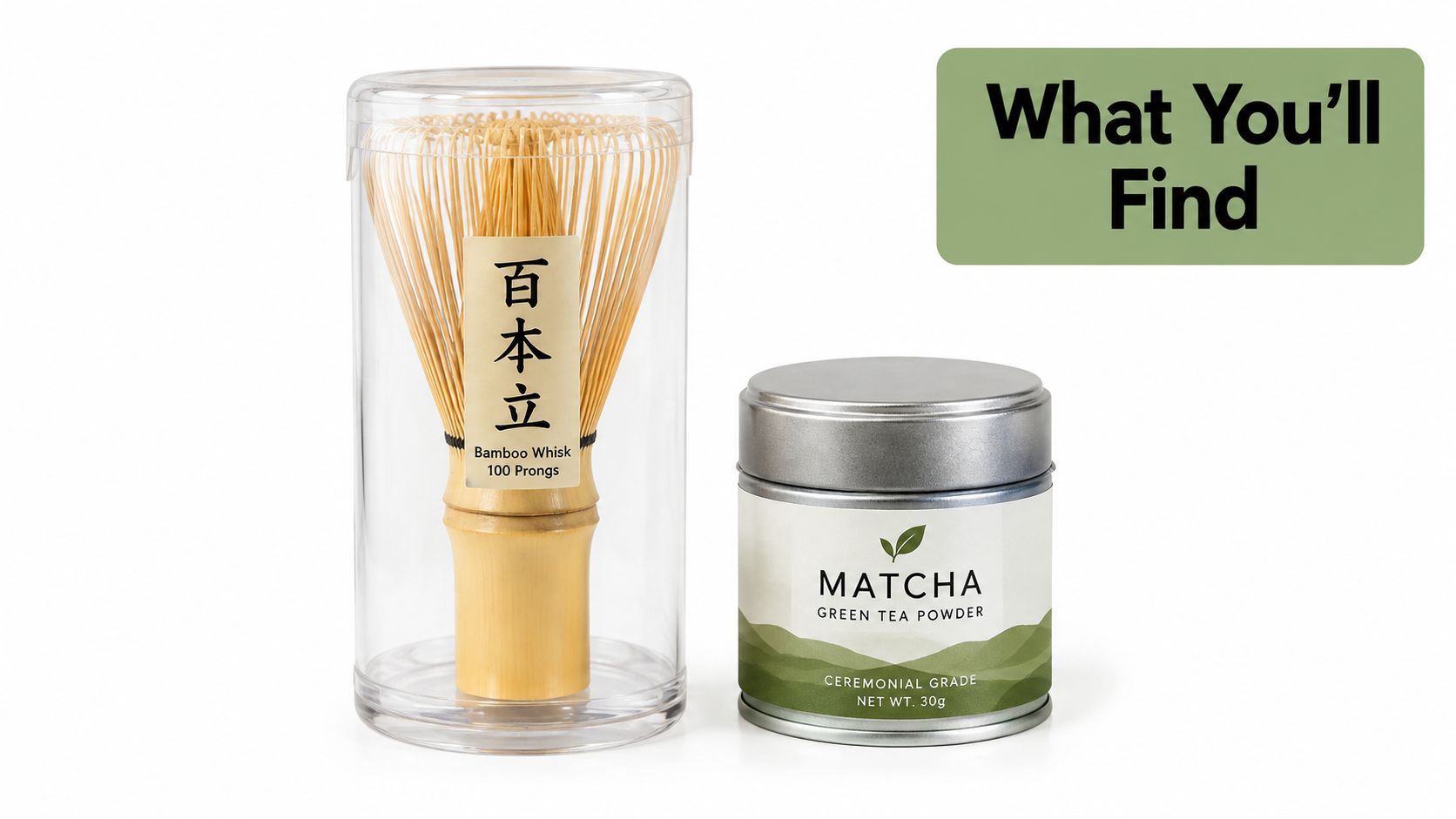
Woolworths also has an Avanti ceremonial set listing containing three components: a bamboo whisk, bamboo spoon and ceramic bowl, with catalogue listing dates showing these bundled tools were represented by 14 December 2022. Its description presents the whisk as a mixing and aerating tool, while the spoon measures powder and can stir settled matcha.
Buy a set if you need the bowl and scoop. If you already own a suitable bowl, a standalone whisk may be the tidier purchase.
Before paying, check:
- Seller identity, especially whether the item is an Everyday Market purchase.
- Delivery arrangements, including your postcode and the estimated arrival shown.
- Bundle contents, rather than assuming everything in a styled photograph is included.
- Seller terms, including returns and what to do if the whisk arrives damaged.
These listings establish an Australian retail presence, not uninterrupted availability. Don't turn a historical catalogue date into an assumption about today's stock, and don't rely on a marketplace order when you need a whisk for this afternoon.
Bamboo Chasen vs Electric Whisk Which One Actually Works
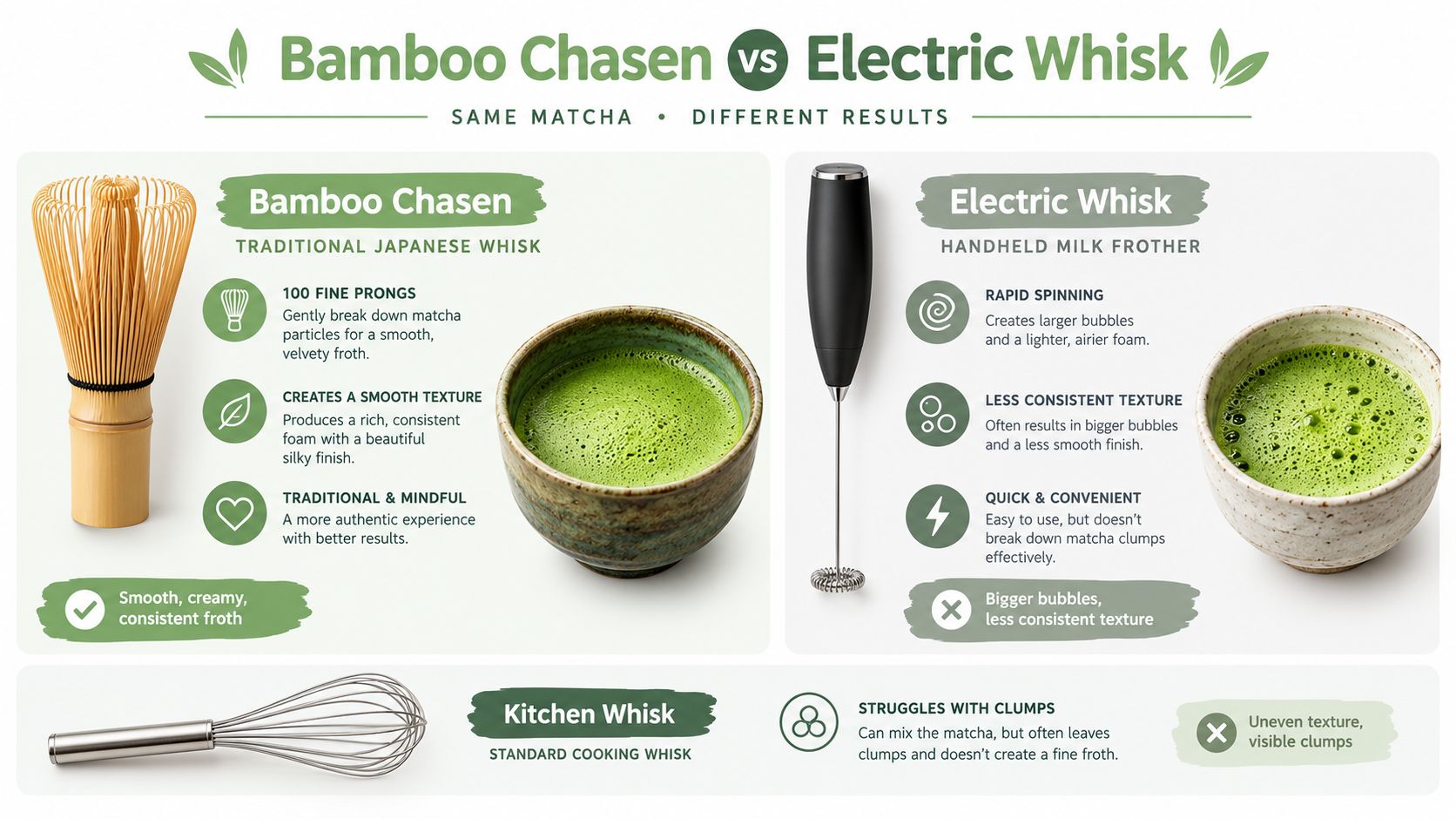
Choose according to what you drink. For matcha served with water, my preference is a bamboo chasen. For a weekday latte made while you're packing lunch and hunting for your keys, a handheld electric frother is a reasonable compromise.
The listed bamboo construction gives you a tool specifically intended for matcha preparation. An electric milk frother gives you a motorised alternative, but I wouldn't buy one solely because a product photograph shows an impressive cap of foam. Foam height isn't my measure of a well-prepared drink.
An ordinary small kitchen whisk is worth trying if it's already in your drawer. I wouldn't make it my first purchase for a dedicated matcha routine, especially if you'll be working in a small bowl.
Bamboo chasen vs electric whisk at a glance
These are practical buying judgements, not laboratory performance ratings.
| Factor | Bamboo chasen | Electric whisk |
|---|---|---|
| Froth quality | My preference for a lightly foamed bowl | Judge the drink underneath the foam, not its height |
| Learning curve | Practise a relaxed wrist movement | Simple controls, but placement still matters |
| Portability | No batteries or charging to organise | Check the power arrangement before travelling |
| Care effort | Needs gentle hand care and thorough drying | Follow the model's cleaning instructions |
| Best-use case | Straight matcha and a slower preparation ritual | Quick lattes and convenience-led routines |
The comparison below gives a visual overview of the tool choices.
Don't buy equipment for someone else's routine
If you love the deliberate process of making a bowl, the manual movement is part of the appeal. If you mainly want a milky drink before work, there's no need to perform a ceremony you don't enjoy.
For café use, I'd also consider who'll clean the tool, where it'll dry and how comfortably staff can repeat the preparation. A tool that looks lovely but doesn't fit the workflow is a poor purchase.
My recommendation: choose bamboo for straight matcha and electric for convenience-led lattes. Keep a kitchen whisk as a fallback, rather than buying it as your dedicated matcha solution.
How to Whisk Matcha the Right Way
Start with a clear bench and organise everything before adding water. You'll want a chasen, a matcha bowl or suitable small bowl, a sieve, a scoop or spoon, matcha powder and warm filtered water.
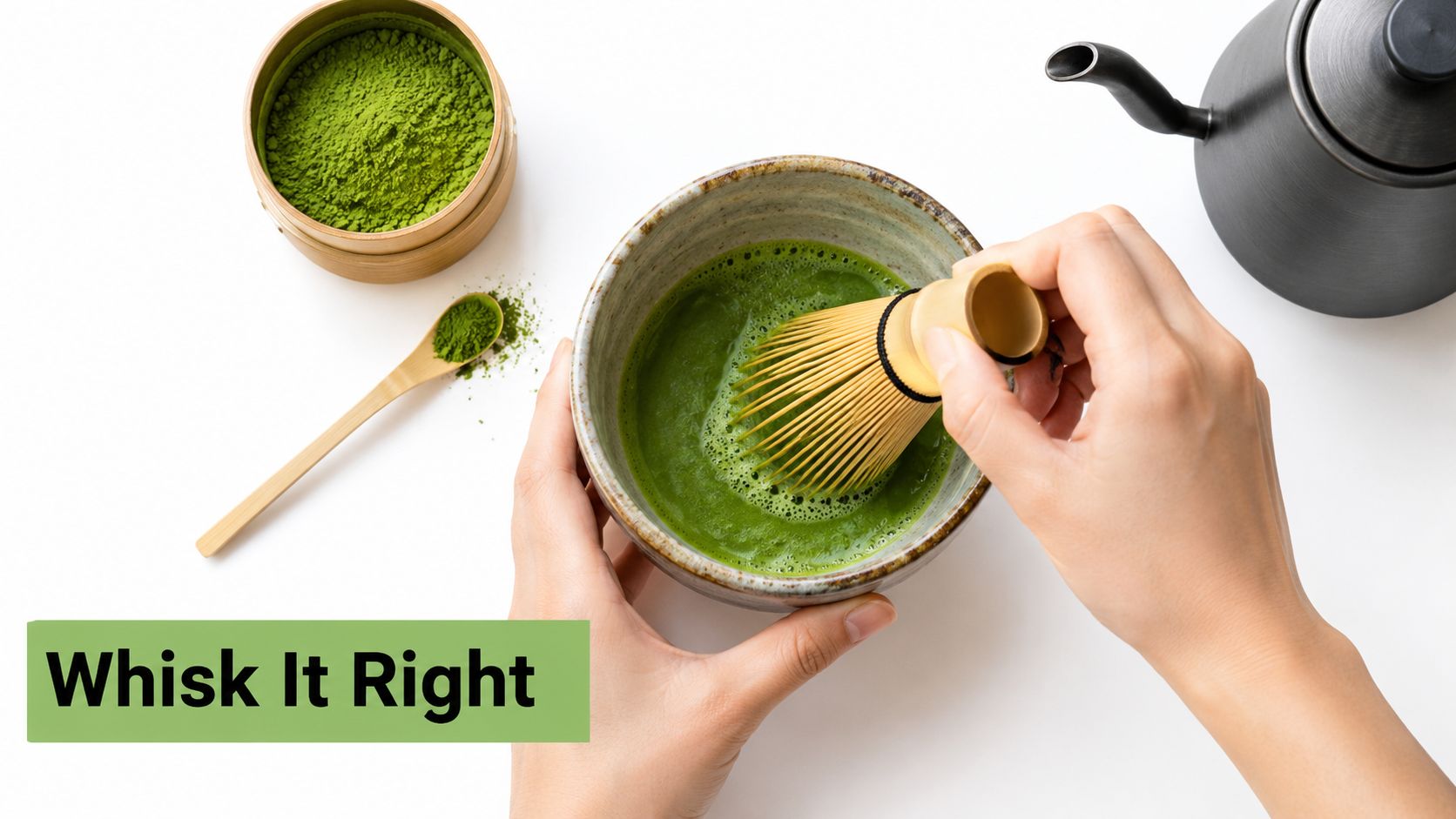
The hand position and bowl space shown below are useful details to notice.
Prepare gently, then whisk briskly
Soften the bamboo first. The Matcha Maiden preparation and care guidance recommends warm-water soaking for 1–2 minutes before use, because hydrated tines are more flexible and less prone to fracture than dry bamboo.
Sift your powder into the bowl. I recommend this rather than trying to crush every visible clump with the whisk. Use the powder maker's serving guidance as your starting point, then adjust to your taste.
Make a smooth base. Add a splash of warm water and gently work it into the powder. Check for dry pockets before adding the remaining water.
Whisk with your wrist. Use a brisk W or M movement instead of large circles around the bowl. Keep the motion light, and don't grind the prongs into the ceramic.
Finish by checking the drink. Look for an evenly mixed base and a fine surface foam. If you're making a latte, add your chosen milk after preparing the matcha.
For water temperature, follow your matcha's preparation guidance rather than treating every powder identically. I'd also avoid judging success by a stopwatch: stop when the texture looks right, not when an arbitrary countdown ends.
Our practical guide to whisking matcha offers another reference while you get comfortable with the movement.
Watch the preparation in motion, then practise without forcing the whisk.
Worth the effort: treat whisking as a short kitchen skill to learn, not a performance. A relaxed hand is more useful than an aggressive scramble.
Looking After Your Bamboo Whisk So It Lasts
The least glamorous part of owning a chasen is also the part I'd take seriously: rinse it and let it dry properly. Don't leave it sitting in yesterday's matcha while you decide whether you've got time to clean up.
The Matcha Maiden care guidance linked earlier calls for hand rinsing without soap, gentle handling and complete drying. It also explains that the centre naturally opens with repeated use. That change in shape isn't, by itself, a reason to throw the whisk away.
An opening centre isn't the same as broken prongs
Inspect the individual tines rather than expecting the bloom to stay exactly as it looked in the packaging. A reshaped centre and a cracked tine are different observations.
I'd stop using a whisk with broken pieces or visibly compromised prongs. Don't try to restore a showroom shape by pulling, twisting or squeezing the bamboo.
This visual checklist is handy to keep beside your preparation area.
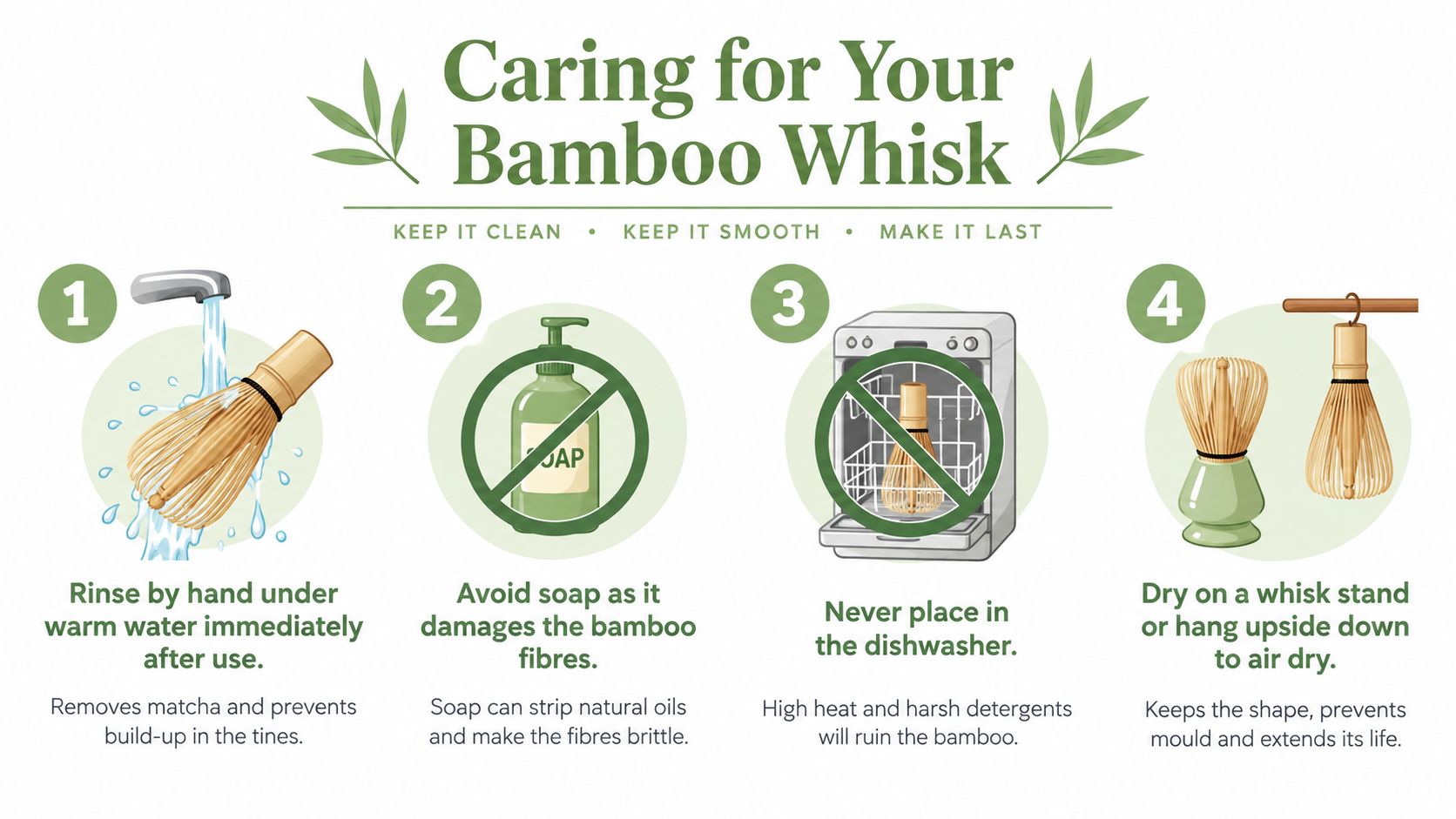
- Rinse by hand with warm water after preparing your drink.
- Skip soap and the dishwasher, following the gentle care approach already described.
- Remove droplets gently, without snapping your wrist or striking the whisk against the sink.
- Dry with airflow, using a suitable whisk holder or a secure hanging arrangement that doesn't crush the tines.
- Store sensibly, away from direct sunlight and places where other utensils can squash it.
- Check before use, replacing the whisk when prongs crack or no longer work comfortably.
Don't pack it into a closed container while it's still damp. For a café, give the chasen a designated drying spot rather than dropping it into a crowded utensil tub.
I wouldn't promise a fixed lifespan. Your useful measure is its condition and how it performs, not a calendar date or the seller's most optimistic description.
Better Australian Alternatives to Woolworths
A specialist retailer is worth considering when you want advice, not just a checkout. That doesn't automatically make its equipment superior. Ask clear questions and compare the actual whisk, rather than assuming a tea-focused website guarantees better craftsmanship.
For Australian buyers, I'd compare specialist tea shops, kitchenware retailers and direct-to-consumer matcha businesses. Each can suit a different purchase, but none deserves a blank cheque.
Compare the service as well as the tool
| Buying channel | What I'd look for | Who it suits |
|---|---|---|
| Specialist tea or matcha shop | Clear construction details, origin information and usable care advice | Drinkers choosing a dedicated chasen |
| Kitchenware shop or department store | A tool you can inspect, clear returns and practical handling | Buyers comparing bamboo and electric options |
| Online matcha specialist | Preparation guidance that matches the powder you're buying | Home drinkers building a complete routine |
Ask a tea specialist how the whisk should be used and dried. At a kitchenware shop, check whether the handle feels comfortable and whether the product instructions explain cleaning properly.
For an online purchase, read the description beyond the word ceremonial. I wouldn't pay extra for decorative language without useful details about the tool itself.
Make the price comparison honestly
There isn't a verified current price comparison to give you. Compare the total delivered cost, then decide whether the bundle includes accessories you need.
- Already have a bowl? Price the whisk alone before buying another set.
- Need something today? Contact a physical shop and confirm stock before leaving home.
- Want help choosing? Prefer a retailer that answers preparation and care questions clearly.
- Buying for a café? Ask about repeat availability and replacement arrangements.
Use Woolworths when the listed product, seller terms and delivery suit you. Choose a specialist when its advice and product detail justify the purchase, not because someone promises a chasen will last for years.
Most notably, don't confuse an online marketplace listing with same-day local access. Convenience only counts if the fulfilment works for your actual deadline.
Matching the Whisk to Quality Matcha and Your Routine
A sensible setup starts with what you want in the cup. I'd choose ceremonial-grade organic matcha for a water-only bowl and consider culinary-grade matcha for lattes, smoothies and baking, while still reading the maker's intended-use guidance.
Don't assume a better whisk makes every powder interchangeable. The tool helps with preparation; your powder choice and how strongly you make the drink still matter. Our organic matcha powder range gives you a place to compare options against the way you plan to use them.
For a slow Sunday bowl, I'd reach for the chasen. For a weekday latte, I'd prepare a smooth base using whichever tool I'll reliably clean and put away.
Texture isn't a caffeine claim
Whisking doesn't remove caffeine. Healthdirect states that healthy adults can generally consume around 400 milligrams of caffeine per day, roughly equivalent to two espressos, four instant coffees or eight cups of black tea, in its Australian caffeine guidance.
That's general adult guidance, not the caffeine content of your matcha serving or a target to reach. Matcha's caffeine depends on the powder quantity and preparation, so count your other caffeinated drinks too.
There's also an important distinction between ordinary tea and concentrated caffeine products. Food Standards Australia New Zealand's caffeine-product rules prohibit retail sale of solid or semi-solid foods containing 5 percent or more caffeine, and liquid foods containing 1 percent or more caffeine; those concentrated-product thresholds shouldn't be confused with ordinary culinary matcha.
Build a routine you'll keep
- At home, choose equipment that fits your bench space and cleaning habits.
- For lattes, match the powder to a drink you enjoy without automatically adding sweetener.
- In a café, give staff a clear preparation method rather than relying on individual improvisation.
Buy thoughtfully, learn the movement and care for the bamboo. That's a more useful approach than collecting accessories or expecting your morning bowl to deliver unverified wellness promises.
Pep Tea offers Japanese organic matcha for home preparation, recipes and café drinks. Pair your chosen powder with a whisk that suits your routine, then visit Pep Tea to explore the range and practical preparation guides.
Where to Buy Matcha Whisk in Australia: Practical Guide

Australian specialty tea retailers and curated online marketplaces are usually the most reliable places to buy a matcha whisk today, with local listings ranging from A$18.80 for basic bamboo chasen styles to A$90.00 for a premium Takayama whisk. If you're in Australia, you'll generally find the widest choice by checking specialist tea shops first, then broader kitchenware and marketplace sellers.
Starting with a simple shopping question often leads to getting stuck on the wrong comparison. They look at price first, when the better question is: what kind of froth do you want every morning, and how often will you use the whisk?
That's the gap I see again and again. A matcha whisk isn't just a box to tick off with your powder and bowl. Prong count, material, and how the whisk is made all shape the texture in your cup. For traditional usucha, a bamboo chasen behaves very differently from a resin or stainless option. For a milk-heavy latte, the trade-off may change.
At Pep Tea, we spend a lot of time helping Australians understand the tools behind a good cup, not just the tea itself. If you've been wondering where to buy matcha whisk options in Australia, and which one is worth it for your routine, this guide will help you buy with more confidence and less guesswork.
Finding Your Matcha Whisk in Australia
Where should you buy a matcha whisk in Australia when ten product photos look nearly identical?

A useful starting point is the seller, not the price tag. The right shop helps you compare how a whisk will behave in daily use. That means looking at prong count, material, and intended drink style, instead of treating every whisk as the same tool with a different markup.
For many Australian buyers, specialty tea retailers are the clearest place to begin. They are more likely to explain whether a whisk suits thin traditional matcha or a thicker latte routine, and whether the shape is designed for fine foam or basic mixing. That matters because a 100-prong bamboo chasen and a stiffer resin whisk can sit in the same search results while producing very different texture in the bowl.
Broader kitchenware stores and larger marketplaces still have a place. They can be useful if you want to compare several tool types at once or need a quick local delivery option. The trade-off is that some listings focus on appearance, bundle size, or discount pricing while saying very little about the whisk itself.
Where most Australian buyers should look first
Three shopping channels tend to cover most needs:
- Specialist tea retailers: Usually the best option for bamboo chasen, clearer usage notes, and better detail on froth quality.
- Kitchenware stores: Handy if you are comparing tea tools with other home items and want Australian shipping.
- Large marketplaces: Good for range, but you need to read carefully because product descriptions can be thin or inconsistent.
A simple rule helps here. Buy from the kind of retailer that can explain what the whisk does in the cup, not only how fast it can post the parcel.
What a good product listing should tell you
A useful listing gives you enough detail to predict performance. If it skips the basics, comparison gets harder.
Look for these points:
- Material, such as bamboo, resin, or stainless steel
- Approximate prong count or tine style
- Intended use, such as usucha, thicker matcha, or lattes
- Whether stock ships from Australia
- Whether care instructions are included
- Whether it is sold on its own or in a set
Prong count is where many buyers miss value. More prongs often help create finer foam with lighter matcha preparations, much like a brush with more bristles leaves a smoother finish. Fewer or thicker tines can be more durable, but they may produce larger bubbles or need more effort to get a creamy surface. If you drink matcha most mornings, that difference shows up quickly.
Care advice is another quiet sign of a reliable seller. A shop that tells you how to rinse, dry, and store a bamboo whisk usually understands that the tool is meant to last longer than one gift season.
Understanding Bamboo Chasen Construction
A bamboo chasen isn't a tiny kitchen whisk. It works more like a fine brush that happens to whip liquid. The carved tines flex, gather the matcha, and help create a surface foam without smashing the powder into clumps.
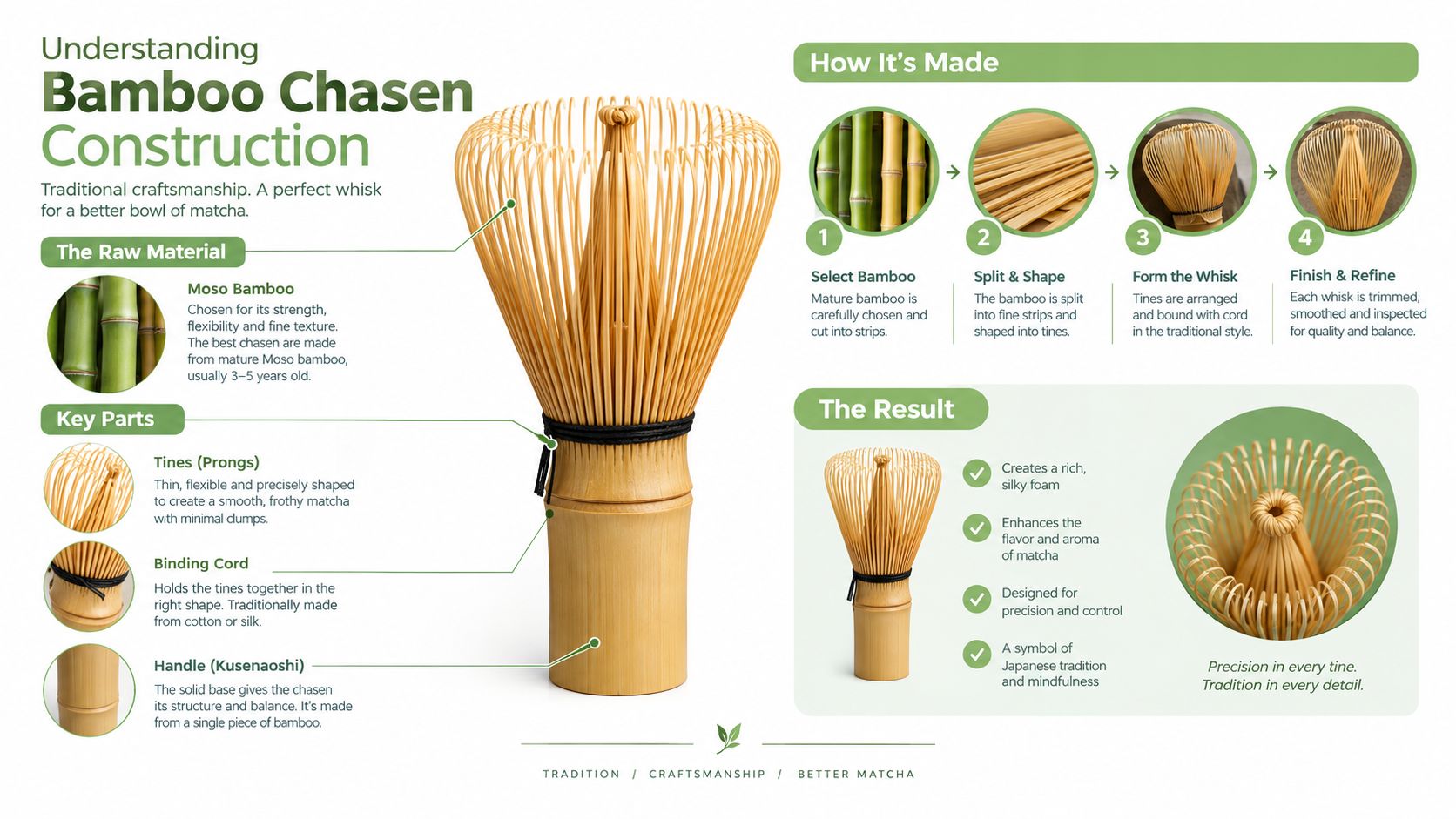
What the parts actually do
The central idea is simple. A chasen is carved from bamboo so the tines are thin, springy, and closely spaced. That shape lets the whisk move through a shallow pool of matcha and water with less resistance than a bulky metal whisk.
Think of it this way:
- The outer tines help agitate the liquid and build foam.
- The inner tines help break up small clumps and refine the texture.
- The handle gives you control without forcing a heavy stirring motion.
One Australian retailer notes that a chasen is made from bamboo specifically to create the frothy texture needed for matcha, which is a useful reminder that the material isn't decorative. It's part of the brewing result (matcha whisk product guidance).
Why construction affects your cup
A poorly shaped whisk can still mix matcha. It just won't do it elegantly. You may end up with larger bubbles, weak foam, or sediment that settles too quickly.
If you're learning at home, a traditional whisk also teaches better movement. That's one reason many people still choose a dedicated chasen rather than treating matcha like a protein powder.
For readers comparing tools, our matcha tea brush collection shows the kind of purpose-built whisk Australians often look for when they want a proper preparation tool instead of a generic frother.
Here's a useful visual demonstration of how a bamboo whisk is shaped and used in practice.
A simple test before you buy
Practical rule: If the listing doesn't show the tine shape clearly, you're buying half-blind.
Check for:
| Detail | Why it matters |
|---|---|
| Clear tine definition | Suggests the whisk is designed for actual matcha preparation |
| Material description | Helps you distinguish bamboo from resin or metal alternatives |
| Use instructions | Often a sign the seller understands the product |
| Set or standalone listing | Helps you decide if you also need a holder |
Bamboo Versus Alternative Matcha Tools
Australian retailers don't sell just one kind of matcha whisk anymore. Local listings include traditional bamboo chasen, resin reusable whisks, and stainless-steel mechanical whisks, with prices ranging from about AU$18.80 to AU$59.00 across these formats (Australian matcha whisk collection).
That broader choice is useful, but it can also blur the decision. Different tools suit different routines.
How the main options compare
| Tool type | Froth quality | Durability | Cleanup | Best fit |
|---|---|---|---|---|
| Bamboo chasen | Fine, traditional foam | More delicate | Easy if rinsed promptly | Daily matcha tea, mindful prep, usucha |
| Resin whisk | More convenient feel, less traditional texture | Reusable and sturdier | Straightforward | Frequent casual use |
| Stainless or mechanical whisk | Good for mixing, especially with milk | Stronger build | Usually easy | Lattes, quick prep, busy kitchens |
What bamboo does better
Bamboo is still the benchmark if your goal is a classic bowl of matcha with a light foam and smooth top. The tines are designed for that motion. They skim and whip rather than churn.
It also feels better in the hand for traditional preparation. That may sound minor, but the whisking motion is easier to learn when the tool was made for the task.
When alternatives earn their place
Resin and stainless options make sense for people who prioritise convenience. If you make iced lattes, add milk often, or want something less fragile, they can be practical.
One Australian retail category also shows a much cheaper entry point for mechanical whisks at about A$4.80, while bamboo and premium handmade options sit much higher. That spread shows why buyers shouldn't assume all “matcha whisks” solve the same problem (Australian matcha accessories range).
Bamboo usually wins on texture. Alternative tools often win on speed.
For many households, that's the trade-off.
Choosing Prong Count by Drink Style
Prong count sounds technical, but it's one of the easiest ways to narrow your choice. In simple terms, more prongs usually mean a finer, softer foam, while fewer prongs can feel a bit sturdier and forgiving for thicker or milk-based drinks.
Australian listings give a clear pricing snapshot: a 64-prong bamboo chasen is A$18.80, an 80-prong whisk is A$18.80, a 100-prong whisk is A$34.80, a 120-prong whisk is A$39.80, and a premium Takayama chasen is A$90.00 (Australian chasen pricing examples).
A practical way to match prongs to your routine
Use this simple guide:
Choose lower prong counts for casual milk drinks.
If you mostly make matcha lattes, a 64-prong whisk can be perfectly sensible. You're blending for smoothness, but the milk will shape much of the final texture.Choose mid-range prong counts for everyday all-round use.
An 80-prong whisk suits many home drinkers because it can handle both straight matcha and occasional lattes without feeling too specialised.Choose higher prong counts for finer foam.
If you enjoy more traditional preparation and want a silkier surface, a 100-prong or 120-prong whisk is often the more satisfying choice.
Don't let price lead the whole decision
The jump in price doesn't always mean the whisk is “better” for you. It may reflect finer workmanship, workshop provenance, or a more specialised shape.
Ask yourself these questions before you buy:
- Do I drink straight matcha or mostly lattes?
- Will I use it daily or only on weekends?
- Am I replacing a damaged whisk or buying my first one?
- Do I care more about ritual, durability, or speed?
A lower-priced whisk can be excellent value if it matches your drink style. A premium whisk only makes sense when you'll appreciate what it does differently.
Sourcing Matches Where Australian Buyers Shop
Where should an Australian buyer look for a good matcha whisk, once price stops being the only filter?
The short answer is that you have more options than many first-time buyers expect. Matcha whisks are sold through specialist tea shops, broader kitchen retailers, and large online marketplaces. That wider retail spread matters because it changes how you compare options. Instead of asking only, “What is the cheapest chasen I can find?”, you can ask, “What am I getting for this material, this prong count, and this level of finish?”
Australia already has an established retail channel for tea and tea tools. Industry context from IBISWorld shows a mature local online market for kitchen and diningware, which helps explain why matcha accessories are not limited to hard-to-find niche imports (Australian online kitchen and diningware industry context).
That practical availability helps in two ways.
First, it gives you room to compare construction details, not just shipping costs. A bamboo whisk with neatly separated tines and a shape suited to your drink style will usually produce better daily foam than a cheap option with uneven cuts, even if both look similar in a product photo. Second, local stock makes it easier to replace a whisk before a worn-out one starts giving you flat, clumpy results.
Where quality differences usually show up
A chasen is a bit like a paintbrush. From a distance, several may look alike. In use, the cut of the bristles, the flexibility of the material, and the overall shape change the result.
When you shop in Australia, check whether the seller clearly states:
- the whisk material, such as traditional bamboo or a non-bamboo substitute
- the prong count, especially if you care about finer foam for straight matcha
- the origin or workshop details, if provenance matters to you
- whether the item is stocked locally, which affects delivery speed and returns
Those details help close the decision gap many buyers run into. Two whisks can sit close together on price, but one may suit daily usucha far better because the prongs are finer and more numerous. Another may be better value for latte drinkers because it is simpler, sturdier, and less fussy.
Local stock can make comparison easier
One dedicated Australian seller states that its chasen are sourced from the Takayama workshop of Chikumeido and says it is the only stockist they supply in Australia. That shows some Japan-made whisks are available domestically, rather than only through direct overseas ordering (Takayama chasen listing in Australia).
That kind of listing is useful because it gives you something concrete to assess. If a seller explains where the whisk was made, what style it is, and who it suits, you can judge value more clearly. If the page says very little beyond “matcha whisk,” you may be buying blind.
Australian interest in matcha appears to be growing, as noted earlier. That helps explain why more local shops now carry preparation tools. For buyers, the main benefit is simple. Better availability means more chances to compare prong count, material, and build quality side by side, instead of treating every whisk as the same product with a different price tag.
Simple Care Routines for Longevity
A bamboo whisk can last well if you treat it gently. Most breakage happens because the prongs dry out, get pressed flat, or are scrubbed like ordinary kitchen gear.
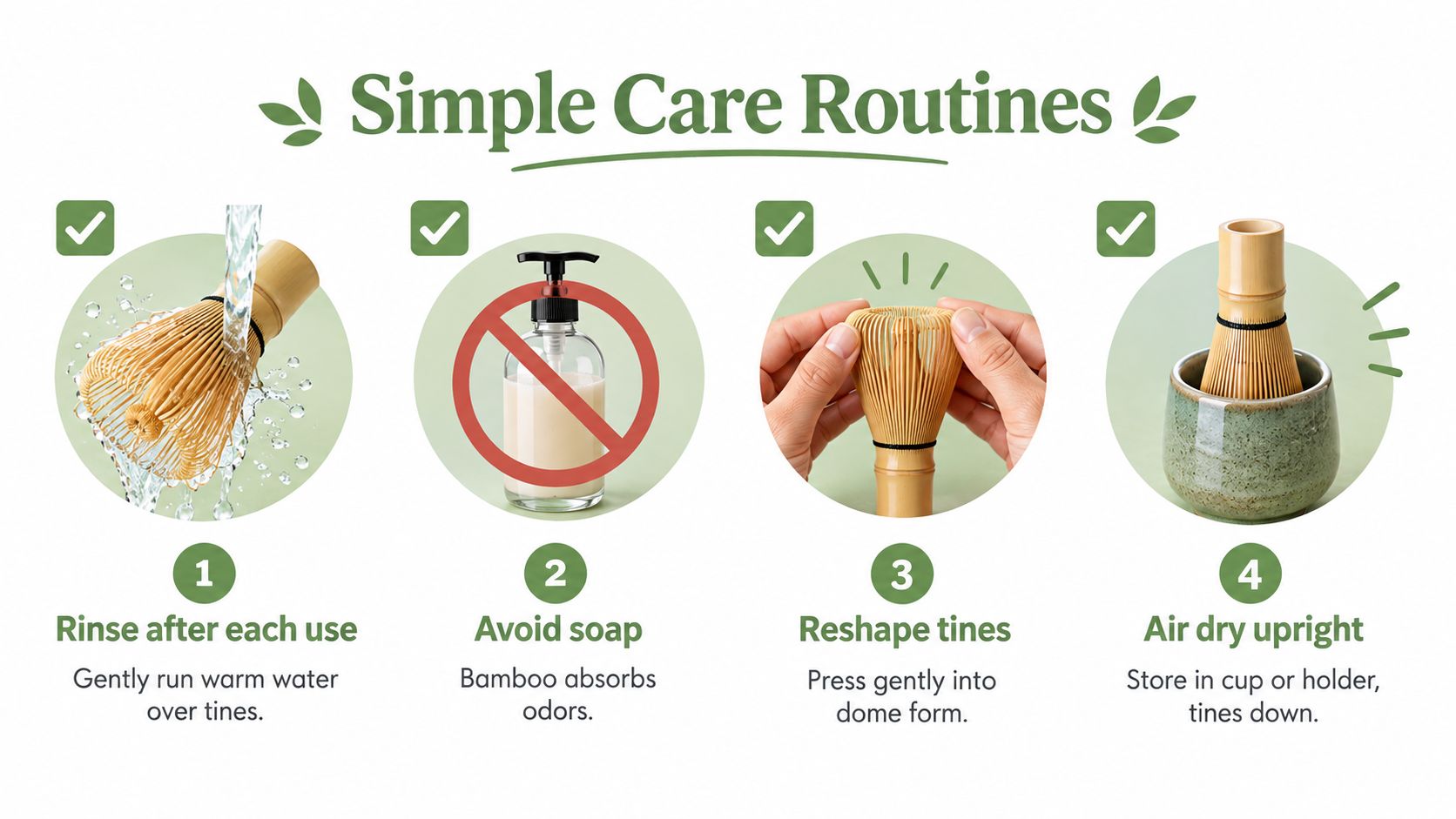
Several Australian sellers advise pre-soaking the whisk in warm water before use to help prevent breakage and improve foam formation, and one guide recommends whisking 2 scoops of matcha with 100 ml of 70°C water in a figure-of-eight motion before rinsing and air-drying upright (Amazon Australia matcha guide).
The daily routine that makes the biggest difference
You don't need special products. You need consistency.
- Before whisking: Soak the tines briefly in warm water so the bamboo softens.
- After whisking: Rinse with warm water soon after use.
- While drying: Let it air-dry upright, not trapped in a drawer.
- For shape support: A holder helps the whisk keep its curve between uses.
If you use a bamboo whisk often, a dedicated matcha whisk stand is a practical add-on because it supports the tine shape while drying.
What not to do
Don't treat a chasen like a dishwasher-safe gadget. It's carved bamboo, and it responds better to gentle habits than hard cleaning.
Avoid these common mistakes:
| Mistake | What happens |
|---|---|
| Leaving matcha to dry on the tines | Residue stiffens the prongs |
| Using soap | Bamboo can hold odours and flavours |
| Storing wet in a closed cupboard | Moisture lingers where air can't circulate |
| Pressing hard against the bowl base | Tines can bend or snap sooner |
A little care goes a long way. With bamboo, maintenance is part of the tool, not an optional extra.
When Mechanical or Electric Whisks Make Sense
Traditionalists sometimes dismiss mechanical or electric whisks too quickly. That isn't always fair. For some Australian households, they solve a real problem.
If you're making a fast weekday latte, or prepping several milk-based drinks in a café, a mechanical tool can be the more practical choice. It's especially relevant because local sellers do offer these alternatives alongside bamboo and resin models, rather than treating them as unrelated kitchen gadgets.
The best use case for a shortcut
Mechanical and electric whisks make the most sense when:
- You mostly drink matcha with milk
- You care more about speed than ritual
- You want a sturdier tool for frequent handling
- You're less concerned with traditional surface foam
That last point matters. A quick frother can blend powder and liquid well, but the texture often feels different from a hand-whisked bowl made with a chasen.
Where they fall short
A mechanical whisk can over-aerate, create a different bubble structure, or miss the softer finish many people want in straight matcha. If your goal is a calm bowl of usucha, bamboo still tends to feel more precise.
For readers who know they prefer convenience, an electric matcha whisk option is one route worth considering, especially for latte-heavy routines where speed matters more than ceremony.
The key is honesty about the drink you make. A shortcut is only a compromise if you wanted the traditional result in the first place.
Final Thoughts on Choosing Wisely
The best answer to where to buy matcha whisk in Australia isn't just the name of a shop. It's the combination of the right seller and the right whisk style for your drink habits.
If you want the safest starting point, check an Australian specialty tea retailer first. If you want broad comparison shopping, curated marketplaces and kitchenware stores can be useful. Then narrow the choice by material, prong count, and whether you'll be making straight matcha or mostly milk-based drinks.
The decision that matters most
A few buyers need handmade provenance. Some need a durable daily tool. Others just need a whisk that won't leave clumps in a morning latte.
That's why price alone doesn't help much. An A$18.80 whisk may be a smart buy for one person, while another will be happier paying more for a finer whisk geometry or Japan-based workshop sourcing, as covered earlier.
A simple buying checklist
Before you click buy, make sure you know:
- Your main drink style
- Your preferred material
- Whether you need a set or a standalone whisk
- Whether the seller offers local stock and clear care advice
The right whisk should fit your routine so naturally that you stop thinking about the tool and start enjoying the tea.
Good matcha preparation doesn't need to be complicated. It just needs a bit of thought at the start, then a little care afterwards.
If you're building a better matcha routine at home or for your café, Pep Tea offers premium organic Japanese matcha, practical preparation guidance, and the kind of tea education that helps you choose tools with confidence. You can explore our matcha range, learn how to whisk it properly, and find straightforward advice for everyday Australian matcha drinking.
Matcha Bowl Set: The Complete Buyer’s and Brewing Guide

You've got a bag of matcha, a favourite mug, and the hope that this cup will finally taste like the café version you keep thinking about. Then the powder clumps, the surface stays flat, and the first sip lands bitter instead of smooth. That frustration usually isn't about the matcha alone, it's about the vessel and the tools.
A proper matcha bowl set changes the whole experience because it gives the whisk room to move, the powder room to disperse, and the drink room to foam. In Japan, the matcha bowl, or chawan, has deep roots in tea culture, with traditions commonly traced to the 9th century in the Heian period and, in later tea-ceremony practice, to the 12th century when Zen monks helped popularise powdered tea in Japan what is a matcha bowl. That history matters, but the practical point matters even more, a good bowl is a working tool, not just a pretty object.
Australian cafés have pushed expectations higher. People now want matcha that looks clean, tastes balanced, and feels consistent from one serve to the next. That's exactly where the right bowl geometry and whisk compatibility make the biggest difference.
Why Your Regular Mug Is Failing Your Matcha
The common beginner move is easy to spot. Someone grabs a regular mug, adds matcha, pours in hot water, and stirs with a spoon or a small whisk. The cup often ends up patchy, the flavour turns harsh, and dry powder clings to the sides.
The problem starts with shape
A regular mug is too narrow for proper whisking. The bamboo whisk, or chasen, needs room to sweep across the surface and break up clumps, and a cramped vessel cuts that motion short before it can do its job. A wider, rounded bowl gives the whisk clearance, which helps create the fine foam people expect from well-made matcha.
Practical rule: if the whisk keeps hitting the sides, the vessel is working against you.
The second issue is aeration. Matcha is a suspended powder, so it needs more than a quick stir. The bowl's open profile supports the whisking pattern that lifts, disperses, and froths the tea properly. Without that movement, sediment settles at the bottom and the first sip tastes uneven.
Temperature adds a third layer. Matcha is delicate, and a bowl designed for the job makes it easier to keep the drink in the right range instead of rushing the process. That matters in home kitchens, and it matters just as much in busy Australian cafés, where every cup needs to look and taste consistent.
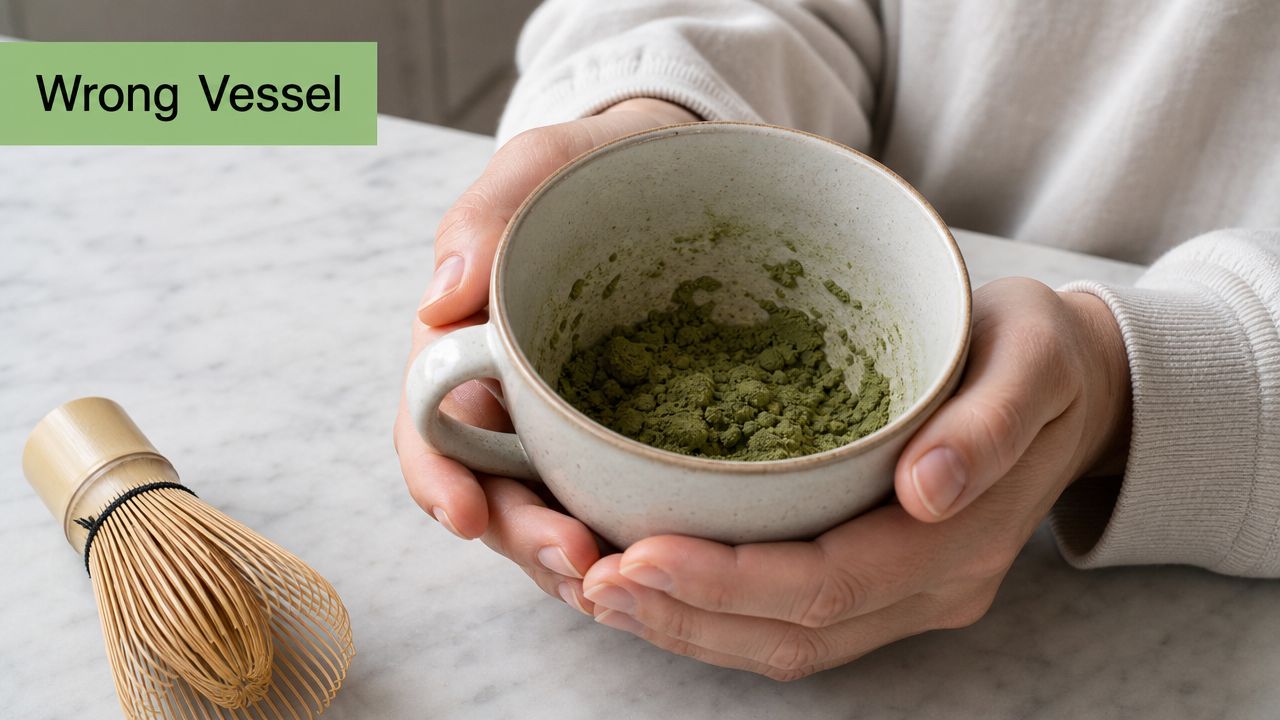
The takeaway is straightforward. A matcha bowl set is not about ceremony for ceremony's sake. It solves the basic mechanics that make matcha pleasant to drink, and that is why serious home drinkers and café operators keep coming back to the proper tools.
Components of a Matcha Bowl Set
A good matcha bowl set works like a small prep station. Each piece has a different job, and the fit between them matters more than the display shelf version of the set. In an Australian home kitchen, or behind a café bench during a morning rush, that fit is what makes the results repeatable.
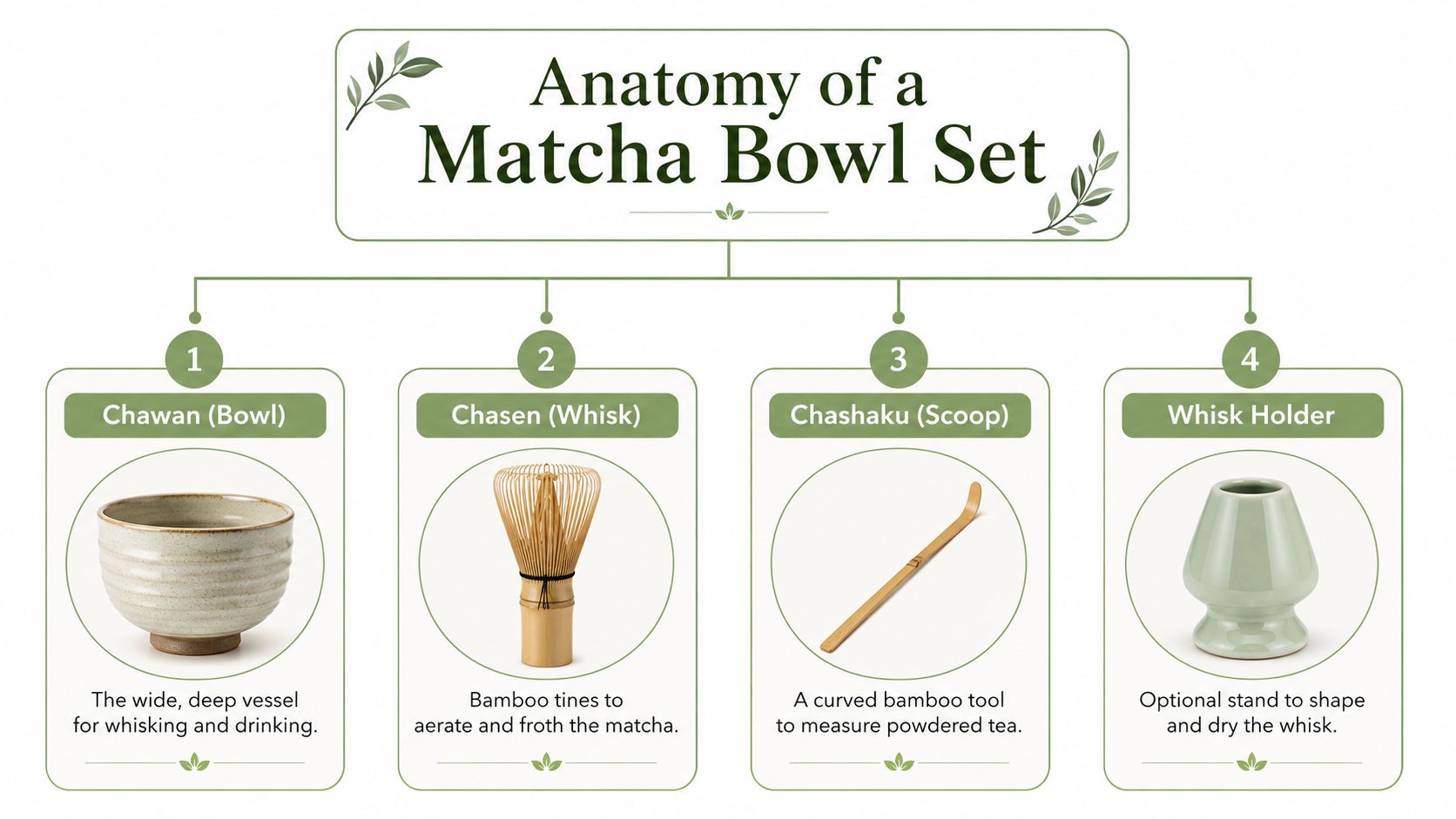
The core tools and what they do
A chawan is the bowl itself. Its wide, rounded shape gives the whisk room to move, so the tea and water can stay in motion instead of collecting in one tight spot. That geometry is the practical reason a proper bowl outperforms a random ceramic bowl from the cupboard.
A chasen is the bamboo whisk. Its flexible tines whip air into the tea and create the light foam people expect from well-made matcha. A spoon can stir the liquid, but it cannot make the same texture because it does not sweep the surface in the same way.
A chashaku is the curved bamboo scoop. The scoop looks simple, yet it matters because dosing changes the feel of the drink very quickly. Too much matcha in a small bowl can leave you with a dense, bitter cup that is hard to smooth out, especially if you are making drinks one after another.
A whisk holder is optional, but it helps keep the whisk in shape as it dries. For anyone who uses the set often, it gives the tines a proper resting place instead of leaving them bent or splayed in a drawer.
If you want to compare the usual accessories before buying, the matcha tea accessories collection at PepTea is a practical reference point for seeing how the tools relate to one another.
The set works best as a system, not as a pile of separate items.
The same idea carries into the kitchen. Matcha sits comfortably alongside authentic Japanese home cooking recipes, especially when you are building a routine around simple preparation and consistent flavour.
The common mistake is treating the bowl as the only part that matters. The bowl sets the shape of the work, but the whisk, scoop, and holder are what make the process reliable. When the pieces match the task, the tea is easier to prepare well, whether you are making one cup at home or repeating the same method for customers in a café.
Choosing the Right Materials and Sizes
A matcha bowl can look beautiful on the shelf and still be awkward in the hand. The key test is whether it supports steady whisking, comfortable pouring, and repeatable results for the way you brew at home or serve in a café. For Australian buyers, those practical details usually matter more than surface style.
Material trade-offs that affect everyday use
Ceramic is the most familiar option. It usually feels stable in the hand and suits the rounded shape that matcha needs. Porcelain can feel smoother and lighter, while glass shows the colour of the tea clearly, but can feel less forgiving in a busy kitchen.
| Matcha Bowl Materials Comparison | Heat Retention | Durability | Best For |
|---|---|---|---|
| Ceramic | Good warmth and a solid hand feel | Generally sturdy, but can chip if knocked | Home use, café service, everyday matcha |
| Porcelain | Even, clean finish | Can be strong, but still needs careful handling | Presentation-focused serving |
| Glass | Lower heat feel and more visual clarity | More fragile in active kitchens | Display use and occasional home brewing |
The best material depends on where the bowl will live. A café bench, a home cupboard, and a gift box all call for different priorities. Choose based on your actual brewing routine, then check whether the bowl is easy to clean, easy to store, and able to handle a busy morning rush without feeling delicate. If you are comparing options across a wider set of tools, the matcha tea accessories range is a useful way to see how the bowl fits with the whisk and scoop.
Why size and rim width matter
A standard matcha bowl is typically 400 to 500 mL, with a rim around 4.5 to 5.5 inches, or roughly 12 to 15 cm, in diameter what is a matcha bowl. That size gives the whisk enough room to move without splashing. A bowl that is too narrow makes the whisk collide with the sides, which breaks the foam and slows you down. A wider opening gives the tines space to work, which is helpful whether you are making a single bowl at home or repeating the same method for customers in a café. As noted earlier, the bowl is built for small, precise servings where whisking and foam formation matter more than volume.
For a deeper practical view of how bowl shape supports daily tea routines, the material and sizing advice in the same matcha bowl set category is worth comparing with the way you already make drinks at home. If your routine leans toward pantry-friendly meals as well, the same logic applies to tools used across authentic Japanese home cooking recipes.
Buy for the way you brew, not for the most beautiful shelf photo.
Handmade pieces can be lovely, especially if you enjoy ritual and presentation. Mass-produced bowls can be more practical for cafés, shared kitchens, or anyone who needs stackability and predictable cleaning. A handmade bowl may suit the quiet pace of home preparation, while a sturdier, more uniform piece often works better where cups are made back to back. The right answer is the one that matches your usage, not the one that looks aspirational on day one.
Mastering the Basic Whisking Technique
A good matcha cup starts with the whisk, the bowl, and the water working together. In an Australian kitchen or café bench, the goal is repeatable texture, not a lucky first try.
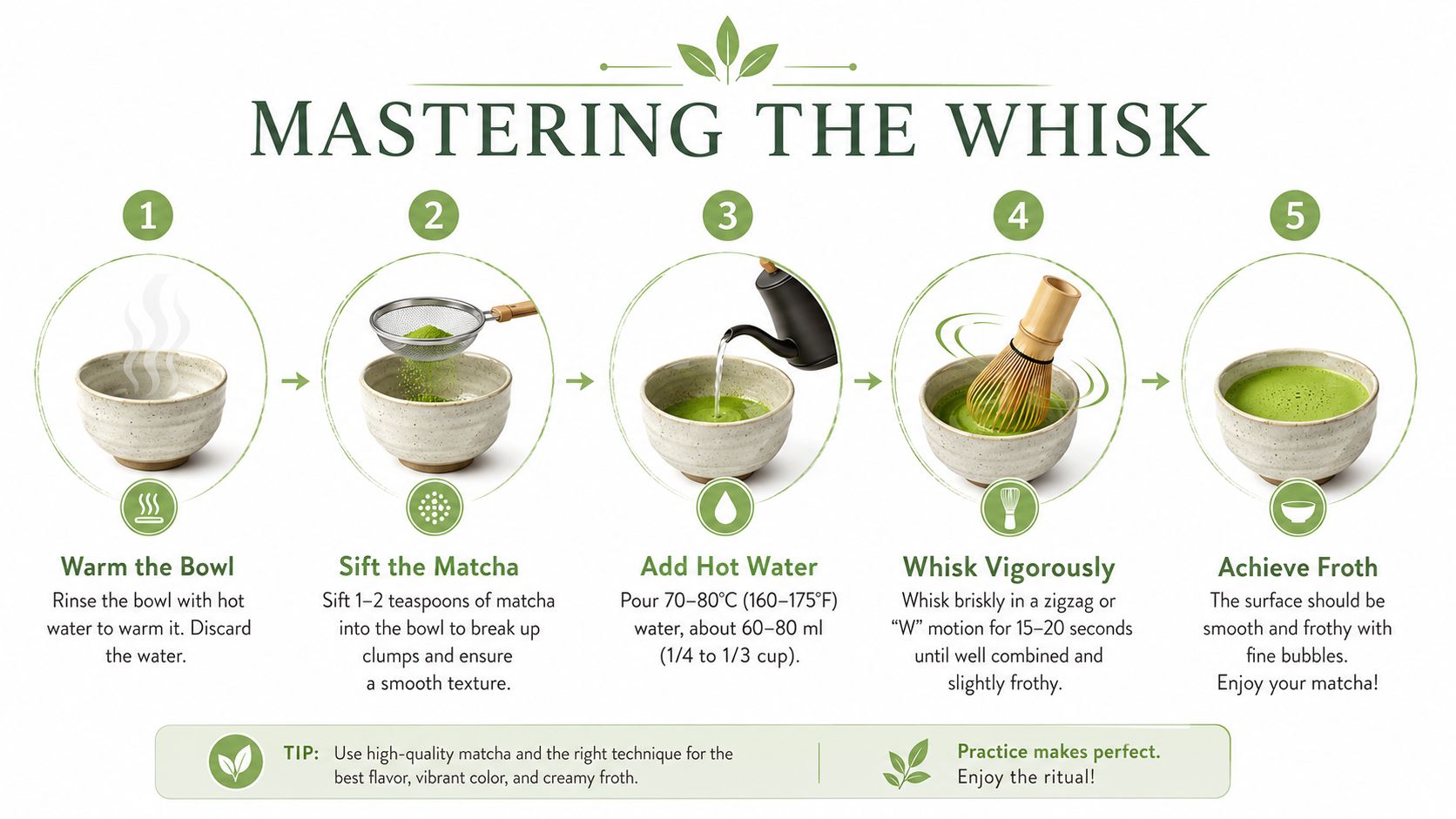
The preparation flow
Warm the bowl first. A pre-warmed vessel gives you a more settled working surface, and it helps the whole process feel under control.
Sift 1 to 2 g of matcha into the bowl next. Matcha is a fine powder, so it clumps easily, much like cocoa left untouched in a dry tin. Sifting gives the whisk less work to do and helps the drink finish smoother.
Add 60 to 80 mL of water at 60 to 70°C. Water that is too hot can push the flavour into a sharper, harsher place, especially if you are still learning how much pressure your whisk needs. The cooler range helps keep the taste cleaner.
Whisk in a W-shaped motion for 10 to 15 seconds. Use quick, light movements rather than force. The bamboo tines need space to move across the bowl, and a well-shaped bowl keeps them from scraping the sides, which helps build a more even foam.
If you want to see the motion before trying it yourself, the tutorial at how to whisk matcha shows the W-shaped whisking pattern at a steady pace, so you can match the rhythm while you practise.
Common mistakes and quick fixes
- If the tea looks grainy: you probably skipped sifting or stopped whisking too soon.
- If it tastes bitter: the water may have been too hot, or the matcha dose may be too heavy.
- If the surface stays flat: the bowl may be too narrow, or the whisk motion may be too circular.
- If it splashes out: the vessel is likely too small for the movement you are using.
A lot of beginners stir matcha like instant coffee. That approach leaves clumps behind and gives you weak foam. The whisk needs room, the bowl needs clearance, and the tea needs a short, decisive burst of motion.
For a fuller walkthrough of hand position and rhythm, the guide on how to whisk matcha is a practical companion. That same method also holds up when you are making drinks for guests or refining café service, because it gives you texture you can repeat instead of guessing from cup to cup.
Picking the Perfect Set for Your Situation
The best set for one person isn't always the best set for another. A home drinker, a café operator, and a gift buyer each care about different things, and the smartest purchase reflects that.
For home baristas
If you're making matcha most mornings, choose a set that's easy to clean and forgiving while you learn. A medium-sized bowl with a comfortable grip and a whisk that feels flexible is usually a better choice than an ornate showpiece. Storage matters too, especially in smaller kitchens where stackability can be a real bonus.
For café operators
Cafés need repeatable texture, fast cleaning, and a bowl that can handle frequent use. Durability matters more than decorative detailing, and the bowl should sit steadily on a bench during service. Whisk compatibility is essential, because the wrong bowl slows down preparation and makes foam quality less consistent across multiple serves.
For gift buyers
Presentation counts here. A set that arrives neatly packaged, looks polished, and includes a short guide for use tends to feel more complete. The recipient shouldn't have to guess which tool does what.
The best gift set is the one that helps someone make a good cup on the first try.
A simple way to think about it is this:
- Home use: prioritise easy cleaning and a bowl that feels comfortable in the hand.
- Café use: prioritise durability, consistency, and whisk clearance.
- Gifting: prioritise presentation, clear components, and user-friendly guidance.
If you're shopping for home use, it's easy to overbuy on extras you won't touch. If you're buying for a café, it's just as easy to under-invest and end up replacing tools too soon. A balanced matcha bowl set saves more time than it costs because it matches the job in front of you.
Caring for Your Matcha Tools
Bamboo and ceramic both last longer when you treat them gently. The maintenance routine is simple, and it pays off quickly because the tools stay usable and look better for longer.
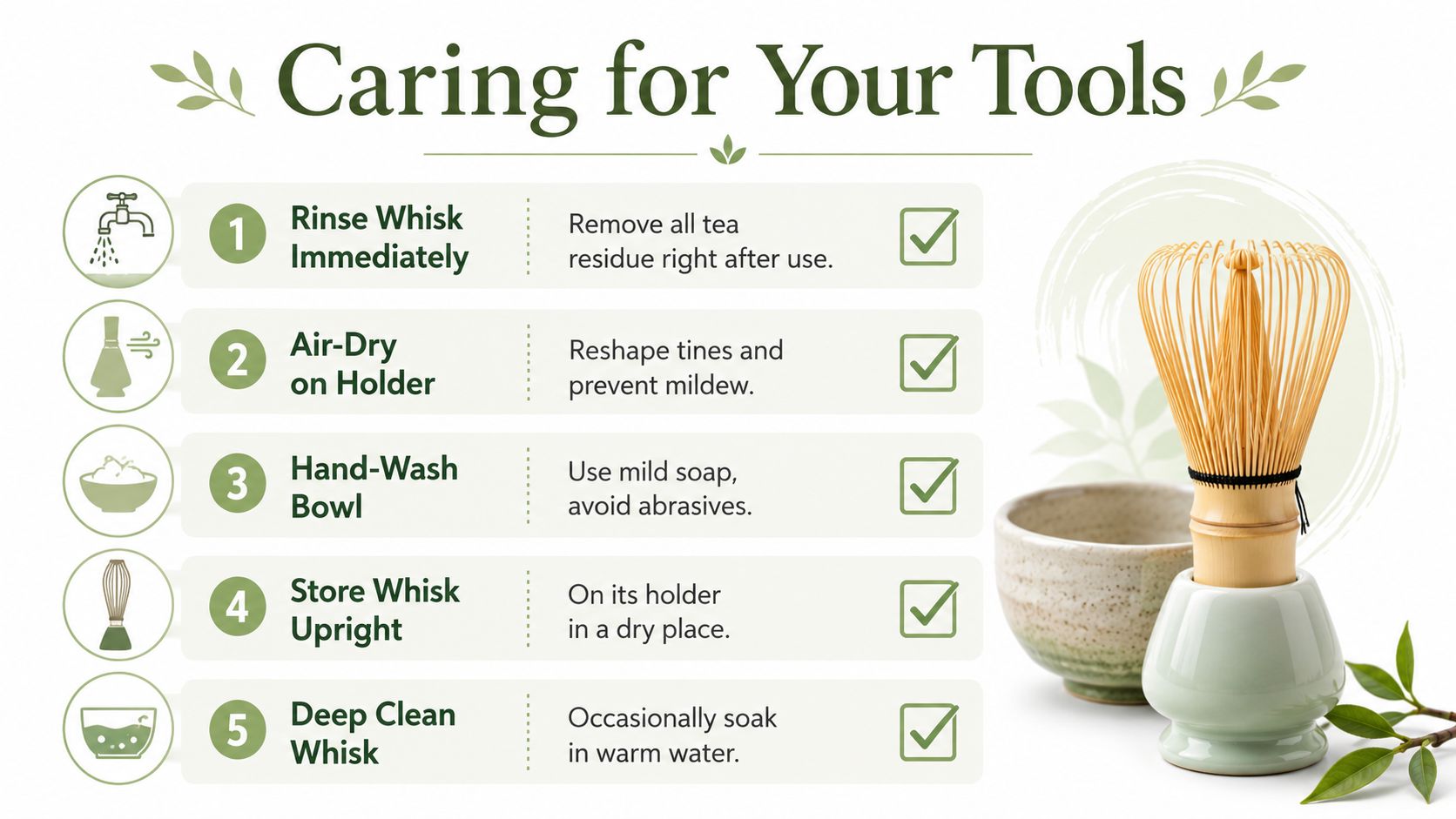
A routine that actually fits real life
Rinse the whisk right after use. Matcha dries fast, and once it sets into the tines, it becomes harder to remove without bending them. Let the whisk air-dry on a holder so the shape stays open instead of collapsing inward.
Wash the bowl by hand with mild soap and a soft sponge. Abrasive pads can dull the finish and make stains more obvious over time. For stubborn residue, warm water and a little patience usually do the job without damaging the surface.
Store the whisk upright in a dry place. Bamboo doesn't like being left damp, especially in humid conditions. In Australian homes, that matters in summer, when moisture can linger longer than you expect.
For a practical storage option, a dedicated matcha whisk stand like the one at PepTea helps the tines keep their shape between uses.
Signs it's time to replace a tool
- Bent whisk tines that no longer spring back properly.
- Persistent staining or odour that survives normal cleaning.
- Chipped bowl edges that make the vessel awkward or unsafe to use.
- Loose or splintering bamboo that no longer feels comfortable in the hand.
The point of good care is not perfection, it's longevity. A few deliberate habits take less time than replacing damaged tools, and they help your set stay ready for daily brewing instead of becoming a drawer of half-used accessories.
Creative Recipes Using Your Matcha Set
A good bowl set earns its place because it's useful beyond the classic hot serve. The same whisking technique gives you a better base for iced drinks, blended drinks, and even baking.
Three easy ways to use it
For an iced matcha latte, whisk matcha with a small amount of warm water first, then pour it over ice and top with milk. Starting with a smooth matcha base matters because the cold drink won't hide clumps later. The bowl helps you build that base properly instead of relying on a spoon and hoping for the best.
For a matcha smoothie, whisk the powder with water first before blending it with fruit, yoghurt, or milk. That tiny prep step improves dispersion and keeps the colour and flavour more even through the drink.
For matcha baking, sift the powder before adding it to batter. The bowl and whisk help you break it down first, which gives cakes, biscuits, and slice batter a cleaner flavour and more even colour.
PepTea's organic matcha works well as a base here because a consistent powder makes the result easier to repeat. That matters whether you're making one serve for yourself or scaling a recipe for a small café menu.
Good matcha prep is a foundation, not a finish line.
If you're entertaining, just keep the same ratios and multiply the servings. A proper bowl set gives you a dependable starting point, which is exactly what you want when drinks need to come out looking and tasting the same.
Your Next Steps to Better Matcha
The right decision comes down to four things, bowl geometry, whisk compatibility, technique, and whether the set fits the way you drink matcha. Once those pieces line up, the drink gets easier to prepare and more satisfying to serve.
If you're starting from scratch, choose a bowl with enough width for the whisk to move freely, a bamboo whisk that feels flexible in hand, and a scoop that helps you keep the dose consistent. If you already own a bowl but keep getting clumps or weak foam, the problem is usually not the powder alone. It's often the vessel, the motion, or the way the tools fit together.
For home drinkers, the safest upgrade is usually a practical, easy-care set that removes friction from the morning routine. For cafés, the better move is durability and consistency, because those two things affect every cup that leaves the bench. For gifts, look for clear presentation and tools that help the recipient succeed quickly.
A matcha bowl set doesn't need to be complicated to be effective. Once you understand what each piece is doing, you can make better matcha with less guesswork and more confidence. Explore Pep Tea's organic matcha range and the matching tools that help turn a powder into a proper cup.
A CTA for Pep Tea.
Matcha Tea Brush: Your Ultimate Guide to Whisking

You’ve probably done this before. You buy beautiful matcha, warm the bowl, add water, then stir with a spoon or attack it with a whisk that feels far too delicate for the job. The result looks dull, tastes flat, and leaves little green clumps hugging the side of the bowl.
That’s usually the moment the matcha tea brush starts to make sense.
A proper bamboo whisk, or chasen, isn’t decorative extra gear. It’s the tool that turns powdered tea and water into something silky, airy, and balanced. It helps with texture, helps with mixing, and it helps you slow down enough to do matcha properly. In Australian kitchens and cafés, that matters even more because our humidity, storage conditions, and hard water can be rough on bamboo tools if you treat them like ordinary utensils.
If you’ve ever wondered which whisk to buy, how to use it without breaking the prongs, or why your brush keeps going mouldy in a coastal cupboard, you’re in the right place.
More Than Just a Whisk The Soul of Your Matcha Ritual
The first time many people see a chasen, they hesitate. It looks fragile. The fine bamboo tines seem almost too delicate to touch, let alone move quickly through a bowl of tea. But once you use one properly, you realise it’s built for a very specific job.
The matcha tea brush creates the desired texture of “good matcha”. Not just mixed. Properly suspended, lightly foamed, and smooth across the tongue. A spoon can combine powder and water. A bamboo whisk brings the bowl to life.
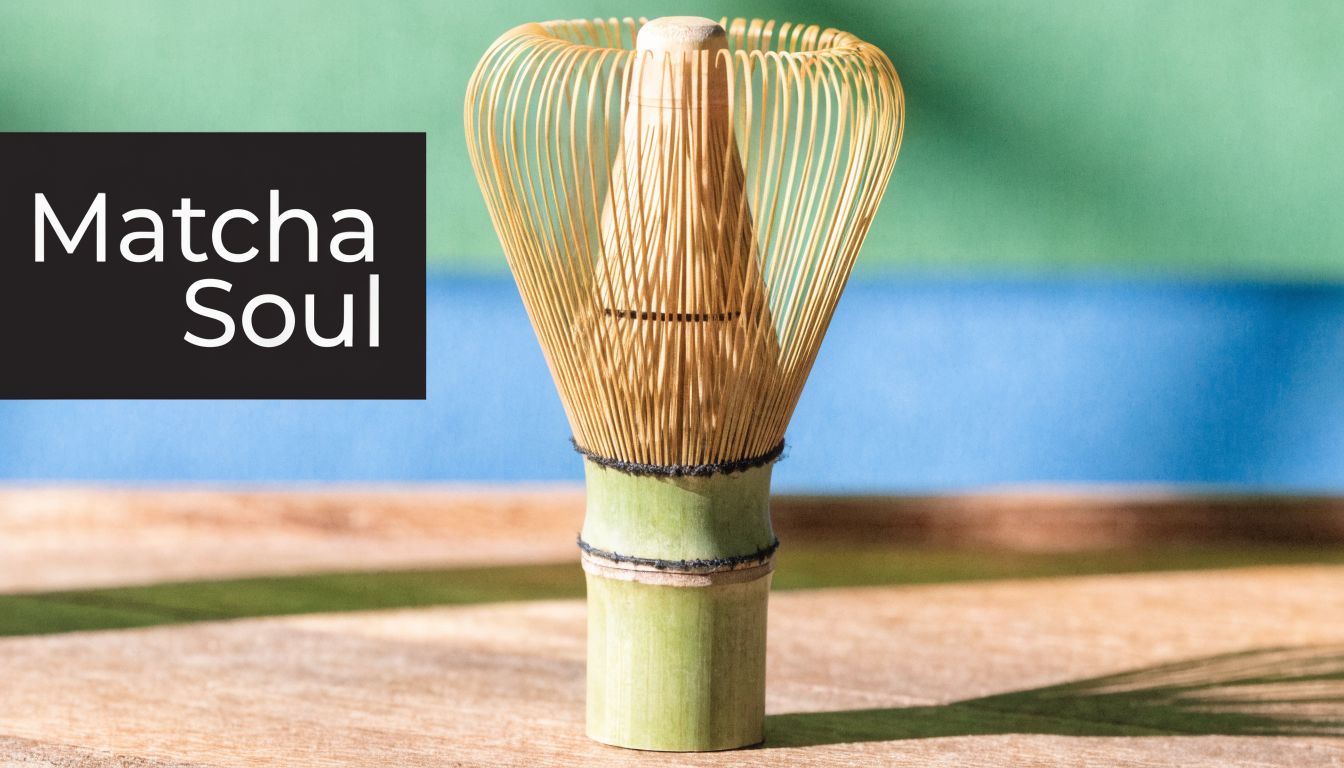
There’s also something practical hidden inside the ritual. When you pick up a chasen, you naturally pay attention to temperature, bowl shape, and movement. You stop rushing. That’s often the difference between a harsh, grassy cup and one that tastes creamy and rounded.
Why the tool changes the drink
A good chasen is hand-carved from a single bamboo stalk. In traditional crafting, the bamboo is split into fine tines, then shaped so the tips flex in water and move quickly through the bowl. That flexibility is the secret. The whisk doesn’t mash matcha against the bowl like a kitchen whisk might. It suspends the powder through fast, light movement.
A matcha tea brush works best when it barely skims the liquid, not when it grinds against the bowl.
For home drinkers, that means a smoother morning cup. For cafés, it means a more consistent base for straight matcha or lattes. In both cases, the whisk is doing more than mixing. It’s controlling mouthfeel.
Why Australians need a slightly different mindset
A lot of online matcha advice assumes stable storage conditions and softer water. Australian homes don’t always offer either. If you live in coastal NSW, your whisk may stay damp longer than expected. If you’re in a city with hard water, the bamboo can age faster than you think. So learning the ritual isn’t about being precious. It’s about helping the tool last and helping the tea taste right.
That’s where pleasure begins. Once the matcha tea brush stops feeling mysterious, it becomes one of the simplest and most satisfying tools in your kitchen.
How to Choose Your Perfect Matcha Tea Brush
You’re standing in an Australian kitchenware shop or scrolling late at night, and suddenly every whisk looks the same. One has 80 prongs. Another has 100. One looks pale and tidy. Another looks rustic and “handmade,” but the listing says almost nothing. That confusion is normal. A good choice gets easier once you know what changes the cup.
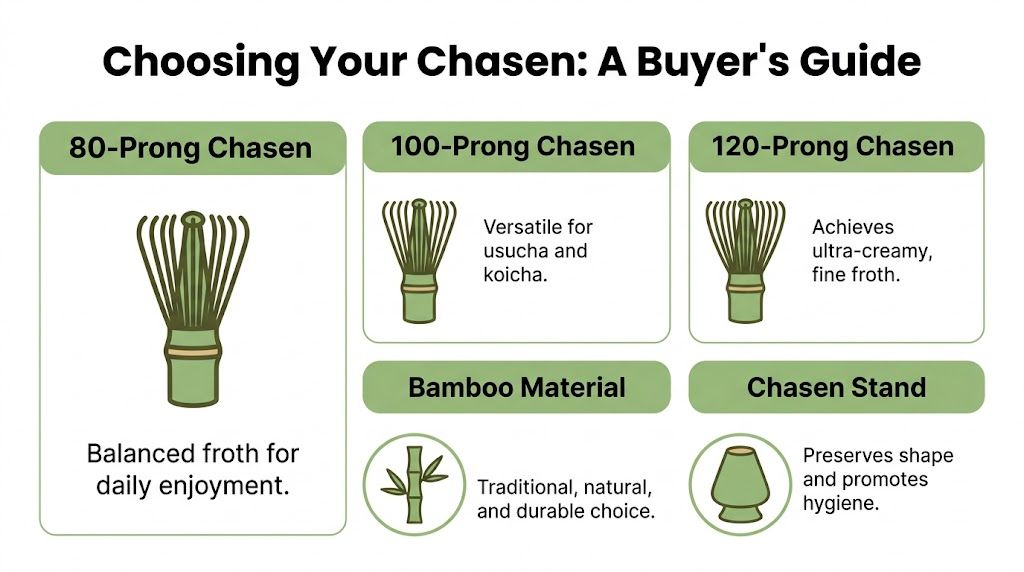
Three things matter most. Prong count, craftsmanship, and whether the seller gives clear information about care and sourcing.
Start with prong count
Prong count changes how the whisk moves through water and matcha. More prongs usually create finer foam with less effort. Fewer prongs often feel a little firmer in the hand and can suit thicker mixes or latte prep.
A simple way to read it is below.
| Matcha Tea Brush (Chasen) Comparison |
|---|
| Prong Count | Ideal For | Foam Level | Best Matcha Grade |
|---|---|---|---|
| 80-prong | Daily matcha and lattes | Balanced froth | Ceremonial or culinary depending on style |
| 100-prong | Usucha, or thin matcha tea | Fine, lively foam | Ceremonial grade |
| 120-prong | Very delicate whisking and ultra-fine froth | Creamier foam | High-quality ceremonial grade |
For many home drinkers, a 100-prong chasen is the easiest place to start. It gives you enough fine movement to make a proper bowl of usucha without feeling fussy. If your goal is that light foam on top and a smooth body underneath, this is usually the safest choice.
If you mainly make matcha lattes, an 80-prong whisk can be practical. It often feels a bit sturdier during everyday use, especially if you are whisking a slightly thicker base before adding milk.
A 120-prong whisk suits drinkers chasing a very fine foam and using high-grade matcha regularly. It can be lovely, but it is not the automatic “better” option for beginners. More delicate tines also demand gentler care, which matters in Australian homes where humidity can slow drying and shorten a whisk’s life if you store it carelessly.
Look closely at craftsmanship
A good chasen is carved from a single piece of bamboo. The tines should look even and neatly spaced. The tips should be slender and slightly curved rather than blunt or splintered.
The easiest comparison is a paintbrush. A brush with tidy, flexible bristles gives you control. One with rough, uneven bristles leaves streaks. A chasen behaves the same way in the bowl.
If the whisk looks ragged before you even use it, it will usually feel rough in the water too. That can mean weaker foam, more clumping, and more pressure against the bowl than you want.
Australian buying advice that generic guides skip
This part gets missed a lot.
A whisk that works beautifully in a dry showroom may behave differently in Brisbane humidity, a Sydney coastal kitchen, or a Melbourne café using mineral-heavy tap water. Australian conditions change what “good value” means. Sometimes the better buy is not the fanciest whisk. It is the one you can dry properly, store properly, and replace without guessing.
Hard water can leave bamboo looking tired sooner. High humidity can keep the inner tines damp long after the outside seems dry. If you live in a humid area, a whisk stand is not just a nice extra. It helps the shape hold while the whisk dries more evenly. If your local water is hard, you may also want to rinse the whisk briefly with filtered water after use to reduce mineral buildup.
Ask better sourcing questions
Many product pages say “natural bamboo” and stop there. That tells you very little.
A better retailer explains where the whisk is made, what style it suits, and how to care for it in real kitchens. The Tezumi guide to chasen is useful here because it shows how much variation exists in bamboo whisks and why details matter.
Use these checks before you buy:
- Purpose. Is it described for usucha, koicha, or general daily use?
- Construction. Does the listing say it is carved from one piece of bamboo?
- Photos. Can you clearly see the tine shape and centre coil?
- Care guidance. Does the seller explain soaking, drying, and storage?
- Australian practicality. Do they mention a whisk stand, humidity, or water conditions?
Buying rule: match the whisk to your routine, your water, and how often you drink matcha.
If you want to compare tools in one place, Pep Tea lists matcha tea accessories with the core preparation pieces Australians usually need.
A simple buyer profile guide
A home drinker making one bowl most mornings will usually do well with a 100-prong whisk.
A latte-focused café may prefer an 80-prong option for repeat service and slightly thicker mixes.
A gift buyer should look past decorative packaging. Clear care instructions and a well-shaped bamboo whisk are more useful than a flashy set with a weak tool inside.
The right matcha tea brush should feel suited to your habits, not just traditional on a product page.
How to Prepare and Season Your New Chasen
On a sticky Brisbane morning or in a Melbourne kitchen with hard tap water, a new chasen can feel confusing. The tines look tight. The bamboo feels stiff. Nothing about it resembles the soft, open whisk you see in matcha videos. That is normal. A new whisk needs a short preparation ritual before it touches tea.
The goal is simple. You are helping dry bamboo absorb a little warmth and moisture so the prongs can flex safely. Bamboo works like a wooden spoon before first use. Straight from storage, it is drier and less forgiving than it will be after a gentle soak.
The quick blooming ritual
Before your first bowl, fill your chawan or a small bowl with hot water that feels just below boiling. Warm, not furious. Place only the tine end of the chasen into the water and leave it there briefly, until the outer tines begin to open and relax. Then lift it out, shake off excess water, and empty the bowl.
A simple routine looks like this:
- Add hot water to your bowl.
- Lower in the prongs, not the handle.
- Soak briefly, just long enough for the tines to soften.
- Check that the outer tips have spread slightly.
- Empty the bowl and start preparing your matcha.
That short soak matters in Australia more than many overseas guides admit. Hard water can leave mineral residue on bamboo over time, and very humid homes can make storage conditions unpredictable. A quick pre-soak prepares the whisk for use without overloading the bamboo with water.
Common mistakes with a new whisk
The first mistake is over-soaking. Leaving a chasen in water for too long weakens the bamboo fibres and can warp the shape.
The second is using boiling water. Excess heat stresses fine tines, especially on a delicate 100-prong whisk.
The third is trying to fix clumpy matcha with force. If your powder has lumps, the whisk ends up doing heavy mixing work it was never meant to do. A fine matcha tea sifter helps here by breaking up clumps before the bamboo starts moving.
A good comparison is warming up a tendon before exercise. You want flexibility, not strain.
Practical rule: store your chasen dry, then soften the tines briefly right before use.
If your local water is very hard, use filtered water for the soak when you can. If your kitchen is humid, let the whisk dry fully after use instead of leaving it enclosed in a drawer or container while damp. Those two small habits make a noticeable difference in how evenly the tines open and how long the chasen keeps its shape.
A properly seasoned chasen feels less brittle, moves more freely, and gives you a much better start on the first whisk.
The Art of Whisking a Perfect Bowl of Matcha
You have the bowl ready, the matcha measured, and the whisk softened properly. Then comes the part that decides whether your tea tastes creamy and rounded or flat and rough. The difference usually comes down to motion, water, and restraint.
A chasen works like a small bamboo engine. Its job is to suspend fine powder evenly through the water and build a soft layer of foam near the surface. It does that best with a light wrist and quick movement through the upper part of the bowl, not by pressing into the ceramic.
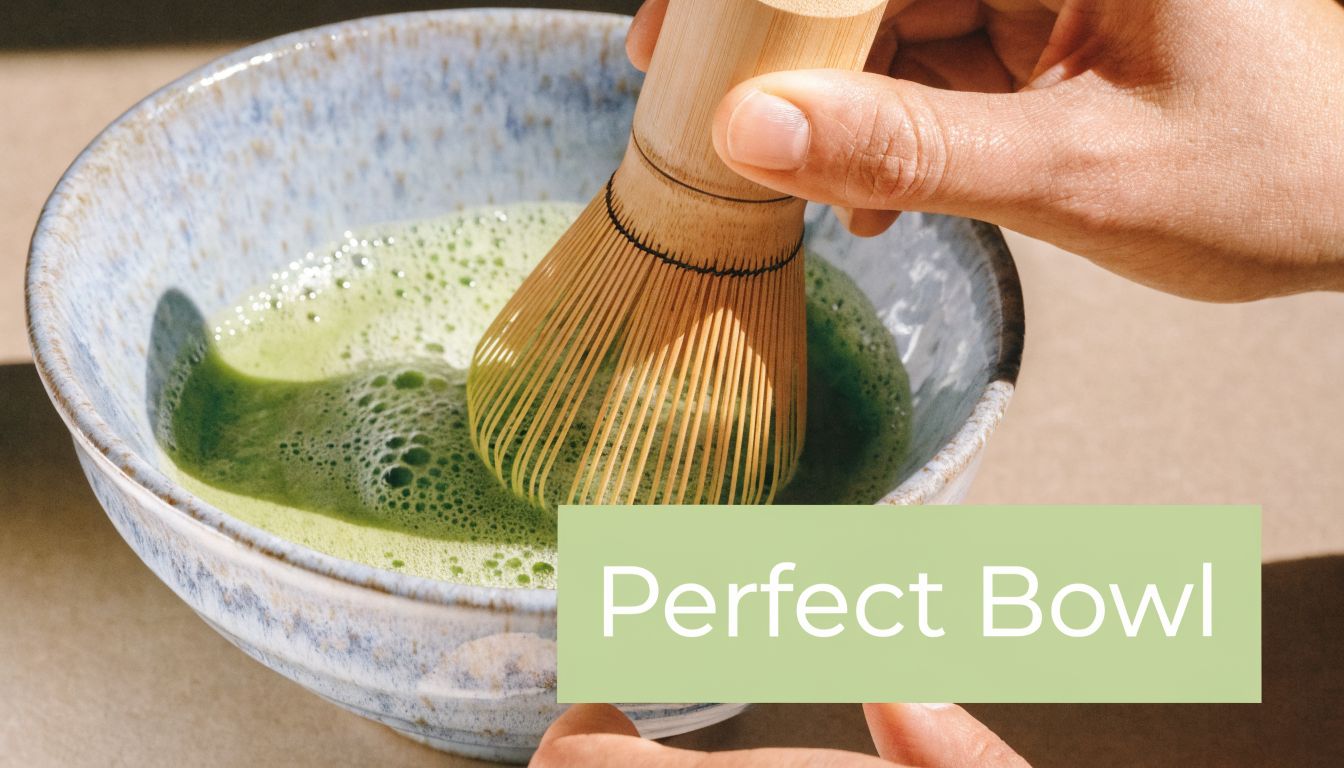
The basic usucha method
For a classic bowl of usucha, start with sifted matcha in a wide bowl, add a small amount of hot water, and whisk before topping up. A practical guide is 2g of matcha, 50ml of water at 75 to 80°C to start, then the remaining water once the paste has loosened and the surface begins to foam. Keep the whisk about 1 to 2cm above the base so the tines can flex freely instead of scraping.
If you are used to stirring tea, this feels different at first. The movement is compact and fast, mostly from the wrist. Your forearm stays fairly quiet.
A simple way to remember the technique
- Sift first so the whisk is not fighting lumps.
- Start with a small amount of water so the matcha disperses evenly.
- Whisk with the wrist for speed and control.
- Work near the surface zone where fine foam forms.
- Finish with a gentler pass to even out the top.
The motion that creates froth
The classic pattern is a fast W or M motion. That shape keeps the whisk moving across the bowl without grinding the tips into the bottom. Circular stirring tends to leave heavier liquid below and larger bubbles on top, a bit like stirring cocoa and wondering why the powder still sits in patches.
The bowl gives you useful feedback. A soft brushing sound usually means the whisk is floating where it should. A scratchy sound means the tines are hitting the base too often.
This matters in Australia because local conditions can affect texture. In hard-water areas, minerals can flatten flavour and make foam a little less fine. In humid kitchens, especially in coastal homes and busy cafés, matcha can clump faster once the tin is open. If your whisking feels correct but the bowl still looks uneven, the issue may be the powder or the water rather than your hand.
A matcha whisk stand for drying and shape retention also helps the whisk keep its open form between uses, which makes the next bowl easier to froth consistently.
What the foam should look like
Good usucha foam is fine-bubbled and even, with a soft sheen across the top. Velvety is the right target.
A few larger bubbles around the edge are not a disaster. They usually mean the movement was slightly uneven or the final whisking pass was too forceful. Lighter, quicker strokes often fix that faster than whisking longer.
A short demonstration helps if you’re more visual:
Water temperature matters more than people think
The whisk often gets blamed for bitterness, but overheated water is a common cause. Matcha prepared around 75 to 80°C usually tastes sweeter, fuller, and less sharp than matcha hit with freshly boiled water.
That point is especially useful in Australian homes where kettles boil fast and many people pour immediately. If you do not have a temperature-controlled kettle, let the water sit briefly after boiling, or pour it into another vessel first to drop the heat before it meets the tea.
Small technique changes that improve the bowl
A few adjustments make a noticeable difference:
- Keep the whisk lifted slightly so the tines glide instead of grind.
- Build speed in the middle of the whisking, where the foam forms fastest.
- Stop once the surface looks fine and even rather than chasing extra froth.
- Use a wider bowl for usucha so the whisk has room to move.
For café prep, the same rules apply. A latte still needs a smooth matcha base before milk goes in. Milk can soften the taste, but it cannot undo clumps or poor suspension.
Good whisking feels quick because it is precise. Light hand, loose wrist, correct water, and a bowl that sounds quiet while you work. That is what turns powdered tea into a smooth, balanced cup.
Proper Cleaning and Storage for Your Matcha Brush
You finish a bowl, set the whisk in the sink, answer a message, and come back later to bamboo that smells faintly damp and looks tighter than it did ten minutes ago. That is how many chasen problems start. The whisking part gets the attention, but the actual wear often happens in the few minutes after you drink the tea.
A chasen is carved from one piece of bamboo. It behaves more like a fine wooden kitchen tool than a metal whisk. Leave it wet, trap it in a drawer, or wash it like cutlery, and the tines lose flexibility fast.
In Australia, that risk goes up because local conditions are rarely neutral. Coastal humidity slows drying, and hard water in some suburbs can leave a mineral film on the bamboo. Generic care advice often skips both.
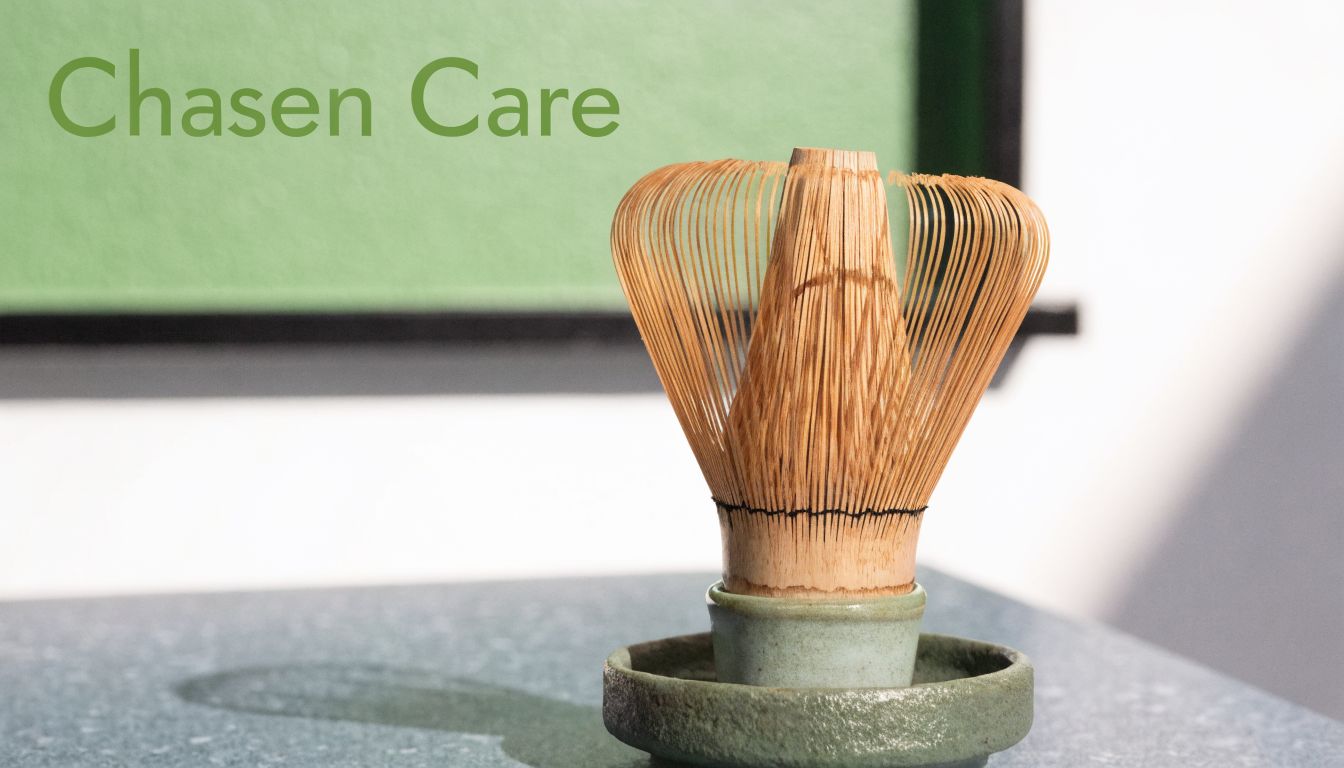
The correct cleaning routine
Clean the whisk as soon as you finish using it. Dried matcha sticks between the tines and pulls them inward as it hardens.
The routine is simple. Rinse the chasen in warm water. Use your fingers only if a little matcha is caught near the centre, and keep the touch light. Skip soap completely. Bamboo absorbs it, and the residue can dry the fibres and leave an odd scent that shows up in the next bowl.
After rinsing, shake off excess water and check the shape. If a few tines have curled together, ease them apart gently with wet fingers rather than forcing them dry later.
Why a stand matters in Australian homes
Drying shape matters almost as much as cleaning. A whisk left flat on the bench holds moisture where the tines meet, which is the slowest part to dry.
A holder supports the natural curve while air moves through the centre. That helps the whisk dry evenly and keeps the prongs from collapsing inward. If you want a practical example, a ceramic matcha whisk stand for drying and shaping a chasen gives the brush a dedicated place to rest between bowls.
Store it in the open, not in a closed cupboard straight after washing.
That point matters in Sydney, Brisbane, the Gold Coast, and other humid parts of the country where a kitchen can stay damp for hours. A whisk that seems dry on the outside may still be holding moisture at the base.
Hard water and humidity need a local fix
Hard water leaves clues. The bamboo starts to feel slightly rough, the tines look chalky, and the whisk loses some of its spring even when you are handling it well. If your kettle builds scale quickly, your chasen is dealing with the same minerals.
An occasional rinse with filtered water can help if your tap water is particularly mineral-heavy. If buildup is already visible, a very diluted vinegar rinse used sparingly can remove residue, but follow it with plain water so no smell remains. This is not an every-day step. It is a reset for mineral film.
Humidity needs a different approach. Keep the whisk away from the kettle plume, the dishwasher, and the splash zone beside the sink. Those spots look convenient, but they create a damp little climate around the bamboo.
A practical care routine for Australian kitchens
- Rinse straight after use so matcha does not dry between the tines.
- Use warm water only. No detergent, no soaking in cleaning products.
- Dry upright in open air so the centre of the whisk can dry.
- Use filtered water sometimes if your tap water is hard and leaves mineral marks.
- Keep the whisk away from steam and enclosed storage until fully dry.
What cafés should standardise
In cafés, the problem is usually inconsistency. One staff member rinses and stores the whisk properly. The next leaves it damp beside the machine during a rush.
Set one routine for everyone:
- Rinse immediately after each use.
- Use warm water only.
- Shake off excess water.
- Dry on a holder in a ventilated spot.
- Replace the whisk if it smells musty, shows mould, or has significant tine loss.
A good chasen does not need complicated care. It needs prompt rinsing, open airflow, and a bit of respect for bamboo in Australian conditions.
Troubleshooting Common Matcha Brush Issues
You whisk a bowl before work, and the chasen suddenly feels wrong. A few tines have snapped, the matcha looks flat, or there is a damp smell that was not there last week. In Australian kitchens, that usually comes back to a small mismatch between bamboo and its environment. Hard water, coastal humidity, and hot tap habits all show up quickly in a matcha brush.
My tines keep breaking
Broken tines usually point to stress on the bamboo, not bad luck. A chasen is carved from one piece of bamboo, so each tine is thin by design. That gives you speed and fine foam, but it also means rough contact shows up fast.
Check the common causes:
- The whisk is hitting or scraping the bottom of the bowl. The tines should flex through the water, not grind against ceramic.
- The water is too hot. Very hot water makes bamboo more brittle.
- The whisk went in dry. Dry tines are stiff, so they are more likely to snap under pressure.
- Mineral buildup is making the tines less flexible. This is more common in parts of Australia with hard tap water.
- The whisk was knocked around in storage. A drawer full of cutlery is a terrible place for a chasen.
A good test is to watch your whisk from the side while you prepare matcha. The tips should skim just above the base, like a brush sweeping over paper without digging in.
My matcha is still clumpy
Clumps often start before the whisk even touches the bowl. Matcha behaves a bit like cocoa powder. Once small lumps get wet on the outside, the dry centre can hide inside and resist whisking.
If your bowl stays grainy, work through the process in order:
- Sift the matcha first if the powder has compacted in the tin.
- Start with a small amount of water to make a smooth paste before adding more.
- Use quick wrist motion in a W or M pattern near the surface.
- Give the whisk room to move. A narrow mug makes proper whisking harder than a wide bowl.
Water quality can also play a part. In hard-water areas, matcha can feel slightly duller and less lively in the bowl. If your technique is sound but the texture still seems heavy, try filtered water for a few days and compare.
The prongs are bending outward
Some spreading is normal. A new whisk opens up with use, just like a new paintbrush softens once the bristles get wet. What you are looking for is uneven splaying, flattened tips, or a shape that looks twisted.
That usually happens for three reasons. The whisk is being pressed down too hard. It is drying in a cramped position. Or it is staying damp for too long, then drying unevenly.
Australian conditions matter more than many guides admit. In a humid Brisbane or Sydney summer, a whisk can stay slightly damp in the middle long after the outside feels dry. That trapped moisture can leave the shape sloppy over time.
The centre looks loose
The centre loop can worry new matcha drinkers because it rarely looks perfectly symmetrical after repeated use. Mild movement is normal. Bamboo softens, flexes, and settles.
Focus on performance instead of perfect appearance. If the whisk still creates a fine surface froth and feels stable in the bowl, the centre does not need to look pristine. If the inner tines are collapsing inward, catching on each other, or no longer springing back, the whisk is wearing out.
There’s a smell I don’t trust
A healthy chasen smells faintly woody, dry, or almost like nothing at all. Sour, musty, or stale smells usually mean moisture sat in the core too long.
In Australia, this often happens in two places. One is beside the kettle, where repeated steam keeps the bamboo damp. The other is in enclosed cupboards that feel tidy but hold humid air.
If the smell is light and there is no visible mould, let the whisk dry fully in a well-ventilated spot and reassess. If the odour is persistent, or you can see mould spotting, replace it. Bamboo is porous. Once contamination settles deep into the fibres, trying to save it is rarely worth the risk.
My whisk is leaving weak foam
This problem confuses a lot of people because the whisk gets blamed first. Sometimes the actual issue is old matcha, too much water, or a slow wrist.
A tired chasen can contribute, though. If many tine tips have broken off, or the whisk has lost its spring, it will struggle to introduce enough air into the bowl. Café teams see this often when one whisk gets pushed far past its useful life.
Ask three quick questions:
- Is the matcha fresh enough to foam well?
- Am I whisking briskly near the surface rather than stirring deep in the bowl?
- Has the chasen lost enough tines that it can no longer move the liquid cleanly?
Troubleshooting a chasen works best when you read it like a bamboo tool, not a kitchen gadget. Snapped tines usually mean friction or heat. A musty smell points to trapped moisture. Weak foam often traces back to technique, age, or worn tips. Once you match the symptom to the cause, the fix is usually straightforward.
Your Matcha Brush Questions Answered
A lot of confusion around the matcha tea brush comes from people trying to simplify it too much. It’s not a fussy object, but it is a specialised one. These are the questions that come up most often once people start using a chasen regularly.
Quick answers in one place
| Frequently Asked Questions |
|---|
| Question | Answer |
|---|---|
| Do I really need a bamboo whisk for matcha? | If you want traditional texture and a fine surface froth, yes. A spoon mixes, but it won’t create the same suspension or mouthfeel. |
| Is a 100-prong whisk a good starting point? | Yes, especially for usucha. It’s the most straightforward choice for home drinkers who want a foamy bowl. |
| Can I use an electric frother instead? | You can for convenience, especially in latte prep, but it won’t behave like a chasen in the bowl and it changes the ritual and texture. |
| Should I soak the whisk every time? | A short warm soak before use helps the tines soften and flex safely. |
| Can I wash it with dish soap? | No. Warm water is the safe choice for bamboo care. |
| Do I need a whisk stand? | It’s strongly recommended because it helps the whisk dry upright and keep its shape. |
| When should I replace my chasen? | Replace it when tine loss is heavy, the shape is badly compromised, or mould or persistent odour appears. |
| Can I make lattes with a matcha tea brush? | Yes. You can whisk a concentrated matcha base first, then add milk. |
Is the bamboo whisk only for traditional tea drinkers
Not at all. The chasen is useful whether you drink straight ceremonial matcha, iced matcha, or a latte. The key difference is the end texture you want.
For a straight bowl, the whisk creates a fine surface and more integrated texture. For a latte, it gives you a smoother concentrate before milk enters the cup. That first stage still matters.
What’s the difference between a matcha tea brush and a kitchen whisk
A kitchen whisk is built to beat, fold, and combine larger volumes. A chasen is built to move quickly through a small bowl with minimal friction. The bamboo tines are fine enough to lift the tea into suspension while staying gentle on the powder.
That’s why a metal whisk often feels too heavy-handed for traditional preparation. It can mix the drink, but it doesn’t create the same finesse.
Does prong count really matter
Yes, but not in a snobbish way. It changes the feel of the tool and the kind of foam you’re likely to get.
A higher-prong whisk usually helps newer drinkers create a more even froth with less effort. A lower-prong whisk may suit thicker tea styles or drinkers who prefer a different feel. The “best” option depends on what you make most often.
Why does my whisk look different after a few uses
Because it’s supposed to change a little. Dry bamboo looks tighter. Soaked and used bamboo opens up. The tines relax, the shape settles, and the brush becomes more responsive.
What you don’t want is severe splitting, snapped tips, mould, or deep distortion. Gentle visual change is normal. Rapid collapse isn’t.
Can I leave the whisk soaking while I drink my matcha
Better not. A short pre-use soak is helpful. Extended soaking isn’t. Bamboo likes brief moisture exposure followed by proper drying.
If you leave the whisk sitting in water while you chat, work, or clean the kitchen, the tines stay stressed and the drying cycle gets delayed. That’s not great in humid weather.
Is a darker bamboo whisk better than a lighter one
Not automatically. Colour can reflect the type of bamboo or finish, but it doesn’t guarantee quality. Pay more attention to even carving, tine shape, and whether the seller explains origin and care clearly.
Can I travel with a chasen
Yes, but protect it. Don’t throw it loose in a drawer or bag. If you’re taking matcha to the office or on holiday, keep the whisk in a breathable container and let it dry fully before packing.
Is mould always obvious
No. Sometimes you’ll see spots. Sometimes you’ll just notice a stale smell or a tacky feeling in the tines. If something seems off, trust your nose and your eyes.
In humid parts of Australia, mould prevention is mostly about routine. Rinse, shake off water, dry upright, and don’t trap the whisk in a closed damp space.
Should cafés keep one whisk per staff member
That depends on service style, but the more important issue is shared standards. Every person preparing matcha should use the same method for soaking, whisking, rinsing, and drying. A beautifully made whisk won’t survive a chaotic prep station.
What’s the smartest beginner setup
Keep it simple:
- A 100-prong chasen
- A bowl with enough width to whisk comfortably
- A sifter
- A whisk stand
- Fresh matcha and water that isn’t boiling
That’s enough to learn properly without cluttering the process.
A matcha tea brush seems niche until you use one well. Then it feels obvious. It’s the small bamboo tool that makes the whole bowl come together.
If you’re building a better matcha routine at home or in your café, Pep Tea offers organic matcha, preparation accessories, and practical guidance for Australian drinkers who want cleaner flavour, better texture, and tools that fit real daily use.