
Tag: how to make matcha
How to Make Matcha Not Taste Like Grass: Fix It Today

An overly grassy bowl is almost always fixable by lowering the water temperature to 70–80°C and adding a creamy base, rather than just using stronger matcha. Start with about 2 g of powder, whisk it properly, then dilute it with milk or chilled water until the flavour suits you.
You've probably had the experience: the colour looks beautiful, the whisk is ready, and then the first sip tastes like freshly cut lawn with a bitter finish. That doesn't necessarily mean your matcha is bad. More often, boiling water, clumps, too much powder, or the wrong serving style has pushed its natural vegetal character too far.
For many Australians, matcha is a big sensory jump from regular black tea. Australian tea-buying data found that 35% of people aged 14 and over purchased regular tea in an average four-week period, compared with 11% for green tea, in the 12 months to March 2015, based on 15,913 respondents. Roy Morgan's tea data helps explain why a strong powdered green-tea flavour can feel unfamiliar.
The good news is that learning how to make matcha not taste like grass is less about hiding the drink and more about controlling heat, texture, concentration and dilution.
Why Your Matcha Tastes Grassy
You whisk up a bright green bowl, take a sip, and get hit with raw lawn, bitterness, or a strange stale edge. That usually points to a specific problem, not a lost cause. Matcha is more concentrated than brewed green tea because you drink the leaf itself, so heat, texture, and dose all show up clearly in the cup.
Start with temperature, because it changes flavour fast. Freshly boiled water pulls out more bitterness and leaves the finish dry, especially in a small, concentrated mix. A lower range gives you a softer, sweeter result and makes it easier to judge the powder fairly. PepTea's matcha brewing temperature guide lays out why gentler water gives you better control.
Then read the flavour before you change everything at once.
Read the flavour before changing the recipe
Your first sip usually tells you what to fix:
- Freshly cut grass or raw greens: the powder itself may lean strongly vegetal. This often shows up more in culinary matcha.
- Drying, puckering bitterness: the water was likely too hot, or the drink is too concentrated.
- Grainy, uneven flavour: the matcha was not sifted or whisked into a smooth suspension.
- Flat, stale green flavour: storage, age, or air exposure may be dulling the powder.
Each fix does a different job. Sugar can soften bitterness, but it will not solve scorched powder. Milk can round off aggressive notes, but it will not remove clumps. If you want a better cup, diagnose the problem first, then change one variable at a time. Keep the amount of matcha steady while you test water temperature or dilution, otherwise it gets hard to tell what improved the flavour.
Off-notes can also come from the vessel itself. If your bottle or shaker carries residue from previous drinks, effective bottle cleaning tablets remove that variable before you blame the matcha. A clean bottle will not rescue overheated powder, but it does stop old protein, sweetener, or tea residue from muddying the aroma.
That diagnostic mindset matters in Australia, where plenty of tea drinkers still find matcha stronger and greener than what they usually reach for. IndexBox's Australian tea market overview shows the category has a solid local base. Matcha usually lands better when the format matches the drinker, whether that is a latte, an iced drink, a smoothie, or a straight bowl made with more care.
Mastering the Basic Preparation Method
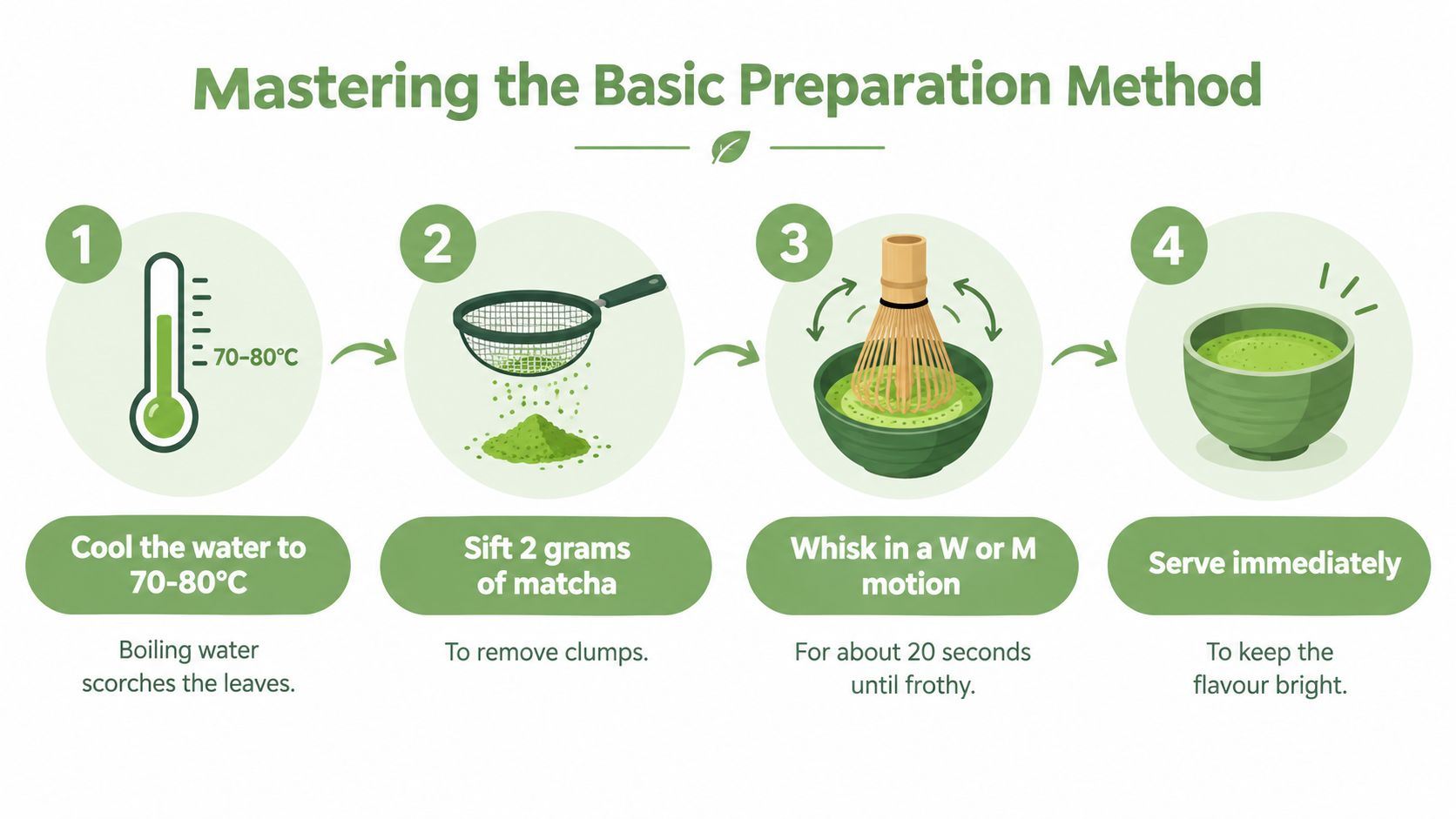
A smooth cup starts with a small, controlled preparation. Use a bowl or wide mug, a fine sifter, a bamboo whisk or electric milk frother, a digital scale if you have one, and water that has cooled below boiling.
Use less heat and better dispersion
Cool the water. Heat water, then let it cool to 70–80°C. For a particularly grassy powder, begin around 70–75°C. If you don't have a thermometer, leave freshly boiled water to cool for several minutes instead of pouring it directly onto the matcha.
Sift approximately 2 g of matcha. Push the powder through a fine sieve into your bowl. This breaks up compacted particles before they become bitter clumps in the finished drink.
Make a paste first. Add 10–15 mL of the warm water and work it into a smooth slurry. Don't rush this step. A paste gives the powder an even starting point and prevents dry pockets from surviving into the final cup.
Whisk in the remaining water. Add enough water to reach approximately 50–60 mL in total, then whisk rapidly in a W or M motion until the surface looks lightly foamy.
Serve immediately. Matcha begins to settle as it stands. The final sips can taste stronger and more bitter because the powder has collected at the bottom.
This controlled method follows Australian preparation guidance that recommends approximately 2 g of matcha with 50–60 mL of water at 70–80°C. SBS Food's matcha recipe also uses a paste before gradually adding the remaining water, which is a simple way to improve texture.
Troubleshoot with a café-style test
If the drink still tastes sharp, keep the dose and water volume unchanged and compare cooler water. A useful sensory trial is 65°C, 70°C and 75°C, tasted immediately after whisking. Australian brewing guidance recommends cooler water when bitterness develops, and explains that warmer water can increase tannin-driven astringency. You can read the broader comparison in this Australian green-tea brewing guide.
For café service, consistency matters more than guesswork. Weigh the powder, measure the water and check the temperature. If you change all three at once, you won't know what improved the flavour.
You'll find a fuller walkthrough of the drink itself in PepTea's guide to making matcha tea from powder, but the essential principle is simple: cooler water, a smooth slurry and immediate service.
Transforming the Taste with Milk and Sweeteners
If plain matcha still feels too intense, a latte is usually the most reliable next step. Milk changes the drink's texture and spreads the powder through a larger volume, so the concentrated green flavour feels rounder rather than so direct.
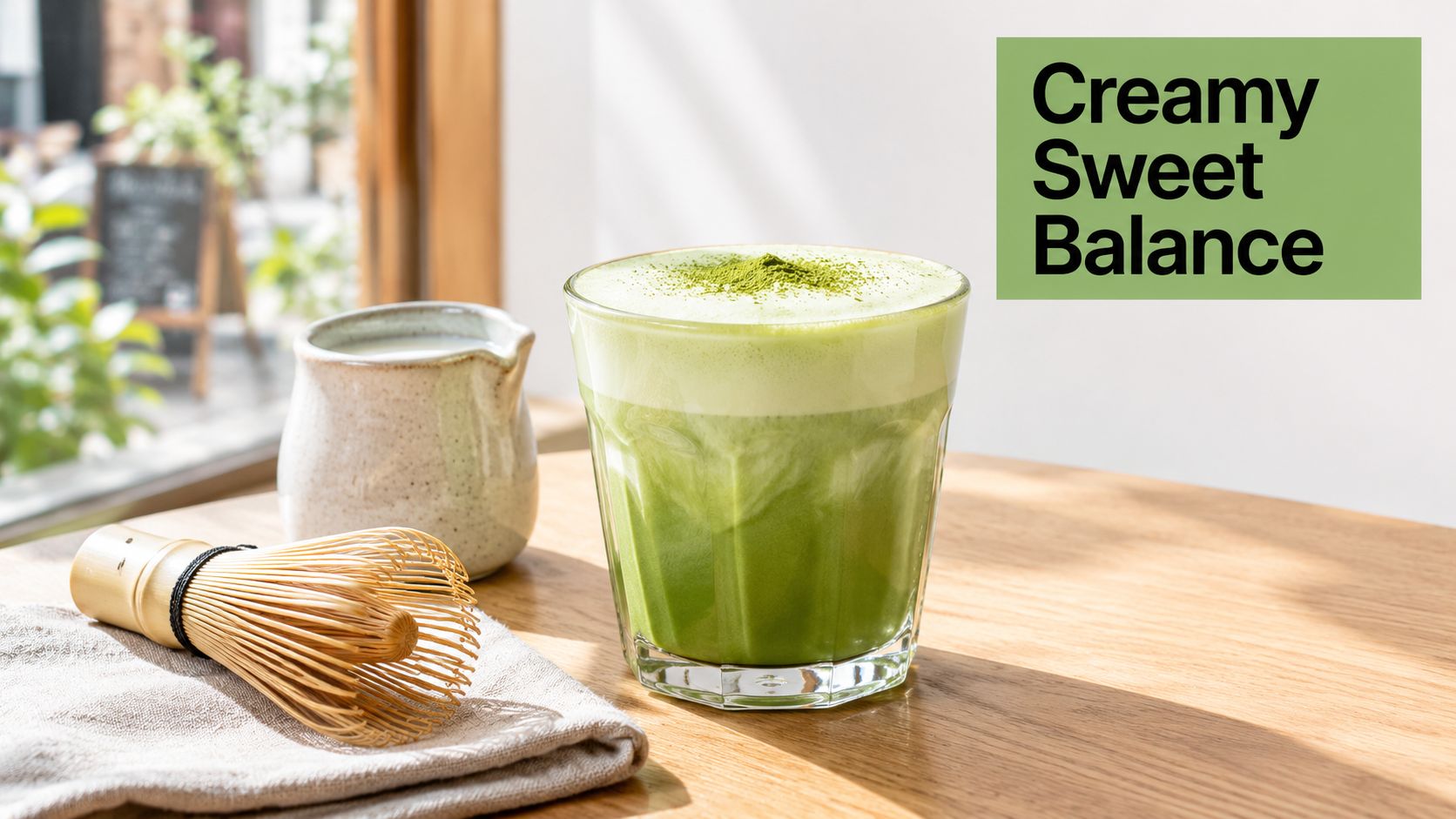
Dairy milk brings creaminess and a familiar café profile. Oat milk adds body and gentle sweetness, while macadamia milk gives a lighter, nutty finish. Unsweetened plant-based milk is a sensible choice if you want to keep the drink aligned with a low-sugar routine. The best option depends on the matcha and your palate, so taste the base before adding a sweetener.
Compare the serving formats
| Format | What it does to the flavour | Best use |
|---|---|---|
| Straight bowl | Keeps the umami and vegetal notes prominent | Fresh, balanced matcha |
| Hot latte | Adds body and softens sharp edges | First-time drinkers and cosy café drinks |
| Iced latte | Makes the flavour feel lighter and more refreshing | Warm Australian days |
| Smoothie or baking | Shares the matcha with other ingredients | Stronger culinary powder |
For a practical latte, whisk the matcha with a small amount of warm water first, then add approximately 150–200 mL of steamed or chilled milk. An iced version works particularly well when you pour the whisked matcha over ice and add milk afterwards. The cold dilution reduces the immediate impact of the vegetal notes without requiring extra sugar.
A smoother drink isn't a caffeine-free drink. Milk, vanilla and sweetener change perceived bitterness and grassiness, but they don't remove the naturally occurring caffeine in matcha.
Sweetness should support the tea, not bury it. A small amount of honey, maple syrup or an approved sugar-free syrup can balance bitterness. Too much sweetness creates a different problem, especially if you're trying to keep a clean-label or sugar-free drink on the menu.
Australian and New Zealand food guidance says naturally occurring caffeine in tea isn't subject to the same maximum limits as caffeine added to beverages, although a standard serving of these foods will normally not exceed 100 mg. FSANZ's caffeine safety information is useful for explaining why matcha can feel stronger than an ordinary brewed green tea.
This video shows the latte process in a visual format:
For a measured home version with milk and optional sweetener, follow PepTea's matcha green tea latte recipe. If you're caffeine-sensitive, pregnant or breastfeeding, or preparing a drink for a child, consider total daily caffeine intake rather than judging the drink by its sweetness.
Understanding Matcha Grades and Flavours
Preparation can only take you so far. If your matcha is naturally forceful, cooler water may reduce bitterness, but it won't turn the powder into a delicate, sweet tea. The grade, cultivation, harvest and processing all contribute to the flavour you're working with.
Ceremonial-grade matcha is intended for drinking with water. It usually offers a finer texture and a more balanced combination of umami, sweetness and gentle vegetal flavour. That doesn't mean it has no grassiness. Authentic matcha can still taste green, savoury and seaweed-like, but the finish should feel more integrated rather than aggressively drying.
Culinary-grade matcha is designed to hold its character alongside other ingredients. Its stronger profile can be useful in cookies, cakes, smoothies, ice cream and savoury recipes, where milk, fruit, flour or fat changes the overall balance. Used as a plain bowl, it may taste more assertively vegetal.
Match the powder to the drink
Choose ceremonial grade when you want to drink matcha mostly with water. Choose culinary grade when you're mixing it into a recipe where a green-tea flavour needs to remain noticeable.
Colour can provide a clue, but it isn't a complete quality test. A vivid green powder may still taste harsh if it has been overheated, while a well-prepared matcha with some vegetal character can be enjoyable. Aroma, texture, freshness and the aftertaste matter as much as appearance.
Organic sourcing is another part of the purchasing decision, but it shouldn't be treated as a guarantee that every cup will taste mild. PepTea offers Japanese organic matcha in ceremonial and culinary styles, so the useful question is not “Is it organic?” It's “Is this grade suited to the way I plan to drink or cook with it?”
Storage affects the result too. Keep the powder sealed, away from heat, light and moisture, and avoid leaving it open beside the kettle. If a powder has lost its fresh aroma and tastes dull or flat, changing technique may not be enough.
When Grassy Notes Are Actually a Good Thing
Not every green flavour is a fault. Matcha is made from powdered tea leaves, so a pleasant vegetal note is part of its identity. The aim isn't to remove every trace of grassiness. It's to separate fresh, savoury character from the harsh bitterness caused by poor extraction or an unsuitable powder.
A well-balanced cup can taste like fresh greens, toasted seaweed, soft umami and gentle sweetness at the same time. Those flavours give matcha its personality. If you force the drink to taste completely neutral with heavy dilution and lots of sweetener, you may lose the reason to drink matcha in the first place.
Tell freshness from over-extraction
Pleasant grassiness usually arrives with aroma and a clean finish. Over-extraction feels more aggressive. It can leave your mouth dry, make the bitterness dominate, or create a burnt impression that lingers after the sip.
This distinction helps you decide whether to keep experimenting with the recipe or replace the powder. If the flavour improves when you cool the water and dilute the drink, technique was the main issue. If it remains blunt, stale or drying even after careful preparation, the grade, freshness or source may not suit a water-based cup.
Matcha is also part of a changing Australian beverage scene. Among surveyed Australians aged 18–24, 40% reported ordering matcha in the previous six months, while 36% ordered flavoured iced matcha, according to Ujiha's Australian matcha flavour guide. Those figures point to a practical lesson for cafés and home drinkers: matcha doesn't need to be introduced only as a strong traditional bowl. Iced and flavoured formats can preserve its character while making the first experience more approachable.
Your Quick Checklist for a Smooth Cup
When the next bowl tastes like grass, don't reach for more powder. Work through the variables in order:
- Start with temperature: Use water at 70–80°C, beginning nearer the lower end if the flavour is harsh.
- Sift before mixing: Break up clumps so the powder disperses evenly.
- Build a paste: Combine the powder with a small splash of water before adding the rest.
- Whisk thoroughly: Use a W or M motion until the drink is smooth and lightly foamy.
- Dilute deliberately: Add chilled water, ice or 150–200 mL of milk if a straight bowl feels too concentrated.
- Sweeten lightly: Use a small amount of honey, maple syrup or sugar-free syrup only after correcting heat and texture.
- Choose the right grade: Use ceremonial matcha for water-based drinking and culinary matcha for recipes.
- Serve promptly: Don't let the powder settle into a bitter final mouthful.
- Check the powder: If careful preparation doesn't soften the flavour, reassess freshness and grade.
The most useful habit is to diagnose before disguising. Cooler water fixes over-extraction, sifting fixes clumps, and milk fixes concentration. Sweetener has a place, but it should be the finishing adjustment, not the rescue plan.
The best matcha routine is the one you'll repeat. A balanced iced latte can be a better introduction than a perfect but intimidating straight bowl.
If your drink contains matcha, remember that a smoother flavour doesn't change its caffeine content. Australian guidance also states that highly concentrated caffeine products, including products with caffeine concentrations of 5% or more in solid or semisolid form, or 1% or more in liquid form, are banned from retail sale to the public. FSANZ's guidance on caffeine powders distinguishes those products from ordinary tea ingredients.
Pep Tea offers organic Japanese matcha in drinking and culinary formats, along with Australian-brewed sugar-free organic kombucha from the Hunter Valley, NSW. Try the temperature and latte methods above, then visit Pep Tea to explore matcha for your next smooth home drink or café menu.
Matcha Tea Ceremony: An Approachable Australian Guide

Most advice gets the matcha tea ceremony wrong from the first sentence. It's often framed as either a museum piece or an impossibly strict ritual that only trained experts can understand. That misses the point.
A Matcha tea ceremony is disciplined, yes, but it isn't about showing off rare knowledge. At its heart, it's a way of paying attention. The bowl, the whisk, the water temperature, the quiet pace, the way you receive the tea. Each part helps people slow down and notice what they're doing.
That's a big reason the practice feels so relevant in Australia right now. Many people want less rush, less noise, and fewer automatic habits around food and drink. They want a morning routine that feels grounding, or a café experience that feels more intentional than another takeaway cup. In that setting, the matcha tea ceremony stops looking old-fashioned and starts looking useful.
For home drinkers, it can become a short daily ritual. For hospitality operators, it can become a refined non-alcoholic offering with real cultural depth. For anyone curious about Japanese tea, it's also a reminder that matcha isn't just an ingredient for lattes and smoothies. It comes from a long, organised tradition of preparation and service.
An Ancient Ritual for Modern Mindfulness
The common assumption is that a matcha tea ceremony only matters if you're sitting in a formal Japanese tearoom. In practice, the deeper value travels well. The ceremony teaches a set of habits that modern life often strips away: patience, care, restraint, and presence.
That matters because many people approach matcha backwards. They focus first on caffeine, colour, or social media aesthetics. The ceremony starts somewhere else. It asks a simpler question. How do you prepare and share tea in a way that creates calm?
Why it still speaks to modern life
A fast drink serves one purpose. A ceremony serves several at once.
- Attention: You stop multitasking and focus on one action.
- Sensory awareness: You notice texture, aroma, warmth, and sound.
- Connection: If you share it, the preparation becomes part of hospitality.
- Rhythm: Repeating the same careful motions can settle a busy mind.
For Australians building wellness routines, that's a practical shift. You don't need a dedicated tea room to make tea with intention. You need a few good tools, decent matcha, and a willingness to slow your pace.
A matcha tea ceremony isn't valuable because it's elaborate. It's valuable because it gives ordinary actions a clear purpose.
What accessibility really looks like
Accessibility doesn't mean stripping away all tradition until nothing remains. It means understanding what is essential and what is contextual. The essential part is respect for the tea, the tools, and the people involved. The contextual part is whether you're in a formal setting, at your kitchen bench in Newcastle, or adding a ceremonial bowl of matcha to a café menu in Sydney.
That's why beginners shouldn't feel put off by the ceremony's reputation. You can appreciate its cultural depth while still starting with ease. In fact, that's often the best approach.
The Heart of Chanoyu Origins and Philosophy
Chanoyu did not begin as a polished cultural performance. It grew from tea practices linked to Zen Buddhism, then gradually took shape in Japan as a disciplined way of preparing, serving, and receiving powdered tea. A clear overview of that longer arc appears in this history of matcha tea ceremonies, and Pep Tea's own brief history of matcha tea helps place that story in a broader timeline.
That shift matters. It explains why chanoyu feels both spiritual and practical at once. The ceremony carries the quiet focus of monastic life, but it also became a social art shaped by taste, hospitality, architecture, ceramics, and seasonal awareness.
From monastery practice to refined cultural art
A beginner can easily mistake the ceremony for a formal way of drinking tea. It is closer to a carefully composed meal or a piece of chamber music. Every tool, gesture, pause, and placement has a role, and the parts only make full sense when they work together.
By the sixteenth century, tea practice in Japan had developed into recognisable ceremonial forms. Two terms still help people understand the range:
| Format | What it means |
|---|---|
| Chaji | A full, formal gathering with a meal and tea, designed as a complete host-guest experience |
| Chakai | A lighter, shorter tea gathering, often easier for modern guests and home hosts to relate to |
Tea master Sen no Rikyū gave lasting shape to this culture of tea. His influence is still felt in how students learn the ceremony, how hosts prepare a space, and how utensils are chosen for mood and season.
The four principles in plain language
Rikyū's four principles are often given in Japanese and English. They can sound lofty until you connect them to ordinary actions in the tea room, or even at a kitchen bench in Brisbane or a café in Melbourne.
- Harmony means the setting feels coherent. The bowl suits the season. The sweet suits the tea. The mood suits the guest.
- Respect shows up in conduct. You handle the bowl with care because it matters, and because the person receiving it matters too.
- Purity includes physical cleanliness, but it also points to mental tidiness. You leave distraction at the door and attend to what is in front of you.
- Tranquility is the result of practising the other three often enough that calm stops feeling forced.
The Metropolitan Museum of Art's essay on the Japanese tea ceremony explains that the ceremony became an important social setting in sixteenth-century Japan and also influenced utensil culture and ceramic traditions such as Raku, Shino, and Oribe. That helps explain why chanoyu is never only about drinking matcha. It is also about how beauty, status, craft, and hospitality meet in one shared act.
A useful way to read these principles is to treat them as operating instructions. They guide how to clean a bowl, how to enter a room, how to offer food, how to receive tea, and how to notice the moment.
For Australians interested in wellness, this philosophy translates surprisingly well to modern life. A traditional gathering might be formal, but the underlying values travel easily. You can apply harmony, respect, purity, and tranquility to a quiet morning bowl at home, a thoughtful service ritual in a café, or a pairing that places ceremonial matcha beside a well-made local kombucha. The form may adapt. The attitude should stay clear.
Understanding the Essential Tools and Terms
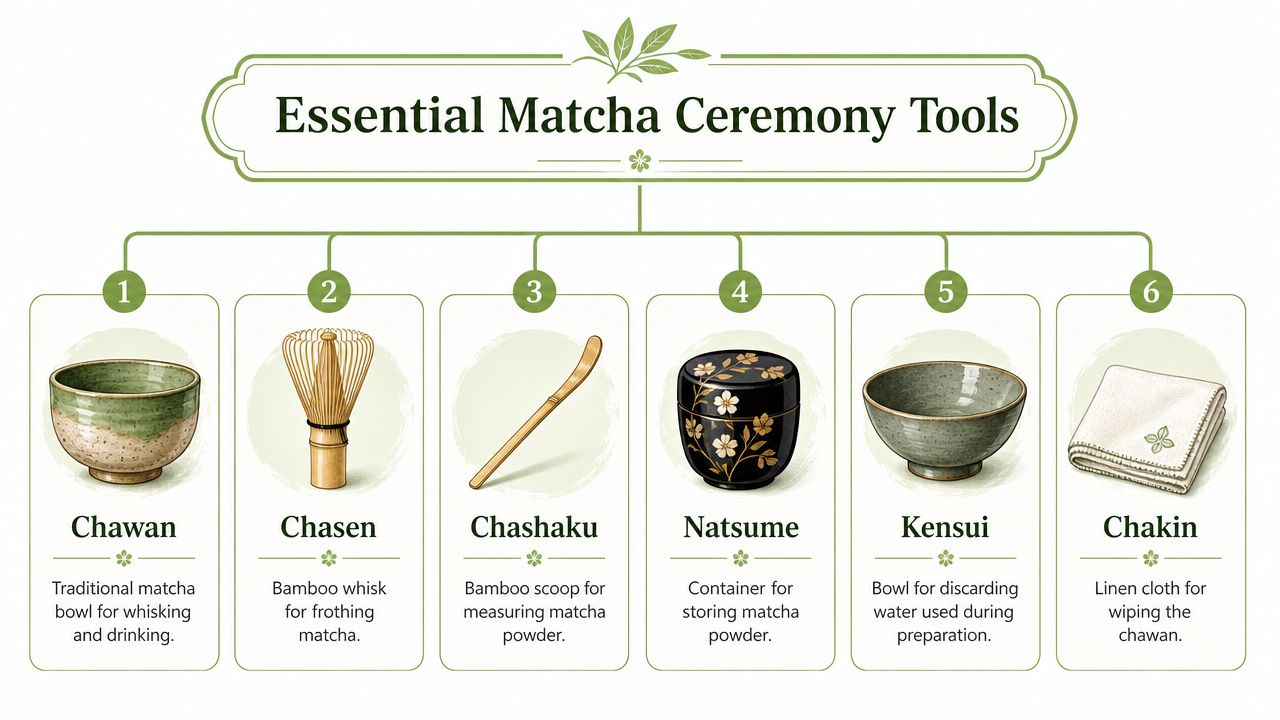
The ceremony starts to feel far less intimidating once the utensils stop looking like mysterious props and start acting like a well-designed kit. Each piece has a clear role. Together, they create order, much like having the right saucepan, knife, and chopping board makes cooking calmer and more precise.
If you are putting together your own setup for home practice or café service, a practical place to start is a collection of matcha tea accessories.
The core utensils most people should know
Some utensils matter from your first bowl. Others help you understand the language and structure of a more formal gathering.
- Chawan: The tea bowl. You whisk in it and drink from it, so its depth and shape affect both texture and comfort.
- Chasen: The bamboo whisk. Its fine tines suspend the powder in water and help create the soft foam used in usucha.
- Chashaku: The bamboo scoop for portioning matcha with consistency.
- Natsume: A tea caddy for holding matcha during service.
- Kensui: A vessel for discarded water used while preparing utensils.
- Chakin: A cloth used to wipe and prepare the bowl.
For a simple practice at home, you do not need every item at once. A bowl, whisk, and scoop will carry most beginners a long way. The other pieces become useful when you want to understand formal service more clearly, or when an Australian café wants to present matcha with a little more ceremony instead of treating it like just another powdered drink.
Usucha and koicha are two different styles of tea
One term pair causes confusion more than any other. Usucha and koicha are not small variations of the same bowl. They are different preparations with different textures, different etiquette, and a different level of difficulty.
Wikipedia's article on the Japanese tea ceremony explains that usucha is the thinner, whisked style commonly encountered initially, while koicha is made with much more tea and much less water, creating a thick, concentrated drink that is kneaded rather than foamed. If usucha is closer to a light broth in texture, koicha is closer to a glossy paste. That shift changes flavour, mouthfeel, and technique in one go.
| Term | What it's like |
|---|---|
| Usucha | Lighter, whisked, foamy, and the usual starting point for new drinkers |
| Koicha | Thicker, denser, more concentrated, and harder to prepare well |
That distinction matters in modern settings too. If you are serving matcha at home before a yoga session, or offering it in a café beside a local kombucha pairing, usucha usually suits the occasion better because it feels brisk, bright, and approachable. Koicha asks for quieter attention, higher-grade tea, and more practiced hands.
Your first bowl does not need to look perfect.
Learn the job of each tool first. Then practise the motions. Skill grows through repetition, and that is true whether you are studying chanoyu seriously or trying to bring a more grounded tea ritual into an Australian morning.
A Simple Guide to the Ceremony Sequence
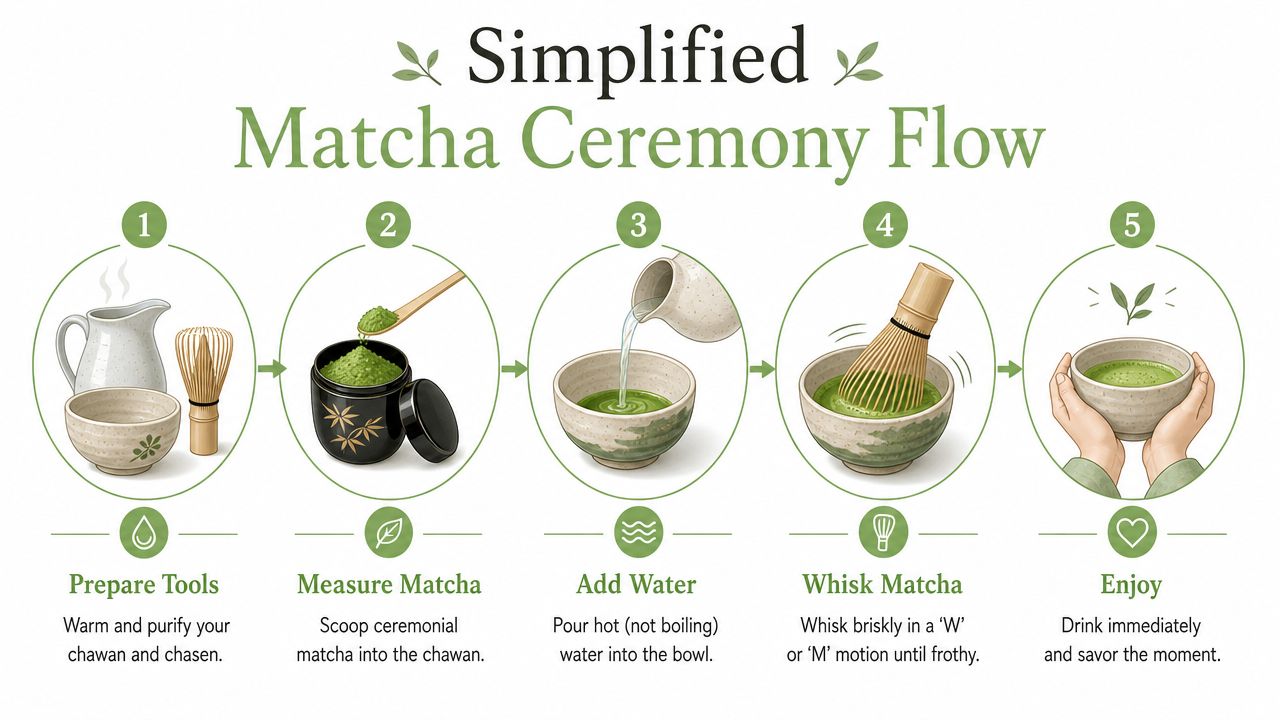
A full tea gathering can be highly formal, but the basic flow is easier to understand than many people expect. For most readers, it helps to think in terms of a short chakai, which is the more approachable gathering format.
If you want to see the whisking mechanics in more detail, Pep Tea has a practical guide on how to whisk matcha.
The simplified ceremony flow
The ceremony is structured, but not random. The sequence helps everyone arrive mentally before they drink.
Arrival and settling in
Guests enter, become quiet, and leave outside distractions behind. In more formal settings, cleansing and careful entry carry symbolic meaning.Preparation of tools
The host handles the bowl, whisk, and other utensils with deliberate care. Even when cleaning is symbolic, it shapes the atmosphere.Sweets are served
A small sweet often comes before the tea. It prepares the palate for matcha's natural character.Tea is prepared
The host measures, adds water, and whisks or kneads depending on the style of tea.Tea is received and appreciated
The guest accepts the bowl respectfully, drinks, and notices both the tea and the vessel.
Simple guest etiquette
Newcomers often feel nervous at this stage. The good news is that basic courtesy matters more than theatrical perfection.
- Receive the bowl carefully: Hold it with attention rather than grabbing it casually.
- Acknowledge the host: A small nod or word of thanks suits a modern, respectful setting.
- Turn the bowl slightly: In traditional etiquette, rotating the bowl shows respect before drinking.
- Drink without rushing: The point isn't speed. It's appreciation.
- Notice the bowl itself: In ceremonial practice, the vessel is part of the experience.
A useful benchmark for understanding ceremony length comes from the verified historical background: chaji is a full ceremony of about four hours, while chakai is a shorter gathering of about 30–60 minutes, which is why a chakai-style format makes more sense for most modern homes and cafés.
Why sequence matters
The order creates the feeling. If you skip straight to “drink the tea”, you lose what makes the matcha tea ceremony distinct. The pauses, the bowl handling, the sweets, and the pace are what turn preparation into hospitality.
That's also why cafés can borrow from the ceremony without pretending to replicate a formal tea school experience. A well-designed service can keep the spirit of the sequence even in a simpler setting.
Choosing Your Perfect Matcha for the Occasion
A ceremony-grade experience starts with choosing the right matcha. Consequently, many people waste good powder or blame themselves for a result that was never possible with the product they bought.
The key choice is between ceremonial grade and culinary grade. They aren't rivals. They serve different purposes.
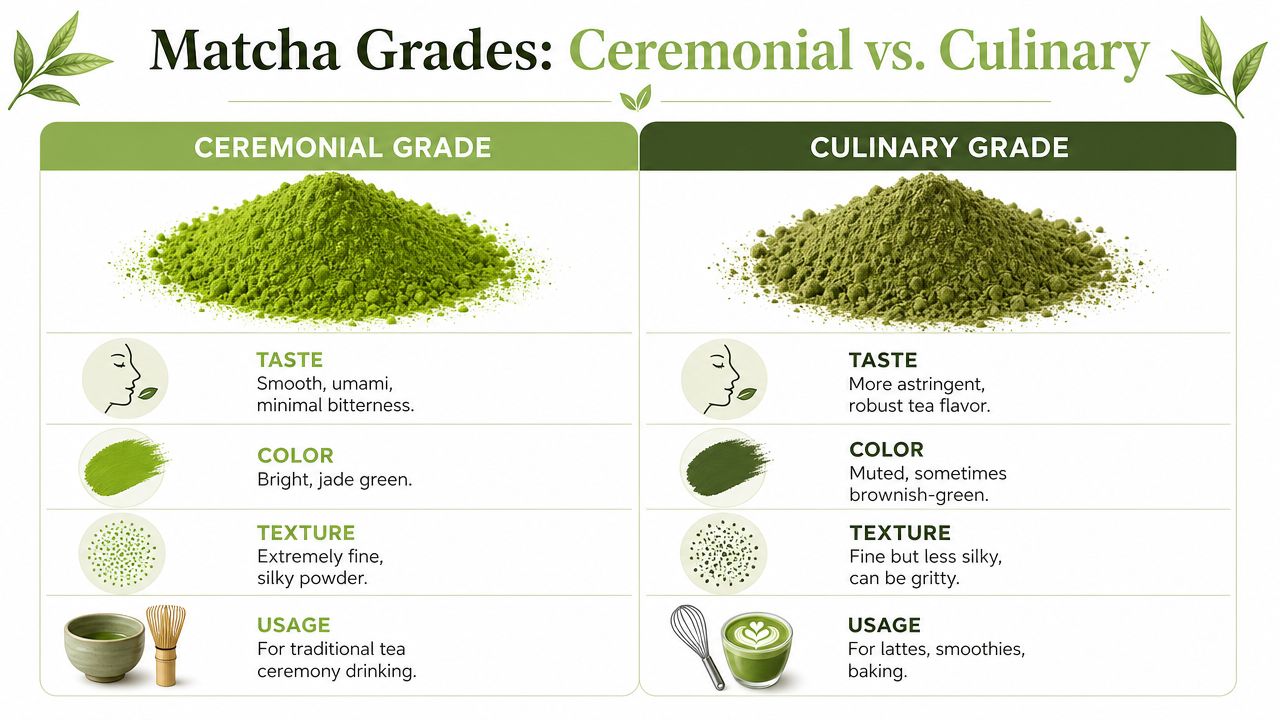
Ceremonial and culinary grade side by side
Here's the practical distinction most drinkers need.
| Grade | Best use | What to expect |
|---|---|---|
| Ceremonial grade | Traditional drinking, straight matcha, mindful preparation | Smoother profile, bright green colour, fine texture |
| Culinary grade | Lattes, smoothies, baking, desserts | Stronger tea character that can stand up to milk or other ingredients |
If you're preparing a bowl to drink on its own, ceremonial grade is the better fit. If you're blending matcha with milk, fruit, or flour, culinary grade often makes more sense.
For an Australian buyer, this can save frustration. A latte-focused matcha may taste forceful and rough when served as straight tea. A delicate ceremonial matcha may be lost once mixed into a heavily flavoured recipe.
What quality looks like in the bowl
You don't need to speak like a tea judge to assess quality. A few practical cues help.
- Colour: Ceremonial matcha should look vivid and lively, not flat or dull.
- Texture: A fine, silky powder disperses more evenly.
- Taste: You're looking for balance. Smooth, savoury, and gently sweet notes are welcome. Harsh bitterness is not.
- Aftertaste: Better matcha tends to finish cleaner.
For readers who want one straightforward option among many, Pep Tea carries organic ceremonial-grade and culinary-grade matcha, which makes it easier to match product type to use rather than treating all matcha as the same.
Practical rule: if you plan to drink matcha with only water, choose ceremonial grade first.
Preparation can rescue or ruin a good powder
Even excellent matcha can taste rough if it's prepared badly. A reliable benchmark for usucha is 70–80°C water and roughly 2 g of matcha to 60 ml of water, with a quick “M” or “W” whisking motion to create fine foam, as described in this guide to matcha tea ceremony preparation. The same source notes that hotter water can increase bitterness.
That one detail solves a lot of beginner confusion. People often assume the answer is “buy more expensive matcha”, when the actual problem is boiling water or timid whisking.
Hosting a Modern Matcha Moment at Home or in Your Café
Australia has plenty of general writing about the cultural meaning of tea ceremony, but there's still a gap regarding local, practical guidance on how to access it, adapt it, and make it feel achievable. That gap matters because many people are interested in premium, wellness-focused drinks but don't know where the ceremony fits into ordinary life, as reflected in the Japan travel guide's discussion of the tea ceremony as a codified art with formal and informal formats in this overview from Japan Travel.
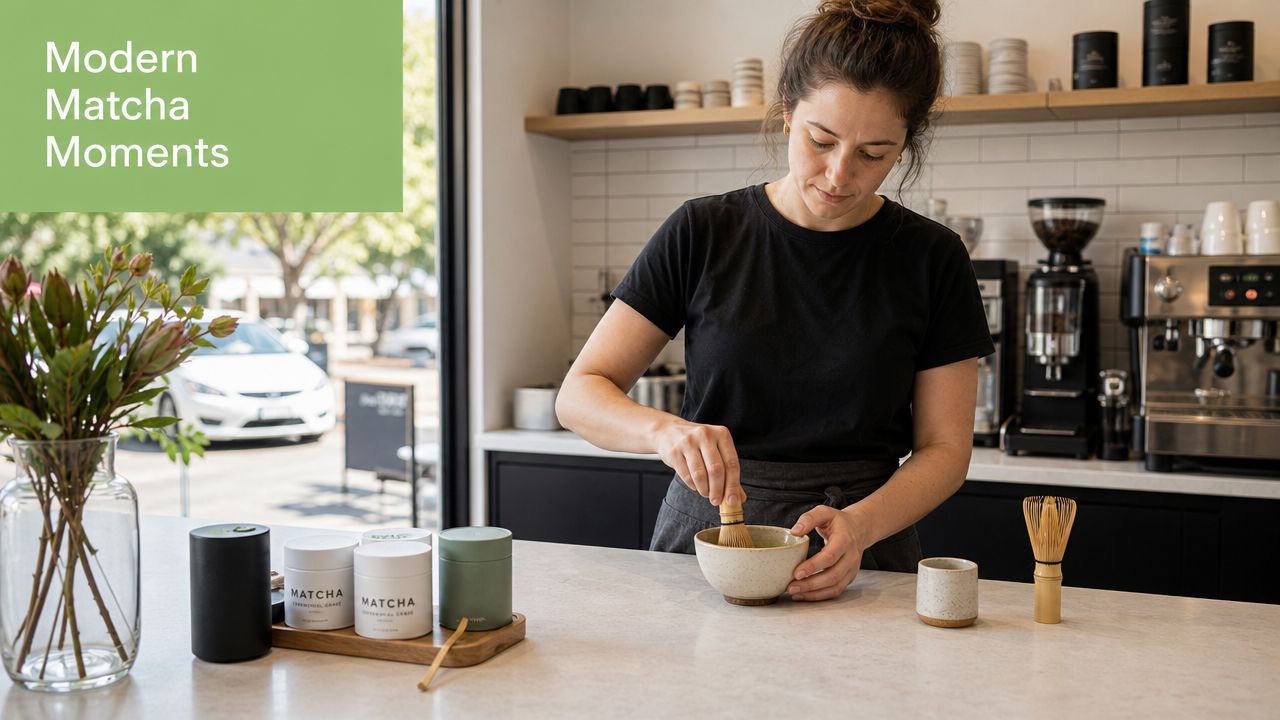
The good news is that the spirit of the matcha tea ceremony adapts beautifully. You can honour the tradition without pretending your kitchen bench is a formal tea room.
At home, keep it uncluttered and intentional
A modern home version doesn't need rare ceramics or perfect Japanese architecture. It needs care.
Try this approach:
- Clear a small space: Even one tidy section of the table changes how the ritual feels.
- Use a dedicated bowl: Reaching for the same chawan each time creates continuity.
- Prepare one serving well: Don't multitask with emails, podcasts, and breakfast prep.
- Serve a small sweet if you like: This helps frame the tea as an experience, not a chore.
- Sit down to drink it: Standing at the sink changes the whole mood.
A home ceremony can be short and still meaningful. The point isn't to imitate every formal detail. It's to build a repeatable pocket of calm.
In a café, make the service understandable
For hospitality teams, the matcha tea ceremony offers more than visual theatre. It gives staff a way to present matcha as a premium non-alcoholic service.
A simple menu idea might include a bowl of ceremonial matcha served with a small sweet, plus a short explanation of the bowl, whisking style, and origin of the tea. That works especially well in venues already attracting customers who value slower, thoughtful experiences.
A helpful training focus for staff is consistency:
| Service point | Why it matters |
|---|---|
| Water temperature | Prevents unnecessary bitterness |
| Whisk technique | Improves texture and presentation |
| Language used with guests | Makes the ritual feel welcoming, not intimidating |
| Tool care | Supports quality and respect for the process |
The following video gives a useful visual sense of preparation and pace.
A local adaptation can still be respectful
The strongest café versions don't oversell “authenticity” in a vague way. They're clear about what they are: a simplified service inspired by ceremonial values.
That honesty matters. Customers don't need a fake performance. They need a thoughtful bowl of matcha, prepared correctly, presented well, and explained clearly. When that happens, the ceremony becomes relevant to Australian hospitality rather than stuck behind glass.
Beyond the Bowl Creative Pairings and Wellness Recipes
The matcha tea ceremony starts with a bowl, but it doesn't have to end there. Once you understand the flavour and rhythm of ceremonial matcha, it becomes easier to use it in a broader wellness routine.
At home, some people keep the ceremonial bowl for quiet mornings and use matcha more casually later in the day. In cafés, the same logic can shape a menu. One offering can be formal and minimal. Another can be more playful.
Pairings that work without fighting the tea
Traditional sweets make sense because they soften matcha's natural bite. In Australia, you can also think more broadly while keeping balance in mind.
Good pairings often share one quality: restraint.
- Simple Japanese-style sweets: Mild sweetness lets the tea stay central.
- Light Australian pastries: Not too sugary, not too buttery, not too dominant.
- Fresh fruit plates: Clean, bright, and easy in warm weather.
- Kombucha as a palate reset: A small serve of sugar-free kombucha after matcha can feel crisp and refreshing rather than heavy.
For cafés, that opens an interesting idea: a quiet, non-alcoholic tasting flight built around one bowl of matcha and a small fermented drink served separately. The contrast in texture and flavour can make the experience feel contemporary while still centred on tea.
The most successful pairings don't overpower matcha. They give it room.
Two easy ways to bring matcha into everyday life
You don't need to perform a full ritual every time you use matcha. Once you've learned to appreciate it properly, everyday recipes become more intuitive.
Simple matcha latte
Use ceremonial grade if you want a softer, fuller flavour.
- Sift matcha into a bowl.
- Add a small amount of hot water and whisk until smooth.
- Warm your milk of choice separately.
- Combine and serve immediately.
This gives you a gentler bridge between formal matcha and a daily café-style drink.
Quick matcha smoothie
A smoothie is useful when you want something cold, simple, and easy to fit into a busy morning.
Blend matcha with fruit and your preferred base until smooth. Keep the other flavours moderate so the tea still comes through. If the smoothie tastes muddy, the recipe usually needs fewer competing ingredients, not more matcha.
The beauty of the matcha tea ceremony is that it teaches attention first. Once you learn that lesson, everything else improves. Your straight matcha tastes better. Your latte has more balance. Your café service feels more considered. Even your pairings become cleaner and more deliberate.
If you'd like to bring that ritual into your own routine, explore Pep Tea for organic matcha and wellness drinks that suit both simple home preparation and modern Australian café service.
Uji Matcha Latte: Your Authentic Recipe (Hot & Iced)

You're probably here because you've had one of those matcha lattes that looked stunning but tasted flat, gritty, or oddly sweet. Then you try making one at home, and it turns into a clumpy green milk drink that feels nothing like what a good café serves.
A proper uji matcha latte is different. It should taste smooth, creamy, fresh, and softly vegetal, with a clean finish rather than a harsh one. When the matcha is good and the method is right, you don't need to hide it under heaps of sugar or syrup.
At PepTea, we love teaching this drink because it sits right at the intersection of craft and everyday comfort. You can make it in a home kitchen before work, or build it into a polished café menu. The secret isn't complexity. It's understanding the ingredient, then treating it with care.
What Makes an Uji Matcha Latte Special
The first thing to know is that Uji isn't just a flavour label. It refers to a famous tea-producing area in Japan, and that place name carries real weight in tea.
In Australian cafés, “uji matcha latte” often signals something more refined than a standard matcha drink. It suggests provenance, not just colour. That matters because matcha buyers are often trying to work out whether they're paying for true quality or just attractive branding.
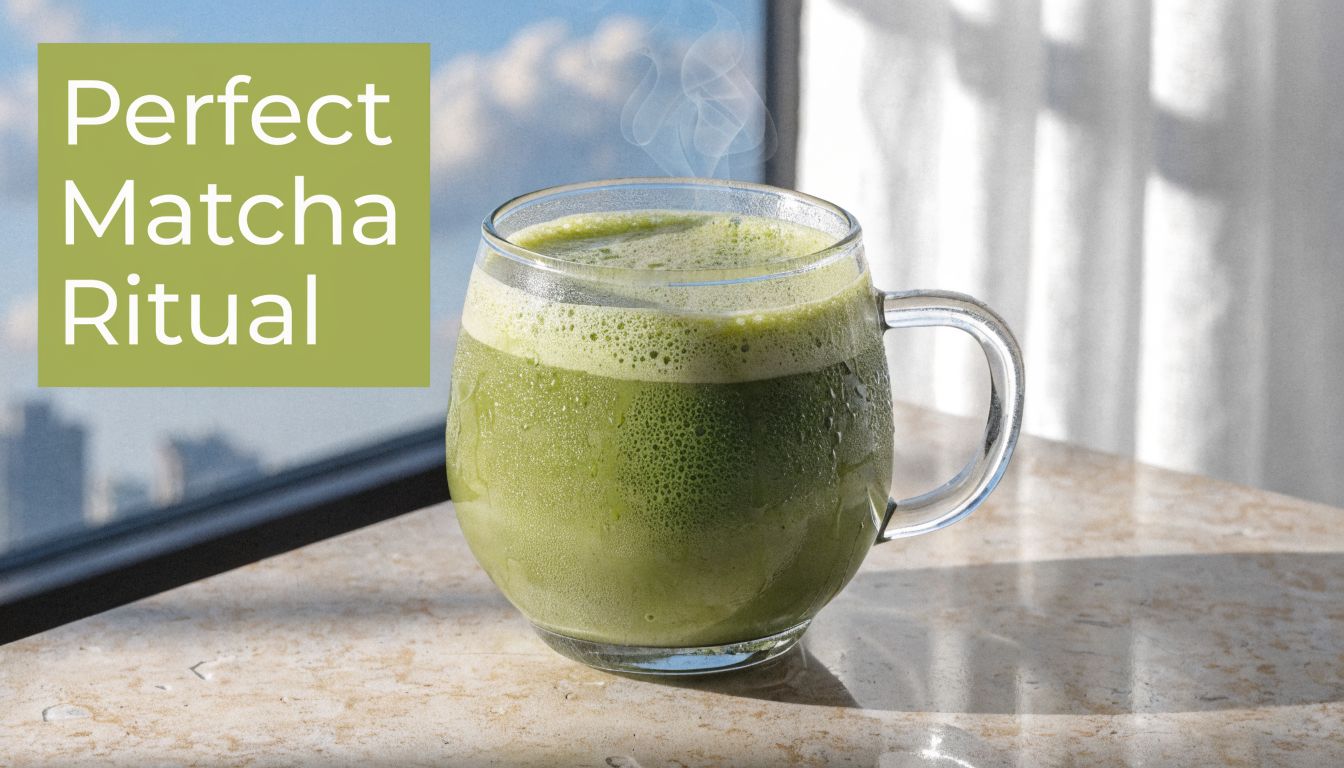
Why Uji carries so much prestige
Uji's reputation as Japan's premier tea region dates back to the Kamakura period (1185–1333), and by the 16th century Uji tea masters had developed the shaded cultivation method that became the origin of modern ceremonial matcha, according to Nippon's history of Uji tea.
That history still shapes what drinkers expect today. When you order an uji matcha latte, you're not just ordering something green and milky. You're buying into a long tradition of tea cultivation and preparation that helped define what premium matcha is meant to be.
Uji matters because it gives the drink a story, a standard, and a point of reference. That's why the name feels different on a café menu.
What that means for Australian drinkers
For home brewers, Uji gives you a useful benchmark. If a powder is sold as Uji-origin, you can start asking sharper questions about colour, texture, taste, and how the drink is built.
For café owners, it helps frame the latte as a premium tea beverage rather than a generic sweetened mix. That's especially useful when customers are looking for cleaner energy options and are comparing matcha with coffee. If you're exploring that broader shift, this guide to Peak Performance coffee alternatives is a helpful companion read.
If you want to start with an origin-specific powder, one practical place to begin is Uji matcha powder from PepTea.
Selecting the Right Uji Matcha Grade
A great latte starts before the kettle goes on. It starts when you choose the powder.
Many people get stuck on one phrase: ceremonial grade. It sounds reassuring, but it doesn't tell you everything you need to know. For Australian consumers, the more useful test is whether the matcha has the right colour, texture, purity, and value per serve.
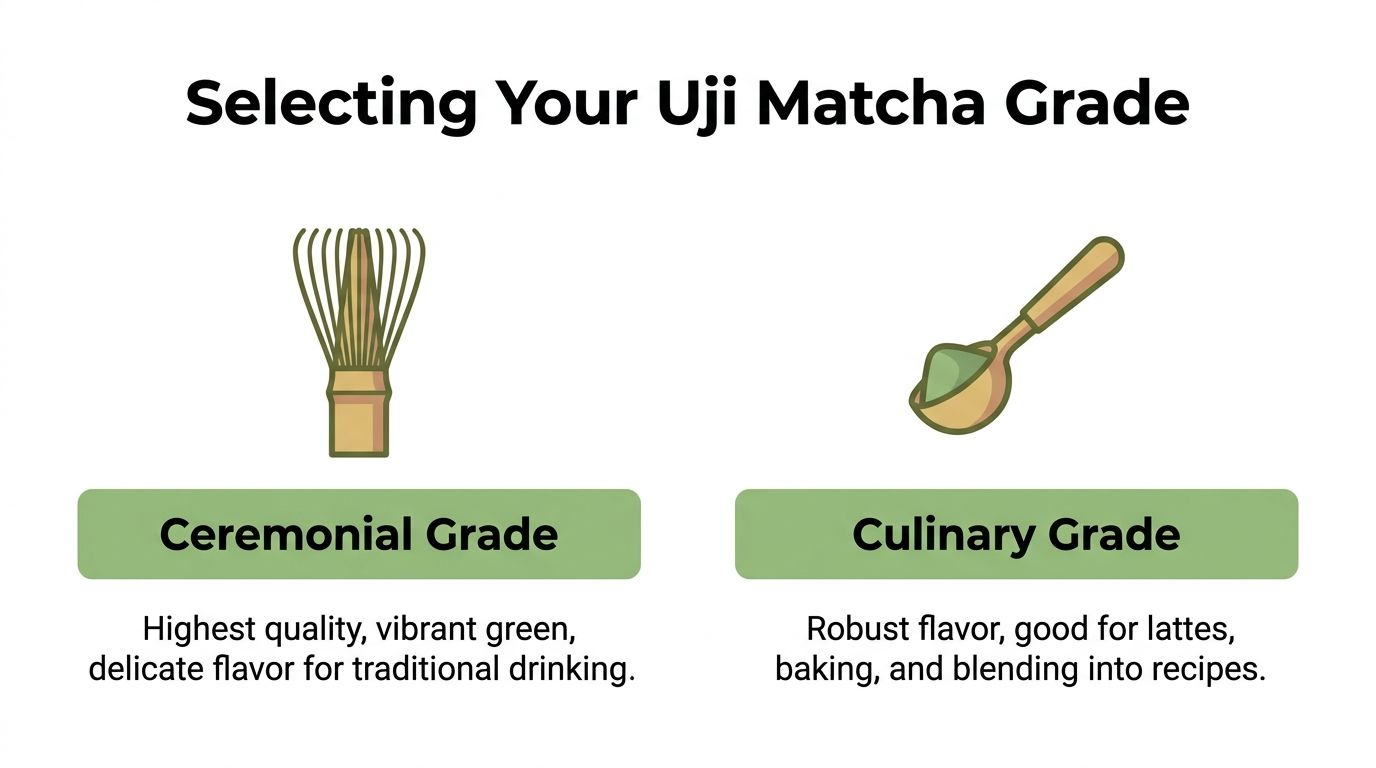
What to judge instead of the label
A practical rule from the Australian buying angle is this: a premium Uji matcha for lattes should be judged on its vibrant colour, fine texture, and grams-per-serve value, not just a ceremonial label. It's also important to check whether the product is 100% pure matcha, because many options on the market are sweetened pre-mixes, as noted by Chicago Tea House's Uji matcha product guidance.
That point clears up a common confusion. A sweetened mix can still look nice in a tin or on a shelf, but it behaves differently in the cup. It can taste flatter, dissolve differently, and make it harder to control sweetness.
Ceremonial or culinary for a latte
Both grades can have a place. What matters is your goal.
| Grade | Best fit | What to expect |
|---|---|---|
| Ceremonial grade | Straight drinking, premium lattes, minimal sweetener | Softer flavour, brighter colour, finer finish |
| Culinary grade | Baking, smoothies, blended recipes, stronger latte style | More robust taste, usually better when mixed with other ingredients |
For a café-style uji matcha latte where the tea still needs to shine through milk, a better-quality ceremonial or latte-friendly premium blend is usually easier to work with. You'll spend less time trying to correct bitterness with sweetener.
A simple buying checklist
When you're standing in an aisle or comparing tins online, check these first:
- Colour first: Look for a lively green rather than a dull, brownish, or yellow-leaning tone.
- Texture matters: Fine powder should look silky, not coarse.
- Ingredient list: If it isn't pure matcha, it's a different product.
- Serving logic: Think in grams per serve, not just pack size.
- Origin claim: “Uji” should mean more than a decorative word on the front label.
Buying shortcut: If a product leans heavily on marketing terms but doesn't help you judge purity, colour, or serve size, keep looking.
If you'd like a clearer breakdown of how different styles are used, PepTea's guide to different grades of matcha is useful for comparing what suits lattes versus traditional bowls.
Mastering the Hot Uji Matcha Latte
Technique is where most home-made matcha lattes go wrong. Not because people are careless, but because matcha responds badly to shortcuts. If you stir powder straight into a full mug of hot milk, you usually get lumps, uneven flavour, and a muddy finish.
The better approach is to build the drink in stages.
Start with the paste, not the milk
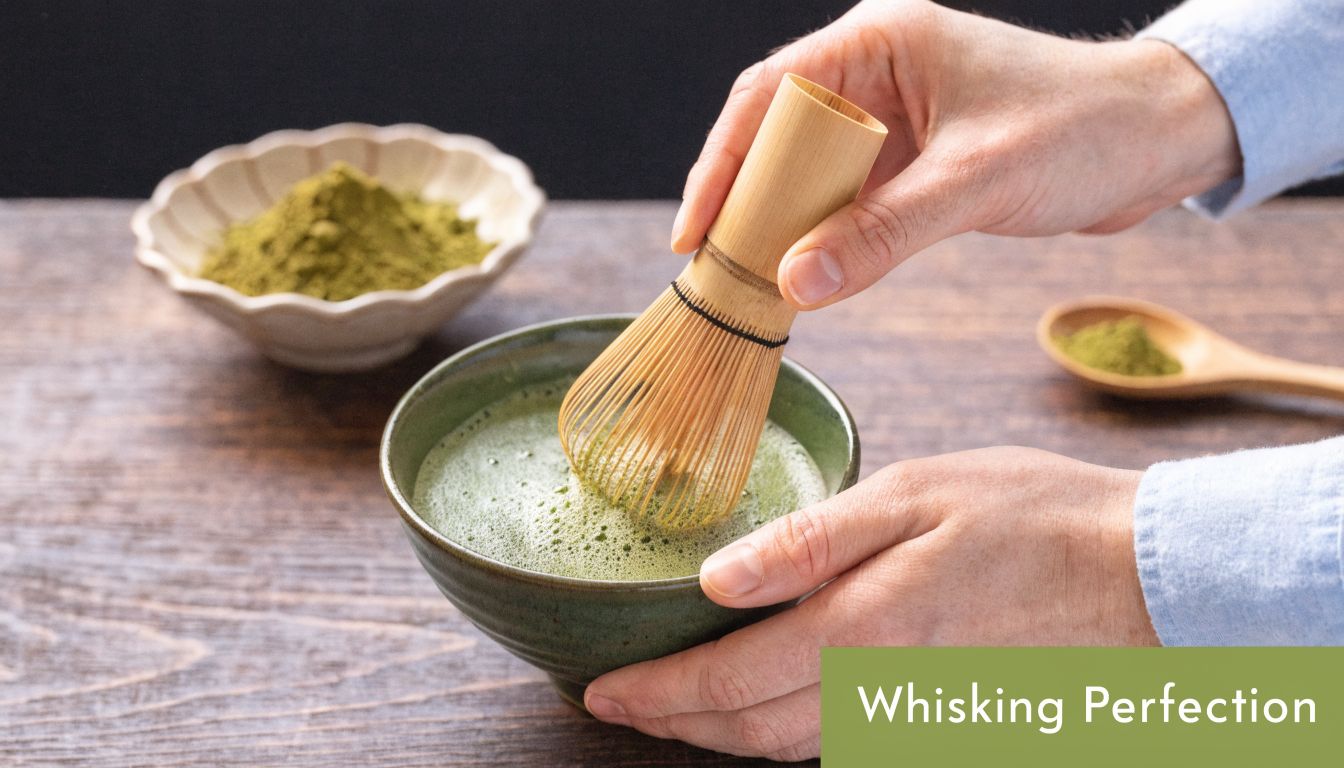
For a smooth uji matcha latte, whisk 2 teaspoons of sifted matcha with a small amount of room-temperature water to make a paste. Then add water at 75–85°C and whisk in an M or W pattern for 15–30 seconds. This is the technique recommended in Uji Matcha Tea's preparation guide.
That method does two important jobs. First, it hydrates the powder evenly so you don't get dry clumps. Second, it builds the fine foam that makes the drink feel creamy before the milk even goes in.
Why temperature changes the whole drink
A lot of people assume hotter water equals better dissolving. With matcha, that's not the goal. Boiling water can flatten the flavour and push the drink toward bitterness.
The sweet spot is warm enough to disperse the powder, but gentle enough to protect the character of the tea. If your latte has ever tasted sharp, scorched, or dull, temperature is often the first thing to check.
Practical rule: If you wouldn't sip the water comfortably, it's probably too hot for premium matcha.
Whisking for texture, not ceremony alone
A bamboo chasen isn't just a traditional accessory. It helps create the tiny bubbles that give matcha a soft, even texture.
Move the whisk briskly in a loose M or W motion rather than stirring in circles. Circular stirring tends to push the powder around the bowl. The faster patterned motion suspends it and creates that fine surface froth you see in a well-made café cup.
If you want to see the motion in action, this quick demonstration helps:
Bringing in the milk properly
Once the matcha base is smooth, heat your milk separately and keep it below a boil. You're aiming for warm, silky milk, not scorched milk.
Here's the part many people skip. Don't pour cold milk into the bowl and hope the whisk fixes everything. Build the tea base first, then pour the warm milk in a steady stream. If you're frothing milk, keep the foam soft and fine so it supports the matcha rather than burying it.
A reliable workflow looks like this:
- Sift the matcha into a bowl or wide cup.
- Add a small splash of room-temperature water and mix into a smooth paste.
- Pour in hot water within the recommended range and whisk briskly until lightly foamy.
- Warm the milk separately until hot but not boiling.
- Combine gently and taste before adding anything extra.
For readers who want to improve their whisking technique specifically, this PepTea how-to on whisking matcha is a practical reference.
Your Guide to a Refreshing Iced Matcha Latte
An iced uji matcha latte isn't just the hot version poured over ice. Cold drinks magnify flaws. If the powder isn't properly dispersed, you'll notice grit straight away.
That's why the best iced version starts with a concentrated matcha base.

Build the matcha shot first
Sift your matcha, add a small amount of water, and work it into a smooth paste before adding more liquid. This matters even more for iced drinks because cold milk won't help dissolve stubborn clumps.
If you like a layered café look, make the matcha base separately and pour it over milk and ice at the end. The result looks polished, but it also gives you more control over flavour.
Sweeten at the right moment
For a smooth hot or iced uji matcha latte, add any sweetener after whisking the matcha into a paste but before adding the bulk of the liquid, which helps it dissolve fully and prevents crystallisation in iced drinks, as explained in Ocha & Co's matcha latte method.
That one detail saves a lot of frustration. If you add sweetener too late, especially in a cold drink, it can sit at the bottom or throw off the texture.
An easy assembly method
Try this order for a cleaner result:
- First the glass: Fill it with ice.
- Then the milk: Add your dairy or plant milk.
- Next the matcha base: Pour slowly over the top for a layered look.
- Final adjustment: Stir just before drinking so the flavour is even.
A good iced matcha latte should taste crisp and creamy at the same time, not watery, chalky, or syrupy.
Pro Tips and Healthy Variations
Once your basic method is sound, small adjustments make a big difference. These refinements ensure an everyday uji matcha latte becomes your version of the drink.
Fixing the most common problems
If your latte tastes bitter, the issue is often heat or powder quality rather than matcha itself.
If it's lumpy, the fix is usually mechanical. Sift first, make a paste, then whisk properly. Most texture problems begin before the milk goes in.
A quick troubleshooting list helps:
- Bitter cup: Check whether your water was too hot or your powder too rough.
- Flat flavour: Use less sweetener so the tea can still come through.
- Gritty finish: Sift the powder and spend longer on the paste stage.
- Weak colour: Review the quality of the matcha itself before changing the recipe.
Choosing milk for flavour and texture
Different milks push the latte in different directions.
Oat milk often gives a rounder, creamier feel. Almond milk can make the drink lighter and a little nuttier. Soy can hold its structure well in a café setting. Dairy gives a familiar richness, but it can also soften some of the tea's sharper edges.
The best milk is the one that lets the matcha remain recognisable. If the milk completely dominates, the tea disappears.
Keeping it sugar-free or lower sugar
Health-conscious Australian drinkers often get more selective. If you've bought a good Uji powder, you may not need much sweetener at all.
Try these approaches:
- Go unsweetened first: Taste the latte before adding anything.
- Use a small amount only if needed: A light touch keeps the tea present.
- Avoid pre-mixes: They remove your control over sweetness and flavour balance.
For café service, consistency matters as much as flavour. Standardise your scoop, whisking time, and milk pour. If you're batching for busy periods, keep the matcha base fresh and don't let it sit too long before service.
Some venues also use commercial blending tools for fast cold drinks and menu variations. If that's relevant to your setup, Vitamix blenders for hospitality are worth reviewing alongside your tea tools.
One practical option for Australian buyers looking for an origin-led powder is Pep Tea's Uji matcha range, particularly when you want a format suitable for controlled latte prep rather than a sugary shortcut.
Your Uji Matcha Latte Questions Answered
How should I store matcha powder?
Keep it sealed, dry, and away from heat, light, and moisture. Matcha is delicate. Once opened, good storage helps preserve colour and aroma.
Can I make an uji matcha latte without a bamboo whisk?
Yes, though a chasen gives the nicest texture. If you don't have one, use a small handheld frother or shake the matcha paste and water in a tightly sealed jar before adding milk. The key is still the same. Break up the powder fully before the main liquid goes in.
Is café matcha always better than homemade?
Not always. A café can still use a sweetened pre-mix or poor technique. At home, you often get a better result when you start with pure matcha and pay attention to temperature and whisking.
What should a good uji matcha latte taste like?
Smooth, fresh, creamy, and balanced. You should notice the tea, not just milk or sweetness.
If you'd like to put this into practice, explore Pep Tea for organic matcha options, brewing guides, and everyday ideas for making café-style matcha at home or on your menu.
Matcha Bowl with Spout: Latte Perfection

You whisk the matcha carefully. The colour looks right. The foam finally sits on top in a soft green layer. Then you pour it into your mug and half of it runs down the outside of the bowl, onto the bench, and into that annoying puddle near the spoon.
If that sounds familiar, you’re not doing anything wrong. You’re just using the wrong vessel for the last part of the job.
A matcha bowl with spout fixes one of the most frustrating parts of making matcha at home or in a café. It helps you whisk properly, then pour cleanly. That sounds simple, but it changes the whole experience. Your latte looks better, your bench stays cleaner, and the texture you worked for makes it into the cup.
The Secret to a Spill-Free Matcha Latte
A lot of people assume the hard part of matcha is the whisking. It isn’t always. Often, the pour is where things fall apart.
You can make a smooth bowl of matcha, heat your milk well, and still end up with streaks down the side of your mug because a standard bowl has no clean pouring point. The liquid rolls over the rim wherever gravity sends it. That’s fine if you’re drinking straight from the bowl. It’s less fine when you’re topping an iced latte, filling a takeaway cup, or trying to keep service moving in a busy café.
The familiar home kitchen problem
At home, the mess is mostly annoying. You wipe the bench, rinse the bowl, and try again.
In hospitality, it becomes a workflow issue. Staff lose time. The presentation slips. Foam breaks while the person pouring slows down to avoid spills. A drink that should feel calm and polished starts to feel fiddly.
A good matcha pour should feel controlled from the first tilt, not like you’re hoping for the best.
Milk also matters here. If you’re building a latte, your poured matcha has to meet milk that’s still silky and in the right range. If you want a useful reference point for that side of the drink, this guide to ideal milk temperature for lattes gives practical context for getting the texture right.
The simple tool that changes the result
That’s where the spouted bowl comes in.
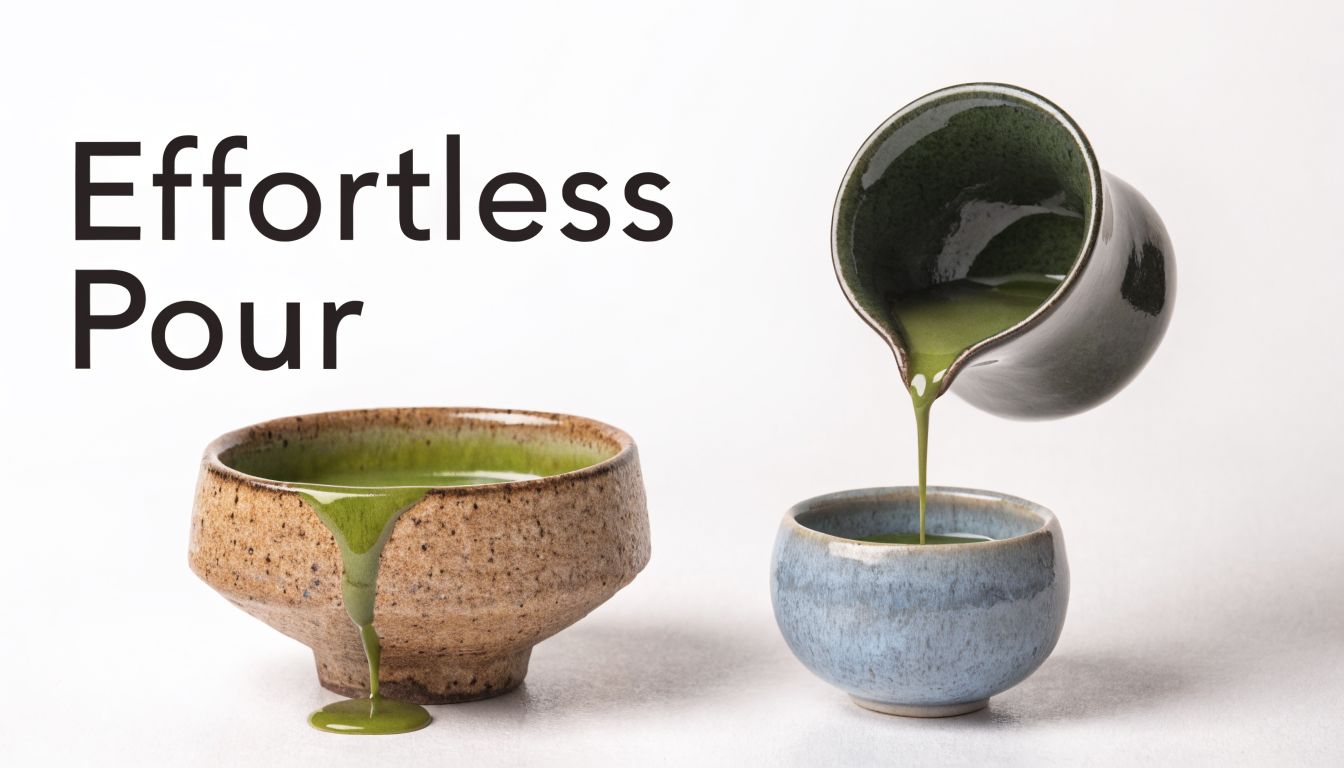
A matcha bowl with spout is designed for one specific problem. It lets you whisk in an open bowl, then pour with precision. No awkward tipping. No dribbling down the side. No sacrificing foam just to get the liquid into the cup.
For home enthusiasts, it makes your morning ritual neater and easier. For café owners, it turns a beautiful but messy drink into something more repeatable.
What Exactly Is a Matcha Bowl With Spout
You will often see this bowl called a katakuchi. In practical terms, it is a whisking bowl with a shaped pouring lip on one side, made to move matcha cleanly from bowl to cup.
That sounds like a small change. It is not.
A standard chawan is brilliant for preparing and drinking matcha in the bowl itself. A matcha bowl with spout keeps that open, whisk-friendly shape, then adds control at the moment many home baristas and café staff struggle with most. The pour.
Built for whisking first, pouring second
The best way to understand a spouted matcha bowl is to start with the job matcha asks the bowl to do. You are not steeping leaves and waiting. You are combining very fine tea powder with water, breaking up small clumps, and whisking enough air into the surface to create a light foam.
That process works better in a bowl that gives the whisk room to move.
Harmony Leaf’s katakuchi product guide describes this style as a wide ceramic bowl with a rounded interior and a pouring lip. Those details matter because the curved base helps the chasen sweep through the liquid more freely, while the lip gives you a clear exit point when it is time to transfer the matcha into a mug, latte glass, or mixing vessel.
For an Australian café, that means fewer messy handoffs during service. For a home barista, it means your bench stays cleaner and your foam has a better chance of reaching the cup intact.
The shape explains the purpose
A spouted matcha bowl works like a mixing bowl with a proper pouring edge. The comparison is simple, but useful. A regular bowl can hold the liquid, yet it does not guide it well once you tilt it.
A good katakuchi usually includes:
- A broad opening so the whisk can move quickly without knocking the sides
- A curved interior so powder and water collect in the centre instead of hiding in corners
- Ceramic walls with some weight so the bowl feels steady in the hand during whisking
- A defined spout so the finished matcha lands where you intend
Each feature answers a specific problem. More room helps with whisk speed. A rounded base helps with consistency. A proper lip helps with transfer.
An old tea form adapted to modern service
The bowl itself sits within a much older tea tradition. Powdered tea was prepared in China during the Song Dynasty, and that style of tea preparation later influenced Japanese tea culture, including the development of the chawan, as outlined in this history of chawan and tea culture.
The spouted version reflects a modern need. Many people still enjoy matcha straight from the bowl, but cafés, home latte drinkers, and dessert makers often need to whisk in one vessel and pour into another. The katakuchi answers that exact workflow.
That is why this tool matters beyond definition. It is not only a ceramic bowl with a lip. It is a practical bridge between traditional matcha preparation and the cleaner, faster service expected in homes and cafés across Australia.
Why the Spout Is a Game Changer for Your Matcha
It is 8:15 on a Sydney breakfast rush. One person wants an iced strawberry matcha, another wants oat milk, and a third wants theirs extra strong. At home, the pressure looks different, but the problem is the same. You whisk a lovely bowl of matcha, then lose control in the last two seconds as it dribbles down the side of the bowl instead of into the cup.
That final pour decides more than people realise.
A spout improves three parts of the process at once. It gives you a cleaner line into the cup, helps protect the foam you just whisked, and saves time when you need to make more than one serve. For anyone building a reliable setup, whether that is a home station or a café bar, the right matcha tea whisk and bowl set makes the whole workflow easier to repeat.
Precision without the drips
The most obvious benefit is control.
A standard bowl often lets liquid spread along the rim before it drops. That spread turns into drips on the bench, streaks on the cup, and wasted matcha. A shaped spout brings the liquid into a narrower stream, so you can aim into a mug, a latte glass, or a bottle without the usual mess.
It works a bit like the difference between pouring from a saucepan and pouring from a milk jug. Both hold liquid. Only one is designed to send it where you want it to go.
That matters in a café where speed counts, but it also matters at home. Less wiping up means the ritual stays enjoyable instead of fiddly.
Better texture in the cup
Texture is the part many beginners miss.
Freshly whisked matcha has a delicate layer of fine foam across the top. If the pour comes out in a broad, uneven sheet, that foam breaks apart before it reaches the drink. A spout guides the liquid more cleanly, which gives the foam a better chance of staying intact as it moves from bowl to cup.
The bowl does not create good foam on its own. Your sift, water temperature, and whisking technique still do the heavy lifting. The spout protects that work during transfer.
If your matcha looks silky in the bowl but flatter in the glass, the weak point is often the pour rather than the whisk.
Faster service, fewer repeated motions
The speed benefit becomes clear once you make matcha regularly.
Ippodo Tea’s page on spouted chawan notes that some Mino-yaki styles are designed for whisking multiple servings and pouring with less loss, which offers a key operational advantage for cafés and busy home cooks alike: fewer repeated prep cycles, less waste around the rim, and more even portioning across drinks. You can see that product guidance on Ippodo’s site at https://ippodotea.com/.
For Australian cafés, that matters because matcha is no longer an occasional extra. It sits in the same service rhythm as coffee, chai, and iced drinks. A bowl that lets staff whisk, pour, and reset quickly helps keep quality steady during a rush.
Home baristas benefit too. If you are making two morning lattes, or one drink plus a matcha cream or syrup for dessert, a spouted bowl cuts down the stop-start feeling of the process. It is the same reason kitchens use pouring jugs for sauces and batters. Cleaner transfer improves consistency.
That crossover between beverage service and food presentation is easy to spot in other hospitality tools as well, including packaging choices covered in this paper ice cream cups buying guide.
Why this matters in real Australian use
In many Australian homes, matcha now sits beside the espresso machine rather than in a once-a-week tea drawer. In cafés, it has to perform under pressure, not just look good on a shelf.
A spouted bowl suits both settings because it solves a practical handoff problem. You whisk in one vessel and pour into another with less mess, better control, and more predictable results.
| Situation | Standard bowl | Spouted bowl |
|---|---|---|
| Home latte | Pour can spread across the rim | Cleaner line into the mug |
| Iced drinks | Harder to aim around ice | Better control into tall glass |
| Busy café service | More wiping and rework | Quicker, tidier portioning |
| Recipe prep | Tricky to divide neatly | Easier to pour into cups or jars |
For a tea drinker, that means better-looking matcha with less cleanup. For a café owner buying wholesale, it means a tool that supports consistency and pace during service.
The spout is small. Its effect on the workflow is not.
How to Choose the Right Spouted Matcha Bowl
Choosing a spouted matcha bowl is a bit like choosing milk jugs for café service. The right one makes the job easier every single day. The wrong one feels fine in your hand for ten seconds, then starts causing small frustrations with every whisk and pour.
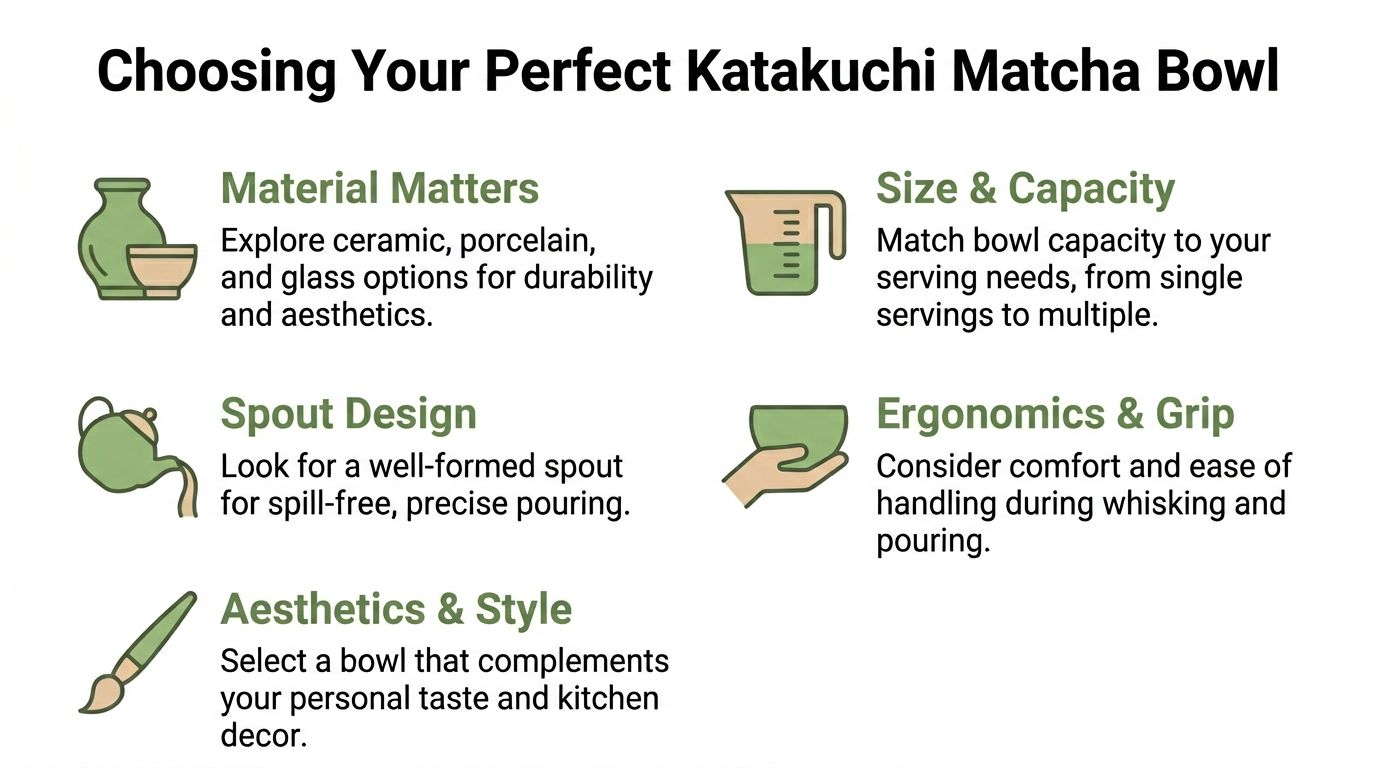
For an Australian home barista, that usually means finding a bowl that feels pleasant to use before work and pours neatly into the mug you already love. For a café owner or wholesale buyer, the question is broader. You need a bowl that helps staff repeat the same result during a busy service, with less waste and less bench cleanup.
Start with the job the bowl needs to do
A bowl for occasional straight matcha does not need the same capacity as one used for back-to-back iced lattes. If you mainly make one serve at home, a smaller bowl can feel more balanced and easier to store. If you prepare larger drinks, split pours, or recipe bases, more room in the bowl gives the whisk space to move and lowers the chance of splashing over the rim.
That is why capacity matters in a practical way, not just on a product label.
For many cafés, a bowl around 500 ml or larger is a sensible starting point because it leaves room for whisking and controlled pouring. For home use, smaller bowls often feel more comfortable, especially if you value a slower ritual and a lighter vessel.
Material changes how the bowl behaves
Material is not only about looks. It affects grip, heat, weight, and how confident the pour feels.
| Material | Best for | What to expect |
|---|---|---|
| Ceramic | Daily use at home or in cafés | Good heat retention, stable in the hand, forgiving to whisk in |
| Porcelain | Minimal, refined setups | Smoother finish, usually lighter, often a sharper visual style |
| Glass | Visual preparation and presentation | Attractive to watch, but can feel hotter, lighter, and less secure when wet |
Ceramic is usually the most practical all-round option. It has enough weight to stay steady while whisking, and it tends to feel more controlled during the pour. That balance matters if you are trying to reproduce café-quality matcha at home, or standardise service across staff in a venue.
Check the shape, not just the photos
A bowl can look beautiful online and still be awkward in use.
Start with the interior. A rounded base helps the chasen move freely, much like a curved mixing bowl helps a whisk catch everything instead of pushing ingredients into corners. You get fewer clumps stuck at the edges and a more even texture with less effort.
Then look closely at the spout. A well-formed spout should guide liquid into a narrow stream. If it looks shallow, uneven, or decorative rather than functional, you may get drips down the side of the bowl after each pour. That is annoying at home and costly in a café where tiny delays add up across a full shift.
What to test before you buy
A quick checklist helps separate a display piece from a working tool:
- Capacity: Enough room for your usual recipe without crowding the whisk.
- Rounded interior: Better whisk movement and less powder trapped around the edge.
- Defined spout: Cleaner stream, less dripping, and more accurate pouring into cups or glasses.
- Balanced weight: Comfortable to lift when full, not clumsy or too delicate.
- Grip: A finish that feels secure even with damp hands.
A useful comparison comes from serviceware buying in other parts of hospitality. This paper ice cream cups buying guide covers a different product, but the same buying logic applies. Capacity, handling, material, and real service conditions should shape the choice.
Match the bowl to the user
The best spouted bowl depends on who is using it and how often.
- Home barista: Choose comfort, a manageable size, and a spout that pours neatly into your usual cup or glass.
- Busy café: Choose durability, larger capacity, and a shape that different staff members can use consistently without retraining their pour every shift.
- Retail customer buying a gift: Choose a bowl that looks attractive but still has a rounded interior and a properly formed spout.
- Wholesale buyer for café supply: Choose pieces that support repeatable drink quality and efficient service, because those are the details venues notice after the first week of use.
If you want a practical benchmark for how the bowl fits into the full preparation setup, this matcha whisk and bowl set shows the core tools that work together.
Mastering Your Whisk and Pour Technique
Owning a good bowl helps, but technique is what turns the tool into a better drink.
Step one with the bowl
Start by warming the bowl with hot water, then empty and dry it. A warmed bowl helps keep the preparation stable and makes whisking feel smoother.
Next, sift your matcha into the bowl if you can. Sifting isn’t fussy for the sake of it. It breaks up clumps before water hits the powder, which makes a smoother drink with less effort.
The whisking motion that works
Add a small amount of hot water and begin whisking with a chasen.
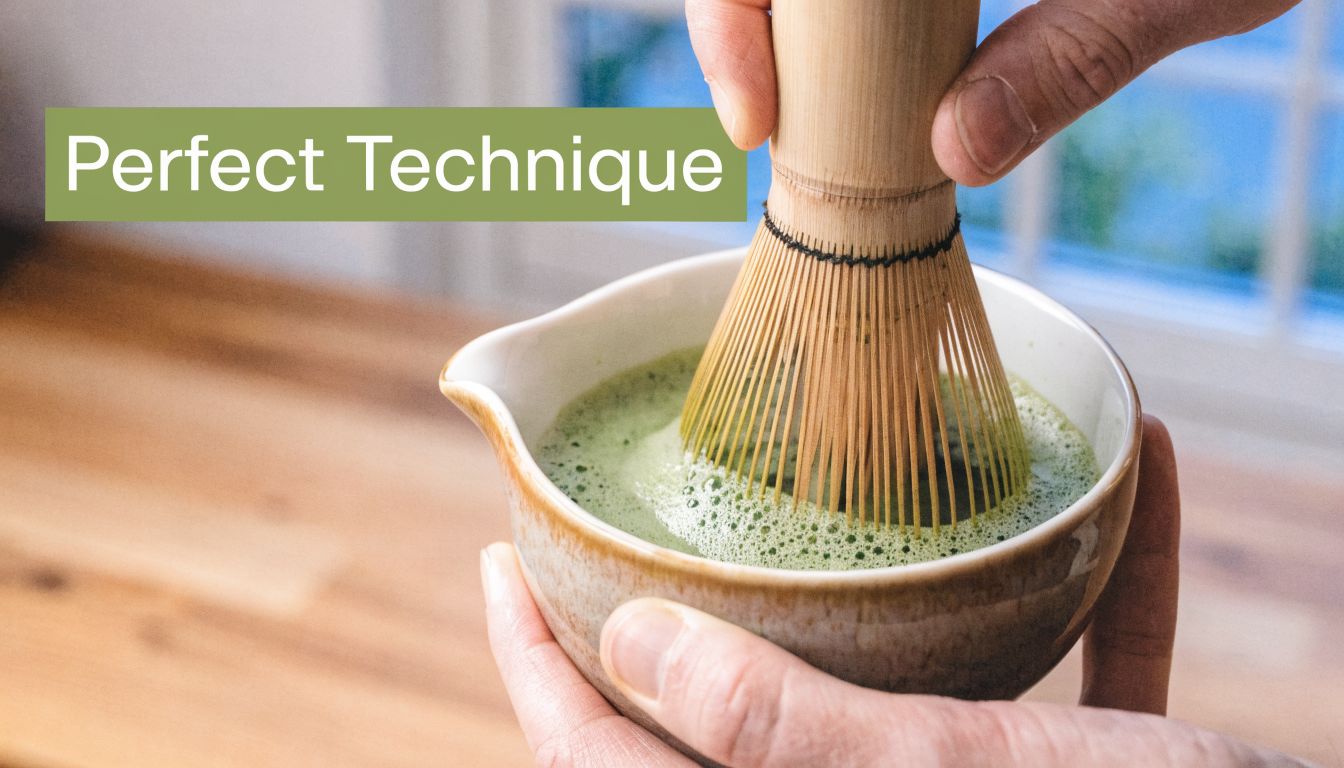
Don’t stir in circles like soup. Use a quick M or W motion with your wrist, keeping the whisk tips near the surface as the foam begins to build. The aim is a fine froth, not giant bubbles.
Small correction: If your whisk is scraping heavily at the base, you’re probably pressing too hard. Let the whisk move lightly and quickly.
A rounded bowl helps here because the whisk can travel freely. You’re less likely to get powder stuck in corners, and the movement feels more natural.
How to pour without collapsing the texture
Once the matcha is whisked, pause for a second. Let the surface settle just enough that you can see the pour.
Grip the bowl firmly with one hand and guide the spout toward the centre of your cup or glass. Tilt smoothly. Don’t jerk the bowl upward at the end. That sudden stop is what often causes the final drip.
For lattes, pour the matcha first or over the milk depending on the style you want. Either works, but the key is keeping the stream controlled.
A visual guide can help if you’re refining your hand motion:
A simple routine to repeat
- Warm the bowl so the preparation starts evenly.
- Sift the matcha to avoid stubborn lumps.
- Add water gradually rather than flooding the powder.
- Whisk fast with the wrist until the top looks fine and frothy.
- Pour from the spout in one smooth tilt instead of hesitating halfway.
If you want a practical latte method to pair with this bowl technique, this make matcha latte guide gives a simple reference for building the drink itself.
Creative Recipes Beyond the Traditional Tea
Saturday morning at home or the middle of a café rush, the same problem shows up fast. You need matcha that is smooth, evenly mixed, and easy to pour without green streaks across the bench. A spouted bowl helps with all three, which is why it suits both the home barista chasing café-quality drinks and venues that need speed without slipping on consistency.
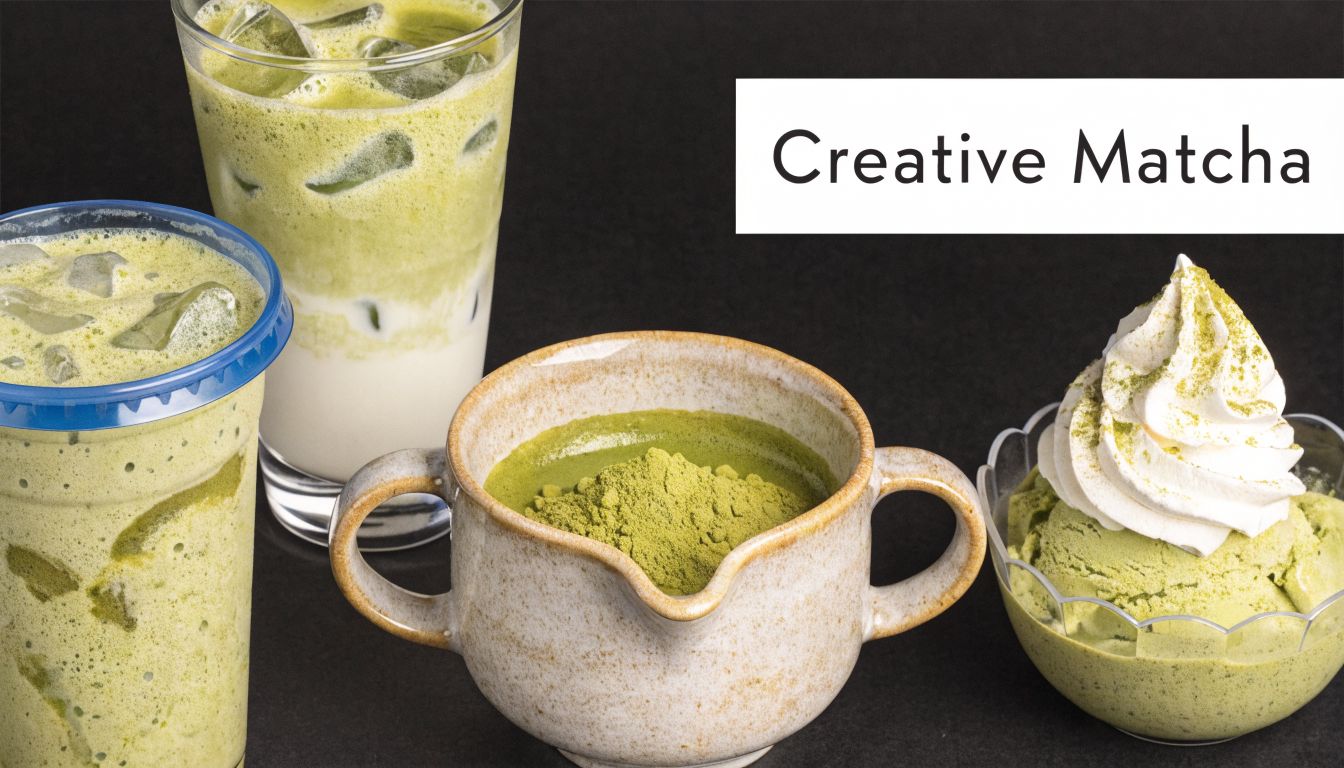
The useful part is not just the whisking. It is what happens after. Once your matcha is properly blended, the spout lets you place that liquid exactly where you want it, whether that is over ice, into a muffin mix, or across the top of sparkling kombucha for a layered special. For Australian cafés, that control means cleaner service and less waste. For home use, it means fewer failed pours and a result that looks far more polished.
Iced matcha latte
An iced latte shows the benefit straight away because ice cubes tend to interrupt the pour. A regular bowl often sends matcha around the cubes and onto the rim of the glass. A spout narrows the stream, so more of the matcha lands in the drink instead of on your hands.
Whisk the matcha with hot water until smooth and lightly frothy. Fill a glass with ice, add cold milk, then pour the matcha slowly over the top. If you want a distinct layered look, pour against the inside of the glass. If you want a more blended drink, pour into the centre and stir once.
Matcha pancake or muffin batter
This bowl is handy in the kitchen too, especially for small batches.
Start by whisking matcha with a little warm liquid to make a loose paste. That step matters because dry matcha dropped straight into batter often forms tiny green clumps, a bit like cocoa powder that refuses to mix in. Once smooth, pour it into your pancake or muffin batter and fold gently.
For pancakes, the spout helps you portion batter onto the pan with better control. For muffins, it makes filling cases neater, which is useful if you are baking for a market stall, a café cabinet, or just trying not to clean batter off the tray later.
Matcha kombucha spritzer
A kombucha spritzer gives matcha a brighter, more refreshing style. It works well for warm weather menus and for customers who want something lighter than a milk-based drink.
Whisk a small serve of matcha, let it cool slightly, then pour it into a glass with ice and chilled kombucha. The flavour changes depending on the base:
- Plain kombucha base: Keeps the matcha front and centre.
- Ginger kombucha: Adds a gentle kick.
- Citrus-leaning kombucha: Brings out the fresher green notes.
This kind of recipe also shows why the bowl matters for service. If you are trialling specials in a café, a controlled pour makes it easier to repeat the same look from one glass to the next. If you are making drinks at home, it makes creative matcha feel less fiddly.
A spouted matcha bowl is a mixing bowl, measuring helper, and pouring jug in one. That is the quiet reason it gets used so often. It earns space in the cupboard because it solves practical problems, not because it is decorative.
Caring For Your Spouted Matcha Bowl
A good bowl can last for years if you treat it gently. The basics are simple, but they make a real difference.
Daily care that keeps it looking good
Rinse the bowl soon after use. Matcha can leave a green tint if it dries onto the glaze, especially around the spout.
Wash with warm water and a soft sponge. If you use detergent, keep it mild and rinse well so no scent or residue lingers for the next bowl.
What to avoid
A few habits shorten the life of handmade ceramics.
- Don’t use abrasive scrubbers: They can mark the glaze and dull the surface.
- Don’t knock the spout against the sink: That edge is often the most vulnerable point.
- Don’t stack carelessly: The rim and pouring lip can chip if bowls rub together.
Dry the bowl fully before storing it. If it lives on an open shelf, give it enough space that you’re not bumping it every time you reach for a mug.
A matcha bowl with spout is a working tool, but it’s still ceramic. A bit of care keeps the pour clean and the bowl pleasant to use.
Elevate Your Matcha Ritual With the Right Tools
A matcha bowl with spout does more than make pouring tidy. It improves how matcha is whisked, transferred, and served. That matters whether you’re making one calm morning latte at home or building a sharper non-alcoholic menu in a busy Australian café.
The right bowl makes the whole process feel more natural. You whisk with confidence, pour with control, and waste less of the drink you’ve just prepared. That’s a small shift in equipment, but a big shift in results.
If you’re building out your setup, a dedicated collection of matcha tea accessories can help you pair the bowl with the right whisk and serving tools.
If you’re ready to put these techniques into practice, explore Pep Tea for organic matcha, brewing accessories, and café-friendly options that make it easier to create smooth, vibrant matcha at home or in service.
Unlock the Perfect Matcha Tea Whisk and Bowl

You’re probably here because your matcha looked promising in the tin and disappointing in the bowl. The colour was right. The whisk looked beautiful. Then the drink turned out clumpy, flat, or oddly bitter.
That’s not a matcha problem. It’s usually a matcha tea whisk and bowl problem, or more precisely, a technique problem shaped by the tools in your hands.
A good bowl of matcha isn’t about ceremony for ceremony’s sake. The whisk and bowl exist because matcha is a suspended powder, not a leaf infusion. If the powder isn’t fully dispersed and aerated, the texture suffers first, then the flavour. Once you understand what the whisk is doing, and why the bowl is shaped the way it is, everything gets easier.
The Ritual of Matcha Why Your Whisk and Bowl Matter
It usually starts on a rushed weekday morning. Matcha goes into the nearest mug, hot water follows, a spoon gets a quick spin, and the cup looks dull before you even taste it. Then the first sip lands harsh, powdery, and flatter than the bright, creamy bowl you were hoping for.
A chasen and chawan fix that because they solve a physical problem, not a decorative one.
Matcha is a fine stone-ground powder suspended in water. It does not dissolve the way instant drinks do. To taste sweet, savoury, and smooth, those particles need to be dispersed evenly and lifted with air. A bamboo whisk does that fast without bruising the liquid. A proper bowl gives the whisk the width and curve it needs to move freely.
That matters even more in Australia, where home water can change a bowl more than many people expect. Hard water in some suburbs can mute sweetness and make bitterness show up sooner. A heavy café-style mug also tends to trap your wrist in a tight angle, which leads to stirring instead of whisking. Good tools create better mechanics, and better mechanics create better texture.
These tools shape the cup
The whisk controls agitation. The bowl controls space, temperature, and the way the liquid rolls back on itself as you whisk. That combination is why the same matcha can taste soft and rounded in one vessel, then sharp and grainy in another.
I see this all the time with Australian café drinkers trying to recreate their favourite order at home. They buy better powder, often something clean and vibrant like Pep Tea, but keep using a cereal bowl or coffee mug. The matcha is fine. The setup is fighting the result.
A proper matcha bowl does three jobs at once:
- Creates room for whisking so the tines can travel quickly across the surface without crashing into the sides
- Buffers heat so the water stays closer to the gentle range matcha prefers
- Supports foam formation because the wider base helps build a fine layer of froth instead of a few large bubbles
Practical rule: If your whisk taps the sides every few seconds, your vessel is too narrow.
There is art in this, but there is physics first. Fast wrist movement pulls air into the liquid. The flexible bamboo tines break up clumps and spread the powder through the water. The bowl’s shape lets that motion stay light and efficient. Once those parts work together, flavour opens up. You get more sweetness, less harshness, and a fuller body.
The ritual also changes how you taste. A slower setup gives the powder a fair chance and gives you a moment to notice what is in the bowl. That is part of why matcha has lasted for centuries. For useful context on how this practice developed, Pep Tea’s brief history of matcha tea is a good place to start.
How to Select the Right Matcha Whisk and Bowl
A rushed weekday prep in Melbourne or Sydney usually exposes weak tools fast. The powder may be excellent, the water temperature may be close, but if the whisk is stiff or the bowl is cramped, the texture falls apart before you even taste it.
Good selection starts with your routine. A person making one careful bowl each morning needs a different setup from someone whisking concentrated matcha for iced lattes after lunch. Australian water also changes the equation. In hard-water areas, matcha can show more bitterness and less softness, so a whisk and bowl that help you mix quickly and evenly are worth more than decorative details.

What to look for in a chasen
A chasen is a precision tool, even if it looks simple. The number, spacing, and thinness of the tines all affect how air enters the liquid and how quickly powder disperses. More tines usually give a finer foam with less effort. Slightly thicker, fewer tines often feel steadier when making a stronger bowl or a small paste for latte prep.
Choosing Your Chasen Matcha Whisk
| Tine Count | Best For | Foam Type |
|---|---|---|
| 80 | Daily usucha, beginners, lighter bowls | Soft, light foam |
| Around 100 | Traditional all-round use | Fine, even microfoam |
| 120 | Thicker preparation, richer bowls, concentrated matcha | Denser surface texture |
What matters at purchase:
- Single-piece bamboo construction flexes more naturally and tends to last better than poorly assembled imitations.
- Clean, even tine cuts help the whisk move consistently across the bowl instead of catching and skipping.
- A handle that sits comfortably in the fingers reduces tension in the wrist, which improves your whisking speed and control.
I usually suggest an all-round whisk with about 100 tines for home drinkers. It gives enough finesse for a smooth bowl made with a high-grade matcha such as Pep Tea, but it is still forgiving if your technique is not perfect at 7 am.
What to look for in a chawan
The bowl decides how usable the whisk becomes. For everyday matcha, choose a bowl with a broad base, open top, and enough depth to keep liquid inside while you whisk briskly. Traditional tea bowls often sit in the 12 to 15 cm range across, and that shape works well because it gives the wrist room to move without forcing the whisk into the walls.
Material matters too. Thicker ceramic holds warmth longer, which helps in cooler Australian kitchens and during winter mornings in places like Hobart or Canberra. A thinner bowl responds faster and can feel lighter in the hand, but it loses heat more quickly. If your local tap water runs hard or heavily mineral, a bowl that keeps temperature steady can make the flavour feel rounder and less sharp.
A few practical checks help:
- Flat or gently curved interior makes it easier to break up small clumps.
- Stable foot keeps the bowl from shifting on the bench.
- Comfortable rim improves the drinking experience, especially with straight matcha rather than lattes.
Match your tools to your routine
For straight matcha, go wider and more traditional. For latte prep, choose a bowl with enough room to whisk a smooth concentrate before adding milk. If you drink both, pick the more versatile option rather than building a collection too early.
The best matcha tea whisk and bowl set is the one that lets you repeat good technique on an ordinary Tuesday morning.
There is always a trade-off between delicacy and durability. Fine tines create prettier foam, but they punish rough handling. Heavier bowls feel steady and hold heat well, but they can be less pleasant if you like to cradle the bowl in your hands. Choose the setup that fits your real habit, not the one that only looks good on a shelf.
The Art of Whisking a Perfect Bowl of Matcha
Technique matters more than people expect. A high-quality powder can still turn out gritty if the method is sloppy. A modest bowl can produce a lovely texture if your whisking is organised and deliberate.
The process is simple once the sequence is right.
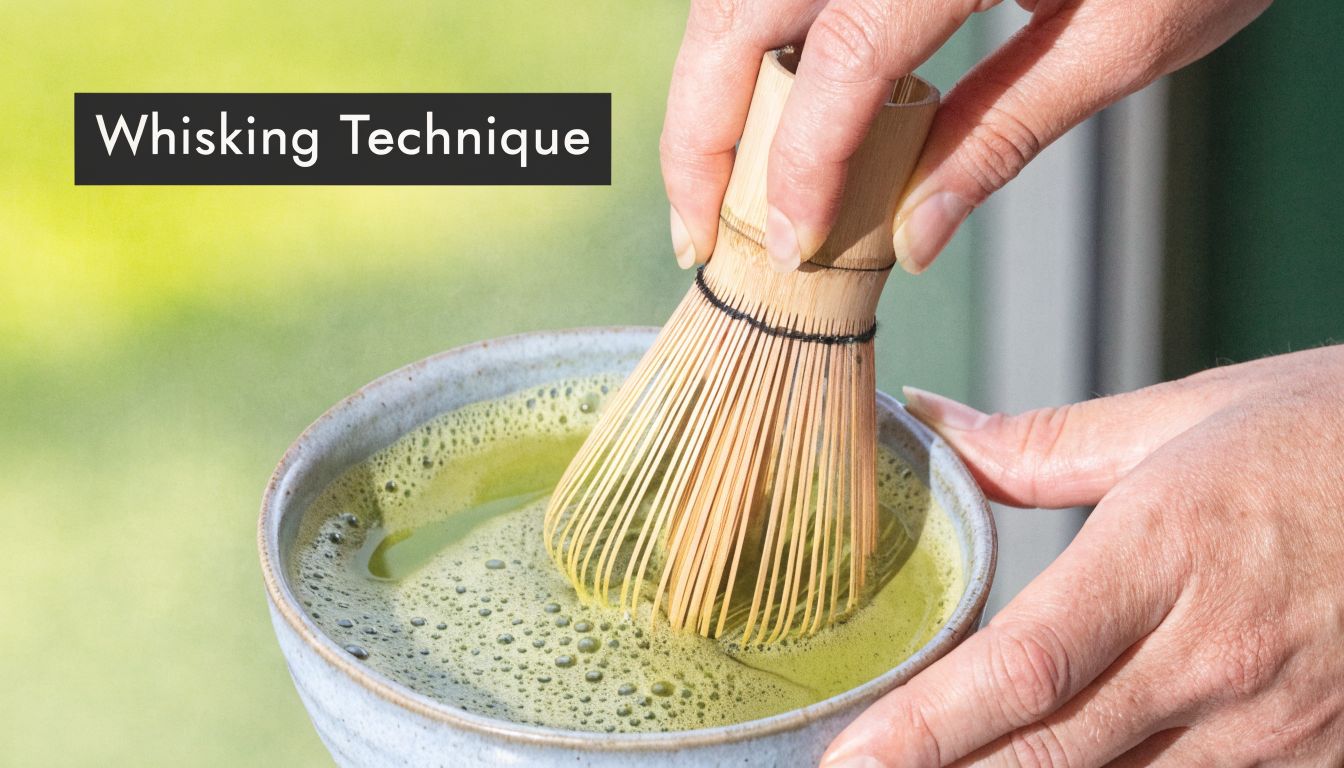
Start by preparing the whisk
Before the matcha touches the bowl, soak the whisk briefly in warm water. This softens the bamboo tines so they open gently and are less likely to snap during use.
A dry whisk is stiff. A softened whisk glides.
The step most people skip
Sift the matcha first. This one action solves an enormous share of home-prep problems.
According to the preparation benchmark cited by Fellow’s matcha set guide, using sifted matcha and 75 to 80°C water achieves a 92% success rate in producing optimal froth, and the vigorous W whisking motion at 200 to 300 strokes per minute is central to building that foam.
Use a fine sieve and press the powder through directly into the bowl. Don’t dump compacted powder into hot water and hope the whisk will rescue it.
A reliable whisking method
Use this sequence when you want a traditional bowl with smooth body and a fine top layer.
Sift the matcha into the bowl
A small mound of fluffy powder is easier to dissolve than compressed clumps.Add hot, not boiling, water
Water in the 75 to 80°C range protects flavour. If it’s too hot, bitterness rises quickly.Begin with slow blending
Use a gentle motion near the base of the bowl to turn the matcha and water into a smooth liquid with no dry pockets.Shift to fast W whisking
Once the powder is dissolved, whisk briskly from the wrist, not the shoulder. The motion should be light, fast, and close to the surface.Stop when the foam looks tight and even
You want fine bubbles, not large froth.
Don’t stir in circles. Circular stirring mixes, but it doesn’t aerate nearly as well.
The physics in plain English
The whisk’s tines break apart tiny clusters of powder while pulling air into the liquid. The bowl’s width gives those movements enough travel to generate a suspended, creamy texture instead of a muddy one.
That’s why the wrist matters. A loose wrist creates speed and lift. A rigid arm creates splashing and uneven mixing.
Here’s a useful visual if you want to watch the motion in real time:
What a finished bowl should look like
A properly whisked bowl should have:
- A smooth body with no visible powder islands
- A fine foam layer rather than big soap-like bubbles
- An even green colour across the surface
- A clean first sip without grit collecting on the tongue
If the bowl tastes grassy but pleasant, you’re close. If it tastes harsh and flat, check water temperature and sifting before blaming the matcha itself.
From Clumps to Flat Foam Troubleshooting Your Technique
You whisk a bowl before work, the colour looks right, but the surface stays flat and the sip turns grainy halfway through. That usually points to a specific fault in the setup, not a mysterious lack of skill.
Matcha is sensitive to small variables. Powder size, bowl shape, whisk flexibility, and local water all change how air and liquid behave in the bowl. In many Australian homes, water straight from the tap carries enough mineral content to affect flavour and tool feel over time, especially compared with the softer water many cafés filter before service.
Persistent clumps usually start before whisking
Clumps form because matcha is hygroscopic. It pulls in moisture from the air, then compresses into little pellets that hot water struggles to break apart. Once those pellets hit the bowl, the outer layer wets first and seals the dry powder inside.
That is why a proper matcha tea sifter matters so much. It separates the powder before water touches it, which gives you a smoother mix and a cleaner texture with less effort from the wrist.
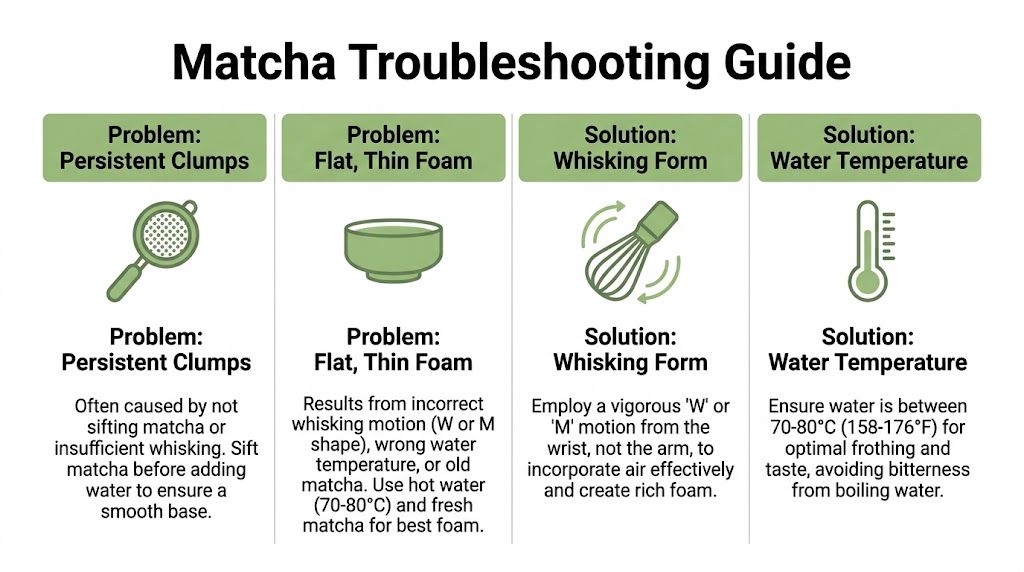
If clumps keep showing up even after sifting, check the age and grade of your matcha. Fresh, finely milled powder disperses far more easily. A clean, vibrant matcha such as Pep Tea’s also gives you a wider margin for error, because the powder itself is milled for a smoother bowl.
Flat foam usually comes from one of three things
Start with the whisk. If the tines feel stiff, stick together, or curl inward, they stop flicking air into the liquid efficiently. Foam depends on many tiny bubbles held in suspension. A tired whisk makes larger bubbles, then those bubbles collapse fast.
Next, check the water. Very hot water weakens sweetness and pushes bitterness forward, but mineral-heavy water can also mute the texture and leave bamboo feeling rough after repeated use.
Then check the bowl. A narrow mug blocks the whisk’s side-to-side travel, so the motion turns into stirring instead of rapid surface aeration. The whisk needs horizontal room to build a tight foam cap.
Quick fixes that usually work
For clumps
Sift into the bowl, add a small splash of water first, and press out any stubborn spots before full whisking.For bitterness
Use water below boiling. If the bowl tastes sharp and hollow, heat is usually the first thing to correct.For weak foam
Inspect the chasen before blaming your technique. Split, brittle, or inward-bent tines cannot trap air properly.For mineral build-up
If your water is hard, rinse the whisk well after each use. An occasional brief soak in warm water with a little white vinegar can loosen residue, followed by a thorough rinse.
When the bowl is the real problem
I see this often with people who start matcha using whatever mug is in the cupboard. The powder can dissolve, but the foam never gets that fine café-style finish because the whisk cannot move freely near the surface.
A wide bowl gives you two advantages at once. It lets the tines travel quickly, and it spreads the liquid into a shallower layer, which makes it easier to pull air through the top. That is the small piece of physics many home brewers miss.
If your motion has improved and your matcha is still coming out thin, change the vessel before changing everything else. Sometimes the best correction is giving the whisk enough room to do its job.
Keeping Your Matcha Whisk and Bowl in Perfect Condition
A bamboo whisk is a working tool. Treat it gently and it rewards you with better texture, cleaner foam, and a more consistent bowl.
The key is speed and simplicity after use.
How to clean the whisk properly
Rinse the whisk under warm water as soon as you finish. Don’t leave matcha drying between the tines, because dried residue makes the whisk stiff and awkward next time.
Skip soap. Bamboo can absorb smell and flavour, and that can end up in the next bowl.
A whisk also dries better when it keeps its natural curve. A matcha whisk stand helps the tines hold their shape while air circulates around them.
How to care for the bowl
The bowl is much easier. Wash it by hand with warm water and a soft cloth, then dry it well before storing. Gentle handling is enough.
A few habits make a real difference:
- Rinse immediately so matcha doesn’t cling to the surface
- Avoid harsh cleaners if you want the bowl’s finish to age well
- Store fully dry to prevent musty cupboard odour
- Keep bamboo out of prolonged soaking because constant saturation weakens it over time
Good maintenance isn’t separate from the ritual. It’s part of the ritual.
When your tools stay clean and correctly shaped, your technique stays reliable. That’s the whole point.
Beyond the Bowl Creative Matcha Recipes
A proper bowl teaches habits that carry into every modern matcha drink Australians make at home. The order stays the same. Sift, add water, whisk smooth, then build the rest around that base.
That matters even more here, because local water can change the result. Softer water often gives a rounder, sweeter bowl, while harder water can make green notes taste sharper, especially once milk or ice enters the mix. Starting with a clean, glossy matcha concentrate gives you more control.
Turn the bowl into a latte base
For a hot latte, whisk a short, strong base in the bowl first. Use less water than for usucha, then whisk until the surface shows a fine foam and the liquid underneath looks fully unified. After that, pour it into warm milk.
This is the part many cafés rush, and the cup shows it. Matcha added straight to milk tends to float, cling to fat, and leave dark specks on the finish. A concentrated base fixes that by hydrating the powder before dilution. Pep Tea’s fine grind makes that step easier, because the particles disperse quickly and stay smoother in the cup.
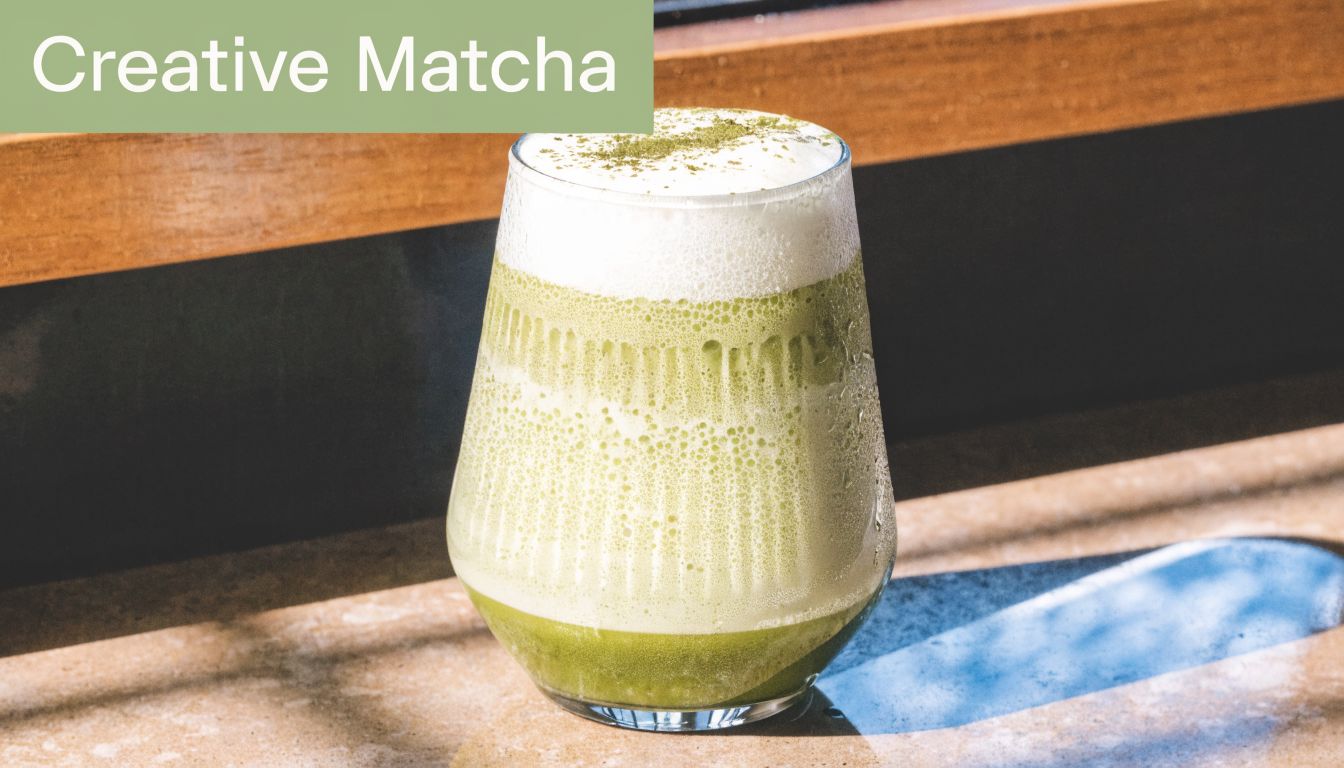
Iced matcha works best when the first step stays traditional
Cold drinks magnify mistakes. Any clump you leave in the bowl becomes more obvious over ice.
Whisk the concentrate with warm water first, then pour it over ice and cold milk. Warm water helps the powder wet evenly. Ice then locks in the texture and keeps the drink bright instead of muddy. If you shake unsifted matcha straight in a jar, you usually get foam on top and sediment underneath, which is a very different drink from a properly built iced matcha.
If you enjoy functional variations, Mushroom Matcha Benefits is a useful read for seeing how matcha is being paired with other wellness ingredients.
Creative recipes that still respect the bowl
A bowl and whisk are not limited to plain matcha. They are the best starting tools for recipes where texture matters.
Try these:
- Iced strawberry matcha. Make the matcha concentrate in the bowl, add strawberry puree to the glass separately, then pour slowly so the layers stay clean.
- Matcha coconut latte. Use coconut milk for body, but keep the matcha base lighter so the drink does not turn heavy or chalky.
- Sparkling matcha tonic. Whisk matcha with a small amount of water until smooth, then top with chilled tonic. The bitterness of tonic can sharpen lower-grade matcha, so this works best with a clean, sweet powder.
- Matcha affogato. Pour a concentrated bowl over vanilla ice cream. The contrast only works if the matcha is smooth and vivid.
Each recipe asks for a different concentration, but the same physics apply. Fine particles need full hydration. Air needs to be introduced in a controlled way. The bowl gives you room to do both before extra ingredients get in the way.
What cafés need to consider
Home drinkers and cafés solve different problems. At home, the goal is pleasure and consistency. In a busy Australian café, speed, staff training, milk workflow, and water filtration all affect the cup.
Many venues now use a hybrid approach. They whisk a proper base for flavour and texture, then adapt the build for service. That trade-off makes sense. Good technique is still good technique, even when the setting is faster and the menu includes iced lattes, strawberry matcha, and seasonal specials.
The bowl remains the quiet advantage. It gives the whisk enough space to move, helps the powder dissolve evenly, and turns recipe experiments into drinks that still taste like real matcha.
Your Matcha Questions Answered
Can I use an electric frother instead of a bamboo whisk
You can. It’s better than using a spoon. But it usually creates larger bubbles and a looser texture.
A bamboo whisk is shaped to produce a finer foam and a smoother mouthfeel. It also gives you more control over how vigorously the matcha is aerated.
Is culinary matcha okay to drink
Yes, especially in lattes, smoothies, and baking. It tends to be stronger and more assertive, which helps it stand up to milk and other ingredients.
For drinking with just water, ceremonial-style matcha is usually the more elegant choice because the flavour is more exposed.
Why does my matcha taste bitter even when I whisk properly
Usually because the water is too hot, or because the powder wasn’t sifted and dissolved cleanly before vigorous whisking. A rough bowl often tastes harsher than a smooth one, even when using the same matcha.
Do I need the bowl, or can I use any cup
Any cup can hold liquid. That’s not the same as helping you make good matcha. A proper bowl gives the whisk room to move, which directly affects texture.
How often should I replace my whisk
Replace it when the tines lose flexibility, begin breaking, or stop producing the texture you expect even with good technique and clean water.
If you’re ready to build a better daily ritual, explore Pep Tea for premium organic matcha, practical accessories, and Australian guidance that makes the process feel approachable rather than fussy.
Matcha Tea Brush: Your Ultimate Guide to Whisking

You’ve probably done this before. You buy beautiful matcha, warm the bowl, add water, then stir with a spoon or attack it with a whisk that feels far too delicate for the job. The result looks dull, tastes flat, and leaves little green clumps hugging the side of the bowl.
That’s usually the moment the matcha tea brush starts to make sense.
A proper bamboo whisk, or chasen, isn’t decorative extra gear. It’s the tool that turns powdered tea and water into something silky, airy, and balanced. It helps with texture, helps with mixing, and it helps you slow down enough to do matcha properly. In Australian kitchens and cafés, that matters even more because our humidity, storage conditions, and hard water can be rough on bamboo tools if you treat them like ordinary utensils.
If you’ve ever wondered which whisk to buy, how to use it without breaking the prongs, or why your brush keeps going mouldy in a coastal cupboard, you’re in the right place.
More Than Just a Whisk The Soul of Your Matcha Ritual
The first time many people see a chasen, they hesitate. It looks fragile. The fine bamboo tines seem almost too delicate to touch, let alone move quickly through a bowl of tea. But once you use one properly, you realise it’s built for a very specific job.
The matcha tea brush creates the desired texture of “good matcha”. Not just mixed. Properly suspended, lightly foamed, and smooth across the tongue. A spoon can combine powder and water. A bamboo whisk brings the bowl to life.
There’s also something practical hidden inside the ritual. When you pick up a chasen, you naturally pay attention to temperature, bowl shape, and movement. You stop rushing. That’s often the difference between a harsh, grassy cup and one that tastes creamy and rounded.
Why the tool changes the drink
A good chasen is hand-carved from a single bamboo stalk. In traditional crafting, the bamboo is split into fine tines, then shaped so the tips flex in water and move quickly through the bowl. That flexibility is the secret. The whisk doesn’t mash matcha against the bowl like a kitchen whisk might. It suspends the powder through fast, light movement.
A matcha tea brush works best when it barely skims the liquid, not when it grinds against the bowl.
For home drinkers, that means a smoother morning cup. For cafés, it means a more consistent base for straight matcha or lattes. In both cases, the whisk is doing more than mixing. It’s controlling mouthfeel.
Why Australians need a slightly different mindset
A lot of online matcha advice assumes stable storage conditions and softer water. Australian homes don’t always offer either. If you live in coastal NSW, your whisk may stay damp longer than expected. If you’re in a city with hard water, the bamboo can age faster than you think. So learning the ritual isn’t about being precious. It’s about helping the tool last and helping the tea taste right.
That’s where pleasure begins. Once the matcha tea brush stops feeling mysterious, it becomes one of the simplest and most satisfying tools in your kitchen.
How to Choose Your Perfect Matcha Tea Brush
You’re standing in an Australian kitchenware shop or scrolling late at night, and suddenly every whisk looks the same. One has 80 prongs. Another has 100. One looks pale and tidy. Another looks rustic and “handmade,” but the listing says almost nothing. That confusion is normal. A good choice gets easier once you know what changes the cup.
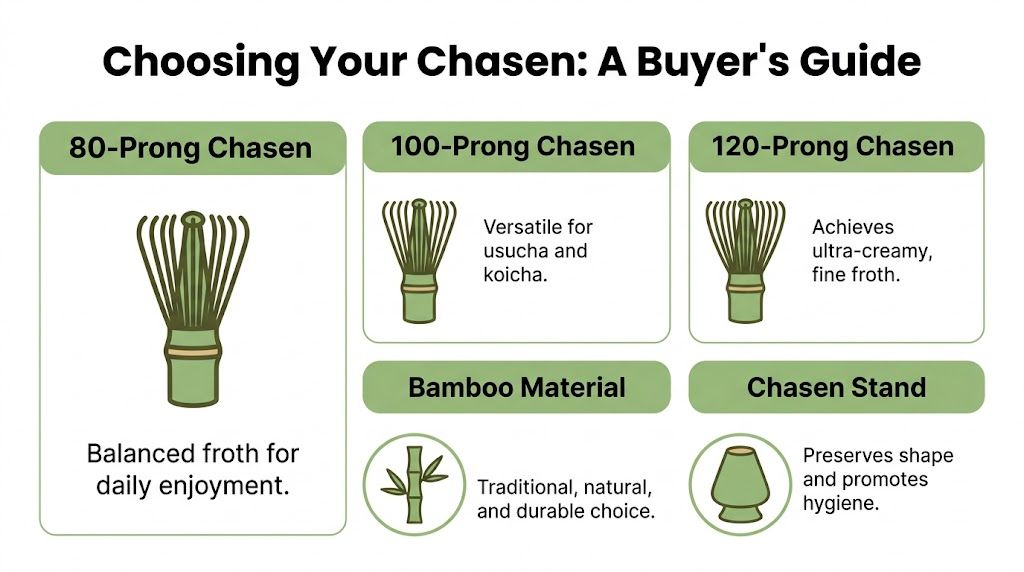
Three things matter most. Prong count, craftsmanship, and whether the seller gives clear information about care and sourcing.
Start with prong count
Prong count changes how the whisk moves through water and matcha. More prongs usually create finer foam with less effort. Fewer prongs often feel a little firmer in the hand and can suit thicker mixes or latte prep.
A simple way to read it is below.
| Matcha Tea Brush (Chasen) Comparison |
|---|
| Prong Count | Ideal For | Foam Level | Best Matcha Grade |
|---|---|---|---|
| 80-prong | Daily matcha and lattes | Balanced froth | Ceremonial or culinary depending on style |
| 100-prong | Usucha, or thin matcha tea | Fine, lively foam | Ceremonial grade |
| 120-prong | Very delicate whisking and ultra-fine froth | Creamier foam | High-quality ceremonial grade |
For many home drinkers, a 100-prong chasen is the easiest place to start. It gives you enough fine movement to make a proper bowl of usucha without feeling fussy. If your goal is that light foam on top and a smooth body underneath, this is usually the safest choice.
If you mainly make matcha lattes, an 80-prong whisk can be practical. It often feels a bit sturdier during everyday use, especially if you are whisking a slightly thicker base before adding milk.
A 120-prong whisk suits drinkers chasing a very fine foam and using high-grade matcha regularly. It can be lovely, but it is not the automatic “better” option for beginners. More delicate tines also demand gentler care, which matters in Australian homes where humidity can slow drying and shorten a whisk’s life if you store it carelessly.
Look closely at craftsmanship
A good chasen is carved from a single piece of bamboo. The tines should look even and neatly spaced. The tips should be slender and slightly curved rather than blunt or splintered.
The easiest comparison is a paintbrush. A brush with tidy, flexible bristles gives you control. One with rough, uneven bristles leaves streaks. A chasen behaves the same way in the bowl.
If the whisk looks ragged before you even use it, it will usually feel rough in the water too. That can mean weaker foam, more clumping, and more pressure against the bowl than you want.
Australian buying advice that generic guides skip
This part gets missed a lot.
A whisk that works beautifully in a dry showroom may behave differently in Brisbane humidity, a Sydney coastal kitchen, or a Melbourne café using mineral-heavy tap water. Australian conditions change what “good value” means. Sometimes the better buy is not the fanciest whisk. It is the one you can dry properly, store properly, and replace without guessing.
Hard water can leave bamboo looking tired sooner. High humidity can keep the inner tines damp long after the outside seems dry. If you live in a humid area, a whisk stand is not just a nice extra. It helps the shape hold while the whisk dries more evenly. If your local water is hard, you may also want to rinse the whisk briefly with filtered water after use to reduce mineral buildup.
Ask better sourcing questions
Many product pages say “natural bamboo” and stop there. That tells you very little.
A better retailer explains where the whisk is made, what style it suits, and how to care for it in real kitchens. The Tezumi guide to chasen is useful here because it shows how much variation exists in bamboo whisks and why details matter.
Use these checks before you buy:
- Purpose. Is it described for usucha, koicha, or general daily use?
- Construction. Does the listing say it is carved from one piece of bamboo?
- Photos. Can you clearly see the tine shape and centre coil?
- Care guidance. Does the seller explain soaking, drying, and storage?
- Australian practicality. Do they mention a whisk stand, humidity, or water conditions?
Buying rule: match the whisk to your routine, your water, and how often you drink matcha.
If you want to compare tools in one place, Pep Tea lists matcha tea accessories with the core preparation pieces Australians usually need.
A simple buyer profile guide
A home drinker making one bowl most mornings will usually do well with a 100-prong whisk.
A latte-focused café may prefer an 80-prong option for repeat service and slightly thicker mixes.
A gift buyer should look past decorative packaging. Clear care instructions and a well-shaped bamboo whisk are more useful than a flashy set with a weak tool inside.
The right matcha tea brush should feel suited to your habits, not just traditional on a product page.
How to Prepare and Season Your New Chasen
On a sticky Brisbane morning or in a Melbourne kitchen with hard tap water, a new chasen can feel confusing. The tines look tight. The bamboo feels stiff. Nothing about it resembles the soft, open whisk you see in matcha videos. That is normal. A new whisk needs a short preparation ritual before it touches tea.
The goal is simple. You are helping dry bamboo absorb a little warmth and moisture so the prongs can flex safely. Bamboo works like a wooden spoon before first use. Straight from storage, it is drier and less forgiving than it will be after a gentle soak.
The quick blooming ritual
Before your first bowl, fill your chawan or a small bowl with hot water that feels just below boiling. Warm, not furious. Place only the tine end of the chasen into the water and leave it there briefly, until the outer tines begin to open and relax. Then lift it out, shake off excess water, and empty the bowl.
A simple routine looks like this:
- Add hot water to your bowl.
- Lower in the prongs, not the handle.
- Soak briefly, just long enough for the tines to soften.
- Check that the outer tips have spread slightly.
- Empty the bowl and start preparing your matcha.
That short soak matters in Australia more than many overseas guides admit. Hard water can leave mineral residue on bamboo over time, and very humid homes can make storage conditions unpredictable. A quick pre-soak prepares the whisk for use without overloading the bamboo with water.
Common mistakes with a new whisk
The first mistake is over-soaking. Leaving a chasen in water for too long weakens the bamboo fibres and can warp the shape.
The second is using boiling water. Excess heat stresses fine tines, especially on a delicate 100-prong whisk.
The third is trying to fix clumpy matcha with force. If your powder has lumps, the whisk ends up doing heavy mixing work it was never meant to do. A fine matcha tea sifter helps here by breaking up clumps before the bamboo starts moving.
A good comparison is warming up a tendon before exercise. You want flexibility, not strain.
Practical rule: store your chasen dry, then soften the tines briefly right before use.
If your local water is very hard, use filtered water for the soak when you can. If your kitchen is humid, let the whisk dry fully after use instead of leaving it enclosed in a drawer or container while damp. Those two small habits make a noticeable difference in how evenly the tines open and how long the chasen keeps its shape.
A properly seasoned chasen feels less brittle, moves more freely, and gives you a much better start on the first whisk.
The Art of Whisking a Perfect Bowl of Matcha
You have the bowl ready, the matcha measured, and the whisk softened properly. Then comes the part that decides whether your tea tastes creamy and rounded or flat and rough. The difference usually comes down to motion, water, and restraint.
A chasen works like a small bamboo engine. Its job is to suspend fine powder evenly through the water and build a soft layer of foam near the surface. It does that best with a light wrist and quick movement through the upper part of the bowl, not by pressing into the ceramic.
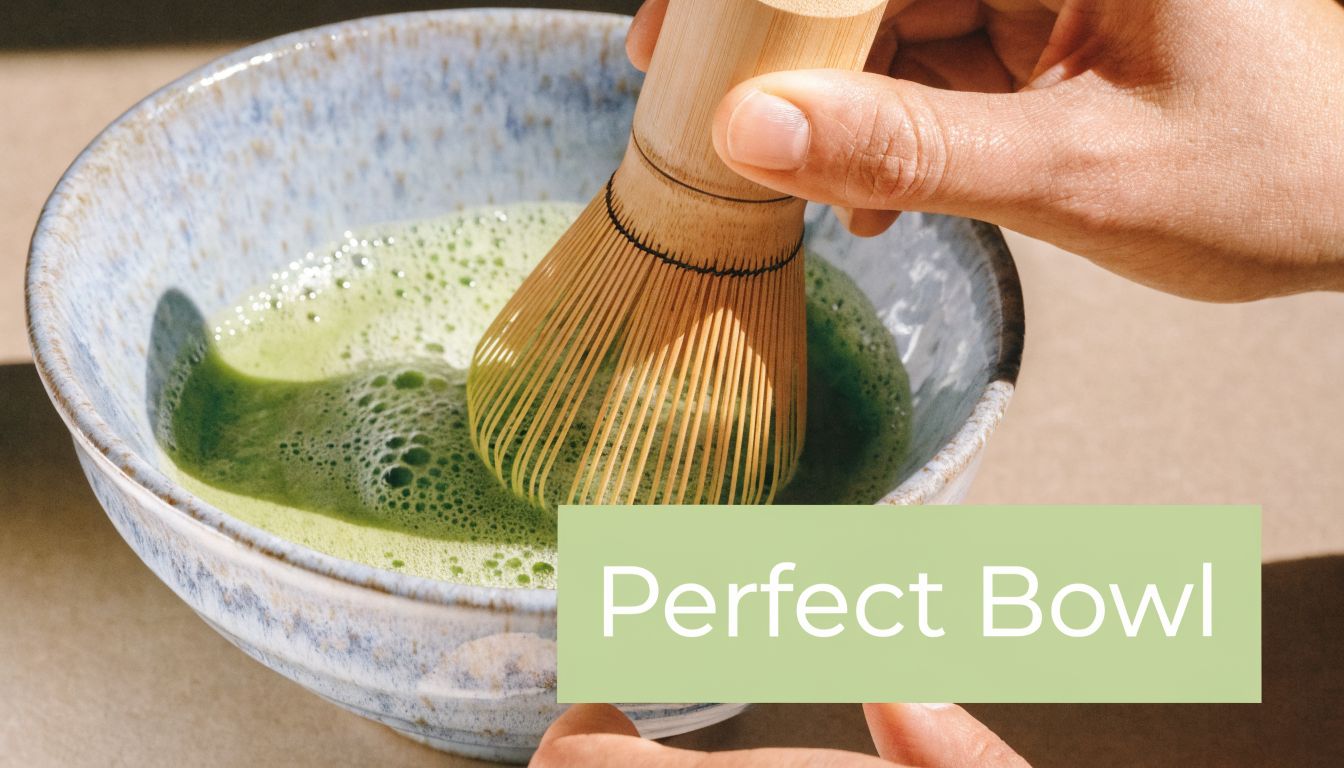
The basic usucha method
For a classic bowl of usucha, start with sifted matcha in a wide bowl, add a small amount of hot water, and whisk before topping up. A practical guide is 2g of matcha, 50ml of water at 75 to 80°C to start, then the remaining water once the paste has loosened and the surface begins to foam. Keep the whisk about 1 to 2cm above the base so the tines can flex freely instead of scraping.
If you are used to stirring tea, this feels different at first. The movement is compact and fast, mostly from the wrist. Your forearm stays fairly quiet.
A simple way to remember the technique
- Sift first so the whisk is not fighting lumps.
- Start with a small amount of water so the matcha disperses evenly.
- Whisk with the wrist for speed and control.
- Work near the surface zone where fine foam forms.
- Finish with a gentler pass to even out the top.
The motion that creates froth
The classic pattern is a fast W or M motion. That shape keeps the whisk moving across the bowl without grinding the tips into the bottom. Circular stirring tends to leave heavier liquid below and larger bubbles on top, a bit like stirring cocoa and wondering why the powder still sits in patches.
The bowl gives you useful feedback. A soft brushing sound usually means the whisk is floating where it should. A scratchy sound means the tines are hitting the base too often.
This matters in Australia because local conditions can affect texture. In hard-water areas, minerals can flatten flavour and make foam a little less fine. In humid kitchens, especially in coastal homes and busy cafés, matcha can clump faster once the tin is open. If your whisking feels correct but the bowl still looks uneven, the issue may be the powder or the water rather than your hand.
A matcha whisk stand for drying and shape retention also helps the whisk keep its open form between uses, which makes the next bowl easier to froth consistently.
What the foam should look like
Good usucha foam is fine-bubbled and even, with a soft sheen across the top. Velvety is the right target.
A few larger bubbles around the edge are not a disaster. They usually mean the movement was slightly uneven or the final whisking pass was too forceful. Lighter, quicker strokes often fix that faster than whisking longer.
A short demonstration helps if you’re more visual:
Water temperature matters more than people think
The whisk often gets blamed for bitterness, but overheated water is a common cause. Matcha prepared around 75 to 80°C usually tastes sweeter, fuller, and less sharp than matcha hit with freshly boiled water.
That point is especially useful in Australian homes where kettles boil fast and many people pour immediately. If you do not have a temperature-controlled kettle, let the water sit briefly after boiling, or pour it into another vessel first to drop the heat before it meets the tea.
Small technique changes that improve the bowl
A few adjustments make a noticeable difference:
- Keep the whisk lifted slightly so the tines glide instead of grind.
- Build speed in the middle of the whisking, where the foam forms fastest.
- Stop once the surface looks fine and even rather than chasing extra froth.
- Use a wider bowl for usucha so the whisk has room to move.
For café prep, the same rules apply. A latte still needs a smooth matcha base before milk goes in. Milk can soften the taste, but it cannot undo clumps or poor suspension.
Good whisking feels quick because it is precise. Light hand, loose wrist, correct water, and a bowl that sounds quiet while you work. That is what turns powdered tea into a smooth, balanced cup.
Proper Cleaning and Storage for Your Matcha Brush
You finish a bowl, set the whisk in the sink, answer a message, and come back later to bamboo that smells faintly damp and looks tighter than it did ten minutes ago. That is how many chasen problems start. The whisking part gets the attention, but the actual wear often happens in the few minutes after you drink the tea.
A chasen is carved from one piece of bamboo. It behaves more like a fine wooden kitchen tool than a metal whisk. Leave it wet, trap it in a drawer, or wash it like cutlery, and the tines lose flexibility fast.
In Australia, that risk goes up because local conditions are rarely neutral. Coastal humidity slows drying, and hard water in some suburbs can leave a mineral film on the bamboo. Generic care advice often skips both.
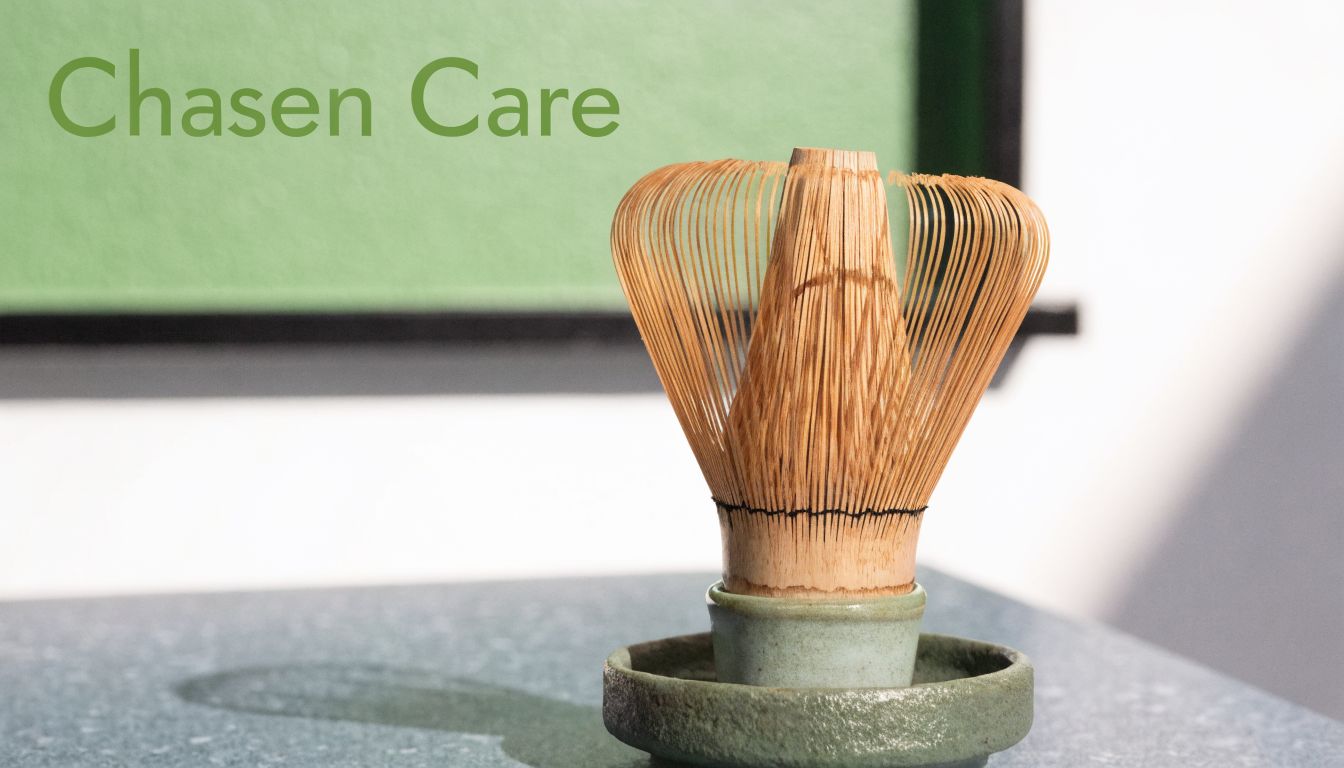
The correct cleaning routine
Clean the whisk as soon as you finish using it. Dried matcha sticks between the tines and pulls them inward as it hardens.
The routine is simple. Rinse the chasen in warm water. Use your fingers only if a little matcha is caught near the centre, and keep the touch light. Skip soap completely. Bamboo absorbs it, and the residue can dry the fibres and leave an odd scent that shows up in the next bowl.
After rinsing, shake off excess water and check the shape. If a few tines have curled together, ease them apart gently with wet fingers rather than forcing them dry later.
Why a stand matters in Australian homes
Drying shape matters almost as much as cleaning. A whisk left flat on the bench holds moisture where the tines meet, which is the slowest part to dry.
A holder supports the natural curve while air moves through the centre. That helps the whisk dry evenly and keeps the prongs from collapsing inward. If you want a practical example, a ceramic matcha whisk stand for drying and shaping a chasen gives the brush a dedicated place to rest between bowls.
Store it in the open, not in a closed cupboard straight after washing.
That point matters in Sydney, Brisbane, the Gold Coast, and other humid parts of the country where a kitchen can stay damp for hours. A whisk that seems dry on the outside may still be holding moisture at the base.
Hard water and humidity need a local fix
Hard water leaves clues. The bamboo starts to feel slightly rough, the tines look chalky, and the whisk loses some of its spring even when you are handling it well. If your kettle builds scale quickly, your chasen is dealing with the same minerals.
An occasional rinse with filtered water can help if your tap water is particularly mineral-heavy. If buildup is already visible, a very diluted vinegar rinse used sparingly can remove residue, but follow it with plain water so no smell remains. This is not an every-day step. It is a reset for mineral film.
Humidity needs a different approach. Keep the whisk away from the kettle plume, the dishwasher, and the splash zone beside the sink. Those spots look convenient, but they create a damp little climate around the bamboo.
A practical care routine for Australian kitchens
- Rinse straight after use so matcha does not dry between the tines.
- Use warm water only. No detergent, no soaking in cleaning products.
- Dry upright in open air so the centre of the whisk can dry.
- Use filtered water sometimes if your tap water is hard and leaves mineral marks.
- Keep the whisk away from steam and enclosed storage until fully dry.
What cafés should standardise
In cafés, the problem is usually inconsistency. One staff member rinses and stores the whisk properly. The next leaves it damp beside the machine during a rush.
Set one routine for everyone:
- Rinse immediately after each use.
- Use warm water only.
- Shake off excess water.
- Dry on a holder in a ventilated spot.
- Replace the whisk if it smells musty, shows mould, or has significant tine loss.
A good chasen does not need complicated care. It needs prompt rinsing, open airflow, and a bit of respect for bamboo in Australian conditions.
Troubleshooting Common Matcha Brush Issues
You whisk a bowl before work, and the chasen suddenly feels wrong. A few tines have snapped, the matcha looks flat, or there is a damp smell that was not there last week. In Australian kitchens, that usually comes back to a small mismatch between bamboo and its environment. Hard water, coastal humidity, and hot tap habits all show up quickly in a matcha brush.
My tines keep breaking
Broken tines usually point to stress on the bamboo, not bad luck. A chasen is carved from one piece of bamboo, so each tine is thin by design. That gives you speed and fine foam, but it also means rough contact shows up fast.
Check the common causes:
- The whisk is hitting or scraping the bottom of the bowl. The tines should flex through the water, not grind against ceramic.
- The water is too hot. Very hot water makes bamboo more brittle.
- The whisk went in dry. Dry tines are stiff, so they are more likely to snap under pressure.
- Mineral buildup is making the tines less flexible. This is more common in parts of Australia with hard tap water.
- The whisk was knocked around in storage. A drawer full of cutlery is a terrible place for a chasen.
A good test is to watch your whisk from the side while you prepare matcha. The tips should skim just above the base, like a brush sweeping over paper without digging in.
My matcha is still clumpy
Clumps often start before the whisk even touches the bowl. Matcha behaves a bit like cocoa powder. Once small lumps get wet on the outside, the dry centre can hide inside and resist whisking.
If your bowl stays grainy, work through the process in order:
- Sift the matcha first if the powder has compacted in the tin.
- Start with a small amount of water to make a smooth paste before adding more.
- Use quick wrist motion in a W or M pattern near the surface.
- Give the whisk room to move. A narrow mug makes proper whisking harder than a wide bowl.
Water quality can also play a part. In hard-water areas, matcha can feel slightly duller and less lively in the bowl. If your technique is sound but the texture still seems heavy, try filtered water for a few days and compare.
The prongs are bending outward
Some spreading is normal. A new whisk opens up with use, just like a new paintbrush softens once the bristles get wet. What you are looking for is uneven splaying, flattened tips, or a shape that looks twisted.
That usually happens for three reasons. The whisk is being pressed down too hard. It is drying in a cramped position. Or it is staying damp for too long, then drying unevenly.
Australian conditions matter more than many guides admit. In a humid Brisbane or Sydney summer, a whisk can stay slightly damp in the middle long after the outside feels dry. That trapped moisture can leave the shape sloppy over time.
The centre looks loose
The centre loop can worry new matcha drinkers because it rarely looks perfectly symmetrical after repeated use. Mild movement is normal. Bamboo softens, flexes, and settles.
Focus on performance instead of perfect appearance. If the whisk still creates a fine surface froth and feels stable in the bowl, the centre does not need to look pristine. If the inner tines are collapsing inward, catching on each other, or no longer springing back, the whisk is wearing out.
There’s a smell I don’t trust
A healthy chasen smells faintly woody, dry, or almost like nothing at all. Sour, musty, or stale smells usually mean moisture sat in the core too long.
In Australia, this often happens in two places. One is beside the kettle, where repeated steam keeps the bamboo damp. The other is in enclosed cupboards that feel tidy but hold humid air.
If the smell is light and there is no visible mould, let the whisk dry fully in a well-ventilated spot and reassess. If the odour is persistent, or you can see mould spotting, replace it. Bamboo is porous. Once contamination settles deep into the fibres, trying to save it is rarely worth the risk.
My whisk is leaving weak foam
This problem confuses a lot of people because the whisk gets blamed first. Sometimes the actual issue is old matcha, too much water, or a slow wrist.
A tired chasen can contribute, though. If many tine tips have broken off, or the whisk has lost its spring, it will struggle to introduce enough air into the bowl. Café teams see this often when one whisk gets pushed far past its useful life.
Ask three quick questions:
- Is the matcha fresh enough to foam well?
- Am I whisking briskly near the surface rather than stirring deep in the bowl?
- Has the chasen lost enough tines that it can no longer move the liquid cleanly?
Troubleshooting a chasen works best when you read it like a bamboo tool, not a kitchen gadget. Snapped tines usually mean friction or heat. A musty smell points to trapped moisture. Weak foam often traces back to technique, age, or worn tips. Once you match the symptom to the cause, the fix is usually straightforward.
Your Matcha Brush Questions Answered
A lot of confusion around the matcha tea brush comes from people trying to simplify it too much. It’s not a fussy object, but it is a specialised one. These are the questions that come up most often once people start using a chasen regularly.
Quick answers in one place
| Frequently Asked Questions |
|---|
| Question | Answer |
|---|---|
| Do I really need a bamboo whisk for matcha? | If you want traditional texture and a fine surface froth, yes. A spoon mixes, but it won’t create the same suspension or mouthfeel. |
| Is a 100-prong whisk a good starting point? | Yes, especially for usucha. It’s the most straightforward choice for home drinkers who want a foamy bowl. |
| Can I use an electric frother instead? | You can for convenience, especially in latte prep, but it won’t behave like a chasen in the bowl and it changes the ritual and texture. |
| Should I soak the whisk every time? | A short warm soak before use helps the tines soften and flex safely. |
| Can I wash it with dish soap? | No. Warm water is the safe choice for bamboo care. |
| Do I need a whisk stand? | It’s strongly recommended because it helps the whisk dry upright and keep its shape. |
| When should I replace my chasen? | Replace it when tine loss is heavy, the shape is badly compromised, or mould or persistent odour appears. |
| Can I make lattes with a matcha tea brush? | Yes. You can whisk a concentrated matcha base first, then add milk. |
Is the bamboo whisk only for traditional tea drinkers
Not at all. The chasen is useful whether you drink straight ceremonial matcha, iced matcha, or a latte. The key difference is the end texture you want.
For a straight bowl, the whisk creates a fine surface and more integrated texture. For a latte, it gives you a smoother concentrate before milk enters the cup. That first stage still matters.
What’s the difference between a matcha tea brush and a kitchen whisk
A kitchen whisk is built to beat, fold, and combine larger volumes. A chasen is built to move quickly through a small bowl with minimal friction. The bamboo tines are fine enough to lift the tea into suspension while staying gentle on the powder.
That’s why a metal whisk often feels too heavy-handed for traditional preparation. It can mix the drink, but it doesn’t create the same finesse.
Does prong count really matter
Yes, but not in a snobbish way. It changes the feel of the tool and the kind of foam you’re likely to get.
A higher-prong whisk usually helps newer drinkers create a more even froth with less effort. A lower-prong whisk may suit thicker tea styles or drinkers who prefer a different feel. The “best” option depends on what you make most often.
Why does my whisk look different after a few uses
Because it’s supposed to change a little. Dry bamboo looks tighter. Soaked and used bamboo opens up. The tines relax, the shape settles, and the brush becomes more responsive.
What you don’t want is severe splitting, snapped tips, mould, or deep distortion. Gentle visual change is normal. Rapid collapse isn’t.
Can I leave the whisk soaking while I drink my matcha
Better not. A short pre-use soak is helpful. Extended soaking isn’t. Bamboo likes brief moisture exposure followed by proper drying.
If you leave the whisk sitting in water while you chat, work, or clean the kitchen, the tines stay stressed and the drying cycle gets delayed. That’s not great in humid weather.
Is a darker bamboo whisk better than a lighter one
Not automatically. Colour can reflect the type of bamboo or finish, but it doesn’t guarantee quality. Pay more attention to even carving, tine shape, and whether the seller explains origin and care clearly.
Can I travel with a chasen
Yes, but protect it. Don’t throw it loose in a drawer or bag. If you’re taking matcha to the office or on holiday, keep the whisk in a breathable container and let it dry fully before packing.
Is mould always obvious
No. Sometimes you’ll see spots. Sometimes you’ll just notice a stale smell or a tacky feeling in the tines. If something seems off, trust your nose and your eyes.
In humid parts of Australia, mould prevention is mostly about routine. Rinse, shake off water, dry upright, and don’t trap the whisk in a closed damp space.
Should cafés keep one whisk per staff member
That depends on service style, but the more important issue is shared standards. Every person preparing matcha should use the same method for soaking, whisking, rinsing, and drying. A beautifully made whisk won’t survive a chaotic prep station.
What’s the smartest beginner setup
Keep it simple:
- A 100-prong chasen
- A bowl with enough width to whisk comfortably
- A sifter
- A whisk stand
- Fresh matcha and water that isn’t boiling
That’s enough to learn properly without cluttering the process.
A matcha tea brush seems niche until you use one well. Then it feels obvious. It’s the small bamboo tool that makes the whole bowl come together.
If you’re building a better matcha routine at home or in your café, Pep Tea offers organic matcha, preparation accessories, and practical guidance for Australian drinkers who want cleaner flavour, better texture, and tools that fit real daily use.
Master Matcha Making Kit: Your Perfect Brew Awaits

You’ve probably seen a matcha making kit online, loved the look of the bowl and whisk, then paused at the checkout wondering whether you need all of it. Fair question. A lot of first kits are bought on impulse, used twice, then pushed to the back of the cupboard because the tea came out bitter, lumpy, or oddly flat.
The good news is that making proper matcha at home isn’t hard. It’s just precise. A few simple tools, the right powder, and a couple of small habits make all the difference. Once those pieces are in place, your morning cup starts to feel less like a fiddly task and more like a ritual you’ll want to repeat.
A good matcha making kit should do two jobs well. It should help you whisk a smooth bowl of tea, and it should remove doubt about what you’re putting into that bowl. For Australian drinkers, that second part matters more than most guides admit.
Choosing Your First Matcha Making Kit
The cheapest kit is rarely the best first buy.
That doesn’t mean you need something ornate or collector-level. It means your matcha making kit should be built around safety, usability, and powder quality, not just aesthetics. Plenty of kits look lovely in product photos but fall short where it counts. The whisk splays too quickly, the bowl is awkward to whisk in, or the included matcha is an afterthought.

What a first kit should include
At minimum, look for these pieces:
- A chawan bowl: Wide enough to whisk in comfortably. A narrow mug makes frothing harder and usually leaves clumps around the edges.
- A chasen whisk: This is the bamboo whisk that gives matcha its light foam and smooth texture.
- A chashaku scoop: Helpful for consistent portions and part of the traditional process.
- A fine sifter: Often skipped in budget sets, but it’s one of the most useful tools in the whole routine.
If a set omits the sifter, I’d still consider buying it, but only if you’re happy to add a fine kitchen sieve yourself. Skipping sifting is one of the quickest ways to end up with gritty matcha.
The real buying question isn’t price
Most beginners compare kits by appearance first and price second. I’d reverse that thinking. Compare them by what they let you avoid.
You want to avoid a whisk with rough or brittle tines. You want to avoid unclear materials. You want to avoid powder with vague sourcing. And you want to avoid kits that bundle in low-grade matcha just to look complete.
Practical rule: If the seller is detailed about the tools but vague about the matcha, treat that as a warning sign.
There’s a genuine gap in the Australian market around organic certification and sourcing. One review of starter kit content notes that many kits focus on the tools while leaving buyers with very little clarity about certified-organic powder and food-grade tool standards, which matters for Australian consumers trying to buy carefully from trusted suppliers (matcha kit sourcing and certification gaps).
What matters most for Australian buyers
If you care about clean ingredients, don’t treat the powder as separate from the kit. Treat it as the centrepiece.
A whisk can help texture. A bowl can help technique. But the flavour, colour, aroma, and overall drinking experience come from the matcha itself. For that reason, I’d rather see a simple kit paired with certified organic matcha than a deluxe set with uncertain powder.
Here’s the short version of what to check before buying:
| What to check | Why it matters |
|---|---|
| Organic certification | Gives you a clearer standard for how the powder was produced |
| Food-grade tool materials | Helps you avoid uncertainty around bamboo and glaze quality |
| Wide bowl shape | Makes whisking easier and improves foam |
| Separate scoop and sifter | Keeps your portioning and texture more consistent |
| Clear sourcing information | Usually signals better care and transparency overall |
For gifting, presentation still matters. If you’re comparing more polished options for birthdays, housewarmings, or wellness gifts, it can help to browse various gift guides and then come back to the practical checklist above so the set looks good and works well.
What works and what usually disappoints
What works:
- A simple ceramic bowl with room to whisk
- A bamboo whisk that feels springy, not dry or fragile
- Matcha sold with clear quality cues rather than bundled as filler
- A set from a supplier that understands preparation, not just packaging
What often disappoints:
- Tiny bowls: Pretty on a shelf, frustrating in use
- Decorative kits with no sifter: You’ll fight clumps from day one
- Mystery matcha: Dull colour, harsh taste, poor value
- Ultra-cheap bundles: Fine for photos, less fine for daily drinking
If you want an example of a straightforward set designed for home preparation, Pep Tea offers a Japanese matcha set that includes the traditional tool format essential for most beginners.
Your First Bowl A Mindful Matcha Ritual
Making your first bowl of matcha goes better when you stop trying to rush it.
The best bowls I’ve made at home haven’t come from speed. They’ve come from giving each part of the process a reason. Warm the bowl because temperature matters. Sift the powder because texture matters. Whisk with focus because the final cup shows every shortcut.
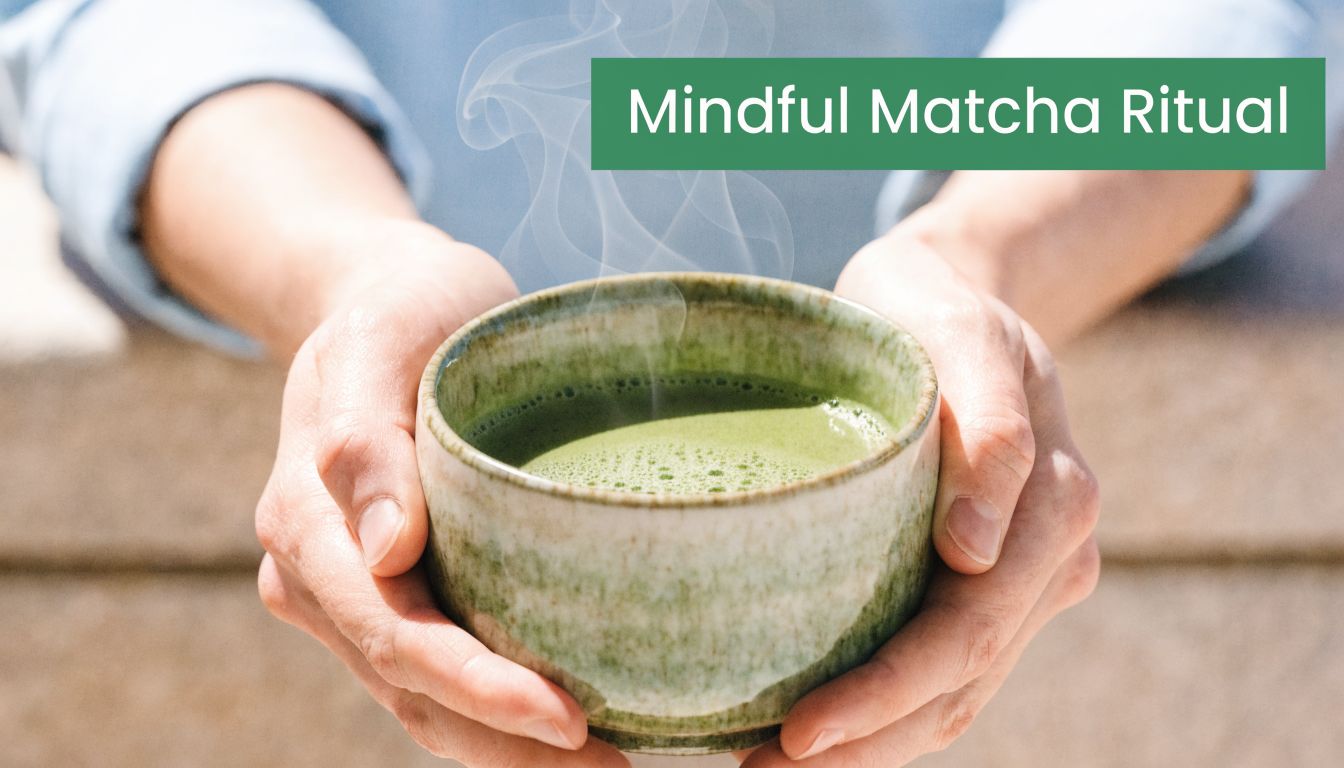
Start by warming the bowl
Pour hot water into your bowl and let it sit briefly. Then warm the whisk in that same water for a moment.
This step does two useful things. It takes the chill off the bowl so your tea stays pleasant to drink, and it softens the whisk tines slightly so they’re less likely to feel stiff or scratchy when you begin. Empty the bowl, then dry it well. If the bowl is wet before the powder goes in, the matcha can stick and form paste-like lumps.
Sift the powder every single time
For a traditional everyday bowl of usucha, use 2g per serving. Sift it into the dry bowl.
That amount is small enough to feel approachable and strong enough to show the character of the tea. Sifting is the difference between smooth and frustrating. Matcha is a fine powder, but it still clumps easily in the tin. Once hot water hits those clumps, they’re harder to break apart cleanly.
Skip sifting once and you’ll usually spend the rest of the bowl chasing little green lumps around the bottom.
Add water that’s hot, not scalding
Your water should be hot enough to wake up the matcha, but not so hot that it knocks the life out of it. If you’ve just boiled the kettle, let the water cool a little before pouring.
When the water is too hot, matcha can taste sharper and less balanced. When the temperature is gentler, you’re more likely to notice sweetness, softness, and that fresh green character people are often chasing in cafés.
A helpful beginner method is this:
- Boil your kettle
- Warm the bowl and whisk
- Dry the bowl
- Sift in your 2g of matcha
- Add a small amount of hot water first
- Whisk into a loose paste before adding the rest
That first small splash of water matters. It helps the powder open up evenly rather than floating in dry pockets.
Let your senses guide the process
As you whisk, listen for the light tapping sound of bamboo moving quickly across the surface. Watch the colour brighten. Notice when the texture changes from thin and watery to silky and lightly foamed.
A good first bowl doesn’t need to look perfect. It just needs to feel integrated. No dry clumps, no sludge at the base, no harsh burnt note from overheated water.
Here’s a simple sensory checklist:
- Colour: Fresh, vivid green rather than dull olive
- Aroma: Grassy, creamy, or softly vegetal, not burnt
- Texture: Smooth and fine, with a light layer of froth
- Finish: Clean and rounded, not aggressively bitter
Drink it while it’s alive
Matcha doesn’t improve by sitting around. Once whisked, drink it promptly.
That’s part of why the ritual feels grounding. You make one bowl, you hold it warm in your hands, and you drink it in the moment it was prepared. It isn’t a brew to forget on the bench while you answer emails.
Small habit, big payoff: Sit down for the first few bowls you make. When you’re standing and distracted, you’ll rush the whisking and miss the flavour cues.
If you’re new to the taste, don’t judge matcha by your first sip alone. The opening can feel grassy or savoury if your palate expects sweetness. Give it a few mouthfuls. Good matcha tends to settle into itself as you drink, and your palate catches up quickly.
Mastering the Whisk The Art of the Perfect Froth
The chasen, or bamboo whisk, is the heart of the matcha making kit. It has been central to matcha preparation since Japan’s Muromachi period (1336–1573), while the broader practice of whipping powdered tea reaches back to China’s Song Dynasty (960–1279 AD), which gives this simple tool a long history in tea preparation (history of the matcha whisk).
That history is lovely, but what matters in your kitchen is this. The whisk isn’t there to stir. It’s there to aerate.
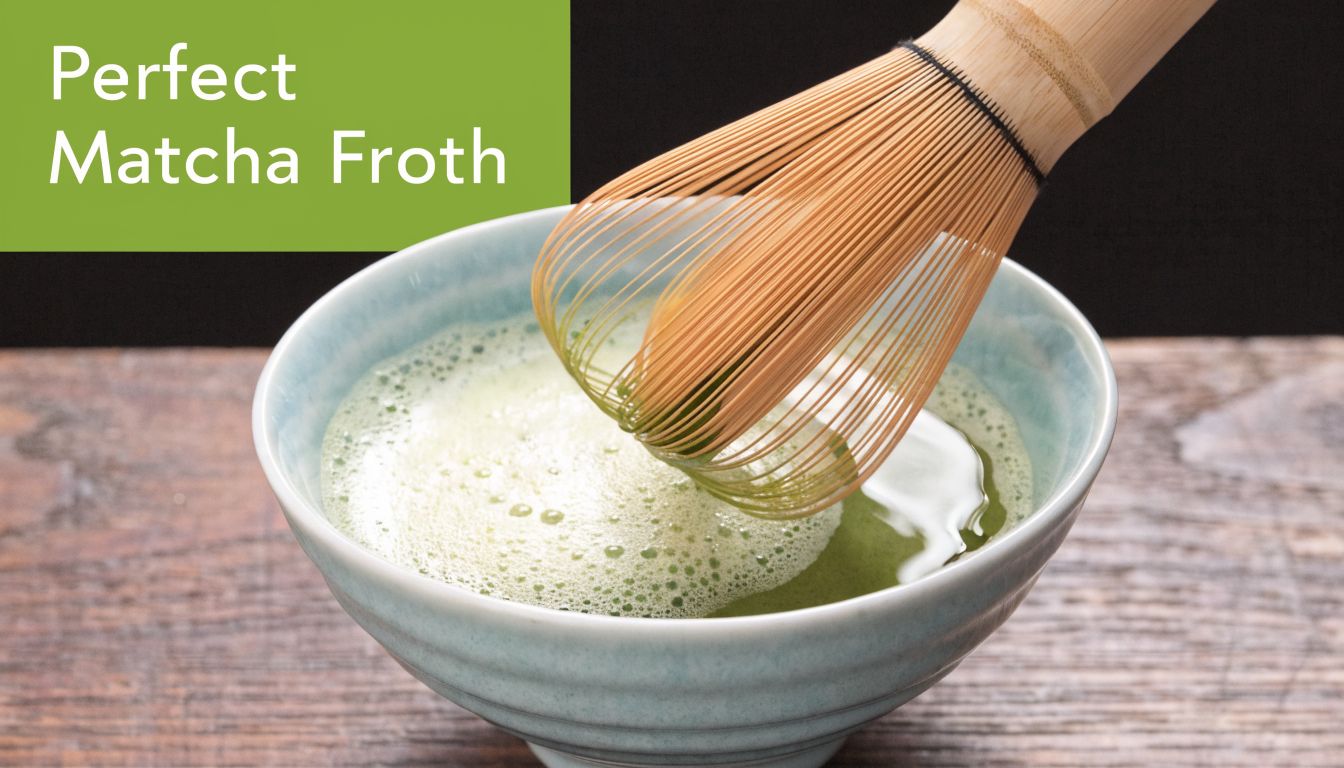
Use your wrist, not your whole arm
A lot of beginners whisk matcha as if they’re beating cake batter. Big arm movement, lots of effort, not much foam.
The better approach is smaller and quicker. Hold the bowl steady with one hand. Hold the whisk lightly with the other. Then move from the wrist in quick M or W motions near the surface of the tea.
The whisk should glide, not grind. If you press the tines hard into the bottom of the bowl, you’ll wear them out faster and get less froth.
What the motion should feel like
Think of it as fast sketching, not stirring.
You’re not tracing perfect letters, but the motion is similar. Short, rapid passes create tiny bubbles and a finer foam. Slow circles usually produce a flatter drink with larger bubbles.
A few signs you’re on track:
- The surface starts to lighten
- Fine foam forms across the top rather than only at the edges
- The whisk moves freely without scraping
- The tea underneath looks evenly blended
If you hit a stubborn little clump, press it gently against the side of the bowl first, then return to whisking. Don’t keep attacking it in the middle of the bowl.
For a closer look at hand position and movement, Pep Tea’s guide on how to whisk matcha is useful if you like seeing the technique broken down visually.
Finish cleanly
Once you’ve got a fine foam, slow down. A gentle final sweep across the surface tidies the top and settles any oversized bubbles.
That last movement changes the look of the bowl more than people expect. The tea appears more even, the foam looks finer, and the whole drink feels more deliberate.
A quick visual demo helps here:
Don’t chase huge foam. Chase fine foam. Matcha should look soft and velvety, not like aggressively frothed milk.
Beyond the Bowl Three Simple Matcha Creations
Once your whisking is organised, your matcha making kit becomes more versatile than people expect. The same bowl, whisk, and sifted powder can take you from a quiet morning tea to an iced afternoon drink or a quick kitchen add-in.
The trick is not changing everything. It’s keeping the matcha base smooth, then adapting what surrounds it.
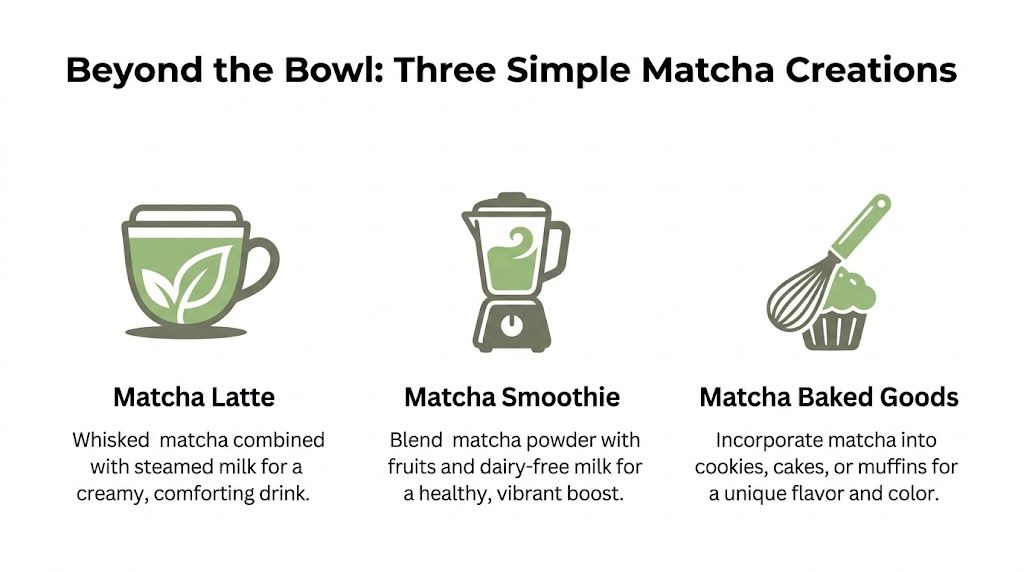
Matcha latte
A latte is often the easiest way for new drinkers to settle into matcha because milk softens the grassy edge.
Start by making a small concentrate in your bowl:
- Sift your matcha first: This keeps the latte smooth rather than chalky.
- Add a small amount of hot water: Whisk until fully blended and lightly foamy.
- Pour in warmed milk or cold milk over ice: Oat milk is popular for body, but use what you enjoy.
If your latte tastes weak, the issue usually isn’t the milk. It’s that the concentrate was too diluted before the milk went in. Keep the base strong, then stretch it.
A good matcha latte still tastes like tea. If it only tastes like milk, build a stronger bowl before you pour.
Iced matcha
Iced matcha can be fresh and crisp, but it turns disappointing fast if you skip the basic prep and try to shake dry powder straight into cold water.
Do this instead:
- Sift the matcha into your bowl
- Whisk with a small amount of hot water until smooth
- Add that concentrate to a glass of cold water and ice
- Stir or shake briefly, then drink straight away
That small amount of hot water matters because it dissolves the powder properly. Cold liquid alone doesn’t handle clumps nearly as well.
If the drink tastes sharp, reduce your brewing water temperature next time when you make the concentrate. The bitterness usually starts earlier than people think.
Matcha in smoothies and baking
Grade matters here.
For a straight bowl or a simple whisked tea, ceremonial-style matcha is the better fit because the flavour sits front and centre. For smoothies, yoghurt, muffins, pancakes, or biscuits, culinary matcha usually makes more sense because it’s designed to work with other ingredients.
A few easy uses:
- Smoothies: Add a small spoonful to banana, mango, or vanilla-based blends
- Yoghurt bowls: Stir through plain yoghurt and top with fruit
- Baking: Fold into cake batter, icing, cookies, or muffins
- No-bake snacks: Mix into energy balls or chia puddings
Here’s a simple comparison:
| Use | Better style |
|---|---|
| Traditional whisked bowl | Ceremonial-style matcha |
| Hot or iced latte | Ceremonial-style matcha or a smooth everyday blend |
| Smoothies | Culinary matcha |
| Baking | Culinary matcha |
If you’re using matcha in the kitchen regularly, keep one powder for drinking and another for recipes. It’s cleaner, more practical, and saves you using your nicest tea where subtle flavour will get buried.
Caring For Your Tools A Guide to Longevity
A matcha making kit lasts much longer when you clean it straight after use.
That’s especially true for the whisk. Bamboo is practical and beautiful, but it doesn’t respond well to neglect. Leave matcha residue sitting in the tines, or tuck the whisk away damp, and you’ll shorten its life quickly.
How to clean the whisk properly
Rinse the whisk under warm water as soon as you finish your bowl. Use your fingers very gently if a bit of powder is caught between the tines, but don’t scrub and don’t use soap.
Soap can linger in bamboo and affect flavour later. Rough handling can snap the fine tines or pull them out of shape.
A simple routine works best:
- Rinse immediately: Dried matcha is harder to remove later
- Use warm water only: Enough to release residue without stressing the bamboo
- Shake off excess water: Don’t leave it dripping on the bench
- Air dry thoroughly: Moisture is the enemy
Why a whisk stand helps
A kusenaoshi, or whisk stand, helps the chasen dry in a more natural shape. That matters because the curved form supports better whisking and reduces stress on the tines over time.
If you use your kit often, a matcha whisk stand is a practical addition rather than a decorative extra.
Store the whisk upright only after it has been rinsed and allowed to dry properly. A damp cupboard is where bamboo tools start going wrong.
Bowl and scoop care
The bowl is the easiest part of the set to maintain. Wash it with warm water and a soft cloth or sponge. If you use dish liquid, rinse it thoroughly so no scent remains.
The scoop needs a lighter touch. Wipe it clean or rinse briefly if needed, then dry it well. Don’t leave bamboo pieces soaking in water.
For best flavour, keep all tools away from strong kitchen smells. Matcha is delicate enough to pick up unwanted aromas over time.
Troubleshooting Common Matcha Mistakes
Even with a solid matcha making kit, the first few bowls can be inconsistent. That’s normal. Most problems come down to one of three things: water, whisking, or powder prep.
Why does my matcha taste bitter
The usual culprit is water that’s too hot. If you pour freshly boiled water straight onto the powder, the cup can taste harsher than it should.
Another common issue is using more powder than your palate is ready for. Strong matcha isn’t the same as balanced matcha.
Try this:
- Let the water cool slightly after boiling
- Stick to a modest serving when you’re learning
- Choose matcha suited to drinking, not baking
- Whisk thoroughly so the flavour is evenly distributed
If the bitterness is only at the end of the bowl, check whether sediment is collecting at the bottom. That often points to weak whisking or poor sifting.
Why am I getting clumps
Clumps usually begin before the whisk ever touches the bowl.
Matcha compacts in storage, so the powder needs air introduced back into it. That’s what sifting does. Once you skip it, the whisk has to work much harder.
The fix is straightforward:
- Sift into a dry bowl
- Add a small amount of water first
- Make a smooth paste
- Then add the rest of the water
- Break any stubborn bits gently against the side
Don’t dump all the water in at once and hope the whisk sorts it out. Sometimes it can. Often it won’t.
Why am I not getting any foam
Foam depends on technique more than force.
If you’re whisking in slow circles, you’re mixing, not aerating. If you’re pressing the whisk heavily into the bowl, the tines can’t flick the liquid properly. And if there’s too much water for the amount of matcha, the surface won’t build the same fine froth.
A quick diagnosis table helps:
| Problem | Likely cause | Better approach |
|---|---|---|
| Flat surface | Circular stirring | Use quick wrist-led M or W motions |
| Big bubbles only | Whisking too high or too slow | Keep the whisk low and fast near the surface |
| No foam with clumps | Unsifted powder | Sift first, then whisk |
| Thin, weak bowl | Too much water | Keep the base more concentrated |
Most bad bowls aren’t ruined bowls. They’re useful feedback. Change one variable at a time and the pattern becomes obvious.
Once you get the feel for the whisk and start noticing how bowl shape, water temperature, and powder texture affect the cup, matcha becomes much easier to repeat well.
If you’re ready to build a calmer, cleaner daily ritual, Pep Tea offers organic matcha, preparation tools, and practical guides for making matcha at home with more confidence and less guesswork.
Mastering Making Matcha Tea At Home

You’re probably here because you’ve had one of two matcha moments.
The first is the café one. You order a beautiful bright green bowl or latte, take a sip, and wonder why it tastes smooth, creamy and clean there, yet muddy or bitter when you try making matcha tea at home.
The second is the wellness one. You want something that feels steadier than coffee, more intentional than a quick tea bag, and a little more special than another rushed morning drink.
Good news. Matcha isn’t hard. It is precise.
Small details make the difference between a sweet, rounded cup and one that tastes flat or sharp. That’s why matcha feels like both an art and a science. The ritual matters, but technique matters just as much.
Beyond the Green Powder The Art of Making Matcha
A lot of people first meet matcha through a latte. That makes sense in Australia, where café culture shapes what ends up in our kitchens. But once you start making matcha tea properly, it stops feeling like a trend and starts feeling like a practice.
The appeal isn’t just flavour. It’s the kind of energy matcha offers. Many tea drinkers reach for it because it supports a calmer, more focused feeling, which is why matcha has become part of so many wellness routines.
That local interest isn’t imagined. In Australia, matcha imports from Japan increased by over 150% between 2018 and 2023, and café adoption of matcha lattes rose 78% in Sydney and Melbourne venues by 2022, according to this overview of the global matcha tea industry.
Those numbers line up with what’s happening on the ground. More cafés are serving matcha. More people want to make it at home. More shoppers are learning that not all green powder is the same.
Practical rule: Great matcha is less about fancy gear and more about doing a few simple things properly.
That starts with understanding what matcha is meant to be. It isn’t brewed like ordinary leaf tea. You’re whisking powdered tea directly into water, so every choice matters. The powder quality, the water temperature, the bowl shape, the whisking motion, even whether you sift first.
When people struggle with matcha, it usually isn’t because they’re bad at it. It’s because nobody showed them the small mechanics that change the result.
If you want the full background on sourcing and production, how matcha tea is made is worth reading before you buy your next tin. Knowing how it gets from leaf to stone-ground powder helps you understand why fresh, well-handled matcha behaves so differently in the bowl.
Making matcha tea well is a skill. The nice part is that it’s a very learnable one.
Gathering Your Tools and Choosing Your Matcha
Before the water goes on, set yourself up properly. Matcha rewards preparation. A little order at the start makes the whole process smoother.
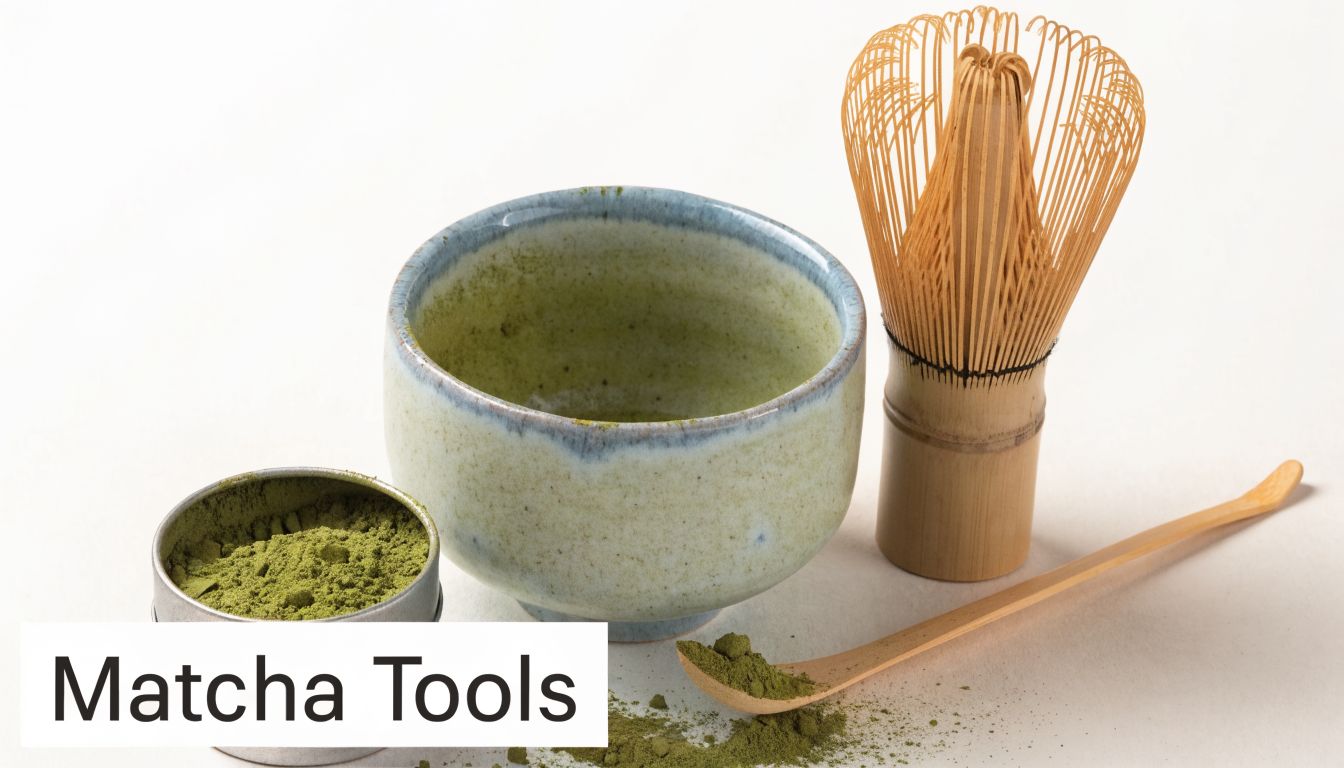
The classic tools and what each one does
The traditional setup is simple.
- Chawan: This is the bowl. Its wide shape gives you room to whisk properly and helps the foam form instead of splashing up the sides.
- Chasen: The bamboo whisk. This is the tool that transforms matcha and water into a smooth suspension rather than a gritty drink.
- Chashaku: The bamboo scoop. It helps with consistent portioning and makes the ritual feel more deliberate.
- Fine sieve: Not always included in a starter set, but essential if you want a smooth cup.
- Kettle and thermometer: Useful because water temperature is one of the most important variables.
A good bowl and whisk do most of the heavy lifting. If you only invest in two things, make them those.
What to use if you don’t have traditional gear
You do not need a formal tea setup to start making matcha tea at home.
A small cereal bowl can stand in for a chawan. A kitchen sieve works well for sifting. If you don’t own a chasen yet, a handheld milk frother is the most practical substitute for lattes and casual home use.
That said, alternatives do change the experience.
A bamboo whisk gives you more control in a traditional bowl of matcha. It creates a finer foam and lets you feel the texture changing as you whisk. A milk frother is convenient, but it can over-aerate or create larger bubbles, especially in a narrow mug.
If you want ritual and texture, use a chasen. If you want speed on a weekday morning, use what gets you drinking good matcha consistently.
Ceremonial and culinary grade are not interchangeable
At this stage, many people waste good powder, or judge matcha unfairly.
Ceremonial-grade matcha is best for drinking with water. It should taste softer, cleaner and more nuanced on its own. When you’re preparing usucha or koicha, this is the right place to spend more.
Culinary-grade matcha is better for recipes where it has support. Think lattes, smoothies, baking, overnight oats or energy balls. It’s designed to hold its character when mixed with milk, fruit, sweeteners or fats.
Here’s the easiest way to decide.
| Use | Best matcha choice | Why |
|---|---|---|
| Traditional bowl with water | Ceremonial grade | The flavour has nothing to hide behind |
| Hot latte | Culinary or robust ceremonial | Milk softens edges and changes the balance |
| Iced latte | Culinary grade | Cold drinks often need a stronger flavour presence |
| Smoothies and baking | Culinary grade | Better value and more assertive character |
If you’re still comparing options, this guide to different grades of matcha helps clarify what each grade is for and what to look for before buying.
What quality looks like before you even taste it
You can spot a lot from the tin.
Look for:
- Colour: A lively green is a good sign. Dull, khaki or yellow-green powder often signals age, oxidation or lower drinking quality.
- Texture: Good matcha should feel very fine, almost silky.
- Aroma: Fresh matcha smells green, soft and slightly sweet. If it smells stale or dusty, it probably tastes that way too.
- Behaviour in water: Better matcha incorporates more willingly and tastes more balanced.
A simple home setup that works
If you’re building a practical home station, keep it modest:
- One bowl you enjoy using
- One bamboo whisk
- One sieve
- One matcha for drinking
- One matcha for lattes and recipes
That setup covers nearly all common preparations. You don’t need a collection. You need tools that suit the way you drink matcha.
Mastering the Ceremonial Brew for a Mindful Moment
The most satisfying bowl of matcha is often the simplest one. No milk. No sweetener. Just powder, water, air, and a few minutes of attention.
Traditional usucha, or thin matcha, is the ideal style for beginners. It teaches you what matcha tastes like and makes every later drink better, including lattes.
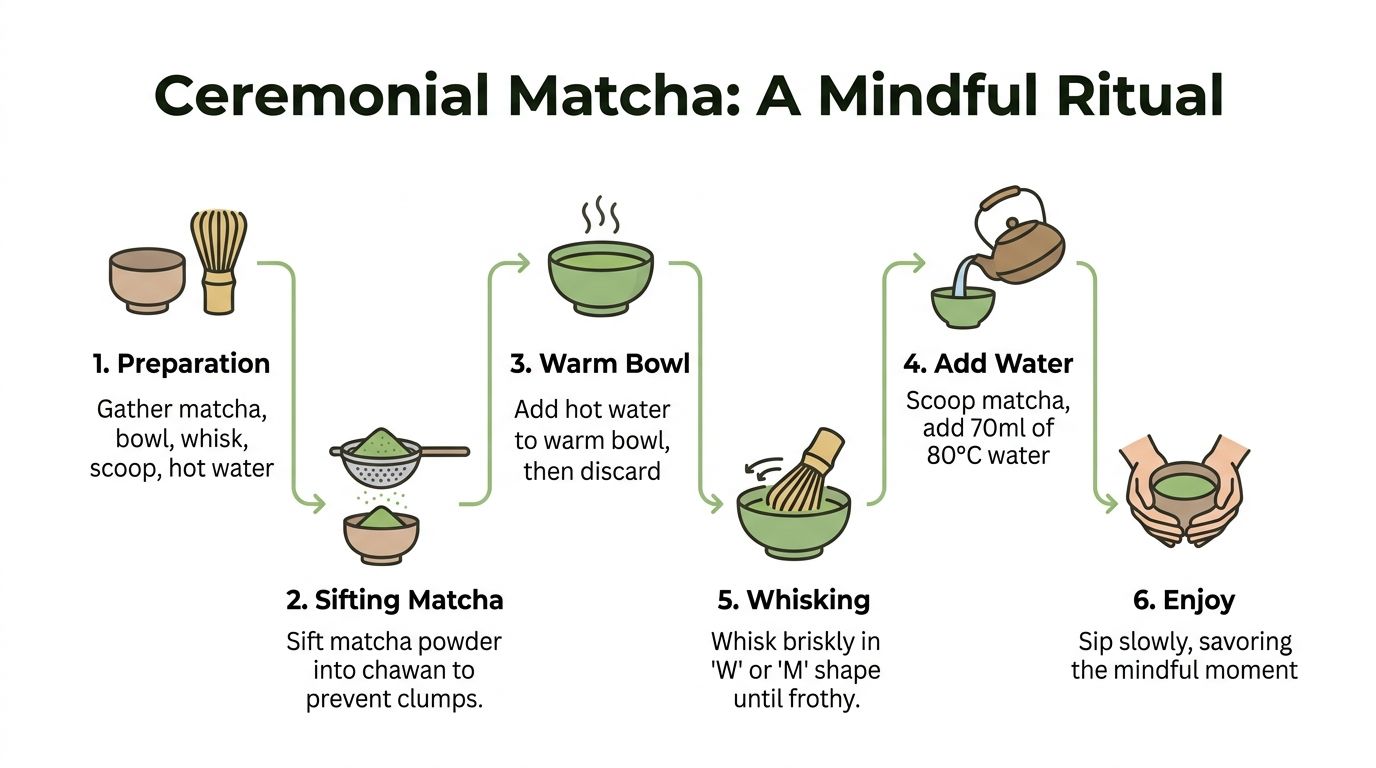
Start with warmth and order
Warm the bowl first. Add a little hot water, swirl it around, and let the whisk soften briefly in the bowl. Then tip the water out and dry the bowl.
That little preparation step matters. A warm bowl helps the powder disperse more evenly and makes the ritual feel settled from the first movement.
Sift your matcha into the bowl. For usucha, use 1 to 2 teaspoons, or 2 to 4 grams, and pass it through a fine mesh sieve. The reason is simple. Matcha clumps easily, and once wet, those clumps are harder to break apart cleanly.
According to this usucha preparation guide, the usual method starts by sifting 1 to 2 teaspoons (2 to 4g) of ceremonial-grade matcha into a preheated bowl before adding water.
The water matters more than people think
Most bad homemade matcha comes down to one problem. The water is too hot.
For usucha, use water at 70 to 80°C. That same guide notes that 70 to 80°C is the critical range, and that overheating can degrade beneficial compounds and create bitterness.
If you’ve just boiled the kettle, let it sit briefly before pouring. If you own a temperature-control kettle, use it. If you don’t, make a habit of slowing down rather than pouring straight off the boil.
Here’s a practical ratio that works well for a bowl of usucha:
- 2 to 4g matcha
- 60ml warm water to begin
- More hot water if you want a longer, lighter bowl
You’re not trying to drown the powder. You’re trying to suspend it smoothly.
Water that’s too hot makes matcha taste harsher than it is. People often blame the powder when the kettle is the real problem.
Whisk for foam, not force
Once the water is in, start by gently combining the powder and water so there are no dry pockets. Then whisk briskly with the chasen in a zigzag M or W motion.
Don’t stir in circles. Circular stirring blends, but it doesn’t create the same fine foam.
The same usucha source notes that whisking vigorously for 30 to 45 seconds is key to building a creamy froth layer over 2mm thick. That foam isn’t just for looks. It changes how the liquid feels on the palate and gives the bowl a softer first sip.
A few technique notes help:
- Use your wrist, not your whole arm
- Keep the whisk tips near the surface once the mixture is combined
- Finish with a gentle sweep to tidy larger bubbles
- Drink promptly while the texture is lively
The finished bowl should look vibrant, lightly glossy and topped with fine foam rather than big soap-like bubbles.
Taste it before changing it
Sip before you decide it needs sweetener.
Well-made ceremonial matcha should have a balance of green freshness, slight savoury depth, gentle bitterness and a round finish. If it’s aggressively bitter, something usually went wrong in preparation.
Common causes include:
| Result in the bowl | Likely cause | What to change |
|---|---|---|
| Sharp bitterness | Water too hot | Lower the temperature |
| Gritty texture | Powder not sifted well | Sift before whisking |
| Flat or weak flavour | Too much water | Use less water first |
| No foam | Poor whisking motion | Use a fast zigzag movement |
Turn it into a quiet ritual
One reason people stick with matcha is that the process slows them down in a useful way. There’s enough technique to hold your attention, but not so much that it becomes fussy.
If you enjoy pairing your tea with a few minutes of breathing or stillness, these simple meditation techniques are an easy companion resource. Matcha and a short mindful pause work well together because both ask you to pay attention to small things.
The best ceremonial bowl isn’t the one that looks perfect. It’s the one that makes you slow down enough to notice it.
For enthusiasts who want to try koicha
Koicha is thick matcha. It’s richer, denser and far less forgiving than usucha.
The method changes noticeably. The verified preparation guidance for koicha calls for 4g (2 tsp) of sifted matcha with 30ml of 75°C water, then slow kneading rather than vigorous whisking, as outlined in this koicha technique guide.
A few distinctions matter:
- Texture: Koicha should be glossy and thick, more like a smooth paste than a frothy tea.
- Movement: You knead and press with the whisk rather than beating air into the bowl.
- Powder quality: Koicha demands excellent matcha. Lower grades become unpleasant quickly.
- Serving style: It’s sipped slowly in small amounts.
If usucha is your daily practice, koicha is your deep dive. Start there only after you can make a balanced bowl of thin tea without guessing.
Creating the Perfect Matcha Latte and Iced Drinks
A good matcha latte should still taste like matcha. Too many homemade versions end up as sweet milk with a green tint.
The fix is straightforward. Build a proper matcha base first, then add milk.

The hot latte method that stays smooth
Start with sifted matcha in a bowl or cup. Add a small amount of hot water, just enough to make a smooth paste. Whisk or froth until there are no lumps.
Then add warm or steamed milk.
That order matters. If you dump powder straight into a full cup of milk, it tends to float, clump or leave sediment at the bottom. A concentrate-first method gives you colour, flavour and a much cleaner texture.
A practical home formula looks like this:
- Use culinary-grade matcha for everyday lattes
- Make a smooth paste with a little hot water
- Add your preferred milk
- Sweeten lightly only if needed
Which milk works best
Different milks change the drink more than people expect.
Oat milk gives body and softness. It’s often the easiest route to a café-style texture.
Soy milk has enough protein to foam well and gives a more structured finish.
Almond milk can taste lighter and nuttier, though some versions split more easily.
Dairy milk creates richness, but it can mute delicate matcha if you use too much.
For café service, consistency matters as much as flavour. Whatever milk you use, keep it stable across drinks so the matcha behaves predictably from one cup to the next.
Iced matcha needs a stronger base
Cold dulls flavour. That’s why an iced matcha latte usually needs a slightly bolder concentrate than a hot one.
Make the matcha base first, let it smooth out completely, then pour it over ice and cold milk. If you build it directly in the glass without dissolving the powder, you’ll often get clumps stuck to the ice or streaks of unmixed powder.
If you want a fuller method with serving ideas, how to make iced matcha latte is a useful reference.
For anyone experimenting beyond the classic version, this Strawberry Matcha Latte is a good example of how fruit can work when the layers are kept clean and the matcha base is made properly first.
Here’s a quick visual if you like seeing the pour and texture in action.
What works in cafés and what doesn’t
For home drinkers, making one latte at a time is fine. For cafés, speed changes the approach.
What works:
- Batching a matcha concentrate for short service windows
- Sifting powder in advance for rush periods
- Training staff to dissolve matcha before milk is added
- Using the same cup size and milk ratio every time
What doesn’t:
- Scooping matcha straight into cold milk
- Relying on vigorous shaking to fix poor mixing
- Using boiling water for the base
- Over-sweetening low-quality powder to hide bitterness
In latte prep, smoothness starts before milk enters the cup. If the concentrate is rough, the finished drink will be rough too.
Keep the flavour in balance
The best latte still lets you taste the tea.
If you need lots of syrup to enjoy it, the issue may be the matcha choice, the water temperature, or the ratio. Start by correcting those before adding more sweetness.
That’s the trick to making matcha tea in modern café form. Respect the original ingredient even when the drink is casual.
Troubleshooting and Storing Your Matcha for Lasting Freshness
Most matcha problems look mysterious but aren’t. The bowl tells you what went wrong if you know what to watch for.
Why your matcha tastes bitter
People often assume bitterness means they bought the wrong powder. Sometimes that’s true. More often, the water was too hot or the ratio was off.
If your matcha tastes harsh, check three things first:
- Water temperature: Boiling water is a common culprit.
- Powder amount: Too much matcha in too little water can create an unpleasantly dense bowl.
- Drink style: A powder suited to lattes may taste rough when prepared with just water.
A bitter bowl is often a preparation problem before it’s a product problem.
Why it’s clumpy or gritty
Clumps come from moisture, static, storage conditions, or skipping the sieve.
The quickest fix is also the simplest. Sift every time. It takes seconds and improves texture immediately.
If your matcha still feels gritty after whisking, the powder may already have absorbed some moisture in storage. That’s common in humid kitchens.
Why it won’t froth
No foam usually comes down to one of four issues:
| Problem | Likely reason | Better move |
|---|---|---|
| Flat surface | Stirring instead of whisking | Use a quick zigzag motion |
| Large bubbles only | Whisking too high or too slowly | Keep whisk tips near the surface |
| Thin weak foam | Too much water too early | Start with less |
| Poor texture overall | Old or poorly stored matcha | Open a fresher tin |
Storage matters more in Australia
A common assumption is that preparation gets all the attention and storage barely matters. In practice, storage can ruin excellent matcha before you even whisk it.
Verified guidance notes that matcha oxidises when exposed to light and air, and that for warm, humid climates like many parts of Australia, it should be kept in an airtight, opaque container in the refrigerator to preserve flavour and antioxidant quality, as explained in this storage advice on common matcha mistakes.
A good Australian storage routine
This works well for most homes and hospitality settings:
- Keep it sealed tight: Air is one of the fastest ways to dull aroma and colour.
- Use an opaque container: Light exposure gradually strips away freshness.
- Store in the fridge: Especially helpful in warm or humid conditions.
- Avoid steam zones: Don’t keep matcha above the kettle or near the dishwasher.
- Open only when needed: Repeated warm-air exposure shortens the life of the powder.
Fresh matcha smells alive when you open the container. If the aroma has almost disappeared, the cup usually has too.
If you refrigerate matcha, let the container come closer to room temperature before opening. That reduces the chance of condensation settling into the powder.
Expanding Your Matcha Horizons Beyond the Tea Bowl
Once you can make a clean bowl and a reliable latte, matcha becomes much more than a drink. It turns into a flexible pantry ingredient.
That’s where culinary-grade matcha earns its keep. You can use it often, generously, and without feeling like you’re wasting a tea meant for quiet sipping.
Easy ways to use matcha daily
Some of the best uses are the least complicated.
- Morning smoothie: Blend matcha with banana, yoghurt or plant milk, and a handful of ice.
- Overnight oats: Stir a little into your oat mixture for a greener, more savoury breakfast profile.
- Yoghurt bowl: Mix a small amount with honey or yoghurt, then top with fruit and seeds.
- Baking: Add it to cookies, muffins, bliss balls or pancake batter.
- No-bake snacks: Matcha works well in coconut-based bites and cashew slices.

The main rule is balance. Matcha has a distinct green, slightly savoury personality. Pair it with ingredients that support that rather than bury it.
Matcha works best when the format suits the grade
A lot of disappointment comes from using one type of matcha for everything.
Use ceremonial matcha when you want the tea to stand alone. Use culinary matcha when other ingredients are involved. That simple decision makes recipes cleaner and more cost-effective.
A thoughtful matcha and kombucha pairing
For wellness-focused drinkers, one of the more interesting ideas is pairing matcha with kombucha.
The verified brief notes that combining matcha with kombucha is an emerging trend in functional beverages and that the pairing brings together matcha’s L-Theanine for calm focus with kombucha’s probiotics for gut health, while also pointing out that existing online guidance on this combination is still limited.
That makes sense from a practical point of view. Matcha offers depth and structure. Kombucha adds acidity, lift and fermentation character.
A simple way to explore the pairing at home is to whisk a small, smooth matcha concentrate first, let it cool slightly, then add it to a glass with ice and a plain or gently flavoured kombucha. You want the tea integrated, not dumped in dry.
A few trade-offs matter:
- Acidity changes flavour perception: Kombucha can sharpen matcha’s edges.
- Sweetness level matters: A drier kombucha tends to let the tea show through more clearly.
- Texture needs care: If the matcha isn’t mixed smoothly first, the drink can feel chalky.
Matcha and kombucha can complement each other nicely, but only when each one still tastes like itself.
For cafés, this pairing opens up non-alcoholic menu ideas that feel more thoughtful than another sugary spritz. For home drinkers, it’s a good reminder that making matcha tea well gives you a base for far more than the traditional bowl.
Your Questions About Making Matcha Answered
Do I need a bamboo whisk to make matcha?
No, but it helps. A chasen is still the best tool for traditional matcha because it disperses the powder gently and creates fine foam. If you’re making lattes, a handheld milk frother is a practical substitute. A standard spoon is the least effective option because it tends to leave clumps behind.
Why isn’t my homemade matcha as bright green as the café version?
Usually it’s one of three things. The matcha may be older, the grade may be better suited to recipes than straight drinking, or your ratio may be too diluted. Lighting also changes what you see in the cup or glass, especially with iced drinks.
Is matcha better than coffee?
That depends on what you want from it. Coffee is direct and punchy. Matcha tends to feel steadier and more ritualistic. Many people prefer matcha when they want a calmer kind of focus and a slower start to the day.
Can I make matcha without sweetener?
Absolutely. In fact, learning to enjoy it unsweetened is one of the best ways to judge powder quality and improve your technique. If it tastes unpleasant without sweetener, fix the preparation before assuming the drink always needs sugar.
Should I use ceremonial matcha in a latte?
You can, but it isn’t always necessary. For everyday lattes, a good culinary-grade matcha often makes more sense. Save ceremonial-grade powder for bowls where you want to taste the tea on its own.
Can I prepare matcha in advance?
You can make a short-term concentrate for convenience, especially for lattes, but freshly whisked matcha always has the best texture. If you’re drinking it as a bowl of tea, make it and drink it straight away.
If you’re ready to put this into practice, explore Pep Tea for premium organic matcha and Australian-made sugar-free organic kombucha. Whether you want a ceremonial bowl, a café-style iced latte, or a more functional daily ritual, we’ve got the ingredients to help you make it well.
Matcha Tea Accessories: Your Complete 2026 Guide

You buy a good tin of matcha, heat the water, stir it with a spoon, and somehow end up with green lumps floating in a drink that tastes sharper than it should. Many assume the problem is the powder.
Usually, it’s the setup.
Matcha behaves differently from leaf tea because you drink the whole powdered leaf. That means texture, water temperature, and tool choice all show up in the cup straight away. The right matcha tea accessories don’t just make things look traditional. They change how the powder dissolves, how the foam forms, and how balanced the final drink tastes.
That’s one reason these tools have become more common in Australian kitchens and cafés. Australia’s tea market, including matcha, grew at a 3.2% CAGR from 2018 to 2023 and reached $450 million in revenue, while premium segments such as matcha accessories contributed 15 to 20%. A 2024 Euromonitor International study also found that 68% of surveyed Melbourne and Sydney cafés added matcha to menus post-2020, which helped drive 25% annual growth in accessory imports according to the summary in this matcha accessories overview.
If you’ve been curious about whisks, bowls, sifters, or whether they’re worth buying at all, the short answer is yes. But each tool matters for a different reason. Once you know what each piece does, matcha feels much simpler.
Why Your Matcha is Lumpy and How to Fix It
Lumpy matcha usually comes from two things. The powder has compacted in storage, and the mixing method isn’t strong or fine enough to break those clumps apart.
A spoon pushes powder around. It doesn’t suspend it evenly. A fork does a bit better, but it still tends to leave tiny gritty pockets that settle to the bottom.
What’s going wrong
Matcha is extremely fine. The moment it meets moisture, little balls of powder can form. Once that happens, stirring often makes the outside wet while the centre stays dry.
That’s why a cup can look mixed but still taste rough.
Common signs you’re fighting the tools instead of the tea:
- Dry specks on the surface that never fully disappear
- A sandy finish at the bottom of the bowl or mug
- Bitterness that seems stronger than expected
- Flat foam or no foam at all
A smooth bowl of matcha starts before the water goes in.
The simplest fix
Use a sifter first, then whisk in a wide bowl.
A fine sifter breaks up compacted powder before it has a chance to clump. If you want a dedicated tool for that step, a matcha tea sifter makes the process much easier than pressing powder through a generic kitchen strainer.
Then whisk with short, brisk motions near the surface rather than stirring in circles. That movement disperses the powder and adds the light foam that softens matcha’s edge.
A better home routine
Try this order next time:
- Warm the bowl with a little hot water, then dry it.
- Sift the matcha directly into the bowl.
- Add a small splash of warm water first and make a loose paste.
- Add the remaining water and whisk briskly.
- Stop when the surface looks fine and even, not bubbly like dish foam.
If your matcha has been disappointing, don’t change everything at once. Start with the tool that prevents clumps. Many notice the difference immediately.
The Essential Trio for Authentic Matcha Preparation
Three tools do most of the heavy lifting in traditional preparation. The chasen, chashaku, and chawan aren’t decorative extras. They solve three separate problems. Mixing, measuring, and whisking space.
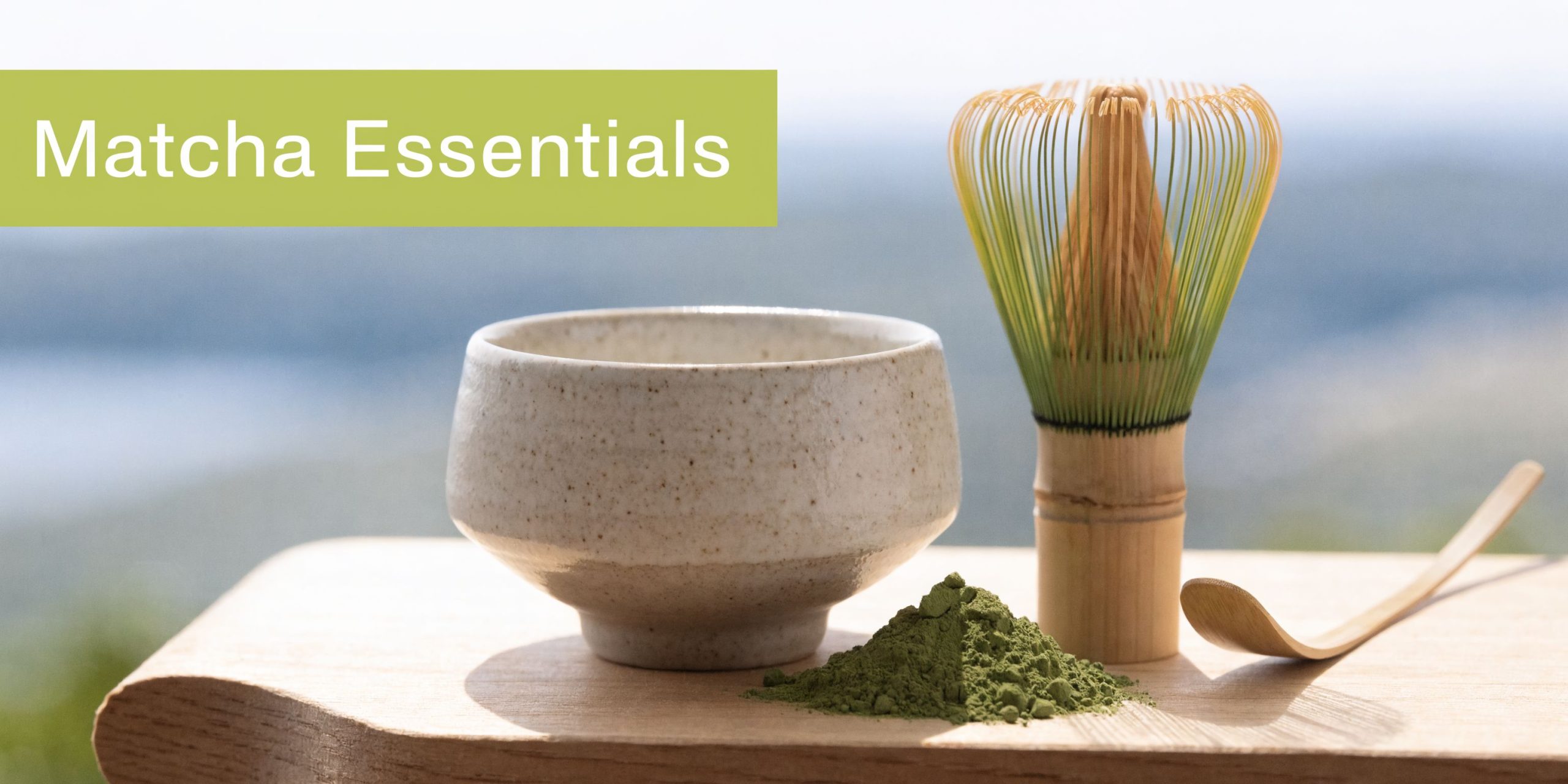
If you’re starting from scratch, a complete matcha tea set Australia option is a practical way to get the core pieces in one go.
The chasen and why it works
The chasen is the bamboo whisk. It’s the tool that changes the cup most.
In premium Australian matcha preparation, a bamboo chasen with 80 to 120 finely split tines is used to aerate 2g of matcha in 60 to 80ml of water at 75 to 80°C, creating a stable crema layer. That froth can enhance EGCg bioavailability by 15 to 20%, while unsifted, unwhisked brews can reduce antioxidant extraction by 30%, according to this detailed guide on matcha accessories and whisking technique. The same source notes that poor whisking leads to clumping and more bitterness from uneven heat exposure.
That sounds technical, but the practical meaning is simple. The whisk creates tiny, even bubbles and keeps the powder suspended. A spoon can’t do that. An electric frother creates a different kind of foam, which matters for mouthfeel.
The chashaku and why scooping matters
The chashaku is the curved bamboo scoop. It looks delicate, but it has a very practical job.
It lets you portion matcha without compacting it or introducing moisture from a metal spoon that’s been sitting near steam. It also makes your routine repeatable. If one day’s cup tastes balanced and the next feels harsh, inconsistent measuring is often part of the reason.
Consider salting food with your fingers versus using a measured spoon. Both can work. One is easier to repeat accurately.
The chawan gives your wrist room to work
The chawan, or matcha bowl, is wider than a mug for a reason.
Whisking in a narrow cup forces the whisk into the sides. Your motion gets smaller. The powder stays less evenly mixed. A wide bowl gives you enough surface area to whisk quickly without splashing.
The bowl also changes the drinking experience in a way people often underestimate:
- Better movement for the whisk
- More even mixing across the base
- A more stable grip while whisking
- A nicer aroma release than a tall glass or travel mug
Practical rule: If the whisk keeps tapping the sides, the bowl is too narrow for proper matcha.
Why this trio is enough for many
You don’t need a shelf full of specialised gear to make a good bowl.
For daily matcha, this trio does the important work:
| Tool | Main job | What improves in the cup |
|---|---|---|
| Chasen | Aerates and suspends the powder | Foam, texture, smoother flavour |
| Chashaku | Measures consistently | Balance, repeatability |
| Chawan | Creates whisking space | Even mixing, less mess |
If you only buy three matcha tea accessories, make them these. Everything else helps refine the process, but this is the working foundation.
Expanding Your Toolkit Beyond the Basics
Once your core setup is sorted, a few extra tools make matcha less fiddly and more consistent. These pieces don’t change the ritual for the sake of it. They remove the little annoyances that ruin an otherwise good cup.
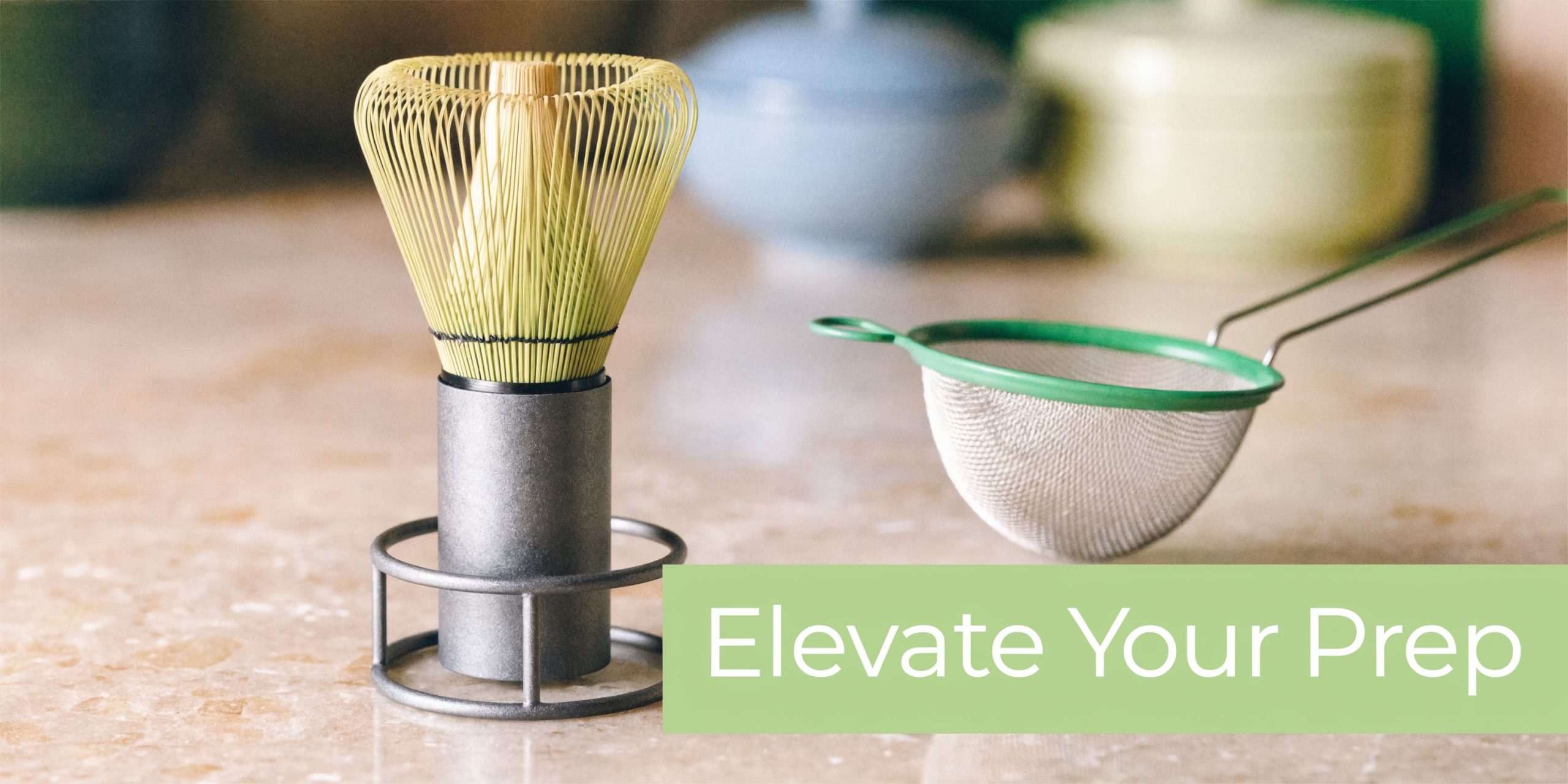
The sifter is the quiet problem-solver
If one extra accessory deserves a place in almost every kitchen, it’s the sifter.
Matcha powder naturally compacts. Even a fresh tin can contain small clumps from storage and humidity. Sifting fluffs the powder before water touches it, which means the whisk spends less effort breaking lumps and more effort creating smooth foam.
A small step, but it changes the result.
The whisk holder protects the whisk you already paid for
The whisk holder, often called a kusenaoshi, helps the bamboo whisk dry in its proper shape.
Without one, the tines can dry bent, flattened, or uneven. That makes whisking less effective and shortens the useful life of the tool. With a holder, airflow improves and the whisk keeps the open curve it needs.
This matters more than people expect because a whisk that looks only slightly misshapen often performs much worse.
A proper storage tin protects the powder itself
People often focus on the whisk and forget that matcha is sensitive to its environment. Air, light, and moisture all work against freshness.
A good storage tin helps preserve:
- Colour, so the powder stays vibrant rather than dull
- Aroma, which fades quickly when left exposed
- Flavour, especially the softer sweet and savoury notes
- Texture, because less humidity means fewer clumps
The accessories that earn their place
Not every extra belongs in every setup. These are the upgrades that usually make sense first:
- Fine sifter for anyone tired of lumps
- Whisk holder for anyone using bamboo regularly
- Airtight tin for anyone buying better-quality matcha
- Clean tea cloth for drying bowls and keeping the area tidy
A lot of matcha tea accessories are sold on appearance. These three are worth owning because they solve preparation problems.
Modern Alternatives Electric Frothers and Scales
Traditional tools aren’t the only option. Plenty of people make matcha with an electric frother, a shaker bottle, or a small blender. That doesn’t make the result wrong. It just changes the drink.
Electric frother versus bamboo whisk
An electric frother is fast. It’s handy when you’re making a quick latte before work or mixing matcha into milk.
A bamboo whisk is slower, but it creates a finer foam and a gentler texture. That matters most when you’re drinking matcha with water rather than masking it with milk and sweetener.
The main differences look like this:
| Tool | Strength | Trade-off |
|---|---|---|
| Electric frother | Speed and convenience | Larger bubbles, less refined texture |
| Bamboo chasen | Fine micro-foam and traditional mouthfeel | More hands-on, needs care |
If you mainly drink iced lattes, an electric frother can be perfectly reasonable. If you want to taste the detail in ceremonial-style matcha, the chasen is still the better tool.
Where a digital scale helps
A small digital scale is one of the most useful modern additions, especially if you like consistency.
The bamboo scoop gives you a traditional feel, but a scale helps when you want to repeat a recipe exactly. That’s useful at home, and even more useful in hospitality where one person’s “slightly heaped scoop” can become another person’s “too much powder”.
A scale is particularly handy for:
- Testing recipes for iced drinks or baking
- Comparing different matcha grades
- Training café staff to prepare drinks consistently
- Troubleshooting when a cup tastes too thin or too strong
For lattes, convenience can win. For straight matcha, texture usually decides.
A sensible middle ground
You don’t have to choose between old and new.
Many people settle into a hybrid routine. Traditional whisk, proper bowl, and a digital scale. Or ceremonial-style preparation on weekends, frother-made iced lattes on busy weekdays. The best setup is the one you’ll use often enough to enjoy good matcha regularly.
Choosing Your Accessories Home vs Café Use
The right setup at home isn’t always the right setup behind a busy bar. A home drinker usually wants ease, comfort, and a sense of ritual. A café needs consistency, speed, and tools that hold up under repeated use.
That’s where total cost of ownership becomes more useful than the sticker price.
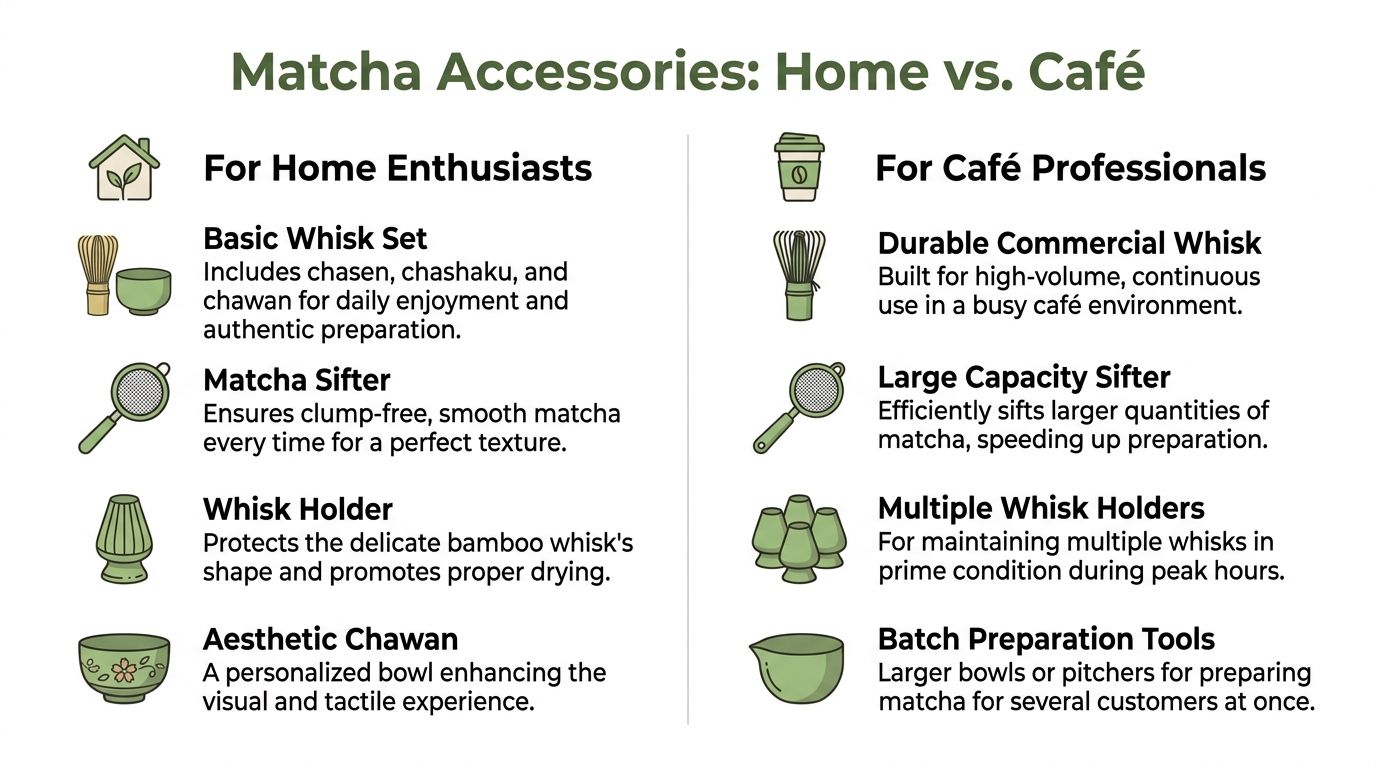
What matters most at home
For home use, it makes sense to keep the kit simple and enjoyable.
A good starter setup usually includes a whisk, bowl, scoop, and sifter. If you drink matcha several times a week, a whisk holder quickly becomes worthwhile too. You don’t need commercial-grade anything. You do need tools that feel pleasant to use and easy to clean.
Home buyers usually care about:
- A balanced starter set rather than individual specialty pieces
- A bowl shape they enjoy holding
- A whisk that feels flexible, not stiff
- Easy storage in a small kitchen
There’s also the visual side. If a bowl and whisk are attractive enough to leave on the bench, you’re more likely to use them.
What changes in a café
In a café, the questions shift.
The issue isn’t whether the whisk looks lovely on a shelf. It’s whether the setup supports fast prep, reliable results, and manageable replacement costs over time. The research around matcha tea accessories often skips these practical realities. This summary on traditional and non-traditional matcha tools notes that buyers need clearer guidance on durability, climate effects, maintenance, and long-term cost comparisons, especially in Australian conditions.
That’s the key buying question for hospitality. Not “What’s traditional?” but “What keeps service smooth without lowering quality?”
Thinking in total cost, not just upfront spend
A cheaper whisk can become expensive if it warps quickly, sheds tines, or gives inconsistent texture that leads staff to remake drinks. A better-made whisk may cost more initially but can be easier to maintain and more reliable in service.
For cafés, it helps to think in layers:
Preparation quality
Does the tool support a repeatable drink with the right texture?Durability in your environment
A coastal or humid venue may need stricter drying and storage habits for bamboo.Staff usability
If a tool is awkward, people won’t use it well during busy periods.Replacement rhythm
Tools that hold shape longer are easier to budget for.
Material choices and practical trade-offs
A café doesn’t have to be rigidly traditional to be thoughtful.
For example:
- Bamboo whisks offer the texture many customers expect in premium matcha
- Stainless steel sifters can make sense in higher-volume settings because they’re sturdy and easy to clean
- Larger bowls or pitchers may help when building a smooth matcha base before pouring into cups
- Multiple whisk holders make daily drying more organised
If you’re fitting out a broader beverage station, it can also help to look at well-designed general kitchen accessories for storage, prep flow, and cleaning tools around the matcha setup itself.
A useful rule of thumb
Home drinkers should buy for pleasure and consistency.
Cafés should buy for workflow, training, and maintenance discipline.
Those goals overlap, but they’re not identical. The most practical accessory setup is the one that fits how matcha is made in your space, not the one that looks most impressive in a product photo.
Care Maintenance and Sustainable Sourcing
Good matcha tools aren’t high-maintenance, but they do need the right kind of care. Bamboo especially rewards gentle habits.
Australia has also seen a long rise in demand for these tools. Matcha accessories entered Australia prominently in 2005 alongside the first certified organic matcha imports, and Australian Department of Agriculture trade data recorded matcha-related imports rising from 150 tonnes in 2010 to 1,200 tonnes by 2023, a 700% increase. Accessories such as chasen whisks and chawan bowls accounted for 22% of value, or AUD 4.2 million. In NSW, a 2024 Nielsen survey found 62% of wellness consumers prioritise accessories for authentic preparation, and whisk holders can extend chasen life by 6 to 12 months, reducing replacement rates by 40%, as summarised in this article on matcha accessory adoption in Australia.
How to clean each tool properly
The biggest mistake is over-cleaning. Matcha tools usually need less soap and less soaking than people think.
For the chasen
- Rinse with warm water only straight after use
- Don’t use detergent because bamboo can retain odour and residue
- Don’t leave it soaking in a bowl or sink
- Place it on a holder to dry in shape
If you need a proper drying stand, a matcha whisk stand is designed for that exact job.
For the chashaku
Wipe it clean and keep it dry. Avoid washing it like cutlery. Bamboo can swell or lose shape if it’s exposed to water too often.
For the chawan
Rinse it soon after drinking, wipe gently, and let it dry fully before putting it away. If matcha sits in the bowl too long, staining becomes more likely.
Bamboo lasts longer when it’s cleaned quickly, dried well, and left alone the rest of the time.
Storage matters more than people realise
Steam, humidity, and trapped moisture do a lot of quiet damage. A whisk left near the kettle, or stored before fully drying, won’t age well.
Helpful habits include:
- Keeping bamboo away from direct steam
- Letting every tool dry fully before storage
- Storing matcha separately from strong food odours
- Avoiding direct sunlight on bamboo and tea powder
Sustainable choices start with longer use
One of the most sustainable things you can do is keep a well-made tool in use for longer. That means buying thoughtfully and maintaining it properly, rather than cycling through cheap accessories.
If sustainability is already part of how you organise your kitchen, broader ideas around materials and lower-waste habits can be useful too. This guide to eco-friendly kitchen products is a handy reference point for that wider mindset.
What to look for when sourcing accessories
You don’t need a museum-grade set. You do want tools that feel intentional.
Look for:
- Responsibly sourced bamboo where possible
- Evenly cut whisk tines
- Bowls with a stable base and enough whisking room
- Craftsmanship that supports repeated use, not just gifting
That approach fits the spirit of matcha nicely. Better tools, fewer replacements, less waste, and a calmer daily routine.
Putting Your Tools to Work With Pep Tea Matcha
Once the tools make sense, the ritual gets much easier. You don’t need complicated recipes to feel the difference. A simple bowl of usucha and a clean iced latte are enough to show what good preparation does.
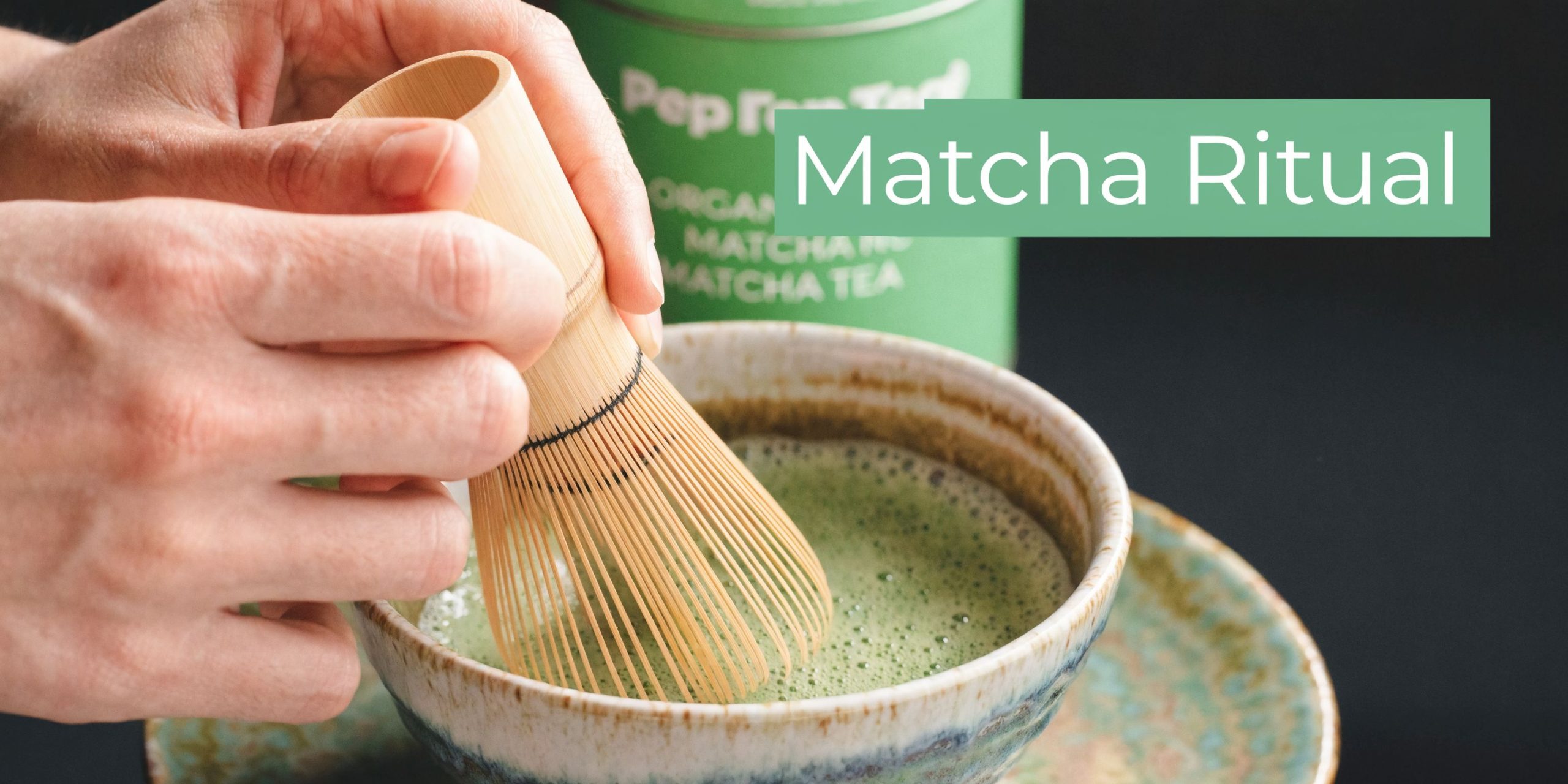
Pep Tea offers organic matcha in grades suited to different uses, including ceremonial-style preparation and lattes, so it’s a practical example of how the right tea and the right tools work together.
A simple usucha for quiet mornings
Use your ceremonial grade organic matcha when you want to drink it with water and appreciate the flavour on its own.
Try this method:
- Warm the chawan, then dry it.
- Sift matcha into the bowl.
- Add a little warm water and mix into a smooth paste.
- Add more water.
- Whisk briskly in a W motion until the surface looks smooth and lightly foamy.
The goal isn’t giant bubbles. It’s a fine, even top layer and a clean, rounded taste.
An iced matcha latte that stays smooth
For milk-based drinks, culinary grade organic matcha is usually the better fit because it stands up well in a latte.
A simple approach:
- Sift the matcha into the bowl
- Add a small amount of warm water
- Whisk until fully smooth
- Pour that concentrate over ice
- Top with your milk of choice
Starting with a smooth concentrate matters. If you add dry powder straight into cold milk, it’s much harder to dissolve properly.
Here’s a quick visual guide for whisking technique and setup:
Small adjustments that improve both drinks
These details make a noticeable difference:
- Sift first if your matcha has been sitting for a while
- Use warm, not boiling, water for the initial mix
- Whisk near the surface for better foam
- Rinse the whisk immediately after use so it stays in working shape
A good bowl of matcha feels light, smooth, and integrated. It shouldn’t taste like powder added to water at the last minute.
Once you’ve made a few bowls this way, the accessories stop feeling specialised. They just feel like the right tools for the drink.
From a Simple Drink to a Mindful Ritual
The nicest thing about matcha tea accessories is that they solve practical problems and slow you down in a good way at the same time.
A sifter gets rid of lumps. A chasen improves texture. A whisk holder helps your tools last. Those are useful, concrete benefits. But the experience goes further than utility. The act of warming the bowl, sifting the powder, and whisking until the surface turns glossy gives the drink a shape in the day. It asks for attention, but not much time.
That’s why these tools appeal to very different people. A home drinker may want a few quiet minutes before work. A café may want a more authentic matcha service and a better-looking cup. Both are using accessories to make the drink more intentional.
The good news is that you don’t need to become a purist. You just need to understand what each tool is for and choose the pieces that match the way you drink matcha. Start small if you like. A whisk, a bowl, a scoop, and a sifter are enough to transform the result.
Once the process becomes familiar, the ritual doesn’t feel complicated. It feels organised, calming, and repeatable. That’s part of matcha’s appeal. It brings together flavour, craft, and a little moment of focus in the middle of ordinary life.
If you’re ready to build a better matcha routine, explore Pep Tea for organic matcha, accessories, and practical guidance for home kitchens, cafés, and everyday wellness.
Matcha Tea Sifter: Smooth, Clump-Free Brews

You whisk. You pour. You take a sip. And instead of a smooth, vivid bowl of matcha, you get little green lumps, a sandy finish, and a drink that feels far less special than the powder you started with.
That’s one of the most common matcha frustrations I see. It happens to beginners, and it happens to café teams too. People often blame the whisk, the water, or their technique. Usually, the underlying issue started a few seconds earlier.
The fix is simple. Use a matcha tea sifter.
This tiny tool looks modest, but it changes almost everything about the cup in front of you. It helps your powder fall light and fluffy into the bowl, makes whisking easier, and gives your matcha a better chance to taste smooth, creamy, and balanced. If you’ve invested in quality powder, whether you drink it straight, make lattes, or build it into a café menu, sifting is one of the easiest ways to respect the tea.
The Secret to Lump-Free Matcha Begins Here
A lot of people have the same first matcha experience. They buy a beautiful tin of green powder, maybe inspired by a café latte they loved, and they expect the home version to feel calm, rich, and silky. Instead, the powder sticks together, floats in clumps, and turns the whole ritual into a small annoyance.
That moment matters because matcha is personal. You’re not just making a drink. You’re preparing something you’ve chosen for flavour, focus, and a better daily rhythm. When the texture is gritty, it’s disappointing in a way that feels bigger than it should.
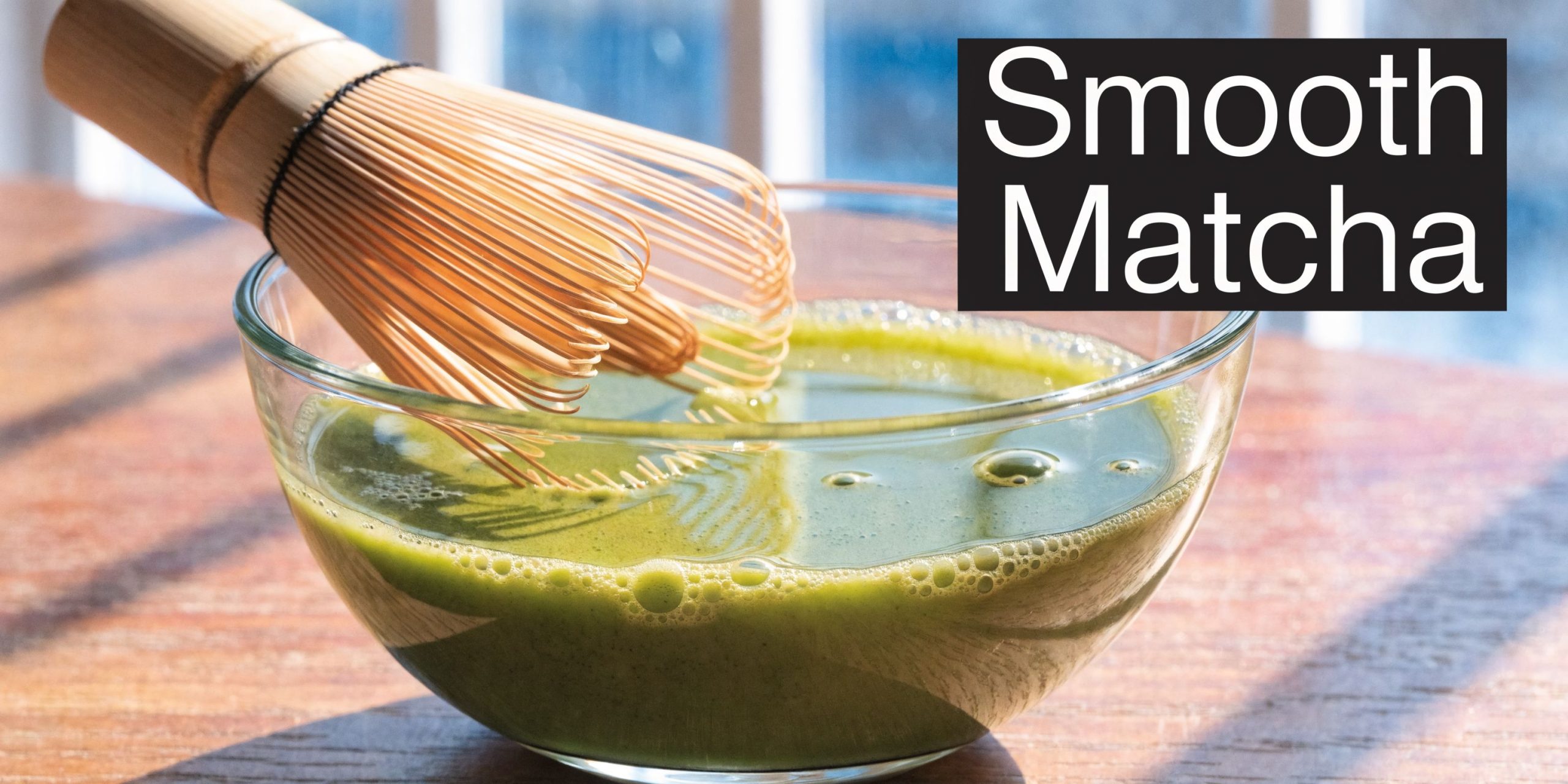
The small tool that changes the whole bowl
A matcha tea sifter is the quiet hero here. Before any water touches the powder, the sifter breaks up tiny compacted bits so the matcha lands in the bowl as a soft, even layer. That gives your whisk a fair chance to do its job.
If you’ve been exploring different grades and styles, it also helps to compare how preparation changes the experience across different powders. Looking at options such as high-quality matcha tea from Key West Coffee Company can be useful because it reminds you that quality and technique work together. Good powder still needs good handling.
A great whisk can’t fully rescue matcha that went into the bowl already clumped.
For beginners, that’s encouraging. It means you probably don’t need stronger wrists or a more complicated ritual. You just need one extra step that takes only moments and makes the rest of the process easier.
For café owners, the same lesson applies at scale. If the base isn’t smooth, the final drink won’t be either, no matter how polished your service is.
Why Sifting Matcha Powder Is Non-Negotiable
The first thing to know is that clumps don’t mean your matcha is poor quality. In fact, fine matcha often clumps precisely because it’s so delicate. The powder is extremely light, and it reacts quickly to moisture in the air and to static.
In Australian preparation settings, that matters even more. Humidity and storage conditions can make a fresh tin behave very differently from one day to the next.
What a matcha tea sifter does
The Japanese name for this tool is chakoshi. In practical terms, it’s a fine-mesh strainer designed to turn compressed powder back into a loose, airy mound before whisking begins.
According to this reference on a matcha tea sifter and tea strainer, a chakoshi in premium matcha preparation commonly uses mesh apertures finer than 10 microns, and matcha clumps formed by static and moisture can reach 50 to 100 microns. The same source notes that unsifted matcha can lead to a grainy texture with 20 to 30% reduced froth volume, because clumps reduce powder-water contact area by 40%. It also states that sifting can increase effective surface area by 3 to 5x, lifting extraction efficiency from 65% to 95% in a 2g/60ml brew.
Those numbers sound technical, but the takeaway is simple. When the powder is evenly dispersed, water can reach more of it quickly and consistently.
Why clumps create bigger problems than you think
A clump isn’t just a lump sitting in your bowl. It acts like a barrier.
Instead of each fine particle meeting water and whisk movement, parts of the powder stay trapped inside little packed pockets. That leads to a few familiar issues:
- Uneven mixing means some sips taste dull while others taste sharp or bitter.
- Poor suspension means sediment drops faster to the bottom.
- Weaker froth means the top of the bowl looks flat rather than lively.
- Less control means you keep whisking harder, which often makes the ritual feel frustrating.
Why this matters for premium matcha
The better the matcha, the more you want to protect what makes it special. If you’re working with a fine ceremonial powder, proper prep helps you taste the softness, sweetness, and savoury depth the producer intended. If you want to understand how grade affects preparation, our guide to https://peptea.com.au/different-grades-of-matcha/ is a helpful place to start.
It’s also useful to compare sift-friendly powders when learning. Browsing products such as Ceremonial Grade Matcha from AQEEK Coffee can help you notice how very fine powders benefit from careful handling.
Practical rule: If your matcha is worth buying, it’s worth sifting.
Improve Flavour, Texture, and Crema
People often think the matcha tea sifter is only about removing lumps. That’s true, but it’s only the beginning. Sifting changes how the drink feels, how it tastes, and how the foam forms on top.
Those three things are closely linked. Better particle distribution gives you better contact with water. Better contact gives you smoother whisking. Smoother whisking gives you a more balanced cup.
Texture starts before the whisk
Texture is often where the difference is first noticed.
When matcha falls through a fine mesh, it becomes light and even. That means your whisk meets a fluffy powder bed instead of stubborn little pebbles. The result is a bowl that feels softer across the tongue, with less graininess and less sludge left behind.
If your goal is a velvety usucha or a café-style latte base, this matters. A smooth base carries milk better, blends more cleanly, and leaves less sediment at the bottom of the cup.
Flavour becomes more balanced
Unsifted matcha doesn’t dissolve evenly. Some parts stay trapped in little clumps while others overexpose to water and agitation. That’s one reason a bowl can taste oddly bitter in one sip and flat in the next.
A more even powder bed supports a more even extraction. In plain language, the bowl tastes more coherent. You’re more likely to notice sweetness, savoury depth, and the gentle grassy freshness people chase in good matcha.
Foam and crema improve in a visible way
Here, the change becomes obvious, especially for café service. According to this reference on a matcha hand strainer, sifted matcha froths to 2 to 3x higher foam height, reaching 15 to 20mm, with microbubble stability lasting 4 to 6 minutes. The same source links that improvement to 30% improved L-theanine-caffeine synergy (1:2 ratio) and notes that unsifted matcha can produce a thinner, more bitter brew due to a 15% increase in polyphenol oxidation.
That sounds scientific, but the visual cue is easy to recognise. Sifted matcha tends to produce a finer, more even top layer. It looks creamy rather than bubbly and rough.
If you’re still working on your whisking motion, our guide to https://peptea.com.au/how-to-whisk-matcha/ pairs well with this step, because sifting and whisking work best together.
What this means in the cup
Here’s a simple perspective:
- Better texture makes the bowl feel luxurious, not chalky.
- Better flavour makes the tea feel composed, not scattered.
- Better crema makes the drink look alive and drink beautifully from the first sip.
Smooth matcha isn’t only a visual win. It changes the whole drinking experience.
For home drinkers, that means a more enjoyable ritual. For cafés, it means a more consistent product that looks good, tastes right, and holds up better on the pass.
How to Choose the Right Matcha Sifter
Not every sifter feels the same in use. Some are made for a single bowl on a quiet morning. Others are more practical for a busy café bench. The right choice depends on how much matcha you prepare, how often you make it, and whether hygiene and workflow need to meet commercial standards.
There’s also a growing Australian angle here. According to this video reference discussing the local market and tool selection, there has been a 35% rise in Australian searches for “organic matcha tools” since Q1 2025, alongside growing interest in sifters that align with FSANZ Code requirements for premium organic handling in hospitality settings: organic matcha tools in Australia.
The two common sifter styles
Many choose between a small handle-style strainer and a larger canister-style sifter.
The handle-style version is the classic choice for making one bowl at a time. You rest it over the chawan, add the powder, and press it through with a scoop or small spatula.
The canister style is built for batching. It’s more useful when you want to pre-sift a larger amount for service, recipe prep, or repeated drinks across a shift.
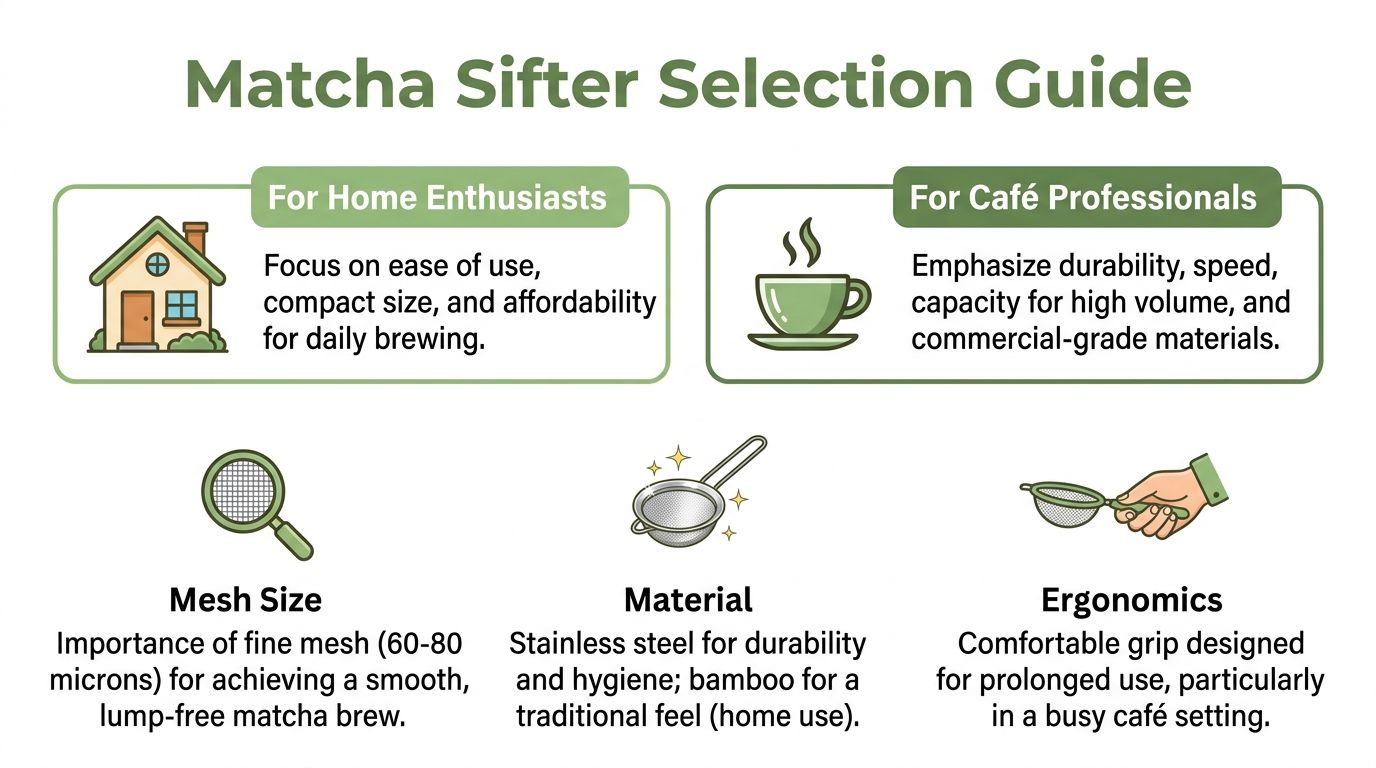
What to look for in the material and mesh
Food-grade stainless steel is usually the safest practical choice. It’s easy to clean, durable, and better suited to repeated use in a home kitchen or commercial setting.
A very fine mesh matters too. A generic kitchen sieve might work in a pinch, but it often isn’t designed for such fine powder. That’s why dedicated matcha tools feel easier and more predictable.
If you’re shopping as a beginner and want an all-in-one setup, the https://peptea.com.au/matcha-tea-set-australia/ page shows a full set format that includes the key preparation tools, including a sifter.
Matcha Sifter Comparison
| Sifter Type | Best For | Material | Pros | Cons |
|---|---|---|---|---|
| Handle-style strainer | Daily home use, single bowls, small latte prep | Usually stainless steel | Easy to store, simple to use, precise for one serve | Slower for batch work |
| Canister-style sifter | Café prep, repeated service, recipe batching | Usually stainless steel | Better for volume, tidier for larger prep | Takes more space, less nimble for one bowl |
| Bamboo-style traditional option | Home enthusiasts who value ritual and aesthetics | Bamboo or mixed materials | Traditional feel, visually appealing | Harder to sanitise well, less practical for commercial use |
| Generic kitchen sieve | Emergency substitute only | Varies | Easy to find | Mesh may be too coarse, less control, less tidy |
A simple buying checklist
- Choose stainless steel if you want durability and easier cleaning.
- Check the mesh and avoid anything that looks obviously coarse.
- Think about volume. One bowl at a time and café prep are different jobs.
- Consider ergonomics if you’ll use it repeatedly during service.
- Keep compliance in mind if you run a venue and need cleaner, more controlled tool choices.
One mention worth making here is practical rather than promotional. Pep Tea’s Japanese Matcha Set includes a sifter, which is useful for people who want the core tools together in one setup.
Your Step-by-Step Sifting Method
Sifting looks refined, but it’s very straightforward once you’ve done it once or twice. Many learn it in minutes.
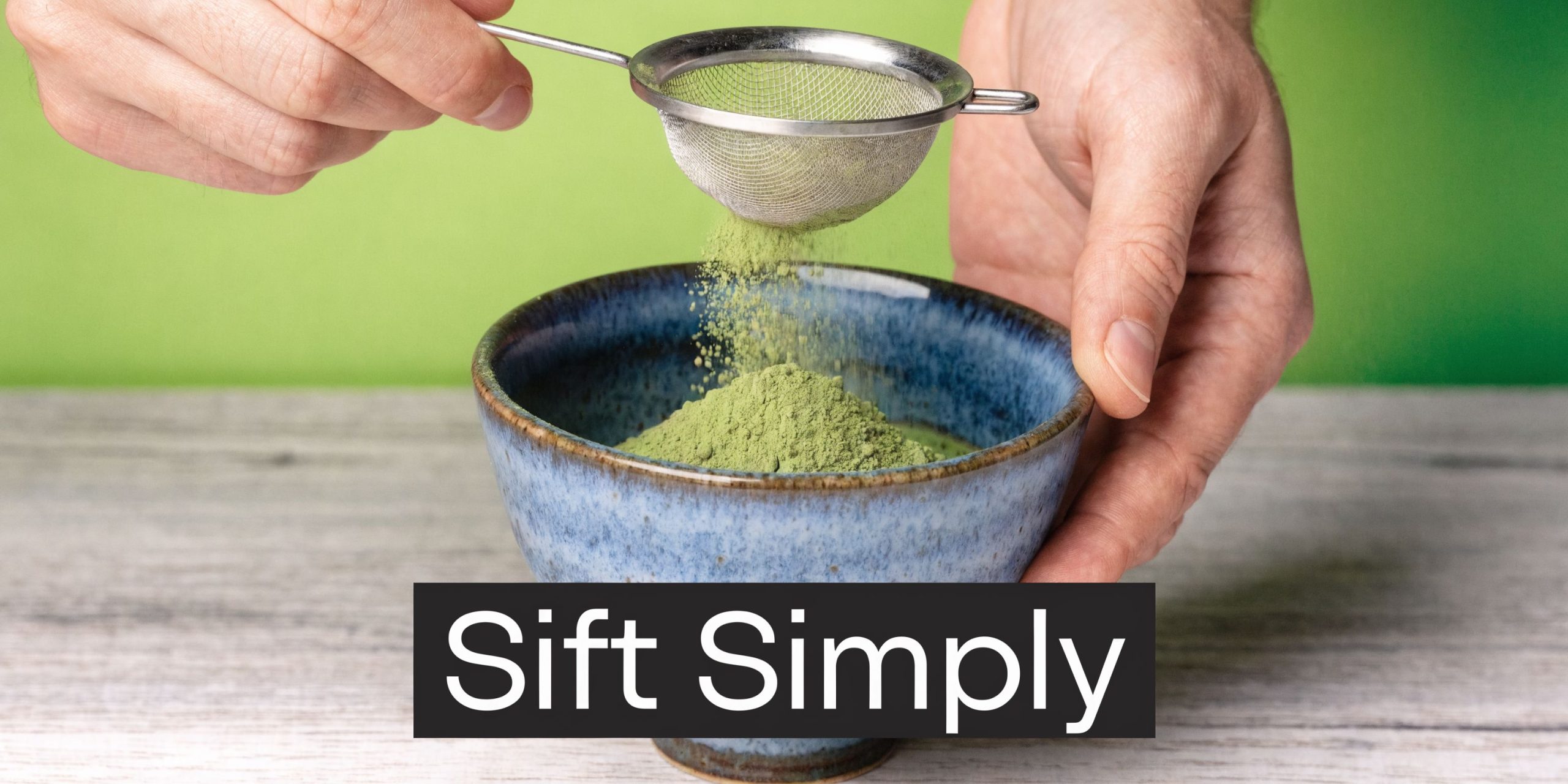
The easiest way to do it
Start with a completely dry bowl and a dry sifter. Moisture is the enemy at this stage, so even a few drops can make the powder catch.
Then follow this sequence:
Set the sifter over the bowl
Make sure it sits securely. You don’t want it wobbling while you work.Measure your matcha into the sifter
Use your bamboo scoop or measuring spoon and place the powder gently into the centre.Press lightly, don’t mash
Use the scoop, a small spoon, or a spatula to coax the powder through the mesh. Gentle circular movements work well.Tap only if needed
If a little powder clings to the mesh, a light tap can help. Don’t smack the sifter hard or you’ll create a puff of green dust.Whisk straight after sifting
Once the matcha is airy and loose in the bowl, add your water and whisk while it’s at its freshest.
Common beginner mistakes
A few tiny habits make the process much easier:
- Using a damp tool causes immediate sticking.
- Forcing the powder through too aggressively can compact it again.
- Sifting too far ahead can expose the powder to more air than necessary.
- Overfilling the sifter makes the process messier than it needs to be.
Keep the motion light. You’re fluffing the powder, not grinding it.
If seeing the movement helps, this short video shows the rhythm clearly:
How long should it take
Not long. Once your tools are within reach, sifting becomes one of the quickest parts of the ritual. It often saves time overall because whisking becomes easier and more predictable afterward.
For a café team, that’s good news. For a beginner, it’s even better. One small habit removes a lot of unnecessary frustration.
Troubleshooting and Advanced Tips for Cafés
Sometimes the problem isn’t your technique. It’s the room.
In parts of Australia, especially through humid periods in NSW and QLD, matcha can start clumping much faster than people expect. That’s why a method that worked perfectly on a cool dry day suddenly feels messy and stubborn in summer.
When humidity keeps ruining your prep
This Australian matcha reference notes that searches for matcha spike 42% in summer, and that matcha agglomeration can happen 3x faster in humidity above 70%. It also reports that home users can pre-chill sifters to -5°C for 10 minutes to cut clumping by 50%, while cafés handling larger amounts may use electric vibrating sieves for 100g batches: sifting matcha powder in humid conditions.
That’s useful because it gives us two practical paths. One for the home kitchen, and one for service.
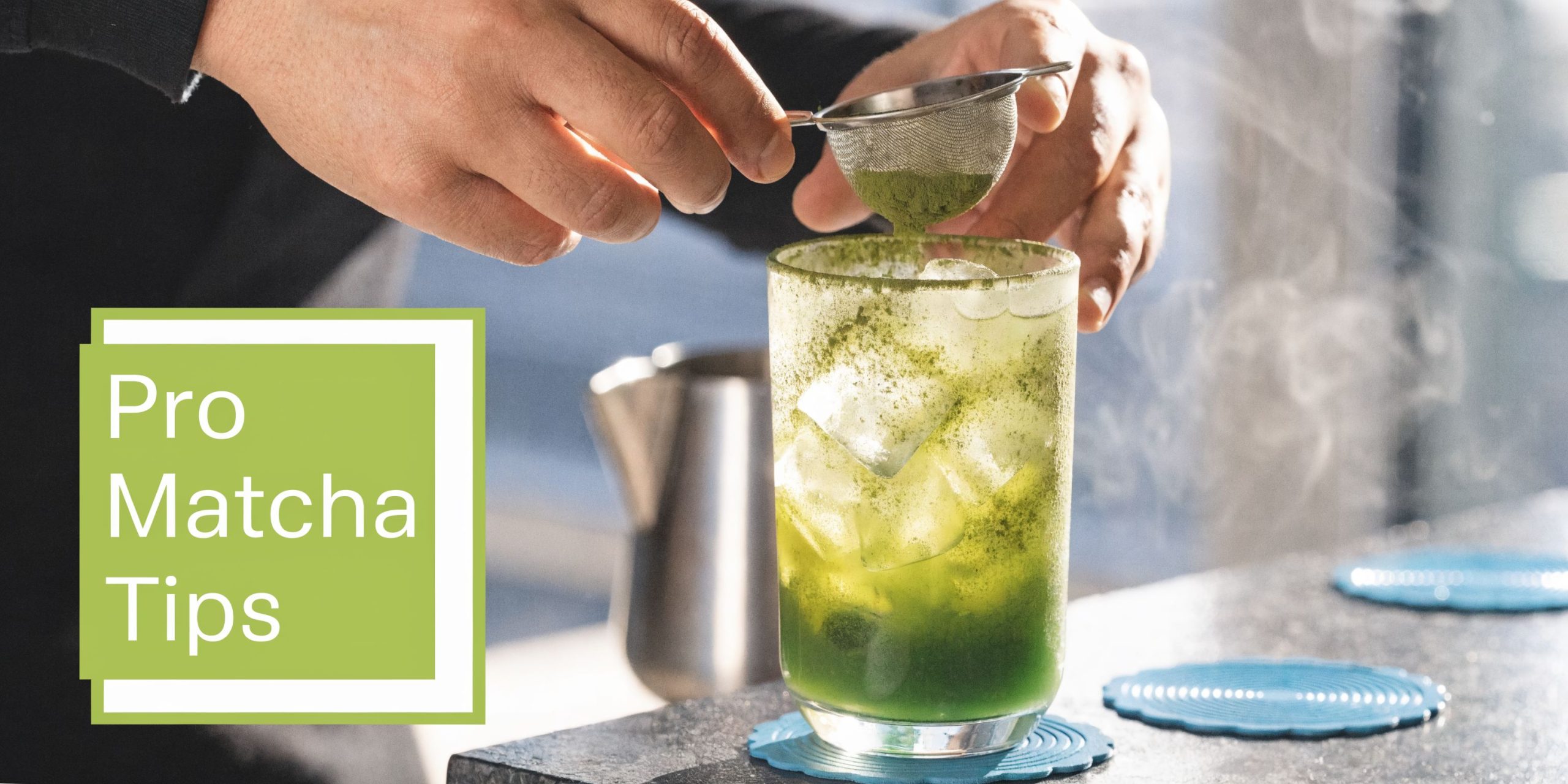
Quick fixes at home
If your matcha keeps clumping, try these:
- Sift just before use rather than preparing it well in advance.
- Keep tools dry and cool so moisture doesn’t catch on the mesh.
- Use a fine tea strainer temporarily if you don’t own a dedicated matcha tea sifter yet.
- Store your matcha tightly sealed and away from steam, sunlight, and heat.
A regular fine tea strainer can work as a stopgap, but it usually feels less tidy and less precise. It’s a practical substitute, not a long-term matcha ritual tool.
Workflow tips for cafés
For hospitality teams, speed matters, but consistency matters more. A rushed bowl with lumps isn’t saving time if the drink comes back or pours poorly into milk.
Try a workflow like this:
- Assign one dry prep zone for matcha only.
- Pre-portion small service amounts instead of exposing a larger container repeatedly.
- Use batch sifting tools only when turnover justifies it.
- Train every staff member the same way so texture stays consistent across shifts.
In a café, the best sifting method is the one staff will repeat accurately during a busy service.
That’s true whether you’re serving straight matcha, iced lattes, or using matcha as part of a non-alcoholic menu.
Caring for Your Tools and Your Tea
A good matcha tea sifter doesn’t need complicated care. It needs clean, gentle care.
Rinse metal sifters with warm water after use if powder has caught in the mesh, then dry them thoroughly before putting them away. Avoid leaving them damp in a drawer or on a crowded sink. If you can brush out dry powder first, that’s often even easier.
Soap can be useful for a deeper clean when needed, but residue is the thing to avoid. You don’t want cleaning smells lingering on a tool that sits close to a delicate tea.
Good habits that protect flavour
A few small habits make a real difference:
- Keep the sifter dry before the next use.
- Store matcha airtight so moisture and kitchen odours stay out.
- Avoid heat and light because they dull freshness.
- Clean promptly so powder doesn’t cake into the mesh.
The bigger point is simple. Sifting is an act of care. It respects the work that went into growing, grinding, packing, and preparing matcha.
If you’ve been skipping this step, don’t feel bad. Many do at first. Once you make it part of your routine, it quickly feels natural, and the bowl in front of you reflects that care straight away.
If you’d like to put this into practice, explore Pep Tea for organic matcha, tea education, and tools that support a smoother everyday ritual at home or in hospitality.