
Tag: organic matcha Australia
Organic Green Tea Price: An Australian Guide for 2026
You're in the tea aisle, or staring at an online store, and two products seem to promise the same thing. Both say organic. Both say green tea. One looks fairly affordable. The other feels surprisingly expensive.
That's a common challenge.
The organic green tea price in Australia can feel inconsistent until you stop looking only at the shelf tag and start asking better questions. What format is it in. Where was it grown. How was it processed. Is it meant for an everyday mug, a café menu, or a more premium wellness ritual?
For Australian shoppers and hospitality buyers, that difference matters. Organic tea doesn't usually sit in the same pricing world as bulk commodity tea. It moves through a more premium import and retail chain, and that pushes up the final shelf price. For context, Selina Wamucii notes projected U.S. wholesale green tea prices in 2026 at US$2.69 to US$4.71 per kg, while the average declared value for all imported organic teas was already US$10.18 per kilo in 2014. That gap helps explain why organic green tea often lands in the premium beverage category rather than the bargain pantry staple category.
If you're new to the category, it helps to start with the basics of what organic green tea means. Once you understand that, the price starts to make more sense.
Decoding the Organic Green Tea Price Tag
A lot of price confusion starts because shoppers compare unlike products as if they're identical.
A box of tea bags, a pouch of loose leaf, and a tin of matcha can all be sold as organic green tea. But they're built for different jobs. One is about convenience. One is about flavour and brewing control. One is a concentrated powdered tea used for whisking, lattes, or recipes.
Why two organic teas can cost very different amounts
The price tag isn't random. It usually reflects a mix of things happening before the tea ever reaches an Australian shelf:
- Certification requirements that add cost to farming, auditing, and handling
- Import and freight realities that matter more in Australia than in larger production markets
- Processing differences such as whole-leaf handling versus fine powder production
- Retail positioning where some teas are sold as everyday staples and others as premium wellness products
That's why a higher price doesn't always mean “overpriced”. Sometimes it means the tea sits in a more demanding supply chain.
Simple rule: Don't compare tea by package price alone. Compare it by format, purpose, and cost per cup.
What most buyers actually want to know
Home drinkers usually want to know, “Is this good value for my daily routine?”
Café owners ask a different question. “Can I serve this confidently, price it properly, and make the quality obvious to customers?”
Both questions are smart. Both depend on moving past the headline price and into the value of the serve.
Australian Price Ranges A Quick Benchmark
You are standing in an Australian supermarket or reviewing a supplier catalogue for your café. One organic green tea is under $10. Another is over $30. A matcha tin costs more again. The fast conclusion is often “one is cheap and one is expensive.” A better question is, “What does each serve cost, and what do I get from that serve?”
That shift matters because shelf price works like the sticker price on a car. It tells you the upfront number, but not how far it will take you.
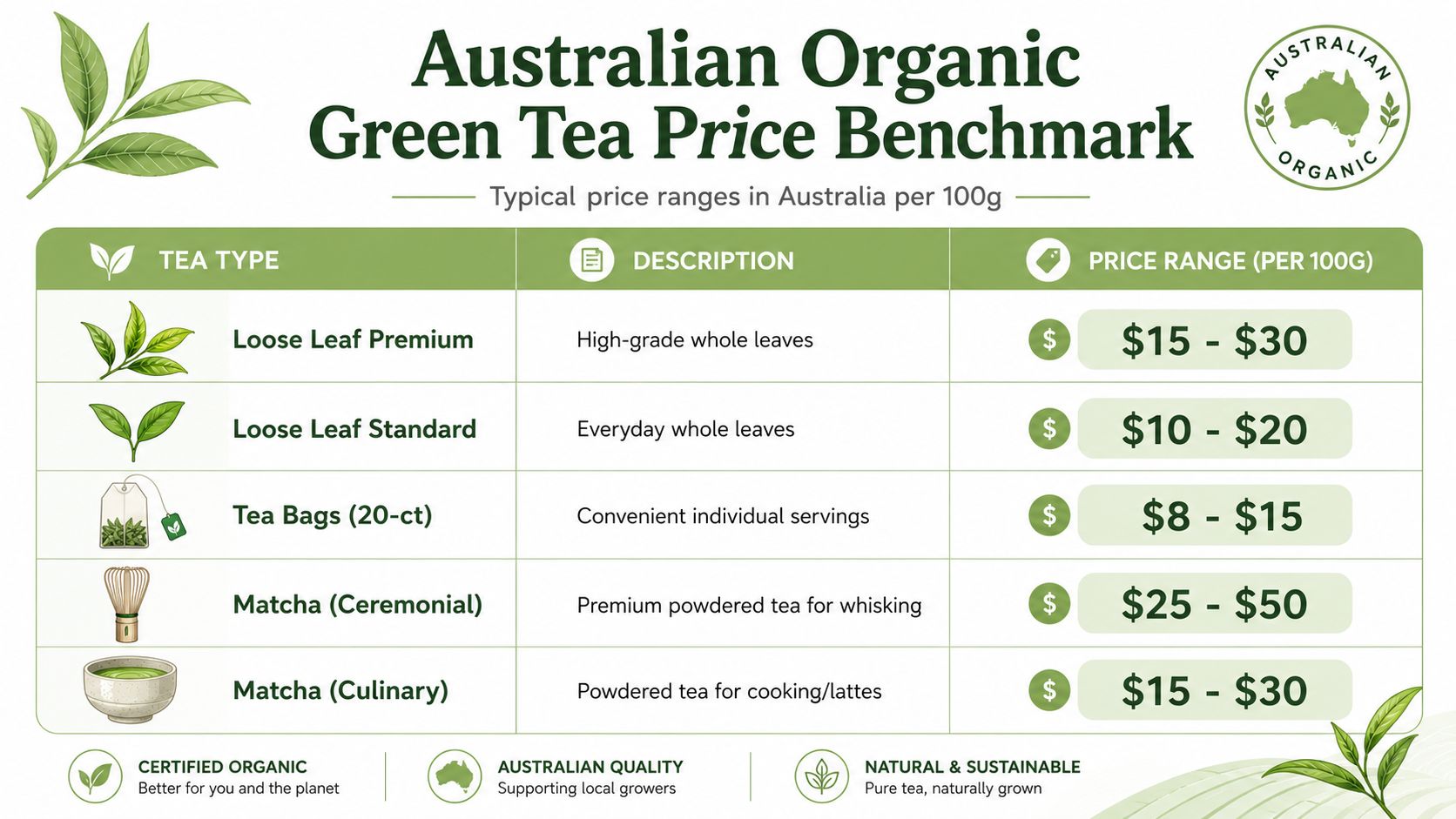
Typical Organic Green Tea Price in Australia 2026
| Tea Format | Typical Price Range (AUD) | Estimated Cost Per Serve (AUD) |
|---|---|---|
| Tea Bags (20-ct) | $8 to $15 | About $0.40 to $0.75 per bag |
| Loose Leaf Standard | $10 to $20 per 100 g | Depends on scoop size and whether you re-steep |
| Loose Leaf Premium | $15 to $30 per 100 g | Depends on scoop size and whether you re-steep |
| Matcha Culinary | $15 to $30 per 100 g | Depends on recipe and serving size |
| Matcha Ceremonial | $25 to $50 per 100 g | Depends on whisking portion |
These ranges give you a rough Australian benchmark. They are most useful as a sorting tool, not a verdict on quality. Supermarket tea, specialty tea, hospitality supply packs, and imported premium products can all sit in different parts of the range.
Why this benchmark can still confuse buyers
Two products can share a similar pack price and deliver very different value per cup.
A 20-bag box gives you a clear serve count, which makes it easy for home drinkers. Loose leaf is less obvious because one person uses 2 grams, another uses 3 grams, and some teas handle a second infusion well. Matcha complicates it again. A small tin may look expensive, but the serve cost can make sense if you are using measured portions for straight tea, lattes, or desserts.
For café owners, this is the same logic used in any sensible menu costing exercise. If you already know how to price products for profit, tea should be treated the same way. You price the serve, not just the bag or tin.
A better benchmark asks two questions at once. What does one serve cost, and what quality, consistency, and experience does that serve create?
How to read the table like a smart buyer
Start with the format that fits the job.
Tea bags usually offer the clearest labour-saving value. They suit fast home routines, office kitchens, and some casual service settings where speed matters more than brewing control.
Loose leaf often gives stronger value for flavour-focused drinkers and cafés that want more control over strength, aroma, and presentation. The upfront pack price may sit above tea bags, but the cost per serve can be competitive.
Matcha usually asks for the highest upfront spend. That does not automatically make it poor value. In Australia, it can make good sense for buyers who want a concentrated product for whisked servings, premium lattes, or menu versatility.
A quick rule of thumb
Use package price to place the product in a rough bracket. Use cost per serve to judge affordability. Use value per serve to decide whether it deserves a place in your kitchen or on your menu.
Key Factors Driving the Cost of Organic Tea
Price becomes much easier to understand once you look at what sits behind it.
In Australia, shelf pricing is heavily shaped by costs that pass through the supply chain. Fortune Business Insights notes that food and non-alcoholic beverage inflation is a key retail driver, which helps explain why freight, certification, and smaller-batch sourcing can lift the final organic tea price. So when a premium organic tea costs more, it isn't automatically a branding trick. There are often real cost layers underneath it.
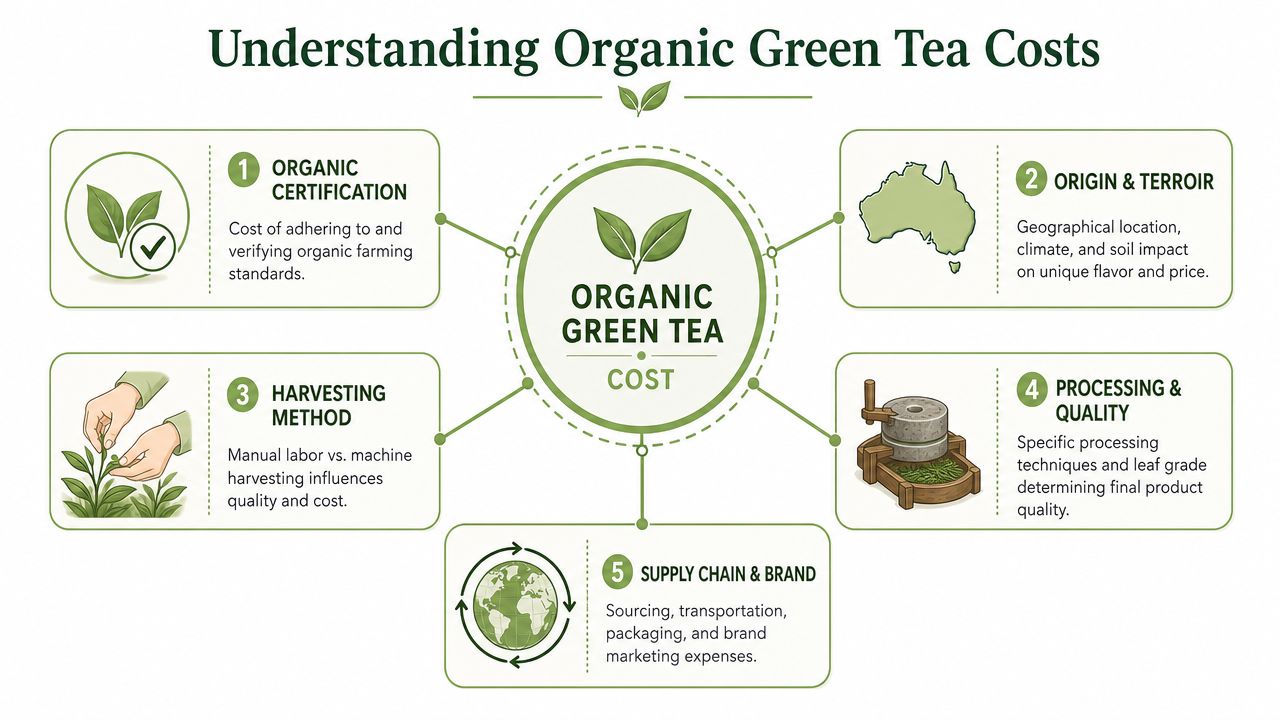
Certification adds more than a logo
Organic certification is one of the first things buyers notice, but often the least understood.
That certification usually means documented production standards, handling controls, and verification processes. Those steps take time, admin, and oversight. By the time the tea reaches Australia, that work is already part of the cost base.
Origin changes both flavour and price
Tea from a recognised tea-growing region can command a stronger price because buyers expect a particular flavour profile, processing style, and consistency.
That doesn't mean only one country can make good tea. It means provenance matters. In premium tea, origin functions a bit like it does in olive oil or coffee. People aren't only buying the ingredient. They're buying a particular result in the cup.
Harvest and processing matter more than most people realise
A tea that's carefully handled will usually cost more than a tea produced for volume.
Some green teas are made for straightforward daily drinking. Others involve more selective harvesting, more controlled processing, or extra labour after picking. Matcha is a strong example. Powdered tea isn't just “green tea ground up” in the casual sense. The path from leaf to fine powder is part of why it occupies a different pricing tier.
Grade and intended use shape value
Not every green tea is trying to do the same job.
- Tea bags suit speed and consistency
- Loose leaf suits flavour, aroma, and brewing flexibility
- Culinary matcha is better suited to lattes, smoothies, and cooking
- Ceremonial matcha is usually chosen for straight preparation and a cleaner tasting experience
If you're a retailer or café operator, it helps to think about the same pricing logic used in other product categories. This practical guide on how to price products for profit is useful because it frames cost, positioning, and margin in a way that fits specialty beverage ranges too.
The fairest way to judge tea price is to ask whether the product is well priced for its purpose, not whether it's the cheapest option on the page.
How to Calculate Your True Cost Per Serve
Buyers often look at the total price first. Smart buyers look at the cost per serve.
That small shift changes everything. A pack that seems expensive can be reasonable once you divide it by the number of useful cups it produces. On the other hand, a cheap-looking product can be poor value if it makes weak tea or disappears quickly.
The simple formula
Use this:
Total price ÷ number of servings = cost per serve
That's it.
If the number of servings isn't listed clearly, estimate it from the pack format and how you prepare your tea. A tea bag is usually one serve. Loose leaf depends on how much you scoop. Matcha depends on whether you're whisking a bowl, making a latte, or adding it to a recipe.
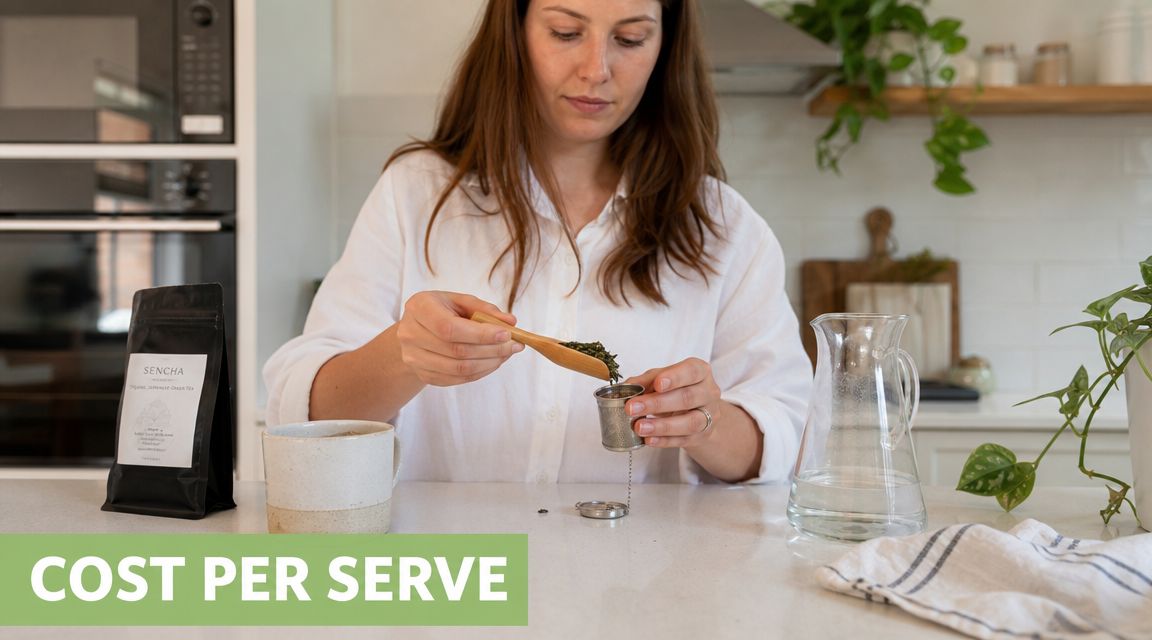
What this looks like in practice
Take a tea bag product first. If a pack costs $10 and gives you 50 cups, your cost per serve is $0.20.
Now compare that with a premium powdered tea. The upfront spend may feel much higher, but it's also serving a different purpose. A matcha bought for focused morning use, café lattes, or recipe work shouldn't be judged like a basic teabag for the office kitchen.
Here's the question: What are you asking that serve to do?
- Daily hydration drink. You'll probably prioritise lower cost and convenience.
- Flavour-focused tea break. You may prefer loose leaf and accept a moderate lift in cost.
- Functional or premium drink. You may decide a higher per-serve cost is worthwhile.
Why businesses should care too
Cafés already know ingredient cost isn't the whole story. They track menu pricing, waste, and customer value over time.
That's why it's useful to borrow thinking from adjacent parts of business. Even though it's about marketing, this guide on how to measure customer acquisition is a good reminder that one headline number rarely tells the full story. Tea buying works similarly. Shelf cost matters, but the better metric is what each serve contributes to value, experience, and repeat purchase.
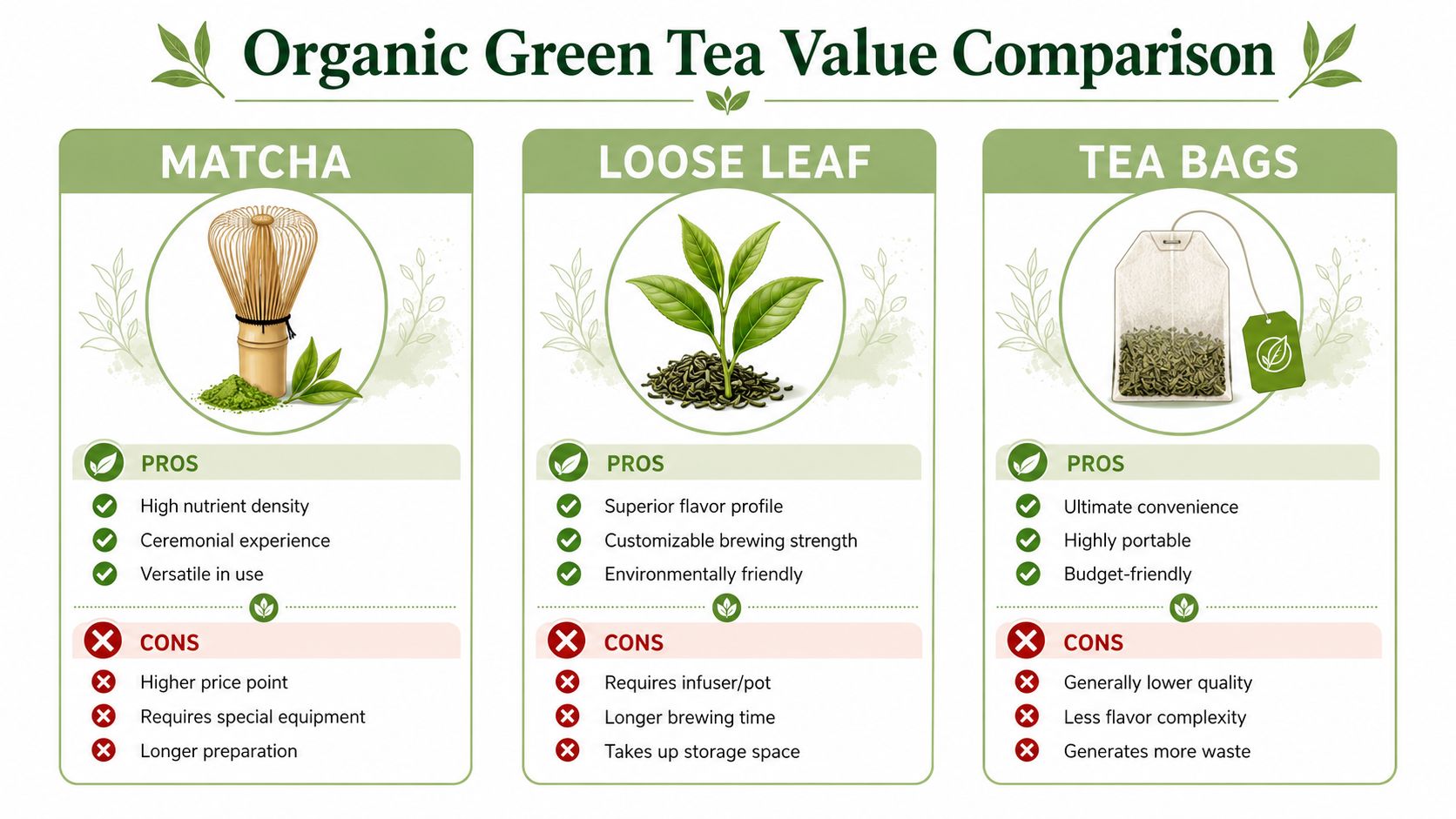
Comparing Value Matcha vs Loose Leaf vs Tea Bags
A $12 box of tea bags and a $30 tin of matcha can sit on the same shelf, yet they are not competing in the same job.
That is the mistake many buyers make. They compare pack price first, then assume the cheaper product is the better deal. Tea works more like kitchen equipment than stationery. A paring knife, chef's knife, and blender all help you prepare food, but you would not judge them by asking which one is cheapest per item. Green tea formats work the same way. Each one creates value in a different way, and the smart comparison is cost per serve matched to purpose per serve.
Tea bags for convenience
Tea bags usually win on routine.
If you want a fast, tidy cup before work, for staff rooms, hotel breakfast stations, or self-serve café setups, tea bags often deliver the lowest friction. The flavour may be simpler and your brewing control is limited, but the value is in reliability. Little mess. Little training. Little guesswork.
For many Australian households and venues, that matters more than nuance in the cup.
Loose leaf for flavour and brewing control
Loose leaf often gives the strongest middle ground.
You pay more attention, but you usually get more say in the final result. Water temperature, steep time, and leaf quantity all shape the cup. That flexibility suits home drinkers who care about aroma and texture, and it suits cafés that want a more premium pot or cup without stepping into matcha preparation.
The key value question is simple. Will the person making it use that extra control well? If yes, loose leaf can feel far better value than tea bags, even if the shelf price is higher.
Matcha for intensity, versatility, and premium positioning
Matcha sits in its own lane because you consume the whole leaf in powdered form rather than infusing and discarding it. That changes both use and perceived value.
A serve of matcha may cost more, but it can also do more. It can be whisked as a straight tea, built into a latte, blended into smoothies, or used in baking. For a café owner, that opens menu possibilities. For a home buyer, it may replace a café-bought drink habit rather than a basic green tea habit. If you want a clearer breakdown of format and use, this guide on the difference between matcha green tea and green tea explains the distinction well.
That is why matcha should not be judged against tea bags alone. It is often closer to a specialty ingredient than an everyday pantry staple.
A better way to compare value
Use a three-part test.
Ask what one serve costs, what one serve requires, and what one serve gives back.
- Tea bags usually offer the lowest effort per cup and the most predictable routine value.
- Loose leaf usually offers better flavour per cup when the drinker is willing to brew with care.
- Matcha usually offers the highest versatility and premium potential, especially for lattes, wellness menus, and intentional daily rituals.
For home drinkers, the best-value format is the one you will enjoy and use consistently.
For cafés, the best-value format is the one that fits your service model, staff skill, and menu pricing. A tea bag can be profitable because it is fast. A loose leaf tea can be profitable because it improves the customer experience. A matcha can be profitable because customers accept a higher menu price for it.
Good value comes from fit. Tea bags suit speed, loose leaf suits flavour, and matcha suits a more purposeful, premium serve.
Where ready-to-drink value fits
Ready-to-drink products belong to a separate value category.
Organic kombucha, for example, removes the brewing step completely. Its appeal comes from convenience, refrigeration, and a different drinking occasion. That does not make it better than green tea. It means the buyer is paying for immediate service and a different customer expectation, which can be useful in hospitality settings.
Smart Buying Tips for Home and Hospitality
Paying more only makes sense when you know what you're paying for.
Australian buyers are balancing two instincts at once. They're careful with everyday spend, but they'll still pay a premium for products that feel better, cleaner, or more purposeful. That tension is especially clear in premium wellness beverages, where buyers want proof of value, not just a nice story.
For home drinkers
A smart purchase starts before checkout.
- Read the format properly. Don't compare tea bags, loose leaf, and matcha as if they're equivalent.
- Check the origin and grade. A premium tea should tell you enough about what it is and how to use it.
- Buy for your real habit. If you drink tea absent-mindedly at your desk, convenience may matter more than prestige.
- Think in servings. A more expensive tea can still be sensible if each cup delivers what you want.
If you shop online, browsing a specialist range of organic green tea in Australia can make comparison easier because format and purpose are usually clearer than they are on crowded marketplace pages.
For cafés and hospitality venues
Hospitality buyers need a slightly different lens. You're not just buying tea. You're building a menu.
A premium green tea or matcha offer can work well when it gives customers a distinct reason to choose your venue. That might be a more refined hot tea option, a stronger matcha latte program, or a non-alcoholic drinks list that feels current and health aware.
Consider these checkpoints:
Match product to menu role
Culinary matcha may suit lattes and kitchen use. Loose leaf may suit pot service. Tea bags may suit speed-led operations.Make the value visible
If customers are paying more, provenance and preparation should be clear on the menu and in service.Watch wastage
A premium ingredient only works commercially when staff use it consistently.Offer contrast
A café menu is stronger when it includes both accessible options and one or two more distinctive premium choices.
For hospitality, “worth the price” usually means the product helps the menu feel sharper, not simply cheaper to pour.
A practical mindset for both groups
The best buyer isn't the one who always spends least. It's the one who spends in the right place.
If you want a quick office tea, don't overbuy. If you care about flavour, ritual, or a premium café drink at home, don't underbuy and then wonder why the experience feels flat.
Finding Quality That Fits Your Budget
There isn't one correct organic green tea price.
There's only the right price for the job you need the tea to do. Tea bags can be good value when convenience matters. Loose leaf can be the better buy when flavour and brewing control matter more. Matcha can justify a higher upfront spend when you want a more premium or functional serve.
That's the key shift. Don't ask only, “Why is this tea so expensive?” Ask, “What am I getting in each cup?”
When you judge organic tea by format, purpose, and cost per serve, the market becomes far easier to understand. You stop comparing everything against the cheapest box on the shelf and start choosing with more confidence.
Frequently Asked Questions
Is organic green tea always more expensive than regular green tea
Often, yes. Organic tea usually carries extra certification, sourcing, and supply-chain costs. But “more expensive” doesn't always mean poor value. If the tea is better suited to your needs, the higher price can still make sense.
What's the difference between organic and certified organic
In practical buying terms, certified organic gives you more confidence because it points to a verified standard rather than a vague marketing phrase. If the label isn't clear, it's worth reading more closely before you compare price.
Why does matcha cost more than tea bags
Because it's a different format with a different use case. Matcha is a powdered tea used for whisking, lattes, and recipes, and buyers often treat it as a premium ingredient rather than a basic pantry tea.
Is loose leaf better value than tea bags
Sometimes. Loose leaf can offer better flavour and more flexibility, but only if you enjoy brewing it. If convenience wins every morning, the tea bag may be the better value for your lifestyle.
How should cafés choose between matcha, loose leaf, and tea bags
Start with the menu. Tea bags suit speed, loose leaf suits table service and flavour-led offers, and matcha suits premium drinks. Buy according to service style, staff capability, and what your customers expect.
Does expensive tea always mean better tea
No. A higher price should come with a clearer reason. Better origin information, stronger processing standards, a more suitable grade, or a format that matches how you'll use it.
If you're ready to choose more confidently, explore Pep Tea for premium organic matcha, Australian-brewed sugar-free organic kombucha, and practical guidance that helps you understand what you're buying, not just what you're paying.
Your Guide: What Does Matcha Latte Taste Like in 2026?

A matcha latte usually tastes creamy, smooth, and subtly sweet, with a distinctive green flavour that balances vegetal notes, umami, and mild bitterness. A common starting method is 1 teaspoon of matcha powder mixed with 2 tablespoons of water before adding milk, which helps keep the flavour full instead of washed out.
If you're staring at a bright green latte on a café menu and wondering whether it'll taste like grass, spinach, dessert, or some strange health drink, you're not alone. Matcha can be confusing at first because people often describe it with one vague word, usually “earthy”, and stop there.
That doesn't help much when you're deciding whether to order one.
Its taste is more interesting. A good matcha latte tastes layered. It has a fresh green character, a savoury depth, and a creamy finish from the milk. The exact balance changes with the matcha grade, the milk you choose, and how the drink is prepared. Once you understand those levers, the flavour stops feeling mysterious and starts feeling easy to control.
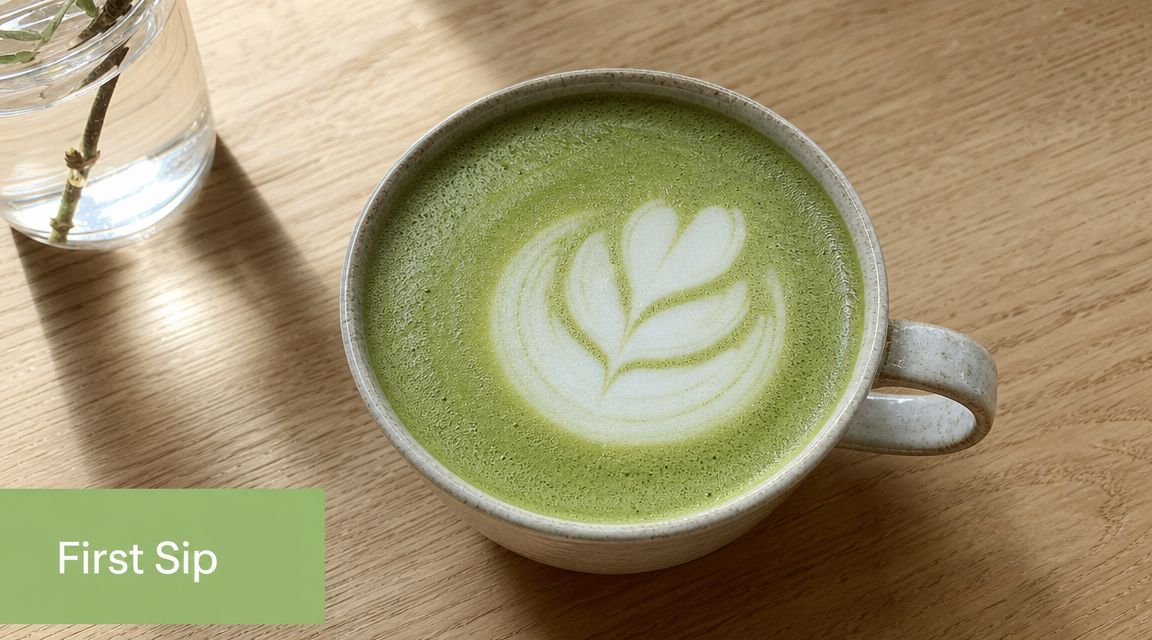
Your First Sip What to Expect from a Matcha Latte
You've probably seen matcha lattes everywhere in Australia. They show up in minimalist cafés, on brunch tables, and all over social feeds with that unmistakable jade-green colour. The look alone suggests something fresh and energising, but the taste often surprises first-time drinkers.
A well-made matcha latte doesn't taste like a standard cup of green tea with milk poured into it. It tastes fuller, softer, and more rounded. The first sip usually brings creaminess from the milk, then a fresh green flavour, followed by a gentle savoury note that lingers in a pleasing way.
The easiest way to picture the flavour
If you've never had one before, think of it like this:
- Green and fresh. Not in a harsh salad way, but more like young greens or steamed edamame.
- Creamy and mellow. Milk smooths out the sharper edges.
- Lightly sweet. Even before extra sweetener, a good matcha latte can come across as naturally soft.
- A little savoury. This is the part people often don't expect, and it's what makes the drink interesting.
That savoury character is why matcha latte fans often describe the drink as comforting rather than sugary. It can feel café-worthy and soothing at the same time.
A matcha latte should taste green in a pleasant way, not like watered-down lawn clippings.
Why first impressions vary so much
Two people can order a matcha latte from different cafés and come away with completely different opinions. One gets a smooth, balanced drink and loves it. The other gets something thin, overly sweet, or bitter and decides matcha isn't for them.
Usually, the difference comes down to three things:
- The powder quality
- The milk and sweetener choices
- The mixing ratio
Those three choices shape almost everything you taste. That's why one matcha latte can feel silky and dessert-like, while another feels sharper and more brothy.
The Core Flavour Profile of a Matcha Latte
The clearest way to answer what does Matcha latte taste like is this: it's a balance of vegetal or grassy notes, umami, and milk-led creaminess with sweetness. That description is strongly supported by this matcha latte flavour guide from Nio Teas, which also notes a useful preparation method of 1 teaspoon of matcha powder with 2 tablespoons of water before milk is added.
Vegetal doesn't mean unpleasant
“Vegetal” can sound off-putting if you haven't tasted matcha before. People hear it and assume the drink must taste raw, bitter, or aggressively healthy.
In practice, that green note is often closer to:
- Steamed spinach
- Edamame
- Fresh-cut herbs
- Young spring greens
The key is softness. Good matcha tastes green, but not rough. It has a living, leafy quality that feels fresh rather than harsh.
Umami is the secret people struggle to name
If you've ever taken a sip and thought, “This tastes rich, but not sugary,” you were probably noticing umami.
Umami is the savoury taste that adds depth. In a matcha latte, it can feel lightly brothy, rounded, and almost creamy in its own right, even before the milk comes in. This is one reason matcha feels more complex than many other tea drinks.
Practical rule: If your matcha latte tastes only sweet, something is off. A good one still lets the tea taste like tea.
Milk changes the shape of the flavour
Milk doesn't erase matcha's taste. It reshapes it.
Instead of letting bitterness sit on top of your tongue, milk cushions it. Instead of making the drink taste sharp, it creates a smoother texture and brings forward any natural sweetness in the matcha. That's why the same powder can taste very different as a straight bowl of whisked matcha compared with a latte.
Here's a simple way to think about the three main flavour elements:
| Flavour note | What it feels like in the cup | What it adds |
|---|---|---|
| Vegetal or grassy | Fresh, green, leafy | Brightness and identity |
| Umami | Savoury, rounded, lightly brothy | Depth and richness |
| Milk sweetness | Creamy, soft, mellow | Balance and comfort |
Why the paste method matters
If you dump matcha straight into a large amount of milk, the flavour can seem weak and flat. Starting with a small amount of water creates a concentrated base first. That helps the tea stay present after milk is added.
That 1 teaspoon to 2 tablespoons starting ratio helps. It isn't just about texture. It protects flavour intensity, so your latte still tastes like matcha instead of vaguely green milk.
How Matcha Quality Shapes the Flavour
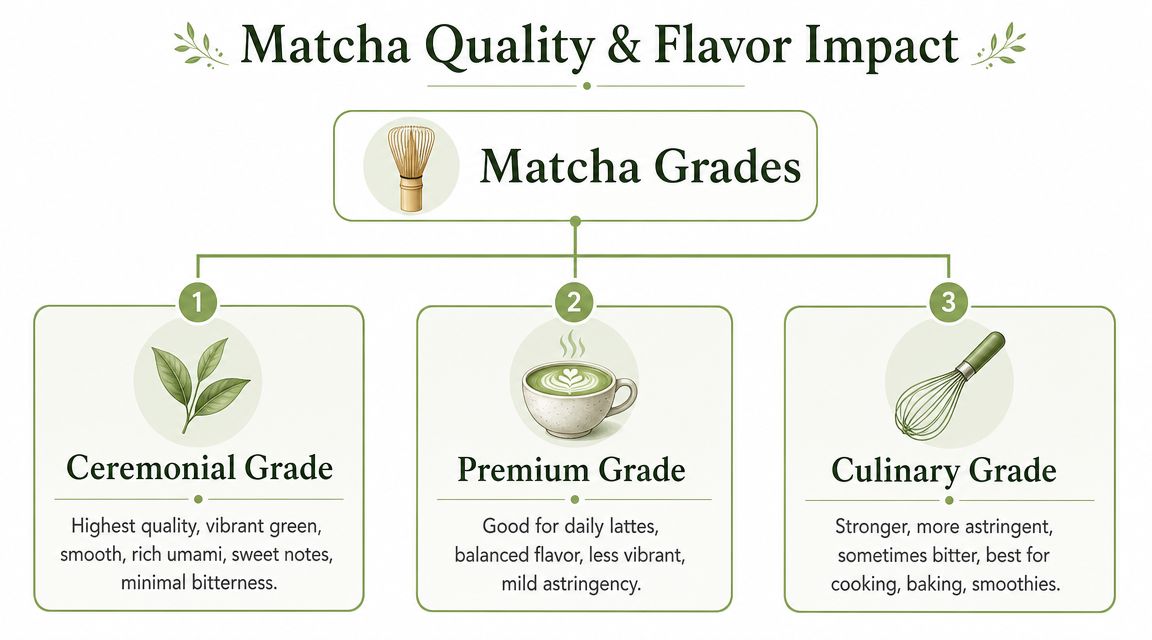
If you've ever wondered why one matcha latte tastes smooth and elegant while another tastes coarse or bitter, quality is usually the answer.
The core flavour of a matcha latte includes vegetal notes, umami, and mild bitterness. According to First Agri's matcha flavour explanation, high-quality ceremonial matcha can contain 3–4% L-theanine by weight, which contributes to the savoury umami character that makes premium matcha feel softer and more refined.
What higher quality tastes like
Higher-quality matcha usually tastes:
- Smoother
- Less bitter
- More naturally sweet
- More savoury and rounded
That doesn't mean it tastes sugary. It means the flavour arrives in a more polished way. You notice green freshness and umami first, not a rough astringent edge.
Texture matters too. Finer powder disperses more evenly, so the drink feels silkier in the mouth. That changes your perception of flavour just as much as the taste compounds do.
What lower quality tastes like
Lower-grade matcha can still work in recipes, smoothies, and baking, but in a latte it often comes across as:
- More assertive
- More astringent
- More bitter
- Less nuanced
This can be useful if you want matcha to punch through lots of other ingredients. But if your goal is a café-style latte with a soft finish, lower quality powder often makes that harder.
Ceremonial and culinary in practical terms
The labels can get a bit messy in the market, but for everyday drinkers the practical distinction is simple:
Ceremonial-style matcha is usually chosen when the matcha itself is meant to shine. It tends to be brighter, gentler, and richer in umami.
Culinary-style matcha is usually chosen when the powder needs to stand up to other strong ingredients like chocolate, banana, syrups, or baking fats.
If you're comparing products and want a grounded buying framework, this guide to explore Jade Leaf Matcha pros and cons can help you think through how different matcha options perform in real use.
For a broader look at styles and uses, Pep Tea also has a helpful guide on different grades of matcha.
Better matcha doesn't just taste “nicer”. It changes which notes dominate. You get more umami and softness, and less blunt bitterness.
The Art of Customisation Milk Sweeteners and Ratios
Matcha can be quite fun. Once you understand the base flavour, you can tune the drink to suit your palate instead of taking whatever the café gives you.
A matcha latte isn't fixed. It's adjustable. Milk choice changes body and sweetness. Sweetener changes emphasis. Ratio changes intensity. Small tweaks make a surprisingly big difference to the final cup.
How different milks change the drink
Some milks pull matcha toward dessert. Others keep it lighter and greener. None is universally “best”. The right one depends on whether you want more creaminess, more tea character, or more restraint.
| Milk Type | Flavour Impact | Texture | Best For |
|---|---|---|---|
| Dairy milk | Softens the green notes and adds a classic mellow sweetness | Rich and rounded | A traditional café-style latte |
| Oat milk | Brings out natural sweetness and can make matcha feel softer | Creamy and plush | People who like a smooth, comforting cup |
| Almond milk | Adds a subtle nutty edge and keeps the drink lighter | Thinner to medium | Drinkers who want matcha to stay more noticeable |
| Soy milk | Can add body without too much heaviness | Creamy and stable | A balanced plant-based option |
| Coconut milk | Adds a distinct tropical note that can compete with matcha | Fuller and sometimes heavy | Flavoured variations rather than a pure matcha profile |
The easiest way to choose your milk
If you're unsure where to begin, use this quick guide:
- Want the matcha to stand out? Choose almond or soy.
- Want a softer, sweeter-feeling latte? Choose oat.
- Want a classic café finish? Choose dairy.
- Want the cleanest expression of the tea? Avoid highly flavoured milks.
A strongly flavoured milk can blur the point of matcha. Vanilla-heavy or very sweet blends often cover the savoury depth that makes the drink special.
Sweeteners can help or hijack
A little sweetener can make matcha feel welcoming, especially if you're new to it. Too much, and you flatten the flavour into generic sweetness.
Common choices each push the drink in a slightly different direction:
- Honey adds floral warmth and a rounded finish.
- Maple syrup adds deeper sweetness and a cosy note.
- Plain sugar sweetens without much added flavour.
- Stevia can work well if you want sweetness without sugar, though the aftertaste depends on the product.
If you're trying a sugar-free option, products like Afida stevia stick wraps can be useful for testing very small adjustments without overcommitting.
Add sweetener slowly. It's easier to build sweetness than to rescue a latte that no longer tastes like matcha.
Ratios decide whether the drink feels bold or vague
This is the part many home brewers underestimate. Even good powder can taste underwhelming if you use too much milk for the amount of matcha.
A few practical cues help:
- If it tastes weak, there's too much milk for the amount of matcha.
- If it tastes muddy, the powder may not have been mixed properly before the milk went in.
- If it tastes intense but pleasant, you've likely hit a good balance.
- If it tastes aggressive, reduce the matcha slightly or switch to a softer milk.
The concentrated paste method helps here too. It gives the tea a head start, so it doesn't disappear into the milk.
If you want a home method you can tweak and repeat, this guide on how to create your Matcha green tea latte recipe at home is a practical place to start.
Three flavour styles you can build on purpose
Rather than guessing, decide what kind of latte you want:
Soft and creamy
Choose oat or dairy milk, use only a light touch of sweetener, and keep the matcha smooth rather than forceful.
Fresh and green
Use a lighter milk, little to no sweetener, and let the vegetal side stay clear.
Rich and café-like
Use a high-quality matcha, enough milk for body, and just enough sweetness to round the edges without hiding the tea.
That's the answer to what a Matcha latte tastes like. It can taste different on purpose, depending on the choices you make.
Matcha Latte vs Coffee Chai and Green Tea
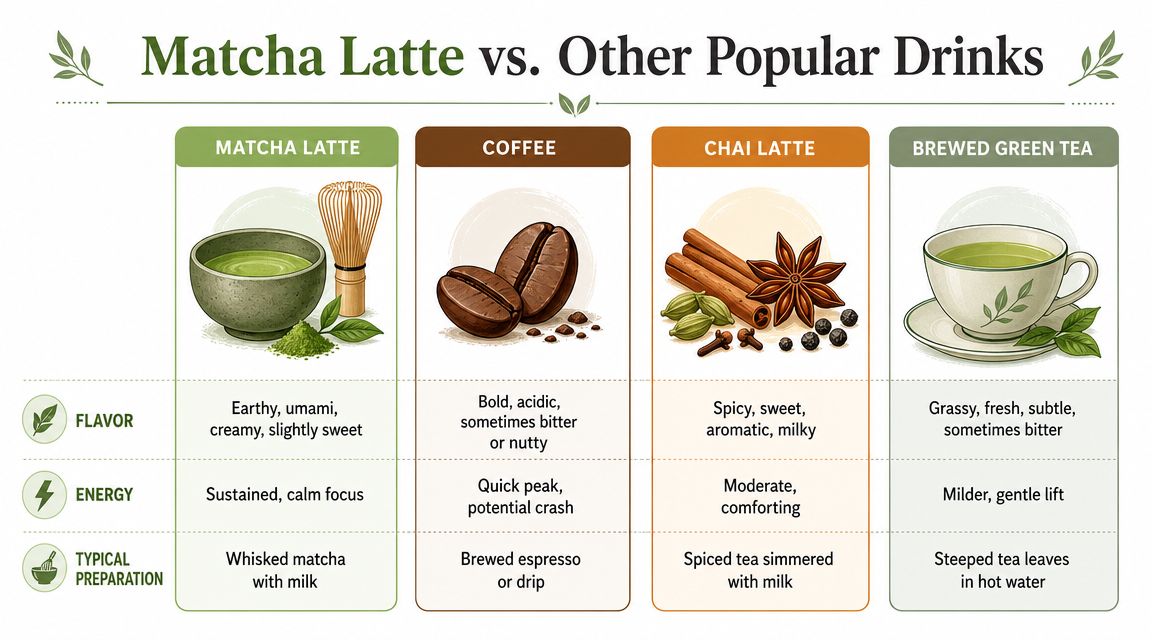
A matcha latte makes more sense when you compare it to drinks you already know.
For many Australians, the taste is shaped by how it feels alongside coffee. Matcha is often described as giving a gentler energy effect because its caffeine is paired with L-theanine, and one guide notes that a typical serving contains about half the caffeine of a coffee. That pairing helps explain why many people experience matcha as smoother and less sharp than coffee, as noted in this matcha taste guide from Aki Matcha.
Matcha latte versus coffee
Coffee usually leads with roast, bitterness, and sometimes acidity. Matcha leads with green freshness, savoury depth, and creaminess.
If coffee hits your palate with a sharper edge, matcha tends to spread more gently. Even when it's strong, it rarely tastes like espresso. It has presence, but of a different kind.
Matcha latte versus chai latte
These two drinks can look similar on a menu because both are often served milky and warm. Flavour-wise, they live in completely different worlds.
Chai tastes spiced, aromatic, and warming. You expect cinnamon, cardamom, ginger, and sweetness. Matcha isn't spicy at all. It's cleaner, greener, and more savoury.
If you enjoy both drinks and want to see how they meet in one cup, this article on mastering your matcha chai latte offers a useful crossover approach.
Matcha latte versus brewed green tea
This comparison catches people out most often. A matcha latte does not taste like standard green tea with milk.
Brewed green tea is usually lighter, more delicate, and more transparent in flavour. A matcha latte feels thicker, fuller, and more concentrated because the tea itself is present as fine powder in the drink rather than steeped and removed.
Here's a quick snapshot:
- Coffee feels bolder and sharper
- Chai latte feels spicier and sweeter
- Brewed green tea feels lighter and more delicate
- Matcha latte feels creamier, greener, and more savoury
If you want a milky café drink without coffee's roasted bitterness or chai's spice, matcha sits in a very appealing middle ground.
Perfecting Your Latte Troubleshooting Common Issues
Making matcha at home is simple once you know what tends to go wrong. Most disappointing cups come down to a few repeat mistakes, and each one has a straightforward fix.
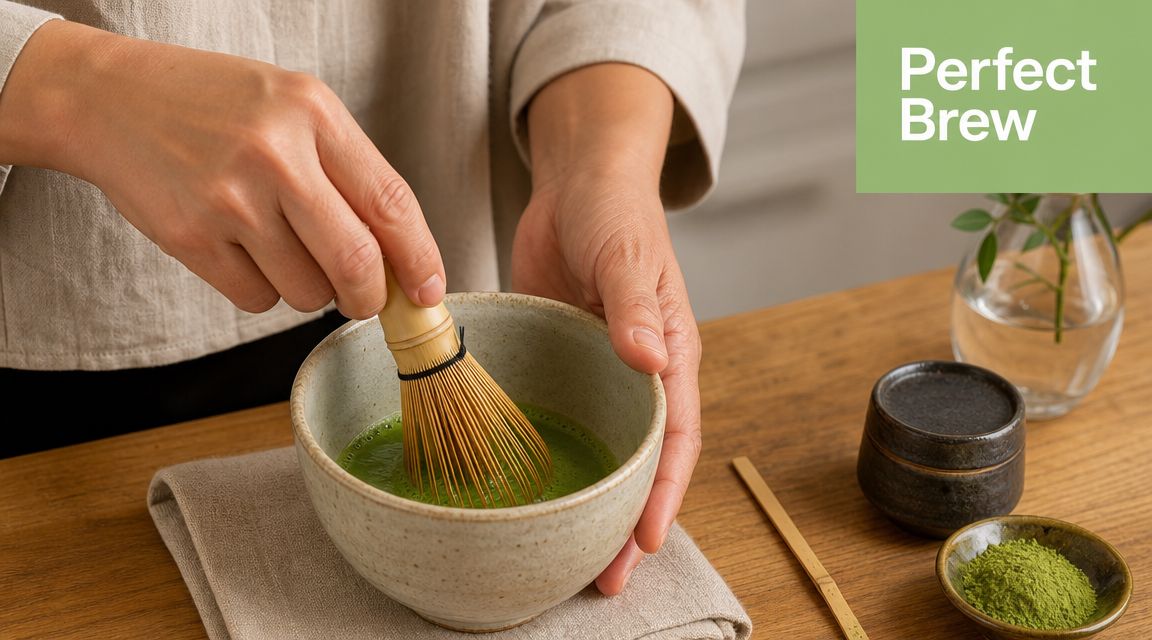
If your latte is lumpy
Lumps usually mean the powder wasn't broken up before mixing. Matcha is very fine, so it clings together easily.
Try this:
- Sift first if you can
- Make a paste with a small amount of water before adding milk
- Whisk thoroughly so the powder disperses evenly
If you want to improve your technique, Pep Tea's guide on how to whisk matcha is worth bookmarking.
If it tastes bitter
Bitterness can come from powder quality, but preparation often plays a role too. If the tea tastes rough, check whether you've made the drink too concentrated for your preference, or whether your matcha has a more assertive profile.
The easiest fixes are:
- Use a smoother-quality matcha
- Pair it with a creamier milk
- Add only a small amount of sweetener if needed
A little bitterness is normal. Harsh bitterness that overwhelms everything else usually means the balance is off.
If it tastes weak
Weak matcha latte almost always means too much milk or too little matcha presence in the base.
Check these points:
- Build the concentrate first instead of stirring powder straight into a full mug of milk
- Reduce the milk slightly if the tea flavour is disappearing
- Choose a less dominant milk if your current one is covering the matcha
This walkthrough shows the process in action:
If it tastes too sweet or too flat
This often happens when people try to “fix” matcha by adding more and more sweetener. Instead of improving the drink, that can bury the savoury and green notes that give it character.
Keep the sweetness low enough that you can still recognise the tea.
When your latte is working, you should taste creaminess and sweetness first, then notice the green and umami character underneath. That layered effect is what makes a good matcha latte feel satisfying rather than one-note.
If you're ready to taste the difference for yourself, Pep Tea offers premium organic matcha and practical guides to help you make a smoother, better-balanced cup at home. Explore the range, experiment with your preferred milk and ratio, and find the matcha latte style that tastes right for you.
Genmaicha vs Matcha: A Complete Guide to Choosing Your Tea
You're standing at a café counter in Newcastle, Melbourne, or somewhere in between. The menu offers a matcha latte, a pot of genmaicha, and maybe a few other green teas. Both names sound healthy. Both are Japanese. Both are green.
But they're not the same drink at all.
One is vivid, creamy, and built for a focused lift. The other is mellow, toasty, and feels like the tea version of a warm jumper. If you've ever wondered about Genmaicha vs Matcha, the most useful question isn't which one is better. It's which one suits this moment.
That's where people often get stuck. They hear “green tea” and assume the difference is minor. In practice, these teas behave differently in the cup, in your body, and in your daily routine. One works beautifully for a morning reset or a pre-work ritual. The other shines beside lunch, during a quiet afternoon, or when you want something gentler.
The Green Tea Dilemma Genmaicha or Matcha
A lot of Australians first meet matcha through a latte. Bright green, a bit earthy, maybe slightly sweet if the café has done it well. Genmaicha usually arrives differently. It might be tucked away on a loose-leaf shelf, or listed on a tea menu without much explanation.
That's why the confusion is so common.
You look at the two and think, “Both are Japanese green teas. Surely they'll taste pretty similar.” Then you try them. Matcha feels dense and vivid. Genmaicha smells like toasted rice and tastes soft, savoury, and calm. Same family, completely different personality.
The simplest explanation is this:
| Tea | What it is | What it feels like | Best moment |
|---|---|---|---|
| Genmaicha | Green tea blended with roasted brown rice | Comforting, light, toasty | Afternoon, with food, winding down |
| Matcha | Shade-grown green tea ground into a fine powder | Rich, creamy, vibrant | Morning, focused work, coffee alternative |
What's needed isn't a tea lecture, but a practical answer. If you're trying to cut back on coffee, matcha might be the one that makes sense. If you want a gentler cup that won't dominate your palate, genmaicha often feels easier to live with day to day.
The right tea isn't the fanciest one. It's the one that fits what you need right now.
That could be energy. It could be comfort. It could be something that works with lunch instead of fighting it. Once you understand how each tea is made and what that means in the cup, the choice gets much easier.
Genmaicha Explained The Soul of Toasted Rice Tea
Genmaicha is one of the most approachable Japanese teas you can drink. It's a blend, not a powder. The classic version combines green tea with roasted brown rice, and that rice is what gives genmaicha its signature aroma and gentle, cereal-like warmth.
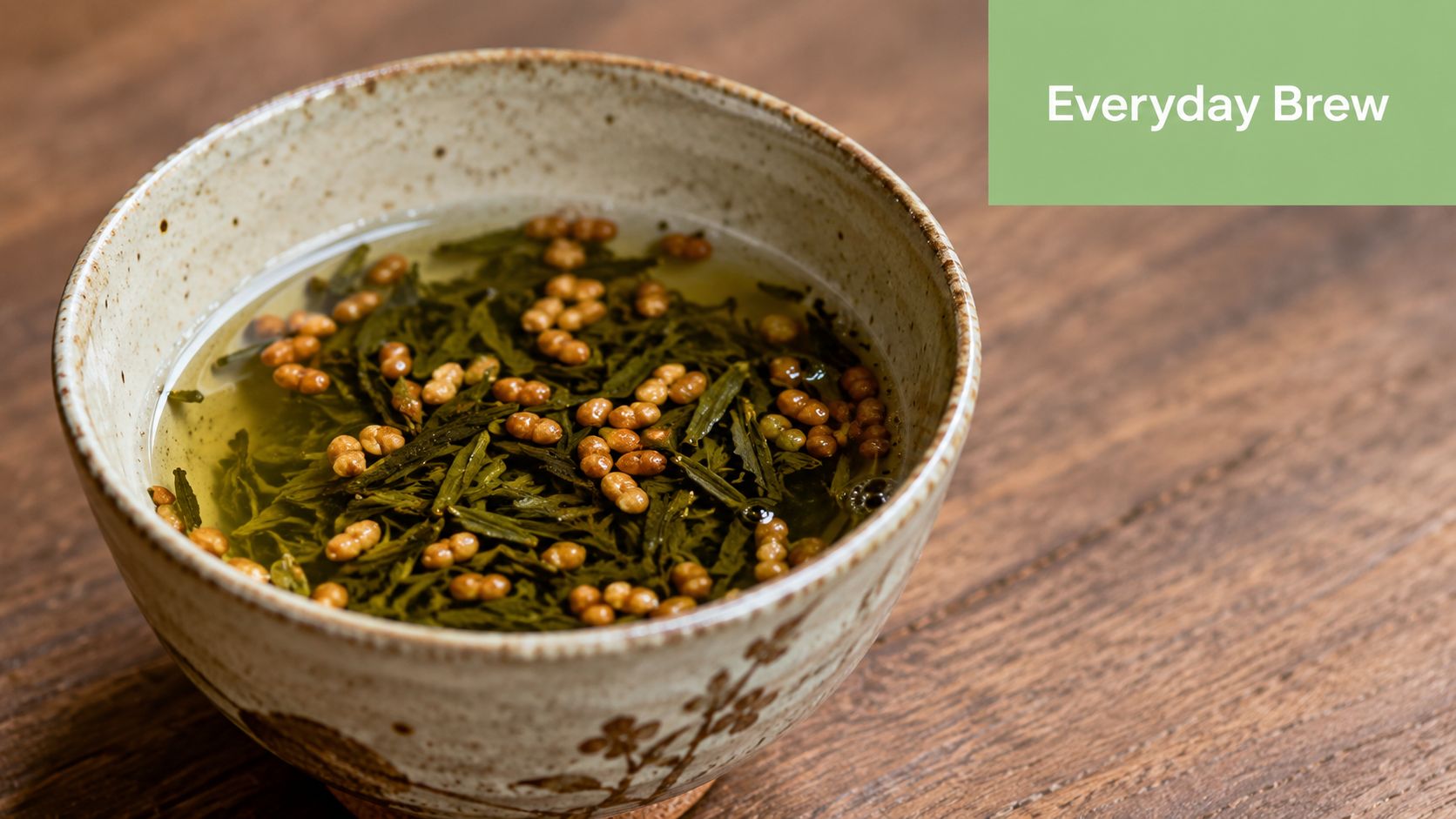
What's actually in genmaicha
The clearest historical distinction between genmaicha and matcha comes down to processing. Genmaicha is a blended tea made from green tea plus roasted brown rice, while matcha is made from shade-grown tea leaves that are ground into powder. Genmaicha typically contains about 50% to 75% brown rice and 25% to 50% green tea, which helps explain why the brewed liquor tends to look more yellow-gold than bright green, as outlined in this comparison of matcha, hojicha, and genmaicha.
That rice-heavy blend shapes the whole drinking experience. Less tea leaf in the cup usually means a softer profile and less intensity.
If you browse a range of Japanese green tea options, genmaicha often stands out as the one people choose when they want something easy-going rather than dramatic.
Why it feels so comforting
Genmaicha has a very particular charm. The roasted rice brings a nutty, savoury scent that many people compare to popcorn, toasted grain, or warm rice crackers. The green tea side keeps it fresh, but the overall cup is mild, round, and friendly.
That's why it works so well for people who find some green teas too grassy or sharp.
A few moments where genmaicha makes immediate sense:
- With meals: Its savoury edge pairs naturally with rice dishes, grilled fish, simple lunches, and lighter snacks.
- In the afternoon: It feels restorative without demanding your full attention.
- For new tea drinkers: It's often easier to enjoy from the first sip than a more intense green tea.
Market-stall rule: If someone says, “I want something soothing, not too strong,” genmaicha is usually where I'd start.
The everyday tea character
Historically, genmaicha has been associated with thrift, practicality, and daily use. It's the kind of tea built around home drinking, not ceremony. That humble background is part of its appeal. It doesn't ask you to perform tea appreciation. It just tastes good and feels grounding.
If matcha is the lively, polished performer, genmaicha is the dependable cup you reach for when you want warmth, ease, and a little toasted comfort.
Matcha Unveiled The Essence of Powdered Green Tea
Matcha is green tea in a very different form. Instead of steeping leaves and discarding them, you whisk a fine powder into water and drink the whole thing. That changes the texture, the flavour, the look, and the overall impact of the cup.
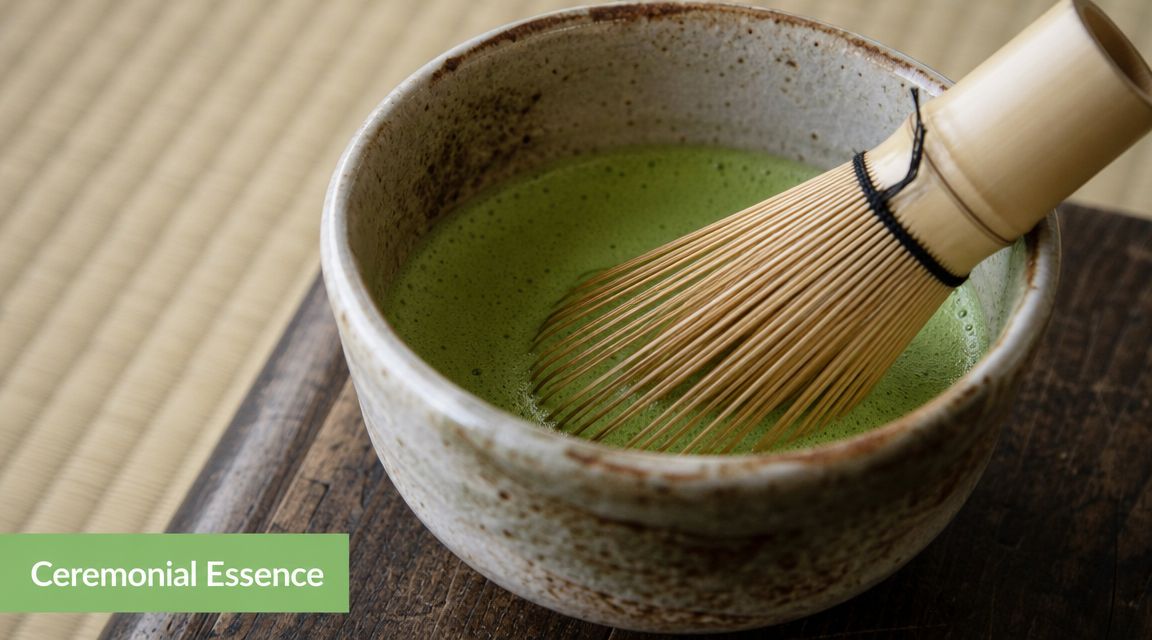
What makes matcha different
Matcha is made from shade-grown tea leaves called tencha that are stone-ground into a fine powder. That production method is central to its identity and part of what separates it so clearly from genmaicha, as described in this guide on how matcha tea is made.
Because the powder suspends in liquid rather than being strained out, matcha produces a cup that looks vivid green and feels fuller on the palate. You're not drinking an infusion. You're drinking the leaf itself in powdered form.
That's why matcha often feels more concentrated in both flavour and effect.
How it tastes and why people love it
Good matcha usually brings a mix of vegetal freshness, savoury depth, natural sweetness, and a pleasant bitterness that gives structure rather than harshness. The texture matters too. When whisked well, it's smooth and creamy, with fine froth on top.
For many people, the “aha” moment with matcha is realising it's not meant to taste like ordinary green tea.
It has more presence. More body. More colour. More of that deep umami note that lingers after the sip.
A short visual demo helps if you've never seen proper preparation in action:
Why matcha suits a functional routine
Matcha has become popular well beyond traditional tea circles because it fits modern habits so neatly. It works as a straight tea, a latte, a smoothie ingredient, or a café staple. It also lends itself to more standardised preparation because the powder disperses through the drink instead of relying on steep time alone.
That matters if you want consistency.
- For a morning ritual: Matcha can replace the “grab a coffee and go” habit with something more deliberate.
- For focused work: Many drinkers like it before study, desk work, or creative tasks.
- For recipes: Its colour and flavour carry through beautifully in food and drinks.
Matcha isn't just another green tea. It behaves more like an ingredient, a ritual, and a beverage all at once.
If genmaicha is easy comfort, matcha is purposeful energy with a strong visual and sensory identity.
A Detailed Comparison Flavour Health and Energy
When people compare Genmaicha vs Matcha, they often jump straight to caffeine. That matters, but it isn't the whole story. The bigger difference starts with structure. One is a brewed blend of tea and roasted rice. The other is a powdered tea that stays suspended in the liquid.
That one difference changes nearly everything else.
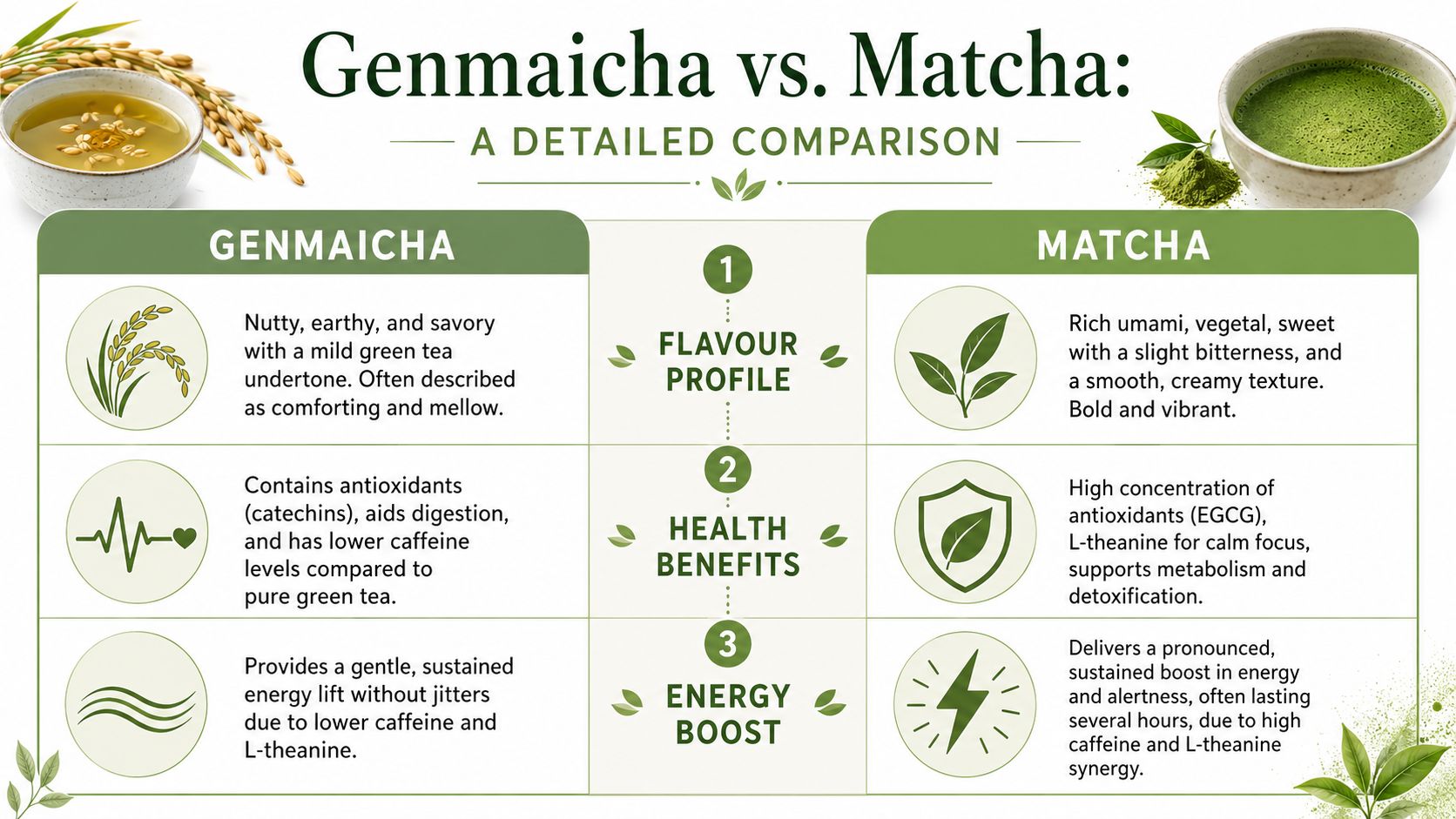
Flavour profile
Genmaicha leans toasty, savoury, and mellow. The roasted rice softens the greener notes and gives the tea a snack-like aroma that feels familiar even to people new to Japanese tea.
Matcha goes in the opposite direction. It's thicker, greener, and more umami-forward. Because it's a fine powder that fully suspends in liquid, it delivers a creamier body and more concentrated green flavour.
According to Tea Vision's comparison of genmaicha, matcha, and hojicha, matcha's particle structure helps create a thick, creamy, high-umami cup with pronounced green colour, while genmaicha typically offers a lighter body, toasted-nut aroma, and a cleaner, more diluted green tea profile.
Key takeaway: If you want bold and vivid, choose matcha. If you want light and cosy, choose genmaicha.
Health and functional character
It's tempting to turn this into a “superfood showdown”, but that usually creates more confusion than clarity.
A more practical way to frame it is this:
- Matcha suits people who want intensity, consistency, and a tea that can anchor a functional beverage routine.
- Genmaicha suits people who want a gentler cup with less bitterness and a softer overall feel.
Tea Vision also notes that matcha is technically better suited to standardised dosed beverages where solubility, colour intensity, and functional consistency matter, while genmaicha works well as a milder, lower-cost tea base with reduced bitterness.
That's useful whether you're choosing for home or for a café menu.
Energy and caffeine feel
Most shoppers pause; they want to know which tea will wake them up, which one is less likely to interfere with sleep, and whether “green tea” automatically means low caffeine.
The answer is more nuanced than a simple yes or no.
Because genmaicha includes roasted rice and less tea leaf, it's generally the lower-caffeine option. Matcha is usually the stronger choice in this comparison. If you want a broader explanation of how matcha compares with other caffeinated drinks, Maximum Health Products' caffeine guide is a handy starting point.
For many people, genmaicha feels like a quiet lift. Matcha feels like a clear signal that the day has started.
Which matters more in real life
Most tea decisions aren't made in a tasting lab. They're made at 7 am, 3 pm, or after dinner.
Use this shortcut:
| If you want… | Often the better fit |
|---|---|
| Toasty comfort with food | Genmaicha |
| A creamy tea or latte base | Matcha |
| A milder cup with less bitterness | Genmaicha |
| A vivid, concentrated green tea experience | Matcha |
If you stop treating them as substitutes and start treating them as tools for different moments, the comparison gets much more helpful.
The Art of Preparation Brewing vs Whisking
Genmaicha and matcha ask for different handling. That's not tea snobbery. It's just the reality of leaf tea versus powder. If you prepare them the same way, one of them will disappoint you.
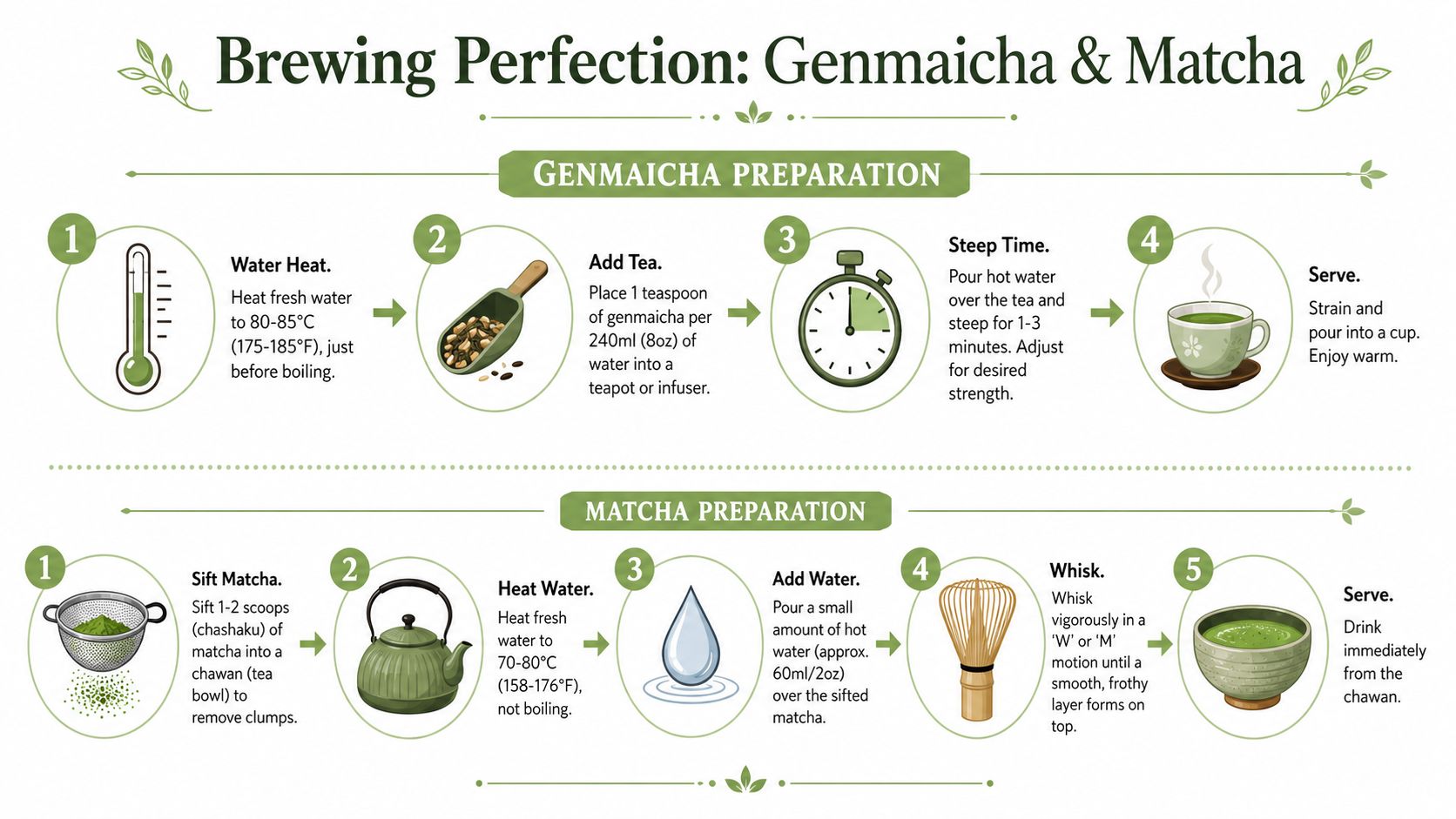
Brewing genmaicha well
Genmaicha is forgiving, but it still benefits from a little care. The key is not scorching the green tea component. Water that's too hot can flatten the toastiness and bring out more bitterness than you want.
A simple home method works beautifully:
- Heat fresh water to 80 to 85°C.
- Use 1 teaspoon of genmaicha per 240ml of water.
- Steep for 1 to 3 minutes.
- Strain and drink warm.
If you prefer your tea softer and sweeter, shorten the steep. If you want a little more backbone with food, let it go a bit longer.
Whisking matcha without overthinking it
Matcha sounds fussy until you do it once or twice. After that, it's quick.
For a traditional bowl:
- Sift first: This helps remove clumps and gives you a smoother drink.
- Use hot, not boiling water: Around 70 to 80°C is the usual sweet spot.
- Add a small amount of water first: Enough to form the base for whisking.
- Whisk briskly: A bamboo whisk in a loose W or M motion helps create a fine froth.
If you'd like a visual walkthrough, this guide on how to whisk matcha makes the process easy to follow.
Practical tip: If your matcha tastes flat or overly bitter, the water is often too hot, or the powder wasn't whisked thoroughly.
For busy mornings and lattes
You don't need to go fully ceremonial every day. A milk frother, shaker bottle, or small whisk can get the job done for a home latte. What matters most is breaking up the powder properly before adding more liquid.
That's a common mistake. They pour everything in at once, then blame the tea for the lumps.
Try this instead:
- Start small: Mix the powder with a little water first.
- Build gradually: Add the rest once you've made a smooth base.
- Choose your texture: More water for a lighter cup, milk for a fuller latte.
Genmaicha rewards brewing. Matcha rewards whisking. Once you respect that difference, both teas get much better.
When to Choose Which A Guide for Your Daily Ritual
The comparison becomes useful in practical terms. Not in theory. In real life.
The best tea for your morning isn't always the best tea for your late afternoon. The best tea before a workout may not be the one you want after dinner. For many Australians, that's the key decision point.
A thoughtful piece on choosing between genmaicha and matcha for caffeine-sensitive users makes this point well. Australia's TGA requires listed medicines containing caffeine to declare it and notes that caffeine effects depend heavily on total dose and timing, while FSANZ notes that tea and caffeine exposure can vary widely with preparation. In plain English, the better question isn't “Which tea is healthier?” It's “Which one fits my afternoon, sleep, or training routine?”
Choose genmaicha when
Genmaicha makes sense when you want tea to support the moment rather than dominate it.
- You want something gentler: If you're caffeine-sensitive or don't want a strong push, genmaicha is often the easier pick.
- You're drinking tea with food: Its toasted rice character pairs naturally with savoury meals and snacks.
- You want an afternoon or evening cup: Many people find it better suited to slower parts of the day.
- You're easing into green tea: It can be friendlier for people who find stronger green teas too intense.
A good example is the 3 pm slump. You don't want another coffee. You still want something warm and restorative. Genmaicha fits that slot beautifully.
Choose matcha when
Matcha earns its place when you want your drink to do more heavy lifting.
- You want a coffee alternative: Matcha can anchor a stronger morning routine.
- You need focus: Before work, study, or a training session, it often feels more purposeful.
- You enjoy ritual: Whisking a bowl or making a proper latte can become a steady daily habit.
- You want flavour presence: Matcha won't disappear into milk, smoothies, or baking.
If genmaicha says “settle in”, matcha says “let's get moving”.
The easiest way to decide
Ask yourself three quick questions:
- What time of day is it?
- Do I want comfort or momentum?
- Am I drinking this on its own or with food?
If the answers point to calm, warmth, and ease, go genmaicha. If they point to alertness, routine, and concentration, go matcha.
That's the whole game. Not better or worse. Just better for this moment.
From Lattes to Loaves Culinary Creativity with Both Teas
These teas don't have to stay in the cup.
Matcha is the obvious kitchen favourite because it brings strong colour, a recognisable flavour, and enough structure to hold up in milk, batter, and dessert. It works beautifully in lattes, smoothies, chia puddings, pancakes, icing, and simple bakes like shortbread or loaf cake. If you've ever had a green cheesecake slice or a soft matcha muffin at a café, you already know how well it performs.
Genmaicha is quieter, but that's part of the fun. Brew it strong and use it as a liquid base for rice dishes or light broths. Steep it for a syrup that can be brushed over sponge or stirred into poached fruit. The toasted rice note also plays nicely in savoury cooking, especially in dishes where you want a gentle grain-like warmth rather than a loud tea flavour.
A few easy ideas to try:
- Matcha latte: Hot or iced, plain or lightly sweetened.
- Matcha baking: Loaves, biscuits, pancakes, or overnight oats.
- Genmaicha broth: Use the brewed tea in a simple savoury bowl.
- Genmaicha syrup: Add to desserts where a nutty, toasted note makes sense.
That's why the best Genmaicha vs Matcha conversation always comes back to use, not status. Matcha is vivid, focused, and versatile in drinks and recipes. Genmaicha is soothing, food-friendly, and subtly brilliant when you want comfort without heaviness.
Both deserve a place in a well-stocked tea cupboard. You just won't reach for them for the same reason.
If you'd like to explore premium organic Japanese tea for your own daily ritual, Pep Tea is a great place to start. Browse the range for quality matcha, practical brewing guides, and everyday inspiration for building a tea habit that feels good and fits real Australian life.
7 Healthy Green Tea Drinks for 2026

Looking for a healthy drink that tastes good and fits real life in Australia? That's where most advice falls short. People hear “green tea” and think of one plain hot cup, when the better question is which format gives you the benefits you want without piling on sugar, syrup, or fluff.
Healthy green tea drinks now cover a much wider range than traditional brewed tea. You've got whisked matcha for calm energy, unsweetened bottled green tea for grab-and-go convenience, and kombucha for a fizzy option that can fit a low-sugar routine. In Australia, tea is already part of everyday life. The CSIRO and ABS National Nutrition and Physical Activity Survey found tea was one of the most commonly consumed non-alcoholic beverages, with about 42% of adults drinking tea on the survey day, which helps explain why green tea-based drinks slot so naturally into daily habits (Harvard Nutrition Source tea overview).
This guide gets straight to the drinks and ingredients worth knowing. Some are ready to drink. Some are pantry staples that let you make better café-style drinks at home. All are useful if you're trying to choose healthy green tea drinks with a more practical, low-sugar lens.
1. Pep Tea

Want one Australian brand that helps you cover both sides of the green tea habit? Pep Tea is a useful place to start because it spans two very different needs. It offers premium organic Japanese matcha for home preparation and Australian-brewed sugar-free organic kombucha for fridge-ready convenience.
That split matters. A lot of shoppers lump all green tea drinks together, then wonder why one feels like a morning ritual and another works better as a cold afternoon pick-me-up. Matcha and kombucha come from green tea, but they play different roles in real life.
Pep Tea's matcha suits the part of your routine where you want focus, flavour, and a bit of intention. You whisk it with water, blend it into a smoothie, or turn it into an iced latte at home. Its kombucha suits the moments when you want something already made, lightly tangy, and easy to grab from the fridge or pack into an esky.
Why it stands out
The brand is strongest when you look at it through a practical health lens. Its matcha is stone-ground and organic, which matters because matcha gives you the whole tea leaf in powdered form rather than a brewed infusion alone. That is part of why people interested in antioxidants, calm focus, and steadier energy often start with matcha. If you are comparing formats for green tea drinks that may support weight goals, matcha is often the ingredient-style option, while kombucha is the ready-to-drink option.
Its kombucha range fills a different gap. Pep Tea brews raw, living kombucha in NSW with organic green tea and live cultures, and the sugar-free approach makes it easier to keep your drink choice aligned with a low-sugar routine. That is useful if you like the idea of kombucha but do not want something that tastes like soft drink wearing a health halo.
A simple way to choose between the two is this:
Practical rule: Pick matcha when you want a warm or iced green tea ritual. Pick kombucha when you want cold refreshment with fizz and no prep.
A few strengths and trade-offs are worth knowing before you buy:
- Best for versatility: The matcha can be whisked traditionally, added to smoothies, used in lattes, or mixed into baking.
- Best for low-sugar routines: The sugar-free kombucha gives you a fizzy option without pushing you back toward sweet drinks.
- Best for beginners: The brand's education and recipe content helps new matcha drinkers learn how to use the product well.
- Possible drawback: Public pricing and full product range details are not always the first thing you see, so cafés or wholesale buyers may need to enquire directly.
- Possible drawback: Matcha is more concentrated than standard brewed green tea, so caffeine-sensitive drinkers may do better with smaller serves.
When to choose it
Pep Tea makes the most sense if you do not want to choose between ingredient quality and convenience. That is the Australian angle here. Some people want a pantry staple they can use for better homemade drinks. Others want a ready-made bottle or can that fits work, errands, beach days, or alcohol-free catch-ups. Pep Tea speaks to both.
It also fits a broader shift in the Australian tea market, where buyers increasingly look for low-sugar, functional drinks framed around routine use rather than old-fashioned tea ceremony language. This trend is reflected in the Statista tea market outlook.
For cafés and retailers, the lesson is fairly simple. Clear language such as sugar-free, organic, calm focus, and clean refreshment usually makes more sense to customers than vague wellness hype.
2. ITO EN Oi Ocha Unsweetened Green Tea (AU)

Sometimes the healthiest choice is the least complicated one. ITO EN Oi Ocha Unsweetened Green Tea is exactly that kind of drink. It's bottled brewed green tea with no sweetener profile to decode and no dessert-like flavouring trying to make it feel more indulgent than it is.
That makes it a handy benchmark. If you're ever unsure whether a green tea drink is healthy, compare it to an unsweetened bottled tea like this. It gives you the familiar brewed tea experience in a convenient format, which is ideal for work bags, lunch runs, or the car.
Who it suits best
This is a great pick for people who want healthy green tea drinks without turning the drink into a snack. It also suits anyone trying to understand whether they enjoy green tea itself, rather than milk, syrups, or fruit flavourings wrapped around it.
Harvard's health guidance is useful here. Green tea is most helpful when it replaces sugary beverages, not when it becomes a sweetened café-style drink. That's a practical lens worth keeping in mind if you're exploring the best green tea for weight loss, because “green tea” on a label doesn't automatically mean low sugar or a better everyday choice.
Unsweetened brewed green tea is often the cleanest baseline. Everything else should earn its place from there.
A few things to like:
- Simple ingredient profile: No added sweeteners means fewer surprises.
- Easy format: Good for people who won't reliably brew tea at home.
- Traditional flavour: Best for drinkers who want something crisp and tea-forward.
The main downside is also the point. It's plain. If you want flavoured drinks, creamy texture, or a functional twist like probiotics, this won't scratch that itch. It also mostly comes in PET bottles, which won't suit every shopper.
3. East Forged Nitro Cold-Brew Australian Green Tea & Pitaya

East Forged Nitro Cold-Brew Australian Green Tea & Pitaya feels more like a modern fridge-can drink than a traditional tea. That's the appeal. It uses Australian-grown green tea, cold-brewed and infused with nitrogen for a creamy, microfoam texture, but without tipping into a sugary energy-drink vibe.
If you like sparkling water, nitro coffee, or adult-style canned refreshers, this is one of the more interesting healthy green tea drinks on the Australian market. The pitaya note gives it a point of difference, but the product still reads as restrained rather than flashy.
Why the format matters
Cold brew changes the experience. Instead of the brisk edge you sometimes get from hot brewed green tea served cold later, nitro cold brew feels softer and smoother in the mouth. That can make green tea more approachable for people who think they don't like it.
This sort of product also lines up with a bigger shift in the category. Green tea demand has expanded through premium and fortified formats, while buyers increasingly look for healthier alternatives to sugary drinks. The broader category direction described in the Mordor Intelligence green tea market report helps explain why a product like this has room to stand out.
- Best feature: Nitro gives it a creamy texture without milk.
- Best use case: Great straight from the can, especially chilled.
- Best fit: Sugar-conscious drinkers who want convenience and novelty.
The trade-off is choice. It's a more niche product with a narrower flavour lane, so it won't be as easy to find as supermarket kombucha or classic bottled tea. Still, for people bored by standard RTD tea, this is a fun upgrade.
4. Remedy Drinks Organic Kombucha (AU)
Remedy Drinks Organic Kombucha is one of the easiest kombuchas to find around Australia. For many people, that accessibility matters more than perfection. If a drink is available at the local supermarket, servo fridge, or convenience stop, it has a much better chance of becoming part of a regular low-sugar swap.
Remedy brews with organic green and black tea and keeps live cultures in the finished drink. It's a kombucha first, not a straight green tea, so think of it as a fizzy functional alternative when you want something more lively than still tea.
A realistic kombucha pick
Kombucha often gets marketed as if all bottles are equally wholesome, and that's where people can get confused. The practical question isn't whether kombucha sounds healthy. It's whether the final product fits your own preferences around sweetness, ingredients, and everyday use.
Remedy is transparent about its tea base and fermentation approach, which is helpful. If you're comparing options in the broader world of healthy probiotic drinks, that transparency makes shopping easier, especially for consumers who want live cultures without the heavy sugar hit they associate with some chilled drinks.
A kombucha can be a smart low-sugar choice, but it still won't behave like plain brewed green tea. Treat it as its own category.
A few clear pros and cons:
- Big advantage: Widely available in major Australian retail channels.
- Big advantage: Organic credentials and kombucha-specific identity are easy to understand.
- Potential drawback: Some products use erythritol or stevia, and not everyone enjoys that taste.
- Potential drawback: Flavoured kombucha is more layered than plain tea, so purists may prefer a simpler green tea drink.
For people moving away from soft drink or alcohol, Remedy is a practical stepping stone.
5. Lo Bros Kombucha (AU)

Lo Bros Kombucha leans a little more into flavour variety, which makes it a good option for drinkers who want healthy green tea drinks that feel fun rather than austere. It uses an organic black and green tea base and then layers in fruit and botanicals across different SKUs.
That means the experience is less about tasting the tea clearly and more about choosing a flavour mood. For some people, that's a plus. It's easier to reach for a kombucha habitually if the drink feels satisfying and social.
Where it fits in a healthy routine
Lo Bros works well for the afternoon can slot. It's the sort of drink you might choose instead of a soft drink with lunch, instead of a mid-arvo snack run, or as a non-alcoholic option when everyone else opens something fizzy.
The strongest use case is variety. If plain bottled green tea feels too minimalist and matcha feels too involved, kombucha with broader flavour options can be the middle ground. You still get a tea-based beverage, but in a more playful package.
Here's the balanced take:
- Why people like it: The flavour range keeps things interesting.
- Why shoppers choose it: National supermarket availability makes repeat buying easy.
- What to watch: Some SKUs use erythritol or stevia, and ingredient lists vary.
- What it isn't: It isn't a pure brewed green tea experience.
Lo Bros is best for people who care about low sugar but still want a drink that feels more like a treat than a ritual.
6. Matcha Maiden Organic Matcha Powder (AU)

If you want to make healthy green tea drinks at home without going deep into specialist tea culture, Matcha Maiden Organic Matcha Powder is a friendly entry point. It's an Australian brand offering organic Japanese matcha in several sizes, so it suits both the curious beginner and the regular latte maker.
The appeal here is usability. Some matcha brands feel intimidating if you're not already whisking daily. Matcha Maiden is more accessible. You can use it for straight matcha, iced drinks, smoothies, and recipe work without feeling like you're “wasting” a precious tin.
Good for everyday experimenting
This is the kind of matcha that makes sense if you're still figuring out how you like your drink. Maybe you want a classic bowl one day, an iced oat matcha the next, and a smoothie the day after that. Flexible powder is what lets healthy green tea drinks become practical rather than aspirational.
If you're new to prep, Pep Tea's guide to making matcha tea is worth a read because the technique matters. A quick sift, the right water temperature, and proper whisking can change the drink from flat and clumpy to smooth and bright.
Good matcha habits matter more than fancy gear. Start with fresh powder, don't scorch it with boiling water, and whisk properly.
A few honest notes:
- Best for value-minded drinkers: Multiple pack sizes make daily use easier.
- Best for recipes: Suitable for lattes, smoothies, and baked goods.
- Possible limitation: If you're chasing a highly refined ceremonial experience, specialist tea houses may offer a more nuanced cup.
For a lot of households and cafés, though, this level of accessibility is exactly the point.
7. Love Tea Organic Green Teas and Matcha (AU)

Love Tea organic green teas and matcha are a good reminder that healthy green tea drinks don't always need to come chilled, canned, or café-styled. Sometimes the best option is a reliable organic tea range you can brew at home or serve in a venue with confidence.
Love Tea offers variety across green tea styles, including Australian Sencha, jasmine green tea, Moroccan mint, and matcha. That's useful for people who don't want to commit to one format only. You can keep a straightforward daily green tea in the cupboard and still have a matcha tin for more focused mornings.
Best for tea drinkers who want range
This range suits households and hospitality venues that want choice. A café can offer a cleaner, classic brewed green tea alongside milk-based matcha drinks. A home drinker can switch between plain green tea on one day and a more involved whisked drink on another.
That flexibility matters because not all evidence around “functional” green tea products is equally strong. Consumer coverage often oversimplifies the category, but the most established evidence still points most clearly to traditional brewed tea, with benefits described more modestly than many marketing headlines suggest. That nuance is reflected in News-Medical's discussion of why green tea shows the strongest health benefits.
For practical buying, that means:
- Choose brewed tea if you want the most straightforward everyday option.
- Choose matcha if you value ritual, texture, and a more concentrated tea experience.
- Choose by use case rather than hype.
Love Tea is especially handy for people who want to stay close to traditional tea drinking while still having matcha in the mix.
7-Brand Healthy Green Tea Drinks Comparison
| Product | 🔄 Implementation Complexity | 💡 Resource Requirements | ⭐ Expected Outcomes | 📊 Ideal Use Cases | ⚡ Key Advantages |
|---|---|---|---|---|---|
| Pep Tea | High, HACCP kombucha brewing + stone‑ground matcha processing | Certified organic tea supply, brewery/SCOBY management, education content, wholesale channels | High antioxidant matcha (EGCg, L‑Theanine); probiotic, sugar‑free kombucha | Home baristas, cafés, specialty retailers, wellness professionals | Certified organic + HACCP production; dual matcha & kombucha range; strong educational support |
| ITO EN Oi Ocha Unsweetened (AU) | Low–Moderate, large‑scale brewing and bottling | Consistent tea sourcing, bottling/PET supply, national distribution | Authentic unsweetened green tea flavour; 0 sugar | Everyday RTD consumers, grocery retail, on‑the‑go refreshment | Reliable, authentic taste; wide retail availability |
| East Forged Nitro Cold‑Brew | Moderate, cold‑brew + nitrogen infusion and canning | Local green tea, nitro infusion equipment, small‑batch canning | Creamy nitro texture, very low sugar, low caffeine | Sugar‑conscious RTD shoppers, niche cafés, DTC customers | Distinctive nitro mouthfeel; clean label |
| Remedy Drinks – Organic Kombucha | High, long fermentation with live culture retention | Organic tea bases, fermentation facilities, large‑scale distribution | Live cultures with minimal residual sugar; finished "no sugar" claims | Mass retail buyers, mainstream probiotic seekers | Market leader with nationwide retail presence; transparent process |
| Lo Bros Kombucha | High, fermented and flavoured kombucha production | Organic tea, flavourings, production to supermarket scale | Varied flavours with low sugar and live cultures | Supermarket shoppers, flavored kombucha consumers | Broad flavour range; strong supermarket availability |
| Matcha Maiden – Organic Matcha Powder | Low–Moderate, sourcing, grinding and packaging | Japanese Uji/Kyoto matcha supply, packing lines, wholesale/retail channels | Organic matcha suitable for daily lattes/recipes; consistent quality for price | Home and café matcha preparation, bulk buyers | Clear pricing, bundle deals, multiple pack sizes for daily use |
| Love Tea – Organic Green Teas & Matcha | Low, hand‑packing and multiple formats | Certified organic tea sourcing, local packing in Victoria, retail networks | Wide variety of organic green teas and matcha; reliable supply | Brew‑at‑home users, hospitality menus, cafés | Diverse formats (loose, bags, canisters); local packing and competitive pricing |
Choosing Your Perfect Green Tea Ritual
The best healthy green tea drinks aren't all trying to do the same job. That's the main thing to remember. A bottled unsweetened green tea is built for convenience. A matcha powder is built for ritual, flexibility, and a more concentrated tea experience. A kombucha is built for refreshment, fizz, and an easy low-sugar swap when you want something more social or snack-like.
That difference matters even more in Australia, where the sugar question is hard to ignore. The Australian Bureau of Statistics reports that 31.7% of Australians lived with obesity in 2022, and the National Diabetes Services Scheme notes that over 1.5 million Australians are registered with diabetes, which is a useful reminder to look closely at what's in a green-tea-based drink before assuming it's automatically healthy (Harvard green tea healthy habit article). A matcha latte with sweetener, a bottled green tea drink, and an unsweetened brewed tea can sit very differently in your day.
If you're choosing for everyday wellness, start simple. Unsweetened brewed green tea is a strong baseline. Matcha is excellent when you want calm energy, a richer tea flavour, and more room to create hot or iced drinks at home. Kombucha can be a smart fridge staple when you're after a tea-based alternative to soft drink or alcohol, especially if you prefer a lower-sugar style and enjoy live cultures.
For cafés, retailers, and hospitality buyers, the same logic applies. People don't just want “wellness” on the label. They want drinks that fit real moments. Morning focus. Afternoon refreshment. A smarter non-alcoholic option. A low-sugar choice that still feels enjoyable. The winning menu or shelf mix usually includes more than one format.
Pep Tea is particularly strong if you want both ends of that spectrum from one Australian brand. You can explore premium organic matcha for your home or venue, or keep things easy with sugar-free organic kombucha brewed here in NSW. Either way, choosing thoughtfully makes healthy green tea drinks much more than a trend. It turns them into a routine you'll keep.
If you're ready to build a better daily drink ritual, explore Pep Tea for premium organic matcha and Australian-brewed sugar-free kombucha. Whether you're whisking at home, upgrading your café menu, or just trying to swap sugary drinks for something cleaner, we've got options that make wellness feel easy and enjoyable.
7 Best Matcha Recipes for Weight Loss in 2026

Why do so many matcha recipes for weight loss sound healthy on paper, then leave you hungry, jittery, or reaching for something sweet an hour later?
The problem usually is not matcha itself. It is the recipe design around it. A useful weight-loss recipe needs to do two jobs at once. It should support a calorie-conscious routine, and it should also feel satisfying enough to repeat in real life.
That is where premium organic matcha stands out. Good matcha naturally contains catechins such as EGCG and also L-Theanine, a combination people often turn to for steadier energy and a calmer, more focused feeling than coffee alone. At PepTea, we like to treat matcha as one part of a balanced framework, not a magic ingredient.
The framework matters. High-protein breakfasts can help you stay full longer. Low-GI drink bases can make energy feel more even. Savoury recipes and smarter snacks can reduce the cycle of drinking calories, then hunting for biscuits or pastries later. Matcha works a bit like a strong supporting actor here. It brings its own benefits, but the full result depends on what you pair it with.
Australia's weight and nutrition picture also explains why simple wellness habits matter. The Australian Bureau of Statistics National Health Survey 2022 reports that overweight and obesity remain common among Australian adults. That helps explain the growing interest in practical recipes that are easy to make at home and easier to stick with than extreme plans.
You will notice that this list is not just a collection of green drinks. Each recipe uses matcha with a specific structure, such as protein for fullness, lower-sugar ingredients for better balance, or lighter replacements for higher-calorie cafe habits. If you are already improving your routine, it also helps to pair drinks with sensible snack choices like these low-sugar weight loss snacks.
1. Matcha Green Tea Smoothie Bowl
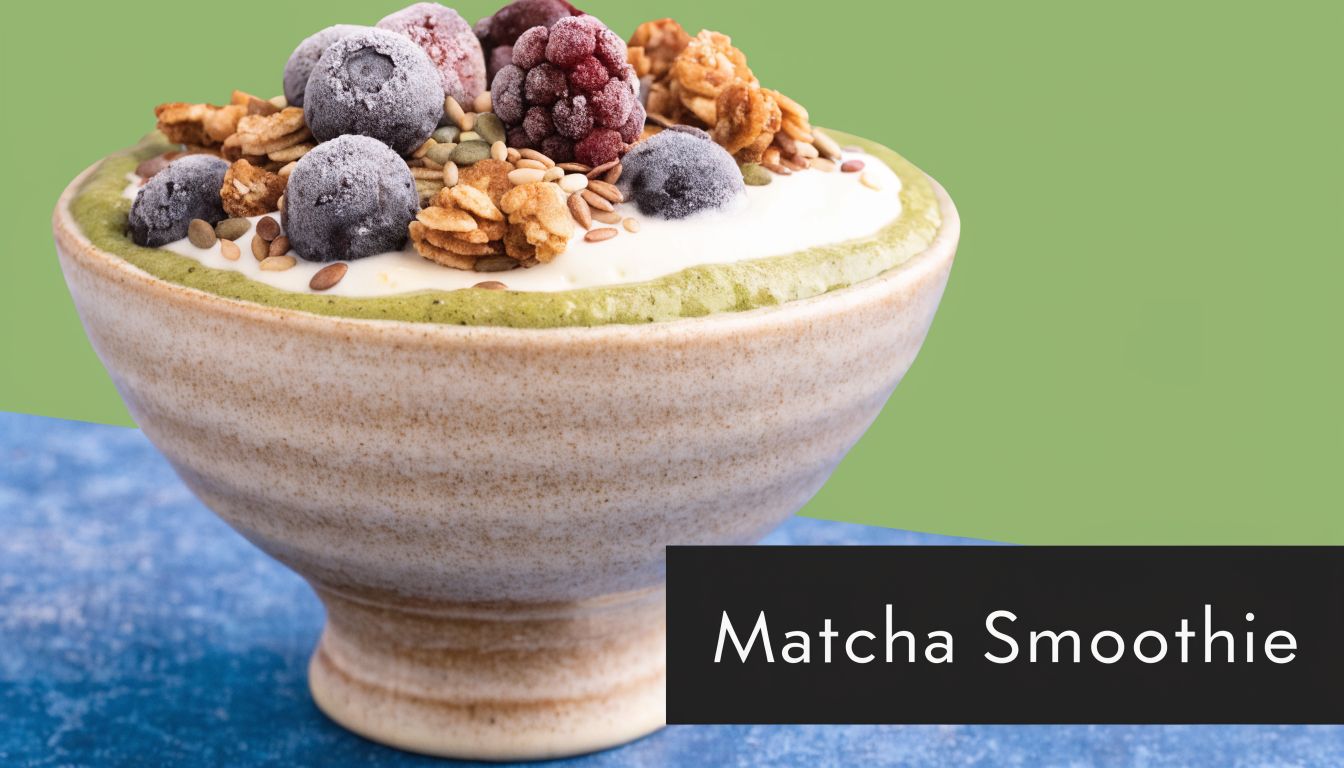
What if your matcha breakfast could do more than taste healthy? A well-built smoothie bowl can pair premium organic matcha's EGCG and L-Theanine with protein and lower-GI ingredients, so the bowl works harder for fullness, steadier energy, and fewer snack cravings later.
A smoothie bowl helps because it feels like a real meal. You eat it with a spoon, you notice the texture, and you are less likely to rush through it the way people often do with sweet drinks. That matters for weight loss. Matcha can support the routine, but the recipe structure carries much of the result.
At PepTea, we like this bowl because it is simple to balance. Start with Greek yoghurt for protein, frozen berries for fibre and natural sweetness, and a splash of unsweetened almond milk to blend. Then add 1 to 2 grams of premium matcha, whisked first with a little warm water so it blends smoothly instead of forming green lumps.
The goal is not to make the bowl as light as possible. The goal is to make it satisfying enough so that breakfast lasts.
That is where the pairing gets interesting. Matcha brings concentrated green tea compounds, while Greek yoghurt slows the meal down and helps keep you full. Berries are usually a smarter fruit base than juices or sweetened smoothie packs because they keep the sugar load lower. It works like building a steady campfire instead of tossing in paper that flares fast and disappears.
If you want a simple framework, use this:
- Protein base: Greek yoghurt or a high-protein unsweetened yoghurt
- Matcha prep: Whisk matcha with warm water first for a smoother texture
- Low-GI fruit: Frozen berries over banana-heavy blends
- Measured toppings: Chia, pumpkin seeds, and a small spoonful of granola
- Extra sweetness only if needed: Cinnamon or vanilla before honey
Practical rule: Toppings should add texture, not turn breakfast into dessert.
Many smoothie bowls go off track at the finish line. Nut butter, honey, granola, coconut flakes, and dried fruit can stack up quickly. A better approach is to choose one crunchy topping and one seed topping, then stop there.
If you are still learning how matcha supports everyday wellness, our guide to matcha and kombucha benefits for balanced energy and wellness explains why premium matcha quality makes such a difference.
This bowl also adapts well to real life. After a morning walk, it can feel light but still grounding. On a busy workday, it gives you a breakfast framework that is easy to repeat, and repeatable habits usually beat complicated healthy recipes every time.
2. Matcha Kombucha Detox Elixir
Could one light, fizzy drink support a weight-loss routine better than a sugary afternoon pick-me-up?
It can, if you build it with the right framework. A matcha kombucha elixir works best when it combines premium organic matcha, which is naturally rich in EGCG and L-Theanine, with a low-sugar kombucha and fresh, sharp flavours like ginger or citrus. That combination gives you a drink that feels refreshing, but still fits the bigger goal of steadier energy and better appetite control.
At Pep Tea, we like this recipe because it brings together two habits people already enjoy, then tightens the structure so it supports wellness more clearly. The key is not the word "detox." The key is choosing ingredients that stay light, low in added sugar, and easy to repeat.
Why the pairing makes sense
Premium matcha and kombucha play different roles. Matcha contributes the concentrated green tea compounds people often look for in wellness routines, especially EGCG, while L-Theanine helps give matcha its calmer, more level feel compared with a jittery energy drink. Kombucha adds acidity, sparkle, and a fermented base that makes the drink more interesting without needing syrup or juice.
That matters for weight loss because recipe structure changes the outcome. If the drink becomes a sweet mocktail, it works against you. If it stays crisp and low GI, it can replace higher-sugar drinks and help keep your routine more consistent.
A good way to picture it is this. Matcha is the anchor, kombucha is the lift, and ginger or lemon acts like a brightness switch that wakes up the whole glass without adding much sugar.
For a simple home version, whisk matcha with a small amount of warm water first so it blends smoothly. Let it cool for a minute, pour it over ice, then top with unsweetened or low-sugar kombucha. Add a few slices of fresh ginger or a squeeze of lemon or lime.
If you want an even cleaner result, start with high-quality latte matcha powder for smooth everyday drinks. Better matcha usually tastes less harsh, which means you are less likely to cover it up with sweeteners.
If you want to understand the overlap between these two ingredients a bit more, Pep Tea breaks it down in this guide to green tea benefits of matcha and kombucha.
A practical use case is the late afternoon slump. This drink can replace a second coffee or a sweet snack while still feeling enjoyable, and that swap often matters more than chasing fancy wellness claims. Consistent, lower-sugar choices tend to do more for real-world weight management than complicated recipes people only make once.
3. Matcha Protein Latte Iced or Hot
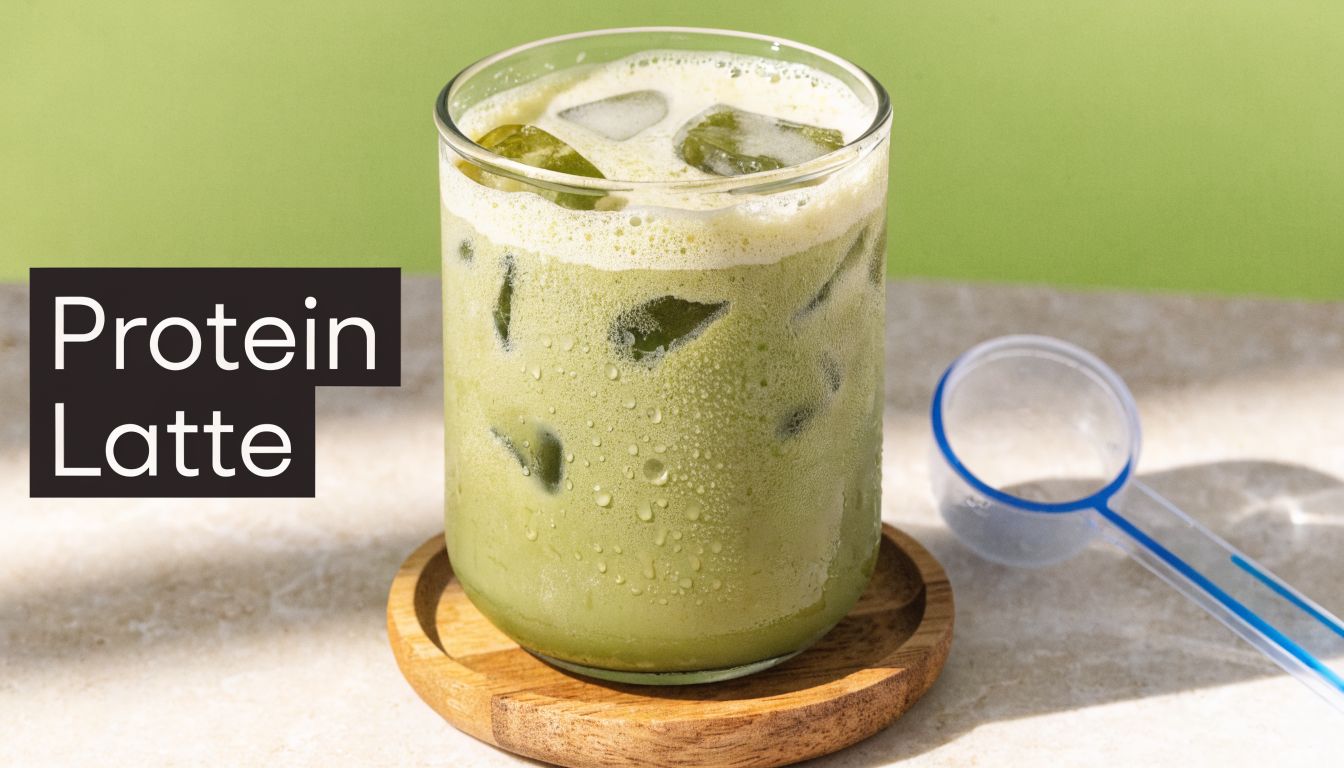
Want a matcha recipe that feels comforting like a latte, but works harder for weight-loss goals than a standard café order?
A protein matcha latte stands out because it combines two useful ideas in one cup. Premium organic matcha brings compounds people often look for in wellness routines, especially EGCG and L-Theanine. A high-protein, low-sugar latte framework then changes how satisfying that drink feels, which can make it easier to stay full and avoid the usual muffin-or-biscuit follow-up.
That pairing is an advantage here. Matcha gives you the tea benefits. Protein gives the drink structure, almost like turning a light snack into a more complete mini-meal.
A simple home version uses 3g matcha, 200ml unsweetened almond milk, and 20 to 25g unflavoured or lightly flavoured protein powder. Pea protein works well if you want a dairy-free option, while whey often gives a creamier finish. The key is keeping the recipe low GI and low in added sugar, so the latte supports steadier energy instead of tasting healthy but acting like dessert.
Why this recipe works so well in real life
Many people do not struggle because they lack recipes. They struggle because their healthy options are not filling enough to repeat. This one solves that problem better than plain matcha or a sweet café latte.
Matcha and protein also need a little technique to work well together. If you stir everything into cold milk at once, the powder can clump and the texture turns chalky. Whisk the matcha first with a small amount of warm water, then shake or blend it with the milk and protein. That one extra step usually gives a much smoother drink.
A few easy upgrades help:
- Use unsweetened milk: This keeps the drink lighter and lowers unnecessary sugar.
- Add cinnamon or vanilla: These soften grassy notes without relying on syrups.
- Choose better matcha for lattes: A cleaner-tasting powder means less need to mask bitterness. Pep Tea's latte matcha powder for smooth protein lattes is made for this style of everyday drink.
Hot works well when you want something cosy and slow. Iced is useful when you need a quick breakfast or post-walk drink in warm weather.
If you run a café or notice menu trends, protein matcha lattes have also become more common because they fit what many health-conscious customers want. Pep Tea has seen growing interest from venues adding organic matcha to high-protein drinks, which lines up with the broader shift toward lower-sugar, functional café options.
For weight loss, that practical repeatability matters. The best recipe is often the one you will stick with three times a week.
4. Matcha Green Tea Intermittent Fasting Drink
Could the simplest matcha recipe be one of the most useful for weight loss?
During a fasting window, plain whisked matcha gives you a small ritual without turning into a full snack or latte. That matters because fasting often breaks down less from true hunger and more from friction, boredom, or the urge to have something comforting in your hands. A warm cup of matcha can meet that need while keeping the drink minimal.
The basic formula is just matcha and hot water. Some people add a tiny pinch of sea salt for taste, especially if they want a smoother savoury edge, but the core strength of this recipe is how little it asks from your body.
Keep it simple during a fasting window
In such a simple drink, quality matters. With no milk, sweetener, or protein to soften harsh notes, you taste the powder clearly. A premium organic matcha with naturally higher EGCG and a gentler L-Theanine-rich profile is easier to drink plain, which makes the habit easier to repeat.
That synergy is the main advantage here. High-protein, low-GI recipes work well later in the day when you want staying power. During the fasting window, this stripped-back version gives you matcha's focused, steady feel without adding the heavier ingredients designed for meals. It fills a different role in the overall framework.
A plain serving of matcha is very light, so many people use it as a simple fasting-friendly option when they want something warm and purposeful.
A plain cup of matcha can feel small, but small rituals often keep bigger habits on track.
Use water that is hot, not boiling. Boiling water can flatten the sweeter, softer notes and pull forward bitterness. Whisk the matcha with a small amount of water first, then add the rest, until the surface looks lightly frothy. Sip slowly. Matcha works better here as a steady companion than a quick shot.
A few moments when this drink tends to work especially well:
- Early morning: for clear-headed energy before your first meal
- Mid-fast: when habit or boredom starts feeling like hunger
- Busy travel or work days: when simple choices are easier to keep consistent
It is a quiet recipe, but quiet recipes often last. If your goal is sustainable fat loss, the best matcha drink is not the fanciest one. It is the one that fits the job you need it to do.
5. Matcha Energy Balls with Kombucha Reduction
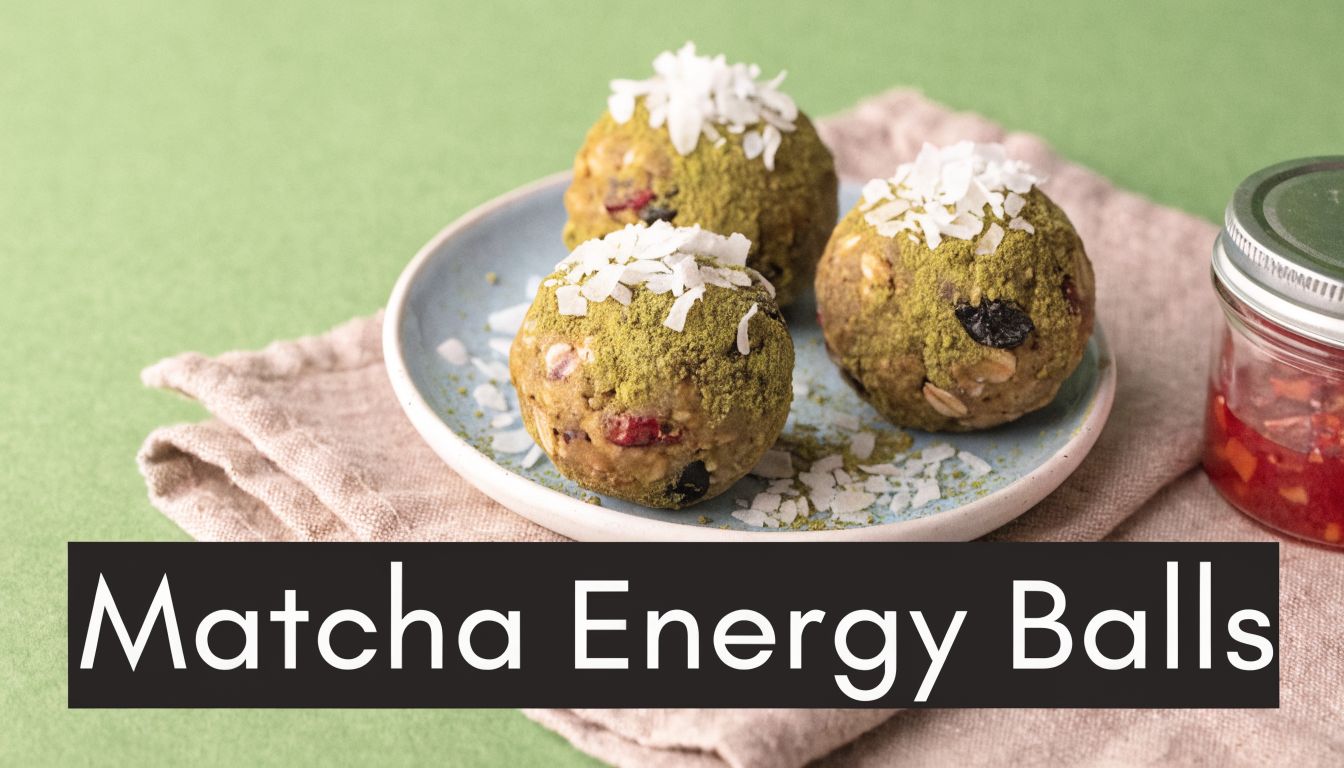
What if your weight-loss matcha recipe needed to fit in your bag, not your blender?
Matcha energy balls solve a very practical problem. Many people do fine at breakfast, then lose momentum when the afternoon snack gap hits. A small, planned snack with protein, fibre, and a lower-GI base can steady that moment far better than a random sweet bite. Add premium organic matcha, and the recipe starts doing more than most snack balls do. You get the pairing this article keeps coming back to. Matcha's naturally occurring EGCG and L-Theanine, plus a framework that slows the rush-and-crash cycle.
A reliable base is simple. Use almond meal or finely ground almonds, unsweetened coconut, a spoonful of quality matcha, and just enough binder to hold everything together. If you want a tangy twist, reduce kombucha gently on the stove until it thickens slightly, then add a small amount to the mix. Too much makes the mixture sticky and pushes the sugar load up, so restraint matters here.
The goal is portioned support, not a dessert in disguise.
That distinction helps with weight loss. High-protein, low-GI recipes work like slower-burning fuel. They release energy more steadily, which can make it easier to stay consistent between meals. Matcha fits neatly into that structure because it adds a focused, steady feel without needing syrups or heavy sweeteners. If you are still comparing powders, this guide to the best green tea for weight loss can help you choose a matcha that tastes smooth enough to use often.
A few details make a big difference:
- Use a fine almond crumb: A smoother texture holds together better and gives a more even bite.
- Mix matcha with the dry ingredients first: This prevents green clumps and spreads the flavour evenly.
- Chill before the final roll: Soft mixture is easier to shape, but a short chill helps the balls set neatly.
- Keep the kombucha reduction modest: You want brightness, not a wet mixture that falls apart.
These work well in a lunchbox, desk drawer, or gym bag. That flexibility matters. A wellness routine only lasts when it still works on ordinary days, and recipes like this make matcha feel less like a project and more like a habit you can keep.
6. Matcha Metabolism-Boosting Water Infusion
What if the simplest weight-loss-friendly matcha recipe is the one that makes plain water easier to finish?
A cold matcha water infusion is useful for people who want the benefits of premium organic matcha without another full snack or calorie-heavy drink. It gives hydration more interest, and it lets matcha's natural EGCG and L-Theanine stay in the routine in a very light format. That pairing matters here. High-quality matcha can support a steadier, more focused feel, while the recipe itself stays low in sugar and easy to fit around high-protein, low-GI meals.
Light, simple, and easy to repeat
The method is straightforward. Add about 1 teaspoon of matcha to a bottle or jug of cold water, whisk or shake well, then add lemon, lime, cucumber, or a few mint leaves. If the texture feels grassy or a little grainy at first, stir again after a minute or strain it before drinking. Matcha is a whole powdered leaf, so a little settling is normal.
This drink works like a bridge between meals, not a meal on its own. That distinction helps. A water infusion will not keep you full for hours, but it can make it easier to stay hydrated and keep your matcha habit consistent without reaching for sweet bottled drinks.
Some people also like adding a small splash of apple cider vinegar. If you enjoy the taste and it suits your digestion, that can fit into the mix. If not, skip it. The useful part of this recipe is its simplicity, not forcing extra ingredients into your bottle.
One useful habit: Make a jug in the morning and leave it somewhere visible. People usually drink what is already within reach.
Quality matters more in a recipe this minimal because there is nowhere for a rough, bitter powder to hide. If you want a smoother option for lighter drinks, Pep Tea explains what to look for in this guide to the best green tea for weight loss.
This is an especially practical option on hot days, after a walk, or during long work-from-home stretches when hydration slips down the priority list.
7. Matcha Superfood Salad Dressing
What if your salad dressing could do more than add flavour?
This recipe works well for weight loss because it brings two helpful pieces together. Premium organic matcha contributes EGCG and L-Theanine, while the dressing framework keeps the meal grounded with protein, healthy fats, and a lower glycaemic load. That combination matters. A salad is much easier to stay consistent with when it feels satisfying instead of sparse.
A creamy matcha dressing made with Greek yoghurt, tahini, lemon juice, and garlic gives vegetables more staying power. Greek yoghurt adds protein. Tahini slows the meal down a little, so the salad feels steady rather than fleeting. Matcha adds a clean, earthy note that pairs especially well with spinach, kale, cucumber, avocado, edamame, or grilled chicken.
The easiest way to understand this recipe is to picture it as a support layer for the whole bowl. The greens bring volume. The protein helps with fullness. The dressing ties everything together and gives matcha a practical job outside the mug.
Matcha beyond sweet recipes
Savoury matcha can surprise people at first. If you have only had it in lattes or smoothies, a salad dressing may sound unusual. But the grassy character of good matcha behaves a lot like a fresh herb here. It brightens the dressing rather than taking it over.
A few small steps make the texture much better:
- Whisk the matcha first. Mix it with a spoonful of warm water so it blends smoothly instead of leaving green specks.
- Add the creamy ingredients next. Stir in Greek yoghurt and tahini until the dressing looks even.
- Season last. Add lemon juice, garlic, salt, and pepper a little at a time, then taste and adjust.
If the flavour feels too strong on the first try, use a little less matcha and a bit more lemon. If it tastes flat, the issue is usually seasoning, not the matcha itself.
This dressing is especially useful for lunches that need to feel light but still complete. Use it on a salad with chicken, tofu, salmon, or boiled eggs for a high-protein, lower-GI meal structure. That is the essential advantage here. Matcha is not acting alone. It works alongside ingredients that help keep energy and appetite on a steadier track.
7-Item Matcha Weight-Loss Recipe Comparison
| Item | 🔄 Implementation Complexity | 💡 Resource Requirements | ⚡ Preparation Speed | 📊 Expected Outcomes | ⭐ Ideal Use Cases / Key Advantages |
|---|---|---|---|---|---|
| Matcha Green Tea Smoothie Bowl | Medium, blending + toppings, basic technique | Moderate, ceremonial matcha, yogurt/milk, frozen fruit, granola | Fast, 5–10 minutes | Sustained satiety, antioxidant intake; 250–350 kcal | Ideal breakfast/pre-workout; high satiety, customizable, visually appealing |
| Matcha Kombucha Detox Elixir | Medium–High, requires quality kombucha sourcing or brewing | Moderate, raw kombucha, matcha, ginger, lemon (premium ingredients) | Moderate, quick assembly if kombucha ready | Supports gut health, probiotics, modest metabolic boost; ~30–50 kcal/8oz | Ideal for detox programs and gut-focused routines; synergistic probio+EGCG benefits |
| Matcha Protein Latte (Iced/Hot) | Low, simple whisking and mixing with protein powder | Low, matcha, milk alternative, protein powder | Very fast, 2–5 minutes | High satiety and muscle support; meal-replacement potential (120–180 kcal) | Ideal on-the-go meal replacement and fitness transitions; reduces high-calorie coffee drinks |
| Matcha Green Tea Intermittent Fasting Drink | Low, minimal ingredients, strict no-additive prep | Minimal, ceremonial matcha, hot water, optional pinch of sea salt | Very fast, near-instant | Maintains fasting state, mental clarity, appetite suppression; 0–5 kcal | Ideal for IF/keto/biohacking; preserves autophagy and energy without calories |
| Matcha Energy Balls with Kombucha Reduction | Medium, no-bake assembly + kombucha reduction step | Moderate, nuts, coconut, kombucha, matcha, food processor | Moderate, 20–30 minutes prep + chill time | Portable, portion-controlled energy; ~50–80 kcal/ball with probiotics | Ideal as grab-and-go snack or pre-workout; whole-food sweet replacement, no refined sugar |
| Matcha Metabolism-Boosting Water Infusion | Low (hands-off), simple prep but long cold-brew time | Minimal, matcha, water, citrus/cucumber; pitcher for batch brew | Slow brew, 8–12 hours extraction, then ready all day | Enhances hydration and thermogenesis (3–8% calorie burn boost); 0 kcal | Ideal for all-day hydration and weight-loss challenges; low-cost batch prep for sustained boost |
| Matcha Superfood Salad Dressing | Low–Medium, whisking technique to emulsify yogurt/tahini | Moderate, matcha, Greek yogurt (or swap), tahini, lemon, garlic | Fast, 5–10 minutes; batchable 5–7 days | Increases salad satiety and nutrient absorption; ~80–120 kcal/2 tbsp | Ideal for making salads more satisfying and protein-rich; enhances EGCG absorption with healthy fats |
Start Your Matcha Wellness Journey Today
What makes matcha recipes for weight loss work long term. Fancy ingredients, or a recipe you can repeat without effort?
The answer is usually repeatability. The strongest recipe is the one that fits into real life on a Monday morning, survives a busy week, and still tastes good a month later. That is why the recipes in this guide follow simple frameworks with a clear purpose. A high-protein latte can replace a sugary café drink. A low-GI smoothie bowl can keep you full for longer. A plain fasting drink can support focus without turning into a snack. A savoury dressing can make a nutrient-dense meal more satisfying.
Quality matters because matcha is the whole leaf, finely ground. You are not steeping it and throwing the leaves away. You are drinking all of it. Premium organic matcha usually gives you a smoother taste, a gentler finish, and a composition people often look for in wellness routines, including naturally occurring EGCG and L-Theanine. That pairing is part of what makes matcha different from many quick-energy drinks. EGCG is the catechin people associate with matcha's metabolic benefits, while L-Theanine helps create a calmer, steadier feel. In practice, that means the recipe framework and the powder need to work together. High-quality matcha plus protein, fibre, and lower-GI ingredients often creates a result that feels more stable and sustainable than sweet, low-satiety options.
That is a significant shift.
Instead of chasing vague “fat-burning” promises, it helps to build a routine around appetite control, steady energy, and meals that leave you satisfied. A smoothie bowl with protein and seeds works like a slower-burning log on a fire compared with a sugary breakfast that flares up and disappears. A matcha latte with protein can turn an afternoon slump into a more controlled reset. Small design choices in a recipe can change how full, focused, and consistent you feel.
If you'd like to organise those meals more intentionally, this guide on how to meal plan for weight loss is a practical next step.
At Pep Tea, we care about making this feel simple and doable. We offer organic Japanese matcha and Australian-brewed sugar-free organic kombucha, and both fit naturally into the recipe structures above. You do not need to change everything at once. Start with one recipe that suits your routine, repeat it until it feels easy, then add another. That is how a wellness habit sticks.
If you're ready to try matcha in a way that feels simple and sustainable, explore Pep Tea for organic matcha, sugar-free kombucha, and everyday recipe inspiration suited for Australian lifestyles.
Best Matcha Cafe Sydney: 2026 Guide

You’ve probably noticed it already. You grab a coffee in Surry Hills, wander through Newtown, or meet a friend near Bondi, and suddenly half the tables around you are holding bright green drinks instead of flat whites. Some look smooth and elegant. Others look sugary, pale, and more like dessert than tea. If you’re curious about the matcha cafe sydney scene, you’re not alone.
A lot of Sydneysiders are in the same spot. They want to know which cafés are worth trying, why one matcha tastes silky and sweet while another tastes harsh, and whether the higher price means better quality. Café owners are asking a similar question from the other side of the counter. Is matcha just a trend, or is it now a serious menu category that deserves proper sourcing and staff training?
Welcome to Sydney’s Matcha Moment
Walk through the inner city at the right time of day and the signs are hard to miss. Iced matcha in takeaway cups. Strawberry matcha on specials boards. Baristas whisking bright green powder with the same care they’d usually reserve for a single-origin espresso. That change didn’t happen overnight.

The shift became especially noticeable when Australia’s matcha trend accelerated during 2024 to 2025, with interest surging over the six months leading up to late 2025 according to Tony Kwok of Qualitea in Sydney’s Strand Arcade, and premium Sydney matcha drinks typically landing in the $6 to $12 range, as reported by Salience Eats Sydney’s look at Australia’s matcha mania.
That explains why so many people feel slightly behind. Matcha used to sit in the “wellness niche” corner. Now it’s part of everyday café culture. You can still find the mindful, ceremonial side of it, but you’ll also see it folded into the daily Sydney rhythm of brunch, takeaway, beach walks, and afternoon catch-ups.
Why the local buzz feels bigger now
Sydney has a way of turning a food trend into a neighbourhood habit. Once a drink lands in the right cafés, gets shared across social feeds, and starts appearing in a few creative forms, it stops being “something new” and starts becoming normal. That’s exactly what happened with matcha.
The interesting part isn’t only that more cafés serve it. It’s that more customers now expect it to be done properly. They’re noticing colour, taste, texture, milk balance, sweetness, and whether the café can say anything meaningful about where the matcha came from.
Sydney drinkers aren’t just ordering matcha for the colour. They’re learning to tell the difference.
Why this guide matters
Most round-ups tell you where to go. That’s useful, but it’s not enough if every green drink gets called matcha without much discussion of grade, freshness, or preparation. A good matcha cafe sydney guide should help you make smarter choices, not just longer lists.
If you’re a customer, that means knowing how to order confidently and spot quality. If you run a café, it means understanding what separates a forgettable matcha latte from one people return for.
What Exactly Is Matcha and Why Is It So Special
Matcha is often described as powdered green tea, and that’s technically true. But it misses the point.
What makes matcha special is the way it’s grown, processed, and prepared. Instead of steeping leaves and throwing them away, you whisk the finely ground tea itself into water or milk and drink the whole leaf. That gives matcha a richer body, a more layered flavour, and a different drinking experience from a standard green tea bag.

It’s not just “green tea, but trendy”
Beginners often get confused here. They assume any green powder is matcha, or that all matcha is basically the same. It isn’t.
Good matcha starts with tea leaves that are handled very differently from ordinary green tea. The powder should be fine, fresh-looking, and easy to whisk. The flavour should have some softness and depth, not just bitterness.
If you want a deeper primer on the basics, Pep Tea has a straightforward explainer on what matcha powder is.
Two grades you’ll see most often
The simplest way to understand matcha grades is to think about purpose.
| Grade | Best use | What it’s like |
|---|---|---|
| Ceremonial grade | Straight whisked matcha, premium lattes | Smoother, more delicate, more pleasant on its own |
| Culinary grade | Baking, smoothies, desserts, blended drinks | Stronger, more assertive, designed to mix with other flavours |
Ceremonial grade is the one people usually mean when they talk about a refined café matcha. It’s meant to stand on its own or carry a latte without needing heaps of sweetener.
Culinary grade has a different job. It needs enough presence to cut through milk, chocolate, syrups, or baking ingredients. That doesn’t make it bad. It just means it’s designed for a different context.
A simple way to remember it
A useful analogy is this:
- Ceremonial grade is like a bottle you’d happily pour for guests on its own.
- Culinary grade is like an ingredient you choose because it still performs well once other flavours join in.
Where people get disappointed is when a café charges premium prices for a drink made with powder that tastes flat, gritty, or heavily sweetened to hide bitterness. The menu might say “matcha”, but that single word doesn’t tell you much about quality.
Good matcha should taste intentional. If a drink only works once syrup is added, the powder may not be doing much of the heavy lifting.
Why Sydney drinkers care
Matcha sits at the intersection of flavour, ritual, and function. Some people love the grassy, umami edge. Some want a coffee alternative that feels smoother. Others enjoy the calm pace of a drink that asks for a bit more attention.
That’s why the best Sydney cafés treat matcha as its own category, not just a green add-on. When a barista understands grade, temperature, whisking, and balance, the result tastes completely different.
Navigating the Menu at a Sydney Matcha Cafe
A Sydney matcha menu can look simple until you’re standing at the counter trying to decide whether you want a hot latte, iced strawberry matcha, or a traditional bowl. If you’re new to it, the easiest way to order well is to think in terms of style, sweetness, and setting.
Start with the style of drink
Most cafés will serve matcha in one of a few broad formats.
Traditional whisked matcha
This is the purest option. Matcha is whisked with water, not drowned in milk or syrup. If you want to taste the tea itself, this method provides the quickest understanding.Hot matcha latte
This is the entry point for many people. Milk softens the grassy notes and makes the drink feel familiar, especially if you’re coming from coffee.Iced matcha latte
Sydney weather makes this one a staple. A good iced version should still taste like tea, not just cold milk with a faint green tint.Creative specials
Strawberry matcha, coconut versions, layered drinks, and dessert-style pours are common in trend-forward cafés. These can be fun, but they vary wildly in balance.
Know what to ask for
You don’t need to sound like a tea judge. A few simple questions will tell you a lot.
- Ask if it can be unsweetened. A confident café usually won’t panic at this request.
- Ask which milk works best. Some baristas will have a clear recommendation because they’ve tested the balance.
- Ask whether the matcha is more delicate or stronger. Even if they don’t use formal grade language, their answer can reveal how much they understand the product.
- Ask if it’s whisked fresh. Fresh preparation usually gives you better texture.
What different neighbourhoods tend to offer
Sydney’s geography shapes the experience. The city’s inner suburbs account for 48% of cafés and lead specialty beverage adoption, especially in places such as Surry Hills, Newtown, and Paddington, according to Coffee Analytica’s overview of Sydney café distribution. Those neighbourhoods draw customers who actively seek quality and are willing to explore drinks beyond standard coffee.
That’s why matcha-focused venues show up so often in these pockets. Names mentioned in that same source include Parami in Surry Hills and Sunday’s Bondi. Even without memorising a list of addresses, the pattern matters. If you’re hunting for a stronger matcha offering, inner-suburban café strips usually give you better odds than a generic convenience stop.
Ordering based on your taste, not the trend
If you’re not sure where to begin, this rough guide helps.
| If you usually like | Try this first | Why it works |
|---|---|---|
| Flat whites or cappuccinos | Hot matcha latte | Familiar texture, gentler introduction |
| Cold brew or iced coffee | Iced matcha latte | Refreshing and clean |
| Green tea or less sweet drinks | Traditional whisked matcha | Lets the tea speak |
| Desserts and sweet café drinks | A creative matcha special | Easy entry, but quality varies |
Common mistakes first-timers make
Some disappointments aren’t about the café. They come from ordering a style that doesn’t suit your palate.
- Choosing a layered novelty drink first can make it hard to know whether you like matcha itself.
- Judging all matcha by one bad latte is another trap. Poor powder or poor preparation can flatten the experience.
- Expecting coffee flavour sets you up for confusion. Matcha is grassy, savoury, creamy, and sometimes gently sweet. It’s a different language.
Order your first cup as simply as you can tolerate. The simpler the drink, the easier it is to learn what the café is serving.
A practical first-order strategy
If you’re walking into a new matcha cafe sydney spot for the first time, this is a sensible approach:
- First visit. Try a regular hot or iced latte with minimal sweetness.
- Second visit. Order it unsweetened or ask for the house-preferred version.
- Third visit. If the café seems serious about tea, try it with water rather than milk.
By then, you’ll know whether you love the place or just loved the Instagram colour.
How to Spot Authentic High-Quality Matcha
The Sydney matcha conversation takes a more interesting turn. Plenty of cafés can make a drink that looks appealing. Far fewer tell you much about the powder itself.
That matters because quality starts long before the whisk touches the bowl. A café can have beautiful ceramics, soft lighting, and a queue out the door, yet still serve matcha that’s stale, overly bitter, or chosen mainly for cost and colour.
What your eyes can tell you first
The first clue is the powder itself, if you can see it, or the colour in the finished drink.

High-quality matcha usually looks vivid and lively. Low-grade powder often drifts into dull green, olive, or yellowish territory. In milk, the colour will soften, but it should still look fresh rather than murky.
Texture tells a similar story. Fine matcha should whisk smoothly and feel almost creamy on the tongue. Coarser powder can taste dusty or gritty, especially when the drink cools down.
The taste test matters more than the colour
A bright colour helps, but flavour is the ultimate giveaway.
Good matcha often has a gentle umami character. You might notice grassy notes, some natural sweetness, and a rounded finish. Poorer matcha tends to hit with aggressive bitterness or dryness, which is why some cafés bury it under vanilla syrup, strawberry puree, or sweet cream.
Use this simple comparison if you’re unsure:
| Quality marker | Higher-quality matcha | Lower-quality matcha |
|---|---|---|
| Colour | Bright, fresh green | Dull, muddy, yellow-green |
| Texture | Fine and silky | Coarse or chalky |
| Aroma | Fresh, vegetal, softly sweet | Flat, stale, or harsh |
| Taste | Umami, smooth, balanced | Bitter, sharp, one-note |
| Aftertaste | Clean and lingering | Drying or unpleasant |
Here’s a helpful visual guide before you order or buy.
Why shade-grown matcha stands out
The biggest quality clue isn’t always visible on the menu. It’s how the tea was grown.
In top Sydney cafés, premium shade-grown organic matcha can reach EGCg antioxidant levels of up to 137 mg/g, compared with 60 to 80 mg/g in standard varieties. The same source notes that pre-harvest shading also boosts L-Theanine, creating a synergy associated with calm focus over 4 to 6 hours, and links this quality difference to repeat customer behaviour in Sydney’s competitive café market, according to Eat Drink Play’s Sydney matcha coverage.
For everyday drinkers, the science matters because you can feel the difference in the cup. Shade-grown matcha tends to taste softer and deeper. It often feels steadier too. That’s part of why people who switch from rushed coffee habits to good matcha often talk about a more even experience.
Practical rule: if a café can explain whether its matcha is shade-grown, organic, and selected for flavour rather than just colour, that’s a strong sign it takes the category seriously.
Questions worth asking at the counter
A lot of Sydney guides focus on aesthetics, but the primary issue is transparency around sourcing, grade, and preparation. That gives you a chance to ask better questions.
Try a few of these:
- Where is the matcha sourced from? Clear origin is better than vague answers.
- Is it ceremonial or culinary? The right answer depends on the drink, but the staff should understand the difference.
- Do you whisk each drink fresh? Fresh whisking improves texture.
- Do you sweeten it by default? This tells you whether the café expects the tea to stand on its own.
If the answer to every question is hazy, the matcha probably isn’t the star product.
Signs a café respects the tea
You don’t need a formal tea ceremony to get a good result. But serious cafés tend to share certain habits.
- They store matcha carefully. Light, heat, and air dull flavour.
- They sift before whisking. This helps prevent clumps.
- They use water that isn’t too hot. Overheating can push bitterness forward.
- They talk about flavour, not just wellness. Good matcha is first a delicious ingredient, then a functional one.
A quality-focused café usually doesn’t need to oversell. The drink speaks for itself.
Why sourcing transparency matters in Sydney
This is the part many customers have been waiting for without realising it. Sydney’s matcha scene has become stylish very quickly, but style alone doesn’t protect quality. The more mainstream matcha becomes, the easier it is for cafés to treat all green powder as interchangeable.
That’s where careful sourcing changes everything. When a café chooses authentic organic matcha with a clear purpose, trains staff to prepare it properly, and explains the difference to customers, the category becomes more than a trend. It becomes part of a long-term beverage identity.
Creative Pairings for Matcha and Kombucha
Matcha doesn’t have to sit alone on a menu. In a modern Sydney café, it works beautifully beside food, pastries, and alcohol-free drinks that share the same fresh, functional feel.

Pairings that make flavour sense
Matcha has a layered profile. It can be grassy, creamy, savoury, soft, and slightly sweet. That means it pairs best with foods that either echo its calm richness or cut through it cleanly.
A few combinations work especially well:
- Mochi or lightly sweet rice cakes because they don’t overpower the tea.
- Yuzu or citrus tarts because acidity brightens matcha’s deeper notes.
- Buttery pastries because the fat rounds out the tea’s grassy edge.
- Sesame desserts because nutty flavours sit comfortably beside umami.
- Simple savoury bites such as egg sandwiches or mushroom toast, which can make a whisked matcha feel surprisingly natural.
Where kombucha fits in
Kombucha belongs in the same conversation because it offers a different kind of refreshment. Matcha is grounding and creamy. Kombucha is lifted and lively. Together they create a strong non-alcoholic pairing language for cafés and home drinkers.
If you’re curious about how these two drinks support a broader tea ritual, Pep Tea has a useful piece on green tea benefits across matcha and kombucha.
Easy pairing ideas for home or café menus
| Matcha item | Pair it with | Why it works |
|---|---|---|
| Iced matcha latte | Ginger kombucha | Spice and acidity sharpen the finish |
| Hot ceremonial matcha | Plain mochi | Lets the tea stay centre stage |
| Matcha brownie | Lime or citrus-forward kombucha | Fresh contrast against richness |
| Matcha mousse | A drier kombucha style | Keeps the dessert from feeling heavy |
A good pairing doesn’t need more sugar. It needs contrast, balance, and enough restraint to let the matcha stay recognisable.
A useful idea for Sydney cafés
Many venues still treat matcha as a single drink and kombucha as a fridge add-on. There’s more potential than that. A café can build a whole “clean energy” section that includes a straight matcha, a house matcha latte, and a kombucha pairing chosen for contrast.
That approach works just as well at home. If your afternoon usually swings between a second coffee and something sweet, a matcha and kombucha pairing can feel more considered without becoming fussy.
A Cafe Owner’s Guide to Adding Matcha to Your Menu
For café owners, matcha is no longer just a courtesy option for the one customer who doesn’t drink coffee. Sydney customers are paying more attention to it, and many are starting to ask the right questions.
The opportunity is clear because so much current café coverage still centres on aesthetics while leaving out grade, sourcing, and preparation. That transparency gap gives venues a practical way to stand apart, as noted in this discussion of matcha quality and sourcing transparency in Sydney cafés.
Start with a clear menu role
Don’t add matcha because other cafés have it. Add it because you know what role it plays in your offer.
A simple framework helps:
- Signature drink role. A carefully made hot or iced matcha latte with clear sourcing details.
- Functional beverage role. A calmer alternative for customers who don’t want another coffee.
- Kitchen ingredient role. Matcha for baking, soft serve, cookies, slices, or specials.
If you try to do all of that with one powder, quality and consistency usually suffer.
Match grade to application
Many venues cut corners, buying one product and forcing it into every format.
That rarely works well.
- Use ceremonial-grade matcha for straight service and premium lattes where the tea flavour is exposed.
- Use culinary-grade matcha for baking, desserts, smoothies, and recipes where it needs to carry through other ingredients.
For cafés that need a practical supply format for recipes and batch use, bulk buy culinary grade organic matcha is the sort of category worth evaluating alongside your existing supplier options.
Train staff on a few non-negotiables
Your barista doesn’t need to become a tea historian. They do need a repeatable method.
Focus on these points:
Sift the powder
Clumps create a rough texture and uneven flavour.Use appropriate water temperature
Water that’s too hot can make the drink taste harsher than it should.Whisk properly before adding milk
A smooth base matters more than latte art.Set one house recipe
If one barista serves a pale, sweet drink and another serves a dense, earthy one, customers won’t know what your café stands for.Teach one short sourcing script
Staff should be able to answer basic questions about grade, origin, and whether the drink is sweetened.
Customers remember inconsistency faster than they remember novelty.
Write the menu like a specialist, not a trend chaser
A generic menu line that says “matcha latte” leaves too much unsaid. Better wording tells the customer why your version is worth ordering.
You don’t need hype. You need clarity.
Try including:
- the grade or intended style
- whether it’s organic
- whether it’s served unsweetened by default
- whether it’s whisked fresh
- any thoughtful pairing you recommend
That kind of detail builds trust quickly, especially for customers who’ve had disappointing matcha elsewhere.
Show the drink properly
Once you’ve improved the product, present it like it matters. Many cafés lose interest at the exact point where they should communicate quality.
That includes:
- cleaner visual merchandising on the counter
- a visible whisking setup where practical
- menu boards that explain the difference between straight matcha and a latte
- product photography that looks natural rather than overly filtered
If your team is building social content around drinks, practical resources on high-quality food visuals for restaurants can help sharpen how your menu appears online without turning the whole brand into a gimmick.
Don’t ignore kombucha on the same menu
A strong non-alcoholic program often works better when matcha isn’t standing alone. Kombucha gives you another fridge-ready option for customers seeking something lighter, fermented, or less coffee-driven. It also opens the door to bundles, pastry pairings, and grab-and-go combinations.
That matters because customers who care about matcha quality often care about ingredient integrity more broadly. They notice whether a venue has a coherent point of view.
What café owners often get wrong
Some common mistakes are easy to avoid.
| Mistake | What happens | Better move |
|---|---|---|
| Buying the cheapest green powder available | Colour may look fine, flavour won’t hold up | Source for flavour first |
| Oversweetening every drink | Customers can’t taste the tea | Offer unsweetened as standard |
| No staff language around origin or grade | Trust drops quickly | Prepare a short, consistent script |
| Treating matcha as seasonal novelty | No menu identity forms | Keep one core matcha drink all year |
The cafés that do well with matcha usually make one quiet decision. They stop treating it like a decoration and start treating it like a serious beverage category.
Your Next Great Cup Awaits
Sydney’s matcha scene is exciting because it’s no longer one thing. It’s a quick iced latte on a warm day, a careful whisked bowl in a quiet corner café, a premium menu addition for hospitality operators, and a sign that drinkers are becoming more ingredient-aware.
For customers, the biggest shift is confidence. Once you know what to look for, you stop being impressed by colour alone. You start noticing texture, bitterness, freshness, balance, and whether the café can tell you something useful about the tea.
For café owners, the opportunity sits in that same knowledge gap. Plenty of venues can copy the look of matcha. Fewer can explain the grade, prepare it well, and build trust around sourcing. That’s where lasting value sits.
A good matcha cafe sydney experience doesn’t need to be complicated. It just needs care. Better powder. Better preparation. Better questions.
The next time you see a green drink on a Sydney table, you’ll know what might be inside the cup, and what should be.
If you’d like to keep exploring, Pep Tea offers organic matcha, educational guides, and options for both home drinkers and hospitality venues looking to build a more thoughtful functional beverage range.
Crafting Delicious Chocolate Matcha Tea

Somewhere between your usual morning coffee and your evening hot chocolate, there’s a drink that feels a bit more balanced. Chocolate matcha tea has that cosy, chocolatey comfort people crave, but it also brings the grassy depth and focused lift that make matcha so distinctive.
It’s also one of those drinks that can go badly wrong if the method is fuzzy. Too hot, and the matcha turns flat or bitter. Too much chocolate, and the tea disappears. Not enough whisking, and you get green lumps floating around in an otherwise lovely cup.
The good news is that making a smooth, café-worthy version at home isn’t difficult once you understand the few details that matter. If you’re a home drinker, a health-conscious café owner, or curious about how to make chocolate and matcha work together, this guide will help you build the drink properly from the ground up.
The Perfect Fusion of Flavour and Wellness
Chocolate matcha tea works because it plays with contrast. Matcha brings earthy, fresh, slightly savoury notes. Chocolate adds roundness, softness, and richness. When the two are in balance, the result tastes layered rather than heavy.
That balance is why the drink appeals to two very different moods at once. It can feel indulgent, like a treat you’d order on a rainy afternoon. It can also feel purposeful, especially when you want a warm drink that supports focus without feeling overblown or sugary.
Why matcha changes the character of a chocolate drink
A standard hot chocolate leans sweet and creamy. Matcha shifts the centre of gravity. It adds structure, colour, and a gentle vegetal edge that stops the drink from becoming cloying.
That’s especially useful if you prefer functional beverages over dessert-style drinks. Instead of tasting like melted confectionery, a well-made chocolate matcha tea tastes more adult and more nuanced.
Chocolate softens matcha’s grassy edge, and matcha sharpens chocolate’s sweetness. That’s why the pairing can feel both comforting and clean.
There’s also a long tradition behind matcha that gives this modern drink more depth than a passing trend. In the 12th century, monk Eisai brought powdered green tea from China to Japan, promoting it as a medicinal aid for monks enduring long meditation sessions due to its combination of caffeine for alertness and L-theanine for calm focus, as noted in this history of matcha and its role in focused energy.
Why wellness-minded drinkers are drawn to it
People often get confused here and assume “healthy” means austere. It doesn’t. A chocolate matcha tea can still feel lush while giving you more control over ingredients than many café drinks.
You can choose:
- The sweetness level so it suits your taste, rather than relying on pre-sweetened powders
- The milk style whether you want dairy, oat, almond, or another option
- The chocolate source from cacao powder to dark chocolate to white chocolate
- The matcha grade depending on whether you want a smoother or bolder finish
That ingredient control matters if you care about clean labels, lower sugar choices, or just a better-tasting cup.
If you’d like a broader grounding in why matcha has become such a staple in modern wellness routines, this guide to the benefits of matcha green tea is a helpful next read.
Choosing Your Core Ingredients and Tools
The best chocolate matcha tea starts before the kettle goes on. Most disappointing cups come down to one of three things. Low-quality matcha, overly sweet chocolate, or skipping the basic tools that create a smooth texture.
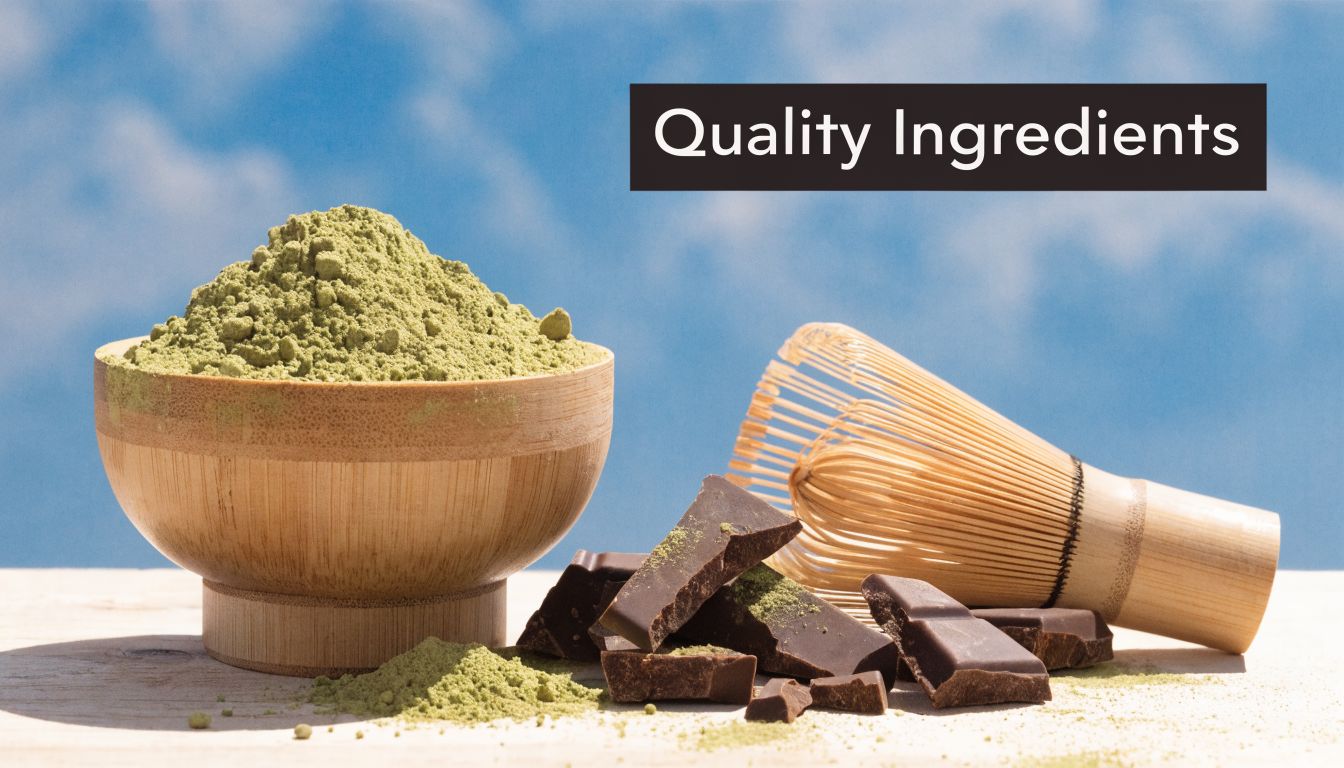
Matcha grade matters more than people expect
For straight drinking with water, ceremonial grade is usually the more delicate and refined choice. For chocolate matcha tea, culinary grade matcha often makes more sense because it has enough presence to stand up to cacao and milk.
That doesn’t mean any cheap powder will do. You still want matcha that looks vibrant, smells fresh, and blends cleanly. Dull olive powder often tastes flat or harsh in milk-based drinks.
If you’re making a menu decision for a café, culinary grade is also practical because it performs well across hot drinks, iced drinks, and blended recipes.
Picking the chocolate without losing the tea
Chocolate choice shapes the whole drink. White chocolate gives creaminess and lets the green tea shine. Dark chocolate makes the cup deeper and more bittersweet. Cacao powder gives you the most control over sweetness.
One very useful benchmark comes from this guide on making matcha chocolate with the right white chocolate balance, which notes that for the best flavour, high-quality white chocolate should have a sugar content below 30%, and that the optimal matcha-to-chocolate ratio is typically between 1:5 and 1:8 by weight so the matcha’s umami notes aren’t buried.
If you use drinking chocolate or hot chocolate blends, ingredient lists matter. Some are heavy on sugar and light on cocoa, which can make the final cup muddy. If you want a clearer sense of how these products differ, this explainer on understanding hot chocolate drinking powders is worth a look.
Milk, sweetness, and flavour support
Different milks change the drink in different ways.
- Dairy milk gives a rounded, classic café texture
- Oat milk usually creates the creamiest vegan version
- Almond milk makes a lighter cup with a nuttier finish
- Soy milk can work well when you want more body than almond offers
For sweetening, keep it simple. Honey, maple syrup, or a sugar-free sweetener can all work, but start small. Matcha and chocolate are both assertive ingredients, so a little sweetener often goes further than expected.
Practical rule: If you can taste only sweetness, the chocolate matcha tea isn’t balanced yet.
The tools that make the biggest difference
You don’t need a huge setup, but a few basics are essential for texture:
- Fine-mesh sifter to break up clumps before whisking
- Bamboo whisk or small handheld whisk to disperse the matcha properly
- Heatproof bowl or mug for making a smooth paste
- Milk jug or saucepan for controlled heating
- Teaspoon or digital scale for consistency
A frother can help, but it doesn’t replace sifting. That’s where many clumpy drinks begin.
Master Recipe The Classic Hot Chocolate Matcha Latte
A great hot chocolate matcha latte isn’t made by dumping everything into one mug and hoping for the best. The smoothest version is built in layers. First the powders are prepared, then a paste, then warm milk is added gradually.
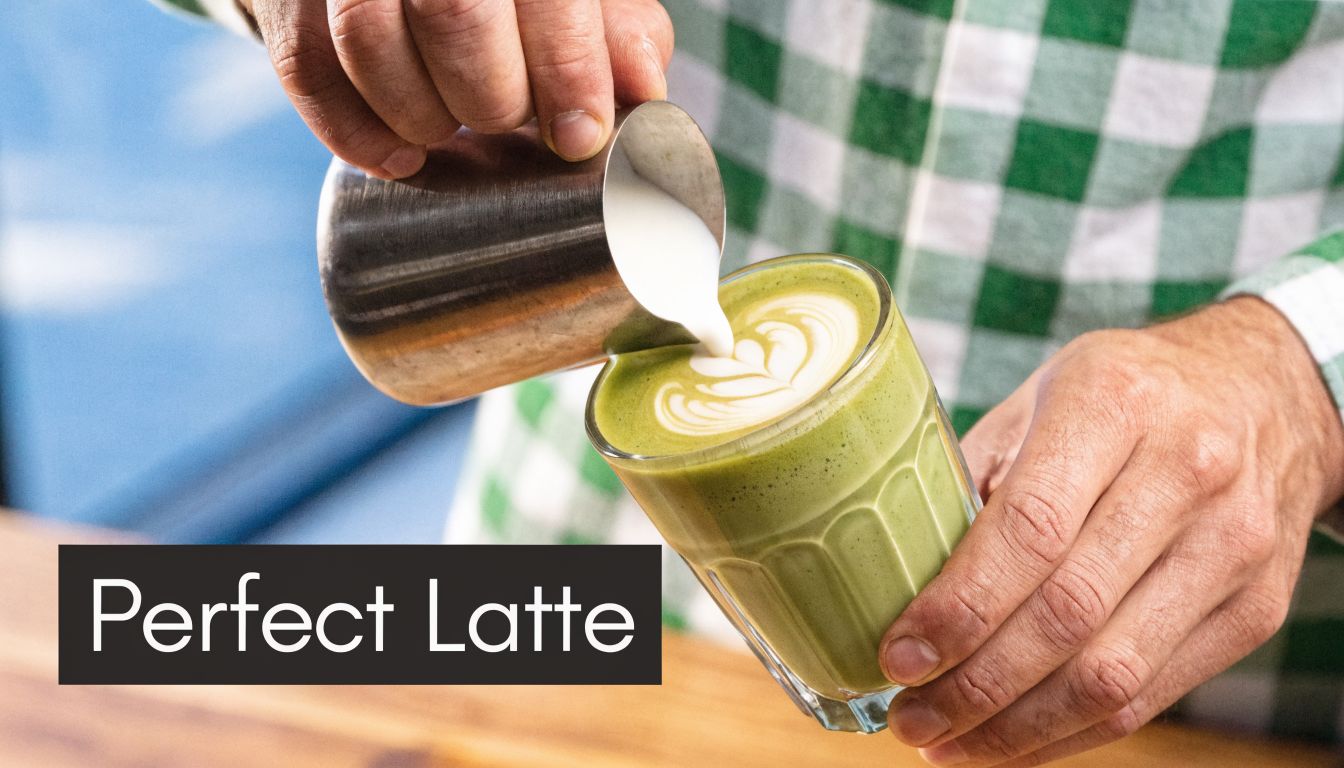
A reliable recipe for one mug
Use this as your base recipe:
- 1 to 2 teaspoons matcha
- 1 to 2 teaspoons cacao powder or finely chopped chocolate
- A small amount of hot water
- 1 cup milk of choice
- Sweetener to taste
- Optional pinch of sea salt or a little vanilla
If you’re using white chocolate instead of cacao powder, melt it into the milk gently rather than trying to whisk chunks into the cup.
The method that prevents clumps
The most important technical detail is temperature. To preserve matcha’s delicate flavour and nutrients, heat your liquid to 70 to 80°C (160 to 175°F), sift the matcha first, then use vigorous M or W whisking motions for 15 to 60 seconds for a smooth consistency, according to this guide on preparing matcha without damaging flavour.
Follow these steps:
Sift the matcha and cacao
Add both to a bowl or wide mug through a fine sieve. This tiny step saves a lot of frustration later.
Make a paste
Add a small splash of hot water. Whisk until it forms a glossy paste with no dry pockets. If it looks grainy here, it’ll stay grainy in the final drink.
Warm the milk gently
Heat your milk so it’s hot but not boiling. If you’re using white chocolate, melt it into the milk slowly while stirring.
Combine in stages
Pour a little warm milk into the paste first and whisk again. Then add the rest. This staged approach keeps the texture silky.
Taste and adjust
Add sweetener, vanilla, or a tiny pinch of salt if needed. Salt can sharpen chocolate flavour without making the drink salty.
Common mistakes and easy fixes
People often think the issue is the recipe, when it’s usually the sequence.
| Problem | Likely cause | Simple fix |
|---|---|---|
| Clumps | Matcha wasn’t sifted | Sift before any liquid touches it |
| Grainy texture | Paste wasn’t whisked enough | Whisk longer before adding milk |
| Bitter finish | Liquid was too hot | Keep milk below boiling |
| Weak matcha flavour | Too much chocolate or sweetener | Reduce chocolate and retaste |
A visual walkthrough can help if you’re more of a watch-and-copy learner.
Easy adaptations for different drinkers
A vegan version is simple. Oat milk is often the easiest choice because it stays creamy and supports both chocolate and matcha well. Almond milk works too, but the result is lighter.
For a sugar-free style, use unsweetened cacao and a sugar-free sweetener you already enjoy in hot drinks. The goal isn’t to mimic a confectionery drink. It’s to let the chocolate and tea still taste like themselves.
If you want to refine your matcha technique beyond this recipe, this guide on how to make a matcha latte is a useful companion.
If your first mug tastes a little too earthy or a little too rich, that’s normal. Small adjustments in chocolate, sweetness, and milk make a much bigger difference than changing everything at once.
Creative Variations for Every Occasion
Once the hot version is working, chocolate matcha tea becomes a very flexible base. It can be refreshing, dessert-like, more coffee-friendly, or even sparkling depending on the occasion.
One reason people enjoy experimenting with matcha in drinks is that you’re consuming the whole leaf powder. This article on historical facts about matcha and antioxidant density notes that whole-leaf matcha can deliver up to 137 times more antioxidants, specifically EGCg, than traditionally steeped green tea, which helps explain why it’s become popular in functional beverages.

Iced chocolate matcha latte for warm afternoons
This is the version to make when you want something café-style and cooling without reaching for a standard iced coffee.
Start by preparing a concentrated paste with sifted matcha, cacao, and a little hot water. Let it cool slightly. Fill a tall glass with ice, add cold milk, then pour the matcha-chocolate mixture over the top.
For the cleanest layers, use cold milk and cooled concentrate. If you pour hot mixture straight onto ice, the drink can dilute too quickly.
Try serving it with:
- Oat milk for a creamy, mellow finish
- Almond milk for a lighter style
- A dusting of cacao on top for a more dessert-like look
Matcha mocha for coffee lovers
Some people don’t want to choose between espresso and matcha. Fair enough. A matcha mocha gives you roasted coffee notes, chocolate depth, and that recognisable green tea edge in one cup.
Build the chocolate matcha base first, then add a freshly pulled shot of espresso before topping with warm milk. Stir gently, taste, then adjust sweetness only if needed. Espresso already brings bitterness, so this version usually needs less cacao than the classic latte.
This variation works best when none of the elements dominate. You should taste coffee, chocolate, and matcha separately, then together.
If you’re serving this in a café, it helps to describe it clearly on the menu. People ordering matcha mochas are often curious, but they want to know whether the drink leans more coffee-forward or tea-forward.
Chocolate matcha kombucha fusion for a lighter, sparkling serve
This one surprises people. It’s not a latte at all. It’s brighter, more grown-up, and ideal for alcohol-free menus or brunch-style drinks.
The easiest method is to make a small, smooth matcha-cacao concentrate first. Cool it fully. Pour it into a glass with ice, add a splash of your preferred milk if you want softness, then top gently with plain or ginger-forward kombucha. Stir lightly rather than aggressively so you keep the sparkle.
A few flavour directions work especially well here:
| Style | What it tastes like | Best moment |
|---|---|---|
| Ginger chocolate matcha spritz | Lively, zesty, lightly earthy | Mid-afternoon pick-me-up |
| Lime-cacao matcha cooler | Sharper and more refreshing | Warm-weather brunch |
| Vanilla chocolate matcha fizz | Softer and rounder | Alcohol-free evening serve |
Small custom touches that make a big difference
You don’t need a complicated recipe to make these drinks feel special.
- Add cinnamon if you want warmth without extra sweetness
- Use orange zest for a bright finish with dark chocolate versions
- Blend with ice when you want a frappe-style drink
- Top with shaved dark chocolate for a more premium presentation
Chocolate matcha tea is at its best when it suits the moment. Hot and quiet in the morning. Iced and quick in the afternoon. Sparkling and polished when guests are over.
For Café Owners and Home Baristas Menu Inspiration
Chocolate matcha tea can earn its place on a menu because it solves a real problem. Not every customer wants coffee, and not every non-coffee option feels premium. This category gives you something distinctive that still feels familiar enough to order.
For cafés, the appeal is range. One base idea can become a hot signature drink, an iced afternoon option, a seasonal special, or a non-alcoholic spritz. For home baristas, it’s a way to serve something memorable without needing a full commercial setup.
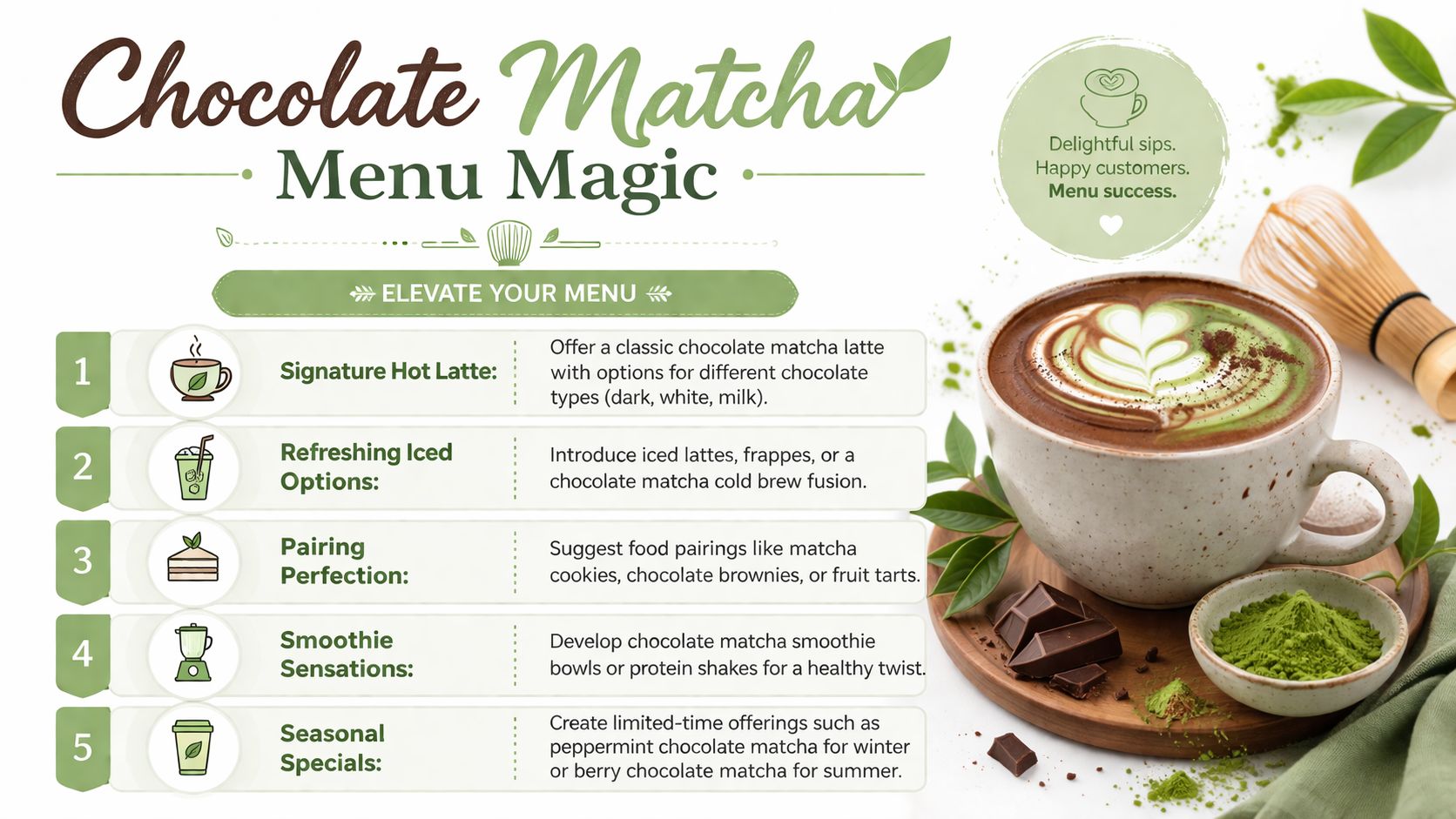
Flavour pairing ideas that sell the drink
Some pairings make the drink easier to understand at a glance. Customers may hesitate at “chocolate matcha tea” if they can’t picture the flavour. Add a familiar note, and the concept becomes easier to order.
| Pairing | Flavour Profile | Serving Suggestion |
|---|---|---|
| Raspberry | Tart, bright, lifts chocolate sweetness | Iced latte with berry garnish |
| Mint | Cool and clean against rich cacao | Winter hot special |
| Orange zest | Fragrant and slightly bitter | Dark chocolate version |
| Vanilla | Softens grassy notes | House hot latte |
| Sea salt | Sharpens chocolate depth | White chocolate matcha drink |
Menu ideas for cafés and hosts
A few naming ideas can make a menu feel more polished:
- Zen Cacao for a classic hot chocolate matcha latte
- Green Mocha for the espresso version
- Matcha Cloud for a lighter iced serve
- Probiotic Sparkler for a kombucha-based option
- Winter Mint Matcha for a seasonal feature
Presentation matters too. Clear glass works beautifully for iced versions because the colour contrast does some of the selling for you. For hot drinks, a matte cup and a neat dusting of cacao can give the drink a more premium feel.
Quality and compliance are part of the product
For Australian businesses, ingredient sourcing isn’t only about flavour. It’s also about trust and safety. This article on FSANZ standards and the risks of non-compliant imported tea powders notes that sourcing ingredients that meet FSANZ standards is critical, and that non-compliant imported tea powders can face seizure due to contamination risks.
That matters for cafés building a serious beverage program. If you’re serving matcha, you need consistency in flavour, colour, and documentation. A drink can’t become a signature item if supply or quality is unpredictable.
Menu mindset: The best-selling speciality drinks are usually the ones staff can describe in one sentence and make consistently during a busy service.
For home baristas, the same principle still applies in a smaller way. Better ingredients simplify the process. Better tools improve consistency. If you want to tighten your setup, a few dedicated matcha tea accessories can make whisking and serving much easier.
Frequently Asked Questions About Chocolate Matcha
Why is my chocolate matcha tea clumpy
Clumps usually start with dry powder hitting liquid too fast. Sift your matcha first, sift cacao too if you’re using it, then whisk with a small amount of hot water to form a smooth paste before adding milk.
If you skip the paste stage, even a strong frother may not rescue the texture.
Why does my drink taste bitter
There are a few possible causes. The liquid may have been too hot, the matcha may be low quality, or the chocolate-to-matcha balance may be off.
Bitterness can also show up when a dark chocolate version has too little milk or sweetener. Adjust one thing at a time so you can tell what helped.
Can I make it ahead of time
Yes, but the best results come from preparing part of it rather than the whole drink. You can make a matcha-chocolate concentrate in advance, keep it chilled, and then combine it with hot or cold milk when you’re ready to serve.
If the mixture settles in the fridge, whisk or shake it again before pouring.
What’s the best milk for chocolate matcha tea
That depends on the style you want. Dairy milk gives a classic, rounded texture. Oat milk is often the easiest plant-based option for a creamy cup. Almond milk creates a lighter drink with a slightly nuttier finish.
If you’re testing for a café menu, try the recipe with at least two milks. Some customers want dairy-free, but they still expect a full-bodied result.
Is chocolate matcha tea healthy
It can fit well into a wellness-focused routine, especially when you use quality matcha, choose your sweetener carefully, and avoid overly sugary chocolate blends. Matcha is valued for antioxidants and for the calm-focus combination often associated with caffeine and L-theanine.
The final nutritional profile depends heavily on your ingredients. A lightly sweetened oat milk version will feel very different from one made with lots of white chocolate syrup.
When’s the best time to drink it
Many people enjoy it in the morning or early afternoon when they want a gentler, more mindful alternative to another coffee. A hot version suits slower mornings. An iced version works well as a warm-weather afternoon drink.
If you’re sensitive to caffeine later in the day, keep that in mind and enjoy it earlier.
If you’re ready to try chocolate matcha tea with premium organic ingredients, explore Pep Tea for Australian matcha, kombucha, and tea essentials that make these recipes easier to get right.
Best Matcha Powder Perth: Where to Buy and How to Use It

You’ve probably seen it already. A bright green iced matcha latte on a café table in Fremantle, a neat little tin on a shelf in Subiaco, or a friend in Perth whisking green powder in a bowl and talking about “calm energy” like they’ve joined a secret club.
Fair question. What is matcha, and where do you find good matcha powder in Perth without wasting money on dull, bitter powder that tastes like lawn clippings?
That confusion is normal. Matcha looks simple, but there’s a big difference between average supermarket powder and a beautifully made Japanese matcha that’s smooth, sweet, fresh, and easy to drink. Once you know what to look for, the whole thing gets much less intimidating.
Matcha also isn’t some passing café fad. In Australia, it’s growing fast. The Australian Matcha Tea Market is projected to expand from USD 340 million in 2025 to USD 790 million by 2031, with a compound annual growth rate of 14.8%, according to Mobility Foresights’ Australia matcha tea market outlook. In a city like Perth, that makes sense. We’ve got a strong café culture, a growing interest in functional drinks, and plenty of people looking for something more mindful than another over-extracted coffee.
The easiest way to understand matcha is this. Regular green tea is like making a broth from leaves and then throwing the leaves away. Matcha is different because you drink the whole leaf, finely ground into powder. That’s why quality matters so much. If the leaf is excellent, the cup is excellent. If the leaf is poor, there’s nowhere to hide.
Introduction
Perth is a great place to get into matcha because you can explore it in a few different ways. You can try a latte at a good café, buy a tin from a Japanese grocer or health store, or order from an Australian online supplier and make it at home. Each option suits a different kind of drinker.
For beginners, the biggest hurdle is usually not taste. It’s vocabulary. People throw around terms like ceremonial grade, culinary grade, Uji, stone-ground, organic, umami, and L-theanine as if everyone already knows what they mean.
You don’t need to memorise tea jargon to buy well. You just need a few practical filters.
What most Perth buyers want to know
Some people want a matcha that tastes good with just water. Others only want something for iced lattes, smoothies, or baking. Café owners usually need consistency, reliable supply, and a powder that performs well during a busy service.
Those are different needs, and they call for different products.
Here’s the simple version:
- If you want to sip it straight, look for ceremonial grade.
- If you’re making lattes or baking, culinary grade often makes more sense.
- If freshness matters to you, storage, packaging, and turnover matter almost as much as the tea itself.
- If you live in Perth, climate matters too. Heat and humidity can flatten matcha faster than commonly understood.
Matcha becomes much easier to enjoy when you stop asking for the “best” matcha and start asking for the right matcha for how you’ll use it.
Why people keep coming back to it
A good matcha has a very particular personality. It can taste creamy, grassy, savoury, sweet, and softly bitter all at once. It feels a bit ritualistic without being fussy. And for a lot of people, making it becomes part of the appeal.
That’s why matcha powder perth searches keep growing. People aren’t just looking for a product. They’re looking for a better way to buy, brew, and enjoy it locally.
What Is Matcha and How Is It Made
Matcha is a finely ground green tea powder made from specially grown tea leaves. It isn’t the same as standard green tea bags, and it isn’t just green tea that’s been crushed up. The growing and processing are what make it different.
Before harvest, the tea plants used for matcha are shaded. That reduced light changes the leaf. It helps build the vivid green colour people associate with premium matcha and contributes to the soft, savoury depth that good matcha lovers chase.
If you want a more detailed look at the traditional production steps, Pep Tea has a useful guide on how matcha tea is made.
Why matcha tastes different from regular green tea
With standard green tea, you steep the leaves in water and remove them. With matcha, the leaf is ground into powder and whisked directly into the bowl, so you consume the whole thing.
A simple way to think about it is this:
| Drink type | What you consume | What it feels like |
|---|---|---|
| Regular green tea | Water infused by the leaf | Lighter, more delicate |
| Matcha | The actual powdered leaf in suspension | Richer, fuller, more intense |
That’s why matcha has more body in the mouth. It can feel almost creamy even without milk, especially when it’s whisked properly.
What happens after harvesting
After the leaves are picked, they’re steamed, dried, and processed into tencha before being ground into a very fine powder. That fine grind is a huge part of the drinking experience. Better matcha feels soft and silky. Lower-grade powder can taste rough, settle badly, and look flat in colour.
This is also where grade starts to matter in real life, not just on a label.
Good matcha should look alive. If the powder looks tired in the tin, it’ll usually taste tired in the cup.
Ceremonial and culinary start with different goals
People sometimes assume ceremonial grade is always “better” and culinary grade is always “worse”. That’s too simplistic. They’re made for different jobs.
- Ceremonial grade is usually the better fit when you want to drink matcha with water and appreciate its aroma, sweetness, and umami.
- Culinary grade is usually chosen for recipes where milk, fruit, sweeteners, or baking ingredients share the stage.
- Your own taste matters more than prestige. If you only drink iced oat milk matcha, you may not need the gentlest ceremonial powder every day.
A lot of disappointment comes from mismatch, not poor tea. Someone buys ceremonial grade, buries it under syrups and ice, and wonders why it felt expensive. Someone else buys a cooking-grade powder, drinks it straight, and decides matcha isn’t for them.
Choosing Your Matcha Ceremonial vs Culinary Grades
The quickest way to buy better matcha in Perth is to understand grade by use, not by hype.
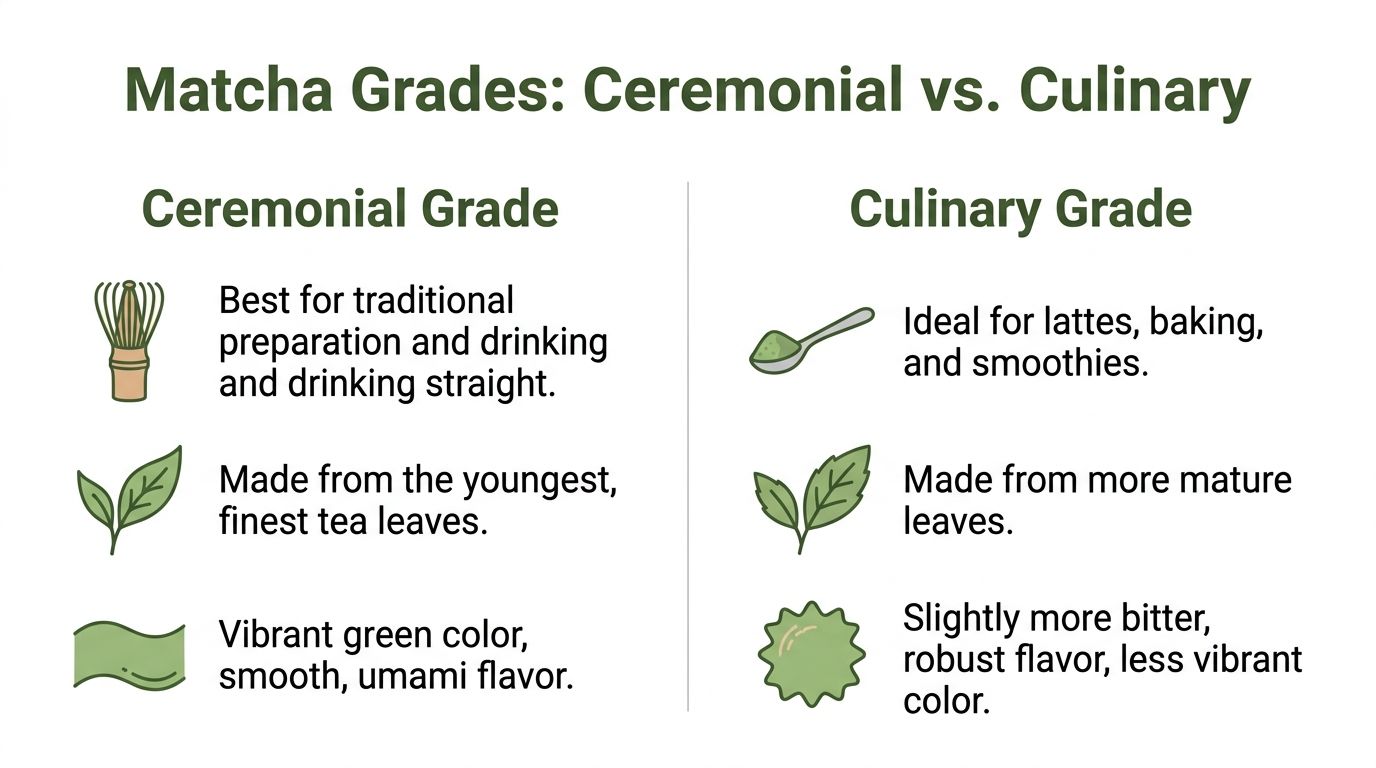
If you want a fuller primer on labels and classifications, this guide to different grades of matcha is a helpful starting point.
Ceremonial grade for drinking
Ceremonial grade is the one people usually picture when they imagine traditional Japanese tea preparation. It’s made to be whisked with water and enjoyed on its own.
You’ll usually notice:
- Brighter colour that leans vivid green rather than olive or khaki
- Softer flavour with sweetness, umami, and only gentle bitterness
- Finer texture that disperses more smoothly
- Cleaner finish that makes straight drinking enjoyable
This is the grade for the person who wants a morning bowl of matcha instead of a latte, or who wants to taste the tea itself rather than the milk around it.
Culinary grade for mixing
Culinary grade has a stronger, punchier profile. That’s not a flaw. It’s useful. In a latte, smoothie, muffin, pancake batter, or protein bowl, a more intense matcha can still come through.
It usually has:
- A firmer bitterness
- A less delicate aroma
- A darker or duller green tone
- A profile that stands up better in recipes
For many Perth households, culinary grade is the everyday workhorse. It’s practical, versatile, and often the better pick if your matcha mostly ends up over ice with milk.
A side by side buying guide
| Feature | Ceremonial grade | Culinary grade |
|---|---|---|
| Best use | Straight drinking, traditional whisking | Lattes, smoothies, baking |
| Colour | Vibrant green | Less vivid green |
| Taste | Smooth, umami, mild sweetness | Stronger, more robust, more bitter |
| Texture | Very fine and silky | Often slightly less refined |
| Who it suits | Tea drinkers who want the leaf to shine | Home cooks and latte lovers |
The texture clue most people miss
One of the most useful quality clues is how finely the powder has been milled. According to Maison Matcha’s ceremonial matcha guide, premium ceremonial matcha’s 800-mesh fineness with a 10 to 20µm particle size supports near-total solubility in lattes, while 500-mesh culinary grades can lead to 30% sediment.
That matters because it changes the whole drinking experience. A smoother powder doesn’t just look prettier in the cup. It feels better, whisks better, and settles less.
Buying rule: If you hate gritty matcha, don’t just ask what grade it is. Ask how fine it is.
How to choose without overthinking it
If you’re standing in a shop or comparing tins online, use this simple checklist.
Start with your main use
Be honest. If you’re making iced lattes every morning, buy for that.Look at colour before claims
A premium-looking label can still hide dull powder.Read the origin
Japanese matcha is often what buyers seek for a more refined cup.Think about value, not status
The “best” matcha is the one that suits your habit and budget.
A practical Perth example
Let’s say you drink one hot matcha on quiet mornings and make a few iced lattes through the week. You don’t need one tin to do everything perfectly.
Some people keep:
- One ceremonial tin for straight drinking
- One culinary tin for milk drinks and recipes
That approach is often more satisfying than trying to force one product into every role.
How to Spot Truly High-Quality Matcha Powder
You don’t need to be a tea master to judge matcha well. You just need to slow down and use your senses. When I’m helping someone choose matcha powder perth options, I tell them to ignore the marketing for a minute and look at what’s in front of them.
The first check is colour. Premium matcha should look fresh and bright, not brownish, swampy, or yellow-green. A flat colour often points to age, lower-grade leaf, or poor storage.
The second check is aroma. Open a fresh tin and you want a smell that feels green, sweet, and clean. It might remind you of fresh-cut grass, spinach, steamed greens, or even a soft creamy note. If it smells dusty, stale, or oddly marine, it’s usually not a good sign.
What quality feels like in the hand and bowl
Texture tells you a lot. Fine matcha should feel almost cloud-like when handled carefully. It shouldn’t feel sandy or coarse.
When whisked, it should form a smooth liquid rather than a stubborn clumpy mess.
A quick sensory checklist helps:
- Colour check. Look for vibrant green rather than dull olive.
- Aroma check. Fresh, grassy, slightly sweet is good.
- Texture check. Silky and fine beats gritty every time.
- Taste check. You want balance. Some pleasant bitterness is fine, but harshness shouldn’t dominate.
Why storage quality matters in Perth
Perth’s climate can be rough on delicate powders, especially if the tin sits in warmth, light, or moisture. This is one of the reasons online buyers should care about packaging and freshness, not just origin.
According to the technical specifications in this organic matcha product document, high-quality matcha powder should have moisture of ≤7% and total ash of ≤8%. The same source notes that in humid conditions, moisture above 7% can accelerate catechin oxidation and reduce EGCg bioavailability by up to 30% within six months.
That sounds technical, but the practical takeaway is simple. Matcha hates heat, light, air, and humidity.
In Perth, a great matcha stored badly can become a disappointing matcha surprisingly quickly.
Buying in person versus buying online
In-store buying has one big advantage. You can sometimes inspect the tin, ask questions, and get a feel for the shop’s standards. That can be excellent in specialist tea shops and selected Japanese grocers.
The challenge is freshness. Shelf time isn’t always obvious, and broad retail environments aren’t always ideal for delicate tea.
Online buying can be the stronger option when the supplier specialises in matcha, turns stock over regularly, and packs it well. That gives you access to a wider range, clearer product detail, and often better insight into origin and grade. For Perth buyers, it also opens up Australian suppliers who focus specifically on organic tea rather than carrying matcha as an afterthought.
Signs that usually point to a poor buy
Not every disappointing matcha is fake. Sometimes it’s just the wrong product for the job. Still, a few warning signs come up again and again:
- No clear origin listed
- Very dull powder colour
- Unsealed or poorly packed product
- Vague claims with no real product detail
- A texture that settles heavily and tastes rough
When people say they “don’t like matcha”, they’ve often just had old or low-quality powder. Fresh, well-made matcha is a very different experience.
Your Local Guide to Buying Matcha Powder in Perth
If you want to buy matcha powder perth locals enjoy using, there are a few sensible paths. Each has strengths, and each suits a different kind of buyer.
The good news is that access has improved. Australia’s matcha tea imports grew by 62.91% from 2023 to 2024, according to 6Wresearch’s Australia matcha tea market analysis. For Perth buyers, that helps support availability through specialty stores and online retailers serving WA.
Try it first at a good café
If you’re brand new to matcha, tasting a well-made café version can save you from buying blind. A solid matcha latte gives you a reference point for colour, aroma, and balance.
When you order one, pay attention to:
- Colour in the cup. It should look vibrant, not muddy.
- Flavour balance. Milk should soften the tea, not erase it.
- Sweetness level. If it’s extremely sweet, you may not be tasting the matcha clearly.
- Texture. A chalky or gritty latte usually points to poor whisking or lower powder quality.
This is especially useful if you’re unsure whether you enjoy matcha itself or only like sweetened café-style drinks.
Browse retail shelves with care
Health food stores, Japanese grocers, and premium supermarkets can all be worth checking. The benefit is convenience. You can grab a tin the same day and compare options on the shelf.
The downside is that shelf labels rarely tell the full story.
A few questions help:
| What to check | Why it matters |
|---|---|
| Origin listed clearly | Helps you understand what style you’re buying |
| Grade named clearly | Stops you using the wrong matcha for the wrong drink |
| Packaging sealed well | Freshness matters with matcha more than many teas |
| Storage conditions | Heat and light can flatten flavour over time |
Farmers markets and local makers
Markets can be fun if you enjoy discovery. You may come across wellness-focused stalls, Japanese pantry goods, or curated beverage products. Still, this route takes a bit more judgement because presentation and quality aren’t always the same thing.
If you buy from a market stall, ask direct questions about origin, grade, and how they recommend using it. A good seller should answer easily and specifically.
Why many Perth buyers end up ordering online
For a lot of people, online becomes the easiest long-term option. You can compare grades properly, read descriptions in detail, and keep a favourite on hand without driving all over the city.
Online also suits Perth’s pace. Once you know what you like, a repeat order is easier than hunting from suburb to suburb.
It’s especially helpful if you want:
- A specialist tea supplier rather than a general retailer
- Clear distinction between ceremonial and culinary options
- Better freshness practices and sealed packaging
- Consistent access for home use or café use
Easy ways to use matcha at home
You don’t need a full tea ceremony setup to enjoy matcha. Start with one recipe and make it part of your week.
Iced matcha latte for warm Perth days
You’ll need matcha, a splash of warm water, milk of your choice, and ice.
- Sift a little matcha into a cup or bowl.
- Add a small amount of warm water.
- Whisk until smooth.
- Fill a glass with ice and milk.
- Pour the whisked matcha over the top.
If you want sweetness, keep it light so you can still taste the tea.
A simple iced matcha latte is often the easiest gateway into matcha because it’s familiar, refreshing, and forgiving.
Matcha in breakfast and baking
Culinary matcha works well in smoothies, yoghurt, overnight oats, pancakes, muffins, and energy balls. It adds colour, a gentle earthy note, and a more grown-up flavour than standard sweet breakfast add-ins.
If the taste seems strong at first, reduce the amount and build up slowly. Matcha is one of those ingredients that rewards a light hand.
For Perth Cafés Sourcing Wholesale and Navigating Supply
Perth cafés don’t need another copy-and-paste menu item. They need drinks that fit how people order now. Matcha earns its place because it works across different customer habits. Hot, iced, dairy, oat, coconut, lightly sweetened, unsweetened, straight-up, or layered into a non-alcoholic menu.
The bigger issue is supply. A café can build demand for a great matcha latte, then run into inconsistency if the product changes, disappears, or arrives in uneven quality.
According to ANZ Bluenotes’ reporting on the matcha shortage and supply chain pressure, the 2025 global matcha shortage slashed Japanese yields by 25% and doubled tencha prices, creating import instability for cafés that rely on overseas supply alone. That makes stable Australian supply relationships more valuable for Perth venues.
Why wholesale matcha needs a different buying mindset
Home buyers can experiment. Cafés can’t. A venue needs a powder that performs consistently in service, tastes the same from bag to bag, and suits the drinks that sell.
That usually means thinking about:
- Menu fit. Is your matcha for premium straight service, iced lattes, or both?
- Ease of prep. Can staff whisk it consistently during a rush?
- Milk compatibility. Does it hold its flavour in dairy and alt-milks?
- Supplier reliability. Can you reorder confidently without drama?
For venues building an all-day beverage program, matcha also works well alongside tea, coffee, and no-alcohol options.
Matcha and customer retention
A strong matcha offer can also support repeat visits. People who find a café that makes matcha properly often come back because they know it’s not guaranteed elsewhere.
That’s where broader retention thinking matters too. If you’re refining your drinks program, these Coffee Shop Loyalty Program strategies are useful for turning one-off beverage orders into regular habits.
What to ask a wholesale supplier
Before choosing a wholesale partner, café owners should ask practical questions, not just flavour questions.
Consider asking:
What grade is this designed for?
A latte powder and a straight-drinking powder are not the same thing.How is it packaged for freshness?
Matcha degrades if it’s handled casually.Can we order in bulk consistently?
Reliability matters more than novelty.What support do you offer for menu use?
Good suppliers should help with product fit, not just delivery.
If you’re comparing options for bar service, iced drinks, and kitchen use, Pep Tea offers a relevant bulk option in its bulk buy culinary grade organic matcha.
Cafés don’t just buy matcha. They buy consistency, speed of service, and confidence that the next delivery will taste like the last one.
Essential Tips for Storage and Common Perth FAQs
Once you’ve bought a good matcha, storage is what protects the experience. This part matters more in Perth than many people expect. Heat, light, air, and humidity all work against freshness.
The easiest rule is to treat matcha more like a delicate pantry ingredient than a hardy tea bag. Keep it sealed, keep it shaded, and don’t leave it sitting open while you decide what milk to use.
How to store matcha properly at home
A few habits make a big difference:
- Use an airtight container. Oxygen is not your friend once the package is open.
- Keep it away from light. Opaque packaging helps protect colour and flavour.
- Store it somewhere cool. Many people use the fridge, especially in warmer months.
- Avoid steam and condensation. Don’t open the tin right over a kettle or dishwasher.
If you refrigerate it, let the container sit closed for a moment before opening so you reduce condensation risk.
The clumping problem
Clumps don’t always mean bad matcha. Fine powders naturally compact a bit. The fix is simple.
Use a small sieve and sift the powder before whisking. That one step makes a noticeable difference to texture and saves you from chasing lumps around the bowl.
Sifting is the easiest upgrade most home matcha drinkers can make.
Common Perth questions
Is ceremonial grade worth it for a daily latte
Sometimes yes, often no. If milk is the main event, a good culinary grade usually gives better value. If you love a softer, more refined latte and you’re happy to pay for that nuance, ceremonial can still be lovely.
Where can I buy a bamboo whisk in Perth
Specialty Japanese tea shops and selected kitchenware stores are your best bet. Some online Australian tea retailers also stock whisks, bowls, and sifters. If you’re just getting started, don’t let gear delay you. You can begin with a small whisk or even a jar shake method while you decide whether matcha will become part of your routine.
How do I stop matcha tasting bitter
Usually one of three things has gone wrong. The water is too hot, the powder quality is too low for the way you’re drinking it, or you’ve used too much. Start gentler. Better matcha and cooler water usually solve a lot.
Can I use one matcha for everything
You can, but it’s a compromise. If you drink matcha straight and also bake with it, keeping separate ceremonial and culinary tins is often the more satisfying option.
Why does my matcha lose its bright green colour
That usually points to age, light exposure, heat, or air. Freshness isn’t just about taste. It shows up visually first.
The simplest way to get started
If you’re new, don’t buy a huge amount straight away. Start with a small quantity from a supplier that explains the grade clearly. Make one drink you know you’ll repeat, usually an iced latte or a simple hot whisked matcha.
That’s enough to build confidence. The ritual, the gear, and the more refined taste preferences can come later.
If you’re ready to try premium organic matcha from an Australian specialist, explore Pep Tea. You’ll find quality matcha options for straight drinking, lattes, and everyday use, plus a broader range of clean functional beverages made for Australian homes and cafés.
Master Matcha Making Kit: Your Perfect Brew Awaits

You’ve probably seen a matcha making kit online, loved the look of the bowl and whisk, then paused at the checkout wondering whether you need all of it. Fair question. A lot of first kits are bought on impulse, used twice, then pushed to the back of the cupboard because the tea came out bitter, lumpy, or oddly flat.
The good news is that making proper matcha at home isn’t hard. It’s just precise. A few simple tools, the right powder, and a couple of small habits make all the difference. Once those pieces are in place, your morning cup starts to feel less like a fiddly task and more like a ritual you’ll want to repeat.
A good matcha making kit should do two jobs well. It should help you whisk a smooth bowl of tea, and it should remove doubt about what you’re putting into that bowl. For Australian drinkers, that second part matters more than most guides admit.
Choosing Your First Matcha Making Kit
The cheapest kit is rarely the best first buy.
That doesn’t mean you need something ornate or collector-level. It means your matcha making kit should be built around safety, usability, and powder quality, not just aesthetics. Plenty of kits look lovely in product photos but fall short where it counts. The whisk splays too quickly, the bowl is awkward to whisk in, or the included matcha is an afterthought.
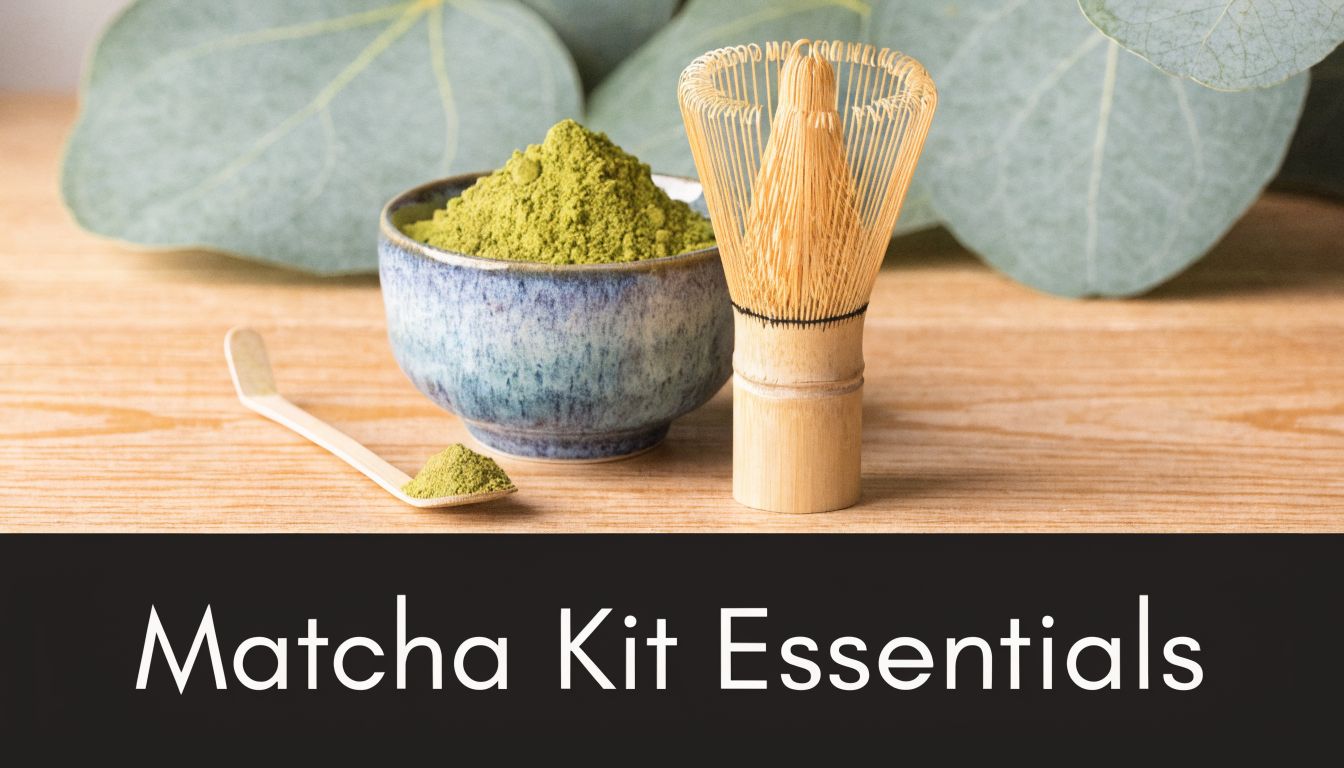
What a first kit should include
At minimum, look for these pieces:
- A chawan bowl: Wide enough to whisk in comfortably. A narrow mug makes frothing harder and usually leaves clumps around the edges.
- A chasen whisk: This is the bamboo whisk that gives matcha its light foam and smooth texture.
- A chashaku scoop: Helpful for consistent portions and part of the traditional process.
- A fine sifter: Often skipped in budget sets, but it’s one of the most useful tools in the whole routine.
If a set omits the sifter, I’d still consider buying it, but only if you’re happy to add a fine kitchen sieve yourself. Skipping sifting is one of the quickest ways to end up with gritty matcha.
The real buying question isn’t price
Most beginners compare kits by appearance first and price second. I’d reverse that thinking. Compare them by what they let you avoid.
You want to avoid a whisk with rough or brittle tines. You want to avoid unclear materials. You want to avoid powder with vague sourcing. And you want to avoid kits that bundle in low-grade matcha just to look complete.
Practical rule: If the seller is detailed about the tools but vague about the matcha, treat that as a warning sign.
There’s a genuine gap in the Australian market around organic certification and sourcing. One review of starter kit content notes that many kits focus on the tools while leaving buyers with very little clarity about certified-organic powder and food-grade tool standards, which matters for Australian consumers trying to buy carefully from trusted suppliers (matcha kit sourcing and certification gaps).
What matters most for Australian buyers
If you care about clean ingredients, don’t treat the powder as separate from the kit. Treat it as the centrepiece.
A whisk can help texture. A bowl can help technique. But the flavour, colour, aroma, and overall drinking experience come from the matcha itself. For that reason, I’d rather see a simple kit paired with certified organic matcha than a deluxe set with uncertain powder.
Here’s the short version of what to check before buying:
| What to check | Why it matters |
|---|---|
| Organic certification | Gives you a clearer standard for how the powder was produced |
| Food-grade tool materials | Helps you avoid uncertainty around bamboo and glaze quality |
| Wide bowl shape | Makes whisking easier and improves foam |
| Separate scoop and sifter | Keeps your portioning and texture more consistent |
| Clear sourcing information | Usually signals better care and transparency overall |
For gifting, presentation still matters. If you’re comparing more polished options for birthdays, housewarmings, or wellness gifts, it can help to browse various gift guides and then come back to the practical checklist above so the set looks good and works well.
What works and what usually disappoints
What works:
- A simple ceramic bowl with room to whisk
- A bamboo whisk that feels springy, not dry or fragile
- Matcha sold with clear quality cues rather than bundled as filler
- A set from a supplier that understands preparation, not just packaging
What often disappoints:
- Tiny bowls: Pretty on a shelf, frustrating in use
- Decorative kits with no sifter: You’ll fight clumps from day one
- Mystery matcha: Dull colour, harsh taste, poor value
- Ultra-cheap bundles: Fine for photos, less fine for daily drinking
If you want an example of a straightforward set designed for home preparation, Pep Tea offers a Japanese matcha set that includes the traditional tool format essential for most beginners.
Your First Bowl A Mindful Matcha Ritual
Making your first bowl of matcha goes better when you stop trying to rush it.
The best bowls I’ve made at home haven’t come from speed. They’ve come from giving each part of the process a reason. Warm the bowl because temperature matters. Sift the powder because texture matters. Whisk with focus because the final cup shows every shortcut.
Start by warming the bowl
Pour hot water into your bowl and let it sit briefly. Then warm the whisk in that same water for a moment.
This step does two useful things. It takes the chill off the bowl so your tea stays pleasant to drink, and it softens the whisk tines slightly so they’re less likely to feel stiff or scratchy when you begin. Empty the bowl, then dry it well. If the bowl is wet before the powder goes in, the matcha can stick and form paste-like lumps.
Sift the powder every single time
For a traditional everyday bowl of usucha, use 2g per serving. Sift it into the dry bowl.
That amount is small enough to feel approachable and strong enough to show the character of the tea. Sifting is the difference between smooth and frustrating. Matcha is a fine powder, but it still clumps easily in the tin. Once hot water hits those clumps, they’re harder to break apart cleanly.
Skip sifting once and you’ll usually spend the rest of the bowl chasing little green lumps around the bottom.
Add water that’s hot, not scalding
Your water should be hot enough to wake up the matcha, but not so hot that it knocks the life out of it. If you’ve just boiled the kettle, let the water cool a little before pouring.
When the water is too hot, matcha can taste sharper and less balanced. When the temperature is gentler, you’re more likely to notice sweetness, softness, and that fresh green character people are often chasing in cafés.
A helpful beginner method is this:
- Boil your kettle
- Warm the bowl and whisk
- Dry the bowl
- Sift in your 2g of matcha
- Add a small amount of hot water first
- Whisk into a loose paste before adding the rest
That first small splash of water matters. It helps the powder open up evenly rather than floating in dry pockets.
Let your senses guide the process
As you whisk, listen for the light tapping sound of bamboo moving quickly across the surface. Watch the colour brighten. Notice when the texture changes from thin and watery to silky and lightly foamed.
A good first bowl doesn’t need to look perfect. It just needs to feel integrated. No dry clumps, no sludge at the base, no harsh burnt note from overheated water.
Here’s a simple sensory checklist:
- Colour: Fresh, vivid green rather than dull olive
- Aroma: Grassy, creamy, or softly vegetal, not burnt
- Texture: Smooth and fine, with a light layer of froth
- Finish: Clean and rounded, not aggressively bitter
Drink it while it’s alive
Matcha doesn’t improve by sitting around. Once whisked, drink it promptly.
That’s part of why the ritual feels grounding. You make one bowl, you hold it warm in your hands, and you drink it in the moment it was prepared. It isn’t a brew to forget on the bench while you answer emails.
Small habit, big payoff: Sit down for the first few bowls you make. When you’re standing and distracted, you’ll rush the whisking and miss the flavour cues.
If you’re new to the taste, don’t judge matcha by your first sip alone. The opening can feel grassy or savoury if your palate expects sweetness. Give it a few mouthfuls. Good matcha tends to settle into itself as you drink, and your palate catches up quickly.
Mastering the Whisk The Art of the Perfect Froth
The chasen, or bamboo whisk, is the heart of the matcha making kit. It has been central to matcha preparation since Japan’s Muromachi period (1336–1573), while the broader practice of whipping powdered tea reaches back to China’s Song Dynasty (960–1279 AD), which gives this simple tool a long history in tea preparation (history of the matcha whisk).
That history is lovely, but what matters in your kitchen is this. The whisk isn’t there to stir. It’s there to aerate.
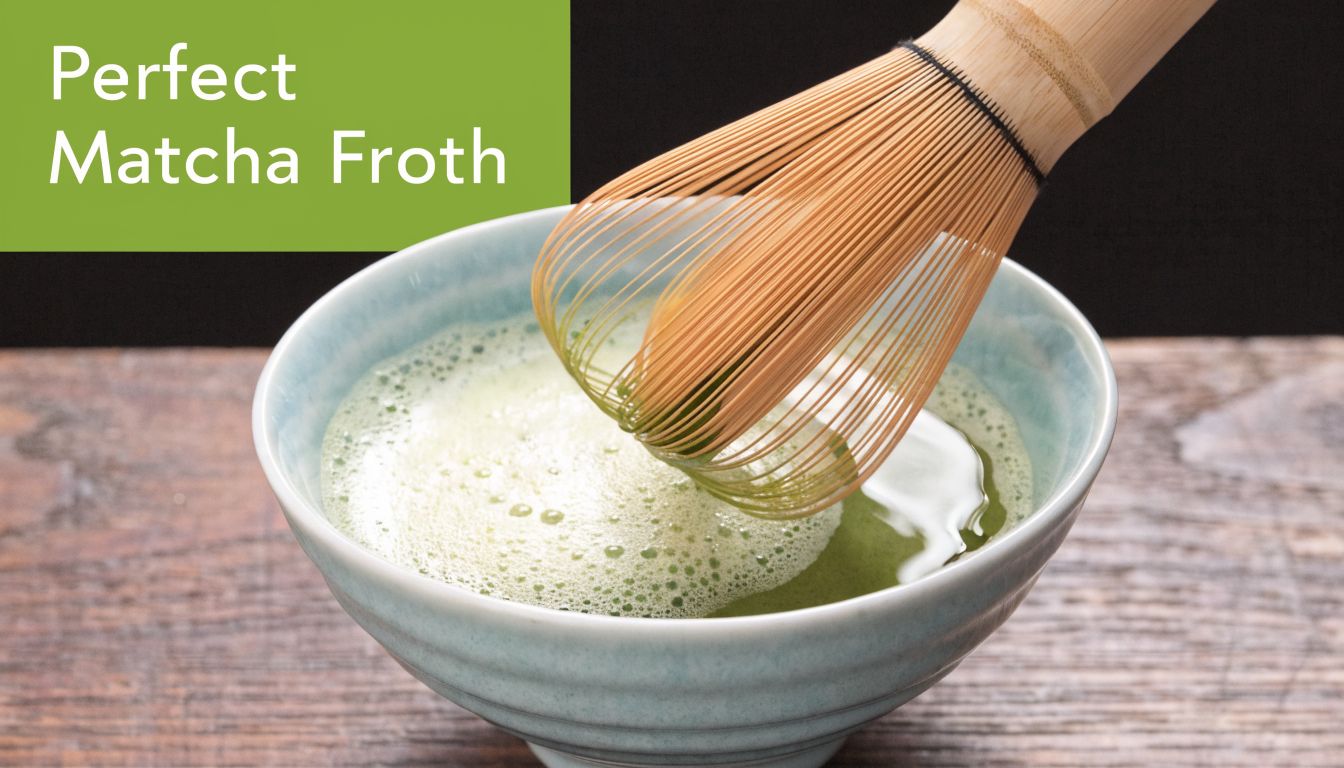
Use your wrist, not your whole arm
A lot of beginners whisk matcha as if they’re beating cake batter. Big arm movement, lots of effort, not much foam.
The better approach is smaller and quicker. Hold the bowl steady with one hand. Hold the whisk lightly with the other. Then move from the wrist in quick M or W motions near the surface of the tea.
The whisk should glide, not grind. If you press the tines hard into the bottom of the bowl, you’ll wear them out faster and get less froth.
What the motion should feel like
Think of it as fast sketching, not stirring.
You’re not tracing perfect letters, but the motion is similar. Short, rapid passes create tiny bubbles and a finer foam. Slow circles usually produce a flatter drink with larger bubbles.
A few signs you’re on track:
- The surface starts to lighten
- Fine foam forms across the top rather than only at the edges
- The whisk moves freely without scraping
- The tea underneath looks evenly blended
If you hit a stubborn little clump, press it gently against the side of the bowl first, then return to whisking. Don’t keep attacking it in the middle of the bowl.
For a closer look at hand position and movement, Pep Tea’s guide on how to whisk matcha is useful if you like seeing the technique broken down visually.
Finish cleanly
Once you’ve got a fine foam, slow down. A gentle final sweep across the surface tidies the top and settles any oversized bubbles.
That last movement changes the look of the bowl more than people expect. The tea appears more even, the foam looks finer, and the whole drink feels more deliberate.
A quick visual demo helps here:
Don’t chase huge foam. Chase fine foam. Matcha should look soft and velvety, not like aggressively frothed milk.
Beyond the Bowl Three Simple Matcha Creations
Once your whisking is organised, your matcha making kit becomes more versatile than people expect. The same bowl, whisk, and sifted powder can take you from a quiet morning tea to an iced afternoon drink or a quick kitchen add-in.
The trick is not changing everything. It’s keeping the matcha base smooth, then adapting what surrounds it.
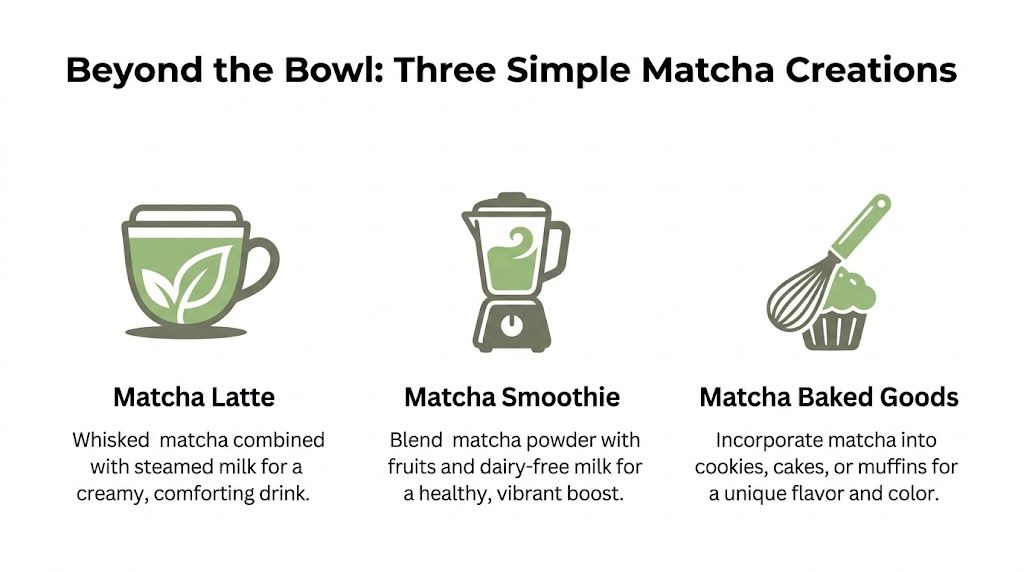
Matcha latte
A latte is often the easiest way for new drinkers to settle into matcha because milk softens the grassy edge.
Start by making a small concentrate in your bowl:
- Sift your matcha first: This keeps the latte smooth rather than chalky.
- Add a small amount of hot water: Whisk until fully blended and lightly foamy.
- Pour in warmed milk or cold milk over ice: Oat milk is popular for body, but use what you enjoy.
If your latte tastes weak, the issue usually isn’t the milk. It’s that the concentrate was too diluted before the milk went in. Keep the base strong, then stretch it.
A good matcha latte still tastes like tea. If it only tastes like milk, build a stronger bowl before you pour.
Iced matcha
Iced matcha can be fresh and crisp, but it turns disappointing fast if you skip the basic prep and try to shake dry powder straight into cold water.
Do this instead:
- Sift the matcha into your bowl
- Whisk with a small amount of hot water until smooth
- Add that concentrate to a glass of cold water and ice
- Stir or shake briefly, then drink straight away
That small amount of hot water matters because it dissolves the powder properly. Cold liquid alone doesn’t handle clumps nearly as well.
If the drink tastes sharp, reduce your brewing water temperature next time when you make the concentrate. The bitterness usually starts earlier than people think.
Matcha in smoothies and baking
Grade matters here.
For a straight bowl or a simple whisked tea, ceremonial-style matcha is the better fit because the flavour sits front and centre. For smoothies, yoghurt, muffins, pancakes, or biscuits, culinary matcha usually makes more sense because it’s designed to work with other ingredients.
A few easy uses:
- Smoothies: Add a small spoonful to banana, mango, or vanilla-based blends
- Yoghurt bowls: Stir through plain yoghurt and top with fruit
- Baking: Fold into cake batter, icing, cookies, or muffins
- No-bake snacks: Mix into energy balls or chia puddings
Here’s a simple comparison:
| Use | Better style |
|---|---|
| Traditional whisked bowl | Ceremonial-style matcha |
| Hot or iced latte | Ceremonial-style matcha or a smooth everyday blend |
| Smoothies | Culinary matcha |
| Baking | Culinary matcha |
If you’re using matcha in the kitchen regularly, keep one powder for drinking and another for recipes. It’s cleaner, more practical, and saves you using your nicest tea where subtle flavour will get buried.
Caring For Your Tools A Guide to Longevity
A matcha making kit lasts much longer when you clean it straight after use.
That’s especially true for the whisk. Bamboo is practical and beautiful, but it doesn’t respond well to neglect. Leave matcha residue sitting in the tines, or tuck the whisk away damp, and you’ll shorten its life quickly.
How to clean the whisk properly
Rinse the whisk under warm water as soon as you finish your bowl. Use your fingers very gently if a bit of powder is caught between the tines, but don’t scrub and don’t use soap.
Soap can linger in bamboo and affect flavour later. Rough handling can snap the fine tines or pull them out of shape.
A simple routine works best:
- Rinse immediately: Dried matcha is harder to remove later
- Use warm water only: Enough to release residue without stressing the bamboo
- Shake off excess water: Don’t leave it dripping on the bench
- Air dry thoroughly: Moisture is the enemy
Why a whisk stand helps
A kusenaoshi, or whisk stand, helps the chasen dry in a more natural shape. That matters because the curved form supports better whisking and reduces stress on the tines over time.
If you use your kit often, a matcha whisk stand is a practical addition rather than a decorative extra.
Store the whisk upright only after it has been rinsed and allowed to dry properly. A damp cupboard is where bamboo tools start going wrong.
Bowl and scoop care
The bowl is the easiest part of the set to maintain. Wash it with warm water and a soft cloth or sponge. If you use dish liquid, rinse it thoroughly so no scent remains.
The scoop needs a lighter touch. Wipe it clean or rinse briefly if needed, then dry it well. Don’t leave bamboo pieces soaking in water.
For best flavour, keep all tools away from strong kitchen smells. Matcha is delicate enough to pick up unwanted aromas over time.
Troubleshooting Common Matcha Mistakes
Even with a solid matcha making kit, the first few bowls can be inconsistent. That’s normal. Most problems come down to one of three things: water, whisking, or powder prep.
Why does my matcha taste bitter
The usual culprit is water that’s too hot. If you pour freshly boiled water straight onto the powder, the cup can taste harsher than it should.
Another common issue is using more powder than your palate is ready for. Strong matcha isn’t the same as balanced matcha.
Try this:
- Let the water cool slightly after boiling
- Stick to a modest serving when you’re learning
- Choose matcha suited to drinking, not baking
- Whisk thoroughly so the flavour is evenly distributed
If the bitterness is only at the end of the bowl, check whether sediment is collecting at the bottom. That often points to weak whisking or poor sifting.
Why am I getting clumps
Clumps usually begin before the whisk ever touches the bowl.
Matcha compacts in storage, so the powder needs air introduced back into it. That’s what sifting does. Once you skip it, the whisk has to work much harder.
The fix is straightforward:
- Sift into a dry bowl
- Add a small amount of water first
- Make a smooth paste
- Then add the rest of the water
- Break any stubborn bits gently against the side
Don’t dump all the water in at once and hope the whisk sorts it out. Sometimes it can. Often it won’t.
Why am I not getting any foam
Foam depends on technique more than force.
If you’re whisking in slow circles, you’re mixing, not aerating. If you’re pressing the whisk heavily into the bowl, the tines can’t flick the liquid properly. And if there’s too much water for the amount of matcha, the surface won’t build the same fine froth.
A quick diagnosis table helps:
| Problem | Likely cause | Better approach |
|---|---|---|
| Flat surface | Circular stirring | Use quick wrist-led M or W motions |
| Big bubbles only | Whisking too high or too slow | Keep the whisk low and fast near the surface |
| No foam with clumps | Unsifted powder | Sift first, then whisk |
| Thin, weak bowl | Too much water | Keep the base more concentrated |
Most bad bowls aren’t ruined bowls. They’re useful feedback. Change one variable at a time and the pattern becomes obvious.
Once you get the feel for the whisk and start noticing how bowl shape, water temperature, and powder texture affect the cup, matcha becomes much easier to repeat well.
If you’re ready to build a calmer, cleaner daily ritual, Pep Tea offers organic matcha, preparation tools, and practical guides for making matcha at home with more confidence and less guesswork.
Matcha Tea Accessories: Your Complete 2026 Guide
You buy a good tin of matcha, heat the water, stir it with a spoon, and somehow end up with green lumps floating in a drink that tastes sharper than it should. Many assume the problem is the powder.
Usually, it’s the setup.
Matcha behaves differently from leaf tea because you drink the whole powdered leaf. That means texture, water temperature, and tool choice all show up in the cup straight away. The right matcha tea accessories don’t just make things look traditional. They change how the powder dissolves, how the foam forms, and how balanced the final drink tastes.
That’s one reason these tools have become more common in Australian kitchens and cafés. Australia’s tea market, including matcha, grew at a 3.2% CAGR from 2018 to 2023 and reached $450 million in revenue, while premium segments such as matcha accessories contributed 15 to 20%. A 2024 Euromonitor International study also found that 68% of surveyed Melbourne and Sydney cafés added matcha to menus post-2020, which helped drive 25% annual growth in accessory imports according to the summary in this matcha accessories overview.
If you’ve been curious about whisks, bowls, sifters, or whether they’re worth buying at all, the short answer is yes. But each tool matters for a different reason. Once you know what each piece does, matcha feels much simpler.
Why Your Matcha is Lumpy and How to Fix It
Lumpy matcha usually comes from two things. The powder has compacted in storage, and the mixing method isn’t strong or fine enough to break those clumps apart.
A spoon pushes powder around. It doesn’t suspend it evenly. A fork does a bit better, but it still tends to leave tiny gritty pockets that settle to the bottom.
What’s going wrong
Matcha is extremely fine. The moment it meets moisture, little balls of powder can form. Once that happens, stirring often makes the outside wet while the centre stays dry.
That’s why a cup can look mixed but still taste rough.
Common signs you’re fighting the tools instead of the tea:
- Dry specks on the surface that never fully disappear
- A sandy finish at the bottom of the bowl or mug
- Bitterness that seems stronger than expected
- Flat foam or no foam at all
A smooth bowl of matcha starts before the water goes in.
The simplest fix
Use a sifter first, then whisk in a wide bowl.
A fine sifter breaks up compacted powder before it has a chance to clump. If you want a dedicated tool for that step, a matcha tea sifter makes the process much easier than pressing powder through a generic kitchen strainer.
Then whisk with short, brisk motions near the surface rather than stirring in circles. That movement disperses the powder and adds the light foam that softens matcha’s edge.
A better home routine
Try this order next time:
- Warm the bowl with a little hot water, then dry it.
- Sift the matcha directly into the bowl.
- Add a small splash of warm water first and make a loose paste.
- Add the remaining water and whisk briskly.
- Stop when the surface looks fine and even, not bubbly like dish foam.
If your matcha has been disappointing, don’t change everything at once. Start with the tool that prevents clumps. Many notice the difference immediately.
The Essential Trio for Authentic Matcha Preparation
Three tools do most of the heavy lifting in traditional preparation. The chasen, chashaku, and chawan aren’t decorative extras. They solve three separate problems. Mixing, measuring, and whisking space.
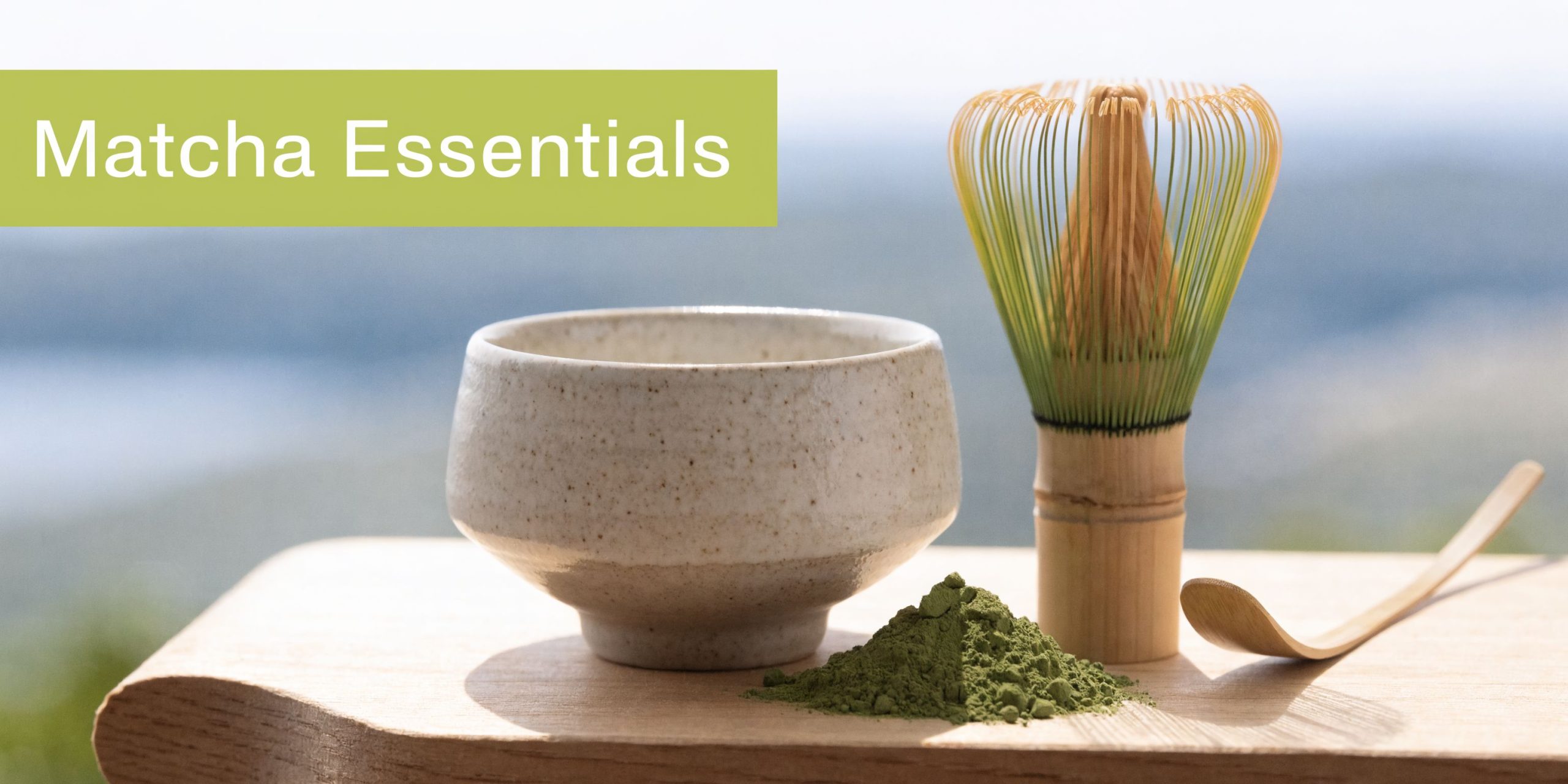
If you’re starting from scratch, a complete matcha tea set Australia option is a practical way to get the core pieces in one go.
The chasen and why it works
The chasen is the bamboo whisk. It’s the tool that changes the cup most.
In premium Australian matcha preparation, a bamboo chasen with 80 to 120 finely split tines is used to aerate 2g of matcha in 60 to 80ml of water at 75 to 80°C, creating a stable crema layer. That froth can enhance EGCg bioavailability by 15 to 20%, while unsifted, unwhisked brews can reduce antioxidant extraction by 30%, according to this detailed guide on matcha accessories and whisking technique. The same source notes that poor whisking leads to clumping and more bitterness from uneven heat exposure.
That sounds technical, but the practical meaning is simple. The whisk creates tiny, even bubbles and keeps the powder suspended. A spoon can’t do that. An electric frother creates a different kind of foam, which matters for mouthfeel.
The chashaku and why scooping matters
The chashaku is the curved bamboo scoop. It looks delicate, but it has a very practical job.
It lets you portion matcha without compacting it or introducing moisture from a metal spoon that’s been sitting near steam. It also makes your routine repeatable. If one day’s cup tastes balanced and the next feels harsh, inconsistent measuring is often part of the reason.
Consider salting food with your fingers versus using a measured spoon. Both can work. One is easier to repeat accurately.
The chawan gives your wrist room to work
The chawan, or matcha bowl, is wider than a mug for a reason.
Whisking in a narrow cup forces the whisk into the sides. Your motion gets smaller. The powder stays less evenly mixed. A wide bowl gives you enough surface area to whisk quickly without splashing.
The bowl also changes the drinking experience in a way people often underestimate:
- Better movement for the whisk
- More even mixing across the base
- A more stable grip while whisking
- A nicer aroma release than a tall glass or travel mug
Practical rule: If the whisk keeps tapping the sides, the bowl is too narrow for proper matcha.
Why this trio is enough for many
You don’t need a shelf full of specialised gear to make a good bowl.
For daily matcha, this trio does the important work:
| Tool | Main job | What improves in the cup |
|---|---|---|
| Chasen | Aerates and suspends the powder | Foam, texture, smoother flavour |
| Chashaku | Measures consistently | Balance, repeatability |
| Chawan | Creates whisking space | Even mixing, less mess |
If you only buy three matcha tea accessories, make them these. Everything else helps refine the process, but this is the working foundation.
Expanding Your Toolkit Beyond the Basics
Once your core setup is sorted, a few extra tools make matcha less fiddly and more consistent. These pieces don’t change the ritual for the sake of it. They remove the little annoyances that ruin an otherwise good cup.
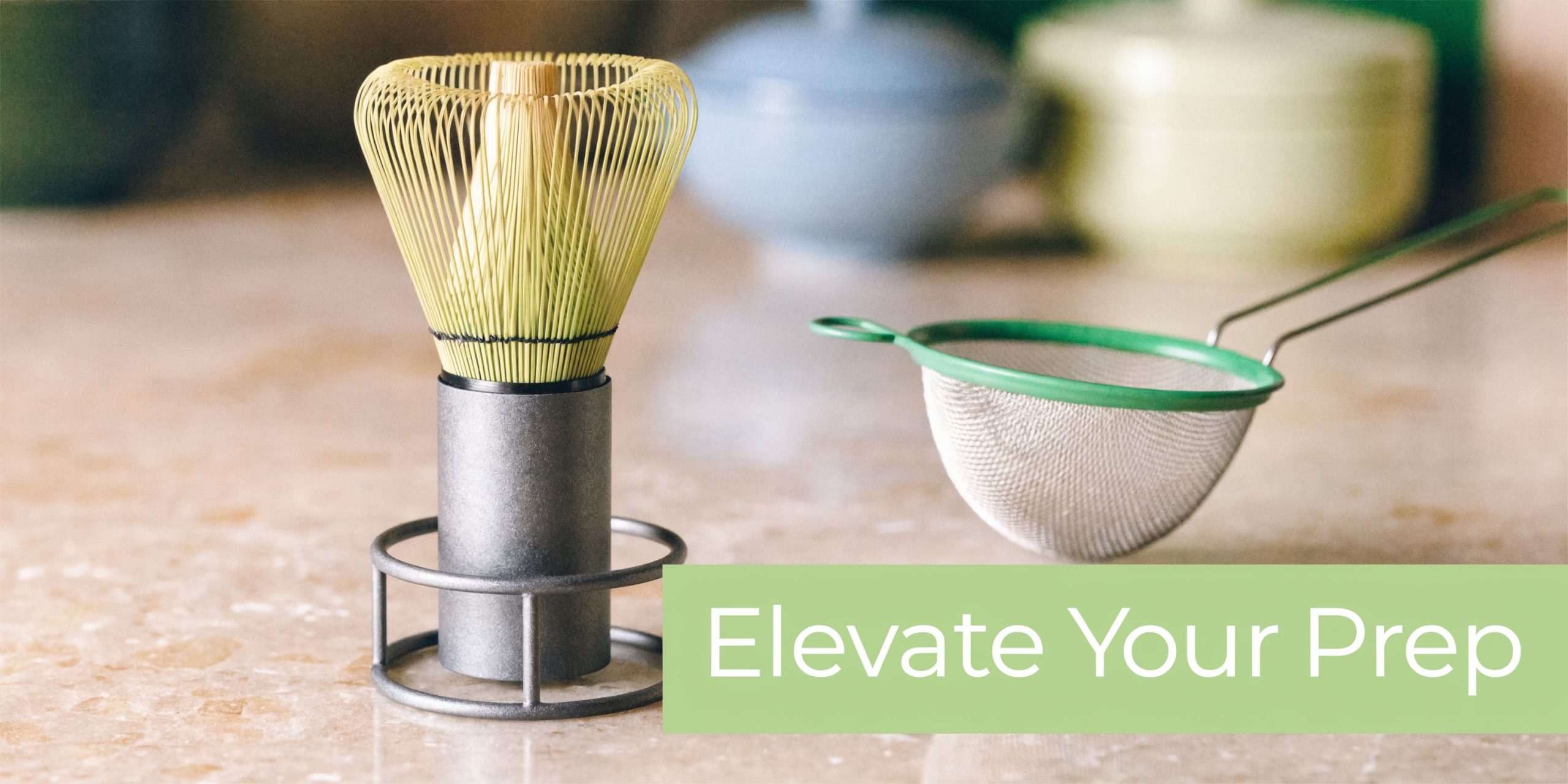
The sifter is the quiet problem-solver
If one extra accessory deserves a place in almost every kitchen, it’s the sifter.
Matcha powder naturally compacts. Even a fresh tin can contain small clumps from storage and humidity. Sifting fluffs the powder before water touches it, which means the whisk spends less effort breaking lumps and more effort creating smooth foam.
A small step, but it changes the result.
The whisk holder protects the whisk you already paid for
The whisk holder, often called a kusenaoshi, helps the bamboo whisk dry in its proper shape.
Without one, the tines can dry bent, flattened, or uneven. That makes whisking less effective and shortens the useful life of the tool. With a holder, airflow improves and the whisk keeps the open curve it needs.
This matters more than people expect because a whisk that looks only slightly misshapen often performs much worse.
A proper storage tin protects the powder itself
People often focus on the whisk and forget that matcha is sensitive to its environment. Air, light, and moisture all work against freshness.
A good storage tin helps preserve:
- Colour, so the powder stays vibrant rather than dull
- Aroma, which fades quickly when left exposed
- Flavour, especially the softer sweet and savoury notes
- Texture, because less humidity means fewer clumps
The accessories that earn their place
Not every extra belongs in every setup. These are the upgrades that usually make sense first:
- Fine sifter for anyone tired of lumps
- Whisk holder for anyone using bamboo regularly
- Airtight tin for anyone buying better-quality matcha
- Clean tea cloth for drying bowls and keeping the area tidy
A lot of matcha tea accessories are sold on appearance. These three are worth owning because they solve preparation problems.
Modern Alternatives Electric Frothers and Scales
Traditional tools aren’t the only option. Plenty of people make matcha with an electric frother, a shaker bottle, or a small blender. That doesn’t make the result wrong. It just changes the drink.
Electric frother versus bamboo whisk
An electric frother is fast. It’s handy when you’re making a quick latte before work or mixing matcha into milk.
A bamboo whisk is slower, but it creates a finer foam and a gentler texture. That matters most when you’re drinking matcha with water rather than masking it with milk and sweetener.
The main differences look like this:
| Tool | Strength | Trade-off |
|---|---|---|
| Electric frother | Speed and convenience | Larger bubbles, less refined texture |
| Bamboo chasen | Fine micro-foam and traditional mouthfeel | More hands-on, needs care |
If you mainly drink iced lattes, an electric frother can be perfectly reasonable. If you want to taste the detail in ceremonial-style matcha, the chasen is still the better tool.
Where a digital scale helps
A small digital scale is one of the most useful modern additions, especially if you like consistency.
The bamboo scoop gives you a traditional feel, but a scale helps when you want to repeat a recipe exactly. That’s useful at home, and even more useful in hospitality where one person’s “slightly heaped scoop” can become another person’s “too much powder”.
A scale is particularly handy for:
- Testing recipes for iced drinks or baking
- Comparing different matcha grades
- Training café staff to prepare drinks consistently
- Troubleshooting when a cup tastes too thin or too strong
For lattes, convenience can win. For straight matcha, texture usually decides.
A sensible middle ground
You don’t have to choose between old and new.
Many people settle into a hybrid routine. Traditional whisk, proper bowl, and a digital scale. Or ceremonial-style preparation on weekends, frother-made iced lattes on busy weekdays. The best setup is the one you’ll use often enough to enjoy good matcha regularly.
Choosing Your Accessories Home vs Café Use
The right setup at home isn’t always the right setup behind a busy bar. A home drinker usually wants ease, comfort, and a sense of ritual. A café needs consistency, speed, and tools that hold up under repeated use.
That’s where total cost of ownership becomes more useful than the sticker price.
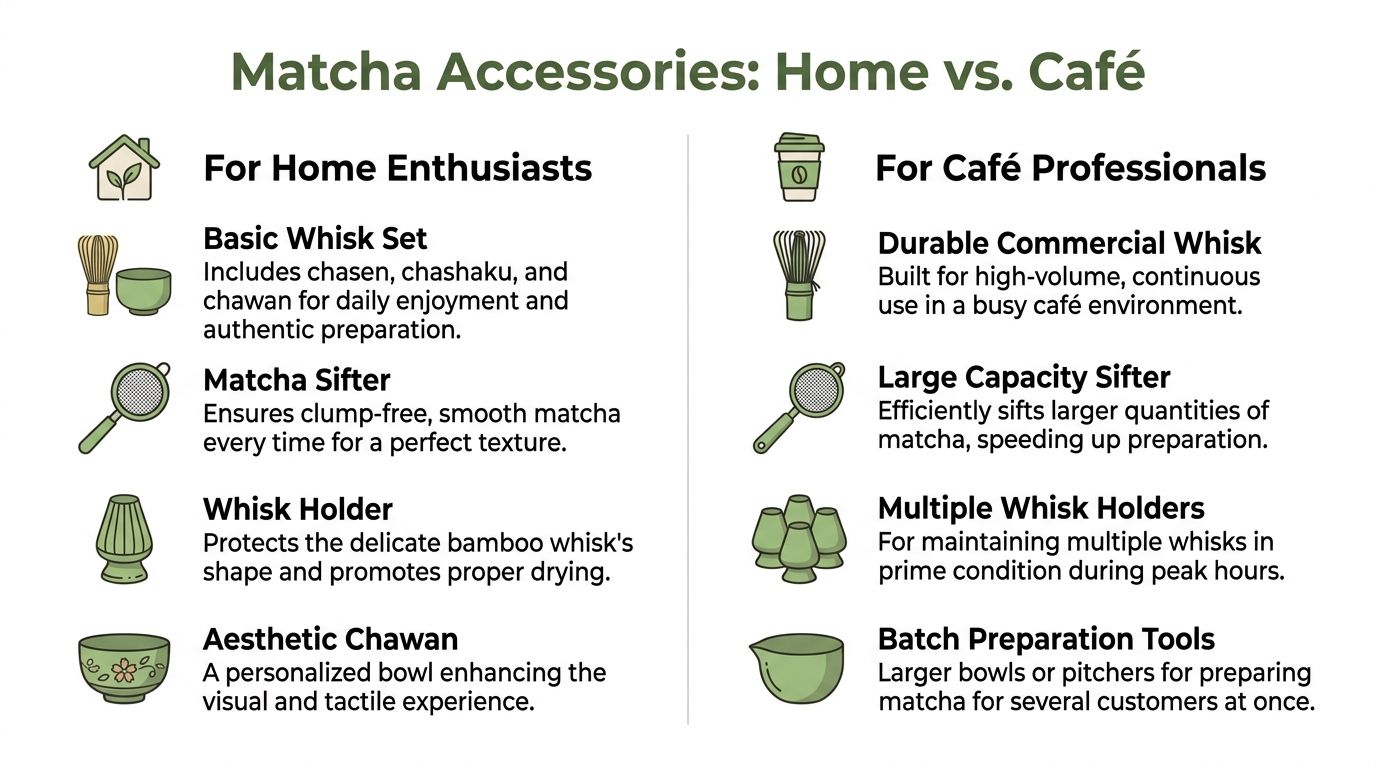
What matters most at home
For home use, it makes sense to keep the kit simple and enjoyable.
A good starter setup usually includes a whisk, bowl, scoop, and sifter. If you drink matcha several times a week, a whisk holder quickly becomes worthwhile too. You don’t need commercial-grade anything. You do need tools that feel pleasant to use and easy to clean.
Home buyers usually care about:
- A balanced starter set rather than individual specialty pieces
- A bowl shape they enjoy holding
- A whisk that feels flexible, not stiff
- Easy storage in a small kitchen
There’s also the visual side. If a bowl and whisk are attractive enough to leave on the bench, you’re more likely to use them.
What changes in a café
In a café, the questions shift.
The issue isn’t whether the whisk looks lovely on a shelf. It’s whether the setup supports fast prep, reliable results, and manageable replacement costs over time. The research around matcha tea accessories often skips these practical realities. This summary on traditional and non-traditional matcha tools notes that buyers need clearer guidance on durability, climate effects, maintenance, and long-term cost comparisons, especially in Australian conditions.
That’s the key buying question for hospitality. Not “What’s traditional?” but “What keeps service smooth without lowering quality?”
Thinking in total cost, not just upfront spend
A cheaper whisk can become expensive if it warps quickly, sheds tines, or gives inconsistent texture that leads staff to remake drinks. A better-made whisk may cost more initially but can be easier to maintain and more reliable in service.
For cafés, it helps to think in layers:
Preparation quality
Does the tool support a repeatable drink with the right texture?Durability in your environment
A coastal or humid venue may need stricter drying and storage habits for bamboo.Staff usability
If a tool is awkward, people won’t use it well during busy periods.Replacement rhythm
Tools that hold shape longer are easier to budget for.
Material choices and practical trade-offs
A café doesn’t have to be rigidly traditional to be thoughtful.
For example:
- Bamboo whisks offer the texture many customers expect in premium matcha
- Stainless steel sifters can make sense in higher-volume settings because they’re sturdy and easy to clean
- Larger bowls or pitchers may help when building a smooth matcha base before pouring into cups
- Multiple whisk holders make daily drying more organised
If you’re fitting out a broader beverage station, it can also help to look at well-designed general kitchen accessories for storage, prep flow, and cleaning tools around the matcha setup itself.
A useful rule of thumb
Home drinkers should buy for pleasure and consistency.
Cafés should buy for workflow, training, and maintenance discipline.
Those goals overlap, but they’re not identical. The most practical accessory setup is the one that fits how matcha is made in your space, not the one that looks most impressive in a product photo.
Care Maintenance and Sustainable Sourcing
Good matcha tools aren’t high-maintenance, but they do need the right kind of care. Bamboo especially rewards gentle habits.
Australia has also seen a long rise in demand for these tools. Matcha accessories entered Australia prominently in 2005 alongside the first certified organic matcha imports, and Australian Department of Agriculture trade data recorded matcha-related imports rising from 150 tonnes in 2010 to 1,200 tonnes by 2023, a 700% increase. Accessories such as chasen whisks and chawan bowls accounted for 22% of value, or AUD 4.2 million. In NSW, a 2024 Nielsen survey found 62% of wellness consumers prioritise accessories for authentic preparation, and whisk holders can extend chasen life by 6 to 12 months, reducing replacement rates by 40%, as summarised in this article on matcha accessory adoption in Australia.
How to clean each tool properly
The biggest mistake is over-cleaning. Matcha tools usually need less soap and less soaking than people think.
For the chasen
- Rinse with warm water only straight after use
- Don’t use detergent because bamboo can retain odour and residue
- Don’t leave it soaking in a bowl or sink
- Place it on a holder to dry in shape
If you need a proper drying stand, a matcha whisk stand is designed for that exact job.
For the chashaku
Wipe it clean and keep it dry. Avoid washing it like cutlery. Bamboo can swell or lose shape if it’s exposed to water too often.
For the chawan
Rinse it soon after drinking, wipe gently, and let it dry fully before putting it away. If matcha sits in the bowl too long, staining becomes more likely.
Bamboo lasts longer when it’s cleaned quickly, dried well, and left alone the rest of the time.
Storage matters more than people realise
Steam, humidity, and trapped moisture do a lot of quiet damage. A whisk left near the kettle, or stored before fully drying, won’t age well.
Helpful habits include:
- Keeping bamboo away from direct steam
- Letting every tool dry fully before storage
- Storing matcha separately from strong food odours
- Avoiding direct sunlight on bamboo and tea powder
Sustainable choices start with longer use
One of the most sustainable things you can do is keep a well-made tool in use for longer. That means buying thoughtfully and maintaining it properly, rather than cycling through cheap accessories.
If sustainability is already part of how you organise your kitchen, broader ideas around materials and lower-waste habits can be useful too. This guide to eco-friendly kitchen products is a handy reference point for that wider mindset.
What to look for when sourcing accessories
You don’t need a museum-grade set. You do want tools that feel intentional.
Look for:
- Responsibly sourced bamboo where possible
- Evenly cut whisk tines
- Bowls with a stable base and enough whisking room
- Craftsmanship that supports repeated use, not just gifting
That approach fits the spirit of matcha nicely. Better tools, fewer replacements, less waste, and a calmer daily routine.
Putting Your Tools to Work With Pep Tea Matcha
Once the tools make sense, the ritual gets much easier. You don’t need complicated recipes to feel the difference. A simple bowl of usucha and a clean iced latte are enough to show what good preparation does.
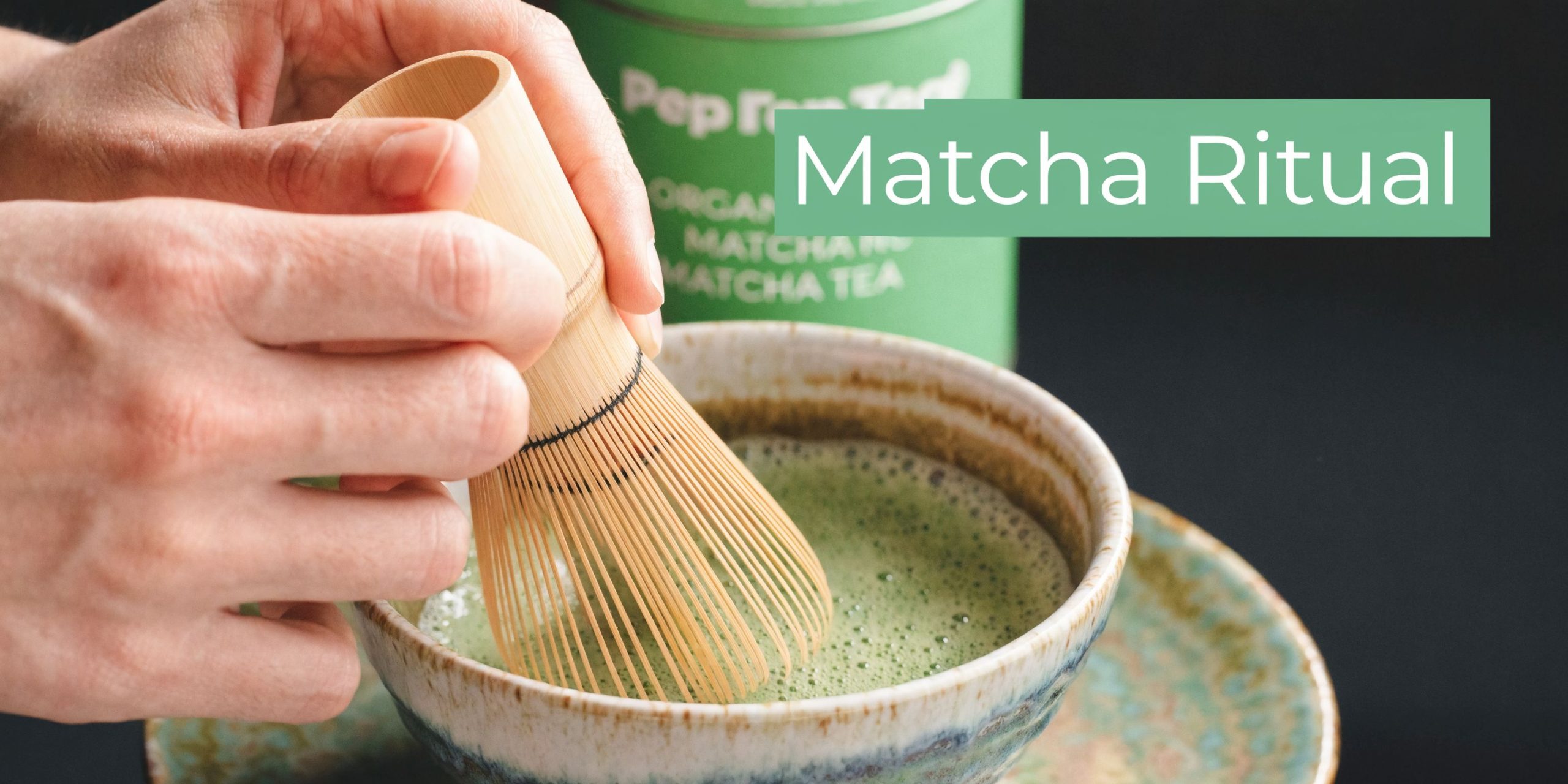
Pep Tea offers organic matcha in grades suited to different uses, including ceremonial-style preparation and lattes, so it’s a practical example of how the right tea and the right tools work together.
A simple usucha for quiet mornings
Use your ceremonial grade organic matcha when you want to drink it with water and appreciate the flavour on its own.
Try this method:
- Warm the chawan, then dry it.
- Sift matcha into the bowl.
- Add a little warm water and mix into a smooth paste.
- Add more water.
- Whisk briskly in a W motion until the surface looks smooth and lightly foamy.
The goal isn’t giant bubbles. It’s a fine, even top layer and a clean, rounded taste.
An iced matcha latte that stays smooth
For milk-based drinks, culinary grade organic matcha is usually the better fit because it stands up well in a latte.
A simple approach:
- Sift the matcha into the bowl
- Add a small amount of warm water
- Whisk until fully smooth
- Pour that concentrate over ice
- Top with your milk of choice
Starting with a smooth concentrate matters. If you add dry powder straight into cold milk, it’s much harder to dissolve properly.
Here’s a quick visual guide for whisking technique and setup:
Small adjustments that improve both drinks
These details make a noticeable difference:
- Sift first if your matcha has been sitting for a while
- Use warm, not boiling, water for the initial mix
- Whisk near the surface for better foam
- Rinse the whisk immediately after use so it stays in working shape
A good bowl of matcha feels light, smooth, and integrated. It shouldn’t taste like powder added to water at the last minute.
Once you’ve made a few bowls this way, the accessories stop feeling specialised. They just feel like the right tools for the drink.
From a Simple Drink to a Mindful Ritual
The nicest thing about matcha tea accessories is that they solve practical problems and slow you down in a good way at the same time.
A sifter gets rid of lumps. A chasen improves texture. A whisk holder helps your tools last. Those are useful, concrete benefits. But the experience goes further than utility. The act of warming the bowl, sifting the powder, and whisking until the surface turns glossy gives the drink a shape in the day. It asks for attention, but not much time.
That’s why these tools appeal to very different people. A home drinker may want a few quiet minutes before work. A café may want a more authentic matcha service and a better-looking cup. Both are using accessories to make the drink more intentional.
The good news is that you don’t need to become a purist. You just need to understand what each tool is for and choose the pieces that match the way you drink matcha. Start small if you like. A whisk, a bowl, a scoop, and a sifter are enough to transform the result.
Once the process becomes familiar, the ritual doesn’t feel complicated. It feels organised, calming, and repeatable. That’s part of matcha’s appeal. It brings together flavour, craft, and a little moment of focus in the middle of ordinary life.
If you’re ready to build a better matcha routine, explore Pep Tea for organic matcha, accessories, and practical guidance for home kitchens, cafés, and everyday wellness.