
Tag: matcha tea ceremony
Matcha Tea Ceremony: An Approachable Australian Guide
Most advice gets the matcha tea ceremony wrong from the first sentence. It's often framed as either a museum piece or an impossibly strict ritual that only trained experts can understand. That misses the point.
A Matcha tea ceremony is disciplined, yes, but it isn't about showing off rare knowledge. At its heart, it's a way of paying attention. The bowl, the whisk, the water temperature, the quiet pace, the way you receive the tea. Each part helps people slow down and notice what they're doing.
That's a big reason the practice feels so relevant in Australia right now. Many people want less rush, less noise, and fewer automatic habits around food and drink. They want a morning routine that feels grounding, or a café experience that feels more intentional than another takeaway cup. In that setting, the matcha tea ceremony stops looking old-fashioned and starts looking useful.
For home drinkers, it can become a short daily ritual. For hospitality operators, it can become a refined non-alcoholic offering with real cultural depth. For anyone curious about Japanese tea, it's also a reminder that matcha isn't just an ingredient for lattes and smoothies. It comes from a long, organised tradition of preparation and service.
An Ancient Ritual for Modern Mindfulness
The common assumption is that a matcha tea ceremony only matters if you're sitting in a formal Japanese tearoom. In practice, the deeper value travels well. The ceremony teaches a set of habits that modern life often strips away: patience, care, restraint, and presence.
That matters because many people approach matcha backwards. They focus first on caffeine, colour, or social media aesthetics. The ceremony starts somewhere else. It asks a simpler question. How do you prepare and share tea in a way that creates calm?
Why it still speaks to modern life
A fast drink serves one purpose. A ceremony serves several at once.
- Attention: You stop multitasking and focus on one action.
- Sensory awareness: You notice texture, aroma, warmth, and sound.
- Connection: If you share it, the preparation becomes part of hospitality.
- Rhythm: Repeating the same careful motions can settle a busy mind.
For Australians building wellness routines, that's a practical shift. You don't need a dedicated tea room to make tea with intention. You need a few good tools, decent matcha, and a willingness to slow your pace.
A matcha tea ceremony isn't valuable because it's elaborate. It's valuable because it gives ordinary actions a clear purpose.
What accessibility really looks like
Accessibility doesn't mean stripping away all tradition until nothing remains. It means understanding what is essential and what is contextual. The essential part is respect for the tea, the tools, and the people involved. The contextual part is whether you're in a formal setting, at your kitchen bench in Newcastle, or adding a ceremonial bowl of matcha to a café menu in Sydney.
That's why beginners shouldn't feel put off by the ceremony's reputation. You can appreciate its cultural depth while still starting with ease. In fact, that's often the best approach.
The Heart of Chanoyu Origins and Philosophy
Chanoyu did not begin as a polished cultural performance. It grew from tea practices linked to Zen Buddhism, then gradually took shape in Japan as a disciplined way of preparing, serving, and receiving powdered tea. A clear overview of that longer arc appears in this history of matcha tea ceremonies, and Pep Tea's own brief history of matcha tea helps place that story in a broader timeline.
That shift matters. It explains why chanoyu feels both spiritual and practical at once. The ceremony carries the quiet focus of monastic life, but it also became a social art shaped by taste, hospitality, architecture, ceramics, and seasonal awareness.
From monastery practice to refined cultural art
A beginner can easily mistake the ceremony for a formal way of drinking tea. It is closer to a carefully composed meal or a piece of chamber music. Every tool, gesture, pause, and placement has a role, and the parts only make full sense when they work together.
By the sixteenth century, tea practice in Japan had developed into recognisable ceremonial forms. Two terms still help people understand the range:
| Format | What it means |
|---|---|
| Chaji | A full, formal gathering with a meal and tea, designed as a complete host-guest experience |
| Chakai | A lighter, shorter tea gathering, often easier for modern guests and home hosts to relate to |
Tea master Sen no Rikyū gave lasting shape to this culture of tea. His influence is still felt in how students learn the ceremony, how hosts prepare a space, and how utensils are chosen for mood and season.
The four principles in plain language
Rikyū's four principles are often given in Japanese and English. They can sound lofty until you connect them to ordinary actions in the tea room, or even at a kitchen bench in Brisbane or a café in Melbourne.
- Harmony means the setting feels coherent. The bowl suits the season. The sweet suits the tea. The mood suits the guest.
- Respect shows up in conduct. You handle the bowl with care because it matters, and because the person receiving it matters too.
- Purity includes physical cleanliness, but it also points to mental tidiness. You leave distraction at the door and attend to what is in front of you.
- Tranquility is the result of practising the other three often enough that calm stops feeling forced.
The Metropolitan Museum of Art's essay on the Japanese tea ceremony explains that the ceremony became an important social setting in sixteenth-century Japan and also influenced utensil culture and ceramic traditions such as Raku, Shino, and Oribe. That helps explain why chanoyu is never only about drinking matcha. It is also about how beauty, status, craft, and hospitality meet in one shared act.
A useful way to read these principles is to treat them as operating instructions. They guide how to clean a bowl, how to enter a room, how to offer food, how to receive tea, and how to notice the moment.
For Australians interested in wellness, this philosophy translates surprisingly well to modern life. A traditional gathering might be formal, but the underlying values travel easily. You can apply harmony, respect, purity, and tranquility to a quiet morning bowl at home, a thoughtful service ritual in a café, or a pairing that places ceremonial matcha beside a well-made local kombucha. The form may adapt. The attitude should stay clear.
Understanding the Essential Tools and Terms
The ceremony starts to feel far less intimidating once the utensils stop looking like mysterious props and start acting like a well-designed kit. Each piece has a clear role. Together, they create order, much like having the right saucepan, knife, and chopping board makes cooking calmer and more precise.
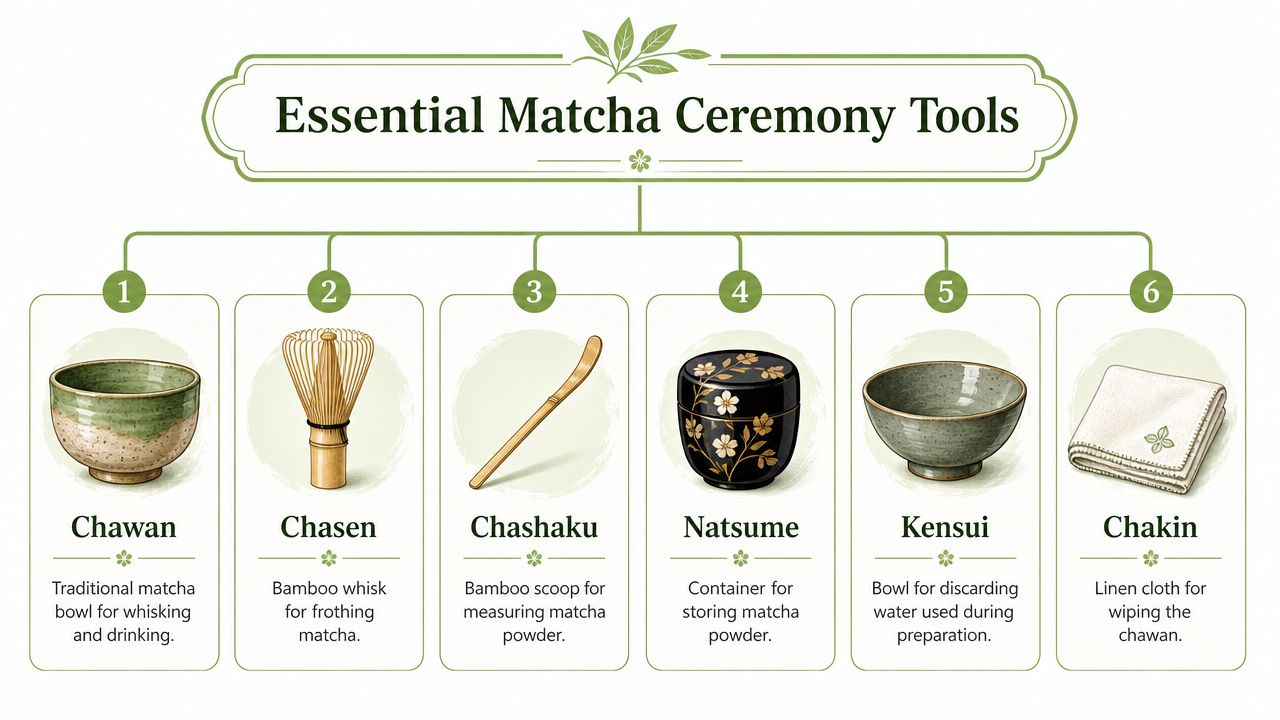
If you are putting together your own setup for home practice or café service, a practical place to start is a collection of matcha tea accessories.
The core utensils most people should know
Some utensils matter from your first bowl. Others help you understand the language and structure of a more formal gathering.
- Chawan: The tea bowl. You whisk in it and drink from it, so its depth and shape affect both texture and comfort.
- Chasen: The bamboo whisk. Its fine tines suspend the powder in water and help create the soft foam used in usucha.
- Chashaku: The bamboo scoop for portioning matcha with consistency.
- Natsume: A tea caddy for holding matcha during service.
- Kensui: A vessel for discarded water used while preparing utensils.
- Chakin: A cloth used to wipe and prepare the bowl.
For a simple practice at home, you do not need every item at once. A bowl, whisk, and scoop will carry most beginners a long way. The other pieces become useful when you want to understand formal service more clearly, or when an Australian café wants to present matcha with a little more ceremony instead of treating it like just another powdered drink.
Usucha and koicha are two different styles of tea
One term pair causes confusion more than any other. Usucha and koicha are not small variations of the same bowl. They are different preparations with different textures, different etiquette, and a different level of difficulty.
Wikipedia's article on the Japanese tea ceremony explains that usucha is the thinner, whisked style commonly encountered initially, while koicha is made with much more tea and much less water, creating a thick, concentrated drink that is kneaded rather than foamed. If usucha is closer to a light broth in texture, koicha is closer to a glossy paste. That shift changes flavour, mouthfeel, and technique in one go.
| Term | What it's like |
|---|---|
| Usucha | Lighter, whisked, foamy, and the usual starting point for new drinkers |
| Koicha | Thicker, denser, more concentrated, and harder to prepare well |
That distinction matters in modern settings too. If you are serving matcha at home before a yoga session, or offering it in a café beside a local kombucha pairing, usucha usually suits the occasion better because it feels brisk, bright, and approachable. Koicha asks for quieter attention, higher-grade tea, and more practiced hands.
Your first bowl does not need to look perfect.
Learn the job of each tool first. Then practise the motions. Skill grows through repetition, and that is true whether you are studying chanoyu seriously or trying to bring a more grounded tea ritual into an Australian morning.
A Simple Guide to the Ceremony Sequence
A full tea gathering can be highly formal, but the basic flow is easier to understand than many people expect. For most readers, it helps to think in terms of a short chakai, which is the more approachable gathering format.
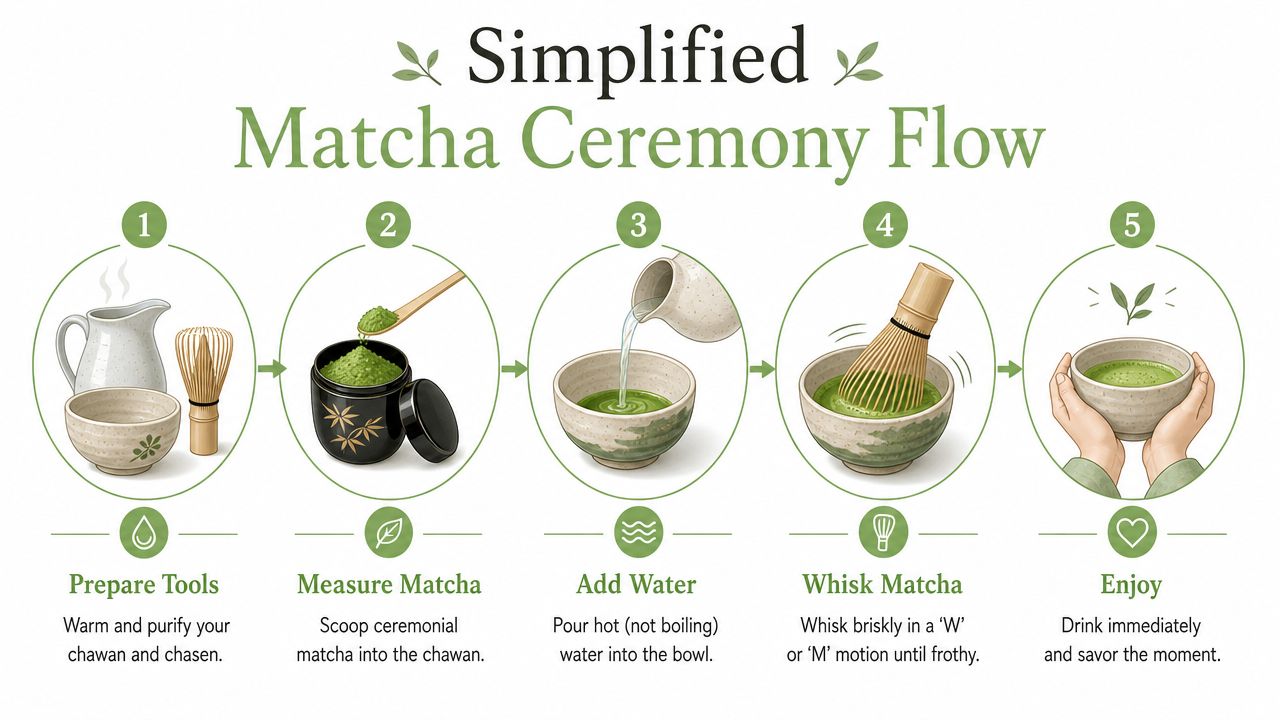
If you want to see the whisking mechanics in more detail, Pep Tea has a practical guide on how to whisk matcha.
The simplified ceremony flow
The ceremony is structured, but not random. The sequence helps everyone arrive mentally before they drink.
Arrival and settling in
Guests enter, become quiet, and leave outside distractions behind. In more formal settings, cleansing and careful entry carry symbolic meaning.Preparation of tools
The host handles the bowl, whisk, and other utensils with deliberate care. Even when cleaning is symbolic, it shapes the atmosphere.Sweets are served
A small sweet often comes before the tea. It prepares the palate for matcha's natural character.Tea is prepared
The host measures, adds water, and whisks or kneads depending on the style of tea.Tea is received and appreciated
The guest accepts the bowl respectfully, drinks, and notices both the tea and the vessel.
Simple guest etiquette
Newcomers often feel nervous at this stage. The good news is that basic courtesy matters more than theatrical perfection.
- Receive the bowl carefully: Hold it with attention rather than grabbing it casually.
- Acknowledge the host: A small nod or word of thanks suits a modern, respectful setting.
- Turn the bowl slightly: In traditional etiquette, rotating the bowl shows respect before drinking.
- Drink without rushing: The point isn't speed. It's appreciation.
- Notice the bowl itself: In ceremonial practice, the vessel is part of the experience.
A useful benchmark for understanding ceremony length comes from the verified historical background: chaji is a full ceremony of about four hours, while chakai is a shorter gathering of about 30–60 minutes, which is why a chakai-style format makes more sense for most modern homes and cafés.
Why sequence matters
The order creates the feeling. If you skip straight to “drink the tea”, you lose what makes the matcha tea ceremony distinct. The pauses, the bowl handling, the sweets, and the pace are what turn preparation into hospitality.
That's also why cafés can borrow from the ceremony without pretending to replicate a formal tea school experience. A well-designed service can keep the spirit of the sequence even in a simpler setting.
Choosing Your Perfect Matcha for the Occasion
A ceremony-grade experience starts with choosing the right matcha. Consequently, many people waste good powder or blame themselves for a result that was never possible with the product they bought.
The key choice is between ceremonial grade and culinary grade. They aren't rivals. They serve different purposes.
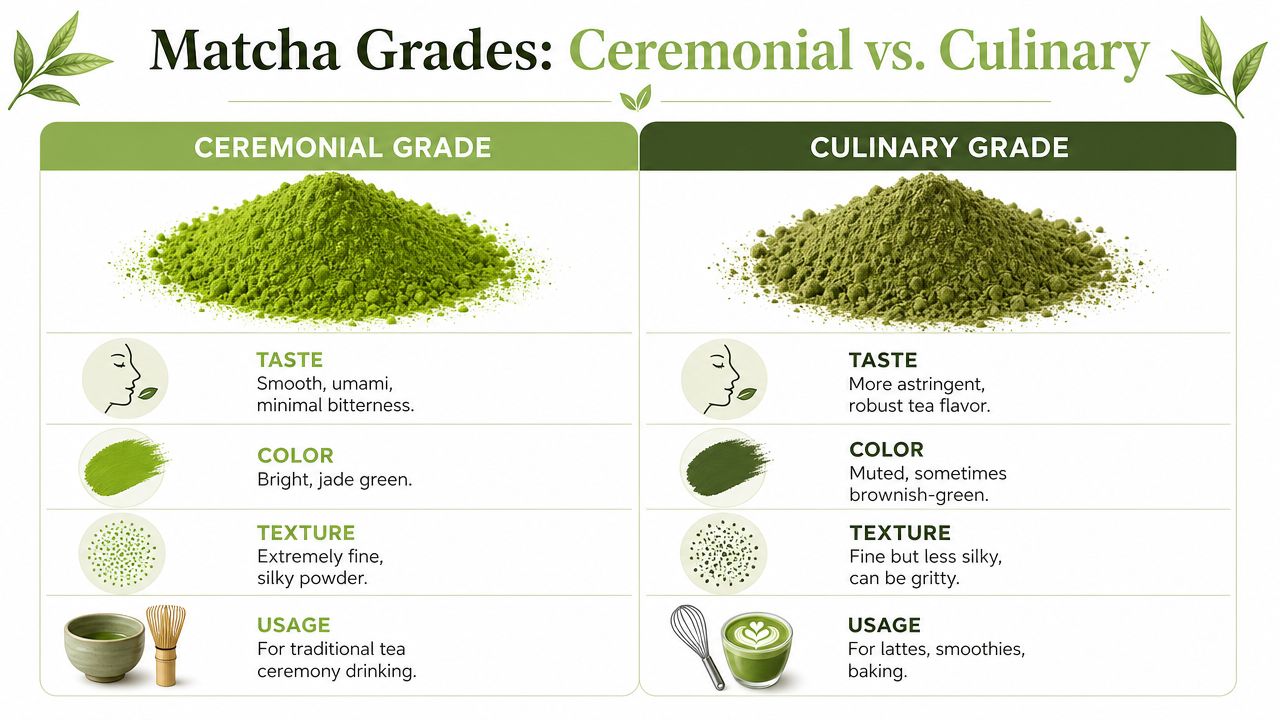
Ceremonial and culinary grade side by side
Here's the practical distinction most drinkers need.
| Grade | Best use | What to expect |
|---|---|---|
| Ceremonial grade | Traditional drinking, straight matcha, mindful preparation | Smoother profile, bright green colour, fine texture |
| Culinary grade | Lattes, smoothies, baking, desserts | Stronger tea character that can stand up to milk or other ingredients |
If you're preparing a bowl to drink on its own, ceremonial grade is the better fit. If you're blending matcha with milk, fruit, or flour, culinary grade often makes more sense.
For an Australian buyer, this can save frustration. A latte-focused matcha may taste forceful and rough when served as straight tea. A delicate ceremonial matcha may be lost once mixed into a heavily flavoured recipe.
What quality looks like in the bowl
You don't need to speak like a tea judge to assess quality. A few practical cues help.
- Colour: Ceremonial matcha should look vivid and lively, not flat or dull.
- Texture: A fine, silky powder disperses more evenly.
- Taste: You're looking for balance. Smooth, savoury, and gently sweet notes are welcome. Harsh bitterness is not.
- Aftertaste: Better matcha tends to finish cleaner.
For readers who want one straightforward option among many, Pep Tea carries organic ceremonial-grade and culinary-grade matcha, which makes it easier to match product type to use rather than treating all matcha as the same.
Practical rule: if you plan to drink matcha with only water, choose ceremonial grade first.
Preparation can rescue or ruin a good powder
Even excellent matcha can taste rough if it's prepared badly. A reliable benchmark for usucha is 70–80°C water and roughly 2 g of matcha to 60 ml of water, with a quick “M” or “W” whisking motion to create fine foam, as described in this guide to matcha tea ceremony preparation. The same source notes that hotter water can increase bitterness.
That one detail solves a lot of beginner confusion. People often assume the answer is “buy more expensive matcha”, when the actual problem is boiling water or timid whisking.
Hosting a Modern Matcha Moment at Home or in Your Café
Australia has plenty of general writing about the cultural meaning of tea ceremony, but there's still a gap regarding local, practical guidance on how to access it, adapt it, and make it feel achievable. That gap matters because many people are interested in premium, wellness-focused drinks but don't know where the ceremony fits into ordinary life, as reflected in the Japan travel guide's discussion of the tea ceremony as a codified art with formal and informal formats in this overview from Japan Travel.
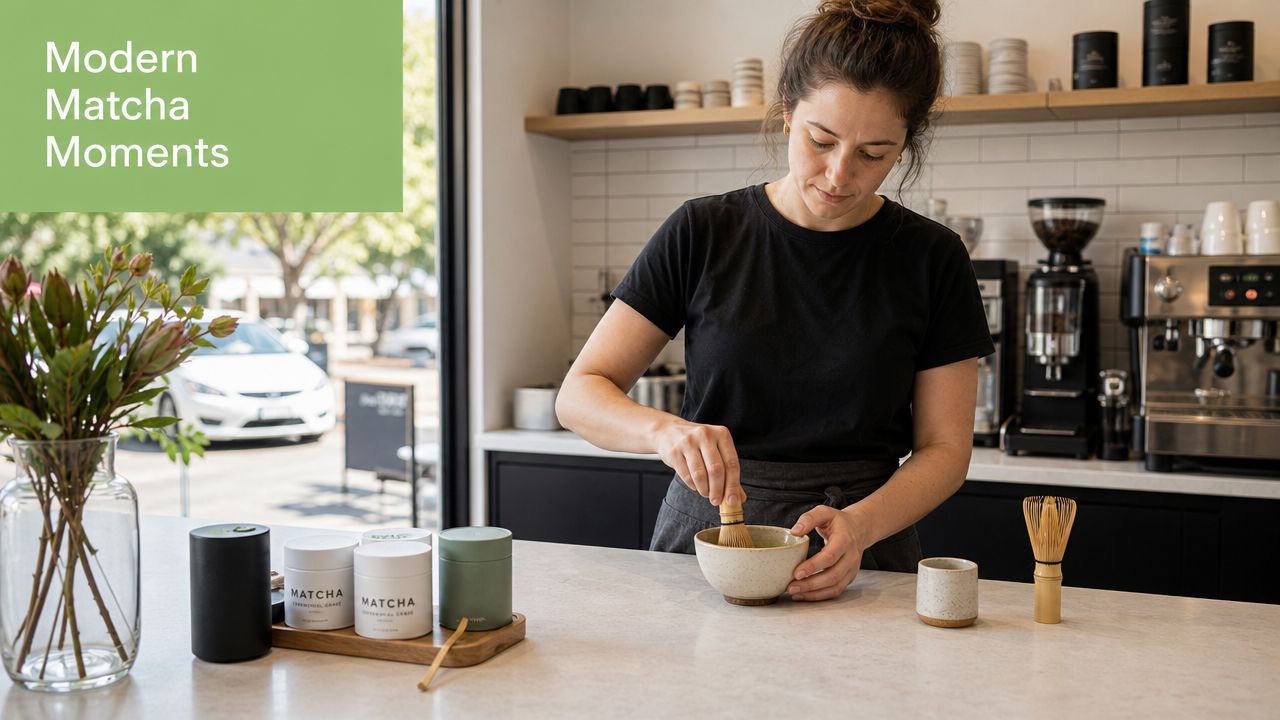
The good news is that the spirit of the matcha tea ceremony adapts beautifully. You can honour the tradition without pretending your kitchen bench is a formal tea room.
At home, keep it uncluttered and intentional
A modern home version doesn't need rare ceramics or perfect Japanese architecture. It needs care.
Try this approach:
- Clear a small space: Even one tidy section of the table changes how the ritual feels.
- Use a dedicated bowl: Reaching for the same chawan each time creates continuity.
- Prepare one serving well: Don't multitask with emails, podcasts, and breakfast prep.
- Serve a small sweet if you like: This helps frame the tea as an experience, not a chore.
- Sit down to drink it: Standing at the sink changes the whole mood.
A home ceremony can be short and still meaningful. The point isn't to imitate every formal detail. It's to build a repeatable pocket of calm.
In a café, make the service understandable
For hospitality teams, the matcha tea ceremony offers more than visual theatre. It gives staff a way to present matcha as a premium non-alcoholic service.
A simple menu idea might include a bowl of ceremonial matcha served with a small sweet, plus a short explanation of the bowl, whisking style, and origin of the tea. That works especially well in venues already attracting customers who value slower, thoughtful experiences.
A helpful training focus for staff is consistency:
| Service point | Why it matters |
|---|---|
| Water temperature | Prevents unnecessary bitterness |
| Whisk technique | Improves texture and presentation |
| Language used with guests | Makes the ritual feel welcoming, not intimidating |
| Tool care | Supports quality and respect for the process |
The following video gives a useful visual sense of preparation and pace.
A local adaptation can still be respectful
The strongest café versions don't oversell “authenticity” in a vague way. They're clear about what they are: a simplified service inspired by ceremonial values.
That honesty matters. Customers don't need a fake performance. They need a thoughtful bowl of matcha, prepared correctly, presented well, and explained clearly. When that happens, the ceremony becomes relevant to Australian hospitality rather than stuck behind glass.
Beyond the Bowl Creative Pairings and Wellness Recipes
The matcha tea ceremony starts with a bowl, but it doesn't have to end there. Once you understand the flavour and rhythm of ceremonial matcha, it becomes easier to use it in a broader wellness routine.
At home, some people keep the ceremonial bowl for quiet mornings and use matcha more casually later in the day. In cafés, the same logic can shape a menu. One offering can be formal and minimal. Another can be more playful.
Pairings that work without fighting the tea
Traditional sweets make sense because they soften matcha's natural bite. In Australia, you can also think more broadly while keeping balance in mind.
Good pairings often share one quality: restraint.
- Simple Japanese-style sweets: Mild sweetness lets the tea stay central.
- Light Australian pastries: Not too sugary, not too buttery, not too dominant.
- Fresh fruit plates: Clean, bright, and easy in warm weather.
- Kombucha as a palate reset: A small serve of sugar-free kombucha after matcha can feel crisp and refreshing rather than heavy.
For cafés, that opens an interesting idea: a quiet, non-alcoholic tasting flight built around one bowl of matcha and a small fermented drink served separately. The contrast in texture and flavour can make the experience feel contemporary while still centred on tea.
The most successful pairings don't overpower matcha. They give it room.
Two easy ways to bring matcha into everyday life
You don't need to perform a full ritual every time you use matcha. Once you've learned to appreciate it properly, everyday recipes become more intuitive.
Simple matcha latte
Use ceremonial grade if you want a softer, fuller flavour.
- Sift matcha into a bowl.
- Add a small amount of hot water and whisk until smooth.
- Warm your milk of choice separately.
- Combine and serve immediately.
This gives you a gentler bridge between formal matcha and a daily café-style drink.
Quick matcha smoothie
A smoothie is useful when you want something cold, simple, and easy to fit into a busy morning.
Blend matcha with fruit and your preferred base until smooth. Keep the other flavours moderate so the tea still comes through. If the smoothie tastes muddy, the recipe usually needs fewer competing ingredients, not more matcha.
The beauty of the matcha tea ceremony is that it teaches attention first. Once you learn that lesson, everything else improves. Your straight matcha tastes better. Your latte has more balance. Your café service feels more considered. Even your pairings become cleaner and more deliberate.
If you'd like to bring that ritual into your own routine, explore Pep Tea for organic matcha and wellness drinks that suit both simple home preparation and modern Australian café service.