
Tag: green tea benefits
Variable Temperature Kettle: A Guide for Aussie Tea Lovers
A variable temperature kettle is an electric kettle with selectable heat settings, usually from 50°C to 100°C, designed to extract the best flavour from different types of tea without burning delicate leaves. For many Australian tea drinkers, it's worth considering if you regularly prepare matcha, green tea or other brews that taste noticeably different when the water is too hot.
You've probably had this experience. You prepare a beautiful green tea or whisk a bowl of matcha, take the first sip and find a harsh, drying bitterness instead of sweetness and umami. It's easy to blame the tea, but the water may be the true culprit.
A standard kettle gives you one main result, boiling water. A variable temperature kettle gives you more control over the part of brewing that happens before the leaves, powder or infusion ever touches your cup.
Why Your Matcha Might Taste Bitter
The morning ritual starts well. You sift your matcha into a bowl, add water and whisk until a soft layer of foam forms on the surface. Yet the first sip tastes gritty, chalky or aggressively bitter. You try more whisking, less powder and a different mug, but the problem remains.
The missing variable is often water temperature.
Boiling water can pull bitter and drying compounds from delicate tea more aggressively than cooler water. An Australian kettle manual explains that lower-temperature brewing is relevant for sensitive infusions because boiling water can over-extract catechins and contribute to bitterness, while cooler water allows more repeatable control over the result in its guidance for variable-temperature brewing.
Matcha needs particular care because you drink the whole leaf in powdered form rather than steeping leaves and removing them. That makes texture, concentration and water temperature especially noticeable. If your water is too hot, the tea's more delicate flavours can become hidden behind astringency.
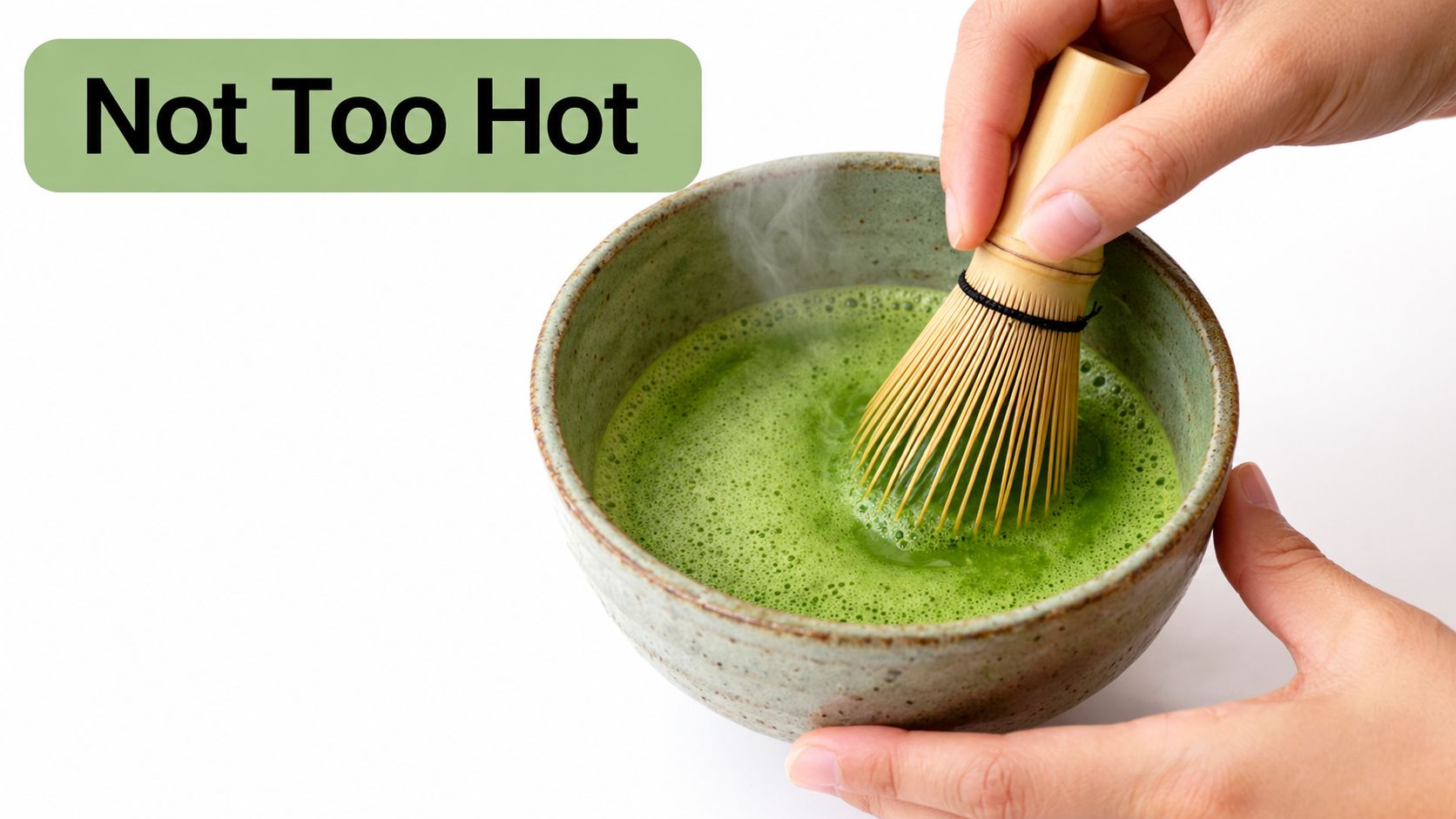
The simple brewing adjustment
Try changing the water before changing the matcha. Use cooler water, whisk thoroughly and taste the result before deciding that the powder itself is poor quality. A smoother cup can make the natural sweetness, savoury character and creamy body easier to notice.
For a practical guide to the complete process, including preparing the powder and whisking technique, follow this guide to making matcha tea from powder.
This principle also applies if you're using tea as part of a calmer alternative to strong coffee. Resources on natural energy boosters without jitters can help you compare different beverage routines, but the preparation method still matters. A carefully brewed tea can be more enjoyable because it tastes balanced.
Practical rule: If green tea or matcha tastes sharp and drying, adjust the water temperature before adding sweetener.
A variable temperature kettle doesn't improve every tea automatically. It gives you the ability to repeat a temperature that suits the particular drink, which is far more useful than boiling water and guessing when it has cooled enough.
What Is a Variable Temperature Kettle
A variable temperature kettle heats water to a selected temperature rather than stopping only at a full boil. Most models in Australia offer a range that broadly spans 50°C to 100°C, although the number of selectable points varies between products.
Smeg Australia's variable kettle range, for example, lists seven settings, at 50°C, 60°C, 70°C, 80°C, 90°C, 95°C and 100°C on its Australian product page. Those settings turn the kettle into something closer to a basic brewing tool. You can choose a gentler temperature for green tea, a warmer setting for oolong or a near-boil for a fuller-bodied infusion.
The category has also spread across different parts of the Australian retail market. Shoppers can find simpler variable-temperature options through mass-market retailers such as Kmart, alongside premium models sold through stores including Myer and Harvey Norman. The difference isn't only appearance. It can include temperature range, display design, pouring control, heat retention and how accurately the kettle reaches its selected setting.
The features that matter
A good model usually combines several functions:
- Selectable heat: You choose a target instead of waiting for boiling water to cool.
- Keep-warm control: The kettle can maintain the selected temperature for later pours, depending on the model.
- Automatic shut-off: The appliance stops heating when it reaches its target or detects a safety issue.
- Clear controls: A readable display or well-marked buttons make repeatable brewing easier.
- Suitable capacity: A compact kettle can suit individual tea preparation, while a larger one may be more convenient for a household.
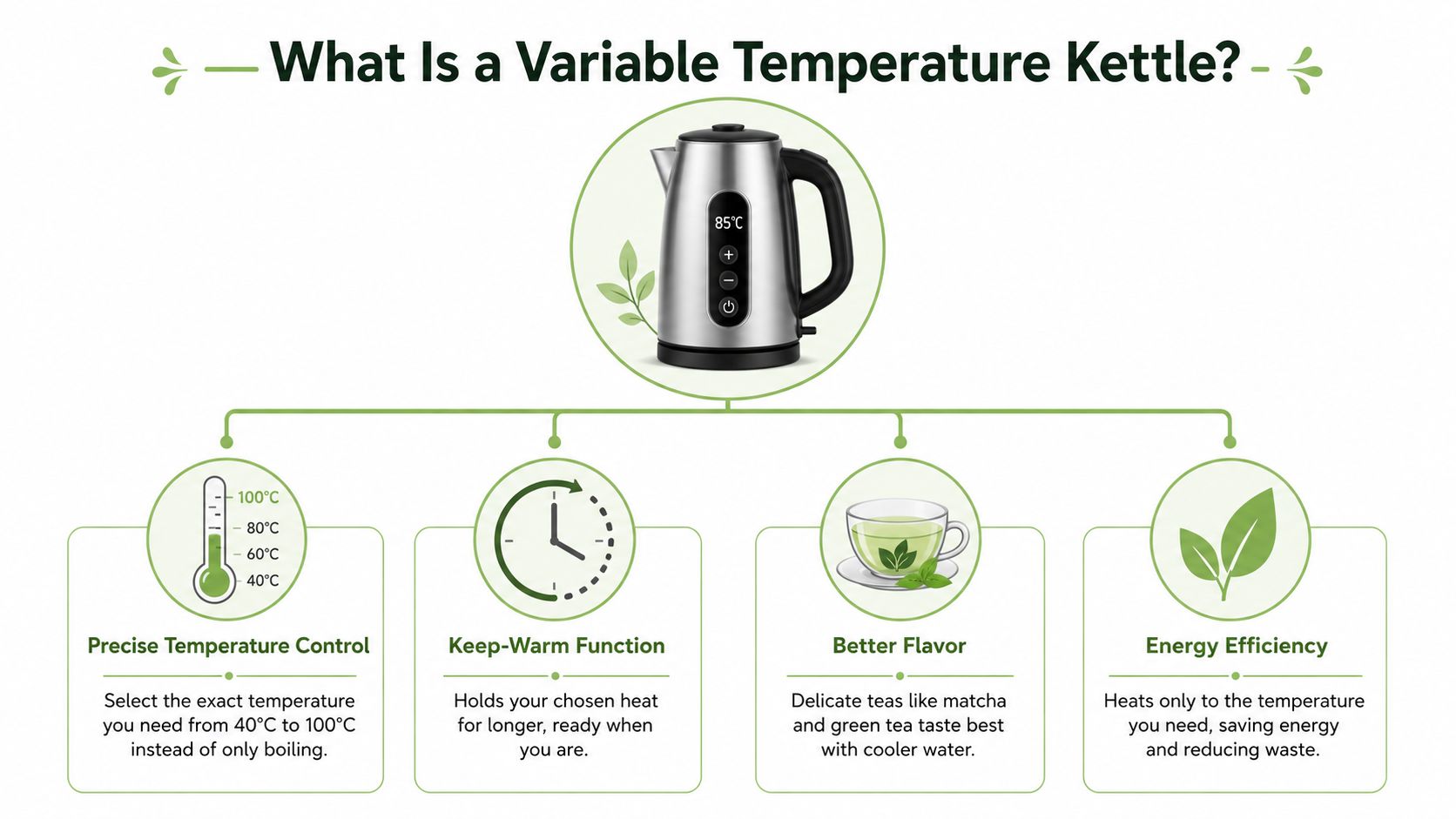
The key distinction is control, not complexity for its own sake. If you mostly boil water for pasta or make drinks that require boiling water, you may not use the extra settings often. If you drink different teas through the week, those settings can remove a frustrating amount of guesswork.
Here's a visual demonstration of how temperature selection and kettle design can fit into a brewing routine:
Optimal Brewing Temperatures for Tea
There isn't one perfect temperature for every tea. Water that suits black tea can overwhelm green tea, while water that produces a gentle green tea may leave some stronger infusions tasting thin.
Use the following as practical starting points rather than rigid rules:
| Drink | Useful starting point | Why it matters |
|---|---|---|
| Green tea | Around 70°C to 80°C | Helps limit harsh extraction from delicate leaves |
| Matcha | Around 70°C to 80°C | Supports a smoother balance of sweetness and umami |
| Oolong | Around 80°C | Gives semi-oxidised leaves enough heat without treating them like a boil-only infusion |
| Black tea | Around 95°C to 100°C | Provides the heat needed for a fuller, more robust cup |
| Herbal infusions | Near boiling | Suits ingredients that need hotter water to release their flavour |
These ranges reflect the broad brewing guidance published for Australian tea drinkers, including recommendations of roughly 75°C to 85°C for green tea, temperatures near 95°C to 100°C for black tea, and an intermediate range for oolong in this Australian tea FAQ. Your exact preference may depend on the tea's origin, the amount used and how long it steeps.
Why a few degrees can change the cup
Heat affects extraction. As water gets hotter, it can draw flavour compounds from tea more quickly. That can be helpful for a strong black tea, but it can make a delicate green tea taste more drying or bitter.
For matcha, temperature also affects the relationship between texture and flavour. Cooler water won't remove the powder's natural character, but it can make the cup feel less aggressive. If your matcha tastes flat rather than bitter, try improving your sifting and whisking before increasing the heat.
You can find more practical guidance in this matcha brewing temperature guide, then adjust gradually rather than changing temperature, powder quantity and brewing time all at once.
The best setting is the one that gives you a balanced cup and that you can repeat tomorrow.
A variable kettle is useful for more than traditional teacups. It can help with matcha lattes, cocoa and other hot drinks where boiling water may damage flavour or make the drink difficult to combine smoothly. If you enjoy steeping tea in alternative equipment, these French press tea tips from PureHQ Inc. offer another preparation option, although a variable kettle still gives you more control over the water before it reaches the press.
Is a Variable Temperature Kettle Worth It
You have a fresh green tea, a good matcha and a busy morning. A basic kettle boils water quickly, yet the cup turns sharp because the water was hotter than the tea needed. In that situation, a variable temperature kettle can make a noticeable difference. Its value depends on what you drink, how often you prepare it and whether you want the same flavour each time.
A basic kettle remains perfectly suitable for black tea, herbal infusions and cooking water. Green tea and matcha make the case for more control, especially when you prepare them regularly. The feature matters because it connects the kettle's settings with the chemistry of the cup. Smeg's seven settings, for example, may look like a reason to upgrade, but the useful question is whether you will use those options for different teas.
Australian shoppers can face a wide gap between entry-level and premium products. A Kmart model can be listed at $69, while premium options may sit around $299 to $349, according to the Australian buying context described by CHOICE in its kettle buying guide. A higher price does not automatically produce better tea. It may pay for sturdier construction, a more polished interface, a better pour or steadier temperature control. Choose features that fit your habits rather than paying for settings that will stay unused.
The energy question
More controls do not automatically mean much higher electricity use. The bigger influence is usually how much water you heat. Filling the kettle for one mug uses less energy than boiling a full chamber, regardless of whether the kettle has a temperature display.
Heating less water to a lower selected temperature may suit some brewing routines, but a variable kettle should not be purchased solely for dramatic savings. Electricity pricing, fill level and daily use affect the result. Its strongest benefits are flavour control, convenience and consistency.
A useful decision test
Choose a basic kettle if:
- You normally prepare drinks with boiling water.
- You do not notice much difference between a gentler and hotter brew.
- Your budget is better spent on higher-quality tea or other kitchen essentials.
Consider upgrading if:
- You prepare green tea or matcha regularly.
- You make several different types of tea.
- You want to repeat a preferred temperature without waiting for boiled water to cool.
- You use a keep-warm function during a longer tea session.
A premium kettle can be a worthwhile daily tool, but it is not required for good tea. A modest variable model may provide the control you need without charging you for design features you will not use.
Buying and Maintaining Your Kettle
A kettle can look impressive on an Australian benchtop without making better tea. Start with performance: it should reach the selected temperature consistently, show clear controls and include practical safety features. A higher price does not automatically mean greater accuracy, lower running costs or a better pour. Match the appliance to the drinks you prepare.
Australian consumer testing treats temperature accuracy as a real performance measure. CHOICE checks accuracy at each variable-temperature setting and conducts a dry-boil safety test, so temperature control and automatic shut-off deserve attention when comparing models in its explanation of kettle testing.
What to check before buying
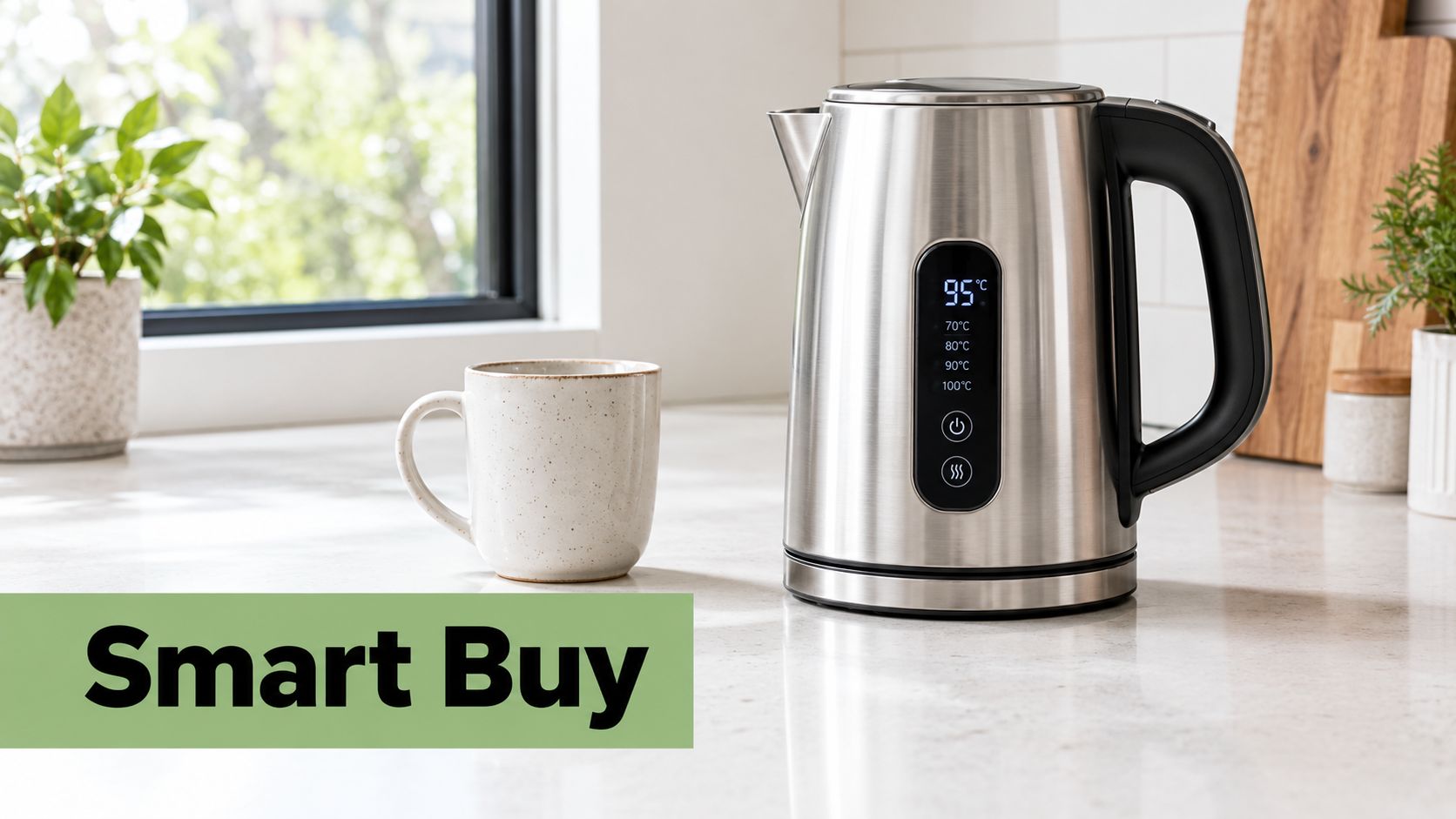
Start with the controls. A readable display and simple temperature selection matter more than a crowded panel. Smeg's seven settings, for example, can be useful when you move between matcha, green tea and hotter brews, provided the selected temperatures suit the chemistry of each drink. Matcha needs water that will not scorch its delicate flavour, while green tea can become harsh when brewed too hot.
For capacity and accuracy comparisons, see our guide to choosing an electric kettle in Australia. Australian products range from compact 1L gooseneck kettles to family-sized 1.7L models, with some combining temperature selection and heat retention in this Australian product listing. Choose the size that fits your usual cups. A larger chamber can encourage unnecessary boiling, while a smaller one may suit a solo morning ritual.
Check the spout. A gooseneck design supports a slower, controlled pour for manual brewing. A wider spout may suit a teapot or French press better.
Keep the water and kettle clean
Mineral deposits can affect flavour and heating performance. Descale according to the manufacturer's directions, particularly if your local water leaves visible residue, then rinse thoroughly so the next cup does not taste of cleaner.
Use a stable, heat-resistant surface, keep the cord away from the bench edge, and avoid overfilling or running the kettle dry. Empty stale water rather than leaving it inside for long periods.
Regular care keeps fresh water, accurate heat and your tea in clean contact.
Elevating Your Daily Tea Ritual
A variable temperature kettle changes the role of water in your routine. Instead of treating every tea as if it needs the same treatment, you can respond to the drink in front of you. Green tea can have a gentler setting, oolong can receive more heat and black tea can still be prepared close to boiling.
That small act of selection encourages a more mindful approach. You notice aroma before drinking, taste the difference between astringency and bitterness, and learn which settings suit your preferred matcha or tea. The kettle becomes useful because it helps you build a repeatable habit, not because it promises to fix every brewing mistake.
Match the tool to the ingredient
Premium tea deserves careful preparation, but equipment can't compensate for stale ingredients, poor storage or an unsuitable recipe. Start with fresh water, use the amount of tea you need and change one variable at a time. If the first cup tastes too sharp, lower the temperature. If it tastes weak, adjust the tea quantity or steeping approach before assuming you need a new appliance.
The same mindset works across a wellness-focused beverage routine. A carefully prepared matcha can be part of a calm morning ritual, while an organic kombucha can offer a low-sugar alternative when you want something refreshing. Neither drink needs exaggerated promises. Their value starts with quality ingredients, thoughtful preparation and choosing a beverage that fits your day.
For Australian households, the best variable temperature kettle is the one that makes those choices simple. It should be safe, easy to clean and accurate enough to help you repeat the cups you enjoy. If you mostly drink one tea, a standard kettle may be all you need. If you move between matcha, green tea, oolong and other infusions, selectable heat can make the difference between guessing and brewing with intention.
Explore organic Japanese matcha and Australian-brewed sugar-free kombucha from Pep Tea, with options suited to home routines, cafés and wellness-focused menus. Visit the range, try your preferred brew at a gentler temperature and discover how better control can bring out more character in every cup.
Best Green Tea for Weight Loss: Reddit’s Top Picks 2026
Reddit loves a shortcut. Search for the best green tea for weight loss Reddit threads and you'll see the same pattern again and again: one person swears green tea “worked”, another says it did nothing, and a third drops a study result with no context at all.
The problem usually isn't the tea. It's the confusion.
Some posts talk about brewed tea. Others are really talking about concentrated extracts. Some people are drinking low-grade bagged tea with breakfast and expecting supplement-like results. Others have stumbled onto the one form that makes the whole conversation more practical: matcha.
If you want a clear answer, you need two things. First, a realistic idea of what green tea can and can't do for weight management. Second, a way to separate forum folklore from advice that makes sense in daily Australian life.
Sorting Through the Reddit Tea Leaves
Reddit can be useful because it shows what real people try, what habits they stick to, and where they get stuck. It's often more honest than polished wellness marketing. But it also bundles together half-remembered studies, personal anecdotes, supplement advice, and café drink recommendations as if they all mean the same thing.
That's why best green tea for weight loss Reddit is a trickier search than it looks. Many threads compare apples with oranges. A capsule gets discussed next to a teabag. A sugary bottled “green tea” drink gets lumped in with plain sencha or matcha. Then readers are left wondering why their results feel underwhelming.
Why Reddit advice feels so mixed
A few patterns show up often:
- People confuse product types. Brewed green tea, powdered matcha, and green tea extract are not the same experience.
- Users report different routines. Someone drinking one weak cup at night is not following the same approach as someone using matcha before training.
- Taste affects consistency. If the tea is bitter, stale, or chalky, many won't maintain the habit.
If you use Reddit for research, it helps to get better at finding niche communities and older discussions instead of relying on whatever appears first. This guide on how to search for subreddits effectively is handy if you want to dig into tea, weight management, fitness, or Australian wellness threads with more intent.
Reddit is best used as a clue board, not a final verdict.
The practical lens that matters
Green tea isn't a magic fat-loss button on its own. It's a support habit. It may help a bit with metabolism, routine, energy, and drink choices, especially if it replaces higher-calorie beverages. But the type of green tea matters more than most threads admit.
That's where the conversation becomes much more useful. Once you stop asking “does green tea work?” and start asking “which green tea form gives me the most from a normal daily drink?”, the answer gets clearer.
The Science Behind Green Tea and Weight Management
Green tea gets its reputation from a small team of natural compounds working together, not from one miracle ingredient. The two names that matter most here are EGCG and caffeine.
Think of them as a metabolic support team. Caffeine gives the system a push. EGCG helps that push last longer by affecting the way the body handles norepinephrine, a hormone involved in breaking down fat.

What thermogenesis actually means
You'll often see the word thermogenesis in green tea discussions. In plain language, it means your body burning energy to produce heat. It's one of the reasons people connect green tea with metabolism support.
That doesn't mean you drink tea and suddenly melt body fat. It means certain compounds may help nudge the body toward using energy a bit more actively, especially when they're paired with movement and a generally organised routine.
The most useful numbers to know
One of the clearest practical points is timing. Clinical studies show that people can increase fat-burning potential by 17% when taking green tea extract before physical exercise, and daily consumption can contribute to an extra 75 to 100 calories per day even at rest, according to Foober's summary of green tea for weight loss.
That's why some people feel green tea “works best” when they use it around exercise instead of treating it like a random afternoon beverage.
A simple way to view it:
| Compound | Everyday role | Why people care |
|---|---|---|
| Caffeine | Helps with alertness and energy | May support exercise drive and thermogenesis |
| EGCG | A catechin found in green tea | Helps support fat oxidation pathways |
| Together | Work in synergy | More useful than either one in isolation |
What this means in real life
If you're walking the dog before work, heading to the gym after lunch, or trying to stop reaching for sugary drinks during the afternoon slump, green tea may fit well because it supports a routine you can repeat.
Practical rule: Green tea works better as a repeatable habit than as a one-off “fat burner”.
That's also why quality matters so much. Once you understand that the effect depends on the compounds you consume, the next question becomes obvious: which green tea gives you the most of them in a normal cup?
What Reddit Gets Right and Wrong About Green Tea
Reddit gets one big thing right. Green tea is not a magic solution. The more grounded posters usually say the same thing: if your sleep is poor, your meals are chaotic, and your total intake is too high, tea won't fix that.
That part is sensible.
Where the threads often go sideways is in the jump from “green tea may help” to “any green tea drink should deliver study-like results.” That's where expectations get distorted.
The extract versus beverage gap
A lot of Reddit comments cite research based on concentrated green tea extracts, sometimes around 500 mg daily, and then assume an ordinary mug of brewed tea will behave the same way. That's not how real-world use works.
Healthline notes this gap clearly in its discussion of green tea and weight loss. Threads often repeat extract-based findings without distinguishing them from brewed tea, while the beverage itself has a more modest effect of burning only 60 to 80 extra calories per day in those discussions, which leaves readers expecting more than a regular cup can deliver. You can read that context in Healthline's green tea and weight loss article.
What Reddit usually gets right
The strongest community advice tends to sound less exciting and more useful:
- Consistency matters. A daily habit beats a “detox week”.
- Unsweetened is the point. Loading green tea with sugar changes the whole equation.
- Exercise helps the tea help you. People often notice better results when tea is part of an active routine.
- Taste decides adherence. If you dread the flavour, you'll quit.
What Reddit often misses
The biggest blind spot is concentration. Not all green tea formats deliver the same amount of the compounds people are chasing.
A supermarket teabag can still be a decent choice over soft drink or juice. But if someone is searching for the best green tea for weight loss Reddit because they want the most practical benefit from a beverage, “any green tea” is too vague to be useful.
Community wisdom is helpful when it tells you what people can stick with. It becomes unhelpful when it skips the difference between a brewed drink and a concentrated extract.
That missing detail is exactly why matcha keeps showing up as the smarter answer.
Why Matcha Is the Smartest Choice for Weight Loss
Matcha changes the conversation because it solves the concentration problem better than standard brewed tea.
With regular green tea, you steep the leaves and throw them away. With matcha, the leaves are stone-ground into a fine powder and whisked into water, so you consume the whole leaf. That means you're not just extracting some compounds. You're taking in the lot.

The whole-leaf advantage
This is the reason matcha sits at the top of so many serious green tea discussions. According to this Australian matcha and green tea breakdown, matcha contains up to 137 times more antioxidants than standard brewed green teas because you consume 100% of the leaf, including its caffeine, amino acids, and catechins such as EGCG.
That doesn't mean every scoop of matcha guarantees weight loss. It means matcha gives you a far stronger nutritional delivery system than a standard infusion.
Why this matters more than hype
If brewed tea is the lighter version of the idea, matcha is the more complete one. It's the closest natural beverage format to the stronger effects people often expect after reading extract-based claims online.
Here's a quick comparison:
| Feature | Standard green tea | Matcha |
|---|---|---|
| How it's used | Leaves steeped, then discarded | Powder whisked and consumed |
| What you ingest | Partial extraction | Whole leaf |
| Compound density | Lower | Higher |
| Practical fit for weight goals | Supportive | More strategic |
For readers who want more detail on why whole-leaf powder matters, this piece on matcha tea powder as a powerhouse of antioxidants is a useful deep dive.
A grounded verdict
If someone asked me for the simplest answer to the Reddit question, it would be this:
- If you want a gentle daily tea habit, standard green tea can still support your routine.
- If you want the smartest beverage choice for weight management support, matcha is the stronger option.
- If your goal is realistic progress, matcha still works best alongside food quality, movement, and sleep.
That's why matcha isn't just trendy. It's logically the most efficient green tea format for people who want more from the cup itself.
Your Actionable Guide to Using Green Tea Effectively
Knowing that matcha is the strongest practical option is helpful. Knowing how to use it well is what makes the habit stick.

Start with a routine you'll actually keep
You don't need a perfect Japanese tea ceremony in your kitchen before 7 am. You need a repeatable pattern.
A practical matcha routine often looks like this:
- Use a small amount first. Start with 1 to 2 teaspoons of matcha powder. That amount lines up with a review noting participants commonly consumed around 2 to 4 g of matcha per day, equivalent to 1 to 2 teaspoons, in human studies discussed by In the Cove's review of matcha health benefits.
- Keep the water hot, not boiling. Very hot water can make matcha taste harsh.
- Whisk well. A fork works in a pinch if you don't have a bamboo whisk.
- Drink it plain first. Learn the flavour before turning it into a sweet café-style drink.
Timing makes a difference
Many people leave easy gains on the table. The synergy between caffeine and EGCG may increase fat-burning potential by up to 17% when consumed about 1.5 hours before a workout, according to Foober's guide on the best green tea for weight loss.
So if you train after work, don't have your matcha randomly at breakfast and hope for the same effect. Use it with some intention.
A pre-workout matcha can make more sense than an end-of-day cup, especially if your goal is metabolic support rather than a cosy ritual.
For easy ways to build that into daily life, this collection of matcha drink recipes for weight loss gives practical ideas without making things complicated.
A quick video can also help if you're more of a visual learner:
Simple ways to use matcha in Australia
You don't have to drink it the same way every day. Try:
- Morning bowl at home. Fast, unsweetened, and easy before work.
- Iced matcha after a walk. Great in warmer weather.
- Smoothie add-in. Handy if you already blend breakfast.
- Light matcha latte. Better kept low in sugar if weight management is the goal.
Common mistakes to avoid
- Adding lots of sweetener. That can undo the benefit of choosing tea in the first place.
- Buying poor-quality powder. If it tastes swampy and bitter, consistency will suffer.
- Expecting dramatic change from one serve. Matcha supports a system. It doesn't replace one.
Beyond the Tea Cup Exploring Kombucha
Weight management isn't only about what speeds metabolism a bit. It's also about the drinks you stop having.
That's where kombucha enters the picture. A properly fermented kombucha gives you a more interesting, adult-feeling alternative to sugary soft drinks or overly sweet mixers, and that swap can support a cleaner routine over time.

Why kombucha fits the same mindset
People who care about green tea for weight goals are usually trying to do a few things at once:
- Lower sugar intake
- Choose more functional drinks
- Support gut health
- Avoid the crash that comes with heavily sweetened beverages
Kombucha fits that broader lifestyle neatly when it's genuinely fermented and not dressed up like a health drink while behaving like cordial.
A useful complementary habit
Matcha and kombucha do different jobs. Matcha suits mornings, focus, and workout timing. Kombucha works well as a fridge staple when you want something fizzy without reverting to soft drink habits.
If you're interested in how fermentation, live cultures, and lower-sugar choices fit into a wellness routine, this guide on the benefits of kombucha is a practical read.
The smartest drink strategy usually isn't one hero beverage. It's having better options ready for different moments of the day.
Your Simple Green Tea Plan for Wellness
If you've made it this far, the answer to the Reddit question is much less messy.
Green tea can support weight management. It just needs honest expectations. A cup won't override everything else, but the right format can absolutely be a better choice than a weak, sugary, or inconsistent routine.
The simplest framework to remember
- Choose matcha first. It's the most efficient green tea format for people who want more from the drink itself.
- Use timing well. If exercise is part of your week, place your matcha before it rather than treating it as random background tea.
- Stay realistic. Green tea supports a healthy pattern. It doesn't replace that pattern.
- Upgrade your drink choices overall. Kombucha and unsweetened tea can help reduce reliance on sugar-heavy options.
One reason matcha stays at the top of this conversation is its thermogenic profile. A study in the American Journal of Clinical Nutrition found that consuming matcha can increase thermogenesis from a typical 8 to 10% to 35 to 43% of daily energy expenditure, as summarised in this article on matcha health benefits.
Build the tea habit into your full routine
Tea works best when it's part of a bigger system. That might mean walking most days, planning simple protein-rich meals, keeping sweet drinks out of the trolley, and having matcha or kombucha ready at home. If you want a practical way to organise the food side of that routine, this guide on using PlateBird for meal planning is worth a look.
A key lesson from Reddit is useful once you clean it up: people do best when they pick a habit they can repeat. For green tea, the repeatable, high-value option is matcha.
If you're ready to turn that knowledge into a daily ritual, explore Pep Tea for premium organic matcha and Australian-made sugar-free kombucha that fit naturally into a cleaner wellness routine.
Buy Organic Green Tea Online: Quality Guide 2026
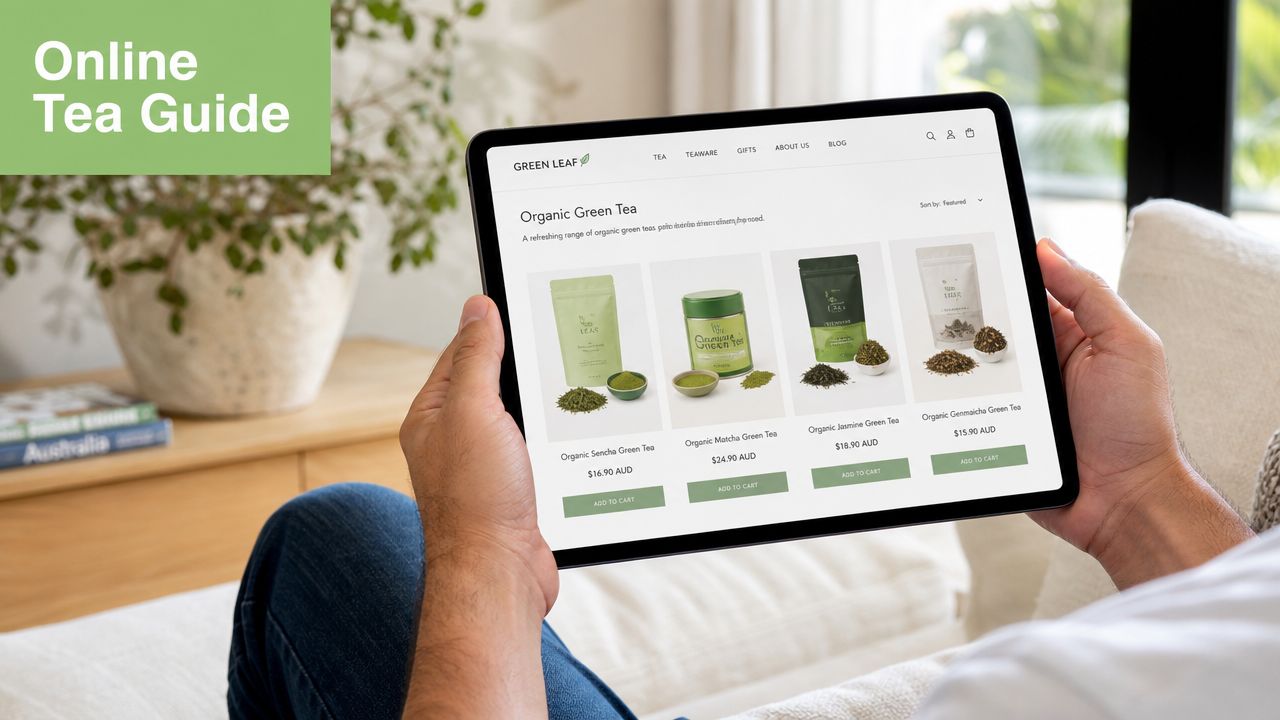
You're probably doing what a lot of Australians do when they start shopping for tea online. You type in a simple search, open six tabs, and suddenly every packet looks “premium”, “pure”, “ceremonial”, “clean”, or “organic”. The photos are lovely. The claims sound reassuring. But it's not always obvious what matters once that tea lands in your kitchen.
That confusion is normal. Tea is one of those products where the label can look clear while the buying decision still feels murky. You can't smell the leaves through a screen. You can't inspect colour, freshness, or texture in person. And if you care about wellness, taste, and clean sourcing, you want more than a pretty pouch and a vague promise.
Your Guide to Buying Organic Green Tea Online
A common scene goes like this. Someone wants a better afternoon drink than another coffee or a sugary option. They start looking for organic green tea online, hoping for something cleaner, lighter, and easier to build into a daily routine. Then the questions hit. Is loose leaf better than matcha? Does organic mean residue-free? Will it taste fresh after shipping? Is the higher price justified?
Those questions sit inside a much bigger shift in how people buy tea. The global organic tea market was valued at USD 2.12 billion in 2025 and is projected to reach nearly USD 4.26 billion by 2032, growing at a 10.5% CAGR, according to the Teeverband 2025 tea report. For Australian shoppers, that matters because it reflects a clear move toward higher-quality, certified-organic tea sold through practical online channels.
Why this matters in Australia
Australia sits in a region where tea demand is strong, but many premium green teas are sourced from overseas. That means online buying isn't a niche habit. It's often the most practical way to access the kind of tea people want, especially if they're looking for certified-organic Japanese green tea, matcha, or premium loose leaf.
If you're curious about the supply side, it also helps to understand how products move into Australia. This guide on how to navigate importing from Japan through AUSFF gives useful context on the logistics behind imported goods, including the sort of care and compliance buyers often assume happens automatically.
Buying tea online gets much easier once you stop asking “Which pack looks healthiest?” and start asking “What proof does this brand give me?”
What a good online tea guide should actually do
You don't need a lecture on tea culture. You need a practical filter.
A useful buying guide should help you:
- Read past marketing words so “organic” means something specific
- Check quality signals like origin, testing, and packaging
- Choose the right format for your routine, whether that's matcha or loose leaf
- Brew it properly so good tea doesn't taste bitter by accident
That's where most shoppers get stuck, and it's exactly where a little clarity makes a big difference.
What Makes Green Tea Genuinely Organic
A lot of Australian shoppers click on a tea listing, see the word “organic”, and assume the hard checking is done. Online, that assumption can trip you up. The label matters, but the true question is what sits behind it.
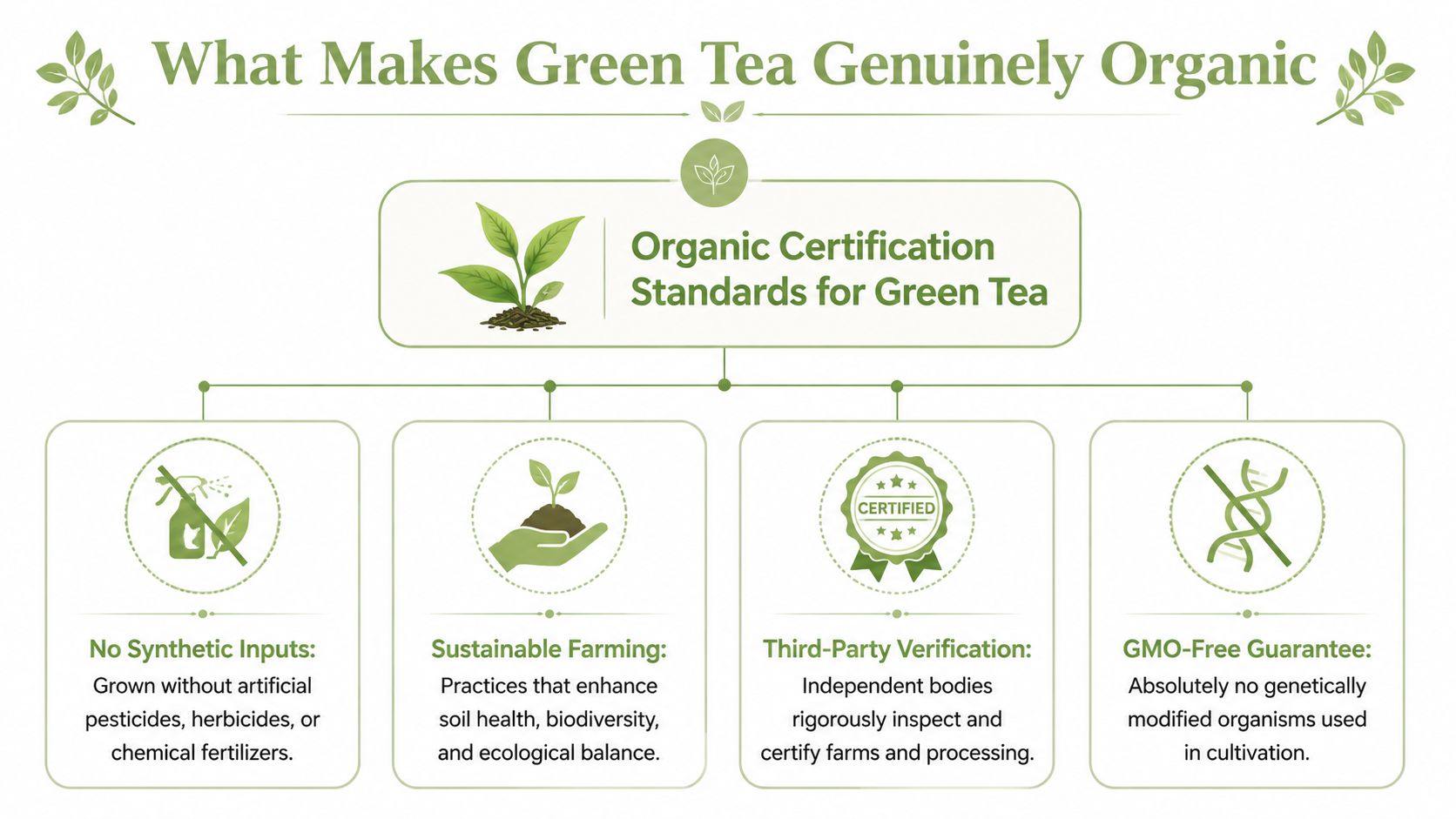
Organic green tea is tea grown and processed under certified standards, not just described with clean-sounding marketing. Those standards usually restrict synthetic pesticides, herbicides, chemical fertilisers, and genetically modified organisms. In plain terms, the farm has to follow rules, and an independent certifier has to verify that those rules are being followed.
What the organic label should point to
For online buyers, “organic” works like a receipt trail. If a brand uses the word properly, you should be able to trace it back to something concrete.
A reliable product page should help you understand:
- How the tea was grown. Organic farming avoids synthetic chemical inputs and follows stricter cultivation standards.
- Who verified the farm or producer. Certification should come from an independent body, not the seller marking their own homework.
- How the tea was handled after harvest. Processing, packing, and storage still shape purity, aroma, and shelf life.
- How clearly the source is explained. “From Japan” is a start. A named region, producer, or style tells you far more.
If you want a simple breakdown before comparing listings, Pep Tea has a clear guide on what organic green tea means.
Why drinkers care about it
People choose organic tea for practical reasons. Some want to limit exposure to synthetic agricultural inputs. Others care about farming systems that support healthier soil and a cleaner growing environment.
There is also a trust factor, especially when you are buying through a screen. A well-documented organic tea often appeals to the same buyer who cares about harvest date, careful packing, and whether the tea will arrive tasting lively rather than tired. It does not guarantee beautiful flavour on its own, but it often sits in the same conversation as freshness and careful sourcing.
That matters with green tea because it is a delicate product. Poor handling shows up quickly in the cup. Flat aroma, dull colour, or rough bitterness can come from age, weak storage, or careless processing, even if the tea was grown under organic standards.
Practical rule: Organic means more when it comes with traceable sourcing and clear certification detail.
Where online buyers get mixed up
The biggest confusion is treating organic as a complete quality guarantee.
It is not.
Organic certification answers a farming question. It tells you the tea met a defined production standard. It does not automatically tell you whether the leaves are fresh, whether the powder has been protected from heat and light, or whether the seller is transparent enough for an Australian buyer to trust the product before ordering.
That distinction is worth keeping in your head. Organic is one filter. Purity, authenticity, and freshness still need their own proof. Brands that explain those points clearly set a much stronger benchmark, and that is the standard careful tea buyers should expect.
Decoding Quality and Purity When Buying Online
Buying tea online asks you to trust information before you trust taste. That's why a careful buyer should judge the product page like they'd judge the tea itself. If a seller can't explain origin, testing, and handling clearly, the problem usually isn't your caution. The problem is the missing detail.
The most important shift is this. Don't treat “organic” as the finish line. Treat it as the starting point. Independent coverage of contamination concerns points out that while organic certification is valuable, it doesn't automatically guarantee freedom from environmental contaminants like heavy metals. That's why buyers should look for origin transparency and batch testing results, especially for products imported into Australia, as discussed in this review of organic and lead-free green tea concerns.
What to check on a product page
A strong listing usually answers your practical questions before you email support.
Look for these signals:
- Named origin. Not just the country, but ideally the producing region or style.
- Certification detail. A clear statement of certified-organic status is more useful than wellness language.
- Testing transparency. Brands that mention batch testing, residue checks, or quality controls give you something concrete to assess.
- Packaging photos. Good images help you see whether the product is likely to stay fresh after opening.
- Preparation guidance. Sellers who know their tea usually explain how to brew it properly.
Purity means more than a logo
Many shoppers often get tripped up. They see “organic”, assume “clean”, and stop reading. But tea is an agricultural product. It comes from soil, weather, transport, processing, and storage. Each step matters.
If you're buying matcha, this becomes even more important because you consume the powdered leaf itself rather than steeping and discarding it. That's one reason grading, origin, and transparency matter so much in this category. If you'd like a simple breakdown of how quality tiers differ, this guide to different grades of matcha is a useful reference.
Ask a plain question when you shop: “What evidence does this seller provide beyond the word organic?”
A quick credibility filter
When a store page feels polished but vague, use this short test.
| Check | What you want to see |
|---|---|
| Origin | Specific sourcing information |
| Purity | Mention of testing or quality control |
| Certification | Clear certified-organic wording |
| Freshness | Packaging designed to protect tea from air and light |
| Education | Brewing advice that matches the tea type |
If a brand gives you three or more of those clearly, you're usually dealing with a seller that understands tea properly. If everything leans on mood, lifestyle imagery, and broad claims, keep browsing.
What good transparency feels like
A trustworthy tea brand doesn't make you work hard to feel informed. It explains what the tea is, where it comes from, how to use it, and why the product is packed the way it is. That kind of clarity is especially valuable for Australians ordering premium green tea online, where quality has to survive shipping as well as scrutiny.
Choosing Your Perfect Form Matcha vs Loose Leaf
Once you've narrowed quality down, the next question is personal. Do you want a tea you whisk, or a tea you steep?
This choice shapes everything. Flavour, routine, equipment, mouthfeel, convenience, and how often you'll reach for it on a busy morning all depend on the format. There isn't one right answer. There's only the one that fits your day.
Green tea holds about 39.6% of the organic tea market, and matcha is described as the fastest-growing format, with 68% of global consumers associating green tea with high antioxidant levels and choosing it for long-term health benefits, according to Maximize Market Research's organic tea market report. That helps explain why so many Australian shoppers land on matcha first when searching for organic green tea online.
Organic Matcha vs Loose Leaf Green Tea at a Glance
| Feature | Organic Matcha | Organic Loose Leaf Green Tea |
|---|---|---|
| Preparation | Whisked into water or milk | Steeped in hot water |
| Drinking style | Full-leaf powder consumed in the cup | Infused liquor, leaves removed after brewing |
| Flavour | Richer, fuller, often creamy or savoury | Lighter, cleaner, more delicate |
| Best for | Ritual drinking, lattes, smoothies, recipes | Daily cups, teapots, simple brewing |
| Equipment | Bowl or cup, whisk or frother, sieve helpful | Infuser, teapot, or basket |
| Texture | Smooth, suspended tea body | Clearer, lighter mouthfeel |
Choose matcha if your routine is hands-on
Matcha suits people who like ritual and versatility. You can drink it straight, whisk it into a latte, blend it into smoothies, or use it in baking. It feels more immersive because preparation is part of the experience.
That's also why grade matters. Ceremonial-style matcha is usually the pick for straight drinking, while culinary-style matcha works better in lattes, desserts, and recipes where the tea shares the stage with other ingredients.
Choose loose leaf if you want a simpler cup
Loose leaf green tea suits people who want ease without sacrificing quality. You measure the leaf, add water, wait a few minutes, and drink. No whisking. No frothing. No powder settling at the bottom of the cup.
For many Australians, that makes loose leaf the easiest daily entry point into better tea. If that sounds closer to your style, Pep Tea's best organic green tea loose leaf page shows the sort of product category to look for when you want quality without the ceremony.
Some people love matcha for focus and routine. Others want a clean, grassy cup they can brew half-awake before work. Both are good choices.
A quick self-check
If you're still torn, use these prompts:
- Go for matcha if you enjoy café-style drinks, want one tea for drinking and recipes, or like a more concentrated green tea experience.
- Go for loose leaf if you value speed, lighter flavour, and a more traditional brew.
- Try both if your weekday and weekend habits are different. Many tea drinkers keep loose leaf for everyday use and matcha for mornings, lattes, or baking.
The best organic green tea online isn't the one with the most dramatic description. It's the one you'll prepare properly and drink often.
Brewing and Using Your Organic Green Tea
A lot of “bad” green tea is good tea brewed poorly. That's encouraging news, because it means one small adjustment can improve the cup immediately.
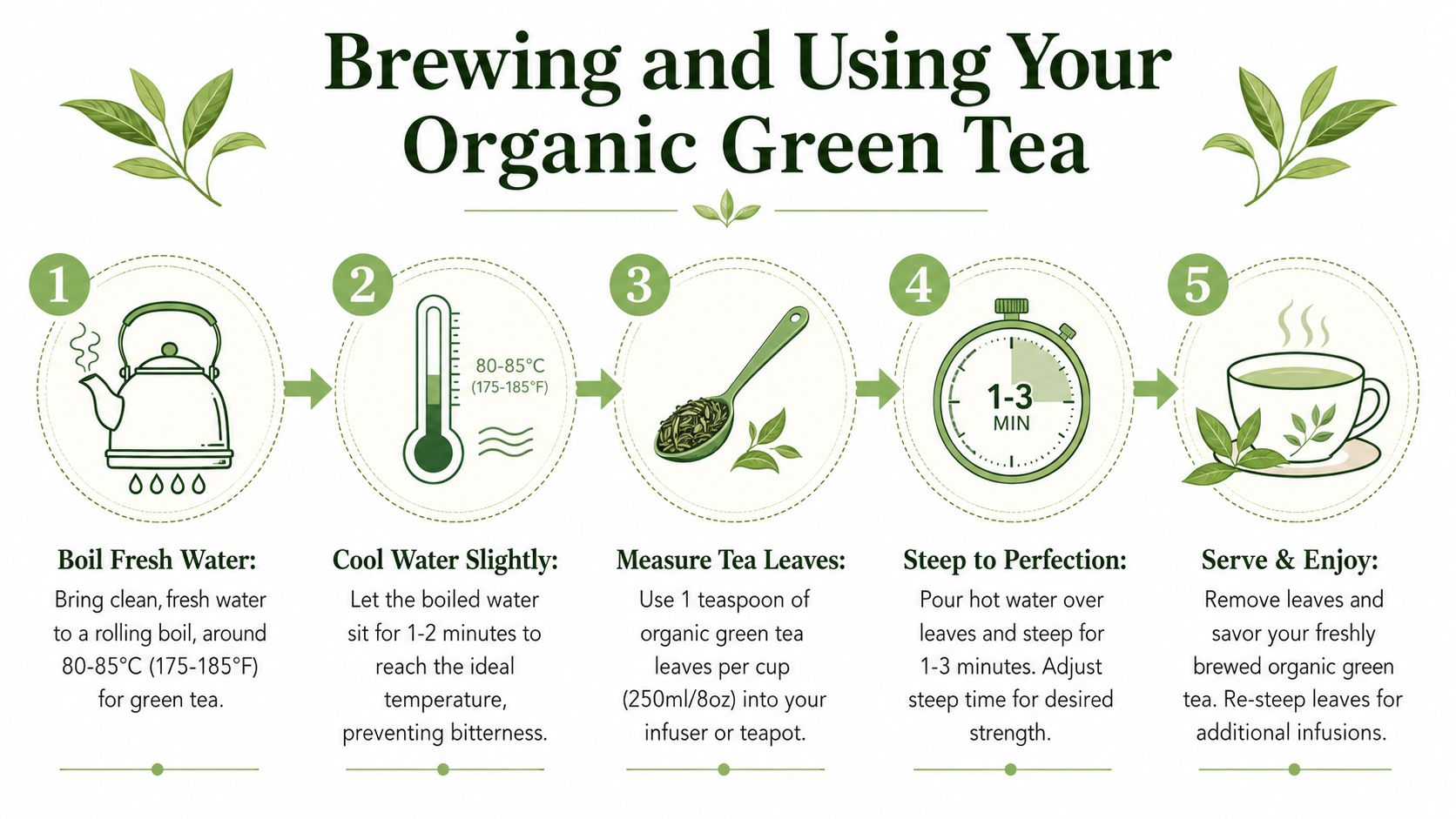
Peer-reviewed review data show that green tea is typically brewed at 80 to 90 °C for 3 to 4 minutes, and that most EGCG and caffeine extraction occurs around 80 °C, according to this review of green tea extraction and bioactive compounds. In simple terms, water that's too hot can push bitterness hard. Water in the right range gives you a better balance.
How to brew loose leaf well
You don't need specialist gear to get this right. You need a kettle, an infuser, and a timer.
Try this simple method:
- Boil fresh water, then let it cool slightly so it sits in the green tea range rather than straight off a hard boil.
- Add your leaf to an infuser or teapot.
- Pour and steep for a short, controlled time rather than guessing.
- Taste and adjust the next cup if needed. A shorter steep usually softens bitterness.
If your tea tastes harsh, don't blame the leaf first. Check temperature and time.
How to prepare matcha without lumps
Matcha is less about steeping and more about suspension. You're mixing powdered tea directly into liquid, so texture matters.
A reliable home method:
- Sift the matcha first if you can. This helps prevent clumping.
- Add a small amount of warm water and whisk into a smooth paste.
- Whisk briskly with more water until the surface looks evenly mixed and lightly frothy.
- For a latte, add your milk after the matcha is smooth.
For readers who like a visual guide, this short video is handy:
Easy ways to use it beyond a plain cup
Good organic green tea online should earn its place in your pantry. Matcha and loose leaf can both do more than one job.
A few practical uses:
- Morning latte. Matcha whisked with warm milk for a smoother start to the day.
- Iced drink. Chill brewed green tea and pour over ice.
- Smoothie add-in. Matcha works well when you want a green tea note in blended drinks.
- Baking and desserts. Culinary matcha suits slices, muffins, yoghurt bowls, and more.
- Food pairing. Loose leaf green tea can be a clean match for light lunches or sushi-style meals.
At Pep Tea, products like ceremonial-grade and culinary-grade organic matcha are examples of how different green tea formats suit different uses rather than one replacing the other.
Storage Freshness and Shipping Considerations
Fresh tea can lose its spark faster than many people expect. Light, air, moisture, and heat all work against flavour. If you've ever bought green tea that smelled flat or tasted dull within days, storage was probably part of the problem.
That's why packaging matters so much when you buy organic green tea online. User behaviour shows growing interest in how price, freshness, and packaging waste trade off when ordering online, along with a shift from conventional tea bags toward premium matcha and functional tea beverages, as noted in this retail-focused organic green tea collection page.
What to do once your tea arrives
Keep it simple and consistent:
- Store it airtight so the tea isn't repeatedly exposed to oxygen.
- Keep it out of direct light because light can flatten flavour over time.
- Avoid warm spots like windowsills, above kettles, or near the stove.
- Use the original pouch if it's well designed. Resealable, opaque packaging is usually there for a reason.
What to look for before you order
A product page can tell you a lot about freshness protection before you buy.
Check for:
- Opaque packaging rather than clear windows that expose the tea
- Resealable closures that make daily use easier
- Pack size that fits your habits so you're not opening the same bag for too long
- Clear shipping information that suggests the seller has thought about safe transit
If you're buying matcha, freshness protection matters even more because powder exposes a lot of surface area. Once opened, it deserves a bit of care.
Your Wellness Journey with Organic Tea
Buying organic green tea online doesn't need to feel like decoding a secret club. Once you know what to look for, the decision gets much calmer. You're checking for real certification, clear origin, sensible transparency, the format that suits your routine, and packaging that protects freshness.
That combination does more than help you choose a product. It helps you build a habit. A good green tea can become the quiet part of your day that feels organised, steady, and genuinely enjoyable. For some people that's a whisked matcha in the morning. For others it's a loose leaf pot in the afternoon instead of another coffee or a sugary drink.
The best tea choice is the one that fits your life closely enough that you'll keep reaching for it.
If you've been overwhelmed by choice, take that as a sign to simplify rather than give up. Look for proof over promises. Buy from sellers who educate as well as sell. And trust your own preferences once the basics are covered.
If you're ready to put that into practice, Pep Tea is a good place to explore organic matcha and green tea options with an Australian focus, clear education, and products designed for everyday use at home or in a café.
What Is Organic Green Tea: Benefits & How It’s Grown

You've probably seen a tea packet labelled organic and thought, “Great, that means no pesticides.” That's part of the story, but it's not the whole story. If you've ever wondered what is organic green tea, the answer starts much earlier than the cup in your hand. It starts with how the tea plant is grown, how the soil is treated, how the product is certified, and how accurately it's presented to you.
That matters because green tea already carries a strong wellness reputation. Organic green tea adds another layer. It connects farming practice, product integrity, and the daily ritual of choosing something clean and considered. In Australia, that question is especially useful because many teas are imported, and shoppers are often left to sort through a mix of genuine certification, vague “natural” language, and premium-looking packaging.
Green tea itself comes from Camellia sinensis leaves that are minimally processed. That lighter processing helps preserve more of the tea's catechins than black tea, and EGCG is the best-known catechin linked to green tea's antioxidant reputation, as outlined in this organic green tea market overview. The same source notes that Australia's tea market was valued at about USD 650.3 million in 2024 and is projected to reach about USD 913.8 million by 2030, which helps explain why wellness-led tea formats continue to attract attention in cafés, retail, and home routines.
An Introduction to Organic Green Tea
Organic green tea is green tea grown according to organic farming standards. In simple terms, that means growers use methods designed to work with natural systems rather than relying on synthetic agricultural inputs. The tea is still green tea. It still comes from the same plant. What changes is the farming approach behind it.
That distinction clears up a common confusion. Some people assume “organic” describes a different species of tea or a stronger health effect on its own. It doesn't. Organic tells you about how the tea was produced. Green tea tells you what the tea is.
A farm-first way of thinking
Organic tea production is rooted in a bigger idea than just avoiding certain sprays. It treats the tea garden as an ecosystem. Healthy soil, balanced plant life, careful cultivation, and traceable handling all matter.
Organic is best understood as a farming standard, not a flavour note and not a magic health shortcut.
For tea drinkers, that makes the label more meaningful. It points to production choices that many people prefer for environmental, ethical, and personal reasons. It also helps explain why two teas that both say “green tea” on the front can represent very different growing systems.
Why Australians often get stuck on the label
Australian shoppers often face an extra layer of uncertainty because many premium green teas, including Japanese styles, are imported. That's why it helps to understand both the tea itself and the certification around it. If you'd like a broader grounding in tea before getting into organic specifics, this guide on the story of tea is a helpful place to start.
By the end of this guide, you'll know what organic really means in practice, how it compares with conventional green tea, which compounds make green tea so valued, and how to brew it in a way that does the leaf justice.
What Organic Really Means for Your Tea
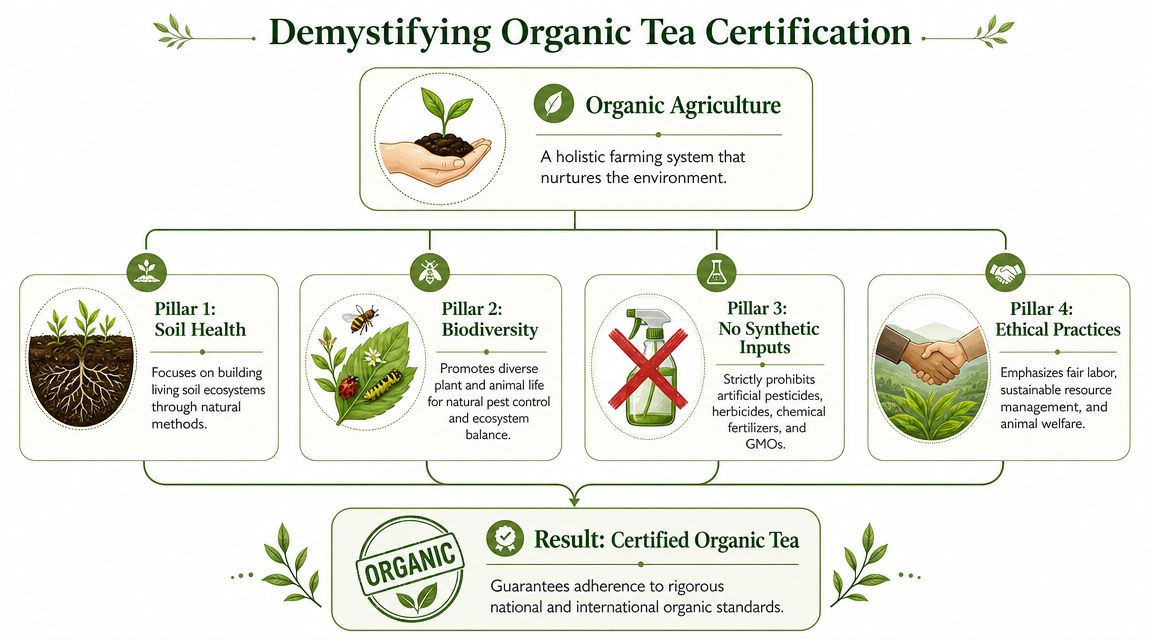
When people say organic tea is “pesticide-free”, they usually mean well. But that shorthand is too narrow. Organic is a full production system. It covers how the land is managed, how crops are supported, how inputs are controlled, and how the final product earns the right to carry an organic claim.
The four ideas behind organic farming
Organic tea farming usually rests on a few core principles:
- Living soil matters. Growers focus on building fertile, active soil rather than treating soil as a neutral base that holds the plant upright.
- Biodiversity helps. A healthier farm environment can support balance between plants, insects, and surrounding ecology.
- Synthetic inputs are restricted. The system is built around avoiding artificial pesticides, herbicides, and chemical fertilisers.
- The process must be verified. A tea isn't organic because the packaging looks earthy or the brand uses words like pure, natural, or clean.
That last point is the one many shoppers miss.
What verification looks like in Australia
In Australia, practical trust comes from certification and compliance, not marketing language. That's why this matters so much for tea buyers. The article discussing organic green tea and certification in the Australian context notes that the Australian organic market was valued at about A$2.59 billion in 2023, while consumer understanding of certification remains uneven, which is exactly why shoppers need to know how to confirm a tea is organic in this Australia-focused discussion of organic verification.
Here's what to look for when you pick up a tea:
- A recognised certification mark on the pack, rather than vague wellness wording.
- Clear origin information, especially if the tea is imported.
- Specific organic language that suggests formal certification rather than loose branding.
- Retail transparency, where the seller explains what standard the tea meets.
Practical rule: If a tea says “natural” but doesn't clearly show how its organic claim is verified, treat it as unproven until you can confirm more.
Imported tea can absolutely be organic. That includes Japanese green tea and matcha. What matters is whether the product has been certified to an accepted standard and marketed in line with Australian requirements. If you want a tea-specific breakdown, this article on the difference between regular and organic matcha adds useful context.
Organic as part of a wider lifestyle choice
For many people, choosing organic tea also fits into a broader low-waste, lower-impact way of living. If that's part of your thinking, this guide on how to start your zero waste journey is a practical companion read.
Organic Versus Conventional Green Tea
Organic and conventional green tea can both taste good. Both come from the same tea plant. The difference lies in how the crop is grown and managed, and that can shape how people think about quality, environmental impact, and value.
A balanced comparison helps here. This isn't about turning conventional tea into a villain. It's about understanding trade-offs clearly enough to make your own call.
Organic vs. Conventional Green Tea at a Glance
| Attribute | Organic Green Tea | Conventional Green Tea |
|---|---|---|
| Farming approach | Grown under organic standards with a focus on ecological balance | Grown using conventional agricultural methods |
| Soil management | Emphasises soil health and natural fertility practices | May rely more heavily on synthetic fertilisers |
| Pest and weed control | Uses organic-compliant methods | May use synthetic pesticides or herbicides |
| Certification | Requires formal certification to support the claim | Not sold as organic unless certified |
| Shopper confidence | Easier to assess when certification marks are clear | Depends more on brand transparency and sourcing detail |
| Environmental approach | Often chosen by people seeking lower-impact farming systems | Can vary widely by producer |
| Flavour experience | Often described as clean, bright, and expressive of origin | Can also be enjoyable, though farming style varies |
| Price | Often priced at a premium because of production and certification requirements | Often available at a wider range of price points |
Where the difference is most practical
The decision often comes down to priorities.
If you care most about certification-backed farming standards, organic will usually appeal more. If your priority is finding a tea you enjoy at an accessible price, conventional tea may still suit you. Plenty of tea drinkers move between both categories depending on the style, source, and budget.
One useful way to think about it is this. Organic tea asks you to pay attention to the system behind the leaf, not just the final beverage. That often resonates with people who already care about ingredients, traceability, and farming methods in the rest of their food.
Why growing method can affect perceived quality
Tea is sensitive. Soil condition, water, climate, leaf handling, and processing all influence what ends up in your cup. The growing method is only one part of that picture, but it does shape how many people evaluate quality.
If you're interested in the broader farming conversation, this piece on how to compare organic vs chemical fertilizers gives useful background on why growers and consumers view these systems differently.
A higher price doesn't automatically mean a better tea. But a certified organic tea gives you a clearer explanation of what you're paying for.
The Wellness Compounds in Every Sip
Green tea's wellness reputation starts with what is inside the leaf. Organic certification matters for how the tea is grown, handled, and verified, especially under Australian organic standards, but the compounds people care about come from the tea plant itself. What organic can do is give you more confidence in the growing system behind those compounds, which matters if you want a cleaner, more traceable daily habit.
Polyphenols and catechins
Green tea is rich in polyphenols, a broad group of plant compounds linked to its antioxidant profile. A review of green tea bioactives and brewing conditions explains that these compounds make up a large share of the leaf and notes that green tea contains thousands of naturally occurring bioactive substances.
Within that group, catechins are the stars. EGCG gets the most attention because it is one of the best-studied catechins in green tea. If the tea leaf were a small orchestra, catechins would be the instruments you hear most clearly in the final performance. They shape much of what people mean when they talk about green tea as a wellness drink.
That does not mean every cup feels the same. Leaf quality, freshness, and preparation all affect what reaches your mug.
L-theanine and calm alertness
Green tea also contains L-theanine, an amino acid that helps explain why tea feels different from coffee for many drinkers. The combination of L-theanine and caffeine often creates a gentler sense of alertness, more like a steady tide than a sudden wave.
This is one reason green tea fits so well into everyday routines. A morning cup can help you settle into work. An afternoon brew can feel refreshing without the sharp edge some people notice from stronger caffeinated drinks.
Organic farming does not create L-theanine or catechins. The plant does that naturally. In practical terms, organic certification in Australia gives you a checked and documented production system, which can make it easier to choose tea with the level of traceability and ingredient confidence many wellness-focused drinkers want.
Brewing changes what you get from the cup
Brewing is where leaf chemistry becomes a real-life experience. Water that is too hot can push green tea toward bitterness, while a gentler temperature usually gives you a smoother cup with better balance. As noted earlier in that same preparation review, moderate brewing temperatures and a short steep help extract beneficial compounds without making the tea harsh.
A simple way to picture it is cooking vegetables. Too little heat and you do not get the best texture or flavour. Too much heat and the result turns dull or unpleasant. Green tea works in a similar way.
If you want to put that into practice, starting with a quality loose-leaf option makes a noticeable difference. PepTea's guide to the best organic green tea loose leaf is a useful place to compare styles that suit everyday brewing.
Here's a short visual explainer if you want to see green tea compounds discussed in a more accessible format.
Green tea works best as a daily ritual, not as a miracle product. Its value comes from consistent enjoyment, good brewing, and leaves from a source you trust.
Your Guide to Popular Organic Green Teas
Walk into a good tea shop and you'll quickly learn that green tea isn't one thing. It's a family of styles. Two of the most useful examples are Sencha and Matcha. They show how processing changes not just flavour, but the whole drinking experience.
Sencha for a fresh everyday cup
Sencha is the classic daily green tea for many drinkers. You brew the leaves in water, let them steep, and then remove them. The result is usually light to medium-bodied, grassy, fresh, and gently savoury.
It suits the kind of moment where you want a clean, uncomplicated cup. Mid-morning at your desk. A quiet reset after lunch. A teapot shared with someone who's curious about green tea but not ready for anything too intense.
Matcha for the whole-leaf experience
Matcha is different from almost every other tea because you don't steep and strain it. You whisk the powdered tea directly into water, so you consume the whole leaf.
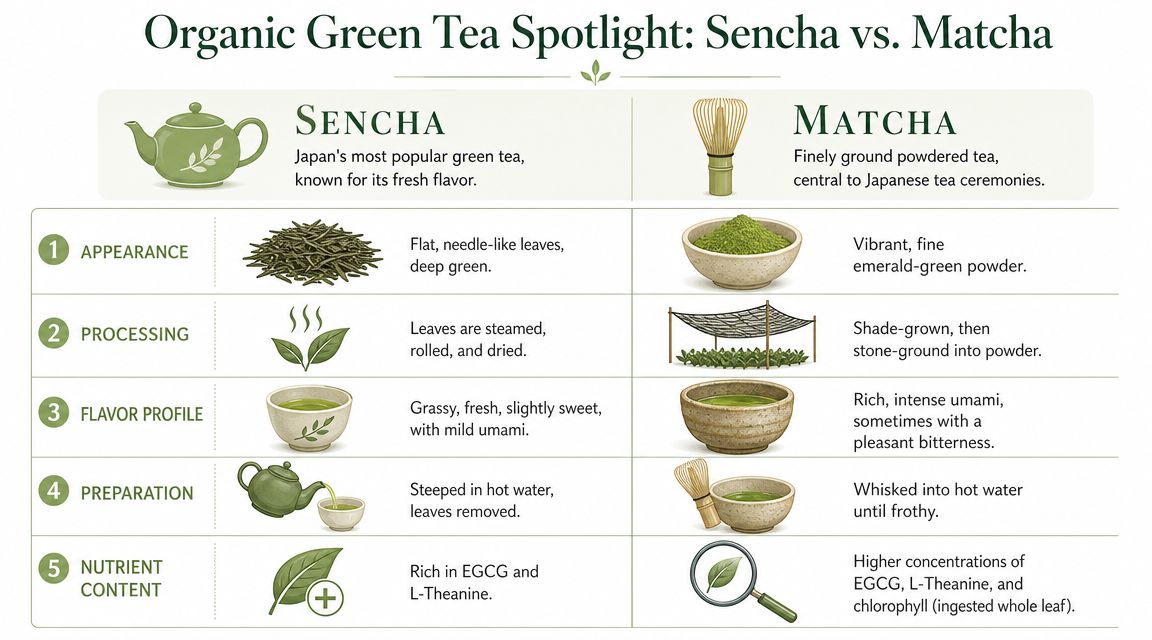
That changes texture, flavour, and intensity. Matcha tends to feel richer, creamier, and more concentrated than a standard leaf brew. The source used in this article notes that a standard cup of brewed green tea can provide 178 to 823 mg of catechins, while products like Matcha that use the entire leaf offer a more concentrated source of those compounds in this green tea overview.
If Sencha feels like a clear, bright conversation, Matcha feels like the full orchestra.
Choosing by mood and use
A simple way to choose:
- Pick Sencha when you want a classic steeped tea with lift and freshness.
- Choose Matcha when you want a fuller texture, a more immersive tea ritual, or a tea that works beautifully in lattes and recipes.
- Use high-quality green tea in other formats if you enjoy wellness drinks beyond the teacup. Green tea is also the traditional base for kombucha, which is one reason it appears so often in functional beverage spaces.
If you want to keep exploring styles beyond these two, this guide to the best organic green tea loose leaf is a useful next read.
Bringing Green Tea Into Your Daily Routine
Knowing what organic green tea is helps. Knowing how to buy, brew, and store it makes the difference between a tea you admire on the shelf and one you enjoy every day.
How to buy with confidence
Look for three things first:
- Certification you can identify. Don't rely on soft words like pure or natural.
- Clear origin details. Tea that tells you where it comes from usually gives you more confidence than tea with a vague back label.
- Fresh-looking leaf or powder. Matcha should look vividly green rather than dull or khaki. Loose green tea should look lively, not tired and dusty.
The one golden brewing rule
Don't pour boiling water straight onto green tea.
Green tea is delicate. If the water is too hot, bitterness can jump forward and flatten the sweeter, softer notes in the cup. Use water that's hot but not aggressively boiling, and give the tea enough time to open without overdoing it.
A simple routine works well:
- Heat your water.
- Let it cool slightly if it has just boiled.
- Brew gently rather than aggressively.
- Taste and adjust next time.
How to store it so it stays good
Tea hates three things: air, heat, and light.
Store green tea in an airtight, opaque container somewhere cool and dry. Keep it away from the stove, sunny windows, and constantly opened pantry spots. Matcha is especially sensitive, so freshness matters even more.
Buy the best tea you can, then protect it properly. Poor storage can undo the care taken in growing and processing it.
Your Organic Green Tea Questions Answered
Can I drink organic green tea every day
For many people, yes. Organic green tea can sit comfortably in a daily routine, much like a regular walk or a bowl of oats. The practical question is not only whether it is organic, but whether the tea suits your body, your caffeine tolerance, and the way you drink it.
With green tea, the key is paying attention to how your body responds. A lighter sencha in the morning may feel very different from a strong matcha in the afternoon. If you are pregnant, managing a health condition, or taking medication, check with a qualified health professional before making it an everyday habit.
Does organic green tea have less caffeine than coffee
Usually, green tea contains less caffeine per cup than coffee, but the experience is often different for another reason too. Green tea also contains L-theanine, an amino acid that can soften the sharper edge people sometimes feel from coffee.
That is why one cup of green tea may feel steadier, while coffee can feel more abrupt. Brewing style matters here. A longer steep, more leaf, or a bowl of matcha can all change the caffeine level in your cup.
Is organic green tea better for the environment
In Australia, organic means more than a nice label on the front of the pack. It points to a certified farming system with rules around synthetic chemicals, soil care, and production methods. For a tea drinker, that matters because the standard connects what happens on the farm to what ends up in your cup.
A healthier farming system can support better soil structure, more balanced growing conditions, and cleaner handling practices. Organic certification does not guarantee that every tea will taste the same or that every farm operates identically. It does give you clearer proof that the grower has met a recognised standard rather than relying on vague claims like natural or clean.
That clarity is a big part of quality.
Organic green tea is best understood through four parts: plant, place, processing, and certification. The leaf is still green tea, but the organic standard asks more of the producer and gives the buyer more confidence in return.
If you're ready to turn that knowledge into a daily ritual, explore Pep Tea for premium organic Matcha and Australian-brewed organic kombucha made for clean flavour, steady energy, and everyday wellness.
Organic Green Tea with Lemon: A Guide to Wellness for 2026

When you think of a daily wellness ritual, it's easy to picture complicated routines or expensive fads. But what if one of the simplest, most enjoyable upgrades to your day is already in your kitchen? We’re talking about organic green tea with lemon—a flavourful, straightforward way to support your wellbeing, one delicious cup at a time.
Your New Everyday Wellness Ritual
For many Australians, a cup of tea is a cherished daily habit, a moment of pause in a busy schedule. This isn’t some niche health trend; it’s a delightful enhancement to a ritual you already know and love.
Tea is a cornerstone of daily life down under. The Australian Bureau of Statistics’ National Health Survey found that 1 in 4 people aged 15 and over had a cup of tea the day before their interview, cementing its place as a true Aussie staple.
This familiarity is what makes organic green tea with lemon so approachable. It isn't a radical overhaul of your routine, just a simple, powerful adjustment.
More Than Just a Drink
At PepTea, our passion is for premium organic ingredients because we know that true quality is the foundation of wellness. This simple combination of high-quality organic green tea and zesty lemon aligns perfectly with a modern, health-conscious lifestyle—without ever giving up on flavour or enjoyment.
It’s all about celebrating the synergy between two of nature's best ingredients:
- The Clean Energy of Green Tea: We source premium organic teas, like our Japanese Matcha, known for their antioxidants and ability to provide a calm, sustained energy boost.
- The Zesty Boost of Lemon: A splash of fresh lemon doesn't just brighten the flavour; it works in tandem with the tea to enhance its natural benefits.
This drink is incredibly versatile. It fits seamlessly into your day, whether you prefer it as a steaming mug to start your morning or as a refreshing iced tea on a warm afternoon. It’s a simple pleasure that carries profound benefits, making it an ideal cornerstone for anyone looking to add a little more wellness into their routine.
You can explore even more options in our guide to healthy green tea drinks for 2026.
The Nutritional Synergy of Green Tea and Lemon
Think of organic green tea and lemon as a classic partnership where each one makes the other better. Green tea on its own is a powerhouse, rightly celebrated for its high concentration of antioxidants. But when you add a squeeze of fresh lemon, something remarkable happens.
The key players in green tea are a group of natural antioxidants called catechins. The most well-known of these is epigallocatechin gallate (EGCG), the compound behind many of the health-supportive qualities that have made green tea a daily ritual for centuries.
Then you have lemon, which brings its own star ingredient to the table: Vitamin C. While most of us know it for its role in supporting the immune system, Vitamin C plays another vital part here—it acts as both a protector and an enhancer for the catechins in your tea.
How Lemon Unlocks More From Your Green Tea
The real magic is in how they work together. The catechins in green tea are quite delicate and can degrade during digestion, meaning your body might not get the full benefit. This is where the Vitamin C from lemon steps in.
Research has shown that the acidity and Vitamin C from lemon help to stabilise these fragile compounds, making them more resilient as they pass through your digestive system.
This simple act means your body can absorb significantly more of the beneficial EGCG from your brew. It’s a classic example of nutritional synergy.
The Power of Synergy: Adding lemon to your organic green tea can increase the amount of catechins your body absorbs by several times. It's a perfect illustration of how combining two simple, natural ingredients creates an effect far greater than the sum of its parts.
Let's break down exactly what's happening when these two ingredients meet.
Green Tea & Lemon Nutritional Synergy
| Component | Found In | Primary Role | Synergistic Benefit |
|---|---|---|---|
| Catechins (EGCG) | Green Tea | Powerful plant-based antioxidant. | Stabilised by Vitamin C, leading to much higher absorption in the body. |
| Vitamin C | Lemon | Immune support and antioxidant. | Protects catechins from degrading during digestion, boosting their bioavailability. |
| L-Theanine | Green Tea | An amino acid known for promoting calm focus. | Lemon's bright, acidic flavour complements the tea, making for a more enjoyable ritual. |
| Citric Acid | Lemon | Provides the signature tart flavour. | Creates an acidic environment that helps preserve the catechins. |
This table shows it's not just a flavour pairing; it's a functional one. The components in lemon actively work to make the beneficial compounds in green tea more available to your body.
This enhanced absorption makes the combination a brilliant choice for supporting your daily wellness goals. It’s an easy, delicious way to hydrate while giving your body that little bit extra. This infographic shows just how this simple drink can become part of a healthy lifestyle.
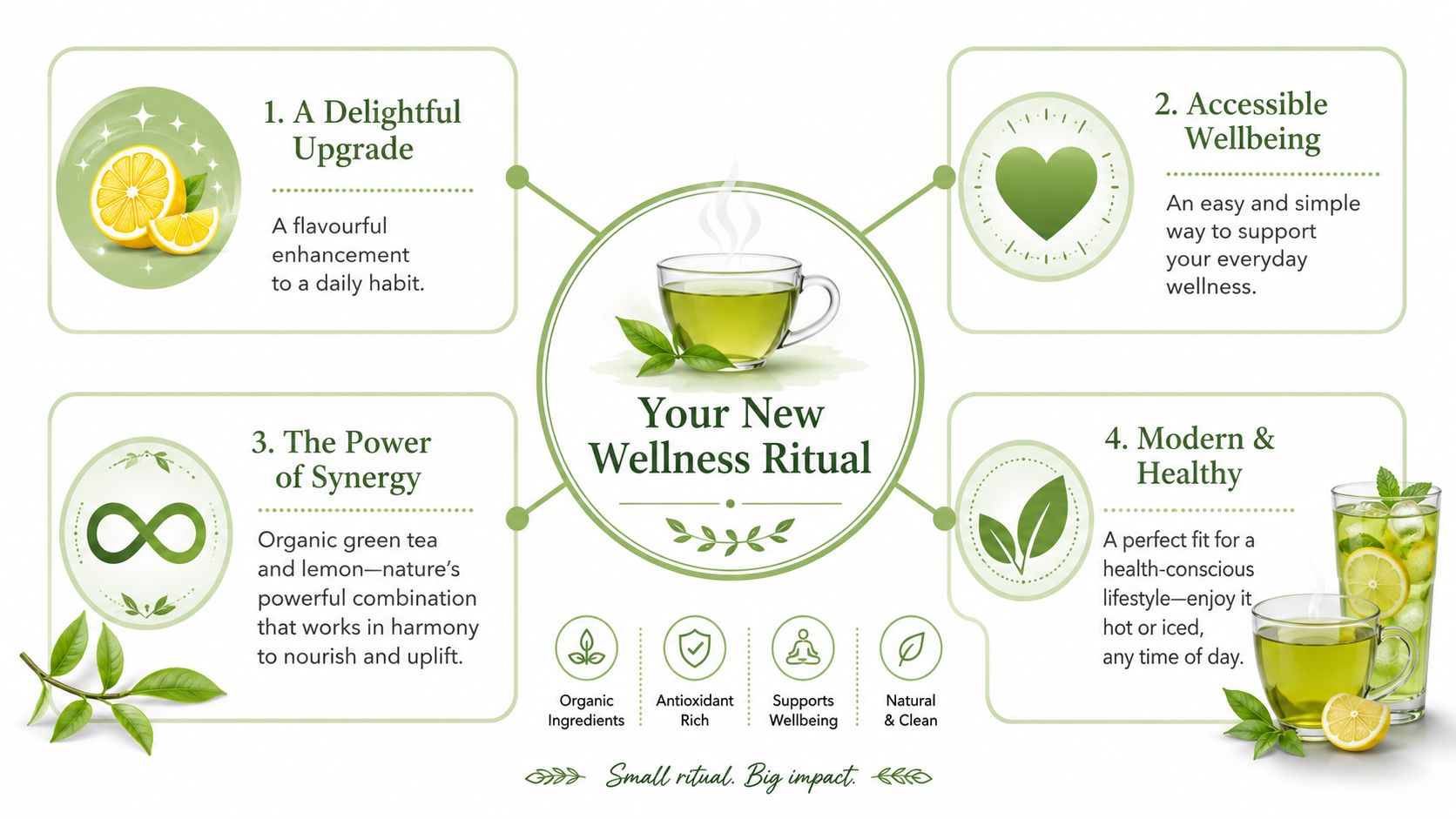
As the graphic illustrates, this isn't just a drink; it's a simple upgrade to your daily routine, powered by the natural intelligence of its ingredients. By pairing high-quality organic green tea with fresh lemon, you’re creating a simple ritual that may support:
- Immune Function: A double-act from Vitamin C and the tea’s antioxidants.
- Metabolic Health: Green tea has long been associated with supporting a healthy metabolism.
- Smarter Hydration: It's a flavourful, virtually zero-calorie alternative to plain water or sugary drinks.
Ultimately, adding a slice of lemon transforms a simple cup of tea into a more effective wellness tool, making it a perfect fit for a health-conscious Australian lifestyle.
How to Choose a Quality Organic Green Tea
Knowing the benefits of organic green tea with lemon is one thing, but actually choosing the right ingredients is where the real work begins. The quality of your final cup is decided the moment you choose your tea leaves and your lemon—not all are created equal.
This is especially true in Australia, where "organic" has become more than just a label. It's now a central part of a clean-food movement that has seen consumer demand skyrocket, turning the organic food and beverage sector into a multi-billion dollar industry. This shift isn't just a trend; it's driven by people who genuinely care about where their food comes from and how it's grown. As this insightful study from PMC shows, this makes high-quality organic ingredients a sought-after choice for everyone from home brewers to professional café owners.
Making the right choice here means you're not just making tea; you're creating a beverage that’s pure, flavourful, and packed with everything you want and nothing you don't.
Look for Certified Organic
The first thing to look for is a "certified organic" label. This isn't just marketing fluff. In Australia, it’s a legally protected term, guaranteeing the tea has been grown without any synthetic pesticides, herbicides, or fertilisers.
This matters immensely for tea. Unlike a piece of fruit that you can peel, the leaves are steeped directly in your water. Choosing organic is your assurance that you’re brewing pure leaf, not a chemical cocktail of unwanted residues.
Loose Leaf vs. Tea Bags
Tea bags are convenient, there's no denying it. But loose-leaf tea almost always delivers a superior experience.
- Flavour and Aroma: Loose-leaf teas are made from whole or larger pieces of leaves, which hold onto their natural oils and aromatic compounds. The result is a richer, more complex, and more satisfying flavour.
- Potency: Because the leaves are larger, water can circulate more freely around them. This allows for a better extraction of the tea’s beneficial antioxidants and nutrients, like the calming L-theanine you'll find in our premium organic Matcha range.
- Purity: A surprising number of conventional tea bags contain microplastics. They’re also often filled with "dust" and "fannings"—the small, broken scraps left over after higher-quality leaves have been sorted.
Choosing loose-leaf is an investment in a purer, more potent, and more flavourful cup. It's a small adjustment to your routine that makes a world of difference to the final drink.
Natural Lemon vs. Artificial Flavouring
Lastly, always reach for a fresh, real lemon instead of a product with "lemon flavouring." Artificial flavours simply can't mimic the bright, authentic taste or nutritional punch of fresh lemon juice. That vibrant zest and hit of Vitamin C are essential for the synergistic effect we talked about earlier, helping your body absorb all the goodness the tea has to offer. A simple squeeze is all it takes.
Brewing the Perfect Cup Every Time
Making an exceptional cup of organic green tea with lemon isn't about complicated steps; it's an art of paying attention to the small details. It’s what separates a decent brew from a truly memorable one, ensuring you get all the flavour and goodness without a trace of bitterness. When you have high-quality ingredients, you want to treat them with the care they deserve.
The process has a lot in common with any precise brewing method. It’s about gently coaxing out the tea’s delicate notes, much like how different techniques can choose your ideal coffee brewer to achieve the perfect extraction. Your goal is a smooth, balanced infusion, not a harsh one.
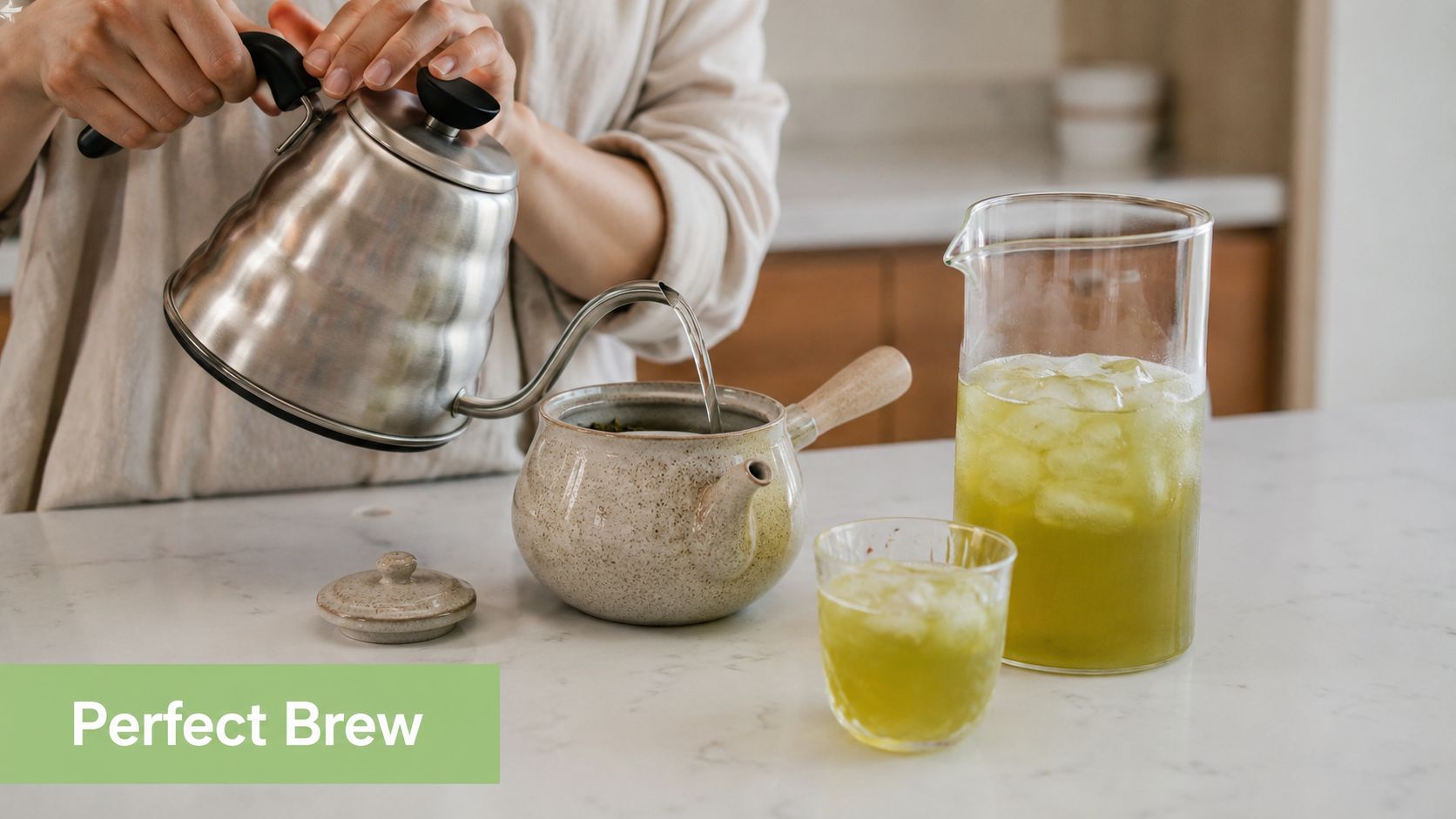
The Perfect Hot Brew
The single biggest secret to a smooth, sweet cup of green tea is water temperature. Boiling water, at 100°C, is simply too aggressive for delicate green tea leaves. It scorches them, releasing bitter-tasting tannins that completely overwhelm the tea’s natural sweetness.
For the best results, just follow these simple steps:
- Heat Your Water: Aim for water that’s around 80°C. If you don’t have a temperature-controlled kettle, it’s easy—just boil the water and let it stand for two to three minutes before pouring. Precision here is key, and you can learn more about why in our guide to using an electric tea kettle with temperature control.
- Steep the Tea: Pour the hot water over your loose-leaf organic green tea and let it steep for 1–3 minutes. A shorter steep time will give you a lighter, more delicate flavour, while a longer one creates a stronger brew.
- Add Lemon Last: This is a non-negotiable step. Squeeze fresh lemon juice into your cup after the tea has finished steeping and you’ve removed the leaves. If you add lemon during the brewing process, the acidity can interfere with extraction, dulling the tea’s vibrant green colour and stopping its sweet, umami notes from coming through properly.
Refreshing Iced Green Tea with Lemon
For those warm Australian days, nothing quite hits the spot like a crisp glass of iced tea. This simple recipe is a perfect thirst-quencher.
- Brew a Stronger Batch: Follow the same steps as you would for hot tea, but double the amount of tea leaves. This creates a stronger concentrate that won’t taste watered down once you add ice.
- Cool It Down: Let the brewed tea cool to room temperature on the counter before moving it to the fridge to chill completely.
- Serve and Enjoy: Fill a glass with ice, pour over the chilled tea, and finish with a generous squeeze of fresh lemon. A slice of lemon for garnish makes it look as good as it tastes.
Creative Tip: Matcha Lemonade
For a vibrant, energising twist, try making a Matcha Lemonade. Whisk a teaspoon of premium organic Matcha powder into a small amount of cold water until you have a smooth paste. Top it up with more cold water, ice, and a good squeeze of fresh lemon juice. It’s a bright, modern, and powerfully refreshing way to enjoy the benefits of organic green tea.
Creative Uses in Your Café and Kitchen
A simple, hot cup of organic green tea with lemon is a ritual worth keeping. But thinking of it only as a finished drink is missing its real potential. For our innovative café partners and adventurous home cooks, this classic pairing is a versatile flavour ingredient, ready to be pulled apart and used in ways that can redefine a menu.
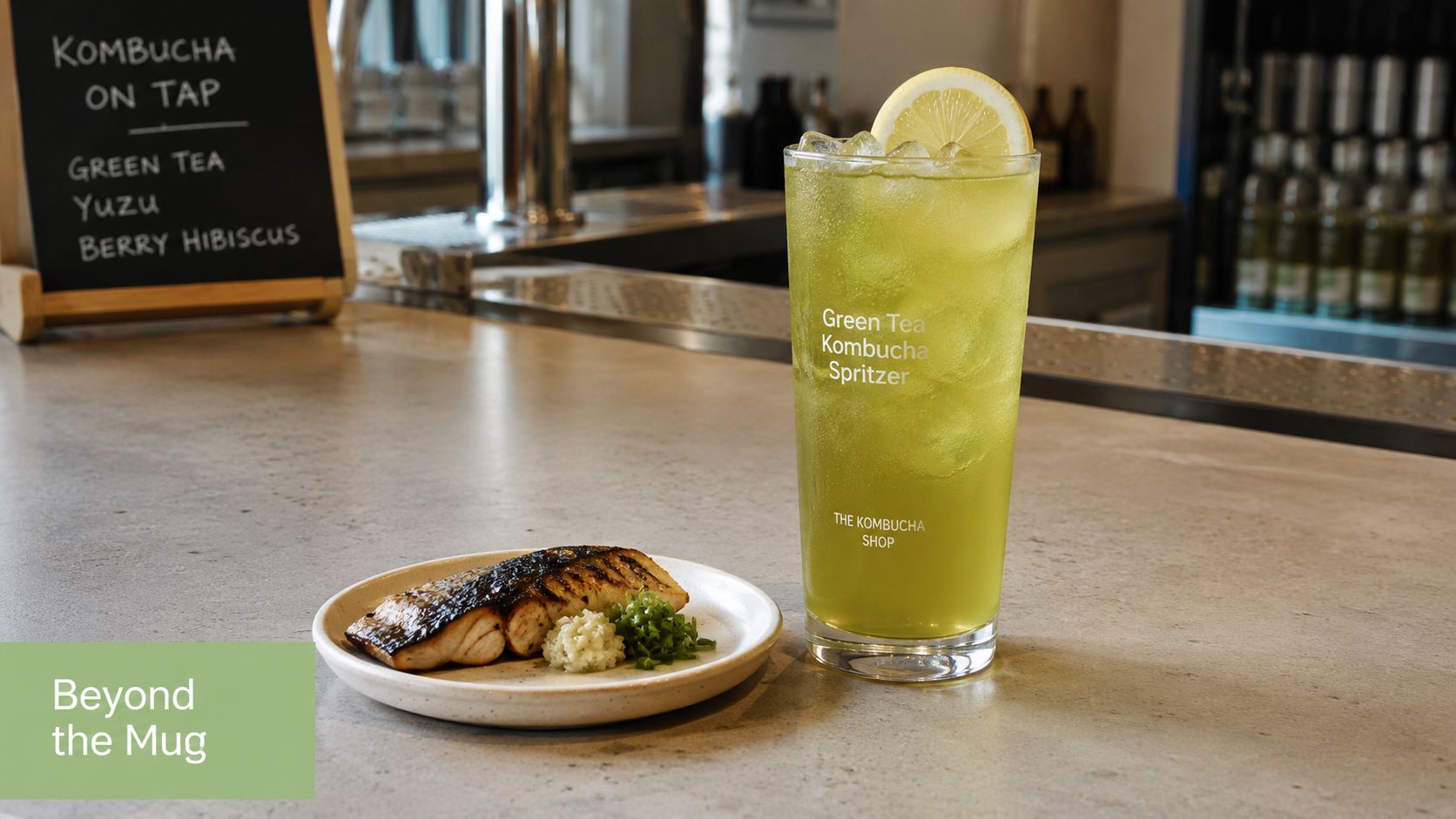
When you start treating your tea as a functional component, a whole world of culinary possibilities opens up. It’s a move that aligns perfectly with what modern customers want: clean, flavour-forward ingredients with a story.
For the Modern Australian Café
Café owners are constantly hunting for unique, healthy, and profitable menu items. Organic green tea with lemon is a fantastic, sugar-free base for sophisticated non-alcoholic drinks that genuinely appeal to health-conscious patrons.
- Elevated Mocktails: Use a strongly brewed, chilled organic green tea as the foundation for vibrant mocktails. Its earthy, slightly astringent character is the perfect counterpoint to muddled herbs like mint, a splash of sparkling water, and just a hint of natural sweetener if needed.
- Wellness Lattes: Move beyond the standard flat white by creating a Lemon Green Tea Latte. Simply froth your milk of choice (or a dairy-free alternative) with a dash of lemon-infused syrup and pour it over a shot of strong green tea. The result is creamy, zesty, and deeply comforting.
Mastering any beverage comes down to understanding the fundamentals of extraction and brewing. Digging into resources like Everti's coffee tea bag recommendations can offer valuable insights that apply just as well to tea as they do to coffee.
Our Signature Green Tea Kombucha Spritzer
One of our favourite creations is a functional ‘super-drink’ that brings together two of our passions: exceptional organic tea and authentic, living kombucha. It’s incredibly simple to make but delivers on complexity and refreshment.
Recipe: PepTea Green Tea Kombucha Spritzer
- Brew a strong batch of organic green tea and let it cool completely.
- Fill a glass with ice and pour it halfway with the chilled green tea.
- Top it up with PepTea’s sugar-free Organic Kombucha—our Ginger or Lime & Ginger flavours work beautifully here.
- Finish with a generous squeeze of fresh lemon juice and garnish with a lemon wheel.
This spritzer is more than just a drink; it's a probiotic-rich, antioxidant-packed beverage that hits the mark on both health and flavour. It’s the kind of signature offering that gets people talking.
In Your Home Kitchen
The culinary applications don't stop at drinks. The clean, bright notes of organic green tea and lemon make it an excellent secret ingredient in both savoury and sweet dishes.
- Flavourful Marinades: Use cooled green tea with lemon as a light marinade for fish or chicken. The tea’s natural tannins help to tenderise the protein, while the citrus adds a fresh zing that cuts beautifully through any richness.
- Dessert Syrups: Create an elegant finishing syrup by gently simmering equal parts water and sugar with a few green tea bags and some lemon peel. Once infused and cooled, this syrup is incredible drizzled over panna cotta, fresh fruit salads, or even a scoop of vanilla bean ice cream.
Understanding Safe and Healthy Consumption
Adding organic green tea with lemon to your daily routine is a brilliant little wellness habit. But like any good thing, the real secret to enjoying it long-term is finding the right balance. For most of us, this drink is overwhelmingly beneficial, but knowing a few general guidelines helps you build a healthy practice that actually sticks.
One of the first questions that always comes up is about caffeine. Yes, green tea has caffeine, but usually far less than your standard flat white. More importantly, the caffeine in green tea comes paired with L-theanine, an amino acid that encourages a sense of calm focus. It’s what helps you sidestep the jittery highs and crashing lows that often come with other caffeinated drinks.
General Guidelines for Daily Enjoyment
Honestly, listening to your own body is always the best advice you'll get. But general recommendations can be a great place to start. Most of the research into green tea’s benefits points towards consistent, moderate consumption as the key.
Studies have linked it to things like reduced LDL cholesterol and lower cardiovascular risk, with some finding that three or more cups a day delivered the best results. You can read more about how green tea supports wellness in this guide from WebMD.
The aim is to build a consistent daily ritual, not to overdo it. A gentle, steady intake is almost always more powerful than drinking a huge amount every now and then.
For most healthy adults, enjoying 1 to 3 cups of organic green tea with lemon per day is the perfect range. This amount lets you tap into all those antioxidant and hydration benefits without going overboard on caffeine.
Of course, your personal situation always matters most. If you have specific health conditions, an iron deficiency, or you're pregnant, it’s smart to be a little more mindful. For more context on this, you might find our article on matcha in pregnancy helpful.
Ultimately, just pay attention to how you feel. Your body is the best guide you have for finding the perfect, healthy balance that works for you.
Your Organic Green Tea Questions Answered
When you start making organic green tea with lemon a regular part of your day, a few questions always come up. We've got the straightforward answers you're looking for, based on what really matters for flavour, nutrition, and getting the most out of every cup.
Can I Drink Organic Green Tea With Lemon Every Day?
Yes, absolutely. For most people, enjoying one to three cups a day is a simple, sustainable wellness habit. It’s a great, low-calorie way to stay hydrated and get a gentle antioxidant boost without overdoing it.
Of course, it’s always wise to listen to your own body, particularly when it comes to caffeine. While green tea has less caffeine than coffee, its real magic lies in the L-theanine, which promotes that unique feeling of calm alertness. This makes it an ideal daily drink.
Is It Better to Use Fresh Lemon or Lemon-Flavoured Tea?
There’s no contest here: fresh lemon is always the better choice. Squeezing a wedge of fresh lemon into your brewed organic green tea delivers a bright, zesty flavour that pre-flavoured teas just can't replicate.
More importantly, fresh lemon juice provides a real dose of Vitamin C. This isn't just about flavour; the Vitamin C is crucial for helping your body actually absorb the tea’s catechins. Pre-flavoured teas rely on oils or powders that offer convenience but miss the nutritional synergy that makes this combination so powerful.
Does Adding Lemon Destroy Green Tea's Nutrients?
This is a common misconception, but the reality is the exact opposite. Adding lemon doesn’t just protect the nutrients in your green tea; it actually makes them more available to your body.
The Vitamin C in lemon juice acts as a preserver for the delicate antioxidants in green tea, like EGCG. Studies have shown it significantly increases the amount of these compounds your body can absorb. It’s a perfect case of nutritional synergy, where the two ingredients together are far more effective than either one on its own.
What Is the Best Time of Day to Drink Green Tea With Lemon?
The best time really comes down to what you want to get out of it. There are a few excellent windows:
- In the Morning: It’s a great way to start your day with a gentle, focused energy boost, setting a calm tone.
- After Meals: Having a cup 30–60 minutes after eating is a popular choice for those who find it aids digestion.
- In the Afternoon: It’s the perfect antidote to a midday slump, offering a lift without the jittery intensity of coffee.
Because of its caffeine content, anyone particularly sensitive might want to avoid it late in the evening. However, most people find its lower caffeine and high L-theanine levels don’t interfere with sleep. The only way to know for sure is to experiment and see what works for your body’s rhythm.
At PepTea, we're passionate about providing premium, certified organic ingredients to support your wellness journey.
Explore our full range of organic teas and sugar-free kombucha online.
7 Healthy Green Tea Drinks for 2026

Looking for a healthy drink that tastes good and fits real life in Australia? That's where most advice falls short. People hear “green tea” and think of one plain hot cup, when the better question is which format gives you the benefits you want without piling on sugar, syrup, or fluff.
Healthy green tea drinks now cover a much wider range than traditional brewed tea. You've got whisked matcha for calm energy, unsweetened bottled green tea for grab-and-go convenience, and kombucha for a fizzy option that can fit a low-sugar routine. In Australia, tea is already part of everyday life. The CSIRO and ABS National Nutrition and Physical Activity Survey found tea was one of the most commonly consumed non-alcoholic beverages, with about 42% of adults drinking tea on the survey day, which helps explain why green tea-based drinks slot so naturally into daily habits (Harvard Nutrition Source tea overview).
This guide gets straight to the drinks and ingredients worth knowing. Some are ready to drink. Some are pantry staples that let you make better café-style drinks at home. All are useful if you're trying to choose healthy green tea drinks with a more practical, low-sugar lens.
1. Pep Tea

Want one Australian brand that helps you cover both sides of the green tea habit? Pep Tea is a useful place to start because it spans two very different needs. It offers premium organic Japanese matcha for home preparation and Australian-brewed sugar-free organic kombucha for fridge-ready convenience.
That split matters. A lot of shoppers lump all green tea drinks together, then wonder why one feels like a morning ritual and another works better as a cold afternoon pick-me-up. Matcha and kombucha come from green tea, but they play different roles in real life.
Pep Tea's matcha suits the part of your routine where you want focus, flavour, and a bit of intention. You whisk it with water, blend it into a smoothie, or turn it into an iced latte at home. Its kombucha suits the moments when you want something already made, lightly tangy, and easy to grab from the fridge or pack into an esky.
Why it stands out
The brand is strongest when you look at it through a practical health lens. Its matcha is stone-ground and organic, which matters because matcha gives you the whole tea leaf in powdered form rather than a brewed infusion alone. That is part of why people interested in antioxidants, calm focus, and steadier energy often start with matcha. If you are comparing formats for green tea drinks that may support weight goals, matcha is often the ingredient-style option, while kombucha is the ready-to-drink option.
Its kombucha range fills a different gap. Pep Tea brews raw, living kombucha in NSW with organic green tea and live cultures, and the sugar-free approach makes it easier to keep your drink choice aligned with a low-sugar routine. That is useful if you like the idea of kombucha but do not want something that tastes like soft drink wearing a health halo.
A simple way to choose between the two is this:
Practical rule: Pick matcha when you want a warm or iced green tea ritual. Pick kombucha when you want cold refreshment with fizz and no prep.
A few strengths and trade-offs are worth knowing before you buy:
- Best for versatility: The matcha can be whisked traditionally, added to smoothies, used in lattes, or mixed into baking.
- Best for low-sugar routines: The sugar-free kombucha gives you a fizzy option without pushing you back toward sweet drinks.
- Best for beginners: The brand's education and recipe content helps new matcha drinkers learn how to use the product well.
- Possible drawback: Public pricing and full product range details are not always the first thing you see, so cafés or wholesale buyers may need to enquire directly.
- Possible drawback: Matcha is more concentrated than standard brewed green tea, so caffeine-sensitive drinkers may do better with smaller serves.
When to choose it
Pep Tea makes the most sense if you do not want to choose between ingredient quality and convenience. That is the Australian angle here. Some people want a pantry staple they can use for better homemade drinks. Others want a ready-made bottle or can that fits work, errands, beach days, or alcohol-free catch-ups. Pep Tea speaks to both.
It also fits a broader shift in the Australian tea market, where buyers increasingly look for low-sugar, functional drinks framed around routine use rather than old-fashioned tea ceremony language. This trend is reflected in the Statista tea market outlook.
For cafés and retailers, the lesson is fairly simple. Clear language such as sugar-free, organic, calm focus, and clean refreshment usually makes more sense to customers than vague wellness hype.
2. ITO EN Oi Ocha Unsweetened Green Tea (AU)

Sometimes the healthiest choice is the least complicated one. ITO EN Oi Ocha Unsweetened Green Tea is exactly that kind of drink. It's bottled brewed green tea with no sweetener profile to decode and no dessert-like flavouring trying to make it feel more indulgent than it is.
That makes it a handy benchmark. If you're ever unsure whether a green tea drink is healthy, compare it to an unsweetened bottled tea like this. It gives you the familiar brewed tea experience in a convenient format, which is ideal for work bags, lunch runs, or the car.
Who it suits best
This is a great pick for people who want healthy green tea drinks without turning the drink into a snack. It also suits anyone trying to understand whether they enjoy green tea itself, rather than milk, syrups, or fruit flavourings wrapped around it.
Harvard's health guidance is useful here. Green tea is most helpful when it replaces sugary beverages, not when it becomes a sweetened café-style drink. That's a practical lens worth keeping in mind if you're exploring the best green tea for weight loss, because “green tea” on a label doesn't automatically mean low sugar or a better everyday choice.
Unsweetened brewed green tea is often the cleanest baseline. Everything else should earn its place from there.
A few things to like:
- Simple ingredient profile: No added sweeteners means fewer surprises.
- Easy format: Good for people who won't reliably brew tea at home.
- Traditional flavour: Best for drinkers who want something crisp and tea-forward.
The main downside is also the point. It's plain. If you want flavoured drinks, creamy texture, or a functional twist like probiotics, this won't scratch that itch. It also mostly comes in PET bottles, which won't suit every shopper.
3. East Forged Nitro Cold-Brew Australian Green Tea & Pitaya

East Forged Nitro Cold-Brew Australian Green Tea & Pitaya feels more like a modern fridge-can drink than a traditional tea. That's the appeal. It uses Australian-grown green tea, cold-brewed and infused with nitrogen for a creamy, microfoam texture, but without tipping into a sugary energy-drink vibe.
If you like sparkling water, nitro coffee, or adult-style canned refreshers, this is one of the more interesting healthy green tea drinks on the Australian market. The pitaya note gives it a point of difference, but the product still reads as restrained rather than flashy.
Why the format matters
Cold brew changes the experience. Instead of the brisk edge you sometimes get from hot brewed green tea served cold later, nitro cold brew feels softer and smoother in the mouth. That can make green tea more approachable for people who think they don't like it.
This sort of product also lines up with a bigger shift in the category. Green tea demand has expanded through premium and fortified formats, while buyers increasingly look for healthier alternatives to sugary drinks. The broader category direction described in the Mordor Intelligence green tea market report helps explain why a product like this has room to stand out.
- Best feature: Nitro gives it a creamy texture without milk.
- Best use case: Great straight from the can, especially chilled.
- Best fit: Sugar-conscious drinkers who want convenience and novelty.
The trade-off is choice. It's a more niche product with a narrower flavour lane, so it won't be as easy to find as supermarket kombucha or classic bottled tea. Still, for people bored by standard RTD tea, this is a fun upgrade.
4. Remedy Drinks Organic Kombucha (AU)
Remedy Drinks Organic Kombucha is one of the easiest kombuchas to find around Australia. For many people, that accessibility matters more than perfection. If a drink is available at the local supermarket, servo fridge, or convenience stop, it has a much better chance of becoming part of a regular low-sugar swap.
Remedy brews with organic green and black tea and keeps live cultures in the finished drink. It's a kombucha first, not a straight green tea, so think of it as a fizzy functional alternative when you want something more lively than still tea.
A realistic kombucha pick
Kombucha often gets marketed as if all bottles are equally wholesome, and that's where people can get confused. The practical question isn't whether kombucha sounds healthy. It's whether the final product fits your own preferences around sweetness, ingredients, and everyday use.
Remedy is transparent about its tea base and fermentation approach, which is helpful. If you're comparing options in the broader world of healthy probiotic drinks, that transparency makes shopping easier, especially for consumers who want live cultures without the heavy sugar hit they associate with some chilled drinks.
A kombucha can be a smart low-sugar choice, but it still won't behave like plain brewed green tea. Treat it as its own category.
A few clear pros and cons:
- Big advantage: Widely available in major Australian retail channels.
- Big advantage: Organic credentials and kombucha-specific identity are easy to understand.
- Potential drawback: Some products use erythritol or stevia, and not everyone enjoys that taste.
- Potential drawback: Flavoured kombucha is more layered than plain tea, so purists may prefer a simpler green tea drink.
For people moving away from soft drink or alcohol, Remedy is a practical stepping stone.
5. Lo Bros Kombucha (AU)

Lo Bros Kombucha leans a little more into flavour variety, which makes it a good option for drinkers who want healthy green tea drinks that feel fun rather than austere. It uses an organic black and green tea base and then layers in fruit and botanicals across different SKUs.
That means the experience is less about tasting the tea clearly and more about choosing a flavour mood. For some people, that's a plus. It's easier to reach for a kombucha habitually if the drink feels satisfying and social.
Where it fits in a healthy routine
Lo Bros works well for the afternoon can slot. It's the sort of drink you might choose instead of a soft drink with lunch, instead of a mid-arvo snack run, or as a non-alcoholic option when everyone else opens something fizzy.
The strongest use case is variety. If plain bottled green tea feels too minimalist and matcha feels too involved, kombucha with broader flavour options can be the middle ground. You still get a tea-based beverage, but in a more playful package.
Here's the balanced take:
- Why people like it: The flavour range keeps things interesting.
- Why shoppers choose it: National supermarket availability makes repeat buying easy.
- What to watch: Some SKUs use erythritol or stevia, and ingredient lists vary.
- What it isn't: It isn't a pure brewed green tea experience.
Lo Bros is best for people who care about low sugar but still want a drink that feels more like a treat than a ritual.
6. Matcha Maiden Organic Matcha Powder (AU)

If you want to make healthy green tea drinks at home without going deep into specialist tea culture, Matcha Maiden Organic Matcha Powder is a friendly entry point. It's an Australian brand offering organic Japanese matcha in several sizes, so it suits both the curious beginner and the regular latte maker.
The appeal here is usability. Some matcha brands feel intimidating if you're not already whisking daily. Matcha Maiden is more accessible. You can use it for straight matcha, iced drinks, smoothies, and recipe work without feeling like you're “wasting” a precious tin.
Good for everyday experimenting
This is the kind of matcha that makes sense if you're still figuring out how you like your drink. Maybe you want a classic bowl one day, an iced oat matcha the next, and a smoothie the day after that. Flexible powder is what lets healthy green tea drinks become practical rather than aspirational.
If you're new to prep, Pep Tea's guide to making matcha tea is worth a read because the technique matters. A quick sift, the right water temperature, and proper whisking can change the drink from flat and clumpy to smooth and bright.
Good matcha habits matter more than fancy gear. Start with fresh powder, don't scorch it with boiling water, and whisk properly.
A few honest notes:
- Best for value-minded drinkers: Multiple pack sizes make daily use easier.
- Best for recipes: Suitable for lattes, smoothies, and baked goods.
- Possible limitation: If you're chasing a highly refined ceremonial experience, specialist tea houses may offer a more nuanced cup.
For a lot of households and cafés, though, this level of accessibility is exactly the point.
7. Love Tea Organic Green Teas and Matcha (AU)

Love Tea organic green teas and matcha are a good reminder that healthy green tea drinks don't always need to come chilled, canned, or café-styled. Sometimes the best option is a reliable organic tea range you can brew at home or serve in a venue with confidence.
Love Tea offers variety across green tea styles, including Australian Sencha, jasmine green tea, Moroccan mint, and matcha. That's useful for people who don't want to commit to one format only. You can keep a straightforward daily green tea in the cupboard and still have a matcha tin for more focused mornings.
Best for tea drinkers who want range
This range suits households and hospitality venues that want choice. A café can offer a cleaner, classic brewed green tea alongside milk-based matcha drinks. A home drinker can switch between plain green tea on one day and a more involved whisked drink on another.
That flexibility matters because not all evidence around “functional” green tea products is equally strong. Consumer coverage often oversimplifies the category, but the most established evidence still points most clearly to traditional brewed tea, with benefits described more modestly than many marketing headlines suggest. That nuance is reflected in News-Medical's discussion of why green tea shows the strongest health benefits.
For practical buying, that means:
- Choose brewed tea if you want the most straightforward everyday option.
- Choose matcha if you value ritual, texture, and a more concentrated tea experience.
- Choose by use case rather than hype.
Love Tea is especially handy for people who want to stay close to traditional tea drinking while still having matcha in the mix.
7-Brand Healthy Green Tea Drinks Comparison
| Product | 🔄 Implementation Complexity | 💡 Resource Requirements | ⭐ Expected Outcomes | 📊 Ideal Use Cases | ⚡ Key Advantages |
|---|---|---|---|---|---|
| Pep Tea | High, HACCP kombucha brewing + stone‑ground matcha processing | Certified organic tea supply, brewery/SCOBY management, education content, wholesale channels | High antioxidant matcha (EGCg, L‑Theanine); probiotic, sugar‑free kombucha | Home baristas, cafés, specialty retailers, wellness professionals | Certified organic + HACCP production; dual matcha & kombucha range; strong educational support |
| ITO EN Oi Ocha Unsweetened (AU) | Low–Moderate, large‑scale brewing and bottling | Consistent tea sourcing, bottling/PET supply, national distribution | Authentic unsweetened green tea flavour; 0 sugar | Everyday RTD consumers, grocery retail, on‑the‑go refreshment | Reliable, authentic taste; wide retail availability |
| East Forged Nitro Cold‑Brew | Moderate, cold‑brew + nitrogen infusion and canning | Local green tea, nitro infusion equipment, small‑batch canning | Creamy nitro texture, very low sugar, low caffeine | Sugar‑conscious RTD shoppers, niche cafés, DTC customers | Distinctive nitro mouthfeel; clean label |
| Remedy Drinks – Organic Kombucha | High, long fermentation with live culture retention | Organic tea bases, fermentation facilities, large‑scale distribution | Live cultures with minimal residual sugar; finished "no sugar" claims | Mass retail buyers, mainstream probiotic seekers | Market leader with nationwide retail presence; transparent process |
| Lo Bros Kombucha | High, fermented and flavoured kombucha production | Organic tea, flavourings, production to supermarket scale | Varied flavours with low sugar and live cultures | Supermarket shoppers, flavored kombucha consumers | Broad flavour range; strong supermarket availability |
| Matcha Maiden – Organic Matcha Powder | Low–Moderate, sourcing, grinding and packaging | Japanese Uji/Kyoto matcha supply, packing lines, wholesale/retail channels | Organic matcha suitable for daily lattes/recipes; consistent quality for price | Home and café matcha preparation, bulk buyers | Clear pricing, bundle deals, multiple pack sizes for daily use |
| Love Tea – Organic Green Teas & Matcha | Low, hand‑packing and multiple formats | Certified organic tea sourcing, local packing in Victoria, retail networks | Wide variety of organic green teas and matcha; reliable supply | Brew‑at‑home users, hospitality menus, cafés | Diverse formats (loose, bags, canisters); local packing and competitive pricing |
Choosing Your Perfect Green Tea Ritual
The best healthy green tea drinks aren't all trying to do the same job. That's the main thing to remember. A bottled unsweetened green tea is built for convenience. A matcha powder is built for ritual, flexibility, and a more concentrated tea experience. A kombucha is built for refreshment, fizz, and an easy low-sugar swap when you want something more social or snack-like.
That difference matters even more in Australia, where the sugar question is hard to ignore. The Australian Bureau of Statistics reports that 31.7% of Australians lived with obesity in 2022, and the National Diabetes Services Scheme notes that over 1.5 million Australians are registered with diabetes, which is a useful reminder to look closely at what's in a green-tea-based drink before assuming it's automatically healthy (Harvard green tea healthy habit article). A matcha latte with sweetener, a bottled green tea drink, and an unsweetened brewed tea can sit very differently in your day.
If you're choosing for everyday wellness, start simple. Unsweetened brewed green tea is a strong baseline. Matcha is excellent when you want calm energy, a richer tea flavour, and more room to create hot or iced drinks at home. Kombucha can be a smart fridge staple when you're after a tea-based alternative to soft drink or alcohol, especially if you prefer a lower-sugar style and enjoy live cultures.
For cafés, retailers, and hospitality buyers, the same logic applies. People don't just want “wellness” on the label. They want drinks that fit real moments. Morning focus. Afternoon refreshment. A smarter non-alcoholic option. A low-sugar choice that still feels enjoyable. The winning menu or shelf mix usually includes more than one format.
Pep Tea is particularly strong if you want both ends of that spectrum from one Australian brand. You can explore premium organic matcha for your home or venue, or keep things easy with sugar-free organic kombucha brewed here in NSW. Either way, choosing thoughtfully makes healthy green tea drinks much more than a trend. It turns them into a routine you'll keep.
If you're ready to build a better daily drink ritual, explore Pep Tea for premium organic matcha and Australian-brewed sugar-free kombucha. Whether you're whisking at home, upgrading your café menu, or just trying to swap sugary drinks for something cleaner, we've got options that make wellness feel easy and enjoyable.