
Author: admin
Matcha Coconut Milk Guide: Ratios, Recipes, and Pro Tips
You're halfway through making a matcha latte at home, or you've just ordered one at a café, and the drink in front of you tastes richer, sweeter, and a bit more rounded than the one you made last week. Nine times out of ten, the difference isn't the whisking. It's the coconut milk.
In Australia, matcha coconut milk sits right where premium tea and plant-based milks meet, which is why it shows up so often on café menus and in home kitchens. The drink can be creamy and balanced, but the result changes a lot depending on whether you use canned full-fat coconut milk, a barista carton, or a lighter carton version. That choice affects texture, froth, flavour, and even how the matcha lands on the palate.
For a quick gut-check on matcha's broader appeal, PepTea has a useful overview of matcha tea powder as a powerhouse of antioxidants, which helps explain why so many people want to build a better latte around it. Coconut milk can absolutely work with matcha, but it works best when you match the milk format to the drink you want.
Why Matcha and Coconut Milk Work So Well Together
The first time a coconut milk matcha really clicks, it usually happens in a café. The drink arrives with that vivid green top, a soft creaminess underneath, and enough natural sweetness that you don't need to pile on syrup to make it pleasant. At home, the same thing can happen, but only if the coconut milk suits the style of drink you're making.
Matcha has a grassy, umami edge that can feel sharp if it's whisked into plain water and served without balance. Coconut milk softens that edge because its fat carries flavour and its natural sweetness rounds off bitterness. That's why it feels like such an obvious pairing in iced lattes, blended drinks, and café-style hot drinks, especially in Australia where plant-based menu options are now part of everyday ordering rather than a special request.
The commercial side matters too. A 2026 industry snapshot reported that matcha latte sales in Australian cafés reached AUD 50 million in 2023 worldmetrics.org. That doesn't just tell you matcha is trending, it explains why cafés keep testing different milk bases and why coconut milk keeps showing up on the board. It's one of the few dairy alternatives that can make matcha feel indulgent without needing cream.
The decision is simpler than most recipe posts make it sound. Don't start with “matcha coconut milk” as if it were one fixed drink. Start with the format of the coconut milk, then build the texture and flavour from there.
Practical rule: if you want a richer, rounder latte, choose the coconut milk first, then adjust matcha strength second.
Core Ratios and Equipment You Need Before You Start
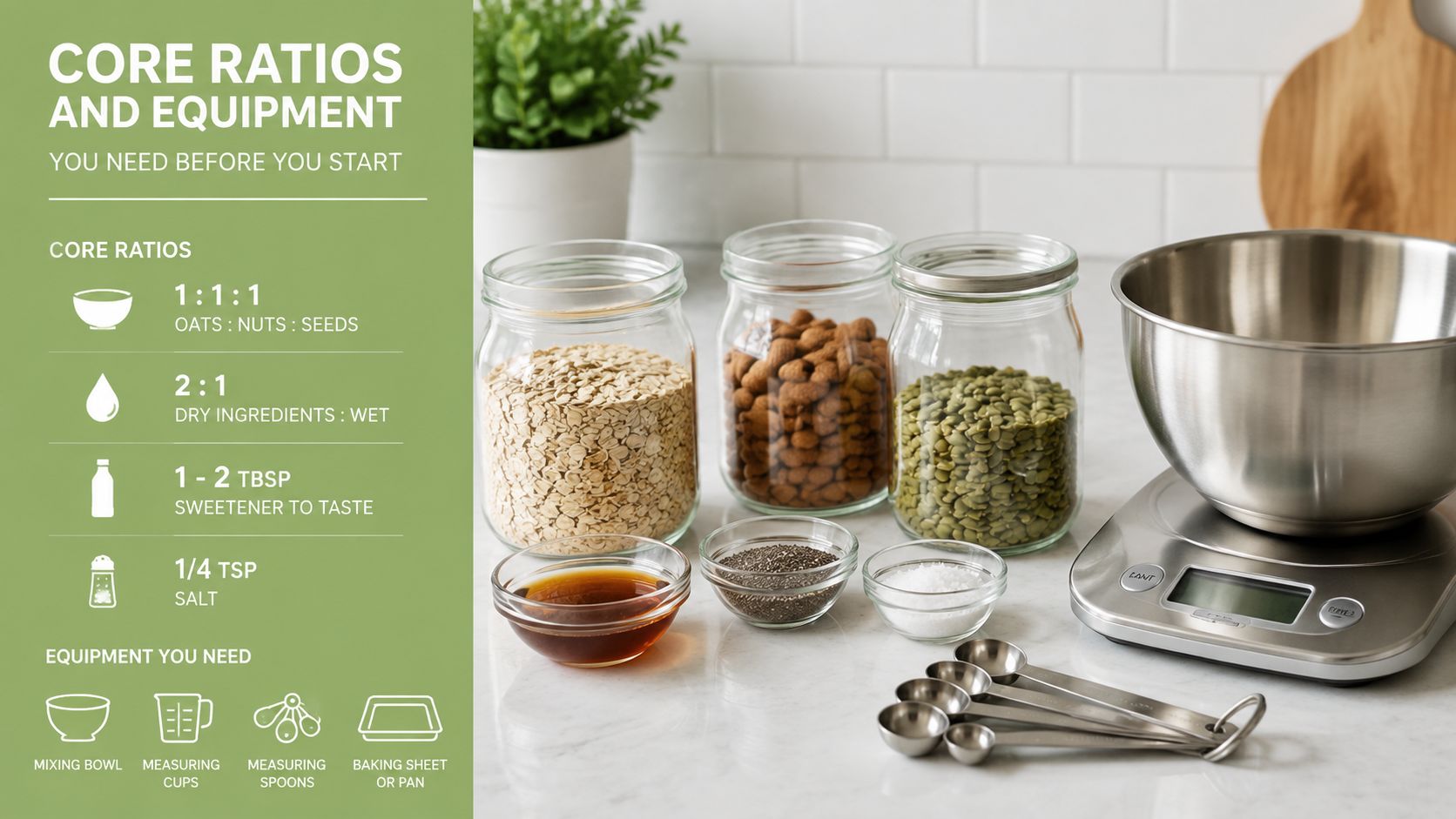
A good matcha coconut milk drink starts with a small, repeatable formula. For a home latte, a solid base is 2 g matcha to 30 ml hot water, then 180 to 220 ml coconut milk depending on how creamy you want the cup to feel. For a café-strength serve, 3 g matcha to 45 ml hot water with 220 to 250 ml coconut milk gives a stronger tea note that still holds up after ice or foam is added.
Water temperature matters just as much as the ratio. Keep it around 80°C, not boiling, so the matcha doesn't scorch or turn harsh. Whisk the powder into the hot water first, then add coconut milk after the matcha is smooth. If you dump everything together at once, you'll often get clumps or a flatter colour.
Your kit doesn't need to be fancy, but it does need to be the right kind of simple. A bamboo chasen gives you the best whisked texture, though a handheld frother works well for quick service. A fine sieve helps stop little green pockets from forming. A kitchen scale keeps the matcha dose consistent, and a small milk pitcher makes pouring cleaner, especially if you're layering a hot latte.
Key takeaway: whisk matcha and water first, keep the water near 80°C, then add coconut milk after the paste is completely smooth.
A small café counter setup makes the process easier if you're doing this daily. PepTea's matcha tea accessories page is a useful reference point for the sort of basic tools that make repeatable drinks less fiddly.
Choosing the Right Coconut Milk for the Job
Most recipes go vague and then wonder why the drink split, looked thin, or tasted oddly flat. In practice, canned full-fat coconut milk, barista-blend carton coconut milk, and light carton coconut milk behave very differently in matcha.
| Coconut Milk Formats for Matcha Drinks | Typical Fat % | Froth Behaviour | Best For | Watch Out For |
|---|---|---|---|---|
| Canned full-fat | Higher, usually the richest format | Thick, creamy, not ideal for light foam | Blended drinks, iced lattes, dessert-style serves | Can feel heavy and very saturated |
| Barista carton | Moderate, formulated for steaming | Best foam stability and pour control | Hot lattes, café service, layered drinks | Check for added sweeteners or flavours |
| Light carton | Lower | Thin foam, lighter body | Lower-calorie menus, smaller drinks | Can taste watery and struggle to hold matcha well |
Commercially listed nutrition makes the differences obvious. A typical coconut-milk matcha latte can sit around 38 kcal per 100 ml or 76 kcal per 200 ml serving, with 1.5 g fat per 100 ml and 4.3 g carbohydrate per 100 ml in one formulation Phytomorphology review. Another listed coconut-milk matcha example comes in at 120 calories, 7 g fat, 10 g carbohydrates, and 2 g protein per 240 g serving Eat This Much.
For café work, the practical benchmark is the fat band. Coconut milks in the 12 to 20% fat range tend to give the best mouthfeel and foam support, while products below 8% often drink too thin for a proper latte texture Alibaba guide. That's why canned works so well in blended drinks, barista cartons perform better in hot service, and light cartons are mainly for people deliberately chasing a thinner cup.
Three Ways to Build a Matcha Coconut Milk Drink
Hot Latte With Barista Coconut Milk
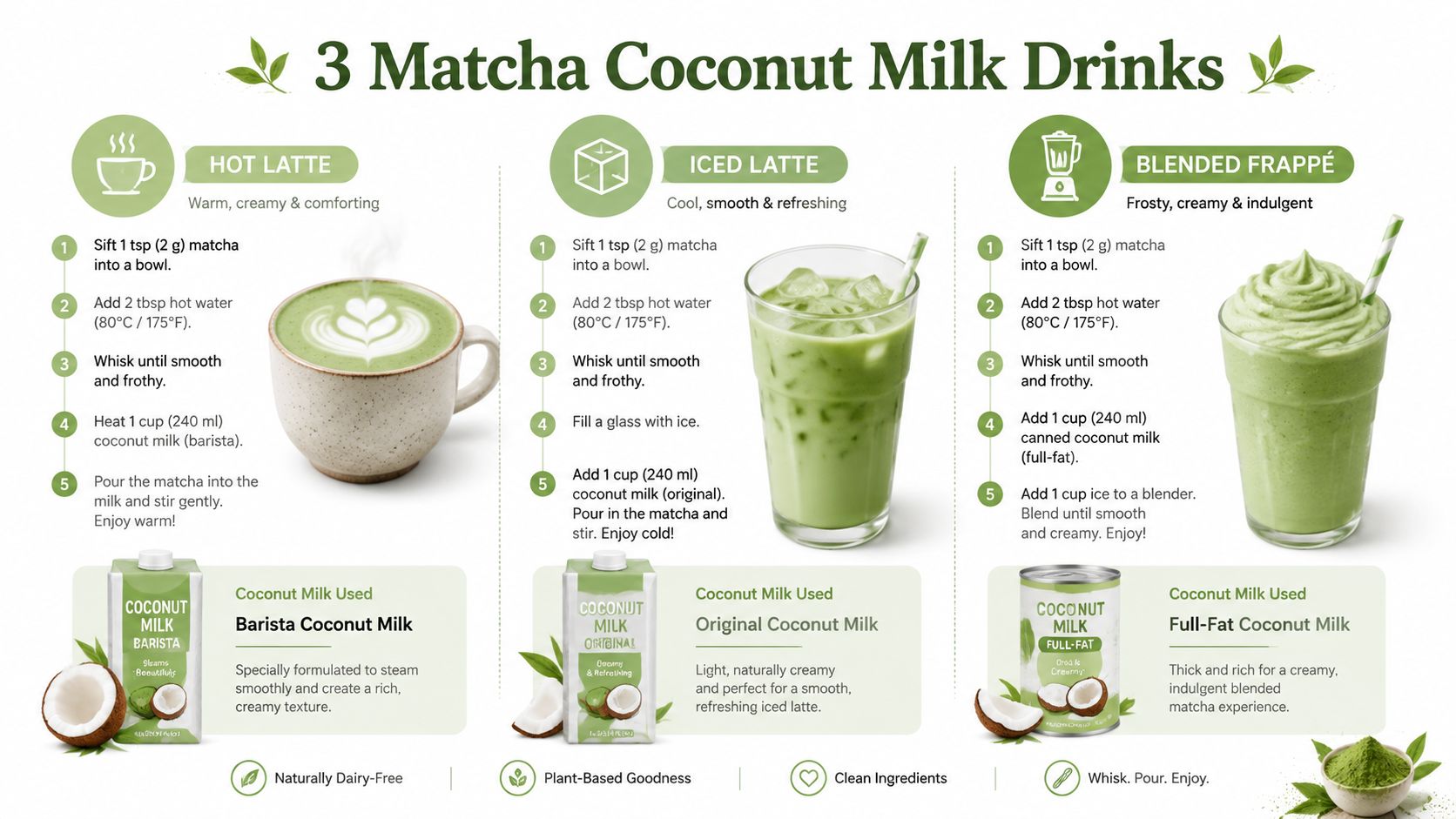
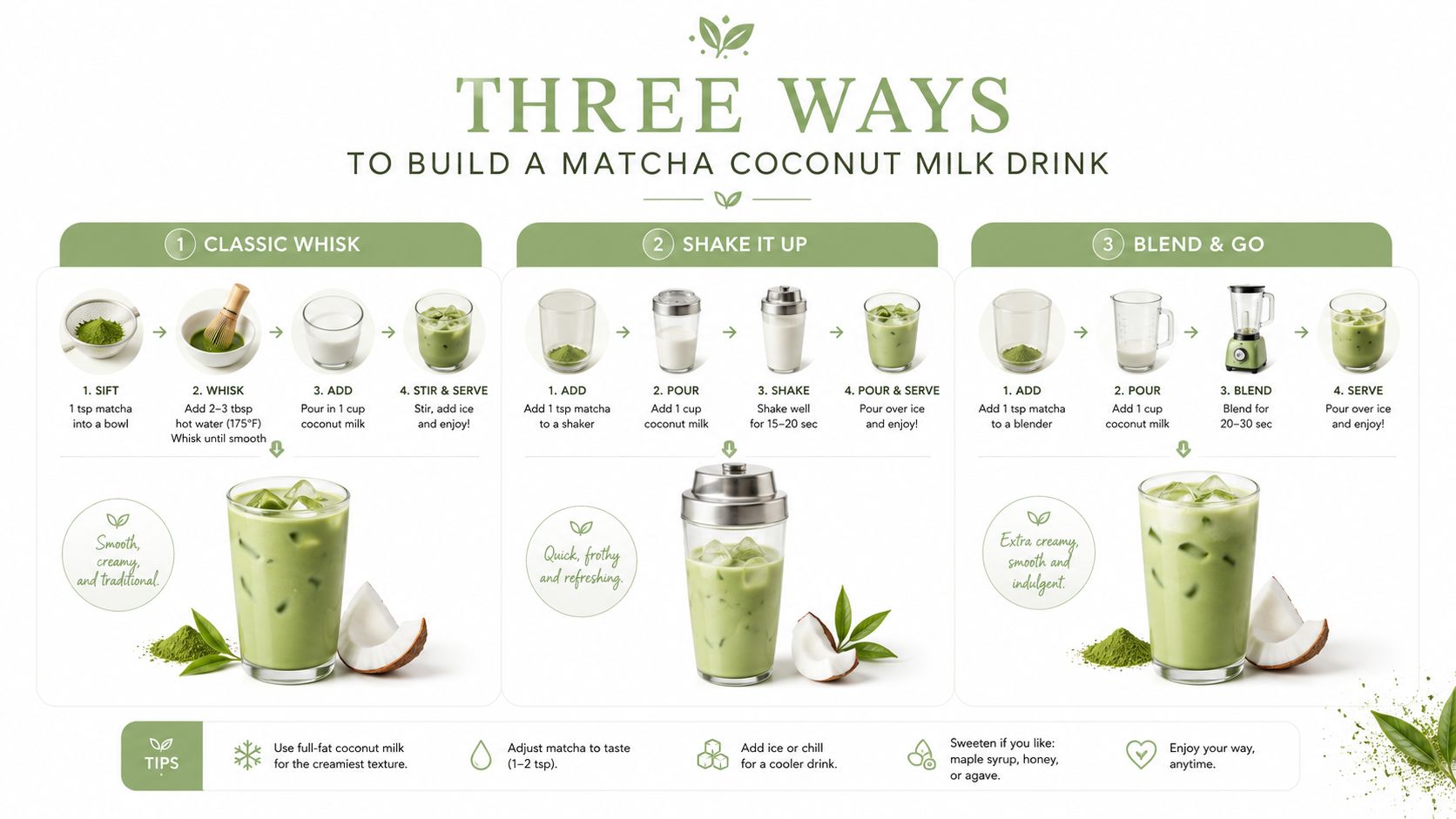
Use 2 g matcha, 30 ml water at about 80°C, and 180 ml barista coconut milk. Sift the matcha, whisk the water into a smooth paste, then steam the coconut milk to around 60 to 65°C so it stays stable and doesn't split. Pour the milk slowly into the matcha, then finish with a thin layer of foam.
If you're working by hand, keep the whisk tight and fast for about 15 to 20 seconds. The goal is a glossy surface, not a mountain of bubbles. A small milk pitcher helps you pour in a steady line instead of dumping the milk and flattening the top.
Iced Latte With Canned Coconut Milk
For a colder, richer drink, use 3 g matcha, 45 ml water, 120 ml plain water or milk base if you like a longer drink, and 100 to 120 ml canned full-fat coconut milk. Whisk the matcha with hot water first, then add a little room-temperature liquid if you want it looser, and pour over ice only after the matcha is fully dissolved.
The trick is to pour the coconut milk down the side of the glass so the foam sits on top rather than disappearing into the ice. This works especially well in a tall glass where the layers can show. It's also the version that handles sweetness best if you want to add a touch of maple or vanilla.
Blended Frappé With Lighter Coconut Milk
For a blended drink, use 2.5 g matcha, 40 ml hot water, 150 ml light coconut milk, and a good handful of ice. Blend for 20 to 30 seconds until the texture looks smooth and aerated, not watery. If the drink comes out too thin, the coconut milk is probably too light for the style.
This version is useful when you want the matcha flavour without the density of canned milk. It works better with a lighter carton than with a heavy one, because the blend stays colder and less claggy. The colour also stays bright if you blend only until the ice breaks down.
Nutrition, Antioxidants, and the Coconut Milk Trade-Off
Coconut milk makes matcha feel more luxurious, but it also changes what the drink is doing nutritionally. One listed coconut-milk matcha latte comes in at 129 calories, 11 g fat, 12.9 g carbohydrate, and 0.99 g protein in a 330 g serving, with 10 g saturated fat making up 50% of daily value worldmetrics.org. Another listing shows 265 calories, 25 g fat, 8 g carbohydrates, and 3 g protein in a 150 ml coconut-milk matcha serve Arise app. That spread tells you how much the final cup shifts with formulation and portion size.
The more important functional point is what happens to the matcha itself. A review of milk variants in matcha tea found that adding milk, regardless of source, significantly reduces matcha's antioxidant profile, including total phenolic content, total flavonoid content, DPPH radical scavenging activity, metal chelating ability, and ferric-reducing power Phytomorphology review. In plain language, the drink still tastes like matcha, but the antioxidant-dense profile of pure matcha is diluted once coconut milk goes in.
That's why I wouldn't sell this drink as a protein option or a low-calorie tea. In Australian cafés, it lands more naturally as a premium creamy functional beverage. If you want to keep the profile lighter, use a smaller serve, choose a lighter coconut milk, or make the matcha stronger so it doesn't disappear behind the fat.
Sweetened versions can add another layer. One commercial listing for Starbucks' Matcha Green Tea Latte with coconut milk shows 143 calories, 20.3 g sugars, and 60 mg caffeine per serving CalorieKing. That's useful as a calibration point, because it shows how quickly sugar can change the drink from creamy to sweetened café treat.
PepTea's guide on how many cups of matcha tea powder are safe per day is a sensible companion read if you're balancing strength, serving size, and how often you want to drink matcha coconut milk.
Frothing, Heating, and Sweetening Without the Mistakes
If the Milk Splits
Heat the coconut milk gently and stop at around 60 to 65°C. Go much hotter and the drink can separate, especially if you're using a thinner carton or a product with fewer stabilisers. Barista blends usually behave better because they include emulsifiers that hold the milk together under steam.
If the Foam Is Weak
The fat is probably too low. Light carton coconut milk can still taste fine, but it rarely gives you the same foam structure as a barista blend, and it'll often collapse before you finish the cup. If you want a proper cappuccino-style top, switch to a higher-fat format or use a stronger steam stretch and pour immediately.
If the Matcha Tastes Bitter or Chalky
The matcha wasn't fully whisked before it hit cold liquid. Always dissolve it into hot water first, then add the coconut milk after the paste is smooth. If you need sweetness, a little maple syrup or vanilla works more naturally with matcha than heavy sweeteners, and a small amount is usually enough.
For something different, a cold sugar-free kombucha topper can work well with an iced matcha coconut build when you want acidity instead of extra sweetness. PepTea's own Hunter Valley-brewed kombucha is one example of the kind of drink that can sit beside matcha rather than compete with it. That combo keeps the finish brighter, especially in summer service.

Serving It at Home, in a Café, or on a Wholesale Menu
A good café menu uses the coconut milk format on purpose. A hot ceremonial matcha coconut latte works well with barista coconut milk, a low-sugar iced matcha coconut can be finished with a kombucha top, and a blended frappé-style version suits canned or richer coconut milk when you want a dessert-like texture. For wholesale planning, it helps to think in terms of milk cost, matcha dose, and serve size rather than just “one latte recipe”, and a practical wholesale pricing structure guide can be useful when you're mapping margins for menu testing.
For home use, the path is simpler. Try one milk format, keep the matcha dose steady, and note how the mouthfeel changes. If the drink gets too heavy, switch to a lighter carton. If it turns thin, move up to a barista or canned format.
PepTea's organic matcha grades and sugar-free kombucha fit naturally into those use cases as reference products for café and home drinks, especially if you want a clean, low-sugar menu base. Use them as the benchmark, not the shortcut.
If you want a drink that fits your palate, start with one of these three steps today: swap one coconut milk format, and log the result on taste, foam, and body. Then build the version that suits your kitchen, your café, or your regular order.
Pep Tea offers organic matcha and sugar-free kombucha that slot neatly into café drinks and home recipes like the ones above. If you want to compare matcha formats, test coconut milk pairings, or build a cleaner drink list for your menu, visit Pep Tea and explore the range.
Pesticide Free Tea Australia: Shop & Verify Safely

Many shoppers looking for pesticide free tea Australia assume an organic label settles the question. It doesn't. In Australia, organic certification tells you a grower or handler followed an audited system, but it doesn't automatically prove the tea in your cup is free from measurable residues, and that's the detail many buyers miss.
That distinction matters because tea is often treated like a simple pantry staple, when in reality it sits at the intersection of farming, compliance, traceability, and even packaging. If you're buying for your own kitchen, a café menu, or retail shelves, the core question isn't just “is it organic?”, it's “what proof do I have that this batch is clean enough for the claim I'm making?”
Why Organic Does Not Always Mean Pesticide Free
The cleanest way to think about tea in Australia is this, organic and pesticide free are related, but they're not the same promise. A compliant organic certificate shows that a supply chain has followed the relevant standards and audits, yet it doesn't replace chemical analysis of the finished lot. For a shopper, that gap is the whole story.

What the label actually tells you
Domestic organic labelling is governed by a voluntary standard, AS 6000–2015, while export organic products must comply with the National Standard for Organic and Bio-Dynamic Produce. The Australian Competition and Consumer Commission says that distinction matters, because a certificate mainly verifies farming and handling controls, not a residue test on the final tea.
For that reason, a buyer who needs a true pesticide free claim should look for batch-level multi-residue testing. That's the only way to substantiate a specific lot as residue-free in a practical, evidence-based sense.
Practical rule: if a seller can show certification but can't show a batch test, you've got assurance about process, not proof about residues.
If you want a plain-English primer on this distinction, PepTea's guide on whether organic tea can still contain pesticides is a useful place to start.
Why the difference matters in real life
Many tea guides stop at "organic" and leave readers thinking the job is done. In reality, cafés, retailers, and careful home buyers need to know whether the claim covers the farming system only, or the actual leaf in the packet.
That's especially relevant if you're choosing teas for customers who care about clean labels, because trust is built on specifics. A certificate says the supply chain was audited. A residue report says the product met a tighter, batch-specific standard.
Australian Pesticide Residue Standards Explained
Australian tea compliance sits on a fairly strict baseline, and that baseline shapes what “pesticide free” can legally mean. The APVMA and the Food Standards Code set maximum residue limits, and Tea Leaves Australia says the MRL is generally set at or around the limit of quantitation, typically about 0.05 mg/kg. That matters because even tiny measurable residues can become relevant to both compliance and consumer perception.
What the numbers mean
A residue limit isn't a marketing slogan, it's a regulatory line. If a product falls under it, that doesn't automatically make it a clean-label winner in the eyes of a cautious shopper. It means the product complies with the limit in that jurisdiction.
The historical context is useful here. A 2003 Choice magazine test of 55 tea products found pesticide traces in nearly 40% of samples, including 7 of 17 green teas, 8 of 20 black teas, and 6 of 18 herbal infusions. The same test reported 12 teas still contained pesticides within acceptable Food Standards Code limits, while 7 brands had cypermethrin above the limit and 3 of those were more than 20 times the MRL. That old snapshot still matters because it shows residue concerns were measurable across mainstream retail tea, not confined to one niche category. See the original report in the Sydney Morning Herald coverage of the Choice tea test.
Why clean-label positioning keeps growing
The commercial side is moving too. Tea Leaves Australia notes that IMARC estimates the Australia organic tea market was worth USD 28.00 million in 2024 and is projected to reach USD 54.18 million by 2033, implying a 7.61% CAGR from 2025 to 2033. That's a projection, not a guarantee, but it does show why residue-free positioning is becoming more important in shelf decisions and café menus. The market is rewarding brands that can explain provenance and proof, not just flavour.
| Metric | Value | Significance |
|---|---|---|
| Tea products tested in the 2003 Choice survey | 55 | Shows the issue was checked across a broad retail sample |
| Samples with pesticide traces | nearly 40% | Indicates residues were common enough to matter |
| Green teas with traces | 7 of 17 | Suggests the issue wasn't limited to black tea |
| Black teas with traces | 8 of 20 | Reinforces that mainstream tea categories were affected |
| Herbal infusions with traces | 6 of 18 | Shows herbal blends weren't automatically clean |
| Australian organic tea market, 2024 | USD 28.00 million | Clean-label demand has real commercial weight |
| Projected market value, 2033 | USD 54.18 million | Growth makes verification more commercially relevant |
Organic Certification Versus Batch Residue Testing
Certification and residue testing solve different problems, and buyers often blur them together. Certified organic systems focus on how tea is grown, handled, and traced. Batch testing focuses on what's in a particular shipment.
Side by side, the difference is obvious
Certified organic supply chains commonly rely on annual third-party audits, plus controls like soil, groundwater, and fresh-product sampling. Industry guidance from Australian tea sellers also notes that transaction certificates are used as the final lot-level control. By contrast, a batch residue test checks whether the tea itself shows pesticide residues at the time of testing.
The strongest assurance isn't one or the other, it's both together.
| Assurance path | What it checks | What it doesn't prove |
|---|---|---|
| Certified organic | Farming and handling controls, audit trail, transaction certificates | That the final batch is residue-free |
| Batch residue testing | Chemical results for a specific lot | That the farm followed organic methods throughout |
| Both together | Process controls plus chemical evidence | Much stronger low-residue confidence |
If you're buying for a café, that combined approach is the one that reduces awkward questions later. A wholesaler can show a certificate and still leave you guessing about the actual shipment. A batch report closes that gap.
For more detail on the audit side, PepTea's page on organic certification standards is a handy reference.
What a robust assurance package looks like
A supplier serious about pesticide free tea Australia should be able to show you a neat paper trail. At minimum, ask for:
- Organic certificate, so you can verify the supply chain sits under an approved system.
- Transaction certificate, so you know the lot you're buying is the lot that was certified.
- Batch residue report, so you've got chemical evidence for the specific shipment.
- Clear lot numbers, so the paperwork matches the packet or bulk carton.
A café owner doesn't need to become a lab technician. They do need to ask for the documents that prove the story on the menu.
How to Verify Pesticide Free Claims When Shopping
A good tea label should answer simple questions quickly. Who grew it, where was it packed, and what proof sits behind the clean claim? If the label goes vague at that point, treat it as a warning sign.
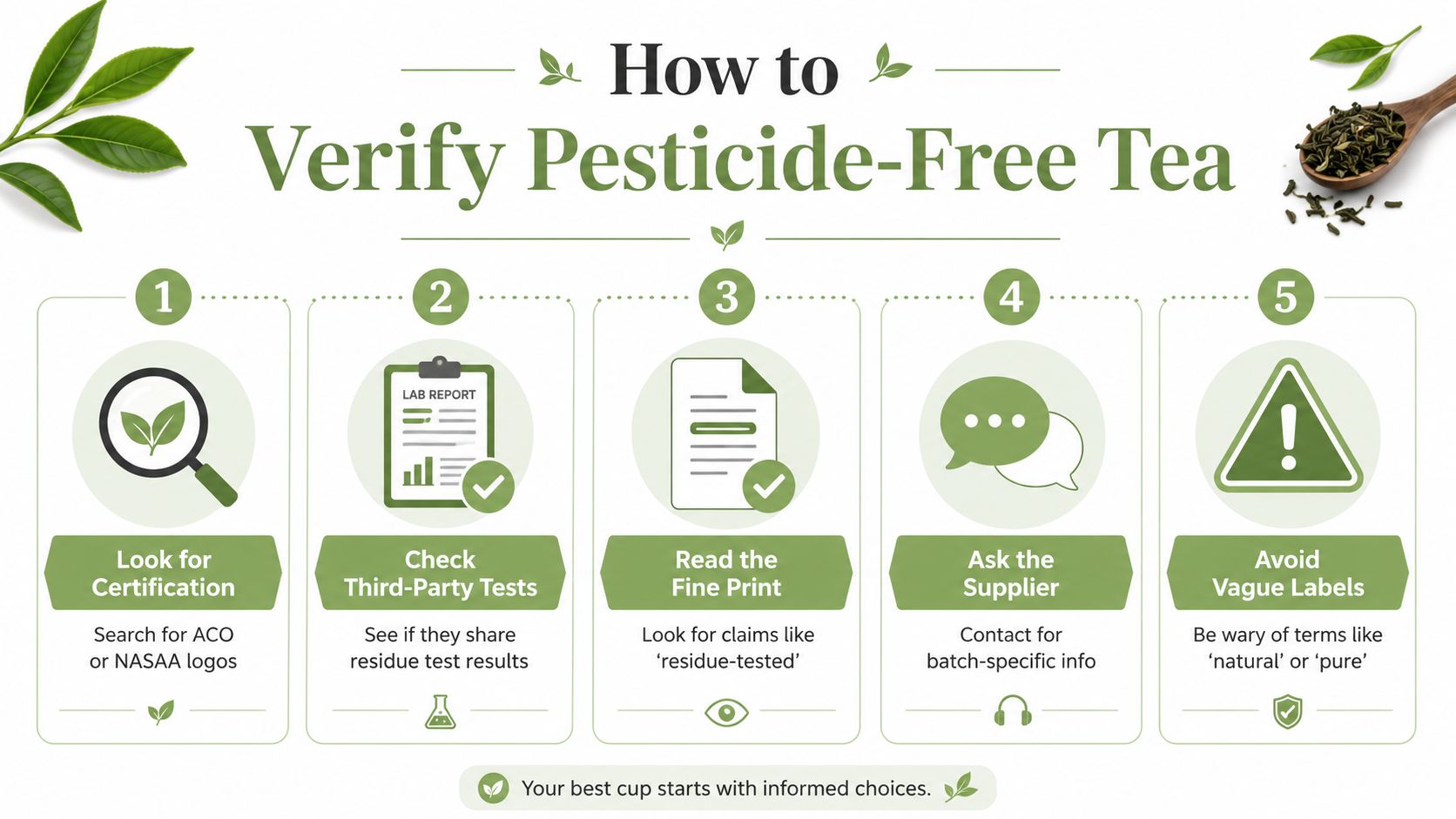
Start with the label and paperwork
Look for a real certification mark, batch number, and country of origin. If you're buying online, read the product page carefully and see whether the brand gives you access to test certificates or a lot code you can ask about later. A few brands make this easy, many don't.
Loose leaf tea often gives you better traceability than pre-bagged tea, because there are fewer layers between the leaf and the pack. That doesn't mean all teabags are a problem, but it does mean the paperwork matters more when you can't see the leaf itself.
Ask the supplier the right questions
The conversation doesn't have to be confrontational. A straightforward supplier will understand the questions and answer them plainly.
- Is this batch certified organic? Ask for the certificate number or lot reference.
- Do you have a residue report for this shipment? The answer should be batch-specific, not generic.
- Where was it grown and packed? Australian-grown tea can have a different risk profile, but imported tea can still be safe if it's independently tested.
- Can you match the test to the lot? If the lot numbers don't line up, the paperwork isn't doing its job.
Independent Australian guidance notes that tea can be grown domestically in north Queensland through to Victoria and Tasmania, and that Australian-grown tea may have low or no pesticide contamination because quarantine has helped prevent pest entry. That same guidance also recommends loose leaf, organically grown tea, or homegrown tea as practical ways to minimise exposure. See the Australian overview from Sustainable Gardening Australia.
For a quick walkthrough of what to look for on shelves, PepTea's organic green tea online page gives you a useful example of how a product page can support the buying decision.
Sourcing Clean Tea for Cafés and Retailers
A café buyer isn't just choosing flavour, they're choosing documentation, consistency, and the ease of answering customer questions. One supplier might offer lovely tea and a vague promise. Another will hand over certificates, batch details, and a cleaner story for the menu board.
What to ask before you list a tea
Start with the basics, then move to evidence. Ask for the organic certificate, the transaction certificate for the current lot, and any multi-residue test report tied to that batch. If a supplier hesitates, that's useful information too.
The cleaner the supply chain, the easier the menu story. Terms like certified organic, batch-tested, and traceable by lot mean more when you can back them up at the point of sale. That's especially helpful for venues that position tea as a premium, health-conscious drink rather than a filler option.
For wholesalers and operators, Everti's guide to brewing coffee tea bags is a practical read if you're also thinking about service workflow and presentation in busy hospitality settings.
A simple procurement example
A café might taste three teas that all look similar on the cup list. One comes with a certificate only, one comes with a certificate and lot number, and one comes with both plus a recent residue report. The third option gives the buyer the cleanest paper trail, even if the flavour is comparable.
That's the model worth using in procurement meetings:
- Process proof from certification.
- Batch proof from residue testing.
- Traceability proof from lot codes and transaction certificates.
- Service fit from format, whether loose leaf, bagged, or matcha.
PepTea is one example of a brand in this space, with certified organic Japanese matcha and Australian-brewed kombucha in its range. For cafés, the practical point is not the brand name, it's the kind of documentation and product clarity you should expect from any supplier in this category.
The Hidden Risk of Packaging and Brewing Habits
A tea can be clean at the farm gate and still lose some of its clean-label appeal in the bag. That's why packaging deserves more attention than it usually gets in pesticide free tea Australia searches.
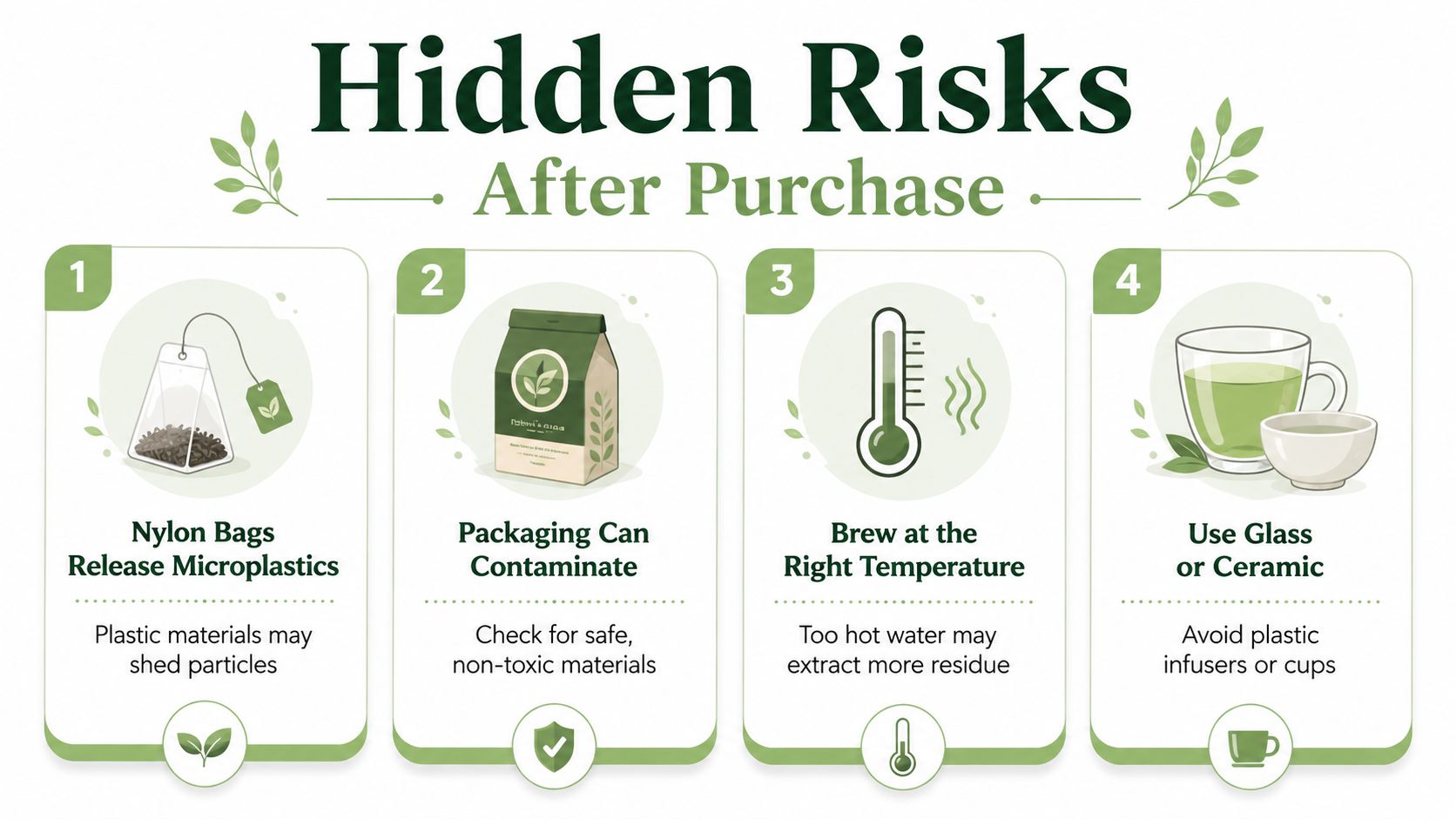
Why the bag matters
Recent Australian consumer and media commentary in 2026 highlighted that nylon pyramid tea bags can release large numbers of microplastic particles into a cup. The practical takeaway is simple. If the leaves are clean but the bag is nylon, the final drink may still carry avoidable plastic exposure. That's why plant-based, plastic-free bags and loose leaf formats are safer choices when you care about the whole cup.
Clean tea is a chain, not a claim. If one part of the chain is compromised, the promise gets weaker.
Brewing and storage still affect quality
Brewing habits can't turn bad tea good, but they can protect the good tea you've already bought. Use the right water temperature for the style you're making, keep tea in airtight containers, and store it away from light so flavour and aroma stay intact longer. Those habits matter even more for matcha, which is a delicate powder and loses freshness faster once exposed to air.
For matcha drinkers, the storage rule is simple. Keep it sealed, cool, and dark, and use it promptly after opening. That helps preserve the bright colour and cleaner flavour people expect from a quality powder.
Building Your Clean Tea Routine in Australia
A clean tea routine starts with a sequence, not a slogan. Certified organic farming, lot-specific residue testing, plastic-free packaging, and proper storage are the four pieces that hold the promise together. Leave one out and the claim gets softer.
A practical routine you can actually use
Begin with what's already in your cupboard. Check whether the tea has a clear lot number, a credible organic certificate, and any evidence of batch testing. If it doesn't, don't panic, just decide whether you want that tea for everyday use or whether you'd rather switch to a more transparent option.
Then make one packaging decision that reduces hassle long term. Choose loose leaf or plastic-free bags where you can, and store everything in airtight containers away from light. For buyers who want a clean, low-fuss routine, that's a simple upgrade with real benefits in the cup.
If you're choosing products for a household, café, or retail shelf, the same logic applies every time. Ask for proof, check traceability, and favour suppliers who can explain their process without getting defensive. That's the difference between a nice-sounding claim and one you can stand behind.
PepTea offers organic matcha and Australian-brewed kombucha for people who want a cleaner, more transparent tea routine. If you're comparing options for home, café, or retail use, visit Pep Tea and look for products that match the proof you'd want in your own cup.
Matcha Tea Bags vs Powder: An Honest Australian Guide
Most advice on matcha tea bags vs powder gets the question wrong. People talk as if bags are just a cheaper, weaker version of powder, but that's too simple. In practice, you're usually choosing between a blended infusion and whole-leaf consumption, and that changes everything from flavour to caffeine to value.
If you buy smart in Australia, the label matters more than the marketing. A bag can say matcha and still contain only a tiny amount of actual matcha, while powder is the full leaf, whisked and consumed. That's why the better choice depends on what job you want it to do, not which format sounds more premium.
| Format | What you're really getting | Best for | Main trade-off |
|---|---|---|---|
| Matcha tea bags | Often a blend with only 1–2% matcha and other tea material | Fast cups, portion control, office use | Lower ingredient concentration |
| Matcha powder | 100% pure matcha consumed whole | Ritual, lattes, stronger matcha character | Higher price per cup |
Why the Tea Bag vs Powder Question Is Misleading
The wrong debate starts with a false ranking, tea bags below powder. The split is between packets that contain a little matcha in a bag and products that are entirely matcha powder, because product-ingredient reviews report many “matcha tea bags” contain only 1–2% matcha while powdered matcha is 100% pure matcha (ingredient review).
What the format actually does
Powder is whisked into water, then consumed in full. Tea bags are steeped and discarded. That difference changes how much of the leaf ends up in your cup, and it is why the powder format is consistently described as the more nutrient-dense option (format comparison).
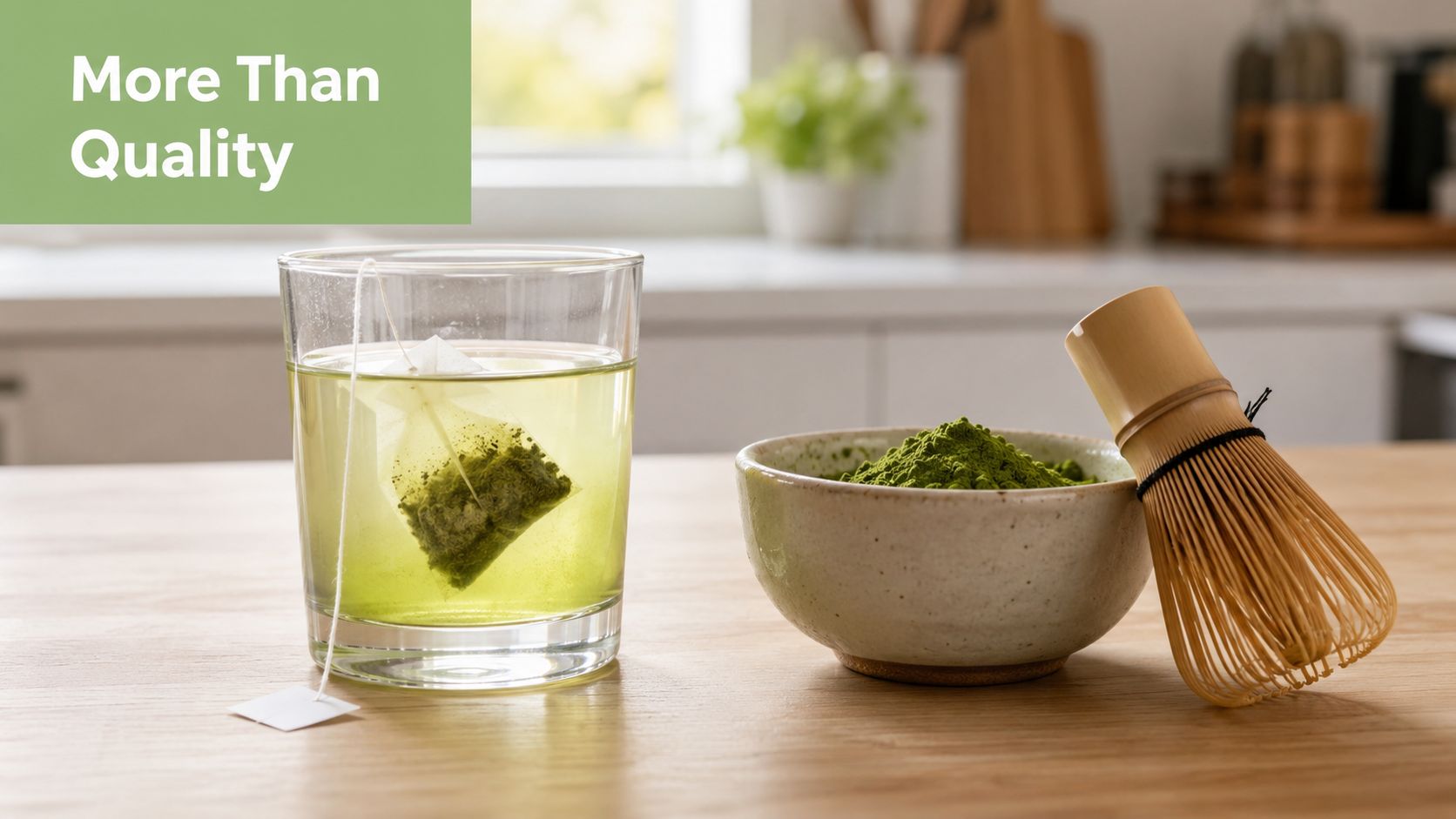
Australian shoppers need to read that difference plainly. If you want a true matcha experience, buy the whole leaf and whisk it. If you want a quick green tea drink with a matcha-style label, the bag can serve that job, but it is not the same product in the cup. For a plain explanation of the powder format, Pep Tea's matcha powder guide is a useful starting point.
Practical rule: read the ingredient panel before you read the front of the packet. The front often sells the idea, the panel tells you what is inside.
That is also why the choice should be tied to the job, not the prestige. A tea bag can suit office use, café back-up service, or a quick cup at home. Powder suits a morning ritual, a proper latte build, or anyone who wants the leaf rather than a trace amount of it. For readers comparing matcha for wellness and energy, matcha for wellness and energy is a relevant reference point.
Independent food-science research also shows that bagged green teas and some standard bagged products can perform well on antioxidant measures depending on the product, so format alone does not guarantee quality. What matters is the ingredient composition, not the marketing language on the box (comparison of bagged and powdered products).
Matcha Grades and What You Are Buying
Shelf labels use the word “matcha” very loosely, so Australian shoppers need to read the ingredient panel before they trust the front of the packet. Some products are true stone-ground matcha, others are diluted blends dressed up with green tea branding. For a plain guide to grading and sourcing, Pep Tea's guide to different grades of matcha is a useful starting point.
Ceremonial and culinary serve different jobs
Ceremonial-grade matcha is the smoother, more delicate style meant for drinking straight. Culinary-grade matcha is built for lattes, baking, and mixing into recipes. That split matters because a cup you whisk and drink on its own needs a different leaf profile from the powder you hide in milk or batter.
A bag that says matcha but contains only 1–2% matcha is not giving you a full matcha experience. It is a green tea blend with matcha branding. Buyers get tripped up because the front of the packet suggests purity while the ingredient list reveals the actual story.
What to check on the pack
Start with the ingredient list. A true matcha powder should read plainly as matcha, not a long blend padded out with other tea material.
Origin details matter too. Japanese regions such as Uji or Nishio usually give you more transparency about sourcing. For Australian buyers who want cleaner inputs, organic certification is another sensible filter. Colour and texture matter as well, because bright, fine powder usually points to a more deliberate product than dull, coarse material.
Buyer's rule: if the brand will not say what percentage of matcha is in the bag, treat it as a blended tea product.
That is why the powder-versus-bag question starts with honesty, not hype. Powder can be true matcha, while a bag can be a convenience format. They are not interchangeable just because both mention green tea. For a buying framework that keeps the purity question front and centre, this Australian matcha powder versus tea bag comparison is useful.
Antioxidants, Caffeine and L-Theanine by Format
The format choice matters because it changes how much of the leaf ends up in the cup. Matcha powder gives you the whole material, while tea bags steep only what sits inside the bag. That is why caffeine delivery, antioxidant intake, and L-theanine exposure usually favour powder when you compare the two formats on equal terms.
Caffeine is a serving question, not just a leaf question
One comparison source reports roughly 70 mg of caffeine per cup for matcha powder versus about 34 mg per cup for matcha tea bags, so powder can deliver about double the caffeine per serve (caffeine comparison). For Australians who want steady energy without guesswork, that is the number to watch.
The key point is not chasing the highest dose. The format changes the stimulant load, and that changes the cup. If you are brewing for morning focus, latte service, or a pre-workout routine, powder gives a stronger and more predictable matcha result.
Antioxidants and L-theanine follow the leaf
The same logic applies to the compounds people usually value in matcha. Powder uses the whole leaf, so the drinker gets more of what the leaf contains. Tea bags make an infusion, so the dose is lower by design.
For a broader wellness framing of matcha powder, matcha for wellness and energy is a useful companion read. Keep the comparison honest, though. Some bagged green teas can still perform well on antioxidant measures depending on the product, so a “matcha” label alone does not guarantee a stronger result.
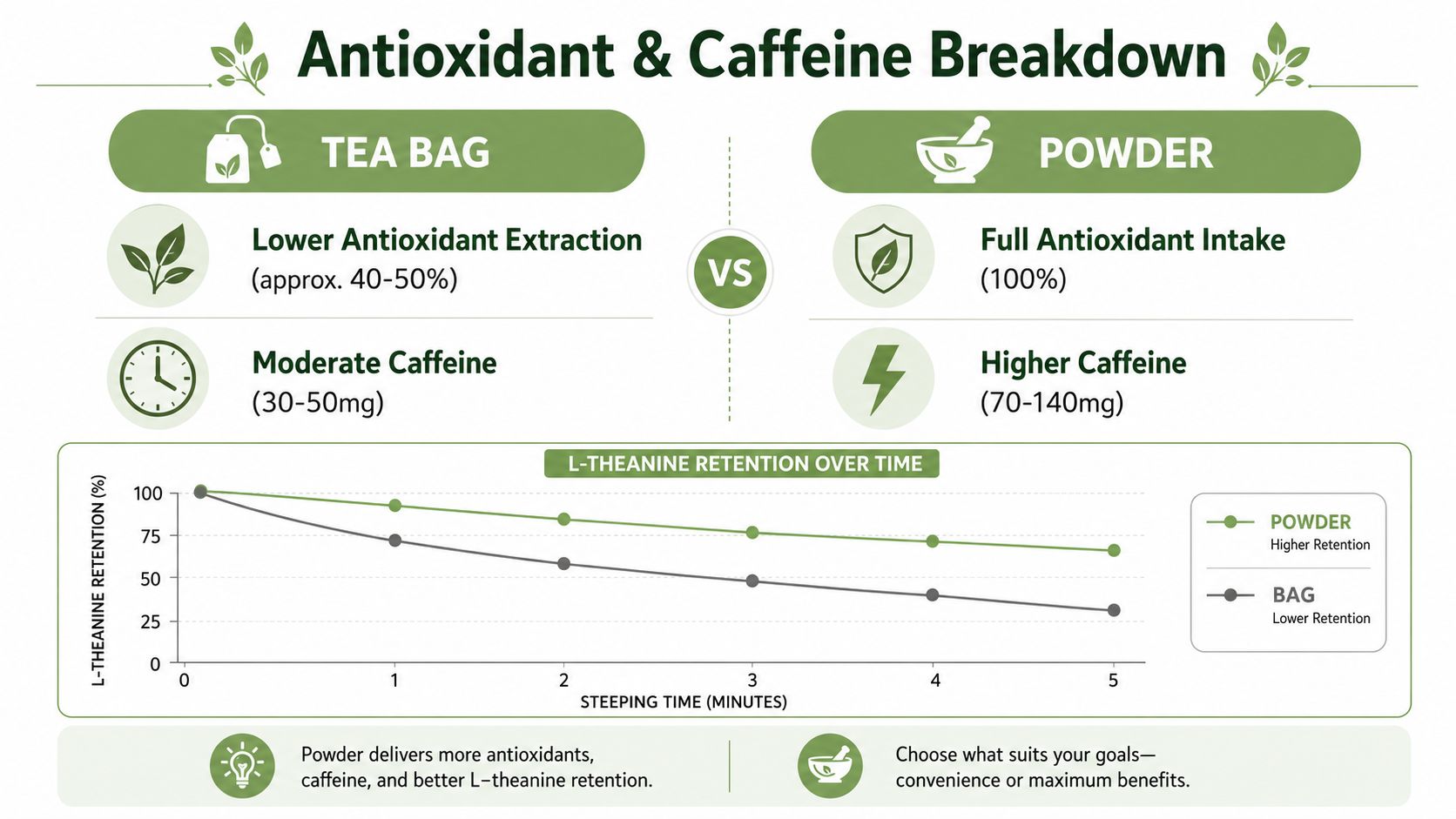
Bottom line: if your goal is clean energy, focus, and the fuller matcha profile, powder is the format that delivers the leaf.
Brewing Methods, Equipment and Everyday Use
Tea bags are dead simple. Drop one into a cup, pour hot water over it, wait a couple of minutes, and you're done. That speed is why they work in offices, hotels, and anywhere a staff member needs a consistent serve with almost no training.
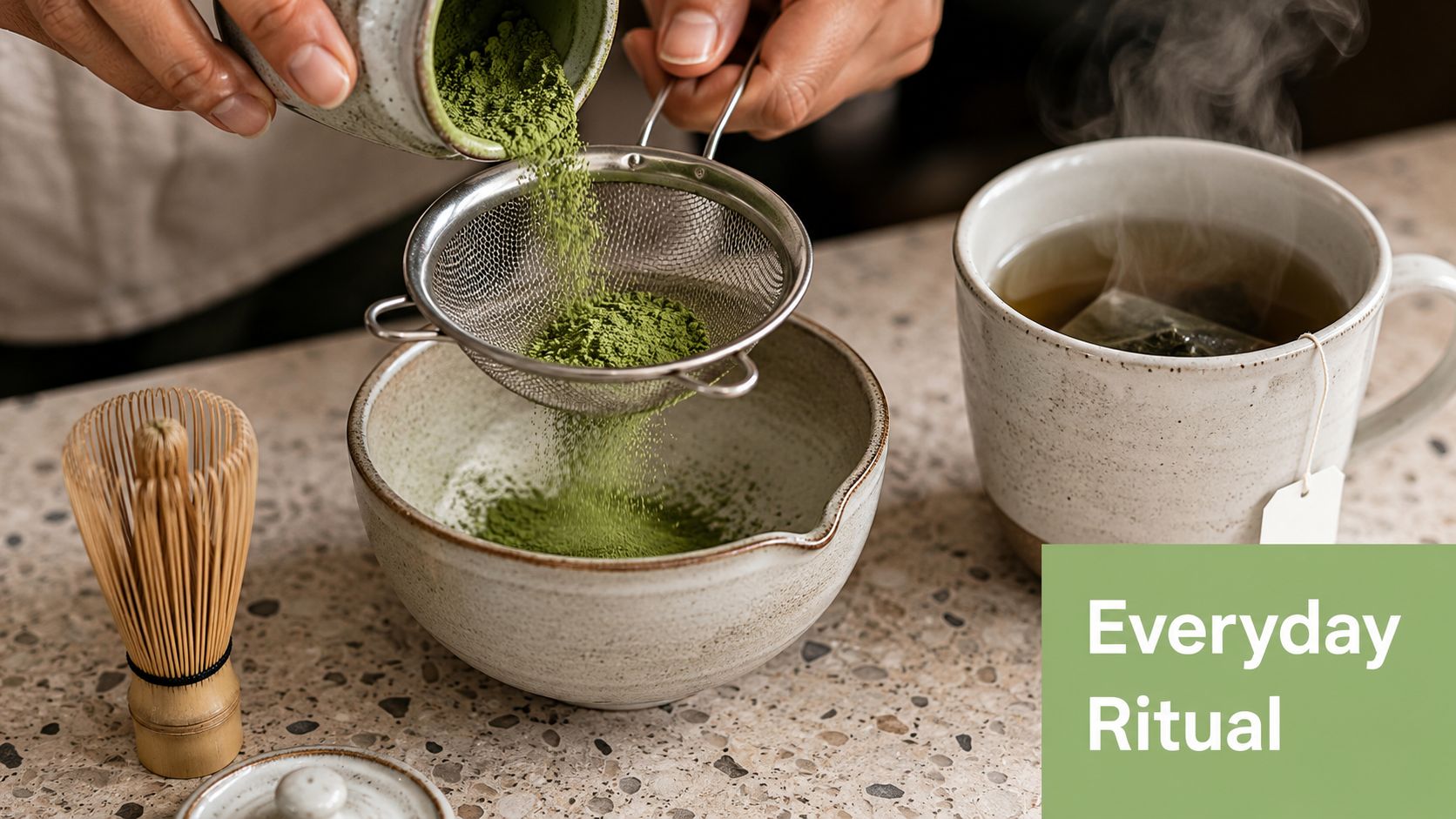
Matcha powder asks for a little more attention, but not much. Sift it, add water at around 80°C, and whisk it with a bamboo chasen until smooth. Once the motion becomes automatic, it's quick, and the result is more consistent than many expect. For a practical walk-through, Pep Tea's how-to-whisk-matcha guide covers the basics well.
The gear each format needs
Tea bags need almost nothing beyond a kettle and a cup. Powder usually benefits from a chasen, a small sifter, a chashaku scoop, and a bowl wide enough for whisking. That sounds fussy until you realise you're setting up a ritual drink, not just making hot water taste green.
You don't need café gear to make powder properly. You need a bowl, a whisk, and a few calm seconds.
That's why powder suits a slower morning or a weekend brew. Tea bags suit a rushed weekday or a shared office kitchen. In café service, powder also gives staff a better base for a latte because the dose can be pre-portioned and built into a repeatable workflow.
Latte service is where powder earns its keep
A latte made from powder has stronger matcha character and a cleaner visual finish. A tea bag is easier to manage, but it won't give the same depth. For cafés, that means powder usually makes more sense when the menu promises a proper matcha drink, while tea bags make sense for simple tea service or back-of-house speed.
Cost Per Cup, Cost Per Nutrient, and Value
Price is where the decision gets honest. ConsumerLab's pricing comparison found brewed tea from bagged green tea could cost as little as US$0.10 per serving, while a serving of matcha powder was about US$1.00 (pricing comparison). That gap is real, and it explains why tea bags keep winning in homes, offices, and cafés that count every cup.
The cheaper cup is not always the better value
If you only want a hot green drink, the bag wins on unit price. If you want actual matcha character, the powder earns its price by putting the whole leaf in the cup. That is the cleaner way to judge value, because a low-priced cup that misses the brief is still poor value.
ConsumerLab also found that getting 200 mg of EGCG from matcha cost over US$2, while it could cost as little as 27 cents from bagged brewed tea. That puts the economics in plain language. If your aim is a specific antioxidant dose, tea bags are the cheaper route. If your aim is full-powder matcha service, powder costs more because you are paying for the whole-leaf format, not just a green-flavoured drink.
Cost Comparison of Matcha Formats
| Format | Avg cost per serving | Cost per 200 mg EGCG | Typical use case |
|---|---|---|---|
| Bagged green tea | as little as US$0.10 | as little as US$0.27 | Low-cost daily cups, offices, bulk hospitality |
| Matcha powder | about US$1.00 | over US$2 | Ritual drinking, lattes, premium menu builds |
For households, that means powder belongs in a smaller, more intentional rotation. For cafés and retailers, it means powder should be priced as a premium drink input, not as a cheap tea bag substitute. The spend only makes sense when the menu or routine calls for the stronger matcha format.
Storage, Shelf Life and Environmental Footprint
Matcha powder is sensitive to air, light, and heat. Once a tin is open, it can lose colour, aroma, and intensity if it sits unrefrigerated and unsealed. Tea bags are usually more forgiving because the product is already portioned and often packed for stability, which suits pantry storage and casual use.
How to store each format properly
Keep matcha powder in a sealed tin or pouch, away from light and moisture, and use it regularly. A premium powder should be treated like a fresh ingredient, not a permanent pantry item.
Tea bags need less care, but packaging still matters. Look for resealable pouches, compostable bags where possible, and packaging that clearly avoids unnecessary plastic mesh. Australian buyers who care about waste should check whether the bag itself is compostable, not just the outer box.
Packaging trade-offs are real
Tea bags create more single-use material per cup, but they can be lower-impact if the bag and sachet are compostable. Powder usually creates less packaging waste overall, especially when it comes in a tin or refill pouch. Stone-grinding and shipping a fine powder takes more energy than a simple bagged format, so pretending powder is automatically greener would be sloppy.
Simple sustainability rule: choose the format you'll finish, then buy it in the least wasteful packaging you can verify.
That is the honest middle ground. If you drink matcha often, powder in a sealed tin makes sense. If you want the occasional cup and hate waste, a well-specified tea bag product can be the cleaner fit. The right answer depends on how fast you use it, not just how polished the label looks.
Which Format Suits Home Drinkers, Cafés and Retailers
Home drinkers should stop thinking in absolutes. A hybrid setup usually makes the most sense, with tea bags for quick weekday cups and a small tin of organic matcha powder for weekends, lattes, and the moments when you want the proper matcha ritual. That way you get speed without giving up the authentic experience.
Home drinkers
If you want convenience first, keep tea bags on hand. If you want a fuller matcha experience, buy powder and learn to whisk it properly. The decision rule is simple, bags for routine, powder for ritual.
Cafés and hospitality venues
Cafés need consistency, menu clarity, and a drink that matches the price on the board. Powder is the stronger default because it gives staff a repeatable serve, a better latte base, and a more premium story to tell the customer. Tea bags still have a place for fast service, office catering, and low-complexity tea offerings, but they shouldn't be passed off as the same thing as a true matcha drink.
Retailers and specialty grocers
Retail buyers should think about shelf life, label clarity, and customer intent. Stock tea bags for entry-level shoppers who want ease, then stock powder for buyers who already know they want the whole-leaf format. If you want one example of a powder-led range in Australia, Pep Tea carries organic matcha powder alongside its Hunter Valley-brewed kombucha, which gives retailers a clean functional-drink pairing without mixing formats.
Decision rule: if the drink needs to feel premium, build it around powder. If the job is speed and portion control, use bags.
Making the Right Choice for Your Cup
Pick the format that matches the outcome you want. If you want concentration, choose powder. If you want convenience, choose tea bags. If you want the cheapest route to a measured green-tea-style cup, bags usually win. If you want whole-leaf consumption, stronger flavour intensity, and the proper matcha ritual, powder is the answer.
The trade-offs are plain. Cost per cup favours bags. Cost per nutrient depends on what nutrient you're chasing, and whole-leaf consumption favours powder for the matcha experience. Steeped infusion and whisked powder are not interchangeable methods, so don't let a label talk you into treating them like the same product.
My one-question tiebreaker is this. What do you want the cup to do? If the answer is “get me through the morning fast,” tea bags are fine. If the answer is “give me proper matcha,” buy powder and don't settle for a diluted blend in a bag.
For Australian buyers, that's the honest line. Read the ingredient panel, ignore the prettiest part of the packet, and choose the format that fits your kitchen bench, café counter, or retail shelf.
Pep Tea makes it easy to choose with purpose, with organic matcha powder for proper whisked drinks and Hunter Valley-brewed kombucha for a different kind of clean, functional refreshment. If you want to compare formats, check the labels properly, and buy from an Australian tea specialist, visit Pep Tea and look through the range.
Instant Matcha Tea: What It Is and How to Use It

Instant matcha tea gets treated like a shortcut, but that's only half the story. Some products are a genuine convenience format, while others are just instant green tea powders wearing a matcha label, and those two things don't behave the same in a cup or in a café.
For Australian buyers, that difference matters more than most guides admit. If you're choosing a powder for lattes, iced drinks, desserts, or a fast home ritual, the label tells you more than the marketing does, and a clear understanding of processing, solubility, flavour, and nutrition will save you from buying the wrong tin.
What Instant Matcha Tea Actually Is
A lot of people assume every green powder called matcha is basically the same product. It isn't. True matcha is made from tencha leaf that's stone-ground into a fine powder, while instant matcha tea is usually a processed instant tea powder designed to dissolve quickly, often from brewed tea concentrates and sometimes with additives like maltodextrin or citric acid for better flow and shelf life, according to the product distinction explained by matcha.com.
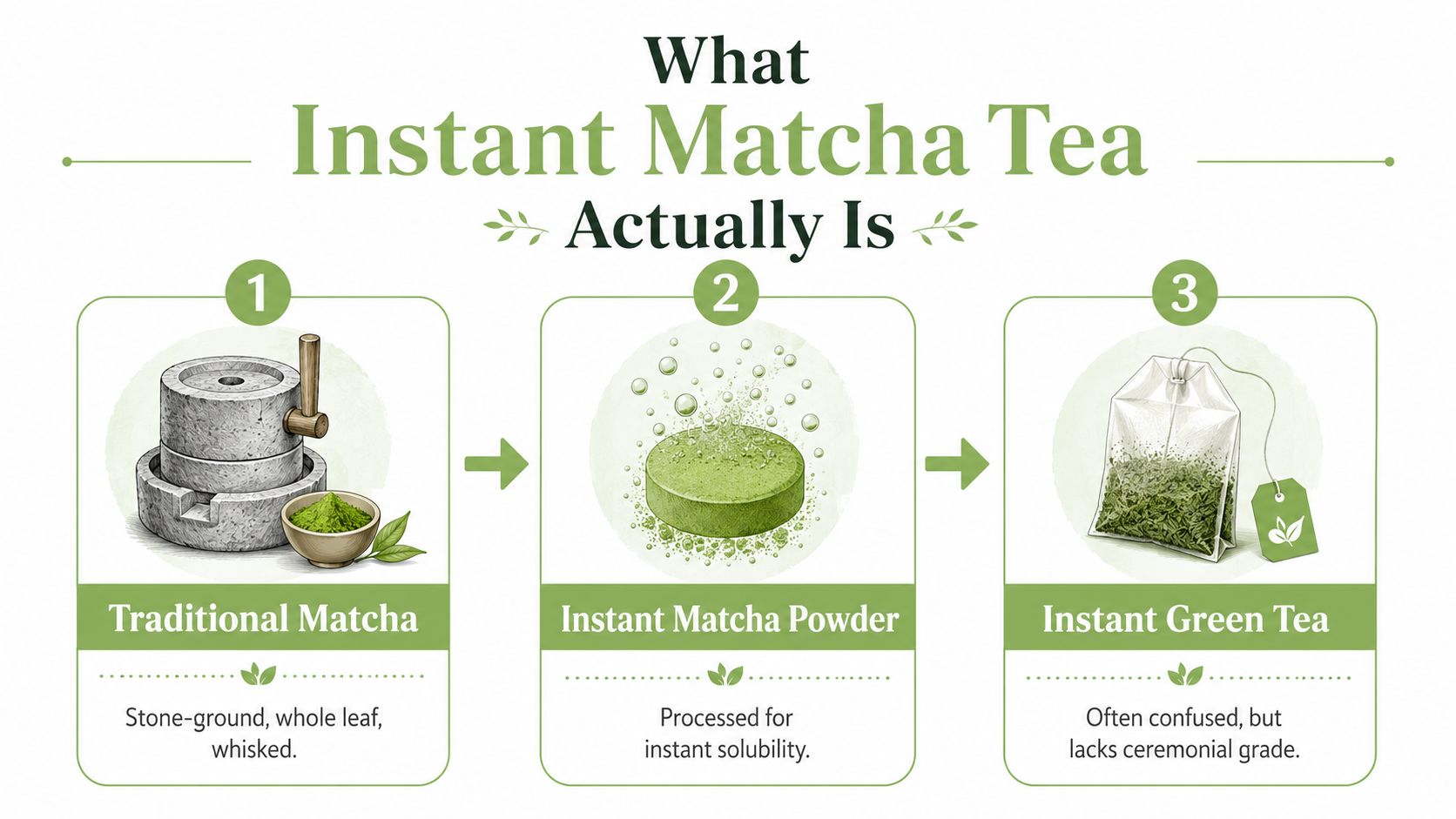
Why the label causes so much confusion
Australian shoppers often see “matcha” and assume heritage tea, bright colour, and full nutritional value. That assumption only holds when the powder is made from ground tea leaf. Instant tea powders are made for convenience first, so they're meant to disperse fast in water or milk, not necessarily to preserve the character of the leaf.
That matters in service settings too. A café team training on speed, consistency, and drink build will need a different workflow from someone preparing ceremonial tea at home, which is why a practical resource like barista training Australia can be useful when you're mapping a menu or onboarding staff.
Practical rule: if the ingredient list reads like a processed beverage mix, you're probably not buying traditional stone-ground matcha, even if the front label says “matcha”.
What to look for on a packet
You don't need a tea degree to read the label well. Start with the ingredients, then look for anything that suggests instant solubility rather than whole-leaf powder. If the powder dissolves completely and leaves little sediment, that's often by design, but it doesn't automatically mean it's equivalent to matcha in flavour or composition.
A simple label check helps:
- Ingredient list first, because additives often signal an instant format.
- Country of origin next, because true matcha is tied to Japanese production.
- Product language last, because words like “instant”, “blend”, or “soluble” tell you how it behaves in the cup.
For café owners, that distinction changes how you build drinks. For home users, it changes expectations. Instant matcha tea can be a smart convenience product, but it shouldn't be judged as though it were the same thing as traditional matcha.
Instant vs Ceremonial vs Culinary Matcha Compared
Start with the cup itself, because that usually clears up the confusion. Ceremonial matcha is made for drinking on its own, culinary matcha is made to stand up in milk, batter, and sauce, and instant matcha tea is designed for speed and easy dispersion. Each one solves a different problem, so the right choice depends on whether you need flavour clarity, kitchen flexibility, or fast service.
Matcha Grades at a Glance
| Attribute | Instant Matcha | Culinary Matcha | Ceremonial Matcha |
|---|---|---|---|
| Processing | Usually made for instant solubility, often from brewed concentrate | Stone-ground tea leaf, usually from slightly older leaves | Stone-ground tea leaf, usually from the youngest shade-grown leaves |
| Texture | Designed to dissolve quickly | Mixes well, may need whisking or frothing | Best whisked, can form a fine foam |
| Flavour | Neutral to mild, sometimes flatter | Stronger, more pronounced | Delicate, smoother, more umami |
| Best use | Iced drinks, fast service, automated prep | Lattes, baking, cooking | Straight tea, ceremonial use, premium drinks |
| Nutritional trade-off | Convenience first, so the whole-leaf profile is usually reduced | Retains more of the leaf than instant forms | Closest to the full leaf experience |
For a practical buyer's guide, PepTea's comparison of ceremonial vs culinary matcha helps separate drinking quality from kitchen use without turning the decision into guesswork.
What each grade is really for
Ceremonial matcha suits moments where the tea itself should lead. The flavour is cleaner, the finish is more refined, and the drink works best when nothing else is crowding the bowl or cup.
Culinary matcha belongs in a different setting. In a latte, smoothie, cake, or biscuit, its fuller taste has enough weight to come through milk, sugar, and other ingredients, which is why it is often the more practical choice for recipes. A Japanese home cooking resource such as the Just Cook It recipe collection is useful when you want to see how matcha behaves beyond a plain tea preparation and into everyday cooking.
Instant matcha tea sits alongside those options rather than replacing them. It is handy when the drink needs to be quick, cold, and consistent, especially in an Australian café where prep time and repeatability matter. That convenience comes with a trade-off, because it is not the same ingredient category as a traditional stone-ground powder, and that difference affects both cup quality and how much of the leaf you are using. Once you separate those roles, the choice becomes easier to make for both café menus and home kitchens.
Short version: ceremonial for drinking, culinary for cooking, instant for convenience.
Nutritional Benefits and What You Might Be Missing
Matcha earns its reputation because you consume the whole leaf, not just the brewed water. Reviews summarised in the medical literature report caffeine around 18.9 to 44.4 mg/g, total polyphenols around 169 to 273 mg gallic acid equivalents per gram, and a composition that is roughly 60 to 70% insoluble material plus 30 to 40% soluble compounds such as catechins, amino acids, and minerals, according to PubMed review data. That's the heart of the nutrition argument in favour of true matcha.
Why whole-leaf powder matters
When you whisk stone-ground matcha, you're taking in the material suspended in the cup as well as what dissolves into the liquid. That's why people value it as a functional drink rather than a simple infusion. The profile can vary a lot by source and dose, but the key point is that true matcha delivers more of the leaf than a typical instant tea powder.
Instant matcha tea often trades some of that completeness for convenience. If a powder is made from extract or concentrate and engineered for solubility, it can be easier to use in iced drinks and automatic dispensing, but it may not carry the same density of leaf-derived compounds. In other words, it may behave better in a machine, while true matcha gives you more of the plant itself.
What readers usually expect from matcha
Most buyers are looking for three things:
- Antioxidants, especially catechin-rich compounds.
- Calm energy, because matcha combines caffeine with amino acids.
- A greener, fuller flavour, which signals freshness and leaf quality.
That's why it helps to keep expectations precise. If you want a product for fast drinks and low-fuss use, instant matcha can make sense. If your priority is nutrition and the classic tea experience, stone-ground matcha is the better fit.
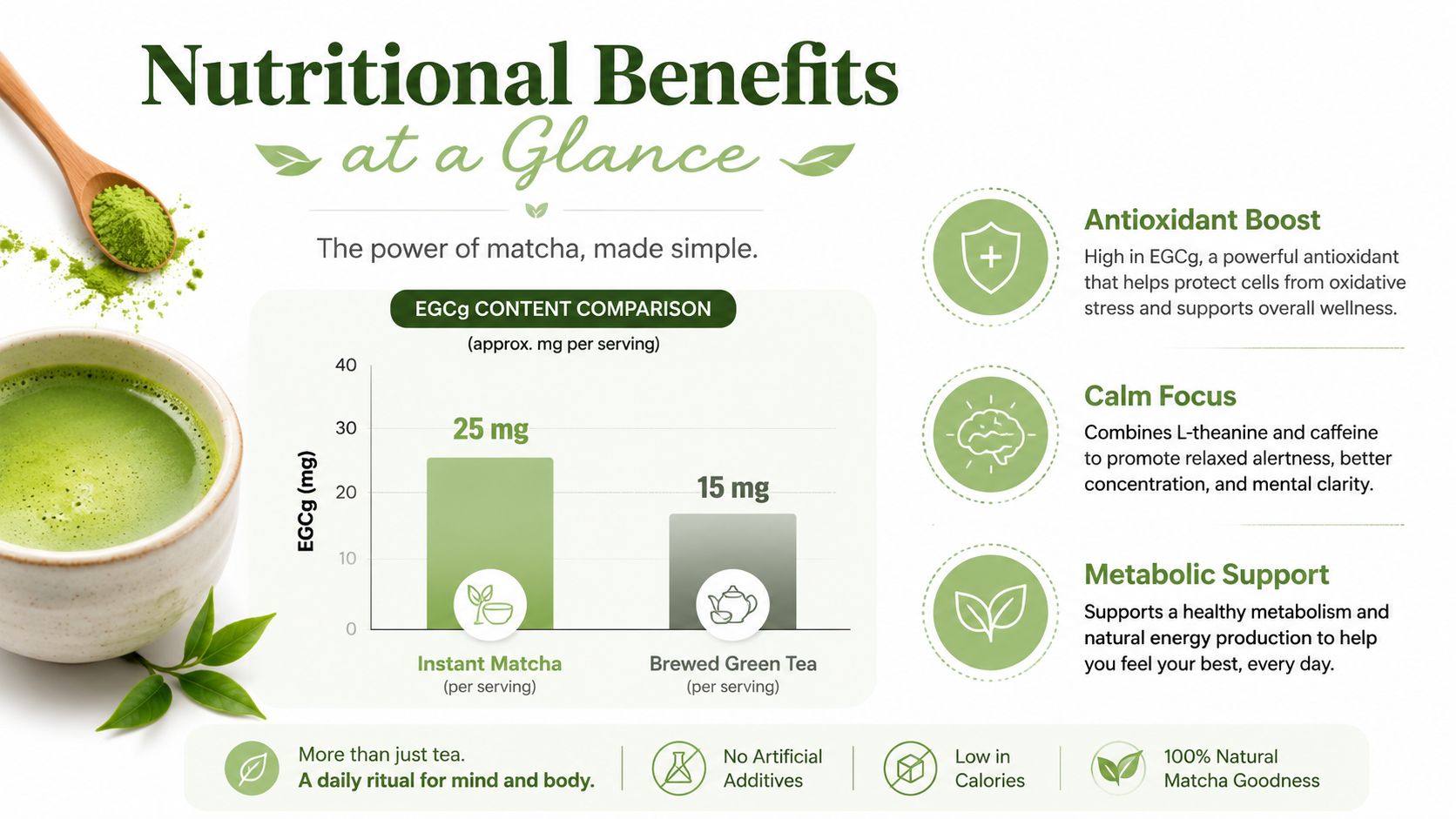
A useful way to think about it is this, the more a product is engineered for instant mixing, the more you should ask what has been gained in speed and what has been lost in whole-leaf character.
How to Prepare Instant Matcha Tea Properly
Instant matcha tea is easier to handle than traditional powder, but the method still matters. If you dump it straight into cold milk and walk away, you'll often end up with weak flavour or an uneven texture. A little technique goes a long way.
Hot, iced, and latte preparation
For a hot drink, start with a small amount of water first, then add the rest once the powder has dispersed. That helps the powder hydrate evenly and keeps the flavour from going flat. If the product is very fine or highly soluble, a quick stir may be enough, but if the cup looks grainy, a small whisk or milk frother helps.
For iced drinks, instant matcha usually outperforms traditional powder because it's designed to disperse more easily in colder liquid. That makes it a practical choice for café iced lattes, shaker bottles, or takeaway formats where speed matters.
For a latte, build it like this:
- Dissolve the powder in a small splash of hot water.
- Stir or froth until smooth.
- Add milk, then ice if needed.
- Taste before sweetening, because some instant blends already include a sweetener or filler.
If you use traditional matcha instead, a proper whisking method matters. PepTea's guide on how to whisk matcha is a useful reference if you want to compare the two workflows side by side.
Fixing common problems
Grainy texture usually means the powder needs more agitation. Weak flavour usually means the dose is too low for the product's concentration. Bitterness often comes from water that's too hot or from a product that already includes more processed tea solids than you expected.
Good café habit: build one test drink before you scale the recipe for service. Instant powders can vary a lot, so a fast calibration saves waste.
If you're making drinks at home, a shaker bottle works well for cold recipes, and a blender helps when milk, ice, and powder all need to combine quickly. For hot drinks, simple stirring is often enough if the powder is soluble.
Recipes and Use Cases for Home and Hospitality
Instant matcha tea makes the most sense when the drink has to move quickly. At home, that usually means morning routines. In hospitality, it usually means iced menus, batch builds, and prep consistency across staff shifts.
Where it works well
A home barista can use instant matcha in a few straightforward ways. A quick iced matcha latte is the obvious one, because the powder disperses easily and doesn't need the same whisking discipline as ceremonial tea. It can also slip into smoothies, overnight oats, or simple baking where the green tea flavour just needs to show up cleanly.
For cafés, the strongest use case is speed. Instant powder can be handy in:
- Iced drinks, where fast dispersion reduces clumping.
- Automated or semi-automated service, where repeatability matters.
- Batch drinks, when a team needs consistent colour and flavour across service.
That said, there are also places where a prepared version wins without question. If a customer expects vivid green colour, foamy texture, and the layered umami of a properly whisked tea, a conventional matcha powder is still the right call.
Simple serving ideas
A few practical pairings work especially well:
- Oat milk latte, because its body softens the tea.
- Coconut milk iced drink, because it reads as tropical and creamy.
- Vanilla smoothie, because the flavour is mild enough to sit beside fruit.
- Matcha muffins or slice, if the recipe only needs background tea notes.
PepTea also offers organic matcha tea products online, including bulk formats suited to retail and food service, which makes sense for kitchens that need a reliable powder rather than a one-off novelty.
For cafés, the decision usually comes down to ticket time versus drink identity. For home users, it comes down to whether you want a fast green drink or a more traditional tea ritual. Both can have a place, but they're not interchangeable.
Buying and Storing Matcha the Right Way
Reading a matcha label properly saves money and disappointment. The easiest mistake is buying by colour alone. A bright tin doesn't always mean good tea, and a smooth powder doesn't always mean it's true matcha.
What to look for on the label
Start with the ingredient list. A clean matcha product should be easy to understand, and if you see a long list of sweeteners, fillers, or anti-caking agents, that's a sign to slow down and ask what the powder is made of. A trusted origin matters too, especially in Australia where the market is largely import-led.
That matters because Australia imported about A$14.2 million of “tea, whether or not flavoured” from Japan in 2024, and Japan External Trade Organization data says Japan remains the world's leading supplier of matcha, with export volume rising 16.1% in 2024 to 8,798 tonnes, about 10 times the level of 20 years earlier, according to the market summary at Ooika. For Australian buyers, that points to a supply chain that's heavily tied to origin-country production.
A simple checklist helps:
- Look for origin transparency, ideally Japan and, when available, a specific region.
- Check for added ingredients, especially if you want authentic matcha.
- Prefer reputable packers or suppliers, because freshness matters more than flashy packaging.
How to store it well
Matcha is sensitive to light, heat, and oxygen. Store it sealed, cool, and away from the cupboard door where temperature swings are common. Once opened, use it promptly, as freshness drops faster than you might expect.
A small airtight tin or jar is better than leaving the powder in a half-open bag. If you've already opened a pouch, a dedicated storage container helps protect flavour and colour, and PepTea's matcha storage container is one practical example of the kind of setup that keeps powder in better shape.
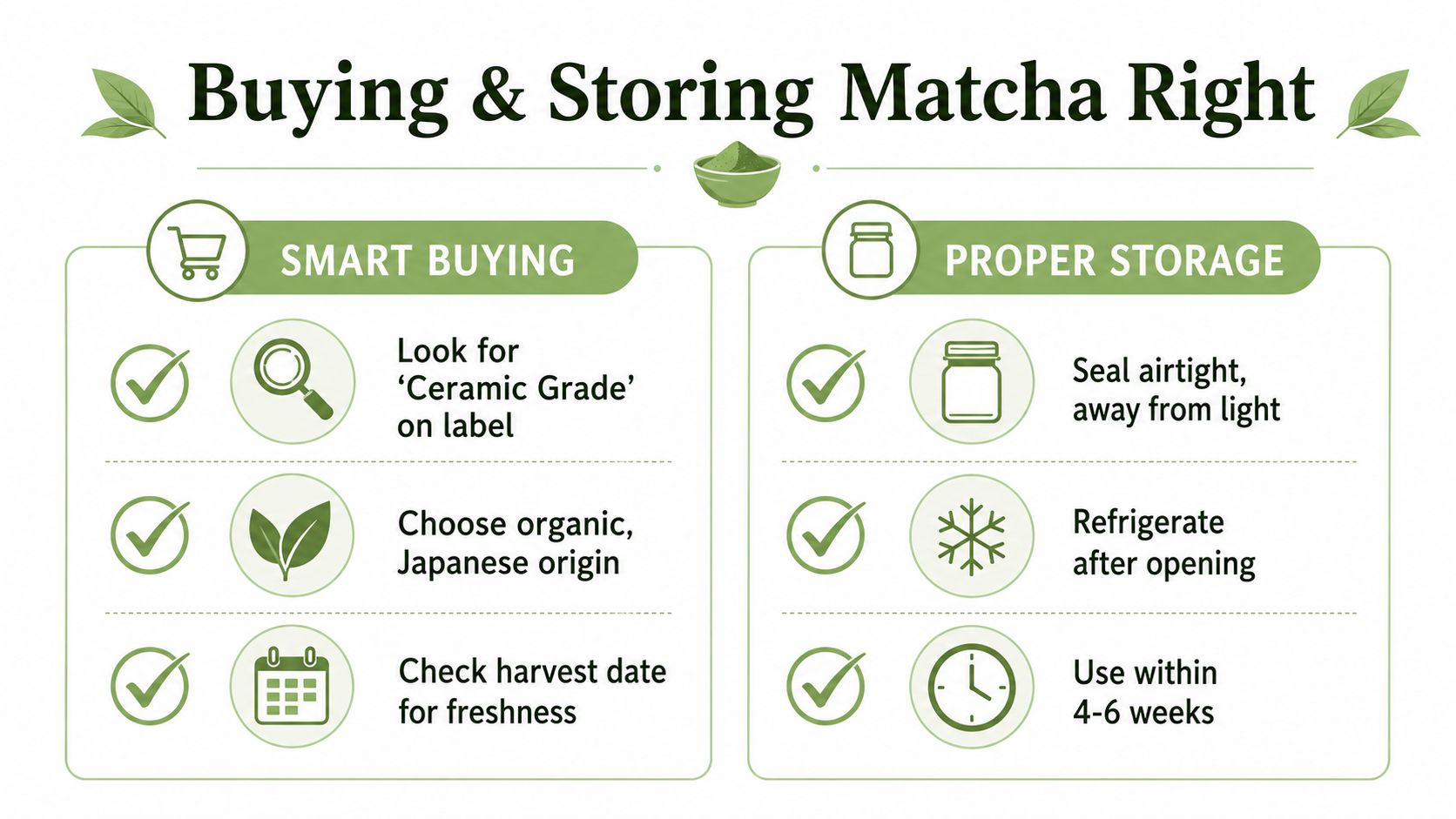
If you buy online, prioritise clear photos of the ingredient panel and packaging date. If you buy in-store, open the conversation with the staff and ask what kind of matcha it is before you decide whether it suits drinking, lattes, or baking.
Choosing the Right Matcha for Your Needs
The decision comes down to one question, what do you want the powder to do? If your answer is “be quick, cold, and easy to mix,” instant matcha tea can be the right tool. If your answer is “taste like real matcha and deliver the fuller leaf experience,” you'll want stone-ground culinary or ceremonial powder instead.
For café owners, the smartest choice often depends on the menu. Instant powder can help with speed and consistency, but a premium matcha earns its place when customers are paying for texture, aroma, and a more authentic cup. For home users, the split is even simpler, convenience versus tradition.
If you're still deciding, keep these priorities in mind:
- Choose instant when you need fast dispersion and straightforward cold-drink prep.
- Choose culinary when you want a stronger flavour for lattes or baking.
- Choose ceremonial when the tea is the whole point.
PepTea's range of premium organic Japanese matcha is built around authenticity, clean ingredients, and practical use in real kitchens and cafés. If you want to compare options and choose the right grade for your routine, explore Pep Tea and pick the powder that fits the drink you want to make.
Kombucha Brewing Container Guide for Home and Café

You've got a kombucha brew sitting on the bench, the SCOBY looks healthy enough, and the big question is still staring back at you from the kitchen shelf. Do you keep using that old glass jar, switch to stainless steel for a bigger batch, or buy something with a spigot because pouring from a heavy vessel is a pain? The answer matters more than most home brewers realise, because the kombucha brewing container isn't just where fermentation happens, it shapes safety, airflow, cleaning, flavour balance and how much finished drink you can draw off.
Why the Brewing Container Matters More Than the Recipe
A good recipe won't save a poor vessel. If the container is too narrow, too reactive, too hard to clean, or sealed in the wrong way, the brew can drift in the wrong direction no matter how careful you are with tea, sugar and starter liquid.

The vessel is part of the fermentation process
Kombucha needs oxygen during primary fermentation, so the vessel has to be open enough for airflow but not sealed tight. Brewing guidance recommends a fermenter that can hold the tea, sugar, SCOBY and starter liquid with headspace, then be covered with breathable material rather than a lid that locks everything in. That's why the same jar that looks “fine” on the shelf can behave very differently once it's holding a live culture.
Practical rule: if the container makes cleaning awkward, pouring messy, or airflow uncertain, it's already working against the brew.
The practical effect is bigger than many expect. Vessel choice can influence whether you get a clean café-style pour, a single-serve retail format, or a larger family bottle at the end of the process. It also affects carbonation behaviour later on, because the vessel shapes how much sediment settles and how much liquid is left behind.
This is why equipment choice often matters more than the recipe itself, a point worth keeping in mind when you read how equipment affects food quality. In kombucha, the container sits upstream of everything else.
Think of it as a control point
Brewers often focus on tea blend or flavour additions and overlook the simple fact that container volume and shape change how the batch behaves. Some liquid is retained by the SCOBY and fermentation losses are normal, so the vessel needs to suit the amount you want to serve. A brew container is not a storage accessory. It's a working part of the process.
If you're choosing one jar for home use, the questions are simple. Can you clean it properly? Can oxygen move the way it should? Can you remove the SCOBY without a wrestling match? If the answer to any of those is no, the container is probably the wrong one.
Comparing Glass, Stainless Steel, Ceramic and Plastic
The easiest mistake is to ask which material is “best” in the abstract. A better question is which material matches the way you brew, clean and serve. For a kombucha brewing container, that means judging acid safety, visibility, durability and how the vessel fits your batch size.
A simple decision lens
Food-grade glass is usually the most straightforward choice for primary fermentation because you can see what's happening without disturbing the brew. Food-grade 304 stainless steel or higher suits larger or more durable setups, especially where breakage is a concern and the metal is fully food-safe. Ceramic can work if it's lead-free and the glaze is safe for acidic contact. Plastic is the weakest fit for long contact, because acidic kombucha can raise material-safety concerns over time.
| Kombucha Brewing Container Material Comparison | Acid safety | Durability | Best for |
|---|---|---|---|
| Glass | Very good when food-grade | Moderate, breakable | Home batches, visible fermentation |
| Stainless Steel | Good when 304 or higher and food-safe | High | Larger batches, heavy use |
| Ceramic | Good if lead-free and glaze-safe | Moderate to high | Heritage-style brewing, stable bench use |
| Plastic | Limited for long contact | Variable | Short-contact experiments only |
The value of glass is obvious to anyone who likes to monitor a ferment closely. You can see the pellicle forming, watch sediment settle and avoid opening the vessel too often. That makes it a comfortable default for beginner brewers and cafés that want a clear visual check before draw-off.
Where stainless steel and ceramic fit
Stainless steel becomes more attractive when the container needs to handle repeated use, transport or a busier service rhythm. The key is that it has to be food-safe stainless, not just any shiny metal. Ceramic sits somewhere between the two, practical and old-school, but only if the glaze is safe and the vessel is easy to inspect.
Plastic sits outside the main recommendation for serious long-term brewing. It can be useful for short-contact testing, but it isn't the easiest material to trust when you're fermenting something acidic and alive. For most Australian home brewers and cafés, glass remains the cleanest starting point, stainless steel the most durable option, and ceramic the niche choice when glaze safety is verified.
Mouth Width, Headspace and Vessel Shape
A brewer can buy a jar for its volume and still end up with a vessel that is awkward to use, hard to clean and poor for food safety. The geometry matters because a kombucha brewing container should let you inspect the culture, remove the SCOBY and wash the vessel without fighting the shape. For a plain-English walkthrough of the culture itself, the SCOBY guide is a useful place to start.
Width is a cleaning feature, not a luxury
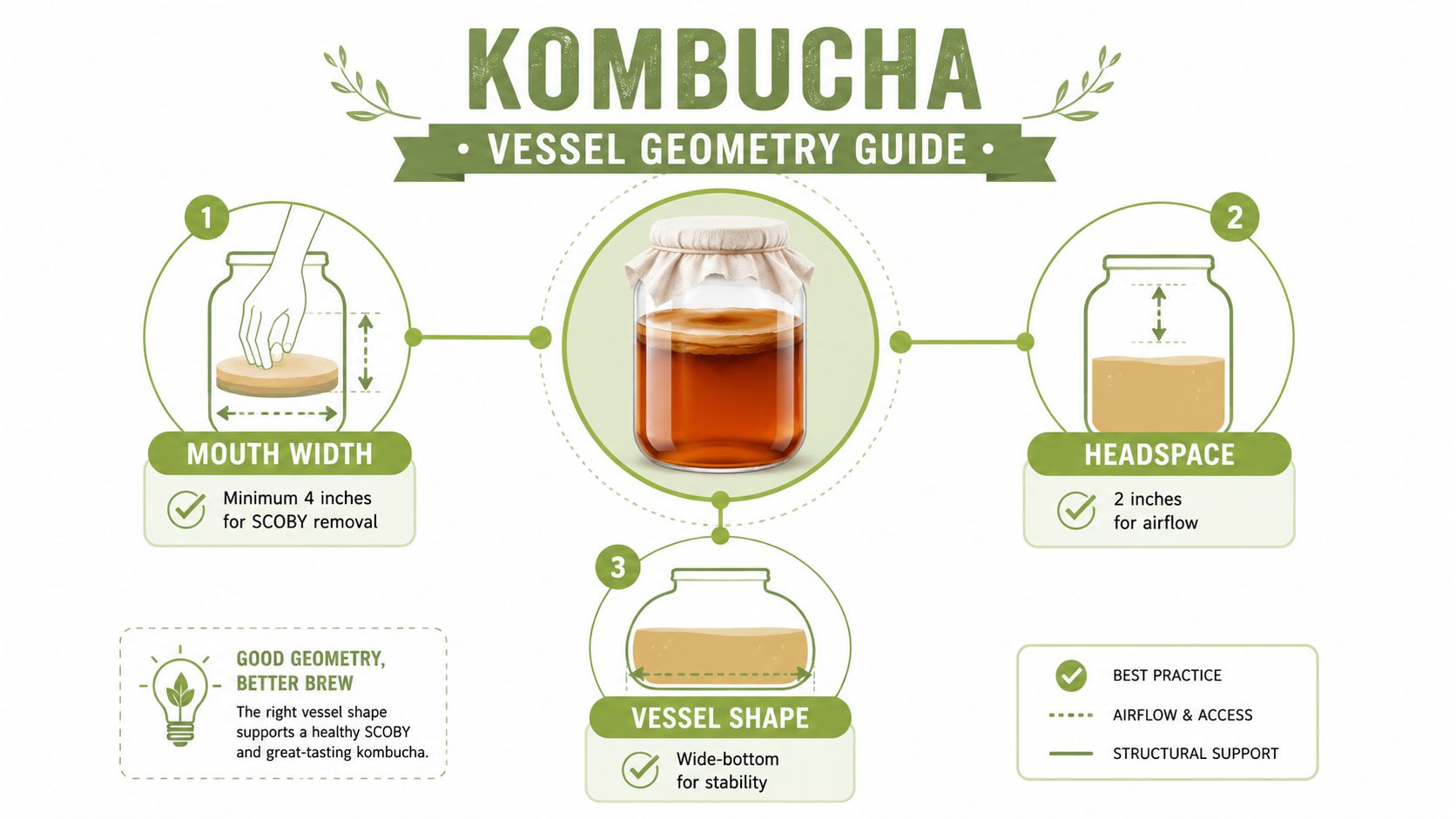
A vessel opening of at least 4 inches is recommended so you can fit a full hand inside for SCOBY removal and cleaning. That is not a comfort upgrade. It is a hygiene decision, because a narrow neck leaves residue where you cannot properly scrub or inspect it, especially around the rim and shoulder of the jar.
The opening also affects how calmly the batch is handled. A wider mouth gives you room to lift the culture, rinse the vessel and check for film or stray sediment without scraping the sides. In a home kitchen, that means less fuss at the sink. In a café, it means faster turnover between batches and fewer awkward cleaning steps during a busy shift.
Headspace matters just as much. A 1-gallon jar should be filled to no more than about 110 ounces, leaving roughly 18 to 20 ounces of headspace for fermentation gas exchange and foam management. That air gap gives the brew room to move naturally instead of pushing liquid up against the cover or into the cloth.
A broad opening and honest headspace are food-safety features. They reduce the chance of residue building up where you cannot see it.
Shape changes the way the batch behaves
A squat, broad vessel tends to sit more steadily on the bench. It is easier to grip, easier to clean and usually less awkward when you are lifting a filled jar full of living, acidic liquid. A tall narrow vessel can still work, but it makes SCOBY handling and washing more fiddly, especially in kitchens where benches are already crowded with kettles, jars and trays.
The base shape matters too. A stable base lowers the chance of knocks and spills, which is worth thinking about in an Australian home with pets, tight bench space or a café prep area where things move quickly. A vessel that tips easily is a poor fit for something that sits fermenting for days at a time.
If you want a clearer picture of how this geometry affects day-to-day brewing, it helps to compare it with preserving spirits with glass stoppers. A stopper suits containment, while kombucha vessel shape should make cleaning, inspection and safe handling easier. Different jobs call for different forms.
Match the vessel to the batch, not the other way around. For home brewing, that usually means prioritising reach and easy washing over decorative shape. For a café, the same rule applies, with extra attention to repeatable handling and stable draw-off. A container that fights you every time you use it is telling you it is the wrong fit for the job.
Lids, Covers and Airflow During Primary Fermentation
Primary fermentation needs oxygen, but it also needs protection from dust and fruit flies. That's why the cover matters just as much as the jar. The right top keeps the brew breathable without leaving it exposed.
What each covering actually does
A breathable cloth cover secured with a rubber band is the usual default. It lets airflow through, keeps debris out and gives the culture the open environment it needs. A tight lid does the opposite, which is why it's the wrong default for primary fermentation. Swing-top seals and valve-style lids are more relevant once the brew moves into later stages.
Think of it the way you'd think about a decanter seal in another kitchen setting, such as preserving spirits with glass stoppers. A stopper is useful when you want containment. Kombucha primary fermentation is the opposite. It wants controlled exposure, not a closed system.
For warm Australian kitchens, a cloth cover still works well if it's clean and secured properly. In smell-sensitive spaces, an airlock-style lid can be a sensible upgrade, but it's more of a specialist choice than a basic requirement. The main point is simple. Primary fermentation should not be sealed shut.
Matching the cover to the stage
A sealed container becomes far more relevant later, after the tea has already fermented and you're managing carbonation or flavour additions. That's when pressure control starts to matter. During the first ferment, though, the job is protection plus airflow, not pressure containment.
A good covering setup usually looks plain, and that's fine. Clean cloth, secure band, enough airflow, enough protection. If you're reaching for more complicated hardware just to get through primary fermentation, the container or the environment may need simplifying instead.
Cleaning, Sterilising and Spotting Early Warnings
Hygiene is the part many overlook, then regret later. In kombucha, the container, lid and spigot are all part of the food-safety system, especially because residue can build up in rims, threads and valves. Cleaning isn't separate from brewing. It is brewing.
A routine that keeps problems small
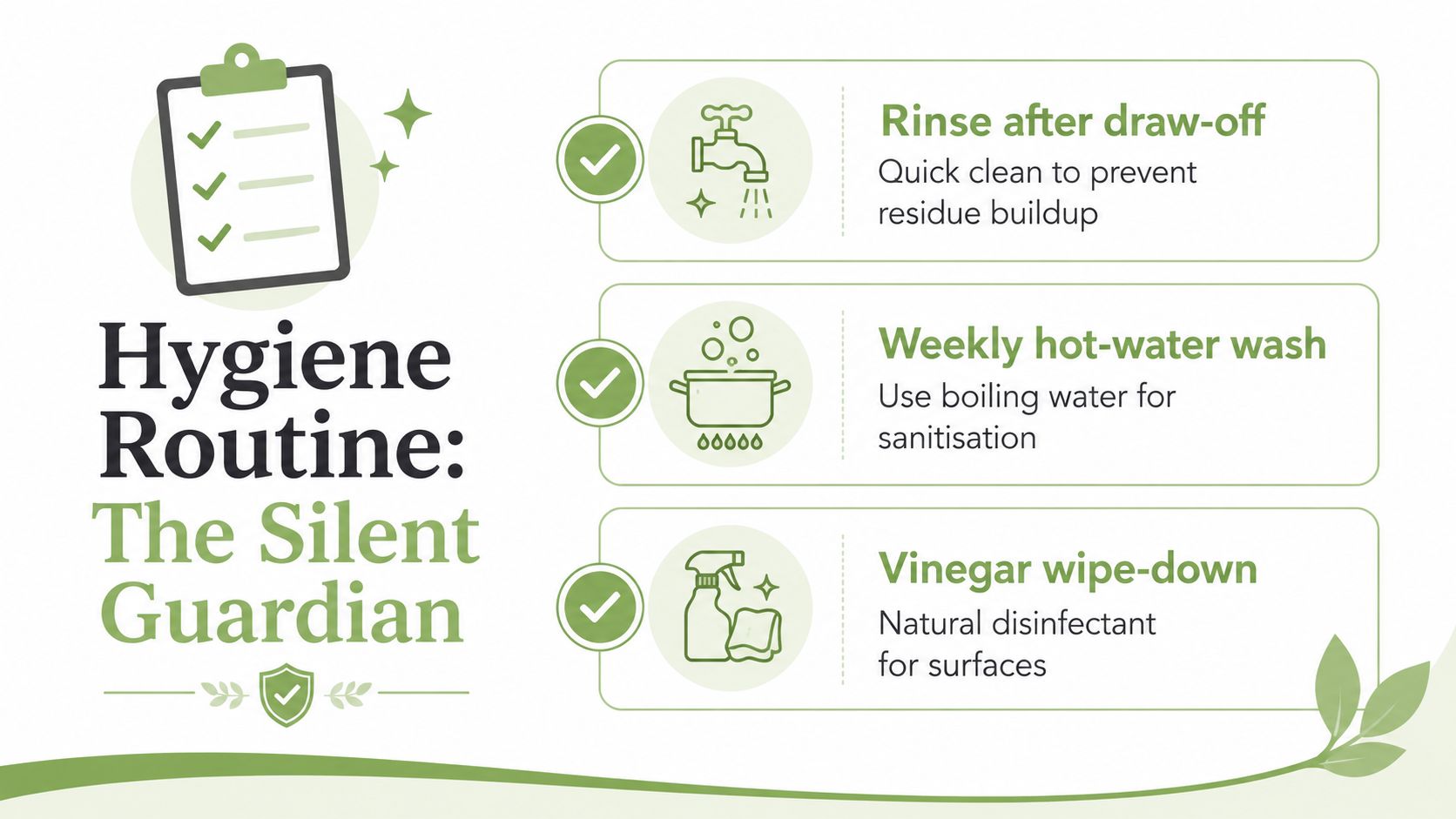
After each draw-off, rinse the vessel so residue doesn't dry onto the walls or spigot. Give it a proper hot-water wash each week if you're using it regularly, and do a periodic deep clean with a food-safe sanitiser. That rhythm is more useful than waiting until the jar looks dirty.
Inspection matters just as much as washing. Look closely at the rim, the threads, the base and any spigot assembly. Those are the places where yeast bits, sugary film and stray residue can linger. A clean-looking container can still hold dirt in a hidden seam.
Good habit: if you can't easily inspect a part of the vessel, you can't really trust it.
Early warnings to take seriously
Stringy brown mould is not something to brush off. Sour alcohol smells can point to a fermentation balance problem, especially if the container isn't behaving well or the vessel has dead zones where residue sits too long. A SCOBY that stops forming new layers can also tell you the system isn't stable.
Those signs don't always mean the same fault, but the container is often part of the cause. A narrow opening makes cleaning harder. A poor spigot design traps sediment. A vessel that's awkward to inspect makes little problems harder to catch early.
If you want a practical benchmark, compare your brew habits with a reliable pH workflow like the one used in Pep Tea's digital pH meter guide. The point isn't to turn home brewing into lab work. It's to make your checks consistent enough that you notice trouble before it spreads.
Hygiene is boring right up until it saves a batch. Then it becomes the most valuable skill in the room.
Scaling Up for Home, Café and Continuous Brew
A single-batch home jar and a café dispensing system are not just different sizes of the same thing. They are different operating models. Once you start drawing off kombucha for customers or steady household demand, the container has to support turnover, cleaning and stable flavour, not just fermentation.
Home batch versus continuous system
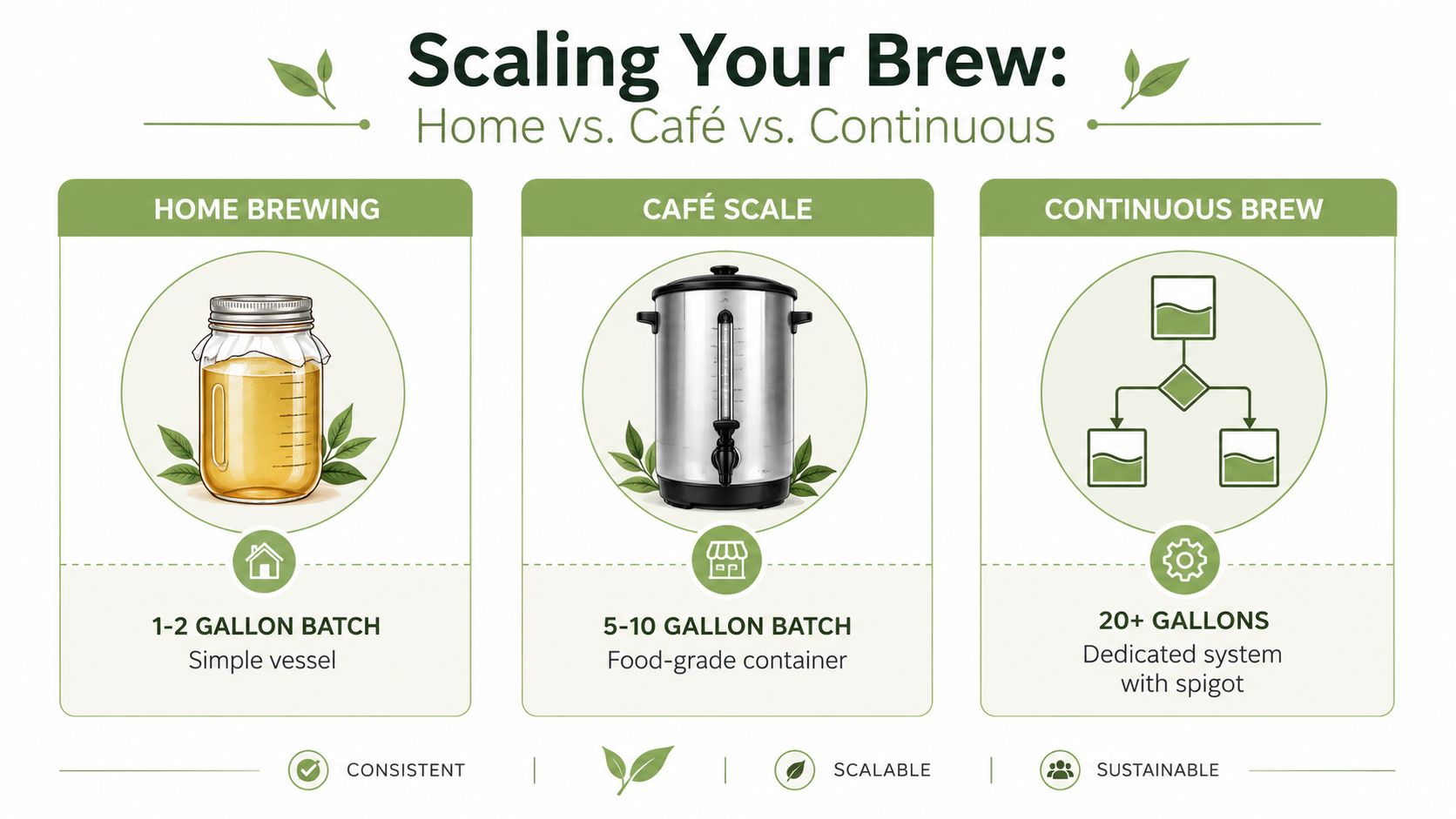
For batch brewing, one source recommends a 1 to 5 gallon vessel, while continuous brew is typically 2 to 5 gallons with a spigot near the bottom so kombucha can be drawn off without disturbing the SCOBY and sediment. A glass vessel in that range is the common shape of a continuous system, and the spigot placement matters because it controls how cleanly you can serve from the lower portion of the brew. The ideal fermentation temperature is often cited around 80°F (27°C), with a broader working range of 75 to 85°F (24 to 30°C), which is another reason vessel choice and room conditions need to be considered together. Kombucha container and spigot options bring those pieces into the same decision.
Continuous brew also has its own maintenance logic. Larger systems can become too acidic or overloaded with SCOBY mass if they're left too long without balancing draw-off and refill. That's why the container has to be sized for regular use, not occasional attention.
What cafés should watch
A small café often does better with two parallel vessels instead of one huge drum. That gives you more flexibility if one batch is slower, cleaner or more popular than the other. It also reduces the pain if a single vessel needs to be cleaned or rotated out.
Spigot design is the primary failure point in many larger systems. Guidance for continuous brew recommends food-grade spigots with no metal on the inside of the container, and material choice should stay on the safe side. A 2 to 5 gallon container is often the sweet spot because it gives enough volume without turning maintenance into a storage problem. Continuous brew vessel guidance is useful here, especially if you're planning a setup that's meant to be drawn from regularly.
For Australian cafés, the practical question is not just “how big?”. It's “how easy is this to clean, inspect and refill on a busy day?”. That answer should drive the choice.
Secondary Fermentation Vessels and Bottling Choices
Once the first ferment is ready, the brew changes jobs. The open vessel that worked for primary fermentation gives way to a sealed bottle that has to manage flavour, pressure and carbonation. The container choice here is different again, because the brewing problem has changed.
Bottles need to handle pressure
Thick-walled glass bottles with swing-top or thick gasket seals are the standard pick for secondary fermentation. They're built to hold pressure and they make it easier to add fruit, herbs or spices without opening and closing a flimsy lid repeatedly. Narrow-necked bottles are awkward if there's any pulp or SCOBY fragment in the mix, because filling and cleaning become harder.
Headspace still matters in the bottle. Pressure builds as carbon dioxide forms, so leaving room at the top gives the gas somewhere to go. That's the same logic as the wider fermentation vessel, just applied to a sealed environment.
Where PET fits, and where it doesn't
Commercial-grade PET bottles can work for short-term, low-pressure experimentation. They're useful when you want a simple, temporary test or a bottle that lets you feel pressure by hand. But they're not a long-term substitute for proper fermentation bottles, especially if you're planning regular secondary fermentation with fruit additions.
If you need a refresher on post-ferment handling, this kombucha storage guide is a helpful companion. The bottle, the fridge and the timing all work together once carbonation is already underway.
The main thing to remember is that secondary fermentation is a pressure stage, not a primary breathing stage. That means the vessel has to be chosen for containment, not airflow. Once you separate those two jobs clearly, bottle choice becomes much easier.
Common Questions and Practical Troubleshooting
A lot of kombucha container questions only come up after the first few batches, when the bottle is already on the bench and something looks slightly off. That's normal. The trick is to treat the container choice as a live decision, not a one-time purchase.
What about plastic for short contact
Food-grade plastic can be acceptable for short contact in limited situations, but it's not the default recommendation for long acidic fermentation. If the contact is brief and the container is food-safe, some brewers use it for experiments or temporary holding. For primary fermentation or repeated long contact, glass, ceramic or food-safe stainless steel is the cleaner call.
Is a cloudy or greasy film a container problem
Sometimes it is, sometimes it isn't. A cloudy film can be harmless yeast activity, while a greasy-looking residue may point to poor cleaning or a spigot that's holding old material. If it keeps returning in the same place, the vessel design is probably part of the issue.
Can stainless steel change flavour
Food-grade stainless steel is generally accepted when it's the right grade, but if a metallic taste shows up, don't assume the vessel is the only cause. Water quality, residue in the container and cleaning issues can all play a role. If the taste appears after switching vessels, check the spigot, the water and the cleaning routine before blaming the metal itself.
What should a buyer look for first
For home brewers, the first test is whether the vessel is easy to inspect and clean. For cafés, the first test is whether the system can be served from safely and cleaned quickly. For both, the safest benchmark is a well-fermented, properly handled, certified-organic Australian kombucha that tastes clean, balanced and stable.
If you want to choose the right vessel once and avoid guesswork later, start with the material, the mouth width and the spigot, then build your batch size around that. And if you'd rather learn from a brand that treats fermentation as a real food-safety process, visit Pep Tea for Australian-made kombucha and tea education that puts quality first.
Kefir Grains Australia: Your Ultimate Guide for 2026

You've probably seen kefir grains pop up in a Sydney café menu, on a wellness shelf, or in a Facebook group where someone's offering a jar of living culture to “a good home”. The odd part is that most Australians can tell kefir is fermented, but they're not always sure what they're buying, how to keep it alive, or whether it's even worth the trouble. If you're standing in that gap right now, you're in the right place.
Australia's kefir market is projected to grow from USD 10.97 million in 2024 to USD 16.68 million by 2033 (Deep Market Insights), which tells you something simple and useful, this is still a niche category, but it's steadily finding its place in Australian fridges and café cool rooms. The broader food pattern matters too, because Australian adults consumed an average of 142 g/day of cereals and grains in 2023, with 47 g/day from flours, rice, and grains (Deep Market Insights). Grain-based eating already sits comfortably in daily life, so fermented grain cultures don't arrive as a foreign idea, they fit into familiar habits.
That's the heart of kefir grains Australia shoppers are really chasing, not just a recipe, but a reliable culture that survives local kitchens, local shipping, and local routines. This guide keeps things practical, plain-spoken, and grounded in how fermentation works at home.
Your Introduction to the World of Kefir
A lot of people meet kefir the same way. They're looking for a gut-friendly breakfast option, they see a cloudy drink in a health shop fridge, and they wonder whether the grains inside are some kind of magic or just another trendy ferment. In Australia, that curiosity is becoming more common, because kefir has moved from specialist chatter into a modest but growing functional food space.
The market data backs that up. Australia's kefir market is projected to grow from USD 10.97 million in 2024 to USD 16.68 million by 2033 (Deep Market Insights). That doesn't make kefir mainstream in the way milk or yoghurt is mainstream, but it does show a clear long-term path for the category. People are learning to make room for fermented drinks in their ordinary routines.
Practical rule: if a product keeps turning up in cafés, home kitchens, and specialist retail, it usually means the category has crossed from novelty into habit.
That shift matters for Australian buyers, because buyers aren't searching for kefir as an abstract health concept. They're asking whether the grains are live, whether they'll survive the trip, and whether the culture will behave in a warm kitchen in Queensland, a breezy coastal flat, or a Hunter Valley dairy room. Those are real questions, and generic internet guides often skip them.
Kefir grains Australia shoppers also tend to run into a second layer of confusion, the difference between a live grain culture and a powdered starter. That distinction changes how the ferment performs, how long it lasts, and what you can do with it later. The rest of this guide strips away the noise and gives you the practical version, the version you'd want if you were standing at the bench with a jar, a strainer, and a half-finished bottle of milk.
What Exactly Are Kefir Grains
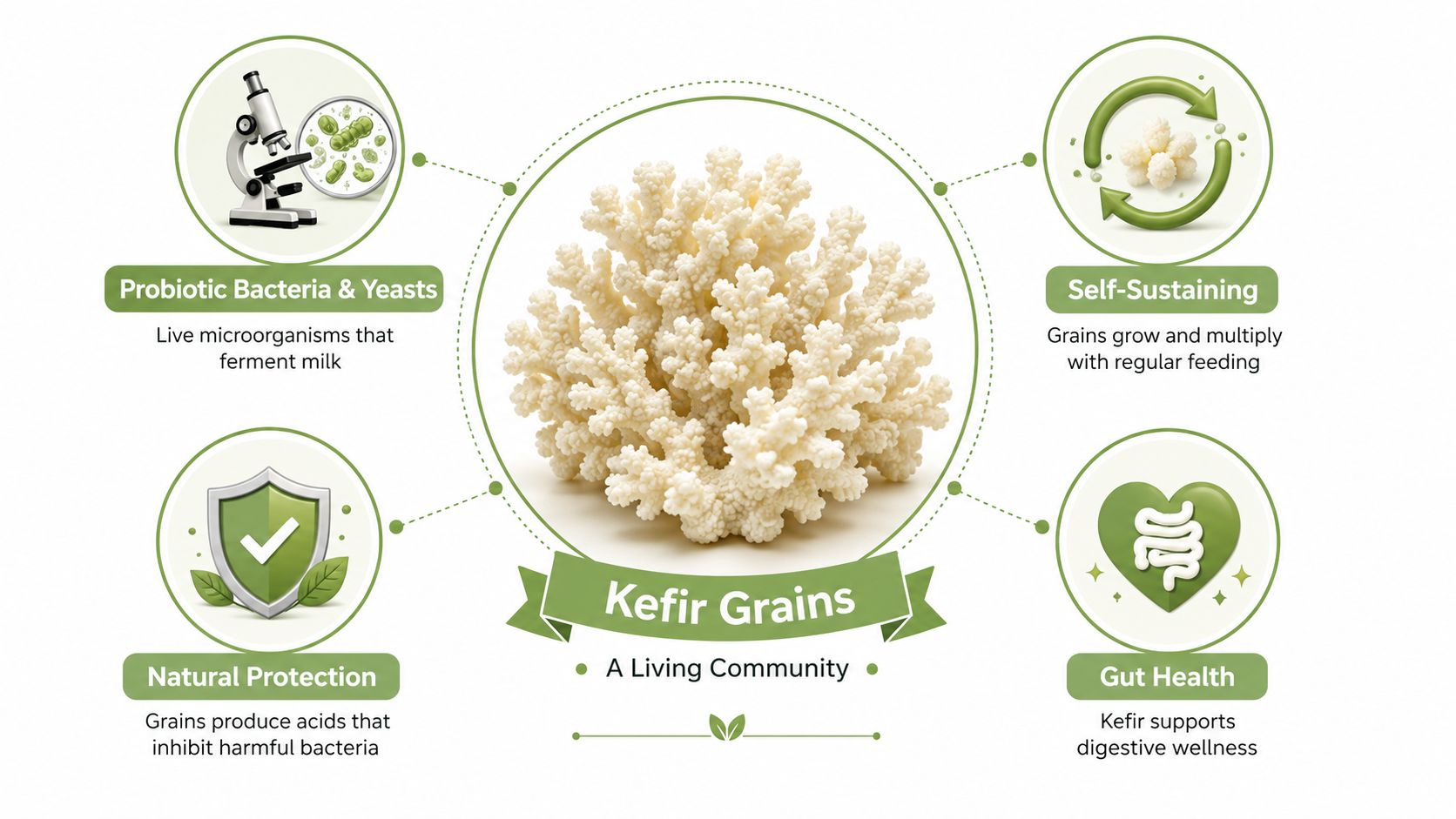
Kefir grains are a living community of microbes held together in a natural matrix. They are not grains in the cereal sense, and they are not a powder you stir in once and leave alone. In practice, they act like a self-renewing fermentation system, taking in milk, feeding the resident microbes, and building the culture that gives kefir its tang and texture.
Milk kefir grains are especially active. A peer-reviewed review reports that they typically contain about 10^8 CFU/g lactic acid bacteria and 10^6 to 10^7 CFU/g yeast, all held in a polysaccharide matrix (PMC review). In plain English, that means the grains are doing real biological work every time they go into milk. The microbes feed, multiply, and shape the flavour and body of the drink.
Milk kefir and water kefir aren't interchangeable
Milk kefir grains and water kefir grains both ferment, but they are built for different jobs. Milk kefir grains are made for dairy, while water kefir grains are used in sweetened water-based ferments. That matters because a culture usually performs best in the medium it knows, which is why a grain bought for milk kefir may not shift cleanly to coconut milk or another substrate (Microbial Foods).
For Australian home fermenters, careful sourcing starts to matter. A grain can look healthy and still be the wrong fit for your kitchen or the wrong medium for your routine. If you are comparing styles, the guide at kefir vs kombucha gives a clear reference point for how the cultures, process, and drinking habits differ.
Why the grain structure matters
Kefir grains are not just a starter sitting in milk. Their structure helps them keep fermenting and growing from batch to batch. Another review describes kefir grain composition as roughly 45.7% mucopolysaccharide and 34.3% total protein, with 90% moisture in the finished kefir drink and about 0.48% alcohol in typical kefir (PMC review). That structure is one reason live grains behave differently from a one-off culture packet. They keep working because the community inside them keeps renewing itself.
Practical rule: if the grains are maintained properly, they should keep doing the work for you. That is the main advantage of a live kefir culture.
Sourcing Quality Kefir Grains in Australia
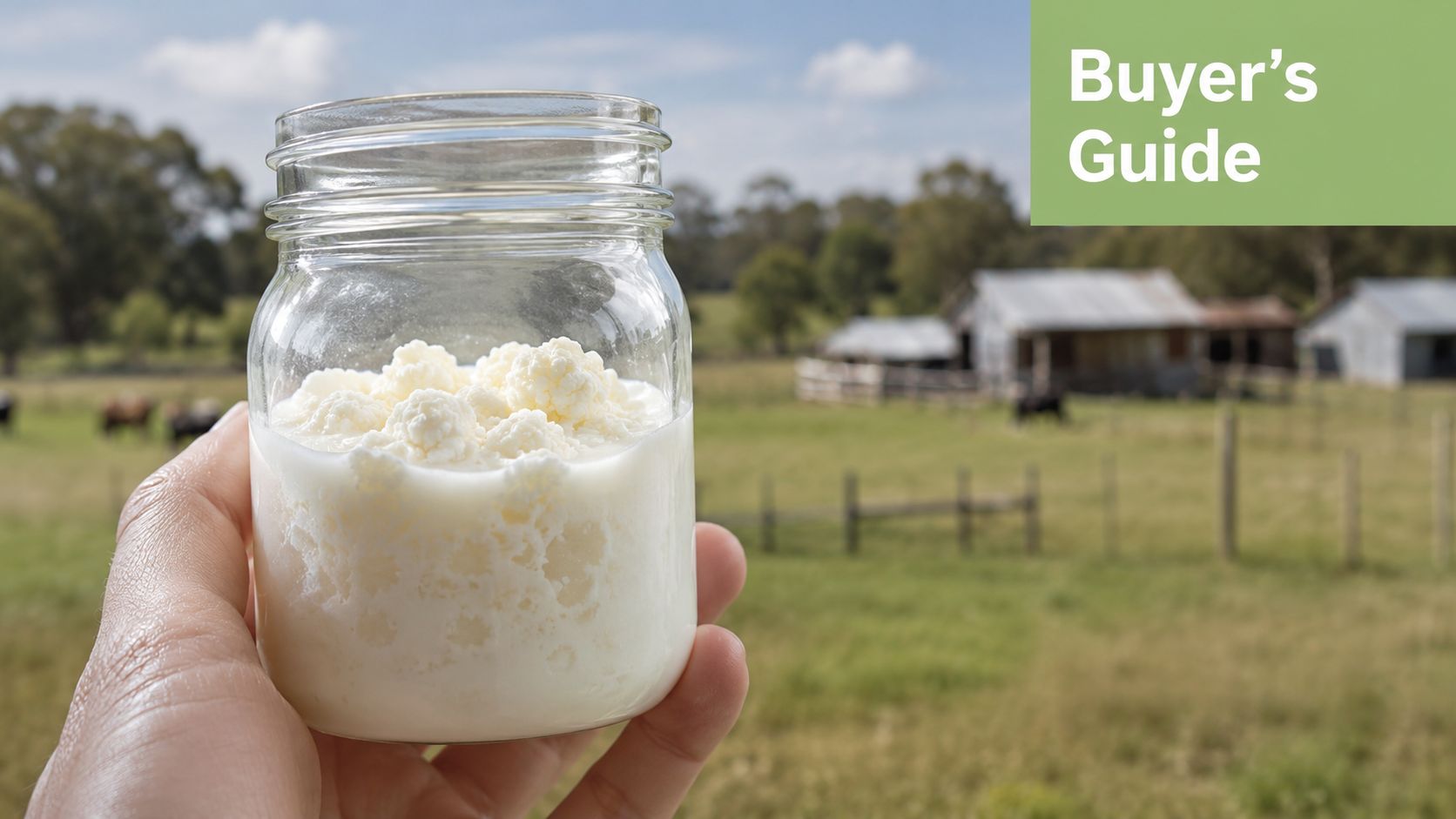
Buying kefir grains in Australia is less about finding the cheapest jar and more about avoiding a weak culture that never really gets going. The best grains usually look plump and cauliflower-like, smell fresh and clean, and come from someone who can tell you what medium they've been living in. If the listing is vague about that, be cautious.
Local health food shops can be handy if they stock live cultures, but availability is patchy. Specialised online sellers are often the most practical route, especially if they describe medium, freshness, and shipping conditions clearly. Community sharing groups can be generous, but they're only useful if the donor can explain how the grains were fed and whether they've been chilled, dehydrated, or switched between milks.
The Australian climate adds another layer. Live cultures don't love sitting in a parcel truck during a summer heatwave, so shipping method matters more than a lot of newcomers realise. If a seller can't explain how they protect the grains in transit, you're taking a gamble on viability.
What to ask before you buy
Before you transfer money, ask simple questions that reveal whether the seller knows the culture:
- What medium are the grains currently adapted to? Milk grains should be treated as milk grains, not generic ferment starters.
- Are the grains live and reusable? You want a continuing culture, not a one-use product.
- How are they packed for transit? This matters a lot in Australian heat.
- How recently were they fed? Freshly maintained grains usually travel better than stressed ones.
- What happens if the parcel is delayed? A sensible seller has an answer.
A useful reminder from the research is that cultures perform best when kept in the same substrate they were propagated in (Microbial Foods). That's a small detail with big consequences. It helps explain why some grains thrive beautifully and others stall out the moment they're moved into the wrong kitchen setup.
You'll also see a lot of content that tells you kefir grains are “live cultures”, which is true, but not enough on its own. The buyer question is whether those live cultures are adapted to your milk, your climate, and your handling routine. That's where quality lives, and it's where poor purchases usually fall apart. For readers who care about traceability and ingredient integrity, our broader approach to organic certification in Australia is a good example of the kind of transparency worth expecting from any ferment seller.
Your First Milk Kefir Fermentation Step by Step
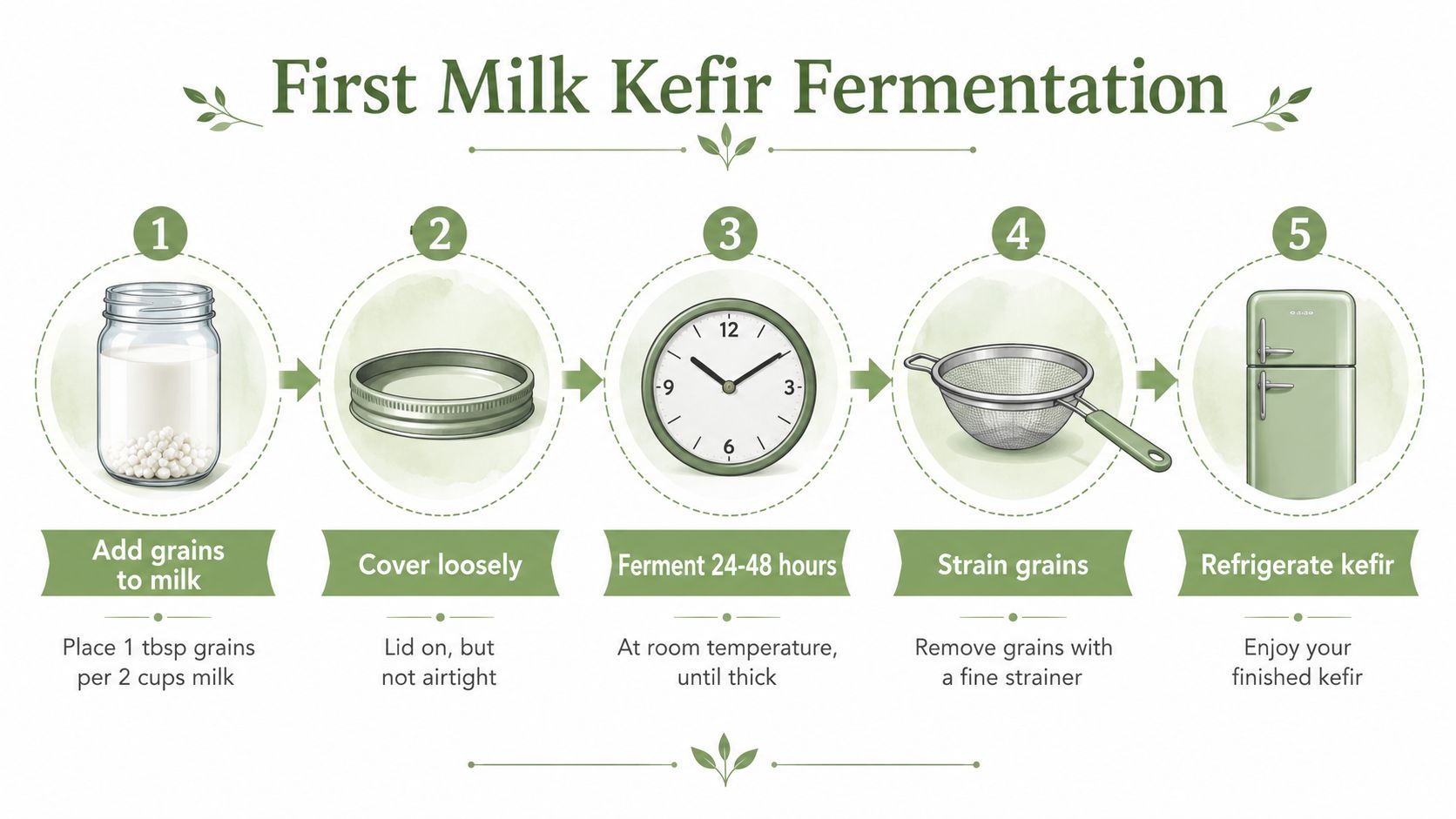
Milk kefir is easiest when you treat it like making tea, not running a lab. You combine the culture with milk, leave it at room temperature, and let the grains do their work. A reliable starting point is about 1 tablespoon, roughly 20 g, of grains per 4 cups, roughly 950 mL, of milk, with fermentation usually taking 12 to 30 hours depending on kitchen temperature (YouTube guide).
The simplest first batch
- Add the grains to milk. Use a clean glass jar and a sensible milk-to-grain ratio. More grains usually mean a faster ferment, less grain means a slower one.
- Cover loosely. A lid that isn't airtight or a breathable cover works well because the culture needs to ferment without pressure building up.
- Leave it at room temperature. In a warmer kitchen, fermentation moves faster. In a cooler kitchen, it slows down.
- Watch for texture changes. The milk should thicken slightly and smell pleasantly tangy, not rotten.
- Strain the grains out. Use a fine strainer, then refrigerate the finished kefir.
The best beginners learn to trust the senses. If it smells clean and sour in a dairy-like way, that's usually a good sign. If it looks separated, with clear liquid and thicker curds, that can still be normal, especially in a warm Australian kitchen where fermentation runs faster than expected.
Getting the timing right in Australian kitchens
Temperature matters more than the clock. A batch might be ready in half a day in a hot room, while a cooler kitchen may need closer to a full day. That's why a recipe is a guide, not a cage.
Practical rule: your nose and your eyes are part of the fermenting kit. Learn them early, and you'll waste less milk.
If you like watching the process, there's a helpful embedded guide below.
Once the kefir tastes right to you, strain it and chill it. The finished drink should be tangy and refreshing, not aggressively sharp on the first try. A gentler batch is often the better place to start, because it builds confidence while the grains settle into their new home.
Caring For and Growing Your Kefir Grains
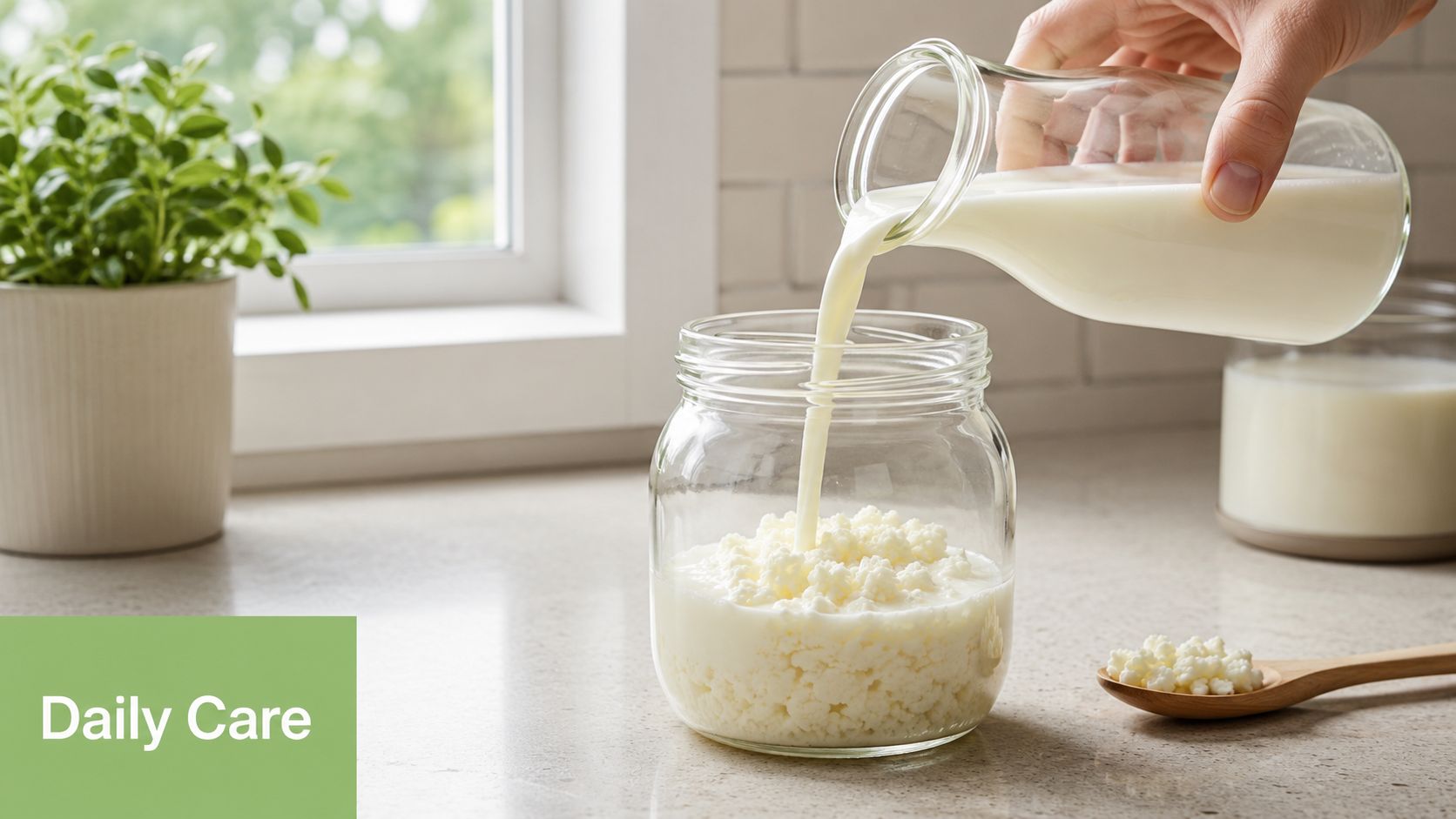
Caring for kefir grains is a rhythm, not a burden. Feed them fresh milk, strain them, repeat. In practical terms, many home fermenters keep them on a 24 to 48 hour cycle, and healthy milk kefir grains can roughly double in volume every 2 weeks under ideal conditions (PMC review).
Keeping the routine manageable
A lot of people worry that live culture will take over the kitchen. It doesn't have to. You can treat grain care like watering a plant, only with a jar and a strainer instead of a watering can.
Fresh milk is the reset button. If the grains are active, they need regular feeding more than they need fussing.
If you're stepping away for a bit, refrigeration is the easiest pause. Grains stored tightly sealed in milk in the fridge can stay viable for about 2 to 4 weeks before needing fresh milk again (Cultured Food Life). That's handy for holidays, busy work weeks, or anyone who doesn't want a daily commitment.
For readers who already keep other ferments at home, the storage approach is similar to how many people manage kombucha during a break. A useful companion read is how to store kombucha, because the same common-sense thinking applies, keep the culture stable, cool it when needed, and don't leave it dry.
What to do when the grains multiply
Growth is a good sign. It means the culture is active and being cared for well. If you end up with more grains than you need, share them with a friend, start a second jar, or freeze the extra only if you understand the trade-off in culture strength. If you don't want to keep them, composting is better than leaving them forgotten at the back of the fridge.
The big thing to remember is this, grain care rewards consistency, not perfection. The more regular your feeding rhythm, the easier the whole process becomes.
Common Kefir Questions and Troubleshooting
Kefir beginners usually ask the same three questions, and the answers are often simpler than they expect.
Why is my kefir too sour or runny? The usual reason is time, temperature, or too many grains for the amount of milk. In a warm Australian kitchen, fermentation moves quickly, so a batch left too long can turn sharp and separate. Use fewer grains, shorten the ferment, or move it to a cooler spot next time.
Why aren't my grains growing? Grains often stall when they're stressed, underfed, or living in a medium they don't prefer. If they were adapted to milk, keep them in milk. If they're not being fed regularly, or they've spent too long in the fridge, they may need a few cycles to recover.
Is this mould? True mould usually looks fuzzy, coloured, and wrong in a way that's easy to spot once you've seen it. Off smell matters too, because healthy kefir should smell tangy and dairy-like, not rotten or harsh. If you're unsure, it's safer to discard the batch and start again than to gamble.
A calm approach helps more than panic ever will. Many first batches behave unevenly because fermentation is sensitive to ambient temperature and handling, not because the culture is bad. If a jar fails once, that doesn't mean kefir isn't for you.
The best troubleshooting move is usually the simplest one, change one variable at a time.
For readers who want a broader sense of how fermented drinks behave in the body and in daily routines, a useful companion read is probiotic coffee science. It's not about kefir specifically, but it does help frame how people think about probiotics in drinks and why format matters.
Bringing Fermented Goodness Into Your Routine
Kefir works best when it becomes ordinary. Stir it into a smoothie, pour it over fruit, use it in a salad dressing, or drink it straight from the glass when you want something tangy and simple. The point isn't to make fermentation elaborate, it's to make it sustainable.
Australia's kefir market is still small, but the growth path shows that more people are making room for cultured foods in everyday life (Deep Market Insights). That fits a broader wellness pattern too, one where people want food and drink that feels functional without feeling heavy. If you enjoy that style of living, homemade kefir and ready-to-drink fermented options can sit comfortably side by side.
For anyone who likes to compare fermented beverages, it's worth remembering that kefir is one piece of a wider probiotic offering. Pep Tea's sugar-free kombucha is another clean, brewed option for people who want live culture in a different format, especially when convenience matters more than maintaining grains every week.
If you're ready to explore more fermented drinks, visit Pep Tea for premium organic teas and our Australian-brewed sugar-free kombucha. If you've been curious about kefir grains Australia buyers can trust, we hope this guide gives you the confidence to start with the right culture and a calmer first batch.
Mate Drink Australia: Sourcing, Brewing, and Serving

You're standing in a café queue in Melbourne or Newcastle, and the person ahead of you orders a mate drink instead of another flat white. At home, it might be the same feeling when you've got a pantry full of tea, coffee, and sparkling water, but you still want something with a cleaner lift and a bit of ritual. That's where mate drink Australia has started to feel less like a niche import and more like a practical everyday choice.
For a lot of Australians, mate sits in an interesting middle ground. It keeps the social warmth of tea, the alertness people want from caffeine, and the lower-sugar, functional appeal that fits modern café menus and home routines. Australia's mate market is still small, but it's moving quickly, with projections from Future Market Insights showing USD 13.2 million in 2025 and USD 37.7 million by 2035, alongside forecast growth of 11.1% CAGR over the period and 10.5% in H1 2025 and 11.9% in H2 2025 (Future Market Insights).
That matters because Australia is already shifting towards drinks that do more than just quench thirst. The ABS reported 191.2 million litres of pure alcohol were available for consumption in 2017–18, equal to 9.51 litres per person (ABS). DrinkWise also found that, comparing 2007 vs 2017, Australians were generally drinking less frequently, with just under two thirds of drinkers having no more than two standard drinks on a typical drinking day (ABS). In that kind of market, a caffeine drink that can show up in cafés, fridges, and lunch breaks makes sense.
Why Mate Is Capturing Australian Attention
A barista pours a sample into a takeaway cup, and the customer asks the same question that comes up everywhere from inner-city cafés to suburban kitchens, “Is this like tea, or is it going to hit me like coffee?” That question explains why mate drink Australia is getting attention. People want something familiar enough to trust, but different enough to feel useful.
The drink fits a changing occasion
Mate fits a space Australians already recognise. It can replace a morning coffee, sit beside a pastry in a café, or take the place of a sugary energy drink when someone wants focus without heavy sweetness. Future Market Insights' projection for the Australian market suggests that demand is moving beyond curiosity and into repeat purchase territory, especially in wellness-led food and beverage settings (Future Market Insights).
That shift also lines up with a broader preference for lower-alcohol and non-alcoholic options. When people want a social drink that still feels adult and functional, mate can fill part of that gap. It is not pretending to be wine or beer, it gives cafés and households another option that feels more purposeful than soft drink.
Practical rule: if the customer wants ritual, caffeine, and less sugar, mate is an easy beverage to explain without overselling it.
It's familiar, but not boring
Australian drinkers already know tea. They already know caffeine. Mate appeals because it sits between those worlds and still feels a little different. That novelty matters, especially in cafés where the menu needs to offer something customers will remember and mention to a friend.
For business owners, that same novelty can work as a low-friction way to broaden a drinks list. A mate option does not need to replace coffee or kombucha. It can give the menu another lane for people who want a warm, energising, less sugary drink. If you are comparing how mate fits into modern beverage ranges, our functional beverage trends page is a useful place to look at the broader category.
Australian taste is moving toward practical wellness
The best mate conversations in Australia rarely start with tradition alone. They start with questions about how it tastes, when to drink it, and whether it suits a workday. That is the right frame. Mate has staying power here because it is useful, not because it is fashionable for a week. Temperature and dose are key safety levers, especially for people who are trying mate for the first time and want a steady, comfortable experience rather than a sharp caffeine spike.
Understanding Mate Origins and Health Benefits
Yerba mate comes from Ilex paraguariensis, a South American plant whose dried leaves are brewed and shared in a gourd with a metal straw called a bombilla. SBS Food describes that traditional preparation clearly. The method matters because mate is not just another flavoured tea, it carries a social ritual with it (SBS Food).
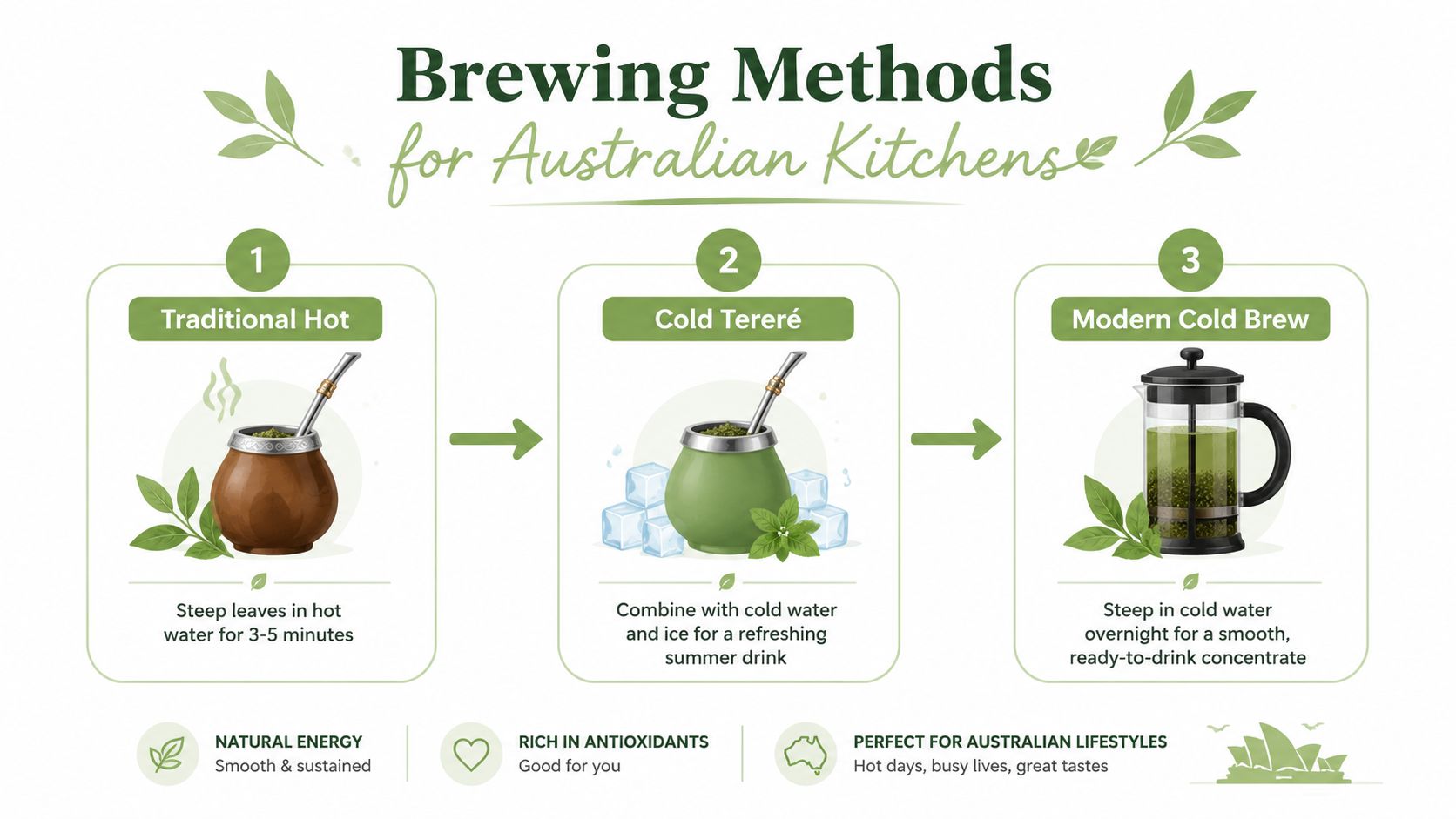
What Australian drinkers need to know first
The first thing many people in Australia want to know is simple, mate is naturally caffeinated. Product guidance from Tea Tonic places brewed yerba mate at around 70-85 mg per 240 mL cup or about 78 mg per 150 mL cup (Tea Tonic). National Geographic also notes that mate contains roughly 80 mg caffeine per cup, which puts it in the same general conversation as coffee, not herbal tea (National Geographic).
That is where confusion often starts. Mate is often described as “smoother” than coffee, but smoother does not mean weak. It means the experience can feel less sharp to some drinkers, especially when brewed well and served at a sensible strength. For people who want alertness without the feel of a heavy espresso hit, mate deserves proper attention.
The bioactive profile is part of the appeal
National Geographic also notes that yerba mate contains caffeine, theobromine, and theophylline (National Geographic). That combination helps explain why some people experience it as a steadier functional drink rather than a purely jarring stimulant. In plain terms, there is more going on than just “tea with caffeine”.
The practical value in Australia is easy to see. Office workers replacing multiple coffees, café customers avoiding sugary energy drinks, and people who want a gentler afternoon option all ask the same thing in different words. They want a drink that supports alertness without becoming a habit they regret later in the day. For that reason, mate fits the gap between cultural authenticity and the convenience people now expect in Australian homes and cafés.
Temperature and dose are the real safety levers
Mayo Clinic warns that the dose and temperature matter more than the label itself. Long-term intake of about 1-2 L/day has been associated with higher risks of several cancers, and hot mate above 65 °C has been classified by IARC as probably carcinogenic because very hot beverages can damage the esophagus (Mayo Clinic). In Australian cafés, the practical response is straightforward, keep serving temperatures sensible and avoid treating mate as an all-day litre-by-litre drink.
Serve it warm, not scalding, and keep the serving size sensible. That is the easy hospitality rule.
Brewing Methods for Australian Kitchens and Cafés
Australian kitchens don't all look the same. Some people have a kettle, a mug, and five quiet minutes before work. Others are running a busy café and need a drink that can be explained, made consistently, and served without fuss. Mate can work in both settings if the brewing method suits the occasion.
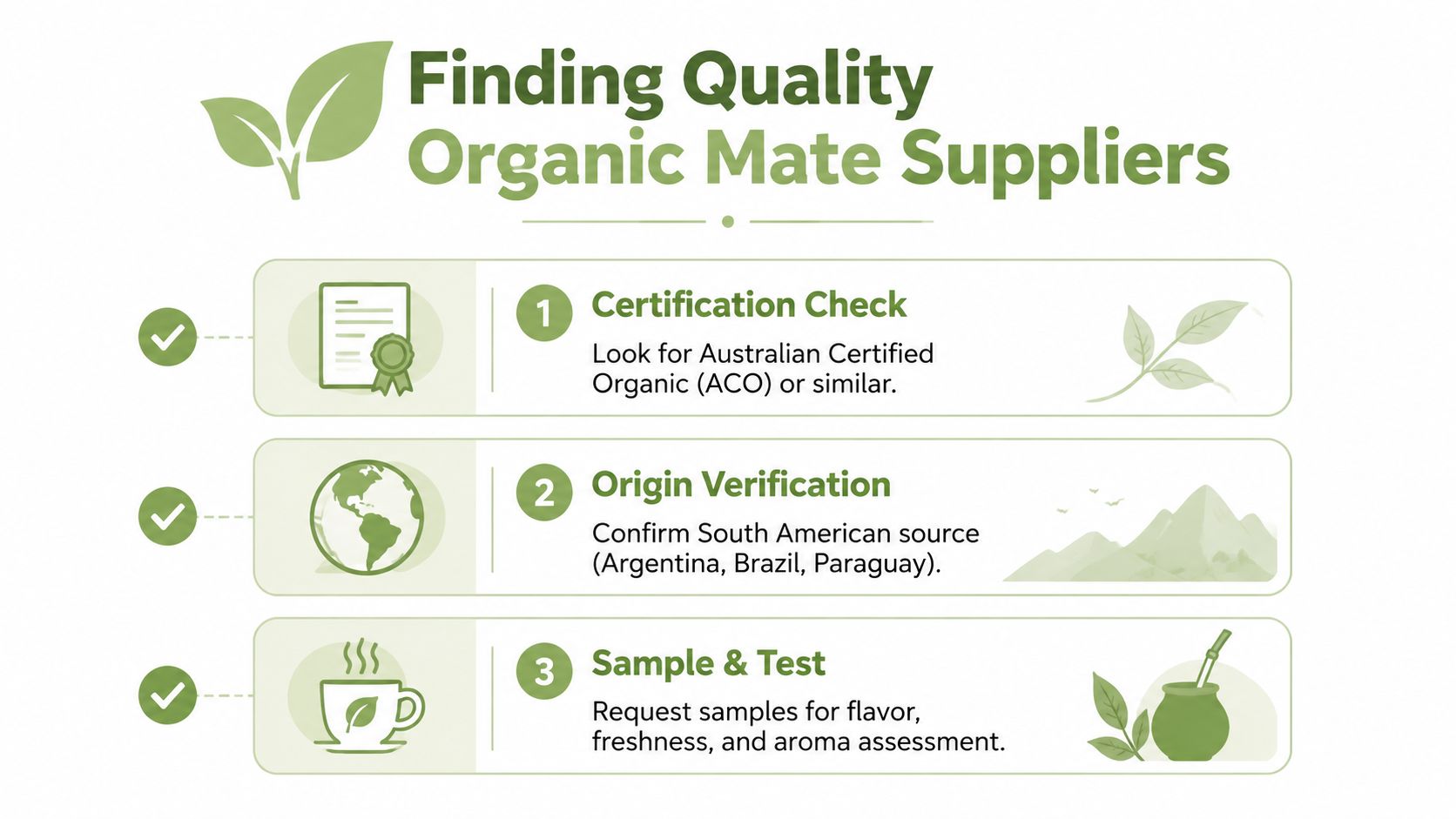
Traditional hot mate for slower moments
Traditional hot mate is the best place to start if someone wants the full ritual. Use a gourd, add the leaves, and pour in hot water that's hot but not harsh. If the water is too aggressive, the drink turns bitter and the first sip can scare people off.
For home drinkers, that means paying attention to the pour rather than rushing it. A well-made cup should feel balanced, not burnt. If you've ever oversteeped green tea, the same mistake applies here.
Cold tereré for summer
Cold tereré suits Australian heat better than many people expect. It's the summer version of mate, especially useful when a customer wants refreshment instead of a hot cup. Cold water, ice, and a clean mate blend are enough to make it feel crisp rather than heavy.
This format works well in coastal cafés and anywhere customers ask for something lighter in the afternoon. It's also easier to explain to people who don't want a strong hot drink in January. The cold version keeps the flavour, but the experience becomes more like a refreshing iced tea.
Modern cold brew for cafés and busy households
Cold brew mate is the most flexible option for modern service. Steep it overnight in cold water, then serve it as a concentrate, over ice, or as a base for a latte-style drink. That approach gives cafés more consistency and helps households batch-prep a couple of servings for the next day.
For busy operators, a cold-brew format reduces pressure during rush periods. It also gives staff a simple way to answer the customer who wants something new, but not complicated. If you're building a menu with ready-to-serve formats in mind, our cold brew tea concentrate page is a useful reference point.
Keep the technique clean
Bitterness usually comes from sloppy technique, not from the drink itself. Too much heat, too much leaf, or too long a steep will flatten the flavour. Clean water, reasonable timing, and a calm pour do more for the cup than fancy equipment ever will.
Finding Quality Organic Mate Suppliers in Australia
Australia's mate shelves can look busy, but not every packet tells you much. A good supplier should make it easy to see where the leaves come from, how they're handled, and whether the product suits home brewing or café use. That's the true test, not a flashy label.
Start with certification and origin
Organic certification is the first filter. If a supplier can't clearly show how the mate is certified, that's a sign to keep looking. For businesses, certification matters even more because customers increasingly expect transparency around what they're drinking.
Origin matters too. South American mate traditions are rooted in Argentina, Brazil, and Paraguay, so suppliers should be able to tell you where their product comes from and how it's sourced. If that information is vague, freshness and consistency are harder to trust.
A supplier should also explain whether the mate is designed for traditional brewing, café service, or cold-brew applications. That difference affects flavour and performance. A home buyer wants something forgiving. A café needs something that behaves the same way every day.
Ask for a sample before you commit to bulk. Fresh aroma and clean flavour tell you more than a polished product page.
Read the product description like a buyer, not a browser
Descriptive words are not enough. “Premium” and “authentic” don't tell you much unless the supplier backs them with handling details, freshness indicators, and clear ingredient information. The better brands usually answer questions before you ask them.
Watch for these practical signs:
- Clear source information, so you know the mate isn't being sold as something generic.
- Fresh packaging cues, because stale mate can taste flat and dusty.
- Usage guidance, since good suppliers explain whether the blend suits hot cups, cold brew, or café service.
- Responsive sample access, which is especially useful for hospitality buyers making a menu decision.
Local buyers should think beyond the packet
If you're buying for a household, the question is whether the flavour matches how often you'll drink it. If you're buying for a venue, the question is whether the supplier can support repeat orders and stable stock. Those are different decisions, and the best supplier will understand both.
For businesses comparing certified organic options and wanting a deeper compliance lens, our organic certification Australia page is a sensible place to start.
Integrating Mate Into Australian Café and Bar Menus
Mate belongs on modern Australian menus for the same reason cold brew coffee and kombucha do. Customers want drinks that feel considered, not generic. A mate line can sit neatly between coffee, tea, and non-alcoholic specials without forcing the venue into a full category rethink.

Start with three menu formats
The easiest way to introduce mate is to keep the menu short and clear. A mate latte gives regular coffee drinkers a familiar format. A sparkling mate cooler suits afternoon service and non-alcoholic requests. A mate mocktail can sit in the same section as premium zero-proof drinks, especially in venues that already sell premium soft drinks.
Each format solves a different customer need. The latte is for comfort and routine, the cooler is for refreshment, and the mocktail is for occasion. That makes mate much easier to sell than a beverage that tries to do everything at once.
Staff language matters more than fancy garnish
A drink only sells if staff can describe it without hesitation. “It's a caffeinated South American leaf drink with a smooth, tea-like flavour” is more useful than a vague wellness pitch. Customers in Australia usually respond better to concrete language than to claims that sound borrowed from a supplement ad.
Keep the explanation simple. People buy the drink they can understand in one sentence.
That also helps when customers are deciding between mate and coffee. If they know mate is a functional option with a distinct flavour, they can place it in their own routine. Café staff don't need to over-educate. They just need to be clear.
Position it where the customer already looks
Mate works well beside iced teas, speciality sodas, and alcohol-free drinks. In a bar setting, it can be framed as a composed, adult beverage rather than a health drink in disguise. In a café, it can sit near lattes or seasonal specials, depending on whether the house style is more classic or more experimental.
Pep Tea also supplies a mate tea blend made from yerba mate, which can be used in the same sort of menu thinking as other functional beverages. The point isn't to force one format. It's to give customers a clean, repeatable option that fits your service style.
Presentation should match the promise
If a menu item is meant to feel fresh, serve it that way. Clear glass, ice, citrus, and restrained garnish often work better than overbuilding the drink. Mate already has an identity, so the presentation should support it rather than bury it under extras.
Purchasing and Storage Best Practices
Australian heat can flatten flavours fast, especially if mate is left in flimsy packaging or opened and forgotten in a cupboard. Buying well is only half the job. Storing it properly is what keeps the drink bright enough to be worth making again tomorrow.
Buy for your actual drinking pattern
Households often overbuy. A café can do the same thing if it gets caught up in the idea of a new menu item before checking turnover. Mate is a product you want to move at a pace that matches its freshness and your service rhythm.
Choose a quantity that suits how often you'll brew it. If you drink it a couple of times a week, a modest bag makes more sense than a large bulk order. If you're serving it commercially, establish a rotation system so older stock gets used first.
Packaging and storage should protect aroma
Look for packaging that keeps out light, air, and moisture. Once mate is opened, reseal it tightly and keep it away from the stove, dishwasher heat, or any warm shelf above a kettle. Those are the places where Australian kitchens ruin good tea.
A dry pantry is better than a sunny counter every time. If the mate smells dull, dusty, or flat, it's usually telling you it has lost some of its character. Fresh mate should still smell alive when you open the bag.
Fresh and aged are not the same experience
Some mate is intended to taste more full-bodied and earthy, while fresher lots can feel greener and brighter. Neither is automatically wrong. The key is matching the style to your own taste, or to what your café customers expect when they order.
For commercial buyers, consistency matters more than chasing novelty. A regular house style makes staff training easier and reduces customer confusion. That's why storing and rotating stock carefully pays off, even for a small venue.
Navigating Australian Regulatory and Labeling Requirements
Mate sits inside a broader Australian drinks market that takes labeling seriously. Caffeine disclosure, ingredient transparency, and responsible marketing all matter because customers deserve to know what they're buying. For businesses, that's not just a legal issue, it's a trust issue.
What to look for on the label
If a mate product is being sold in Australia, the label should tell you enough to understand the contents, origin, and intended use. The more clearly a brand explains serving size, ingredient list, and caffeine-related information, the easier it is for customers to make a sensible choice. That's especially important for people who are sensitive to stimulants.
Health claims need care. A product can be positioned as functional or traditional without slipping into medical promises. That line matters for anyone selling mate in a café, retail shelf, or online store.
Certification and compliance go together
Organic claims should be backed by a credible certification pathway, not just a green design and a leafy logo. If a supplier says the mate is organic, ask how that status is verified and whether the paperwork matches the label. You don't need a compliance degree to ask good questions.
For a broader plain-English breakdown of packaging and label rules, AUSFF's complete labeling guide is a useful reference. It's especially handy for small business owners who want a quick overview before printing menus or product tags.
Venues need simple service rules
Hospitality teams should also think about responsible service in practical terms. That means staff know what the drink contains, whether it's served hot or cold, and how to answer a customer who asks about caffeine. Allergen disclosure still matters if a mate drink is blended with milk, syrups, or other menu ingredients.
Compliance feels less intimidating when it's built into the workflow. A good label, a clear menu description, and a consistent recipe are often enough to keep things simple for staff and reassuring for customers.
Where to Buy Mate Across Australia
Finding mate in Australia is much easier now than it used to be, but the best place to buy depends on what you need. Home drinkers often want convenience and a fair price. Café owners need reliability, wholesale access, and equipment that won't become a headache after the first order.
Start with the channel that suits your purpose
Online specialty retailers are the easiest option if you want variety and delivery. Health food stores and specialty grocers can be handy if you want to see the pack before you buy, though stock can be patchy. For traditional equipment like a bombilla and gourd, specialist tea stores and imported beverage sections are usually the better bet than mainstream supermarkets.
If you're buying for a venue, direct-from-supplier relationships often make more sense. That's where you can ask about repeat supply, menu support, and order minimums without having to work around retail packaging. It also helps if you want a consistent product for cold brew, café service, or a drink list built around non-alcoholic options.
Regional buyers need a bit more planning
City customers usually have more choice. Regional and remote buyers often need to plan around shipping times and stock rotation, especially in hotter months. That makes it worth buying from a supplier that clearly explains dispatch, packaging, and how the product holds up in transit.
If you're outside a major city, don't settle for the first listing you find. Look for suppliers that answer product questions clearly and ship regularly across Australia. That usually tells you more about reliability than the prettiest online storefront.
Match the shop to the drink style
Traditional mate drinkers may prefer a loose-leaf product and the right brewing gear. Café owners may want a format that's easier to portion and explain to staff. Retail buyers might want a compact pack they can store properly and use without special equipment.
The right choice is usually the one that fits your routine, not the one that looks the most authentic in a photo. If you want to explore premium organic tea and functional drink options in one place, Pep Tea has a range built for Australian homes and hospitality settings.
If you're ready to bring mate into your kitchen, café, or menu, Pep Tea can help with practical, organic options that suit Australian routines. Explore our range at Pep Tea, and choose the format that fits the way you drink and serve mate.
Cold Brew Tea Concentrate: Master Australian Brewing
Most people treat cold brew tea concentrate like a stronger version of iced tea. That's the wrong model. Cold extraction changes what comes out of the leaf, which means you're building a different drink base with different flavour, body, and storage behaviour, not just a bigger jug of tea.
That matters in Australian kitchens and cafés because the best cold brew isn't chasing harshness. It's chasing smoothness, clarity, and reliable batch prep, which is exactly why cold-water brewing has such a strong functional basis in tea science. A Japanese review on cold-water brewed sencha notes that the main compounds extracted in cold water are epigallocatechin (EGC) and theanine, while hotter extraction shifts more toward EGCG and caffeine. In plain terms, cold brew tea concentrate is less about brute strength and more about the chemistry that stays gentle in the glass, as shown in the JIRCAS review on cold-water brewed sencha.
For cafés, that difference is practical. A concentrate that tastes cleaner after dilution gives you more room to build iced teas, lattes, and mocktails without fighting bitterness. For home brewers, it means you can batch once, chill it, and pour later without the flat, over-extracted edge that so often turns people off hot-brewed iced tea.
Why Cold Brew Tea Concentrate Is Not Just Strong Iced Tea
Cold brew tea concentrate works because it extracts a different slice of the leaf. In cold water, the lighter, more delicate compounds come forward first, while the harsher elements move more slowly. That's why a properly made concentrate can taste fuller, not thinner, even though it often carries less caffeine and less bitterness than a hot-brewed equivalent, according to the tea science and iced-tea chemistry sources already outlined above.
The flavour you notice first is the point
Cold extraction tends to favour aromatic compounds, amino acids, and softer soluble solids. A scientific review on iced-tea chemistry reports that cold-brewed tea is dominated by volatile aromatic compounds, carbohydrates, and amino acids, while the larger molecules linked to bitterness and astringency extract more slowly. That's the reason a cold brew tea concentrate can feel rounder on the palate after dilution, as described in the red blossom tea chemistry overview.
This also helps explain why “strong” doesn't always mean “stimulant-heavy”. Cold extraction shifts balance, not just intensity. The cup can still be full-bodied enough for milk or sparkling water, but the finish stays calmer and less aggressive.
Practical rule: if a concentrate tastes sharp before dilution, it usually won't magically improve in the final drink. Fix the extraction first.
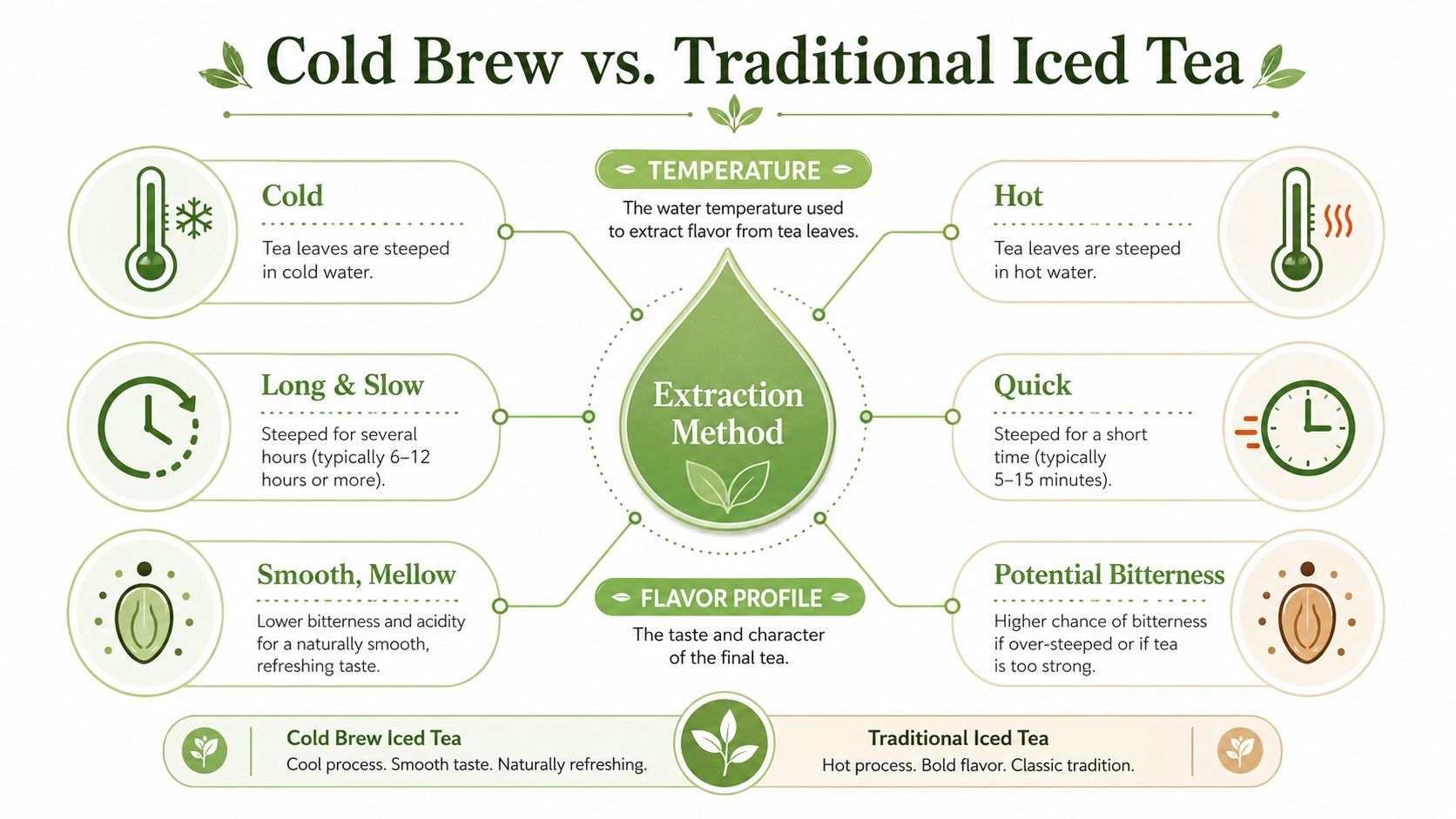
Why that matters in Australia
Australian drinkers already lean toward beverages that feel lighter, cleaner, and more functional. That's where cold brew tea concentrate fits neatly. It gives cafés a base for smoother iced service, and it gives households a chilled tea option that doesn't need sugar to taste complete.
The broader market backdrop supports that shift. One market report projects the global cold-brew tea market will grow from USD 0.8 billion in 2025 to USD 1.52 billion by 2034, with a 7.8% CAGR, and a separate estimate projects cold-brew concentrate from USD 2,950 million in 2025 to USD 6,368.8 million by 2035. Those are global projections, but they help explain why Australian menus are paying more attention to batchable, lower-bitter tea formats, in the market overview from MarketIntelo.
Choosing the Right Tea and Leaf Format for Concentrate
Not every tea behaves the same once you switch to cold extraction. Leaf size, oxidation level, and how the tea was processed all affect what lands in the jar. Loose-leaf tea usually gives the cleanest result because the leaves can unfurl properly, while dust-grade material tends to over-extract quickly and leave you with a muddy finish.
Match the tea to the drink you actually want
Black tea is the safest choice when you need a concentrate that can stand up to milk, ice, and sweeteners. It gives body and depth, which is useful for lattes or strong iced tea. Green tea is better when you want a lighter, more vegetal profile, but it needs a shorter steep to avoid murkiness. White tea and some oolongs can be elegant in delicate drinks, while herbal blends work well when fruit or florals are the main point of the drink.
Japanese ceremonial-grade matcha sits in a different category altogether. It's not a leaf-steeped concentrate, it's a stone-ground tea powder, so it behaves more like a suspension than an infusion. That makes it ideal for whisked drinks and recipes, while cold-brewed leaf tea is better when you want a clear, filtered liquid base.
If you're choosing organic loose leaf for cold extraction, a dedicated green tea range is a better starting point than a dusty all-purpose blend. A useful benchmark is Pep Tea's organic green tea loose leaf range, because freshness and leaf integrity matter more than people expect in cold brew.
Keep the leaf intact
A fine, whole leaf gives you control. Smaller particles release faster, which can be useful, but too much surface area pushes tannin extraction in the wrong direction. That's where cold brew starts tasting hollow or a little swampy, especially after dilution.
Loose leaf is usually easier to calibrate than tea bags because you can adjust the mass, leaf quality, and steep time with far more precision.
For green and white teas, a bloom step can help if you want cleaner extraction. An Australian iced-tea guide recommends dampening the leaves briefly with hot water before adding cold water and chilling for a full extraction cycle, which can improve clarity in larger batches, as shown in the AOT iced-tea brewing guide.
Precise Ratios and Step-by-Step Brewing Methods
The quickest way to wreck cold brew tea concentrate is to guess. The next quickest way is to push green tea too far, then try to rescue it with extra water. A measured batch is easier to repeat, easier to taste, and far easier to scale in a café or a home kitchen.
Start with a simple baseline
For black tea and most herbal teas, a practical starting point is 10 to 12 g of loose leaf tea per 1 L water with a refrigerated steep of 12 to 16 hours. Green tea should rarely go beyond 12 hours, because it can turn muddy and bitter if you leave it too long, according to the cold-brew concentrate recipe guide. Cold extraction also changes the cup in useful ways, a cold brew at about 4°C for 6 to 12 hours can produce 10 to 40% less caffeine than equivalent hot brewing, along with 15 to 30% less EGCG and total polyphenols, while keeping more aromatic terpenes and a smoother finish, as outlined by TeaTrade.
That shift matters in service. Lower caffeine, more retained theanine, and a softer polyphenol balance give concentrate a cleaner profile than hot-brewed iced tea, especially once you dilute it into milk, soda, or fruit.
Use the method that fits the batch
For home use, a wide jar or pitcher works fine if it has an airtight lid. For café service, use a clean, food-safe container that lets you strain quickly and chill evenly. Keep the leaves fully submerged, and avoid repeated contact with air or dirty utensils.
A useful reference table:
| Tea Type | Ratio (g per L) | Steep Time (hours) | Notes |
|---|---|---|---|
| Black tea | 10 to 12 | 12 to 16 | Best for milk drinks and bold iced tea |
| Herbal tea | 10 to 12 | 12 to 16 | Fruit-forward blends usually hold up well |
| Green tea | 10 to 12 | Up to 12 | Shorter steep keeps flavour cleaner |
| White tea | 10 to 12 | 12 to 16 | Gentle profile, works well in lighter drinks |
| Oolong | 10 to 12 | 12 to 16 | Middle ground between body and delicacy |
For larger batches, the Australian iced-tea guide recommends 2 pouches for 4 gallons, 3 pouches for 6 gallons, or 4 pouches for 8 gallons before straining, and it also advises pressing out as much liquid as possible without squeezing the leaves hard. That last part matters. Squeezing spent leaves can force tannins back into the liquor and undo the softness you wanted in the first place.
Keep the process repeatable
Blooming green or white tea briefly with hot water can help release aroma before the cold steep. The same guide recommends 175 to 180°F for a 20-second bloom, then cold water and a 24-hour chill for certain service formats. That is a café method, not a universal rule, but it shows how operators balance clarity, strength, and service flow in real kitchens, in the AOT brewing guide.
For storage and handling, pair a tight brew method with clean equipment and a clear rotation system. If you want a practical comparison point for cold storage habits, shelf-stable probiotic explanations show the same basic principle, the container, temperature, and handling matter as much as the product itself. The same logic applies to tea concentrate, and a prep routine should be written down before the first batch goes into the fridge.
A simple label with tea type, batch time, and intended use keeps service consistent. It also helps when you need to assess whether a concentrate is still suitable for milk drinks, fruit mixers, or straight iced service. For a storage reference outside tea, how to store kombucha is a useful parallel because it treats refrigeration and sealing as part of quality control, not an afterthought.
Storage Safety and Shelf Life for Refrigerated Concentrate
This is the part many tea guides skip. They'll tell you how long to steep, then leave you guessing once the jar is in the fridge. For home brewers, that's annoying. For cafés, it's a food-safety problem.
Refrigeration is not a magic shield
Cold brew tea concentrate still needs clean handling, tight sealing, and sensible rotation. The most useful guidance in the material you've got is inconsistent, which tells you the answer depends on sanitation, container choice, and how often the jar is opened. A sealed, refrigerated concentrate made with clean equipment is safer than one transferred between multiple containers, left half-open, or dipped into repeatedly.
Use a sanitised glass jar or food-grade container with an airtight lid. Glass is easier to inspect for cloudiness, residue, and off-colours, while food-grade plastic can be practical for service if it's clean and well maintained. In both cases, label the brew date and tea type, then keep it cold and closed.
For hospitality venues, batch discipline matters. Use first in, first out rotation, write the prep time on the label, and don't keep a service jug on the counter longer than needed. Repeated opening invites contamination, and that risk climbs quickly if the concentrate is later mixed with milk or fruit purée.
Simple rule for cafés: the more ingredients you add, the shorter the useful storage window becomes.
One helpful parallel comes from Yuve's explanation of shelf-stable probiotic foods. The point isn't that tea concentrate behaves like probiotics, it doesn't. The useful takeaway is that shelf life always depends on the product's live or non-live status, storage conditions, and how it's handled after opening. Tea concentrate is much closer to a fresh refrigerated beverage than a shelf-stable pantry item.
Watch the signs, not just the calendar
If the liquid turns sour, develops an odd film, or smells wrong, discard it. If it's a diluted serving that contains milk, treat it far more cautiously than plain concentrate. And if you need a practical storage companion for broader tea and kombucha handling, Pep Tea's kombucha storage guide is a useful reference point for fridge discipline and container habits.
Dilution Charts and Concentration Adjustment for Different Drinks
A concentrate only works if you know what it's meant to become. Some batches are designed for iced tea, some for lattes, and some for lighter, sparkling drinks. The trick is to plan the concentrate strength around the final pour, not the jar straight out of the fridge.
Build backwards from the serving
For iced tea, a common starting point is 1:3 or 1:4 concentrate to water. For tea lattes, 1:2 or 1:3 with milk or plant-based milk usually gives enough body without tasting watery. For spritz-style drinks, you can go lighter, around 1:5 or more, especially if you're adding citrus or sparkling water.
| Beverage Type | Concentrate Ratio | Diluent | Serving Suggestion |
|---|---|---|---|
| Iced tea | 1:3 to 1:4 | Water | Clear, refreshing, easy to scale |
| Tea latte | 1:2 to 1:3 | Milk or plant milk | Best with black tea or robust oolong |
| Spritz-style drink | 1:5 or higher | Sparkling water | Works well with citrus and herbs |
| Mixed tea drink | Varies | Kombucha or soda water | Useful for café mocktails |
The important point is that stronger concentrate does not automatically mean more caffeine. Cold extraction changes the balance of soluble compounds, so a bolder-looking batch may still be smoother and less stimulant-heavy than a hot brew. That's why taste matters more than appearance here.
Calibrate with the spoon, not the assumption
Taste the concentrate before you dilute it. If it's thin and flat, the batch was under-extracted, so use more leaf or give the next batch more time. If it's drying or harsh, the steep went too far or the leaves were squeezed too hard.
Good concentrate tastes complete on its own, even before dilution. It shouldn't need sugar to feel balanced.
Keep notes on leaf type, steep time, and final use. Black tea that feels perfect in milk might be too heavy for a spritz, while a white tea that sings in sparkling water will vanish in a latte. Once you start matching base strength to the serving style, the whole process gets easier.
Recipe Ideas for Iced Drinks, Lattes, Mocktails, and Mixers
Cold brew tea concentrate earns its keep when it stops being a one-note iced tea base. In cafés, I've seen it become the backbone of seasonal menus because one batch can cover multiple drinks without forcing staff to brew each order from scratch. At home, it's just as useful because it plays well with fruit, herbs, milk, and bubbles.
Build drinks around the tea's personality
A green tea and mint cooler works best when the concentrate is light, chilled, and topped with sparkling water. Add fresh mint, a slice of cucumber, and ice, then keep the sweetener minimal. That's a clean summer drink, not a dessert.
A black tea latte with vanilla and cinnamon needs more body. Use a stronger base, then pair it with oat milk or dairy milk and a small amount of vanilla. Black tea holds up best when the drink is meant to taste creamy rather than crisp.
A white tea spritz with elderflower and lime is a good example of why cold brew concentrate is useful for non-alcoholic menus. It keeps the drink floral and bright, and it doesn't need the kind of heavy sweetening that can flatten a sparkling serve.
For operators expanding their mocktail list, a useful adjacent resource is NA Beer Finder's guide to the best non-alcoholic beers, because it shows how far Australian consumers are willing to go for better non-alcoholic options. Tea concentrate fits that same demand for drinks that feel grown-up without relying on alcohol.
Use it as a mixer, not just a base
Cold brew tea concentrate also works surprisingly well with kombucha. A small amount can add tea depth to a probiotic drink, especially if you want a layered flavour profile for a café special. That's where the format gets interesting. It can sit beside sparkling drinks, not just replace still iced tea.
For more drink ideas built around this format, Pep Tea's non-alcoholic tea cocktail ideas can spark menu thinking without pushing you into sugary territory.
Troubleshooting Common Problems and Final Tips
Most cold brew problems come down to four things, time, leaf quality, sanitation, or dilution. The good news is that each one has a fix you can apply on the next batch without starting from scratch.
Read the batch, then correct the batch
If the flavour is weak, use more tea or let the next steep run longer. If the drink is bitter, shorten the steep and stop squeezing the leaves. If the jar looks cloudy, that can be normal for some teas, but a finer mesh filter will often improve the finish.
- Weak Cup. Taste is diluted, double the tea-to-water ratio or extend steep time to 24 hours.
- Frothy or Overflowing? Leave 2 inches of headspace, tea expands.
- Too Bitter? Use fewer tannic leaves, like Assam, and lean towards green or oolong.
- Cloudy Appearance? Normal for some teas, strain through a fine mesh filter.
The safest habit is the simplest one
Use fresh tea, clean gear, and a brew date label every time. If a batch smells off, looks suspicious, or has been sitting too long after opening, bin it. That's cheaper than serving a bad drink and far better than trying to rescue a compromised one.
Cold brew tea concentrate works because it respects the leaf. It gives you control over flavour, body, and service, while keeping the cup smoother than a hot steep pushed too far. If you want to keep building a cleaner, more functional drinks menu, explore Pep Tea for organic Japanese matcha and sugar-free kombucha that pair naturally with tea-led café recipes and everyday home brewing.
Matcha Bowl Set: The Complete Buyer’s and Brewing Guide
You've got a bag of matcha, a favourite mug, and the hope that this cup will finally taste like the café version you keep thinking about. Then the powder clumps, the surface stays flat, and the first sip lands bitter instead of smooth. That frustration usually isn't about the matcha alone, it's about the vessel and the tools.
A proper matcha bowl set changes the whole experience because it gives the whisk room to move, the powder room to disperse, and the drink room to foam. In Japan, the matcha bowl, or chawan, has deep roots in tea culture, with traditions commonly traced to the 9th century in the Heian period and, in later tea-ceremony practice, to the 12th century when Zen monks helped popularise powdered tea in Japan what is a matcha bowl. That history matters, but the practical point matters even more, a good bowl is a working tool, not just a pretty object.
Australian cafés have pushed expectations higher. People now want matcha that looks clean, tastes balanced, and feels consistent from one serve to the next. That's exactly where the right bowl geometry and whisk compatibility make the biggest difference.
Why Your Regular Mug Is Failing Your Matcha
The common beginner move is easy to spot. Someone grabs a regular mug, adds matcha, pours in hot water, and stirs with a spoon or a small whisk. The cup often ends up patchy, the flavour turns harsh, and dry powder clings to the sides.
The problem starts with shape
A regular mug is too narrow for proper whisking. The bamboo whisk, or chasen, needs room to sweep across the surface and break up clumps, and a cramped vessel cuts that motion short before it can do its job. A wider, rounded bowl gives the whisk clearance, which helps create the fine foam people expect from well-made matcha.
Practical rule: if the whisk keeps hitting the sides, the vessel is working against you.
The second issue is aeration. Matcha is a suspended powder, so it needs more than a quick stir. The bowl's open profile supports the whisking pattern that lifts, disperses, and froths the tea properly. Without that movement, sediment settles at the bottom and the first sip tastes uneven.
Temperature adds a third layer. Matcha is delicate, and a bowl designed for the job makes it easier to keep the drink in the right range instead of rushing the process. That matters in home kitchens, and it matters just as much in busy Australian cafés, where every cup needs to look and taste consistent.
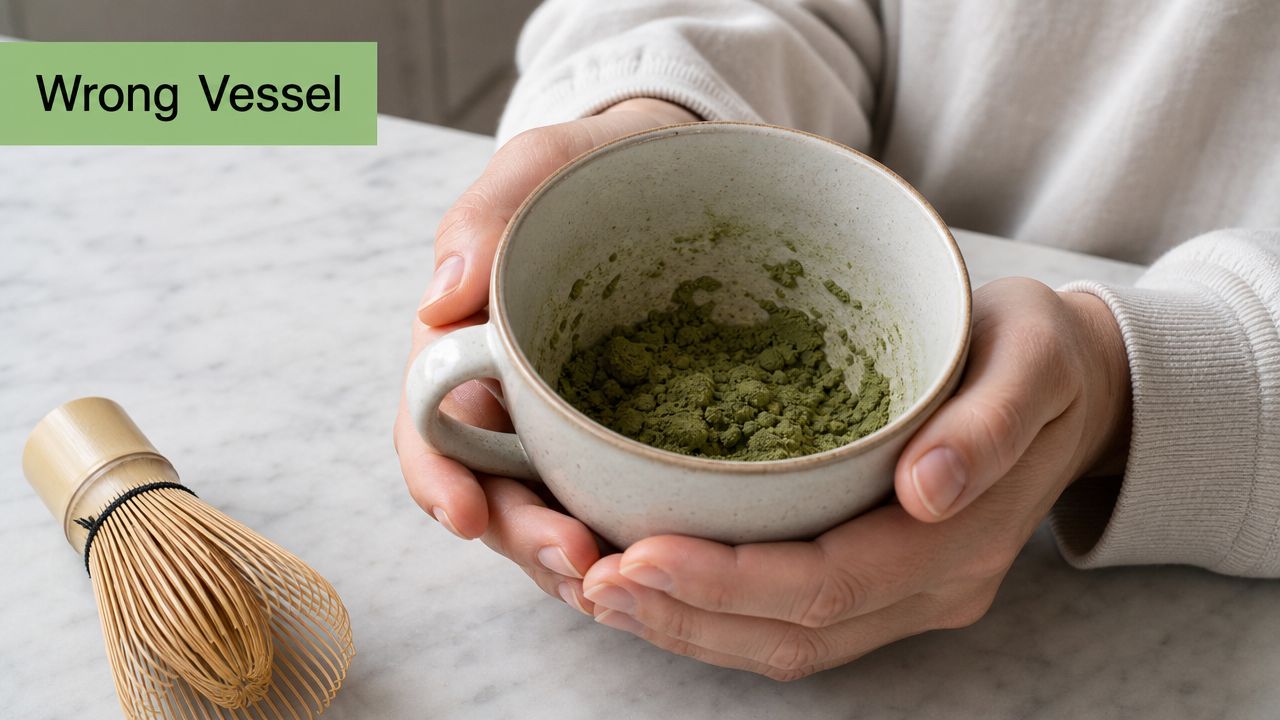
The takeaway is straightforward. A matcha bowl set is not about ceremony for ceremony's sake. It solves the basic mechanics that make matcha pleasant to drink, and that is why serious home drinkers and café operators keep coming back to the proper tools.
Components of a Matcha Bowl Set
A good matcha bowl set works like a small prep station. Each piece has a different job, and the fit between them matters more than the display shelf version of the set. In an Australian home kitchen, or behind a café bench during a morning rush, that fit is what makes the results repeatable.
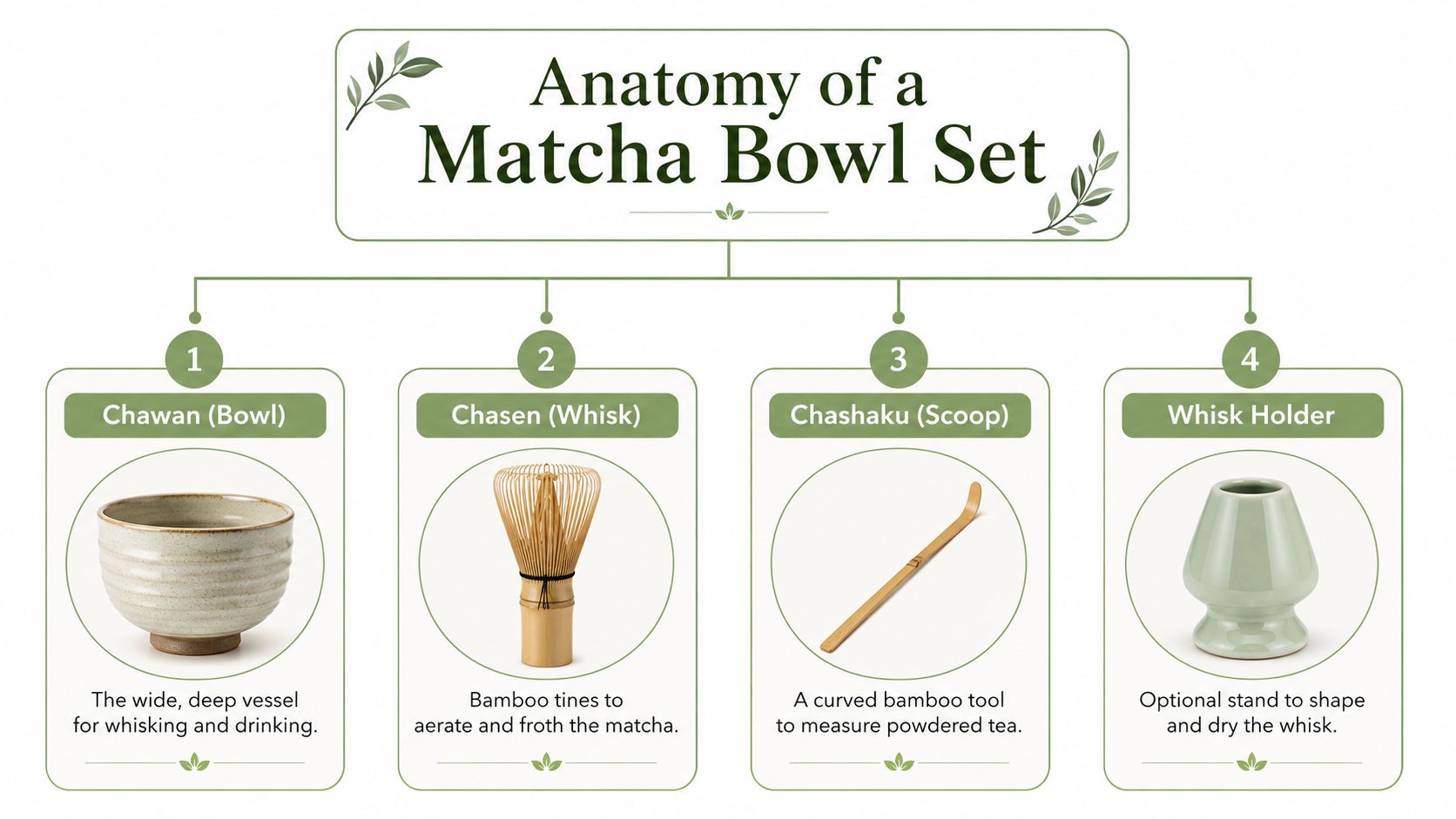
The core tools and what they do
A chawan is the bowl itself. Its wide, rounded shape gives the whisk room to move, so the tea and water can stay in motion instead of collecting in one tight spot. That geometry is the practical reason a proper bowl outperforms a random ceramic bowl from the cupboard.
A chasen is the bamboo whisk. Its flexible tines whip air into the tea and create the light foam people expect from well-made matcha. A spoon can stir the liquid, but it cannot make the same texture because it does not sweep the surface in the same way.
A chashaku is the curved bamboo scoop. The scoop looks simple, yet it matters because dosing changes the feel of the drink very quickly. Too much matcha in a small bowl can leave you with a dense, bitter cup that is hard to smooth out, especially if you are making drinks one after another.
A whisk holder is optional, but it helps keep the whisk in shape as it dries. For anyone who uses the set often, it gives the tines a proper resting place instead of leaving them bent or splayed in a drawer.
If you want to compare the usual accessories before buying, the matcha tea accessories collection at PepTea is a practical reference point for seeing how the tools relate to one another.
The set works best as a system, not as a pile of separate items.
The same idea carries into the kitchen. Matcha sits comfortably alongside authentic Japanese home cooking recipes, especially when you are building a routine around simple preparation and consistent flavour.
The common mistake is treating the bowl as the only part that matters. The bowl sets the shape of the work, but the whisk, scoop, and holder are what make the process reliable. When the pieces match the task, the tea is easier to prepare well, whether you are making one cup at home or repeating the same method for customers in a café.
Choosing the Right Materials and Sizes
A matcha bowl can look beautiful on the shelf and still be awkward in the hand. The key test is whether it supports steady whisking, comfortable pouring, and repeatable results for the way you brew at home or serve in a café. For Australian buyers, those practical details usually matter more than surface style.
Material trade-offs that affect everyday use
Ceramic is the most familiar option. It usually feels stable in the hand and suits the rounded shape that matcha needs. Porcelain can feel smoother and lighter, while glass shows the colour of the tea clearly, but can feel less forgiving in a busy kitchen.
| Matcha Bowl Materials Comparison | Heat Retention | Durability | Best For |
|---|---|---|---|
| Ceramic | Good warmth and a solid hand feel | Generally sturdy, but can chip if knocked | Home use, café service, everyday matcha |
| Porcelain | Even, clean finish | Can be strong, but still needs careful handling | Presentation-focused serving |
| Glass | Lower heat feel and more visual clarity | More fragile in active kitchens | Display use and occasional home brewing |
The best material depends on where the bowl will live. A café bench, a home cupboard, and a gift box all call for different priorities. Choose based on your actual brewing routine, then check whether the bowl is easy to clean, easy to store, and able to handle a busy morning rush without feeling delicate. If you are comparing options across a wider set of tools, the matcha tea accessories range is a useful way to see how the bowl fits with the whisk and scoop.
Why size and rim width matter
A standard matcha bowl is typically 400 to 500 mL, with a rim around 4.5 to 5.5 inches, or roughly 12 to 15 cm, in diameter what is a matcha bowl. That size gives the whisk enough room to move without splashing. A bowl that is too narrow makes the whisk collide with the sides, which breaks the foam and slows you down. A wider opening gives the tines space to work, which is helpful whether you are making a single bowl at home or repeating the same method for customers in a café. As noted earlier, the bowl is built for small, precise servings where whisking and foam formation matter more than volume.
For a deeper practical view of how bowl shape supports daily tea routines, the material and sizing advice in the same matcha bowl set category is worth comparing with the way you already make drinks at home. If your routine leans toward pantry-friendly meals as well, the same logic applies to tools used across authentic Japanese home cooking recipes.
Buy for the way you brew, not for the most beautiful shelf photo.
Handmade pieces can be lovely, especially if you enjoy ritual and presentation. Mass-produced bowls can be more practical for cafés, shared kitchens, or anyone who needs stackability and predictable cleaning. A handmade bowl may suit the quiet pace of home preparation, while a sturdier, more uniform piece often works better where cups are made back to back. The right answer is the one that matches your usage, not the one that looks aspirational on day one.
Mastering the Basic Whisking Technique
A good matcha cup starts with the whisk, the bowl, and the water working together. In an Australian kitchen or café bench, the goal is repeatable texture, not a lucky first try.
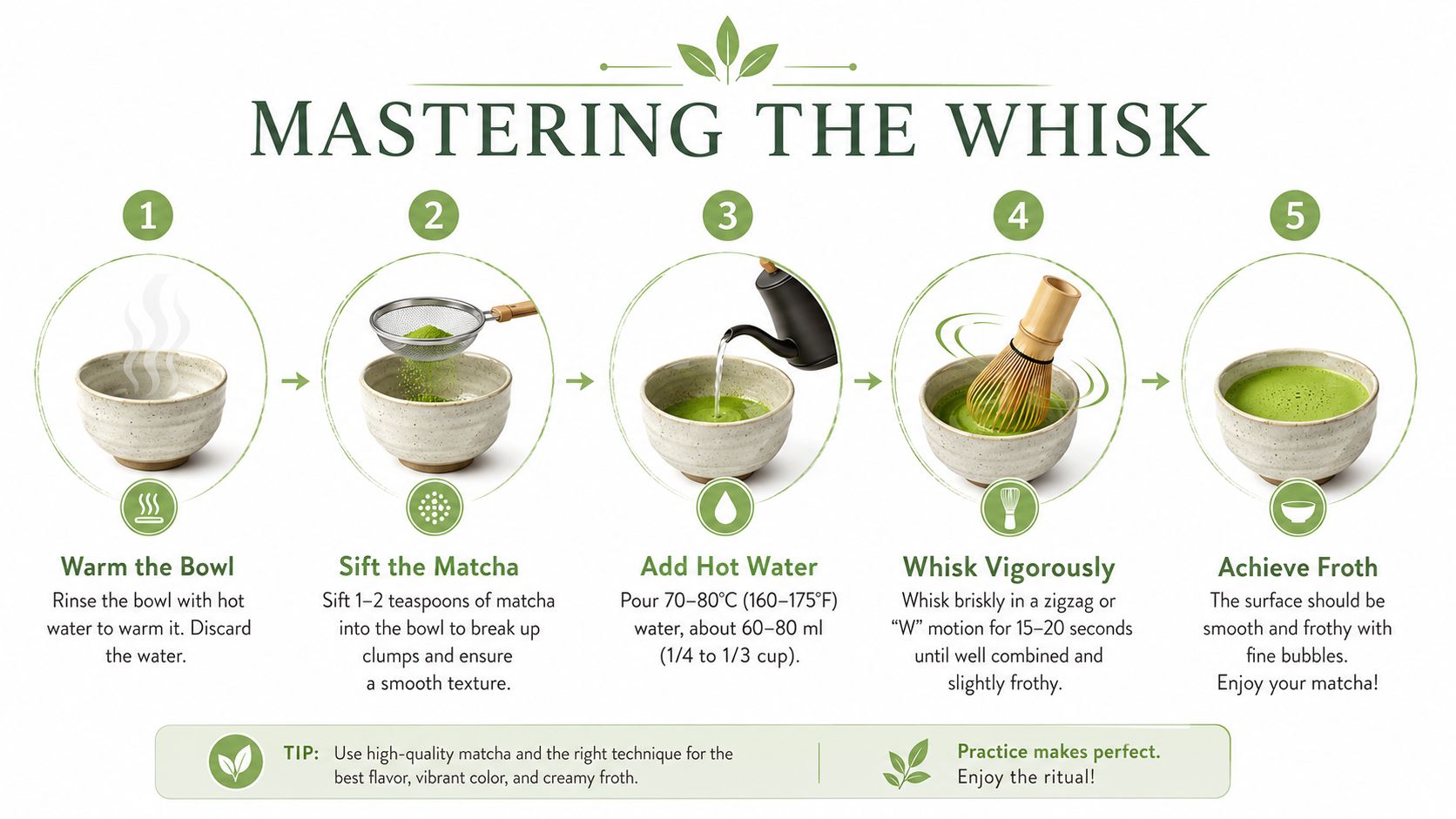
The preparation flow
Warm the bowl first. A pre-warmed vessel gives you a more settled working surface, and it helps the whole process feel under control.
Sift 1 to 2 g of matcha into the bowl next. Matcha is a fine powder, so it clumps easily, much like cocoa left untouched in a dry tin. Sifting gives the whisk less work to do and helps the drink finish smoother.
Add 60 to 80 mL of water at 60 to 70°C. Water that is too hot can push the flavour into a sharper, harsher place, especially if you are still learning how much pressure your whisk needs. The cooler range helps keep the taste cleaner.
Whisk in a W-shaped motion for 10 to 15 seconds. Use quick, light movements rather than force. The bamboo tines need space to move across the bowl, and a well-shaped bowl keeps them from scraping the sides, which helps build a more even foam.
If you want to see the motion before trying it yourself, the tutorial at how to whisk matcha shows the W-shaped whisking pattern at a steady pace, so you can match the rhythm while you practise.
Common mistakes and quick fixes
- If the tea looks grainy: you probably skipped sifting or stopped whisking too soon.
- If it tastes bitter: the water may have been too hot, or the matcha dose may be too heavy.
- If the surface stays flat: the bowl may be too narrow, or the whisk motion may be too circular.
- If it splashes out: the vessel is likely too small for the movement you are using.
A lot of beginners stir matcha like instant coffee. That approach leaves clumps behind and gives you weak foam. The whisk needs room, the bowl needs clearance, and the tea needs a short, decisive burst of motion.
For a fuller walkthrough of hand position and rhythm, the guide on how to whisk matcha is a practical companion. That same method also holds up when you are making drinks for guests or refining café service, because it gives you texture you can repeat instead of guessing from cup to cup.
Picking the Perfect Set for Your Situation
The best set for one person isn't always the best set for another. A home drinker, a café operator, and a gift buyer each care about different things, and the smartest purchase reflects that.
For home baristas
If you're making matcha most mornings, choose a set that's easy to clean and forgiving while you learn. A medium-sized bowl with a comfortable grip and a whisk that feels flexible is usually a better choice than an ornate showpiece. Storage matters too, especially in smaller kitchens where stackability can be a real bonus.
For café operators
Cafés need repeatable texture, fast cleaning, and a bowl that can handle frequent use. Durability matters more than decorative detailing, and the bowl should sit steadily on a bench during service. Whisk compatibility is essential, because the wrong bowl slows down preparation and makes foam quality less consistent across multiple serves.
For gift buyers
Presentation counts here. A set that arrives neatly packaged, looks polished, and includes a short guide for use tends to feel more complete. The recipient shouldn't have to guess which tool does what.
The best gift set is the one that helps someone make a good cup on the first try.
A simple way to think about it is this:
- Home use: prioritise easy cleaning and a bowl that feels comfortable in the hand.
- Café use: prioritise durability, consistency, and whisk clearance.
- Gifting: prioritise presentation, clear components, and user-friendly guidance.
If you're shopping for home use, it's easy to overbuy on extras you won't touch. If you're buying for a café, it's just as easy to under-invest and end up replacing tools too soon. A balanced matcha bowl set saves more time than it costs because it matches the job in front of you.
Caring for Your Matcha Tools
Bamboo and ceramic both last longer when you treat them gently. The maintenance routine is simple, and it pays off quickly because the tools stay usable and look better for longer.
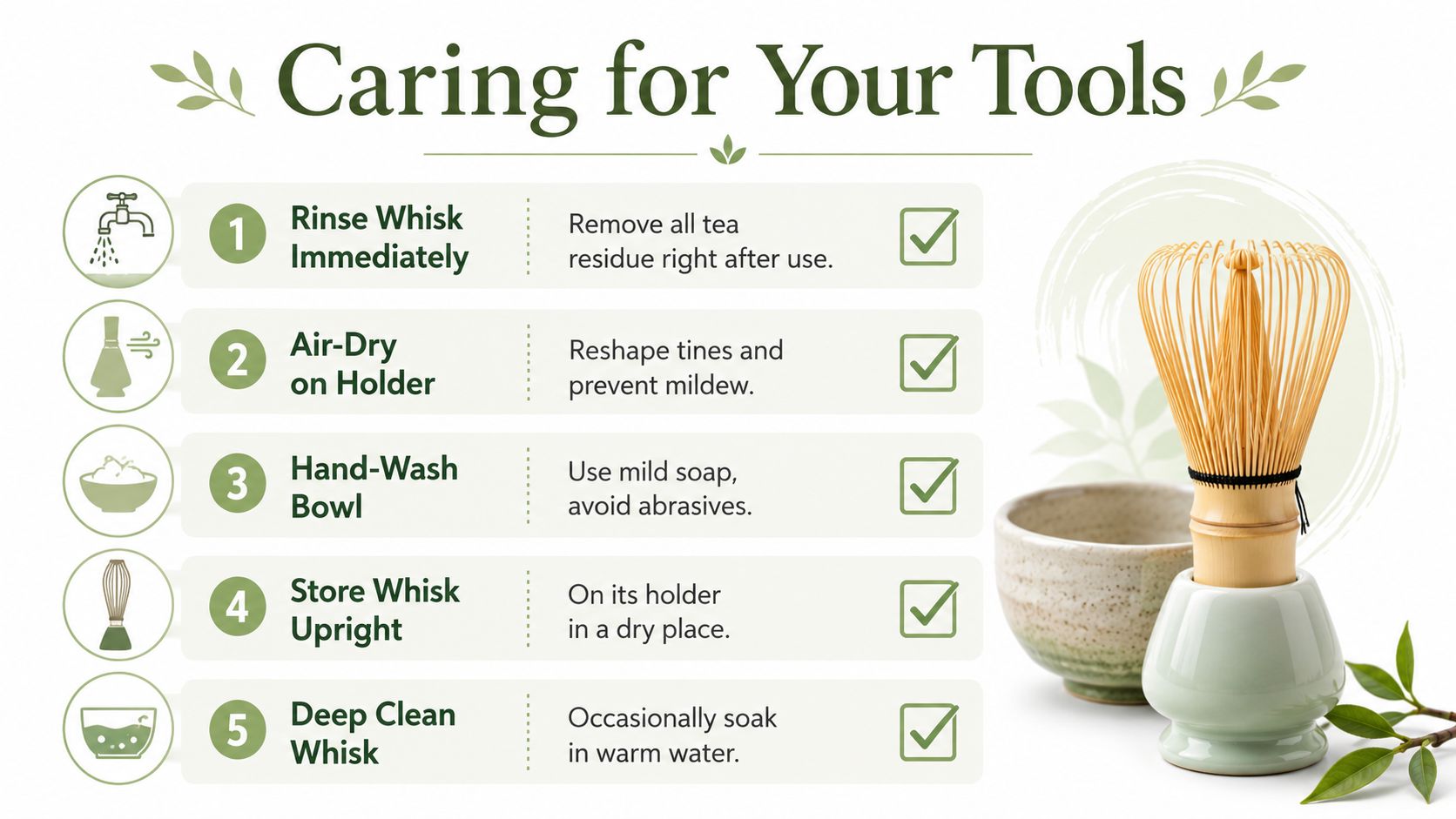
A routine that actually fits real life
Rinse the whisk right after use. Matcha dries fast, and once it sets into the tines, it becomes harder to remove without bending them. Let the whisk air-dry on a holder so the shape stays open instead of collapsing inward.
Wash the bowl by hand with mild soap and a soft sponge. Abrasive pads can dull the finish and make stains more obvious over time. For stubborn residue, warm water and a little patience usually do the job without damaging the surface.
Store the whisk upright in a dry place. Bamboo doesn't like being left damp, especially in humid conditions. In Australian homes, that matters in summer, when moisture can linger longer than you expect.
For a practical storage option, a dedicated matcha whisk stand like the one at PepTea helps the tines keep their shape between uses.
Signs it's time to replace a tool
- Bent whisk tines that no longer spring back properly.
- Persistent staining or odour that survives normal cleaning.
- Chipped bowl edges that make the vessel awkward or unsafe to use.
- Loose or splintering bamboo that no longer feels comfortable in the hand.
The point of good care is not perfection, it's longevity. A few deliberate habits take less time than replacing damaged tools, and they help your set stay ready for daily brewing instead of becoming a drawer of half-used accessories.
Creative Recipes Using Your Matcha Set
A good bowl set earns its place because it's useful beyond the classic hot serve. The same whisking technique gives you a better base for iced drinks, blended drinks, and even baking.
Three easy ways to use it
For an iced matcha latte, whisk matcha with a small amount of warm water first, then pour it over ice and top with milk. Starting with a smooth matcha base matters because the cold drink won't hide clumps later. The bowl helps you build that base properly instead of relying on a spoon and hoping for the best.
For a matcha smoothie, whisk the powder with water first before blending it with fruit, yoghurt, or milk. That tiny prep step improves dispersion and keeps the colour and flavour more even through the drink.
For matcha baking, sift the powder before adding it to batter. The bowl and whisk help you break it down first, which gives cakes, biscuits, and slice batter a cleaner flavour and more even colour.
PepTea's organic matcha works well as a base here because a consistent powder makes the result easier to repeat. That matters whether you're making one serve for yourself or scaling a recipe for a small café menu.
Good matcha prep is a foundation, not a finish line.
If you're entertaining, just keep the same ratios and multiply the servings. A proper bowl set gives you a dependable starting point, which is exactly what you want when drinks need to come out looking and tasting the same.
Your Next Steps to Better Matcha
The right decision comes down to four things, bowl geometry, whisk compatibility, technique, and whether the set fits the way you drink matcha. Once those pieces line up, the drink gets easier to prepare and more satisfying to serve.
If you're starting from scratch, choose a bowl with enough width for the whisk to move freely, a bamboo whisk that feels flexible in hand, and a scoop that helps you keep the dose consistent. If you already own a bowl but keep getting clumps or weak foam, the problem is usually not the powder alone. It's often the vessel, the motion, or the way the tools fit together.
For home drinkers, the safest upgrade is usually a practical, easy-care set that removes friction from the morning routine. For cafés, the better move is durability and consistency, because those two things affect every cup that leaves the bench. For gifts, look for clear presentation and tools that help the recipient succeed quickly.
A matcha bowl set doesn't need to be complicated to be effective. Once you understand what each piece is doing, you can make better matcha with less guesswork and more confidence. Explore Pep Tea's organic matcha range and the matching tools that help turn a powder into a proper cup.
A CTA for Pep Tea.
Glass Kettle Temperature Control for Better Tea
You've probably had that cup of green tea that should've been fresh, sweet, and clean, but instead landed sharp, grassy, and a bit unforgiving. That's usually not the leaf's fault. More often, it's the water, and with delicate teas and matcha, temperature is the difference between a silky cup and a bitter one.
A glass kettle temperature control setup turns that difference into something you can steer. Instead of guessing, waiting, or repeatedly overshooting the boil, you choose the heat that suits the drink in front of you. That matters whether you're whisking matcha at home, making back-to-back cups in a café, or just trying to stop your “healthy” tea habit from tasting harsh.
The Bitter Cup Problem and Why Temperature Matters
The common mistake is simple. Water boils, the kettle clicks off, and the leaves get whatever comes out next. For sturdy black tea, that can be fine. For green tea, white tea, and especially matcha, it's often too aggressive.
Why boiling water can flatten a good tea
Boiling water pulls flavour out fast, but fast isn't always kind. With more delicate teas, too much heat can bring out the bitter side of the leaf before the sweeter and more savoury notes have a chance to show up. That's why a cup made with lower-temperature water often tastes rounder, softer, and cleaner.
Matcha is a good example because you're not steeping a leaf, you're suspending finely milled tea in the water itself. PepTea's own organic Matcha range is a natural example of a tea that rewards gentle handling, since the aim is smooth texture and balanced flavour, not a harsh blast of heat.
Practical rule: if the tea tastes bitter before it tastes fragrant, the water was probably too hot for that style.
A lot of people think “hotter” means “better extraction”, but the real goal is the right extraction. With a glass kettle temperature control model, the difference isn't academic, it's right there in the cup. If you've ever made a second cup that tasted worse because you guessed the cooling time, you already know why precision matters.
For a simple starting point, it helps to look at the kettle as a flavour tool, not just a water heater. If you want a deeper dive into suitable gear, you can check the dedicated electric tea kettle with temperature control page as a reference point for the kind of setup tea drinkers often look for.
What Temperature Control Actually Means on a Glass Kettle
Temperature control means the kettle doesn't just race to a boil and stop. It lets you choose a setpoint, then uses heat, sensors, and a controller to stop at that target instead of overshooting it. That's the key difference between “hot water” and “the right water”.
On-off switch versus dimmer switch
The easiest way to think about it is this. A basic kettle behaves like an on-off wall switch, it's either heating or not heating. A precision kettle behaves more like a dimmer switch, where you choose the level you want instead of jumping straight to full blast.
That's also why product pages often mention preset temperatures, keep-warm, hold mode, or auto shut-off. Presets are the quick buttons, keep-warm means the kettle tries to stay near the chosen setting, and auto shut-off means it stops once the target is reached. A basic electric kettle usually shuts off when water reaches 212°F / 100°C through an internal thermostat or steam-activated switch, which is the core principle behind automatic shutoff in many kettles, as discussed in an engineering thread on how electric kettles trigger shutoff.
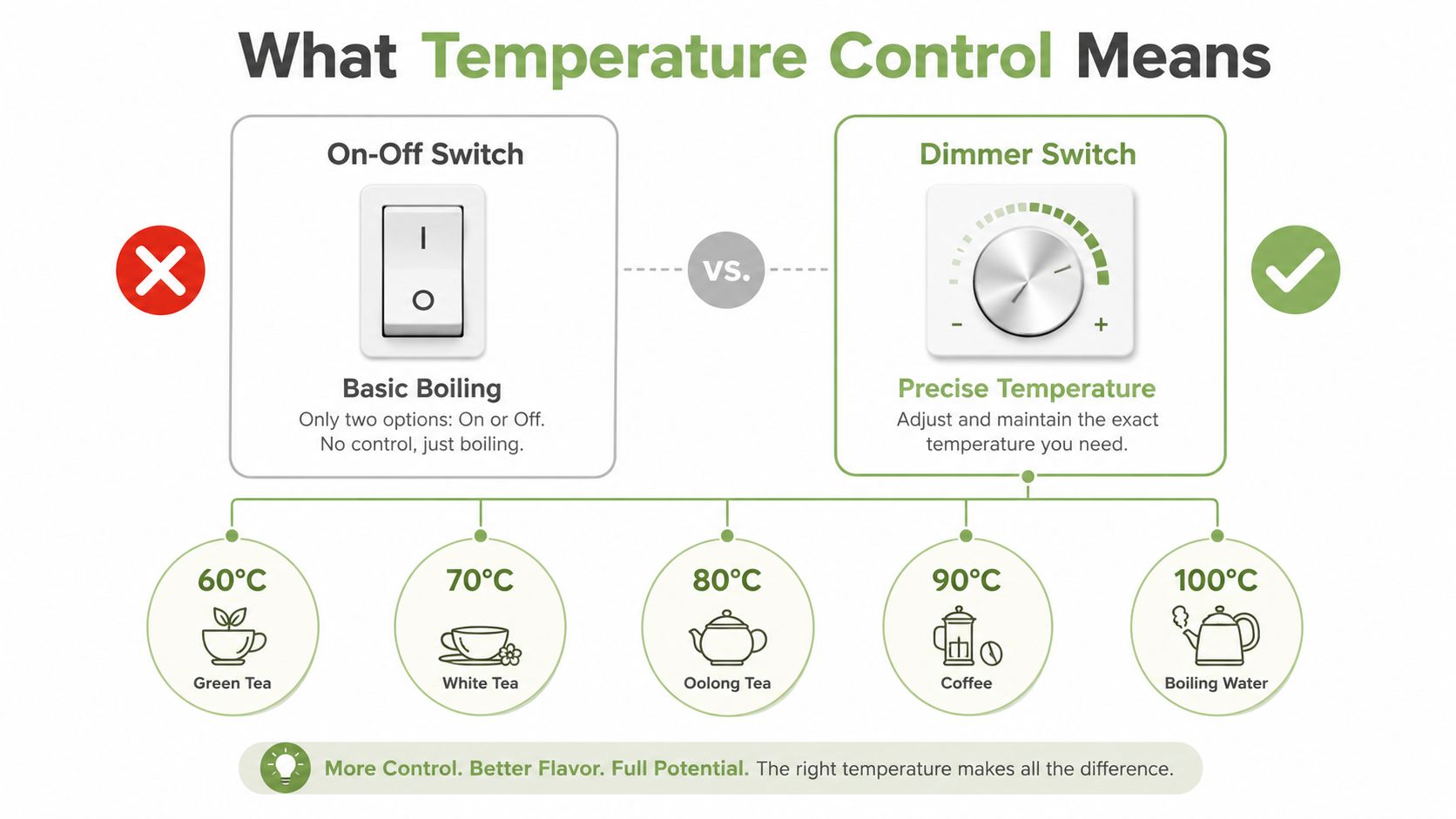
What the buttons usually mean
A glass kettle with precision control often gives you familiar targets like 60°C, 70°C, 80°C, 90°C, and 100°C. One glass-kettle manual lists exactly those setpoints, which makes the choice much easier for tea drinkers who don't want to think in theory every morning. It also shows how the machine handles timing, heating automatically after selection and switching off when the job is done, which removes a lot of human error. You can see a similar preset-style approach in the manual for a glass kettle with listed targets of 60°C, 70°C, 80°C, 90°C, and 100°C at this instruction guide.
A stovetop glass kettle is different. There, the brewer manages the heat, then uses a thermometer or timing method to hit the target manually. That's useful to know because not every “glass kettle” listing means the same thing.
If you see keep-warm, read the temperature list carefully. It usually means holding one or a few chosen settings, not every possible number.
How Modern Glass Kettles Actually Hit and Hold a Temperature
The story starts well before smart kitchen gear. The modern electric kettle is commonly traced to 1922, while earlier electric kettles date to 1891, which shows the long gap between a first electric model and a safer, more practical version for everyday use, as noted in this historical overview. That history matters because the whole idea of modern temperature control came from the move away from simple boil-only behaviour.
What the thermostat is doing
Early temperature-controlled kettles used bimetallic thermostats. In plain English, that means a heat-sensitive part bends as the water warms up, and once the target temperature is reached, it cuts power to the heating element. The kettle doesn't need to “think”, it just responds to heat in a predictable way.
Later versions add electronic sensors and a controller. The sensor measures water temperature, the controller compares that reading with your selected setpoint, and heating stops when the target is reached. If the kettle has a hold function, the system may reheat after the temperature falls below the chosen point. A general explanation of this sensor-and-controller approach appears in this temperature-control guide.
Why placement and keep-warm matter
Sensor placement matters because heat doesn't spread evenly in every kettle body. A sensor near the base can react quickly, but it may also be more sensitive to thermal lag or local hotspots if the design isn't well tuned. That's one reason two kettles can both advertise “variable temperature” and still feel different in the cup.
Keep-warm modes are useful, but they're not always universal across every setting. One glass-kettle manual says keep-warm only operates at 160°F, 175°F, 185°F, and 195°F, and the kettle reheats when sensed temperature falls below the setpoint, which is a good reminder that holding performance is often more limited than marketing copy suggests. You can see that behaviour in this glass kettle manual.
For buyers comparing models, a precision-focused option such as the Fellow Stagg EKG electric kettle shows why people pay attention to controls, not just looks. The point isn't shiny hardware, it's whether the kettle can land on the number you picked.
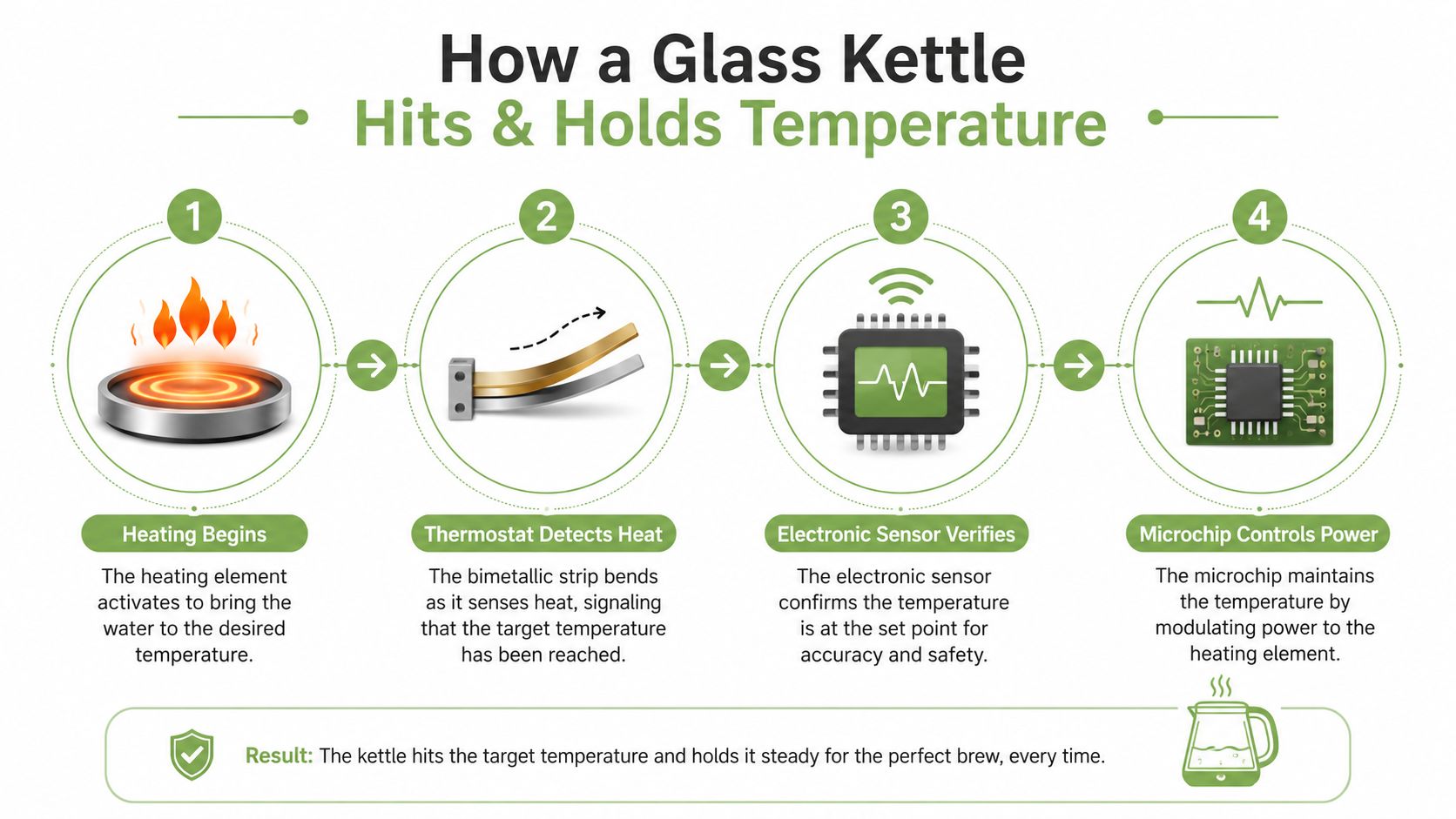
Matching Temperature to Tea Type
Tea gets easier when you stop asking, “How hot should the water be?” and start asking, “What am I making?” Different leaves respond to heat differently, and the same kettle can handle all of them if you choose the right setting.
Ideal water temperatures by tea style
| Tea Type | Target Temperature | Steep Time | Too-Hot Result |
|---|---|---|---|
| Japanese green tea | 70°C to 80°C | Brief steeping | More bitterness, less sweetness |
| Matcha | About 70°C to 80°C, using cooled water | Whisk immediately | Harsh flavour, duller texture |
| White tea | 75°C to 85°C | Gentle steeping | Reduced delicacy, sharper edges |
| Oolong | 85°C to 95°C | Moderate steeping | Can taste thinner than intended |
| Black tea | Near boiling | Short to moderate steeping | Less extraction if too cool |
| Pu-erh | Near boiling | Short to moderate steeping | Can seem flat if underheated |
The reason is chemical, but it's easy to feel in practice. Hotter water pulls out more of the compounds that can create bitterness, while cooler water gives the sweeter and more umami side of the leaf more room to show up. That's why green tea and matcha are usually treated more gently than black tea.
A simple tea-by-tea mindset
Japanese green tea is usually happiest in the lower range because it's easy to overdo. White tea likes warmth, but not force. Oolong sits in the middle, and darker teas are the ones that usually welcome a proper boil.
Matcha deserves special care because you're tasting the whole tea, not a leaf left behind in a strainer. A well-handled cup should taste smooth, not scorched. That's one reason gentle water handling matters so much for ceremonial-grade organic Matcha.
Useful shortcut: if a tea tastes oddly dry or harsh, try dropping the water temperature before changing anything else.
A glass kettle temperature control unit makes those adjustments much easier because the same appliance can move between styles without guesswork. That's handy at home, and even more useful in a café where one person might want green tea, another wants black tea, and someone else wants matcha in the same service run.
Three Practical Ways to Reach Your Target Temperature
There's more than one way to get good water, and the best method depends on your setup. A precise kettle is the simplest route, but a thermometer or a timing trick can still give you good results if you stay consistent.
The three methods side by side
Electric kettle with presets. A precision glass kettle with buttons for 60°C, 70°C, 80°C, 90°C, and 100°C is the most direct option. You press the setting, wait, and pour once it finishes. That's the least fiddly approach for anyone making tea daily.
Manual kettle plus thermometer. This works well on a stovetop or with any plain kettle. Heat the water, check the temperature with a probe thermometer, then take it off the heat or let it cool a little if it runs hot. It takes more attention, but it's universal.
Boil, then wait. If you've got no gear at hand, boil the water and let it sit briefly before pouring. The exact cooling time depends on your kettle, room temperature, and water volume, so this is more of a practical habit than a strict formula. In a busy café or event setting, that kind of timing often works best when it's written into a simple service routine.
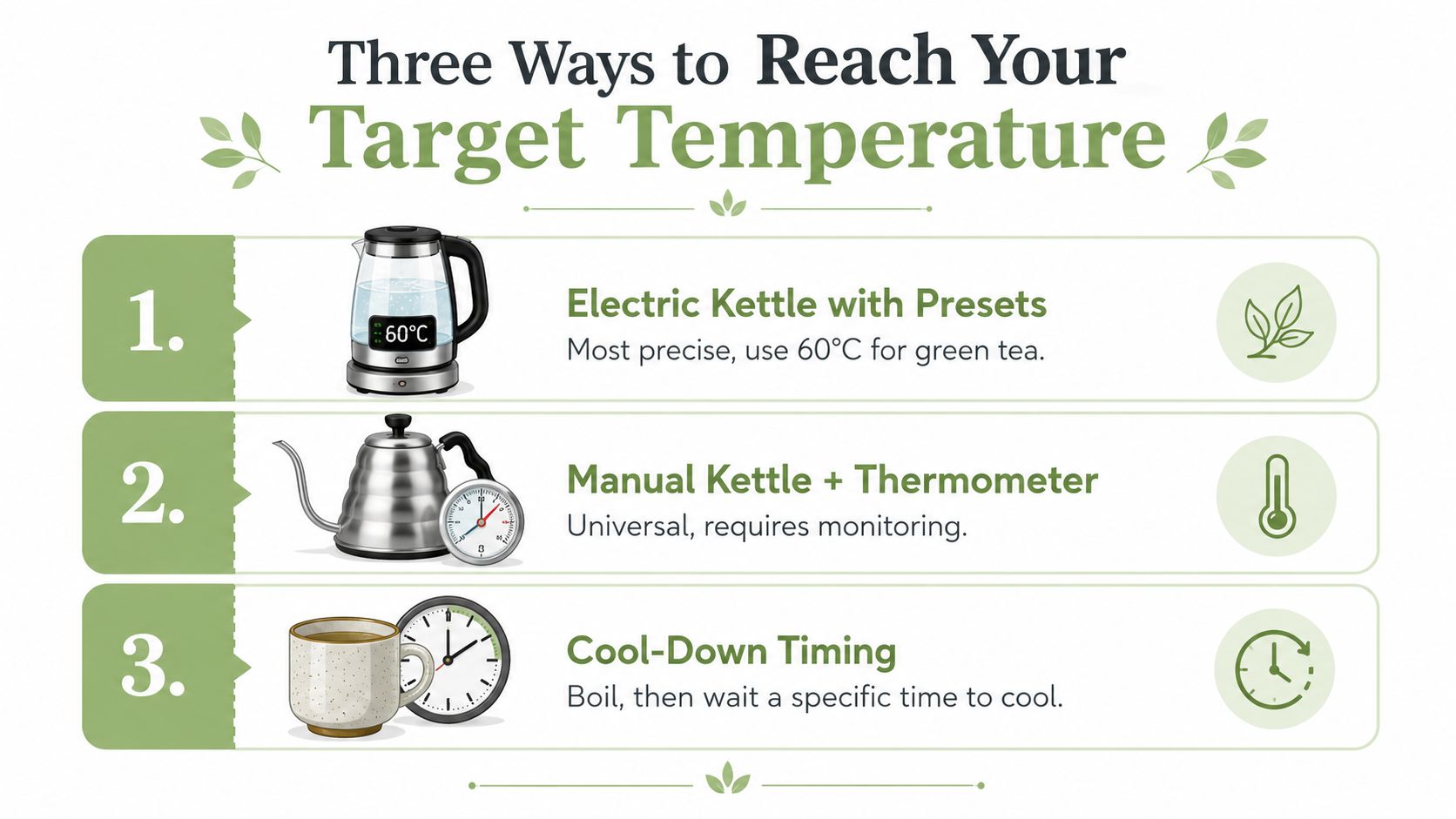
Choosing the method that fits your day
If you brew the same tea most mornings, presets remove friction. If you switch between drinks and only have basic tools, a thermometer gives you more control. If you're teaching staff or organising service across a team, a clear process matters even more than the device itself, and a centralised event management platform can be a useful way to keep timings, run sheets, and drink prep notes in one place.
Best takeaway: the right method is the one you'll use consistently, not the one that sounds the most technical.
Accuracy, Keep-Warm, and the Price Trap
A pricier kettle doesn't automatically mean a more accurate one. That's the trap. Some models look premium, have glowing buttons, and still drift enough to make repeated cups taste different from one another.
What to test before you trust the label
The key question is not whether a kettle says variable temperature, but whether it lands close to the chosen setting and stays there after repeated use. An independent buying guide for glass electric kettles highlights a useful benchmark: variable-temp kettles should ideally stay within about ±1.5°C at 80°C; larger errors can point to poor calibration and uneven brewing results, according to this buyer's guide.
That's especially relevant for lower-temp drinks, where a small miss can change flavour more than you might expect. If a kettle overshoots badly, your green tea may taste sharper than intended. If it undershoots, a bold tea may seem flat.
Keep-warm isn't the same as precision
Keep-warm can be handy, but only if it behaves predictably. Some kettles only hold at a few settings rather than the whole range, so a menu with several tea styles can expose the limits quickly. That matters in home service, but it matters even more in cafés where one kettle may need to support several different drinks in a row.
For comparison shopping, the electric kettle Australia page is a useful place to think through what features matter for real brewing habits. A good-looking kettle is nice. A kettle that consistently holds the number you asked for is better.
If you're testing a kettle in person, check whether the water tastes the same on the first cup and the third cup. Inconsistent flavour usually means inconsistent temperature control.
Safety, Cleaning, and Care for a Glass Kettle
Glass looks lovely, but it asks for a bit more care than stainless steel. The upside is obvious, you can see the water level and spot buildup early. The trade-off is that glass doesn't forgive rough handling.
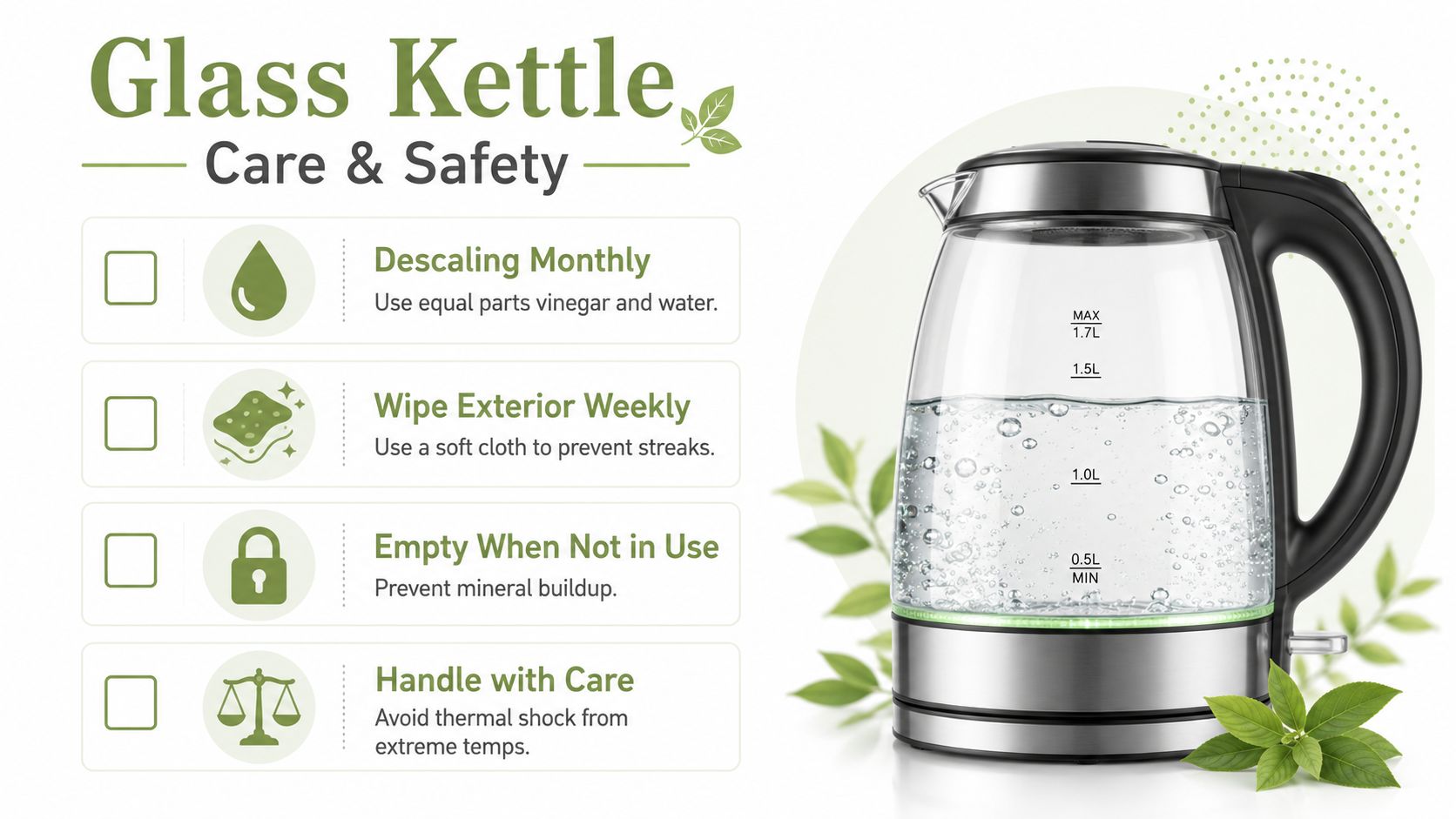
A simple care routine
- Descale regularly: use a mild descaling routine with citric acid or vinegar and water, especially in hard-water areas.
- Wipe the body gently: a soft cloth keeps the glass clear without scratching.
- Empty stale water: leaving water sitting around invites mineral buildup and stale flavour.
- Avoid thermal shock: don't pour cold water into a hot glass kettle body.
A good habit for both homes and cafés is to treat the kettle as a brewing surface, not just a container. Residue builds up on the element and in the spout, and that can affect taste before it affects appearance.
The mistake that hurts both taste and gear
Running the kettle dry, or repeatedly reboiling the same water, is a fast way to weaken flavour and wear the element.
That advice sounds boring until you taste the difference. Fresh water gives you cleaner extraction, and a kettle that's cleaned and handled well will usually feel more reliable over time.
Check the cord, the base, and the lid if the kettle lives in a busy space. In home kitchens, that's a monthly glance. In hospitality, it should be part of normal close-down and opening checks.
Quick Answers for Common Glass Kettle Questions
Is it safe to leave a glass kettle on keep-warm?
Usually, yes, if the model is designed for it and you're using the correct setting. The better question is whether the keep-warm function holds your chosen temperature consistently enough for the drink you're making.
Does reboiling water change the taste?
It can. Repeated heating often makes people notice a flatter or less fresh flavour, especially in delicate teas where water quality and temperature are already doing a lot of the work.
How often should I descale in Australia?
There isn't one universal schedule, because water hardness varies. In harder-water areas, a regular cleaning habit matters more than waiting until the kettle looks obviously scaled.
Can a stovetop glass kettle match electric precision?
It can get close with a thermometer and good attention, but it takes more hands-on control. Electric presets are still easier for repeatable tea brewing.
What setting should I use for matcha?
A cooler setting around the green-tea range is usually a better starting point than boiling water. Matcha responds best when the water is gentle, not punishing.
If you want better tea at home, start with the water before you start changing the leaves. Then match the kettle to the drink, keep it clean, and choose a setting with intent instead of habit. Explore the Pep Tea range at Pep Tea if you're ready to pair precise water handling with organic Matcha or sugar-free organic Kombucha that fits a cleaner daily routine.