
Tag: clean tea guide
Pesticide Free Tea Australia: Shop & Verify Safely
Many shoppers looking for pesticide free tea Australia assume an organic label settles the question. It doesn't. In Australia, organic certification tells you a grower or handler followed an audited system, but it doesn't automatically prove the tea in your cup is free from measurable residues, and that's the detail many buyers miss.
That distinction matters because tea is often treated like a simple pantry staple, when in reality it sits at the intersection of farming, compliance, traceability, and even packaging. If you're buying for your own kitchen, a café menu, or retail shelves, the core question isn't just “is it organic?”, it's “what proof do I have that this batch is clean enough for the claim I'm making?”
Why Organic Does Not Always Mean Pesticide Free
The cleanest way to think about tea in Australia is this, organic and pesticide free are related, but they're not the same promise. A compliant organic certificate shows that a supply chain has followed the relevant standards and audits, yet it doesn't replace chemical analysis of the finished lot. For a shopper, that gap is the whole story.
What the label actually tells you
Domestic organic labelling is governed by a voluntary standard, AS 6000–2015, while export organic products must comply with the National Standard for Organic and Bio-Dynamic Produce. The Australian Competition and Consumer Commission says that distinction matters, because a certificate mainly verifies farming and handling controls, not a residue test on the final tea.
For that reason, a buyer who needs a true pesticide free claim should look for batch-level multi-residue testing. That's the only way to substantiate a specific lot as residue-free in a practical, evidence-based sense.
Practical rule: if a seller can show certification but can't show a batch test, you've got assurance about process, not proof about residues.
If you want a plain-English primer on this distinction, PepTea's guide on whether organic tea can still contain pesticides is a useful place to start.
Why the difference matters in real life
Many tea guides stop at "organic" and leave readers thinking the job is done. In reality, cafés, retailers, and careful home buyers need to know whether the claim covers the farming system only, or the actual leaf in the packet.
That's especially relevant if you're choosing teas for customers who care about clean labels, because trust is built on specifics. A certificate says the supply chain was audited. A residue report says the product met a tighter, batch-specific standard.
Australian Pesticide Residue Standards Explained
Australian tea compliance sits on a fairly strict baseline, and that baseline shapes what “pesticide free” can legally mean. The APVMA and the Food Standards Code set maximum residue limits, and Tea Leaves Australia says the MRL is generally set at or around the limit of quantitation, typically about 0.05 mg/kg. That matters because even tiny measurable residues can become relevant to both compliance and consumer perception.
What the numbers mean
A residue limit isn't a marketing slogan, it's a regulatory line. If a product falls under it, that doesn't automatically make it a clean-label winner in the eyes of a cautious shopper. It means the product complies with the limit in that jurisdiction.
The historical context is useful here. A 2003 Choice magazine test of 55 tea products found pesticide traces in nearly 40% of samples, including 7 of 17 green teas, 8 of 20 black teas, and 6 of 18 herbal infusions. The same test reported 12 teas still contained pesticides within acceptable Food Standards Code limits, while 7 brands had cypermethrin above the limit and 3 of those were more than 20 times the MRL. That old snapshot still matters because it shows residue concerns were measurable across mainstream retail tea, not confined to one niche category. See the original report in the Sydney Morning Herald coverage of the Choice tea test.
Why clean-label positioning keeps growing
The commercial side is moving too. Tea Leaves Australia notes that IMARC estimates the Australia organic tea market was worth USD 28.00 million in 2024 and is projected to reach USD 54.18 million by 2033, implying a 7.61% CAGR from 2025 to 2033. That's a projection, not a guarantee, but it does show why residue-free positioning is becoming more important in shelf decisions and café menus. The market is rewarding brands that can explain provenance and proof, not just flavour.
| Metric | Value | Significance |
|---|---|---|
| Tea products tested in the 2003 Choice survey | 55 | Shows the issue was checked across a broad retail sample |
| Samples with pesticide traces | nearly 40% | Indicates residues were common enough to matter |
| Green teas with traces | 7 of 17 | Suggests the issue wasn't limited to black tea |
| Black teas with traces | 8 of 20 | Reinforces that mainstream tea categories were affected |
| Herbal infusions with traces | 6 of 18 | Shows herbal blends weren't automatically clean |
| Australian organic tea market, 2024 | USD 28.00 million | Clean-label demand has real commercial weight |
| Projected market value, 2033 | USD 54.18 million | Growth makes verification more commercially relevant |
Organic Certification Versus Batch Residue Testing
Certification and residue testing solve different problems, and buyers often blur them together. Certified organic systems focus on how tea is grown, handled, and traced. Batch testing focuses on what's in a particular shipment.
Side by side, the difference is obvious
Certified organic supply chains commonly rely on annual third-party audits, plus controls like soil, groundwater, and fresh-product sampling. Industry guidance from Australian tea sellers also notes that transaction certificates are used as the final lot-level control. By contrast, a batch residue test checks whether the tea itself shows pesticide residues at the time of testing.
The strongest assurance isn't one or the other, it's both together.
| Assurance path | What it checks | What it doesn't prove |
|---|---|---|
| Certified organic | Farming and handling controls, audit trail, transaction certificates | That the final batch is residue-free |
| Batch residue testing | Chemical results for a specific lot | That the farm followed organic methods throughout |
| Both together | Process controls plus chemical evidence | Much stronger low-residue confidence |
If you're buying for a café, that combined approach is the one that reduces awkward questions later. A wholesaler can show a certificate and still leave you guessing about the actual shipment. A batch report closes that gap.
For more detail on the audit side, PepTea's page on organic certification standards is a handy reference.
What a robust assurance package looks like
A supplier serious about pesticide free tea Australia should be able to show you a neat paper trail. At minimum, ask for:
- Organic certificate, so you can verify the supply chain sits under an approved system.
- Transaction certificate, so you know the lot you're buying is the lot that was certified.
- Batch residue report, so you've got chemical evidence for the specific shipment.
- Clear lot numbers, so the paperwork matches the packet or bulk carton.
A café owner doesn't need to become a lab technician. They do need to ask for the documents that prove the story on the menu.
How to Verify Pesticide Free Claims When Shopping
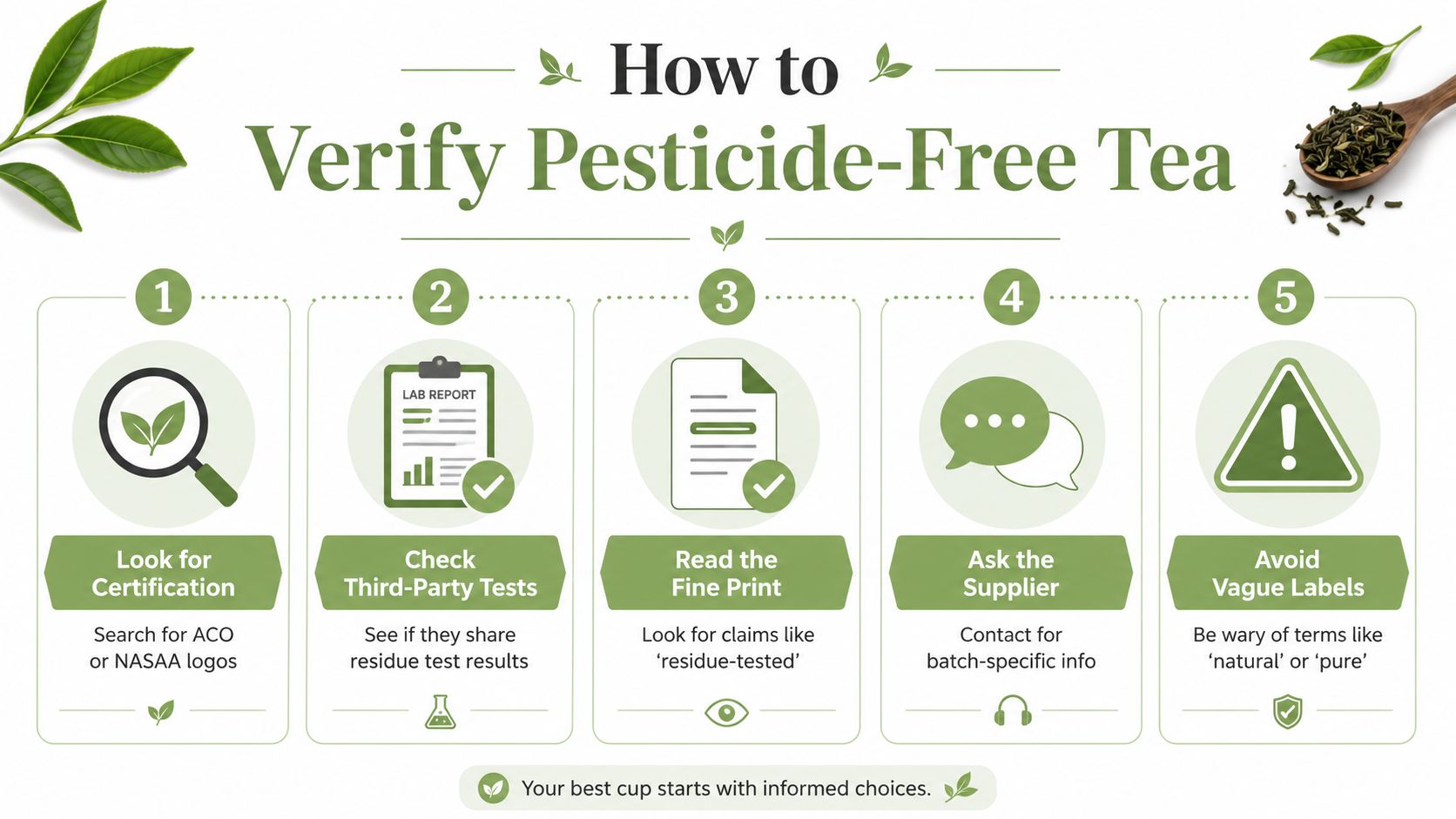
A good tea label should answer simple questions quickly. Who grew it, where was it packed, and what proof sits behind the clean claim? If the label goes vague at that point, treat it as a warning sign.
Start with the label and paperwork
Look for a real certification mark, batch number, and country of origin. If you're buying online, read the product page carefully and see whether the brand gives you access to test certificates or a lot code you can ask about later. A few brands make this easy, many don't.
Loose leaf tea often gives you better traceability than pre-bagged tea, because there are fewer layers between the leaf and the pack. That doesn't mean all teabags are a problem, but it does mean the paperwork matters more when you can't see the leaf itself.
Ask the supplier the right questions
The conversation doesn't have to be confrontational. A straightforward supplier will understand the questions and answer them plainly.
- Is this batch certified organic? Ask for the certificate number or lot reference.
- Do you have a residue report for this shipment? The answer should be batch-specific, not generic.
- Where was it grown and packed? Australian-grown tea can have a different risk profile, but imported tea can still be safe if it's independently tested.
- Can you match the test to the lot? If the lot numbers don't line up, the paperwork isn't doing its job.
Independent Australian guidance notes that tea can be grown domestically in north Queensland through to Victoria and Tasmania, and that Australian-grown tea may have low or no pesticide contamination because quarantine has helped prevent pest entry. That same guidance also recommends loose leaf, organically grown tea, or homegrown tea as practical ways to minimise exposure. See the Australian overview from Sustainable Gardening Australia.
For a quick walkthrough of what to look for on shelves, PepTea's organic green tea online page gives you a useful example of how a product page can support the buying decision.
Sourcing Clean Tea for Cafés and Retailers
A café buyer isn't just choosing flavour, they're choosing documentation, consistency, and the ease of answering customer questions. One supplier might offer lovely tea and a vague promise. Another will hand over certificates, batch details, and a cleaner story for the menu board.
What to ask before you list a tea
Start with the basics, then move to evidence. Ask for the organic certificate, the transaction certificate for the current lot, and any multi-residue test report tied to that batch. If a supplier hesitates, that's useful information too.
The cleaner the supply chain, the easier the menu story. Terms like certified organic, batch-tested, and traceable by lot mean more when you can back them up at the point of sale. That's especially helpful for venues that position tea as a premium, health-conscious drink rather than a filler option.
For wholesalers and operators, Everti's guide to brewing coffee tea bags is a practical read if you're also thinking about service workflow and presentation in busy hospitality settings.
A simple procurement example
A café might taste three teas that all look similar on the cup list. One comes with a certificate only, one comes with a certificate and lot number, and one comes with both plus a recent residue report. The third option gives the buyer the cleanest paper trail, even if the flavour is comparable.
That's the model worth using in procurement meetings:
- Process proof from certification.
- Batch proof from residue testing.
- Traceability proof from lot codes and transaction certificates.
- Service fit from format, whether loose leaf, bagged, or matcha.
PepTea is one example of a brand in this space, with certified organic Japanese matcha and Australian-brewed kombucha in its range. For cafés, the practical point is not the brand name, it's the kind of documentation and product clarity you should expect from any supplier in this category.
The Hidden Risk of Packaging and Brewing Habits
A tea can be clean at the farm gate and still lose some of its clean-label appeal in the bag. That's why packaging deserves more attention than it usually gets in pesticide free tea Australia searches.
Why the bag matters
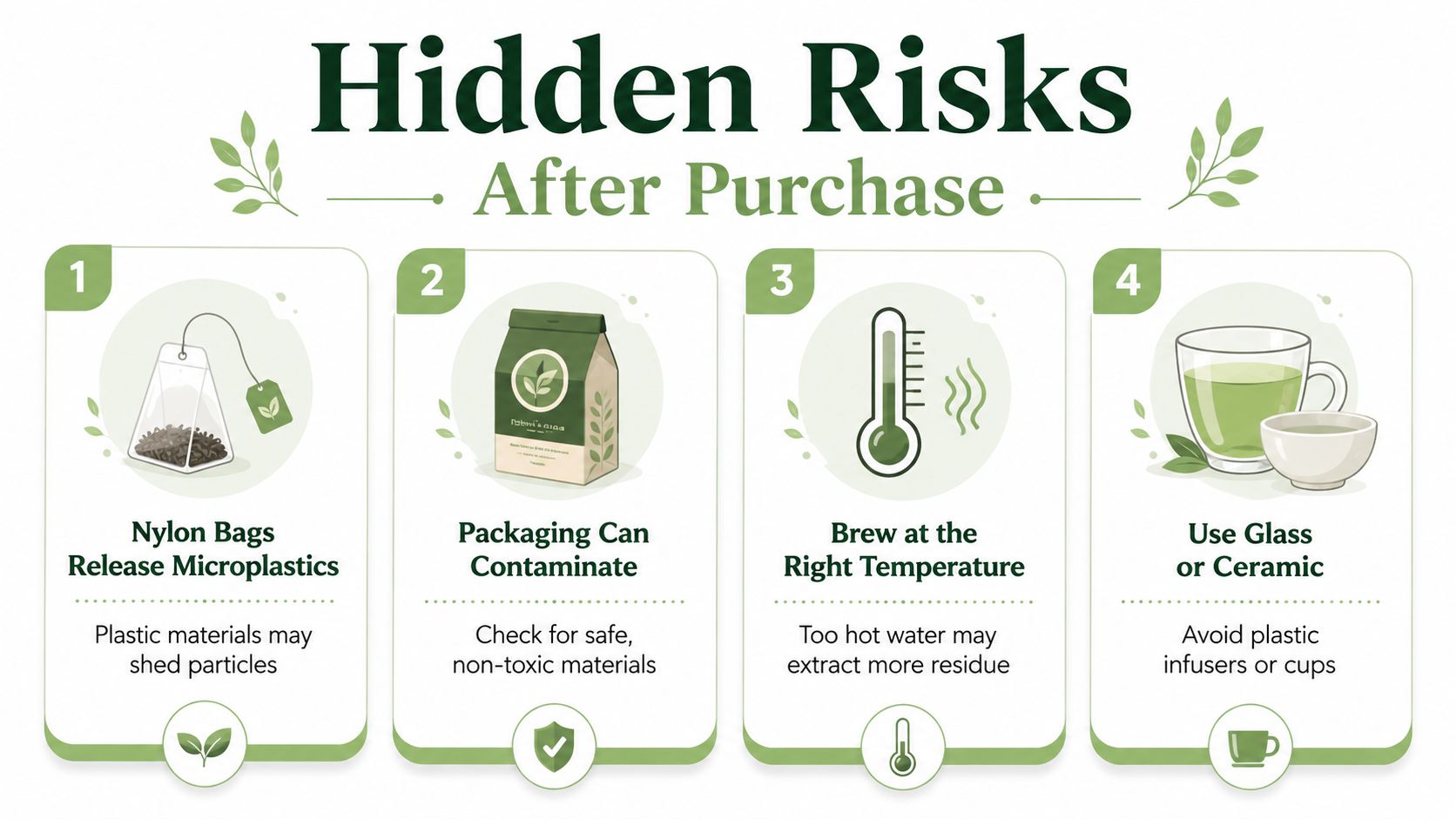
Recent Australian consumer and media commentary in 2026 highlighted that nylon pyramid tea bags can release large numbers of microplastic particles into a cup. The practical takeaway is simple. If the leaves are clean but the bag is nylon, the final drink may still carry avoidable plastic exposure. That's why plant-based, plastic-free bags and loose leaf formats are safer choices when you care about the whole cup.
Clean tea is a chain, not a claim. If one part of the chain is compromised, the promise gets weaker.
Brewing and storage still affect quality
Brewing habits can't turn bad tea good, but they can protect the good tea you've already bought. Use the right water temperature for the style you're making, keep tea in airtight containers, and store it away from light so flavour and aroma stay intact longer. Those habits matter even more for matcha, which is a delicate powder and loses freshness faster once exposed to air.
For matcha drinkers, the storage rule is simple. Keep it sealed, cool, and dark, and use it promptly after opening. That helps preserve the bright colour and cleaner flavour people expect from a quality powder.
Building Your Clean Tea Routine in Australia
A clean tea routine starts with a sequence, not a slogan. Certified organic farming, lot-specific residue testing, plastic-free packaging, and proper storage are the four pieces that hold the promise together. Leave one out and the claim gets softer.
A practical routine you can actually use
Begin with what's already in your cupboard. Check whether the tea has a clear lot number, a credible organic certificate, and any evidence of batch testing. If it doesn't, don't panic, just decide whether you want that tea for everyday use or whether you'd rather switch to a more transparent option.
Then make one packaging decision that reduces hassle long term. Choose loose leaf or plastic-free bags where you can, and store everything in airtight containers away from light. For buyers who want a clean, low-fuss routine, that's a simple upgrade with real benefits in the cup.
If you're choosing products for a household, café, or retail shelf, the same logic applies every time. Ask for proof, check traceability, and favour suppliers who can explain their process without getting defensive. That's the difference between a nice-sounding claim and one you can stand behind.
PepTea offers organic matcha and Australian-brewed kombucha for people who want a cleaner, more transparent tea routine. If you're comparing options for home, café, or retail use, visit Pep Tea and look for products that match the proof you'd want in your own cup.