
Cold Brew Tea Concentrate: Master Australian Brewing
Most people treat cold brew tea concentrate like a stronger version of iced tea. That's the wrong model. Cold extraction changes what comes out of the leaf, which means you're building a different drink base with different flavour, body, and storage behaviour, not just a bigger jug of tea.
That matters in Australian kitchens and cafés because the best cold brew isn't chasing harshness. It's chasing smoothness, clarity, and reliable batch prep, which is exactly why cold-water brewing has such a strong functional basis in tea science. A Japanese review on cold-water brewed sencha notes that the main compounds extracted in cold water are epigallocatechin (EGC) and theanine, while hotter extraction shifts more toward EGCG and caffeine. In plain terms, cold brew tea concentrate is less about brute strength and more about the chemistry that stays gentle in the glass, as shown in the JIRCAS review on cold-water brewed sencha.
For cafés, that difference is practical. A concentrate that tastes cleaner after dilution gives you more room to build iced teas, lattes, and mocktails without fighting bitterness. For home brewers, it means you can batch once, chill it, and pour later without the flat, over-extracted edge that so often turns people off hot-brewed iced tea.
Why Cold Brew Tea Concentrate Is Not Just Strong Iced Tea
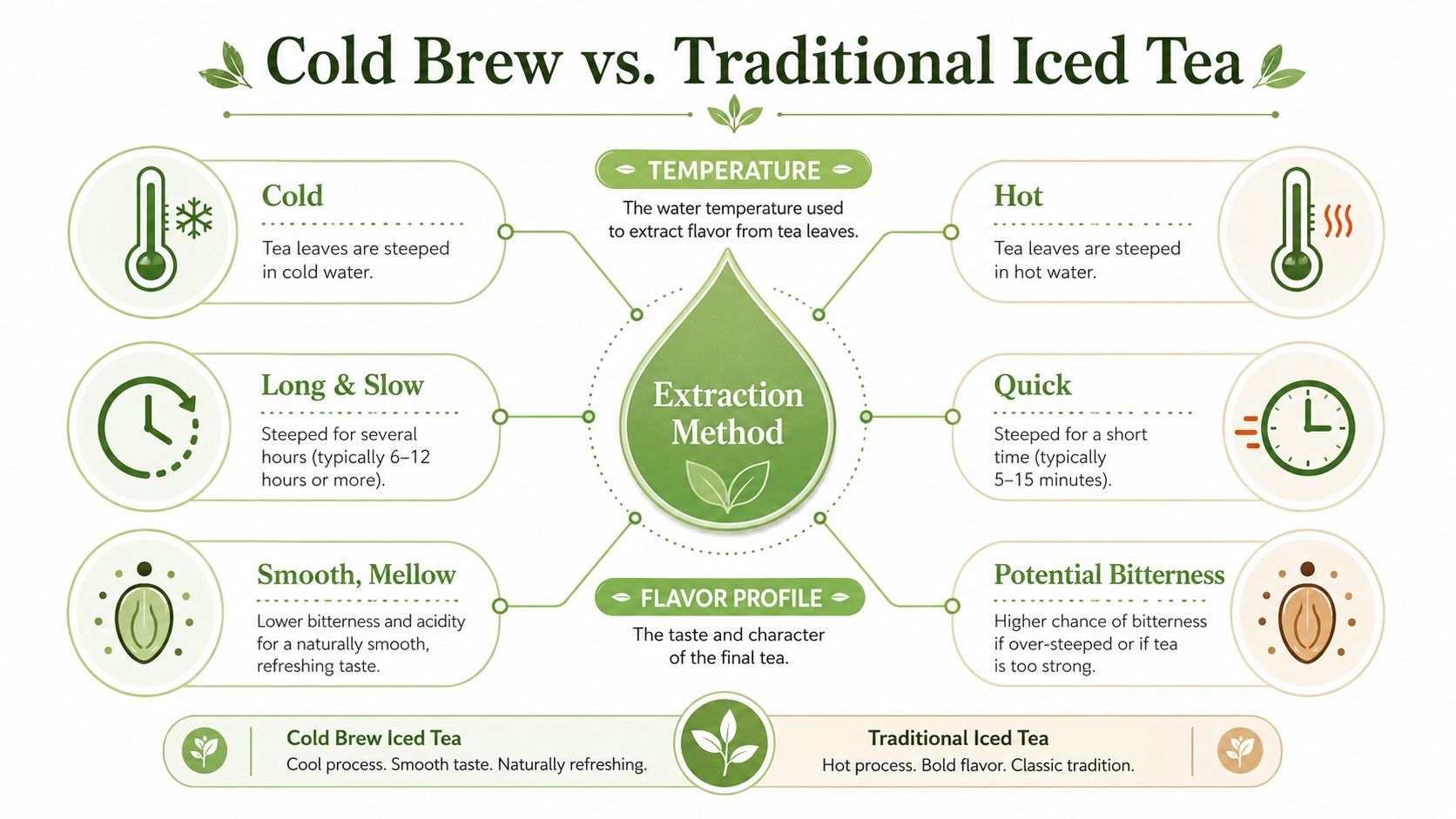
Cold brew tea concentrate works because it extracts a different slice of the leaf. In cold water, the lighter, more delicate compounds come forward first, while the harsher elements move more slowly. That's why a properly made concentrate can taste fuller, not thinner, even though it often carries less caffeine and less bitterness than a hot-brewed equivalent, according to the tea science and iced-tea chemistry sources already outlined above.
The flavour you notice first is the point
Cold extraction tends to favour aromatic compounds, amino acids, and softer soluble solids. A scientific review on iced-tea chemistry reports that cold-brewed tea is dominated by volatile aromatic compounds, carbohydrates, and amino acids, while the larger molecules linked to bitterness and astringency extract more slowly. That's the reason a cold brew tea concentrate can feel rounder on the palate after dilution, as described in the red blossom tea chemistry overview.
This also helps explain why “strong” doesn't always mean “stimulant-heavy”. Cold extraction shifts balance, not just intensity. The cup can still be full-bodied enough for milk or sparkling water, but the finish stays calmer and less aggressive.
Practical rule: if a concentrate tastes sharp before dilution, it usually won't magically improve in the final drink. Fix the extraction first.
Why that matters in Australia
Australian drinkers already lean toward beverages that feel lighter, cleaner, and more functional. That's where cold brew tea concentrate fits neatly. It gives cafés a base for smoother iced service, and it gives households a chilled tea option that doesn't need sugar to taste complete.
The broader market backdrop supports that shift. One market report projects the global cold-brew tea market will grow from USD 0.8 billion in 2025 to USD 1.52 billion by 2034, with a 7.8% CAGR, and a separate estimate projects cold-brew concentrate from USD 2,950 million in 2025 to USD 6,368.8 million by 2035. Those are global projections, but they help explain why Australian menus are paying more attention to batchable, lower-bitter tea formats, in the market overview from MarketIntelo.
Choosing the Right Tea and Leaf Format for Concentrate
Not every tea behaves the same once you switch to cold extraction. Leaf size, oxidation level, and how the tea was processed all affect what lands in the jar. Loose-leaf tea usually gives the cleanest result because the leaves can unfurl properly, while dust-grade material tends to over-extract quickly and leave you with a muddy finish.
Match the tea to the drink you actually want
Black tea is the safest choice when you need a concentrate that can stand up to milk, ice, and sweeteners. It gives body and depth, which is useful for lattes or strong iced tea. Green tea is better when you want a lighter, more vegetal profile, but it needs a shorter steep to avoid murkiness. White tea and some oolongs can be elegant in delicate drinks, while herbal blends work well when fruit or florals are the main point of the drink.
Japanese ceremonial-grade matcha sits in a different category altogether. It's not a leaf-steeped concentrate, it's a stone-ground tea powder, so it behaves more like a suspension than an infusion. That makes it ideal for whisked drinks and recipes, while cold-brewed leaf tea is better when you want a clear, filtered liquid base.
If you're choosing organic loose leaf for cold extraction, a dedicated green tea range is a better starting point than a dusty all-purpose blend. A useful benchmark is Pep Tea's organic green tea loose leaf range, because freshness and leaf integrity matter more than people expect in cold brew.
Keep the leaf intact
A fine, whole leaf gives you control. Smaller particles release faster, which can be useful, but too much surface area pushes tannin extraction in the wrong direction. That's where cold brew starts tasting hollow or a little swampy, especially after dilution.
Loose leaf is usually easier to calibrate than tea bags because you can adjust the mass, leaf quality, and steep time with far more precision.
For green and white teas, a bloom step can help if you want cleaner extraction. An Australian iced-tea guide recommends dampening the leaves briefly with hot water before adding cold water and chilling for a full extraction cycle, which can improve clarity in larger batches, as shown in the AOT iced-tea brewing guide.
Precise Ratios and Step-by-Step Brewing Methods
The quickest way to wreck cold brew tea concentrate is to guess. The next quickest way is to push green tea too far, then try to rescue it with extra water. A measured batch is easier to repeat, easier to taste, and far easier to scale in a café or a home kitchen.
Start with a simple baseline
For black tea and most herbal teas, a practical starting point is 10 to 12 g of loose leaf tea per 1 L water with a refrigerated steep of 12 to 16 hours. Green tea should rarely go beyond 12 hours, because it can turn muddy and bitter if you leave it too long, according to the cold-brew concentrate recipe guide. Cold extraction also changes the cup in useful ways, a cold brew at about 4°C for 6 to 12 hours can produce 10 to 40% less caffeine than equivalent hot brewing, along with 15 to 30% less EGCG and total polyphenols, while keeping more aromatic terpenes and a smoother finish, as outlined by TeaTrade.
That shift matters in service. Lower caffeine, more retained theanine, and a softer polyphenol balance give concentrate a cleaner profile than hot-brewed iced tea, especially once you dilute it into milk, soda, or fruit.
Use the method that fits the batch
For home use, a wide jar or pitcher works fine if it has an airtight lid. For café service, use a clean, food-safe container that lets you strain quickly and chill evenly. Keep the leaves fully submerged, and avoid repeated contact with air or dirty utensils.
A useful reference table:
| Tea Type | Ratio (g per L) | Steep Time (hours) | Notes |
|---|---|---|---|
| Black tea | 10 to 12 | 12 to 16 | Best for milk drinks and bold iced tea |
| Herbal tea | 10 to 12 | 12 to 16 | Fruit-forward blends usually hold up well |
| Green tea | 10 to 12 | Up to 12 | Shorter steep keeps flavour cleaner |
| White tea | 10 to 12 | 12 to 16 | Gentle profile, works well in lighter drinks |
| Oolong | 10 to 12 | 12 to 16 | Middle ground between body and delicacy |
For larger batches, the Australian iced-tea guide recommends 2 pouches for 4 gallons, 3 pouches for 6 gallons, or 4 pouches for 8 gallons before straining, and it also advises pressing out as much liquid as possible without squeezing the leaves hard. That last part matters. Squeezing spent leaves can force tannins back into the liquor and undo the softness you wanted in the first place.
Keep the process repeatable
Blooming green or white tea briefly with hot water can help release aroma before the cold steep. The same guide recommends 175 to 180°F for a 20-second bloom, then cold water and a 24-hour chill for certain service formats. That is a café method, not a universal rule, but it shows how operators balance clarity, strength, and service flow in real kitchens, in the AOT brewing guide.
For storage and handling, pair a tight brew method with clean equipment and a clear rotation system. If you want a practical comparison point for cold storage habits, shelf-stable probiotic explanations show the same basic principle, the container, temperature, and handling matter as much as the product itself. The same logic applies to tea concentrate, and a prep routine should be written down before the first batch goes into the fridge.
A simple label with tea type, batch time, and intended use keeps service consistent. It also helps when you need to assess whether a concentrate is still suitable for milk drinks, fruit mixers, or straight iced service. For a storage reference outside tea, how to store kombucha is a useful parallel because it treats refrigeration and sealing as part of quality control, not an afterthought.
Storage Safety and Shelf Life for Refrigerated Concentrate
This is the part many tea guides skip. They'll tell you how long to steep, then leave you guessing once the jar is in the fridge. For home brewers, that's annoying. For cafés, it's a food-safety problem.
Refrigeration is not a magic shield
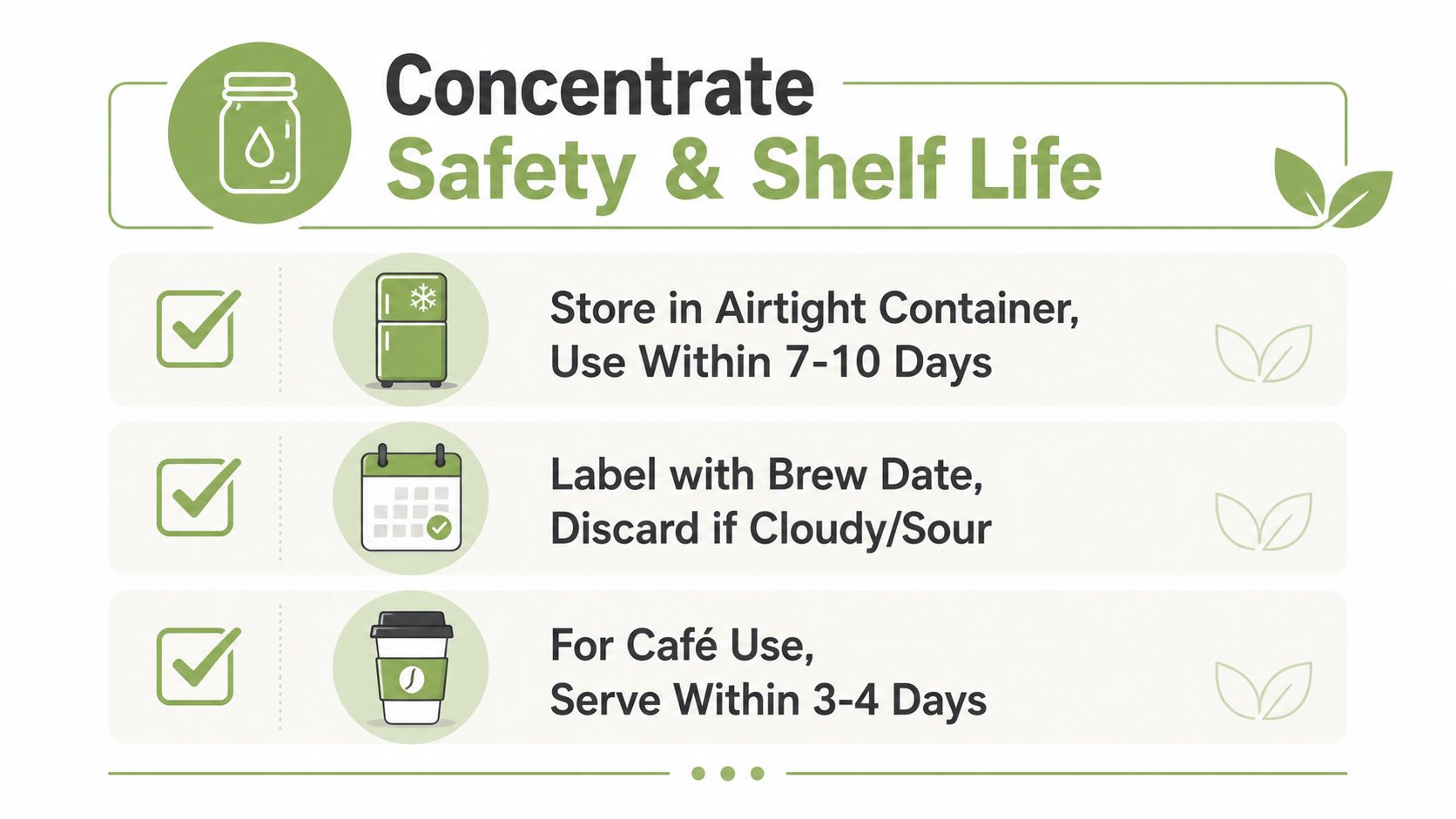
Cold brew tea concentrate still needs clean handling, tight sealing, and sensible rotation. The most useful guidance in the material you've got is inconsistent, which tells you the answer depends on sanitation, container choice, and how often the jar is opened. A sealed, refrigerated concentrate made with clean equipment is safer than one transferred between multiple containers, left half-open, or dipped into repeatedly.
Use a sanitised glass jar or food-grade container with an airtight lid. Glass is easier to inspect for cloudiness, residue, and off-colours, while food-grade plastic can be practical for service if it's clean and well maintained. In both cases, label the brew date and tea type, then keep it cold and closed.
For hospitality venues, batch discipline matters. Use first in, first out rotation, write the prep time on the label, and don't keep a service jug on the counter longer than needed. Repeated opening invites contamination, and that risk climbs quickly if the concentrate is later mixed with milk or fruit purée.
Simple rule for cafés: the more ingredients you add, the shorter the useful storage window becomes.
One helpful parallel comes from Yuve's explanation of shelf-stable probiotic foods. The point isn't that tea concentrate behaves like probiotics, it doesn't. The useful takeaway is that shelf life always depends on the product's live or non-live status, storage conditions, and how it's handled after opening. Tea concentrate is much closer to a fresh refrigerated beverage than a shelf-stable pantry item.
Watch the signs, not just the calendar
If the liquid turns sour, develops an odd film, or smells wrong, discard it. If it's a diluted serving that contains milk, treat it far more cautiously than plain concentrate. And if you need a practical storage companion for broader tea and kombucha handling, Pep Tea's kombucha storage guide is a useful reference point for fridge discipline and container habits.
Dilution Charts and Concentration Adjustment for Different Drinks
A concentrate only works if you know what it's meant to become. Some batches are designed for iced tea, some for lattes, and some for lighter, sparkling drinks. The trick is to plan the concentrate strength around the final pour, not the jar straight out of the fridge.
Build backwards from the serving
For iced tea, a common starting point is 1:3 or 1:4 concentrate to water. For tea lattes, 1:2 or 1:3 with milk or plant-based milk usually gives enough body without tasting watery. For spritz-style drinks, you can go lighter, around 1:5 or more, especially if you're adding citrus or sparkling water.
| Beverage Type | Concentrate Ratio | Diluent | Serving Suggestion |
|---|---|---|---|
| Iced tea | 1:3 to 1:4 | Water | Clear, refreshing, easy to scale |
| Tea latte | 1:2 to 1:3 | Milk or plant milk | Best with black tea or robust oolong |
| Spritz-style drink | 1:5 or higher | Sparkling water | Works well with citrus and herbs |
| Mixed tea drink | Varies | Kombucha or soda water | Useful for café mocktails |
The important point is that stronger concentrate does not automatically mean more caffeine. Cold extraction changes the balance of soluble compounds, so a bolder-looking batch may still be smoother and less stimulant-heavy than a hot brew. That's why taste matters more than appearance here.
Calibrate with the spoon, not the assumption
Taste the concentrate before you dilute it. If it's thin and flat, the batch was under-extracted, so use more leaf or give the next batch more time. If it's drying or harsh, the steep went too far or the leaves were squeezed too hard.
Good concentrate tastes complete on its own, even before dilution. It shouldn't need sugar to feel balanced.
Keep notes on leaf type, steep time, and final use. Black tea that feels perfect in milk might be too heavy for a spritz, while a white tea that sings in sparkling water will vanish in a latte. Once you start matching base strength to the serving style, the whole process gets easier.
Recipe Ideas for Iced Drinks, Lattes, Mocktails, and Mixers
Cold brew tea concentrate earns its keep when it stops being a one-note iced tea base. In cafés, I've seen it become the backbone of seasonal menus because one batch can cover multiple drinks without forcing staff to brew each order from scratch. At home, it's just as useful because it plays well with fruit, herbs, milk, and bubbles.
Build drinks around the tea's personality
A green tea and mint cooler works best when the concentrate is light, chilled, and topped with sparkling water. Add fresh mint, a slice of cucumber, and ice, then keep the sweetener minimal. That's a clean summer drink, not a dessert.
A black tea latte with vanilla and cinnamon needs more body. Use a stronger base, then pair it with oat milk or dairy milk and a small amount of vanilla. Black tea holds up best when the drink is meant to taste creamy rather than crisp.
A white tea spritz with elderflower and lime is a good example of why cold brew concentrate is useful for non-alcoholic menus. It keeps the drink floral and bright, and it doesn't need the kind of heavy sweetening that can flatten a sparkling serve.
For operators expanding their mocktail list, a useful adjacent resource is NA Beer Finder's guide to the best non-alcoholic beers, because it shows how far Australian consumers are willing to go for better non-alcoholic options. Tea concentrate fits that same demand for drinks that feel grown-up without relying on alcohol.
Use it as a mixer, not just a base
Cold brew tea concentrate also works surprisingly well with kombucha. A small amount can add tea depth to a probiotic drink, especially if you want a layered flavour profile for a café special. That's where the format gets interesting. It can sit beside sparkling drinks, not just replace still iced tea.
For more drink ideas built around this format, Pep Tea's non-alcoholic tea cocktail ideas can spark menu thinking without pushing you into sugary territory.
Troubleshooting Common Problems and Final Tips
Most cold brew problems come down to four things, time, leaf quality, sanitation, or dilution. The good news is that each one has a fix you can apply on the next batch without starting from scratch.
Read the batch, then correct the batch
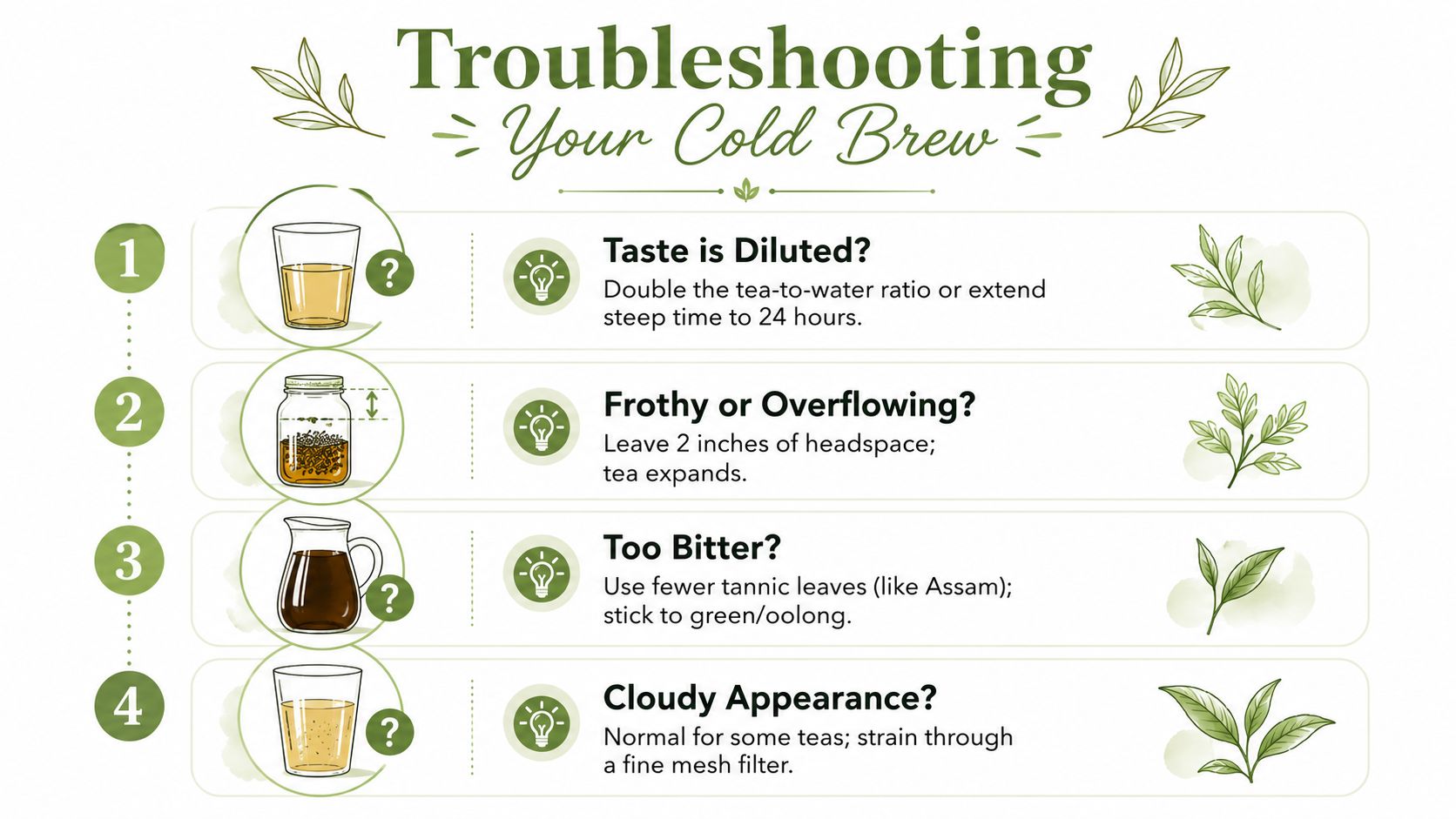
If the flavour is weak, use more tea or let the next steep run longer. If the drink is bitter, shorten the steep and stop squeezing the leaves. If the jar looks cloudy, that can be normal for some teas, but a finer mesh filter will often improve the finish.
- Weak Cup. Taste is diluted, double the tea-to-water ratio or extend steep time to 24 hours.
- Frothy or Overflowing? Leave 2 inches of headspace, tea expands.
- Too Bitter? Use fewer tannic leaves, like Assam, and lean towards green or oolong.
- Cloudy Appearance? Normal for some teas, strain through a fine mesh filter.
The safest habit is the simplest one
Use fresh tea, clean gear, and a brew date label every time. If a batch smells off, looks suspicious, or has been sitting too long after opening, bin it. That's cheaper than serving a bad drink and far better than trying to rescue a compromised one.
Cold brew tea concentrate works because it respects the leaf. It gives you control over flavour, body, and service, while keeping the cup smoother than a hot steep pushed too far. If you want to keep building a cleaner, more functional drinks menu, explore Pep Tea for organic Japanese matcha and sugar-free kombucha that pair naturally with tea-led café recipes and everyday home brewing.