
Tag: sugar-free matcha
Matcha Latte Mix Guide: Pure vs Pre-Sweetened Options
Australian matcha entries in MyFitnessPal rose 33.8% from 2024 to 2025, according to reporting by Melbourne Insider. That measures food logs, not matcha latte mix sales, but it's a useful reminder that more Australians are fitting matcha into everyday routines. The important buying question isn't whether the packet says matcha. It's what ends up in your cup, including the sugar, caffeine, milk and actual dose of tea.
What a Matcha Latte Mix Is and Why Australians Are Buying It
A matcha latte mix is powdered matcha blended with ingredients such as milk powder, sweetener or flavouring, ready for you to add water or milk. Pure matcha powder is different: it supplies the tea, while you choose the rest of the drink.
Australia's interest extends beyond specialist tea shops. Market estimates reported by SBS put Australian matcha revenue above A$54 million in 2024, with projected annual growth of 7.1% over the following five years and revenue projected to exceed A$81 million by 2030. Those are matcha-category estimates, not figures specifically for latte premixes.
Convenience changes the preparation
Say you're making a latte before work. With pure powder, you weigh the matcha, sift it, whisk it with water, then add your chosen milk. With an all-in-one premix, you measure the blend and follow its mixing directions.
The difference is a little like instant coffee beside a pour-over: the premix is quicker and easier to repeat, but the manufacturer has already made some ingredient decisions for you. Unlike loose-leaf green tea, neither format needs straining after steeping. Matcha is powdered leaf that stays in the drink.
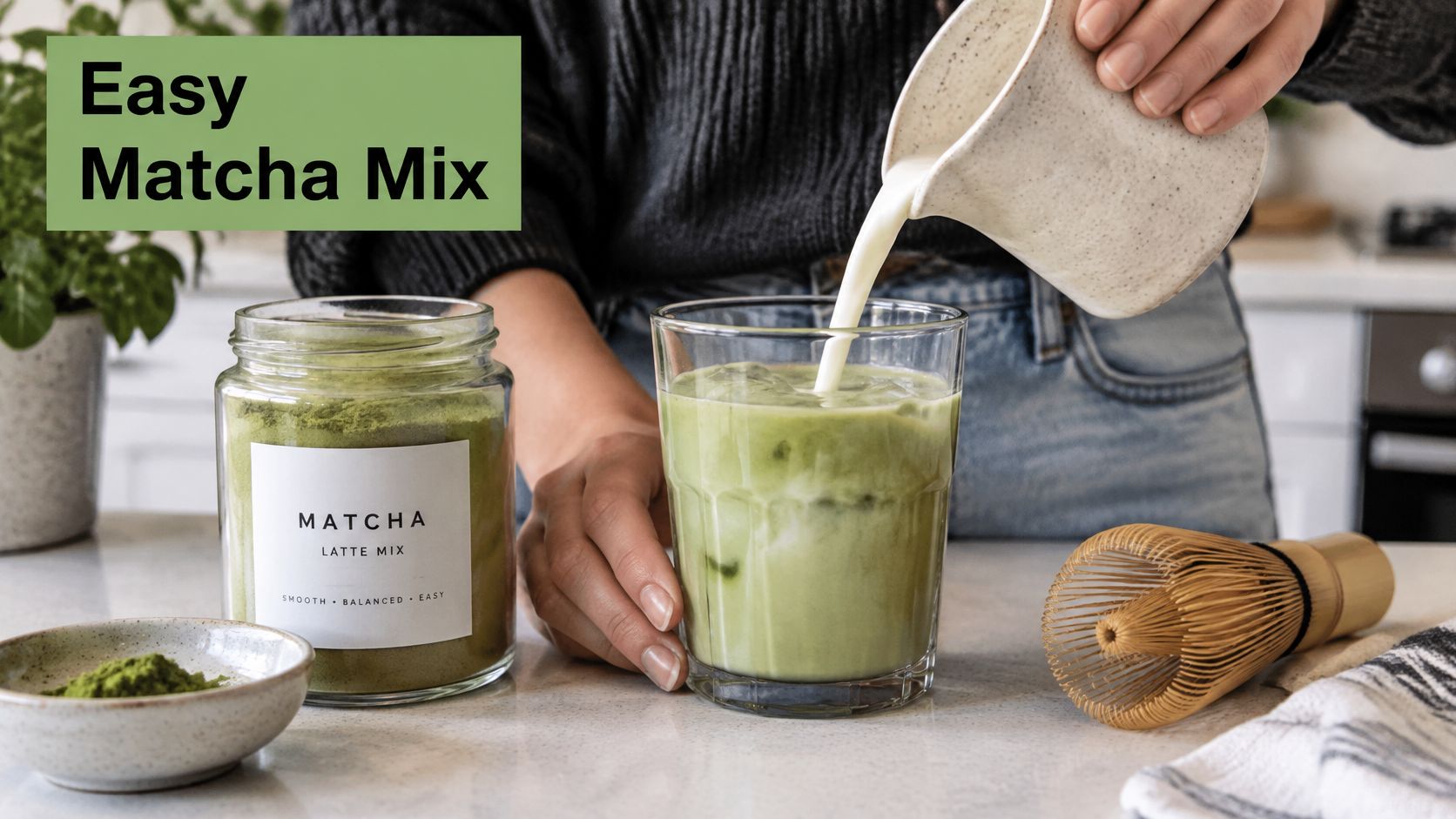
This is the finished cup you're aiming to judge, rather than the appearance of the powder alone.
Who's choosing matcha?
Australian MyFitnessPal reporting published by Mirage News found that people aged 18–34 accounted for 53% of Australian matcha entries. Again, these are app entries, not purchases, but they help explain why cafés offer matcha alongside familiar coffee drinks.
For a café operator, convenience means more than speed. Staff need a recipe they can reproduce during a rush, while customers need to know whether they're ordering an unsweetened tea latte or a sweetened beverage.
Buying rule: Choose the format first, then judge the prepared drink by its sugar, caffeine, tea dose and cost per serve.
A useful matcha latte mix should fit your routine without leaving you guessing about what you're drinking.
Pure Matcha vs Pre-Sweetened Mixes at a Glance
Matcha latte mix formats compared
| Format | Typical ingredients | Added sugar | Caffeine information | Best for |
|---|---|---|---|---|
| Pure matcha powder | 100 per cent matcha, with milk and sweetener added at home | None unless you add it | Set by your dose; weigh it and request a tested figure | Control over sugar and dose |
| Pre-sweetened mix | Matcha, sugar, milk powder, flavourings | Present; check per-serve sugars | Check tested milligrams at the recommended serving weight | Fast, café-style sweetness |
| Sugar-free mix | Matcha with milk powder or plant milk powder and non-sugar sweetener or none | Check the claim; milk sugars still count towards total sugars | Check tested milligrams per prepared serve | Lower-sugar daily routines |
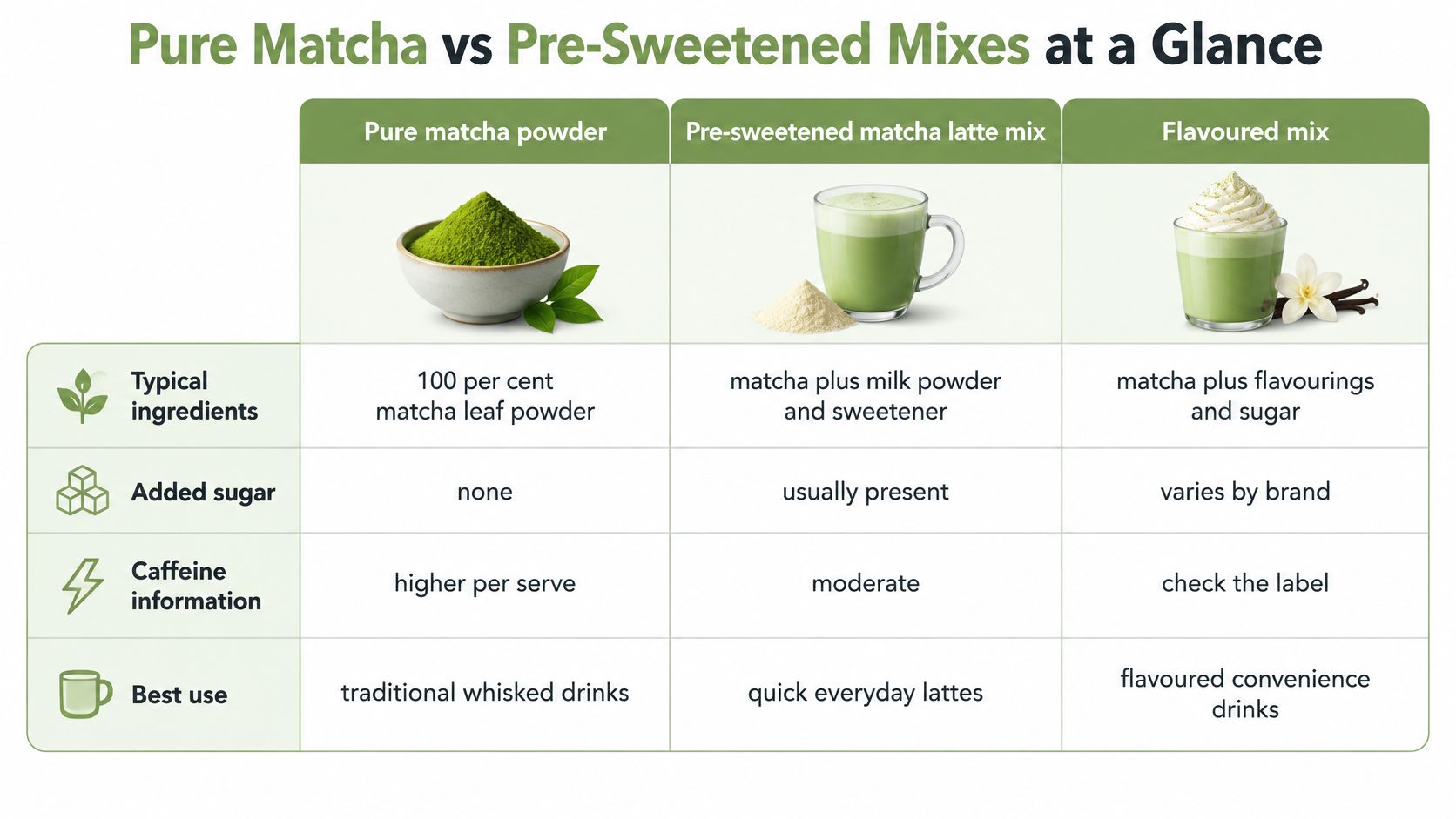
The visual comparison below summarises common formats. Treat its caffeine descriptions as prompts to investigate, not a reliable ranking: a product's tested serving dose matters more than its format.
What you gain and give up
Pure matcha offers the most flexibility. You can change the milk, leave out sweetener or make a stronger-tasting drink without adding more sugar. The trade-off is preparation: a fine sieve, small digital scale and whisk make the process much more dependable than tipping powder straight into a mug of milk.
Pep Tea's organic Japanese pure matcha powder is one example of a base you can prepare this way. Compare it with other pure powders on origin, freshness, flavour and suitability for milk, rather than assuming an elaborate tin guarantees a better latte.
Pre-sweetened mixes reduce decisions. That's useful when you want the same sweetness each morning, but increasing the scoop to strengthen the tea also increases every other ingredient. You can't separate the matcha from the sugar once they're blended.
Sugar-free mixes occupy the middle ground. They can simplify preparation without relying on added sugar, although the sweetener's aftertaste and the milk powder's texture still need a taste test. Organic versions can exist in any of these formats.
For a preparation demonstration to accompany your comparison, watch the video below.
Compare the cost of the cup
Use pack price ÷ usable serves = powder cost per drink. Calculate usable serves from the dose you'll make, not a smaller advertised portion you won't enjoy.
Then account for anything missing from the packet:
- Milk: A water-only premix and a pure powder requiring fresh milk aren't equivalent purchases.
- Sweetener and flavour: Include additions you'll use regularly.
- Waste: A large bag isn't good value if it loses its appealing flavour before you finish it.
If you're organising a drinks shelf, keep flavoured additions separate while learning your preferred tea strength. The same ingredient-first approach helps when choosing chocolate for your next hot drink from Fresco Chocolate: compare the intended cup, not just the bag size.
Reading the Label for Sugar, Caffeine and Organic Claims
Start with the back of the pack. A grassy-green front label can belong to pure tea, a milk-heavy blend or a sweetened drink powder.
Check the pack in this order
- Ingredients: Look for matcha, dairy or plant milk powder, sugar, glucose syrup, maltodextrin and flavourings. Ingredient order shows their relative weight, but it doesn't reveal the exact matcha proportion unless that's stated.
- Serving weight: Find the gram dose, not just the scoop description. A heaped scoop and a level scoop won't necessarily produce the same drink.
- Preparation liquid: Establish whether the nutrition information assumes water, dairy milk or a particular plant milk.
- Sugars per prepared serve: Compare equivalent cup sizes made as you intend to drink them.
- Caffeine information: Look for a tested milligram amount and whether caffeine has been added separately.
- Allergens: Check milk, soy and other declared allergens, including relevant cross-contact statements.
Sugar near the top tells you it's a substantial ingredient. It doesn't, by itself, prove that most of the packet is sugar. Likewise, maltodextrin isn't interchangeable with sugar on a nutrition panel, so don't try to calculate total sugars from ingredient names alone.
For readers choosing drinks during pregnancy, NSW Health's healthy-eating guidance provides broader dietary context. A wellness description on a drink packet shouldn't replace an assessment of its ingredients or your individual needs.
Sugar-free powder isn't automatically a sugar-free latte
FSANZ explains that total sugars include naturally occurring and added sugars. That distinction matters when the powder contains milk solids, or when you add milk yourself.
No added sugar and sugar-free aren't interchangeable claims. Judge the drink at the intended dilution and serving size. Unsweetened milk can still contribute naturally occurring sugars, and a flavoured plant milk may change the result again.
Say you enjoy sweetness but want to reduce sugar. Compare the prepared sugars on competing packs using the same milk and cup size, then check how each gets its sweetness. Milk powder listed after matcha might help identify a more tea-forward blend, but it isn't proof of lower total sugar.
Don't compare a water-prepared nutrition panel with your milk-made latte and assume the numbers still describe your drink.
A packaged pure tea may not carry the same nutrition information as a nutritionally substantial latte blend. If the information you need is missing, ask the supplier rather than treating a blank panel as a nutritional advantage.
Separate caffeine rules from organic claims
Naturally occurring caffeine in tea and separately added caffeine have different labelling implications. FSANZ's caffeine guidance states that added caffeine must appear in the ingredient statement and that foods containing added caffeine must carry a statement that they contain caffeine.
Products classified as formulated caffeinated beverages face additional requirements. The FSANZ caffeine review describes warnings for children, pregnant or lactating women and caffeine-sensitive people, alongside a stated daily consumption quantity. Don't assume an ordinary matcha powder belongs to that category just because tea contains caffeine.
Organic certification concerns production and processing. It doesn't establish low sugar, low caffeine or a clinical health benefit. Check the certification information and origin separately from the nutrition panel.
Similarly, antioxidant and L-theanine language doesn't tell you how sweet the drink is or whether its caffeine suits you. Phrases such as may support wellbeing shouldn't be read as promises of immunity, treatment or crash-free energy.
Finally, test performance. A sugar-free blend still needs to taste balanced, disperse smoothly and remain acceptable during storage; persistent sludge, stale aromas or an unpleasant sweetener finish aren't solved by a reassuring front label.
How Much Caffeine Is in Each Serve
Caffeine reference figures for matcha drinks
| Reference | Caffeine figure | What it applies to |
|---|---|---|
| Tea, typical cup | 10 to 50 mg, according to Pregnancy, Birth and Baby | General tea guidance, not a tested matcha latte mix value |
| Matcha latte mix, per serve | Use the tested milligrams for the stated gram dose | Ask the brand if it isn't listed |
| Pregnant or breastfeeding adults, daily | No more than 200 mg, under FSANZ's caffeine guidance | Total caffeine from all sources |
| General adult reference, daily | Up to 400 mg, in the same FSANZ caffeine review | General reference for total intake, not an individual target |
The general tea range isn't a substitute for a matcha result. Matcha contains powdered leaf, and caffeine concentration can change with cultivar, shading, harvest and batch. Your weighed dose then determines how much of that powder reaches the cup.
Ask for a usable answer
A supplier's most useful response is a tested caffeine amount tied to a clearly stated serving weight. Tea strength, colour and bitterness can't reliably provide that answer.
For a café, record the recipe in grams and train staff to weigh it. A larger cup made with the same tea dose has more dilution, not less total caffeine; adding more powder to maintain flavour changes the exposure.
Optimal Native's guide to understanding matcha's caffeine content offers another reading option when comparing products. For the actual drink you're buying, prioritise the manufacturer's tested serving information over a generic online estimate.
Calculate your day without inventing a dose
Suppose your day includes three matcha lattes, a coffee and a square of dark chocolate. Use this calculation:
Daily caffeine = matcha caffeine per serve × number of lattes + coffee caffeine + chocolate caffeine.
Insert the tested amount for your matcha recipe and reliable serving information for the other products. If the café can't identify its matcha dose or caffeine content, you can't produce a precise total.
Include cola, energy drinks and any other caffeine sources too. Compare that complete total with the guidance relevant to you, rather than counting cups of matcha alone.
Caffeine check: A drink that feels gentle can still contribute meaningfully to your daily intake.
Calm energy isn't another term for caffeine-free. If you're sensitive, pregnant or breastfeeding, discuss an uncertain product with your health professional rather than assuming a smaller scoop makes it suitable.
Tea taken with meals can also reduce iron absorption, a separate consideration from how alert you feel afterwards. Readers managing iron status should ask their clinician about drink timing.
For recipe-specific questions, our guide to caffeine in a matcha latte can help you identify what information to request. Don't treat the general adult reference as an amount you need to reach, especially if caffeine affects your sleep or comfort.
How to Make Your Own Matcha Latte Mix at Home
Home matcha latte mix ratios
These are practical starting recipes, not tested caffeine specifications. Adjust sweetness separately so you can learn how the tea and milk taste together.
| Batch | Matcha | Milk powder | Serves |
|---|---|---|---|
| Single serve | 2 g, approximately 1 level teaspoon | 15 g | 1 |
| Small jar | 20 g | 150 g | About 10 |
| Plant-based version | 2 g | 15 g unsweetened plant milk powder | 1 |
A teaspoon is only an approximation. Use a digital scale for repeatable tea doses, particularly when making a larger batch.
Blend a small jar first
- Sift the matcha. Pass 2 g through a fine sieve into a dry bowl to break up clumps before adding anything else.
- Add the milk powder. Stir in 15 g of dairy milk powder or unsweetened plant milk powder, checking that it's suitable for making drinks.
- Mix thoroughly and store dry. Transfer the blend to a clean, airtight jar away from light and heat, using only dry utensils. Make enough for a few weeks, while respecting any shorter ingredient storage directions.
- Make a smooth concentrate. Whisk a single serve with about 60 ml of water at 70 to 80°C, rather than straight from a boiling kettle. This is a starting preparation range intended to avoid an overly harsh-tasting cup.
- Add the milk. Stir in about 150 ml of warm milk, then taste before adding anything else.
- Adjust sweetness last. Leave it unsweetened or add your preferred sweetener gradually, noting the amount if you want to repeat the result.
Using milk powder plus fresh milk produces a particularly creamy drink. If that feels too heavy, try water for the final dilution or omit the powder and prepare a fresh-milk latte instead.
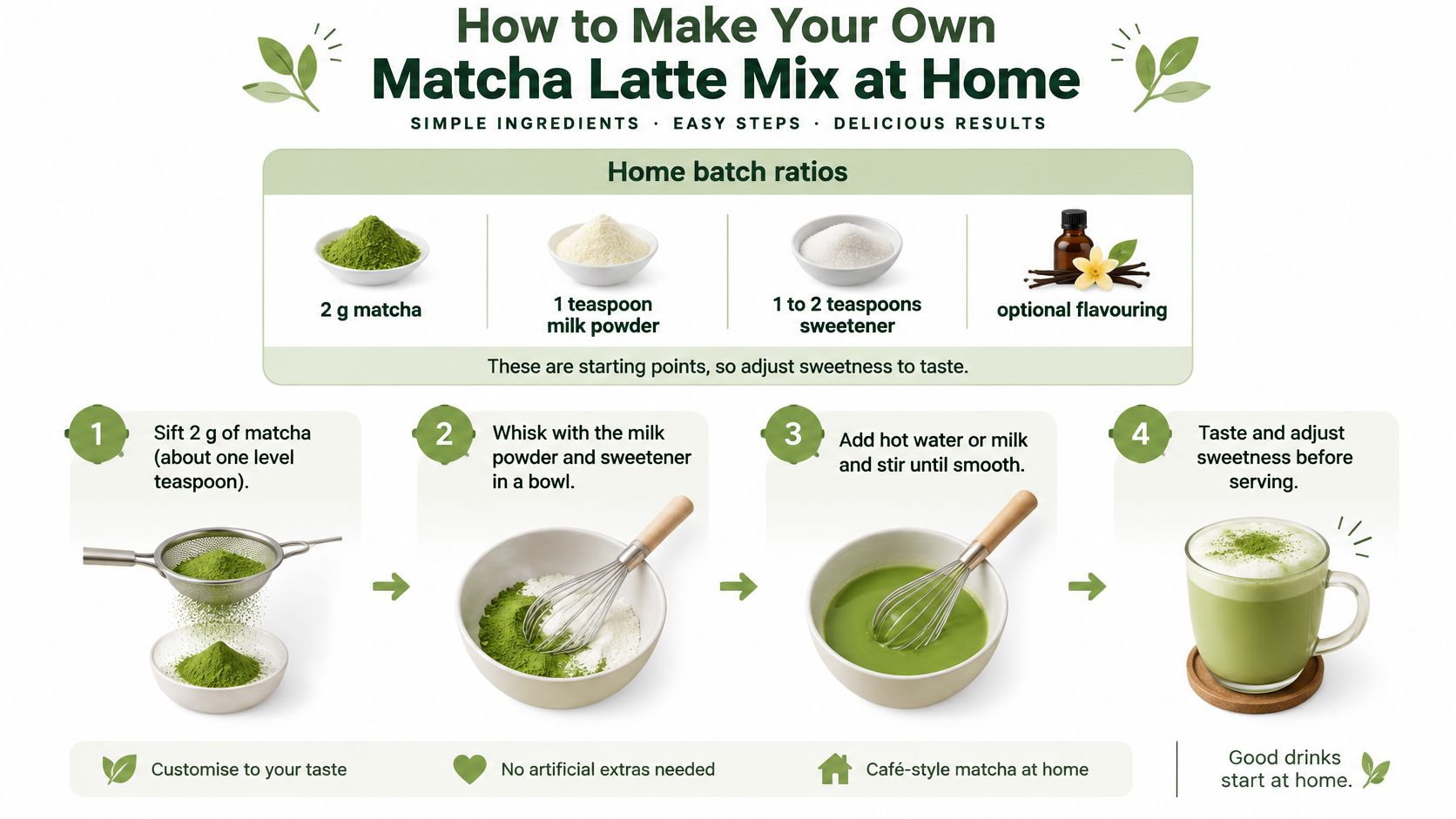
The infographic offers a lighter, spoon-based variation. Its milk powder quantity is different from the weighed recipe above, so choose one approach rather than combining their measurements.
Fix texture before adding more sweetener
If the drink is lumpy, work on dispersion first. A bamboo whisk suits pure matcha; a small electric frother is useful for a milk-powder blend, provided you use a vessel deep enough to prevent splashing.
Matcha is a suspension, not instant coffee that dissolves completely. Some settling is normal, so stir before drinking rather than trying to eliminate every trace of sediment with extra powder or syrup.
For the small jar, stir the dry ingredients again before portioning. Powders can separate during handling, and weighing a portion of an uneven blend won't guarantee the intended tea dose.
When the jar runs out
Whisk 2 g of pure matcha with a little hot water, then add warm milk. For an iced drink, prepare the concentrate first and pour it over cold milk and ice, or shake with cold milk in a tightly sealed bottle.
Don't shake hot liquid in a sealed container. For more preparation ideas, use our organic matcha latte guide to compare hot and cold methods.
Keep a note of the matcha used in each home serve. A recipe gives you control over the amount of powder, but it doesn't establish caffeine milligrams without information for that tea.
Choosing a Mix for Your Routine and Where to Start
Choose according to the job you need the mix to do, not the most ambitious wellness wording.
- For caffeine-sensitive readers: Look for a tested serving figure before buying. Pure powder allows measured dosing, but it isn't automatically suitable during pregnancy or breastfeeding.
- For cafés and home baristas: A weighed pure base lets you standardise the tea while offering different milks and sweetness levels.
- For sugar reduction: Choose pure matcha or assess a sugar-free blend using the drink you'll prepare.
- For busy mornings: A pre-sweetened mix can be practical if you enjoy its fixed sweetness and understand its ingredients.
- For a first purchase: I'd start with a small pack of culinary-grade pure matcha intended for lattes. Learn whether you enjoy the flavour before paying for a more delicate ceremonial option.
If you're also comparing powders with capsules or extracts, NexiHerb LLC's practical guide to matcha supplementation provides context for that separate purchase. Don't treat supplement doses as interchangeable with a café recipe.
The useful purchase is the one you can prepare consistently, enjoy drinking and assess without guesswork. Buy a manageable pack, keep your preferred recipe written down and change one ingredient at a time.
Pep Tea offers organic Japanese matcha for making hot or iced lattes with your choice of milk and sweetness. Visit Pep Tea to compare the organic matcha range, or get in touch about wholesale supply for your café or shop.
Iced Matcha Latte Calories: Kilojoules, Milks and Sugar
Why do two drinks with the same green colour and the same name land so far apart? In Australia, an iced matcha latte can sit anywhere from roughly 30 to 340 kcal, about 130 to 1,430 kJ, depending on milk, sweetener and cup size.
The matcha powder works like the food colouring of the drink: it brings flavour and colour, while the pale base around it carries most of the energy. Milk fills most of the glass. Sugar can hide in premixes, syrups and foam. Separate those parts and the number stops being mysterious: swapping milk changes the base, skipping syrup removes added sugar, and ordering smaller shrinks every liquid component at once.
Iced Matcha Latte Calories at a Glance
Why does one label say 770 kJ while a recipe site says 184 kcal for a similar-looking drink? Unit and serving size explain most of that gap. Iced matcha latte calories are easiest to compare when every drink uses the same unit, the same serving size and the same sweetener description.
Reading The Range Without Guessing
Australia uses kilojoules (kJ) on most labels, while many recipes and café websites use kilocalories (kcal). Divide kilojoules by about 4.2 to get kilocalories. A drink near 770 kJ sits near 184 kcal, and a drink near 1,430 kJ sits near 340 kcal.
Serving size trips people up next. A small home glass and a large café cup are different serves even when the recipe tastes identical, because a larger cup holds more milk and more milk means more energy. Ice is the exception. It fills the glass without adding anything.
Iced matcha latte calories by variation
| Drink | Milk and sweetener | Serving | Energy (kcal) |
|---|---|---|---|
| Unsweetened, reduced-fat milk | 250 mL reduced-fat milk, no added sugar, milk only | 250 mL | about 126 |
| Unsweetened, extra-creamy milk | 250 mL extra-creamy milk, no added sugar | 250 mL | about 176 |
| Unsweetened oat milk | 250 mL unsweetened oat milk | 250 mL | about 120 |
| Unsweetened almond milk | 250 mL unsweetened almond milk | 250 mL | about 30 to 60 |
| Café benchmark, Jamaica Blue | Sweetened matcha premix with milk and ice, 23 g sugar | 330 g | about 184 |
| Flavoured café iced matcha | Sweetened matcha with flavour syrup and toppings | Café size | about 184 and up |
What The Table Is Really Showing
Read the first four rows as one ingredient changing while everything else stays fixed. The matcha powder adds little energy in each of them. Milk volume, milk type and sweetener decide the count. Swap reduced-fat milk for extra-creamy milk at the same 250 mL and the base climbs by about 50 kcal before a single gram of sugar is added. Move to the café rows and the jump comes from a different place: a sweetened premix, syrup or topping rather than the milk alone.
That split is the useful habit. Ask two questions of any iced matcha latte: what milk, in what volume, and what sweetener, in what form. The powder answer barely moves the total. The milk and sugar answers move it a lot.
Sugar deserves its own check. A drink can sit lower in energy because you picked a lower-fat milk, yet still carry plenty of sugar from a sweetened powder or syrup. Checking only calories hides the sugar. Checking only sugar hides what a creamy milk or topping adds.
Practical rule: Compare energy and sugar together, and always note the serving size in millilitres or grams.
Use the table as a starting map for your own order. Your cup size matters most because it sets the milk volume. Once you know that volume and whether the matcha is sweetened, your estimate is already close.
Hot and iced versions of the same build carry much the same energy. The gap appears when the iced version uses a bigger glass, more milk, a premix or extra syrup to stand up to dilution from ice.
Why Milk Drives Most of the Calories
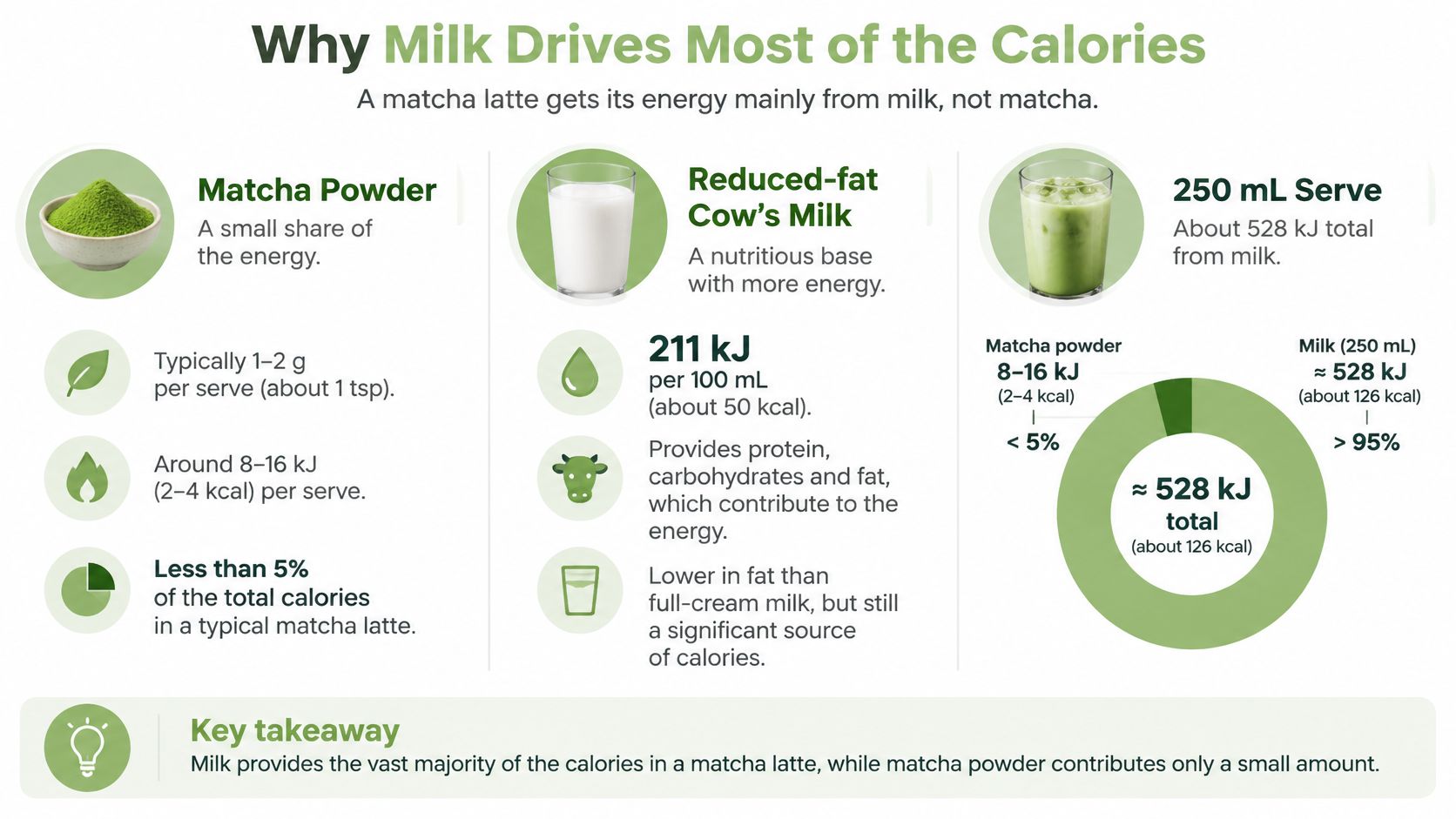
Picture your glass before you pour. You'll add a spoon of green powder, a splash of water, a handful of ice and then a long pour of milk. The milk is most of what you drink, so it's usually most of the energy.
The Per 100 mL Figure Does The Work
Food Standards Australia New Zealand's nutrient data in the Australian Food Composition Database nutrient file lists reduced-fat cow's milk at 211 kJ per 100 mL, about 50 kcal per 100 mL. On that basis, 250 mL contributes about 528 kJ, or 126 kcal, and 350 mL contributes about 739 kJ, or 176 kcal, before matcha or sweetener.
The same data lists an extra-creamy milk at 295 kJ per 100 mL, about 70 kcal, so 250 mL contributes about 738 kJ, or 176 kcal. Changing only the milk can alter the base by roughly 50 kcal per 250 mL serving, with no change to sugar from a sweetener because you haven't added one yet.
That fits the broader point from Healthdirect's kilojoules guide, which states that 1 kilocalorie equals approximately 4.2 kilojoules, so 500 kJ provides about 119 kcal and 800 kJ provides about 191 kcal. It also gives an average adult daily energy reference of approximately 8,700 kJ, about 2,070 kcal.
A Simple Way To Calculate Your Glass
Use this order every time. It works for dairy milk and for plant milks, including the options we discuss in our guide to matcha with coconut milk.
- Find the per 100 mL value: Read it on the carton or in composition data.
- Multiply by your volume: For 250 mL, multiply by 2.5. For 300 mL, multiply by 3.
- Add sweetener separately: Keep milk energy and sugar energy apart.
- Convert at the end: Divide total kilojoules by about 4.2 if you want kilocalories.
Say a 400 mL café cup holds 300 mL reduced-fat milk, 2 g matcha and ice. The milk gives about 633 kJ, roughly 151 kcal. The same recipe at 250 mL of milk sits near 126 kcal for the milk. Nothing about the matcha changed. The cup did.
Australian panels help because they show energy per serving and per 100 mL for liquids. Check both. The per serving figure tells you what you'll drink. The per 100 mL figure lets you compare two milks fairly, even when the cartons use different serve sizes.
How Sugar, Syrups and Toppings Add Up
Sweeteners are the lever many people miss because they're often already in the powder. You might say no to sugar at the counter and still get a sweetened drink if the café uses a premix.
Common add-ons and their typical energy
| Add-on | Typical amount | Approx. energy (kcal) | Practical note |
|---|---|---|---|
| White sugar | 1 teaspoon | about 16 | Dissolves slowly in cold drinks |
| Honey | 1 tablespoon | about 64 | Sweeter, so less is often needed |
| Flavour syrup | 1 pump | about 20 | Check the label, as sugar varies by brand |
| Cold foam or whipped cream | 1 standard topping | about 50 to 100 | Adds fat and energy quickly |
| Sweetened matcha premix | One café serve | about 184 for a 330 g serve | Contains 23 g sugar per serve |
| Stevia or monk fruit drops | A few drops | about 0 | Check for bulking agents on the label |
Why A Premix Changes The Question
A sweetened matcha premix carries sugar in the powder itself. So an order described as no extra sugar isn't automatically sugar-free. You need to know whether the base powder is unsweetened matcha or a blended product made with sugar, milk powder or flavourings.
That distinction matters for another reason. A lower-fat milk can reduce energy while sugar stays high. You'll see a smaller calorie number and may assume the drink is also low in sugar, but the syrup and premix can keep sugar exactly where it was. Check both numbers when a café publishes them.
Australian guidance on eating well from the Department of Health identifies sugar-sweetened drinks, including lemonade and cola, as discretionary choices because they can be high in added sugar and energy while supplying few nutrients, and should form only a very small part of the diet. For matcha, the useful lesson is to separate the milk and matcha from added sugar, flavoured syrups, sweetened sauces and whipped toppings.
Where Toppings Fit
Cold foam looks light because it's airy. It can still add milk, cream, sugar or flavouring on top of an already complete latte. Whipped cream does the same in a smaller-looking spoonful. Neither makes a drink a bad choice. Both make the plain estimate for matcha and milk too low.
Context helps explain why cafés now offer more options. The Australian Bureau of Statistics reported that 28.9% of Australians consumed sweetened beverages in 2023 in its release on sweetened beverages consumption, including 20.9% who consumed sugar-sweetened beverages. A low-sugar matcha option gives those customers another choice, as long as the milk and any sweetener are still counted.
At home, sweeteners are the easiest part to measure. Add half your usual amount, stir, taste, then decide. Cold drinks dull sweetness a little, and sugar doesn't dissolve well over ice, so a small amount of syrup or honey whisked into the warm matcha paste often tastes more even than granulated sugar added at the end.
Calorie Build-Up for a Homemade Iced Matcha Latte
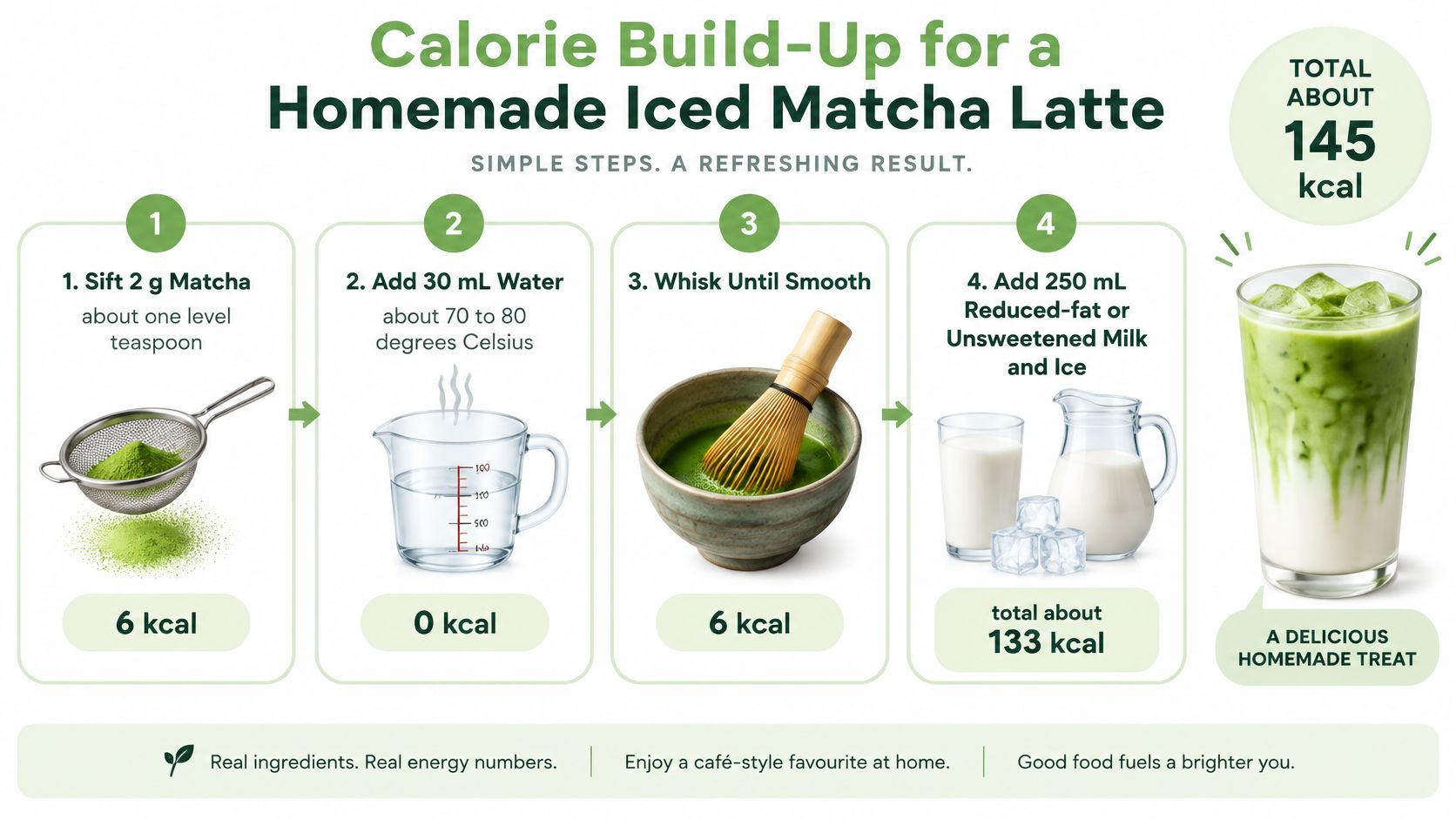
A home recipe gives you control because you can see each ingredient go in. Follow the steps in order, and notice where the count changes. Most of the glass stays at zero until the milk arrives.
Step By Step Build
Sift the matcha: Sift 2 g, about one level teaspoon, into a small bowl. This breaks up lumps that won't whisk out later, and the powder adds only a small amount of energy.
Make a smooth paste: Add 30 mL water at about 70 to 80 degrees Celsius. Whisk briskly in a zigzag until smooth and lightly frothy. Boiling water can make the flavour harsher, which pushes many people to add sugar they might not otherwise want.
Fill the glass with ice: Use a 350 mL glass and fill it well. Ice adds volume and chill, not energy, and a full glass helps the drink feel generous without more milk.
Measure the milk: Measure 250 mL reduced-fat milk in a jug. Measuring matters more than any special technique here, because a free pour can become 300 mL or more.
Pour and layer: Pour the milk over the ice, then pour the whisked matcha over the milk. Stir if you want an even colour, or leave the layers if you prefer to mix as you drink.
Taste before sweetening: Add one teaspoon of sugar only if you need it, then stir again. If you know you'll sweeten it, whisking the sugar into the warm paste at step 2 helps it dissolve.
The Build-Up In Numbers
Calorie build-up for one homemade serve
| Ingredient | Amount | Approx. energy (kcal) | Notes |
|---|---|---|---|
| Matcha powder | 2 g (1 level teaspoon) | about 7 | Powder adds little energy |
| Reduced-fat milk | 250 mL | about 126 | 211 kJ per 100 mL |
| Ice | 1 glass | 0 | Adds volume, not energy |
| Hot water for whisking | 30 mL | 0 | Used only to make the paste |
| White sugar (optional) | 1 teaspoon | about 16 | Skip for the lowest count |
| Total, unsweetened | Matcha, milk and ice | about 133 | Lowest version of this recipe |
| Total, with one teaspoon of sugar | Matcha, milk, ice and sugar | about 149 | Add only if needed |
The total is simple because there's nowhere for energy to hide. Matcha contributes about 7 kcal, the milk contributes about 126 kcal, and ice and water contribute zero. That gives about 133 kcal unsweetened and about 149 kcal with one teaspoon of sugar.
If you'd like more detail on whisking, milk choices and flavour variations, our best matcha latte recipe guide walks through the method for hot and iced versions. Use it for technique, then return to your measured milk volume for the count.
Swapping The Milk Without Losing Track
To swap in an unsweetened plant milk, don't guess from the front of the carton. Read the per 100 mL energy figure on the nutrition panel and multiply by 2.5 for a 250 mL pour. Then add the matcha figure and any sweetener.
Barista-style plant milks deserve a closer look. Some are sweetened or made richer so they foam like dairy milk, so two cartons with similar names can give different totals. The word plant-based doesn't settle the count. The panel does.
Measure the milk in a jug for the first week. After that, you'll recognise the right level in your usual glass and your count will stay consistent.
A common mistake is to change three things at once, then wonder why the drink tastes thin. Change one variable at a time. Try the same matcha with a different milk on one day, then adjust sweetener on another day. You'll learn which change affects flavour and which one mainly affects energy.
Ordering a Café Iced Matcha Latte Without Surprises
A café menu name cannot tell you the build. Two cafés can sell the same iced matcha latte and still pour different volumes, use different powders and choose different milks, so the label tells you less than the recipe does.
One Australian Benchmark
Jamaica Blue lists in its iced matcha latte menu details a 330 g iced matcha latte at 770 kJ, equivalent to approximately 184 kcal, with 23 g sugar, 26.6 g carbohydrate, 6.8 g protein and 5.4 g fat per serving. Its formulation contains 45.5% milk, 36.4% ice, 12.1% water and 6.1% tea powder, and the powder itself contains sugar and only 30% matcha.
Read that build as a split. Ice and water work like padding in a parcel: they make the serve look bigger while adding no energy. Milk and the sweetened tea powder carry the count, while the matcha solids sit inside the small powder portion. That is why a café drink can look light in the cup yet still arrive with 23 g sugar already mixed in.
Treat the benchmark as a reference point for the same levers elsewhere. When another café gives a higher or lower figure, check which lever moved: cup size, milk volume, sweetened powder, syrup or topping.
Questions That Get You A Clear Answer
Ask short, specific questions. Baristas answer these every day, and clear questions help them make the drink you expect.
- What size is it in millilitres: Cup names like regular and large don't mean the same volume everywhere.
- Is the matcha powder sweetened: This tells you whether sugar is already in the base.
- How many syrup pumps go in: Ask for half or none if you want a less sweet drink.
- Which milks are unsweetened: Barista plant milks may be sweetened even when the café calls the drink unsweetened.
- Can cold foam be left off: Removing a topping is often easier than rebuilding the whole recipe.
The same habit applies when your choice is between a matcha and a different takeaway drink, including drive-thru coffee choices for weight management: check the size, the milk and the flavourings before you compare totals.
You don't need to interrogate anyone. One or two questions are usually enough. Start with size and sweetened powder, because those two answers explain most surprises.
Keeping the Flavour While Cutting Calories
A lower calorie iced matcha latte still has to taste like matcha. When the powder is bitter or grassy, sugar, syrup and extra milk start to look like fixes. Start by making the base smoother, then let the milk and sweetener do only the jobs they need to do.
The calorie split matters here. Matcha powder is the small part of the energy load; milk volume, syrup and toppings are where the total climbs. That is why changing from extra-creamy milk to reduced-fat milk, or pouring less milk over more ice, usually saves more energy than switching matcha grades.
Small Changes That Protect The Taste
- Choose a smoother grade for drinking: A ceremonial grade is often better suited to a plain latte, while culinary grades can work well when other flavours are present.
- Whisk until frothy: A smooth, airy paste tastes richer and mixes evenly, so you don't need extra milk to mask lumps.
- Use a smaller glass with more ice: You'll keep a satisfying serve while reducing the milk pour.
- Try aroma before syrup: A splash of vanilla extract or a pinch of cinnamon can add perceived sweetness without a pump of syrup.
- Pick reduced-fat or unsweetened milk: Check the panel rather than relying on the carton name.
- Taste first, then sweeten: Add half, stir and taste again before adding the rest.
Our guide to a sugar-free matcha latte is a useful starting point if you want a version built around unsweetened matcha and milk. Treat it as a base recipe, then adjust the milk volume to your glass.
One product example is PepTea's organic matcha, which is sold as unsweetened powder for whisking at home or in cafés. Keeping the powder and sweetener separate lets you decide how much sugar, if any, belongs in your drink.
Putting The Number In Context
Use 250 mL reduced-fat milk as the comparison point: about 528 kJ, or 126 kcal. The same 250 mL of extra-creamy milk is closer to 738 kJ, so the milk choice can move the drink more than most flavour tweaks.
The Australian Dietary Guidelines summary uses about 600 kJ as a maximum daily discretionary-choice benchmark for many adults. A latte near that mark uses the whole benchmark, and larger flavoured versions can pass it, so milk size and syrup count are the dials to watch.
Small changes are easier to keep than a complete rebuild. If you drink matcha several times a week, measuring the milk and halving the sweetener will usually matter more than hunting for a perfect recipe once.
Choose the Iced Matcha Latte That Suits Your Day
Use a default you can repeat. At home, start with 2 g matcha, 250 mL reduced-fat or unsweetened milk, ice and no added sugar. That puts you near 133 kcal and gives you a baseline you can adjust without recalculating everything.
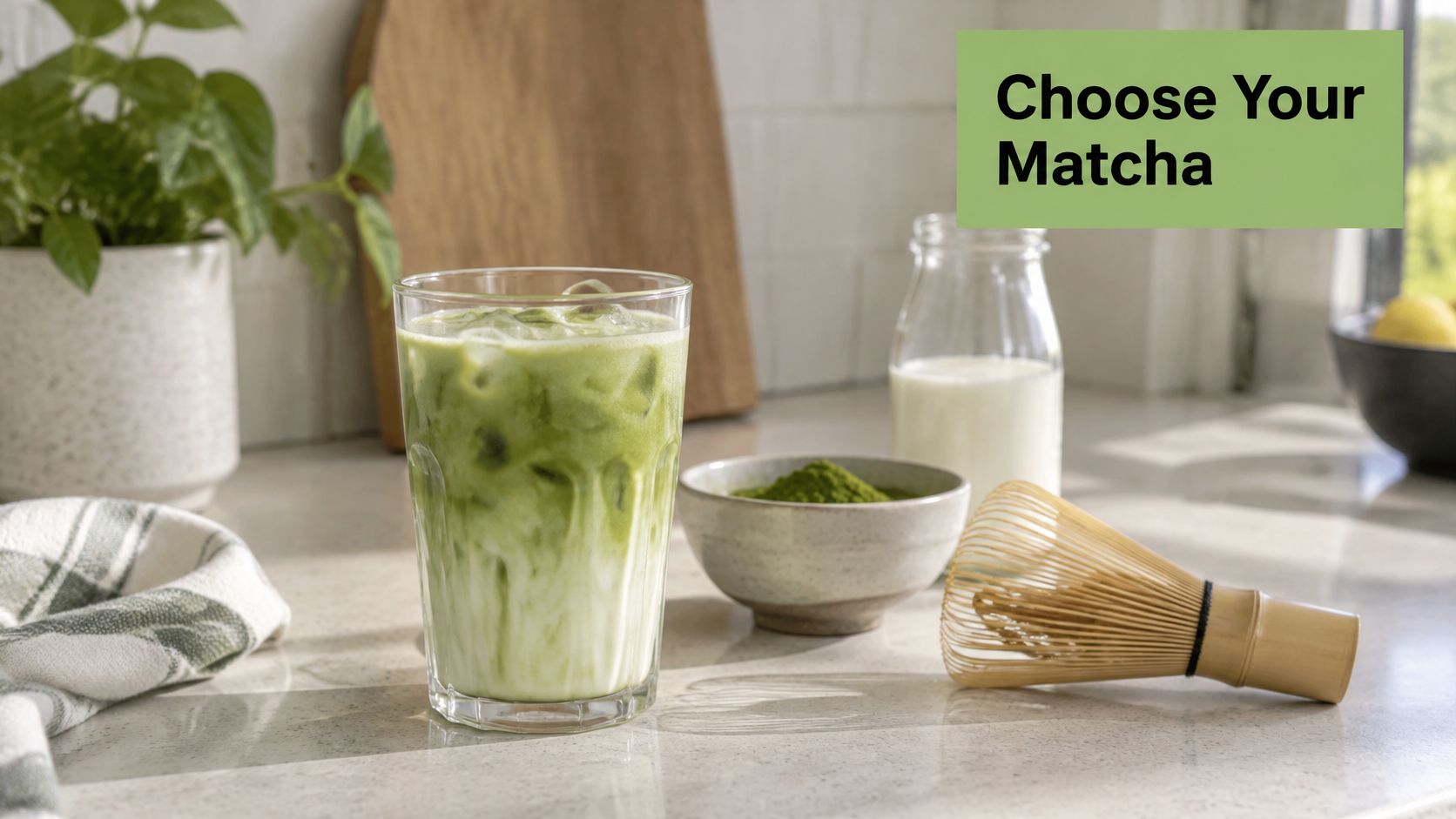
Here's a simple serve to picture while you set up your glass and whisk.
Treat café orders differently. Check size, sweetened powder and syrups before you order, since a flavoured version can reach roughly 330 kcal or more. That doesn't rule it out. It just means you can choose it knowingly, perhaps as an occasional drink rather than your everyday default.
Keep a simple log for one week if you're unsure which choices matter in your routine. Note the milk, the volume, the sweetener and whether you added a topping. You'll usually spot one habit doing most of the work, such as a larger pour at home or a daily syrup pump at a café.
This short video is handy if you'd rather watch the whisking and pouring order before you make your next glass.
Try your default recipe with a smoother ceremonial grade matcha and taste it before adding anything sweet. Many people find they need less sweetener than they expected once the paste is smooth and the water isn't boiling.
Iced Matcha Latte Calories FAQs
Does Matcha Itself Add Many Calories
No. A 2 g serve adds about 7 kcal, so the milk and sweetener set almost all of the total. Changing the matcha amount mainly changes strength and flavour.
Is An Iced Matcha Latte Low In Calories
It can be moderate at home. With 250 mL reduced-fat milk and no sugar, it sits near 133 kcal, while café versions mentioned here range from 184 to 339 kcal. Size and sweetener explain most of that difference.
Does Ice Add Energy
No. Ice and water add volume only. They can make a drink look larger without changing the energy from milk or sugar.
Are Oat Or Almond Milks Lower In Calories
Check the specific carton. Read the per 100 mL value, multiply by the millilitres you'll pour, then compare. Sweetened and barista-style products can differ from unsweetened versions.
Are Sugar-Free Sweeteners Calorie-Free
Stevia or monk fruit drops contribute about zero kcal in a few drops. Still check the label, because powders and blends may include bulking agents.
Can I Still Enjoy A Café Version
Yes. Ask about size, sweetened powder and syrup pumps, then choose the version that suits your day. A flavoured café drink can be an occasional choice rather than a daily default.
Ready to make your default at home with an unsweetened base you can measure and adjust? Explore the certified organic Japanese matcha range from Pep Tea, choose a grade that suits lattes, and try it with 250 mL of your preferred unsweetened milk before adding any sweetener.
Matcha Coconut Milk Guide: Ratios, Recipes, and Pro Tips
You're halfway through making a matcha latte at home, or you've just ordered one at a café, and the drink in front of you tastes richer, sweeter, and a bit more rounded than the one you made last week. Nine times out of ten, the difference isn't the whisking. It's the coconut milk.
In Australia, matcha coconut milk sits right where premium tea and plant-based milks meet, which is why it shows up so often on café menus and in home kitchens. The drink can be creamy and balanced, but the result changes a lot depending on whether you use canned full-fat coconut milk, a barista carton, or a lighter carton version. That choice affects texture, froth, flavour, and even how the matcha lands on the palate.
For a quick gut-check on matcha's broader appeal, PepTea has a useful overview of matcha tea powder as a powerhouse of antioxidants, which helps explain why so many people want to build a better latte around it. Coconut milk can absolutely work with matcha, but it works best when you match the milk format to the drink you want.
Why Matcha and Coconut Milk Work So Well Together
The first time a coconut milk matcha really clicks, it usually happens in a café. The drink arrives with that vivid green top, a soft creaminess underneath, and enough natural sweetness that you don't need to pile on syrup to make it pleasant. At home, the same thing can happen, but only if the coconut milk suits the style of drink you're making.
Matcha has a grassy, umami edge that can feel sharp if it's whisked into plain water and served without balance. Coconut milk softens that edge because its fat carries flavour and its natural sweetness rounds off bitterness. That's why it feels like such an obvious pairing in iced lattes, blended drinks, and café-style hot drinks, especially in Australia where plant-based menu options are now part of everyday ordering rather than a special request.
The commercial side matters too. A 2026 industry snapshot reported that matcha latte sales in Australian cafés reached AUD 50 million in 2023 worldmetrics.org. That doesn't just tell you matcha is trending, it explains why cafés keep testing different milk bases and why coconut milk keeps showing up on the board. It's one of the few dairy alternatives that can make matcha feel indulgent without needing cream.
The decision is simpler than most recipe posts make it sound. Don't start with “matcha coconut milk” as if it were one fixed drink. Start with the format of the coconut milk, then build the texture and flavour from there.
Practical rule: if you want a richer, rounder latte, choose the coconut milk first, then adjust matcha strength second.
Core Ratios and Equipment You Need Before You Start
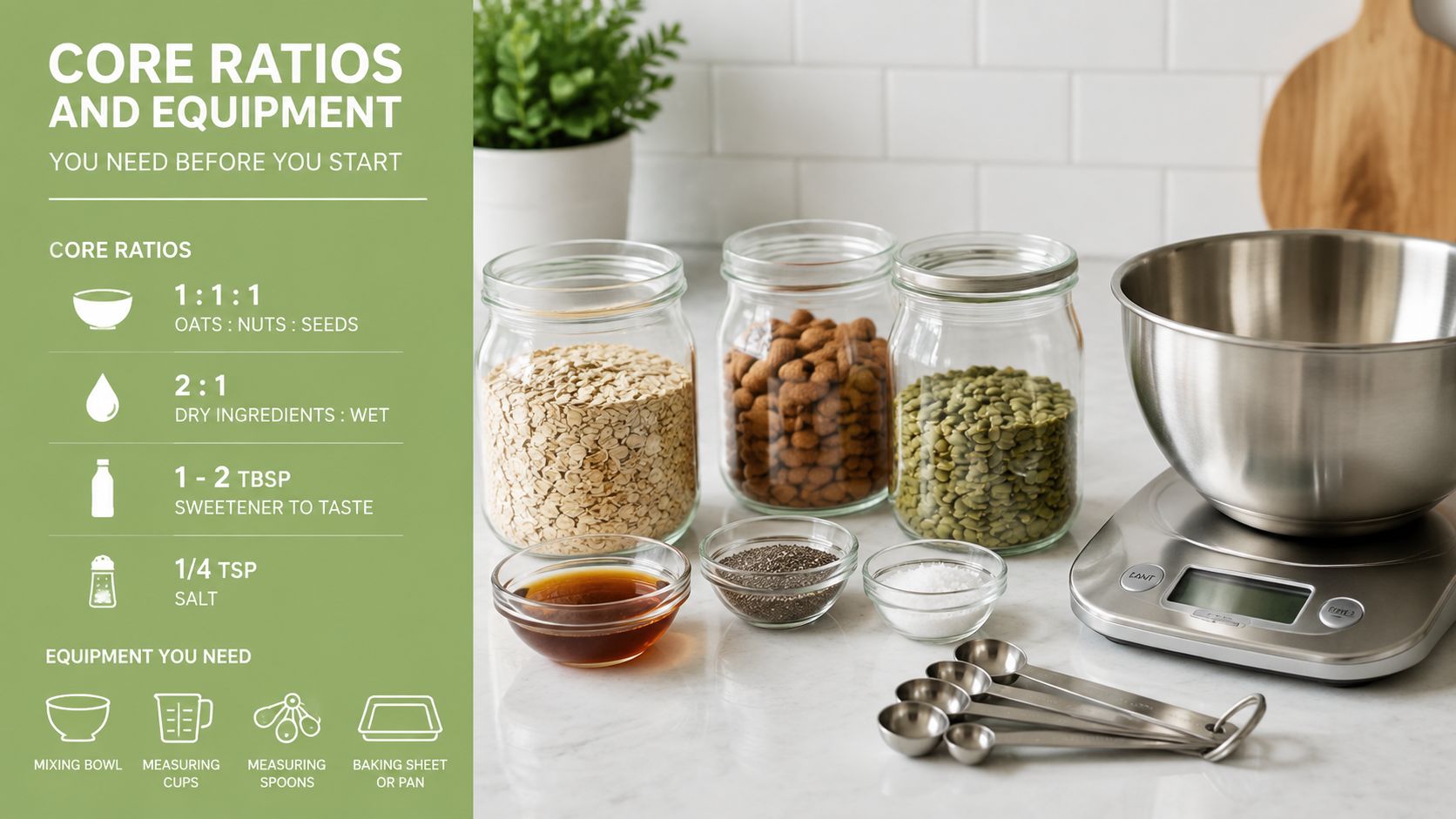
A good matcha coconut milk drink starts with a small, repeatable formula. For a home latte, a solid base is 2 g matcha to 30 ml hot water, then 180 to 220 ml coconut milk depending on how creamy you want the cup to feel. For a café-strength serve, 3 g matcha to 45 ml hot water with 220 to 250 ml coconut milk gives a stronger tea note that still holds up after ice or foam is added.
Water temperature matters just as much as the ratio. Keep it around 80°C, not boiling, so the matcha doesn't scorch or turn harsh. Whisk the powder into the hot water first, then add coconut milk after the matcha is smooth. If you dump everything together at once, you'll often get clumps or a flatter colour.
Your kit doesn't need to be fancy, but it does need to be the right kind of simple. A bamboo chasen gives you the best whisked texture, though a handheld frother works well for quick service. A fine sieve helps stop little green pockets from forming. A kitchen scale keeps the matcha dose consistent, and a small milk pitcher makes pouring cleaner, especially if you're layering a hot latte.
Key takeaway: whisk matcha and water first, keep the water near 80°C, then add coconut milk after the paste is completely smooth.
A small café counter setup makes the process easier if you're doing this daily. PepTea's matcha tea accessories page is a useful reference point for the sort of basic tools that make repeatable drinks less fiddly.
Choosing the Right Coconut Milk for the Job
Most recipes go vague and then wonder why the drink split, looked thin, or tasted oddly flat. In practice, canned full-fat coconut milk, barista-blend carton coconut milk, and light carton coconut milk behave very differently in matcha.
| Coconut Milk Formats for Matcha Drinks | Typical Fat % | Froth Behaviour | Best For | Watch Out For |
|---|---|---|---|---|
| Canned full-fat | Higher, usually the richest format | Thick, creamy, not ideal for light foam | Blended drinks, iced lattes, dessert-style serves | Can feel heavy and very saturated |
| Barista carton | Moderate, formulated for steaming | Best foam stability and pour control | Hot lattes, café service, layered drinks | Check for added sweeteners or flavours |
| Light carton | Lower | Thin foam, lighter body | Lower-calorie menus, smaller drinks | Can taste watery and struggle to hold matcha well |
Commercially listed nutrition makes the differences obvious. A typical coconut-milk matcha latte can sit around 38 kcal per 100 ml or 76 kcal per 200 ml serving, with 1.5 g fat per 100 ml and 4.3 g carbohydrate per 100 ml in one formulation Phytomorphology review. Another listed coconut-milk matcha example comes in at 120 calories, 7 g fat, 10 g carbohydrates, and 2 g protein per 240 g serving Eat This Much.
For café work, the practical benchmark is the fat band. Coconut milks in the 12 to 20% fat range tend to give the best mouthfeel and foam support, while products below 8% often drink too thin for a proper latte texture Alibaba guide. That's why canned works so well in blended drinks, barista cartons perform better in hot service, and light cartons are mainly for people deliberately chasing a thinner cup.
Three Ways to Build a Matcha Coconut Milk Drink
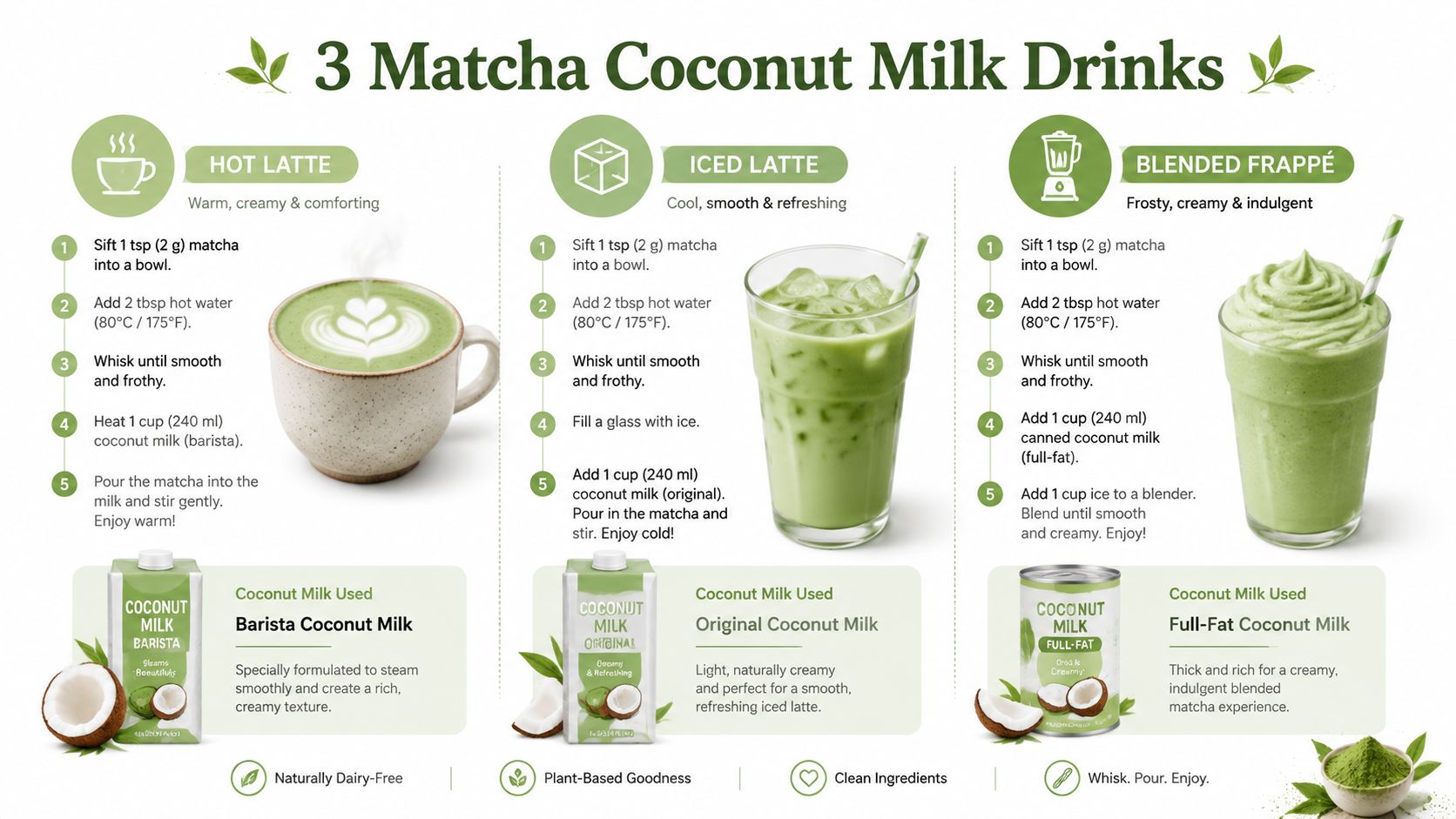
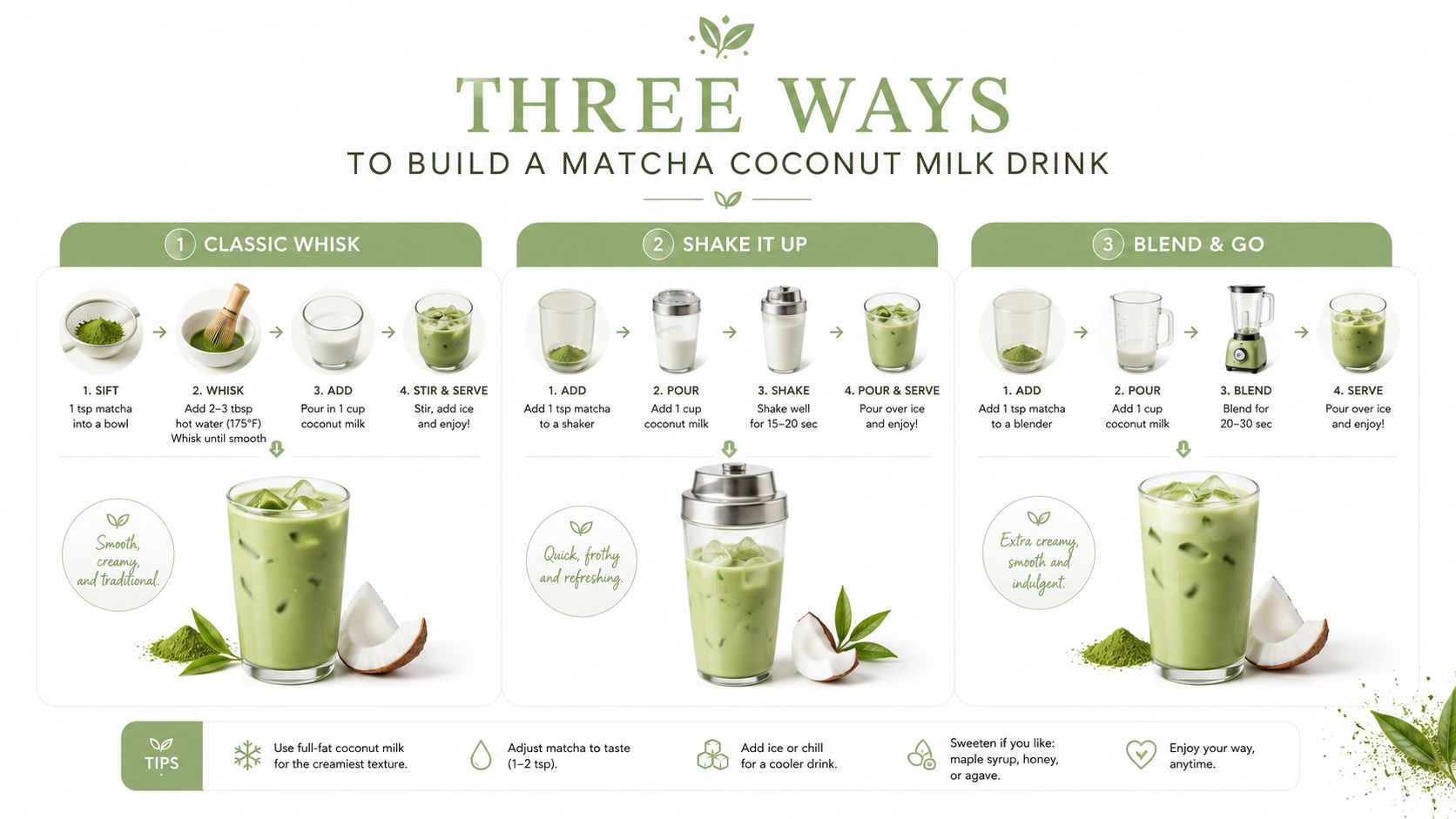
Hot Latte With Barista Coconut Milk
Use 2 g matcha, 30 ml water at about 80°C, and 180 ml barista coconut milk. Sift the matcha, whisk the water into a smooth paste, then steam the coconut milk to around 60 to 65°C so it stays stable and doesn't split. Pour the milk slowly into the matcha, then finish with a thin layer of foam.
If you're working by hand, keep the whisk tight and fast for about 15 to 20 seconds. The goal is a glossy surface, not a mountain of bubbles. A small milk pitcher helps you pour in a steady line instead of dumping the milk and flattening the top.
Iced Latte With Canned Coconut Milk
For a colder, richer drink, use 3 g matcha, 45 ml water, 120 ml plain water or milk base if you like a longer drink, and 100 to 120 ml canned full-fat coconut milk. Whisk the matcha with hot water first, then add a little room-temperature liquid if you want it looser, and pour over ice only after the matcha is fully dissolved.
The trick is to pour the coconut milk down the side of the glass so the foam sits on top rather than disappearing into the ice. This works especially well in a tall glass where the layers can show. It's also the version that handles sweetness best if you want to add a touch of maple or vanilla.
Blended Frappé With Lighter Coconut Milk
For a blended drink, use 2.5 g matcha, 40 ml hot water, 150 ml light coconut milk, and a good handful of ice. Blend for 20 to 30 seconds until the texture looks smooth and aerated, not watery. If the drink comes out too thin, the coconut milk is probably too light for the style.
This version is useful when you want the matcha flavour without the density of canned milk. It works better with a lighter carton than with a heavy one, because the blend stays colder and less claggy. The colour also stays bright if you blend only until the ice breaks down.
Nutrition, Antioxidants, and the Coconut Milk Trade-Off
Coconut milk makes matcha feel more luxurious, but it also changes what the drink is doing nutritionally. One listed coconut-milk matcha latte comes in at 129 calories, 11 g fat, 12.9 g carbohydrate, and 0.99 g protein in a 330 g serving, with 10 g saturated fat making up 50% of daily value worldmetrics.org. Another listing shows 265 calories, 25 g fat, 8 g carbohydrates, and 3 g protein in a 150 ml coconut-milk matcha serve Arise app. That spread tells you how much the final cup shifts with formulation and portion size.
The more important functional point is what happens to the matcha itself. A review of milk variants in matcha tea found that adding milk, regardless of source, significantly reduces matcha's antioxidant profile, including total phenolic content, total flavonoid content, DPPH radical scavenging activity, metal chelating ability, and ferric-reducing power Phytomorphology review. In plain language, the drink still tastes like matcha, but the antioxidant-dense profile of pure matcha is diluted once coconut milk goes in.
That's why I wouldn't sell this drink as a protein option or a low-calorie tea. In Australian cafés, it lands more naturally as a premium creamy functional beverage. If you want to keep the profile lighter, use a smaller serve, choose a lighter coconut milk, or make the matcha stronger so it doesn't disappear behind the fat.
Sweetened versions can add another layer. One commercial listing for Starbucks' Matcha Green Tea Latte with coconut milk shows 143 calories, 20.3 g sugars, and 60 mg caffeine per serving CalorieKing. That's useful as a calibration point, because it shows how quickly sugar can change the drink from creamy to sweetened café treat.
PepTea's guide on how many cups of matcha tea powder are safe per day is a sensible companion read if you're balancing strength, serving size, and how often you want to drink matcha coconut milk.
Frothing, Heating, and Sweetening Without the Mistakes
If the Milk Splits
Heat the coconut milk gently and stop at around 60 to 65°C. Go much hotter and the drink can separate, especially if you're using a thinner carton or a product with fewer stabilisers. Barista blends usually behave better because they include emulsifiers that hold the milk together under steam.
If the Foam Is Weak
The fat is probably too low. Light carton coconut milk can still taste fine, but it rarely gives you the same foam structure as a barista blend, and it'll often collapse before you finish the cup. If you want a proper cappuccino-style top, switch to a higher-fat format or use a stronger steam stretch and pour immediately.
If the Matcha Tastes Bitter or Chalky
The matcha wasn't fully whisked before it hit cold liquid. Always dissolve it into hot water first, then add the coconut milk after the paste is smooth. If you need sweetness, a little maple syrup or vanilla works more naturally with matcha than heavy sweeteners, and a small amount is usually enough.
For something different, a cold sugar-free kombucha topper can work well with an iced matcha coconut build when you want acidity instead of extra sweetness. PepTea's own Hunter Valley-brewed kombucha is one example of the kind of drink that can sit beside matcha rather than compete with it. That combo keeps the finish brighter, especially in summer service.
Serving It at Home, in a Café, or on a Wholesale Menu
A good café menu uses the coconut milk format on purpose. A hot ceremonial matcha coconut latte works well with barista coconut milk, a low-sugar iced matcha coconut can be finished with a kombucha top, and a blended frappé-style version suits canned or richer coconut milk when you want a dessert-like texture. For wholesale planning, it helps to think in terms of milk cost, matcha dose, and serve size rather than just “one latte recipe”, and a practical wholesale pricing structure guide can be useful when you're mapping margins for menu testing.
For home use, the path is simpler. Try one milk format, keep the matcha dose steady, and note how the mouthfeel changes. If the drink gets too heavy, switch to a lighter carton. If it turns thin, move up to a barista or canned format.
PepTea's organic matcha grades and sugar-free kombucha fit naturally into those use cases as reference products for café and home drinks, especially if you want a clean, low-sugar menu base. Use them as the benchmark, not the shortcut.
If you want a drink that fits your palate, start with one of these three steps today: swap one coconut milk format, and log the result on taste, foam, and body. Then build the version that suits your kitchen, your café, or your regular order.
Pep Tea offers organic matcha and sugar-free kombucha that slot neatly into café drinks and home recipes like the ones above. If you want to compare matcha formats, test coconut milk pairings, or build a cleaner drink list for your menu, visit Pep Tea and explore the range.