
Tag: glass kettle
Glass Kettle Temperature Control for Better Tea
You've probably had that cup of green tea that should've been fresh, sweet, and clean, but instead landed sharp, grassy, and a bit unforgiving. That's usually not the leaf's fault. More often, it's the water, and with delicate teas and matcha, temperature is the difference between a silky cup and a bitter one.
A glass kettle temperature control setup turns that difference into something you can steer. Instead of guessing, waiting, or repeatedly overshooting the boil, you choose the heat that suits the drink in front of you. That matters whether you're whisking matcha at home, making back-to-back cups in a café, or just trying to stop your “healthy” tea habit from tasting harsh.
The Bitter Cup Problem and Why Temperature Matters
The common mistake is simple. Water boils, the kettle clicks off, and the leaves get whatever comes out next. For sturdy black tea, that can be fine. For green tea, white tea, and especially matcha, it's often too aggressive.
Why boiling water can flatten a good tea
Boiling water pulls flavour out fast, but fast isn't always kind. With more delicate teas, too much heat can bring out the bitter side of the leaf before the sweeter and more savoury notes have a chance to show up. That's why a cup made with lower-temperature water often tastes rounder, softer, and cleaner.
Matcha is a good example because you're not steeping a leaf, you're suspending finely milled tea in the water itself. PepTea's own organic Matcha range is a natural example of a tea that rewards gentle handling, since the aim is smooth texture and balanced flavour, not a harsh blast of heat.
Practical rule: if the tea tastes bitter before it tastes fragrant, the water was probably too hot for that style.
A lot of people think “hotter” means “better extraction”, but the real goal is the right extraction. With a glass kettle temperature control model, the difference isn't academic, it's right there in the cup. If you've ever made a second cup that tasted worse because you guessed the cooling time, you already know why precision matters.
For a simple starting point, it helps to look at the kettle as a flavour tool, not just a water heater. If you want a deeper dive into suitable gear, you can check the dedicated electric tea kettle with temperature control page as a reference point for the kind of setup tea drinkers often look for.
What Temperature Control Actually Means on a Glass Kettle
Temperature control means the kettle doesn't just race to a boil and stop. It lets you choose a setpoint, then uses heat, sensors, and a controller to stop at that target instead of overshooting it. That's the key difference between “hot water” and “the right water”.
On-off switch versus dimmer switch
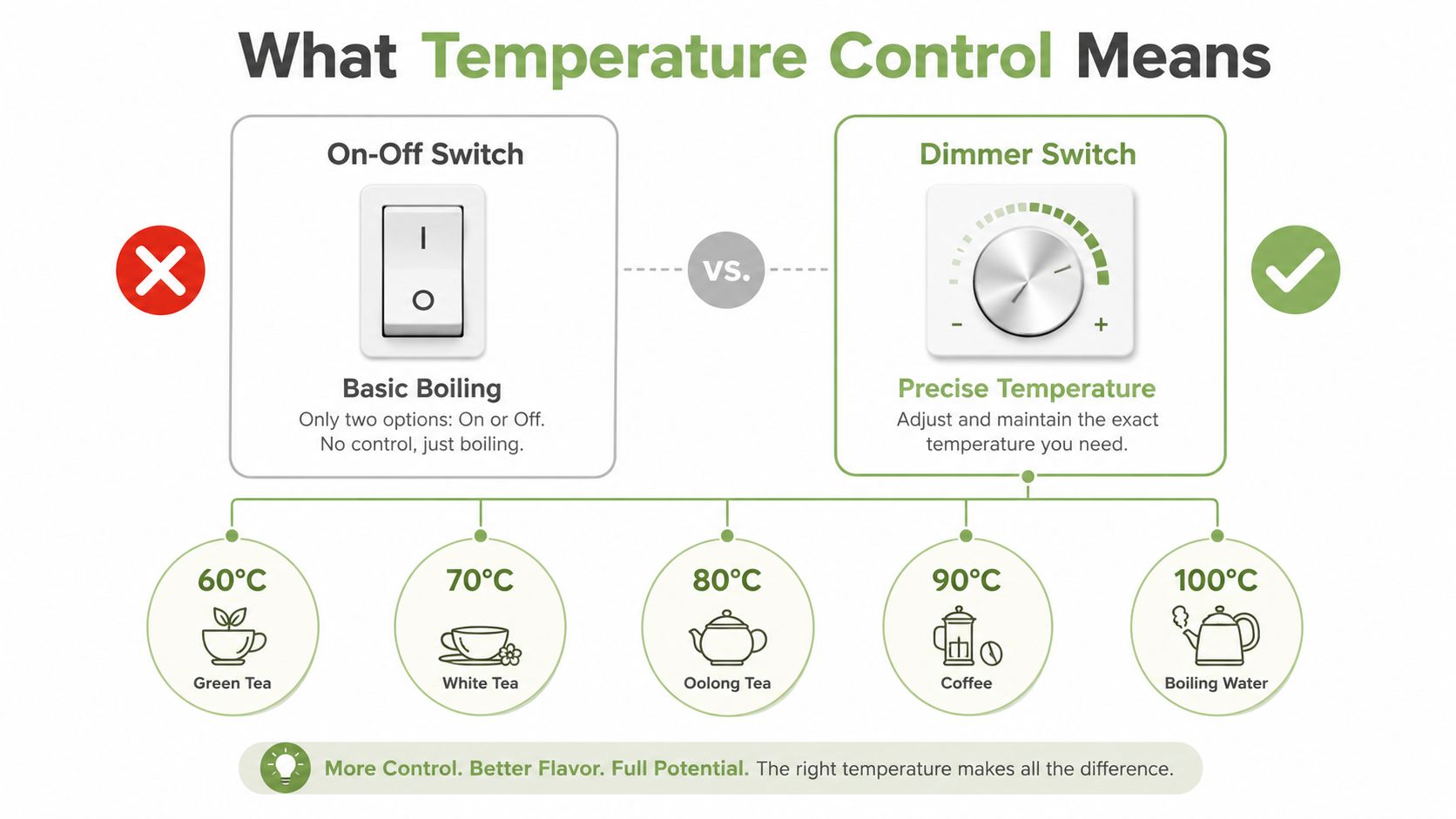
The easiest way to think about it is this. A basic kettle behaves like an on-off wall switch, it's either heating or not heating. A precision kettle behaves more like a dimmer switch, where you choose the level you want instead of jumping straight to full blast.
That's also why product pages often mention preset temperatures, keep-warm, hold mode, or auto shut-off. Presets are the quick buttons, keep-warm means the kettle tries to stay near the chosen setting, and auto shut-off means it stops once the target is reached. A basic electric kettle usually shuts off when water reaches 212°F / 100°C through an internal thermostat or steam-activated switch, which is the core principle behind automatic shutoff in many kettles, as discussed in an engineering thread on how electric kettles trigger shutoff.
What the buttons usually mean
A glass kettle with precision control often gives you familiar targets like 60°C, 70°C, 80°C, 90°C, and 100°C. One glass-kettle manual lists exactly those setpoints, which makes the choice much easier for tea drinkers who don't want to think in theory every morning. It also shows how the machine handles timing, heating automatically after selection and switching off when the job is done, which removes a lot of human error. You can see a similar preset-style approach in the manual for a glass kettle with listed targets of 60°C, 70°C, 80°C, 90°C, and 100°C at this instruction guide.
A stovetop glass kettle is different. There, the brewer manages the heat, then uses a thermometer or timing method to hit the target manually. That's useful to know because not every “glass kettle” listing means the same thing.
If you see keep-warm, read the temperature list carefully. It usually means holding one or a few chosen settings, not every possible number.
How Modern Glass Kettles Actually Hit and Hold a Temperature
The story starts well before smart kitchen gear. The modern electric kettle is commonly traced to 1922, while earlier electric kettles date to 1891, which shows the long gap between a first electric model and a safer, more practical version for everyday use, as noted in this historical overview. That history matters because the whole idea of modern temperature control came from the move away from simple boil-only behaviour.
What the thermostat is doing
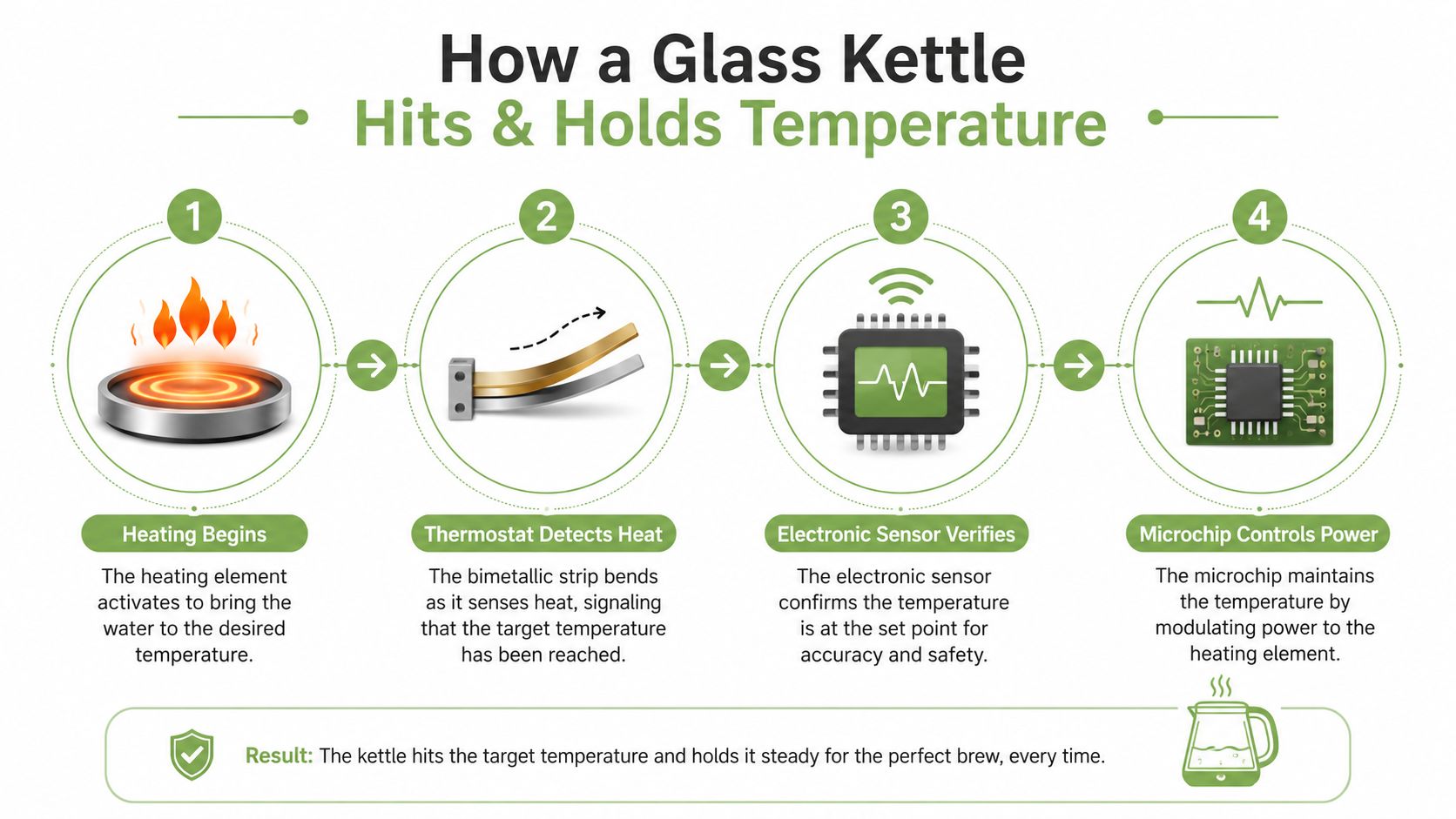
Early temperature-controlled kettles used bimetallic thermostats. In plain English, that means a heat-sensitive part bends as the water warms up, and once the target temperature is reached, it cuts power to the heating element. The kettle doesn't need to “think”, it just responds to heat in a predictable way.
Later versions add electronic sensors and a controller. The sensor measures water temperature, the controller compares that reading with your selected setpoint, and heating stops when the target is reached. If the kettle has a hold function, the system may reheat after the temperature falls below the chosen point. A general explanation of this sensor-and-controller approach appears in this temperature-control guide.
Why placement and keep-warm matter
Sensor placement matters because heat doesn't spread evenly in every kettle body. A sensor near the base can react quickly, but it may also be more sensitive to thermal lag or local hotspots if the design isn't well tuned. That's one reason two kettles can both advertise “variable temperature” and still feel different in the cup.
Keep-warm modes are useful, but they're not always universal across every setting. One glass-kettle manual says keep-warm only operates at 160°F, 175°F, 185°F, and 195°F, and the kettle reheats when sensed temperature falls below the setpoint, which is a good reminder that holding performance is often more limited than marketing copy suggests. You can see that behaviour in this glass kettle manual.
For buyers comparing models, a precision-focused option such as the Fellow Stagg EKG electric kettle shows why people pay attention to controls, not just looks. The point isn't shiny hardware, it's whether the kettle can land on the number you picked.
Matching Temperature to Tea Type
Tea gets easier when you stop asking, “How hot should the water be?” and start asking, “What am I making?” Different leaves respond to heat differently, and the same kettle can handle all of them if you choose the right setting.
Ideal water temperatures by tea style
| Tea Type | Target Temperature | Steep Time | Too-Hot Result |
|---|---|---|---|
| Japanese green tea | 70°C to 80°C | Brief steeping | More bitterness, less sweetness |
| Matcha | About 70°C to 80°C, using cooled water | Whisk immediately | Harsh flavour, duller texture |
| White tea | 75°C to 85°C | Gentle steeping | Reduced delicacy, sharper edges |
| Oolong | 85°C to 95°C | Moderate steeping | Can taste thinner than intended |
| Black tea | Near boiling | Short to moderate steeping | Less extraction if too cool |
| Pu-erh | Near boiling | Short to moderate steeping | Can seem flat if underheated |
The reason is chemical, but it's easy to feel in practice. Hotter water pulls out more of the compounds that can create bitterness, while cooler water gives the sweeter and more umami side of the leaf more room to show up. That's why green tea and matcha are usually treated more gently than black tea.
A simple tea-by-tea mindset
Japanese green tea is usually happiest in the lower range because it's easy to overdo. White tea likes warmth, but not force. Oolong sits in the middle, and darker teas are the ones that usually welcome a proper boil.
Matcha deserves special care because you're tasting the whole tea, not a leaf left behind in a strainer. A well-handled cup should taste smooth, not scorched. That's one reason gentle water handling matters so much for ceremonial-grade organic Matcha.
Useful shortcut: if a tea tastes oddly dry or harsh, try dropping the water temperature before changing anything else.
A glass kettle temperature control unit makes those adjustments much easier because the same appliance can move between styles without guesswork. That's handy at home, and even more useful in a café where one person might want green tea, another wants black tea, and someone else wants matcha in the same service run.
Three Practical Ways to Reach Your Target Temperature
There's more than one way to get good water, and the best method depends on your setup. A precise kettle is the simplest route, but a thermometer or a timing trick can still give you good results if you stay consistent.
The three methods side by side
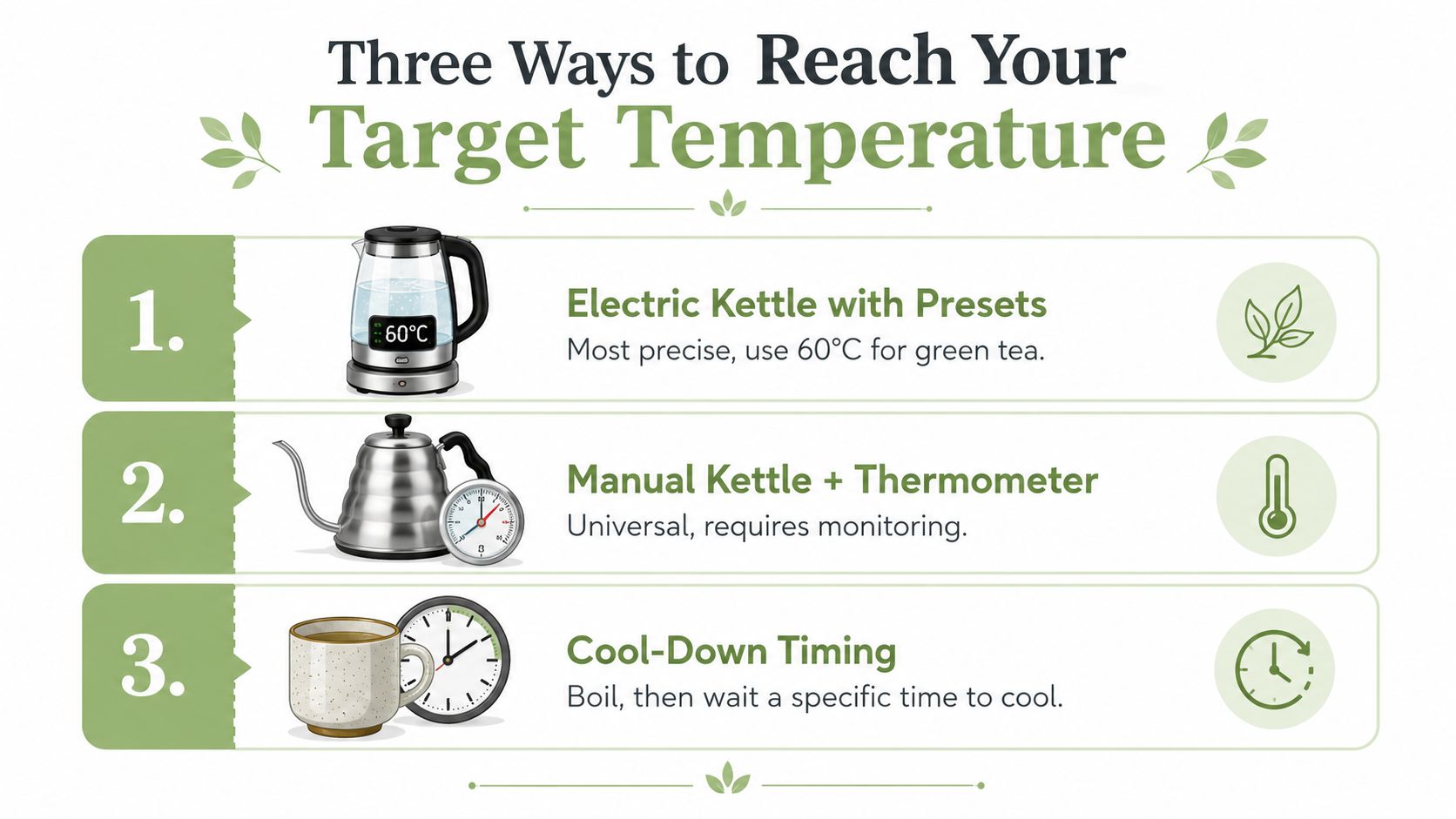
Electric kettle with presets. A precision glass kettle with buttons for 60°C, 70°C, 80°C, 90°C, and 100°C is the most direct option. You press the setting, wait, and pour once it finishes. That's the least fiddly approach for anyone making tea daily.
Manual kettle plus thermometer. This works well on a stovetop or with any plain kettle. Heat the water, check the temperature with a probe thermometer, then take it off the heat or let it cool a little if it runs hot. It takes more attention, but it's universal.
Boil, then wait. If you've got no gear at hand, boil the water and let it sit briefly before pouring. The exact cooling time depends on your kettle, room temperature, and water volume, so this is more of a practical habit than a strict formula. In a busy café or event setting, that kind of timing often works best when it's written into a simple service routine.
Choosing the method that fits your day
If you brew the same tea most mornings, presets remove friction. If you switch between drinks and only have basic tools, a thermometer gives you more control. If you're teaching staff or organising service across a team, a clear process matters even more than the device itself, and a centralised event management platform can be a useful way to keep timings, run sheets, and drink prep notes in one place.
Best takeaway: the right method is the one you'll use consistently, not the one that sounds the most technical.
Accuracy, Keep-Warm, and the Price Trap
A pricier kettle doesn't automatically mean a more accurate one. That's the trap. Some models look premium, have glowing buttons, and still drift enough to make repeated cups taste different from one another.
What to test before you trust the label
The key question is not whether a kettle says variable temperature, but whether it lands close to the chosen setting and stays there after repeated use. An independent buying guide for glass electric kettles highlights a useful benchmark: variable-temp kettles should ideally stay within about ±1.5°C at 80°C; larger errors can point to poor calibration and uneven brewing results, according to this buyer's guide.
That's especially relevant for lower-temp drinks, where a small miss can change flavour more than you might expect. If a kettle overshoots badly, your green tea may taste sharper than intended. If it undershoots, a bold tea may seem flat.
Keep-warm isn't the same as precision
Keep-warm can be handy, but only if it behaves predictably. Some kettles only hold at a few settings rather than the whole range, so a menu with several tea styles can expose the limits quickly. That matters in home service, but it matters even more in cafés where one kettle may need to support several different drinks in a row.
For comparison shopping, the electric kettle Australia page is a useful place to think through what features matter for real brewing habits. A good-looking kettle is nice. A kettle that consistently holds the number you asked for is better.
If you're testing a kettle in person, check whether the water tastes the same on the first cup and the third cup. Inconsistent flavour usually means inconsistent temperature control.
Safety, Cleaning, and Care for a Glass Kettle
Glass looks lovely, but it asks for a bit more care than stainless steel. The upside is obvious, you can see the water level and spot buildup early. The trade-off is that glass doesn't forgive rough handling.
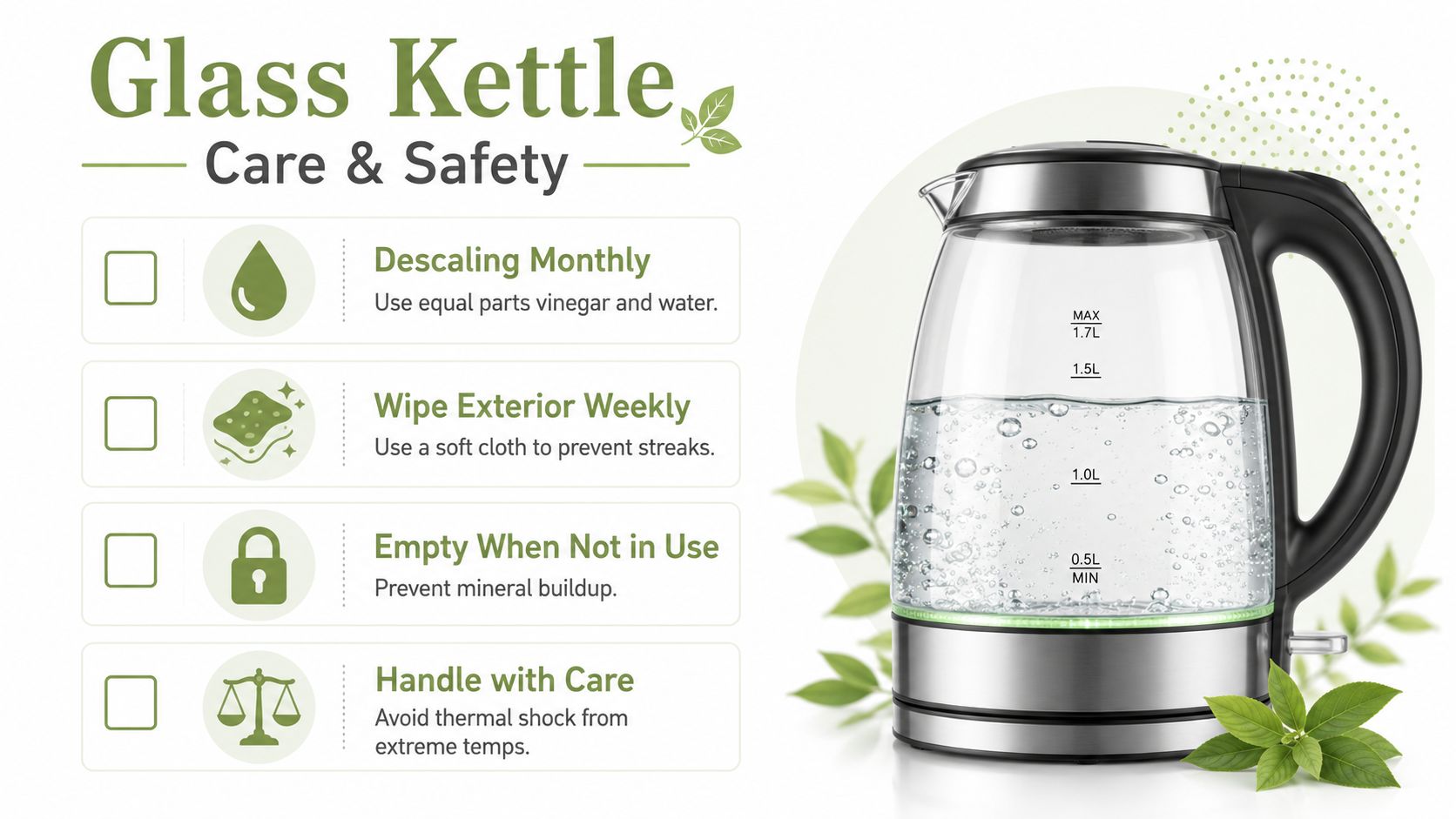
A simple care routine
- Descale regularly: use a mild descaling routine with citric acid or vinegar and water, especially in hard-water areas.
- Wipe the body gently: a soft cloth keeps the glass clear without scratching.
- Empty stale water: leaving water sitting around invites mineral buildup and stale flavour.
- Avoid thermal shock: don't pour cold water into a hot glass kettle body.
A good habit for both homes and cafés is to treat the kettle as a brewing surface, not just a container. Residue builds up on the element and in the spout, and that can affect taste before it affects appearance.
The mistake that hurts both taste and gear
Running the kettle dry, or repeatedly reboiling the same water, is a fast way to weaken flavour and wear the element.
That advice sounds boring until you taste the difference. Fresh water gives you cleaner extraction, and a kettle that's cleaned and handled well will usually feel more reliable over time.
Check the cord, the base, and the lid if the kettle lives in a busy space. In home kitchens, that's a monthly glance. In hospitality, it should be part of normal close-down and opening checks.
Quick Answers for Common Glass Kettle Questions
Is it safe to leave a glass kettle on keep-warm?
Usually, yes, if the model is designed for it and you're using the correct setting. The better question is whether the keep-warm function holds your chosen temperature consistently enough for the drink you're making.
Does reboiling water change the taste?
It can. Repeated heating often makes people notice a flatter or less fresh flavour, especially in delicate teas where water quality and temperature are already doing a lot of the work.
How often should I descale in Australia?
There isn't one universal schedule, because water hardness varies. In harder-water areas, a regular cleaning habit matters more than waiting until the kettle looks obviously scaled.
Can a stovetop glass kettle match electric precision?
It can get close with a thermometer and good attention, but it takes more hands-on control. Electric presets are still easier for repeatable tea brewing.
What setting should I use for matcha?
A cooler setting around the green-tea range is usually a better starting point than boiling water. Matcha responds best when the water is gentle, not punishing.
If you want better tea at home, start with the water before you start changing the leaves. Then match the kettle to the drink, keep it clean, and choose a setting with intent instead of habit. Explore the Pep Tea range at Pep Tea if you're ready to pair precise water handling with organic Matcha or sugar-free organic Kombucha that fits a cleaner daily routine.