
Tag: probiotic foods
Kefir Grains Australia: Your Ultimate Guide for 2026

You've probably seen kefir grains pop up in a Sydney café menu, on a wellness shelf, or in a Facebook group where someone's offering a jar of living culture to “a good home”. The odd part is that most Australians can tell kefir is fermented, but they're not always sure what they're buying, how to keep it alive, or whether it's even worth the trouble. If you're standing in that gap right now, you're in the right place.
Australia's kefir market is projected to grow from USD 10.97 million in 2024 to USD 16.68 million by 2033 (Deep Market Insights), which tells you something simple and useful, this is still a niche category, but it's steadily finding its place in Australian fridges and café cool rooms. The broader food pattern matters too, because Australian adults consumed an average of 142 g/day of cereals and grains in 2023, with 47 g/day from flours, rice, and grains (Deep Market Insights). Grain-based eating already sits comfortably in daily life, so fermented grain cultures don't arrive as a foreign idea, they fit into familiar habits.
That's the heart of kefir grains Australia shoppers are really chasing, not just a recipe, but a reliable culture that survives local kitchens, local shipping, and local routines. This guide keeps things practical, plain-spoken, and grounded in how fermentation works at home.
Your Introduction to the World of Kefir
A lot of people meet kefir the same way. They're looking for a gut-friendly breakfast option, they see a cloudy drink in a health shop fridge, and they wonder whether the grains inside are some kind of magic or just another trendy ferment. In Australia, that curiosity is becoming more common, because kefir has moved from specialist chatter into a modest but growing functional food space.
The market data backs that up. Australia's kefir market is projected to grow from USD 10.97 million in 2024 to USD 16.68 million by 2033 (Deep Market Insights). That doesn't make kefir mainstream in the way milk or yoghurt is mainstream, but it does show a clear long-term path for the category. People are learning to make room for fermented drinks in their ordinary routines.
Practical rule: if a product keeps turning up in cafés, home kitchens, and specialist retail, it usually means the category has crossed from novelty into habit.
That shift matters for Australian buyers, because buyers aren't searching for kefir as an abstract health concept. They're asking whether the grains are live, whether they'll survive the trip, and whether the culture will behave in a warm kitchen in Queensland, a breezy coastal flat, or a Hunter Valley dairy room. Those are real questions, and generic internet guides often skip them.
Kefir grains Australia shoppers also tend to run into a second layer of confusion, the difference between a live grain culture and a powdered starter. That distinction changes how the ferment performs, how long it lasts, and what you can do with it later. The rest of this guide strips away the noise and gives you the practical version, the version you'd want if you were standing at the bench with a jar, a strainer, and a half-finished bottle of milk.
What Exactly Are Kefir Grains
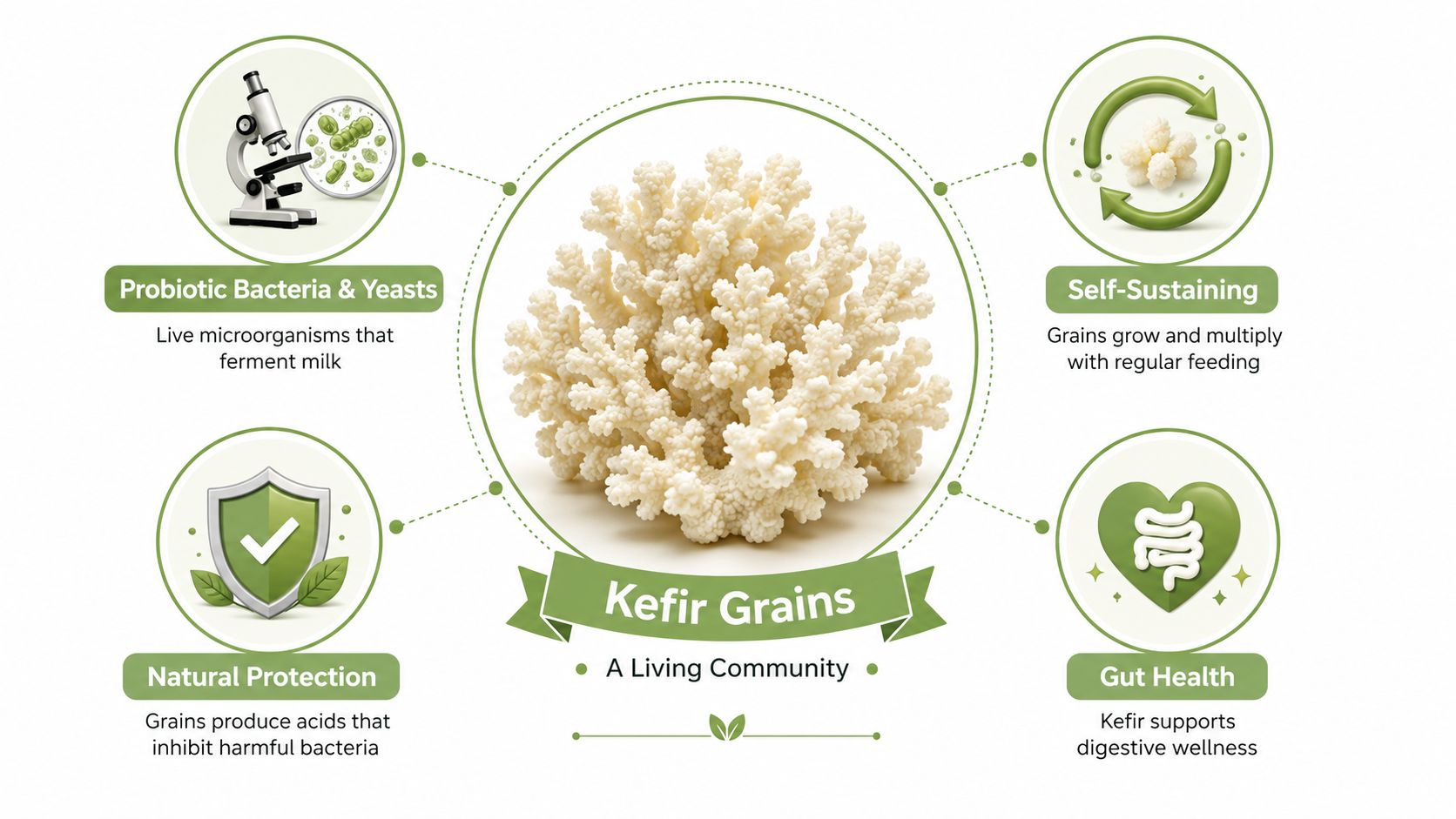
Kefir grains are a living community of microbes held together in a natural matrix. They are not grains in the cereal sense, and they are not a powder you stir in once and leave alone. In practice, they act like a self-renewing fermentation system, taking in milk, feeding the resident microbes, and building the culture that gives kefir its tang and texture.
Milk kefir grains are especially active. A peer-reviewed review reports that they typically contain about 10^8 CFU/g lactic acid bacteria and 10^6 to 10^7 CFU/g yeast, all held in a polysaccharide matrix (PMC review). In plain English, that means the grains are doing real biological work every time they go into milk. The microbes feed, multiply, and shape the flavour and body of the drink.
Milk kefir and water kefir aren't interchangeable
Milk kefir grains and water kefir grains both ferment, but they are built for different jobs. Milk kefir grains are made for dairy, while water kefir grains are used in sweetened water-based ferments. That matters because a culture usually performs best in the medium it knows, which is why a grain bought for milk kefir may not shift cleanly to coconut milk or another substrate (Microbial Foods).
For Australian home fermenters, careful sourcing starts to matter. A grain can look healthy and still be the wrong fit for your kitchen or the wrong medium for your routine. If you are comparing styles, the guide at kefir vs kombucha gives a clear reference point for how the cultures, process, and drinking habits differ.
Why the grain structure matters
Kefir grains are not just a starter sitting in milk. Their structure helps them keep fermenting and growing from batch to batch. Another review describes kefir grain composition as roughly 45.7% mucopolysaccharide and 34.3% total protein, with 90% moisture in the finished kefir drink and about 0.48% alcohol in typical kefir (PMC review). That structure is one reason live grains behave differently from a one-off culture packet. They keep working because the community inside them keeps renewing itself.
Practical rule: if the grains are maintained properly, they should keep doing the work for you. That is the main advantage of a live kefir culture.
Sourcing Quality Kefir Grains in Australia
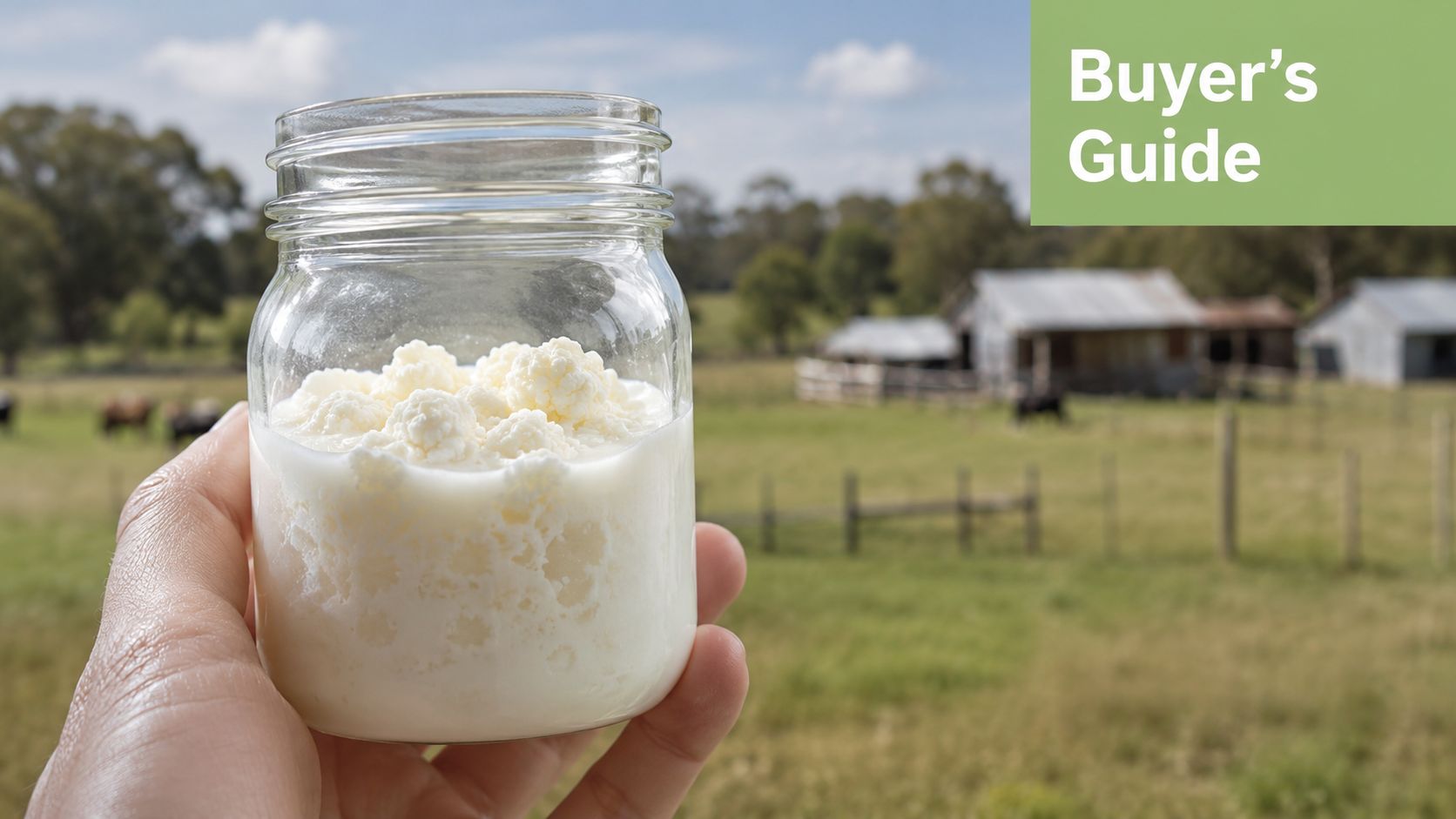
Buying kefir grains in Australia is less about finding the cheapest jar and more about avoiding a weak culture that never really gets going. The best grains usually look plump and cauliflower-like, smell fresh and clean, and come from someone who can tell you what medium they've been living in. If the listing is vague about that, be cautious.
Local health food shops can be handy if they stock live cultures, but availability is patchy. Specialised online sellers are often the most practical route, especially if they describe medium, freshness, and shipping conditions clearly. Community sharing groups can be generous, but they're only useful if the donor can explain how the grains were fed and whether they've been chilled, dehydrated, or switched between milks.
The Australian climate adds another layer. Live cultures don't love sitting in a parcel truck during a summer heatwave, so shipping method matters more than a lot of newcomers realise. If a seller can't explain how they protect the grains in transit, you're taking a gamble on viability.
What to ask before you buy
Before you transfer money, ask simple questions that reveal whether the seller knows the culture:
- What medium are the grains currently adapted to? Milk grains should be treated as milk grains, not generic ferment starters.
- Are the grains live and reusable? You want a continuing culture, not a one-use product.
- How are they packed for transit? This matters a lot in Australian heat.
- How recently were they fed? Freshly maintained grains usually travel better than stressed ones.
- What happens if the parcel is delayed? A sensible seller has an answer.
A useful reminder from the research is that cultures perform best when kept in the same substrate they were propagated in (Microbial Foods). That's a small detail with big consequences. It helps explain why some grains thrive beautifully and others stall out the moment they're moved into the wrong kitchen setup.
You'll also see a lot of content that tells you kefir grains are “live cultures”, which is true, but not enough on its own. The buyer question is whether those live cultures are adapted to your milk, your climate, and your handling routine. That's where quality lives, and it's where poor purchases usually fall apart. For readers who care about traceability and ingredient integrity, our broader approach to organic certification in Australia is a good example of the kind of transparency worth expecting from any ferment seller.
Your First Milk Kefir Fermentation Step by Step
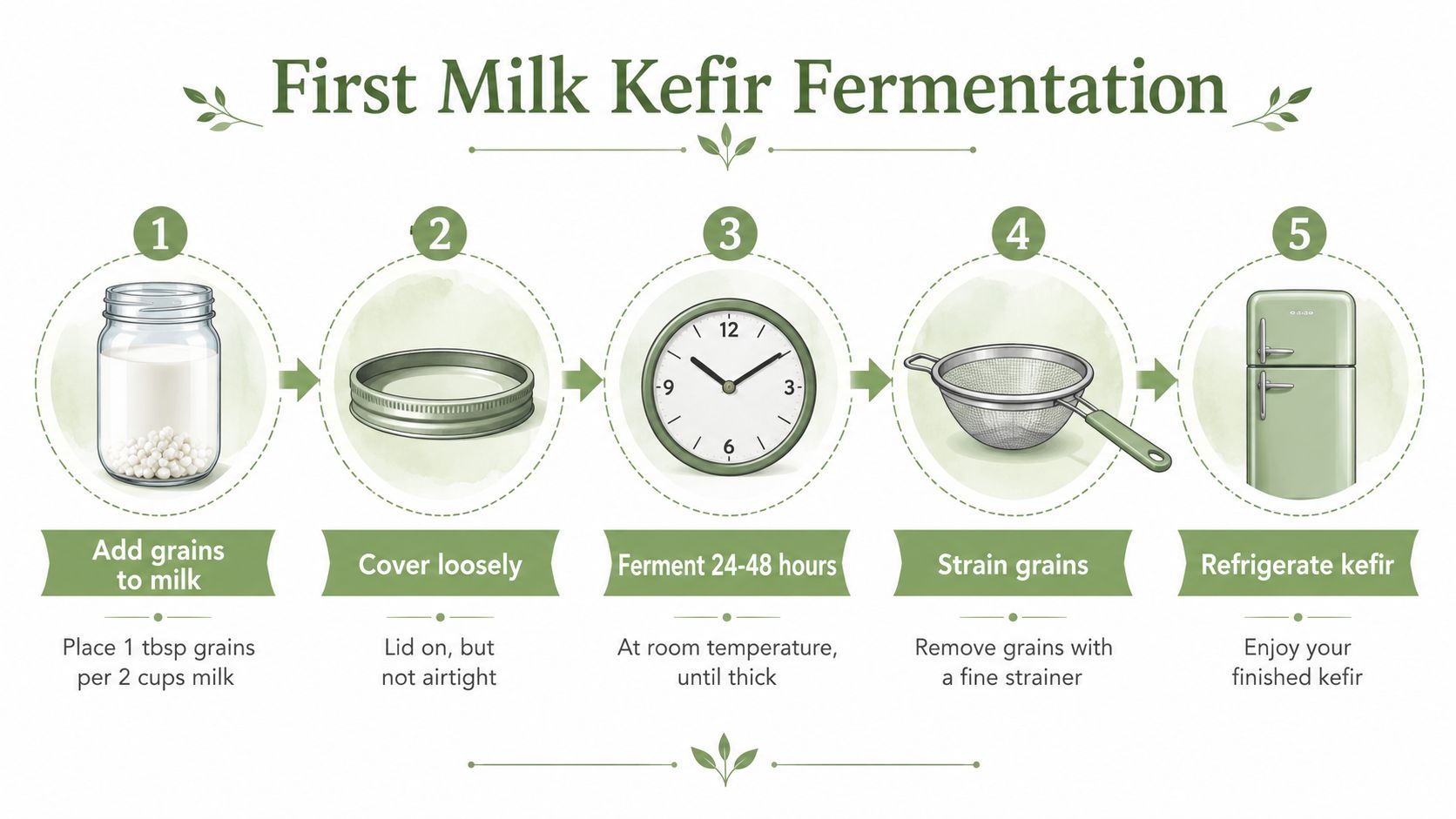
Milk kefir is easiest when you treat it like making tea, not running a lab. You combine the culture with milk, leave it at room temperature, and let the grains do their work. A reliable starting point is about 1 tablespoon, roughly 20 g, of grains per 4 cups, roughly 950 mL, of milk, with fermentation usually taking 12 to 30 hours depending on kitchen temperature (YouTube guide).
The simplest first batch
- Add the grains to milk. Use a clean glass jar and a sensible milk-to-grain ratio. More grains usually mean a faster ferment, less grain means a slower one.
- Cover loosely. A lid that isn't airtight or a breathable cover works well because the culture needs to ferment without pressure building up.
- Leave it at room temperature. In a warmer kitchen, fermentation moves faster. In a cooler kitchen, it slows down.
- Watch for texture changes. The milk should thicken slightly and smell pleasantly tangy, not rotten.
- Strain the grains out. Use a fine strainer, then refrigerate the finished kefir.
The best beginners learn to trust the senses. If it smells clean and sour in a dairy-like way, that's usually a good sign. If it looks separated, with clear liquid and thicker curds, that can still be normal, especially in a warm Australian kitchen where fermentation runs faster than expected.
Getting the timing right in Australian kitchens
Temperature matters more than the clock. A batch might be ready in half a day in a hot room, while a cooler kitchen may need closer to a full day. That's why a recipe is a guide, not a cage.
Practical rule: your nose and your eyes are part of the fermenting kit. Learn them early, and you'll waste less milk.
If you like watching the process, there's a helpful embedded guide below.
Once the kefir tastes right to you, strain it and chill it. The finished drink should be tangy and refreshing, not aggressively sharp on the first try. A gentler batch is often the better place to start, because it builds confidence while the grains settle into their new home.
Caring For and Growing Your Kefir Grains
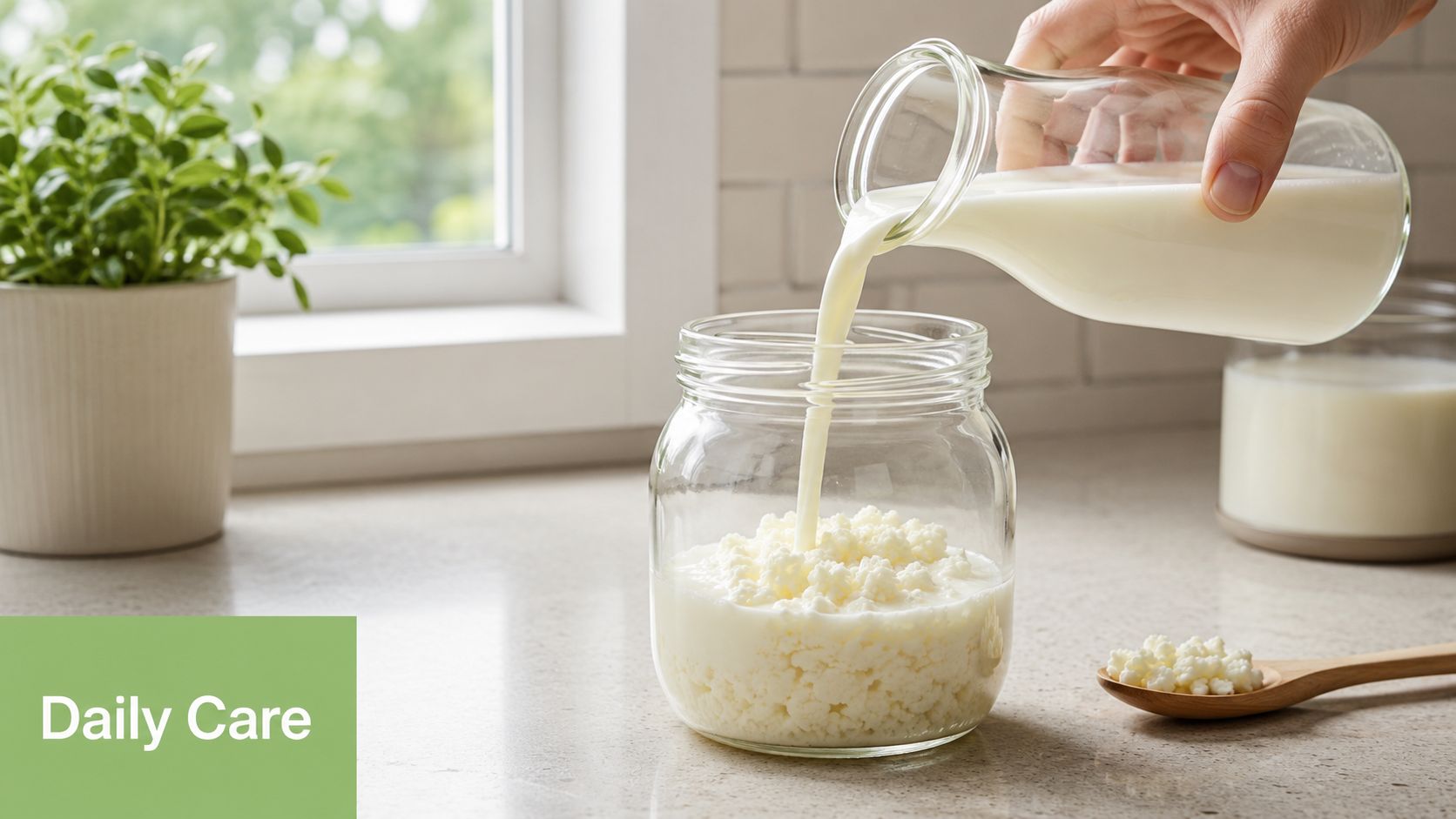
Caring for kefir grains is a rhythm, not a burden. Feed them fresh milk, strain them, repeat. In practical terms, many home fermenters keep them on a 24 to 48 hour cycle, and healthy milk kefir grains can roughly double in volume every 2 weeks under ideal conditions (PMC review).
Keeping the routine manageable
A lot of people worry that live culture will take over the kitchen. It doesn't have to. You can treat grain care like watering a plant, only with a jar and a strainer instead of a watering can.
Fresh milk is the reset button. If the grains are active, they need regular feeding more than they need fussing.
If you're stepping away for a bit, refrigeration is the easiest pause. Grains stored tightly sealed in milk in the fridge can stay viable for about 2 to 4 weeks before needing fresh milk again (Cultured Food Life). That's handy for holidays, busy work weeks, or anyone who doesn't want a daily commitment.
For readers who already keep other ferments at home, the storage approach is similar to how many people manage kombucha during a break. A useful companion read is how to store kombucha, because the same common-sense thinking applies, keep the culture stable, cool it when needed, and don't leave it dry.
What to do when the grains multiply
Growth is a good sign. It means the culture is active and being cared for well. If you end up with more grains than you need, share them with a friend, start a second jar, or freeze the extra only if you understand the trade-off in culture strength. If you don't want to keep them, composting is better than leaving them forgotten at the back of the fridge.
The big thing to remember is this, grain care rewards consistency, not perfection. The more regular your feeding rhythm, the easier the whole process becomes.
Common Kefir Questions and Troubleshooting
Kefir beginners usually ask the same three questions, and the answers are often simpler than they expect.
Why is my kefir too sour or runny? The usual reason is time, temperature, or too many grains for the amount of milk. In a warm Australian kitchen, fermentation moves quickly, so a batch left too long can turn sharp and separate. Use fewer grains, shorten the ferment, or move it to a cooler spot next time.
Why aren't my grains growing? Grains often stall when they're stressed, underfed, or living in a medium they don't prefer. If they were adapted to milk, keep them in milk. If they're not being fed regularly, or they've spent too long in the fridge, they may need a few cycles to recover.
Is this mould? True mould usually looks fuzzy, coloured, and wrong in a way that's easy to spot once you've seen it. Off smell matters too, because healthy kefir should smell tangy and dairy-like, not rotten or harsh. If you're unsure, it's safer to discard the batch and start again than to gamble.
A calm approach helps more than panic ever will. Many first batches behave unevenly because fermentation is sensitive to ambient temperature and handling, not because the culture is bad. If a jar fails once, that doesn't mean kefir isn't for you.
The best troubleshooting move is usually the simplest one, change one variable at a time.
For readers who want a broader sense of how fermented drinks behave in the body and in daily routines, a useful companion read is probiotic coffee science. It's not about kefir specifically, but it does help frame how people think about probiotics in drinks and why format matters.
Bringing Fermented Goodness Into Your Routine
Kefir works best when it becomes ordinary. Stir it into a smoothie, pour it over fruit, use it in a salad dressing, or drink it straight from the glass when you want something tangy and simple. The point isn't to make fermentation elaborate, it's to make it sustainable.
Australia's kefir market is still small, but the growth path shows that more people are making room for cultured foods in everyday life (Deep Market Insights). That fits a broader wellness pattern too, one where people want food and drink that feels functional without feeling heavy. If you enjoy that style of living, homemade kefir and ready-to-drink fermented options can sit comfortably side by side.
For anyone who likes to compare fermented beverages, it's worth remembering that kefir is one piece of a wider probiotic offering. Pep Tea's sugar-free kombucha is another clean, brewed option for people who want live culture in a different format, especially when convenience matters more than maintaining grains every week.
If you're ready to explore more fermented drinks, visit Pep Tea for premium organic teas and our Australian-brewed sugar-free kombucha. If you've been curious about kefir grains Australia buyers can trust, we hope this guide gives you the confidence to start with the right culture and a calmer first batch.