
Category: Learn About Tea
Tea Kettle with Infuser: Practical Loose-Leaf Brewing Guide
You've probably seen the moment before. A loose-leaf tin comes home from a market, the kettle is already on the bench, and you're left wondering whether the little basket in a tea kettle with infuser is useful or just one more gadget taking up space.
That question matters in Australia because tea isn't a fringe habit. Roy Morgan's consumer research says around 8 in 10 Australians drink tea, and more than 50 million cups are consumed each day nationwide, so this is everyday equipment, not a novelty item. Tea infusers became widely used in the late 19th and early 20th centuries, which is a good reminder that the basic idea has lasted because it solves a real domestic problem, boiling water and steeping tea in the same place.
A Real Australian Tea Moment Worth Thinking About
A lot of first-time loose-leaf buyers start with the same small frustration. They want better flavour than a tea bag gives them, but they don't want a cupboard full of separate gear, a pot, a strainer, a thermometer, and a drying rack all fighting for bench space.
That's where the tea kettle with infuser earns attention. It sits between a plain kettle and a dedicated teapot, which makes it appealing for home brewers, café counters, and small retail setups that need something simple to explain and easy to use.
For Australian households, the appeal is practical. One vessel means less washing up, fewer moving parts, and a faster route from dry leaves to cup. For specialty retailers and hospitality buyers, it also gives customers a visible brewing process, which can make loose-leaf tea feel less intimidating for someone who's only ever used bags.
The catch is that convenience always comes with trade-offs. Some buyers care most about speed, others care about temperature control, and others just want a setup that won't become annoying to clean after the third week.
The right infuser kettle doesn't just brew tea, it fits the way you actually live, clean, and serve.
What a Tea Kettle with Infuser Does
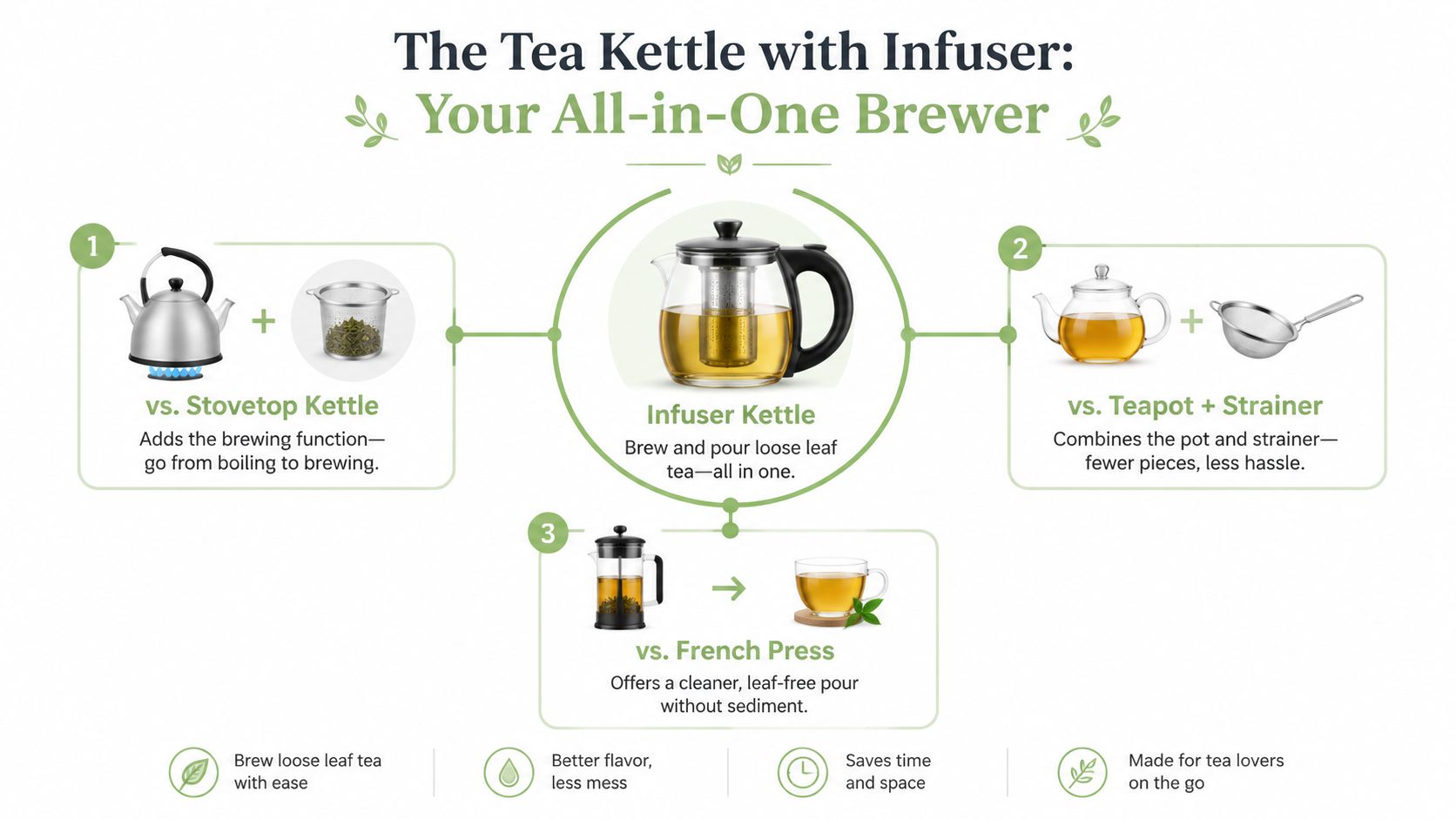
A tea kettle with infuser combines three jobs in one body. It heats the water, holds loose leaves in a removable basket, and lets you pour the brewed tea without reaching for a separate strainer at the end.
That is different from a stovetop kettle, which only gives you hot water. It is also different from a teapot plus a strainer, where the pot and the filter stay as separate pieces of equipment. A French press can steep tea too, but it is built around plunge brewing, so sediment is handled in a different way.
A simple mental model
The infuser basket acts as a gatekeeper, letting water in and keeping the leaves behind. You add the leaves, hot water moves through them, and the basket comes out once steeping is done.
That built-in basket changes the workflow in a few clear ways.
- You brew in one vessel. Less transfer means fewer drips and fewer dishes.
- You keep the leaves contained. That matters when you do not want particles floating into the cup.
- You remove the basket to stop extraction. Once the leaves stay in hot water for too long, bitterness starts to build.
The material matters too. A removable stainless-steel basket is usually easier to clean and less likely to hold onto old flavours, while harder-to-reach designs can make routine rinsing feel like a chore. A kettle body with a clear wall also gives you a better view of colour change, which helps when you are learning how your tea behaves.
Under Australian hard-water conditions, that simple design can be easier to live with than a separate kettle and teapot setup, because there are fewer pieces for scale to settle into. It also suits brewing routines that sit beside PepTea-style matcha and kombucha workflows, where the same bench space often needs to handle hot water, infusion, and quick cleanup without extra clutter.
Materials, Capacity, Wattage and Heat Sources Compared
Buyers usually get stuck comparing the wrong things first. They focus on the colour of the kettle or whether the handle looks sleek, when the decision sits in four places: body material, capacity, wattage, and how the heat source fits the job.
Here's the practical version. Glass shows you the brew and makes temperature changes easy to watch, but it also makes scale more obvious. Stainless steel usually feels tougher in busy kitchens and hides wear better. Ceramic can look elegant on the bench, though it's usually less about speed and more about presentation.
The AU market already gives a useful benchmark. A Barbeques Galore AU listing shows a 1.2 L digital glass kettle with infuser rated at 800 W and 40°C to 100°C temperature control for this kettle style. That profile suits controlled brewing and keep-warm use more than fast service. By contrast, a Canadian listing for a comparable 1.7 L glass kettle with infuser shows 1500 W, a 29 in. cord, and 1.5 kg net weight, which points to a faster, heavier-duty style of heating in a higher-output format.
| Profile | Capacity | Power | Best For |
|---|---|---|---|
| AU digital glass kettle with infuser | 1.2 L | 800 W | Controlled home brewing, delicate tea, keep-warm use |
| Higher-output glass kettle with infuser | 1.7 L | 1500 W | Faster service, hospitality-style turnover, frequent use |
The takeaway is simple. Lower wattage is gentler and more controlled, higher wattage is faster and better for throughput, and capacity should match how many cups you make before the kettle cools down.
For shoppers who want a starting point, this electric tea kettle with temperature control is a useful category to compare against other setups.
Choosing the Right Kettle for Home Café and Retail Buyers
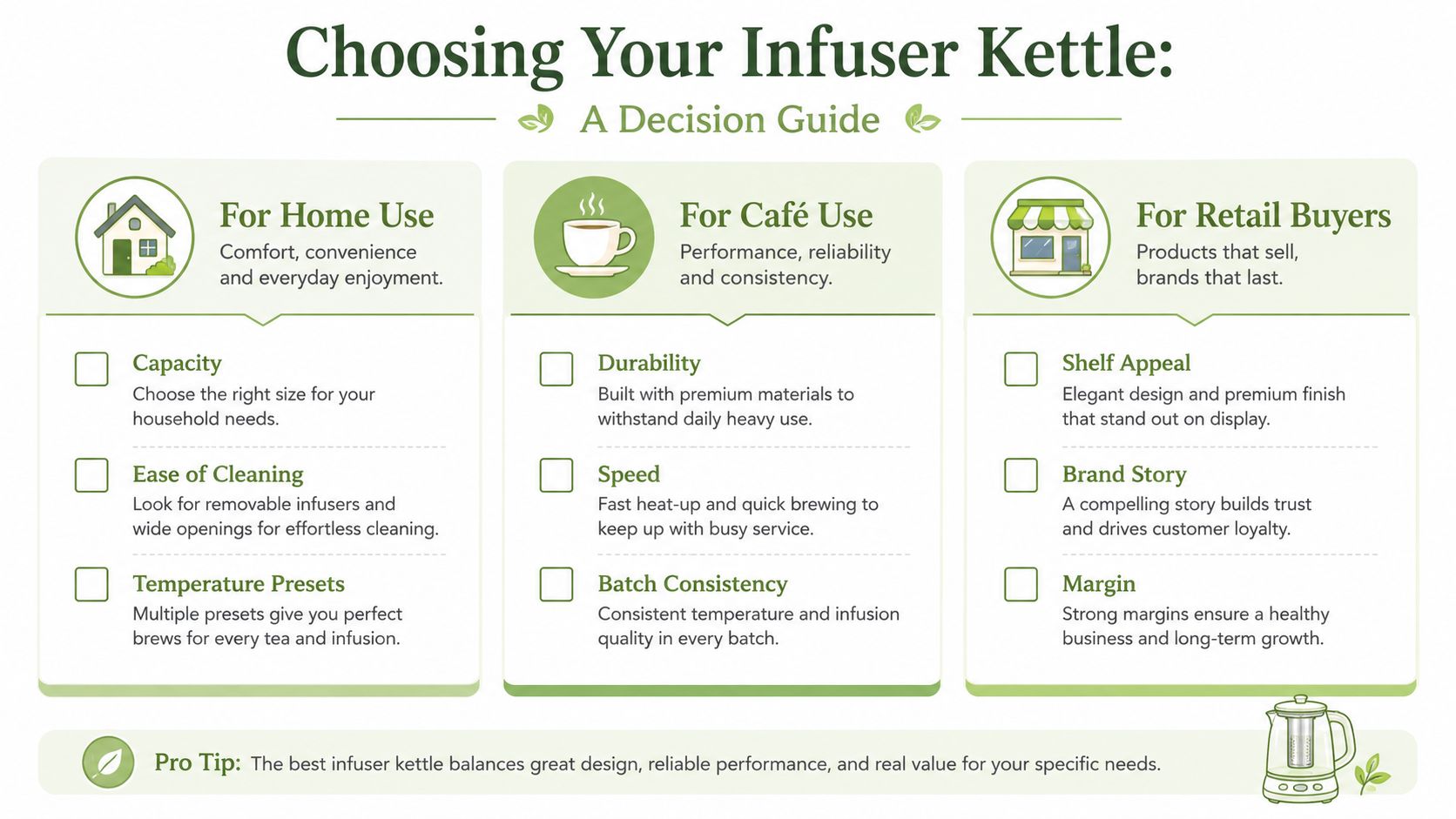
The best choice depends on who's using it, not just what the product page says. A home kitchen, a café bench, and a retail shelf all ask different questions of the same appliance.
For home use
Ask whether the kettle fits your counter and your routine. If you only brew one or two cups at a time, a smaller capacity can be plenty. If a family, housemate, or partner will use it daily, the basket size and water volume start to matter much more.
A temperature display is useful when you're moving between green tea, black tea, and herbal blends. If you mostly make one style of tea, you may not need a complex control panel. If you also like preparing hot water for other drinks, the added precision can make the machine feel more versatile.
For café use
Café buyers should think in terms of turnaround, not just flavour. A kettle that's fine for a single afternoon brew can become frustrating during a breakfast rush if the basket is awkward to remove or the keep-warm function drops off too quickly.
Durability matters here more than polish. Look closely at the mesh basket, the lid hinge, boil-dry protection, and whether the design survives repeated handling without wobble. If you're comparing appliance styles for a kitchen that gets used hard, the Luna Pro kettle for kitchen lovers is the sort of reference point people often use to judge build style and bench presence.
For retail buyers
Retailers need something that explains itself fast. Shelf appeal counts, but so does the story behind it, because shoppers buying loose-leaf tea often want a brewing method that feels clear and low-stress.
- Shelf appeal: Choose a design customers can understand at a glance.
- Brand story: Match the kettle to the kind of tea range you stock.
- Margin logic: Make sure the format fits your category, not just your display.
Brewing Temperatures and Steep Times That Actually Matter
Temperature control isn't a gimmick if you brew more than one tea type. It's the difference between a cup that tastes round and one that turns sharp, flat, or bitter.
Match the water to the leaf
The cleanest rule is to heat water to the right range, start the timer the moment it reaches that point, and remove the infuser as soon as the steep ends. A usage guide notes that even a short delay can make tea bitter, so the timer is not decoration, it's part of the brewing process as explained in this infuser-kettle guide.
| Tea type | Temperature | Steep time |
|---|---|---|
| Black Tea | 95-100°C | 3-5 min |
| Green Tea | 75-85°C | 1-3 min |
| Oolong Tea | 85-95°C | 2-4 min |
| White Tea | 70-80°C | 2-3 min |
A few practical points help the ranges make sense. Green tea usually needs gentler water, because hotter water can pull too much bitterness too quickly. Oolong sits in the middle, and black tea can handle hotter water and a longer steep without falling apart as easily.
Herbal blends are more forgiving, but they still benefit from a clear removal point. If the leaves stay submerged after the timer ends, the flavour keeps changing.
Practical rule: start timing when the water reaches the target temperature, not when you finally remember to glance back at the kettle.
Matcha-adjacent use
A tea kettle with infuser doesn't steep ceremonial matcha, because matcha is whisked into water rather than infused. It can still be useful for heating the water base that goes into a matcha shot or latte, which keeps the workflow tidy when you're building drinks at home or in a small café.
Cleaning and Descaling Under Australian Hard Water
Australian kitchens often deal with scale sooner than people expect. That matters because mineral build-up can reduce heating efficiency, leave visible marks on glass, and make a fine basket harder to keep fresh.
The cleaning habit should be boring and regular. Rinse the infuser after every use, dry it well, and don't let spent leaves sit in the mesh. A removable stainless-steel basket helps here because you can get at the surfaces that trap residue, and an easy-to-clean carafe reduces the chance that old flavour hangs around.
A simple maintenance rhythm
- After every brew: Rinse the basket immediately and let it dry.
- Monthly: Run a food-safe citric acid or white vinegar descaling cycle.
- Quarterly: Clean the lid hinge, base contact points, and any small creases where residue settles.
If your kettle takes longer to heat than it used to, or the base looks cloudy even after a wipe, scale has probably been building for a while. Don't wait until the element is obviously struggling, because the fix is easier when the film is still light.
The other overlooked piece is the water itself. A counter-top filter can reduce some of the nuisance that comes with hard water, and it's worth considering if your kettle is part of a daily brewing routine. A simple counter-top water filter can make the whole setup feel less fussy over time.
If you brew often, cleaning isn't an optional extra, it's part of the kettle's performance.
Brewing Bases for Kombucha and Matcha-Adjacent Prep
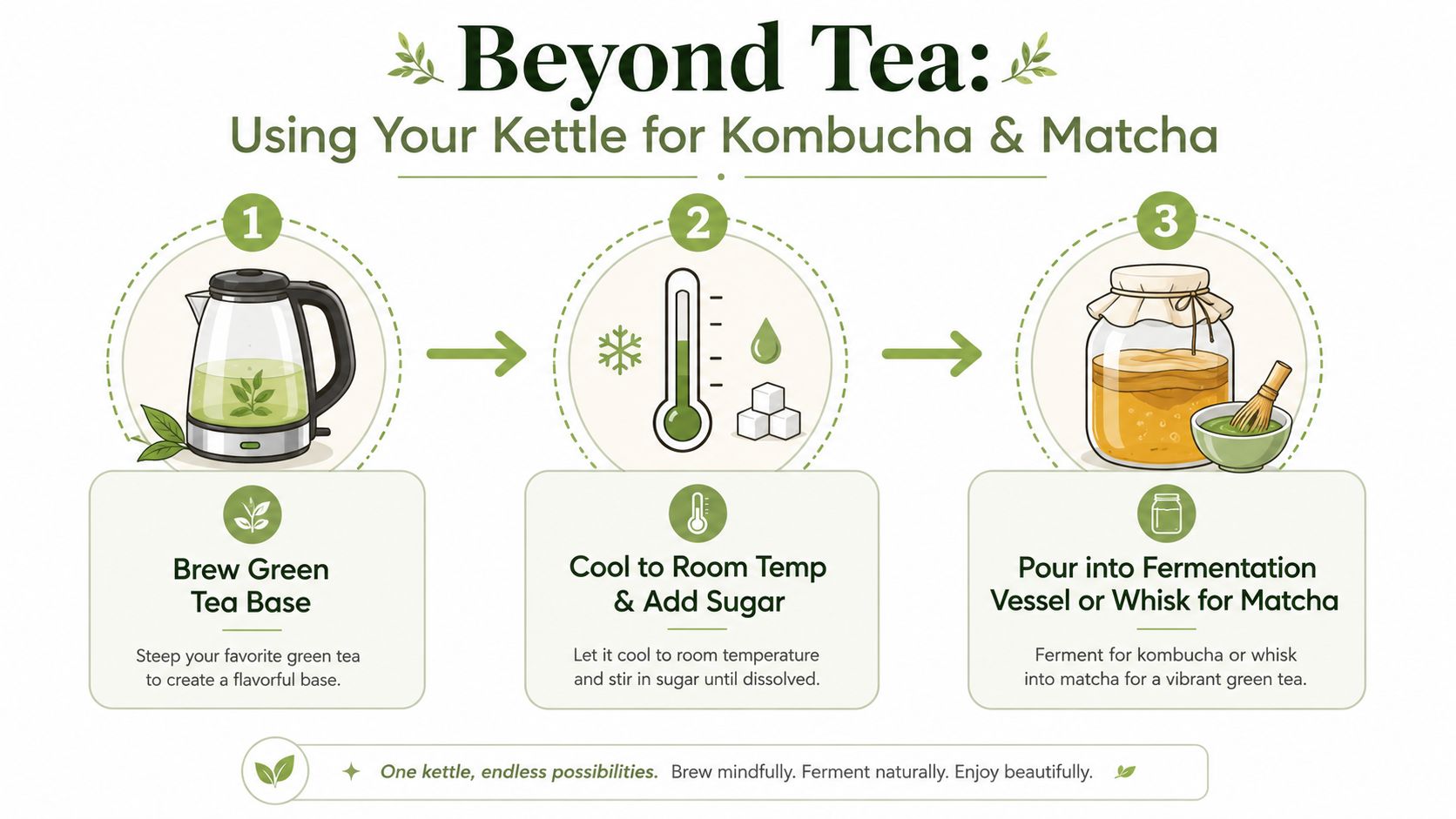
The same kettle can do more than one job in a wellness kitchen. A loose-leaf brewer that handles green, black, or herbal tea also gives you a clean hot-water base for kombucha prep and for matcha drinks that need controlled water, not boiling chaos.
Two practical ways to use it
For a simple kombucha spritz base, steep a herbal blend, cool it fully, then pour it over ice with sparkling water. If you want a home kombucha setup, a brewed tea base also fits neatly into a fermentation workflow, which is why a dedicated kit can be handy. This kombucha tea kit is the kind of companion product people often look at when they want the brewing side organised.
For a matcha latte, use the kettle only for the water component. Heat to a sensible temperature, whisk the matcha separately, then combine it with your milk of choice. The kettle's job is to be precise and unflashy, which is exactly what you want before the whisk goes in.
A good rule is to keep the brewing base separate from the flavour finish. That keeps the kettle useful without asking it to do everything.
The Honest Trade-Off and What to Do Next
The quiet downside of an all-in-one kettle in an Australian hard-water kitchen is maintenance. If you brew occasionally, the convenience usually wins. If you brew every day, a separate kettle and ceramic teapot can be lower friction because you spread the wear, reduce mesh clogging, and make flavour carryover easier to manage.
For apartment kitchens, the integrated format still makes sense because it saves space. For daily loose-leaf drinkers, the simpler long-term answer is often a separate heat source plus a pot that's easy to rinse and dry.
Pep Tea fits naturally alongside that kind of routine. If you're building a better daily tea habit, our organic matcha and Hunter Valley kombucha range are strong companions to the same low-fuss brewing mindset.
If you're ready to build a tea routine that suits an Australian kitchen, explore Pep Tea for organic matcha and sugar-free kombucha made for everyday use. You'll find practical options that pair well with loose-leaf brewing, whether you're making a calm morning cup, a matcha latte, or a cleaner non-alcoholic serve for home or hospitality.
Matcha Latte Recipe Reddit Guide: How to Make One at Home

If you've ever made a matcha latte at home and ended up with something thin, grassy, or weirdly bitter, you're in good company. The first cup often teaches the wrong lesson, because matcha punishes sloppy ratios and hot water faster than many expect.
That's why the matcha latte recipe Reddit crowd matters. Across r/Matcha and r/MatchaEverything, home drinkers have slowly converged on a reliable benchmark, 4 g matcha, 40 mL water, and 140 to 160 mL milk, with a practical two-stage method that makes the drink smoother and less clumpy. One thread describes 4 grams matcha, 40 millilitres hot water, and about 100 to 150 millilitres oat milk, another condenses the formula to 4/40/140, and an iced version lands at 4 g matcha, 40 mL water, and 160 mL milk for a 12 oz latte (Reddit matcha latte recipes).
That crowd-sourced consistency is the core story. It isn't a fad ratio, it's a community-standard that keeps showing up because it works in ordinary kitchens, with ordinary tools, and with milk choices that suit Australian café habits at home.
The Reddit Method That Delivers
The first time you make matcha, it's easy to treat it like instant coffee. You sprinkle powder into milk, stir once, and wonder why the drink looks speckled and tastes flat. Reddit's best advice cuts straight through that mistake, because the powder needs to be fully hydrated before milk ever enters the bowl.
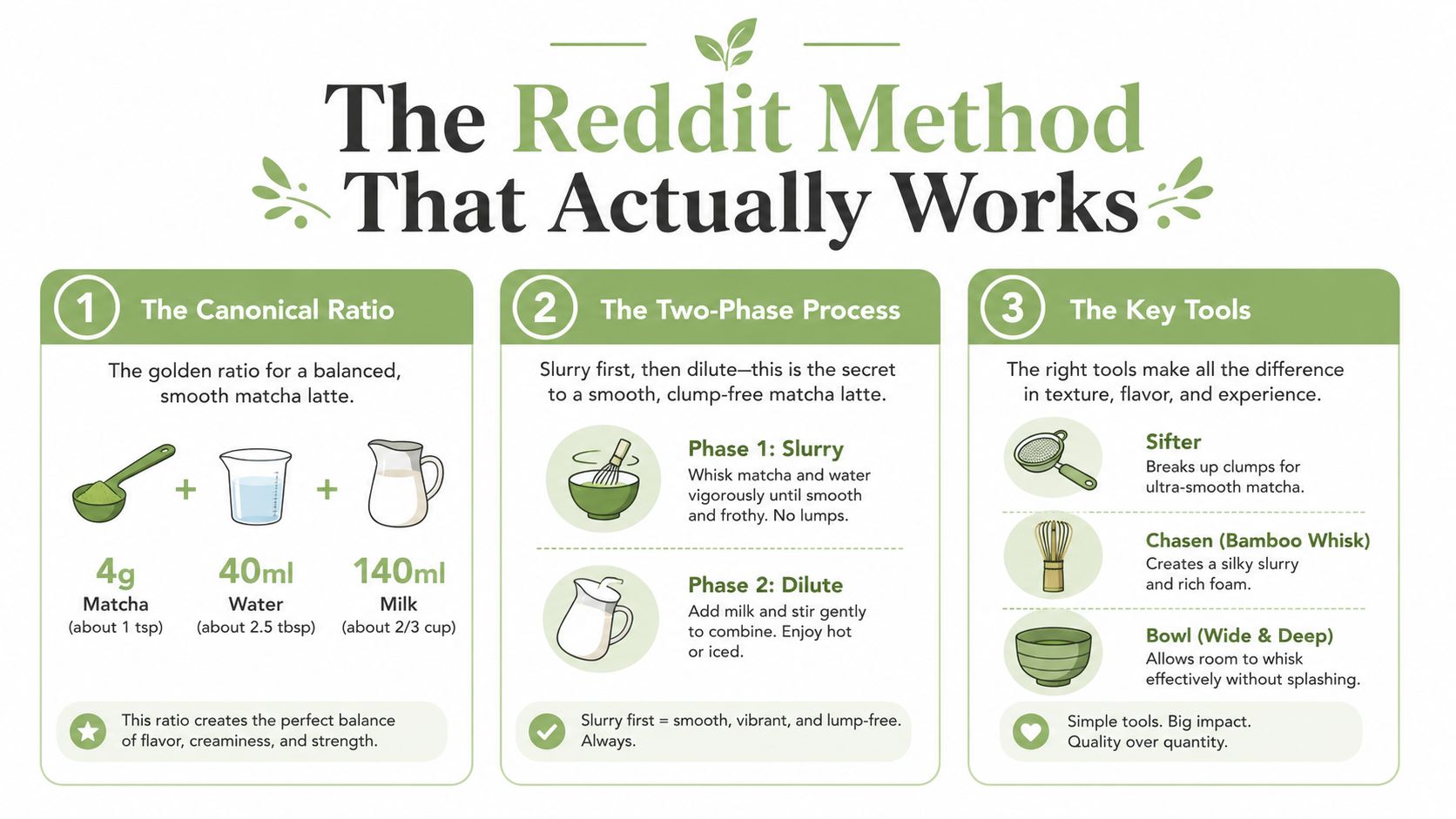
Why the crowd settled on one ratio
The repeated benchmark is 4 g matcha, 40 mL water, and 140 to 160 mL milk, which sits close to a 1:10 powder-to-water ratio and a roughly 1:4 milk-to-water finishing ratio for a single serve. That gives the powder enough liquid to disperse properly, while still keeping the finished drink full and creamy instead of thin. The same structure also appears in an iced version built around 4 g matcha, 40 mL water, and 160 mL milk for a 12 oz latte, which shows the method holds up in both hot and cold drinks (Reddit matcha latte recipes).
Practical rule: if the powder meets too little water, it clumps. If it meets too much milk too early, it never fully opens up.
The two-phase method behind the benchmark
Reddit's strongest recipes do not start with milk, they start with a slurry. Users consistently recommend sifting, then whisking the matcha into a small water phase before adding milk or ice. That sequence keeps the fine powder from sitting dry in the cup, and it gives the matcha room to hydrate before dilution. It is the reason the method keeps showing up in good home recipes instead of disappearing after one viral post.
For home baristas, that matters more than chasing a one-off version from a single creator. The strongest matcha latte recipe Reddit posts point to the same logic, a small hydrated base first, then milk to finish. That is the version worth keeping on repeat, especially if you are using oat milk and want something that feels café-made rather than muddy.
The 4-40-140 Hot Matcha Latte Method
A hot matcha latte works best when the cup is ready before the whisk starts. Pre-warm the mug so the drink holds heat instead of cooling fast, and sift the powder so the finest clumps do not survive the first stir. Those two small steps stop a lot of the grainy, uneven cups people run into at home.
Build the slurry first
Measure 4 g matcha and sift it into a bowl or wide cup. Add 40 mL hot water, kept around 75 to 80°C rather than boiling, because hotter water can push the flavour toward bitterness. Whisk the matcha into the water in a W or zigzag motion for about 15 to 30 seconds, until the surface looks smooth and the powder is fully dispersed (matcha latte guidance).
That motion matters because it moves the whisk across more of the surface, which breaks up fine particles more evenly than a lazy circle. The goal is not foam at this stage. The goal is a clean, even base that can take milk without turning speckled or gritty.
A good slurry also gives you a clearer read on the matcha itself. If the colour looks dull or the flavour tastes thin at this stage, milk will not fix it later. It will only soften the problem.
Finish with milk, not the other way round
Once the slurry looks smooth, pour in 140 mL milk for the standard hot serve. That keeps the drink balanced and gives you the benchmark 4/40/140 ratio that keeps showing up in the stronger Reddit versions. If you want a slightly larger café-style cup, the same method can stretch a little, but the drink still needs enough matcha presence to taste like tea, not sweet milk.
Froth the milk for 10 to 15 seconds if you want a silkier texture, and keep it around 60 to 70°C so it stays sweet instead of tasting cooked. That temperature range matters more than people expect, especially if you use oat milk, which can flatten when overheated. A short froth is usually enough for a home setup, and it keeps the drink from turning airy when you really want body.
Home-barista shortcut: pre-warm the bowl or cup, then work quickly. Matcha tastes cleaner when the drink stays hot enough to serve right away, not lukewarm by the time you sit down.
For anyone following the matcha latte recipe Reddit trail, this is the version that holds together in a normal kitchen. It is simple, but it is not careless, and that difference shows up in the cup.
Choosing the Right Milk for Your Latte
Milk choice changes matcha more than you might expect. The same 4 g matcha base can taste round and dessert-like in one milk, then sharp and thin in another, even when the whisking is identical. That's why Reddit threads keep circling the question without ever settling it completely, because the “best” milk depends on whether you want creaminess, sweetness, or a cleaner tea finish.
How the common options behave
| Milk type | Creaminess | Natural sweetness | Froth stability | Best with |
|---|---|---|---|---|
| Oat milk | High | Medium to high | Strong | Iced lattes, café-style drinks |
| Dairy milk | High | Medium | Strong | Hot lattes, fuller body |
| Soy milk | Medium to high | Low to medium | Good | Ceremonial-grade matcha |
| Almond milk | Low to medium | Low | Weaker | Light drinks, lower-calorie preference |
Oat milk has become the natural fit for Australian café-style matcha because it gives body without fighting the tea's flavour. Dairy is still the easiest route to a plush, classic latte texture. Soy can work beautifully with cleaner, higher-quality matcha because it doesn't drown out the tea note, while almond milk tends to read thinner unless you specifically want a lighter cup.
Matching milk to the drink you want
If you want a latte that feels rounded and café-like, choose oat. If you want the matcha to taste more like tea than dessert, soy is often the cleaner call. Almond works when you want restraint, but it's the least forgiving if the powder wasn't whisked properly in the first place.
If you're comparing plant milks for different recipes, Pep Tea's matcha coconut milk guide sits in the same practical territory, because question is always texture first, flavour second.
Good matcha doesn't need a heavy milk mask. The better the powder, the less you have to rely on sweetness to make the cup feel complete.
For anyone testing the matcha latte recipe Reddit formula at home, start with oat if you want the safest result. Switch to soy if you're chasing a cleaner finish, or dairy if you want the richest texture with the least fuss.
The Iced Matcha Latte Without the Watery Bottom
Iced matcha fails in one very specific way. The cup looks gorgeous for a minute, then the ice melts, the milk thins out, and the green layer on top turns into a sad puddle at the bottom. The fix is to separate hydration, whisking, and dilution so the drink stays strong from first sip to last.
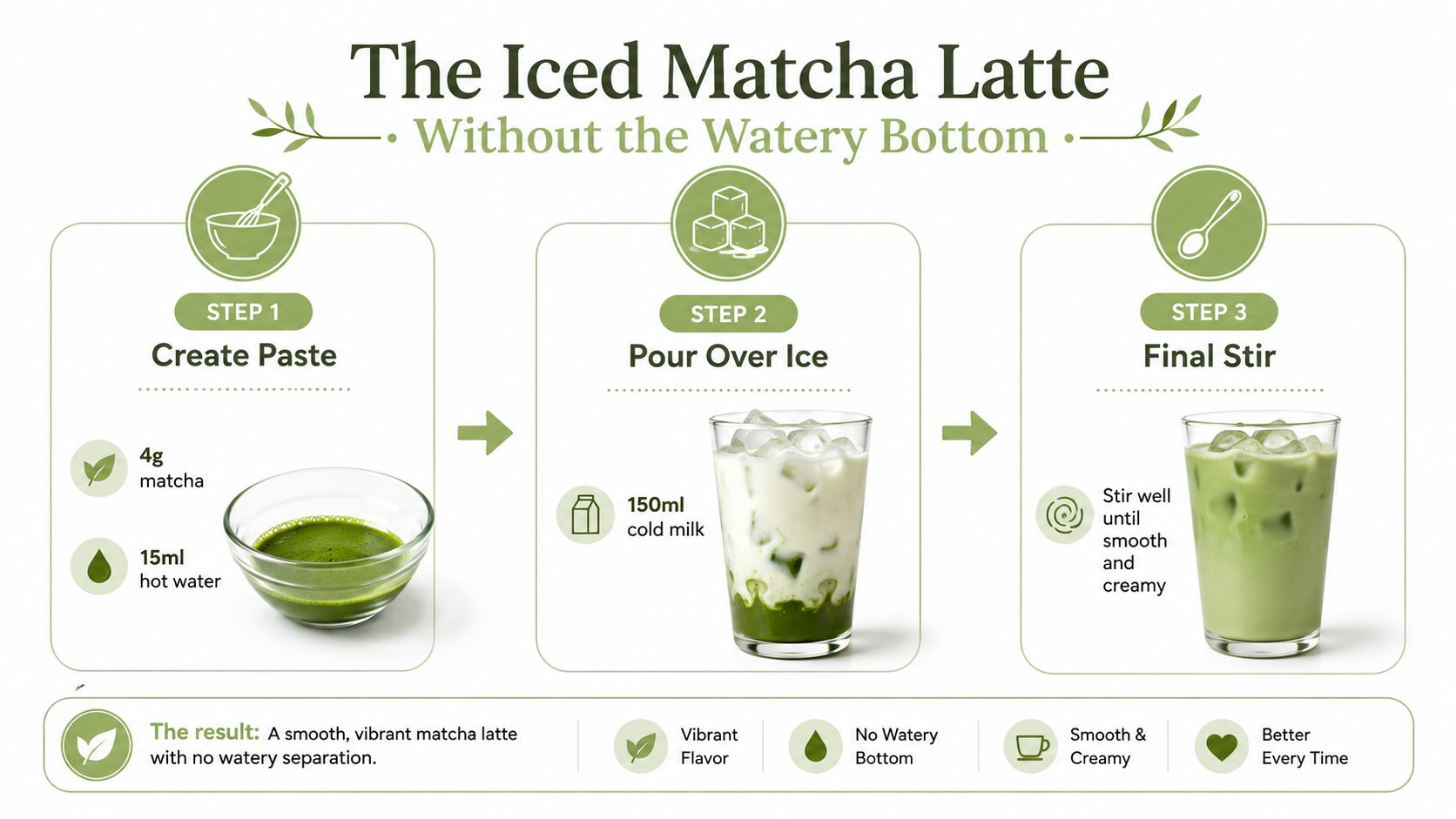
The paste first method
Use 4 g matcha powder and add 15 mL water first, just enough to make a paste. Then add another 45 mL water for whisking, so the powder can fully disperse before the milk goes in (iced matcha Reddit recipe). After that, pour over plenty of ice and add 120 mL milk. The sequence matters because it separates the wetting stage from the flavour-building stage, which helps stop clumps and keeps the drink strong enough after dilution.
A tall glass works better than a short one here, because it gives the layers room to sit visibly before you stir. Large cubes are more useful than crushed ice if you want slower melting and a cleaner layered look. Cold milk is fine, but don't start with such a large ice load that the drink loses its tea flavour before you've even picked it up.
When a shaker makes more sense
The café-style shaken version is faster and more uniform. It's the better choice when you're making a takeaway iced latte or want a drink that feels brisk rather than layered. A shaker blends the matcha and milk more aggressively, so you lose the visual separation, but you gain speed and consistency.
If you want a more detailed visual walkthrough, Pep Tea's how to make iced matcha latte guide fits neatly with this method. The linked YouTube tutorial below is also useful if you prefer to watch the pour order instead of reading it.
The chilled version rewards patience more than the hot one does. If you rush the order, you get weak flavour and a watery bottom, and that's the exact problem the Reddit-derived method is trying to avoid.
The Sugar-Free Matcha Latte That Actually Tastes Good
A lot of home recipes hide matcha behind sugar, syrup, or sweetened instant powder. That can make the drink easier to drink, but it also buries the very flavour people are usually chasing in the first place. If the matcha is good enough, and the ratio is tight enough, the cup doesn't need to be sweet to feel satisfying.
Why less dilution often tastes better
A smaller, stronger latte can taste smoother than a bigger one with more milk and more sugar. That's especially true when you use a better-grade matcha and keep the water phase tight, because the tea flavour stays present instead of getting washed out. Reddit recipes often lean sweet, but they don't really solve the core problem, which is balance.
Unsweetened matcha is also where milk choice matters most. Oat milk can make a sugar-free latte feel rounder, soy keeps the tea more visible, and dairy adds richness without needing syrup. Almond milk is the least forgiving in a no-sugar cup because it doesn't contribute much body on its own.
Optional sweeteners, if you still want them
If you want a little sweetness without turning the drink into dessert, use a light hand. Honey, maple, or monk fruit can sit in the background without flattening the tea note. The point is not to make matcha taste like a flavoured milkshake, it's to soften the edges just enough for your palate.
A better sugar-free latte is often a smaller latte. Stronger matcha, less dilution, and the right milk can do more for flavour than another spoon of sweetener.
That approach fits the direction many Australians are already heading, toward cleaner drinks with a more functional feel and less sugar load. It also lines up neatly with Pep Tea's own organic matcha positioning, which keeps the focus on authenticity and natural flavour rather than masking the tea.
Troubleshooting the Most Common Matcha Latte Problems
Most bad matcha lattes fail for one of three reasons. The powder clumps, the drink tastes harsh, or the foam looks pale and collapses quickly. Once you know which symptom you're seeing, the fix is usually simple.
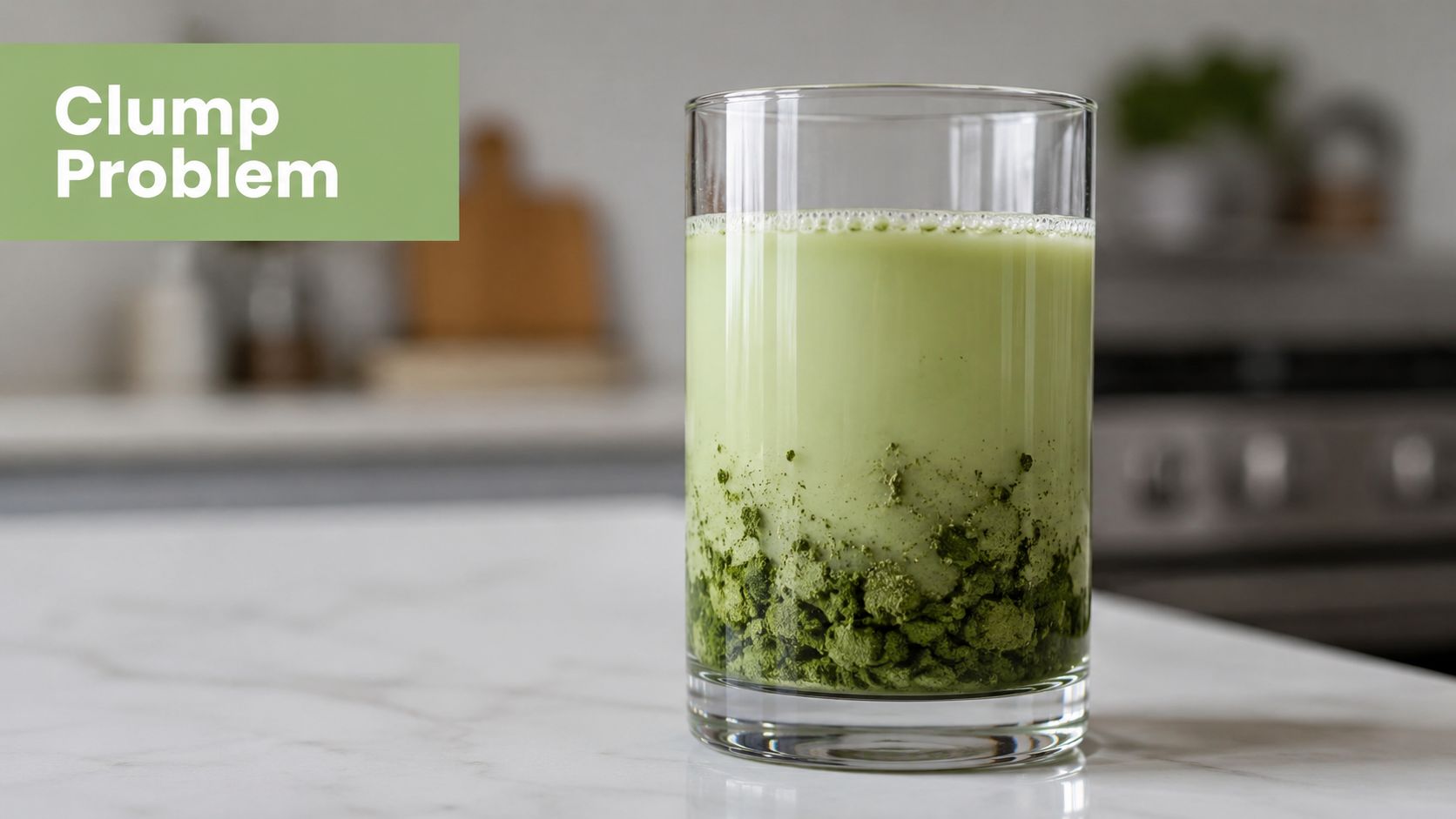
Quick diagnosis
A clumpy cup usually means the powder never fully hydrated. Sifting helps, but the slurry step matters just as much. Give the matcha enough water to disperse before the milk goes in, and whisk until the surface looks even rather than speckled.
Bitterness usually points to heat or handling. Water that is too hot can push the tea toward a sharper finish, and overwhisking can make the drink feel thin and aggressive. Keep the water around 75 to 80°C, then stop once the slurry is smooth, as shown in matcha latte guidance.
Pale foam that disappears fast is usually a milk problem. The milk may not have enough structure, or it may have been froth warmed too little to hold microfoam. Warm it gently, then give it a short final froth instead of chasing a big airy cap that falls apart in the cup.
A bamboo chasen still gives the most reliable surface texture, especially if you care about a fine, even foam. A handheld milk frother is easier to use and works well once the matcha is already hydrated. A shaker bottle is the fastest option, though the texture is rougher, and an electric whisk sits between the two, quick enough for home use but less polished than a chasen.
For whisking technique that helps the slurry come together, Pep Tea's how to whisk matcha guide is a practical reference. The base has to be right first. No frother fixes a clumpy slurry.
Taking the Reddit Recipe From Home to Your Café Menu
The home version scales cleanly into café service because the logic stays the same. A good venue doesn't need to reinvent matcha, it needs to reproduce the same ratio, texture, and pour order every shift. That's especially useful for Australian cafés that want one signature hot latte, one signature iced latte, and a sugar-free option without sending staff down a rabbit hole.
Menu structure that makes sense
A straightforward menu can run from the same base. Use the 4/40/140 style as the internal benchmark, then scale the milk volume to suit your cup size and whether the drink is served hot or iced. A 12 oz iced serve maps well to the Reddit-style formula already mentioned, and a larger glass can stretch the same method without changing the flavour logic.
Ceremonial-grade matcha makes the strongest case on a menu where the drink is sold as a premium tea beverage, while culinary-grade matcha makes more sense in baking, blended drinks, or cost-sensitive applications. That isn't about hype, it's about matching quality level to the drink's role. If the matcha is the hero, use the cleaner powder. If it's one ingredient among several, the cheaper grade can be the practical choice.
Training staff for consistency
Staff need the same physical sequence every time. Sift, whisk the slurry, then add milk or ice. If one shift dumps powder straight into milk and another uses a proper slurry, the drink won't taste like the same product.
Consistency sells the second cup, not just the first one.
If your venue wants a reliable organic source for that menu build, one option is Pep Tea's organic matcha range, which is positioned for cafés, wholesale, and home use in Australia. It fits the same practical standard the Reddit recipes point toward, just in a form a venue can stock and repeat.
If you're ready to turn a clumpy home experiment into a drink you'll want to remake, explore Pep Tea's organic matcha and tea range at Pep Tea. We keep the focus on clean ingredients, café-friendly recipes, and practical brewing support so you can make a smoother matcha at home or serve one with confidence in your venue.
What Is EGCG and Why It Matters for Your Daily Tea

EGCG, short for epigallocatechin gallate, is the most abundant catechin in green tea, and it can make up more than 50% of total green-tea catechins. That's why EGCG is the compound most closely tied to matcha's celebrated health reputation, not just “antioxidants” in general.
Hearing the word antioxidant is a start, but that's too broad to be useful. If you run a café, sell tea, or want a smarter daily cup, the key question is what's in the glass, how much of it you're getting, and whether the format matters.
Why EGCG Deserves Your Attention Beyond Generic Antioxidants
“All antioxidants are the same” sounds neat, but tea does not work that way. Green tea gets much of its reputation from catechins, and EGCG stands out because it is the dominant one in the leaf and one of the most studied in tea nutrition in PepTea's antioxidant tea guide.
That matters in Australia because people are asking more exact questions now. They do not just want to know whether a drink is “healthy”, they want to know which active compounds are present, how much they are likely to get, and whether a tea, matcha, or extract behaves in the same way.
Why specificity matters in real beverage choices
EGCG matters because it gives green tea, especially matcha, a measurable profile rather than a loose wellness story. Independent review data places it at more than half of total green-tea catechins and notes that brewed tea commonly contains about 200–300 mg of EGCG per cup in some contexts (PMC review). For café owners, that kind of detail shifts the conversation from general claims to formulation choices.
A product that says “antioxidants” leaves too much unsaid. The useful question is which compound is doing the work, and what serving size delivers it.
The difference shows up in everyday use. A ceremonial matcha latte, a plain brewed green tea, and a capsule extract all contain EGCG, but they do not deliver it in the same way or at the same dose. That is why EGCG is more than a chemistry term, it affects purchasing, menu design, and how a beverage is described to customers.
EGCG also sits at the point where wellness language meets careful label reading. For tea drinkers, that helps make sense of what is in the cup. For operators, it helps explain why a green tea beverage is not just another hot drink, but a distinct option with a different nutritional profile.
The Chemistry and Mechanism Behind EGCG
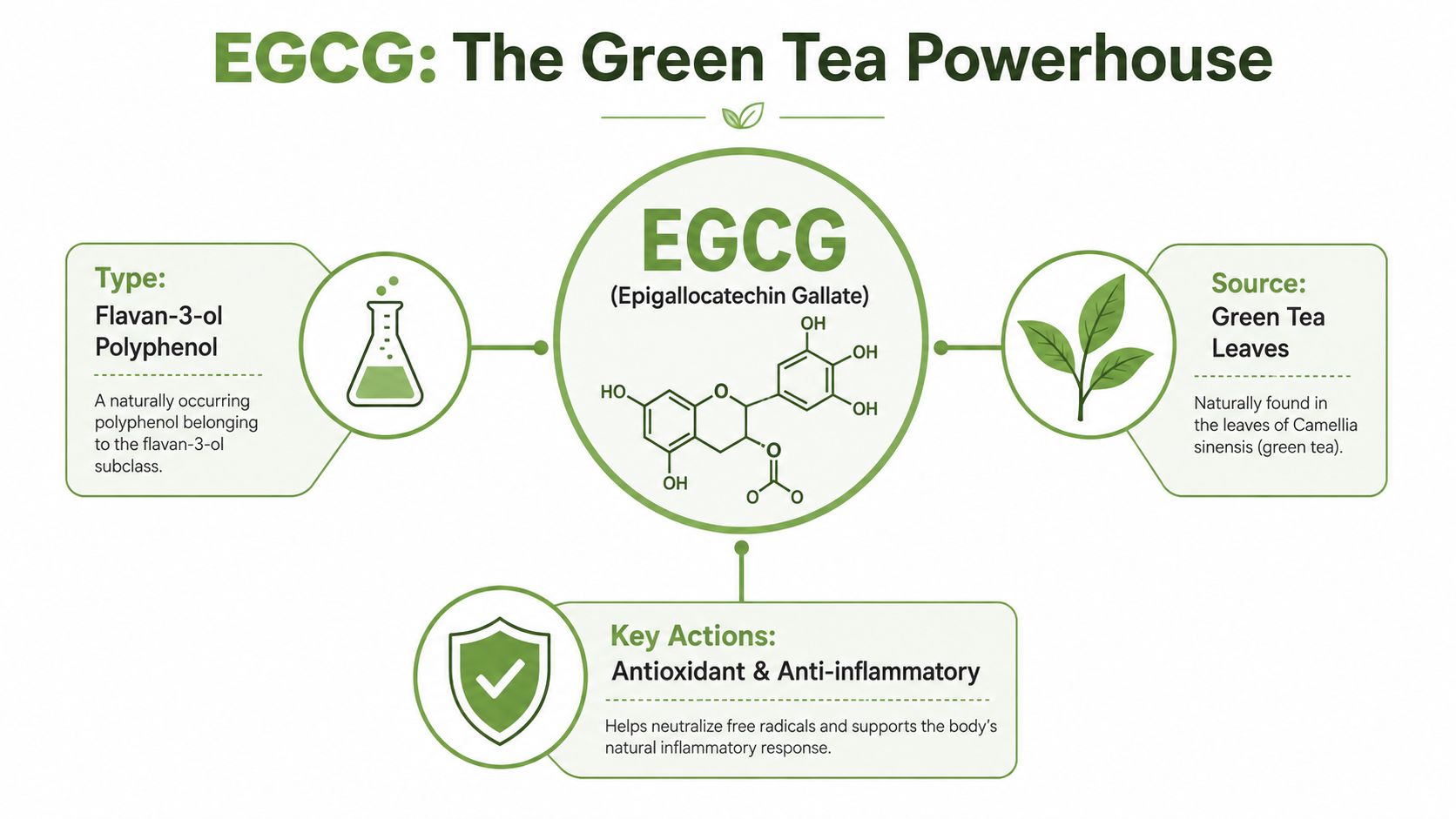
EGCG is a catechin, a subclass of polyphenols, and scientific reviews describe it as the principal bioactive compound in Camellia sinensis (Molecules review). In practical terms, it is one of the plant compounds that gives green tea its sharp, fresh, slightly astringent edge.
Why its structure matters
EGCG stands for epigallocatechin-3-gallate, with a formula of C22H18O11 and a molecular weight of about 458.4 g/mol. That structure gives it strong redox activity, which means it can interact with unstable molecules and support the body's antioxidant defences (technical source).
The molecule has multiple reactive sites, so it can engage with its surroundings in several ways at once. That is part of why tea scientists pay close attention to it, and also why it is more fragile than some other catechins. It is useful chemistry, but not indestructible chemistry.
Why freshness and preparation matter
EGCG is water soluble, so hot-water extraction can pull it into a drink efficiently (technical source). It is also sensitive to storage, pH, oxygen exposure, and heat, so processing and preparation change how much reaches the cup.
Tea is a chemistry system, and EGCG is one of the parts that changes most readily.
That explains why matcha quality can vary so much. Freshness, shading, grinding, and storage all affect how much of the plant's chemistry survives to the finished drink. A bright, clean matcha and a flat, dull one often differ before the whisk even hits the bowl, because the leaf material itself has already been handled differently.
For café owners, that makes product quality a practical issue. A well-stored matcha can support a cleaner flavour and a more consistent beverage experience, while a poorly handled product loses the very compounds people are buying it for, as shown in PepTea's Uji matcha range.
What the Scientific Evidence Shows About Health Benefits

EGCG gets attention because the research does not treat tea as a vague wellness habit. It looks at a specific plant compound and asks what it may be associated with in human studies. For café owners and health-conscious consumers, that distinction matters, because it keeps the conversation grounded in what the evidence can support.
A recent meta-analysis reported that green tea was associated with a 9% lower cancer risk overall (RR 0.91), while EGCG specifically was associated with a 28% lower risk (RR 0.72) versus controls (PubMed). Those findings are part of why EGCG has moved from a tea chemistry topic into broader nutrition conversations.
What that means, and what it doesn't
The numbers are useful, but they are not a promise. They show associations in the research literature, not proof that drinking more tea prevents disease. That difference matters on a menu board, in a wellness shop, or in any setting where EGCG might be described as part of a healthy routine.
The same analysis reported stronger associations for some cancers, including prostate cancer (RR 0.43), oral cancer (RR 0.44), gallbladder cancer (RR 0.72), and hematological cancers (RR 0.72) (PubMed). Separate physiological research also found that EGCG supplementation changed energy metabolism in adults, with a mean reduction in respiratory quotient of 0.02 and an increase in energy expenditure of 158.05 kJ/day compared with placebo. That helps explain why EGCG appears in conversations about metabolic support and functional beverages.
How to read the evidence responsibly
A practical reading of the evidence is straightforward. EGCG has enough human data behind it to deserve attention, but not enough to justify exaggerated claims. Its strongest place is within an overall tea pattern, not as a stand-alone cure or a miracle ingredient.
For café operators, that means you can speak about tea catechins, metabolic support, and plant-based bioactives without making medical promises. For consumers, it means a daily matcha or green tea can fit a sensible routine, while still sitting alongside the rest of a healthy diet and lifestyle.
Where to Find EGCG in Your Diet and Daily Drinks
Green tea is still the main practical source. EGCG also appears in smaller amounts in white tea, black tea, and oolong tea, and trace amounts show up in some fruits, nuts, and beans such as berries, plums, apples, hazelnuts, and peanuts (PMC review). For everyday drinking, tea remains the clearest way to obtain it.
If you like tracking what ends up in the cup, log teas with Drinkist can help you notice how leaf quality, water temperature, and steeping style change the drink from day to day.
Approximate EGCG content by source
| Source | Typical Serving | Approximate EGCG |
|---|---|---|
| Brewed green tea | 1 cup | About 50–150 mg (technical source) |
| Matcha | 1 serving | Higher than a typical infusion because you consume the whole leaf, not just the water (technical source) |
| Concentrated supplement | 1 serving | About 100–800 mg/day in common supplement formats (technical source) |
| Brewed tea in a conservative safety benchmark | 1 cup per day | About 100 mg EGCG/day |
| Conservative higher tea intake | 3 cups per day | About 300 mg EGCG/day |
Why matcha feels stronger than brewed tea
Matcha changes the serving picture because you consume the powdered leaf rather than an infusion. That usually means more catechins per cup than a standard steeped tea, even though the exact amount still depends on grade, dose, and how it is prepared.
Kombucha sits in a different category. If it is brewed on a green tea base, it may carry some EGCG from the tea used in fermentation, but the final amount depends on the starting brew and the process, so it should not be treated as equal to matcha or a strong green tea infusion.
For cafés, menu language matters. “Green tea based” and “matcha” are not interchangeable, and customers who care about function will notice the difference.
Safe Intake Levels and Understanding the Supplement Gap
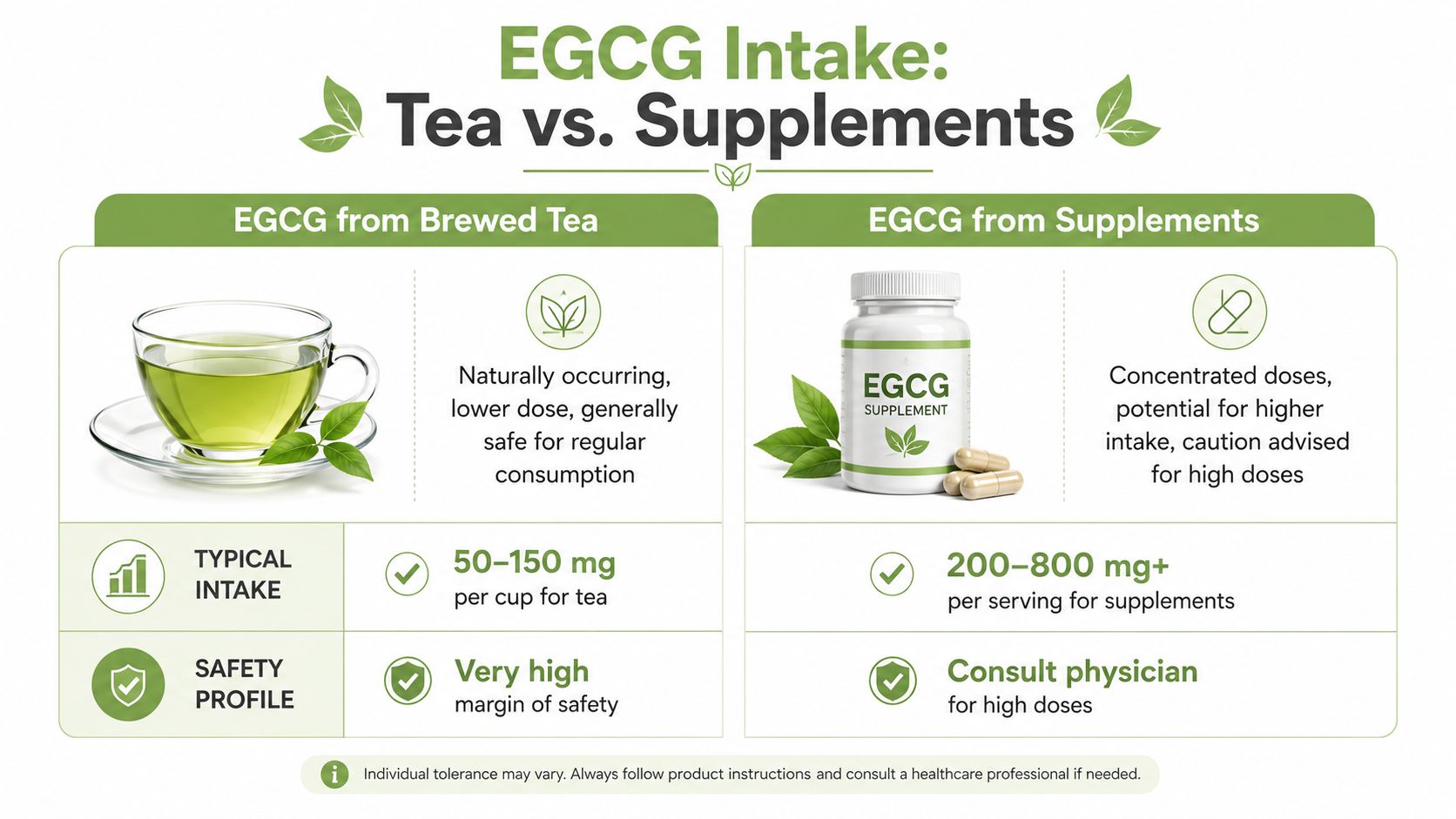
The main mistake with EGCG is treating tea and supplements as if they deliver the same thing in the body. They do not. In a PMC safety review, analysts used a conservative benchmark that places a typical background intake at about 1 cup of green tea per day, or ~100 mg EGCG/day, while a higher conservative intake was 3 cups per day, or ~300 mg EGCG/day.
Tea is not the same as an extract
That same safety literature also discusses a proposed adult safe intake level of 338 mg EGCG per day for EGCG in solid bolus supplement form. That detail matters because it shows why brewed tea and concentrated extracts should not be grouped together.
A simple way to read the difference is this. Tea delivers EGCG inside a food matrix, while a capsule delivers a concentrated dose in a form that behaves differently in the body. A cup of tea sits inside normal food and drink habits, but a supplement can push someone much closer to the upper range without them noticing.
Practical rule: if the label focuses on milligrams of EGCG, treat it like a supplement, not like a tea.
How to read labels without getting lost
If you compare products, check whether the figure refers to per serve, per capsule, or per daily dose. Then read the rest of the ingredient panel, because a product that combines catechins with other concentrated extracts needs closer attention.
That caution matters most for people with liver conditions, pregnant individuals, and anyone taking medicines that may interact with green tea or caffeine. For those readers, regular brewed tea is a very different decision from capsules or high-dose wellness blends. If you are comparing formats, this green tea capsule guide helps separate tea-based intake from supplement-style products.
For cafés and beverage brands, the safest language is straightforward. Describe tea as a traditional drink with plant compounds, not as a treatment. That keeps the message accurate and keeps the menu honest.
Practical Applications for Consumers and Hospitality Professionals
A good matcha routine doesn't need to be complicated. For home drinkers, a whisked bowl in the morning gives a clean way to use the plant whole, while a latte can make the flavour more accessible if you keep the sugar low. If caffeine sensitivity matters, start with a smaller serve and see how it fits your day.
What to do in a café setting
For hospitality teams, EGCG knowledge is useful because it gives you a clearer way to position drinks. A properly made matcha, a brewed green tea, and a kombucha built on tea are different menu items, and each should be described that way. That helps customers make better choices without crossing into medical claims.
A smart menu can highlight organic matcha, sugar-free kombucha, and clean, functional beverage options alongside coffee. If you're building a drinks program, a tea-focused beverage line can give people a lower-sugar alternative without pushing them into overly sweet soft drinks.
Good menu language tells the truth about the drink first, then the experience second.
Operations also matter. If you're selling a beverage with tea-based functional framing, it helps to keep ingredient communication tight and allergen processes organised. A restaurant allergen compliance checklist is a practical reference for tightening that side of service.
For home use, keep the approach simple. Use fresh water, respect the leaf, and choose a format that matches your goal, whether that's a calm morning cup or a more versatile ingredient for lattes and baking. We also see interest in organic matcha because it works across both café service and kitchen use, which is one reason Pep Tea's Australian-brewed kombucha and matcha range fits so naturally into functional drinks menus.
Common Questions About EGCG Answered
EGCG can survive tea brewing well, but preparation matters. In kombucha, some of the tea's catechins may carry through the process, yet the final amount depends on the tea base and fermentation style, so it's best to think of kombucha as a tea-derived drink rather than a concentrated EGCG source.
Matcha pairs naturally with caffeine and L-theanine, which is why many people describe the lift as smoother than coffee. Cooking or baking with matcha can still leave you with useful tea compounds, but the more heat and air exposure you introduce, the less you should expect the finished dish to behave like a fresh whisked cup.
Individuals won't “feel” EGCG in the dramatic way a stimulant works. If anything, its value is cumulative and routine-based, which is why consistency matters more than chasing a huge dose.
Pep Tea makes organic matcha and sugar-free organic kombucha for people who want tea-based drinks with clear ingredients and real-world use cases. If you're comparing matcha for your home routine or building a café menu around functional beverages, visit Pep Tea to explore options that fit a daily tea habit rather than a supplement-style shortcut.
No Sugar Soft Drinks: A Practical Guide for Australians

Most advice treats no sugar soft drinks like the automatic upgrade from regular soft drink. That's too simple for Australian shoppers, and it misses the core decision, which is whether you want a cola-style swap, a lighter refreshment, or a functional drink that fits a café run, a workday, or a night out.
The category has also changed in a big way. In Australia's water-based non-alcoholic beverage market, low- and no-sugar drinks held 30% of market share in 1997 and 65% in 2024, while sugar-sweetened drinks fell from 70% to 35%. Sales of no-sugar water-based beverages rose from 30.4 litres per capita to 105.8 litres per capita over the same period, so these drinks are no longer a fringe option, they're a mainstream one (Australian beverage trends factsheet).
That shift matters because a drink's label doesn't tell you the whole story. No sugar can mean a diet cola, a sparkling water, a fermented kombucha, or a tea-based drink, and each one plays a different role in everyday Australian habits. Used well, they're practical substitutions. Used carelessly, they can crowd out better options like water or unsweetened tea.
Why No Sugar Soft Drinks Became the Australian Default
The surprising part is not that no sugar soft drinks exist. It is that they now sit beside water, kombucha, matcha, and tea as ordinary choices in Australian fridges and café menus. That changes the question. The useful comparison is no longer just “better than a sugary cola”, it is which drink fits the moment, the label, and the habit.
The market has already moved
Australia's water-based beverage market has flipped. Low- and no-sugar drinks have gone from 30% of market share in 1997 to 65% in 2024, while sugar-sweetened drinks moved the other way, from 70% down to 35% (Australian beverage trends factsheet). That means the fridge door, the servo shelf, and the café display are all reflecting the same shift.
No-sugar sales also climbed from 30.4 litres per capita to 105.8 litres per capita in that period, and the factsheet points to the category becoming part of everyday purchase behaviour rather than a side option. The same source also shows how broadly the category now reaches across water-based drinks, which helps explain why shoppers meet it everywhere from a corner store cooler to a chain café display (Australian beverage trends factsheet).

Practical rule: once a drink becomes the default shelf choice, judge it by label, ingredients, and use case, not by the word “zero” alone.
Why the default matters for shoppers
When a category becomes common, it can start to feel invisible. That is why label reading matters more now. A no-sugar cola can work as a tidy swap for a sugary cola, but it is still a processed beverage with a defined sweetener profile and flavour structure. It is not the same as water, and it is not the same as plain tea.
That distinction matters in Australia because shoppers now have several everyday options that solve different problems. A no-sugar soft drink can suit a convenience buy. A sugar-free kombucha can fill the role of a café-style pick. Matcha or plain tea can suit someone who wants a slower, more functional drink. The category makes more sense once you stop treating it as the only sensible alternative and start seeing how it fits alongside other choices.
For brands and venues, that same shift is why functional beverage trends now sit beside mainstream soft drinks, not off to the side.
What Counts as a No Sugar Soft Drink in Australia
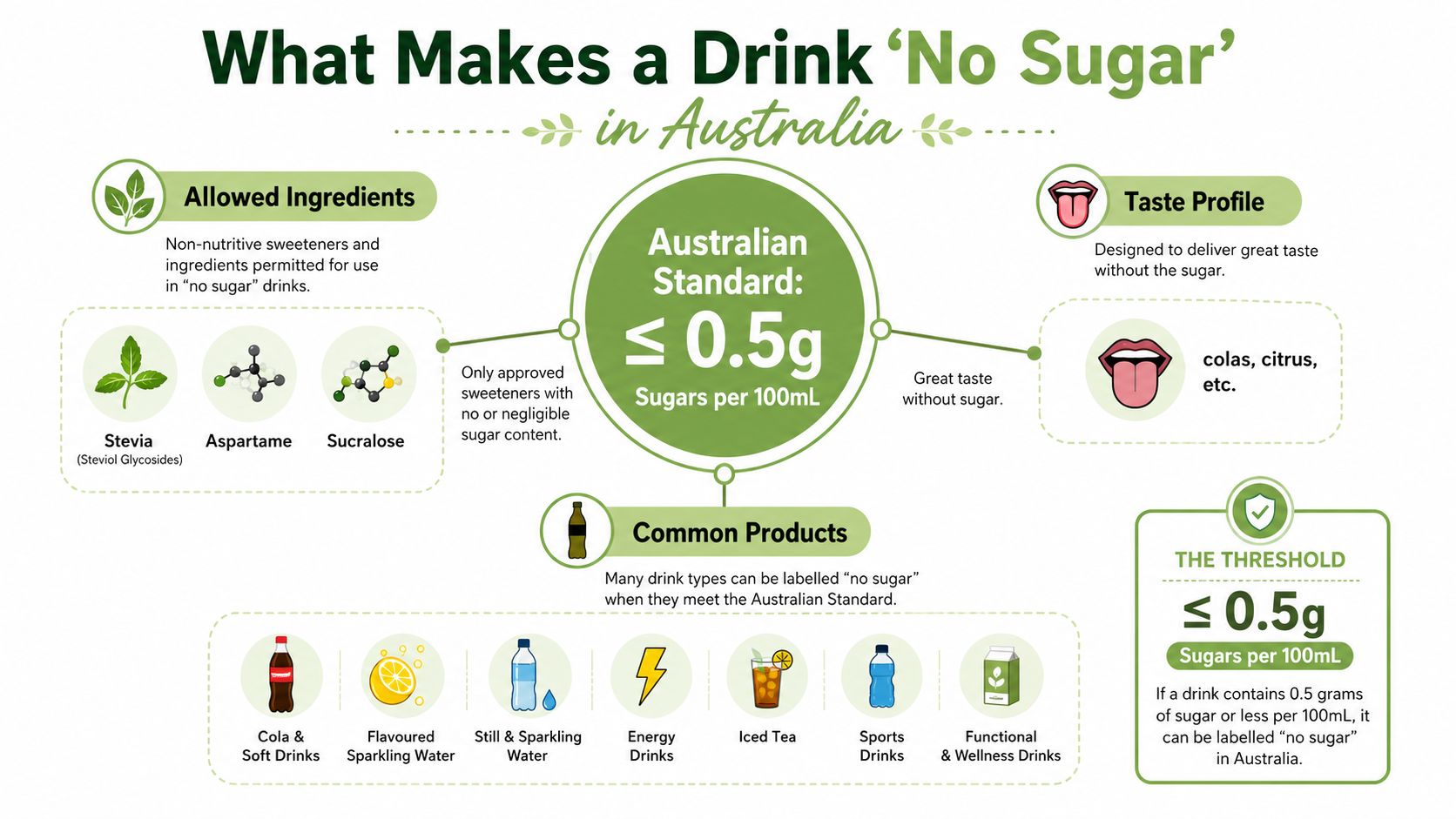
A label can look simple and still hide a lot of formulation work. In Australia, a no sugar soft drink must contain no more than 0.5 g of sugars per 100 mL. That threshold is what turns “no sugar” into a regulated claim, not a loose marketing phrase. Australian label guidance on “no sugar” uses that sugar limit as the benchmark, and the wording on pack needs to match it.
The sweetness comes from a system, not just one ingredient
These drinks usually keep the familiar soft-drink taste by replacing sucrose with high-intensity sweeteners such as aspartame and acesulfame potassium. The drink still needs sweetness, sharpness, body, and finish, so the formula has to do several jobs at once.
That formulation approach is common across the category. A product overview from UNESDA product and ingredients overview describes no- and low-calorie soft drinks as mostly water, often around 98% to 99%, which helps explain why they feel light on the palate even when the flavour is bold. The energy contribution stays effectively negligible because there is very little sugar in the first place.
Acid and sweetener work together
The easiest way to understand a cola-style no-sugar drink is to treat the acid-sweetener system as a matched pair. One part supplies the sparkle and edge, the other supplies the sweetness cue, and together they make up for the missing sugar. That is why a well-made no-sugar cola can still taste round and familiar.
Food acids matter here as much as sweeteners do. They provide the bite, brightness, and stability that sugar would normally help support. Without that balance, a zero-sugar drink can taste thin or flat. With it, the drink can feel cohesive even without the bulk of sugar.
Australian label rules for “no sugar” are also easy to miss if you only glance at the front of pack. An infographic explaining that Australian regulations require drinks to have 0.5g of sugar or less to be labeled no sugar.
A no-sugar label tells you the sugar level, not whether the drink is a good everyday choice for your routine.
The main takeaway is simple. No sugar is a legal and formulation category. It does not automatically mean healthy, nourishing, or better than every other alternative. It means the drink meets a sugar threshold and uses a sweetness system designed to replace the flavour of sugar.
Reading a No Sugar Label Like a Local
A front label can be neat and reassuring, while the ingredient list tells the story. Once you know what each part is doing, a supermarket shelf becomes much easier to read. That matters in Australia, where no sugar can cover anything from a classic cola to a lighter café-style swap.
A real Coke No Sugar label, translated
Australian product labelling for Coke No Sugar lists carbonated water, colour (150d), food acids (338, 331), sweeteners (951, 950), flavour, caffeine (Foodwatch product snapshot). That is a standard no-sugar cola structure, and each ingredient has a clear job.
- Carbonated water: This is the base. It gives the drink its fizz and light body.
- Colour 150d: This is the caramel colouring that gives cola its dark look.
- Food acids 338 and 331: These help with sharpness, balance, and stability.
- Sweeteners 951 and 950: These are aspartame and acesulfame potassium, the main sweetness system.
- Flavour and caffeine: These round out the drink's sensory profile and familiar cola character.
That same sweetener pairing also shows up across other Coke variants in Australia, which is useful when you are comparing cans that look different on the shelf but share a similar formula.
A quick mental checklist for any can
Practical shortcut: if the front says no sugar, check the ingredient list for the sweetener blend, the acid system, and any extras like caffeine.
A fast scan works well in store. Start with the base liquid, usually water or carbonated water, then look for the sweeteners, then check whether acids and flavourings suit the drink style. If caffeine matters to you, it will usually be listed too. For a broader example of how sugar-free carbonation fits into everyday buying, the Pep Tea guide to sugar-free carbonated drinks is a handy reference point.
The aim is not to memorise code numbers forever. It is to stop treating ingredient labels like secret text. Once you know that 951 and 950 are sweeteners and 338 and 331 are part of the acidity system, you can compare drinks in under a minute.
That same habit also helps when you are choosing outside the supermarket. A Low sugar mood trio sampler can make sense on a café shelf beside kombucha, matcha, and other everyday drinks that are not trying to copy cola at all.
Diet Sodas, Sparkling Water, Kombucha, and Tea Compared
Not every drink that skips sugar is trying to do the same job. Some are built for a cola hit, some for clean refreshment, and some for a more functional role in the day. That's where a side-by-side comparison helps.
| Category | Sweetener approach | Functional extras | Best for |
|---|---|---|---|
| Diet soda | High-intensity sweeteners and acids | Familiar cola-style flavour, caffeine in some products | People who want the closest swap for regular soft drink |
| Flavoured sparkling water | Usually no sweetener, or a very light sweetening approach | Minimal additives, light refreshment | Anyone who wants fizz without a heavy flavour load |
| Sugar-free kombucha | Fermentation-based, usually low sugar rather than sweet | Live cultures and organic acids from fermentation | Café menus, food pairing, and people wanting a tangier option |
| Unsweetened tea or matcha | No sweetener needed | Antioxidants, and in matcha, naturally occurring caffeine with L-theanine | Calm focus, morning routines, and less sugary everyday drinking |
Where each option fits
Diet soda wins on nostalgia. It's the most obvious substitute when someone wants the exact cola experience without the sugar load. The trade-off is that it still depends on a tight sweetener-and-acid structure, so it's not the same as a naturally unsweetened drink.
Flavoured sparkling water gives you a cleaner finish. It's the least intrusive option if you just want bubbles and hydration-style refreshment. That makes it a good bridge drink for people who're trying to move away from sweeter cans but don't want to jump straight to tea or kombucha.
Sugar-free kombucha sits in a different lane. It brings fermentation character, a more complex taste, and a better café or meal pairing role than plain soft drink. If you want a practical example of a ready-made option in that space, Low sugar mood trio sampler shows how brands are building mixed packs around function and flavour rather than just sweetness.
Tea and matcha are the quiet achievers. They don't try to imitate soft drink at all. They give you a different kind of drink moment, one that's slower, more deliberate, and often better suited to a workday or café setting.
For Australian shoppers, that's where Pep Tea's sugar-free carbonated drinks sit naturally alongside the rest of the category. The right choice depends on whether you want familiarity, light refreshment, fermented complexity, or a tea-led functional drink.
How Cafés and Retailers Can Stock Sugar Free with Confidence
A café owner in Brisbane or Newcastle doesn't need a wall of identical cans. They need a short menu of drinks that cover different moods, price points, and storage realities. A smart non-alcoholic list works like a ladder, not a single bucket.
A simple stocking mix that actually works
The easiest model is to cover three roles. First, a familiar diet cola for people who want the classic fallback. Second, a premium sparkling water for the clean, neutral option. Third, a brewed, sugar-free functional drink for customers who want something with more character.
That tiering helps because not every customer wants “the healthiest drink”. Some want a familiar taste with no sugar, some want a refreshment drink, and some want something they can sip with lunch. A menu that acknowledges all three sells better than a menu that tries to force everyone into one category.
For venues that also run loyalty or repeat-purchase programs, retail loyalty program inspiration can be useful when you're thinking about how to nudge regular drink buyers back into the fridge or onto the menu again. The point isn't to gamify everything. It's to give people an easy reason to come back for the same drink they already liked.
Storage, serving, and pairing matter
Diet cola cans are easy on fridge space and simple to serve. Sparkling water can go straight into glassware with ice and citrus if the venue wants a cleaner look. Sugar-free kombucha and chilled matcha sit better when staff can explain them briefly, because they're more flavour-led and often sit in the premium part of the menu.
A café menu gets stronger when each drink has a clear job, a clear serve, and a clear reason to exist.
Retailers should think in shelves, not just cartons. Put familiar no-sugar sodas where customers expect them, and keep functional drinks close enough that shoppers notice them without having to hunt. That reduces friction and helps people compare a standard no-sugar option with a more functional one in the same visit.
If you stock kombucha locally, Pep Tea's guide to where to buy organic kombucha in Australia fits naturally beside this thinking. It's especially relevant when you want to position a brewed option as a separate choice from canned soft drinks, not as a replacement for every drink on the shelf.
A Smart Shopper Checklist for the Aisle and the Menu
The front of the can is marketing. The back of the can is where the useful information lives. If you want to make better choices without overthinking it, use the same five checks every time.
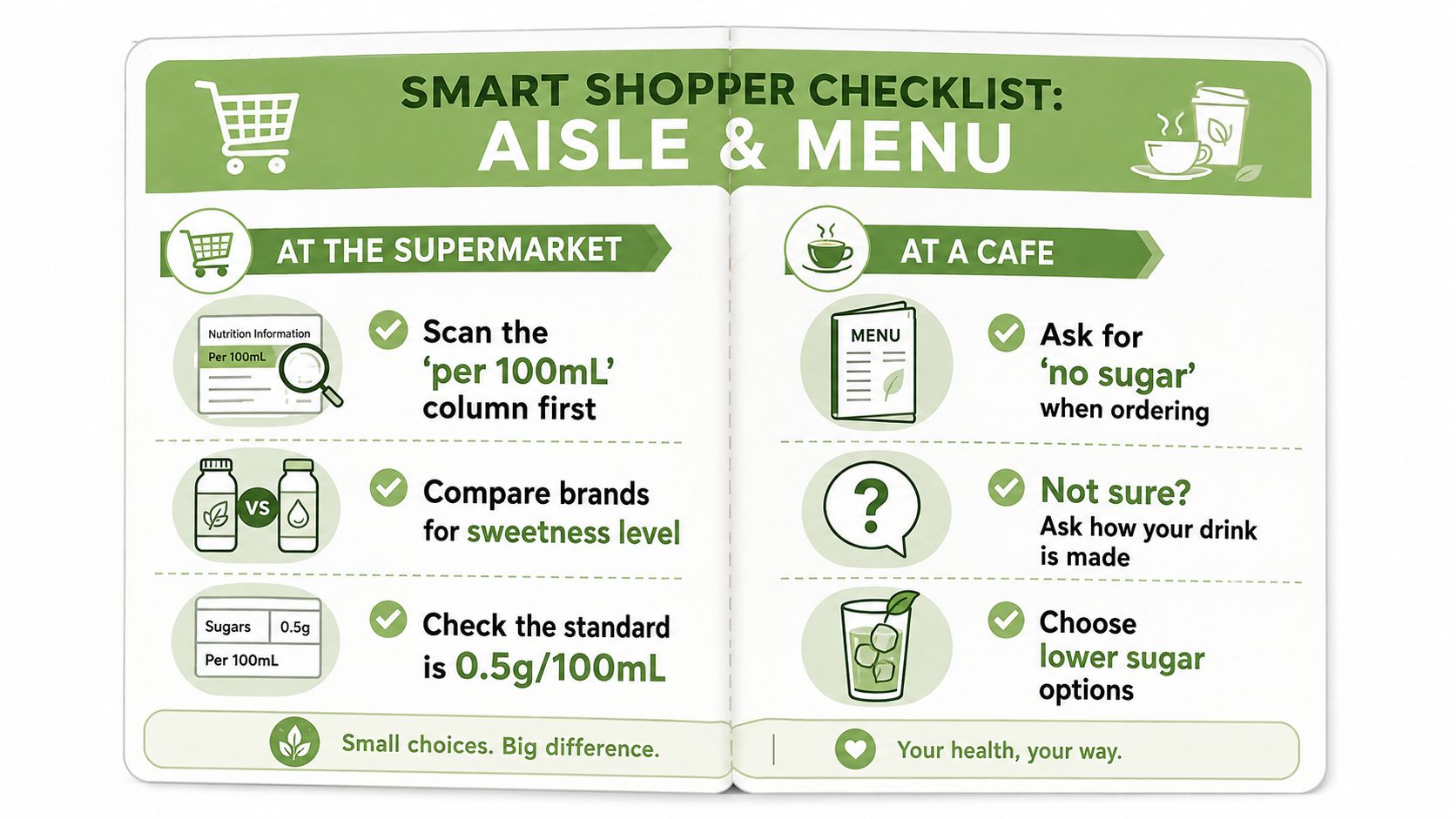
Five checks that actually help
- Scan the per-100 mL figure first. That's where the sugar claim lives, not in the headline wording on the pack.
- Check the sweetener list. If you care about specific ingredients, look for the code numbers and names, not just “no sugar”.
- Look for functional extras. Live cultures, organic acids, antioxidants, caffeine, or tea compounds each point to a different drinking experience.
- Match the drink to the occasion. A desk drink, a post-lunch refreshment, and an evening social serve don't need the same product.
- Ask whether the price matches the role. A premium drink should do a premium job, not just sit there looking healthy.
The substitution pattern matters too. Swapping a sugary soft drink for a no-sugar version is a different choice from swapping water or unsweetened tea for the same bottle. The first move reduces sugar exposure. The second move might just change taste preference, without adding much benefit.
That distinction is why some shoppers feel better with a no-sugar cola for a party but still prefer water or tea during the workday. Both can be sensible. They just serve different purposes.
If you're standing in the aisle with three good options in hand, choose the one that fits the moment. A no-sugar cola can replace a regular cola. Sparkling water can cover the refreshing gap. Sugar-free kombucha can add flavour and café-style variety when you want something more distinctive.
Building Everyday Habits Around Sugar Free Drinks
Habits change faster when the choice feels normal. If you keep the right drinks on hand for the right times of day, you won't need to negotiate with yourself every afternoon. The pattern becomes automatic.
For a work-from-home desk routine, a chilled unsweetened tea or matcha suits the slow-focus part of the day. For a lunch-on-the-go routine, a no-sugar soft drink or a sugar-free kombucha can be the easier grab-and-go choice. For an evening social routine, sparkling water or a lightly flavoured functional drink often fits better than a heavy sweetener hit.
Pep Tea's Australian-brewed sugar-free organic kombucha and Japanese organic matcha both fit that functional middle ground, where the drink is doing more than quenching thirst. They're useful examples of how Australians can shift away from sugary defaults without pretending every drink has to be the same.
The best long-term swap is usually the one you'll keep choosing. That might be a diet soda on some days, kombucha on others, and plain water when that's what you want. A healthier routine usually comes from a few consistent swaps, not from trying to make one drink solve everything.
If you're building a better drink routine, start with the swap that feels easiest and keep going from there. Explore Pep Tea for Australian-brewed sugar-free kombucha and organic matcha, then choose the option that fits your day, your café run, or your shelf at home.
What Is L-Theanine: Your Guide to Calm Focus & Sleep

L-theanine is a natural amino acid found almost exclusively in tea, and it's the reason a good cup can feel calm and alert at the same time. In brewed tea, you'll usually get only 5.8 to 32 mg per 200 mL from 3 g of dried leaves, while clinical studies often use 200 mg or more per day, so the experience in your mug is usually gentler than in a supplement. If you've ever wanted clearer focus without the coffee crash, you're in the right place.
Tea lovers often talk about that smooth, settled feeling after a proper matcha or green tea, and there's real chemistry behind it. L-theanine sits right at the intersection of everyday brewing and modern wellness, which is why it keeps turning up in conversations about concentration, sleep support, and stress-aware routines. If you also like comparing tea nutrients, our guide to the benefits of magnesium and L-theanine is a useful companion read, especially if you're curious about how different calming ingredients fit together in real life. For matcha drinkers, our Uji Matcha Powder page is a handy example of how this tea amino acid shows up in premium tea rather than as a synthetic add-on.
Your Guide to the 'Calm Alertness' Amino Acid
You know that feeling when you want to think clearly, but you don't want the wired edge that coffee can bring. That's the exact gap L-theanine fills for many tea drinkers. It's a tea amino acid, not a stimulant, and it's one of the main reasons tea can feel different from other caffeinated drinks.
In simple terms, what is L-theanine? It's a naturally occurring compound in Camellia sinensis, the tea plant, and it's part of what gives high-quality tea its smooth, rounded character. A 2024 review notes that white, green, oolong, and black teas typically contain 0.9% to 3.1% of leaf dry weight, with brewed tea from 3 g of dried leaves providing about 5.8 to 32 mg per 200 mL. The same review also notes that L-theanine can make up up to 50% of total amino acids in tea leaves, which helps explain why the tea leaf itself matters so much. PubMed review on tea composition and L-theanine
Why tea feels different from a supplement
Tea gives you a food-first experience. The theanine arrives alongside other tea compounds, so the cup feels like part of a ritual, not just a dose. That matters for people who want a calmer kind of focus without turning every wellness choice into a pill routine.
Practical rule: if you're after the tea experience, start with the cup, not the capsule.
That's also why this ingredient shows up so often in matcha conversations. Matcha uses the whole leaf, so the theanine conversation becomes much more relevant than it is with many ordinary tea bags. It's a good fit for people who want their morning drink to support a smoother mental rhythm.
A broader look at tea and wellness can also be useful when you're comparing calming ingredients, and the organic matcha brewing approach makes more sense once you understand that theanine is part of the leaf itself, not an added flavour trick. The more you understand the leaf, the more sense your cup makes.
How L-Theanine Actually Works in Your Brain
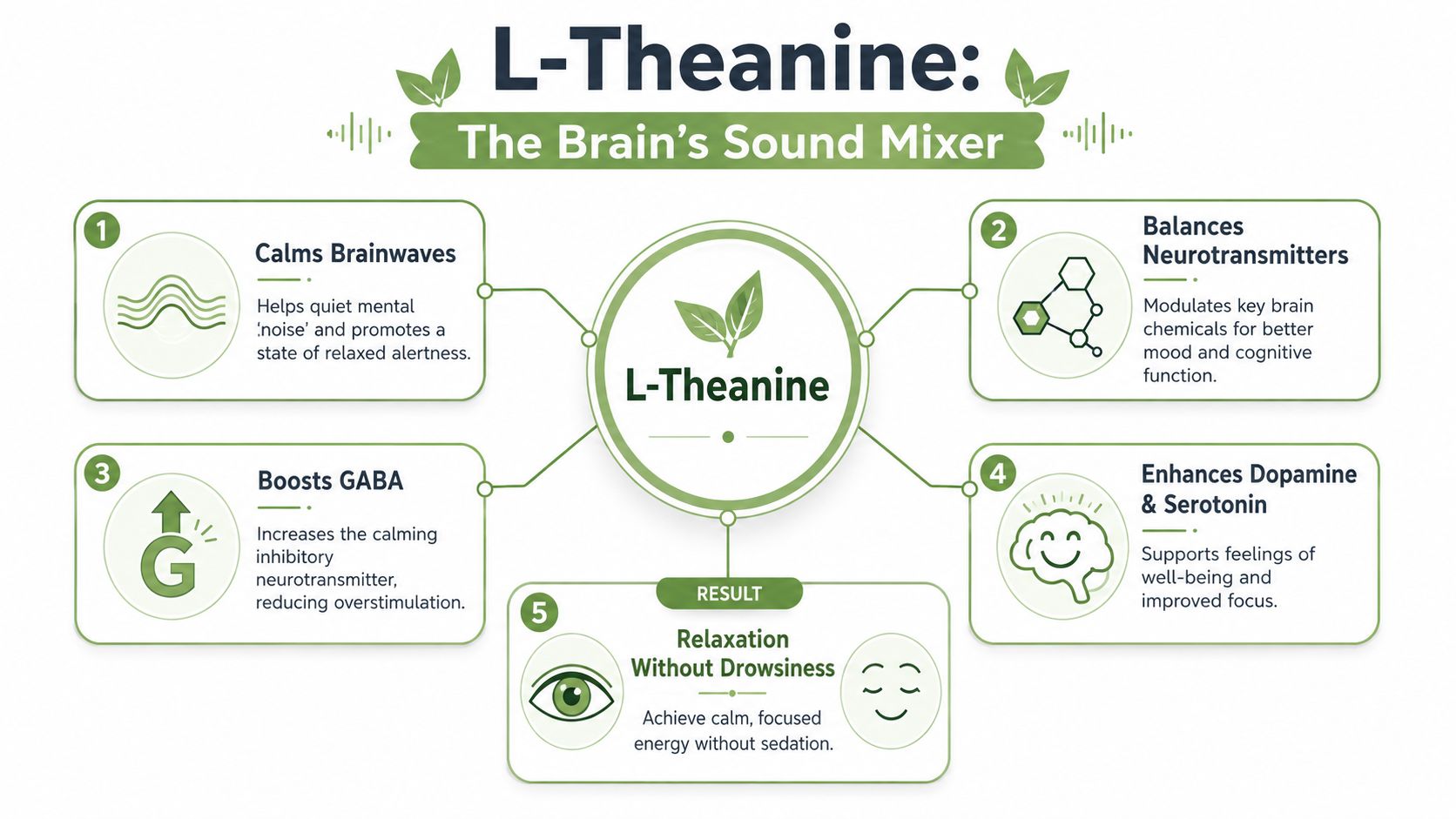
Think of L-theanine like a volume dial for mental noise. It doesn't switch your brain off, and it doesn't force sleepiness. Instead, it seems to help your mind settle into a state that feels more organised, less cluttered, and easier to work with.
A calmer signal, not a blanker mind
The often-used shorthand is that L-theanine supports alpha brain wave activity, which is the pattern many people associate with relaxed alertness. That's why tea can feel mentally bright without feeling harsh. In plain language, it helps take the edge off mental overdrive so your attention has a better chance of sticking.
It also interacts with key neurotransmitter systems that shape mood and alertness, including GABA, serotonin, and dopamine. You don't need a neuroscience degree to use that information well. Just remember that this compound isn't trying to sedate you, it's trying to make your brain feel less overclocked.
Simple takeaway: L-theanine doesn't erase thoughts, it lowers the background static.
That's why many people describe tea as the drink they reach for when they need to write, read, or think through a tricky problem without feeling scattered. If overthinking tends to hijack your day, a good companion resource is coping with overthinking and anxiety, because the mental state people want from tea is often the same one they're trying to rebuild elsewhere.
For readers who like a more structured look at functional ingredients, the idea of natural focus enhancers fits well with tea. The internal logic is simple, a tea amino acid helps shift the feel of the drink from merely caffeinated to more balanced. That's a big reason matcha keeps a loyal following among people who want sharpness with a softer landing.
The Evidence-Backed Benefits of L-Theanine

L-theanine gets attention for three reasons that matter in daily life, relaxation, focus, and sleep support. Research summaries consistently describe it that way, and they also note that it may promote relaxation without sedation and may enhance attention when paired with caffeine. That pairing matters because tea, especially matcha, naturally gives you both ingredients in one cup. WebMD overview of theanine uses and risks
Relaxation without feeling knocked out
This is the part most tea drinkers notice first. L-theanine is associated with a calmer internal pace, but not the heavy feeling you'd expect from something sedating. That makes it easier to use during the day, at work, or before a busy afternoon.
Focus that feels smoother
Caffeine can sharpen attention, but it can also make some people feel jumpy. Tea changes that equation because L-theanine is naturally part of the mix. The result many people describe is cleaner focus with fewer rough edges, especially in matcha-based drinks where the whole leaf is involved.
Sleep support that starts earlier in the day
L-theanine isn't a sleeping pill. What it may do is reduce the mental churn that keeps people awake when they're tired but overstimulated. A 2025 systematic review of sleep trials found 13 eligible studies involving 550 participants, used 50 to 900 mg/day, and reported sleep benefits in 9 of the 13 trials, with the strongest effects at 200 mg/day or higher. The same review says studies using up to 250 mg daily reported mostly minimal adverse effects. 2025 systematic review of sleep trials
For people who get stuck replaying the day at night, that distinction matters. You're not chasing unconsciousness, you're trying to quiet the mental static enough for sleep to arrive naturally. If that sounds familiar, a broader read on organic green tea caffeine can help you compare how tea energy differs from coffee energy in practice.
Finding L-Theanine in Your Daily Brew
If you want L-theanine in a form your body already recognises, tea is the obvious place to look. It appears in all Camellia sinensis teas, but the amount shifts with leaf type, growing method, and preparation. That's why two cups of tea can feel noticeably different even when they're both “green tea”.
Why matcha often stands out
A peer-reviewed review reports that among Japanese teas, gyokuro and matcha contain more L-theanine than sencha, and it identifies L-theanine as a bioactive compound in tea that may influence brain function under stress. That makes matcha especially relevant for people who want a richer, smoother tea experience with a stronger functional profile than standard brewed tea often delivers. Review on Japanese tea composition
The reason is easy to grasp. Matcha is made from the whole leaf, so you're not just drinking flavour, you're consuming the leaf material itself. That gives it a different relationship with both taste and function than a light tea infusion.
What this means in a real cup
A 250 mL cup of green tea provides only about 8 to 30 mg of L-theanine, while many clinical studies use 200 mg or more per day in supplement form. That comparison shows why a standard brew feels subtle, and why matcha tends to feel more substantial. News-Medical summary of green tea L-theanine amounts
Useful rule of thumb: tea is usually a gentle source of theanine, while supplement research often works at much higher levels.
For Australian tea drinkers, that's the practical takeaway. If your goal is a daily calming ritual, a well-made matcha or green tea can be enough. If your goal is to mirror clinical research, the cup and the capsule are not the same thing, and it helps to understand that before you set expectations.
Safe Dosages and What to Expect
A lot of confusion around L-theanine comes from people comparing a cup of tea with a supplement study and expecting the same result. That's not how it works. A daily brew usually gives you a modest amount, while clinical research often uses higher, more concentrated doses.
Tea amounts versus study amounts
A brewed cup gives you a small-to-moderate exposure, not a strong pharmacological hit. The tea-based range above, roughly 5.8 to 32 mg per 200 mL, is very different from the 200 mg/day or higher used in many trials. That gap is why tea feels like a steady ritual and supplements feel more direct.
Safety data in the reviewed sleep literature is also reassuring. The 2025 systematic review found sleep benefits in trials using 50 to 900 mg/day, and studies using up to 250 mg daily reported mostly minimal adverse effects. 2025 sleep review
What to expect from tea, not capsules
If you're drinking matcha or green tea, the likely experience is a gentle shift rather than a dramatic one. You may feel more settled, less frazzled, and better able to keep your attention on one thing. That's a realistic goal for a beverage.
Practical rule: judge tea by consistency and feel, not by chasing a supplement-style effect from one cup.
Mainstream consumer health guidance also treats the long-term picture cautiously, noting that the ingredient isn't a primary treatment and that short-term tolerability is better established than long-term safety. That's a sensible way to think about it, because tea is part of an everyday pattern, not a cure-all. For people who want to reduce uncertainty in the evening, pairing tea knowledge with a broader routine around lighting, screens, and wind-down habits often makes more difference than chasing a bigger dose.
Bringing L-Theanine into Your Routine with Pep Tea

A good L-theanine routine starts with the kind of drink you'll enjoy every day. For a quiet morning, whisking a bowl of matcha gives you a more complete tea experience than a rushed, bitter brew. For a smoother afternoon, the same ingredient can work beautifully in a latte or a blended drink.
Easy ways to use it at home
A simple matcha latte works well when you want calm energy without a heavy feel. Whisk 1 to 2 teaspoons of matcha with a small splash of warm water until smooth, then add steamed milk or a plant-based alternative. If you like a lighter result, keep the sweetness low and let the tea flavour stay front and centre.
Culinary-grade matcha also fits into smoothies, yoghurt bowls, and baking. That's useful if you want the tea flavour without making another hot drink. The point is to make the ingredient part of a habit, not a project.
What cafés can do with it
Cafés can build simple menu ideas around the same logic. A signature Zen Latte or a low-sugar iced matcha drink gives customers a clear, functional option without leaning on hype. Sugar-free kombucha also works well as a non-alcoholic base when a venue wants something refreshing, adult, and lighter than soft drink.
If you're comparing product formats, here's the simplest way to think about them.
- Ceremonial matcha: best for a clean, traditional cup with the most refined flavour.
- Culinary matcha: better for lattes, smoothies, and kitchen use.
- Sugar-free kombucha: a useful café option when customers want a fermented drink with a crisp finish.
That mix gives both home drinkers and cafés a practical way to use tea in real routines, not just in wellness marketing.
When to Speak with a Health Professional
L-theanine from tea can be a lovely part of a daily routine, but it isn't a replacement for treatment. If anxiety, insomnia, or low mood are persistent, a doctor or registered dietitian is the right place to start. That matters even more if you're already taking medication, are pregnant or breastfeeding, or have an ongoing health condition.
A tea habit can support wellbeing, but it shouldn't be used to mask symptoms that deserve proper care. If you're thinking about a supplement rather than tea, it's smart to ask a professional about dose, timing, and possible interactions first. A simple conversation can save a lot of guesswork.
Pep Tea offers premium organic matcha and sugar-free kombucha for Australians who want clean, functional drinks with real care behind them. If this guide has helped you understand what L-theanine is, visit Pep Tea to explore matcha options that fit a calmer, more focused daily ritual.
Blue Matcha Powder Benefits: What the Evidence Actually Says
Blue matcha powder benefits get talked about as if blue matcha were just another version of green matcha. It isn't. In Australia, the blue drink in cafés is usually butterfly pea flower powder, and that distinction changes how you should read every wellness claim that follows.
That matters because blue matcha's appeal is mostly colour, caffeine-free use, and novelty, while the better-established evidence sits with true matcha and green tea compounds. Australian tea drinkers are seeing more niche, wellness-led drinks because tea is still a major everyday category, with the Australian Bureau of Statistics reporting Australians consumed around 36,000 tonnes of tea in 2023–24. But if you're asking what blue matcha powder benefits are real, the honest answer starts with knowing what's in the cup.
What Blue Matcha Is and Why It Matters
Searching for blue matcha powder benefits often starts with the assumption that it's a type of matcha. The cleaner way to read it is simpler. Blue matcha is usually butterfly pea flower powder, not powdered tea leaves, and it comes from a different plant family altogether. True matcha is ground green tea, which means the ingredients, the compounds, and the likely effects are not the same.
The ingredient behind the blue colour
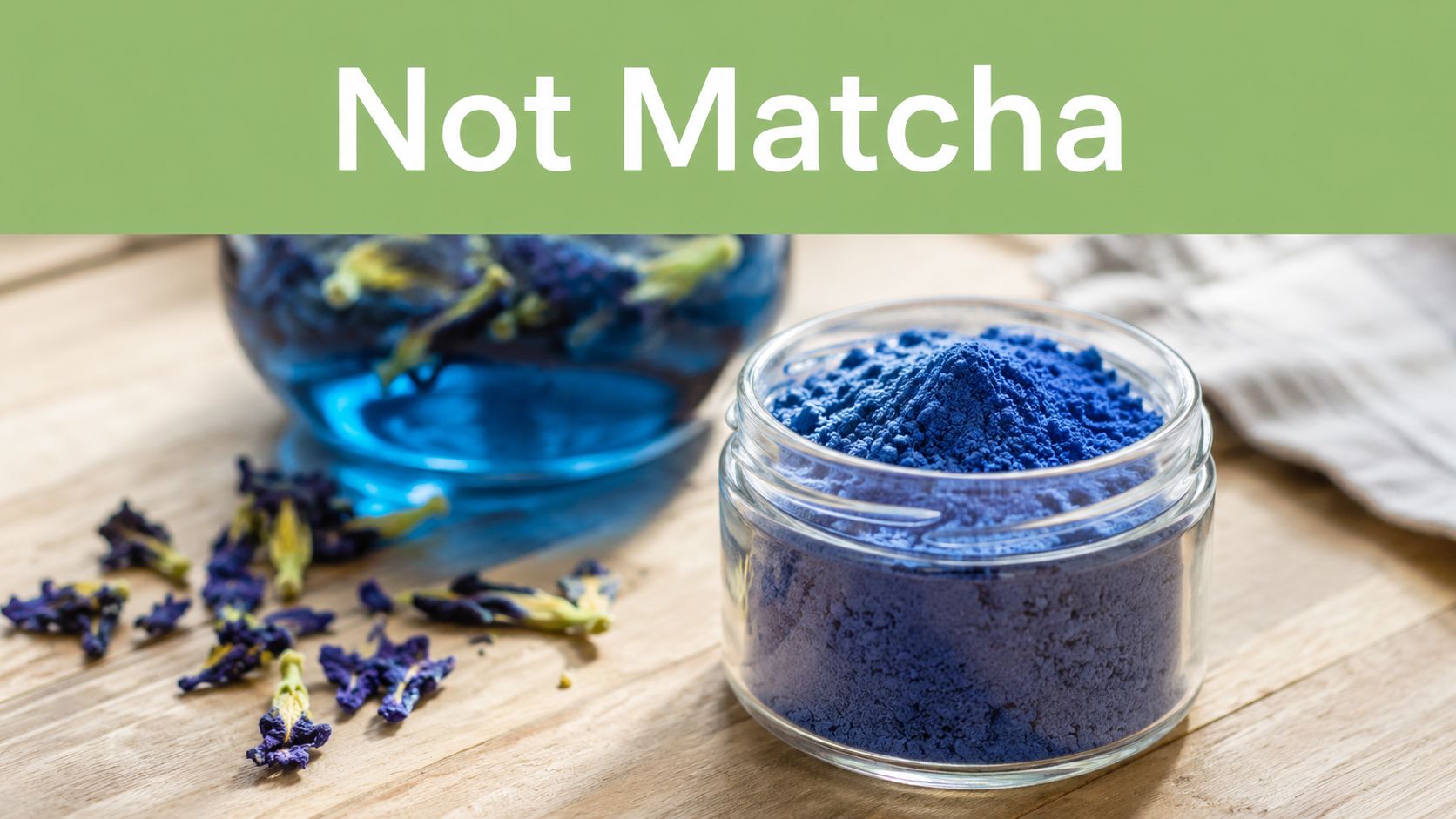
Butterfly pea flower powder is used because it makes drinks a vivid blue, then shifts towards purple when acidic ingredients like lemon or lime are added. That colour change is a big part of its appeal in Australian cafés, especially in iced drinks and lattes. It also explains why blue matcha has travelled through social media much faster than it has through nutrition research.
The plant is best treated as a beverage ingredient, not a proven wellness product. If you want the basic matcha definition first, see what matcha powder is. Independent Australian commentary notes there is “not much research on the benefits of blue matcha” and says butterfly pea is mainly valued for its colour and novelty, even though it does contain antioxidants (Marie Claire Australia). That is a very different starting point from green matcha, where the evidence base is much deeper.
Practical rule: if a blue drink is sold as “matcha”, check the label. If it is butterfly pea flower, you are looking at a colour-forward herbal ingredient, not classic matcha.
Why the distinction changes the benefit claim
Blue matcha is naturally caffeine-free, so it plays a different role in a routine than true matcha. Green matcha contains caffeine and L-theanine, which is why it is used for alertness and focus. A Cleveland Clinic review describes blue matcha as butterfly pea flower and notes that cardiometabolic claims are still largely based on preclinical data rather than proven human outcomes (Cleveland Clinic).
That does not make blue matcha useless. It just means the honest benefits are narrower than the marketing often suggests. It works as a visually distinctive, caffeine-free drink base, with a long list of popular claims and a comparatively short list of human trials.
Blue Matcha vs Green Matcha
A lot of people asking about blue matcha powder benefits are really choosing between a colourful evening drink and a traditional matcha ritual. The two can look similar on a café menu, but they do different jobs in the cup and in the body.
Side by side in plain language
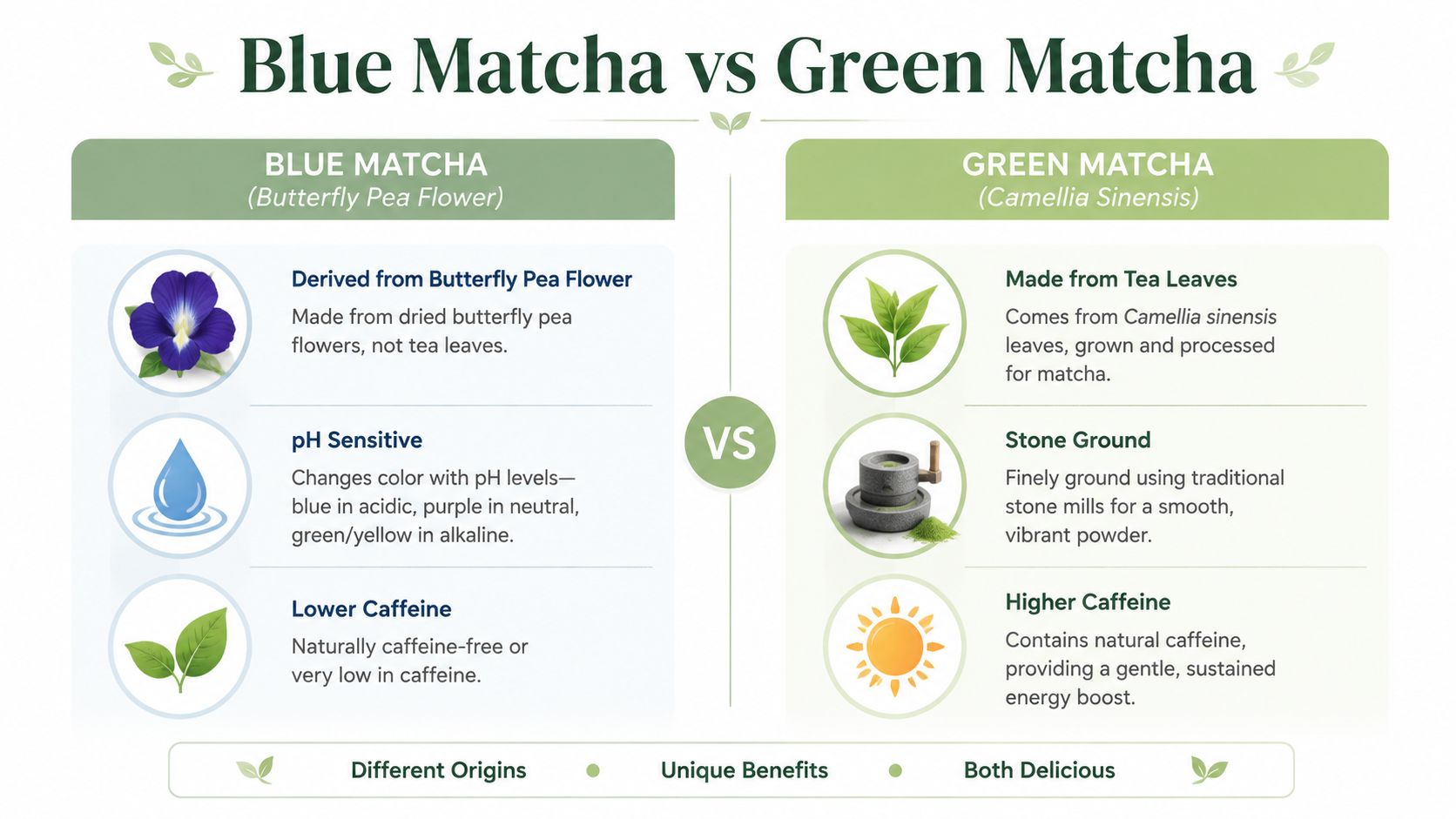
Blue matcha, meaning butterfly pea flower powder, is caffeine-free and built around anthocyanins, the pigments that create its blue colour. Green matcha comes from tea leaves and is built around catechins and L-theanine, which is why it has a much stronger reputation for focus and sustained energy. Everyday Health also makes the basic botanical distinction clear, blue matcha is not true matcha, and the main antioxidant families differ (Everyday Health).
For Australian drinkers, the choice is practical rather than trendy. Blue matcha suits an evening cup or any routine where you want to avoid stimulants. Green matcha fits a morning cup far better if you want alertness and a steadier energy lift.
Blue Matcha vs Green Matcha at a Glance
| Criterion | Blue Matcha (Butterfly Pea) | Green Matcha |
|---|---|---|
| Plant source | Butterfly pea flower | Tea leaves |
| Caffeine | Caffeine-free | Contains caffeine |
| Main antioxidant family | Anthocyanins | Catechins and polyphenols |
| Colour behaviour | Turns purple with acid | Stays green |
| Best use case | Evening drinks, visual lattes, caffeine-free routines | Morning rituals, focus, traditional matcha use |
Blue matcha and green matcha sit in different parts of a tea routine. Blue matcha is the colour-forward, caffeine-free option. Green matcha is the tea preparation people reach for when they want the more established matcha experience, with all the familiar ritual around whisking, flavour, and function.
Australia's broader tea culture helps explain why both appear on café menus. There is room for wellness-led drinks and for traditional tea preparations, but that does not make the products interchangeable. For readers comparing functional beverage options, Pep Tea's guide to the difference between matcha, green tea and green tea helps anchor that distinction in the tea category.
The Benefits and Where the Evidence Stops
Blue matcha powder benefits are real in a few narrow ways, but the evidence stops sooner than most product pages admit. The sensible way to read the claims is by evidence tier, not by hype. That keeps you from treating a colourful herbal powder like a clinically tested functional tea.
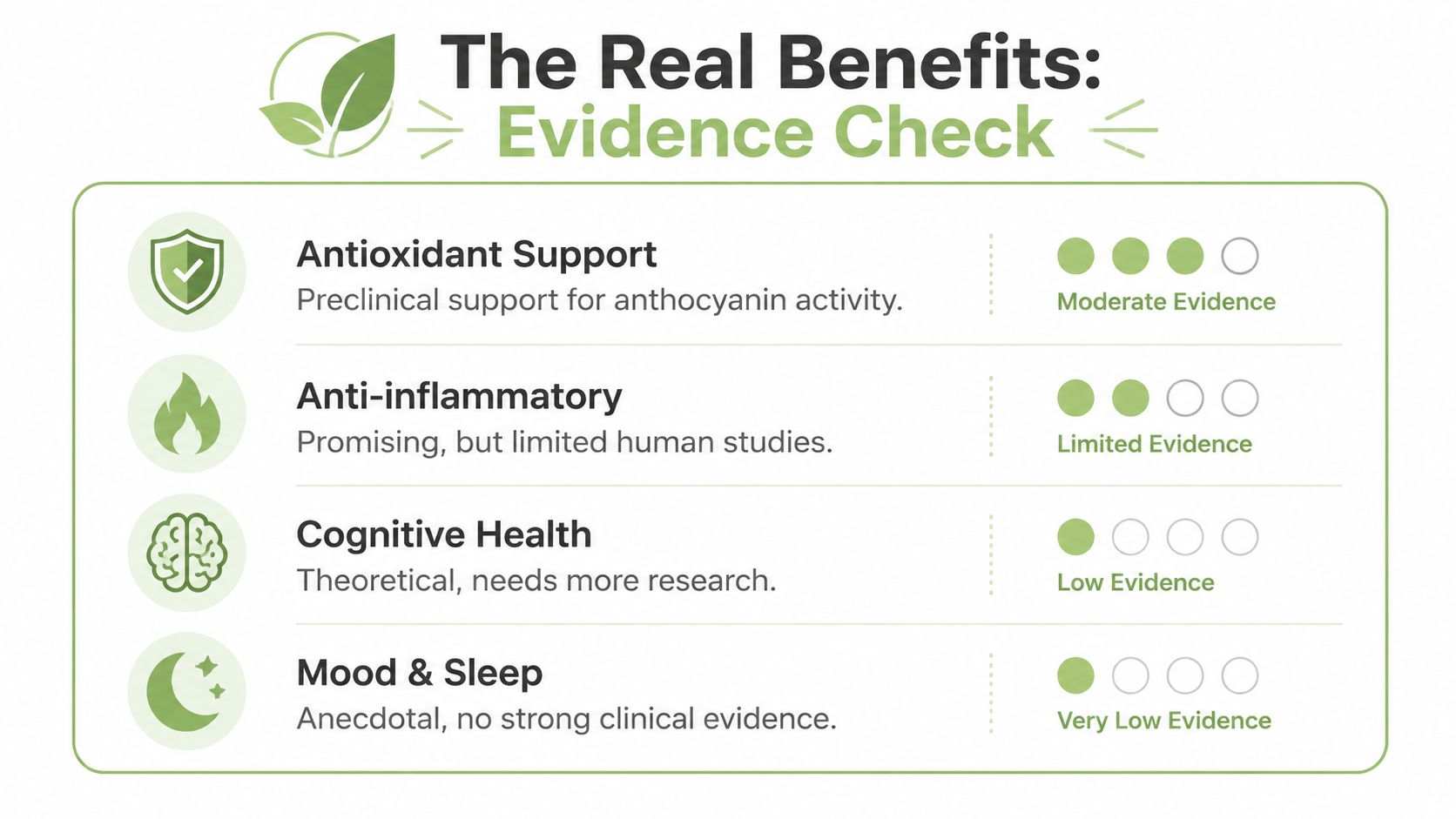
What looks promising
Butterfly pea flower's most credible angle is its anthocyanin content, which gives it antioxidant activity. That is why people often connect it with anti-inflammatory or cell-protective benefits. The evidence around blue matcha still sits well below the research base for true matcha, so the usual claims need a careful read rather than a glossy one.
Anthocyanins are the same broad class of plant compounds that make some berries and flowers vividly coloured. In a tea cup, they explain the blue shade, and they also explain why the product is discussed in the same breath as antioxidant support. For a broader tea-side view of that topic, Pep Tea's guide to antioxidant tea benefits helps place butterfly pea in context without confusing it with matcha leaf chemistry.
What stays unproven in humans
Most claims around blue matcha for memory, stress, sleep, skin, hair, digestion, and metabolism are still weakly supported or mostly extrapolated from laboratory or animal work. A consumer health review notes that many benefits are marketed beyond the human evidence base, and that the product is not well studied in clinical settings (Nutrition to Fit). Another mainstream summary also warns against overstating benefits because the human data are limited (Gut Love).
By contrast, true matcha has a much stronger research footing. Harvard Health reports that a meta-analysis in the European Journal of Nutrition found green-tea catechins can help lower blood pressure and LDL cholesterol, while L-theanine is associated with improved concentration and alertness (Harvard Health). A 2023 critical review in Nutrients found randomized clinical trials showing matcha decreases stress and slightly enhances attention and memory, while broader cardiovascular or anticancer claims still need more evidence (Nutrients, 2023).
Bottom line: blue matcha may offer antioxidant activity and a pleasant caffeine-free ritual, but the stronger human evidence belongs to true matcha.
A simple evidence rating
- Antioxidant support. Plausible, mostly based on anthocyanin content and lab-level findings.
- Anti-inflammatory claims. Promising, but human proof is limited.
- Cognitive effects. Mostly theoretical for blue matcha, stronger for green matcha.
- Mood and sleep. Often claimed, but not firmly established clinically for butterfly pea flower.
- Heart and metabolic benefits. Early-stage only for blue matcha, with better human support for green matcha.
A quick rule helps here. If a claim depends on cell studies, animal studies, or general antioxidant theory, treat it as a lead rather than a conclusion. If a claim has human trial support, it can sit higher on the evidence ladder, though it still may not tell you much about everyday use in a home kitchen.
How to Use Blue Matcha at Home
Blue matcha works best when you treat it like a delicate powder, not a hard-working coffee substitute. A gentle starting point is half a teaspoon per cup, then adjust to taste if you want a deeper colour or stronger flavour. Use hot water, but don't let it boil, because very high heat can dull the colour and the plant compounds you're trying to preserve.
A simple method that actually works
Whisk the powder into a small splash of hot water first, then top up with milk or cold water depending on the drink you want. If you add citrus, expect the colour to shift from blue to purple. That's not a fault, it's the anthocyanins reacting to acid.
Practical rule: if you want the brightest blue, keep the drink away from lemon and lime until you're ready for the colour change.
Three easy ways to use it
- Blue matcha latte. Whisk half a teaspoon into hot water, then add warm oat milk or dairy milk. A little honey or vanilla can soften the earthy note.
- Iced butterfly pea lemonade. Mix the powder with cold water first, then add lemon juice at the end for the purple shift. It's a simple café-style summer drink.
- Blue matcha smoothie. Blend butterfly pea powder with banana, mango, coconut water, and ice. The fruit keeps the flavour friendly and the colour stays striking.
If you're making drinks for guests, the colour shift can be part of the experience. In an Australian kitchen, it's an easy way to make a non-alcoholic drink look special without needing syrups or food colouring.
Keep the flavour profile in mind. Butterfly pea flower is usually mild, so it pairs better with milk, fruit, or citrus than with strong bitter ingredients.
For anyone trying blue matcha for the first time, that's the appeal. It's easy to build into a latte, a cold drink, or a mocktail-style serve without much technique.
Sourcing, Quality and Storage Checklist
Blue matcha powder benefits depend partly on what's in the bag. A clean, well-sourced powder gives you butterfly pea flower's colour and plant compounds. A poor-quality one can be dull, gritty, or mixed with fillers that add little beyond bulk.
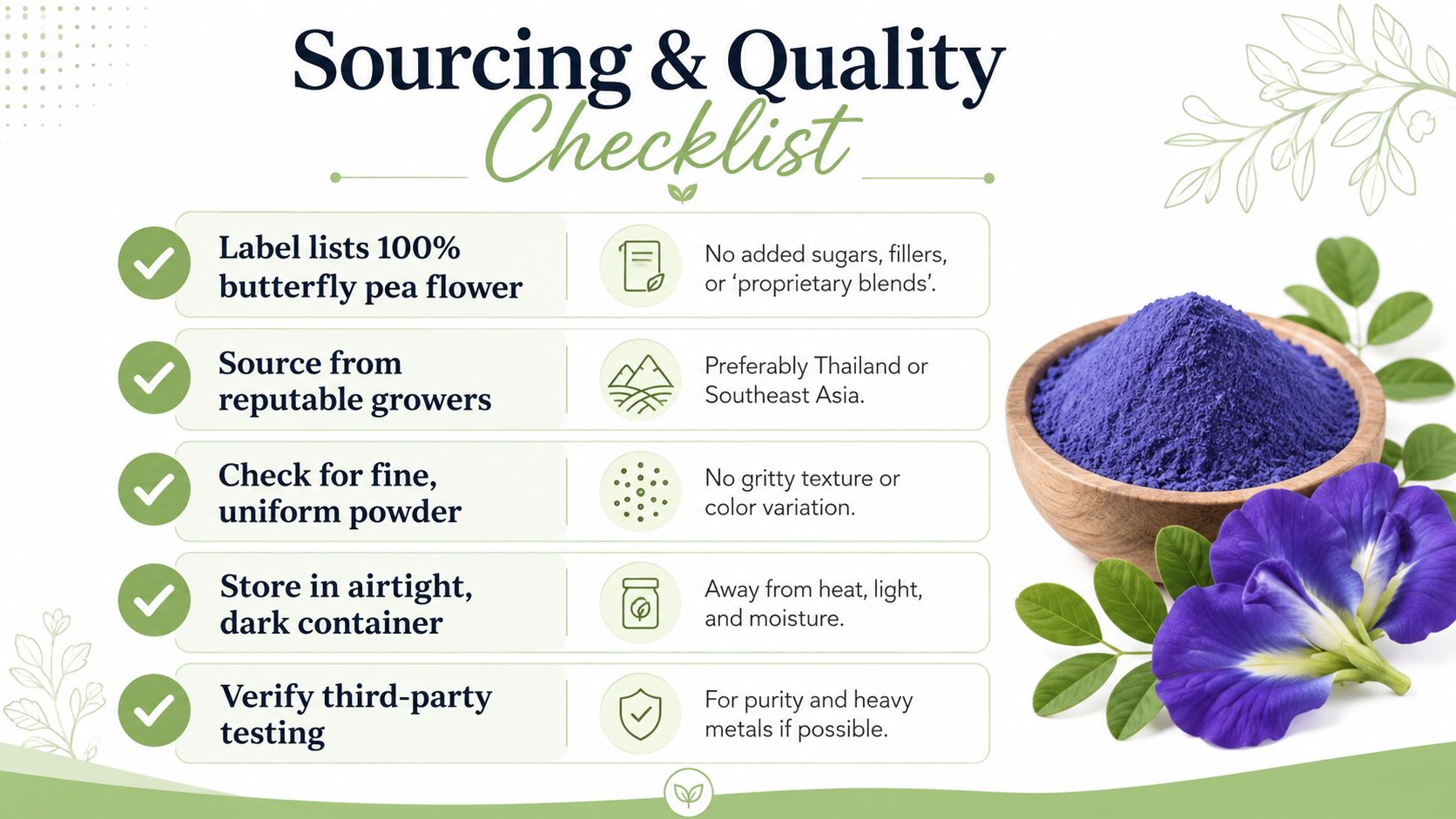
What to look for on the label
The first check is simple. The ingredient list should say 100% butterfly pea flower, or Clitoria ternatea, with no added sugars, fillers, or mystery blends. A fine, uniform powder usually mixes more evenly in drinks than a coarse or speckled one.
Packaging matters too. Look for a container that protects the powder from light and moisture, because both can dull the colour. Organic certification is worth considering where available, but the main priority is clear sourcing and a clean ingredient list.
How to spot a weak product
Cheap products can lean on food colouring, starch, or vague branding instead of actual flower powder. If the colour looks unusually flat, grey-green, or artificially bright, that's a warning sign. The same goes for a gritty mouthfeel after mixing, which often points to poor milling or fillers.
- Check the ingredient panel: it should name butterfly pea flower directly.
- Assess the texture: fine and even is better than dusty clumps or grit.
- Read the packaging: sealed, dark, and moisture-resistant is the goal.
- Look for sourcing details: reputable growers are more transparent about origin.
- Ask about testing: third-party testing for purity is a good sign if it's available.
How to store it once opened
Keep the powder in an airtight container, away from heat, light, and moisture. A pantry cupboard is usually better than a windowsill or a humid shelf above the kettle. If the powder starts to lose colour quickly, storage has probably been too loose.
For cafés and home kitchens alike, this is the practical question. If the powder has lost freshness before it reaches the cup, the benefits people imagine from the drink are already compromised.
Safety, Dosage and Who Should Be Cautious
There isn't an established clinical dose for butterfly pea flower, so it makes sense to stay conservative. A sensible household range is half to one teaspoon per serving, and keeping it to one to two cups per day is a cautious routine for most adults. That's a practical kitchen guide, not a medical prescription.
Who should be careful
Pregnant and breastfeeding people should be cautious because safety data are insufficient. People with iron concerns may also want to think twice about timing, since anthocyanin-rich foods can bind dietary iron. Anyone taking anticoagulant or blood pressure medication should check with a healthcare professional before making blue matcha a daily habit.
Allergic reactions are uncommon, but they can happen. If a drink causes itching, swelling, digestive upset, or any unusual response, stop using it. That's especially important if you're trying a new powder from an unfamiliar brand.
If you're sensitive to stimulants, blue matcha can make an easy evening drink, but keep it clearly separate from caffeinated matcha. Mixing the two without thinking can undo the reason you switched in the first place.
A cautious way to introduce it
Start with a small serve and use it on a day when you're not adding other new supplements or drinks. That makes it easier to spot whether the powder suits you. If you use it in a latte, remember that the milk or acidity in the recipe can change how it behaves, even if the powder itself is fine.
Blue matcha isn't a problem drink, but it's also not a product to treat casually just because it looks gentle. The evidence is still limited, so the safest approach is modest use, clean sourcing, and realistic expectations.
Smart Ways to Fit Blue Matcha Into Your Routine
Blue matcha makes most sense as a caffeine-free evening ritual, a visual café-style drink, or a way to add variety to a tea routine. It's not the drink I'd reach for if the goal is proven focus or alertness. For that, true matcha has the stronger evidence and the clearer role.
Use it for the right job
If you want a night-time latte that won't interfere with sleep, blue matcha fits well. If you want something for a mocktail, a brunch menu, or a summer iced drink, the colour shift is part of the value. If you want evidence-backed support for calm focus, a high-quality organic ceremonial matcha is the more defensible choice.
That's why many Australian households do better with both rather than one pretending to be the other. Blue matcha can be the playful, caffeine-free option. Green matcha can stay in the role of the morning staple.
A simple decision check
- Choose blue matcha if you want colour, novelty, and no caffeine.
- Choose green matcha if you want the better-researched tea with caffeine and L-theanine.
- Choose both if you want a morning and evening routine that does different jobs.
Pep Tea's range includes organic matcha and Australian-brewed sugar-free kombucha, which suits readers who want the evidence-backed tea side of the routine alongside other low-sugar drinks. Blue matcha still has a place, but it works best as a complement, not a substitute.
If you've been wondering whether blue matcha powder benefits are worth chasing, the honest answer is yes, but only in the right frame. It's a colourful, caffeine-free ingredient with some plausible antioxidant value, not a clinical equivalent of matcha. Use it for the ritual you enjoy, and keep your expectations tied to the evidence, not the café trend.
If you want tea that's backed by real matcha research, explore Pep Tea's organic matcha and sugar-free kombucha ranges at Pep Tea. We focus on clean, carefully sourced drinks that fit everyday routines, whether you're after calm focus in the morning or a lower-sugar option later in the day.
Fermenting Glass Jar Guide for Australian Home Brewers

A fermenting jar looks simple until it doesn't. One morning the brine is clear, the lid's bulging, and the top layer has gone cloudy or furry, which is usually the moment people realise the jar itself is the problem, not just the recipe.
In Australian kitchens, that problem shows up faster than it does in cooler climates. Summer heat, seasonal swings, and the wide mix of jars sold locally all change how a ferment behaves, especially when the vessel isn't matched to the food inside it. A fermenting glass jar works brilliantly when the seal, headspace, lid, and temperature all line up, but it gets unforgiving the moment one of those pieces is off.
Why Glass Jars Are the Foundation of Reliable Fermentation
The best ferments usually start with the least dramatic vessel on the bench, a plain glass jar. Glass doesn't react with the acids produced during fermentation, it's easy to clean, and it lets you see what's happening without opening the lid every few hours. That visibility matters, because the jar isn't just storage, it's the working environment where the ferment either stays calm or drifts into trouble. The chemical stability of soda-lime glass is one reason it's still the default choice for home fermentation, especially for acidic foods and drinks (why glass jars matter in fermentation).
From sealed glass to the modern home jar
The modern jar owes a lot to the practical logic of preservation. Nicolas Appert had already shown by the early 1800s that food sealed in glass and heated could keep for years, and John Landis Mason's 1858 patent for a threaded, screw-top glass jar made reusable sealed vessels practical for home use (brief history of the canning jar). Mason filed that patent on November 30, 1858, at age 26, and the design became the basis for the jars people still reach for in kitchens and small-batch ferments today.
Practical rule: if the vessel can't hold a stable seal, the ferment becomes guesswork.
That historical shift matters in Australian homes because the same jar format became the standard for preserving, then later for home fermentation culture. The jar's value comes from the airtight seal, not from glass alone, because the seal is what keeps contamination down while still allowing a controlled ferment to happen.
Why glass beats the usual alternatives
Wood and ceramic have their place in older fermentation traditions, but glass is easier to inspect and less likely to carry flavour from batch to batch. In a real kitchen, that means fewer surprises when you're tracking sourness, surface activity, or sediment. For kombucha and vegetable ferments, the jar does two jobs at once, it acts as a chamber and as a container you can move straight into the fridge when the flavour is right.
Glass also fits the way Australian home fermenters work. Home fermenters want something reusable, visible, and simple to sanitise after a batch of kraut, pickles, or kombucha. A quality fermenting glass jar gives you that without asking you to fight the vessel every time you pack, weigh, or taste.
Choosing the Right Jar and Lid for Your Ferment Type
A jar that works for kimchi can be awkward for kombucha, and a narrow bottle that suits a drink ferment can be miserable for cabbage. The shape has to suit the job, because the food needs to fit the workflow as well as the shelf. For solid vegetables, a wide-mouth jar is the practical choice because you need room to pack the food down with your hands or with a weight, and narrow-neck jars make that harder and less reliable.
Match the opening to the food
For sauerkraut, kimchi, and whole-vegetable pickles, wide-mouth jars are the right tool because the vegetables need to sit under the brine and stay there. A narrow neck makes it harder to push the food down, spread pressure evenly, or lift out a stubborn leaf floating at the top. That is why wide-mouth jars are the cleaner option for chunky vegetables, especially when you are using a weight.
Liquid-heavy ferments are different. Kombucha and water kefir do not need the same packing pressure, so the jar shape can be more forgiving, although the lid still needs to suit the stage of fermentation. For carbonated ferments, ordinary lids can be the wrong choice because pressure builds, and ordinary glass jars were not made to behave like pressure vessels. If you are buying locally, the safer question is not whether it is glass, but whether it is pressure-rated for that ferment.
Headspace, seals, and what actually works
The National Center for Home Food Preservation says active fermentation can build pressure, so jars should be filled only to the recommended headspace and should use suitable covers and weights rather than a permanently sealed lid, with the ferment kept submerged under the brine to reduce spoilage risk (suitable containers, covers, and weights for fermenting food). For vegetable ferments, that means leaving room at the top, not packing a jar so full that it spills as soon as gas activity starts.
Kilner's guidance gives home users a practical benchmark for jar choice and fill level, and its temperature advice lines up with what holds up in warmer Australian kitchens, where overflow is a common failure point. Their fermentation notes also reinforce the basics of full submersion under salt brine and moving the batch to refrigeration once the flavour is where you want it (Kilner fermentation guide).
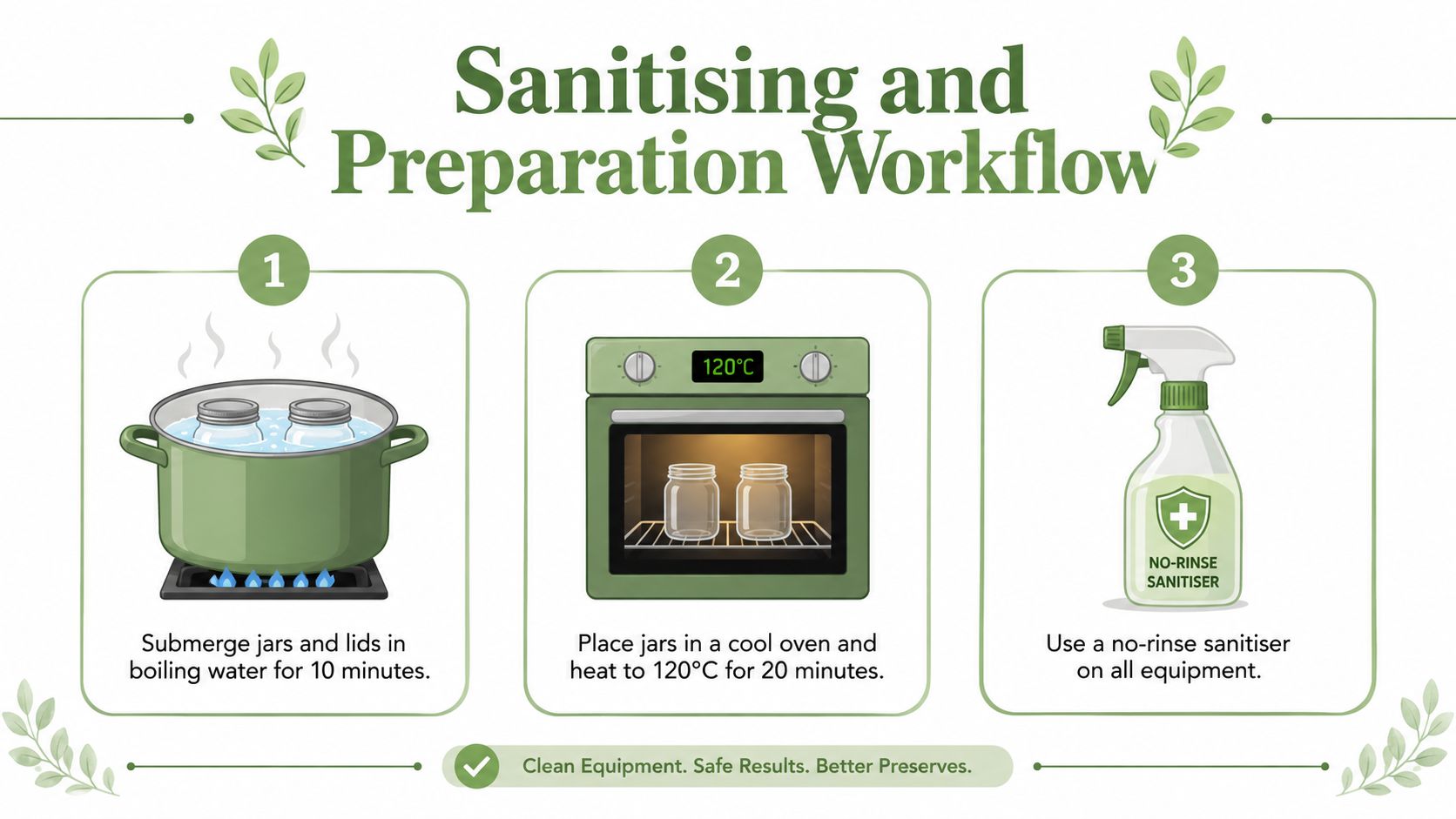
If you are choosing between jars sold locally, the best test is simple, does the lid support controlled venting, or is it going to trap gas? For a brewing container that needs consistency, PepTea's kombucha brewing container is a useful reference point for matching the vessel to the drink instead of just grabbing whatever is on the pantry shelf. If you want a practical refresher on prep as well, the guide to how to sanitize home brewing gear is worth keeping nearby.
Sanitising and Preparation Workflow
Clean gear doesn't make a ferment good on its own, but dirty gear can ruin a good one very quickly. The basics are boring for a reason, because the batches that go wrong usually fail before the ingredients even hit the jar. Soap residue, skipped sanitising, and loose seals are all avoidable problems, and they're the sort of mistakes that can turn a promising batch into a mouldy one.
A repeatable prep routine
The safest workflow is straightforward. Start with jars, lids, weights, and any tools touching the ferment, then sterilise or sanitise them properly before use. Boiling, oven heat, or a no-rinse sanitiser all work as preparation methods when they're used carefully and consistently, and the key is to keep every surface that will touch the ferment clean and non-reactive.
A practical way to think about prep is to treat the jar like food-contact equipment, not like a decorative container. If a lid has grit in the thread or a weight has detergent film on it, you're adding risk for no benefit. That's especially true with starter cultures and SCOBYs, where you want the culture doing the work, not stray residue or bacteria from the bench.
Practical rule: complete submersion under brine is your best insurance against surface spoilage.
For a clear sanitation walkthrough, the advice in how to sanitize home brewing gear is a useful companion read because it approaches hygiene as a brewing discipline, not a one-off chore. The same logic applies whether you're starting sauerkraut or building a jar for kombucha.
What not to skip
The workspace matters too. Wipe the bench, dry the tools, and check that the lid or cover fits the jar you're using before the ingredients go in. If you're handling a SCOBY, keep the transfer calm and clean, because fussing around with dirty hands or wet implements is one of the quickest ways to introduce unwanted microbes.
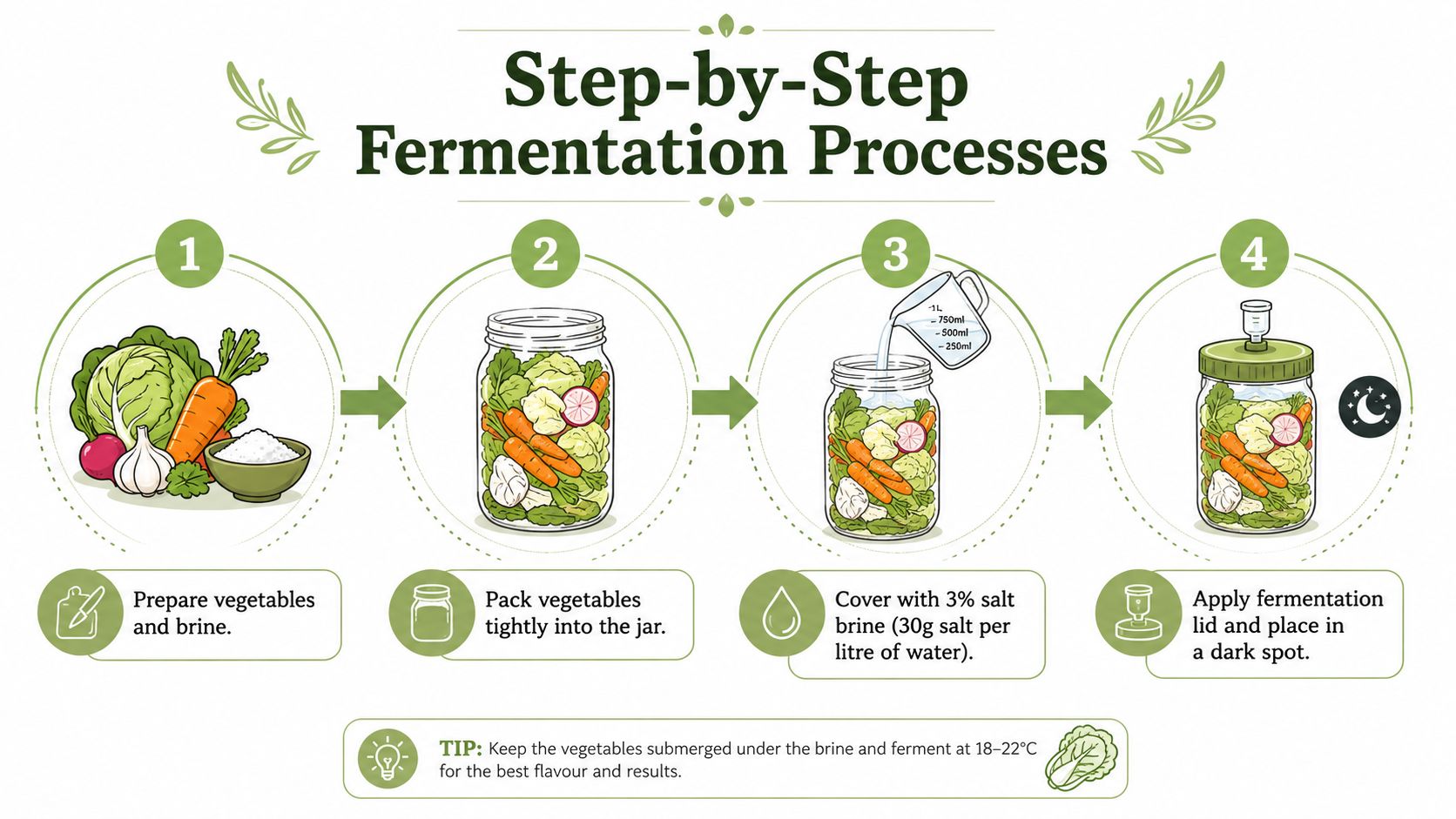
A simple prep check before every batch keeps the process repeatable:
- Inspect the jar: Look for chips, cracks, or damaged threads before filling.
- Prepare the lid: Make sure the seal is clean and seated properly.
- Sanitise the tools: Weights, funnels, spoons, and hands all count.
- Set the workspace: Clear clutter so the jar can be packed without rushing.
Step-by-Step Fermentation Processes for Common Ferments
A good ferment is usually the result of a few small controls, not magic. Salt, temperature, headspace, and submersion do most of the heavy lifting, and they need to be handled differently depending on whether you're making vegetables, kombucha, or water kefir. In Australian kitchens, the biggest variable is often heat, which makes the early stages move faster and less predictably than many people expect.
Vegetables need brine discipline
For vegetable ferments, the most reliable method is a ~3% brine, which is about 2 tablespoons salt per 4 cups water (how to ferment). Pack the vegetables into a clean jar, pour the brine over them, and use a weight or similar device to keep everything below the liquid line. If the food floats, the top layer is the one most likely to spoil.
Daily jar checks matter because active ferments can build gas quickly, and some jars need burping more than once a day to vent pressure safely. The usual timing runs from a few days to several weeks depending on cut size and recipe, so the cue is flavour and texture rather than the calendar alone. In practice, chopped vegetables move faster than big pieces, and warmer rooms accelerate the process.
Useful habit: check the jar at 48 hours, then again before you assume the ferment is stable.
Kombucha and water kefir need a gentler touch
Kombucha belongs in a vessel that gives the culture space while still keeping the environment controlled. The liquid needs room for activity, the cover needs to breathe appropriately during primary fermentation, and the jar shouldn't be pushed into a cramped spot where temperature swings are constant. Water kefir is similar in that it's a liquid ferment, but the grains and the water chemistry introduce a different rhythm, so it responds best when the jar is kept consistent and not overhandled.
For a practical compare-and-contrast on a related kitchen ingredient, the difference between sake and mirin is a handy reminder that similar-looking liquids can serve very different roles. Fermentation works the same way, the vessel and the process have to match the job.
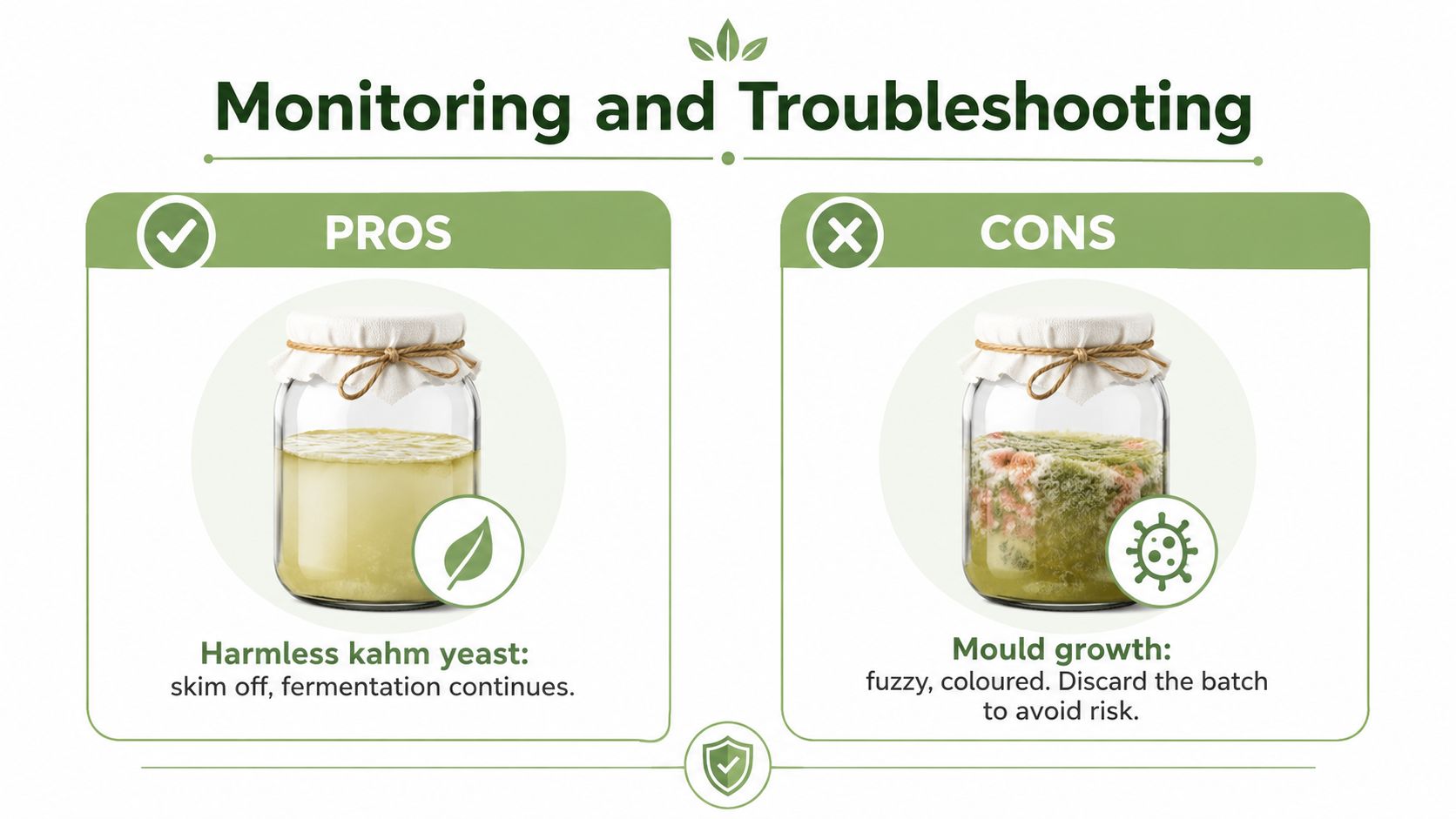
A practical judgement rule
A ferment is ready to chill when the sourness tastes right and the texture has settled into what you want. If it's still too sharp, too bland, or too soft, leave it a little longer and keep the jar under control. If the batch has drifted into off smells or visible contamination, stop trying to rescue it.
Monitoring and Troubleshooting Common Problems
You usually spot trouble in the jar before you taste it. Surface changes, odd pressure, and a smell that does not suit the ferment are the early warnings. In a Hunter Valley kitchen, where a warm afternoon can turn a calm batch lively by evening, that early check saves a lot of food.
Kahm yeast, mould, and pressure
Kahm yeast usually shows up as a thin surface film. Mould looks fuzzy and may carry colour, and that difference matters because mould means the batch should go. A light film can sometimes be skimmed, but fuzzy growth is a different category. If there is any coloured fuzz, do not try to rescue it.
Pressure needs just as much respect. Sealed jars can crack or even explode when carbon dioxide builds up, especially with fizzy ferments, which is why ordinary lids are not the right choice for every batch (fermentation bottles buyer's guide). In Australian kitchens, heat speeds everything up, so overflow and pressure can arrive sooner than you expect if the jar sits on a sunny bench or near the stove.
Temperature drift and what to change
If a jar is running too hot, move it somewhere cooler. A shaded pantry, a laundry shelf, or a room that stays steady through the day usually behaves better than a bright kitchen counter. Fermentation that is allowed to swing with the weather often turns uneven, especially in summer.
Glass jars do best when the room stays in a sensible range for the culture, and you can see the difference in how quickly the surface moves and how fast the flavour shifts. If you want a clear read on what is happening inside the jar, a digital pH meter is handy because it takes some of the guesswork out of judging whether the ferment is moving in the right direction. It does not replace taste or smell, but it gives you a cleaner check on whether the batch is progressing or stalling.
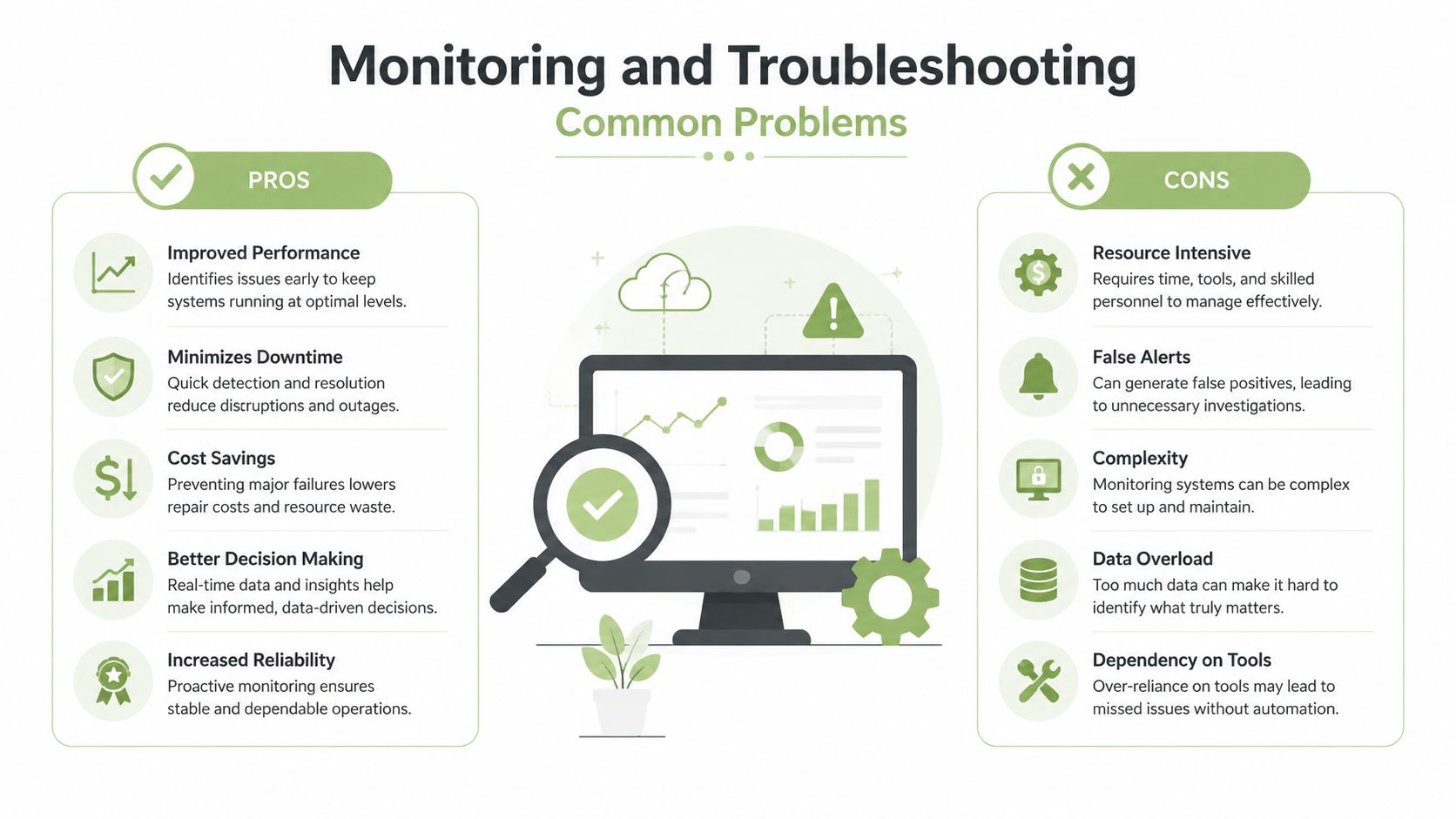
For a deeper read on surface contamination, preventing mold on glass is worth a look because the same basics keep showing up, clean surfaces, dry contact points, and enough airflow control to stop problem growth from taking hold. In a fermenting jar, those basics matter even more because the contents are active and changing all the time.
Troubleshooting rule: if the smell, surface, and texture all point the wrong way, stop testing the batch. Discard it and start again with a clean jar.
Storage, Scaling, and Safety Best Practices
Once a ferment tastes right, the job shifts from active control to smart storage. Refrigeration slows the process, which protects flavour and keeps a finished batch from racing past the point you wanted. That's true whether you've made one jar for the fridge or you're keeping multiple jars moving at once for a café or household routine.
From single jar to repeatable batch work
The simplest scaling move is consistency. Use the same jar style, the same headspace, the same brine strength, and the same cooling habit each time, and you'll spot drifts much faster. If you're storing starter cultures or a SCOBY between batches, keep the container clean, protected, and easy to inspect so you're not guessing at the next round.
For practical storage guidance, PepTea's how to store kombucha is a sensible reference because storage is where many good ferments lose quality. The same principle applies to vegetables, once the jar has hit the flavour you want, chilling is what keeps it there.
Safety decisions that protect the batch and the person
Pressure-safe vessel choice matters most when the ferment is meant to be carbonated or fizzy. If you're using a jar that wasn't designed for pressure, pair it with a safe venting method or switch to a vessel that is. Airlocks can help with high-gas ferments, but they don't replace the need for the right jar and the right headspace.
HACCP-accredited production and purpose-built brewing spaces matter once you scale beyond home testing, because consistency becomes a safety issue as much as a flavour issue. If a jar looks compromised, smells wrong, or shows coloured fuzzy growth, the safest choice is to throw it out. That's not wasteful, it's disciplined.
PepTea brings that same practical care to organic Matcha and sugar-free kombucha, with products made for people who want clean flavour and a more confident routine in the kitchen or café. If you're refining your own fermentation setup, visit Pep Tea to explore the range and see how quality ingredients and good process go hand in hand.
7 Healthy Breakfast Beverages to Start Your Day
What's the first thing you drink in the morning, and does it help you start the day well? For many Australians, it's coffee or plain water, but healthy breakfast beverages can do more than wake you up. They can support hydration, sit neatly alongside breakfast, and make it easier to choose foods that leave you feeling steady rather than flat an hour later. Breakfast also tends to contribute a meaningful share of daily energy intake, and beverages often play a noticeable role in that morning routine. If you want a smarter first sip, the best choices are usually simple, low in sugar, and easy to match with food.
This guide goes beyond generic suggestions and looks at specific drink types, because each one does a different job. Matcha can provide calm focus, kombucha can add fermented tang, smoothies can help with fullness, and other options offer hydration or probiotic variety without making breakfast feel heavy. For a practical Australian example, you can find premium matcha with Allied Drinks Systems, and Pep Tea's matcha and caffeine guide is useful if you want to compare it with your usual morning cup. The goal is simple. Choose a drink that fits your routine, tastes good, and supports the way you want to feel through the morning.
1. Organic Matcha Green Tea for Calm, Focused Energy
Matcha is a strong breakfast choice when you want energy without making your morning feel chaotic. It's a finely ground green tea powder, so you consume the whole leaf, not just an infusion. That's part of why premium matcha is so appealing for Australians who want a clean, functional start to the day.
A useful way to think about matcha is as a coffee alternative with a calmer edge. A peer-reviewed review of beverage guidance says caffeine intake should stay below 400 mg per day, and coffee or tea can fit well when you count any added milk or sugar (PMC review). For people who feel jittery after a long black, matcha is often easier to build into breakfast because it's usually taken with milk or water and doesn't need syrup to taste good.
How Aussies can use it in real life
Try it as a simple matcha latte, iced in summer or warm on cooler mornings. Pep Tea's guide on matcha and caffeine helps explain how it compares with a regular latte, which is handy if you're trying to manage your morning routine more deliberately (Pep Tea matcha caffeine guide).
Practical rule: if your breakfast drink needs three sugars to feel enjoyable, it's probably not doing your morning any favours.
For a quality option, Pep Tea's organic Japanese ceremonial-grade and culinary-grade matcha fits the kind of low-sugar, wellness-led breakfast habit many Australians are looking for. If you want a premium supplier outside the cafe cup, you can also find premium matcha with Allied Drinks Systems.
2. Sugar-Free Kombucha for Gut Health

Kombucha suits breakfast when you want something crisp, lightly tangy, and not too sweet. Its fermented tea base gives it a more purposeful feel than a soft drink or juice, which is part of why it has found a place in the broader move toward drinks with clear functional benefits. Market research on gut-health beverages points to steady consumer interest in probiotics and fermentation, and that helps explain why kombucha keeps showing up in morning routines (GMI gut health beverages market).
That interest is not just about flavour. People often choose kombucha because they want a drink that feels lighter than a sugary breakfast beverage and still offers a bit of complexity. The fizz gives it the same kind of wake-up effect you get from sparkling water, but the tea base and fermentation make it feel more layered.
Why sugar-free matters
Sugar control is the part that matters most here. A randomised trial in overweight and obese adults found glucose area-under-the-curve was higher for sugar-sweetened coffee than for water, reduced-energy orange juice, or low-fat milk, and the authors concluded that the lower-sugar options may be better for glucose control (PubMed trial). Kombucha is not a treatment, but the message is clear, the morning drink you choose can shape how much sugar you start the day with.
That is why a sugar-free organic kombucha can fit so neatly into a lower-sugar breakfast habit. Pep Tea's version, brewed in the Hunter Valley, NSW, gives you the tang and fizz without turning breakfast into a sugar hit. For a broader look at fermented drink options and how they fit into a healthy routine, Pep Tea's healthy probiotic drinks guide is a useful place to start.
If you like pairing breakfast drinks with a simple recipe idea, AloeCure's refreshing smoothie guide shows how a fresh, fruit-led drink can stay light while still feeling satisfying.
3. Protein-Rich Smoothies for Satiety

Some mornings need more than a drink. They need a drinkable breakfast that keeps you going until lunch. That's where a protein-rich smoothie earns its place, especially if you're heading to work, school drop-off, or the gym and don't have time for a full sit-down meal.
The key is balance. Australian breakfast guidance emphasises protein, fibre, and healthy fats, and advises pairing drinks with foods like yogurt, nuts, eggs, or whole grains rather than relying on juice or sweetened beverages alone (Alberta Health Services breakfast guide). A smoothie can fit that pattern if you build it around Greek yogurt, milk, soy milk, nut butter, chia seeds, or oats.
A simple make-at-home formula
- Start with protein: Use Greek yogurt, milk, soy milk, or a protein powder you already trust.
- Add fibre: Choose berries, oats, chia seeds, or spinach.
- Include healthy fat: Avocado, nut butter, or seeds help slow digestion.
- Keep sweetness in check: Use fruit for flavour before reaching for honey or syrups.
A good example is a berry smoothie with yogurt, chia, and milk, which feels more like breakfast than a sugary drink. If you want ideas for texture and flavour, AloeCure's smoothie guide shows how a smoothie can be turned into a satisfying morning option.
4. Nutrient-Dense Green Juice for a Vitamin Boost

Green juice has a clear place in the breakfast lineup, but it helps to be honest about what it is and what it isn't. It's a light, hydrating, vegetable-forward drink, not a full breakfast replacement. That makes it a sensible choice for people who want something fresh first thing in the morning, especially if they're planning to eat proper food soon after.
Because it's strained, green juice doesn't give you the same fullness as a smoothie. That matters in the Australian context, where balanced breakfast guidance keeps coming back to whole foods, protein, and fibre rather than liquids alone (BDA healthy breakfast guidance). If you drink green juice on its own, think of it as a supplement to breakfast, not breakfast itself.
Green juice works best when it complements a real meal. If you're still hungry an hour later, that's not a failure of the juice, it's a sign you needed more substance.
A practical version might include cucumber, spinach, celery, lemon, and a little green apple for taste. That gives you a bright morning drink without leaning too hard on sweetness. If you're in a cafe or grocery setting, it's also a good menu item for people who want something lighter than a smoothie but more interesting than plain water.
For Australian buyers, the most useful green juices are the ones with a short ingredient list and no added sugar. Keep it crisp, keep it clean, and pair it with breakfast, not instead of it.
5. Cultured Kefir for Probiotic Diversity
Kefir is one of those breakfast beverages that feels old-school in the best way. It's tangy, cultured, and easy to fit into ordinary routines, which makes it a practical choice for people who want a fermented dairy option with more character than plain milk. If you already eat muesli, oats, or fruit in the morning, kefir can sit alongside them without asking you to change your whole routine.
It also fits the growing interest in foods that do more than just taste nice. Fermented dairy drinks are often chosen for their live cultures and their place in a functional breakfast, and kefir suits that pattern without needing much fuss. That makes it a good option for people who want a drink with a job to do, not just something cold in a glass.
Easy ways to drink it
- Straight from the bottle: A small glass on its own is the simplest option.
- Blended into smoothies: Kefir adds tang and creaminess without much effort.
- Over muesli or oats: It turns breakfast into something richer and more filling.
If you want to make your own cultured drinks, Pep Tea's kefir grains Australia page is a useful place to start. For many households, that can turn kefir from an occasional fridge buy into a regular morning habit.
6. Hot Water with Lemon and Ginger for Gentle Hydration
Need a breakfast drink that feels light, warm, and easy to sip? Hot water with lemon and ginger keeps things simple. It is caffeine-free, gentle on the morning routine, and useful when you wake up feeling flat, have a sensitive stomach, or just want something mild before food.
The appeal is plain, it starts the day with fluid first. That matters because a glass of warm water can be easier to manage than a strong drink first thing, especially if your stomach likes a softer start. For readers comparing dairy free options for Queensland food, this kind of mug also fits neatly into a broader morning routine without adding milk, sugar, or extra richness.
A very simple morning mug
Use hot water, a squeeze of lemon, and a few slices of fresh ginger. Let it sit for a few minutes so the ginger can infuse, then sip it slowly while breakfast is cooking or after your first shower.
The flavour should stay light, not sharp. If you want a little more ginger warmth, add another thin slice next time rather than overloading the mug at the start. That way the drink stays easy to drink and keeps its calm, clearing feeling.
This isn't a meal replacement, and it should not be treated like one. It works more like a gentle bridge between sleep and breakfast, especially for mornings that begin badly with strong coffee on an empty stomach. A few days a week is enough to see whether this simpler habit suits you.
7. Golden Milk for a Cosy, Caffeine-Free Start
Golden milk works well when you want something warm, mild, and comforting without reaching for caffeine. It is usually made with milk and turmeric, then rounded out with ginger, cinnamon, or both. For Australian mornings, it suits a slower start, especially on cooler days when a café-style drink feels nicer than a plain glass of water.
Its appeal is partly about habit. Many people want a morning cup that feels soothing, but not sugary, and golden milk fills that role neatly. A homemade version made with unsweetened milk keeps the drink in breakfast territory rather than dessert territory, and the Harvard Nutrition Source notes the value of limiting added sugar, cream, and whole milk if weight management is a goal (Harvard Nutrition Source).
Build it cleanly
Use dairy milk or a plant milk, then stir in turmeric, a pinch of cinnamon, and a little ginger. If you want to match the needs of different households, there are plenty of dairy free options for Queensland food that work well here too. Some people add black pepper for flavour, but the point is to make a warm mug that feels balanced before the day gets busy.
Golden milk also works like a bridge between waking up and eating breakfast. It can take the edge off a rushed morning, but it should still sit alongside real food rather than replace it. Oats, toast, eggs, or fruit make a better match than treating the drink as a full meal by itself.
7-Point Comparison of Healthy Breakfast Beverages
| Beverage | Implementation Complexity 🔄 | Resource Requirements ⚡ | Expected Outcomes 📊 / ⭐ | Ideal Use Cases 💡 | Key Advantages ⭐ |
|---|---|---|---|---|---|
| Organic Matcha Green Tea for Calm, Focused Energy | 🔄🔄 Moderate, sift & whisk (ceremonial prep) | ⚡⚡ Low, matcha, hot water, whisk | Sustained calm alertness; antioxidant support, ⭐⭐⭐⭐ | Morning focus, coffee alternative, productive work sessions | L-theanine + caffeine balance; high antioxidants |
| Sugar-Free Kombucha for Gut Health | 🔄 Low, ready-to-drink or simple home brew | ⚡⚡ Low–Medium, bottled or SCOBY for brewing | Supports gut microbiome and digestion, ⭐⭐⭐ | Gut-support routine, refreshing low-sugar alternative | Live probiotics and organic acids; low sugar |
| Protein-Rich Smoothies for Satiety | 🔄🔄 Low, blend ingredients | ⚡⚡ Medium, blender, protein powder, perishables | High satiety; balanced macros and nutrients, ⭐⭐⭐⭐ | Breakfast replacement, post-workout, on-the-go meal | Keeps you full; customizable macronutrients |
| Nutrient-Dense Green Juice for a Vitamin Boost | 🔄🔄 Low–Medium, juicer or blending + strain | ⚡⚡ Medium, fresh produce, juicer/blender | Rapid micronutrient delivery; low fiber, ⭐⭐⭐ | Quick vitamin surge, hydration, light-calorie days | Concentrated vitamins and hydration |
| Cultured Kefir for Probiotic Diversity | 🔄 Low, drink straight or use in recipes | ⚡⚡ Low–Medium, store-bought or ferment at home | Broad probiotic diversity; calcium & protein, ⭐⭐⭐⭐ | Gut diversity, smoothie base, cereal topping | Wide range of probiotic strains; versatile use |
| Hot Water with Lemon & Ginger for Gentle Hydration | 🔄 Very low, steep slices in hot water | ⚡⚡⚡ Minimal, lemon, ginger, hot water | Gentle hydration; aids digestion; zero calories, ⭐⭐⭐ | Very gentle mornings, caffeine-free start, digestion prep | Extremely simple, comforting, low-cost |
| Golden Milk (Turmeric Latte) for Anti-Inflammatory Support | 🔄🔄 Low, warm and whisk spices into milk | ⚡⚡ Low, turmeric, milk (or substitute), spices | Anti-inflammatory support; warming ritual, ⭐⭐⭐ | Cozy caffeine-free mornings, anti-inflammatory routine | Curcumin benefits; comforting and nourishing |
Your Perfect Morning Beverage Awaits
A healthy breakfast beverage does not need to be complicated to be useful. The right choice can support hydration, help you keep sugar in check, and make the first part of your day feel more deliberate, whether that means the steady lift of matcha, the tang of kombucha, or a plain cup of hot water with lemon and ginger. The key is to pick a drink that fits your body, your schedule, and the breakfast you plan to eat.
Simple drinks are often the easiest to keep. Familiar options that are lower in sugar and easy to repeat tend to fit better into a morning routine, and health-minded buyers are increasingly looking for drinks with functional benefits and cleaner ingredient lists. That suits a practical Australian approach, where the beverage should support breakfast, not crowd it out.
Start with one small change if you want to improve your morning routine. Swap one sugary drink for a lower-sugar option, add protein to a smoothie, or choose a warm caffeine-free drink a few times a week. Over time, the drink you reach for first can become one of the easiest healthy habits in your day.
Pep Tea offers organic Japanese matcha and Australian-brewed sugar-free kombucha that fit neatly into that kind of routine. They give you a straightforward way to keep your morning drink honest, functional, and easy to enjoy.
Probiotic Strains Explained: A Practical Guide
Shop for a probiotic the way you'd shop for a bottle of sparkling water, looking for the word itself and assuming the rest is detail. That's the part worth challenging, because “probiotic” is not one thing, and the same label can hide very different organisms, doses, storage needs, and outcomes. If you've ever stood at a market stall or café fridge wondering why one ferment feels steady and another feels like marketing noise, the answer usually lives at strain level, not species level.
In Australia, that distinction matters even more because probiotic effects are strain-specific rather than species-specific, and listed medicines must hold evidence for every indication made on label under the TGA framework (NIH Probiotics Health Professional Fact Sheet). That's the difference between a vague wellness promise and a product that's been framed around evidence. For a plain-English overview of the basics, PepTea's guide to What are Prebiotics and Probiotics? is a useful starting point.
If you want a deeper rabbit hole, the long-form Dr. Stephen Langer probiotic review is a handy reminder that even multi-strain formulas still need to be read carefully, not just admired for a big label. The point here is simple. Once you understand strains, you stop asking, “Is this probiotic good?” and start asking, “Which organism is this, what does it do, and is it the right fit for me?”
Why Strain Matters More Than the Word Probiotic
A probiotic label can look reassuring without telling you much at all. The word probiotic is a broad category, while the behaviour sits at the strain level, the individual microbe with its own evidence, survival quirks, and effects. A jar that says “Lactobacillus” alone is like a market stall saying “apple” without telling you whether you're holding a Granny Smith, Pink Lady, or something else entirely.
That distinction matters in Australia because the TGA expects evidence to line up with the claims on the label. A probiotic product is not just a generic wellness bucket, it is a specific product with specific evidence requirements, and the NIH Probiotics Health Professional Fact Sheet makes the same point about strain-specific effects. Two products can both wear the probiotic badge and still behave very differently in the body.
Why the label can't do all the work
The same species can produce different outcomes depending on the strain. That is why consumers get confused when one product is praised for gut support and another, with a similar-sounding name, does not have the same backing. The evidence base does not treat all probiotic names as equal, and that matters whether you are reading a capsule label or checking a fermented drink in a café fridge.
For a plain-English starting point on the basic terms, PepTea's guide to What are Prebiotics and Probiotics? gives a useful overview before you start comparing products on the shelf.
A long-form Dr. Stephen Langer probiotic review is a good reminder that even multi-strain formulas still need careful reading, not just a glance at the front of the packet. The point is simple. Once you understand strains, you stop asking whether a probiotic is good in the abstract and start asking which organism it is, what it is meant to do, and whether it is the right fit for you.
Practical rule: if the strain is not named, you are not really evaluating a probiotic, you are evaluating a vague claim.
The Taxonomy Ladder From Genus to Strain
Think of probiotic naming like a family tree at a community market. Genus is the surname, species is the given name, and strain is the exact person you mean. If you only know the surname, you've narrowed things down a bit. If you know the full name and the unique identifier, you can start matching it to a real evidence trail.
Genus, species, strain in plain English
Take a label such as Lactobacillus rhamnosus GG. Lactobacillus is the genus, the broad family. rhamnosus is the species, the narrower grouping. GG is the strain designation, the part that links the product to specific research and product performance.
That little suffix is not decorative. It tells you the microbe isn't just “a Lactobacillus”, it's a particular version with its own documented characteristics. On Australian shelves, labels may shorten or stylise the name, but the useful version is the one that keeps the strain visible. If you can't see the strain, you can't match the product to the evidence.

What to look for on the pack
A good label usually gives you a clear chain of identity. Look for:
- Full name: genus, species, and strain where possible.
- Exact strain code: letters or numbers after the species name.
- Matching documentation: the same strain name should appear in product literature or supplier material.
- Realistic wording: claims that sound broad and universal should make you pause.
The name on the pack should be specific enough that someone else could identify the same organism.
That's the simplest way to separate a serious probiotic from a loose marketing label. Once you learn to read the naming ladder, the rest of the bottle starts making much more sense.
The Four Groups You Will Meet
On Australian shelves, in yoghurt cabinets, and in kombucha brewing rooms, you keep meeting the same broad cast of characters. They are not all bacteria, and they do not all behave the same way. What matters is what they do, how they survive, and whether the label tells you enough to judge them properly.

The familiar bacterial groups
Lactobacillus is the name many people recognise first. It is widely used in fermented foods and often turns up in products pitched around digestive or general wellness support. Bifidobacterium is another common group, often associated with the gut environment and seen in some dairy-based ferments. Both groups matter because they are among the names shoppers encounter, not just the names researchers talk about.
The important part is that these are broad groups, not single answers. A label that says one genus without a strain still leaves you guessing about the actual organism. That is why the naming ladder from the previous section matters so much in real life.
Yeast, not bacteria
Saccharomyces boulardii gets its own mention because it is a yeast, not a bacterium. That sounds like a technicality, but it changes how you think about the product. It reminds you that “probiotic” is a functional category, not a single microbial species family.
Kombucha cultures are a mixed crew
Kombucha is different again. A well-made brew usually involves a mixed culture of yeasts and acetic acid bacteria, working together through fermentation. That is part of why kombucha behaves differently from a capsule or a yoghurt pot, and why storage, acidity, and process control matter so much in a bottled drink.
For a broader take on how fermented products are described in PepTea's education content, the article on postbiotics and beneficial bacteria is a useful companion piece. For a closer look at how web teams handle linked content without sending people into broken paths, the Speculation Rules API docs offer a practical reference point. The takeaway here is simple. The group tells you the rough family, but the strain and the process tell you how the product is likely to behave.
What the Evidence Shows by Condition
Probiotics rarely give the same answer across every use case. The evidence shifts by condition, by strain, and by whether the product was tested in a real human trial. A serious label should prompt a simpler question, “What has this exact strain been studied for?” rather than “Is probiotic good for everything?”
Some areas have stronger support than others. The clinical review cited in the brief notes evidence for preventing or treating necrotizing enterocolitis, infantile colic, Helicobacter pylori infection, and irritable bowel syndrome, while also saying further studies are needed to identify which strain or strains are most effective (PubMed review on probiotic evidence). That is a sensible way to set expectations. Useful in some cases, still uncertain in others.
Evidence is not evenly spread
A strain can perform differently from a close cousin, and that is where shoppers get tripped up. A review of 228 trials found strong preventive evidence in many tested probiotic types and significant treatment evidence in many others, but the effect still varied by strain and condition (PMC review). One example from that review showed recurrent antibiotic-associated diarrhoea was much lower for one L. casei strain than another, which is a good reminder that the strain label can change the story.
| Condition | Typical strain type | Evidence strength | Australian consumer note |
|---|---|---|---|
| Infant gut conditions | Specific tested strains | Some evidence | Don't assume every baby product works the same way |
| IBS | Specific tested strains | Some evidence | Look for strain names, not just “digestive support” |
| H. pylori support | Specific tested strains | Some evidence | This is not a general gut-health claim |
| General immunity | Mixed strains | Less consistent | Broad marketing often runs ahead of the data |
Read claims as carefully as ingredients
A product can make biological sense and still be the wrong pick for your needs. A label that promises immunity in broad terms deserves more caution than one that names the organism and the condition it was tested against.
For anyone who likes a useful technical sidebar, the Speculation Rules API docs show how structured systems depend on precise rules, not loose assumptions. Probiotic reading works the same way. Specific claim, specific strain, specific evidence.
For a closer look at how fermented products are described in PepTea's education content, the article on postbiotics and beneficial bacteria is a useful companion piece.
How to Read a Probiotic or Kombucha Label
A credible label should answer four basic questions straight away. If it doesn't, you're doing the guessing for the brand, and that's not a fair deal.

The four things to check first
- Full strain name: genus, species, and strain code should be visible.
- Dose at end of shelf life: the label should tell you whether the count is meant to last to the best-before date, not just at manufacture.
- Storage instructions: refrigeration, light protection, or other handling notes should be clear.
- Sugar or carbohydrate content: especially important for kombucha and other fermented drinks.
If a bottle leans on a phrase like “billions of cultures” without naming the strain, that's not enough. A big number sounds impressive, but it doesn't tell you whether the microbe survives, whether it matches any evidence, or whether it's suitable for your needs.
What “naturally fermented” can hide
“Live cultures” is another phrase that needs context. In a kombucha, live microbes may be present, but the mix, viability, and final balance depend on the brew, the storage, and the bottle's age. That's where transparent producers stand out, because they show their work instead of hiding behind a wellness adjective.
PepTea's Australian-brewed sugar-free kombucha is a practical example of the kind of label clarity I trust, because the focus is on documented fermentation rather than fuzzy “health halo” language. That doesn't make it magical. It just makes it easier to read.
Shopping test: if you can't tell what the organism is, how much is there, and how it's been kept alive, keep looking.
That's the label literacy habit worth building. Once you have it, a fridge door full of fermented drinks starts looking a lot less mysterious.
Dosing, Storage and the Kombucha Question
Dosing in probiotic products isn't a “more is better” game. The right amount depends on the strain, the condition, and whether the product has stayed viable long enough to reach you in useful shape. That's why storage isn't a side note, it's part of the product.
Why storage changes the result
Heat, light, and time all work against living cultures. A drink that's been sitting warm in transit may still taste fine, but that doesn't tell you much about whether the microbes remain at an efficacious dose. For fermented drinks, refrigeration and shelf-life handling become part of the purchase decision, not just part of the back-label fine print.
The kombucha question comes up a lot at markets. Are the cultures still alive when you drink it? Sometimes yes, sometimes less so, and sometimes the point is less about a huge live count and more about the overall fermentation profile. A bottle with gentle sediment isn't automatically faulty, it often just signals that the drink has kept some of its living character.
Reading the bottle like a brewer
A few practical habits help:
- Check the best-before date and ask whether the product is intended to stay potent to that point.
- Look for storage guidance that makes sense for a live fermented drink.
- Watch the sugar story, because kombucha can range from very dry to quite sweet depending on the process.
- Ask how the product is brewed, especially if the label uses broad phrases like “raw” or “live”.
For home storage questions, PepTea's guide on how to store kombucha covers the practical handling side in a way that matches what brewers worry about, not just what labels say.
The short version is this. If you're buying kombucha for the living cultures, the bottle, the fridge, and the date all matter together. If those three don't line up, the microbes may not either.
Safety, Contraindications and Who Should Be Cautious
Most probiotics are generally regarded as safe for healthy people, but “natural” does not mean universal. That is where many quick explainers stop too soon, because they talk about possible benefits and leave out the people who should pause and get advice first.
When caution matters
The literature warns that immunocompromised patients and other medically vulnerable groups need extra care, along with people who have certain severe underlying conditions and some central venous catheters (PMC safety review). Premature infants also belong in a group where product choice should be clinician-led, not kitchen-counterled. The point is not fear, it is matching the organism to the person.
Life stage changes the conversation
Pregnancy, older age, and medically complex situations deserve a slower read of the label. A strain that seems sensible for a healthy adult may not suit someone with a fragile immune system or a specific clinical situation. A five-minute conversation with a GP can be smarter than a month of guesswork.
Practical rule: if you are managing a health condition, treating a child, or taking a probiotic after a hospital stay, ask before you assume.
Shelf stability and clinical evidence also matter together. The same review notes gaps in long-term validation, industrial stability data, and commercial evidence for newer probiotic categories, which means not every product on sale has the same level of backing. A product can sound gentle and still be poorly matched to your situation.
That is the mature way to think about probiotics. Respect the promise, but respect the person using it even more.
Choosing and Using Probiotic Drinks in Real Life
For home drinkers, the best filter is simple. Look for the full strain name, a clear storage cue, and a label that doesn't hide behind vague language. Ignore the packaging noise if it can't tell you what organism is inside, how it's meant to stay viable, and how much sugar you're drinking.
Three ways to decide faster
- Home drinkers: choose products you can store properly and use consistently, instead of buying whatever has the loudest wellness claim.
- Cafés and hospitality buyers: talk about refreshment, fermentation, and sugar content with care, because that's honest and useful without overclaiming health effects.
- Retailers: keep an eye on cold chain, stock rotation, and supplier documentation so you're not asking customers to trust a label you haven't checked yourself.
For cafés, kombucha also works well as a menu category because it gives guests a non-alcoholic, lower-sugar option with a clear point of difference. For specialty retail, the big win is transparency. The better the supplier documentation, the easier it is to stock a product with confidence.
PepTea's organic kombucha range fits that practical standard because it's brewed in Australia, sugar-free, and built around fermentation you can discuss without leaning on hype. If you want a clean example of how this topic looks in real life, start there.
PepTea makes Australian-brewed, sugar-free organic kombucha and premium organic matcha for people who want flavour, transparency, and a more thoughtful daily ritual. If you're comparing probiotic drinks or building a café menu with honest fermentation stories, take a look at Pep Tea and explore what clear labelling and careful brewing look like in practice.
Store Bought Kombucha vs Homemade
The phrase store bought kombucha vs homemade often leads to the assumption that the home version wins by default. It's cheaper, it feels more hands-on, and the word “live” gets people thinking it must be the fresher, healthier choice.
That shortcut misses the trade-off. Homemade kombucha can offer a richer antioxidant profile in some comparisons, but it also carries more room for contamination, batch variation, and plain old brewing mistakes. Commercial kombucha can be less variable and easier to trust on a busy shelf, though some products are processed in ways that change their live-culture profile and sensory character. The smarter choice depends on what you value most, quality, safety, consistency, cost, or convenience.
| Factor | Homemade | Store-Bought |
|---|---|---|
| Control over ingredients | High, you choose the tea, sugar, and flavouring | Lower, recipe is set by the producer |
| Safety oversight | Depends on your hygiene and process | Usually higher, with commercial controls |
| Live cultures | Can stay active if handled well | Can be reduced by pasteurisation or stabilisation |
| Antioxidant profile | Can be higher in some studies | Can be lower in some comparisons |
| Cost | Usually cheaper over time | Usually more expensive per litre |
| Convenience | Requires patience and attention | Ready to drink |
The Assumption That Homemade Kombucha Is Always Better
Homemade kombucha gets an easy reputation boost because it sounds purer. You're mixing tea, sugar, and a culture in your own kitchen, so it feels more natural than something bottled in a factory. That instinct makes sense, but it doesn't automatically make the home version the better drink for every person or every setting.
The strongest argument for homemade is control. You decide the tea base, sweetness, fermentation time, and flavouring, which gives you a lot of flexibility. Cost is another draw, especially in Australia, where one retailer estimates homemade kombucha can come in at about $1 to $1.50 per litre versus roughly $10 per litre for commercial bottles, a big retail gap for households and hospitality buyers alike homemade kombucha can cost about $1 to $1.50 per litre.
What people usually mean when they say better
Usually, they mean one of three things. They want more live culture, less sugar, or better value. Homemade can support all three goals if you brew carefully, but none of them comes for free.
Practical rule: if you're judging kombucha only by taste or price, you're missing half the picture. Safety and consistency matter just as much as the label on the bottle.
Commercial kombucha also has genuine strengths. It's made to be consistent, easier to transport, and more predictable on shelf. For cafés, grocers, and venues, that consistency often matters more than the romance of a jar on the counter.
The fairest way to think about store bought kombucha vs homemade is this, homemade rewards effort and attention, while store-bought rewards reliability and convenience. If you're brewing for your own kitchen and enjoy the process, home fermentation can be a great fit. If you need something stable, repeatable, and easy to serve, a well-made commercial product can be the more practical option.
How Store-Bought and Homemade Kombucha Are Made
Homemade kombucha starts with sweet tea and a culture, then sits through fermentation in a jar. The brewer controls the tea strength, the sugar level, the room temperature, and the flavouring stage, which is why two home batches can taste completely different. That flexibility is part of the appeal, but it also means the outcome depends heavily on the brewer's habits.
A common starting point is a SCOBY, which stands for Symbiotic Culture Of Bacteria and Yeast. In home brewing, the tea ferments in a covered vessel, then often moves into a second stage for flavour and carbonation. That second stage is where fruit juice, ginger, or other additions can create a more finished drink, but it's also where pressure can build if the bottles aren't handled properly.
For a plain-language primer on the drink itself, see Pep Tea's guide to what kombucha is.
Where commercial production changes the drink
Store-bought kombucha is usually brewed with scale and shelf life in mind. Some products are pasteurised, filtered, or stabilised so they won't keep fermenting in the bottle. According to Yemoos, that process can leave commercial kombucha with less variety of bacteria and yeast, and many commercial products are pasteurized, which the source says removes probiotic content from the drink commercial kombucha vs home.
That doesn't automatically make commercial kombucha inferior. It means the producer is managing risk, pressure, and consistency differently. A factory can also use ingredients such as kombucha extract or added sweeteners, and that can change the final flavour and live-culture profile in ways home brewers don't always expect.
One useful shortcut is to think in terms of priorities. A home brewer can chase freshness and experimentation. A commercial producer has to solve for shelf stability, transport, and consumer safety at scale. Both methods produce kombucha, but they don't produce the exact same drink.
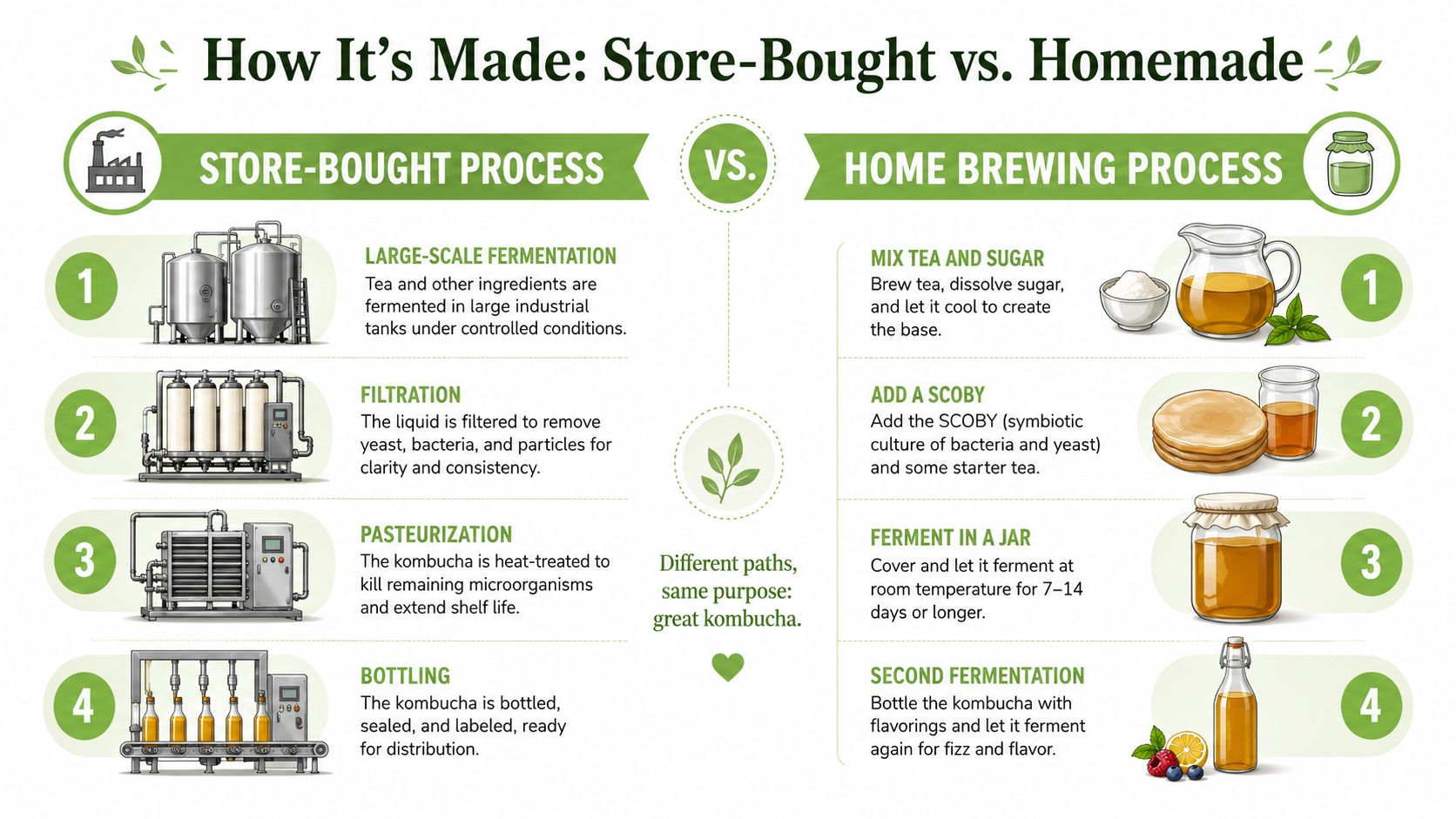
Safety and Quality Differences You Should Know About
Safety is where the romantic version of home brewing can fall apart. Kombucha depends on acidity, cleanliness, and careful storage, and if any of those slip, the batch can go from pleasant to unsafe. That's why food safety guidance for consumer brewing keeps coming back to the same basics, sanitation, pH, and proper storage, all of which matter more in a kitchen than many people realise safe preparation, handling and storage guidance.
The home environment is the main issue. Unlike a commercial brewery, your kitchen isn't controlled for contamination risk, and the equipment you use may not be sterilised as thoroughly as it should be. Brew Dr. Kombucha also warns that contamination is more likely in home brewing, and notes that improperly manufactured ceramic vessels have been linked to lead poisoning because kombucha acids can leach lead from ceramic glaze buy or make kombucha.
What safe home brewing actually demands
You don't need lab gear to brew at home, but you do need discipline. The brew should be kept in glass or other food-safe containers, the tea must cool before starter liquid goes in, and anything that looks fuzzy or mouldy needs to be thrown out. If you want a broader food-safety lens for handling fermented drinks and hospitality service, Irish hospitality food safety guidance is a useful reference point for the kind of hygiene thinking that keeps problems from starting in the first place.
Homemade kombucha can be perfectly fine when the process is controlled. The risk isn't the idea of fermentation, it's sloppy handling, unsafe containers, and ignoring early warning signs.
Commercial kombucha brings different safeguards. Producers can use testing, documented processes, and food-safety systems that aren't realistic for most households. That's why a certified, HACCP-produced product can be the smarter choice for cafés and retailers that need consistency and less operational risk.
For readers comparing options, Pep Tea's real, raw organic kombucha fits that commercial safety-and-quality logic, especially when serving customers who expect dependable flavour and handling.
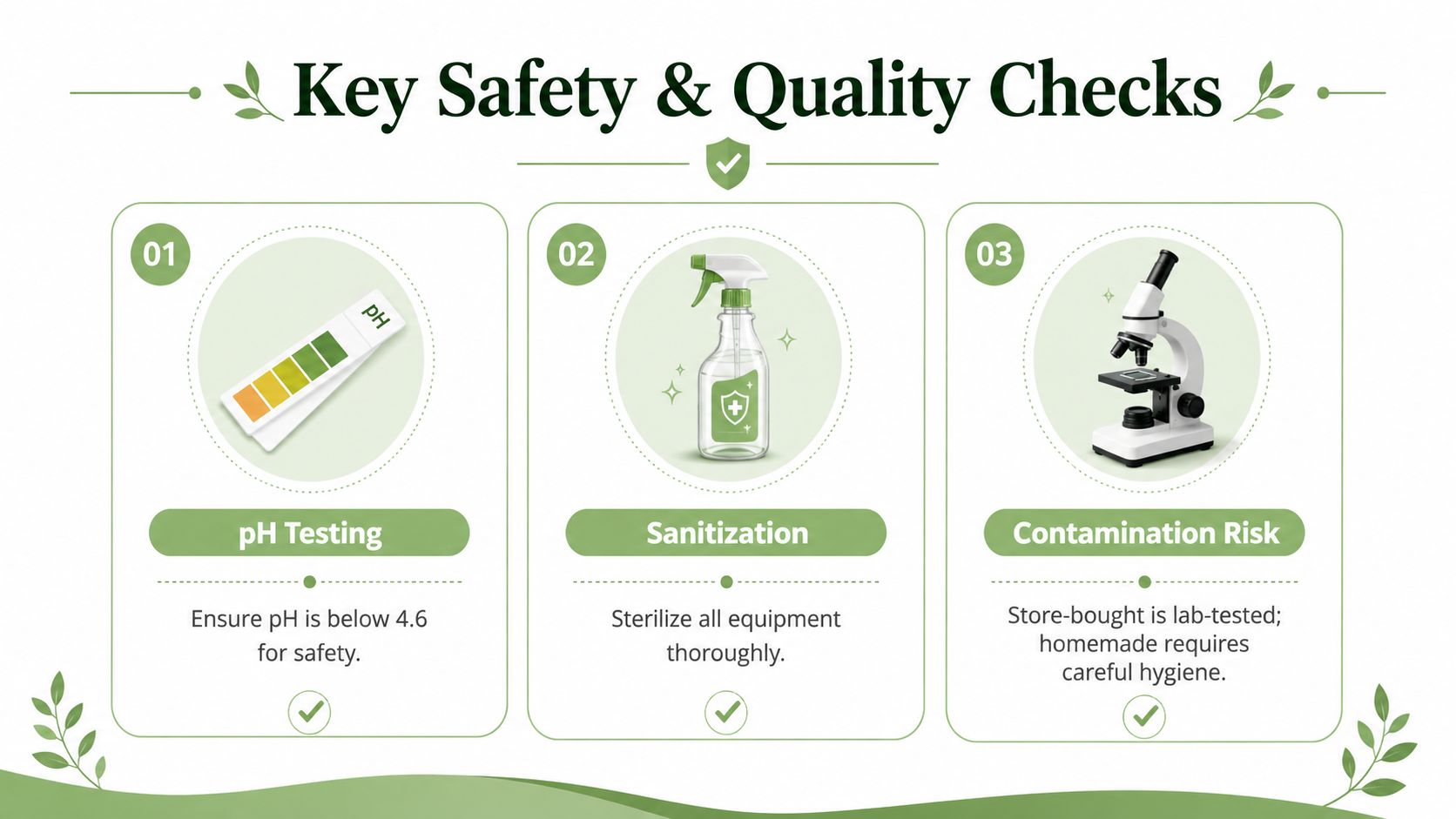
Nutrition and Probiotic Profiles Compared
The nutrition question is more interesting than the marketing would have you believe. A 2019 antioxidant analysis comparing homemade and commercial kombucha found that homemade samples had statistically higher concentrations of caffeine, catechin, epicatechin, EGCG, and total antioxidants, with the differences reported as significant at p < 0.05 antioxidant analysis of homemade vs commercial kombucha. A separate summary of the same research said homemade kombucha had, on average, twice the total antioxidants of store-bought kombucha homebrew is better.
That's a real difference, but it needs careful reading. Higher antioxidant counts don't prove better health outcomes, and they don't make every homemade batch superior in every way. They do show that home fermentation can preserve or produce a more complex chemical profile than some commercial products.
The probiotic part is where processing matters
Commercial kombucha may be processed to stop fermentation, and that can change the live-culture picture. If a drink is pasteurised or heavily stabilised, it may no longer behave like a living fermented beverage in the same way a fresh home brew does. On the other hand, home kombucha only keeps those active cultures if the brewer manages the batch correctly.
| Factor | Homemade | Store-Bought |
|---|---|---|
| Caffeine and tea compounds | Can be higher in some batches | Can be lower in some commercial products |
| Total antioxidants | Higher in the cited comparison | Lower in the cited comparison |
| Live cultures | Ongoing microbial activity if handled correctly | May be reduced by pasteurisation or stabilisation |
| Batch consistency | Varies by brewer | Usually more consistent |
| Shelf stability | Shorter, more variable | Usually stronger |
For a plain explanation of how probiotics fit into fermented drinks, Pep Tea's probiotic guide is a helpful companion read.
The honest takeaway is simple. Homemade kombucha can have a stronger antioxidant profile in the research cited here, but commercial kombucha may still be the better product for a café fridge or a retail shelf because it stays consistent and predictable. Better numbers on paper don't always mean better experience in the glass.
Cost and Time Investment for Home Brewing versus Buying
Cost is where a lot of people make their decision, and the gap can be wide. In the Australian figures provided, homemade kombucha can cost about $1 to $1.50 per litre, while commercial kombucha commonly sells at around $10 per litre, which implies roughly a 6.7x to 10x retail premium for store-bought bottles Australian retailer price comparison. That difference is hard to ignore if you're drinking it regularly.
The US comparison tells a similar story. Brew Buch estimates a typical store-bought 16-ounce bottle at about $3.99, with the initial home setup around $37.38, after which a 128-ounce batch costs about $0.12 per 16-ounce serving price of kombucha. Another source places homemade kombucha at $0.25 to $0.50 per 16-ounce bottle, versus $3 to $5 for store-bought price of kombucha.
The hidden cost is time
Home brewing isn't a grab-and-go habit. It asks for monitoring, bottling, waiting, and cleaning, and the batch itself can take around two weeks from start to finish in beginner guides. Store-bought kombucha wins on convenience because it's already finished, chilled, and ready when you want it.
That time difference matters for hospitality too. A café can't afford a drinks programme that depends on whether a jar fermented properly this week. It needs reliability, portion control, and service speed, which is why buying from a trusted producer often makes more sense than brewing in-house.
Practical rule: choose home brewing if the process itself is part of the value. Choose store-bought if the drink needs to behave like any other stocked menu item.
Packaging waste and refrigeration are part of the total cost as well. Bottled products bring more packaging, while home brewing uses fewer ready-to-ship containers but demands your own fridge space and attention. If you're running a venue, those details can change the overall cost of the drink more than the sticker price does.
Who Should Brew at Home and Who Should Buy from a Certified Producer
Home brewing suits people who like the process as much as the drink. If you enjoy cleaning jars, tracking fermentation, and tasting batches as they evolve, it can be a rewarding habit. It also makes sense if you want more control over ingredients and you're prepared to treat sanitation seriously.
A simple decision filter for home drinkers
- Choose home brewing if you have time, patience, and a food-safe setup.
- Choose a certified product if you've had contamination problems before, don't want to manage pressure in bottles, or prefer a consistent taste.
- Choose store-bought if convenience matters more than experimentation.
Cafés and hospitality venues sit in a different category. They need a kombucha that pours the same way every time, tastes the same across cases, and fits service standards without extra staff training. That's where a certified organic, HACCP-produced Australian kombucha becomes the smart operational choice, because the business isn't just buying flavour, it's buying consistency and reduced risk.
Retail buyers have their own priorities. Shelf stability, customer trust, and clean label communication matter more than the romance of fermentation. If a product can't hold up in distribution or creates avoidable quality issues, it becomes a liability rather than an asset.
A quick buyer's checklist
- For cafés: look for reliable supply, clear ingredients, and a product that can be served fast.
- For retailers: look for shelf clarity, strong packaging, and a brand story that's easy to explain.
- For home buyers: think about your own tolerance for batch variation and kitchen upkeep.

The best choice isn't always the most artisanal one. It's the one that fits the way you drink, serve, and store kombucha. If you're managing a business, certified production usually wins. If you're brewing for pleasure and you're happy to learn the craft, home fermentation can be worth the effort.
Practical Tips for Reading Labels and Testing Your Own Batches
Start with the label if you're buying kombucha. Look for wording that tells you whether the drink is pasteurised, filtered, or stabilised, because those processes can affect live-culture content. Also check for added sweeteners and flavourings, since some bottles are closer to a flavoured beverage than a living fermented tea.
For home batches, use your senses and a few basic checks. A healthy brew should smell pleasantly tart, not rotten or mouldy, and any fuzzy growth on the surface means the batch needs to go. If you test pH, keep an eye on acidity, because kombucha that isn't acidic enough is more vulnerable to spoilage.
Keep the home process simple
- Sanitise equipment well: jars, funnels, and bottles need to be clean before every batch.
- Watch the temperature: a stable room is better than a cold corner.
- Use safe containers: glass is the easiest place to start.
- Trust visual signs: mould looks fuzzy, not smooth.
If you're new to brewing, don't try to outsmart the process. Start with a simple recipe, keep notes on timing and taste, and make one change at a time. That's how you learn whether you actually enjoy making kombucha, rather than just liking the idea of it.
For many people, the answer in the store bought kombucha vs homemade debate is a mix of both. Brew at home if you want the ritual and can manage the care it needs, or buy from a trusted producer if you want safety, consistency, and less mess. If you'd like a reliable, Australian-made option, explore Pep Tea for organic kombucha made for everyday wellness, café service, and simple, practical enjoyment.