
Tea Kettle with Infuser: Practical Loose-Leaf Brewing Guide
You've probably seen the moment before. A loose-leaf tin comes home from a market, the kettle is already on the bench, and you're left wondering whether the little basket in a tea kettle with infuser is useful or just one more gadget taking up space.
That question matters in Australia because tea isn't a fringe habit. Roy Morgan's consumer research says around 8 in 10 Australians drink tea, and more than 50 million cups are consumed each day nationwide, so this is everyday equipment, not a novelty item. Tea infusers became widely used in the late 19th and early 20th centuries, which is a good reminder that the basic idea has lasted because it solves a real domestic problem, boiling water and steeping tea in the same place.
A Real Australian Tea Moment Worth Thinking About
A lot of first-time loose-leaf buyers start with the same small frustration. They want better flavour than a tea bag gives them, but they don't want a cupboard full of separate gear, a pot, a strainer, a thermometer, and a drying rack all fighting for bench space.
That's where the tea kettle with infuser earns attention. It sits between a plain kettle and a dedicated teapot, which makes it appealing for home brewers, café counters, and small retail setups that need something simple to explain and easy to use.
For Australian households, the appeal is practical. One vessel means less washing up, fewer moving parts, and a faster route from dry leaves to cup. For specialty retailers and hospitality buyers, it also gives customers a visible brewing process, which can make loose-leaf tea feel less intimidating for someone who's only ever used bags.
The catch is that convenience always comes with trade-offs. Some buyers care most about speed, others care about temperature control, and others just want a setup that won't become annoying to clean after the third week.
The right infuser kettle doesn't just brew tea, it fits the way you actually live, clean, and serve.
What a Tea Kettle with Infuser Does
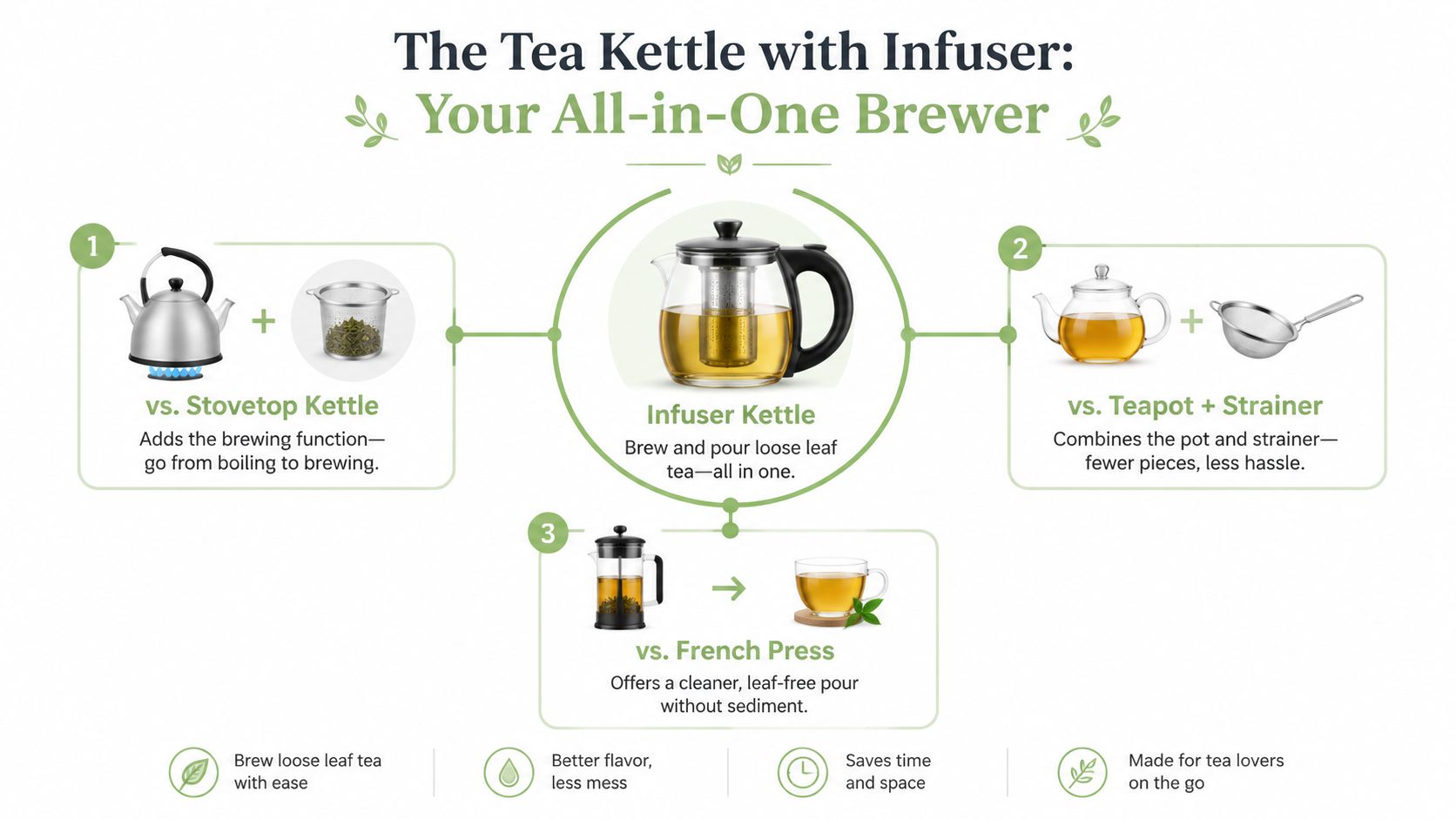
A tea kettle with infuser combines three jobs in one body. It heats the water, holds loose leaves in a removable basket, and lets you pour the brewed tea without reaching for a separate strainer at the end.
That is different from a stovetop kettle, which only gives you hot water. It is also different from a teapot plus a strainer, where the pot and the filter stay as separate pieces of equipment. A French press can steep tea too, but it is built around plunge brewing, so sediment is handled in a different way.
A simple mental model
The infuser basket acts as a gatekeeper, letting water in and keeping the leaves behind. You add the leaves, hot water moves through them, and the basket comes out once steeping is done.
That built-in basket changes the workflow in a few clear ways.
- You brew in one vessel. Less transfer means fewer drips and fewer dishes.
- You keep the leaves contained. That matters when you do not want particles floating into the cup.
- You remove the basket to stop extraction. Once the leaves stay in hot water for too long, bitterness starts to build.
The material matters too. A removable stainless-steel basket is usually easier to clean and less likely to hold onto old flavours, while harder-to-reach designs can make routine rinsing feel like a chore. A kettle body with a clear wall also gives you a better view of colour change, which helps when you are learning how your tea behaves.
Under Australian hard-water conditions, that simple design can be easier to live with than a separate kettle and teapot setup, because there are fewer pieces for scale to settle into. It also suits brewing routines that sit beside PepTea-style matcha and kombucha workflows, where the same bench space often needs to handle hot water, infusion, and quick cleanup without extra clutter.
Materials, Capacity, Wattage and Heat Sources Compared
Buyers usually get stuck comparing the wrong things first. They focus on the colour of the kettle or whether the handle looks sleek, when the decision sits in four places: body material, capacity, wattage, and how the heat source fits the job.
Here's the practical version. Glass shows you the brew and makes temperature changes easy to watch, but it also makes scale more obvious. Stainless steel usually feels tougher in busy kitchens and hides wear better. Ceramic can look elegant on the bench, though it's usually less about speed and more about presentation.
The AU market already gives a useful benchmark. A Barbeques Galore AU listing shows a 1.2 L digital glass kettle with infuser rated at 800 W and 40°C to 100°C temperature control for this kettle style. That profile suits controlled brewing and keep-warm use more than fast service. By contrast, a Canadian listing for a comparable 1.7 L glass kettle with infuser shows 1500 W, a 29 in. cord, and 1.5 kg net weight, which points to a faster, heavier-duty style of heating in a higher-output format.
| Profile | Capacity | Power | Best For |
|---|---|---|---|
| AU digital glass kettle with infuser | 1.2 L | 800 W | Controlled home brewing, delicate tea, keep-warm use |
| Higher-output glass kettle with infuser | 1.7 L | 1500 W | Faster service, hospitality-style turnover, frequent use |
The takeaway is simple. Lower wattage is gentler and more controlled, higher wattage is faster and better for throughput, and capacity should match how many cups you make before the kettle cools down.
For shoppers who want a starting point, this electric tea kettle with temperature control is a useful category to compare against other setups.
Choosing the Right Kettle for Home Café and Retail Buyers
The best choice depends on who's using it, not just what the product page says. A home kitchen, a café bench, and a retail shelf all ask different questions of the same appliance.
For home use
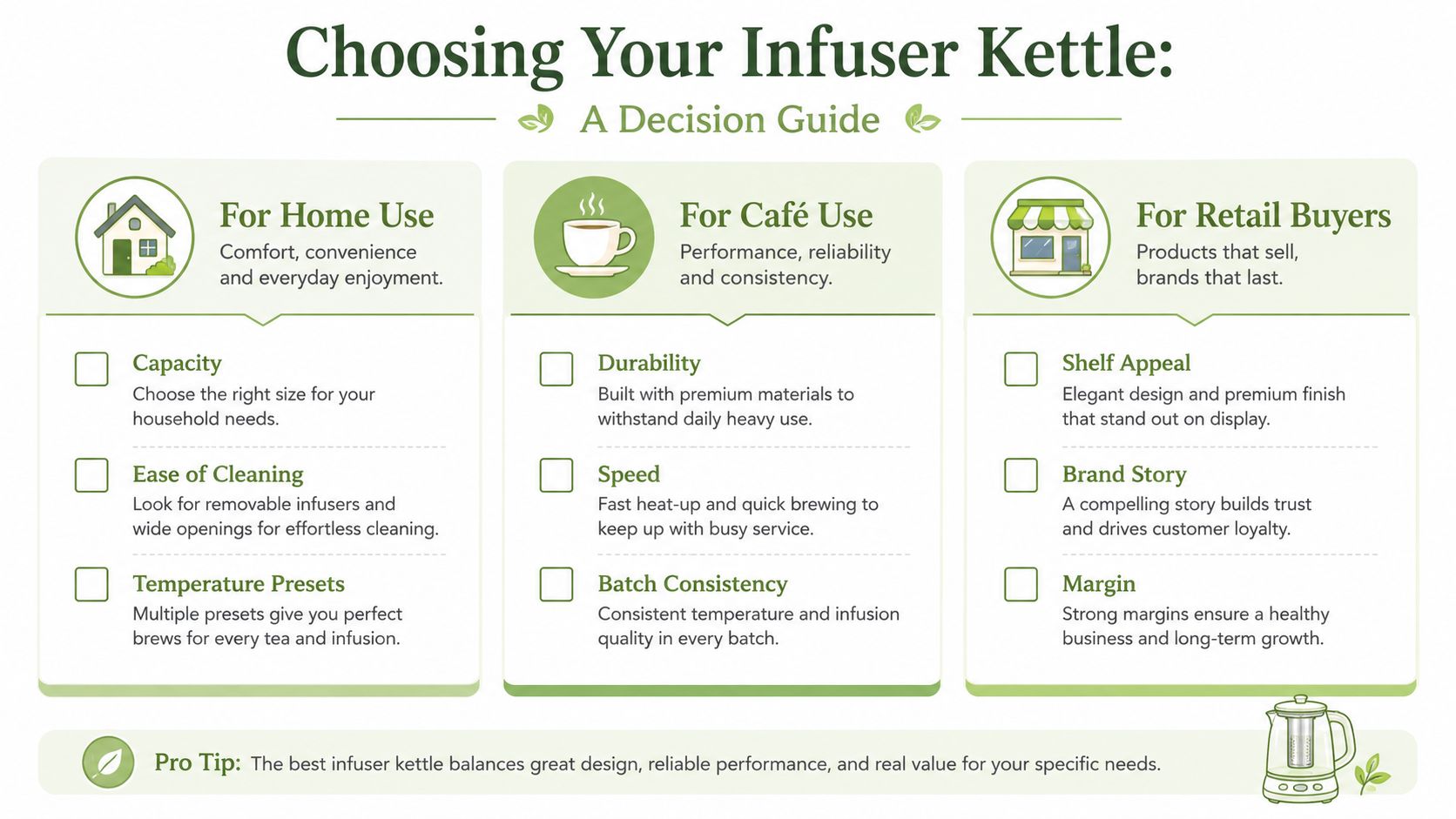
Ask whether the kettle fits your counter and your routine. If you only brew one or two cups at a time, a smaller capacity can be plenty. If a family, housemate, or partner will use it daily, the basket size and water volume start to matter much more.
A temperature display is useful when you're moving between green tea, black tea, and herbal blends. If you mostly make one style of tea, you may not need a complex control panel. If you also like preparing hot water for other drinks, the added precision can make the machine feel more versatile.
For café use
Café buyers should think in terms of turnaround, not just flavour. A kettle that's fine for a single afternoon brew can become frustrating during a breakfast rush if the basket is awkward to remove or the keep-warm function drops off too quickly.
Durability matters here more than polish. Look closely at the mesh basket, the lid hinge, boil-dry protection, and whether the design survives repeated handling without wobble. If you're comparing appliance styles for a kitchen that gets used hard, the Luna Pro kettle for kitchen lovers is the sort of reference point people often use to judge build style and bench presence.
For retail buyers
Retailers need something that explains itself fast. Shelf appeal counts, but so does the story behind it, because shoppers buying loose-leaf tea often want a brewing method that feels clear and low-stress.
- Shelf appeal: Choose a design customers can understand at a glance.
- Brand story: Match the kettle to the kind of tea range you stock.
- Margin logic: Make sure the format fits your category, not just your display.
Brewing Temperatures and Steep Times That Actually Matter
Temperature control isn't a gimmick if you brew more than one tea type. It's the difference between a cup that tastes round and one that turns sharp, flat, or bitter.
Match the water to the leaf
The cleanest rule is to heat water to the right range, start the timer the moment it reaches that point, and remove the infuser as soon as the steep ends. A usage guide notes that even a short delay can make tea bitter, so the timer is not decoration, it's part of the brewing process as explained in this infuser-kettle guide.
| Tea type | Temperature | Steep time |
|---|---|---|
| Black Tea | 95-100°C | 3-5 min |
| Green Tea | 75-85°C | 1-3 min |
| Oolong Tea | 85-95°C | 2-4 min |
| White Tea | 70-80°C | 2-3 min |
A few practical points help the ranges make sense. Green tea usually needs gentler water, because hotter water can pull too much bitterness too quickly. Oolong sits in the middle, and black tea can handle hotter water and a longer steep without falling apart as easily.
Herbal blends are more forgiving, but they still benefit from a clear removal point. If the leaves stay submerged after the timer ends, the flavour keeps changing.
Practical rule: start timing when the water reaches the target temperature, not when you finally remember to glance back at the kettle.
Matcha-adjacent use
A tea kettle with infuser doesn't steep ceremonial matcha, because matcha is whisked into water rather than infused. It can still be useful for heating the water base that goes into a matcha shot or latte, which keeps the workflow tidy when you're building drinks at home or in a small café.
Cleaning and Descaling Under Australian Hard Water
Australian kitchens often deal with scale sooner than people expect. That matters because mineral build-up can reduce heating efficiency, leave visible marks on glass, and make a fine basket harder to keep fresh.
The cleaning habit should be boring and regular. Rinse the infuser after every use, dry it well, and don't let spent leaves sit in the mesh. A removable stainless-steel basket helps here because you can get at the surfaces that trap residue, and an easy-to-clean carafe reduces the chance that old flavour hangs around.
A simple maintenance rhythm
- After every brew: Rinse the basket immediately and let it dry.
- Monthly: Run a food-safe citric acid or white vinegar descaling cycle.
- Quarterly: Clean the lid hinge, base contact points, and any small creases where residue settles.
If your kettle takes longer to heat than it used to, or the base looks cloudy even after a wipe, scale has probably been building for a while. Don't wait until the element is obviously struggling, because the fix is easier when the film is still light.
The other overlooked piece is the water itself. A counter-top filter can reduce some of the nuisance that comes with hard water, and it's worth considering if your kettle is part of a daily brewing routine. A simple counter-top water filter can make the whole setup feel less fussy over time.
If you brew often, cleaning isn't an optional extra, it's part of the kettle's performance.
Brewing Bases for Kombucha and Matcha-Adjacent Prep
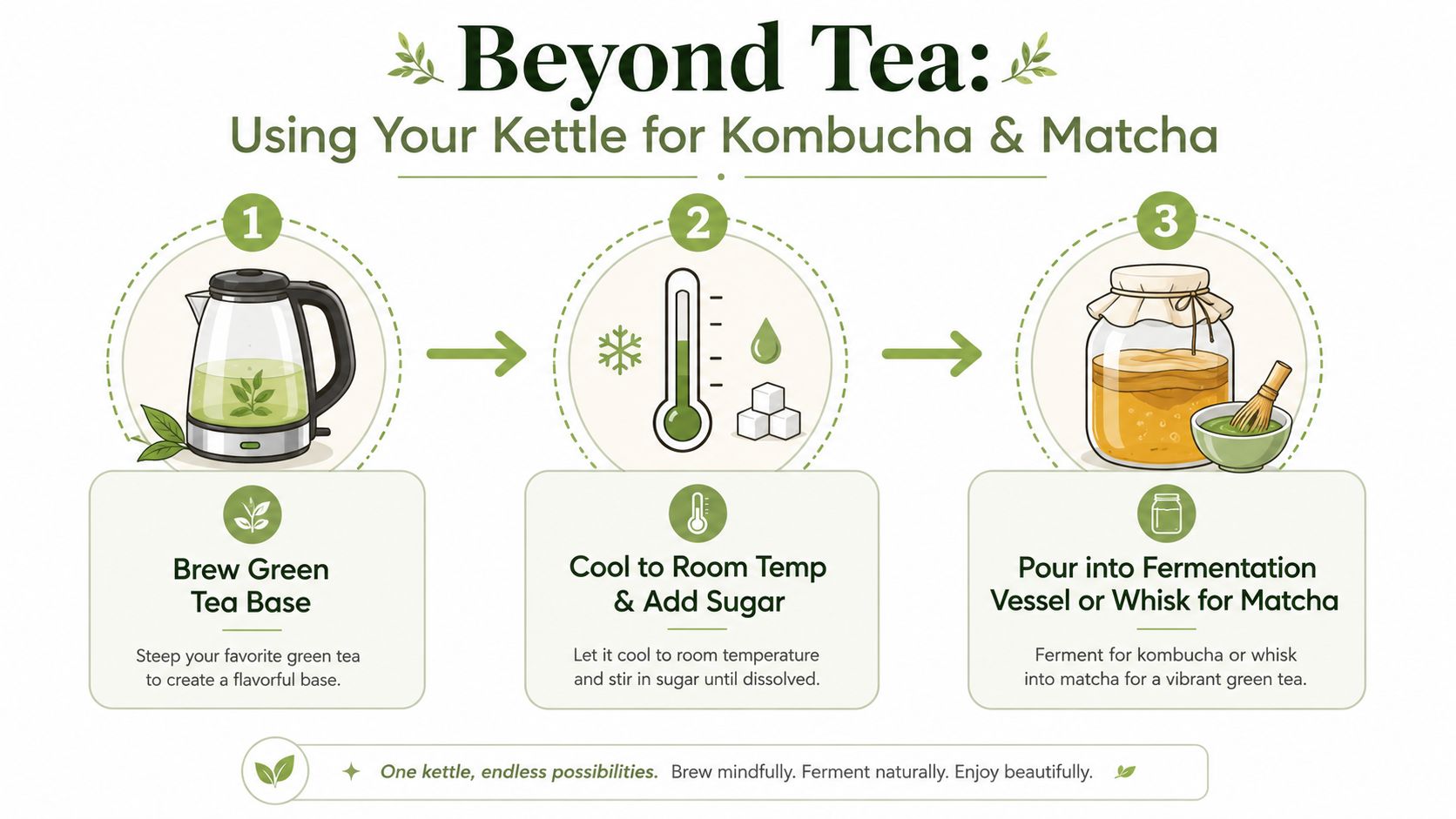
The same kettle can do more than one job in a wellness kitchen. A loose-leaf brewer that handles green, black, or herbal tea also gives you a clean hot-water base for kombucha prep and for matcha drinks that need controlled water, not boiling chaos.
Two practical ways to use it
For a simple kombucha spritz base, steep a herbal blend, cool it fully, then pour it over ice with sparkling water. If you want a home kombucha setup, a brewed tea base also fits neatly into a fermentation workflow, which is why a dedicated kit can be handy. This kombucha tea kit is the kind of companion product people often look at when they want the brewing side organised.
For a matcha latte, use the kettle only for the water component. Heat to a sensible temperature, whisk the matcha separately, then combine it with your milk of choice. The kettle's job is to be precise and unflashy, which is exactly what you want before the whisk goes in.
A good rule is to keep the brewing base separate from the flavour finish. That keeps the kettle useful without asking it to do everything.
The Honest Trade-Off and What to Do Next
The quiet downside of an all-in-one kettle in an Australian hard-water kitchen is maintenance. If you brew occasionally, the convenience usually wins. If you brew every day, a separate kettle and ceramic teapot can be lower friction because you spread the wear, reduce mesh clogging, and make flavour carryover easier to manage.
For apartment kitchens, the integrated format still makes sense because it saves space. For daily loose-leaf drinkers, the simpler long-term answer is often a separate heat source plus a pot that's easy to rinse and dry.
Pep Tea fits naturally alongside that kind of routine. If you're building a better daily tea habit, our organic matcha and Hunter Valley kombucha range are strong companions to the same low-fuss brewing mindset.
If you're ready to build a tea routine that suits an Australian kitchen, explore Pep Tea for organic matcha and sugar-free kombucha made for everyday use. You'll find practical options that pair well with loose-leaf brewing, whether you're making a calm morning cup, a matcha latte, or a cleaner non-alcoholic serve for home or hospitality.