
Tag: calm focus
Matcha Green Tea L Theanine: Benefits for Calm Focus
Matcha contains naturally occurring L-theanine, an amino acid that, paired with caffeine, is associated with calm alertness. However, a typical 2 g serve delivers far less L-theanine than the 200–400 mg/day doses used in clinical sleep and anxiety studies, so the experience depends heavily on grade, shading, and dose.
Have you ever wondered whether matcha's famous “energy without the jitters” reputation comes from the drink itself, or from a much larger dose of purified L-theanine than your cup can realistically provide? That distinction matters. Matcha green tea L-theanine is a useful food-and-beverage story, but it isn't the same thing as taking a controlled supplement.
Matcha can still be a pleasant source of caffeine, amino acids and antioxidant compounds. The sensible question is not whether it's a magic calm-focus drink. It's what a particular serve contains, how you prepare it, and what the human evidence can tell us.
Why Everyone Is Talking About Matcha and L-Theanine
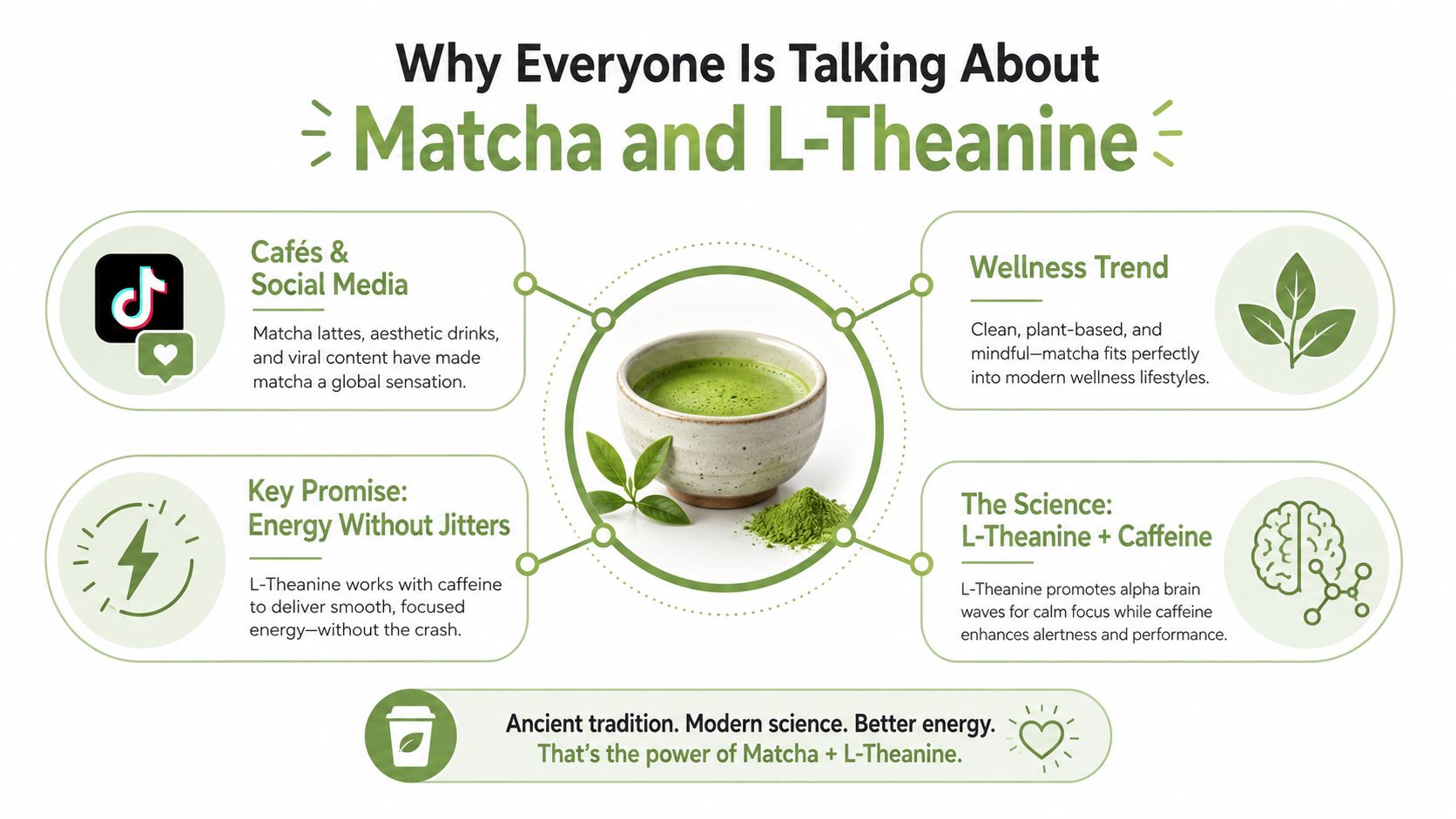
Matcha has moved from specialist tea counters into cafés, wellness shelves and social feeds. The usual promise is familiar: smooth energy, better concentration and fewer sharp edges than coffee. The compound most often placed at the centre of that story is L-theanine, an amino acid naturally found in the leaves of the tea plant, Camellia sinensis.
At a chemical level, L-theanine is one of the compounds that contributes to tea's savoury, rounded character. It helps explain why some green teas taste brothy or umami rather than just bitter. Tea plants produce it as part of their natural chemistry, and shading the plants changes the balance of compounds inside the leaf.
That's why marketers talk about L-theanine whenever matcha appears in a conversation about focus. The drink combines the amino acid with caffeine, so people often describe the result as alert but less edgy than a strongly caffeinated drink. Human research has examined isolated L-theanine in stressful conditions, with a systematic review identifying 9 peer-reviewed randomised controlled trials and concluding that 200–400 mg per day may help reduce stress and anxiety in people exposed to stress, while also noting that larger and longer studies are needed. Read the systematic review on L-theanine and stress
The molecule behind the message
The important catch is dose. A clinical study of isolated L-theanine doesn't automatically prove that a café latte produces the same effect. Matcha is a whole-leaf beverage matrix, containing caffeine, polyphenols, flavour compounds and amino acids in proportions that vary between products.
So, when you see matcha green tea L-theanine described as a calm-focus solution, read the phrase carefully. It points to a plausible combination, not a guaranteed outcome. Explore PepTea's matcha education and products to see how the ingredient fits into a broader tea ritual.
What Matcha Actually Is and Why Its Chemistry Differs
Matcha isn't just green tea brewed more strongly. With ordinary loose-leaf green tea, hot water draws compounds out of the leaves, and you usually discard the leaves. With matcha, you drink finely stone-ground leaf powder, so the preparation includes the leaf itself.
The difference begins in the field. Matcha plants are shade-grown before harvest. A useful café analogy is to think of the leaves as wearing sunscreen. With less direct sunlight, the plant's chemistry shifts, supporting more chlorophyll and preserving more amino-acid character, including L-theanine. The leaves also retain caffeine, which is why matcha can feel more concentrated than a typical green-tea infusion.
Ceremonial and culinary grades
Ceremonial-grade matcha is generally selected for drinking. It tends to have a brighter colour, finer texture and more delicate balance, so whisking it with water can produce a clean, rounded cup. Culinary-grade matcha is designed to hold its flavour in foods such as smoothies, cakes, sauces and ice cream, where milk, fruit, sugar or other ingredients compete with the tea.
Those labels describe intended use more than they guarantee a precise L-theanine amount. A higher price, vivid colour or ceremonial wording cannot replace a product-specific lab result. Shading, cultivar, harvest conditions, processing and storage all influence the finished powder.
Stone-grinding matters because it turns the prepared leaf into a fine powder rather than an infusion. That gives matcha its dense texture and concentrated flavour, but it doesn't create a fixed dose of L-theanine. Two powders can look similar while delivering different amounts per gram.
A useful mental model: matcha is a concentrated leaf preparation, not a standardised L-theanine capsule.
That distinction also explains why matcha can taste both rich and slightly bitter. L-theanine contributes savoury softness, while caffeine and polyphenols add bitterness and astringency. The balance depends on the leaf and on your brewing technique.
How L-Theanine and Caffeine Create Calm Focus
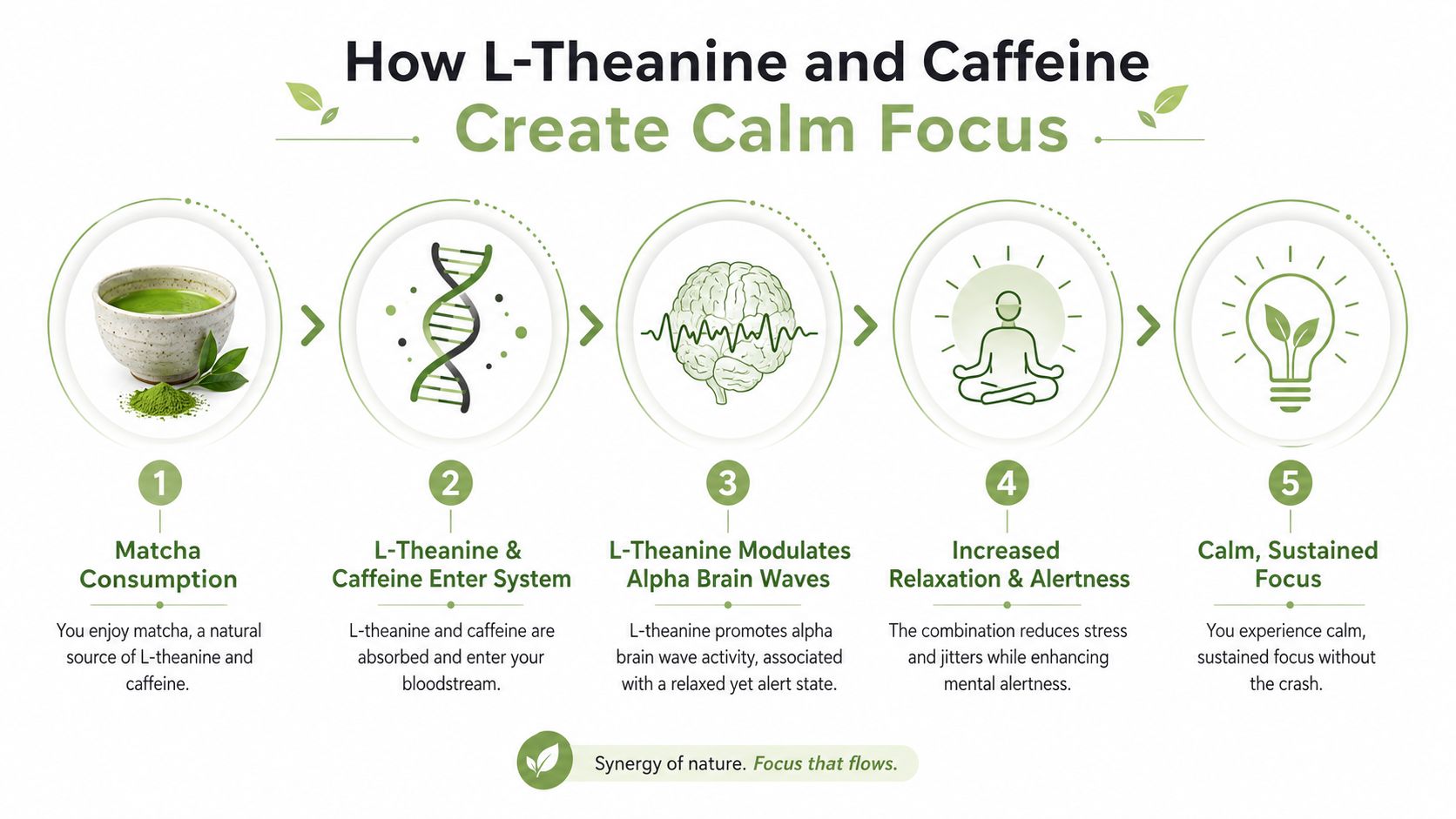
The phrase calm focus describes a combined experience, not a single switch in the brain. Caffeine supports alertness, while L-theanine has been studied for its relationship with relaxation and stress responses. Researchers have also examined L-theanine in relation to alpha brain-wave activity, GABA and other neurotransmitter systems, but these mechanisms shouldn't be treated as proof that every matcha drink produces a predictable mental state.
A helpful analogy is lighting. Caffeine alone can feel like a bright strobe for some people, especially when taken quickly or on an empty stomach. L-theanine may make the experience feel more like a steady LED bulb, where alertness remains present without the same sense of sharp stimulation. That analogy is useful, but individual responses still vary.
What the evidence can and cannot show
Human evidence is strongest for isolated L-theanine doses, particularly in the 200–400 mg/day range discussed in the systematic review of stress and anxiety trials. Typical matcha beverages usually contain much less, so it would be a mistake to copy a supplement claim directly onto a teaspoon of powder.
L-theanine also isn't a sedative in the usual sense. A person may feel less tense while staying awake, but that doesn't mean matcha will treat anxiety, insomnia or a medical condition. Caffeine can also work against relaxation if the serving is large, the drink is consumed late, or the drinker is especially sensitive.
The caffeine-to-theanine relationship is central to the way matcha is marketed. An Australian matcha education source describes matcha caffeine as being absorbed and released slowly over 6–8 hours, and positions L-theanine as part of the drink's smoother focus profile. That is a useful description of the product narrative, but it shouldn't be read as a guarantee for every person or every preparation. Read Australian matcha guidance on caffeine and L-theanine
For a visual explanation of the calm-focus idea, this video provides an accessible introduction:
If you'd like the chemistry explained in more detail, learn what L-theanine is before deciding how much weight to give the claim. The honest summary is simple: matcha may feel smoother than some caffeinated drinks, but it isn't a guaranteed focus pill.
Matcha Versus Other Teas and Supplements on L-Theanine
How much L-theanine does matcha provide compared with ordinary tea or a supplement? The answer depends on both the product and the form being compared.
One Australian lab-tested matcha product contained 21.3 mg of L-theanine per gram and 33.3 mg of caffeine per gram. The cited averages across 36 commercial green teas were lower, at 6.46 mg of theanine per gram and 16.28 mg of caffeine per gram. View the Australian matcha potency results
| Source | Typical L-theanine per gram | Typical caffeine per gram | Notes |
|---|---|---|---|
| Lab-tested Australian matcha product | 21.3 mg | 33.3 mg | Product-specific laboratory result |
| Cited mean across commercial green teas | 6.46 mg | 16.28 mg | Mean across 36 commercial teas |
| Isolated L-theanine used in human research | 200–400 mg/day | Not applicable | Clinical dose range, not a tea measurement |
The difference comes partly from preparation. Matcha contains powdered whole leaf, while a standard green-tea infusion contains only the compounds that move into the water. Even so, the higher concentration in this tested product does not make an ordinary matcha serving equivalent to the isolated amounts used in supplement research.
Oolong and black tea cannot be assigned one fixed L-theanine value. Cultivar, harvest, oxidation, processing and brewing can all alter the final cup. Saying that green tea generally contains more may offer a rough direction, but it cannot replace analysis of the specific tea.
Why supplements are a different category
An L-theanine supplement is built around a stated amount of one compound. Matcha is a food with naturally variable composition, and it brings caffeine plus other tea constituents along with the L-theanine. The result is a beverage with taste, texture and a whole-leaf ritual, rather than a precisely controlled research dose.
The choice depends on the goal. Matcha suits someone who wants L-theanine as part of a drink and daily routine. A supplement suits someone who needs clearer control over the amount. Neither format automatically delivers the same experience or evidence base as the other.
The Dose Reality Most Articles Skip Over
How much L-theanine does a normal cup of matcha provide? The answer depends on the powder and serving size, so the word matcha alone cannot predict a clinical dose.
An Australian nutrition panel listing 180 mg of L-theanine per 100 g works out to about 7.2 mg in a 4 g serve. That example shows why labels matter: products can differ substantially in composition. Review the Australian nutrition panel example
The same arithmetic helps put supplement claims in perspective. A serving may contribute L-theanine as part of a drink, but it does not automatically deliver the isolated amounts used in research. A larger serve could move the beverage closer to those research doses, while also increasing caffeine intake. The result is less like taking a measured tablet and more like eating a food whose ingredients arrive together.
Caffeine is the main reason dose comparisons need care. Matcha supplies L-theanine alongside caffeine and other tea compounds, so increasing the powder changes more than one variable. Someone who wants a predictable L-theanine amount may find a supplement easier to measure. Someone who values flavour, texture and a daily ritual may prefer matcha, accepting that its composition varies.
Dose matters more than the word “matcha”. Check the powder's serving size, L-theanine information and caffeine content before assuming your cup mirrors a clinical trial.
There is no universal cup count that suits everyone. Body size, caffeine sensitivity, preparation strength, timing and other sources of caffeine all affect the experience. For practical guidance on serving amounts and personal tolerance, read this guide to how many cups of matcha powder may be suitable per day. Anyone who is pregnant, taking medication, managing a health condition or unusually sensitive to caffeine should discuss regular use with a qualified health professional.
What the 2026 Australian Research Is Telling Us
Australia's L-theanine research is becoming more practical, but it hasn't settled the question of what an everyday matcha latte does for everyone. An Australian clinical trial registered in 2026 for the THESleep project recruited 60 healthy adults aged 18–65 with mild to moderate sleep disturbances. The design included 4 arms, testing 100 mg, 200 mg and 400 mg of L-theanine or placebo over 14 days, following a 7-day baseline. Review the Australian THESleep trial record
That design is valuable because it tests several defined doses against placebo. It also highlights the translation problem. Participants receive a measured amount of isolated L-theanine, while a matcha drink contains a variable amount of L-theanine alongside caffeine and other compounds.
What this means for a real kitchen
The evidence supports caution rather than cynicism. Matcha may fit comfortably into a morning routine for someone who enjoys its flavour and tolerates caffeine. It shouldn't be described as a sleep treatment, a sedative or a substitute for professional care.
Timing becomes especially important. A morning serve may suit focus, while an afternoon or evening serve could be less comfortable for someone whose sleep is caffeine-sensitive. Food, hydration, regular movement and a consistent sleep routine remain more reliable foundations than trying to push a beverage towards a supplement dose.
Local research also shows why Australian readers deserve more than imported wellness slogans. The science is developing, and carefully controlled trials are useful, but a trial of purified L-theanine doesn't erase the variability of matcha powder.
Practical Ways to Get the Most From Matcha's L-Theanine
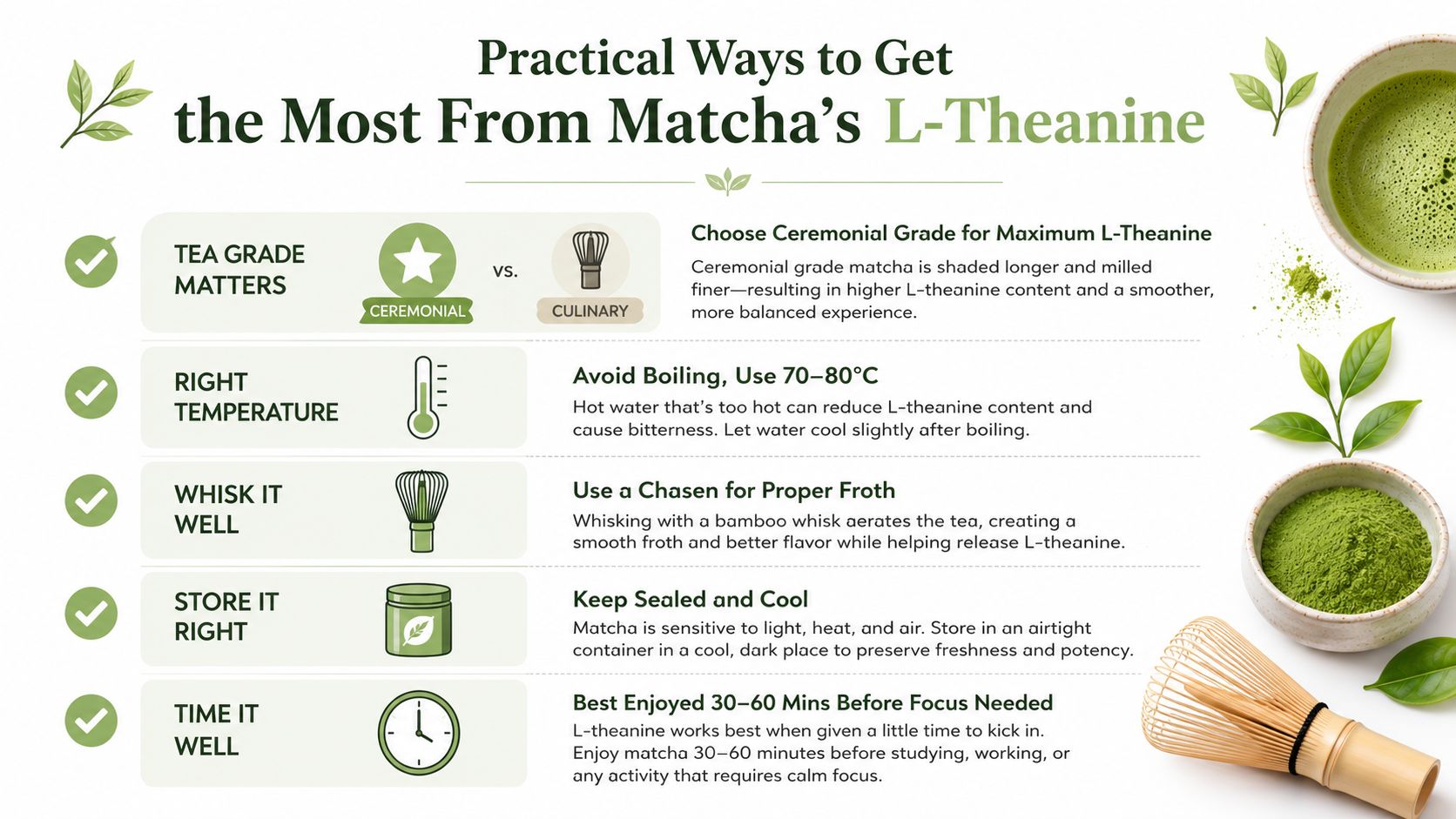
How can you make matcha's L-theanine useful without treating the powder like a supplement? Start with a drink you can prepare and tolerate regularly. A smooth ceremonial-grade powder generally suits plain drinking, while culinary-grade matcha works well in smoothies, baking or ice cream, where its stronger tea flavour can balance other ingredients.
Brewing changes the cup's flavour more predictably than its exact L-theanine content. Use warm rather than boiling water, sift the powder if it clumps, then whisk with a bamboo chasen or small electric frother until evenly mixed. Very hot water can make matcha taste harsh. A cooler approach improves the drinking experience, but it does not create more L-theanine.
A practical serving guide
The earlier Australian lab results are useful for understanding the relationship between powder, caffeine and L-theanine. They should guide preparation, not encourage chasing a supplement-style dose. Begin with a modest amount, especially if you are sensitive to caffeine, and adjust only after noticing how the drink feels.
For steadier flavour, dissolve the powder in a small amount of warm water first, then add more water or milk. Drinking it with breakfast may feel more comfortable than taking concentrated caffeine on an empty stomach. A latte can also spread the flavour through a larger drink, although it does not change the powder's measured L-theanine content.
Matcha values vary between products. One Australian nutrition panel reported a much smaller amount of L-theanine for a larger serve than the lab-tested product discussed earlier. Grade, sourcing, storage and testing can all affect what reaches the cup, so a package label is more useful than assuming every matcha has the same chemistry.
Four questions to ask before brewing
Should I drink matcha before sleep? If caffeine disrupts your sleep, late-day matcha may be a poor fit, whatever its L-theanine content. Research on isolated L-theanine does not establish that an ordinary matcha beverage improves sleep.
Does lower-temperature water preserve more L-theanine? It can produce a smoother, less bitter cup. It cannot turn a small beverage serving into a clinical dose.
Can I combine matcha with coffee? You can, but both drinks contribute caffeine. If you feel wired, reduce one drink first rather than trying to offset it with extra L-theanine.
What should I pair with matcha? Breakfast with protein, fibre and carbohydrates may feel steadier than concentrated caffeine on an empty stomach. That is a practical eating choice, not proof that food changes L-theanine absorption.
Answers to Common Matcha and L-Theanine Questions
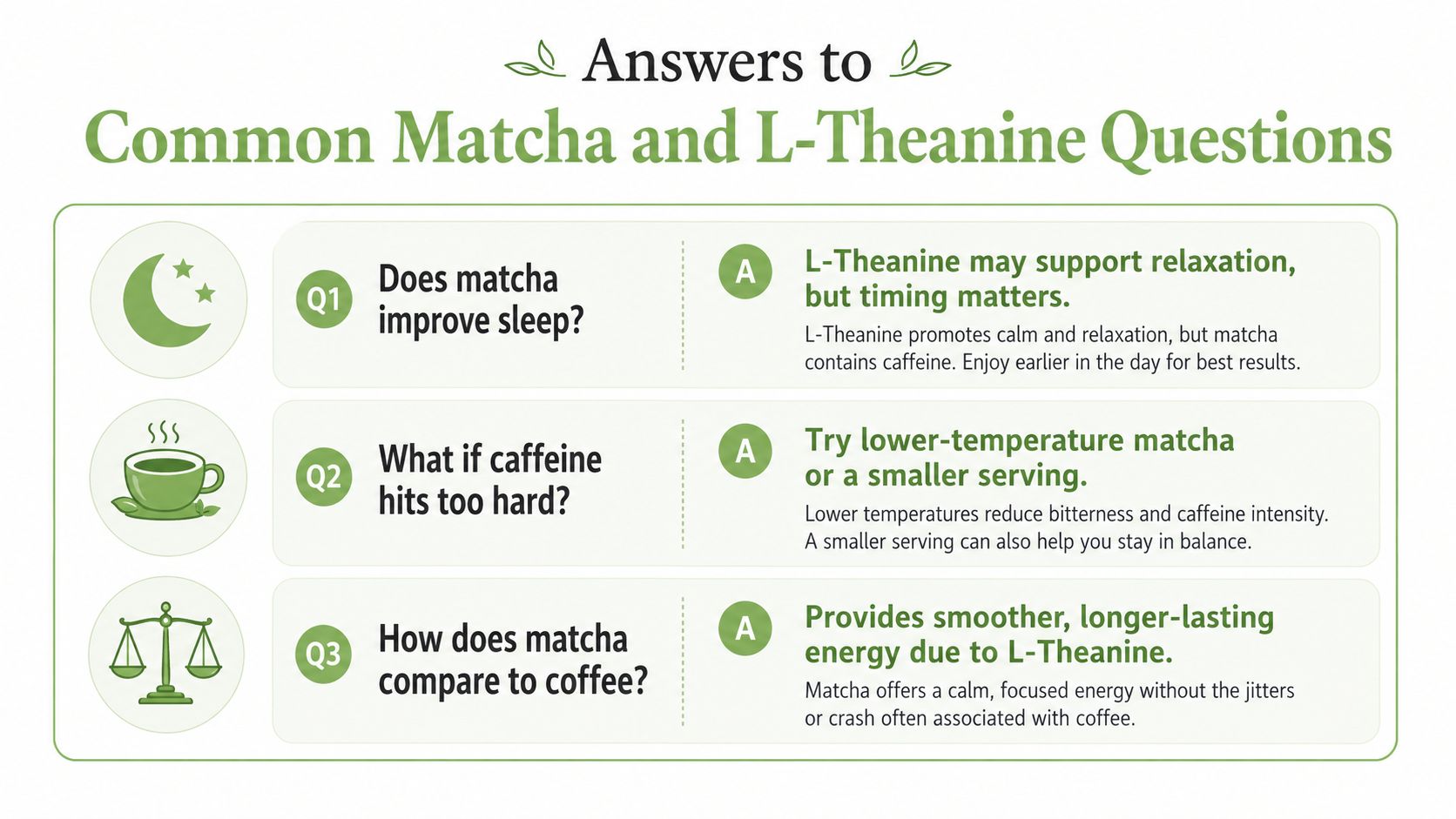
Does matcha improve sleep?
Matcha contains L-theanine, and human research on isolated L-theanine has examined stress, anxiety and sleep-related outcomes. Matcha also contains caffeine, so a late serve may make sleep harder for caffeine-sensitive people. The evidence doesn't justify calling ordinary matcha a sleep treatment.
Is L-theanine in matcha enough to make a difference?
It may contribute to the drink's character and to an individual's experience of calm alertness. However, the studied isolated range of 200–400 mg/day is much higher than the amount supplied by many beverage serves, so you shouldn't assume that matcha reproduces a supplement result.
What if caffeine hits me too hard?
Use a smaller serve and drink it earlier in the day. You can also make a latte with less powder, eat beforehand and avoid stacking the drink with coffee until you know how your body responds.
How does matcha compare with an L-theanine capsule for studying?
Matcha gives you a beverage ritual, caffeine and a variable amount of L-theanine. A capsule gives you a stated amount of isolated L-theanine, which is closer to the format used in clinical research. Neither option guarantees better concentration, and sleep, stress, food and study conditions still matter.
Is daily matcha sensible?
For many adults, a modest morning matcha can be a reasonable beverage habit if they tolerate caffeine. Sensible use means treating matcha as part of a balanced routine, not increasing the powder aggressively to chase a supplement-style effect.
Does matcha have benefits beyond L-theanine?
Matcha is also a concentrated source of plant compounds. A 2020 analysis indexed in PubMed reported phenolic measurements of 169–273 mg gallic acid equivalents per gram and flavonoid measurements of 99–139 mg rutin equivalents per gram in matcha fractions, supporting its description as a concentrated source of antioxidant compounds. Read the PubMed analysis of matcha phenolics and flavonoids
Does matcha contain more L-theanine than regular green tea?
A tested Australian matcha product reported a higher L-theanine density than the cited mean across commercial green teas. The comparison is useful, but it doesn't mean every matcha powder has the same composition or that every brewed cup reaches a particular threshold.
The most useful mantra is matcha is a low-to-moderate L-theanine habit, not a stand-alone focus drug. It contains L-theanine and can provide more of it per gram than the cited green-tea average, but beverage servings remain far below many isolated supplement doses. Australian research is helping close the local evidence gap, while also showing why dose and study design matter.
For readers who want to make the ritual part of their day, Pep Tea offers organically grown Japanese matcha, including premium ceremonial-grade and culinary-style options for drinking and recipes. Visit Pep Tea to explore the organic matcha range and choose a powder that suits your serving style, caffeine tolerance and everyday routine.
What Is L-Theanine: Your Guide to Calm Focus & Sleep
L-theanine is a natural amino acid found almost exclusively in tea, and it's the reason a good cup can feel calm and alert at the same time. In brewed tea, you'll usually get only 5.8 to 32 mg per 200 mL from 3 g of dried leaves, while clinical studies often use 200 mg or more per day, so the experience in your mug is usually gentler than in a supplement. If you've ever wanted clearer focus without the coffee crash, you're in the right place.
Tea lovers often talk about that smooth, settled feeling after a proper matcha or green tea, and there's real chemistry behind it. L-theanine sits right at the intersection of everyday brewing and modern wellness, which is why it keeps turning up in conversations about concentration, sleep support, and stress-aware routines. If you also like comparing tea nutrients, our guide to the benefits of magnesium and L-theanine is a useful companion read, especially if you're curious about how different calming ingredients fit together in real life. For matcha drinkers, our Uji Matcha Powder page is a handy example of how this tea amino acid shows up in premium tea rather than as a synthetic add-on.
Your Guide to the 'Calm Alertness' Amino Acid
You know that feeling when you want to think clearly, but you don't want the wired edge that coffee can bring. That's the exact gap L-theanine fills for many tea drinkers. It's a tea amino acid, not a stimulant, and it's one of the main reasons tea can feel different from other caffeinated drinks.
In simple terms, what is L-theanine? It's a naturally occurring compound in Camellia sinensis, the tea plant, and it's part of what gives high-quality tea its smooth, rounded character. A 2024 review notes that white, green, oolong, and black teas typically contain 0.9% to 3.1% of leaf dry weight, with brewed tea from 3 g of dried leaves providing about 5.8 to 32 mg per 200 mL. The same review also notes that L-theanine can make up up to 50% of total amino acids in tea leaves, which helps explain why the tea leaf itself matters so much. PubMed review on tea composition and L-theanine
Why tea feels different from a supplement
Tea gives you a food-first experience. The theanine arrives alongside other tea compounds, so the cup feels like part of a ritual, not just a dose. That matters for people who want a calmer kind of focus without turning every wellness choice into a pill routine.
Practical rule: if you're after the tea experience, start with the cup, not the capsule.
That's also why this ingredient shows up so often in matcha conversations. Matcha uses the whole leaf, so the theanine conversation becomes much more relevant than it is with many ordinary tea bags. It's a good fit for people who want their morning drink to support a smoother mental rhythm.
A broader look at tea and wellness can also be useful when you're comparing calming ingredients, and the organic matcha brewing approach makes more sense once you understand that theanine is part of the leaf itself, not an added flavour trick. The more you understand the leaf, the more sense your cup makes.
How L-Theanine Actually Works in Your Brain
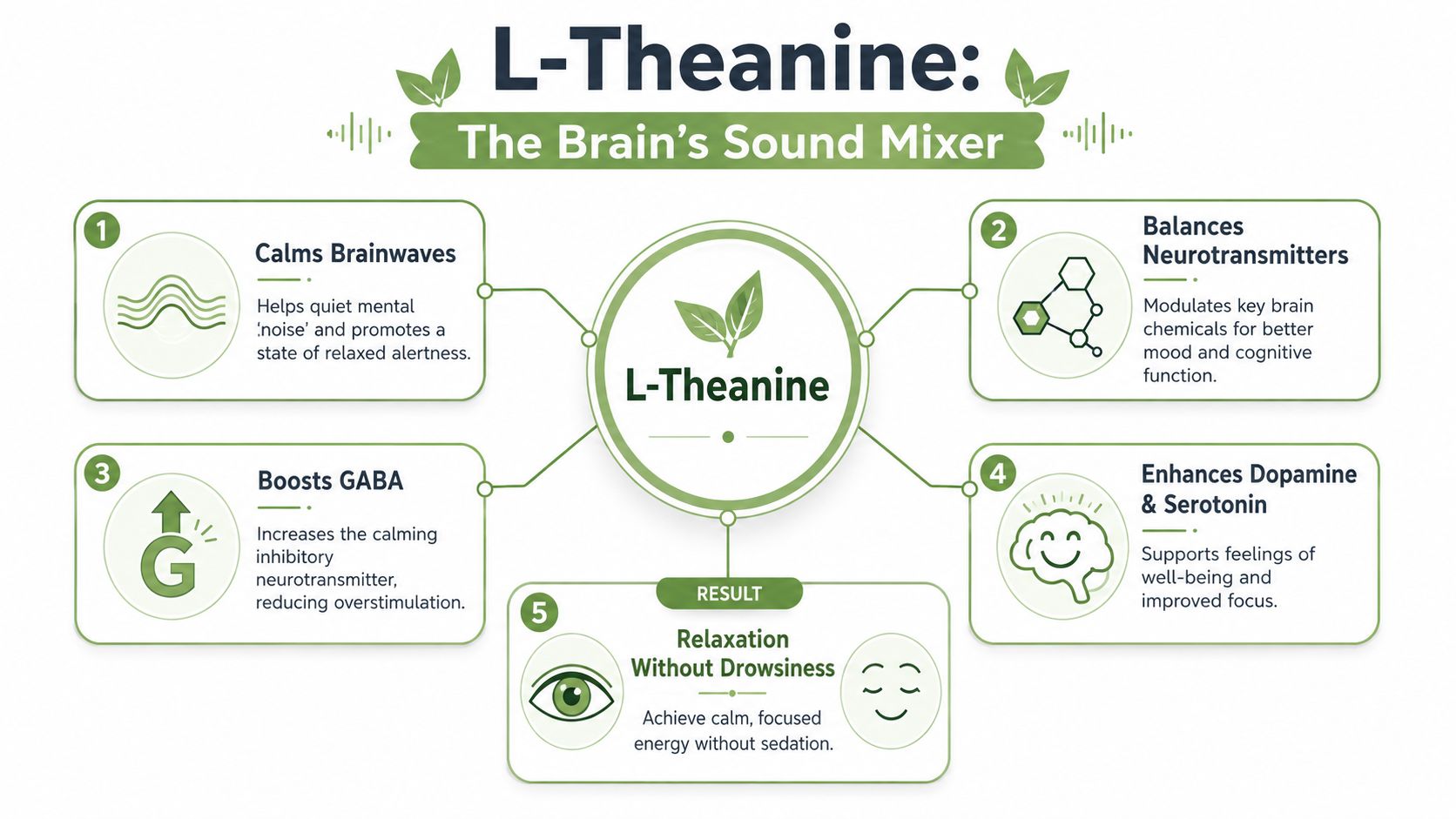
Think of L-theanine like a volume dial for mental noise. It doesn't switch your brain off, and it doesn't force sleepiness. Instead, it seems to help your mind settle into a state that feels more organised, less cluttered, and easier to work with.
A calmer signal, not a blanker mind
The often-used shorthand is that L-theanine supports alpha brain wave activity, which is the pattern many people associate with relaxed alertness. That's why tea can feel mentally bright without feeling harsh. In plain language, it helps take the edge off mental overdrive so your attention has a better chance of sticking.
It also interacts with key neurotransmitter systems that shape mood and alertness, including GABA, serotonin, and dopamine. You don't need a neuroscience degree to use that information well. Just remember that this compound isn't trying to sedate you, it's trying to make your brain feel less overclocked.
Simple takeaway: L-theanine doesn't erase thoughts, it lowers the background static.
That's why many people describe tea as the drink they reach for when they need to write, read, or think through a tricky problem without feeling scattered. If overthinking tends to hijack your day, a good companion resource is coping with overthinking and anxiety, because the mental state people want from tea is often the same one they're trying to rebuild elsewhere.
For readers who like a more structured look at functional ingredients, the idea of natural focus enhancers fits well with tea. The internal logic is simple, a tea amino acid helps shift the feel of the drink from merely caffeinated to more balanced. That's a big reason matcha keeps a loyal following among people who want sharpness with a softer landing.
The Evidence-Backed Benefits of L-Theanine

L-theanine gets attention for three reasons that matter in daily life, relaxation, focus, and sleep support. Research summaries consistently describe it that way, and they also note that it may promote relaxation without sedation and may enhance attention when paired with caffeine. That pairing matters because tea, especially matcha, naturally gives you both ingredients in one cup. WebMD overview of theanine uses and risks
Relaxation without feeling knocked out
This is the part most tea drinkers notice first. L-theanine is associated with a calmer internal pace, but not the heavy feeling you'd expect from something sedating. That makes it easier to use during the day, at work, or before a busy afternoon.
Focus that feels smoother
Caffeine can sharpen attention, but it can also make some people feel jumpy. Tea changes that equation because L-theanine is naturally part of the mix. The result many people describe is cleaner focus with fewer rough edges, especially in matcha-based drinks where the whole leaf is involved.
Sleep support that starts earlier in the day
L-theanine isn't a sleeping pill. What it may do is reduce the mental churn that keeps people awake when they're tired but overstimulated. A 2025 systematic review of sleep trials found 13 eligible studies involving 550 participants, used 50 to 900 mg/day, and reported sleep benefits in 9 of the 13 trials, with the strongest effects at 200 mg/day or higher. The same review says studies using up to 250 mg daily reported mostly minimal adverse effects. 2025 systematic review of sleep trials
For people who get stuck replaying the day at night, that distinction matters. You're not chasing unconsciousness, you're trying to quiet the mental static enough for sleep to arrive naturally. If that sounds familiar, a broader read on organic green tea caffeine can help you compare how tea energy differs from coffee energy in practice.
Finding L-Theanine in Your Daily Brew
If you want L-theanine in a form your body already recognises, tea is the obvious place to look. It appears in all Camellia sinensis teas, but the amount shifts with leaf type, growing method, and preparation. That's why two cups of tea can feel noticeably different even when they're both “green tea”.
Why matcha often stands out
A peer-reviewed review reports that among Japanese teas, gyokuro and matcha contain more L-theanine than sencha, and it identifies L-theanine as a bioactive compound in tea that may influence brain function under stress. That makes matcha especially relevant for people who want a richer, smoother tea experience with a stronger functional profile than standard brewed tea often delivers. Review on Japanese tea composition
The reason is easy to grasp. Matcha is made from the whole leaf, so you're not just drinking flavour, you're consuming the leaf material itself. That gives it a different relationship with both taste and function than a light tea infusion.
What this means in a real cup
A 250 mL cup of green tea provides only about 8 to 30 mg of L-theanine, while many clinical studies use 200 mg or more per day in supplement form. That comparison shows why a standard brew feels subtle, and why matcha tends to feel more substantial. News-Medical summary of green tea L-theanine amounts
Useful rule of thumb: tea is usually a gentle source of theanine, while supplement research often works at much higher levels.
For Australian tea drinkers, that's the practical takeaway. If your goal is a daily calming ritual, a well-made matcha or green tea can be enough. If your goal is to mirror clinical research, the cup and the capsule are not the same thing, and it helps to understand that before you set expectations.
Safe Dosages and What to Expect
A lot of confusion around L-theanine comes from people comparing a cup of tea with a supplement study and expecting the same result. That's not how it works. A daily brew usually gives you a modest amount, while clinical research often uses higher, more concentrated doses.
Tea amounts versus study amounts
A brewed cup gives you a small-to-moderate exposure, not a strong pharmacological hit. The tea-based range above, roughly 5.8 to 32 mg per 200 mL, is very different from the 200 mg/day or higher used in many trials. That gap is why tea feels like a steady ritual and supplements feel more direct.
Safety data in the reviewed sleep literature is also reassuring. The 2025 systematic review found sleep benefits in trials using 50 to 900 mg/day, and studies using up to 250 mg daily reported mostly minimal adverse effects. 2025 sleep review
What to expect from tea, not capsules
If you're drinking matcha or green tea, the likely experience is a gentle shift rather than a dramatic one. You may feel more settled, less frazzled, and better able to keep your attention on one thing. That's a realistic goal for a beverage.
Practical rule: judge tea by consistency and feel, not by chasing a supplement-style effect from one cup.
Mainstream consumer health guidance also treats the long-term picture cautiously, noting that the ingredient isn't a primary treatment and that short-term tolerability is better established than long-term safety. That's a sensible way to think about it, because tea is part of an everyday pattern, not a cure-all. For people who want to reduce uncertainty in the evening, pairing tea knowledge with a broader routine around lighting, screens, and wind-down habits often makes more difference than chasing a bigger dose.
Bringing L-Theanine into Your Routine with Pep Tea

A good L-theanine routine starts with the kind of drink you'll enjoy every day. For a quiet morning, whisking a bowl of matcha gives you a more complete tea experience than a rushed, bitter brew. For a smoother afternoon, the same ingredient can work beautifully in a latte or a blended drink.
Easy ways to use it at home
A simple matcha latte works well when you want calm energy without a heavy feel. Whisk 1 to 2 teaspoons of matcha with a small splash of warm water until smooth, then add steamed milk or a plant-based alternative. If you like a lighter result, keep the sweetness low and let the tea flavour stay front and centre.
Culinary-grade matcha also fits into smoothies, yoghurt bowls, and baking. That's useful if you want the tea flavour without making another hot drink. The point is to make the ingredient part of a habit, not a project.
What cafés can do with it
Cafés can build simple menu ideas around the same logic. A signature Zen Latte or a low-sugar iced matcha drink gives customers a clear, functional option without leaning on hype. Sugar-free kombucha also works well as a non-alcoholic base when a venue wants something refreshing, adult, and lighter than soft drink.
If you're comparing product formats, here's the simplest way to think about them.
- Ceremonial matcha: best for a clean, traditional cup with the most refined flavour.
- Culinary matcha: better for lattes, smoothies, and kitchen use.
- Sugar-free kombucha: a useful café option when customers want a fermented drink with a crisp finish.
That mix gives both home drinkers and cafés a practical way to use tea in real routines, not just in wellness marketing.
When to Speak with a Health Professional
L-theanine from tea can be a lovely part of a daily routine, but it isn't a replacement for treatment. If anxiety, insomnia, or low mood are persistent, a doctor or registered dietitian is the right place to start. That matters even more if you're already taking medication, are pregnant or breastfeeding, or have an ongoing health condition.
A tea habit can support wellbeing, but it shouldn't be used to mask symptoms that deserve proper care. If you're thinking about a supplement rather than tea, it's smart to ask a professional about dose, timing, and possible interactions first. A simple conversation can save a lot of guesswork.
Pep Tea offers premium organic matcha and sugar-free kombucha for Australians who want clean, functional drinks with real care behind them. If this guide has helped you understand what L-theanine is, visit Pep Tea to explore matcha options that fit a calmer, more focused daily ritual.