
Tag: kombucha benefits
Live Cultures Kombucha: What They Are and Why They Matter

Live cultures in kombucha are the living bacteria and yeast from the SCOBY that survive into the bottle and may support gut health. In Australia, however, almost 65% of 132 tested kombucha samples contained more than 0.5% alcohol, so “live” on a label is a specific claim that deserves more attention than a wellness slogan.
The popular advice is simple: choose kombucha for your gut. The useful advice is more precise: learn what the bottle means by live cultures, whether fermentation has been stopped, how the drink has been stored, and whether the producer controls acidity, sugar and alcohol. A chilled bottle can contain a living fermentation ecosystem, but two products with similar front labels may deliver very different things.
For Australian shoppers, cafés and retailers, this matters beyond taste. Live-culture kombucha is a relatively young local category. Commercial production began in Australia in 2009, and the market has since moved from home-brew culture into mainstream retail and hospitality, as reported by the Sydney Morning Herald's account of kombucha's Australian development. That growth brings better access, but it also makes label literacy essential.
Why Live Cultures Are the Most Misunderstood Phrase in Kombucha
“Live cultures” is probably the most misunderstood phrase on a kombucha label. Some people read it as a guarantee of a defined probiotic dose. Others assume any fermented tea must contain living microbes. Neither assumption is reliable.
In plain English, live cultures are bacteria and yeast that remain viable when you drink the kombucha. They come from the SCOBY, the mixed culture used to ferment sweet tea. If the finished drink is pasteurised after fermentation, heat can remove that living microbial activity. If it's heavily filtered, the microbial content may also change. A refrigerated bottle labelled raw or unpasteurised points towards a different product from a shelf-stable bottle that has been heat-treated.
Why fermentation language gets blurred
Brewing reality is more complicated than front-of-pack marketing. Fermentation produces acids, carbon dioxide, flavour compounds and trace alcohol, while the exact balance changes with the tea, sugar, temperature, time and culture. A producer might describe a drink as naturally fermented, yet the finished product may later be filtered, heated or stabilised.
That's why two bottles with similar wording can carry different microbial payloads. One may contain a mixed community of bacteria and yeast. Another may retain the acids and flavour of fermentation but no longer contain viable cultures. The label needs to tell you which story applies.
Practical rule: “Fermented” describes how the drink was made. “Contains live cultures” describes what remains when you drink it.
A useful label-reading habit is to ask four questions:
- Was it heat-treated? Look for wording such as pasteurised after fermentation or heat-treated.
- Does it require refrigeration? Cold storage supports culture survival and slows continued fermentation, although refrigeration alone isn't proof of live cultures.
- Does the producer explain the culture claim? Clear language is more useful than broad terms such as wellness or detox.
- What does the nutrition panel show? Sugar and alcohol help you understand how far fermentation progressed.
The rest of the label story starts with the SCOBY itself. Once you understand that small ecosystem, “raw”, “unpasteurised”, “probiotic” and “live” become practical clues rather than interchangeable buzzwords.
What Live Cultures and SCOBYs Actually Are
A SCOBY is a symbiotic culture of bacteria and yeast. It isn't one organism and it isn't a magic mushroom. It's a working community that lives in sweetened tea and transforms the liquid over time.
Yeast starts by using available sugars and producing alcohol and carbon dioxide. Acetic-acid bacteria then use oxygen and fermentation products to create organic acids, which give kombucha its sharp, refreshing character. Commonly discussed members of the ecosystem include Acetobacter, Gluconobacter, Brettanomyces and Saccharomyces, although the exact community varies between cultures and batches.
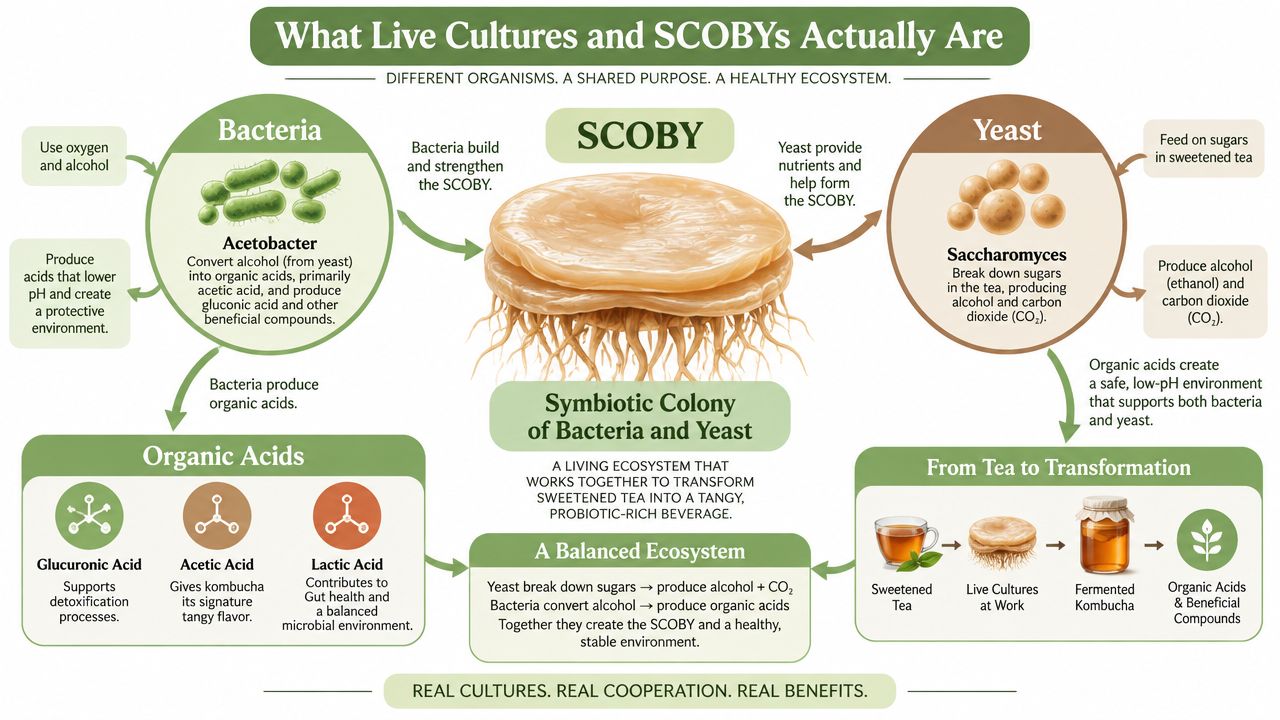
The pellicle isn't the whole culture
The rubbery cellulose layer floating at the top of a brew is often called the SCOBY. More accurately, it's a pellicle, a cellulose structure produced by some of the bacteria. It houses part of the community, but the liquid starter contains important bacteria, yeast, acids and metabolites too.
That distinction matters for home brewers. Throwing away the liquid and keeping only the pellicle removes much of the active fermentation environment. A healthy brew relies on both the culture and sufficiently acidic starter tea.
The finished drink contains more than microbes. It can include acetic acid, gluconic acid, residual sugar and trace ethanol, with tea compounds adding flavour and polyphenols. A laboratory count expressed as CFU, or colony-forming units, is only an approximation of a diverse community. It doesn't fully describe which organisms are present, whether they remain active, or how they behave in your gut.
Yeasts also deserve attention because they aren't automatically a fault. They help create alcohol and carbonation, while bacteria convert some fermentation products into acids. That relationship is why kombucha can taste bright and complex rather than just sweet or sour.
If you're curious about how yeast behaves in other traditional fermentations, the McLaren Vale indigenous yeast guide offers useful background on the difference between naturally occurring and selected cultures. Wine and kombucha aren't brewed in the same way, but the comparison helps explain why a living fermentation community doesn't behave like a single, perfectly uniform ingredient.
The key distinction is straightforward. Live means viable organisms remain. Pasteurised means heat has been used to stabilise the finished drink, usually changing or removing that living component. The acids may remain after treatment, but acids alone aren't live cultures.
Gut Health and Probiotic Benefits Without the Hype
Kombucha may support a varied diet, but it isn't a cure-all. Live cultures kombucha provides a mixed fermentation community alongside organic acids and tea compounds. That combination may support digestion for some people, but it shouldn't be presented as a guaranteed detox, weight-loss product or substitute for medical care.
The word probiotic also needs care. In strict use, a probiotic is a living microorganism shown to provide a health benefit when consumed in an adequate amount. Kombucha's microbial community varies between producers and batches, so it shouldn't automatically be treated like a clinically defined supplement containing a named strain at a guaranteed dose.
What the drink may contribute
Fermentation can make a beverage more acidic and change the tea's original compounds. The resulting drink may:
- Add microbial variety: A raw, refrigerated product can contain living bacteria and yeast when consumed.
- Support digestion: Acidity and fermentation products may suit some people as part of a meal or regular eating pattern.
- Complement plant-rich eating: Kombucha can sit alongside fibre-rich foods, which provide the substrate your existing gut microbes use.
- Offer a lower-sugar alternative: A well-fermented, sugar-free formulation can replace soft drink or other sweet beverages without turning the drink into a medical intervention.
Those are possible roles, not promises. Human research on kombucha remains less developed than the marketing often suggests, and results from one product can't automatically be applied to every bottle. The culture, tea, residual sugar, acidity and storage history all influence what reaches the glass.
You can read a more detailed breakdown of the question in PepTea's guide to how many probiotics are in kombucha. The practical lesson is to judge the product rather than assume that the category delivers one standard probiotic result.
When to take a cautious approach
New fermented drinks can cause bloating or digestive discomfort, particularly if you start with a large serving. Begin with a modest amount and pay attention to your response. People who are pregnant, immunocompromised or managing histamine issues should discuss fermented beverages with a qualified clinician before making them a regular habit.
Kombucha also contains fermentation-derived alcohol, even when it's sold as a non-alcoholic drink. People avoiding alcohol completely, including some pregnant consumers or those in recovery, may prefer not to rely on a “low” amount without checking the product information.
The most honest health claim is modest: live cultures kombucha may be a refreshing fermented food that supports a varied eating pattern. It isn't a shortcut around sleep, fibre, hydration, medical treatment or a balanced diet.
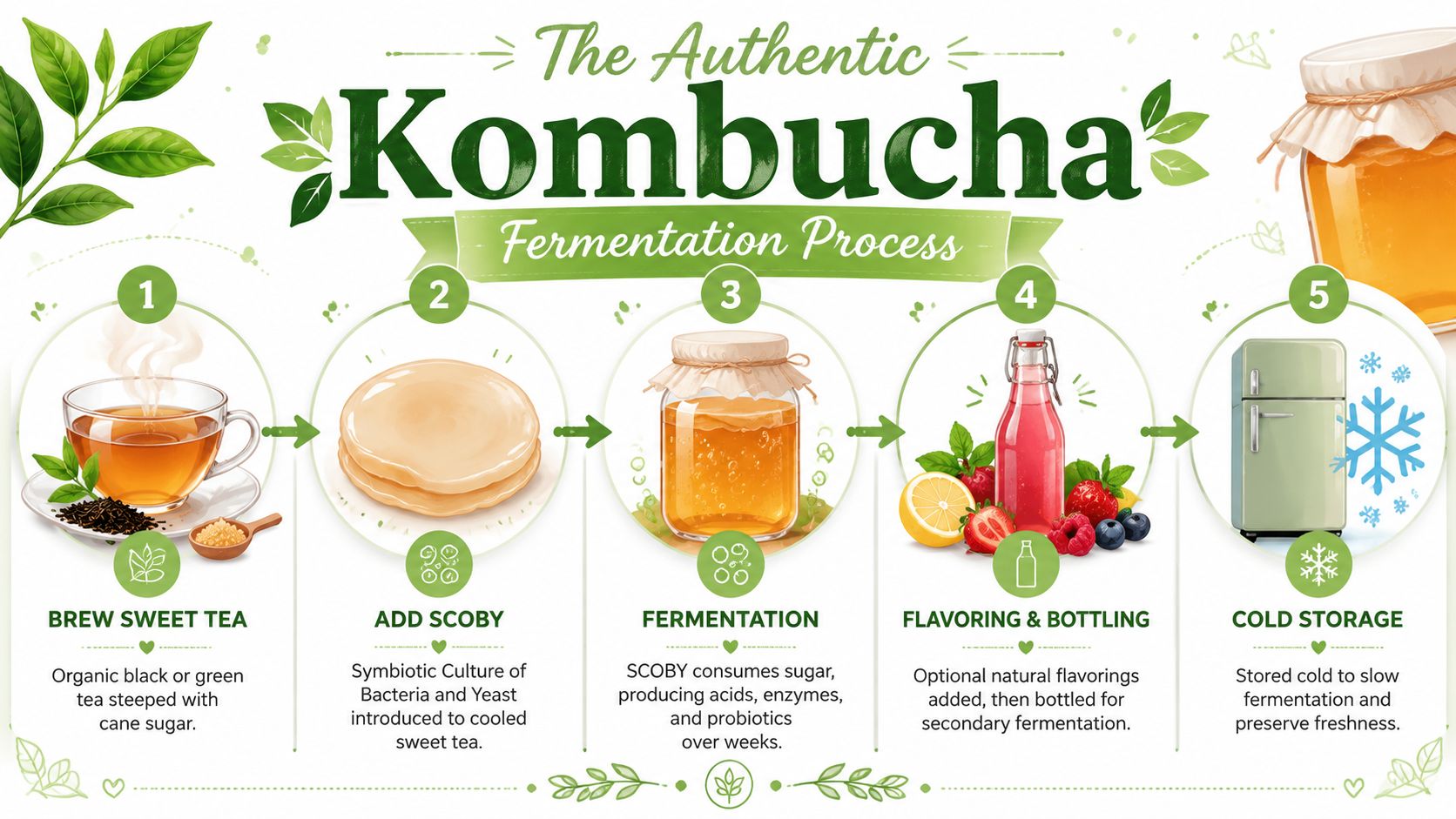
How Live Culture Kombucha Is Brewed Step by Step
A good bottle begins with controlled fermentation, not a flavour powder added to sweet tea. The brewer manages a living process from the first steep to the final refrigerated bottle.
1. Build the sweet tea base
Black or green tea supplies the fermentation environment, flavour and plant compounds. Cane sugar feeds the yeast and bacteria. The brewer needs enough sugar to support the culture, but the finished drink shouldn't taste like sweet tea.
2. Cool before adding culture
Hot tea can damage the living culture. The sweetened tea is cooled to a suitable temperature before the brewer adds acidic starter liquid from a previous batch and the SCOBY. Starter liquid lowers the initial pH and helps the new batch begin in a safer, more stable environment.
3. Ferment the first stage
Primary fermentation commonly runs at 22 to 28°C for 5 to 14 days, depending on the recipe and conditions. During this stage, yeast and bacteria consume available sugars and generate organic acids, carbon dioxide and trace alcohol.
Taste and testing work together. A batch that's stopped too early may retain too much sugar and lack acidity. A batch left too long can become sharply sour, lose balance and continue changing in ways the brewer needs to monitor.
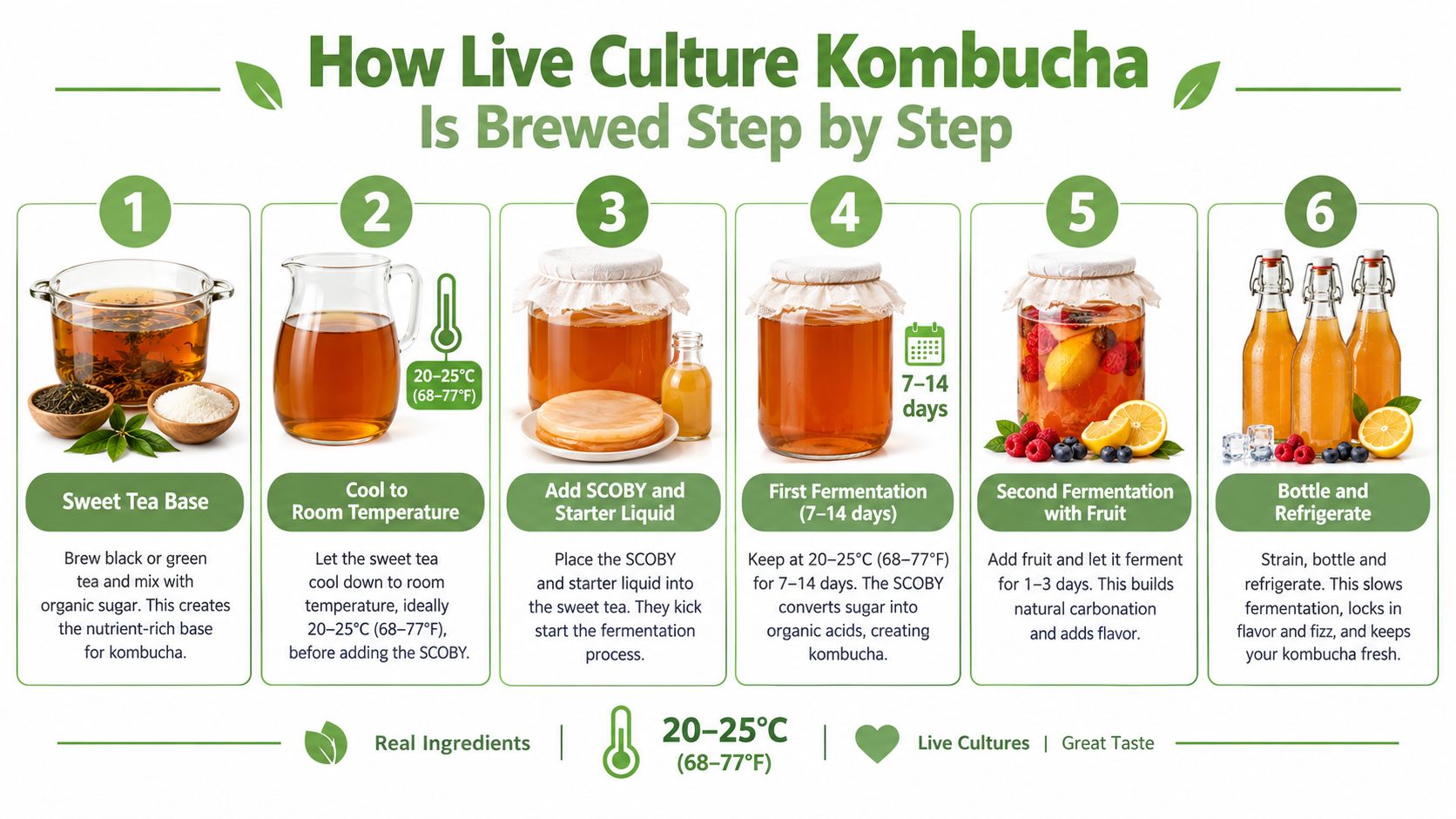
4. Flavour and bottle
The brewer adds ingredients such as ginger, lime or mango before bottling. Residual sugar gives yeast something to ferment in the sealed bottle, creating natural carbonation. This stage needs care because the same process that creates fizz can increase pressure and alter alcohol over time.
For a closer look at the first stage, PepTea's guide to kombucha first fermentation explains the role of tea, sugar, starter liquid and culture management.
A practical visual walkthrough can also help make the process easier to follow:
5. Refrigerate and monitor
Cold storage slows fermentation. It doesn't make a living drink static. Yeast and bacteria may continue working slowly, particularly when residual sugar remains, so temperature, distribution time and packaging all affect the final drink.
Small producers can often monitor these variables closely, especially when brewing for local cafés, retailers and direct customers. PepTea's kombucha is brewed in the Hunter Valley, NSW, where the brand describes its Australian-made range as organic, sugar-free and made with raw live cultures. That's one example of why production transparency matters more than a generic “fermented” claim.
Reading the Label on Live Culture Kombucha in Australia
Australian labels need to answer two separate questions: is the drink safe and legally described, and does it still contain viable cultures? Those questions overlap, but they aren't identical.
A drink can retain fermentation acids after treatment, while a live-culture claim depends on organisms surviving into the bottle. Likewise, refrigeration supports a live product but doesn't prove the claim by itself.
Four phrases with different meanings
- Raw: Usually signals that the product hasn't been heated in a way that would remove its living character, but check the producer's explanation.
- Unpasteurised: Indicates the drink hasn't undergone pasteurisation. It points more directly to the absence of post-fermentation heat treatment.
- Live cultures: Means the producer is claiming viable microorganisms remain in the product.
- Probiotic: Implies a health-related content claim that needs substantiation. Don't treat it as interchangeable with fermented.
The term “naturally fermented” describes a process, not necessarily the condition of the final bottle. If a brewer heat-treats the finished drink, the fermentation history remains true, but the live-culture story changes.
Alcohol and acidity are production controls
Australian food-safety information has highlighted alcohol variability in fermented drinks. In testing of 132 kombucha samples sold in 2017 and 2018, almost 65% contained more than 0.5% ABV and more than 22% exceeded 1.15% ABV, as reported in the Sydney Morning Herald coverage of kombucha and kefir alcohol content.
In Australia, drinks above 0.5% ABV must carry alcohol-content statements under the Australia New Zealand Food Standards Code. NSW treats products above 1.15% ABV as liquor, according to NSW Health guidance on fermented drinks and alcohol. Ongoing fermentation after packaging can contribute to alcohol drift, particularly when bottles are warm or contain residual sugar.
Acidity matters for safety too. Australian guidance uses pH controls to reduce contamination risk. Some guidance calls for a final pH below 3.0, while other state guidance uses a target below 4.2 within seven days. Queensland guidance also requires pH below 4.6 within 24 hours and recommends refrigeration to slow ongoing fermentation, as outlined in the Australian fermented beverages issues paper.
| Label claim | What it means | Live culture implication |
|---|---|---|
| Raw | The producer presents the drink as minimally heat-treated | Cultures may remain, but check the full process |
| Unpasteurised | No pasteurisation has been applied | Stronger indication that fermentation microbes may survive |
| Contains live cultures | Viable bacteria and yeast are claimed in the bottle | Look for refrigeration and clear storage guidance |
| Probiotic | A health-related microbial claim | Ask whether the claim is substantiated and specific |
| Shelf-stable | Designed to remain at room temperature | Treat as a warning sign if you're seeking living cultures |
Sugar-free claims also need context. A product described as sugar-free under the relevant food-labelling convention may contain less than 0.5 g per 100 mL, but the nutrition panel remains the most useful place to check the actual formulation. A bottle that sits warm on a shelf may have had its live-culture promise altered through filtration, heat treatment or continued fermentation.
Serving, Storage and Using Kombucha as a Mixer
Kombucha works best when you treat it as a food and a flavour ingredient, not a shot. A 150 to 200 mL glass is a sensible standard serving, while people with sensitive stomachs may prefer to start smaller.
Pour it slowly into a glass rather than drinking straight from the bottle. The aroma opens up, carbonation softens and you can judge the balance of sweetness, acidity and spice.
Match the acidity to food
Kombucha's brightness can cut through rich or fatty foods. Try it with:
- Grilled meats: Ginger notes can lift smoky or savoury flavours.
- Spicy curries: Acidity and carbonation refresh the palate between bites.
- Cheese boards: Tart kombucha balances creamy textures.
- Rich brunches: Citrus or ginger flavours work well with eggs, avocado and buttery pastries.
Flavour choice changes the pairing. PepTea's examples include Ginger, Lime & Ginger and Mango, each offering a different route into food matching without adding a sugary soft drink to the table.
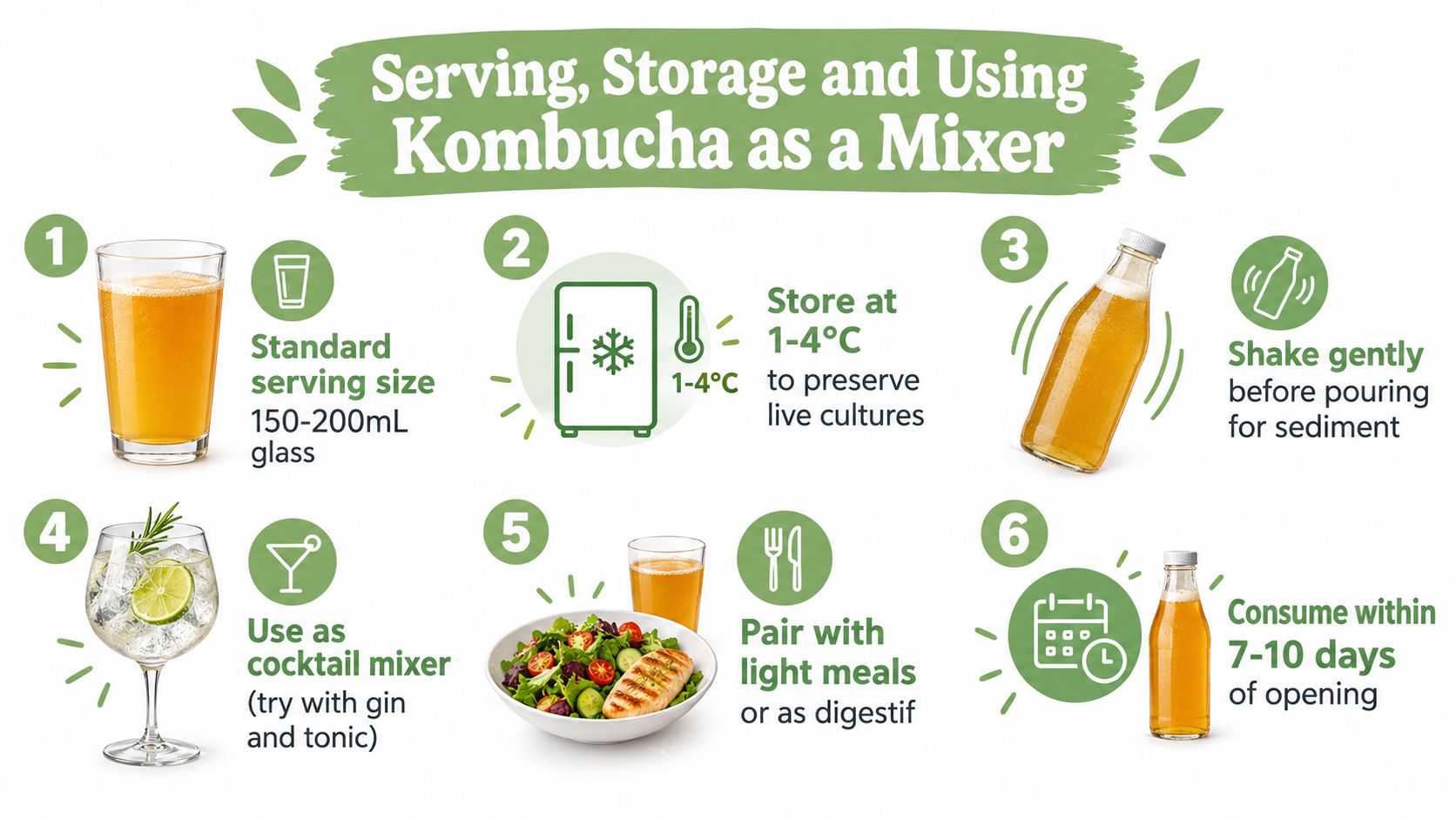
Use it in a café-style drink
Kombucha makes a useful base for a non-alcoholic spritz. Pour it over ice with citrus and herbs, or combine it with soda water for a longer drink. In a cocktail, carbonation lifts botanical notes from gin, citrus and aromatic bitters, although the finished alcohol level depends on the other ingredients.
Cold-chain handling affects the experience as well as culture survival. A warm trip from a distribution centre to a retail fridge can accelerate fermentation, alter flavour and increase pressure. Check the sell-by date and choose bottles stored below 4°C, following the practical advice in PepTea's kombucha storage guide.
At home, refrigerate unopened bottles immediately. Keep them away from direct sun and hot cars. Once opened, reseal the bottle and aim to finish it within 2 to 3 weeks, while remembering that flavour and carbonation may change sooner.
Choosing a Live Culture Kombucha Worth Your Fridge Space
You don't need to become a fermentation scientist to choose well. A quick scan can reveal whether a bottle's live-culture story is supported by its ingredients, storage and producer information.
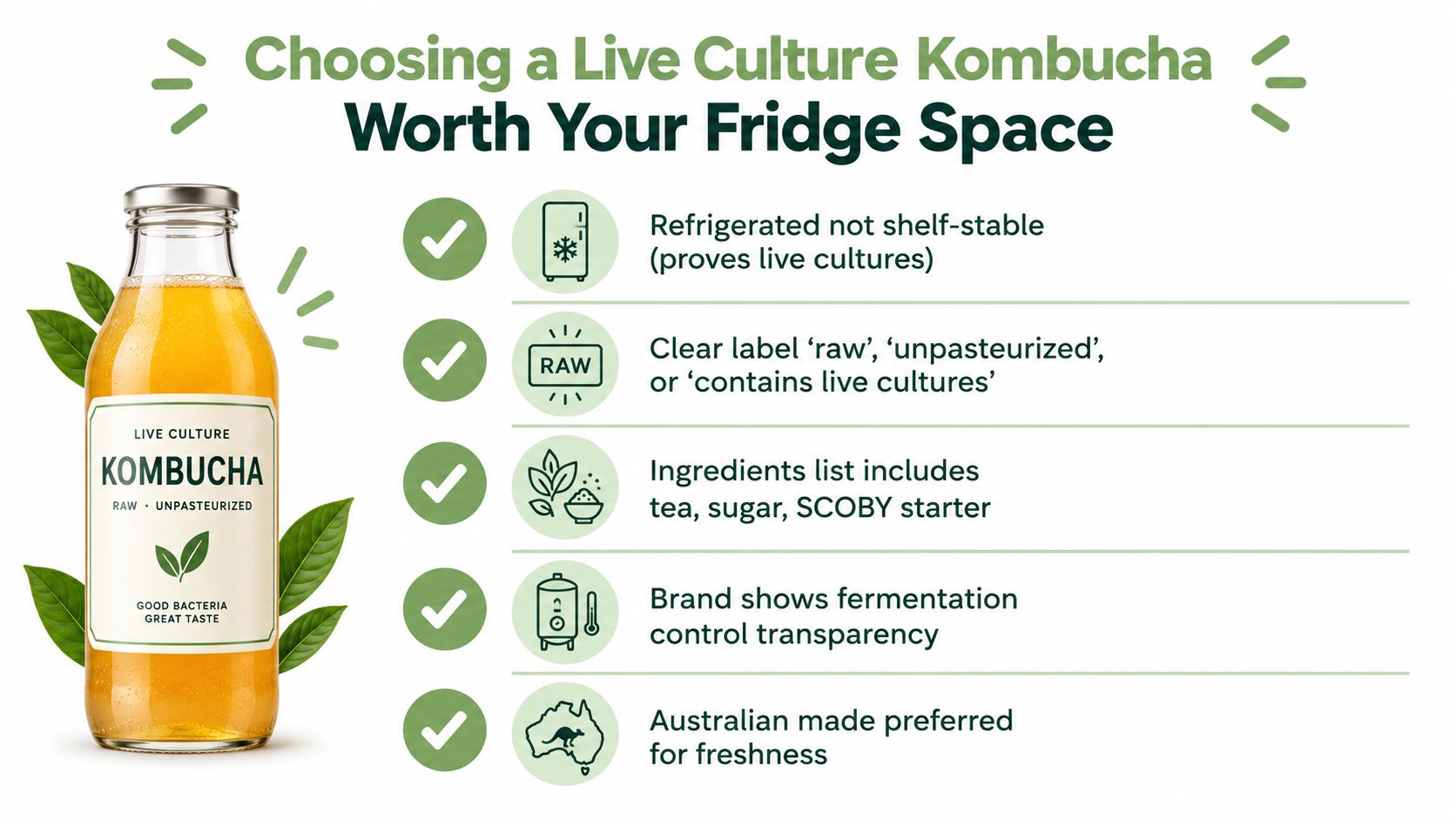
Start with the fridge. Refrigerated kombucha is generally a better sign for culture preservation than a shelf-stable bottle, though refrigeration alone isn't proof. Then inspect the wording and ingredients.
- Read the process language: Look for raw, unpasteurised or contains live cultures, and check for any statement about post-fermentation pasteurisation.
- Check the ingredients: Tea, sugar, starter culture and flavour ingredients are easier to understand than a long list of sweeteners, colours and stabilisers.
- Review sugar and alcohol: Sugar-free or low-sugar formulations may suit people reducing sweet drinks. Confirm the alcohol statement if you avoid alcohol or need a non-alcoholic option.
- Look for production transparency: A producer that discusses pH, refrigeration, batch control or fermentation gives you more useful information than one relying only on detox language.
- Notice the bottle condition: Natural sediment or activity can occur in a living drink, but absence of visible sediment doesn't prove that cultures are gone. Packaging material matters less than the process and storage record.
Glass can make a product feel more premium, but it doesn't guarantee viable cultures. A clear raw claim, a cold chain and sensible fermentation controls matter more than the container alone.
PepTea's sugar-free organic kombucha, brewed in the Hunter Valley, NSW, is one local example to compare against these criteria. The range includes flavours such as Ginger, Lime & Ginger and Mango, giving Australian shoppers a practical way to assess local live-culture kombucha by its label and handling rather than by wellness hype.
Explore Pep Tea's organic, Australian-brewed kombucha range to compare sugar-free flavours made with raw live cultures. Visit Pep Tea to shop online, learn more about fermentation, or enquire about supplying live-culture kombucha to your café or hospitality venue.
Lemon Ginger Kombucha: Benefits, Brewing, and Buying
You're standing in front of a café fridge, trying to choose between sparkling water, an iced tea, a soft drink and a row of colourful functional beverages. Lemon ginger kombucha catches your eye because it sounds familiar, refreshing and a little more grown-up than lemonade. But the label raises sensible questions. How much lemon and ginger is in the bottle? Is it low in sugar? Does it contain live cultures, and can the alcohol level change during fermentation?
Those questions matter in Australia, where kombucha has moved well beyond a niche wellness drink. The flavour is appealing, but the quality of the fermentation, ingredient dose, storage and labelling determines what you're really buying. Here's how to assess lemon ginger kombucha with the practical eye of a tea and fermentation specialist.
Why Lemon Ginger Kombucha Is Winning Over Australian Drinkers
A café customer may choose lemon ginger kombucha for a simple reason: it offers brightness, spice and fizz in one bottle. Lemon gives the drink a clean, tart edge, while ginger adds warmth that lingers after the sip. That combination feels refreshing in hot weather, yet substantial enough to replace a sugary soft drink or an alcoholic aperitif.
The flavour also suits the way Australians increasingly use drinks. A bottle can sit beside a work lunch, accompany brunch, or become the base of a non-alcoholic menu serve. Health-conscious shoppers may look for a low-sugar option, while café owners want something with more character than plain soda water. Home brewers like the pairing because lemon and ginger are easy to recognise, source and adjust.
A mainstream category, not only a wellness niche
Australian kombucha already has a broad commercial foundation. One market estimate values the category at USD 184.1 million in 2024, with a projection of USD 650.4 million by 2033 at a 15.1% CAGR, while another estimates USD 218.3 million in 2024 rising to USD 765.8 million by 2033 at 15.0% CAGR. These are independent estimates with different market methodologies, but both point towards strong category expansion. Grand View Research's Australian kombucha market outlook
The same outlook identifies conventional kombucha as 89.8% of the market in 2024, with on-trade channels accounting for 60.7% of sales. That mix suggests lemon ginger kombucha can work as an everyday café or retail product, not merely as a specialist health-store purchase.
A federal fermented-beverages issues paper also reported that kombucha sales rose 174% over the previous three years, with New South Wales recording the largest consumer base, closely followed by Queensland. Australian fermented beverages issues paper For a Hunter Valley-brewed product, that local connection is especially relevant, but popularity doesn't remove the need to check what's inside the bottle.
What Makes Lemon Ginger Kombucha Unique
A café may serve two lemon ginger kombuchas that look similar on the label yet taste completely different. The difference usually comes from the tea base, fermentation stage, ingredient dose and alcohol control, rather than the flavour name alone.
Kombucha starts as sweet tea fermented by a SCOBY, a symbiotic culture of bacteria and yeast. The culture converts some sugar into acids, gases and other fermentation compounds. Lemon and ginger are often added during a later flavouring stage, although recipes and timing vary between producers.
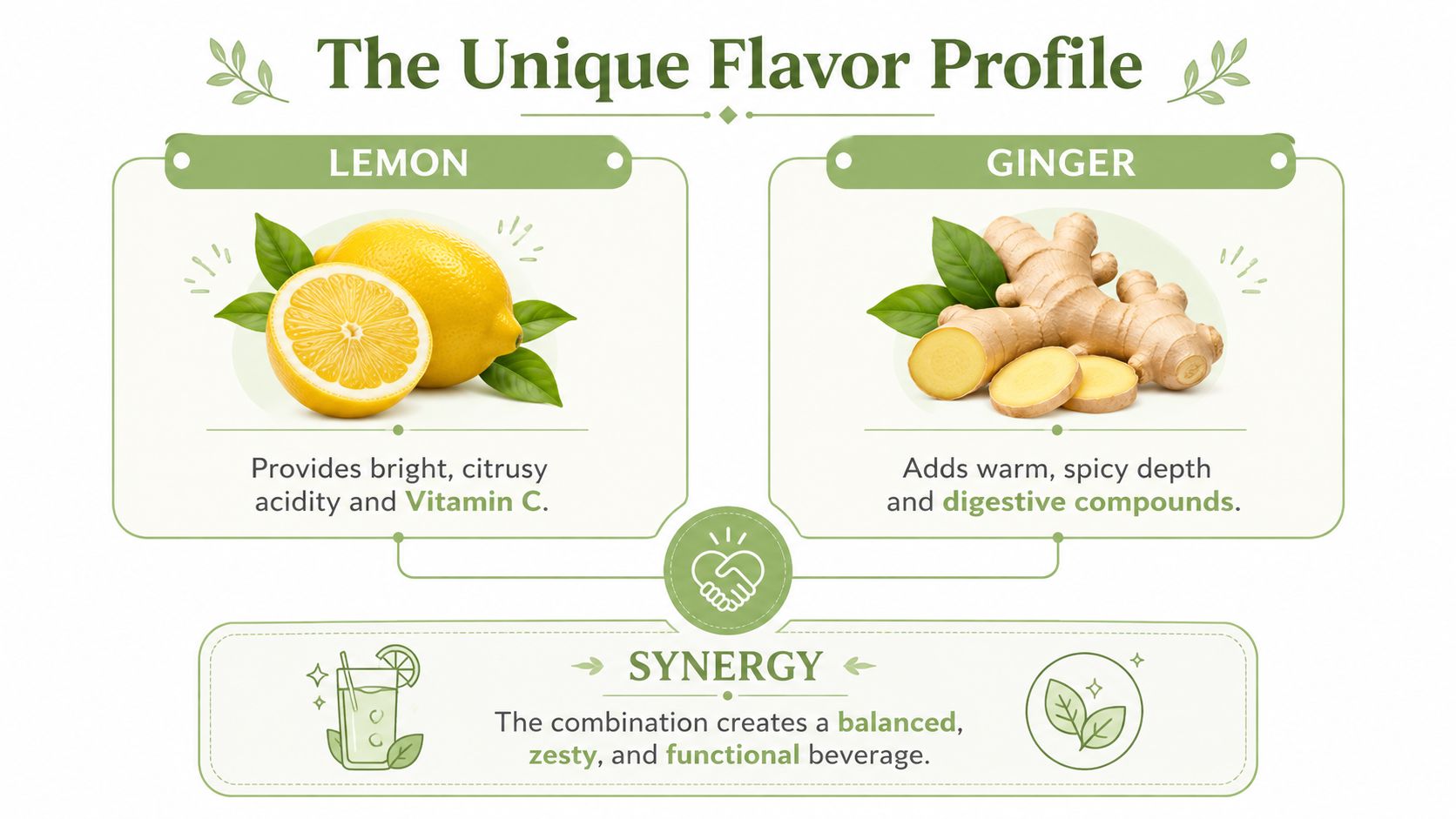
Lemon supplies acidity and citrus aroma. Ginger adds heat, fragrance and a warming finish. In the right proportions, those flavours keep a lower-sugar drink lively without making it taste thin. A well-made version should still show fermented tea beneath the botanicals, rather than tasting like sweetened water with generic citrus flavouring.
Why timing and dose change the result
Lemon and ginger affect more than flavour. A Western Sydney University study found statistically significant inhibition of S. cerevisiae and Bacillus species at 2–3% additions under low inoculum density. Lemon also inhibited L. plantarum under particular low-inoculum or higher-lemon conditions. The study's findings are discussed in more detail later in this article.
For home brewers, this makes addition timing a practical control point. Adding the ingredients after primary fermentation can make flavour adjustment easier, while fruit sugars may restart yeast activity. For cafés and packaged-product buyers, the formulation also affects consistency, refrigeration needs and alcohol management. Excess ginger can dominate the palate or interfere with culture activity, while too little leaves a sharp lemon tea profile.
Ingredient panels deserve a close read. One Australian listing specifies 0.1% lemon and 2% ginger. Remedy Ginger Lemon product information Those amounts do not determine quality by themselves, but they show why a broad wellness message should be separated from the actual recipe.
A useful tasting test: look for a clear sequence of tea, acidity and ginger warmth. If sweetness or artificial citrus takes over, the formulation is doing little beyond flavour coating.
Probiotic and Nutritional Benefits Worth Knowing
A glass of lemon ginger kombucha can supply fermented tea, organic acids and distinctive plant compounds. Its value depends on the live cultures that remain, the fermentation and processing methods, the amounts of lemon and ginger added, and the sugar left in the finished drink. That makes the recipe more informative than a broad wellness promise.
Live cultures may include organisms from groups such as Lactobacillus, Bifidobacterium and Acetobacter, although the profile varies between products. Culture names do not establish a particular health outcome. A label that identifies the cultures or provides a CFU count gives a clearer basis for comparison than a general probiotic claim.
What lemon and ginger can contribute
Lemon contributes citrus aroma, acidity, vitamin C and antioxidant compounds, depending on its dose and the way the drink is processed. Ginger supplies aromatic compounds, including gingerols, which create its warming character. Fermentation changes acidity and flavour, but it does not guarantee that every nutrient or plant compound becomes more bioavailable.
The Western Sydney University work found that lemon-treated kombucha increased antioxidant activity by 5–15% in a FRAP assay. That result applies to the tested formulation and assay, rather than to every lemon ginger kombucha. The study's research record The practical lesson is straightforward: ingredient concentration and fermentation conditions shape the result, so dosing matters alongside the ingredient list.
For a broader explanation of fermentation, live cultures and practical use, read Pep Tea's guide to the benefits of kombucha.
A realistic daily role
A small serve can replace a sweet soft drink or add variety to a hydration routine. It may suit people who enjoy tart, sparkling drinks and want a fermented option. It cannot correct an unbalanced diet, poor sleep or an underlying digestive condition.
Acidity also matters in everyday use. People with reflux, dental sensitivity, diabetes, pregnancy-related dietary questions or medically restricted diets should check the label and seek individual advice from a qualified health professional.
Australian product pages may highlight live cultures, organic acids and “no sugar” positioning without explaining the limits for every customer. Woolworths product information for Remedy Ginger Lemon A transparent label should help you assess acidity, sweeteners, caffeine, storage and ingredients. For home brewers and cafés, those details also support sensible portioning and menu descriptions.
Brewing and Selecting Quality Lemon Ginger Kombucha
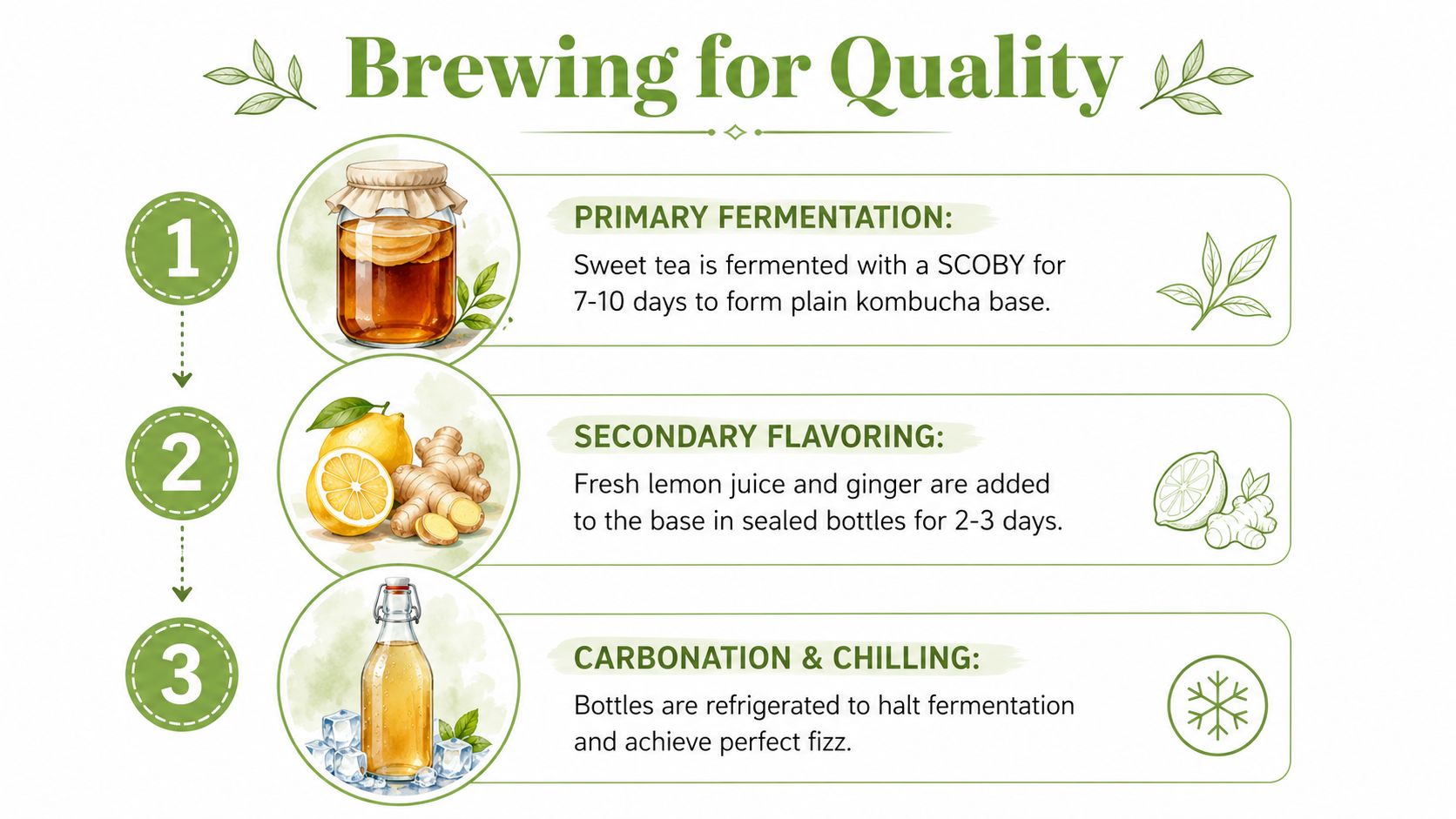
A reliable batch starts with control, not flavour improvisation. Primary fermentation creates the plain kombucha base. A later flavouring stage introduces lemon and ginger, then the sealed drink may develop carbonation before refrigeration slows further activity.
A controlled brewing sequence
For home brewers, the process can be organised around three decisions:
Build a sound base. Brew tea, add the required sugar, cool it properly, then ferment with an active SCOBY and starter liquid. Australian room conditions vary, but a working range of 24–28°C is commonly used for fermentation planning. Time, temperature and culture strength all change the final acidity.
Add flavour with restraint. Fresh ginger root gives a cleaner, more layered heat than powder, while lemon juice supplies direct acidity. Zest brings aromatic citrus oils but can become bitter if overused. A brewer should taste the base first, then make a measured addition rather than tipping in ingredients by guesswork.
Manage the bottle stage. Lemon and ginger can introduce residual sugars or fermentable material. In a sealed bottle, yeast may continue working, creating pressure and increasing alcohol. Refrigeration helps slow that activity, but it isn't a substitute for a validated process.
A purpose-built kombucha brewing container from Pep Tea can help keep the process organised, but equipment won't correct a weak starter, poor sanitation or uncontrolled temperature. Clean vessels, sound tea and careful observation remain the foundation.
Alcohol is a production issue
Australian testing shows why brewers and buyers shouldn't assume kombucha is automatically non-alcoholic. A Food Standards Australia New Zealand survey found 35.2% of sampled kombuchas below 0.5% ABV, 41.9% between 0.5% and 1.15% ABV, and 22.9% above 1.15% ABV. FSANZ coordinated survey of fermented soft drinks
In Queensland, Tasmania and Victoria, beverages above 0.5% ethanol by volume are classified as alcoholic, while jurisdictions using a 1.15% threshold apply a different boundary. The practical lesson is simple: producers need batch consistency, appropriate labelling and testing where necessary.
For troubleshooting, excessive sourness usually points to an overextended fermentation or too little residual sweetness. Weak carbonation may reflect insufficient fermentable material, a loose seal or a short bottle stage. Mould is a safety failure, not a flavour problem. Discard a mouldy batch rather than trying to rescue it.
Serving Ideas and Café Menu Applications
At a café, lemon ginger kombucha can arrive in a clear glass over ice, finished with a lemon wheel and a thin slice of fresh ginger. That presentation makes the ingredients visible and gives customers a quick sensory cue before they taste it. Serve it cold, pour gently and avoid burying the fermented character under syrups.

Three useful menu formats
A kombucha spritz combines chilled lemon ginger kombucha with muddled mint, ice and a small amount of soda water. Keep the additions restrained so the acidity and ginger remain recognisable. A fermented mule uses kombucha as the ginger element, with lime, ice and a non-alcoholic spirit if the venue wants a more structured bar-style serve.
Food pairing is straightforward. Lemon's acidity can cut through rich avocado toast, smoked salmon or pastry, while ginger brings enough spice to sit comfortably beside an Asian-inspired bowl. The drink's tartness can also refresh the palate between bites, especially where a creamy or oily component dominates.
Operational details for venues
Cafés should treat kombucha as a living product. Keep stock within the supplier's recommended cold-chain conditions, rotate it carefully and avoid leaving open bottles at room temperature for long periods. If a venue uses a keg or tap system, the team should confirm compatibility with the producer, maintain clean lines and monitor carbonation and flavour over service.
For winter, a café can offer a room-temperature or gently warmed spiced tea alternative using turmeric and cinnamon, but heating kombucha may affect live cultures and carbonation. Summer menus can use cucumber and basil for a lighter aromatic variation. For wider seasonal planning, Simply Hospitality's seasonal beverage ideas offers useful hospitality context.
Menu wording should stay accurate. “Fermented tea with lemon and ginger” tells customers more than an unqualified promise about gut health, and a clear alcohol statement helps staff answer questions confidently.
How to Choose the Best Lemon Ginger Kombucha in Australia
The best bottle isn't necessarily the one with the loudest wellness language. Start with the ingredient list, then assess processing, storage and taste. A mass-market product may be convenient and consistent, while a small-batch producer may offer a more distinctive fermentation profile. Neither label category guarantees quality.
Look for real lemon and ginger, rather than relying only on “natural flavour”. Check whether the drink is raw or unpasteurised, but remember that those terms still need context. A live product can change in the bottle, and a producer should be able to explain its storage and alcohol-control practices.
A practical comparison
| Quality Factor | Mass-Market Options | Premium/Small-Batch, for example Pep Tea |
|---|---|---|
| Ingredient detail | May provide a shorter or less specific flavour description | More likely to identify tea, cultures and flavour ingredients clearly |
| Processing | May prioritise shelf stability and broad distribution | May retain a more pronounced fermented profile, depending on process |
| Sugar positioning | Check whether fruit juice or concentrates contribute sweetness | Look for a clear sugar statement and an ingredient list you can understand |
| Alcohol control | Confirm the product's labelling and storage instructions | Ask how fermentation consistency and testing are managed |
| Flavour | Often designed for broad appeal | May show clearer tea, citrus and ginger character |
| Cold chain | Storage can vary across transport and retail | Chilled handling and producer guidance are especially important |
Australian food law treats kombucha as a traditional food rather than a novel food, so it doesn't need special pre-approval. It still has to be safe and suitable, and general food laws apply. CHOICE's kombucha guidance also notes that a low-sugar claim in Australia requires 2.5 g sugar or less per 100 mL.
Label questions worth asking
- Cultures: Are live cultures stated, and are specific organisms or CFU information provided?
- Sugar: Is “sugar free” supported by the nutrition panel, rather than inferred from a health claim?
- Acidity: Does the product suit your teeth, reflux history and preferred taste?
- Alcohol: Does the producer explain how ABV is controlled and labelled?
- Storage: Does the bottle require refrigeration, and has it stayed cold through retail?
For an Australian buying guide and retailer context, Pep Tea's guide to buying organic kombucha in Australia provides a useful starting point.
Making Lemon Ginger Kombucha Part of Your Routine
A home brewer pours lemon ginger kombucha after lunch, while a café owner serves the same style over ice with a citrus garnish. In both settings, its value comes from practical use rather than broad wellness promises: fermented tea, ginger warmth, acidity and carbonation in a soft-drink alternative or non-alcoholic menu base.
Start with a small serve and observe how your body handles acidity and carbonation. For cafés, trial it beside brunch or as a seasonal mocktail, then check whether the flavour remains balanced when diluted with ice or paired with food.
A reliable routine also depends on consistent brewing. Home brewers can adjust lemon and ginger gradually, while venues need a repeatable recipe, cold storage and a clear approach to alcohol control. The aim is a drink people can enjoy regularly, with its ingredients and production understood.
Explore Pep Tea's Australian-made organic kombucha options, including its sugar-free Lime & Ginger style, for a practical lemon-and-ginger-style choice.
Pep Tea offers organic tea and Australian-brewed sugar-free kombucha for home drinkers, cafés and wholesale customers. Visit Pep Tea to explore the range and brewing resources.
No Sugar Soft Drinks: A Practical Guide for Australians

Most advice treats no sugar soft drinks like the automatic upgrade from regular soft drink. That's too simple for Australian shoppers, and it misses the core decision, which is whether you want a cola-style swap, a lighter refreshment, or a functional drink that fits a café run, a workday, or a night out.
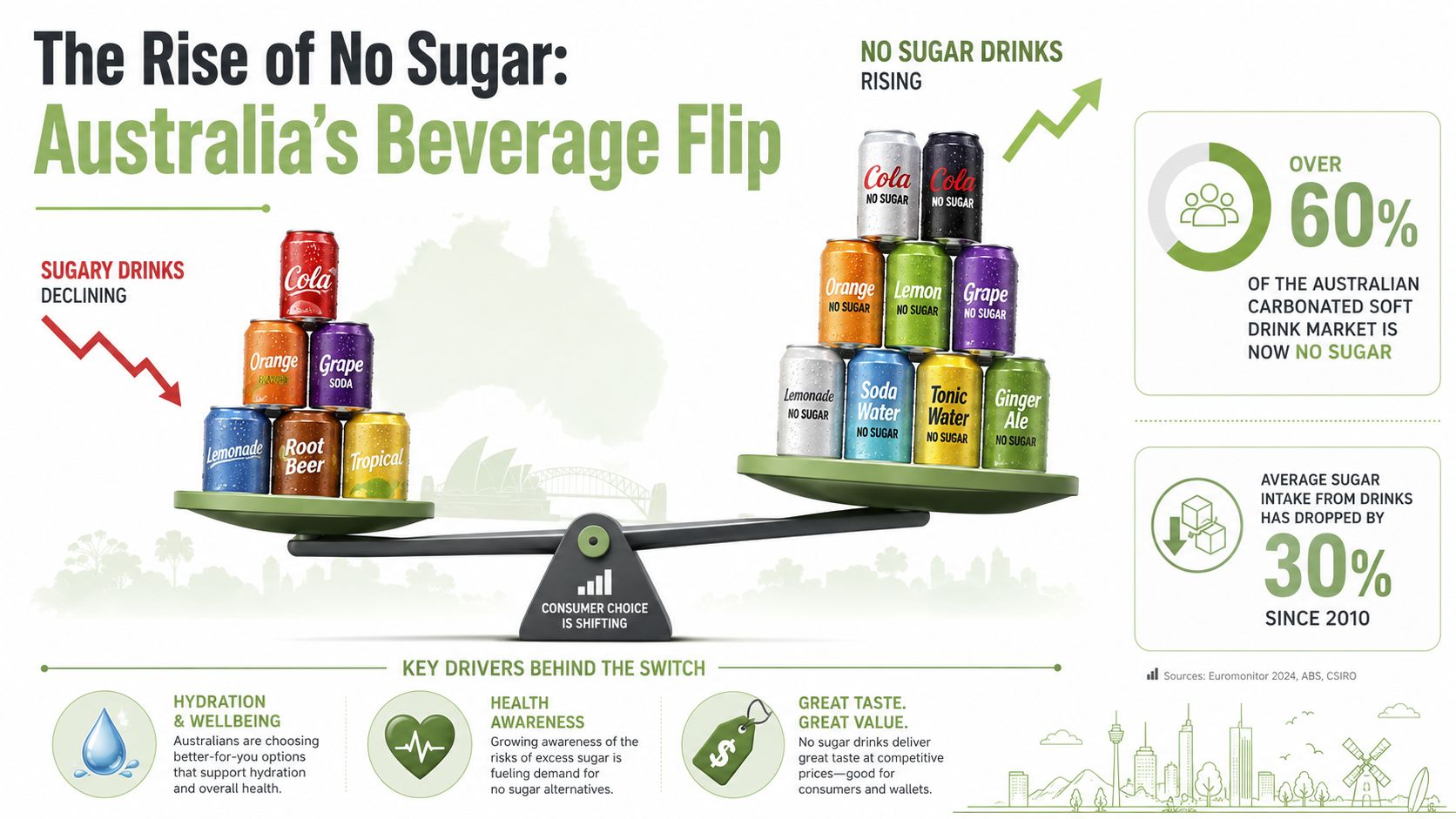
The category has also changed in a big way. In Australia's water-based non-alcoholic beverage market, low- and no-sugar drinks held 30% of market share in 1997 and 65% in 2024, while sugar-sweetened drinks fell from 70% to 35%. Sales of no-sugar water-based beverages rose from 30.4 litres per capita to 105.8 litres per capita over the same period, so these drinks are no longer a fringe option, they're a mainstream one (Australian beverage trends factsheet).
That shift matters because a drink's label doesn't tell you the whole story. No sugar can mean a diet cola, a sparkling water, a fermented kombucha, or a tea-based drink, and each one plays a different role in everyday Australian habits. Used well, they're practical substitutions. Used carelessly, they can crowd out better options like water or unsweetened tea.
Why No Sugar Soft Drinks Became the Australian Default
The surprising part is not that no sugar soft drinks exist. It is that they now sit beside water, kombucha, matcha, and tea as ordinary choices in Australian fridges and café menus. That changes the question. The useful comparison is no longer just “better than a sugary cola”, it is which drink fits the moment, the label, and the habit.
The market has already moved
Australia's water-based beverage market has flipped. Low- and no-sugar drinks have gone from 30% of market share in 1997 to 65% in 2024, while sugar-sweetened drinks moved the other way, from 70% down to 35% (Australian beverage trends factsheet). That means the fridge door, the servo shelf, and the café display are all reflecting the same shift.
No-sugar sales also climbed from 30.4 litres per capita to 105.8 litres per capita in that period, and the factsheet points to the category becoming part of everyday purchase behaviour rather than a side option. The same source also shows how broadly the category now reaches across water-based drinks, which helps explain why shoppers meet it everywhere from a corner store cooler to a chain café display (Australian beverage trends factsheet).
Practical rule: once a drink becomes the default shelf choice, judge it by label, ingredients, and use case, not by the word “zero” alone.
Why the default matters for shoppers
When a category becomes common, it can start to feel invisible. That is why label reading matters more now. A no-sugar cola can work as a tidy swap for a sugary cola, but it is still a processed beverage with a defined sweetener profile and flavour structure. It is not the same as water, and it is not the same as plain tea.
That distinction matters in Australia because shoppers now have several everyday options that solve different problems. A no-sugar soft drink can suit a convenience buy. A sugar-free kombucha can fill the role of a café-style pick. Matcha or plain tea can suit someone who wants a slower, more functional drink. The category makes more sense once you stop treating it as the only sensible alternative and start seeing how it fits alongside other choices.
For brands and venues, that same shift is why functional beverage trends now sit beside mainstream soft drinks, not off to the side.
What Counts as a No Sugar Soft Drink in Australia
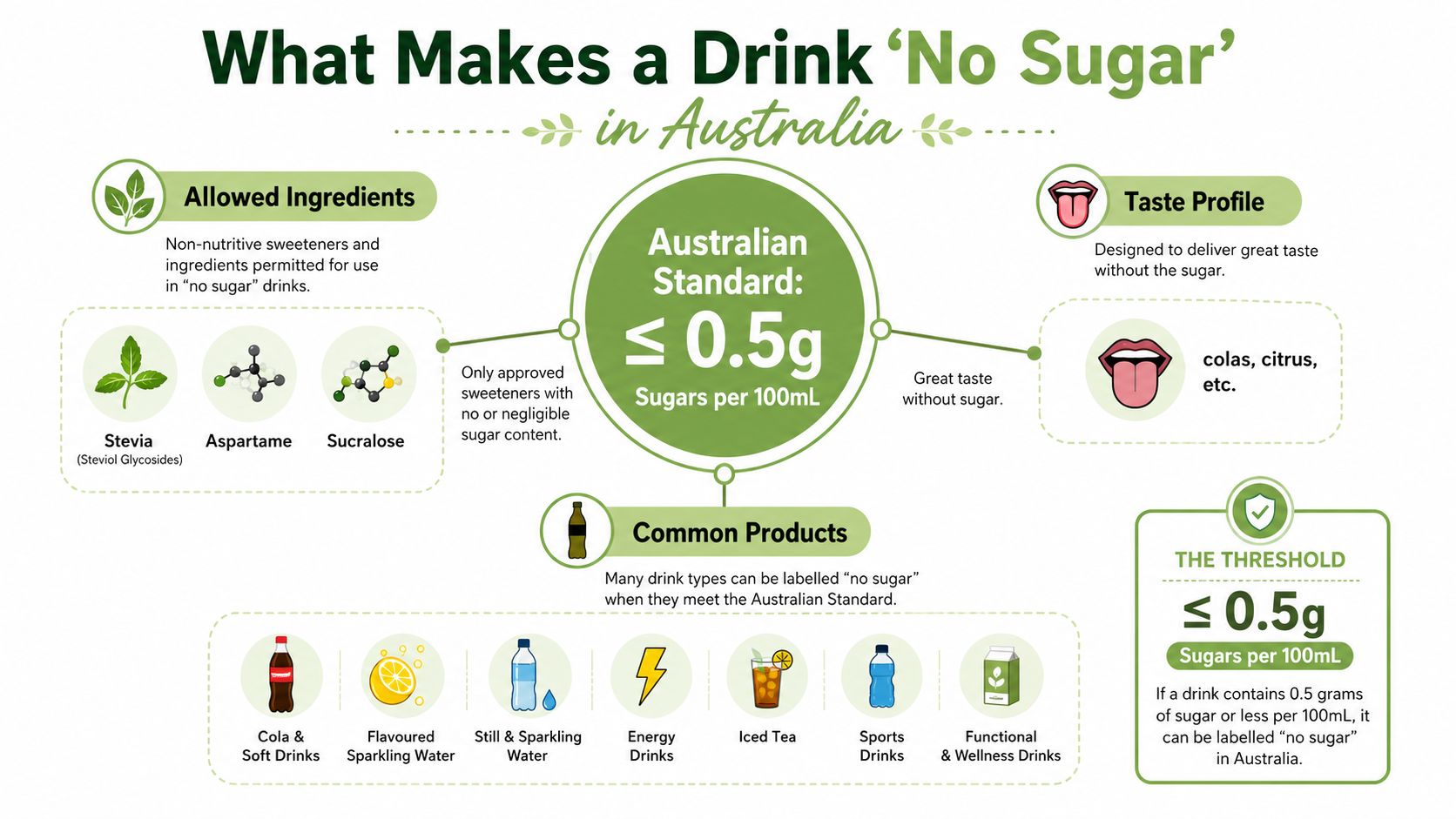
A label can look simple and still hide a lot of formulation work. In Australia, a no sugar soft drink must contain no more than 0.5 g of sugars per 100 mL. That threshold is what turns “no sugar” into a regulated claim, not a loose marketing phrase. Australian label guidance on “no sugar” uses that sugar limit as the benchmark, and the wording on pack needs to match it.
The sweetness comes from a system, not just one ingredient
These drinks usually keep the familiar soft-drink taste by replacing sucrose with high-intensity sweeteners such as aspartame and acesulfame potassium. The drink still needs sweetness, sharpness, body, and finish, so the formula has to do several jobs at once.
That formulation approach is common across the category. A product overview from UNESDA product and ingredients overview describes no- and low-calorie soft drinks as mostly water, often around 98% to 99%, which helps explain why they feel light on the palate even when the flavour is bold. The energy contribution stays effectively negligible because there is very little sugar in the first place.
Acid and sweetener work together
The easiest way to understand a cola-style no-sugar drink is to treat the acid-sweetener system as a matched pair. One part supplies the sparkle and edge, the other supplies the sweetness cue, and together they make up for the missing sugar. That is why a well-made no-sugar cola can still taste round and familiar.
Food acids matter here as much as sweeteners do. They provide the bite, brightness, and stability that sugar would normally help support. Without that balance, a zero-sugar drink can taste thin or flat. With it, the drink can feel cohesive even without the bulk of sugar.
Australian label rules for “no sugar” are also easy to miss if you only glance at the front of pack. An infographic explaining that Australian regulations require drinks to have 0.5g of sugar or less to be labeled no sugar.
A no-sugar label tells you the sugar level, not whether the drink is a good everyday choice for your routine.
The main takeaway is simple. No sugar is a legal and formulation category. It does not automatically mean healthy, nourishing, or better than every other alternative. It means the drink meets a sugar threshold and uses a sweetness system designed to replace the flavour of sugar.
Reading a No Sugar Label Like a Local
A front label can be neat and reassuring, while the ingredient list tells the story. Once you know what each part is doing, a supermarket shelf becomes much easier to read. That matters in Australia, where no sugar can cover anything from a classic cola to a lighter café-style swap.
A real Coke No Sugar label, translated
Australian product labelling for Coke No Sugar lists carbonated water, colour (150d), food acids (338, 331), sweeteners (951, 950), flavour, caffeine (Foodwatch product snapshot). That is a standard no-sugar cola structure, and each ingredient has a clear job.
- Carbonated water: This is the base. It gives the drink its fizz and light body.
- Colour 150d: This is the caramel colouring that gives cola its dark look.
- Food acids 338 and 331: These help with sharpness, balance, and stability.
- Sweeteners 951 and 950: These are aspartame and acesulfame potassium, the main sweetness system.
- Flavour and caffeine: These round out the drink's sensory profile and familiar cola character.
That same sweetener pairing also shows up across other Coke variants in Australia, which is useful when you are comparing cans that look different on the shelf but share a similar formula.
A quick mental checklist for any can
Practical shortcut: if the front says no sugar, check the ingredient list for the sweetener blend, the acid system, and any extras like caffeine.
A fast scan works well in store. Start with the base liquid, usually water or carbonated water, then look for the sweeteners, then check whether acids and flavourings suit the drink style. If caffeine matters to you, it will usually be listed too. For a broader example of how sugar-free carbonation fits into everyday buying, the Pep Tea guide to sugar-free carbonated drinks is a handy reference point.
The aim is not to memorise code numbers forever. It is to stop treating ingredient labels like secret text. Once you know that 951 and 950 are sweeteners and 338 and 331 are part of the acidity system, you can compare drinks in under a minute.
That same habit also helps when you are choosing outside the supermarket. A Low sugar mood trio sampler can make sense on a café shelf beside kombucha, matcha, and other everyday drinks that are not trying to copy cola at all.
Diet Sodas, Sparkling Water, Kombucha, and Tea Compared
Not every drink that skips sugar is trying to do the same job. Some are built for a cola hit, some for clean refreshment, and some for a more functional role in the day. That's where a side-by-side comparison helps.
| Category | Sweetener approach | Functional extras | Best for |
|---|---|---|---|
| Diet soda | High-intensity sweeteners and acids | Familiar cola-style flavour, caffeine in some products | People who want the closest swap for regular soft drink |
| Flavoured sparkling water | Usually no sweetener, or a very light sweetening approach | Minimal additives, light refreshment | Anyone who wants fizz without a heavy flavour load |
| Sugar-free kombucha | Fermentation-based, usually low sugar rather than sweet | Live cultures and organic acids from fermentation | Café menus, food pairing, and people wanting a tangier option |
| Unsweetened tea or matcha | No sweetener needed | Antioxidants, and in matcha, naturally occurring caffeine with L-theanine | Calm focus, morning routines, and less sugary everyday drinking |
Where each option fits
Diet soda wins on nostalgia. It's the most obvious substitute when someone wants the exact cola experience without the sugar load. The trade-off is that it still depends on a tight sweetener-and-acid structure, so it's not the same as a naturally unsweetened drink.
Flavoured sparkling water gives you a cleaner finish. It's the least intrusive option if you just want bubbles and hydration-style refreshment. That makes it a good bridge drink for people who're trying to move away from sweeter cans but don't want to jump straight to tea or kombucha.
Sugar-free kombucha sits in a different lane. It brings fermentation character, a more complex taste, and a better café or meal pairing role than plain soft drink. If you want a practical example of a ready-made option in that space, Low sugar mood trio sampler shows how brands are building mixed packs around function and flavour rather than just sweetness.
Tea and matcha are the quiet achievers. They don't try to imitate soft drink at all. They give you a different kind of drink moment, one that's slower, more deliberate, and often better suited to a workday or café setting.
For Australian shoppers, that's where Pep Tea's sugar-free carbonated drinks sit naturally alongside the rest of the category. The right choice depends on whether you want familiarity, light refreshment, fermented complexity, or a tea-led functional drink.
How Cafés and Retailers Can Stock Sugar Free with Confidence
A café owner in Brisbane or Newcastle doesn't need a wall of identical cans. They need a short menu of drinks that cover different moods, price points, and storage realities. A smart non-alcoholic list works like a ladder, not a single bucket.
A simple stocking mix that actually works
The easiest model is to cover three roles. First, a familiar diet cola for people who want the classic fallback. Second, a premium sparkling water for the clean, neutral option. Third, a brewed, sugar-free functional drink for customers who want something with more character.
That tiering helps because not every customer wants “the healthiest drink”. Some want a familiar taste with no sugar, some want a refreshment drink, and some want something they can sip with lunch. A menu that acknowledges all three sells better than a menu that tries to force everyone into one category.
For venues that also run loyalty or repeat-purchase programs, retail loyalty program inspiration can be useful when you're thinking about how to nudge regular drink buyers back into the fridge or onto the menu again. The point isn't to gamify everything. It's to give people an easy reason to come back for the same drink they already liked.
Storage, serving, and pairing matter
Diet cola cans are easy on fridge space and simple to serve. Sparkling water can go straight into glassware with ice and citrus if the venue wants a cleaner look. Sugar-free kombucha and chilled matcha sit better when staff can explain them briefly, because they're more flavour-led and often sit in the premium part of the menu.
A café menu gets stronger when each drink has a clear job, a clear serve, and a clear reason to exist.
Retailers should think in shelves, not just cartons. Put familiar no-sugar sodas where customers expect them, and keep functional drinks close enough that shoppers notice them without having to hunt. That reduces friction and helps people compare a standard no-sugar option with a more functional one in the same visit.
If you stock kombucha locally, Pep Tea's guide to where to buy organic kombucha in Australia fits naturally beside this thinking. It's especially relevant when you want to position a brewed option as a separate choice from canned soft drinks, not as a replacement for every drink on the shelf.
A Smart Shopper Checklist for the Aisle and the Menu
The front of the can is marketing. The back of the can is where the useful information lives. If you want to make better choices without overthinking it, use the same five checks every time.
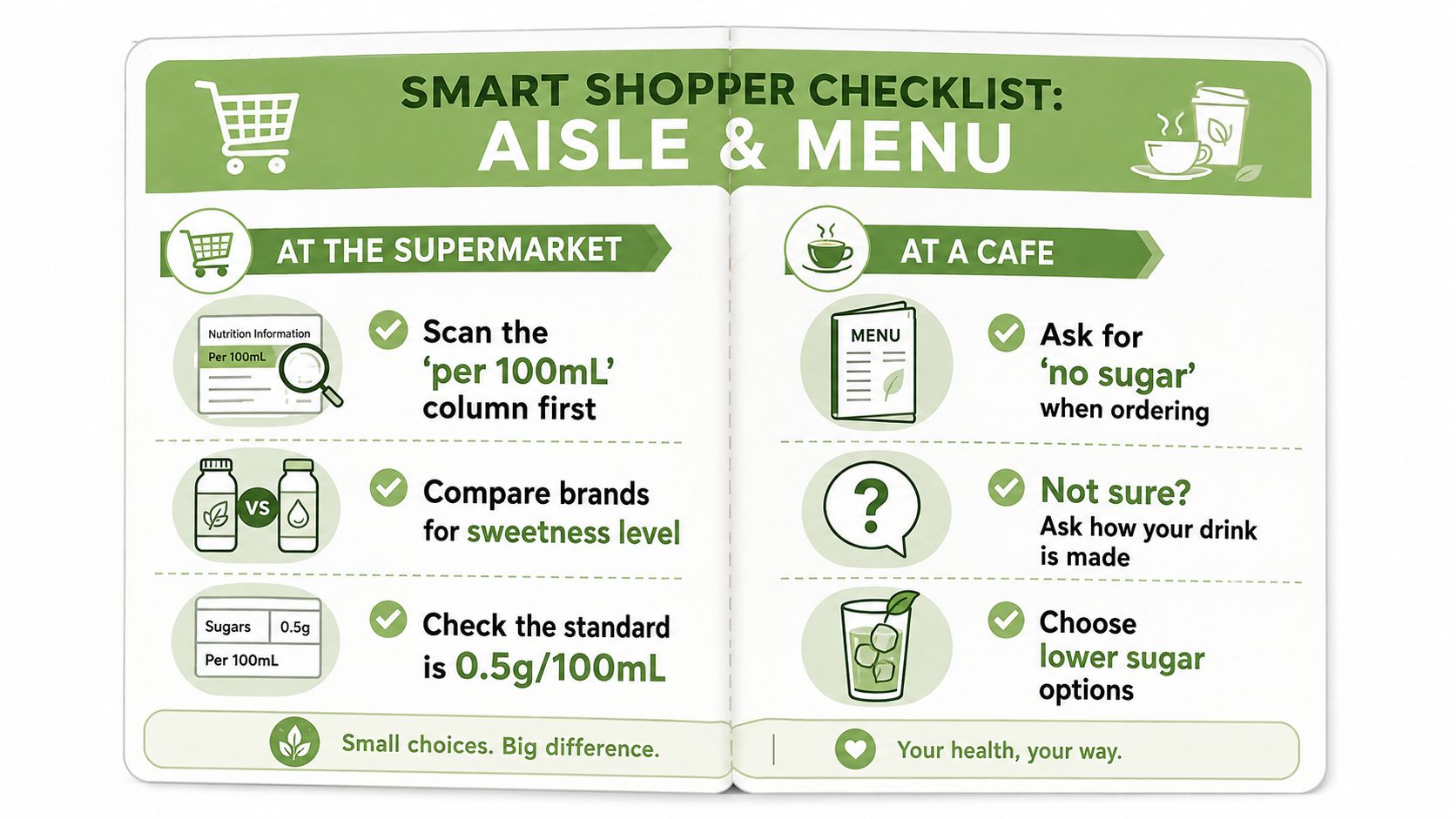
Five checks that actually help
- Scan the per-100 mL figure first. That's where the sugar claim lives, not in the headline wording on the pack.
- Check the sweetener list. If you care about specific ingredients, look for the code numbers and names, not just “no sugar”.
- Look for functional extras. Live cultures, organic acids, antioxidants, caffeine, or tea compounds each point to a different drinking experience.
- Match the drink to the occasion. A desk drink, a post-lunch refreshment, and an evening social serve don't need the same product.
- Ask whether the price matches the role. A premium drink should do a premium job, not just sit there looking healthy.
The substitution pattern matters too. Swapping a sugary soft drink for a no-sugar version is a different choice from swapping water or unsweetened tea for the same bottle. The first move reduces sugar exposure. The second move might just change taste preference, without adding much benefit.
That distinction is why some shoppers feel better with a no-sugar cola for a party but still prefer water or tea during the workday. Both can be sensible. They just serve different purposes.
If you're standing in the aisle with three good options in hand, choose the one that fits the moment. A no-sugar cola can replace a regular cola. Sparkling water can cover the refreshing gap. Sugar-free kombucha can add flavour and café-style variety when you want something more distinctive.
Building Everyday Habits Around Sugar Free Drinks
Habits change faster when the choice feels normal. If you keep the right drinks on hand for the right times of day, you won't need to negotiate with yourself every afternoon. The pattern becomes automatic.
For a work-from-home desk routine, a chilled unsweetened tea or matcha suits the slow-focus part of the day. For a lunch-on-the-go routine, a no-sugar soft drink or a sugar-free kombucha can be the easier grab-and-go choice. For an evening social routine, sparkling water or a lightly flavoured functional drink often fits better than a heavy sweetener hit.
Pep Tea's Australian-brewed sugar-free organic kombucha and Japanese organic matcha both fit that functional middle ground, where the drink is doing more than quenching thirst. They're useful examples of how Australians can shift away from sugary defaults without pretending every drink has to be the same.
The best long-term swap is usually the one you'll keep choosing. That might be a diet soda on some days, kombucha on others, and plain water when that's what you want. A healthier routine usually comes from a few consistent swaps, not from trying to make one drink solve everything.
If you're building a better drink routine, start with the swap that feels easiest and keep going from there. Explore Pep Tea for Australian-brewed sugar-free kombucha and organic matcha, then choose the option that fits your day, your café run, or your shelf at home.
Real Raw Organics Kombucha: An Australian Buyer’s Guide
You're probably standing in front of a fridge full of bright labels right now, looking at words like raw, organic, living, probiotic, and real, and wondering which ones mean something and which ones are just packaging.
That confusion is fair. Kombucha has picked up a lot of wellness language, and not every bottle earns it. Some brews are carefully fermented and cold handled. Others feel more like flavoured fizzy tea dressed up to look the part.
If you've been searching for Real Raw Organics kombucha or trying to work out what matters when choosing a proper kombucha in Australia, the useful question isn't “Which label sounds healthiest?” It's “What signs tell me this was brewed with care, handled safely, and sold transparently?”
That's where this guide helps. We'll keep it practical, plain-English, and grounded in what a buyer can check on the shelf.
The Kombucha Aisle Dilemma
Walk into a health food shop, a local grocer, or even a café fridge, and you'll see the same pattern. Every bottle seems to promise purity, gut support, live cultures, and natural ingredients. At a glance, they all look similar.
The trouble starts when those words blur together. Real sounds reassuring. Raw sounds wholesome. Organic sounds cleaner. Living sounds active and beneficial. But those terms don't all point to the same thing, and they don't all tell you whether the brew was handled properly.
Some brands lean heavily on rustic branding. Murky bottle. earthy colours. farmhouse language. That can be fine, but it can also hide sloppy process. A rough-looking bottle isn't proof of authenticity. Sometimes it's just rough-looking.
A good kombucha should feel transparent, not mysterious. If a brand makes big promises but gives you little detail, that's worth noticing.
That's why a practical buying framework matters more than marketing language. You want to know what's in the bottle, how it was fermented, whether the culture is still alive, and whether the producer seems organised enough to manage a living drink safely.
If you're comparing local options, this guide on where to buy organic kombucha in Australia is a handy next step once you know what to look for.
Why buyers get stuck
A few things trip people up again and again:
- They confuse cloudy with high quality. Some sediment is normal in raw kombucha. A chaotic bottle isn't automatically better.
- They assume “organic” means “raw”. It doesn't. Organic refers to ingredients and farming standards, not whether the drink still contains live cultures.
- They treat all fizz the same. Natural fermentation and added carbonation can produce very different drinking experiences.
- They assume more claims means more quality. Often the opposite is true. Good producers usually explain their process clearly and directly.
That's the kombucha aisle dilemma. Not too few choices. Too many labels saying almost the same thing.
Defining Raw and Organic Kombucha
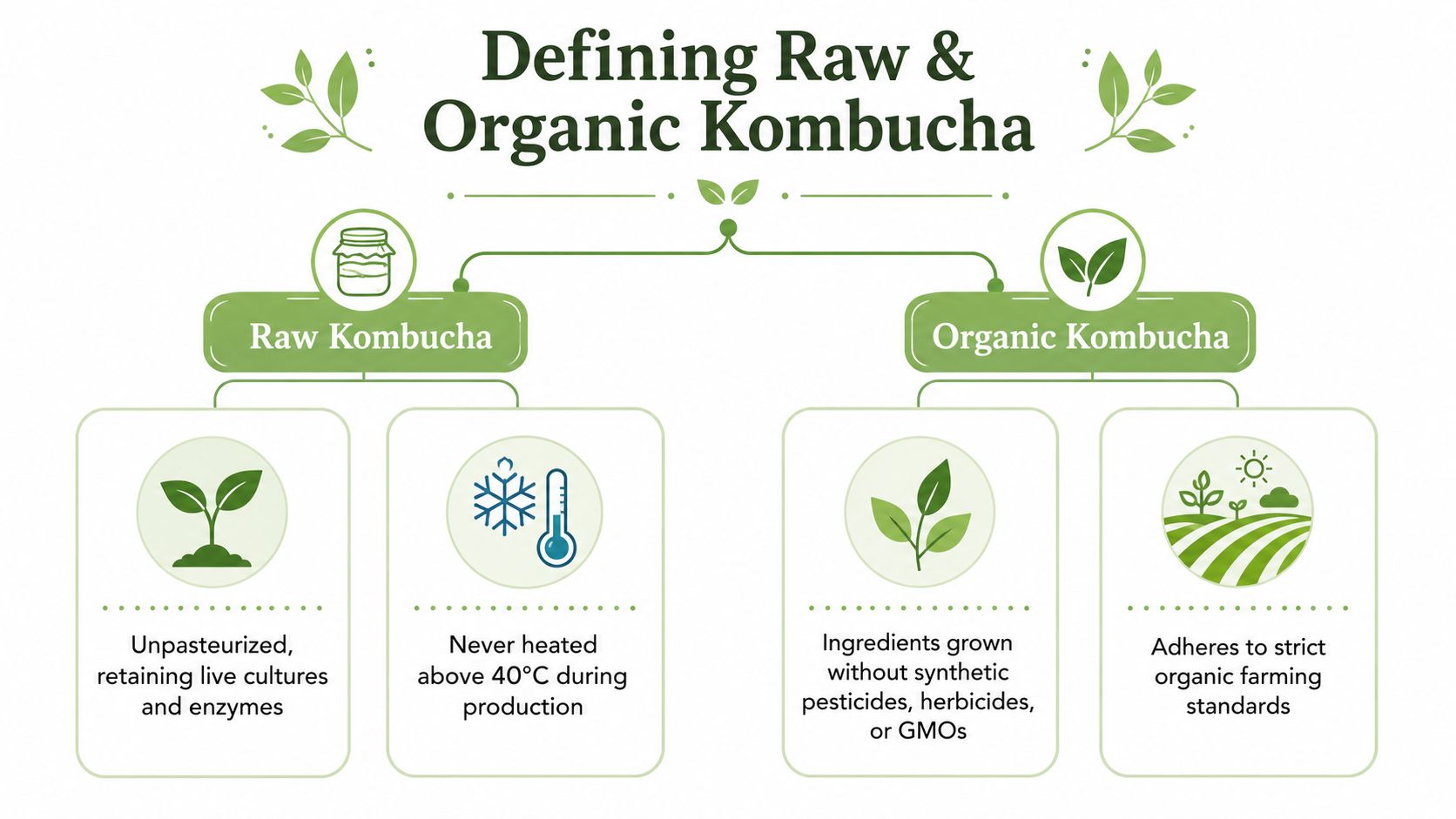
You can save yourself a lot of confusion by sorting kombucha claims into three separate ideas: raw, organic, and living. On the shelf they often get bundled together, but they answer different questions. One is about processing, one is about ingredients, and one is about whether the culture is still active in the bottle.
What raw means in practice
Raw kombucha usually means the drink has not been pasteurised after fermentation. In everyday terms, it has not been heat-treated to the point that the live culture is knocked back or wiped out. That matters because the culture is not a decorative extra. It is part of what makes kombucha kombucha.
A good way to picture it is fresh yoghurt versus a shelf-stable yoghurt dessert. They may look similar from a distance, but they are not handled the same way and they do not offer the same living character. Raw kombucha works in that same practical sense.
Raw also helps explain sediment, which confuses plenty of buyers. A light layer at the bottom, fine strands, or a bit of cloudiness can be normal in a living brew. It can come from yeast, tea particles, or new culture forming. Sediment is not a gold medal for quality, and it is not a warning sign by itself either. It is only one clue, and you need to read it alongside the label, storage instructions, and how clearly the producer explains their process.
If you want a plain-English look at how the culture develops, this guide to making and understanding a kombucha SCOBY helps connect what is happening in the jar to what you later see in the bottle.
What organic actually tells you
Organic kombucha refers to the ingredients used to make it. That usually means the tea, sugar, fruit, herbs, or spices were grown and handled under organic standards rather than conventional farming systems.
That is useful information, but it does not tell you how carefully the kombucha was brewed. A producer can start with organic ingredients and still rush fermentation, over-flavour the batch, or process it in a way that strips out the living character. The reverse can also be true. A kombucha can be raw and alive without every ingredient being organic.
For shoppers, this is the key distinction. Organic tells you about sourcing. Raw tells you about processing.
What living refers to
A living kombucha still contains active microbes from fermentation. On the label, that may appear as live cultures or similar wording. In Australia, that claim should sit comfortably with the rest of the product details, especially refrigeration and shelf-life. If a bottle presents itself as alive but is treated like a soft drink that can sit warm indefinitely, it is fair to ask more questions.
Research on kombucha composition has also found that fermentation can change the drink's profile by producing organic acids and transforming tea compounds, though the result depends heavily on the tea, sugar, culture, and brewing conditions, as described in this review of kombucha processing and composition.
That last part matters. “Living” is not a magic word. It does not guarantee a careful brew, and it does not override basic food safety.
A quick way to separate the terms
| Term | What it points to | What it does not guarantee |
|---|---|---|
| Raw | Minimal post-fermentation heat treatment | Organic ingredients |
| Organic | Farming and ingredient standards | Live cultures |
| Living | Active microbial culture remains in the drink | Careful ingredient sourcing |
Cowboy brands often blur these lines because the blur helps them sell. A better producer makes the distinctions easy to understand. That clarity is what you want. It gives you a practical way to judge the bottle for yourself, especially when you are trying to work out whether the sediment is normal, whether the culture is likely still active, and whether the product looks handled in a way that would meet Australian expectations for a refrigerated, living drink.
Behind the Brew The Authentic Fermentation Process
You pick up a bottle, give it a gentle tilt, and see a little haze drifting through the glass. For plenty of shoppers, that is the moment the doubts start. Is that a sign of a real ferment, or a sign that something has gone wrong? The answer starts with understanding how kombucha is made.
A genuine brew begins straightforwardly. Tea is steeped. Sugar is mixed in while the tea is warm. The liquid is cooled, then the SCOBY and starter liquid are added. After that, the microbes take over and slowly change sweet tea into something brighter, drier, and more complex.
What the SCOBY is actually doing
SCOBY stands for symbiotic culture of bacteria and yeast. The name sounds a bit lab-coat, but the job is easy enough to follow once you break it into stages.
First, the yeast starts feeding on the sugar. As it does, it creates alcohol and carbon dioxide. Then the bacteria use those fermentation by-products and turn them into the acids that give kombucha its clean tang. A good comparison is sourdough or yoghurt. You begin with a simple base, then a living culture reshapes it over time into something with its own character.
That also clears up one of the biggest points of confusion. Sugar is there to feed the ferment at the start. It is not there so the finished drink tastes like cordial.
Why time matters more than branding
Authentic kombucha needs time because flavour does not arrive all at once. In the early stage, the brew can taste flat and sweet. Leave it too long, and the acidity can push too far. The brewer's skill is in knowing when the tea, acidity, fizz, and remaining sweetness are in balance.
That is one of the easiest ways to spot the cowboy end of the market. Some brands build a kombucha image around fruit flavour, buzzwords, and flashy packaging, then deliver something that drinks more like soft drink with a health halo. You can add flavouring after the fact. You cannot fake the layered character that comes from a careful ferment.
A practical test helps here. If the first clear impression is sugary fruit and the tea-ferment note barely shows up, the brewing may not be doing much of the work.
For home brewers wanting to understand the culture itself, this guide on how to make a kombucha SCOBY explains the living side of the process in plain language.
What authentic fermentation looks like in the glass
A well-made raw kombucha usually leaves a few honest clues once it is poured.
- Balanced tartness. The acidity should taste refreshing and clean, not rough or aggressively vinegary.
- Natural-looking fizz. Fine bubbles usually feel more integrated than the sharp pop of a heavily force-carbonated drink.
- Tea still present. Even with ginger, citrus, or berry flavours, you should still get some sense of the tea underneath.
- A drier finish. Real fermentation often leaves the palate cleaner and less sticky than a sugary soft drink.
- Some variation bottle to bottle. Small differences can happen in living products, though a careful producer still keeps that variation under control.
Second fermentation can add more texture and lift, especially when fruit or juice is used thoughtfully. Done well, it creates extra sparkle and depth. Done poorly, it can lead to gushing bottles, muddled flavour, or sediment that looks messy rather than natural.
That point matters in Australia, where a living, fermented drink still has to be handled with care. The process should produce character, not chaos. When you understand that, sediment stops looking mysterious and starts looking like one more clue about whether the bottle in your hand comes from a real brewer or a brand just borrowing the language of one.
Reading the Signs of a Quality Brew
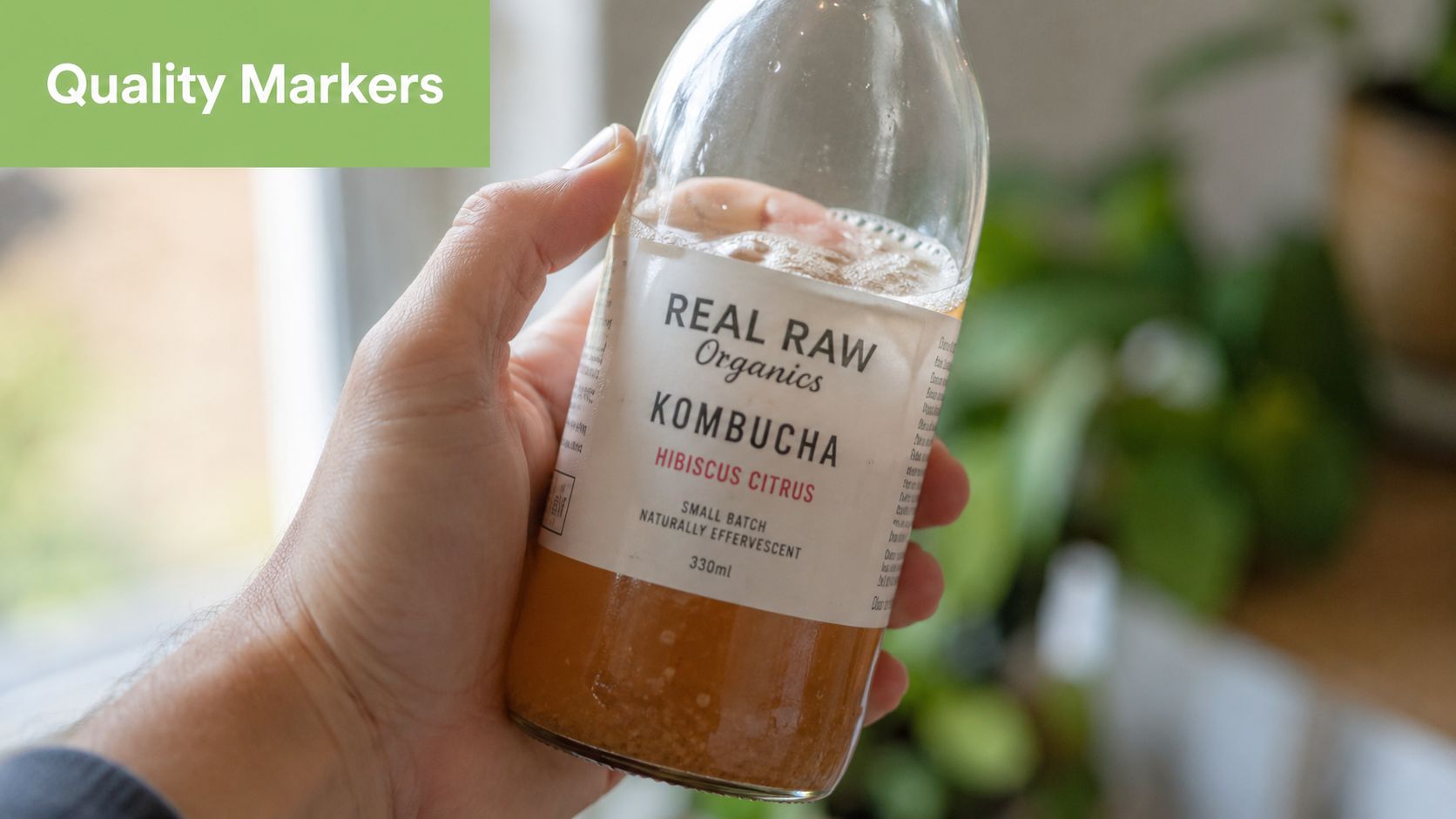
A quality kombucha gives you clues before you even open it. Label detail, ingredient list, sediment, fizz, and handling instructions all tell a story.
Start with what the label can prove
Look for specifics, not mood. “Raw”, “living”, and “organic” are useful starting words, but they should be backed by something concrete such as ingredient transparency, refrigeration guidance, or clear mention of active cultures.
Real Raw Organics states that each 16-ounce jar contains 3 billion live probiotics and says that's three times more than leading brands. The company also says the fizz comes from natural fermentation rather than force carbonation. Those are company-reported figures, so they're best treated as brand claims rather than independent lab findings, as stated on the Real Raw Organics website.
That kind of claim isn't useless. It can tell you how the brand positions its brew. But smart buyers read it as one piece of evidence, not the whole case.
What sediment really means
Sediment confuses people more than almost anything else. They see strands, flecks, or a light haze and assume one of two extremes. Either “this must be ultra-natural” or “this has gone off”.
Neither reaction is reliable.
A little sediment is normal in raw kombucha because it's a living fermented drink. Small particles of yeast, culture, or tea can settle out. That's not automatically a fault. But heavy, messy sediment can also point to less refined filtration, weaker process control, or inconsistent bottling.
A shelf-side way to think about it
- A light haze or fine sediment can be perfectly normal.
- Large floating clumps aren't always dangerous, but they may put off drinkers and suggest rough handling.
- A bottle that looks different every time you buy it can signal inconsistency.
- Clear storage instructions matter. Raw kombucha usually needs cold handling for a reason.
Sediment tells you something. It just doesn't tell you everything on its own.
Check the ingredient list with a brewer's eye
The best ingredient list is usually boring in the best possible way. Tea. sugar for fermentation. culture. maybe fruit, herbs, or spices. That's the basic frame.
If the label leans heavily on sweeteners, flavour systems, or vague “natural” language without much explanation, pause there. Kombucha should taste built, not assembled.
For buyers who want a low-sediment, certified organic Australian option, Pep Tea offers raw organic kombucha brewed in NSW as one example of a producer focusing on controlled fermentation and clean ingredient lists.
Watch how the pour behaves
This short visual is useful because quality often reveals itself once the bottle is opened and poured.
A practical buyer's checklist
| Sign | What you want to see | Why it matters |
|---|---|---|
| Culture claim | Clear language around live cultures | Suggests the drink is still active |
| Storage guidance | Kept refrigerated | Supports cold-chain handling for a living product |
| Ingredient list | Tea, fermentation inputs, recognisable flavourings | Easier to judge what's driving the taste |
| Sediment level | Some is fine, excessive isn't ideal | Helps assess process control |
| Fizz quality | Integrated natural sparkle | Often signals a more careful brew |
Good kombucha doesn't need to look rustic to be real. It needs to look managed.
Navigating Health and Safety in Australia
In Australia, the safety conversation around raw kombucha is less about drama and more about discipline. It comes down to fermentation control, alcohol management, storage, and honest labelling.
Australian food standards require fermented foods and drinks to stay within alcohol limits for their classification, and kombucha is often discussed in Australia because alcohol can vary during fermentation and storage. In practical terms, that puts the focus on labelling, batch control, and cold-chain handling, as described in the referenced note on Australian kombucha safety and alcohol variability.
Why cold storage matters
Kombucha is alive. That's a strength, but it also means the product can keep changing if it isn't stored properly. Warm conditions can push fermentation further than intended, which may affect flavour and alcohol formation.
That's why refrigeration isn't just a merchandising choice. It's part of quality control.
If you're brewing or assessing acidity at home, a digital pH meter for kombucha checks is one of the simplest tools for keeping process decisions grounded in measurement rather than guesswork.
Common questions buyers ask
Is raw kombucha safe?
For many people, a properly produced and properly stored kombucha can fit comfortably into everyday drinking. The key words there are properly produced and properly stored.
A brand should give you confidence that it understands fermentation, not just flavour.
What about pregnancy, children, or avoiding alcohol?
Those situations call for extra caution. Because kombucha is a fermented beverage, people who are pregnant, buying for children, or avoiding alcohol completely should read labels carefully and speak with a qualified health professional if unsure.
That's not fear-mongering. It's just sensible.
Does “raw” mean wild and uncontrolled?
No. In a good brewery, raw should mean carefully controlled without unnecessary heat treatment after fermentation. It shouldn't mean chaotic.
The safest raw kombucha is usually the one made by the most organised brewer.
Packaging matters too
Safety isn't only about what happens in the tank. It also includes what happens after bottling. Container choice, closure quality, and storage all affect the drinking experience.
If you're comparing reusable bottles, takeaway formats, or café service vessels, this explainer on why BPA free matters is a useful refresher on packaging considerations many buyers overlook.
How to Use Kombucha for Consumers and Cafés
Once you've found a kombucha you trust, the next question is simple. How do you use it in daily life without overthinking it?

Kombucha often works best when it replaces something less helpful. A sugary soft drink in the afternoon. A heavy mixer at dinner. Another forgettable fridge option that tastes sweet but doesn't feel refreshing.
For home drinkers
A good raw kombucha suits a few easy moments in the day:
- With lunch if you want something sharper and less sugary than soft drink
- Mid-afternoon when you're after flavour and fizz without reaching for confectionery
- With a savoury meal where acidity helps cut through richness
- As a weekend alcohol alternative poured into a proper glass, not drunk absent-mindedly from the bottle
Serve it cold, open it gently, and pour with a little care if there's visible sediment settled at the bottom.
For cafés and hospitality venues
Kombucha has become a practical menu tool because it can do more than sit in the grab-and-go fridge. It can anchor a non-alcoholic list without feeling childish or overly sweet.
A café or bar can use it in a few ways:
| Use case | Practical idea |
|---|---|
| Straight serve | Chilled bottle or glass pour with garnish |
| Mocktail base | Pair with citrus, herbs, or tonic-style elements |
| Food pairing | Match brighter flavours with brunch or lighter meals |
| Menu upgrade | Offer a fermented option beside juices and sparkling water |
Operators who want to make functional drinks easier to stock and serve also need their back-of-house systems sorted. If you're tightening purchasing and wastage control, this guide on how to optimize hospitality operations is a practical read.
Keep the serve simple
The biggest mistake cafés make with kombucha is overbuilding it. If the brew is good, it doesn't need a dozen ingredients piled on top.
Let the ferment do some of the talking. A strip of citrus peel, a clean glass, and proper chill will often beat an overcomplicated mocktail.
For drinkers at home, the same rule applies. Buy better. Fiddle less.
Your Checklist for Choosing the Best Kombucha
When you're facing a fridge full of options, keep the decision simple. Don't ask which label sounds the most natural. Ask which bottle gives the clearest signs of careful brewing.
The shortlist that matters
- Check whether it's raw or living. You're looking for signs that the culture is still active and the drink has been kept cold.
- Read the ingredients plainly. Tea, fermentation inputs, and recognisable flavourings are easier to trust than a long list of extras.
- Treat probiotic claims sensibly. Specific figures can be useful, but brand-reported numbers are still brand-reported numbers.
- Look at the sediment without romanticising it. A little can be normal. A lot isn't automatically a badge of honour.
- Consider the producer's discipline. Storage, consistency, and clear labelling tell you as much as the front label does.
- Think in Australian conditions. A living fermented drink needs good handling from brewery to shelf to home fridge.
What “real raw organics kombucha” should mean to you
It should mean more than nice packaging and wellness language. It should point to genuine fermentation, careful cold handling, sensible ingredient choices, and an honest approach to safety.
That's the difference between a proper kombucha and a cowboy one. It doesn't need to shout. It just needs to stand up to scrutiny.
If you'd like a local example of what that checklist looks like in practice, explore Pep Tea for Australian organic tea and raw kombucha options brewed with a clean, quality-focused approach.
Immune Booster Drink: Matcha & Kombucha Recipes
Most advice about an immune booster drink starts in the wrong place. It starts with the fantasy that one glass, one powder, or one exotic ingredient can somehow do the heavy lifting for your immune system.
That's not how good drinks work, and it's not how the body works either.
The strongest everyday options are much less glamorous. They hydrate well. They keep sugar in check. They use ingredients with a real nutritional role, such as vitamin C, tea catechins, and live cultures. They also taste good enough that you'll keep drinking them. In my experience as a tea brewer in the Hunter Valley, that last part matters more than people think. A functional drink that's unpleasant, gritty, or overloaded with sharp botanicals usually ends up as a one-off experiment, not a habit.
Rethinking the Immune Booster Drink
Search for an immune booster drink and you'll find a lot of noise. Bright labels, loud promises, and recipes built around whatever ingredient is trending this month.
The better question is simpler. Does the drink support daily wellness in a way that's realistic, low in sugar, and enjoyable enough to become part of your routine?

In Australia, that shift is already happening. By the mid-2020s, immune support had become one of the top functional-beverage purchase drivers in Australia, and immune-health claims accounted for about 61% of new functional beverage introductions globally, according to Beverage Industry's report on immune-support beverages. That helps explain why tea-based wellness drinks now show up as everyday fridge staples rather than winter-only comfort drinks.
Why the old advice falls short
A lot of popular recipes make two mistakes.
- They chase novelty: Turmeric, cayenne, charcoal, herbal blends, syrups, and juices all thrown together doesn't automatically create a better drink.
- They forget the base: If the drink is sugary, poorly balanced, or dehydrating, the “functional” ingredients don't rescue it.
- They ignore consistency: One intense morning shot won't outdo steady habits such as hydration, sleep, balanced meals, and lower sugar intake.
A sensible immune booster drink isn't magic. It's a clean, repeatable drink built on hydration and ingredients that earn their place.
What actually deserves space in your glass
For a practical Australian kitchen or café, two of the most useful bases are matcha and kombucha.
One gives you a tea-based format with naturally occurring compounds people already enjoy drinking hot or cold. The other gives you a fermented base that can fit neatly into a low-sugar, flavour-forward drink when it's brewed and handled properly.
Here's the no-nonsense version:
| Base | What it does well | Common mistake |
|---|---|---|
| Matcha | Easy to pair with citrus, ginger, and water or milk alternatives | Turning it into a dessert with too much sweetener |
| Kombucha | Adds acidity, complexity, and live-culture potential | Choosing overly sweet versions or treating storage casually |
Daily immune support isn't built from hype. It's built from good brewing, sensible formulation, and ingredients that do more than decorate the label.
The Real Heroes Behind Immune Support
The most credible drinks don't “boost” immunity in some dramatic, superhuman way. They support normal function by delivering something your body can use.
That's why I trust drinks built from known components, not vague wellness language.
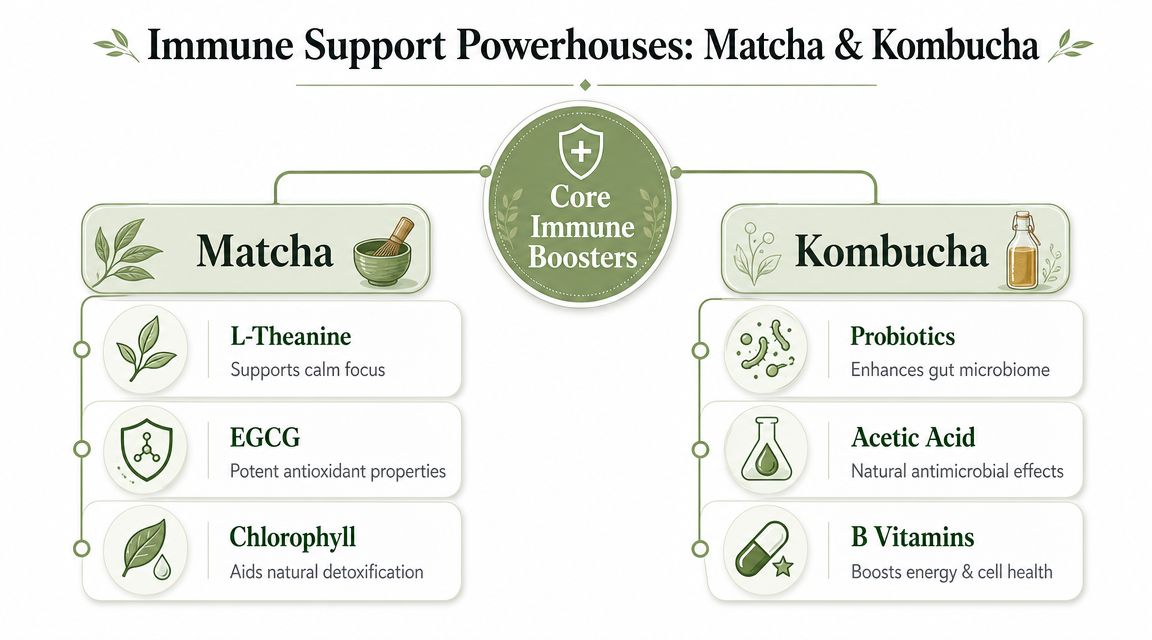
A useful summary comes from Harvard's nutrition and immunity guide, which notes that balanced eating patterns and lifestyle habits matter most, while evidence around functional beverages is strongest when they provide known nutrients. The same source highlights that green tea catechins such as EGCG may improve immunological function, and that probiotic-rich foods can enhance mucosal and systemic immunity.
What matcha brings to the table
Matcha works because it's more than green-coloured powder. A well-made matcha drink gives you tea compounds in a concentrated, drinkable format.
Three components matter most in practice:
- EGCG: This is the green tea catechin most often discussed in relation to matcha's functional value.
- L-theanine: It's one reason matcha tends to feel smoother and more composed than a standard high-caffeine drink.
- Chlorophyll and whole-leaf intake: Because matcha is whisked into the drink rather than steeped and discarded, you consume the leaf material itself.
For home drinkers, that means quality matters. Dull, stale matcha tastes bitter and grassy in the wrong way. Bright, fresh matcha is cleaner, softer, and much easier to build into a low-sugar drink.
What kombucha contributes
Kombucha's value is different. It's not there to mimic tea. It brings fermentation character, acidity, and in properly made versions, live cultures.
That matters because gut health and immune function are closely connected in everyday wellness discussions. A kombucha-based drink can be a smart format when you want something cold, savoury-sharp, and less heavy than a smoothie or juice.
The best kombucha recipes don't bury the brew. They use kombucha as the backbone, then add fresh elements around it.
Known actives beat vague promises
People often ask whether a drink needs a long list of ingredients to count as functional. Usually, no.
A shorter ingredient list often works better if each part has a clear purpose:
- A water-based or tea-based foundation for hydration.
- A vitamin C source, such as lemon or orange.
- A meaningful functional layer, such as matcha or a well-made kombucha.
- Low sugar, so the drink still fits a health-oriented routine.
Here's a simple way to understand it:
| Ingredient type | Why it belongs |
|---|---|
| Tea catechins | Give tea-based drinks a functional role beyond flavour |
| Probiotic foods or drinks | Support gut-focused wellness when handled properly |
| Citrus | Adds brightness and a familiar vitamin C source |
| Fresh ginger or mint | Improve flavour and make low-sugar drinks more satisfying |
If a drink can't explain why each ingredient is there, it usually isn't well designed.
Recipe The Energising Matcha Immunity Elixir
A good matcha-based immune booster drink should wake you up without tasting like a punishment. It needs brightness, a little warmth, and a finish clean enough that you'd happily make it again tomorrow.
This is the version I reach for when I want something warming but not heavy.
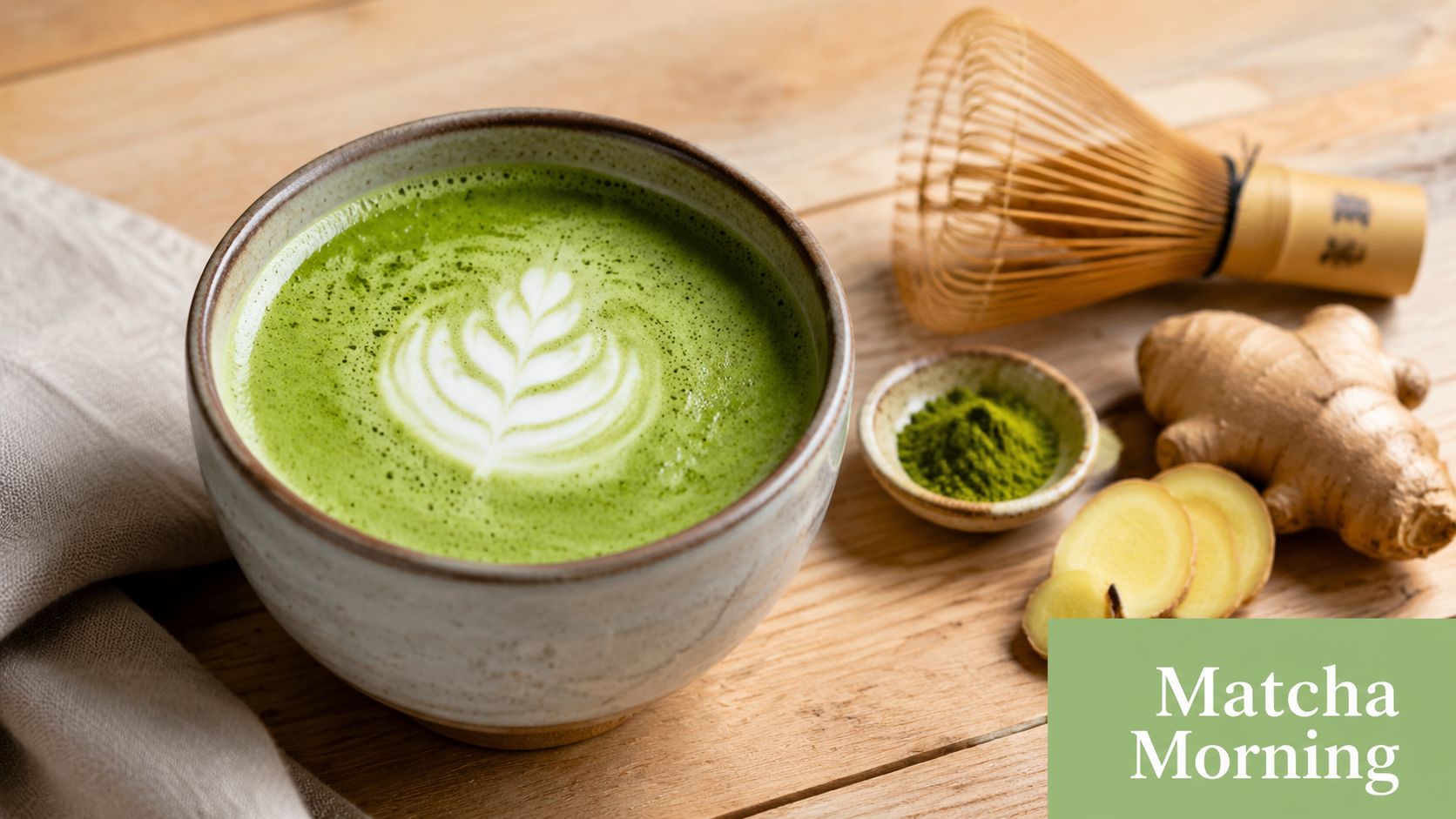
Ingredients that pull their weight
You don't need a crowded recipe. You need one with purpose.
For one serve:
- Matcha powder
- Warm water
- Fresh lemon juice
- Freshly grated ginger
- Optional milk or plant milk if you want a softer latte-style finish
- Optional small amount of honey if you need it sweeter
The logic is straightforward. Matcha gives the drink its tea-based functional backbone. Lemon adds brightness and vitamin C. Ginger rounds out the flavour and brings warmth, which makes the whole drink feel more satisfying without relying on sugar.
How to make it properly
- Sift the matcha into a bowl or cup. This prevents clumps and gives you a smoother texture.
- Add a small amount of warm water. Not boiling. Too much heat can roughen the flavour.
- Whisk until glossy and foamy. A bamboo whisk is ideal, but a small handheld frother works.
- Stir in lemon juice and a little fresh ginger. Add gradually so the citrus sharpness doesn't dominate.
- Top with more warm water for a lighter drink, or warm milk for a creamier version.
- Taste before sweetening. Often the ginger and lemon make it lively enough without much else.
Where most recipes go wrong
The biggest mistake is overbuilding. Too many spices, too much syrup, or a huge pour of fruit juice can flatten matcha's fresh, green character.
Another common problem is sugar. A useful warning from this PMC review on functional beverages is that wellness drinks often rely on “fairy dust” levels of botanicals while also carrying high sugar loads that undermine health goals. That's exactly why I prefer a low-sugar format with a tea base and a few fresh additions.
Practical rule: If your “healthy” matcha drink tastes like melted dessert, rebuild it from scratch.
A few smart variations
If you make this often, keep the structure the same and change the edges.
- For hot mornings: Use just water, lemon, ginger, and matcha for a clean finish.
- For a café-style cup: Add textured milk and keep the lemon very light so the drink stays balanced.
- For warmer weather: Shake it cold over ice instead of serving it hot.
If you want a chilled version with better texture, this iced matcha tea recipe is a useful starting point. The same low-sugar thinking still applies.
A short visual guide helps if you're still dialling in whisking technique:
Flavour notes worth noticing
This drink should taste lively, not aggressive.
You want:
- Fresh grassy sweetness from the matcha
- Citrus lift rather than sourness
- Ginger warmth without a harsh burn
- A dry, clean finish that leaves you ready for another sip
When those pieces line up, the drink feels functional because it's well made, not because the label shouts at you.
Recipe The Probiotic Kombucha Zing
A kombucha-based immune booster drink should feel crisp and alive. Not sticky, not flat, and not overloaded with juice.
The best versions build on the kombucha's own acidity and fizz instead of fighting it.
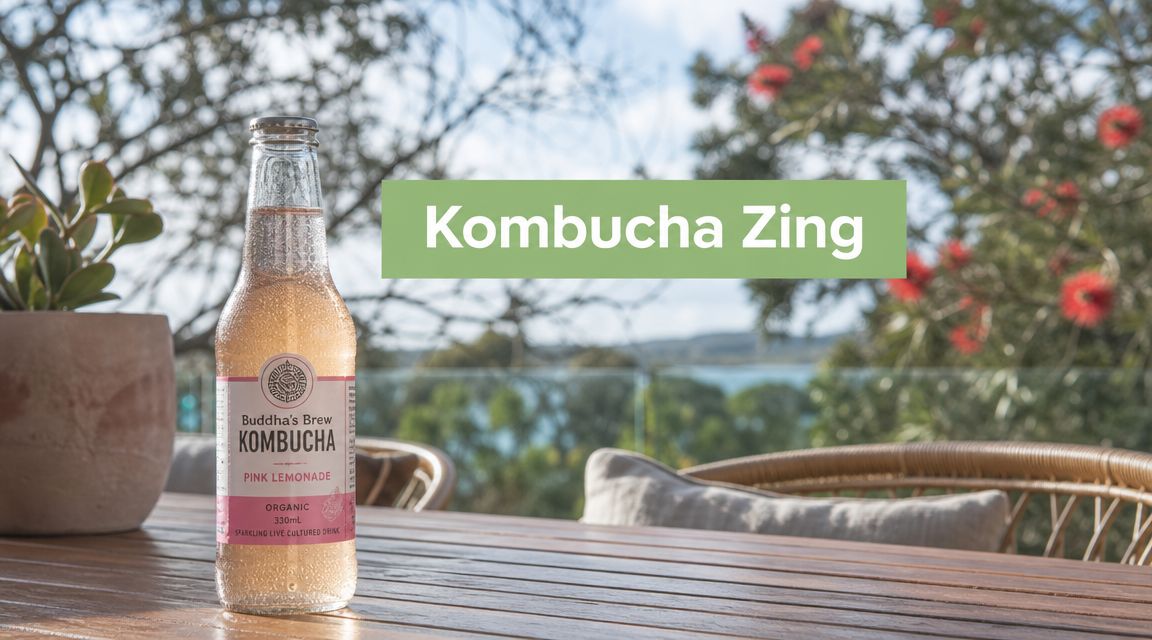
Build around the base, not around sugar
Start with a plain, ginger, or lime-leaning kombucha that isn't trying to pass as soft drink. From there, add small fresh elements that lift the drink without burying the fermentation.
For one glass:
- Chilled kombucha
- A few muddled berries
- Fresh mint leaves
- A squeeze of lemon or lime
- Ice
- Optional slice of cucumber for a cleaner finish
This works well because the berries add depth and freshness without requiring much quantity. Mint cools the palate. Citrus sharpens the edges.
Method that keeps the drink bright
Use a tall glass and work gently. Kombucha loses its charm fast if you beat the bubbles out of it.
- Muddle lightly: Press the berries and mint just enough to release flavour.
- Add ice next: This protects the carbonation when you pour.
- Pour the kombucha slowly: Let it run down the inside of the glass.
- Finish with citrus: Add just enough to lift the aroma.
You should still taste the tea and fermentation underneath the fruit.
What to avoid
Kombucha drinks become clumsy when people treat them like smoothies or mocktails loaded with syrup.
Skip these habits:
- Large juice pours that swamp the base
- Heavy sweeteners that make the finish sticky
- Too many herbs competing for attention
- Warm storage after opening, which dulls flavour and can affect the drink's behaviour
Keep kombucha recipes sharp and restrained. The brew should still taste like kombucha when you're done.
For a broader look at what makes kombucha appealing in the first place, this overview of the benefits of kombucha is a handy read.
Two useful serving styles
Not every kombucha drink needs the same shape. For home use and café service, these two styles tend to work best.
| Style | Best for | Flavour profile |
|---|---|---|
| Berry and mint spritz | Afternoon refreshment | Bright, tart, slightly herbal |
| Ginger citrus highball | Cooler weather or food pairing | Zesty, warming, more savoury |
The ginger citrus version is especially good with a drier kombucha. You get a pleasant bite without needing extra sugar.
Why this recipe earns the “functional” label
This drink makes sense because every part has a job. The kombucha gives the structure. The citrus freshens it. The herbs and fruit make it easier to enjoy regularly.
That's the standard I use for any immune booster drink. If it hydrates reasonably well, keeps sugar under control, and starts with a quality fermented base, it's already doing more than most flashy wellness blends.
Menu Ideas for Australian Cafés and Retailers
Cafés don't need another syrup-heavy “wellness” special. They need drinks that staff can make consistently, customers can understand quickly, and fridges can hold safely.
That's where matcha and kombucha stand out. Both already have flavour identity. Both fit non-alcoholic menus naturally. Both can be positioned as everyday wellness drinks without drifting into claims you can't support.
Build a menu around repeatability
For cafés, the winning move is restraint. Keep the menu language clean and the prep simple.
A practical line-up might include:
- Hot matcha ginger cup: Matcha, warm water, fresh ginger, light citrus
- Iced matcha citrus spritz: Matcha over ice with lemon and sparkling water
- Kombucha berry cooler: Kombucha, muddled berries, mint
- Ginger kombucha highball: Kombucha with fresh lime and lots of ice
The commercial advantage is that these drinks share ingredients. Ginger, mint, lemon, lime, and berries can move across multiple menu items, which helps reduce waste and keeps service organised.
Say less on the menu, but say it better
In Australia, kombucha and other fermented drinks need disciplined handling in commercial settings. As noted by guidance referenced for fermented beverage controls, fermented beverages like kombucha must be managed with validated HACCP controls, including cold-chain integrity and microbiological verification, because ambient distribution can alter sugar, carbonation, and alcohol levels.
That matters for menu wording too. Don't promise disease prevention. Don't imply a single drink can “fix” immunity. Describe the drink for what it is.
Good menu phrasing sounds like this:
- Low-sugar matcha drink with citrus and ginger
- Live-culture kombucha served chilled with fresh mint and berries
- Tea-based wellness drink with a clean, bright finish
Poor menu phrasing usually overreaches.
Customers trust cafés that explain drinks clearly. They don't trust menus that read like supplement ads.
Batch prep without wrecking quality
For café service, batch what's stable and finish what's fresh.
Batch these:
- matcha concentrate for same-day service
- pre-washed mint
- sliced citrus
- ginger infusion
Finish to order:
- whisked hot matcha
- sparkling or carbonated elements
- opened kombucha
- muddled fruit
This keeps flavour lively and reduces the chance of flat, tired drinks during the lunch rush.
Retail fridges and social promotion
Retailers should merchandise these drinks as part of a better daily-drinks habit, not a panic purchase for cold season. Place them near lunch items, grab-and-go snacks, or non-alcoholic alternatives.
For cafés posting short-form drink content, visual consistency matters almost as much as flavour. If you're filming pours, foam, and garnish shots for Instagram, this guide to SleekPost for Reels success is a useful resource for making the drinks look polished without overcomplicating the shoot.
A clean menu, cold storage discipline, and simple visual storytelling go a long way.
Sourcing Storing and Important Safety Notes
A well-made immune booster drink starts before the first pour. It starts with what you buy, how you store it, and how properly you use it.
Choose ingredients that show their quality
With matcha, colour tells you a lot. Look for a vibrant green powder with a fresh aroma and a smooth finish when whisked. Stale matcha tends to look dull and taste flat or bitter.
With kombucha, read for live cultures, a sensible ingredient list, and a lower-sugar profile. If the bottle tastes more like soft drink than fermented tea, it probably won't behave like a functional drink base either.
Store for flavour and function
Matcha is delicate. Heat, air, moisture, and light all work against it. Keep it sealed and cool, and don't leave the packet open while you fuss around making breakfast.
Kombucha needs proper refrigeration and sensible handling after opening. If you're checking acidity or refining your own brewing process at home, a reliable digital pH meter for beverage testing is one of the most useful tools you can keep in the kitchen.
Safety matters more than hype
A few grounded reminders are worth keeping in mind:
- Caffeine counts: Matcha contains caffeine, so some people will want smaller serves or earlier timing in the day.
- Fermented drinks need care: Home-brewed or poorly stored kombucha can be unpredictable.
- More isn't always better: Loading a drink with extra powders and extracts doesn't automatically make it smarter.
- General support is the right frame: These drinks can fit a wellness routine, but they aren't a substitute for medical care, sleep, balanced eating, or hydration.
Buy fewer ingredients, but buy better ones. Quality is easier to taste in simple drinks.
If you're making these at home, keep them enjoyable. If you're serving them professionally, keep them consistent. That's the difference between a functional drink people trust and a trend that disappears after one season.
If you'd like to put these ideas into practice, explore Pep Tea for premium organic matcha, Australian-brewed sugar-free kombucha, and practical tea gear that makes everyday wellness drinks easier to get right.
Best Healthy Probiotic Drinks for Gut Health

You're standing in the drinks aisle, holding a bottle that says gut health, another that says natural, and a third that says probiotic. One looks green and clean. Another looks like a soft drink wearing activewear. A third sits in the fridge and costs more, so you start wondering if it's better or just better marketed.
That confusion is fair. Healthy probiotic drinks are everywhere in Australia now, but the labels often skip the details that matter most. For shoppers, that means spending money without knowing whether the drink is functional. For café owners and retailers, it means choosing between products that can look similar on shelf but perform very differently in practice.
Navigating the World of Healthy Probiotic Drinks
A few years ago, drinks were primarily bought for thirst, flavour, or caffeine. Now many Australians are looking for something more purposeful. They want drinks that fit a wellness routine, support digestion, and don't load the day with sugar.
That shift is happening inside a much bigger category. In Australia, the non-alcoholic beverages market is projected to reach about USD 28.8 billion by 2033, up from USD 17.2 billion in 2024, with growth linked to consumer demand for wellness-oriented, lower-sugar functional drinks, according to market projections for probiotic and functional beverage demand. Probiotic drinks sit neatly inside that movement.
Why the labels feel confusing
The problem isn't that probiotic drinks are meaningless. The problem is that not every fermented or “healthy-looking” drink deserves the same trust.
Some drinks contain live cultures and keep them alive through shelf life. Some are low in sugar and fit neatly into a health-conscious routine. Others lean heavily on branding while skipping the details that help you judge quality.
If you're still sorting out the language around gut health, a simple explainer on understanding probiotics and gut enzymes can help make the basics less murky.
Healthy probiotic drinks should make life simpler. If a label creates more questions than answers, it hasn't done its job.
The real question to ask
Don't start with “Is this trendy?”
Start with “What exactly is this drink doing for me, and what proof is on the label?”
That's the lens we use at Pep Tea when talking about wellness drinks in Australia. Not hype. Not vague “goodness”. Just practical standards that help people choose better.
What Makes a Probiotic Drink Truly Healthy
A healthy probiotic drink isn't just a fermented beverage. It's a drink that combines live beneficial cultures, low sugar, and clear product integrity.
That distinction matters because a lot of products borrow the language of wellness without delivering the basics. A fizzy bottle can be fermented and still not be a smart daily choice if the sugar is high or the probiotic information is missing.

The first test is sugar
Many people get caught out. A drink can talk about gut health and still behave more like a soft drink nutritionally.
Over half of Australians aged 15 and over exceed recommended free-sugar limits, and sugary drinks are a major contributor, which is why low sugar matters so much when judging whether a probiotic drink is healthy, as discussed in this overview of probiotic drink benefits and sugar concerns.
If sugar is doing most of the heavy lifting in the flavour profile, the product may undermine the healthy image it's trying to project.
The second test is live cultures
“Contains probiotics” sounds impressive, but it's incomplete. The better question is whether the drink contains live cultures in a form that remains useful by the time you consume it.
A healthy probiotic drink should give you:
- Live and active cultures that are intended to survive into the final drink
- A clear ingredient list without unnecessary artificial extras
- A reason to choose it regularly, not just occasionally as a treat
For readers who want a clear primer on how probiotics and prebiotics work together, we've covered that in our guide to prebiotics and probiotics.
The third test is product transparency
A strong label makes it easier to trust the drink. A weak label asks you to trust the branding.
Look for signs that the maker has thought carefully about quality:
- Storage instructions that match a live product
- Specific culture information rather than vague wellness language
- A clean water source and careful processing, because even the starting ingredients matter. If you're curious about household water quality standards, these expert tips for lead removal are a useful reminder that what goes into a drink matters as much as what's added later.
Practical rule: If a probiotic drink is high in sugar, vague on cultures, and full of “natural wellness” language, treat it cautiously.
The Science-Backed Benefits of Probiotics
People often hear that probiotics are “good for your gut”, but that phrase can feel frustratingly vague. In plain language, probiotics are used to support a healthier balance of microbes in the digestive system. That can matter for digestion, day-to-day comfort, and broader wellness.
The key point is restraint. Probiotics aren't magic, and probiotic drinks aren't medicine. But there is meaningful evidence behind some uses.
What the evidence supports
International evidence cited by the U.S. NIH shows that probiotics can reduce certain types of diarrhoea by 36% and, in some meta-analyses, lower total cholesterol by 7.8 mg/dL, according to this summary of the probiotic drinks market and evidence base. That doesn't mean every bottle on the shelf will do those things. It means probiotics have a legitimate functional basis when the right strains and doses are present.
That's an important distinction. The benefit is tied to the probiotic itself, not to the marketing around the drink.
Why low-sugar options fit better
Australian health advice has pushed people to rethink sugary drinks for good reason. If you're trying to support digestion or make better everyday choices, replacing a soft drink habit with a lower-sugar functional drink makes practical sense.
For many people, healthy probiotic drinks work best as:
- An alternative to sugary soft drinks
- A better fit for wellness routines
- A lighter option than rich or overly sweet beverages
Where readers often get confused
A common mistake is assuming “fermented” automatically means “probiotic” and “healthy”. That's too broad.
Another mistake is expecting instant dramatic results. Gut health usually responds better to consistency than to one-off wellness purchases. A quality product may support digestion and everyday balance, but it still needs to fit the rest of your diet and routine.
Some probiotic drinks may support digestive comfort. None get a free pass on sugar, storage, or label transparency.
A Guide to Common Probiotic Drinks
Not all healthy probiotic drinks look or taste alike. Some are tart and sparkling. Others are creamy and filling. Some suit dairy-free customers. Others appeal more as a snack replacement than a refreshing drink.
Here's a practical look at the most common types you'll find in Australia.

Kombucha
Kombucha starts with tea and is fermented using a SCOBY. The result is usually tangy, lightly acidic, and often fizzy.
For many Australians, kombucha is the easiest entry point because it feels like a grown-up soft drink alternative. It can work well for people who want something refreshing rather than creamy.
A good kombucha should be judged carefully, though. Some are far sweeter than people realise. Some are more about flavour than function. Others are brewed to stay low in sugar and keep a live culture profile. If you want a deeper side-by-side look at formats, this guide on kefir vs kombucha is useful.
Water kefir
Water kefir is often dairy-free and tends to have a softer, fruitier profile than kombucha. It's made with water, sugar, and kefir grains, then fermented.
Many people like it because it feels approachable. It's often milder on the palate and can suit drinkers who find kombucha too sharp.
Best fit:
- Dairy-free shoppers
- People who prefer a gentler tang
- Menus looking for a lighter sparkling option
Milk kefir
Milk kefir is quite different. It's creamy, tart, and closer to drinkable yoghurt than to a sparkling wellness drink.
It can be satisfying and substantial, which makes it appealing as a snack or breakfast-style product. But it won't suit everyone, especially those avoiding dairy or anyone after a crisp, refreshing drink.
Drinkable probiotic yoghurts
These are familiar, convenient, and often easy to find. They usually appeal to people who want a quick grab-and-go option.
The main thing to watch is the flavouring. Fruit-style probiotic yoghurts can drift quickly into dessert territory if the sugar climbs. For some shoppers that's still a workable choice, but it belongs in a different category from low-sugar functional drinks.
Which one suits which buyer
| Drink type | Texture and taste | Often suits |
|---|---|---|
| Kombucha | Fizzy, tangy, tea-based | Soft drink switchers, café fridges, mindful drinkers |
| Water kefir | Light, sparkling, fruity | Dairy-free customers, wellness retail |
| Milk kefir | Creamy, tart | Breakfast routines, snack-style use |
| Drinkable probiotic yoghurt | Smooth, familiar, flavoured | Convenience buyers, on-the-go snacking |
One factual example from the Australian market is Pep Tea's sugar-free organic kombucha, which is Australian-brewed in the Hunter Valley, NSW and positioned as a live kombucha option for consumers and hospitality buyers looking for a low-sugar fermented tea drink.
How to Choose and Store Probiotic Drinks
Smart buying begins with examining the bottle. The front of the bottle is marketing. The side and back panels are where the truth usually lives.
For both shoppers and hospitality buyers, three details matter most: strain information, viable dose, and storage.

Read beyond the word probiotic
The word itself isn't enough. Health effects are strain-specific and dose-dependent, and products should ideally list the full strain name plus a viable count at end of shelf life. A commonly cited intake window is 1–10 billion CFU per day, according to this guide on which drinks are probiotic.
If the label doesn't tell you what the strain is or how much is present, it becomes hard to judge the product's functional value.
Here's a simple label-reading checklist:
- Look for named strains such as a full Lactobacillus or Bifidobacterium identification, not just “contains cultures”
- Check whether the count is meaningful at end of shelf life, not only at time of manufacture
- Scan the ingredient list for excess sugar or unnecessary additives
Understand what CFU means
CFU stands for colony-forming units. In simple terms, it's a way of estimating how many live microorganisms are in the drink.
That doesn't mean the highest number always wins. More isn't automatically better if the strains aren't relevant, stable, or clearly identified. A modest but well-labelled product can be more useful than a flashy one with vague claims.
A probiotic claim without strain and dose information is like a tea label that says “contains leaves” and stops there.
Storage tells you a lot
Storage instructions often reveal whether a product is likely to behave like a living drink or a heavily processed one.
A live probiotic drink often needs careful handling:
- Refrigeration helps protect viability
- Expiry dates matter because live cultures can decline over time
- Heat treatment may reduce the live benefit you're expecting
For café owners and retailers, this affects more than health claims. It affects menu reliability, customer trust, and how confidently staff can explain the product.
A quick shelf test in store
When you're in front of the fridge, ask:
- Is it chilled?
- Does it name the cultures?
- Does it show a viable count?
- Is the sugar modest enough to fit a healthy-drink role?
If the answer to most of those is no, keep walking.
Simple Recipes and Serving Ideas
A healthy probiotic drink doesn't have to be a serious little bottle consumed with a furrowed brow. It can be part of everyday life, and it can taste excellent.
For home drinkers, the easiest win is using probiotic drinks as a replacement for sweeter, less functional choices. For cafés, they can become a polished non-alcoholic option that feels more thoughtful than standard post-mix.

Easy ideas at home
Try these with a low-sugar kombucha or another chilled probiotic drink that suits your diet.
Mint and lime spritz
Pour kombucha over ice, add lime wedges and torn mint, then top with chilled sparkling water if you want a softer flavour.Berry probiotic cooler
Add frozen berries to a glass and pour over your drink just before serving. The berries lightly flavour the glass without needing syrup.Granita shortcut
Freeze a probiotic drink in a shallow tray, scrape with a fork as it sets, and serve as an icy afternoon option.
Smart café serves
For hospitality venues, probiotic drinks work best when treated as premium menu items rather than afterthoughts.
A few practical uses:
- As a bottled fridge offering for customers avoiding sugary soft drinks
- As a mocktail base with citrus, herbs, and fresh garnish
- As a food-pairing option for brunch, light lunches, and wellness-focused menus
If you're building a drinks list, this collection of kombucha cocktail and mocktail ideas is a helpful place to start adapting serves for alcohol-free menus.
A short visual can spark ideas quickly:
Keep the additions simple
The fastest way to ruin a healthy probiotic drink is to drown it in syrups, juice, or sugary mixers.
Use fresh ingredients to add interest. Mint, cucumber, ginger, citrus, and berries usually do more for flavour than sweeteners do.
That approach keeps the drink aligned with why people bought it in the first place.
Your Probiotic Drink Buyer Checklist
At this point, the marketing fog should be much thinner. A healthy probiotic drink isn't defined by the word probiotic. It's defined by what survives into the bottle, how much sugar comes with it, and how clearly the maker explains what you're drinking.
Fermented drinks are only beneficial if live organisms survive processing and storage at effective concentrations. For cafés and retailers, the benchmark is chilled, low-sugar products with transparent culture labelling and a stable live-culture guarantee, as explained in this review of whether probiotic drinks are good or bad.
Keep this checklist in mind when you buy:
Check the sugar first
If it reads like a soft drink, treat it like one.Look for clear culture details
Named strains and viable counts are far more useful than vague wellness claims.Notice where it's stored
Chilled products often make more sense when live cultures are part of the promise.Read the ingredient list properly
Simpler is usually better.Match the drink to the job
A creamy probiotic yoghurt and a low-sugar kombucha may both have a place, but they serve different needs.
For consumers, that means buying with more confidence. For café owners and retailers, it means choosing products that customers can trust and staff can explain without hand-waving.
If you'd like a practical example of what this looks like on shelf, explore Pep Tea for Australian-brewed organic kombucha and tea-based wellness drinks made with a clear focus on low sugar, live fermentation, and everyday drinkability.
From Gut Health to Detox: The Benefits of Kombucha
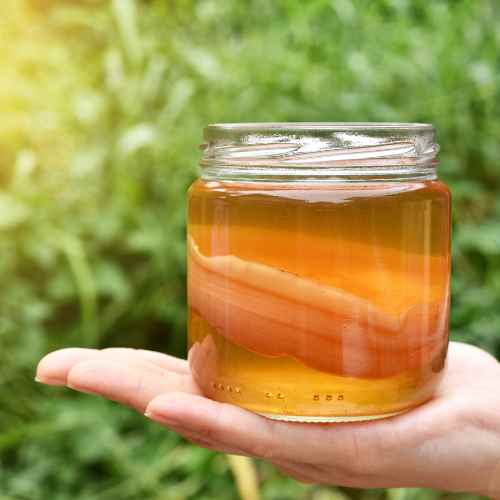
In case you missed the memo, the benefits of kombucha have been a talking point for quite a while now. From nurturing gut health with its probiotics to aiding the body’s natural detoxification process, it has emerged as a potent player in the world of functional beverages. In this article, we will look into the fascinating world of kombucha, its brewing process, and the various ways it can contribute to your health and wellness.
Where does Kombucha come from?
Kombucha originated around 2,000 years ago in Northeast China (formerly known as Manchuria). A fermented tea drink, it was highly valued for its detoxifying and energizing properties. It was then traded along the Silk Road and eventually found its way to Russia and Eastern Europe. Over time, it gained popularity in the West, and by the late 20th century, kombucha had firmly established itself as a globally loved health beverage.
Despite its seemingly recent surge in popularity, the roots of kombucha run deep, entwined with ancient cultures and age-old traditions of health and wellness.
How is Kombucha made?
Kombucha is made through a fermentation process that starts with a sweetened tea base. The magic happens when a Symbiotic Culture Of Bacteria and Yeast (SCOBY) is introduced to this sugary tea mix. This SCOBY, often referred to as the “mother” or “mushroom,” begins to feed on the sugar, initiating the fermentation process. Over a period of about 1-3 weeks, the brew is transformed into a fizzy, slightly sour, and refreshing beverage packed with probiotics, enzymes, and beneficial acids.
The specific flavour profile of kombucha can vary greatly based on factors such as the type of tea used, the duration of fermentation, and any additional flavourings added post-fermentation, such as fruits or herbs.
The Health Benefits of Kombucha
Thanks to its unique brewing process, kombucha is not just any ordinary tea. Kombucha health benefits have been celebrated for centuries and it is often touted for its ability to support a range of wellness goals – from boosting gut health to promoting detoxification and heart health.
Gut health and kombucha
Perhaps the best-known benefit of kombucha is its role in promoting a healthy gut. But why is it so good for our digestive health?
The role of probiotics in gut health
Probiotics, often referred to as “good bacteria,” play a vital role in maintaining gut health. Our gut is home to trillions of microorganisms, including various bacteria types, collectively known as the gut microbiome. When this microbiota is balanced, it aids digestion, nutrient absorption, and immune function. Probiotics contribute to this balance by inhibiting harmful bacteria’s growth, boosting the immune system, and helping to maintain the gut’s protective barrier. They can also produce substances like short-chain fatty acids, which provide nourishment for the gut lining.
How kombucha nurtures digestive health
Kombucha directly nurtures gut health through its rich composition of probiotics and acids produced during the fermentation process. These probiotics, along with acetic, gluconic, and lactic acids, can help restore the balance of the gut microbiota. The probiotics in kombucha, specifically Saccharomyces and Brettanomyces, are known to combat harmful bacteria in the gut, fostering an environment conducive to the growth of beneficial bacteria.
Additionally, the acids in kombucha can aid in maintaining an optimal pH level in the gut, further promoting digestive health by inhibiting the growth of undesirable bacteria and yeasts. Moreover, kombucha is believed to have a prebiotic effect, providing nourishment for beneficial gut bacteria and stimulating their growth.
By introducing and nourishing the beneficial bacteria in our gut, kombucha can play a vital role in maintaining and improving digestive health.
Kombucha as a detoxifying agent
Kombucha is also known as a powerful detoxifying agent, binding to the toxins present in the body and aiding in their expulsion, thus promoting a healthier liver and overall well-being.
Understanding detoxification
Detoxification is the biological process of eliminating toxins from the body. These toxins can be anything from harmful chemicals we intake through air, food, and water, to natural waste products produced by our bodily functions. The process involves several key organs, primarily the liver, which plays a central role in metabolizing substances to be removed. Toxins are processed for elimination and then excreted through channels such as sweat, urine, and faeces. The kidneys, lungs, and even skin also play crucial roles in this detoxification process.
Regular detoxification can support overall health, improving organ function, boosting energy levels, and supporting the immune system. Drinking kombucha, with its beneficial natural acids and antioxidants, is said to enhance this vital process.
The role of kombucha in the detoxification process
Kombucha plays a crucial role in the detoxification process due to its high content of glucuronic acid, a natural detoxifier. This acid binds to toxins entering the liver and converts them into soluble compounds that can be easily excreted through the kidneys.
By aiding in the efficient removal of harmful substances, kombucha helps to alleviate the burden on the liver and kidneys, resulting in enhanced overall health.
Other health benefits of kombucha
In addition to its detoxifying properties and its positive effects on digestive health, kombucha may offer plenty of other health benefits. The drink can be rich in B vitamins, known for their role in energy production and maintaining good brain health. Kombucha’s antioxidant content helps combat inflammation and protect the body from the harmful effects of free radicals.
The antioxidant power of kombucha is all down to the tea it is made from, as all the benefits of tea remain. You can find out more in our article about the benefits of green tea in kombucha.
Lastly, some studies suggest that kombucha may contribute to heart health by reducing levels of “bad” LDL cholesterol while increasing “good” HDL cholesterol. However, more research is needed in this area to fully understand the extent of kombucha’s health benefits.
Are there any downsides to kombucha?
Before we look at the downsides and potential side effects of kombucha, it is worth mentioning that not all kombucha is made equal. So it follows that the associated health benefits can vary widely from brand to brand, and even batch to batch. Always buy good quality kombucha and beware of high-sugar versions that may also contain artificial flavours and preservatives.
Our all-natural organic green tea kombucha is raw AND organic.
Like any food or drink, kombucha can also have potential side effects. While generally considered safe for most people, individuals with compromised immune systems or those who are pregnant or breastfeeding should exercise caution.
Kombucha is a fermented drink containing a small amount of alcohol and caffeine, which some people may need to avoid. It can also cause upset stomachs, infections, and allergic reactions in rare cases. Overconsumption may lead to acidosis, a condition characterized by excess acid in the body.
Always remember to consume kombucha in moderation and consult your healthcare provider if you have any concerns.
To recap, kombucha is a delicious drink with a unique flavour profile and a wealth of potential health benefits, that makes a refreshing alternative to sugary sodas. Just remember to prioritize quality, watch out for high-sugar versions, and most importantly, consume in moderation.
Have you tried our range of naturally flavoured raw organic kombucha tea?
This article was reproduced on this site with permission from operafoods.com.au the “Organic Kombucha Distributors”.
See original article:- From Gut Health to Detox: The Benefits of Kombucha
Organic Kombucha Tea – Lime & Ginger Boosts your Immune System
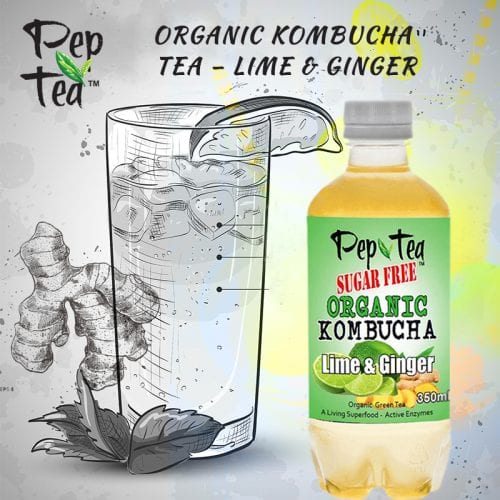
Pep Tea produces great organic matcha powder as well as organic kombucha tea. Organic kombucha tea – Lime and Ginger is very much popular among our superior Sugar Free kumbucha flavours. Organic Kombucha Tea – Lime and Ginger is considered as a healthy tea it is raw and loaded with probiotics and contains no sugar, fat, lactose and other preservatives. It is raw and organic, gluten free and vegan friendly.
Organic kombucha tea-lime and ginger is also low in calorie, carbs and GI. Kombucha is considered as a symbiotic culture of yeast as well as bacteria. Kombucha was first initiated in 221 BC in China. According to a modern science, it contains several health benefits that help to build good gut health. If this magnificent drink is consumed regularly will aid to stabilize gut flora, helps in liver function that will assist an individual’s body to remove toxins and increase the immune system of individuals.
Sugar Free Organic Kombucha Apple Pomegranate Rich In Probiotics

Sugar-free organic kombucha, Apple Pomegranate flavour is a product of a Pep Tea brand. It is free from sugar, gluten, GMO, caffeine, lactose, fat, and other preservatives. Sugar-free organic kombucha Apple Pomegranate is low in calorie, carbs, GI and it is quite vegan-friendly. It is considered as one of the Australia’s highest grade of organic kombucha or iced green tea. Pep Tea brands Kombucha is brewed and bottled in the hunter valley of Australia.
Our Sugar-free organic kombucha in Apple Pomegranate is always a raw, live, organic, as well as a shelf table product made with a lot of science. That is why it needs no refrigeration till opened. The flavor of the this kombucha tea tea is Apple and Pomegranate.
Organic kombucha tea is regarded as a symbiotic culture of yeasts as well as beneficial bacteria. It is documented as a health drink in 221 BC in China. Sugar-free organic kombucha is an ideal drink for kids and all types of ages.
It is rich in probiotics, antioxidants, minerals, organic acids and many more. If this magnificent cocktail is used regularly will aid to stable an individual’s gut flora, help in liver function that may assist an individual’s body to remove respective toxins as well as increase an immune system of an individual.
Pep Tea is among the most popular Kombucha brands in Australia. Buy Real live raw gut health fermented tea at Harris Farm Markets.
Or order your favorite kombucha drink from our Online Store for the best Kombucha brands, the taste, and quality of ours is undeniable.
Organic Kombucha Tea Mango Rich in Probiotics
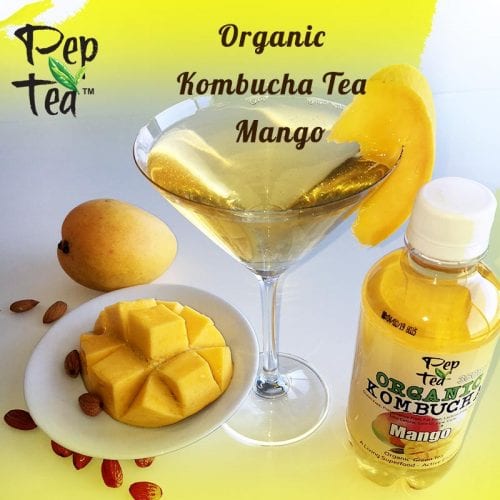
Organic kombucha tea is a product of Pep Tea that is originated in Australia. It is considered as the highest quality green tea in Australia. Organic kombucha tea mango is rich in probiotics, antioxidants, minerals as well as organic acids. It can be available in every shop in Australia; moreover, people can buy it in-store or online from Harris Farm Markets or from Pep Tea’s parent company Opera Foods. At present, the popularity of the respective product has increased considerably across the globe.
Organic kombucha tea mango can offer all the benefits of tea as well as Kombucha probiotics. As organic kombucha tea mango flavour contains tea polyphenols as well as acetic acid that helps improve gut health from the right bacteria. The organic kombucha health benefits include reducing heart disease, diabetes, blood sugar, prevention of cancer and many more.
Pep Tea is one of the leading Kombucha brands in Australia.