
Tag: cafe menu ideas
8 Healthy Drinks to Make at Home or in a Café

Healthy drinks shouldn't be bland, complicated or buried under sweeteners. The best healthy drinks to make fit the moment first, then use ingredients that deliver flavour, texture and a clear purpose. A morning latte needs a smooth finish and dependable energy. A drink for guests needs brightness, fizz and easy batch service.
This collection uses organic Japanese Matcha and properly fermented sugar-free organic Kombucha as practical foundations. Matcha may support calm focus through its naturally occurring L-theanine and caffeine, while Kombucha offers a bright, fermented alternative to soft drinks and alcohol. PepTea's Matcha is sourced from Japan, and its Kombucha is brewed in the Hunter Valley, NSW, using organic tea and live cultures.
You'll find hot and cold options, breakfast recipes, café-friendly serves and drinks for entertaining. Choose by occasion, temperature and serving style, then adjust sweetness and strength to suit your household or customers. If you're researching wider water quality considerations, well water treatment in Kentucky is a separate resource worth exploring.
1. Organic Matcha Latte for Smooth Energy
A Matcha latte is one of the most dependable healthy drinks to make at home or serve in a café. It has the comfort of a familiar milk drink, but the flavour is more layered, with fresh, grassy and gently umami notes. Ceremonial-grade Matcha is the natural choice when the tea itself leads the drink, while culinary-grade Matcha is earthier and better suited to recipes where fruit, spices or cocoa are present.
Matcha is consumed as a fine powder rather than infused and discarded, so preparation matters. Sifting removes compacted particles, and whisking creates the smooth texture that separates a polished latte from a gritty one. Matcha contains L-theanine, and an Australian laboratory result cited by Pure Matcha reported 21.3 mg of L-theanine per 1 g serve in its Matcha potency testing. That combination may suit people looking for alertness with a calmer feel, although caffeine sensitivity varies.
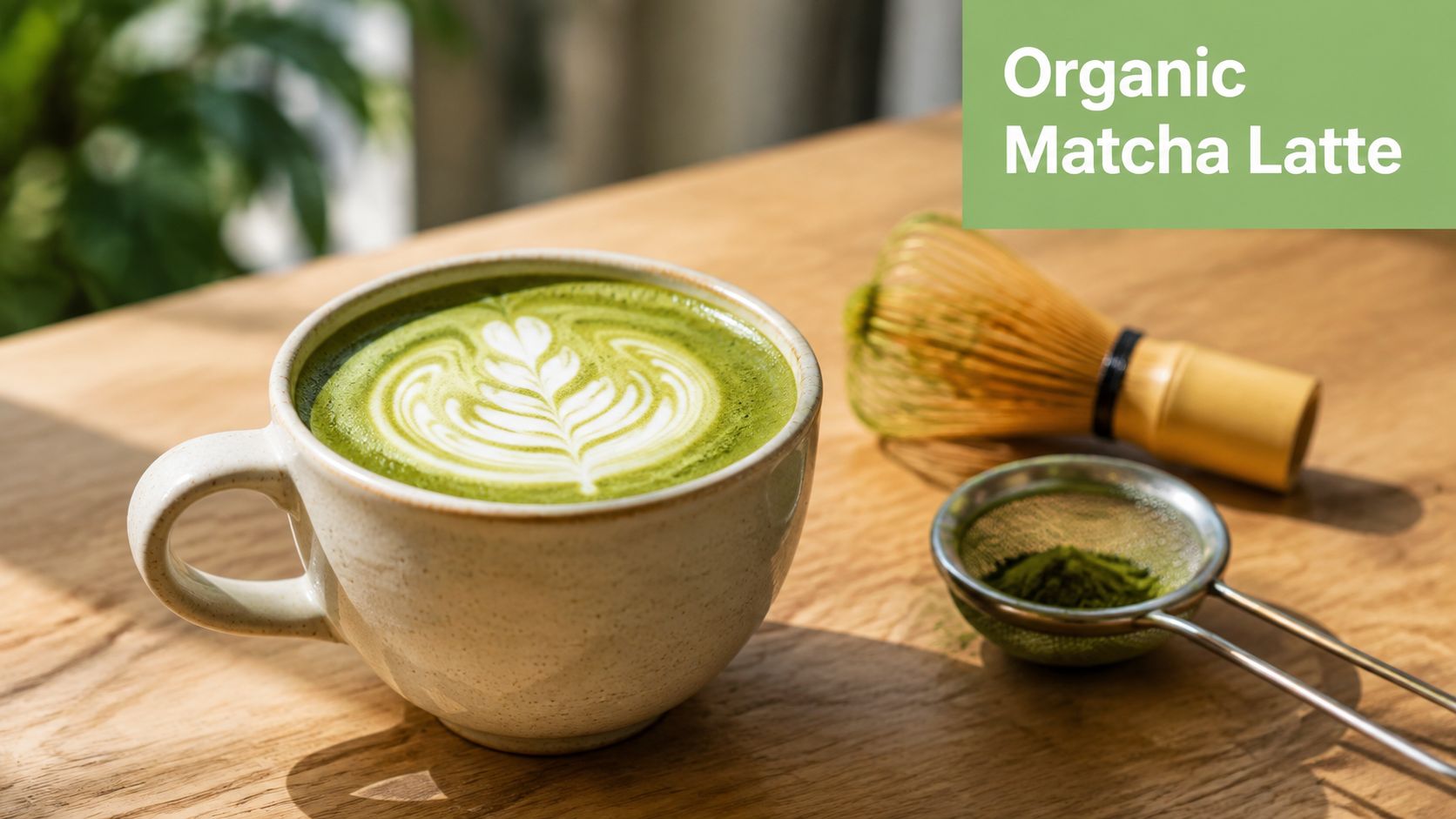
A reliable café-style method
Sift Matcha into a bowl, add hot water between 70 and 80°C, and whisk briskly with a bamboo chasen until frothy. Boiling water can make the tea taste harsh and bitter. Warm your preferred milk separately, then pour it gradually into the whisked Matcha rather than shocking the tea with a sudden temperature change.
- For a sugar-free serve: Use naturally creamy oat, dairy or soy milk and let the Matcha's umami flavour carry the drink.
- For café service: Prepare the Matcha base to order and texture the milk separately for a cleaner, more consistent finish.
- For multiple serves: Whisk a larger batch in a jug, but serve it soon after preparation so the flavour stays fresh.
PepTea's guide to caffeine in a Matcha latte is useful when choosing a morning or afternoon serving routine. Start with ceremonial Matcha for a drinking preparation, then reserve culinary Matcha for smoothies, baking and frozen desserts.
2. Iced Matcha Lemonade for Warm Days
Cold Matcha works best when you build contrast. Fresh lemon brings acidity, ice provides refreshment, and a small amount of honey can round out Matcha's green bitterness without turning the drink into a soft drink. The result is bright enough for a summer breakfast, afternoon break or outdoor café menu.
Whisk the Matcha with a small amount of warm water first. This step matters because Matcha doesn't dissolve well when you tip the powder straight into a glass of cold liquid. Add honey while the tea is still warm, then allow the mixture to cool before adding lemon juice and ice. Using room-temperature lemon juice makes it easier to combine and keeps the drink from becoming instantly watery.
For a single glass, combine whisked Matcha, fresh lemon juice, honey to taste and cold water. Shake or stir with ice, then top with sparkling water if you want a lighter, effervescent finish. A pitcher version should be chilled before ice is added, otherwise the ice will melt quickly and flatten the flavour.
Make the texture work
Practical rule: Whisk first, chill second, dilute last.
Freeze some of the prepared Matcha mixture in ice-cube trays for a stronger drink as it melts. You can also prepare lemon juice in advance and refrigerate it for quick assembly. Keep the sweetness restrained. Honey adds flavour, but it still contributes sugar, so the amount should reflect the occasion rather than habit.
For a café menu, describe this as an iced Matcha and lemon drink rather than promising a health outcome. Matcha is widely valued for catechins, including EGCG, and an Australian tea source reports that consuming the whole leaf can provide about two to three times the catechin content of steeped green tea in its explanation of Matcha antioxidants. For a related flavour idea, explore PepTea's organic green tea with lemon, then adapt the profile into a cold Matcha serve.
3. Kombucha and Matcha Green Energy Elixir
Matcha and Kombucha reward careful handling. Matcha supplies concentrated green tea flavour and caffeine, while Kombucha adds acidity, fermentation character and carbonation. The result suits drinkers seeking a lively, lower-sugar alternative to soft drink or an alcoholic serve, provided the sweetness and caffeine fit the occasion.
Whisk the Matcha fully before adding Kombucha. A smooth tea base keeps dry powder from floating in the glass. Let it cool to at least room temperature, pour it into the glass, then add chilled Kombucha slowly down the side. Stir once, gently. Shaking can quickly flatten the carbonation.
PepTea's sugar-free organic Kombucha is brewed in the Hunter Valley, NSW. Its Ginger flavour pairs well with Matcha because the spice gives the green tea a warmer finish. Lime & Ginger creates a sharper, more refreshing drink, while Mango adds roundness and can soften Matcha's savoury edge for new drinkers.
Choose the flavour by service context. Ginger fits a morning ritual, Lime & Ginger suits an afternoon café serve, and Mango works well when the tea needs a gentler introduction.
What to watch when combining live drinks
Authentic Kombucha uses tea, water, sugar and a SCOBY, with some sugar consumed during fermentation. Products still vary considerably. CHOICE notes that low sugar under the Food Standards Code means 2.5 g of sugar or less per 100 mL, while the Kombucha products it reviewed ranged from less than 0.1 g to 3.8 g per 100 mL in its Kombucha review. Read the label rather than assuming every fermented drink is low in sugar.
Serve the elixir immediately for the freshest carbonation. A room-temperature version is possible, but heating Kombucha may reduce some probiotic activity. Those who are sensitive to caffeine, acidity or fermented drinks should begin with a modest serve and assess their response. The earlier Matcha discussion covers the tea's caffeine profile, so this combination is best adjusted through temperature, flavour choice and portion size rather than treated as a guaranteed energy remedy. PepTea's Matcha and Kombucha benefits guide provides further preparation context without presenting the drink as a medical treatment.
4. Matcha Smoothie Bowl for Breakfast
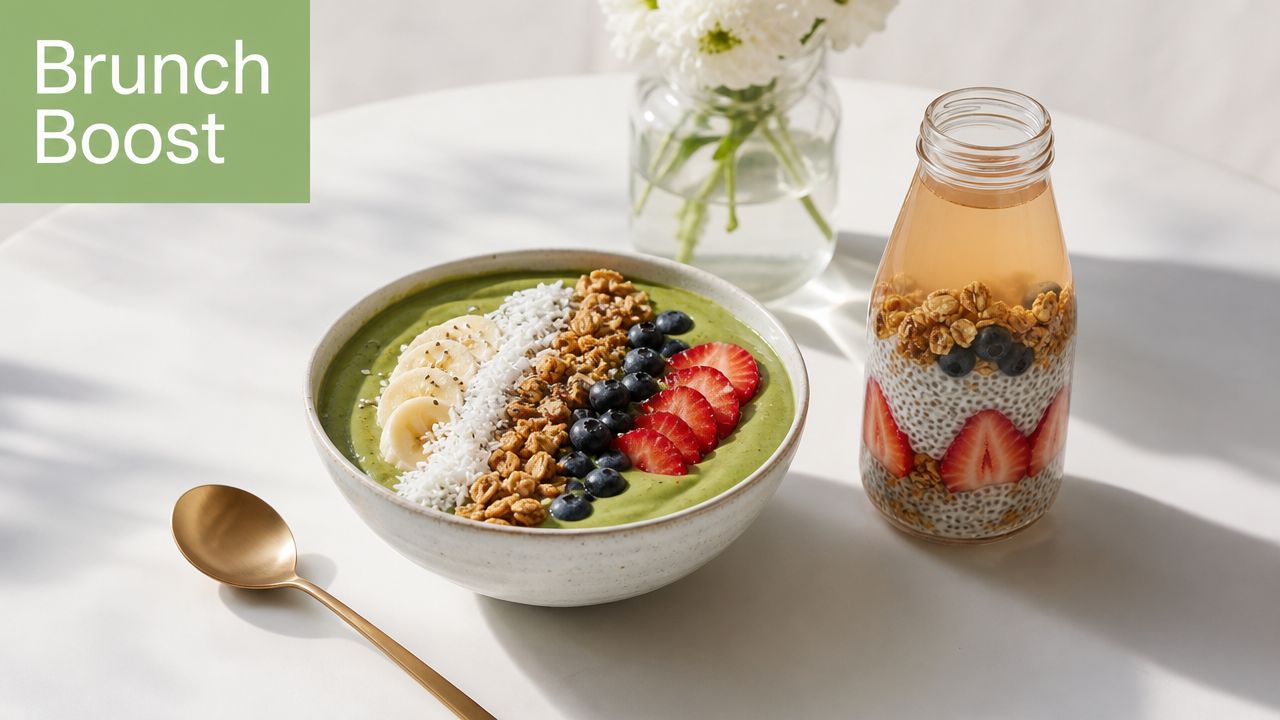
A smoothie bowl is technically eaten with a spoon, but it belongs on any practical list of healthy drinks to make because the base uses the same blending principles as a drinkable smoothie. The thicker format also gives Matcha room to work alongside banana, yoghurt, berries and seeds instead of competing with them.
Blend frozen banana, Greek yoghurt or a dairy-free alternative, milk and culinary-grade Matcha until thick and smooth. Culinary Matcha is the sensible choice here. Its deeper flavour stands up to fruit and toppings, and using a premium ceremonial powder in a blended breakfast can be unnecessary when the tea isn't the main tasting note.
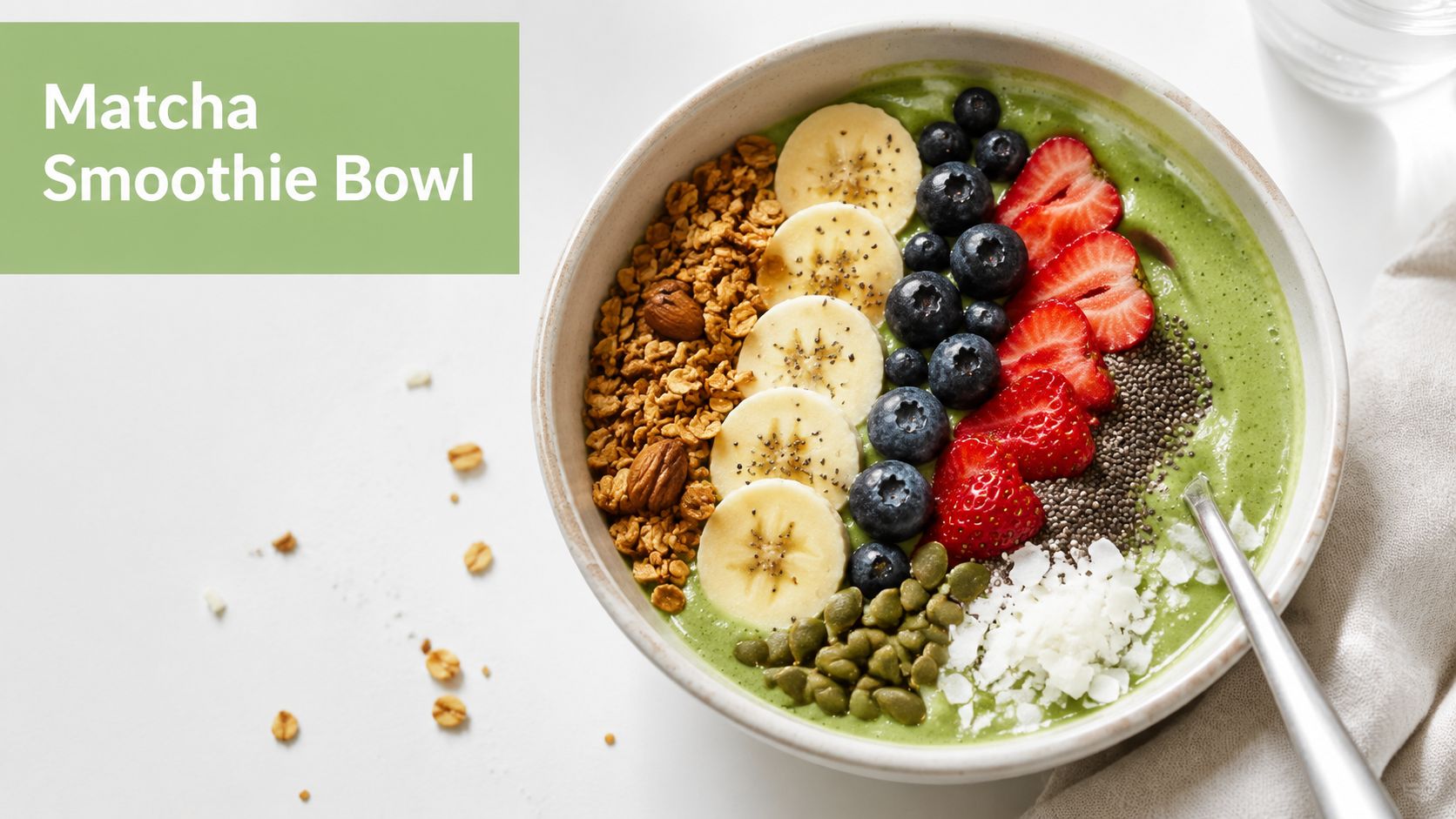
Freeze sliced banana in a sealed bag the night before. Add only enough milk to help the blender move, because excess liquid turns the bowl into a thin smoothie. Frozen yoghurt cubes can make the base creamier, while protein powder can make it more substantial for a post-training breakfast. If you use collagen peptides, remember that they change the nutritional profile but not the need for a balanced meal overall.
Build toppings that stay on the surface
Arrange granola, fresh berries, coconut, nuts and seeds in separate sections rather than scattering everything at once. This improves texture and keeps softer toppings from disappearing into the base. Prepare dry toppings in small containers if you're assembling breakfast before work.
Matcha's antioxidant profile makes it an appealing ingredient, but a bowl still needs sensible structure. Fruit supplies sweetness, yoghurt can add protein, and seeds contribute texture and fat. Keep added syrups optional. A café can offer the bowl unsweetened, then let customers choose a small drizzle if they want one.
5. Kombucha Immunity Spritzer for Everyday Refreshment
A spritzer turns Kombucha into an easy hospitality format. It looks celebratory, has natural acidity and fizz, and can be built around a small amount of juice or a chilled herbal infusion rather than a large quantity of sweet mixer. That makes it useful for cafés, yoga studios, wellness events and alcohol-free gatherings.
Start with chilled PepTea Ginger or Lime & Ginger Kombucha. Add a modest splash of fresh apple, citrus or another fruit juice, then top with sparkling water. Fresh mint, basil, rosemary or a citrus wheel gives the glass a more finished appearance without needing extra sweetener. A clear tumbler or wine glass lets guests see the colour and carbonation.
For a turmeric variation, brew a mild turmeric infusion, chill it thoroughly and combine it with Lime & Ginger Kombucha and sparkling water. Don't over-steep herbal ingredients. Bitterness becomes more noticeable once acidity and carbonation are added, and no amount of garnish will fully hide an unbalanced base.
Design the serve around the setting
- For mornings: Pair Ginger Kombucha with apple and mint for a soft, familiar flavour.
- For afternoons: Use Lime & Ginger with citrus and sparkling water for a sharper finish.
- For events: Chill the glasses, prepare the non-carbonated ingredients ahead, and add Kombucha just before serving.
- For cafés: List the flavour components clearly so customers can choose a lower-sweetness option with confidence.
The word “immunity” needs care. A spritzer can be refreshing and may contribute tea-derived or fruit-derived compounds, but it won't replace sleep, balanced food or medical care. CSIRO warns that some Kombucha products become high in sugar when manufacturers add fruit juice for flavour and fermentation, so checking the nutrition label is important when choosing a regular drink.
6. Golden Turmeric and Matcha Latte for a Warming Ritual
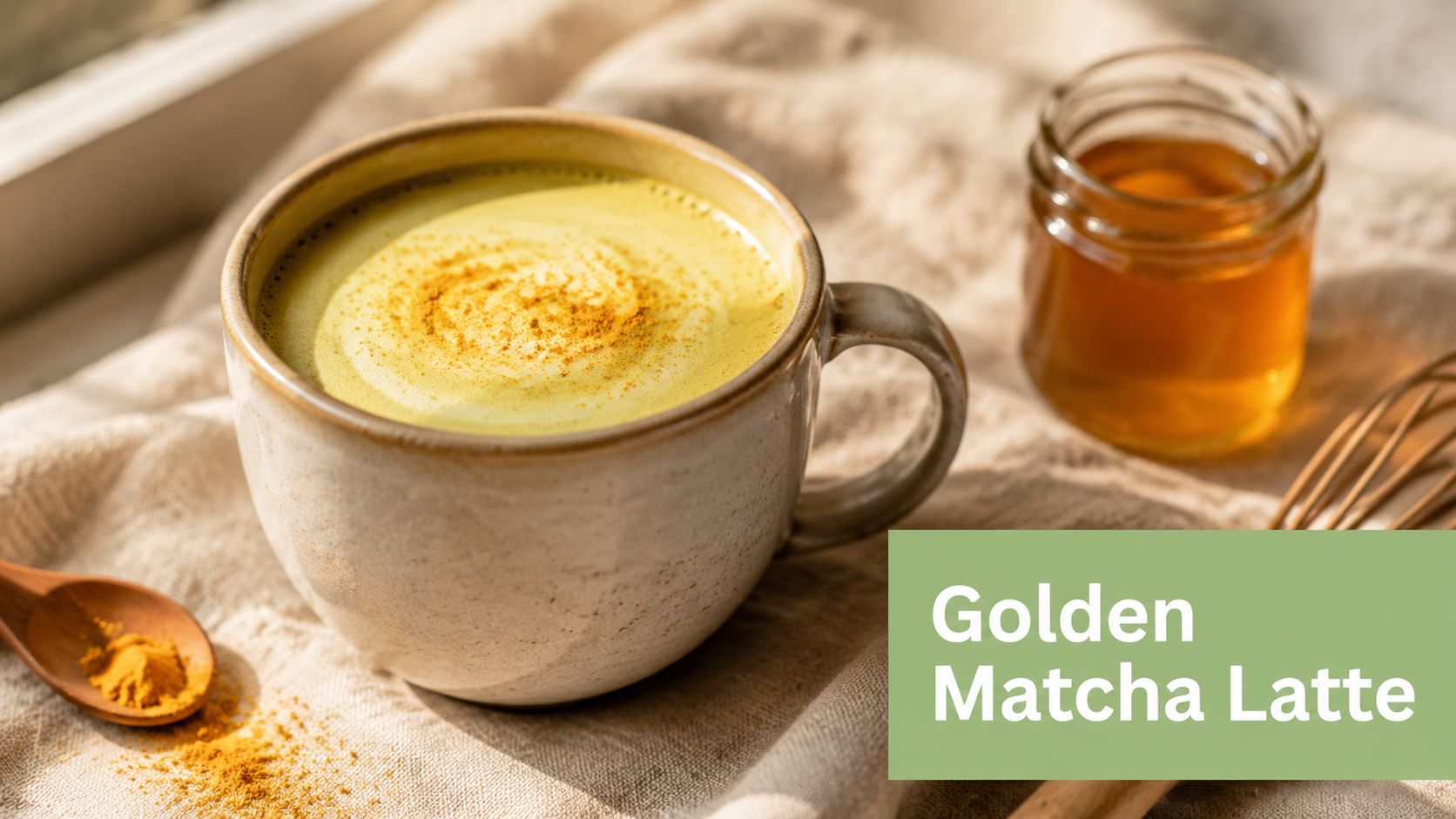
Turmeric and Matcha create a striking golden-green latte, but the drink succeeds because of balance rather than the colour alone. Turmeric brings earthy spice, Matcha adds vegetal depth, and milk provides the body needed to soften both flavours. Black pepper is traditional in many turmeric preparations, but it isn't a guarantee of a health outcome.
Sift Matcha into a bowl with turmeric, cinnamon and a small pinch of black pepper. Add warm water and whisk until the powders are evenly dispersed. Heat coconut, oat or dairy milk separately, then combine it with the tea mixture. Oat milk often gives a soft foam, coconut milk brings richness, and dairy milk creates a familiar café-style texture.
Fresh grated turmeric can taste livelier than dried powder, though it also creates more preparation and can stain equipment. For busy service, a measured dry spice blend is easier to keep consistent. Store it in an airtight container and make only what you'll use promptly.
Keep the promise modest
Turmeric is often discussed for curcumin and inflammation, but a homemade latte shouldn't be presented as treatment for arthritis, chronic conditions or post-workout injury. People taking medication, managing a health condition or experiencing digestive sensitivity should ask a qualified health professional whether concentrated spices suit them.
Serve this drink as a warming ritual, not a prescription. A little honey can soften the spice, but it's optional. If you want a sugar-free menu option, use a naturally creamy milk and allow cinnamon, pepper and Matcha to provide the aromatic interest.
7. Kombucha Fruit Punch for Gatherings
Fruit punch often becomes unhealthy because the base is sweet juice, cordial or soft drink. Kombucha changes the structure of the drink. It brings acidity and fizz, so you can use fresh fruit, citrus and herbs for flavour while keeping the punch lighter and more complex.
For a large jug, combine chilled PepTea Kombucha with fresh juice, citrus slices and a small amount of honey if needed. Add sparkling water immediately before serving. Ginger Kombucha works with apple, pear, mint and rosemary. Lime & Ginger suits pineapple, cucumber and citrus. Mango can pair with passionfruit, orange and berries.
Avoid assembling the punch too early. Carbonation fades, fruit can become soft, and the acidity may dominate as the drink stands. Keep the juice, garnishes and Kombucha chilled separately for a café or event, then combine shortly before guests arrive.
Make one base serve two audiences
Prepare the main punch without alcohol, then offer spirits separately for guests who want them. This keeps the non-alcoholic option complete rather than treating it as a diluted substitute. It also suits Australian gatherings where some guests may be driving, taking a break from alcohol or looking for something refreshing.
Use a wide glass dispenser or clear jug so the fruit and herbs become part of the presentation. Fresh citrus wheels add aroma, while berries provide colour. Don't rely on large amounts of juice to make the punch attractive. Good Kombucha, fresh garnish and cold service do more for the finished drink.
For a lower-sugar result, choose a Kombucha with a label that supports your intention and keep honey optional. “Sugar-free” is not a reason to ignore flavour balance, and “natural” doesn't automatically mean low sugar. The best punch tastes bright enough that guests don't miss cordial.
8. PepTea Pairing and Serving Guide
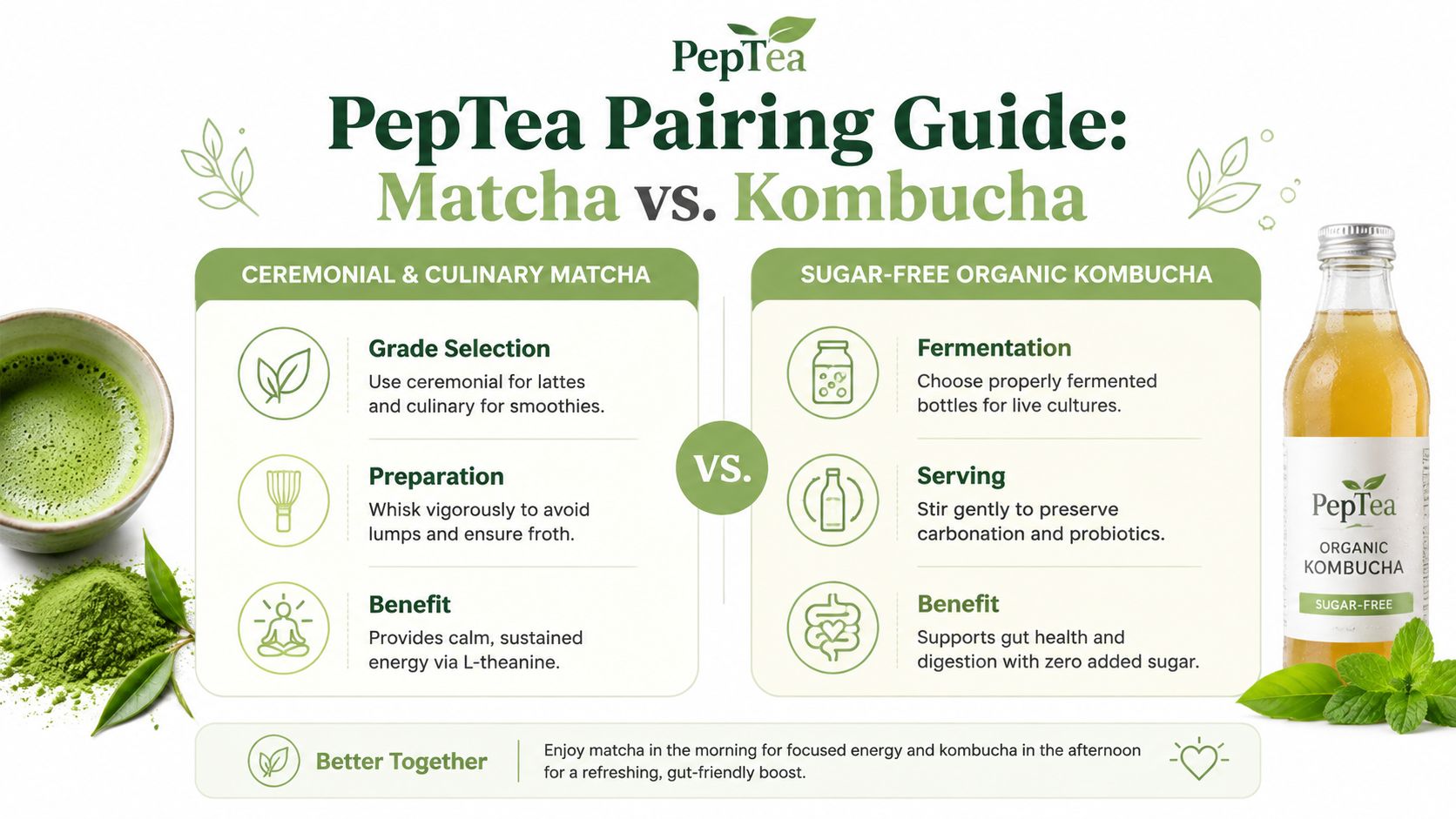
The simplest pairing rule is to match the Matcha grade and Kombucha style to the preparation. Ceremonial-grade Matcha is smoother for a whisked latte, straight tea or delicate iced drink. Culinary-grade Matcha is more practical in smoothie bowls, baking and blended recipes where other ingredients provide the structure.
Kombucha belongs in drinks that benefit from acidity and carbonation. Use it in spritzers, punches and the Matcha elixir, but add it late and stir gently. A carbonated drink loses its appeal when it's shaken, and live cultures are best treated as a food ingredient rather than exposed unnecessarily to heat.
For cafés, consistency comes from measuring the tea, controlling water temperature and keeping batch service close to the moment of pouring. For home use, the same principles make the recipes easier to repeat. Garnish with herbs, citrus wheels or edible flowers when presentation matters, but don't let decoration cover a drink that's too sweet, too hot or poorly balanced.
The Australian market gives these ingredients useful context. Food Standards Australia New Zealand found that Kombucha represented 55.2% of 239 fermented soft drink samples in its coordinated survey, and its report identified NSW as the biggest consumer market for fermented beverages, followed closely by Queensland in its fermented beverages outcomes paper. That doesn't make every Kombucha healthy, but it does show why careful product education matters.
8 Healthy Drinks Comparison
| Item | 🔄 Implementation complexity | ⚡ Resources & speed | ⭐ Expected outcomes | 📊 Ideal use cases | 💡 Key advantages / tips |
|---|---|---|---|---|---|
| Organic Matcha Latte – The Smooth Energy Classic | Moderate, requires basic whisking technique (short learning curve) | Minimal equipment (whisk or chasen, bowl, milk steamer optional); ready in <5 min | Calm, sustained focus; high EGCG antioxidant content; smooth mouthfeel | Daily morning ritual, café menu, afternoon energy without sleep disruption | Customisable milk/sweetness; sift Matcha, use 70–80°C water |
| Iced Matcha Lemonade – Refreshing Summer Wellness | Low, whisk then combine and chill | Needs fresh lemon, ice, chilled or sparkling water; pitcher-friendly; ~5–10 min | Refreshing hydration; vitamin C boost; sustained, jitter‑free energy | Summer entertaining, outdoor events, post-workout refresh | Use fresh lemon; batch in pitcher; freeze Matcha cubes to avoid dilution |
| Kombucha + Matcha Green Energy Elixir – Gut Health & Calm Focus | Low, whisk Matcha, then gently combine with Kombucha | Requires sugar‑free Kombucha and ceremonial Matcha; ready ≈3 min | Probiotic support + sustained mental clarity; antioxidant synergy | Gut‑health focus, wellness cafés, pre‑workout or recovery drink | Stir gently to preserve live cultures; serve immediately for fizz |
| Matcha Smoothie Bowl – Creamy, Nutrient-Dense Breakfast | Moderate, whisk then blend; assembly/decoration step | Blender required; frozen banana prep; ~10 min (prep dependent) | Protein-rich, satiating breakfast; sustained energy and digestive fibre | Breakfast, post-workout, meal-prep, Instagram-friendly brunch | Freeze banana ahead; use culinary Matcha to reduce cost; layer toppings for texture |
| Kombucha Immunity Spritzer – Sparkling Wellness Refresh | Low, simple pour-and-gently-stir assembly | Kombucha, fresh juice or herbal infusion, sparkling water; <5 min | Probiotic and immune support; hydrating, low sugar impact | Everyday wellness, hospitality, non‑alcoholic bar menu | Use fresh‑pressed juice/herbal infusions; chill glasses; garnish heavily |
| Golden Turmeric + Matcha Latte – Anti-Inflammatory Wellness Ritual | Moderate, whisking multiple powders; spice balance important | Turmeric, black pepper (essential), Matcha, milk; ready <5 min | Anti‑inflammatory (curcumin) + antioxidant support; calming focus | Inflammation management, recovery rituals, evening wind‑down | Always include black pepper for bioavailability; sift powders before whisking |
| Kombucha Fruit Punch – Probiotic Party Drink for Gatherings | Low–moderate, batch assembly, visual garnish important | Large volumes of Kombucha, fresh juice, pitcher, ice; 5–10 min assembly | Crowd-pleasing probiotic punch; low‑sugar alternative to sweet punches | Parties, gatherings, events, wellness functions | Keep pitcher on ice to preserve carbonation; use frozen fruit cubes |
| PepTea Pairing & Serving Guide – Matcha + Kombucha Essentials | Low, informational; requires following guidelines in practice | Resource: guide/infographic for staff; speeds menu planning and batch prep | Improved pairing choices; consistent service; maximised probiotic & antioxidant benefits | Cafés, events, staff training, menu development | Use ceremonial for lattes, culinary for bowls; assemble shortly before serving; label 'sugar‑free' and 'probiotic' |
Choose Your Next Pour
The right drink depends less on a universal definition of “healthy” and more on what you need the drink to do. For a daily morning ritual, start with a whisked organic Matcha latte. Use ceremonial-grade Matcha, water between 70 and 80°C, and milk that gives you the texture you enjoy. The drink should taste smooth enough that you don't need a heavy syrup to make it appealing.
Choose iced Matcha lemonade when the weather is warm or you're serving a group that prefers a sharper, more refreshing profile. Whisk the tea before chilling, dissolve any honey while the liquid is warm, and add ice only after the flavour is balanced. Matcha ice cubes are a useful practical touch because they protect the drink from becoming weak as they melt.
A smoothie bowl makes more sense at breakfast, especially when you want fruit, yoghurt, seeds and granola alongside the tea. Culinary-grade Matcha is perfectly suited to this setting, and frozen banana gives the base body without requiring a large amount of milk. Keep toppings organised so each spoonful has a mix of creamy, crunchy and fresh elements.
For entertaining, Kombucha spritzers and fruit punch offer the easiest path to a refined non-alcoholic menu. Ginger, Lime & Ginger and Mango each create a different starting point, while fresh juice, citrus and herbs provide the finishing details. Assemble carbonated drinks close to service, because fizz and freshness decline when a batch sits for too long.
The Kombucha and Matcha elixir is the most distinctive option. It may suit someone who enjoys tea's focused energy and Kombucha's bright fermented character, but the combination also requires the most care. Cool the Matcha before adding Kombucha, stir gently and serve promptly. Anyone sensitive to caffeine, acidity or fermented beverages should adjust the strength or choose a different recipe.
Healthy doesn't mean every ingredient suits every person. Check labels, particularly when buying Kombucha, because added juice can increase sugar content. PepTea's own sugar-free organic Kombucha provides a useful starting point for lower-sugar recipes, but your finished drink can still contain sugar from honey, fruit juice or sweetened milk. Treat those ingredients as choices to measure, not automatic additions.
The same applies to Matcha. L-theanine and catechins make it an interesting tea ingredient, and Matcha's caffeine may support alertness, but people respond differently to caffeine and concentrated tea. Keep portions sensible, avoid presenting these drinks as treatments, and seek professional advice if you're pregnant, taking medication or managing a health condition.
For Australian cafés, the opportunity is practical rather than gimmicky. A menu can offer hot and iced Matcha, sugar-free Kombucha spritzers, breakfast bowls and alcohol-free punch while giving customers clear information about flavour, sweetness and caffeine. PepTea's Japanese organic Matcha and Australian-brewed Kombucha from the Hunter Valley, NSW, fit that approach because provenance and preparation are part of the product experience.
Explore the recipes by occasion, then make one small adjustment at a time. Reduce the honey, change the milk, swap Ginger for Lime & Ginger, or serve the same Matcha base hot and iced. The most useful healthy drinks to make are the ones you'll prepare confidently, enjoy regularly and serve wholeheartedly.
PepTea offers organic Japanese Matcha for lattes, smoothies and baking, alongside sugar-free organic Kombucha brewed in the Hunter Valley, NSW. Visit Pep Tea to explore the range, shop Kombucha for home entertaining, or enquire about café and wholesale supply.
Probiotic Drink Powder: A Complete Guide for Australians

You've probably stood in front of a shelf, a café fridge, or an online store tab and wondered if a probiotic powder is worth buying. The label looks tidy, the claims sound healthy, and the sachet seems easier than hauling home a bottle of fermented drink. The question is simpler and more useful, though, can that powder still deliver live cultures by the time it reaches your glass, your shaker, or your café menu?
That's where probiotic drink powder earns its own category. It's not just a dried version of a drink, and it's not quite the same as yoghurt cultures or ready-to-drink kombucha. The format exists because shelf stability, transport, flavour control, and low-sugar preferences all matter, especially in Australia where products often sit in warm kitchens, travel through long supply chains, and need to work for both home use and hospitality service.
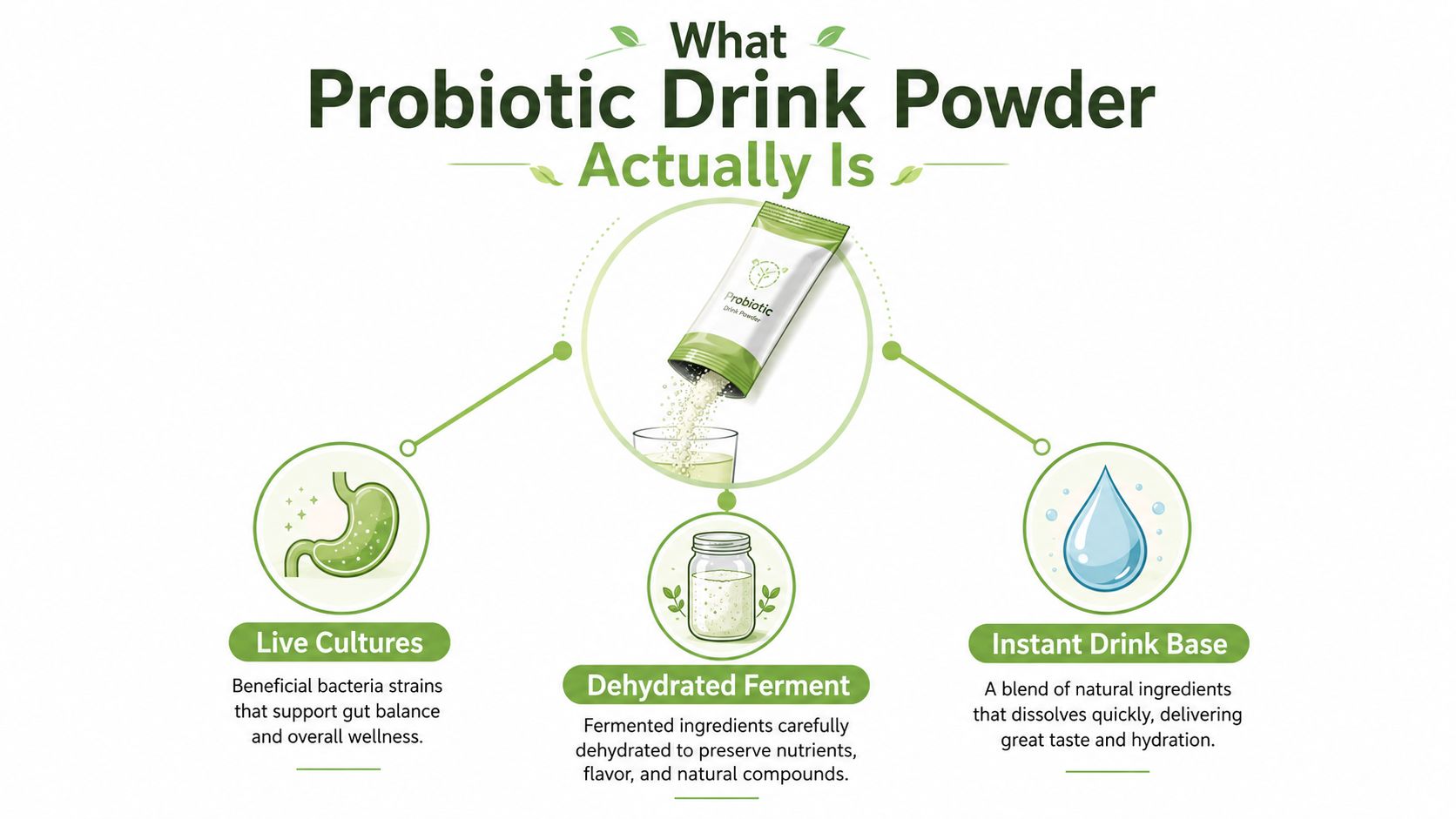
What Probiotic Drink Powder Actually Is
A customer in Melbourne might be comparing two tins, one with a glossy wellness label and one with a plain ingredient panel, while a café owner in Brisbane is trying to work out which sachet will behave properly in iced drinks. Both are asking the same thing in different words. What is this powder, and what makes it more than flavoured dust?
The cleanest definition comes from the International Scientific Association for Probiotics and Prebiotics. Probiotics are “live microorganisms that, when administered in adequate amounts, confer a health benefit on the host” (NIH fact sheet). In plain English, a probiotic drink powder is a shelf-stable, dehydrated format of live cultures designed to be mixed into water, smoothies, or food.
Why the powder format exists
Powders solve a practical problem. Liquid fermented drinks can be awkward to ship, store, and portion. A powder can sit in a pantry, live in a café dry store, and travel more easily than a chilled bottle, which matters in a country where logistics and temperature swings are part of daily life.
That doesn't make powder automatically superior. It just means the format is built for convenience, dosing flexibility, and storage ease. If you're using it at home, it might go into a smoothie or a glass of cold water. If you're using it in hospitality, it can be measured into a menu drink with more consistency than a loosely poured fermented base.
Practical rule: if a powder can't tell you what live cultures are inside and how many are still there by the time you drink it, you're buying a format, not a function.
For readers trying to separate genuine functional products from wellness marketing, our guide on what are prebiotics and probiotics is a useful companion. It helps connect the powder on the shelf with the biology behind it, without overcomplicating the jargon.
The Health Mechanisms Behind the Format
A powder helps the gut only if its live organisms survive the trip in usable numbers. That is the basic test for the format, whether you are pouring it into a café glass or shaking it up at home. Once you look at the product that way, the label starts to mean something practical instead of sounding like wellness noise.
Helpful tourists and occasional residents
Probiotic microbes work like helpful tourists in the gut, and sometimes like temporary visitors who leave a useful trace behind. Some strains pass through and interact with the existing microbiome without settling in permanently, while others influence the gut environment in more targeted ways. The point is not that every strain moves in for good, it is that the right organisms can still do useful work while they are there.
That work is often linked to digestion and microbiome balance, which is why fermented foods like yoghurt, kefir, and kombucha sit alongside probiotic products in consumer education. Harvard Health notes that probiotics are widely used in fermented foods and may help with digestion, immune function, and protection against unwanted microbes (Harvard Health).
Why prebiotic carriers matter
Many powders pair probiotics with a prebiotic matrix, often including ingredients like inulin. That carrier can help protect the organisms during drying, storage, and reconstitution, a bit like packing fragile produce in a carton instead of loose in the back of a ute. It can also give the microbes a better chance of reaching the gut in a usable state rather than dying off in the tin.
A good powder is doing two jobs at once, protecting the live culture and making the drink easy to use.
The formulation matters because a probiotic powder is not just dried fermentation for its own sake. A yoghurt spooned from a tub and a probiotic sachet may both be called probiotic in broad terms, but they are built for different jobs. One is a food. The other is a deliberately dosed functional ingredient.
For a closer look at what sits beyond the live culture layer, our page on postbiotics and the benefits of beneficial bacteria gives a useful next step. It helps explain why some products lean on fermentation by-products as well as live cultures.
Decoding Strains, CFU and Formulation Choices
This is the section you want before buying your first tub. The label can look technical at first glance, but once you know what to check, the category becomes much easier to compare.
Strain names matter more than the word probiotic
A label that only says “Lactobacillus” or “Bifidobacterium” gives you a family name, not a full identity. Different strains can behave differently, so quality-focused producers usually name them more precisely. That is not marketing fluff, it is part of how you know what is inside.
The NIH fact sheet notes that probiotic use in trials is often strain-specific, and that doses vary by organism and purpose (NIH fact sheet). Cleveland Clinic also describes probiotics as live bacteria and yeasts, which is a useful reminder that not every probiotic product is bacterial in the narrow sense (Cleveland Clinic).
CFU is the number you need to check
CFU means colony-forming units, a measure of how many viable microbes are present. A peer-reviewed review in Nutrients says probiotic products are generally accepted to need a minimum concentration of 10^6 CFU per mL or gram, and that consumers should typically ingest around 10^8 to 10^9 probiotic microorganisms daily for the probiotic effect to be transferred (Nutrients review).
That does not mean more is automatically better. It means the label should give you enough detail to judge whether the product is likely to deliver a meaningful live dose.
A useful benchmark appears in a cited formulation where 1 g delivered a 100 billion CFU blend, built on a prebiotic matrix of inulin plus a proprietary polysaccharide complex. Another powder-format beverage reported 10 billion probiotic bacteria per 250 mL serving when diluted (NIH PDF). Those figures show the order of magnitude some products are aiming for, especially once storage and transport losses are taken into account.
Quick Comparison of Common Probiotic Drink Powder Variables
| Format | Typical CFU per serving | Common carriers | Sugar content |
|---|---|---|---|
| Basic drink mix | Varies by brand | Inulin, starches, fibres | Can range from none to added sugars |
| Synbiotic powder | Varies by brand | Inulin, other prebiotics | Often lower in sugar-focused versions |
| Encapsulated powder | Varies by brand | Protective coatings, fibre matrices | Usually designed to minimise added sugar |
| DIY home-dried powder | Unpredictable | Whatever remains after drying | Depends on the base used |
The hidden part of the label
A strong powder also depends on moisture control, encapsulation, and the way the product was dried. Reviews of probiotic powders consistently point out that heat and moisture can damage viability, so a bag that looks fine can still underperform if the formulation was not built well from the start.
Buyer's shortcut: if the brand will not tell you whether the CFU count is valid through shelf life, treat the number as a manufacturing claim, not a consumption guarantee.
How to Use Probiotic Drink Powder Every Day
Once you've got the right tin, the use case should be easy, not fussy. The simplest rule is also the most overlooked one, keep the liquid cool enough for live cultures to survive.
Mix it like a functional drink, not a hot tea
Cold water and lukewarm water are the safest everyday options. Very hot liquids are a bad idea because heat kills live cultures, which defeats the whole point of buying a probiotic product in the first place. If you're stirring powder into a smoothie, add it near the end rather than blending it endlessly with warm ingredients.
A few practical ways Australians tend to use it:
- Morning water mix: Stir into cold water before breakfast for the simplest routine.
- Smoothie add-in: Blend with banana, berries, or spinach after the main liquid is already cool.
- Breakfast bowl boost: Sprinkle over overnight oats or yoghurt once the food is no longer hot.
- Café menu use: Add to chilled drinks or layered functional beverages rather than steaming liquids.
Small recipes that don't get in the way of the cultures
A citrus-style spritzer can be built with cold sparkling water, lemon, and a measured scoop of powder. A ginger and lime drink works well as a recovery-style option after a long day or a workout, especially if the flavour profile already sits in that direction. A kombucha-and-powder hybrid can also make sense when you want the refreshment of a fermented drink plus the measured dose of a powder in the same glass.
That last idea is where cafés can get creative without overcomplicating the menu. A functional flight, with one kombucha, one powder drink, and one matcha option, gives customers a cleaner way to compare flavours and formats. PepTea's own sugar-free organic kombucha can sit comfortably in that kind of menu alongside a probiotic powder, especially for customers who want low-sugar choices.
For hospitality teams, the useful principle is consistency. Measure the powder, keep the liquid cool, and avoid letting staff freestyle the dose if you want the product to behave predictably from one serve to the next.
Storage, Shelf Life and Real-World Viability
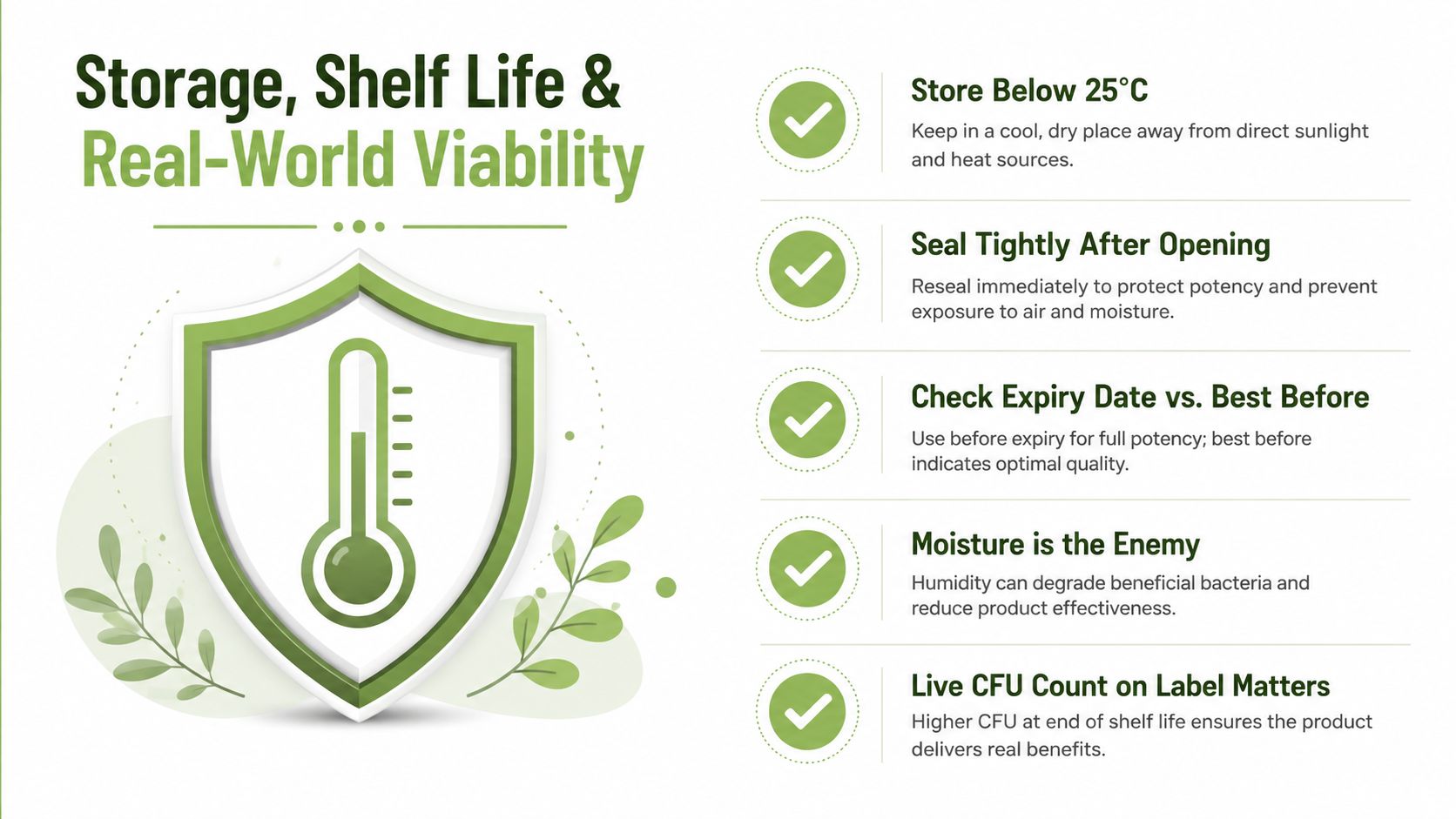
A probiotic powder only matters if the microbes are still alive when the drink is made. That sounds obvious, but it is the part many skip, especially in Australian homes and cafés where warm rooms, open lids, and rushed service can wear a product down over time.
Moisture is the quiet enemy
Published powder-quality work found probiotic powder formulations with 2.97% to 3.35% water content had flow rates of 0.38 to 0.62 g/s and angle of repose values of 20.39° to 29.83°, which are practical signs of whether a powder will dispense cleanly or clump awkwardly (PMC study). Another cited synbiotic drink powder reported 4.03% to 6.12% moisture, and the same paper described a serving design of 30 g powder in 100 mL water that still had to meet a minimum viable lactic-acid-bacteria level of 6.53 log CFU/g to comply with the standard discussed there.
Those details matter because moisture affects both flowability and bacterial survival. If a powder clumps, it is not just annoying. It can also mean the product has absorbed enough water to put viability at risk.
Storage rules that help
Keep the container sealed. Use a dry spoon. Store it away from heat and light. If the label allows refrigeration after opening, do it. If the powder smells off or has changed texture in a way that looks wrong, trust your nose and bin it.
A refrigerated product is not automatically better than a shelf-stable one. What matters is whether the packaging, drying method, and storage conditions preserve the live count long enough for the label promise to mean something at the time of drinking.
For transport-heavy businesses, even simple handling improvements help. A useful guide to thermal delivery bags can show how cafés and retailers reduce heat exposure when products are moved between locations or sent out for service.
A café example that gets this right
A small venue might keep sachets in a cool dry cupboard near service, then open only one pack at a time during a shift. A home user might do the same in a pantry, but the mistake usually comes later, when the lid stays loose and a damp scoop goes back into the tin. That is how a live product becomes a dusty one.
Internal storage habits matter just as much as what the label says. If you want a broader guide for fermented products, our how to store kombucha page covers the logic in a way that transfers neatly to powders too.
DIY Versus Commercial Powders in Australia
A lot of Australians have a practical streak, so the idea of drying a home culture into powder can sound appealing. It feels resourceful, a bit old-school, and cheaper on paper. The trouble is that probiotic powders are judged by what survives the process, not by how charming the process sounds.
The trade-off is control versus reliability
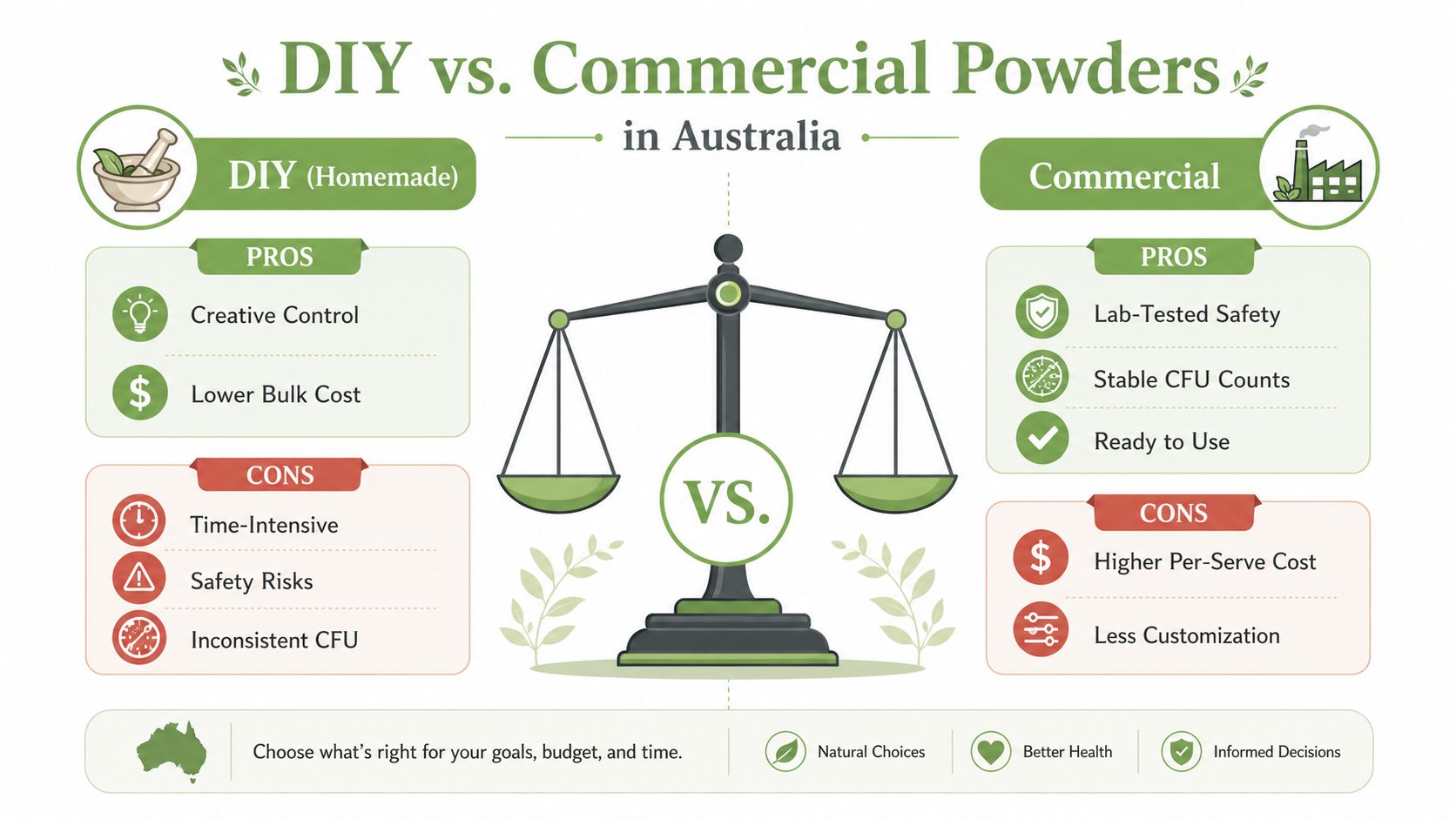
DIY drying gives you creative control, but it also gives you inconsistency. Without professional controls for heat, moisture, and contamination, the CFU count at the end can drift fast. Commercial powders are built with spray-drying, encapsulation, and manufacturing controls designed to protect viability through storage and distribution.
Short version: homemade can be meaningful as a kitchen experiment, commercial is usually better when the goal is a predictable live dose.
Why commercial systems usually win on dose reliability
The hard part isn't making a powder-like material. The hard part is keeping enough live organisms intact after processing, transport, and shelf time. That's why lab-tested products usually focus on strain identity, viable count, and packaging controls rather than just the romance of fermentation.
In Australia, that difference matters if you're selling to cafés or retail customers, because the buyer isn't paying for a story. They're paying for a product that behaves the same way every time someone opens it.
For cautious producers and home makers alike
If your goal is a weekend fermentation project, DIY can be satisfying. If your goal is a product with stable dose expectations and a clear label claim, commercial manufacturing is the safer lane. The deciding factor is rarely price alone, it's whether the final powder still works when someone mixes it at the end of the week, not just on day one.
A Buyer Checklist for Cafés, Retailers and Wellness Brands
A good buyer doesn't just ask whether a powder is “healthy”. They ask whether it will serve well, store well, and hold up under real café conditions. That's the commercial test, and it's where a lot of products separate quickly.
What to check before you buy
- Strain transparency: Look for full strain names, not just broad species labels.
- CFU at end of shelf life: Ask whether the count is valid through expiry, not just at manufacture.
- Carrier system: Check whether the powder uses inulin, fibre matrices, or other stabilising ingredients.
- Sugar and additive profile: Confirm whether the product fits low-sugar or clean-label goals.
- Allergen and vegan status: This matters for café menus and retail shelves.
- Packaging format: Sachets, tubs, and stick packs all behave differently in service.
- Cost per live dose: Price per gram can be misleading if the viable count is weak.
A useful commercial lens is the broader Asia-Pacific demand signal, where probiotic beverage formats are growing strongly in the region according to industry projections (global probiotic drinks market analysis). That matters to Australian buyers because the local market is connected to the same functional-beverage trend, not insulated from it.
A simple shortlist method
Ask suppliers for a data sheet, a sample, and a clear answer on storage. Then test the product in your actual service conditions. A sachet that looks fine in a lab can still clump on a café bench or taste awkward in a menu drink.
For wholesalers and wellness brands, the strongest products are usually the ones that can answer the boring questions without hesitation. That's often a better sign than a long list of broad health claims.
Dosing, Safety and Frequently Asked Questions
A good starting point for most adults is the dose on the label. The right amount depends on the strain, the way the powder is formulated, and how many live cultures are present when you use it. Read the serving size with the same care you'd use for coffee dosing in a café, because a scoop that looks generous is not the same thing as a meaningful live dose.
Safety deserves the same attention. Probiotics are generally considered safe for healthy people, but people with weaker immune systems can face a small risk of adverse side effects. If you are immunocompromised, pregnant, or managing a complex health condition, it makes sense to check with a health professional before adding a probiotic powder to your routine.
Can probiotic drink powder replace kombucha?
They serve different jobs. Kombucha is a fermented drink, while powder is a dry format you mix yourself, so the live cultures, flavour, and handling are not identical. A powder can suit a measured daily routine, while kombucha sits more in the ready-to-drink, fermented category.
How long before you feel anything?
That depends on the strain, the dose, and your own digestion. Some people notice a change quickly, while others feel nothing obvious even if the product is still doing its job. For that reason, the label and the formulation matter more than expecting one fixed timeline for everyone.
Can children use it?
Sometimes, but not automatically. Whether a product suits a child depends on the strain, the dose, and the child's health status, so it is better to get professional advice than to assume every powder is family-friendly.
What about sugar, lactose, and vegan needs?
Powders can be useful here because the format can be built to suit low-sugar, dairy-free, or simpler ingredient preferences. A café menu or home routine can benefit from that flexibility, especially when customers are trying to match a probiotic product with other dietary needs. That said, not every powder is made that way, so the ingredient list still needs a proper look.
For people building a daily ritual rather than chasing a miracle product, a sugar-free organic kombucha in the fridge and a measured probiotic powder in the pantry can work as a practical pair. If you also want a clean energy option, ceremonial-grade matcha gives a different kind of functional drink altogether, one that is about calm focus rather than live cultures.
PepTea makes it easy to keep that routine practical, with Australian-brewed sugar-free kombucha and organic matcha that fit neatly into a low-sugar, functional lifestyle. If you are comparing probiotic drink powder with other gut-health options, visit Pep Tea to explore the range and see what works for your kitchen, café, or retail shelves.
10 Profitable Cafe Menu Ideas for 2026

Beyond the Flat White: Winning Cafe Menu Ideas for 2026
Think your current menu is doing enough? A lot of the most popular advice still says cafés should just tighten the coffee list, add one seasonal special, and call it a day. That's no longer enough for many Australian venues. Customers still want a great flat white, but they also want drinks that feel lighter, more functional, more visual, and more aligned with how they're trying to live.
That shift is already showing up in the market. In 2025, organic coffee and tea held a 31.4% share of the Australia organic beverages market, and the category moved from USD 536.7 million in 2024 towards a projected USD 1,449.8 million by 2030, according to IMARC's Australia organic beverages market analysis. For café owners, that points to a broader move towards clean-label drinks that fit non-alcoholic, wellness-focused menus.
It also means your best cafe menu ideas probably aren't more of the same. They're smarter beverage programs built around quality ingredients, clear positioning, and experiences people want to order again.
This guide gets straight to the point with 10 practical cafe menu ideas for Australian operators. They go beyond the obvious and show how premium organic Matcha and Australian-brewed sugar-free Kombucha can help build a more profitable, resilient, and talked-about menu. If you want inspiration outside the usual espresso lane, it's worth scanning these protein-infused brews and exotic lattes too.
1. Matcha-Forward Signature Café Menu with Ceremonial-Grade Focus
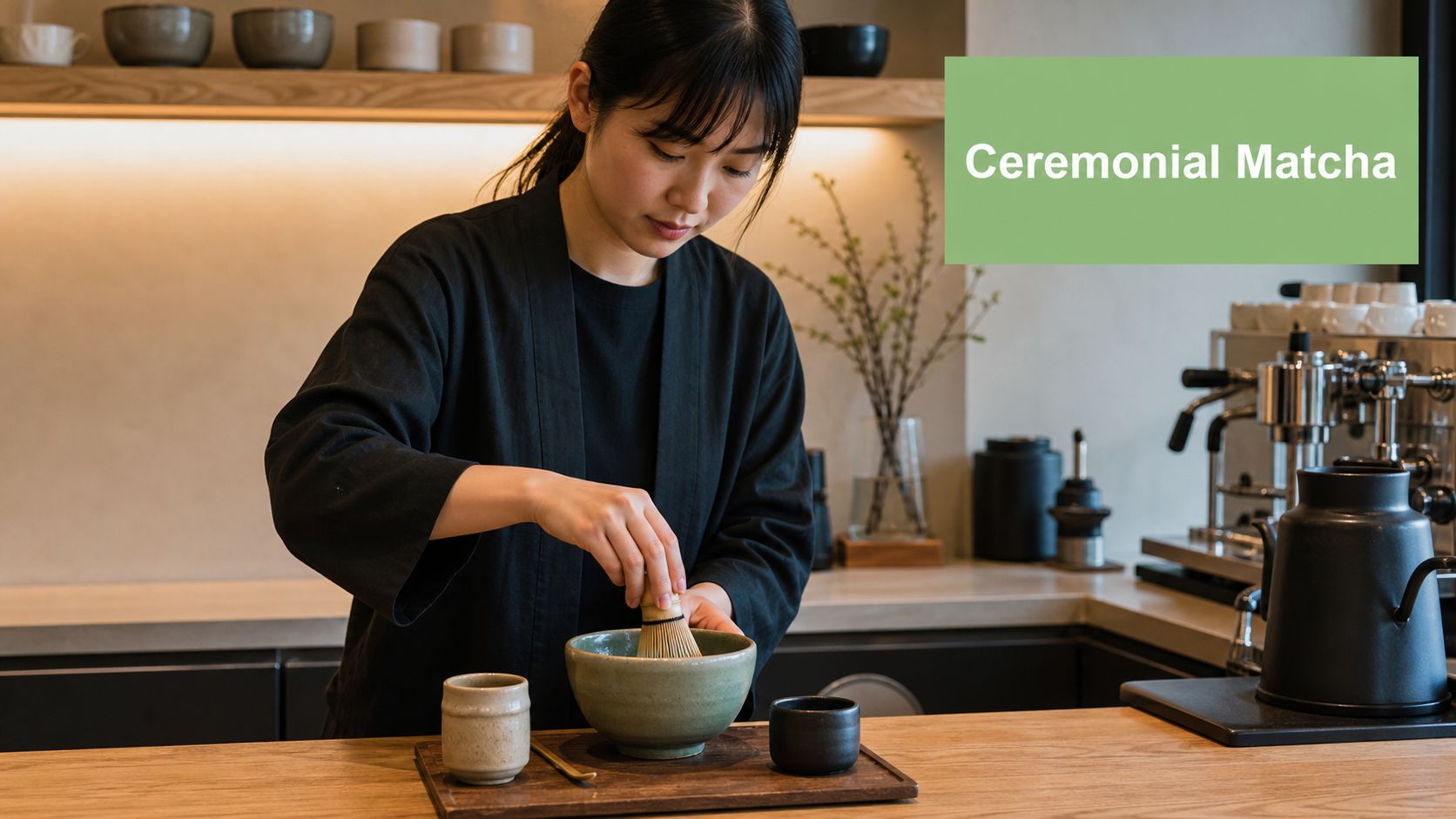
A matcha-first menu works best when you treat it as a category, not a token green latte tucked into the corner. Customers notice when a café has made a real call on quality. They also notice when staff can explain the difference between a bright, smooth ceremonial bowl and a stronger culinary-grade latte.
That's where a specialist setup helps. We like the model used by matcha-led venues such as Matcha DNA in Melbourne, where the menu feels intentional rather than incidental. Traditional whisked service gives customers a ritual. Modern drinks like iced strawberry matcha or a clean vanilla oat matcha latte make the category approachable for people who are curious but not yet committed.
Make the quality difference visible
Ceremonial-grade matcha belongs in whisked tea service and premium lattes where flavour clarity matters. Culinary-grade matcha belongs in baking, smoothies, soft serve, and menu items where it needs to hold its own beside milk, fruit, or sweet elements.
A useful way to teach both staff and customers is to link your menu language to a simple explainer like Pep Tea's guide to ceremonial vs culinary matcha. It removes confusion and gives customers confidence to trade up without feeling pushed.
- Offer two entry points: Keep one pure ceremonial matcha and one house culinary matcha latte on the menu so beginners and enthusiasts both have an easy choice.
- Train the whisking method: A proper bowl, sift, whisk and serve sequence turns preparation into part of the experience.
- Build food around it: Matcha financiers, matcha granola, or a matcha yoghurt pot help the category carry more of your menu.
Practical rule: If your team can't explain why one matcha costs more, customers won't understand it either.
There's also substance behind the premium story. Research published in the National Library of Medicine found ceremonial matcha contained 56.57 ± 2.19 mg/g of EGCG, while culinary matcha contained 50.53 ± 2.41 mg/g, showing both formats deliver high concentrations of the key catechin antioxidant in this matcha composition study.
2. Sugar-Free Kombucha Mocktail & Non-Alcoholic Bar Menu
Many cafés still sell kombucha as a bottled add-on from the fridge. That's a missed opportunity. A stronger move is to give it the same care you'd give a cocktail base and build a non-alcoholic drinks section around it.
This works especially well for brunch venues, early evening cafés, and hospitality spaces that want to serve sober-curious customers without defaulting to sugary sodas. In Australia, kombucha is moving with real momentum. The local market is projected to grow from USD 218.3 million in 2024 to USD 765.8 million by 2033, with a 15.0% CAGR, driven by people moving away from sugary soft drinks towards probiotic-rich options, according to Grand View Research on the Australia kombucha market.
Turn kombucha into a crafted serve
Pep Tea's sugar-free organic Kombucha gives cafés a cleaner base for mocktails because it already fits the low-sugar, wellness-minded brief. Flavours like Ginger, Lime & Ginger, or Mango can become the backbone of a signature drinks list.
A few menu examples:
- Hunter Valley Highball: Lime & Ginger Kombucha, fresh lime, rosemary, ice.
- Ginger Citrus Spritz: Ginger Kombucha, orange slice, mint, chilled soda.
- Mango Garden Cooler: Mango Kombucha, cucumber ribbon, basil, crushed ice.
Use a menu page or counter board to point customers to non-alcoholic cocktail mixers from Pep Tea so the concept feels deliberate and premium.
Kombucha doesn't need to mimic alcohol to feel sophisticated. It just needs balance, texture, and a good glass.
Tasting flights also help. A short paddle of house kombucha serves lets customers compare flavour profiles and often leads to a second purchase, whether that's a takeaway bottle or a return visit for the mocktail list.
3. Wellness-Focused Café Menu with Functional Beverage Pairing System
A long drinks list can make a healthy café feel harder to buy from, not easier. The stronger approach is to guide the decision the way a good waiter does. Start with what the customer wants to feel, then show the best-fit drink and food pairing.
That matters because Australian customers are getting more selective about function, not just flavour. Mintel's analysis of functional food and drink trends in Australia points to growing interest in products linked to energy, gut health, immunity and mental wellbeing. For a café, that is a menu design opportunity. It means ceremonial-grade matcha and sugar-free kombucha can sit at the centre of a considered system rather than appearing as side options for a small niche.
Build the menu around moments, not just drink types
A pairing system works like shelf signs in a well-run grocer. It reduces friction. Instead of asking customers to decode ingredients, you help them choose based on need.
A simple structure could look like this:
- Morning Energy: Ceremonial matcha, iced yuzu matcha, matcha with protein toast.
- Steady Focus: Straight matcha, a lighter oat matcha latte, jasmine tea with a simple almond slice.
- Gut-Friendly Reset: Sugar-free kombucha, kombucha with a yoghurt bowl, fermented drinks paired with fibre-rich snacks.
- Post-Training Recovery: Matcha smoothie, kombucha with eggs on grain toast, higher-protein brunch items.
- Light Afternoon Pick-Me-Up: Sparkling matcha tonic, citrus kombucha, fruit-forward small plates.
The value is clarity. A customer standing at the counter at 8:10 am often does not want to compare six milks, three syrups and four add-ons. They want a smart suggestion that feels current, premium and easy to trust.
Pair the drink with a food job
Many café menus fall flat when they list a wellness drink, then leave the food side disconnected. Pairings work better when each item has a role.
Matcha suits breakfast and early lunch because it pairs cleanly with protein, fruit, yoghurt, oats and nut-based flavours. Kombucha fits lighter plates, especially when a guest wants something refreshing without the sugar hit of soft drink or juice. If a customer orders for gut health, a sugar-free kombucha beside a grain bowl makes more sense than a random pastry upsell. The menu feels intentional.
Staff training matters here. Give your team short, plain-English prompts. “If someone wants steady energy, suggest ceremonial matcha with eggs or yoghurt.” “If they want something refreshing and low sugar, suggest kombucha with a lighter brunch plate.” That kind of guidance is easier to remember and easier to sell.
You can support the idea with a short explainer board and a link to functional beverage trends shaping modern café menus. It gives staff and customers a clearer reason behind the menu structure.
If you're refining the food offer to match the same health-led positioning, these tips for healthier cooking can help keep the kitchen side consistent with the drinks menu.
A pairing system does more than tidy up the board. It helps your café serve the sober-curious, the health-conscious, and the customer who wants something that feels good after drinking it, not just while holding it.
4. Seasonally Rotating Matcha & Kombucha Flavour Menu with Limited Editions
The cafés that win repeat visits are not always the ones with the biggest menu. They are often the ones that give regulars a fresh reason to return.
Seasonal rotation does that well, especially with matcha and kombucha. Both drinks carry flavour cleanly, so you can introduce a limited edition that feels new without rebuilding your bar setup or confusing your staff. For an Australian café, that matters. You want change customers can notice, but operations the team can still run during a busy Saturday brunch.
A strong structure is simple. Keep your bestselling drinks steady, then rotate a small set of seasonal specials built around local produce, weather, and customer mood. It works like a wardrobe. Your core pieces stay reliable, and a few seasonal additions keep everything current.
Build a menu customers can learn quickly
Customers return to what they understand. If the board changes too much, they stop tracking it. If nothing changes, they stop looking.
A practical seasonal format often looks like this:
- Permanent staples: Flat white, batch brew, whisked ceremonial matcha, house kombucha spritz.
- Three rotating drinks: One warm matcha special, one iced matcha special, one kombucha feature.
- One limited food match: A pastry or sweet item that echoes the drink flavour.
That last part matters more than many owners expect. A winter black sesame matcha with a miso caramel scroll feels considered. A summer peach kombucha spritz with a stone-fruit danish feels tied together. The guest remembers the combination, not just the drink.
Use seasonality to signal quality, not novelty for its own sake
Limited editions work best when they answer a clear customer question. What suits the season? What feels premium? What gives a sober-curious guest something interesting that is not alcohol-shaped and sugary?
For matcha, cooler months suit warmer, rounder flavours such as toasted sesame, vanilla pear, roasted strawberry, or cinnamon oat. In warmer weather, cleaner profiles usually sell better, including yuzu, mango, mint, or watermelon. Kombucha gives you similar flexibility, but with more lift and acidity, which makes it useful for bright summer serves and food-friendly spring flavours.
If you use premium inputs such as PepTea Matcha and Kombucha, the seasonal menu also becomes a quality signal. Customers can taste the difference when the base product is good. The fruit or spice should support the drink, not hide it.
Name each release like a house special
A limited release needs a clear identity. Generic titles such as “seasonal matcha” are easy to ignore. Specific names are easier for staff to recommend and easier for customers to remember.
Try names with a sense of place or flavour:
- Winter Cloud Matcha
- Hunter Mango Kombucha Crush
- Spring Citrus Ceremonial
- Ginger Orchard Fizz
Keep each one on for a defined window. Four to eight weeks is usually enough to create interest without dragging the offer out. That short run also helps you test demand before committing to ingredients at scale.
Presentation matters here as well. Layered drinks, textured foam, fruit accents, and glassware that shows colour all improve the chance of social sharing. If your kitchen also produces baked goods, seasonal drinks pair well with display items and can support better merchandising across the counter. Teams looking at workflow and packaging can borrow ideas from sustainable bakery solutions, especially when limited-time products create small-batch prep pressure.
Make the rotation easy to sell
Staff do not need a script. They need one confident sentence.
“Today's special is our Winter Cloud Matcha. Ceremonial-grade matcha with toasted sesame and a softer, nutty finish.”
That kind of recommendation works because it explains the flavour and the reason to care. It also helps health-conscious customers see these drinks as thoughtful menu items, not novelty add-ons. For sober-curious guests, seasonal kombucha specials can fill the same role a house cocktail once did. Something distinctive, grown-up, and worth ordering on purpose.
A seasonal menu should feel alive, but still recognisably yours. That is the balance. Keep the foundation steady, rotate with restraint, and let quality ingredients do the heavy lifting.
5. Matcha & Kombucha Breakfast and Brunch Menu Integration
The missed opportunity in many brunch menus is simple. Matcha sits on the drinks board, kombucha stays in the fridge, and neither ingredient helps shape the food offer. A stronger approach is to treat them as menu builders.
That shift matters because brunch guests do not order in isolation. They build a table. A ceremonial or culinary matcha on the drinks side can support a bowl, pastry, or lighter breakfast item with the same flavour logic. Kombucha can do similar work through dressings, compotes, and pairing cues that make the whole menu feel intentional rather than patched together.
Build dishes that make the beverage program easier to sell
Start with a small cluster of items that share ingredients and prep. That keeps service clean and helps staff explain the menu with confidence.
A practical set might look like this:
- Matcha yoghurt bowl: Greek yoghurt, house granola, kiwi, honey, culinary matcha dusting.
- Green breakfast smoothie: Spinach, banana, oat milk, culinary matcha.
- Seasonal fruit with kombucha dressing: Fresh fruit finished with a lightly reduced kombucha syrup for acidity.
- Matcha pastry special: A weekly item developed with a nearby bakery partner.
The reason this works is the same reason a good wine list supports a restaurant menu. Shared flavour signals reduce friction for the customer. If someone orders a clean, grassy PepTea matcha, a yoghurt bowl with kiwi and honey feels like a natural companion. If they want something lighter and alcohol-free with brunch, a dry kombucha beside fruit, eggs, or toasted sourdough gives them a grown-up option that still suits a daytime café occasion.
For Australian cafés, this also lines up with how health-conscious and sober-curious guests increasingly browse menus. They are often looking for lower-sugar choices, clearer ingredients, and drinks that feel premium without being heavy. Matcha and kombucha answer that need best when they are woven into the meal, not treated as side notes.
Keep the kitchen logic tight
Use ingredients more than once. Banana can go into a smoothie bowl and a smoothie. Citrus can sharpen a kombucha dressing and finish a plate. Matcha can flavour chia pudding, dust a pastry, or become the base of a brunch latte. That kind of crossover protects margins and makes ordering simpler.
Quality matters here. Ceremonial-grade matcha belongs where guests will taste it clearly, such as straight matcha, lattes, or a simple breakfast pairing. Culinary-grade matcha suits smoothies, baked items, and bowls where it works with other ingredients. Using each grade for the right job is a bit like choosing extra virgin olive oil for finishing and a different oil for cooking. Guests may not name the distinction, but they notice the result.
If your kitchen team needs support with prep systems, portioning, or supplier planning, these sustainable bakery solutions offer useful operational ideas, even outside a bakery context.
6. Post-Workout & Recovery-Focused Menu with Matcha & Kombucha Positioning
A café near a gym, Pilates studio, surf club, or park run route doesn't need to become a supplement bar. It just needs to recognise why people are coming in after movement. They want something refreshing, light, and supportive of how they feel.
That's where a recovery-minded menu strip can work well. Matcha gives a cleaner energy position than many sugary drinks. Kombucha gives you a fermented, lower-sugar alternative to soft drink. Add a few solid snack pairings and the concept becomes practical rather than niche.
Keep the language grounded
Use plain words. “Post-gym” is clearer than “performance optimisation”. “Gentle energy” is friendlier than overpromising.
A few combinations that make sense in real cafés:
- Recovery Combo: sugar-free kombucha plus a protein ball or boiled eggs.
- Calm Lift Latte: ceremonial matcha with your house milk choice and a banana loaf.
- Green Refill Smoothie: culinary matcha, yoghurt, banana, ice.
Globally, kombucha is projected to grow at a 13.3% CAGR from 2025 to 2035, with demand linked to sugar-free variants and organic, plant-based fermented drinks in café and specialty channels, according to Market Research Future's kombucha market outlook. That doesn't guarantee every fitness-adjacent venue should stock it, but it does support what many operators are already seeing on the ground. Customers are looking for alternatives that feel functional without feeling punishing.
A post-workout customer usually doesn't want a lecture. They want an easy choice that feels better than a sports drink from the servo.
If you lean into this category, train staff to describe taste first, then function. Flavour still wins the first order.
7. Matcha & Kombucha Kids' Menu with Educational Wellness Positioning
A family-friendly café can include functional drinks without making them feel grown-up or intimidating. The trick is to keep the serves age-appropriate, the flavours gentle, and the messaging aimed at parents, not kids.
This is also where many menus leave money on the table. Parents often want something better than a standard juice box or sugary milkshake, but they don't necessarily want to order from the adult list and split cups by hand. A short kids' range solves that.
Make it playful, not preachy
Small formats work well:
- Mini Green Latte: a lighter, milky matcha serve in a smaller cup.
- Tiny Ginger Fizz: a very small kombucha pour for families already familiar with the taste.
- Banana Matcha Smoothie: culinary matcha blended softly with fruit and milk.
The broader market context supports thinking about smaller formats too. Unilever Food Solutions notes an operational gap in café menus around cost-of-living pressure, solo dining, and the rise of “little treats”, with operators still lacking clear mini-menu formulas for non-alcoholic drinks like matcha and kombucha in its breakfast and café trend article. That's useful for kids' menus because smaller serves can feel more welcoming, less wasteful, and easier for parents to say yes to.
Use friendly names, illustrated boards, and simple staff language. “This one's smooth and milky with just a little matcha” lands better than anything too technical. And if a parent asks about fermentation or caffeine, answer clearly and calmly. Trust matters more than clever copy here.
8. Corporate Wellness Program & Subscription-Based Office Beverage Service
Some of the best cafe menu ideas don't stay inside the café. They travel. Offices, co-working spaces, and studio workplaces are all looking for better everyday beverage options, especially when coffee alone no longer covers what teams want.
A corporate offer can be simple. Weekly kombucha fridge drops. A matcha station for meetings. Monthly wellness boxes with ceremonial matcha, culinary matcha, and sugar-free kombucha flavours. This is less about being flashy and more about being useful.
Sell convenience and consistency
Office buyers usually care about three things:
- Easy replenishment: They don't want to chase stock every week.
- Clear product quality: Organic, low sugar, Australian-made, and easy to explain.
- Staff adoption: Drinks need to taste good enough that people reach for them.
Pep Tea's positioning makes this kind of offer practical. We're Australian-owned and operated, with kombucha brewed in the Hunter Valley, NSW, and premium Japanese organic Matcha at the centre of the range. That local and specialist angle can matter when offices want a supplier that feels more thoughtful than a bulk beverage catalogue.
Create a few packages with clear use cases. One for boardrooms, one for everyday team kitchens, one for wellness activations. Include simple brewing cards and tasting notes. If a client likes the drinks in the office, some staff will later look for them in cafés or buy them direct for home. That crossover is one of the strongest parts of a smart beverage program.
9. Wholesale & Partnership Strategy for Hospitality and Retail
A café menu can become a platform, not just a list of products. That's especially true when you partner with venues that want support, not just cartons delivered to the back door.
Wholesale works best when the product comes with a usable system. Cafés and bars need menu names, staff talking points, tasting notes, and service suggestions. Retailers need shelf language and an easy explanation for why one matcha is ceremonial and another is culinary. Gyms need recovery framing. Hotels need consistent prep.
Give partners a launch kit, not just stock
A strong wholesale support package might include:
- Co-branded menu lines: Ready-to-use drink descriptions.
- Staff training: Simple scripts on whisking, fermentation, flavour profile, and food pairing.
- Seasonal support: Limited-edition ideas that keep the account fresh.
- Sampling assets: Counter cards, mini tasters, and social content suggestions.
This approach suits Pep Tea particularly well because the brand story is coherent. Japanese organic Matcha for authenticity and quality. Australian-brewed sugar-free organic Kombucha for local relevance and everyday usability. Clean-label positioning. Family-friendly tone. That makes it easier for partner venues to plug the products into their own identity without it feeling forced.
Real-world examples are everywhere in hospitality. The venues that win with specialist products usually make adoption easy. They remove ambiguity. They don't ask a busy café manager to invent the whole concept from scratch.
10. Education, Sampling & Events Program to Drive Trial and Adoption
Great products don't always sell themselves, especially if customers are still learning how to drink them. Education turns curiosity into confidence, and confidence turns into repeat orders.
A café can run this lightly. It doesn't need a huge event budget. A short matcha tasting on a quiet weekday morning. A kombucha mocktail flight over the weekend. A “meet the maker” session with your supplier. A family session where parents try ceremonial matcha while kids get mini smoothie samples.
Teach people how to order again
The best education is practical. Show people what they're tasting and why it matters.
Useful formats include:
- Matcha 101 sessions: Taste ceremonial and culinary side by side.
- Kombucha flights: Compare Ginger, Lime & Ginger, and Mango in small pours.
- Brunch pairings: Match one food item with one beverage and let staff explain the pairing.
- QR follow-ups: Share brewing guides, product pages, and wholesale enquiry options after the event.
Research cited by Pep Tea notes that men who regularly consume matcha green tea are approximately 11% less likely to develop heart disease than non-consumers, discussed in Pep Tea's article on matcha green tea benefits. That kind of stat should be handled carefully and never used as a hard sell, but it does show why customers are interested in learning more about matcha beyond flavour alone.
For café owners, the actual gain from events is simpler. Sampling reduces hesitation. A customer who tastes a well-made matcha or kombucha serve is far more likely to order it properly next time.
10-Concept Café Menu Comparison
| Concept | Complexity (🔄) | Resources (⚡) | Expected outcomes (📊) | Ideal use cases (💡) | Key advantages (⭐) |
|---|---|---|---|---|---|
| Matcha-Forward Signature Café Menu (Ceremonial focus) | High 🔄 Staff training, ceremonial protocols, slower prep | High ⚡ Ceremonial-grade matcha, whisking tools, trained baristas | Strong 📊 Premium pricing, brand loyalty, social buzz | Specialty cafés, wellness flagships, educational venues | Differentiates brand, commands premium, authentic experience ⭐ |
| Sugar-Free Kombucha Mocktail & Non-Alc Bar | Medium–High 🔄 Mixology skills, fermentation handling | Medium ⚡ Sugar-free Kombucha stock, cold storage, bar kit | Strong 📊 Attracts sober‑curious, premium margins, upsell potential | Non‑alcoholic bars, hotels, cocktail‑style venues | Positions as craft alternative, probiotic & low‑sugar appeal ⭐ |
| Wellness-Focused Café Menu (Functional pairing system) | High 🔄 Extensive staff education, inventory complexity | High ⚡ Multiple SKUs, add‑ons, POS/loyalty, educational assets | Very strong 📊 Higher AOV, repeat visits, customer data collection | Wellness cafés, boutique chains, data‑driven venues | Personalisation, upsell via intentions, strong differentiation ⭐ |
| Seasonally Rotating Matcha & Kombucha (Limited editions) | Medium 🔄 Regular R&D, seasonal planning, testing | Medium ⚡ Seasonal produce sourcing, marketing, supplier coordination | Strong 📊 Creates FOMO, repeat visits, organic social engagement | Trend‑driven cafés, urban locations, high‑traffic outlets | Generates urgency, social shareability, co‑brand opportunities ⭐ |
| Matcha & Kombucha Breakfast and Brunch Integration | Medium 🔄 Requires kitchen capacity, recipe development | Medium ⚡ Culinary matcha, bakery partnerships, kitchen staff | Strong 📊 Boosts brunch traffic, higher check averages | Brunch cafés, bakeries, weekend‑focused venues | Normalises ingredients, expands sales channels, Instagrammable dishes ⭐ |
| Post-Workout & Recovery-Focused Menu | Medium 🔄 Nutrition knowledge, partner coordination | Low–Medium ⚡ Protein/electrolyte add‑ons, simple labelling, gym ties | Moderate 📊 Builds niche loyalty, co‑marketing opportunities | Gyms, fitness studios, recovery cafés | Targets athletic audience, justifies premium functional pricing ⭐ |
| Matcha & Kombucha Kids' Menu (Educational) | Medium 🔄 Portioning, flavour adjustment, parental messaging | Low–Medium ⚡ Small portions, playful design, child‑friendly flavours | Moderate 📊 Family revenue uplift, early brand affinity | Family cafés, suburban venues, family markets | Builds parent trust, differentiates family offering, long‑term affinity ⭐ |
| Corporate Wellness Program & Subscription Service | High 🔄 B2B sales cycles, account management, logistics | High ⚡ Bulk fulfilment, subscription tech, delivery & training | Very strong 📊 Recurring revenue, bulk orders, workplace penetration | Corporate campuses, coworking spaces, HR wellness programs | Predictable recurring revenue, strong workplace presence ⭐ |
| Wholesale & Partnership Strategy (Hospitality & Retail) | High 🔄 Supply coordination, partner onboarding, QC | High ⚡ Sales team, logistics, training workshops, POS assets | Very strong 📊 Scaled distribution, steady wholesale revenue | Cafés, bars, retailers, gym franchises | Scales brand reach, exclusivity via co‑development, partner support ⭐ |
| Education, Sampling & Events Program | Medium 🔄 Event coordination, facilitator quality matters | Medium ⚡ Sampling stock, educational materials, staff time | Strong 📊 Increases trial, social buzz, conversion to repeat buyers | Pop‑ups, in‑café activations, gyms, markets | Reduces hesitancy, builds advocates, generates experiential content ⭐ |
Your Next Step Turning Ideas into Action
The strongest café menus in 2026 won't win just because they add more items. They'll win because they make sharper choices. They'll know who they serve, what those customers want from a drink beyond caffeine, and how to turn quality ingredients into something memorable enough to bring people back.
That's why the best cafe menu ideas in Australia right now sit beyond the flat white. They still respect café staples, but they expand the role of the beverage menu. Matcha can be a ritual, a premium latte, a brunch ingredient, and an educational talking point. Kombucha can be an everyday fridge grab, a polished mocktail base, a recovery drink, and a clean-label option for people cutting back on sugar or alcohol.
The commercial upside comes from relevance. Health-conscious customers want more than sugary add-ons. Sober-curious customers want proper non-alcoholic options. Families want smaller, better choices. Office buyers want drinks that align with workplace wellness. When your menu answers those needs clearly, it becomes more resilient.
For Australian operators, local context matters too. Buying from a supplier that understands the market helps. Pep Tea's combination of premium Japanese organic Matcha and proudly Australian-brewed sugar-free organic Kombucha gives cafés a practical way to build quality into the menu without losing approachability. The Hunter Valley connection, the focus on real fermentation, and the emphasis on low-sugar, functional drinks all support the kind of menu many venues are trying to build now.
A final point is worth keeping front of mind. Trends can spark attention, but repeat business comes from execution. If you introduce matcha, train the whisking properly. If you launch kombucha mocktails, give them names and glassware that feel intentional. If you create a wellness menu, keep the language simple and honest. Customers can tell when a concept is genuine.
Start with one or two ideas from this list, not all ten at once. Build a core serve. Test a seasonal special. Add one brunch item. Run one tasting event. Then watch what customers reorder, what staff feel confident serving, and what naturally fits your venue.
That's how a stronger beverage program grows. Not through gimmicks, but through consistent quality, clear positioning, and products people want to drink. If you're ready to lift your menu with authentic organic Matcha and locally brewed sugar-free Kombucha, Pep Tea's wholesale range is a smart place to begin.
Explore Pep Tea for premium organic Matcha, Australian-brewed sugar-free Kombucha, and wholesale support designed for cafés, hospitality venues, and retailers looking to build a more modern functional drinks menu.
Mango Passion Fruit Drinks: A Flavour & Recipe Guide

You're probably here because one of two things happened. You had a mango passion fruit drink somewhere that tasted bright, juicy and perfectly balanced, then tried to remake it at home and ended up with something flat, too sweet, or oddly sharp. Or you're staring at ripe fruit on the bench and wondering how cafés make this flavour combo feel so polished.
The good news is that mango passion fruit is one of the most forgiving tropical pairings once you understand what each fruit is doing. Mango brings body, round sweetness and that soft, almost creamy finish. Passion fruit brings perfume, tang and lift. Get the ratio right, and the drink tastes fuller without becoming heavy.
That balance also suits the way many Australians like to drink now: fresh flavour, less cloying sweetness, and ingredients that feel real rather than artificial. Used well, mango passion fruit can move across still drinks, spritzes, kombucha, iced matcha and café specials without losing its identity.
The Allure of Mango Passion Fruit Flavours
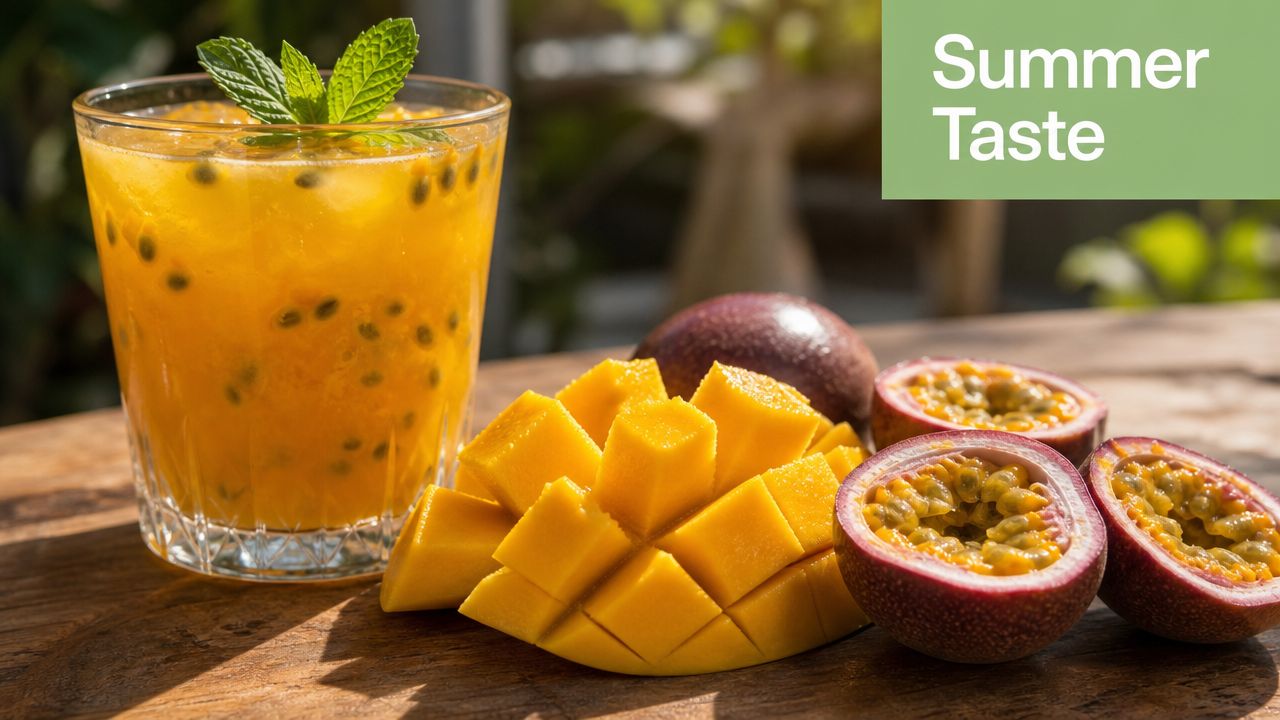
A great mango passion fruit drink lands in layers. First comes the aroma from the passion fruit. Then the mango fills out the middle so the drink doesn't taste thin. At the end, the tartness keeps your palate awake and ready for the next sip.
That's why this pairing works so well in everything from a quick sparkling cooler to a more thoughtful café serve. It gives you both comfort and freshness. One fruit softens. The other brightens.
Why the pairing feels complete
Mango on its own can be lovely, but in drinks it sometimes needs help. It's naturally dense and can read as one-note if there isn't enough acid around it. Passion fruit fixes that fast. It adds a tart edge and a floral top note that makes the whole glass smell alive.
This is also why the combination works for more than juice. You can use it in:
- Syrups for sodas, mocktails and dessert drinks
- Second-fermented kombucha where fruit sugar and acidity create a livelier profile
- Layered matcha drinks where tropical fruit softens earthy notes
- Café batched bases for faster service during busy periods
A good tropical drink shouldn't just taste sweet. It should taste lifted.
The role of ingredient quality
When the ingredient list is short, quality matters more. Ripe fruit tastes fuller and needs less fixing. Organic ingredients can also make the finished drink feel cleaner and more focused, especially in recipes where tea, fruit and fermentation all sit in the same glass.
That's one reason we're fussy about what goes into functional drinks. If you're pairing tropical fruit with kombucha or matcha, there's nowhere for dull flavours to hide. Real fruit, properly fermented bases, and fresh preparation make the difference between “nice enough” and “I'd order that again”.
Crafting a Versatile Mango Passion Fruit Syrup
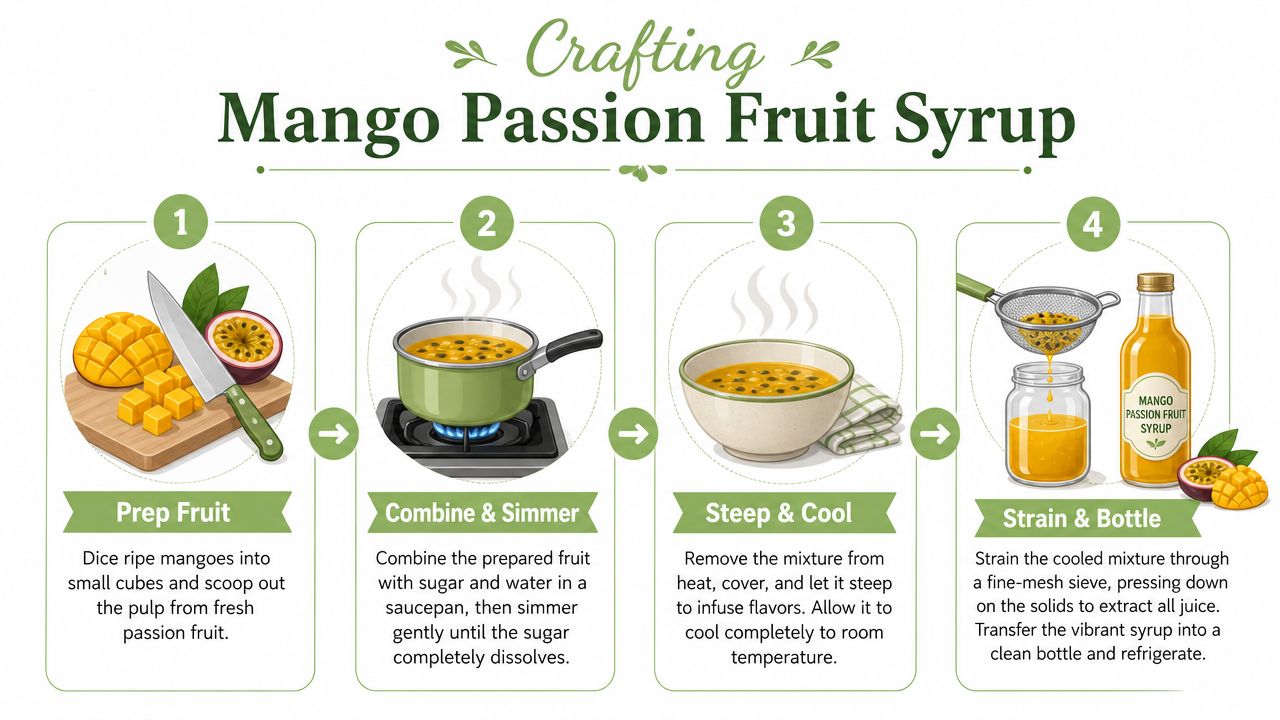
A reliable syrup is the engine room of a good mango passion fruit menu. Once you've got one bottle in the fridge, you can build sparkling drinks, mocktails, iced teas and dessert-style serves in minutes.
The trick is not making it taste like jam. You want concentration, not heaviness.
A practical flavour ratio
In Australian recipes, 1 cup (250ml) of passionfruit pulp is often paired with 1,300g of mango to create a balanced sweet-tart flavour, and passionfruit has a lower glycaemic index than mango, which makes it a thoughtful inclusion when you're blending fruit for drinks, as noted in this Australian mango and passionfruit sauce recipe.
You don't need to make a huge batch, but that ratio teaches an important lesson. Mango usually needs more volume. Passion fruit needs less, because its flavour is intense.
What to use
For a home batch, work with ripe fruit and keep the method simple.
Mango
Fresh ripe mango gives the best texture and aroma. Frozen mango works well if fresh fruit is expensive or inconsistent.Passion fruit
Scoop the pulp from ripe fruit. If you like a silkier syrup, strain some or all of the seeds out later.Sugar and water
Sugar isn't there only for sweetness. It also helps carry flavour and gives the syrup body.A pinch of salt
Not enough to taste salty. Just enough to sharpen the fruit.
Step-by-step method
Prep for clarity and control
Dice the mango quite small so it breaks down quickly. Scoop the passion fruit pulp into a bowl and check for any underripe pieces. If the fruit smells flat rather than fragrant, the syrup will too.
Add your fruit to a saucepan with water and sugar. Keep the heat gentle. A hard boil can mute delicate top notes and push the syrup toward a cooked-fruit flavour.
Simmer, steep and strain
Once the sugar dissolves, let the mixture simmer lightly until the mango softens fully. Turn off the heat, cover the pan, and let it sit. That rest gives the passion fruit time to infuse without overcooking it.
Strain through a fine sieve, pressing the solids gently. If you press too hard, you can force fibrous pulp through and end up with a cloudy syrup that separates faster in the bottle.
Practical rule: Stop reducing while the syrup still looks slightly looser than you think it should. It thickens as it cools.
How to adjust the flavour
If the syrup tastes too sweet, don't immediately add more sugar-free mixer later and hope for the best. Fix the base first.
Use this quick guide:
| Syrup problem | What it usually means | How to correct it |
|---|---|---|
| Too thick | Reduced too far | Stir in a little water while warm |
| Too tart | Passion fruit is dominating | Blend in more mango puree |
| Too dull | Fruit wasn't ripe enough | Add fresh passion fruit pulp before a brief reheat |
| Too pulpy | Straining was too light | Pass through a finer sieve |
Storage and café prep
Bottle the syrup in a clean glass container and chill it once fully cool. For home use, smaller bottles are easier because you'll open them more often and expose less syrup to air each time.
For cafés, batch one master syrup, then portion part of it into service bottles. That keeps your main batch cleaner during rush periods and gives staff a more consistent pour for each drink.
Second Fermentation for Mango Passion Fruit Kombucha
Second fermentation is where kombucha becomes lively, fragrant and properly drinkable rather than merely sour. It's also the stage where mango passion fruit can go from pleasant to brilliant, because the fruit adds both flavour and fuel for carbonation.
The key is restraint. Too much fruit pulp, too little headspace, or fruit that isn't fully ripe can all create problems.
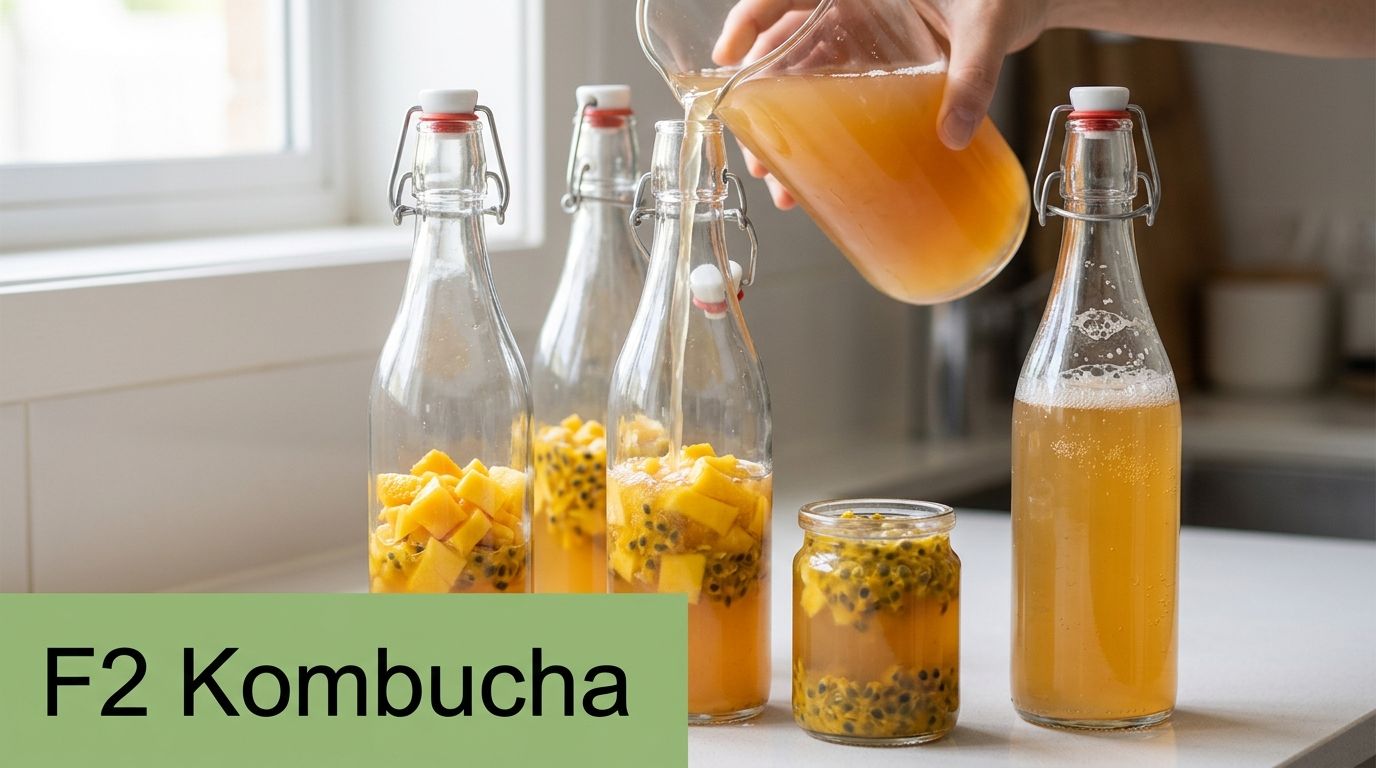
Start with ripe fruit only
A critical safety point often missed in home recipes is that unripe passion fruit seeds can contain cyanogenic glycosides, which are cyanide precursors. Always use fully ripe, mature fruit for infusions and fermentations, as explained in this passion fruit safety overview.
That matters even more in kombucha because fermentation doesn't rescue poor fruit choices. It amplifies what you put in.
How the second ferment works
In plain language, your kombucha still contains live cultures after the first ferment. When you bottle it with fruit, those cultures keep working on the available sugars. That creates carbonation and pulls fruit character into the liquid.
Mango adds roundness and gentle sweetness. Passion fruit keeps the finish bright, so the kombucha doesn't taste sticky or overripe.
A reliable home method
Use clean, fermentation-safe bottles with secure lids. Add a small amount of mango puree or finely chopped ripe mango, plus a spoonful of ripe passion fruit pulp, then top with plain kombucha and leave some headspace.
Don't pack the bottle with fruit. More fruit doesn't always mean more flavour. It often means blocked pours, excess sediment and harder pressure control.
Choose texture wisely
Smooth puree gives more even flavour. Fruit chunks can work, but they're less predictable.Leave room at the top
Headspace helps manage pressure and gives the liquid room to carbonate.Keep bottles warm, not hot
Moderate room temperature helps the second ferment along without pushing it too fast.Burp carefully if needed
If your bottles are building pressure quickly, open them briefly over a sink.
If you hear an aggressive hiss the moment the cap loosens, chill the bottle before opening it again.
A ready-made benchmark for flavour direction is this passion fruit kombucha option, which shows how bright tropical acidity can sit comfortably inside a kombucha profile.
Common problems and what they mean
No fizz
Usually, the kombucha was too cold, the seal wasn't tight enough, or the fruit amount was too timid. It can also happen if the base kombucha had already fermented too far and had less energy left for bottle conditioning.
Too much pressure
This often comes from overfilling fruit, warm storage, or leaving bottles too long before chilling. Mango pulp can also trap gas in a way that makes the bottle seem quiet until it's suddenly not.
Here's a useful visual walkthrough before you bottle your next batch:
Murky, sludgy pours
That's usually a fruit-prep issue rather than a fermentation fault. Strain your syrup or puree more thoroughly if you want a cleaner café-style pour. If you like a rustic finish at home, that's fine too, but warn guests before they tip the last mouthful into the glass.
For cafés and small-batch service
If you're serving mango passion fruit kombucha in a hospitality setting, consistency matters more than novelty. Keep your fruit base standardised, label batch dates clearly, and refrigerate promptly once carbonation is where you want it.
Staff also need one clear opening protocol. Tropical kombucha can foam hard if handled roughly. Open cold bottles slowly and pour on an angle, just as you would with other lively fermented drinks.
Stunning Mango Passion Fruit Mocktails and Sparklers
Mango passion fruit shines in non-alcoholic drinks because it already has built-in drama. You've got sweetness, acidity, aroma and colour before you add anything fancy. The job of the mocktail is to support that, not bury it.
That popularity also makes sense locally. Australia's passionfruit industry includes about 130 commercial growers and produced approximately 5,200 tonnes of fruit last year, underscoring how established the flavour is in our food culture, as noted in this Australian passionfruit industry report.
Three easy serves that look polished
Tropical Spritz
Build this in a tall glass with ice, mango passion fruit syrup, sparkling water and lightly slapped mint. It's the cleanest expression of the syrup, and the bubbles push the passion fruit aroma upward.
Best for: brunch, warm afternoons, and customers who want something refreshing rather than creamy.
Sunrise Cooler
Shake the syrup with coconut milk and ice, then pour into a chilled glass. The coconut softens the tart edge and gives the drink a rounder finish.
Best for: a snack-like serve, especially when someone wants a more filling alcohol-free option.
Chilli Mango Tango
Add a very thin slice of fresh red chilli to the syrup before shaking with ice and soda. You don't want a spicy drink. You want a soft warmth at the back of the palate that makes the fruit taste brighter.
Best for: menus that want one conversation-starting drink without going too far.
Garnish should hint at flavour, not confuse it. If the drink tastes tropical, garnish tropical.
How to make them taste balanced
Many homemade mocktails fail because every element pulls in the same direction. Sweet juice, sweet cordial, sweet garnish. That's when the drink tastes childish rather than café-worthy.
Use contrast instead:
- For lift add sparkling water or mineral water
- For aroma use fresh mint, citrus peel, or a spoon of passion fruit pulp
- For texture bring in coconut milk or crushed ice
- For tension add chilli, fresh lime, or unsweetened tea as a lengthener
For broader alcohol-free serving ideas, this guide to fruity non-alcoholic kombucha cocktails is useful for café teams building a more grown-up menu.
Presentation details that matter
Glassware changes the mood of the drink. Highballs feel clean and modern. Stemmed glasses make a spritz feel more celebratory. Short tumblers suit creamy serves.
Try these finishing touches:
| Drink style | Best garnish | Why it works |
|---|---|---|
| Spritz | Mint sprig and passion fruit float | Fresh aroma and visual contrast |
| Creamy cooler | Toasted coconut rim | Adds texture and signals richness |
| Spicy sparkler | Thin chilli slice and mango cheek | Warns the palate and looks striking |
If you're serving families or groups, set up a small garnish station and let everyone finish their own glass. It makes a simple syrup-based drink feel much more special.
An Unexpected Pairing with Organic Matcha
At first glance, matcha and mango passion fruit can sound like they belong in different worlds. One is grassy, savoury and deep. The other is sunny, lush and aromatic. In the glass, though, they often solve each other's problems.
Matcha can feel too assertive if there isn't enough softness around it. Mango gives it body. Passion fruit trims the edges and keeps the drink from becoming heavy.
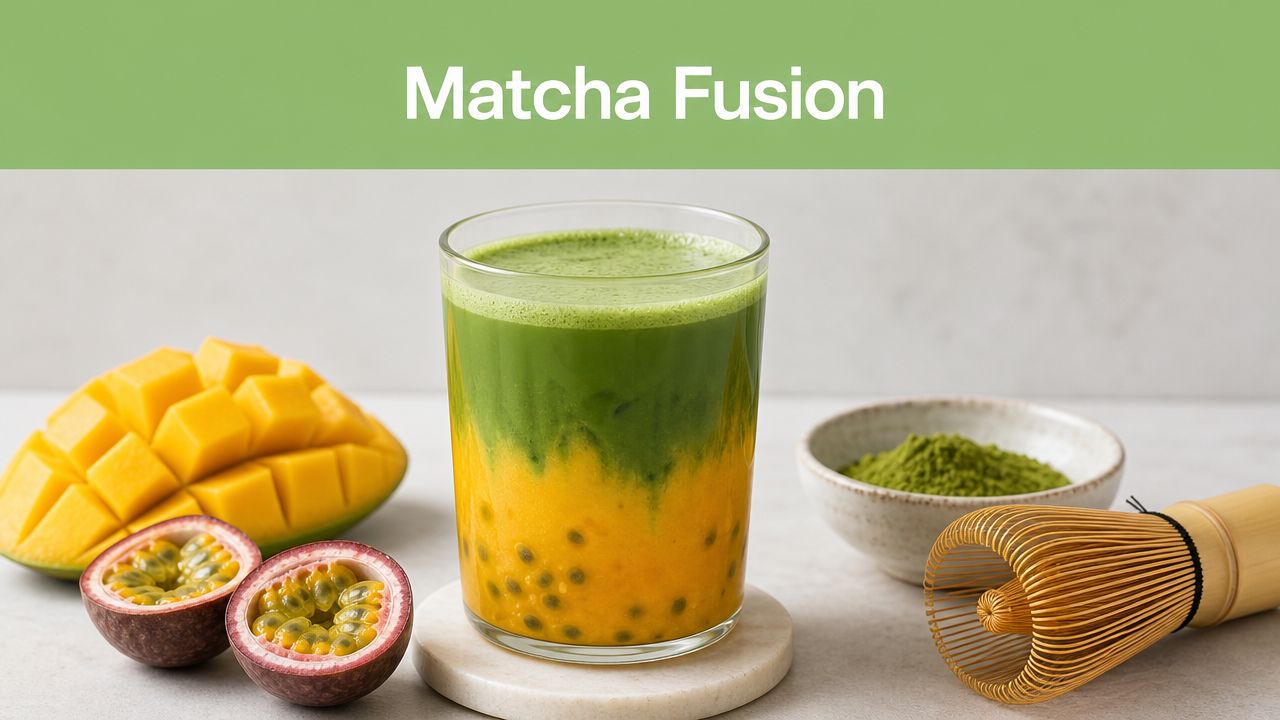
Why the flavour pairing works
Think of it as a triangle. Matcha brings earthiness and a gentle bitter line. Mango contributes sweetness and texture. Passion fruit delivers acidity and perfume. Remove any one of the three and the drink becomes less interesting.
This pairing also suits people who want a drink that feels indulgent but still purposeful. In organic matcha, epigallocatechin gallate, or EGCg, makes up 60% of the catechins, which is why it's often highlighted as a key antioxidant component in matcha, as explained in this organic matcha benefits article.
The smartest matcha pairings don't hide the tea. They give it a better frame.
A layered iced mango passion fruit matcha latte
Build the fruit base
Start with chilled mango passion fruit syrup or a slightly thicker fruit puree in the bottom of the glass. If it's too thin, the layers will blur immediately.
Add ice next. Plenty of it. Ice isn't only there to chill the drink. It slows mixing and helps create visual separation.
Prepare the matcha properly
Whisk culinary-grade or ceremonial-grade organic matcha with a small amount of water until smooth. Then add your milk of choice. Pour this gently over the ice so it settles above the fruit layer.
If you want a more wellness-focused variation, this immune booster drink idea offers another way to think about combining vibrant ingredients with tea.
Two mistakes to avoid
Don't over-sweeten the fruit layer
Matcha already benefits from mellow companions. If the fruit is too sugary, the tea disappears.Don't use weak matcha
A timid whisked tea gets lost under tropical flavour. Choose a quality organic matcha with enough depth to stay present.
Which grade should you use
Ceremonial-grade is lovely if the drink is matcha-forward and minimally sweetened. Culinary-grade works beautifully in lattes and blended recipes where the tea needs to hold its own against fruit and milk.
That doesn't mean culinary-grade is second best for this job. It often gives a stronger, more grounded matcha note in flavoured drinks, which can be exactly what you want.
Scaling for Your Café or Hospitality Venue
A mango passion fruit special is easy to make once. The main challenge is making it quickly, consistently and profitably across a full service.
That starts with one decision. Don't let every staff member freestyle the fruit component. Create one batched base, train one standard pour, and build several menu items from it.
Batch for speed, not just convenience
Your syrup or fruit base should pour cleanly, taste the same each time, and fit multiple drinks. A single batch can support spritzes, kombucha serves, iced teas, sodas and matcha specials if the sweetness is kept in check.
Set up a simple workflow:
- Prep and strain fruit base before service.
- Store master batch cold in labelled containers.
- Decant into smaller service bottles at the bar or coffee station.
- Record the date and staff initials on each bottle.
That system reduces waste and makes troubleshooting easier if a batch tastes off.
Menu language that actually sells
Customers respond to flavour first, then function. “Mango passion fruit” does more work on a menu than vague wellness wording.
Try descriptions like:
- Hunter Valley brewed kombucha with mango passion fruit
- Iced matcha with tropical mango passion fruit
- Sparkling passion fruit mango spritz with mint
- Creamy coconut mango passion fruit cooler
Short descriptions are easier for front-of-house staff to remember and repeat.
Costing and staffing reality
Fruit-based drinks can look profitable on paper and still cause service bottlenecks if prep isn't organised. That's why labour matters as much as ingredient cost. If you're checking whether a new non-alcoholic range makes sense in your venue, a tool like this restaurant labor cost calculator can help you estimate how prep time affects the margin.
Train the team on flavour cues
Don't train staff with recipe cards alone. Train their palate.
Have them taste:
- The base syrup on its own so they know the target balance
- The over-sweet version so they can recognise when soda or coconut milk won't rescue it
- A correct finished serve with the intended garnish and glassware
That makes service stronger because staff can spot mistakes before the drink leaves the pass.
One product mention that fits service
For venues that want a ready-to-pour fermented option on the menu, Pep Tea's Manga Organic Kombucha Tea is one example of a kombucha product built around mango and passion fruit flavour, which can simplify service when a café doesn't want to run its own fruit-forward fermentation program.
Seasonal promotion works well here too. Tropical flavours feel natural in warm weather, but they can also brighten winter menus when paired with sparkling water, tea, or a creamy matcha format.
If you'd like to turn these ideas into everyday drinks at home or on your menu, explore Pep Tea for organic matcha, Australian-brewed sugar-free kombucha, and more beverage inspiration built around clean, functional flavour.
Non Alcoholic Cocktail Mixers: Your Guide to Flavour

The most common advice about mocktails is also the least helpful. It tells you to swap alcohol for more juice, more syrup, or a bottled “spirit alternative”, then hope the drink still feels grown-up.
That's usually why so many alcohol-free drinks disappoint. They're sweet, loud, and flat in the middle. They taste like a soft drink pretending to be a cocktail.
A better approach starts with non alcoholic cocktail mixers as flavour-building tools, not shortcuts. Think tea for tannin, kombucha for acidity and light fizz, verjus for structure, shrubs for brightness, and saline for lift. Once you understand what each mixer does, you stop chasing imitation and start making drinks that are balanced on their own terms.
Beyond the Mocktail The New Era of Non Alcoholic Drinks
The word “mocktail” still makes some people think of orange juice, grenadine, and a mint sprig. That old model doesn't fit how people drink now.
Many guests aren't avoiding alcohol because they want a childish substitute. They want a drink that suits lunch service, a work night, training goals, medication, moderation, or preference. The drink still needs ritual, complexity, and a sense of occasion.
That shift is no longer niche. Global consumer reporting highlighted a 58% increase in consumption of low- and no-alcohol cocktails in 2022, a strong sign that moderation has moved into the mainstream, not the margins, as noted in MDRG's zero-proof cocktail trend coverage.
Why the old juice-first model falls short
A cocktail earns its place through tension. It has brightness, restraint, aroma, and structure. When a non-alcoholic version leans only on fruit juice or sugary cordial, it loses that tension.
That's where confusion starts for both home drink makers and cafés. People think the missing ingredient is alcohol. Often, the missing pieces are:
- Acidity: Something to sharpen the palate
- Bitterness or tannin: Something to stop the drink feeling soft and childish
- Texture: Carbonation, body, or grip
- Aroma: Herbs, zest, tea, spice, florals
- Length: A finish that lingers after the first sip
Non-alcoholic drinks work best when they're designed like culinary beverages, not watered-down cocktails.
Why this matters in Australia
Australian cafés, bars, and retailers are serving a customer who's increasingly comfortable ordering alcohol-free drinks without apology. That changes menu design. A lemon-lime soda might still have a place, but it won't carry a premium menu section on its own.
A stronger list includes drinks with clear identity. A sparkling tea highball. A kombucha spritz with herbs. A verjus and citrus cooler with saline. If you're exploring broader ideas for mindful drinking, Pep Tea's guide to healthy non-alcoholic drinks in Australia is a useful companion read.
A new standard for the category
The primary upgrade is mental. Stop asking, “What can replace gin?” Start asking, “What gives this drink lift, grip, aroma, and balance?”
That's the modern alcohol-free menu. Not imitation. Intention.
What Are Non Alcoholic Cocktail Mixers Really
Hearing “mixer” often brings to mind tonic, soda, or lemonade. In modern drinks, that definition is far too narrow.
Non alcoholic cocktail mixers are any ingredients that help build a complete drink. Some provide body. Some bring acid. Some create bitterness, fizz, spice, or aroma. A good mixer doesn't just fill the glass. It gives the drink shape.
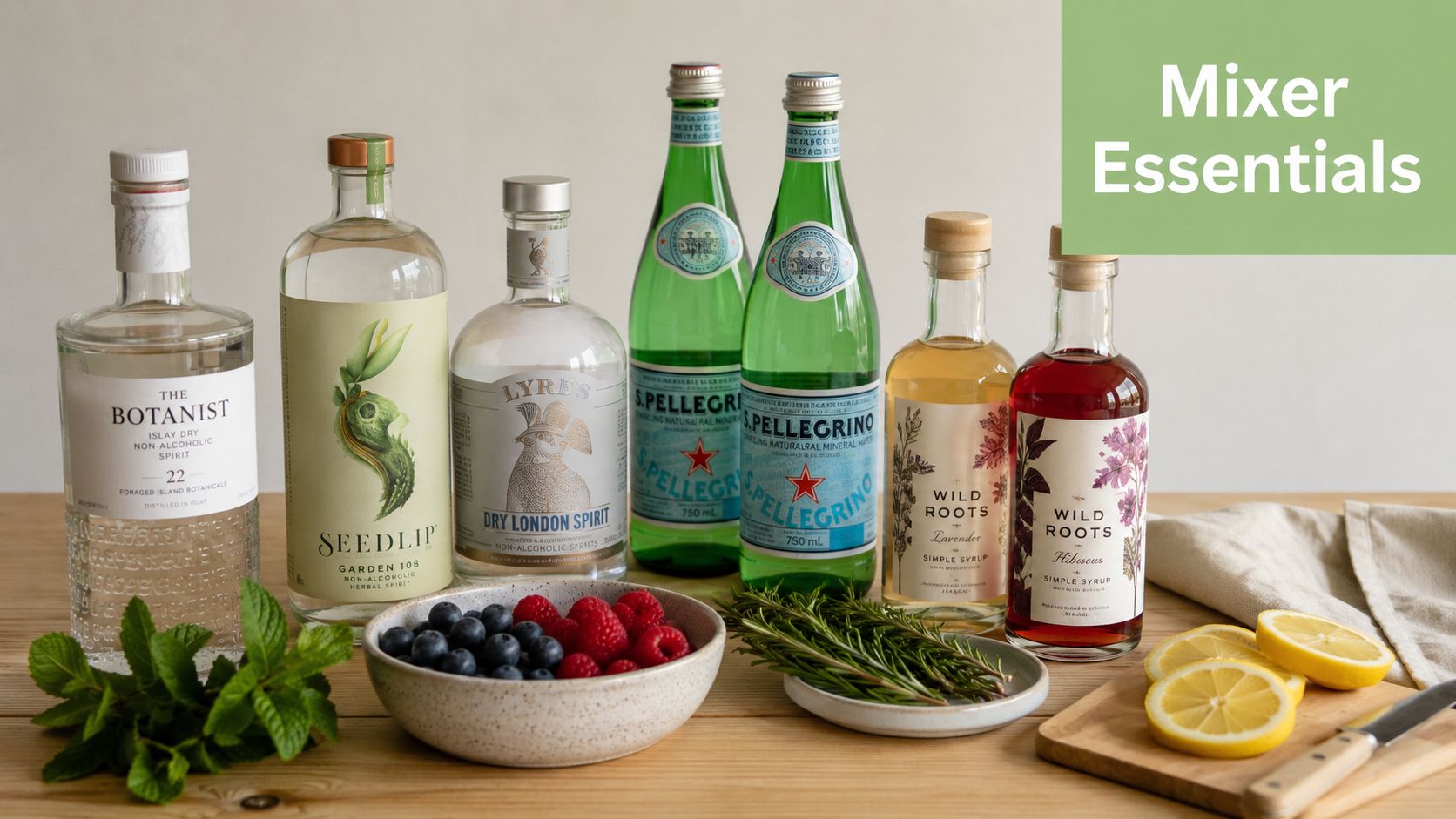
Mixer doesn't mean sweet
Many readers find the definition of a mixer confusing. A mixer can be tart, bitter, dry, savoury, or neutral. Sparkling water is a mixer. Brewed tea can be a mixer. Kombucha can be a mixer. A shrub can be a mixer. Even a few drops of saline count, because they change flavour perception.
That broader definition matters because alcohol-free drinks don't have ethanol doing the heavy lifting. Without alcohol, you need to build flavour from several directions at once.
The category is bigger than many people realise
This isn't a fringe shelf in the drinks fridge. Australia's non-alcoholic beverage revenue was forecast at USD 13.8 billion in 2023, which shows how commercially relevant this broader category has become for premium alcohol-free ingredients, according to Market.us reporting on Australia's non-alcoholic beverage market.
That scale matters for hospitality. It means customers are already shopping and drinking in this wider space. They understand sparkling botanical drinks, tea-based refreshers, and functional beverages. A good non-alcoholic mixer fits naturally into that behaviour.
A more useful definition
If you work in a café, restaurant, or bar, this practical definition helps:
Working definition: A non-alcoholic cocktail mixer is any ingredient used to add structure, balance, length, or sensory interest to an alcohol-free drink.
That includes ingredients with very different jobs:
- Base builders: Tea, kombucha, juice, coffee, botanical infusions
- Brightness tools: Citrus, verjus, shrubs
- Texture builders: Carbonated water, tonic, foaming ingredients
- Balancing agents: Syrups, honey, saline
- Aromatic finishers: Herbs, spices, zests, floral accents
Once you think in functions, the category gets much easier to use. You're no longer choosing between “healthy” and “tasty”, or between “simple” and “premium”. You're assembling a drink with purpose.
The Building Blocks A Typology of Modern Mixers
The easiest way to understand modern mixers is to group them by job. One ingredient can do more than one job, but every strong drink needs each role considered.
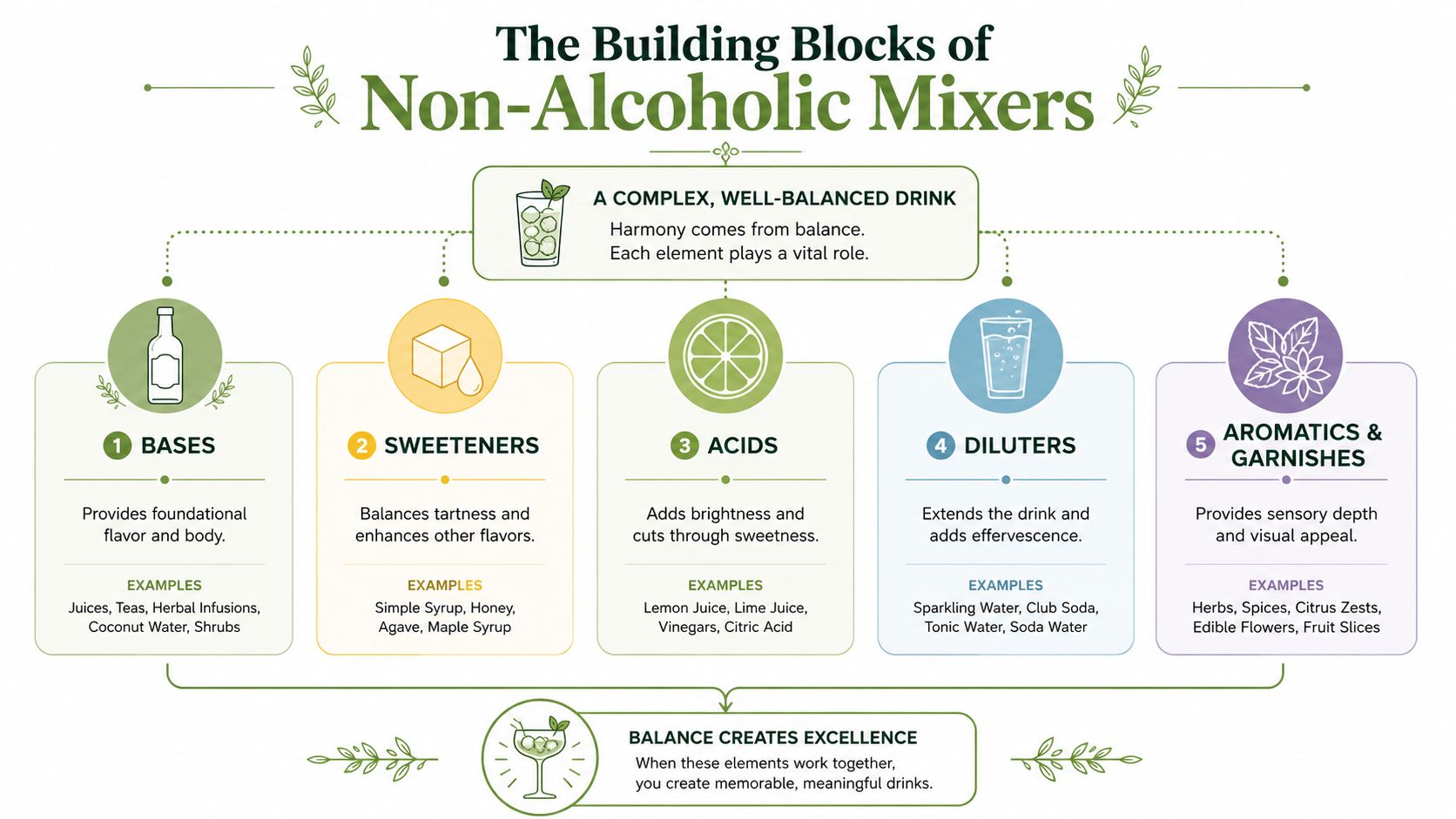
Start with the base
The base is the main liquid and the first thing the palate notices. If the base is thin or sugary, the whole drink struggles.
Tea is one of the most underrated bases because it brings tannin, aroma, and a dry finish. Green tea can feel grassy and lifted. Black tea can feel fuller and more grounded. Matcha works differently again. It gives colour, gentle bitterness, and a creamy, suspended texture when whisked properly.
Kombucha is another versatile base. It can contribute acidity, light funk, natural complexity, and often some carbonation. It works especially well when you want a drink to feel lively without adding lots of sweetener.
Then balance with sweeteners and acids
A common mistake is treating sweetness as the centre of the drink. It's usually better to treat sweetness as a control knob.
Use sweet elements to round edges, not dominate the profile. That could be a small pour of simple syrup, honey, fruit reduction, or a naturally sweeter ingredient paired with drier components.
Acid does the opposite job. It gives snap and keeps the drink from dragging. Citrus is the obvious tool, but not the only one. Verjus and shrubs often create a more layered result because they brighten the drink without pushing it fully into lemonade territory.
Diluters and aromatics finish the drink
Once the core balance is right, diluters open the drink up. Soda water, mineral water, tonic, and ginger beer all change the final impression. Some subtly lengthen flavour. Others bring bitterness, spice, or bubbles.
Aromatics complete the experience before the first sip even lands. Citrus peel, rosemary, mint, basil, cracked spice, and floral accents can make a simple build feel polished and intentional.
Practical rule: If a drink tastes fine but still feels boring, the missing element is often aroma or texture, not more sugar.
Functional categories at a glance
| Mixer Category | Primary Function | Examples |
|---|---|---|
| Bases | Provide foundational flavour and body | Tea, kombucha, juice, coffee, botanical infusions |
| Sweeteners | Soften sharp edges and add roundness | Simple syrup, honey, fruit reduction |
| Acids | Add brightness and structure | Citrus, verjus, shrubs |
| Diluters | Extend the drink and influence mouthfeel | Soda water, tonic, mineral water, ginger beer |
| Aromatics and garnishes | Add nose, freshness, and visual appeal | Mint, rosemary, citrus peel, spices |
Why lower-sugar formats matter
This category also matters because many drinkers don't want every alcohol-free option to be syrup-led. The Australian Bureau of Statistics reported that 47.8% of adults consumed sugar-sweetened beverages on the day before interview in 2022, which underlines the opportunity for lower-sugar drink formats built on ingredients like tea and kombucha, as discussed in this article on non-alcoholic mixers and lower-sugar options.
For venues, that opens a practical lane. You can build drinks that feel premium without defaulting to heavy sweetness. If your menu already includes spiced sodas or adult soft drinks, it's also worth reviewing broader low-sugar mixer thinking, including guides such as Pep Tea's take on no sugar ginger beer options.
The Art of Flavour Architecture in Non Alcoholic Drinks
A good alcohol-free drink isn't a random mix of nice ingredients. It has structure. I think of that structure as flavour architecture.
If a drink tastes one-dimensional, the problem usually isn't the recipe length. It's that one of the core pillars is missing.
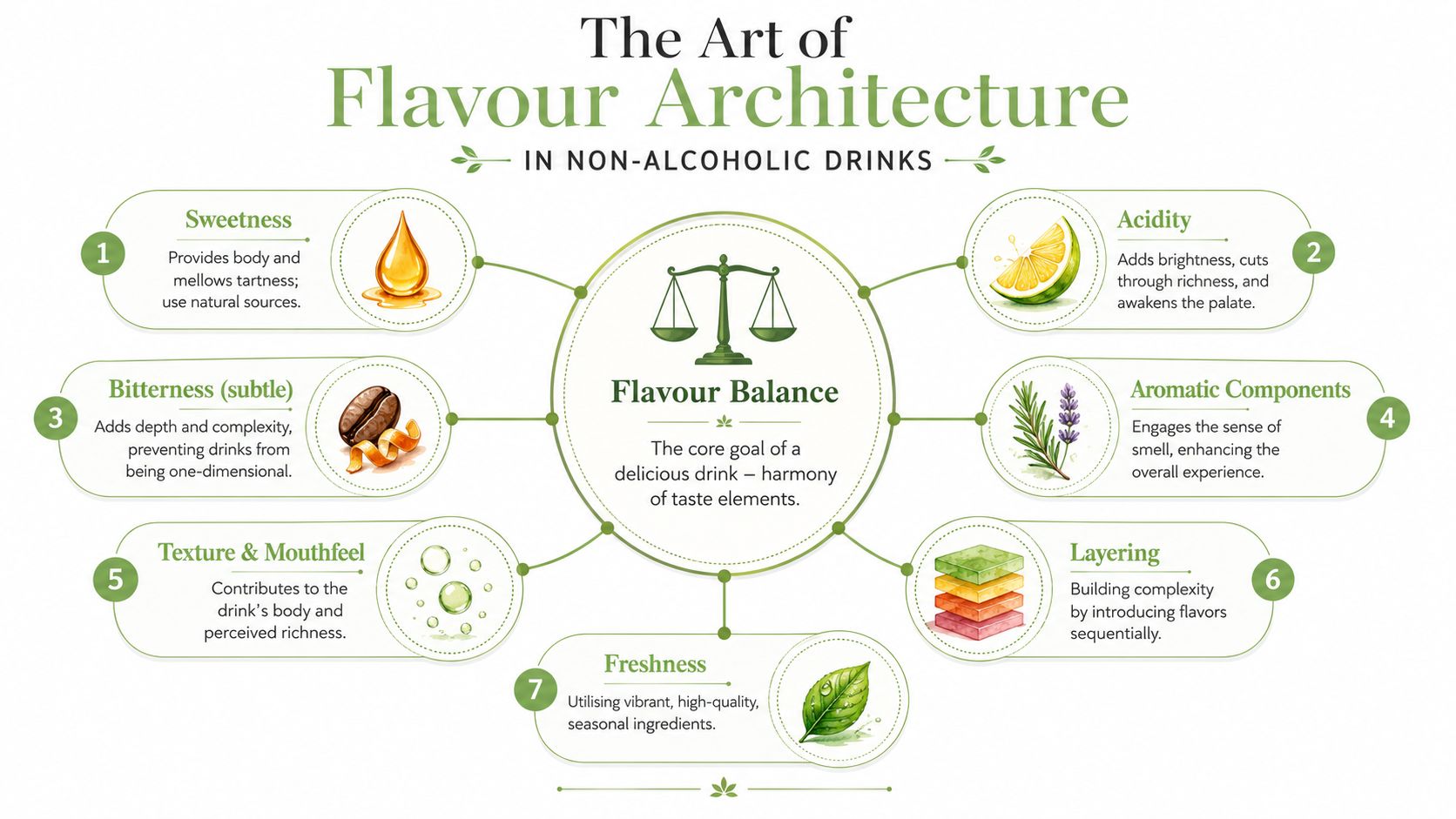
Acid gives the drink direction
Acidity is what makes a drink feel awake. It sharpens fruit, lifts botanicals, and stops sweetness from turning sticky.
Citrus is the most familiar source, but it can be blunt if overused. Verjus is softer. Shrubs add both acid and savoury complexity. Kombucha often gives a gentler, more integrated acidity that works well in spritz-style serves.
If your drink tastes dull, add a little acid before you add anything sweet.
Sweetness should support, not lead
In non-alcoholic drinks, sweetness is often over-applied because people are trying to compensate for missing alcohol. That usually backfires.
A small amount of sweetness can make the whole drink taste more complete. Too much and every other note disappears. If you're using fruit, sweet tea, or kombucha, taste first. You may need much less added sugar than expected.
Bitterness and tannin create an adult profile
This is the piece that many home recipes ignore. Without bitterness, tannin, or some kind of grip, a drink can feel soft and juvenile.
Tea is excellent here. Black tea offers backbone. Green tea brings freshness and a firmer line. Matcha adds gentle bitterness and a savoury edge. Citrus zest, bitter leaves, and some botanical non-alcoholic bitters can also help.
A drink doesn't need to be bitter. It needs just enough resistance to stay interesting.
Texture changes how quality is perceived
Texture is easy to miss because people don't always have language for it. But they notice it immediately.
Fine bubbles can make a drink feel elegant. A whisked tea can feel creamy. Crushed ice creates looseness and refreshment. A still drink with no body often feels unfinished, even when the flavour is good.
When you're designing a serve, ask: should this drink feel crisp, plush, frothy, sparkling, or lean?
Aroma finishes the job
Aromatic ingredients tell the brain what to expect before the drink even touches the lips. That's why garnish isn't just decoration.
Mint gives lift. Citrus oils add freshness and bitterness together. Rosemary can feel resinous and dry. Fresh basil can push a drink into a more savoury, food-friendly direction.
A strong aromatic choice also helps alcohol-free drinks hold attention at the table. They smell intentional.
The small saline trick that changes everything
One of the most useful professional techniques is saline. A 20% saline solution, made with 20 g salt to 80 g water, can be added in very small doses because sodium suppresses bitterness, boosts perceived citrus brightness, and can heighten carbonation perception, as explained in All The Bitter's guide to non-alcoholic cocktail program design.
That sounds technical, but the use is simple. If a drink tastes harsh, thin, or oddly flat, a tiny amount of saline can make it feel more connected without adding sugar.
A practical tasting sequence
When building a drink, don't adjust everything at once. Taste in order.
- Check brightness first: Does it need acid?
- Check shape next: Does it need bitterness, tannin, or savoury lift?
- Check body: Does it need fizz, dilution, or texture?
- Check sweetness last: Add only enough to balance
- Finish with aroma: Herbs, zest, spice, or floral note
For readers who want to see how these ideas translate into alcohol-free serves with a more cocktail-style presentation, Pep Tea's guide to kombucha cocktails offers useful inspiration.
Simple Recipes and Proportions for Success
Recipes are helpful, but rigid formulas can make people nervous. Templates work better. They teach you how to think, not just what to pour.
Start with a glass, good ice, and one clear flavour idea. Then build around that idea.
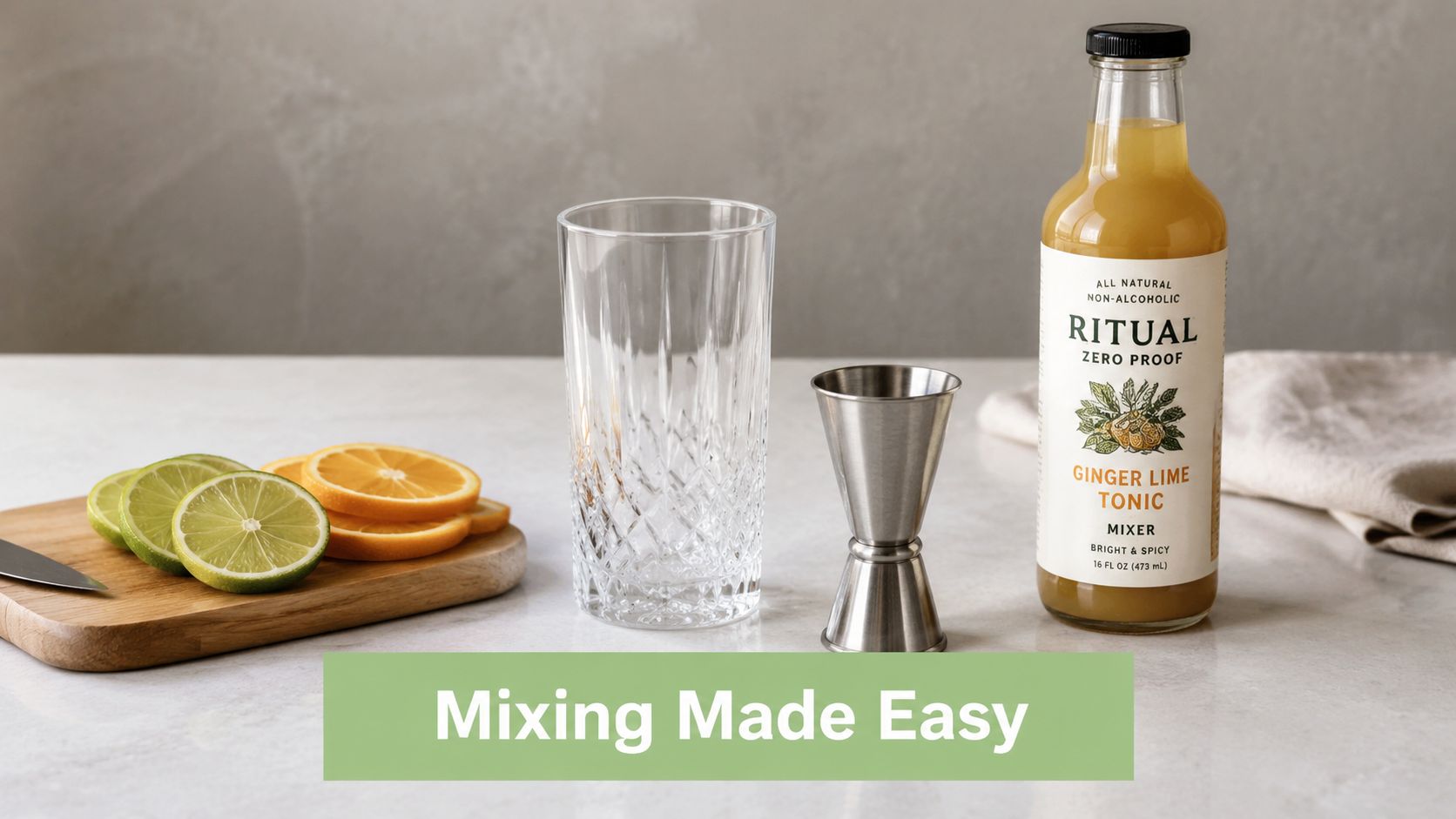
The tea spritz template
Use this when you want something dry, bright, and lunch-friendly.
- 2 parts brewed and chilled tea
- 1 part acid element such as citrus or verjus
- 1 small part sweetener if needed
- Top with sparkling water
- Finish with a fragrant garnish
Example: chilled green tea, a squeeze of lime, a touch of honey, soda, and mint.
If it tastes too sharp, soften it slightly. If it tastes too soft, add zest or a more tannic tea.
The kombucha highball template
This works when you want complexity with minimal prep.
- 2 parts kombucha
- 1 part lengthener or secondary base such as chilled tea or soda
- Aromatic accent like cucumber, ginger, rosemary, or basil
- Optional saline drop if the finish feels muddled
Example: ginger kombucha, chilled soda, cucumber ribbon, and lime peel.
The kombucha carries acid and character, so the rest of the build can stay restrained.
Service note: Keep garnishes tight and relevant. One strong aromatic usually works better than three competing ones.
The no-syrup sour-style template
This is useful for readers trying to avoid sugar-heavy drinks.
Use ingredients with natural structure instead of relying on lots of syrup. Pair strong acid with tannin, then add texture.
- 1 part sharp element such as lemon or verjus
- 2 parts structured base such as black tea or kombucha
- A small balancing touch from fruit, honey, or a naturally round ingredient
- Optional foam or shake for body
Example: black tea, verjus, a little muddled pear, shaken hard and served cold.
The result feels closer to a proper mixed drink than a cordial.
A quick visual demo can help if you prefer watching technique over reading ratios.
A simple way to test your own build
If you're inventing drinks at home or for a menu, run this short check before serving:
- Too sweet: Add acid, bitterness, or dilution
- Too sharp: Add a touch of sweetness or fuller base
- Too boring: Add aroma or a tannic element
- Too busy: Remove one flavour and let the base speak
- Too flat: Add carbonation or a tiny saline adjustment
That process is far more reliable than chasing a “perfect” bottle of mixer.
Sourcing and Menu Tips for Australian Cafés and Retailers
For cafés and retailers, the opportunity isn't just stocking one alcohol-free option. It's building a section that feels deliberate enough to order without apology.
That starts with naming and description. “Mocktail” can work, but many venues now get better results from language like sparkling tea, botanical spritz, or zero-proof highball. Those terms signal flavour and format, not compromise.
What to look for in a supplier
Choose mixers and bases that answer practical service questions, not just branding questions.
- Consistency: Can staff produce the same drink across a busy service?
- Clarity of flavour: Does the product still taste distinct once chilled, diluted, or poured over ice?
- Operational fit: Does it suit by-the-glass service, batching, and menu rotation?
- Handling guidance: Are refrigeration, shelf life, sediment, and service notes clearly explained?
This matters especially with live fermented products. Kombucha can be excellent in a menu program, but venues need to understand storage, temperature control, and in-service behaviour. Those handling details are not minor, particularly when food safety matters. The Australian Food Safety Information Council reports that foodborne illness affects an estimated 4.1 million Australians each year, which is why consistent handling of fermented and low-alcohol products deserves real attention, as noted in this discussion of non-alcoholic mixers, live products, and venue operations.
Write the menu for real guests
A strong alcohol-free menu usually does three things well:
It signals flavour clearly
“Green tea, yuzu, soda” is easier to trust than a vague fantasy name.It gives drinks a proper format
Serve in highballs, wine glasses, coupes, or tumblers that match the style.It trains staff to explain the drink in one sentence
Guests buy with confidence when the explanation is simple and specific.
If staff can't describe where the structure comes from, the drink probably isn't ready for the menu.
Think beyond the bottle
For venues serving brunch, events, or large-format refreshment, batching matters. You need to know how a drink holds, whether carbonation fades, and what happens to fresh garnishes over time. If you're exploring service hardware for larger pours or self-serve formats, Modern Lyfe's beverage dispenser guide is a practical reference for setup considerations.
The best Australian menus in this space don't treat non-alcoholic drinks as an afterthought. They treat them like a category with its own logic, margins, and standards.
If you're building a better alcohol-free drinks menu at home or in a venue, Pep Tea is worth exploring for premium organic Matcha and Australian-brewed sugar-free organic kombucha. They're especially useful if you want low-sugar, flavour-led ingredients that fit modern café service as well as everyday drinking.
Functional Beverage Trends: Top Innovations for 2026

Beyond the Buzz: Real Trends Shaping What We Drink
The phrase functional beverage trends gets thrown around so often that it can start to mean everything and nothing at once. A powder gets added, a bold claim lands on the can, and suddenly it's positioned as the future of wellness. In practice, that's not what separates a drink people try once from a drink they build into daily life.
The strongest shift heading into 2026 is simpler than the hype cycle suggests. Australians are choosing drinks with a clearer job to do. They want calm energy, better hydration, lower sugar, gut-friendly options, and ingredients they can recognise. They also want labels and claims that hold up under scrutiny, especially in a local market where compliant wording matters as much as flavour.
That lines up with broader category movement. Food Navigator reported that market research valued the global functional drinks market at about USD 149 billion in 2025, with a projected CAGR of 8.9% to nearly USD 250 billion by 2030, while noting that Australian category tracking points to growing demand for wellness-oriented drinks with clearer health positioning and lower sugar in this functional drinks market report.
For us at Pep Tea, that isn't a new idea. It's been the baseline from the start. Real organic Matcha. Properly brewed Kombucha. No hiding behind vague “wellness” language when quality, sourcing, fermentation, and taste should do the heavy lifting. If you're a consumer, café owner, or hospitality buyer, these are the trends worth acting on.
1. Adaptogenic & Nootropic Blends
Adaptogen and nootropic drinks are moving into everyday café language. You'll now see mushrooms, roots, and botanical add-ins pitched around focus, balance, and calm. The opportunity is real, but so is the risk of cluttered menus and loose claims.

What tends to work in Australia is restraint. A good base drink still has to taste good without a lecture attached. If a venue adds lion's mane to a latte, or reishi to a cacao blend, the drink needs one primary promise customers can understand fast. “Calm focus” lands better than a five-ingredient wellness stack with murky intent.
What actually lands on menu
Matcha is one of the best base formats for this trend because it already carries a clean energy story. It doesn't need to be overbuilt. In many cafés, the smartest move is a short line-up:
- Pure option: Organic ceremonial Matcha for customers who want the cleanest expression.
- Focus option: Matcha paired with one complementary mushroom or botanical.
- Evening option: A lower-caffeine botanical latte instead of forcing matcha into every daypart.
The trade-off is operational. Every extra powder adds training, stock management, and inconsistency risk. Café owners often underestimate how quickly a “wellness menu” turns into a messy bench and a confused team.
Practical rule: If staff can't explain why an ingredient is in the drink in one sentence, it probably shouldn't be on the menu.
For home use, the same applies. Start with high-quality Matcha and add one extra element only if it improves the ritual or flavour. Better ingredients usually beat bigger ingredient lists.
2. Radical Transparency in Probiotics & Gut Health
“Gut health” still pulls attention, but vague probiotic language doesn't cut it anymore. Shoppers are getting better at spotting the difference between properly fermented Kombucha and a sweet fizzy drink wearing health-food branding.
In Australia, that matters because compliant claims are a real issue, not a branding detail. Industry commentary has pointed out that local brands often face a gap between trendy wellness messaging and what can be supported under Australian rules, especially for drinks positioned around mood, gut health, focus, or energy in this analysis of functional beverage claim challenges.
What transparency looks like in real life
For consumers, transparency starts with basic questions. Was it properly fermented? Is it low in sugar because the fermentation process did the work, or because sweetness was manipulated later? Does the brand explain what the drink is, instead of just selling a vibe?
For cafés and retailers, brand selection is key. If you're stocking Kombucha, choose producers that are open about process and quality. Drinks positioned as healthy probiotic drinks should earn that trust through clarity, not buzzwords.
A practical benchmark is Pep Tea's style of Kombucha. Australian-brewed, organic, sugar-free, and built around real fermentation rather than a soft-drink shortcut. That sort of product makes service easier because staff can talk about what the drink is with confidence.
Customers don't need a microbiology lesson. They do need a reason to believe the bottle is more than flavoured fizz.
What doesn't work is overclaiming. “Supports digestion” is a very different tone from promising life-changing results. The best gut-health brands stay credible by staying specific and measured.
3. Clean Energy & Active Lifestyle Integration
The energy category is getting cleaned up. More Australians want a lift they can fit into a workday, gym session, school run, or long afternoon without feeling rattled afterward. That's why matcha keeps gaining ground as a practical energy drink, not just a café trend.
Independent market commentary has highlighted that Australian shoppers are increasingly choosing beverages for specific benefits such as energy, digestion, and mental wellbeing, with functional drinks becoming part of everyday routines rather than staying trapped in sport or supplement culture in this functional beverage market overview.
Better energy for real routines
This trend works best when the drink already fits a habit. A morning Matcha latte, an iced Matcha before a workout, or a Kombucha after lunch all make sense because they replace something people already drink.
For café owners, “clean energy” only works if the menu language is clear:
- Morning crowd: Offer a straight ceremonial Matcha and a Matcha latte.
- Fitness crowd: Position matcha as a smoother option for pre-training focus.
- Afternoon crowd: Use lighter serves and less sweetness so the drink feels refreshing, not heavy.
For consumers, choosing the best green tea for energy usually comes down to quality and preparation. Low-grade matcha with loads of syrup defeats the whole point. A clean whisked Matcha or an unsweetened iced version is where this trend delivers.
I've found cafés get the best repeat orders when they stop trying to mimic energy drinks and let Matcha be Matcha. The bright flavour, the colour, and the calmer feel are already the selling points.
4. Sophisticated Non-Alcoholic Mixology
Non-alcoholic menus have grown up. People still want complexity, bitterness, acidity, aroma, and proper presentation. They just don't always want alcohol in the glass.

Kombucha and Matcha both slot naturally into this shift. Kombucha brings acidity and fermentation character. Matcha brings bitterness, savoury depth, and colour. Used well, they help bars and cafés build drinks that feel adult and intentional rather than sugary and apologetic.
What makes a non-alc drink feel premium
The drinks that work usually borrow structure from classic cocktails. A ginger or lime-forward Kombucha can stand in for sparkle and acid. Matcha can replace part of the bitter backbone in a spritz-style serve or tea-based cooler. Herbs, citrus peel, and proper glassware do the rest.
What fails is trying to cover weak ingredients with garnish theatre. If the base liquid isn't good, the mocktail won't be either. That's why real Kombucha matters. It gives the drink shape.
For venues wanting ideas that customers will order, fruity and non-alcoholic kombucha cocktails are a strong starting point because they build on flavour pairings people already understand.
Here's a quick visual on where this trend is heading in service style and presentation.
A simple example for hospitality is a Ginger Kombucha serve with rosemary, citrus twist, and chilled stemware. It takes almost no extra labour, but it looks and drinks like a considered menu item. That's the sweet spot.
5. Zero-Sugar & Naturally Sweetened
Low sugar used to sound impressive on its own. Now people read the label more closely. They want to know what created the sweetness, what replaced the sugar, and whether the drink still tastes balanced without becoming weirdly artificial.

This is one of the clearest functional beverage trends in Australia because the wider category is already moving toward better-for-you drinks with stronger low-sugar positioning, as noted earlier. The takeaway for buyers is simple. “Healthier” means very little if the ingredient panel tells another story.
Sugar reduction that still tastes good
The hard part is flavour. Plenty of drinks remove sugar but strip out pleasure at the same time. The best products solve that with process and ingredient quality.
Kombucha is a strong example. A properly fermented sugar-free Kombucha can keep acidity, complexity, and refreshment without tasting flat. Pep Tea's organic Kombucha fits that benchmark because the drink is brewed for a clean result rather than relying on a heavy-handed sweetener profile.
For cafés, zero-sugar options also make menu design easier:
- Pair with food: Less sweet drinks work better across breakfast and lunch menus.
- Reduce fatigue: Staff don't need to explain why a “healthy” drink tastes like dessert.
- Broaden appeal: Customers avoiding alcohol, soft drinks, or sugary juices all have a place to land.
The strongest zero-sugar drinks don't taste like a compromise. They taste deliberate.
At home, this trend is worth acting on by checking what you reach for at 3 pm. If it's a soft drink or sweet iced coffee out of habit, a crisp Kombucha or an unsweetened iced Matcha can shift the whole routine.
6. Ready-to-Drink RTD Matcha
RTD Matcha is a convenience play, but convenience alone won't keep it growing. People have become more selective. If a bottle says matcha, they expect it to taste like matcha, not like vanilla syrup with a green tint.
That's where a lot of RTD products still miss. They chase shelf appeal first and tea quality second. For Australian consumers, the better direction is obvious. Fewer additives, cleaner flavour, lower sugar, and a real connection to the tea itself.
Convenience without losing integrity
There's a genuine place for grab-and-go Matcha. Not everyone has time to sift, whisk, and warm water between meetings or school drop-off. RTD formats can make sense for offices, gyms, independent grocers, and café fridges, but only if they preserve what makes Matcha worthwhile.
A good RTD Matcha should still feel vegetal, fresh, and lightly creamy if milk is involved. It shouldn't lean on excessive sweetness to hide poor powder quality. Consequently, understanding the differences between ceremonial-grade and culinary-grade matters. A café might use culinary Matcha for blended drinks and reserve ceremonial Matcha for premium serves, but both still need to be good.
For operators, the RTD trade-off is margin versus theatre. Bottled Matcha is fast and consistent. Fresh-whisked Matcha has more ceremony and often more perceived value. Many venues will do best with both. Grab-and-go in the fridge, and a made-to-order Matcha menu for customers who want the full experience.
If Pep Tea ever sets the benchmark here, it should be the same rule we apply to every category. The format can change. The integrity can't.
7. Gut-Mind Connection and Beverages for Mood
This is one of the more interesting shifts because people aren't separating physical wellness from mental wellbeing as neatly as they used to. They're looking for drinks that support how they feel, not just how they fuel.
Industry commentary for 2025 noted rising demand for gut-friendly drinks with prebiotic and probiotic ingredients, with launches in markets including Australia and Japan increasingly carrying digestive health claims. The same commentary also pointed to a global functional beverage estimate of USD 151.80 billion in 2025, with a forecast to reach USD 239.95 billion by 2031, implying a 7.93% CAGR from 2026 to 2031 in this functional beverage trends update.
Why mood-friendly drinks are getting traction
In practical terms, people understand “calm focus” and “settled stomach” far better than abstract wellness language. That's why Matcha and Kombucha sit so neatly in this space. Matcha already has a reputation for smoother, steadier energy. Kombucha already fits the digestive wellness conversation.
The key is not to oversell either one. A drink can be part of a better routine without becoming a miracle product. For consumers, that might mean replacing a jittery second coffee with Matcha, or swapping a sugary afternoon drink for Kombucha. For cafés, it means writing menus that sound grounded and believable.
A good example is a simple iced ceremonial Matcha promoted as a clean option for focus, or a sugar-free Kombucha listed as a refreshing fermented drink for customers who want something lighter. That tone respects both the product and the customer.
Mood-supportive beverage marketing works best when it sounds like a daily habit, not a medical promise.
8. Sustainable & Ethical Sourcing Story
People don't just want functional drinks. They want to feel good about the chain of decisions behind them. Where was the tea grown? How was it handled? Who made the drink locally? Was the product built with care or just assembled for trend appeal?
This matters even more in premium categories because the sourcing story is part of the quality story. With Matcha, origin and grade aren't decorative details. They shape flavour, colour, texture, and trust. With Kombucha, local brewing and disciplined production matter because “craft” can mean excellence or inconsistency depending on who's doing the work.
The sourcing story has to be real
Australian consumers have become very good at sniffing out vague ethical language. A brand that says it values sustainability but won't explain packaging, sourcing, or production choices feels flimsy fast.
What tends to resonate is specificity:
- Japanese organic Matcha: Clear origin and grade information.
- Australian-brewed Kombucha: Local production with a visible standard.
- Clean ingredient panel: No need to hide behind marketing fog.
Pep Tea has a natural advantage here because the story is grounded in actual product decisions. Organic Japanese Matcha. Kombucha brewed in the Hunter Valley, NSW. Australian ownership. Those details help cafés and retailers sell with confidence because they're concrete.
For hospitality, this trend isn't only moral. It's commercial. Staff can tell a short, credible story tableside. Customers remember that. A sourced-well product also tends to hold its flavour standard better, which matters more than any sustainability slogan.
9. Culinary Crossover with Matcha and Kombucha as Ingredients
One of the smartest shifts in functional drinks is that they're no longer trapped in the cup. Matcha and Kombucha are becoming pantry ingredients, and that opens up more occasions to use them without inventing a whole new ritual.
For home cooks, Matcha already makes sense in baking, smoothies, overnight oats, and desserts. For cafés, it lifts everything from muffins to soft serve to glaze. Kombucha has a different strength. Its acidity and fermented edge make it useful in dressings, marinades, shrubs, and low-sugar syrups.
Ingredient use creates repeat value
This trend matters because it deepens product relevance. A customer who buys Matcha only for weekend lattes might buy it more often once they start using it in bliss balls, cheesecake filling, or pancake batter. A venue that pours Kombucha by the glass might also use it in a non-alc spritz, salad dressing, or seasonal granita.
Some practical combinations work especially well:
- Ceremonial Matcha: Best for straight tea and cleaner iced drinks.
- Culinary Matcha: Better for baking, smoothies, and kitchen prep.
- Ginger or Lime Kombucha: Great in vinaigrettes, mocktail bases, and marinades.
What doesn't work is forcing “functional” into dishes that don't need it. A fluorescent green cake with weak flavour is still a weak cake. Quality ingredient, appropriate use, and proper balance matter more than trend-chasing.
If you run a café, this is one of the easiest ways to extend a premium product across the menu without adding another supplier. One excellent Matcha can support drinks, cabinet food, and seasonal specials.
10. Functional Hydration with Benefits
Hydration has become more layered. People still want refreshment first, but they also want the drink to do a little more. Maybe that means antioxidants, maybe it means a lower-sugar format, maybe it means a cleaner alternative to neon sports drinks.
This trend works best when the beverage still behaves like a thirst-quencher. If a “hydration” drink feels syrupy, medicinal, or overloaded with claims, people won't come back to it. That's why tea-based and fermented drinks have an edge. They can feel light, adult, and useful without trying too hard.
Everyday hydration is replacing occasion-only wellness
For consumers, the practical move is to think beyond workouts. Functional hydration can sit at a desk, in a lunchbox, in the car, or beside a meal. An iced Matcha with no heavy sweetener can refresh and sharpen attention. A crisp sugar-free Kombucha can replace soft drink at lunch without feeling punitive.
For cafés and foodservice, this creates room for a broader cold-drinks strategy. Sparkling water still belongs. So do premium mixers and mineral waters. If you're building a more thoughtful drinks fridge or table service list, it's worth including premium hydration options like explore Lurisia at IFM Gourmet alongside Kombucha and Matcha-based serves.

A key trade-off here is simplicity. A good hydration menu doesn't need ten fortified beverages. It needs a few excellent options with clear roles. Sparkling mineral water. Unsweetened iced Matcha. Proper Kombucha. That's enough to cover most modern drinking occasions well.
Top 10 Functional Beverage Trends Comparison
For Australian consumers and venue operators, the best trend is not the flashiest one. It is the one you can explain in ten seconds, source reliably, price properly, and serve again next week without quality slipping. That is why authentic Matcha and properly fermented Kombucha remain useful benchmarks. They make it easier to sort real function from marketing noise.
| Trend | Implementation Complexity 🔄 | Resource Requirements ⚡ | Expected Outcomes 📊 | Ideal Use Cases 💡 | Key Advantages ⭐ |
|---|---|---|---|---|---|
| Adaptogenic & Nootropic Blends | 🔄 Moderate, formulation, dosing and regulatory controls | ⚡ Medium, certified adaptogens, quality testing, staff education | 📊 Stronger perceived focus and stress-support appeal, with premium pricing potential | 💡 Premium cafés, wellness retail, limited-edition launches | ⭐ Clear point of difference, especially when paired with quality Matcha |
| Radical Transparency in Probiotics & Gut Health | 🔄 High, strain identification, CFU tracking, cold chain and quality control | ⚡ High, lab testing, refrigerated logistics, documentation | 📊 More trust, clearer claims, better repeat purchase potential | 💡 Refrigerated retail, educational marketing, health-focused outlets | ⭐ Credibility and authenticity, especially for serious Kombucha brands |
| Clean Energy & Active Lifestyle Integration | 🔄 Low to moderate, mainly positioning with minor reformulation if needed | ⚡ Low, existing Matcha or Kombucha range, simple partnerships | 📊 Better appeal for active daytime occasions and steady everyday use | 💡 Gyms, sports events, fitness retail, pre or post-training rituals | ⭐ Natural sustained energy from Matcha, without the rough energy-drink feel |
| Premium Non-Alcoholic Mixology | 🔄 Moderate, recipe development and staff training | ⚡ Medium, product samples, venue training, hospitality partnerships | 📊 Higher-margin venue sales and stronger presence in bars and restaurants | 💡 Bars, restaurants, events, signature mocktails and spritzes | ⭐ Strong mixability, layered flavour, and access to premium hospitality |
| Zero-Sugar & Naturally Sweetened | 🔄 Low, maintain flavour balance, fermentation standards and transparent labelling | ⚡ Low, mostly clear messaging with minimal reformulation | 📊 Broad appeal and easier health positioning | 💡 Health-focused retail, sugar-conscious shoppers, café fridges | ⭐ Strong core differentiator, especially when the sugar-free claim is genuine |
| Ready-to-Drink (RTD) Matcha | 🔄 Moderate, packaging, shelf-stability and distribution setup | ⚡ Medium, bottling or canning, packaging, supply chain support | 📊 More grab-and-go sales and broader retail reach | 💡 Convenience retail, cafés with bottled options, office fridges | ⭐ Builds on Matcha expertise and creates an extra convenience-led revenue stream |
| Gut-Mind Connection: Beverages for Mood | 🔄 Moderate, compliant claims and customer education | ⚡ Medium, research-based messaging, content creation, staff training | 📊 Stronger emotional connection and more repeat interest | 💡 Wellness subscriptions, mental wellbeing campaigns, premium retail | ⭐ Integrated story connecting gut health, mood and focus without overclaiming |
| Sustainable & Ethical Sourcing Story | 🔄 Low to moderate, traceability systems and clear storytelling | ⚡ Medium, certifications, audits, supplier documentation, content production | 📊 Increased trust and stronger willingness to pay for quality | 💡 Premium retail, conscious consumers, hospitality menus with provenance cues | ⭐ Authentic sourcing story that supports premium pricing if the product quality matches |
| Culinary Crossover: Matcha & Kombucha as Ingredients | 🔄 Low, recipe development and simple collaborations | ⚡ Low, chef partnerships, recipe cards, menu testing | 📊 More usage occasions and greater volume per customer | 💡 Foodservice, recipe-led retail, bakery and brunch menus | ⭐ Versatility that turns these drinks into ingredients, not just finished products |
| Functional Hydration with Benefits | 🔄 Low, mostly positioning with optional formulation tweaks | ⚡ Medium, marketing support and possible electrolyte inputs | 📊 Wider appeal across everyday drinking occasions | 💡 Office, summer promotions, lunch trade, all-day café fridges | ⭐ Broader hydration appeal with a cleaner wellness angle |
A practical read on this table is simple. High-complexity trends can build trust and margin, but they demand discipline. Lower-complexity trends move faster, yet they only work if the base product is already good. Pep Tea sets the right benchmark here. Start with ingredient integrity, then add a function people can feel and understand.
For café owners, the strongest options are usually RTD Matcha, zero-sugar serves, premium alcohol-free drinks, and culinary crossover applications. They are easier to train, easier to merchandise, and easier to sell in busy Australian service environments. For consumers, the safer bet is similar. Choose products with clear ingredients, believable benefits, and flavour you would still want even without the wellness claim.
Putting Function into Practice: Your Next Sip
The most useful functional beverage trends aren't the loudest ones. They're the ones that fit real Australian habits and hold up once the marketing fades. People want drinks that feel better to live with. Less sugar, clearer benefits, stronger ingredient integrity, and more versatility across home, café, and hospitality settings.
That's why Matcha and Kombucha keep showing up in serious conversations about the future of drinks. They aren't novelty formats. They're adaptable, recognisable, and capable of delivering exactly what many people are after right now. Matcha fits the clean-energy conversation beautifully when it's high quality and prepared properly. Kombucha fits the gut-health and non-alcoholic conversation when it's properly fermented and balanced, not dressed up as a health halo product.
For consumers, the practical move is to simplify. Don't chase every new powder or trending botanical. Start with drinks that already make sense in your routine. A morning Matcha instead of a second coffee. A sugar-free Kombucha in place of soft drink. An iced tea-based option in the afternoon that doesn't leave you flat. Good routines beat exotic ingredient lists every time.
For café owners and hospitality operators, the same principle applies. Build a drinks range that your staff can explain, your customers can understand, and your kitchen can execute consistently. The strongest menu usually isn't the biggest one. It's the one with a few high-quality functional options that each do a clear job. One premium Matcha line. One or two excellent Kombucha flavours. A couple of well-built non-alcoholic serves. That's often enough to feel current without becoming chaotic.
There's also a bigger strategic lesson in all of this. Australian buyers are becoming more literate. They're reading labels, questioning claims, and rewarding brands that act like grown-ups. That means quality isn't just a nice-to-have. It's the filter people use to separate products with staying power from products built for a short trend cycle.
Pep Tea is a strong benchmark because it reflects what these trends look like when they're done properly. Organic Japanese Matcha with real quality behind it. Australian-brewed sugar-free organic Kombucha made in the Hunter Valley. Clean flavour, clear purpose, and none of the wellness theatre that gets in the way of trust.
The future of drinking looks intentional. It also looks more enjoyable. That's the part worth keeping.
If you're ready to bring these functional beverage trends into your daily routine or your café menu, explore Pep Tea for premium organic Matcha, Australian-made sugar-free Kombucha, and practical guidance on choosing drinks that earn their place in the fridge, on the shelf, or behind the bar.