
Tag: organic green tea
What Is Organic Green Tea: Benefits & How It’s Grown
You've probably seen a tea packet labelled organic and thought, “Great, that means no pesticides.” That's part of the story, but it's not the whole story. If you've ever wondered what is organic green tea, the answer starts much earlier than the cup in your hand. It starts with how the tea plant is grown, how the soil is treated, how the product is certified, and how accurately it's presented to you.
That matters because green tea already carries a strong wellness reputation. Organic green tea adds another layer. It connects farming practice, product integrity, and the daily ritual of choosing something clean and considered. In Australia, that question is especially useful because many teas are imported, and shoppers are often left to sort through a mix of genuine certification, vague “natural” language, and premium-looking packaging.
Green tea itself comes from Camellia sinensis leaves that are minimally processed. That lighter processing helps preserve more of the tea's catechins than black tea, and EGCG is the best-known catechin linked to green tea's antioxidant reputation, as outlined in this organic green tea market overview. The same source notes that Australia's tea market was valued at about USD 650.3 million in 2024 and is projected to reach about USD 913.8 million by 2030, which helps explain why wellness-led tea formats continue to attract attention in cafés, retail, and home routines.
An Introduction to Organic Green Tea
Organic green tea is green tea grown according to organic farming standards. In simple terms, that means growers use methods designed to work with natural systems rather than relying on synthetic agricultural inputs. The tea is still green tea. It still comes from the same plant. What changes is the farming approach behind it.
That distinction clears up a common confusion. Some people assume “organic” describes a different species of tea or a stronger health effect on its own. It doesn't. Organic tells you about how the tea was produced. Green tea tells you what the tea is.
A farm-first way of thinking
Organic tea production is rooted in a bigger idea than just avoiding certain sprays. It treats the tea garden as an ecosystem. Healthy soil, balanced plant life, careful cultivation, and traceable handling all matter.
Organic is best understood as a farming standard, not a flavour note and not a magic health shortcut.
For tea drinkers, that makes the label more meaningful. It points to production choices that many people prefer for environmental, ethical, and personal reasons. It also helps explain why two teas that both say “green tea” on the front can represent very different growing systems.
Why Australians often get stuck on the label
Australian shoppers often face an extra layer of uncertainty because many premium green teas, including Japanese styles, are imported. That's why it helps to understand both the tea itself and the certification around it. If you'd like a broader grounding in tea before getting into organic specifics, this guide on the story of tea is a helpful place to start.
By the end of this guide, you'll know what organic really means in practice, how it compares with conventional green tea, which compounds make green tea so valued, and how to brew it in a way that does the leaf justice.
What Organic Really Means for Your Tea
When people say organic tea is “pesticide-free”, they usually mean well. But that shorthand is too narrow. Organic is a full production system. It covers how the land is managed, how crops are supported, how inputs are controlled, and how the final product earns the right to carry an organic claim.
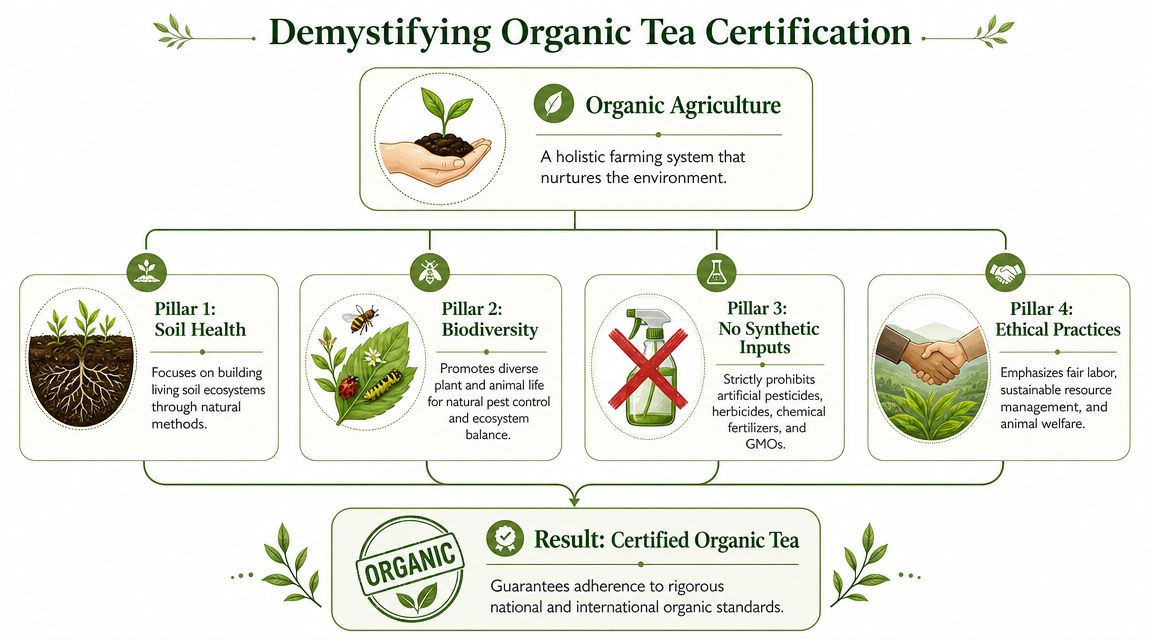
The four ideas behind organic farming
Organic tea farming usually rests on a few core principles:
- Living soil matters. Growers focus on building fertile, active soil rather than treating soil as a neutral base that holds the plant upright.
- Biodiversity helps. A healthier farm environment can support balance between plants, insects, and surrounding ecology.
- Synthetic inputs are restricted. The system is built around avoiding artificial pesticides, herbicides, and chemical fertilisers.
- The process must be verified. A tea isn't organic because the packaging looks earthy or the brand uses words like pure, natural, or clean.
That last point is the one many shoppers miss.
What verification looks like in Australia
In Australia, practical trust comes from certification and compliance, not marketing language. That's why this matters so much for tea buyers. The article discussing organic green tea and certification in the Australian context notes that the Australian organic market was valued at about A$2.59 billion in 2023, while consumer understanding of certification remains uneven, which is exactly why shoppers need to know how to confirm a tea is organic in this Australia-focused discussion of organic verification.
Here's what to look for when you pick up a tea:
- A recognised certification mark on the pack, rather than vague wellness wording.
- Clear origin information, especially if the tea is imported.
- Specific organic language that suggests formal certification rather than loose branding.
- Retail transparency, where the seller explains what standard the tea meets.
Practical rule: If a tea says “natural” but doesn't clearly show how its organic claim is verified, treat it as unproven until you can confirm more.
Imported tea can absolutely be organic. That includes Japanese green tea and matcha. What matters is whether the product has been certified to an accepted standard and marketed in line with Australian requirements. If you want a tea-specific breakdown, this article on the difference between regular and organic matcha adds useful context.
Organic as part of a wider lifestyle choice
For many people, choosing organic tea also fits into a broader low-waste, lower-impact way of living. If that's part of your thinking, this guide on how to start your zero waste journey is a practical companion read.
Organic Versus Conventional Green Tea
Organic and conventional green tea can both taste good. Both come from the same tea plant. The difference lies in how the crop is grown and managed, and that can shape how people think about quality, environmental impact, and value.
A balanced comparison helps here. This isn't about turning conventional tea into a villain. It's about understanding trade-offs clearly enough to make your own call.
Organic vs. Conventional Green Tea at a Glance
| Attribute | Organic Green Tea | Conventional Green Tea |
|---|---|---|
| Farming approach | Grown under organic standards with a focus on ecological balance | Grown using conventional agricultural methods |
| Soil management | Emphasises soil health and natural fertility practices | May rely more heavily on synthetic fertilisers |
| Pest and weed control | Uses organic-compliant methods | May use synthetic pesticides or herbicides |
| Certification | Requires formal certification to support the claim | Not sold as organic unless certified |
| Shopper confidence | Easier to assess when certification marks are clear | Depends more on brand transparency and sourcing detail |
| Environmental approach | Often chosen by people seeking lower-impact farming systems | Can vary widely by producer |
| Flavour experience | Often described as clean, bright, and expressive of origin | Can also be enjoyable, though farming style varies |
| Price | Often priced at a premium because of production and certification requirements | Often available at a wider range of price points |
Where the difference is most practical
The decision often comes down to priorities.
If you care most about certification-backed farming standards, organic will usually appeal more. If your priority is finding a tea you enjoy at an accessible price, conventional tea may still suit you. Plenty of tea drinkers move between both categories depending on the style, source, and budget.
One useful way to think about it is this. Organic tea asks you to pay attention to the system behind the leaf, not just the final beverage. That often resonates with people who already care about ingredients, traceability, and farming methods in the rest of their food.
Why growing method can affect perceived quality
Tea is sensitive. Soil condition, water, climate, leaf handling, and processing all influence what ends up in your cup. The growing method is only one part of that picture, but it does shape how many people evaluate quality.
If you're interested in the broader farming conversation, this piece on how to compare organic vs chemical fertilizers gives useful background on why growers and consumers view these systems differently.
A higher price doesn't automatically mean a better tea. But a certified organic tea gives you a clearer explanation of what you're paying for.
The Wellness Compounds in Every Sip
Green tea's wellness reputation starts with what is inside the leaf. Organic certification matters for how the tea is grown, handled, and verified, especially under Australian organic standards, but the compounds people care about come from the tea plant itself. What organic can do is give you more confidence in the growing system behind those compounds, which matters if you want a cleaner, more traceable daily habit.
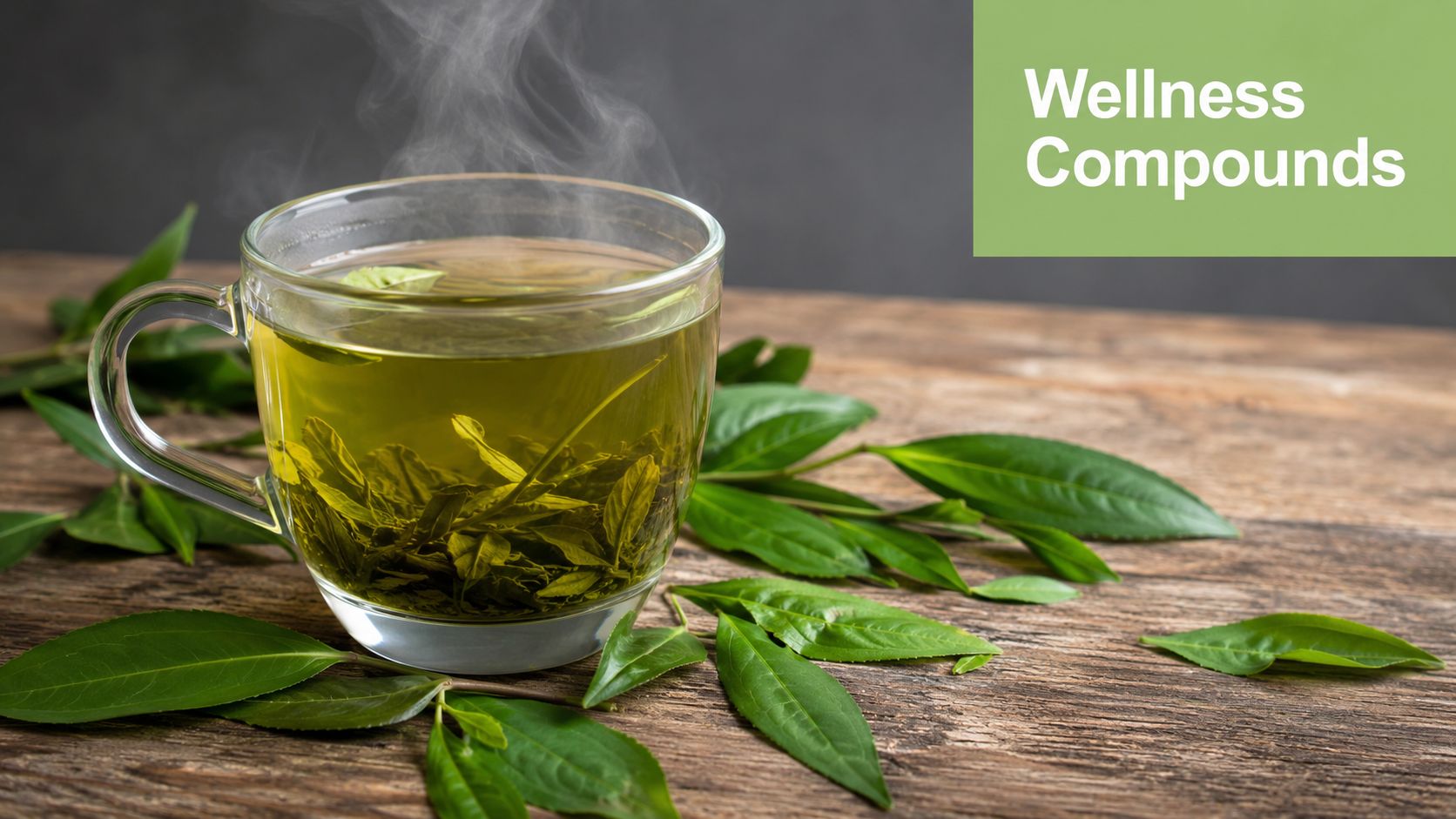
Polyphenols and catechins
Green tea is rich in polyphenols, a broad group of plant compounds linked to its antioxidant profile. A review of green tea bioactives and brewing conditions explains that these compounds make up a large share of the leaf and notes that green tea contains thousands of naturally occurring bioactive substances.
Within that group, catechins are the stars. EGCG gets the most attention because it is one of the best-studied catechins in green tea. If the tea leaf were a small orchestra, catechins would be the instruments you hear most clearly in the final performance. They shape much of what people mean when they talk about green tea as a wellness drink.
That does not mean every cup feels the same. Leaf quality, freshness, and preparation all affect what reaches your mug.
L-theanine and calm alertness
Green tea also contains L-theanine, an amino acid that helps explain why tea feels different from coffee for many drinkers. The combination of L-theanine and caffeine often creates a gentler sense of alertness, more like a steady tide than a sudden wave.
This is one reason green tea fits so well into everyday routines. A morning cup can help you settle into work. An afternoon brew can feel refreshing without the sharp edge some people notice from stronger caffeinated drinks.
Organic farming does not create L-theanine or catechins. The plant does that naturally. In practical terms, organic certification in Australia gives you a checked and documented production system, which can make it easier to choose tea with the level of traceability and ingredient confidence many wellness-focused drinkers want.
Brewing changes what you get from the cup
Brewing is where leaf chemistry becomes a real-life experience. Water that is too hot can push green tea toward bitterness, while a gentler temperature usually gives you a smoother cup with better balance. As noted earlier in that same preparation review, moderate brewing temperatures and a short steep help extract beneficial compounds without making the tea harsh.
A simple way to picture it is cooking vegetables. Too little heat and you do not get the best texture or flavour. Too much heat and the result turns dull or unpleasant. Green tea works in a similar way.
If you want to put that into practice, starting with a quality loose-leaf option makes a noticeable difference. PepTea's guide to the best organic green tea loose leaf is a useful place to compare styles that suit everyday brewing.
Here's a short visual explainer if you want to see green tea compounds discussed in a more accessible format.
Green tea works best as a daily ritual, not as a miracle product. Its value comes from consistent enjoyment, good brewing, and leaves from a source you trust.
Your Guide to Popular Organic Green Teas
Walk into a good tea shop and you'll quickly learn that green tea isn't one thing. It's a family of styles. Two of the most useful examples are Sencha and Matcha. They show how processing changes not just flavour, but the whole drinking experience.
Sencha for a fresh everyday cup
Sencha is the classic daily green tea for many drinkers. You brew the leaves in water, let them steep, and then remove them. The result is usually light to medium-bodied, grassy, fresh, and gently savoury.
It suits the kind of moment where you want a clean, uncomplicated cup. Mid-morning at your desk. A quiet reset after lunch. A teapot shared with someone who's curious about green tea but not ready for anything too intense.
Matcha for the whole-leaf experience
Matcha is different from almost every other tea because you don't steep and strain it. You whisk the powdered tea directly into water, so you consume the whole leaf.
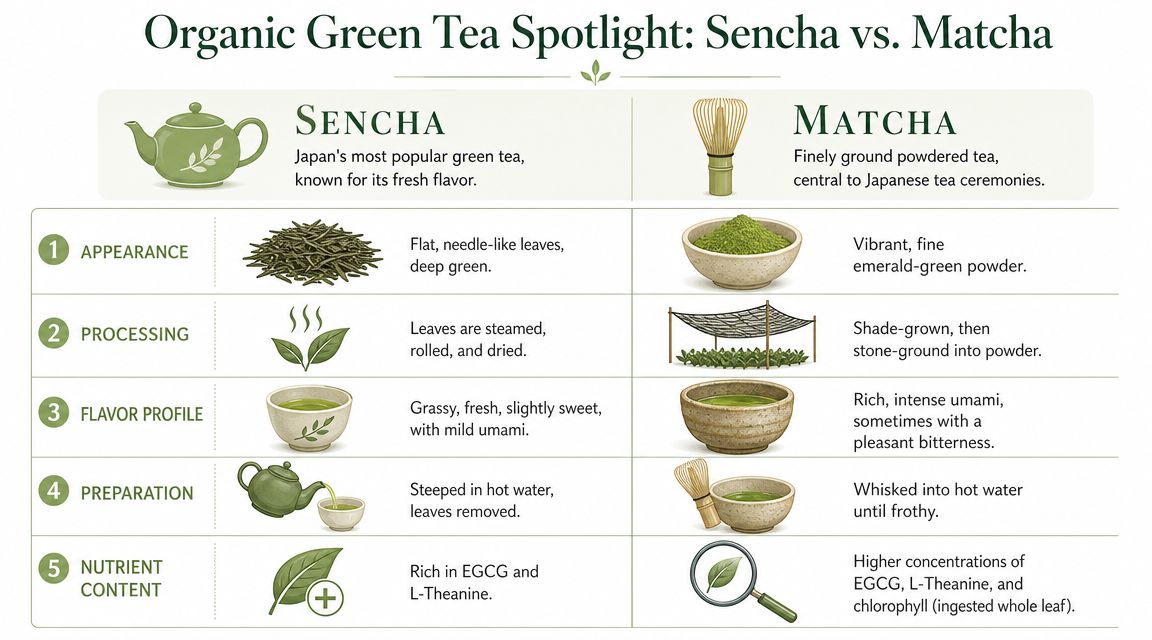
That changes texture, flavour, and intensity. Matcha tends to feel richer, creamier, and more concentrated than a standard leaf brew. The source used in this article notes that a standard cup of brewed green tea can provide 178 to 823 mg of catechins, while products like Matcha that use the entire leaf offer a more concentrated source of those compounds in this green tea overview.
If Sencha feels like a clear, bright conversation, Matcha feels like the full orchestra.
Choosing by mood and use
A simple way to choose:
- Pick Sencha when you want a classic steeped tea with lift and freshness.
- Choose Matcha when you want a fuller texture, a more immersive tea ritual, or a tea that works beautifully in lattes and recipes.
- Use high-quality green tea in other formats if you enjoy wellness drinks beyond the teacup. Green tea is also the traditional base for kombucha, which is one reason it appears so often in functional beverage spaces.
If you want to keep exploring styles beyond these two, this guide to the best organic green tea loose leaf is a useful next read.
Bringing Green Tea Into Your Daily Routine
Knowing what organic green tea is helps. Knowing how to buy, brew, and store it makes the difference between a tea you admire on the shelf and one you enjoy every day.
How to buy with confidence
Look for three things first:
- Certification you can identify. Don't rely on soft words like pure or natural.
- Clear origin details. Tea that tells you where it comes from usually gives you more confidence than tea with a vague back label.
- Fresh-looking leaf or powder. Matcha should look vividly green rather than dull or khaki. Loose green tea should look lively, not tired and dusty.
The one golden brewing rule
Don't pour boiling water straight onto green tea.
Green tea is delicate. If the water is too hot, bitterness can jump forward and flatten the sweeter, softer notes in the cup. Use water that's hot but not aggressively boiling, and give the tea enough time to open without overdoing it.
A simple routine works well:
- Heat your water.
- Let it cool slightly if it has just boiled.
- Brew gently rather than aggressively.
- Taste and adjust next time.
How to store it so it stays good
Tea hates three things: air, heat, and light.
Store green tea in an airtight, opaque container somewhere cool and dry. Keep it away from the stove, sunny windows, and constantly opened pantry spots. Matcha is especially sensitive, so freshness matters even more.
Buy the best tea you can, then protect it properly. Poor storage can undo the care taken in growing and processing it.
Your Organic Green Tea Questions Answered
Can I drink organic green tea every day
For many people, yes. Organic green tea can sit comfortably in a daily routine, much like a regular walk or a bowl of oats. The practical question is not only whether it is organic, but whether the tea suits your body, your caffeine tolerance, and the way you drink it.
With green tea, the key is paying attention to how your body responds. A lighter sencha in the morning may feel very different from a strong matcha in the afternoon. If you are pregnant, managing a health condition, or taking medication, check with a qualified health professional before making it an everyday habit.
Does organic green tea have less caffeine than coffee
Usually, green tea contains less caffeine per cup than coffee, but the experience is often different for another reason too. Green tea also contains L-theanine, an amino acid that can soften the sharper edge people sometimes feel from coffee.
That is why one cup of green tea may feel steadier, while coffee can feel more abrupt. Brewing style matters here. A longer steep, more leaf, or a bowl of matcha can all change the caffeine level in your cup.
Is organic green tea better for the environment
In Australia, organic means more than a nice label on the front of the pack. It points to a certified farming system with rules around synthetic chemicals, soil care, and production methods. For a tea drinker, that matters because the standard connects what happens on the farm to what ends up in your cup.
A healthier farming system can support better soil structure, more balanced growing conditions, and cleaner handling practices. Organic certification does not guarantee that every tea will taste the same or that every farm operates identically. It does give you clearer proof that the grower has met a recognised standard rather than relying on vague claims like natural or clean.
That clarity is a big part of quality.
Organic green tea is best understood through four parts: plant, place, processing, and certification. The leaf is still green tea, but the organic standard asks more of the producer and gives the buyer more confidence in return.
If you're ready to turn that knowledge into a daily ritual, explore Pep Tea for premium organic Matcha and Australian-brewed organic kombucha made for clean flavour, steady energy, and everyday wellness.
Best Organic Green Tea Loose Leaf: An Australian Guide

You're probably here because you've stood in front of a shelf, or scrolled through page after page online, and seen every tea described as premium, pure, clean, ceremonial, artisan, or wellness-focused. It sounds impressive until you realise none of those words tells you whether the tea will taste good, brew well, or feel worth the money.
That's where the search for the best organic green tea loose leaf often gets stuck. The assumption is that the answer is a single brand name. In practice, the better answer is a skill set. Once you know what to look for, you stop buying on buzzwords and start buying with confidence.
In Australia, that matters even more because tea buyers are seeing more specialty options, more imported styles, and more health-led marketing than ever before. The good news is that quality leaves clues. You can spot them in the leaf itself, in the label, in the way the tea is stored, and in how it behaves in the cup.
Your Guide to Choosing Quality Green Tea
A friend once asked me why one loose-leaf green tea felt refined and smooth, while another tasted flat and sharp even though both were sold as organic. The answer had nothing to do with flashy packaging. It came down to what was inside the pouch, and whether the seller gave enough real information to support the claims.
Australian tea buying has moved well beyond basic supermarket tea bags. In Your Guide to Choosing Quality Green Tea, the key shift is understanding that loose-leaf sits in a more specialist part of the market, where buyers are encouraged to look for whole leaves, freshness, and less processing rather than treating tea like a generic pantry item. That pattern is reflected in guidance around premium and specialty tea, which treats loose-leaf green tea as a craft beverage rather than a commodity, with whole leaves valued because they preserve more aroma and are generally less processed (retailer guidance on organic loose-leaf green tea).
Stop chasing the word best
The word best causes most of the confusion.
For one person, the best organic green tea loose leaf is a soft, sweet Japanese-style green for a quiet morning cup. For another, it's a sturdier tea that can hold up in an iced drink or a café batch brew. If you don't separate quality from personal preference, every purchase feels like guesswork.
What to focus on first
Start with three practical questions:
- Is it verifiable? Organic claims should be supported by proper certification, not just earthy packaging.
- Can you assess the leaf? Whole, intact leaves usually tell you more than the marketing on the front.
- Does it suit your use? A tea for slow sipping is not always the same tea you'd use for a chilled wellness drink.
The smartest tea buyers don't memorise brand rankings. They learn to read the leaf, the label, and the brewing behaviour.
That's the ultimate goal. Not to copy someone else's favourites, but to become the person who can tell quality for yourself.
What Really Defines Quality in Organic Green Tea
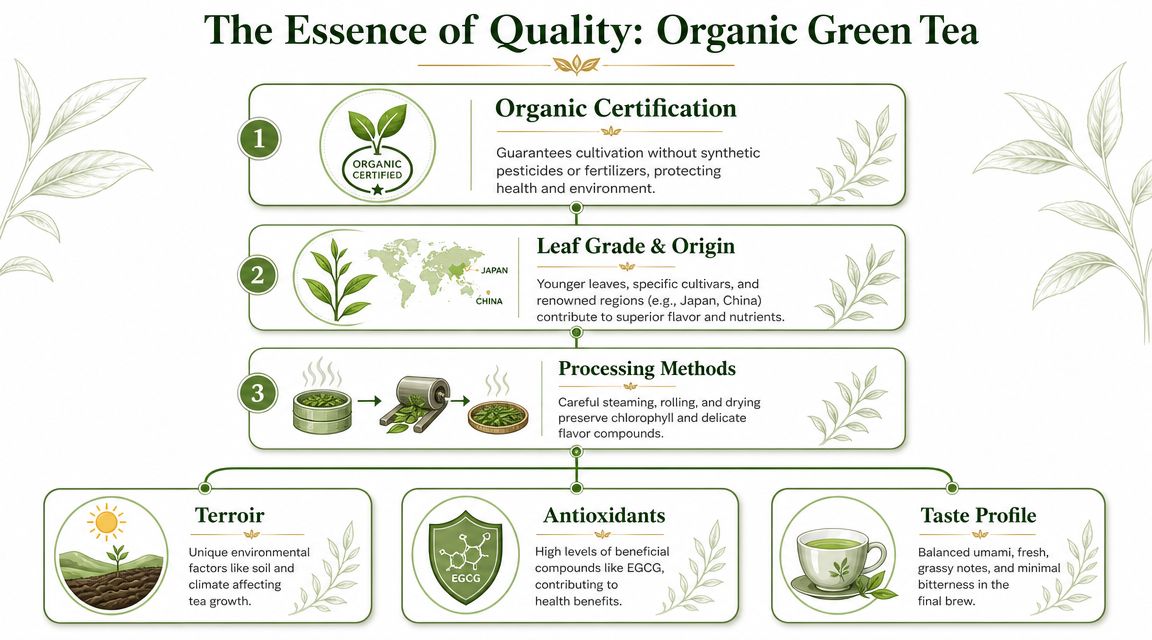
When people talk about quality in green tea, they often jump straight to flavour. Flavour matters, of course, but it's only the final result. The deeper story starts with the leaf itself, how intact it is, how it was processed, and whether it matches the way you plan to use it.
Why whole leaves matter
Green tea isn't just dried plant material. Its quality is tied to delicate compounds that can be lost or damaged when the leaf is heavily broken, handled roughly, or poorly stored.
A strong technical benchmark comes from research showing that green tea leaves contain polyphenols at about 25 to 35% of dry weight, with catechins making up roughly 70% of total polyphenols, and EGCG standing out as the most prominent catechin behind many of green tea's antioxidant effects. The same research also notes that loose-leaf tea with larger, intact leaves generally preserves more of these compounds than more heavily broken material (green tea polyphenol and catechin data).
That sounds scientific, but the buying takeaway is simple. If the leaf has been reduced to tiny fragments, you're often looking at a tea that has lost some of the elegance people expect from a good green tea.
Quality is not one thing
A lot of buyers assume quality can be ranked on a single ladder. It can't. Good green tea is really a combination of factors working together.
Here's a simple way to look at it:
| Quality signal | What it tells you | Why it matters |
|---|---|---|
| Leaf integrity | Whether the leaves are whole or broken | Whole leaves usually brew with more nuance |
| Processing care | How gently the tea was handled after harvest | Better handling protects flavour and freshness |
| Intended use | Whether the tea suits your drinking style | A tea can be high quality and still wrong for your purpose |
Many guides often fall short. They tell you what's expensive, but not what's suitable.
The best tea depends on the job
A lighter, sweeter green tea often suits a calm-focus cup, especially when you want softness and delicacy. A more full-bodied loose-leaf style can make more sense for iced tea, blending, or higher-volume brewing where you need the flavour to hold its shape.
That difference becomes much clearer when you compare classic loose-leaf green tea to powdered tea styles. If you want a clean explanation of how leaf tea and matcha behave differently, Pep Tea's guide on the difference between matcha, green tea and green tea forms is a useful reference.
Practical rule: Don't ask only “Is this a good tea?” Ask “Is this a good tea for the way I drink tea?”
That small shift saves people from buying lovely leaves for the wrong purpose, then blaming the tea when the result disappoints.
Decoding Labels and Certifications in Australia
Marketing myths need a firm reality check. Plenty of tea packs use natural-looking colours, minimalist design, and words like clean or pure. None of that proves the tea is organically certified, traceable, or handled with proper food-safety discipline.
What organic should mean in Australia
In the Australian market, the strongest starting point for organic credibility is the Australian Organic Standard (AS 6000:2015). It functions as the main benchmark for products sold as organic, and equivalency arrangements with markets such as Japan and the EU make it a useful proxy for traceability and clean-label assurance for both consumers and cafés.
If you're buying the best organic green tea loose leaf, this matters because certification gives you something firmer than brand storytelling. It tells you the product is being assessed against a recognised organic standard, not just wrapped in wellness language.
What the label does not tell you
This is the part many shoppers miss. Organic is not the same as fully explained food safety.
A tea can be organic and still leave important buyer questions unanswered if the brand says nothing about testing, sourcing transparency, or packaging protection. That's why careful shoppers increasingly ask for more than a certification badge.
Look for signs that a brand can clearly explain:
- Origin traceability such as where the tea was grown and packed
- Batch testing transparency around residues or contaminants
- Protective packaging that helps reduce exposure to moisture, odours, and handling issues
- Storage guidance so the tea stays stable after purchase
How origin shapes flavour
Origin doesn't just sound romantic. It helps you predict taste.
Japanese green teas are often associated with fresh, grassy, marine, or umami-leaning notes. Many Chinese green teas can lean nuttier, toastier, or earthier depending on style and processing. Neither is automatically better. They serve different palates.
If you know you dislike sharp grassy notes, buying blindly from a style known for that profile won't make much sense. If you love a clean savoury finish, that same profile might be exactly what you want.
A better label-reading checklist
When you pick up a tea, run through this short filter:
Check the organic claim
Look for actual certification language, not just nature-inspired branding.Check the origin detail
Country of origin should be clear enough to help you understand likely flavour.Check whether the brand explains quality control
If testing and traceability are never mentioned, ask.Check the packaging format
Good tea deserves packaging that protects it from light, air, and contamination.
Organic status is a strong foundation. It isn't the whole story.
That's the myth worth dropping. The best tea brands don't ask you to trust the label alone. They give you enough information to judge the tea properly.
A Sensory Guide to Judging Loose Leaf Tea
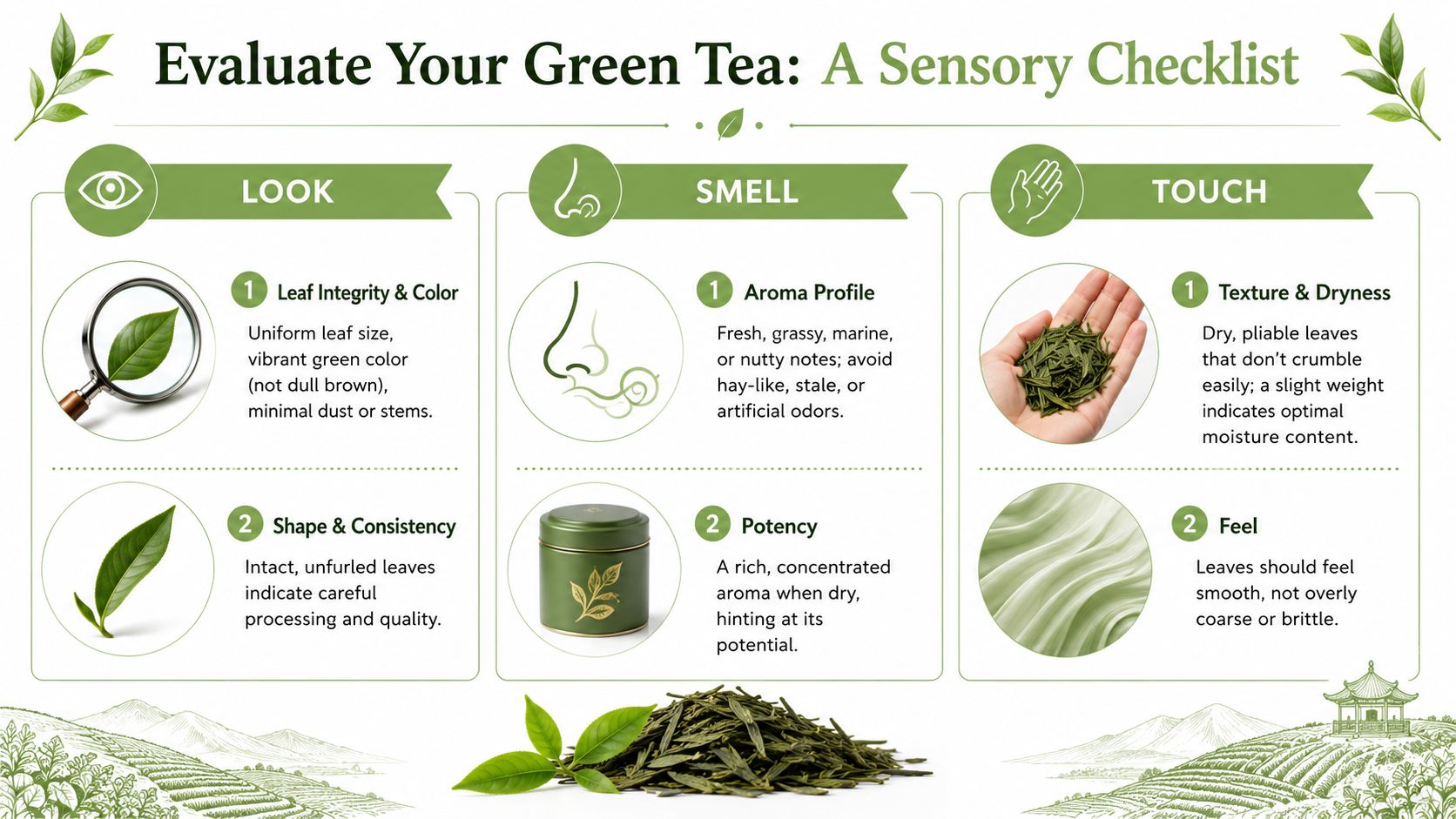
The fastest way to get better at buying tea is to use your senses before you ever boil water. A good dry-leaf check can save you from dull, stale, or badly handled tea, even when the front label looks convincing.
Look first
Dry leaf appearance tells you a lot.
A quality loose-leaf green tea usually looks intentional. The leaves should have a reasonably consistent size and shape for the style. You don't want a bag full of dust, excessive stem, or random crushed fragments unless the style itself naturally runs smaller.
Pay attention to colour too. Green tea should look alive, not tired. Dull brownish tones can point to age, poor storage, or rough handling.
Smell second
Open the pouch or tin and breathe in gently. You're looking for a fresh aroma that fits the style.
That might mean grassy, sweet, marine, nutty, or softly vegetal. What you don't want is a stale hay-like smell, no aroma at all, or anything that feels artificially perfumed.
Aroma isn't just a luxury detail. It often tells you whether the tea still has its freshness.
Touch third
If you can handle the leaf, touch helps confirm what your eyes already suspected.
The leaves should feel dry but not frail. You don't want them disintegrating the second you rub them between your fingers. Well-kept tea feels light and structured, not damp, limp, or oddly brittle from mishandling.
Match the tea to the moment
Many buying guides act as if one green tea can do every job. That's rarely true. The more useful approach is to choose by use case.
Guidance around green tea styles suggests a better match-up: lighter, sweeter shaded leaves suit calm-focus drinks, while more full-bodied loose-leaf styles suit batch brewing, café service, or iced tea preparation (practical style matching for green tea use cases).
That means your sensory check should include a practical question. Does this leaf look delicate and refined, or sturdy and adaptable?
A simple shop test
Use this mini checklist:
- Leaf looks clean with minimal dust and obvious breakage
- Aroma smells fresh and style-appropriate
- Colour looks lively rather than faded
- Texture feels intact not crumbly
- Leaf style matches use such as hot sipping, iced tea, or café brewing
If the dry leaf already looks tired, the brewed cup usually won't rescue it.
That one rule will stop a surprising number of disappointing purchases.
Brewing for Flavour Not Bitterness
A lot of people think they dislike green tea when they've really just been brewing it too hot and too long. Good leaves can turn harsh very quickly if you treat them like black tea.
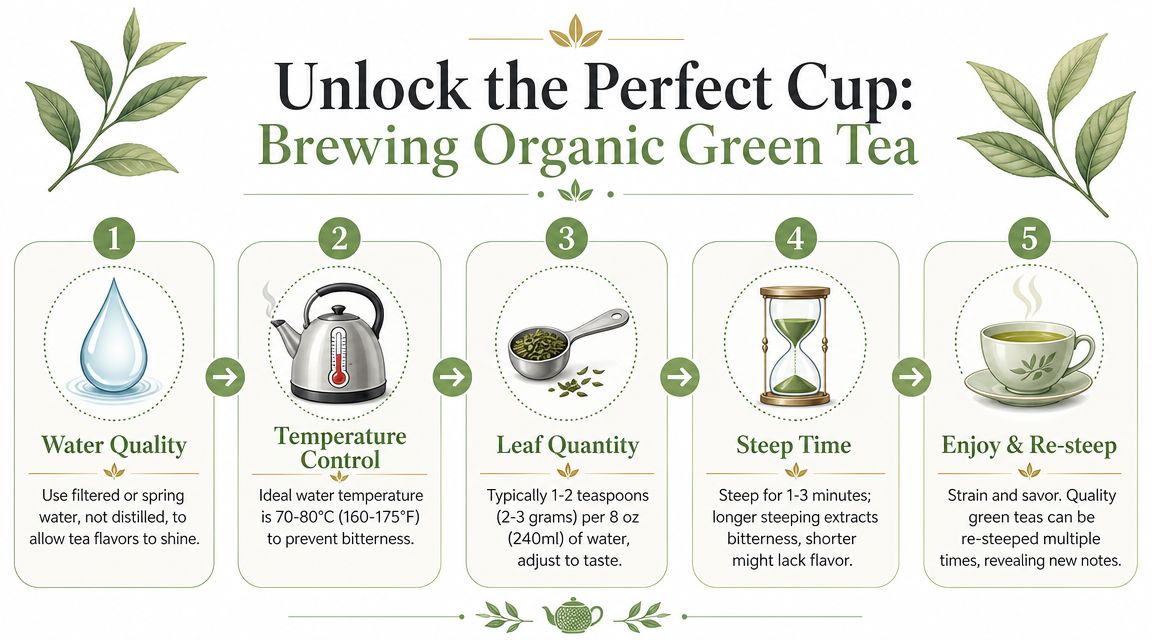
Green tea needs a gentler hand, much like cooking something delicate. You wouldn't blast a fine piece of fish the way you'd boil potatoes. Tea works the same way. Too much heat pulls out bitterness before the pleasant flavours have room to shine.
Start cooler and shorter
Premium brewing guidance in Australia commonly points to cooler water and short steeps of 1 to 2 minutes for delicate green teas, specifically to avoid bitterness and bring out better flavour (Australian brewing guidance for loose-leaf green tea).
That's the easiest habit shift to make if your cups keep turning astringent.
If you want more control over that process, a kettle with adjustable settings helps a lot. Something like an electric tea kettle with temperature control makes it easier to repeat the same result instead of guessing every time.
A practical brewing method
Try this simple starting routine:
Warm your teapot or cup first
A quick rinse with warm water helps stabilise the brew.Use cooler water
Boiling water is usually too aggressive for delicate green tea.Keep the first steep short
Start around the lower end and adjust from there.Taste and refine
If the cup seems thin, add a little time next round. If it bites, reduce heat or steeping time.
Here's a visual guide you can use as a quick refresher while brewing:
Common mistakes that ruin good tea
| Mistake | What happens |
|---|---|
| Water too hot | The cup turns bitter and rough |
| Steeping too long | The finish gets astringent |
| Too much leaf without adjustment | The tea can feel heavy or sharp |
| Ignoring the tea style | Delicate teas get overpowered |
Green tea usually needs restraint, not force.
Once you get that, the whole category changes. Suddenly the sweetness, softness, and layered aroma that people talk about emerge in your cup.
Storing and Using Your Tea Beyond the Cup
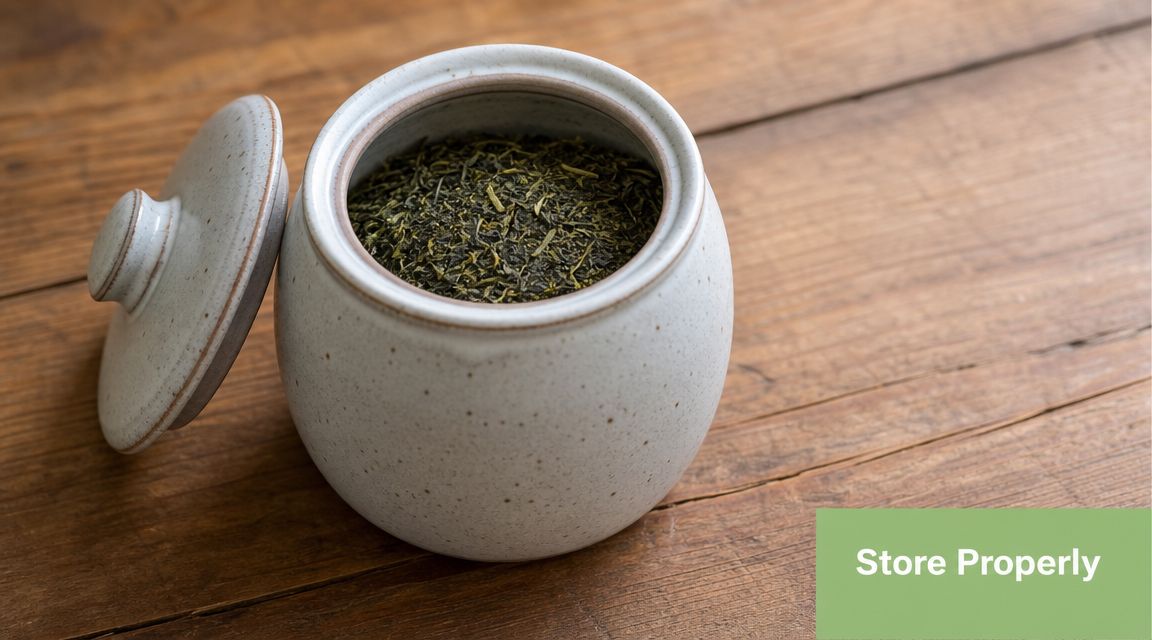
You can buy beautiful tea and still ruin it at home with poor storage. Green tea is especially sensitive to light, air, moisture, heat, and strong smells from nearby foods.
How to store it properly
Keep your tea in an airtight, opaque container and place it somewhere cool, dry, and away from direct sun. Don't store it beside spices, coffee, or anything strongly aromatic. Tea absorbs odours more easily than many people realise.
A simple metal tin or well-sealed pouch stored in a cupboard usually does the job well. The goal is to protect the leaf from the things that flatten its aroma and make the cup taste dull before its time.
Ways to use it outside a teapot
Loose-leaf green tea is more versatile than people think. Once you know how it tastes on its own, you can start using it in simple food and drink ideas.
Here are a few easy options:
- Cold infusions for a gentler iced tea with less harshness
- Tea syrups for desserts or alcohol-free café drinks
- Smoothie additions where brewed tea replaces part of the liquid
- Citrus pairings for a brighter, fresher profile
If you like that citrus direction, an option such as organic green tea with lemon shows how green tea can move from a straight brew into a more everyday wellness drink style.
Think of tea as an ingredient
Many home drinkers level up when they stop treating tea as a single-use beverage and start treating it as a pantry ingredient.
Brewed green tea can work in iced drinks, light jellies, poached fruit liquids, and simple mocktail bases. Delicate teas shine in cleaner recipes. More full-bodied loose-leaf styles tend to cope better with sweeteners, citrus, and chilled serving.
Your Journey to the Perfect Cup
Finding the best organic green tea loose leaf isn't about memorising a top-ten list. It's about knowing how to read quality with your own eyes, nose, hands, and palate.
The strongest buyers look for real organic credibility, clear traceability, and leaves that show care before they ever hit the cup. They don't confuse fancy wording with proof. They don't assume expensive means suitable. And they know that brewing can either reveal quality or bury it.
That's good news, because it means you don't need to be a tea snob to buy well. You just need a few reliable habits. Check the certification. Look at the leaf. Trust your senses. Brew gently. Store it properly. Match the style to the way you drink tea.
Once you start doing that, tea shopping gets much less confusing and much more enjoyable. You stop hoping for a good cup and start creating one on purpose.
If you'd like a practical place to continue, Pep Tea offers an Australian starting point for people who care about organic tea, clean flavour, and straightforward education around matcha, green tea, and functional drinks.
Best Decaf Green Tea for Weight Loss: A 2026 AU Guide
Most advice on the best decaf green tea for weight loss starts in the wrong place. It treats caffeine as the star, then assumes decaf must be a watered-down compromise.
That misses the actual story.
Green tea's weight management potential isn't only about stimulation. The bigger players are catechins, especially EGCG, which are natural plant compounds found in the leaf itself. If those compounds are preserved during decaffeination, decaf green tea can still be a useful part of a sensible routine built around eating well, moving regularly, and sleeping properly.
That matters for a lot of Australians. Some people want a warm evening drink without the buzz. Others love green tea but don't love feeling wired. And many are looking for something more realistic than another “fat-burning” product with flashy promises.
A better approach is to treat decaf green tea as a supportive tool, not a miracle. It can fit neatly alongside a solid eating pattern, daily activity, and smarter habits like replacing sugary drinks. If you're building those foundations, practical resources such as Zing Coach's nutrition advice can help you think beyond single ingredients and focus on the bigger picture. If you'd like a broader look at tea options, this guide to green tea for weight loss is also useful.
Rethinking Decaf Green Tea for Your Wellness Goals
If you've ever thought, “Surely decaf green tea can't do much,” you're not alone. People often connect green tea with energy, and energy with caffeine. So once the caffeine goes, they assume the useful part has gone too.
That's where a lot of confusion starts.
Why decaf isn't automatically “less useful”
A high-quality decaf green tea still contains catechins, the antioxidant compounds that researchers keep studying in relation to metabolism and fat use during activity. In plain English, that means decaf may still help your body use fuel well, especially when your routine already includes exercise.
The key phrase is high-quality. Not every decaf green tea is processed the same way, and not every product keeps the same amount of those beneficial compounds.
Decaf works best when you stop asking, “Is it as strong as coffee?” and start asking, “Does it still keep the useful tea compounds?”
Who often benefits most from decaf
Decaf green tea makes particular sense for people who:
- Feel shaky with caffeine: Some people tolerate coffee poorly but still enjoy the ritual of tea.
- Want an evening option: A calming cup after dinner is easier to stick with than a drink that disrupts sleep.
- Prefer steady habits over extremes: Weight management usually responds better to routines than to all-or-nothing products.
This is why the best decaf green tea for weight loss isn't the strongest-tasting tea or the one with the flashiest packaging. It's the one that keeps the leaf's useful compounds intact and fits your life well enough that you'll drink it consistently.
How Catechins in Decaf Green Tea Aid Weight Management
The simplest way to understand green tea is this. Caffeine can contribute, but catechins do a lot of the heavy lifting. That's especially important when we're talking about decaf.
Catechins are natural polyphenols in green tea. EGCG is the one people talk about most because it's closely tied to green tea's metabolic effects. When people say green tea may support weight management, this is usually the part they mean.
What the research actually suggests
One of the clearest findings comes from a Penn State research summary. In a 16-week study, mice on a high-fat diet that consumed decaffeinated green tea extract combined with regular exercise had an average body mass reduction of 27.1 percent and an average abdominal fat mass reduction of 36.6 percent. The same report notes a 17 percent reduction in fasting blood glucose and a 65 percent decrease in plasma insulin levels.
That doesn't mean a cup of decaf green tea will create the same result in humans. It does mean the idea that decaf is “inactive” doesn't hold up well. In that study, decaffeinated green tea extract looked particularly effective when paired with exercise.
That pairing matters more than is generally understood.
What “fat oxidation” means in normal language
You'll sometimes see researchers talk about substrate utilisation or fat oxidation. Those phrases sound technical, but the idea is straightforward. Your body can draw energy from different sources. During activity, green tea catechins may help shift some of that energy use more towards fat.
Let's frame it this way:
- At rest and in movement, your body chooses fuel
- Training influences that choice
- Catechins may support a more efficient fuel mix during exercise
That's why decaf green tea isn't best viewed as a stand-alone slimming drink. It's better understood as a beverage that may support the work you're already doing.
Practical rule: If your routine includes walking, gym sessions, cycling, or strength training, decaf green tea makes more sense than if you expect it to do the whole job alone.
Why this matters in real life
For a health-conscious Australian trying to lose weight without overloading on stimulants, this is good news. You don't need to choose between “useful” and “decaf”. You need to choose a decaf green tea that still contains the compounds you want.
A lot of readers also care about the broader wellness picture, especially in life stages where hormones, stress, sleep, and appetite all interact. If that's relevant to you, this article on best probiotic for menopause weight loss offers another angle on supportive habits beyond caffeine-heavy products. Some people also compare brewed tea with concentrated formats, and this overview of green tea capsules for weight loss can help clarify the difference.
The takeaway from the science
Here's the useful interpretation, without hype:
| What people assume | What the evidence suggests |
|---|---|
| Decaf means no metabolic value | Decaf can still retain meaningful catechins |
| Caffeine is the whole reason green tea helps | Catechins remain central, especially with activity |
| Tea alone should drive visible weight loss | Results are more plausible when tea supports exercise and diet |
If you remember one thing, make it this. The best decaf green tea for weight loss is the one that preserves catechins and fits into an active lifestyle.
A Buyer's Guide to High-Quality Decaf Green Tea
Walking into a supermarket or browsing online can make decaf green tea look simple. It isn't. Two products can both say “decaf green tea” and still be very different in quality.
The biggest difference often sits behind the label. It's the decaffeination method.
Why the decaffeination method matters
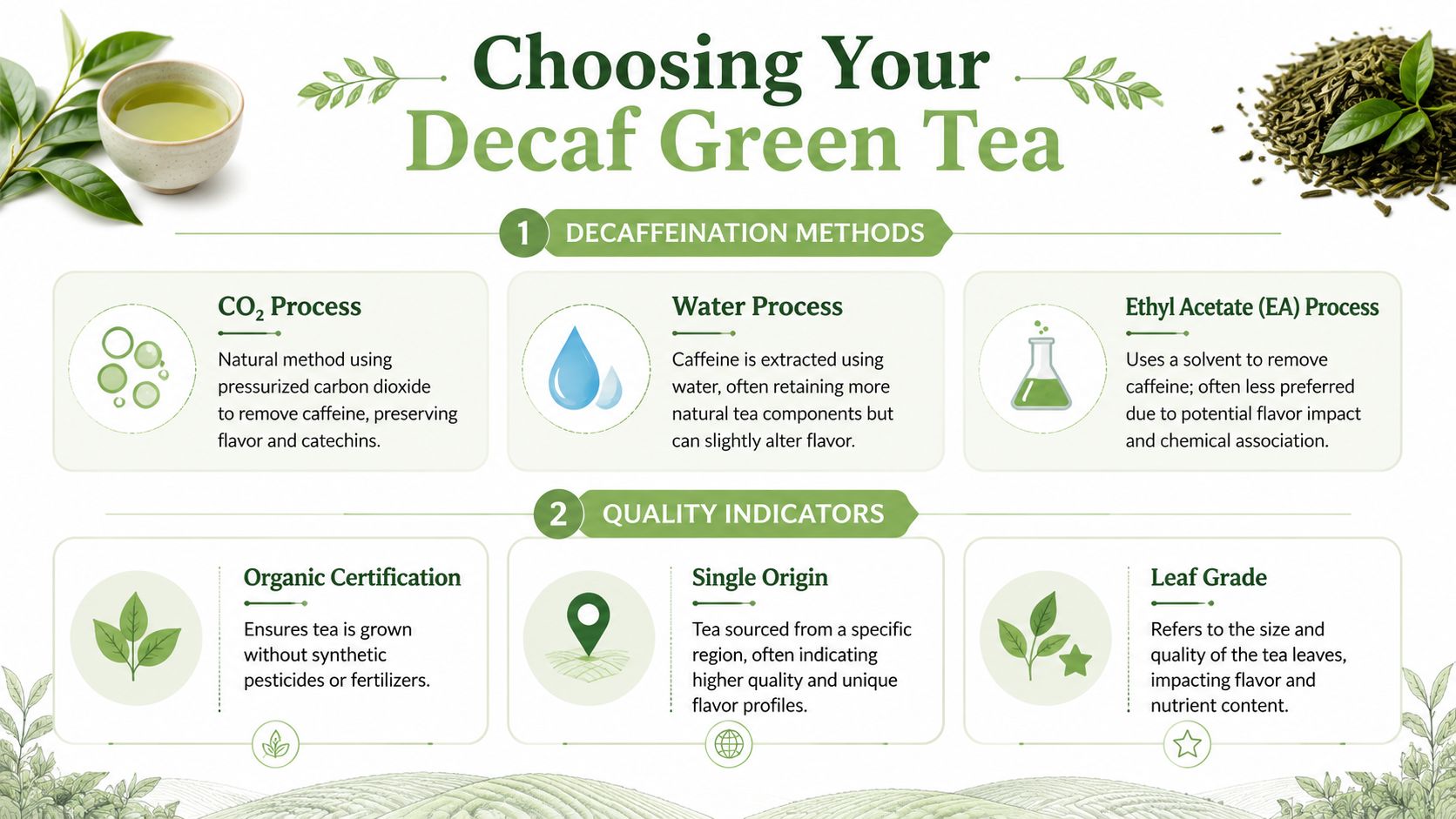
A decaf tea can only support your goals if the useful compounds survive processing. According to this decaf green tea analysis, the CO2 decaffeination process preserves 30 to 50 mg of EGCG per serving, while alternative methods have significantly lower retention. The same source notes that daily consumption of tea with high catechin levels, at around 690 mg, can measurably reduce body fat within 12 weeks, and that supplementation with 400 mg of EGCG from decaf extract significantly improves fat oxidation during exercise.
You don't need to become a lab technician to use that information well. You just need to know what to look for.
A simple comparison when you shop
| Method | What to know | Why it matters |
|---|---|---|
| CO2 decaffeination | Often preferred for preserving catechins | Better fit if you care about EGCG retention |
| Water process | Can be gentler than some alternatives | May still be a reasonable option, depending on the tea |
| Ethyl acetate process | Often less appealing to careful shoppers | People may avoid it because of flavour changes and processing concerns |
What to check on the label
Some brands tell you a lot. Others tell you almost nothing. If a product is vague about everything, be cautious.
Look for these quality signals:
- Decaffeination method listed: If the brand proudly says CO2 decaf, that's a good sign.
- Organic certification: This helps if you want a cleaner product and a more transparent supply chain.
- Leaf quality: Whole leaf or better leaf grade usually signals more care than dusty, flat-tasting tea bags.
- Origin information: Single-origin or clearly named growing region can indicate stronger quality control.
- Catechin or EGCG details: Not every label provides this, but if it does, that transparency is useful.
Cheap decaf green tea often tastes flat for a reason. It may have lost much of what made the original leaf special.
What “best” really means
The best decaf green tea for weight loss usually isn't the most aggressively marketed product. It's the one that gets four basics right:
- Preserves catechins well
- Tastes pleasant enough to drink regularly
- Comes from a transparent producer
- Fits the way you live
That last point matters. A beautiful loose-leaf tea isn't “best” if you'll never brew it. A practical tea bag option isn't “worse” if it helps you build a daily habit.
A fast buying checklist
If you want a quick shortcut, use this:
- Choose CO2 decaf when possible
- Pick organic if purity matters to you
- Prefer brands that explain their sourcing
- Don't confuse “decaf” with “benefit-free”
- Avoid products that hide every meaningful detail
Your Daily Ritual for Decaf Green Tea Wellness
A good tea routine should feel easy. If it's fussy, expensive, or hard to repeat, it is often abandoned within a week.
The most effective decaf green tea habit is the one you can keep. For many people, that means one cup earlier in the day and another later on, especially if they want the comfort of tea without a late caffeine hit.
Why timing matters for some Australians
For the 28% of Australians following low-carb diets, zero-calorie decaf green tea can fit neatly into that style of eating, and it's especially useful in the evening because caffeine sensitivity affects up to 35% of the Australian population, according to this overview on decaf green tea and low-carb eating. The same source notes that decaf green tea tends to show minimal results alone, but its catechins work better alongside diet and exercise.
That gives us a helpful framework. Don't treat tea as the plan. Treat it as the drink that supports the plan.
How to brew it so it actually tastes good
A lot of people think they dislike green tea when they've really just had it brewed badly. Water that's too hot can make it bitter and harsh.
Try this instead:
- For loose-leaf decaf green tea: Use hot water, not boiling. Steep until the flavour is fresh and grassy, not overly sharp.
- For tea bags: Give the leaves room if you can. A cramped bag in scalding water often tastes dull.
- For a smoother cup: Let the kettle cool slightly before pouring.
A practical daily rhythm
Different people prefer different timings, but this pattern works well:
| Time | How it can fit |
|---|---|
| Morning | Replace a sugary breakfast drink or pair it with a balanced meal |
| Before activity | Use it as part of your pre-walk or pre-gym ritual |
| Afternoon | Swap it in when you'd usually reach for biscuits and another coffee |
| Evening | Keep the tea ritual without the stimulant effect |
If you're trying to lose weight, consistency beats intensity. A simple cup you enjoy every day is more useful than a “perfect” routine you follow twice.
Two easy ways to use it beyond a plain cup
You don't need to drink decaf green tea the same way every day.
1. Iced citrus decaf green tea
Brew your tea, cool it, pour over ice, and add lemon. Keep it unsweetened if your goal is weight management.
2. Warm decaf matcha-style latte
Whisk decaf green tea powder or a decaf matcha-style option with warm milk or an unsweetened milk alternative. This works well after dinner when you want something comforting.
For a quick brewing visual, this simple walkthrough can help:
Small habits that make tea more useful
The best decaf green tea for weight loss becomes more helpful when it replaces less helpful choices.
Some examples:
- Swap soft drink for tea at lunch: That change can reduce unnecessary sugar in a very practical way.
- Pair tea with movement: A cup before a walk creates a habit loop that's easy to repeat.
- Use tea to close the kitchen at night: Many people snack less once they've made a warm drink and settled in.
None of that is magic. It's habit design. And habit design is often what turns a nice idea into visible progress.
Expanding Your Routine with Matcha and Kombucha
If you enjoy green tea but want more variety, it helps to think in terms of a wellness routine, not a single “weight loss tea”.
Matcha belongs in that conversation because it gives you the whole leaf in powdered form. That matters when you care about the compounds inside the tea rather than just the ritual of sipping it. Research discussed in this paper on decaffeinated green tea extract and exercise metabolism notes that the catechins in green tea work together with L-theanine to support cognitive focus while maintaining metabolic function. The same source describes enhanced fat-burning efficiency over 8 to 12 weeks when combined with fitness routines, without the jitteriness associated with high-caffeine stimulants.
Why matcha feels different
Matcha often feels smoother and more rounded than standard green tea because you're getting a more concentrated tea experience. It also tends to attract people who want focus and ritual in the same cup.
That doesn't mean everyone needs matcha. It does mean matcha can be a smart extension of your tea routine if you want something a bit more substantial than a bagged decaf brew.
Where kombucha fits
Kombucha serves a different role. It's not a substitute for decaf green tea, and it's best not to force it into the same box. Instead, kombucha can complement a tea-based routine as a refreshing, lower-sugar functional drink that many people enjoy as an alternative to soft drink or alcohol.
If you're curious about that side of the wellness picture, this guide to kombucha benefits is a helpful place to start.
A thoughtful routine can include more than one drink. Tea may support your active lifestyle, while kombucha can help make healthier drink choices easier to stick with.
A sensible way to combine them
A simple pattern could look like this:
- Morning or early day: Matcha when you want a richer tea ritual
- Afternoon or evening: Decaf green tea when you want calm and consistency
- Social or meal moments: Kombucha as a flavourful alternative to sugary drinks
That kind of setup feels balanced. It also keeps you away from the trap of chasing one product to solve everything.
Your Questions Answered and Path Forward
A few practical questions come up again and again.
Is it better before or after exercise
Before often makes more sense if tea helps cue your workout or walk. The bigger idea is consistency. If drinking it after exercise helps you stick to the habit, that's still useful.
Do tea bags work as well as loose leaf
They can, but quality varies a lot. A good tea bag is more practical than loose leaf you never use. If the brand shares details about sourcing and decaffeination, that's a better sign than packaging alone.
Can I drink it at night
For many people, yes. That's one of decaf's biggest advantages. If you're sensitive to caffeine, decaf green tea can let you keep the ritual without the wired feeling that spoils sleep.
Should I build my whole weight loss plan around tea
No. Tea is supportive, not central. Your eating pattern, activity, recovery, and sleep still do the main work. If you want help organising meals around those basics, a tool like AI Meal Planner can be useful for turning good intentions into something more structured.
Here's the honest conclusion. The best decaf green tea for weight loss is high-quality decaf green tea that preserves catechins, tastes good enough to drink regularly, and supports a healthy routine you can maintain. It isn't a shortcut. It is a smart option for people who want green tea's benefits without relying on caffeine.
If you'd like to explore premium organic tea options for your own routine, Pep Tea offers Australian access to high-quality matcha and sugar-free organic kombucha that fit naturally into a thoughtful, everyday wellness lifestyle.
Best Green Tea Capsules for Weight Loss: A 2026 AU Guide
If you're looking at green tea capsules because you want a simple, natural push with weight management, that's a fair question. Many individuals aren't chasing a miracle. They want something practical that fits a busy week, doesn't feel extreme, and won't undo their efforts with food, exercise, and sleep.
Green tea capsules do have a place. Some extracts are concentrated, some are poorly labelled, and some are much better than others. But capsules also raise a bigger question. Is isolating one compound the best long-term strategy, or does a whole-food tea ritual give you broader support that feels easier to stick with?
Searching for a Natural Edge in Weight Wellness
A lot of Australians start in the same place. You're standing in the supplement aisle, or comparing bottles online, and nearly every label seems to promise metabolism support, fat burning, or appetite help. Green tea capsules often sound more trustworthy than louder weight loss products because green tea already has a healthy reputation.
That instinct makes sense. Green tea is familiar, plant-based, and less intimidating than heavily marketed stimulants. But the label can still be confusing. One bottle lists total extract, another lists catechins, another mentions EGCG, and another hides everything inside a “blend”.
Finding a capsule is not the primary challenge. The difficulty lies in determining if the supplement is high-quality, whether it suits your specific needs, and if it supports habits you can realistically maintain.
Good weight wellness usually comes from stacking small decisions that you can repeat, not from finding one heroic product.
That wider view matters. Weight support is rarely just about one supplement. It's usually tied to movement, sleep, meal quality, stress, and consistency. If you want a thoughtful read on improving health span through lifestyle choices, that broader lens is worth your time.
Understanding Green Tea's Link to Weight Management
Green tea gets linked with weight management because it contains catechins, a group of natural plant compounds. The one you'll see most often on labels is EGCG, short for epigallocatechin gallate. If you've ever wondered why some products list EGCG in milligrams instead of just saying “green tea extract”, this is the reason. EGCG is one of the main compounds people are trying to measure.
What EGCG is thought to do
In simple terms, green tea compounds may help your body use energy a bit more efficiently. You'll often hear words like thermogenesis and fat oxidation. They sound technical, but the core idea is straightforward.
- Thermogenesis means your body is producing heat as it uses energy.
- Fat oxidation means your body is using fat as a fuel source.
- Metabolic support means those processes may get a gentle nudge, especially when green tea is paired with healthy habits.
That doesn't turn green tea into a magic pill. It means the compounds may support processes your body already has.
What one clinical trial found
A 2015 randomised controlled trial involving women with central obesity found that a high dose of green tea extract, 856.8 mg EGCG daily, taken for 12 weeks, led to a statistically significant weight loss of 1.1 kg, plus reductions in BMI and waist circumference, with no side effects reported.
That result is useful for two reasons. First, it shows why researchers focus on specific EGCG amounts rather than vague extract claims. Second, it reinforces that the effect is modest, not dramatic. That's exactly how green tea should be viewed. As support, not rescue.
Why labels can be misleading
Two bottles can both say “green tea”, but deliver very different amounts of the compounds people care about. One might contain a concentrated extract. Another might contain a lower-strength powder with a much smaller active dose.
If you want a broader look at how green tea differs from matcha and why that matters nutritionally, this guide on the benefits of matcha green tea is a helpful companion.
Practical rule: If a label doesn't clearly tell you how much EGCG you're getting, it's hard to judge whether the product is likely to be meaningful.
How to Choose the Best Green Tea Capsules in Australia
If you're comparing the best green tea capsules for weight loss, don't start with branding. Start with the label. The most important question is not “How many capsules are in the bottle?” It's “What exactly is in each serve?”
A useful market comparison found that some higher-strength products available in Australia, such as Zenwise, provide 363 mg of EGCG per 725 mg serving, while some other local brands average 240 mg. The key lesson from that comparison is simple. Check the EGCG amount itself, not just the total extract on the front of the bottle, as noted in this Australian-market comparison of green tea extracts.
| Feature | What to Look For | Red Flag |
|---|---|---|
| EGCG content | A clearly stated EGCG amount per serve | Only “green tea extract” listed with no EGCG detail |
| Standardisation | A label that explains the extract is standardised | Vague wording with no active compound breakdown |
| Serving size | A practical daily serve you can understand easily | Tiny print or confusing multi-capsule maths |
| Caffeine | Transparent caffeine information, especially if you're sensitive | No mention of caffeine at all |
| Purity | Clear manufacturing and quality details | Buzzwords without any testing or compliance detail |
| Ingredients | Short, readable ingredient list | “Proprietary blend” or filler-heavy formula |
Read the active ingredient panel first
Many shoppers make the same mistake. They look at the biggest number on the bottle. A capsule can sound impressive because it contains hundreds of milligrams of “extract”, but that doesn't tell you how much EGCG is inside it.
A stronger label usually gives you more than one layer of information:
- Total extract amount
- Catechin or polyphenol detail
- EGCG amount
- Caffeine amount
If those details are missing, you're buying with very little context.
Watch for the wording that hides the truth
“Proprietary blend” is one of the least helpful phrases in the supplement world. It can make a formula sound advanced while telling you almost nothing. If a company won't disclose the key active amount, you can't compare it properly with another product.
Also be careful with labels that lean hard on vague phrases such as natural metabolism support or antioxidant complex but don't explain the actual dose.
Think about your own tolerance
A capsule that looks strong on paper may not suit you if you're sensitive to caffeine or if concentrated extracts tend to upset your stomach. That doesn't mean the product is bad. It means the “best” option is always partly personal.
Some people do fine with capsules taken alongside food. Others notice they feel edgy, nauseous, or too wired. A good product should be transparent enough that you can predict that risk before you buy.
The best label is the one that lets you make an informed decision without guessing.
A quick buyer checklist
Before you buy, ask these questions:
- Does the label state EGCG in milligrams?
- Is the extract standardised, or is it just loosely described?
- Can you see the caffeine content?
- Are the other ingredients minimal and clearly named?
- Does the brand give you confidence about quality and compliance in Australia?
That checklist won't guarantee results, but it will help you avoid weak or opaque products.
A Word of Caution Safety and Side Effects
Green tea is natural. Concentrated green tea extract is still something to treat carefully.
Capsules can be more intense than a normal cup of tea because they deliver a concentrated amount in a small serve. For some people, that's convenient. For others, it's where problems start. The most common issues are fairly predictable: jitteriness, sleep disruption, nausea, or a generally unsettled stomach. If you already react strongly to coffee, pre-workouts, or energy drinks, it makes sense to be cautious here too.
When extra care makes sense
Some readers should slow down and get professional advice before trying any green tea extract capsule.
- If you take regular medication, ask your GP or pharmacist whether a green tea extract could interfere.
- If you have a history of liver concerns, don't assume a herbal product is automatically low risk.
- If you're pregnant, breastfeeding, or highly caffeine sensitive, a capsule may be less suitable than a gentler food-based option.
A safer way to approach extracts
Start with the smallest sensible serve on the label, not the most aggressive routine you can tolerate. Take it with food unless the packaging clearly advises otherwise. Stop if you feel unwell.
If a supplement makes you feel shaky, nauseous, or off, that's useful feedback. You don't need to “push through” because it's marketed as natural.
This is also where whole-food forms of tea often feel easier. A cup or bowl of tea gives you a more gradual experience. The ritual slows you down, and the dose is easier to manage than swallowing a concentrated extract and hoping it suits you.
Beyond the Capsule The Case for Whole-Food Matcha
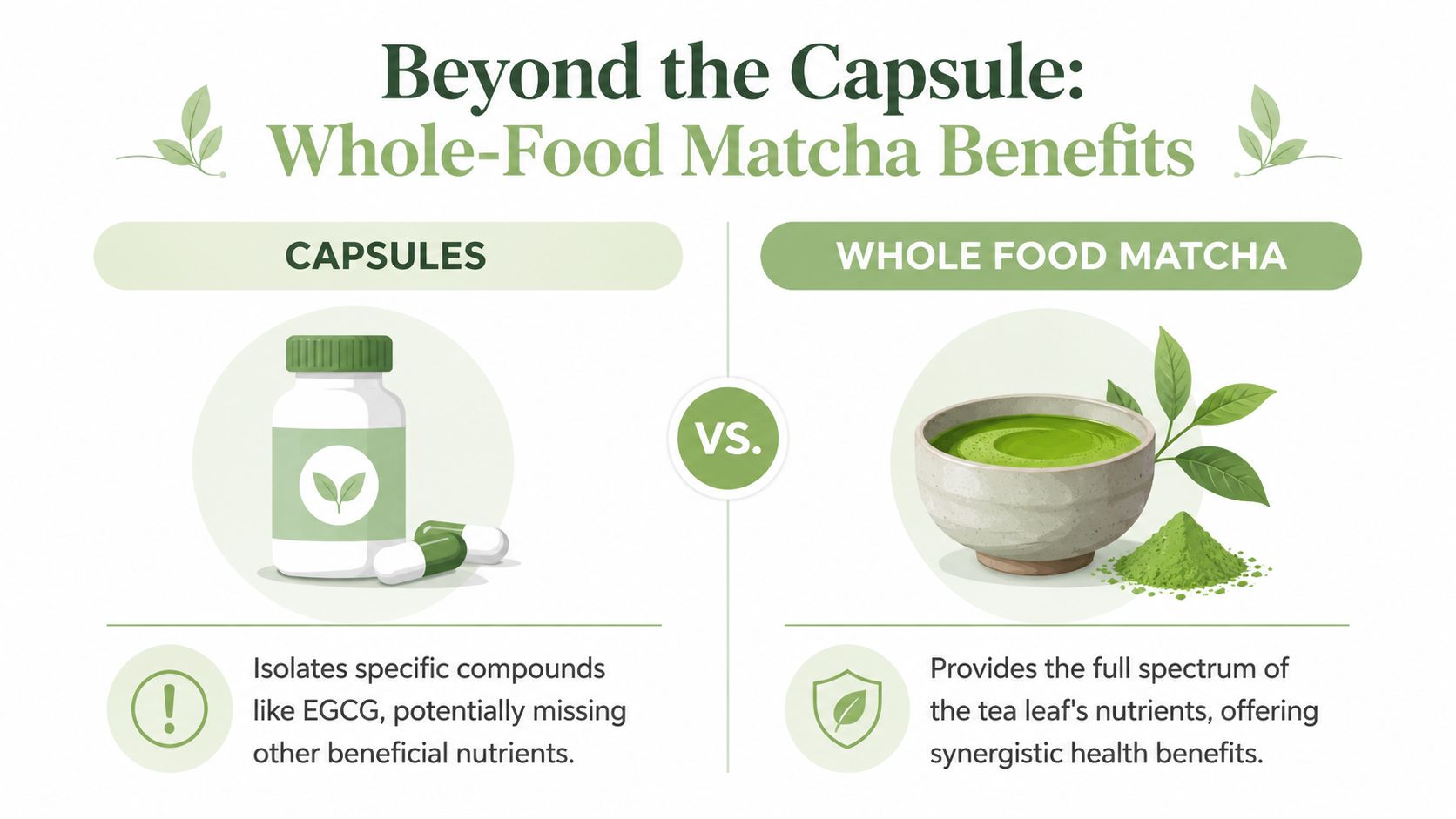
Capsules isolate. Matcha nourishes more broadly.
That's the biggest shift in perspective. A green tea capsule usually focuses attention on one target compound, often EGCG. Matcha is different because it's the whole tea leaf, finely stone-ground into powder. When you drink it, you're consuming the leaf itself rather than an isolated extract.
Why whole-food form matters
A capsule can be useful if your only goal is concentrated intake. But a whole-food approach offers a wider nutritional picture.
With matcha, you're not just chasing EGCG. You're also getting naturally occurring compounds that help shape the overall experience, including L-theanine. That matters because many people want energy support without feeling overstimulated.
Here's the practical difference:
- A capsule is often about dose concentration
- Matcha is about compound synergy
- A tea ritual supports daily consistency
- Whole-food intake tends to feel more connected to meals, hydration, and routine
The calm-focus factor
One reason matcha has such loyal followers is that it feels different from harsher stimulants. Many tea drinkers describe it as cleaner and steadier. That's one reason whole-leaf green tea traditions have lasted so long. The experience isn't just about “fat burning”. It's about alertness, satisfaction, and rhythm.
This can matter more than people expect. Weight wellness gets easier when your routine feels good enough to repeat. If your support tool feels clinical, inconvenient, or irritating on the stomach, you're less likely to stick with it.
Matcha fits a long-game mindset
The best green tea capsules for weight loss may help some people. But “best” depends on what problem you're trying to solve.
If you want the most concentrated extract, capsules may win that comparison. If you want a habit that supports energy, focus, mindful eating, and a more enjoyable relationship with wellness, whole-food matcha is often the stronger option.
A good starting point is understanding exactly what matcha powder is and how it differs from standard green tea products.
Whole-food choices often do more than deliver an active compound. They help build a routine that people can live with.
Your Daily Wellness Ritual with Matcha and Kombucha
Many individuals do not struggle because they lack information. They struggle because their day gets busy, cravings hit, and healthy choices need to be simple. That's where a tea-based ritual can help.
A capsule asks for compliance. A ritual invites participation.

Morning
Start the day with matcha instead of reaching straight for something harsher or sweeter. Whisked matcha gives you a deliberate pause before the day speeds up. That small action can shape what happens next. You're more likely to eat breakfast mindfully, less likely to chase quick sugar, and more likely to notice your hunger properly.
Some people prefer it straight. Others like it as an iced matcha or a lighter latte. If you want ideas you can use during the week, these matcha drink recipes for weight loss make the habit feel more practical.
Afternoon
The afternoon slump is where many routines fall apart. Energy dips, concentration drops, and sugary snacks start looking reasonable. A chilled kombucha can be a smart swap here because it gives you flavour, fizz, and a more intentional break from the desk or kitchen bench.
For many people, that matters as much as the ingredients. Replacing a soft drink or mindless snack with something refreshing can change the pattern of the whole afternoon.
Why this pairing works well
Matcha and kombucha do different jobs in a routine.
- Matcha in the morning suits focus and a steady start.
- Kombucha in the afternoon can replace sweeter drinks and make healthier choices feel less restrictive.
- Together, they support a more food-based, habit-friendly approach.
This doesn't need to become a strict protocol. Keep it simple. Use the parts that make your day easier.
A wellness ritual works best when it feels enjoyable enough to keep doing on ordinary Tuesdays, not just on highly motivated Mondays.
Frequently Asked Questions
| Question | Answer |
|---|---|
| Are green tea capsules better than drinking green tea? | Not automatically. Capsules can offer concentrated EGCG, but whole-food tea can be easier to tolerate and easier to build into a long-term routine. |
| What should I check on a capsule label first? | Start with the stated EGCG amount. Then look for standardisation, caffeine details, and clear ingredient disclosure. |
| Do green tea capsules work on their own? | It's better to think of them as support, not a standalone fix. Habits around food, movement, sleep, and consistency still do the heavy lifting. |
| Is matcha a good alternative if I don't want capsules? | Yes. Matcha gives you the whole tea leaf rather than an isolated extract, which many people prefer for a broader wellness approach. |
| Can green tea capsules cause side effects? | They can. Some people notice jitters, stomach upset, or sleep issues, especially with concentrated products or if they're caffeine sensitive. |
| Is kombucha useful in a weight wellness routine? | It can be a practical replacement for sugary drinks and can make healthier choices feel more satisfying. The main benefit is often behavioural and routine-based. |
If you'd rather build a sustainable tea ritual than rely only on capsules, explore Pep Tea for premium organic matcha and Australian-brewed sugar-free kombucha. It's a simple place to start if you want clean energy, better daily habits, and a more whole-food approach to wellness.