
Tag: probiotic drinks
Kombucha Starter Liquid: What It Is and Why It Matters
You've brewed the tea, dissolved the sugar and waited for it to cool. The SCOBY is ready beside the jar, but one small detail can decide whether the batch starts cleanly or sits vulnerable for too long: kombucha starter liquid.
At a Hunter Valley café, this is the part of the process that's easy to overlook because it doesn't look dramatic. It's mature, tangy kombucha. Yet that liquid carries the established culture and acidity that help guide fresh sweet tea towards a safer fermentation. Treating it as leftover drink misses its most important job.
The Hidden Foundation of Every Successful Brew
A new brewer often spends plenty of time choosing black or green tea, measuring sugar and planning flavours such as ginger or mango. Then the tea cools, the SCOBY goes in, and the jar is covered. If the batch develops an odd smell or takes too long to turn tart, the starter liquid may have been the missing piece.
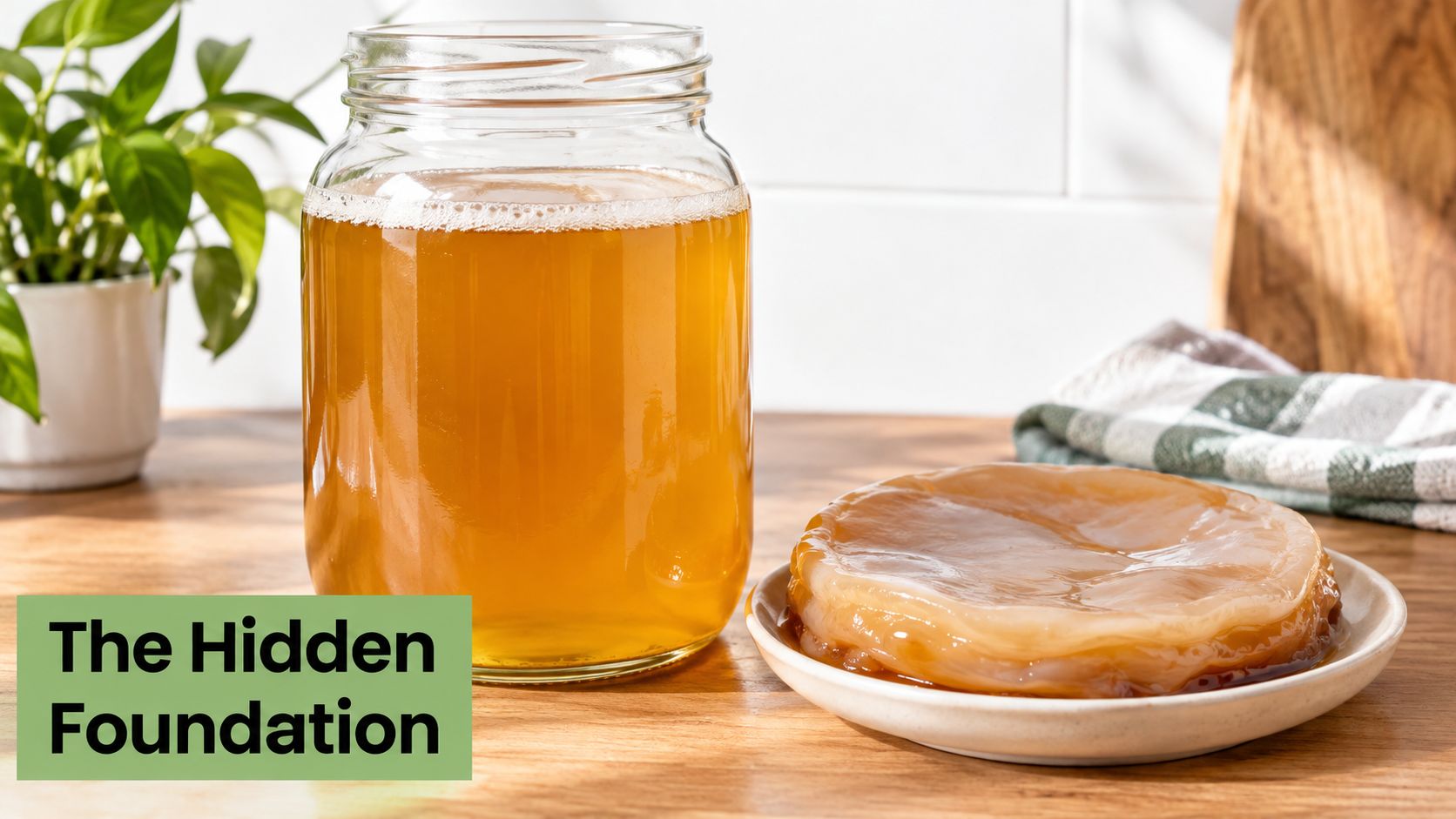
Starter liquid is the mature kombucha reserved from an active, successful batch. It brings an established community of yeasts and bacteria into the new tea, while its existing acidity changes the starting conditions straight away. The SCOBY matters too, but the liquid surrounding it is an active part of the fermentation system, not just a carrying medium.
Picture planting a garden bed. Fresh sweet tea is the prepared soil, the SCOBY is part of the living garden, and starter liquid brings an established population that can begin working immediately. Without that head start, the new batch has to develop its balance while the sweet tea remains in a condition where unwanted microorganisms may gain an opportunity.
Practical rule: A healthy-looking SCOBY without sufficiently active, acidic liquid isn't a complete fermentation plan.
This matters at home, but it matters even more in cafés and small production spaces. A hospitality team needs repeatable batches, predictable flavour and responsible control of a living drink after it leaves the brew vessel. The first pour of starter liquid influences all three.
Starter liquid also changes how you judge a recipe. Rather than measuring only by volume, you need to consider its acidity, smell, activity and history. A small amount of reliable mature kombucha can help a fresh batch move in the right direction, while weak, contaminated or poorly stored liquid can create uncertainty from the beginning.
What Kombucha Starter Liquid Actually Is
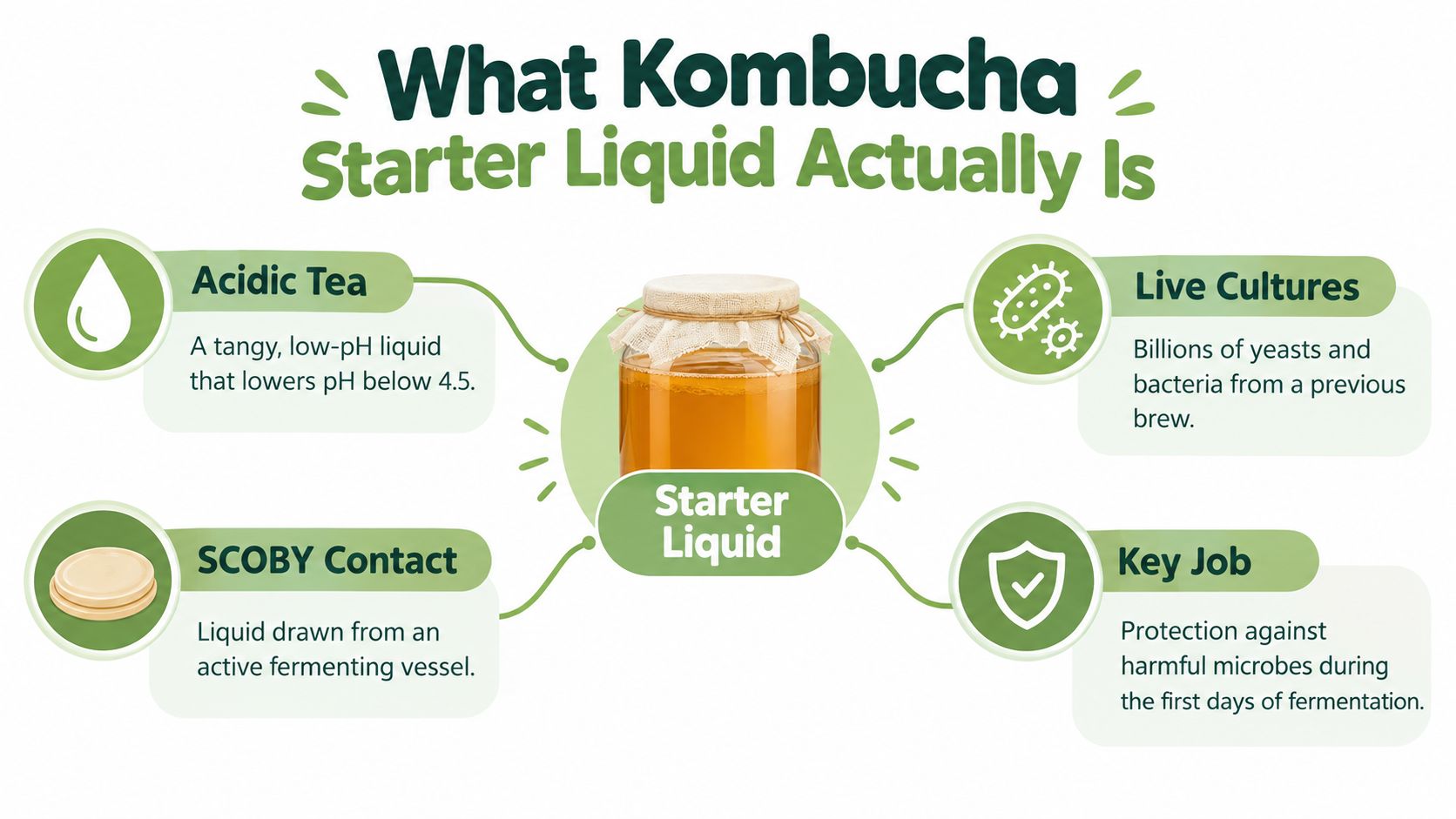
Kombucha starter liquid is finished, acidic kombucha from an active fermentation, usually taken from the vessel before flavouring or bottling. It contains the yeasts and acetic-acid bacteria that have already adapted to the tea environment. When added to fresh sweet tea, these organisms continue the sequence that creates kombucha's characteristic tartness.
The roles are complementary:
- Yeasts use available sugar and produce ethanol and carbon dioxide as part of fermentation.
- Acetic-acid bacteria use oxygen and convert yeast-produced ethanol into organic acids, including acetic acid.
- The liquid itself carries acidity and living culture into the next batch.
- The SCOBY is the visible cellulose-rich layer formed by the culture. It can support fermentation, but it isn't the only place where the active organisms live.
The simplest comparison is a sourdough starter. You wouldn't expect a dry piece of crust to ferment a fresh dough reliably. The living mixture around it carries much of the activity. Kombucha starter liquid plays a similar practical role, although the organisms and process are different.
Starter liquid and a SCOBY are not interchangeable
Adding a SCOBY alone can leave the new tea without enough acidity at the beginning. The liquid helps lower the starting pH and introduces organisms throughout the batch, rather than relying only on contact with a floating or sinking disc.
The liquid should come from a batch that smells pleasantly sour or tea-like, without fuzzy growth, rotten odours or unexplained discolouration. A SCOBY can naturally sink, float or sit at an angle, so its position isn't a reliable test of culture health. The condition of the liquid and the way the brew progresses matter more.
Why mature liquid is carried forward
Each successful batch leaves behind a portion of mature kombucha that can seed the next one. This creates continuity. You're not starting with a blank jar each time, but carrying forward a working culture that has already converted sweet tea into an acidic ferment.
That's why starter liquid deserves to be measured and protected. It is both an inoculum, meaning a source of living culture, and an early acidification control.
How pH Control Makes Starter Liquid a Safety Tool
Freshly brewed sweet tea begins at approximately pH 5, a range in which potential contaminants can grow. Food Standards Australia New Zealand advises cooling tea rapidly from 60°C to 20°C within 2 hours, then adding a proven, uncontaminated starter culture as soon as possible. You can review the broader fermentation context in Yuve's gut health guide, but kombucha brewing needs its own careful controls.
Starter liquid helps the culture begin producing acid sooner. The yeasts and acetic-acid bacteria work in sequence, and oxygen supports the bacteria as they oxidise yeast-produced ethanol into acetic acid. That gradual acidification lowers pH and changes the environment in favour of the intended culture.
The useful pH milestones
Australian guidance identifies pH 4.2 or below as the point at which kombucha becomes a non-potentially hazardous food that doesn't support pathogen growth or toxin production. The practical lesson is simple: the batch needs to reach that milestone promptly, not merely taste sour after a long wait.
A final pH of approximately 2.5 or higher is described as typical. Excessive acidification can produce an aggressively sharp drink and may create additional safety concerns, so lower isn't automatically better.
| Brewing question | Practical answer |
|---|---|
| Is taste enough? | No. Taste can help judge flavour, but it doesn't replace measurement. |
| Does oxygen matter? | Yes. Aerobic fermentation supports acetic-acid production. |
| What should be measured? | Track pH during fermentation with a calibrated meter. |
| Is the starting liquid important? | Yes. Its acidity and culture activity influence how quickly the new batch changes. |
A calibrated digital pH meter for kombucha brewing gives you a clearer view than elapsed time alone. Two jars brewed in different kitchens can move at different speeds because of temperature, tea, culture condition and handling. Recording pH gives a café team or home brewer evidence to work with.
Taste tells you what the drink is becoming. A pH meter tells you whether the process is moving into the intended safety range.
Use clean equipment, cool the tea before adding culture and keep the ferment exposed to suitable air circulation. If the pH doesn't move as expected, don't solve the problem by waiting indefinitely. Review the starter's condition, the temperature, the equipment and the possibility of contamination.
Where to Source or Make Your Starter Liquid
There are two sensible routes. You can obtain starter liquid from an established kombucha producer, or reserve it from your own healthy batch. The right choice depends on whether you're learning at home, restarting after a break or trying to keep café production consistent.
Buying from a reliable producer
A supplied starter should have a clear origin and handling information. Ask how it was brewed, whether it has been kept clean and whether the supplier can explain how to use it with your tea. A reputable source should be able to describe the culture rather than treating the liquid as a generic flavour additive.
For a first batch, a packaged option such as PepTea's starter tea kombucha product can be useful because it is presented specifically for establishing fermentation alongside a SCOBY. The important point isn't the packaging itself. It's knowing what the liquid is, where it came from and how it has been handled.
Reserving liquid from your own batch
Before flavouring or bottling a successful brew, decant clean mature kombucha into a sanitised container. Choose liquid from a batch with a pleasant acidic aroma and no visible mould. If the brew has an unusual smell, fuzzy growth or signs of spoilage, don't preserve it as your next starter.
A small café should label the container with the batch identity and date, then store it under the same controlled conditions used for the rest of the production process. Home brewers can use a simpler note on the jar, but the principle is identical: know which batch you're carrying forward.
How much is enough
PepTea's product guidance describes mature acidic kombucha at approximately 10% of a new batch as a way to lower initial pH and establish fermentation. The exact suitability depends on the acidity and activity of the liquid, so volume alone shouldn't be your only check.
If the starter is unusually mild, old, diluted or uncertain, adding more by guesswork won't guarantee a safe result. Measure pH, use a known culture and keep your process consistent. A starter liquid with strong acidity and healthy activity gives the new tea a more dependable beginning.
Storing and Maintaining Starter Liquid Correctly
Starter liquid is alive, so storage is about slowing change without treating it as a lifeless ingredient. A clean container, stable refrigeration and careful handling help preserve its useful acidity and culture activity between brews.
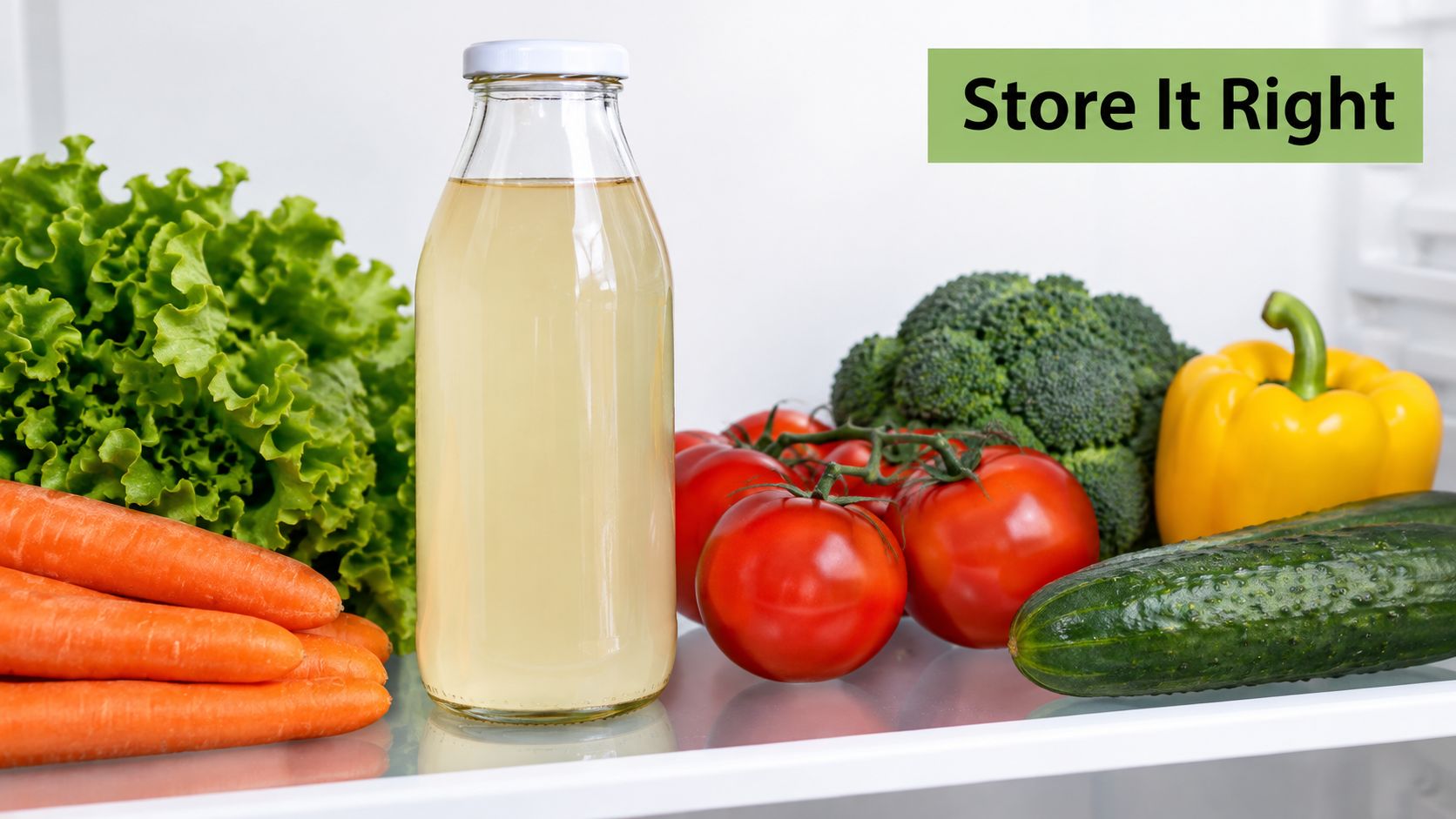
Use a clean glass container with enough room for safe handling. Keep the lid secure, but avoid repeatedly opening the jar just to smell it. Every opening creates another opportunity for dust, insects or accidental contact to enter.
A simple storage routine
- Label the jar: Record the batch source and storage date so nobody has to guess what it contains.
- Keep it cold: Refrigeration slows fermentation and helps maintain a more stable flavour and activity profile.
- Protect the liquid: If a SCOBY is stored with it, keep the culture covered so it doesn't dry out.
- Use clean utensils: Never dip a used spoon or tasting glass into the container.
- Inspect before use: Look for mould, unpleasant odours or a change that doesn't resemble normal acidic fermentation.
A refrigerated starter can become more sour over time, and its activity may change. “It still smells acidic” is useful information, but it isn't proof that the liquid is suitable for every new batch. Measure and observe rather than assuming that starter liquid never expires.
Freezing can also alter texture and culture activity, so it isn't automatically the best preservation method. For a short brewing pause, stable refrigeration is the more straightforward routine. If you're unsure about a stored culture, discard it rather than trying to rescue a questionable ferment.
The following video can help visualise practical SCOBY storage habits:
For a longer pause between batches, keep the culture submerged in mature kombucha and avoid repeated transfers. PepTea's guide to storing a SCOBY between brews offers a useful reference for maintaining the culture without letting it dry out.
Spotting Contamination and Managing Alcohol Risk
A healthy kombucha culture can look different from batch to batch. The SCOBY may float, sink or form an uneven new layer, and strands or sediment can appear as yeast activity continues. Those changes aren't automatically contamination.
Mould is different. Fuzzy or dry growth, especially with suspicious colours, is a reason to discard the affected batch and starter rather than skim the surface. A rotten, solvent-like or otherwise offensive smell also deserves caution. If the liquid has been exposed to dirty equipment, insects or questionable water, don't use it to seed another brew. For general background on checking water quality, how to test well water for E. coli is a useful resource, although a home water test doesn't replace good brewing hygiene.
Alcohol can change after bottling
Acidity is only half the control problem. Yeasts can remain active after the SCOBY is removed, particularly when residual sugar, warm storage, sealed bottles or a second fermentation give them favourable conditions.
A national survey of 239 fermented soft drink samples found that only 35.2 per cent of kombucha tested below 0.5 per cent alcohol by volume, while some products increased in alcohol during shelf life. The findings are reported in the Australian fermented-beverages issues paper.
In the same survey, 41.9 per cent of all sampled fermented drinks measured above 0.5 per cent and below 1.15 per cent ABV, while 22.9 per cent exceeded 1.15 per cent ABV. Kombucha represented 132 samples, or 55.2 per cent, of the total fermented-drink sample. These figures show why a bottle that tastes fine at filling can't automatically be treated as stable throughout its shelf life.
Practical controls for cafés and home brewers
- Reduce uncontrolled sugar: Residual fermentable sugar gives yeast more material to convert.
- Control warmth: Cold storage slows, but doesn't magically erase, ongoing fermentation.
- Treat sealed bottles carefully: Carbonation stages can trap gas and support continued yeast activity.
- Check the finished product: Commercial operators should validate alcohol at bottling and during shelf-life studies.
- Avoid blanket claims: Don't describe a living fermented drink as alcohol-free without appropriate testing and awareness of applicable Australian requirements.
In New South Wales, guidance states that kombucha sold as a non-alcoholic beverage must contain less than 0.5% ABV, as outlined by the NSW Food Authority. Requirements and classification can vary between states, so a café serving or selling kombucha should document its controls rather than rely on assumptions.
Best Practices for Home Brewers and Hospitality Use
The best process is the one you can repeat. Home brewers need a clean jar, reliable starter liquid and a way to check progress. Cafés need those same foundations, plus batch records, staff consistency and a clear approach to storage and product claims.
Keep the framework practical:
- Start with known liquid. Use mature starter from a healthy ferment or a traceable supplier.
- Cool before inoculating. Hot tea can damage the living culture.
- Measure pH. Don't rely on taste, smell or the calendar alone.
- Keep equipment hygienic. Clean jars, utensils, bottles and meter probes after use.
- Provide oxygen during primary fermentation. The acetic-acid bacteria need it for their work.
- Control the post-bottling stage. Residual sugar, active yeast and warm storage can keep fermentation moving.
- Record what happened. Note the starter source, pH observations, storage conditions and any alcohol testing.
A café doesn't need a laboratory bench beside the espresso machine, but commercial production does benefit from organised testing and suitable food-grade workspaces. Businesses planning more formal analysis can browse food testing lab benches for context on laboratory furniture and workflow design.
Home brewers can keep their notes in a notebook. Hospitality teams should make the process easy for every staff member to follow. In both settings, starter liquid should be treated as a safety control and fermentation tool, not an optional flavouring.
Pep Tea offers Australian-brewed, sugar-free organic kombucha from the Hunter Valley, along with organic Japanese matcha and practical guidance for mindful beverage routines. Visit Pep Tea to explore the range, learn more about kombucha culture care and enquire about options for home, café or wholesale use.
Live Cultures Kombucha: What They Are and Why They Matter

Live cultures in kombucha are the living bacteria and yeast from the SCOBY that survive into the bottle and may support gut health. In Australia, however, almost 65% of 132 tested kombucha samples contained more than 0.5% alcohol, so “live” on a label is a specific claim that deserves more attention than a wellness slogan.
The popular advice is simple: choose kombucha for your gut. The useful advice is more precise: learn what the bottle means by live cultures, whether fermentation has been stopped, how the drink has been stored, and whether the producer controls acidity, sugar and alcohol. A chilled bottle can contain a living fermentation ecosystem, but two products with similar front labels may deliver very different things.
For Australian shoppers, cafés and retailers, this matters beyond taste. Live-culture kombucha is a relatively young local category. Commercial production began in Australia in 2009, and the market has since moved from home-brew culture into mainstream retail and hospitality, as reported by the Sydney Morning Herald's account of kombucha's Australian development. That growth brings better access, but it also makes label literacy essential.
Why Live Cultures Are the Most Misunderstood Phrase in Kombucha
“Live cultures” is probably the most misunderstood phrase on a kombucha label. Some people read it as a guarantee of a defined probiotic dose. Others assume any fermented tea must contain living microbes. Neither assumption is reliable.
In plain English, live cultures are bacteria and yeast that remain viable when you drink the kombucha. They come from the SCOBY, the mixed culture used to ferment sweet tea. If the finished drink is pasteurised after fermentation, heat can remove that living microbial activity. If it's heavily filtered, the microbial content may also change. A refrigerated bottle labelled raw or unpasteurised points towards a different product from a shelf-stable bottle that has been heat-treated.
Why fermentation language gets blurred
Brewing reality is more complicated than front-of-pack marketing. Fermentation produces acids, carbon dioxide, flavour compounds and trace alcohol, while the exact balance changes with the tea, sugar, temperature, time and culture. A producer might describe a drink as naturally fermented, yet the finished product may later be filtered, heated or stabilised.
That's why two bottles with similar wording can carry different microbial payloads. One may contain a mixed community of bacteria and yeast. Another may retain the acids and flavour of fermentation but no longer contain viable cultures. The label needs to tell you which story applies.
Practical rule: “Fermented” describes how the drink was made. “Contains live cultures” describes what remains when you drink it.
A useful label-reading habit is to ask four questions:
- Was it heat-treated? Look for wording such as pasteurised after fermentation or heat-treated.
- Does it require refrigeration? Cold storage supports culture survival and slows continued fermentation, although refrigeration alone isn't proof of live cultures.
- Does the producer explain the culture claim? Clear language is more useful than broad terms such as wellness or detox.
- What does the nutrition panel show? Sugar and alcohol help you understand how far fermentation progressed.
The rest of the label story starts with the SCOBY itself. Once you understand that small ecosystem, “raw”, “unpasteurised”, “probiotic” and “live” become practical clues rather than interchangeable buzzwords.
What Live Cultures and SCOBYs Actually Are
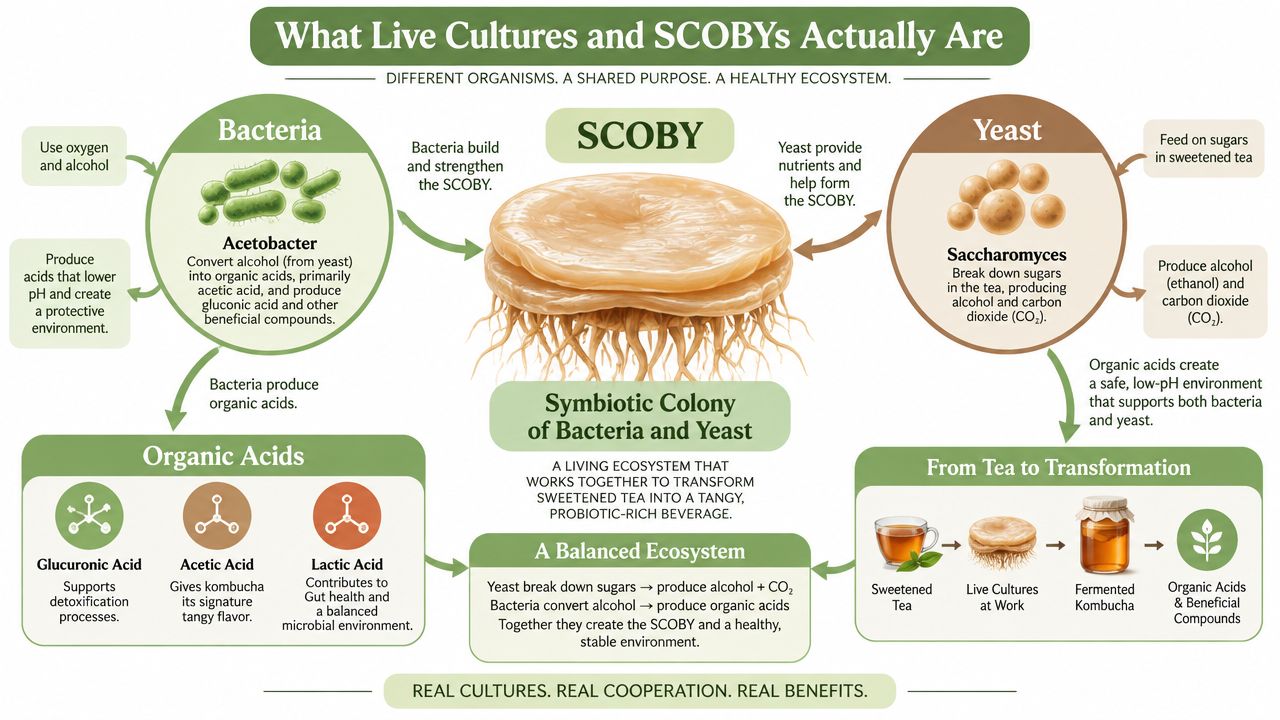
A SCOBY is a symbiotic culture of bacteria and yeast. It isn't one organism and it isn't a magic mushroom. It's a working community that lives in sweetened tea and transforms the liquid over time.
Yeast starts by using available sugars and producing alcohol and carbon dioxide. Acetic-acid bacteria then use oxygen and fermentation products to create organic acids, which give kombucha its sharp, refreshing character. Commonly discussed members of the ecosystem include Acetobacter, Gluconobacter, Brettanomyces and Saccharomyces, although the exact community varies between cultures and batches.
The pellicle isn't the whole culture
The rubbery cellulose layer floating at the top of a brew is often called the SCOBY. More accurately, it's a pellicle, a cellulose structure produced by some of the bacteria. It houses part of the community, but the liquid starter contains important bacteria, yeast, acids and metabolites too.
That distinction matters for home brewers. Throwing away the liquid and keeping only the pellicle removes much of the active fermentation environment. A healthy brew relies on both the culture and sufficiently acidic starter tea.
The finished drink contains more than microbes. It can include acetic acid, gluconic acid, residual sugar and trace ethanol, with tea compounds adding flavour and polyphenols. A laboratory count expressed as CFU, or colony-forming units, is only an approximation of a diverse community. It doesn't fully describe which organisms are present, whether they remain active, or how they behave in your gut.
Yeasts also deserve attention because they aren't automatically a fault. They help create alcohol and carbonation, while bacteria convert some fermentation products into acids. That relationship is why kombucha can taste bright and complex rather than just sweet or sour.
If you're curious about how yeast behaves in other traditional fermentations, the McLaren Vale indigenous yeast guide offers useful background on the difference between naturally occurring and selected cultures. Wine and kombucha aren't brewed in the same way, but the comparison helps explain why a living fermentation community doesn't behave like a single, perfectly uniform ingredient.
The key distinction is straightforward. Live means viable organisms remain. Pasteurised means heat has been used to stabilise the finished drink, usually changing or removing that living component. The acids may remain after treatment, but acids alone aren't live cultures.
Gut Health and Probiotic Benefits Without the Hype
Kombucha may support a varied diet, but it isn't a cure-all. Live cultures kombucha provides a mixed fermentation community alongside organic acids and tea compounds. That combination may support digestion for some people, but it shouldn't be presented as a guaranteed detox, weight-loss product or substitute for medical care.
The word probiotic also needs care. In strict use, a probiotic is a living microorganism shown to provide a health benefit when consumed in an adequate amount. Kombucha's microbial community varies between producers and batches, so it shouldn't automatically be treated like a clinically defined supplement containing a named strain at a guaranteed dose.
What the drink may contribute
Fermentation can make a beverage more acidic and change the tea's original compounds. The resulting drink may:
- Add microbial variety: A raw, refrigerated product can contain living bacteria and yeast when consumed.
- Support digestion: Acidity and fermentation products may suit some people as part of a meal or regular eating pattern.
- Complement plant-rich eating: Kombucha can sit alongside fibre-rich foods, which provide the substrate your existing gut microbes use.
- Offer a lower-sugar alternative: A well-fermented, sugar-free formulation can replace soft drink or other sweet beverages without turning the drink into a medical intervention.
Those are possible roles, not promises. Human research on kombucha remains less developed than the marketing often suggests, and results from one product can't automatically be applied to every bottle. The culture, tea, residual sugar, acidity and storage history all influence what reaches the glass.
You can read a more detailed breakdown of the question in PepTea's guide to how many probiotics are in kombucha. The practical lesson is to judge the product rather than assume that the category delivers one standard probiotic result.
When to take a cautious approach
New fermented drinks can cause bloating or digestive discomfort, particularly if you start with a large serving. Begin with a modest amount and pay attention to your response. People who are pregnant, immunocompromised or managing histamine issues should discuss fermented beverages with a qualified clinician before making them a regular habit.
Kombucha also contains fermentation-derived alcohol, even when it's sold as a non-alcoholic drink. People avoiding alcohol completely, including some pregnant consumers or those in recovery, may prefer not to rely on a “low” amount without checking the product information.
The most honest health claim is modest: live cultures kombucha may be a refreshing fermented food that supports a varied eating pattern. It isn't a shortcut around sleep, fibre, hydration, medical treatment or a balanced diet.
How Live Culture Kombucha Is Brewed Step by Step
A good bottle begins with controlled fermentation, not a flavour powder added to sweet tea. The brewer manages a living process from the first steep to the final refrigerated bottle.
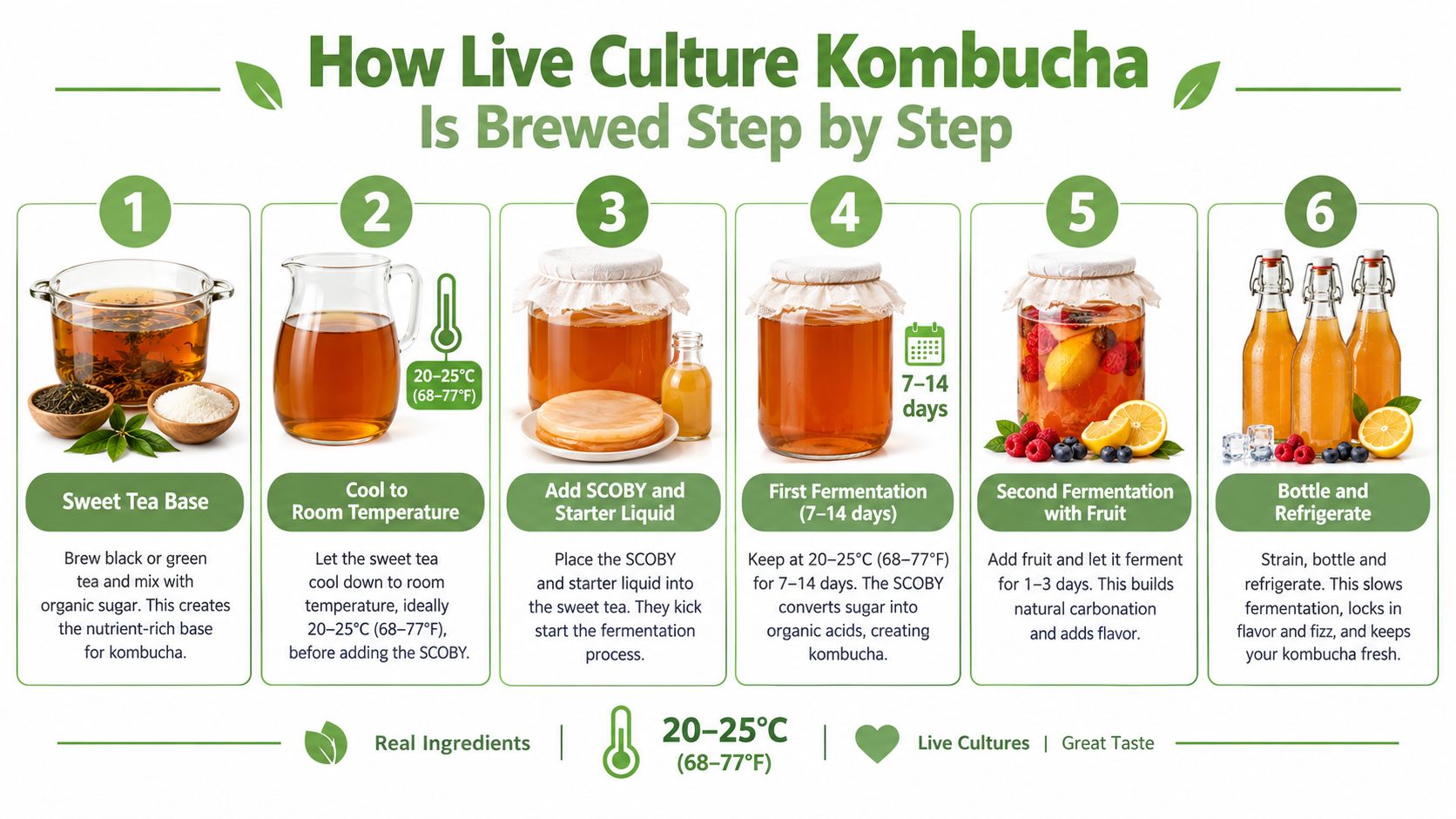
1. Build the sweet tea base
Black or green tea supplies the fermentation environment, flavour and plant compounds. Cane sugar feeds the yeast and bacteria. The brewer needs enough sugar to support the culture, but the finished drink shouldn't taste like sweet tea.
2. Cool before adding culture
Hot tea can damage the living culture. The sweetened tea is cooled to a suitable temperature before the brewer adds acidic starter liquid from a previous batch and the SCOBY. Starter liquid lowers the initial pH and helps the new batch begin in a safer, more stable environment.
3. Ferment the first stage
Primary fermentation commonly runs at 22 to 28°C for 5 to 14 days, depending on the recipe and conditions. During this stage, yeast and bacteria consume available sugars and generate organic acids, carbon dioxide and trace alcohol.
Taste and testing work together. A batch that's stopped too early may retain too much sugar and lack acidity. A batch left too long can become sharply sour, lose balance and continue changing in ways the brewer needs to monitor.
4. Flavour and bottle
The brewer adds ingredients such as ginger, lime or mango before bottling. Residual sugar gives yeast something to ferment in the sealed bottle, creating natural carbonation. This stage needs care because the same process that creates fizz can increase pressure and alter alcohol over time.
For a closer look at the first stage, PepTea's guide to kombucha first fermentation explains the role of tea, sugar, starter liquid and culture management.
A practical visual walkthrough can also help make the process easier to follow:
5. Refrigerate and monitor
Cold storage slows fermentation. It doesn't make a living drink static. Yeast and bacteria may continue working slowly, particularly when residual sugar remains, so temperature, distribution time and packaging all affect the final drink.
Small producers can often monitor these variables closely, especially when brewing for local cafés, retailers and direct customers. PepTea's kombucha is brewed in the Hunter Valley, NSW, where the brand describes its Australian-made range as organic, sugar-free and made with raw live cultures. That's one example of why production transparency matters more than a generic “fermented” claim.
Reading the Label on Live Culture Kombucha in Australia
Australian labels need to answer two separate questions: is the drink safe and legally described, and does it still contain viable cultures? Those questions overlap, but they aren't identical.
A drink can retain fermentation acids after treatment, while a live-culture claim depends on organisms surviving into the bottle. Likewise, refrigeration supports a live product but doesn't prove the claim by itself.
Four phrases with different meanings
- Raw: Usually signals that the product hasn't been heated in a way that would remove its living character, but check the producer's explanation.
- Unpasteurised: Indicates the drink hasn't undergone pasteurisation. It points more directly to the absence of post-fermentation heat treatment.
- Live cultures: Means the producer is claiming viable microorganisms remain in the product.
- Probiotic: Implies a health-related content claim that needs substantiation. Don't treat it as interchangeable with fermented.
The term “naturally fermented” describes a process, not necessarily the condition of the final bottle. If a brewer heat-treats the finished drink, the fermentation history remains true, but the live-culture story changes.
Alcohol and acidity are production controls
Australian food-safety information has highlighted alcohol variability in fermented drinks. In testing of 132 kombucha samples sold in 2017 and 2018, almost 65% contained more than 0.5% ABV and more than 22% exceeded 1.15% ABV, as reported in the Sydney Morning Herald coverage of kombucha and kefir alcohol content.
In Australia, drinks above 0.5% ABV must carry alcohol-content statements under the Australia New Zealand Food Standards Code. NSW treats products above 1.15% ABV as liquor, according to NSW Health guidance on fermented drinks and alcohol. Ongoing fermentation after packaging can contribute to alcohol drift, particularly when bottles are warm or contain residual sugar.
Acidity matters for safety too. Australian guidance uses pH controls to reduce contamination risk. Some guidance calls for a final pH below 3.0, while other state guidance uses a target below 4.2 within seven days. Queensland guidance also requires pH below 4.6 within 24 hours and recommends refrigeration to slow ongoing fermentation, as outlined in the Australian fermented beverages issues paper.
| Label claim | What it means | Live culture implication |
|---|---|---|
| Raw | The producer presents the drink as minimally heat-treated | Cultures may remain, but check the full process |
| Unpasteurised | No pasteurisation has been applied | Stronger indication that fermentation microbes may survive |
| Contains live cultures | Viable bacteria and yeast are claimed in the bottle | Look for refrigeration and clear storage guidance |
| Probiotic | A health-related microbial claim | Ask whether the claim is substantiated and specific |
| Shelf-stable | Designed to remain at room temperature | Treat as a warning sign if you're seeking living cultures |
Sugar-free claims also need context. A product described as sugar-free under the relevant food-labelling convention may contain less than 0.5 g per 100 mL, but the nutrition panel remains the most useful place to check the actual formulation. A bottle that sits warm on a shelf may have had its live-culture promise altered through filtration, heat treatment or continued fermentation.
Serving, Storage and Using Kombucha as a Mixer
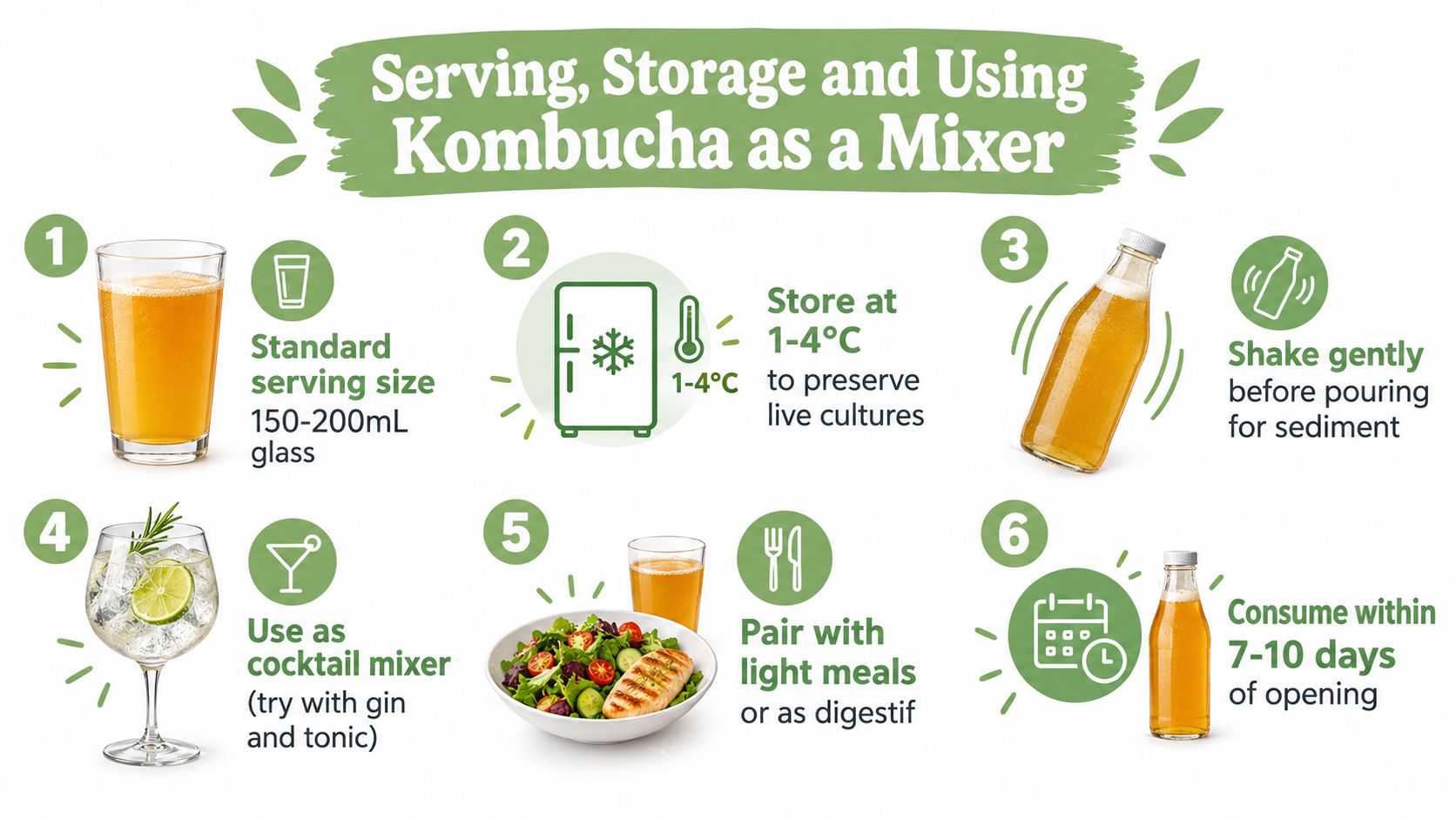
Kombucha works best when you treat it as a food and a flavour ingredient, not a shot. A 150 to 200 mL glass is a sensible standard serving, while people with sensitive stomachs may prefer to start smaller.
Pour it slowly into a glass rather than drinking straight from the bottle. The aroma opens up, carbonation softens and you can judge the balance of sweetness, acidity and spice.
Match the acidity to food
Kombucha's brightness can cut through rich or fatty foods. Try it with:
- Grilled meats: Ginger notes can lift smoky or savoury flavours.
- Spicy curries: Acidity and carbonation refresh the palate between bites.
- Cheese boards: Tart kombucha balances creamy textures.
- Rich brunches: Citrus or ginger flavours work well with eggs, avocado and buttery pastries.
Flavour choice changes the pairing. PepTea's examples include Ginger, Lime & Ginger and Mango, each offering a different route into food matching without adding a sugary soft drink to the table.
Use it in a café-style drink
Kombucha makes a useful base for a non-alcoholic spritz. Pour it over ice with citrus and herbs, or combine it with soda water for a longer drink. In a cocktail, carbonation lifts botanical notes from gin, citrus and aromatic bitters, although the finished alcohol level depends on the other ingredients.
Cold-chain handling affects the experience as well as culture survival. A warm trip from a distribution centre to a retail fridge can accelerate fermentation, alter flavour and increase pressure. Check the sell-by date and choose bottles stored below 4°C, following the practical advice in PepTea's kombucha storage guide.
At home, refrigerate unopened bottles immediately. Keep them away from direct sun and hot cars. Once opened, reseal the bottle and aim to finish it within 2 to 3 weeks, while remembering that flavour and carbonation may change sooner.
Choosing a Live Culture Kombucha Worth Your Fridge Space
You don't need to become a fermentation scientist to choose well. A quick scan can reveal whether a bottle's live-culture story is supported by its ingredients, storage and producer information.
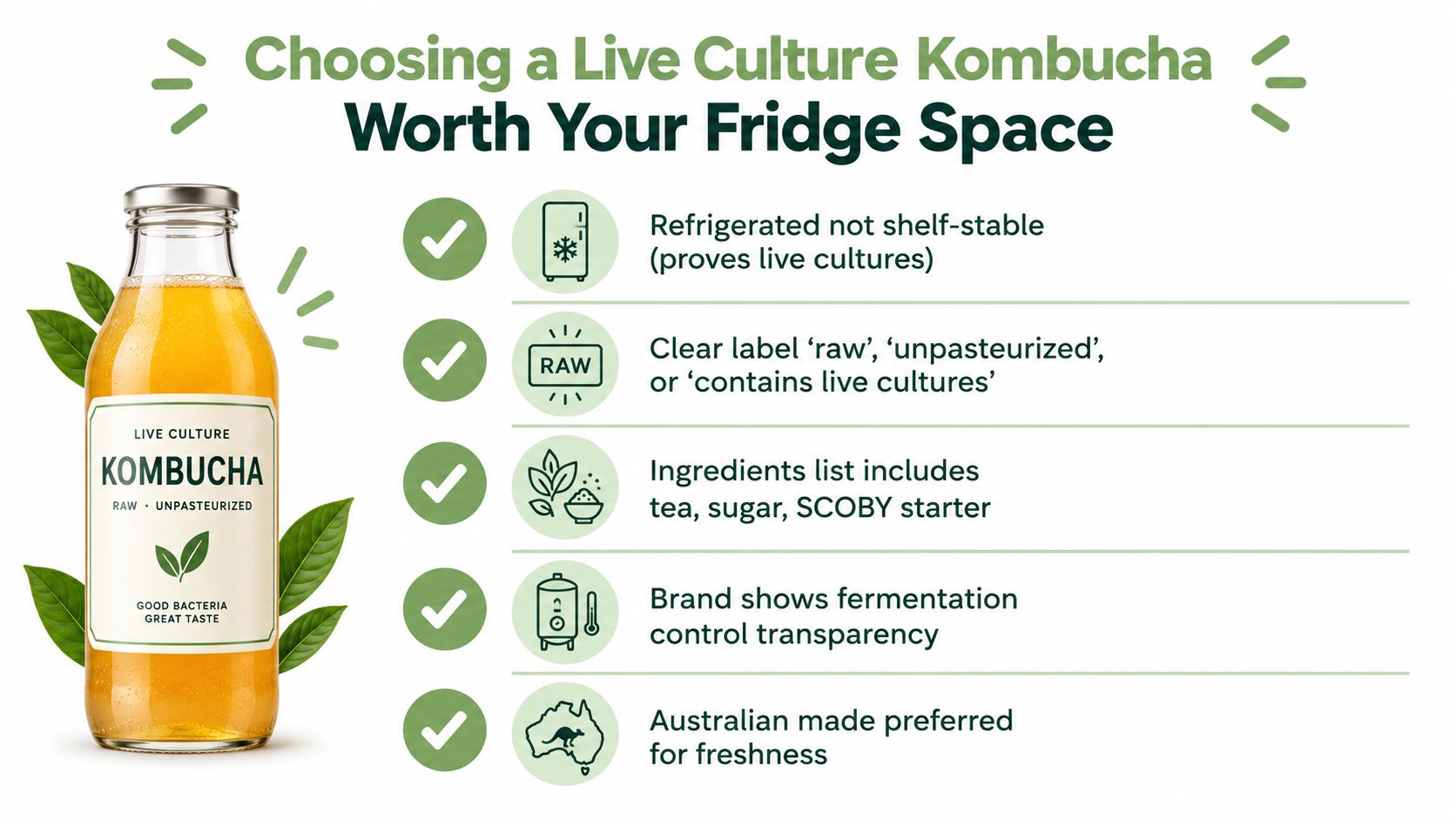
Start with the fridge. Refrigerated kombucha is generally a better sign for culture preservation than a shelf-stable bottle, though refrigeration alone isn't proof. Then inspect the wording and ingredients.
- Read the process language: Look for raw, unpasteurised or contains live cultures, and check for any statement about post-fermentation pasteurisation.
- Check the ingredients: Tea, sugar, starter culture and flavour ingredients are easier to understand than a long list of sweeteners, colours and stabilisers.
- Review sugar and alcohol: Sugar-free or low-sugar formulations may suit people reducing sweet drinks. Confirm the alcohol statement if you avoid alcohol or need a non-alcoholic option.
- Look for production transparency: A producer that discusses pH, refrigeration, batch control or fermentation gives you more useful information than one relying only on detox language.
- Notice the bottle condition: Natural sediment or activity can occur in a living drink, but absence of visible sediment doesn't prove that cultures are gone. Packaging material matters less than the process and storage record.
Glass can make a product feel more premium, but it doesn't guarantee viable cultures. A clear raw claim, a cold chain and sensible fermentation controls matter more than the container alone.
PepTea's sugar-free organic kombucha, brewed in the Hunter Valley, NSW, is one local example to compare against these criteria. The range includes flavours such as Ginger, Lime & Ginger and Mango, giving Australian shoppers a practical way to assess local live-culture kombucha by its label and handling rather than by wellness hype.
Explore Pep Tea's organic, Australian-brewed kombucha range to compare sugar-free flavours made with raw live cultures. Visit Pep Tea to shop online, learn more about fermentation, or enquire about supplying live-culture kombucha to your café or hospitality venue.
Lemon Ginger Kombucha: Benefits, Brewing, and Buying
You're standing in front of a café fridge, trying to choose between sparkling water, an iced tea, a soft drink and a row of colourful functional beverages. Lemon ginger kombucha catches your eye because it sounds familiar, refreshing and a little more grown-up than lemonade. But the label raises sensible questions. How much lemon and ginger is in the bottle? Is it low in sugar? Does it contain live cultures, and can the alcohol level change during fermentation?
Those questions matter in Australia, where kombucha has moved well beyond a niche wellness drink. The flavour is appealing, but the quality of the fermentation, ingredient dose, storage and labelling determines what you're really buying. Here's how to assess lemon ginger kombucha with the practical eye of a tea and fermentation specialist.
Why Lemon Ginger Kombucha Is Winning Over Australian Drinkers
A café customer may choose lemon ginger kombucha for a simple reason: it offers brightness, spice and fizz in one bottle. Lemon gives the drink a clean, tart edge, while ginger adds warmth that lingers after the sip. That combination feels refreshing in hot weather, yet substantial enough to replace a sugary soft drink or an alcoholic aperitif.
The flavour also suits the way Australians increasingly use drinks. A bottle can sit beside a work lunch, accompany brunch, or become the base of a non-alcoholic menu serve. Health-conscious shoppers may look for a low-sugar option, while café owners want something with more character than plain soda water. Home brewers like the pairing because lemon and ginger are easy to recognise, source and adjust.
A mainstream category, not only a wellness niche
Australian kombucha already has a broad commercial foundation. One market estimate values the category at USD 184.1 million in 2024, with a projection of USD 650.4 million by 2033 at a 15.1% CAGR, while another estimates USD 218.3 million in 2024 rising to USD 765.8 million by 2033 at 15.0% CAGR. These are independent estimates with different market methodologies, but both point towards strong category expansion. Grand View Research's Australian kombucha market outlook
The same outlook identifies conventional kombucha as 89.8% of the market in 2024, with on-trade channels accounting for 60.7% of sales. That mix suggests lemon ginger kombucha can work as an everyday café or retail product, not merely as a specialist health-store purchase.
A federal fermented-beverages issues paper also reported that kombucha sales rose 174% over the previous three years, with New South Wales recording the largest consumer base, closely followed by Queensland. Australian fermented beverages issues paper For a Hunter Valley-brewed product, that local connection is especially relevant, but popularity doesn't remove the need to check what's inside the bottle.
What Makes Lemon Ginger Kombucha Unique
A café may serve two lemon ginger kombuchas that look similar on the label yet taste completely different. The difference usually comes from the tea base, fermentation stage, ingredient dose and alcohol control, rather than the flavour name alone.
Kombucha starts as sweet tea fermented by a SCOBY, a symbiotic culture of bacteria and yeast. The culture converts some sugar into acids, gases and other fermentation compounds. Lemon and ginger are often added during a later flavouring stage, although recipes and timing vary between producers.
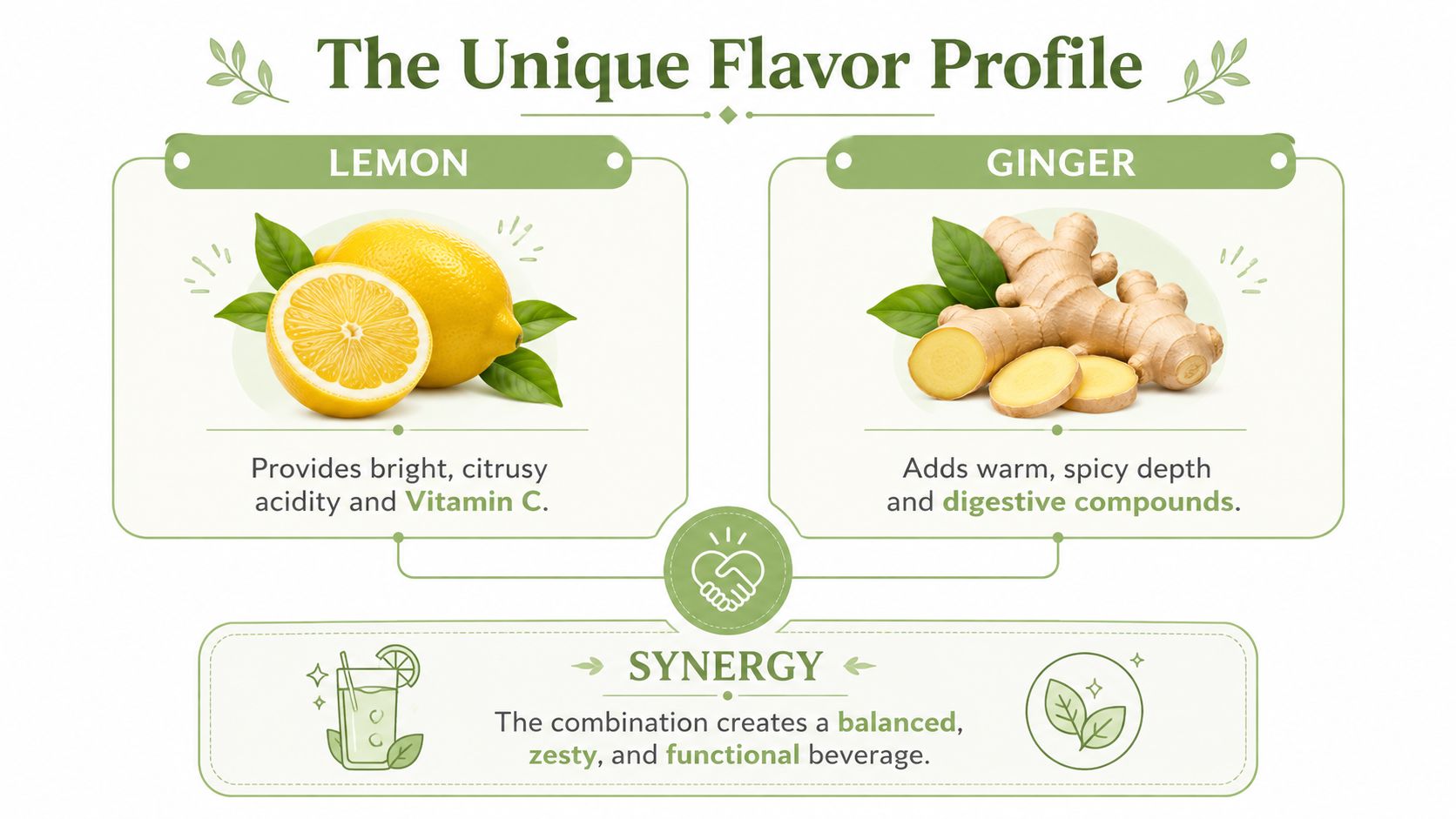
Lemon supplies acidity and citrus aroma. Ginger adds heat, fragrance and a warming finish. In the right proportions, those flavours keep a lower-sugar drink lively without making it taste thin. A well-made version should still show fermented tea beneath the botanicals, rather than tasting like sweetened water with generic citrus flavouring.
Why timing and dose change the result
Lemon and ginger affect more than flavour. A Western Sydney University study found statistically significant inhibition of S. cerevisiae and Bacillus species at 2–3% additions under low inoculum density. Lemon also inhibited L. plantarum under particular low-inoculum or higher-lemon conditions. The study's findings are discussed in more detail later in this article.
For home brewers, this makes addition timing a practical control point. Adding the ingredients after primary fermentation can make flavour adjustment easier, while fruit sugars may restart yeast activity. For cafés and packaged-product buyers, the formulation also affects consistency, refrigeration needs and alcohol management. Excess ginger can dominate the palate or interfere with culture activity, while too little leaves a sharp lemon tea profile.
Ingredient panels deserve a close read. One Australian listing specifies 0.1% lemon and 2% ginger. Remedy Ginger Lemon product information Those amounts do not determine quality by themselves, but they show why a broad wellness message should be separated from the actual recipe.
A useful tasting test: look for a clear sequence of tea, acidity and ginger warmth. If sweetness or artificial citrus takes over, the formulation is doing little beyond flavour coating.
Probiotic and Nutritional Benefits Worth Knowing
A glass of lemon ginger kombucha can supply fermented tea, organic acids and distinctive plant compounds. Its value depends on the live cultures that remain, the fermentation and processing methods, the amounts of lemon and ginger added, and the sugar left in the finished drink. That makes the recipe more informative than a broad wellness promise.
Live cultures may include organisms from groups such as Lactobacillus, Bifidobacterium and Acetobacter, although the profile varies between products. Culture names do not establish a particular health outcome. A label that identifies the cultures or provides a CFU count gives a clearer basis for comparison than a general probiotic claim.
What lemon and ginger can contribute
Lemon contributes citrus aroma, acidity, vitamin C and antioxidant compounds, depending on its dose and the way the drink is processed. Ginger supplies aromatic compounds, including gingerols, which create its warming character. Fermentation changes acidity and flavour, but it does not guarantee that every nutrient or plant compound becomes more bioavailable.
The Western Sydney University work found that lemon-treated kombucha increased antioxidant activity by 5–15% in a FRAP assay. That result applies to the tested formulation and assay, rather than to every lemon ginger kombucha. The study's research record The practical lesson is straightforward: ingredient concentration and fermentation conditions shape the result, so dosing matters alongside the ingredient list.
For a broader explanation of fermentation, live cultures and practical use, read Pep Tea's guide to the benefits of kombucha.
A realistic daily role
A small serve can replace a sweet soft drink or add variety to a hydration routine. It may suit people who enjoy tart, sparkling drinks and want a fermented option. It cannot correct an unbalanced diet, poor sleep or an underlying digestive condition.
Acidity also matters in everyday use. People with reflux, dental sensitivity, diabetes, pregnancy-related dietary questions or medically restricted diets should check the label and seek individual advice from a qualified health professional.
Australian product pages may highlight live cultures, organic acids and “no sugar” positioning without explaining the limits for every customer. Woolworths product information for Remedy Ginger Lemon A transparent label should help you assess acidity, sweeteners, caffeine, storage and ingredients. For home brewers and cafés, those details also support sensible portioning and menu descriptions.
Brewing and Selecting Quality Lemon Ginger Kombucha
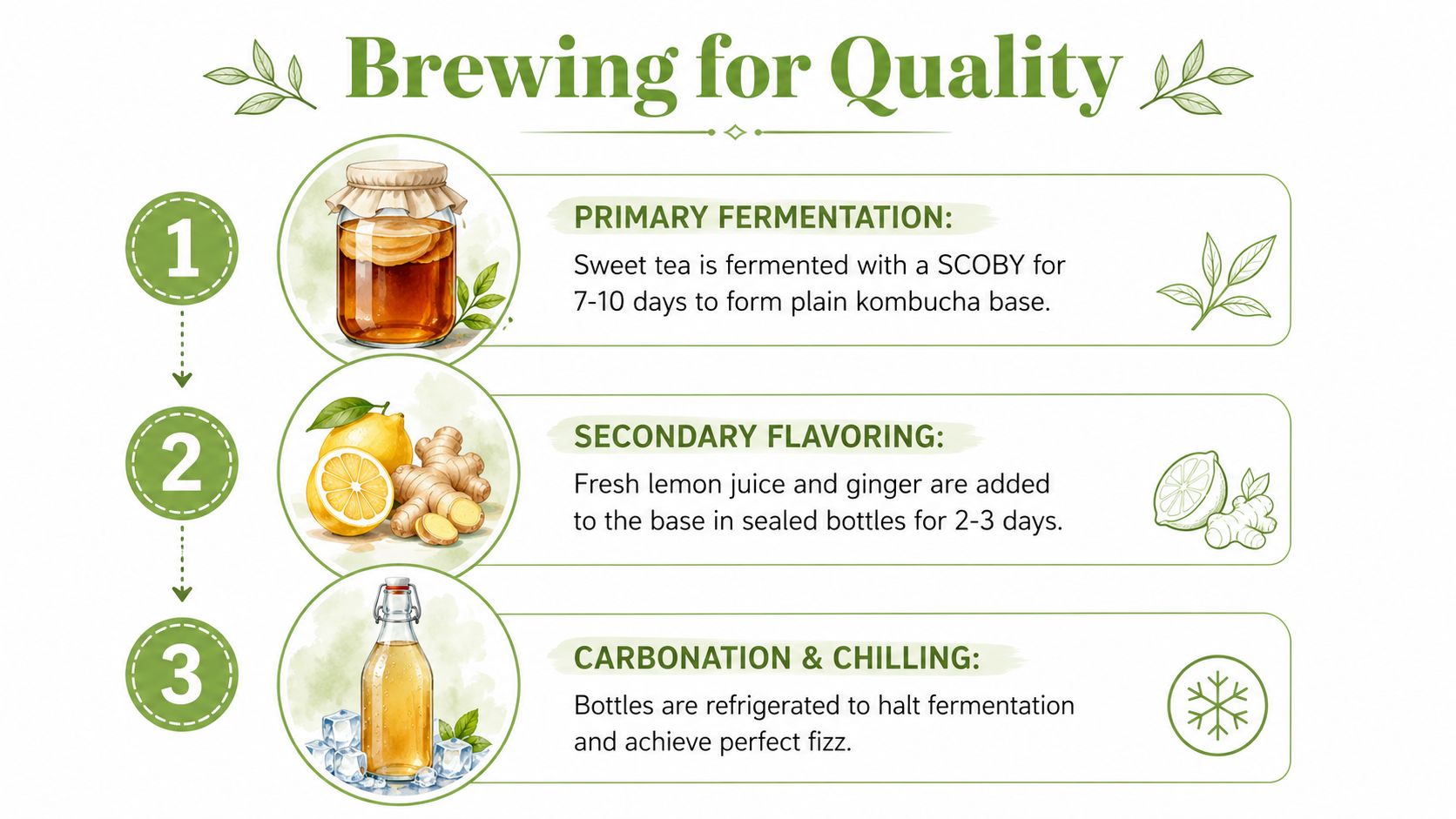
A reliable batch starts with control, not flavour improvisation. Primary fermentation creates the plain kombucha base. A later flavouring stage introduces lemon and ginger, then the sealed drink may develop carbonation before refrigeration slows further activity.
A controlled brewing sequence
For home brewers, the process can be organised around three decisions:
Build a sound base. Brew tea, add the required sugar, cool it properly, then ferment with an active SCOBY and starter liquid. Australian room conditions vary, but a working range of 24–28°C is commonly used for fermentation planning. Time, temperature and culture strength all change the final acidity.
Add flavour with restraint. Fresh ginger root gives a cleaner, more layered heat than powder, while lemon juice supplies direct acidity. Zest brings aromatic citrus oils but can become bitter if overused. A brewer should taste the base first, then make a measured addition rather than tipping in ingredients by guesswork.
Manage the bottle stage. Lemon and ginger can introduce residual sugars or fermentable material. In a sealed bottle, yeast may continue working, creating pressure and increasing alcohol. Refrigeration helps slow that activity, but it isn't a substitute for a validated process.
A purpose-built kombucha brewing container from Pep Tea can help keep the process organised, but equipment won't correct a weak starter, poor sanitation or uncontrolled temperature. Clean vessels, sound tea and careful observation remain the foundation.
Alcohol is a production issue
Australian testing shows why brewers and buyers shouldn't assume kombucha is automatically non-alcoholic. A Food Standards Australia New Zealand survey found 35.2% of sampled kombuchas below 0.5% ABV, 41.9% between 0.5% and 1.15% ABV, and 22.9% above 1.15% ABV. FSANZ coordinated survey of fermented soft drinks
In Queensland, Tasmania and Victoria, beverages above 0.5% ethanol by volume are classified as alcoholic, while jurisdictions using a 1.15% threshold apply a different boundary. The practical lesson is simple: producers need batch consistency, appropriate labelling and testing where necessary.
For troubleshooting, excessive sourness usually points to an overextended fermentation or too little residual sweetness. Weak carbonation may reflect insufficient fermentable material, a loose seal or a short bottle stage. Mould is a safety failure, not a flavour problem. Discard a mouldy batch rather than trying to rescue it.
Serving Ideas and Café Menu Applications
At a café, lemon ginger kombucha can arrive in a clear glass over ice, finished with a lemon wheel and a thin slice of fresh ginger. That presentation makes the ingredients visible and gives customers a quick sensory cue before they taste it. Serve it cold, pour gently and avoid burying the fermented character under syrups.

Three useful menu formats
A kombucha spritz combines chilled lemon ginger kombucha with muddled mint, ice and a small amount of soda water. Keep the additions restrained so the acidity and ginger remain recognisable. A fermented mule uses kombucha as the ginger element, with lime, ice and a non-alcoholic spirit if the venue wants a more structured bar-style serve.
Food pairing is straightforward. Lemon's acidity can cut through rich avocado toast, smoked salmon or pastry, while ginger brings enough spice to sit comfortably beside an Asian-inspired bowl. The drink's tartness can also refresh the palate between bites, especially where a creamy or oily component dominates.
Operational details for venues
Cafés should treat kombucha as a living product. Keep stock within the supplier's recommended cold-chain conditions, rotate it carefully and avoid leaving open bottles at room temperature for long periods. If a venue uses a keg or tap system, the team should confirm compatibility with the producer, maintain clean lines and monitor carbonation and flavour over service.
For winter, a café can offer a room-temperature or gently warmed spiced tea alternative using turmeric and cinnamon, but heating kombucha may affect live cultures and carbonation. Summer menus can use cucumber and basil for a lighter aromatic variation. For wider seasonal planning, Simply Hospitality's seasonal beverage ideas offers useful hospitality context.
Menu wording should stay accurate. “Fermented tea with lemon and ginger” tells customers more than an unqualified promise about gut health, and a clear alcohol statement helps staff answer questions confidently.
How to Choose the Best Lemon Ginger Kombucha in Australia
The best bottle isn't necessarily the one with the loudest wellness language. Start with the ingredient list, then assess processing, storage and taste. A mass-market product may be convenient and consistent, while a small-batch producer may offer a more distinctive fermentation profile. Neither label category guarantees quality.
Look for real lemon and ginger, rather than relying only on “natural flavour”. Check whether the drink is raw or unpasteurised, but remember that those terms still need context. A live product can change in the bottle, and a producer should be able to explain its storage and alcohol-control practices.
A practical comparison
| Quality Factor | Mass-Market Options | Premium/Small-Batch, for example Pep Tea |
|---|---|---|
| Ingredient detail | May provide a shorter or less specific flavour description | More likely to identify tea, cultures and flavour ingredients clearly |
| Processing | May prioritise shelf stability and broad distribution | May retain a more pronounced fermented profile, depending on process |
| Sugar positioning | Check whether fruit juice or concentrates contribute sweetness | Look for a clear sugar statement and an ingredient list you can understand |
| Alcohol control | Confirm the product's labelling and storage instructions | Ask how fermentation consistency and testing are managed |
| Flavour | Often designed for broad appeal | May show clearer tea, citrus and ginger character |
| Cold chain | Storage can vary across transport and retail | Chilled handling and producer guidance are especially important |
Australian food law treats kombucha as a traditional food rather than a novel food, so it doesn't need special pre-approval. It still has to be safe and suitable, and general food laws apply. CHOICE's kombucha guidance also notes that a low-sugar claim in Australia requires 2.5 g sugar or less per 100 mL.
Label questions worth asking
- Cultures: Are live cultures stated, and are specific organisms or CFU information provided?
- Sugar: Is “sugar free” supported by the nutrition panel, rather than inferred from a health claim?
- Acidity: Does the product suit your teeth, reflux history and preferred taste?
- Alcohol: Does the producer explain how ABV is controlled and labelled?
- Storage: Does the bottle require refrigeration, and has it stayed cold through retail?
For an Australian buying guide and retailer context, Pep Tea's guide to buying organic kombucha in Australia provides a useful starting point.
Making Lemon Ginger Kombucha Part of Your Routine
A home brewer pours lemon ginger kombucha after lunch, while a café owner serves the same style over ice with a citrus garnish. In both settings, its value comes from practical use rather than broad wellness promises: fermented tea, ginger warmth, acidity and carbonation in a soft-drink alternative or non-alcoholic menu base.
Start with a small serve and observe how your body handles acidity and carbonation. For cafés, trial it beside brunch or as a seasonal mocktail, then check whether the flavour remains balanced when diluted with ice or paired with food.
A reliable routine also depends on consistent brewing. Home brewers can adjust lemon and ginger gradually, while venues need a repeatable recipe, cold storage and a clear approach to alcohol control. The aim is a drink people can enjoy regularly, with its ingredients and production understood.
Explore Pep Tea's Australian-made organic kombucha options, including its sugar-free Lime & Ginger style, for a practical lemon-and-ginger-style choice.
Pep Tea offers organic tea and Australian-brewed sugar-free kombucha for home drinkers, cafés and wholesale customers. Visit Pep Tea to explore the range and brewing resources.
Real Raw Organics Kombucha: An Australian Buyer’s Guide
You're probably standing in front of a fridge full of bright labels right now, looking at words like raw, organic, living, probiotic, and real, and wondering which ones mean something and which ones are just packaging.
That confusion is fair. Kombucha has picked up a lot of wellness language, and not every bottle earns it. Some brews are carefully fermented and cold handled. Others feel more like flavoured fizzy tea dressed up to look the part.
If you've been searching for Real Raw Organics kombucha or trying to work out what matters when choosing a proper kombucha in Australia, the useful question isn't “Which label sounds healthiest?” It's “What signs tell me this was brewed with care, handled safely, and sold transparently?”
That's where this guide helps. We'll keep it practical, plain-English, and grounded in what a buyer can check on the shelf.
The Kombucha Aisle Dilemma
Walk into a health food shop, a local grocer, or even a café fridge, and you'll see the same pattern. Every bottle seems to promise purity, gut support, live cultures, and natural ingredients. At a glance, they all look similar.
The trouble starts when those words blur together. Real sounds reassuring. Raw sounds wholesome. Organic sounds cleaner. Living sounds active and beneficial. But those terms don't all point to the same thing, and they don't all tell you whether the brew was handled properly.
Some brands lean heavily on rustic branding. Murky bottle. earthy colours. farmhouse language. That can be fine, but it can also hide sloppy process. A rough-looking bottle isn't proof of authenticity. Sometimes it's just rough-looking.
A good kombucha should feel transparent, not mysterious. If a brand makes big promises but gives you little detail, that's worth noticing.
That's why a practical buying framework matters more than marketing language. You want to know what's in the bottle, how it was fermented, whether the culture is still alive, and whether the producer seems organised enough to manage a living drink safely.
If you're comparing local options, this guide on where to buy organic kombucha in Australia is a handy next step once you know what to look for.
Why buyers get stuck
A few things trip people up again and again:
- They confuse cloudy with high quality. Some sediment is normal in raw kombucha. A chaotic bottle isn't automatically better.
- They assume “organic” means “raw”. It doesn't. Organic refers to ingredients and farming standards, not whether the drink still contains live cultures.
- They treat all fizz the same. Natural fermentation and added carbonation can produce very different drinking experiences.
- They assume more claims means more quality. Often the opposite is true. Good producers usually explain their process clearly and directly.
That's the kombucha aisle dilemma. Not too few choices. Too many labels saying almost the same thing.
Defining Raw and Organic Kombucha
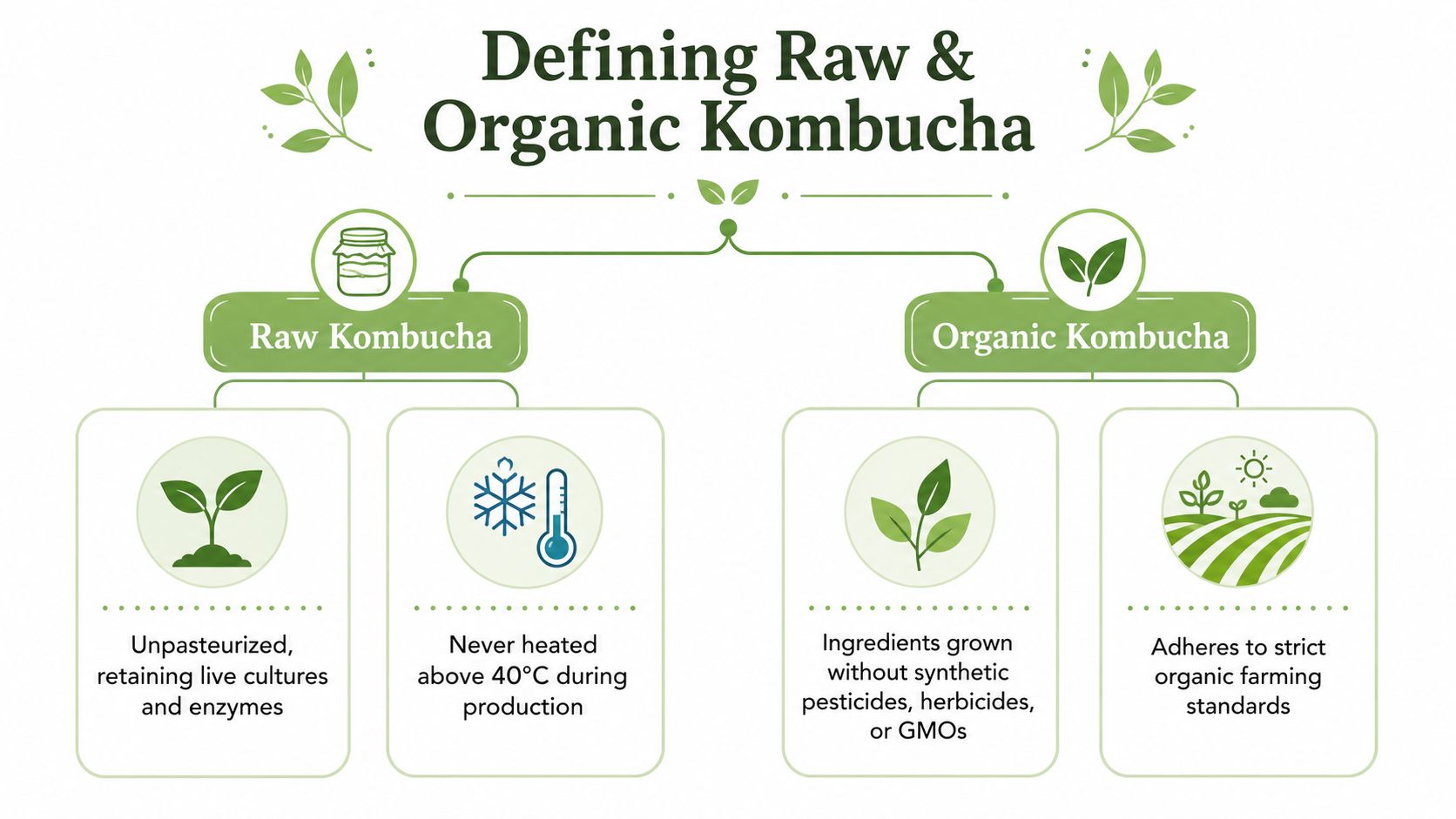
You can save yourself a lot of confusion by sorting kombucha claims into three separate ideas: raw, organic, and living. On the shelf they often get bundled together, but they answer different questions. One is about processing, one is about ingredients, and one is about whether the culture is still active in the bottle.
What raw means in practice
Raw kombucha usually means the drink has not been pasteurised after fermentation. In everyday terms, it has not been heat-treated to the point that the live culture is knocked back or wiped out. That matters because the culture is not a decorative extra. It is part of what makes kombucha kombucha.
A good way to picture it is fresh yoghurt versus a shelf-stable yoghurt dessert. They may look similar from a distance, but they are not handled the same way and they do not offer the same living character. Raw kombucha works in that same practical sense.
Raw also helps explain sediment, which confuses plenty of buyers. A light layer at the bottom, fine strands, or a bit of cloudiness can be normal in a living brew. It can come from yeast, tea particles, or new culture forming. Sediment is not a gold medal for quality, and it is not a warning sign by itself either. It is only one clue, and you need to read it alongside the label, storage instructions, and how clearly the producer explains their process.
If you want a plain-English look at how the culture develops, this guide to making and understanding a kombucha SCOBY helps connect what is happening in the jar to what you later see in the bottle.
What organic actually tells you
Organic kombucha refers to the ingredients used to make it. That usually means the tea, sugar, fruit, herbs, or spices were grown and handled under organic standards rather than conventional farming systems.
That is useful information, but it does not tell you how carefully the kombucha was brewed. A producer can start with organic ingredients and still rush fermentation, over-flavour the batch, or process it in a way that strips out the living character. The reverse can also be true. A kombucha can be raw and alive without every ingredient being organic.
For shoppers, this is the key distinction. Organic tells you about sourcing. Raw tells you about processing.
What living refers to
A living kombucha still contains active microbes from fermentation. On the label, that may appear as live cultures or similar wording. In Australia, that claim should sit comfortably with the rest of the product details, especially refrigeration and shelf-life. If a bottle presents itself as alive but is treated like a soft drink that can sit warm indefinitely, it is fair to ask more questions.
Research on kombucha composition has also found that fermentation can change the drink's profile by producing organic acids and transforming tea compounds, though the result depends heavily on the tea, sugar, culture, and brewing conditions, as described in this review of kombucha processing and composition.
That last part matters. “Living” is not a magic word. It does not guarantee a careful brew, and it does not override basic food safety.
A quick way to separate the terms
| Term | What it points to | What it does not guarantee |
|---|---|---|
| Raw | Minimal post-fermentation heat treatment | Organic ingredients |
| Organic | Farming and ingredient standards | Live cultures |
| Living | Active microbial culture remains in the drink | Careful ingredient sourcing |
Cowboy brands often blur these lines because the blur helps them sell. A better producer makes the distinctions easy to understand. That clarity is what you want. It gives you a practical way to judge the bottle for yourself, especially when you are trying to work out whether the sediment is normal, whether the culture is likely still active, and whether the product looks handled in a way that would meet Australian expectations for a refrigerated, living drink.
Behind the Brew The Authentic Fermentation Process
You pick up a bottle, give it a gentle tilt, and see a little haze drifting through the glass. For plenty of shoppers, that is the moment the doubts start. Is that a sign of a real ferment, or a sign that something has gone wrong? The answer starts with understanding how kombucha is made.
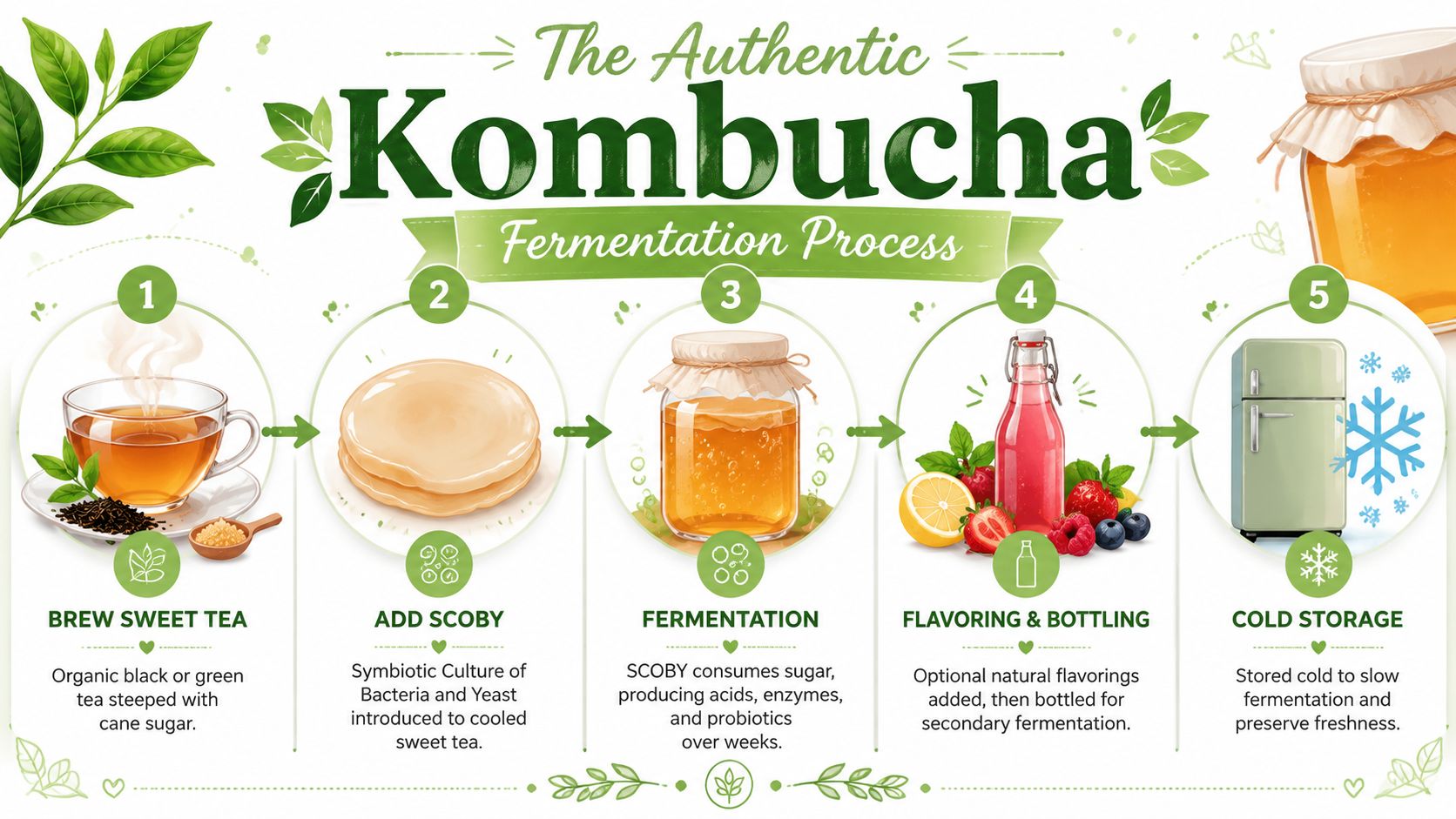
A genuine brew begins straightforwardly. Tea is steeped. Sugar is mixed in while the tea is warm. The liquid is cooled, then the SCOBY and starter liquid are added. After that, the microbes take over and slowly change sweet tea into something brighter, drier, and more complex.
What the SCOBY is actually doing
SCOBY stands for symbiotic culture of bacteria and yeast. The name sounds a bit lab-coat, but the job is easy enough to follow once you break it into stages.
First, the yeast starts feeding on the sugar. As it does, it creates alcohol and carbon dioxide. Then the bacteria use those fermentation by-products and turn them into the acids that give kombucha its clean tang. A good comparison is sourdough or yoghurt. You begin with a simple base, then a living culture reshapes it over time into something with its own character.
That also clears up one of the biggest points of confusion. Sugar is there to feed the ferment at the start. It is not there so the finished drink tastes like cordial.
Why time matters more than branding
Authentic kombucha needs time because flavour does not arrive all at once. In the early stage, the brew can taste flat and sweet. Leave it too long, and the acidity can push too far. The brewer's skill is in knowing when the tea, acidity, fizz, and remaining sweetness are in balance.
That is one of the easiest ways to spot the cowboy end of the market. Some brands build a kombucha image around fruit flavour, buzzwords, and flashy packaging, then deliver something that drinks more like soft drink with a health halo. You can add flavouring after the fact. You cannot fake the layered character that comes from a careful ferment.
A practical test helps here. If the first clear impression is sugary fruit and the tea-ferment note barely shows up, the brewing may not be doing much of the work.
For home brewers wanting to understand the culture itself, this guide on how to make a kombucha SCOBY explains the living side of the process in plain language.
What authentic fermentation looks like in the glass
A well-made raw kombucha usually leaves a few honest clues once it is poured.
- Balanced tartness. The acidity should taste refreshing and clean, not rough or aggressively vinegary.
- Natural-looking fizz. Fine bubbles usually feel more integrated than the sharp pop of a heavily force-carbonated drink.
- Tea still present. Even with ginger, citrus, or berry flavours, you should still get some sense of the tea underneath.
- A drier finish. Real fermentation often leaves the palate cleaner and less sticky than a sugary soft drink.
- Some variation bottle to bottle. Small differences can happen in living products, though a careful producer still keeps that variation under control.
Second fermentation can add more texture and lift, especially when fruit or juice is used thoughtfully. Done well, it creates extra sparkle and depth. Done poorly, it can lead to gushing bottles, muddled flavour, or sediment that looks messy rather than natural.
That point matters in Australia, where a living, fermented drink still has to be handled with care. The process should produce character, not chaos. When you understand that, sediment stops looking mysterious and starts looking like one more clue about whether the bottle in your hand comes from a real brewer or a brand just borrowing the language of one.
Reading the Signs of a Quality Brew
A quality kombucha gives you clues before you even open it. Label detail, ingredient list, sediment, fizz, and handling instructions all tell a story.
Start with what the label can prove
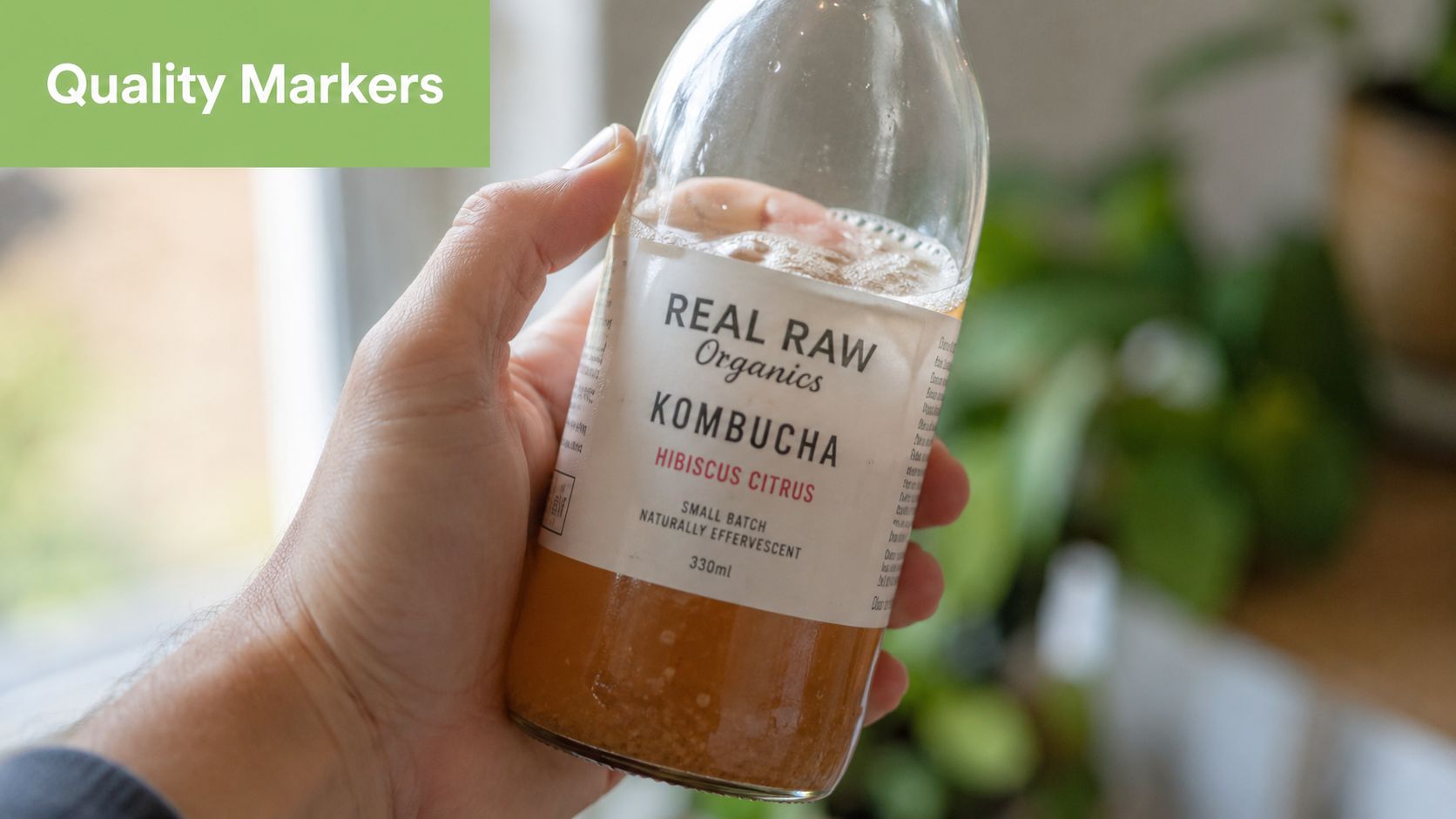
Look for specifics, not mood. “Raw”, “living”, and “organic” are useful starting words, but they should be backed by something concrete such as ingredient transparency, refrigeration guidance, or clear mention of active cultures.
Real Raw Organics states that each 16-ounce jar contains 3 billion live probiotics and says that's three times more than leading brands. The company also says the fizz comes from natural fermentation rather than force carbonation. Those are company-reported figures, so they're best treated as brand claims rather than independent lab findings, as stated on the Real Raw Organics website.
That kind of claim isn't useless. It can tell you how the brand positions its brew. But smart buyers read it as one piece of evidence, not the whole case.
What sediment really means
Sediment confuses people more than almost anything else. They see strands, flecks, or a light haze and assume one of two extremes. Either “this must be ultra-natural” or “this has gone off”.
Neither reaction is reliable.
A little sediment is normal in raw kombucha because it's a living fermented drink. Small particles of yeast, culture, or tea can settle out. That's not automatically a fault. But heavy, messy sediment can also point to less refined filtration, weaker process control, or inconsistent bottling.
A shelf-side way to think about it
- A light haze or fine sediment can be perfectly normal.
- Large floating clumps aren't always dangerous, but they may put off drinkers and suggest rough handling.
- A bottle that looks different every time you buy it can signal inconsistency.
- Clear storage instructions matter. Raw kombucha usually needs cold handling for a reason.
Sediment tells you something. It just doesn't tell you everything on its own.
Check the ingredient list with a brewer's eye
The best ingredient list is usually boring in the best possible way. Tea. sugar for fermentation. culture. maybe fruit, herbs, or spices. That's the basic frame.
If the label leans heavily on sweeteners, flavour systems, or vague “natural” language without much explanation, pause there. Kombucha should taste built, not assembled.
For buyers who want a low-sediment, certified organic Australian option, Pep Tea offers raw organic kombucha brewed in NSW as one example of a producer focusing on controlled fermentation and clean ingredient lists.
Watch how the pour behaves
This short visual is useful because quality often reveals itself once the bottle is opened and poured.
A practical buyer's checklist
| Sign | What you want to see | Why it matters |
|---|---|---|
| Culture claim | Clear language around live cultures | Suggests the drink is still active |
| Storage guidance | Kept refrigerated | Supports cold-chain handling for a living product |
| Ingredient list | Tea, fermentation inputs, recognisable flavourings | Easier to judge what's driving the taste |
| Sediment level | Some is fine, excessive isn't ideal | Helps assess process control |
| Fizz quality | Integrated natural sparkle | Often signals a more careful brew |
Good kombucha doesn't need to look rustic to be real. It needs to look managed.
Navigating Health and Safety in Australia
In Australia, the safety conversation around raw kombucha is less about drama and more about discipline. It comes down to fermentation control, alcohol management, storage, and honest labelling.
Australian food standards require fermented foods and drinks to stay within alcohol limits for their classification, and kombucha is often discussed in Australia because alcohol can vary during fermentation and storage. In practical terms, that puts the focus on labelling, batch control, and cold-chain handling, as described in the referenced note on Australian kombucha safety and alcohol variability.
Why cold storage matters
Kombucha is alive. That's a strength, but it also means the product can keep changing if it isn't stored properly. Warm conditions can push fermentation further than intended, which may affect flavour and alcohol formation.
That's why refrigeration isn't just a merchandising choice. It's part of quality control.
If you're brewing or assessing acidity at home, a digital pH meter for kombucha checks is one of the simplest tools for keeping process decisions grounded in measurement rather than guesswork.
Common questions buyers ask
Is raw kombucha safe?
For many people, a properly produced and properly stored kombucha can fit comfortably into everyday drinking. The key words there are properly produced and properly stored.
A brand should give you confidence that it understands fermentation, not just flavour.
What about pregnancy, children, or avoiding alcohol?
Those situations call for extra caution. Because kombucha is a fermented beverage, people who are pregnant, buying for children, or avoiding alcohol completely should read labels carefully and speak with a qualified health professional if unsure.
That's not fear-mongering. It's just sensible.
Does “raw” mean wild and uncontrolled?
No. In a good brewery, raw should mean carefully controlled without unnecessary heat treatment after fermentation. It shouldn't mean chaotic.
The safest raw kombucha is usually the one made by the most organised brewer.
Packaging matters too
Safety isn't only about what happens in the tank. It also includes what happens after bottling. Container choice, closure quality, and storage all affect the drinking experience.
If you're comparing reusable bottles, takeaway formats, or café service vessels, this explainer on why BPA free matters is a useful refresher on packaging considerations many buyers overlook.
How to Use Kombucha for Consumers and Cafés
Once you've found a kombucha you trust, the next question is simple. How do you use it in daily life without overthinking it?

Kombucha often works best when it replaces something less helpful. A sugary soft drink in the afternoon. A heavy mixer at dinner. Another forgettable fridge option that tastes sweet but doesn't feel refreshing.
For home drinkers
A good raw kombucha suits a few easy moments in the day:
- With lunch if you want something sharper and less sugary than soft drink
- Mid-afternoon when you're after flavour and fizz without reaching for confectionery
- With a savoury meal where acidity helps cut through richness
- As a weekend alcohol alternative poured into a proper glass, not drunk absent-mindedly from the bottle
Serve it cold, open it gently, and pour with a little care if there's visible sediment settled at the bottom.
For cafés and hospitality venues
Kombucha has become a practical menu tool because it can do more than sit in the grab-and-go fridge. It can anchor a non-alcoholic list without feeling childish or overly sweet.
A café or bar can use it in a few ways:
| Use case | Practical idea |
|---|---|
| Straight serve | Chilled bottle or glass pour with garnish |
| Mocktail base | Pair with citrus, herbs, or tonic-style elements |
| Food pairing | Match brighter flavours with brunch or lighter meals |
| Menu upgrade | Offer a fermented option beside juices and sparkling water |
Operators who want to make functional drinks easier to stock and serve also need their back-of-house systems sorted. If you're tightening purchasing and wastage control, this guide on how to optimize hospitality operations is a practical read.
Keep the serve simple
The biggest mistake cafés make with kombucha is overbuilding it. If the brew is good, it doesn't need a dozen ingredients piled on top.
Let the ferment do some of the talking. A strip of citrus peel, a clean glass, and proper chill will often beat an overcomplicated mocktail.
For drinkers at home, the same rule applies. Buy better. Fiddle less.
Your Checklist for Choosing the Best Kombucha
When you're facing a fridge full of options, keep the decision simple. Don't ask which label sounds the most natural. Ask which bottle gives the clearest signs of careful brewing.
The shortlist that matters
- Check whether it's raw or living. You're looking for signs that the culture is still active and the drink has been kept cold.
- Read the ingredients plainly. Tea, fermentation inputs, and recognisable flavourings are easier to trust than a long list of extras.
- Treat probiotic claims sensibly. Specific figures can be useful, but brand-reported numbers are still brand-reported numbers.
- Look at the sediment without romanticising it. A little can be normal. A lot isn't automatically a badge of honour.
- Consider the producer's discipline. Storage, consistency, and clear labelling tell you as much as the front label does.
- Think in Australian conditions. A living fermented drink needs good handling from brewery to shelf to home fridge.
What “real raw organics kombucha” should mean to you
It should mean more than nice packaging and wellness language. It should point to genuine fermentation, careful cold handling, sensible ingredient choices, and an honest approach to safety.
That's the difference between a proper kombucha and a cowboy one. It doesn't need to shout. It just needs to stand up to scrutiny.
If you'd like a local example of what that checklist looks like in practice, explore Pep Tea for Australian organic tea and raw kombucha options brewed with a clean, quality-focused approach.
Wild Berry Kombucha: A Guide to Flavour & Benefits

You're probably standing in front of a fridge at the supermarket or café, wanting something cold and satisfying that doesn't feel like a sugar bomb. Water feels a bit flat. Soft drink feels like a step backwards. Juice can be heavier than you want. Then you spot a bottle labelled wild berry kombucha and pause.
It sounds healthy. It looks lively. But the questions come quickly. Is it low in sugar? Is it just flavoured fizz with a wellness label? Why does it taste tart instead of sweet? And what does “naturally fermented” really mean?
Those are fair questions. Around the Hunter Valley, where we are serious about proper brewing, this is the sort of drink that gets misunderstood all the time. A well-made wild berry kombucha isn't trying to be a lolly-water soft drink with a fancy label. It's a fermented tea drink with fruit character, bright acidity, and a much cleaner drinking experience.
The Australian market has also made this category more interesting. Brands are positioning wild berry kombucha as a low-sugar functional beverage, not a dessert-style indulgence. If you follow how food and beverage teams build products and bring them to market, these kinds of category shifts are also visible in broader industry examples such as Beacon Recruitment food and beverage success stories, where product positioning and consumer expectations shape what ends up on shelves and menus.
An Introduction to Your New Favourite Drink
You grab a chilled bottle on a warm afternoon, hoping for something with flavour that still feels light. That is the moment wild berry kombucha starts to make sense.
For Australian drinkers, especially anyone trying to cut back on sugary soft drinks, wild berry kombucha sits in a very useful middle ground. It has the lift of a sparkling drink, the fruit character people enjoy, and the sharper, cleaner finish that comes from real fermentation. Around the Hunter Valley, that difference matters. A properly brewed kombucha is built from tea first, then shaped by culture, time, and fruit notes. It is not berry-flavoured soda wearing a health halo.
The point that causes the most confusion is sugar.
Many bottles on the shelf use similar words, but they are not made in the same way. In authentically brewed kombucha, sugar is added at the start because the culture needs fuel, much like yeast needs sugar to turn grape juice into wine. During fermentation, much of that sugar is transformed into acids and other compounds that give kombucha its tart, brisk character. That is why some lower-sugar Australian options, including brands such as PepTea, drink drier and less sweet than juice-heavy alternatives.
This is also why a “no sugar” or low-sugar promise can be true in a brewed kombucha and still sound odd at first glance. The sugar goes in as part of the process, not as a promise that the final drink will taste sweet. If a product leans heavily on fruit juice, concentrates, or sweeteners for its final flavour, you are often getting a very different drink from one that has been fermented properly and finished with restraint.
That distinction shapes the whole category. Product teams across food and drink spend a lot of time working out how to meet changing expectations around flavour, health, and convenience, which you can also see in Beacon Recruitment food and beverage success stories.
Why people get confused
Two bottles can both say kombucha and deliver completely different experiences.
One will taste crisp, tangy, and light because fermentation still leads the flavour. Another will come across more like sparkling berry juice because sweetness leads instead. The label may look similar, but the drinking experience is not.
A simple way to judge it is this. Authentic wild berry kombucha should taste like brewed tea and fermentation with berry notes layered over the top. If it tastes like cordial with bubbles, the fruit is probably doing more work than the ferment.
What makes it appealing
People usually come to wild berry kombucha for a few clear reasons:
- They want a soft drink alternative that feels more refreshing than syrupy.
- They want a lower-sugar option without giving up flavour.
- They want an alcohol-free drink that still feels interesting and grown-up.
A good bottle delivers on all three. It is lively without being cloying, fruity without becoming confectionery-sweet, and better suited to everyday drinking than many standard berry beverages.
Defining the Flavour of Wild Berry Kombucha
You crack open a chilled bottle on a hot Hunter Valley afternoon, expecting something like berry soft drink. The first sip usually says otherwise. Wild berry kombucha is lighter, drier, and more layered, with fruit on the nose and a brewed tang underneath.

What it usually tastes like
A good wild berry kombucha tends to arrive in three stages rather than one big sugary hit.
| Layer | What you notice | Why it matters |
|---|---|---|
| Fermented tea base | Tart, crisp, lightly acidic | This gives kombucha structure and keeps it refreshing |
| Berry aroma | Notes that suggest raspberry, blueberry, blackberry, or strawberry | This makes the drink smell inviting before it tastes sweet |
| Natural fizz | Fine bubbles and a dry finish | This keeps the palate clean instead of sticky |
That order matters. In a properly brewed kombucha, the tea and fermentation set the frame, and the berries colour it in. It works a bit like adding fresh fruit to sparkling water instead of pouring cordial into soda. You still get berry character, but the drink stays bright and adult rather than lolly-like.
Why "wild berry" can taste very different from one bottle to another
Many Australian shoppers get tripped up on this point. "Wild berry" sounds clear enough, yet one brand may taste close to a lightly tart fermented tea, while another drinks more like sparkling juice with a kombucha badge on it.
The difference usually comes down to what is doing the heavy lifting. If fermentation leads, you notice tang, dryness, and a clean finish. If fruit juice or added sweeteners lead, the berry flavour becomes rounder, fuller, and more obviously sweet.
That is also why a "no sugar" claim can seem confusing at first. Kombucha starts life with sweet tea because the culture needs fuel. After fermentation, a well-brewed bottle can finish much lower in sugar than a juice-heavy alternative. So the flavour cue to watch for is not intense sweetness. It is balance.
The flavour profile to look for
If you want authentic wild berry kombucha, look for these signs in the glass:
- A tart opening, not a syrupy one
- Berry aroma that smells fresh or jammy without tasting sugary
- A tea-like backbone that gives the drink shape
- A clean, dry finish that invites another sip
A sweeter product can still be enjoyable, of course. It is a different style. For readers comparing berry-led options, Pep Tea's Raspberry Lemonade Kombucha is a useful example of how fruit character can stay lively while the fermented profile still shows through.
What the ingredient list can tell you
Labels often reveal the drinking experience before you open the bottle. A shorter, tea-first ingredient list usually points to a more traditional kombucha profile. A formula built around fruit concentrates, sweeteners, or flavour-heavy additions often pushes the drink closer to soft drink territory.
For Australian buyers, this matters because "better-for-you" claims can sit on both styles. One bottle may be authentically brewed and low in sugar because fermentation has done the work. Another may rely more heavily on flavour additions to create a berry impression while still tasting sweet.
A simple test helps. If you can picture the drink alongside a meal, in a wine glass, or as an afternoon refresher without palate fatigue, it is probably a true kombucha-style flavour. If it reads more like dessert in a bottle, the berry is likely overpowering the brew.
The best wild berry kombucha tastes like fermented tea first, berry second, and sweetness a distant third.
The Magic of Fermentation and Its Health Benefits
Much of the confusion surrounding wild berry kombucha begins with a single fair question. If brewers use sugar at the start of the process, how can some bottles end up very low in sugar, or even make a "no sugar" claim?
The answer sits in the ferment, not the flavouring.

What fermentation actually does
Kombucha starts as sweet tea because the culture needs fuel. Yeast and bacteria use that sugar during fermentation, much like a sourdough starter uses flour. The starting ingredient matters, but what the microbes do with it matters more.
A review on kombucha fermentation and bioactive compounds explains the basic sequence. Yeast split sucrose into simpler sugars and convert them into ethanol. Acetic acid bacteria then turn that ethanol into organic acids, including acetic acid, which lowers the pH and creates kombucha's bright, tangy edge.
That is why properly brewed kombucha tastes dry, tart, and tea-led rather than like cordial.
Why the sugar question trips people up
Shoppers often look at kombucha the way they look at soft drink. They assume sweetness in the recipe means sweetness in the bottle. Fermentation changes that equation.
In a genuine brew, sugar is part of the process first and part of the flavour second. If fermentation is allowed to do its work, much of that starting sugar is transformed. If a product relies heavily on juice, concentrates, or added sweeteners after brewing, the final drink can taste fuller, softer, and much sweeter, even if it still sits in the kombucha section.
That distinction matters in Australia, where "better-for-you" messaging appears on both traditional and fruit-heavy styles. An authentically brewed, low-sugar kombucha such as PepTea's approach is built around fermentation doing the heavy lifting. A sweeter, juice-led option may still be pleasant, but it is offering a different drinking experience.
What fermentation adds beyond lower sugar
Fermentation does more than trim sweetness. It builds the structure of the drink.
You can taste that in a good wild berry kombucha. The berry notes sit on top, while the ferment gives shape underneath. It works like the frame of a house. You may notice the paint first, but the frame is what holds everything together.
That ferment-driven structure usually shows up as:
- Organic acids that bring tang, freshness, and a cleaner finish
- Live cultures that make kombucha part of the broader functional beverage category
- Tea-derived compounds that remain in the brew when real black or green tea is used as the base
For a practical overview of these ideas, Pep Tea's guide to the benefits of kombucha is a useful companion.
Brewer's note: In a well-made wild berry kombucha, fruit gives the first impression. Fermentation gives the drink its identity.
What about caffeine
Wild berry kombucha usually suits people who want a lighter lift than coffee. Because it is brewed from tea, it still contains some caffeine, but the effect is generally gentler than a full cup of coffee or a sugary energy drink.
Remedy notes the caffeine content of its Wild Berry Kombucha on the brand's product page, which helps explain why many drinkers find kombucha better suited to an afternoon refreshment than a hard caffeine hit.
Health benefits in plain language
Kombucha is not a cure-all, and it should not be sold that way. Its value is much more practical.
For many Australian drinkers, the primary benefit is that a properly fermented kombucha can replace sweeter drinks without feeling like a compromise. You still get flavour, acidity, aroma, and a bit of ceremony in the glass. You are not just giving something up. You are choosing a drink with more character and, in many cases, less sugar.
That is the true magic of fermentation. It turns sweet tea into something sharper, drier, and more interesting, which is exactly why wild berry kombucha can feel both indulgent and sensible at the same time.
How to Serve and Pair Wild Berry Kombucha

You pull a cold bottle from the fridge on a hot Hunter Valley afternoon, pour it over ice, and suddenly the whole drink makes more sense. The berry aroma rises first. Then the tart, dry finish comes through, which is exactly why a properly brewed wild berry kombucha behaves more like a food-friendly spritz than a soft drink.
The easiest way to enjoy it
Start simple. Chill the bottle well, pour into a glass, and add ice only if you want a lighter, longer serve.
A glass does more than make it look nicer. It lets the aroma open up, softens the first hit of acidity, and shows you the bubble size. Fine bubbles usually feel more elegant on the palate, while a straight-from-the-bottle sip can hide some of the drink's detail.
If you are trying to understand the "no sugar" promise that appears on some Australian kombuchas, tasting it this way helps. An authentically fermented, low-sugar kombucha often finishes drier and cleaner. A sweeter, juice-heavy version usually lands more like a sparkling berry drink. Both can taste good, but they are not doing the same job at the table.
Why it works so well with food
Wild berry kombucha pairs well with food for the same reason a squeeze of lemon improves grilled fish. Acidity sharpens flavour and resets the palate between bites.
That makes it especially handy with foods that are creamy, salty, or a little rich. The berry note adds fragrance, while the fermented edge keeps the drink from feeling sticky or heavy. In a well-brewed bottle, the fruit is the welcome. The fermentation is the structure.
Try it with:
- Goat's cheese salad, where the tartness cuts through the creaminess.
- Grilled chicken or fish, where the berry note adds freshness without extra sweetness.
- Charcuterie or savoury nibbles, because each sip cleans the palate.
- A creamy dessert, if you want contrast instead of matching sweetness.
This is also where label reading matters in real life. A lower-sugar kombucha can sit beside food much like a dry cider or a light spritz. A kombucha with more added juice tends to behave more like a soft drink, which can crowd the food rather than refresh the palate.
A simple mocktail idea
One of my favourite warm-weather serves is built for balance, not sugar:
- Wild berry kombucha
- Sparkling mineral water
- Fresh lime
- Mint
Build it in a tall glass with ice and keep the garnish restrained. Too many extras can bury the fermented berry character that makes the drink interesting in the first place.
If you want more ideas, Pep Tea's guide to fruity and non-alcoholic kombucha cocktails shows how kombucha can work as a mixer without turning into a syrupy mocktail.
For visual inspiration, this short video is a handy starting point.
Serve it cold, keep the extras light, and let the tart berry profile do the work.
Café and entertaining use
For cafés and hospitality venues, wild berry kombucha earns its place beside sparkling water, tonic, and alcohol-free spritzes. It feels grown-up in the glass and does not need much dressing up.
At home, it fills the same gap. You get something social, flavourful, and satisfying without reaching straight for a sweet soft drink. That is a big part of its appeal in Australia, where plenty of drinkers want refreshment with a bit more craft behind it.
How to Choose and Store the Best Kombucha
You are standing in the drinks aisle, looking at two bottles that both say wild berry kombucha. One is sharply brewed, light, and low in sugar. The other drinks more like diluted berry juice with a kombucha label on the front. The difference usually shows up on the back of the bottle.

Read the nutrition panel first
Start with sugar. In Australia, “no sugar” can sound too good to be true until you understand how kombucha is made. Sugar goes into the brew at the start as food for the culture. During fermentation, the yeast and bacteria use much of that sugar and turn it into acids and other compounds that give kombucha its tang and structure.
That is why two berry kombuchas can taste similar at first sip but have very different nutrition panels. One may be fully fermented and left relatively dry. Another may have fruit juice or other sweet ingredients added later to build a softer, sweeter profile.
A front label can tell a nice story. The panel tells you what ended up in the bottle.
Then check the ingredient list
The ingredient list helps you answer a simple question. Are you buying fermented tea with berry flavour, or a berry drink with a little kombucha added?
A good label-reading habit is to look for the base first, then the extras. Tea, culture, and natural flavouring or fruit components suggest a brew-led product. If juice concentrates or sweeteners play a large role, the drink may still be pleasant, but it sits closer to a soft drink style.
Pep Tea is one Australian option in this category. The brand describes its kombucha as Australian made, organic, and sugar-free. That makes it a useful reference point when you compare bottles side by side with sweeter, juice-heavier alternatives.
Shopping rule: Buy the ingredient panel first, then decide whether the marketing matches it.
Storage matters more than people think
Kombucha is a living, acidic drink. It behaves more like a fresh fermented food than a shelf-stable fizzy drink.
Cold storage slows change. Heat speeds it up. Leave a bottle warm for too long and the flavour can drift, with berry notes fading while sharper vinegary notes become more obvious. If a bottle has been shaken around in the car or stored poorly, open it slowly over the sink or outdoors. You may get more fizz than expected.
Keep these habits in mind:
- Keep it refrigerated to protect flavour and keep fermentation activity steadier.
- Avoid long periods in the heat especially in an Australian summer, where a hot boot or pantry can change the drink quickly.
- Open with care if the bottle feels very firm or has been jostled.
- Drink it within the best-before period for the cleanest balance of fruit aroma, acidity, and sparkle.
A quick buying checklist
| Check | What you want |
|---|---|
| Sugar result | A genuinely low-sugar or sugar-free outcome, not just a healthy-sounding front label |
| Base ingredients | Tea, kombucha culture, and a clear flavouring approach |
| Sweetness source | Minimal added juice or sweeteners if you want a truer fermented style |
| Storage advice | Clear refrigerated handling |
The best wild berry kombucha tastes honest. You should get fermented tea first, berry character second, and sweetness kept in check rather than used as a disguise.
Start Your Wild Berry Kombucha Journey Today
Wild berry kombucha makes sense once you stop judging it like a soft drink. It isn't supposed to be syrupy, simple, or one-note. It's supposed to be crisp, tart, fruity, and refreshing in a way that comes from fermentation rather than a heavy hand with sugar.
That's also why the Australian context matters. “No sugar” can sound suspicious until you understand the brew itself. The sugar starts as fuel for the culture. In a properly fermented kombucha, that fuel is transformed. What's left is a drink with structure, sparkle, and a much lighter feel than many berry beverages on the shelf.
The takeaway worth remembering
If you remember only a few things, make them these:
- Fermentation explains the flavour
- The label explains the honesty
- Cold storage protects the quality
- Berry aroma should support the brew, not hide it
For brands, cafés, and educators, presentation matters too. If you ever create visual content around drinks, recipes, or product storytelling, tools like the cinematic AI video generator by LunaBloom can be useful for turning flavour ideas into clear visual content without losing that artisanal feel.
Wild berry kombucha is one of the easiest ways to move toward a better-for-you beverage habit without giving up enjoyment. It has enough personality to feel special and enough restraint to fit everyday life. That's a rare balance, and it's a big part of why so many Australians keep coming back to it.
If you'd like to explore Australian-made organic kombucha and premium tea with a wellness focus, visit Pep Tea. You'll find sugar-free kombucha, matcha, and practical guidance to help you choose drinks that fit everyday life without the sugar overload.
A Guide to Passion Fruit Kombucha in Australia

If you could bottle the taste of an Australian summer, this would be it. That’s passion fruit kombucha: a vibrant, naturally sparkling drink that perfectly captures the tropical sweetness of real passion fruit and the signature tangy finish of authentic kombucha.
Sunshine in a Bottle: The Rise of Passion Fruit Kombucha
What was once a niche health drink has firmly hit the mainstream, winning over health-conscious Aussies everywhere. Passion fruit kombucha delivers that perfect sweet spot between taste and function—a bubbly, refreshing drink that feels like an indulgence but still aligns with a wellness-focused lifestyle.
The flavour is what sets it apart. It’s both complex and incredibly easy to drink; the sweet, aromatic notes of passion fruit cut through the fermented tang of the kombucha base beautifully. Each sip is like a burst of tropical sunshine, making it the go-to healthy swap for sugary soft drinks and juices. It’s a choice that feels both satisfying and genuinely beneficial.
A Flavour That Captured Australia
The growth of kombucha in Australia has been nothing short of remarkable, and the passion fruit flavour has consistently led the charge. This isn't just a fleeting trend. We've seen passion fruit varieties quickly become top sellers in major supermarkets, pointing to a clear shift in what people want from their drinks: something functional that doesn't compromise on taste.
To give you a quick snapshot, here are the key attributes of this fantastic drink.
Passion Fruit Kombucha At a Glance
| Attribute | Description |
|---|---|
| Taste Profile | A balance of sweet, tropical passion fruit and a bright, tangy finish. |
| Aroma | Fresh, aromatic, and unmistakably like ripe passion fruit. |
| Texture | Lightly carbonated with a natural, gentle fizz from fermentation. |
| Key Ingredients | Fermented tea (black or green), SCOBY, and real passion fruit. |
This combination of features is exactly why it has become such a beloved, health-forward choice for any time of day.
At its core, passion fruit kombucha is a fermented beverage crafted from sweetened tea and a SCOBY (Symbiotic Culture of Bacteria and Yeast). The real magic happens when real, organic passion fruit is infused during the brewing process, creating a drink that's not just delicious but also full of character. If you want to understand the fundamentals better, check out our guide on what kombucha is.
The final result is a beverage celebrated for its:
- Vibrant Taste: A perfect harmony of sweet tropical notes and a refreshing tang.
- Natural Sparkle: Lightly carbonated through the fermentation process, not forced.
- Pleasing Aroma: The distinct, delightful scent of fresh, ripe passion fruit.
The Probiotic Power of Passion Fruit Kombucha
There’s more to our passion fruit kombucha than just its incredible taste. It's what's known as a functional beverage, meaning it does more than just quench your thirst. Its real strength comes from two places: the gut-friendly probiotics from our authentic fermentation and the genuine nutritional kick from real, organic passion fruit.
At the core of every PepTea kombucha are live, active cultures. These are the good bacteria—the probiotics—that are a natural result of our SCOBY doing its work. It helps to think of your gut as a garden. These probiotics act like tiny gardeners, tending to the soil and helping everything in your internal ecosystem stay balanced.
More Than Just Probiotics
While probiotics get a lot of attention, the real passion fruit we use takes this drink to another level. This isn't just a flavouring; the fruit brings its own unique health-supporting compounds to the party.
This synergy creates a drink that works on multiple levels. You’re not just getting the benefits of a classic fermented tea, but you're also getting a genuine nutritional boost from the fruit itself.
When you choose passion fruit kombucha, you're getting a two-for-one wellness boost. The fermentation provides the live cultures for your gut, while the passion fruit adds its own distinct vitamins and antioxidants.
A Nutritional Powerhouse in Every Sip
When you combine authentic kombucha with real fruit, the results are genuinely impressive. Recent findings, for example, show that passion fruit-infused varieties often contain an enhanced nutritional profile.
A 2026 analysis of commercial kombuchas found those infused with passion fruit had, on average, 15% higher antioxidant levels than plain green tea versions. What's more, consumer data shows that 28% of Australian health enthusiasts now specifically seek out passion fruit kombucha for its dual benefits. A single serve of an authentically brewed kombucha can pack up to 2 billion CFUs (Colony Forming Units) and a serious dose of Vitamin C—around 45mg per 100ml, which is about 50% of your daily needs.
This combination of gut support and nutrient density is exactly why it's become such a popular choice. It's a beautiful marriage of the health properties from our organic green tea base and the vibrant goodness of real passion fruit.
To get a clearer picture of how these elements may support your body, consider the following:
- Live Probiotics: Generated during fermentation, these may help support a healthy gut microbiome, which is linked to everything from digestion to overall wellbeing.
- Antioxidants: Both our organic green tea base and the passion fruit itself are loaded with antioxidants, which help your body combat free radicals.
- Vitamin C: Passion fruit is a fantastic natural source of Vitamin C, a crucial nutrient known for its role in supporting healthy immune function.
This unique combination makes our authentically brewed, organic passion fruit kombucha a truly functional beverage. It’s a delicious, natural way to support your wellness goals. For a deeper dive into this topic, you can learn more about prebiotics and probiotics in our detailed guide.
How We Brew Our Authentic Passion Fruit Kombucha
There’s a world of difference between a mass-produced, shelf-stable drink and a truly authentic, living kombucha. Here at PepTea, we’re brewers first. Our entire process, honed in our dedicated Hunter Valley brewery, is designed to create a sugar-free, probiotic-rich drink that’s alive with both flavour and goodness.
It all comes down to the process. We start with just two premium ingredients: certified organic green tea and raw sugar. The sugar isn’t there for sweetness in the final drink; it's essential food for our SCOBY (Symbiotic Culture of Bacteria and Yeast). Think of the SCOBY as the engine of our brewery. It’s a living culture that metabolises the sweetened tea, transforming it into a complex, tangy beverage brimming with beneficial organic acids and live probiotics.
The Art of Authentic Fermentation
This is where patience comes in. Unlike drinks that are quickly produced and pasteurised for a long shelf life, our method is traditional and unhurried. We give the SCOBY the time it needs to work its magic, allowing it to consume virtually all of the sugar. This is the single most important step in making a genuinely sugar-free kombucha that’s rich in the good stuff.
The secret to real kombucha isn’t just in the ingredients, but in the process. We brew a raw, unpasteurised drink, which means we never heat-treat it. This preserves the delicate, living probiotic cultures that are the entire point of drinking kombucha for wellness.
It's a delicate dance between science and nature. We monitor this transformation closely, making sure the brew hits the perfect balance of flavour and acidity before we move to the next step. For anyone curious about the craft of brewing, getting this right is everything, and knowing how to use a digital pH meter is a key part of the process.
Infusing Pure Passion Fruit Flavour
Only when the primary fermentation is absolutely complete do we introduce the star of the show: real, organic passion fruit. We add the pure fruit pulp after the main brew, and we do this for a very specific reason. This method lets us capture the bright, tropical aroma and authentic taste of the fruit without interfering with the living cultures or adding any processed sugars or syrups.
This infographic shows the journey of key benefits from the bottle to your body, starting with gut support, then antioxidant action, and finally a boost of Vitamin C.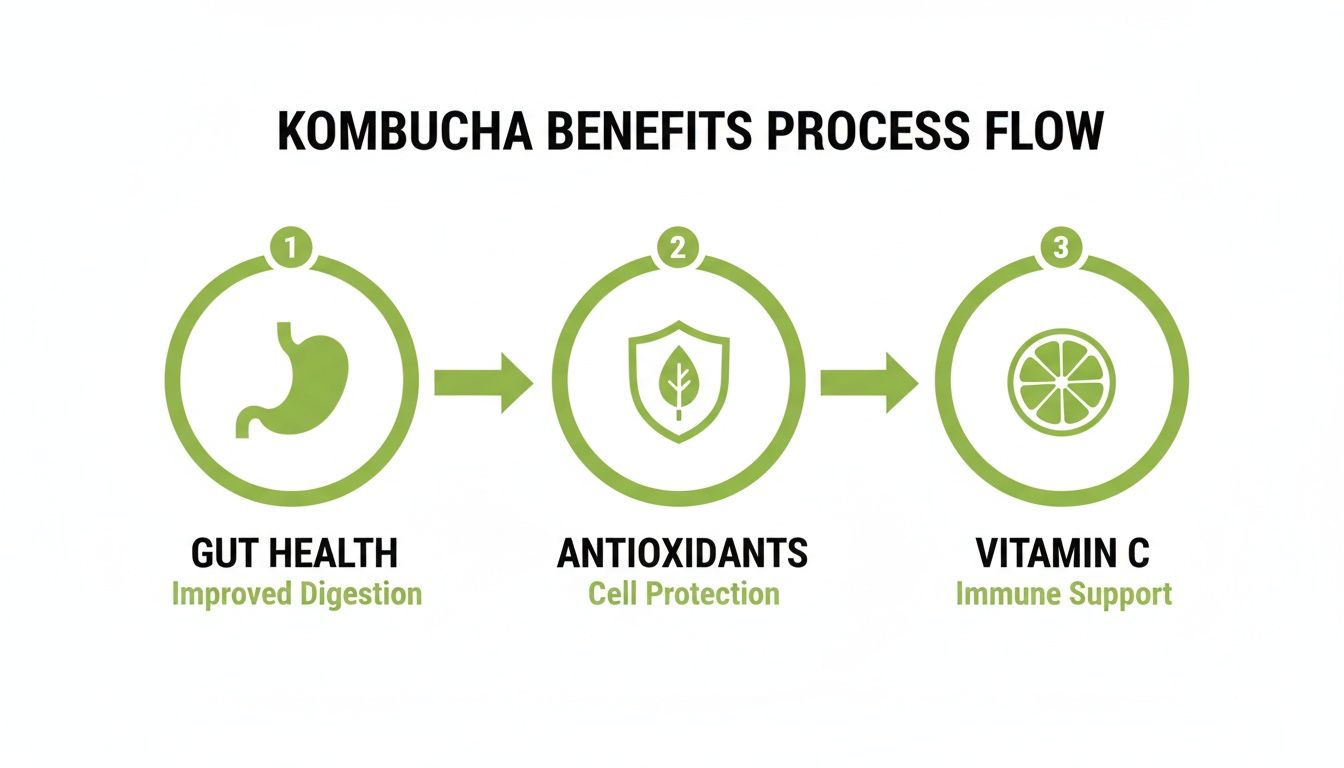
It’s a simple visual that shows how the combined elements in our passion fruit kombucha work together to support overall wellbeing. This commitment to real ingredients and an authentic, unhurried brewing method is what sets PepTea apart. It’s not a shortcut—it’s the right way to make a living drink that truly delivers.
Beyond the Bottle: How to Use Your Passion Fruit Kombucha
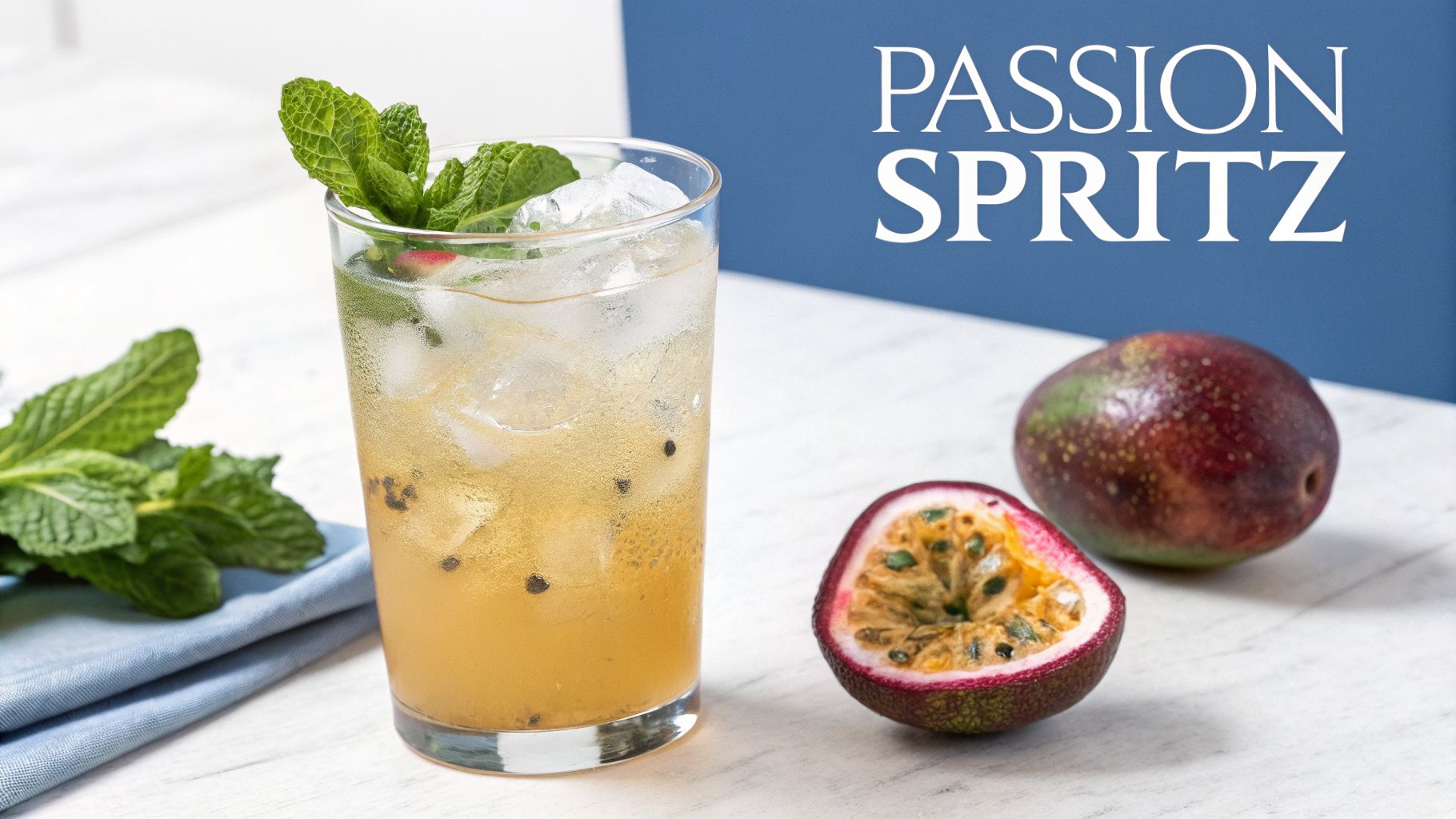
While our passion fruit kombucha is fantastic straight from the bottle, that's really just the beginning. Its true character—that balance of tropical tang and natural fizz—makes it an incredible starting point for all kinds of drinks and even a few surprising kitchen creations.
The simplest upgrade? Treat it like a proper drink. Pour it over a generous glass of ice, then add a sprig of fresh mint or a wedge of lime. It’s a small step that turns a daily wellness habit into a sophisticated ritual, perfect for a warm afternoon.
From Simple Sips to Café-Worthy Mocktails
One of the best things about our authentically brewed kombucha is its exceptionally clean finish and low sediment. This is no accident. It’s designed to be a brilliant mixer that doesn't cloud or fight with other ingredients, which is exactly why it’s found a home in so many Australian cafés and bars.
Since its rise, passion fruit kombucha has become a hospitality hero. Non-alcoholic beverage menus have grown by 48% in Australian cafés and bars, according to a 2026 industry survey. Our NSW-brewed organic kombucha is leading that charge, with our passion fruit flavour now accounting for 31% of all kombucha mixer sales in NSW venues this year. You can get a deeper insight into kombucha's journey in the beverage world and its origins as a living drink.
That professional-grade quality makes it incredibly easy to create impressive drinks at home. You can build a stunning non-alcoholic spritz, blend it into a vibrant smoothie, or even use its acidity as the base for a zesty salad dressing.
Simple Recipe: The Passion Spritz
For an instant crowd-pleaser, fill a tall glass with ice and a generous scoop of fresh passion fruit pulp. Squeeze in the juice of half a lime, top with a splash of sparkling water, and then pour over your PepTea passion fruit kombucha. A twist of lime to garnish, and you have a beautiful, bubbly mocktail that’s ready in seconds.
Get Creative in the Kitchen
To really get a feel for its versatility, it helps to start thinking of your kombucha as an ingredient. Its natural acidity and bright, tangy flavour make it a fantastic tool for cutting through richness in marinades or dressings. Here are a few ideas to get you started.
Zesty Vinaigrette: Whisk together ¼ cup of passion fruit kombucha, a tablespoon of good olive oil, a teaspoon of Dijon mustard, and a pinch of salt and pepper. It’s perfect for drizzling over a fresh garden salad, especially one with grilled chicken or prawns.
Smoothie Booster: Add a generous splash of kombucha to your morning smoothie. It pairs beautifully with mango, pineapple, and spinach for a probiotic and vitamin-packed start to your day.
Summer Popsicles: For a healthy, family-friendly treat, simply pour the kombucha into popsicle moulds with some diced fruit and freeze. The kids will love them.
Serving and Pairing Ideas
Here’s a quick-reference guide to help you get creative with your passion fruit kombucha, offering simple pairings for different occasions.
| Occasion | Serving Suggestion | Food Pairing |
|---|---|---|
| Afternoon Refresher | Poured over ice with a sprig of fresh mint. | Light snacks like rice paper rolls or a fresh fruit platter. |
| Weekend Brunch | Mixed into a Passion Spritz (see recipe above). | Smashed avocado on toast, or a goat's cheese and spinach tart. |
| Pre-Dinner Drink | Served neat in a champagne flute. | Salty nibbles like olives, salted nuts, or a cheese board. |
| Healthy Breakfast | As a liquid base for a tropical fruit smoothie. | A bowl of granola with yoghurt and berries. |
This table is just a starting point. The best way to discover what works is to experiment and see what you enjoy most.
Whether you’re looking for an effortless, refreshing drink or an innovative new idea for your café menu, our passion fruit kombucha offers a whole world of delicious possibilities.
How to Choose and Store High-Quality Kombucha
Walking down the kombucha aisle can feel like a test. With so many bottles claiming to be the real deal, how do you sort the genuinely healthy, living drinks from the impostors—the "cowboy kombuchas"?
It’s actually simpler than it looks. A few quick checks on the label are all it takes to make sure you’re bringing home something truly good for you.
First, look for two essential words: “raw” and “unpasteurised.” These are non-negotiable. They tell you the kombucha hasn't been heat-treated, which means the beneficial, living probiotics are still active. A pasteurised kombucha is really just a fancy, flavoured tea, not the functional beverage you're after.
What to Look for on the Ingredients List
Next, flip the bottle around. A quality passion fruit kombucha will have a refreshingly short and clean ingredients list: filtered water, organic tea, a SCOBY (or live cultures), and real, organic passion fruit.
Be sceptical of anything listing "natural flavours," "fruit concentrates," or extra sugars. These are often shortcuts used in mass-produced drinks that compromise the integrity of the brew.
At PepTea, we’re committed to authenticity. That means we only use certified organic ingredients, and our kombucha is genuinely sugar-free. We let the fermentation run its full course, allowing the SCOBY to consume the sugar naturally. What’s left is a pure, crisp taste without the sugary hit.
See a few cloudy wisps or a bit of sediment at the bottom? Don’t worry. That’s a great sign. Those are tiny strands of the SCOBY and yeast, proving your kombucha is raw, alive, and packed with the goodness you want. It’s the hallmark of an authentic brew.
Storing Your Kombucha to Keep it at Its Best
Once you’ve made your choice, proper storage is everything. The rule is simple: always keep your kombucha in the fridge.
Keeping it chilled is crucial for a few reasons:
- It Protects the Probiotics: The living cultures in raw kombucha are delicate. Cold temperatures keep them dormant and healthy, preserving their potency right up until you drink them.
- It Stops Over-Fermentation: If you leave a raw kombucha at room temperature, the fermentation will kick back into gear. This can create excess carbonation (think fizz explosions) and make the drink taste overly sour or vinegary.
- It Maintains Flavour: Refrigeration locks in that crisp, balanced flavour profile the brewer intended. It ensures every sip is as refreshing as the first.
By choosing a raw, organic, and genuinely low-sugar option and storing it correctly, you can be confident that you’re getting all the incredible flavour and wellness benefits your passion fruit kombucha has to offer.
Why Choose PepTea's Australian-Made Kombucha
Not all kombucha is created equal. When you look past the clever marketing, the difference often comes down to one simple thing: how it’s made, and who’s making it. At PepTea, we brew a kombucha that’s a world away from the mass-produced stuff, and it all starts with where we’re from.
We're a 100% Australian-owned family business, and every batch of our kombucha is brewed right here in the beautiful Hunter Valley, NSW. This isn't just a label on a bottle; it’s our guarantee of freshness and our connection to the local community. Choosing PepTea means you’re backing a family that’s genuinely passionate about making real, functional drinks.
Our Commitment to What's Real
Our approach is straightforward: real ingredients, real fermentation, and real health benefits. We don't cut corners. That’s why we insist on using only certified organic ingredients, from the premium green tea that forms our base to the real passion fruit pulp that gives our kombucha its authentic tropical character.
When you pick up a bottle of PepTea, you’re holding our promise. It’s our commitment to a genuinely sugar-free, probiotic-rich drink that’s raw, living, and unpasteurised. This is what sets us apart—a truly authentic kombucha, made with your wellbeing in mind.
This dedication to quality is visible in every part of our brand. For a company like PepTea, standing out requires that our values are clearly communicated, right down to our food and beverage printing needs to make sure our labels tell the full story.
Experience the PepTea Difference
Our traditional brewing process ensures our passion fruit kombucha is not just bursting with flavour but also genuinely packed with live, active cultures. We let our SCOBY do its thing, naturally fermenting away all the sugar to leave a crisp, clean refreshment you can feel good about.
Ready to taste what authentic kombucha is all about? We invite you to experience the vibrant, real flavour of a drink brewed with passion and purpose.
A Few Common Questions
Still have a few questions floating around about passion fruit kombucha? Let's clear them up. Here are the answers to some of the most common things we get asked.
Is Passion Fruit Kombucha Okay for a Low-Sugar Diet?
It absolutely can be, but you have to know what you’re looking for. Some brands will add sugar back in after fermentation for extra sweetness, but an authentically brewed kombucha like ours at PepTea is completely sugar-free.
We let our SCOBY do its job properly, allowing it to consume all the organic raw sugar during fermentation. This process is what creates the beneficial acids and probiotics, not a sweet, sugary drink. This makes our passion fruit kombucha a great choice for anyone watching their sugar intake. Always check the nutritional panel to be sure.
Does Passion Fruit Kombucha Contain Alcohol?
Because it’s a naturally fermented product, all kombucha contains trace amounts of alcohol—it's just a normal byproduct of the brewing process. The amount is tiny, typically less than 0.5% ABV.
That’s a similar level to what you might find in a very ripe piece of fruit or even a loaf of sourdough bread. In Australia, any drink with this little alcohol is legally classified as non-alcoholic.
Can I Drink Passion Fruit Kombucha Every Day?
For most people, yes. Having a daily serve of passion fruit kombucha is a fantastic way to support your gut health as part of a balanced diet.
If you’re new to fermented foods, though, we suggest starting with a smaller amount—maybe half a bottle. See how your body feels before you make it a daily habit.
What Are the Floating Bits in My Kombucha?
Those little cloudy strands you might see in the bottle are actually a great sign. They're tiny, harmless strands from the SCOBY or yeast culture, and they're proof that your kombucha is raw, living, and unpasteurised.
Think of them as a mark of authenticity. They're perfectly safe to drink and a real hallmark of a quality, craft-brewed kombucha.
Sometimes, a fermenting drink can attract fruit flies, especially for home brewers or cafés serving kombucha on tap. Learning what attracts fruit flies and how to stop them is a good way to keep your brewing environment clean.
Ready to taste what an authentic, Australian-made kombucha is all about? PepTea brews our entire range of organic, sugar-free kombucha with passion right here in the Hunter Valley.
A Guide to Making Apple Cider Vinegar Soda at Home

An apple cider vinegar soda is a remarkably simple, healthy swap for sugary soft drinks. It’s little more than raw apple cider vinegar (ACV) mixed with sparkling water, but this refreshing, gut-friendly drink is taking off across Australia as people look for functional beverages that deliver on both flavour and wellness.
The Rise of Healthier Homemade Sodas

The days of sugary soft drinks dominating the fridge are numbered. Health-conscious Aussies are actively searching for better-for-you alternatives that don't sacrifice flavour, and an apple cider vinegar soda fits the brief perfectly. It's a fantastic way to turn a pantry wellness staple into a delicious daily ritual.
The real beauty is in its simplicity and how well it aligns with modern health values. You’re just combining a few core ingredients—good quality ACV, sparkling water, and maybe a natural sweetener—to create something that feels like a treat but actually supports your health goals.
This isn't a surprise. It mirrors the huge shift towards functional drinks we’ve seen firsthand with our own PepTea organic kombucha. People want their drinks to do more than just quench thirst; they want real, tangible benefits.
Here's a quick look at the core components and a simple ratio to get you started on your first delicious apple cider vinegar soda.
Your First ACV Soda Quick Guide
| Component | Recommended Amount | Why It's Important |
|---|---|---|
| Raw Apple Cider Vinegar | 1-2 tablespoons | The hero ingredient. Choose an organic, unfiltered ACV "with the mother" for the most probiotic goodness and a robust flavour. |
| Sparkling Water | 250-350 ml | Provides the fizz and refreshing base. Plain sparkling or mineral water works best to let the ACV and other flavours shine. |
| Natural Sweetener | To taste (optional) | Balances the tartness of the vinegar. Monk fruit, stevia, or a dash of raw honey are great sugar-free or natural options. |
This table gives you a solid starting point. From here, you can start experimenting with different flavours and carbonation methods to find what you love.
A Shift in Australian Tastes
It's interesting to see how the rise of drinks like ACV soda is happening alongside a big change in the traditional cider market. While many Aussies love the crisp taste of apple-based drinks, there’s a noticeable move away from alcoholic options.
In fact, the Australian cider production industry has seen a real decline, which points to a shift where consumers are swapping boozy ciders for functional, non-alcoholic beverages. This has created the perfect opening for innovative drinks like apple cider vinegar soda to really shine.
This move toward mindful drinking is all about making conscious choices that support your wellbeing. Whether it’s enjoying a living, probiotic-rich kombucha or a homemade ACV soda, the goal is the same: to find joy in drinks that are both delicious and genuinely good for you. If you're curious about other gut-friendly options, our guide to kombucha as a natural and organic health drink is a great place to start.
Choosing the Right Ingredients for Your Soda
A great apple cider vinegar soda comes down to just three things, and getting them right is what separates a decent drink from a genuinely brilliant one. The quality of what you choose here dictates both the flavour and the health perks you're after.
The non-negotiable starting point is the apple cider vinegar itself. You need a bottle that is raw, unfiltered, and organic. Most importantly, it must contain "the mother".
That cloudy, stringy stuff you see at the bottom of the bottle? That’s the good stuff. It's a living culture of beneficial bacteria and enzymes from the fermentation process. This is what delivers the probiotic potential you want for supporting a healthy gut. If you use a filtered or pasteurised ACV, you’re missing the entire point.
Selecting Your Vinegar and Water
Sourcing high-quality ACV in Australia has become remarkably easy. As more people have embraced wellness, the demand for premium organic ACV has grown, and thankfully, that has made it more affordable for everyone. You can see how affordability has improved for consumers and get a sense of the market trends.
With your vinegar sorted, the next choice is your fizz. You have two solid options for the water base:
- Sparkling Mineral Water: This is a fantastic choice because it brings its own naturally occurring minerals, like calcium and magnesium. It adds a subtle depth of flavour and a small nutritional bonus to your soda.
- Soda Water: This is simply carbonated water. It provides a crisp, clean canvas, which really lets the flavour of your ACV and any other additions shine.
Honestly, both are excellent. It usually just comes down to what you prefer or happen to have in the fridge.
Sweetening the Smart Way
Finally, you’ll likely want something to balance the vinegar's sharp tang. At PepTea, we’re firm believers in avoiding refined sugar, and this is where natural, sugar-free sweeteners are perfect.
For a clean, healthy apple cider vinegar soda, stick to sweeteners that won’t spike your blood sugar. Options like liquid stevia or monk fruit drops are ideal because they are potent, dissolve easily in cold liquids, and have a neutral taste.
Making these choices ensures your soda is genuinely refreshing and aligns with your wellness goals, especially if you’re focusing on gut health. For a deeper dive into that topic, you might find our our guide to good gut health useful.
By being intentional with these three simple ingredients, you set yourself up to make the perfect, healthy soda every single time.
How to Make a Classic Apple Cider Vinegar Soda
Ready to make your first batch? An ACV soda is one of the simplest and most refreshing drinks you can make at home. It’s a fantastic way to work apple cider vinegar into your day without the harshness of taking it straight.
The secret is all in the balance and the order you add things. Get that right, and you have a genuinely delicious, healthy alternative to sugary soft drinks. We’ll walk you through a foolproof starting point, but the real fun begins when you start tweaking it to find the ratio that’s perfect for you.
The Classic Recipe
At its heart, this drink is just three things: a quality apple cider vinegar, chilled sparkling water, and maybe a touch of sugar-free sweetener. The whole process takes less than a minute and is designed to keep as much of that lovely fizz as possible.
Here's our go-to method for a single glass:
Start with the Vinegar: First, pour 1 to 2 tablespoons of raw, unfiltered apple cider vinegar into a tall glass. If you're new to the flavour, we’d suggest starting with just 1 tablespoon and seeing how you go. You can always add more next time.
Add Your Sweetener: If you want to cut through the vinegar's tang, now’s the time to add your sweetener. A few drops of liquid stevia or monk fruit are perfect because they dissolve instantly without needing a lot of stirring, which would kill the bubbles.
Top with Sparkling Water: Gently pour 250-300ml of chilled sparkling water into the glass. The trick is to pour it slowly down the side of the glass. This helps keep the carbonation intact.
Garnish and Serve: Give it one, very gentle stir. Add a good amount of ice, and maybe a thin slice of fresh apple or a twist of lemon peel for that café-style finish. Drink it straight away while the bubbles are at their most lively.
This simple flow of ingredients is all it takes to create a refreshing, healthy drink.

As you can see, it's a straightforward path from basic ingredients to a finished soda. The key is starting with the ACV, adding the sweetener, and then gently topping with sparkling water to preserve the fizz.
Finding Your Perfect Ratio
Think of that recipe as a starting point, not a rule. The best part of making ACV soda at home is the freedom to get it exactly how you like it.
Don't hesitate to experiment. If you find the vinegar taste too strong, simply use less ACV or add a little more sweetener. Conversely, if you love that zesty kick, feel free to add a bit more.
This is what makes ACV soda so brilliant. It's completely customisable and takes less time to whip up than boiling the kettle, making it an easy and enjoyable habit to stick with.
Creative Flavour Ideas to Elevate Your Soda

Alright, this is where the real fun begins. Once you’ve got the basic ACV soda down, you can start treating that glass like a blank canvas. The sharp, slightly sweet foundation is incredibly versatile, making it the perfect base for all kinds of flavour infusions.
This is your chance to get creative and craft something that feels truly special. The trick is to use fresh, good-quality ingredients and prepare them in a way that lets their natural oils and juices shine. It’s what turns a simple drink into something you’d be happy to find on a café menu.
Simple Infusions for Every Palate
Here are a few of our go-to combinations to get you started. They’re dead simple, take almost no effort, and pack a serious flavour punch. For each of these, you'll want to get the fresh ingredients ready in the glass before adding the ACV and sparkling water.
Zesty Refresher: Gently muddle a few fresh mint leaves with a slice of lime in the bottom of your glass. The key word here is gently—you’re just bruising the leaves to release their fragrant oils, not pulverising them into a bitter mess. Top it off with your ACV and sparkling water for an instant classic.
Warming Spice: Finely grate about a teaspoon of fresh ginger and drop it into your glass with a single cinnamon stick. The sharp heat from the ginger combined with the sweet spice of cinnamon creates a wonderfully warming and invigorating soda, perfect for a cooler afternoon.
Berry Boost: Take a small handful of fresh or frozen raspberries and gently press them against the side of the glass with the back of a spoon. Add a sprig of fresh rosemary. It might sound unusual, but its subtle, piney note is a surprisingly brilliant match for the tartness of the berries.
These simple methods are a fantastic way to introduce a bit of complexity and fresh, natural flavour into your daily soda habit.
Pro Tip: For an extra wellness kick, try adding a splash of your favourite kombucha. A shot of our PepTea Organic Ginger Kombucha, for instance, would be a perfect match for the Warming Spice variation, adding extra probiotics and a deeper, fermented complexity.
ACV Soda Flavour Pairing Inspiration
To help spark a few more ideas, have a look at this quick-reference table. Think about what’s in season and what flavours naturally complement each other.
| Primary Flavour | Complementary Herbs/Spices | Best Sweetener Pairing |
|---|---|---|
| Fresh Strawberries | Basil, Black Pepper | A few drops of monk fruit to enhance sweetness. |
| Sliced Cucumber | Dill, Mint | Often needs no sweetener, but a tiny bit of stevia works. |
| Orange Slices | Cloves, Star Anise | A dash of maple syrup (if not strictly sugar-free). |
| Peach Slices | Thyme, Lavender | Pairs well with the floral notes of raw honey. |
Exploring these pairings is all part of the fun of making your own healthy drinks. You might even find inspiration for creating your own unique blends, much like you would when building out a menu of delicious and fruity kombucha cocktails.
Don't be afraid to experiment with what’s fresh and available—the possibilities really are endless.
Serving Tips and Storage Best Practices
To really get the most out of your homemade apple cider vinegar soda, knowing how to serve and store it makes all the difference. This simple drink is at its absolute best when it's fresh, fizzy, and cold, so the number one rule is to drink it immediately after making it. The carbonation is lively and the flavours are crispest in those first few minutes.
But let’s be realistic—planning ahead is often a necessity, especially if you're prepping for a gathering or streamlining service for your café. The best approach here is to get your flavour base sorted in advance.
Prepping for Easy Serving
You can create a delicious and potent syrup base that's ready to go whenever you are. This is a genuine game-changer for busy households and commercial settings alike.
Simply combine your core flavour elements in a sealable glass jar or bottle:
- The Apple Cider Vinegar: Your standard 1-2 tablespoons per serving.
- Your Sweetener: Add your chosen sugar-free sweetener, like stevia or monk fruit.
- The Flavour Infusions: This is where you can add things like grated ginger, muddled berries, or fresh herbs.
Give this mixture a good shake and store it in the fridge. This concentrated flavour base will keep well for a few days, and the flavours will actually infuse more deeply over time. When you're ready for a drink, just pour a serving of the syrup into a glass with ice and top it with chilled sparkling water. It’s an efficient way to offer fresh, high-quality apple cider vinegar soda on demand.
For serving your homemade soda, especially on a warm Aussie day, you might be interested in practical tips on how to keep drinks cold without ice.
Responsible and Enjoyable Consumption
While ACV is a fantastic wellness ingredient, it's important to enjoy it responsibly. The natural acidity of vinegar can be harsh on tooth enamel over time. To minimise any potential damage, it’s a great idea to enjoy your soda with a meal.
A simple and effective habit is to drink your apple cider vinegar soda through a reusable straw. This helps the liquid bypass direct contact with your teeth, protecting your enamel while you enjoy your refreshing drink.
It’s also smart to always start with a smaller amount of ACV. Beginning with just one tablespoon (15ml) per glass allows your digestive system to get accustomed to it. You can slowly increase the amount as you see fit, listening to your body along the way.
This mindful approach ensures your experience with this healthy soda is always a positive one, turning it into a sustainable part of your daily wellness routine rather than a short-lived experiment.
Your Apple Cider Vinegar Soda Questions Answered
Once you start making your own apple cider vinegar soda, a few questions almost always come up. We’ve heard them all, so let’s get straight to the answers you need to feel confident about adding this fantastic drink to your routine.
Can I drink apple cider vinegar soda every day?
For most people, a daily ACV soda fits perfectly into a healthy lifestyle. It’s a brilliant way to stay hydrated while getting a dose of beneficial compounds.
The key is sticking to a sensible amount. We suggest a maximum of 1-2 tablespoons (15-30ml) of apple cider vinegar per day, always diluted. It’s also a good idea to have it with a meal. This not only may help with digestion but also protects your tooth enamel from the acid.
Like anything new, start small and listen to your body. See how you feel and adjust from there.
Will it help with weight management?
This is a really common question. When you swap out sugary soft drinks, juices, or even alcohol for a sugar-free ACV soda, you’re naturally cutting your daily calorie intake. That simple change can absolutely support weight management over time.
Some studies also suggest that acetic acid, the main component in ACV, may help increase feelings of fullness, which could lead to eating fewer calories throughout the day.
It's important to see this for what it is: a supportive tool, not a magic bullet. Real results always come from using it as one piece of a bigger puzzle that includes a balanced diet and an active lifestyle.
What is the difference between ACV Soda and Kombucha?
That’s an excellent question, especially since both are fantastic, gut-friendly drinks that we love. The main difference is in how they’re made and their complexity.
Kombucha: This is a living, fermented tea. It starts with a base of sweetened organic tea, which is then fermented by a SCOBY (Symbiotic Culture Of Bacteria and Yeast). This process, which we use for our own PepTea organic kombucha, creates a diverse culture of beneficial bacteria and yeasts, plus organic acids and enzymes.
ACV Soda: This is a simple, unfermented mix. You are just combining pre-fermented apple cider vinegar with sparkling water.
So, while the raw ACV in your soda does contain probiotics from "the mother," the drink itself isn't a living, fermented beverage in the same way kombucha is. They actually work beautifully together in a healthy beverage rotation!
Does the ACV need to have the Mother?
For the full range of health benefits, absolutely yes. "The mother" is that cloudy, web-like stuff you see floating in a bottle of good-quality, raw ACV. It’s a powerhouse of beneficial bacteria, yeasts, and enzymes created during the natural fermentation process.
Filtered or pasteurised apple cider vinegar has had "the mother" removed, and with it, most of its valuable probiotic properties. For the best flavour and the biggest wellness boost, always choose a raw, unfiltered, and organic ACV that still has "the mother" intact.
At PepTea, we are passionate about delicious, functional beverages that support your wellbeing. From our authentic, Australian-brewed kombucha to our premium organic Matcha, we believe in the power of quality ingredients. Explore our range and discover your new favourite healthy drink today.
Explore the PepTea range now