
Tag: sugar free kombucha
7 Healthy Breakfast Beverages to Start Your Day
What's the first thing you drink in the morning, and does it help you start the day well? For many Australians, it's coffee or plain water, but healthy breakfast beverages can do more than wake you up. They can support hydration, sit neatly alongside breakfast, and make it easier to choose foods that leave you feeling steady rather than flat an hour later. Breakfast also tends to contribute a meaningful share of daily energy intake, and beverages often play a noticeable role in that morning routine. If you want a smarter first sip, the best choices are usually simple, low in sugar, and easy to match with food.
This guide goes beyond generic suggestions and looks at specific drink types, because each one does a different job. Matcha can provide calm focus, kombucha can add fermented tang, smoothies can help with fullness, and other options offer hydration or probiotic variety without making breakfast feel heavy. For a practical Australian example, you can find premium matcha with Allied Drinks Systems, and Pep Tea's matcha and caffeine guide is useful if you want to compare it with your usual morning cup. The goal is simple. Choose a drink that fits your routine, tastes good, and supports the way you want to feel through the morning.
1. Organic Matcha Green Tea for Calm, Focused Energy
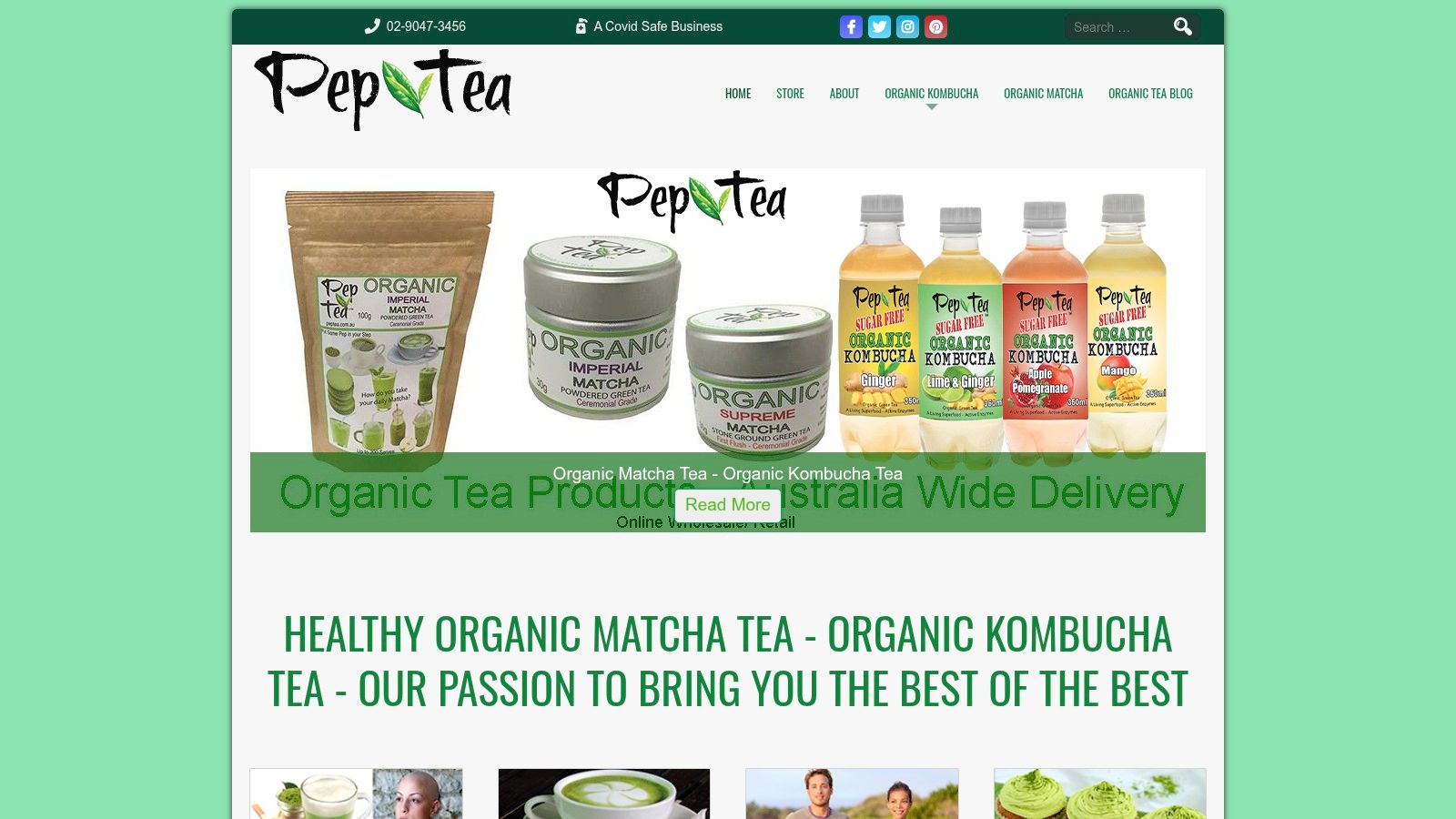
Matcha is a strong breakfast choice when you want energy without making your morning feel chaotic. It's a finely ground green tea powder, so you consume the whole leaf, not just an infusion. That's part of why premium matcha is so appealing for Australians who want a clean, functional start to the day.
A useful way to think about matcha is as a coffee alternative with a calmer edge. A peer-reviewed review of beverage guidance says caffeine intake should stay below 400 mg per day, and coffee or tea can fit well when you count any added milk or sugar (PMC review). For people who feel jittery after a long black, matcha is often easier to build into breakfast because it's usually taken with milk or water and doesn't need syrup to taste good.
How Aussies can use it in real life
Try it as a simple matcha latte, iced in summer or warm on cooler mornings. Pep Tea's guide on matcha and caffeine helps explain how it compares with a regular latte, which is handy if you're trying to manage your morning routine more deliberately (Pep Tea matcha caffeine guide).
Practical rule: if your breakfast drink needs three sugars to feel enjoyable, it's probably not doing your morning any favours.
For a quality option, Pep Tea's organic Japanese ceremonial-grade and culinary-grade matcha fits the kind of low-sugar, wellness-led breakfast habit many Australians are looking for. If you want a premium supplier outside the cafe cup, you can also find premium matcha with Allied Drinks Systems.
2. Sugar-Free Kombucha for Gut Health
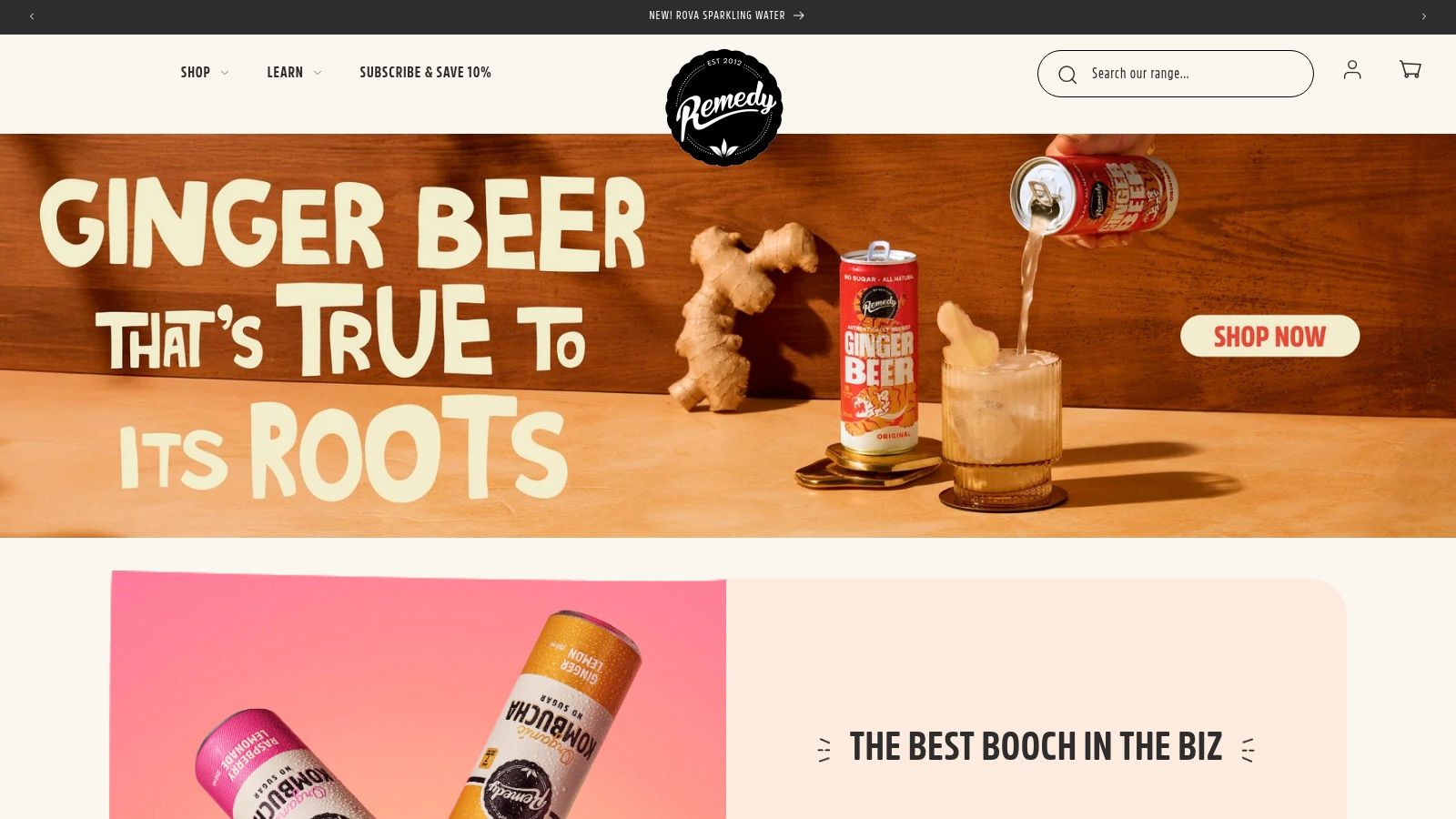
Kombucha suits breakfast when you want something crisp, lightly tangy, and not too sweet. Its fermented tea base gives it a more purposeful feel than a soft drink or juice, which is part of why it has found a place in the broader move toward drinks with clear functional benefits. Market research on gut-health beverages points to steady consumer interest in probiotics and fermentation, and that helps explain why kombucha keeps showing up in morning routines (GMI gut health beverages market).
That interest is not just about flavour. People often choose kombucha because they want a drink that feels lighter than a sugary breakfast beverage and still offers a bit of complexity. The fizz gives it the same kind of wake-up effect you get from sparkling water, but the tea base and fermentation make it feel more layered.
Why sugar-free matters
Sugar control is the part that matters most here. A randomised trial in overweight and obese adults found glucose area-under-the-curve was higher for sugar-sweetened coffee than for water, reduced-energy orange juice, or low-fat milk, and the authors concluded that the lower-sugar options may be better for glucose control (PubMed trial). Kombucha is not a treatment, but the message is clear, the morning drink you choose can shape how much sugar you start the day with.
That is why a sugar-free organic kombucha can fit so neatly into a lower-sugar breakfast habit. Pep Tea's version, brewed in the Hunter Valley, NSW, gives you the tang and fizz without turning breakfast into a sugar hit. For a broader look at fermented drink options and how they fit into a healthy routine, Pep Tea's healthy probiotic drinks guide is a useful place to start.
If you like pairing breakfast drinks with a simple recipe idea, AloeCure's refreshing smoothie guide shows how a fresh, fruit-led drink can stay light while still feeling satisfying.
3. Protein-Rich Smoothies for Satiety

Some mornings need more than a drink. They need a drinkable breakfast that keeps you going until lunch. That's where a protein-rich smoothie earns its place, especially if you're heading to work, school drop-off, or the gym and don't have time for a full sit-down meal.
The key is balance. Australian breakfast guidance emphasises protein, fibre, and healthy fats, and advises pairing drinks with foods like yogurt, nuts, eggs, or whole grains rather than relying on juice or sweetened beverages alone (Alberta Health Services breakfast guide). A smoothie can fit that pattern if you build it around Greek yogurt, milk, soy milk, nut butter, chia seeds, or oats.
A simple make-at-home formula
- Start with protein: Use Greek yogurt, milk, soy milk, or a protein powder you already trust.
- Add fibre: Choose berries, oats, chia seeds, or spinach.
- Include healthy fat: Avocado, nut butter, or seeds help slow digestion.
- Keep sweetness in check: Use fruit for flavour before reaching for honey or syrups.
A good example is a berry smoothie with yogurt, chia, and milk, which feels more like breakfast than a sugary drink. If you want ideas for texture and flavour, AloeCure's smoothie guide shows how a smoothie can be turned into a satisfying morning option.
4. Nutrient-Dense Green Juice for a Vitamin Boost

Green juice has a clear place in the breakfast lineup, but it helps to be honest about what it is and what it isn't. It's a light, hydrating, vegetable-forward drink, not a full breakfast replacement. That makes it a sensible choice for people who want something fresh first thing in the morning, especially if they're planning to eat proper food soon after.
Because it's strained, green juice doesn't give you the same fullness as a smoothie. That matters in the Australian context, where balanced breakfast guidance keeps coming back to whole foods, protein, and fibre rather than liquids alone (BDA healthy breakfast guidance). If you drink green juice on its own, think of it as a supplement to breakfast, not breakfast itself.
Green juice works best when it complements a real meal. If you're still hungry an hour later, that's not a failure of the juice, it's a sign you needed more substance.
A practical version might include cucumber, spinach, celery, lemon, and a little green apple for taste. That gives you a bright morning drink without leaning too hard on sweetness. If you're in a cafe or grocery setting, it's also a good menu item for people who want something lighter than a smoothie but more interesting than plain water.
For Australian buyers, the most useful green juices are the ones with a short ingredient list and no added sugar. Keep it crisp, keep it clean, and pair it with breakfast, not instead of it.
5. Cultured Kefir for Probiotic Diversity
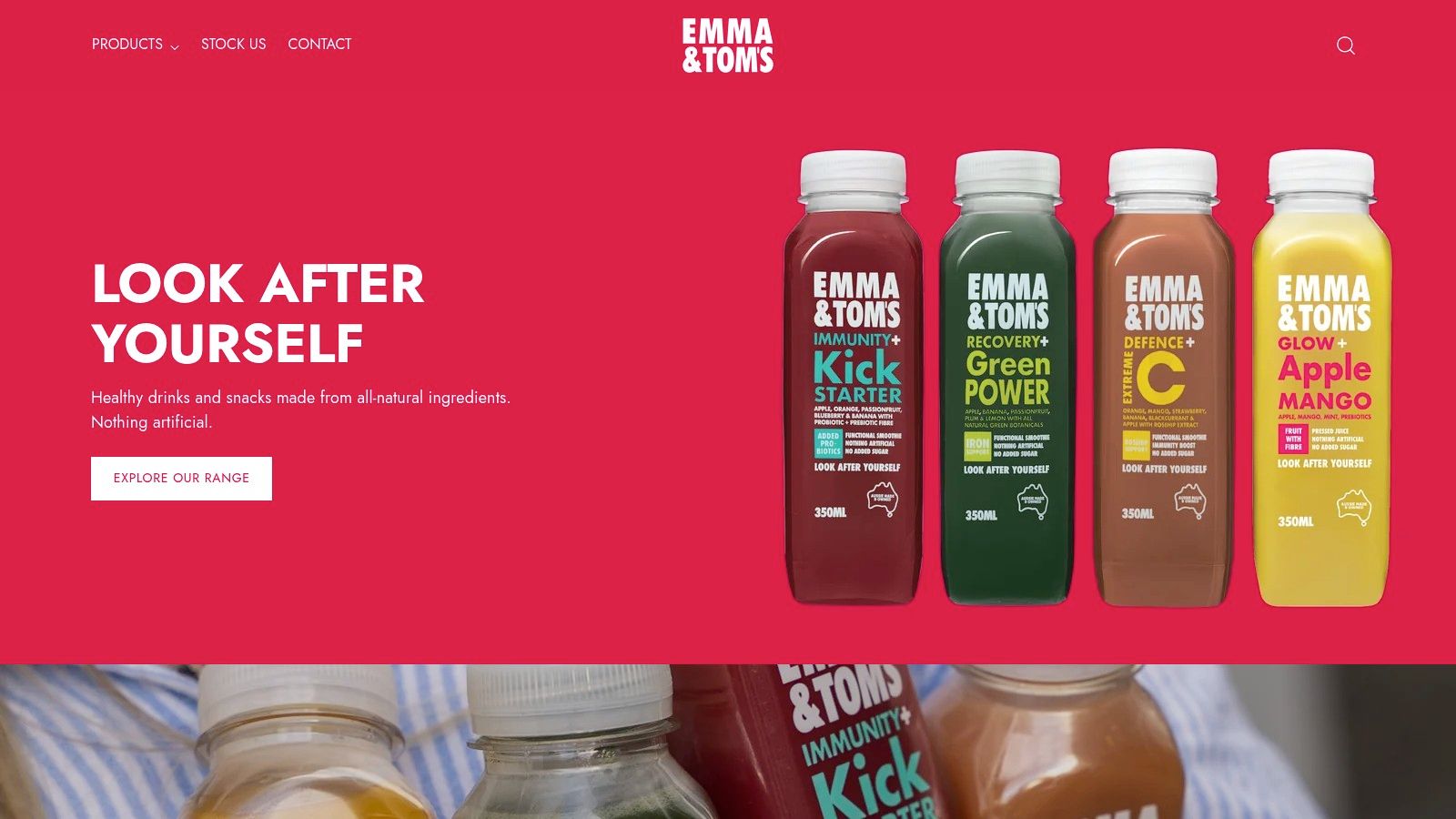
Kefir is one of those breakfast beverages that feels old-school in the best way. It's tangy, cultured, and easy to fit into ordinary routines, which makes it a practical choice for people who want a fermented dairy option with more character than plain milk. If you already eat muesli, oats, or fruit in the morning, kefir can sit alongside them without asking you to change your whole routine.
It also fits the growing interest in foods that do more than just taste nice. Fermented dairy drinks are often chosen for their live cultures and their place in a functional breakfast, and kefir suits that pattern without needing much fuss. That makes it a good option for people who want a drink with a job to do, not just something cold in a glass.
Easy ways to drink it
- Straight from the bottle: A small glass on its own is the simplest option.
- Blended into smoothies: Kefir adds tang and creaminess without much effort.
- Over muesli or oats: It turns breakfast into something richer and more filling.
If you want to make your own cultured drinks, Pep Tea's kefir grains Australia page is a useful place to start. For many households, that can turn kefir from an occasional fridge buy into a regular morning habit.
6. Hot Water with Lemon and Ginger for Gentle Hydration
Need a breakfast drink that feels light, warm, and easy to sip? Hot water with lemon and ginger keeps things simple. It is caffeine-free, gentle on the morning routine, and useful when you wake up feeling flat, have a sensitive stomach, or just want something mild before food.
The appeal is plain, it starts the day with fluid first. That matters because a glass of warm water can be easier to manage than a strong drink first thing, especially if your stomach likes a softer start. For readers comparing dairy free options for Queensland food, this kind of mug also fits neatly into a broader morning routine without adding milk, sugar, or extra richness.
A very simple morning mug
Use hot water, a squeeze of lemon, and a few slices of fresh ginger. Let it sit for a few minutes so the ginger can infuse, then sip it slowly while breakfast is cooking or after your first shower.
The flavour should stay light, not sharp. If you want a little more ginger warmth, add another thin slice next time rather than overloading the mug at the start. That way the drink stays easy to drink and keeps its calm, clearing feeling.
This isn't a meal replacement, and it should not be treated like one. It works more like a gentle bridge between sleep and breakfast, especially for mornings that begin badly with strong coffee on an empty stomach. A few days a week is enough to see whether this simpler habit suits you.
7. Golden Milk for a Cosy, Caffeine-Free Start
Golden milk works well when you want something warm, mild, and comforting without reaching for caffeine. It is usually made with milk and turmeric, then rounded out with ginger, cinnamon, or both. For Australian mornings, it suits a slower start, especially on cooler days when a café-style drink feels nicer than a plain glass of water.
Its appeal is partly about habit. Many people want a morning cup that feels soothing, but not sugary, and golden milk fills that role neatly. A homemade version made with unsweetened milk keeps the drink in breakfast territory rather than dessert territory, and the Harvard Nutrition Source notes the value of limiting added sugar, cream, and whole milk if weight management is a goal (Harvard Nutrition Source).
Build it cleanly
Use dairy milk or a plant milk, then stir in turmeric, a pinch of cinnamon, and a little ginger. If you want to match the needs of different households, there are plenty of dairy free options for Queensland food that work well here too. Some people add black pepper for flavour, but the point is to make a warm mug that feels balanced before the day gets busy.
Golden milk also works like a bridge between waking up and eating breakfast. It can take the edge off a rushed morning, but it should still sit alongside real food rather than replace it. Oats, toast, eggs, or fruit make a better match than treating the drink as a full meal by itself.
7-Point Comparison of Healthy Breakfast Beverages
| Beverage | Implementation Complexity 🔄 | Resource Requirements ⚡ | Expected Outcomes 📊 / ⭐ | Ideal Use Cases 💡 | Key Advantages ⭐ |
|---|---|---|---|---|---|
| Organic Matcha Green Tea for Calm, Focused Energy | 🔄🔄 Moderate, sift & whisk (ceremonial prep) | ⚡⚡ Low, matcha, hot water, whisk | Sustained calm alertness; antioxidant support, ⭐⭐⭐⭐ | Morning focus, coffee alternative, productive work sessions | L-theanine + caffeine balance; high antioxidants |
| Sugar-Free Kombucha for Gut Health | 🔄 Low, ready-to-drink or simple home brew | ⚡⚡ Low–Medium, bottled or SCOBY for brewing | Supports gut microbiome and digestion, ⭐⭐⭐ | Gut-support routine, refreshing low-sugar alternative | Live probiotics and organic acids; low sugar |
| Protein-Rich Smoothies for Satiety | 🔄🔄 Low, blend ingredients | ⚡⚡ Medium, blender, protein powder, perishables | High satiety; balanced macros and nutrients, ⭐⭐⭐⭐ | Breakfast replacement, post-workout, on-the-go meal | Keeps you full; customizable macronutrients |
| Nutrient-Dense Green Juice for a Vitamin Boost | 🔄🔄 Low–Medium, juicer or blending + strain | ⚡⚡ Medium, fresh produce, juicer/blender | Rapid micronutrient delivery; low fiber, ⭐⭐⭐ | Quick vitamin surge, hydration, light-calorie days | Concentrated vitamins and hydration |
| Cultured Kefir for Probiotic Diversity | 🔄 Low, drink straight or use in recipes | ⚡⚡ Low–Medium, store-bought or ferment at home | Broad probiotic diversity; calcium & protein, ⭐⭐⭐⭐ | Gut diversity, smoothie base, cereal topping | Wide range of probiotic strains; versatile use |
| Hot Water with Lemon & Ginger for Gentle Hydration | 🔄 Very low, steep slices in hot water | ⚡⚡⚡ Minimal, lemon, ginger, hot water | Gentle hydration; aids digestion; zero calories, ⭐⭐⭐ | Very gentle mornings, caffeine-free start, digestion prep | Extremely simple, comforting, low-cost |
| Golden Milk (Turmeric Latte) for Anti-Inflammatory Support | 🔄🔄 Low, warm and whisk spices into milk | ⚡⚡ Low, turmeric, milk (or substitute), spices | Anti-inflammatory support; warming ritual, ⭐⭐⭐ | Cozy caffeine-free mornings, anti-inflammatory routine | Curcumin benefits; comforting and nourishing |
Your Perfect Morning Beverage Awaits
A healthy breakfast beverage does not need to be complicated to be useful. The right choice can support hydration, help you keep sugar in check, and make the first part of your day feel more deliberate, whether that means the steady lift of matcha, the tang of kombucha, or a plain cup of hot water with lemon and ginger. The key is to pick a drink that fits your body, your schedule, and the breakfast you plan to eat.
Simple drinks are often the easiest to keep. Familiar options that are lower in sugar and easy to repeat tend to fit better into a morning routine, and health-minded buyers are increasingly looking for drinks with functional benefits and cleaner ingredient lists. That suits a practical Australian approach, where the beverage should support breakfast, not crowd it out.
Start with one small change if you want to improve your morning routine. Swap one sugary drink for a lower-sugar option, add protein to a smoothie, or choose a warm caffeine-free drink a few times a week. Over time, the drink you reach for first can become one of the easiest healthy habits in your day.
Pep Tea offers organic Japanese matcha and Australian-brewed sugar-free kombucha that fit neatly into that kind of routine. They give you a straightforward way to keep your morning drink honest, functional, and easy to enjoy.
Green Tea Australia Brands a Shopper’s Guide for 2026

You're probably here because you've stood in front of a supermarket shelf, opened five browser tabs, and realised that “green tea” in Australia can mean very different things. One box says organic. Another says matcha. Another looks healthy but is packed like a soft drink. Then there are imported tins, local blends, tea bags, loose leaf, sparkling cans, probiotic bottles, and labels full of wellness language that don't always tell you much.
That confusion makes sense. The Australian green tea aisle has become more crowded, and shoppers are paying closer attention because they want drinks that feel lighter, cleaner, and more purposeful. Interest isn't niche anymore. In Australia, the organic green tea market reached a retail value between AUD 180 million and AUD 250 million in 2025, with health-conscious consumers driving a significant portion of demand, according to IndexBox's Australia organic green tea market analysis.
A good guide to Green Tea Australia brands shouldn't just hand you a list of names. It should help you recognise quality markers, understand what type of green tea suits your day, and know when a label is saying something meaningful versus sounding impressive.
Navigating the World of Australian Green Tea
A lot of Australians start with the same assumption. Green tea is green tea, so choosing one brand should be simple.
Then the practical choices show up.
You might buy tea bags for convenience, then notice a bright tin of Japanese matcha beside them. A café menu offers a matcha latte. The fridge section has kombucha made from green tea. A wellness shop stocks loose-leaf sencha and premium powders with very different prices. Suddenly you're not comparing one product type. You're comparing several categories that all sit under the same broad umbrella.
Why the category feels crowded
Part of the confusion comes from the fact that these products solve different problems.
- Tea bags suit quick weekday brewing.
- Loose-leaf green tea suits people who care about flavour and ritual.
- Matcha appeals to anyone chasing a more concentrated, versatile green tea experience.
- Kombucha attracts drinkers who want something cold, lively, and a bit more social.
That's why brand lists alone often fall short. A “best brands” roundup can lump very different products together without explaining what you are purchasing.
Green tea isn't one single shopping decision. It's a category of formats, origins, and processing styles.
Start with your real goal
Before you compare labels, ask a simpler question. What do you want this green tea to do in your life?
Maybe you want a calm morning drink instead of another coffee. Maybe you want a low-sugar fridge staple. Maybe you're after a ceremonial matcha for whisking, or a culinary powder for smoothies and baking. Some shoppers want local brewing and traceable production. Others care most about organic certification and clean ingredients.
Once you know your goal, the shelf makes more sense. You stop asking, “Which brand is best?” and start asking better questions.
- Is this for sipping hot or cold?
- Do I want convenience or a ritual?
- Am I paying for better leaf quality, better processing, or just better packaging?
- Is the “organic” claim supported?
Those questions turn a confusing category into an organised one.
How to Read a Green Tea Label Like an Expert
A strong green tea label should help you trust the product. If it leaves you guessing, that's already useful information.
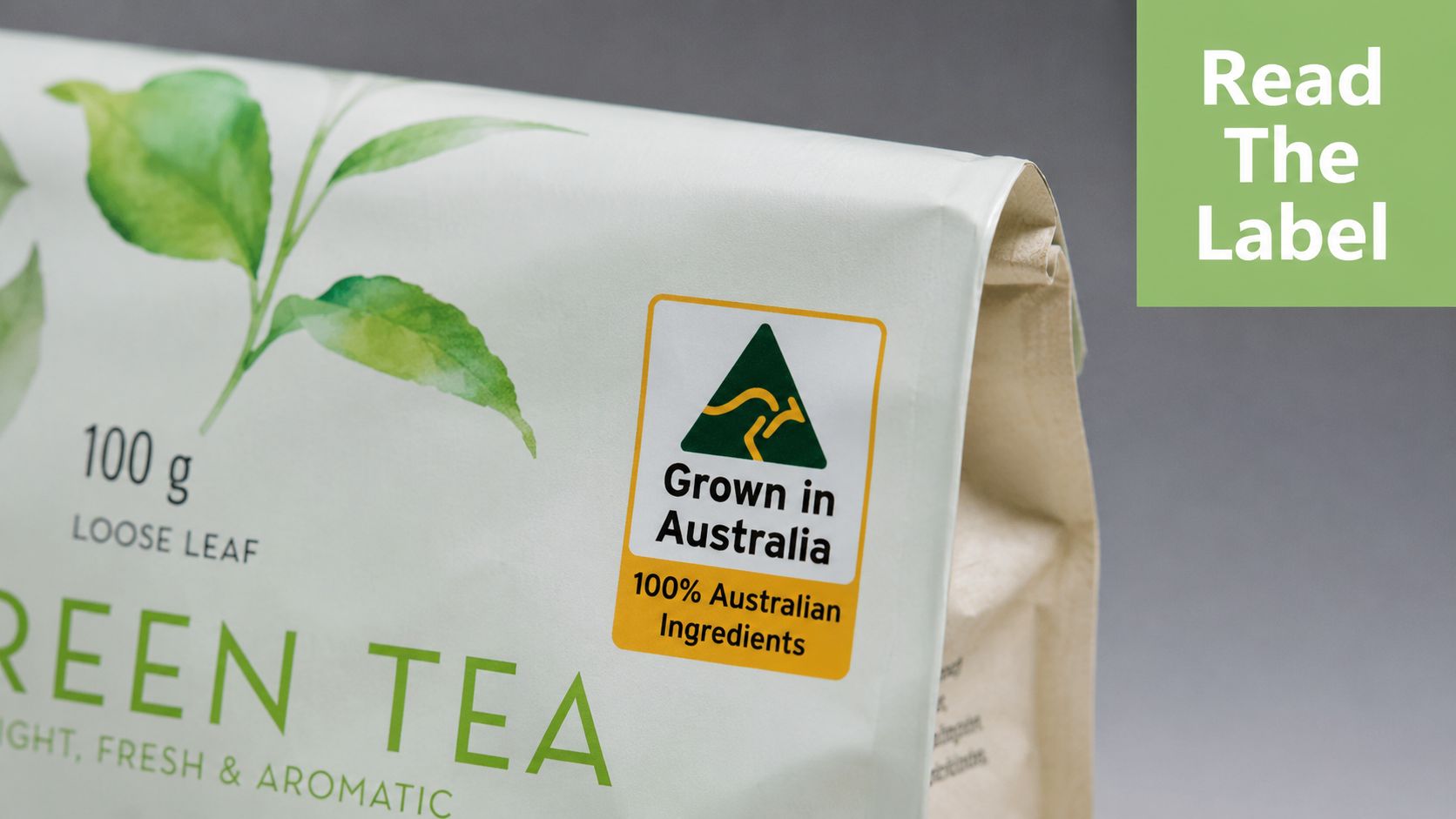
Check the certification first
The word organic gets used loosely. That's one of the biggest traps in this category.
Consumers are often misled by brands using “organic” without third-party validation, and shoppers should look for recognised certification marks such as ACCOA, as noted in this discussion of organic certification literacy in Australia. If the front of pack says organic but the label gives you no certifier, no mark, and no traceable standard, pause before you buy.
A quick way to build confidence is to learn what recognised standards look like and what they cover. A practical starting point is this guide to organic certification standards, which helps decode what a certification is meant to signal.
Look for origin, not just branding
A polished brand name doesn't tell you where the tea comes from. Origin matters because it often shapes flavour, processing style, and buyer expectations.
If a product is Japanese green tea or Japanese matcha, the label should make that clear. If it's Australian grown, that should also be visible and specific. “Packed in Australia” is not the same thing as “grown in Australia”. Shoppers often miss that distinction.
Here's a useful way to read that part of the pack:
Find the country of origin
Don't stop at the front label. Check the side or back panel.Notice whether the tea is grown, packed, blended, or brewed locally
Those are different claims.See if the origin matches the product type
For example, many premium matcha products highlight Japanese sourcing because that's central to the style and processing.
Scan for processing clues
Processing changes the final cup more than many people realise.
A tea bag often contains finely cut leaf for speed and consistency. Loose-leaf tea tends to show more of the leaf itself. Matcha is powdered whole leaf. Kombucha is brewed and fermented. Each format needs a different label lens.
Look for clues such as:
Leaf form
Whole leaf, loose leaf, powder, or brewed beverage.Intended use
Drinking straight, lattes, recipes, or ready-to-drink refreshment.Storage guidance
This can hint at freshness sensitivity, especially with powdered green tea.
Practical rule: If a pack makes a premium claim, it should also give you premium detail.
Know what vague language sounds like
Some wording looks reassuring but says very little.
“Natural”, “clean”, “premium”, and “wellness” aren't useless words, but they aren't proof of quality on their own. Treat them as supporting language, not deciding factors. The details that count are the certifier, origin, ingredients, and processing information.
That's when Green Tea Australia brands become easier to sort. You stop buying the prettiest pack and start buying the clearest one.
The Four Faces of Green Tea in Australia
Not every green tea belongs in the same routine. The easiest way to cut through the noise is to separate the category into its main formats and compare them by use.
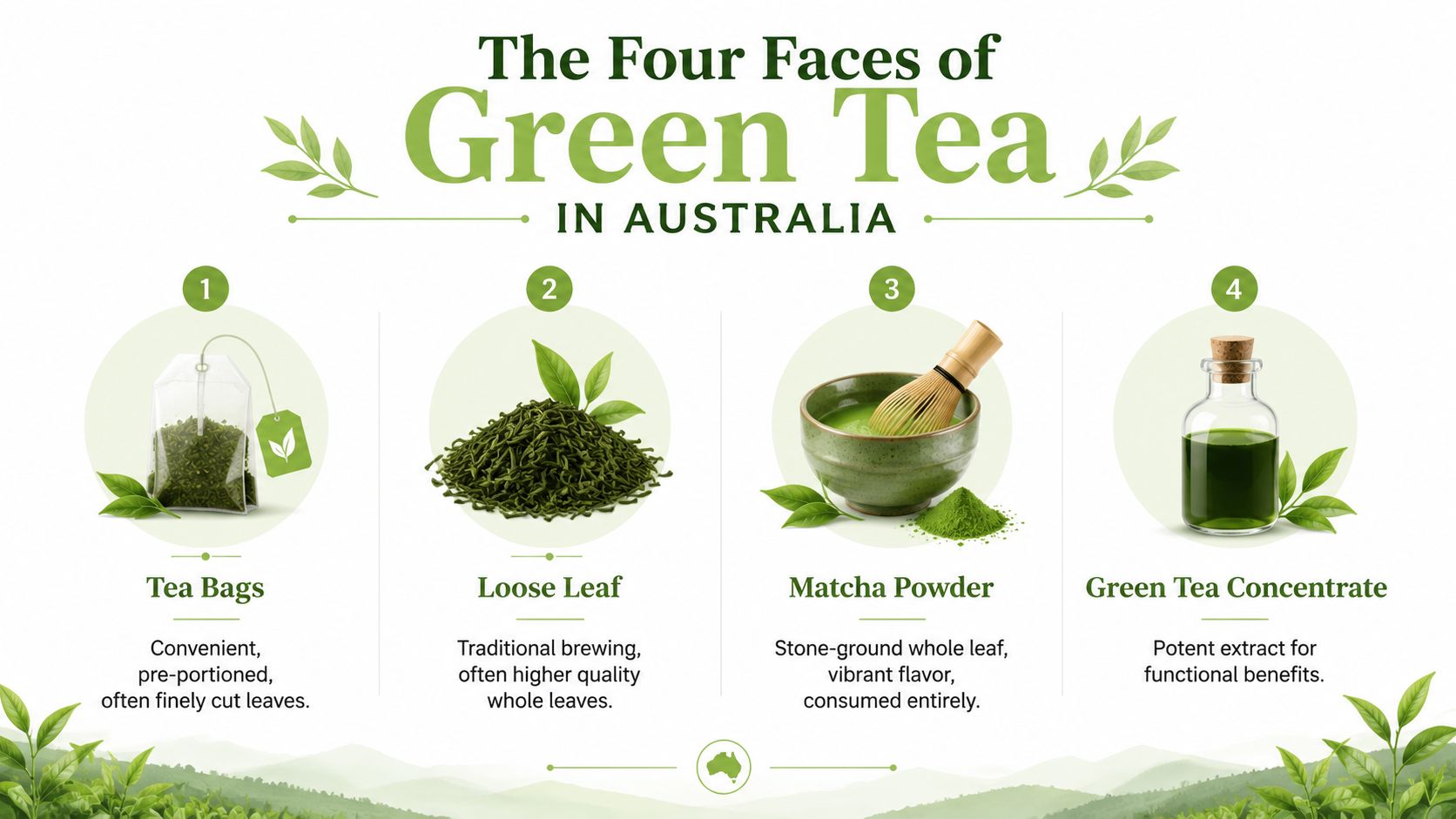
Convenience still drives a lot of buying. In Australia, green tea bags hold a 45.9% market share in 2025, while premium varieties like matcha are seeing rapid adoption because of their antioxidant appeal and versatility in drinks and recipes, according to IMARC's Australia green tea market overview.
Tea bags
Tea bags are the familiar entry point. They're easy, portable, and forgiving.
They suit office kitchens, rushed mornings, and anyone who wants a quick cup without measuring or equipment. The trade-off is that the experience can be simpler in flavour and less expressive than whole-leaf formats.
Loose-leaf green tea
Loose leaf asks for a bit more attention, but it often rewards you with a more nuanced cup.
You can usually see the leaf, adjust the strength, and pay attention to aroma in a way that tea bags don't always allow. It's a good fit if you enjoy the brewing ritual and want your daily tea to feel more intentional.
Matcha powder
Matcha changes the equation because you consume the powdered leaf rather than steeping and discarding it.
That's one reason people see it differently from a standard brewed green tea. It also moves well across routines. Some drink it whisked with water, others build lattes, smoothies, iced drinks, or baking recipes around it.
If you want green tea as both a drink and an ingredient, matcha opens more doors than bags or loose leaf.
Kombucha made from green tea
Kombucha belongs to the same conversation, but it solves a different need.
It's for people who want a chilled, fermented, ready-to-drink option with more lift and personality than plain water. It can work as an alcohol alternative, an afternoon fridge drink, or a café menu option that feels adult without being heavy.
Green Tea Forms at a Glance
| Format | Preparation | Key Benefit | Best For |
|---|---|---|---|
| Tea bags | Steep in hot water | Convenience | Busy mornings, work, travel |
| Loose leaf | Brew with infuser or pot | Better flavour control | Tea drinkers who enjoy ritual |
| Matcha | Whisk powder with water or milk | Whole-leaf versatility | Lattes, focused mornings, recipes |
| Kombucha | Ready to drink cold | Fermented, refreshing format | Gut-friendly routines, alcohol-free swaps |
How to choose the right one for your day
A helpful way to shop is to stop thinking in terms of “best” and think in terms of “best fit”.
For speed
Tea bags are hard to beat.For flavour exploration
Loose leaf gives you more to notice.For a wellness ritual with culinary flexibility
Matcha makes the strongest case.For a fridge staple
Kombucha offers convenience with a more social feel.
Some households keep more than one format on hand. That isn't indecisive. It's practical. A weekday desk drawer and a Sunday morning kitchen bench don't need the same thing.
Why categories matter more than brand popularity
Shoppers often search for Green Tea Australia brands as if every product competes on one shared scale. It doesn't work that way.
A strong tea bag brand may not be the best matcha source. A beautiful matcha label may tell you nothing about kombucha quality. A local brand may be excellent at brewing beverages but not focused on loose leaf at all.
Once you separate the category into formats, comparing brands gets much cleaner. You compare tea bags with tea bags, matcha with matcha, and kombucha with kombucha. That's when quality markers start to stand out.
A Deeper Dive into Matcha's Magic
Matcha is one of the few drinks that can feel both grounding and energising at the same time. That's why people often try it once out of curiosity, then keep coming back for the effect as much as the flavour.
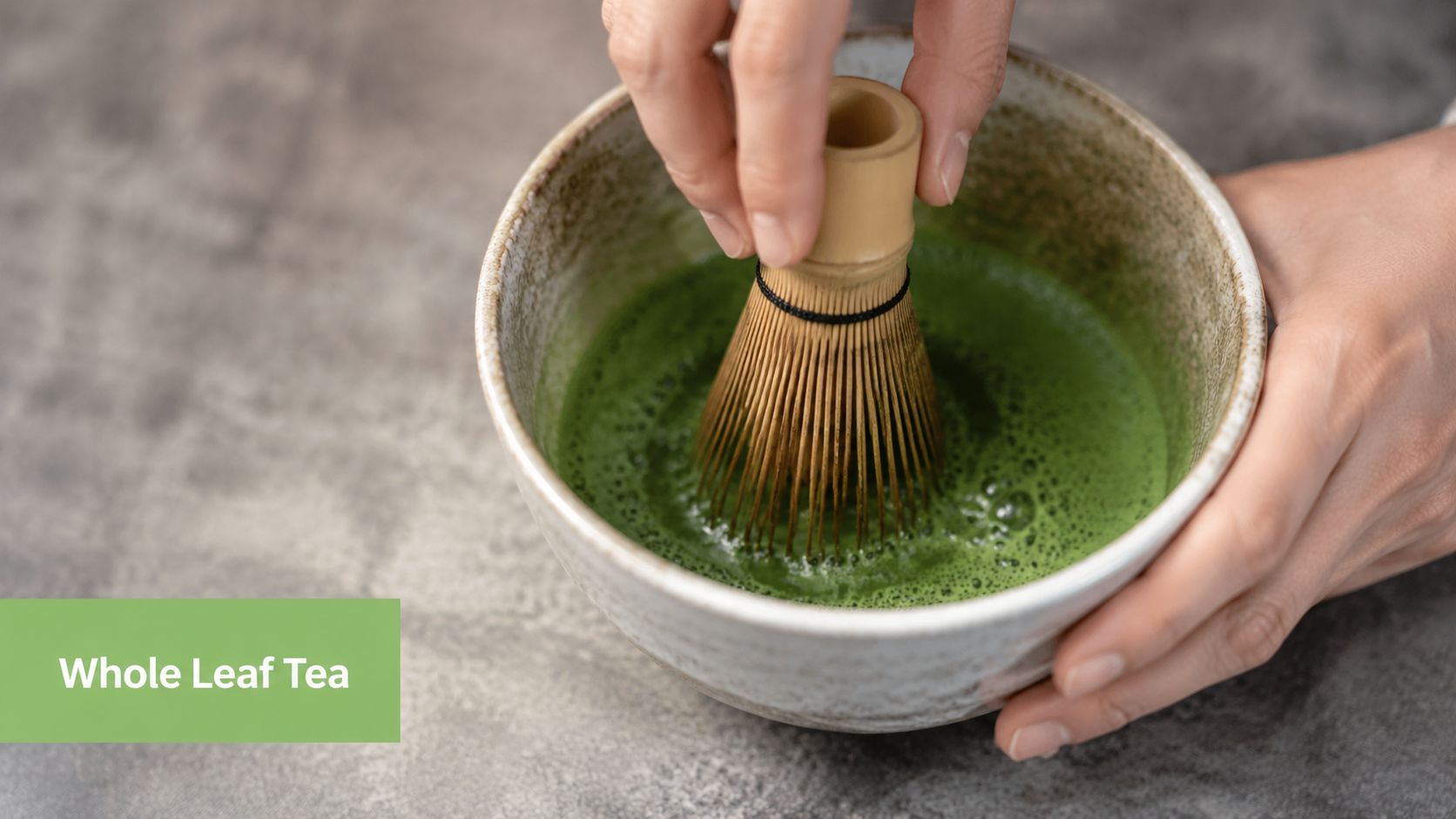
Why matcha feels different
The biggest shift is simple. You're not just infusing water with leaves. You're consuming the powdered leaf itself.
That changes how people use it and how they talk about quality. Colour, texture, aroma, and smoothness matter a lot. A vibrant green powder with a fine texture usually signals more care in cultivation and processing than a dull, khaki-looking powder that tastes flat or harsh.
Shade-grown ceremonial-grade matcha contains higher levels of L-theanine, which moderates caffeine absorption and can produce a sense of calm focus without the sharper spike and crash people often associate with other stimulants, according to this matcha quality and comparison guide.
Ceremonial and culinary in plain English
These labels confuse plenty of shoppers because they sound formal and absolute. In practice, they're more useful as buying cues than fixed rules.
Ceremonial matcha
Best suited to whisking with water when you want the powder itself to shine.Culinary matcha
Better suited to lattes, smoothies, baking, desserts, and recipes where matcha shares the stage with other ingredients.
If you want help choosing between them, this breakdown of different grades of matcha is a practical reference.
What to look for in a good tin or pouch
A shopper doesn't need to be a tea master to make a smart choice. A few sensory checks go a long way.
Colour matters
Look for a lively green rather than a brownish or yellowed powder.Texture tells a story
A fine, soft powder tends to whisk more smoothly.Smell is part of quality
Fresh matcha should smell alive, not stale.Use case should match the label
Don't pay for a premium drinking powder if you only want it for banana bread or protein smoothies.
A quick visual guide can help if you're learning the whisking basics:
Good matcha should make sense on the palate and on the label. If the flavour, colour, and product description don't line up, keep looking.
A simple way to use it daily
Try one teaspoon sifted into a bowl, add a small amount of hot water that isn't boiling, then whisk until frothy. From there, you can drink it straight or pour it over warm or iced milk for a latte.
That flexibility is a big part of matcha's appeal. It isn't locked into one ritual. It can be traditional at 7 am and playful by 3 pm.
Understanding Real Australian Kombucha
Kombucha often gets treated like a trendy flavoured drink with a healthy halo. That misses the point.
Real kombucha starts with tea, live cultures, and fermentation. The result should taste alive, not just sweet and fizzy. When shoppers realise that, they start reading kombucha labels very differently.
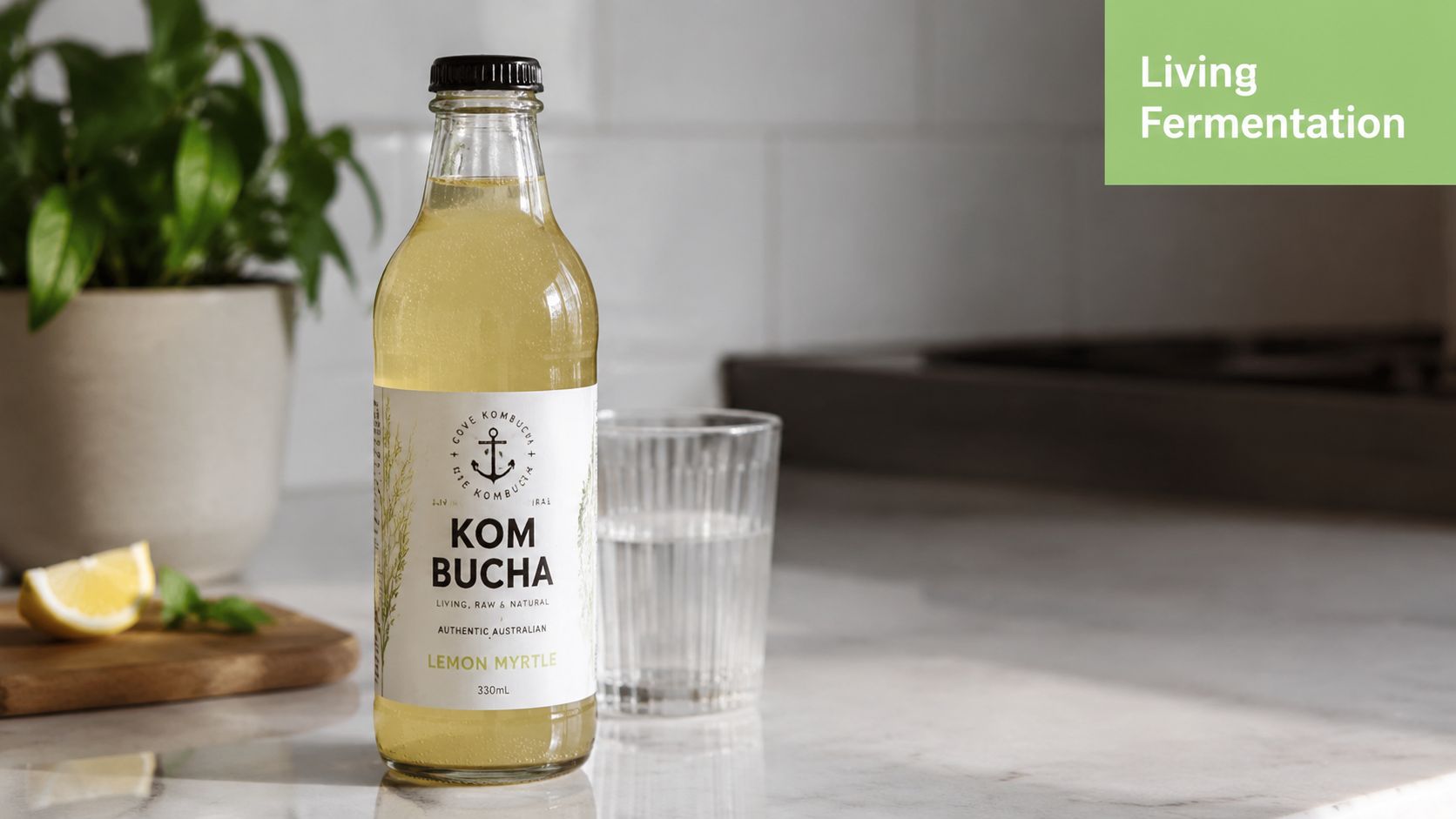
Not all kombucha is doing the same job
Some drinks borrow kombucha language but don't give you the same experience as a properly fermented product. They may lean heavily on sweetness, flavouring, or shelf-friendly positioning while giving the fermentation side far less importance than the front label suggests.
That's why it helps to ask a few direct questions:
- Was it properly fermented?
- Does the brand talk clearly about live cultures?
- Is it built as a low-sugar or sugar-free option?
- Is the producer transparent about where and how it's brewed?
What real fermentation adds
A proper kombucha process starts with brewed tea and a SCOBY, then time does the work. During fermentation, the drink develops its tang, complexity, and living character.
When a kombucha is made with care, people often describe it as cleaner, drier, and more grown-up than a soft drink. That matters in homes and cafés alike. It gives you a cold drink option that feels functional rather than sugary.
A kombucha shouldn't taste like soft drink wearing a wellness label.
Why local brewing matters
Australian shoppers often care where a product is made, especially in categories tied to freshness, trust, and food standards.
Pep Tea's organic kombucha is made in a HACCP-accredited brewery in the Hunter Valley, NSW, using organic green tea and live cultures to create a probiotic-rich, sugar-free beverage, according to Opera Foods' Pep Tea brand profile. That kind of production detail matters because it tells you the kombucha isn't just branded well. It's brewed with a clear standard behind it.
If you want a better feel for what separates properly fermented kombucha from shortcut versions, this guide to real raw organics kombucha is worth reading.
Easy ways to enjoy it
Kombucha doesn't need a complicated ritual.
Some people keep it simple and pour it over ice with lunch. Others use it as a non-alcoholic alternative in the evening. Cafés can also use it to build sharper, lighter drinks without relying on sugary mixers.
A few practical ideas:
Midday fridge pick-me-up
Serve cold on its own.Alcohol-free spritz substitute
Pour into a wine glass with ice and citrus.Café menu option
Pair it with clean food, brunch dishes, or wellness-focused menus.
Real kombucha earns its place when the label, flavour, and fermentation story all line up.
Creating Your Daily Green Tea Ritual
A good green tea habit doesn't need to look polished or complicated. It just needs to fit your real day.
Build around moments, not rules
If mornings are rushed, keep tea bags or ready-to-drink kombucha where you'll reach for them. If you like a slower start, use loose leaf or whisked matcha and let the preparation become part of the ritual.
A simple routine might look like this:
Morning focus
Make a matcha with hot water, or turn it into an iced latte if coffee feels too heavy.Midday reset
Brew loose-leaf green tea for a cleaner lunch drink.Afternoon swap
Reach for kombucha instead of a sugary soft drink.
Keep one easy recipe in rotation
If you're new to matcha, start with a basic latte.
Sift your matcha into a bowl or mug, add a small splash of hot water, whisk until smooth, then top with warm or iced milk. Once that feels easy, use culinary matcha in smoothies, bliss balls, yoghurt, or baking. It's one of the simplest ways to make green tea part of your kitchen rather than just your mug.
Make quality the habit
The most useful thing you can do is stay curious about what you're buying. Read the label. Check the certification. Notice the origin. Match the product type to the way you live.
That's the lesson behind sorting through Green Tea Australia brands. Buy with a bit more literacy and a bit less guesswork, and the whole category becomes more enjoyable.
If you'd like to put that knowledge into practice, explore Pep Tea for premium organic matcha and Australian-brewed sugar-free kombucha. It's a simple place to start if you want certified quality, clean flavour, and a greener daily ritual that feels easy to keep.
Best Green Tea for Weight Loss: Reddit’s Top Picks 2026
Reddit loves a shortcut. Search for the best green tea for weight loss Reddit threads and you'll see the same pattern again and again: one person swears green tea “worked”, another says it did nothing, and a third drops a study result with no context at all.
The problem usually isn't the tea. It's the confusion.
Some posts talk about brewed tea. Others are really talking about concentrated extracts. Some people are drinking low-grade bagged tea with breakfast and expecting supplement-like results. Others have stumbled onto the one form that makes the whole conversation more practical: matcha.
If you want a clear answer, you need two things. First, a realistic idea of what green tea can and can't do for weight management. Second, a way to separate forum folklore from advice that makes sense in daily Australian life.
Sorting Through the Reddit Tea Leaves
Reddit can be useful because it shows what real people try, what habits they stick to, and where they get stuck. It's often more honest than polished wellness marketing. But it also bundles together half-remembered studies, personal anecdotes, supplement advice, and café drink recommendations as if they all mean the same thing.
That's why best green tea for weight loss Reddit is a trickier search than it looks. Many threads compare apples with oranges. A capsule gets discussed next to a teabag. A sugary bottled “green tea” drink gets lumped in with plain sencha or matcha. Then readers are left wondering why their results feel underwhelming.
Why Reddit advice feels so mixed
A few patterns show up often:
- People confuse product types. Brewed green tea, powdered matcha, and green tea extract are not the same experience.
- Users report different routines. Someone drinking one weak cup at night is not following the same approach as someone using matcha before training.
- Taste affects consistency. If the tea is bitter, stale, or chalky, many won't maintain the habit.
If you use Reddit for research, it helps to get better at finding niche communities and older discussions instead of relying on whatever appears first. This guide on how to search for subreddits effectively is handy if you want to dig into tea, weight management, fitness, or Australian wellness threads with more intent.
Reddit is best used as a clue board, not a final verdict.
The practical lens that matters
Green tea isn't a magic fat-loss button on its own. It's a support habit. It may help a bit with metabolism, routine, energy, and drink choices, especially if it replaces higher-calorie beverages. But the type of green tea matters more than most threads admit.
That's where the conversation becomes much more useful. Once you stop asking “does green tea work?” and start asking “which green tea form gives me the most from a normal daily drink?”, the answer gets clearer.
The Science Behind Green Tea and Weight Management
Green tea gets its reputation from a small team of natural compounds working together, not from one miracle ingredient. The two names that matter most here are EGCG and caffeine.
Think of them as a metabolic support team. Caffeine gives the system a push. EGCG helps that push last longer by affecting the way the body handles norepinephrine, a hormone involved in breaking down fat.

What thermogenesis actually means
You'll often see the word thermogenesis in green tea discussions. In plain language, it means your body burning energy to produce heat. It's one of the reasons people connect green tea with metabolism support.
That doesn't mean you drink tea and suddenly melt body fat. It means certain compounds may help nudge the body toward using energy a bit more actively, especially when they're paired with movement and a generally organised routine.
The most useful numbers to know
One of the clearest practical points is timing. Clinical studies show that people can increase fat-burning potential by 17% when taking green tea extract before physical exercise, and daily consumption can contribute to an extra 75 to 100 calories per day even at rest, according to Foober's summary of green tea for weight loss.
That's why some people feel green tea “works best” when they use it around exercise instead of treating it like a random afternoon beverage.
A simple way to view it:
| Compound | Everyday role | Why people care |
|---|---|---|
| Caffeine | Helps with alertness and energy | May support exercise drive and thermogenesis |
| EGCG | A catechin found in green tea | Helps support fat oxidation pathways |
| Together | Work in synergy | More useful than either one in isolation |
What this means in real life
If you're walking the dog before work, heading to the gym after lunch, or trying to stop reaching for sugary drinks during the afternoon slump, green tea may fit well because it supports a routine you can repeat.
Practical rule: Green tea works better as a repeatable habit than as a one-off “fat burner”.
That's also why quality matters so much. Once you understand that the effect depends on the compounds you consume, the next question becomes obvious: which green tea gives you the most of them in a normal cup?
What Reddit Gets Right and Wrong About Green Tea
Reddit gets one big thing right. Green tea is not a magic solution. The more grounded posters usually say the same thing: if your sleep is poor, your meals are chaotic, and your total intake is too high, tea won't fix that.
That part is sensible.
Where the threads often go sideways is in the jump from “green tea may help” to “any green tea drink should deliver study-like results.” That's where expectations get distorted.
The extract versus beverage gap
A lot of Reddit comments cite research based on concentrated green tea extracts, sometimes around 500 mg daily, and then assume an ordinary mug of brewed tea will behave the same way. That's not how real-world use works.
Healthline notes this gap clearly in its discussion of green tea and weight loss. Threads often repeat extract-based findings without distinguishing them from brewed tea, while the beverage itself has a more modest effect of burning only 60 to 80 extra calories per day in those discussions, which leaves readers expecting more than a regular cup can deliver. You can read that context in Healthline's green tea and weight loss article.
What Reddit usually gets right
The strongest community advice tends to sound less exciting and more useful:
- Consistency matters. A daily habit beats a “detox week”.
- Unsweetened is the point. Loading green tea with sugar changes the whole equation.
- Exercise helps the tea help you. People often notice better results when tea is part of an active routine.
- Taste decides adherence. If you dread the flavour, you'll quit.
What Reddit often misses
The biggest blind spot is concentration. Not all green tea formats deliver the same amount of the compounds people are chasing.
A supermarket teabag can still be a decent choice over soft drink or juice. But if someone is searching for the best green tea for weight loss Reddit because they want the most practical benefit from a beverage, “any green tea” is too vague to be useful.
Community wisdom is helpful when it tells you what people can stick with. It becomes unhelpful when it skips the difference between a brewed drink and a concentrated extract.
That missing detail is exactly why matcha keeps showing up as the smarter answer.
Why Matcha Is the Smartest Choice for Weight Loss
Matcha changes the conversation because it solves the concentration problem better than standard brewed tea.
With regular green tea, you steep the leaves and throw them away. With matcha, the leaves are stone-ground into a fine powder and whisked into water, so you consume the whole leaf. That means you're not just extracting some compounds. You're taking in the lot.

The whole-leaf advantage
This is the reason matcha sits at the top of so many serious green tea discussions. According to this Australian matcha and green tea breakdown, matcha contains up to 137 times more antioxidants than standard brewed green teas because you consume 100% of the leaf, including its caffeine, amino acids, and catechins such as EGCG.
That doesn't mean every scoop of matcha guarantees weight loss. It means matcha gives you a far stronger nutritional delivery system than a standard infusion.
Why this matters more than hype
If brewed tea is the lighter version of the idea, matcha is the more complete one. It's the closest natural beverage format to the stronger effects people often expect after reading extract-based claims online.
Here's a quick comparison:
| Feature | Standard green tea | Matcha |
|---|---|---|
| How it's used | Leaves steeped, then discarded | Powder whisked and consumed |
| What you ingest | Partial extraction | Whole leaf |
| Compound density | Lower | Higher |
| Practical fit for weight goals | Supportive | More strategic |
For readers who want more detail on why whole-leaf powder matters, this piece on matcha tea powder as a powerhouse of antioxidants is a useful deep dive.
A grounded verdict
If someone asked me for the simplest answer to the Reddit question, it would be this:
- If you want a gentle daily tea habit, standard green tea can still support your routine.
- If you want the smartest beverage choice for weight management support, matcha is the stronger option.
- If your goal is realistic progress, matcha still works best alongside food quality, movement, and sleep.
That's why matcha isn't just trendy. It's logically the most efficient green tea format for people who want more from the cup itself.
Your Actionable Guide to Using Green Tea Effectively
Knowing that matcha is the strongest practical option is helpful. Knowing how to use it well is what makes the habit stick.

Start with a routine you'll actually keep
You don't need a perfect Japanese tea ceremony in your kitchen before 7 am. You need a repeatable pattern.
A practical matcha routine often looks like this:
- Use a small amount first. Start with 1 to 2 teaspoons of matcha powder. That amount lines up with a review noting participants commonly consumed around 2 to 4 g of matcha per day, equivalent to 1 to 2 teaspoons, in human studies discussed by In the Cove's review of matcha health benefits.
- Keep the water hot, not boiling. Very hot water can make matcha taste harsh.
- Whisk well. A fork works in a pinch if you don't have a bamboo whisk.
- Drink it plain first. Learn the flavour before turning it into a sweet café-style drink.
Timing makes a difference
Many people leave easy gains on the table. The synergy between caffeine and EGCG may increase fat-burning potential by up to 17% when consumed about 1.5 hours before a workout, according to Foober's guide on the best green tea for weight loss.
So if you train after work, don't have your matcha randomly at breakfast and hope for the same effect. Use it with some intention.
A pre-workout matcha can make more sense than an end-of-day cup, especially if your goal is metabolic support rather than a cosy ritual.
For easy ways to build that into daily life, this collection of matcha drink recipes for weight loss gives practical ideas without making things complicated.
A quick video can also help if you're more of a visual learner:
Simple ways to use matcha in Australia
You don't have to drink it the same way every day. Try:
- Morning bowl at home. Fast, unsweetened, and easy before work.
- Iced matcha after a walk. Great in warmer weather.
- Smoothie add-in. Handy if you already blend breakfast.
- Light matcha latte. Better kept low in sugar if weight management is the goal.
Common mistakes to avoid
- Adding lots of sweetener. That can undo the benefit of choosing tea in the first place.
- Buying poor-quality powder. If it tastes swampy and bitter, consistency will suffer.
- Expecting dramatic change from one serve. Matcha supports a system. It doesn't replace one.
Beyond the Tea Cup Exploring Kombucha
Weight management isn't only about what speeds metabolism a bit. It's also about the drinks you stop having.
That's where kombucha enters the picture. A properly fermented kombucha gives you a more interesting, adult-feeling alternative to sugary soft drinks or overly sweet mixers, and that swap can support a cleaner routine over time.

Why kombucha fits the same mindset
People who care about green tea for weight goals are usually trying to do a few things at once:
- Lower sugar intake
- Choose more functional drinks
- Support gut health
- Avoid the crash that comes with heavily sweetened beverages
Kombucha fits that broader lifestyle neatly when it's genuinely fermented and not dressed up like a health drink while behaving like cordial.
A useful complementary habit
Matcha and kombucha do different jobs. Matcha suits mornings, focus, and workout timing. Kombucha works well as a fridge staple when you want something fizzy without reverting to soft drink habits.
If you're interested in how fermentation, live cultures, and lower-sugar choices fit into a wellness routine, this guide on the benefits of kombucha is a practical read.
The smartest drink strategy usually isn't one hero beverage. It's having better options ready for different moments of the day.
Your Simple Green Tea Plan for Wellness
If you've made it this far, the answer to the Reddit question is much less messy.
Green tea can support weight management. It just needs honest expectations. A cup won't override everything else, but the right format can absolutely be a better choice than a weak, sugary, or inconsistent routine.
The simplest framework to remember
- Choose matcha first. It's the most efficient green tea format for people who want more from the drink itself.
- Use timing well. If exercise is part of your week, place your matcha before it rather than treating it as random background tea.
- Stay realistic. Green tea supports a healthy pattern. It doesn't replace that pattern.
- Upgrade your drink choices overall. Kombucha and unsweetened tea can help reduce reliance on sugar-heavy options.
One reason matcha stays at the top of this conversation is its thermogenic profile. A study in the American Journal of Clinical Nutrition found that consuming matcha can increase thermogenesis from a typical 8 to 10% to 35 to 43% of daily energy expenditure, as summarised in this article on matcha health benefits.
Build the tea habit into your full routine
Tea works best when it's part of a bigger system. That might mean walking most days, planning simple protein-rich meals, keeping sweet drinks out of the trolley, and having matcha or kombucha ready at home. If you want a practical way to organise the food side of that routine, this guide on using PlateBird for meal planning is worth a look.
A key lesson from Reddit is useful once you clean it up: people do best when they pick a habit they can repeat. For green tea, the repeatable, high-value option is matcha.
If you're ready to turn that knowledge into a daily ritual, explore Pep Tea for premium organic matcha and Australian-made sugar-free kombucha that fit naturally into a cleaner wellness routine.
The Real Organic Tea Benefits: A Complete Australian Guide
You're probably here because tea has become more than just a hot drink. It's your morning reset, your afternoon swap for another coffee, or the one thing that helps you slow down for five minutes between work, family, training, and everything else life throws at you.
That's where the conversation around organic tea benefits gets interesting. For many Australians, organic starts as a safety question. Fewer chemicals. Cleaner farming. Better peace of mind. But once you dig deeper, organic tea isn't only about what's missing. It's also about what stays intact in the leaf, in the brew, and in the flavour.
A well-grown organic tea can offer a cleaner cup, a more expressive taste, and a more functional daily ritual. That matters even more with high-performance teas like Japanese matcha and properly fermented kombucha, where quality shows up in every sip.
More Than a Buzzword The Real Meaning of Organic Tea
A lot of people start with tea because they want one of three things. Calm. Energy. Comfort. Sometimes all three at once.
You swap a sugary drink for green tea because you want something lighter. You try matcha because coffee feels too sharp. You reach for kombucha because your body wants something refreshing that doesn't feel heavy. Then the label catches your eye. Organic. It sounds good, but what does it really change?
Organic changes the whole experience
Organic tea isn't just conventional tea with nicer branding. It reflects a different growing philosophy. In practical terms, it means the tea is produced without the synthetic inputs many people are trying to avoid in the rest of their food and drink choices.
That matters because tea is an ingredient you often consume daily. If something is part of your routine every morning or every afternoon, the quality of that product matters more than it does with an occasional treat.
For readers who want to understand the farming side in plain English, it helps to look at organic tea farming practices in Australia.
Organic tea feels different because it asks a better question. Not just “does this taste nice?” but “what kind of cup am I inviting into my body every day?”
Why people notice the difference
Organic tea isn't first noticed in a lab report. It's noticed in the cup.
A vibrant matcha tastes cleaner and more rounded. A carefully brewed kombucha tastes alive, bright, and balanced rather than loud or syrupy. Even a simple loose-leaf green tea can feel fresher and more expressive when the leaf has been handled with care from the start.
Three organic tea benefits often stand out quickly:
- Cleaner everyday drinking because many health-conscious tea drinkers want to reduce routine exposure to synthetic agricultural chemicals.
- Better functional potential because the natural compounds in tea are the reason many people drink it for wellness in the first place.
- Richer flavour because quality farming and careful processing tend to reward your palate, not just your principles.
That's why organic isn't a restriction. It's a filter. It helps you choose tea that supports the way you want to feel.
Why Organic Certification Matters for Your Tea
The word “organic” gets thrown around so often that it can lose meaning. In tea, certification matters because it gives the word substance.
What certified organic actually signals
When tea is certified organic, it isn't just marketed as natural or clean. It's grown and handled according to standards that limit or prohibit a range of synthetic agricultural and processing inputs.
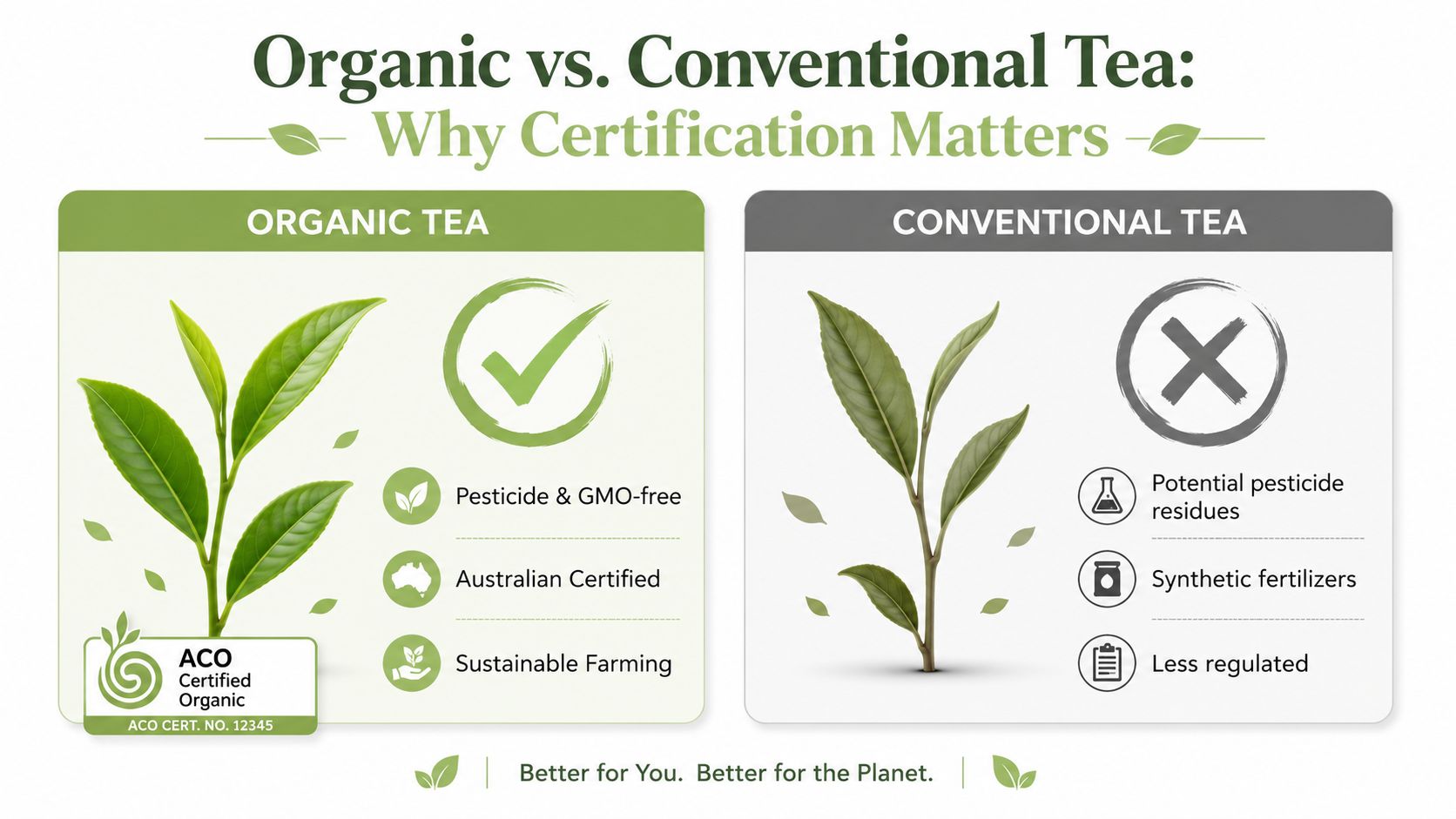
In Australia, that distinction matters. Organic tea is distinguished from conventional tea by its significantly lower levels of harmful chemical residues, as organic farming prohibits the use of synthetic pesticides, herbicides, chemical fertilizers, GMOs, preservatives, and fungicides, resulting in a safer product for consumers concerned about chemical exposure, as outlined in this explanation of organic vs conventional tea.
If you want a practical overview of what local certification means, this guide to organic tea certification in Australia is a useful place to start.
Why lower residue matters in a daily ritual
Tea often feels harmless because it's simple. Water, leaves, cup. But that simplicity is exactly why sourcing matters.
If you drink tea every day, you're not making a one-off choice. You're building a repeated habit. For many people, that's why organic tea benefits feel especially relevant here. A cleaner agricultural approach supports a cleaner daily routine.
Here's a simple comparison:
| Tea type | What the growing approach focuses on | What many drinkers value |
|---|---|---|
| Organic tea | Avoiding synthetic pesticides, herbicides, chemical fertilisers, GMOs, preservatives, and fungicides | A cleaner cup and confidence in how the tea was produced |
| Conventional tea | Standard agricultural methods that may include synthetic inputs | Wider availability, but with fewer assurances about residue levels |
Certification protects more than the absence of chemicals
The best way to think about organic certification is that it protects the integrity of the tea. It's not just about what's left out. It's also about what the plant is allowed to express.
That can shape:
- Leaf quality through gentler, more considered growing systems
- Flavour clarity because the cup isn't competing with a rougher profile
- Functional value because tea drinkers often choose green tea, matcha, and kombucha for their natural compounds, not just their taste
Practical rule: If you're drinking tea for wellness, don't treat sourcing as an afterthought. The benefit starts long before the kettle boils.
The Science-Backed Health Benefits of Organic Tea
Tea's reputation for wellness doesn't come out of nowhere. Its natural compounds, especially catechins and polyphenols, are where the primary interest lies, known for their antioxidant activity.
What antioxidants are doing in simple terms
Oxidative stress sounds technical, but the idea is straightforward. Your body deals with ongoing wear and tear from normal metabolism and from daily life. Antioxidants help counter some of that stress.
Tea naturally contains compounds that support this process. That's one reason it keeps showing up in discussions about long-term wellbeing, especially for people trying to make better everyday choices rather than chasing quick fixes.
A useful way to think about tea is this: it's a small habit with a cumulative effect. One cup won't transform your health overnight. But a good routine can support the bigger picture.
What the research on green tea shows
The strongest evidence in the material available here relates to green tea. According to Harvard's overview of tea and health, regular consumption of green tea is linked to a 14% reduced risk of stroke in individuals drinking 2–3 cups daily, and a 20% reduced risk for those consuming 4 or more cups, based on a 13-year cohort study of 82,369 Japanese men and women.
That matters because it gives the conversation some grounding. Tea isn't only associated with a pleasant ritual. It's also linked with meaningful health outcomes in large population studies.
The same source also describes broader links between tea intake and cardiovascular health, including observational findings around heart disease, stroke, and type 2 diabetes. That doesn't make tea a treatment, but it does support the idea that tea can be part of a smart, steady lifestyle pattern.
Why organic can strengthen the value of that habit
Many readers get confused because the research often focuses on tea itself, especially green tea. So where does “organic” fit in?
Organic doesn't create catechins and polyphenols from scratch. Tea naturally has them. What organic farming may do, based on the verified material available, is help preserve the tea's natural integrity by avoiding synthetic residues that many health-conscious consumers would rather not bring into a wellness routine.
That means the habit becomes more coherent. If you're drinking tea because you want something clean, supportive, and functional, organic aligns the farming method with the reason you're drinking it.
A simple way to use that in daily life:
- Choose tea you'll drink consistently. Daily habits matter more than occasional bursts of enthusiasm.
- Keep it unsweetened when possible. Let the leaf do the work.
- Treat tea as support, not magic. It works best alongside sleep, food, movement, and stress management.
Tea fits best in a wellness routine when it replaces something less helpful, not when it's expected to do everything on its own.
Focus and Energy The Organic Matcha Advantage
If green tea is a strong all-rounder, matcha is the concentrated version of that story. It's one of the clearest examples of why organic tea benefits can feel more noticeable in real life.
Why matcha feels different from regular green tea
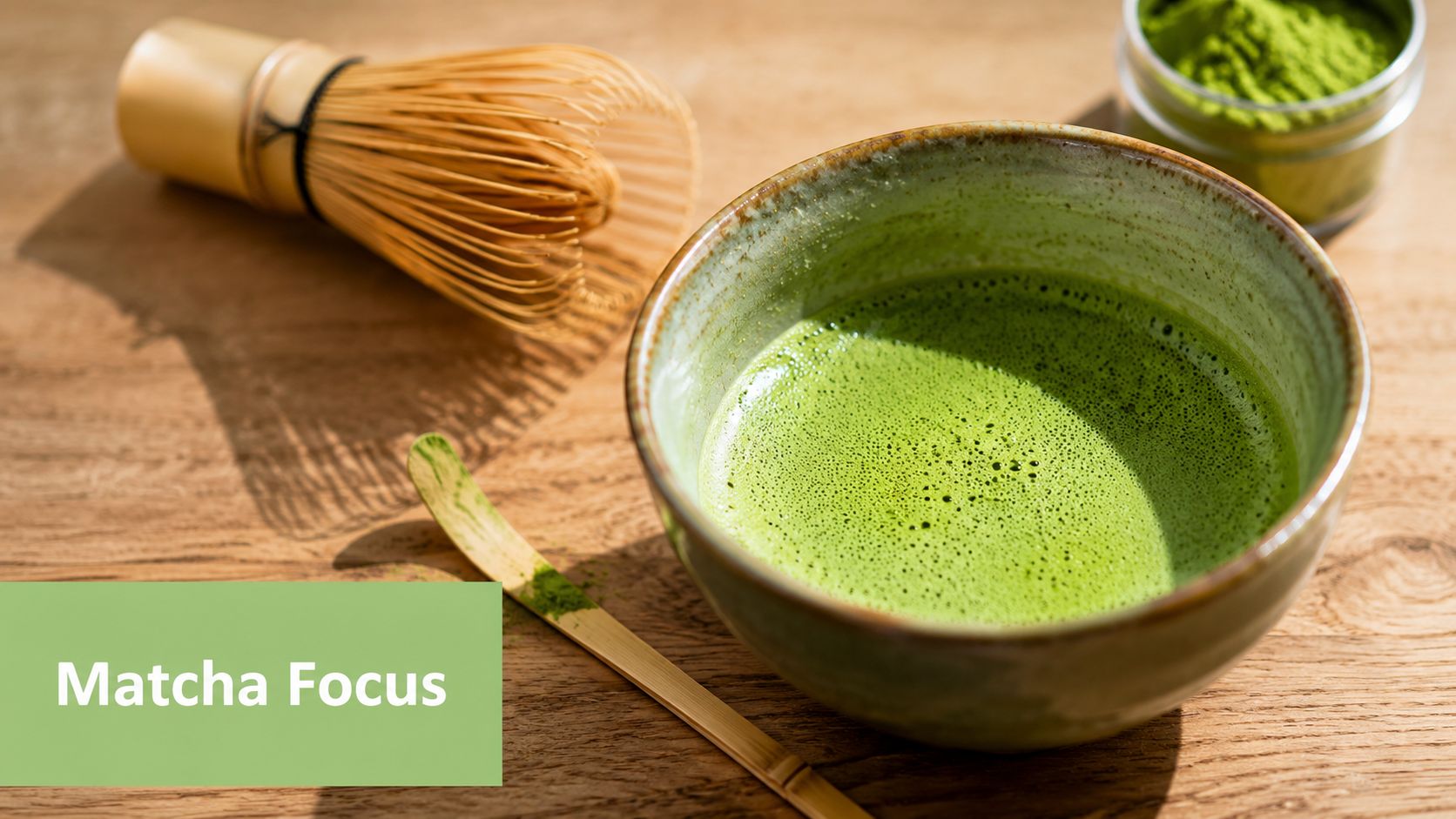
With brewed green tea, you steep the leaves and drink the infusion. With matcha, you whisk the stone-ground leaf into water and consume the whole thing.
That changes the experience. It's one reason matcha drinkers often describe the effect as steadier and more immersive. You're not just tasting tea. You're taking in the finely milled leaf itself.
According to this review of EGCG and antioxidants in matcha, matcha contains approximately 100–200 mg of EGCG per cup, with EGCG comprising 50–60% of total catechins, whereas regular brewed green tea delivers only 30–400 µmol TE/g in antioxidant activity compared to matcha's 1,300–1,600 µmol TE/g.
That's a big reason matcha has become such a favourite for people chasing functional drinks with substance.
Calm focus, not chaotic stimulation
Many Australians come to matcha because coffee stops working for them the way it used to. The first cup is fine. The second pushes them into jitters, irritability, or an afternoon slump.
Matcha tends to appeal to a different goal. People want energy, but they also want clarity. They want alertness without feeling scattered. Readers often associate this with the combination of tea caffeine and naturally occurring L-theanine in matcha, which is why matcha has developed a reputation for calmer focus.
That doesn't mean every matcha delivers the same experience. Grade, freshness, origin, and processing all matter. A vibrant Japanese organic matcha is usually smoother, sweeter, and easier to drink than dull, stale powder that tastes flat or bitter.
What to look for in a quality matcha
A quick checklist helps:
- Colour should look bright and lively rather than khaki or brownish.
- Texture should feel fine and soft, not gritty.
- Taste should be fresh, rounded, and pleasantly vegetal, not harsh.
- Origin and production matter, especially if you care about both flavour and farming standards.
For a simple visual on preparation, this video is a good reference point:
When matcha makes the most sense
Matcha works especially well when you want a beverage that supports performance without feeling aggressive.
It suits:
| Moment | Why matcha fits |
|---|---|
| Morning start | It gives your day a more deliberate pace than rushing into another coffee |
| Pre-work focus | Many people like it before writing, planning, or study sessions |
| Afternoon reset | It can feel cleaner than reaching for sweets or another strong caffeine hit |
A good matcha doesn't just wake you up. It helps you stay with what you're doing.
Gut Health and Vitality The Power of Real Organic Kombucha
Kombucha can be one of the most misunderstood drinks in the wellness space. Some bottles are carefully fermented and alive with character. Others taste like soft drink wearing a health halo.
That difference matters if you care about organic tea benefits beyond buzzwords.
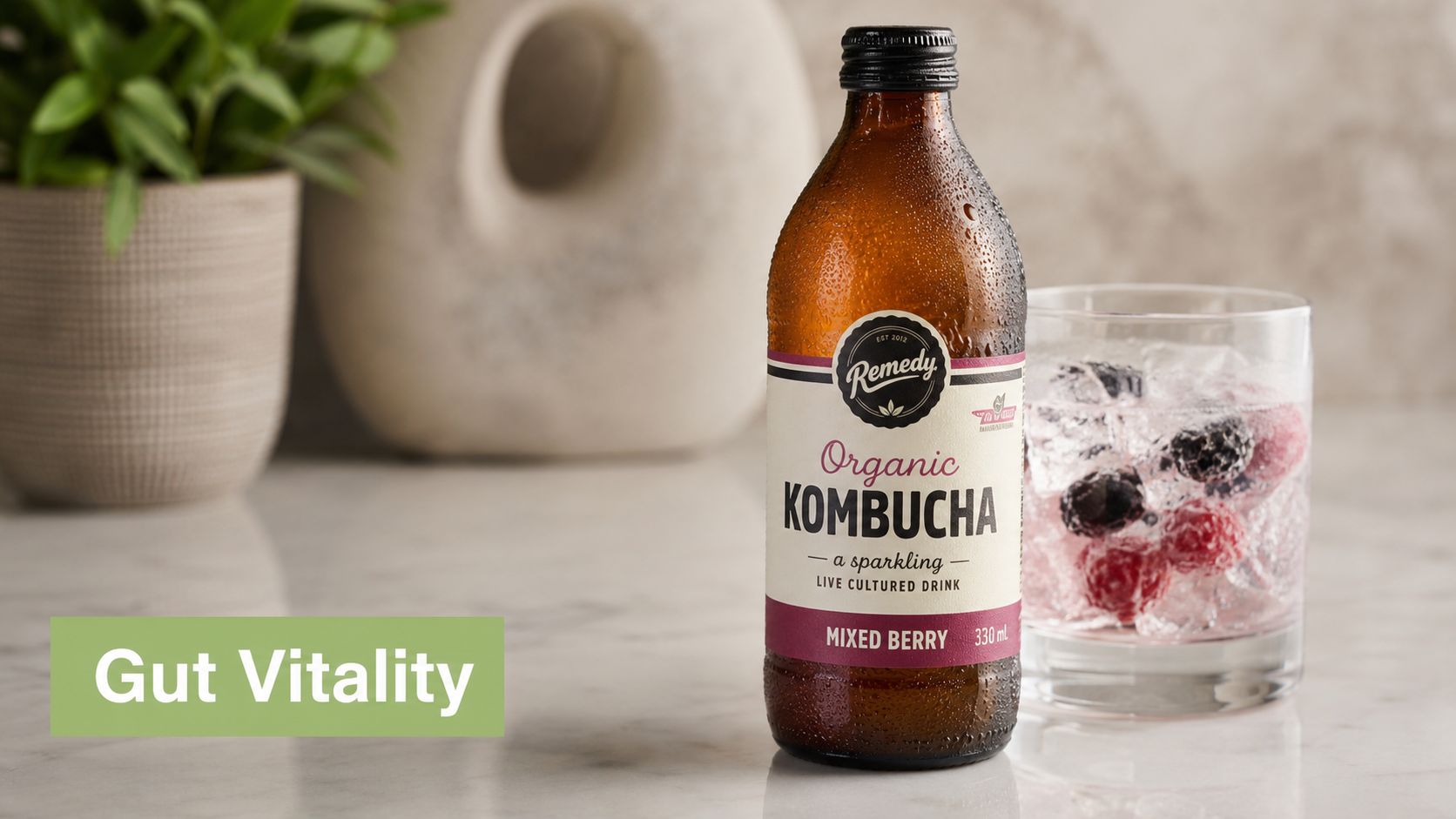
Real kombucha starts with real tea
Authentic kombucha begins with brewed tea, culture, and time. The process transforms the original sweetened tea into something tangy, layered, and much lighter than many people expect.
For readers who are trying to understand what separates proper fermentation from shortcuts, this guide to real raw organic kombucha explains the distinction well.
When kombucha is made with organic tea, the starting point already aligns with a cleaner product philosophy. That won't automatically make every bottle excellent, but it does set a stronger foundation.
Why fermentation quality matters
People often assume kombucha is healthy just because it's called kombucha. That's where things get messy.
Some products lean heavily on flavourings, sweetness, or marketing language. A properly fermented kombucha, by contrast, earns its place through the brewing process itself. If you're drinking it for gut-friendly potential and as an alternative to sugary beverages, the details matter.
A useful way to compare them:
- Properly fermented kombucha often tastes tart, refreshing, and balanced. It feels like a brewed beverage.
- Mass-market imitation styles can taste flat, overly sweet, or more like flavoured soda.
The best kombucha doesn't try to hide fermentation. It lets fermentation create the flavour.
Where kombucha fits in daily life
Kombucha is often less about one dramatic health promise and more about replacing less helpful habits.
It can work well for people who want:
- A low-sugar alternative to soft drinks or sweet mixers
- A grown-up non-alcoholic option that still feels interesting
- A refreshing fridge staple that supports a more mindful routine
This is also where Australian-made kombucha has a special appeal. Local brewing, especially when done carefully, gives drinkers a product that feels close to home and easier to trust. For cafés, it also creates a stronger menu story. Customers increasingly want non-alcoholic drinks that feel thoughtful rather than like an afterthought.
A note on flavour and function
Good kombucha should taste like something you'd want to drink even if health benefits were never mentioned. Ginger, lime and ginger, or mango styles can all work beautifully when they're built on a genuine fermented base rather than sugar and flavour alone.
That's the heart of the argument for real organic kombucha. If the tea is well sourced and the fermentation is done properly, the drink becomes more than a trend. It becomes a practical, enjoyable part of modern Australian drinking habits.
How to Use Organic Tea at Home and in Your Café
The easiest way to enjoy organic tea benefits is to make them routine. You don't need a complicated wellness plan. You need a few reliable ways to use tea that fit your day.
Simple ideas for home

Try these:
Ceremonial-style matcha
Sift your matcha into a bowl, add a little warm water, then whisk until smooth and frothy. Keep the flavour front and centre. No sweetener needed if the powder is good.Quick matcha latte
Make a smooth matcha base first, then add your preferred milk hot or cold. If you like a softer flavour, this is often the easiest daily entry point.Kombucha mocktail
Pour chilled kombucha over ice with fresh citrus or mint. It gives you the ritual of a mixed drink without the heaviness.
A practical reason to keep green tea in rotation
One reason many people stay committed to green tea and matcha is that the habit is easy to repeat. There's also a strong wellness argument for doing so. According to this article on tea as a health drink, organic green tea including matcha delivers a bioactive dose of EGCg that directly inhibits reactive oxygen species, with a 2020 Australian Curtin University study quantifying that consuming three cups daily reduces the likelihood of developing prostate and ovarian cancer by neutralizing free radicals that damage DNA.
That doesn't mean everyone needs three cups every day. It does show why regular use, rather than occasional novelty, is where tea becomes meaningful.
Smart menu ideas for cafés
For cafés and hospitality venues, organic tea can do more than fill a menu gap. It can shape a more modern drinks offer.
Consider adding:
| Menu idea | Why customers respond |
|---|---|
| Straight matcha | It suits customers who want a clean, premium hot drink |
| Iced matcha latte | It appeals to regular café traffic looking for a coffee alternative |
| Kombucha by the bottle or glass | It gives non-alcoholic drinkers something with personality |
| Seasonal mocktails using kombucha | It helps venues build a wellness-friendly drinks list |
For home drinkers and cafés alike, the key is consistency. Keep the ingredients clean. Keep the preparation simple. Let the tea do the heavy lifting.
Your Organic Tea Questions Answered
Is organic tea automatically safer in every way?
It's safer in one important sense. Organic certification helps reduce exposure to synthetic agricultural chemicals. But it doesn't answer every sourcing question.
According to this explanation of what to look for when buying organic tea wholesale, while organic certification ensures tea avoids pesticides, it doesn't automatically screen for soil-derived heavy metals, and no recent 2024–2025 Australian report compares heavy metal levels in imported organic versus conventional matcha. If you drink matcha daily, it's reasonable to care about origin, supplier transparency, and testing standards.
Is matcha stronger than regular green tea?
Functionally, yes, many people experience it that way. You're consuming the whole powdered leaf, so the experience is more concentrated than a standard brewed green tea. That's part of why matcha often feels more substantial and more sustaining.
Can I drink organic tea every day?
For most adults, tea works best as a daily habit rather than an occasional health kick. The main questions are your caffeine sensitivity, the type of tea you choose, and whether it fits the rest of your routine.
What about pregnancy or medication interactions?
If you're pregnant, breastfeeding, managing a health condition, or taking medication, it's smart to check with your doctor before making tea, matcha, or kombucha a bigger part of your routine. Tea can be wonderfully supportive, but personal advice matters.
Is organic kombucha always low in sugar?
Not always. “Organic” and “low sugar” aren't the same thing. Read the label, pay attention to the fermentation style, and choose a product that aligns with why you're drinking it.
If you're ready to turn all of this into an everyday ritual, explore Pep Tea for premium organic matcha and Australian-brewed sugar-free organic kombucha. It's a simple way to bring cleaner flavour, functional benefits, and a more enjoyable wellness routine into your day.
What Are Energy Shots? Ingredients, Safety & Alternatives
Energy shots are small, highly concentrated drinks designed to deliver a rapid and intense boost of energy and alertness. A commonly cited energy shot format is 60 mL, and one factsheet describes these products as concentrated forms that can contain 200 mg of caffeine plus ingredients such as taurine, D-glucuronolactone, and inosite per unit.
You probably know the moment. It's mid-afternoon, your brain goes foggy, your to-do list still looks far too long, and grabbing something quick feels easier than slowing down and asking why your energy fell off in the first place.
That's why energy shots appeal to so many people. They're tiny, portable, and built around speed. No large can, no sipping, no waiting. Just a fast hit of stimulation in a small bottle you can keep in a bag, glovebox, gym locker, or desk drawer.
But small doesn't mean simple.
When people ask what are energy shots, they're usually asking a few different things at once. What's in them? How are they different from an energy drink or coffee? Do they work? And are they something you should use regularly, or only occasionally?
The answer sits somewhere between convenience and caution. Energy shots can be useful as a short-term tool, but they're not the same thing as building steady daily energy. For that, it usually makes more sense to look at sleep, food, hydration, movement, and gentler functional drinks that support focus without turning your afternoon into a spike-and-slump cycle.
That Sudden Need for a Boost
At 3 p.m., a lot of people don't want a wellness lecture. They want to feel awake enough to finish work, make the school pick-up, get through training, or survive the drive home.
That's where energy shots fit. They're sold as the fastest answer to a tired brain and heavy eyelids. In Australia, that promise lands in a market that keeps expanding. The broader energy drink market reached $1.39 billion in 2024 and is projected to reach $1.94 billion by 2030, with demand tied to portability and on-the-go convenience, according to TechSci Research's Australia energy drinks market overview.
Why the format feels so appealing
A shot is easy to understand emotionally, even before you read the label:
- It's tiny: You can take it in seconds.
- It feels efficient: There's no large drink to carry around.
- It signals urgency: The whole design says “instant effect”.
- It fits modern routines: Commutes, shift work, study sessions, and busy parenting all reward convenience.
That's why students, tradies, office workers, travellers, and gym-goers often see them as a practical quick fix.
Energy shots aren't really sold as drinks in the everyday sense. They're sold as solutions to a moment of fatigue.
The real question behind the purchase
Energy shots aren't typically purchased for their taste. They are bought because performance is desired, fast. The tiny bottle suggests precision and power. It looks more potent than a standard can, and in many cases, that's exactly the point.
Still, there's a difference between temporarily overriding tiredness and supporting real energy.
That distinction matters. If you're reaching for high-intensity stimulants every day, the shot may be masking a bigger issue such as poor sleep, inconsistent meals, dehydration, or simple overwork. That doesn't make the product evil. It just means it should be understood for what it is: a short-term intervention, not a long-term energy strategy.
The Anatomy of an Energy Shot
The effect of an energy shot usually comes down to a small group of ingredients, and caffeine does most of the heavy lifting.
That matters because the label can look busy. A tiny bottle may list amino acids, vitamins, plant extracts, flavours, and sweeteners, which can make it seem like every ingredient is pushing your energy higher at once. In practice, the short-term lift typically noticed is mainly stimulant-driven.
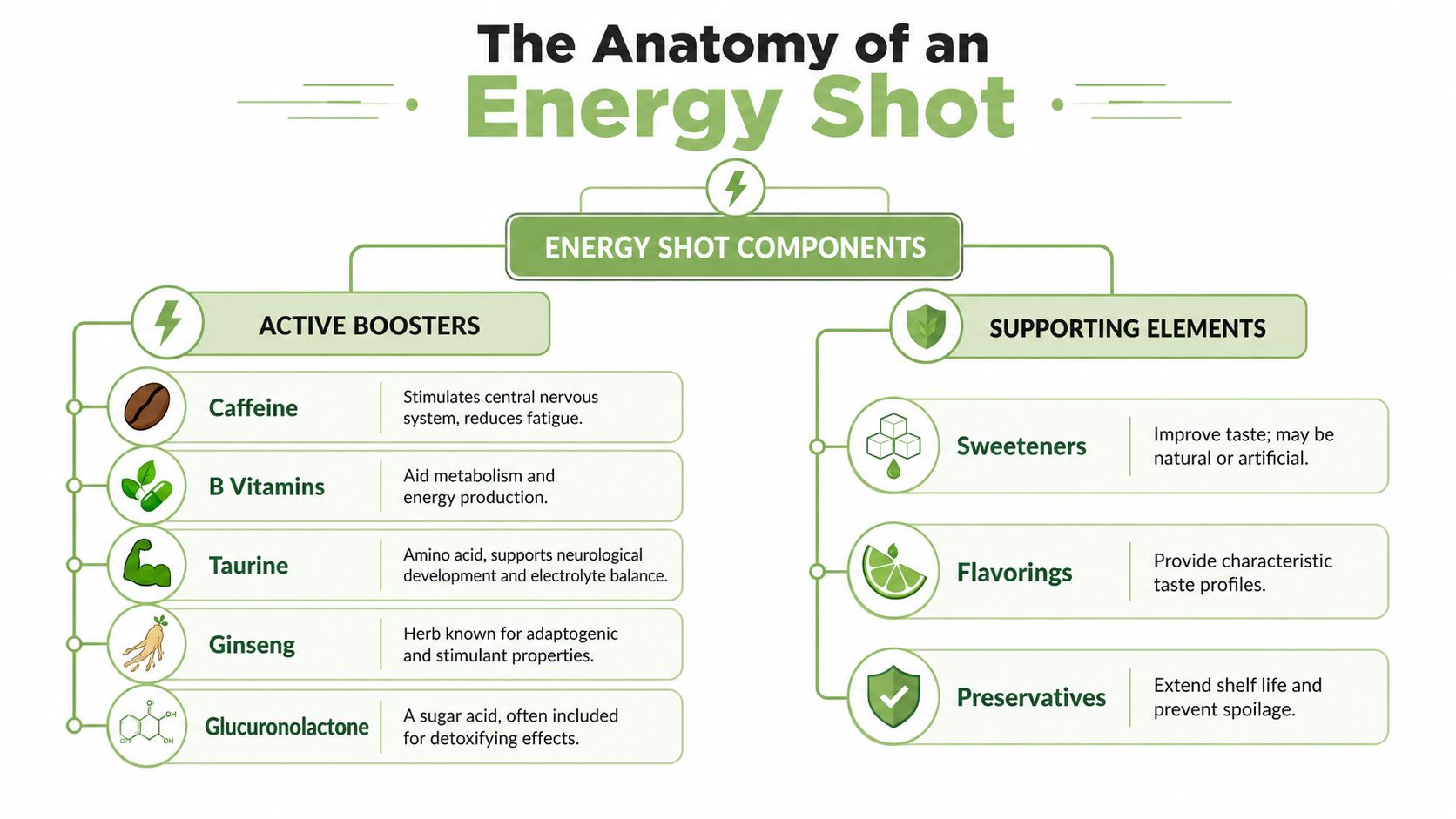
A typical formula often includes:
- Caffeine: The main stimulant. This is usually the ingredient responsible for the alert, switched-on feeling.
- Taurine: Common in energy products and often paired with caffeine.
- B vitamins: Included because they help normal energy metabolism, but they do not create an instant buzz on their own.
- Glucuronolactone: Another ingredient frequently used in concentrated energy formulas.
- Sweeteners and flavourings: Added to make a strong, compact product easier to swallow.
- Herbal extras: Some brands include ginseng or other plant extracts to round out the formula.
What the label can make easy to misunderstand
A lot of people read an ingredient panel and assume every added nutrient contributes to the same immediate effect. Energy shots do not really work that way.
Caffeine stimulates the central nervous system and can temporarily reduce the feeling of fatigue. B vitamins play a different role. They help the body process energy from food, but if your body already has enough, adding more in a shot does not automatically create a stronger surge in the moment.
A simple way to read the bottle is to separate stimulation from nourishment. One gives a short burst of alertness. The other supports the systems that produce energy over time. They can appear in the same product, but they are not the same job.
If tiredness keeps showing up, nutrient status may be part of the picture. In that case, a stimulant can cover the feeling without addressing the reason. For readers who want a clearer explanation of one common fatigue-related nutrient, OneTwenty's preventive B12 insights are useful background.
Practical rule: If a bottle promises energy, ask whether it is offering a stimulant effect, nutritional support, or both.
Why the small size changes the experience
The ingredient list is only part of the story. The format changes the experience too.
Drinking a coffee or a full can takes time. A shot is over in seconds. That compressed delivery can make the effect feel more intense, much like swallowing a concentrated syrup instead of sipping a tea. The formula may be familiar, but the pace of intake is different, and your body feels that difference.
This is why energy shots sit in a very specific category. They are high-intensity, short-term tools. They can be useful in a pinch, but they are not a balanced daily energy plan. If you are already looking for sugar free energy drinks that feel less harsh, you are already asking the better question, which is not just “How fast can I get a boost?” but “What kind of energy support can I live with day after day?”
That is where natural functional drinks start to make more sense for regular use. Matcha offers caffeine with L-theanine, which many people find steadier. Kombucha usually plays a different role again, supporting refreshment and routine rather than delivering a synthetic jolt. Energy shots have their place, but their anatomy tells you exactly what that place is. Short-term stimulation, packed into a tiny bottle.
The Jolt and the Inevitable Crash
The first part often feels impressive.
You take a shot in the car before a late appointment, outside the gym after a long workday, or at your desk before a meeting you need to be sharp for. Not long after, the fog starts to lift. You feel more switched on. Your thoughts seem faster. The tiredness moves into the background for a while.
What the experience can feel like
For many people, the arc goes something like this:
- Fast lift: Alertness kicks up quickly.
- Sharper focus: You feel more capable, more awake, sometimes more confident.
- Peak window: This is the “I'm back” phase people buy the product for.
- Drop-off: The stimulation fades, and the body often reminds you it was tired to begin with.
The tricky part is that the rebound doesn't always feel gentle. Some people describe it as flatness, irritability, restlessness, or a heavier fatigue than before.
Why the rebound can hit hard
An energy shot can temporarily cover up exhaustion, but it doesn't replace sleep, food, hydration, or recovery. If those foundations are weak, the lift may feel dramatic because you were already running low.
Then the contrast kicks in.
A caffeine crash often feels worse when the shot was used to push through a problem the body was already signalling clearly.
That's one reason many people start looking for a different kind of support. If you're trying to move away from harsh stimulants and sugary pick-me-ups, our guide to sugar-free energy drinks looks at lower-sugar options and what to watch for when comparing products.
The bigger lesson is simple. A fast boost can be handy in a pinch. It's a poor substitute for a daily routine that protects your energy.
Energy Shots vs Drinks vs Coffee
People often lump all caffeinated options together, but they behave differently in real life. Volume, concentration, sugar, and drinking speed all shape the experience.
An energy shot is built for intensity. A canned energy drink is often part stimulant, part soft drink. Coffee sits in a different cultural lane again. Matcha belongs in the same broad conversation about energy, but the feel is usually steadier and less abrupt.
The main point of difference
A shot gives you very little volume and a lot of intent. There's no ritual. You're not there for flavour or comfort. You're there for effect.
By contrast, coffee is often slower and more habitual. An energy drink may be consumed over a longer stretch, especially in social or work settings. Matcha tends to suit people who want alertness with a calmer rhythm.
For readers comparing tea-based energy more closely, this explainer on caffeine in a matcha latte is helpful because the experience of caffeine in matcha often feels different from the hit people expect from shots or canned stimulants.
Energy Boost Comparison
| Beverage | Typical Volume | Avg. Caffeine | Sugar Content | Energy Profile |
|---|---|---|---|---|
| Energy shot | Small, concentrated serve | Can be high per serve in a very small volume | Varies by brand, often low or sugar-free | Fast, intense, short-term |
| Energy drink | Larger can or bottle | Varies by product | Often sweet, though sugar-free options are common | Noticeable lift, often more gradual than a shot |
| Coffee | Cup-sized serve | Varies by brew style | Usually low unless sugar or syrups are added | Familiar, direct caffeine effect |
| Matcha | Tea or latte serve | Moderate and naturally paired with tea compounds | Depends on preparation | Smoother, more sustained, calmer focus |
Why matcha belongs in this comparison
Matcha isn't an energy shot replacement in the exact same way a spare tyre replaces a tyre. It's a different approach.
If your goal is “I need something right now or I won't function”, a shot is designed for that. If your goal is “I want energy I can live with every day”, matcha usually makes more sense because it encourages a steadier pattern rather than a rush.
Safety Risks and Australian Regulations
A tiny bottle can hide a very strong dose.
That is the first safety problem with energy shots. People often judge strength by size, but these products work more like a concentrate than a regular drink. You can swallow a full serve in seconds, which leaves less room to notice how your body is reacting before the stimulant load has already landed.
For someone who is tired, underfed, stressed, or dehydrated, that can be a rough combination. Common short-term effects include jitters, nausea, a racing feeling, anxiety, trouble settling down later, and a general sense that the body has been pushed harder than it wanted.
What Australian rules say
In Australia, caffeinated energy drinks sit under a defined regulatory framework. Food Standards Australia New Zealand sets compositional rules for formulated caffeinated beverages and requires advisory statements on products in that category.
The catch is that not every small stimulant product is sold in exactly the same category. Some concentrated products may be marketed in ways that make the label feel more like a supplement than a standard beverage. For shoppers, that creates confusion. Two products can sit in a similar part of the store and look like they do the same job, while the rules around them are not identical.
That matters because people often assume "energy product" means one consistent set of safeguards. It does not always work that neatly in practice.
Why labelling matters
Small packaging can create a false sense of safety. Potency and volume are not the same thing.
Australian industry guidance explains that regulated energy drinks must carry advisory labels under the FSANZ framework, as outlined in the Australian Beverages Council's summary of the FSANZ framework. The practical lesson is simple. Read the label slowly, check the serving size, and notice whether the product expects you to treat one bottle as one serve or more than one.
That habit becomes even more useful if you are comparing highly processed stimulants with gentler options such as natural energy drinks for steady daily use. The goal is not just to get through the next hour. It is to choose an energy source your body can tolerate well over time.
Who should be especially cautious
Some people should avoid energy shots altogether, or speak with a health professional first.
- Children and teenagers: Concentrated stimulant products are a poor fit for developing bodies.
- Pregnant women: Advisory warnings exist because caffeine intake deserves extra care during pregnancy.
- People sensitive to caffeine: A small serve can still feel intense.
- People with heart symptoms, high anxiety, or panic tendencies: Fast, concentrated stimulation can aggravate those problems.
- Anyone mixing caffeine with alcohol or other stimulants: It becomes harder to judge what the body is responding to, and easier to overdo it.
If tiredness is showing up often, the better question may be why your energy keeps dropping in the first place. BionicGym's guide to managing fatigue is a useful read for that bigger picture.
Energy shots have a place as a short-term tool. They are less suitable as a daily energy strategy.
Smarter Energy Through Natural Alternatives
For daily life, I'm far more interested in sustainable energy than dramatic energy. What's often needed isn't a bigger jolt, but a steadier system.
That's where natural functional drinks can help, especially when they're part of a broader routine built on sleep, hydration, balanced meals, and realistic pacing.

Why matcha feels different
Matcha is still a caffeinated option, but it usually creates a different experience from a synthetic-feeling shot. One key reason is its composition. In matcha green tea, 60% of the total catechins are EGCg, and this antioxidant profile, together with L-theanine, contributes to matcha's distinctive benefits and more sustained energy release, as explained in Pep Tea's guide to matcha benefits and EGCg.
In practical terms, many people describe matcha energy as more even and more focused. Less “go hard now”. More “I can think clearly and keep going”.
That makes it useful for:
- Morning work blocks
- Study sessions
- Pre-walk or pre-yoga routines
- An afternoon reset that doesn't feel chaotic
Kombucha and the broader wellness picture
Kombucha sits in a different lane again. It isn't usually chosen for a hard stimulant effect. People tend to reach for it because they want a refreshing, lower-sugar functional drink that fits a healthier routine.
A properly brewed, sugar-free kombucha can support that sense of better daily habits. It won't mimic the punch of a concentrated shot, and that's exactly the point. It can be part of a pattern that feels cleaner, lighter, and easier to repeat.
If you're building a more balanced approach to alertness, BionicGym's guide to managing fatigue is a useful resource because it treats tiredness as something to manage from multiple angles rather than something to override.
One practical place to start is with natural energy drinks, including tea-based options and fermented drinks that suit a more measured rhythm.
A short visual guide can help if you're curious about making matcha part of your routine:
One simple way to think about it
Energy shots ask, “How fast can I feel different?”
Natural options ask, “How do I want to feel through the whole day?”
That second question usually leads to better choices.
Choosing Your Energy Boost Responsibly
Good energy decisions usually happen before you're desperate.
If you're already wrecked, stressed, and running on fumes, you'll grab whatever promises the fastest fix. That's human. But a little planning changes everything. It helps you choose based on how you want to function, not just how tired you feel in the moment.
A practical filter for better choices
Use this checklist before you buy any energy product:
- Read the full label: Look for caffeine content, sweeteners, and how many serves are really in the container.
- Choose lower-sugar options where possible: In Australia, sugar-free energy drinks now make up 39.87% of total sales, showing a strong shift toward wellness-focused functional drinks, according to this Australian energy drinks trend summary.
- Don't stack stimulants: A shot plus strong coffee plus pre-workout can get messy fast.
- Avoid mixing with alcohol: Stimulants can blur your sense of how affected you are.
- Treat persistent fatigue as a signal: If you're exhausted all the time, the answer may not be a stronger product.
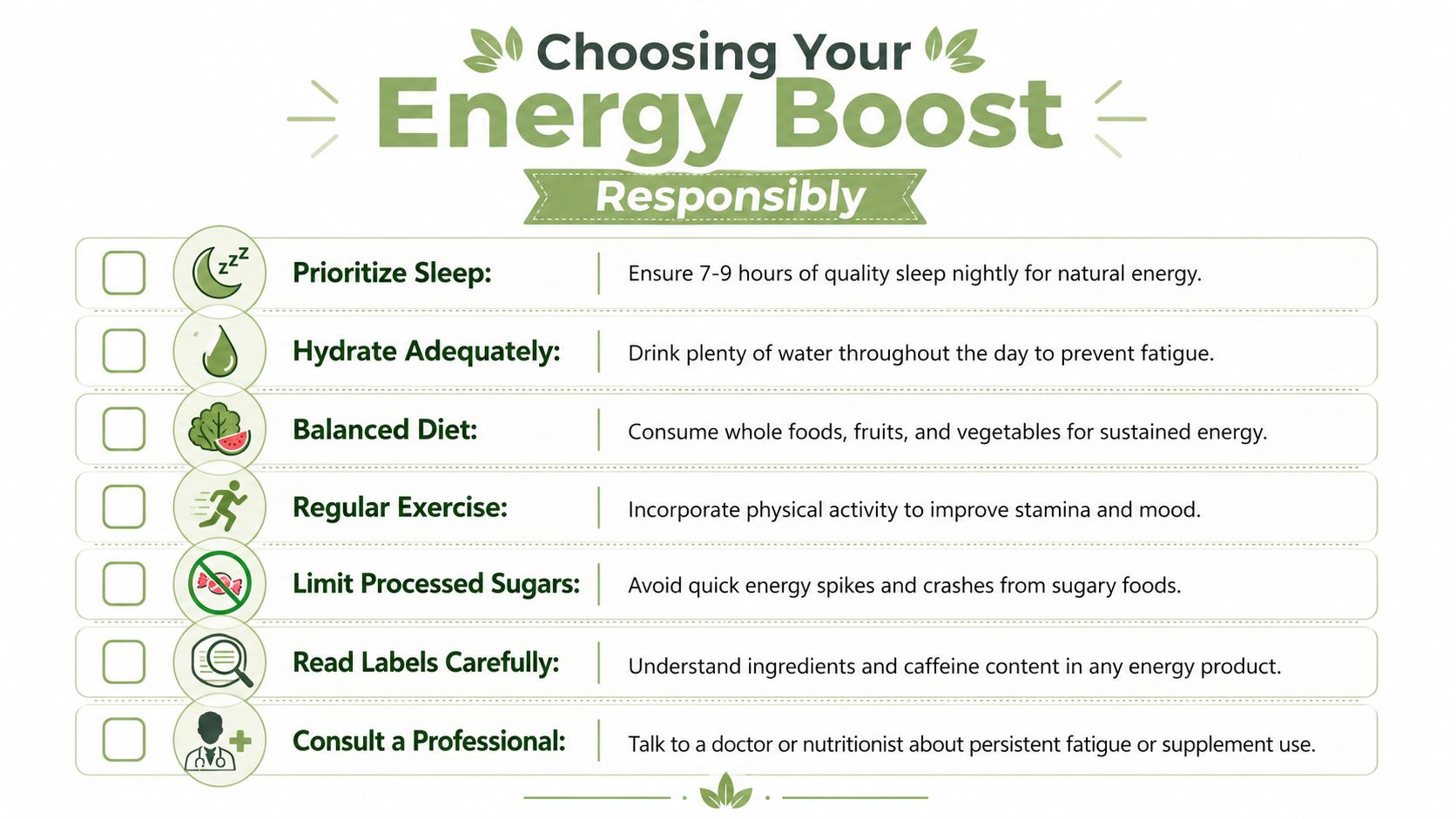
The long-term view matters more
The healthiest energy strategy usually looks a bit boring on paper. Regular sleep. Real meals. Water. Movement. A caffeine source that doesn't leave you rattled. But boring often works better than dramatic.
That principle shows up in other health-focused settings too. For gyms and wellness businesses, education around habits often creates more value than quick-fix products, which is part of what this article on boosting gym revenue through coaching gets right.
Choose products that fit your body and routine, not just your emergency moments.
If you do use an energy shot, keep it occasional and deliberate. If you want energy you can live with every day, natural options such as matcha or kombucha tend to support a more balanced relationship with focus, appetite, mood, and routine. Pep Tea offers one example through its organic Japanese matcha and Australian-brewed sugar-free organic kombucha, both designed for people who want functional drinks without relying on the harshest end of the category.
If you're ready to move from quick fixes to steadier daily energy, explore Pep Tea for organic matcha and sugar-free organic kombucha made for a more balanced Australian wellness routine.
Does Organic Tea Have Pesticides: Understanding Organic Tea
Certified organic tea in Australia should not contain synthetic pesticides because the standard explicitly prohibits them, and Australia's tea residue limit is often 0.05 mg/kg, compared with the European Union's 0.01 mg/kg. But the word organic on its own isn't the whole story, because the safety difference often comes down to whether a tea is properly certified, where it was grown, and how transparent the brand is about testing.
A lot of people ask, “does organic tea have pesticides?” and expect a simple yes or no. The honest answer is more useful than that. If your tea is certified organic, that's very different from a pack that merely uses feel-good language like “natural”, “pure” or “organically grown”.
That distinction matters even more when you drink matcha, because you consume the whole leaf, and when you drink kombucha, because the final brew starts with tea. If the base ingredient isn't clean, the finished drink doesn't magically become cleaner.
Tea labels can get confusing for Australian shoppers. The front of the pack might look wholesome, earthy, even premium. But a certification mark tells you far more than the colour scheme or the marketing copy ever will. Once you know what to look for, it gets much easier to shop with confidence.
So Does Your Organic Tea Contain Pesticides
If the tea is certified organic in Australia, the answer is that it shouldn't contain synthetic pesticides. That's the reassuring part. The part many people miss is that not every tea sold as “organic” gives you the same level of confidence.
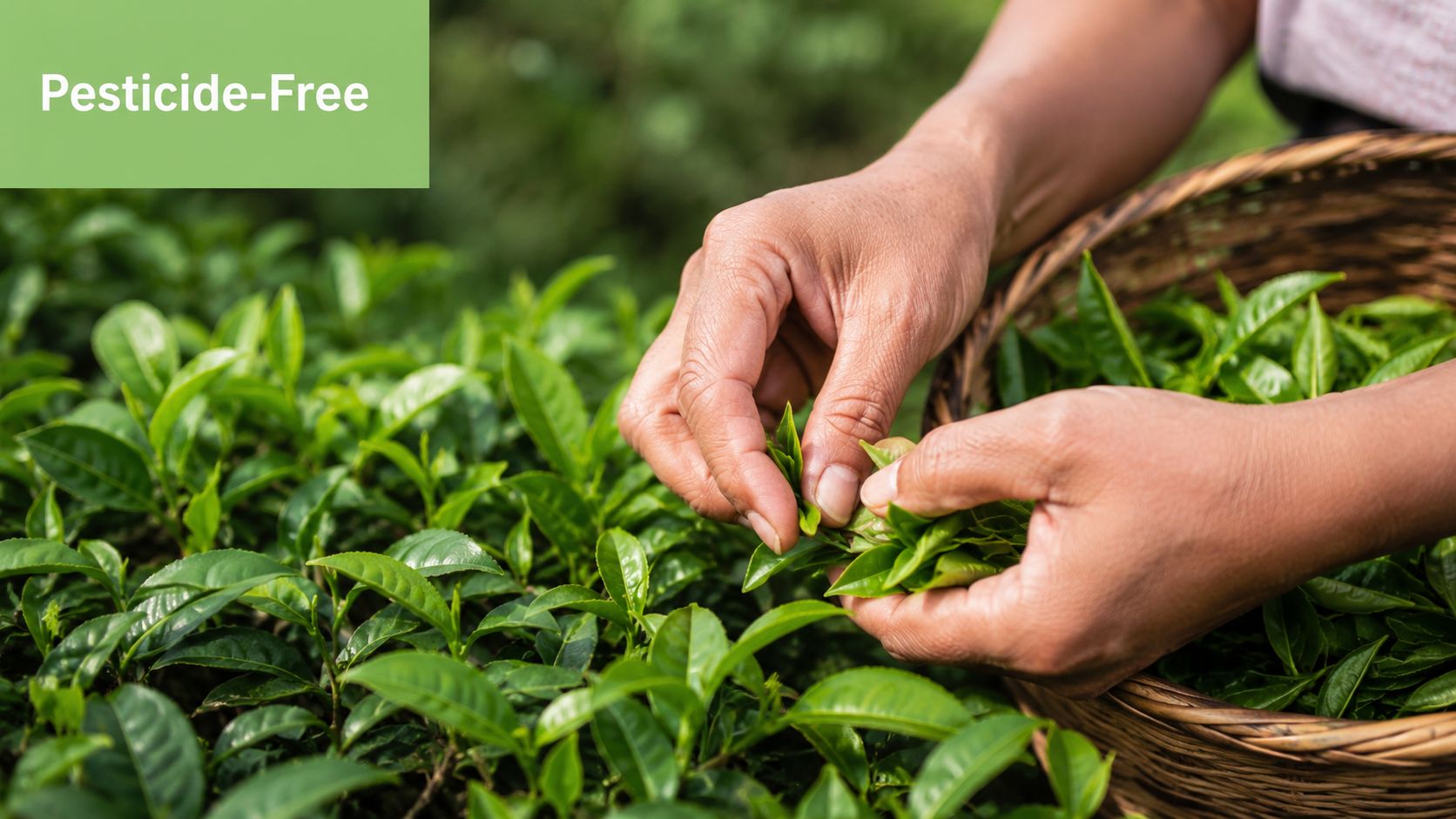
Tea is one of those products where the details matter. A loose-leaf black tea, a green tea bag, a ceremonial matcha and a bottle of kombucha might all sit in the same kitchen, but they don't carry the same exposure risks or the same certification signals. That's why the blanket question “does organic tea have pesticides” often leaves people more confused than informed.
The short version
Here's the practical way to understand it:
- Certified organic tea means synthetic pesticides are prohibited under the certification standard.
- A generic organic claim isn't always enough on its own if you can't see a recognised certification mark.
- Source matters because tea plants can absorb more than just pesticides from their environment.
- Product type matters because matcha is consumed differently from steeped tea.
Practical rule: Don't judge tea safety by the word “organic” alone. Judge it by the certification behind it.
There's another reason this topic trips people up. People often assume “organic” means every possible contamination issue has been solved. It hasn't. Organic certification is powerful, but it answers one part of the question very well and other parts only partially.
For most shoppers, that's good news. You don't need to become a chemist to buy better tea. You just need to know how to separate a certified claim from a marketing claim, and how to read the cues that matter most.
Decoding The Organic Label on Tea in Australia
The easiest way to understand certified organic is to compare it with qualifications. If someone says they're a great cook, that might be true. If they've completed formal training and passed assessments, you have something independent to rely on. Tea works the same way.
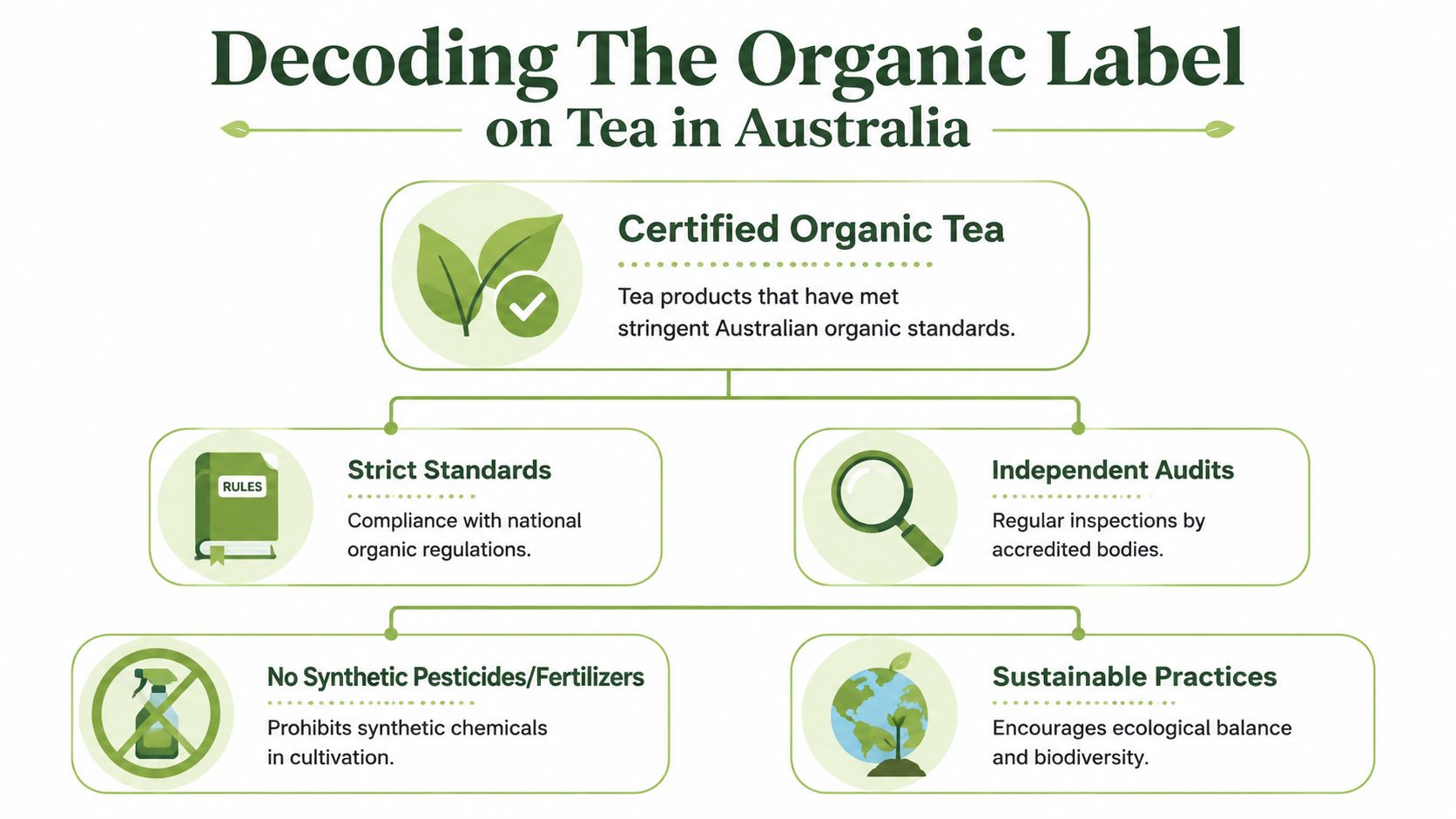
In Australia, organic tea is certified to contain zero synthetic pesticides because the Australian Certified Organic standard explicitly prohibits their use. The same standard also prohibits synthetic chemicals, herbicides and artificial preservatives, which is why many health-conscious buyers treat certification as a meaningful safety marker rather than a branding extra. The underlying standard is discussed in this overview of organic certification standards and is reflected in the explanation from Pure Matcha on Australian organic tea standards.
What certification actually tells you
A proper organic certification logo isn't decorative. It tells you the product has been assessed against a defined set of rules.
That matters because tea packaging is full of soft language that sounds healthy but doesn't carry the same weight, such as:
- Natural means very little by itself.
- Eco-friendly may describe packaging or brand positioning, not farming inputs.
- Pure is a marketing word, not a certification category.
- Organically grown can sound reassuring, but without a recognised certifier, you're still relying on the brand's own wording.
Why this matters in daily shopping
When you're standing in a supermarket aisle or browsing online, you're often making a decision in seconds. A certification mark simplifies that decision. It says, in effect, that the tea wasn't just described as clean. It was produced under rules designed to keep synthetic pesticides out of the process.
A recognised certification logo does the heavy lifting that marketing language can't.
That doesn't mean every uncertified tea is automatically poor quality. It means you don't have the same level of independent assurance. For many Australians, especially those drinking tea every day, that assurance is worth looking for.
The consumer takeaway
If you remember one thing from this section, make it this: certified organic is a stronger claim than organic-looking.
A genuine certification gives you a clearer line from farm to finished product. It's one of the simplest ways to cut through label noise and make a more informed choice.
Conventional vs Organic Tea A Look at Pesticide Residues
The gap between conventional tea and certified organic tea becomes clearer when you look at residue findings and the rules that govern them.
A Tea Leaves Australia article on tea pesticide limits notes that the Australian Pesticides and Veterinary Medicines Authority sets tea Maximum Residue Levels often at 0.05 mg/kg, while the European Union threshold is 0.01 mg/kg. That means Australia's limit is five times higher, and products that fail EU standards can sometimes still be sold legally in Australia.
That point alone surprises many tea drinkers. People assume “legal” automatically means “as strict as possible”. In food regulation, it often means “within the limits set by that country”.
What conventional tea can carry
Documented findings in the material above show why some buyers prefer certified organic tea for peace of mind.
One example: a 2012 Greenpeace China investigation found that 100% of tested tea samples from China contained at least three types of pesticides, and 78% (14 out of 18) contained pesticides harmful to human consumption. Another reported survey found conventional tea could contain up to 17 different pesticide types. These figures don't mean every conventional tea is identical, but they do show why residue concerns haven't come from nowhere.
Organic vs. Conventional Tea at a Glance
| Aspect | Certified Organic Tea | Conventional Tea |
|---|---|---|
| Synthetic pesticides | Prohibited under certification standards | May be used in cultivation |
| Residue concern | Certification is designed to avoid synthetic pesticide residue exposure | Residues may be present within legal limits |
| Consumer confidence | Based on independent standards and audits | Often depends on regulatory compliance alone |
| Australian market context | Bypasses the residue limit gap discussed above | Some products legal in Australia may not meet stricter EU limits |
| Label clarity | Strongest when backed by recognised certification | “Conventional” may not be obvious on front-of-pack packaging |
Why legal limits don't settle the whole question
A residue limit is not the same thing as zero residue. That's where people often get tripped up. Conventional tea may comply with the law and still contain detectable pesticide residues.
Certified organic tea appeals to many buyers because it aims to remove that concern at the farming stage rather than managing it at an allowable threshold later.
If you want the simplest route to avoiding synthetic pesticide residue, certified organic is the cleaner choice.
There's also a trust issue. Tea is often imported, blended, repacked and sold under familiar household brand names. Unless a product gives you a strong certification cue, you may be relying on a chain of decisions you can't see.
For Australians who drink several cups a day, that can be reason enough to choose tea with a clearer paper trail and stricter production rules.
Why This Matters More for Matcha and Kombucha
Matcha changes the conversation because you're not just brewing leaves and discarding them. You're drinking the leaf itself in powdered form. That makes the quality of the leaf much more important.
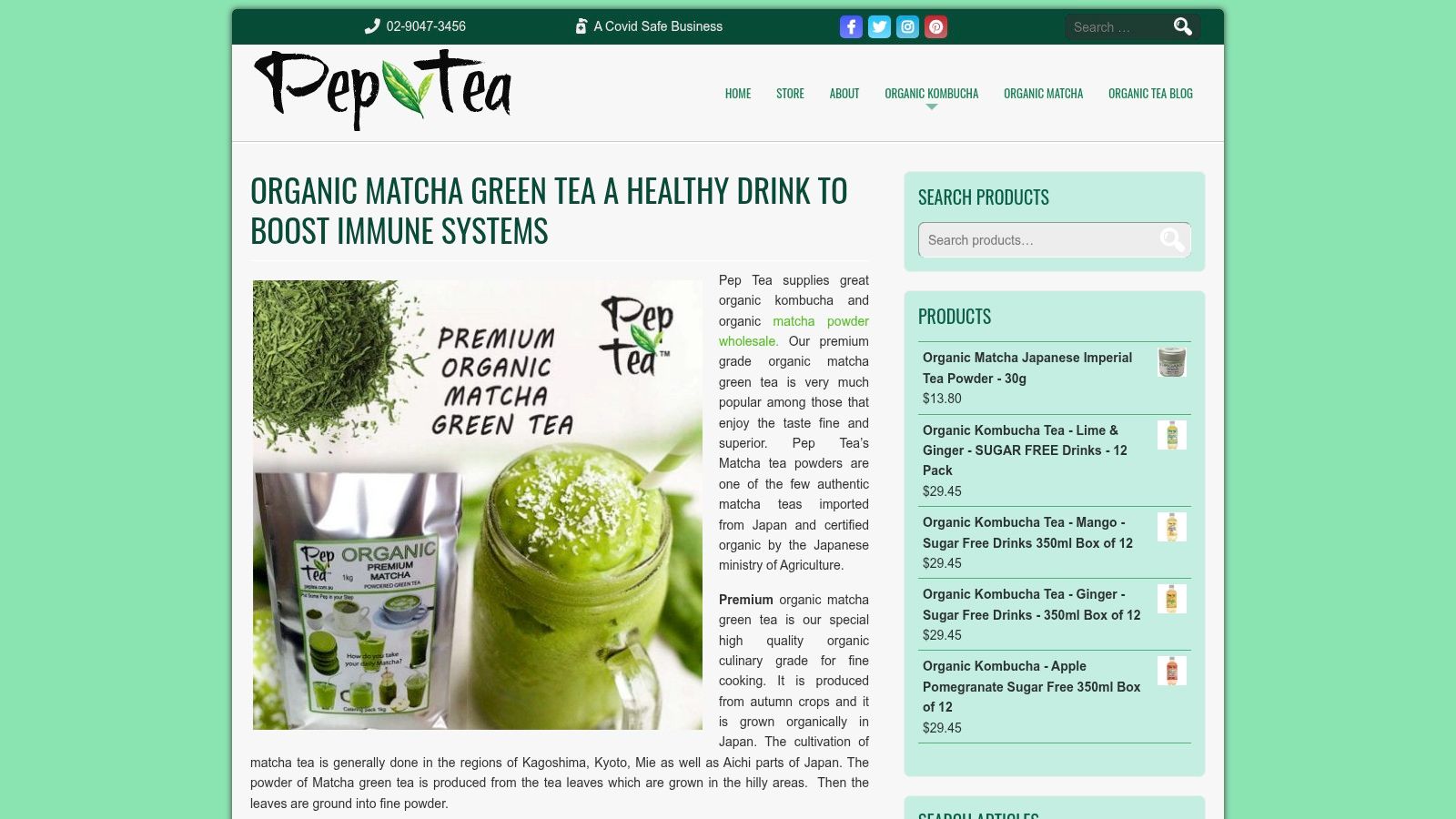
If regular steeped tea is like cooking vegetables in water and then straining them out, matcha is more like blending the whole lot into your drink. That's why many experienced tea drinkers are far stricter about matcha sourcing than they are about an ordinary tea bag.
Matcha is a whole leaf product
For premium matcha, certification and origin matter. Pure Matcha's explanation of Organic JAS matcha states that true organic matcha certified under the Organic JAS standard is produced from tea plantations in southern Japan, including Uji, where pollution and soil contamination are described as lower than in other tea-producing regions, with zero traces of chemical pesticides or fertilisers during cultivation.
That's a strong reason to pay attention to Japanese certification, not just broad organic wording. It's also why tea lovers often compare flavour and sourcing together. If you want a helpful example of how sourcing language and taste notes come together, this guide to Buttery umami matcha is a useful reference point.
For readers trying to understand quality tiers, this comparison of regular and ultimate matcha tea powder also helps clarify why not all matcha behaves the same in the bowl, latte or smoothie.
Kombucha is only as clean as its tea base
Kombucha can sound like a completely separate category, but it starts with tea. If the base tea is poor quality, heavily processed or murky in origin, fermentation doesn't erase that history.
The cleaner the tea, the cleaner the starting point for a drink many people choose for its simple, natural feel. That's especially relevant for sugar-free and low-sugar kombucha drinkers who are already trying to make more mindful choices.
Why these products raise the stakes
This topic matters more for matcha and kombucha for three practical reasons:
- Matcha increases exposure relevance because the powdered leaf goes straight into the cup.
- Kombucha depends on ingredient integrity because fermentation starts with tea, not with a blank slate.
- Premium buyers usually care about more than flavour. They care about origin, process and clean production.
The more directly you consume the leaf, the more the quality of that leaf matters.
That doesn't mean other teas don't matter. It means these two products make the certification question harder to ignore.
How to Choose a Genuinely Pesticide-Free Tea
Tea shopping gets easier when you stop reading the front of the pack first. Start with the proof points instead.
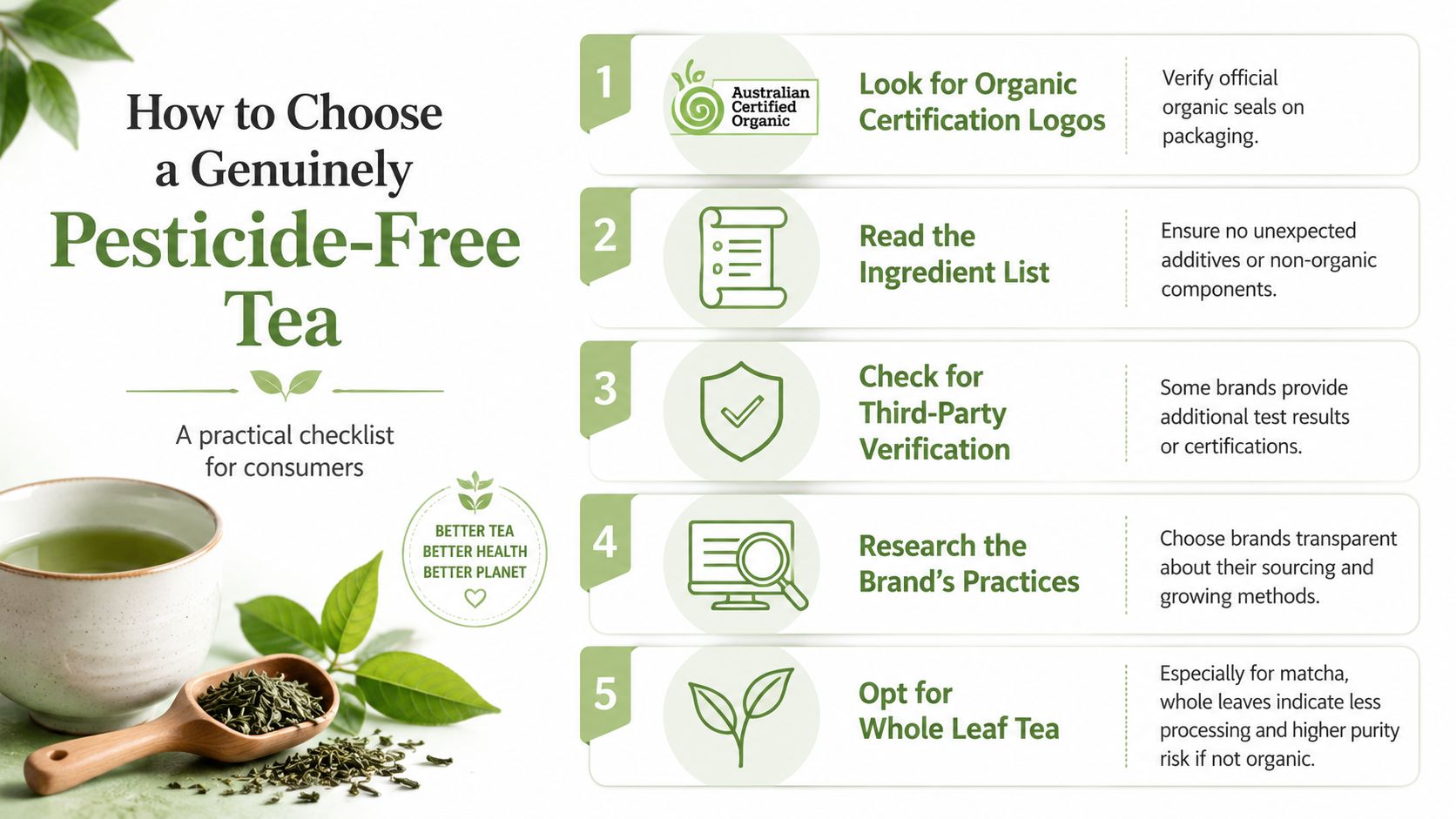
For Japanese matcha, one of the strongest signals is Organic JAS. According to Matcha Direct's explanation of Organic JAS certification, this certification is a third-party verified process that prohibits all synthetic pesticides and chemical fertilisers, and any product carrying the official JAS mark is guaranteed to have no pesticide residues from farm to finished powder.
A simple shopping checklist
Use this when you're choosing tea online or in-store:
- Look for recognised certification logos. For Australian products, check for established organic certification marks. For matcha from Japan, look for Organic JAS.
- Read past the front label. Words like “clean”, “pure” and “natural” aren't enough on their own.
- Check the ingredient list. Simpler is usually better. Tea should look like tea, not a list of fillers and vague flavour systems.
- Look for brand transparency. Brands that explain sourcing and standards usually make shopping easier.
- Be stricter with matcha. Because you consume the leaf, this is the category where weak sourcing claims matter most.
Questions worth asking before you buy
Not every tea buyer wants to interrogate a packet, but a few simple questions help:
| Question | Why it matters |
|---|---|
| Is it certified organic, or just described that way? | This separates verified claims from marketing language |
| Where was it grown? | Region can influence overall quality and confidence |
| Is the brand transparent about standards? | Clear brands are easier to trust |
| Is it matcha or a steeped tea? | Whole leaf products deserve more scrutiny |
If you also enjoy coffee and want to compare how other beverage buyers think about sourcing and residue concerns, this overview of sustainable coffee options gives a useful parallel.
For readers browsing green tea more broadly, a curated organic green tea collection can also make it easier to compare product types and certification cues side by side.
Buy the proof, not the mood. Tea packaging can suggest wellness. Certification is what confirms it.
The labels that should make you pause
A few claims deserve extra caution:
- Organically grown, with no recognised certifier named
- Pesticide free, with no explanation of verification
- Premium imported tea, with no origin detail
- Wellness tea blend, where the tea source is unclear
These aren't automatic deal-breakers. They're prompts to look closer.
What Organic Certification May Not Cover
Organic certification does an important job. It tackles synthetic pesticides. But it doesn't automatically answer every safety question a careful tea drinker might have.
One of the most overlooked issues is that tea plants can absorb naturally occurring substances from the soil. As noted in this discussion of fluoride and heavy metals in tea, organic certification doesn't regulate naturally absorbed contaminants in the same way, and some organic teas may still accumulate fluoride or heavy metals like lead depending on where and how they're grown.
The hidden confusion
Many shoppers often find this confusing. They hear “organic” and reasonably assume “completely clean”. In practice, organic means the farming system avoids prohibited synthetic inputs. It doesn't mean the plant is isolated from its environment.
That's especially relevant for tea because the leaf is the product. What the plant absorbs matters.
What a careful buyer should do with that information
This isn't a reason to panic or stop drinking organic tea. It's a reason to go one step further in your thinking.
A more complete quality picture includes:
- Certification for pesticide-related assurance
- Source region for broader environmental confidence
- Brand transparency about testing and quality control
- Product type awareness, especially for matcha
Organic certification solves one major problem well. It doesn't replace good sourcing.
That nuance is reassuring. Once you understand it, you can make sharper choices instead of assuming every tea with an organic-looking label is identical. The strongest products tend to pair recognised certification with careful sourcing and clear communication.
Your Questions on Organic Tea and Pesticides Answered
Can I wash or brew away pesticides from conventional tea?
Brewing may change what ends up in the cup, but it doesn't turn conventional tea into certified organic tea. If avoiding synthetic pesticide concerns matters to you, it's better to choose certified organic from the start.
Is decaffeinated organic tea still pesticide-free?
If it's properly certified organic, the key issue remains the same. Certification is what matters most, not whether the tea contains caffeine.
Is matcha worth being fussier about?
Yes. Matcha deserves more scrutiny because you consume the powdered leaf itself, not just an infusion.
Does local or transparent sourcing help?
Usually, yes. A brand that clearly explains its certification, origin and standards is easier to trust than one relying on vague wellness language.
Does organic mean completely risk-free?
No food claim is that simple. Organic certification is excellent for avoiding synthetic pesticide use, but thoughtful shoppers should still care about origin, transparency and overall quality.
If you're looking for a cleaner cup with clearer sourcing, explore Pep Tea for premium organic matcha and Australian-brewed organic kombucha. We're passionate about making healthy tea choices easier to understand, whether you're choosing ceremonial-grade matcha for calm energy or a refreshing low-sugar kombucha for everyday wellness.
Zero Sugar Energy Drinks: Natural Boosts for 2026
A drink can be zero sugar and still be a poor energy choice.
That sounds backwards, because most marketing trains us to think sugar is the whole problem. In reality, removing sugar only answers one question. It doesn't tell you how much caffeine is inside, what sweeteners create the flavour, how acidic the drink is, or whether the “boost” comes from a harsh stimulant hit rather than a steadier source of focus.
Australians are right in the middle of this shift. Shelves are packed with bright cans promising clean energy, better performance and no guilt. But if you want a drink that supports wellbeing, it helps to look past the front of the can and ask a better question. What kind of energy are you buying?
The Rise of the Zero Sugar Promise
Walk into a servo, supermarket or gym fridge and you'll see how normal zero sugar energy drinks have become. They're aimed at students, tradies, office workers, parents, drivers and just about anyone who feels tired at 3 pm. The message is simple. You can keep the buzz and skip the sugar.
That message has landed because the category is huge and still growing. The global zero-sugar beverages market was valued at USD 79.48 billion in 2026 and is projected to reach USD 199.68 billion by 2034, while Asia Pacific held a 38.14% share in 2025. Australia sits inside that regional demand, which shows how central local consumers are to the trend.
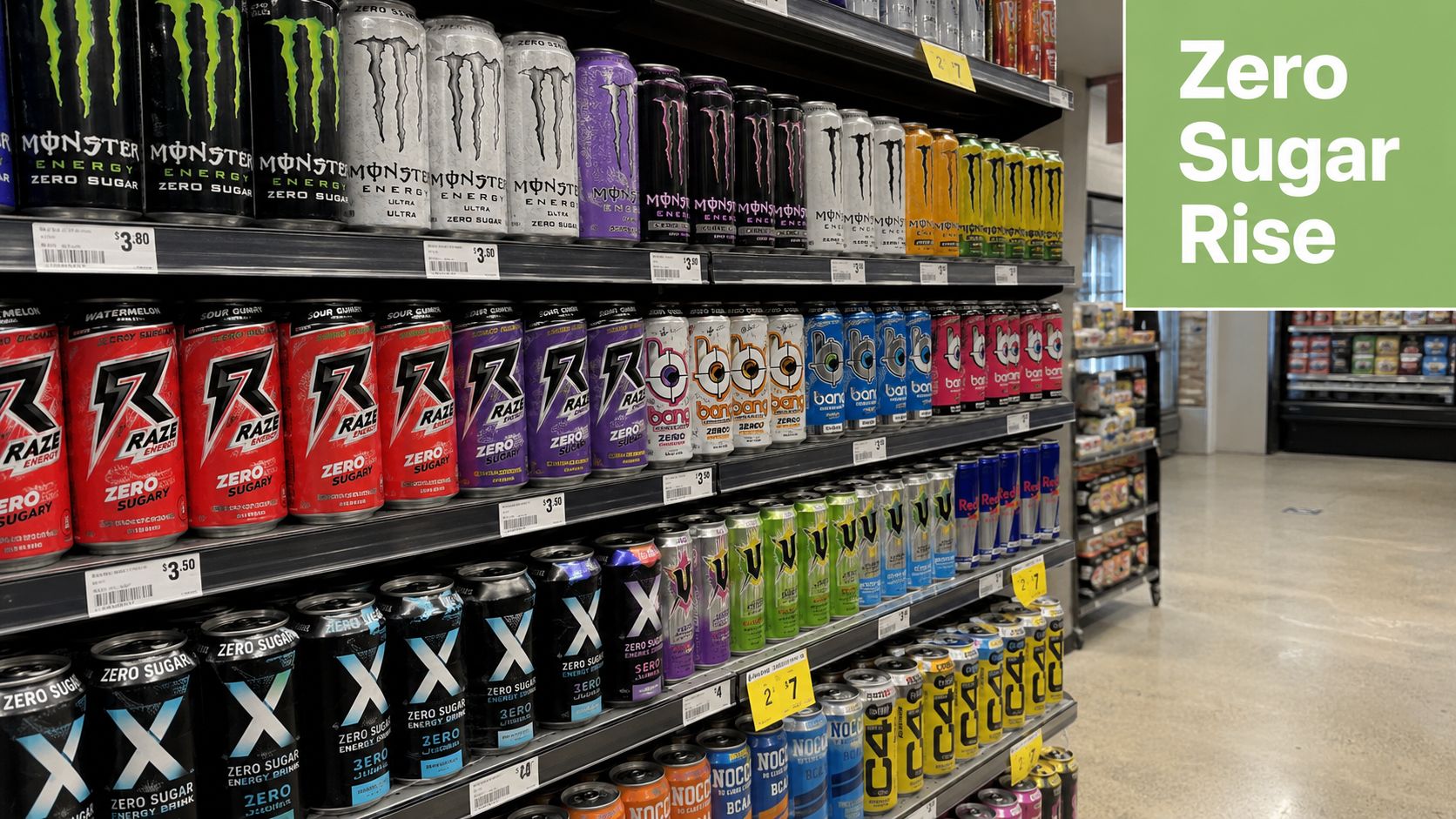
Why the promise is so attractive
Zero sugar energy drinks solve an obvious concern. Many people want alertness without the sugar crash that can follow a sweet soft drink or a standard energy drink. For busy Australians trying to cut back on sugar, that sounds like an upgrade.
The trouble is that “zero sugar” has become a health shortcut. People often read it as low-risk, light, or somehow naturally better. It isn't that simple.
What the label doesn't tell you at a glance
A can may be free from sugar and still rely on a mix of caffeine, acids, flavour systems and non-nutritive sweeteners to deliver the same big taste and punchy effect. That doesn't automatically make it dangerous, but it does mean the health story is incomplete if all you look at is the sugar line.
A useful rule: “Zero sugar” describes what has been removed. It doesn't describe the overall quality of the drink.
If you've noticed more cafés, retailers and wellness brands talking about alternatives to mainstream energy drinks, that's part of the same conversation. We've written more about that broader shift in functional beverage trends in Australia, where people are looking for drinks that do more than just stimulate.
The real question
The issue isn't whether individuals need energy. They do. The issue is whether the drink delivers energy in a way that fits their body, routine and long-term health goals.
That's where the label needs a closer look.
Unpacking the Can What Is Really Inside
The design on the outside usually says “performance”, “focus” or “no crash”. The ingredient list tells the full story.
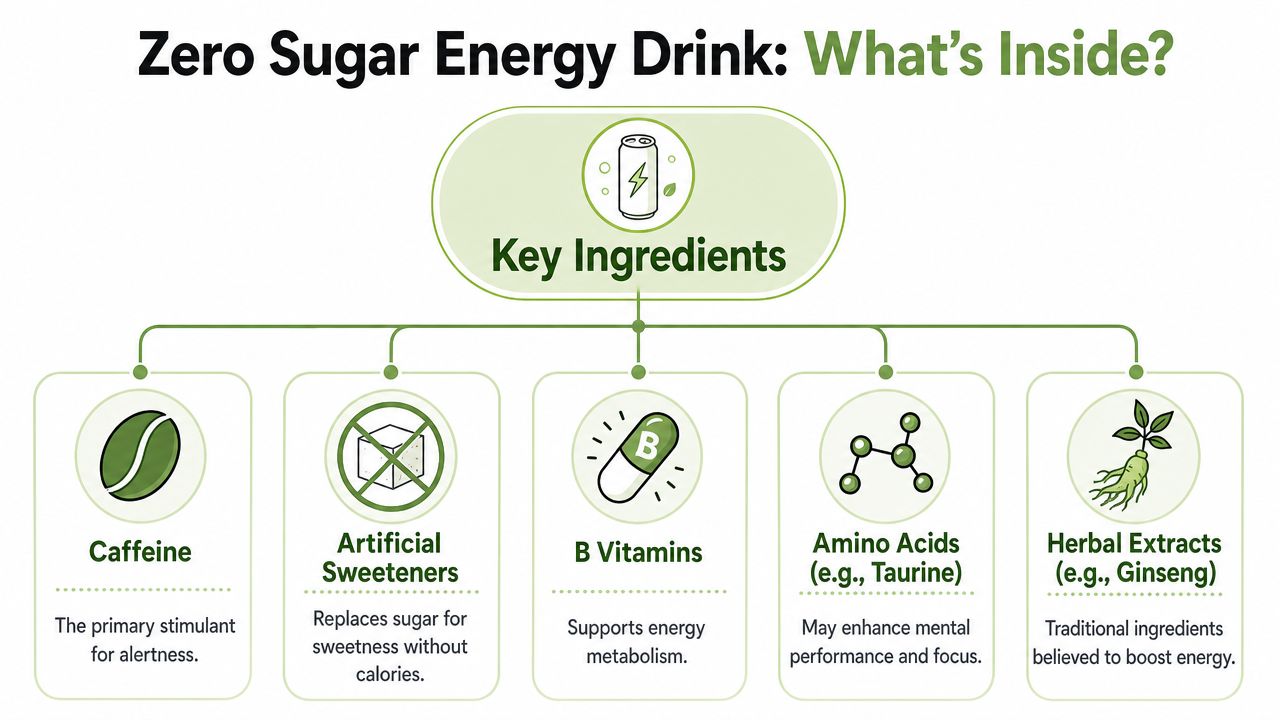
The main building blocks
Most zero sugar energy drinks sold in Australia are built from a familiar formula:
- Caffeine for stimulation. This is the main active ingredient people feel. In Australia, zero-sugar energy drinks commonly sit around 32 mg of caffeine per 100 mL, which works out to about 80 mg in a 250 mL can.
- Sweeteners instead of sugar. These create the sweet taste without adding meaningful calories.
- Acids and flavours. These sharpen the taste and preserve the product.
- B vitamins and added compounds. These often include B6, B12, taurine or herbal extracts such as guarana or ginseng.
A quick visual breakdown can help if you're new to label reading:
Why sweeteners matter
The most common sweeteners in these drinks include sucralose and acesulfame-K. They're used because they deliver intense sweetness in tiny amounts. In fact, they can be up to 600 times more potent than sugar, which is why manufacturers can keep products under <5 kcal per 100 mL under FSANZ criteria.
That sounds efficient, and commercially it is. But it also means the drink is relying on a highly engineered flavour system rather than whole-food ingredients.
The key difference isn't only sugar versus no sugar. It's often ultra-processed stimulation versus food-based function.
What each ingredient is doing
Here's a plain-English view of the usual formula:
| Ingredient type | What it does in the drink | What you should know |
|---|---|---|
| Caffeine | Increases alertness | The boost may feel fast, but some people also get jitters or sleep disruption |
| Artificial sweeteners | Replace sugar while keeping sweetness | They change taste without adding sugar, but they don't make the drink whole or natural |
| B vitamins | Support normal energy metabolism | Their presence doesn't cancel out the rest of the formulation |
| Taurine and amino acids | Added for performance positioning | Common in energy drink formulas, though consumers often assume they're more natural than they are |
| Acids and flavours | Create the sharp, punchy flavour | They affect taste and shelf stability, and acidity matters for teeth |
The part that confuses most shoppers
Many readers assume “sugar-free” means the can is basically flavoured sparkling water with caffeine. It usually isn't. It's a carefully balanced product designed to mimic sweetness, intensity and instant lift without using sugar.
That's why reading the ingredient list matters more than reading the front label.
The Hidden Health Risks Behind the Hype
The strongest marketing line for zero sugar energy drinks is also the most misleading. It suggests that once sugar is gone, the major health risk is gone too.
That leaves out several important trade-offs.
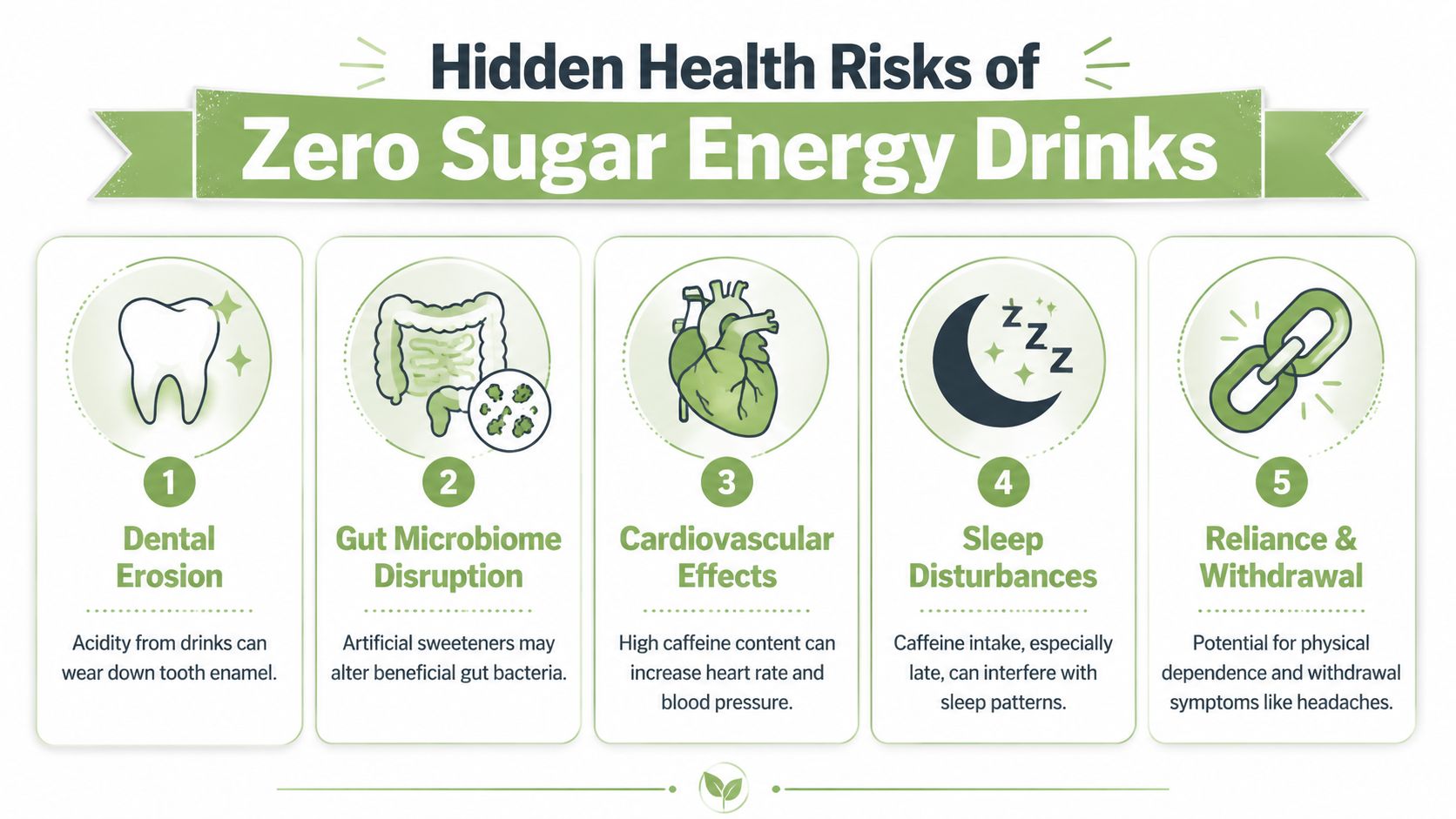
Metabolic concerns are not just about sugar
One of the most important findings in this space comes from Australia. Curtin University reported in 2025 that sugar-free energy drinks induced metabolic syndrome and insulin resistance in mice to nearly the same extent as high-fat diets, raising concerns that artificial sweeteners may dysregulate blood sugar and affect the gut microbiome. You can read the university summary in Curtin University's report on sugar-free energy drinks and metabolic harm.
This doesn't mean every person who drinks one can will develop a metabolic problem. It does mean the “metabolically neutral” idea deserves more caution than the branding suggests.
The heart still feels the stimulant load
Sugar-free doesn't mean stimulant-free. That matters because the Australian Heart Foundation reports that energy drinks, including sugar-free versions, are linked to transient rises in blood pressure and abnormal electrical activity in the heart.
For some healthy adults, that may mean a racing feeling, palpitations, or an uncomfortable post-drink buzz. For people with existing sensitivity to caffeine, poor sleep, anxiety, or underlying heart concerns, it can matter more.
The NHMRC recommends that adults limit caffeine intake to 400 mg a day and adolescents stay below 100 mg a day. Since some sugar-free energy drinks can contain 80–200 mg of caffeine per serving, a single can may already take a teen to or beyond that threshold.
Worth remembering: removing sugar does nothing to reduce the core stimulant effect of the can.
Dental damage can still happen
A lot of people switch to zero sugar products for their teeth. That's understandable, but it's only half the picture.
Under the Australian Food Standards Code, a beverage claiming to be sugar-free must contain less than 0.5 grams of sugar per 100 mL. Yet acidity still matters. Some zero sugar drinks rely on acids and preservatives that push pH low enough to contribute to enamel wear. A NSW dental health survey in 2023 found that 32% of adults who regularly consume sugar-free acidic beverages reported early enamel loss.
Why the “healthy” halo is risky
A standard sugary energy drink often looks unhealthy. A sleek zero sugar can often looks disciplined, sporty and modern. That image can lead people to drink them more often, drink them faster, or assume they're a routine wellness product rather than an occasional stimulant beverage.
Here's the balanced view:
- Lower sugar is a real benefit. If someone is choosing between a high-sugar can and a zero sugar version, reducing sugar intake can be sensible.
- It's not the same as choosing a nourishing drink. Artificial sweeteners, high caffeine, acidity and ultra-processed flavour systems still deserve attention.
- Frequency matters. An occasional drink is a different pattern from relying on them every day to get through work, study or training.
The main problem isn't that the label is false. It's that the label is incomplete.
Searching for a Smarter Way to Get Energised
Consumers don't reach for an energy drink because they're reckless. They're tired, flat, under pressure, underslept, or trying to stay sharp through a long day. That need is real.
The better question is whether you want stimulation or support.
Synthetic buzz versus functional energy
Synthetic stimulation is designed to feel immediate. It pushes alertness hard and fast. For some people that's useful in the moment, but it can also feel edgy, abrupt or draining later.
Functional energy is different. It aims to support focus, steadier alertness and a more manageable experience in the body. That's why more Australians are paying attention to ingredient quality, not just calorie count.
Australian market reporting has highlighted a shift toward drinks with natural ingredients and functional benefits, including L-Theanine from matcha, for stress management and focus, as discussed in Coherent Market Insights' report on sugar-free energy drinks.
A more useful way to judge an energy drink
Instead of asking, “How strong is it?”, try asking:
- How does it make me feel an hour later
- Can I still concentrate without feeling wired
- Will it interfere with sleep if I have it in the afternoon
- Does it rely on a short ingredient list or a lab-style formula
- Would I feel comfortable drinking this regularly
The smartest energy source isn't always the strongest one. It's the one you can live with well.
That shift matters in cafés, workplaces and homes. People don't just want a jolt anymore. They want drinks that suit a healthier routine.
Natural Alternatives Organic Matcha and Kombucha
If you want energy without leaning on the usual can formula, two options stand out. Organic matcha offers focused, tea-based stimulation. Properly brewed kombucha offers a lighter, refreshing alternative that fits people trying to move away from ultra-processed drinks.
Why matcha feels different
Matcha isn't marketed as a shock-to-the-system drink. Its appeal is the combination of naturally occurring caffeine and L-Theanine, which many people experience as calmer, smoother focus.
That difference matters because, as noted earlier, the Australian Heart Foundation has linked energy drinks, including sugar-free forms, to temporary increases in blood pressure and abnormal electrical activity in the heart. Matcha sits in a different category of experience. Rather than trying to overpower fatigue with a synthetic-style buzz, it offers a more measured lift.
A simple matcha routine can look like this:
- Morning focus drink. Whisk ceremonial-grade matcha with water for a clean start to the day.
- Mid-morning latte. Add your preferred milk for something more filling.
- Workday reset. Choose matcha when you need concentration but don't want the abrupt feel some canned drinks produce.
Where kombucha fits
Kombucha isn't a direct one-for-one substitute for every energy drink. It's better understood as a refreshing, functional swap for people who want something lively, low in sugar and easier to integrate into everyday life.
When kombucha is properly fermented, it brings a very different profile from a mainstream energy can. The focus isn't maximum stimulation. It's a lighter drinking experience with live cultures and a brewed character that feels more like a real beverage and less like a flavour-engineered product.
At Pep Tea, we make Australian-brewed sugar-free organic kombucha in the Hunter Valley, NSW, which is one practical option for people moving away from artificial energy drinks. If you want a deeper look at what fermentation changes in the final drink, our guide to the benefits of kombucha is a useful starting point.
Which alternative suits which person
| If you want | A better fit may be | Why |
|---|---|---|
| Calm focus for work or study | Matcha | Natural caffeine plus L-Theanine can feel smoother |
| A fizzy afternoon swap | Kombucha | Refreshing and lower in sugar than many soft drinks |
| A café-friendly non-alcoholic option | Matcha or kombucha | Both work well in hospitality settings |
| Less reliance on synthetic formulas | Either | Both move you away from the typical can model |
For readers comparing broader clean energy options for professionals, it's useful to think in terms of routine, not just ingredients. The best alternative is the one you'll enjoy using consistently.
How to Choose a Genuinely Healthy Energy Drink
A healthy-looking label can hide a lot. The safest way to shop is to read the back, not the front.
Start with the ingredient list
The shorter and more recognisable the list, the easier it is to judge. That doesn't mean every unfamiliar ingredient is harmful. It means you can spot whether the product is built from brewed or whole-food inputs, or whether it depends on a long processing chain.
Look closely for:
- Artificial sweeteners. Names such as sucralose and acesulfame-K matter. On some labels, people also watch for additive numbers linked to sweeteners.
- Synthetic flavour systems. “Natural flavour” and “artificial flavour” can both mask a lot of formulation complexity.
- Acids and preservatives. These affect the drink's sharpness and shelf life, but they also matter for teeth and overall product style.
Check how the energy is created
Not all energy drinks deliver the same kind of effect. Ask yourself where the lift is coming from.
A quick checklist helps:
- Is the main effect just a caffeine hit? If yes, think about how it fits your day and sleep.
- Is it brewed or blended? Brewed drinks such as tea and kombucha usually signal a different product philosophy from highly formulated cans.
- Does it mention organic certification? That can help if you're trying to reduce exposure to unnecessary additives.
- Would you call the ingredients food-like? If not, it may still be legal and popular, but it may not match your health goals.
Label-reading shortcut: if the front says “clean” but the back reads like a chemistry set, trust the back.
What to choose in a café or supermarket
In practice, the healthiest option often looks less dramatic than the flashiest one in the fridge.
Choose drinks that lean toward:
- Brewed ingredients
- Organic tea bases
- Naturally fermented products
- Low or no added sugar
- No artificial colours when possible
If you're comparing options for everyday use, our article on natural energy drinks in Australia may help you narrow down what suits your routine.
The aim isn't perfection. It's making one better decision at a time.
Simple Swaps for a Better Boost
You don't need to overhaul your entire routine to move away from zero sugar energy drinks. A single swap can change how your day feels.
Try these examples:
- Morning can to morning matcha. If your first drink is a zero sugar energy can, swap it for a hot or iced matcha. You still get a lift, but many people find the focus feels steadier.
- Afternoon slump to chilled kombucha. If you usually want something fizzy at 3 pm, a sugar-free kombucha can scratch that same refreshment itch without turning the moment into a stimulant event.
- Second caffeine hit to caffeine-free support. Some afternoons call for less stimulation, not more. If that's you, this guide to caffeine-free drinks from Maximum Health Products gives practical ideas for lower-stimulation options.
A better energy ritual can also be more enjoyable:
- Whisk matcha with cold water and ice for a quick pre-work drink.
- Serve kombucha in a proper glass with citrus or mint if you want a café-style non-alcoholic option at home.
- Keep the decision simple. Ask whether the drink is supporting your body or just forcing it onward.
The big shift is mental. You're not giving something up. You're upgrading from a manufactured buzz to a more thoughtful source of energy.
If you're exploring cleaner ways to stay focused and refreshed, Pep Tea offers organic matcha and Australian-brewed sugar-free kombucha designed for everyday rituals, café menus and mindful low-sugar living.
Sugar Free Carbonated Drinks: A Guide to Healthier Fizz

You're in the supermarket, staring at a fridge full of cans and bottles. One says zero sugar. Another says diet. Another leans hard on words like “natural”, “clean”, or “better for you”. Then there's sparkling water, kombucha, flavoured soda water, and a few bright-coloured drinks that look suspiciously like soft drink wearing a wellness costume.
It's no wonder people get confused.
For a lot of Australians, cutting back on sugary soft drink feels like an obvious good move. Cancer Council South Australia notes that a typical 600 mL bottle of soft drink contains 16 teaspoons of sugar in its discussion of diet drinks and alternatives, which helps explain why lower-sugar options keep getting attention in the drinks aisle Cancer Council SA on diet drinks and sugar. But once sugar comes out, a new question appears. What exactly has replaced it, and does that make the drink healthy, or less sugary?
That question matters because these drinks aren't fringe products anymore. In the same Cancer Council South Australia article, almost 1 in 4 teenagers aged 15 to 17 years (24.2%) said they drank sugar-free soft drink, sports drinks and energy drinks every day, based on the South Australian Population Health Survey Cancer Council SA on youth consumption patterns.
Navigating the World of Sugar Free Carbonated Drinks
If you've ever picked up three different fizzy drinks and flipped each one over to compare labels, you've already realised the category is messy.
Some sugar free carbonated drinks are basically water plus bubbles. Some are classic soft drinks rebuilt with high-intensity sweeteners. Some aim for a “healthy soda” identity. Others come from fermentation, where sugar is used in the brewing process and then reduced rather than swapped for an additive.
That's why the label on the front rarely tells the full story.
Why the category feels so confusing
A drink can be sugar free and still be very different from the one next to it. One bottle might contain only carbonated water and natural flavour. Another might rely on a blend of aspartame and acesulfame potassium. Another might be acidic, sweet, colourful, and heavily processed, even though the sugar line reads zero.
Practical rule: “Sugar free” tells you one thing. It doesn't tell you the whole nutritional story.
The confusion gets bigger because shoppers often compare the wrong drinks. They compare zero sugar cola with regular cola, and stop there. In real life, the more useful comparison is often zero sugar cola versus sparkling water, or kombucha versus artificially sweetened soda, or a flavoured fizzy drink versus unsweetened tea.
The real question isn't just sugar
The more helpful question is this: what is this drink made from, and what role do I want it to play?
A few simple examples make that clearer:
- If you want hydration first, plain water or unsweetened sparkling water usually makes the most sense.
- If you want a soft drink flavour without sugar, a diet or zero sugar soda may suit that job.
- If you want fizz with a more food-like ingredient story, a naturally fermented option can be worth a closer look.
- If you drink it every day, ingredient quality matters much more than marketing language.
There's also a broader market shift behind all of this. Data Intelligence estimates the global sugar-free carbonated drinks market reached USD 147.0 billion in 2025 and is projected to reach USD 262.2 billion by 2033, with a projected 7.5% CAGR from 2026 to 2033 Data Intelligence market projection for sugar-free carbonated drinks.
So yes, there's more choice than ever. That's useful. It also means you need a better filter than “zero sugar = healthy”.
The Spectrum of Sugar-Free Fizz Explained
Not all fizzy drinks belong in the same basket. Once you split them into a few simple families, the aisle gets much easier to read.
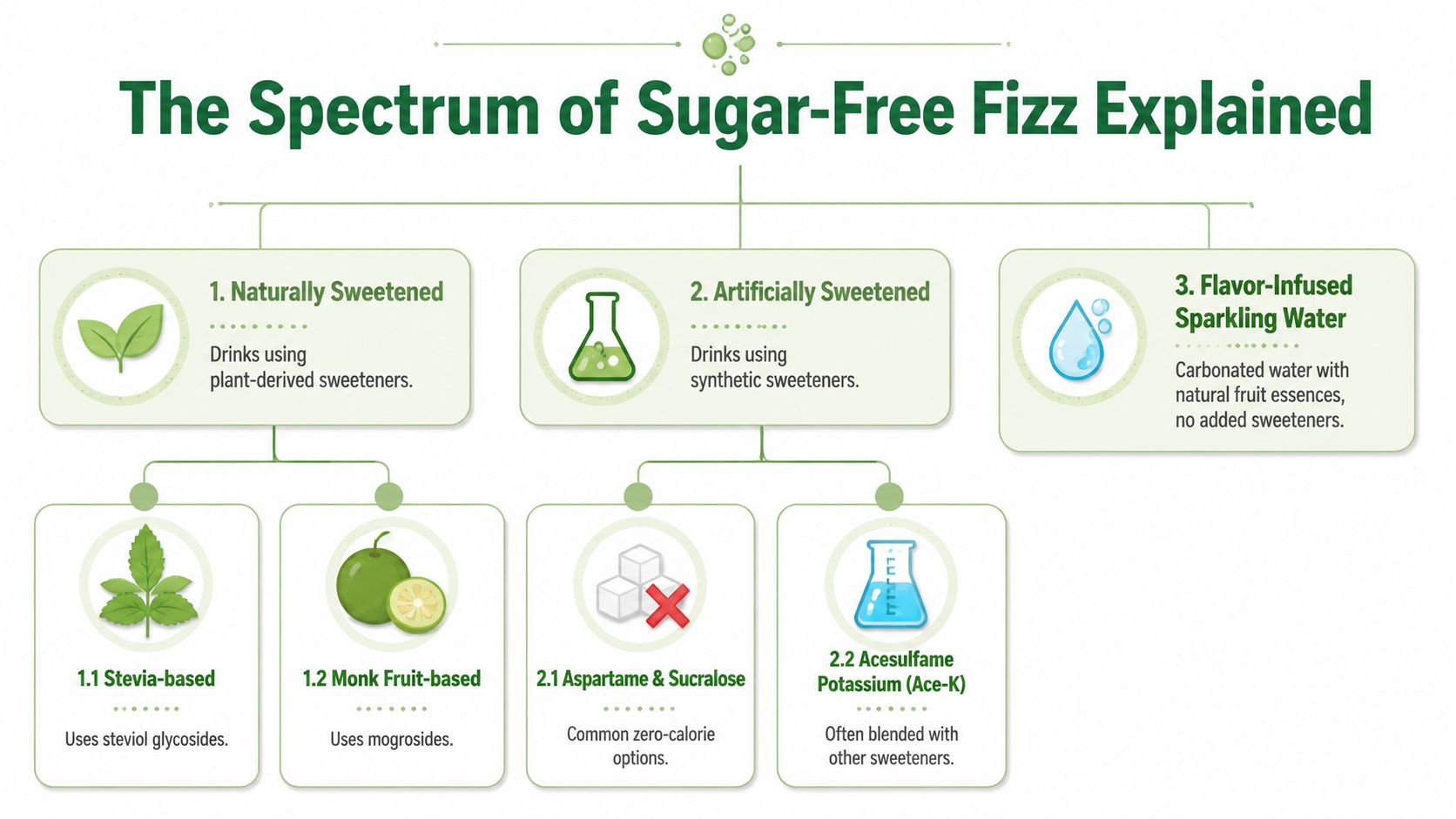
Sparkling water and mineral water
This is the simplest end of the spectrum.
These drinks are mostly just water with carbonation. Some are naturally mineral-rich. Others are filtered water with bubbles added later. If they're unflavoured and unsweetened, they're usually the most straightforward choice in the whole category.
They suit people who like fizz but don't want sweetness.
A flavoured sparkling water can still fit here if it contains only carbonated water and flavour essence, without added sweeteners, leading many people to discover they don't need a drink to taste like soft drink to enjoy it.
Diet soda and zero sugar soft drink
This is the familiar soft drink lane. Cola, lemon, orange, energy-style drinks, and other sweet fizzy beverages often fall into this group when sugar is removed and replaced with non-nutritive sweeteners.
The aim is simple. Keep the sweetness, keep the fizz, keep the recognisable flavour profile, and cut the sugar and calories.
That makes these drinks useful for people moving away from full-sugar soft drinks. But they're still best understood as soft drinks with a different sweetening system, not the same thing as water.
If you browse healthy soda drink options, this is the point where it helps to compare ingredient lists rather than front-label claims.
Naturally fermented fizzy drinks
Then there's a different path. Fermented drinks use a brewing process to create flavour, tang, and bubbles. Kombucha is the clearest example.
This category often feels less obvious because it doesn't fit the old “soft drink vs diet drink” logic. Fermentation can create a drier, more layered taste. It can also change how sweetness appears on the palate. Instead of trying to mimic a sugary soft drink exactly, these drinks often offer a different drinking experience altogether.
Some people switch to kombucha not because it tastes like cola, but because it gives them fizz without the same “liquid lolly” feel.
A simple mental map
Here's a quick way to sort the fridge in your head:
| Drink type | Main idea | Usually sweet? | Best thought of as |
|---|---|---|---|
| Sparkling water | Water plus bubbles | No | Hydration with fizz |
| Flavoured sparkling water | Water, bubbles, flavour | Usually no | Light flavoured hydration |
| Diet or zero sugar soda | Soft drink rebuilt without sugar | Yes | Sugar-free soft drink |
| Fermented fizzy drink | Brewed and carbonated through fermentation | Sometimes lightly, sometimes not | A functional or food-like alternative |
If you remember one thing, make it this. Sugar free carbonated drinks range from plain water with bubbles to highly engineered soft drinks. The label category is broad. The ingredients decide where a drink really sits.
Decoding the Sweeteners Behind the Zero Sugar Promise
Once sugar disappears from a fizzy drink, sweetness usually has to come from somewhere else. That “somewhere else” is where many people get stuck.
Some drinks use artificial sweeteners. Some use plant-derived sweeteners. Some lean on flavour and acidity more than sweetness. Others reduce sugar through fermentation rather than replacing it outright.
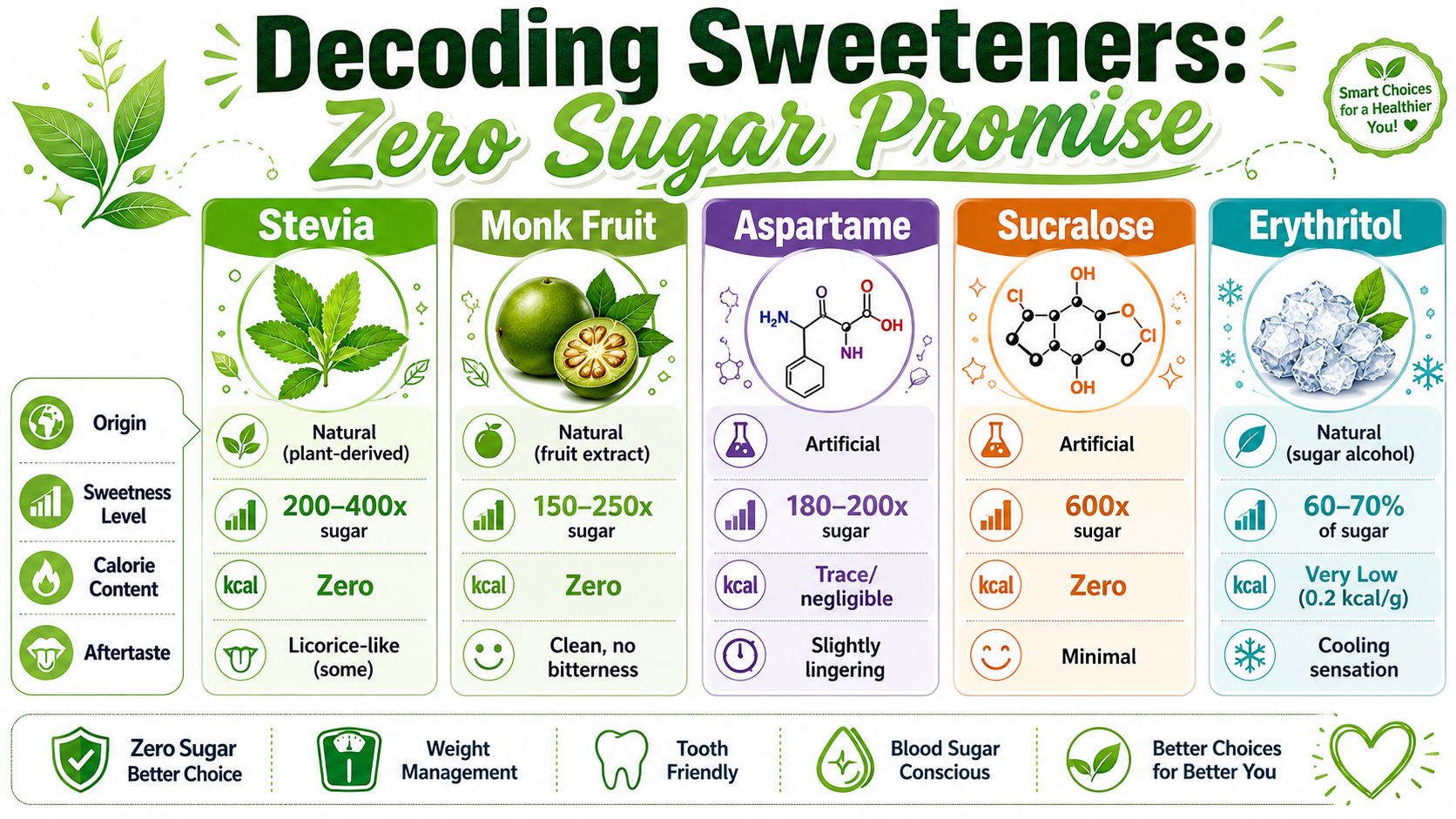
The common sweeteners you'll see on labels
Coca-Cola's ingredient information explains that reduced-, low-, and no-sugar beverages commonly use sweeteners such as aspartame, sucralose, acesulfame potassium, saccharin, cyclamates, or stevia Coca-Cola ingredient FAQ on sweeteners.
That matters because these aren't all the same.
Some are used because they're extremely sweet in tiny amounts. Some are blended together to smooth out aftertaste. Some can taste cleaner to one person and harsher to another. If you've ever said, “I can always tell when a drink is diet,” you were probably noticing that sweetener profile.
Why drinks often use a blend
Sugar doesn't just make a drink sweet. It also affects body, mouthfeel, and the way flavour lands and fades.
When formulators remove sugar, they have to rebuild that experience in a different way. That's why many sugar free carbonated drinks use more than one sweetener. One sweetener may bring the upfront sweetness, while another fills out the middle or helps the finish feel less thin.
Here's the simple version:
- Aspartame often appears in classic diet-style soft drinks.
- Sucralose can deliver a strong sweetness with a different finish.
- Acesulfame potassium is often used in blends.
- Stevia appeals to shoppers looking for a plant-derived option.
- Saccharin and cyclamates still appear in some formulations.
None of that automatically tells you whether a drink is right or wrong for you. It tells you what kind of sweetness experience the brand is trying to create.
Fermentation is a different route
Some drinks don't aim to copy soft drink sweetness at all. Fermentation creates a tart, lively profile that can reduce the need for added sweeteners.
That's one reason kombucha sits in its own lane. The result can be fizzy and refreshing without chasing the exact flavour arc of a conventional zero sugar cola. For people who are tired of artificial sweetener aftertaste, that can be a meaningful difference.
A short explainer can help if you want the basics visually.
What to notice as a drinker
You don't need a chemistry degree. You need a few useful questions:
- Does the sweetness taste clean or lingering?
- Is the drink trying to mimic soft drink, or offer a different style?
- Do you feel good drinking it regularly, or only occasionally?
- Can you recognise and accept the ingredient list?
A sugar-free label answers the calorie question. The ingredient list answers the quality question.
If you start there, labels become much less mysterious.
Beyond Zero Sugar Health and Wellness Considerations
A drink can be sugar free and still not be the best choice for everyday drinking.
That's the part many labels leave out. They focus on what's missing, not what's still present. Acidity, sweeteners, flavouring systems, and the overall level of processing still matter.
Zero sugar doesn't equal a health drink
Independent review material highlights an important gap in the conversation. Artificially sweetened beverages avoid sugar, but their broader health effects are still debated and may include associations with metabolic risk, with the evidence described as controversial and not fully settled review discussion on artificially sweetened beverages and unresolved health questions.
That means “better than regular soft drink” and “good as an everyday staple” are not the same claim.
Water still sits in a category of its own. Unsweetened sparkling water also plays a very different role from sweetened zero sugar soft drink. One is basically hydration with bubbles. The other is closer to a treat, even if it contains no sugar.
Think about what the drink contributes
A useful way to compare drinks is to ask what they bring to the table.
- Plain water brings hydration, with no sweetness to maintain.
- Unsweetened sparkling water adds texture and enjoyment, but stays simple.
- Diet soft drink removes sugar, yet often remains acidic and nutritionally non-contributory.
- Fermented tea drinks may offer a more ingredient-led alternative, depending on the product and formulation.
UNC Health Appalachian makes the broader point clearly: removing sugar alone doesn't automatically make a carbonated drink “healthy”, because zero-sugar beverages can still be highly processed and their long-term effects remain uncertain UNC Health Appalachian on zero-sugar soda and health context.
That's why many people now compare drinks by ingredient quality, not just calories.
Everyday use versus occasional use
Context matters here.
If someone is replacing full-sugar cola with zero sugar cola, that can be a practical sugar-reduction step. But if someone is deciding what to drink with lunch every day, the comparison should probably widen to water, sparkling water, unsweetened tea, or a more thoughtful functional option.
For workplaces, schools, and shared fridges, that same logic applies. A guide to healthy vending choices for Oklahoma offices is useful because it frames beverages as part of an environment people use repeatedly, not as a one-off purchase. The principle translates well to Australia. Daily choices shape habits.
If you enjoy sweeter fizzy drinks but want options with a different ingredient profile, some people also look at sugar-free energy drink alternatives to compare caffeine, sweetness style, and overall formulation.
The best “healthy fizz” question is often not “Does it have sugar?” It's “Would I feel good choosing this often?”
That one question cuts through a lot of marketing.
How to Read Drink Labels Like an Expert
Front-of-pack claims are designed to sell the drink. The back label tells you what you're holding.
If you want to get better at choosing sugar free carbonated drinks, start with the ingredient list and nutrition panel before you look at buzzwords.
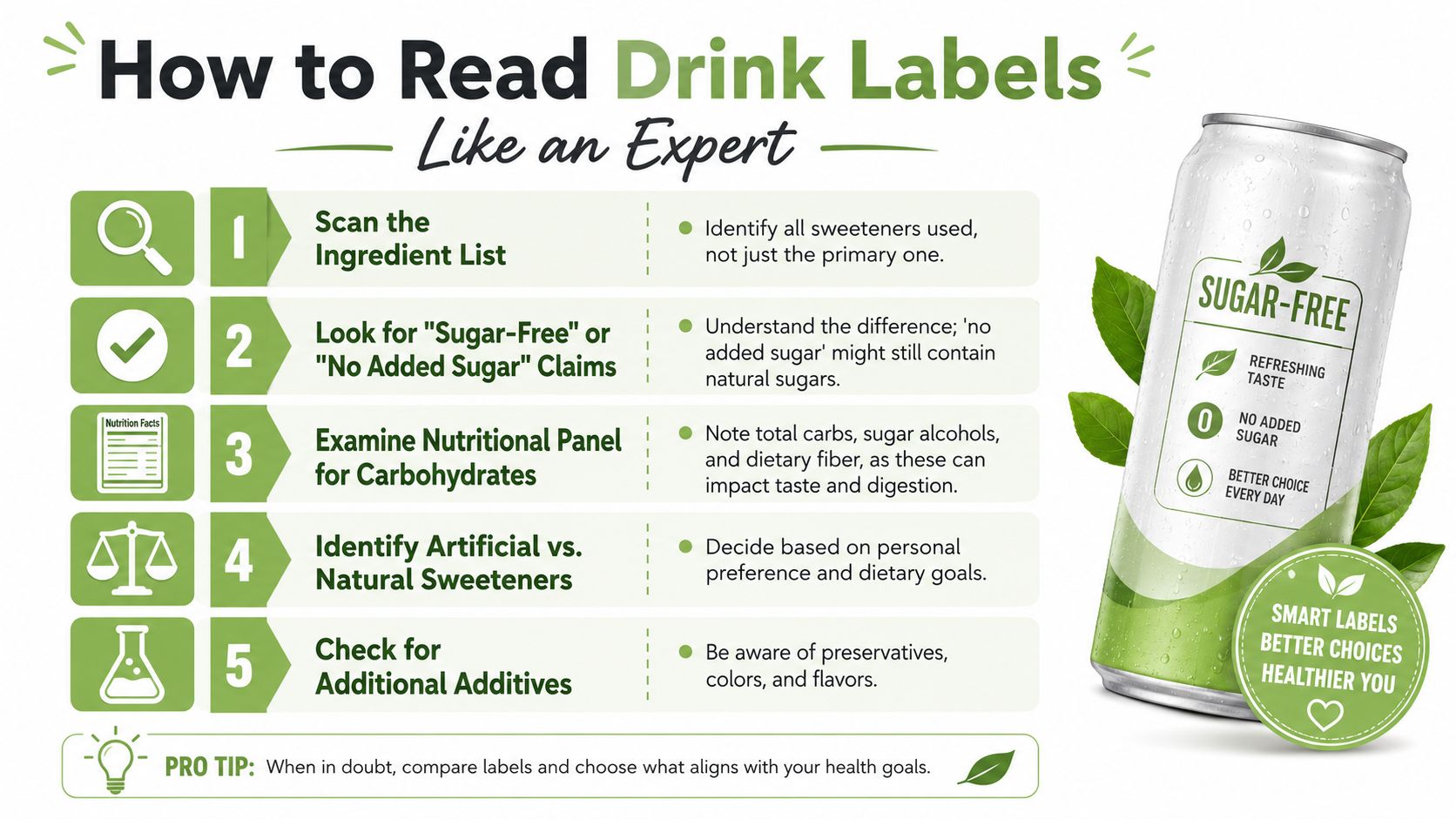
The five-part label check
- Find the sweetener first. Look for names such as aspartame, sucralose, acesulfame potassium, stevia, saccharin, or cyclamates. This tells you how the “zero sugar” promise is being delivered.
- Check whether it's sweetened at all. Some sparkling waters have no sweetener and rely only on flavour essence. That's very different from a diet-style soft drink.
- Read the ingredient list length. A shorter list isn't always perfect, but it often tells you the drink is simpler.
- Look for extra additives. Colours, preservatives, acids, and flavour enhancers can change how processed the drink feels overall.
- Use the nutrition panel as a backup, not the whole story. Zero sugar and low calories can still sit alongside a heavily engineered formula.
A fast side-by-side mindset
Here's a practical way to compare two bottles in under a minute:
| What to check | Simpler fizzy drink | More processed zero sugar drink |
|---|---|---|
| Ingredient list | Short and easy to follow | Long and technical |
| Sweetness source | None, or minimal | One or more high-intensity sweeteners |
| Drinking role | Hydration or light refreshment | Treat-style soft drink replacement |
| Overall feel | Cleaner and less sweet | Stronger flavour and sweeter finish |
A few label traps people miss
“No added sugar” and “sugar free” don't always mean the same thing in practice. A drink can also sound natural on the front while still using a complex formula inside.
That's why the healthier choice often isn't the loudest one.
If you're shopping for a more traditional soft-drink-style option, no sugar ginger beer choices can be a good example of why label reading matters. Two products may both say “no sugar”, yet taste and read very differently once you flip the can around.
Read the first three ingredients, then the sweetener system. That gives you the quickest picture of what kind of drink you're buying.
Once you start doing this regularly, the aisle stops feeling random. You can spot the difference between simple fizz, sweetened soda, and a functional drink at a glance.
Serving Ideas for Home and Hospitality Venues
Good sugar free carbonated drinks don't have to be treated like a compromise. Served well, they can feel just as considered as wine, beer, or a cocktail.
For home drinkers, the easiest upgrade is presentation. A proper glass, citrus peel, fresh herbs, chilled temperature, and the right pairing can make a simple fizzy drink feel much more satisfying.
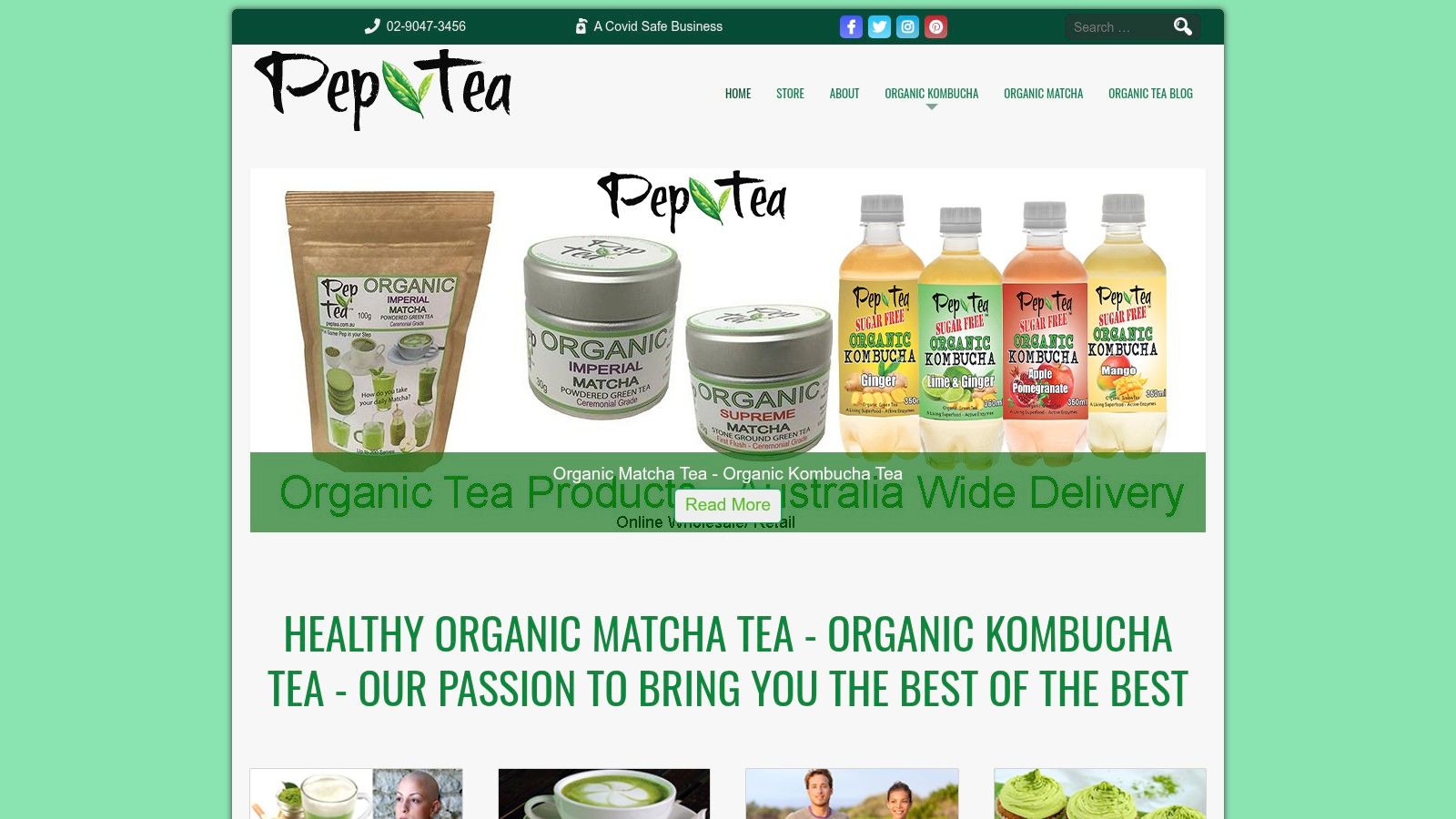
At home
Try a few low-fuss combinations:
- With lunch pair unsweetened sparkling water with lemon or cucumber for something crisp.
- For an afternoon pick-me-up pour a fermented fizzy drink over plenty of cold glassware and garnish with fresh mint.
- For a no-alcohol evening serve use kombucha as a base, then add citrus, ice alternatives, and a herb garnish.
If you want to keep drinks cold without diluting flavour, guides on alternative ways to keep drinks refreshing can be surprisingly handy, especially for sparkling drinks that lose character when watered down.
In cafés and hospitality venues
Customers don't just want “something with no sugar”. They often want a drink that still feels adult, intentional, and menu-worthy.
That opens the door for:
- A premium non-alcoholic list with sparkling water, unsweetened options, and fermented drinks.
- Food pairing suggestions so the drink feels selected, not apologetic.
- Signature house serves built around tea, citrus, ginger, or herb notes.
One factual example in this space is Pep Tea's sugar-free organic kombucha, brewed in the Hunter Valley, NSW. In a venue, a product like that can sit as a bottled serve, a cocktail alternative, or part of a zero-proof menu, depending on the style of service.
Cold temperature, proper glassware, and garnish can completely change how people perceive a healthier fizzy option.
That matters at home, and it matters even more across a café counter.
Frequently Asked Questions About Sugar Free Drinks
Are sugar-free carbonated drinks okay for children
It depends on the drink and how often it's consumed. A sugar-free soft drink is still a soft drink in style, especially if it's sweet, acidic, and heavily flavoured. Water and simpler drinks generally make more sense as everyday options.
Can sugar-free drinks help with weight management
They can help some people reduce sugar intake if they replace full-sugar soft drinks. But they aren't a magic solution. A drink being sugar free doesn't automatically improve overall diet quality.
Are they better than water
Usually not for everyday hydration. Water and unsweetened sparkling water remain the simpler benchmark. Sugar-free fizzy drinks are often better understood as alternatives to soft drink, not upgrades on water.
How much is too much
There isn't one universal answer. The better question is how often you rely on very sweet, highly processed drinks. If it's a daily habit, it's worth looking at simpler options and rotating in drinks with a cleaner ingredient profile.
What's a good option when entertaining
Offer a mix. Include plain sparkling water, a more flavourful sugar-free option, and a naturally fermented drink for guests who want something different. If you're planning a larger event, examples of a polished mobile bar setup, like ABC Hire's top-tier bar experience, can spark ideas for presenting alcohol-free drinks with the same care as cocktails.
If you're looking for fizz with a more thoughtful ingredient story, explore Pep Tea for Australian organic kombucha, matcha, and other functional drink options that fit a lower-sugar lifestyle without leaning on the usual soft drink formula.
Tea for Digestion: A Guide to Soothing Your Gut Naturally

Lunch was lovely. Then half an hour later, you're unbuttoning your jeans, wondering why a normal meal has left you feeling heavy, puffy, and weirdly tired.
I hear this all the time. Sometimes it's the long café lunch with something rich and delicious. Sometimes it's a rushed desk meal wolfed down between emails. Sometimes it's not even a “bad” meal at all. It's just your body saying, “I need a bit of support here.”
That's why so many of us reach for tea for digestion. Not because tea is a magic fix. It isn't. But a well-chosen tea can be a gentle, comforting ritual that helps your body settle after food, especially when you feel bloated, crampy, or just off.
As someone who lives and breathes tea in Australia, I love this part of tea culture most. It's practical. It's calming. And it makes sense. You boil the kettle, slow down for a minute, and give your gut something warm and easy to work with.
Some teas are soothing and soft. Some feel bright and lifting. Some are better after a heavy meal, while others suit a sensitive stomach or a stressful day. And then there are the modern stars, like high-quality Matcha and properly brewed kombucha, which bring a different kind of digestive support to the table.
That Post-Meal Slump Is Not Your Fault
A lot of people assume digestive discomfort means they ate “wrong”. That's usually too simple.
You can feel ordinary one minute, then sluggish and bloated the next, even after a meal that looked perfectly sensible. A quick sandwich eaten standing up. Fish and chips by the water. A rich pasta at dinner because it's Friday and you felt like it. Your digestive system doesn't only respond to food. It also responds to pace, stress, temperature, caffeine, sleep, and how much your body is juggling that day.
I think that matters, because shame is a terrible wellness strategy. If you're searching for tea for digestion, you probably don't need more discipline. You probably need something gentler.
A warm cup of tea works well here because it invites you to pause. You sit down. You sip slowly. You breathe. For plenty of people, that little shift alone can help the stomach feel less clenched and the whole body feel more settled.
Tea for digestion works best when you treat it as support, not punishment.
I've seen this with customers, family, and in my own routine. After a big lunch, peppermint can feel like a reset. If dinner was rich, green tea can feel cleaner and lighter afterwards. If the day has been frantic, chamomile sometimes helps because the stomach often mirrors the nervous system.
The best approach isn't to memorise a giant list of “good” and “bad” foods. It's to learn the feel of different teas and keep a few dependable options nearby. Once you know which tea suits which kind of discomfort, your cupboard becomes a pretty handy little toolkit.
How Tea Actually Helps Your Digestion
Tea helps digestion in a few different ways, and it's easier to understand when you stop thinking of “digestive tea” as one single category. Different teas do different jobs.
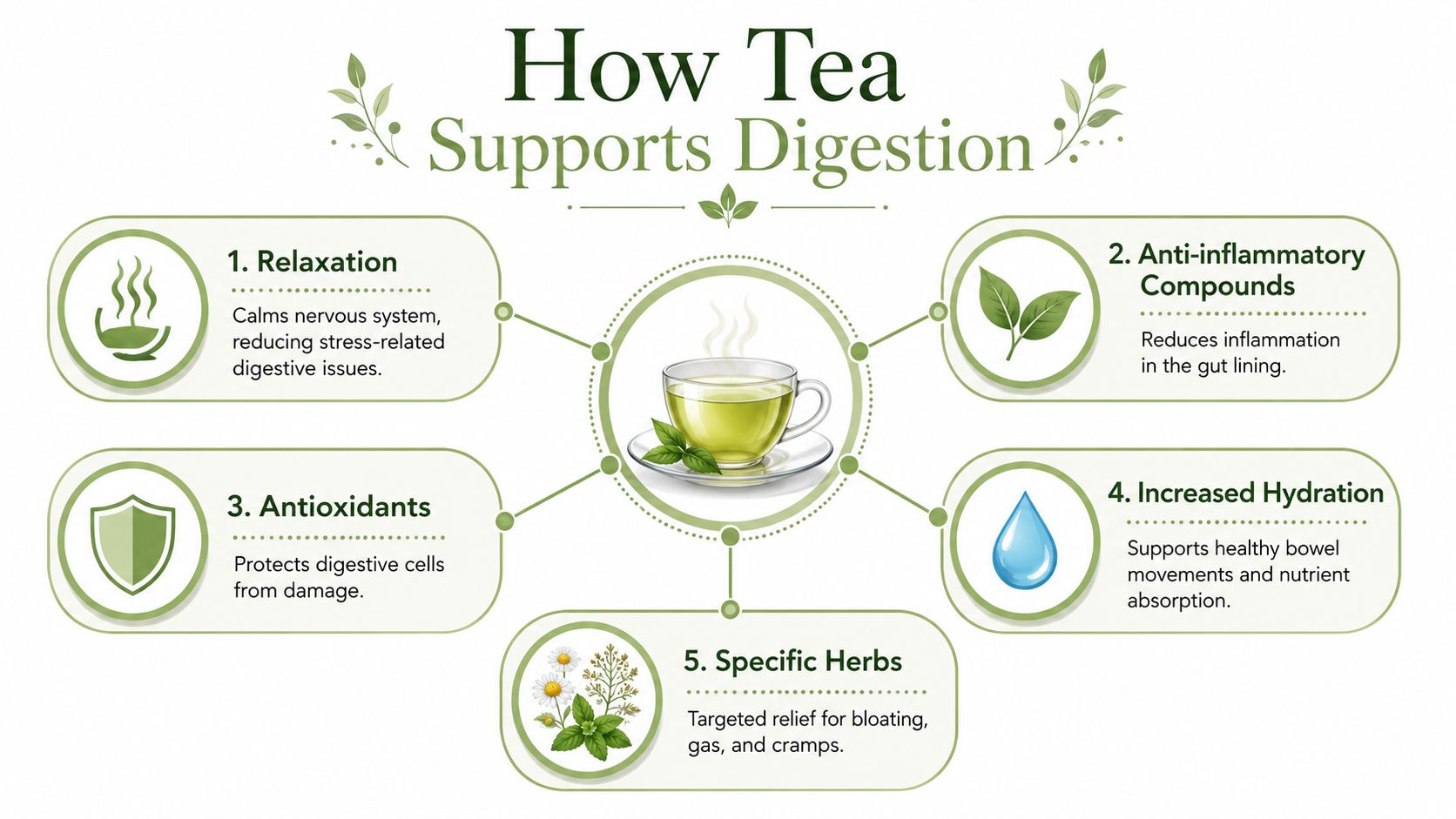
Four simple ways tea can support the gut
Here's the plain-English version:
- Carminative support helps move trapped gas along. This action is similar to gently releasing pressure in a distended abdomen.
- Antispasmodic support helps calm tight, twitchy digestive muscles. That's useful when your belly feels crampy or unsettled.
- Prokinetic support means encouraging movement through the digestive tract. Not in a harsh way. More like helping things keep flowing.
- Probiotic support comes from fermented drinks such as kombucha, which can contribute live cultures to the gut environment.
Hydration matters too. Warm fluids can feel easier on the stomach than icy drinks, especially after a rich meal.
Why green tea feels different after food
Green tea has its own digestive personality. Experimental work summarised in a tea-and-digestion review suggests that green tea extracts can reduce intestinal digestion and absorption of fats and starch, while also increasing gastric secretion through local action on the stomach lining, which helps explain why many people like green tea after heavier meals instead of using it as a treatment for illness (tea and digestion review).
That's a useful distinction. Tea for digestion isn't a medicine replacement. It's more like choosing the right tool for the moment. If lunch was oily, creamy, or generally a bit much, green tea may feel more balancing than a sweet drink or another coffee.
Practical rule: Ask what your stomach needs right now. Less pressure, less cramping, more calm, or better overall gut support.
If you're fuzzy on the difference between feeding good bacteria and adding live cultures, Pep Tea has a helpful explainer on prebiotics and probiotics that breaks down the concepts.
Why the ritual matters as much as the leaves
People often get confused here and assume the benefit comes only from chemistry in the cup. That's only part of the story.
Tea slows the whole moment down. You sip instead of gulping. You warm the stomach instead of shocking it with something freezing. You often step away from whatever was stressing you out. That combination is one reason tea for digestion has stuck around in so many food cultures for so long.
A Guide to Classic Digestive Herbal Teas
When someone asks me where to start, I usually begin with the old favourites. They've stayed popular for a reason. Each one suits a slightly different kind of digestive complaint.
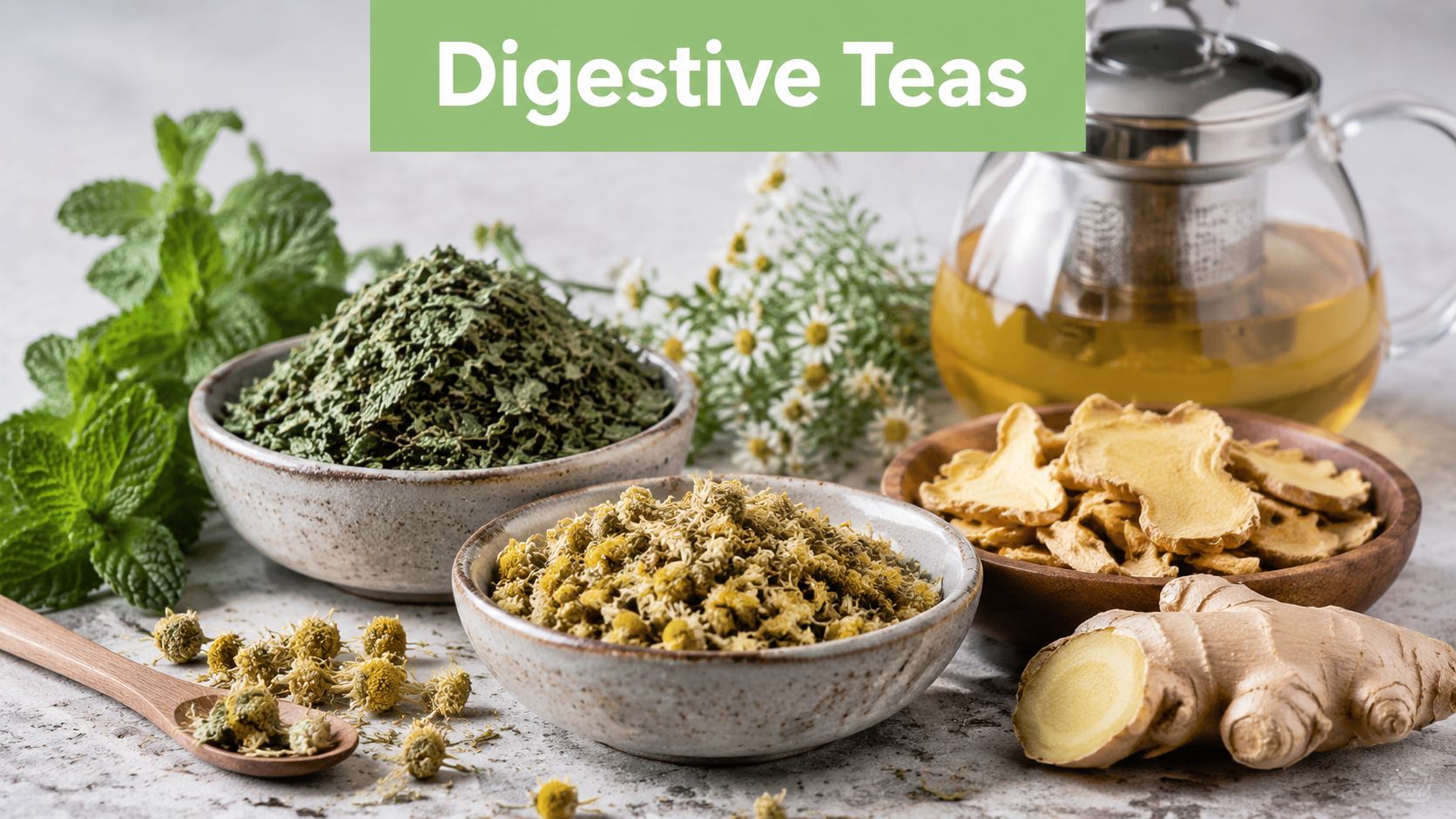
Which herbal tea suits which feeling
| Tea | Often chosen for | What it feels like | Taste |
|---|---|---|---|
| Peppermint | Bloating and heaviness | Cooling and clearing | Fresh, minty, brisk |
| Ginger | Queasiness and sluggish digestion | Warming and stimulating | Spicy, zesty, bright |
| Chamomile | Tension-related digestive discomfort | Soft and calming | Floral, gentle, slightly apple-like |
| Fennel | Gas and post-meal fullness | Light and easing | Sweet, aniseed-like |
Peppermint for bloating
Peppermint is the classic “I ate too much and now I regret it” tea. It's often the first thing people think of for bloating, and for good reason. It tends to feel fresh, cooling, and relieving after a heavy lunch or a meal that's sitting a bit too firmly.
If your tummy feels tight and gassy, peppermint is usually the first cupboard check.
Ginger for nausea and slow, heavy digestion
Ginger has more warmth to it. I think of it as the tea you choose when your stomach feels cold, sluggish, or slightly queasy. It has that clear, active feeling that can be very welcome after travelling, eating too quickly, or overdoing rich food.
It's also one of the easiest herbal teas to pair with food because the flavour is so lively.
If peppermint feels like opening a window, ginger feels like switching the lights back on.
Chamomile and fennel for a gentler approach
Chamomile is the one I reach for when stress is clearly part of the picture. Your gut and your mood are often tangled together. If the whole system feels tight, unsettled, or over-alert, chamomile can be a softer option than stronger-tasting herbs.
Fennel is underrated. It has that sweet, slightly liquorice-like note that people either love immediately or need a cup or two to appreciate. But for post-meal fullness and gas, it's a lovely traditional option.
A simple trick is to match the tea to the sensation:
- Tight and bloated: peppermint
- Heavy and queasy: ginger
- Nervous and crampy: chamomile
- Gassy and full: fennel
Food choices matter too. If you're building a digestion-friendly routine more broadly, it's worth reading about olive oil's digestive benefits, especially if you enjoy simple meals built around vegetables, grains, and good fats.
Why Matcha Is Your Gut Health Ally
Matcha deserves its own conversation because it isn't just “green tea in powder form”. It behaves differently in the cup and in your routine.
With Matcha, you're whisking finely ground tea leaf into water, so you consume the whole leaf rather than steeping it and removing it. That creates a fuller flavour, a richer texture, and a more immersive tea experience. When the Matcha is high quality, the difference is obvious. The colour is vivid, the aroma is clean and green, and the taste has that savoury sweetness that cheap powders just don't deliver.
As a tea person, I tend to get a bit excited. Real Matcha, especially organic Japanese Matcha that's been carefully stone-ground, has a depth and softness that makes it easy to drink regularly. That matters, because tea for digestion only becomes useful when you enjoy it enough to make it part of your day.
What the research says about green tea and the gut
A 2019 systematic review found that 24 publications met the inclusion criteria, including 6 human trials and 18 mechanistic studies, and reported that the strongest evidence was for green tea. In those green-tea studies, intake of up to 1,000 mL per day, roughly 4–5 cups, was associated with higher proportions of Bifidobacterium, and some studies also noted reductions in Firmicutes with improvements in Bacteroidetes (systematic review on tea and gut health).
That doesn't mean Matcha is a cure for digestive problems. It does mean green tea has a meaningful place in the gut-health conversation.
If you want a broader rundown of how green tea powder fits into energy, focus, and daily wellness, our guide to the benefits of Matcha green tea is a good next read.
Why quality matters more than people realise
Low-grade Matcha can taste harsh, dusty, or bitter enough that people drown it in sugar. That defeats the whole point if you're trying to support digestion and feel lighter after meals.
High-quality Matcha is different. It's smoother. It mixes better. It feels more like a ritual and less like a chore.
Here's a quick visual if you'd like to see how Matcha is prepared and used in everyday life:
If you're also dealing with food triggers, tea works best alongside practical eating choices. For readers who want a food-focused companion resource, it's useful to discover IBS fruit options on OrganizEat and build from there rather than expecting one drink to do everything.
Kombucha The Living Drink for Your Microbiome
Kombucha sits in a different category from herbal tea and Matcha. It's a fermented tea, which means it brings the conversation into microbiome territory.
I like to explain the microbiome as your gut garden. You've got a whole community living there. When that garden is well looked after, digestion tends to feel steadier. When it's out of balance, things can feel noisy, reactive, or unpredictable.
Kombucha appeals to people because it's a living drink. Properly fermented kombucha contains live cultures, and that makes it very different from a standard soft drink.
Not all kombucha helps in the same way
Many shoppers get caught out. A lot of products use kombucha-style branding, but they drink more like sweet fizzy beverages than genuine fermented tea. If a kombucha is heavily sweetened, the whole “gut health” message gets murky fast.
That's why I always tell people to think less about hype and more about what's in the bottle. Live culture. Real fermentation. A flavour profile that doesn't rely on sweetness to carry the drink.
A good kombucha should taste alive, not like soft drink wearing a wellness costume.
For people trying to move away from sugary beverages, it can help to discover better drink choices and compare what different options are really offering.
Why properly brewed kombucha stands out
At home or in cafés, kombucha works well when you want something cold, refreshing, and digestion-friendly without reaching for another juice or soft drink. Ginger-based flavours are especially popular after meals because they combine the bright lift of ginger with the tang of fermentation.
Pep Tea's guide to the benefits of kombucha covers the basics if you want to understand the drink more completely.
From a practical point of view, this is why I get enthusiastic about properly brewed, sugar-free kombucha. When fermentation is handled well, the drink tastes crisp, clean, and grown-up. It has structure. It has life. And in an Australian café setting, it gives people a smart non-alcoholic option that still feels interesting.
For home drinkers, the biggest win is simplicity. Keep a bottle chilled, pour a glass with lunch, and you've got a digestive ritual that feels more like a treat than a health task.
Your Daily Ritual for Better Digestion
Tea for digestion works best when it's matched to the moment. You don't need a complicated regime. You need a few reliable habits.
A simple sip plan
- Morning after a rough start: ginger tea if your stomach feels unsettled or heavy.
- After lunch: peppermint if you're bloated, or green tea if the meal was especially rich.
- Mid-afternoon: Matcha if you want steady energy without the hard edge some people get from coffee.
- Evening: chamomile when stress and digestion seem to be feeding each other.
A large evidence summary from Harvard notes that drinking 2–3 cups daily is associated with positive health outcomes, and it also highlights that tea consumed hotter than 55–60°C has been associated with higher health risks, so your tea for digestion is better warm, not scalding (Harvard Nutrition Source on tea).
Brewing tips that make a difference
Small details matter more than people think:
- Peppermint and chamomile: steep until the aroma opens up and the flavour tastes rounded, not watery.
- Ginger: slice it fresh if you want a bolder, more warming cup.
- Matcha: whisk with warm water rather than boiling water if you want a smoother, less harsh bowl.
- Kombucha: serve chilled, straight or over ice, especially with lunch or as an alcohol alternative.
For cafés and hospitality
This is such an easy win for modern menus.
A café can offer a small digestive tea list after meals, build a clean Matcha latte for customers who want calm focus, or pour kombucha as a grown-up non-alcoholic option. A ginger kombucha, a peppermint tea, and a proper Matcha can cover a surprising range of customer moods without making the menu feel crowded.
Frequently Asked Questions About Digestive Teas
Can I drink digestive teas if I have IBS or reflux
Generic advice often falls short. One common gap in Australian consumer content is clear guidance for people with existing conditions like reflux or IBS. Much of the advice stays broad, but the evidence is mixed and people need clearer help deciding which teas to try and which to avoid (Australian digestion tea guidance gap).
A sensible starting point is to go one tea at a time and pay attention to your own response. If reflux is your main issue, minty teas may not suit you. If stress and cramping are more your pattern, a gentler option may feel better.
Is Matcha okay if I'm sensitive to caffeine
Sometimes yes, sometimes no. It depends on your sensitivity, the serving size, and whether you drink it with food.
If coffee leaves you jittery, Matcha can feel smoother for some people as part of a meal or morning routine. But if you already know caffeine doesn't agree with you, start small and be honest with yourself. Digestive support shouldn't come at the cost of feeling wired.
Start with the mildest option that matches your symptoms, then adjust slowly.
Are digestive teas safe in pregnancy
This is one of those situations where “natural” doesn't automatically mean “fine for everyone”. If you're pregnant, managing a medical condition, or taking regular medication, it's smart to check with your health professional before making any tea or herbal drink a daily habit.
What's the safest way to use tea for digestion
Keep it simple:
- Match the tea to the symptom.
- Drink it warm, not piping hot.
- Choose quality over gimmicks.
- Treat tea as support, not a substitute for medical care.
If symptoms are frequent, severe, or changing, it's worth getting proper advice instead of trying to solve everything with your teapot.
If you'd like to build a simple digestive tea routine at home or add better functional drinks to your café menu, have a look at Pep Tea. We stock organic Matcha and sugar-free kombucha, and we share practical guides to help you choose, brew, and enjoy tea with a bit more confidence.
Immune Booster Drink: Matcha & Kombucha Recipes
Most advice about an immune booster drink starts in the wrong place. It starts with the fantasy that one glass, one powder, or one exotic ingredient can somehow do the heavy lifting for your immune system.
That's not how good drinks work, and it's not how the body works either.
The strongest everyday options are much less glamorous. They hydrate well. They keep sugar in check. They use ingredients with a real nutritional role, such as vitamin C, tea catechins, and live cultures. They also taste good enough that you'll keep drinking them. In my experience as a tea brewer in the Hunter Valley, that last part matters more than people think. A functional drink that's unpleasant, gritty, or overloaded with sharp botanicals usually ends up as a one-off experiment, not a habit.
Rethinking the Immune Booster Drink
Search for an immune booster drink and you'll find a lot of noise. Bright labels, loud promises, and recipes built around whatever ingredient is trending this month.
The better question is simpler. Does the drink support daily wellness in a way that's realistic, low in sugar, and enjoyable enough to become part of your routine?

In Australia, that shift is already happening. By the mid-2020s, immune support had become one of the top functional-beverage purchase drivers in Australia, and immune-health claims accounted for about 61% of new functional beverage introductions globally, according to Beverage Industry's report on immune-support beverages. That helps explain why tea-based wellness drinks now show up as everyday fridge staples rather than winter-only comfort drinks.
Why the old advice falls short
A lot of popular recipes make two mistakes.
- They chase novelty: Turmeric, cayenne, charcoal, herbal blends, syrups, and juices all thrown together doesn't automatically create a better drink.
- They forget the base: If the drink is sugary, poorly balanced, or dehydrating, the “functional” ingredients don't rescue it.
- They ignore consistency: One intense morning shot won't outdo steady habits such as hydration, sleep, balanced meals, and lower sugar intake.
A sensible immune booster drink isn't magic. It's a clean, repeatable drink built on hydration and ingredients that earn their place.
What actually deserves space in your glass
For a practical Australian kitchen or café, two of the most useful bases are matcha and kombucha.
One gives you a tea-based format with naturally occurring compounds people already enjoy drinking hot or cold. The other gives you a fermented base that can fit neatly into a low-sugar, flavour-forward drink when it's brewed and handled properly.
Here's the no-nonsense version:
| Base | What it does well | Common mistake |
|---|---|---|
| Matcha | Easy to pair with citrus, ginger, and water or milk alternatives | Turning it into a dessert with too much sweetener |
| Kombucha | Adds acidity, complexity, and live-culture potential | Choosing overly sweet versions or treating storage casually |
Daily immune support isn't built from hype. It's built from good brewing, sensible formulation, and ingredients that do more than decorate the label.
The Real Heroes Behind Immune Support
The most credible drinks don't “boost” immunity in some dramatic, superhuman way. They support normal function by delivering something your body can use.
That's why I trust drinks built from known components, not vague wellness language.
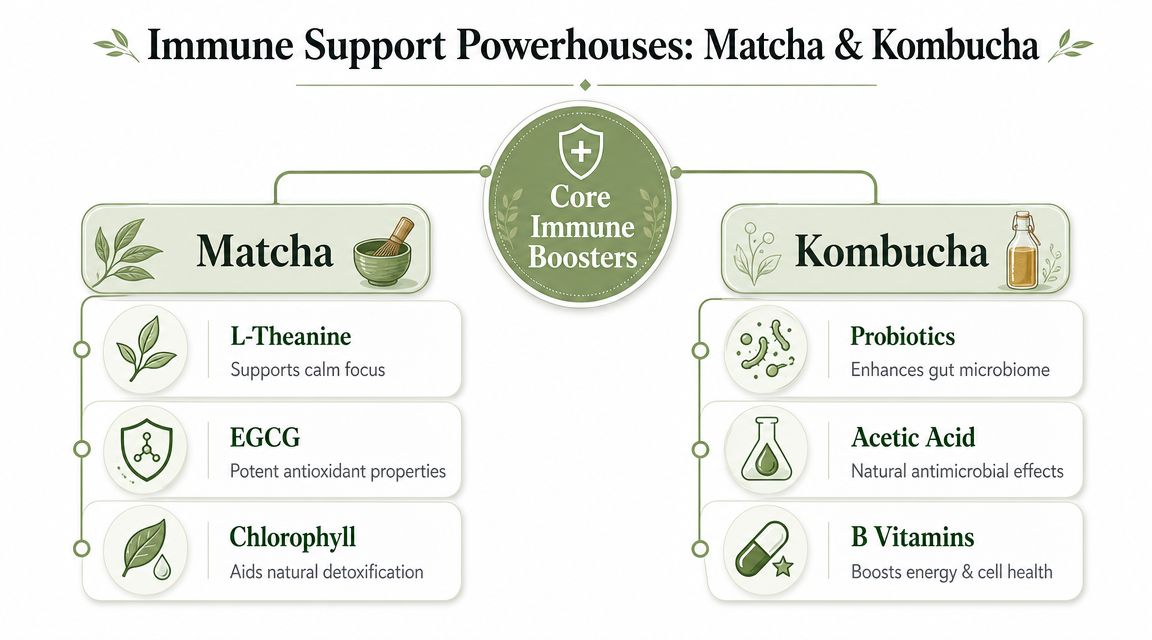
A useful summary comes from Harvard's nutrition and immunity guide, which notes that balanced eating patterns and lifestyle habits matter most, while evidence around functional beverages is strongest when they provide known nutrients. The same source highlights that green tea catechins such as EGCG may improve immunological function, and that probiotic-rich foods can enhance mucosal and systemic immunity.
What matcha brings to the table
Matcha works because it's more than green-coloured powder. A well-made matcha drink gives you tea compounds in a concentrated, drinkable format.
Three components matter most in practice:
- EGCG: This is the green tea catechin most often discussed in relation to matcha's functional value.
- L-theanine: It's one reason matcha tends to feel smoother and more composed than a standard high-caffeine drink.
- Chlorophyll and whole-leaf intake: Because matcha is whisked into the drink rather than steeped and discarded, you consume the leaf material itself.
For home drinkers, that means quality matters. Dull, stale matcha tastes bitter and grassy in the wrong way. Bright, fresh matcha is cleaner, softer, and much easier to build into a low-sugar drink.
What kombucha contributes
Kombucha's value is different. It's not there to mimic tea. It brings fermentation character, acidity, and in properly made versions, live cultures.
That matters because gut health and immune function are closely connected in everyday wellness discussions. A kombucha-based drink can be a smart format when you want something cold, savoury-sharp, and less heavy than a smoothie or juice.
The best kombucha recipes don't bury the brew. They use kombucha as the backbone, then add fresh elements around it.
Known actives beat vague promises
People often ask whether a drink needs a long list of ingredients to count as functional. Usually, no.
A shorter ingredient list often works better if each part has a clear purpose:
- A water-based or tea-based foundation for hydration.
- A vitamin C source, such as lemon or orange.
- A meaningful functional layer, such as matcha or a well-made kombucha.
- Low sugar, so the drink still fits a health-oriented routine.
Here's a simple way to understand it:
| Ingredient type | Why it belongs |
|---|---|
| Tea catechins | Give tea-based drinks a functional role beyond flavour |
| Probiotic foods or drinks | Support gut-focused wellness when handled properly |
| Citrus | Adds brightness and a familiar vitamin C source |
| Fresh ginger or mint | Improve flavour and make low-sugar drinks more satisfying |
If a drink can't explain why each ingredient is there, it usually isn't well designed.
Recipe The Energising Matcha Immunity Elixir
A good matcha-based immune booster drink should wake you up without tasting like a punishment. It needs brightness, a little warmth, and a finish clean enough that you'd happily make it again tomorrow.
This is the version I reach for when I want something warming but not heavy.
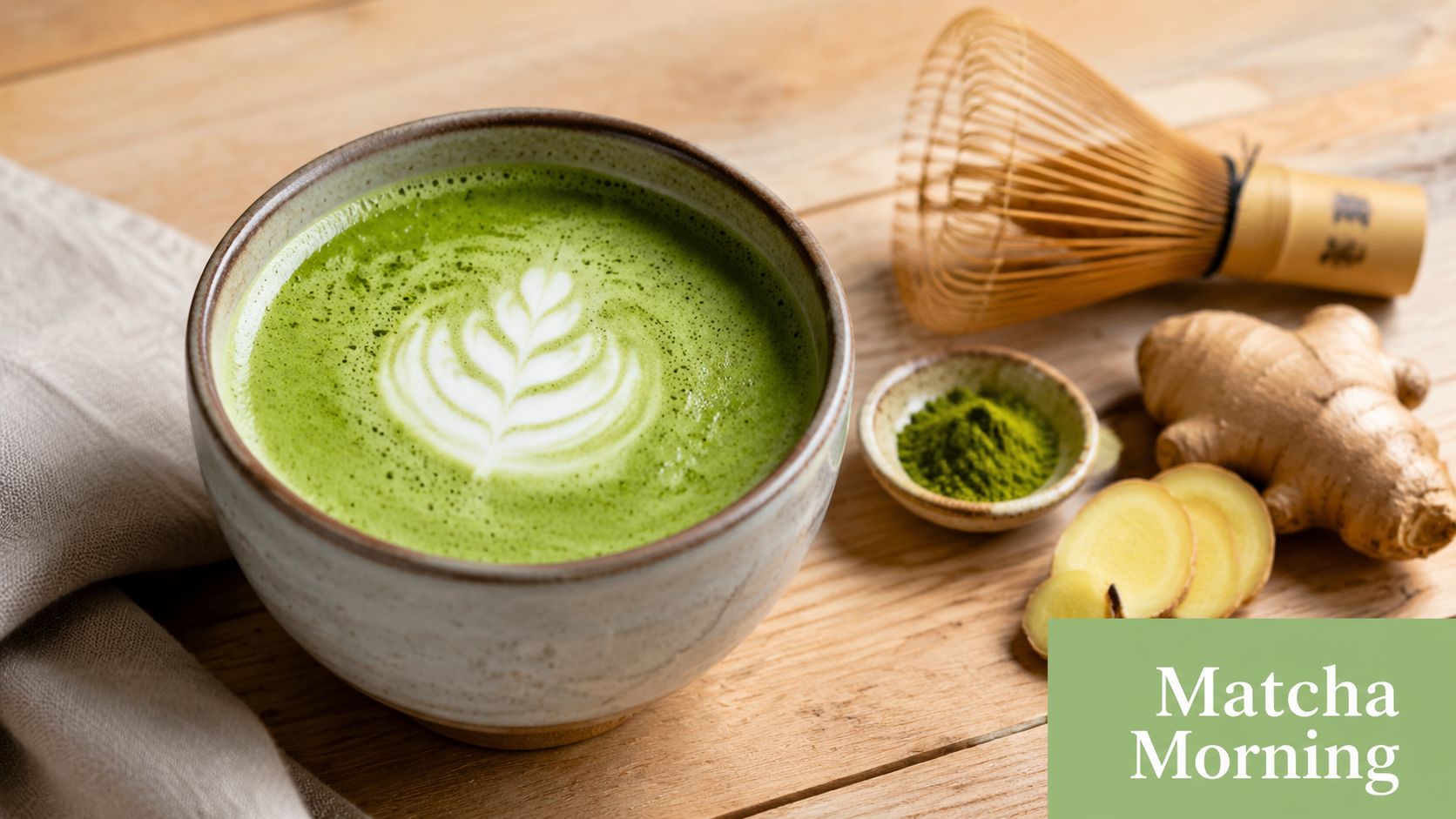
Ingredients that pull their weight
You don't need a crowded recipe. You need one with purpose.
For one serve:
- Matcha powder
- Warm water
- Fresh lemon juice
- Freshly grated ginger
- Optional milk or plant milk if you want a softer latte-style finish
- Optional small amount of honey if you need it sweeter
The logic is straightforward. Matcha gives the drink its tea-based functional backbone. Lemon adds brightness and vitamin C. Ginger rounds out the flavour and brings warmth, which makes the whole drink feel more satisfying without relying on sugar.
How to make it properly
- Sift the matcha into a bowl or cup. This prevents clumps and gives you a smoother texture.
- Add a small amount of warm water. Not boiling. Too much heat can roughen the flavour.
- Whisk until glossy and foamy. A bamboo whisk is ideal, but a small handheld frother works.
- Stir in lemon juice and a little fresh ginger. Add gradually so the citrus sharpness doesn't dominate.
- Top with more warm water for a lighter drink, or warm milk for a creamier version.
- Taste before sweetening. Often the ginger and lemon make it lively enough without much else.
Where most recipes go wrong
The biggest mistake is overbuilding. Too many spices, too much syrup, or a huge pour of fruit juice can flatten matcha's fresh, green character.
Another common problem is sugar. A useful warning from this PMC review on functional beverages is that wellness drinks often rely on “fairy dust” levels of botanicals while also carrying high sugar loads that undermine health goals. That's exactly why I prefer a low-sugar format with a tea base and a few fresh additions.
Practical rule: If your “healthy” matcha drink tastes like melted dessert, rebuild it from scratch.
A few smart variations
If you make this often, keep the structure the same and change the edges.
- For hot mornings: Use just water, lemon, ginger, and matcha for a clean finish.
- For a café-style cup: Add textured milk and keep the lemon very light so the drink stays balanced.
- For warmer weather: Shake it cold over ice instead of serving it hot.
If you want a chilled version with better texture, this iced matcha tea recipe is a useful starting point. The same low-sugar thinking still applies.
A short visual guide helps if you're still dialling in whisking technique:
Flavour notes worth noticing
This drink should taste lively, not aggressive.
You want:
- Fresh grassy sweetness from the matcha
- Citrus lift rather than sourness
- Ginger warmth without a harsh burn
- A dry, clean finish that leaves you ready for another sip
When those pieces line up, the drink feels functional because it's well made, not because the label shouts at you.
Recipe The Probiotic Kombucha Zing
A kombucha-based immune booster drink should feel crisp and alive. Not sticky, not flat, and not overloaded with juice.
The best versions build on the kombucha's own acidity and fizz instead of fighting it.
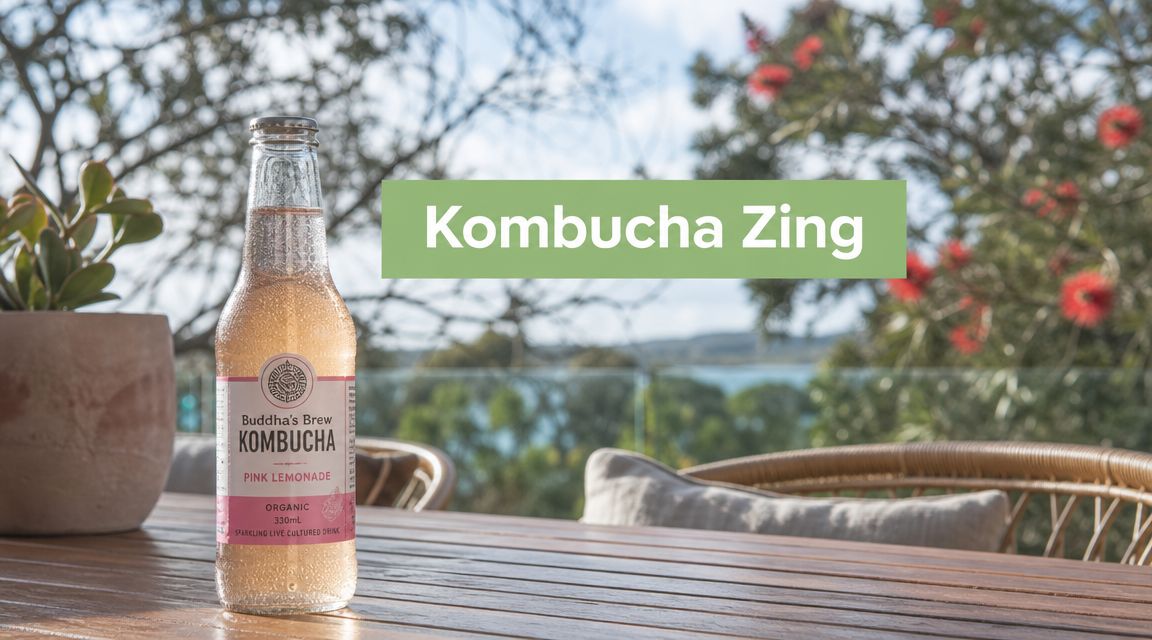
Build around the base, not around sugar
Start with a plain, ginger, or lime-leaning kombucha that isn't trying to pass as soft drink. From there, add small fresh elements that lift the drink without burying the fermentation.
For one glass:
- Chilled kombucha
- A few muddled berries
- Fresh mint leaves
- A squeeze of lemon or lime
- Ice
- Optional slice of cucumber for a cleaner finish
This works well because the berries add depth and freshness without requiring much quantity. Mint cools the palate. Citrus sharpens the edges.
Method that keeps the drink bright
Use a tall glass and work gently. Kombucha loses its charm fast if you beat the bubbles out of it.
- Muddle lightly: Press the berries and mint just enough to release flavour.
- Add ice next: This protects the carbonation when you pour.
- Pour the kombucha slowly: Let it run down the inside of the glass.
- Finish with citrus: Add just enough to lift the aroma.
You should still taste the tea and fermentation underneath the fruit.
What to avoid
Kombucha drinks become clumsy when people treat them like smoothies or mocktails loaded with syrup.
Skip these habits:
- Large juice pours that swamp the base
- Heavy sweeteners that make the finish sticky
- Too many herbs competing for attention
- Warm storage after opening, which dulls flavour and can affect the drink's behaviour
Keep kombucha recipes sharp and restrained. The brew should still taste like kombucha when you're done.
For a broader look at what makes kombucha appealing in the first place, this overview of the benefits of kombucha is a handy read.
Two useful serving styles
Not every kombucha drink needs the same shape. For home use and café service, these two styles tend to work best.
| Style | Best for | Flavour profile |
|---|---|---|
| Berry and mint spritz | Afternoon refreshment | Bright, tart, slightly herbal |
| Ginger citrus highball | Cooler weather or food pairing | Zesty, warming, more savoury |
The ginger citrus version is especially good with a drier kombucha. You get a pleasant bite without needing extra sugar.
Why this recipe earns the “functional” label
This drink makes sense because every part has a job. The kombucha gives the structure. The citrus freshens it. The herbs and fruit make it easier to enjoy regularly.
That's the standard I use for any immune booster drink. If it hydrates reasonably well, keeps sugar under control, and starts with a quality fermented base, it's already doing more than most flashy wellness blends.
Menu Ideas for Australian Cafés and Retailers
Cafés don't need another syrup-heavy “wellness” special. They need drinks that staff can make consistently, customers can understand quickly, and fridges can hold safely.
That's where matcha and kombucha stand out. Both already have flavour identity. Both fit non-alcoholic menus naturally. Both can be positioned as everyday wellness drinks without drifting into claims you can't support.
Build a menu around repeatability
For cafés, the winning move is restraint. Keep the menu language clean and the prep simple.
A practical line-up might include:
- Hot matcha ginger cup: Matcha, warm water, fresh ginger, light citrus
- Iced matcha citrus spritz: Matcha over ice with lemon and sparkling water
- Kombucha berry cooler: Kombucha, muddled berries, mint
- Ginger kombucha highball: Kombucha with fresh lime and lots of ice
The commercial advantage is that these drinks share ingredients. Ginger, mint, lemon, lime, and berries can move across multiple menu items, which helps reduce waste and keeps service organised.
Say less on the menu, but say it better
In Australia, kombucha and other fermented drinks need disciplined handling in commercial settings. As noted by guidance referenced for fermented beverage controls, fermented beverages like kombucha must be managed with validated HACCP controls, including cold-chain integrity and microbiological verification, because ambient distribution can alter sugar, carbonation, and alcohol levels.
That matters for menu wording too. Don't promise disease prevention. Don't imply a single drink can “fix” immunity. Describe the drink for what it is.
Good menu phrasing sounds like this:
- Low-sugar matcha drink with citrus and ginger
- Live-culture kombucha served chilled with fresh mint and berries
- Tea-based wellness drink with a clean, bright finish
Poor menu phrasing usually overreaches.
Customers trust cafés that explain drinks clearly. They don't trust menus that read like supplement ads.
Batch prep without wrecking quality
For café service, batch what's stable and finish what's fresh.
Batch these:
- matcha concentrate for same-day service
- pre-washed mint
- sliced citrus
- ginger infusion
Finish to order:
- whisked hot matcha
- sparkling or carbonated elements
- opened kombucha
- muddled fruit
This keeps flavour lively and reduces the chance of flat, tired drinks during the lunch rush.
Retail fridges and social promotion
Retailers should merchandise these drinks as part of a better daily-drinks habit, not a panic purchase for cold season. Place them near lunch items, grab-and-go snacks, or non-alcoholic alternatives.
For cafés posting short-form drink content, visual consistency matters almost as much as flavour. If you're filming pours, foam, and garnish shots for Instagram, this guide to SleekPost for Reels success is a useful resource for making the drinks look polished without overcomplicating the shoot.
A clean menu, cold storage discipline, and simple visual storytelling go a long way.
Sourcing Storing and Important Safety Notes
A well-made immune booster drink starts before the first pour. It starts with what you buy, how you store it, and how properly you use it.
Choose ingredients that show their quality
With matcha, colour tells you a lot. Look for a vibrant green powder with a fresh aroma and a smooth finish when whisked. Stale matcha tends to look dull and taste flat or bitter.
With kombucha, read for live cultures, a sensible ingredient list, and a lower-sugar profile. If the bottle tastes more like soft drink than fermented tea, it probably won't behave like a functional drink base either.
Store for flavour and function
Matcha is delicate. Heat, air, moisture, and light all work against it. Keep it sealed and cool, and don't leave the packet open while you fuss around making breakfast.
Kombucha needs proper refrigeration and sensible handling after opening. If you're checking acidity or refining your own brewing process at home, a reliable digital pH meter for beverage testing is one of the most useful tools you can keep in the kitchen.
Safety matters more than hype
A few grounded reminders are worth keeping in mind:
- Caffeine counts: Matcha contains caffeine, so some people will want smaller serves or earlier timing in the day.
- Fermented drinks need care: Home-brewed or poorly stored kombucha can be unpredictable.
- More isn't always better: Loading a drink with extra powders and extracts doesn't automatically make it smarter.
- General support is the right frame: These drinks can fit a wellness routine, but they aren't a substitute for medical care, sleep, balanced eating, or hydration.
Buy fewer ingredients, but buy better ones. Quality is easier to taste in simple drinks.
If you're making these at home, keep them enjoyable. If you're serving them professionally, keep them consistent. That's the difference between a functional drink people trust and a trend that disappears after one season.
If you'd like to put these ideas into practice, explore Pep Tea for premium organic matcha, Australian-brewed sugar-free kombucha, and practical tea gear that makes everyday wellness drinks easier to get right.