
Tag: batch brew kombucha
Kombucha Continuous Brew vs Batch: Which Method Suits You
The popular advice is simple: continuous brew is easier, while batch brew is old-fashioned and labour-intensive. That's only half the story. For Australian home fermenters and cafés, the more important question is whether the method gives you reliable control over alcohol, pH, flavour and service timing.
A continuous vessel can keep kombucha available with regular draw-offs, but its living contents change as fresh sweet tea enters the system. Batch brewing takes more planning, yet each fermentation has a defined beginning and end. If your kombucha needs to sit on a café menu as a dependable non-alcoholic option, convenience alone isn't a sufficient reason to choose continuous brew.
| Factor | Batch brew | Continuous brew |
|---|---|---|
| Basic system | Separate fermentation cycles | One active vessel with regular draw-off and refill |
| Control | Clear fermentation window and harvest point | Rolling system with changing liquid composition |
| Workflow | Brew, ferment, bottle, clean and restart | Draw finished kombucha, then replace the removed volume |
| Flavour | Easier to vary by cycle | More consistent when managed well, but can drift |
| Compliance focus | Easier to isolate and test a finished run | Requires close attention to refill, dwell time, pH and alcohol |
| Best fit | Experimentation, traceable production and wholesale | Steady household or café service with disciplined monitoring |
Why the Wrong Kombucha Brewing Method Costs You More Than Time
Continuous brew isn't a universal shortcut. It can reduce the number of full resets, but it also creates a system where fresh sugar, active culture, temperature and time interact continuously. If the balance changes, the result can be more acidic, more alcoholic or less predictable than the last pour.
That matters in Australia because alcohol in kombucha isn't merely a flavour issue. National surveillance found 35.2% of kombucha samples below 0.5% ABV, 41.9% between 0.5% and 1.15% ABV, and 22.9% above 1.15% ABV in the coordinated survey of fermented soft drinks (Australian fermented soft drinks alcohol and labelling survey). NSW Health has also reported that around 65% of tested kombucha samples exceeded 0.5% alcohol. A drink intended for a non-alcoholic menu can therefore become a labelling and licensing problem if the operator assumes the recipe alone determines the final ABV.
Start with the use case
Ask three practical questions before buying a vessel:
- How will you serve it? A household drinking small amounts at home has a different rhythm from a café pouring kombucha throughout service.
- How much control do you need? Batch brewing gives you a discrete ferment to taste, test and release. Continuous brewing gives you a moving target.
- What happens when the brew goes wrong? With a batch, you can quarantine one run. With continuous brew, an off-balance culture affects the liquid already in the vessel and the tea you add next.
Practical rule: Choose continuous brew for a steady service rhythm only if you're prepared to monitor it like a production system, not treat it like a countertop appliance.
The Australian category itself developed from small, culture-led fermentation into larger operations. MOJO Beverages began commercial production in South Australia in 2009, and by 2022 Melbourne-based Remedy had a production line capable of filling 20,000 brown glass bottles per hour after brewing for about 30 days, according to the Australian food timeline for kombucha. Those milestones show why vessel management, timing and consistency matter as production grows.
The wrong method can cost you wasted tea, spoiled product, difficult flavour conversations with customers and non-compliant stock. For a café, the risk sits at menu level. For a home brewer, it may mean a vessel that's hard to control or a brew that no longer tastes pleasant.
How Continuous Brew and Batch Brew Actually Work
Batch brew is a closed-cycle process. You prepare sweet tea, cool it, add starter liquid and a SCOBY, cover the vessel and allow primary fermentation to proceed. Australian industry commentary commonly places primary fermentation around 7 to 10 days, with secondary fermentation often occurring in the bottle (Australian kombucha production history and fermentation commentary).
A practical batch workflow looks like this:
- Brew tea and dissolve the required sugar while the liquid is warm.
- Cool the tea before adding mature kombucha and the SCOBY.
- Cover the vessel with a breathable cloth and keep it away from direct sunlight.
- Taste and measure during fermentation rather than relying on the calendar alone.
- Harvest the full batch, reserve mature starter for the next run, then clean the vessel.
Batch recipes often use a smaller starter proportion and ferment for 5 to 7 days at about 25 degrees Celsius, as described in Australian continuous-brew guidance. The exact recipe varies, but the important feature is the reset. Each run receives a defined tea volume and a defined starter amount, so you can record what went in and what came out.
Continuous brew uses a different physical arrangement. A spigot-equipped vessel holds mature kombucha and its SCOBY, and you draw off a portion from the bottom before replacing that volume with cooled sweet tea. One Australian setup reserves roughly 400 mL of finished kombucha and SCOBY to seed a 4 L vessel, then draws 250 mL to 500 mL daily and replaces it immediately. Another Australian supplier describes a 5 L jar that leaves 50% fermented liquid as starter. These operating details are set out in Australian continuous-brew instructions.
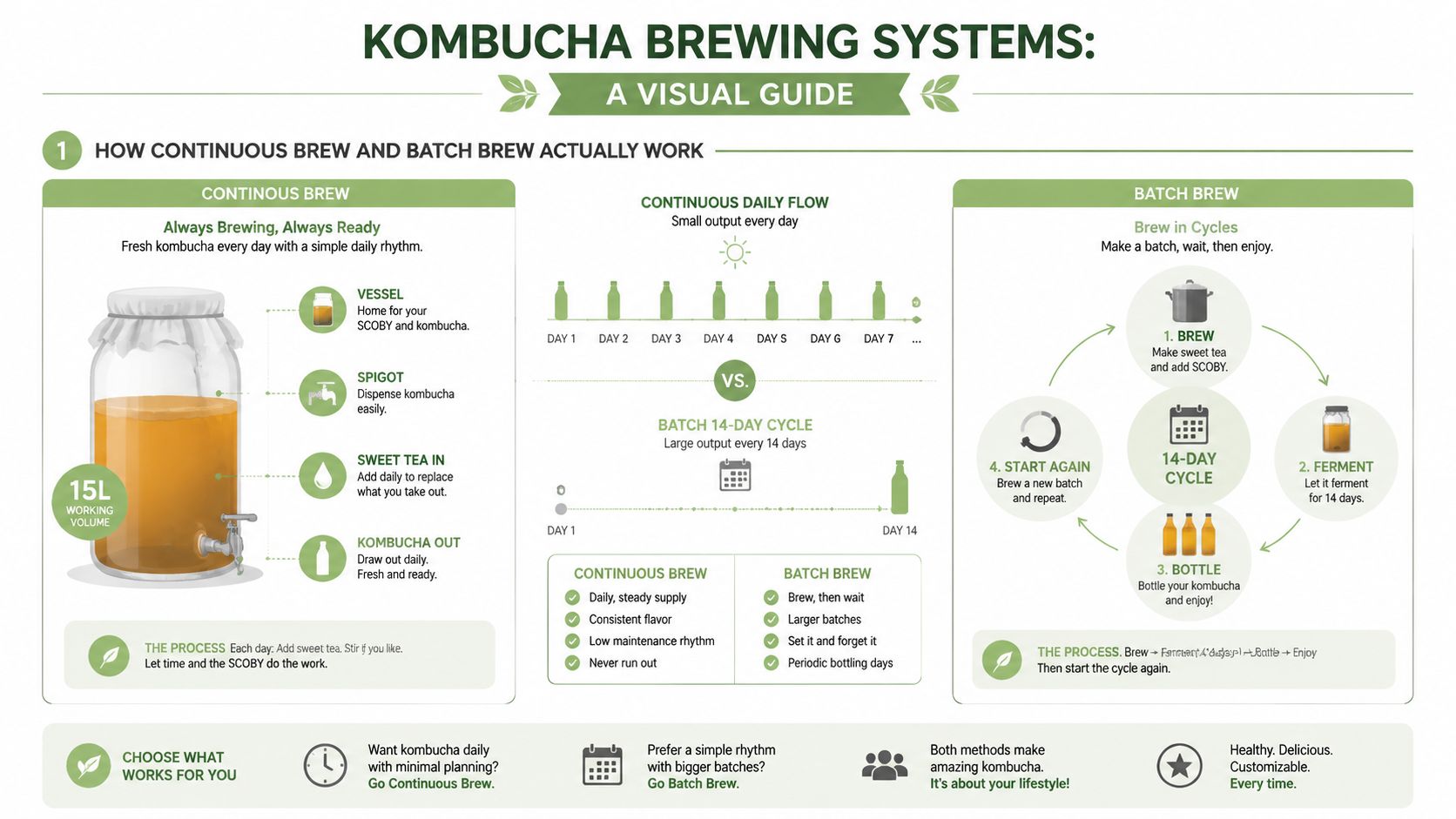
The spigot changes the work. You don't lift a full jar each time, but you do need to keep the tap clean, make sure sediment doesn't obstruct the outlet and refill with tea at a suitable temperature. A kombucha brewing container suitable for this style of setup needs stable placement, enough clearance for a bottle or jug and a surface that can cope with drips.
Glass is easy to inspect, food-grade HDPE can be practical in some production settings, and stainless steel may suit commercial equipment when it's appropriate for acidic beverages. Whatever the vessel, the culture must remain protected from insects and contamination, and the operator must be able to clean every contact surface.
Comparing Flavour, Workflow and Equipment Needs
Batch brewing gives you a flavour arc you can follow. The tea starts sweet, acidity develops, and the brew reaches a point where you can harvest the whole vessel. That makes it easier to compare tea bases, adjust the next recipe and produce a seasonal flavour with a clear identity.
Continuous brew tends to produce a more blended profile because mature liquid remains in the vessel while new tea is added. That can be appealing for a household or café that wants a familiar tartness, but the profile can move towards vinegar if draw-off is too slow or the culture remains underfed or over-acidified. The system is consistent only when the operator keeps the inputs and harvest rhythm consistent.
| Factor | Batch brew | Continuous brew |
|---|---|---|
| Flavour control | High control over each fermentation cycle | Stable profile when draw-off and refilling remain disciplined |
| Time commitment | More work on brew and bottling days | Smaller tasks repeated more frequently |
| Equipment | Multiple vessels can support different flavours | One large vessel, spigot, bench space and drainage access |
| Cleaning | Full clean between cycles | Spigot and vessel maintenance are central |
| Scaling | Add vessels or move to controlled production tanks | Increase vessel capacity, service frequency and monitoring |
| Commercial service | Strong fit where traceability matters | Useful for steady tap service if compliance controls are robust |
| Experimentation | Easy to run separate tea and flavour trials | Harder to isolate changes inside one living system |
Batch brew also fits operators who value flavour separation. You can finish a green-tea ferment, clean the vessel and begin a black-tea run without carrying as much of the previous profile forward. That flexibility is useful for home brewers who want to test ingredients and for cafés rotating a menu.
Continuous brew wins on physical convenience once established. A spigot reduces lifting and lets staff fill service containers directly, but it doesn't remove responsibility. The vessel needs a stable home near drainage, and the outlet needs regular inspection. Sediment, yeast and SCOBY growth can affect flow, especially when the tap is narrow.
Secondary fermentation adds another layer. Bottling a finished batch lets you manage flavour additions as a separate, traceable stage. The secondary-fermentation guide is useful for understanding why fruit, sugar and warm storage can change carbonation and alcohol after primary fermentation.
For a café, the decision often comes down to labour pattern. Batch work is concentrated into planned production windows. Continuous work is distributed across the week, but staff must remember to draw, refill, record and clean. A method that looks cheaper on paper can become expensive if the team doesn't follow the same routine every shift.
Alcohol, pH and Safety Realities for Australian Brewers
The central compliance question is whether the finished drink stays below the relevant alcohol threshold, not whether the recipe is marketed as “healthy” or “non-alcoholic”. FSANZ-linked Australian and New Zealand rules identify 0.5% v/v ethanol as the key threshold for declaring kombucha as alcoholic or non-non-alcoholic, while some Australian jurisdictions treat beverages above 1.15% ABV as liquor for regulatory purposes (Australian and New Zealand fermented beverage regulatory discussion).
Continuous brew can make alcohol management less intuitive. Fresh sweet tea regularly feeds an active culture, while the vessel retains mature liquid and continues fermenting between draw-offs. If refill volumes, temperature or dwell time change, alcohol output can change too. Batch brewing doesn't eliminate alcohol production, but a defined sugar dose and a planned harvest give the operator a clearer point at which to test and release the product.
The Food Regulation outcomes paper notes that kombucha traditionally involves primary fermentation followed by bottle conditioning, and that carbonation and additional alcohol can develop during secondary fermentation (Food Regulation fermented beverages outcomes paper). Bottling isn't therefore a neutral storage step. Warm bottles and longer conditioning can continue changing the drink after it leaves the main vessel.
pH is the stop point
Australian fermented-beverage guidance treats a final pH of 4.2 or below as the relevant safety target and says the SCOBY is removed once fermentation reaches that point (Australian fermented beverages issues paper). A continuous system shouldn't run indefinitely just because it still smells acceptable. Drawing off liquid can also dilute acidity with fresh tea, so the operator needs to check the vessel rather than assume its established culture guarantees the result.
Independent food-safety guidance recommends checking pH throughout fermentation. If the product hasn't reached pH 4.2 or below within seven days, the guidance says to discard and restart, while pH below 2.5 is identified as unsafe because of over-acidification (kombucha brewing and bottling safety guidance).
| Metric | Continuous brew | Batch brew |
|---|---|---|
| Alcohol control | More variable because fresh sugar enters an active, ongoing ferment | Easier to isolate by recipe, fermentation window and release test |
| pH behaviour | Can shift after refill if fresh tea dilutes acidity | Easier to follow across one defined cycle |
| Main safety task | Record every draw, refill and measurement | Record each batch from inoculation to bottling |
| Bottle risk | Ongoing fermentation may continue after packing | Secondary fermentation can still change alcohol and carbonation |
| Best operational safeguard | Frequent, documented checks and controlled refrigeration | Release testing, consistent timing and controlled storage |
A pH meter is more dependable for production decisions than taste alone. A digital pH meter for fermentation work should be clean, calibrated according to its manufacturer's instructions and used consistently. Commercial operators may also need alcohol analysis beyond a home hydrometer or refractometer, because sugar readings alone don't provide a definitive finished ABV.
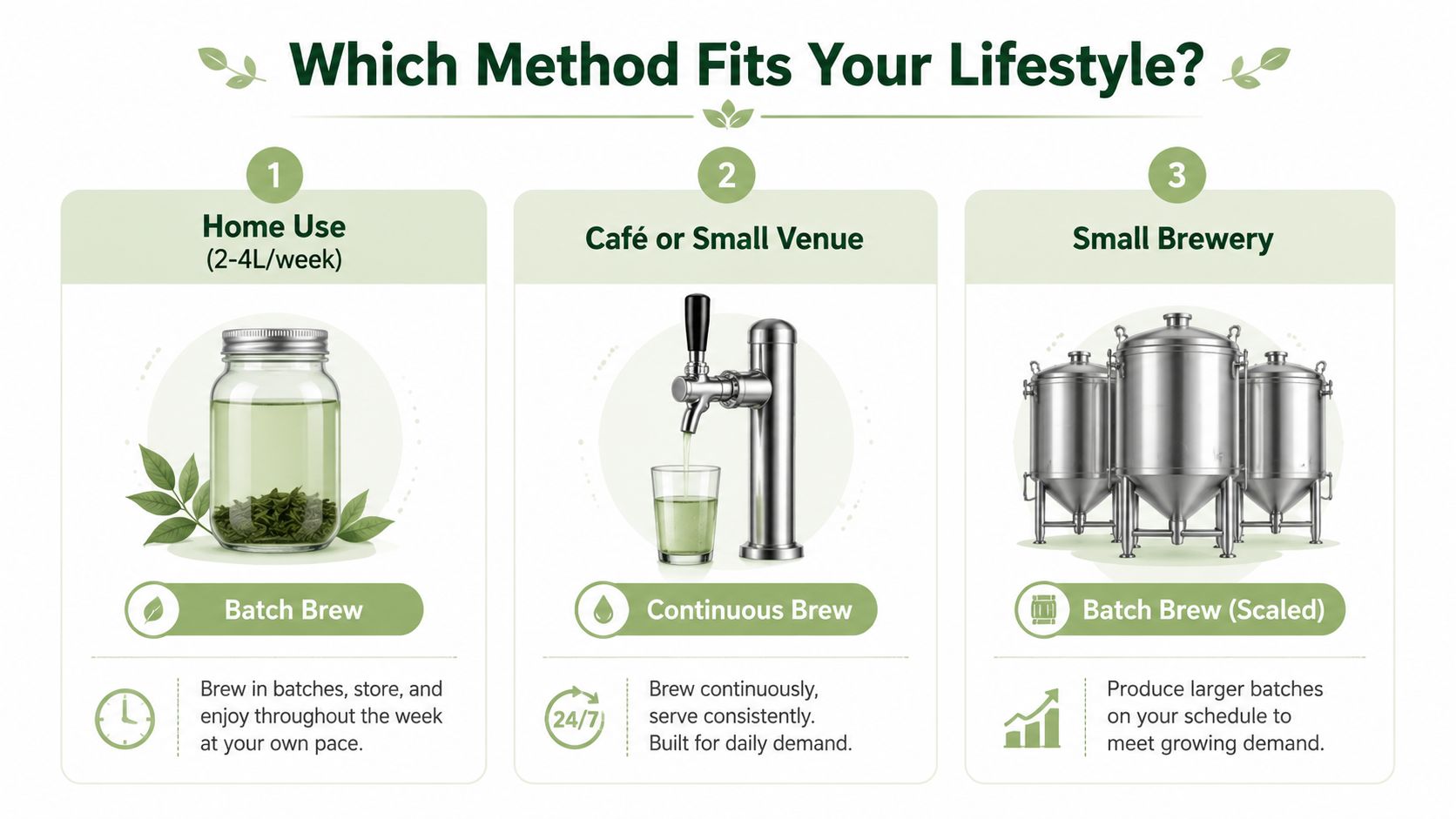
Which Method Fits Your Home, Café or Small Brewery
A home fermenter making a small amount each week usually benefits from batch brewing. The vessel can sit in a kitchen corner, the brewer can choose a different tea for the next cycle and one finished run can be bottled or refrigerated before the next begins. The main risks are forgetting the fermentation, letting the brew over-acidify or creating too much pressure during bottle conditioning.
A café has a different problem. The team needs an available drink during service, and a continuous vessel can reduce the number of full brewing resets. That convenience comes with a management burden. Staff need a written routine for draw-off, refill, pH checks, refrigeration and alcohol control, and someone must own the record rather than assuming “the kitchen” will handle it.
A small brewery supplying wholesale customers needs repeatability above all else. Batch production makes it easier to assign a lot identity, record ingredients and fermentation conditions, hold finished stock and investigate a problem without affecting every vessel at once. Larger systems still need careful process control, but the batch structure supports clearer traceability and labelling decisions.
| Operator | Better starting point | Why it fits | Main risk |
|---|---|---|---|
| Home brewer | Batch | Low complexity and easy flavour changes | Inconsistent timing or over-fermentation |
| Café with regular tap service | Continuous, with testing | Steady output and fewer full resets | Alcohol or pH drift across refills |
| Small wholesale producer | Batch at scale | Traceability and repeatable release decisions | More cleaning, vessels and production planning |
Many hospitality operators will eventually use both approaches. Continuous brew can serve a house kombucha where the profile stays familiar, while batch brewing can support limited releases, different tea bases or flavours that need to remain separate. That hybrid model makes sense when the menu has both an everyday pour and occasional products that require tighter control.
The most useful decision isn't “which method is best?” It's “which method can this team operate correctly every week?” A café with excellent equipment but inconsistent records is less prepared than a smaller venue with a simple batch process that staff follow without shortcuts.
For a visual overview of the three operating models, watch the brewing comparison below.
Troubleshooting and Recipe Adjustments for Each Method
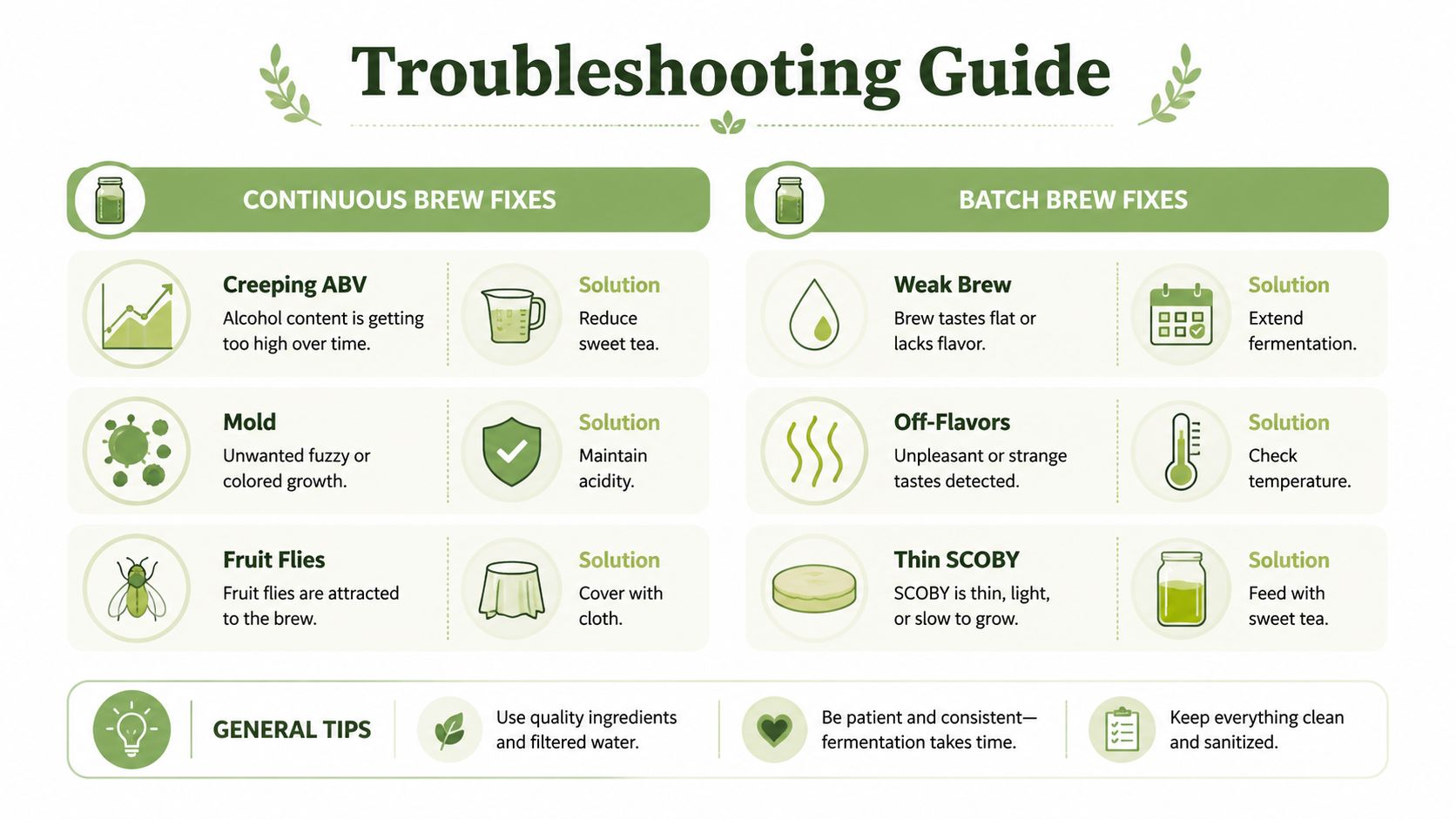
Continuous brew problems usually begin with a disrupted rhythm. If alcohol appears to be creeping upward, reduce the amount of fresh sweet tea added at each refill or harvest more often, then test rather than guessing. If pH rises after a refill, check whether the new tea has diluted the mature liquid too heavily and review the starter proportion before changing the entire recipe.
A blocked spigot is a mechanical warning. Yeast and SCOBY material can restrict flow, so clean the tap and inspect the vessel during scheduled maintenance. Don't scrape or disturb the culture unnecessarily, but don't keep pouring through a visibly obstructed outlet either.
Batch failures are easier to isolate:
- Stalled fermentation: Check the room temperature, tea strength and starter health. A batch that remains sweet and inactive may need a sounder starter process, not just more time.
- Weak carbonation: Standardise the priming approach and bottle-conditioning conditions. Refrigeration slows fermentation, but it won't reverse pressure that has already developed.
- Over-fermented flavour: Tighten the tasting and harvest window. Vinegar notes usually mean the brew stayed active longer than your preferred flavour profile.
Australian weather changes the pace. Warm summer conditions can accelerate fermentation and alcohol development, while cooler winter conditions can slow activity. Keep the brewing location consistent, log temperature qualitatively and adjust the fermentation window rather than blindly adding more sugar.
“Sugar-free” also needs careful wording. Kombucha requires fermentable sugar for the culture to work, so a finished product may be low in residual sugar without beginning as sugar-free tea. If you're adapting a recipe for a lower-sugar finished drink, change the formulation cautiously and verify pH and alcohol because reducing or replacing fermentable ingredients can alter fermentation behaviour.
The fix for one system may damage the other. Harvesting more often can help a neglected continuous vessel, but it can also destabilise a small batch if applied without understanding the starter ratio. Record the change, make one adjustment at a time and judge the next measured result.
Choosing the Right Brew Method and Tea Base
Choose batch brew if you're a home brewer who wants clear start and finish points, simple flavour experiments and a straightforward reset. Choose continuous brew if you're a café operator with steady demand, enough space for a spigot vessel and the discipline to monitor pH, alcohol and refill timing. Choose scaled batch production if you're moving towards wholesale and need stronger traceability and labelling control.
Neither system can rescue poor tea. A clean organic black or green tea gives the SCOBY a dependable base and lets the finished drink express the tea rather than masking problems with flavourings. For an organised trial, commit to one method for 30 days, log pH and taste weekly, and only then decide whether to change systems.
Pep Tea offers premium organic Japanese Matcha alongside proudly Australian-brewed sugar-free organic Kombucha made in the Hunter Valley, NSW. Visit Pep Tea to explore quality tea and kombucha options for home routines, cafés and carefully managed fermentation programmes.