
Hojicha Tea Caffeine: A Guide for Sensitive Australians
Have you ever chosen hojicha for an evening drink, then wondered whether “low caffeine” really means caffeine-free? That distinction matters, especially if you're sensitive to stimulants, serving tea to children, or replacing coffee or matcha in an Australian café.
Hojocha is a roasted Japanese green tea with a warm, nutty flavour and a naturally lower caffeine level than many unroasted teas. But the amount in your cup depends on the tea, the format, the serving size and the way you brew it. The most useful question isn't just whether hojicha contains caffeine. It's how much caffeine your particular preparation delivers.
How Much Caffeine Is Actually in Hojicha
Could a roasted tea contain caffeine without delivering the same lift as green tea or matcha? Australian-facing tea information places hojicha at about 7.7 mg of caffeine per cup, compared with around 20 mg in regular green tea. That makes hojicha a lower-caffeine choice, rather than a caffeine-free one. Pep Tea's guide to caffeine content in green tea provides broader context on differences between green tea varieties.
Australian products show why the number on your own cup may vary. One canned hojicha drink lists 7 mg of caffeine per 750 ml bottle. An Australian tea reference also explains that caffeine depends on the tea type, the proportion of leaves to stems, and brew strength. A loose-leaf infusion and a powdered hojicha drink therefore should not be treated as identical servings.
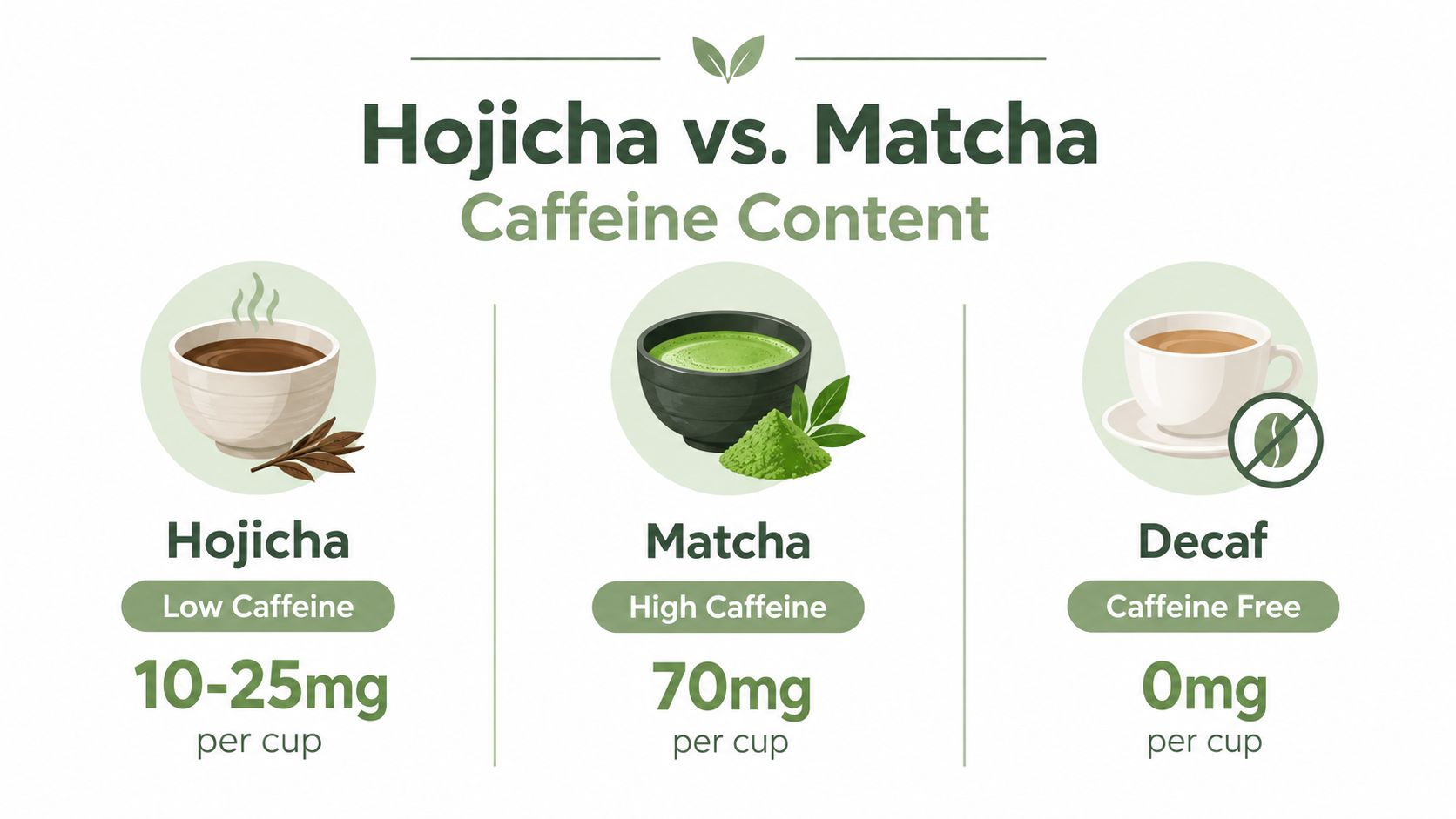
A practical comparison
| Tea type | Average caffeine per cup |
|---|---|
| Hojicha | About 7.7 mg, Australian tea reference |
| Regular green tea | Around 20 mg |
| Tea benchmark | About 27 mg per 250 ml cup, Australian Sports Commission |
| Green tea benchmark | 30–50 mg |
| Matcha | Around 60–70 mg per serve, Australian comparison |
The table is a guide, not a guarantee for every packet or café preparation. Hojicha powder can provide around 20–25 mg per standard serve, according to an Australian tea product guide, because you consume the powdered leaf instead of steeping and discarding it. People who are sensitive to stimulants may also find decaf and sleep sensitivity relevant when choosing an evening drink.
Why Hojicha Contains Less Caffeine Than Matcha
Why does hojicha usually feel gentler than matcha? The answer begins with how each tea is processed and consumed. Matcha is made from tea leaves that are processed and stone-ground into a fine powder, so you drink the whole leaf. Hojicha takes a different route: its leaves or stems are roasted, creating its brown colour, toasted aroma and mellow flavour.
Roasting reshapes the cup as well as the colour. Heat reduces some compounds linked with green tea's fresh, grassy character, while the roasted notes bring flavours closer to toasted grain, nuts and light caramel. This contributes to hojicha's lower stimulant load, although it remains a low-caffeine tea rather than a caffeine-free one.
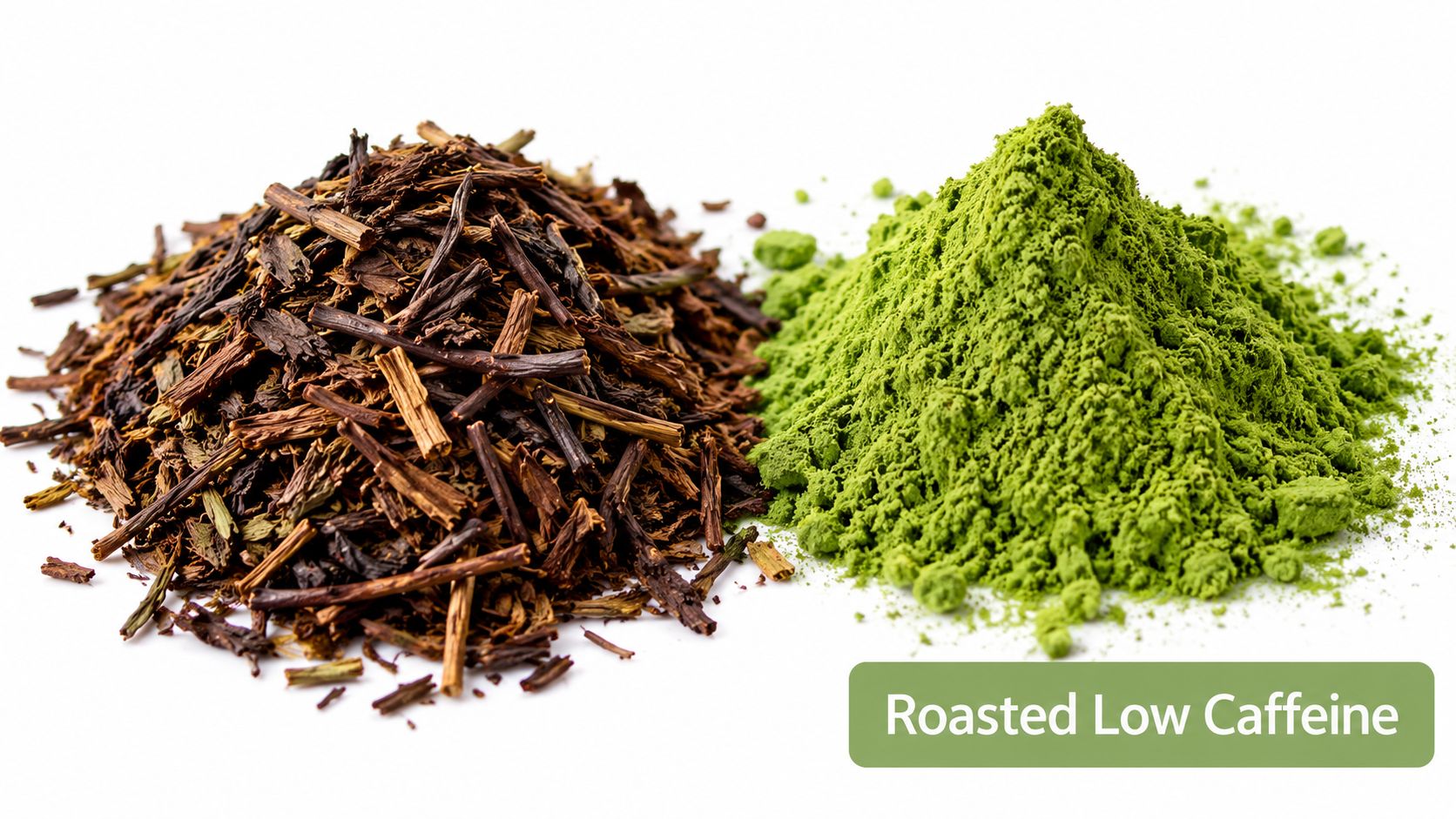
One tea family, two distinct experiences
Matcha and hojicha can both suit lattes, yet they offer different flavour and caffeine profiles:
- Matcha: Fresh, grassy and umami-rich, with a more noticeable caffeine presence because the powdered leaf is consumed.
- Hojicha leaf: Smooth, roasted and lighter-bodied, with caffeine shaped by the plant material and brewing method.
- Hojicha powder: Creamier and more concentrated than a loose-leaf infusion, so it can contain more caffeine than a lightly brewed cup.
To compare matcha and coffee, it helps to remember that matcha is a whole-leaf drink. Hojicha has its own identity, built around roasting, toasted flavour and a gentler cup, rather than being merely weak matcha.
A morning matcha may suit focused work or a pre-activity routine. Roasted hojicha can feel more comfortable after lunch or alongside dessert, especially for people who find green tea too bitter or grassy. Its rounded flavour often needs less adjustment for drinkers who prefer mellow, nutty notes.
This distinction matters when choosing Japanese tea for home or a café menu. Pep Tea's guide to how matcha tea is made explains matcha's processing, while hojicha is defined by the later roasting stage. The result is low caffeine, not zero caffeine, with the final amount still shaped by the tea material and preparation.
The Science Behind Roasting and Caffeine Reduction
It's common to hear that roasting “burns off” the caffeine in hojicha. That wording is too simple. A 2025 peer-reviewed review explains that heat decomposes amino acids and catechins in hojicha, while caffeine is reduced only slightly through sublimation rather than being completely broken down. In plain language, some caffeine may be lost during roasting, but the roasting process doesn't guarantee a caffeine-free tea. Read the review's discussion of hojicha chemistry.
Sublimation describes a substance moving from a solid state directly into a gas under suitable conditions. In tea roasting, this helps explain why some caffeine can leave with the heat. It doesn't tell us that every batch loses the same amount, because the final cup also depends on the starting material and extraction.
Why the figures vary
Hojicha may be made from different parts of the tea plant, including leaves and stems. Producers also use different roast profiles, and consumers prepare the tea in different ways. A light loose-leaf infusion and a concentrated powder whisked into milk shouldn't be expected to deliver the same caffeine level.
The apparent contradiction between “roasting reduces caffeine” and “hojicha still contains caffeine” disappears once you separate reduction from elimination. Roasting lowers the amount compared with some unroasted green teas, but it doesn't create a guaranteed zero-caffeine beverage.
The useful label is low-caffeine, not caffeine-free.
This distinction matters in Australian hospitality. A menu can describe hojicha as a low-caffeine alternative, but staff shouldn't promise that it contains no caffeine unless a specific product has been tested and labelled accordingly. For sensitive customers, the responsible approach is to explain the format and preparation, then allow the customer to choose.
Factors That Influence Caffeine in Your Cup
Caffeine extraction isn't fixed from one hojicha preparation to the next. The tea's leaf or powder format, the amount used, water conditions and brewing time all influence what reaches the cup. Australian product information makes the same practical point by linking caffeine variation to tea type, leaf ratio and brew strength.
Leaf or powder makes the biggest practical difference
Loose-leaf hojicha is steeped and then removed. Powdered hojicha remains in the drink, so the full measured portion is consumed. An Australian product guide places a standard serve of hojicha powder at around 20–25 mg of caffeine, while an Australian tea reference gives an average cup of steeped hojicha at about 7.7 mg. Those values aren't contradictory. They describe different preparations.
If you're particularly sensitive, start with loose leaf rather than powder. A brewed infusion usually gives you more control over the tea quantity and the strength of the final drink.
Adjust the brew deliberately
Use these levers to make a gentler cup:
- Use less tea. Reducing the leaf-to-water ratio reduces the amount available for extraction. For powder, measure a smaller portion rather than treating a full latte serve as the default.
- Shorten the steep. A brief infusion generally extracts less caffeine than a long, concentrated brew. Taste the tea early and stop when the roast character is present but not heavy.
- Choose a lighter preparation. A large mug made with a modest amount of leaf can taste comforting without becoming intensely concentrated.
- Avoid assuming colour tells the whole story. Hojicha's brown liquor reflects roasting, not a precise caffeine reading. A dark-looking cup isn't automatically high in caffeine, and a pale cup isn't automatically caffeine-free.
- Read the product information. If a manufacturer provides a caffeine value for a bottle or powder serve, use that figure for the product you are drinking.
Water temperature also affects extraction, although the relationship isn't a simple home formula. Rather than chasing a precise caffeine calculation, keep your method consistent. Use the same tea amount, water volume and steeping approach whenever you want a repeatable result.
For cafés, record the recipe for each hojicha drink. A powder latte and a loose-leaf pot should have separate preparation notes, because customers may interpret “hojicha” as one standard beverage even when the café is serving very different formats.
Preparing Low-Caffeine Hojicha at Home
A lighter hojicha infusion is simple to make, and you don't need complicated equipment. The aim is to keep the roasted aroma while avoiding an unnecessarily concentrated serve.
A gentle loose-leaf method
- Measure a modest amount of loose-leaf hojicha. Use less tea than you would for a strong pot, particularly if you're drinking it late in the day.
- Warm your teapot or cup. This helps the infusion stay pleasant without relying on an oversized tea dose.
- Add hot water and steep briefly. Start with a short brewing time, then taste. If the flavour is too light, extend the next infusion slightly rather than making the first cup very strong.
- Remove the leaves promptly. Don't leave the tea sitting in the pot while you drink, as continued extraction changes the strength.
- Serve plain or with milk. Hojicha's toasted flavour can stand on its own, and a splash of milk turns it into a softer after-dinner drink without needing sugar.
Some tea drinkers use a quick first rinse, then discard that liquid before making the main infusion. This may remove some readily soluble material, but it isn't a guaranteed way to remove caffeine. Treat it as a flavour and preparation preference, not a caffeine-free shortcut.
Serving it for others
For a family gathering or café service, prepare a lighter pot rather than assuming everyone wants a concentrated cup. Keep the leaf amount modest, avoid extended holding time and tell guests that hojicha is low in caffeine, not caffeine-free. If you're using powder, offer a smaller portion for people who want a milder drink.
That transparency is especially helpful for children and caffeine-sensitive adults. It also makes the tea easier to enjoy as a warm alternative to coffee, without turning a comforting ritual into a precise calculation.
Hojicha in Your Daily Wellness Routine
Hojicha fits naturally into a balanced Australian wellness routine because it offers roasted comfort with less caffeine than many standard green tea preparations. The caffeine is still present, so people who are highly sensitive should consider their total intake and personal response.
Australian food guidance explains that naturally caffeinated foods such as tea are exempt from added-caffeine labelling rules. It also says there's no recognised health-based guidance value for caffeine, while noting that about 3 mg per kilogram of body weight per day in children has previously been linked by FSANZ with increased anxiety. See the Australian food authority's caffeine guidance.

For a broader look at flavour, preparation and everyday uses, explore Pep Tea's guide to hojicha tea benefits. Choose loose leaf when you want a lighter infusion, and treat powder as a more concentrated format. Pep Tea offers organic tea products alongside its Australian-brewed, sugar-free organic kombucha from the Hunter Valley, NSW, giving health-conscious drinkers options for warm and chilled routines.
Explore Pep Tea for organic tea options and Australian-brewed sugar-free kombucha, then choose a hojicha preparation that suits your flavour preferences and caffeine sensitivity. If you're a café or hospitality buyer, contact Pep Tea about practical beverage options for a thoughtful, low-sugar menu.
Kombucha Starter Recipe: A Practical Beginner’s Guide

You're at the kitchen bench with a clean jar, sweet tea and a new SCOBY, wondering whether the thin layer forming on top is healthy or whether something has gone wrong. That uncertainty is normal. A good kombucha starter recipe gives you more than a list of ingredients. It gives you a controlled starting point, sensible fermentation checks and clear rules for when a batch should be used, continued or discarded.
Australian guidance provides useful benchmarks for home brewers. The tea must cool before the culture is added, fermentation needs a suitable temperature range, and pH matters more than taste alone. Follow the process below as a practical framework, while remembering that home fermentation carries food-safety risks and should be approached carefully.
Why Your First Kombucha Starter Matters
Your first starter liquid becomes the acidic foundation for later batches. If it's mature and healthy, it helps the new sweet tea move into a safer acidic environment. If it's weak, contaminated or added to hot tea, the SCOBY may struggle and the brew may remain vulnerable to unwanted microbial growth.
A SCOBY is the living culture used to ferment sweet tea. You may see a rubbery pellicle floating on the surface, brown stringy material underneath or a new pale layer developing. Those visual changes can be part of normal fermentation, but appearance alone can't confirm that a batch is safe to drink.
Practical rule: Treat the starter liquid as a core ingredient, not a splash added at the end.
Australian food-safety guidance explains that the initial tea infusion can sit around pH 5 and may support contaminant growth. It recommends using a proven starter culture and cooling the tea quickly from 60°C to 20°C within 2 hours before inoculation. You can read the Australian food-safety guidance on kombucha starter culture and cooling for the reasoning behind those controls.
This guide focuses on the points that cause first batches to fail: the starter-to-tea ratio, cooling temperature, fermentation conditions, pH testing, SCOBY inspection and contamination control. You'll also learn how to respond to a slow brew, a sour brew, fruit flies or fuzzy growth without trying to rescue something unsafe.
The aim isn't to make every batch identical. Ambient conditions vary between a cool Melbourne kitchen, a warm Queensland pantry and a home near the Hunter Valley. The aim is to give you measurable checkpoints so you aren't relying on a calendar or a guess.
Ingredients and Starter Ratios for a Safe Batch
For a straightforward Australian baseline, use about 100 ml of mature starter tea per litre of sweet tea, with roughly 70 g sugar and 1 tea bag per litre, as reflected in Australian consumer brewing guidance. The Australian kombucha and kefir brewing guide also describes retaining fermented liquid for the next batch, reinforcing the importance of keeping enough mature starter aside.
For a 2-litre batch, the working quantities are:
| Ingredient | Per litre | 2 L batch | Purpose |
|---|---|---|---|
| Tea | 1 tea bag | 2 tea bags | Provides the tea base for fermentation |
| White sugar | About 70 g | About 140 g | Fuels the yeast and bacteria during fermentation |
| Mature starter tea | About 100 ml | About 200 ml | Brings acidic fermented liquid into the fresh tea |
| Water | 1 litre | 2 litres | Forms the sweet tea base |
| Healthy SCOBY | 1 culture | 1 healthy culture | Continues the fermentation |
The Australian baseline is deliberately simple. Black tea is a familiar starting point, while plain green tea can also be used. Avoid treating the sugar as a sweetener added only for flavour. It feeds the culture, and fermentation changes the balance of sweetness and acidity over time.
Use clean, filtered water where possible. Water with a strong chlorine smell may interfere with the culture, so allow treated water to stand according to your local water advice or use filtered water. Choose a clean glass fermentation jar with enough room for the liquid and surface growth, then cover it with clean, breathable cotton secured firmly with a food-safe rubber band.
You can use ordinary kitchen utensils, but avoid prolonged contact between fermenting kombucha and reactive metal. Wash your hands, jar, cover and utensils thoroughly before starting. If you need a measured source of acidic liquid, PepTea starter tea for kombucha is one option to consider alongside a mature homemade batch.
Brewing and Inoculating the Sweet Tea
Start with the tea base, not the SCOBY. Measure the water, heat it and dissolve the sugar completely while the liquid is hot. Add the tea and steep until the brew has developed a clear tea flavour, then remove the bags or strain the leaves.
Don't add the culture while the tea is warm from the kettle. Australian guidance says the tea should cool from 60°C to 20°C within 2 hours before starter culture is added, so use a clean, shallow pot or an ice bath if you need to speed cooling. The liquid should feel like room-temperature water, not warm tea.
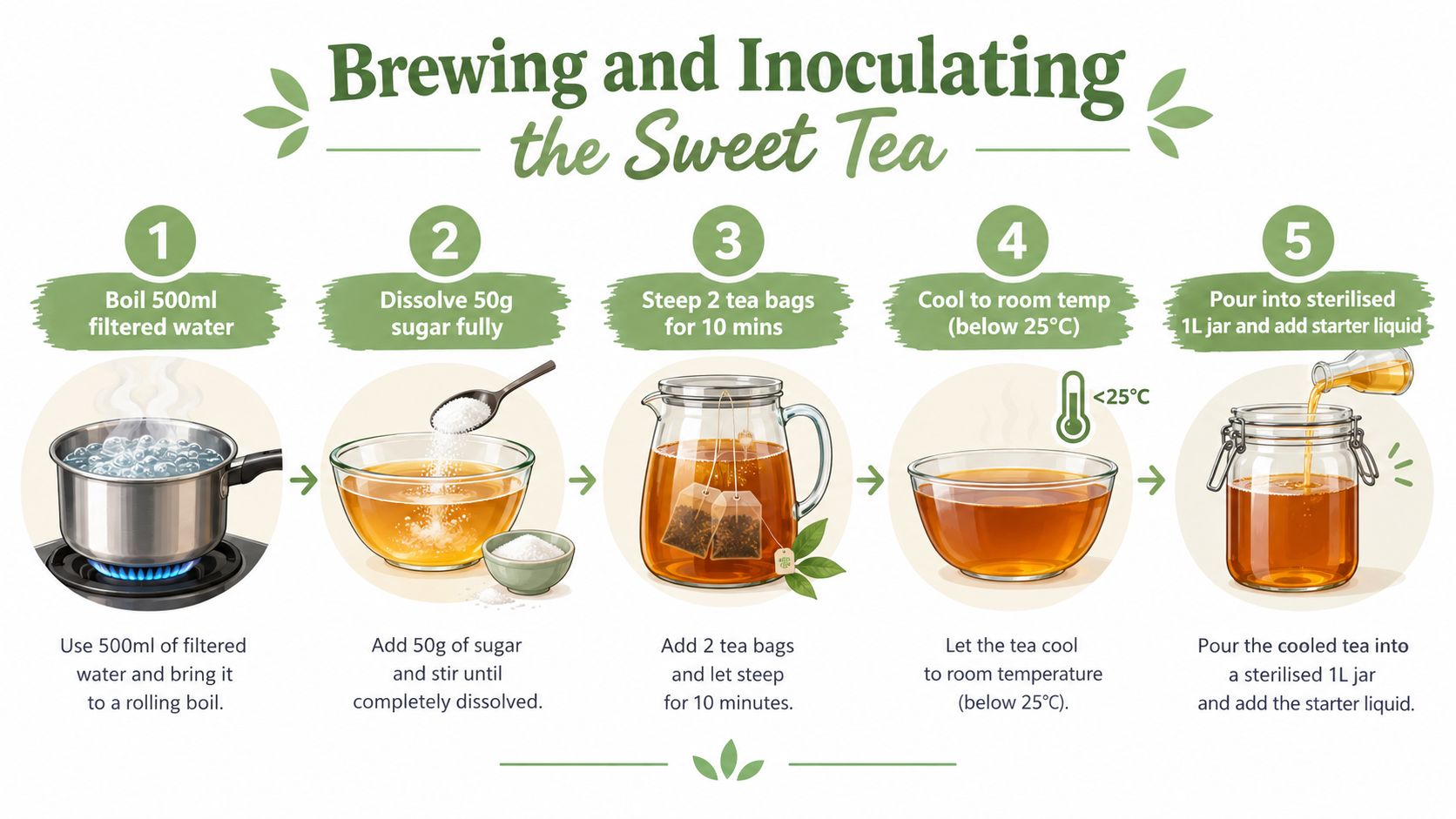
Once cooled, pour the sweet tea into your clean glass jar. Add the mature starter liquid, then place the SCOBY in with clean hands. It may float, sink or sit at an angle. That position isn't a reliable sign of failure.
Your inoculation checklist
- Cool the tea first. Don't compromise this step to save time.
- Add the starter liquid. Use about 100 ml per litre of sweet tea, giving a 2-litre batch about 200 ml.
- Add the SCOBY last. Handle it gently and inspect it before use.
- Cover the jar. Use breathable cotton or tightly woven cloth, secured so insects can't enter.
- Label the batch. Record the date, tea type and starter ratio so you can compare batches.
Keep the jar away from direct sunlight and avoid moving it unnecessarily. Don't seal it with an airtight lid during primary fermentation, because the culture needs airflow. For the first 48 hours, leave the brew undisturbed and don't taste it as a substitute for checking its acidity.
A short video can help you visualise the movement from sweet tea to inoculated jar:
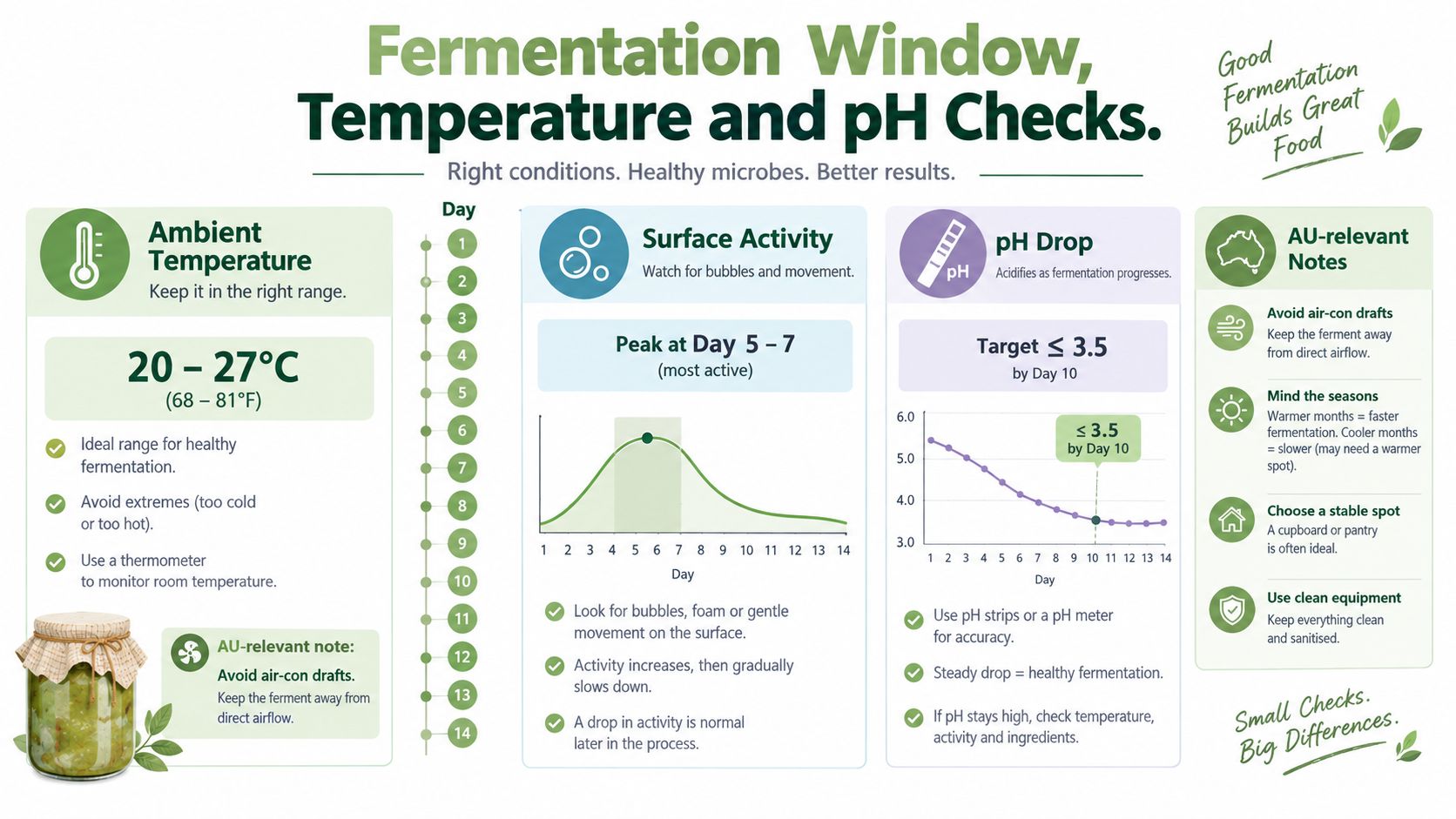
Fermentation Window, Temperature and pH Checks
A fixed day count can't tell you whether your kombucha is ready. Temperature changes the pace, and the strength of the starter liquid affects how quickly acidity develops. Australian guidance commonly places fermentation at 7 to 10 days, with the brew held between 20°C and 23°C, and recommends checking the finished product until it reaches pH 4.2 or lower. Those benchmarks are set out in the Western Australian fermented-food safety guideline.
Use three signals together:
- Temperature: Keep the jar in a stable, moderate environment. A cold room can slow fermentation, while excessive heat can damage the culture or push the brew towards excessive acidity.
- Surface activity: A thin new layer, small bubbles or brown strands may appear as the culture works. A SCOBY that sinks isn't automatically unhealthy.
- pH: Test with fresh pH strips or a digital meter rather than judging safety by smell or sweetness.
A simple testing routine
Use a clean spoon or sampling vessel to take a small amount from the jar. Test that sample, not the whole batch, and avoid returning it to the fermentation vessel. Write the result beside the date so you can see whether acidity is changing.
If the pH remains above the Australian safety target, don't bottle or drink the batch. If the brew reaches the target, remove the starter culture and refrigerate the finished kombucha at 4°C, as described in Australian fermented-beverage safety material.
For a reliable testing setup, a digital pH meter for kombucha brewing can make readings easier to repeat, provided you clean, store and calibrate it according to the manufacturer's instructions. pH testing doesn't replace visual inspection. If you see green, white, black or grey discolouration, or notice an abnormal odour, discard the culture and the entire batch.
SCOBY Care Between Batches
A healthy SCOBY can become the reusable part of your brewing routine. After fermentation, lift it out with clean hands and keep it covered with enough mature starter liquid to prevent it drying out.
You can leave the culture in a brewing jar if you expect to start another batch soon. For a longer pause, place the SCOBY in a clean glass jar with starter tea and cover it appropriately. The liquid should be at least equal to the SCOBY's volume, so the culture remains surrounded by acidic liquid rather than exposed to air and drying.
A SCOBY hotel is a storage jar containing cultures and starter liquid. Keep it organised by labelling the jar and removing any culture that shows suspicious growth. Don't scrape mould from the surface and continue using the liquid. Fuzzy growth or unusual colours aren't cosmetic problems because contamination can spread through the batch.
When to retire a culture
- Persistent mould: Discard the culture and liquid rather than trying to clean and save them.
- No activity: If a warm, properly prepared batch shows no fermentation activity over an extended period, use fresh starter rather than repeatedly feeding the inactive culture.
- Returning off odour: A smell that remains unpleasant after cleaning and restarting is a reason to stop using the culture.
If you share a SCOBY, place it in a clean, food-safe container with enough starter liquid to keep it moist during transport. Give the recipient the tea type, approximate ratio and latest pH information, so they aren't trying to identify an unknown culture from appearance alone. Guidance on how to make a SCOBY can help a new brewer understand what they're receiving.
Troubleshooting Common Starter Problems
A slow brew doesn't always mean the SCOBY is dead. Before changing several variables at once, check the room temperature, water, starter strength and cleanliness of the vessel. Australian food-safety material warns that low temperatures can slow acidification, while excessive heat can harm the culture, so temperature drift is often the first place to investigate.
The six problems beginners see most often
- Slow fermentation: Move the jar away from cold drafts and check whether the starter liquid is mature and acidic. Don't compensate by adding random ingredients.
- Weak starter liquid: Use mature, unflavoured starter from a healthy batch. Australian consumer guidance warns against using previously fermented foods as a starter because back-slopping can reduce effectiveness and allow unwanted bacteria to grow. The Australian fermented-beverages issues paper provides the regulatory context for treating kombucha as a fermented sweetened tea rather than an ordinary cold drink.
- Under-pitched culture: Confirm that the SCOBY looks normal and that enough starter tea was included. A large pellicle alone doesn't guarantee a strong liquid culture.
- Chlorinated water: If your water smells strongly of chlorine, use filtered water for the next batch and keep your process consistent.
- Fuzzy mould: Blue, green, black, white or grey fuzzy growth means discard the entire batch, including the SCOBY. Don't scrape the patch away.
- Overly sour kombucha: The brew has gone further than your preferred drinking point. Shorten the next fermentation by checking pH earlier, and reserve a balanced batch as starter rather than using vinegar-like liquid.
Flat kombucha needs a separate check. Confirm that fermentation took place, test the pH and look for remaining sweetness. Carbonation develops later and can vary, so a flat first ferment isn't automatically evidence of contamination.
Fruit flies usually indicate that the cover isn't tight enough. Use a clean, tight-weave cloth secured with a rubber band, and never use an airtight lid during primary fermentation. If the smell is rotten, musty or otherwise abnormal, discard the liquid and restart with clean equipment and a healthy starter.
Safety-first decision: If you can't confidently identify the problem, throw the batch out and begin again.
Flavouring Your Starter Brew and Next Steps
Flavouring belongs after primary fermentation, not in the starter tea. Once the brew has reached the appropriate acidic endpoint, remove the SCOBY and reserve mature liquid for the next batch. Add flavourings to the finished kombucha in pressure-safe bottles, leaving room for carbonation and handling the bottles cautiously.
For a 2-litre batch, you can divide the liquid between flavour combinations such as:
- Ginger and lemon: Add sliced ginger and a small amount of lemon zest for a sharp, warming profile.
- Berry and mint: Use crushed berries with fresh mint, then strain before serving if you prefer a clearer drink.
- Native lemon myrtle: Add a modest amount of culinary lemon myrtle and taste carefully, because its aroma can become prominent quickly.
The provided Australian flavouring benchmark also lists passionfruit pulp, mint leaves, ginger slices, lemon zest and a cinnamon stick as practical additions. Keep additions clean, use food-safe bottles and monitor pressure. If a bottle becomes unusually hard or sprays when opened, chill it thoroughly and open it slowly over a sink.
Build a repeatable brewing rhythm
Reserve starter liquid before flavouring the rest of the batch. Start the next brew with the same tea, sugar and starter proportions, then change only one variable at a time. That approach helps you understand whether a change in flavour, speed or acidity came from the tea, the room or the fruit.
Not everyone wants to maintain a SCOBY between batches. A ready-made starter culture can be a practical shortcut when you want a consistent starting point without first growing or storing your own culture.
Pep Tea offers Australian organic tea and sugar-free organic kombucha, including flavours such as Ginger, Lime & Ginger and Mango, for readers who'd rather enjoy a finished fermented drink than manage a starter jar. Visit Pep Tea to explore the kombucha range and find a convenient option for your next glass.
Best Matcha Latte Recipe for Café-Style Flavour at Home
You've picked up a vivid green matcha latte on the way to work, taken two sips, and realised it tastes more like sweetened milk than tea. At home, the same drink can be smoother, fresher, and much easier to adjust. The difference usually isn't an expensive coffee machine. It's fresh matcha, controlled water temperature, proper sifting, and milk that can hold its texture.
Australia's matcha habit has moved well beyond a niche tea order. The market generated more than AUD 54 million in 2024 and one industry forecast expects it to exceed AUD 81 million by 2030, a projection covered by SBS News. That growth has brought better access, more café experimentation, and higher expectations for the cup.
This is the best matcha latte recipe I use as a practical starting point. It works hot or iced, with dairy or plant milk, and gives you enough control to make a café-style drink without hiding the tea under syrup.
Why Your Morning Matcha Latte Costs Too Much
A Sydney or Melbourne takeaway can cost close to A$8, while cafés in major Australian cities commonly charge AUD 6 to AUD 8 per serve, according to Australian tea market coverage. One occasional purchase is easy to justify. Five weekday drinks, however, can put roughly A$40 a week toward takeaway matcha.
Home preparation changes the calculation without requiring bargain-basement powder. A carefully portioned latte costs around A$2 a serve with ceremonial matcha, or roughly A$1.20 with culinary matcha, depending on the matcha, milk, and sweetener. At five drinks a week, that is about A$10 for ceremonial matcha or A$6 for culinary matcha, compared with roughly A$40 from a café.
The lower cost also gives you control over the cup:
- Matcha grade: Ceremonial matcha offers a cleaner, more delicate flavour, while culinary matcha can bring stronger bitterness at a lower serving cost. Neither replaces good technique.
- Sweetness: Use honey, maple, a sugar-free option, or nothing, rather than accepting a café's preset balance.
- Milk: Dairy, oat, almond, soy, and coconut milk change the texture and how clearly the tea comes through.
- Tea flavour: With enough matcha and restrained sweetness, umami and gentle vegetal notes remain noticeable instead of disappearing under syrup.
Supply can affect the choice. If ceremonial matcha is difficult to find or too expensive, fresh culinary matcha is a practical substitute for a daily latte. Sifting it carefully, controlling the water temperature, and choosing milk that froths well will matter more than paying for a premium label alone.
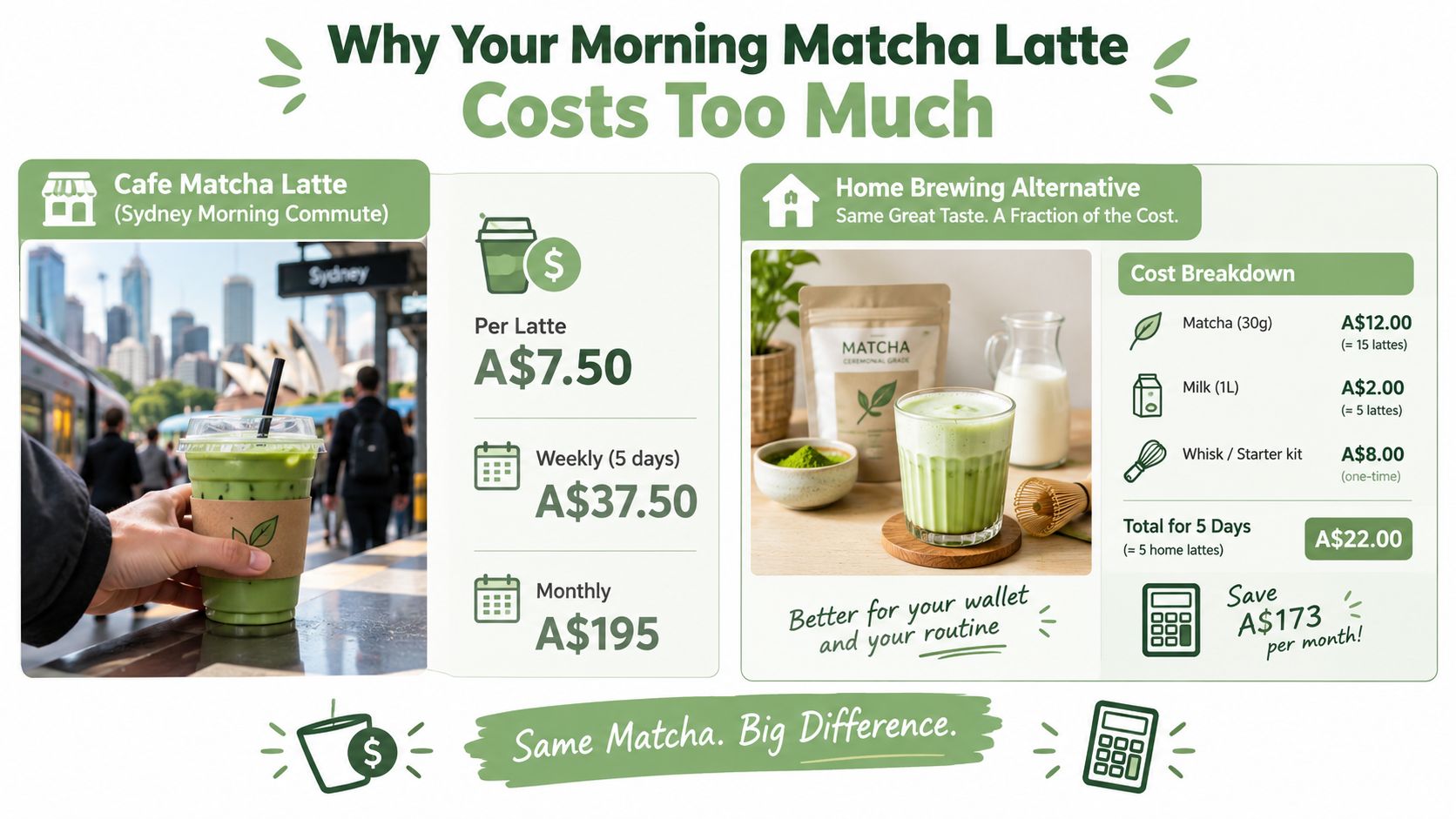
The home method costs about the same as one takeaway drink once the basic ingredients are in your kitchen. The return is a fresher, more adjustable cup, with attention and technique doing more work than expensive equipment.
The Core Method for a Smooth, Vibrant Cup
The smoothest latte starts with a small matcha concentrate, not powder dumped directly into a full glass of milk. Matcha is finely ground tea leaf, so it won't dissolve like sugar. Sifting and emulsifying suspend the particles evenly and prevent dry pockets from floating through the drink.
Start with a fine matcha base
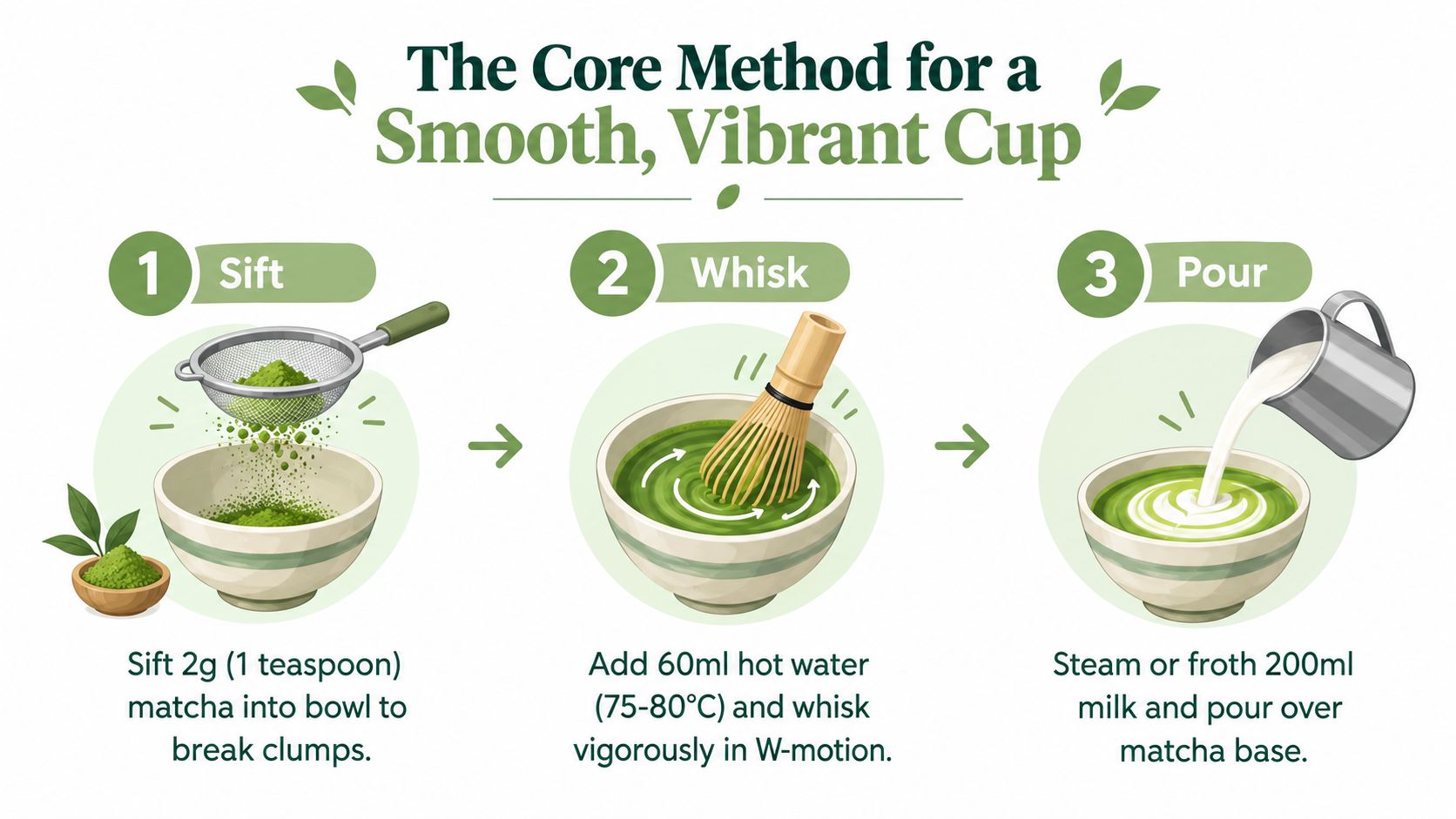
Measure 2 g, about 1 teaspoon, of matcha into a small bowl, wide mug, or matcha bowl. Pass it through a fine sieve before adding water. This takes a few seconds and removes the compacted pieces that a spoon tends to leave behind.
Add 60 ml of water at 70–80°C. This temperature range is the most important control in the recipe. Australian matcha preparation guidance recommends this window because it helps preserve flavour, reduces bitterness, and supports a more stable foam, as described in this Australian matcha latte method.
Build a paste, then whisk
First, work the water into the powder to make a thick paste. Use a bamboo chasen or small whisk and press any remaining lumps against the side of the bowl. Don't rush straight to a large volume of water. The paste stage gives every particle a chance to hydrate evenly.
Add a second small splash of the remaining water if the paste feels tight, then whisk rapidly for 15–20 seconds in a W or M motion. A circular stir moves liquid around the bowl but doesn't incorporate air as effectively. The target is a glossy, fully suspended base with fine pale-green bubbles across the surface.
Practical rule: If your water has just boiled, let it cool before it touches the matcha. Water above the recommended range is the fastest route to a harsh cup.
Warm 150–200 ml of milk and pour it into the matcha base. For an iced latte, use cold milk and pour the whisked matcha over ice. Keep the milk volume toward the lower end when you want a stronger tea flavour, and use the higher end for a softer, milkier drink.
For a visual demonstration of the whisking technique, see PepTea's guide to whisking matcha.
A bamboo chasen is traditional, but a handheld electric frother or small wire whisk works perfectly well for a home latte. The method matters more than the tool.
Choosing the Right Matcha Grade for Your Budget
Ceremonial and culinary matcha aren't interchangeable in every drink, but the more expensive option isn't automatically the better latte powder. Ceremonial matcha is generally selected for drinking with water, where its colour, aroma, texture, and finish have nowhere to hide. Culinary matcha is made for recipes in which milk, sweetener, fruit, chocolate, or flour share the stage.
| Attribute | Ceremonial Grade | Culinary Grade |
|---|---|---|
| Flavour | Smooth, umami-rich, vegetal, gently sweet | Deeper, toastier, and more astringent |
| Colour | Brighter, vivid green | Often darker or duller green |
| Price guide | Typically A$35–A$60 per 30 g tin | Typically A$15–A$25 per 100 g pouch |
| Best use | Straight matcha, lightly milky drinks | Everyday lattes, iced drinks, baking |
| Main advantage | Clean finish and refined aroma | Strong value and enough flavour to stand up to milk |
Those price ranges reflect the product examples described in the brief, not a universal retail rule. Matcha availability and pricing vary as Australian demand expands across cafés, supermarkets, and specialty tea suppliers. PepTea's explanation of matcha grades is useful when you're comparing a drinking powder with one intended for cooking.
My rule is simple: choose ceremonial grade when the tea itself is the focus, and save with culinary grade for regular lattes, smoothies, iced drinks, and baking. Ceremonial grade matters less than many people think when you're adding a substantial amount of oat milk, sweetener, vanilla, or ice. In that situation, a fresh culinary matcha can taste more balanced than an older, expensive tin.
Storage also affects the result. Keep opened matcha sealed, away from heat and strong light, and use clean, dry utensils so the powder retains its colour and aroma.
Milk Options and How to Froth Each One
Milk changes the latte more than most expect. It affects sweetness, body, foam, and how strongly the matcha comes through, so the right choice depends on whether you want a traditional creamy drink, a plant-based café texture, or a refreshing iced version.
| Milk | Flavour Impact | Foam Quality | Best Temperature |
|---|---|---|---|
| Full-cream dairy | Rich, rounded, naturally sweet | Stable, fine microfoam | Around 65°C |
| Oat milk | Creamy, lightly sweet, cereal-like | Usually the most stable plant foam | Around 60–65°C |
| Almond milk | Nutty and lighter-bodied | Light foam, stronger with barista blends | Warm gently |
| Soy milk | Creamy with a mild bean note | Holds foam well, but can split if overheated | Keep below boiling |
| Coconut milk | Tropical and aromatic | Thin foam, better for iced drinks | Froth cold or warm gently |
Full-cream dairy gives the most forgiving hot latte. Warm 150 ml gently to around 65°C, then froth until the surface looks glossy rather than bubbly. Overheated milk loses sweetness and can make the tea taste flatter.
Oat milk is usually the easiest plant-based substitute for a café-style texture. Barista versions often contain ingredients that improve body and emulsification, which helps them produce a more persistent foam. Soy can also foam well, but high heat may cause it to split, so stop before the milk simmers.
Almond milk heats quickly and tends to create a lighter drink. Choose a barista blend if foam matters. Coconut milk adds an appealing tropical note but usually stays thinner, so I prefer it cold over ice rather than trying to force it into a dense hot foam. PepTea's matcha coconut milk recipe is a useful format for that combination.
Two reliable cold versions
For a shaken iced latte, combine the sifted matcha with the hot water paste first, then add 200 ml cold milk and ice to a jar. Seal it firmly and shake until the drink looks evenly green and lightly foamy.
For a cold-foam finish, froth a small amount of cold milk separately with a handheld frother or French press, then spoon it over an iced matcha latte. If you're preparing drinks for a household or café, a larger piece of equipment such as this Chef Inox Elite jug milk frother from Simply Hospitality can make repeated batches easier.
Rice milk and very low-fat dairy are less reliable when you want stable foam. They can still make a pleasant latte, but expect a thinner surface and let the matcha carry more of the texture.
Sweeteners and Flavour Variations Worth Trying
Sweetener should support matcha's flavour, not bury it. Start with a small amount, taste after the milk is added, and remember that oat milk already brings its own sweetness.
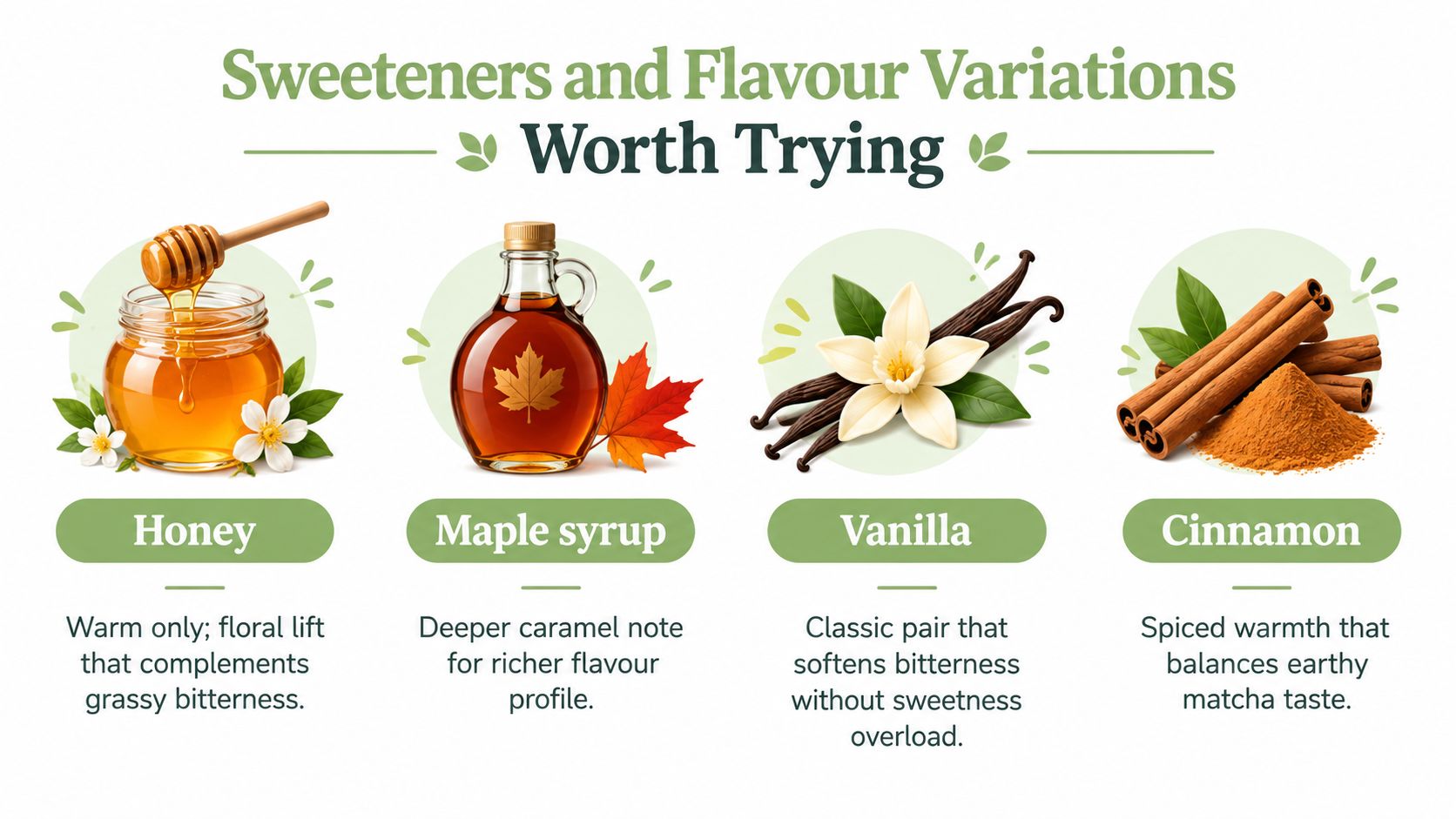
- Honey: Begin with 1 teaspoon in the warm matcha paste. Its floral character can lift grassy notes, but don't add it to a cold drink if it won't dissolve properly.
- Maple syrup: Use 1 teaspoon for a deeper caramel note, especially with oat milk.
- Caster sugar: Add 1 teaspoon to the hot paste if you want a neutral sweetness that disappears cleanly into the drink.
- Monk fruit or stevia: Follow the product's serving guidance, because concentrations vary. These options suit a low-sugar routine, but some products leave a lingering aftertaste.
- No sweetener: Use this with a good ceremonial matcha when you want to notice its umami, aroma, and gentle vegetal sweetness.
Vanilla is one of the most useful additions. A few drops round out bitterness without turning the latte into a dessert. A pinch of fine sea salt can make sweetness feel more pronounced, while 1 teaspoon cocoa creates a matcha-mocha profile with a darker finish. For an iced tropical version, add a splash of coconut cream and reduce the milk slightly so the drink doesn't become heavy.
These small adjustments fit neatly into everyday low-sugar cooking. For broader ideas on balancing sweetness and flavour in family drinks, see these balanced cooking tips for Melbourne families.
Cinnamon works best as a finishing dusting rather than a large dose whisked into the base. It adds warmth, but too much spice can cover the tea's more delicate notes.
Fixing the Most Common Home Matcha Problems
A bitter latte isn't proof that you dislike matcha. In most home kitchens, it points to a process problem, usually water that's too hot or powder that hasn't been emulsified properly.
Bitter taste
Boiling water extracts a harsher flavour and overwhelms matcha's softer notes. Cool freshly boiled water for about 60 seconds before adding it, then stay within the 70–80°C range.
Clumps
A spoon can mix matcha into milk, but it won't break up compacted powder as reliably as a sieve and rapid whisk. Sift the dry matcha before adding any liquid, then make a paste before increasing the water volume.
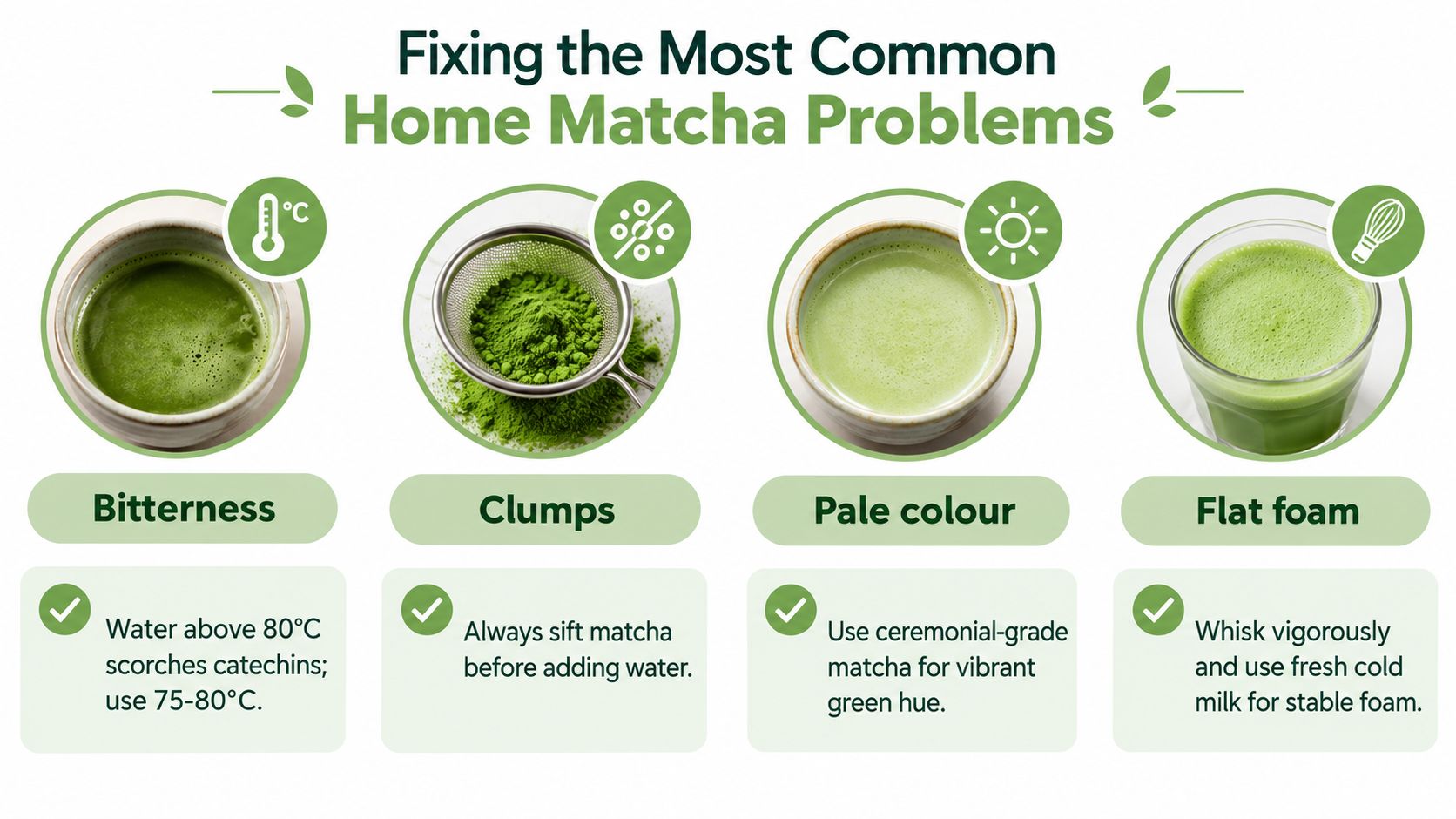
Pale colour
A weak green colour usually comes from too much milk, older oxidised powder, or using a small amount of culinary matcha in a large drink. Reduce the milk to 150 ml and use 2 g matcha before reaching for more sweetener.
Flat or disappearing foam
Overheated milk and low-protein plant milks produce large bubbles that collapse quickly. Warm dairy or barista plant milk gently toward 65°C and whisk the matcha vigorously until it has fine surface bubbles.
The most useful diagnostic is to change one variable at a time. If you alter the powder, milk, sweetener, water, and whisking method together, you won't know what fixed the cup.
Matcha can settle after standing, even when you've prepared it correctly. Serve it soon after mixing, and give an iced version another shake if it sits while you're getting ready.
Quick Answers and What to Brew Next
The recipe is easy to remember once the proportions become familiar:
- Sift: Use 1–2 teaspoons of ceremonial or culinary matcha.
- Whisk: Add 60–80 ml water at 70–80°C and whisk with a chasen or frother until smooth and foamy.
- Pour: Add 150–200 ml of steamed, warmed, or cold milk.
How hot should the water be?
Keep it between 70 and 80°C. Water that's too hot can create bitterness, while cooler water may leave the paste less expressive and harder to blend.
Does matcha contain caffeine?
Matcha contains caffeine, and the Australian Good Food recipe notes that it can contain up to three times as much caffeine as steeped tea, as reported by Good Food. The amount in your cup depends on the powder dose and preparation, so treat matcha as a caffeinated drink rather than assuming it's automatically gentle.
Can I use pre-mixed matcha latte powder?
You can, but check the ingredient list. Pre-mixed powders may include sweeteners or milk ingredients, which limits your control over flavour and sugar. Plain matcha gives you more flexibility with milk, sweetness, and strength.
How should I store an opened tin?
Seal it tightly and keep it away from heat, moisture, and direct light. Matcha's colour and aroma are strongest when the powder is protected from air and used while fresh.
Is a matcha latte different from matcha with milk?
A matcha latte is built around a whisked matcha base combined with a larger volume of warm or cold milk, often with foam and optional sweetener. Matcha with milk can be simpler, with less milk and little or no frothing, so the tea remains more prominent.
For readers ready to upgrade their everyday tin, PepTea offers organic Japanese matcha in ceremonial and culinary formats. The brand also makes sugar-free organic kombucha in the Hunter Valley, NSW, including Ginger, Lime & Ginger, and Mango, which works well as a palate-cleansing afternoon drink alongside a morning matcha ritual.
Explore the Pep Tea range for organic Japanese matcha suited to both straight preparation and lattes, then compare it with sugar-free kombucha for a refreshing, low-sugar drink later in the day. Choose the grade and milk that match your routine, and make your next café-style cup at home.
What Is Ceremonial Matcha? the Real Difference

Most advice about matcha starts with colour: if the powder is bright green, it must be ceremonial. That's a useful first clue, but it isn't enough. In Australia, products carrying similar “ceremonial” language can vary in origin, processing, flavour and price, while the term itself doesn't provide a universal grading standard.
So, what is ceremonial matcha? It's the highest-grade form of matcha, traditionally made from the youngest tea leaves picked during the first harvest. Those leaves are shaded before picking, processed into tencha, stripped of stems and veins, and stone-milled into an exceptionally fine powder. The result is designed to be whisked with water and enjoyed on its own, not hidden in sugar, milk or flour.
Understanding that journey makes it easier to judge a product by what's behind the label, rather than by packaging alone.
Defining Ceremonial Matcha Beyond the Label
Not every green tea powder is matcha, and not every product called ceremonial matcha offers the same experience. The word has become common in Australian cafés and online shops, but the useful question isn't just, "Does the tin say ceremonial?" It's, "What leaves were used, how were they grown, and how were they processed?"
Ceremonial matcha is made from the youngest leaves of the first harvest, often called ichibancha. These leaves are valued for their bright colour, fine texture and naturally rounded flavour. Producers shade the plants before harvest, then turn the leaves into tencha before grinding them into powder. Because you consume the whole leaf rather than steeping it and discarding it, the raw material and processing have a direct effect on what ends up in your bowl.
Historical accounts trace powdered tea practices from China to Japan in the 12th century, while the Japanese tea ceremony was fully established by the late 15th century. That gives ceremonial matcha a place within over 500 years of ritualised use in Japan, as described in this history of Japanese matcha in Australia.
What you're paying for
A premium price should reflect more than a vivid label. You're paying for careful cultivation, selective harvesting, refined processing, stone milling and appropriate handling. Those choices influence whether the powder tastes creamy and umami-rich or harsh, dusty and bitter.
Ceremonial matcha is traditionally intended for straight preparation with water. That doesn't mean you can't use it in a latte, smoothie or dessert. It means the powder should be pleasant enough to drink without needing other ingredients to cover flaws.
The simplest quality test is also the most revealing: can you enjoy it with water alone?
The term “ceremonial” can help shoppers find the style of matcha they want, but it shouldn't replace checking the product details. Look for a clear Japanese origin, first-harvest information, shade-growing details, tencha processing and sensible storage guidance. These details tell you much more than the front of the pouch.
The Cultivation and Processing of Premium Tencha
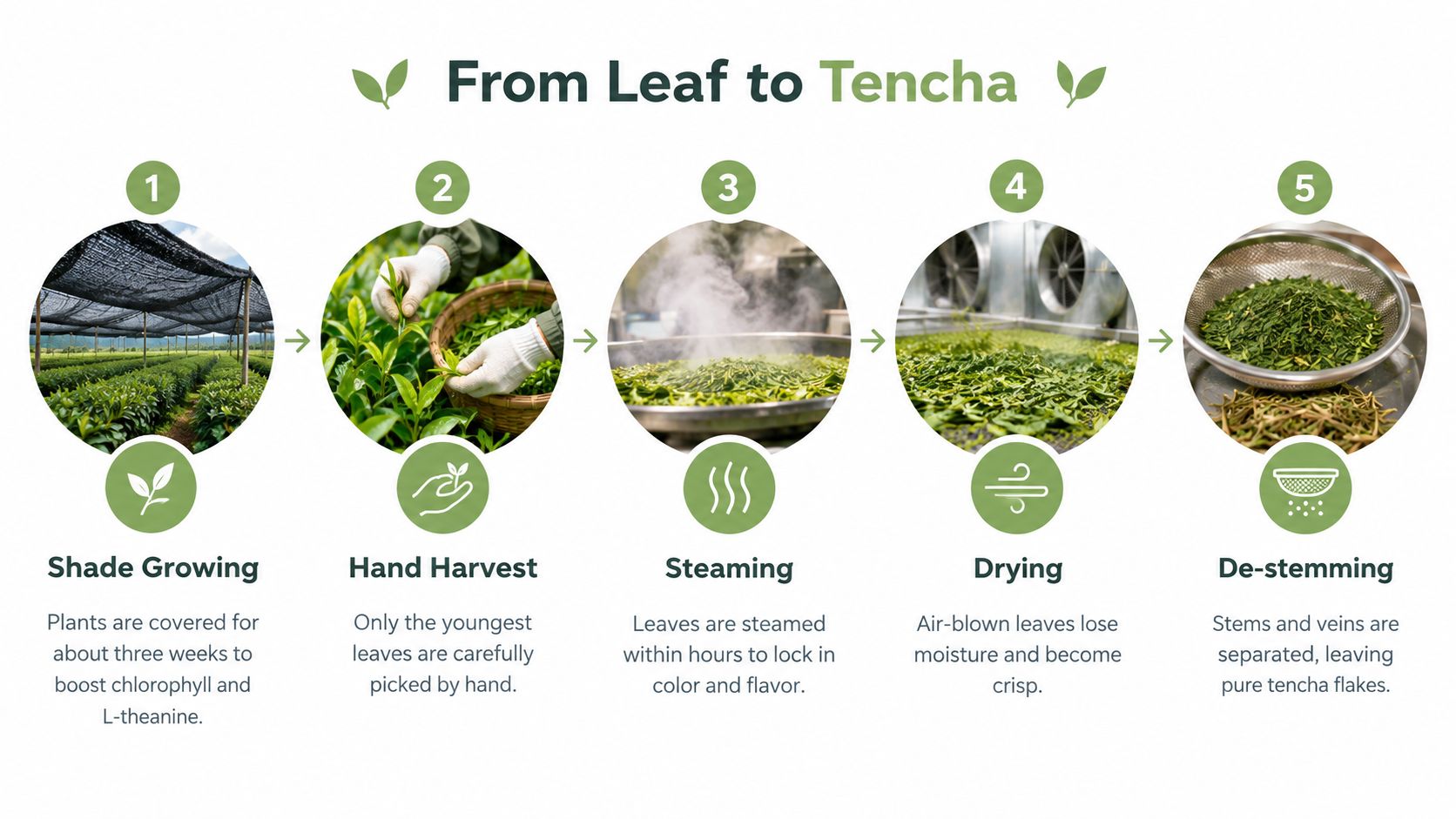
A ceremonial bowl begins in a tea field long before anyone reaches for a bamboo whisk. Farmers first prepare the plants for a controlled period of shade, then harvest the youngest leaves and process them quickly to protect their colour and flavour.
Shade changes the leaf
Producers commonly shade tea plants for about 20 to 40 days before harvest. This limited sunlight encourages the plant to retain more chlorophyll and preserve L-theanine, an amino acid associated with sweeter flavour and reduced bitterness. The result is the deep green colour and savoury-sweet umami that people expect from well-made matcha. See this explanation of matcha grades and shading for more detail.
The plants are then harvested for their youngest leaves, usually during the first spring picking. Timing matters because older leaves tend to produce a more assertive, astringent cup, while tender first-harvest leaves are better suited to drinking straight.
From fresh leaf to tencha
After harvest, the leaves are steamed to halt oxidation and help retain their green character. They're then dried, creating the material that will be refined into matcha. Unlike many other tea styles, the leaves aren't rolled into familiar needle shapes.
The stems and veins are removed next, since these tougher parts can add coarseness and unwanted bitterness. The remaining leaf material is called tencha, the raw material used for authentic matcha. This guide to how matcha tea is made provides a practical look at the stages involved.
Finally, producers stone-mill the tencha into a very fine powder. Slow milling helps create the silky mouthfeel associated with ceremonial matcha, although it also makes production careful and labour-intensive. The finished powder is more than dried green tea ground up at random. It's the product of shade management, selective harvesting and specialised processing.
That craftsmanship also explains why fresh ceremonial matcha can taste so different from ordinary green tea powder. The leaf has been cultivated for a particular flavour profile, prepared for suspension in water and milled finely enough to become part of the drink's texture.
The Biochemical Profile and Health Benefits
Matcha's distinctive appeal comes partly from the fact that you drink the powdered leaf. With ordinary green tea, you steep the leaves and remove them. With matcha, the prepared powder remains in the bowl, so the drink contains the compounds present in the leaf material.
One Australian analytical report for a ceremonial matcha product lists total catechins at 65,200 micrograms per gram, including 56,000 micrograms per gram of EGCG, with L-theanine at 21,300 micrograms per gram and caffeine at 33,300 micrograms per gram. These figures come from the product's published analysis, not from a universal value for every ceremonial matcha, so they're best understood as an example of the biochemical profile that can occur in a carefully produced product. The published ceremonial matcha analysis shows why laboratory information can be more useful than broad wellness language.
Antioxidants and EGCG
Catechins are naturally occurring compounds in tea. EGCG, or epigallocatechin gallate, is one of the best-known tea catechins and is often discussed for its antioxidant activity. Antioxidants help protect cells from oxidative stress, but matcha shouldn't be treated as a medicine or a substitute for a varied diet.
If you'd like a plain-language explanation of the compound itself, Pep Tea's guide to what EGCG is is a useful place to start. The practical takeaway is simple: a high-quality matcha can contribute tea polyphenols to your daily routine, but the product's actual composition depends on cultivar, harvest, cultivation, processing and storage.
L-theanine and caffeine
L-theanine gives matcha much of its character, both in flavour and in how the drink feels. Paired with caffeine, it may support a state of calm alertness, which many people experience as focused energy rather than the sharper lift associated with coffee.
That doesn't mean matcha can never feel stimulating or that everyone will respond in the same way. Caffeine sensitivity varies, and serving size, timing and whether you've eaten all matter. People who are pregnant, managing a medical condition or taking medication should seek individual advice from a qualified health professional.
Matcha is also sometimes described as immune-supporting because tea compounds and a balanced diet may contribute to general wellbeing. Keep the claim proportionate. Ceremonial matcha can be a nutrient-rich, enjoyable beverage, but it isn't an immunity cure.
Ceremonial Grade Versus Culinary Grade Matcha
Ceremonial and culinary matcha aren't rival products where one is automatically good and the other is automatically poor. They're made for different jobs.
Ceremonial matcha is selected for drinking with water. Culinary matcha is generally chosen for recipes where the powder needs to hold its flavour against milk, sugar, flour, fruit or other strong ingredients. It may come from later harvests or use leaf material with a more pronounced bitterness, which can be useful in baking and blended drinks.
| Feature | Ceremonial Grade | Culinary Grade |
|---|---|---|
| Primary use | Whisked with water and enjoyed straight | Lattes, smoothies, baking, sauces and desserts |
| Leaf selection | Young first-harvest leaves | Often later-harvest or more robust leaf material |
| Flavour | Smooth, umami-rich and naturally rounded | More assertive, grassy or astringent |
| Colour | Usually vivid green | Can be green but often less luminous |
| Texture | Very fine and silky | Fine powder, though texture can vary |
| Best buying question | Is it enjoyable without added flavour? | Will it remain noticeable in the finished recipe? |
Choose for the way you'll drink it
If your morning ritual is a small bowl of matcha and water, ceremonial grade makes sense because its delicate sweetness and umami are exposed. Poor-quality powder has nowhere to hide in that preparation.
For a matcha latte, the choice is more personal. A good culinary powder can be practical, especially if you're adding milk and a sweetener. A ceremonial powder can also make an excellent latte, particularly when you want a softer flavour and a cleaner finish. The important point is not to buy the most expensive product automatically. Buy the grade that suits your actual use.
Where the confusion begins
Some Australian listings describe ceremonial matcha as water-only, while others promote the same style for lattes. That isn't necessarily a contradiction. “Ceremonial” describes the intended quality and drinking style, not a rule that forbids every other recipe.
The distinction becomes clearer when you think about flavour. Use ceremonial matcha when the tea itself is the centre of attention. Use culinary matcha when it's one ingredient among several.
How to Identify Authentic Ceremonial Matcha in Australia
Australian shoppers have plenty of choice, but the variety can make comparison difficult. Similar products may use the same words, while prices for comparable-sounding listings can range from about A$35 to A$69.99, as shown in this Australian ceremonial matcha product listing. Price alone can't prove quality, but it should encourage you to inspect the details.
Use a practical checklist
Read the harvest description. Look for first harvest or ichibancha language, rather than relying only on “premium” or “ceremonial”.
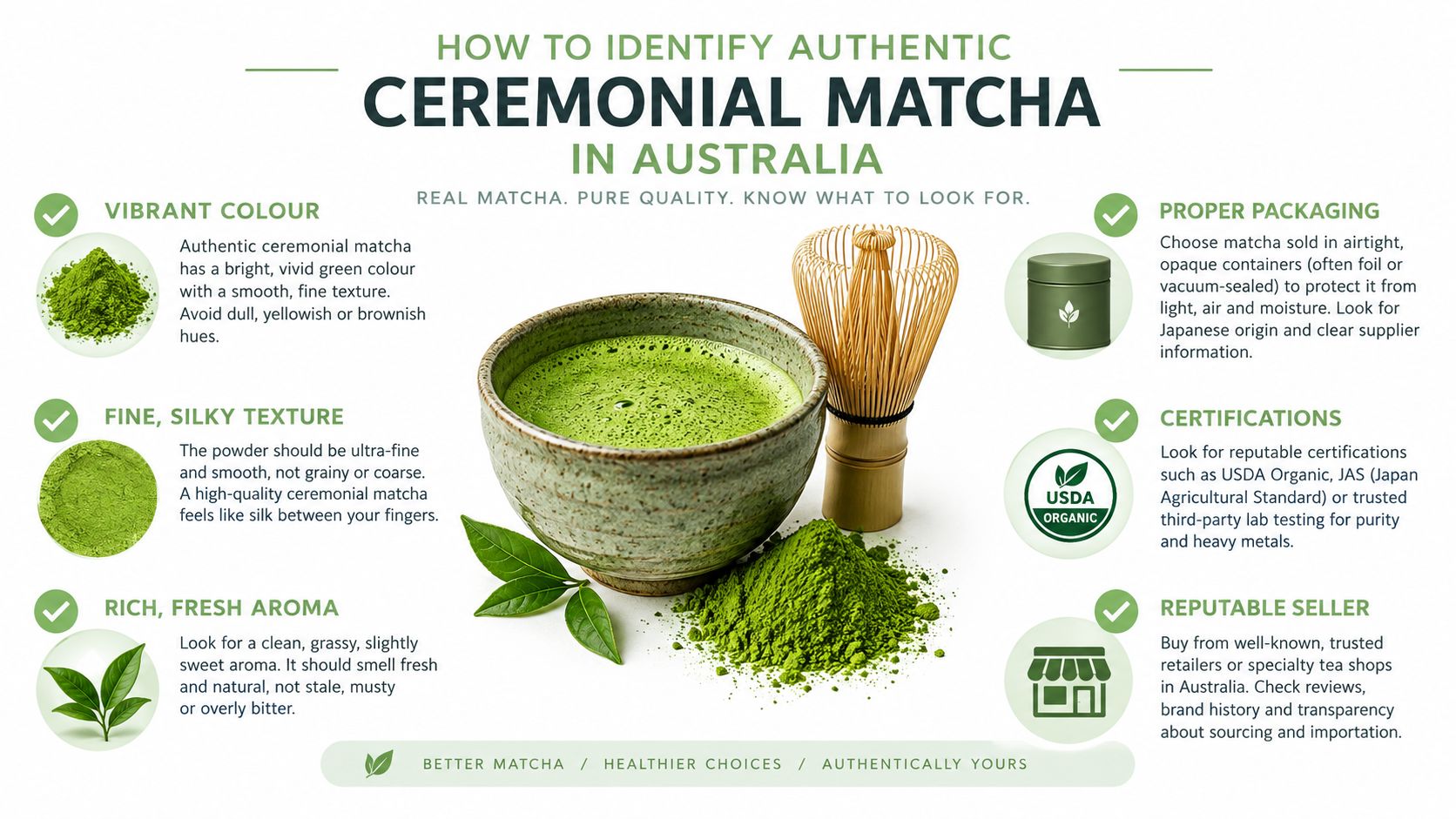
Check the colour. Fresh ceremonial matcha is generally a vibrant green. A dull, yellowish or brownish appearance can indicate older material, oxidation or poor storage, although colour should always be judged alongside taste and provenance.
Inspect the texture. The powder should feel exceptionally fine and silky. Grittiness suggests that the product hasn't been milled or refined to the standard expected of a whisked tea.
Look for tencha processing. A credible product description should explain that the leaves were de-stemmed and de-veined before stone milling. This overview of ceremonial matcha processing explains why those steps affect texture.
Ask where it was grown and packed. Japanese origin should be clear, not buried under vague language such as “Japanese-style”.
Treat pricing as context, not proof. First-harvest tea, careful shading and stone milling require more work, so an unusually low price deserves closer inspection. A high price doesn't guarantee authenticity either.
Ask for evidence, not adjectives
Look for batch information, organic certification where relevant, storage guidance and analytical information. A supplier that can explain the leaf, harvest and processing gives you something concrete to evaluate.
The most reliable buyer doesn't chase the brightest green pouch. They compare the agricultural and processing story with the sensory result in the cup.
Traditional Preparation and Tasting Notes
Premium matcha is forgiving once you understand the basics, but it isn't prepared like a teabag. The traditional setup uses a chawan, or bowl, and a chasen, the fine bamboo whisk. A small sieve is also helpful because it breaks up clumps before they become difficult to disperse.
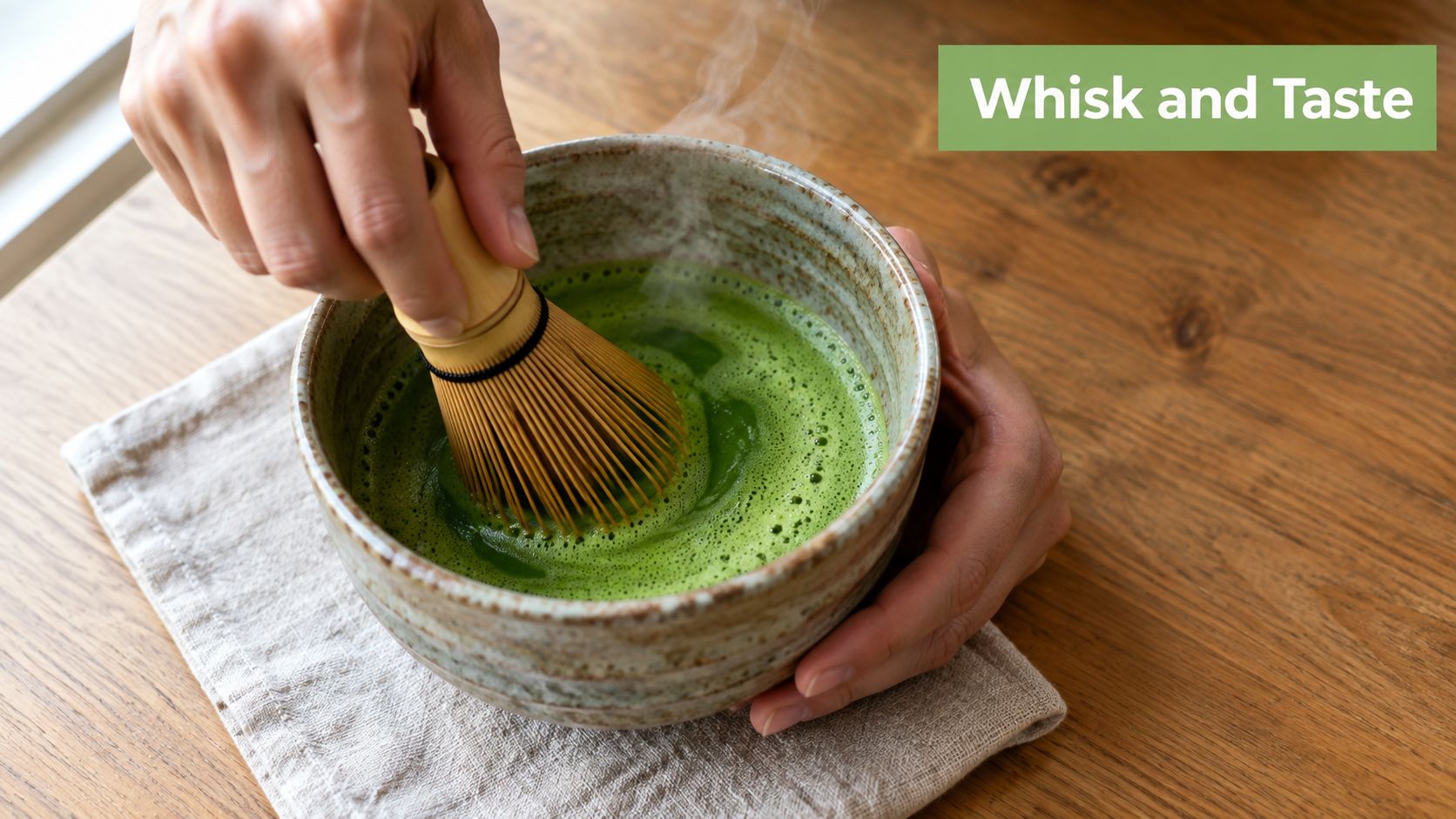
A simple bowl method
Warm the bowl, then discard the warming water.
Sift the matcha into the bowl. Sifting isn't ceremonial theatre. It helps the fine powder combine with water smoothly.
Add a small amount of hot water that has cooled below boiling. Water that's too hot can push delicate flavours towards harshness and flatten the tea's sweeter notes.
Whisk briskly using a light W or M motion, keeping the whisk near the surface rather than stirring slowly around the edges.
Add more water to reach your preferred strength, then drink soon after whisking so the powder stays evenly suspended.
The bowl should feel creamy rather than sandy. Expect fresh vegetal notes, gentle sweetness and a savoury umami finish. A little bitterness can be part of tea's character, but pronounced harshness often points to water that's too hot, too much powder, an older product or unsuitable raw material.
For a closer look at the ritual, explore Pep Tea's guide to the matcha tea ceremony.
Here's a visual demonstration of the whisking rhythm and bowl preparation:
If your first bowl tastes strong, adjust one variable at a time. Try cooler water before reducing the powder, then experiment with a little more water. Matcha rewards attention, but it doesn't require perfection.
Integrating Premium Matcha Into Your Daily Routine
Ceremonial matcha can fit neatly into an Australian morning without turning every cup into a formal tea ceremony. Prepare it traditionally when you have a quiet moment, or whisk it into a small latte when you're heading into work. The quality still matters because a smooth powder gives you more flexibility, especially when you sometimes drink it with water and sometimes with milk.
Many people prefer matcha earlier in the day, when its caffeine and L-theanine profile suits focused work, study or a calm start. If you're sensitive to caffeine, drink a smaller serving, have it with food and pay attention to how your body responds.
Keep the ritual realistic
A useful routine might look like this:
- Morning focus: whisk matcha with water before opening your phone or starting your commute.
- Café-style break: make a simple latte without heavy syrups so you can taste the tea.
- Recipe use: reserve culinary grade for smoothies, baking, ice cream and other recipes where stronger ingredients are involved.
- Thoughtful storage: protect the powder from heat, moisture, light and air, and follow the supplier's storage instructions.
Australia's interest in matcha has accelerated sharply. One market source reports that Australian matcha imports rose 62.91% from 2023 to 2024, while another report says Australia imported 195,319 kilograms of Japanese green tea between January and August 2025, a 131% year-on-year increase, ranking Australia as the eighth-largest export destination for Japanese green tea. These figures are reported in the Australia matcha tea market data, and they help explain why shoppers need clearer quality guidance as more products appear.
The best choice is the matcha you'll prepare and enjoy regularly. For some people, that means a delicate bowl of ceremonial powder. For others, it means keeping ceremonial grade for water preparation and using culinary grade for creative recipes.
Pep Tea offers organic Japanese matcha, including ceremonial-grade powder, alongside Australian-brewed sugar-free organic kombucha from the Hunter Valley, NSW. Visit Pep Tea to explore the matcha range, learn more about preparation and find functional drinks suited to everyday routines.
Matcha Latte Calories and How to Reduce Them

A matcha latte isn't automatically a light drink. In Australia, the phrase can describe anything from a low-energy sachet prepared at home to a flavoured café drink with several hundred calories. The matcha powder matters, but milk, portion size, syrups and toppings usually shape the final energy load far more.
That's why a single online answer to “how many calories are in a matcha latte?” can be misleading. A standard iced drink, a pistachio version, a bubble tea serve and a supermarket sachet aren't nutritionally interchangeable. Learning to read the recipe behind the label is the practical way to manage matcha latte calories without giving up the creamy, earthy drink you enjoy.
The Truth About Matcha Latte Calories
Many Australians order matcha expecting a universally wholesome alternative to coffee or hot chocolate. Pure matcha has a reputation for being clean and functional, but a café latte is a prepared recipe, not just green tea in a cup. Once milk, sugar, flavour syrup, cream or toppings enter the picture, the energy content can change sharply.
Australian menus make that variation clear. McCafé lists a Matcha Latte at about 184 kcal, while Jamaica Blue lists its Medium Matcha Latte at 177 kcal. Starbucks Australia lists an Iced Matcha Green Tea Latte at 240 kcal for a Grande, whereas its flavoured iced products range from 318 kcal to 339 kcal, depending on the recipe and size. These examples are shown in this Australian matcha latte guide, and they make one point hard to miss: “matcha latte” isn't a reliable calorie description on its own.
The label hides the recipe
A café menu may tell you the drink name and size without clearly showing the milk, sweetener concentration or topping formula. Two drinks with the same name can therefore have very different kilojoule and calorie counts.
Starbucks Australia's Pistachio Flavoured Matcha Latte rises from 318 kcal in a Small to 626 kcal in a Venti, while the listed serving sizes also increase from 273 mL to 591 mL. That's a difference of more than 300 kcal, driven by the combined effect of a larger serve and flavouring. The Starbucks Australia product listing provides the serving details.
Practical rule: Treat the flavour name and cup size as nutrition information, not decoration.
A matcha latte can still fit comfortably into a balanced routine. The useful question isn't whether matcha is “good” or “bad”. Ask instead: what's in this particular drink, and how often am I choosing it?
Breaking Down the Ingredients and Energy Load
A matcha latte has three main energy contributors: the powder, the liquid base and anything added for sweetness or flavour. Pure matcha is usually the smallest contributor. The larger differences come from the volume and type of milk, plus sugar-containing powders, syrups and toppings.
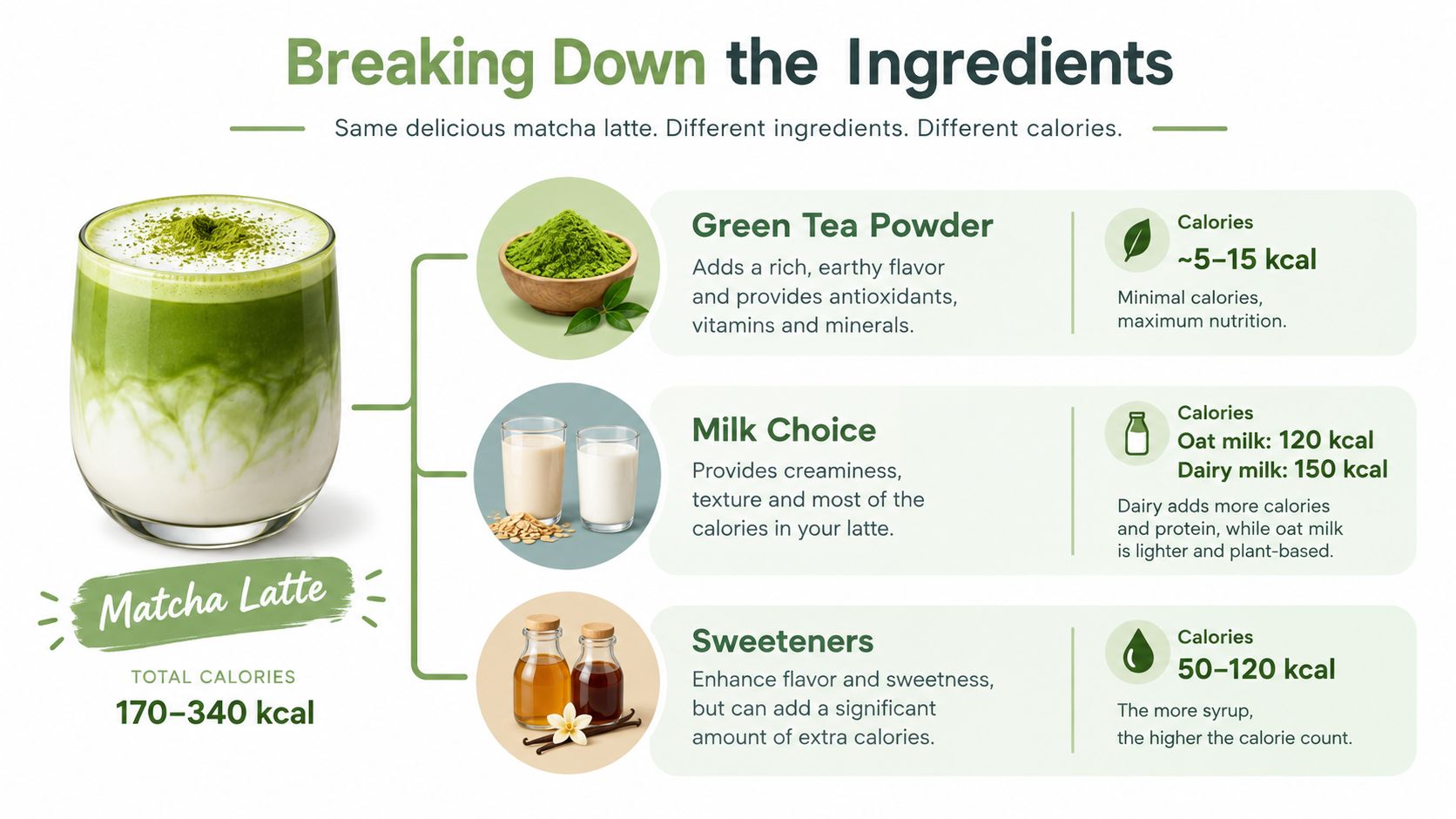
Matcha powder is rarely the main issue
Matcha is finely ground green tea leaf, so it contributes flavour, colour and naturally occurring compounds such as catechins and L-theanine. In a latte, however, the powder itself generally accounts for far less energy than a generous serving of milk or sweetened flavour base. Increasing the powder dose may make the drink stronger and more bitter, but it isn't usually the most effective way to reduce matcha latte calories.
The liquid base has a much bigger practical effect. A neutral Australian calories guide gives an at-home range of about 52 kcal with almond milk to 154 kcal with whole dairy, showing how milk choice can outweigh the matcha itself. Those figures are discussed in the Australian matcha latte nutrition overview.
Milk and sweeteners set the total
Milk contributes energy through its natural or added carbohydrate, fat and protein. Plant-based options also vary, particularly when they're sweetened or formulated for café steaming. The word “oat” or “almond” doesn't automatically mean low-energy, so check the product or café nutrition information where it's available.
Sweeteners create another layer of variation:
- Plain powder: Gives you control over the final drink, especially when mixed with unsweetened milk.
- Pre-mixed powder: May include sugar and milk solids before you add any extra sweetener.
- Flavoured syrup: Can turn a simple tea latte into a dessert-style drink.
- Toppings: Creamy foams, sauces and confectionery-style additions add energy without making the cup feel much larger.
Woolworths lists Twinings Matcha Latte Sachets at 251 kJ per serving, about 60 kcal, with 12.2 g of carbohydrate and 10.4 g of sugars, while Morning Made Matcha Latte Original is listed at 80 kJ per serving, about 19 kcal, with 0.2 g of sugars. The contrast appears in the Morning Made product information. It's a formulation comparison, not a judgement about every sachet.
For a home recipe, you can enter the exact milk and sweetener quantities into a recipe calorie calculator. That's more useful than relying on a generic matcha latte estimate when your ingredients differ from a café recipe.
One more detail deserves attention: caffeine isn't the same thing as calories. Matcha can contribute caffeine even when the drink is prepared with little energy. For a clearer explanation of what affects caffeine in the cup, see how caffeine works in a matcha latte.
Comparing Popular Australian Cafes and Retail Brands
Real menus show why matcha latte calories need an Australian context. The figures below come from café and retail listings, but they shouldn't be treated as a universal ranking. Recipes, sizes and preparation methods differ, and a product can change over time.
| Brand / Product | Size / Serve | Calories (kcal) |
|---|---|---|
| McCafé Matcha Latte | One serving | 184 |
| Jamaica Blue Matcha Latte | Medium | 177 |
| Chatime Matcha Latte | Regular | 192 |
| Chatime Matcha Latte | Large | 246 |
| Starbucks Iced Matcha Green Tea Latte | Tall, 354 mL | 184 |
| Starbucks Iced Matcha Green Tea Latte | Grande, 473 mL | 240 |
| Starbucks Pistachio Flavoured Matcha Latte | Small, 273 mL | 318 |
| Starbucks Pistachio Flavoured Matcha Latte | Tall | 390 |
| Starbucks Pistachio Flavoured Matcha Latte | Grande | 519 |
| Starbucks Pistachio Flavoured Matcha Latte | Venti, 591 mL | 626 |
| Twinings Matcha Latte Sachets | One serving | About 60 |
| Morning Made Matcha Latte Original | One listed serving | About 19 |
The Jamaica Blue figures come from its Australian iced matcha menu information. Chatime's Regular and Large values, including the 54 kcal difference between sizes, are listed by Macro Menu Australia. Starbucks' standard iced figures and flavoured examples come from the linked Australian product listings cited above.
What the comparison tells you
The café examples cluster differently from the low-energy retail products because they're prepared as milk-based drinks, often with a larger liquid volume. The flavoured Starbucks range shows how quickly a sweetened recipe can move into dessert territory. A standard iced matcha and a pistachio matcha may share a green colour, but they don't share the same nutritional profile.
Retail sachets require label reading too. Twinings' sachet contains substantially more energy and sugar than Morning Made's listed serving, despite both being sold as matcha latte products. A pre-mixed base can be convenient, but convenience doesn't tell you how much sugar or milk powder is included.
The useful comparison isn't brand versus brand. It's unsweetened versus sweetened, smaller versus larger, and plain versus flavoured.
When ordering, ask whether the powder is sweetened, which milk is used and whether the syrup is optional. That short conversation can reveal more than the drink name.
How to Order and Brew Lighter Matcha Lattes
You don't need to drink matcha plain to lower the energy content. The strongest approach is to control the ingredients that contribute most, while keeping enough milk to create the texture you like.
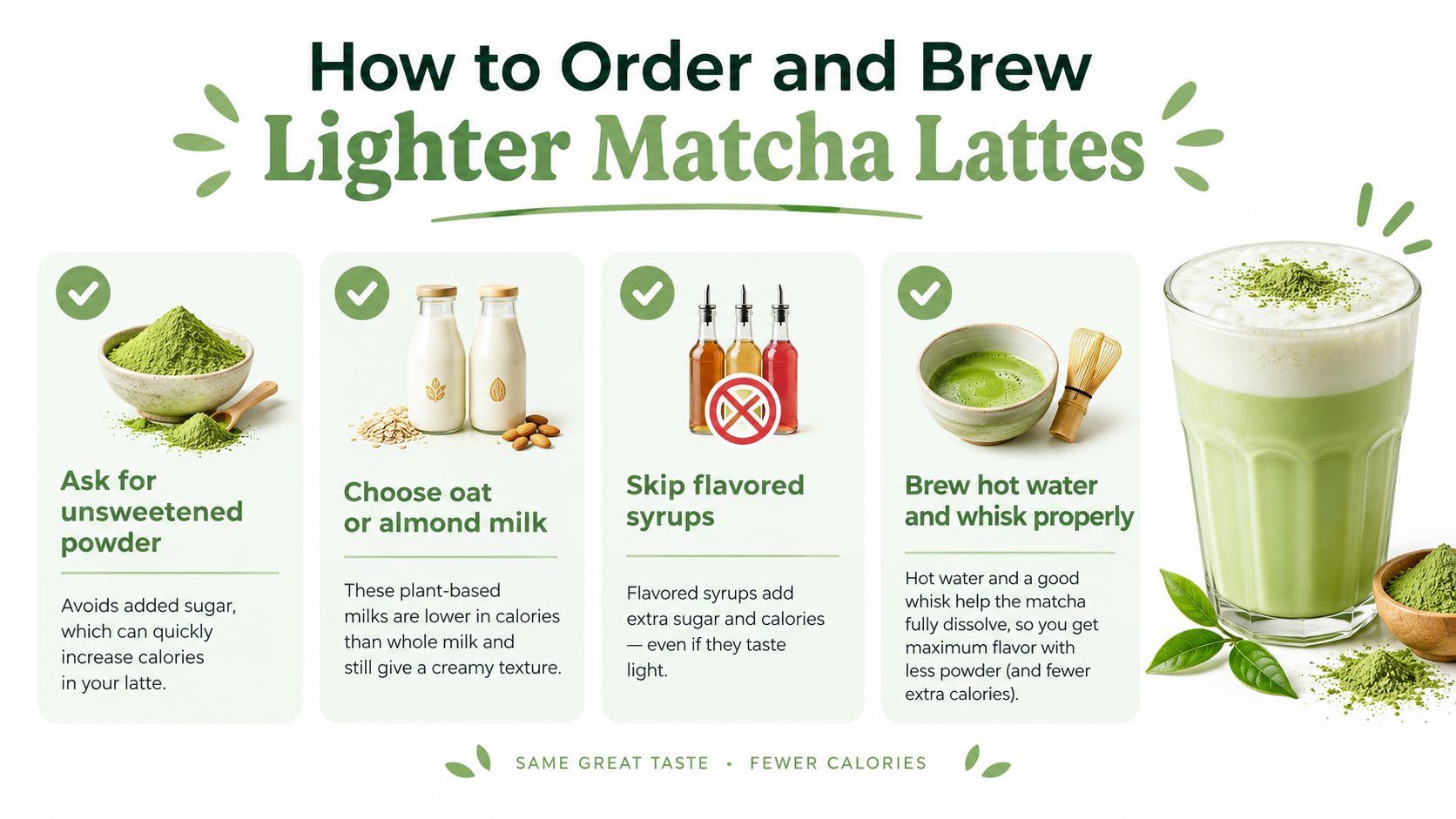
Ordering at a café
Use a specific order rather than asking vaguely for a “healthy” matcha. Café staff may interpret that request in different ways.
- Ask for unsweetened powder. Some café bases are already sweetened, so removing an added syrup won't necessarily remove all the sugar.
- Choose your milk deliberately. Unsweetened almond milk can be a lower-energy option, while oat and dairy recipes vary by brand and pour size. If the café publishes nutrition information, use that rather than guessing.
- Skip flavoured syrups and dessert toppings. Pistachio, white chocolate, cream foam and sauce are the additions most likely to change a simple latte into a richer treat.
- Choose a smaller size if you want the same style of drink less often. The Chatime comparison demonstrates that serving volume alone can create a measurable difference.
- Ask for the recipe if you're tracking closely. “Is the matcha sweetened, and what milk do you use?” is more useful than relying on the menu title.
Making one at home
Home preparation gives you control without removing the ritual. Whisk the powder with a small amount of hot water first, then add chilled or warmed unsweetened milk. Proper whisking disperses the tea and helps the drink taste smoother, which can reduce the temptation to cover bitterness with sugar.
A simple method looks like this:
- Sift the matcha if it's lumpy. This creates a more even texture.
- Add hot, not boiling, water. Very high heat can make the flavour seem harsher.
- Whisk briskly until smooth. A bamboo whisk or handheld frother works well.
- Pour in unsweetened milk. Adjust the amount for a stronger tea flavour or creamier finish.
- Taste before sweetening. If you need sweetness, add a small amount deliberately rather than using a pre-sweetened base by default.
Start with the powder and milk you actually want, then add sweetness only if the finished drink needs it.
This method also makes it easier to compare your home recipe with a café drink. You'll know whether the difference comes from milk, sweetener or serving size instead of blaming the matcha.
Clean Energy and Sustained Focus Without the Crash
A lower-calorie drink can be useful, but the quality of the whole beverage matters too. Pure, unsweetened matcha supplies the tea leaf itself, while a heavily flavoured latte can deliver much more sugar and energy without necessarily providing a better tea experience.

Matcha contains naturally occurring catechins, including antioxidant compounds, and L-theanine. L-theanine is an amino acid found in tea that many people associate with a calmer, more settled experience alongside caffeine. That doesn't make matcha a medical treatment or guarantee a particular feeling, but it helps explain why some drinkers prefer it for focused work.
The caffeine amount depends on the quantity of powder used and the recipe. It also deserves attention if you're sensitive to caffeine or already drink coffee during the day. A lower-calorie latte isn't automatically suitable at every time of day, especially if it affects your sleep or makes you feel uncomfortable.
Sweetness changes the experience
A strongly sweetened drink can taste immediately rewarding, but it can also make the earthy character of quality matcha difficult to notice. When you reduce syrup gradually, your palate has more opportunity to recognise vegetal, creamy and lightly umami notes.
That matters for cafés and home drinkers alike. A café menu can offer a satisfying non-alcoholic option without relying on heavy flavouring, while a home routine can use organic Japanese matcha, unsweetened milk and careful whisking. The result is a drink built around tea rather than a sweet dessert base.
Choose the version that supports your day, not just the version with the most appealing name. Clean energy starts with a clear ingredient list and a serving you can enjoy consistently.
Building a Mindful Matcha Routine at Home
A home matcha habit makes the recipe visible. You choose the powder, measure the milk, decide whether sweetness is needed and can prepare a smaller or larger drink according to the occasion. That control is often more valuable than searching for one universal matcha latte calorie number.
For a weekday cup, use authentic stone-ground Japanese matcha with a naturally vibrant colour and balanced flavour. A ceremonial-grade matcha is suited to whisking with water or milk, while a culinary-grade matcha is practical for smoothies, baking and other recipes where stronger flavours are already present. Neither grade removes the need to check the rest of the recipe.
Keep the routine simple:
- Whisk matcha with hot water.
- Add unsweetened milk.
- Taste before adding sweetener.
- Reserve flavoured versions for an occasional treat.
- Notice how the drink fits into your overall day.
Australia's café and retail market shows that milk, added sugar and portion size drive matcha latte calories far more than the green tea label suggests. Once you understand that, you can enjoy matcha with less guesswork and make choices that suit your preferences.
Pep Tea offers premium organic Japanese matcha for mindful home preparation, along with Australian-brewed sugar-free organic kombucha from the Hunter Valley, NSW. Explore the range at Pep Tea and choose a clean, low-sugar option for your next daily drink.
Sencha Tea Benefits: A Practical Guide for Australians
You're halfway through the afternoon, your inbox is still full, and another coffee sounds less appealing than it did an hour ago. You want something refreshing, low in sugar and capable of helping you stay attentive without turning your evening into a battle with caffeine. That's where sencha tea benefits become relevant for Australian routines.
Sencha is more than a green-coloured drink. It's a steamed Japanese whole-leaf tea containing catechins, caffeine and L-theanine, served as part of a beverage habit that can also contribute to fluid intake. The evidence is encouraging in some areas, but it's more modest and nuanced than many wellness claims suggest.
Understanding Sencha and Its Place in Australian Wellness
Sencha is made from green tea leaves that are steamed, rolled and dried soon after harvesting. Steaming limits oxidation, helping preserve the tea's bright colour and fresh, grassy flavour. In the cup, you may notice vegetal, marine or lightly savoury notes, depending on the tea's origin and preparation.
That makes sencha a different experience from a standard black tea or a strong coffee. A person working from a café in Sydney might choose it during an afternoon focus block, while someone in Newcastle may brew it at home as a lower-sugar alternative to a soft drink. The appeal isn't only its taste. Sencha fits a wider Australian interest in organic food, functional beverages and more intentional daily habits.
Roy Morgan consumer research found that Australians who buy green tea are 49% more likely than the average Australian to agree that they try to buy organic food whenever they can. The same group is 51% more likely to avoid dairy and 57% more likely to eat an almost fully vegetarian diet. These findings don't prove that sencha causes cleaner eating habits, but they show why green tea connects naturally with an established wellness-oriented consumer segment. (Roy Morgan's Australian tea research)
Sencha is a beverage, not a supplement
The useful distinction is simple. Sencha may provide hydration, polyphenols and gentle stimulation, but it isn't a treatment for a medical condition and it won't compensate for poor sleep, an unbalanced diet or excessive caffeine intake.
The Australian Bureau of Statistics reports that water-based beverages, including tea and black coffee, account for 11.2% of intake, while average non-alcoholic beverage intake was 1,926 g per day in 2023. (ABS food and nutrition data) Those figures help frame the practical question Australians should ask: not whether sencha is healthy, but how it fits into the drinks they already consume.
Practical rule: Treat sencha as a daily drink with useful properties, not as a miracle product with guaranteed outcomes.
The Active Compounds Driving Sencha Tea Benefits
Sencha's functional profile comes from several naturally occurring compounds in the leaf. The most important are catechins, L-theanine and caffeine. Their effects depend on the tea itself, how it's brewed and how much you drink.
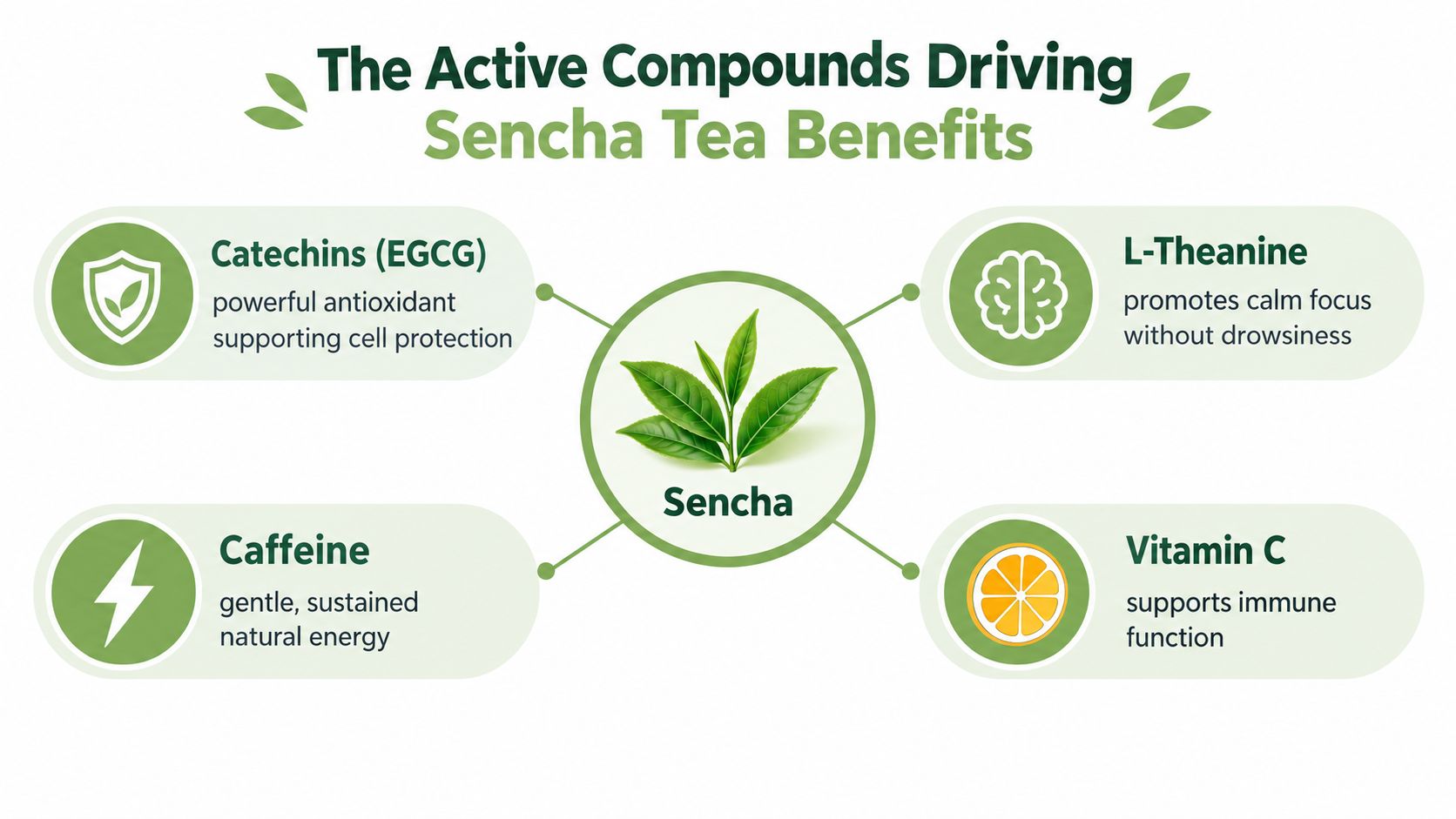
Catechins and oxidative stress
Catechins are green-tea polyphenols. A review reported 12.9 to 23.6 mg of catechins per gram of dry matter for Sen-cha tea bags. (Review of tea polyphenols and catechins) The exact amount in your cup will vary with the leaves, portion, water temperature and steeping time, so the dry-leaf figure shouldn't be treated as a guaranteed serving amount.
These compounds act as antioxidants in laboratory and biological contexts. Researchers have linked green-tea catechins with antioxidant, anti-inflammatory, antimicrobial, antidiabetic and cardiovascular effects through their bioactive polyphenol activity. That wording matters. It describes potential biological activity, not a promise that a cup of sencha will prevent disease.
Readers who want a clearer explanation of one prominent catechin can explore what EGCG is and why it matters. EGCG is often discussed in green-tea education, but it's only one part of sencha's broader chemical profile.
L-theanine and caffeine
L-theanine is an amino acid naturally found in tea. Caffeine is a stimulant. Together, they help explain why some people experience green tea as more balanced than coffee, although individual responses vary and sencha isn't guaranteed to feel calm for everyone.
A useful analogy is a dimmer switch rather than an on/off button. Caffeine can increase alertness, while L-theanine is associated with a more relaxed mental state. The result may feel like calm focus, but research on L-theanine has limitations. A systematic review identified human randomised trials and reported that 200 to 400 mg per day may help reduce stress and anxiety in people exposed to stressful conditions, while also emphasising the need for larger and longer studies. (Systematic review of L-theanine research)
The University of Canberra also ran a clinical trial involving a green-tea-derived L-theanine beverage. It enrolled 60 healthy adults aged 18 to 65 with mild to moderate sleep disturbances and used a randomised, double-blind, placebo-controlled, parallel-group, four-arm, dose-response design. The protocol involved nightly use over a 3-week period, tracking sleep and stress-related measures. (University of Canberra clinical trial record)
Sencha contains L-theanine, but a brewed cup shouldn't automatically be equated with the doses used in isolated L-theanine trials. That's the difference between discussing a mechanism responsibly and making a broad wellness promise.
Comparing Sencha With Matcha and Other Green Teas
Sencha and matcha both come from green tea, but they're prepared and consumed differently. Sencha leaves are steeped in water and then removed. Matcha leaves are ground into powder, so you consume the leaf itself. That difference changes the drinking experience and can affect how much of the leaf's compounds enter your serving.
Matcha is commonly shade-grown before harvest, while sencha is generally cultivated as a leaf tea exposed to sunlight. Gyokuro is also shade-grown and has a rich, umami-focused profile. Hojicha is roasted, giving it a toasty flavour and a different sensory character from fresh, steamed sencha.
| Tea Type | Cultivation and Processing | Caffeine and L-Theanine Profile | Best Use Case |
|---|---|---|---|
| Sencha | Steamed, rolled and dried whole leaves, usually steeped and removed | Provides caffeine, L-theanine and catechins through an infusion | Everyday hydration, a fresh afternoon brew or multiple tea moments |
| Matcha | Shade-grown leaves are processed and stone-ground into powder | The whole powdered leaf is consumed, so the overall exposure can be more concentrated than a steeped tea | Focused morning use, lattes, smoothies and culinary recipes |
| Standard green tea | Processing varies, with leaves generally steeped rather than eaten | Provides green-tea compounds through the brewed liquid | Familiar daily drinking and straightforward preparation |
Choose by routine, not by marketing
Sencha suits people who want a lighter, leaf-based infusion. Matcha may suit someone who wants a more concentrated ritual or enjoys blending tea into food. Hojicha can appeal to drinkers who prefer roasted notes, though the relevant caffeine experience still depends on the product and preparation.
If you're comparing tea and coffee for alertness, timing and tolerance, this guide to comparing caffeine and focus offers useful context. It's still important to remember that caffeine responses are personal. A person who feels comfortable with sencha in the afternoon may find the same timing disruptive, particularly if they're sensitive to stimulants.
For a deeper breakdown of the categories, see the difference between matcha, green tea and sencha-style teas. The right choice depends on whether your priority is sipping, concentrated preparation, cooking, flavour or caffeine control.
Translating Sencha Benefits Into Real-World Health Outcomes
The strongest human evidence relevant to sencha comes from research on green tea as a broader category. That means the findings are useful, but they shouldn't be presented as if every sencha cup produces a fixed medical effect.
A meta-analysis of 13 studies found small but statistically significant reductions in systolic blood pressure of 2.08 mm Hg, diastolic blood pressure of 1.71 mm Hg, total cholesterol of 0.15 mmol/L and LDL cholesterol of 0.16 mmol/L compared with control. (Green tea meta-analysis) The blood-pressure effect appeared strongest in participants whose baseline systolic pressure was at least 130 mm Hg.
Those results suggest a modest cardiometabolic contribution, not a replacement for medical care. If you have high blood pressure or cholesterol, keep following advice from your GP and don't use sencha as a substitute for prescribed treatment.
Hydration is part of the picture
Better Health Channel states that tea can help meet daily fluid recommendations and provides antioxidants and polyphenols. (Better Health Channel guidance on water and tea) This everyday framing is more useful than treating sencha like a capsule. A warm, unsweetened cup can replace a sugary drink while contributing to your overall fluid intake.
The practical outcome depends on your wider pattern:
- Use it consistently: A regular unsweetened beverage habit is more realistic than an occasional “detox” approach.
- Watch additions: Sugar, syrups and creamy mixers change the nutritional profile of the drink.
- Keep expectations measured: Sencha may support a healthy routine, but it can't independently create cardiovascular health.
- Consider your baseline: The clinical blood-pressure result was stronger in people who began with higher systolic readings.
Stress and focus require similar caution. L-theanine research gives a plausible explanation for the calm-focus reputation, but brewed sencha isn't identical to a controlled trial beverage. The most defensible takeaway is that sencha may be a useful, enjoyable daily adjunct within a balanced lifestyle.
Brewing Sencha for Maximum Flavour and Function
Boiling water is the fastest way to make sencha taste harsh. Hotter water and longer steeping can draw out more bitterness and astringency, while cooler water tends to preserve a softer, sweeter profile.
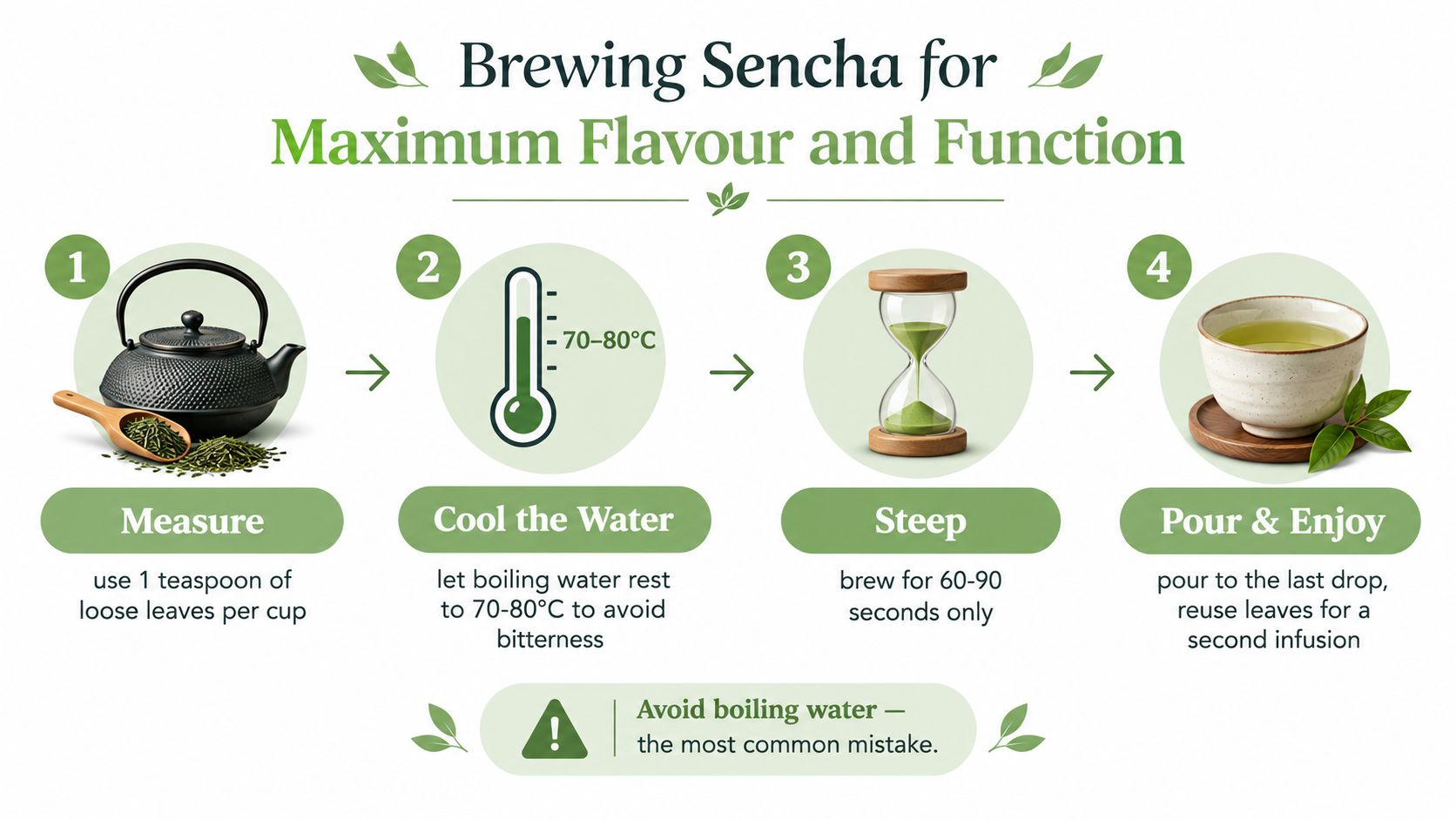
A reliable starting method
- Measure the leaves. Use about one teaspoon of loose sencha per cup. Whole leaves usually give you more control than very fine tea dust because you can adjust the infusion without immediately overwhelming the water.
- Cool the water. Let freshly boiled water rest until it reaches roughly 70°C to 80°C. A temperature-controlled kettle, such as the Pep Tea glass kettle with temperature control, makes this easier.
- Steep briefly. Start with 60 to 90 seconds. If the result is too light, extend the next brew slightly. If it's bitter, reduce the temperature or steep for less time.
- Pour completely. Empty the pot into your cup so the leaves don't continue extracting. You can reuse them for a second infusion, adjusting the time to suit the flavour.
The exact method isn't a rigid prescription. Leaf size, water quality and personal taste all matter. Filtered water can help if your tap water has a strong mineral or chlorine character, and a small teapot or infuser gives leaves room to open.
Here's a visual demonstration of the preparation process:
Brewing adjustment: If your cup tastes sharp, change one variable at a time. Lower the water temperature first, then shorten the steep if needed.
Integrating Sencha Into a Modern Daily Routine
Sencha works best when it replaces a less useful habit rather than becoming another task on an already crowded schedule. You might brew it after breakfast, use it before a mid-morning meeting or make a cold infusion for a warm day.

Match the timing to your sensitivity
Sencha still contains caffeine, so timing matters more than the label “natural”. If caffeine affects your sleep, keep sencha earlier in the day. If you're anxiety-sensitive, begin with a weaker infusion and avoid stacking it immediately with coffee or energy drinks.
Pregnancy is another situation where personalised advice matters. Caffeine limits and individual health circumstances vary, so pregnant people should discuss their total intake with their midwife or doctor rather than relying on generic tea advice.
A simple routine might look like this:
- Morning: Brew sencha alongside breakfast when you want a lighter alternative to coffee.
- Afternoon: Use a shorter infusion before a focused work session.
- Warm weather: Cold-brew leaves in the refrigerator for a smoother, less astringent drink.
- Training days: Consider the timing of tea alongside other caffeine sources instead of treating it as a separate total.
Some drinkers also enjoy rotating beverages. For example, an occasional golden latte can offer a different flavour profile and ritual. Cartograph Coffee's guide to a turmeric golden latte is a useful reference for that style of drink, though it isn't a substitute for understanding your overall caffeine or sugar intake.
Avoid turning sencha into a sweetened café-style dessert by default. Unsweetened brewing keeps the tea's grassy character clear and makes it easier to assess whether the drink genuinely fits your routine.
Common Questions About Drinking Sencha Every Day
Can sencha stain your teeth?
Tea contains compounds that may contribute to surface staining over time, particularly with frequent drinking. Rinsing with water after tea and maintaining regular brushing can help, but ask your dentist for personal advice if staining concerns you.
Does sencha affect iron absorption?
Tea may interfere with the absorption of non-haem iron when consumed with meals. People with diagnosed iron deficiency, or those at higher risk, should ask their GP or dietitian about timing rather than assuming tea is always harmless around food.
Is organic sencha worth choosing?
Organic certification can provide clearer production standards and help shoppers who want to reduce exposure to certain agricultural chemicals. It doesn't guarantee a particular catechin level or prove that the tea will deliver a specific health outcome, so also consider freshness, transparent sourcing and clean flavour.
Is sencha better than matcha?
Neither is universally better. Sencha is a steeped whole-leaf tea with a lighter drinking style, while matcha is powdered and consumed as part of the beverage. Choose sencha for an easy everyday infusion and matcha when you prefer a concentrated preparation or want to use green tea in a latte, smoothie or recipe.
What are the main sencha tea benefits?
The most defensible benefits are fluid intake, polyphenol consumption and gentle caffeine-based alertness, with green-tea research suggesting modest cardiometabolic effects. The experience will depend on preparation, sensitivity and the rest of your diet and lifestyle.
Pep Tea offers organic tea products centred on Japanese matcha and Australian-made sugar-free kombucha, alongside practical education for brewing and everyday wellness. Visit Pep Tea to explore options that can complement your sencha routine and choose a clean, low-sugar beverage for home or café use.
Live Cultures Kombucha: What They Are and Why They Matter

Live cultures in kombucha are the living bacteria and yeast from the SCOBY that survive into the bottle and may support gut health. In Australia, however, almost 65% of 132 tested kombucha samples contained more than 0.5% alcohol, so “live” on a label is a specific claim that deserves more attention than a wellness slogan.
The popular advice is simple: choose kombucha for your gut. The useful advice is more precise: learn what the bottle means by live cultures, whether fermentation has been stopped, how the drink has been stored, and whether the producer controls acidity, sugar and alcohol. A chilled bottle can contain a living fermentation ecosystem, but two products with similar front labels may deliver very different things.
For Australian shoppers, cafés and retailers, this matters beyond taste. Live-culture kombucha is a relatively young local category. Commercial production began in Australia in 2009, and the market has since moved from home-brew culture into mainstream retail and hospitality, as reported by the Sydney Morning Herald's account of kombucha's Australian development. That growth brings better access, but it also makes label literacy essential.
Why Live Cultures Are the Most Misunderstood Phrase in Kombucha
“Live cultures” is probably the most misunderstood phrase on a kombucha label. Some people read it as a guarantee of a defined probiotic dose. Others assume any fermented tea must contain living microbes. Neither assumption is reliable.
In plain English, live cultures are bacteria and yeast that remain viable when you drink the kombucha. They come from the SCOBY, the mixed culture used to ferment sweet tea. If the finished drink is pasteurised after fermentation, heat can remove that living microbial activity. If it's heavily filtered, the microbial content may also change. A refrigerated bottle labelled raw or unpasteurised points towards a different product from a shelf-stable bottle that has been heat-treated.
Why fermentation language gets blurred
Brewing reality is more complicated than front-of-pack marketing. Fermentation produces acids, carbon dioxide, flavour compounds and trace alcohol, while the exact balance changes with the tea, sugar, temperature, time and culture. A producer might describe a drink as naturally fermented, yet the finished product may later be filtered, heated or stabilised.
That's why two bottles with similar wording can carry different microbial payloads. One may contain a mixed community of bacteria and yeast. Another may retain the acids and flavour of fermentation but no longer contain viable cultures. The label needs to tell you which story applies.
Practical rule: “Fermented” describes how the drink was made. “Contains live cultures” describes what remains when you drink it.
A useful label-reading habit is to ask four questions:
- Was it heat-treated? Look for wording such as pasteurised after fermentation or heat-treated.
- Does it require refrigeration? Cold storage supports culture survival and slows continued fermentation, although refrigeration alone isn't proof of live cultures.
- Does the producer explain the culture claim? Clear language is more useful than broad terms such as wellness or detox.
- What does the nutrition panel show? Sugar and alcohol help you understand how far fermentation progressed.
The rest of the label story starts with the SCOBY itself. Once you understand that small ecosystem, “raw”, “unpasteurised”, “probiotic” and “live” become practical clues rather than interchangeable buzzwords.
What Live Cultures and SCOBYs Actually Are
A SCOBY is a symbiotic culture of bacteria and yeast. It isn't one organism and it isn't a magic mushroom. It's a working community that lives in sweetened tea and transforms the liquid over time.
Yeast starts by using available sugars and producing alcohol and carbon dioxide. Acetic-acid bacteria then use oxygen and fermentation products to create organic acids, which give kombucha its sharp, refreshing character. Commonly discussed members of the ecosystem include Acetobacter, Gluconobacter, Brettanomyces and Saccharomyces, although the exact community varies between cultures and batches.
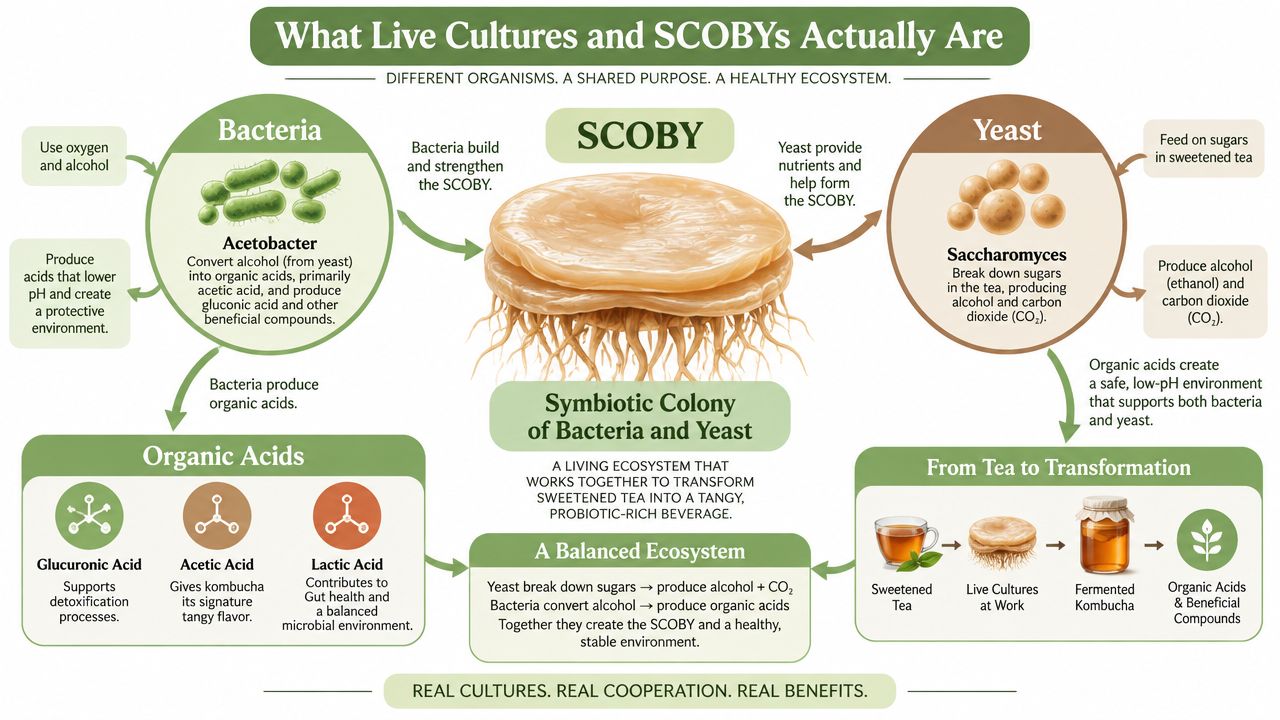
The pellicle isn't the whole culture
The rubbery cellulose layer floating at the top of a brew is often called the SCOBY. More accurately, it's a pellicle, a cellulose structure produced by some of the bacteria. It houses part of the community, but the liquid starter contains important bacteria, yeast, acids and metabolites too.
That distinction matters for home brewers. Throwing away the liquid and keeping only the pellicle removes much of the active fermentation environment. A healthy brew relies on both the culture and sufficiently acidic starter tea.
The finished drink contains more than microbes. It can include acetic acid, gluconic acid, residual sugar and trace ethanol, with tea compounds adding flavour and polyphenols. A laboratory count expressed as CFU, or colony-forming units, is only an approximation of a diverse community. It doesn't fully describe which organisms are present, whether they remain active, or how they behave in your gut.
Yeasts also deserve attention because they aren't automatically a fault. They help create alcohol and carbonation, while bacteria convert some fermentation products into acids. That relationship is why kombucha can taste bright and complex rather than just sweet or sour.
If you're curious about how yeast behaves in other traditional fermentations, the McLaren Vale indigenous yeast guide offers useful background on the difference between naturally occurring and selected cultures. Wine and kombucha aren't brewed in the same way, but the comparison helps explain why a living fermentation community doesn't behave like a single, perfectly uniform ingredient.
The key distinction is straightforward. Live means viable organisms remain. Pasteurised means heat has been used to stabilise the finished drink, usually changing or removing that living component. The acids may remain after treatment, but acids alone aren't live cultures.
Gut Health and Probiotic Benefits Without the Hype
Kombucha may support a varied diet, but it isn't a cure-all. Live cultures kombucha provides a mixed fermentation community alongside organic acids and tea compounds. That combination may support digestion for some people, but it shouldn't be presented as a guaranteed detox, weight-loss product or substitute for medical care.
The word probiotic also needs care. In strict use, a probiotic is a living microorganism shown to provide a health benefit when consumed in an adequate amount. Kombucha's microbial community varies between producers and batches, so it shouldn't automatically be treated like a clinically defined supplement containing a named strain at a guaranteed dose.
What the drink may contribute
Fermentation can make a beverage more acidic and change the tea's original compounds. The resulting drink may:
- Add microbial variety: A raw, refrigerated product can contain living bacteria and yeast when consumed.
- Support digestion: Acidity and fermentation products may suit some people as part of a meal or regular eating pattern.
- Complement plant-rich eating: Kombucha can sit alongside fibre-rich foods, which provide the substrate your existing gut microbes use.
- Offer a lower-sugar alternative: A well-fermented, sugar-free formulation can replace soft drink or other sweet beverages without turning the drink into a medical intervention.
Those are possible roles, not promises. Human research on kombucha remains less developed than the marketing often suggests, and results from one product can't automatically be applied to every bottle. The culture, tea, residual sugar, acidity and storage history all influence what reaches the glass.
You can read a more detailed breakdown of the question in PepTea's guide to how many probiotics are in kombucha. The practical lesson is to judge the product rather than assume that the category delivers one standard probiotic result.
When to take a cautious approach
New fermented drinks can cause bloating or digestive discomfort, particularly if you start with a large serving. Begin with a modest amount and pay attention to your response. People who are pregnant, immunocompromised or managing histamine issues should discuss fermented beverages with a qualified clinician before making them a regular habit.
Kombucha also contains fermentation-derived alcohol, even when it's sold as a non-alcoholic drink. People avoiding alcohol completely, including some pregnant consumers or those in recovery, may prefer not to rely on a “low” amount without checking the product information.
The most honest health claim is modest: live cultures kombucha may be a refreshing fermented food that supports a varied eating pattern. It isn't a shortcut around sleep, fibre, hydration, medical treatment or a balanced diet.
How Live Culture Kombucha Is Brewed Step by Step
A good bottle begins with controlled fermentation, not a flavour powder added to sweet tea. The brewer manages a living process from the first steep to the final refrigerated bottle.
1. Build the sweet tea base
Black or green tea supplies the fermentation environment, flavour and plant compounds. Cane sugar feeds the yeast and bacteria. The brewer needs enough sugar to support the culture, but the finished drink shouldn't taste like sweet tea.
2. Cool before adding culture
Hot tea can damage the living culture. The sweetened tea is cooled to a suitable temperature before the brewer adds acidic starter liquid from a previous batch and the SCOBY. Starter liquid lowers the initial pH and helps the new batch begin in a safer, more stable environment.
3. Ferment the first stage
Primary fermentation commonly runs at 22 to 28°C for 5 to 14 days, depending on the recipe and conditions. During this stage, yeast and bacteria consume available sugars and generate organic acids, carbon dioxide and trace alcohol.
Taste and testing work together. A batch that's stopped too early may retain too much sugar and lack acidity. A batch left too long can become sharply sour, lose balance and continue changing in ways the brewer needs to monitor.
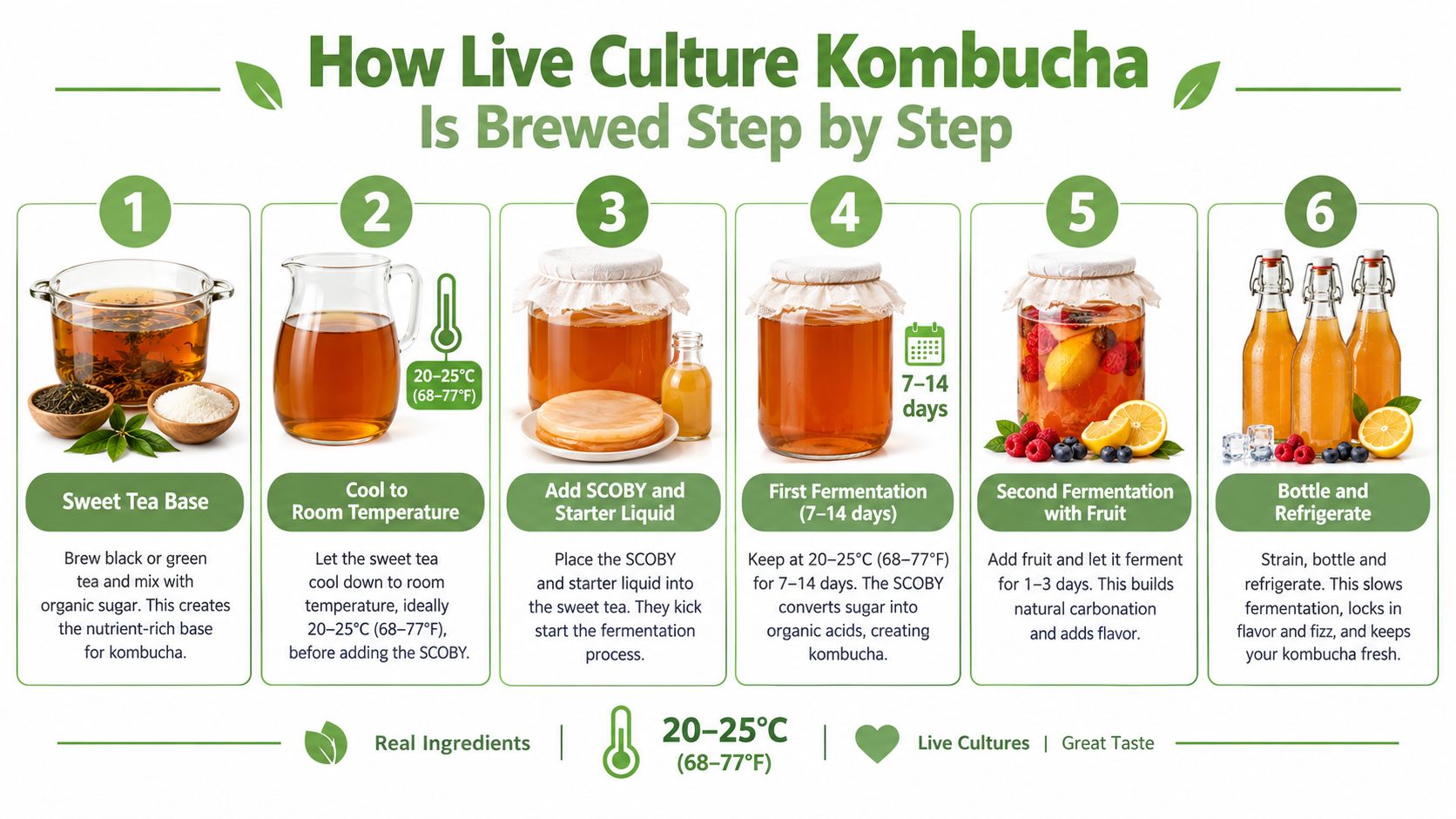
4. Flavour and bottle
The brewer adds ingredients such as ginger, lime or mango before bottling. Residual sugar gives yeast something to ferment in the sealed bottle, creating natural carbonation. This stage needs care because the same process that creates fizz can increase pressure and alter alcohol over time.
For a closer look at the first stage, PepTea's guide to kombucha first fermentation explains the role of tea, sugar, starter liquid and culture management.
A practical visual walkthrough can also help make the process easier to follow:
5. Refrigerate and monitor
Cold storage slows fermentation. It doesn't make a living drink static. Yeast and bacteria may continue working slowly, particularly when residual sugar remains, so temperature, distribution time and packaging all affect the final drink.
Small producers can often monitor these variables closely, especially when brewing for local cafés, retailers and direct customers. PepTea's kombucha is brewed in the Hunter Valley, NSW, where the brand describes its Australian-made range as organic, sugar-free and made with raw live cultures. That's one example of why production transparency matters more than a generic “fermented” claim.
Reading the Label on Live Culture Kombucha in Australia
Australian labels need to answer two separate questions: is the drink safe and legally described, and does it still contain viable cultures? Those questions overlap, but they aren't identical.
A drink can retain fermentation acids after treatment, while a live-culture claim depends on organisms surviving into the bottle. Likewise, refrigeration supports a live product but doesn't prove the claim by itself.
Four phrases with different meanings
- Raw: Usually signals that the product hasn't been heated in a way that would remove its living character, but check the producer's explanation.
- Unpasteurised: Indicates the drink hasn't undergone pasteurisation. It points more directly to the absence of post-fermentation heat treatment.
- Live cultures: Means the producer is claiming viable microorganisms remain in the product.
- Probiotic: Implies a health-related content claim that needs substantiation. Don't treat it as interchangeable with fermented.
The term “naturally fermented” describes a process, not necessarily the condition of the final bottle. If a brewer heat-treats the finished drink, the fermentation history remains true, but the live-culture story changes.
Alcohol and acidity are production controls
Australian food-safety information has highlighted alcohol variability in fermented drinks. In testing of 132 kombucha samples sold in 2017 and 2018, almost 65% contained more than 0.5% ABV and more than 22% exceeded 1.15% ABV, as reported in the Sydney Morning Herald coverage of kombucha and kefir alcohol content.
In Australia, drinks above 0.5% ABV must carry alcohol-content statements under the Australia New Zealand Food Standards Code. NSW treats products above 1.15% ABV as liquor, according to NSW Health guidance on fermented drinks and alcohol. Ongoing fermentation after packaging can contribute to alcohol drift, particularly when bottles are warm or contain residual sugar.
Acidity matters for safety too. Australian guidance uses pH controls to reduce contamination risk. Some guidance calls for a final pH below 3.0, while other state guidance uses a target below 4.2 within seven days. Queensland guidance also requires pH below 4.6 within 24 hours and recommends refrigeration to slow ongoing fermentation, as outlined in the Australian fermented beverages issues paper.
| Label claim | What it means | Live culture implication |
|---|---|---|
| Raw | The producer presents the drink as minimally heat-treated | Cultures may remain, but check the full process |
| Unpasteurised | No pasteurisation has been applied | Stronger indication that fermentation microbes may survive |
| Contains live cultures | Viable bacteria and yeast are claimed in the bottle | Look for refrigeration and clear storage guidance |
| Probiotic | A health-related microbial claim | Ask whether the claim is substantiated and specific |
| Shelf-stable | Designed to remain at room temperature | Treat as a warning sign if you're seeking living cultures |
Sugar-free claims also need context. A product described as sugar-free under the relevant food-labelling convention may contain less than 0.5 g per 100 mL, but the nutrition panel remains the most useful place to check the actual formulation. A bottle that sits warm on a shelf may have had its live-culture promise altered through filtration, heat treatment or continued fermentation.
Serving, Storage and Using Kombucha as a Mixer
Kombucha works best when you treat it as a food and a flavour ingredient, not a shot. A 150 to 200 mL glass is a sensible standard serving, while people with sensitive stomachs may prefer to start smaller.
Pour it slowly into a glass rather than drinking straight from the bottle. The aroma opens up, carbonation softens and you can judge the balance of sweetness, acidity and spice.
Match the acidity to food
Kombucha's brightness can cut through rich or fatty foods. Try it with:
- Grilled meats: Ginger notes can lift smoky or savoury flavours.
- Spicy curries: Acidity and carbonation refresh the palate between bites.
- Cheese boards: Tart kombucha balances creamy textures.
- Rich brunches: Citrus or ginger flavours work well with eggs, avocado and buttery pastries.
Flavour choice changes the pairing. PepTea's examples include Ginger, Lime & Ginger and Mango, each offering a different route into food matching without adding a sugary soft drink to the table.
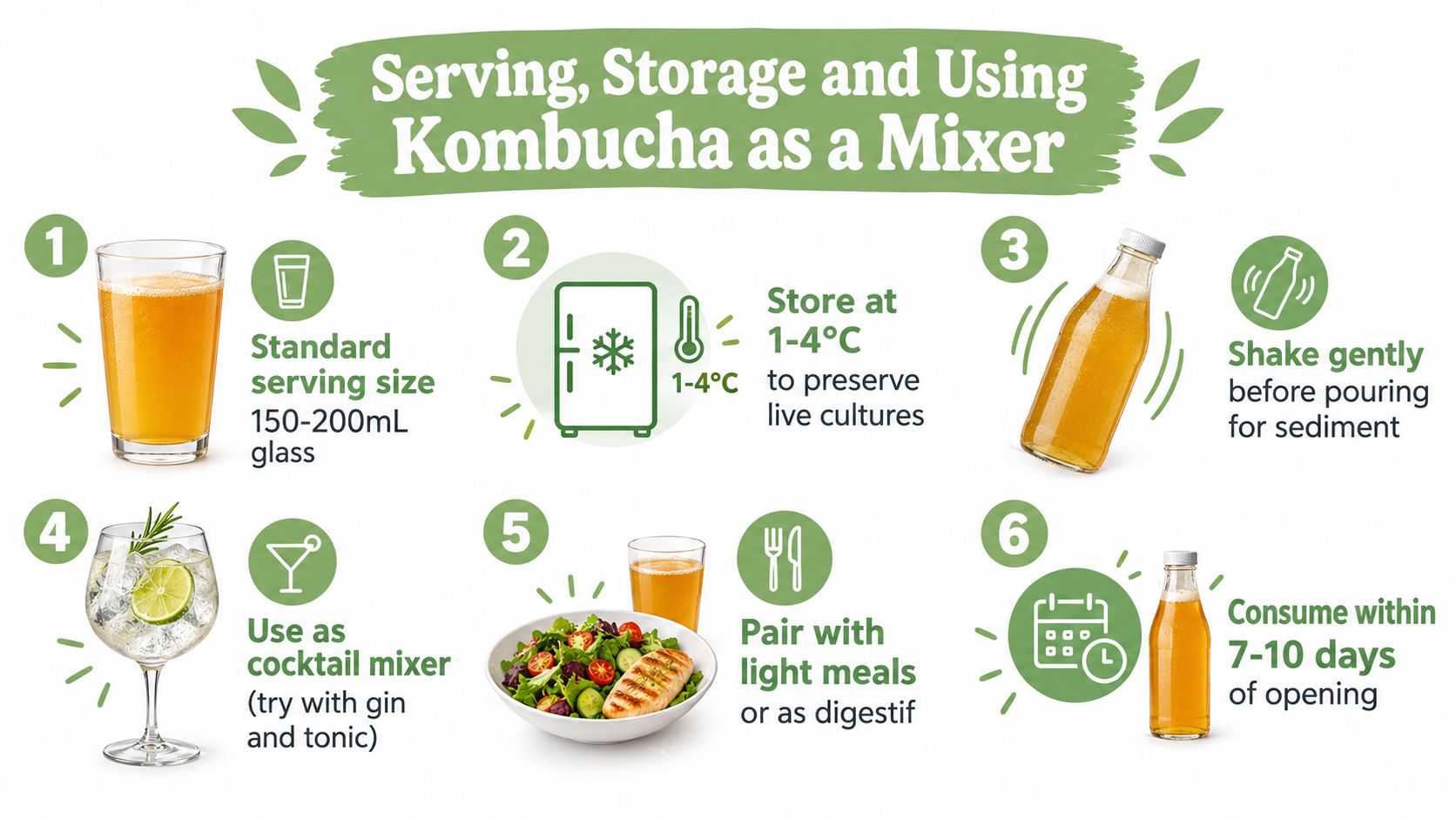
Use it in a café-style drink
Kombucha makes a useful base for a non-alcoholic spritz. Pour it over ice with citrus and herbs, or combine it with soda water for a longer drink. In a cocktail, carbonation lifts botanical notes from gin, citrus and aromatic bitters, although the finished alcohol level depends on the other ingredients.
Cold-chain handling affects the experience as well as culture survival. A warm trip from a distribution centre to a retail fridge can accelerate fermentation, alter flavour and increase pressure. Check the sell-by date and choose bottles stored below 4°C, following the practical advice in PepTea's kombucha storage guide.
At home, refrigerate unopened bottles immediately. Keep them away from direct sun and hot cars. Once opened, reseal the bottle and aim to finish it within 2 to 3 weeks, while remembering that flavour and carbonation may change sooner.
Choosing a Live Culture Kombucha Worth Your Fridge Space
You don't need to become a fermentation scientist to choose well. A quick scan can reveal whether a bottle's live-culture story is supported by its ingredients, storage and producer information.
Start with the fridge. Refrigerated kombucha is generally a better sign for culture preservation than a shelf-stable bottle, though refrigeration alone isn't proof. Then inspect the wording and ingredients.
- Read the process language: Look for raw, unpasteurised or contains live cultures, and check for any statement about post-fermentation pasteurisation.
- Check the ingredients: Tea, sugar, starter culture and flavour ingredients are easier to understand than a long list of sweeteners, colours and stabilisers.
- Review sugar and alcohol: Sugar-free or low-sugar formulations may suit people reducing sweet drinks. Confirm the alcohol statement if you avoid alcohol or need a non-alcoholic option.
- Look for production transparency: A producer that discusses pH, refrigeration, batch control or fermentation gives you more useful information than one relying only on detox language.
- Notice the bottle condition: Natural sediment or activity can occur in a living drink, but absence of visible sediment doesn't prove that cultures are gone. Packaging material matters less than the process and storage record.
Glass can make a product feel more premium, but it doesn't guarantee viable cultures. A clear raw claim, a cold chain and sensible fermentation controls matter more than the container alone.
PepTea's sugar-free organic kombucha, brewed in the Hunter Valley, NSW, is one local example to compare against these criteria. The range includes flavours such as Ginger, Lime & Ginger and Mango, giving Australian shoppers a practical way to assess local live-culture kombucha by its label and handling rather than by wellness hype.
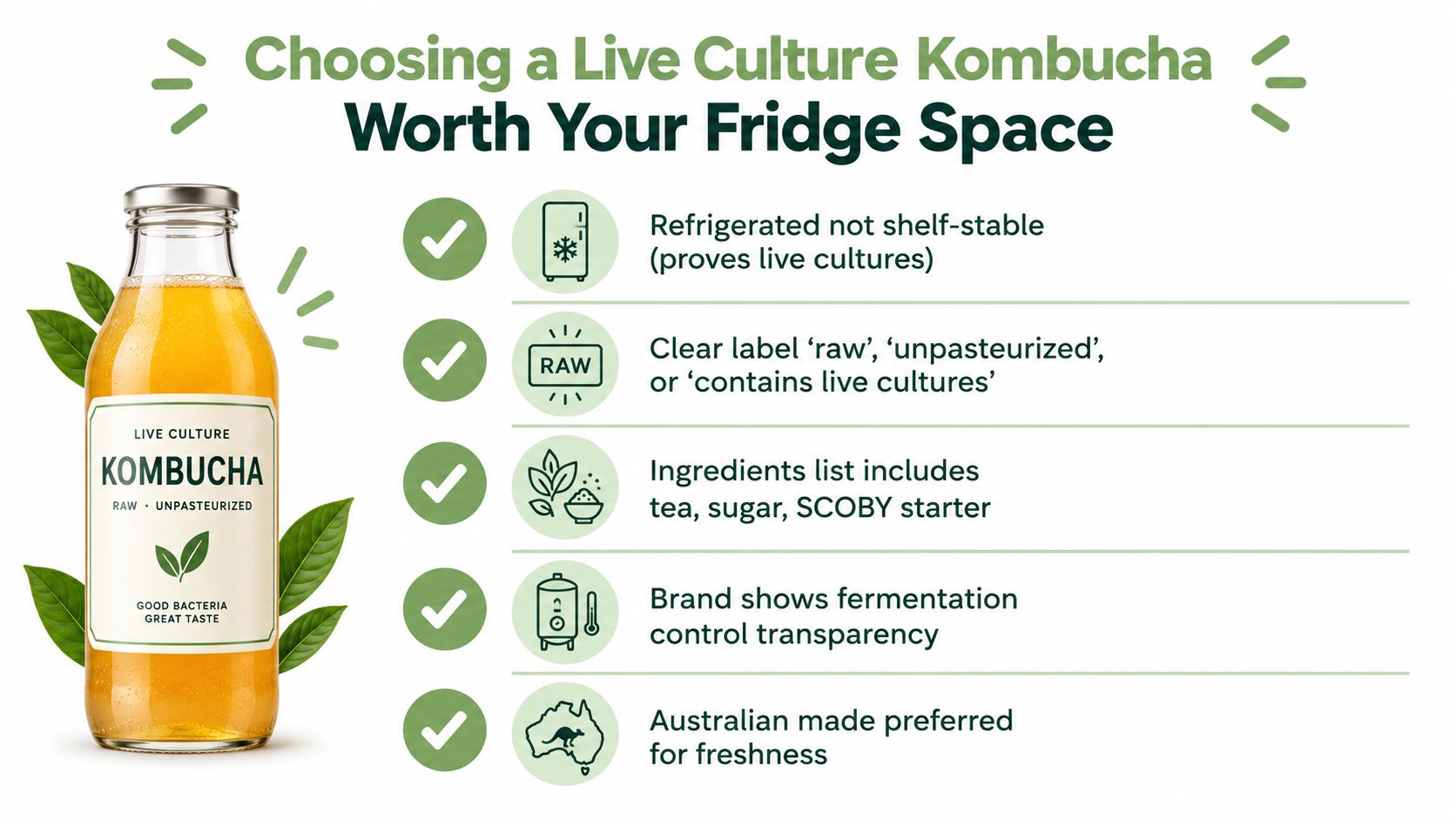
Explore Pep Tea's organic, Australian-brewed kombucha range to compare sugar-free flavours made with raw live cultures. Visit Pep Tea to shop online, learn more about fermentation, or enquire about supplying live-culture kombucha to your café or hospitality venue.
No Sugar Added Apple Juice: What the Label Really Means

“No added sugar” sounds like a health upgrade. On a bottle of apple juice, it often isn't. The phrase tells you what the manufacturer didn't put in, not how much sugar the apples contributed. A juice can contain no added sugar and still deliver a concentrated dose of the fruit's natural sugars, with very little of the fibre that makes a whole apple filling.
That distinction matters in Australia, where a small amount of unsweetened fruit juice can count as fruit, but juice isn't treated as an unlimited substitute for eating fruit. It also matters if you're choosing drinks for children, managing your weight, comparing café options, or trying to reduce sugar without falling for a reassuring front label.
What No Sugar Added Really Means on Your Juice Bottle
No sugar added apple juice isn't sugar-free. It's juice made without added sugars or certain sweetening ingredients. The apples still bring their own naturally occurring sugars, including fructose and sucrose, and pressing removes much of the fruit's original structure.
Think of the label as an ingredients statement, not a nutrition guarantee. “No added sugar” answers one question: Was extra sugar added during production? It doesn't answer another important question: How much total sugar is already in the finished drink?
The café test
Suppose a café pours a generous glass of apple juice from a bottle labelled “no added sugar”. The drink may taste fresh and less obviously sweet than a soft drink, but the total sugar still comes from the apples. If the glass is large, the serving can contain a substantial amount of sugar, even though nobody added a spoonful of table sugar behind the counter.
That's where the popular advice goes wrong. Shoppers often compare the front labels of juice and soft drink, then assume the juice is automatically the healthier everyday choice. A more useful comparison includes total sugars, energy, fibre and portion size, not just the absence of added sugar.
The label describes the recipe. The Nutrition Information Panel describes what you're drinking.
What can change the claim
A manufacturer can make a no-added-sugar claim when the product contains natural sugars from its fruit and no disallowed sweeteners have been added. But ingredients that increase sweetness, such as sugar, syrup or a sweetened concentrate, change the formulation and may prevent the claim.
The details matter because fruit-derived ingredients aren't all interpreted in the same way when they're added to a product. An apple juice made from apples is different from an apple drink sweetened with another fruit concentrate. Reading the ingredients list helps you spot that distinction.
The rest of the bottle deserves attention too. “Natural”, “pure” and “100% juice” can describe the product's composition or positioning, but none of those phrases means the drink has the fibre, chewing time or satiety of a whole apple.
The Australian Rules Behind the No Added Sugar Claim
In Australia, “no added sugar” is a regulated claim about ingredients. FSANZ materials explain that a singular fruit product, such as apple juice sold as the food itself, may use the claim when no added sugars or other disallowed ingredients have been included. The key issue is whether sweetness has been added, not whether the finished drink contains sugar.
Ingredients that can disqualify the claim
The formulation generally needs to avoid added sweetening ingredients such as:
- Refined sugar: This includes the familiar forms used to sweeten beverages.
- Honey and syrups: These add sugar even when the marketing language sounds natural.
- Malt-based sweeteners: Malt can contribute sweetness and affect eligibility.
- Fruit concentrate used as a sweetener: Grape or pear juice concentrate added to make apple juice sweeter isn't the same as the natural sugar already present in the pressed apples.
FSANZ proposal materials also distinguish a singular fruit juice from a blend containing fruit juice and fruit purée. That distinction shows why the product's full ingredient description matters, rather than relying on the front panel alone. You can read more about the practical difference between sugar-free drinks and products that avoid added sugar in this guide to no-sugar soft drinks.
A simple supermarket check
Start with the ingredients list. If you see sugar, honey, syrup, malt or another sweetening ingredient, the product isn't the straightforward no-added-sugar formulation shoppers usually expect.
Then check the Nutrition Information Panel. A compliant claim doesn't require the total sugars line to be zero, because natural sugars from apples remain in the drink. That's the point many shoppers miss.
Australian labelling rules also distinguish “low sugar” from “no added sugar”. For packaged drinks, a low-sugar or percentage-sugar-free claim requires no more than 2.5 g of sugars per 100 mL, according to the national sugar-labelling policy paper. Apple juice with natural fruit sugars is generally nowhere near that threshold, so no added sugar and low sugar shouldn't be treated as interchangeable descriptions.
How Much Sugar Is Actually in No Added Sugar Apple Juice
Australian retail examples show why the front-of-pack wording can create a misleading health halo. Typical apple juices sit around 10.1 to 12.7 g of sugars per 100 mL, with examples including Daily Juice Company Apple No Added Sugar at 10.1 g per 100 mL and Nudie 100% Apple Juice at 12.2 g per 100 mL. These figures come from Australian product and retail information compiled for apple juice comparisons, including the Golden Circle apple fruit juice listing.
Energy follows the same pattern. No-added-sugar retail apple juices commonly provide around 184 to 211 kJ per 100 mL, which makes them closer to standard apple juice than to a reduced-sugar drink. A Nudie Nothing But Apple Juice product listing provides a useful Australian retail benchmark.
The serving size changes the picture
A 500 mL serve can contain roughly 50.5 g of sugar and about 920 kJ, based on the Australian retail benchmark cited above. That's a large amount for a drink that many people consume quickly and don't experience as a full snack.
The Australian Beverages Council's summary of juice research gives broader population context. Fruit juice contributes 0% of added sugar intake, because its sugars occur naturally, while contributing 3.5% of total sugar intake and about 1% of energy in the population, as described in the FSANZ consumer evidence material. Those figures don't make juice sugar-free. They show why added sugar and total sugar are separate nutrition questions.
| Product type | Total sugars (g/100 mL) | Energy (kJ/100 mL) | Ingredient sweetener |
|---|---|---|---|
| No-added-sugar apple juice examples | 10.1 to 12.7 | 184 to 211 | No added sweetener, natural apple sugars remain |
| Low-sugar packaged drink threshold | No more than 2.5 | Not specified | Claim threshold, not an apple juice profile |
A no-added-sugar claim can therefore be accurate while the drink remains high in natural sugar. The absence of added sugar doesn't reduce the sugar density created by pressing apples.
How to Read a Juice Label Without Getting Misled
The most reliable place to start isn't the front of the bottle. Turn it around and work through the information in a fixed order.
Use this three-part check
- Locate the Nutrition Information Panel. Look for total sugars per 100 mL. This lets you compare products on the same basis, even when brands use different serving sizes.
- Separate “no added sugar” from total sugars. The claim describes added ingredients. The sugars line includes the naturally occurring sugar remaining in the juice.
- Read the ingredients statement. Look for apple juice, concentrate, purée, flavouring and other additions. A product may be marketed with orchard imagery while its formulation is more complicated than the picture suggests.
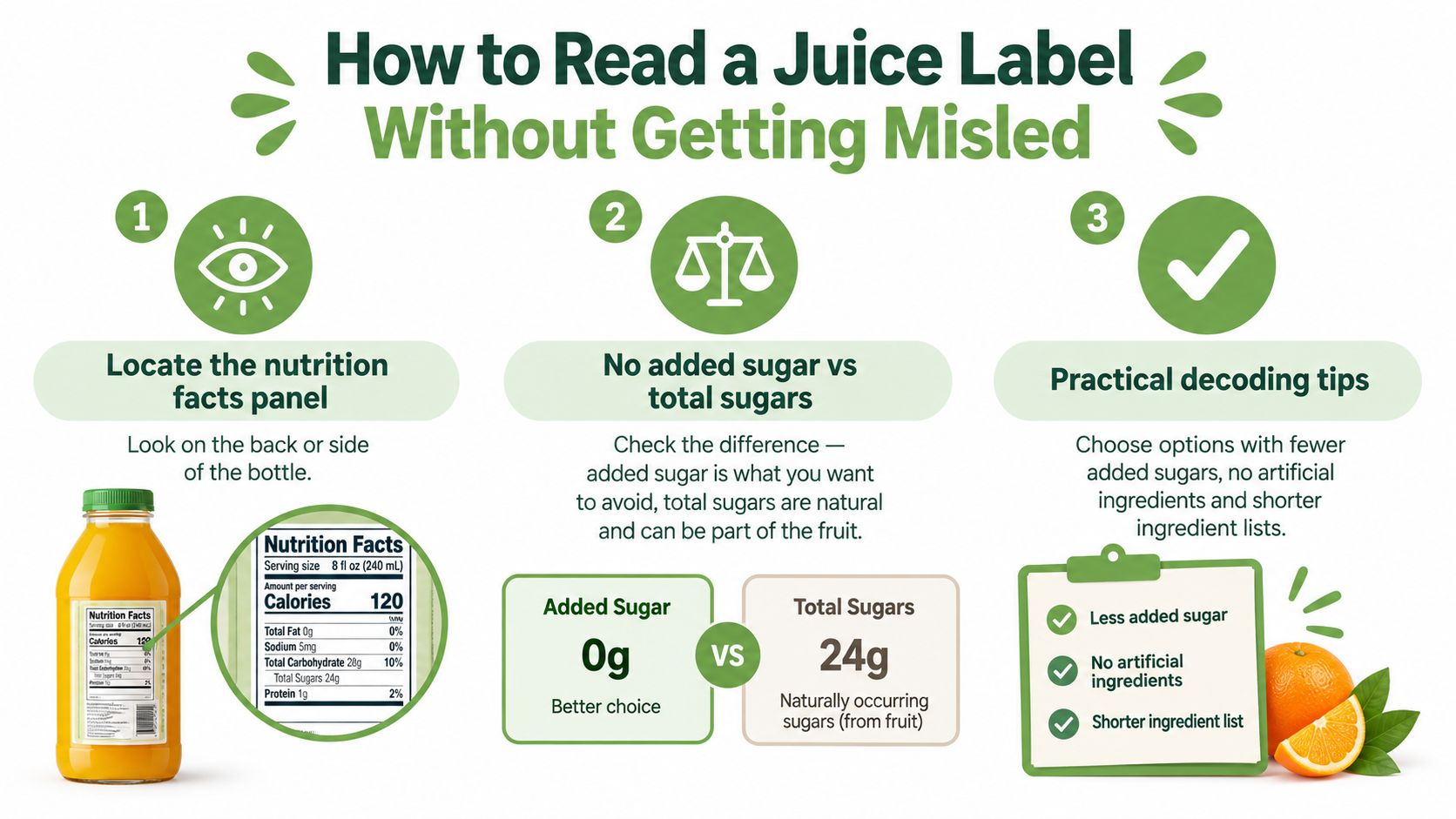
Calculate your actual pour
The panel may list a neat serving size, but your glass might hold considerably more. Multiply the sugar per 100 mL by the amount you pour, then divide by 100. This calculation is more useful than comparing bottle fronts.
Health stars and similar front-of-pack devices can help with quick scanning, but they don't replace the detailed panel. Use them as a starting point, then verify the total sugars and serving size yourself. If you're comparing juice with other non-alcoholic options, the same habit works when choosing sugar-free carbonated drinks.
Practical rule: Check total sugars per 100 mL, multiply by your real pour, and treat “natural” imagery as marketing rather than nutrition evidence.
No Added Sugar Juice Against Sweetened Juice and Whole Apples
No-added-sugar apple juice has one clear advantage over sweetened apple juice: the manufacturer hasn't added sugar to the recipe. It doesn't automatically beat a whole apple, because the pressing process changes the way the fruit is consumed.
A whole apple requires chewing and retains its fibre. Juice delivers the fruit's sugars in a form that's easier to drink quickly, while the pulp and much of the original structure are absent. LiveLighter's Australian analysis highlighted that a 500 mL bottle of branded apple juice marketed with no added sugar can provide energy equivalent to around 4.3 to 5 apples, while supplying less than 1 g of fibre. The comparison is a useful warning against treating juice as nutritionally identical to whole fruit.
Kombucha sits in a different category. A sparkling kombucha blend can offer acidity, carbonation and fermentation-derived flavour, but you still need to check the individual product's Nutrition Information Panel. It shouldn't be assumed that every kombucha is sugar-free or that every apple-flavoured drink has the same sugar profile.
| Drink or food | Serve size | Total sugars (g) | Energy (kJ) | Fibre (g) |
|---|---|---|---|---|
| No-added-sugar apple juice | 500 mL | Roughly 50.5 | About 920 | Less than 1 |
| Sweetened apple juice | Varies | Product-dependent | Product-dependent | Product-dependent |
| Whole apples | Comparable fruit amount varies | Product-dependent | Product-dependent | Retained in the whole fruit |
| Apple-flavoured kombucha | Product serving | Check the product label | Check the product label | Check the product label |
The table's missing values are deliberate. Without a verified label for a specific sweetened juice, whole apple size or kombucha product, assigning a number would create false precision.
The practical conclusion is context-dependent. No-added-sugar apple juice may be a preferable choice to a sugar-sweetened drink, but it isn't a free pass against soft drink alternatives, and it doesn't offer the same fibre and satiety as eating an apple. For a café, it can work as a small menu serve or mixer. For an everyday drink, water remains simpler.
Where Apple Juice Fits in Australian Dietary Guidance
Australian guidance treats unsweetened fruit juice as a limited fruit serve, not as an unlimited beverage. The Australian Dietary Guidelines guidance cited by the Australian Beverages Council says an occasional 125 mL glass of fruit juice with no added sugar counts as one serve of fruit, while the Australian Bureau of Statistics explains that half a cup can occasionally count as one fruit serve in the relevant dietary guidance. You can review the ABS material on consumption of food groups under the Australian Dietary Guidelines.
That serving rule gives shoppers a useful reality check. A 250 mL glass is twice the cited occasional serving volume, so it shouldn't be mentally filed as “just one piece of fruit”. The drink may come from apples, but it lacks the whole-fruit experience that slows eating and supports fullness.
Juice intake is changing
The ABS reports that fruit and vegetable juices fell to 32.5 mL per capita per day in the year to June 2024, down 2.5 mL, or 7.1%, from the prior year. That decline suggests Australians are drinking less juice overall, while sparkling water, tea-based drinks and kombucha provide other ways to add variety.
Most individuals find that no-added-sugar apple juice makes more sense as an occasional option than a daily hydration staple. If you're managing diabetes, body weight or blood-glucose responses, treat the juice as a concentrated carbohydrate source and discuss your individual approach with your healthcare professional. Pairing a small serve with a meal containing protein or fibre may be more satisfying than drinking it alone, but it doesn't erase the juice's sugar.
Cafés and restaurants also need to think beyond marketing language. Serving guidance, accurate menu descriptions and safe handling all matter, so businesses can use resources such as food safety compliance for restaurants when reviewing their broader beverage practices.
Using No Added Sugar Apple Juice in Kombucha and Recipes
Apple juice can be useful in the kitchen when you treat it as a sweet ingredient rather than a free drink. Its natural sugars can support fermentation, add acidity and apple character to dressings, or bring moisture and flavour to a glaze.
For a secondary kombucha ferment, a home brewer might combine 250 mL apple juice with 750 mL green tea starter, then ferment the sealed mixture for 3 to 5 days at 22 to 25°C. Those figures are a practical recipe ratio, not a universal safety guarantee. Fermentation depends on the culture, acidity, temperature, bottle pressure and hygiene, so use suitable equipment and follow a tested method. Pep Tea's guide to kombucha second fermentation can help with the process.
Recipe uses beyond the glass
Try a modest amount in food:
- Glaze: Reduce 60 to 80 mL with savoury ingredients for pork or roasted vegetables.
- Vinaigrette: Whisk a splash into mustard and oil to balance bitter greens.
- Spritzers: Freeze juice into ice cubes and use one cube to add apple flavour gradually.
The “no added” part still doesn't make the ingredient sugar-free. If you use 125 mL in a recipe or drink, that amount fits the occasional fruit-serve guidance and displaces the equivalent fruit serve elsewhere in the day.
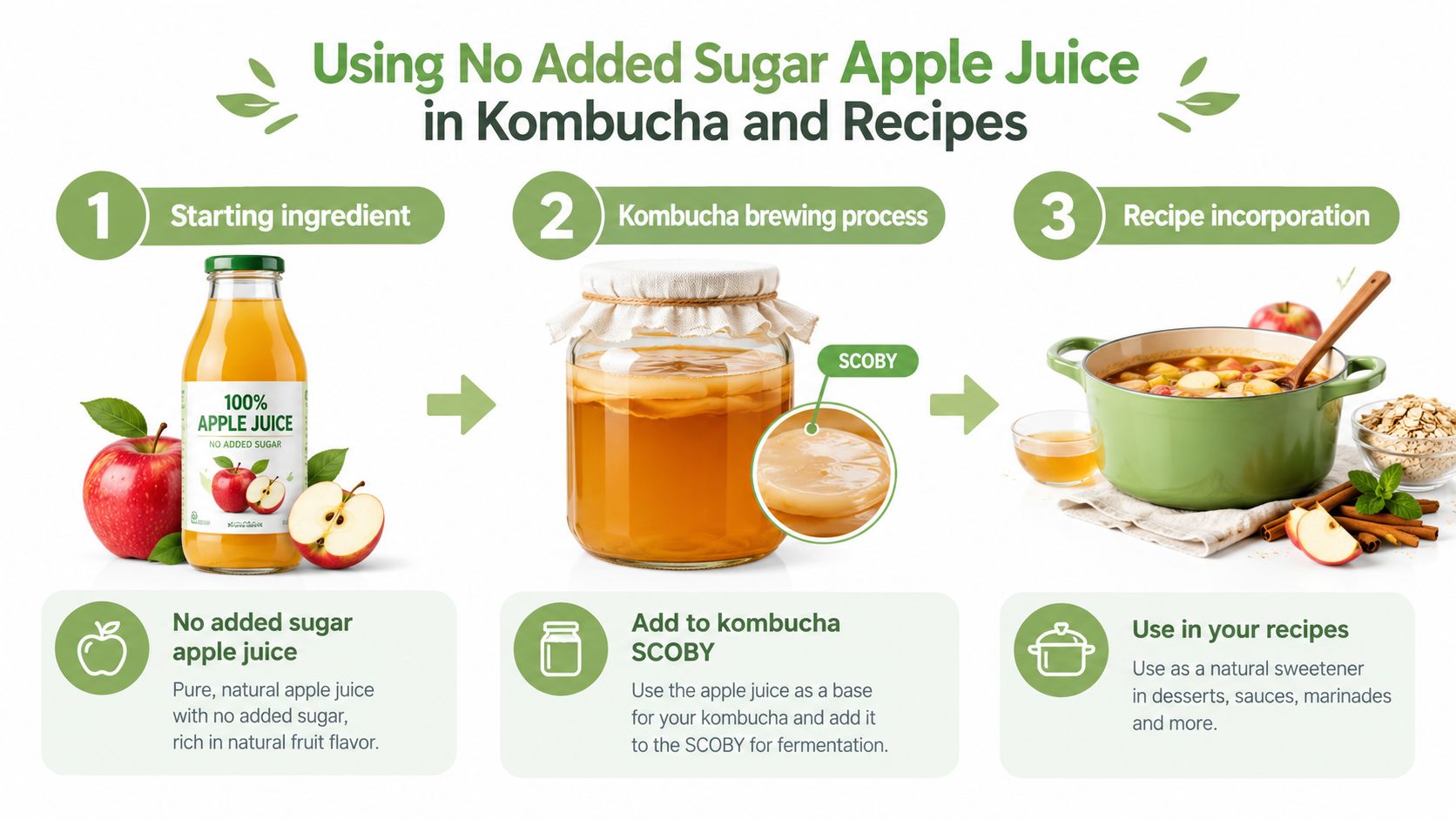
For a visual introduction to the process, this fermentation demonstration may help:
Keep batches small, label the date, and refrigerate finished drinks when the flavour and carbonation suit you. Never assume that a naturally fermented beverage is automatically low in sugar or safe without attention to hygiene and storage.
Lower Sugar Alternatives You Can Make at Home
You can keep apple flavour without making juice the main ingredient. The simplest option is a 50/50 spritzer: combine 100 mL no-added-sugar apple juice with 100 mL sparkling water and add lime. That creates two serves, so each glass contains half the sugar of the undiluted juice used in the recipe.
Build flavour with less juice
A cold apple infusion uses aroma rather than a full juice load. Place chopped Granny Smith skins and cores in 1 L of cold water overnight, then strain and serve chilled. The result is faintly apple-flavoured and contains only a fraction of the sugar found in juice, although the exact amount depends on the fruit and how much dissolves into the water.
For a sharper drink, combine celery with a smaller amount of apple in a home juicer. Celery dilutes the apple's natural sugars and adds a savoury note, but it doesn't turn the drink into a fibre-rich whole-food replacement. A pinch of salt, fresh ginger, a cinnamon stick or a few drops of apple cider vinegar can make a diluted drink taste fuller without adding sugar.
| Drink (250 mL serve) | Total sugar (g) | Energy (kJ) | Fruit serves |
|---|---|---|---|
| Undiluted no-added-sugar apple juice | Product-dependent | Product-dependent | Depends on the amount used |
| 50/50 apple juice and sparkling water | Approximately half the juice recipe's sugar | Approximately half the juice recipe's energy | Depends on the amount of juice |
| Cold apple skin and core infusion | Qualitatively low compared with juice | Qualitatively low compared with juice | Not equivalent to eating whole fruit |
| Apple and celery juice | Recipe-dependent | Recipe-dependent | Depends on the apple quantity |
Freeze measured portions in 30 mL silicone moulds for smoothies, dressings or kombucha starters. Portioning before you need the ingredient prevents a generous pour from becoming the default.
For a ready-made alternative with a different flavour profile, Pep Tea offers organic kombucha options including Apple Pomegranate, described by the brand as sugar free. Check the product information and serving guidance for the specific drink you choose, then explore the wider Pep Tea range for organic tea and kombucha options that can replace sweet drinks without confusing “no added sugar” with “no sugar”.
How Many Probiotics in Kombucha and What Counts

There's no single probiotic number for kombucha in Australia. Product claims can range from 500 million CFU per 100 mL to 39 billion live probiotics across a pack, because the category has no national mandated probiotic minimum.
So, how many probiotics are in kombucha? The honest answer depends on the brand, serving size, culture, fermentation method, processing and storage. A raw, refrigerated brew may contain a different live-culture profile from a pasteurised drink that has probiotics added later. Even two bottles made from similar ingredients can't automatically be treated as equivalent.
That uncertainty doesn't make kombucha meaningless. It means you need to read the label with a little more care than you might expect from a drink marketed as “probiotic”. This guide explains what CFU means, how Australian products present their counts, why live cultures change from brew to bottle, and what to look for when choosing a kombucha for everyday drinking or a café menu.
Pep Tea's own approach sits in that practical middle ground. Its kombucha is brewed in the Hunter Valley, NSW, using organic tea and live cultures, with a focus on a raw, sugar-free fermented drink rather than a promised clinical dose. For a broader look at what beneficial bacteria produce during fermentation, see postbiotics and the real benefit of beneficial bacteria.
Introduction Why There Is No Single Probiotic Number
Many shoppers assume “kombucha” comes with a standard probiotic serving, much like a supplement comes with a declared dose. In Australia, that assumption doesn't hold. Food Standards Australia New Zealand treats kombucha as a traditional food rather than a therapeutic good, so there's no Australia-wide mandated probiotic minimum for the category (CHOICE explains the regulatory position and variability).
The live microbes in a bottle can shift according to the culture used, how long the tea ferments, whether the finished drink is raw or pasteurised, and how it's transported and stored. Australian consumer guidance also notes that kombucha's potential depends on both the number and type of microbes, and that it's likely to contain fewer microbes than a commercial probiotic supplement (CHOICE discusses the difference between kombucha and concentrated supplements).
Why labels can look so different
One Australian ready-to-drink kombucha lists 1 billion CFU per serve and 500 million CFU per 100 mL (Australian product listing). Another Australian functional beverage claims 39 billion live probiotics across the full pack (Australian kombucha product example). Those statements may both be accurate as written, but they aren't directly comparable until you know the serving size and whether the figure refers to one bottle, a pack or a measured volume.
That's why the question “how many probiotics in kombucha?” needs a comparison method, not a magic answer. CFU per serve, CFU per 100 mL, raw or pasteurised processing, and refrigeration instructions tell you more than a large number printed on the front.
Practical rule: Treat a live-culture claim as a product-specific snapshot, not a guaranteed standard for every kombucha.
The rest of the answer is useful for both home shoppers and café buyers. You'll learn how to compare bottles fairly, recognise language that may blur “live” and “probiotic”, and set a realistic expectation: kombucha can be an enjoyable fermented tea with live cultures, but it isn't automatically a measured therapeutic dose.
What Probiotics and CFU Actually Mean in Kombucha
Start with the simplest distinction. Live cultures are microorganisms that remain alive in the drink at the time it's made or tested. Probiotics is a more specific term for live microorganisms that provide a health benefit when consumed in an appropriate amount. A drink can contain live microbes without proving a particular health outcome for every person.
Kombucha begins with sweetened tea and a SCOBY, short for a symbiotic culture of bacteria and yeast. The SCOBY is a mixed community, not one named organism. During fermentation, different bacteria and yeasts interact with the tea, sugar and acids, so the microbial profile can change as the brew develops.
CFU is a viability measure
CFU means colony-forming units. It estimates how many viable microbes in a sample are capable of multiplying under the test conditions and forming a visible colony. It doesn't necessarily count every individual cell, and it doesn't tell you whether all the microbes belong to the same strain.
A useful analogy is a packet of seeds. The number printed on the packet suggests how many seeds are present, but the meaningful question is how many are viable and able to sprout. CFU is closer to the number of seeds that can grow than to the total number of seeds sitting in the packet.
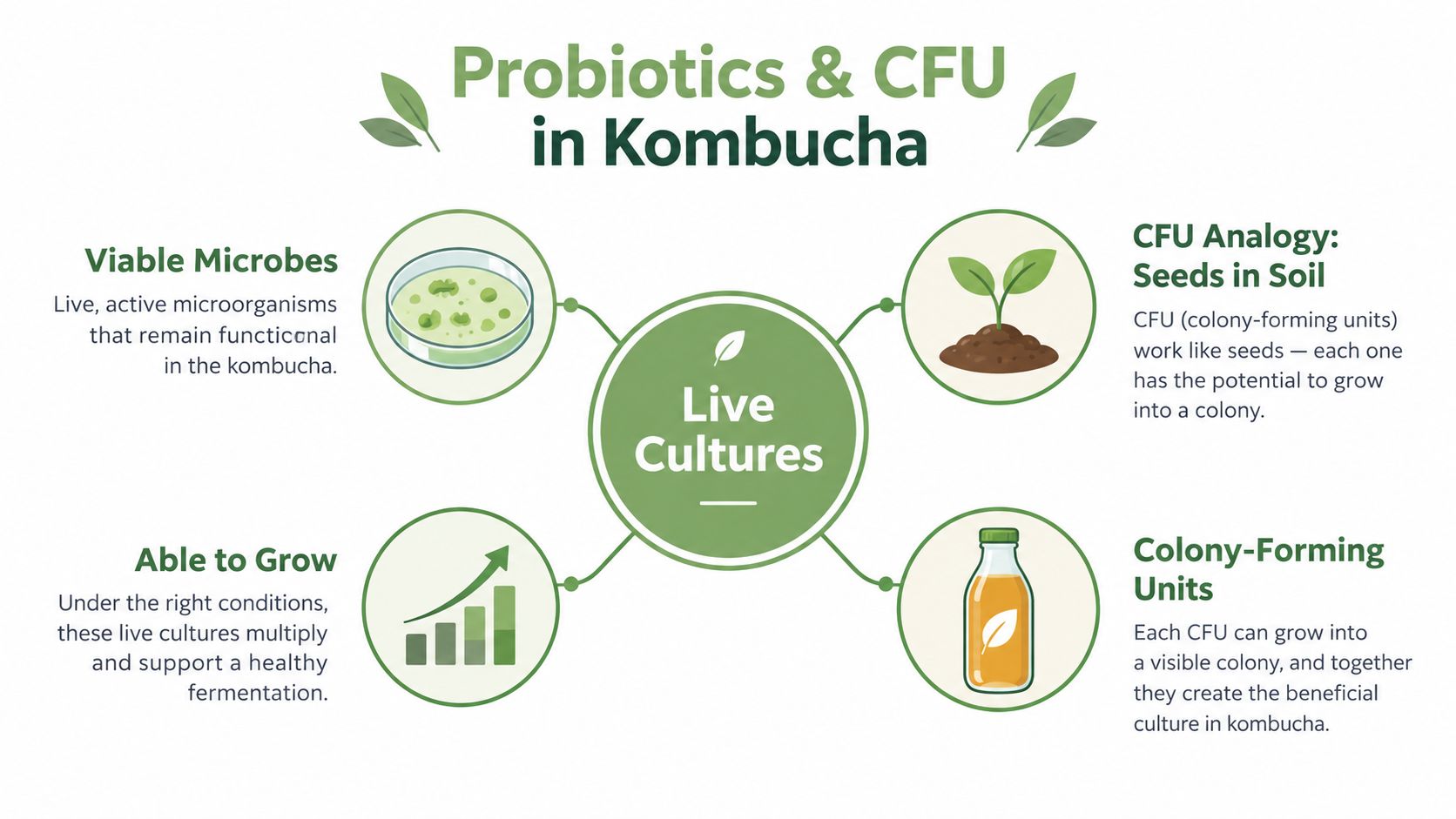
Number and type both matter
A higher CFU figure isn't automatically a better product. The type of microbe, its ability to remain viable through storage, and the amount consumed all affect how meaningful the claim may be. Australian CSIRO researcher Dr Michael Conlon told CHOICE that probiotic effects depend on the number and type of microbes, while noting that kombucha generally contains fewer microbes than dedicated probiotic drinks (CHOICE's expert commentary).
Added strains create another layer of confusion. Some producers may add probiotic strains after processing, while a traditionally fermented drink gets its microbial community from the brewing process. Both may use words such as “live” or “probiotic”, but those words don't describe identical production methods.
For a plain-language foundation, Pep Tea's guide to what prebiotics and probiotics are can help separate these related terms. The key point is simple: a CFU number tells you about viable growth under testing conditions, not a universal promise of health benefit.
Typical Probiotic Counts You Will See on Australian Labels
Why can two Australian kombucha labels show such different probiotic counts? The answer often sits in the unit, serving size and product format, rather than in a simple difference in quality. One bottle may state its live-culture content per serve, another per 100 mL, and another across the entire pack. Comparing those figures directly is like comparing the price of one apple with the price of a whole crate.
Here are Australian examples that show how the wording changes:
| Product Format | Claimed Live Count | How It Is Expressed |
|---|---|---|
| Ready-to-drink kombucha | 1 billion CFU per serve | Also listed as 500 million CFU per 100 mL |
| Functional kombucha beverage | 39 billion live probiotics | Across the full product pack |
| Live bacterial ready-to-drink beverage | Over 500 million viable and living bacteria | Before consumption, with a stated 12-month shelf life |
The ready-to-drink example gives both measurements, making it useful for comparison. A label stating 1 billion CFU per serve and 500 million CFU per 100 mL is describing the same drink through two different lenses (Australian label example). The per-serve figure shows what you may consume in that portion. The per-100-mL figure creates a common measuring line for comparing products with different serving sizes.
A pack-level claim needs careful reading. 39 billion across a pack may include several servings or reflect a different product format. Without the pack volume, serving guidance and testing point, the headline figure cannot show whether one glass contains more live cultures than another product (Australian functional beverage example).
A practical Australian range
Across the examples above, claims range from hundreds of millions to tens of billions of CFU, depending on how each product is formulated and how the claim is expressed. This range is a description of the examples, not a recommended dose or a target that every kombucha should meet.
A high number might come from added strains, a full-pack calculation or a particular testing method. A lower declared number might be measured per 100 mL in a traditionally fermented drink. Check the unit first, then the serving size. After that, check whether the drink is raw or pasteurised, and follow the storage instructions, because handling affects how much of the claimed live culture may remain by the time you drink it.
Why Probiotic Numbers Vary So Much From Brew to Bottle
Kombucha is a living, changing beverage. The number printed on a label represents a product at a particular point in its journey, while the drink in your glass may have travelled through fermentation, bottling, transport and refrigeration before you open it.
Brew method and culture blend
A SCOBY contains a mixed community of bacteria and yeast. Different culture blends can produce different microbial profiles, and the same broad recipe doesn't guarantee the same result from one producer to another. Brewing conditions also influence acidity, carbonation and the balance of organisms that remain in the finished drink.
Fermentation time matters because the culture uses sugar and changes the surrounding tea. A producer may stop fermentation at a particular point to achieve a preferred flavour and stability. The finished drink can therefore taste sweeter, sharper or more acidic without that flavour alone revealing its exact CFU content.
Raw, pasteurised or re-fortified
Raw or unpasteurised kombucha is processed to retain live cultures, although “raw” doesn't provide a standard CFU number by itself. Pasteurisation uses heat, which can reduce or remove viable microbes. Some products may then be re-fortified with probiotic strains after processing, creating a drink that contains an added culture rather than the original living fermentation community.
That distinction matters because “live” and “probiotic” aren't interchangeable words. Australian industry coverage has raised concerns about products that are pasteurised or re-fortified, particularly when shoppers interpret broad health language as proof of a naturally live brew (ABC News coverage of kombucha regulation concerns).
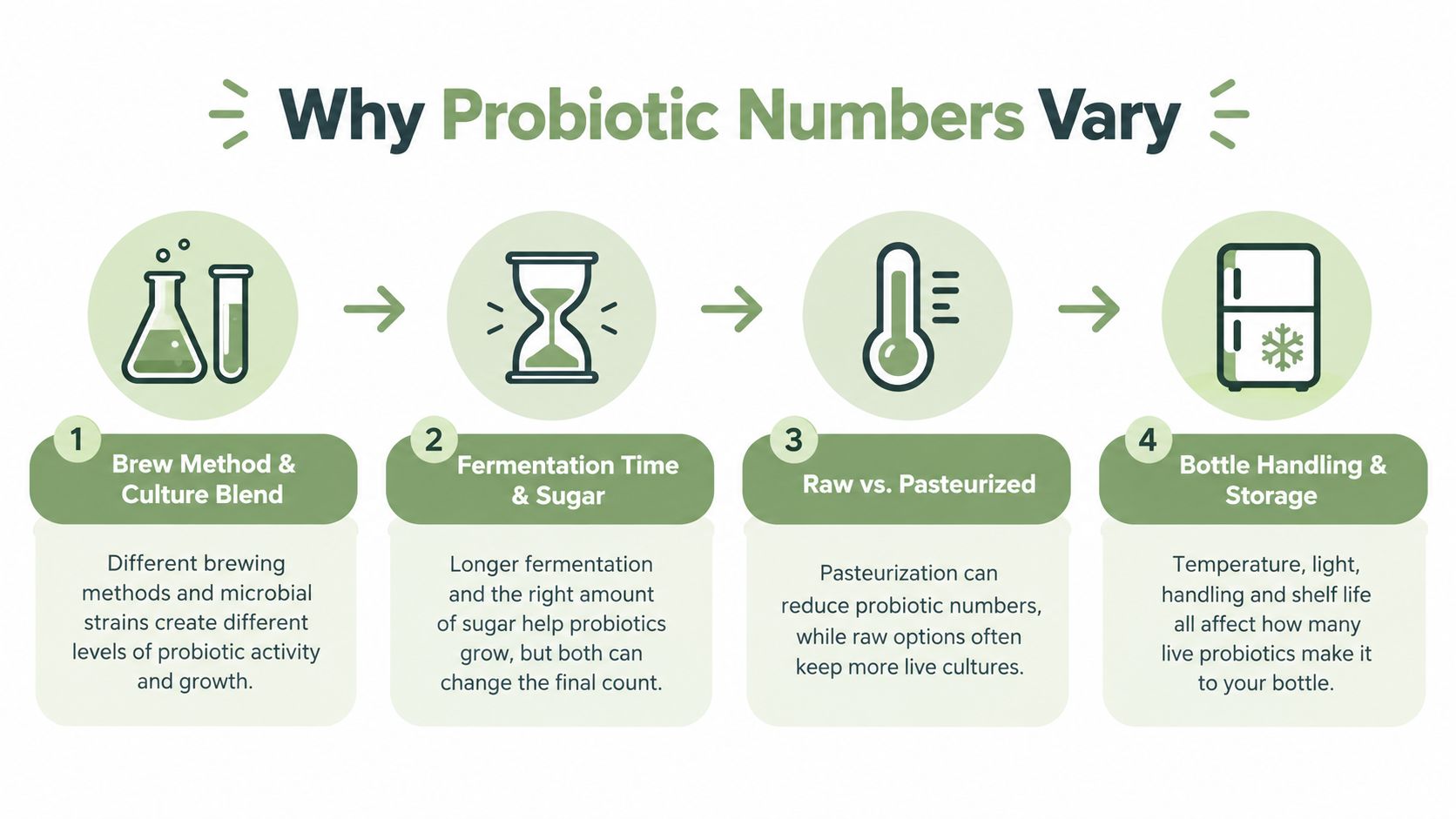
Bottle handling and storage
Cold storage helps preserve the characteristics of a raw fermented drink. Heat exposure, long periods outside refrigeration and continued fermentation can all change the product after bottling. The label's “keep refrigerated” instruction isn't decoration. It tells you how the producer expects the drink to be handled.
Shelf life can also complicate comparisons. One Australian live bacterial beverage record described over 500 million viable and living bacteria before consumption alongside a 12-month shelf life (Australian award record). That wording gives useful context, but it still doesn't establish what every bottle contains at the end of its shelf life.
A kombucha label is a snapshot. Storage is part of the recipe once the drink leaves the brewery.
How to Read a Kombucha Label and Spot Real Live Cultures
Use the label as a checklist rather than hunting for the biggest number. A transparent product should make it reasonably clear whether the drink is raw, how live cultures are described, how much you're expected to consume and how it should be stored.
Four checks for shoppers
Look for raw or unpasteurised wording. This suggests the producer intends to retain live fermentation cultures. It still isn't a guarantee of a particular count, so keep reading.
Find the live-culture statement. “Contains live cultures” tells you more than a vague wellness phrase. If the label names specific strains, note them, but don't assume a named strain makes the drink equivalent to a supplement.
Check the unit. Is the CFU figure listed per serve, per 100 mL or across a pack? The Australian examples show why this distinction changes the apparent size of the claim (Australian label comparison).
Read the storage instructions. Refrigeration, best-before information and handling guidance help you judge whether the product is intended to stay live through consumption. Pep Tea explains the practical reason behind refrigerating kombucha.
Questions for cafés and wholesale buyers
Hospitality buyers need to look beyond the front label. Ask the supplier how the drink is brewed, whether it's raw or pasteurised, how CFU is measured, and what cold-chain arrangements apply from production to delivery.
A café should also check flavour balance, residual sweetness, bottle or keg handling and the alcohol statement. NSW Health explains that kombucha is made by fermenting tea with sugar, yeast and bacteria, and that fermented drinks can retain residual alcohol. In Australia, drinks over 0.5% ABV must state alcohol content on the label, while in NSW products over 1.15% ABV are considered alcoholic drinks (NSW Health guidance).
For café menus: Describe the product as a fermented tea with live cultures unless the label supports a more specific statement. Don't turn a variable food into a guaranteed medical dose.
Kombucha Versus Probiotic Supplements and Other Fermented Drinks
Kombucha and a probiotic supplement serve different purposes. A supplement is usually designed to deliver selected strains in a concentrated format, with the dose presented as a central product feature. Australian guidance notes that commercial probiotic supplements often contain far more concentrated strains than kombucha (CHOICE comparison of kombucha and probiotic supplements).
Kombucha is better understood as fermented tea that may contain live microbes. You drink it for its tart flavour, gentle fizz and place in a low-sugar routine, while the live-culture content is an added characteristic that varies between products. That makes it quite different from taking a supplement to target a particular strain or declared amount.
Tea itself contributes the starting material, but fermentation changes the drink. The culture transforms the sweetened tea and produces acids, carbonation and trace alcohol. A pasteurised product may no longer deliver the same live-culture experience, while a re-fortified beverage may contain added strains that weren't part of the original fermentation.
Live doesn't mean clinically proven
A live microbe is not automatically a proven probiotic for a specific health outcome. CSIRO describes kombucha as a food or drink containing live bacteria that may provide a health benefit, while also stating that research on gut benefits is limited and contradictory and that there are no human studies proving kombucha's claimed benefits (CSIRO's evidence overview).
That evidence gap matters for wellness menus. A café can offer kombucha as a refreshing fermented alternative to soft drink or alcohol, especially when the product has low or no added sugar. It shouldn't promise that a particular bottle will fix digestion, immunity or a diagnosed condition.
For anyone taking a probiotic supplement, kombucha can be an enjoyable food choice, but it shouldn't be used to replace professional advice or a product selected for a specific clinical purpose.
The comparison becomes clearer when you ask what you're buying:
- Kombucha: A fermented tea with a variable mixed culture.
- Probiotic supplement: A concentrated product with declared strains and a stated dose.
- Other fermented foods: Foods such as yoghurt, kefir or vegetables with their own cultures, ingredients and processing conditions.
A sensible approach is to choose the drink you enjoy and tolerate, then assess its label without borrowing the certainty of a supplement.
Before choosing any fermented product, this guide to how to improve gut health naturally offers broader lifestyle context beyond one beverage.
Choosing the Right Kombucha for Gut Health and Everyday Enjoyment
For most shoppers, three questions are enough to make a sensible comparison.
Is it raw and refrigerated? Look for clear raw or unpasteurised wording, then follow the storage instructions at home. A cold, properly handled bottle gives you a better chance of preserving the living character the producer intended.
What is the CFU per serve? Check whether the claim is per 100 mL, per serve or across a pack. If there's no number, don't assume the product has none. Just recognise that you don't have a standardised count to compare.
Does it suit daily drinking? Choose a flavour and sweetness level you'll enjoy. Sugar-free options can replace sweeter soft drinks, while flavours such as ginger or lime and ginger can work well with meals and café menus. Serve kombucha chilled, keep it away from unnecessary heat and don't treat a high headline number as proof of superior quality.
Kombucha also contains trace alcohol because fermentation produces it naturally. If alcohol matters for your household, read the label carefully and use the Australian guidance above as your reference point.
Pep Tea offers Australian-brewed, sugar-free organic kombucha made in the Hunter Valley, NSW, alongside organic Japanese matcha. It's one option for shoppers and hospitality venues looking for a live fermented tea with a low-sugar profile, provided the product's label and storage instructions suit their needs.
Explore the Pep Tea range of sugar-free organic kombucha and organic Japanese matcha, then contact the team about products for home, cafés or wholesale. Choose a chilled fermented tea you can enjoy regularly, and compare its live-culture information with the serving size and storage guidance rather than chasing one magic probiotic number.
Best Kombucha for Beginners How to Choose Your First Bottle

You're standing in front of a supermarket fridge, surrounded by bright labels, cloudy bottles and flavour names that sound more like cocktail menus than tea. One says ginger, another promises berries, and a third highlights live cultures in large lettering. You want to try kombucha, but you also want to know what you're buying.
The best kombucha for beginners isn't necessarily the bottle with the boldest wellness claim or the most unusual flavour. A better starting point is a drink with a clear label, modest sweetness, manageable acidity, familiar flavour and transparent alcohol information. Once you know what to check, choosing becomes much less mysterious.
Australia's kombucha category is expanding into more shops and cafés. The market was estimated at USD 218.3 million in 2024 and is projected to reach USD 765.8 million by 2033, with a projected 15.0% CAGR from 2025 to 2033, according to Grand View Research's Australia kombucha market report. That means beginners have more choice than ever, but more choice also makes label literacy useful.
Introduction to Your First Kombucha Experience
A first bottle can feel like a small decision with too many variables. You might be choosing between a sweet drink that resembles soft drink, a sharp fermented tea, or a cloudy bottle with visible strands floating at the bottom. None of those details automatically means the product is good or bad, but they can change whether your first taste feels refreshing or overwhelming.
Start by deciding what you want from the experience. If you're replacing sugary soft drinks, a bright citrus or ginger style may feel familiar. If you usually drink sparkling water, you may prefer a drier, cleaner kombucha with less sweetness. If you enjoy strong iced tea, a more pronounced tea base could be appealing, although tartness may take some getting used to.
The Australian market gives beginners a useful advantage. Conventional, lightly flavoured kombucha products are the largest revenue segment, according to Grand View Research. That suggests a simple first bottle is often easier to find than an experimental one, whether you're shopping at a supermarket, specialty grocer or local café.
This guide follows a practical path. First, you'll learn how sweet tea becomes fizzy fermented tea. Then you'll look at realistic wellness expectations, sugar, acidity, sediment, storage and alcohol by volume. Finally, you'll match flavour and serving style to your own palate.
The aim isn't to turn you into a fermentation scientist before your first sip. It's to give you a calm filter for choosing a bottle that tastes good, fits your preferences and doesn't leave important label questions unanswered.
What Kombucha Is and How It Gets Its Fizz
Kombucha begins as sweetened tea, usually made with black tea, green tea or a blend. A SCOBY is added to the cooled tea. SCOBY stands for symbiotic culture of bacteria and yeast, which is a community of microorganisms that transforms the drink during fermentation.
A useful kitchen analogy is yoghurt. Milk starts as a familiar ingredient, then cultures change its flavour and texture. Kombucha follows a different process, but the basic idea is similar. Microorganisms consume some of the available sugar and produce new compounds, including acids and carbon dioxide.
Kombucha is fermented tea. The SCOBY changes sweet tea into a tart, lightly sparkling drink with a flavour shaped by the tea, sugar, fermentation and added ingredients.
Yeast generally helps create carbon dioxide, the gas responsible for natural fizz. Bacteria contribute to the formation of organic acids, which give kombucha its characteristic tang. The finished drink can therefore range from gently sweet and soft to dry, sharp and distinctly vinegary.
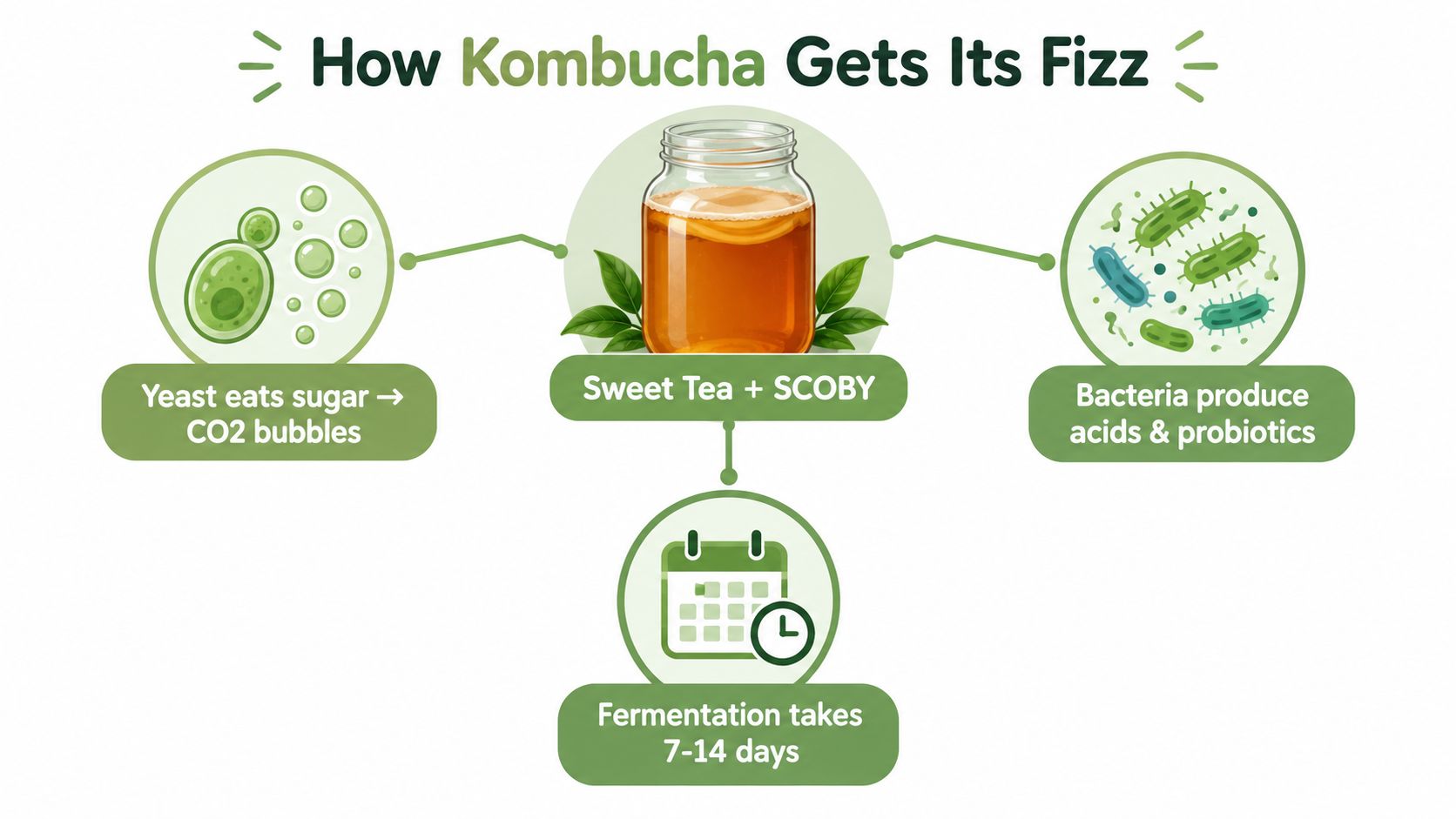
Why the same drink can taste so different
Several details influence the final bottle:
- Tea base: Black tea can bring deeper, malty notes, while green tea often tastes lighter and more delicate.
- Fermentation progress: More fermentation can reduce sweetness and increase tartness.
- Flavour additions: Ginger, lime, mango, berries, herbs and citrus can soften, brighten or intensify the fermented character.
- Bottle handling: Continued fermentation can affect carbonation, flavour and alcohol content if the product isn't stored as directed.
Acidity is central to the experience. Published kombucha samples have been measured around pH 3.0, and a low pH helps explain why first-time drinkers may find the drink sharply tart. Some finished samples contained very little residual sugar, including 1.11 g/L sucrose, 1.87 g/L glucose and 0.05 g/L fructose, as reported in CHOICE's kombucha guidance.
Sediment is another normal point of confusion. A small amount of cloudiness or sediment can come from tea particles, flavour ingredients or fermentation material. It doesn't automatically indicate poor quality, but a beginner who wants a smooth drink may find a low-sediment style more approachable.
What Beginners Should Realistically Expect From Kombucha
Your first bottle may taste closer to a tart sparkling tea than to soft drink. Kombucha can replace soft drink, juice or an alcoholic beverage, but it is not a guaranteed wellness solution. It may contain live cultures and acids created during fermentation, although the strength and relevance of health claims differ between products and human evidence remains limited. For a fuller look at what the drink can and cannot do, read the benefits of kombucha.
Australian coverage has pointed out that many kombucha health claims come from laboratory or animal research. A review discussed by ABC News found no clear scientific basis for common claims about mental-health benefits. Kombucha can still be an enjoyable drink. Choose your first bottle for its taste, ingredients and label clarity, rather than promises that sound medical.
A better definition of “healthy”
A sensible beginner choice has:
- A sugar level you're comfortable drinking regularly
- An ingredient list you can understand
- A flavour you'll enjoy
- Storage directions that are easy to follow
- Alcohol information that matches your needs
That checklist gives you more useful information than a front label mentioning probiotics. “Live cultures” signals that fermentation has occurred, but it does not tell you whether the drink will be sweet, sharp, cloudy, low in sugar or suitable for your alcohol requirements.
You may also encounter the informal term “cowboy kombucha”, usually describing fermentation with inconsistent control. Homemade kombucha is not automatically unsafe. The practical concern is assessment. Without reliable control of ingredients, acidity, storage and alcohol, a beginner has fewer clear signals about what is in the drink.
The best starter bottle is the one you can understand and enjoy, not the one making the biggest promise.
A low-sugar kombucha can taste more tart when fermentation has progressed further, so less sugar does not necessarily mean a milder drink. If plain kombucha tastes too sharp, try a familiar flavour, chill it thoroughly and pour a small glass to enjoy with food. A low-sediment style can also make the first experience feel more like drinking a clear, flavoured refresher than an unfamiliar fermented mixture.
How to Read the Label and Choose a Beginner Friendly Bottle
The front of a bottle is designed to attract attention. The back label helps you decide whether the drink suits you. Read it in a consistent order, beginning with the nutrition panel and ingredient list rather than the flavour name.
Start with sugar and ingredients
Check the sugar per 100 ml first. Lower sugar can be useful if you're replacing sweet drinks, but it may also come with more noticeable acidity. Compare products within the same category and think about whether you want a daily refresher or an occasional treat.
Next, read the ingredients. Tea, sugar, a fermentation culture, fruit, spices and natural flavour ingredients are easier to assess than a long list of vague additions. Organic certification can also matter if you prefer certified-organic ingredients, although it doesn't remove the need to check sugar, acidity or alcohol information.
Look for clues about texture and taste. A low-sediment style is often easier to drink straight, especially if you're not used to fermentation. Clear storage directions are equally important because kombucha can continue changing when it's handled or stored incorrectly.
Don't assume kombucha is alcohol-free
This is the label check many beginner guides overlook. In a federal survey of fermented soft drinks, 35.2% of samples were below 0.5% ABV, 41.9% were between 0.5% and 1.15% ABV, and sales of kombucha reportedly rose 174% over three years, according to the Australian fermented beverages issues paper.
The same Australian material reported that 64% of tested fermented beverage products were above 0.5% ABV, 25% were above 1.15% ABV, and 15% of alcoholic products had no alcohol warning. Because the figures cover fermented beverages broadly, they shouldn't be treated as the profile of every kombucha bottle. They do show why beginners should verify rather than assume.
NSW Health explains that drinks above 0.5% alcohol by volume must carry an alcohol-content statement under the Australia New Zealand Food Standards Code. In NSW, products above 1.15% ABV are legally considered alcoholic drinks. This matters if you're driving, pregnant, avoiding alcohol for religious reasons or buying drinks for children.
| What to Check | Beginner Friendly Signal | Proceed with Caution |
|---|---|---|
| Sugar | A lower level that suits your normal drinking habits | Very sweet taste or a product that resembles soft drink |
| Ingredients | Clear tea, fermentation and flavour ingredients | Vague or difficult-to-understand descriptions |
| Acidity | A flavour profile described as balanced or gentle | Strong vinegar-like notes if you're new to kombucha |
| Sediment | Smooth or low-sediment appearance | Heavy sediment if texture makes you hesitant |
| Live cultures | Clearly explained fermentation or culture information | Marketing language with no useful product detail |
| ABV | A clearly stated alcohol percentage and storage advice | No clear alcohol statement where you need certainty |
| Storage | Refrigeration instructions that are easy to follow | A bottle stored warm when the label requires chilling |
Before placing a bottle in your basket, use this quick phone checklist:
- Check sugar per 100 ml.
- Scan the ingredient list.
- Look for ABV information.
- Confirm refrigeration and use-by guidance.
- Choose a familiar flavour.
- Pick the smaller commitment if you're uncertain.
The NSW Food Authority's testing also found that 7 products, or 11% of the tested sample, exceeded 1.15% ABV and were non-compliant, and all seven were kombucha, as recorded in its 2022–23 annual food testing report. That finding reinforces a simple rule: label transparency isn't a bonus. It's part of choosing responsibly.
Flavour and Style Guide for First Time Drinkers
Your usual drink preferences can guide your first kombucha choice. Someone who loves lemonade may enjoy citrus or lime. A person who drinks ginger beer might appreciate a warming ginger style. If you normally choose unsweetened sparkling water, a dry, lightly flavoured kombucha may feel closer to home.
Match your palate to a flavour family
Bright and familiar flavours are often the easiest entry point. Ginger brings warmth and a gentle bite, while lime can add a clean, refreshing edge. A Ginger or Lime & Ginger kombucha may work well for someone who wants character without jumping straight into a strongly tart berry or herbal profile.
Tropical flavours such as mango can feel rounder and more recognisable to people who prefer fruit drinks. Mango may be a comfortable choice for a soft-drink drinker, although you should still check the sugar panel rather than assuming a fruit flavour is low in sugar.
Tart and bold flavours can be rewarding once you know you enjoy kombucha's acidity. Berry, hibiscus and herbal combinations may taste sharper, more aromatic or more complex. They're not inferior choices, but they can hide less of the fermented character for a first-time drinker.
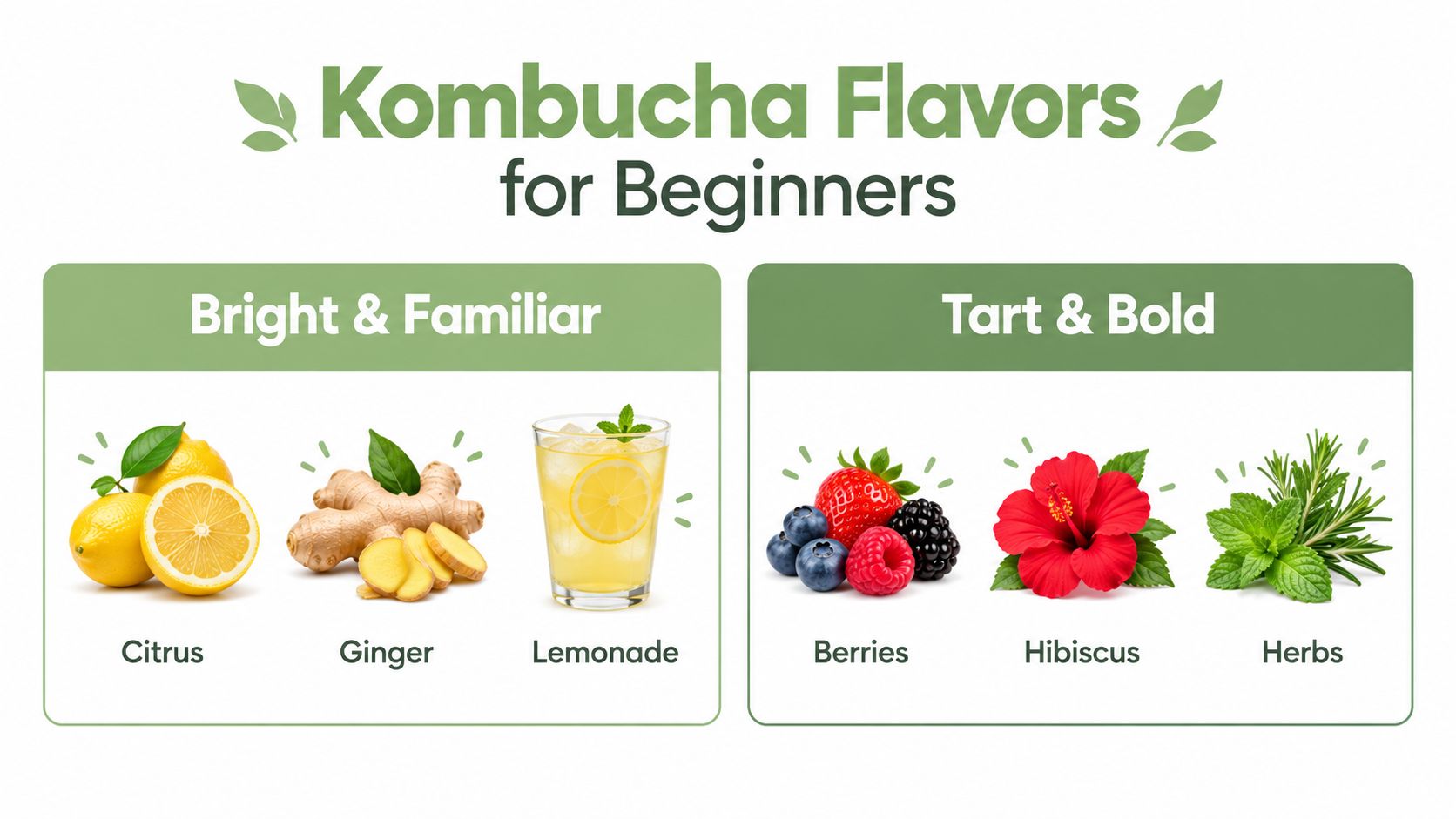
Tea base changes the background flavour. Green tea can give a lighter, fresher impression, while black tea can create deeper tea notes. Neither is automatically more suitable. The better choice depends on whether you prefer delicate or fuller flavours.
Taste it like a café drink
Pour the kombucha into a small glass rather than drinking straight from the bottle. This lets you notice the colour, aroma, bubbles and sediment before the flavour reaches your palate.
Serve it chilled and take a small sip. Wait a moment before deciding. Acidity can feel stronger when you take a large mouthful, while a cold, measured pour often makes the drink seem cleaner and more refreshing.
Try it with food if the first sip feels intense. Salty snacks, a light lunch or a fresh sandwich can make tart flavours feel more balanced. You can also dilute a strongly flavoured kombucha with sparkling water, although that will soften both the flavour and the fizz.
If you're choosing between a familiar flavour and an adventurous one, start familiar. Once you know how your preferred bottle tastes, you can explore bold blends with much more confidence.
Serving Storing and Enjoying Kombucha Every Day
Kombucha is at its easiest when you treat it like a chilled sparkling drink, not a complicated wellness ritual. Refrigerate it as directed, avoid shaking the bottle and pour gently to protect the carbonation.
Serve it cold in a small tulip-shaped glass if you have one. The narrower opening helps hold the aroma and gives the bubbles a little room to rise without immediately disappearing. You don't need special equipment, though. A clean glass and a careful pour make a noticeable difference.
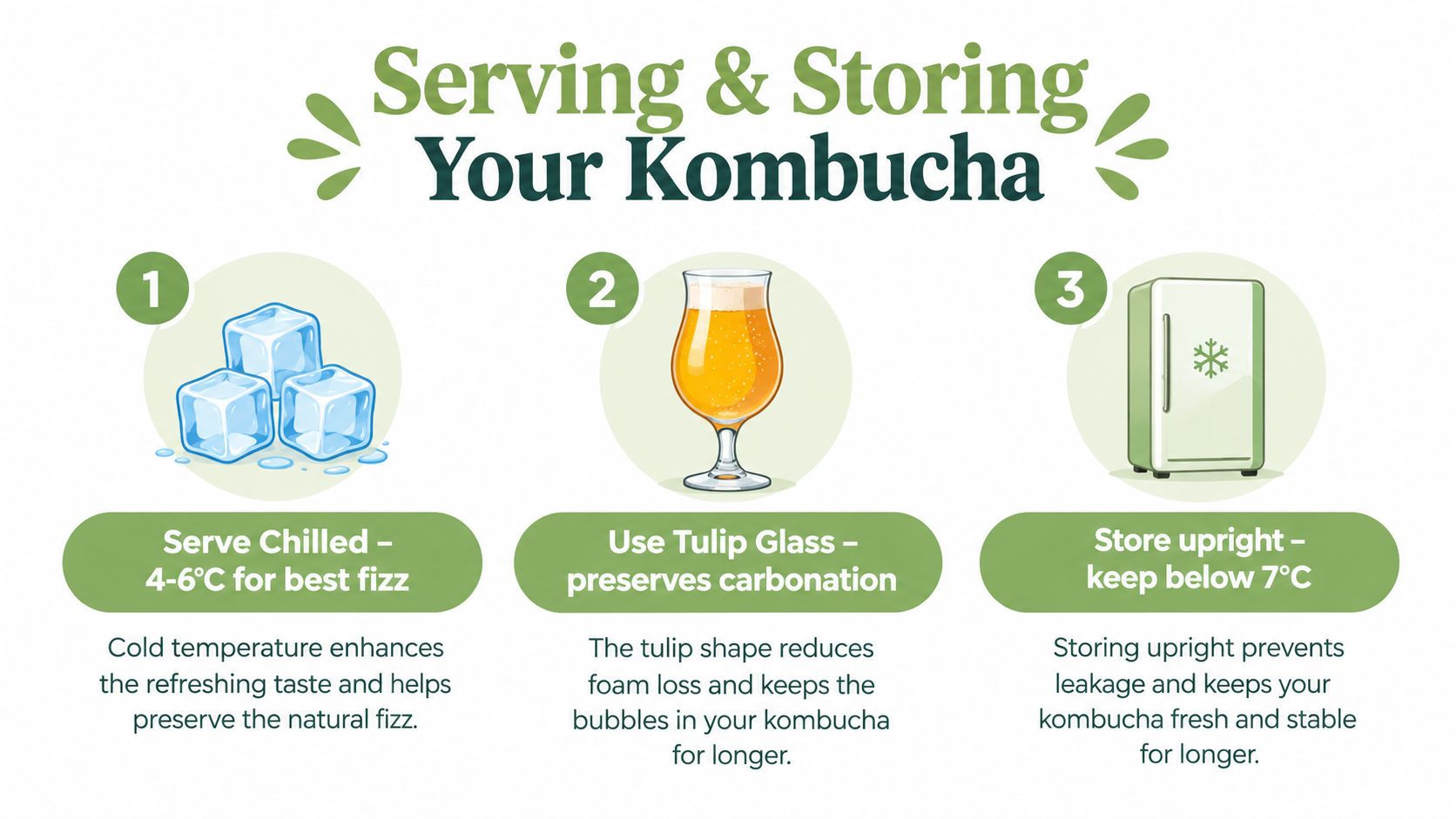
Keep the bottle stable
Fermentation is ongoing biology, so storage affects the drink. Australian kombucha guidance says the tea infusion begins around pH 5, should be cooled quickly from 60°C to 20°C within 2 hours, and should be inoculated with the SCOBY as soon as possible to begin acid production. The guidance identifies pH 4.2 or less as the target for the drink to no longer be potentially hazardous, while a final pH of 2.5 or higher is typical for safe consumption, as outlined in Australian kombucha guidance.
Those production controls aren't something a supermarket customer needs to recreate at home, but they explain why storage instructions matter. Keep commercial kombucha refrigerated when the label says to do so, store it upright where practical and check the bottle before opening.
For more practical guidance, use Pep Tea's kombucha storage guide. If a bottle looks unusually pressurised, smells unpleasant rather than pleasantly tart, or has packaging damage, don't force the issue. Follow the manufacturer's advice or ask the retailer.
Make it part of ordinary occasions
Kombucha can fit into routines without becoming a health assignment:
- Afternoon alternative: Pour it over ice when you want something more interesting than water.
- Soft-drink swap: Choose a lower-sugar style with a flavour you already enjoy.
- Café serve: Offer chilled kombucha in a glass with citrus for a polished non-alcoholic menu option.
- Mixer base: Combine it with sparkling water, herbs or fruit for a simple alcohol-free drink.
- Granita ingredient: Freeze a flavoured kombucha in a shallow tray, scrape it with a fork and serve the ice crystals as a refreshing dessert.
Share the bottle with family or friends if you're still learning what you like. A tasting pour makes it easier to compare ginger, lime, mango or berry styles without committing to a full serving of a flavour that doesn't suit you.
Your Simple Plan to Pick the Best First Bottle
Choosing the best kombucha for beginners comes down to three filters.
First, look for a lower-sugar, low-sediment profile if you want a smooth everyday drink. Lower sugar may mean more tartness, so choose a familiar flavour to keep the first experience approachable.
Second, insist on a clear label. Check ingredients, storage instructions and ABV information. If you need to avoid alcohol completely, don't rely on the word “kombucha” or a general impression that fermented soft drinks are automatically alcohol-free.
Third, pick a flavour that matches something you already enjoy:
- If you like lemonade or sparkling water, try lime or citrus.
- If you like ginger beer, begin with Ginger or Lime & Ginger.
- If you prefer fruit drinks, Mango may feel familiar.
- If you enjoy sour or complex flavours, explore berry, hibiscus or herbal blends.
Start with one chilled bottle, pour a small glass and give your palate time to adjust. The first sip doesn't need to be a verdict on all kombucha. It's information about the balance of tea, sweetness, acidity and fizz you prefer.
For Australian shoppers, Pep Tea's guide to finding organic kombucha is a useful place to explore locally available options. PepTea offers Australian-brewed sugar-free organic kombucha from the Hunter Valley, NSW, including Ginger, Lime & Ginger and Mango styles, so beginners can compare familiar flavours while keeping label transparency and sugar levels in view.
Explore Pep Tea's organic Matcha and Australian-brewed sugar-free organic Kombucha range at Pep Tea, and choose a chilled flavour that suits your palate and everyday routine. If you run a café or hospitality venue, contact the team about practical wholesale options for premium non-alcoholic drinks.