
Tag: pep tea kombucha
Is Kombucha Halal? An Australian Consumer’s Guide
Kombucha often gets treated as a simple health drink question. For many Muslim consumers in Australia, it isn’t simple at all.
The gap is this. Consumers often hear “fermented” and stop at one of two conclusions. Either they assume kombucha must be haram because fermentation creates alcohol, or they assume it must be halal because it’s sold as a wellness drink. Neither shortcut is good enough.
If you’re asking is kombucha halal, the answer depends on a few practical details. The alcohol level matters. The way it’s brewed matters. Scholarly opinion matters. In Australia, local labelling and halal certification also matter.
That’s especially important if you’re buying for a family, stocking a café fridge, or choosing drinks for a Muslim customer base. You need a standard you can use, not vague reassurance.
Your Guide to Kombucha and Halal Explained
Is kombucha halal if it is sold as a health drink, but made through fermentation that can produce alcohol?
That question matters in real life, not just in theory. In Australia, Muslim shoppers are reading bottle labels in Woolworths and health food stores. Cafe owners are deciding what belongs in the fridge. Parents are asking whether a product marketed as natural and probiotic is also suitable for the family.
Kombucha can feel confusing because it sits between two categories people usually keep separate. It is fermented tea. It is also marketed as a non-alcoholic beverage. Once those two facts meet, halal concerns naturally follow.
Islamic dietary rulings work a bit like checking both the ingredients list and the finished meal. A dish is not judged by marketing alone, and a drink is not judged by its name alone either. The practical questions are clearer than they first seem. What was used to make it? What is in the final bottle? Can it intoxicate? Was it produced and labelled in a way a careful Muslim consumer in Australia can verify?
That is why one broad answer rarely satisfies everyone. Some Muslims want formal halal certification. Others look closely at alcohol testing, manufacturing controls, and whether the product stays within Australian non-alcoholic standards. For hospitality venues, the bar is often higher because staff are choosing on behalf of customers, not only for themselves.
If you want a better grounding in how fermented tea is made before judging halal status, PepTea’s explanation of the art of fermented tea is a useful starting point. For a wider food context, this discussion of the principles of fermentation helps explain why fermented foods can raise different questions from ordinary soft drinks.
Simple takeaway: Kombucha is judged by the finished drink, the production method, and the level of alcohol present, not by the word “kombucha” on the label.
That practical approach is especially helpful in Australia, where consumers may see imported kombucha, locally brewed brands, and products with very different labelling standards. It also explains why brands that test carefully and document compliance, including Australian producers such as PepTea, are often easier for Muslim consumers and cafe buyers to assess with confidence.
Understanding Kombucha Fermentation
Kombucha has a simple start. Tea is brewed, sugar is added, and then a SCOBY goes in. SCOBY stands for Symbiotic Culture of Bacteria and Yeast.
That culture does the work of fermentation. The yeast and bacteria feed on the sugar and gradually turn sweet tea into something tart, lightly fizzy, and full of fermentation byproducts.
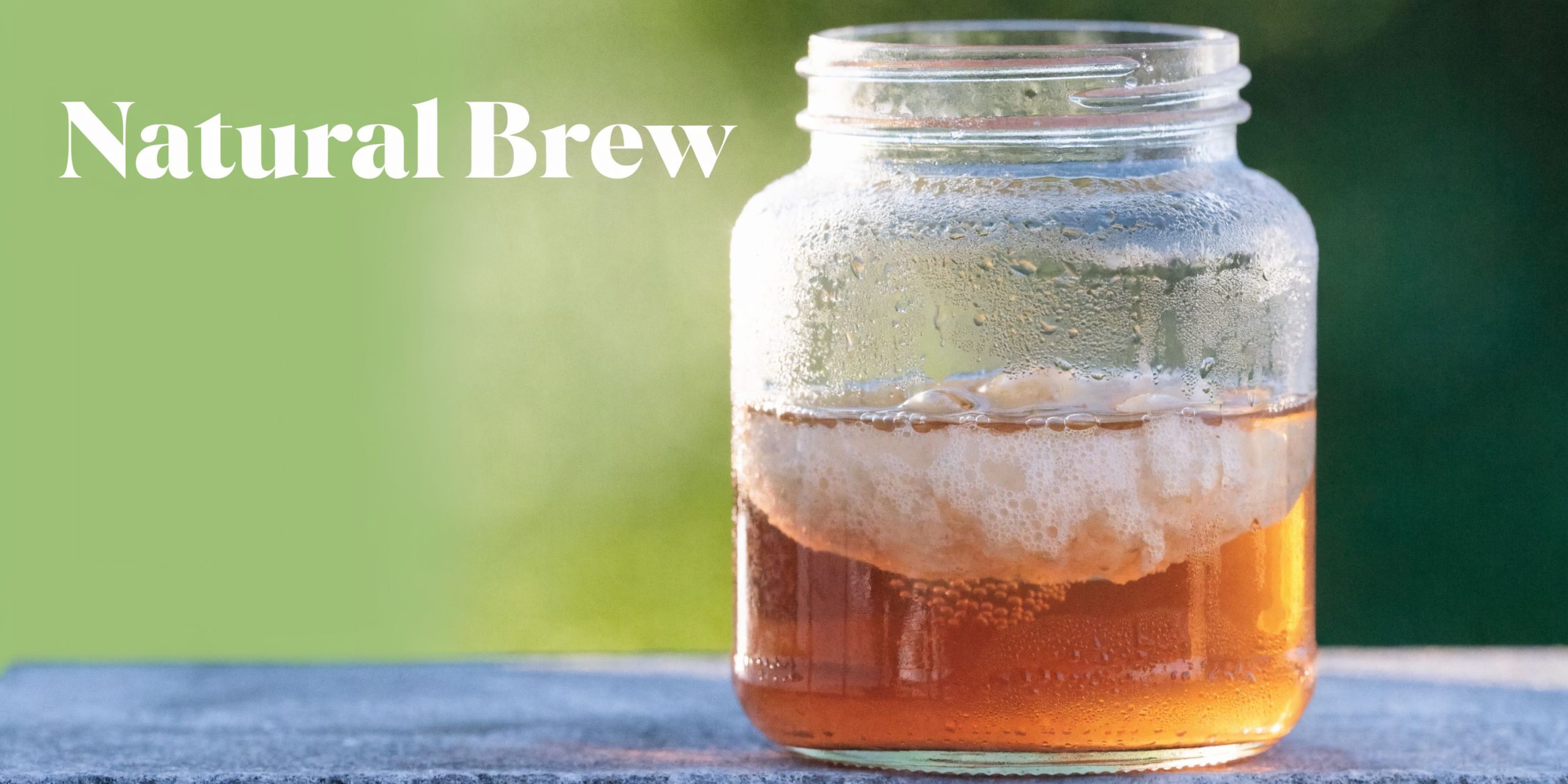
What fermentation is really doing
A simple analogy helps. Think of kombucha fermentation a bit like sourdough baking.
In sourdough, microbes eat sugars and transform the dough. In kombucha, microbes eat sugars and transform tea. The ingredients change, and the finished product is very different from the starting liquid.
If you want a broader explanation of traditional food processes, this discussion of the principles of fermentation is useful because it shows how fermentation changes flavour, stability, and digestibility across many foods.
Why sugar is added if the drink isn’t meant to be sugary
Here, readers often get stuck. They see sugar on the ingredient list and assume kombucha must stay sugary.
That’s not how fermentation works.
The sugar acts like fuel for the culture. The SCOBY consumes much of it during brewing. That’s why a properly fermented kombucha tastes sharper and less like sweet tea.
Why fermentation raises halal questions
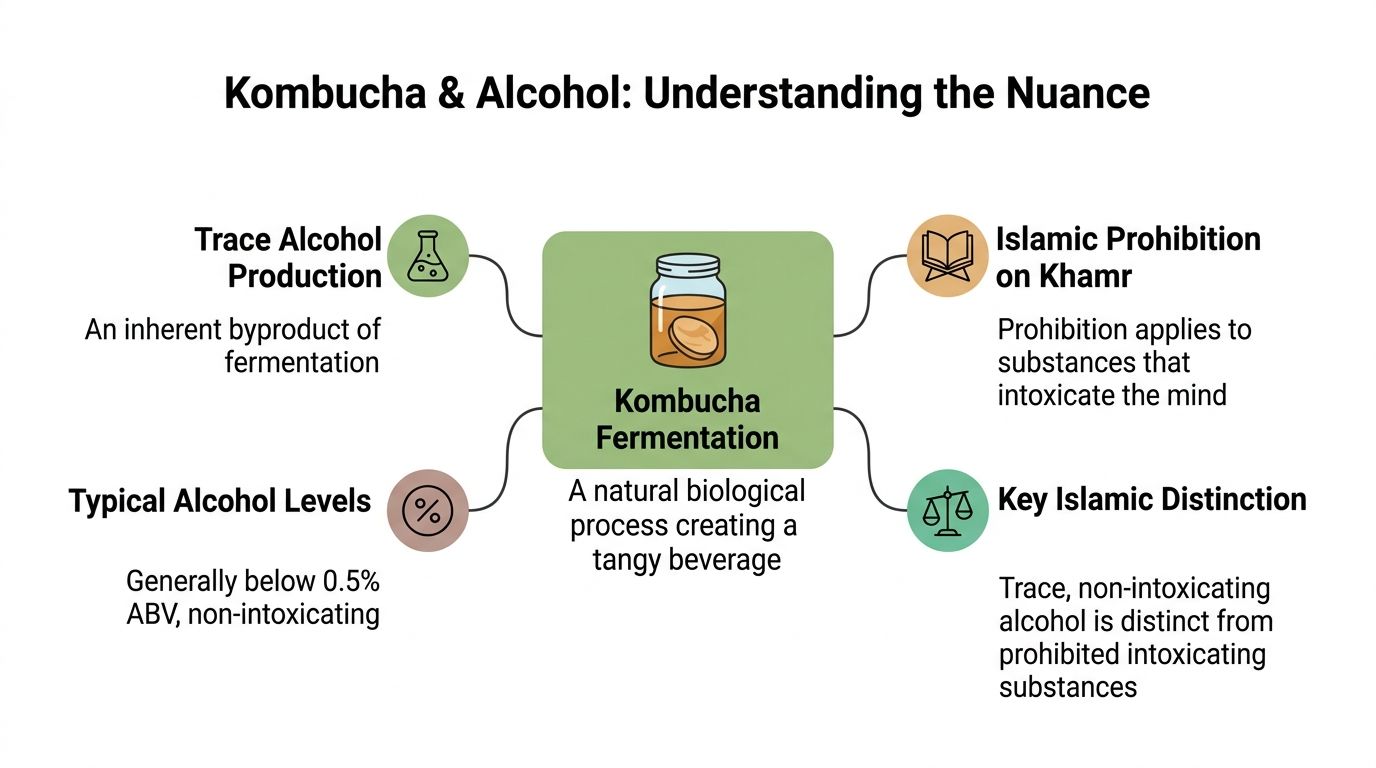
Fermentation can also create trace alcohol as a natural byproduct. That doesn’t mean kombucha is brewed as an alcoholic drink. It means the same natural microbial process that creates acidity and fizz can also produce a very small amount of ethanol.
That single detail is what drives most of the halal discussion.
For readers who want a deeper look at how real fermented tea differs from quick, simplified versions, Pep Tea’s article on the true art of fermented tea is a practical companion.
The Critical Question of Alcohol Content
Could a drink be fermented, contain a trace of alcohol, and still be treated differently from an alcoholic beverage in halal decision-making?
That is the key question with kombucha. For Muslim consumers and café owners in Australia, the answer usually comes down to two practical points. How much alcohol is present in the finished drink, and is the product sold and consumed as an intoxicating beverage.
In day-to-day retail practice, 0.5% ABV is a common reference point for non-alcoholic drinks. FSANZ explains how foods and beverages must be labelled for alcohol content, including the threshold at which alcoholic beverages require an alcohol declaration, which helps Australian buyers understand what they are looking at on a shelf or café menu (Food Standards Australia New Zealand alcohol labelling guidance). For halal assessment, that number is not the whole ruling on its own, but it is often the first practical checkpoint.
Commercial kombucha and homebrew are not the same thing
A professionally brewed kombucha works like a recipe followed in a commercial kitchen. Time, temperature, sugar, and storage are controlled so the final drink stays consistent from batch to batch.
Homebrew is less predictable. If fermentation keeps going longer than planned, alcohol can keep rising too. That uncertainty matters for halal-conscious households and for cafés that want to serve kombucha with confidence.
For the clearest halal option, professionally brewed and clearly labelled kombucha is usually easier to assess than an untested homemade batch.
Why a trace amount does not settle the ruling by itself
Islamic law does not usually assess fermented foods by scanning the ingredient list for one word and stopping there. It asks what the finished product is, what effect it has, and how people use it.
A simple comparison helps here. Vanilla extract, vinegar, bread dough, kefir, and kombucha all involve processes that can produce tiny amounts of alcohol at some stage. That does not place every fermented product into the same category as wine or beer. The legal and practical question is whether the drink is intoxicating in its final form.
That is also why people compare kombucha with other drinks sold as non-alcoholic. Can You Get Drunk on Non Alcoholic Beer? offers a plain-language way to understand the difference between trace alcohol and actual intoxication.
What Australian buyers should check
An Australian shopper or café manager does not need to become a fermentation scientist. A few careful checks go a long way.
- Read the label closely. Look for any stated alcohol content and whether the product is presented as standard kombucha or hard kombucha.
- Ask how the brand controls fermentation. A producer that explains testing, cold storage, and batch consistency makes assessment easier.
- Check where it is sold. A kombucha in the soft drink fridge is not automatically halal, but retail context can still help you spot whether it is being marketed as a non-alcoholic refreshment or an alcoholic drink.
- Look for brand transparency. This matters in Australia, where Muslim consumers often rely on a mix of label information, supplier answers, and local trust.
For readers comparing alcohol-free drink options in a practical Australian setting, Pep Tea’s guide to kombucha for a healthier dry January shows how some brands position kombucha as a non-alcoholic alternative while keeping production standards clear.
Navigating Different Islamic Scholarly Opinions
The most common ruling you’ll hear is that kombucha is permissible when it remains non-intoxicating and the alcohol is only a trace byproduct of fermentation. But there isn’t just one view, and pretending otherwise doesn’t help anyone.

The majority view
Most scholarly opinions discussed in halal guidance focus on intoxication. In that approach, the prohibition applies to substances that function as intoxicants, not every food or drink that contains a negligible fermentation byproduct.
That’s why many scholars permit kombucha when it stays under the accepted threshold and doesn’t alter the mind. The reasoning is that the final drink is not consumed as alcohol and does not behave like an intoxicating beverage.
A useful way to understand this is by thinking about intent and effect together. A vinegar-like ferment with trace alcohol left over from a natural process is treated differently from a beverage produced for intoxication.
The minority and stricter view
There is also a stricter opinion that some Muslims follow. According to the verified data, while most scholars permit kombucha with less than 0.5% ABV, some interpretations, such as rulings from Shia authority Ayatollah Sistani, deem it haram regardless of the percentage. That matters in Australia because the Shia Muslim community is estimated at around 20% to 25% of the total 813,400 Muslims in the country (reference).
So the answer to is kombucha halal may differ depending on whose ruling you follow.
Some Muslims ask, “Is this generally halal?” Others ask, “Is this halal according to my marja or school?” Those are related questions, but they are not identical.
A short explainer can help if you want to hear a spoken overview before making up your mind:
A practical way to handle the difference
If you follow the majority Sunni position, the main issue is usually whether the kombucha is non-intoxicating and properly controlled.
If you follow a stricter Shia ruling, you may choose to avoid kombucha altogether, even when brands present low alcohol test results. That isn’t confusion. It’s a different legal standard.
For households, cafés, and event organisers, the safest approach is to ask one more question before serving kombucha to a mixed group: Are you looking for a general halal standard, or one that also accommodates stricter interpretations?
That question prevents awkward assumptions.
Finding Halal Kombucha in Australia
Once you know the ruling depends on the finished product, shopping gets easier. You don’t need to guess. You need to verify.
In Australia, halal certification plays a practical role here. According to the verified data, Australia has over 70 registered halal certifiers, and bodies such as AFIC certify fermented drinks like kombucha when they are non-intoxicating and contain less than 0.5% ABV. The same source notes this matters for Australia’s 813,392 Muslims (reference).
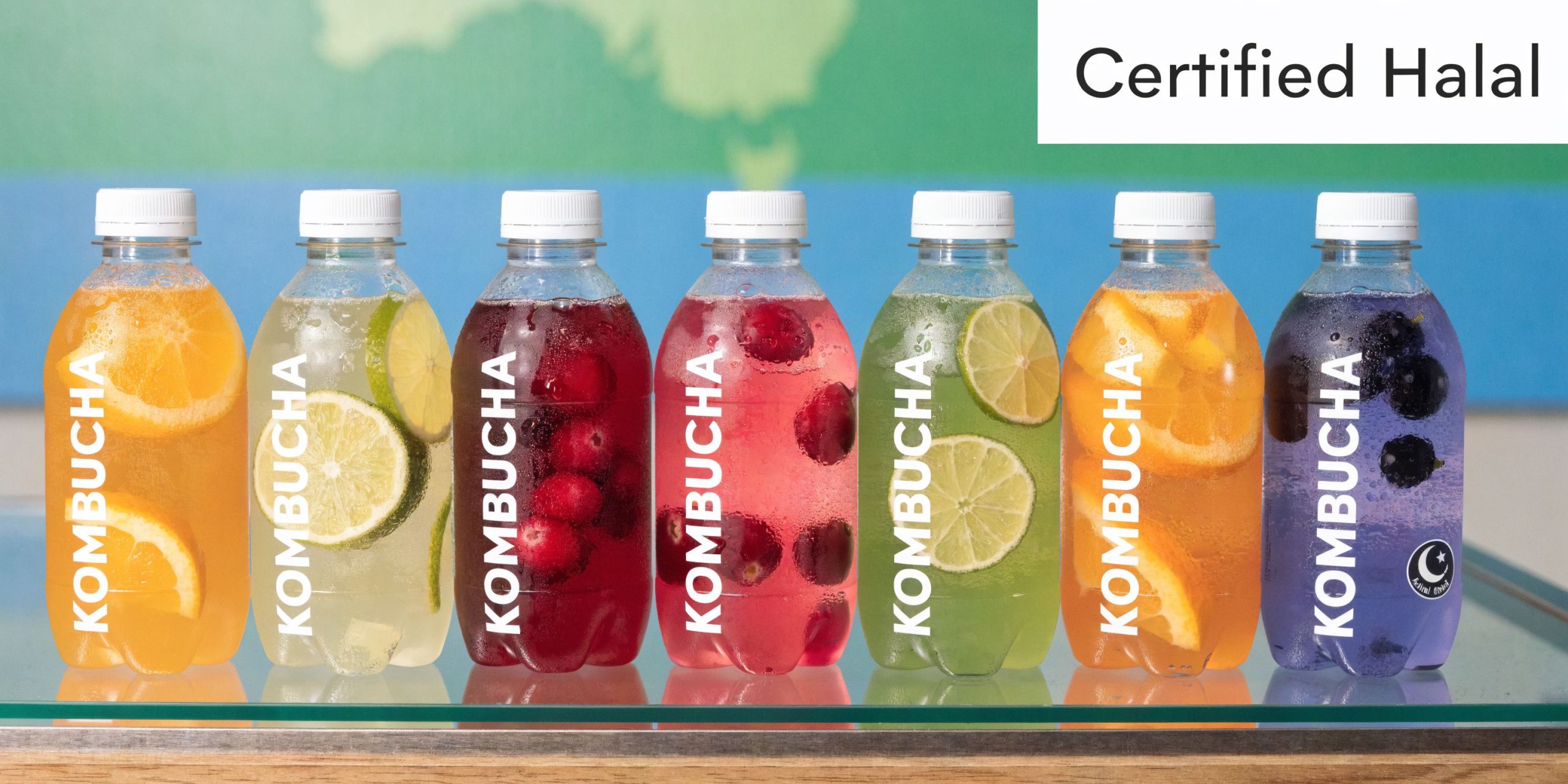
What to look for on the bottle or website
A strong label won’t always answer every faith-based question, but it can answer several practical ones.
Look for:
- Halal certification marks from recognised Australian certifiers.
- Non-alcoholic or low-ABV disclosure that’s easy to find.
- Ingredient transparency so you can rule out other concerns.
- Brand contact details in case you want to request more information.
If a brand is serious about Muslim consumers, it should be ready to explain its process in plain language.
Questions worth asking a brand
You don’t need a chemistry degree. A short email can do the job.
Ask:
- Is your kombucha tested for alcohol content?
- Does it remain below the accepted halal threshold?
- Is it produced in a controlled commercial facility?
- Do you hold halal certification, or can you provide batch information?
A trustworthy producer won’t treat those questions as inconvenient. They’ll see them as part of responsible food transparency.
If you’re buying locally and want to compare Australian options, Pep Tea’s guide on where to buy organic kombucha in Australia is a useful place to start.
For café owners and retailers
If you’re serving a diverse customer base, don’t rely on “it should be fine.”
Keep product information on file. Train staff to answer basic questions. If a customer asks whether the kombucha is halal, the best response is specific and calm: “This is a commercially brewed kombucha, and we can show you the producer’s information.”
That level of care builds trust fast.
A Practical Guide for Cafes and Consumers
For most buyers, the safest choice isn’t the most complicated one. It’s the most verifiable one.
The verified data points to several critical control points for halal kombucha. These include using halal-certified SCOBYs, ensuring ingredient purity, and monitoring batches to keep alcohol levels consistently below 0.5% ABV. It also notes that professional brewers using UV-sterilised equipment and pH monitoring in HACCP-accredited facilities can provide a Certificate of Analysis to verify compliance (reference).
What this means for consumers
If you’re buying kombucha for yourself or your household, your decision can be very practical.
Choose products that are professionally brewed, clearly labelled, and easy to verify. If a brand is vague about alcohol testing, ingredient sourcing, or production standards, that’s a sign to slow down.
A careful buyer usually does three things:
- Checks the process: Controlled fermentation matters.
- Asks for proof: A Certificate of Analysis can remove guesswork.
- Avoids uncertainty: Homebrew may be enjoyable, but it’s harder to assess from a halal perspective.
What this means for cafés
For cafés, restaurants, and caterers, the issue is bigger than one bottle in the fridge. It’s about what you can confidently tell customers.
A venue that stocks kombucha without understanding the product can create confusion. A venue that keeps supplier documentation, trains staff, and chooses professionally brewed options can answer questions with confidence.
Here’s a simple service standard:
| Venue task | Why it matters |
|---|---|
| Keep supplier specs on file | Staff can respond clearly to halal questions |
| Prefer professionally brewed kombucha | Controlled production lowers uncertainty |
| Ask for a CoA when needed | Helps verify low alcohol compliance |
| Separate standard and hard kombucha | Prevents customer confusion |
For hospitality businesses, that clarity matters just as much as flavour and presentation.
Conclusion Your Informed Choice
So, is kombucha halal?
For many Muslims in Australia, the practical answer is yes, if it is commercially produced, non-intoxicating, and kept below the accepted alcohol threshold. That is the position reflected by many halal certification approaches and the majority scholarly view discussed earlier.
But that isn’t the only answer in circulation. Some Muslims follow stricter rulings and may avoid kombucha entirely. That choice deserves respect.
The most useful way to make a decision is to stop thinking in labels alone and start thinking in evidence. Ask what kind of kombucha it is. Check whether it’s professionally brewed. Look for transparent alcohol information or halal certification. If needed, ask the brand directly.
The best halal decisions are often the clearest ones. Choose products that remove doubt rather than products that require you to guess.
For cafés and retailers, the same principle applies. A verified product is easier to serve responsibly than a trendy product with unclear standards.
Kombucha doesn’t need to be a grey area. With the right questions, it becomes a manageable choice.
Frequently Asked Questions
Does NSW alcohol labelling change the halal answer
Not necessarily, but it can confuse people.
According to the verified data, 2025 NSW food labelling laws define anything under 1.15% ABV as “low alcohol”, and a 2025 Halal Australia survey found 35% of Sydney Muslims avoid kombucha due to “fermentation uncertainty” (reference).
That means a product could fit one legal label while still raising halal concerns for consumers who use a stricter threshold. Legal compliance and halal comfort are related, but they are not identical.
Is hard kombucha halal
Hard kombucha is generally treated differently from standard kombucha because it is made to have a higher alcohol content. For halal-conscious consumers, that usually places it outside the category of non-intoxicating fermented tea.
Is homemade kombucha halal
Homemade kombucha is harder to assess because fermentation is less predictable outside a controlled commercial setup. If there is no testing, many consumers will see it as doubtful.
What should I ask before buying kombucha from a café
Ask whether it is standard kombucha or hard kombucha, whether the brand provides alcohol information, and whether the product is halal-certified or backed by batch testing.
Quick Guide to Kombucha Types and Halal Status
| Kombucha Type | Typical ABV | General Halal Ruling |
|---|---|---|
| Commercial kombucha with verified low alcohol | Below 0.5% ABV | Generally considered halal by the majority view |
| Homemade kombucha without testing | Can vary | Doubtful unless verified |
| Homemade kombucha that exceeds accepted threshold | Above accepted halal threshold | Generally not halal |
| Hard kombucha | Alcoholic | Generally not halal |
| Kombucha for consumers following stricter Shia rulings | Even if below 0.5% ABV | May still be considered haram according to that view |
If you’re looking for Australian-made kombucha and organic tea with a strong focus on quality, transparency, and everyday wellness, explore Pep Tea. We offer premium organic matcha and proudly brewed NSW kombucha for households, cafés, and retailers who want cleaner, more considered drink options.