
Tag: tea brewing machine
Automatic Tea Maker Guide for Australian Homes and Cafés
The most popular advice about an automatic tea maker is also the least useful: buy the most advanced machine you can afford and great tea will follow. It won't. A machine can control water temperature, steeping time and basket movement, but it can't choose the right tea, judge freshness or replace a thoughtful brewing routine.
For some Australian homes, a kettle with temperature control and a timer is the better purchase. For a busy café, office or self-service station, automation may earn its bench space through repeatability and reduced handling. The right decision depends on how often you brew, which teas you use, how much adjustment they need and who'll clean the equipment.
Do You Really Need an Automatic Tea Maker
An automatic tea maker solves a practical problem, not a romantic one. It can heat water to a selected temperature, lower an infuser, lift it at the end of a programmed steep and keep the finished tea warm. That's valuable when several people want the same drink or staff need to repeat a recipe without watching a timer.
At home, the case is less obvious. If you usually make one mug of black tea, a standard kettle and a reliable timer may do everything you need. A temperature-controlled kettle becomes more useful when you switch between green tea, black tea, herbal infusions and delicate organic blends, because each style can need a different approach.
Start with your actual routine
Ask yourself:
- Frequency: Do you brew repeatedly throughout the day, or only occasionally?
- Variety: Do you mostly drink one tea, or change between styles?
- Consistency: Does the same person prepare every cup, or do several users share the equipment?
- Cleaning: Will you rinse the basket and jug after use, even on busy mornings?
- Workflow: Do you enjoy measuring, timing and whisking, or would you rather press a button?
An automatic tea maker makes the strongest argument when consistency matters more than ritual. A café serving a house black tea, an office supplying staff drinks or a household preparing several cups may benefit from programmed brewing. A tea enthusiast who adjusts every infusion by taste may find the machine restrictive.
The appliance market is moving towards more automated, higher-specification formats, including precision temperature control, digital interfaces and automated cleaning. A recent Australian coffee-machine market model describes value growth outpacing unit growth and projects shipments from about 650,000 units in 2025 to 862,000 in 2031, but that evidence comes from coffee machines, not automatic tea makers, so it shouldn't be treated as proof that every tea drinker needs one. The Australian coffee machine market model supports a more careful conclusion: buyers increasingly pay for convenience when it solves a real workflow problem.
Practical rule: Buy automation for repeated work, not because a complicated control panel makes tea sound more serious.
The Surprising Australian History of Automatic Tea Makers
Automatic tea makers aren't a new response to busy mornings. Australia's documented connection with the category reaches back to the pre-war electric-appliance era.
The Museum Victoria collection includes a Goblin automatic tea-maker used in Toorak, Victoria. Its record identifies the appliance as made in England by 1936 or earlier, with later models commonly marketed as “Teasmade”. Independent Australian collection records also trace the electric tea-maker patent line to the early 1930s, including William Hermann Brenner Thornton's 1933 patent, which was sold to the British Vacuum Cleaner and Engineering Co. That company commercialised the Goblin Teasmade. Museum Victoria's Goblin automatic tea-maker record provides a useful local link between an imported appliance and Australian household use.
The early design was straightforward in principle. A timer arranged for water to heat and tea to brew, turning a morning drink into a scheduled domestic task. Wartime interruption affected availability, but the category returned to public attention after the war.
From novelty to household familiarity
The Powerhouse Collection records that Teasmades returned to popularity after wartime interruption. By the late 1960s, about 300,000 units were sold annually in the UK and some Commonwealth countries, according to the collection history. Collections WA's Teasmade record adds that Teasmades peaked during the 1960s and 1970s, declined afterwards and experienced a partial revival in the 2000s as a retro novelty.
That history matters for Australian buyers because it shows the appliance wasn't just a modern gadget invented for digital kitchens. Commonwealth distribution helped move automatic tea-making from a niche invention towards broad household familiarity, even though Australia wasn't necessarily the main manufacturing base.
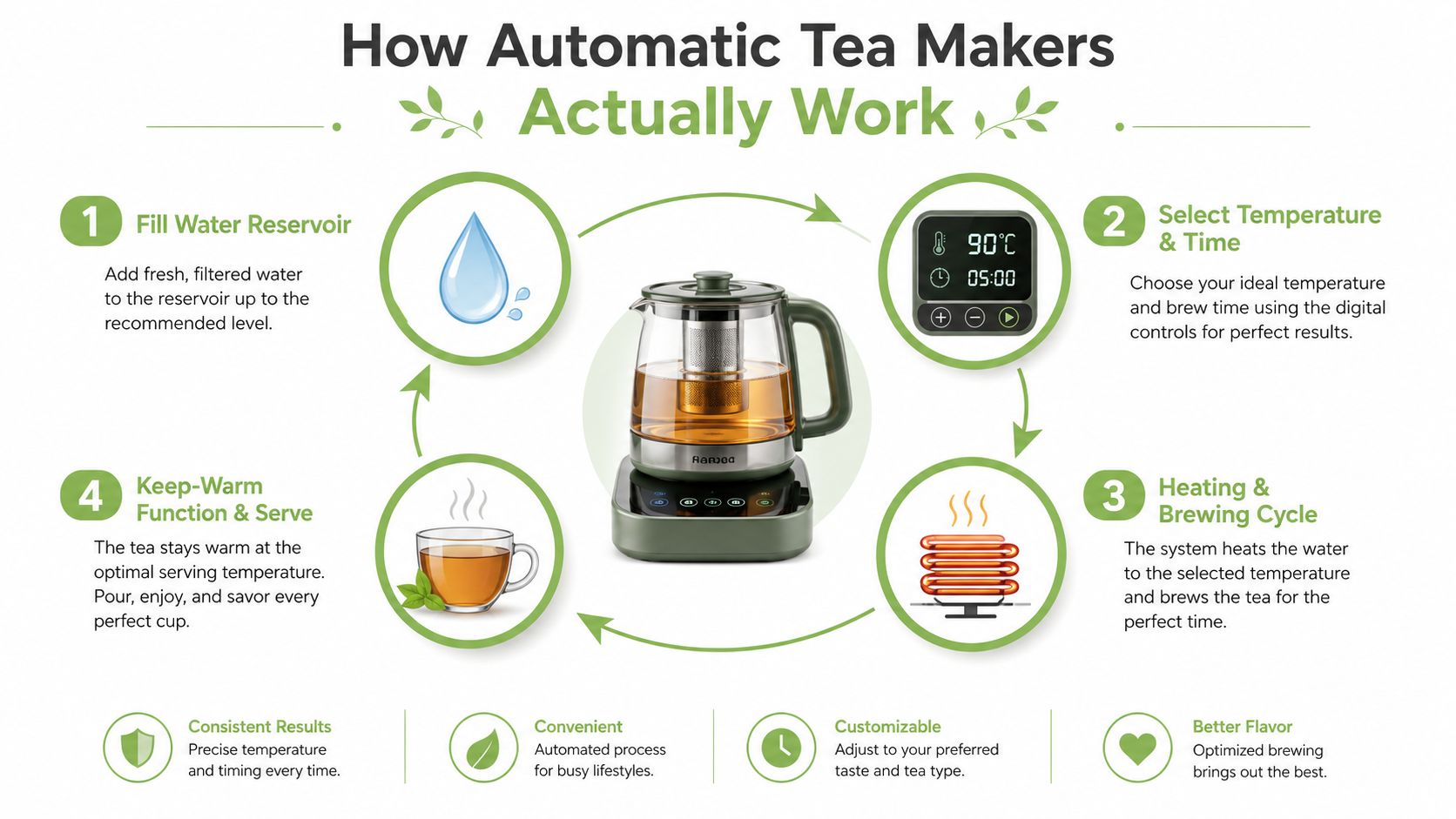
The modern machine adds temperature sensing, programmable steeping and more deliberate control over extraction. The underlying promise remains familiar, but the technology has moved beyond waking someone with a cup of hot tea.
How Automatic Tea Makers Work
An automatic tea maker combines a kettle, timer and infuser in one unit. The heating element raises the water towards the selected temperature, while a sensor checks the water rather than relying only on heating time.
Starting temperature, water volume and the surrounding environment all affect heating speed. A higher wattage rating can shorten the wait, but sensor feedback helps the machine stop at the intended temperature.
Four parts that affect the cup
Heating element: This supplies the energy for heating. More power may produce faster results, but it does not by itself create suitable brewing conditions.
Temperature sensor: The sensor checks the water and helps the controller hold the selected setting. That control is useful when switching between green tea and black tea.
Infuser basket: Loose leaves sit in the basket as water moves around them. With auto-lower and auto-lift functions, the basket enters the water at the beginning and rises when the programmed steep ends.
Keep-warm function: The heater maintains the drink after brewing. This can help an office or café serve several cups from one cycle, although tea can change in flavour if it remains hot for too long.
Australian brewing guidance places green tea around 80–85°C and black tea around 90–95°C. CoffeePlus's Australian tea brewing temperature chart shows why a temperature setting offers more control than a basic “boil” function. Hotter water extracts compounds faster, which can make delicate green tea bitter, while black tea generally suits a higher range.
A programmable basket replaces the hand movement of lifting an infuser. It does not make every tea identical, so tasting and adjustment still matter.
A manual workflow can be just as practical. A French press gives a clear view of the steep, making these french press tea recipe tips useful for comparing hands-on infusion with a programmed cycle. For organic matcha, neither method replaces whisking the powder into a smooth suspension. Kombucha also calls for separate preparation and fermentation control, rather than a hotter or longer tea cycle.
Automation therefore suits repeatable leaf-tea brewing, especially where several servings follow the same recipe. A kettle and infuser may offer better control for small batches or changing teas.
Home Kitchen Versus Café Environment
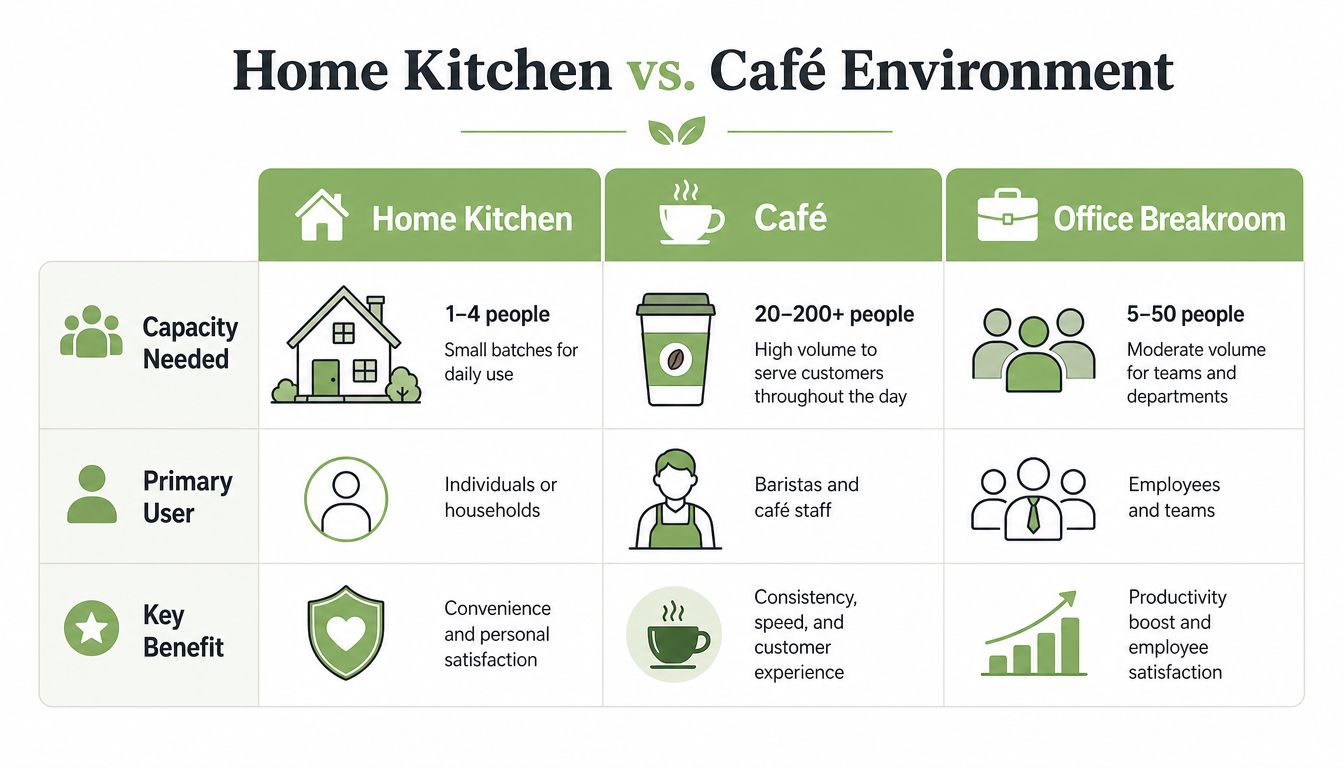
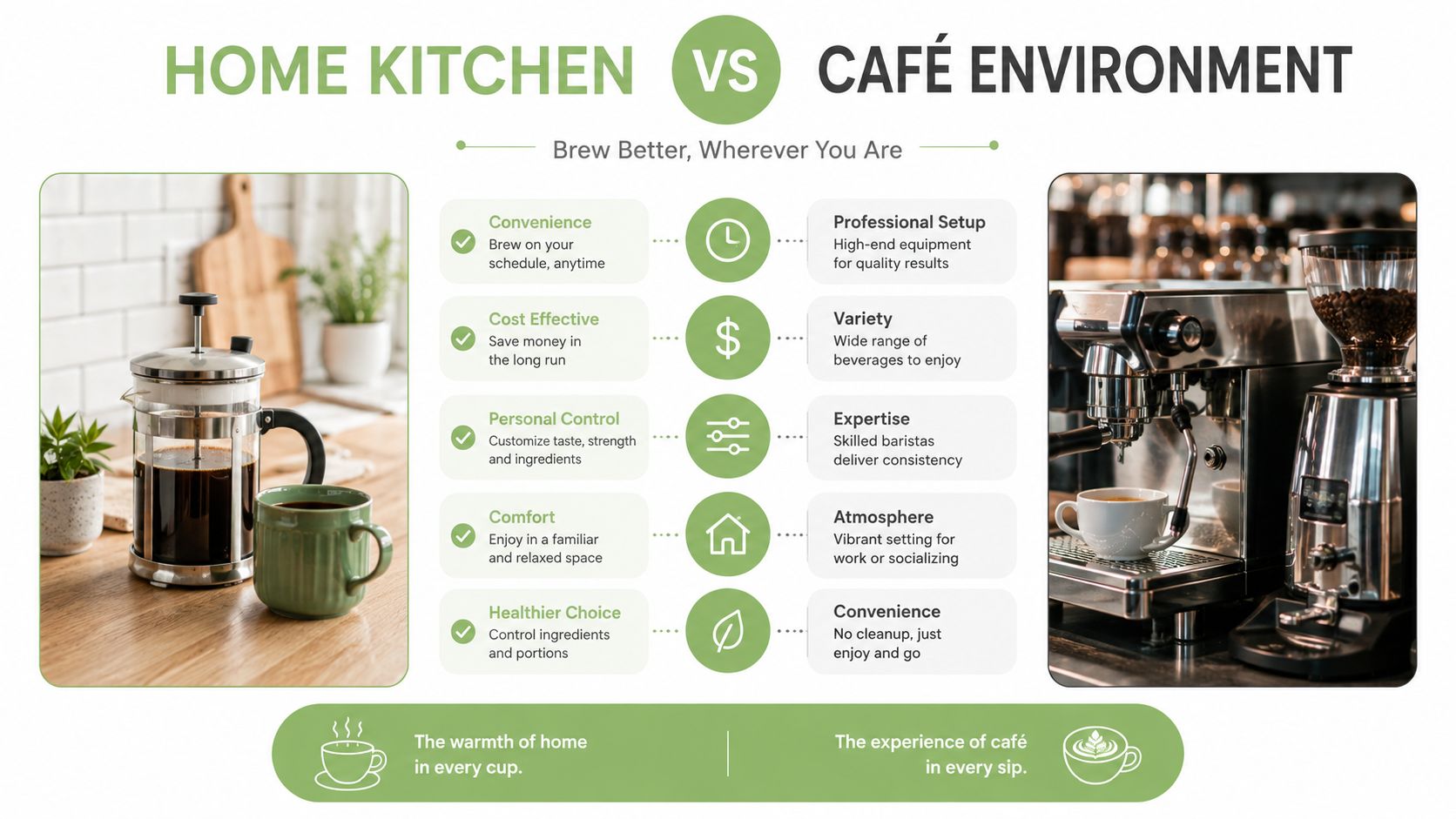
The same automatic tea maker can feel luxurious at home and inadequate in a café. The difference isn't only capacity. It's the number of people using the machine, the number of tea styles on the menu, the pace of service and the consequences of an inconsistent cup.
Home kitchen
A home user often values flexibility. You might prepare ceremonial matcha in the morning, a green tea later and a herbal infusion at night. An automatic tea maker can simplify water heating, but it won't replace the separate whisking step required for matcha, and a single jug may need careful rinsing between strongly flavoured teas.
A manual kettle and infuser may be the better fit when you enjoy changing variables. You can shorten a steep, add more leaves or pour immediately when the aroma reaches the right point. Automation is more attractive for households that prepare multiple cups, want repeatable temperature settings or dislike monitoring the clock.
Café and hospitality
A café has a stronger operational case. Staff can use programmed settings for a core tea menu, reducing variation between shifts. Portion control and self-service can also matter in hotels, diners and venues operating around the clock. Australian listings already market automated tea solutions to these environments, but the machine still creates work through refilling, rinsing, descaling and checking the basket.
Use automation for repeatability, not for every drink. A specialty tea program may need manual adjustment for delicate leaves, botanical blends or unusual steeping sequences. Before buying, find efficient prep tools and map the full workflow, including storage, cleaning and service space.
Office breakroom
An office sits between the two. Users may want simple operation and predictable results, but they won't always share the same tea preferences or clean equipment carefully. Clear labels, a limited set of presets and an accessible rinse routine can matter more than advanced customisation.
For menu planning, pair the equipment decision with practical café menu ideas. A tea station can support a broader non-alcoholic offering, but only if the chosen drinks match the machine's capacity and cleaning demands.
Key Features and Specifications to Evaluate
A good specification sheet should answer a simple question: will this machine protect the tea and fit the workflow? Capacity, wattage and digital controls matter, but they don't matter equally.
The Breville Tea Maker BTM800 offers a useful Australian benchmark. It has a 1.5 L capacity, five preset temperature settings, three tea-strength presets, an auto-lower and auto-lift basket, a temperature sensor, a 60-minute keep-warm function and 2000 W heating power. Breville's BTM800 product information shows the feature combination buyers should examine rather than judging the machine by wattage alone.
Temperature control comes first
Green tea and black tea don't share the same ideal brewing range. A machine that only boils water may be convenient, but it gives you less control over extraction. An Australian automatic tea-maker instruction booklet describes adjustment in 5°C increments from 70°C to 100°C, while also setting separate volume limits for heating and brewing. The Australian instruction booklet illustrates how small temperature steps can support different tea styles.
| Tea Type | Temperature Range | Key Consideration |
|---|---|---|
| Green tea | 80–85°C | Lower heat helps preserve delicate aroma and reduce harsh extraction. |
| Black tea | 90–95°C | Higher heat supports a fuller infusion. |
| Matcha preparation | Around 80°C | Heat water first, then whisk the powder separately. |
| Herbal or botanical blends | Follow the product guidance | Ingredients vary, so don't assume one preset suits every blend. |
Read beyond the headline features
- Basket movement: Auto-lift is useful because it ends contact between leaves and water. Confirm that the mechanism is easy to remove and rinse.
- Capacity: Choose enough volume for your normal service, not an imagined peak. A larger jug can also mean more water and tea left sitting warm.
- Keep-warm duration: This supports staggered serving, but it isn't a substitute for brewing fresh when flavour is the priority.
- Material and handling: Look for a clear jug, readable fill markings, stable controls and components that can be cleaned properly.
- Wattage: Treat power as a heating specification, not a quality score. Sensor accuracy and basket timing have a more direct relationship with extraction.
If you're mainly interested in controlled water temperature rather than automated steeping, an electric tea kettle with temperature control may deliver the simpler solution.
Integrating Automatic Tea Makers with Matcha and Kombucha
An automatic tea maker can support matcha and kombucha, but it shouldn't be used in exactly the same way for both.
Matcha is finely ground powder, not loose leaf. The machine can heat water to a suitable temperature, but you'll still need a bowl, whisk and proper mixing technique. For a delicate ceremonial-grade matcha, water around 80°C is a sensible starting point within the Australian green-tea guidance range. Pour the heated water over the powder and whisk until smooth rather than placing matcha directly into a basket designed for leaves.
A practical matcha workflow
- Heat fresh water using the machine's temperature setting.
- Sift matcha into a bowl to reduce clumps.
- Add a small amount of the heated water.
- Whisk briskly until the powder disperses.
- Add more water or chilled milk for a latte.
For an iced matcha latte, cool the prepared matcha over ice before adding milk. The appliance handles the temperature-controlled water, while you retain control over texture and strength.
Kombucha uses a different process. An automatic tea maker can produce a consistent green or black tea base, but the tea must cool before it meets a SCOBY and fermentation culture. Hot water is useful at the extraction stage. It's not suitable for live cultures.
Keep the stages separate
Brew the tea base, dissolve any recipe ingredients according to your method, then allow the liquid to cool before fermentation. Don't use the machine as a kombucha fermenter, and don't place a SCOBY or finished live kombucha in the jug. For broader functional beverage ideas, explore this immune-supporting drink guide while keeping health language realistic. Matcha may contribute antioxidants and naturally occurring L-theanine, and kombucha can provide a low-sugar fermented option, but neither drink replaces medical care or a balanced diet.
Maintenance Routines and Troubleshooting Common Issues
Tea leaves leave fine particles, tannins and aromatic oils behind. Australian tap water can also deposit minerals around the heating element and temperature sensor. Over time, that buildup may produce stale flavours, slower heating or inconsistent temperature readings. For cafés, these faults can appear first during busy service, when repeated cycles expose weak cleaning habits.
Follow the manufacturer's instructions for descaling products and dishwasher-safe parts. Keep daily rinsing separate from periodic scale removal, because a clean basket cannot remove deposits inside the heating area.
A workable cleaning rhythm
- After each use: Empty the basket, rinse away leaves and wash the jug if residue remains.
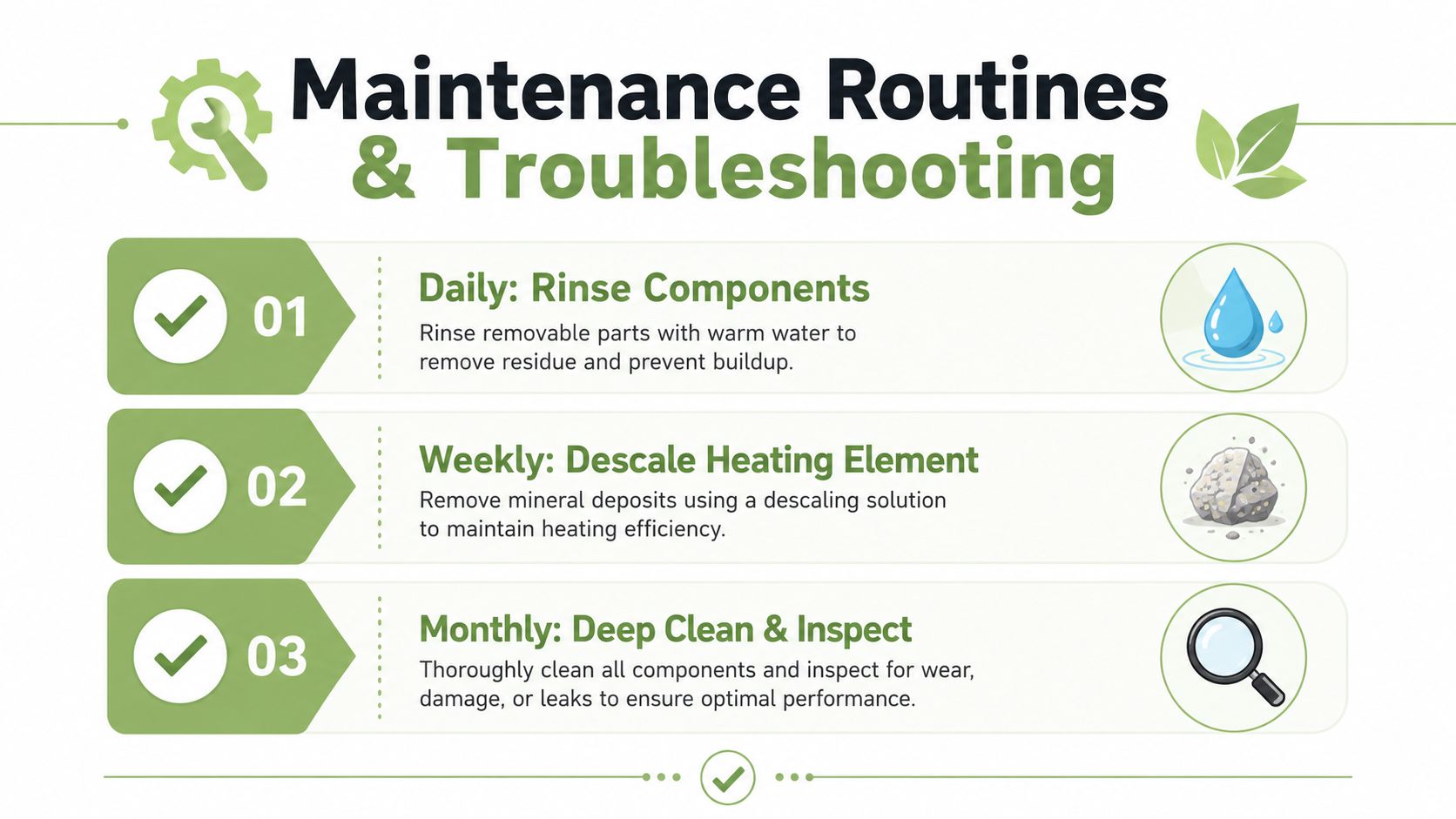
- Daily: Rinse removable components with clean water and leave them open to dry.
- Weekly: Inspect the heating area for scale. Descale only when the manufacturer permits it.
- Monthly: Deep-clean the basket, lid, jug and moving parts, then check that the auto-lift mechanism travels freely.
Fill lines are part of the machine's operating system, not decoration. Follow the manufacturer's fill-line instructions when heating and brewing. Filling beyond the permitted level can cause spills, obstruct basket movement and create a burn hazard.
Troubleshoot by symptom
The tea tastes bitter: Check water temperature, steep duration and leaf quantity. Green tea can become harsh when brewed too hot or held in water too long.
The machine heats slowly: Mineral deposits may be reducing heat transfer. In a hard-water home or café, compare the heating time with a freshly cleaned unit, then follow the approved descaling process. Avoid abrasive tools, which can damage surfaces or sensors.
The basket won't move: Switch off and unplug the unit before checking for leaves or residue around the mechanism. Never force the basket.
The jug leaks or overflows: Confirm that the water is below the correct fill line and that the lid and basket are seated properly.
The temperature seems wrong: Scale near the sensor can distort readings. Clean the area as directed, test with fresh water, and keep the machine out of service if the reading remains unreliable.
Buying Considerations and Australian Safety Standards
A buying decision should include more than presets and appearance. Check the warranty, replacement-part availability, bench footprint, power requirements and whether the jug and infuser are practical to wash. For a café, calculate cleaning time and staff training as part of the purchase. For a home, ask whether the extra appliance will simplify your morning or add another object to maintain.
Hot-water safety becomes critical when a machine connects to plumbing or serves customers, children, older people or people with disability. South Australian guidance limits heated water connected to plumbing fixtures used for personal hygiene to 50°C, with a 45°C maximum in specified public-building areas such as aged-care, patient-care, early-childhood and school settings. South Australian hot-water safety guidance explains why delivery temperature must be considered separately from tea-brewing temperature.
A NSW Health document defines hot water as heated water delivered or used above 45.0°C, and includes a thermal shut-off at 46.0°C in its temperature categories. The NSW scald-prevention document reinforces that small temperature differences can be safety-critical in facilities.
Queensland guidance uses a dual-temperature approach. Storage water must reach at least 60°C to help prevent Legionella, while delivery to taps is limited to 50°C through a temperature-control device. Queensland hot-water system guidance is particularly relevant to plumbed hospitality systems.
Choose a standalone unit unless your venue needs an integrated installation. If plumbing is involved, have the setup assessed by a qualified professional and keep brewing temperature controls separate from safe point-of-use delivery.
Pep Tea offers premium organic Japanese matcha and Australian-brewed, sugar-free organic kombucha from the Hunter Valley, NSW, giving homes and cafés quality ingredients to use with either manual brewing or an automatic tea maker. Visit Pep Tea to explore the organic matcha range, kombucha options and wholesale support for a more considered non-alcoholic drinks menu.