
Tag: buy matcha australia
How to Purchase Matcha Green Tea Powder Well in 2026
Buying ceremonial matcha isn't automatically the smartest choice. If you're making a latte or baking a cake, you may pay for delicate flavours that milk, butter and sugar will hide. And an expensive tin still tells you very little if the seller won't explain its origin, freshness or caffeine content.
To purchase matcha green tea powder well, start with what you'll make, then compare label evidence, price per gram and caffeine per serve. The right powder should suit your taste and routine, not just carry the most impressive grade name.
Matcha Grades Compared for Drinking, Lattes and Baking
| Grade | Best for | Colour and taste | Harvest and processing | Price guide |
|---|---|---|---|---|
| Ceremonial | Drinking plain, whisked tea | Vivid green, smooth, sweet umami | First harvest, shade-grown tencha, stone-ground | Highest of the three |
| Premium | Lattes and iced drinks | Bright green, mild, slightly bitter | Early harvest or blend, stone-ground | Mid-range |
| Culinary | Baking, smoothies, sauces, ice cream | Dull olive green, bold and bitter | Later harvest, may include stems and veins | Lowest per gram |
These are common trade conventions, not standardised legal definitions. Sellers use grade names differently, so treat the table as a starting point for questions rather than proof of what's inside.
When you're drinking matcha plain
Ceremonial matcha is intended to taste balanced with water alone. Look for sweetness, savoury umami and a smooth finish, rather than assuming that any bitterness means you've bought a bad product. Some astringency can be part of the tea's character.
Preparation matters too. Sift the powder into a bowl, add hot water that's cooled below boiling, then use a bamboo whisk, or chasen, with quick back-and-forth movements. Around 70–80°C is a practical starting point for preparation, adjusting to the tea and your taste.
Matcha forms a suspension rather than dissolving like sugar. A fine sieve helps remove ordinary clumps, but it won't turn coarse powder into silky tea.
When milk or other ingredients carry the flavour
For lattes, a premium blend often makes more sense than the most delicate ceremonial option. You want enough tea flavour to remain noticeable in your chosen milk, without needing syrup to cover harshness. Test it in the milk you use, because dairy, oat and soy drinks don't produce identical results.
Culinary matcha earns its place in baking, smoothies, ice cream and sauces. Its stronger flavour can stand up to other ingredients, although a dull olive colour shouldn't be confused with brown, stale powder. You're buying an ingredient for a job, not accepting deterioration.
Practical rule: If you'll drink it plain, start with ceremonial. If you'll add milk, sugar or butter, consider premium or culinary before paying more.
For a closer comparison, use our ceremonial versus culinary matcha guide. If you're choosing between breakfast drinks rather than tea grades, Gym Snack's guide to coffee with protein for gym-goers is a useful separate resource, especially when deciding whether you want a tea ritual or a protein-containing drink.
Finish your shelf inspection with these checks:
- Colour: Look for a lively green appropriate to the grade, not brown or yellowed powder.
- Texture: Expect a fine, silky powder rather than obvious grit.
- Aroma: Fresh grassy, sweet or savoury notes are more promising than hay, dust or mustiness.
Origin, Harvest Date and Certifications That Matter
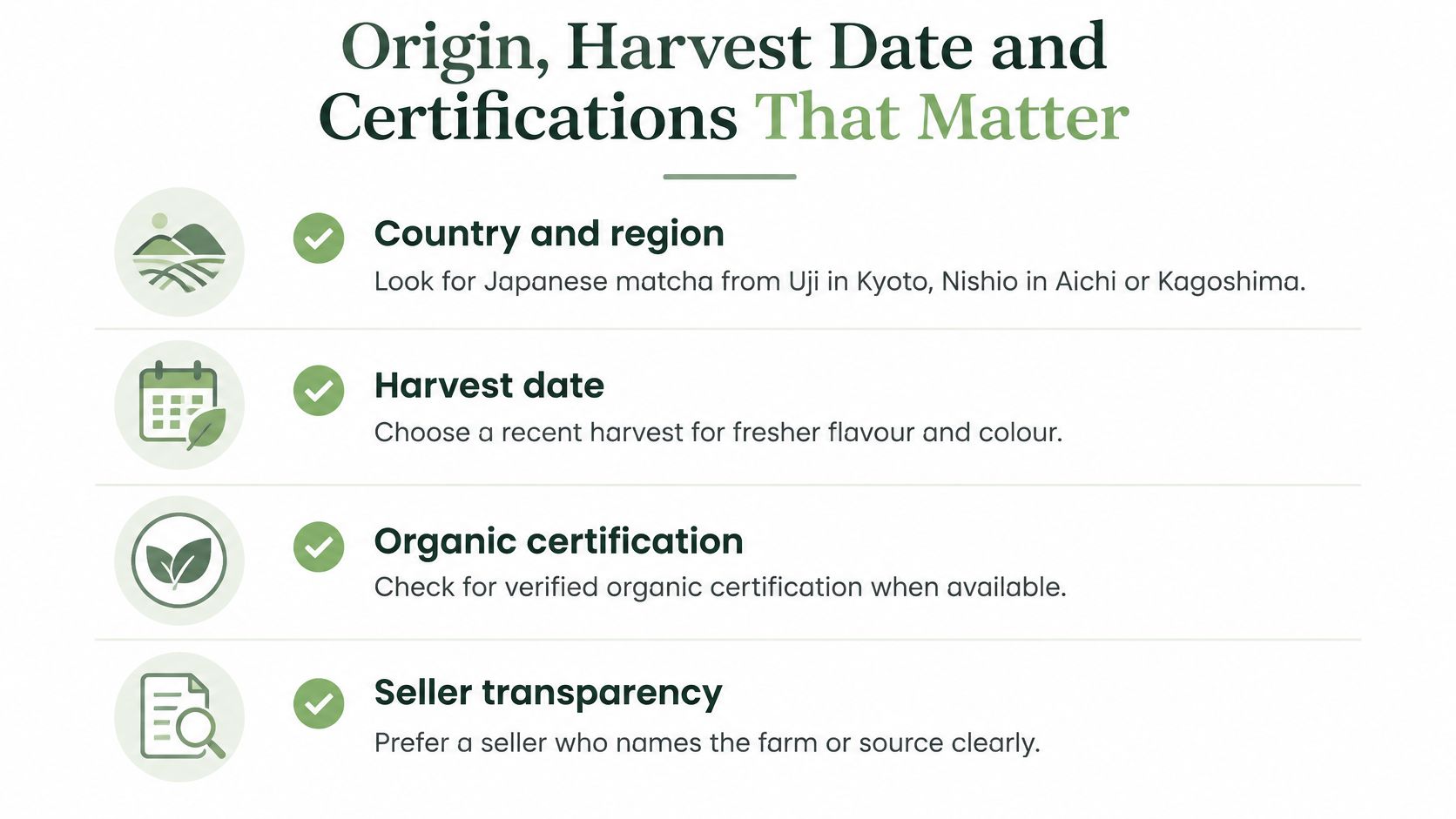
A region name can guide a search, but it cannot grade the powder. Uji in Kyoto, Nishio in Aichi and Kagoshima are useful starting points; the seller's batch details tell you more about the tin in your hand.
Japanese matcha has also faced supply pressure. SBS reporting on Australia's matcha boom describes premium Japanese matcha rising from about A$390 to A$500 per kilogram. That figure is a market signal, not a quality test. Compare the price per gram and per serving, then check whether the seller can explain the product's origin and handling.
Ask questions that produce checkable answers
Where was the tea grown and processed? Look for a country and region, plus an explanation of whether the matcha comes from one producer or a regional blend. Blending is not a defect. A Japanese-style name on Australian packaging does not establish Japanese origin.
When was it harvested, and when was it milled? Harvest information describes the leaf; milling information helps you judge how long the powder may have been stored. A best-before date alone answers neither question. Ask how the stock was packed and held before dispatch.
What does the batch code identify? A useful code connects the tin to a farm, processor or production lot. If the seller cannot explain what it traces, the number offers little practical reassurance.
For more context on what an origin label can and cannot tell you, see this guide to Uji matcha powder.
Separate organic status from other evidence
For organic certification, look for an identifiable certifier, such as Australian Certified Organic, and a certificate number that can be checked. Confirm that certification covers the product being sold. A leaf symbol or the word “natural” is not equivalent evidence.
Ask separately about heavy-metal and pesticide-residue testing. A useful product sheet names the laboratory, test date and relevant batch or sampling arrangement. Organic status and contaminant testing answer different questions, so neither replaces the other.
Stone milling is another detail to check. Ask whether the stated method applies to this product and whether the seller can explain its process or hourly output. A mill photograph is not evidence of how the matcha was made, and output alone does not establish flavour.
Before buying, use this checklist:
- Provenance: Named country, region and source or processor.
- Freshness: Harvest or milling information, plus storage conditions.
- Traceability: A batch code the supplier can explain.
- Certification: Checkable organic certification covering the product.
- Testing: Clear contaminant-testing information.
- Purpose: An honest recommendation for drinking, lattes or cooking.
Red Flags and Caffeine Gaps to Avoid
Premium packaging can hide an ordinary product. More to the point, it can distract you from the question that affects your daily routine: how much caffeine will your serving contain?
Watch for these purchase red flags:
- Suspiciously neon powder: An unnatural appearance warrants questions about colouring, but colour alone can't establish adulteration. Product photography and screen settings can also mislead.
- Unexpected ingredients: Sugar, flavourings and fillers don't belong in a product presented as pure matcha. A latte blend is a different product and should be clearly labelled.
- An unexplained bargain: A strikingly low price needs a credible explanation, such as culinary positioning, pack size or clearance stock.
- Unsupported wellness promises: Claims about crash-free energy, antioxidants or immunity aren't a substitute for product information or evidence.
Use this visual reminder when a product page gives you more lifestyle language than practical detail.
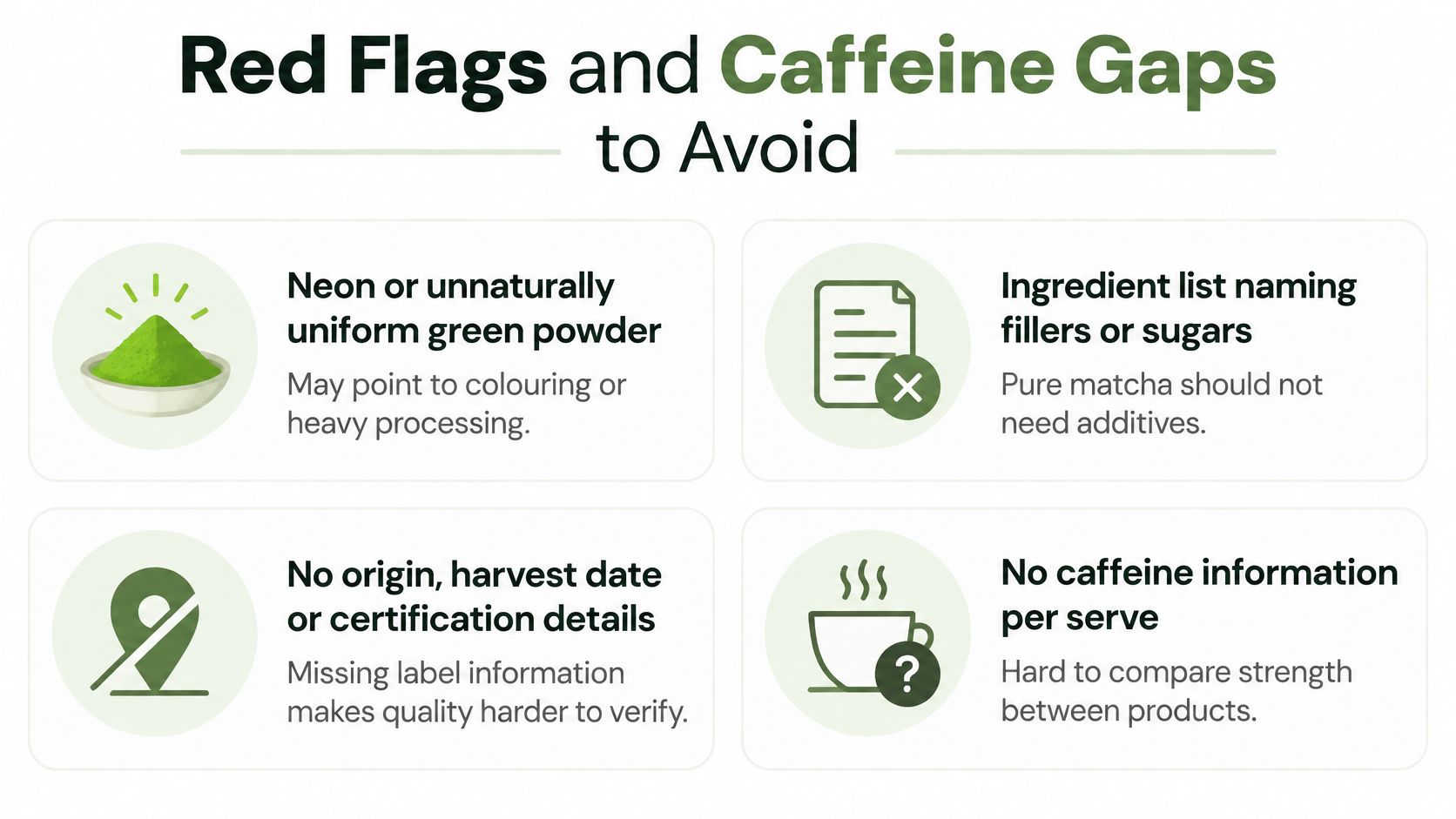
Ask about the serving, not the grade
Food Standards Australia New Zealand's caffeine guidance states that caffeine occurs naturally in tea and that Australia has no recognised health-based guidance value equivalent to an acceptable daily intake for caffeine. That doesn't mean unlimited intake is safe, or that individual sensitivity doesn't matter.
With matcha, you consume the powdered leaf rather than discard infused leaves. A serving may therefore deliver more caffeine than steeped green tea, depending on the product and preparation.
Ask the seller:
- Serving content: How many milligrams of caffeine are in a 2 g serve?
- Verification: Is that independently tested, which laboratory tested it, and does the result represent this product?
- Latte strength: How much caffeine would a latte made with two serves contain?
Those are comparison questions, not a claim that every product contains the same amount.
Ceremonial describes a proposed use. It doesn't tell you your caffeine dose.
Beginners can start with half the seller's stated serving and assess tolerance. Regular users should count coffee and energy drinks too. Pregnant or breastfeeding readers, adolescents and caffeine-sensitive people should seek personalised advice from a health professional rather than assume a smaller matcha is automatically suitable.
How to Compare Price Per Gram Honestly
Compare net powder weight, not tin size, and keep pure matcha separate from sweetened latte mixes. Otherwise, you may be comparing the price of tea with the price of a blend containing cheaper ingredients.
The arithmetic is straightforward:
- Price per gram: Divide the pack price by its weight in grams.
- Price per 100 g: Multiply the price per gram by 100.
- Price per serve: Multiply the price per gram by the grams you use.
Price per gram and per serve at reference prices
The reference prices below illustrate the conversion, rather than representing current retail quotes for a particular tin.
| Price per kilogram | Price per 100 g |
|---|---|
| A$390 | A$39 |
| A$500 | A$50 |
| Your pack | Pack price ÷ net grams × 100 |
Using a hypothetical 2 g serving for comparison, those reference prices work out to approximately A$0.78 and A$1.00 per serve, respectively. These are calculated ingredient costs, not complete latte costs, and exclude milk, delivery and wastage.
For your own pack, use its actual serving weight rather than relying on a rounded number of servings printed for marketing purposes. A small kitchen scale makes this easier than comparing heaped teaspoons, which aren't consistent.
Where a cheap pack stops being good value
A low-priced culinary powder isn't a saving if you dislike drinking it and leave it untouched. Equally, there's little reason to pay a ceremonial premium for a strongly flavoured cake when a suitable culinary product gives you the result you want.
For cafés, test the powder in the finished menu drink. Record the weighed dose, milk choice and whether staff can reproduce it without adding extra syrup or powder to compensate.
Buying judgement: Start with a small trial pack of the grade you intend to use. Commit to bulk only after the finished drink or recipe works.
A larger pack may offer a lower unit price, but unused powder still costs money. Include delivery in your comparison, resist buying extra solely to qualify for free shipping, and choose a quantity that fits your actual consumption.
How to Keep Matcha Fresh After You Open It
Keep matcha away from light, heat, air and moisture. For a working tin, use an airtight, opaque container in a cool, dark cupboard away from the stove, dishwasher and sunny windowsill.
Close it promptly after measuring, and use a clean, dry spoon. Leaving the lid off while you make breakfast exposes the whole pack unnecessarily.
Storage conditions and approximate freshness windows
These are practical flavour guidelines, not laboratory-validated shelf-life guarantees. Follow product-specific instructions where they're more restrictive, and remember that packaging, handling and starting freshness affect the result.
| Storage | Conditions | Best within (approximate) |
|---|---|---|
| Unopened tin | Cool, dark cupboard away from heat | Until the best-before date, check the harvest date too |
| Opened tin, pantry | Airtight and opaque, away from light | About 1 month |
| Opened, refrigerated | Sealed bag in the fridge, warmed before opening | About 1 to 2 months |
| Opened, frozen | Sealed portions, thawed before opening | Up to about 3 months |
If you refrigerate or freeze matcha, let the sealed portion reach room temperature before opening it. Opening cold packaging in humid air can allow condensation onto the powder, undermining the reason you chilled it.
Avoid repeatedly moving your entire supply between cold storage and the kitchen bench. Small, well-sealed portions are easier to manage, particularly in a warm Australian kitchen.
Notice deterioration before changing the recipe
A dull or yellowing colour, hay-like smell and flat taste suggest the powder has lost freshness. Ordinary soft clumps can be sifted out; stubborn clumps associated with dampness deserve more caution. Don't taste powder that smells musty or shows signs of mould.
Adding more powder won't restore the aroma of stale matcha. It can make the drink stronger and less pleasant.
- Date the tin: Write the opening date where you'll see it.
- Separate reserve stock: Portion extra powder into suitable airtight freezer bags before freezing.
- Keep the working pack small: Refill only with dry equipment, without mixing fresh stock into old residue.
Our matcha shelf-life guide gives further help with freshness and storage decisions.
Choose Your Grade and Buy with Confidence
The strongest buying decision combines a suitable flavour with information you can verify. A beautiful label, a famous region or a low unit price can each be useful, but none should decide the purchase alone.
Compare the actual packs rather than relying on their front-label descriptions.
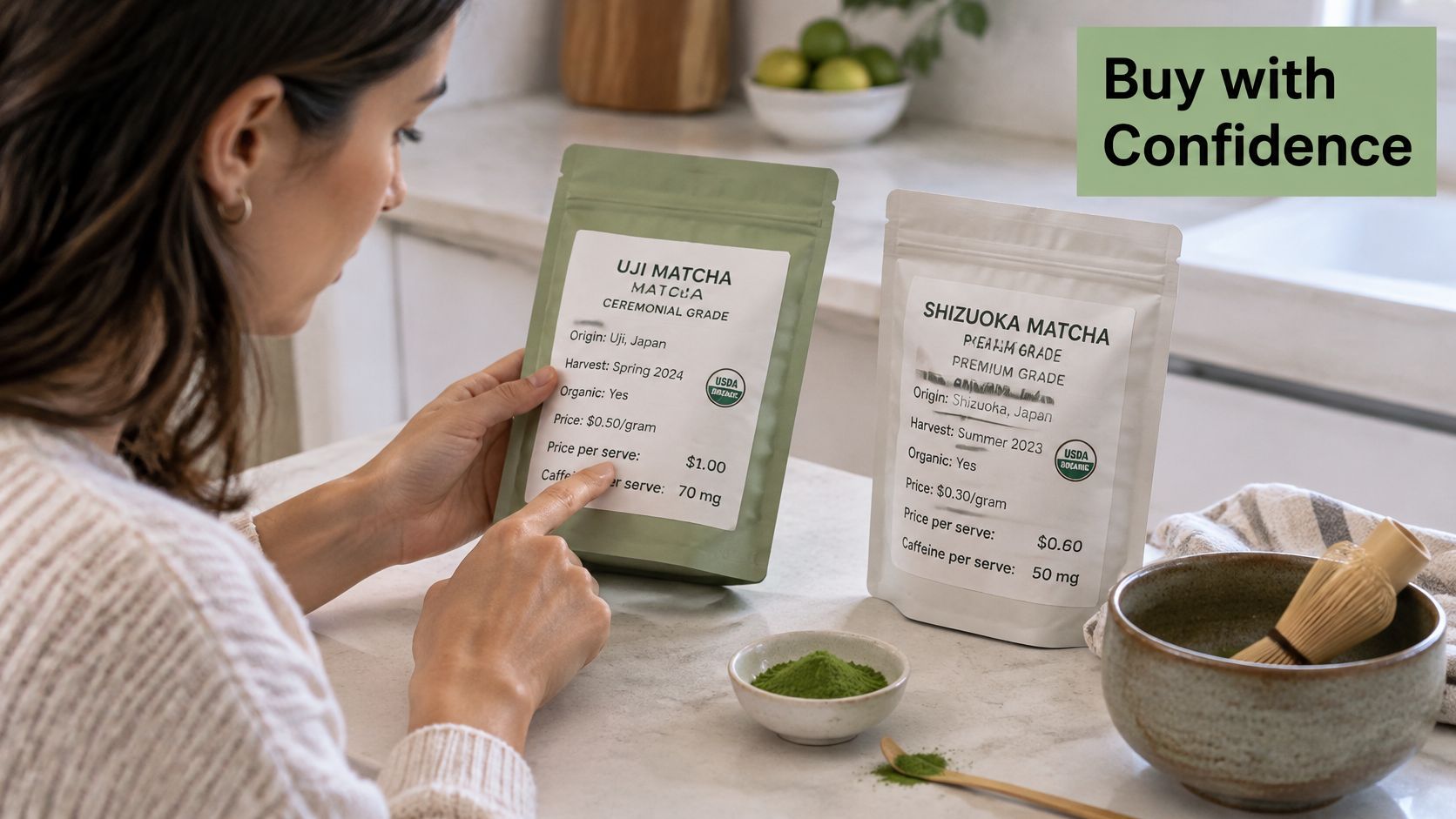
Match the seller to the way you buy
A specialist tea retailer is useful when you need help distinguishing flavour profiles and preparation styles. Look for product sheets that describe the tea itself, not just the lifestyle associated with drinking it.
A café can be a practical tasting stop if staff can name the powder they serve and explain whether the retail pack is the same product. Order it in your usual preparation rather than choosing a heavily sweetened special that disguises the tea.
For online shopping, favour stores that make batch, certification and testing information accessible, or answer direct questions without evasion. A seller who admits that a particular detail isn't available is more useful than one who substitutes another wellness slogan.
Use this short buying route:
- Choose the job: Plain tea, latte or cooking.
- Check the evidence: Origin, freshness, organic status and traceability.
- Calculate the true cost: Use net weight and your intended dose.
- Resolve caffeine uncertainty: Ask for product-specific information before making it a daily habit.
- Trial the result: Taste it in your usual drink before ordering more.
A preparation demonstration can also help you recognise which tools and handling steps you'll need at home.
Let taste settle the final choice
When your trial pack arrives, try it whisked with water and in your usual latte. Note sweetness, bitterness, texture and whether the tea remains noticeable in milk. You don't need elaborate tasting vocabulary, just a clear record of what you enjoyed.
If you're buying for a household, don't assume the same caffeinated drink suits every family member. For hospitality, choose a recipe staff can weigh and repeat, then ask the supplier about availability before committing it to a permanent menu.
Your next step today is simple: shortlist a suitable trial pack, calculate its serving cost and send the seller any unanswered questions before checkout.
At Pep Tea, we offer organic Japanese matcha in ceremonial and culinary grades for home preparation, cooking and hospitality. Browse our matcha range, check the origin and organic certification information on the product pages, and compare a trial-size option against your buying checklist before choosing your next pack.
Where Do You Buy Matcha Green Tea Powder

Most buying advice starts with the wrong question. Where do you buy matcha green tea powder? The usual answer is “find a reputable shop”, but a polished website, a Japanese-looking tin and the word ceremonial don't prove much. Australians waste money when they judge the storefront instead of the powder, its paperwork and its intended use.
The better question is simple: what evidence does the listing provide? Whether you're comparing an online specialist, a café, a supermarket or a marketplace seller, check the batch details, organic certification, price per serve and freshness date before you pay. Matcha is a whole-leaf powder, so origin, handling and traceability matter more than attractive branding.
The Real Question Is Not Where but What to Check
A specialist tea shop can sell excellent matcha, but it can also sell an expensive product with little useful information. A supermarket can offer a practical everyday powder, while a marketplace listing might show a premium tin with no clear Australian importer, batch code or storage guidance. The channel helps, but the listing makes the case.
Australia's matcha buyers generally use four routes:
- Online specialists, where product pages can explain origin, grade, certification and preparation.
- Cafés, which may sell the powder they use behind the counter or direct customers to a supplier.
- Supermarkets and health-food retailers, which offer convenience and physical access.
- Third-party marketplaces, where choice is broad but seller transparency varies sharply.
Online and health-oriented channels matter particularly for matcha powder. One Australia-focused market estimate places distribution at approximately 40% online, 35% through retail health stores and 25% through foodservice, although those figures are directional market estimates rather than official Australian government statistics. The estimate is useful because it reflects how matcha is bought, as a packaged ingredient for home preparation as well as a café drink. Australia-focused matcha channel estimate
Four tests before you trust the seller
Batch transparency tells you whether the product can be traced. Look for a lot or batch identifier, an importer or Australian business address, and a best-before date.
Certification evidence matters more than the word “organic”. A genuine claim should point to a certifier and identifiable certification details.
Price per serve exposes inflated ceremonial pricing. Compare the pack size with how you drink matcha, not with the prestige of the label.
Freshness information helps you judge whether the powder is likely to retain its colour and flavour. A listing that hides the date or gives only vague wording deserves caution.
Practical rule: If you can't identify the origin, grade, batch information and intended use, don't let a low price make the decision for you.
The best buying habit is to stop searching for a perfect shop and start evaluating a specific product. Use the guidance in our explanation of matcha grades to understand the difference between powder designed for whisking and powder made for food, then demand evidence from the seller.
Australian Matcha Channels Compared
There isn't one correct place to buy matcha in Australia. The right channel depends on whether you want a daily latte, occasional whisked tea, baking powder or a hospitality supply. The available market estimate places online platforms ahead of health stores and foodservice, but it doesn't provide a separate official share for supermarkets or third-party marketplaces. Treat those channels as practical buying options, not as fixed market categories.
What each channel does well
Dedicated online specialists usually provide the clearest product education. A good listing can show Japanese origin, grade, ingredients, storage advice, certification information and pack sizes. The weakness is that you can't inspect the powder before purchase, so the seller's transparency and returns policy carry more weight.
Direct-from-café sales can be useful when you already like the flavour in your drink. Ask whether the café can identify the supplier, batch and grade. The limitation is that cafés often sell for beverage use, not necessarily with the full retail labelling and documentation you should expect from packaged food.
Major supermarkets and health-food retailers win on convenience. They suit a cautious first purchase or someone who wants a small pack without waiting for delivery. Selection may be narrower, and a sachet or small pouch can look cheap while costing more per gram than a larger specialist pack.
Third-party marketplaces offer access to imported tins, unusual origins and a wide range of prices. They also create the greatest need for scrutiny. The seller, importer, packaging date, country of origin and return process may be unclear, particularly when the listing relies on lifestyle language rather than product evidence.
| Channel | Typical AUD price approach | Strength | Weakness |
|---|---|---|---|
| Online specialist | Compare by grade and grams | Strongest product education and selection | You rely on listing accuracy |
| Café direct | Usually tied to the café's chosen product | Taste can be judged in a prepared drink | Batch and retail documentation may be limited |
| Supermarket or health retailer | Small packs and sachets are common | Convenient and easy to access | Less choice and weaker origin detail |
| Marketplace | Wide range, including imported premium tins | Broadest selection | Seller transparency varies |
For an everyday latte, I favour an online specialist or a clearly labelled health-food retailer. Milk, fruit, sweeteners and ice soften the differences between grades, so culinary or middle-tier powder usually makes more sense than paying a ceremonial premium. For a once-a-week whisked tea, buy a smaller, fresher ceremonial pack from a supplier that publishes origin and batch information.
Matcha also fits neatly into simple food routines. If you're making dairy-free snacks alongside your tea, a practical gluten-free and nut-free snacks guide can help you choose recipes where culinary matcha will add colour and flavour without wasting a delicate drinking grade.
How to Read an Australian Matcha Listing
A product page should answer basic food-buying questions before you reach the checkout. If it doesn't, move on. The colour of the tin matters less than the information behind it.
Start with the powder and its identity
A fresh, well-made matcha generally appears vivid jade green, while dull olive, yellow-green or brown tones can indicate age, oxidation or lower-grade leaf. Colour isn't proof by itself, because photography and packaging affect what you see, but a seller should provide a clear product image rather than hiding the powder behind decorative branding.
The texture should be extremely fine. Matcha is stone-ground or finely milled tencha, not crushed loose-leaf tea. A listing should identify the product as matcha or green tea powder and show an ingredient statement. For a plain product, the ingredients should be 100% green tea powder, without sugar, maltodextrin, starch or anti-caking agents.
Look for the following details:
- Country of origin: “Japan” is not the same as “packed in Australia”. Check where the tea was grown and where it was packed.
- Region or producer information: A named growing region or supplier gives you more to assess than “Japanese-style”.
- Batch or lot code: This supports traceability if a product is recalled or a quality issue appears.
- Best-before date: A packed-on date alone doesn't tell you how long the product remains suitable.
- Storage directions: Matcha should be protected from heat, moisture, light and air.
- Particle and preparation guidance: A serious seller explains whether the powder suits whisking, milk drinks or cooking.
Australian food labelling rules cover product identity, ingredients, date marking, storage directions, nutrition information, country-of-origin information and relevant claims. The parliamentary overview of matcha and Australian food requirements also explains why commercial packaging matters, especially for a whole-leaf product that the consumer ingests rather than merely infuses.
Treat “organic” as a claim to verify
Domestic organic certification is voluntary. A product can use organic language without carrying independent certification, but “certified organic” should be supported by a genuine mark and identifiable certification details. Australian guidance recommends checking the certifying organisation, grower name and certification number where applicable. ACCC guidance on organic claims
If a listing hides the origin or grade, don't buy it, regardless of the colour of the tin or the apparent bargain. Those two details define what you're purchasing and how you should use it.
Ceremonial vs Culinary and What Your Money Buys
“Ceremonial” sounds precise, but it isn't a nationally standardised quality grade. Sellers use the term differently, so the label can't replace evidence about origin, freshness, processing, packaging and testing.
The practical distinction is use. Ceremonial matcha is made to be whisked with water, where umami, sweetness, colour and texture are exposed. Culinary matcha is made to work with milk, fruit, sugar, flour and other ingredients, where a stronger or more assertive flavour can be useful.
Verified Australian market guidance places indicative retail pricing at AUD 30–80 per 100g for ceremonial matcha and AUD 18–35 per 100g for culinary matcha. Australian organic green tea and matcha pricing estimate Those are directional ranges, not a guarantee of quality. A high price doesn't turn an anonymous powder into a superior one.
Match the grade to the drink
A daily latte usually doesn't need the most expensive powder. Milk changes the flavour balance, and culinary matcha is designed to hold its own in that setting. Use it for smoothies, baking, pancakes, ice cream, sauces and energy balls. If you're whisking matcha with water and drinking it without additions, a fresher ceremonial product is the sensible place to spend more.
| Attribute | Ceremonial matcha | Culinary matcha |
|---|---|---|
| Best use | Whisked with water | Lattes, smoothies and cooking |
| Flavour focus | Umami, sweetness and smooth texture | More robust flavour that works with other ingredients |
| Colour expectation | Usually brighter when fresh | May be less vivid |
| Buying priority | Origin, harvest detail, freshness and texture | Clean ingredients, flavour strength and cost per use |
| Sensible buyer | Straight-tea drinker | Latte drinker, baker or smoothie maker |
Price-per-serve maths makes the decision clearer. Take the pack price, divide by the total grams, then multiply by the amount you use in one drink. Don't compare a small ceremonial tin with a large culinary pouch by shelf price alone. Compare the cost of the bowl or latte you make.
A middle option can work for people who drink both styles. Labels such as “premium culinary” or “latte grade” may describe a powder positioned between everyday culinary matcha and a whisking-focused product. Treat those names as marketing descriptions, then check the evidence. PepTea's ceremonial and culinary matcha comparison is useful when you're deciding whether the extra spend will be noticeable in your usual preparation.
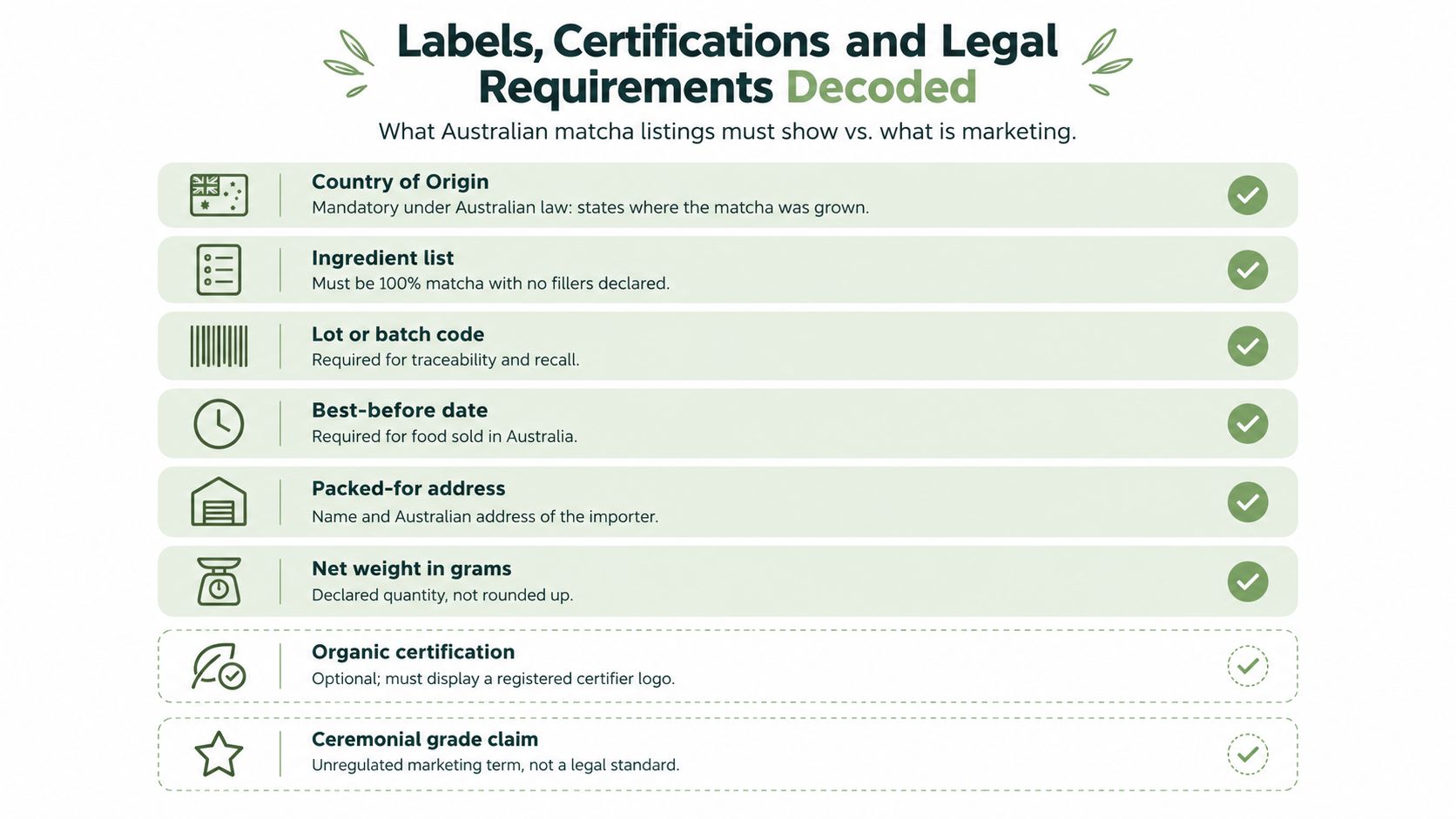
Labels Certifications and Legal Requirements Decoded
Australian matcha buyers need to separate mandatory food information from optional marketing language. “Ceremonial”, “premium”, “clean” and “Japanese-style” may influence your impression, but they don't prove the powder's origin or quality.
Country-of-origin information is central. An Australian supplier may pack imported matcha locally, but that doesn't make the tea Australian-grown. Read the wording carefully and look for the country where the tea was produced, along with the Australian importer or business details.
Organic systems can also appear on packaging. You may see Australian Certified Organic, USDA Organic, JAS or EU Organic marks, depending on the producer and supply chain. Don't treat the logo alone as enough. Match the mark to an identifiable certifier, operator or certification record, particularly when the product carries a premium price.
Caffeine and GST require careful reading
Plain tea naturally contains caffeine, while added caffeine must be declared in relevant foods. If matcha is blended with other caffeine sources or sold as a formulated beverage, read the ingredient and advisory statements rather than relying on “energy” or “focus” language. Food Standards Australia New Zealand's caffeine guidance explains the difference between naturally caffeinated tea and products with caffeine added as an ingredient.
Don't confuse ordinary matcha with concentrated caffeine powder. Pure and highly concentrated caffeine products are banned from retail sale in Australia and New Zealand in the categories described by the food regulator. Naturally caffeinated tea is treated differently, but a product presented as a high-concentration caffeine powder is not a normal matcha purchase. FSANZ guidance on caffeine powders and high-caffeine foods
GST treatment isn't as simple as adding a fixed tax assumption to every matcha product. The Australian Taxation Office says tea is generally GST-free when sold as food, but classification can depend on promotion, name, labelling, packaging, display and placement. Check how the product is presented, especially if it is marketed primarily as a supplement, ingredient or ready-to-drink beverage. ATO guidance on GST-free food
The useful information to retain is straightforward: ingredient panel, net weight, batch number, best-before date, origin, importer details and certification documentation. Use PepTea's guide to organic certification in Australia as a reference for the kind of evidence an organic claim should provide.
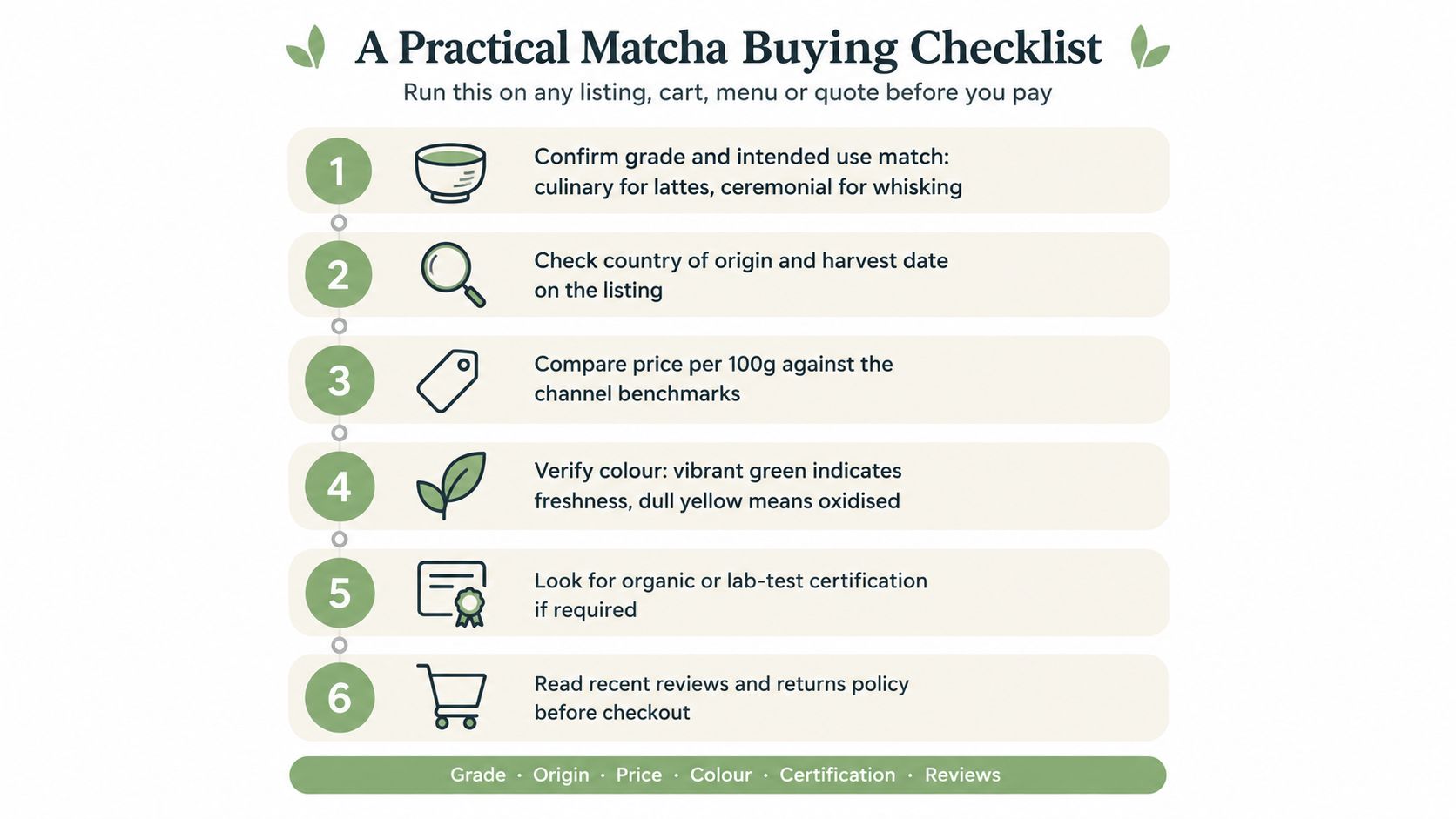
A Practical Matcha Buying Checklist
Run this checklist on a product page, café menu, supermarket pack or wholesaler quote. You shouldn't need specialist equipment to reject a vague listing.
- Choose the use first. Culinary powder suits lattes, smoothies and baking. Ceremonial powder earns consideration when you whisk it with water and drink it straight.
- Inspect the colour. Look for a lively green product image. Yellow-green or brown powder deserves questions about age, oxidation and storage.
- Find the origin and harvest detail. A named Japanese region such as Uji, Nishio or Kagoshima is more useful than “Japanese-style”. A harvest year or clearly explained shade-growing claim can add context, but it still doesn't replace a batch code.
- Read the ingredients. Plain matcha should identify green tea powder without fillers, sugar, maltodextrin or anti-caking agents.
- Verify the seller. The listing should show a batch number, best-before date, country of origin, Australian business address and, where relevant, ABN or importer information.
- Calculate the unit cost. Compare price per gram and price per serve with the verified Australian guide ranges, rather than comparing tins by sticker price.
- Ask wholesalers direct questions. Request the harvest date, particle size, storage and transport conditions, stone-milling information, specification sheet and certificate of analysis where the product is for café service.
Some red flags should end the purchase immediately:
- Vague origin: “Japanese-style” without a growing country or region.
- Missing business details: No Australian address, importer or traceability information.
- Unclear pack format: Bulk pricing with no sealed retail option or labelling.
- Suspiciously low pricing: A price well below the verified culinary range deserves a full explanation, not an impulse purchase.
- Unsubstantiated certification: “Organic” with no certifier, operator identity or record to check.
For café buyers, request testing information for microbial limits, heavy metals, pesticide residues and moisture. A consumer buying one sealed pack doesn't need the same supplier file, but should still expect a labelled product from an identifiable seller.
Putting It Together and Buying With Confidence
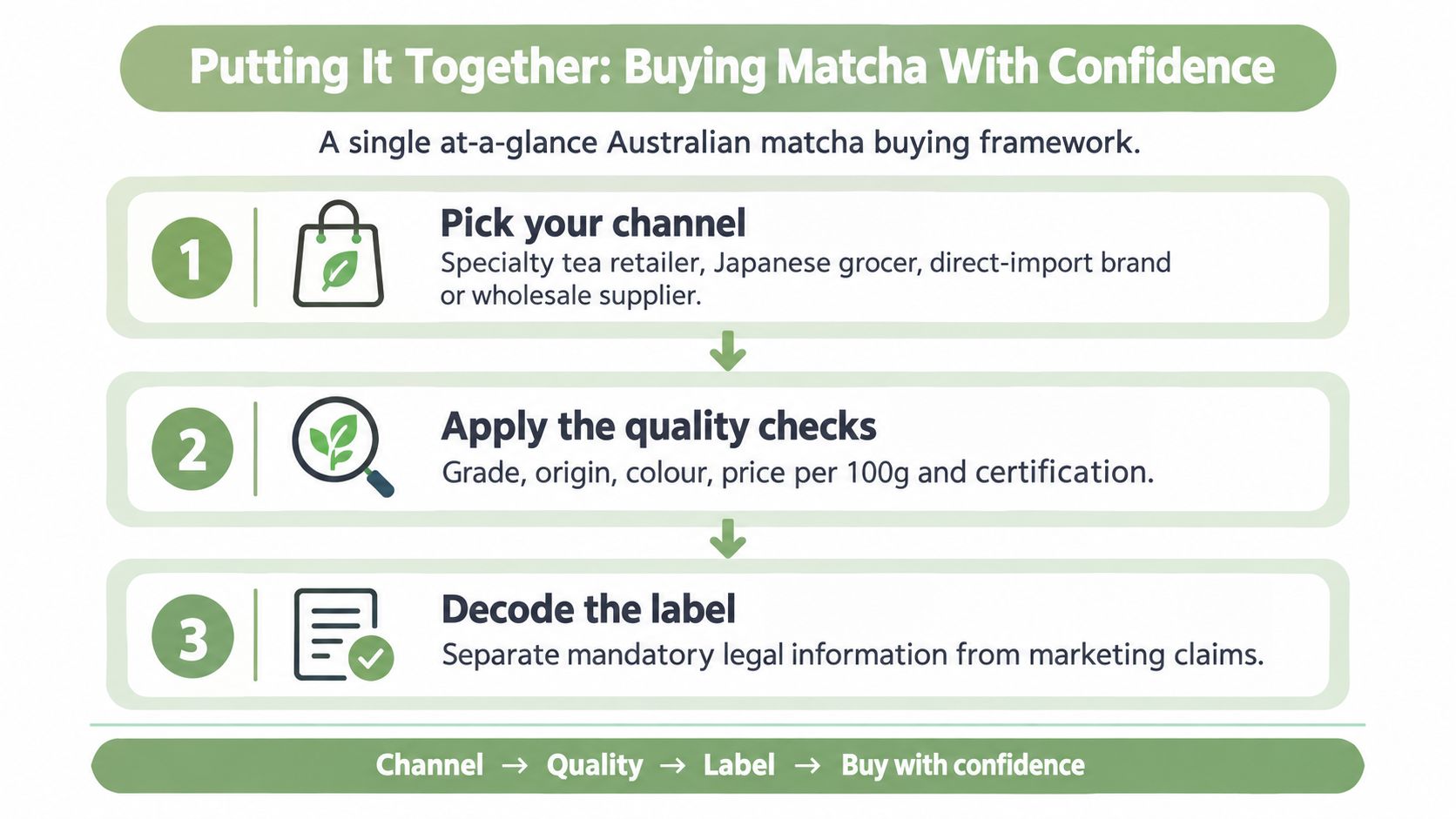
A reliable matcha purchase follows three decisions. First, choose the channel according to your use and budget. Second, apply the evidence checks to the individual listing. Third, calculate the cost per serve and ask whether the grade makes sense for the drink you prepare most often.
Pick the channel for the job
Choose an online specialist when origin, certification and preparation guidance matter. Use a supermarket or health-food retailer for a straightforward first trial, provided the pack is sealed and fully labelled. Buy through a café when you trust the flavour and the business can identify its supplier. Treat a marketplace as a research exercise, not an automatic shortcut to premium quality.
Apply the product checks
Look for a clear grade, growing country, ingredients, best-before date, batch information and Australian seller details. Check the powder's colour and the storage instructions. For an organic product, verify the certification claim rather than assuming the word itself is regulated.
PepTea provides an example of the Australian specialist model, selling Japanese organic matcha online through its Australian operation with products intended for both home use and larger supply formats. The useful standard isn't the brand name. It's whether a seller publishes enough origin, grade and batch information for you to judge the product before buying.
Calculate before you commit
A ceremonial product should make sense for whisked drinking, where texture and flavour are visible. Culinary matcha should make economic sense in lattes, baking and smoothies. If you're paying a ceremonial price for a powder that disappears into milk, reconsider the purchase.
Bookmark the checklist, compare two or three sellers side by side and start with a pack size that suits your consumption. You don't need to commit to a brand after one order. Buy transparently, taste the powder in the preparation you make, and let evidence rather than packaging decide your next purchase.
Pep Tea offers organic Japanese matcha green tea powder online, with options suited to both everyday preparation and larger-use requirements. Visit Pep Tea to compare the range, review the product information and choose a matcha that fits the way you drink it.
Best Matcha Tea Set Amazon Picks for 2026

You’ve probably done it already. Typed matcha tea set amazon into the search bar, opened a few listings, then found yourself comparing bowls that all look similar, whisks that all claim to be “traditional”, and kits padded out with extras you may never use.
That confusion is normal.
A matcha set looks simple, but a good one changes how your tea tastes, how easily it froths, and whether you enjoy using it every morning. A poor one can leave you with clumps, a flimsy whisk, and a bowl that feels more decorative than practical. The marketplace is convenient. The hard part is knowing what matters and what is just nice photography.
Matcha is also one of those rituals that feels more complicated online than it is in real life. Once you understand the role of each tool, the whole process becomes calm, quick, and satisfying. That’s when your first bowl stops feeling like a project and starts feeling like a habit you want to keep.
Your Guide to Finding the Perfect Matcha Tea Set on Amazon
You open Amazon for a quick search and suddenly you are comparing twenty near-identical kits before breakfast. One bowl looks elegant but shallow. One whisk seems cheap in the close-up photos. Another set has five accessories, but no clear explanation of what the ceramic or bamboo is like.
That early overwhelm puts many first-time buyers off. It should not.
Buying a matcha set online gets easier once you stop shopping by brand name and start shopping by function. A good set supports the ritual. It gives your whisk room to move, helps you mix the powder properly, and makes the whole process feel simple enough to repeat on a weekday morning. A poor set does the opposite. It turns a calm tea practice into clumps, spills, and frustration.
Demand in Australia is growing, which means marketplace choice keeps expanding. That sounds helpful, but it often creates more noise than clarity. The key question is not which listing has the prettiest photos. It is which set is built from materials that help you prepare matcha well.
That distinction matters because the tools are only half the story. The bowl, whisk, and scoop shape the technique, but the powder decides the flavour, colour, and drinking experience. Even a beautiful set cannot rescue dull, bitter matcha. If you want to understand why some powders taste grassy and sweet while others turn harsh, this guide to the different grades of matcha will help you choose with more confidence.
It helps to borrow the same mindset you would use for everyday ceramics. A plate can look lovely in a product photo and still feel awkward in daily use. The same applies to matcha bowls and accessories, which is why the logic behind choosing a best tableware set applies here too. Good design has to work in the hand, not just on a screen.
You do not need years of tea knowledge to buy well. You need a clear eye for materials, a basic sense of how each tool affects preparation, and the understanding that the finest set still depends on fresh, well-made organic matcha to produce a bowl worth drinking.
Deconstructing the Set What Really Matters in Your Kit
A good matcha set works like a simple kitchen system. Each piece supports one part of the process, and if one tool is poorly made, the whole routine feels harder than it should.
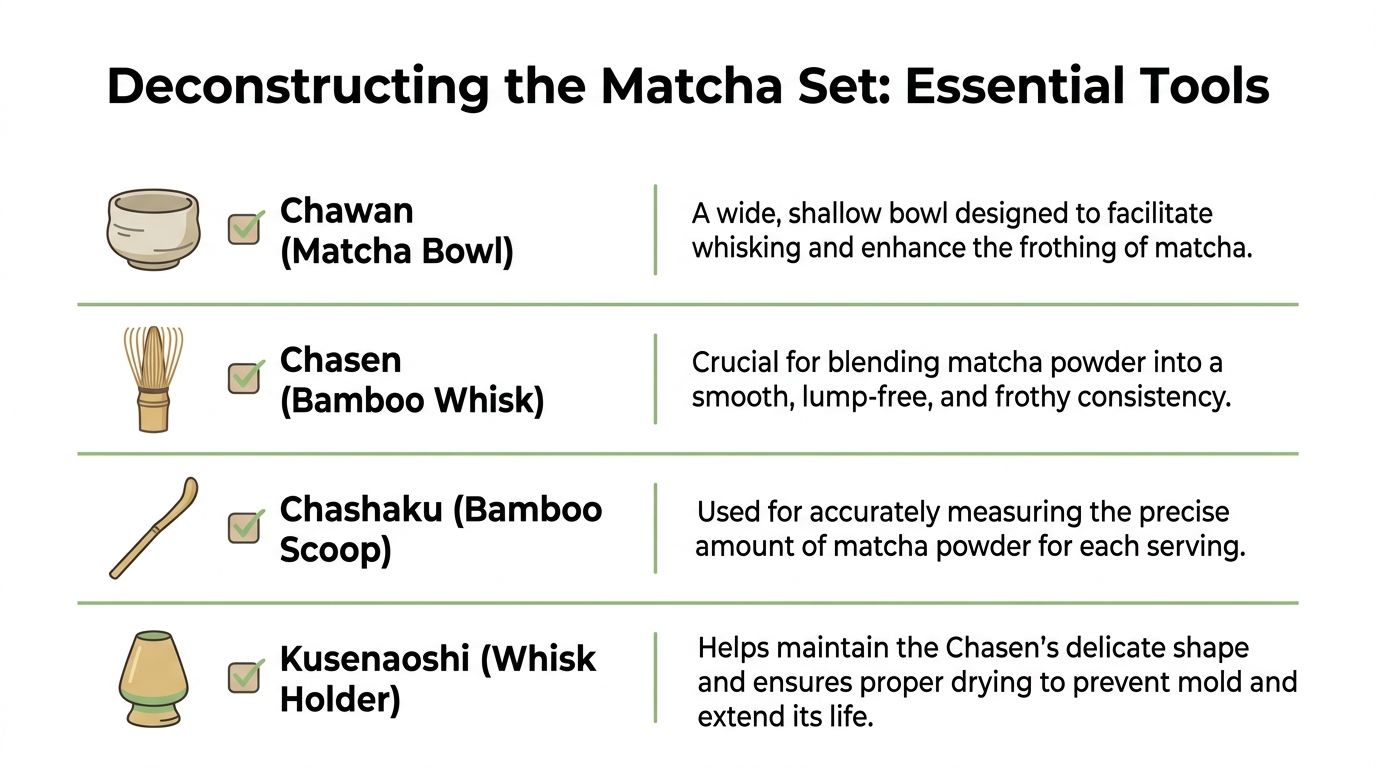
You do not need the biggest kit on Amazon. You need the right core pieces. For most beginners, that means a bowl, a bamboo whisk, a bamboo scoop, and a whisk holder. The bowl gives you space to whisk properly. The whisk breaks up the powder and creates texture. The scoop keeps your portions steady. The holder helps the whisk dry in the shape it was made to keep.
The bowl does more than hold the tea
The chawan, or matcha bowl, shapes the way your whisk moves.
A wide bowl gives your wrist room to make quick zigzag motions across the surface. That motion matters because matcha is suspended in water, not steeped like loose-leaf tea. If the bowl is narrow and steep-sided, your whisk hits the walls, your movement gets cramped, and the tea often ends up with clumps sitting under a thin layer of foam.
Ceramic suits most home buyers well because it has a reassuring weight and helps the bowl feel steady while you whisk. Look for a shape that opens at the top rather than pinching inward. A smooth interior also helps. Tiny ridges or awkward angles can catch the whisk tips and make the whole process feel scratchy.
If aesthetics matter to you, apply the same standard you would use when choosing everyday ceramics. A piece should feel good in the hand as well as look good on the shelf. This guide to the best tableware set explains that balance nicely, and the same logic applies to matcha bowls.
The whisk is the tool that changes the drink
The chasen, or bamboo whisk, has the biggest effect on texture.
A decent whisk separates the powder, blends it with water, and pulls in enough air to create a fine foam. A poor one bends unevenly, sheds splinters, or loses its shape after only a few uses. That difference shows up in the cup straight away. One bowl tastes smooth and creamy. The next tastes gritty, flat, or harsh.
For a first set, check whether the tines look evenly cut and reasonably dense. You do not need to count every tine from a product photo, but you do want a whisk that looks symmetrical and carefully finished. If the bamboo appears thick, rough, or badly spaced, the listing is telling you something.
This is also where people often blame the tools for a flavour problem that starts with the powder. Even a well-shaped whisk cannot make dull matcha taste fresh. If you want to understand how colour, sweetness, and bitterness change from one powder to another, this guide to different grades of matcha will make those differences much clearer. The set helps you prepare matcha properly. The powder decides whether the result is vibrant and pleasant to drink.
The scoop teaches consistency
The chashaku, or bamboo scoop, looks modest, but it solves a beginner problem quickly.
Using a normal teaspoon usually leads to guesswork. One day you add too much and the bowl turns aggressively strong. The next day you add too little and it tastes thin. A scoop gives you a repeatable starting point, which makes it much easier to adjust your recipe with confidence.
It also keeps the ritual cleaner. Matcha is a fine powder, and a purpose-made scoop helps you move it neatly from tin to bowl without the little green cloud that tends to follow a metal spoon.
The whisk holder protects the whisk you paid for
A kusenaoshi, or whisk holder, helps the chasen dry open instead of collapsing inward.
That matters because wet bamboo is delicate. If you rinse the whisk and leave it on its side or tuck it into a drawer, the tines can warp, stick together, or dry in a cramped shape. A holder keeps airflow around the whisk and helps preserve the curve of the tines, which means better whisking over time.
It is a small item, but it saves wear on the part of the set that does the most work.
What to check at a glance
| Tool | What to check | Impact on Your Tea |
|---|---|---|
| Chawan | Wide ceramic bowl with an open shape | Gives your whisk room to move and helps reduce clumping |
| Chasen | Even bamboo tines, neat finish, balanced shape | Blends powder smoothly and creates finer foam |
| Chashaku | Proper bamboo scoop | Keeps portions more consistent from bowl to bowl |
| Kusenaoshi | Included or easy to add | Helps the whisk dry properly and hold its shape |
The easiest way to judge a set is to ask a practical question about each piece. Will this bowl let me whisk freely? Will this whisk stay usable after regular rinsing? Will this scoop help me repeat a recipe I enjoy? Amazon listings can make every set look polished. Materials and function tell the full story.
And once the tools are sorted, the last decision matters just as much. Fresh organic matcha with good colour and a balanced taste will reward every bit of care you put into the set.
A Smart Shopper’s Checklist for Buying on Marketplaces
Buying from a marketplace is convenient. It also asks you to do some quality control yourself.
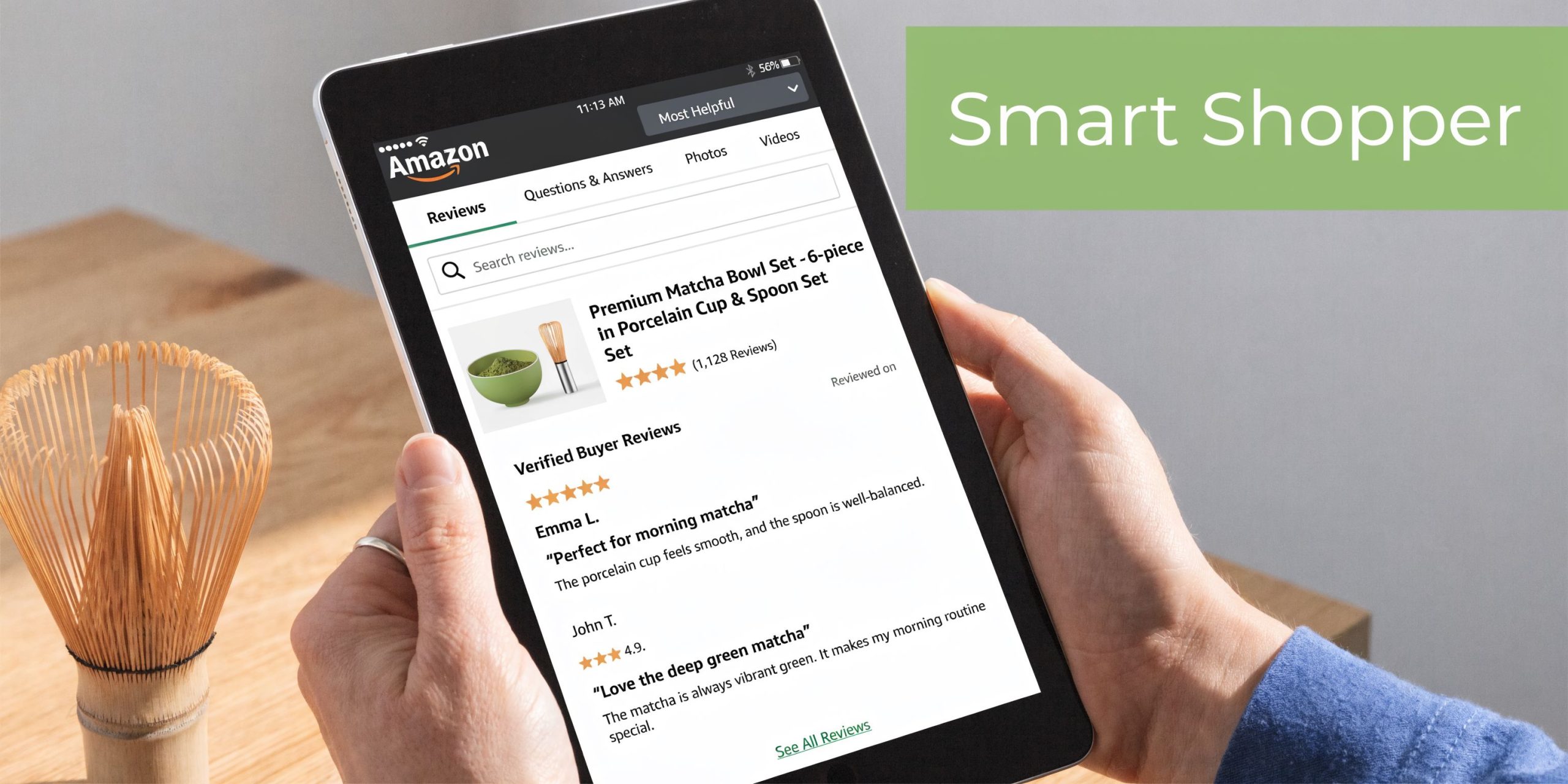
A good listing tells you what the set is made from, shows the pieces clearly, and gives you enough detail to judge whether the tools are functional. A weak listing leans on buzzwords like “premium” and “Japanese style” without saying much else.
Read reviews like a buyer, not a browser
Don’t stop at star ratings. Open the written reviews and search for the words whisk, crack, mould, splinter, ceramic, and packaging.
You are trying to answer practical questions:
- Did the whisk hold its shape after use
- Did the bowl arrive intact
- Did the glaze or ceramic feel solid
- Did buyers mention poor finishing or rough edges
A lot of marketplace regret comes from buying a lovely-looking set that performs badly.
Check the materials, then check what is missing
A strong listing usually names the bowl material and gives some indication of the whisk style. If the description is vague, that tells you something too.
There is also a safety angle many buyers miss. Analyses of Australian forums have found many discussions about greenwashing and the lack of local FSANZ compliance in imported sets, while some independent tests have shown imported ceramic and tea products can exceed safety limits for heavy metals. That concern is rarely addressed in Amazon reviews. This matters most when you are choosing the parts that touch hot water and the powder you consume.
Key takeaway: Buying the tools on a marketplace can be fine. Be more selective about the matcha itself and where it comes from.
Use a simple marketplace filter
When I help someone choose a first set, I suggest this quick filter:
- Look for clear component photos. You should be able to see the bowl shape, whisk profile, and whether a holder is included.
- Prefer functional descriptions. Specifics beat marketing language.
- Treat missing safety detail as a caution sign. Especially for ceramics and anything sold as “organic” without clear backing.
- Separate the tools from the tea. It often makes sense to buy the set from Amazon and buy the matcha from a trusted Australian supplier.
That final point is important. The set affects technique. The powder affects flavour, colour, aroma, and your overall experience. If you want the convenience of marketplaces but also want to think carefully about how online retail ecosystems differ, this broader comparison of Amazon vs Takealot offers useful context on how marketplace models shape product discovery.
If you’re browsing sets and want a dedicated starting point, this collection is a useful reference: https://peptea.com.au/tag/buy-matcha-set/
Your First Bowl How to Prepare Perfect Matcha at Home
You open the Amazon box, set the bowl on the bench, and suddenly the whole thing feels a little more real. The good news is that your first bowl does not need ceremony-level precision. It needs a few simple habits that help the tea taste clean, smooth, and fresh.
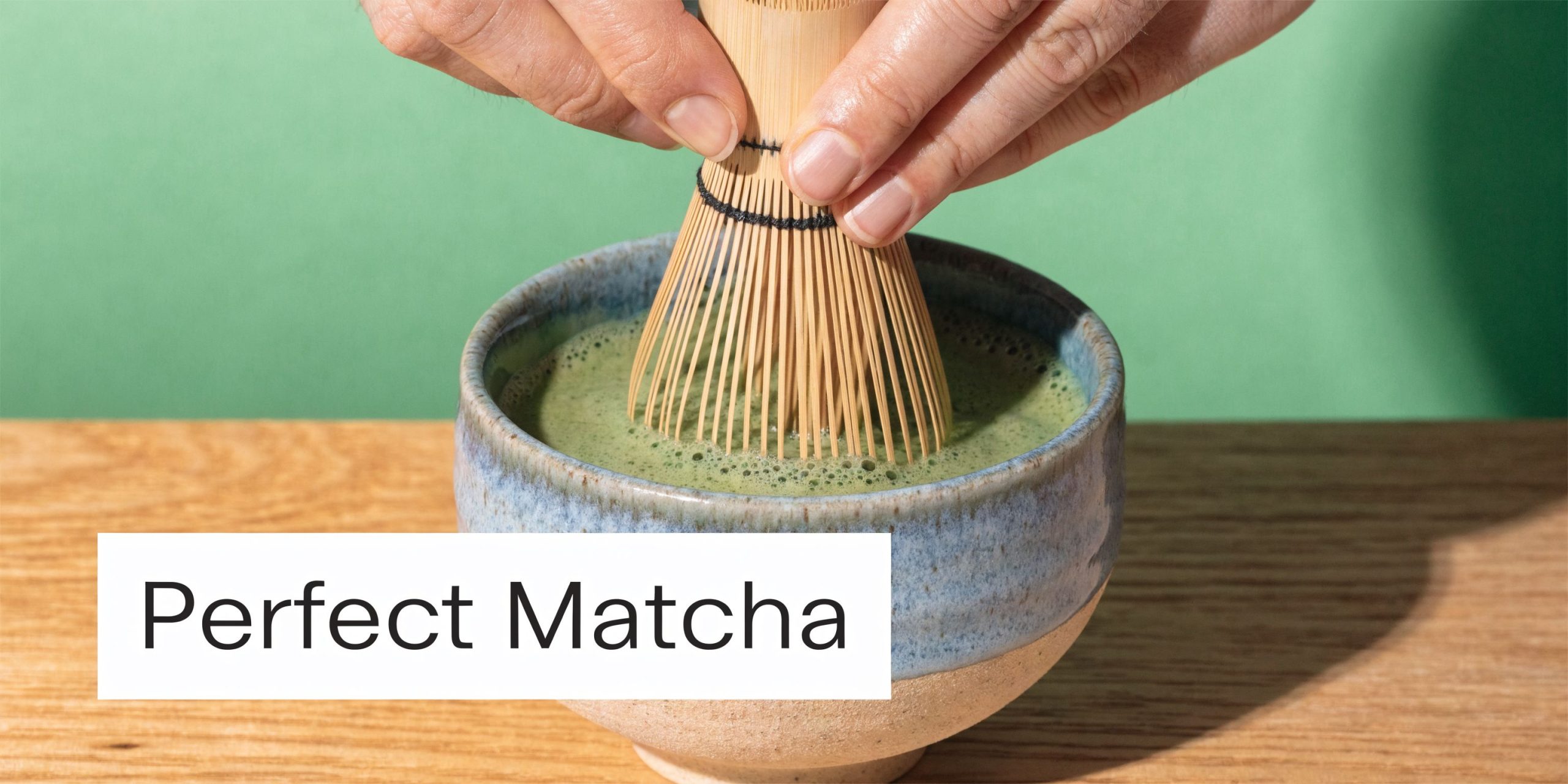
Start by setting up the bowl properly
Warm the bowl with a little hot water, then pour it out and dry the inside. This small step does two useful things. It takes the chill off the ceramic, and it gives you a dry surface for the powder so it does not stick in damp patches.
Then check your water. Matcha is delicate, so boiling water is too aggressive for most powders. Aim for water that is hot but not scorching, around 75 to 80°C. If the tea turns bitter or loses its sweetness, water temperature is often the first thing to correct.
Sift first, then build the bowl
Many first-time drinkers blame themselves when matcha turns lumpy. Usually the problem is much simpler. Powder naturally compresses in the tin, so sifting helps loosen it before whisking.
Here is an easy first-bowl method:
- Add a small amount of matcha to the bowl. Start modestly so you can learn the texture.
- Sift the powder. This breaks up clumps before water goes in.
- Pour in a small splash of hot water. You want enough to whisk, not a full bowl yet.
- Whisk with quick wrist movement. Let the whisk glide across the surface rather than press into the base.
- Add a little more water if needed. Adjust the strength to suit your taste.
That sequence matters. Sifting gives you a smoother starting point. A small amount of water helps the powder disperse evenly before you dilute it further.
Why the whisking motion matters
Circular stirring feels intuitive, but it tends to leave heavier bits sitting at the bottom. Matcha tastes better when the powder stays suspended through the liquid and a light foam forms on top.
Use quick, light strokes in a W or zigzag pattern for about 20 to 30 seconds. The motion works like shaking air into the tea while breaking up any last tiny clumps. If the whisk is scraping hard against the bowl, ease up. The tines should flex and skim, not grind.
If you want a clearer visual before making your first bowl, this guide on how to whisk matcha properly is a helpful companion.
Here’s a visual walkthrough for the home ritual:
Common beginner mistakes, and how to fix them
A disappointing first bowl usually comes down to one of a few simple issues.
- Water is too hot. The flavour turns sharper and less balanced.
- Powder was not sifted. Small clumps survive even energetic whisking.
- Too much water was added at the start. The matcha struggles to blend smoothly.
- The whisk was pushed down instead of moved across the surface. That makes whisking harder and can strain the bamboo.
- The powder itself is low grade or stale. Good technique helps, but it cannot create sweetness, colour, or aroma that is not there in the first place.
That last point is easy to miss on marketplaces. A beautifully photographed set can still produce an average bowl if the tea is dull. The tools shape the process. The matcha shapes the flavour, colour, and how satisfying the drink feels once it reaches your lips.
A simple matcha latte variation
Your set is useful for more than traditional usucha. It also gives you a much better base for a latte than dropping powder straight into milk.
Try it this way:
- Whisk matcha with a small amount of hot water until smooth
- Warm your milk separately
- Pour the milk over the whisked matcha
- Sweeten only if you want to
This works because water hydrates the powder first. Milk alone makes that harder, which is why café-style drinks often turn gritty when made without a bowl and whisk. If you want more tea character, use less milk. If you want a softer cup, add more.
Make the routine simple enough to repeat
A good bowl of matcha is smooth, lively, and pleasant to drink. It does not need to look perfect on day one.
The ritual is valuable because it slows you down for a minute. The tools are valuable because they make that minute easier. And the matcha powder matters most, because fresh organic tea is what gives you the bright colour, gentle sweetness, and clean finish you were hoping for when you bought the set.
Beyond the Bowl Creative Ways to Enjoy Your Matcha
Once you have a set on the bench, it tends to get used for more than one kind of drink. That’s a good thing. Matcha fits into everyday routines far more easily than many people expect.
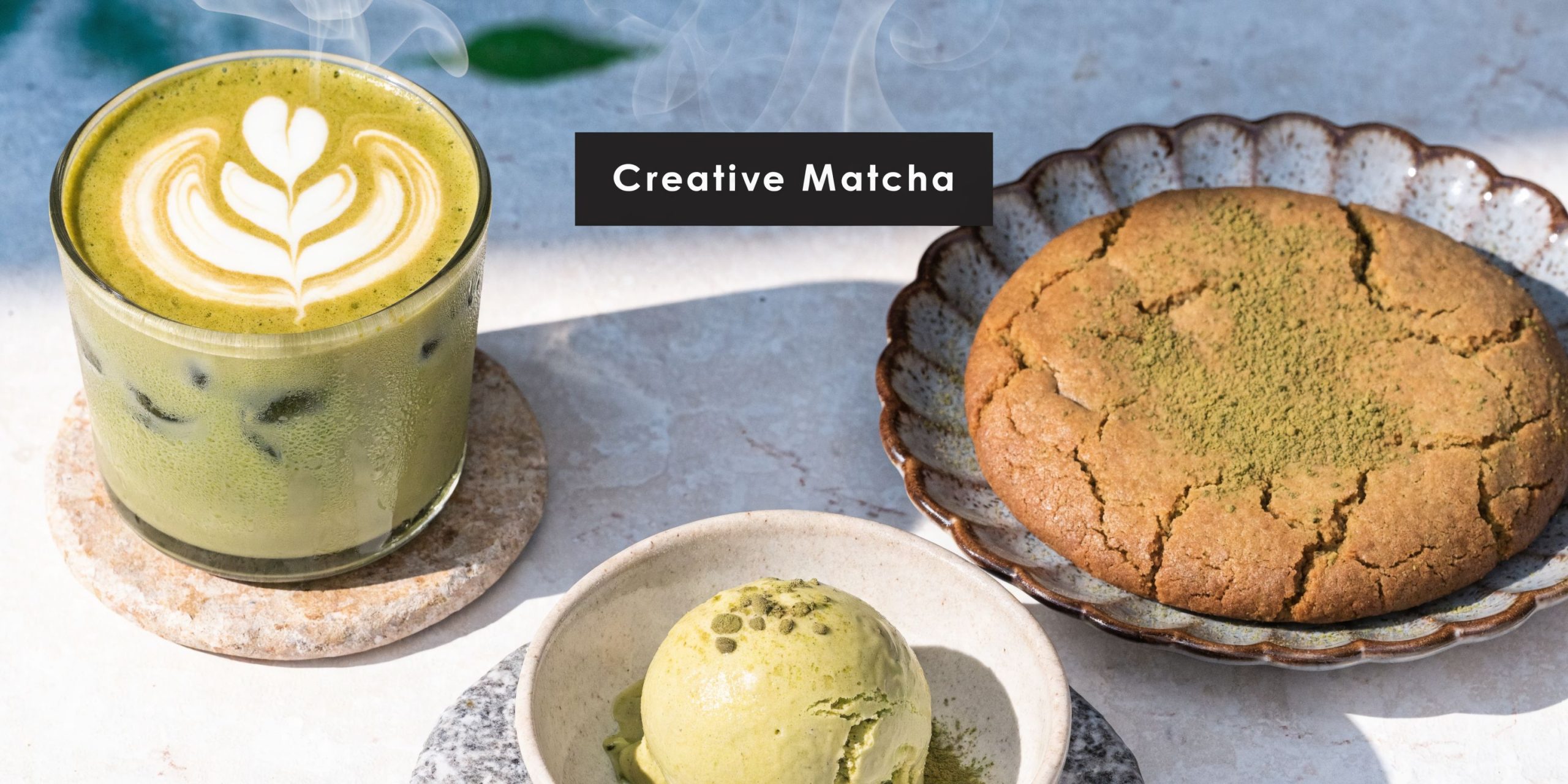
The quick morning option
Some mornings call for the full bowl-and-whisk ritual. Some do not.
On a busy weekday, whisk matcha with a little water in your bowl, then pour it into a glass bottle or travel cup with cold water and ice. Shake and go. You still get a smoother result than trying to stir powder into a bottle from scratch.
A few easy ways to use your kit
Your bowl and whisk are handy beyond plain tea:
- Breakfast smoothie. Whisk matcha with a splash of water first, then blend it with banana, yoghurt, and milk.
- Yoghurt topping. A light dusting adds colour and a gentle grassy note.
- Pre-gym drink. A short, concentrated bowl can slot into a morning routine when coffee feels too heavy.
- Iced latte. Build the smooth matcha base in the bowl, then pour over cold milk and ice.
For cooks, bakers, and the curious
Matcha also works beautifully in simple food ideas at home. Stir it into overnight oats, fold it into chia pudding, or use it in baking where you want colour and a fresh green tea note.
The reason many people stick with matcha once they start is not just taste. It’s flexibility. One tin can move from a quiet bowl in the morning to an afternoon iced latte to a weekend baking project.
Tip: If you’re using matcha in recipes, whisk it with a small amount of liquid first. That gives you a smoother mix and better colour.
A dedicated culinary-style powder is usually the practical choice for recipes because it lets you use matcha more freely in lattes, smoothies, and baking without feeling like every spoonful should be reserved for ceremonial drinking.
Caring for Your Set to Ensure a Lifetime of Tea
A matcha set is easy to care for if you do the small things straight after use.
Look after the whisk first
Rinse the chasen with water as soon as you finish whisking. Don’t use soap. Don’t scrub the tines. Don’t leave dried matcha sitting in the bamboo.
Shake off excess water gently, then place the whisk on its holder to dry. That helps the prongs keep their shape and reduces the chance of mould from trapped moisture.
Keep the bowl simple
The chawan usually only needs warm water and a soft wash. If it has a handcrafted glaze, treat it with the same care you’d give any favourite ceramic bowl. Avoid knocking the rim with the whisk handle or stacking it carelessly in a crowded cupboard.
Build a two-minute habit
The easiest maintenance routine is this:
- Rinse immediately so matcha doesn’t dry onto the bamboo
- Air dry fully before storing
- Use the holder for the whisk rather than laying it flat in a drawer
- Store carefully where the bowl won’t chip
A well-kept set feels better to use, and that matters. Tea habits last when the process stays easy.
Common Questions About Buying and Using Matcha Sets
Is an expensive set worth it
Sometimes yes, often no. Price alone does not guarantee a better bowl. Focus on material quality, bowl shape, and whisk construction rather than luxury packaging or extra pieces you won’t use.
Can I use an electric milk frother instead of a bamboo whisk
You can, especially for lattes. But it creates a different texture. A bamboo whisk gives you finer control and a more even foam in a traditional bowl. A frother is a shortcut, not a full substitute.
What’s the difference between ceremonial and culinary matcha
In simple terms, ceremonial styles are usually chosen for drinking with water, while culinary styles are commonly used in lattes, smoothies, and recipes. The best choice depends on how you plan to use your set day to day.
Are Amazon sets durable enough for a small café
Usually for light use, not always for service speed. Some industry reports indicate that café owners cite frother breakage in high-volume prep as a common issue with consumer-grade sets. Home-use Amazon kits can be great for personal routines, but cafés often need sturdier tools and replaceable parts. If you’re setting up a menu rather than a kitchen shelf, think commercial durability first.
If you’re ready to move from browsing to better brewing, explore Pep Tea for premium organic matcha and practical guidance for home drinkers, cafés, and anyone building a healthier tea ritual in Australia.