
Tag: Kombucha Cocktails
Non Alcoholic Cocktail Mixers: Your Guide to Flavour
The most common advice about mocktails is also the least helpful. It tells you to swap alcohol for more juice, more syrup, or a bottled “spirit alternative”, then hope the drink still feels grown-up.
That's usually why so many alcohol-free drinks disappoint. They're sweet, loud, and flat in the middle. They taste like a soft drink pretending to be a cocktail.
A better approach starts with non alcoholic cocktail mixers as flavour-building tools, not shortcuts. Think tea for tannin, kombucha for acidity and light fizz, verjus for structure, shrubs for brightness, and saline for lift. Once you understand what each mixer does, you stop chasing imitation and start making drinks that are balanced on their own terms.
Beyond the Mocktail The New Era of Non Alcoholic Drinks
The word “mocktail” still makes some people think of orange juice, grenadine, and a mint sprig. That old model doesn't fit how people drink now.
Many guests aren't avoiding alcohol because they want a childish substitute. They want a drink that suits lunch service, a work night, training goals, medication, moderation, or preference. The drink still needs ritual, complexity, and a sense of occasion.
That shift is no longer niche. Global consumer reporting highlighted a 58% increase in consumption of low- and no-alcohol cocktails in 2022, a strong sign that moderation has moved into the mainstream, not the margins, as noted in MDRG's zero-proof cocktail trend coverage.
Why the old juice-first model falls short
A cocktail earns its place through tension. It has brightness, restraint, aroma, and structure. When a non-alcoholic version leans only on fruit juice or sugary cordial, it loses that tension.
That's where confusion starts for both home drink makers and cafés. People think the missing ingredient is alcohol. Often, the missing pieces are:
- Acidity: Something to sharpen the palate
- Bitterness or tannin: Something to stop the drink feeling soft and childish
- Texture: Carbonation, body, or grip
- Aroma: Herbs, zest, tea, spice, florals
- Length: A finish that lingers after the first sip
Non-alcoholic drinks work best when they're designed like culinary beverages, not watered-down cocktails.
Why this matters in Australia
Australian cafés, bars, and retailers are serving a customer who's increasingly comfortable ordering alcohol-free drinks without apology. That changes menu design. A lemon-lime soda might still have a place, but it won't carry a premium menu section on its own.
A stronger list includes drinks with clear identity. A sparkling tea highball. A kombucha spritz with herbs. A verjus and citrus cooler with saline. If you're exploring broader ideas for mindful drinking, Pep Tea's guide to healthy non-alcoholic drinks in Australia is a useful companion read.
A new standard for the category
The primary upgrade is mental. Stop asking, “What can replace gin?” Start asking, “What gives this drink lift, grip, aroma, and balance?”
That's the modern alcohol-free menu. Not imitation. Intention.
What Are Non Alcoholic Cocktail Mixers Really
Hearing “mixer” often brings to mind tonic, soda, or lemonade. In modern drinks, that definition is far too narrow.
Non alcoholic cocktail mixers are any ingredients that help build a complete drink. Some provide body. Some bring acid. Some create bitterness, fizz, spice, or aroma. A good mixer doesn't just fill the glass. It gives the drink shape.
Mixer doesn't mean sweet
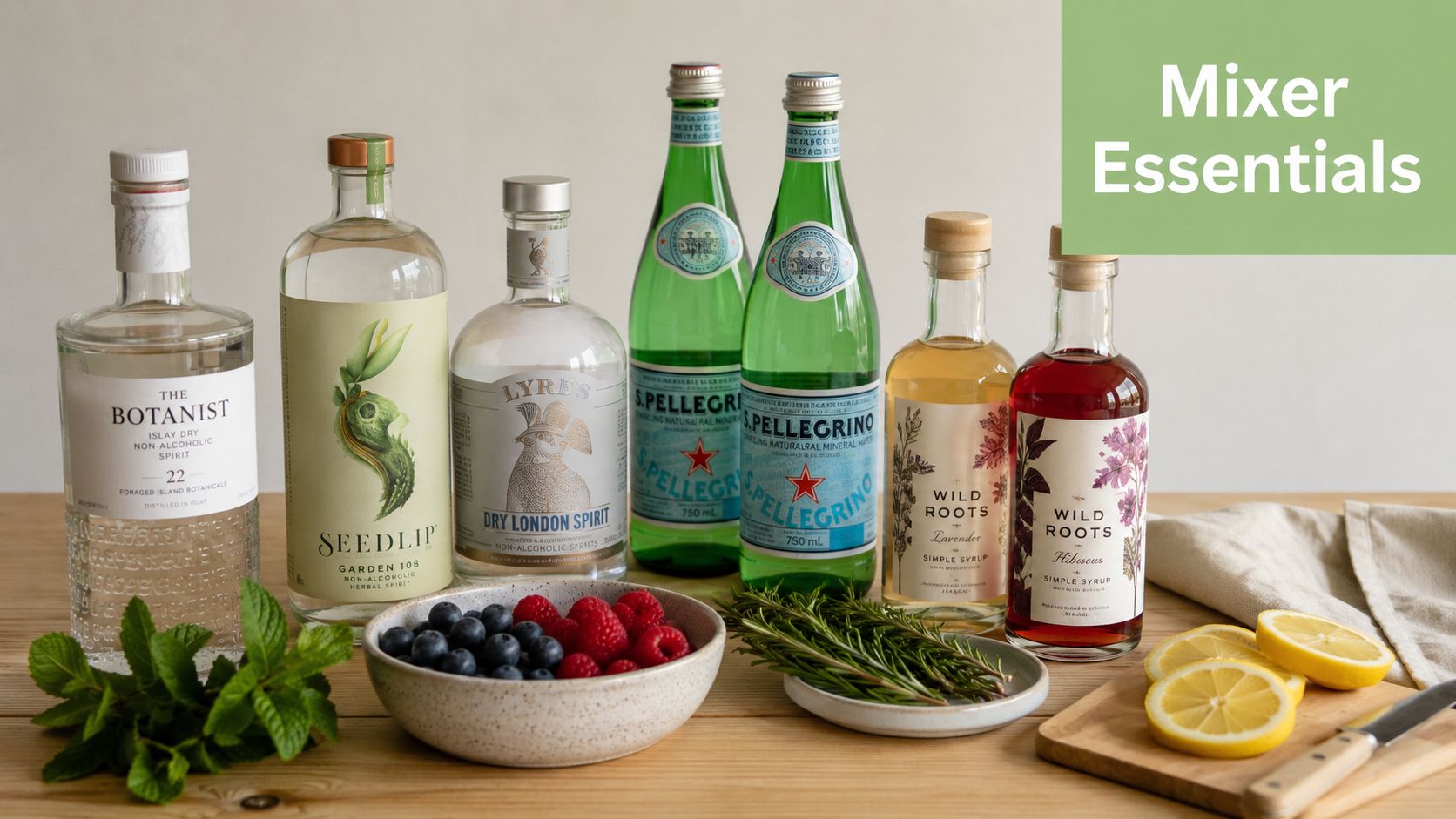
Many readers find the definition of a mixer confusing. A mixer can be tart, bitter, dry, savoury, or neutral. Sparkling water is a mixer. Brewed tea can be a mixer. Kombucha can be a mixer. A shrub can be a mixer. Even a few drops of saline count, because they change flavour perception.
That broader definition matters because alcohol-free drinks don't have ethanol doing the heavy lifting. Without alcohol, you need to build flavour from several directions at once.
The category is bigger than many people realise
This isn't a fringe shelf in the drinks fridge. Australia's non-alcoholic beverage revenue was forecast at USD 13.8 billion in 2023, which shows how commercially relevant this broader category has become for premium alcohol-free ingredients, according to Market.us reporting on Australia's non-alcoholic beverage market.
That scale matters for hospitality. It means customers are already shopping and drinking in this wider space. They understand sparkling botanical drinks, tea-based refreshers, and functional beverages. A good non-alcoholic mixer fits naturally into that behaviour.
A more useful definition
If you work in a café, restaurant, or bar, this practical definition helps:
Working definition: A non-alcoholic cocktail mixer is any ingredient used to add structure, balance, length, or sensory interest to an alcohol-free drink.
That includes ingredients with very different jobs:
- Base builders: Tea, kombucha, juice, coffee, botanical infusions
- Brightness tools: Citrus, verjus, shrubs
- Texture builders: Carbonated water, tonic, foaming ingredients
- Balancing agents: Syrups, honey, saline
- Aromatic finishers: Herbs, spices, zests, floral accents
Once you think in functions, the category gets much easier to use. You're no longer choosing between “healthy” and “tasty”, or between “simple” and “premium”. You're assembling a drink with purpose.
The Building Blocks A Typology of Modern Mixers
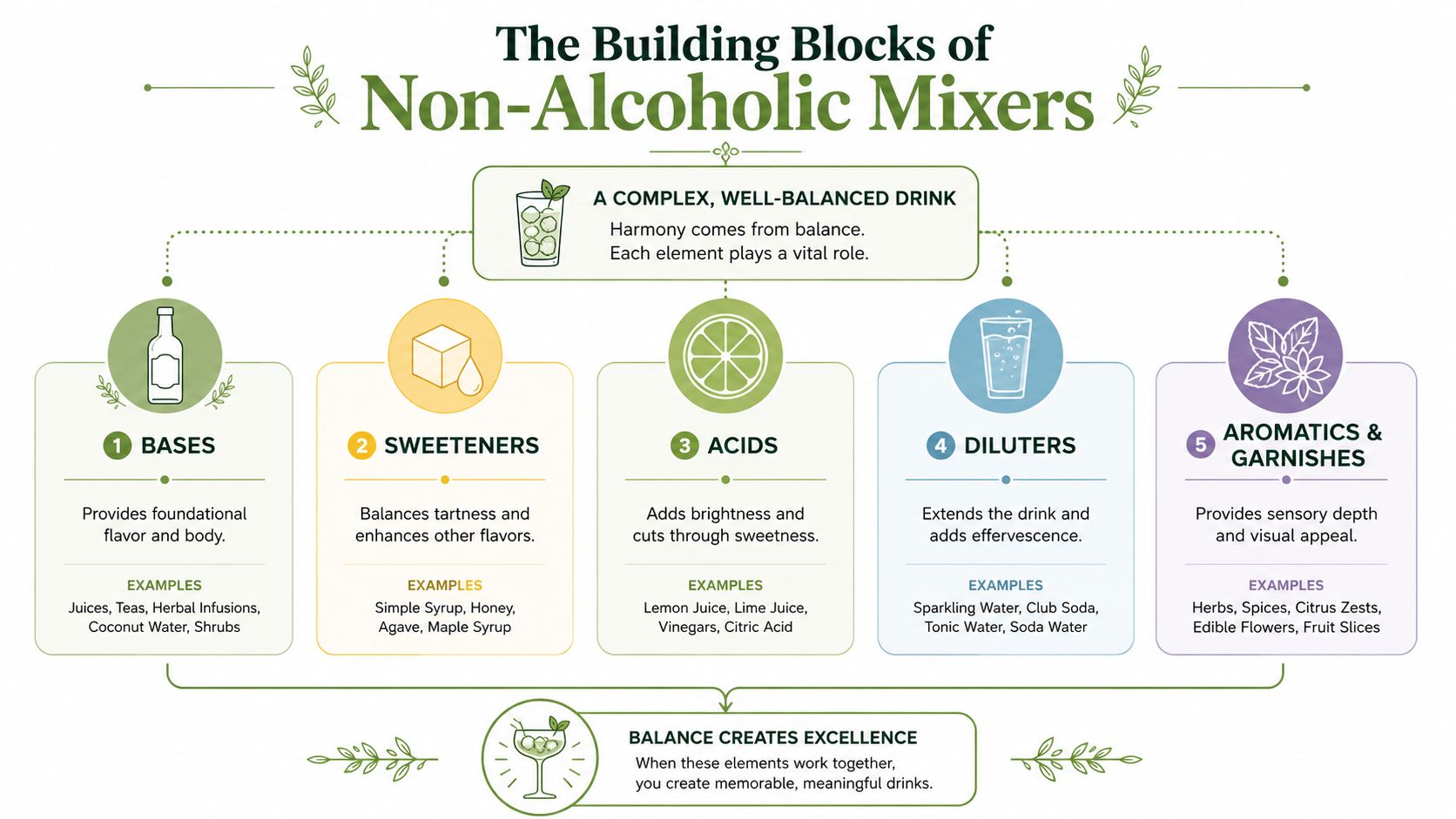
The easiest way to understand modern mixers is to group them by job. One ingredient can do more than one job, but every strong drink needs each role considered.
Start with the base
The base is the main liquid and the first thing the palate notices. If the base is thin or sugary, the whole drink struggles.
Tea is one of the most underrated bases because it brings tannin, aroma, and a dry finish. Green tea can feel grassy and lifted. Black tea can feel fuller and more grounded. Matcha works differently again. It gives colour, gentle bitterness, and a creamy, suspended texture when whisked properly.
Kombucha is another versatile base. It can contribute acidity, light funk, natural complexity, and often some carbonation. It works especially well when you want a drink to feel lively without adding lots of sweetener.
Then balance with sweeteners and acids
A common mistake is treating sweetness as the centre of the drink. It's usually better to treat sweetness as a control knob.
Use sweet elements to round edges, not dominate the profile. That could be a small pour of simple syrup, honey, fruit reduction, or a naturally sweeter ingredient paired with drier components.
Acid does the opposite job. It gives snap and keeps the drink from dragging. Citrus is the obvious tool, but not the only one. Verjus and shrubs often create a more layered result because they brighten the drink without pushing it fully into lemonade territory.
Diluters and aromatics finish the drink
Once the core balance is right, diluters open the drink up. Soda water, mineral water, tonic, and ginger beer all change the final impression. Some subtly lengthen flavour. Others bring bitterness, spice, or bubbles.
Aromatics complete the experience before the first sip even lands. Citrus peel, rosemary, mint, basil, cracked spice, and floral accents can make a simple build feel polished and intentional.
Practical rule: If a drink tastes fine but still feels boring, the missing element is often aroma or texture, not more sugar.
Functional categories at a glance
| Mixer Category | Primary Function | Examples |
|---|---|---|
| Bases | Provide foundational flavour and body | Tea, kombucha, juice, coffee, botanical infusions |
| Sweeteners | Soften sharp edges and add roundness | Simple syrup, honey, fruit reduction |
| Acids | Add brightness and structure | Citrus, verjus, shrubs |
| Diluters | Extend the drink and influence mouthfeel | Soda water, tonic, mineral water, ginger beer |
| Aromatics and garnishes | Add nose, freshness, and visual appeal | Mint, rosemary, citrus peel, spices |
Why lower-sugar formats matter
This category also matters because many drinkers don't want every alcohol-free option to be syrup-led. The Australian Bureau of Statistics reported that 47.8% of adults consumed sugar-sweetened beverages on the day before interview in 2022, which underlines the opportunity for lower-sugar drink formats built on ingredients like tea and kombucha, as discussed in this article on non-alcoholic mixers and lower-sugar options.
For venues, that opens a practical lane. You can build drinks that feel premium without defaulting to heavy sweetness. If your menu already includes spiced sodas or adult soft drinks, it's also worth reviewing broader low-sugar mixer thinking, including guides such as Pep Tea's take on no sugar ginger beer options.
The Art of Flavour Architecture in Non Alcoholic Drinks
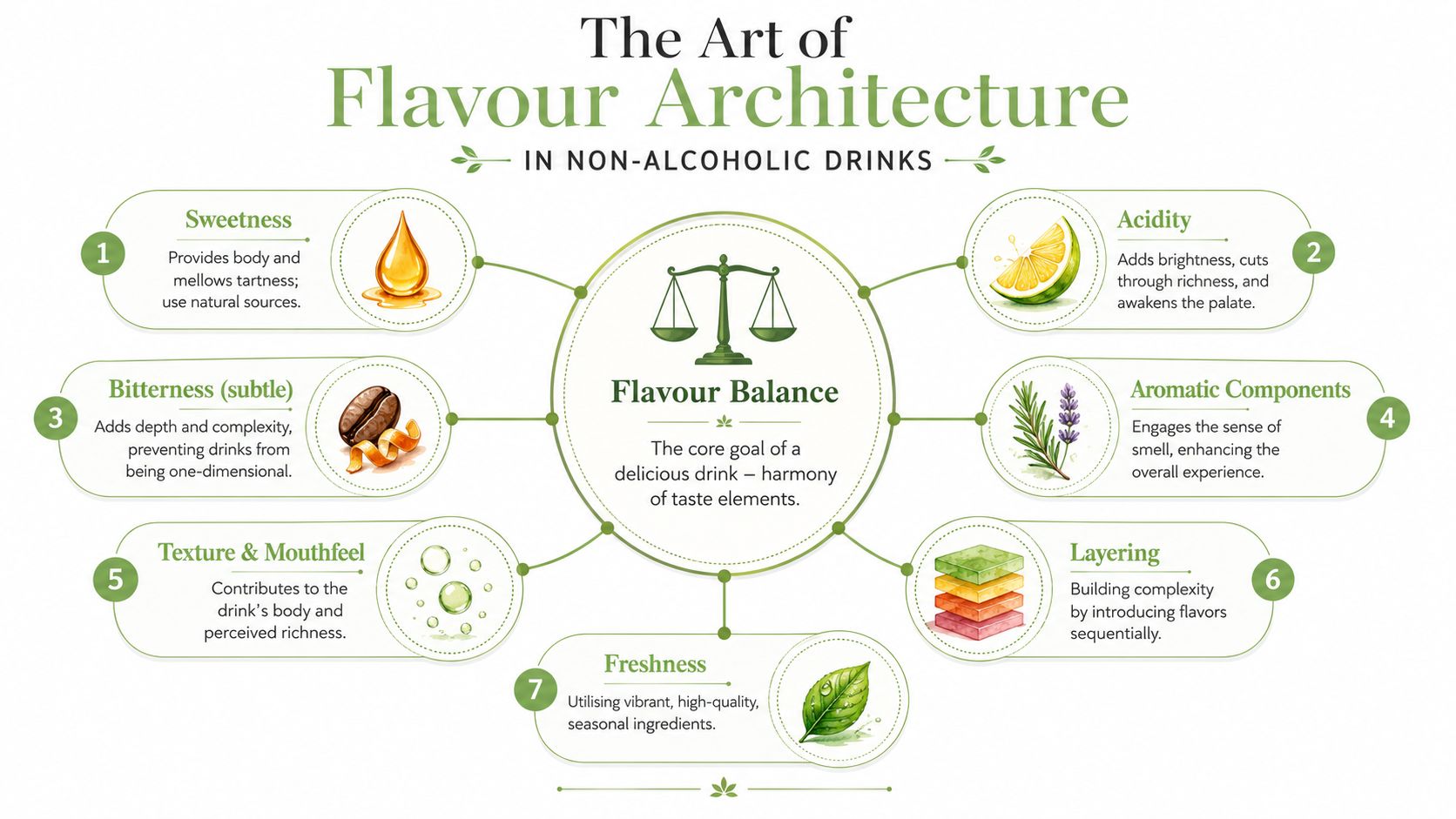
A good alcohol-free drink isn't a random mix of nice ingredients. It has structure. I think of that structure as flavour architecture.
If a drink tastes one-dimensional, the problem usually isn't the recipe length. It's that one of the core pillars is missing.
Acid gives the drink direction
Acidity is what makes a drink feel awake. It sharpens fruit, lifts botanicals, and stops sweetness from turning sticky.
Citrus is the most familiar source, but it can be blunt if overused. Verjus is softer. Shrubs add both acid and savoury complexity. Kombucha often gives a gentler, more integrated acidity that works well in spritz-style serves.
If your drink tastes dull, add a little acid before you add anything sweet.
Sweetness should support, not lead
In non-alcoholic drinks, sweetness is often over-applied because people are trying to compensate for missing alcohol. That usually backfires.
A small amount of sweetness can make the whole drink taste more complete. Too much and every other note disappears. If you're using fruit, sweet tea, or kombucha, taste first. You may need much less added sugar than expected.
Bitterness and tannin create an adult profile
This is the piece that many home recipes ignore. Without bitterness, tannin, or some kind of grip, a drink can feel soft and juvenile.
Tea is excellent here. Black tea offers backbone. Green tea brings freshness and a firmer line. Matcha adds gentle bitterness and a savoury edge. Citrus zest, bitter leaves, and some botanical non-alcoholic bitters can also help.
A drink doesn't need to be bitter. It needs just enough resistance to stay interesting.
Texture changes how quality is perceived
Texture is easy to miss because people don't always have language for it. But they notice it immediately.
Fine bubbles can make a drink feel elegant. A whisked tea can feel creamy. Crushed ice creates looseness and refreshment. A still drink with no body often feels unfinished, even when the flavour is good.
When you're designing a serve, ask: should this drink feel crisp, plush, frothy, sparkling, or lean?
Aroma finishes the job
Aromatic ingredients tell the brain what to expect before the drink even touches the lips. That's why garnish isn't just decoration.
Mint gives lift. Citrus oils add freshness and bitterness together. Rosemary can feel resinous and dry. Fresh basil can push a drink into a more savoury, food-friendly direction.
A strong aromatic choice also helps alcohol-free drinks hold attention at the table. They smell intentional.
The small saline trick that changes everything
One of the most useful professional techniques is saline. A 20% saline solution, made with 20 g salt to 80 g water, can be added in very small doses because sodium suppresses bitterness, boosts perceived citrus brightness, and can heighten carbonation perception, as explained in All The Bitter's guide to non-alcoholic cocktail program design.
That sounds technical, but the use is simple. If a drink tastes harsh, thin, or oddly flat, a tiny amount of saline can make it feel more connected without adding sugar.
A practical tasting sequence
When building a drink, don't adjust everything at once. Taste in order.
- Check brightness first: Does it need acid?
- Check shape next: Does it need bitterness, tannin, or savoury lift?
- Check body: Does it need fizz, dilution, or texture?
- Check sweetness last: Add only enough to balance
- Finish with aroma: Herbs, zest, spice, or floral note
For readers who want to see how these ideas translate into alcohol-free serves with a more cocktail-style presentation, Pep Tea's guide to kombucha cocktails offers useful inspiration.
Simple Recipes and Proportions for Success
Recipes are helpful, but rigid formulas can make people nervous. Templates work better. They teach you how to think, not just what to pour.
Start with a glass, good ice, and one clear flavour idea. Then build around that idea.
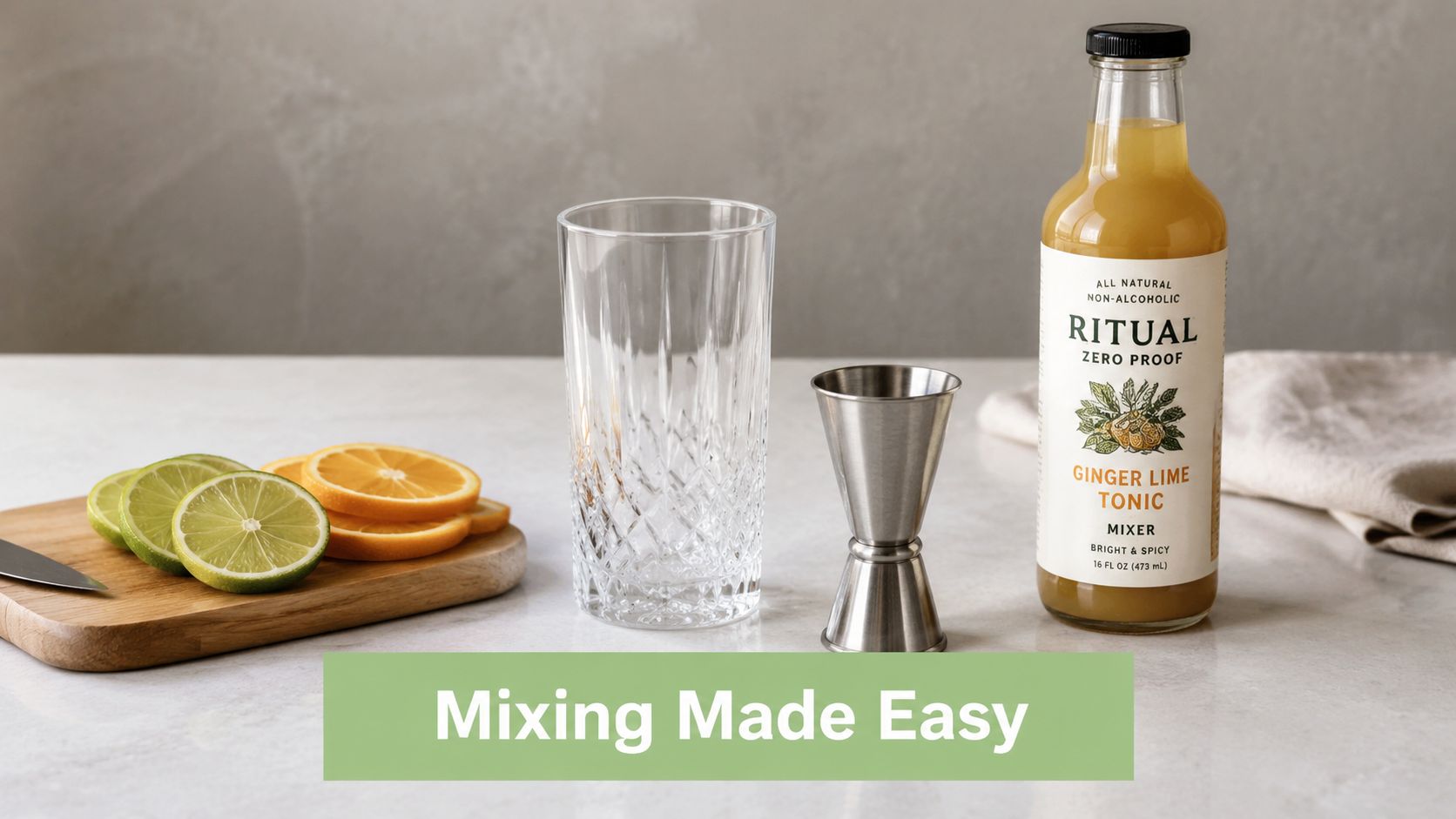
The tea spritz template
Use this when you want something dry, bright, and lunch-friendly.
- 2 parts brewed and chilled tea
- 1 part acid element such as citrus or verjus
- 1 small part sweetener if needed
- Top with sparkling water
- Finish with a fragrant garnish
Example: chilled green tea, a squeeze of lime, a touch of honey, soda, and mint.
If it tastes too sharp, soften it slightly. If it tastes too soft, add zest or a more tannic tea.
The kombucha highball template
This works when you want complexity with minimal prep.
- 2 parts kombucha
- 1 part lengthener or secondary base such as chilled tea or soda
- Aromatic accent like cucumber, ginger, rosemary, or basil
- Optional saline drop if the finish feels muddled
Example: ginger kombucha, chilled soda, cucumber ribbon, and lime peel.
The kombucha carries acid and character, so the rest of the build can stay restrained.
Service note: Keep garnishes tight and relevant. One strong aromatic usually works better than three competing ones.
The no-syrup sour-style template
This is useful for readers trying to avoid sugar-heavy drinks.
Use ingredients with natural structure instead of relying on lots of syrup. Pair strong acid with tannin, then add texture.
- 1 part sharp element such as lemon or verjus
- 2 parts structured base such as black tea or kombucha
- A small balancing touch from fruit, honey, or a naturally round ingredient
- Optional foam or shake for body
Example: black tea, verjus, a little muddled pear, shaken hard and served cold.
The result feels closer to a proper mixed drink than a cordial.
A quick visual demo can help if you prefer watching technique over reading ratios.
A simple way to test your own build
If you're inventing drinks at home or for a menu, run this short check before serving:
- Too sweet: Add acid, bitterness, or dilution
- Too sharp: Add a touch of sweetness or fuller base
- Too boring: Add aroma or a tannic element
- Too busy: Remove one flavour and let the base speak
- Too flat: Add carbonation or a tiny saline adjustment
That process is far more reliable than chasing a “perfect” bottle of mixer.
Sourcing and Menu Tips for Australian Cafés and Retailers
For cafés and retailers, the opportunity isn't just stocking one alcohol-free option. It's building a section that feels deliberate enough to order without apology.
That starts with naming and description. “Mocktail” can work, but many venues now get better results from language like sparkling tea, botanical spritz, or zero-proof highball. Those terms signal flavour and format, not compromise.
What to look for in a supplier
Choose mixers and bases that answer practical service questions, not just branding questions.
- Consistency: Can staff produce the same drink across a busy service?
- Clarity of flavour: Does the product still taste distinct once chilled, diluted, or poured over ice?
- Operational fit: Does it suit by-the-glass service, batching, and menu rotation?
- Handling guidance: Are refrigeration, shelf life, sediment, and service notes clearly explained?
This matters especially with live fermented products. Kombucha can be excellent in a menu program, but venues need to understand storage, temperature control, and in-service behaviour. Those handling details are not minor, particularly when food safety matters. The Australian Food Safety Information Council reports that foodborne illness affects an estimated 4.1 million Australians each year, which is why consistent handling of fermented and low-alcohol products deserves real attention, as noted in this discussion of non-alcoholic mixers, live products, and venue operations.
Write the menu for real guests
A strong alcohol-free menu usually does three things well:
It signals flavour clearly
“Green tea, yuzu, soda” is easier to trust than a vague fantasy name.It gives drinks a proper format
Serve in highballs, wine glasses, coupes, or tumblers that match the style.It trains staff to explain the drink in one sentence
Guests buy with confidence when the explanation is simple and specific.
If staff can't describe where the structure comes from, the drink probably isn't ready for the menu.
Think beyond the bottle
For venues serving brunch, events, or large-format refreshment, batching matters. You need to know how a drink holds, whether carbonation fades, and what happens to fresh garnishes over time. If you're exploring service hardware for larger pours or self-serve formats, Modern Lyfe's beverage dispenser guide is a practical reference for setup considerations.
The best Australian menus in this space don't treat non-alcoholic drinks as an afterthought. They treat them like a category with its own logic, margins, and standards.
If you're building a better alcohol-free drinks menu at home or in a venue, Pep Tea is worth exploring for premium organic Matcha and Australian-brewed sugar-free organic kombucha. They're especially useful if you want low-sugar, flavour-led ingredients that fit modern café service as well as everyday drinking.
Kombucha cocktails – make kombucha your go to alcohol mixer
Not only is kombucha the ideal alternative to fizzy sodas (which can be sugar-laden, chemical-laden, or both) but it makes the perfect mixer for alcoholic drinks. Serve it straight up with a shot or two of something simple or get creative with an endless array of kombucha cocktails.
Adding alcohol to kombucha
As a fermented product all kombucha can contain trace amounts of alcohol. Pep Tea does not make it, but Hard kombucha, whether store bought or homemade, is brewed so that the alcohol content is higher (up to 7.6%). So it can be enjoyed in a way similar to beer, wine or cider. Hard kombucha is sold as an alcoholic drink, and will always be labelled as such.
Another way to add alcohol to normal kombucha is to use it as a mixer, in place of soft drinks. The sharp, yet slightly sweet, tangy flavours and fermented fizz, make it the ideal companion to alcohol. Added to gin in place of tonic, or to wine for a cooling spritzer, the flavours of kombucha are really suited for purpose.
When it comes to getting creative with mixology, kombucha cocktails open up new avenues of possibility.
Kombucha cocktail recipes
Lime and ginger kombucha mojito

4 x mint leaves
1 measure fresh lime juice
1 measure white rum
3 measures lime and ginger kombucha
- Add the mint leaves to the glass with the lime juice and a teaspoon of sugar if you wish. Press the mint leaves into the juice to release the flavours (a process known as muddling).
- Add ice cubes.
- Pour over the rum and then the kombucha.
- Add more kombucha if you want a longer drink.
Lemon balm leaves make a nice alternative to mint.
Apple and pomegranate booch sangria
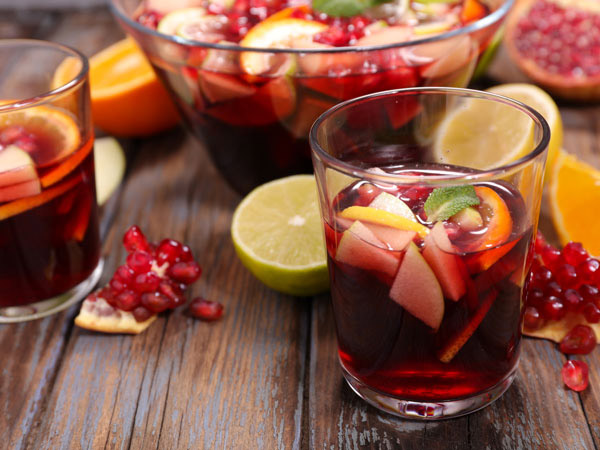
1 bottle light red wine
2 bottles apple and pomegranate kombucha
1/2 cup brandy
1/4 cup honey
2 apples, cut into chunks
2 pomegranates, cut into chunks
1 orange, cut into chunks
- Stir all of the ingredients together in a large jug or punch bowl.
- Stand for at least 4 hours before serving.
Ginger kombucha hot toddy
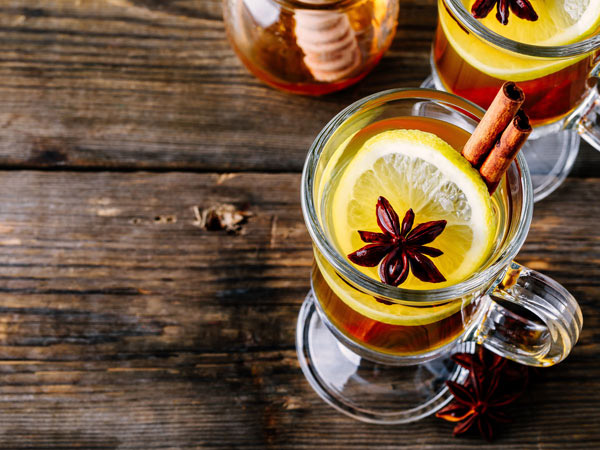
1 measure whisky
3/4 cup ginger kombucha
2 tsp honey
Juice of 1/2 lemon
1 cinnamon stick
1 star anise
- Heat everything together in a pan until just before boiling point.
- Tip everything into a glass and sip as soon as it is bearable.
Mango mimosa kombucha cocktail

sparkling wine
mango kombucha
fresh mango juice
- Combine equal measure of all ingredients.
- Serve chilled.
All of our raw organic kombucha is sugar free and comes in a range of fabulous flavours. You can also find more gourmet groceries at our online wholesale superstore.
Delicious Kombucha Cocktails can be fruity and Non-Alcoholic
Pep Tea’s effervescent Kombucha is organic and naturally flavored so they make perfect healthy non-alcoholic fruity cocktails, that are really good for you.
So make your Cocktail with an effervescent Kombucha from Pep Tea Australia.
Apple Pomegranate is a great fruity flavor for red cocktails.
If you prefer an alcoholic version like a Moscow Mule you will find our kombucha is a perfect drinks mixer.

Now you can buy kombucha in bulk online in Australia from $1.80 for Australia’s best Kombucha s featured om ABC’s Landline,